

VOTING POWER100.00%
DOWNVOTE POWER100.00%
RESOURCE CREDITS100.00%
REPUTATION PROGRESS0.00%
Net Worth
0.000USD
STEEM
0.000STEEM
SBD
0.000SBD
Effective Power
1.201SP
├── Own SP
0.000SP
└── Incoming DelegationsDeleg
+1.201SP
Detailed Balance
| STEEM | ||
| balance | 0.000STEEM | STEEM |
| market_balance | 0.000STEEM | STEEM |
| savings_balance | 0.000STEEM | STEEM |
| reward_steem_balance | 0.000STEEM | STEEM |
| STEEM POWER | ||
| Own SP | 0.000SP | SP |
| Delegated Out | 0.000SP | SP |
| Delegation In | 1.201SP | SP |
| Effective Power | 1.201SP | SP |
| Reward SP (pending) | 0.000SP | SP |
| SBD | ||
| sbd_balance | 0.000SBD | SBD |
| sbd_conversions | 0.000SBD | SBD |
| sbd_market_balance | 0.000SBD | SBD |
| savings_sbd_balance | 0.000SBD | SBD |
| reward_sbd_balance | 0.000SBD | SBD |
{
  "balance": "0.000 STEEM",
  "savings_balance": "0.000 STEEM",
  "reward_steem_balance": "0.000 STEEM",
  "vesting_shares": "0.000000 VESTS",
  "delegated_vesting_shares": "0.000000 VESTS",
  "received_vesting_shares": "1953.311140 VESTS",
  "sbd_balance": "0.000 SBD",
  "savings_sbd_balance": "0.000 SBD",
  "reward_sbd_balance": "0.000 SBD",
  "conversions": []
}
Account Info
| name | salinasalejandra |
| id | 1352548 |
| rank | 1,489,787 |
| reputation | 604917 |
| created | 2020-01-03T10:58:18 |
| recovery_account | steem |
| proxy | None |
| post_count | 2 |
| comment_count | 0 |
| lifetime_vote_count | 0 |
| witnesses_voted_for | 0 |
| last_post | 2020-01-23T22:13:48 |
| last_root_post | 2020-01-23T22:13:48 |
| last_vote_time | 1970-01-01T00:00:00 |
| proxied_vsf_votes | 0, 0, 0, 0 |
| can_vote | 1 |
| voting_power | 0 |
| delayed_votes | 0 |
| balance | 0.000 STEEM |
| savings_balance | 0.000 STEEM |
| sbd_balance | 0.000 SBD |
| savings_sbd_balance | 0.000 SBD |
| vesting_shares | 0.000000 VESTS |
| delegated_vesting_shares | 0.000000 VESTS |
| received_vesting_shares | 1953.311140 VESTS |
| reward_vesting_balance | 0.000000 VESTS |
| vesting_balance | 0.000 STEEM |
| vesting_withdraw_rate | 0.000000 VESTS |
| next_vesting_withdrawal | 1969-12-31T23:59:59 |
| withdrawn | 0 |
| to_withdraw | 0 |
| withdraw_routes | 0 |
| savings_withdraw_requests | 0 |
| last_account_recovery | 1970-01-01T00:00:00 |
| reset_account | null |
| last_owner_update | 2020-01-03T11:08:39 |
| last_account_update | 2020-01-03T11:08:39 |
| mined | No |
| sbd_seconds | 0 |
| sbd_last_interest_payment | 1970-01-01T00:00:00 |
| savings_sbd_last_interest_payment | 1970-01-01T00:00:00 |
{
  "id": 1352548,
  "name": "salinasalejandra",
  "owner": {
    "weight_threshold": 1,
    "account_auths": [],
    "key_auths": [
      [
        "STM8Dmy5GoFmLtwHZD4KvFhtaotSbRss2As9fg3d7pmJNV8k4oddL",
        1
      ]
    ]
  },
  "active": {
    "weight_threshold": 1,
    "account_auths": [],
    "key_auths": [
      [
        "STM77t2YGAEYLYxzRaMYrdyXBGJmRXdL6Qps7gN7ec3iGWN9kcmvs",
        1
      ]
    ]
  },
  "posting": {
    "weight_threshold": 1,
    "account_auths": [],
    "key_auths": [
      [
        "STM8C2KVs8WYhkKwHgabeGkz7kjnKiFmhSi5m5MKc5Npk2VyeJZEH",
        1
      ]
    ]
  },
  "memo_key": "STM6UotSeAHJGGNCdrnQXwUWinXQW3WDb7VpB1tTgTyJFaEq1RLeQ",
  "json_metadata": "{}",
  "posting_json_metadata": "",
  "proxy": "",
  "last_owner_update": "2020-01-03T11:08:39",
  "last_account_update": "2020-01-03T11:08:39",
  "created": "2020-01-03T10:58:18",
  "mined": false,
  "recovery_account": "steem",
  "last_account_recovery": "1970-01-01T00:00:00",
  "reset_account": "null",
  "comment_count": 0,
  "lifetime_vote_count": 0,
  "post_count": 2,
  "can_vote": true,
  "voting_manabar": {
    "current_mana": 1953311140,
    "last_update_time": 1588950972
  },
  "downvote_manabar": {
    "current_mana": 488327785,
    "last_update_time": 1588950972
  },
  "voting_power": 0,
  "balance": "0.000 STEEM",
  "savings_balance": "0.000 STEEM",
  "sbd_balance": "0.000 SBD",
  "sbd_seconds": "0",
  "sbd_seconds_last_update": "1970-01-01T00:00:00",
  "sbd_last_interest_payment": "1970-01-01T00:00:00",
  "savings_sbd_balance": "0.000 SBD",
  "savings_sbd_seconds": "0",
  "savings_sbd_seconds_last_update": "1970-01-01T00:00:00",
  "savings_sbd_last_interest_payment": "1970-01-01T00:00:00",
  "savings_withdraw_requests": 0,
  "reward_sbd_balance": "0.000 SBD",
  "reward_steem_balance": "0.000 STEEM",
  "reward_vesting_balance": "0.000000 VESTS",
  "reward_vesting_steem": "0.000 STEEM",
  "vesting_shares": "0.000000 VESTS",
  "delegated_vesting_shares": "0.000000 VESTS",
  "received_vesting_shares": "1953.311140 VESTS",
  "vesting_withdraw_rate": "0.000000 VESTS",
  "next_vesting_withdrawal": "1969-12-31T23:59:59",
  "withdrawn": 0,
  "to_withdraw": 0,
  "withdraw_routes": 0,
  "curation_rewards": 0,
  "posting_rewards": 0,
  "proxied_vsf_votes": [
    0,
    0,
    0,
    0
  ],
  "witnesses_voted_for": 0,
  "last_post": "2020-01-23T22:13:48",
  "last_root_post": "2020-01-23T22:13:48",
  "last_vote_time": "1970-01-01T00:00:00",
  "post_bandwidth": 0,
  "pending_claimed_accounts": 0,
  "vesting_balance": "0.000 STEEM",
  "reputation": 604917,
  "transfer_history": [],
  "market_history": [],
  "post_history": [],
  "vote_history": [],
  "other_history": [],
  "witness_votes": [],
  "tags_usage": [],
  "guest_bloggers": [],
  "rank": 1489787
}
Withdraw Routes
| Incoming | Outgoing |
|---|---|
Empty | Empty |
{
  "incoming": [],
  "outgoing": []
}From Date
To Date
steemdelegated 1.201 SP to @salinasalejandra2020/05/08 15:16:12
steemdelegated 1.201 SP to @salinasalejandra
2020/05/08 15:16:12
| delegatee | salinasalejandra |
| delegator | steem |
| vesting shares | 1953.311140 VESTS |
| Transaction Info | Block #43200082/Trx 282d9ed977f203dba93b08a0557bcacb7f726d26 |
View Raw JSON Data
{
  "block": 43200082,
  "op": [
    "delegate_vesting_shares",
    {
      "delegatee": "salinasalejandra",
      "delegator": "steem",
      "vesting_shares": "1953.311140 VESTS"
    }
  ],
  "op_in_trx": 0,
  "timestamp": "2020-05-08T15:16:12",
  "trx_id": "282d9ed977f203dba93b08a0557bcacb7f726d26",
  "trx_in_block": 19,
  "virtual_op": 0
}steemdelegated 6.010 SP to @salinasalejandra2020/04/23 22:52:21
steemdelegated 6.010 SP to @salinasalejandra
2020/04/23 22:52:21
| delegatee | salinasalejandra |
| delegator | steem |
| vesting shares | 9774.636611 VESTS |
| Transaction Info | Block #42787759/Trx 4198dd45a4620f9bbedfcd06ef7fba3b9621032b |
View Raw JSON Data
{
  "block": 42787759,
  "op": [
    "delegate_vesting_shares",
    {
      "delegatee": "salinasalejandra",
      "delegator": "steem",
      "vesting_shares": "9774.636611 VESTS"
    }
  ],
  "op_in_trx": 0,
  "timestamp": "2020-04-23T22:52:21",
  "trx_id": "4198dd45a4620f9bbedfcd06ef7fba3b9621032b",
  "trx_in_block": 20,
  "virtual_op": 0
}2020/01/23 22:47:15
2020/01/23 22:47:15
| author | salinasalejandra |
| permlink | dlt-blockchain-challenges-can-be-addressed-by-standards |
| voter | laissez-faire |
| weight | 10000 (100.00%) |
| Transaction Info | Block #40192000/Trx 0fe34092bf9fe60a0672c05e08b683002b1abf8c |
View Raw JSON Data
{
  "block": 40192000,
  "op": [
    "vote",
    {
      "author": "salinasalejandra",
      "permlink": "dlt-blockchain-challenges-can-be-addressed-by-standards",
      "voter": "laissez-faire",
      "weight": 10000
    }
  ],
  "op_in_trx": 0,
  "timestamp": "2020-01-23T22:47:15",
  "trx_id": "0fe34092bf9fe60a0672c05e08b683002b1abf8c",
  "trx_in_block": 32,
  "virtual_op": 0
}2020/01/23 22:47:12
2020/01/23 22:47:12
| author | salinasalejandra |
| permlink | dlt-blockchain-challenges-can-be-addressed-by-standards |
| voter | raise-me-up |
| weight | 1 (0.01%) |
| Transaction Info | Block #40191999/Trx 3482f4d66d31675f933f8bd3da0deecc4e0ad379 |
View Raw JSON Data
{
  "block": 40191999,
  "op": [
    "vote",
    {
      "author": "salinasalejandra",
      "permlink": "dlt-blockchain-challenges-can-be-addressed-by-standards",
      "voter": "raise-me-up",
      "weight": 1
    }
  ],
  "op_in_trx": 0,
  "timestamp": "2020-01-23T22:47:12",
  "trx_id": "3482f4d66d31675f933f8bd3da0deecc4e0ad379",
  "trx_in_block": 25,
  "virtual_op": 0
}salinasalejandraupvoted (100.00%) @samradilshad / autolog-executive-summary2020/01/23 22:20:57
salinasalejandraupvoted (100.00%) @samradilshad / autolog-executive-summary
2020/01/23 22:20:57
| author | samradilshad |
| permlink | autolog-executive-summary |
| voter | salinasalejandra |
| weight | 10000 (100.00%) |
| Transaction Info | Block #40191475/Trx 728f8804dca28bd559de412529d13b4d0ea698f0 |
View Raw JSON Data
{
  "block": 40191475,
  "op": [
    "vote",
    {
      "author": "samradilshad",
      "permlink": "autolog-executive-summary",
      "voter": "salinasalejandra",
      "weight": 10000
    }
  ],
  "op_in_trx": 0,
  "timestamp": "2020-01-23T22:20:57",
  "trx_id": "728f8804dca28bd559de412529d13b4d0ea698f0",
  "trx_in_block": 23,
  "virtual_op": 0
}salinasalejandrapublished a new post: dlt-blockchain-challenges-can-be-addressed-by-standards2020/01/23 22:13:48
salinasalejandrapublished a new post: dlt-blockchain-challenges-can-be-addressed-by-standards
2020/01/23 22:13:48
| author | salinasalejandra |
| body | ##### Abstract There is high acceptance of DLT/ Blockchain technology among different industries. The development and application of this technology enhances the trust between people and businesses. However, its early stage, governance, privacy, interoperability and regulations are topics that, are still unclear for this technology, which represents a limitation for its adoption. This paper highlights the benefits from DLT/Blockchain, analyses the current challenges´ and explains how the application of standards can address the existing challenges. This paper also mentions the most active institutions and associations developing the standards. ##### I. Introduction Distributed Ledger Technology (DLT) is considered one of the most innovative methods of storing and updating data for individuals and organizations. The application of distributed ledger is not limited to finance and banking, that is why it has received particular attention. Recent studies show that by 2025, 10 % of the global GDP will be represented by blockchain applications (Lima, 2018). This technology operates in areas like supply chain, manufacturing, internet of things, agriculture, pharmaceutical industry, education among others (Deshpande, 2017). But there are existing challenges for this promising technology. DTL and Blockchain have the same conceptual principle. They are decentralized and digitalized log books of records. They are differentiated by an unshared set of certain features. The main distinction is that a blockchain is a type of DLT. Therefore, not all DLTs are Blockchain (BBVA, 2018). A Blockchain technology (BT) based platform is a category of DLT system, but not all DLT applies for BT. Some authors argue that this technology is dynamic and that there is not formal definition. The term DLT and Blockchain are usually interchangeably in the literature. For the purpose of this report we will combine the terms as DLT/ Blockchain. 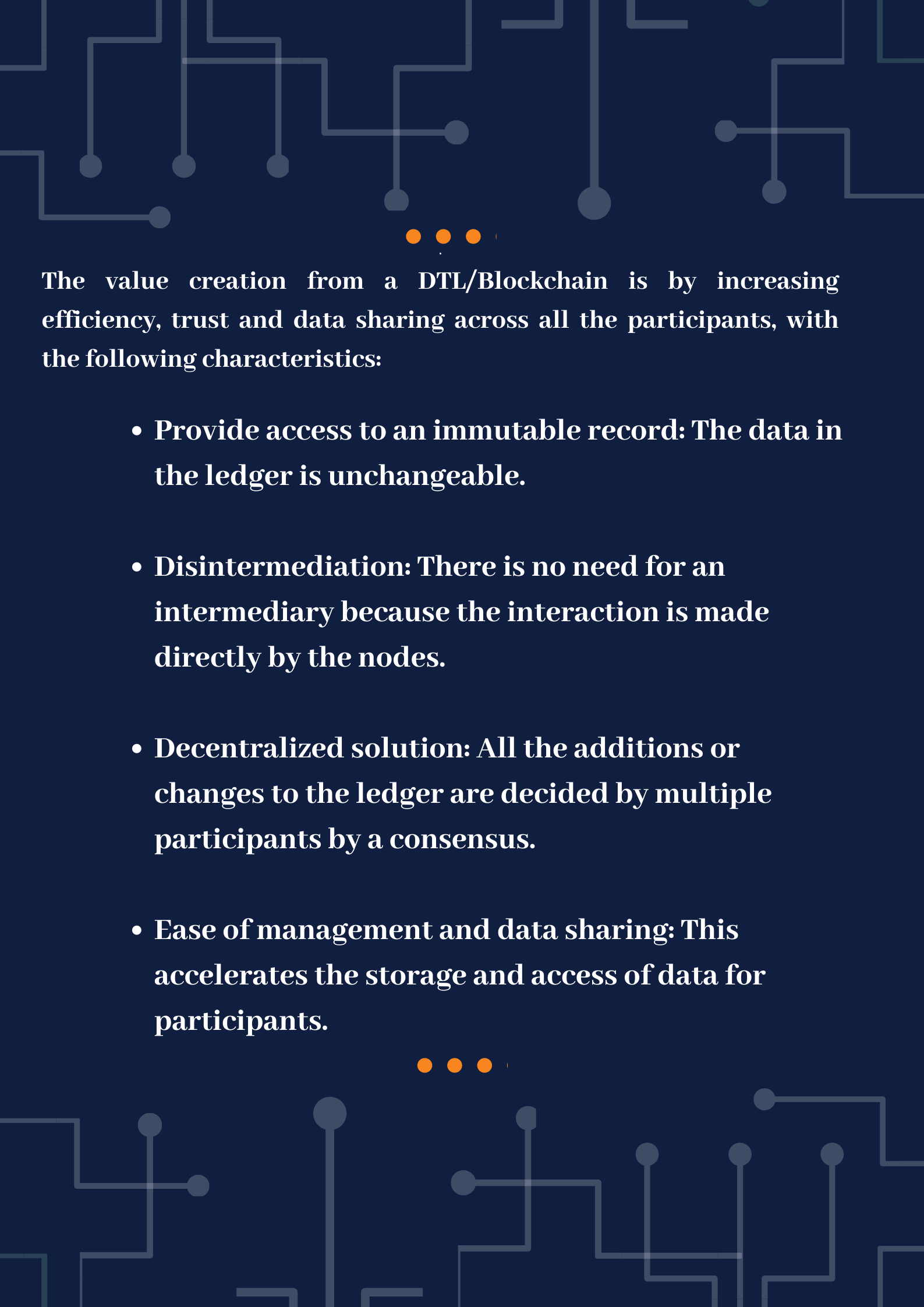 Despite the benefits and opportunities of DLT/Blockchain, some experts are questioning the scalability, the immaturity of the technology and the lack of clarity on how it can be governed. Those are some of the challenges for DLT/Blockchain. However, some authors are suggesting that the implementation of standards can solve some of these limitations (Deshpande, 2017). This paper presents the challenges for this technology based on a review of the literature and explains the potential solutions offered by the implementation of standards. The challenges and solutions presented in this paper might not applied to all DLT/Blockchain designs as the landscape of this technology is varied and complex. The analysis of the following points is also based on my findings and the aim is to provide a general overview of the promising technology. ##### II. DLT/ Blockchain challenges The International Chamber of Commerce (ICC) conducted a survey among approximately 200 participants from banks, fintech companies and industrial corporates to study the challenges that DLT is facing. The results show that the 4 major concerns are: interoperability, standardization, legal concerns and privacy challenges. The study shows that 86% of the respondents agreed that the integration of the back-office system is a big obstacle. 65% of the participants mentioned that choosing between different DLTs can represent a challenge for the firm. Regarding the adoption of DLT, 42% of the respondents see a promising outcome in the next 5 years. Seen over 10 years, this percentage increased to 73% ( Fadilpašić, 2019). Apparently, the adoption of the technology will depend on the maturity of the technology. RAND Europe studied the potential role of standards in Distributed Ledger Technologies. It was commissioned by the British Standards Institution (BSI). The study took 6 weeks and it was based on stakeholder interviews; the respondents were from the UK DLT/blockchain community. An internal workshop also took place to evaluate the potential implementation of standards and the benefits that it might bring. Among the limitations of the study were the small sample size, the timeline, and the fact that the evidence of the assessment was accelerated. The findings show the following challenges for DLT (Deshpande, 2017): **• Apparent immaturity of the technology and lack of clarity on the terminology**: The terminology of DLT and Blockchain is often ambiguous and inconsistent. The different technical implementations and the variety of approaches contributes to misunderstanding of this technology. The SWIFT Institute mention that this confusion of terms underlines the immaturity of the technology. “The perceived immaturity of the technology also creates challenges for businesses that potentially want to use the DLT/Blockchain” (RAND). Lack of extensive testing and therefore low interoperability with other systems and poor regulatory frameworks are factors that support this statement. **• Perceived risks and early adoption**: this challenge is highlighted by the study conducted by the ICC. The non-interoperability of DLT/Blockchain can represent high risk for early adopters. They might be investing in a model that later proves non-interoperable with existing technologies and systems (McKinsey). Beside the high investment in the implementation of DLT/Blockchain, the business might face disruption to existing operational practices. There is a lack of clarity in how DLT interacts with existing systems. Another concern is that the automatization of process may lead to loss of jobs. In a talk that I had with Amit Pradhan (President, Silicon Valley Blockchain Society) in Bits and Pretzels in October 2019, we discussed the potential consequence of the loss of jobs and he added that the companies should do it carefully and based their decision with ethics. **• Scarce evidence of economic impact and business gains**: Accenture (2016), Barclays (2016), and The Economist (2015) all agree that there is uncertainty in the return of investment from this technology. It might be unclear for businesses whether they should invest in DLT/Blockchain or not. If the old technology is doing the job, why should the company invest in DLT/Blockchain? Will this new technology help the company to increase their profits? This is referred to in the RAND study as ´technology doubt´, and emphasizes the scale of the challenge for the adoption of DLT/Blockchain. **• Security applications of Blockchain on a small scale**: studies from 2018 showed that the hash rate for Bitcoin was 33 Million TH/sec. It can be inferred that it is very unlikely to be hacked. However, there is a remaining risk for small-scale transactions, and 100% security cannot be guaranteed: “Where the hash rate of the network is small, and it would be easy for an attacker to mine a malignant block because the attacker can match the overall mining power of the network” (Memon, 2018). It can be inferred that the small number of nodes of the network increases the risk of being hacked. **• Cyberattacks risks**: BT have shown resistance to cyberattacks but as this technology speeds the development of new hacking techniques as well. The most common attacks are the Distributed Denial Of Services (DDOS). The Malleability attack is a type of DDOS and occurs in Bitcoin exchange. In this attack, a copy of the transaction is created with another ID, which means the user pays twice for the transaction. Other types of hacking with comparable principles are the Eclipse and Sybil attacks, where the attacker takes control of a extensive number of IP addresses in the network and the victim is encircled by them. Researchers from the University of Boston found out that in Eclipse attacks, the victim does not have access to the transactions they are interested in. In a Sybil attack the attacker can influence the victim by his/her voting power of information and nodes; this behavior causes the victim to double spend. A majority attack, i.e. more than 51%, arises when a single entity owns most of the voting power in a network. This condition can lead the attacker to create a fork in the main chain with the transaction it wants to do (Valdeolmillos, 2019). **• Blockchain privacy challenge**: BT has two main transaction types, the first one is reading data and the second is writing data to a blockchain. ´Wallet´ is the term for each transaction and it recognizes the sender and the receiver of the digital assets. The main reason why the wallet is created is to protect user’s privacy, making it more difficult for an attacker to link the transactions. Nevertheless, the attackers can still link the Bitcoin transactions to a common user despite the wallets. There are latent security vulnerabilities with data privacy, especially if users are assigning their personal data in a DLT/Blockchain transaction. **• Governance challenge**: because of the immaturity of the technology, there is an absence of information on how it should be governed. This might be a challenge for permissionless and permissioned ledgers. The establishment of off-ledger agreements is key to setting out the terms of use and responsibility for the participants. Some governance considerations are: The verification of users and the establishment of proper permissions (Financial Industry Regulatory Authority); applicable law (ESMA, 2016b) and dispute arbitration (Bogart and Rice, 2015); compliance and regulation with legislation such as KYK (know-your-customer), AML (anti-money laundry); also designation of the responsibility for maintaining the system integrity. The difficulty of achieving consensus to validate transactions can represent high costs, for example, the absence of consensus between the involved parties can lead to forks. **• Uncertainty about regulations**: from an international perspective, the existing regulatory environment is unclear (World Economic Forum, 2016b; Deloitte, 2016). The standards for this technology might be crucial, especially in the financial sector. For companies like Alliance and Deloitte, the regulatory perspective will be more critical than the functions and impact of DLT/Blockchain technology itself. The development of regulatory bodies will be important in identifying hidden risks and ensuring user compliance. (Deshpande, 2017). ##### III. Solutions from DLT/Blockchain The challenges for DLT/Blockchain have been presented above. Nevertheless, it is important to highlight the potential solutions that this growing technology offers. For example, the improvement of business practices, reduction of operational costs, facilitation of applications such as smart contracts and digital identity management. Deloitte and McKinsey (2016) agree that the automation of processes which DLT/Blockchain offers represents efficiency gains because this technology can remove intermediaries. “DLT/Blockchain can closely link usage with cost and value, which would allow companies to pay for infrastructure in real time according to their usage and value attained.” (Bogart and Rice 2015). This allows an increase of transparency in data-intensive transactions by the adoption of permissioned DLT/blockchain (Taylor, 2015). Another solution offered by this technology is the high quality and accessibility of data, because of the high-quality data analysis that can be done. The nature of the technology makes the immutability of the transactions one of the core solutions, providing a clear audit and reducing the vulnerability to fraud. Meanwhile, the adoption of this technology can potentially represent new sources of revenue for the business (Deshpande, 2017). Even recognizing the solutions offered by DLT/Blockchain and its importance in many industries, standards for global adoption are still missing. In order to guarantee the efficient application of this technology there is a need for standards for the industry to succeed. ##### IV. How the Standards can address DLT/ Blockchain challenges? Now that the challenges facing DLT/Blockchain have been outlined, in this section I will mention how these challenges can be addressed by standards. Blockchain standards started to appear in late 2017. Some authors agree that the standards and interoperability are decisive for the DLT industry’s survival (Lima, 2018). However, the question is how fast these standards can be created and applied, and how flexible the standards can be to counter the disruptive effects of this technology. The Blockchain market is diverse, immature and does not have consistent standardization. Depending on the stage of the technology, standards can play a significant role. If standards are introduced at an early stage this might boost the development of the technology. At a later stage, it will be about the adoption of the technology leading to opportunities and improvement of efficiency. Premature standardization can limit the innovation and can potentially affect the adoption of the technology (Deshpande, 2017). This could be a reason why the level of standardization for this technology is still under discussion. RAND suggests that applying standards in interoperability can reduce the risk of disintegration in the DLT/Blockchain landscape. They can ensure the interoperability within and across sectors, which helps develop efficient cross-sector applications. Also, the creation of standards, as a mean of regulation, will determine the taxonomies, definitions and categorization of DLT/Blockchain and how they should operate. They also enable governments to protect and ensure data privacy. The study from RAND suggests that the standards can play a relevant role in digital identity management and handling risks associated with identity, compliance and liability. Robust norms are needed to protect end-users’ digital identity and reach cross-sectoral adoption. (Deshpande, 2017). ##### V. Main standards drivers To address the previous points, Anjum, Sporny and Sill summarize the following items for applying standards: • *Basic data models for blockchain* • *Consensus algorithms (Proof of work, Stellar Consensus, Hashgraph)* • *Storage algorithms (Merkle Trees, MerklePatriciaTries, Linked Lists)* • *Signature algortithms (JOSE Web Signing, Linked Data Signatures, Hierarchically Deterministic Keys, Chainpoint)* • *Web-based access protocols (Create, Read, Add, Ger Status, Query)* Several organizations are pursuing the development of standards such as the Web Wide Web Consortium, Standards Australia and The International Organization for Standardization (ISO). ISO have created a technical committee (TC 307) on DLT/Blockchain. The ISO TC 307 is currently working on the taxonomy, architecture, ontology (SG 1) use cases (SG 2), privacy and security (SG 3), identity (SG 4) and smart contracts (SG 5). However, they have not concluded anything yet from the most challenging part, which is the establishment of standards in governance, interoperability and auditing (Anjum, 2017). There are several parties involved in the development of a standards initiative, and with alliances and industry associations they are supporting the growth of the community. Most of the standards are in the first draft phase and a greater part of them are in the preliminary stage. There are country-specific standards, global and technical specifications being developed all over the world. 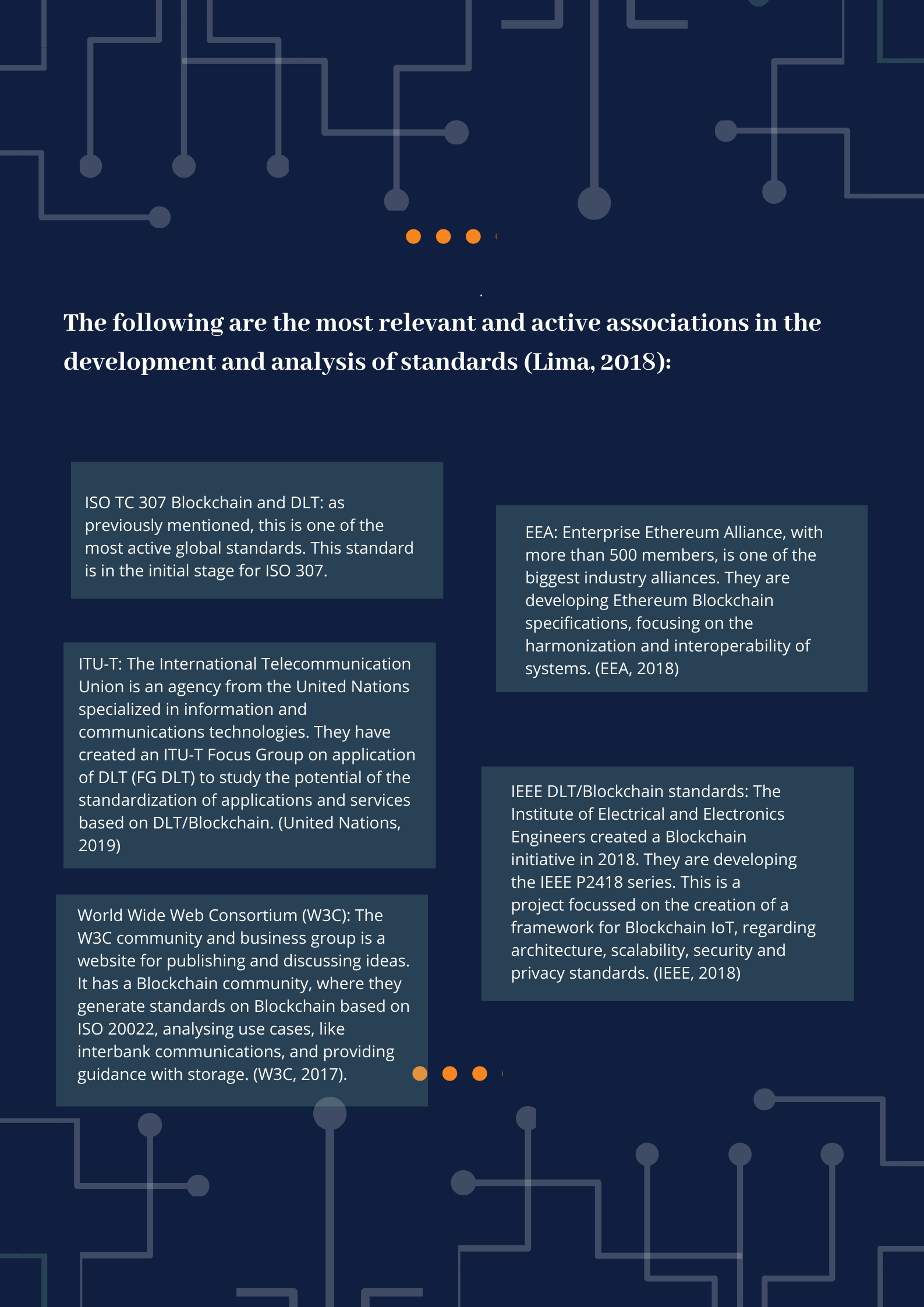 ##### VI. Conclusion DLT/Technology can bring multiple benefits for businesses and people. However, as outlined in Section II, the existing challenges go beyond the absence of regulations and standards to ensure this technology is fully implemented. In order to succeed, it is critical to have standardization and normalization in the application and development of the technology. I personally agree that standards may overcome the challenges and enhance the innovation and attractiveness of the DLT/Blockchain landscape. Through standards we can ensure interoperability and I am positive that they will play a significant role in privacy, governance and digital identities. *VII. References* Anjum, A., Sporny, M., & Sill, A. (2017). Blockchain standards for compliance and trust. IEEE Cloud Computing, 4(4), 84-90 BBVA. (2018). What is the difference between DLT and blockchain?. 21.12.2019, from BBVA [Online]. Available https://www.bbva.com/en/bbva-a-european-leader-in-tax-transparency/ Deshpande, A., Stewart, K., Lepetit, L., & Gunashekar, S. (2017). Distributed Ledger Technologies/Blockchain: Challenges, opportunities and the prospects for standards. Overview report The British Standards Institution (BSI), 1-34. Deshpande, A., Stewart, K., Lepetit, L., & Gunashekar, S. (2017). Understanding the landscape of Distributed Ledger Technologies/Blockchain. Rand Europe. EEA. (2018). About the EEA. 3.01.2020, from EEA [Online]. Available https://entethalliance.org/ Fadilpašić, Sead. (2019). Top 4 Major Challenges For DLT, According to 200 Businessmen. 22.12.2019, de Cryptonews.com Website: https://cryptonews.com/news/top-4-major-challenges-for-dlt-according-to-200-businessmen-5212.htm Henry, R., Herzberg, A., & Kate, A. (2018). Blockchain access privacy: challenges and directions. IEEE Security & Privacy, 16(4), 38-45. IEEE. (2018). P2418.1 - Standard for the Framework of Blockchain Use in Internet of Things (IoT). 03.01.2020, from IEEE [Online]. Available: https://standards.ieee.org/project/2418_1.html Lima, C. (2018). Developing Open and Interoperable DLT\/Blockchain Standards [Standards]. Computer, 51(11), 106-111 Memon, M., Hussain, S. S., Bajwa, U. A., & Ikhlas, A. (2018, August). Blockchain Beyond Bitcoin: Blockchain Technology Challenges and Real-World Applications. In 2018 International Conference on Computing, Electronics & Communications Engineering (iCCECE) (pp. 29-34). IEEE. UN. (2019). Focus Group on Application of Distributed Ledger Technology. 03.01.2020, from UN [Online]. Available: https://www.itu.int/en/ITU-T/focusgroups/dlt/Pages/default.aspx Valdeolmillos, D., Mezquita, Y., González-Briones, A., Prieto, J., & Corchado, J. M. (2019, June). Blockchain Technology: A Review of the Current Challenges of Cryptocurrency. In International Congress on Blockchain and Applications (pp. 153-160). Springer, Cham. W3C Community and business group. (2017). Blockchain Community Group. 03.01.2020, from W3C [Online]. Available https://www.w3.org/community/blockchain/ |
| json metadata | {"tags":["lifewithblockchain"],"image":["https://cdn.steemitimages.com/DQmUyuWCG7rjypNfWwMtufsUxmpbQkzQ8JEf8cfFczfmfqE/intro2.png","https://cdn.steemitimages.com/DQmXHMUMv7VhutWZKtJw44B1zEbGPXAzUuQKdbcmnhvotxb/main%20actors.png"],"links":["https://www.bbva.com/en/bbva-a-european-leader-in-tax-transparency/","https://entethalliance.org/","https://cryptonews.com/news/top-4-major-challenges-for-dlt-according-to-200-businessmen-5212.htm","https://standards.ieee.org/project/2418_1.html","https://www.itu.int/en/ITU-T/focusgroups/dlt/Pages/default.aspx","https://www.w3.org/community/blockchain/"],"app":"steemit/0.1","format":"markdown"} |
| parent author | |
| parent permlink | lifewithblockchain |
| permlink | dlt-blockchain-challenges-can-be-addressed-by-standards |
| title | DLT/Blockchain challenges can be addressed by standards |
| Transaction Info | Block #40191332/Trx 3ad321ad85781b45b48c658018aa8e656001a8d0 |
View Raw JSON Data
{
"block": 40191332,
"op": [
"comment",
{
"author": "salinasalejandra",
"body": "##### Abstract\n\nThere is high acceptance of DLT/ Blockchain technology among different industries. The development and application of this technology enhances the trust between people and businesses. However, its early stage, governance, privacy, interoperability and regulations are topics that, are still unclear for this technology, which represents a limitation for its adoption. This paper highlights the benefits from DLT/Blockchain, analyses the current challenges´ and explains how the application of standards can address the existing challenges. This paper also mentions the most active institutions and associations developing the standards. \n\n\n##### I. Introduction\n\nDistributed Ledger Technology (DLT) is considered one of the most innovative methods of storing and updating data for individuals and organizations. The application of distributed ledger is not limited to finance and banking, that is why it has received particular attention. Recent studies show that by 2025, 10 % of the global GDP will be represented by blockchain applications (Lima, 2018). This technology operates in areas like supply chain, manufacturing, internet of things, agriculture, pharmaceutical industry, education among others (Deshpande, 2017). But there are existing challenges for this promising technology. \n\nDTL and Blockchain have the same conceptual principle. They are decentralized and digitalized log books of records. They are differentiated by an unshared set of certain features. The main distinction is that a blockchain is a type of DLT. Therefore, not all DLTs are Blockchain (BBVA, 2018). A Blockchain technology (BT) based platform is a category of DLT system, but not all DLT applies for BT. Some authors argue that this technology is dynamic and that there is not formal definition. The term DLT and Blockchain are usually interchangeably in the literature. For the purpose of this report we will combine the terms as DLT/ Blockchain. \n\n\n\n\nDespite the benefits and opportunities of DLT/Blockchain, some experts are questioning the scalability, the immaturity of the technology and the lack of clarity on how it can be governed. Those are some of the challenges for DLT/Blockchain. However, some authors are suggesting that the implementation of standards can solve some of these limitations (Deshpande, 2017).\n\nThis paper presents the challenges for this technology based on a review of the literature and explains the potential solutions offered by the implementation of standards. The challenges and solutions presented in this paper might not applied to all DLT/Blockchain designs as the landscape of this technology is varied and complex. The analysis of the following points is also based on my findings and the aim is to provide a general overview of the promising technology. \n\n\n##### II. DLT/ Blockchain challenges \n\nThe International Chamber of Commerce (ICC) conducted a survey among approximately 200 participants from banks, fintech companies and industrial corporates to study the challenges that DLT is facing. The results show that the 4 major concerns are: interoperability, standardization, legal concerns and privacy challenges.\n\nThe study shows that 86% of the respondents agreed that the integration of the back-office system is a big obstacle. 65% of the participants mentioned that choosing between different DLTs can represent a challenge for the firm. Regarding the adoption of DLT, 42% of the respondents see a promising outcome in the next 5 years. Seen over 10 years, this percentage increased to 73% ( Fadilpašić, 2019). Apparently, the adoption of the technology will depend on the maturity of the technology. \n\nRAND Europe studied the potential role of standards in Distributed Ledger Technologies. It was commissioned by the British Standards Institution (BSI). The study took 6 weeks and it was based on stakeholder interviews; the respondents were from the UK DLT/blockchain community. An internal workshop also took place to evaluate the potential implementation of standards and the benefits that it might bring. Among the limitations of the study were the small sample size, the timeline, and the fact that the evidence of the assessment was accelerated. \n\nThe findings show the following challenges for DLT (Deshpande, 2017):\n\n**•\tApparent immaturity of the technology and lack of clarity on the terminology**: The terminology of DLT and Blockchain is often ambiguous and inconsistent. The different technical implementations and the variety of approaches contributes to misunderstanding of this technology. The SWIFT Institute mention that this confusion of terms underlines the immaturity of the technology. “The perceived immaturity of the technology also creates challenges for businesses that potentially want to use the DLT/Blockchain” (RAND). Lack of extensive testing and therefore low interoperability with other systems and poor regulatory frameworks are factors that support this statement. \n\n**•\tPerceived risks and early adoption**: this challenge is highlighted by the study conducted by the ICC. The non-interoperability of DLT/Blockchain can represent high risk for early adopters. They might be investing in a model that later proves non-interoperable with existing technologies and systems (McKinsey). Beside the high investment in the implementation of DLT/Blockchain, the business might face disruption to existing operational practices. There is a lack of clarity in how DLT interacts with existing systems. Another concern is that the automatization of process may lead to loss of jobs. In a talk that I had with Amit Pradhan (President, Silicon Valley Blockchain Society) in Bits and Pretzels in October 2019, we discussed the potential consequence of the loss of jobs and he added that the companies should do it carefully and based their decision with ethics. \n\n**•\tScarce evidence of economic impact and business gains**: Accenture (2016), Barclays (2016), and The Economist (2015) all agree that there is uncertainty in the return of investment from this technology. It might be unclear for businesses whether they should invest in DLT/Blockchain or not. If the old technology is doing the job, why should the company invest in DLT/Blockchain? Will this new technology help the company to increase their profits? This is referred to in the RAND study as ´technology doubt´, and emphasizes the scale of the challenge for the adoption of DLT/Blockchain. \n\n**• Security applications of Blockchain on a small scale**: studies from 2018 showed that the hash rate for Bitcoin was 33 Million TH/sec. It can be inferred that it is very unlikely to be hacked. However, there is a remaining risk for small-scale transactions, and 100% security cannot be guaranteed: “Where the hash rate of the network is small, and it would be easy for an attacker to mine a malignant block because the attacker can match the overall mining power of the network” (Memon, 2018). It can be inferred that the small number of nodes of the network increases the risk of being hacked. \n\n**•\tCyberattacks risks**: BT have shown resistance to cyberattacks but as this technology speeds the development of new hacking techniques as well. The most common attacks are the Distributed Denial Of Services (DDOS). The Malleability attack is a type of DDOS and occurs in Bitcoin exchange. In this attack, a copy of the transaction is created with another ID, which means the user pays twice for the transaction. Other types of hacking with comparable principles are the Eclipse and Sybil attacks, where the attacker takes control of a extensive number of IP addresses in the network and the victim is encircled by them. Researchers from the University of Boston found out that in Eclipse attacks, the victim does not have access to the transactions they are interested in. In a Sybil attack the attacker can influence the victim by his/her voting power of information and nodes; this behavior causes the victim to double spend. A majority attack, i.e. more than 51%, arises when a single entity owns most of the voting power in a network. This condition can lead the attacker to create a fork in the main chain with the transaction it wants to do (Valdeolmillos, 2019). \n\n**•\tBlockchain privacy challenge**: BT has two main transaction types, the first one is reading data and the second is writing data to a blockchain. ´Wallet´ is the term for each transaction and it recognizes the sender and the receiver of the digital assets. The main reason why the wallet is created is to protect user’s privacy, making it more difficult for an attacker to link the transactions. Nevertheless, the attackers can still link the Bitcoin transactions to a common user despite the wallets. There are latent security vulnerabilities with data privacy, especially if users are assigning their personal data in a DLT/Blockchain transaction. \n\n**•\tGovernance challenge**: because of the immaturity of the technology, there is an absence of information on how it should be governed. This might be a challenge for permissionless and permissioned ledgers. The establishment of off-ledger agreements is key to setting out the terms of use and responsibility for the participants. Some governance considerations are: The verification of users and the establishment of proper permissions (Financial Industry Regulatory Authority); applicable law (ESMA, 2016b) and dispute arbitration (Bogart and Rice, 2015); compliance and regulation with legislation such as KYK (know-your-customer), AML (anti-money laundry); also designation of the responsibility for maintaining the system integrity. The difficulty of achieving consensus to validate transactions can represent high costs, for example, the absence of consensus between the involved parties can lead to forks. \n\n**•\tUncertainty about regulations**: from an international perspective, the existing regulatory environment is unclear (World Economic Forum, 2016b; Deloitte, 2016). The standards for this technology might be crucial, especially in the financial sector. For companies like Alliance and Deloitte, the regulatory perspective will be more critical than the functions and impact of DLT/Blockchain technology itself. The development of regulatory bodies will be important in identifying hidden risks and ensuring user compliance. (Deshpande, 2017).\n\n\n##### III.\tSolutions from DLT/Blockchain\n\nThe challenges for DLT/Blockchain have been presented above. Nevertheless, it is important to highlight the potential solutions that this growing technology offers. For example, the improvement of business practices, reduction of operational costs, facilitation of applications such as smart contracts and digital identity management. \n\nDeloitte and McKinsey (2016) agree that the automation of processes which DLT/Blockchain offers represents efficiency gains because this technology can remove intermediaries. “DLT/Blockchain can closely link usage with cost and value, which would allow companies to pay for infrastructure in real time according to their usage and value attained.” (Bogart and Rice 2015). This allows an increase of transparency in data-intensive transactions by the adoption of permissioned DLT/blockchain (Taylor, 2015). Another solution offered by this technology is the high quality and accessibility of data, because of the high-quality data analysis that can be done. The nature of the technology makes the immutability of the transactions one of the core solutions, providing a clear audit and reducing the vulnerability to fraud. Meanwhile, the adoption of this technology can potentially represent new sources of revenue for the business (Deshpande, 2017).\n\nEven recognizing the solutions offered by DLT/Blockchain and its importance in many industries, standards for global adoption are still missing. In order to guarantee the efficient application of this technology there is a need for standards for the industry to succeed.\n\n\n##### IV.\tHow the Standards can address DLT/ Blockchain challenges?\n\nNow that the challenges facing DLT/Blockchain have been outlined, in this section I will mention how these challenges can be addressed by standards. Blockchain standards started to appear in late 2017. Some authors agree that the standards and interoperability are decisive for the DLT industry’s survival (Lima, 2018). However, the question is how fast these standards can be created and applied, and how flexible the standards can be to counter the disruptive effects of this technology.\n\nThe Blockchain market is diverse, immature and does not have consistent standardization. Depending on the stage of the technology, standards can play a significant role. If standards are introduced at an early stage this might boost the development of the technology. At a later stage, it will be about the adoption of the technology leading to opportunities and improvement of efficiency. Premature standardization can limit the innovation and can potentially affect the adoption of the technology (Deshpande, 2017). This could be a reason why the level of standardization for this technology is still under discussion.\n\nRAND suggests that applying standards in interoperability can reduce the risk of disintegration in the DLT/Blockchain landscape. They can ensure the interoperability within and across sectors, which helps develop efficient cross-sector applications. Also, the creation of standards, as a mean of regulation, will determine the taxonomies, definitions and categorization of DLT/Blockchain and how they should operate. They also enable governments to protect and ensure data privacy. The study from RAND suggests that the standards can play a relevant role in digital identity management and handling risks associated with identity, compliance and liability. Robust norms are needed to protect end-users’ digital identity and reach cross-sectoral adoption. (Deshpande, 2017). \n\n\n##### V.\tMain standards drivers \n\nTo address the previous points, Anjum, Sporny and Sill summarize the following items for applying standards:\n\n•\t*Basic data models for blockchain* \n•\t*Consensus algorithms (Proof of work, Stellar Consensus, Hashgraph)* \n•\t*Storage algorithms (Merkle Trees, MerklePatriciaTries, Linked Lists)*\n•\t*Signature algortithms (JOSE Web Signing, Linked Data Signatures, Hierarchically Deterministic Keys, Chainpoint)* \n•\t*Web-based access protocols (Create, Read, Add, Ger Status, Query)* \n\nSeveral organizations are pursuing the development of standards such as the Web Wide Web Consortium, Standards Australia and The International Organization for Standardization (ISO). ISO have created a technical committee (TC 307) on DLT/Blockchain. The ISO TC 307 is currently working on the taxonomy, architecture, ontology (SG 1) use cases (SG 2), privacy and security (SG 3), identity (SG 4) and smart contracts (SG 5). However, they have not concluded anything yet from the most challenging part, which is the establishment of standards in governance, interoperability and auditing (Anjum, 2017).\n\nThere are several parties involved in the development of a standards initiative, and with alliances and industry associations they are supporting the growth of the community. Most of the standards are in the first draft phase and a greater part of them are in the preliminary stage. There are country-specific standards, global and technical specifications being developed all over the world.\n\n\n\n\n##### VI.\tConclusion\n\nDLT/Technology can bring multiple benefits for businesses and people. However, as outlined in Section II, the existing challenges go beyond the absence of regulations and standards to ensure this technology is fully implemented. In order to succeed, it is critical to have standardization and normalization in the application and development of the technology. I personally agree that standards may overcome the challenges and enhance the innovation and attractiveness of the DLT/Blockchain landscape. Through standards we can ensure interoperability and I am positive that they will play a significant role in privacy, governance and digital identities.\n\n\n\n\n\n*VII.\t References* \nAnjum, A., Sporny, M., & Sill, A. (2017). Blockchain standards for compliance and trust. IEEE Cloud Computing, 4(4), 84-90\nBBVA. (2018). What is the difference between DLT and blockchain?. 21.12.2019, from BBVA [Online]. Available https://www.bbva.com/en/bbva-a-european-leader-in-tax-transparency/\nDeshpande, A., Stewart, K., Lepetit, L., & Gunashekar, S. (2017). Distributed Ledger Technologies/Blockchain: Challenges, opportunities and the prospects for standards. Overview report The British Standards Institution (BSI), 1-34.\nDeshpande, A., Stewart, K., Lepetit, L., & Gunashekar, S. (2017). Understanding the landscape of Distributed Ledger Technologies/Blockchain. Rand Europe.\nEEA. (2018). About the EEA. 3.01.2020, from EEA [Online]. Available https://entethalliance.org/\nFadilpašić, Sead. (2019). Top 4 Major Challenges For DLT, According to 200 Businessmen. 22.12.2019, de Cryptonews.com Website: https://cryptonews.com/news/top-4-major-challenges-for-dlt-according-to-200-businessmen-5212.htm\nHenry, R., Herzberg, A., & Kate, A. (2018). Blockchain access privacy: challenges and directions. IEEE Security & Privacy, 16(4), 38-45.\nIEEE. (2018). P2418.1 - Standard for the Framework of Blockchain Use in Internet of Things (IoT). 03.01.2020, from IEEE [Online]. Available: https://standards.ieee.org/project/2418_1.html\nLima, C. (2018). Developing Open and Interoperable DLT\\/Blockchain Standards [Standards]. Computer, 51(11), 106-111\nMemon, M., Hussain, S. S., Bajwa, U. A., & Ikhlas, A. (2018, August). Blockchain Beyond Bitcoin: Blockchain Technology Challenges and Real-World Applications. In 2018 International Conference on Computing, Electronics & Communications Engineering (iCCECE) (pp. 29-34). IEEE.\nUN. (2019). Focus Group on Application of Distributed Ledger Technology. 03.01.2020, from UN [Online]. Available: https://www.itu.int/en/ITU-T/focusgroups/dlt/Pages/default.aspx\nValdeolmillos, D., Mezquita, Y., González-Briones, A., Prieto, J., & Corchado, J. M. (2019, June). Blockchain Technology: A Review of the Current Challenges of Cryptocurrency. In International Congress on Blockchain and Applications (pp. 153-160). Springer, Cham.\nW3C Community and business group. (2017). Blockchain Community Group. 03.01.2020, from W3C [Online]. Available https://www.w3.org/community/blockchain/",
"json_metadata": "{\"tags\":[\"lifewithblockchain\"],\"image\":[\"https://cdn.steemitimages.com/DQmUyuWCG7rjypNfWwMtufsUxmpbQkzQ8JEf8cfFczfmfqE/intro2.png\",\"https://cdn.steemitimages.com/DQmXHMUMv7VhutWZKtJw44B1zEbGPXAzUuQKdbcmnhvotxb/main%20actors.png\"],\"links\":[\"https://www.bbva.com/en/bbva-a-european-leader-in-tax-transparency/\",\"https://entethalliance.org/\",\"https://cryptonews.com/news/top-4-major-challenges-for-dlt-according-to-200-businessmen-5212.htm\",\"https://standards.ieee.org/project/2418_1.html\",\"https://www.itu.int/en/ITU-T/focusgroups/dlt/Pages/default.aspx\",\"https://www.w3.org/community/blockchain/\"],\"app\":\"steemit/0.1\",\"format\":\"markdown\"}",
"parent_author": "",
"parent_permlink": "lifewithblockchain",
"permlink": "dlt-blockchain-challenges-can-be-addressed-by-standards",
"title": "DLT/Blockchain challenges can be addressed by standards"
}
],
"op_in_trx": 0,
"timestamp": "2020-01-23T22:13:48",
"trx_id": "3ad321ad85781b45b48c658018aa8e656001a8d0",
"trx_in_block": 44,
"virtual_op": 0
}2020/01/12 19:02:33
2020/01/12 19:02:33
| author | salinasalejandra |
| permlink | bulletproof-cars-in-blockchain-technology-are-an-opportunity-to-reduce-violence-in-mexico |
| voter | unggoy |
| weight | -10000 (-100.00%) |
| Transaction Info | Block #39871338/Trx 1cf4decc579d1adb95fbc30da813f12d0b4f9dc1 |
View Raw JSON Data
{
  "block": 39871338,
  "op": [
    "vote",
    {
      "author": "salinasalejandra",
      "permlink": "bulletproof-cars-in-blockchain-technology-are-an-opportunity-to-reduce-violence-in-mexico",
      "voter": "unggoy",
      "weight": -10000
    }
  ],
  "op_in_trx": 0,
  "timestamp": "2020-01-12T19:02:33",
  "trx_id": "1cf4decc579d1adb95fbc30da813f12d0b4f9dc1",
  "trx_in_block": 2,
  "virtual_op": 0
}2020/01/11 12:54:06
2020/01/11 12:54:06
| author | salinasalejandra |
| permlink | bulletproof-cars-in-blockchain-technology-are-an-opportunity-to-reduce-violence-in-mexico |
| voter | raise-me-up |
| weight | 1 (0.01%) |
| Transaction Info | Block #39835239/Trx f00a99b233c1119c166add10cbcea01bd7c51da4 |
View Raw JSON Data
{
  "block": 39835239,
  "op": [
    "vote",
    {
      "author": "salinasalejandra",
      "permlink": "bulletproof-cars-in-blockchain-technology-are-an-opportunity-to-reduce-violence-in-mexico",
      "voter": "raise-me-up",
      "weight": 1
    }
  ],
  "op_in_trx": 0,
  "timestamp": "2020-01-11T12:54:06",
  "trx_id": "f00a99b233c1119c166add10cbcea01bd7c51da4",
  "trx_in_block": 35,
  "virtual_op": 0
}2020/01/11 12:28:57
2020/01/11 12:28:57
| author | salinasalejandra |
| body | ##### Due to the increase of violence in Mexico, more and more people are buying bulletproof cars. Unfortunately, also the crime has access to them and they use these cars to continue with their criminal activities. In the last weeks the Senate of Mexico approved a law to make mandatory the registration of the ownership of bulletproof cars. The aim is to avoid the illegitimate use of this vehicles and increase transparency and control. So far, the registration is planned to be in one of the states´ offices. I personally think that they should do it with Blockchain. Specially, because it is a very sensitive topic and Blockchain will make everything more transparent. ### Pain Point *The criminal groups are using the bulletproof cars for illegal activities. There is no ownership record and there is no control on how many bulletproof cars are.*  Image by: Wall Street Journal. (2014). Bulletproof BMW X5 Security Plus SUV Unveiled. Retrieved from https://images.app.goo.gl/BjNHaYyc4RAGDf3j9 **How could this Pain Point be reduced in a blockchain-world?** If the government make the records of bulletproof cars in Blockchain everything will be more transparent, and it is assumed that the criminal groups won´t have legitimate access to this vehicle. Meaning that the people involved in criminal activities barely will have access to buy one of those cars. The benefits to have the records on blockchain are: a) Blockchain will ensure the transparency and will make the information immutable. b) The state can make use of the information to detect fraud or illegal activities. All the owners of bulletproof cars will be registered in the Blockchain. The state can analyse the data which might lead to further research. For example, cities with high number of bulletproof cars registered. Also, they will exactly know who was involved in a shooting and therefore they can make a more accurate investigation. c) The information will be protected, and it will ensure the security of the data. Corruption is not going to be an option. (If someone wants to manipulate the information) d) It increase the control of the state on this problem and It might help to identify people involved in these illicit activities. Maybe the impact of having the records on blockchain will take some time. But I am positive that Blockchain technology can have huge impact in this issue simply because it makes the records more transparent and especially immutable. *References:* Senado de Mexico. (2020). Aprueba Senado registro de autos blindados. Website: http://comunicacion.senado.gob.mx/index.php/periodo-ordinario/boletines/3515-boletin-0963-aprueba-senado-registro-de-autos-blindados |
| json metadata | {"tags":["lifewithblockchain"],"image":["https://cdn.steemitimages.com/DQmaMZcqg21QTtP3MFu8515BsN9rWq2EphXGiXzYWdejqZX/steemit%20post%20picture.jpg"],"links":["https://images.app.goo.gl/BjNHaYyc4RAGDf3j9","http://comunicacion.senado.gob.mx/index.php/periodo-ordinario/boletines/3515-boletin-0963-aprueba-senado-registro-de-autos-blindados"],"app":"steemit/0.1","format":"markdown"} |
| parent author | |
| parent permlink | lifewithblockchain |
| permlink | bulletproof-cars-in-blockchain-technology-are-an-opportunity-to-reduce-violence-in-mexico |
| title | Bulletproof cars in Blockchain technology are an opportunity to reduce violence in Mexico |
| Transaction Info | Block #39834736/Trx ca92f051c727eb048acf59a8ff04521a0b4aeb57 |
View Raw JSON Data
{
"block": 39834736,
"op": [
"comment",
{
"author": "salinasalejandra",
"body": "##### Due to the increase of violence in Mexico, more and more people are buying bulletproof cars. Unfortunately, also the crime has access to them and they use these cars to continue with their criminal activities. \n\n\nIn the last weeks the Senate of Mexico approved a law to make mandatory the registration of the ownership of bulletproof cars. The aim is to avoid the illegitimate use of this vehicles and increase transparency and control. So far, the registration is planned to be in one of the states´ offices. I personally think that they should do it with Blockchain. Specially, because it is a very sensitive topic and Blockchain will make everything more transparent. \n\n### Pain Point\n\n*The criminal groups are using the bulletproof cars for illegal activities. There is no ownership record and there is no control on how many bulletproof cars are.* \n\n\nImage by: Wall Street Journal. (2014). Bulletproof BMW X5 Security Plus SUV Unveiled. Retrieved from https://images.app.goo.gl/BjNHaYyc4RAGDf3j9\n\n\n**How could this Pain Point be reduced in a blockchain-world?**\n\nIf the government make the records of bulletproof cars in Blockchain everything will be more transparent, and it is assumed that the criminal groups won´t have legitimate access to this vehicle. Meaning that the people involved in criminal activities barely will have access to buy one of those cars. \n\nThe benefits to have the records on blockchain are: \na)\tBlockchain will ensure the transparency and will make the information immutable. \nb)\tThe state can make use of the information to detect fraud or illegal activities. All the owners of bulletproof cars will be registered in the Blockchain. The state can analyse the data which might lead to further research. For example, cities with high number of bulletproof cars registered. Also, they will exactly know who was involved in a shooting and therefore they can make a more accurate investigation. \nc)\tThe information will be protected, and it will ensure the security of the data. Corruption is not going to be an option. (If someone wants to manipulate the information)\nd)\tIt increase the control of the state on this problem and It might help to identify people involved in these illicit activities. \n\nMaybe the impact of having the records on blockchain will take some time. But I am positive that Blockchain technology can have huge impact in this issue simply because it makes the records more transparent and especially immutable. \n\n\n*References:* \nSenado de Mexico. (2020). Aprueba Senado registro de autos blindados. Website: http://comunicacion.senado.gob.mx/index.php/periodo-ordinario/boletines/3515-boletin-0963-aprueba-senado-registro-de-autos-blindados",
"json_metadata": "{\"tags\":[\"lifewithblockchain\"],\"image\":[\"https://cdn.steemitimages.com/DQmaMZcqg21QTtP3MFu8515BsN9rWq2EphXGiXzYWdejqZX/steemit%20post%20picture.jpg\"],\"links\":[\"https://images.app.goo.gl/BjNHaYyc4RAGDf3j9\",\"http://comunicacion.senado.gob.mx/index.php/periodo-ordinario/boletines/3515-boletin-0963-aprueba-senado-registro-de-autos-blindados\"],\"app\":\"steemit/0.1\",\"format\":\"markdown\"}",
"parent_author": "",
"parent_permlink": "lifewithblockchain",
"permlink": "bulletproof-cars-in-blockchain-technology-are-an-opportunity-to-reduce-violence-in-mexico",
"title": "Bulletproof cars in Blockchain technology are an opportunity to reduce violence in Mexico"
}
],
"op_in_trx": 0,
"timestamp": "2020-01-11T12:28:57",
"trx_id": "ca92f051c727eb048acf59a8ff04521a0b4aeb57",
"trx_in_block": 17,
"virtual_op": 0
}salinasalejandraupvoted (100.00%) @steemitboard / steemitboard-notify-pascalmehrwald-20190423t013658000z2020/01/10 16:14:39
salinasalejandraupvoted (100.00%) @steemitboard / steemitboard-notify-pascalmehrwald-20190423t013658000z
2020/01/10 16:14:39
| author | steemitboard |
| permlink | steemitboard-notify-pascalmehrwald-20190423t013658000z |
| voter | salinasalejandra |
| weight | 10000 (100.00%) |
| Transaction Info | Block #39810498/Trx 15b77b5e812ad349ac97a1a6709e0063dd48d4fa |
View Raw JSON Data
{
  "block": 39810498,
  "op": [
    "vote",
    {
      "author": "steemitboard",
      "permlink": "steemitboard-notify-pascalmehrwald-20190423t013658000z",
      "voter": "salinasalejandra",
      "weight": 10000
    }
  ],
  "op_in_trx": 0,
  "timestamp": "2020-01-10T16:14:39",
  "trx_id": "15b77b5e812ad349ac97a1a6709e0063dd48d4fa",
  "trx_in_block": 11,
  "virtual_op": 0
}steemdelegated 18.142 SP to @salinasalejandra2020/01/03 13:00:36
steemdelegated 18.142 SP to @salinasalejandra
2020/01/03 13:00:36
| delegatee | salinasalejandra |
| delegator | steem |
| vesting shares | 29505.518212 VESTS |
| Transaction Info | Block #39605407/Trx 43147048563a5f5a8f7007e7517534a885b01398 |
View Raw JSON Data
{
  "block": 39605407,
  "op": [
    "delegate_vesting_shares",
    {
      "delegatee": "salinasalejandra",
      "delegator": "steem",
      "vesting_shares": "29505.518212 VESTS"
    }
  ],
  "op_in_trx": 0,
  "timestamp": "2020-01-03T13:00:36",
  "trx_id": "43147048563a5f5a8f7007e7517534a885b01398",
  "trx_in_block": 19,
  "virtual_op": 0
}salinasalejandraupdated their account properties2020/01/03 11:08:39
salinasalejandraupdated their account properties
2020/01/03 11:08:39
| account | salinasalejandra |
| active | {"account_auths":[],"key_auths":[["STM77t2YGAEYLYxzRaMYrdyXBGJmRXdL6Qps7gN7ec3iGWN9kcmvs",1]],"weight_threshold":1} |
| json metadata | {} |
| memo key | STM6UotSeAHJGGNCdrnQXwUWinXQW3WDb7VpB1tTgTyJFaEq1RLeQ |
| owner | {"account_auths":[],"key_auths":[["STM8Dmy5GoFmLtwHZD4KvFhtaotSbRss2As9fg3d7pmJNV8k4oddL",1]],"weight_threshold":1} |
| posting | {"account_auths":[],"key_auths":[["STM8C2KVs8WYhkKwHgabeGkz7kjnKiFmhSi5m5MKc5Npk2VyeJZEH",1]],"weight_threshold":1} |
| Transaction Info | Block #39603172/Trx b391617ca6386835ded53baf39a16a5b9541200e |
View Raw JSON Data
{
  "block": 39603172,
  "op": [
    "account_update",
    {
      "account": "salinasalejandra",
      "active": {
        "account_auths": [],
        "key_auths": [
          [
            "STM77t2YGAEYLYxzRaMYrdyXBGJmRXdL6Qps7gN7ec3iGWN9kcmvs",
            1
          ]
        ],
        "weight_threshold": 1
      },
      "json_metadata": "{}",
      "memo_key": "STM6UotSeAHJGGNCdrnQXwUWinXQW3WDb7VpB1tTgTyJFaEq1RLeQ",
      "owner": {
        "account_auths": [],
        "key_auths": [
          [
            "STM8Dmy5GoFmLtwHZD4KvFhtaotSbRss2As9fg3d7pmJNV8k4oddL",
            1
          ]
        ],
        "weight_threshold": 1
      },
      "posting": {
        "account_auths": [],
        "key_auths": [
          [
            "STM8C2KVs8WYhkKwHgabeGkz7kjnKiFmhSi5m5MKc5Npk2VyeJZEH",
            1
          ]
        ],
        "weight_threshold": 1
      }
    }
  ],
  "op_in_trx": 0,
  "timestamp": "2020-01-03T11:08:39",
  "trx_id": "b391617ca6386835ded53baf39a16a5b9541200e",
  "trx_in_block": 7,
  "virtual_op": 0
}steemdelegated 18.631 SP to @salinasalejandra2020/01/03 10:58:18
steemdelegated 18.631 SP to @salinasalejandra
2020/01/03 10:58:18
| delegatee | salinasalejandra |
| delegator | steem |
| vesting shares | 30300.000000 VESTS |
| Transaction Info | Block #39602965/Trx 65ee0d561b5cb543e953e0399adb3a40fab6b36e |
View Raw JSON Data
{
  "block": 39602965,
  "op": [
    "delegate_vesting_shares",
    {
      "delegatee": "salinasalejandra",
      "delegator": "steem",
      "vesting_shares": "30300.000000 VESTS"
    }
  ],
  "op_in_trx": 0,
  "timestamp": "2020-01-03T10:58:18",
  "trx_id": "65ee0d561b5cb543e953e0399adb3a40fab6b36e",
  "trx_in_block": 12,
  "virtual_op": 0
}steemcreated a new account: @salinasalejandra2020/01/03 10:58:18
steemcreated a new account: @salinasalejandra
2020/01/03 10:58:18
| active | {"account_auths":[],"key_auths":[["STM8BvPANJoZF8jZjkkDwd3XP8V4ZcPVVekko9rxD6gBkxZeT22pf",1]],"weight_threshold":1} |
| creator | steem |
| extensions | [] |
| json metadata | {} |
| memo key | STM6qwGzymF3C3dAUzCNaRjCbBeg2uVP8Yh3DuFTtd9mMy3Zoxd9m |
| new account name | salinasalejandra |
| owner | {"account_auths":[],"key_auths":[["STM7sPcjn3DdJ5axNJkseWXPyRkSMe4eZTHBdVED8VFJ5kktRHNqt",1]],"weight_threshold":1} |
| posting | {"account_auths":[],"key_auths":[["STM67NGvbSK6ACoEJ4iHeVjgh4M4HB356T1qMhQPU6ZVXtYBvGnmy",1]],"weight_threshold":1} |
| Transaction Info | Block #39602965/Trx 65ee0d561b5cb543e953e0399adb3a40fab6b36e |
View Raw JSON Data
{
  "block": 39602965,
  "op": [
    "create_claimed_account",
    {
      "active": {
        "account_auths": [],
        "key_auths": [
          [
            "STM8BvPANJoZF8jZjkkDwd3XP8V4ZcPVVekko9rxD6gBkxZeT22pf",
            1
          ]
        ],
        "weight_threshold": 1
      },
      "creator": "steem",
      "extensions": [],
      "json_metadata": "{}",
      "memo_key": "STM6qwGzymF3C3dAUzCNaRjCbBeg2uVP8Yh3DuFTtd9mMy3Zoxd9m",
      "new_account_name": "salinasalejandra",
      "owner": {
        "account_auths": [],
        "key_auths": [
          [
            "STM7sPcjn3DdJ5axNJkseWXPyRkSMe4eZTHBdVED8VFJ5kktRHNqt",
            1
          ]
        ],
        "weight_threshold": 1
      },
      "posting": {
        "account_auths": [],
        "key_auths": [
          [
            "STM67NGvbSK6ACoEJ4iHeVjgh4M4HB356T1qMhQPU6ZVXtYBvGnmy",
            1
          ]
        ],
        "weight_threshold": 1
      }
    }
  ],
  "op_in_trx": 0,
  "timestamp": "2020-01-03T10:58:18",
  "trx_id": "65ee0d561b5cb543e953e0399adb3a40fab6b36e",
  "trx_in_block": 12,
  "virtual_op": 0
}Manabar
Voting Power100.00%
Downvote Power100.00%
Resource Credits100.00%
Reputation Progress0.00%
{
  "voting_manabar": {
    "current_mana": 1953311140,
    "last_update_time": 1588950972
  },
  "downvote_manabar": {
    "current_mana": 488327785,
    "last_update_time": 1588950972
  },
  "rc_account": {
    "account": "salinasalejandra",
    "max_rc": "7854442058",
    "max_rc_creation_adjustment": {
      "amount": "5901130918",
      "nai": "@@000000037",
      "precision": 6
    },
    "rc_manabar": {
      "current_mana": "15675767529",
      "last_update_time": 1588950972
    }
  }
}
Account Metadata
| POSTING JSON METADATA | |
| None | |
| JSON METADATA | |
| None |
{
  "posting_json_metadata": {},
  "json_metadata": {}
}
Auth Keys
Owner
Single Signature
Public Keys
STM8Dmy5GoFmLtwHZD4KvFhtaotSbRss2As9fg3d7pmJNV8k4oddL1/1
Active
Single Signature
Public Keys
STM77t2YGAEYLYxzRaMYrdyXBGJmRXdL6Qps7gN7ec3iGWN9kcmvs1/1
Posting
Single Signature
Public Keys
STM8C2KVs8WYhkKwHgabeGkz7kjnKiFmhSi5m5MKc5Npk2VyeJZEH1/1
Memo
STM6UotSeAHJGGNCdrnQXwUWinXQW3WDb7VpB1tTgTyJFaEq1RLeQ
{
  "owner": {
    "weight_threshold": 1,
    "account_auths": [],
    "key_auths": [
      [
        "STM8Dmy5GoFmLtwHZD4KvFhtaotSbRss2As9fg3d7pmJNV8k4oddL",
        1
      ]
    ]
  },
  "active": {
    "weight_threshold": 1,
    "account_auths": [],
    "key_auths": [
      [
        "STM77t2YGAEYLYxzRaMYrdyXBGJmRXdL6Qps7gN7ec3iGWN9kcmvs",
        1
      ]
    ]
  },
  "posting": {
    "weight_threshold": 1,
    "account_auths": [],
    "key_auths": [
      [
        "STM8C2KVs8WYhkKwHgabeGkz7kjnKiFmhSi5m5MKc5Npk2VyeJZEH",
        1
      ]
    ]
  },
  "memo": "STM6UotSeAHJGGNCdrnQXwUWinXQW3WDb7VpB1tTgTyJFaEq1RLeQ"
}
Witness Votes
0 / 30
No active witness votes.
[]