

@auroraeos
38The Leading Block Producer for the Informed Voter. Vote for us: auroraeoscom
steemit.com/@auroraeosVOTING POWER100.00%
DOWNVOTE POWER100.00%
RESOURCE CREDITS100.00%
REPUTATION PROGRESS14.10%
Net Worth
0.464USD
STEEM
2.562STEEM
SBD
0.038SBD
Own SP
5.657SP
Detailed Balance
| STEEM | ||
| balance | 1.555STEEM | STEEM |
| market_balance | 0.000STEEM | STEEM |
| savings_balance | 0.000STEEM | STEEM |
| reward_steem_balance | 1.007STEEM | STEEM |
| STEEM POWER | ||
| Own SP | 5.657SP | SP |
| Delegated Out | 0.000SP | SP |
| Delegation In | 0.000SP | SP |
| Effective Power | 5.657SP | SP |
| Reward SP (pending) | 1.059SP | SP |
| SBD | ||
| sbd_balance | 0.000SBD | SBD |
| sbd_conversions | 0.000SBD | SBD |
| sbd_market_balance | 0.000SBD | SBD |
| savings_sbd_balance | 0.000SBD | SBD |
| reward_sbd_balance | 0.038SBD | SBD |
{
  "balance": "1.555 STEEM",
  "savings_balance": "0.000 STEEM",
  "reward_steem_balance": "1.007 STEEM",
  "vesting_shares": "9211.507270 VESTS",
  "delegated_vesting_shares": "0.000000 VESTS",
  "received_vesting_shares": "0.000000 VESTS",
  "sbd_balance": "0.000 SBD",
  "savings_sbd_balance": "0.000 SBD",
  "reward_sbd_balance": "0.038 SBD",
  "conversions": []
}
Account Info
| name | auroraeos |
| id | 1100453 |
| rank | 211,642 |
| reputation | 28847540627 |
| created | 2018-08-07T14:55:03 |
| recovery_account | blocktrades |
| proxy | None |
| post_count | 7 |
| comment_count | 0 |
| lifetime_vote_count | 0 |
| witnesses_voted_for | 0 |
| last_post | 2019-01-16T04:47:42 |
| last_root_post | 2019-01-16T04:47:42 |
| last_vote_time | 2019-01-16T04:47:42 |
| proxied_vsf_votes | 0, 0, 0, 0 |
| can_vote | 1 |
| voting_power | 9,799 |
| delayed_votes | 0 |
| balance | 1.555 STEEM |
| savings_balance | 0.000 STEEM |
| sbd_balance | 0.000 SBD |
| savings_sbd_balance | 0.000 SBD |
| vesting_shares | 9211.507270 VESTS |
| delegated_vesting_shares | 0.000000 VESTS |
| received_vesting_shares | 0.000000 VESTS |
| reward_vesting_balance | 2131.215501 VESTS |
| vesting_balance | 0.000 STEEM |
| vesting_withdraw_rate | 0.000000 VESTS |
| next_vesting_withdrawal | 1969-12-31T23:59:59 |
| withdrawn | 0 |
| to_withdraw | 0 |
| withdraw_routes | 0 |
| savings_withdraw_requests | 0 |
| last_account_recovery | 1970-01-01T00:00:00 |
| reset_account | null |
| last_owner_update | 1970-01-01T00:00:00 |
| last_account_update | 2018-11-19T21:06:36 |
| mined | No |
| sbd_seconds | 0 |
| sbd_last_interest_payment | 1970-01-01T00:00:00 |
| savings_sbd_last_interest_payment | 1970-01-01T00:00:00 |
{
  "active": {
    "account_auths": [],
    "key_auths": [
      [
        "STM5KttzPLP4ybQxHWSLPaHfTp8iecEZygUNXzS71wRNyJ5bUxuZV",
        1
      ]
    ],
    "weight_threshold": 1
  },
  "balance": "1.555 STEEM",
  "can_vote": true,
  "comment_count": 0,
  "created": "2018-08-07T14:55:03",
  "curation_rewards": 0,
  "delegated_vesting_shares": "0.000000 VESTS",
  "downvote_manabar": {
    "current_mana": 0,
    "last_update_time": 1533653703
  },
  "guest_bloggers": [],
  "id": 1100453,
  "json_metadata": "{\"profile\":{\"name\":\"Aurora EOS\",\"profile_image\":\"https://cdn.steemitimages.com/DQmQbRY6Hhr8TH7AqMmseZDdfvNEz8xoD2qroDfXkT5BCyT/[email protected]\",\"cover_image\":\"https://cdn.steemitimages.com/DQmeKX9wyps3ykPVPYWkgav2bts6seHnAwUD6idUur4ggtR/Twitter%[email protected]\",\"about\":\"The Leading Block Producer for the Informed Voter. Vote for us: auroraeoscom\",\"location\":\"Austin, TX\",\"twitter\":\"auroraeosbp\",\"website\":\"www.auroraeos.com\"}}",
  "last_account_recovery": "1970-01-01T00:00:00",
  "last_account_update": "2018-11-19T21:06:36",
  "last_owner_update": "1970-01-01T00:00:00",
  "last_post": "2019-01-16T04:47:42",
  "last_root_post": "2019-01-16T04:47:42",
  "last_vote_time": "2019-01-16T04:47:42",
  "lifetime_vote_count": 0,
  "market_history": [],
  "memo_key": "STM6rdxqjLVMuYnhmvABXvkDJohwDoAhFxWDBWXh7mR25FoCe8Wfn",
  "mined": false,
  "name": "auroraeos",
  "next_vesting_withdrawal": "1969-12-31T23:59:59",
  "other_history": [],
  "owner": {
    "account_auths": [],
    "key_auths": [
      [
        "STM7piDsVJbfpgMcK1CGGkTEUtbGjLM9h37HpqoPUEcZW6iYt7jug",
        1
      ]
    ],
    "weight_threshold": 1
  },
  "pending_claimed_accounts": 0,
  "post_bandwidth": 0,
  "post_count": 7,
  "post_history": [],
  "posting": {
    "account_auths": [
      [
        "busy.app",
        1
      ]
    ],
    "key_auths": [
      [
        "STM4yQJ1DG1KCQZy9ob8mDR9ZG9vMUDfoYhzo4AqHC9LNf2rg4KA2",
        1
      ]
    ],
    "weight_threshold": 1
  },
  "posting_json_metadata": "{\"profile\":{\"name\":\"Aurora EOS\",\"profile_image\":\"https://cdn.steemitimages.com/DQmQbRY6Hhr8TH7AqMmseZDdfvNEz8xoD2qroDfXkT5BCyT/[email protected]\",\"cover_image\":\"https://cdn.steemitimages.com/DQmeKX9wyps3ykPVPYWkgav2bts6seHnAwUD6idUur4ggtR/Twitter%[email protected]\",\"about\":\"The Leading Block Producer for the Informed Voter. Vote for us: auroraeoscom\",\"location\":\"Austin, TX\",\"twitter\":\"auroraeosbp\",\"website\":\"www.auroraeos.com\"}}",
  "posting_rewards": 2118,
  "proxied_vsf_votes": [
    0,
    0,
    0,
    0
  ],
  "proxy": "",
  "received_vesting_shares": "0.000000 VESTS",
  "recovery_account": "blocktrades",
  "reputation": "28847540627",
  "reset_account": "null",
  "reward_sbd_balance": "0.038 SBD",
  "reward_steem_balance": "1.007 STEEM",
  "reward_vesting_balance": "2131.215501 VESTS",
  "reward_vesting_steem": "1.059 STEEM",
  "savings_balance": "0.000 STEEM",
  "savings_sbd_balance": "0.000 SBD",
  "savings_sbd_last_interest_payment": "1970-01-01T00:00:00",
  "savings_sbd_seconds": "0",
  "savings_sbd_seconds_last_update": "1970-01-01T00:00:00",
  "savings_withdraw_requests": 0,
  "sbd_balance": "0.000 SBD",
  "sbd_last_interest_payment": "1970-01-01T00:00:00",
  "sbd_seconds": "0",
  "sbd_seconds_last_update": "1970-01-01T00:00:00",
  "tags_usage": [],
  "to_withdraw": 0,
  "transfer_history": [],
  "vesting_balance": "0.000 STEEM",
  "vesting_shares": "9211.507270 VESTS",
  "vesting_withdraw_rate": "0.000000 VESTS",
  "vote_history": [],
  "voting_manabar": {
    "current_mana": "9027277124",
    "last_update_time": 1547614062
  },
  "voting_power": 9799,
  "withdraw_routes": 0,
  "withdrawn": 0,
  "witness_votes": [],
  "witnesses_voted_for": 0,
  "rank": 211642
}
Withdraw Routes
| Incoming | Outgoing |
|---|---|
Empty | Empty |
{
  "incoming": [],
  "outgoing": []
}From Date
To Date
2019/08/07 15:17:30
2019/08/07 15:17:30
| parent author | auroraeos |
| parent permlink | eos-is-a-dao |
| author | steemitboard |
| permlink | steemitboard-notify-auroraeos-20190807t151731000z |
| title | |
| body | Congratulations @auroraeos! You received a personal award! <table><tr><td>https://steemitimages.com/70x70/http://steemitboard.com/@auroraeos/birthday1.png</td><td>Happy Birthday! - You are on the Steem blockchain for 1 year!</td></tr></table> <sub>_You can view [your badges on your Steem Board](https://steemitboard.com/@auroraeos) and compare to others on the [Steem Ranking](https://steemitboard.com/ranking/index.php?name=auroraeos)_</sub> ###### [Vote for @Steemitboard as a witness](https://v2.steemconnect.com/sign/account-witness-vote?witness=steemitboard&approve=1) to get one more award and increased upvotes! |
| json metadata | {"image":["https://steemitboard.com/img/notify.png"]} |
| Transaction Info | Block #35347156/Trx 6b7d6e0c0fc0180d2a18f1407c1d9c4d8f2a961a |
View Raw JSON Data
{
  "trx_id": "6b7d6e0c0fc0180d2a18f1407c1d9c4d8f2a961a",
  "block": 35347156,
  "trx_in_block": 30,
  "op_in_trx": 0,
  "virtual_op": 0,
  "timestamp": "2019-08-07T15:17:30",
  "op": [
    "comment",
    {
      "parent_author": "auroraeos",
      "parent_permlink": "eos-is-a-dao",
      "author": "steemitboard",
      "permlink": "steemitboard-notify-auroraeos-20190807t151731000z",
      "title": "",
      "body": "Congratulations @auroraeos! You received a personal award!\n\n<table><tr><td>https://steemitimages.com/70x70/http://steemitboard.com/@auroraeos/birthday1.png</td><td>Happy Birthday! - You are on the Steem blockchain for 1 year!</td></tr></table>\n\n<sub>_You can view [your badges on your Steem Board](https://steemitboard.com/@auroraeos) and compare to others on the [Steem Ranking](https://steemitboard.com/ranking/index.php?name=auroraeos)_</sub>\n\n\n###### [Vote for @Steemitboard as a witness](https://v2.steemconnect.com/sign/account-witness-vote?witness=steemitboard&approve=1) to get one more award and increased upvotes!",
      "json_metadata": "{\"image\":[\"https://steemitboard.com/img/notify.png\"]}"
    }
  ]
}auroraeoscustom json: follow2019/04/24 20:38:36
auroraeoscustom json: follow
2019/04/24 20:38:36
| required auths | [] |
| required posting auths | ["auroraeos"] |
| id | follow |
| json | ["reblog",{"account":"auroraeos","author":"greymass","permlink":"inflation-centralization-and-dpos"}] |
| Transaction Info | Block #32334257/Trx be5df0ad360020c37ba22e1c503b098b3324e2f7 |
View Raw JSON Data
{
  "trx_id": "be5df0ad360020c37ba22e1c503b098b3324e2f7",
  "block": 32334257,
  "trx_in_block": 25,
  "op_in_trx": 0,
  "virtual_op": 0,
  "timestamp": "2019-04-24T20:38:36",
  "op": [
    "custom_json",
    {
      "required_auths": [],
      "required_posting_auths": [
        "auroraeos"
      ],
      "id": "follow",
      "json": "[\"reblog\",{\"account\":\"auroraeos\",\"author\":\"greymass\",\"permlink\":\"inflation-centralization-and-dpos\"}]"
    }
  ]
}2019/03/07 21:46:03
2019/03/07 21:46:03
| required auths | [] |
| required posting auths | ["auroraeos"] |
| id | follow |
| json | ["follow",{"follower":"auroraeos","following":"ecaf","what":["blog"]}] |
| Transaction Info | Block #30955652/Trx 5b0f6ac2b8317f929340d79b7c7563735f0beb07 |
View Raw JSON Data
{
  "trx_id": "5b0f6ac2b8317f929340d79b7c7563735f0beb07",
  "block": 30955652,
  "trx_in_block": 16,
  "op_in_trx": 0,
  "virtual_op": 0,
  "timestamp": "2019-03-07T21:46:03",
  "op": [
    "custom_json",
    {
      "required_auths": [],
      "required_posting_auths": [
        "auroraeos"
      ],
      "id": "follow",
      "json": "[\"follow\",{\"follower\":\"auroraeos\",\"following\":\"ecaf\",\"what\":[\"blog\"]}]"
    }
  ]
}2019/02/26 13:16:09
2019/02/26 13:16:09
| parent author | auroraeos |
| parent permlink | eos-is-a-dao |
| author | partiko |
| permlink | partiko-re-auroraeos-eos-is-a-dao-20190226t131609256z |
| title | |
| body | Hello @auroraeos! This is a friendly reminder that you have 3000 Partiko Points unclaimed in your Partiko account! Partiko is a fast and beautiful mobile app for Steem, and it’s the most popular Steem mobile app out there! Download Partiko using the link below and login using SteemConnect to claim your 3000 Partiko points! You can easily convert them into Steem token! https://partiko.app/referral/partiko  |
| json metadata | {"app":"partiko"} |
| Transaction Info | Block #30686436/Trx 75fb6c794484d93e04d62b57e9f2c9023f332b89 |
View Raw JSON Data
{
"trx_id": "75fb6c794484d93e04d62b57e9f2c9023f332b89",
"block": 30686436,
"trx_in_block": 25,
"op_in_trx": 0,
"virtual_op": 0,
"timestamp": "2019-02-26T13:16:09",
"op": [
"comment",
{
"parent_author": "auroraeos",
"parent_permlink": "eos-is-a-dao",
"author": "partiko",
"permlink": "partiko-re-auroraeos-eos-is-a-dao-20190226t131609256z",
"title": "",
"body": "Hello @auroraeos! This is a friendly reminder that you have 3000 Partiko Points unclaimed in your Partiko account!\n\nPartiko is a fast and beautiful mobile app for Steem, and it’s the most popular Steem mobile app out there! Download Partiko using the link below and login using SteemConnect to claim your 3000 Partiko points! You can easily convert them into Steem token!\n\nhttps://partiko.app/referral/partiko\n\n",
"json_metadata": "{\"app\":\"partiko\"}"
}
]
}2019/02/04 00:59:15
2019/02/04 00:59:15
| required auths | [] |
| required posting auths | ["auroraeos"] |
| id | follow |
| json | ["follow",{"follower":"auroraeos","following":"m-i-k-e","what":["blog"]}] |
| Transaction Info | Block #30038605/Trx 1b7a980c29176315144e8906bfcced2a61cf8a8a |
View Raw JSON Data
{
  "trx_id": "1b7a980c29176315144e8906bfcced2a61cf8a8a",
  "block": 30038605,
  "trx_in_block": 7,
  "op_in_trx": 0,
  "virtual_op": 0,
  "timestamp": "2019-02-04T00:59:15",
  "op": [
    "custom_json",
    {
      "required_auths": [],
      "required_posting_auths": [
        "auroraeos"
      ],
      "id": "follow",
      "json": "[\"follow\",{\"follower\":\"auroraeos\",\"following\":\"m-i-k-e\",\"what\":[\"blog\"]}]"
    }
  ]
}auroraeosreceived 0.129 STEEM, 0.160 SP author reward for @auroraeos / sidechains-and-sister-chains-on-eos-an-explainer2019/01/17 03:43:48
auroraeosreceived 0.129 STEEM, 0.160 SP author reward for @auroraeos / sidechains-and-sister-chains-on-eos-an-explainer
2019/01/17 03:43:48
| author | auroraeos |
| permlink | sidechains-and-sister-chains-on-eos-an-explainer |
| sbd payout | 0.000 SBD |
| steem payout | 0.129 STEEM |
| vesting payout | 261.073299 VESTS |
| Transaction Info | Block #29523998/Virtual Operation #18 |
View Raw JSON Data
{
  "trx_id": "0000000000000000000000000000000000000000",
  "block": 29523998,
  "trx_in_block": 4294967295,
  "op_in_trx": 0,
  "virtual_op": 18,
  "timestamp": "2019-01-17T03:43:48",
  "op": [
    "author_reward",
    {
      "author": "auroraeos",
      "permlink": "sidechains-and-sister-chains-on-eos-an-explainer",
      "sbd_payout": "0.000 SBD",
      "steem_payout": "0.129 STEEM",
      "vesting_payout": "261.073299 VESTS"
    }
  ]
}magpieloverupvoted (100.00%) @auroraeos / eos-is-a-dao2019/01/16 05:31:51
magpieloverupvoted (100.00%) @auroraeos / eos-is-a-dao
2019/01/16 05:31:51
| voter | magpielover |
| author | auroraeos |
| permlink | eos-is-a-dao |
| weight | 10000 (100.00%) |
| Transaction Info | Block #29497397/Trx 16d6ec5a59f745a45b4f69b753bc194de9728154 |
View Raw JSON Data
{
  "trx_id": "16d6ec5a59f745a45b4f69b753bc194de9728154",
  "block": 29497397,
  "trx_in_block": 10,
  "op_in_trx": 0,
  "virtual_op": 0,
  "timestamp": "2019-01-16T05:31:51",
  "op": [
    "vote",
    {
      "voter": "magpielover",
      "author": "auroraeos",
      "permlink": "eos-is-a-dao",
      "weight": 10000
    }
  ]
}steffenixupvoted (100.00%) @auroraeos / eos-is-a-dao2019/01/16 05:03:45
steffenixupvoted (100.00%) @auroraeos / eos-is-a-dao
2019/01/16 05:03:45
| voter | steffenix |
| author | auroraeos |
| permlink | eos-is-a-dao |
| weight | 10000 (100.00%) |
| Transaction Info | Block #29496836/Trx d8b20664ebcfd879a20d7271373a1b7bf388fae5 |
View Raw JSON Data
{
  "trx_id": "d8b20664ebcfd879a20d7271373a1b7bf388fae5",
  "block": 29496836,
  "trx_in_block": 22,
  "op_in_trx": 0,
  "virtual_op": 0,
  "timestamp": "2019-01-16T05:03:45",
  "op": [
    "vote",
    {
      "voter": "steffenix",
      "author": "auroraeos",
      "permlink": "eos-is-a-dao",
      "weight": 10000
    }
  ]
}cheetahreplied to @auroraeos / cheetah-re-auroraeoseos-is-a-dao2019/01/16 04:47:54
cheetahreplied to @auroraeos / cheetah-re-auroraeoseos-is-a-dao
2019/01/16 04:47:54
| parent author | auroraeos |
| parent permlink | eos-is-a-dao |
| author | cheetah |
| permlink | cheetah-re-auroraeoseos-is-a-dao |
| title | |
| body | Hi! I am a robot. I just upvoted you! I found similar content that readers might be interested in: https://www.theblockcrypto.com/2018/12/21/eos-is-a-dao/ |
| json metadata | |
| Transaction Info | Block #29496519/Trx a3ef8a661580881b292d4d50352c5c6958e14012 |
View Raw JSON Data
{
  "trx_id": "a3ef8a661580881b292d4d50352c5c6958e14012",
  "block": 29496519,
  "trx_in_block": 28,
  "op_in_trx": 0,
  "virtual_op": 0,
  "timestamp": "2019-01-16T04:47:54",
  "op": [
    "comment",
    {
      "parent_author": "auroraeos",
      "parent_permlink": "eos-is-a-dao",
      "author": "cheetah",
      "permlink": "cheetah-re-auroraeoseos-is-a-dao",
      "title": "",
      "body": "Hi! I am a robot. I just upvoted you! I found similar content that readers might be interested in:\nhttps://www.theblockcrypto.com/2018/12/21/eos-is-a-dao/",
      "json_metadata": ""
    }
  ]
}cheetahupvoted (0.08%) @auroraeos / eos-is-a-dao2019/01/16 04:47:51
cheetahupvoted (0.08%) @auroraeos / eos-is-a-dao
2019/01/16 04:47:51
| voter | cheetah |
| author | auroraeos |
| permlink | eos-is-a-dao |
| weight | 8 (0.08%) |
| Transaction Info | Block #29496518/Trx cb188454ed7d17fe01bacacf388a8f93e264082a |
View Raw JSON Data
{
  "trx_id": "cb188454ed7d17fe01bacacf388a8f93e264082a",
  "block": 29496518,
  "trx_in_block": 17,
  "op_in_trx": 0,
  "virtual_op": 0,
  "timestamp": "2019-01-16T04:47:51",
  "op": [
    "vote",
    {
      "voter": "cheetah",
      "author": "auroraeos",
      "permlink": "eos-is-a-dao",
      "weight": 8
    }
  ]
}eosbpnewsreplied to @auroraeos / 20190116t044748675z2019/01/16 04:47:48
eosbpnewsreplied to @auroraeos / 20190116t044748675z
2019/01/16 04:47:48
| parent author | auroraeos |
| parent permlink | eos-is-a-dao |
| author | eosbpnews |
| permlink | 20190116t044748675z |
| title | |
| body | I just resteemed your post!<br><br> Why? @eosbpnews aggregates updates of active EOS BPs and conveniently serves them in one place!<br><hr><sub><i>This service is provided by @eosoceania. If you think we are doing useful work, consider supporting us with a vote :) <br>For any inquiries/issues please reach out on <a href="https://t.me/joinchat/IB6xJg7tmo7v4knEJyQRSw">Telegram</a> or <a href="https://discord.gg/eAdBZBv">Discord</a>.</i></sub> |
| json metadata | {"tags":["kiwi"],"app":"steemjs"} |
| Transaction Info | Block #29496517/Trx a9c93d36ddd0ce789f202d945a553ca1bed8705c |
View Raw JSON Data
{
  "trx_id": "a9c93d36ddd0ce789f202d945a553ca1bed8705c",
  "block": 29496517,
  "trx_in_block": 22,
  "op_in_trx": 0,
  "virtual_op": 0,
  "timestamp": "2019-01-16T04:47:48",
  "op": [
    "comment",
    {
      "parent_author": "auroraeos",
      "parent_permlink": "eos-is-a-dao",
      "author": "eosbpnews",
      "permlink": "20190116t044748675z",
      "title": "",
      "body": "I just resteemed your post!<br><br> Why? @eosbpnews aggregates updates of active EOS BPs and conveniently serves them in one place!<br><hr><sub><i>This service is provided by @eosoceania. If you think we are doing useful work, consider supporting us with a vote :) <br>For any inquiries/issues please reach out on <a href=\"https://t.me/joinchat/IB6xJg7tmo7v4knEJyQRSw\">Telegram</a> or <a href=\"https://discord.gg/eAdBZBv\">Discord</a>.</i></sub>",
      "json_metadata": "{\"tags\":[\"kiwi\"],\"app\":\"steemjs\"}"
    }
  ]
}auroraeosupvoted (100.00%) @auroraeos / eos-is-a-dao2019/01/16 04:47:42
auroraeosupvoted (100.00%) @auroraeos / eos-is-a-dao
2019/01/16 04:47:42
| voter | auroraeos |
| author | auroraeos |
| permlink | eos-is-a-dao |
| weight | 10000 (100.00%) |
| Transaction Info | Block #29496515/Trx f581a2fae26a6add77802b9bb31a4760a0b3b38e |
View Raw JSON Data
{
  "trx_id": "f581a2fae26a6add77802b9bb31a4760a0b3b38e",
  "block": 29496515,
  "trx_in_block": 20,
  "op_in_trx": 0,
  "virtual_op": 0,
  "timestamp": "2019-01-16T04:47:42",
  "op": [
    "vote",
    {
      "voter": "auroraeos",
      "author": "auroraeos",
      "permlink": "eos-is-a-dao",
      "weight": 10000
    }
  ]
}auroraeospublished a new post: eos-is-a-dao2019/01/16 04:47:42
auroraeospublished a new post: eos-is-a-dao
2019/01/16 04:47:42
| parent author | |
| parent permlink | blockchain |
| author | auroraeos |
| permlink | eos-is-a-dao |
| title | EOS is a DAO |
| body | This article is a response to [this piece](https://www.theblockcrypto.com/2018/12/07/why-do-we-take-eos-seriously-when-its-clearly-a-plutocracy/) by Arjun Balaji. In Arjun’s article, he asks the question: “Why should we take EOS seriously, when it’s clearly a plutocracy?” In the context of a crypto asset as digital gold or Money 2.0, this view may be correct. But EOS isn’t that. EOS aims to be a decentralized autonomous organization (DAO). This industry has largely failed to distinguish between different forms and applications of blockchain technology, lumping them all under the basket of “cryptocurrencies.” Many (if not most) blockchain tokens, including EOS, aren’t meant to be digital gold. EOS the token is a pro-rata claim on access to the EOS network’s resources, as well as a pro-rata claim on its governance rights. EOS the network is a decentralized operating system governed by a DAO. All publicly traded companies are plutocracies; the point is that people who are financially invested in the platform should have more influence. DAOs are an attempt to create a new form of corporation, in which users, developers, and block producers collaborate according to the rules of the protocol, rather than at the directive of the CEO. EOS is built on delegated-proof-of-stake (DPOS), a form of proof-of-stake that gives token holders governance power relative to their stake in the system. In other words, those who have more stake, and thus have more at risk, are given more say. This is not some unfortunate byproduct of the system— it’s an explicit design choice! **Money vs DAOs** Proof-of-stake (PoS) systems, especially those with stake-weighted governance, can create angst amongst those who believe that this technology stands to become the next form of money. Money is a universal system that underpins all economic activity, globally. The problem with PoS governance is that it allows those with the most money to control _the money itself_ by virtue of their holding more of it. That’s a bad outcome and one that does not appear to solve the centralization problems of the status quo, in which a relatively small set of actors (e.g. central banks) control the system. One of Bitcoin’s greatest features is what [Pierre Rochard](https://blog.kraken.com/post/219/security-advisory-mobile-phones/) describes as its “[peer-to-peer governance](https://medium.com/@pierre_rochard/bitcoin-governance-37e86299470f)” model. Just because you own more of the money, does not mean you get a greater say in how it behaves or evolves. But EOS does not aim to be global state-free money. EOS is a DAO. DAOs should behave much more like businesses than money— they are owned by stakeholders who collectively control the entity. Like businesses, these DAOs must compete with others in the market to offer the best goods and services to a set of potential users. EOS is a DAO that provides a decentralized operating system for applications built on a distributed ledger. EOS must compete with other blockchains and other DAOs that offer similar services. This includes not only Ethereum and Dfinity, but also other chains built using the free, open-source [EOSIO](https://eos.io/) software published by [Block.one](https://block.one/); [Telos](https://www.telosfoundation.io/) and [Worbli](https://worbli.io/) are two such examples. If any one of these chains fails to meet user expectations— whether that’s because of collusion, centralization, poor technical performance, chaotic governance, or anything else— then stakeholders will sell, and users will go elsewhere. This is crypto competition and evolution in action. In a world of free, open-source software, where anyone can borrow anyone else’s ideas, this competition is likely to be intense. Stakeholders are the key constituents that guide the evolution of these networks in order to maximize their value. Large holders stand to lose more if the system fails; with more skin in the game, they are given more say. They also stand to gain more if the system succeeds; this incentivizes them to act in ways that maximize value. While we as an industry are still learning about how blockchain governance models should work, I would argue that systems that have purely _money_ use cases seem to function better with off-chain governance that doesn’t take into account users’ stake. DAO-like systems, on the other hand, can potentially benefit from stake-weighted governance. It’s still early, and these hypotheses are still being tested. **EOSIO Is Designed For DAOs** So within the context of EOS as a DAO, what exactly makes it so compelling? Simply put, EOSIO is the most performant software in existence for decentralized applications. It’s the most user-friendly blockchain platform, with features like human-readable account names, customizable account permissions, zero individual transaction fees, high-throughput, low latency, deferred transactions, and more. The ecosystem that’s been built around mobile use for EOS is far more advanced than most onlookers recognize: you can use a mobile wallet to send tokens, play games, trade on a DEX, and more, signing all transactions with TouchID, on EOS _today_. The user experiences built on EOS are far and away the best of blockchain-based applications. Because of its unique architecture and usability, the EOS platform is best poised to capture many of the most exciting use cases for blockchains— gaming, NFTs, fully on-chain DEXs, decentralized social networks, and more. EOS is perfectly suited for anything that needs a neutral database— [a database that a single company cannot control](https://medium.com/s/story/why-decentralization-matters-5e3f79f7638e)— but that doesn’t need to withstand a coordinated assault by all the world’s governments. Gaming, especially, seems likely to be the first major use case to gain traction here. True digital ownership combined with high-performance blockchain software opens up a huge opportunity set for game developers. As [Mythical Games](https://mythical.games/)’ John Linden [recently noted](https://youtu.be/Di2Ah_Ho4O8?t=1969), EOS-based [EOS Knights](https://eosknights.io/) bring in more revenue per user per day than most legacy mobile games bring in per user per month, by orders of magnitude! Entrepreneurs may be able to create games that drive entirely new consumer behaviors because of the unique attributes that come with being built on a blockchain. **The EOS Ecosystem Is Accelerating** EOS is, by far, the most well-capitalized ecosystem in the space. It appears to be among the best suited to not just weather this bear market but to thrive in it. At a time when a number of prominent crypto companies have downsized or shut down altogether, Block.one is actively hiring and already has over 100 engineers building an iPhone wallet using the secure enclave, a DEX, and much more. EOS VCs— who are deploying $1B into startups building on the EOS ecosystem— continue to fund all sorts of projects, and [core development](https://github.com/EOSIO/eos/releases) continues at an impressive pace. EOS is upgrading every month with new features and performance improvements (e.g. multi-threaded signature verification, improved resource management algorithm, etc). Age-adjusted, EOS is the fastest-evolving ecosystem of any smart contract platform. The EOS mainnet launched just six months ago, and the performance and capacity of the network have increased several-fold since then. There is also an incredibly diverse ecosystem of infrastructure built around the network that greatly improves both user and developer experiences. EOS allows developers to abstract away much of the complexity of using a blockchain; dApps can create accounts for their users, and soon they’ll be able to directly allocate resources to them, as well. This will allow dApps to leapfrog many of the traditional barriers to entry for acquiring users in the blockchain space. The EOS mainnet is just the first of many blockchains that will be built using the EOSIO software. Several teams are working on inter-blockchain communication contracts that will allow various EOSIO chains to communicate and interoperate. New projects may launch as sidechains or sister chains (code forks). We’ll see a number of different approaches tested; though many will likely fail, some high-quality projects that learn from the shortcomings of others will surely emerge. In particular, I’m looking forward to seeing other projects that take slightly different approaches to governance in order to see what works best. Arjun is right in that ECAF, the quasi-legitimate “judicial branch” of EOS mainnet, is not working. I’ve written about that [here](https://medium.com/aurora-eos/against-mandatory-arbitration-on-eos-32334ba3af9f). The good news is that many within the EOS community [share](https://twitter.com/eosnewyork/status/1064952608434069504) [our](https://medium.com/@tokenika/ecaf-on-eos-in-its-current-form-and-shape-is-a-dysfunctional-toxic-can-of-worms-that-should-be-c8128d76be2c) [views](https://medium.com/@Ashe_Oro/critiques-of-ecaf-and-the-growing-risk-to-block-producers-d122bcc18218) and are preparing to vote out ECAF through an upcoming on-chain referendum. If the EOS mainnet doesn’t get rid of this feature, then it will face intense competition from other chains that offer more freedom and less intervention to users and developers. **Measuring Decentralization** Many builders are realizing that optimizing for maximum decentralization at the expense of performance is a bad trade-off. For better or for worse, most users likely don’t care, as long as the platform is decentralized _enough_ to be useful to them, which EOS is. What users do care about are performance and usability, and in those categories, EOS shines. A common criticism is that EOS is just “AWS with a token.” The idea that a platform controlled by a single company, with no ability to natively transfer value p2p within that system, is equivalent to a functionally decentralized platform is simply intellectually dishonest. The current EOS BPs are independent companies based in Israel, the Cook Islands, China, Japan, Canada, the British Virgin Islands, Brazil, Ukraine, the Cayman Islands, Sweden, the United Kingdom, and Singapore (and that list of countries doesn’t include standbys BPs who can be voted in at any time). None of these entities can unilaterally control or censor the shared database. While BPs can theoretically collude, it’s exponentially more difficult for this diverse array of companies to collude, than for a single decision maker at one company to make unilateral decisions. Further, there aren’t just 21 nodes. There are 21 nodes producing blocks _at a time_, but the total number of possible nodes is unlimited, with every node competing to be among the top ~80, which are paid. Why 21? Although it’s somewhat arbitrary, the idea is that, beyond a certain point, having more nodes doesn’t meaningfully improve the benefits of decentralization— having a trust-minimized database— but it does come at the cost of performance and the ability of token holders to perform due diligence on the nodes. Perhaps the largest unresolved challenge facing EOS is that on-chain governance is new, immature, and untested. It has not been tried at the scale it’s being tried with EOS before, and many users are unaware of how exactly the system works. On-chain governance _may be able to_ align incentives in certain instances, but it may take several market cycles before it functions in a healthy way. Despite these challenges, I’m incredibly excited about what the EOS ecosystem is collectively building. EOS is the best capitalized, fastest evolving, most usable and performant blockchain platform on the market, bar none. That’s worth paying attention to. |
| json metadata | {"community":"busy","app":"busy/2.5.6","format":"markdown","tags":["blockchain","governance"],"users":["pierre","tokenika","Ashe"],"links":["https://www.theblockcrypto.com/2018/12/07/why-do-we-take-eos-seriously-when-its-clearly-a-plutocracy/","https://blog.kraken.com/post/219/security-advisory-mobile-phones/","https://medium.com/@pierre_rochard/bitcoin-governance-37e86299470f","https://eos.io/","https://block.one/","https://www.telosfoundation.io/","https://worbli.io/","https://medium.com/s/story/why-decentralization-matters-5e3f79f7638e","https://mythical.games/","https://youtu.be/Di2Ah_Ho4O8?t=1969"],"image":[]} |
| Transaction Info | Block #29496515/Trx f581a2fae26a6add77802b9bb31a4760a0b3b38e |
View Raw JSON Data
{
  "trx_id": "f581a2fae26a6add77802b9bb31a4760a0b3b38e",
  "block": 29496515,
  "trx_in_block": 20,
  "op_in_trx": 0,
  "virtual_op": 0,
  "timestamp": "2019-01-16T04:47:42",
  "op": [
    "comment",
    {
      "parent_author": "",
      "parent_permlink": "blockchain",
      "author": "auroraeos",
      "permlink": "eos-is-a-dao",
      "title": "EOS is a DAO",
      "body": "This article is a response to [this piece](https://www.theblockcrypto.com/2018/12/07/why-do-we-take-eos-seriously-when-its-clearly-a-plutocracy/) by Arjun Balaji.\n\nIn Arjun’s article, he asks the question: “Why should we take EOS seriously, when it’s clearly a plutocracy?”\n\nIn the context of a crypto asset as digital gold or Money 2.0, this view may be correct. But EOS isn’t that. EOS aims to be a decentralized autonomous organization (DAO).\n\nThis industry has largely failed to distinguish between different forms and applications of blockchain technology, lumping them all under the basket of “cryptocurrencies.” Many (if not most) blockchain tokens, including EOS, aren’t meant to be digital gold.\n\nEOS the token is a pro-rata claim on access to the EOS network’s resources, as well as a pro-rata claim on its governance rights. EOS the network is a decentralized operating system governed by a DAO.\n\nAll publicly traded companies are plutocracies; the point is that people who are financially invested in the platform should have more influence. DAOs are an attempt to create a new form of corporation, in which users, developers, and block producers collaborate according to the rules of the protocol, rather than at the directive of the CEO.\n\nEOS is built on delegated-proof-of-stake (DPOS), a form of proof-of-stake that gives token holders governance power relative to their stake in the system. In other words, those who have more stake, and thus have more at risk, are given more say. This is not some unfortunate byproduct of the system— it’s an explicit design choice!\n\n**Money vs DAOs**\n\nProof-of-stake (PoS) systems, especially those with stake-weighted governance, can create angst amongst those who believe that this technology stands to become the next form of money. Money is a universal system that underpins all economic activity, globally. The problem with PoS governance is that it allows those with the most money to control _the money itself_ by virtue of their holding more of it. That’s a bad outcome and one that does not appear to solve the centralization problems of the status quo, in which a relatively small set of actors (e.g. central banks) control the system. One of Bitcoin’s greatest features is what [Pierre Rochard](https://blog.kraken.com/post/219/security-advisory-mobile-phones/) describes as its “[peer-to-peer governance](https://medium.com/@pierre_rochard/bitcoin-governance-37e86299470f)” model. Just because you own more of the money, does not mean you get a greater say in how it behaves or evolves.\n\nBut EOS does not aim to be global state-free money. EOS is a DAO. DAOs should behave much more like businesses than money— they are owned by stakeholders who collectively control the entity.\n\nLike businesses, these DAOs must compete with others in the market to offer the best goods and services to a set of potential users. EOS is a DAO that provides a decentralized operating system for applications built on a distributed ledger. EOS must compete with other blockchains and other DAOs that offer similar services. This includes not only Ethereum and Dfinity, but also other chains built using the free, open-source [EOSIO](https://eos.io/) software published by [Block.one](https://block.one/); [Telos](https://www.telosfoundation.io/) and [Worbli](https://worbli.io/) are two such examples.\n\nIf any one of these chains fails to meet user expectations— whether that’s because of collusion, centralization, poor technical performance, chaotic governance, or anything else— then stakeholders will sell, and users will go elsewhere. This is crypto competition and evolution in action. In a world of free, open-source software, where anyone can borrow anyone else’s ideas, this competition is likely to be intense. Stakeholders are the key constituents that guide the evolution of these networks in order to maximize their value. Large holders stand to lose more if the system fails; with more skin in the game, they are given more say. They also stand to gain more if the system succeeds; this incentivizes them to act in ways that maximize value.\n\nWhile we as an industry are still learning about how blockchain governance models should work, I would argue that systems that have purely _money_ use cases seem to function better with off-chain governance that doesn’t take into account users’ stake. DAO-like systems, on the other hand, can potentially benefit from stake-weighted governance. It’s still early, and these hypotheses are still being tested.\n\n**EOSIO Is Designed For DAOs**\n\nSo within the context of EOS as a DAO, what exactly makes it so compelling?\n\nSimply put, EOSIO is the most performant software in existence for decentralized applications. It’s the most user-friendly blockchain platform, with features like human-readable account names, customizable account permissions, zero individual transaction fees, high-throughput, low latency, deferred transactions, and more.\n\nThe ecosystem that’s been built around mobile use for EOS is far more advanced than most onlookers recognize: you can use a mobile wallet to send tokens, play games, trade on a DEX, and more, signing all transactions with TouchID, on EOS _today_. The user experiences built on EOS are far and away the best of blockchain-based applications.\n\nBecause of its unique architecture and usability, the EOS platform is best poised to capture many of the most exciting use cases for blockchains— gaming, NFTs, fully on-chain DEXs, decentralized social networks, and more. EOS is perfectly suited for anything that needs a neutral database— [a database that a single company cannot control](https://medium.com/s/story/why-decentralization-matters-5e3f79f7638e)— but that doesn’t need to withstand a coordinated assault by all the world’s governments.\n\nGaming, especially, seems likely to be the first major use case to gain traction here. True digital ownership combined with high-performance blockchain software opens up a huge opportunity set for game developers. As [Mythical Games](https://mythical.games/)’ John Linden [recently noted](https://youtu.be/Di2Ah_Ho4O8?t=1969), EOS-based [EOS Knights](https://eosknights.io/) bring in more revenue per user per day than most legacy mobile games bring in per user per month, by orders of magnitude! Entrepreneurs may be able to create games that drive entirely new consumer behaviors because of the unique attributes that come with being built on a blockchain.\n\n**The EOS Ecosystem Is Accelerating**\n\nEOS is, by far, the most well-capitalized ecosystem in the space. It appears to be among the best suited to not just weather this bear market but to thrive in it. At a time when a number of prominent crypto companies have downsized or shut down altogether, Block.one is actively hiring and already has over 100 engineers building an iPhone wallet using the secure enclave, a DEX, and much more. EOS VCs— who are deploying $1B into startups building on the EOS ecosystem— continue to fund all sorts of projects, and [core development](https://github.com/EOSIO/eos/releases) continues at an impressive pace. EOS is upgrading every month with new features and performance improvements (e.g. multi-threaded signature verification, improved resource management algorithm, etc).\n\nAge-adjusted, EOS is the fastest-evolving ecosystem of any smart contract platform. The EOS mainnet launched just six months ago, and the performance and capacity of the network have increased several-fold since then. There is also an incredibly diverse ecosystem of infrastructure built around the network that greatly improves both user and developer experiences. EOS allows developers to abstract away much of the complexity of using a blockchain; dApps can create accounts for their users, and soon they’ll be able to directly allocate resources to them, as well. This will allow dApps to leapfrog many of the traditional barriers to entry for acquiring users in the blockchain space.\n\nThe EOS mainnet is just the first of many blockchains that will be built using the EOSIO software. Several teams are working on inter-blockchain communication contracts that will allow various EOSIO chains to communicate and interoperate. New projects may launch as sidechains or sister chains (code forks). We’ll see a number of different approaches tested; though many will likely fail, some high-quality projects that learn from the shortcomings of others will surely emerge.\n\nIn particular, I’m looking forward to seeing other projects that take slightly different approaches to governance in order to see what works best. Arjun is right in that ECAF, the quasi-legitimate “judicial branch” of EOS mainnet, is not working. I’ve written about that [here](https://medium.com/aurora-eos/against-mandatory-arbitration-on-eos-32334ba3af9f). The good news is that many within the EOS community [share](https://twitter.com/eosnewyork/status/1064952608434069504) [our](https://medium.com/@tokenika/ecaf-on-eos-in-its-current-form-and-shape-is-a-dysfunctional-toxic-can-of-worms-that-should-be-c8128d76be2c) [views](https://medium.com/@Ashe_Oro/critiques-of-ecaf-and-the-growing-risk-to-block-producers-d122bcc18218) and are preparing to vote out ECAF through an upcoming on-chain referendum. If the EOS mainnet doesn’t get rid of this feature, then it will face intense competition from other chains that offer more freedom and less intervention to users and developers.\n\n**Measuring Decentralization**\n\nMany builders are realizing that optimizing for maximum decentralization at the expense of performance is a bad trade-off. For better or for worse, most users likely don’t care, as long as the platform is decentralized _enough_ to be useful to them, which EOS is. What users do care about are performance and usability, and in those categories, EOS shines.\n\nA common criticism is that EOS is just “AWS with a token.” The idea that a platform controlled by a single company, with no ability to natively transfer value p2p within that system, is equivalent to a functionally decentralized platform is simply intellectually dishonest.\n\nThe current EOS BPs are independent companies based in Israel, the Cook Islands, China, Japan, Canada, the British Virgin Islands, Brazil, Ukraine, the Cayman Islands, Sweden, the United Kingdom, and Singapore (and that list of countries doesn’t include standbys BPs who can be voted in at any time). None of these entities can unilaterally control or censor the shared database. While BPs can theoretically collude, it’s exponentially more difficult for this diverse array of companies to collude, than for a single decision maker at one company to make unilateral decisions.\n\nFurther, there aren’t just 21 nodes. There are 21 nodes producing blocks _at a time_, but the total number of possible nodes is unlimited, with every node competing to be among the top ~80, which are paid. Why 21? Although it’s somewhat arbitrary, the idea is that, beyond a certain point, having more nodes doesn’t meaningfully improve the benefits of decentralization— having a trust-minimized database— but it does come at the cost of performance and the ability of token holders to perform due diligence on the nodes.\n\nPerhaps the largest unresolved challenge facing EOS is that on-chain governance is new, immature, and untested. It has not been tried at the scale it’s being tried with EOS before, and many users are unaware of how exactly the system works. On-chain governance _may be able to_ align incentives in certain instances, but it may take several market cycles before it functions in a healthy way.\n\nDespite these challenges, I’m incredibly excited about what the EOS ecosystem is collectively building. EOS is the best capitalized, fastest evolving, most usable and performant blockchain platform on the market, bar none. That’s worth paying attention to.",
      "json_metadata": "{\"community\":\"busy\",\"app\":\"busy/2.5.6\",\"format\":\"markdown\",\"tags\":[\"blockchain\",\"governance\"],\"users\":[\"pierre\",\"tokenika\",\"Ashe\"],\"links\":[\"https://www.theblockcrypto.com/2018/12/07/why-do-we-take-eos-seriously-when-its-clearly-a-plutocracy/\",\"https://blog.kraken.com/post/219/security-advisory-mobile-phones/\",\"https://medium.com/@pierre_rochard/bitcoin-governance-37e86299470f\",\"https://eos.io/\",\"https://block.one/\",\"https://www.telosfoundation.io/\",\"https://worbli.io/\",\"https://medium.com/s/story/why-decentralization-matters-5e3f79f7638e\",\"https://mythical.games/\",\"https://youtu.be/Di2Ah_Ho4O8?t=1969\"],\"image\":[]}"
    }
  ]
}steemitboardupvoted (1.00%) @auroraeos / sidechains-and-sister-chains-on-eos-an-explainer2019/01/10 06:59:06
steemitboardupvoted (1.00%) @auroraeos / sidechains-and-sister-chains-on-eos-an-explainer
2019/01/10 06:59:06
| voter | steemitboard |
| author | auroraeos |
| permlink | sidechains-and-sister-chains-on-eos-an-explainer |
| weight | 100 (1.00%) |
| Transaction Info | Block #29326489/Trx 4f199e38cc460928a0a094345a75b5438287799e |
View Raw JSON Data
{
  "trx_id": "4f199e38cc460928a0a094345a75b5438287799e",
  "block": 29326489,
  "trx_in_block": 8,
  "op_in_trx": 0,
  "virtual_op": 0,
  "timestamp": "2019-01-10T06:59:06",
  "op": [
    "vote",
    {
      "voter": "steemitboard",
      "author": "auroraeos",
      "permlink": "sidechains-and-sister-chains-on-eos-an-explainer",
      "weight": 100
    }
  ]
}2019/01/10 06:59:03
2019/01/10 06:59:03
| parent author | auroraeos |
| parent permlink | sidechains-and-sister-chains-on-eos-an-explainer |
| author | steemitboard |
| permlink | steemitboard-notify-auroraeos-20190110t065903000z |
| title | |
| body | Congratulations @auroraeos! You have completed the following achievement on the Steem blockchain and have been rewarded with new badge(s) : <table><tr><td>https://steemitimages.com/60x70/http://steemitboard.com/@auroraeos/votes.png?201901100606</td><td>You made more than 10 upvotes. Your next target is to reach 50 upvotes.</td></tr> </table> <sub>_[Click here to view your Board](https://steemitboard.com/@auroraeos)_</sub> <sub>_If you no longer want to receive notifications, reply to this comment with the word_ `STOP`</sub> To support your work, I also upvoted your post! **Do not miss the last post from @steemitboard:** <table><tr><td><a href="https://steemit.com/steem/@steemitboard/steemwhales-has-officially-moved-to-steemitboard-ranking"><img src="https://steemitimages.com/64x128/https://cdn.steemitimages.com/DQmfRVpHQhLDhnjDtqck8GPv9NPvNKPfMsDaAFDE1D9Er2Z/header_ranking.png"></a></td><td><a href="https://steemit.com/steem/@steemitboard/steemwhales-has-officially-moved-to-steemitboard-ranking">SteemWhales has officially moved to SteemitBoard Ranking</a></td></tr><tr><td><a href="https://steemit.com/steemitboard/@steemitboard/steemitboard-witness-update-2019-01-07"><img src="https://steemitimages.com/64x128/http://i.cubeupload.com/7CiQEO.png"></a></td><td><a href="https://steemit.com/steemitboard/@steemitboard/steemitboard-witness-update-2019-01-07">SteemitBoard - Witness Update</a></td></tr></table> > Support [SteemitBoard's project](https://steemit.com/@steemitboard)! **[Vote for its witness](https://v2.steemconnect.com/sign/account-witness-vote?witness=steemitboard&approve=1)** and **get one more award**! |
| json metadata | {"image":["https://steemitboard.com/img/notify.png"]} |
| Transaction Info | Block #29326488/Trx cc33bb2d83aac06aba8a3277e1af2fc720de8e54 |
View Raw JSON Data
{
  "trx_id": "cc33bb2d83aac06aba8a3277e1af2fc720de8e54",
  "block": 29326488,
  "trx_in_block": 10,
  "op_in_trx": 0,
  "virtual_op": 0,
  "timestamp": "2019-01-10T06:59:03",
  "op": [
    "comment",
    {
      "parent_author": "auroraeos",
      "parent_permlink": "sidechains-and-sister-chains-on-eos-an-explainer",
      "author": "steemitboard",
      "permlink": "steemitboard-notify-auroraeos-20190110t065903000z",
      "title": "",
      "body": "Congratulations @auroraeos! You have completed the following achievement on the Steem blockchain and have been rewarded with new badge(s) :\n\n<table><tr><td>https://steemitimages.com/60x70/http://steemitboard.com/@auroraeos/votes.png?201901100606</td><td>You made more than 10 upvotes. Your next target is to reach 50 upvotes.</td></tr>\n</table>\n\n<sub>_[Click here to view your Board](https://steemitboard.com/@auroraeos)_</sub>\n<sub>_If you no longer want to receive notifications, reply to this comment with the word_ `STOP`</sub>\n\n\nTo support your work, I also upvoted your post!\n\n\n**Do not miss the last post from @steemitboard:**\n<table><tr><td><a href=\"https://steemit.com/steem/@steemitboard/steemwhales-has-officially-moved-to-steemitboard-ranking\"><img src=\"https://steemitimages.com/64x128/https://cdn.steemitimages.com/DQmfRVpHQhLDhnjDtqck8GPv9NPvNKPfMsDaAFDE1D9Er2Z/header_ranking.png\"></a></td><td><a href=\"https://steemit.com/steem/@steemitboard/steemwhales-has-officially-moved-to-steemitboard-ranking\">SteemWhales has officially moved to SteemitBoard Ranking</a></td></tr><tr><td><a href=\"https://steemit.com/steemitboard/@steemitboard/steemitboard-witness-update-2019-01-07\"><img src=\"https://steemitimages.com/64x128/http://i.cubeupload.com/7CiQEO.png\"></a></td><td><a href=\"https://steemit.com/steemitboard/@steemitboard/steemitboard-witness-update-2019-01-07\">SteemitBoard - Witness Update</a></td></tr></table>\n\n> Support [SteemitBoard's project](https://steemit.com/@steemitboard)! **[Vote for its witness](https://v2.steemconnect.com/sign/account-witness-vote?witness=steemitboard&approve=1)** and **get one more award**!",
      "json_metadata": "{\"image\":[\"https://steemitboard.com/img/notify.png\"]}"
    }
  ]
}2019/01/10 05:41:15
2019/01/10 05:41:15
| parent author | auroraeos |
| parent permlink | sidechains-and-sister-chains-on-eos-an-explainer |
| author | eturnerx |
| permlink | re-auroraeos-sidechains-and-sister-chains-on-eos-an-explainer-20190110t054111197z |
| title | |
| body | What a well written article! Another form of horizontal scaling, possible in a dPos consensus, is to dynamically shard using quorums of primary and backup BPs. |
| json metadata | {"tags":["blockchain"],"app":"steemit/0.1"} |
| Transaction Info | Block #29324934/Trx 952b2d4e344607ec739f32fe46ba75a99fba6ea2 |
View Raw JSON Data
{
  "trx_id": "952b2d4e344607ec739f32fe46ba75a99fba6ea2",
  "block": 29324934,
  "trx_in_block": 5,
  "op_in_trx": 0,
  "virtual_op": 0,
  "timestamp": "2019-01-10T05:41:15",
  "op": [
    "comment",
    {
      "parent_author": "auroraeos",
      "parent_permlink": "sidechains-and-sister-chains-on-eos-an-explainer",
      "author": "eturnerx",
      "permlink": "re-auroraeos-sidechains-and-sister-chains-on-eos-an-explainer-20190110t054111197z",
      "title": "",
      "body": "What a well written article! Another form of horizontal scaling, possible in a dPos consensus, is to dynamically shard using quorums of primary and backup BPs.",
      "json_metadata": "{\"tags\":[\"blockchain\"],\"app\":\"steemit/0.1\"}"
    }
  ]
}eturnerxupvoted (30.00%) @auroraeos / sidechains-and-sister-chains-on-eos-an-explainer2019/01/10 05:37:57
eturnerxupvoted (30.00%) @auroraeos / sidechains-and-sister-chains-on-eos-an-explainer
2019/01/10 05:37:57
| voter | eturnerx |
| author | auroraeos |
| permlink | sidechains-and-sister-chains-on-eos-an-explainer |
| weight | 3000 (30.00%) |
| Transaction Info | Block #29324868/Trx 7ead4390556a02db702846cdd939b000bb6ebc22 |
View Raw JSON Data
{
  "trx_id": "7ead4390556a02db702846cdd939b000bb6ebc22",
  "block": 29324868,
  "trx_in_block": 16,
  "op_in_trx": 0,
  "virtual_op": 0,
  "timestamp": "2019-01-10T05:37:57",
  "op": [
    "vote",
    {
      "voter": "eturnerx",
      "author": "auroraeos",
      "permlink": "sidechains-and-sister-chains-on-eos-an-explainer",
      "weight": 3000
    }
  ]
}sensationupvoted (100.00%) @auroraeos / sidechains-and-sister-chains-on-eos-an-explainer2019/01/10 04:54:42
sensationupvoted (100.00%) @auroraeos / sidechains-and-sister-chains-on-eos-an-explainer
2019/01/10 04:54:42
| voter | sensation |
| author | auroraeos |
| permlink | sidechains-and-sister-chains-on-eos-an-explainer |
| weight | 10000 (100.00%) |
| Transaction Info | Block #29324003/Trx 7707cdbb1751de2face8e83814f5197fa8f70768 |
View Raw JSON Data
{
  "trx_id": "7707cdbb1751de2face8e83814f5197fa8f70768",
  "block": 29324003,
  "trx_in_block": 2,
  "op_in_trx": 0,
  "virtual_op": 0,
  "timestamp": "2019-01-10T04:54:42",
  "op": [
    "vote",
    {
      "voter": "sensation",
      "author": "auroraeos",
      "permlink": "sidechains-and-sister-chains-on-eos-an-explainer",
      "weight": 10000
    }
  ]
}filipinoupvoted (10.00%) @auroraeos / sidechains-and-sister-chains-on-eos-an-explainer2019/01/10 04:31:39
filipinoupvoted (10.00%) @auroraeos / sidechains-and-sister-chains-on-eos-an-explainer
2019/01/10 04:31:39
| voter | filipino |
| author | auroraeos |
| permlink | sidechains-and-sister-chains-on-eos-an-explainer |
| weight | 1000 (10.00%) |
| Transaction Info | Block #29323542/Trx 9b950553b010b798f13c39d7fef4087cdf21eb25 |
View Raw JSON Data
{
  "trx_id": "9b950553b010b798f13c39d7fef4087cdf21eb25",
  "block": 29323542,
  "trx_in_block": 32,
  "op_in_trx": 0,
  "virtual_op": 0,
  "timestamp": "2019-01-10T04:31:39",
  "op": [
    "vote",
    {
      "voter": "filipino",
      "author": "auroraeos",
      "permlink": "sidechains-and-sister-chains-on-eos-an-explainer",
      "weight": 1000
    }
  ]
}acknowledgementupvoted (10.00%) @auroraeos / sidechains-and-sister-chains-on-eos-an-explainer2019/01/10 04:12:18
acknowledgementupvoted (10.00%) @auroraeos / sidechains-and-sister-chains-on-eos-an-explainer
2019/01/10 04:12:18
| voter | acknowledgement |
| author | auroraeos |
| permlink | sidechains-and-sister-chains-on-eos-an-explainer |
| weight | 1000 (10.00%) |
| Transaction Info | Block #29323156/Trx 646d371b2bb54b13d6b8140ffa7d7a97e41e0740 |
View Raw JSON Data
{
  "trx_id": "646d371b2bb54b13d6b8140ffa7d7a97e41e0740",
  "block": 29323156,
  "trx_in_block": 5,
  "op_in_trx": 0,
  "virtual_op": 0,
  "timestamp": "2019-01-10T04:12:18",
  "op": [
    "vote",
    {
      "voter": "acknowledgement",
      "author": "auroraeos",
      "permlink": "sidechains-and-sister-chains-on-eos-an-explainer",
      "weight": 1000
    }
  ]
}elowinupvoted (80.00%) @auroraeos / sidechains-and-sister-chains-on-eos-an-explainer2019/01/10 04:06:03
elowinupvoted (80.00%) @auroraeos / sidechains-and-sister-chains-on-eos-an-explainer
2019/01/10 04:06:03
| voter | elowin |
| author | auroraeos |
| permlink | sidechains-and-sister-chains-on-eos-an-explainer |
| weight | 8000 (80.00%) |
| Transaction Info | Block #29323031/Trx af33f78b7e217f7556cc7e05cc994c48ac82b6c5 |
View Raw JSON Data
{
  "trx_id": "af33f78b7e217f7556cc7e05cc994c48ac82b6c5",
  "block": 29323031,
  "trx_in_block": 12,
  "op_in_trx": 0,
  "virtual_op": 0,
  "timestamp": "2019-01-10T04:06:03",
  "op": [
    "vote",
    {
      "voter": "elowin",
      "author": "auroraeos",
      "permlink": "sidechains-and-sister-chains-on-eos-an-explainer",
      "weight": 8000
    }
  ]
}fyrstikkenupvoted (1.00%) @auroraeos / sidechains-and-sister-chains-on-eos-an-explainer2019/01/10 04:03:48
fyrstikkenupvoted (1.00%) @auroraeos / sidechains-and-sister-chains-on-eos-an-explainer
2019/01/10 04:03:48
| voter | fyrstikken |
| author | auroraeos |
| permlink | sidechains-and-sister-chains-on-eos-an-explainer |
| weight | 100 (1.00%) |
| Transaction Info | Block #29322986/Trx 376035903a2fb385e491580bd834d0d1ebaa07cf |
View Raw JSON Data
{
  "trx_id": "376035903a2fb385e491580bd834d0d1ebaa07cf",
  "block": 29322986,
  "trx_in_block": 21,
  "op_in_trx": 0,
  "virtual_op": 0,
  "timestamp": "2019-01-10T04:03:48",
  "op": [
    "vote",
    {
      "voter": "fyrstikken",
      "author": "auroraeos",
      "permlink": "sidechains-and-sister-chains-on-eos-an-explainer",
      "weight": 100
    }
  ]
}auroraeosfollowed @eosbpnews2019/01/10 03:45:30
auroraeosfollowed @eosbpnews
2019/01/10 03:45:30
| required auths | [] |
| required posting auths | ["auroraeos"] |
| id | follow |
| json | ["follow",{"follower":"auroraeos","following":"eosbpnews","what":["blog"]}] |
| Transaction Info | Block #29322620/Trx 36764644d6c65d77057788f015cfc828812cd045 |
View Raw JSON Data
{
  "trx_id": "36764644d6c65d77057788f015cfc828812cd045",
  "block": 29322620,
  "trx_in_block": 4,
  "op_in_trx": 0,
  "virtual_op": 0,
  "timestamp": "2019-01-10T03:45:30",
  "op": [
    "custom_json",
    {
      "required_auths": [],
      "required_posting_auths": [
        "auroraeos"
      ],
      "id": "follow",
      "json": "[\"follow\",{\"follower\":\"auroraeos\",\"following\":\"eosbpnews\",\"what\":[\"blog\"]}]"
    }
  ]
}eosbpnewsreplied to @auroraeos / 20190110t034354518z2019/01/10 03:43:54
eosbpnewsreplied to @auroraeos / 20190110t034354518z
2019/01/10 03:43:54
| parent author | auroraeos |
| parent permlink | sidechains-and-sister-chains-on-eos-an-explainer |
| author | eosbpnews |
| permlink | 20190110t034354518z |
| title | |
| body | I just resteemed your post!<br><br> Why? @eosbpnews aggregates updates of active EOS BPs and conveniently serves them in one place!<br><hr><sub><i>This service is provided by @eosoceania. If you think we are doing useful work, consider supporting us with a vote :) <br>For any inquiries/issues please reach out on <a href="https://t.me/joinchat/IB6xJg7tmo7v4knEJyQRSw">Telegram</a> or <a href="https://discord.gg/eAdBZBv">Discord</a>.</i></sub> |
| json metadata | {"tags":["kiwi"],"app":"steemjs"} |
| Transaction Info | Block #29322588/Trx 6d99e3e85b0e3af4c45daf77dadd697e9a4c29bb |
View Raw JSON Data
{
  "trx_id": "6d99e3e85b0e3af4c45daf77dadd697e9a4c29bb",
  "block": 29322588,
  "trx_in_block": 30,
  "op_in_trx": 0,
  "virtual_op": 0,
  "timestamp": "2019-01-10T03:43:54",
  "op": [
    "comment",
    {
      "parent_author": "auroraeos",
      "parent_permlink": "sidechains-and-sister-chains-on-eos-an-explainer",
      "author": "eosbpnews",
      "permlink": "20190110t034354518z",
      "title": "",
      "body": "I just resteemed your post!<br><br> Why? @eosbpnews aggregates updates of active EOS BPs and conveniently serves them in one place!<br><hr><sub><i>This service is provided by @eosoceania. If you think we are doing useful work, consider supporting us with a vote :) <br>For any inquiries/issues please reach out on <a href=\"https://t.me/joinchat/IB6xJg7tmo7v4knEJyQRSw\">Telegram</a> or <a href=\"https://discord.gg/eAdBZBv\">Discord</a>.</i></sub>",
      "json_metadata": "{\"tags\":[\"kiwi\"],\"app\":\"steemjs\"}"
    }
  ]
}auroraeosupvoted (100.00%) @auroraeos / sidechains-and-sister-chains-on-eos-an-explainer2019/01/10 03:43:48
auroraeosupvoted (100.00%) @auroraeos / sidechains-and-sister-chains-on-eos-an-explainer
2019/01/10 03:43:48
| voter | auroraeos |
| author | auroraeos |
| permlink | sidechains-and-sister-chains-on-eos-an-explainer |
| weight | 10000 (100.00%) |
| Transaction Info | Block #29322586/Trx f3d380303f3cda33fd279b87eb84b2148a0b95ad |
View Raw JSON Data
{
  "trx_id": "f3d380303f3cda33fd279b87eb84b2148a0b95ad",
  "block": 29322586,
  "trx_in_block": 15,
  "op_in_trx": 0,
  "virtual_op": 0,
  "timestamp": "2019-01-10T03:43:48",
  "op": [
    "vote",
    {
      "voter": "auroraeos",
      "author": "auroraeos",
      "permlink": "sidechains-and-sister-chains-on-eos-an-explainer",
      "weight": 10000
    }
  ]
}auroraeospublished a new post: sidechains-and-sister-chains-on-eos-an-explainer2019/01/10 03:43:48
auroraeospublished a new post: sidechains-and-sister-chains-on-eos-an-explainer
2019/01/10 03:43:48
| parent author | |
| parent permlink | blockchain |
| author | auroraeos |
| permlink | sidechains-and-sister-chains-on-eos-an-explainer |
| title | Sidechains and Sister Chains on EOS: An Explainer |
| body |  **Intro** EOS is a blockchain that is built from the ground up for scalability. At its peak, the EOS mainnet as it exists today has [processed](https://bloks.io/live) 3,996 transactions per second (tps) and more than [10M operations](http://blocktivity.info/) in a single day. While these numbers are truly impressive, they are just the beginning for EOS. The long-term vision for the platform is to host thousands of dApps that serve millions of users on a daily basis. For this, the network will need to expand far beyond its current capacity. The EOS scaling roadmap can be divided into two primary routes, each with its own subsections: The first route is **vertical scaling**. These are optimizations that increase the capacity and throughput of an individual blockchain. This includes things like multi-threading, changes to the resource algorithms, optimizations to WASM, and increased block producer hardware capacity. The second route is **horizontal scaling** ; solutions that increase the total number of individual blockchains in the ecosystem while maintaining interoperability between them. This includes sidechains and sister chains. This article will focus on the role that sidechains and sister chains play in the EOS ecosystem and will address some of the challenges that these projects face. **What are Sidechains and Sister Chains?** Both sidechains and sister chains are ways of creating additional capacity in the EOS ecosystem by creating multiple blockchains that use the same software and can communicate and interoperate. - **Sidechains** are EOSIO blockchains that utilize the [EOS mainnet token](https://coinmarketcap.com/currencies/eos/) for resource allocation (access to bandwidth, RAM, etc). - **Sister chains** are blockchains that utilize the EOSIO software but that have their own native token used for resource allocation. There are not currently any sidechains that are live, but several sister chains are either live, in beta testing, or currently being built. These include a number of projects like [Worbli](https://www.worbli.io/), [WAX](https://wax.io/), [Telos](https://telosfoundation.io/), and [ONO](https://www.ono.chat/en/). These blockchains are built on the same open-source [EOSIO](https://eos.io/) software that powers the EOS mainnet, but they have their own tokens that are used for voting, resource allocation, and compensating block producers. Examples include the Worbli $WBI token and the ONO $ONOT token. Some of these sister chains have altered the features or parameters of the EOSIO software, making them functionally different from the EOS mainnet. Others have kept all of the core EOSIO features but are choosing to build on their own chain for reasons of throughput, resource management, compliance, or governance. Many of these sister chains have also airdropped a portion of their tokens to the existing set of EOS mainnet token holders. Sidechains work a bit differently. Sidechains are separate blockchains, but they use the EOS mainnet token for resource allocation. Currently, if I stake 1000 EOS on the mainnet, then I have a pro-rata share of the network's resources. With a sidechain, I could stake those same 1000 EOS and get access to a pro-rata share of the sidechain's resources. This would allow users of the EOS mainnet to spread out across many chains for additional capacity while still building network effects (and value accrual) around the EOS mainnet token. It would also mean that users of the mainnet would be able to use their resources across an entire ecosystem of many chains without having to convert them into another token. This graphic from [KOREOS](http://koreos.io/) does a great job of visualizing this ecosystem. 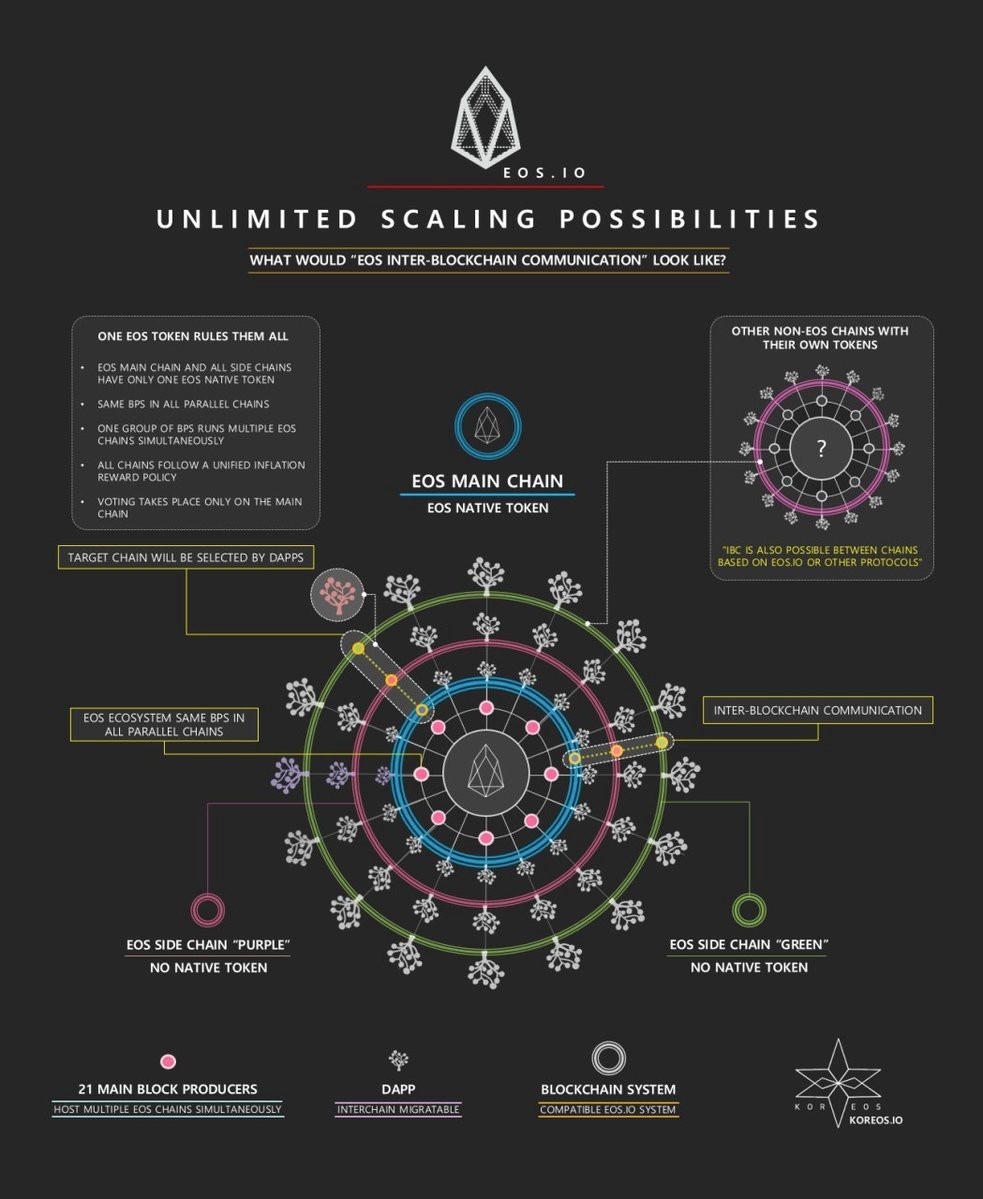 **Why Multiple Chains?** All blockchain networks face some fundamental limits on their capacity. While EOS has many features that allow it to achieve industry-leading performance, there are limits to systems that are distributed, especially those (like the current version of the EOS mainnet) that require sequential processing. For example, if I am using a decentralized exchange (DEX), and I sell 50 EOS to Bob, that transaction must be processed and confirmed before Bob can go and buy something with that EOS. Otherwise I could sell 50 EOS to Bob in exchange for another token (say BET) and then cancel or reverse the transaction before Bob can buy something with the EOS. Then I have both my EOS and Bob's BET tokens, and Bob has nothing. This is known as the [double-spend problem](https://www.investopedia.com/terms/d/doublespending.asp). On the other hand, say that I am using a DEX to trade with Bob, and another user is using a completely separate dApp like [Everipedia](https://everipedia.org/) to stake and unstake IQ tokens and edit articles. My trades and the other user's edits don't need to be processed one after another because they don't reference one another at all. The transactions within each respective dApp (the DEX and Everipedia) must be sequential, but my trades and the other user's edits can be processed at the same time, since there's no risk of a double spend. At the most basic level, the idea behind side chains and sister chains is that these two dApps could exist as separate chains. Instead of having a single blockchain with 3,996 tps that could host both dApps, we could have two separate chains, each with 3,996 tps, for a total of 7,992 tps across the ecosystem. Now imagine this across hundreds or even thousands of chains, and the scaling possibilities are nearly endless. While this solution gets us the increased throughput that we desire, it doesn't get us the interoperability between dApps that makes a platform like EOS so useful. So what happens if these dApps need to communicate and interoperate? That's where inter-blockchain communication (IBC) comes in. **Inter-Blockchain Communication (IBC)** Without interoperability, sidechains aren't possible, and sister chains become siloed platforms. Luckily for us, the ability for EOSIO blockchains to communicate has always been part of the vision for the EOS ecosystem. IBC was [first described](https://github.com/EOSIO/Documentation/blob/master/TechnicalWhitePaper.md#inter-blockchain-communication) in the EOSIO white paper. The groundwork has been laid to allow for IBC on the EOS mainnet, but the IBC core code is still being developed by both [Block.one](https://block.one/) and a number of block producers. It will likely be released by the end of this year. The core idea behind IBC is quite simple; different EOSIO blockchains will be able to send proofs to one another that allow for operations on one chain to be recognized on another. For example, say that I use a DEX to trade some EOS to Bob in exchange for IQ tokens. But then I want to stake those IQ tokens to edit articles on Everipedia. If the DEX and Everipedia exist as separate chains, then I need a way to transfer those IQ tokens from the DEX chain to the Everipedia chain. Using IBC, I can create a transaction on the DEX chain that proves ownership of those tokens and allows me to spend them on a separate chain. We won't dive into the complexities of how exactly this works, but it suffices to say that IBC creates a single global platform that has many chains that can all interoperate. In the future, these IBC transactions will likely be completely abstracted away from the end user, who will have no idea that transfers between different ledgers are taking place on the back end. **Problems with Sidechains and Sister Chains** While sidechains and sister chains are in many ways an elegant solution to scalability issues, they are not without their own challenges. Sister chains use their own native token for governance, resource allocation, and block producer compensation. Worbli, for example, has incentivized a number of BPs to join its network because it can use inflation of its WBI token to compensate BPs (just as the EOS mainnet does with the EOS token). One of the issues with this model is that it doesn't always make sense for a dApp to have its own native token. Certainly there are instances where a dApp-specific token makes sense, but there are many others where the dApp could function without its own token at all. And in many cases the native tokens that are created won't actually accrue much value. If this is the case, it will be hard to incentivize block producers to be paid in these tokens. These platforms may have to have higher rates of inflation to pay BPs enough to cover their costs, and that high inflation will put further downward price pressure on the token, creating a value-destructive cycle. Only those projects with compelling token models and true value creation will be able to survive long-term using this model. Sidechains, on the other hand, use the EOS mainnet token for resource allocation. Projects that build on sidechains have no way of incentivizing validators with inflation at all, since the EOS mainnet inflation goes to mainnet BPs. Thus, sidechains have two options: 1. Get all mainnet BPs to also act as BPs on the sidechain 2. Create other models for compensating BPs Getting existing mainnet BPs to all agree to produce blocks on other sidechains, especially when there are additional costs associated with providing that additional infrastructure, will be a tough sell for many projects. Block producers would be taking on additional costs while working for the same pay, and there may be disagreements among BPs about which projects are worth supporting. **Solutions** There are ways of solving these issues. For sister chains, they will have to create compelling enough products and token models that the tokens actually accrue value and thus can incentivize BPs. For sidechains, there are a few other solutions; in theory, an on-chain referendum could be held for EOS token holders to decide which sidechains existing mainnet BPs should produce blocks on. While this solution may work in the future once EOS's governance and referendum process is more mature, this may also create additional issues. An even better solution, proposed by [Chitty](https://twitter.com/jesus_chitty) of [EOS Argentina](https://www.eosargentina.io/), would be for sidechains to create business models that allow them to compensate BPs without inflation. Some EOS dApps have already proven real business models. [EOSBet](https://www.eosbet.io/) and [BETDice](https://betdice.one/) are both examples. These dApps generate actual revenue, some of which goes to token holders, some of which is paid to the developers, and some of which is used for staking and resources, depending on the structure. Now imagine if one of these dApps were built as a sidechain instead of a dApp on the mainnet. EOS mainnet tokens would still be used to stake for resources, as they are in the dApp today, but a portion of the dApp's revenue would be paid to the BPs on the sidechain. This would allow the dApp to compensate BPs, who would benefit from the success of the dApp. In fact, the dApp's native token (currently used for revenue sharing) could also be used for governance to decide who the BPs are, but the token supply wouldn't have to be inflated, and BPs could be paid in the EOS generated by the dApp. This is likely the best solution for most sidechains moving forward. **The Future of the EOSIO Multi-Chain Ecosystem** Once the IBC software is released, we will likely see an explosion of new projects creating sidechains and sister chains with all sorts of different models. We're looking forward to seeing all sorts of experimentation in the space to determine which models make the most sense. There are a number of ways that the EOSIO ecosystem could develop as a result of sidechains, sister chains, and IBC. On one hand, we may see more and more sidechains developed such that the EOS mainnet token accrues more value and network effects than any other token in the ecosystem. It may be that the EOS mainnet token becomes the reserve currency of the entire EOSIO ecosystem and that the mainnet is considered to be the most secure and canonical chain. If this is the case, sidechains and sister chains may be considered slightly less secure but more free to experiment with different models and architectures. These chains may periodically submit proofs of their state to the EOS mainnet in order to have a canonical record that lives on the main blockchain. On the other hand, it's entirely possible that no single EOSIO chain comes to be seen as the base chain or canonical chain of the ecosystem. This ecosystem may grow into one that sees competition between all sorts of different chains, where free market competition simply sees the most successful chains accrue the most value over time. We're not sure exactly how this situation will pan out, but we look forward to observing its evolution. [**Aurora EOS**](https://www.auroraeos.com) **is the leading block producer for the informed voter. If you find our work helpful, please vote for our node: auroraeoscom** **If you prefer to proxy your vote, our proxy account is auroraeosprx** **Find us on** [**Twitter**](https://twitter.com/auroraeosbp) **,** [**Medium**](https://medium.com/@auroraeos) **,** [**Telegram**](https://t.me/aurora_eos) **, and** [**Steem**](https://steemit.com/@auroraeos) [**Subscribe**](https://www.getrevue.co/profile/auroraeos) **to our newsletter for weekly updates on the EOS ecosystem** |
| json metadata | {"community":"busy","app":"busy/2.5.6","format":"markdown","tags":["blockchain","sidechain","scaling"],"users":["auroraeos"],"links":["https://bloks.io/live","http://blocktivity.info/","https://coinmarketcap.com/currencies/eos/","https://www.worbli.io/","https://wax.io/","https://telosfoundation.io/","https://www.ono.chat/en/","https://eos.io/","http://koreos.io/","https://www.investopedia.com/terms/d/doublespending.asp"],"image":["https://prismic-io.s3.amazonaws.com/aurora-eos%2F7b764cde-6b45-4d21-8301-3d7bd6ce5fdb_sidechains+and+sister+chains.png","https://prismic-io.s3.amazonaws.com/aurora-eos%2F54420222-48de-492d-8d9d-3efb666c79a0_auroraeos.jpg"]} |
| Transaction Info | Block #29322586/Trx f3d380303f3cda33fd279b87eb84b2148a0b95ad |
View Raw JSON Data
{
"trx_id": "f3d380303f3cda33fd279b87eb84b2148a0b95ad",
"block": 29322586,
"trx_in_block": 15,
"op_in_trx": 0,
"virtual_op": 0,
"timestamp": "2019-01-10T03:43:48",
"op": [
"comment",
{
"parent_author": "",
"parent_permlink": "blockchain",
"author": "auroraeos",
"permlink": "sidechains-and-sister-chains-on-eos-an-explainer",
"title": "Sidechains and Sister Chains on EOS: An Explainer",
"body": "\n\n**Intro**\n\nEOS is a blockchain that is built from the ground up for scalability. At its peak, the EOS mainnet as it exists today has [processed](https://bloks.io/live) 3,996 transactions per second (tps) and more than [10M operations](http://blocktivity.info/) in a single day. While these numbers are truly impressive, they are just the beginning for EOS. The long-term vision for the platform is to host thousands of dApps that serve millions of users on a daily basis. For this, the network will need to expand far beyond its current capacity.\n\nThe EOS scaling roadmap can be divided into two primary routes, each with its own subsections:\n\nThe first route is **vertical scaling**. These are optimizations that increase the capacity and throughput of an individual blockchain. This includes things like multi-threading, changes to the resource algorithms, optimizations to WASM, and increased block producer hardware capacity.\n\nThe second route is **horizontal scaling** ; solutions that increase the total number of individual blockchains in the ecosystem while maintaining interoperability between them. This includes sidechains and sister chains.\n\nThis article will focus on the role that sidechains and sister chains play in the EOS ecosystem and will address some of the challenges that these projects face.\n\n**What are Sidechains and Sister Chains?**\n\nBoth sidechains and sister chains are ways of creating additional capacity in the EOS ecosystem by creating multiple blockchains that use the same software and can communicate and interoperate.\n\n- **Sidechains** are EOSIO blockchains that utilize the [EOS mainnet token](https://coinmarketcap.com/currencies/eos/) for resource allocation (access to bandwidth, RAM, etc).\n- **Sister chains** are blockchains that utilize the EOSIO software but that have their own native token used for resource allocation.\n\nThere are not currently any sidechains that are live, but several sister chains are either live, in beta testing, or currently being built. These include a number of projects like [Worbli](https://www.worbli.io/), [WAX](https://wax.io/), [Telos](https://telosfoundation.io/), and [ONO](https://www.ono.chat/en/). These blockchains are built on the same open-source [EOSIO](https://eos.io/) software that powers the EOS mainnet, but they have their own tokens that are used for voting, resource allocation, and compensating block producers. Examples include the Worbli $WBI token and the ONO $ONOT token.\n\nSome of these sister chains have altered the features or parameters of the EOSIO software, making them functionally different from the EOS mainnet. Others have kept all of the core EOSIO features but are choosing to build on their own chain for reasons of throughput, resource management, compliance, or governance. Many of these sister chains have also airdropped a portion of their tokens to the existing set of EOS mainnet token holders.\n\nSidechains work a bit differently. Sidechains are separate blockchains, but they use the EOS mainnet token for resource allocation. Currently, if I stake 1000 EOS on the mainnet, then I have a pro-rata share of the network's resources. With a sidechain, I could stake those same 1000 EOS and get access to a pro-rata share of the sidechain's resources. This would allow users of the EOS mainnet to spread out across many chains for additional capacity while still building network effects (and value accrual) around the EOS mainnet token. It would also mean that users of the mainnet would be able to use their resources across an entire ecosystem of many chains without having to convert them into another token.\n\nThis graphic from [KOREOS](http://koreos.io/) does a great job of visualizing this ecosystem.\n\n\n**Why Multiple Chains?**\n\nAll blockchain networks face some fundamental limits on their capacity. While EOS has many features that allow it to achieve industry-leading performance, there are limits to systems that are distributed, especially those (like the current version of the EOS mainnet) that require sequential processing.\n\nFor example, if I am using a decentralized exchange (DEX), and I sell 50 EOS to Bob, that transaction must be processed and confirmed before Bob can go and buy something with that EOS. Otherwise I could sell 50 EOS to Bob in exchange for another token (say BET) and then cancel or reverse the transaction before Bob can buy something with the EOS. Then I have both my EOS and Bob's BET tokens, and Bob has nothing. This is known as the [double-spend problem](https://www.investopedia.com/terms/d/doublespending.asp).\n\nOn the other hand, say that I am using a DEX to trade with Bob, and another user is using a completely separate dApp like [Everipedia](https://everipedia.org/) to stake and unstake IQ tokens and edit articles. My trades and the other user's edits don't need to be processed one after another because they don't reference one another at all. The transactions within each respective dApp (the DEX and Everipedia) must be sequential, but my trades and the other user's edits can be processed at the same time, since there's no risk of a double spend.\n\nAt the most basic level, the idea behind side chains and sister chains is that these two dApps could exist as separate chains. Instead of having a single blockchain with 3,996 tps that could host both dApps, we could have two separate chains, each with 3,996 tps, for a total of 7,992 tps across the ecosystem. Now imagine this across hundreds or even thousands of chains, and the scaling possibilities are nearly endless.\n\nWhile this solution gets us the increased throughput that we desire, it doesn't get us the interoperability between dApps that makes a platform like EOS so useful. So what happens if these dApps need to communicate and interoperate? That's where inter-blockchain communication (IBC) comes in.\n\n**Inter-Blockchain Communication (IBC)**\n\nWithout interoperability, sidechains aren't possible, and sister chains become siloed platforms. Luckily for us, the ability for EOSIO blockchains to communicate has always been part of the vision for the EOS ecosystem.\n\nIBC was [first described](https://github.com/EOSIO/Documentation/blob/master/TechnicalWhitePaper.md#inter-blockchain-communication) in the EOSIO white paper. The groundwork has been laid to allow for IBC on the EOS mainnet, but the IBC core code is still being developed by both [Block.one](https://block.one/) and a number of block producers. It will likely be released by the end of this year.\n\nThe core idea behind IBC is quite simple; different EOSIO blockchains will be able to send proofs to one another that allow for operations on one chain to be recognized on another. For example, say that I use a DEX to trade some EOS to Bob in exchange for IQ tokens. But then I want to stake those IQ tokens to edit articles on Everipedia. If the DEX and Everipedia exist as separate chains, then I need a way to transfer those IQ tokens from the DEX chain to the Everipedia chain. Using IBC, I can create a transaction on the DEX chain that proves ownership of those tokens and allows me to spend them on a separate chain. We won't dive into the complexities of how exactly this works, but it suffices to say that IBC creates a single global platform that has many chains that can all interoperate. In the future, these IBC transactions will likely be completely abstracted away from the end user, who will have no idea that transfers between different ledgers are taking place on the back end.\n\n**Problems with Sidechains and Sister Chains**\n\nWhile sidechains and sister chains are in many ways an elegant solution to scalability issues, they are not without their own challenges.\n\nSister chains use their own native token for governance, resource allocation, and block producer compensation. Worbli, for example, has incentivized a number of BPs to join its network because it can use inflation of its WBI token to compensate BPs (just as the EOS mainnet does with the EOS token).\n\nOne of the issues with this model is that it doesn't always make sense for a dApp to have its own native token. Certainly there are instances where a dApp-specific token makes sense, but there are many others where the dApp could function without its own token at all. And in many cases the native tokens that are created won't actually accrue much value. If this is the case, it will be hard to incentivize block producers to be paid in these tokens. These platforms may have to have higher rates of inflation to pay BPs enough to cover their costs, and that high inflation will put further downward price pressure on the token, creating a value-destructive cycle. Only those projects with compelling token models and true value creation will be able to survive long-term using this model.\n\nSidechains, on the other hand, use the EOS mainnet token for resource allocation. Projects that build on sidechains have no way of incentivizing validators with inflation at all, since the EOS mainnet inflation goes to mainnet BPs. Thus, sidechains have two options:\n\n1. Get all mainnet BPs to also act as BPs on the sidechain\n2. Create other models for compensating BPs\n\nGetting existing mainnet BPs to all agree to produce blocks on other sidechains, especially when there are additional costs associated with providing that additional infrastructure, will be a tough sell for many projects. Block producers would be taking on additional costs while working for the same pay, and there may be disagreements among BPs about which projects are worth supporting.\n\n**Solutions**\n\nThere are ways of solving these issues. For sister chains, they will have to create compelling enough products and token models that the tokens actually accrue value and thus can incentivize BPs. For sidechains, there are a few other solutions; in theory, an on-chain referendum could be held for EOS token holders to decide which sidechains existing mainnet BPs should produce blocks on. While this solution may work in the future once EOS's governance and referendum process is more mature, this may also create additional issues.\n\nAn even better solution, proposed by [Chitty](https://twitter.com/jesus_chitty) of [EOS Argentina](https://www.eosargentina.io/), would be for sidechains to create business models that allow them to compensate BPs without inflation. Some EOS dApps have already proven real business models. [EOSBet](https://www.eosbet.io/) and [BETDice](https://betdice.one/) are both examples. These dApps generate actual revenue, some of which goes to token holders, some of which is paid to the developers, and some of which is used for staking and resources, depending on the structure. Now imagine if one of these dApps were built as a sidechain instead of a dApp on the mainnet. EOS mainnet tokens would still be used to stake for resources, as they are in the dApp today, but a portion of the dApp's revenue would be paid to the BPs on the sidechain. This would allow the dApp to compensate BPs, who would benefit from the success of the dApp. In fact, the dApp's native token (currently used for revenue sharing) could also be used for governance to decide who the BPs are, but the token supply wouldn't have to be inflated, and BPs could be paid in the EOS generated by the dApp. This is likely the best solution for most sidechains moving forward.\n\n**The Future of the EOSIO Multi-Chain Ecosystem**\n\nOnce the IBC software is released, we will likely see an explosion of new projects creating sidechains and sister chains with all sorts of different models. We're looking forward to seeing all sorts of experimentation in the space to determine which models make the most sense.\n\nThere are a number of ways that the EOSIO ecosystem could develop as a result of sidechains, sister chains, and IBC. On one hand, we may see more and more sidechains developed such that the EOS mainnet token accrues more value and network effects than any other token in the ecosystem. It may be that the EOS mainnet token becomes the reserve currency of the entire EOSIO ecosystem and that the mainnet is considered to be the most secure and canonical chain. If this is the case, sidechains and sister chains may be considered slightly less secure but more free to experiment with different models and architectures. These chains may periodically submit proofs of their state to the EOS mainnet in order to have a canonical record that lives on the main blockchain.\n\nOn the other hand, it's entirely possible that no single EOSIO chain comes to be seen as the base chain or canonical chain of the ecosystem. This ecosystem may grow into one that sees competition between all sorts of different chains, where free market competition simply sees the most successful chains accrue the most value over time.\n\nWe're not sure exactly how this situation will pan out, but we look forward to observing its evolution.\n\n[**Aurora EOS**](https://www.auroraeos.com) **is the leading block producer for the informed voter. If you find our work helpful, please vote for our node: auroraeoscom**\n\n**If you prefer to proxy your vote, our proxy account is auroraeosprx**\n\n**Find us on** [**Twitter**](https://twitter.com/auroraeosbp) **,** [**Medium**](https://medium.com/@auroraeos) **,** [**Telegram**](https://t.me/aurora_eos) **, and** [**Steem**](https://steemit.com/@auroraeos)\n\n[**Subscribe**](https://www.getrevue.co/profile/auroraeos) **to our newsletter for weekly updates on the EOS ecosystem**",
"json_metadata": "{\"community\":\"busy\",\"app\":\"busy/2.5.6\",\"format\":\"markdown\",\"tags\":[\"blockchain\",\"sidechain\",\"scaling\"],\"users\":[\"auroraeos\"],\"links\":[\"https://bloks.io/live\",\"http://blocktivity.info/\",\"https://coinmarketcap.com/currencies/eos/\",\"https://www.worbli.io/\",\"https://wax.io/\",\"https://telosfoundation.io/\",\"https://www.ono.chat/en/\",\"https://eos.io/\",\"http://koreos.io/\",\"https://www.investopedia.com/terms/d/doublespending.asp\"],\"image\":[\"https://prismic-io.s3.amazonaws.com/aurora-eos%2F7b764cde-6b45-4d21-8301-3d7bd6ce5fdb_sidechains+and+sister+chains.png\",\"https://prismic-io.s3.amazonaws.com/aurora-eos%2F54420222-48de-492d-8d9d-3efb666c79a0_auroraeos.jpg\"]}"
}
]
}2018/12/08 01:26:33
2018/12/08 01:26:33
| parent author | auroraeos |
| parent permlink | against-mandatory-arbitration-on-eos |
| author | steemitboard |
| permlink | steemitboard-notify-auroraeos-20181208t012635000z |
| title | |
| body | Congratulations @auroraeos! You have completed the following achievement on the Steem blockchain and have been rewarded with new badge(s) : <table><tr><td>https://steemitimages.com/60x60/http://steemitboard.com/notifications/firstpayout.png</td><td>You got your First payout</td></tr> </table> <sub>_[Click here to view your Board of Honor](https://steemitboard.com/@auroraeos)_</sub> <sub>_If you no longer want to receive notifications, reply to this comment with the word_ `STOP`</sub> **Do not miss the last post from @steemitboard:** <table><tr><td><a href="https://steemit.com/steemitboard/@steemitboard/5jrq2c-steemitboard-saint-nicholas-day"><img src="https://steemitimages.com/64x128/http://i.cubeupload.com/mGo2Zd.png"></a></td><td><a href="https://steemit.com/steemitboard/@steemitboard/5jrq2c-steemitboard-saint-nicholas-day">Saint Nicholas challenge for good boys and girls</a></td></tr></table> > Support [SteemitBoard's project](https://steemit.com/@steemitboard)! **[Vote for its witness](https://v2.steemconnect.com/sign/account-witness-vote?witness=steemitboard&approve=1)** and **get one more award**! |
| json metadata | {"image":["https://steemitboard.com/img/notify.png"]} |
| Transaction Info | Block #28370126/Trx 1906a824551df2ce69b8099e0e3bd9d36f604f65 |
View Raw JSON Data
{
  "trx_id": "1906a824551df2ce69b8099e0e3bd9d36f604f65",
  "block": 28370126,
  "trx_in_block": 16,
  "op_in_trx": 0,
  "virtual_op": 0,
  "timestamp": "2018-12-08T01:26:33",
  "op": [
    "comment",
    {
      "parent_author": "auroraeos",
      "parent_permlink": "against-mandatory-arbitration-on-eos",
      "author": "steemitboard",
      "permlink": "steemitboard-notify-auroraeos-20181208t012635000z",
      "title": "",
      "body": "Congratulations @auroraeos! You have completed the following achievement on the Steem blockchain and have been rewarded with new badge(s) :\n\n<table><tr><td>https://steemitimages.com/60x60/http://steemitboard.com/notifications/firstpayout.png</td><td>You got your First payout</td></tr>\n</table>\n\n<sub>_[Click here to view your Board of Honor](https://steemitboard.com/@auroraeos)_</sub>\n<sub>_If you no longer want to receive notifications, reply to this comment with the word_ `STOP`</sub>\n\n\n\n**Do not miss the last post from @steemitboard:**\n<table><tr><td><a href=\"https://steemit.com/steemitboard/@steemitboard/5jrq2c-steemitboard-saint-nicholas-day\"><img src=\"https://steemitimages.com/64x128/http://i.cubeupload.com/mGo2Zd.png\"></a></td><td><a href=\"https://steemit.com/steemitboard/@steemitboard/5jrq2c-steemitboard-saint-nicholas-day\">Saint Nicholas challenge for good boys and girls</a></td></tr></table>\n\n> Support [SteemitBoard's project](https://steemit.com/@steemitboard)! **[Vote for its witness](https://v2.steemconnect.com/sign/account-witness-vote?witness=steemitboard&approve=1)** and **get one more award**!",
      "json_metadata": "{\"image\":[\"https://steemitboard.com/img/notify.png\"]}"
    }
  ]
}auroraeosreceived 0.878 STEEM, 0.003 SBD, 1.095 SP author reward for @auroraeos / re-eosphere-why-eosphere-20181130t170224253z2018/12/07 17:02:24
auroraeosreceived 0.878 STEEM, 0.003 SBD, 1.095 SP author reward for @auroraeos / re-eosphere-why-eosphere-20181130t170224253z
2018/12/07 17:02:24
| author | auroraeos |
| permlink | re-eosphere-why-eosphere-20181130t170224253z |
| sbd payout | 0.003 SBD |
| steem payout | 0.878 STEEM |
| vesting payout | 1783.316544 VESTS |
| Transaction Info | Block #28360061/Virtual Operation #5 |
View Raw JSON Data
{
  "trx_id": "0000000000000000000000000000000000000000",
  "block": 28360061,
  "trx_in_block": 4294967295,
  "op_in_trx": 0,
  "virtual_op": 5,
  "timestamp": "2018-12-07T17:02:24",
  "op": [
    "author_reward",
    {
      "author": "auroraeos",
      "permlink": "re-eosphere-why-eosphere-20181130t170224253z",
      "sbd_payout": "0.003 SBD",
      "steem_payout": "0.878 STEEM",
      "vesting_payout": "1783.316544 VESTS"
    }
  ]
}auroraeosfollowed @blocktivity2018/12/05 23:17:42
auroraeosfollowed @blocktivity
2018/12/05 23:17:42
| required auths | [] |
| required posting auths | ["auroraeos"] |
| id | follow |
| json | ["follow",{"follower":"auroraeos","following":"blocktivity","what":["blog"]}] |
| Transaction Info | Block #28309999/Trx 15e44efef3b23bb94a9787ddb9c5e2856c67f6ca |
View Raw JSON Data
{
  "trx_id": "15e44efef3b23bb94a9787ddb9c5e2856c67f6ca",
  "block": 28309999,
  "trx_in_block": 5,
  "op_in_trx": 0,
  "virtual_op": 0,
  "timestamp": "2018-12-05T23:17:42",
  "op": [
    "custom_json",
    {
      "required_auths": [],
      "required_posting_auths": [
        "auroraeos"
      ],
      "id": "follow",
      "json": "[\"follow\",{\"follower\":\"auroraeos\",\"following\":\"blocktivity\",\"what\":[\"blog\"]}]"
    }
  ]
}auroraeosfollowed @cryptobobby2018/12/05 16:25:03
auroraeosfollowed @cryptobobby
2018/12/05 16:25:03
| required auths | [] |
| required posting auths | ["auroraeos"] |
| id | follow |
| json | ["follow",{"follower":"auroraeos","following":"cryptobobby","what":["blog"]}] |
| Transaction Info | Block #28301749/Trx cc0f3afe3c691a7ed91ae21b0f7e52c0bc485798 |
View Raw JSON Data
{
  "trx_id": "cc0f3afe3c691a7ed91ae21b0f7e52c0bc485798",
  "block": 28301749,
  "trx_in_block": 28,
  "op_in_trx": 0,
  "virtual_op": 0,
  "timestamp": "2018-12-05T16:25:03",
  "op": [
    "custom_json",
    {
      "required_auths": [],
      "required_posting_auths": [
        "auroraeos"
      ],
      "id": "follow",
      "json": "[\"follow\",{\"follower\":\"auroraeos\",\"following\":\"cryptobobby\",\"what\":[\"blog\"]}]"
    }
  ]
}boatymcboatfaceupvoted (100.00%) @auroraeos / re-eosphere-why-eosphere-20181130t170224253z2018/12/01 13:15:24
boatymcboatfaceupvoted (100.00%) @auroraeos / re-eosphere-why-eosphere-20181130t170224253z
2018/12/01 13:15:24
| voter | boatymcboatface |
| author | auroraeos |
| permlink | re-eosphere-why-eosphere-20181130t170224253z |
| weight | 10000 (100.00%) |
| Transaction Info | Block #28182797/Trx f004af5d7404ba07058c18e9dd6ee273be968f3f |
View Raw JSON Data
{
  "trx_id": "f004af5d7404ba07058c18e9dd6ee273be968f3f",
  "block": 28182797,
  "trx_in_block": 14,
  "op_in_trx": 0,
  "virtual_op": 0,
  "timestamp": "2018-12-01T13:15:24",
  "op": [
    "vote",
    {
      "voter": "boatymcboatface",
      "author": "auroraeos",
      "permlink": "re-eosphere-why-eosphere-20181130t170224253z",
      "weight": 10000
    }
  ]
}eosphereupvoted (100.00%) @auroraeos / re-eosphere-why-eosphere-20181130t170224253z2018/12/01 13:15:03
eosphereupvoted (100.00%) @auroraeos / re-eosphere-why-eosphere-20181130t170224253z
2018/12/01 13:15:03
| voter | eosphere |
| author | auroraeos |
| permlink | re-eosphere-why-eosphere-20181130t170224253z |
| weight | 10000 (100.00%) |
| Transaction Info | Block #28182790/Trx af8c2bc0a56b0c1a02dfa755981f6cd018353bb7 |
View Raw JSON Data
{
  "trx_id": "af8c2bc0a56b0c1a02dfa755981f6cd018353bb7",
  "block": 28182790,
  "trx_in_block": 15,
  "op_in_trx": 0,
  "virtual_op": 0,
  "timestamp": "2018-12-01T13:15:03",
  "op": [
    "vote",
    {
      "voter": "eosphere",
      "author": "auroraeos",
      "permlink": "re-eosphere-why-eosphere-20181130t170224253z",
      "weight": 10000
    }
  ]
}2018/11/30 18:16:45
2018/11/30 18:16:45
| parent author | auroraeos |
| parent permlink | against-mandatory-arbitration-on-eos |
| author | steemitboard |
| permlink | steemitboard-notify-auroraeos-20181130t181644000z |
| title | |
| body | Congratulations @auroraeos! You have completed the following achievement on the Steem blockchain and have been rewarded with new badge(s) : <table><tr><td>https://steemitimages.com/60x60/http://steemitboard.com/notifications/firstcomment.png</td><td>You made your First Comment</td></tr> </table> <sub>_[Click here to view your Board of Honor](https://steemitboard.com/@auroraeos)_</sub> <sub>_If you no longer want to receive notifications, reply to this comment with the word_ `STOP`</sub> > Support [SteemitBoard's project](https://steemit.com/@steemitboard)! **[Vote for its witness](https://v2.steemconnect.com/sign/account-witness-vote?witness=steemitboard&approve=1)** and **get one more award**! |
| json metadata | {"image":["https://steemitboard.com/img/notify.png"]} |
| Transaction Info | Block #28160033/Trx 6e7905485aeb451da75293720ad7cbca3c8f17a5 |
View Raw JSON Data
{
  "trx_id": "6e7905485aeb451da75293720ad7cbca3c8f17a5",
  "block": 28160033,
  "trx_in_block": 5,
  "op_in_trx": 0,
  "virtual_op": 0,
  "timestamp": "2018-11-30T18:16:45",
  "op": [
    "comment",
    {
      "parent_author": "auroraeos",
      "parent_permlink": "against-mandatory-arbitration-on-eos",
      "author": "steemitboard",
      "permlink": "steemitboard-notify-auroraeos-20181130t181644000z",
      "title": "",
      "body": "Congratulations @auroraeos! You have completed the following achievement on the Steem blockchain and have been rewarded with new badge(s) :\n\n<table><tr><td>https://steemitimages.com/60x60/http://steemitboard.com/notifications/firstcomment.png</td><td>You made your First Comment</td></tr>\n</table>\n\n<sub>_[Click here to view your Board of Honor](https://steemitboard.com/@auroraeos)_</sub>\n<sub>_If you no longer want to receive notifications, reply to this comment with the word_ `STOP`</sub>\n\n\n\n> Support [SteemitBoard's project](https://steemit.com/@steemitboard)! **[Vote for its witness](https://v2.steemconnect.com/sign/account-witness-vote?witness=steemitboard&approve=1)** and **get one more award**!",
      "json_metadata": "{\"image\":[\"https://steemitboard.com/img/notify.png\"]}"
    }
  ]
}fatmanc1970upvoted (100.00%) @auroraeos / re-eosphere-why-eosphere-20181130t170224253z2018/11/30 17:19:27
fatmanc1970upvoted (100.00%) @auroraeos / re-eosphere-why-eosphere-20181130t170224253z
2018/11/30 17:19:27
| voter | fatmanc1970 |
| author | auroraeos |
| permlink | re-eosphere-why-eosphere-20181130t170224253z |
| weight | 10000 (100.00%) |
| Transaction Info | Block #28158889/Trx 7eeed70a5fe494e7284d1da0cc1a3581541fb75f |
View Raw JSON Data
{
  "trx_id": "7eeed70a5fe494e7284d1da0cc1a3581541fb75f",
  "block": 28158889,
  "trx_in_block": 11,
  "op_in_trx": 0,
  "virtual_op": 0,
  "timestamp": "2018-11-30T17:19:27",
  "op": [
    "vote",
    {
      "voter": "fatmanc1970",
      "author": "auroraeos",
      "permlink": "re-eosphere-why-eosphere-20181130t170224253z",
      "weight": 10000
    }
  ]
}auroraeoscustom json: follow2018/11/30 17:02:48
auroraeoscustom json: follow
2018/11/30 17:02:48
| required auths | [] |
| required posting auths | ["auroraeos"] |
| id | follow |
| json | ["reblog",{"account":"auroraeos","author":"greymass","permlink":"introducing-light-history-nodes-for-eos"}] |
| Transaction Info | Block #28158556/Trx 8af07236694f2ee1e5e69e5ec27d3b0cbe1eec9c |
View Raw JSON Data
{
  "trx_id": "8af07236694f2ee1e5e69e5ec27d3b0cbe1eec9c",
  "block": 28158556,
  "trx_in_block": 39,
  "op_in_trx": 0,
  "virtual_op": 0,
  "timestamp": "2018-11-30T17:02:48",
  "op": [
    "custom_json",
    {
      "required_auths": [],
      "required_posting_auths": [
        "auroraeos"
      ],
      "id": "follow",
      "json": "[\"reblog\",{\"account\":\"auroraeos\",\"author\":\"greymass\",\"permlink\":\"introducing-light-history-nodes-for-eos\"}]"
    }
  ]
}auroraeosupvoted (100.00%) @greymass / introducing-light-history-nodes-for-eos2018/11/30 17:02:42
auroraeosupvoted (100.00%) @greymass / introducing-light-history-nodes-for-eos
2018/11/30 17:02:42
| voter | auroraeos |
| author | greymass |
| permlink | introducing-light-history-nodes-for-eos |
| weight | 10000 (100.00%) |
| Transaction Info | Block #28158554/Trx 8b3e2d94f9e23ed189c7453db20d5f6e5340aa55 |
View Raw JSON Data
{
  "trx_id": "8b3e2d94f9e23ed189c7453db20d5f6e5340aa55",
  "block": 28158554,
  "trx_in_block": 15,
  "op_in_trx": 0,
  "virtual_op": 0,
  "timestamp": "2018-11-30T17:02:42",
  "op": [
    "vote",
    {
      "voter": "auroraeos",
      "author": "greymass",
      "permlink": "introducing-light-history-nodes-for-eos",
      "weight": 10000
    }
  ]
}2018/11/30 17:02:24
2018/11/30 17:02:24
| parent author | eosphere |
| parent permlink | why-eosphere |
| author | auroraeos |
| permlink | re-eosphere-why-eosphere-20181130t170224253z |
| title | |
| body | Great stuff EOSphere! |
| json metadata | {"community":"busy","app":"busy/2.5.6","format":"markdown","tags":["eosio"],"users":[],"links":[],"image":[]} |
| Transaction Info | Block #28158548/Trx 45fa2e6de54b49c06cafa6cca54a273dbe8b70e7 |
View Raw JSON Data
{
  "trx_id": "45fa2e6de54b49c06cafa6cca54a273dbe8b70e7",
  "block": 28158548,
  "trx_in_block": 23,
  "op_in_trx": 0,
  "virtual_op": 0,
  "timestamp": "2018-11-30T17:02:24",
  "op": [
    "comment",
    {
      "parent_author": "eosphere",
      "parent_permlink": "why-eosphere",
      "author": "auroraeos",
      "permlink": "re-eosphere-why-eosphere-20181130t170224253z",
      "title": "",
      "body": "Great stuff EOSphere!",
      "json_metadata": "{\"community\":\"busy\",\"app\":\"busy/2.5.6\",\"format\":\"markdown\",\"tags\":[\"eosio\"],\"users\":[],\"links\":[],\"image\":[]}"
    }
  ]
}auroraeosupvoted (100.00%) @eosphere / why-eosphere2018/11/30 17:02:09
auroraeosupvoted (100.00%) @eosphere / why-eosphere
2018/11/30 17:02:09
| voter | auroraeos |
| author | eosphere |
| permlink | why-eosphere |
| weight | 10000 (100.00%) |
| Transaction Info | Block #28158543/Trx 101ba2dba4388fc2e73e1568be267c7953f8a39e |
View Raw JSON Data
{
  "trx_id": "101ba2dba4388fc2e73e1568be267c7953f8a39e",
  "block": 28158543,
  "trx_in_block": 3,
  "op_in_trx": 0,
  "virtual_op": 0,
  "timestamp": "2018-11-30T17:02:09",
  "op": [
    "vote",
    {
      "voter": "auroraeos",
      "author": "eosphere",
      "permlink": "why-eosphere",
      "weight": 10000
    }
  ]
}2018/11/30 17:01:57
2018/11/30 17:01:57
| required auths | [] |
| required posting auths | ["auroraeos"] |
| id | follow |
| json | ["follow",{"follower":"auroraeos","following":"eosphere","what":["blog"]}] |
| Transaction Info | Block #28158539/Trx 3b42a1e0bdae83b3ce2a68f08d47826d1505d7a4 |
View Raw JSON Data
{
  "trx_id": "3b42a1e0bdae83b3ce2a68f08d47826d1505d7a4",
  "block": 28158539,
  "trx_in_block": 1,
  "op_in_trx": 0,
  "virtual_op": 0,
  "timestamp": "2018-11-30T17:01:57",
  "op": [
    "custom_json",
    {
      "required_auths": [],
      "required_posting_auths": [
        "auroraeos"
      ],
      "id": "follow",
      "json": "[\"follow\",{\"follower\":\"auroraeos\",\"following\":\"eosphere\",\"what\":[\"blog\"]}]"
    }
  ]
}auroraeosfollowed @cypherglass2018/11/23 18:20:06
auroraeosfollowed @cypherglass
2018/11/23 18:20:06
| required auths | [] |
| required posting auths | ["auroraeos"] |
| id | follow |
| json | ["follow",{"follower":"auroraeos","following":"cypherglass","what":["blog"]}] |
| Transaction Info | Block #27958603/Trx 387b3fe8ea87e2f8cc86a4adf0bbb6095bd29eb9 |
View Raw JSON Data
{
  "trx_id": "387b3fe8ea87e2f8cc86a4adf0bbb6095bd29eb9",
  "block": 27958603,
  "trx_in_block": 10,
  "op_in_trx": 0,
  "virtual_op": 0,
  "timestamp": "2018-11-23T18:20:06",
  "op": [
    "custom_json",
    {
      "required_auths": [],
      "required_posting_auths": [
        "auroraeos"
      ],
      "id": "follow",
      "json": "[\"follow\",{\"follower\":\"auroraeos\",\"following\":\"cypherglass\",\"what\":[\"blog\"]}]"
    }
  ]
}sensationupvoted (100.00%) @auroraeos / against-mandatory-arbitration-on-eos2018/11/20 19:54:48
sensationupvoted (100.00%) @auroraeos / against-mandatory-arbitration-on-eos
2018/11/20 19:54:48
| voter | sensation |
| author | auroraeos |
| permlink | against-mandatory-arbitration-on-eos |
| weight | 10000 (100.00%) |
| Transaction Info | Block #27874131/Trx 856caed40779eacd30c8782348b6f6dda3b2f8c0 |
View Raw JSON Data
{
  "trx_id": "856caed40779eacd30c8782348b6f6dda3b2f8c0",
  "block": 27874131,
  "trx_in_block": 43,
  "op_in_trx": 0,
  "virtual_op": 0,
  "timestamp": "2018-11-20T19:54:48",
  "op": [
    "vote",
    {
      "voter": "sensation",
      "author": "auroraeos",
      "permlink": "against-mandatory-arbitration-on-eos",
      "weight": 10000
    }
  ]
}yeheyupvoted (10.00%) @auroraeos / against-mandatory-arbitration-on-eos2018/11/20 19:02:42
yeheyupvoted (10.00%) @auroraeos / against-mandatory-arbitration-on-eos
2018/11/20 19:02:42
| voter | yehey |
| author | auroraeos |
| permlink | against-mandatory-arbitration-on-eos |
| weight | 1000 (10.00%) |
| Transaction Info | Block #27873089/Trx 08fddedd5da1984224751e16dbc0a5db724fdca3 |
View Raw JSON Data
{
  "trx_id": "08fddedd5da1984224751e16dbc0a5db724fdca3",
  "block": 27873089,
  "trx_in_block": 4,
  "op_in_trx": 0,
  "virtual_op": 0,
  "timestamp": "2018-11-20T19:02:42",
  "op": [
    "vote",
    {
      "voter": "yehey",
      "author": "auroraeos",
      "permlink": "against-mandatory-arbitration-on-eos",
      "weight": 1000
    }
  ]
}auroraeosupvoted (100.00%) @thecryptodunker / how-to-airgrab-free-nebula-tokens2018/11/20 18:29:03
auroraeosupvoted (100.00%) @thecryptodunker / how-to-airgrab-free-nebula-tokens
2018/11/20 18:29:03
| voter | auroraeos |
| author | thecryptodunker |
| permlink | how-to-airgrab-free-nebula-tokens |
| weight | 10000 (100.00%) |
| Transaction Info | Block #27872417/Trx 66c4c1a545a20d72c865b522639523774c41abba |
View Raw JSON Data
{
  "trx_id": "66c4c1a545a20d72c865b522639523774c41abba",
  "block": 27872417,
  "trx_in_block": 33,
  "op_in_trx": 0,
  "virtual_op": 0,
  "timestamp": "2018-11-20T18:29:03",
  "op": [
    "vote",
    {
      "voter": "auroraeos",
      "author": "thecryptodunker",
      "permlink": "how-to-airgrab-free-nebula-tokens",
      "weight": 10000
    }
  ]
}auroraeosupvoted (100.00%) @auroraeos / against-mandatory-arbitration-on-eos2018/11/20 18:28:48
auroraeosupvoted (100.00%) @auroraeos / against-mandatory-arbitration-on-eos
2018/11/20 18:28:48
| voter | auroraeos |
| author | auroraeos |
| permlink | against-mandatory-arbitration-on-eos |
| weight | 10000 (100.00%) |
| Transaction Info | Block #27872412/Trx 3ab6b6682de32920fa8ccdeb3c6045b20011cfc8 |
View Raw JSON Data
{
  "trx_id": "3ab6b6682de32920fa8ccdeb3c6045b20011cfc8",
  "block": 27872412,
  "trx_in_block": 2,
  "op_in_trx": 0,
  "virtual_op": 0,
  "timestamp": "2018-11-20T18:28:48",
  "op": [
    "vote",
    {
      "voter": "auroraeos",
      "author": "auroraeos",
      "permlink": "against-mandatory-arbitration-on-eos",
      "weight": 10000
    }
  ]
}auroraeospublished a new post: against-mandatory-arbitration-on-eos2018/11/20 18:28:48
auroraeospublished a new post: against-mandatory-arbitration-on-eos
2018/11/20 18:28:48
| parent author | |
| parent permlink | eos |
| author | auroraeos |
| permlink | against-mandatory-arbitration-on-eos |
| title | Against Mandatory Arbitration on EOS |
| body |  *The EOS community has been working together to produce a referendum contract; that is, a contract that will allow the EOS community to hold public, on-chain vote on any topic. This will allow the EOS community to officially ratify a constitution that serves as a peer-to-peer terms of service agreement for EOS users. This will be the first in a series of articles that dive into the most important topics that the EOS community must consider when building a new constitution.* **Intro** Recently, there has been a debate in the EOS community around arbitration, also called dispute resolution. Arbitration is defined as “the hearing and determining of a dispute or the settling of differences between parties by a person or persons chosen or agreed to by them.” In the context of EOS, dispute resolution is a broad concept that refers to any method by which any kind of dispute that may arise between users of the EOS platform is resolved on-chain. The debate over how dispute resolution on EOS will work is one of the most important, controversial, and confusing topics discussed as the EOS community adopts a new constitution via public referendum. In this post we will explain the concept of arbitration on EOS and the current state of the debate. We will also make the case that arbitration on EOS should be opt-in rather than mandatory. We will demonstrate why the next version of the EOS constitution should not give special powers to any single global arbitrator, since mandatory arbitration degrades the security, public trust, and social scalability of the EOS blockchain. Finally, we’ll offer a near-term solution to this issue and brainstorm next steps. **Background** Many blockchains that came before EOS took a “code is law” approach to governance. These blockchains operate under rigid, strictly defined parameters in order to operate in as deterministic a manner as possible without the complexities introduced by human interactions. The advantage to this approach is that it gives users strong guarantees about how the protocol will behave under any given circumstance. The disadvantage is that code is created by humans, and when humans are involved, at some point things inevitably go wrong. The limits of the “code is law” approach become most apparent when such mistakes happen. A perfect example is the DAO hack that affected Ethereum in 2016. Ethereum operated under a code is law approach until one of the highest-value contracts on the entire network was exploited by a hacker. Given the nascency of the network and the tremendous amount of value that was at risk of being stolen, some members of the Ethereum community proposed a hard fork of the network that would negate the results of the attack. Other community members believed that code is law meant that any exploitation of the code was legitimate, and thus opposed the hard fork. Ultimately, the network did fork, and two networks-- Ethereum and Ethereum Classic-- emerged as a result. The DAO hack was one of many examples of network disputes that affect platforms like Ethereum and EOS, and there will certainly be more in the future. EOS is designed to have a more structured governance process that allows network disputes to be resolved without having to resort to hard forks that fracture the network. EOS has a multi-layered governance stack that includes voting for block producers, voting in general referenda, a network constitution, and arbitration. Different layers may be more or less relevant to different types of governance decisions. Each of these layers is designed to give the protocol more flexibility than the code is law approach. But this governance stack is still being defined and formalized, and it is up to the EOS community to improve these processes and put effective frameworks in place. In this article, we’ll be focusing on the arbitration layer of governance. Arbitration attempts to answer the question: “how can two entities interact on a blockchain and resolve disputes when the code does not behave as intended?” With arbitration, both parties to an transaction have a mutually agreed-upon third party who is tasked with resolving disputes. While simple in theory, there are many nuances to how arbitration works in practice. We believe specifically that mandatory arbitration degrades the value of the EOS network. **Mandatory Arbitration vs. Opt-in Arbitration** The EOS community is debating two paths forward: opt-in (or application-layer) arbitration, and mandatory (also called default, or base-layer) arbitration. All arbitration requires that two parties agree to an arbitrator prior to there being a dispute. The debate between opt-in arbitration and mandatory arbitration is simple— should all users be bound to a system-level arbitrator or should users have to opt into arbitration? In other words, should there be a single arbitrator of last resort for all EOS users, or should many different arbitrators exist, giving users the option of any of these arbitrators or no arbitrator at all? Opt-in arbitration would work by allowing EOS users to choose any arbitrator to mediate their interactions. Importantly, however, these agreements would happen on a contract by contract basis and can be handled in any number of different ways, depending on the specifics of the situation. No user of EOS would be required to use an arbitrator, but users who choose not to do so would have to accept the risks associated with their interactions on the blockchain. This approach would allow users to be completely self-sovereign but would also offer the option of arbitration for those that wanted it. So how would opt-in arbitration work in practice? If Alice and Bob enter into a contract, they can both agree that a neutral third party (Carol) can arbitrate in the event of a dispute. Alternatively, if Alice and Bob don’t want to agree on an arbitrator ahead of time, they can specify in the contract that they must mutually agree on an arbitrator in the event of dispute. When a dispute occurs, the decision falls on the arbitrator, who can address the specifics of the case without requiring outside involvement. In some cases, arbitrators can even structure smart contracts, multi-sig key management, and account permissions in such a way that allows arbitration decisions to be enforced programmatically. Different arbitrators, some specializing in certain kinds of disputes or in certain jurisdictions, will compete in a free market for business from EOS users. We expect that arbitrators will emerge that specialize in different verticals— gaming, financial services, enterprise agreements, etc. Just as businesses today choose different jurisdictions in which to incorporate, so too will EOS users and businesses built on EOS choose different arbitrators based on specific use cases. Mandatory arbitration, on the other hand, refers to the use of a default arbitrator, specified in the constitution, for every interaction that takes place on the blockchain. The idea of a network constitution was first introduced in the EOSIO whitepaper, described as a “peer-to-peer terms of service agreement.” This serves as a document and Ricardian contract that defines the governance processes of the network. The EOS mainnet launched in June with a temporary constitution designed to serve as an interim solution until a public on-chain vote could be held to ratify an official version. This current interim EOS constitution defaults to base-layer arbitration, with ECAF acting as the default arbitrator. In this setup, users do not have the option to opt out of arbitration, and they can’t use EOS unless they agree to the default arbitrator. In the case of a dispute, users can file a case with ECAF, and all EOS users are bound by ECAF’s decisions. At Aurora EOS, we believe that the EOS platform should offer users the option to use an arbitrator but should not include any arbitrator by default. We believe that the inclusion of a base layer arbitrator is a grave mistake that does far more harm than good. Below, we outline the reasons why. **Mandatory Arbitration Breaks the DPOS Security Model** EOS is powered by delegated proof of stake (DPOS), the consensus algorithm that allows token holders to elect the network’s validator set. In DPOS, many independent companies located all over the world compete to earn the approval of EOS token holders, and thus the privilege of serving as a block producer. They are elected into semi-trusted positions within the network, but there are direct, enforceable, and effective checks on their power that both limit the amount of damage they can do if they act maliciously and also keep them highly accountable and incentivized to act honestly. If a block producer is malicious or acts against the best interest of the community, they can be voted out and replaced by another standby BP. They risk losing not only their public reputation but also their future income stream. This is a core part of the security model of DPOS. Public blockchains like the EOS mainnet are explicitly designed to be decentralized. While there is no single definition or quantifiable metric to measure decentralization, one way to conceptualize decentralization is to eliminate the reliance on any single individual or entity. DPOS does this by rotating block production equally among 21 entities at any given time, giving token holders the ability to control who is in those positions, and incentivizing BPs to act as standbys (there are currently more than 60 standby BPs that’re being paid by the protocol in case anything happens to any of the top 21 BPs). The network is designed to withstand any one entity behaving maliciously; if any single BP attempts to harm the network, the effects are negligible. BPs are subject to their constituents, token holders, in a perpetual, 24/7 election. Token holders are the owners of the network. They are in control collectively, but no single party has complete power or influence to make decisions. Mandatory arbitration, instead of eliminating reliance on any single entity, creates such reliance. In fact, it gives sweeping decision-making power to a single entity, the default arbitrator, within the EOS ecosystem without any checks or restrictions on that power. Proponents of base layer arbitration argue that block producers provide a check on the power of the arbitrators, since it is ultimately up to the BPs to enforce any arbitration decision. But this argument undermines the entire point of a constitution! If BPs are constitutionally bound to an arbitrator, they should not question that arbitrator’s decision. This is key to the separation of powers in the EOS system. DPOS creates a system of distributed trust that gives very limited power to a diverse set of entities in order to create a system that is global, permissionless, and doesn’t give outsized power or influence to any individual entity. The inclusion of an arbitrator at the base layer of EOS violates the most fundamental tenet of decentralized systems. **Mandatory Arbitration Undermines the Legitimacy of EOS as a Public Blockchain** In order to be successful, blockchains need to provide certain levels of assurance for their users. Users need to know that their property is self-sovereign— that it cannot be confiscated by any third party. Arbitration, as it currently stands, is a feature unique to the EOS blockchain. Although it has been used successfully to protect users from malicious attacks, it creates a massive liability for the vast majority of token holders. Users should be able to agree to 100% final, non-reversible transactions. With the presence of a base-layer arbitrator, this is impossible. Blockchain tokens are bearer instruments. Even with all of the unique features of EOS, the protocol is still powered by public key cryptography, meaning private keys act as definitive proof of ownership. This is important because that is the only way for the protocol to objectively verify ownership. Any other way of defining ownership naturally requires off-chain, subjective interpretations (like those given by ECAF), and thus undermines property rights on EOS. If a blockchain cannot objectively determine ownership at the protocol level, then it will introduce dangerous levels of subjectivity that ultimately cause the entire project to break down. We do not believe that the goal for all blockchain systems is to entirely eliminate the need for subjectivity and trust in the world. We know that there is room for these things, but they can’t exist at the protocol layer because blockchains as designed to have objective consensus and state transition rules. If these protocols can’t rely on objective criteria like public/private key cryptography at the base layer, then they won’t function at scale. Systems that require trust and subjectivity should exist on top of these protocols, either at the dApp layer or as services offered by third parties. The important thing is that users have a choice of whether or not to use these services and the risk/reward tradeoff that comes with that decision. **Mandatory Arbitration Doesn’t Scale** Even if EOS token holders were to agree to mandatory arbitration specified in the constitution, this setup faces massive practical challenges. Base-layer arbitration is by definition global, which means that it must scale to support 7B people. It is entirely unreasonable to expect a single arbitration body to operate at this scale, especially given the massive diversity contained therein (different cultures, timezones, languages, etc). Arbitration requires decisions to be made about individual disputes, which are inherently local, and not global, in scope. EOS launched less than 6 months ago, and the EOS community is still relatively small. ECAF has already become inundated with cases and has suffered from lack of proper funding. To have a single arbitration body dealing with cases ranging from petty theft of small accounts to multi-million dollar contract disputes is simply not feasible. In order to avoid these complications, a base layer arbitrator must limit the scope of its services, which makes it inherently less effective. ECAF, the current base-layer arbitrator, has no business model. Thus far, it has relied on donations and small fees charged to those filing disputes. Mandatory arbitration specifies a single party that is ultimately responsible for disputes but does not offer a business model to fund such an entity (which would need to operate at significant scale). There should be no single arbitrator put into a privileged position. Arbitrators, like all other businesses built on top of EOS, should compete on the open market to create a business model that attracts customers and funds their operations. With mandatory base-layer arbitration, this is impossible. Finally, because the EOS base layer arbitrator is so backlogged, its services have become entirely ineffective. Currently, a user must file a claim with ECAF, who must then examine the claim, issue an order to block producers to freeze an account, finalize a decision about the account, and then issue another order to BPs on how to proceed. Recently, months after mainnet launch, ECAF issued its first decision related to a simple case of petty theft. EOS is one of the fastest blockchains in existence. A hacker could easily steal a user’s tokens, send those tokens to an exchange, and cash out of EOS before a base layer arbitrator could even complete step one of the ECAF process. Only with additional tools such as account alerts, transaction delays, and various key permissions can arbitration actually function effectively. It cannot be expected that all users take advantage of these software features, so base layer arbitration simply can’t offer protection to all users of the platform, as it claims to do. **Mandatory Arbitration is an Attack Vector** Perhaps the most important reason to oppose mandatory arbitration on EOS is that the existence of such a system creates a singular attack vector for the entire network. EOS, through the use of DPOS, is designed to be resilient to any single entity being compromised, attacked, or becoming malicious. If a single block producer (or even a number of block producers) was attacked, the system would survive because it is designed to withstand such an attack by having distributed control. A mandatory base-layer arbitrator, on the other hand, is a single entity who, if compromised, could do significant damage to the EOS network. Because a mandatory arbitrator can issue decisions related to ownership and transaction validity, a compromised arbitrator could easily undermine the entire network. And because this style of arbitration is not opt-in, it could potentially affect any and every user of EOS. Any entity wishing to attack EOS would go after the lowest-hanging fruit— that is, any singular point of failure or control. A mandatory arbitrator specified in the constitution is that point of failure. With opt-in arbitration, EOS no longer has that attack vector. The risk to the EOS network as a whole from mandatory arbitration is much greater than the risk of theft for individual users. In order to bolster the resilience of EOS and to protect it against attacks from sophisticated entities, we should eliminate mandatory arbitration. **Next Steps and Long-Term Solutions** We believe the path forward for the EOS community is to use the decision-making processes enabled by on-chain voting to make gradual improvements to the network. We recognize that the current constitution has many issues, but we also believe that adopting an entirely new constitution is a longer-term process that will involve a number of important issues outside just arbitration. Given that mandatory arbitration at the base layer of EOS degrades the value of the network and adds significant risk to users, we believe that the first step should be to remove any mandatory arbitrator from the current constitution. As soon as the public referendum software goes live, we will be proposing a vote to remove Article IX from the existing constitution. This would stop any mandatory arbitrator from having authority in EOS without requiring an immediate constitutional overhaul. We believe that opt-in arbitration will play a pivotal role in the future of business interactions on the EOS blockchain, and we will be publishing future articles outlining how this can be achieved. Opt-in arbitration combined with a number of features unique to EOS, including account permissions and recovery, account alerts, delayed transactions, and more can allow us to make EOS the most user-friendly blockchain in existence. We’ll be highlighting the important work being done by a number of BPs and other independent companies in these areas. Looking forward, we believe that the EOS community should work towards adopting an entirely new constitution, taking into account not just arbitration but also many other issues. We will be releasing further blog posts on constitutional topics in the near future. |
| json metadata | {"community":"busy","app":"busy/2.5.6","format":"markdown","tags":["eos","blockchain","arbitration","ecaf"],"users":[],"links":[],"image":["https://ipfs.busy.org/ipfs/QmWNuyGvejaCRz9yVmYSC1nR7wEqpwTgSrwSpGwe1RxrrX"]} |
| Transaction Info | Block #27872412/Trx 3ab6b6682de32920fa8ccdeb3c6045b20011cfc8 |
View Raw JSON Data
{
"trx_id": "3ab6b6682de32920fa8ccdeb3c6045b20011cfc8",
"block": 27872412,
"trx_in_block": 2,
"op_in_trx": 0,
"virtual_op": 0,
"timestamp": "2018-11-20T18:28:48",
"op": [
"comment",
{
"parent_author": "",
"parent_permlink": "eos",
"author": "auroraeos",
"permlink": "against-mandatory-arbitration-on-eos",
"title": "Against Mandatory Arbitration on EOS",
"body": "\n\n\n*The EOS community has been working together to produce a referendum contract; that is, a contract that will allow the EOS community to hold public, on-chain vote on any topic. This will allow the EOS community to officially ratify a constitution that serves as a peer-to-peer terms of service agreement for EOS users. This will be the first in a series of articles that dive into the most important topics that the EOS community must consider when building a new constitution.*\n\n**Intro**\n\nRecently, there has been a debate in the EOS community around arbitration, also called dispute resolution. Arbitration is defined as “the hearing and determining of a dispute or the settling of differences between parties by a person or persons chosen or agreed to by them.” In the context of EOS, dispute resolution is a broad concept that refers to any method by which any kind of dispute that may arise between users of the EOS platform is resolved on-chain. \n\nThe debate over how dispute resolution on EOS will work is one of the most important, controversial, and confusing topics discussed as the EOS community adopts a new constitution via public referendum.\n\nIn this post we will explain the concept of arbitration on EOS and the current state of the debate. We will also make the case that arbitration on EOS should be opt-in rather than mandatory. We will demonstrate why the next version of the EOS constitution should not give special powers to any single global arbitrator, since mandatory arbitration degrades the security, public trust, and social scalability of the EOS blockchain. Finally, we’ll offer a near-term solution to this issue and brainstorm next steps. \n\n**Background** \n\nMany blockchains that came before EOS took a “code is law” approach to governance. These blockchains operate under rigid, strictly defined parameters in order to operate in as deterministic a manner as possible without the complexities introduced by human interactions. The advantage to this approach is that it gives users strong guarantees about how the protocol will behave under any given circumstance. The disadvantage is that code is created by humans, and when humans are involved, at some point things inevitably go wrong. \n\nThe limits of the “code is law” approach become most apparent when such mistakes happen. A perfect example is the DAO hack that affected Ethereum in 2016. Ethereum operated under a code is law approach until one of the highest-value contracts on the entire network was exploited by a hacker. Given the nascency of the network and the tremendous amount of value that was at risk of being stolen, some members of the Ethereum community proposed a hard fork of the network that would negate the results of the attack. Other community members believed that code is law meant that any exploitation of the code was legitimate, and thus opposed the hard fork. Ultimately, the network did fork, and two networks-- Ethereum and Ethereum Classic-- emerged as a result. The DAO hack was one of many examples of network disputes that affect platforms like Ethereum and EOS, and there will certainly be more in the future. \n\nEOS is designed to have a more structured governance process that allows network disputes to be resolved without having to resort to hard forks that fracture the network. EOS has a multi-layered governance stack that includes voting for block producers, voting in general referenda, a network constitution, and arbitration. Different layers may be more or less relevant to different types of governance decisions. Each of these layers is designed to give the protocol more flexibility than the code is law approach. But this governance stack is still being defined and formalized, and it is up to the EOS community to improve these processes and put effective frameworks in place. \n\nIn this article, we’ll be focusing on the arbitration layer of governance. Arbitration attempts to answer the question: “how can two entities interact on a blockchain and resolve disputes when the code does not behave as intended?” With arbitration, both parties to an transaction have a mutually agreed-upon third party who is tasked with resolving disputes. While simple in theory, there are many nuances to how arbitration works in practice. We believe specifically that mandatory arbitration degrades the value of the EOS network.\n\n**Mandatory Arbitration vs. Opt-in Arbitration**\n\nThe EOS community is debating two paths forward: opt-in (or application-layer) arbitration, and mandatory (also called default, or base-layer) arbitration. \n\nAll arbitration requires that two parties agree to an arbitrator prior to there being a dispute. The debate between opt-in arbitration and mandatory arbitration is simple— should all users be bound to a system-level arbitrator or should users have to opt into arbitration? In other words, should there be a single arbitrator of last resort for all EOS users, or should many different arbitrators exist, giving users the option of any of these arbitrators or no arbitrator at all? \n\nOpt-in arbitration would work by allowing EOS users to choose any arbitrator to mediate their interactions. Importantly, however, these agreements would happen on a contract by contract basis and can be handled in any number of different ways, depending on the specifics of the situation. No user of EOS would be required to use an arbitrator, but users who choose not to do so would have to accept the risks associated with their interactions on the blockchain. This approach would allow users to be completely self-sovereign but would also offer the option of arbitration for those that wanted it. \n\nSo how would opt-in arbitration work in practice? If Alice and Bob enter into a contract, they can both agree that a neutral third party (Carol) can arbitrate in the event of a dispute. Alternatively, if Alice and Bob don’t want to agree on an arbitrator ahead of time, they can specify in the contract that they must mutually agree on an arbitrator in the event of dispute. When a dispute occurs, the decision falls on the arbitrator, who can address the specifics of the case without requiring outside involvement. In some cases, arbitrators can even structure smart contracts, multi-sig key management, and account permissions in such a way that allows arbitration decisions to be enforced programmatically. Different arbitrators, some specializing in certain kinds of disputes or in certain jurisdictions, will compete in a free market for business from EOS users. We expect that arbitrators will emerge that specialize in different verticals— gaming, financial services, enterprise agreements, etc. Just as businesses today choose different jurisdictions in which to incorporate, so too will EOS users and businesses built on EOS choose different arbitrators based on specific use cases. \n\nMandatory arbitration, on the other hand, refers to the use of a default arbitrator, specified in the constitution, for every interaction that takes place on the blockchain. The idea of a network constitution was first introduced in the EOSIO whitepaper, described as a “peer-to-peer terms of service agreement.” This serves as a document and Ricardian contract that defines\n the governance processes of the network. The EOS mainnet launched in June with a temporary constitution designed to serve as an interim solution until a public on-chain vote could be held to ratify an official version. This current interim EOS constitution defaults to base-layer arbitration, with ECAF acting as the default arbitrator. In this setup, users do not have the option to opt out of arbitration, and they can’t use EOS unless they agree to the default arbitrator. In the case of a dispute, users can file a case with ECAF, and all EOS users are bound by ECAF’s decisions. \n\nAt Aurora EOS, we believe that the EOS platform should offer users the option to use an arbitrator but should not include any arbitrator by default. We believe that the inclusion of a base layer arbitrator is a grave mistake that does far more harm than good. Below, we outline the reasons why. \n\n**Mandatory Arbitration Breaks the DPOS Security Model**\n\nEOS is powered by delegated proof of stake (DPOS), the consensus algorithm that allows token holders to elect the network’s validator set. In DPOS, many independent companies located all over the world compete to earn the approval of EOS token holders, and thus the privilege of serving as a block producer. They are elected into semi-trusted positions within the network, but there are direct, enforceable, and effective checks on their power that both limit the amount of damage they can do if they act maliciously and also keep them highly accountable and incentivized to act honestly. If a block producer is malicious or acts against the best interest of the community, they can be voted out and replaced by another standby BP. They risk losing not only their public reputation but also their future income stream. This is a core part of the security model of DPOS. \n\nPublic blockchains like the EOS mainnet are explicitly designed to be decentralized. While there is no single definition or quantifiable metric to measure decentralization, one way to conceptualize decentralization is to eliminate the reliance on any single individual or entity. DPOS does this by rotating block production equally among 21 entities at any given time, giving token holders the ability to control who is in those positions, and incentivizing BPs to act as standbys (there are currently more than 60 standby BPs that’re being paid by the protocol in case anything happens to any of the top 21 BPs). The network is designed to withstand any one entity behaving maliciously; if any single BP attempts to harm the network, the effects are negligible. BPs are subject to their constituents, token holders, in a perpetual, 24/7 election. Token holders are the owners of the network. They are in control collectively, but no single party has complete power or influence to make decisions.\n\nMandatory arbitration, instead of eliminating reliance on any single entity, creates such reliance. In fact, it gives sweeping decision-making power to a single entity, the default arbitrator, within the EOS ecosystem without any checks or restrictions on that power. \n\nProponents of base layer arbitration argue that block producers provide a check on the power of the arbitrators, since it is ultimately up to the BPs to enforce any arbitration decision. But this argument undermines the entire point of a constitution! If BPs are constitutionally bound to an arbitrator, they should not question that arbitrator’s decision. This is key to the separation of powers in the EOS system.\n\nDPOS creates a system of distributed trust that gives very limited power to a diverse set of entities in order to create a system that is global, permissionless, and doesn’t give outsized power or influence to any individual entity. The inclusion of an arbitrator at the base layer of EOS violates the most fundamental tenet of decentralized systems.\n\n**Mandatory Arbitration Undermines the Legitimacy of EOS as a Public Blockchain**\n\nIn order to be successful, blockchains need to provide certain levels of assurance for their users. Users need to know that their property is self-sovereign— that it cannot be confiscated by any third party. Arbitration, as it currently stands, is a feature unique to the EOS blockchain. Although it has been used successfully to protect users from malicious attacks, it creates a massive liability for the vast majority of token holders. Users should be able to agree to 100% final, non-reversible transactions. With the presence of a base-layer arbitrator, this is impossible.\n\nBlockchain tokens are bearer instruments. Even with all of the unique features of EOS, the protocol is still powered by public key cryptography, meaning private keys act as definitive proof of ownership. This is important because that is the only way for the protocol to objectively verify ownership. Any other way of defining ownership naturally requires off-chain, subjective interpretations (like those given by ECAF), and thus undermines property rights on EOS. If a blockchain cannot objectively determine ownership at the protocol level, then it will introduce dangerous levels of subjectivity that ultimately cause the entire project to break down. \n\nWe do not believe that the goal for all blockchain systems is to entirely eliminate the need for subjectivity and trust in the world. We know that there is room for these things, but they can’t exist at the protocol layer because blockchains as designed to have objective consensus and state transition rules. If these protocols can’t rely on objective criteria like public/private key cryptography at the base layer, then they won’t function at scale. Systems that require trust and subjectivity should exist on top of these protocols, either at the dApp layer or as services offered by third parties. The important thing is that users have a choice of whether or not to use these services and the risk/reward tradeoff that comes with that decision.\n\n**Mandatory Arbitration Doesn’t Scale**\n\nEven if EOS token holders were to agree to mandatory arbitration specified in the constitution, this setup faces massive practical challenges. Base-layer arbitration is by definition global, which means that it must scale to support 7B people. It is entirely unreasonable to expect a single arbitration body to operate at this scale, especially given the massive diversity contained therein (different cultures, timezones, languages, etc). Arbitration requires decisions to be made about individual disputes, which are inherently local, and not global, in scope. \n\nEOS launched less than 6 months ago, and the EOS community is still relatively small. ECAF has already become inundated with cases and has suffered from lack of proper funding. To have a single arbitration body dealing with cases ranging from petty theft of small accounts to multi-million dollar contract disputes is simply not feasible. In order to avoid these complications, a base layer arbitrator must limit the scope of its services, which makes it inherently less effective. \n\nECAF, the current base-layer arbitrator, has no business model. Thus far, it has relied on donations and small fees charged to those filing disputes. Mandatory arbitration specifies a single party that is ultimately responsible for disputes but does not offer a business model to fund such an entity (which would need to operate at significant scale). There should be no single arbitrator put into a privileged position. Arbitrators, like all other businesses built on top of EOS, should compete on the open market to create a business model that attracts customers and funds their operations. With mandatory base-layer arbitration, this is impossible. \n\nFinally, because the EOS base layer arbitrator is so backlogged, its services have become entirely ineffective. Currently, a user must file a claim with ECAF, who must then examine the claim, issue an order to block producers to freeze an account, finalize a decision about the account, and then issue another order to BPs on how to proceed. Recently, months after mainnet launch, ECAF issued its first decision related to a simple case of petty theft. EOS is one of the fastest blockchains in existence. A hacker could easily steal a user’s tokens, send those tokens to an exchange, and cash out of EOS before a base layer arbitrator could even complete step one of the ECAF process. Only with additional tools such as account alerts, transaction delays, and various key permissions can arbitration actually function effectively. It cannot be expected that all users take advantage of these software features, so base layer arbitration simply can’t offer protection to all users of the platform, as it claims to do. \n\n**Mandatory Arbitration is an Attack Vector**\n\nPerhaps the most important reason to oppose mandatory arbitration on EOS is that the existence of such a system creates a singular attack vector for the entire network. EOS, through the use of DPOS, is designed to be resilient to any single entity being compromised, attacked, or becoming malicious. If a single block producer (or even a number of block producers) was attacked, the system would survive because it is designed to withstand such an attack by having distributed control. \n\nA mandatory base-layer arbitrator, on the other hand, is a single entity who, if compromised, could do significant damage to the EOS network. Because a mandatory arbitrator can issue decisions related to ownership and transaction validity, a compromised arbitrator could easily undermine the entire network. And because this style of arbitration is not opt-in, it could potentially affect any and every user of EOS. \n\nAny entity wishing to attack EOS would go after the lowest-hanging fruit— that is, any singular point of failure or control. A mandatory arbitrator specified in the constitution is that point of failure. With opt-in arbitration, EOS no longer has that attack vector. The risk to the EOS network as a whole from mandatory arbitration is much greater than the risk of theft for individual users. In order to bolster the resilience of EOS and to protect it against attacks from sophisticated entities, we should eliminate mandatory arbitration. \n\n**Next Steps and Long-Term Solutions**\n\nWe believe the path forward for the EOS community is to use the decision-making processes enabled by on-chain voting to make gradual improvements to the network. We recognize that the current constitution has many issues, but we also believe that adopting an entirely new constitution is a longer-term process that will involve a number of important issues outside just arbitration. \n\nGiven that mandatory arbitration at the base layer of EOS degrades the value of the network and adds significant risk to users, we believe that the first step should be to remove any mandatory arbitrator from the current constitution. As soon as the public referendum software goes live, we will be proposing a vote to remove Article IX from the existing constitution. This would stop any mandatory arbitrator from having authority in EOS without requiring an immediate constitutional overhaul. \n\nWe believe that opt-in arbitration will play a pivotal role in the future of business interactions on the EOS blockchain, and we will be publishing future articles outlining how this can be achieved. Opt-in arbitration combined with a number of features unique to EOS, including account permissions and recovery, account alerts, delayed transactions, and more can allow us to make EOS the most user-friendly blockchain in existence. We’ll be highlighting the important work being done by a number of BPs and other independent companies in these areas. \n\nLooking forward, we believe that the EOS community should work towards adopting an entirely new constitution, taking into account not just arbitration but also many other issues. We will be releasing further blog posts on constitutional topics in the near future.\n",
"json_metadata": "{\"community\":\"busy\",\"app\":\"busy/2.5.6\",\"format\":\"markdown\",\"tags\":[\"eos\",\"blockchain\",\"arbitration\",\"ecaf\"],\"users\":[],\"links\":[],\"image\":[\"https://ipfs.busy.org/ipfs/QmWNuyGvejaCRz9yVmYSC1nR7wEqpwTgSrwSpGwe1RxrrX\"]}"
}
]
}2018/11/19 23:05:00
2018/11/19 23:05:00
| required auths | [] |
| required posting auths | ["auroraeos"] |
| id | follow |
| json | ["follow",{"follower":"auroraeos","following":"kesarito","what":["blog"]}] |
| Transaction Info | Block #27849142/Trx c43e0c07a0851fc301415cdef59005a31c9fde50 |
View Raw JSON Data
{
  "trx_id": "c43e0c07a0851fc301415cdef59005a31c9fde50",
  "block": 27849142,
  "trx_in_block": 15,
  "op_in_trx": 0,
  "virtual_op": 0,
  "timestamp": "2018-11-19T23:05:00",
  "op": [
    "custom_json",
    {
      "required_auths": [],
      "required_posting_auths": [
        "auroraeos"
      ],
      "id": "follow",
      "json": "[\"follow\",{\"follower\":\"auroraeos\",\"following\":\"kesarito\",\"what\":[\"blog\"]}]"
    }
  ]
}auroraeoscustom json: follow2018/11/19 21:07:51
auroraeoscustom json: follow
2018/11/19 21:07:51
| required auths | [] |
| required posting auths | ["auroraeos"] |
| id | follow |
| json | ["reblog",{"account":"auroraeos","author":"greymass","permlink":"converting-an-eos-account-to-use-a-ledger-with-eos-voter-0-6-x-greymass-wallet"}] |
| Transaction Info | Block #27846800/Trx 01adacc89887ba9b77df1f47b729dc39029223c3 |
View Raw JSON Data
{
  "trx_id": "01adacc89887ba9b77df1f47b729dc39029223c3",
  "block": 27846800,
  "trx_in_block": 11,
  "op_in_trx": 0,
  "virtual_op": 0,
  "timestamp": "2018-11-19T21:07:51",
  "op": [
    "custom_json",
    {
      "required_auths": [],
      "required_posting_auths": [
        "auroraeos"
      ],
      "id": "follow",
      "json": "[\"reblog\",{\"account\":\"auroraeos\",\"author\":\"greymass\",\"permlink\":\"converting-an-eos-account-to-use-a-ledger-with-eos-voter-0-6-x-greymass-wallet\"}]"
    }
  ]
}auroraeoscustom json: follow2018/11/19 21:07:36
auroraeoscustom json: follow
2018/11/19 21:07:36
| required auths | [] |
| required posting auths | ["auroraeos"] |
| id | follow |
| json | ["reblog",{"account":"auroraeos","author":"tokenika","permlink":"how-to-govern-a-blockchain-without-killing-it-moving-from-hippie-pipe-dreams-to-workable-smart-contract-governance"}] |
| Transaction Info | Block #27846795/Trx 563a164851bbc32cee96695cf9f4c6728b310a69 |
View Raw JSON Data
{
  "trx_id": "563a164851bbc32cee96695cf9f4c6728b310a69",
  "block": 27846795,
  "trx_in_block": 4,
  "op_in_trx": 0,
  "virtual_op": 0,
  "timestamp": "2018-11-19T21:07:36",
  "op": [
    "custom_json",
    {
      "required_auths": [],
      "required_posting_auths": [
        "auroraeos"
      ],
      "id": "follow",
      "json": "[\"reblog\",{\"account\":\"auroraeos\",\"author\":\"tokenika\",\"permlink\":\"how-to-govern-a-blockchain-without-killing-it-moving-from-hippie-pipe-dreams-to-workable-smart-contract-governance\"}]"
    }
  ]
}2018/11/19 21:07:27
2018/11/19 21:07:27
| voter | auroraeos |
| author | tokenika |
| permlink | how-to-govern-a-blockchain-without-killing-it-moving-from-hippie-pipe-dreams-to-workable-smart-contract-governance |
| weight | 10000 (100.00%) |
| Transaction Info | Block #27846792/Trx 70ab64525d491bbc229e025091f43099741818dd |
View Raw JSON Data
{
  "trx_id": "70ab64525d491bbc229e025091f43099741818dd",
  "block": 27846792,
  "trx_in_block": 9,
  "op_in_trx": 0,
  "virtual_op": 0,
  "timestamp": "2018-11-19T21:07:27",
  "op": [
    "vote",
    {
      "voter": "auroraeos",
      "author": "tokenika",
      "permlink": "how-to-govern-a-blockchain-without-killing-it-moving-from-hippie-pipe-dreams-to-workable-smart-contract-governance",
      "weight": 10000
    }
  ]
}auroraeosupdated their account properties2018/11/19 21:06:36
auroraeosupdated their account properties
2018/11/19 21:06:36
| account | auroraeos |
| memo key | STM6rdxqjLVMuYnhmvABXvkDJohwDoAhFxWDBWXh7mR25FoCe8Wfn |
| json metadata | {"profile":{"name":"Aurora EOS","profile_image":"https://cdn.steemitimages.com/DQmQbRY6Hhr8TH7AqMmseZDdfvNEz8xoD2qroDfXkT5BCyT/[email protected]","cover_image":"https://cdn.steemitimages.com/DQmeKX9wyps3ykPVPYWkgav2bts6seHnAwUD6idUur4ggtR/Twitter%[email protected]","about":"The Leading Block Producer for the Informed Voter. Vote for us: auroraeoscom","location":"Austin, TX","twitter":"auroraeosbp","website":"www.auroraeos.com"}} |
| Transaction Info | Block #27846775/Trx 3ba2722fe47f1b7b6e9e9c0a533c42227f6da5ad |
View Raw JSON Data
{
  "trx_id": "3ba2722fe47f1b7b6e9e9c0a533c42227f6da5ad",
  "block": 27846775,
  "trx_in_block": 15,
  "op_in_trx": 0,
  "virtual_op": 0,
  "timestamp": "2018-11-19T21:06:36",
  "op": [
    "account_update",
    {
      "account": "auroraeos",
      "memo_key": "STM6rdxqjLVMuYnhmvABXvkDJohwDoAhFxWDBWXh7mR25FoCe8Wfn",
      "json_metadata": "{\"profile\":{\"name\":\"Aurora EOS\",\"profile_image\":\"https://cdn.steemitimages.com/DQmQbRY6Hhr8TH7AqMmseZDdfvNEz8xoD2qroDfXkT5BCyT/[email protected]\",\"cover_image\":\"https://cdn.steemitimages.com/DQmeKX9wyps3ykPVPYWkgav2bts6seHnAwUD6idUur4ggtR/Twitter%[email protected]\",\"about\":\"The Leading Block Producer for the Informed Voter. Vote for us: auroraeoscom\",\"location\":\"Austin, TX\",\"twitter\":\"auroraeosbp\",\"website\":\"www.auroraeos.com\"}}"
    }
  ]
}2018/11/16 22:51:51
2018/11/16 22:51:51
| required auths | [] |
| required posting auths | ["auroraeos"] |
| id | follow |
| json | ["follow",{"follower":"auroraeos","following":"busy.org","what":["blog"]}] |
| Transaction Info | Block #27762511/Trx c241534df8d61d8a6a2c7511312ef964050ba509 |
View Raw JSON Data
{
  "trx_id": "c241534df8d61d8a6a2c7511312ef964050ba509",
  "block": 27762511,
  "trx_in_block": 0,
  "op_in_trx": 0,
  "virtual_op": 0,
  "timestamp": "2018-11-16T22:51:51",
  "op": [
    "custom_json",
    {
      "required_auths": [],
      "required_posting_auths": [
        "auroraeos"
      ],
      "id": "follow",
      "json": "[\"follow\",{\"follower\":\"auroraeos\",\"following\":\"busy.org\",\"what\":[\"blog\"]}]"
    }
  ]
}2018/11/16 22:50:45
2018/11/16 22:50:45
| required auths | [] |
| required posting auths | ["auroraeos"] |
| id | follow |
| json | ["follow",{"follower":"auroraeos","following":"eos42","what":["blog"]}] |
| Transaction Info | Block #27762489/Trx 4b4c5a314c2648b577c6314713ecb95a5f7946d8 |
View Raw JSON Data
{
  "trx_id": "4b4c5a314c2648b577c6314713ecb95a5f7946d8",
  "block": 27762489,
  "trx_in_block": 26,
  "op_in_trx": 0,
  "virtual_op": 0,
  "timestamp": "2018-11-16T22:50:45",
  "op": [
    "custom_json",
    {
      "required_auths": [],
      "required_posting_auths": [
        "auroraeos"
      ],
      "id": "follow",
      "json": "[\"follow\",{\"follower\":\"auroraeos\",\"following\":\"eos42\",\"what\":[\"blog\"]}]"
    }
  ]
}2018/11/16 22:50:42
2018/11/16 22:50:42
| required auths | [] |
| required posting auths | ["auroraeos"] |
| id | follow |
| json | ["follow",{"follower":"auroraeos","following":"acroeos","what":["blog"]}] |
| Transaction Info | Block #27762488/Trx 46417a2029871002b055029f0fce9f9644d69c55 |
View Raw JSON Data
{
  "trx_id": "46417a2029871002b055029f0fce9f9644d69c55",
  "block": 27762488,
  "trx_in_block": 27,
  "op_in_trx": 0,
  "virtual_op": 0,
  "timestamp": "2018-11-16T22:50:42",
  "op": [
    "custom_json",
    {
      "required_auths": [],
      "required_posting_auths": [
        "auroraeos"
      ],
      "id": "follow",
      "json": "[\"follow\",{\"follower\":\"auroraeos\",\"following\":\"acroeos\",\"what\":[\"blog\"]}]"
    }
  ]
}auroraeosfollowed @blockmatrix2018/11/16 22:50:30
auroraeosfollowed @blockmatrix
2018/11/16 22:50:30
| required auths | [] |
| required posting auths | ["auroraeos"] |
| id | follow |
| json | ["follow",{"follower":"auroraeos","following":"blockmatrix","what":["blog"]}] |
| Transaction Info | Block #27762484/Trx 3adeb06903a950a2f3a8a657c73180cec13dca86 |
View Raw JSON Data
{
  "trx_id": "3adeb06903a950a2f3a8a657c73180cec13dca86",
  "block": 27762484,
  "trx_in_block": 28,
  "op_in_trx": 0,
  "virtual_op": 0,
  "timestamp": "2018-11-16T22:50:30",
  "op": [
    "custom_json",
    {
      "required_auths": [],
      "required_posting_auths": [
        "auroraeos"
      ],
      "id": "follow",
      "json": "[\"follow\",{\"follower\":\"auroraeos\",\"following\":\"blockmatrix\",\"what\":[\"blog\"]}]"
    }
  ]
}myles.sniderpowered up 1.555 STEEM to @auroraeos2018/11/16 22:49:39
myles.sniderpowered up 1.555 STEEM to @auroraeos
2018/11/16 22:49:39
| from | myles.snider |
| to | auroraeos |
| amount | 1.555 STEEM |
| Transaction Info | Block #27762467/Trx d599f7c75f7fcad701c18e81d2290fd4186cc3c3 |
View Raw JSON Data
{
  "trx_id": "d599f7c75f7fcad701c18e81d2290fd4186cc3c3",
  "block": 27762467,
  "trx_in_block": 9,
  "op_in_trx": 0,
  "virtual_op": 0,
  "timestamp": "2018-11-16T22:49:39",
  "op": [
    "transfer_to_vesting",
    {
      "from": "myles.snider",
      "to": "auroraeos",
      "amount": "1.555 STEEM"
    }
  ]
}auroraeosfollowed @lucacroce2018/10/31 15:14:36
auroraeosfollowed @lucacroce
2018/10/31 15:14:36
| required auths | [] |
| required posting auths | ["auroraeos"] |
| id | follow |
| json | ["follow",{"follower":"auroraeos","following":"lucacroce","what":["blog"]}] |
| Transaction Info | Block #27292930/Trx 4ff391687e8d7dd3265b945592d1faa7b8c6b510 |
View Raw JSON Data
{
  "trx_id": "4ff391687e8d7dd3265b945592d1faa7b8c6b510",
  "block": 27292930,
  "trx_in_block": 41,
  "op_in_trx": 0,
  "virtual_op": 0,
  "timestamp": "2018-10-31T15:14:36",
  "op": [
    "custom_json",
    {
      "required_auths": [],
      "required_posting_auths": [
        "auroraeos"
      ],
      "id": "follow",
      "json": "[\"follow\",{\"follower\":\"auroraeos\",\"following\":\"lucacroce\",\"what\":[\"blog\"]}]"
    }
  ]
}myles.sniderupvoted (100.00%) @auroraeos / un-resumen-de-la-votacion-de-un-proxy-en-eos2018/10/16 16:36:39
myles.sniderupvoted (100.00%) @auroraeos / un-resumen-de-la-votacion-de-un-proxy-en-eos
2018/10/16 16:36:39
| voter | myles.snider |
| author | auroraeos |
| permlink | un-resumen-de-la-votacion-de-un-proxy-en-eos |
| weight | 10000 (100.00%) |
| Transaction Info | Block #26862882/Trx e610fdb22bb64282670e1a693ea9f5ca643551a1 |
View Raw JSON Data
{
  "trx_id": "e610fdb22bb64282670e1a693ea9f5ca643551a1",
  "block": 26862882,
  "trx_in_block": 0,
  "op_in_trx": 0,
  "virtual_op": 0,
  "timestamp": "2018-10-16T16:36:39",
  "op": [
    "vote",
    {
      "voter": "myles.snider",
      "author": "auroraeos",
      "permlink": "un-resumen-de-la-votacion-de-un-proxy-en-eos",
      "weight": 10000
    }
  ]
}auroraeosupvoted (100.00%) @auroraeos / un-resumen-de-la-votacion-de-un-proxy-en-eos2018/10/16 16:36:24
auroraeosupvoted (100.00%) @auroraeos / un-resumen-de-la-votacion-de-un-proxy-en-eos
2018/10/16 16:36:24
| voter | auroraeos |
| author | auroraeos |
| permlink | un-resumen-de-la-votacion-de-un-proxy-en-eos |
| weight | 10000 (100.00%) |
| Transaction Info | Block #26862877/Trx 6d27dc11ae9bb0eb9abb894087b38cf7cec97227 |
View Raw JSON Data
{
  "trx_id": "6d27dc11ae9bb0eb9abb894087b38cf7cec97227",
  "block": 26862877,
  "trx_in_block": 12,
  "op_in_trx": 0,
  "virtual_op": 0,
  "timestamp": "2018-10-16T16:36:24",
  "op": [
    "vote",
    {
      "voter": "auroraeos",
      "author": "auroraeos",
      "permlink": "un-resumen-de-la-votacion-de-un-proxy-en-eos",
      "weight": 10000
    }
  ]
}sensationupvoted (100.00%) @auroraeos / un-resumen-de-la-votacion-de-un-proxy-en-eos2018/10/16 15:53:30
sensationupvoted (100.00%) @auroraeos / un-resumen-de-la-votacion-de-un-proxy-en-eos
2018/10/16 15:53:30
| voter | sensation |
| author | auroraeos |
| permlink | un-resumen-de-la-votacion-de-un-proxy-en-eos |
| weight | 10000 (100.00%) |
| Transaction Info | Block #26862019/Trx 6b075fe9d98c9fbf4a7efdbb89cc9b22a1b46add |
View Raw JSON Data
{
  "trx_id": "6b075fe9d98c9fbf4a7efdbb89cc9b22a1b46add",
  "block": 26862019,
  "trx_in_block": 44,
  "op_in_trx": 0,
  "virtual_op": 0,
  "timestamp": "2018-10-16T15:53:30",
  "op": [
    "vote",
    {
      "voter": "sensation",
      "author": "auroraeos",
      "permlink": "un-resumen-de-la-votacion-de-un-proxy-en-eos",
      "weight": 10000
    }
  ]
}auroraeosfollowed @controllinghand2018/10/16 15:44:18
auroraeosfollowed @controllinghand
2018/10/16 15:44:18
| required auths | [] |
| required posting auths | ["auroraeos"] |
| id | follow |
| json | ["follow",{"follower":"auroraeos","following":"controllinghand","what":["blog"]}] |
| Transaction Info | Block #26861835/Trx d46e26596985618c99a6f5709b15fff77722b40c |
View Raw JSON Data
{
  "trx_id": "d46e26596985618c99a6f5709b15fff77722b40c",
  "block": 26861835,
  "trx_in_block": 17,
  "op_in_trx": 0,
  "virtual_op": 0,
  "timestamp": "2018-10-16T15:44:18",
  "op": [
    "custom_json",
    {
      "required_auths": [],
      "required_posting_auths": [
        "auroraeos"
      ],
      "id": "follow",
      "json": "[\"follow\",{\"follower\":\"auroraeos\",\"following\":\"controllinghand\",\"what\":[\"blog\"]}]"
    }
  ]
}kingnosaupvoted (100.00%) @auroraeos / un-resumen-de-la-votacion-de-un-proxy-en-eos2018/10/16 14:47:00
kingnosaupvoted (100.00%) @auroraeos / un-resumen-de-la-votacion-de-un-proxy-en-eos
2018/10/16 14:47:00
| voter | kingnosa |
| author | auroraeos |
| permlink | un-resumen-de-la-votacion-de-un-proxy-en-eos |
| weight | 10000 (100.00%) |
| Transaction Info | Block #26860689/Trx b9123731133536b9e6e8f8708bef16e5a7421b0f |
View Raw JSON Data
{
  "trx_id": "b9123731133536b9e6e8f8708bef16e5a7421b0f",
  "block": 26860689,
  "trx_in_block": 31,
  "op_in_trx": 0,
  "virtual_op": 0,
  "timestamp": "2018-10-16T14:47:00",
  "op": [
    "vote",
    {
      "voter": "kingnosa",
      "author": "auroraeos",
      "permlink": "un-resumen-de-la-votacion-de-un-proxy-en-eos",
      "weight": 10000
    }
  ]
}auroraeospublished a new post: un-resumen-de-la-votacion-de-un-proxy-en-eos2018/10/16 14:46:30
auroraeospublished a new post: un-resumen-de-la-votacion-de-un-proxy-en-eos
2018/10/16 14:46:30
| parent author | |
| parent permlink | eos |
| author | auroraeos |
| permlink | un-resumen-de-la-votacion-de-un-proxy-en-eos |
| title | Un Resumen de la Votación de un Proxy en EOS |
| body |  Aurora EOS es el principal productor de bloques para el votante informado. Si encuentra nuestro trabajo útil, vote por nuestro nodo: **auroraeoscom** Una de las características más importantes y subestimadas del proceso de gobierno de EOS es el uso de la votación de un proxy. Esta publicación explicará el papel de los votantes proxy en el ecosistema EOS para fomentar su uso por parte de una amplia gama de los que poseen los tokens. **¿Qué es un Proxy?** [Democracia liquida](https://en.wikipedia.org/wiki/Delegative_democracy) o democracia delegativa, es una forma de gobierno donde las personas pueden prestar su poder de voto a otras personas que voten en su nombre. Una de las características más útiles de la tecnología blockchain ( o Cadema de bloques) es que podemos diseñar un sistema que permita que este proceso de delegación sea transparente y sin necesidad de tener un intermediario en cadena. En el software EOSIO, los proxies son cuentas que participan en el gobierno usando el poder de voto de otros usuarios. Los proxies se registran específicamente para ofrecer a otros usuarios la capacidad de delegar su poder de voto a la cuenta de proxy. Estas cuentas proxy luego votan por los productores de bloques y otros referendos, utilizando el poder de voto combinado de cada usuario individual que ha delegado su poder de voto al proxy. Este proceso es completamente transparente: Todas las relaciones de usuario proxy se registran en la a y son cadenauditables públicamente. Toda la actividad de votación del proxy es transparente. Aún más importante, sin embargo, este proceso no necesita de un intermediario. Los usuarios pueden delegar su poder de voto a un proxy sin darle al proxy ningún control sobre sus claves privadas o cuenta. El proxy solo recibe la capacidad de dirigir el poder de voto del usuario hacia productores de bloques y otras iniciativas de voto, pero el usuario puede revocar su poder de voto desde el proxy en cualquier momento. A primera vista, esto parece bastante simple, pero es una configuración muy poderosa. Creemos que la votación por medio de proxies seguirá siendo una parte más importante del ecosistema de votación EOS. **El papel de los proxies en EOS** Los proxies juegan un papel muy importante en EOS. Ellos son las partes que contribuyen activamente a la supervisión de la red y la toma de decisiones en nombre de los que poseen los tokens que no desean hacerlo por ellos mismos. La existencia de proxies agrega una capa de supervisión involucrada al ecosistema de gobernanza EOS, y también permite que las decisiones se tomen de manera más eficiente. EOS es un sistema de gobierno en cadena, lo que significa que las decisiones sobre la red en última instancia están en manos de los que poseen los tokens. No todos los que poseen los tokens están totalmente incentivados para dedicar tiempo y recursos a supervisar la diligencia del productor de bloques, los cambios en la red y otras iniciativas de votación. Muchos que de los que poseen los token, especialmente aquellos con una pequeña inversion, encuentran que hacerlo simplemente toma demasiado tiempo y energía para que valga la pena. A otros les gustaría contribuir activamente, pero simplemente no tienen el tiempo para seguir diferentes iniciativas, investigar diversas propuestas, realizar diligencias en los productores de bloques o hacer el otro trabajo requerido para mantenerse al tanto de cada desarrollo en EOS. Los proxies son los usuarios que se ofrecen como voluntarios para hacer eso en nombre de otros usuarios. En esencia, los proxies lideran EOS [bloques de votación](https://en.wikipedia.org/wiki/Voting_bloc). Depende de los proxies comunicar a los usuarios cómo y por qué tomarán las decisiones. Si un usuario está de acuerdo con el razonamiento y las metodologías de un proxy, entonces ellos pueden delegar su voto a ese proxy. Si en algún momento no están de acuerdo o sienten que el proxy no los ha representado bien, pueden revocar su voto en una sola transacción. **Beneficios de los proxies** Los proxies forman una capa extremadamente importante del gobierno de EOS y la supervisión de la red. Un problema que afecta a todos los sistemas de votación en cadena es la apatía de los votantes; a menudo hay grandes porciones de poder de voto que simplemente no participan. Los proxies eliminan una importante barrera de entrada para los usuarios cotidianos (el tiempo y los recursos necesarios para participar activamente en la votación informada) y permiten poner en juego grandes cantidades de poder de voto. Proporcionan una forma efectiva de aumentar la participación total de los votantes sin requerir demasiado trabajo de usuarios individuales. Con una mayor participación de los votantes, la toma de decisiones es más eficiente. Por ejemplo, si un productor de bloque se comporta maliciosamente, puede requerir una gran cantidad de votos para movilizarse para expulsar a ese productor. Confiar en miles de usuarios individuales para mantenerse al tanto de las actualizaciones y luego emitir o revocar votos puede simplemente tomar demasiado tiempo para ser eficiente. Con los proxies, se pueden movilizar grandes números de votos de manera rápida y eficiente de manera que la red avance más rápido. Los proxies tienen una influencia grande y a la misma vez reprensentan los intereses de muchos los que poseen tokens más pequeños. Otro beneficio importante de los proxies es que forman bloques de votación para representar los intereses colectivos de grupos dentro del ecosistema EOS. La base de poseedores de tokens de EOS está formada por muchos grupos diferentes: usuarios, desarrolladores, empresas, fondos, productores de bloques y muchos más. A veces, estos grupos pueden tener intereses divergentes y pueden estar en desacuerdo sobre la dirección de la red. A través de los votantes proxy, estos grupos pueden agrupar los votos de una manera que represente intereses específicos. A medida que se escala, crea un ecosistema saludable de gobierno que representa ampliamente los diferentes subconjuntos de miembros de la comunidad EOS. También crea un sistema natural de controles y equilibrios que limita el poder que cualquier parte individual dentro del ecosistema puede tener sobre el gobierno. **Tipos de proxies** Hay muchos tipos diferentes de proxies, ya que el rol de una cuenta proxy puede servir a muchos intereses diferentes. Los proxies, en general, no son posiciones pagadas. Entonces, ¿por qué alguien elegiría servir como proxy? - Proxies altruistas o ideológicos Algunos proxies son creados simplemente por razones altruistas o ideológicas. Algunos miembros de la comunidad EOS tienen opiniones sólidas sobre la dirección que debe tomar la red o los principios que deben guiar la toma de decisiones. Por lo tanto, están dispuestos a asumir este rol para ayudar a dar forma al futuro de EOS. Algunos proxies se centran en apoyar los intereses de los desarrolladores, mientras que otros se centran en los principios de mercado libre o la transparencia y el cumplimiento. Las entidades que ejecutan estos proxies aveces lo hacen de forma anónima, mientras que otras lo hacen como una forma de aprovechar o acumular capital social. - Proxies del productor de bloques Otra forma de proxy que existe actualmente es un proxy productor de bloque. Varios candidatos a productores de bloque tienen sus propias cuentas de poder que votan no solo por su propio productor de bloque, sino también por otros productores de bloque cuyas opiniones respaldan. Es posible que algunos usuarios solo conozcan o hayan diluido algunos BP: saben que son compatibles con esos BP pero no están seguros de a quién más votar. En lugar de simplemente emitir su voto para un solo productor, pueden delegar su voto a ese BP, permitiendo que BP vote por otros productores en su nombre. - Empresas Proxies, dApp e Inversionistas Estamos empezando a ver la aparición de cuentas proxy ejecutadas por desarrolladores de dApp u otras empresas basadas en EOS, pero esta es una tendencia que esperamos que crezca significativamente a medida que pase el tiempo. Las aplicaciones creadas en EOS forman el alma de la red. Los desarrolladores, las empresas y otras empresas que eligen invertir y desarrollar EOS tienen mucho en juego en la salud, la seguridad y el futuro de la plataforma. A diferencia de los usuarios individuales, a menudo están altamente incentivados a participar en el gobierno de la red y a aprovechar todo el poder de voto posible para apoyar sus intereses. Por lo tanto, ejecutar cuentas proxy, a las que sus usuarios y simpatizantes pueden delegar el poder de voto, tiene mucho sentido. Las partes adicionales que tienen intereses creados en el protocolo EOS, como los fondos de cobertura criptográficos, los fondos indexados o los inversores individuales, también pueden optar por ejecutar proxies como una forma de ayudar a dirigir la dirección de la red y proteger el valor de su inversión. Estas partes también tienen sentido asi como los proxies. Los fondos criptográficos tienden a mantener una mayor participación en estas redes que los usuarios individuales, y siempre buscan proteger sus inversiones. Ejecutar proxies EOS les permite actuar como inversionistas activistas de una manera más poderosa, aprovechando grandes cantidades de poder de voto para apoyar sus intereses. - Los proxies de intercambio Muchos usuarios en el ecosistema EOS mantienen sus tokens en intercambios como Bitfinex y Huobi. Estos intercambios a menudo almacenan tokens EOS en grandes porciones en billeteras fuera de línea y usan sus sistemas internos para acreditar los saldos individuales de los usuarios. Para permitir que los usuarios voten por productores de bloques, algunos de estos intercambios han establecido múltiples proxies que cuentan los saldos de los usuarios internamente, y luego votan por productores de bloques de manera proporcional usando las cuentas proxy. Todos los usuarios deben recordar que los tokens guardados en intercambios son simplemente IOU de esos intercambios. *Si no controla sus claves, no controla sus fondos o sus votos.* Por este motivo, altamente recomendamos que los usuarios no mantengan sus tokens en intercambios durante largos períodos de tiempo. **Mecanica de voto de los Proxies** Para que un usuario use a un proxy para su voto, todo lo que se requiere es una transacción simple en la cadena. La mayoría de las carteras EOS principales tienen la capacidad de establecer un proxy integrado en el UX de una manera simple y fácil de usar. Para obtener una explicación detallada de cómo votar en EOS, incluidas las múltiples opciones para configurar un proxy, consulte nuestra [guia de votacion](https://www.auroraeos.com/blog/voting-guide/). Puede encontrar una lista detallada de los principales proxies de EOS, junto con información sobre cada uno, en [este enlace](https://www.alohaeos.com/vote/proxy). Cualquier usuario de EOS puede convertirse en un proxy. Una vez más, todo lo que se requiere es que la cuenta se registre n cadena como un proxy. Algunas carteras como eos-voter por Greymass y EOSToolkit ofrecen conexiones fáciles para registrar un proxy. Para mejorar aún más la transparencia y el flujo de información del ecosistema proxy, varios productores de bloques, liderados por crearon [el contrato de informacion EOS Proxy](https://github.com/AlohaEOS/eos-proxyinfo). Este es un contrato que permite a las cuentas proxy publicar información sobre ellos mismos en la cadena. Cualquier usuario puede encontrar esta información utilizando cualquier explorador de bloques o una interfaz como [este](https://www.alohaeos.com/vote/proxy) por Aloha EOS. Un aspecto muy importante de la votación hecha por un proxy es la existencia de decadencia de votantes. La decadencia de votantes es una característica integrada en el programa EOSIO que disminuye lentamente el poder de los votos emitidos por los usuarios hasta que vuelvan a emitir su voto. Esta es una forma de evitar la votación de "configurarlo y olvidarlo". Los usuarios que no participan activamente en la votación de forma continua verán disminuir su poder de voto con el tiempo. Esta es una buena iniciativa que garantiza un gobierno más activo, pero también significa que los usuarios deben al menos confirmar su proxy de forma regular. La decadencia de los votantes se lleva a cabo a una tasa de acerca de 1% por semana. Esto significa que, en el transcurso de un año, el poder de voto de una cuenta se reduce aproximadamente a la mitad si no renueva su voto. Esto se aplica no solo a la votación directa para los productores de bloques, sino también a los votos que han sido hecho por los proxies. Por lo tanto, si usted decide delegar su poder de voto a una cuenta proxy, asegúrese de renovar su voto con frecuencia. Una buena noticia es que volver a votar por un proxy es solo una transacción simple. ¡Animamos a cualquier usuario que aún no haya participado en la votación a que delegue su poder de voto a una cuenta de proxy para votar en su nombre! **Proxy de Aurora EOS** Aurora EOS ejecuta una cuenta de proxy llamada **auroraeosprx** Votamos por los productores de bloques que comparten nuestra visión del futuro de EOS y trabajamos activamente para aportar valor al ecosistema. Próximamente, publicaremos un blog que describa los criterios específicos que utilizamos para evaluar a los productores de bloques y emitir votos. --------------- [Aurora EOS](https://www.auroraeos.com/) es el principal productor de bloques para el votante informado. Si encuentra nuestro trabajo útil, vote por nuestro nodo: **auroraeoscom** |
| json metadata | {"tags":["eos","blockchain","espanol","argentina","proxy"],"image":["https://cdn.steemitimages.com/DQmTvUDnoxPzgaYfNK9FbbYoEqN2JX26s7oCG4bxiSMpipA/GovSmall.png"],"links":["https://en.wikipedia.org/wiki/Delegative_democracy","https://en.wikipedia.org/wiki/Voting_bloc","https://www.auroraeos.com/blog/voting-guide/","https://www.alohaeos.com/vote/proxy","https://github.com/AlohaEOS/eos-proxyinfo","https://www.auroraeos.com/"],"app":"steemit/0.1","format":"markdown"} |
| Transaction Info | Block #26860679/Trx 7f1bb9325b9fb261d8fd22b672e71f4db7564d30 |
View Raw JSON Data
{
"trx_id": "7f1bb9325b9fb261d8fd22b672e71f4db7564d30",
"block": 26860679,
"trx_in_block": 30,
"op_in_trx": 0,
"virtual_op": 0,
"timestamp": "2018-10-16T14:46:30",
"op": [
"comment",
{
"parent_author": "",
"parent_permlink": "eos",
"author": "auroraeos",
"permlink": "un-resumen-de-la-votacion-de-un-proxy-en-eos",
"title": "Un Resumen de la Votación de un Proxy en EOS",
"body": "\n\nAurora EOS es el principal productor de bloques para el votante informado.\n\nSi encuentra nuestro trabajo útil, vote por nuestro nodo: **auroraeoscom**\n\nUna de las características más importantes y subestimadas del proceso de gobierno de EOS es el uso de la votación de un proxy. Esta publicación explicará el papel de los votantes proxy en el ecosistema EOS para fomentar su uso por parte de una amplia gama de los que poseen los tokens. \n\n**¿Qué es un Proxy?**\n\n[Democracia liquida](https://en.wikipedia.org/wiki/Delegative_democracy) o democracia delegativa, es una forma de gobierno donde las personas pueden prestar su poder de voto a otras personas que voten en su nombre. Una de las características más útiles de la tecnología blockchain ( o Cadema de bloques) es que podemos diseñar un sistema que permita que este proceso de delegación sea transparente y sin necesidad de tener un intermediario en cadena. \n\nEn el software EOSIO, los proxies son cuentas que participan en el gobierno usando el poder de voto de otros usuarios. Los proxies se registran específicamente para ofrecer a otros usuarios la capacidad de delegar su poder de voto a la cuenta de proxy. Estas cuentas proxy luego votan por los productores de bloques y otros referendos, utilizando el poder de voto combinado de cada usuario individual que ha delegado su poder de voto al proxy. Este proceso es completamente transparente: Todas las relaciones de usuario proxy se registran en la a y son cadenauditables públicamente. Toda la actividad de votación del proxy es transparente. Aún más importante, sin embargo, este proceso no necesita de un intermediario. Los usuarios pueden delegar su poder de voto a un proxy sin darle al proxy ningún control sobre sus claves privadas o cuenta. El proxy solo recibe la capacidad de dirigir el poder de voto del usuario hacia productores de bloques y otras iniciativas de voto, pero el usuario puede revocar su poder de voto desde el proxy en cualquier momento.\n\nA primera vista, esto parece bastante simple, pero es una configuración muy poderosa. Creemos que la votación por medio de proxies seguirá siendo una parte más importante del ecosistema de votación EOS.\n\n**El papel de los proxies en EOS** \n\nLos proxies juegan un papel muy importante en EOS. Ellos son las partes que contribuyen activamente a la supervisión de la red y la toma de decisiones en nombre de los que poseen los tokens que no desean hacerlo por ellos mismos. La existencia de proxies agrega una capa de supervisión involucrada al ecosistema de gobernanza EOS, y también permite que las decisiones se tomen de manera más eficiente.\n\nEOS es un sistema de gobierno en cadena, lo que significa que las decisiones sobre la red en última instancia están en manos de los que poseen los tokens. No todos los que poseen los tokens están totalmente incentivados para dedicar tiempo y recursos a supervisar la diligencia del productor de bloques, los cambios en la red y otras iniciativas de votación. Muchos que de los que poseen los token, especialmente aquellos con una pequeña inversion, encuentran que hacerlo simplemente toma demasiado tiempo y energía para que valga la pena. A otros les gustaría contribuir activamente, pero simplemente no tienen el tiempo para seguir diferentes iniciativas, investigar diversas propuestas, realizar diligencias en los productores de bloques o hacer el otro trabajo requerido para mantenerse al tanto de cada desarrollo en EOS.\n\nLos proxies son los usuarios que se ofrecen como voluntarios para hacer eso en nombre de otros usuarios. En esencia, los proxies lideran EOS [bloques de votación](https://en.wikipedia.org/wiki/Voting_bloc). Depende de los proxies comunicar a los usuarios cómo y por qué tomarán las decisiones. Si un usuario está de acuerdo con el razonamiento y las metodologías de un proxy, entonces ellos pueden delegar su voto a ese proxy. Si en algún momento no están de acuerdo o sienten que el proxy no los ha representado bien, pueden revocar su voto en una sola transacción.\n\n**Beneficios de los proxies** \n\nLos proxies forman una capa extremadamente importante del gobierno de EOS y la supervisión de la red. Un problema que afecta a todos los sistemas de votación en cadena es la apatía de los votantes; a menudo hay grandes porciones de poder de voto que simplemente no participan. Los proxies eliminan una importante barrera de entrada para los usuarios cotidianos (el tiempo y los recursos necesarios para participar activamente en la votación informada) y permiten poner en juego grandes cantidades de poder de voto. Proporcionan una forma efectiva de aumentar la participación total de los votantes sin requerir demasiado trabajo de usuarios individuales.\n\nCon una mayor participación de los votantes, la toma de decisiones es más eficiente. Por ejemplo, si un productor de bloque se comporta maliciosamente, puede requerir una gran cantidad de votos para movilizarse para expulsar a ese productor. Confiar en miles de usuarios individuales para mantenerse al tanto de las actualizaciones y luego emitir o revocar votos puede simplemente tomar demasiado tiempo para ser eficiente. Con los proxies, se pueden movilizar grandes números de votos de manera rápida y eficiente de manera que la red avance más rápido. Los proxies tienen una influencia grande y a la misma vez reprensentan los intereses de muchos los que poseen tokens más pequeños.\n\nOtro beneficio importante de los proxies es que forman bloques de votación para representar los intereses colectivos de grupos dentro del ecosistema EOS. La base de poseedores de tokens de EOS está formada por muchos grupos diferentes: usuarios, desarrolladores, empresas, fondos, productores de bloques y muchos más. A veces, estos grupos pueden tener intereses divergentes y pueden estar en desacuerdo sobre la dirección de la red. A través de los votantes proxy, estos grupos pueden agrupar los votos de una manera que represente intereses específicos. A medida que se escala, crea un ecosistema saludable de gobierno que representa ampliamente los diferentes subconjuntos de miembros de la comunidad EOS. También crea un sistema natural de controles y equilibrios que limita el poder que cualquier parte individual dentro del ecosistema puede tener sobre el gobierno.\n\n**Tipos de proxies** \n\nHay muchos tipos diferentes de proxies, ya que el rol de una cuenta proxy puede servir a muchos intereses diferentes. Los proxies, en general, no son posiciones pagadas. Entonces, ¿por qué alguien elegiría servir como proxy? \n\n- Proxies altruistas o ideológicos\n\nAlgunos proxies son creados simplemente por razones altruistas o ideológicas. Algunos miembros de la comunidad EOS tienen opiniones sólidas sobre la dirección que debe tomar la red o los principios que deben guiar la toma de decisiones. Por lo tanto, están dispuestos a asumir este rol para ayudar a dar forma al futuro de EOS. Algunos proxies se centran en apoyar los intereses de los desarrolladores, mientras que otros se centran en los principios de mercado libre o la transparencia y el cumplimiento. Las entidades que ejecutan estos proxies aveces lo hacen de forma anónima, mientras que otras lo hacen como una forma de aprovechar o acumular capital social.\n\n- Proxies del productor de bloques\n\nOtra forma de proxy que existe actualmente es un proxy productor de bloque. Varios candidatos a productores de bloque tienen sus propias cuentas de poder que votan no solo por su propio productor de bloque, sino también por otros productores de bloque cuyas opiniones respaldan. Es posible que algunos usuarios solo conozcan o hayan diluido algunos BP: saben que son compatibles con esos BP pero no están seguros de a quién más votar. En lugar de simplemente emitir su voto para un solo productor, pueden delegar su voto a ese BP, permitiendo que BP vote por otros productores en su nombre.\n\n- Empresas Proxies, dApp e Inversionistas\n\nEstamos empezando a ver la aparición de cuentas proxy ejecutadas por desarrolladores de dApp u otras empresas basadas en EOS, pero esta es una tendencia que esperamos que crezca significativamente a medida que pase el tiempo. Las aplicaciones creadas en EOS forman el alma de la red. Los desarrolladores, las empresas y otras empresas que eligen invertir y desarrollar EOS tienen mucho en juego en la salud, la seguridad y el futuro de la plataforma. A diferencia de los usuarios individuales, a menudo están altamente incentivados a participar en el gobierno de la red y a aprovechar todo el poder de voto posible para apoyar sus intereses. Por lo tanto, ejecutar cuentas proxy, a las que sus usuarios y simpatizantes pueden delegar el poder de voto, tiene mucho sentido. \n\nLas partes adicionales que tienen intereses creados en el protocolo EOS, como los fondos de cobertura criptográficos, los fondos indexados o los inversores individuales, también pueden optar por ejecutar proxies como una forma de ayudar a dirigir la dirección de la red y proteger el valor de su inversión. Estas partes también tienen sentido asi como los proxies. Los fondos criptográficos tienden a mantener una mayor participación en estas redes que los usuarios individuales, y siempre buscan proteger sus inversiones. Ejecutar proxies EOS les permite actuar como inversionistas activistas de una manera más poderosa, aprovechando grandes cantidades de poder de voto para apoyar sus intereses.\n\n- Los proxies de intercambio\n\nMuchos usuarios en el ecosistema EOS mantienen sus tokens en intercambios como Bitfinex y Huobi. Estos intercambios a menudo almacenan tokens EOS en grandes porciones en billeteras fuera de línea y usan sus sistemas internos para acreditar los saldos individuales de los usuarios. Para permitir que los usuarios voten por productores de bloques, algunos de estos intercambios han establecido múltiples proxies que cuentan los saldos de los usuarios internamente, y luego votan por productores de bloques de manera proporcional usando las cuentas proxy. \n\nTodos los usuarios deben recordar que los tokens guardados en intercambios son simplemente IOU de esos intercambios. *Si no controla sus claves, no controla sus fondos o sus votos.*\n\nPor este motivo, altamente recomendamos que los usuarios no mantengan sus tokens en intercambios durante largos períodos de tiempo. \n\n**Mecanica de voto de los Proxies**\n\nPara que un usuario use a un proxy para su voto, todo lo que se requiere es una transacción simple en la cadena. La mayoría de las carteras EOS principales tienen la capacidad de establecer un proxy integrado en el UX de una manera simple y fácil de usar.\n\nPara obtener una explicación detallada de cómo votar en EOS, incluidas las múltiples opciones para configurar un proxy, consulte nuestra [guia de votacion](https://www.auroraeos.com/blog/voting-guide/). Puede encontrar una lista detallada de los principales proxies de EOS, junto con información sobre cada uno, en [este enlace](https://www.alohaeos.com/vote/proxy). \n\nCualquier usuario de EOS puede convertirse en un proxy. Una vez más, todo lo que se requiere es que la cuenta se registre n cadena como un proxy. Algunas carteras como eos-voter por Greymass y EOSToolkit ofrecen conexiones fáciles para registrar un proxy.\n\nPara mejorar aún más la transparencia y el flujo de información del ecosistema proxy, varios productores de bloques, liderados por crearon [el contrato de informacion EOS Proxy](https://github.com/AlohaEOS/eos-proxyinfo). Este es un contrato que permite a las cuentas proxy publicar información sobre ellos mismos en la cadena. Cualquier usuario puede encontrar esta información utilizando cualquier explorador de bloques o una interfaz como [este](https://www.alohaeos.com/vote/proxy) por Aloha EOS. \n\nUn aspecto muy importante de la votación hecha por un proxy es la existencia de decadencia de votantes. La decadencia de votantes es una característica integrada en el programa EOSIO que disminuye lentamente el poder de los votos emitidos por los usuarios hasta que vuelvan a emitir su voto. Esta es una forma de evitar la votación de \"configurarlo y olvidarlo\". Los usuarios que no participan activamente en la votación de forma continua verán disminuir su poder de voto con el tiempo. Esta es una buena iniciativa que garantiza un gobierno más activo, pero también significa que los usuarios deben al menos confirmar su proxy de forma regular. \n\nLa decadencia de los votantes se lleva a cabo a una tasa de acerca de 1% por semana. Esto significa que, en el transcurso de un año, el poder de voto de una cuenta se reduce aproximadamente a la mitad si no renueva su voto. Esto se aplica no solo a la votación directa para los productores de bloques, sino también a los votos que han sido hecho por los proxies. Por lo tanto, si usted decide delegar su poder de voto a una cuenta proxy, asegúrese de renovar su voto con frecuencia. Una buena noticia es que volver a votar por un proxy es solo una transacción simple.\n\n¡Animamos a cualquier usuario que aún no haya participado en la votación a que delegue su poder de voto a una cuenta de proxy para votar en su nombre!\n\n**Proxy de Aurora EOS**\n\nAurora EOS ejecuta una cuenta de proxy llamada **auroraeosprx**\n\nVotamos por los productores de bloques que comparten nuestra visión del futuro de EOS y trabajamos activamente para aportar valor al ecosistema.\n\nPróximamente, publicaremos un blog que describa los criterios específicos que utilizamos para evaluar a los productores de bloques y emitir votos.\n\n---------------\n\n\n[Aurora EOS](https://www.auroraeos.com/) es el principal productor de bloques para el votante informado.\n\nSi encuentra nuestro trabajo útil, vote por nuestro nodo: **auroraeoscom**",
"json_metadata": "{\"tags\":[\"eos\",\"blockchain\",\"espanol\",\"argentina\",\"proxy\"],\"image\":[\"https://cdn.steemitimages.com/DQmTvUDnoxPzgaYfNK9FbbYoEqN2JX26s7oCG4bxiSMpipA/GovSmall.png\"],\"links\":[\"https://en.wikipedia.org/wiki/Delegative_democracy\",\"https://en.wikipedia.org/wiki/Voting_bloc\",\"https://www.auroraeos.com/blog/voting-guide/\",\"https://www.alohaeos.com/vote/proxy\",\"https://github.com/AlohaEOS/eos-proxyinfo\",\"https://www.auroraeos.com/\"],\"app\":\"steemit/0.1\",\"format\":\"markdown\"}"
}
]
}2018/10/16 14:17:57
2018/10/16 14:17:57
| voter | auroraeos |
| author | tokenika |
| permlink | tokenika-s-eos-projects-update-a-cyclical-roundup-of-newly-added-eos-coolness |
| weight | 10000 (100.00%) |
| Transaction Info | Block #26860108/Trx 06f56085536d1ac9d0b4e5a67d0b6ed7f6e7f46e |
View Raw JSON Data
{
  "trx_id": "06f56085536d1ac9d0b4e5a67d0b6ed7f6e7f46e",
  "block": 26860108,
  "trx_in_block": 3,
  "op_in_trx": 0,
  "virtual_op": 0,
  "timestamp": "2018-10-16T14:17:57",
  "op": [
    "vote",
    {
      "voter": "auroraeos",
      "author": "tokenika",
      "permlink": "tokenika-s-eos-projects-update-a-cyclical-roundup-of-newly-added-eos-coolness",
      "weight": 10000
    }
  ]
}2018/10/11 17:37:21
2018/10/11 17:37:21
| required auths | [] |
| required posting auths | ["auroraeos"] |
| id | follow |
| json | ["follow",{"follower":"auroraeos","following":"tokenika","what":["blog"]}] |
| Transaction Info | Block #26720207/Trx 36f2c4da00758c572669316f2e899b5bc1f67044 |
View Raw JSON Data
{
  "trx_id": "36f2c4da00758c572669316f2e899b5bc1f67044",
  "block": 26720207,
  "trx_in_block": 7,
  "op_in_trx": 0,
  "virtual_op": 0,
  "timestamp": "2018-10-11T17:37:21",
  "op": [
    "custom_json",
    {
      "required_auths": [],
      "required_posting_auths": [
        "auroraeos"
      ],
      "id": "follow",
      "json": "[\"follow\",{\"follower\":\"auroraeos\",\"following\":\"tokenika\",\"what\":[\"blog\"]}]"
    }
  ]
}2018/10/11 16:42:54
2018/10/11 16:42:54
| required auths | [] |
| required posting auths | ["auroraeos"] |
| id | follow |
| json | ["follow",{"follower":"auroraeos","following":"iang","what":["blog"]}] |
| Transaction Info | Block #26719120/Trx 20248720010c6ae09fcba6798c930a20dcea47d3 |
View Raw JSON Data
{
  "trx_id": "20248720010c6ae09fcba6798c930a20dcea47d3",
  "block": 26719120,
  "trx_in_block": 6,
  "op_in_trx": 0,
  "virtual_op": 0,
  "timestamp": "2018-10-11T16:42:54",
  "op": [
    "custom_json",
    {
      "required_auths": [],
      "required_posting_auths": [
        "auroraeos"
      ],
      "id": "follow",
      "json": "[\"follow\",{\"follower\":\"auroraeos\",\"following\":\"iang\",\"what\":[\"blog\"]}]"
    }
  ]
}auroraeoscustom json: follow2018/10/11 16:42:33
auroraeoscustom json: follow
2018/10/11 16:42:33
| required auths | [] |
| required posting auths | ["auroraeos"] |
| id | follow |
| json | ["reblog",{"account":"auroraeos","author":"eosrio","permlink":"simplyreg-saving-the-unregistered-eos-accounts"}] |
| Transaction Info | Block #26719113/Trx f3612ee188350819a7e846c78ef87c6bc062bb41 |
View Raw JSON Data
{
  "trx_id": "f3612ee188350819a7e846c78ef87c6bc062bb41",
  "block": 26719113,
  "trx_in_block": 0,
  "op_in_trx": 0,
  "virtual_op": 0,
  "timestamp": "2018-10-11T16:42:33",
  "op": [
    "custom_json",
    {
      "required_auths": [],
      "required_posting_auths": [
        "auroraeos"
      ],
      "id": "follow",
      "json": "[\"reblog\",{\"account\":\"auroraeos\",\"author\":\"eosrio\",\"permlink\":\"simplyreg-saving-the-unregistered-eos-accounts\"}]"
    }
  ]
}auroraeosupvoted (100.00%) @eosrio / simplyreg-saving-the-unregistered-eos-accounts2018/10/11 16:42:24
auroraeosupvoted (100.00%) @eosrio / simplyreg-saving-the-unregistered-eos-accounts
2018/10/11 16:42:24
| voter | auroraeos |
| author | eosrio |
| permlink | simplyreg-saving-the-unregistered-eos-accounts |
| weight | 10000 (100.00%) |
| Transaction Info | Block #26719110/Trx 340828401ffcbb38c2e40d9beaeeaa70266fbbbe |
View Raw JSON Data
{
  "trx_id": "340828401ffcbb38c2e40d9beaeeaa70266fbbbe",
  "block": 26719110,
  "trx_in_block": 20,
  "op_in_trx": 0,
  "virtual_op": 0,
  "timestamp": "2018-10-11T16:42:24",
  "op": [
    "vote",
    {
      "voter": "auroraeos",
      "author": "eosrio",
      "permlink": "simplyreg-saving-the-unregistered-eos-accounts",
      "weight": 10000
    }
  ]
}auroraeosreceived 0.035 SBD, 0.053 SP author reward for @auroraeos / combatting-vote-manipulation-on-eos2018/10/10 02:30:30
auroraeosreceived 0.035 SBD, 0.053 SP author reward for @auroraeos / combatting-vote-manipulation-on-eos
2018/10/10 02:30:30
| author | auroraeos |
| permlink | combatting-vote-manipulation-on-eos |
| sbd payout | 0.035 SBD |
| steem payout | 0.000 STEEM |
| vesting payout | 86.825658 VESTS |
| Transaction Info | Block #26673314/Virtual Operation #7 |
View Raw JSON Data
{
  "trx_id": "0000000000000000000000000000000000000000",
  "block": 26673314,
  "trx_in_block": 4294967295,
  "op_in_trx": 0,
  "virtual_op": 7,
  "timestamp": "2018-10-10T02:30:30",
  "op": [
    "author_reward",
    {
      "author": "auroraeos",
      "permlink": "combatting-vote-manipulation-on-eos",
      "sbd_payout": "0.035 SBD",
      "steem_payout": "0.000 STEEM",
      "vesting_payout": "86.825658 VESTS"
    }
  ]
}2018/10/09 20:23:48
2018/10/09 20:23:48
| required auths | [] |
| required posting auths | ["auroraeos"] |
| id | follow |
| json | ["follow",{"follower":"auroraeos","following":"tuitui","what":["blog"]}] |
| Transaction Info | Block #26665982/Trx f2198bed40e58de9957646f9c661143117803696 |
View Raw JSON Data
{
  "trx_id": "f2198bed40e58de9957646f9c661143117803696",
  "block": 26665982,
  "trx_in_block": 11,
  "op_in_trx": 0,
  "virtual_op": 0,
  "timestamp": "2018-10-09T20:23:48",
  "op": [
    "custom_json",
    {
      "required_auths": [],
      "required_posting_auths": [
        "auroraeos"
      ],
      "id": "follow",
      "json": "[\"follow\",{\"follower\":\"auroraeos\",\"following\":\"tuitui\",\"what\":[\"blog\"]}]"
    }
  ]
}2018/10/08 20:45:39
2018/10/08 20:45:39
| required auths | [] |
| required posting auths | ["auroraeos"] |
| id | follow |
| json | ["follow",{"follower":"auroraeos","following":"eostribe","what":["blog"]}] |
| Transaction Info | Block #26637636/Trx 3ae81d1332f5cb59f8733445d73606429335aa7b |
View Raw JSON Data
{
  "trx_id": "3ae81d1332f5cb59f8733445d73606429335aa7b",
  "block": 26637636,
  "trx_in_block": 9,
  "op_in_trx": 0,
  "virtual_op": 0,
  "timestamp": "2018-10-08T20:45:39",
  "op": [
    "custom_json",
    {
      "required_auths": [],
      "required_posting_auths": [
        "auroraeos"
      ],
      "id": "follow",
      "json": "[\"follow\",{\"follower\":\"auroraeos\",\"following\":\"eostribe\",\"what\":[\"blog\"]}]"
    }
  ]
}auroraeosfollowed @eosnation2018/10/08 20:44:24
auroraeosfollowed @eosnation
2018/10/08 20:44:24
| required auths | [] |
| required posting auths | ["auroraeos"] |
| id | follow |
| json | ["follow",{"follower":"auroraeos","following":"eosnation","what":["blog"]}] |
| Transaction Info | Block #26637611/Trx 28a5d44f32416d285c1f9ccd44d1688d419c7b2d |
View Raw JSON Data
{
  "trx_id": "28a5d44f32416d285c1f9ccd44d1688d419c7b2d",
  "block": 26637611,
  "trx_in_block": 4,
  "op_in_trx": 0,
  "virtual_op": 0,
  "timestamp": "2018-10-08T20:44:24",
  "op": [
    "custom_json",
    {
      "required_auths": [],
      "required_posting_auths": [
        "auroraeos"
      ],
      "id": "follow",
      "json": "[\"follow\",{\"follower\":\"auroraeos\",\"following\":\"eosnation\",\"what\":[\"blog\"]}]"
    }
  ]
}auroraeosfollowed @eosargentina2018/10/08 19:54:03
auroraeosfollowed @eosargentina
2018/10/08 19:54:03
| required auths | [] |
| required posting auths | ["auroraeos"] |
| id | follow |
| json | ["follow",{"follower":"auroraeos","following":"eosargentina","what":["blog"]}] |
| Transaction Info | Block #26636604/Trx 33ee349c3a9a5b3cc0b562a25da2a166a4eba587 |
View Raw JSON Data
{
  "trx_id": "33ee349c3a9a5b3cc0b562a25da2a166a4eba587",
  "block": 26636604,
  "trx_in_block": 65,
  "op_in_trx": 0,
  "virtual_op": 0,
  "timestamp": "2018-10-08T19:54:03",
  "op": [
    "custom_json",
    {
      "required_auths": [],
      "required_posting_auths": [
        "auroraeos"
      ],
      "id": "follow",
      "json": "[\"follow\",{\"follower\":\"auroraeos\",\"following\":\"eosargentina\",\"what\":[\"blog\"]}]"
    }
  ]
}2018/10/08 19:53:51
2018/10/08 19:53:51
| required auths | [] |
| required posting auths | ["auroraeos"] |
| id | follow |
| json | ["follow",{"follower":"auroraeos","following":"eosrio","what":["blog"]}] |
| Transaction Info | Block #26636600/Trx 2c1e8a0997ca67b058e923efca28742498cf97cf |
View Raw JSON Data
{
  "trx_id": "2c1e8a0997ca67b058e923efca28742498cf97cf",
  "block": 26636600,
  "trx_in_block": 31,
  "op_in_trx": 0,
  "virtual_op": 0,
  "timestamp": "2018-10-08T19:53:51",
  "op": [
    "custom_json",
    {
      "required_auths": [],
      "required_posting_auths": [
        "auroraeos"
      ],
      "id": "follow",
      "json": "[\"follow\",{\"follower\":\"auroraeos\",\"following\":\"eosrio\",\"what\":[\"blog\"]}]"
    }
  ]
}auroraeosfollowed @dantheman2018/10/08 19:53:21
auroraeosfollowed @dantheman
2018/10/08 19:53:21
| required auths | [] |
| required posting auths | ["auroraeos"] |
| id | follow |
| json | ["follow",{"follower":"auroraeos","following":"dantheman","what":["blog"]}] |
| Transaction Info | Block #26636590/Trx ddc03add2022bc17ea40905cb7a16e185b0315d6 |
View Raw JSON Data
{
  "trx_id": "ddc03add2022bc17ea40905cb7a16e185b0315d6",
  "block": 26636590,
  "trx_in_block": 4,
  "op_in_trx": 0,
  "virtual_op": 0,
  "timestamp": "2018-10-08T19:53:21",
  "op": [
    "custom_json",
    {
      "required_auths": [],
      "required_posting_auths": [
        "auroraeos"
      ],
      "id": "follow",
      "json": "[\"follow\",{\"follower\":\"auroraeos\",\"following\":\"dantheman\",\"what\":[\"blog\"]}]"
    }
  ]
}2018/10/08 19:53:15
2018/10/08 19:53:15
| required auths | [] |
| required posting auths | ["auroraeos"] |
| id | follow |
| json | ["follow",{"follower":"auroraeos","following":"dan","what":["blog"]}] |
| Transaction Info | Block #26636588/Trx 8298c59d5d5f621bd4ddec2fc3cf3d189a9ab30d |
View Raw JSON Data
{
  "trx_id": "8298c59d5d5f621bd4ddec2fc3cf3d189a9ab30d",
  "block": 26636588,
  "trx_in_block": 21,
  "op_in_trx": 0,
  "virtual_op": 0,
  "timestamp": "2018-10-08T19:53:15",
  "op": [
    "custom_json",
    {
      "required_auths": [],
      "required_posting_auths": [
        "auroraeos"
      ],
      "id": "follow",
      "json": "[\"follow\",{\"follower\":\"auroraeos\",\"following\":\"dan\",\"what\":[\"blog\"]}]"
    }
  ]
}Manabar
Voting Power100.00%
Downvote Power100.00%
Resource Credits100.00%
Reputation Progress14.10%
{
  "voting_manabar": {
    "current_mana": "9027277124",
    "last_update_time": 1547614062
  },
  "downvote_manabar": {
    "current_mana": 0,
    "last_update_time": 1533653703
  },
  "rc_account": {
    "account": "auroraeos",
    "rc_manabar": {
      "current_mana": "10794100911",
      "last_update_time": 1556138316
    },
    "max_rc_creation_adjustment": {
      "amount": "2020748973",
      "precision": 6,
      "nai": "@@000000037"
    },
    "max_rc": "11232256243"
  }
}
Account Metadata
| POSTING JSON METADATA | |
| profile | {"name":"Aurora EOS","profile_image":"https://cdn.steemitimages.com/DQmQbRY6Hhr8TH7AqMmseZDdfvNEz8xoD2qroDfXkT5BCyT/[email protected]","cover_image":"https://cdn.steemitimages.com/DQmeKX9wyps3ykPVPYWkgav2bts6seHnAwUD6idUur4ggtR/Twitter%[email protected]","about":"The Leading Block Producer for the Informed Voter. Vote for us: auroraeoscom","location":"Austin, TX","twitter":"auroraeosbp","website":"www.auroraeos.com"} |
| JSON METADATA | |
| profile | {"name":"Aurora EOS","profile_image":"https://cdn.steemitimages.com/DQmQbRY6Hhr8TH7AqMmseZDdfvNEz8xoD2qroDfXkT5BCyT/[email protected]","cover_image":"https://cdn.steemitimages.com/DQmeKX9wyps3ykPVPYWkgav2bts6seHnAwUD6idUur4ggtR/Twitter%[email protected]","about":"The Leading Block Producer for the Informed Voter. Vote for us: auroraeoscom","location":"Austin, TX","twitter":"auroraeosbp","website":"www.auroraeos.com"} |
{
  "posting_json_metadata": {
    "profile": {
      "name": "Aurora EOS",
      "profile_image": "https://cdn.steemitimages.com/DQmQbRY6Hhr8TH7AqMmseZDdfvNEz8xoD2qroDfXkT5BCyT/[email protected]",
      "cover_image": "https://cdn.steemitimages.com/DQmeKX9wyps3ykPVPYWkgav2bts6seHnAwUD6idUur4ggtR/Twitter%[email protected]",
      "about": "The Leading Block Producer for the Informed Voter. Vote for us: auroraeoscom",
      "location": "Austin, TX",
      "twitter": "auroraeosbp",
      "website": "www.auroraeos.com"
    }
  },
  "json_metadata": {
    "profile": {
      "name": "Aurora EOS",
      "profile_image": "https://cdn.steemitimages.com/DQmQbRY6Hhr8TH7AqMmseZDdfvNEz8xoD2qroDfXkT5BCyT/[email protected]",
      "cover_image": "https://cdn.steemitimages.com/DQmeKX9wyps3ykPVPYWkgav2bts6seHnAwUD6idUur4ggtR/Twitter%[email protected]",
      "about": "The Leading Block Producer for the Informed Voter. Vote for us: auroraeoscom",
      "location": "Austin, TX",
      "twitter": "auroraeosbp",
      "website": "www.auroraeos.com"
    }
  }
}
Auth Keys
Owner
Single Signature
Public Keys
STM7piDsVJbfpgMcK1CGGkTEUtbGjLM9h37HpqoPUEcZW6iYt7jug1/1
Active
Single Signature
Public Keys
STM5KttzPLP4ybQxHWSLPaHfTp8iecEZygUNXzS71wRNyJ5bUxuZV1/1
Posting
Single Signature
Public Keys
STM4yQJ1DG1KCQZy9ob8mDR9ZG9vMUDfoYhzo4AqHC9LNf2rg4KA21/1
App Permissions
@busy.app1/1
Memo
STM6rdxqjLVMuYnhmvABXvkDJohwDoAhFxWDBWXh7mR25FoCe8Wfn
{
  "owner": {
    "account_auths": [],
    "key_auths": [
      [
        "STM7piDsVJbfpgMcK1CGGkTEUtbGjLM9h37HpqoPUEcZW6iYt7jug",
        1
      ]
    ],
    "weight_threshold": 1
  },
  "active": {
    "account_auths": [],
    "key_auths": [
      [
        "STM5KttzPLP4ybQxHWSLPaHfTp8iecEZygUNXzS71wRNyJ5bUxuZV",
        1
      ]
    ],
    "weight_threshold": 1
  },
  "posting": {
    "account_auths": [
      [
        "busy.app",
        1
      ]
    ],
    "key_auths": [
      [
        "STM4yQJ1DG1KCQZy9ob8mDR9ZG9vMUDfoYhzo4AqHC9LNf2rg4KA2",
        1
      ]
    ],
    "weight_threshold": 1
  },
  "memo": "STM6rdxqjLVMuYnhmvABXvkDJohwDoAhFxWDBWXh7mR25FoCe8Wfn"
}
Witness Votes
0 / 30
No active witness votes.
[]