

VOTING POWER100.00%
DOWNVOTE POWER100.00%
RESOURCE CREDITS100.00%
REPUTATION PROGRESS44.26%
Net Worth
0.092USD
STEEM
0.000STEEM
SBD
0.001SBD
Effective Power
5.007SP
├── Own SP
1.576SP
└── Incoming DelegationsDeleg
+3.430SP
Detailed Balance
| STEEM | ||
| balance | 0.000STEEM | STEEM |
| market_balance | 0.000STEEM | STEEM |
| savings_balance | 0.000STEEM | STEEM |
| reward_steem_balance | 0.000STEEM | STEEM |
| STEEM POWER | ||
| Own SP | 1.576SP | SP |
| Delegated Out | 0.000SP | SP |
| Delegation In | 3.430SP | SP |
| Effective Power | 5.007SP | SP |
| Reward SP (pending) | 0.000SP | SP |
| SBD | ||
| sbd_balance | 0.001SBD | SBD |
| sbd_conversions | 0.000SBD | SBD |
| sbd_market_balance | 0.000SBD | SBD |
| savings_sbd_balance | 0.000SBD | SBD |
| reward_sbd_balance | 0.000SBD | SBD |
{
  "balance": "0.000 STEEM",
  "savings_balance": "0.000 STEEM",
  "reward_steem_balance": "0.000 STEEM",
  "vesting_shares": "2563.981545 VESTS",
  "delegated_vesting_shares": "0.000000 VESTS",
  "received_vesting_shares": "5579.678261 VESTS",
  "sbd_balance": "0.001 SBD",
  "savings_sbd_balance": "0.000 SBD",
  "reward_sbd_balance": "0.000 SBD",
  "conversions": []
}
Account Info
| name | thesquire |
| id | 211380 |
| rank | 1,013,908 |
| reputation | 6713519706 |
| created | 2017-06-21T20:27:24 |
| recovery_account | steem |
| proxy | None |
| post_count | 13 |
| comment_count | 0 |
| lifetime_vote_count | 0 |
| witnesses_voted_for | 0 |
| last_post | 2019-01-15T22:22:39 |
| last_root_post | 2019-01-15T22:22:39 |
| last_vote_time | 2018-08-23T20:24:54 |
| proxied_vsf_votes | 0, 0, 0, 0 |
| can_vote | 1 |
| voting_power | 0 |
| delayed_votes | 0 |
| balance | 0.000 STEEM |
| savings_balance | 0.000 STEEM |
| sbd_balance | 0.001 SBD |
| savings_sbd_balance | 0.000 SBD |
| vesting_shares | 2563.981545 VESTS |
| delegated_vesting_shares | 0.000000 VESTS |
| received_vesting_shares | 5579.678261 VESTS |
| reward_vesting_balance | 0.000000 VESTS |
| vesting_balance | 0.000 STEEM |
| vesting_withdraw_rate | 0.000000 VESTS |
| next_vesting_withdrawal | 1969-12-31T23:59:59 |
| withdrawn | 0 |
| to_withdraw | 0 |
| withdraw_routes | 0 |
| savings_withdraw_requests | 0 |
| last_account_recovery | 1970-01-01T00:00:00 |
| reset_account | null |
| last_owner_update | 1970-01-01T00:00:00 |
| last_account_update | 1970-01-01T00:00:00 |
| mined | No |
| sbd_seconds | 0 |
| sbd_last_interest_payment | 1970-01-01T00:00:00 |
| savings_sbd_last_interest_payment | 1970-01-01T00:00:00 |
{
  "id": 211380,
  "name": "thesquire",
  "owner": {
    "weight_threshold": 1,
    "account_auths": [],
    "key_auths": [
      [
        "STM8L2EiyvaQahV3ipZf7z6VLrw1GtFbh7Hp2iirb9W5VsBL1pGY7",
        1
      ]
    ]
  },
  "active": {
    "weight_threshold": 1,
    "account_auths": [],
    "key_auths": [
      [
        "STM6BK8wTXENPAaQwd8142CszHaXN3p5iDQZ82iUvShgcEgv7SNof",
        1
      ]
    ]
  },
  "posting": {
    "weight_threshold": 1,
    "account_auths": [],
    "key_auths": [
      [
        "STM5zQH91jMGsmPoBLb9hnj9XwaMgTncVR49WtY6kKQ6WAHQxNKKo",
        1
      ]
    ]
  },
  "memo_key": "STM5oEwg9X6KGDg95aeQgE4rWD1aXpm5XyYacB2K4F2S7Bx2e2QAJ",
  "json_metadata": "",
  "posting_json_metadata": "",
  "proxy": "",
  "last_owner_update": "1970-01-01T00:00:00",
  "last_account_update": "1970-01-01T00:00:00",
  "created": "2017-06-21T20:27:24",
  "mined": false,
  "recovery_account": "steem",
  "last_account_recovery": "1970-01-01T00:00:00",
  "reset_account": "null",
  "comment_count": 0,
  "lifetime_vote_count": 0,
  "post_count": 13,
  "can_vote": true,
  "voting_manabar": {
    "current_mana": "8143659806",
    "last_update_time": 1779089118
  },
  "downvote_manabar": {
    "current_mana": 2035914951,
    "last_update_time": 1779089118
  },
  "voting_power": 0,
  "balance": "0.000 STEEM",
  "savings_balance": "0.000 STEEM",
  "sbd_balance": "0.001 SBD",
  "sbd_seconds": "0",
  "sbd_seconds_last_update": "2018-08-04T12:01:15",
  "sbd_last_interest_payment": "1970-01-01T00:00:00",
  "savings_sbd_balance": "0.000 SBD",
  "savings_sbd_seconds": "0",
  "savings_sbd_seconds_last_update": "1970-01-01T00:00:00",
  "savings_sbd_last_interest_payment": "1970-01-01T00:00:00",
  "savings_withdraw_requests": 0,
  "reward_sbd_balance": "0.000 SBD",
  "reward_steem_balance": "0.000 STEEM",
  "reward_vesting_balance": "0.000000 VESTS",
  "reward_vesting_steem": "0.000 STEEM",
  "vesting_shares": "2563.981545 VESTS",
  "delegated_vesting_shares": "0.000000 VESTS",
  "received_vesting_shares": "5579.678261 VESTS",
  "vesting_withdraw_rate": "0.000000 VESTS",
  "next_vesting_withdrawal": "1969-12-31T23:59:59",
  "withdrawn": 0,
  "to_withdraw": 0,
  "withdraw_routes": 0,
  "curation_rewards": 0,
  "posting_rewards": 744,
  "proxied_vsf_votes": [
    0,
    0,
    0,
    0
  ],
  "witnesses_voted_for": 0,
  "last_post": "2019-01-15T22:22:39",
  "last_root_post": "2019-01-15T22:22:39",
  "last_vote_time": "2018-08-23T20:24:54",
  "post_bandwidth": 0,
  "pending_claimed_accounts": 0,
  "vesting_balance": "0.000 STEEM",
  "reputation": "6713519706",
  "transfer_history": [],
  "market_history": [],
  "post_history": [],
  "vote_history": [],
  "other_history": [],
  "witness_votes": [],
  "tags_usage": [],
  "guest_bloggers": [],
  "rank": 1013908
}
Withdraw Routes
| Incoming | Outgoing |
|---|---|
Empty | Empty |
{
  "incoming": [],
  "outgoing": []
}From Date
To Date
steemdelegated 3.430 SP to @thesquire2026/05/18 07:25:18
steemdelegated 3.430 SP to @thesquire
2026/05/18 07:25:18
| delegator | steem |
| delegatee | thesquire |
| vesting shares | 5579.678261 VESTS |
| Transaction Info | Block #106152015/Trx 2769eb0c806ed35b5c51e49527599b5a78c87c18 |
View Raw JSON Data
{
  "trx_id": "2769eb0c806ed35b5c51e49527599b5a78c87c18",
  "block": 106152015,
  "trx_in_block": 0,
  "op_in_trx": 0,
  "virtual_op": 0,
  "timestamp": "2026-05-18T07:25:18",
  "op": [
    "delegate_vesting_shares",
    {
      "delegator": "steem",
      "delegatee": "thesquire",
      "vesting_shares": "5579.678261 VESTS"
    }
  ]
}steemdelegated 1.763 SP to @thesquire2026/05/13 08:56:15
steemdelegated 1.763 SP to @thesquire
2026/05/13 08:56:15
| delegator | steem |
| delegatee | thesquire |
| vesting shares | 2867.467856 VESTS |
| Transaction Info | Block #106010547/Trx c37aa782d18ef7faf11a096299533f958ce2f948 |
View Raw JSON Data
{
  "trx_id": "c37aa782d18ef7faf11a096299533f958ce2f948",
  "block": 106010547,
  "trx_in_block": 1,
  "op_in_trx": 0,
  "virtual_op": 0,
  "timestamp": "2026-05-13T08:56:15",
  "op": [
    "delegate_vesting_shares",
    {
      "delegator": "steem",
      "delegatee": "thesquire",
      "vesting_shares": "2867.467856 VESTS"
    }
  ]
}steemdelegated 3.438 SP to @thesquire2026/04/26 06:35:33
steemdelegated 3.438 SP to @thesquire
2026/04/26 06:35:33
| delegator | steem |
| delegatee | thesquire |
| vesting shares | 5592.194017 VESTS |
| Transaction Info | Block #105519469/Trx ae75e24f9abf59b702fccdba4cefaff109863d40 |
View Raw JSON Data
{
  "trx_id": "ae75e24f9abf59b702fccdba4cefaff109863d40",
  "block": 105519469,
  "trx_in_block": 6,
  "op_in_trx": 0,
  "virtual_op": 0,
  "timestamp": "2026-04-26T06:35:33",
  "op": [
    "delegate_vesting_shares",
    {
      "delegator": "steem",
      "delegatee": "thesquire",
      "vesting_shares": "5592.194017 VESTS"
    }
  ]
}steemdelegated 1.788 SP to @thesquire2026/01/24 03:04:48
steemdelegated 1.788 SP to @thesquire
2026/01/24 03:04:48
| delegator | steem |
| delegatee | thesquire |
| vesting shares | 2909.014675 VESTS |
| Transaction Info | Block #102874897/Trx 4a47975539e53dcb19f5003fc03f296847acef61 |
View Raw JSON Data
{
  "trx_id": "4a47975539e53dcb19f5003fc03f296847acef61",
  "block": 102874897,
  "trx_in_block": 2,
  "op_in_trx": 0,
  "virtual_op": 0,
  "timestamp": "2026-01-24T03:04:48",
  "op": [
    "delegate_vesting_shares",
    {
      "delegator": "steem",
      "delegatee": "thesquire",
      "vesting_shares": "2909.014675 VESTS"
    }
  ]
}steemdelegated 1.889 SP to @thesquire2024/12/17 22:13:30
steemdelegated 1.889 SP to @thesquire
2024/12/17 22:13:30
| delegator | steem |
| delegatee | thesquire |
| vesting shares | 3073.233872 VESTS |
| Transaction Info | Block #91321092/Trx d75d4871705d140d65894eb62463390701d26aca |
View Raw JSON Data
{
  "trx_id": "d75d4871705d140d65894eb62463390701d26aca",
  "block": 91321092,
  "trx_in_block": 0,
  "op_in_trx": 0,
  "virtual_op": 0,
  "timestamp": "2024-12-17T22:13:30",
  "op": [
    "delegate_vesting_shares",
    {
      "delegator": "steem",
      "delegatee": "thesquire",
      "vesting_shares": "3073.233872 VESTS"
    }
  ]
}steemdelegated 1.993 SP to @thesquire2023/11/14 13:52:33
steemdelegated 1.993 SP to @thesquire
2023/11/14 13:52:33
| delegator | steem |
| delegatee | thesquire |
| vesting shares | 3242.367404 VESTS |
| Transaction Info | Block #79875189/Trx 400ada09678d5aa9b1454a5cb31682abcd82f37b |
View Raw JSON Data
{
  "trx_id": "400ada09678d5aa9b1454a5cb31682abcd82f37b",
  "block": 79875189,
  "trx_in_block": 2,
  "op_in_trx": 0,
  "virtual_op": 0,
  "timestamp": "2023-11-14T13:52:33",
  "op": [
    "delegate_vesting_shares",
    {
      "delegator": "steem",
      "delegatee": "thesquire",
      "vesting_shares": "3242.367404 VESTS"
    }
  ]
}steemdelegated 3.799 SP to @thesquire2023/09/22 11:43:42
steemdelegated 3.799 SP to @thesquire
2023/09/22 11:43:42
| delegator | steem |
| delegatee | thesquire |
| vesting shares | 6179.276190 VESTS |
| Transaction Info | Block #78364464/Trx 15b1eafd80020db6bb2d48673e51445e42931b1f |
View Raw JSON Data
{
  "trx_id": "15b1eafd80020db6bb2d48673e51445e42931b1f",
  "block": 78364464,
  "trx_in_block": 20,
  "op_in_trx": 0,
  "virtual_op": 0,
  "timestamp": "2023-09-22T11:43:42",
  "op": [
    "delegate_vesting_shares",
    {
      "delegator": "steem",
      "delegatee": "thesquire",
      "vesting_shares": "6179.276190 VESTS"
    }
  ]
}steemdelegated 3.935 SP to @thesquire2022/11/03 19:02:06
steemdelegated 3.935 SP to @thesquire
2022/11/03 19:02:06
| delegator | steem |
| delegatee | thesquire |
| vesting shares | 6401.327628 VESTS |
| Transaction Info | Block #69122016/Trx 374bd026675ca811b8b96dfff4ce3f699ab56914 |
View Raw JSON Data
{
  "trx_id": "374bd026675ca811b8b96dfff4ce3f699ab56914",
  "block": 69122016,
  "trx_in_block": 2,
  "op_in_trx": 0,
  "virtual_op": 0,
  "timestamp": "2022-11-03T19:02:06",
  "op": [
    "delegate_vesting_shares",
    {
      "delegator": "steem",
      "delegatee": "thesquire",
      "vesting_shares": "6401.327628 VESTS"
    }
  ]
}steemdelegated 4.071 SP to @thesquire2022/01/18 00:07:09
steemdelegated 4.071 SP to @thesquire
2022/01/18 00:07:09
| delegator | steem |
| delegatee | thesquire |
| vesting shares | 6621.435229 VESTS |
| Transaction Info | Block #60825131/Trx e7286523f356d125db4dfeb47875edc1ffc5d073 |
View Raw JSON Data
{
  "trx_id": "e7286523f356d125db4dfeb47875edc1ffc5d073",
  "block": 60825131,
  "trx_in_block": 18,
  "op_in_trx": 0,
  "virtual_op": 0,
  "timestamp": "2022-01-18T00:07:09",
  "op": [
    "delegate_vesting_shares",
    {
      "delegator": "steem",
      "delegatee": "thesquire",
      "vesting_shares": "6621.435229 VESTS"
    }
  ]
}steemdelegated 4.184 SP to @thesquire2021/06/14 07:15:12
steemdelegated 4.184 SP to @thesquire
2021/06/14 07:15:12
| delegator | steem |
| delegatee | thesquire |
| vesting shares | 6805.629517 VESTS |
| Transaction Info | Block #54615392/Trx bc5b542d494675387bcc891f88e8bc44282bf74b |
View Raw JSON Data
{
  "trx_id": "bc5b542d494675387bcc891f88e8bc44282bf74b",
  "block": 54615392,
  "trx_in_block": 6,
  "op_in_trx": 0,
  "virtual_op": 0,
  "timestamp": "2021-06-14T07:15:12",
  "op": [
    "delegate_vesting_shares",
    {
      "delegator": "steem",
      "delegatee": "thesquire",
      "vesting_shares": "6805.629517 VESTS"
    }
  ]
}steemdelegated 4.299 SP to @thesquire2020/12/11 17:26:33
steemdelegated 4.299 SP to @thesquire
2020/12/11 17:26:33
| delegator | steem |
| delegatee | thesquire |
| vesting shares | 6993.051491 VESTS |
| Transaction Info | Block #49362627/Trx 1a7a2762dd531c81d5fa53d2fd1606f6e7cfb73a |
View Raw JSON Data
{
  "trx_id": "1a7a2762dd531c81d5fa53d2fd1606f6e7cfb73a",
  "block": 49362627,
  "trx_in_block": 0,
  "op_in_trx": 0,
  "virtual_op": 0,
  "timestamp": "2020-12-11T17:26:33",
  "op": [
    "delegate_vesting_shares",
    {
      "delegator": "steem",
      "delegatee": "thesquire",
      "vesting_shares": "6993.051491 VESTS"
    }
  ]
}steemdelegated 1.176 SP to @thesquire2020/12/06 11:01:48
steemdelegated 1.176 SP to @thesquire
2020/12/06 11:01:48
| delegator | steem |
| delegatee | thesquire |
| vesting shares | 1912.543513 VESTS |
| Transaction Info | Block #49214136/Trx 79e8bcf9c588c7560c2940548566a80cfaf9de05 |
View Raw JSON Data
{
  "trx_id": "79e8bcf9c588c7560c2940548566a80cfaf9de05",
  "block": 49214136,
  "trx_in_block": 0,
  "op_in_trx": 0,
  "virtual_op": 0,
  "timestamp": "2020-12-06T11:01:48",
  "op": [
    "delegate_vesting_shares",
    {
      "delegator": "steem",
      "delegatee": "thesquire",
      "vesting_shares": "1912.543513 VESTS"
    }
  ]
}steemdelegated 4.303 SP to @thesquire2020/12/05 21:04:21
steemdelegated 4.303 SP to @thesquire
2020/12/05 21:04:21
| delegator | steem |
| delegatee | thesquire |
| vesting shares | 6999.259345 VESTS |
| Transaction Info | Block #49197706/Trx 6c37766aaa794a489d3e72f63c93f8baddfc9e5a |
View Raw JSON Data
{
  "trx_id": "6c37766aaa794a489d3e72f63c93f8baddfc9e5a",
  "block": 49197706,
  "trx_in_block": 1,
  "op_in_trx": 0,
  "virtual_op": 0,
  "timestamp": "2020-12-05T21:04:21",
  "op": [
    "delegate_vesting_shares",
    {
      "delegator": "steem",
      "delegatee": "thesquire",
      "vesting_shares": "6999.259345 VESTS"
    }
  ]
}steemdelegated 1.180 SP to @thesquire2020/11/03 04:45:24
steemdelegated 1.180 SP to @thesquire
2020/11/03 04:45:24
| delegator | steem |
| delegatee | thesquire |
| vesting shares | 1920.017158 VESTS |
| Transaction Info | Block #48273244/Trx 817382533a43310bce49030fd212a258b02a4229 |
View Raw JSON Data
{
  "trx_id": "817382533a43310bce49030fd212a258b02a4229",
  "block": 48273244,
  "trx_in_block": 3,
  "op_in_trx": 0,
  "virtual_op": 0,
  "timestamp": "2020-11-03T04:45:24",
  "op": [
    "delegate_vesting_shares",
    {
      "delegator": "steem",
      "delegatee": "thesquire",
      "vesting_shares": "1920.017158 VESTS"
    }
  ]
}steemdelegated 4.428 SP to @thesquire2020/05/09 12:05:57
steemdelegated 4.428 SP to @thesquire
2020/05/09 12:05:57
| delegator | steem |
| delegatee | thesquire |
| vesting shares | 7202.064704 VESTS |
| Transaction Info | Block #43224485/Trx a511804c9d10ca7d978d9b16f5cb65c8f06d2d41 |
View Raw JSON Data
{
  "trx_id": "a511804c9d10ca7d978d9b16f5cb65c8f06d2d41",
  "block": 43224485,
  "trx_in_block": 11,
  "op_in_trx": 0,
  "virtual_op": 0,
  "timestamp": "2020-05-09T12:05:57",
  "op": [
    "delegate_vesting_shares",
    {
      "delegator": "steem",
      "delegatee": "thesquire",
      "vesting_shares": "7202.064704 VESTS"
    }
  ]
}steemdelegated 1.201 SP to @thesquire2020/05/08 16:39:03
steemdelegated 1.201 SP to @thesquire
2020/05/08 16:39:03
| delegator | steem |
| delegatee | thesquire |
| vesting shares | 1953.311140 VESTS |
| Transaction Info | Block #43201699/Trx 00738a6012bb633e61dcd322a82dcc7efabcfba9 |
View Raw JSON Data
{
  "trx_id": "00738a6012bb633e61dcd322a82dcc7efabcfba9",
  "block": 43201699,
  "trx_in_block": 22,
  "op_in_trx": 0,
  "virtual_op": 0,
  "timestamp": "2020-05-08T16:39:03",
  "op": [
    "delegate_vesting_shares",
    {
      "delegator": "steem",
      "delegatee": "thesquire",
      "vesting_shares": "1953.311140 VESTS"
    }
  ]
}steemdelegated 4.445 SP to @thesquire2020/03/17 11:30:42
steemdelegated 4.445 SP to @thesquire
2020/03/17 11:30:42
| delegator | steem |
| delegatee | thesquire |
| vesting shares | 7229.667070 VESTS |
| Transaction Info | Block #41729502/Trx 1ef922c24707c70a6ef058f793475f92c78f2625 |
View Raw JSON Data
{
  "trx_id": "1ef922c24707c70a6ef058f793475f92c78f2625",
  "block": 41729502,
  "trx_in_block": 1,
  "op_in_trx": 0,
  "virtual_op": 0,
  "timestamp": "2020-03-17T11:30:42",
  "op": [
    "delegate_vesting_shares",
    {
      "delegator": "steem",
      "delegatee": "thesquire",
      "vesting_shares": "7229.667070 VESTS"
    }
  ]
}2019/06/21 21:08:09
2019/06/21 21:08:09
| parent author | thesquire |
| parent permlink | right-to-literacy-california |
| author | steemitboard |
| permlink | steemitboard-notify-thesquire-20190621t210808000z |
| title | |
| body | Congratulations @thesquire! You received a personal award! <table><tr><td>https://steemitimages.com/70x70/http://steemitboard.com/@thesquire/birthday2.png</td><td>Happy Birthday! - You are on the Steem blockchain for 2 years!</td></tr></table> <sub>_You can view [your badges on your Steem Board](https://steemitboard.com/@thesquire) and compare to others on the [Steem Ranking](https://steemitboard.com/ranking/index.php?name=thesquire)_</sub> **Do not miss the last post from @steemitboard:** <table><tr><td><a href="https://steemit.com/steemitboard/@steemitboard/the-steem-community-has-lost-an-epic-member-farewell-woflhart"><img src="https://steemitimages.com/64x128/https://cdn.steemitimages.com/DQmQWnM36SWCPGn98nY83M1ArgweMz5fnovQEp2E4FiDdug/Wolfhart_header.png"></a></td><td><a href="https://steemit.com/steemitboard/@steemitboard/the-steem-community-has-lost-an-epic-member-farewell-woflhart">The Steem community has lost an epic member! Farewell @woflhart!</a></td></tr><tr><td><a href="https://steemit.com/steemtoolbar/@steemitboard/steemtoolbar-update-display-bug-fixed"><img src="https://steemitimages.com/64x128/http://i.cubeupload.com/7CiQEO.png"></a></td><td><a href="https://steemit.com/steemtoolbar/@steemitboard/steemtoolbar-update-display-bug-fixed">SteemitBoard - Witness Update</a></td></tr><tr><td><a href="https://steemit.com/steem/@steemitboard/do-not-miss-the-coming-rocky-mountain-steem-meetup-and-get-a-new-community-badge"><img src="https://steemitimages.com/64x128/https://cdn.steemitimages.com/DQmUphCGZFWgt6bJ1XTtunV7esnwy6bxnGqcLcHAV3NEqnQ/meetup-rocky-mountain.png"></a></td><td><a href="https://steemit.com/steem/@steemitboard/do-not-miss-the-coming-rocky-mountain-steem-meetup-and-get-a-new-community-badge">Do not miss the coming Rocky Mountain Steem Meetup and get a new community badge!</a></td></tr></table> ###### [Vote for @Steemitboard as a witness](https://v2.steemconnect.com/sign/account-witness-vote?witness=steemitboard&approve=1) to get one more award and increased upvotes! |
| json metadata | {"image":["https://steemitboard.com/img/notify.png"]} |
| Transaction Info | Block #34003595/Trx 37ed6edcee82b4e5fdea23c885908796c856e50e |
View Raw JSON Data
{
  "trx_id": "37ed6edcee82b4e5fdea23c885908796c856e50e",
  "block": 34003595,
  "trx_in_block": 6,
  "op_in_trx": 0,
  "virtual_op": 0,
  "timestamp": "2019-06-21T21:08:09",
  "op": [
    "comment",
    {
      "parent_author": "thesquire",
      "parent_permlink": "right-to-literacy-california",
      "author": "steemitboard",
      "permlink": "steemitboard-notify-thesquire-20190621t210808000z",
      "title": "",
      "body": "Congratulations @thesquire! You received a personal award!\n\n<table><tr><td>https://steemitimages.com/70x70/http://steemitboard.com/@thesquire/birthday2.png</td><td>Happy Birthday! - You are on the Steem blockchain for 2 years!</td></tr></table>\n\n<sub>_You can view [your badges on your Steem Board](https://steemitboard.com/@thesquire) and compare to others on the [Steem Ranking](https://steemitboard.com/ranking/index.php?name=thesquire)_</sub>\n\n\n**Do not miss the last post from @steemitboard:**\n<table><tr><td><a href=\"https://steemit.com/steemitboard/@steemitboard/the-steem-community-has-lost-an-epic-member-farewell-woflhart\"><img src=\"https://steemitimages.com/64x128/https://cdn.steemitimages.com/DQmQWnM36SWCPGn98nY83M1ArgweMz5fnovQEp2E4FiDdug/Wolfhart_header.png\"></a></td><td><a href=\"https://steemit.com/steemitboard/@steemitboard/the-steem-community-has-lost-an-epic-member-farewell-woflhart\">The Steem community has lost an epic member! Farewell @woflhart!</a></td></tr><tr><td><a href=\"https://steemit.com/steemtoolbar/@steemitboard/steemtoolbar-update-display-bug-fixed\"><img src=\"https://steemitimages.com/64x128/http://i.cubeupload.com/7CiQEO.png\"></a></td><td><a href=\"https://steemit.com/steemtoolbar/@steemitboard/steemtoolbar-update-display-bug-fixed\">SteemitBoard - Witness Update</a></td></tr><tr><td><a href=\"https://steemit.com/steem/@steemitboard/do-not-miss-the-coming-rocky-mountain-steem-meetup-and-get-a-new-community-badge\"><img src=\"https://steemitimages.com/64x128/https://cdn.steemitimages.com/DQmUphCGZFWgt6bJ1XTtunV7esnwy6bxnGqcLcHAV3NEqnQ/meetup-rocky-mountain.png\"></a></td><td><a href=\"https://steemit.com/steem/@steemitboard/do-not-miss-the-coming-rocky-mountain-steem-meetup-and-get-a-new-community-badge\">Do not miss the coming Rocky Mountain Steem Meetup and get a new community badge!</a></td></tr></table>\n\n###### [Vote for @Steemitboard as a witness](https://v2.steemconnect.com/sign/account-witness-vote?witness=steemitboard&approve=1) to get one more award and increased upvotes!",
      "json_metadata": "{\"image\":[\"https://steemitboard.com/img/notify.png\"]}"
    }
  ]
}steemdelegated 4.565 SP to @thesquire2019/04/17 01:27:42
steemdelegated 4.565 SP to @thesquire
2019/04/17 01:27:42
| delegator | steem |
| delegatee | thesquire |
| vesting shares | 7425.583979 VESTS |
| Transaction Info | Block #32109760/Trx 2692198afef6cb6a66a585db968e6ff23a2379ce |
View Raw JSON Data
{
  "trx_id": "2692198afef6cb6a66a585db968e6ff23a2379ce",
  "block": 32109760,
  "trx_in_block": 6,
  "op_in_trx": 0,
  "virtual_op": 0,
  "timestamp": "2019-04-17T01:27:42",
  "op": [
    "delegate_vesting_shares",
    {
      "delegator": "steem",
      "delegatee": "thesquire",
      "vesting_shares": "7425.583979 VESTS"
    }
  ]
}steemdelegated 16.873 SP to @thesquire2019/03/24 06:33:48
steemdelegated 16.873 SP to @thesquire
2019/03/24 06:33:48
| delegator | steem |
| delegatee | thesquire |
| vesting shares | 27445.585047 VESTS |
| Transaction Info | Block #31426669/Trx cb598b530a8b48c0ba4952b2cfc4b6fea22a3ef0 |
View Raw JSON Data
{
  "trx_id": "cb598b530a8b48c0ba4952b2cfc4b6fea22a3ef0",
  "block": 31426669,
  "trx_in_block": 10,
  "op_in_trx": 0,
  "virtual_op": 0,
  "timestamp": "2019-03-24T06:33:48",
  "op": [
    "delegate_vesting_shares",
    {
      "delegator": "steem",
      "delegatee": "thesquire",
      "vesting_shares": "27445.585047 VESTS"
    }
  ]
}2019/02/26 08:36:30
2019/02/26 08:36:30
| parent author | thesquire |
| parent permlink | right-to-literacy-california |
| author | partiko |
| permlink | partiko-re-thesquire-right-to-literacy-california-20190226t083630449z |
| title | |
| body | Hello @thesquire! This is a friendly reminder that you have 3000 Partiko Points unclaimed in your Partiko account! Partiko is a fast and beautiful mobile app for Steem, and it’s the most popular Steem mobile app out there! Download Partiko using the link below and login using SteemConnect to claim your 3000 Partiko points! You can easily convert them into Steem token! https://partiko.app/referral/partiko |
| json metadata | {"app":"partiko"} |
| Transaction Info | Block #30680849/Trx ece4e2decadf0e947cb15b4e732ed49b223f3f68 |
View Raw JSON Data
{
  "trx_id": "ece4e2decadf0e947cb15b4e732ed49b223f3f68",
  "block": 30680849,
  "trx_in_block": 38,
  "op_in_trx": 0,
  "virtual_op": 0,
  "timestamp": "2019-02-26T08:36:30",
  "op": [
    "comment",
    {
      "parent_author": "thesquire",
      "parent_permlink": "right-to-literacy-california",
      "author": "partiko",
      "permlink": "partiko-re-thesquire-right-to-literacy-california-20190226t083630449z",
      "title": "",
      "body": "Hello @thesquire! This is a friendly reminder that you have 3000 Partiko Points unclaimed in your Partiko account!\n\nPartiko is a fast and beautiful mobile app for Steem, and it’s the most popular Steem mobile app out there! Download Partiko using the link below and login using SteemConnect to claim your 3000 Partiko points! You can easily convert them into Steem token!\n\nhttps://partiko.app/referral/partiko",
      "json_metadata": "{\"app\":\"partiko\"}"
    }
  ]
}yeheyupvoted (10.00%) @thesquire / right-to-literacy-california2019/01/15 23:03:57
yeheyupvoted (10.00%) @thesquire / right-to-literacy-california
2019/01/15 23:03:57
| voter | yehey |
| author | thesquire |
| permlink | right-to-literacy-california |
| weight | 1000 (10.00%) |
| Transaction Info | Block #29489661/Trx 96c56a099dbc590734a1f021abe3d759836390ab |
View Raw JSON Data
{
  "trx_id": "96c56a099dbc590734a1f021abe3d759836390ab",
  "block": 29489661,
  "trx_in_block": 1,
  "op_in_trx": 0,
  "virtual_op": 0,
  "timestamp": "2019-01-15T23:03:57",
  "op": [
    "vote",
    {
      "voter": "yehey",
      "author": "thesquire",
      "permlink": "right-to-literacy-california",
      "weight": 1000
    }
  ]
}zedpalupvoted (100.00%) @thesquire / right-to-literacy-california2019/01/15 22:50:06
zedpalupvoted (100.00%) @thesquire / right-to-literacy-california
2019/01/15 22:50:06
| voter | zedpal |
| author | thesquire |
| permlink | right-to-literacy-california |
| weight | 10000 (100.00%) |
| Transaction Info | Block #29489384/Trx 7b3715187a9fb8a35827404c436630da37fdd7c7 |
View Raw JSON Data
{
  "trx_id": "7b3715187a9fb8a35827404c436630da37fdd7c7",
  "block": 29489384,
  "trx_in_block": 10,
  "op_in_trx": 0,
  "virtual_op": 0,
  "timestamp": "2019-01-15T22:50:06",
  "op": [
    "vote",
    {
      "voter": "zedpal",
      "author": "thesquire",
      "permlink": "right-to-literacy-california",
      "weight": 10000
    }
  ]
}thesquirepublished a new post: right-to-literacy-california2019/01/15 22:22:39
thesquirepublished a new post: right-to-literacy-california
2019/01/15 22:22:39
| parent author | |
| parent permlink | education |
| author | thesquire |
| permlink | right-to-literacy-california |
| title | Right to Literacy (California) |
| body | ISSUE PRESENTED Does the California Constitution afford California public school students a right to an opportunity to acquire basic literacy skills? Alternatively: Does the California Constitution guarantee the right of every student in California’s public school system an opportunity to not remain illiterate? SHORT ANSWER Yes. Although the California Constitution does not mention any specific qualitative or substantive standards for education, an appreciable body of historical and legal sources reflects the State’s assumed constitutional obligation to provide its citizens with a public education that includes, at minimum, the opportunity for students to achieve literacy in the English language. ANALYSIS The meaning of the word “education” is the core issue in establishing the constitutional right to an opportunity to attain literacy. The following discussion demonstrates that historical accounts pertaining to the drafting of the California Constitution, as well as current statutory language and jurisprudence, support the notion that literacy is, and always has been, presumed to be included in the definition of “education.” The California courts, Legislature, and the State’s constitutional framers, have all appreciated that no citizen can possibly have an education—let alone a basic, rudimentary, adequate, or quality education—if he or she is illiterate. Were the opportunity to become literate not inherent in the fundamental right to an education, the right to an education would be rendered meaningless. The opportunity to become literate is the foundation upon which the right to education is premised. A. California Constitution & Judicial Interpretation The fundamental right to an education as interpreted by the California courts is found primarily in article IX of the California Constitution. Courts have recognized education as a constitutionally protected right because of its universal relevance in society, its importance in preserving democracy, and its significance in shaping the culture. Literacy, as a foundational element of education, must be constitutionally protected for precisely the same reasons. Being literate is indispensable to one’s capacity to fully participate in society, and to exercise other constitutionally protected rights. An illiterate person, for example, cannot exercise his right to contract (CAL. CONST. art. I, § 9), or his right to petition the government for redress of grievances and to access information concerning the conduct of the people’s business (CAL. CONST. art. I, § 3). 1. Constitutional Basis for the Right to Education/Literacy For the purpose of establishing a right to the opportunity to become literate, article IX, section 1 is likely the most pertinent section of the state charter. Section 1, which is titled, “Encouragement of Education,” reads: A general diffusion of knowledge and intelligence being essential to the preservation of the rights and liberties of the people, the Legislature shall encourage by all suitable means the promotion of intellectual, scientific, moral, and agricultural improvement. Given the section’s title and what the language of the section commands the Legislature to encourage, it seems that education is a necessary precursor to intellectual, scientific, moral, and agricultural improvement. In Section E of this memorandum, I discuss the utility of interpreting the language of section 1 in precisely this manner, as I believe it bolsters the section’s capacity to support additional rights, like the right to literacy. The right to education is also enshrined in article IX, section 5, which directs the legislature to “provide for a system of common schools by which a free school shall be kept up and supported in each district at least six months in every year . . . .” Whereas section 1 explains why education is imperative, this mandate provides clear direction for how the State ought to encourage education. Article IX, section 7.5 (titled “Textbooks”) can potentially be read to directly provide a right to literacy. This section instructs the State Board of Education to “adopt textbooks for use in grades one through eight throughout the State, to be furnished without cost as provided by statute.” It could be argued that the Constitution would not mandate textbooks if it were constitutionally permissible for students in the public school system to remain illiterate. Additionally, and as I discuss in Section B of this memorandum, section 7.5 may be particularly germane to a right to literacy claim in light of one particular case that discusses section 7.5, in which the court provided some insight as to how the Legislature may and may not interpret the requirements of article IX. Finally, article XVI of the California Constitution (titled, “Public Finance”), section 8 (“Funding School Priority”) states, “From all state revenues there shall first be set apart the moneys to be applied by the state for support of the public school system and public institutions of higher education.” This section indicates that support for education is first in line for state revenues; such a preeminent status would be squandered if the revenues were not used to ensure the basic foundation for education: literacy. 2. Defining Education Despite its status as a constitutionally protected right, the right to education remains fairly equivocal. This then naturally presents some difficulty for crafting a right to the opportunity to become literate (throughout this memorandum, I sometimes refer to this right in a variety of ways, including “the right to literacy”). A substantial number of cases have discussed the right to education, but no court has provided a concrete definition of what the right actually entails. In fact, most courts have been explicitly hesitant to opine on even the threshold standards of a public school education, electing to defer the question to the Legislature instead. Nevertheless, a few court decisions, when read together, form a foundation for the right to literacy because of their references to educational adequacy or quality. Precedent that speaks to educational quality is valuable because it demonstrates that the right to an education is unfulfilled if it is devoid of certain aspects. a. MacMillan Co. v. Clarke In MacMillan Co. v. Clarke, 184 Cal. 491 (1920), the California Supreme Court considered whether the Free Text-Book Act of 1917, which provided free textbooks to high school students, was constitutional. The petitioner in MacMillan asserted that the Act was unconstitutional because there was no express authority under the California Constitution permitting such an allocation of resources. The court found that the Act did not violate the Constitution. Before making its decision, however, the court raised an argument on behalf of the petitioner asserting that a section of the Constitution prohibiting the Legislature from giving gifts to individuals (a section now codified at article XVI, section 6) could potentially be read as prohibiting the giving of books to high school students. The court rejected this argument partly by reasoning that “the free school system with all its equipment [i.e., the free books] is not primarily a service to the individual pupils, but to the community, just as fire and police protection, public libraries, hospitals, playgrounds, and the numerous other public service utilities . . . .” MacMillan, 184 Cal. at 500. This reasoning illustrates the oft forgotten fundamental truth that the denial of any individual’s right to education (or, more fundamentally, the denial of an individual’s opportunity not to remain illiterate) is obnoxious, not only to the uneducated or illiterate individual himself, but also to the general welfare. While the above language and sentiment is certainly noteworthy for the purposes of establishing a right to literacy, perhaps the most salient portion of Macmillan is the court’s description of what a “rudimentary education” in 1879 included: To argue that . . . the scope of school service is limited to rudimentary education in the ‘three R's' and such equipment as was deemed sufficient when our Constitution was adopted, is to place our public schools under the blight of the ‘dead hand,’ with no chance for expansion and development in line with our growing culture and civilization. MacMillan, 184 Cal. at 499 (emphasis added). This is likely the clearest and most affirmative statement by any California court to this day regarding what an education includes. It reiterates that the opportunity for students to learn to read and write is fundamental to California conception of education. b. Veteran’s Welfare Board v. Riley Veterans' Welfare Bd. v. Riley, 189 Cal. 159 (1922) is a pertinent for a fairly narrow observation made by the California high court. Briefly, some background on the case: Veterans’ Welfare Bd. involved a petition for a writ of mandamus regarding the validity of the Veterans’ Educational Act of 1921. The particularities of the case are not especially relevant, except to note that one of the questions the court addressed was whether the Legislature can designate veterans as a special class (and thereby provide them with a special education) when the sole basis for doing so was gratitude or moral obligation. The court answered that question in the affirmative. Veterans’ Welfare Bd., 189 Cal. at 208. In coming to its conclusion, the court offered language that is useful for asserting a constitutional right to literacy. First, the court observed that, “the function of education is to fit the scholar for the problem [sic] of every-day life and these problems are increasing.” Id. at 166. The court then stated that by making education compulsory, that State has “not only assumed the function of giving an education to the children, but has also insisted upon the surrender by the child and by its parents of the time necessary for that education.” Id. During the time in which a student is in school, “[t]he young man or woman . . . has been a financial burden instead of an asset to [his or her] parents.” Id. These observations by the court are powerful because they articulate the State’s duty to the vast number of children—and their parents—who do not have a choice in their educators. Literacy is, and long has been, imperative to handling the problems of everyday life. When the State fails in its duty to provide its captive students with the opportunity to become literate, it does not only leave students ill-prepared to handle the milieu of problems they will experience after they graduate, it also imposes an immediate burden on society by restraining the students from benefitting from other activities or experiences. Whether or not students would engage in opportunities that allow them to become literate without State-provided compulsory education is irrelevant—the State has taken that opportunity away. Thus, if the State holds students in classrooms without helping them become literate, the State creates both immediate and future harm. c. Serrano I & II The seminal cases of Serrano v. Priest, 5 Cal. 3d 584 (1971) (“Serrano I”) and Serrano v. Priest, 18 Cal. 3d 728 (1976) (“Serrano II”) (collectively, “the Serrano cases”) resulted in the California Supreme Court striking down the State’s previous public school financing system, which had caused the amount of basic revenues per pupil to vary substantially among districts thereby depriving some students of an adequate education. In both cases, after affirming education as a constitutional right that is subject to a strict scrutiny analysis, the court ruled that the unequal financing schemes involved in the Serrano cases hampered some students’ fundamental right to an education. The cases are relevant for establishing a constitutional right to access to literacy because, in each case, the court reflected upon the importance and quality of a State-provided education. In Serrano I, the court declared that the fundamental right to education in California “[s]urely . . . means more than access to a classroom.” Serrano I, 5 Cal. 3d at 617. This language is significant because it implies that there is a constitutional baseline standard of education; the fundamental right to an education is offended if students do not have access to a classroom. By commenting on the quality of education, the court established precedent for future courts to say when the State has failed to meet its educational obligations. Serrano I, however, is also significant for another reason: the court explained why education is a fundamental interest. The explanation by the court in Serrano I can be used to explain why literacy is also a fundamental interest. The Serrano I court said that education is a fundamental interest for two reasons: “first, education is a major determinant of an individual's chances for economic and social success in our competitive society; second, education is a unique influence on a child's development as a citizen and his participation in political and community life.” Id. at 605. Because literacy is an essential component of education, this argument is directly applicable in the context of the right to literacy as well. Literacy, like education is a fundamental right because “it is ‘preservative of other basic civil and political rights.’” Id. at 608 (quoting Reynolds v. Sims, 377 U.S. 533, 562). In Serrano II, the court offered insight as to what a “quality education” encompasses (in addition to access to a classroom). Without commenting on whether a “quality education” (as opposed to simply “an education”) is a fundamental interest, the court listed some of the hallmarks of a quality education: “higher quality staff, program expansion and variety, beneficial teacher to pupil ratios and class sizes, modern equipment and materials, and high-quality buildings.” Serrano II, 18 Cal.3d at 748. While this list of what comprises a “quality education” suggests that it is something to aspire toward, the adjectival modifiers in the list confirm the California judiciary’s presumption that there are indeed basic standards for an education (even though the court did not list them). The articulation of “quality education” standards, furthermore, affirms that the court may comment on constitutional educational standards. d. Hartzell v. Connell In 1984, Hartzell v. Connell, 35 Cal. 3d 899 (1984) greatly expanded the definition of education under the California Constitution. In Hartzell, a taxpayer with two children in the Santa Barbara High School District challenged the district’s plan to charge students a fee to participate in certain extracurricular activities offered by its schools. Sitting en banc, California Supreme Court held that the “the imposition of fees as a precondition for participation in educational programs offered by public high schools on a noncredit basis violates the free school guarantee of the California Constitution . . . .” Hartzell, 35 Cal. 3d at 917. In so ruling, the court explained that extracurricular activities “encourage active participation in community affairs, promote the development of leadership qualities, and instill a spirit of collective endeavor.” These results, the court found, are “directly linked to the constitutional role of education in preserving democracy, as set forth in article IX, section 1, and elaborated in Serrano I . . . .” Hartzell, 35 Cal. 3d at 911. Hartzell may therefore be used to suggest the existence of a constitutional right to literacy, even though literacy is nowhere mentioned in Constitution, because Hartzell found extracurricular activities are part of an “education,” despite there being no mention of extracurricular activities in the Constitution. If extracurricular activities—which are, by definition, not part of the standard educational curriculum—are integral to the constitutional right to education, then surely literacy is integral to that right as well. Literacy is unquestionably more imperative to civic and political participation than are extracurricular activities. Yet, the California Supreme Court has found that the limit of constitutional protection goes beyond the curricular. As the court observed, Without high quality education, the populace will lack the knowledge, self-confidence, and critical skills to evaluate independently the pronouncements of pundits and political leaders. Moreover, education provides more than intellectual skills; it also supplies the practical training and experience—from communicative skills to experience in group activities—necessary for full participation in the “uninhibited, robust, and wide-open” debate that is central to our democracy Hartzell, 35 Cal. 3d at 908 (1984) (internal citations omitted). Perhaps at no time in recent history has that statement been more salient than today. And for that reason, establishing the right to literacy may be more important than ever. e. Butt v. California Almost two decades after the Serrano cases, the California Supreme Court continued the trend of commenting on educational equality in Butt v. California, 4 Cal. 4th 668 (1992). Butt involved a scenario in which some public schools proposed to close their doors six weeks before the end of the school year due to budget constraints. Among other impacts that the school closures would have had, one pertinent consequence would have been the curtailing of a first grade teacher’s classroom instruction in “phonics, reading comprehension, creative writing, and handwriting skills.” Butt, 4 Cal. 4th at 688 n.16. The trial court concluded that these kinds of consequences stemming from the school closure would have “a real and appreciable impact on the affected students' fundamental California right to basic educational equality” Butt, 4 Cal. 4th at 688. Consequently, the trial court issued an injunction preventing the closures. Affirming the trial court’s decision (at least on this issue), the California Supreme Court found that “[i]n extreme circumstances at least, the State ‘has a duty to intervene to prevent unconstitutional discrimination’ at the local level. [citation].” Id. That duty, the court said, is derived not only from the Constitution, but also from “the pervasive role the State itself has chosen to assume in order to ensure a fair, high quality public education for all California students.” Id. at 689. While the Butt case centered on the equality of the amount of time spent in the classroom, it is obvious that the amount of time was significant only because of the educational instruction intended to occupy the time. The time itself would be of no concern to the State if the time would be spent idly; but as the court observed, the amount of time in question (six weeks) was necessary to enable teachers to fulfill the State’s constitutional obligation to provide a basic level of education. In footnote 16 of the opinion, the court listed the various harms that would have transpired had the schools been permitted to close early, including (as mentioned above) the restriction of a first grade teacher’s literacy instruction. Thus, in holding that all students are constitutionally entitled to an equal, baseline ¬amount of education, the court also held that students are entitled to a baseline quality of education. Were it not the court’s understanding that a basic level of educational quality is required for “educational equality,” then the six weeks that the students would have missed would not have mattered. The time missed was only relevant because it meant that the students would miss out on necessary educational instruction—to wit, in part, instruction aimed at helping students become literate. Unfortunately, nowhere in the Butt opinion did the court provide an explicit definition of “basic” or “basic educational equality.” Neither did it clarify whether the word “basic,” as used in that phrase, is meant to modify “educational” or “equality.” Nevertheless, the court did offer somewhat of a benchmark from which to identify constitutional violations in the context of education. It said, “Unless the actual quality of the [school] district's program, viewed as a whole, falls fundamentally below prevailing statewide standards, no constitutional violation occurs.” Id. at 686–87 (emphasis added). In offering that benchmark, it is significant that the court used the term quality because it affirms the notion that schools may be considered constitutionally equal if they meet a basic level of quality. It confirms that this case was not merely about the time students spent at school, but rather about the instruction that the students would have been denied had their schools closed early. Taken as a whole, Butt is the first apparent demonstration of the judiciary’s capacity to hold the Legislature directly accountable for a school district’s failure to ensure basic constitutional standards of educational quality. Accordingly, the case may be read to stand for the proposition that “basic educational equality” cannot exist where some schools deny students the necessary instruction to develop (among other basic educational skills) the skills necessary to become literate. The case also reveals that, in instances where schools have failed to meet their constitutional duty to provide an opportunity for students to achieve basic skills, the State is obligated by the California Constitution to intervene. f. Williams v. California A settlement reached in Williams v. California in 2005 offers some concrete standards to help define Butt’s notion of “basic educational equality.” Williams, like Butt, also concerned the lack of equal opportunities for some students to obtain a basic education. The plaintiffs in Williams alleged causes of action (including violations of article IX, sections 1 and 5) against the State of California, the California Board of Education, the California Department of Education, and the California Superintendent of Schools (collectively “defendants”). Plaintiffs alleged that the defendants deprived them of equal access to the basic educational tools (e.g., textbooks, seats in classrooms, adequate facilities, and trained teachers) they needed to learn. These deprivations, the plaintiffs contended, were extreme departures from accepted educational standards and thus constituted both statutory and constitutional violations. The terms of the Williams settlement included a package of legislative proposals relating to the State’s assurance of proper educational materials, qualified teachers, clean and safe schools, adequate school funding, and—perhaps most importantly—the creation of verification methods to ensure compliance with the settlement agreement. Given the claims alleged, the terms of the settlement alone reflect the State’s understanding that it has a constitutional duty to provide its public school students with an education of basic quality, which inherently includes providing them with certain basic educational necessities—necessities that, like the amount of instructional time at issue in Butt, would obviously be useless if they were not employed to develop students’ basic educational skills. After all, the utility of the requisite educational tools is in their capacity to be used to provide students with a basic education. If the State is not ensuring that the educational tools it has provided through the Williams settlement are being used to provide students with realistic opportunities achieve literacy, then the tools are useless—it is as if the tools were not provided at all. It should be emphasized that, although the Williams settlement resulted in the creation of new educational standards, the settlement should not be seen as rebellious to the notion that the Legislature ultimately remains responsible for setting educational standards. Rather, the settlement merely confirms the actuality (hinted at in the line of cases beginning with MacMillan) that the constitutional right to an education is not hollow, and failures by the Legislature to safeguard that right can be rectified by the courts. The settlement shows that the word “education,” as it is used in article IX, includes inherent assumptions about educational quality (like the right to literacy), such that the Legislature cannot, through action or inaction, permit the ignorance of basic educational necessities. g. Campaign for Quality Educ. v. California Though it is a significant for a multitude of reasons relating to educational law, Campaign for Quality Educ. v. California, 209 Cal. Rptr. 3d 888 (Ct. App. 2016), review denied (Aug. 22, 2016) (“Campaign”) is most relevant here because it indirectly calls into question the impact of the Butt case and the Williams settlement. In Campaign, plaintiffs alleged that the State violated certain school children's constitutional right to an education of “some quality.” Plaintiffs also argued, in the alternative, that the Legislature failed to meet its constitutional duty by employing an irrational educational funding scheme. In a 2-1 decision upholding the district court’s dismissal of the plaintiffs’ claims, the court found that “sections 1 and 5 of article IX do not provide for a education of ‘some quality’ that may be judicially enforced by appellants.” Campaign, 209 Cal. Rptr. 3d 888, 888. Although this holding seemingly implies that a publicly-provided education may be of “no quality,” the court attempted to explain “that [its] interpretation of sections 1 and 5 of article IX flows not only from the language of article IX itself, but from a consideration of its purpose.” Id. at 898. The purpose, the court found, was to declare “great principles and fundamental truths,” not to “mandate the Legislature to act in a particular manner regarding what precise laws shall be made to implement these principles and truths.” Id. Even in light of the court’s explanation, it still strains the imagination to a consider a mandate requiring an education to be of “some quality” as a precise law, rather than a principle or fundamental truth. The dissenting judge in the case acknowledged this. Nevertheless, the holding in Campaign (perhaps intentionally) left open the possibility for courts to interpret the word “education,” since the right to an education is one of the “great principles and fundamental truths” bestowed by the state charter. Campaign, thus, does not preclude a claim that seeks to ground the right to literacy in the right to education. The court’s decision in Campaign is most likely indicative of the court’s reluctance to interpret the term “some quality.” Were the court to have agreed that the Constitution requires an education of “some quality,” it would have inevitably opened the door to a wave of constitutionally based challenges to legislative actions aimed at achieving “some quality.” However, with respect to a claim asserting a right to literacy, the court should have fewer reservations (if any at all) because the definition of “literacy” is far less evasive than the definition of “some quality.” As opposed to an opaque standard, literacy is a specific ability that can be conceptualized by an objective measure. In a concurring opinion written by Judge Siggins in the Campaign case, Judge Siggins argued that “the academic standards articulated in our Education Code” essentially define “the constitutional right to a quality education” and that any claims of systemic inadequacy “should arise under the statutes . . . without resort to the general language of article IX.” Id. at 918 (conc. opn. of Siggins, J.). An argument that asks the court to hold that literacy is a necessary component of an education under the Constitution is consistent with Justice Siggins’ concurrence. As explained more thoroughly in Section C, the Education Code states quite explicitly that all students have a constitutional right to literacy in the English language. In fact, the Education Code declares the right to literacy “among the most important.” Cal. Educ. Code § 300 (West). A right to literacy claim can therefore arise under both the statues and article IX. Following the court’s ruling in Campaign, the appellants petitioned the California Supreme Court for review, but the state high court declined to hear the matter. Upon that rejection, both Justice Liu and Justice Cuellar filed dissenting statement. Justices Liu, who has a notable affinity for this issue (see infra Section F), saw the case different from the majority of the appellate court, and agreed with Judge Pollack, who wrote the dissenting opinion in Campaign. As opposed to a question of constitutional interpretation that might intrude on the Legislature’s province, Justice Liu framed “[t]he question at the heart of this case,” as one that asked “whether California's K–12 education system has fallen below a minimum level of quality guaranteed by our state Constitution.” Campaign, 209 Cal.Rptr.3d at 919 (diss. statement of Liu, J.). Without commenting on whether the plaintiffs might have actually established a constitutional violation, Justice Liu said that the question in Campaign was, nonetheless, one that “only this court can definitively resolve.” Id. B. Engelman’s Interpretation of Article IX, Section 7.5 Article IX, section 7.5 reads, “The State Board of Education shall adopt textbooks for use in grades one through eight throughout the State, to be furnished without cost as provided by statute.” In 1991, Engelmann v. State Bd. of Educ., 2 Cal. App. 4th 47 (1991) addressed the meaning of article IX, section 7.5. The case involved a developer of textbooks (specifically for reading courses, interestingly enough) for elementary school students who challenged the procedures and criteria under which textbooks were evaluated and rejected by the State Board of Education. The challenged procedures were not in accordance with provisions of the Administrative Procedures Act (“APA”). The central question in Engelmann was whether the delegation of constitutional authority to the Board to select textbooks rendered all of its rules and procedures for adopting textbooks beyond the reach of the APA. The trial court ruled that the rules and procedures were not beyond the reach of the APA, but that the Legislature still could not intrude on the Board’s authority to select books. The appellate court affirmed, stating, “short of its power to make the ultimate selection among textbooks, the Board is no different than any other executive agency, and thus the governing procedures and criteria it develops for the purpose of selecting textbooks must comply with the APA.” Engelmann v. State Bd. of Educ., 2 Cal. App. 4th 47, 49 (1991). Engelmann may be useful in establishing a right to literacy because it draws a fairly clear line between judicial and legislative authority in the context of article IX. The case suggests that, although the Legislature is responsible for explaining how a right is to be secured, the judiciary may not permit the Legislature to inhibit that right. In the court’s words: “It is well established [that] the Legislature may define, limit, or condition a constitutional power or right so long as it does not unduly burden the exercise of that power or right.” Id. at 54. As applied to a right to literacy claim, this principle would offer our court a basis for reconciling the Campaign decision with the notion that education includes, among other things, literacy. The court in Engelmann explained that “[p]resumably the Legislature could not hamstring the Board [of Education] by mandating procedures or criteria which would effectively eliminate any discretion on the Board's part to choose among texts.” Id. at 63, n.18. In our case, this would mean that the Legislature has the power to “define” education, so long as it does not define it in a way that permits students to remain without access to literacy. In other words, the Legislature may not “hamstring” its public school students by implementing policies that “effectively eliminate” the students’ rights to education. Permitting a public school system that denies students an opportunity to become literate would certainly eliminate the students’ rights to education. C. Statutory Language Evidencing a Constitutional Right to Literacy Numerous sections of the California’s Education Code explicitly mention the State’s duty to ensure that all students in its public school system have the opportunity to become literate. These statutes establish a right to literacy independent of, but in addition to, the Constitutional right. In any case, though, the statutory basis for the right is ultimately grounded in the Constitution—the statutes simply make the existence of this fundamental right undeniable. Before discussing the Education Code’s affirmation of the right to literacy, it is first worth recalling some important, previously discussed language from the California courts. In Butt, the California Supreme Court indicated that the government’s duty to safeguard basic educational equality is derived, in part, from “the pervasive role the State itself has chosen to assume.” Butt, 4 Cal. 4th at 689. That the Legislature has acted in a particular manner to fulfill its constitutional duties does not, however, mean that the statutory iteration of a right is not rooted in a constitutional mandate. As the appellate court in Campaign observed, “‘all intendments [of the California Constitution] favor the exercise of the Legislature's plenary authority.’” Campaign, 209 Cal. Rptr. 3d at 894 (quoting Methodist Hosp. of Sacramento v. Saylor, 5 Cal.3d 685, 691 (1971)). These quotes are helpful to recall because they demonstrate that, while the courts must allow the Legislature to give effect to the Constitution, the courts may hold the Legislature accountable for the effects to the Constitution that the Legislature has already provided. 1. Section 300 One of the most explicit and powerful references to the right to literacy in the Education Code is found in section 300. Section 300 was recently amended by popular vote in favor of SB 1174 (through Proposition 58) on the November 2016 ballot. The original section 300 was added in June 1998 by initiative measure (Prop. 227, § 1). Although SB 1174 significantly amended section 300, the relevant language (for our purposes) was left unchanged. Section 300, subpart (h) (formerly subpart (c)), states: Whereas, The government and the public schools of California have a moral obligation and a constitutional duty to provide all of California's children, regardless of their ethnicity or national origin, with the skills necessary to become productive members of our society, and of these skills, literacy in the English language is among the most important. Cal. Educ. Code § 300 (West) (emphasis added). Here, without reservation, the California Legislature—with direct approval from the citizenry on two separate occasions (1998 and 2016)—articulated that all of California’s children have a constitutional right to “literacy in the English language.” Moreover, while section 300 refers to “skills” in the plural, only one skill—literacy—is specifically referenced in the statute. That skill is noted as being “among the most important.” If any court were to ignore this unequivocal recitation of the State’s constitutional duty to provide “all of California’s children” with access to literacy, then the judiciary’s impunity in this area of law would presumably be boundless. 2. Section 30 Section 30 of the Education Code, titled “Language of Instruction,” states that “[i]t is the policy of the state to insure the mastery of English by all pupils in the schools.” Cal. Educ. Code § 30 (West) (emphasis added). Although the word “literacy” is not present in this section, the legislative intent seems clear, as one cannot master English, let alone be proficient in English, if he or she in unable to read and write in the language. The irony here, and in section 300 as well, is that this powerful language is located in a section of the Education Code meant to address “English learners.” Every child is, of course, technically an “English learner” until he or she is literate. Under the Education Code, however, “English learner” or “pupil of limited English proficiency” means a pupil who was not born in the United States or whose native language is a language other than English or who comes from an environment where a language other than English is dominant; and whose difficulties in speaking, reading, writing, or understanding the English language may be sufficient to deny the individual the ability to meet the state's proficient level of achievement on state assessments, the ability to successfully achieve in classrooms where the language of instruction is English, or the opportunity to participate fully in society. Cal. Educ. Code § 435 (West) (emphasis added). The operative word in the above passage is the conjunction, “and.” Under California law, an “English learner” must either be an immigrant, or communicate primarily in a language other than English. Students who, through no fault of their own, are left by the public schools system unable to communicate proficiently in any language, and therefore do not have the “opportunity to participate fully in society,” are not mentioned. Presumably, the inattention to this increasingly large segment of the K-12 population is a result of the Legislature’s assumption that, given the State’s dedication to education, there should not be any native English-speakers who are illiterate upon graduation. Unfortunately, this is not the case. Still, in spite of the irony (or perhaps fueled by it), section 30 bares the State’s recognition that every student’s mastery of the English language is fundamental and cannot be compromised. 3. Sections 51000, et seq. Title 2 (“Elementary and Secondary Education”), Division 4 (“Instruction and Services”), Part 28 (“General Instructional Programs”), Article 1 (“Legislative Intent”) presents additional evidence of the Legislature’s understanding that literacy is a fundamental and inextricable part of education. Though not explicit, some language in chapter 1 of article 1 requires little inference to appreciate the Legislature’s intent to include literacy as a right. The language, found in section 51004 (titled, “Education Goals”), is worth quoting at length: The Legislature hereby recognizes that it is the policy of the people of the State of California to provide an educational opportunity to the end that every pupil leaving school shall have the opportunity to be prepared to enter the world of work; that every pupil who graduates from any state-supported educational institution should have sufficient marketable skills for legitimate remunerative employment; that every qualified and eligible adult citizen shall be afforded an educational opportunity to become suitably employed in some remunerative field of employment; and that these opportunities are a right to be enjoyed without regard to economic status or the characteristics listed in Section 220. Cal. Educ. Code § 51004 (West) (emphasis added). An educational opportunity that prepares students to enter the world of work is not one that permits illiteracy. Furthermore, and undoubtedly, the most “marketable” skill—and the most necessary skill—for remunerative employment is literacy. In fact, the Legislature states this much in the “California Reading and Literacy Improvement and Public Library Construction and Renovation Bond Act of 2000,” codified at section 19985, et seq. It there reads: “The Legislature finds and declares the following: Reading and literacy skills are fundamental to success in our economy and our society.” Cal. Educ. Code § 19985.5 (West). Section 51210, titled “Course of Study, Grades 1 to 6,” and Section 51220, titled “Course of Study, Grades 7 to 12” also address the role the State has in cultivating literacy. Section 51210 lists among the courses of study in grades 1-6, “English, including knowledge of, and appreciation for literature and the language, as well as the skills of speaking, reading, listening, spelling, handwriting, and composition.” Cal. Educ. Code § 51210 (West). Section 51220 lists among its courses, “English, including knowledge of and appreciation for literature, language, and composition, and the skills of reading, listening, and speaking.” Cal. Educ. Code § 51220 (West). That spelling and handwriting are not mentioned in the latter section suggests that, by Grade 6, students should have mastered these skills. Indeed, other, more advanced areas of study are the focus of the latter section—areas that build upon the skills that have (or should have) been acquired in Grades 1-6. D. Constitutional History Official historical accounts unequivocally support the claim that the constitutional right to education is one that assumes a right to an opportunity to not remain illiterate. This sentiment was widely expressed during the California Constitutional Convention of 1879 (the “Convention”), where a host of delegates voiced their understanding that the right to education obviated a right to literacy in the English language. The delegates present at the Convention believed that the right to the opportunity to become literate was inherently secured by their adoption of article IX, and specifically their adoption of article IX, section 1. This was apparent during their discussion of article IX at the Convention on January 20, 1879. On that date, after the presiding Secretary of the Convention read aloud article IX, as proposed by the Committee on Education, Delegate Samuel A. Holmes of Fresno proposed an amendment to section 1 of that article (which read then as it reads today). Delegate Holmes’ amendment suggested that all of section 1 be stricken in favor of the following language: “The Legislature shall provide a thorough and efficient system of free schools, whereby all the children of this State may receive a good common school education.” 2 DEBATES AND PROCEEDINGS OF THE CONSTITUTIONAL CONVENTION OF THE STATE OF CALIFORNIA 1087 (1881) (hereinafter, the “DEBATES”). Deliberation ensued among the delegates over whether the existing language was sufficiently specific, or whether it was a “glimmering generality.” Id. 1087-89. Delegate Charles W. Cross of San Bernardino acknowledged that the debate over whether to accept Holmes’ amendment involved two factions: one faction held that the State ought only to provide an education in the “common English branches”; the other faction believed that it was beneficial for the State to assume the role of educating its citizens beyond the common schools (e.g., by providing free university education). Id. at 1087. Delegate Cross then explained, The section as here proposed by the committee certainly does involve the expenditure of public funds for encouraging education not limited to reading, writing, spelling, arithmetic, grammar, and geography, but this to encouraging the promotion of intellectual, scientific, moral, and agricultural improvement. The section as presented by the committee takes the position of the latter class, while the amendment represents the sentiment that the education at public expense should be limited to the common English branches. Id. (emphasis added). The contention among the delegates was, therefore, whether the State should provide a right to education that either went beyond ensuring access to literacy, or far beyond it. The amendment was, obviously, vetoed. But none of the delegates on either side of the debate contended that the right to education did not include the right to an opportunity to become literate. As Delegate Cross’s statement reveals that the section, as it currently reads, intends literacy (that is, proficiency in reading, writing, spelling, and grammar) to be used for the further purpose of promoting intellectual, scientific, moral, and agricultural improvement. The entire discussion among the delegates over article IX (which is now reflected in pages 1087 through 1113 of the DEBATES) offers a plethora of historical basis for the constitutional right to literacy. And, today, in light of the current status of California’s education system, some of the delegates’ comments are simply uncanny. For instance, in discussing a bill proposed at the 1872 Convention that was substantially similar to article IX, section 1, Delegate Henry Larkin of El Dorado stated that the idea of the 1872 bill “was to give each child of the State an equal opportunity of learning the common branches of education; that there should be equality from one end of the State to the other in the facilities to acquire education.” 2 DEBATES, at 1088. At another point during the Convention, in the context of a debate over whether a provision requiring the teaching of only English in primary and grammar schools should be eliminated from the Constitution, Delegate Alphonse Vacquerel of San Francisco stated, If nobody teaches a child to read or write will he know it by instinct? I say no; therefore the necessity of education; and the more education man receives, the more learning he possess, and the more superiority he has over those more ignorant. 3 DEBATES AND PROCEEDINGS OF THE CONSTITUTIONAL CONVENTION OF THE STATE OF CALIFORNIA 1397 (1881). The notion that becoming literate, and having an education, was a fundamental aspect of California citizenship was one of the themes of the Convention. In fact, lamentably, the persistent importance of literacy to many of delegates was indicative of the sort of nativism that was prevalent throughout California politics during that time period. The ability to read and write in English, and to continue to build upon one’s education after graduation from common school was seen as a way to protect Californian and American culture (the Anglo-Saxon notion of it, that is). Still, literacy was, by the same token, also viewed as the most potent method of growing the young California economy (hence the inclusion of “agricultural improvement”) and maintaining a productive society; it was seen as necessary to keep citizens out of the already overcrowded jails and in the labor force. E. Novel Argument: Meaning of Article IX, Section 1 It is important to note that article IX, section 1 does not command the Legislature to engage in the promotion of improvement. If that were the intended meaning of this section, the Constitution would read simply, “the Legislature shall by all suitable means promote . . . improvement.” The right to education in California, thus, does not stem from the State’s duty to promote improvement, but rather from the State’s duty to encourage the promotion of improvement. The act of encouraging the promotion of improvement is the act of maintaining an education system. The act of promoting improvement is the acting of educating. Therefore, by becoming educated, one has the capacity to improve. To be more specific, the right to an education under the California Constitution provides every citizen with the right to an opportunity to improve himself and society, if he so desires. One who has realized his right to education is, by definition, able to improve himself and society through intellectual, scientific, moral, and agricultural means. This does not mean that every citizen has the right to learn how to promote these kinds of improvements; it only means that the State must maintain a system of education that provides citizens an opportunity to become competent enough to make these improvements individually. Of course, the State may find it suitable to make these kinds of improvements on its own, but article IX, section 1 sets forth the broad mandate that the State educate citizens who are able to make these improvements on its behalf. This reading finds support in history. During the Constitutional Convention of 1879, Delegate Herrington of Santa Clara questioned the meaning of the “encouragement of promotion” language in this section 1. He suggested that the language was superfluous because the Legislature would already be “doing the thing directly” by maintaining a system of common schools. DEBATES, at 1090. Delegate Eli T. Blackmer responded that, consistent with the California militia’s notion of “promotion,” encouraging the promotion of a thing means that “[i]t might encourage his promotion to some higher position.” Id. at 1091. This exchange between Delegates Herrington and Blackmer indicates that the obligation for the State to “encourage the promotion” of improvement is a charge on the State to create a system of schools whereby the schools furnish students with the necessary skills to advance themselves, and thereby society, “to some higher position.” The State is obligated to encourage the advancement of improvement, not to autocratically attempt to advance improvement through State agents. The demand in article IX, section 1 is as much about preserving democracy as it is about propagating a productive citizenry. Education, therefore, need not be an evasive term because article IX, section 1 offers a guiding definition. However, in order to accept that definition, education cannot be conceptualized as a possession, devoid of intrinsic meaning. Education must be recognized as an ability that is comprised of skills—skills that enable one to continue improving long after the State’s instructional intervention is complete. One of the skills necessary for continuous improvement is, of course, literacy. Just as we must learn to write words before we can write sentences, we must become literate before we can become educated. And just as we must learn to write sentences before we can write a story, we must become educated before we can make intellectual, scientific, moral, and agricultural improvements. F. Justice Liu: Education, Equality, and National Citizenship Justice Goodwin Liu of the California Supreme Court has strongly expressed his belief that citizenship and civic duties are dependent upon education. Long before writing his Dissenting Statement in Campaign, Justice Liu (then Professor Liu) wrote an article titled Education, Equality, and National Citizenship that was published in the Yale Law Journal in 2006. In that article, he observed that, despite successful educational adequacy litigation taking place at the state level, “the most significant component of educational inequality across the nation is not inequality within states but inequality between states.” Goodwin Liu, Education, Equality, and National Citizenship, 116 YALE L.J. 330, 330. The thesis of his article was, accordingly, that the Citizenship Clause of the Fourteenth Amendment ought to be understood as “encompass[ing] a legislative duty to ensure that all children have adequate educational opportunity for equal citizenship.” Id. at 335. Justice Liu supported his thesis by presenting a “historical account of proposals for federal education aid between 1870 and 1890, [showing] that constitutional interpreters outside of the courts understood the Citizenship Clause to be a font of substantive guarantees that Congress has the power and duty to enforce.” Id. His strategy—to examine legislative action during a time where the founders’ intent was easier to recall—is an applicable strategy in arguing for a right to literacy. Moreover, Justice Liu’s assertion that national citizenship includes a right to an adequate education is hardly different from the assertion that California citizenship includes that right as well. The foundation of both claims is that education is necessary to exercise the duties that society expects its citizens to undertake. Therefore, should the right to literacy case ever reach the state high court, Justice Liu would undoubtedly be receptive to an argument in his own style. CONCLUSION The California Constitution imbues its citizens with a right to education that includes the right to the opportunity to become literate. Any contrary reading of the Constitution is nonsensical and disrespectful to each and every Californian. By maintaining an education system that fails to appreciate the essentiality of literacy to education, the Legislature has not only violated its constitutional obligation, it has duped California taxpayers on their investment in education; it has condemned business owners to operate without skilled employees; it has left our local police forces scouring for qualified officers; and it has forsaken the State Board of Education to continually want for qualified teachers. Literacy is fundamental to education and necessary to a properly functioning society. Neither the State’s constitutional framers, nor the California Legislature, nor the California judiciary can rationally assert the contrary.  |
| json metadata | {"tags":["education","literacy","law","legal","california"],"image":["https://cdn.steemitimages.com/DQmZgrZNuja6yimAM3uG2FYCYwN42i7kJByb5hSdeqXwCvq/image.png"],"app":"steemit/0.1","format":"markdown"} |
| Transaction Info | Block #29488836/Trx 4bd4830008906037ab169ab82adc8519f4f964b3 |
View Raw JSON Data
{
"trx_id": "4bd4830008906037ab169ab82adc8519f4f964b3",
"block": 29488836,
"trx_in_block": 14,
"op_in_trx": 0,
"virtual_op": 0,
"timestamp": "2019-01-15T22:22:39",
"op": [
"comment",
{
"parent_author": "",
"parent_permlink": "education",
"author": "thesquire",
"permlink": "right-to-literacy-california",
"title": "Right to Literacy (California)",
"body": "ISSUE PRESENTED\n\tDoes the California Constitution afford California public school students a right to an opportunity to acquire basic literacy skills? \n\nAlternatively: Does the California Constitution guarantee the right of every student in California’s public school system an opportunity to not remain illiterate? \n\nSHORT ANSWER\nYes. Although the California Constitution does not mention any specific qualitative or substantive standards for education, an appreciable body of historical and legal sources reflects the State’s assumed constitutional obligation to provide its citizens with a public education that includes, at minimum, the opportunity for students to achieve literacy in the English language. \n\nANALYSIS\n\tThe meaning of the word “education” is the core issue in establishing the constitutional right to an opportunity to attain literacy. The following discussion demonstrates that historical accounts pertaining to the drafting of the California Constitution, as well as current statutory language and jurisprudence, support the notion that literacy is, and always has been, presumed to be included in the definition of “education.” The California courts, Legislature, and the State’s constitutional framers, have all appreciated that no citizen can possibly have an education—let alone a basic, rudimentary, adequate, or quality education—if he or she is illiterate. Were the opportunity to become literate not inherent in the fundamental right to an education, the right to an education would be rendered meaningless. The opportunity to become literate is the foundation upon which the right to education is premised. \n\nA. California Constitution & Judicial Interpretation\n\tThe fundamental right to an education as interpreted by the California courts is found primarily in article IX of the California Constitution. Courts have recognized education as a constitutionally protected right because of its universal relevance in society, its importance in preserving democracy, and its significance in shaping the culture. Literacy, as a foundational element of education, must be constitutionally protected for precisely the same reasons. Being literate is indispensable to one’s capacity to fully participate in society, and to exercise other constitutionally protected rights. An illiterate person, for example, cannot exercise his right to contract (CAL. CONST. art. I, § 9), or his right to petition the government for redress of grievances and to access information concerning the conduct of the people’s business (CAL. CONST. art. I, § 3). \n\n1. Constitutional Basis for the Right to Education/Literacy\nFor the purpose of establishing a right to the opportunity to become literate, article IX, section 1 is likely the most pertinent section of the state charter. Section 1, which is titled, “Encouragement of Education,” reads:\nA general diffusion of knowledge and intelligence being essential to the preservation of the rights and liberties of the people, the Legislature shall encourage by all suitable means the promotion of intellectual, scientific, moral, and agricultural improvement.\n\nGiven the section’s title and what the language of the section commands the Legislature to encourage, it seems that education is a necessary precursor to intellectual, scientific, moral, and agricultural improvement. In Section E of this memorandum, I discuss the utility of interpreting the language of section 1 in precisely this manner, as I believe it bolsters the section’s capacity to support additional rights, like the right to literacy.\n\nThe right to education is also enshrined in article IX, section 5, which directs the legislature to “provide for a system of common schools by which a free school shall be kept up and supported in each district at least six months in every year . . . .” Whereas section 1 explains why education is imperative, this mandate provides clear direction for how the State ought to encourage education. \n\n\tArticle IX, section 7.5 (titled “Textbooks”) can potentially be read to directly provide a right to literacy. This section instructs the State Board of Education to “adopt textbooks for use in grades one through eight throughout the State, to be furnished without cost as provided by statute.” It could be argued that the Constitution would not mandate textbooks if it were constitutionally permissible for students in the public school system to remain illiterate. Additionally, and as I discuss in Section B of this memorandum, section 7.5 may be particularly germane to a right to literacy claim in light of one particular case that discusses section 7.5, in which the court provided some insight as to how the Legislature may and may not interpret the requirements of article IX. \n\n\tFinally, article XVI of the California Constitution (titled, “Public Finance”), section 8 (“Funding School Priority”) states, “From all state revenues there shall first be set apart the moneys to be applied by the state for support of the public school system and public institutions of higher education.” This section indicates that support for education is first in line for state revenues; such a preeminent status would be squandered if the revenues were not used to ensure the basic foundation for education: literacy.\n\n2. Defining Education\nDespite its status as a constitutionally protected right, the right to education remains fairly equivocal. This then naturally presents some difficulty for crafting a right to the opportunity to become literate (throughout this memorandum, I sometimes refer to this right in a variety of ways, including “the right to literacy”). A substantial number of cases have discussed the right to education, but no court has provided a concrete definition of what the right actually entails. In fact, most courts have been explicitly hesitant to opine on even the threshold standards of a public school education, electing to defer the question to the Legislature instead. Nevertheless, a few court decisions, when read together, form a foundation for the right to literacy because of their references to educational adequacy or quality. Precedent that speaks to educational quality is valuable because it demonstrates that the right to an education is unfulfilled if it is devoid of certain aspects.\n\na. MacMillan Co. v. Clarke\nIn MacMillan Co. v. Clarke, 184 Cal. 491 (1920), the California Supreme Court considered whether the Free Text-Book Act of 1917, which provided free textbooks to high school students, was constitutional. The petitioner in MacMillan asserted that the Act was unconstitutional because there was no express authority under the California Constitution permitting such an allocation of resources. The court found that the Act did not violate the Constitution. Before making its decision, however, the court raised an argument on behalf of the petitioner asserting that a section of the Constitution prohibiting the Legislature from giving gifts to individuals (a section now codified at article XVI, section 6) could potentially be read as prohibiting the giving of books to high school students. The court rejected this argument partly by reasoning that “the free school system with all its equipment [i.e., the free books] is not primarily a service to the individual pupils, but to the community, just as fire and police protection, public libraries, hospitals, playgrounds, and the numerous other public service utilities . . . .” MacMillan, 184 Cal. at 500. This reasoning illustrates the oft forgotten fundamental truth that the denial of any individual’s right to education (or, more fundamentally, the denial of an individual’s opportunity not to remain illiterate) is obnoxious, not only to the uneducated or illiterate individual himself, but also to the general welfare. \nWhile the above language and sentiment is certainly noteworthy for the purposes of establishing a right to literacy, perhaps the most salient portion of Macmillan is the court’s description of what a “rudimentary education” in 1879 included:\n\nTo argue that . . . the scope of school service is limited to rudimentary education in the ‘three R's' and such equipment as was deemed sufficient when our Constitution was adopted, is to place our public schools under the blight of the ‘dead hand,’ with no chance for expansion and development in line with our growing culture and civilization. \n\nMacMillan, 184 Cal. at 499 (emphasis added). This is likely the clearest and most affirmative statement by any California court to this day regarding what an education includes. It reiterates that the opportunity for students to learn to read and write is fundamental to California conception of education. \n\nb. Veteran’s Welfare Board v. Riley\n \tVeterans' Welfare Bd. v. Riley, 189 Cal. 159 (1922) is a pertinent for a fairly narrow observation made by the California high court. Briefly, some background on the case: Veterans’ Welfare Bd. involved a petition for a writ of mandamus regarding the validity of the Veterans’ Educational Act of 1921. The particularities of the case are not especially relevant, except to note that one of the questions the court addressed was whether the Legislature can designate veterans as a special class (and thereby provide them with a special education) when the sole basis for doing so was gratitude or moral obligation. The court answered that question in the affirmative. Veterans’ Welfare Bd., 189 Cal. at 208. In coming to its conclusion, the court offered language that is useful for asserting a constitutional right to literacy. First, the court observed that, “the function of education is to fit the scholar for the problem [sic] of every-day life and these problems are increasing.” Id. at 166. The court then stated that by making education compulsory, that State has “not only assumed the function of giving an education to the children, but has also insisted upon the surrender by the child and by its parents of the time necessary for that education.” Id. During the time in which a student is in school, “[t]he young man or woman . . . has been a financial burden instead of an asset to [his or her] parents.” Id.\n\n\tThese observations by the court are powerful because they articulate the State’s duty to the vast number of children—and their parents—who do not have a choice in their educators. Literacy is, and long has been, imperative to handling the problems of everyday life. When the State fails in its duty to provide its captive students with the opportunity to become literate, it does not only leave students ill-prepared to handle the milieu of problems they will experience after they graduate, it also imposes an immediate burden on society by restraining the students from benefitting from other activities or experiences. Whether or not students would engage in opportunities that allow them to become literate without State-provided compulsory education is irrelevant—the State has taken that opportunity away. Thus, if the State holds students in classrooms without helping them become literate, the State creates both immediate and future harm. \n\nc. Serrano I & II\nThe seminal cases of Serrano v. Priest, 5 Cal. 3d 584 (1971) (“Serrano I”) and Serrano v. Priest, 18 Cal. 3d 728 (1976) (“Serrano II”) (collectively, “the Serrano cases”) resulted in the California Supreme Court striking down the State’s previous public school financing system, which had caused the amount of basic revenues per pupil to vary substantially among districts thereby depriving some students of an adequate education. In both cases, after affirming education as a constitutional right that is subject to a strict scrutiny analysis, the court ruled that the unequal financing schemes involved in the Serrano cases hampered some students’ fundamental right to an education. The cases are relevant for establishing a constitutional right to access to literacy because, in each case, the court reflected upon the importance and quality of a State-provided education.\n\nIn Serrano I, the court declared that the fundamental right to education in California “[s]urely . . . means more than access to a classroom.” Serrano I, 5 Cal. 3d at 617. This language is significant because it implies that there is a constitutional baseline standard of education; the fundamental right to an education is offended if students do not have access to a classroom. By commenting on the quality of education, the court established precedent for future courts to say when the State has failed to meet its educational obligations. Serrano I, however, is also significant for another reason: the court explained why education is a fundamental interest. The explanation by the court in Serrano I can be used to explain why literacy is also a fundamental interest. The Serrano I court said that education is a fundamental interest for two reasons: “first, education is a major determinant of an individual's chances for economic and social success in our competitive society; second, education is a unique influence on a child's development as a citizen and his participation in political and community life.” Id. at 605. Because literacy is an essential component of education, this argument is directly applicable in the context of the right to literacy as well. Literacy, like education is a fundamental right because “it is ‘preservative of other basic civil and political rights.’” Id. at 608 (quoting Reynolds v. Sims, 377 U.S. 533, 562).\n\nIn Serrano II, the court offered insight as to what a “quality education” encompasses (in addition to access to a classroom). Without commenting on whether a “quality education” (as opposed to simply “an education”) is a fundamental interest, the court listed some of the hallmarks of a quality education: “higher quality staff, program expansion and variety, beneficial teacher to pupil ratios and class sizes, modern equipment and materials, and high-quality buildings.” Serrano II, 18 Cal.3d at 748. While this list of what comprises a “quality education” suggests that it is something to aspire toward, the adjectival modifiers in the list confirm the California judiciary’s presumption that there are indeed basic standards for an education (even though the court did not list them). The articulation of “quality education” standards, furthermore, affirms that the court may comment on constitutional educational standards.\n\nd. Hartzell v. Connell\n\tIn 1984, Hartzell v. Connell, 35 Cal. 3d 899 (1984) greatly expanded the definition of education under the California Constitution. In Hartzell, a taxpayer with two children in the Santa Barbara High School District challenged the district’s plan to charge students a fee to participate in certain extracurricular activities offered by its schools. Sitting en banc, California Supreme Court held that the “the imposition of fees as a precondition for participation in educational programs offered by public high schools on a noncredit basis violates the free school guarantee of the California Constitution . . . .” Hartzell, 35 Cal. 3d at 917. In so ruling, the court explained that extracurricular activities “encourage active participation in community affairs, promote the development of leadership qualities, and instill a spirit of collective endeavor.” These results, the court found, are “directly linked to the constitutional role of education in preserving democracy, as set forth in article IX, section 1, and elaborated in Serrano I . . . .” Hartzell, 35 Cal. 3d at 911. \n\n\tHartzell may therefore be used to suggest the existence of a constitutional right to literacy, even though literacy is nowhere mentioned in Constitution, because Hartzell found extracurricular activities are part of an “education,” despite there being no mention of extracurricular activities in the Constitution. If extracurricular activities—which are, by definition, not part of the standard educational curriculum—are integral to the constitutional right to education, then surely literacy is integral to that right as well. Literacy is unquestionably more imperative to civic and political participation than are extracurricular activities. Yet, the California Supreme Court has found that the limit of constitutional protection goes beyond the curricular. As the court observed, \n\nWithout high quality education, the populace will lack the knowledge, self-confidence, and critical skills to evaluate independently the pronouncements of pundits and political leaders. Moreover, education provides more than intellectual skills; it also supplies the practical training and experience—from communicative skills to experience in group activities—necessary for full participation in the “uninhibited, robust, and wide-open” debate that is central to our democracy\n\n Hartzell, 35 Cal. 3d at 908 (1984) (internal citations omitted). Perhaps at no time in recent history has that statement been more salient than today. And for that reason, establishing the right to literacy may be more important than ever.\n\ne. Butt v. California\nAlmost two decades after the Serrano cases, the California Supreme Court continued the trend of commenting on educational equality in Butt v. California, 4 Cal. 4th 668 (1992). Butt involved a scenario in which some public schools proposed to close their doors six weeks before the end of the school year due to budget constraints. Among other impacts that the school closures would have had, one pertinent consequence would have been the curtailing of a first grade teacher’s classroom instruction in “phonics, reading comprehension, creative writing, and handwriting skills.” Butt, 4 Cal. 4th at 688 n.16. The trial court concluded that these kinds of consequences stemming from the school closure would have “a real and appreciable impact on the affected students' fundamental California right to basic educational equality” Butt, 4 Cal. 4th at 688. Consequently, the trial court issued an injunction preventing the closures. Affirming the trial court’s decision (at least on this issue), the California Supreme Court found that “[i]n extreme circumstances at least, the State ‘has a duty to intervene to prevent unconstitutional discrimination’ at the local level. [citation].” Id. That duty, the court said, is derived not only from the Constitution, but also from “the pervasive role the State itself has chosen to assume in order to ensure a fair, high quality public education for all California students.” Id. at 689.\n\nWhile the Butt case centered on the equality of the amount of time spent in the classroom, it is obvious that the amount of time was significant only because of the educational instruction intended to occupy the time. The time itself would be of no concern to the State if the time would be spent idly; but as the court observed, the amount of time in question (six weeks) was necessary to enable teachers to fulfill the State’s constitutional obligation to provide a basic level of education. In footnote 16 of the opinion, the court listed the various harms that would have transpired had the schools been permitted to close early, including (as mentioned above) the restriction of a first grade teacher’s literacy instruction. Thus, in holding that all students are constitutionally entitled to an equal, baseline ¬amount of education, the court also held that students are entitled to a baseline quality of education. Were it not the court’s understanding that a basic level of educational quality is required for “educational equality,” then the six weeks that the students would have missed would not have mattered. The time missed was only relevant because it meant that the students would miss out on necessary educational instruction—to wit, in part, instruction aimed at helping students become literate.\n\n Unfortunately, nowhere in the Butt opinion did the court provide an explicit definition of “basic” or “basic educational equality.” Neither did it clarify whether the word “basic,” as used in that phrase, is meant to modify “educational” or “equality.” Nevertheless, the court did offer somewhat of a benchmark from which to identify constitutional violations in the context of education. It said, “Unless the actual quality of the [school] district's program, viewed as a whole, falls fundamentally below prevailing statewide standards, no constitutional violation occurs.” Id. at 686–87 (emphasis added). In offering that benchmark, it is significant that the court used the term quality because it affirms the notion that schools may be considered constitutionally equal if they meet a basic level of quality. It confirms that this case was not merely about the time students spent at school, but rather about the instruction that the students would have been denied had their schools closed early.\n\nTaken as a whole, Butt is the first apparent demonstration of the judiciary’s capacity to hold the Legislature directly accountable for a school district’s failure to ensure basic constitutional standards of educational quality. Accordingly, the case may be read to stand for the proposition that “basic educational equality” cannot exist where some schools deny students the necessary instruction to develop (among other basic educational skills) the skills necessary to become literate. The case also reveals that, in instances where schools have failed to meet their constitutional duty to provide an opportunity for students to achieve basic skills, the State is obligated by the California Constitution to intervene.\n\nf. Williams v. California\nA settlement reached in Williams v. California in 2005 offers some concrete standards to help define Butt’s notion of “basic educational equality.” Williams, like Butt, also concerned the lack of equal opportunities for some students to obtain a basic education. The plaintiffs in Williams alleged causes of action (including violations of article IX, sections 1 and 5) against the State of California, the California Board of Education, the California Department of Education, and the California Superintendent of Schools (collectively “defendants”). Plaintiffs alleged that the defendants deprived them of equal access to the basic educational tools (e.g., textbooks, seats in classrooms, adequate facilities, and trained teachers) they needed to learn. These deprivations, the plaintiffs contended, were extreme departures from accepted educational standards and thus constituted both statutory and constitutional violations.\n\nThe terms of the Williams settlement included a package of legislative proposals relating to the State’s assurance of proper educational materials, qualified teachers, clean and safe schools, adequate school funding, and—perhaps most importantly—the creation of verification methods to ensure compliance with the settlement agreement. Given the claims alleged, the terms of the settlement alone reflect the State’s understanding that it has a constitutional duty to provide its public school students with an education of basic quality, which inherently includes providing them with certain basic educational necessities—necessities that, like the amount of instructional time at issue in Butt, would obviously be useless if they were not employed to develop students’ basic educational skills. After all, the utility of the requisite educational tools is in their capacity to be used to provide students with a basic education. If the State is not ensuring that the educational tools it has provided through the Williams settlement are being used to provide students with realistic opportunities achieve literacy, then the tools are useless—it is as if the tools were not provided at all.\n\nIt should be emphasized that, although the Williams settlement resulted in the creation of new educational standards, the settlement should not be seen as rebellious to the notion that the Legislature ultimately remains responsible for setting educational standards. Rather, the settlement merely confirms the actuality (hinted at in the line of cases beginning with MacMillan) that the constitutional right to an education is not hollow, and failures by the Legislature to safeguard that right can be rectified by the courts. The settlement shows that the word “education,” as it is used in article IX, includes inherent assumptions about educational quality (like the right to literacy), such that the Legislature cannot, through action or inaction, permit the ignorance of basic educational necessities. \n\ng. Campaign for Quality Educ. v. California\nThough it is a significant for a multitude of reasons relating to educational law, Campaign for Quality Educ. v. California, 209 Cal. Rptr. 3d 888 (Ct. App. 2016), review denied (Aug. 22, 2016) (“Campaign”) is most relevant here because it indirectly calls into question the impact of the Butt case and the Williams settlement. In Campaign, plaintiffs alleged that the State violated certain school children's constitutional right to an education of “some quality.” Plaintiffs also argued, in the alternative, that the Legislature failed to meet its constitutional duty by employing an irrational educational funding scheme. In a 2-1 decision upholding the district court’s dismissal of the plaintiffs’ claims, the court found that “sections 1 and 5 of article IX do not provide for a education of ‘some quality’ that may be judicially enforced by appellants.” Campaign, 209 Cal. Rptr. 3d 888, 888. Although this holding seemingly implies that a publicly-provided education may be of “no quality,” the court attempted to explain “that [its] interpretation of sections 1 and 5 of article IX flows not only from the language of article IX itself, but from a consideration of its purpose.” Id. at 898. The purpose, the court found, was to declare “great principles and fundamental truths,” not to “mandate the Legislature to act in a particular manner regarding what precise laws shall be made to implement these principles and truths.” Id. \n\nEven in light of the court’s explanation, it still strains the imagination to a consider a mandate requiring an education to be of “some quality” as a precise law, rather than a principle or fundamental truth. The dissenting judge in the case acknowledged this. Nevertheless, the holding in Campaign (perhaps intentionally) left open the possibility for courts to interpret the word “education,” since the right to an education is one of the “great principles and fundamental truths” bestowed by the state charter. Campaign, thus, does not preclude a claim that seeks to ground the right to literacy in the right to education.\n\nThe court’s decision in Campaign is most likely indicative of the court’s reluctance to interpret the term “some quality.” Were the court to have agreed that the Constitution requires an education of “some quality,” it would have inevitably opened the door to a wave of constitutionally based challenges to legislative actions aimed at achieving “some quality.” However, with respect to a claim asserting a right to literacy, the court should have fewer reservations (if any at all) because the definition of “literacy” is far less evasive than the definition of “some quality.” As opposed to an opaque standard, literacy is a specific ability that can be conceptualized by an objective measure.\n\nIn a concurring opinion written by Judge Siggins in the Campaign case, Judge Siggins argued that “the academic standards articulated in our Education Code” essentially define “the constitutional right to a quality education” and that any claims of systemic inadequacy “should arise under the statutes . . . without resort to the general language of article IX.” Id. at 918 (conc. opn. of Siggins, J.). An argument that asks the court to hold that literacy is a necessary component of an education under the Constitution is consistent with Justice Siggins’ concurrence. As explained more thoroughly in Section C, the Education Code states quite explicitly that all students have a constitutional right to literacy in the English language. In fact, the Education Code declares the right to literacy “among the most important.” Cal. Educ. Code § 300 (West). A right to literacy claim can therefore arise under both the statues and article IX.\n\nFollowing the court’s ruling in Campaign, the appellants petitioned the California Supreme Court for review, but the state high court declined to hear the matter. Upon that rejection, both Justice Liu and Justice Cuellar filed dissenting statement. Justices Liu, who has a notable affinity for this issue (see infra Section F), saw the case different from the majority of the appellate court, and agreed with Judge Pollack, who wrote the dissenting opinion in Campaign. As opposed to a question of constitutional interpretation that might intrude on the Legislature’s province, Justice Liu framed “[t]he question at the heart of this case,” as one that asked “whether California's K–12 education system has fallen below a minimum level of quality guaranteed by our state Constitution.” Campaign, 209 Cal.Rptr.3d at 919 (diss. statement of Liu, J.). Without commenting on whether the plaintiffs might have actually established a constitutional violation, Justice Liu said that the question in Campaign was, nonetheless, one that “only this court can definitively resolve.” Id.\n\nB. Engelman’s Interpretation of Article IX, Section 7.5\nArticle IX, section 7.5 reads, “The State Board of Education shall adopt textbooks for use in grades one through eight throughout the State, to be furnished without cost as provided by statute.” \n\nIn 1991, Engelmann v. State Bd. of Educ., 2 Cal. App. 4th 47 (1991) addressed the meaning of article IX, section 7.5. The case involved a developer of textbooks (specifically for reading courses, interestingly enough) for elementary school students who challenged the procedures and criteria under which textbooks were evaluated and rejected by the State Board of Education. The challenged procedures were not in accordance with provisions of the Administrative Procedures Act (“APA”). The central question in Engelmann was whether the delegation of constitutional authority to the Board to select textbooks rendered all of its rules and procedures for adopting textbooks beyond the reach of the APA. The trial court ruled that the rules and procedures were not beyond the reach of the APA, but that the Legislature still could not intrude on the Board’s authority to select books. The appellate court affirmed, stating, “short of its power to make the ultimate selection among textbooks, the Board is no different than any other executive agency, and thus the governing procedures and criteria it develops for the purpose of selecting textbooks must comply with the APA.” Engelmann v. State Bd. of Educ., 2 Cal. App. 4th 47, 49 (1991).\n\nEngelmann may be useful in establishing a right to literacy because it draws a fairly clear line between judicial and legislative authority in the context of article IX. The case suggests that, although the Legislature is responsible for explaining how a right is to be secured, the judiciary may not permit the Legislature to inhibit that right. In the court’s words: “It is well established [that] the Legislature may define, limit, or condition a constitutional power or right so long as it does not unduly burden the exercise of that power or right.” Id. at 54. As applied to a right to literacy claim, this principle would offer our court a basis for reconciling the Campaign decision with the notion that education includes, among other things, literacy. The court in Engelmann explained that “[p]resumably the Legislature could not hamstring the Board [of Education] by mandating procedures or criteria which would effectively eliminate any discretion on the Board's part to choose among texts.” Id. at 63, n.18. In our case, this would mean that the Legislature has the power to “define” education, so long as it does not define it in a way that permits students to remain without access to literacy. In other words, the Legislature may not “hamstring” its public school students by implementing policies that “effectively eliminate” the students’ rights to education. Permitting a public school system that denies students an opportunity to become literate would certainly eliminate the students’ rights to education.\n\nC. Statutory Language Evidencing a Constitutional Right to Literacy\nNumerous sections of the California’s Education Code explicitly mention the State’s duty to ensure that all students in its public school system have the opportunity to become literate. These statutes establish a right to literacy independent of, but in addition to, the Constitutional right. In any case, though, the statutory basis for the right is ultimately grounded in the Constitution—the statutes simply make the existence of this fundamental right undeniable.\n\n Before discussing the Education Code’s affirmation of the right to literacy, it is first worth recalling some important, previously discussed language from the California courts. In Butt, the California Supreme Court indicated that the government’s duty to safeguard basic educational equality is derived, in part, from “the pervasive role the State itself has chosen to assume.” Butt, 4 Cal. 4th at 689. That the Legislature has acted in a particular manner to fulfill its constitutional duties does not, however, mean that the statutory iteration of a right is not rooted in a constitutional mandate. As the appellate court in Campaign observed, “‘all intendments [of the California Constitution] favor the exercise of the Legislature's plenary authority.’” Campaign, 209 Cal. Rptr. 3d at 894 (quoting Methodist Hosp. of Sacramento v. Saylor, 5 Cal.3d 685, 691 (1971)). These quotes are helpful to recall because they demonstrate that, while the courts must allow the Legislature to give effect to the Constitution, the courts may hold the Legislature accountable for the effects to the Constitution that the Legislature has already provided.\n\n1. Section 300\nOne of the most explicit and powerful references to the right to literacy in the Education Code is found in section 300. Section 300 was recently amended by popular vote in favor of SB 1174 (through Proposition 58) on the November 2016 ballot. The original section 300 was added in June 1998 by initiative measure (Prop. 227, § 1). Although SB 1174 significantly amended section 300, the relevant language (for our purposes) was left unchanged. Section 300, subpart (h) (formerly subpart (c)), states: \n\nWhereas, The government and the public schools of California have a moral obligation and a constitutional duty to provide all of California's children, regardless of their ethnicity or national origin, with the skills necessary to become productive members of our society, and of these skills, literacy in the English language is among the most important.\n\nCal. Educ. Code § 300 (West) (emphasis added). Here, without reservation, the California Legislature—with direct approval from the citizenry on two separate occasions (1998 and 2016)—articulated that all of California’s children have a constitutional right to “literacy in the English language.” \n\nMoreover, while section 300 refers to “skills” in the plural, only one skill—literacy—is specifically referenced in the statute. That skill is noted as being “among the most important.” If any court were to ignore this unequivocal recitation of the State’s constitutional duty to provide “all of California’s children” with access to literacy, then the judiciary’s impunity in this area of law would presumably be boundless. \n\n2. Section 30\n\tSection 30 of the Education Code, titled “Language of Instruction,” states that “[i]t is the policy of the state to insure the mastery of English by all pupils in the schools.” Cal. Educ. Code § 30 (West) (emphasis added). Although the word “literacy” is not present in this section, the legislative intent seems clear, as one cannot master English, let alone be proficient in English, if he or she in unable to read and write in the language. The irony here, and in section 300 as well, is that this powerful language is located in a section of the Education Code meant to address “English learners.” Every child is, of course, technically an “English learner” until he or she is literate. Under the Education Code, however,\n“English learner” or “pupil of limited English proficiency” means a pupil who was not born in the United States or whose native language is a language other than English or who comes from an environment where a language other than English is dominant; and whose difficulties in speaking, reading, writing, or understanding the English language may be sufficient to deny the individual the ability to meet the state's proficient level of achievement on state assessments, the ability to successfully achieve in classrooms where the language of instruction is English, or the opportunity to participate fully in society.\n\nCal. Educ. Code § 435 (West) (emphasis added). The operative word in the above passage is the conjunction, “and.” Under California law, an “English learner” must either be an immigrant, or communicate primarily in a language other than English. Students who, through no fault of their own, are left by the public schools system unable to communicate proficiently in any language, and therefore do not have the “opportunity to participate fully in society,” are not mentioned. \nPresumably, the inattention to this increasingly large segment of the K-12 population is a result of the Legislature’s assumption that, given the State’s dedication to education, there should not be any native English-speakers who are illiterate upon graduation. Unfortunately, this is not the case. Still, in spite of the irony (or perhaps fueled by it), section 30 bares the State’s recognition that every student’s mastery of the English language is fundamental and cannot be compromised.\n\n3. Sections 51000, et seq.\nTitle 2 (“Elementary and Secondary Education”), Division 4 (“Instruction and Services”), Part 28 (“General Instructional Programs”), Article 1 (“Legislative Intent”) presents additional evidence of the Legislature’s understanding that literacy is a fundamental and inextricable part of education. Though not explicit, some language in chapter 1 of article 1 requires little inference to appreciate the Legislature’s intent to include literacy as a right. The language, found in section 51004 (titled, “Education Goals”), is worth quoting at length:\n\nThe Legislature hereby recognizes that it is the policy of the people of the State of California to provide an educational opportunity to the end that every pupil leaving school shall have the opportunity to be prepared to enter the world of work; that every pupil who graduates from any state-supported educational institution should have sufficient marketable skills for legitimate remunerative employment; that every qualified and eligible adult citizen shall be afforded an educational opportunity to become suitably employed in some remunerative field of employment; and that these opportunities are a right to be enjoyed without regard to economic status or the characteristics listed in Section 220.\n\nCal. Educ. Code § 51004 (West) (emphasis added). An educational opportunity that prepares students to enter the world of work is not one that permits illiteracy. Furthermore, and undoubtedly, the most “marketable” skill—and the most necessary skill—for remunerative employment is literacy. In fact, the Legislature states this much in the “California Reading and Literacy Improvement and Public Library Construction and Renovation Bond Act of 2000,” codified at section 19985, et seq. It there reads: “The Legislature finds and declares the following: Reading and literacy skills are fundamental to success in our economy and our society.” Cal. Educ. Code § 19985.5 (West). \n\nSection 51210, titled “Course of Study, Grades 1 to 6,” and Section 51220, titled “Course of Study, Grades 7 to 12” also address the role the State has in cultivating literacy. Section 51210 lists among the courses of study in grades 1-6, “English, including knowledge of, and appreciation for literature and the language, as well as the skills of speaking, reading, listening, spelling, handwriting, and composition.” Cal. Educ. Code § 51210 (West). Section 51220 lists among its courses, “English, including knowledge of and appreciation for literature, language, and composition, and the skills of reading, listening, and speaking.” Cal. Educ. Code § 51220 (West). That spelling and handwriting are not mentioned in the latter section suggests that, by Grade 6, students should have mastered these skills. Indeed, other, more advanced areas of study are the focus of the latter section—areas that build upon the skills that have (or should have) been acquired in Grades 1-6.\n \nD. Constitutional History\nOfficial historical accounts unequivocally support the claim that the constitutional right to education is one that assumes a right to an opportunity to not remain illiterate. This sentiment was widely expressed during the California Constitutional Convention of 1879 (the “Convention”), where a host of delegates voiced their understanding that the right to education obviated a right to literacy in the English language.\n\n\tThe delegates present at the Convention believed that the right to the opportunity to become literate was inherently secured by their adoption of article IX, and specifically their adoption of article IX, section 1. This was apparent during their discussion of article IX at the Convention on January 20, 1879. On that date, after the presiding Secretary of the Convention read aloud article IX, as proposed by the Committee on Education, Delegate Samuel A. Holmes of Fresno proposed an amendment to section 1 of that article (which read then as it reads today). Delegate Holmes’ amendment suggested that all of section 1 be stricken in favor of the following language: “The Legislature shall provide a thorough and efficient system of free schools, whereby all the children of this State may receive a good common school education.” 2 DEBATES AND PROCEEDINGS OF THE CONSTITUTIONAL CONVENTION OF THE STATE OF CALIFORNIA 1087 (1881) (hereinafter, the “DEBATES”). Deliberation ensued among the delegates over whether the existing language was sufficiently specific, or whether it was a “glimmering generality.” Id. 1087-89. Delegate Charles W. Cross of San Bernardino acknowledged that the debate over whether to accept Holmes’ amendment involved two factions: one faction held that the State ought only to provide an education in the “common English branches”; the other faction believed that it was beneficial for the State to assume the role of educating its citizens beyond the common schools (e.g., by providing free university education). Id. at 1087. Delegate Cross then explained, \n\nThe section as here proposed by the committee certainly does involve the expenditure of public funds for encouraging education not limited to reading, writing, spelling, arithmetic, grammar, and geography, but this to encouraging the promotion of intellectual, scientific, moral, and agricultural improvement. The section as presented by the committee takes the position of the latter class, while the amendment represents the sentiment that the education at public expense should be limited to the common English branches.\n \nId. (emphasis added). The contention among the delegates was, therefore, whether the State should provide a right to education that either went beyond ensuring access to literacy, or far beyond it. The amendment was, obviously, vetoed. But none of the delegates on either side of the debate contended that the right to education did not include the right to an opportunity to become literate. As Delegate Cross’s statement reveals that the section, as it currently reads, intends literacy (that is, proficiency in reading, writing, spelling, and grammar) to be used for the further purpose of promoting intellectual, scientific, moral, and agricultural improvement.\n\n\tThe entire discussion among the delegates over article IX (which is now reflected in pages 1087 through 1113 of the DEBATES) offers a plethora of historical basis for the constitutional right to literacy. And, today, in light of the current status of California’s education system, some of the delegates’ comments are simply uncanny. For instance, in discussing a bill proposed at the 1872 Convention that was substantially similar to article IX, section 1, Delegate Henry Larkin of El Dorado stated that the idea of the 1872 bill “was to give each child of the State an equal opportunity of learning the common branches of education; that there should be equality from one end of the State to the other in the facilities to acquire education.” 2 DEBATES, at 1088. At another point during the Convention, in the context of a debate over whether a provision requiring the teaching of only English in primary and grammar schools should be eliminated from the Constitution, Delegate Alphonse Vacquerel of San Francisco stated, \nIf nobody teaches a child to read or write will he know it by instinct? I say no; therefore the necessity of education; and the more education man receives, the more learning he possess, and the more superiority he has over those more ignorant.\n\n3 DEBATES AND PROCEEDINGS OF THE CONSTITUTIONAL CONVENTION OF THE STATE OF CALIFORNIA 1397 (1881). \nThe notion that becoming literate, and having an education, was a fundamental aspect of California citizenship was one of the themes of the Convention. In fact, lamentably, the persistent importance of literacy to many of delegates was indicative of the sort of nativism that was prevalent throughout California politics during that time period. The ability to read and write in English, and to continue to build upon one’s education after graduation from common school was seen as a way to protect Californian and American culture (the Anglo-Saxon notion of it, that is). Still, literacy was, by the same token, also viewed as the most potent method of growing the young California economy (hence the inclusion of “agricultural improvement”) and maintaining a productive society; it was seen as necessary to keep citizens out of the already overcrowded jails and in the labor force.\n\nE. Novel Argument: Meaning of Article IX, Section 1\nIt is important to note that article IX, section 1 does not command the Legislature to engage in the promotion of improvement. If that were the intended meaning of this section, the Constitution would read simply, “the Legislature shall by all suitable means promote . . . improvement.” The right to education in California, thus, does not stem from the State’s duty to promote improvement, but rather from the State’s duty to encourage the promotion of improvement. The act of encouraging the promotion of improvement is the act of maintaining an education system. The act of promoting improvement is the acting of educating. Therefore, by becoming educated, one has the capacity to improve.\nTo be more specific, the right to an education under the California Constitution provides every citizen with the right to an opportunity to improve himself and society, if he so desires. One who has realized his right to education is, by definition, able to improve himself and society through intellectual, scientific, moral, and agricultural means. This does not mean that every citizen has the right to learn how to promote these kinds of improvements; it only means that the State must maintain a system of education that provides citizens an opportunity to become competent enough to make these improvements individually. Of course, the State may find it suitable to make these kinds of improvements on its own, but article IX, section 1 sets forth the broad mandate that the State educate citizens who are able to make these improvements on its behalf.\n\nThis reading finds support in history. During the Constitutional Convention of 1879, Delegate Herrington of Santa Clara questioned the meaning of the “encouragement of promotion” language in this section 1. He suggested that the language was superfluous because the Legislature would already be “doing the thing directly” by maintaining a system of common schools. DEBATES, at 1090. Delegate Eli T. Blackmer responded that, consistent with the California militia’s notion of “promotion,” encouraging the promotion of a thing means that “[i]t might encourage his promotion to some higher position.” Id. at 1091. This exchange between Delegates Herrington and Blackmer indicates that the obligation for the State to “encourage the promotion” of improvement is a charge on the State to create a system of schools whereby the schools furnish students with the necessary skills to advance themselves, and thereby society, “to some higher position.” The State is obligated to encourage the advancement of improvement, not to autocratically attempt to advance improvement through State agents. The demand in article IX, section 1 is as much about preserving democracy as it is about propagating a productive citizenry.\n\nEducation, therefore, need not be an evasive term because article IX, section 1 offers a guiding definition. However, in order to accept that definition, education cannot be conceptualized as a possession, devoid of intrinsic meaning. Education must be recognized as an ability that is comprised of skills—skills that enable one to continue improving long after the State’s instructional intervention is complete. One of the skills necessary for continuous improvement is, of course, literacy. Just as we must learn to write words before we can write sentences, we must become literate before we can become educated. And just as we must learn to write sentences before we can write a story, we must become educated before we can make intellectual, scientific, moral, and agricultural improvements.\n\nF. Justice Liu: Education, Equality, and National Citizenship\nJustice Goodwin Liu of the California Supreme Court has strongly expressed his belief that citizenship and civic duties are dependent upon education. Long before writing his Dissenting Statement in Campaign, Justice Liu (then Professor Liu) wrote an article titled Education, Equality, and National Citizenship that was published in the Yale Law Journal in 2006. In that article, he observed that, despite successful educational adequacy litigation taking place at the state level, “the most significant component of educational inequality across the nation is not inequality within states but inequality between states.” Goodwin Liu, Education, Equality, and National Citizenship, 116 YALE L.J. 330, 330. The thesis of his article was, accordingly, that the Citizenship Clause of the Fourteenth Amendment ought to be understood as “encompass[ing] a legislative duty to ensure that all children have adequate educational opportunity for equal citizenship.” Id. at 335.\nJustice Liu supported his thesis by presenting a “historical account of proposals for federal education aid between 1870 and 1890, [showing] that constitutional interpreters outside of the courts understood the Citizenship Clause to be a font of substantive guarantees that Congress has the power and duty to enforce.” Id. His strategy—to examine legislative action during a time where the founders’ intent was easier to recall—is an applicable strategy in arguing for a right to literacy. Moreover, Justice Liu’s assertion that national citizenship includes a right to an adequate education is hardly different from the assertion that California citizenship includes that right as well. The foundation of both claims is that education is necessary to exercise the duties that society expects its citizens to undertake. Therefore, should the right to literacy case ever reach the state high court, Justice Liu would undoubtedly be receptive to an argument in his own style. \n\nCONCLUSION\nThe California Constitution imbues its citizens with a right to education that includes the right to the opportunity to become literate. Any contrary reading of the Constitution is nonsensical and disrespectful to each and every Californian. By maintaining an education system that fails to appreciate the essentiality of literacy to education, the Legislature has not only violated its constitutional obligation, it has duped California taxpayers on their investment in education; it has condemned business owners to operate without skilled employees; it has left our local police forces scouring for qualified officers; and it has forsaken the State Board of Education to continually want for qualified teachers. Literacy is fundamental to education and necessary to a properly functioning society. Neither the State’s constitutional framers, nor the California Legislature, nor the California judiciary can rationally assert the contrary.\n",
"json_metadata": "{\"tags\":[\"education\",\"literacy\",\"law\",\"legal\",\"california\"],\"image\":[\"https://cdn.steemitimages.com/DQmZgrZNuja6yimAM3uG2FYCYwN42i7kJByb5hSdeqXwCvq/image.png\"],\"app\":\"steemit/0.1\",\"format\":\"markdown\"}"
}
]
}steemdelegated 16.996 SP to @thesquire2018/11/26 19:46:09
steemdelegated 16.996 SP to @thesquire
2018/11/26 19:46:09
| delegator | steem |
| delegatee | thesquire |
| vesting shares | 27645.780583 VESTS |
| Transaction Info | Block #28046664/Trx d76b5071922377b326d2619da349f4b576acbc42 |
View Raw JSON Data
{
  "trx_id": "d76b5071922377b326d2619da349f4b576acbc42",
  "block": 28046664,
  "trx_in_block": 27,
  "op_in_trx": 0,
  "virtual_op": 0,
  "timestamp": "2018-11-26T19:46:09",
  "op": [
    "delegate_vesting_shares",
    {
      "delegator": "steem",
      "delegatee": "thesquire",
      "vesting_shares": "27645.780583 VESTS"
    }
  ]
}raise-me-upupvoted (0.01%) @thesquire / tokenomics2018/11/14 21:51:06
raise-me-upupvoted (0.01%) @thesquire / tokenomics
2018/11/14 21:51:06
| voter | raise-me-up |
| author | thesquire |
| permlink | tokenomics |
| weight | 1 (0.01%) |
| Transaction Info | Block #27703747/Trx 1fc6ec01b015ad796289d2963a3ac1b88f56d992 |
View Raw JSON Data
{
  "trx_id": "1fc6ec01b015ad796289d2963a3ac1b88f56d992",
  "block": 27703747,
  "trx_in_block": 29,
  "op_in_trx": 0,
  "virtual_op": 0,
  "timestamp": "2018-11-14T21:51:06",
  "op": [
    "vote",
    {
      "voter": "raise-me-up",
      "author": "thesquire",
      "permlink": "tokenomics",
      "weight": 1
    }
  ]
}thesquirepublished a new post: tokenomics2018/11/14 21:40:57
thesquirepublished a new post: tokenomics
2018/11/14 21:40:57
| parent author | |
| parent permlink | tokenomics |
| author | thesquire |
| permlink | tokenomics |
| title | Tokenomics |
| body | A token is something that represents something else. Economics is an academic field concerned with analyzing and describing the production, consumption, and exchange activities within an economy. Tokenomics is a portmanteau word blending token and economics. However, the term is misleading; one might believe the primary academic discipline implicated by Tokenomics is Economics, when really it’s Psychology. The term “token economics” is a term based on concepts derived from the theory of operant conditioning — a theory that describes how presenting an individual with certain stimuli along with a parallel reward or punishment of the individual’s specific behavior can come to change the person’s future behavior. In this theory, the stimuli eventually come to control the subject-person’s behavior. In the late 1960s, Psychology researchers began recording their use of “token economics” to successfully modify the aggressive and destructive behavior of, generally, mentally disturbed patients (i.e., “severely disturbed preadolescent boys so as to insure their continued treatment in a children’s day care unit.” ref: Carlin & Armstrong (1968). These studies were replicated with success (search on Google Scholar). Tokenomics is distinct from token economics because tokenomics is a descriptive practice, while token economics is a prescriptive discipline. Token economics is a method of operant conditioning that actively seeks a particular form of compliance. By contrast, tokenomics attempts to describe and anticipate the behavioral consequences that crypto-assets have on society. In tokenomics, Psychology is more influential than Economics because, again, tokens are representations of something that they are not. In order to understand a token economy and apply concepts from Economics to the economy, one must first understand why the participants are in the economy/marketplace to begin with (e.g., what does the representation mean to the participant?). This often involves behavioral, sociological, and depending on the size of the token economy, political analyses. As a field of study, tokenomics deals with how and why people participate in token economies/marketplaces, as well as how and why certain economic variables are associated with their participation and non-participation. |
| json metadata | {"tags":["tokenomics","crypto","cryptoasset","cryptocurrency","economics"],"app":"steemit/0.1","format":"markdown"} |
| Transaction Info | Block #27703544/Trx 755a44d27109487e21edd8cf717a61bb9ef342d6 |
View Raw JSON Data
{
  "trx_id": "755a44d27109487e21edd8cf717a61bb9ef342d6",
  "block": 27703544,
  "trx_in_block": 16,
  "op_in_trx": 0,
  "virtual_op": 0,
  "timestamp": "2018-11-14T21:40:57",
  "op": [
    "comment",
    {
      "parent_author": "",
      "parent_permlink": "tokenomics",
      "author": "thesquire",
      "permlink": "tokenomics",
      "title": "Tokenomics",
      "body": "A token is something that represents something else. Economics is an academic field concerned with analyzing and describing the production, consumption, and exchange activities within an economy.\n\nTokenomics is a portmanteau word blending token and economics. However, the term is misleading; one might believe the primary academic discipline implicated by Tokenomics is Economics, when really it’s Psychology.\n\nThe term “token economics” is a term based on concepts derived from the theory of operant conditioning — a theory that describes how presenting an individual with certain stimuli along with a parallel reward or punishment of the individual’s specific behavior can come to change the person’s future behavior. In this theory, the stimuli eventually come to control the subject-person’s behavior.\n\nIn the late 1960s, Psychology researchers began recording their use of “token economics” to successfully modify the aggressive and destructive behavior of, generally, mentally disturbed patients (i.e., “severely disturbed preadolescent boys so as to insure their continued treatment in a children’s day care unit.” ref: Carlin & Armstrong (1968). These studies were replicated with success (search on Google Scholar).\n\nTokenomics is distinct from token economics because tokenomics is a descriptive practice, while token economics is a prescriptive discipline. Token economics is a method of operant conditioning that actively seeks a particular form of compliance. By contrast, tokenomics attempts to describe and anticipate the behavioral consequences that crypto-assets have on society.\n\nIn tokenomics, Psychology is more influential than Economics because, again, tokens are representations of something that they are not. In order to understand a token economy and apply concepts from Economics to the economy, one must first understand why the participants are in the economy/marketplace to begin with (e.g., what does the representation mean to the participant?). This often involves behavioral, sociological, and depending on the size of the token economy, political analyses.\n\nAs a field of study, tokenomics deals with how and why people participate in token economies/marketplaces, as well as how and why certain economic variables are associated with their participation and non-participation.",
      "json_metadata": "{\"tags\":[\"tokenomics\",\"crypto\",\"cryptoasset\",\"cryptocurrency\",\"economics\"],\"app\":\"steemit/0.1\",\"format\":\"markdown\"}"
    }
  ]
}thesquireupvoted (100.00%) @cryptoeater / lessons-learnt-from-crypto-one-year-on-part-12018/08/23 20:24:54
thesquireupvoted (100.00%) @cryptoeater / lessons-learnt-from-crypto-one-year-on-part-1
2018/08/23 20:24:54
| voter | thesquire |
| author | cryptoeater |
| permlink | lessons-learnt-from-crypto-one-year-on-part-1 |
| weight | 10000 (100.00%) |
| Transaction Info | Block #25328927/Trx ed64ec6b6617c6c9e803c5754c59beec46806289 |
View Raw JSON Data
{
  "trx_id": "ed64ec6b6617c6c9e803c5754c59beec46806289",
  "block": 25328927,
  "trx_in_block": 22,
  "op_in_trx": 0,
  "virtual_op": 0,
  "timestamp": "2018-08-23T20:24:54",
  "op": [
    "vote",
    {
      "voter": "thesquire",
      "author": "cryptoeater",
      "permlink": "lessons-learnt-from-crypto-one-year-on-part-1",
      "weight": 10000
    }
  ]
}merlin7sent 0.001 SBD to @thesquire- " Hi I am lady Merlin...You are awesome.I need your friendship,i am following you, kindly follow me .I can get you FREE UPVOTES JUST FOR FRIENDSHIP..Thank you"2018/08/04 12:01:15
merlin7sent 0.001 SBD to @thesquire- " Hi I am lady Merlin...You are awesome.I need your friendship,i am following you, kindly follow me .I can get you FREE UPVOTES JUST FOR FRIENDSHIP..Thank you"
2018/08/04 12:01:15
| from | merlin7 |
| to | thesquire |
| amount | 0.001 SBD |
| memo | Hi I am lady Merlin...You are awesome.I need your friendship,i am following you, kindly follow me .I can get you FREE UPVOTES JUST FOR FRIENDSHIP..Thank you |
| Transaction Info | Block #24771850/Trx cfe4ad4d0e7fad4e24fa9e86704d0e0102a91a87 |
View Raw JSON Data
{
  "trx_id": "cfe4ad4d0e7fad4e24fa9e86704d0e0102a91a87",
  "block": 24771850,
  "trx_in_block": 58,
  "op_in_trx": 0,
  "virtual_op": 0,
  "timestamp": "2018-08-04T12:01:15",
  "op": [
    "transfer",
    {
      "from": "merlin7",
      "to": "thesquire",
      "amount": "0.001 SBD",
      "memo": "\tHi I am lady Merlin...You are awesome.I need your friendship,i am following you, kindly follow me .I can get you FREE UPVOTES JUST FOR FRIENDSHIP..Thank you"
    }
  ]
}steemitboardupvoted (1.00%) @thesquire / the-concept-of-socialism-is-antagonistic2018/08/04 05:45:30
steemitboardupvoted (1.00%) @thesquire / the-concept-of-socialism-is-antagonistic
2018/08/04 05:45:30
| voter | steemitboard |
| author | thesquire |
| permlink | the-concept-of-socialism-is-antagonistic |
| weight | 100 (1.00%) |
| Transaction Info | Block #24764339/Trx 540b88f4703f75d2bf04ebee0cbe09b9ed36d31c |
View Raw JSON Data
{
  "trx_id": "540b88f4703f75d2bf04ebee0cbe09b9ed36d31c",
  "block": 24764339,
  "trx_in_block": 2,
  "op_in_trx": 0,
  "virtual_op": 0,
  "timestamp": "2018-08-04T05:45:30",
  "op": [
    "vote",
    {
      "voter": "steemitboard",
      "author": "thesquire",
      "permlink": "the-concept-of-socialism-is-antagonistic",
      "weight": 100
    }
  ]
}2018/08/04 05:45:27
2018/08/04 05:45:27
| parent author | thesquire |
| parent permlink | the-concept-of-socialism-is-antagonistic |
| author | steemitboard |
| permlink | steemitboard-notify-thesquire-20180804t054526000z |
| title | |
| body | Congratulations @thesquire! You have completed the following achievement on Steemit and have been rewarded with new badge(s) : [](http://steemitboard.com/@thesquire) Award for the number of posts published <sub>_Click on the badge to view your Board of Honor._</sub> <sub>_If you no longer want to receive notifications, reply to this comment with the word_ `STOP`</sub> To support your work, I also upvoted your post! > Do you like [SteemitBoard's project](https://steemit.com/@steemitboard)? Then **[Vote for its witness](https://v2.steemconnect.com/sign/account-witness-vote?witness=steemitboard&approve=1)** and **get one more award**! |
| json metadata | {"image":["https://steemitboard.com/img/notify.png"]} |
| Transaction Info | Block #24764338/Trx b0a73848549338d7ae58a7ba7a2956b0b75e46d4 |
View Raw JSON Data
{
"trx_id": "b0a73848549338d7ae58a7ba7a2956b0b75e46d4",
"block": 24764338,
"trx_in_block": 0,
"op_in_trx": 0,
"virtual_op": 0,
"timestamp": "2018-08-04T05:45:27",
"op": [
"comment",
{
"parent_author": "thesquire",
"parent_permlink": "the-concept-of-socialism-is-antagonistic",
"author": "steemitboard",
"permlink": "steemitboard-notify-thesquire-20180804t054526000z",
"title": "",
"body": "Congratulations @thesquire! You have completed the following achievement on Steemit and have been rewarded with new badge(s) :\n\n[](http://steemitboard.com/@thesquire) Award for the number of posts published\n\n<sub>_Click on the badge to view your Board of Honor._</sub>\n<sub>_If you no longer want to receive notifications, reply to this comment with the word_ `STOP`</sub>\n\n\nTo support your work, I also upvoted your post!\n\n\n> Do you like [SteemitBoard's project](https://steemit.com/@steemitboard)? Then **[Vote for its witness](https://v2.steemconnect.com/sign/account-witness-vote?witness=steemitboard&approve=1)** and **get one more award**!",
"json_metadata": "{\"image\":[\"https://steemitboard.com/img/notify.png\"]}"
}
]
}alphabotupvoted (1.00%) @thesquire / the-concept-of-socialism-is-antagonistic2018/08/04 00:05:27
alphabotupvoted (1.00%) @thesquire / the-concept-of-socialism-is-antagonistic
2018/08/04 00:05:27
| voter | alphabot |
| author | thesquire |
| permlink | the-concept-of-socialism-is-antagonistic |
| weight | 100 (1.00%) |
| Transaction Info | Block #24757538/Trx 551fdae37ba0215880c5b09f4789be2ba4104c9b |
View Raw JSON Data
{
  "trx_id": "551fdae37ba0215880c5b09f4789be2ba4104c9b",
  "block": 24757538,
  "trx_in_block": 63,
  "op_in_trx": 0,
  "virtual_op": 0,
  "timestamp": "2018-08-04T00:05:27",
  "op": [
    "vote",
    {
      "voter": "alphabot",
      "author": "thesquire",
      "permlink": "the-concept-of-socialism-is-antagonistic",
      "weight": 100
    }
  ]
}thesquireupdated options for the-concept-of-socialism-is-antagonistic2018/08/04 00:05:18
thesquireupdated options for the-concept-of-socialism-is-antagonistic
2018/08/04 00:05:18
| author | thesquire |
| permlink | the-concept-of-socialism-is-antagonistic |
| max accepted payout | 1000000.000 SBD |
| percent steem dollars | 0 |
| allow votes | true |
| allow curation rewards | true |
| extensions | [] |
| Transaction Info | Block #24757535/Trx 8fbdf577e163d05637ce72dce5950b474b9c44bd |
View Raw JSON Data
{
  "trx_id": "8fbdf577e163d05637ce72dce5950b474b9c44bd",
  "block": 24757535,
  "trx_in_block": 37,
  "op_in_trx": 0,
  "virtual_op": 0,
  "timestamp": "2018-08-04T00:05:18",
  "op": [
    "comment_options",
    {
      "author": "thesquire",
      "permlink": "the-concept-of-socialism-is-antagonistic",
      "max_accepted_payout": "1000000.000 SBD",
      "percent_steem_dollars": 0,
      "allow_votes": true,
      "allow_curation_rewards": true,
      "extensions": []
    }
  ]
}thesquirepublished a new post: the-concept-of-socialism-is-antagonistic2018/08/04 00:05:18
thesquirepublished a new post: the-concept-of-socialism-is-antagonistic
2018/08/04 00:05:18
| parent author | |
| parent permlink | politics |
| author | thesquire |
| permlink | the-concept-of-socialism-is-antagonistic |
| title | The concept of "socialism" is antagonistic. |
| body | In my experience, almost everywhere in the U.S. except for academia, so-called "Socialists" wield the word "socialism" as synonymous with symbiosis. Symbiosis is a description of the definite and inevitable state of the world and everything in it. Socialism is not that. I believe that, in today's United States, self-proclaimed and/or vocal "Socialists" (as well as proud Trump Supporters, Libertarians, and Moderates alike) almost never actually reveal their true particular political persuasions. However, they almost always reveal their particular brand of vocabulary. In fact, identifying oneself as ideologically affiliated with any political party does nothing more than provide information about how that person internally defines the words he or she uses. This essay is about the power of words. I am using the word "Socialism" to demonstrate the power of that and all other words. My claim is this: If a critical mass of voting citizens in society change their typical and colloquial use of the word "socialism," all citizens in society will have more productive discussions about how the current society's political processes are, can, and should be used and developed. To explain why I think this way, I'll begin with an Abstract Notion, which I will then refine using brief analogies and examples into a concrete answer that explains why I wrote, "The concept of 'socialism' is antagonistic." The Abstract Notion (hyperlinked): Canadian Trade Commissioner Service: Guide to Business Etiquette in China. Chinese business etiquette (and Chinese society more broadly) involves the practice of a philosophical approach called Guanxi. Guanxi (Google it yourself; or here's a link to Wiki) is too complex to detail here, but I draw attention to Guanxi mainly to emphasize the breadth, complexity, and diversity of ideological belief systems that fundamentally rely on human interdependence (in 2016, China's population was 1.3 billion - talk about interdependence). I offer the link to the Canadian Trade Commissioner Service's materials on Chinese business relations because I think providing a hyperlink promotes curiosity and self-help research skills. In plain writing, the Abstract Notion is this: stating that human interdependence and cooperation among individuals with differing values and beliefs constitute a particular ideology that is better than any alternative ideology is a Hobbesian Trap (Wiki). Canada is a Constitutional Monarchy with federal parliamentary administration. China is a Communist party-led state. These Nation-States are interdependent and cooperate because Canadian and Chinese individuals are interdependent and cooperate. The hyperlinked materials are evidence of symbiosis; they provide no evidence as to which governmental solution is "better." Calling out symbiotic behavior describes the state of the world but says nothing about how the world should be. Too many people too often use the word "socialism" as a synonym, or antonym, for symbiotic behavior (I'm as guilty of this as anyone, by the way). I believe this persistent misidentification of "socialism" is deeply problematic and has delayed the forward progression of society in the U.S. and globally. As opposed to Western business ideology (and perhaps the Manifest Destiny strain/system of values), Guanxi is transparent about the degree to which "who you know" affects societal outcomes. Eastern business ideology appreciates what, for the purposes of this essay, I'll call the "Root System" of the economic landscape. By contrast, Western business ideology appreciates the economic landscape itself. The Root System is the network of connections that the people in one's immediate friend group have with other individuals outside the group. By analogy, if you are a tree and your roots are your immediate connections (e.g., the group of less than 150 people to whom you give personal preference above others), the Root System pertains to the connections your roots make with the roots of other trees or plants. Background Info: The roots of plants (including trees) connect to and communicate with other plants (even entirely different species) by and through networks of fungus. The point of that analogy is to emphasize the preeminence of the Root System (my term) in American society and, really, among all people in the world. Socialism in the United States (… or maybe chiefly among Millenials in the U.S.?…) reflects that in order to preserve the forest, we must chop down the large trees because they are using too many of the forest's resources; we must preserve and heal the trees that are diseased or damaged. The antagonistic slant inherent in that definition of Socialism is apparent in its failure to appreciate that (returning to the tree analogy) the mycelia - that is, the network of fungal strands connecting the roots of the plants in the forest - is both the problem and the solution. Socialists ignore the Root System's existence, or worse, demonize it. The problem is not that some trees are too big, or that some trees are sick. The problem, as with a vast number of societal problems, stems from miscommunication among the mycelia. Problems arise when the Root System is unable to cooperate in certain respects (i.e., toward the "best" or "most efficient" use of resources possible). My argument here is in favor of colloquially redefining the word "socialism" (and perhaps the core tenants of today's American "Socialist" movement) because Western and Eastern ideologies have been awkwardly and desperately attempting to merge for far too long. I suspect that one extremely relevant and important driver of social change in America is the ideological merging of Guanxi and American (Millenial) Socialism. American Socialists are, unfortunately, resisting this merge. American "Socialism" is antagonistic because, practically speaking, I believe the general hierarchy of values (as self-identified American Socialists have represented those values to me) is mostly antithetical to human interdependence. This brand of socialism fails to consider or include as a fundamental (albeit informal) tenet the method by which value is created in society. To be clear, this is very distinct from Guanxi, which appreciates exactly how value is created. Guanxi recognizes that the creation of relationships is precisely the creation of value. The relationship itself is the value. Therefore, the Eastern answer to "how" to create value is, plainly, "create and foster relationships." American Socialism, unfortunately, does not ask the question of "how?"and therefore the ideology suffers from an inability to define intrinsic cultural value and solve problems. My Solution: American Socialists and, frankly, anyone else who identifies or takes pride in actively not identifying himself or herself politically, should do the following: 1. Ask "What/When/Where-Heavy" questions of people with whom you agree. 2. Ask "Who-Heavy" questions of people with whom you disagree. 3. Provide "Why-Heavy" answers to people with whom you agree. 4. Provide "How-Heavy" answers to people with whom you disagree. Briefly, an example of a "What/When/Where-Heavy" question is, "Are you going to the protest today?" A What/When/Where-Heavy question does not begin with the words "what," "where," or "when." Instead, this kind of question provides information about at least two of the What/Where/When variables. In the example, "the protest" is the Where and "today" is the When. Specifically, the question is therefore a "What-Heavy" question because it seeks information about what you are planning on doing today. A "Who-Heavy" question is one that asks for information about multiple specifically identifiable individuals, but that does not begin with the word "who." For example, "What do you and your best friend think about what the President said today?" This is a Who-Heavy question because it asks about you and your friend, as opposed to only asking about you. "Why-Heavy" and "How-Heavy" answers are just answers that include two or more distinct uses of the word "because." For example, a Why-Heavy answer to the Who-Heavy question above might be, "I don't know what my best friend thinks BECAUSE I haven't spoken with him today, but I didn't like what the President said BECAUSE I didn't like his tone when he said it." The concept of "socialism" is antagonistic because, conceptually, it provides only What/Where/Who/When answers. For instance, "We ought to increase taxes . . ." (What) " . . . in California . . ." (Where) " . . . on people who earn too much money . . ." (Who) " . . . immediately." (When). This approach to problem-solving inspires hostility. Instead, I might suggest reframing the statement as, "In order to reduce crime in low-income neighborhoods . . ." (Why) " . . . we ought to demand that cities pay perpetually unemployed citizens to patrol those neighborhoods and alert police officers whenever they notice criminal activity occurring." (How). Then, hopefully, productive and cordial debate will follow. |
| json metadata | {"tags":["politics","socialism","china","america","opinion"],"app":"steemit/0.1","format":"markdown"} |
| Transaction Info | Block #24757535/Trx 8fbdf577e163d05637ce72dce5950b474b9c44bd |
View Raw JSON Data
{
  "trx_id": "8fbdf577e163d05637ce72dce5950b474b9c44bd",
  "block": 24757535,
  "trx_in_block": 37,
  "op_in_trx": 0,
  "virtual_op": 0,
  "timestamp": "2018-08-04T00:05:18",
  "op": [
    "comment",
    {
      "parent_author": "",
      "parent_permlink": "politics",
      "author": "thesquire",
      "permlink": "the-concept-of-socialism-is-antagonistic",
      "title": "The concept of \"socialism\" is antagonistic.",
      "body": "In my experience, almost everywhere in the U.S. except for academia, so-called \"Socialists\" wield the word \"socialism\" as synonymous with symbiosis. Symbiosis is a description of the definite and inevitable state of the world and everything in it. Socialism is not that.\n\nI believe that, in today's United States, self-proclaimed and/or vocal \"Socialists\" (as well as proud Trump Supporters, Libertarians, and Moderates alike) almost never actually reveal their true particular political persuasions. However, they almost always reveal their particular brand of vocabulary. In fact, identifying oneself as ideologically affiliated with any political party does nothing more than provide information about how that person internally defines the words he or she uses. \n\nThis essay is about the power of words. I am using the word \"Socialism\" to demonstrate the power of that and all other words.\n\nMy claim is this: \n\nIf a critical mass of voting citizens in society change their typical and colloquial use of the word \"socialism,\" all citizens in society will have more productive discussions about how the current society's political processes are, can, and should be used and developed.\n\nTo explain why I think this way, I'll begin with an Abstract Notion, which I will then refine using brief analogies and examples into a concrete answer that explains why I wrote, \"The concept of 'socialism' is antagonistic.\"\nThe Abstract Notion (hyperlinked): Canadian Trade Commissioner Service: Guide to Business Etiquette in China.\nChinese business etiquette (and Chinese society more broadly) involves the practice of a philosophical approach called Guanxi. Guanxi (Google it yourself; or here's a link to Wiki) is too complex to detail here, but I draw attention to Guanxi mainly to emphasize the breadth, complexity, and diversity of ideological belief systems that fundamentally rely on human interdependence (in 2016, China's population was 1.3 billion - talk about interdependence).\n\nI offer the link to the Canadian Trade Commissioner Service's materials on Chinese business relations because I think providing a hyperlink promotes curiosity and self-help research skills. In plain writing, the Abstract Notion is this: stating that human interdependence and cooperation among individuals with differing values and beliefs constitute a particular ideology that is better than any alternative ideology is a Hobbesian Trap (Wiki). Canada is a Constitutional Monarchy with federal parliamentary administration. China is a Communist party-led state. These Nation-States are interdependent and cooperate because Canadian and Chinese individuals are interdependent and cooperate. The hyperlinked materials are evidence of symbiosis; they provide no evidence as to which governmental solution is \"better.\"\n\nCalling out symbiotic behavior describes the state of the world but says nothing about how the world should be. Too many people too often use the word \"socialism\" as a synonym, or antonym, for symbiotic behavior (I'm as guilty of this as anyone, by the way). I believe this persistent misidentification of \"socialism\" is deeply problematic and has delayed the forward progression of society in the U.S. and globally. \n\nAs opposed to Western business ideology (and perhaps the Manifest Destiny strain/system of values), Guanxi is transparent about the degree to which \"who you know\" affects societal outcomes. Eastern business ideology appreciates what, for the purposes of this essay, I'll call the \"Root System\" of the economic landscape. By contrast, Western business ideology appreciates the economic landscape itself.\n\nThe Root System is the network of connections that the people in one's immediate friend group have with other individuals outside the group. \n\nBy analogy, if you are a tree and your roots are your immediate connections (e.g., the group of less than 150 people to whom you give personal preference above others), the Root System pertains to the connections your roots make with the roots of other trees or plants. Background Info: The roots of plants (including trees) connect to and communicate with other plants (even entirely different species) by and through networks of fungus.\n\nThe point of that analogy is to emphasize the preeminence of the Root System (my term) in American society and, really, among all people in the world.\n\nSocialism in the United States (… or maybe chiefly among Millenials in the U.S.?…) reflects that in order to preserve the forest, we must chop down the large trees because they are using too many of the forest's resources; we must preserve and heal the trees that are diseased or damaged.\n\nThe antagonistic slant inherent in that definition of Socialism is apparent in its failure to appreciate that (returning to the tree analogy) the mycelia - that is, the network of fungal strands connecting the roots of the plants in the forest - is both the problem and the solution. Socialists ignore the Root System's existence, or worse, demonize it. \n\nThe problem is not that some trees are too big, or that some trees are sick. The problem, as with a vast number of societal problems, stems from miscommunication among the mycelia. Problems arise when the Root System is unable to cooperate in certain respects (i.e., toward the \"best\" or \"most efficient\" use of resources possible).\n\nMy argument here is in favor of colloquially redefining the word \"socialism\" (and perhaps the core tenants of today's American \"Socialist\" movement) because Western and Eastern ideologies have been awkwardly and desperately attempting to merge for far too long. \n\nI suspect that one extremely relevant and important driver of social change in America is the ideological merging of Guanxi and American (Millenial) Socialism. American Socialists are, unfortunately, resisting this merge. \n\nAmerican \"Socialism\" is antagonistic because, practically speaking, I believe the general hierarchy of values (as self-identified American Socialists have represented those values to me) is mostly antithetical to human interdependence. This brand of socialism fails to consider or include as a fundamental (albeit informal) tenet the method by which value is created in society. \n\nTo be clear, this is very distinct from Guanxi, which appreciates exactly how value is created. Guanxi recognizes that the creation of relationships is precisely the creation of value. The relationship itself is the value. Therefore, the Eastern answer to \"how\" to create value is, plainly, \"create and foster relationships.\" American Socialism, unfortunately, does not ask the question of \"how?\"and therefore the ideology suffers from an inability to define intrinsic cultural value and solve problems.\n\nMy Solution: \n\nAmerican Socialists and, frankly, anyone else who identifies or takes pride in actively not identifying himself or herself politically, should do the following:\n\n1. Ask \"What/When/Where-Heavy\" questions of people with whom you agree.\n2. Ask \"Who-Heavy\" questions of people with whom you disagree.\n3. Provide \"Why-Heavy\" answers to people with whom you agree.\n4. Provide \"How-Heavy\" answers to people with whom you disagree.\n\nBriefly, an example of a \"What/When/Where-Heavy\" question is, \"Are you going to the protest today?\" A What/When/Where-Heavy question does not begin with the words \"what,\" \"where,\" or \"when.\" Instead, this kind of question provides information about at least two of the What/Where/When variables. In the example, \"the protest\" is the Where and \"today\" is the When. Specifically, the question is therefore a \"What-Heavy\" question because it seeks information about what you are planning on doing today.\n\nA \"Who-Heavy\" question is one that asks for information about multiple specifically identifiable individuals, but that does not begin with the word \"who.\" For example, \"What do you and your best friend think about what the President said today?\" This is a Who-Heavy question because it asks about you and your friend, as opposed to only asking about you.\n\"Why-Heavy\" and \"How-Heavy\" answers are just answers that include two or more distinct uses of the word \"because.\" For example, a Why-Heavy answer to the Who-Heavy question above might be, \"I don't know what my best friend thinks BECAUSE I haven't spoken with him today, but I didn't like what the President said BECAUSE I didn't like his tone when he said it.\"\n\nThe concept of \"socialism\" is antagonistic because, \n conceptually, it provides only What/Where/Who/When answers. For instance, \"We ought to increase taxes . . .\" (What) \" . . . in California . . .\" (Where) \" . . . on people who earn too much money . . .\" (Who) \" . . . immediately.\" (When). This approach to problem-solving inspires hostility.\n\nInstead, I might suggest reframing the statement as, \n\"In order to reduce crime in low-income neighborhoods . . .\" (Why) \" . . . we ought to demand that cities pay perpetually unemployed citizens to patrol those neighborhoods and alert police officers whenever they notice criminal activity occurring.\" (How).\n\n\nThen, hopefully, productive and cordial debate will follow.",
      "json_metadata": "{\"tags\":[\"politics\",\"socialism\",\"china\",\"america\",\"opinion\"],\"app\":\"steemit/0.1\",\"format\":\"markdown\"}"
    }
  ]
}2018/07/12 04:42:21
2018/07/12 04:42:21
| parent author | thesquire |
| parent permlink | blockchain-legal-stuff-for-critique-only |
| author | surikowstepanuk |
| permlink | re-thesquire-blockchain-legal-stuff-for-critique-only-20180712t044221355z |
| title | |
| body | Right thoughts you have @thesquire, and set them cool |
| json metadata | {"tags":["crypto"],"users":["thesquire"],"app":"steemit/0.1"} |
| Transaction Info | Block #24101507/Trx fc2fc7076902d9362bcd59597aa0899335d080e7 |
View Raw JSON Data
{
  "trx_id": "fc2fc7076902d9362bcd59597aa0899335d080e7",
  "block": 24101507,
  "trx_in_block": 41,
  "op_in_trx": 0,
  "virtual_op": 0,
  "timestamp": "2018-07-12T04:42:21",
  "op": [
    "comment",
    {
      "parent_author": "thesquire",
      "parent_permlink": "blockchain-legal-stuff-for-critique-only",
      "author": "surikowstepanuk",
      "permlink": "re-thesquire-blockchain-legal-stuff-for-critique-only-20180712t044221355z",
      "title": "",
      "body": "Right thoughts you have @thesquire, and set them cool",
      "json_metadata": "{\"tags\":[\"crypto\"],\"users\":[\"thesquire\"],\"app\":\"steemit/0.1\"}"
    }
  ]
}thesquireupvoted (100.00%) @resteemsupport / re-blockchain-legal-stuff-for-critique-only-20180711t2220142018/07/12 00:47:57
thesquireupvoted (100.00%) @resteemsupport / re-blockchain-legal-stuff-for-critique-only-20180711t222014
2018/07/12 00:47:57
| voter | thesquire |
| author | resteemsupport |
| permlink | re-blockchain-legal-stuff-for-critique-only-20180711t222014 |
| weight | 10000 (100.00%) |
| Transaction Info | Block #24096819/Trx 13536df58f4d4dbdd3d5f485b5868b5c5c8f8168 |
View Raw JSON Data
{
  "trx_id": "13536df58f4d4dbdd3d5f485b5868b5c5c8f8168",
  "block": 24096819,
  "trx_in_block": 8,
  "op_in_trx": 0,
  "virtual_op": 0,
  "timestamp": "2018-07-12T00:47:57",
  "op": [
    "vote",
    {
      "voter": "thesquire",
      "author": "resteemsupport",
      "permlink": "re-blockchain-legal-stuff-for-critique-only-20180711t222014",
      "weight": 10000
    }
  ]
}thesquireremoved vote from (0.00%) @thesquire / blockchain-token-and-virtual-currency-research-references-will-update2018/07/11 22:26:21
thesquireremoved vote from (0.00%) @thesquire / blockchain-token-and-virtual-currency-research-references-will-update
2018/07/11 22:26:21
| voter | thesquire |
| author | thesquire |
| permlink | blockchain-token-and-virtual-currency-research-references-will-update |
| weight | 0 (0.00%) |
| Transaction Info | Block #24093987/Trx 7e1ce63fdc35fd1a7684d5e874bcf4e9c4e5f46d |
View Raw JSON Data
{
  "trx_id": "7e1ce63fdc35fd1a7684d5e874bcf4e9c4e5f46d",
  "block": 24093987,
  "trx_in_block": 41,
  "op_in_trx": 0,
  "virtual_op": 0,
  "timestamp": "2018-07-11T22:26:21",
  "op": [
    "vote",
    {
      "voter": "thesquire",
      "author": "thesquire",
      "permlink": "blockchain-token-and-virtual-currency-research-references-will-update",
      "weight": 0
    }
  ]
}thesquireupvoted (100.00%) @thesquire / blockchain-legal-stuff-for-critique-only2018/07/11 22:26:09
thesquireupvoted (100.00%) @thesquire / blockchain-legal-stuff-for-critique-only
2018/07/11 22:26:09
| voter | thesquire |
| author | thesquire |
| permlink | blockchain-legal-stuff-for-critique-only |
| weight | 10000 (100.00%) |
| Transaction Info | Block #24093983/Trx d816a92b54b4cf2ee6c372aae8c5a4374e0d3f6a |
View Raw JSON Data
{
  "trx_id": "d816a92b54b4cf2ee6c372aae8c5a4374e0d3f6a",
  "block": 24093983,
  "trx_in_block": 40,
  "op_in_trx": 0,
  "virtual_op": 0,
  "timestamp": "2018-07-11T22:26:09",
  "op": [
    "vote",
    {
      "voter": "thesquire",
      "author": "thesquire",
      "permlink": "blockchain-legal-stuff-for-critique-only",
      "weight": 10000
    }
  ]
}2018/07/11 22:20:15
2018/07/11 22:20:15
| parent author | thesquire |
| parent permlink | blockchain-legal-stuff-for-critique-only |
| author | resteemsupport |
| permlink | re-blockchain-legal-stuff-for-critique-only-20180711t222014 |
| title | |
| body | Hello thesquire! Congratulations! This post has been randomly Resteemed! For a chance to get more of your content resteemed join the [Steem Engine Team](https://steemit.com/steemit/@steemengineteam/join-steemengine-today) |
| json metadata | |
| Transaction Info | Block #24093865/Trx 2f73636b4a8700431674a30936a0138cd1ed7f0c |
View Raw JSON Data
{
  "trx_id": "2f73636b4a8700431674a30936a0138cd1ed7f0c",
  "block": 24093865,
  "trx_in_block": 30,
  "op_in_trx": 0,
  "virtual_op": 0,
  "timestamp": "2018-07-11T22:20:15",
  "op": [
    "comment",
    {
      "parent_author": "thesquire",
      "parent_permlink": "blockchain-legal-stuff-for-critique-only",
      "author": "resteemsupport",
      "permlink": "re-blockchain-legal-stuff-for-critique-only-20180711t222014",
      "title": "",
      "body": "Hello thesquire!\n\nCongratulations! This post has been randomly Resteemed! For a chance to get more of your content resteemed join the [Steem Engine Team](https://steemit.com/steemit/@steemengineteam/join-steemengine-today)",
      "json_metadata": ""
    }
  ]
}ubgupvoted (1.00%) @thesquire / blockchain-legal-stuff-for-critique-only2018/07/11 22:20:09
ubgupvoted (1.00%) @thesquire / blockchain-legal-stuff-for-critique-only
2018/07/11 22:20:09
| voter | ubg |
| author | thesquire |
| permlink | blockchain-legal-stuff-for-critique-only |
| weight | 100 (1.00%) |
| Transaction Info | Block #24093863/Trx 69f8ab97b41fe707afd370a3c90307b7f6ff0317 |
View Raw JSON Data
{
  "trx_id": "69f8ab97b41fe707afd370a3c90307b7f6ff0317",
  "block": 24093863,
  "trx_in_block": 18,
  "op_in_trx": 0,
  "virtual_op": 0,
  "timestamp": "2018-07-11T22:20:09",
  "op": [
    "vote",
    {
      "voter": "ubg",
      "author": "thesquire",
      "permlink": "blockchain-legal-stuff-for-critique-only",
      "weight": 100
    }
  ]
}fastresteemupvoted (1.00%) @thesquire / blockchain-legal-stuff-for-critique-only2018/07/11 22:19:06
fastresteemupvoted (1.00%) @thesquire / blockchain-legal-stuff-for-critique-only
2018/07/11 22:19:06
| voter | fastresteem |
| author | thesquire |
| permlink | blockchain-legal-stuff-for-critique-only |
| weight | 100 (1.00%) |
| Transaction Info | Block #24093842/Trx 700fd9d585e5a7c05555cfe54361bd7902a5bcda |
View Raw JSON Data
{
  "trx_id": "700fd9d585e5a7c05555cfe54361bd7902a5bcda",
  "block": 24093842,
  "trx_in_block": 23,
  "op_in_trx": 0,
  "virtual_op": 0,
  "timestamp": "2018-07-11T22:19:06",
  "op": [
    "vote",
    {
      "voter": "fastresteem",
      "author": "thesquire",
      "permlink": "blockchain-legal-stuff-for-critique-only",
      "weight": 100
    }
  ]
}thesquireupdated options for blockchain-legal-stuff-for-critique-only2018/07/11 22:18:57
thesquireupdated options for blockchain-legal-stuff-for-critique-only
2018/07/11 22:18:57
| author | thesquire |
| permlink | blockchain-legal-stuff-for-critique-only |
| max accepted payout | 1000000.000 SBD |
| percent steem dollars | 0 |
| allow votes | true |
| allow curation rewards | true |
| extensions | [] |
| Transaction Info | Block #24093839/Trx a81be017660951379203c2b79b00abed547c247f |
View Raw JSON Data
{
  "trx_id": "a81be017660951379203c2b79b00abed547c247f",
  "block": 24093839,
  "trx_in_block": 14,
  "op_in_trx": 0,
  "virtual_op": 0,
  "timestamp": "2018-07-11T22:18:57",
  "op": [
    "comment_options",
    {
      "author": "thesquire",
      "permlink": "blockchain-legal-stuff-for-critique-only",
      "max_accepted_payout": "1000000.000 SBD",
      "percent_steem_dollars": 0,
      "allow_votes": true,
      "allow_curation_rewards": true,
      "extensions": []
    }
  ]
}thesquirepublished a new post: blockchain-legal-stuff-for-critique-only2018/07/11 22:18:57
thesquirepublished a new post: blockchain-legal-stuff-for-critique-only
2018/07/11 22:18:57
| parent author | |
| parent permlink | crypto |
| author | thesquire |
| permlink | blockchain-legal-stuff-for-critique-only |
| title | Blockchain Legal Stuff -- FOR CRITIQUE ONLY |
| body | **Not Legal Advice** >> *These are ideas for critique only and have not been published for any purpose other than to allow others to improve upon them. Some statements are outdated -- things change quickly. I produced the documents shown in the images below, in my spare time, and I'm giving them freely here for everyone to critique. I drafted these with the intent of moving the legal industry forward by contributing new ideas about how things can be done, legally, when blockchain tech is involved. Sorry about the chocolate chip stain.* >> Please upvote if you find this useful. And, of course, please share your critiques and improvements -- **this is the point of me sharing.** >> 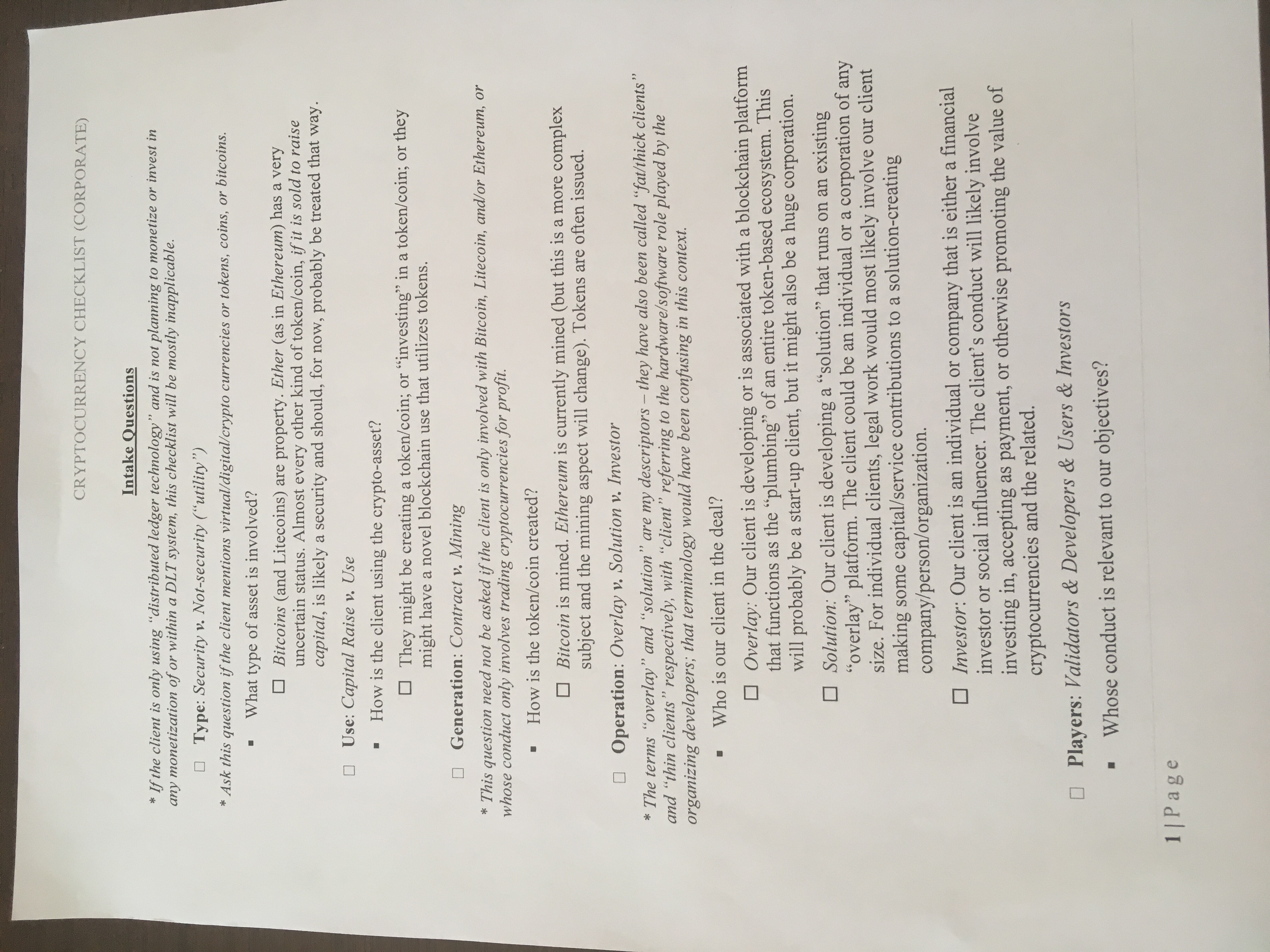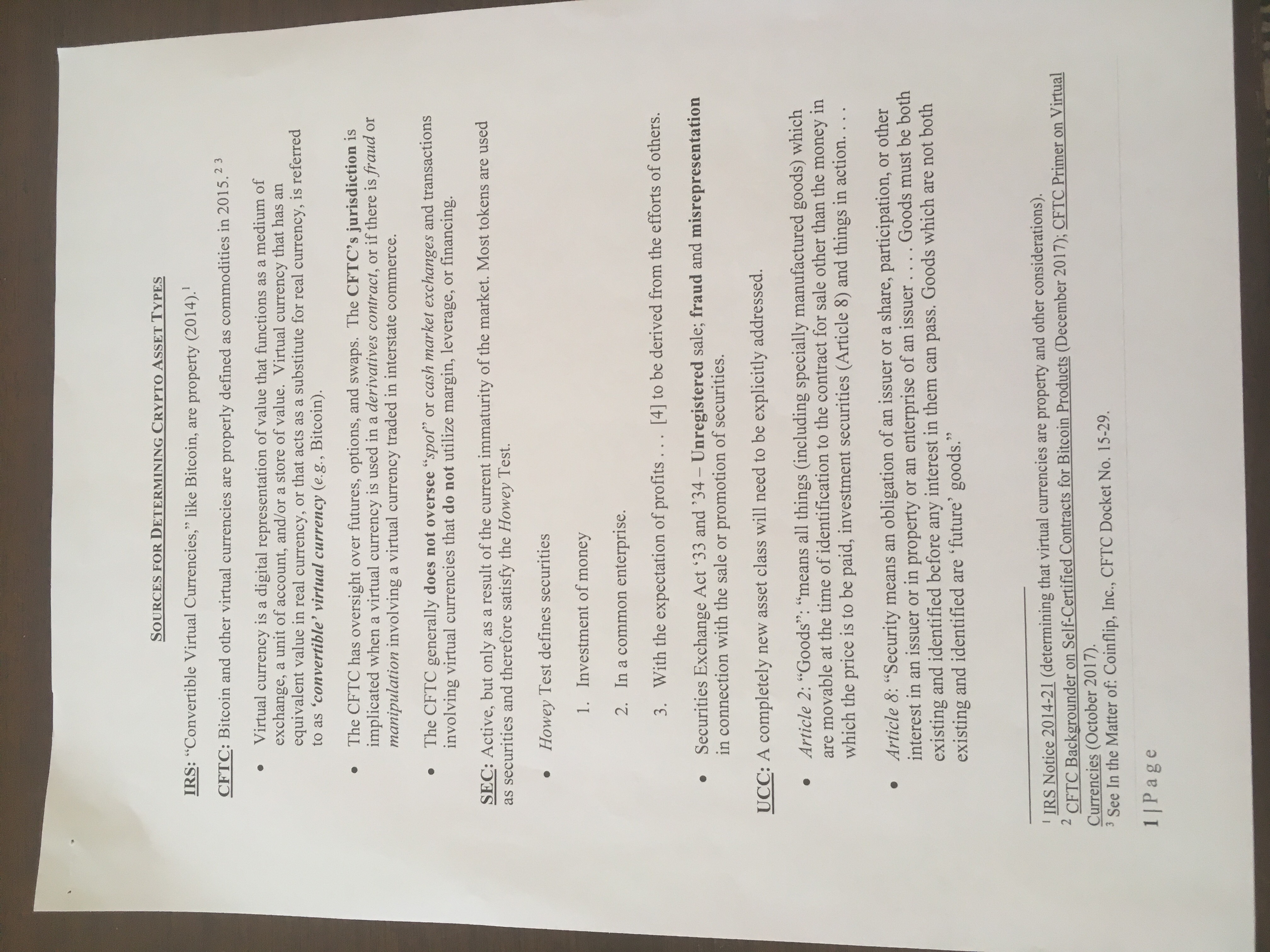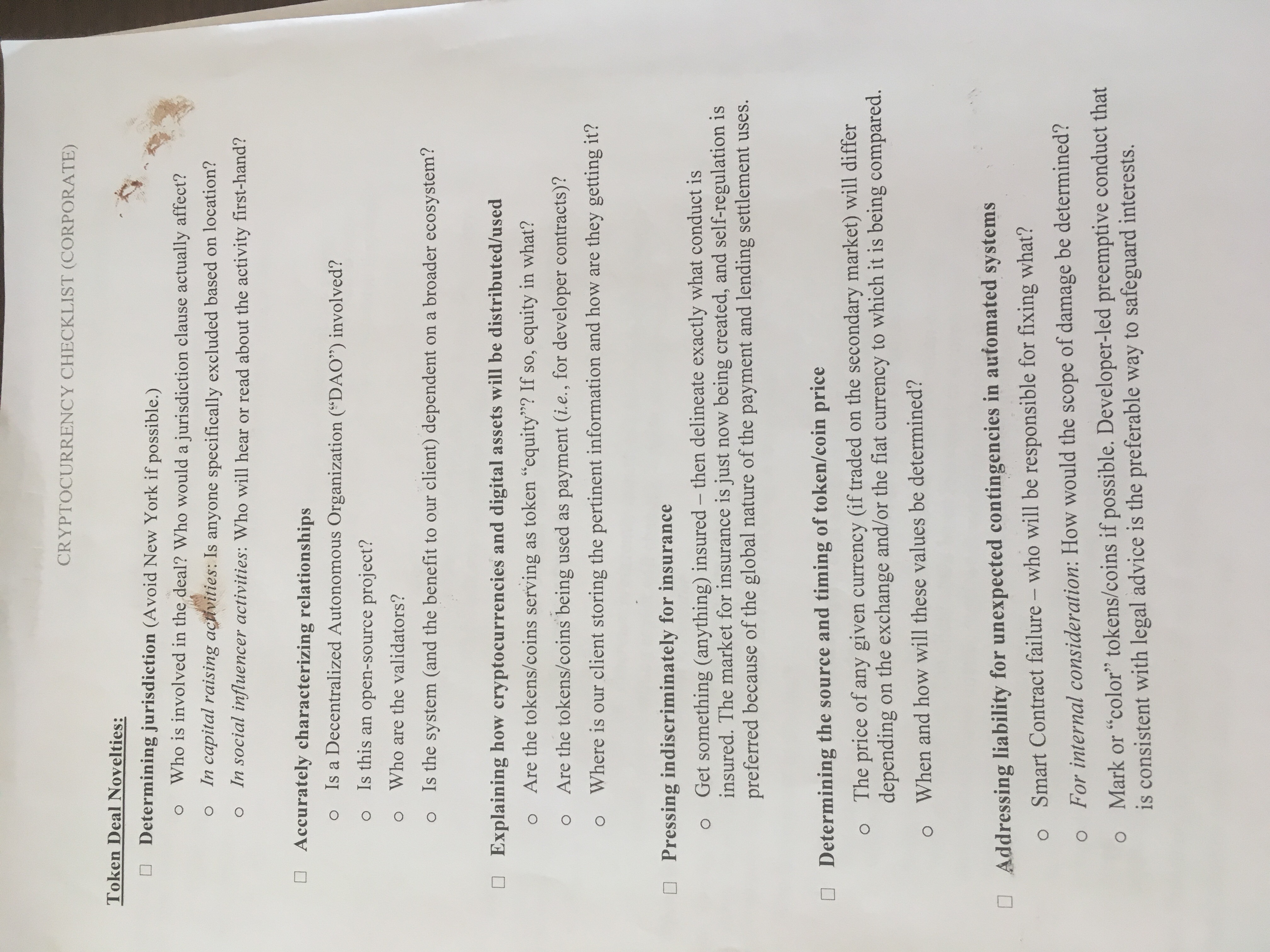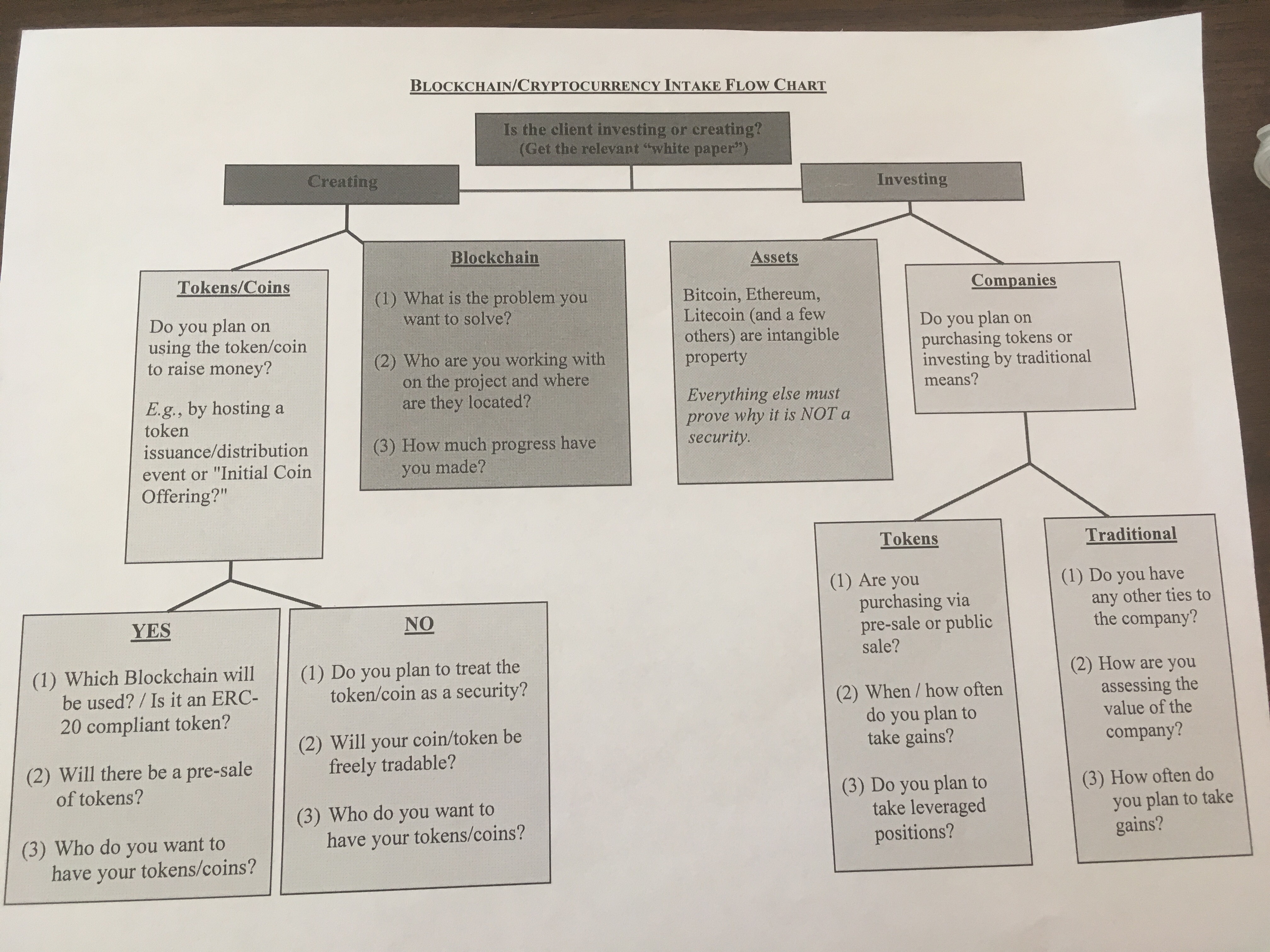 |
| json metadata | {"tags":["crypto","legal","bitcoin","blockchain"],"image":["https://cdn.steemitimages.com/DQmUGtmXKp7BMJCbiFS57e5wHw2fSHZNnv2wEk18CJoykGQ/IMG_6517.jpg","https://cdn.steemitimages.com/DQmUqTT42bk5BAGaNfzLNixnVLqBWUHbWKeSTGTgnVA4oJU/IMG_6520.jpg","https://cdn.steemitimages.com/DQmPTUheLE4pmbYY8WVEGiScnjiSxWGgx9V3H69yGvxDsyD/IMG_6523.jpg","https://cdn.steemitimages.com/DQmWRcUHKQiHXchmZTbYXYVuQ7NUD243r6UwMufDCNLXCyN/IMG_6518.jpg"],"app":"steemit/0.1","format":"markdown"} |
| Transaction Info | Block #24093839/Trx a81be017660951379203c2b79b00abed547c247f |
View Raw JSON Data
{
"trx_id": "a81be017660951379203c2b79b00abed547c247f",
"block": 24093839,
"trx_in_block": 14,
"op_in_trx": 0,
"virtual_op": 0,
"timestamp": "2018-07-11T22:18:57",
"op": [
"comment",
{
"parent_author": "",
"parent_permlink": "crypto",
"author": "thesquire",
"permlink": "blockchain-legal-stuff-for-critique-only",
"title": "Blockchain Legal Stuff -- FOR CRITIQUE ONLY",
"body": "**Not Legal Advice** \n>>\n\n*These are ideas for critique only and have not been published for any purpose other than to allow others to improve upon them. Some statements are outdated -- things change quickly. I produced the documents shown in the images below, in my spare time, and I'm giving them freely here for everyone to critique. I drafted these with the intent of moving the legal industry forward by contributing new ideas about how things can be done, legally, when blockchain tech is involved. Sorry about the chocolate chip stain.*\n>>\nPlease upvote if you find this useful. And, of course, please share your critiques and improvements -- **this is the point of me sharing.**\n\n>>\n\n",
"json_metadata": "{\"tags\":[\"crypto\",\"legal\",\"bitcoin\",\"blockchain\"],\"image\":[\"https://cdn.steemitimages.com/DQmUGtmXKp7BMJCbiFS57e5wHw2fSHZNnv2wEk18CJoykGQ/IMG_6517.jpg\",\"https://cdn.steemitimages.com/DQmUqTT42bk5BAGaNfzLNixnVLqBWUHbWKeSTGTgnVA4oJU/IMG_6520.jpg\",\"https://cdn.steemitimages.com/DQmPTUheLE4pmbYY8WVEGiScnjiSxWGgx9V3H69yGvxDsyD/IMG_6523.jpg\",\"https://cdn.steemitimages.com/DQmWRcUHKQiHXchmZTbYXYVuQ7NUD243r6UwMufDCNLXCyN/IMG_6518.jpg\"],\"app\":\"steemit/0.1\",\"format\":\"markdown\"}"
}
]
}steemdelegated 17.134 SP to @thesquire2018/07/11 04:12:03
steemdelegated 17.134 SP to @thesquire
2018/07/11 04:12:03
| delegator | steem |
| delegatee | thesquire |
| vesting shares | 27870.662936 VESTS |
| Transaction Info | Block #24072109/Trx 23f1c9cc0e766e48f9681e19df5656a4d833b82a |
View Raw JSON Data
{
  "trx_id": "23f1c9cc0e766e48f9681e19df5656a4d833b82a",
  "block": 24072109,
  "trx_in_block": 14,
  "op_in_trx": 0,
  "virtual_op": 0,
  "timestamp": "2018-07-11T04:12:03",
  "op": [
    "delegate_vesting_shares",
    {
      "delegator": "steem",
      "delegatee": "thesquire",
      "vesting_shares": "27870.662936 VESTS"
    }
  ]
}2018/07/11 03:24:57
2018/07/11 03:24:57
| required auths | [] |
| required posting auths | ["thesquire"] |
| id | follow |
| json | ["follow",{"follower":"thesquire","following":"ax3","what":["blog"]}] |
| Transaction Info | Block #24071167/Trx dd9aa9b18c88b53d7f8fee023a78a73edffb3622 |
View Raw JSON Data
{
  "trx_id": "dd9aa9b18c88b53d7f8fee023a78a73edffb3622",
  "block": 24071167,
  "trx_in_block": 5,
  "op_in_trx": 0,
  "virtual_op": 0,
  "timestamp": "2018-07-11T03:24:57",
  "op": [
    "custom_json",
    {
      "required_auths": [],
      "required_posting_auths": [
        "thesquire"
      ],
      "id": "follow",
      "json": "[\"follow\",{\"follower\":\"thesquire\",\"following\":\"ax3\",\"what\":[\"blog\"]}]"
    }
  ]
}thesquireremoved vote from (0.00%) @thesquire / the-blue-print-a-new-idea-for-token-disclosures2018/07/11 03:23:15
thesquireremoved vote from (0.00%) @thesquire / the-blue-print-a-new-idea-for-token-disclosures
2018/07/11 03:23:15
| voter | thesquire |
| author | thesquire |
| permlink | the-blue-print-a-new-idea-for-token-disclosures |
| weight | 0 (0.00%) |
| Transaction Info | Block #24071133/Trx 030d43ecc1a0fd005268c6ff8ee2e07be111ba3a |
View Raw JSON Data
{
  "trx_id": "030d43ecc1a0fd005268c6ff8ee2e07be111ba3a",
  "block": 24071133,
  "trx_in_block": 17,
  "op_in_trx": 0,
  "virtual_op": 0,
  "timestamp": "2018-07-11T03:23:15",
  "op": [
    "vote",
    {
      "voter": "thesquire",
      "author": "thesquire",
      "permlink": "the-blue-print-a-new-idea-for-token-disclosures",
      "weight": 0
    }
  ]
}thesquireremoved vote from (0.00%) @thesquire / marijuana-is-not-medicine-for-debate-discussion2018/07/11 03:23:12
thesquireremoved vote from (0.00%) @thesquire / marijuana-is-not-medicine-for-debate-discussion
2018/07/11 03:23:12
| voter | thesquire |
| author | thesquire |
| permlink | marijuana-is-not-medicine-for-debate-discussion |
| weight | 0 (0.00%) |
| Transaction Info | Block #24071132/Trx ac437e683986c576e74616167d4fb062444d76ae |
View Raw JSON Data
{
  "trx_id": "ac437e683986c576e74616167d4fb062444d76ae",
  "block": 24071132,
  "trx_in_block": 28,
  "op_in_trx": 0,
  "virtual_op": 0,
  "timestamp": "2018-07-11T03:23:12",
  "op": [
    "vote",
    {
      "voter": "thesquire",
      "author": "thesquire",
      "permlink": "marijuana-is-not-medicine-for-debate-discussion",
      "weight": 0
    }
  ]
}thesquireupvoted (100.00%) @thesquire / crypto-doctors-of-law-mid-19th-century-anesthesiologists2018/07/11 03:23:09
thesquireupvoted (100.00%) @thesquire / crypto-doctors-of-law-mid-19th-century-anesthesiologists
2018/07/11 03:23:09
| voter | thesquire |
| author | thesquire |
| permlink | crypto-doctors-of-law-mid-19th-century-anesthesiologists |
| weight | 10000 (100.00%) |
| Transaction Info | Block #24071131/Trx 9e08f5c5060afdefa591b586c9d5440696ca77b1 |
View Raw JSON Data
{
  "trx_id": "9e08f5c5060afdefa591b586c9d5440696ca77b1",
  "block": 24071131,
  "trx_in_block": 2,
  "op_in_trx": 0,
  "virtual_op": 0,
  "timestamp": "2018-07-11T03:23:09",
  "op": [
    "vote",
    {
      "voter": "thesquire",
      "author": "thesquire",
      "permlink": "crypto-doctors-of-law-mid-19th-century-anesthesiologists",
      "weight": 10000
    }
  ]
}thesquireremoved vote from (0.00%) @thesquire / crypto-doctors-of-law-mid-19th-century-anesthesiologists2018/07/11 03:22:57
thesquireremoved vote from (0.00%) @thesquire / crypto-doctors-of-law-mid-19th-century-anesthesiologists
2018/07/11 03:22:57
| voter | thesquire |
| author | thesquire |
| permlink | crypto-doctors-of-law-mid-19th-century-anesthesiologists |
| weight | 0 (0.00%) |
| Transaction Info | Block #24071127/Trx 9857df8b69be652acc3717aed600f2a4f69200d8 |
View Raw JSON Data
{
  "trx_id": "9857df8b69be652acc3717aed600f2a4f69200d8",
  "block": 24071127,
  "trx_in_block": 15,
  "op_in_trx": 0,
  "virtual_op": 0,
  "timestamp": "2018-07-11T03:22:57",
  "op": [
    "vote",
    {
      "voter": "thesquire",
      "author": "thesquire",
      "permlink": "crypto-doctors-of-law-mid-19th-century-anesthesiologists",
      "weight": 0
    }
  ]
}thesquireclaimed reward balance: 0.940 SP2018/07/11 03:22:36
thesquireclaimed reward balance: 0.940 SP
2018/07/11 03:22:36
| account | thesquire |
| reward steem | 0.000 STEEM |
| reward sbd | 0.000 SBD |
| reward vests | 1529.052727 VESTS |
| Transaction Info | Block #24071120/Trx 976ebaa50695812463ba41cc2c8441756e154f7d |
View Raw JSON Data
{
  "trx_id": "976ebaa50695812463ba41cc2c8441756e154f7d",
  "block": 24071120,
  "trx_in_block": 20,
  "op_in_trx": 0,
  "virtual_op": 0,
  "timestamp": "2018-07-11T03:22:36",
  "op": [
    "claim_reward_balance",
    {
      "account": "thesquire",
      "reward_steem": "0.000 STEEM",
      "reward_sbd": "0.000 SBD",
      "reward_vests": "1529.052727 VESTS"
    }
  ]
}thesquireupvoted (100.00%) @thesquire / crypto-doctors-of-law-mid-19th-century-anesthesiologists2018/07/11 03:21:15
thesquireupvoted (100.00%) @thesquire / crypto-doctors-of-law-mid-19th-century-anesthesiologists
2018/07/11 03:21:15
| voter | thesquire |
| author | thesquire |
| permlink | crypto-doctors-of-law-mid-19th-century-anesthesiologists |
| weight | 10000 (100.00%) |
| Transaction Info | Block #24071093/Trx 0b0168a74ea0b963137571345065bc9651da62fc |
View Raw JSON Data
{
  "trx_id": "0b0168a74ea0b963137571345065bc9651da62fc",
  "block": 24071093,
  "trx_in_block": 36,
  "op_in_trx": 0,
  "virtual_op": 0,
  "timestamp": "2018-07-11T03:21:15",
  "op": [
    "vote",
    {
      "voter": "thesquire",
      "author": "thesquire",
      "permlink": "crypto-doctors-of-law-mid-19th-century-anesthesiologists",
      "weight": 10000
    }
  ]
}ax3upvoted (1.00%) @thesquire / crypto-doctors-of-law-mid-19th-century-anesthesiologists2018/07/10 18:08:27
ax3upvoted (1.00%) @thesquire / crypto-doctors-of-law-mid-19th-century-anesthesiologists
2018/07/10 18:08:27
| voter | ax3 |
| author | thesquire |
| permlink | crypto-doctors-of-law-mid-19th-century-anesthesiologists |
| weight | 100 (1.00%) |
| Transaction Info | Block #24060042/Trx 8e5de11c7d68abfea8e264f72935d6c97e90ed3b |
View Raw JSON Data
{
  "trx_id": "8e5de11c7d68abfea8e264f72935d6c97e90ed3b",
  "block": 24060042,
  "trx_in_block": 42,
  "op_in_trx": 0,
  "virtual_op": 0,
  "timestamp": "2018-07-10T18:08:27",
  "op": [
    "vote",
    {
      "voter": "ax3",
      "author": "thesquire",
      "permlink": "crypto-doctors-of-law-mid-19th-century-anesthesiologists",
      "weight": 100
    }
  ]
}thesquirepublished a new post: crypto-doctors-of-law-mid-19th-century-anesthesiologists2018/07/10 18:08:18
thesquirepublished a new post: crypto-doctors-of-law-mid-19th-century-anesthesiologists
2018/07/10 18:08:18
| parent author | |
| parent permlink | crypto |
| author | thesquire |
| permlink | crypto-doctors-of-law-mid-19th-century-anesthesiologists |
| title | Crypto Doctors of Law = Mid-19th Century Anesthesiologists |
| body | I've said this before: Crypto "Doctors of Law" are like Anesthesiologists in the mid-19th century. Like anesthesiology, the nomology behind crypto/blockchain governance is really patient-specific... and the patients never want to know what's going on — in fact, the benefit of the practice is that the patients would rather be asleep or numb. Both anesthesiology and crypto-nomology involve substantial risk. Neither -ology is "necessary" to an economy. But there are reasons society encouraged, or least didn't discourage, the continued practice of anesthesiology 170 years ago. Persistent experimentation with the alchemy of chemical compounds has made things like open heart surgery possible (if not only less painful). Fixing broken stuff is painful. Now, unlike the 1850s, we have the means to exchange a lot of information and very quickly. Beware of anesthesiologists with a secret cocktail. #opensourcelaw |
| json metadata | {"tags":["crypto","nomology","alchemy","blockchain","law"],"app":"steemit/0.1","format":"markdown"} |
| Transaction Info | Block #24060039/Trx 9481e4fb11868df167c7c2fece7a8c774e91aaee |
View Raw JSON Data
{
  "trx_id": "9481e4fb11868df167c7c2fece7a8c774e91aaee",
  "block": 24060039,
  "trx_in_block": 29,
  "op_in_trx": 0,
  "virtual_op": 0,
  "timestamp": "2018-07-10T18:08:18",
  "op": [
    "comment",
    {
      "parent_author": "",
      "parent_permlink": "crypto",
      "author": "thesquire",
      "permlink": "crypto-doctors-of-law-mid-19th-century-anesthesiologists",
      "title": "Crypto Doctors of Law = Mid-19th Century Anesthesiologists",
      "body": "I've said this before: Crypto \"Doctors of Law\" are like Anesthesiologists in the mid-19th century. Like anesthesiology, the nomology behind crypto/blockchain governance is really patient-specific... and the patients never want to know what's going on — in fact, the benefit of the practice is that the patients would rather be asleep or numb. Both anesthesiology and crypto-nomology involve substantial risk. Neither -ology is \"necessary\" to an economy. \n\n\n\nBut there are reasons society encouraged, or least didn't discourage, the continued practice of anesthesiology 170 years ago. Persistent experimentation with the alchemy of chemical compounds has made things like open heart surgery possible (if not only less painful). Fixing broken stuff is painful. Now, unlike the 1850s, we have the means to exchange a lot of information and very quickly. Beware of anesthesiologists with a secret cocktail. #opensourcelaw",
      "json_metadata": "{\"tags\":[\"crypto\",\"nomology\",\"alchemy\",\"blockchain\",\"law\"],\"app\":\"steemit/0.1\",\"format\":\"markdown\"}"
    }
  ]
}2018/06/21 22:53:03
2018/06/21 22:53:03
| parent author | thesquire |
| parent permlink | the-blue-print-a-new-idea-for-token-disclosures |
| author | steemitboard |
| permlink | steemitboard-notify-thesquire-20180621t225303000z |
| title | |
| body | Congratulations @thesquire! You have received a personal award! [](http://steemitboard.com/@thesquire) 1 Year on Steemit <sub>_Click on the badge to view your Board of Honor._</sub> **Do not miss the [last post](https://steemit.com/steemitboard/@steemitboard/steemitboard-world-cup-contest-serbia-vs-switzerland) from @steemitboard!** --- **Participate in the [SteemitBoard World Cup Contest](https://steemit.com/steemitboard/@steemitboard/steemitboard-world-cup-contest-collect-badges-and-win-free-sbd)!** Collect World Cup badges and win free SBD Support the Gold Sponsors of the contest: [@good-karma](https://v2.steemconnect.com/sign/account-witness-vote?witness=good-karma&approve=1) and [@lukestokes](https://v2.steemconnect.com/sign/account-witness-vote?witness=lukestokes.mhth&approve=1) --- > Do you like [SteemitBoard's project](https://steemit.com/@steemitboard)? Then **[Vote for its witness](https://v2.steemconnect.com/sign/account-witness-vote?witness=steemitboard&approve=1)** and **get one more award**! |
| json metadata | {"image":["https://steemitboard.com/img/notify.png"]} |
| Transaction Info | Block #23528559/Trx 3988c3010dd80fc8a7a6d1c527154322ea71a667 |
View Raw JSON Data
{
"trx_id": "3988c3010dd80fc8a7a6d1c527154322ea71a667",
"block": 23528559,
"trx_in_block": 12,
"op_in_trx": 0,
"virtual_op": 0,
"timestamp": "2018-06-21T22:53:03",
"op": [
"comment",
{
"parent_author": "thesquire",
"parent_permlink": "the-blue-print-a-new-idea-for-token-disclosures",
"author": "steemitboard",
"permlink": "steemitboard-notify-thesquire-20180621t225303000z",
"title": "",
"body": "Congratulations @thesquire! You have received a personal award!\n\n[](http://steemitboard.com/@thesquire) 1 Year on Steemit\n<sub>_Click on the badge to view your Board of Honor._</sub>\n\n\n**Do not miss the [last post](https://steemit.com/steemitboard/@steemitboard/steemitboard-world-cup-contest-serbia-vs-switzerland) from @steemitboard!**\n\n---\n**Participate in the [SteemitBoard World Cup Contest](https://steemit.com/steemitboard/@steemitboard/steemitboard-world-cup-contest-collect-badges-and-win-free-sbd)!**\nCollect World Cup badges and win free SBD\nSupport the Gold Sponsors of the contest: [@good-karma](https://v2.steemconnect.com/sign/account-witness-vote?witness=good-karma&approve=1) and [@lukestokes](https://v2.steemconnect.com/sign/account-witness-vote?witness=lukestokes.mhth&approve=1)\n\n---\n\n> Do you like [SteemitBoard's project](https://steemit.com/@steemitboard)? Then **[Vote for its witness](https://v2.steemconnect.com/sign/account-witness-vote?witness=steemitboard&approve=1)** and **get one more award**!",
"json_metadata": "{\"image\":[\"https://steemitboard.com/img/notify.png\"]}"
}
]
}steemdelegated 18.127 SP to @thesquire2018/05/18 21:07:36
steemdelegated 18.127 SP to @thesquire
2018/05/18 21:07:36
| delegator | steem |
| delegatee | thesquire |
| vesting shares | 29484.591107 VESTS |
| Transaction Info | Block #22548443/Trx 06192c5bbd1388691b1a0ca64e6f6c9554cf7fcd |
View Raw JSON Data
{
  "trx_id": "06192c5bbd1388691b1a0ca64e6f6c9554cf7fcd",
  "block": 22548443,
  "trx_in_block": 34,
  "op_in_trx": 0,
  "virtual_op": 0,
  "timestamp": "2018-05-18T21:07:36",
  "op": [
    "delegate_vesting_shares",
    {
      "delegator": "steem",
      "delegatee": "thesquire",
      "vesting_shares": "29484.591107 VESTS"
    }
  ]
}fabernazovupvoted (100.00%) @thesquire / the-blue-print-a-new-idea-for-token-disclosures2018/04/15 03:06:27
fabernazovupvoted (100.00%) @thesquire / the-blue-print-a-new-idea-for-token-disclosures
2018/04/15 03:06:27
| voter | fabernazov |
| author | thesquire |
| permlink | the-blue-print-a-new-idea-for-token-disclosures |
| weight | 10000 (100.00%) |
| Transaction Info | Block #21577247/Trx a2618fd6a6e37c5d83cb4971be1ae86b3c3a49ff |
View Raw JSON Data
{
  "trx_id": "a2618fd6a6e37c5d83cb4971be1ae86b3c3a49ff",
  "block": 21577247,
  "trx_in_block": 1,
  "op_in_trx": 0,
  "virtual_op": 0,
  "timestamp": "2018-04-15T03:06:27",
  "op": [
    "vote",
    {
      "voter": "fabernazov",
      "author": "thesquire",
      "permlink": "the-blue-print-a-new-idea-for-token-disclosures",
      "weight": 10000
    }
  ]
}nyavinupvoted (100.00%) @thesquire / the-blue-print-a-new-idea-for-token-disclosures2018/04/15 03:06:21
nyavinupvoted (100.00%) @thesquire / the-blue-print-a-new-idea-for-token-disclosures
2018/04/15 03:06:21
| voter | nyavin |
| author | thesquire |
| permlink | the-blue-print-a-new-idea-for-token-disclosures |
| weight | 10000 (100.00%) |
| Transaction Info | Block #21577245/Trx 571faf4d1a1d0f1570a46b4a2b432fed95363618 |
View Raw JSON Data
{
  "trx_id": "571faf4d1a1d0f1570a46b4a2b432fed95363618",
  "block": 21577245,
  "trx_in_block": 4,
  "op_in_trx": 0,
  "virtual_op": 0,
  "timestamp": "2018-04-15T03:06:21",
  "op": [
    "vote",
    {
      "voter": "nyavin",
      "author": "thesquire",
      "permlink": "the-blue-print-a-new-idea-for-token-disclosures",
      "weight": 10000
    }
  ]
}yarinbratupvoted (100.00%) @thesquire / the-blue-print-a-new-idea-for-token-disclosures2018/04/15 03:06:18
yarinbratupvoted (100.00%) @thesquire / the-blue-print-a-new-idea-for-token-disclosures
2018/04/15 03:06:18
| voter | yarinbrat |
| author | thesquire |
| permlink | the-blue-print-a-new-idea-for-token-disclosures |
| weight | 10000 (100.00%) |
| Transaction Info | Block #21577244/Trx 9a4ee7d1cc75e481bb148dccd9b2c3fcbb2076d3 |
View Raw JSON Data
{
  "trx_id": "9a4ee7d1cc75e481bb148dccd9b2c3fcbb2076d3",
  "block": 21577244,
  "trx_in_block": 46,
  "op_in_trx": 0,
  "virtual_op": 0,
  "timestamp": "2018-04-15T03:06:18",
  "op": [
    "vote",
    {
      "voter": "yarinbrat",
      "author": "thesquire",
      "permlink": "the-blue-print-a-new-idea-for-token-disclosures",
      "weight": 10000
    }
  ]
}tantonewaupvoted (100.00%) @thesquire / the-blue-print-a-new-idea-for-token-disclosures2018/04/15 03:06:18
tantonewaupvoted (100.00%) @thesquire / the-blue-print-a-new-idea-for-token-disclosures
2018/04/15 03:06:18
| voter | tantonewa |
| author | thesquire |
| permlink | the-blue-print-a-new-idea-for-token-disclosures |
| weight | 10000 (100.00%) |
| Transaction Info | Block #21577244/Trx 2c35a47adbee826118023ea01448a8a43105613f |
View Raw JSON Data
{
  "trx_id": "2c35a47adbee826118023ea01448a8a43105613f",
  "block": 21577244,
  "trx_in_block": 45,
  "op_in_trx": 0,
  "virtual_op": 0,
  "timestamp": "2018-04-15T03:06:18",
  "op": [
    "vote",
    {
      "voter": "tantonewa",
      "author": "thesquire",
      "permlink": "the-blue-print-a-new-idea-for-token-disclosures",
      "weight": 10000
    }
  ]
}galolovaupvoted (100.00%) @thesquire / the-blue-print-a-new-idea-for-token-disclosures2018/04/15 03:06:18
galolovaupvoted (100.00%) @thesquire / the-blue-print-a-new-idea-for-token-disclosures
2018/04/15 03:06:18
| voter | galolova |
| author | thesquire |
| permlink | the-blue-print-a-new-idea-for-token-disclosures |
| weight | 10000 (100.00%) |
| Transaction Info | Block #21577244/Trx c592dabe2c44fbcd59d6c15f6ed47750c34453a2 |
View Raw JSON Data
{
  "trx_id": "c592dabe2c44fbcd59d6c15f6ed47750c34453a2",
  "block": 21577244,
  "trx_in_block": 25,
  "op_in_trx": 0,
  "virtual_op": 0,
  "timestamp": "2018-04-15T03:06:18",
  "op": [
    "vote",
    {
      "voter": "galolova",
      "author": "thesquire",
      "permlink": "the-blue-print-a-new-idea-for-token-disclosures",
      "weight": 10000
    }
  ]
}ianlladorupvoted (100.00%) @thesquire / the-blue-print-a-new-idea-for-token-disclosures2018/04/15 03:05:48
ianlladorupvoted (100.00%) @thesquire / the-blue-print-a-new-idea-for-token-disclosures
2018/04/15 03:05:48
| voter | ianllador |
| author | thesquire |
| permlink | the-blue-print-a-new-idea-for-token-disclosures |
| weight | 10000 (100.00%) |
| Transaction Info | Block #21577234/Trx e8832c5db5f724917a2497c8a005d0500a51383a |
View Raw JSON Data
{
  "trx_id": "e8832c5db5f724917a2497c8a005d0500a51383a",
  "block": 21577234,
  "trx_in_block": 32,
  "op_in_trx": 0,
  "virtual_op": 0,
  "timestamp": "2018-04-15T03:05:48",
  "op": [
    "vote",
    {
      "voter": "ianllador",
      "author": "thesquire",
      "permlink": "the-blue-print-a-new-idea-for-token-disclosures",
      "weight": 10000
    }
  ]
}garizontupvoted (100.00%) @thesquire / the-blue-print-a-new-idea-for-token-disclosures2018/04/15 03:05:48
garizontupvoted (100.00%) @thesquire / the-blue-print-a-new-idea-for-token-disclosures
2018/04/15 03:05:48
| voter | garizont |
| author | thesquire |
| permlink | the-blue-print-a-new-idea-for-token-disclosures |
| weight | 10000 (100.00%) |
| Transaction Info | Block #21577234/Trx 39240daab100f49762e591438563d9d35dbf02f2 |
View Raw JSON Data
{
  "trx_id": "39240daab100f49762e591438563d9d35dbf02f2",
  "block": 21577234,
  "trx_in_block": 18,
  "op_in_trx": 0,
  "virtual_op": 0,
  "timestamp": "2018-04-15T03:05:48",
  "op": [
    "vote",
    {
      "voter": "garizont",
      "author": "thesquire",
      "permlink": "the-blue-print-a-new-idea-for-token-disclosures",
      "weight": 10000
    }
  ]
}steemitboardupvoted (1.00%) @thesquire / the-blue-print-a-new-idea-for-token-disclosures2018/04/14 22:00:09
steemitboardupvoted (1.00%) @thesquire / the-blue-print-a-new-idea-for-token-disclosures
2018/04/14 22:00:09
| voter | steemitboard |
| author | thesquire |
| permlink | the-blue-print-a-new-idea-for-token-disclosures |
| weight | 100 (1.00%) |
| Transaction Info | Block #21571123/Trx 09552be70bf1999ba8265af65b094e84d89e90b2 |
View Raw JSON Data
{
  "trx_id": "09552be70bf1999ba8265af65b094e84d89e90b2",
  "block": 21571123,
  "trx_in_block": 5,
  "op_in_trx": 0,
  "virtual_op": 0,
  "timestamp": "2018-04-14T22:00:09",
  "op": [
    "vote",
    {
      "voter": "steemitboard",
      "author": "thesquire",
      "permlink": "the-blue-print-a-new-idea-for-token-disclosures",
      "weight": 100
    }
  ]
}2018/04/14 22:00:06
2018/04/14 22:00:06
| parent author | thesquire |
| parent permlink | the-blue-print-a-new-idea-for-token-disclosures |
| author | steemitboard |
| permlink | steemitboard-notify-thesquire-20180414t220005000z |
| title | |
| body | Congratulations @thesquire! You have completed some achievement on Steemit and have been rewarded with new badge(s) : [](http://steemitboard.com/@thesquire) You made your First Comment Click on any badge to view your own Board of Honor on SteemitBoard. To support your work, I also upvoted your post! For more information about SteemitBoard, click [here](https://steemit.com/@steemitboard) If you no longer want to receive notifications, reply to this comment with the word `STOP` > Upvote this notification to help all Steemit users. Learn why [here](https://steemit.com/steemitboard/@steemitboard/http-i-cubeupload-com-7ciqeo-png)! |
| json metadata | {"image":["https://steemitboard.com/img/notifications.png"]} |
| Transaction Info | Block #21571122/Trx 59ee8c56d291d636a8d80feff3471a0bd3c98aae |
View Raw JSON Data
{
"trx_id": "59ee8c56d291d636a8d80feff3471a0bd3c98aae",
"block": 21571122,
"trx_in_block": 0,
"op_in_trx": 0,
"virtual_op": 0,
"timestamp": "2018-04-14T22:00:06",
"op": [
"comment",
{
"parent_author": "thesquire",
"parent_permlink": "the-blue-print-a-new-idea-for-token-disclosures",
"author": "steemitboard",
"permlink": "steemitboard-notify-thesquire-20180414t220005000z",
"title": "",
"body": "Congratulations @thesquire! You have completed some achievement on Steemit and have been rewarded with new badge(s) :\n\n[](http://steemitboard.com/@thesquire) You made your First Comment\n\nClick on any badge to view your own Board of Honor on SteemitBoard.\n\nTo support your work, I also upvoted your post!\nFor more information about SteemitBoard, click [here](https://steemit.com/@steemitboard)\n\nIf you no longer want to receive notifications, reply to this comment with the word `STOP`\n\n> Upvote this notification to help all Steemit users. Learn why [here](https://steemit.com/steemitboard/@steemitboard/http-i-cubeupload-com-7ciqeo-png)!",
"json_metadata": "{\"image\":[\"https://steemitboard.com/img/notifications.png\"]}"
}
]
}2018/04/14 19:11:18
2018/04/14 19:11:18
| parent author | thesquire |
| parent permlink | re-thecleangame-re-thesquire-marijuana-is-not-medicine-for-debate-discussion-20180414t184826459z |
| author | thecleangame |
| permlink | re-thesquire-re-thecleangame-re-thesquire-marijuana-is-not-medicine-for-debate-discussion-20180414t191118380z |
| title | |
| body | You have some messed up programming there kiddo. Might want to have that looked at. |
| json metadata | {"tags":["health"],"app":"steemit/0.1"} |
| Transaction Info | Block #21567746/Trx 54b348759693770c37da2907cf7cfac7526a0fdf |
View Raw JSON Data
{
  "trx_id": "54b348759693770c37da2907cf7cfac7526a0fdf",
  "block": 21567746,
  "trx_in_block": 45,
  "op_in_trx": 0,
  "virtual_op": 0,
  "timestamp": "2018-04-14T19:11:18",
  "op": [
    "comment",
    {
      "parent_author": "thesquire",
      "parent_permlink": "re-thecleangame-re-thesquire-marijuana-is-not-medicine-for-debate-discussion-20180414t184826459z",
      "author": "thecleangame",
      "permlink": "re-thesquire-re-thecleangame-re-thesquire-marijuana-is-not-medicine-for-debate-discussion-20180414t191118380z",
      "title": "",
      "body": "You have some messed up programming there kiddo. Might want to have that looked at.",
      "json_metadata": "{\"tags\":[\"health\"],\"app\":\"steemit/0.1\"}"
    }
  ]
}2018/04/14 18:51:24
2018/04/14 18:51:24
| parent author | thecleangame |
| parent permlink | re-thesquire-marijuana-is-not-medicine-for-debate-discussion-20180401t141301440z |
| author | thesquire |
| permlink | re-thecleangame-re-thesquire-marijuana-is-not-medicine-for-debate-discussion-20180414t184826459z |
| title | |
| body | @@ -676,16 +676,19 @@ jacking +up the pric @@ -701,26 +701,55 @@ ome -strains of cannabi +cannabis strains (and I mean jacking the price s wa @@ -757,16 +757,17 @@ , way up +) by crow |
| json metadata | {"tags":["health"],"app":"steemit/0.1"} |
| Transaction Info | Block #21567348/Trx a2cb388d4712f643ead8852425863d8e862a9e6a |
View Raw JSON Data
{
  "trx_id": "a2cb388d4712f643ead8852425863d8e862a9e6a",
  "block": 21567348,
  "trx_in_block": 53,
  "op_in_trx": 0,
  "virtual_op": 0,
  "timestamp": "2018-04-14T18:51:24",
  "op": [
    "comment",
    {
      "parent_author": "thecleangame",
      "parent_permlink": "re-thesquire-marijuana-is-not-medicine-for-debate-discussion-20180401t141301440z",
      "author": "thesquire",
      "permlink": "re-thecleangame-re-thesquire-marijuana-is-not-medicine-for-debate-discussion-20180414t184826459z",
      "title": "",
      "body": "@@ -676,16 +676,19 @@\n jacking \n+up \n the pric\n@@ -701,26 +701,55 @@\n ome \n-strains of cannabi\n+cannabis strains  (and I mean jacking the price\n s wa\n@@ -757,16 +757,17 @@\n , way up\n+)\n  by crow\n",
      "json_metadata": "{\"tags\":[\"health\"],\"app\":\"steemit/0.1\"}"
    }
  ]
}2018/04/14 18:49:54
2018/04/14 18:49:54
| parent author | thecleangame |
| parent permlink | re-thesquire-marijuana-is-not-medicine-for-debate-discussion-20180401t141301440z |
| author | thesquire |
| permlink | re-thecleangame-re-thesquire-marijuana-is-not-medicine-for-debate-discussion-20180414t184826459z |
| title | |
| body | @@ -288,16 +288,30 @@ but that + (necessarily) places @@ -348,18 +348,25 @@ ine%22 as -i t +hat term is defi @@ -374,24 +374,25 @@ ed in these +%22 messed up ti @@ -395,16 +395,17 @@ p times. +%22 My mom |
| json metadata | {"tags":["health"],"app":"steemit/0.1"} |
| Transaction Info | Block #21567318/Trx 84fad67a97a3124c777b95bc786b08efaee087fa |
View Raw JSON Data
{
  "trx_id": "84fad67a97a3124c777b95bc786b08efaee087fa",
  "block": 21567318,
  "trx_in_block": 24,
  "op_in_trx": 0,
  "virtual_op": 0,
  "timestamp": "2018-04-14T18:49:54",
  "op": [
    "comment",
    {
      "parent_author": "thecleangame",
      "parent_permlink": "re-thesquire-marijuana-is-not-medicine-for-debate-discussion-20180401t141301440z",
      "author": "thesquire",
      "permlink": "re-thecleangame-re-thesquire-marijuana-is-not-medicine-for-debate-discussion-20180414t184826459z",
      "title": "",
      "body": "@@ -288,16 +288,30 @@\n but that\n+ (necessarily)\n  places \n@@ -348,18 +348,25 @@\n ine%22 as \n-i\n t\n+hat term\n  is defi\n@@ -374,24 +374,25 @@\n ed in these \n+%22\n messed up ti\n@@ -395,16 +395,17 @@\n p times.\n+%22\n  My mom \n",
      "json_metadata": "{\"tags\":[\"health\"],\"app\":\"steemit/0.1\"}"
    }
  ]
}2018/04/14 18:49:06
2018/04/14 18:49:06
| parent author | thecleangame |
| parent permlink | re-thesquire-marijuana-is-not-medicine-for-debate-discussion-20180401t141301440z |
| author | thesquire |
| permlink | re-thecleangame-re-thesquire-marijuana-is-not-medicine-for-debate-discussion-20180414t184826459z |
| title | |
| body | @@ -284,16 +284,21 @@ e,%22 but +that places t |
| json metadata | {"tags":["health"],"app":"steemit/0.1"} |
| Transaction Info | Block #21567302/Trx e8d6e8734a1577d31ad6ebc8a2f56589846e3f40 |
View Raw JSON Data
{
  "trx_id": "e8d6e8734a1577d31ad6ebc8a2f56589846e3f40",
  "block": 21567302,
  "trx_in_block": 0,
  "op_in_trx": 0,
  "virtual_op": 0,
  "timestamp": "2018-04-14T18:49:06",
  "op": [
    "comment",
    {
      "parent_author": "thecleangame",
      "parent_permlink": "re-thesquire-marijuana-is-not-medicine-for-debate-discussion-20180401t141301440z",
      "author": "thesquire",
      "permlink": "re-thecleangame-re-thesquire-marijuana-is-not-medicine-for-debate-discussion-20180414t184826459z",
      "title": "",
      "body": "@@ -284,16 +284,21 @@\n e,%22 but \n+that \n places t\n",
      "json_metadata": "{\"tags\":[\"health\"],\"app\":\"steemit/0.1\"}"
    }
  ]
}2018/04/14 18:48:27
2018/04/14 18:48:27
| parent author | thecleangame |
| parent permlink | re-thesquire-marijuana-is-not-medicine-for-debate-discussion-20180401t141301440z |
| author | thesquire |
| permlink | re-thecleangame-re-thesquire-marijuana-is-not-medicine-for-debate-discussion-20180414t184826459z |
| title | |
| body | "Until these messed up times." You can either change the times, or change the definition. Seeing as how you can't change time, I say we change the definition. We might say "cannabis is good for you" like we say "apples are good for you." We can call both cannabis and apples "medicine," but places them in the category of "medicine" as it is defined in these messed up times. My mom would always tell me, "birds of a feather flock together." If you think it best for the cannabis industry to flock with the pharmaceutical industry, I think you're not only in favor of withholding cannabis from people who need it, I think you're also in favor of jacking the price of some strains of cannabis way, way up by crowding smaller participants out of the marketplace. You tell me, though. |
| json metadata | {"tags":["health"],"app":"steemit/0.1"} |
| Transaction Info | Block #21567289/Trx 4db5e55df927f2c7dc74c9dbb96b0a5935d6fea4 |
View Raw JSON Data
{
  "trx_id": "4db5e55df927f2c7dc74c9dbb96b0a5935d6fea4",
  "block": 21567289,
  "trx_in_block": 16,
  "op_in_trx": 0,
  "virtual_op": 0,
  "timestamp": "2018-04-14T18:48:27",
  "op": [
    "comment",
    {
      "parent_author": "thecleangame",
      "parent_permlink": "re-thesquire-marijuana-is-not-medicine-for-debate-discussion-20180401t141301440z",
      "author": "thesquire",
      "permlink": "re-thecleangame-re-thesquire-marijuana-is-not-medicine-for-debate-discussion-20180414t184826459z",
      "title": "",
      "body": "\"Until these messed up times.\" You can either change the times, or change the definition. Seeing as how you can't change time, I say we change the definition. We might say \"cannabis is good for you\" like we say \"apples are good for you.\" We can call both cannabis and apples \"medicine,\" but places them in the category of \"medicine\" as it is defined in these messed up times. My mom would always tell me, \"birds of a feather flock together.\" If you think it best for the cannabis industry to flock with the pharmaceutical industry, I think you're not only in favor of withholding cannabis from people who need  it, I think you're also in favor of jacking the price of some strains of cannabis way, way up by crowding smaller participants out of the marketplace. You tell me, though.",
      "json_metadata": "{\"tags\":[\"health\"],\"app\":\"steemit/0.1\"}"
    }
  ]
}ubgupvoted (1.00%) @thesquire / the-blue-print-a-new-idea-for-token-disclosures2018/04/14 18:45:51
ubgupvoted (1.00%) @thesquire / the-blue-print-a-new-idea-for-token-disclosures
2018/04/14 18:45:51
| voter | ubg |
| author | thesquire |
| permlink | the-blue-print-a-new-idea-for-token-disclosures |
| weight | 100 (1.00%) |
| Transaction Info | Block #21567237/Trx 6fdf00b74a31aa7e7ab552cfdf127a0d68e8cff2 |
View Raw JSON Data
{
  "trx_id": "6fdf00b74a31aa7e7ab552cfdf127a0d68e8cff2",
  "block": 21567237,
  "trx_in_block": 27,
  "op_in_trx": 0,
  "virtual_op": 0,
  "timestamp": "2018-04-14T18:45:51",
  "op": [
    "vote",
    {
      "voter": "ubg",
      "author": "thesquire",
      "permlink": "the-blue-print-a-new-idea-for-token-disclosures",
      "weight": 100
    }
  ]
}thesquireupvoted (100.00%) @thesquire / the-blue-print-a-new-idea-for-token-disclosures2018/04/14 18:42:39
thesquireupvoted (100.00%) @thesquire / the-blue-print-a-new-idea-for-token-disclosures
2018/04/14 18:42:39
| voter | thesquire |
| author | thesquire |
| permlink | the-blue-print-a-new-idea-for-token-disclosures |
| weight | 10000 (100.00%) |
| Transaction Info | Block #21567173/Trx a482f16ceed00e8f08201ef43b5884497b55571b |
View Raw JSON Data
{
  "trx_id": "a482f16ceed00e8f08201ef43b5884497b55571b",
  "block": 21567173,
  "trx_in_block": 75,
  "op_in_trx": 0,
  "virtual_op": 0,
  "timestamp": "2018-04-14T18:42:39",
  "op": [
    "vote",
    {
      "voter": "thesquire",
      "author": "thesquire",
      "permlink": "the-blue-print-a-new-idea-for-token-disclosures",
      "weight": 10000
    }
  ]
}thesquireupdated options for the-blue-print-a-new-idea-for-token-disclosures2018/04/14 18:42:39
thesquireupdated options for the-blue-print-a-new-idea-for-token-disclosures
2018/04/14 18:42:39
| author | thesquire |
| permlink | the-blue-print-a-new-idea-for-token-disclosures |
| max accepted payout | 1000000.000 SBD |
| percent steem dollars | 0 |
| allow votes | true |
| allow curation rewards | true |
| extensions | [] |
| Transaction Info | Block #21567173/Trx a482f16ceed00e8f08201ef43b5884497b55571b |
View Raw JSON Data
{
  "trx_id": "a482f16ceed00e8f08201ef43b5884497b55571b",
  "block": 21567173,
  "trx_in_block": 75,
  "op_in_trx": 0,
  "virtual_op": 0,
  "timestamp": "2018-04-14T18:42:39",
  "op": [
    "comment_options",
    {
      "author": "thesquire",
      "permlink": "the-blue-print-a-new-idea-for-token-disclosures",
      "max_accepted_payout": "1000000.000 SBD",
      "percent_steem_dollars": 0,
      "allow_votes": true,
      "allow_curation_rewards": true,
      "extensions": []
    }
  ]
}thesquirepublished a new post: the-blue-print-a-new-idea-for-token-disclosures2018/04/14 18:42:39
thesquirepublished a new post: the-blue-print-a-new-idea-for-token-disclosures
2018/04/14 18:42:39
| parent author | |
| parent permlink | ico |
| author | thesquire |
| permlink | the-blue-print-a-new-idea-for-token-disclosures |
| title | The Blue Print: A New Idea for Token Disclosures |
| body | # **The Blue Print** > > A Blue Print consists of three parts: (1) **A technical analysis** of 10 pages or less; (2) **A slide deck** with no more than 25 slides; and (3) **An executive summary** of no more than 5 pages. *Each part should have its own standards.* ## 1. Technical Analysis > The technical analysis will have **two parts**, a *developer's perspective* and a *lawyer's perspective*. The specifics of what must necessarily be included in each section will depend on the project. ## 2. Slide Deck > The first five slides must include: 1. A definite time at which the capital raised by the project will be returned to investors if the project is not complete. 2. A definition of when the project will be determined "complete." 3. A description of the purpose of the project. 4. A list of the most relevant individuals participating in the project. 5. Contact information for at least one person associated with the project. The other slides must cover (by a "good faith" standard) all other relevant information about the project, including but not limited to: - Specifics about when tokens are created, how many tokens will circulate, who makes decisions about token distribution, and whether the tokens will trade openly on the secondary market. - A brief summary of why the token is or is not a security. - A fairly specific identification of the intended users of the token (e.g., for a token used to make payments within a delivery service application "people who want goods and food delivered to a specific location at any time of the day.") ## 3. Executive Summary > The executive summary is an introductory document that is meant to outline the broad aspirations of the project and summarize the work done and to be done. The executive summary must include at least the information presented by the first five slides of the slide deck. |
| json metadata | {"tags":["ico","blockchain","cryptocurrency","bitcoin","token"],"app":"steemit/0.1","format":"markdown"} |
| Transaction Info | Block #21567173/Trx a482f16ceed00e8f08201ef43b5884497b55571b |
View Raw JSON Data
{
  "trx_id": "a482f16ceed00e8f08201ef43b5884497b55571b",
  "block": 21567173,
  "trx_in_block": 75,
  "op_in_trx": 0,
  "virtual_op": 0,
  "timestamp": "2018-04-14T18:42:39",
  "op": [
    "comment",
    {
      "parent_author": "",
      "parent_permlink": "ico",
      "author": "thesquire",
      "permlink": "the-blue-print-a-new-idea-for-token-disclosures",
      "title": "The Blue Print: A New Idea for Token Disclosures",
      "body": "# **The Blue Print**\n>\n>\nA Blue Print consists of three parts: (1) **A technical analysis** of 10 pages or less; (2) **A slide deck** with no more than 25 slides; and (3) **An executive summary** of no more than 5 pages. \n\n*Each part should have its own standards.*\n\n## 1. Technical Analysis\n>\nThe technical analysis will have **two parts**, a *developer's perspective* and a *lawyer's perspective*. The specifics of what must necessarily be included in each section will depend on the project.\n\n## 2. Slide Deck \n>\nThe first five slides must include: \n1. A definite time at which the capital raised by the project will be returned to investors if the project is not complete. \n2. A definition of when the project will be determined \"complete.\" \n3. A description of the purpose of the project. \n4. A list of the most relevant individuals participating in the project.\n5. Contact information for at least one person associated with the project. \n\nThe other slides must cover (by a \"good faith\" standard) all other relevant information about the project, including but not limited to:\n\n- Specifics about when tokens are created, how many tokens will circulate, who makes decisions about token distribution, and whether the tokens will trade openly on the secondary market.\n\n- A brief summary of why the token is or is not a security. \n\n- A fairly specific identification of the intended users of the token (e.g., for a token used to make payments within a delivery service application \"people who want goods and food delivered to a specific location at any time of the day.\")\n\n\n## 3. Executive Summary \n>\nThe executive summary is an introductory document that is meant to outline the broad aspirations of the project and summarize the work done and to be done. The executive summary must include at least the information presented by the first five slides of the slide deck.",
      "json_metadata": "{\"tags\":[\"ico\",\"blockchain\",\"cryptocurrency\",\"bitcoin\",\"token\"],\"app\":\"steemit/0.1\",\"format\":\"markdown\"}"
    }
  ]
}2018/04/01 14:19:15
2018/04/01 14:19:15
| parent author | thesquire |
| parent permlink | marijuana-is-not-medicine-for-debate-discussion |
| author | thecleangame |
| permlink | re-thesquire-marijuana-is-not-medicine-for-debate-discussion-20180401t141301440z |
| title | |
| body | @@ -94,16 +94,56 @@ m plants + (usually by your parents or a neighbor) , which |
| json metadata | {"tags":["health"],"app":"steemit/0.1"} |
| Transaction Info | Block #21187557/Trx e1af6edd9c443b77f27a47a4758b35d85871153d |
View Raw JSON Data
{
  "trx_id": "e1af6edd9c443b77f27a47a4758b35d85871153d",
  "block": 21187557,
  "trx_in_block": 18,
  "op_in_trx": 0,
  "virtual_op": 0,
  "timestamp": "2018-04-01T14:19:15",
  "op": [
    "comment",
    {
      "parent_author": "thesquire",
      "parent_permlink": "marijuana-is-not-medicine-for-debate-discussion",
      "author": "thecleangame",
      "permlink": "re-thesquire-marijuana-is-not-medicine-for-debate-discussion-20180401t141301440z",
      "title": "",
      "body": "@@ -94,16 +94,56 @@\n m plants\n+ (usually by your parents or a neighbor)\n , which \n",
      "json_metadata": "{\"tags\":[\"health\"],\"app\":\"steemit/0.1\"}"
    }
  ]
}2018/04/01 14:12:33
2018/04/01 14:12:33
| parent author | thesquire |
| parent permlink | marijuana-is-not-medicine-for-debate-discussion |
| author | thecleangame |
| permlink | re-thesquire-marijuana-is-not-medicine-for-debate-discussion-20180401t141301440z |
| title | |
| body | "Medicine" does not mean man made pills. Until these messed up times, "Medicine" was made from plants, which includes cannabis. |
| json metadata | {"tags":["health"],"app":"steemit/0.1"} |
| Transaction Info | Block #21187423/Trx f2f05fb79b6dca5e700253bf32e7b92e08996b39 |
View Raw JSON Data
{
  "trx_id": "f2f05fb79b6dca5e700253bf32e7b92e08996b39",
  "block": 21187423,
  "trx_in_block": 33,
  "op_in_trx": 0,
  "virtual_op": 0,
  "timestamp": "2018-04-01T14:12:33",
  "op": [
    "comment",
    {
      "parent_author": "thesquire",
      "parent_permlink": "marijuana-is-not-medicine-for-debate-discussion",
      "author": "thecleangame",
      "permlink": "re-thesquire-marijuana-is-not-medicine-for-debate-discussion-20180401t141301440z",
      "title": "",
      "body": "\"Medicine\" does not mean man made pills. Until these messed up times, \"Medicine\" was made from plants, which includes cannabis.",
      "json_metadata": "{\"tags\":[\"health\"],\"app\":\"steemit/0.1\"}"
    }
  ]
}Manabar
Voting Power100.00%
Downvote Power100.00%
Resource Credits100.00%
Reputation Progress44.26%
{
  "voting_manabar": {
    "current_mana": "8143659806",
    "last_update_time": 1779089118
  },
  "downvote_manabar": {
    "current_mana": 2035914951,
    "last_update_time": 1779089118
  },
  "rc_account": {
    "account": "thesquire",
    "rc_manabar": {
      "current_mana": "10164408779",
      "last_update_time": 1779089118
    },
    "max_rc_creation_adjustment": {
      "amount": "2020748973",
      "precision": 6,
      "nai": "@@000000037"
    },
    "max_rc": "10164408779"
  }
}
Account Metadata
| POSTING JSON METADATA | |
| None | |
| JSON METADATA | |
| None |
{
  "posting_json_metadata": {},
  "json_metadata": {}
}
Auth Keys
Owner
Single Signature
Public Keys
STM8L2EiyvaQahV3ipZf7z6VLrw1GtFbh7Hp2iirb9W5VsBL1pGY71/1
Active
Single Signature
Public Keys
STM6BK8wTXENPAaQwd8142CszHaXN3p5iDQZ82iUvShgcEgv7SNof1/1
Posting
Single Signature
Public Keys
STM5zQH91jMGsmPoBLb9hnj9XwaMgTncVR49WtY6kKQ6WAHQxNKKo1/1
Memo
STM5oEwg9X6KGDg95aeQgE4rWD1aXpm5XyYacB2K4F2S7Bx2e2QAJ
{
  "owner": {
    "weight_threshold": 1,
    "account_auths": [],
    "key_auths": [
      [
        "STM8L2EiyvaQahV3ipZf7z6VLrw1GtFbh7Hp2iirb9W5VsBL1pGY7",
        1
      ]
    ]
  },
  "active": {
    "weight_threshold": 1,
    "account_auths": [],
    "key_auths": [
      [
        "STM6BK8wTXENPAaQwd8142CszHaXN3p5iDQZ82iUvShgcEgv7SNof",
        1
      ]
    ]
  },
  "posting": {
    "weight_threshold": 1,
    "account_auths": [],
    "key_auths": [
      [
        "STM5zQH91jMGsmPoBLb9hnj9XwaMgTncVR49WtY6kKQ6WAHQxNKKo",
        1
      ]
    ]
  },
  "memo": "STM5oEwg9X6KGDg95aeQgE4rWD1aXpm5XyYacB2K4F2S7Bx2e2QAJ"
}
Witness Votes
0 / 30
No active witness votes.
[]