

VOTING POWER100.00%
DOWNVOTE POWER100.00%
RESOURCE CREDITS100.00%
REPUTATION PROGRESS0.00%
Net Worth
0.042USD
STEEM
0.000STEEM
SBD
0.011SBD
Effective Power
5.007SP
├── Own SP
0.629SP
└── Incoming DelegationsDeleg
+4.378SP
Detailed Balance
| STEEM | ||
| balance | 0.000STEEM | STEEM |
| market_balance | 0.000STEEM | STEEM |
| savings_balance | 0.000STEEM | STEEM |
| reward_steem_balance | 0.000STEEM | STEEM |
| STEEM POWER | ||
| Own SP | 0.629SP | SP |
| Delegated Out | 0.000SP | SP |
| Delegation In | 4.378SP | SP |
| Effective Power | 5.007SP | SP |
| Reward SP (pending) | 0.002SP | SP |
| SBD | ||
| sbd_balance | 0.000SBD | SBD |
| sbd_conversions | 0.000SBD | SBD |
| sbd_market_balance | 0.000SBD | SBD |
| savings_sbd_balance | 0.000SBD | SBD |
| reward_sbd_balance | 0.011SBD | SBD |
{
  "balance": "0.000 STEEM",
  "savings_balance": "0.000 STEEM",
  "reward_steem_balance": "0.000 STEEM",
  "vesting_shares": "1023.632625 VESTS",
  "delegated_vesting_shares": "0.000000 VESTS",
  "received_vesting_shares": "7120.027181 VESTS",
  "sbd_balance": "0.000 SBD",
  "savings_sbd_balance": "0.000 SBD",
  "reward_sbd_balance": "0.011 SBD",
  "conversions": []
}
Account Info
| name | therealtim |
| id | 628088 |
| rank | 301,374 |
| reputation | 84359105 |
| created | 2018-01-19T23:52:57 |
| recovery_account | steem |
| proxy | None |
| post_count | 7 |
| comment_count | 0 |
| lifetime_vote_count | 0 |
| witnesses_voted_for | 0 |
| last_post | 2018-01-24T06:19:33 |
| last_root_post | 2018-01-24T06:19:33 |
| last_vote_time | 2018-01-20T06:31:03 |
| proxied_vsf_votes | 0, 0, 0, 0 |
| can_vote | 1 |
| voting_power | 0 |
| delayed_votes | 0 |
| balance | 0.000 STEEM |
| savings_balance | 0.000 STEEM |
| sbd_balance | 0.000 SBD |
| savings_sbd_balance | 0.000 SBD |
| vesting_shares | 1023.632625 VESTS |
| delegated_vesting_shares | 0.000000 VESTS |
| received_vesting_shares | 7120.027181 VESTS |
| reward_vesting_balance | 4.093104 VESTS |
| vesting_balance | 0.000 STEEM |
| vesting_withdraw_rate | 0.000000 VESTS |
| next_vesting_withdrawal | 1969-12-31T23:59:59 |
| withdrawn | 0 |
| to_withdraw | 0 |
| withdraw_routes | 0 |
| savings_withdraw_requests | 0 |
| last_account_recovery | 1970-01-01T00:00:00 |
| reset_account | null |
| last_owner_update | 1970-01-01T00:00:00 |
| last_account_update | 1970-01-01T00:00:00 |
| mined | No |
| sbd_seconds | 0 |
| sbd_last_interest_payment | 1970-01-01T00:00:00 |
| savings_sbd_last_interest_payment | 1970-01-01T00:00:00 |
{
  "active": {
    "account_auths": [],
    "key_auths": [
      [
        "STM5NYWuHau1BVCi2HJSHbhxifvKgDWLEm5NXbbbzioYxeb8aNiVq",
        1
      ]
    ],
    "weight_threshold": 1
  },
  "balance": "0.000 STEEM",
  "can_vote": true,
  "comment_count": 0,
  "created": "2018-01-19T23:52:57",
  "curation_rewards": 0,
  "delegated_vesting_shares": "0.000000 VESTS",
  "downvote_manabar": {
    "current_mana": 2035914951,
    "last_update_time": 1779089079
  },
  "guest_bloggers": [],
  "id": 628088,
  "json_metadata": "",
  "last_account_recovery": "1970-01-01T00:00:00",
  "last_account_update": "1970-01-01T00:00:00",
  "last_owner_update": "1970-01-01T00:00:00",
  "last_post": "2018-01-24T06:19:33",
  "last_root_post": "2018-01-24T06:19:33",
  "last_vote_time": "2018-01-20T06:31:03",
  "lifetime_vote_count": 0,
  "market_history": [],
  "memo_key": "STM8E8eHrbTP4vmNYp6MC6tVt9FUjgGpk6dAMhXqRiMfe2SLUZWcJ",
  "mined": false,
  "name": "therealtim",
  "next_vesting_withdrawal": "1969-12-31T23:59:59",
  "other_history": [],
  "owner": {
    "account_auths": [],
    "key_auths": [
      [
        "STM57KHB2Gy2ZPC7ije1yqkPMKtEkiie5MCWPQbnrhJRkhrrtUWkm",
        1
      ]
    ],
    "weight_threshold": 1
  },
  "pending_claimed_accounts": 0,
  "post_bandwidth": 0,
  "post_count": 7,
  "post_history": [],
  "posting": {
    "account_auths": [],
    "key_auths": [
      [
        "STM8b4kaH6cVw3kyKFPZBSqsYhBo5Hri2iGzhrVtjBP4aogNJMhQC",
        1
      ]
    ],
    "weight_threshold": 1
  },
  "posting_json_metadata": "",
  "posting_rewards": 4,
  "proxied_vsf_votes": [
    0,
    0,
    0,
    0
  ],
  "proxy": "",
  "received_vesting_shares": "7120.027181 VESTS",
  "recovery_account": "steem",
  "reputation": 84359105,
  "reset_account": "null",
  "reward_sbd_balance": "0.011 SBD",
  "reward_steem_balance": "0.000 STEEM",
  "reward_vesting_balance": "4.093104 VESTS",
  "reward_vesting_steem": "0.002 STEEM",
  "savings_balance": "0.000 STEEM",
  "savings_sbd_balance": "0.000 SBD",
  "savings_sbd_last_interest_payment": "1970-01-01T00:00:00",
  "savings_sbd_seconds": "0",
  "savings_sbd_seconds_last_update": "1970-01-01T00:00:00",
  "savings_withdraw_requests": 0,
  "sbd_balance": "0.000 SBD",
  "sbd_last_interest_payment": "1970-01-01T00:00:00",
  "sbd_seconds": "0",
  "sbd_seconds_last_update": "1970-01-01T00:00:00",
  "tags_usage": [],
  "to_withdraw": 0,
  "transfer_history": [],
  "vesting_balance": "0.000 STEEM",
  "vesting_shares": "1023.632625 VESTS",
  "vesting_withdraw_rate": "0.000000 VESTS",
  "vote_history": [],
  "voting_manabar": {
    "current_mana": "8143659806",
    "last_update_time": 1779089079
  },
  "voting_power": 0,
  "withdraw_routes": 0,
  "withdrawn": 0,
  "witness_votes": [],
  "witnesses_voted_for": 0,
  "rank": 301374
}
Withdraw Routes
| Incoming | Outgoing |
|---|---|
Empty | Empty |
{
  "incoming": [],
  "outgoing": []
}From Date
To Date
steemdelegated 4.378 SP to @therealtim2026/05/18 07:24:39
steemdelegated 4.378 SP to @therealtim
2026/05/18 07:24:39
| delegatee | therealtim |
| delegator | steem |
| vesting shares | 7120.027181 VESTS |
| Transaction Info | Block #106152002/Trx 4ee4be0cf10a82845e4d4fe90c69197ddfbf5c34 |
View Raw JSON Data
{
  "block": 106152002,
  "op": [
    "delegate_vesting_shares",
    {
      "delegatee": "therealtim",
      "delegator": "steem",
      "vesting_shares": "7120.027181 VESTS"
    }
  ],
  "op_in_trx": 0,
  "timestamp": "2026-05-18T07:24:39",
  "trx_id": "4ee4be0cf10a82845e4d4fe90c69197ddfbf5c34",
  "trx_in_block": 0,
  "virtual_op": 0
}steemdelegated 2.710 SP to @therealtim2026/05/13 08:54:27
steemdelegated 2.710 SP to @therealtim
2026/05/13 08:54:27
| delegatee | therealtim |
| delegator | steem |
| vesting shares | 4407.816776 VESTS |
| Transaction Info | Block #106010511/Trx 192c27658ab7ff0be0f10e2cc208941f2428ad6c |
View Raw JSON Data
{
  "block": 106010511,
  "op": [
    "delegate_vesting_shares",
    {
      "delegatee": "therealtim",
      "delegator": "steem",
      "vesting_shares": "4407.816776 VESTS"
    }
  ],
  "op_in_trx": 0,
  "timestamp": "2026-05-13T08:54:27",
  "trx_id": "192c27658ab7ff0be0f10e2cc208941f2428ad6c",
  "trx_in_block": 0,
  "virtual_op": 0
}steemdelegated 4.386 SP to @therealtim2026/04/26 06:34:57
steemdelegated 4.386 SP to @therealtim
2026/04/26 06:34:57
| delegatee | therealtim |
| delegator | steem |
| vesting shares | 7132.542937 VESTS |
| Transaction Info | Block #105519457/Trx f32da1860028bca415f15a71ae108fa27674d268 |
View Raw JSON Data
{
  "block": 105519457,
  "op": [
    "delegate_vesting_shares",
    {
      "delegatee": "therealtim",
      "delegator": "steem",
      "vesting_shares": "7132.542937 VESTS"
    }
  ],
  "op_in_trx": 0,
  "timestamp": "2026-04-26T06:34:57",
  "trx_id": "f32da1860028bca415f15a71ae108fa27674d268",
  "trx_in_block": 4,
  "virtual_op": 0
}steemdelegated 2.736 SP to @therealtim2026/01/24 03:03:18
steemdelegated 2.736 SP to @therealtim
2026/01/24 03:03:18
| delegatee | therealtim |
| delegator | steem |
| vesting shares | 4449.363595 VESTS |
| Transaction Info | Block #102874867/Trx 8dd3f0431281deb2dba5a9857d483947b7a4e67d |
View Raw JSON Data
{
  "block": 102874867,
  "op": [
    "delegate_vesting_shares",
    {
      "delegatee": "therealtim",
      "delegator": "steem",
      "vesting_shares": "4449.363595 VESTS"
    }
  ],
  "op_in_trx": 0,
  "timestamp": "2026-01-24T03:03:18",
  "trx_id": "8dd3f0431281deb2dba5a9857d483947b7a4e67d",
  "trx_in_block": 1,
  "virtual_op": 0
}steemdelegated 2.837 SP to @therealtim2024/12/17 22:11:57
steemdelegated 2.837 SP to @therealtim
2024/12/17 22:11:57
| delegatee | therealtim |
| delegator | steem |
| vesting shares | 4613.582792 VESTS |
| Transaction Info | Block #91321061/Trx 3f6876c8b290fb1d0dce6f21b54de1e59d10688a |
View Raw JSON Data
{
  "block": 91321061,
  "op": [
    "delegate_vesting_shares",
    {
      "delegatee": "therealtim",
      "delegator": "steem",
      "vesting_shares": "4613.582792 VESTS"
    }
  ],
  "op_in_trx": 0,
  "timestamp": "2024-12-17T22:11:57",
  "trx_id": "3f6876c8b290fb1d0dce6f21b54de1e59d10688a",
  "trx_in_block": 5,
  "virtual_op": 0
}steemdelegated 2.941 SP to @therealtim2023/11/14 13:51:03
steemdelegated 2.941 SP to @therealtim
2023/11/14 13:51:03
| delegatee | therealtim |
| delegator | steem |
| vesting shares | 4782.716324 VESTS |
| Transaction Info | Block #79875159/Trx 6d9932e99efc64c1f0130656db430e75daf81332 |
View Raw JSON Data
{
  "block": 79875159,
  "op": [
    "delegate_vesting_shares",
    {
      "delegatee": "therealtim",
      "delegator": "steem",
      "vesting_shares": "4782.716324 VESTS"
    }
  ],
  "op_in_trx": 0,
  "timestamp": "2023-11-14T13:51:03",
  "trx_id": "6d9932e99efc64c1f0130656db430e75daf81332",
  "trx_in_block": 0,
  "virtual_op": 0
}steemdelegated 4.747 SP to @therealtim2023/09/22 11:43:03
steemdelegated 4.747 SP to @therealtim
2023/09/22 11:43:03
| delegatee | therealtim |
| delegator | steem |
| vesting shares | 7719.625110 VESTS |
| Transaction Info | Block #78364451/Trx cf4d6037371b01dc84d939ec7f56f1818b3c9575 |
View Raw JSON Data
{
  "block": 78364451,
  "op": [
    "delegate_vesting_shares",
    {
      "delegatee": "therealtim",
      "delegator": "steem",
      "vesting_shares": "7719.625110 VESTS"
    }
  ],
  "op_in_trx": 0,
  "timestamp": "2023-09-22T11:43:03",
  "trx_id": "cf4d6037371b01dc84d939ec7f56f1818b3c9575",
  "trx_in_block": 3,
  "virtual_op": 0
}steemdelegated 4.883 SP to @therealtim2022/11/03 19:01:27
steemdelegated 4.883 SP to @therealtim
2022/11/03 19:01:27
| delegatee | therealtim |
| delegator | steem |
| vesting shares | 7941.676548 VESTS |
| Transaction Info | Block #69122003/Trx 5dfed2a806f5f6a8a150927dc92e416887dc767c |
View Raw JSON Data
{
  "block": 69122003,
  "op": [
    "delegate_vesting_shares",
    {
      "delegatee": "therealtim",
      "delegator": "steem",
      "vesting_shares": "7941.676548 VESTS"
    }
  ],
  "op_in_trx": 0,
  "timestamp": "2022-11-03T19:01:27",
  "trx_id": "5dfed2a806f5f6a8a150927dc92e416887dc767c",
  "trx_in_block": 0,
  "virtual_op": 0
}steemdelegated 5.019 SP to @therealtim2022/01/18 00:06:36
steemdelegated 5.019 SP to @therealtim
2022/01/18 00:06:36
| delegatee | therealtim |
| delegator | steem |
| vesting shares | 8161.784149 VESTS |
| Transaction Info | Block #60825120/Trx bb05d9e1a88bfc1e759995944678bdf53eb519b7 |
View Raw JSON Data
{
  "block": 60825120,
  "op": [
    "delegate_vesting_shares",
    {
      "delegatee": "therealtim",
      "delegator": "steem",
      "vesting_shares": "8161.784149 VESTS"
    }
  ],
  "op_in_trx": 0,
  "timestamp": "2022-01-18T00:06:36",
  "trx_id": "bb05d9e1a88bfc1e759995944678bdf53eb519b7",
  "trx_in_block": 5,
  "virtual_op": 0
}steemdelegated 5.132 SP to @therealtim2021/06/14 07:14:39
steemdelegated 5.132 SP to @therealtim
2021/06/14 07:14:39
| delegatee | therealtim |
| delegator | steem |
| vesting shares | 8345.978437 VESTS |
| Transaction Info | Block #54615382/Trx eaa524277719c14d3e4ae888d07ea699f5745861 |
View Raw JSON Data
{
  "block": 54615382,
  "op": [
    "delegate_vesting_shares",
    {
      "delegatee": "therealtim",
      "delegator": "steem",
      "vesting_shares": "8345.978437 VESTS"
    }
  ],
  "op_in_trx": 0,
  "timestamp": "2021-06-14T07:14:39",
  "trx_id": "eaa524277719c14d3e4ae888d07ea699f5745861",
  "trx_in_block": 1,
  "virtual_op": 0
}steemdelegated 5.247 SP to @therealtim2020/12/11 17:26:00
steemdelegated 5.247 SP to @therealtim
2020/12/11 17:26:00
| delegatee | therealtim |
| delegator | steem |
| vesting shares | 8533.400411 VESTS |
| Transaction Info | Block #49362616/Trx 32734bad0ddecf7c5579335ff5fdf6d30c0ed795 |
View Raw JSON Data
{
  "block": 49362616,
  "op": [
    "delegate_vesting_shares",
    {
      "delegatee": "therealtim",
      "delegator": "steem",
      "vesting_shares": "8533.400411 VESTS"
    }
  ],
  "op_in_trx": 0,
  "timestamp": "2020-12-11T17:26:00",
  "trx_id": "32734bad0ddecf7c5579335ff5fdf6d30c0ed795",
  "trx_in_block": 4,
  "virtual_op": 0
}steemdelegated 1.176 SP to @therealtim2020/12/06 11:01:15
steemdelegated 1.176 SP to @therealtim
2020/12/06 11:01:15
| delegatee | therealtim |
| delegator | steem |
| vesting shares | 1912.543513 VESTS |
| Transaction Info | Block #49214125/Trx ec0240242e820ab821380b41856e1d2ccb94aabd |
View Raw JSON Data
{
  "block": 49214125,
  "op": [
    "delegate_vesting_shares",
    {
      "delegatee": "therealtim",
      "delegator": "steem",
      "vesting_shares": "1912.543513 VESTS"
    }
  ],
  "op_in_trx": 0,
  "timestamp": "2020-12-06T11:01:15",
  "trx_id": "ec0240242e820ab821380b41856e1d2ccb94aabd",
  "trx_in_block": 2,
  "virtual_op": 0
}steemdelegated 5.251 SP to @therealtim2020/12/05 21:03:48
steemdelegated 5.251 SP to @therealtim
2020/12/05 21:03:48
| delegatee | therealtim |
| delegator | steem |
| vesting shares | 8539.608265 VESTS |
| Transaction Info | Block #49197696/Trx e8a09d5d7271b283968b02dcb8631756a8cb391e |
View Raw JSON Data
{
  "block": 49197696,
  "op": [
    "delegate_vesting_shares",
    {
      "delegatee": "therealtim",
      "delegator": "steem",
      "vesting_shares": "8539.608265 VESTS"
    }
  ],
  "op_in_trx": 0,
  "timestamp": "2020-12-05T21:03:48",
  "trx_id": "e8a09d5d7271b283968b02dcb8631756a8cb391e",
  "trx_in_block": 3,
  "virtual_op": 0
}steemdelegated 1.181 SP to @therealtim2020/11/03 04:44:21
steemdelegated 1.181 SP to @therealtim
2020/11/03 04:44:21
| delegatee | therealtim |
| delegator | steem |
| vesting shares | 1920.017158 VESTS |
| Transaction Info | Block #48273223/Trx b89ed55decc6f8b3853429ae506f968de45a58a0 |
View Raw JSON Data
{
  "block": 48273223,
  "op": [
    "delegate_vesting_shares",
    {
      "delegatee": "therealtim",
      "delegator": "steem",
      "vesting_shares": "1920.017158 VESTS"
    }
  ],
  "op_in_trx": 0,
  "timestamp": "2020-11-03T04:44:21",
  "trx_id": "b89ed55decc6f8b3853429ae506f968de45a58a0",
  "trx_in_block": 1,
  "virtual_op": 0
}steemdelegated 5.376 SP to @therealtim2020/05/09 12:05:21
steemdelegated 5.376 SP to @therealtim
2020/05/09 12:05:21
| delegatee | therealtim |
| delegator | steem |
| vesting shares | 8742.413624 VESTS |
| Transaction Info | Block #43224473/Trx 382a20f88b6f650f192424a05e7ea304e5a796fc |
View Raw JSON Data
{
  "block": 43224473,
  "op": [
    "delegate_vesting_shares",
    {
      "delegatee": "therealtim",
      "delegator": "steem",
      "vesting_shares": "8742.413624 VESTS"
    }
  ],
  "op_in_trx": 0,
  "timestamp": "2020-05-09T12:05:21",
  "trx_id": "382a20f88b6f650f192424a05e7ea304e5a796fc",
  "trx_in_block": 18,
  "virtual_op": 0
}steemdelegated 1.201 SP to @therealtim2020/05/08 16:38:27
steemdelegated 1.201 SP to @therealtim
2020/05/08 16:38:27
| delegatee | therealtim |
| delegator | steem |
| vesting shares | 1953.311140 VESTS |
| Transaction Info | Block #43201687/Trx 934d3b798968badab8ca57cc01d585527d76b937 |
View Raw JSON Data
{
  "block": 43201687,
  "op": [
    "delegate_vesting_shares",
    {
      "delegatee": "therealtim",
      "delegator": "steem",
      "vesting_shares": "1953.311140 VESTS"
    }
  ],
  "op_in_trx": 0,
  "timestamp": "2020-05-08T16:38:27",
  "trx_id": "934d3b798968badab8ca57cc01d585527d76b937",
  "trx_in_block": 0,
  "virtual_op": 0
}steemdelegated 5.383 SP to @therealtim2020/04/16 03:54:45
steemdelegated 5.383 SP to @therealtim
2020/04/16 03:54:45
| delegatee | therealtim |
| delegator | steem |
| vesting shares | 8755.301072 VESTS |
| Transaction Info | Block #42569870/Trx d550cfcdc2c649fb7e8042b21502d584433b8d15 |
View Raw JSON Data
{
  "block": 42569870,
  "op": [
    "delegate_vesting_shares",
    {
      "delegatee": "therealtim",
      "delegator": "steem",
      "vesting_shares": "8755.301072 VESTS"
    }
  ],
  "op_in_trx": 0,
  "timestamp": "2020-04-16T03:54:45",
  "trx_id": "d550cfcdc2c649fb7e8042b21502d584433b8d15",
  "trx_in_block": 5,
  "virtual_op": 0
}2020/01/20 01:15:45
2020/01/20 01:15:45
| author | steemitboard |
| body | Congratulations @therealtim! You received a personal award! <table><tr><td>https://steemitimages.com/70x70/http://steemitboard.com/@therealtim/birthday2.png</td><td>Happy Birthday! - You are on the Steem blockchain for 2 years!</td></tr></table> <sub>_You can view [your badges on your Steem Board](https://steemitboard.com/@therealtim) and compare to others on the [Steem Ranking](https://steemitboard.com/ranking/index.php?name=therealtim)_</sub> ###### [Vote for @Steemitboard as a witness](https://v2.steemconnect.com/sign/account-witness-vote?witness=steemitboard&approve=1) to get one more award and increased upvotes! |
| json metadata | {"image":["https://steemitboard.com/img/notify.png"]} |
| parent author | therealtim |
| parent permlink | how-to-save-thousands-by-not-investing-in-these-marketing-schemes |
| permlink | steemitboard-notify-therealtim-20200120t011545000z |
| title | |
| Transaction Info | Block #40079991/Trx 52ece4ffa972e8a3ce109bbe6d85139986051699 |
View Raw JSON Data
{
  "block": 40079991,
  "op": [
    "comment",
    {
      "author": "steemitboard",
      "body": "Congratulations @therealtim! You received a personal award!\n\n<table><tr><td>https://steemitimages.com/70x70/http://steemitboard.com/@therealtim/birthday2.png</td><td>Happy Birthday! - You are on the Steem blockchain for 2 years!</td></tr></table>\n\n<sub>_You can view [your badges on your Steem Board](https://steemitboard.com/@therealtim) and compare to others on the [Steem Ranking](https://steemitboard.com/ranking/index.php?name=therealtim)_</sub>\n\n\n###### [Vote for @Steemitboard as a witness](https://v2.steemconnect.com/sign/account-witness-vote?witness=steemitboard&approve=1) to get one more award and increased upvotes!",
      "json_metadata": "{\"image\":[\"https://steemitboard.com/img/notify.png\"]}",
      "parent_author": "therealtim",
      "parent_permlink": "how-to-save-thousands-by-not-investing-in-these-marketing-schemes",
      "permlink": "steemitboard-notify-therealtim-20200120t011545000z",
      "title": ""
    }
  ],
  "op_in_trx": 0,
  "timestamp": "2020-01-20T01:15:45",
  "trx_id": "52ece4ffa972e8a3ce109bbe6d85139986051699",
  "trx_in_block": 15,
  "virtual_op": 0
}steemdelegated 5.504 SP to @therealtim2019/05/12 21:02:12
steemdelegated 5.504 SP to @therealtim
2019/05/12 21:02:12
| delegatee | therealtim |
| delegator | steem |
| vesting shares | 8950.917885 VESTS |
| Transaction Info | Block #32852844/Trx 1f18d97e8e71d0125e699406c519bb14fce59a0f |
View Raw JSON Data
{
  "block": 32852844,
  "op": [
    "delegate_vesting_shares",
    {
      "delegatee": "therealtim",
      "delegator": "steem",
      "vesting_shares": "8950.917885 VESTS"
    }
  ],
  "op_in_trx": 0,
  "timestamp": "2019-05-12T21:02:12",
  "trx_id": "1f18d97e8e71d0125e699406c519bb14fce59a0f",
  "trx_in_block": 42,
  "virtual_op": 0
}2019/01/20 01:50:48
2019/01/20 01:50:48
| author | steemitboard |
| body | Congratulations @therealtim! You received a personal award! <table><tr><td>https://steemitimages.com/70x70/http://steemitboard.com/@therealtim/birthday1.png</td><td><p>Happy Birthday! - You are on the Steem blockchain for 1 year!<p></td></tr></table> <sub>_[Click here to view your Board](https://steemitboard.com/@therealtim)_</sub> > Support [SteemitBoard's project](https://steemit.com/@steemitboard)! **[Vote for its witness](https://v2.steemconnect.com/sign/account-witness-vote?witness=steemitboard&approve=1)** and **get one more award**! |
| json metadata | {"image":["https://steemitboard.com/img/notify.png"]} |
| parent author | therealtim |
| parent permlink | how-to-save-thousands-by-not-investing-in-these-marketing-schemes |
| permlink | steemitboard-notify-therealtim-20190120t015047000z |
| title | |
| Transaction Info | Block #29608068/Trx b424f43a1ad41f64929af908407bb1ddb4b75386 |
View Raw JSON Data
{
  "block": 29608068,
  "op": [
    "comment",
    {
      "author": "steemitboard",
      "body": "Congratulations @therealtim! You received a personal award!\n\n<table><tr><td>https://steemitimages.com/70x70/http://steemitboard.com/@therealtim/birthday1.png</td><td><p>Happy Birthday! - You are on the Steem blockchain for 1 year!<p></td></tr></table>\n\n<sub>_[Click here to view your Board](https://steemitboard.com/@therealtim)_</sub>\n\n\n> Support [SteemitBoard's project](https://steemit.com/@steemitboard)! **[Vote for its witness](https://v2.steemconnect.com/sign/account-witness-vote?witness=steemitboard&approve=1)** and **get one more award**!",
      "json_metadata": "{\"image\":[\"https://steemitboard.com/img/notify.png\"]}",
      "parent_author": "therealtim",
      "parent_permlink": "how-to-save-thousands-by-not-investing-in-these-marketing-schemes",
      "permlink": "steemitboard-notify-therealtim-20190120t015047000z",
      "title": ""
    }
  ],
  "op_in_trx": 0,
  "timestamp": "2019-01-20T01:50:48",
  "trx_id": "b424f43a1ad41f64929af908407bb1ddb4b75386",
  "trx_in_block": 1,
  "virtual_op": 0
}steemdelegated 5.626 SP to @therealtim2018/05/17 03:18:39
steemdelegated 5.626 SP to @therealtim
2018/05/17 03:18:39
| delegatee | therealtim |
| delegator | steem |
| vesting shares | 9150.432977 VESTS |
| Transaction Info | Block #22498271/Trx d76acf23ffbf68cdc558d14fec4d6d0ea835637d |
View Raw JSON Data
{
  "block": 22498271,
  "op": [
    "delegate_vesting_shares",
    {
      "delegatee": "therealtim",
      "delegator": "steem",
      "vesting_shares": "9150.432977 VESTS"
    }
  ],
  "op_in_trx": 0,
  "timestamp": "2018-05-17T03:18:39",
  "trx_id": "d76acf23ffbf68cdc558d14fec4d6d0ea835637d",
  "trx_in_block": 8,
  "virtual_op": 0
}therealtimreceived 0.011 SBD, 0.003 SP author reward for @therealtim / understanding-ethereum-and-learning-everything-you-need-to-know-about-it2018/01/27 00:14:15
therealtimreceived 0.011 SBD, 0.003 SP author reward for @therealtim / understanding-ethereum-and-learning-everything-you-need-to-know-about-it
2018/01/27 00:14:15
| author | therealtim |
| permlink | understanding-ethereum-and-learning-everything-you-need-to-know-about-it |
| sbd payout | 0.011 SBD |
| steem payout | 0.000 STEEM |
| vesting payout | 4.093104 VESTS |
| Transaction Info | Block #19329972/Virtual Operation #9 |
View Raw JSON Data
{
  "block": 19329972,
  "op": [
    "author_reward",
    {
      "author": "therealtim",
      "permlink": "understanding-ethereum-and-learning-everything-you-need-to-know-about-it",
      "sbd_payout": "0.011 SBD",
      "steem_payout": "0.000 STEEM",
      "vesting_payout": "4.093104 VESTS"
    }
  ],
  "op_in_trx": 0,
  "timestamp": "2018-01-27T00:14:15",
  "trx_id": "0000000000000000000000000000000000000000",
  "trx_in_block": 4294967295,
  "virtual_op": 9
}therealtimpublished a new post: how-to-save-thousands-by-not-investing-in-these-marketing-schemes2018/01/24 06:19:33
therealtimpublished a new post: how-to-save-thousands-by-not-investing-in-these-marketing-schemes
2018/01/24 06:19:33
| author | therealtim |
| body | Many YouTube cryptocurrency "experts" will try and sell you products using marketing tactics. With these huge subscriber platforms, comes great responsibility and so I am here to point out some obvious tactics! [url=https://www.youtube.com/watch?v=ZzZObkw0H_M&feature=youtu.be]How to save THOUSANDS by not investing in these marketing schemes[/url] |
| json metadata | {"tags":["cryptocurrency","crypto","bitcoin","money","blockchain"],"image":["https://img.youtube.com/vi/ZzZObkw0H_M/0.jpg"],"links":["https://www.youtube.com/watch?v=ZzZObkw0H_M&feature=youtu.be"],"app":"steemit/0.1","format":"markdown"} |
| parent author | |
| parent permlink | cryptocurrency |
| permlink | how-to-save-thousands-by-not-investing-in-these-marketing-schemes |
| title | How to save THOUSANDS by not investing in these marketing schemes |
| Transaction Info | Block #19250920/Trx 7b0181bf53c73e597b43f197cc4638e30b02c9d0 |
View Raw JSON Data
{
  "block": 19250920,
  "op": [
    "comment",
    {
      "author": "therealtim",
      "body": "Many YouTube cryptocurrency \"experts\" will try and sell you products using marketing tactics. With these huge subscriber platforms, comes great responsibility and so I am here to point out some obvious tactics! \n\n[url=https://www.youtube.com/watch?v=ZzZObkw0H_M&feature=youtu.be]How to save THOUSANDS by not investing in these marketing schemes[/url]",
      "json_metadata": "{\"tags\":[\"cryptocurrency\",\"crypto\",\"bitcoin\",\"money\",\"blockchain\"],\"image\":[\"https://img.youtube.com/vi/ZzZObkw0H_M/0.jpg\"],\"links\":[\"https://www.youtube.com/watch?v=ZzZObkw0H_M&feature=youtu.be\"],\"app\":\"steemit/0.1\",\"format\":\"markdown\"}",
      "parent_author": "",
      "parent_permlink": "cryptocurrency",
      "permlink": "how-to-save-thousands-by-not-investing-in-these-marketing-schemes",
      "title": "How to save THOUSANDS by not investing in these marketing schemes"
    }
  ],
  "op_in_trx": 0,
  "timestamp": "2018-01-24T06:19:33",
  "trx_id": "7b0181bf53c73e597b43f197cc4638e30b02c9d0",
  "trx_in_block": 10,
  "virtual_op": 0
}2018/01/21 21:49:00
2018/01/21 21:49:00
| author | therealtim |
| permlink | breaking-news-bitcoin-takes-a-huge-dip-regulation-becomes-a-concern-and-much-more |
| voter | dragony |
| weight | 10000 (100.00%) |
| Transaction Info | Block #19183140/Trx 5c7fd4c1dd6102a93fcdc12c0cc8d988ddb60b70 |
View Raw JSON Data
{
  "block": 19183140,
  "op": [
    "vote",
    {
      "author": "therealtim",
      "permlink": "breaking-news-bitcoin-takes-a-huge-dip-regulation-becomes-a-concern-and-much-more",
      "voter": "dragony",
      "weight": 10000
    }
  ],
  "op_in_trx": 0,
  "timestamp": "2018-01-21T21:49:00",
  "trx_id": "5c7fd4c1dd6102a93fcdc12c0cc8d988ddb60b70",
  "trx_in_block": 48,
  "virtual_op": 0
}phoneboxupvoted (100.00%) @therealtim / the-right-way-to-evaluate-a-cryptocurrency2018/01/20 18:14:57
phoneboxupvoted (100.00%) @therealtim / the-right-way-to-evaluate-a-cryptocurrency
2018/01/20 18:14:57
| author | therealtim |
| permlink | the-right-way-to-evaluate-a-cryptocurrency |
| voter | phonebox |
| weight | 10000 (100.00%) |
| Transaction Info | Block #19150068/Trx 81943ad11c1cc8b2b0d71f53f5d35bec6e842bb4 |
View Raw JSON Data
{
  "block": 19150068,
  "op": [
    "vote",
    {
      "author": "therealtim",
      "permlink": "the-right-way-to-evaluate-a-cryptocurrency",
      "voter": "phonebox",
      "weight": 10000
    }
  ],
  "op_in_trx": 0,
  "timestamp": "2018-01-20T18:14:57",
  "trx_id": "81943ad11c1cc8b2b0d71f53f5d35bec6e842bb4",
  "trx_in_block": 6,
  "virtual_op": 0
}therealtimpublished a new post: the-right-way-to-evaluate-a-cryptocurrency2018/01/20 17:52:39
therealtimpublished a new post: the-right-way-to-evaluate-a-cryptocurrency
2018/01/20 17:52:39
| author | therealtim |
| body | Summary : Take a deep breath! The worst thing you can do is panic when the market is down, that is not to say your investment will be safe or that you picked the right coins. All it does is allow you to make a more educated decision on the situation and it allows you to better evaluate the market. If you haven’t dived right into the market yet, then you are starting out right. Lots of people are entering the space without even a basic knowledge of how crypto currency works/functions and little to no knowledge on blockchain technology. In this course we will look over the necessary steps you should take when deciding if a currency is worth your investment. Sneak Peak: It doesn’t involve magically reading chart graphs. Lets do some independent reflection. Do you understand Blockchain Technology? Most people investing in cryptocurrency don’t understand blockchain technology and how it works exactly. That is like buying a car before you have a license or understanding and not understanding its safety precautions. If you don’t know how cryptocurrency works or blockchain technology then you need to pull out of the market and do some research. How are you receiving your investing advice? Are you buying into it because your friends are jumping up and down from 1 successful 5x trade in a short amount of time? (Crypto fever ) Or are you investing because you see potential from actual research and not “news articles”. The best way to invest of course is from your own personal knowledge and the combined thought of others. News articles are good but come with a great responsibility! Use it as a guide but not advice. Often times, people will read a “buzz” article about a coin and then go on and invest into it without doing ACTUAL research on the coin. This causes a lot of problems and will make your cryptocurrency investing experience horrible. Do you understand the risk of cryptocurrency? 99% of these coins that are out on the market today will fail. Most of them are like politicians and promise innovation that is not technologically possible or a white paper that looks good but does not actually work out for one reason or another. With that knowledge that most of the coins are going to fail, you should really think about how your Return on investment (ROI) and Expected Value (EV) will be affected. What is EV? EV is very important when thinking about cryptocurrency coins and potential investments.It forces you to think outside of the box and think more about the stastically chances of failing and succeeding. A example of EV: When you are driving into a parking lot, do you take the first spot you see that is the closest to the building. Or you do you drive up past your vision and hope there’s a better spot? The answer is simple, it is +ev to pick the closest spot that you can see, rather than driving past your vision. ( this is in terms of time ) You will spend more time looking for a spot that is past your vision and not finding a spot and having to circle back around, than you would if you just picked a farther spot and decided to take the initial longer distance. This is taken at a large population of times. If you did this 1000 times, what would work best? Taking the closest spot you can see. Of course luck does play a role like it does in many business situations, however when you think about variance luck does deteriorate as time goes on. If you play that scenario 1000 times, regardless of your luck you would find that parking your car closer would be more beneficial in terms of your time. ( Which is your most valuable resource) How does this relate to cryptocurrency? Just like in programming, you need to think of the market in this “if this than that” mindset. If you can think about a specific scenario such as government regulation, hacks, or a market decline that happened to a coin you are invested in or potentially invested in you can think about the comprehensive outcomes. These outcomes will then help you get a range of variables that you can evaluate and put together with your risk management strategy. However you don’t have to specifically look at possible scenarios, you can also take a look at information such as trading volume, market capital and supply circulation. Another example of EV: Lets say you want to invest in a crypto currency and if it succeeds it will 5x your money. You have $30 to invest, and you know that most crypto currency coins are bad investments so you decide to invest in 6 coins. Thus investing $5 into each of the currencies. If you figure you will go broke or make 5x, is it within your best interest to invest? Looking at this scenario one can conclude that you have a 5/6 probability of winning nothing. So the value of your investment is at $-5 since that is the remainder of your investment. The chance of you being successful and 5x’ing is a 1/6 chance which means you will get $18. ($5*5 -$2) So the formula of your investment is $-5 (5/6)+$18(1/6) = -1.166666666666667 Meaning if you actually went ahead and did this, you would be losing on average $1.17 per coin you invest in. However you could get lucky the first time and win, giving you the get rich fever. Of course this could be easily translated to the scale that you are personally investing in, and of course you are not guaranteed to lose all your money or gain 5x on a single coin. When evaluating a coin you want to think about all aspects, and try and figure out what investment makes sense with your precised risk. Thus giving you a +ev investment. Instructions on how to evaluate: #1 The first thing I would suggest you do, is go to CoinMarketCap If your coin is existing you should be able to look up the ticker and find it, however if you are trying to evalaute a ICO it wont be on there just yet and you should skip number 2. #2 Take out a piece of paper and write down the current price of the coin, circulating supply, max supply, daily volume and market cap. We will give into these numbers down the road. #3 Basic questions you will need to answer via the whitepaper. What Market is this coin trying to capture? What industry is it in? Is it tackling a new or existing market? Is this coin a registered company? Where is this company located? Be careful, the company might be located somewhere and be registered somewhere else. So where are they currently located, and where are they registered. This is important because different countries and areas might have different laws regarding businesses and cryptocurrency. So it is important to learn about the different government regulations that different countries have. What legal boundaries are they going to have to get through? Have they explained the legal structures in the white paper? How is their security? How will they be making the coins safe? How will they be keeping internal control? Will they follow similar laws regarding internal control? Have you read the terms of service? Do you understand it? How are they established on the blockchain, are they a ERC21 token etc? How does the team look, when you google them are you able to find legitimate information on them. If so, how well do you think they will represent your interest and making the coin successful. Also make sure to do research on the advisors and their compensation terms. If they are able to receive their coins within a month, then a possible dump of coins could happen etc. What risks are you able to see, and how can you see these risks minimized in your investing strategy?The whole idea is to invest in the best coin, with the lowest amount of risk. Does this company have a successful record? A example would be if Microsoft decided to create a coin. Although it is not the most important thing, it can help you evaluate the coin in the end. Are their exchanges that are ready to list the coin, or have no exchanges publicly agreed to launch the coin. Make sure to check the legitimacy of these claims Are they communicating well? Often times the coins will have Twitters or other social media accounts that they will update with information often. What role will this token/coin play in the cryptocurrency ecosystem? Does it actually have a utility? What is the economic structure behind the coin? Why does this coin have to exist? Are you able to use this coin outside of its application? Is this coin specific to its application or can it be used in other markets? For example: You can use bitcoin to buy physical items in stores using a debit card or buying it directly from the store. Is their a market that you can analyze outside of their marketplace? Is it absolutely necessarily to have the coin? What makes this coin essential for the project? For example: Does the ICO or existing coin/token have to exist or can someone simply make a similar company and accept bitcoin. If the company doesn’t have a purpose making a coin/token then they are likely only creating it to crowdfund. This is very important and is especially important when deciding to invest in a ICO. You will notice when you look through ICO’s that they are basically a hidden “crowdfund” and not a good investment. They will talk about how they will make so much money with their application, but you should note that just because they are profiting doesn’t mean your coin will increase in value. When buying a coin, you are most likely not receiving a equity in the company. All of this information should help you formulate an idea at how much the market capital of the coin could reach and then dividing that by the number of coins available will give you a good price that it could potentially reach. 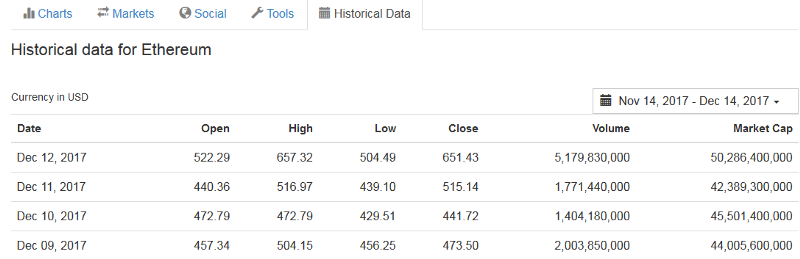 You will want to calculate the average daily volume. Which is very valuable information because it will tell you how quickly money is changing hands. In the above example on Dec 12 ETH had a recorded 5,179,830,000 24hr volume in a 50,286,400,000 market cap, so divide and you will get 0.1030065783193866 or 10.3% which is amazing. Typically you should be looking for coins that are doing around 4%+ in daily volume. Now of course the 10.3% is not a average daily volume, so you will need to go down the list and find the daily trading volume that it is doing which will certainly be less than 10.3%. Twitter: @cryptoassetnews YouTube Channel: https://www.youtube.com/channel/UCDMskjJegbcshbTMfpqhbXQ If you enjoyed this dont forget to up vote it! |
| json metadata | {"tags":["bitcoin","cryptocurrency","blockchain","evaluation","crypto"],"users":["cryptoassetnews"],"image":["https://steemitimages.com/DQmQDU3epNNe3ru7Vdcjfd8CLVzMMDZkzf8YuJsgZpTdzqi/l.png"],"links":["https://www.youtube.com/channel/UCDMskjJegbcshbTMfpqhbXQ"],"app":"steemit/0.1","format":"markdown"} |
| parent author | |
| parent permlink | bitcoin |
| permlink | the-right-way-to-evaluate-a-cryptocurrency |
| title | The right way to evaluate a cryptocurrency |
| Transaction Info | Block #19149622/Trx 21b95cb9d97832cd24a4ea278c485ab1b2033c00 |
View Raw JSON Data
{
"block": 19149622,
"op": [
"comment",
{
"author": "therealtim",
"body": "Summary :\n\nTake a deep breath!\n\nThe worst thing you can do is panic when the market is down, that is not to say your investment will be safe or that you picked the right coins. All it does is allow you to make a more educated decision on the situation and it allows you to better evaluate the market. If you haven’t dived right into the market yet, then you are starting out right. Lots of people are entering the space without even a basic knowledge of how crypto currency works/functions and little to no knowledge on blockchain technology. In this course we will look over the necessary steps you should take when deciding if a currency is worth your investment. Sneak Peak: It doesn’t involve magically reading chart graphs.\n\nLets do some independent reflection.\n\nDo you understand Blockchain Technology? Most people investing in cryptocurrency don’t understand blockchain technology and how it works exactly. That is like buying a car before you have a license or understanding and not understanding its safety precautions. If you don’t know how cryptocurrency works or blockchain technology then you need to pull out of the market and do some research.\n\nHow are you receiving your investing advice? Are you buying into it because your friends are jumping up and down from 1 successful 5x trade in a short amount of time? (Crypto fever ) Or are you investing because you see potential from actual research and not “news articles”. The best way to invest of course is from your own personal knowledge and the combined thought of others. News articles are good but come with a great responsibility! Use it as a guide but not advice. Often times, people will read a “buzz” article about a coin and then go on and invest into it without doing ACTUAL research on the coin. This causes a lot of problems and will make your cryptocurrency investing experience horrible.\n\nDo you understand the risk of cryptocurrency? 99% of these coins that are out on the market today will fail. Most of them are like politicians and promise innovation that is not technologically possible or a white paper that looks good but does not actually work out for one reason or another. With that knowledge that most of the coins are going to fail, you should really think about how your Return on investment (ROI) and Expected Value (EV) will be affected.\n\nWhat is EV?\n\nEV is very important when thinking about cryptocurrency coins and potential investments.It forces you to think outside of the box and think more about the stastically chances of failing and succeeding.\n\nA example of EV:\n\nWhen you are driving into a parking lot, do you take the first spot you see that is the closest to the building. Or you do you drive up past your vision and hope there’s a better spot? The answer is simple, it is +ev to pick the closest spot that you can see, rather than driving past your vision. ( this is in terms of time ) You will spend more time looking for a spot that is past your vision and not finding a spot and having to circle back around, than you would if you just picked a farther spot and decided to take the initial longer distance. This is taken at a large population of times. If you did this 1000 times, what would work best? Taking the closest spot you can see. Of course luck does play a role like it does in many business situations, however when you think about variance luck does deteriorate as time goes on. If you play that scenario 1000 times, regardless of your luck you would find that parking your car closer would be more beneficial in terms of your time. ( Which is your most valuable resource)\n\nHow does this relate to cryptocurrency?\n\nJust like in programming, you need to think of the market in this “if this than that” mindset. If you can think about a specific scenario such as government regulation, hacks, or a market decline that happened to a coin you are invested in or potentially invested in you can think about the comprehensive outcomes. These outcomes will then help you get a range of variables that you can evaluate and put together with your risk management strategy. However you don’t have to specifically look at possible scenarios, you can also take a look at information such as trading volume, market capital and supply circulation.\n\nAnother example of EV:\n\nLets say you want to invest in a crypto currency and if it succeeds it will 5x your money. You have $30 to invest, and you know that most crypto currency coins are bad investments so you decide to invest in 6 coins. Thus investing $5 into each of the currencies. If you figure you will go broke or make 5x, is it within your best interest to invest?\n\nLooking at this scenario one can conclude that you have a 5/6 probability of winning nothing. So the value of your investment is at $-5 since that is the remainder of your investment. The chance of you being successful and 5x’ing is a 1/6 chance which means you will get $18. ($5*5 -$2) So the formula of your investment is $-5 (5/6)+$18(1/6) = -1.166666666666667\n\nMeaning if you actually went ahead and did this, you would be losing on average $1.17 per coin you invest in. However you could get lucky the first time and win, giving you the get rich fever.\n\nOf course this could be easily translated to the scale that you are personally investing in, and of course you are not guaranteed to lose all your money or gain 5x on a single coin. When evaluating a coin you want to think about all aspects, and try and figure out what investment makes sense with your precised risk. Thus giving you a +ev investment.\n\nInstructions on how to evaluate:\n\n#1 The first thing I would suggest you do, is go to CoinMarketCap\n\nIf your coin is existing you should be able to look up the ticker and find it, however if you are trying to evalaute a ICO it wont be on there just yet and you should skip number 2.\n\n#2 Take out a piece of paper and write down the current price of the coin, circulating supply, max supply, daily volume and market cap. We will give into these numbers down the road.\n\n#3 Basic questions you will need to answer via the whitepaper.\n\n What Market is this coin trying to capture? What industry is it in? Is it tackling a new or existing market?\n Is this coin a registered company?\n Where is this company located? Be careful, the company might be located somewhere and be registered somewhere else. So where are they currently located, and where are they registered. This is important because different countries and areas might have different laws regarding businesses and cryptocurrency. So it is important to learn about the different government regulations that different countries have.\n What legal boundaries are they going to have to get through? Have they explained the legal structures in the white paper?\n How is their security? How will they be making the coins safe? How will they be keeping internal control? Will they follow similar laws regarding internal control?\n Have you read the terms of service? Do you understand it?\n How are they established on the blockchain, are they a ERC21 token etc?\n How does the team look, when you google them are you able to find legitimate information on them. If so, how well do you think they will represent your interest and making the coin successful. Also make sure to do research on the advisors and their compensation terms. If they are able to receive their coins within a month, then a possible dump of coins could happen etc.\n What risks are you able to see, and how can you see these risks minimized in your investing strategy?The whole idea is to invest in the best coin, with the lowest amount of risk.\n Does this company have a successful record? A example would be if Microsoft decided to create a coin. Although it is not the most important thing, it can help you evaluate the coin in the end.\n Are their exchanges that are ready to list the coin, or have no exchanges publicly agreed to launch the coin. Make sure to check the legitimacy of these claims\n Are they communicating well? Often times the coins will have Twitters or other social media accounts that they will update with information often.\n What role will this token/coin play in the cryptocurrency ecosystem? Does it actually have a utility? What is the economic structure behind the coin? Why does this coin have to exist?\n Are you able to use this coin outside of its application? Is this coin specific to its application or can it be used in other markets? For example: You can use bitcoin to buy physical items in stores using a debit card or buying it directly from the store. Is their a market that you can analyze outside of their marketplace?\n Is it absolutely necessarily to have the coin? What makes this coin essential for the project? For example: Does the ICO or existing coin/token have to exist or can someone simply make a similar company and accept bitcoin. If the company doesn’t have a purpose making a coin/token then they are likely only creating it to crowdfund.\n\nThis is very important and is especially important when deciding to invest in a ICO. You will notice when you look through ICO’s that they are basically a hidden “crowdfund” and not a good investment. They will talk about how they will make so much money with their application, but you should note that just because they are profiting doesn’t mean your coin will increase in value. When buying a coin, you are most likely not receiving a equity in the company. All of this information should help you formulate an idea at how much the market capital of the coin could reach and then dividing that by the number of coins available will give you a good price that it could potentially reach.\n\n\n\n\nYou will want to calculate the average daily volume. Which is very valuable information because it will tell you how quickly money is changing hands. In the above example on Dec 12 ETH had a recorded 5,179,830,000 24hr volume in a 50,286,400,000 market cap, so divide and you will get 0.1030065783193866 or 10.3% which is amazing. Typically you should be looking for coins that are doing around 4%+ in daily volume. Now of course the 10.3% is not a average daily volume, so you will need to go down the list and find the daily trading volume that it is doing which will certainly be less than 10.3%.\n\nTwitter: @cryptoassetnews\n\nYouTube Channel: https://www.youtube.com/channel/UCDMskjJegbcshbTMfpqhbXQ\n\nIf you enjoyed this dont forget to up vote it!",
"json_metadata": "{\"tags\":[\"bitcoin\",\"cryptocurrency\",\"blockchain\",\"evaluation\",\"crypto\"],\"users\":[\"cryptoassetnews\"],\"image\":[\"https://steemitimages.com/DQmQDU3epNNe3ru7Vdcjfd8CLVzMMDZkzf8YuJsgZpTdzqi/l.png\"],\"links\":[\"https://www.youtube.com/channel/UCDMskjJegbcshbTMfpqhbXQ\"],\"app\":\"steemit/0.1\",\"format\":\"markdown\"}",
"parent_author": "",
"parent_permlink": "bitcoin",
"permlink": "the-right-way-to-evaluate-a-cryptocurrency",
"title": "The right way to evaluate a cryptocurrency"
}
],
"op_in_trx": 0,
"timestamp": "2018-01-20T17:52:39",
"trx_id": "21b95cb9d97832cd24a4ea278c485ab1b2033c00",
"trx_in_block": 4,
"virtual_op": 0
}ponchikusupvoted (100.00%) @therealtim / bitcoin-and-anonymity2018/01/20 10:01:00
ponchikusupvoted (100.00%) @therealtim / bitcoin-and-anonymity
2018/01/20 10:01:00
| author | therealtim |
| permlink | bitcoin-and-anonymity |
| voter | ponchikus |
| weight | 10000 (100.00%) |
| Transaction Info | Block #19140194/Trx 4a6081b28483281f86e81d1f30464c4af36d0f31 |
View Raw JSON Data
{
  "block": 19140194,
  "op": [
    "vote",
    {
      "author": "therealtim",
      "permlink": "bitcoin-and-anonymity",
      "voter": "ponchikus",
      "weight": 10000
    }
  ],
  "op_in_trx": 0,
  "timestamp": "2018-01-20T10:01:00",
  "trx_id": "4a6081b28483281f86e81d1f30464c4af36d0f31",
  "trx_in_block": 24,
  "virtual_op": 0
}kuekmupvoted (100.00%) @therealtim / bitcoin-and-anonymity2018/01/20 10:00:27
kuekmupvoted (100.00%) @therealtim / bitcoin-and-anonymity
2018/01/20 10:00:27
| author | therealtim |
| permlink | bitcoin-and-anonymity |
| voter | kuekm |
| weight | 10000 (100.00%) |
| Transaction Info | Block #19140183/Trx 7e6c97f8ccd0dba0b11d9f6696051e20e8f78bae |
View Raw JSON Data
{
  "block": 19140183,
  "op": [
    "vote",
    {
      "author": "therealtim",
      "permlink": "bitcoin-and-anonymity",
      "voter": "kuekm",
      "weight": 10000
    }
  ],
  "op_in_trx": 0,
  "timestamp": "2018-01-20T10:00:27",
  "trx_id": "7e6c97f8ccd0dba0b11d9f6696051e20e8f78bae",
  "trx_in_block": 26,
  "virtual_op": 0
}therealtimupvoted (100.00%) @marcuswahl / re-therealtim-tim-forrest-20180120t024531457z2018/01/20 06:31:03
therealtimupvoted (100.00%) @marcuswahl / re-therealtim-tim-forrest-20180120t024531457z
2018/01/20 06:31:03
| author | marcuswahl |
| permlink | re-therealtim-tim-forrest-20180120t024531457z |
| voter | therealtim |
| weight | 10000 (100.00%) |
| Transaction Info | Block #19135997/Trx 71620cec47c2a367ec505fb2105f66d2bb738ce5 |
View Raw JSON Data
{
  "block": 19135997,
  "op": [
    "vote",
    {
      "author": "marcuswahl",
      "permlink": "re-therealtim-tim-forrest-20180120t024531457z",
      "voter": "therealtim",
      "weight": 10000
    }
  ],
  "op_in_trx": 0,
  "timestamp": "2018-01-20T06:31:03",
  "trx_id": "71620cec47c2a367ec505fb2105f66d2bb738ce5",
  "trx_in_block": 9,
  "virtual_op": 0
}2018/01/20 02:45:30
2018/01/20 02:45:30
| author | marcuswahl |
| body | Welcome Tim, you have definitely found a home for crypto content! |
| json metadata | {"tags":["introduction"],"app":"steemit/0.1"} |
| parent author | therealtim |
| parent permlink | tim-forrest |
| permlink | re-therealtim-tim-forrest-20180120t024531457z |
| title | |
| Transaction Info | Block #19131490/Trx b9a2e6328001927320f6f2fafe556c8cbcfc4cb1 |
View Raw JSON Data
{
  "block": 19131490,
  "op": [
    "comment",
    {
      "author": "marcuswahl",
      "body": "Welcome Tim, you have definitely found a home for crypto content!",
      "json_metadata": "{\"tags\":[\"introduction\"],\"app\":\"steemit/0.1\"}",
      "parent_author": "therealtim",
      "parent_permlink": "tim-forrest",
      "permlink": "re-therealtim-tim-forrest-20180120t024531457z",
      "title": ""
    }
  ],
  "op_in_trx": 0,
  "timestamp": "2018-01-20T02:45:30",
  "trx_id": "b9a2e6328001927320f6f2fafe556c8cbcfc4cb1",
  "trx_in_block": 40,
  "virtual_op": 0
}therealtimpublished a new post: tim-forrest2018/01/20 02:43:57
therealtimpublished a new post: tim-forrest
2018/01/20 02:43:57
| author | therealtim |
| body | My name is Timothy Forrest and I create cryptocurrency content all over the internet. I hope to be very active and post a lot of helpful articles :) |
| json metadata | {"tags":["introduction","bitcoin","cryptocurrency","etherum"],"app":"steemit/0.1","format":"markdown"} |
| parent author | |
| parent permlink | introduction |
| permlink | tim-forrest |
| title | Tim Forrest |
| Transaction Info | Block #19131459/Trx 63f42b968bb55b205571ff0fc61d2e87f9f8eb8f |
View Raw JSON Data
{
  "block": 19131459,
  "op": [
    "comment",
    {
      "author": "therealtim",
      "body": "My name is Timothy Forrest and I create cryptocurrency content all over the internet. I hope to be very active and post a lot of helpful articles :)",
      "json_metadata": "{\"tags\":[\"introduction\",\"bitcoin\",\"cryptocurrency\",\"etherum\"],\"app\":\"steemit/0.1\",\"format\":\"markdown\"}",
      "parent_author": "",
      "parent_permlink": "introduction",
      "permlink": "tim-forrest",
      "title": "Tim Forrest"
    }
  ],
  "op_in_trx": 0,
  "timestamp": "2018-01-20T02:43:57",
  "trx_id": "63f42b968bb55b205571ff0fc61d2e87f9f8eb8f",
  "trx_in_block": 14,
  "virtual_op": 0
}2018/01/20 00:57:54
2018/01/20 00:57:54
| author | coin.info |
| body | **Coins mentioned in post:** Coin | | Price (USD) | 📈 24h | 📉 7d - | - | - | - | - **BTC** | Bitcoin | 11731.000$ | _1.74%_ | _-16.65%_ **ETH** | Ethereum | 1052.840$ | _1.11%_ | _-17.8%_ **GAS** | Gas | 55.447$ | _-2.31%_ | _1.93%_ **OMG** | OmiseGO | 18.760$ | _5.1%_ | _-18.8%_ |
| json metadata | {"app":"coininfo/1.0.0","format":"markdown"} |
| parent author | therealtim |
| parent permlink | understanding-ethereum-and-learning-everything-you-need-to-know-about-it |
| permlink | re-therealtim-understanding-ethereum-and-learning-everything-you-need-to-know-about-it-20180120t005754114z |
| title | |
| Transaction Info | Block #19129347/Trx 4ffb76e9d9a55f1e2d1166cc88242b5785bf7a6c |
View Raw JSON Data
{
  "block": 19129347,
  "op": [
    "comment",
    {
      "author": "coin.info",
      "body": "**Coins mentioned in post:**\n\nCoin | | Price (USD) | 📈 24h | 📉 7d\n- | - | - | - | -\n**BTC** | Bitcoin | 11731.000$ | _1.74%_ | _-16.65%_\n**ETH** | Ethereum | 1052.840$ | _1.11%_ | _-17.8%_\n**GAS** | Gas | 55.447$ | _-2.31%_ | _1.93%_\n**OMG** | OmiseGO | 18.760$ | _5.1%_ | _-18.8%_",
      "json_metadata": "{\"app\":\"coininfo/1.0.0\",\"format\":\"markdown\"}",
      "parent_author": "therealtim",
      "parent_permlink": "understanding-ethereum-and-learning-everything-you-need-to-know-about-it",
      "permlink": "re-therealtim-understanding-ethereum-and-learning-everything-you-need-to-know-about-it-20180120t005754114z",
      "title": ""
    }
  ],
  "op_in_trx": 0,
  "timestamp": "2018-01-20T00:57:54",
  "trx_id": "4ffb76e9d9a55f1e2d1166cc88242b5785bf7a6c",
  "trx_in_block": 9,
  "virtual_op": 0
}therealtimpublished a new post: bitcoin-and-anonymity2018/01/20 00:19:57
therealtimpublished a new post: bitcoin-and-anonymity
2018/01/20 00:19:57
| author | therealtim |
| body | Anonymity Basics — If this isn’t the first time you have heard of bitcoin then you have likely read or heard someone say bitcoin is anonymous. How true is this statement really? Are transactions made through bitcoin really anonymous? Lets jump in and found out ourselves. From a birds eye view, bitcoin follows the “laws” of anonymity. When a transaction is sent, the person’s Identity, street address, zip code, state/country, or phone number is not given and so by the pure nature it is in fact anonymous. However because of the nature of the blockchain and in this case Bitcoin, you are able to see all transactions ever made within that specific address. Of course people could keep creating new addresses to try and tangle their connections, but the mere fact is, you are still connected to that address forever. It might not be possible to see the persons identity from the transaction, however if a Identity is connected to an address then all of your transactions are now revealed. The distinction between anonymity should really be un-linkable instead of unrecognizable. From a random address the identity might be unrecognizable, however it can be linked. How could someone from a link with your transactions? Most regulated and often “legitimate” exchange sites keep track of your addresses and are linked to your real identity. Let’s imagine for a second you received 1 BTC from X address and your address is Y. You then send the 1 BTC ( Y address ) to Coinbase, a popular exchange site that requires your identity. From there Coinbase will send you an address to submit the coins too and you will transact it. If for some reason, an audit appeared and Coinbase was to give away information regarding your transaction history it would be clear that you sold 1 BTC from your address Y, that was given from X. So in the worst situation, let’s say you stole 1BTC from X and your address was submitted to a fraud agency. The fraud agency could request all Coinbase transactions, and find search through and find the X transaction and Coinbase will know exactly who that address belongs to since they keep record. It is also possible that you could publicly post your transaction on a social media, online forum, or email and then your identity is pressed to that address forever. Now you might ask yourself, why do I need to be fully anonymous If I am not doing sketchy things? There are a number of different reasons one might want to be anonymous with personal and business transactions. If your identity is found, all of your transactions can be traced due to the distributed ledger. This sort of privacy is worse than cash transactions, as they are not held on a public ledger. A few different reasons exist that allow legitimate people to want private transactions. Just like in real life, you don’t want a sign above your head that states exactly how much money you have. This would make you a target for robbery, and in the cryptocurrency world an identity link could bring personal hacking/phishing attempts your way. You might also not want people to be able to see how much money you have spent on items/services and or see the value of donations made. If people are able to track your expensive purchases, businesses might use a pricing algorithm to charge you more for a product/service since you can afford it. This also translates to businesses as well, they don’t want competitors to see their purchases and profits day to day. However not all people can be trusted with this, as unethical things could happen as well. Which isn’t a reason to hate or love cryptocurrency as unethical actions tied to fiat currency happens every single day. We have all heard of Bernie Madoff. So of course there are real risks of money laundering and the purchases of illegal or prohibited items. This sort of issue though is not completely helpless as “cashing out” bitcoin or even cryptocurrency in that matter can be difficult to do. Often times exchanges and other financial institutions that allow the exchanging of fiat currency too cryptocurrency have limits. So in other words, if you tried to cash out $1m of bitcoins via Coinbase, they might not let you entirely, but that transaction will be recorded under your profile ( that has your attached identity ) and a notification to the IRS or government can be made. In reality this “anonymous” nature of the blockchain doesn’t really affect someone’s desire, or ability to money launder in a way that they were not able to before. So clearly, there are good uses and bad uses of this technology. Is there a way that we could only allow good people to use it? This is not possible however law enforcement is able to use the technology as well to even the playing field by tracking and using different cyber sting operations. A good example of someone using cryptocurrency for bad, was the creator of the silk road who after many different sting operations was able to be caught by the FBI and shut down. So even with this technology being used for bad, the government and protective agencies still have the ability to use and combat the “anonymous” nature of cryptocurrency. Some people do not realize it but cryptography and this idea of anonymity through cash systems has been around since the 1980’s. Lets run through an example of how anonymous cash based systems worked previously before the idea of a decentralized system ( Bitcoin ). 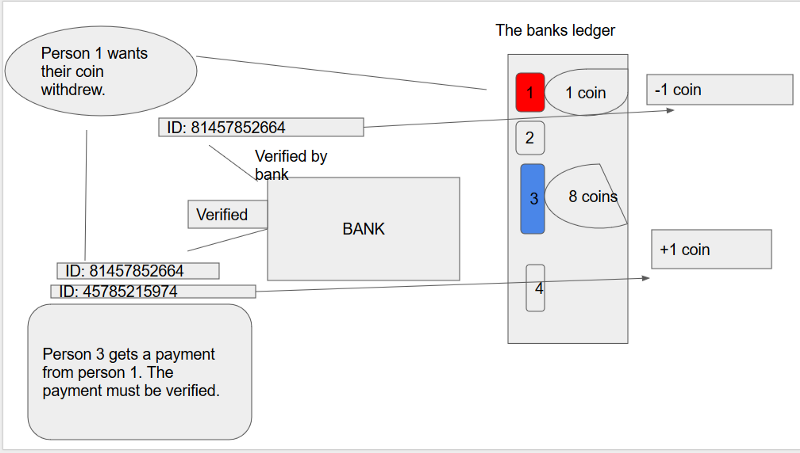 Lets try and understand this step by step. In this system there are 2 people that have money in the “bank”. However you will notice their are other people in the system, that are able to transact payments at the same exact time. Person 1 has a coin in the bank and wants to withdraw that coin. The person submits a form to withdraw that coin and gives the bank a special number that the bank cannot identity to the individual. The ID number however is verifiable in the system and so the bank knows where to send the coin too when the transaction is started. The bank will then take off a coin from the users account, while doing many other transactions at once so the specific transaction is not identified. Once the person gets the coin, he/she is now able to spend the money at their desire and decides to spend the money to person 2. This person is smart and understands that person 1 could simply be sending that ID coin to 100 different people and “double spend”. So this person waits for the bank to automatically verify the transaction while creating a new ID number for that individual. Once the bank can confirm the transaction is legit, the bank can give person 2 an extra coin in their bank and this can happen anonymous as the bank verifies the transactions without them actually being visible. Can you see the problem that occurs in this scenario? I said it before we started, this is not a decentralized payment system but rather a centralized. We have to trust that the bank can accurately verify and keep our identities anonymous. So we can now start to see that decentralization and being anonymous can run into some problems and are conflicts of each other. Decentralized transactions are able to be traced for right now which is an issue. ( A example of this is bitcoin ) If you take a look at people’s values you can see that decentralization is more important than being fully anonymous which is why bitcoin has been able to succeed. Is it possible to become anonymous ? Now that we know some of the different factors that make up bitcoin, let’s take a deeper look into transactions and see if it is possible to become anonymous. Often times people will create new wallet addresses for each of their transactions so that someone looking at the public ledger can not tell that the different addresses are actually linked to a user. What happens though when you want to buy an item that would cause you to need both of your addresses? In that scenario you would be linking your addresses by sending money from one address to the other one. Someone looking into your addresses could find this connection and figure out that the different addresses are indeed controlled by the single person. It might seem farfetched to assume that people could find these connections, however technology changes every single day and programs are being built to find these connections that might not be seen from a quick look. Some things can get complicated if let’s say person A has 1 BTC and decides to make a legitimate purchase of .5 btc for an item, and with the remaining money sends .5 BTC to a brand new address. However people have began to realize that both transactions made could be potential addresses of the original sender so now even this doesn’t always work. In fact you can look at the outputs of addresses and figure out who that address might be owned by. An example would be too look at the transaction date of a particular address and the transaction volume that the output address is making. For example if sender A sends 1 BTC to address B, in 2011 this address could be BTC-E given that the transaction volume of the address could match up with BTC E’s volumes. This gives the person some more knowledge of where the money was sent, and even if the money could possible be sent from sender A to another address owned by that sender. By corresponding that BTCE yourself, you can find the cluster of the transaction and then be able to figure out what addresses are owned by that specific address. However it is helpful when we can interact with big company addresses that make a lot of volume since we can correspond those transactions, however is it possible to then figure out someones individual identity from a pool of addresses. This example was already previously stated, if person A sends bitcoins to their coinbase account, they will have a connection to their personal identity if someone was able to get the information off of the coinbase account. So how can you actually protect yourself? There are a few different ways to protect yourself which include using an anonymous browser like Tor, and mix nets. Mixing — If you want to actually be anonymous your payment must go through a pool, that can not be identified individually. So for example, we could have person A, B, C all sending transactions and instead of having them sent directly to an address you have them sent to a pool that can not identify the original senders. So for instance, lets say person A sends a bitcoin into this pool, and then tries to retrieve that bitcoin, the coin they get in return or the coin that person A wants to send it to becomes a totally different coin but represents the same amount. So person A could have a bitcoin with the ID:475748 but when withdraws or sends the coin to someone else it is retrieved as ID:467431. You still have the value of a coin, however your coin has be given to someone else and in return you got someone else’s coin. So for a mixing service to actually work, they need to act somewhat like Coinbase does in the sense that it can hold your coins for you. A mixing service however would need to not keep record of the different addresses like coinbase does, and the mixing service would need too allow you to access its service without providing your identity. This would allow you to deposit coins, and withdraw them to a new address that is “mixed” without being able to link the person to their ID, home address, SSN etc. Often times people will transfer coins through a mixing pool and then transfer the coins to a different one, so that if a pool was hacked and the information was logged it is possible that your information could be safe. The obvious caution of using these pools is simply the fact that they could take your bitcoins and not give you them back, and there for scam you. Could there be a decentralized mixing? — In order for decentralized mixing, you would need to find a community of people that want to accomplish the same goal. As long as bitcoin exist, there will always be a need for mixing and the need to stay anonymous. No one would be sending bitcoin to a user so fraud between sending the coins would not happen. Coinjoin is a proposed operation for a decentralized mix. In this pool, signatures are created and are entirely different, so each person in the network will be submitting a transaction that is not their own. In order for this to work, peers need to find each other and exchange each others inputs/outputs. The transaction then needs to be broadcasted on the network, all without a centralized figure. The problem with this situation is that people could try and harm the system by sending a mass amount of transactions and not signing the signatures. Often times when we have these sort of problems, and a reason a lot of coins force a fee when there is no mining, is to make it expensive for people to try and maliciously attack the system. You could also make people that want people to enter this pool solve algorithms on their computer ( sort of like mining bitcoin ) and instead of the reward being a coin, the reward could be transmitting the transaction. You can also try and find the people that are harming the system, and kicking them out of the system. This sort of behavior could be attributed to reputation. Twitter: @cryptoassetnews YouTube Channel: https://www.youtube.com/channel/UCDMskjJegbcshbTMfpqhbXQ |
| json metadata | {"tags":["bitcoin","anonmity","cryptocurrency","blockchain","coinbase"],"users":["cryptoassetnews"],"image":["https://steemitimages.com/DQmYbnzsL3WBE55mpvaCBi19R1xDu9Mt6JXmvZXTL1Y5U7A/1.png"],"links":["https://www.youtube.com/channel/UCDMskjJegbcshbTMfpqhbXQ"],"app":"steemit/0.1","format":"markdown"} |
| parent author | |
| parent permlink | bitcoin |
| permlink | bitcoin-and-anonymity |
| title | Bitcoin and Anonymity |
| Transaction Info | Block #19128589/Trx cbabe2e138ac00c742ae920c13e3c037ab743045 |
View Raw JSON Data
{
"block": 19128589,
"op": [
"comment",
{
"author": "therealtim",
"body": "Anonymity Basics — If this isn’t the first time you have heard of bitcoin then you have likely read or heard someone say bitcoin is anonymous. How true is this statement really? Are transactions made through bitcoin really anonymous? Lets jump in and found out ourselves. From a birds eye view, bitcoin follows the “laws” of anonymity. When a transaction is sent, the person’s Identity, street address, zip code, state/country, or phone number is not given and so by the pure nature it is in fact anonymous. However because of the nature of the blockchain and in this case Bitcoin, you are able to see all transactions ever made within that specific address. Of course people could keep creating new addresses to try and tangle their connections, but the mere fact is, you are still connected to that address forever. It might not be possible to see the persons identity from the transaction, however if a Identity is connected to an address then all of your transactions are now revealed. The distinction between anonymity should really be un-linkable instead of unrecognizable. From a random address the identity might be unrecognizable, however it can be linked. How could someone from a link with your transactions? Most regulated and often “legitimate” exchange sites keep track of your addresses and are linked to your real identity. Let’s imagine for a second you received 1 BTC from X address and your address is Y. You then send the 1 BTC ( Y address ) to Coinbase, a popular exchange site that requires your identity. From there Coinbase will send you an address to submit the coins too and you will transact it. If for some reason, an audit appeared and Coinbase was to give away information regarding your transaction history it would be clear that you sold 1 BTC from your address Y, that was given from X. So in the worst situation, let’s say you stole 1BTC from X and your address was submitted to a fraud agency. The fraud agency could request all Coinbase transactions, and find search through and find the X transaction and Coinbase will know exactly who that address belongs to since they keep record. It is also possible that you could publicly post your transaction on a social media, online forum, or email and then your identity is pressed to that address forever. Now you might ask yourself, why do I need to be fully anonymous If I am not doing sketchy things? There are a number of different reasons one might want to be anonymous with personal and business transactions. If your identity is found, all of your transactions can be traced due to the distributed ledger. This sort of privacy is worse than cash transactions, as they are not held on a public ledger. A few different reasons exist that allow legitimate people to want private transactions. Just like in real life, you don’t want a sign above your head that states exactly how much money you have. This would make you a target for robbery, and in the cryptocurrency world an identity link could bring personal hacking/phishing attempts your way. You might also not want people to be able to see how much money you have spent on items/services and or see the value of donations made. If people are able to track your expensive purchases, businesses might use a pricing algorithm to charge you more for a product/service since you can afford it. This also translates to businesses as well, they don’t want competitors to see their purchases and profits day to day. However not all people can be trusted with this, as unethical things could happen as well. Which isn’t a reason to hate or love cryptocurrency as unethical actions tied to fiat currency happens every single day. We have all heard of Bernie Madoff. So of course there are real risks of money laundering and the purchases of illegal or prohibited items. This sort of issue though is not completely helpless as “cashing out” bitcoin or even cryptocurrency in that matter can be difficult to do. Often times exchanges and other financial institutions that allow the exchanging of fiat currency too cryptocurrency have limits. So in other words, if you tried to cash out $1m of bitcoins via Coinbase, they might not let you entirely, but that transaction will be recorded under your profile ( that has your attached identity ) and a notification to the IRS or government can be made. In reality this “anonymous” nature of the blockchain doesn’t really affect someone’s desire, or ability to money launder in a way that they were not able to before. So clearly, there are good uses and bad uses of this technology. Is there a way that we could only allow good people to use it? This is not possible however law enforcement is able to use the technology as well to even the playing field by tracking and using different cyber sting operations. A good example of someone using cryptocurrency for bad, was the creator of the silk road who after many different sting operations was able to be caught by the FBI and shut down. So even with this technology being used for bad, the government and protective agencies still have the ability to use and combat the “anonymous” nature of cryptocurrency. Some people do not realize it but cryptography and this idea of anonymity through cash systems has been around since the 1980’s. Lets run through an example of how anonymous cash based systems worked previously before the idea of a decentralized system ( Bitcoin ).\n\n\n\nLets try and understand this step by step. In this system there are 2 people that have money in the “bank”. However you will notice their are other people in the system, that are able to transact payments at the same exact time. Person 1 has a coin in the bank and wants to withdraw that coin. The person submits a form to withdraw that coin and gives the bank a special number that the bank cannot identity to the individual. The ID number however is verifiable in the system and so the bank knows where to send the coin too when the transaction is started. The bank will then take off a coin from the users account, while doing many other transactions at once so the specific transaction is not identified. Once the person gets the coin, he/she is now able to spend the money at their desire and decides to spend the money to person 2. This person is smart and understands that person 1 could simply be sending that ID coin to 100 different people and “double spend”. So this person waits for the bank to automatically verify the transaction while creating a new ID number for that individual. Once the bank can confirm the transaction is legit, the bank can give person 2 an extra coin in their bank and this can happen anonymous as the bank verifies the transactions without them actually being visible. Can you see the problem that occurs in this scenario? I said it before we started, this is not a decentralized payment system but rather a centralized. We have to trust that the bank can accurately verify and keep our identities anonymous. So we can now start to see that decentralization and being anonymous can run into some problems and are conflicts of each other. Decentralized transactions are able to be traced for right now which is an issue. ( A example of this is bitcoin ) If you take a look at people’s values you can see that decentralization is more important than being fully anonymous which is why bitcoin has been able to succeed.\n\nIs it possible to become anonymous ? Now that we know some of the different factors that make up bitcoin, let’s take a deeper look into transactions and see if it is possible to become anonymous. Often times people will create new wallet addresses for each of their transactions so that someone looking at the public ledger can not tell that the different addresses are actually linked to a user. What happens though when you want to buy an item that would cause you to need both of your addresses? In that scenario you would be linking your addresses by sending money from one address to the other one. Someone looking into your addresses could find this connection and figure out that the different addresses are indeed controlled by the single person.\n\nIt might seem farfetched to assume that people could find these connections, however technology changes every single day and programs are being built to find these connections that might not be seen from a quick look. Some things can get complicated if let’s say person A has 1 BTC and decides to make a legitimate purchase of .5 btc for an item, and with the remaining money sends .5 BTC to a brand new address. However people have began to realize that both transactions made could be potential addresses of the original sender so now even this doesn’t always work. In fact you can look at the outputs of addresses and figure out who that address might be owned by. An example would be too look at the transaction date of a particular address and the transaction volume that the output address is making. For example if sender A sends 1 BTC to address B, in 2011 this address could be BTC-E given that the transaction volume of the address could match up with BTC E’s volumes. This gives the person some more knowledge of where the money was sent, and even if the money could possible be sent from sender A to another address owned by that sender. By corresponding that BTCE yourself, you can find the cluster of the transaction and then be able to figure out what addresses are owned by that specific address. However it is helpful when we can interact with big company addresses that make a lot of volume since we can correspond those transactions, however is it possible to then figure out someones individual identity from a pool of addresses. This example was already previously stated, if person A sends bitcoins to their coinbase account, they will have a connection to their personal identity if someone was able to get the information off of the coinbase account. So how can you actually protect yourself? There are a few different ways to protect yourself which include using an anonymous browser like Tor, and mix nets.\n\nMixing — If you want to actually be anonymous your payment must go through a pool, that can not be identified individually. So for example, we could have person A, B, C all sending transactions and instead of having them sent directly to an address you have them sent to a pool that can not identify the original senders. So for instance, lets say person A sends a bitcoin into this pool, and then tries to retrieve that bitcoin, the coin they get in return or the coin that person A wants to send it to becomes a totally different coin but represents the same amount. So person A could have a bitcoin with the ID:475748 but when withdraws or sends the coin to someone else it is retrieved as ID:467431. You still have the value of a coin, however your coin has be given to someone else and in return you got someone else’s coin. So for a mixing service to actually work, they need to act somewhat like Coinbase does in the sense that it can hold your coins for you. A mixing service however would need to not keep record of the different addresses like coinbase does, and the mixing service would need too allow you to access its service without providing your identity. This would allow you to deposit coins, and withdraw them to a new address that is “mixed” without being able to link the person to their ID, home address, SSN etc. Often times people will transfer coins through a mixing pool and then transfer the coins to a different one, so that if a pool was hacked and the information was logged it is possible that your information could be safe. The obvious caution of using these pools is simply the fact that they could take your bitcoins and not give you them back, and there for scam you.\n\nCould there be a decentralized mixing? — In order for decentralized mixing, you would need to find a community of people that want to accomplish the same goal. As long as bitcoin exist, there will always be a need for mixing and the need to stay anonymous. No one would be sending bitcoin to a user so fraud between sending the coins would not happen. Coinjoin is a proposed operation for a decentralized mix. In this pool, signatures are created and are entirely different, so each person in the network will be submitting a transaction that is not their own. In order for this to work, peers need to find each other and exchange each others inputs/outputs. The transaction then needs to be broadcasted on the network, all without a centralized figure. The problem with this situation is that people could try and harm the system by sending a mass amount of transactions and not signing the signatures. Often times when we have these sort of problems, and a reason a lot of coins force a fee when there is no mining, is to make it expensive for people to try and maliciously attack the system. You could also make people that want people to enter this pool solve algorithms on their computer ( sort of like mining bitcoin ) and instead of the reward being a coin, the reward could be transmitting the transaction. You can also try and find the people that are harming the system, and kicking them out of the system. This sort of behavior could be attributed to reputation.\n\nTwitter: @cryptoassetnews\n\nYouTube Channel: https://www.youtube.com/channel/UCDMskjJegbcshbTMfpqhbXQ",
"json_metadata": "{\"tags\":[\"bitcoin\",\"anonmity\",\"cryptocurrency\",\"blockchain\",\"coinbase\"],\"users\":[\"cryptoassetnews\"],\"image\":[\"https://steemitimages.com/DQmYbnzsL3WBE55mpvaCBi19R1xDu9Mt6JXmvZXTL1Y5U7A/1.png\"],\"links\":[\"https://www.youtube.com/channel/UCDMskjJegbcshbTMfpqhbXQ\"],\"app\":\"steemit/0.1\",\"format\":\"markdown\"}",
"parent_author": "",
"parent_permlink": "bitcoin",
"permlink": "bitcoin-and-anonymity",
"title": "Bitcoin and Anonymity"
}
],
"op_in_trx": 0,
"timestamp": "2018-01-20T00:19:57",
"trx_id": "cbabe2e138ac00c742ae920c13e3c037ab743045",
"trx_in_block": 10,
"virtual_op": 0
}2018/01/20 00:14:33
2018/01/20 00:14:33
| author | cheetah |
| body | Hi! I am a robot. I just upvoted you! I found similar content that readers might be interested in: https://medium.com/@therealtimforrest/understanding-ethereum-38bd1dad6838 |
| json metadata | |
| parent author | therealtim |
| parent permlink | understanding-ethereum-and-learning-everything-you-need-to-know-about-it |
| permlink | cheetah-re-therealtimunderstanding-ethereum-and-learning-everything-you-need-to-know-about-it |
| title | |
| Transaction Info | Block #19128482/Trx e2a9601dd32782abc4b4fe38dda1523aa9bc45f4 |
View Raw JSON Data
{
  "block": 19128482,
  "op": [
    "comment",
    {
      "author": "cheetah",
      "body": "Hi! I am a robot. I just upvoted you! I found similar content that readers might be interested in:\nhttps://medium.com/@therealtimforrest/understanding-ethereum-38bd1dad6838",
      "json_metadata": "",
      "parent_author": "therealtim",
      "parent_permlink": "understanding-ethereum-and-learning-everything-you-need-to-know-about-it",
      "permlink": "cheetah-re-therealtimunderstanding-ethereum-and-learning-everything-you-need-to-know-about-it",
      "title": ""
    }
  ],
  "op_in_trx": 0,
  "timestamp": "2018-01-20T00:14:33",
  "trx_id": "e2a9601dd32782abc4b4fe38dda1523aa9bc45f4",
  "trx_in_block": 14,
  "virtual_op": 0
}2018/01/20 00:14:27
2018/01/20 00:14:27
| author | therealtim |
| permlink | understanding-ethereum-and-learning-everything-you-need-to-know-about-it |
| voter | cheetah |
| weight | 8 (0.08%) |
| Transaction Info | Block #19128480/Trx 27a941fccf9ef5ca5ac74c994079b41e7fe68aa9 |
View Raw JSON Data
{
  "block": 19128480,
  "op": [
    "vote",
    {
      "author": "therealtim",
      "permlink": "understanding-ethereum-and-learning-everything-you-need-to-know-about-it",
      "voter": "cheetah",
      "weight": 8
    }
  ],
  "op_in_trx": 0,
  "timestamp": "2018-01-20T00:14:27",
  "trx_id": "27a941fccf9ef5ca5ac74c994079b41e7fe68aa9",
  "trx_in_block": 49,
  "virtual_op": 0
}therealtimpublished a new post: understanding-ethereum-and-learning-everything-you-need-to-know-about-it2018/01/20 00:14:15
therealtimpublished a new post: understanding-ethereum-and-learning-everything-you-need-to-know-about-it
2018/01/20 00:14:15
| author | therealtim |
| body | What is Ethereum - Is a digital cryptocurrency that was founded in 2015 by Vitalik Buterin, with co-founded by Mihai Alisie, Anthony Di Iorio, Charles Hoskinson, Dr. Gavin Wood and Joseph Lubin. Ethereum is similar to that of bitcoin, however it is used to operate smart contracts on the Ethereum network via virtual machines. Rather than thinking of Ethereum as a currency it is easiest to think of a technology that allows developers to use its software to create amazing things like decentralized applications (DAPPS). Ethereum is a mine-able currency but it switching from a POW to a POS system which will allow people to “stake” their Ethereum to earn more coins. Ether is the token on the Ethereum network that is used to power the network, and is used to pay for transactions and services within the network. Although similar to bitcoins fees for transactions it runs a little differently as you use your ether for “gas” which will be explained in a lecture on its own. Ethereum also runs on a completely different blockchain than bitcoin and has founders and developers who are very well known in the community. When entering the network each computer downloads a virtual machine that is used collectively to build a supercomputer that has the computing power to run the network, provide security and process the transactions. Dr. Gavin Wood an Ethereum co- founder stated that “Bitcoin is first and foremost a currency; this is one particular application of a blockchain. However, it is far from the only application. To take a past example of a similar situation, e-mail is one particular use of the internet, and for sure helped popularize it, but there are many others.” Making a Ethereum wallet — A lot of time people want to make Ethereum wallets that are compatible with ERC20 tokens. An ERC20 token is just a fancy way of saying that it follows a specific set of rules and is built on top of the Ethereum network. Below I will list 3 different wallets that support ERC20 tokens. MyEtherWallet (Online) MetaMask (Firefox and Chrome browser extension) Mist (Desktop) Often times people will make the mistake of having people send tokens to there Ethereum wallets on exchanges which is a mistake.When a coin forks or when you send tokens to an Ethereum address on a exchange you will not get the transaction because they only support that specific coin. For example, if you had an Ethereum address on Myetherwallet and someone was like “hey want some OMG coins” they could send you the OMG tokens to your wallet address, and you will receive the tokens. If you give them your Ethereum address on an exchange, the exchange will not recognize the tokens and will assume nothing has been sent since Ethereum wasn’t deposited in the correct wallet. Same with a forked coin, if you have coin X and it is forking into X2 you won’t get the x2 coin if your money is on an exchange because they don’t have a wallet for the coin and you don’t own the private keys. However if you have a coin on Myetherwallet and it forks, the other coin will have a place to be stored since you own the keys. Creating a Myetherwallet account : Go to Myetherwallet and bookmark it, so that if you click on a phishing site you will notice fairly quick. You should also look in the top left and see the “MYETHERWALLET LLC (US)”. Make a password and write it down or save it in another location so you don’t forget it Download the key file, myetherwallet does not store your information online. You store it on your computer, so it protects from hacking. ( Not at the individual level ) You can save the file on USB flash drives and hide them for every safely. Save your private key that you are given, and write that down. To enter your wallet or to send money, you can do so by uploading your private key or file. Now you are done and can manage your ether and tokens. Differences from bitcoin Bitcoin- Stack based programming. Longer block time. Fees are typically higher. Bitcoin was created to be an alternative to fiat money, and it is a way to store digital value. Ethereum- Turing complete programming. Quicker block time, more transactions able to be confirmed per second. Even on the large scale that Ethereum is on, you are still able to send transactions for under $1. Ethereum was created to be able to run applications using smart contracts and command different functions. Comparing the two different currencies would be like apples to oranges as they are both solving different problems. Smart contracts- Is the computer code that is built on the Ethereum network to exchange assets of value given a particular set of rules. (Typically “if this” then “that” statements) When these circumstances are met, the code will run and execute the next action and is able to do so since Ethereum is run using virtual servers. Being that these codes exist on the Ethereum blockchain they are safe from centralization, fraud, and maintenance down time. Once the code is published and audited for security malfunctions it is able to run on its own and doesn’t need someone executing the actions. Smart contracts function similarly to regular wallet addresses as they are public, and have balances. In order to make the contract execute a code you have to send it a transaction with ether. From this the smart contract will be able to output the next task and return any additional data once the transaction has been mined. Example: Whenever someone wants to learn about Ethereum the easiest way to think of it, is to picture a vending machine. When you go to the vending machine you bring your $1 and see the soda for sale. You insert your $1 and select the soda you would like and the machine executes the trade. When you put your $1 you are not trusting the company that may have deposited the soda’s in the machine, you are trusting that the code within the machine will execute your trade fairly. Unlike the vending machine, Ethereum doesn’t have to rely on any physical mechanisms that could possibly fail. In a smart contract, when you put $1 in the contract ( $1 representing your ether ) the transaction is able to happen and does so safely considering it is a computer code that can’t be altered. So if the smart contract is posted publicly, everyone will know exactly what will happen each and every time because the code is conducted automatically. You can see the way in which this could affect different industries. Let’s take the music industry for example. Imagine you have a software where you can upload files (songs) and a smart contract that handles the sending of the music when the payment is made. The buyer would send the ether to the contract and pick what song they wanted, and the contract would automatically send the purchase to the artists pockets instantly while sending you the song. Cool right? Another good example is thinking of a smart contract as a digital “deed”. Imagine you want to sell a car and you find someone who wants to buy it. In order for you to sell your car the buyer needs to have his money in order and you need to send him over the registration. Smart contracts can make this process a lot easier and safer than traditionally. The buyer could try and steal your care when you meet, and you could if you were bad try and steal his cash. However there is now a way to upload the deed to the blockchain and only until after he has sent the full amount received it automatically. So now this process moves a lot faster and could even have specific rules, like when you buy a house you must put a down payment of 20% down. Once 20% is payed you get the contract for the house, and then you must make continuous payments and if you don’t then the bank will be notified and it is easily proven that you didn't make your payments. These are not the only examples though, think about other markets that a deal has to be made in. Gas- Gas refers to a unit of ether ( the Ethereum token ) that is used in order to make an action or a group of actions function. The minimal amount of gas for a transaction is 21000 and can be much higher for a ICO smart contract. Every function on the network, whether you are sending tokens to a wallet or sending tokens to complete a contract you will have to use gas. Depending on how much work is needed, will result in the amount of gas that is used. Kind of like how a traditional car works. If you want to drive 1 mile, you use X gas and the price of gas costs $x. In relation to Ethereum, if you send money to a contract that needs to store a bunch of data you might need to pay 21000 and the cost of gas might be 50 gwei. Gwei is a measurement of the gas price or it could be measured in wei. When dealing with Ethereum you might come across a popular wallet Myetherwallet which has a “gas limit”. This is the limit of gas you are willing to use, however if it is set to low it can cause the transaction to fail if more gas is needed. Any extra gas or unused gas is returned to the sender however the fees are given to the miners. If you send a transaction with inefficient gas you will not be returned it, however the main funds would basically have never left your wallet since the transaction didn’t go through. That would be like driving to the store, and not being able to find the item you want. You don’t lose the cash you brought to buy the item, but the gas you used driving can not be recovered. Purposely making the limit higher is not a good idea though, miners only get paid for the gas that is consumed so making a higher limit won’t make them prioritize it. Price of gas — This is the amount that you are willing to pay for every single unit of gas. This allows you to be in full control because you are able to price the gas and limit the amount that is used in each transaction. Gas is prioritized so the more you are willing to pay the more likely a miner will pick it up. To find a accurate listing of gas prices you can visit Ethgasstation. You can play around with the different limits and prices to figure out exactly how the value changes. Very interesting mechanics and economics going on. Ethereum’s function- The Ethereum blockchain has many use cases that were outlined in the whitepaper. The technology is being developed every day and different directions are taken on it, so it wouldn’t be surprising if we see more use cases as more creative developers enter the space. It is an amazing world we live in, isn’t it? Below is a list of some directions Ethereum could go into or has already gone into. Token Systems — The ICO frenzy started around August-September 2017 where hundreds of coins were funding successfully millions of dollars. Below is a Coindesk report that shows the growth of the ICO funding which is absolutely incredible. This is a hot topic for companies who want to build projects on the Ethereum network because they can fund accepting Ethereum while selling a token of their own that has “utility” in there specific applications. Ethereum is still typically used to process the transactions of the ICO coins, and so gas is needed to be purchased in order to push the transactions through the applications. Building on the Ethereum network is also easier on the developers as they don’t need to create a brand new blockchain and can just operate in one. Financial Derivatives — You can now build financial systems on the Ethereum network that are able to manage margin requirements and cash settlements. You could upload different financial analysis data and be able to trade long, although would be risky now as once an asset leaves the blockchain it can not be referred to again. So we would have to rely on centralized data contributors who might be incentivized to do something differently. In order to create margin calls someone would have to open up an account via a smart contract with specific requirements to keeping enough funds to pay cash settlements etc Call options, Call spreads, and Contract pingers could all eventually be executed on the Ethereum network as more advancements in contracts come out. Identity and Reputation Systems — One thing to really understand with reputation and identity systems is that nothing is ever really forgotten. The blockchain keeps data on every transaction that is made, and so if you buy something that maybe you weren’t supposed to or do something on the blockchain you wish you had not done it can be seen forever. However not everything is bad, you can also earn reputation or possibly credit lines with your actions. If you are constantly paying bills on time or paying off debts, this can be credited and known. This doesn’t mean that the blockchain will lose the ability to be anonymous. Your personal identity would have multiple levels of authentication and be hidden from the eye, but able to be identified within the blockchain technology. File Storage- Basically all contracts have some sort of stored data that needs to take place which is the reason that the virtual computer connection exists. When you store data on the blockchain you pay for it via gas which is through ether. Ethereum is able to scale because there is no direct or fixed limit on the transactions size so you could use up the entire block. Gas however has a current limit of 3,141,592 which can be spent maximum per block. Banking- One of the “failures” relates to the venture capital funding organization known as the Distributed Autonomous Organization (DAO). Who experienced a hack and lost $50m from a contract that sent the money without any input. Which was eventually forked to try and get the missing funds back which is known as Ethereum Classic. However the technology has since gotten better and Legal contracts can exist within code on the blockchain that have the ability to self-execute. This allows Ethereum to process around 20–25 transactions per second. Which is not at its full capability and still needs to scale and improve. Ethereum’s security is also heightened and since it doesn’t have a centralized computer attacks are weakened. Since all of the computers on the network are working together there is virtually no down time and transactions can be made cheaply. Since Ethereum works like a distributed ledger, it tracks every single transaction and can rarely be mistaken. Human error does not play a role, which makes the systems balances run effectively. The transactions also work automatically when sent, and contracts are executed without human oversight and so the cost of paying people to manage these transactions is eliminated. How would banks benefit from this technology? — Reduce and in some cases eliminate positions that require managing the monitoring of simple data. Banks can also utilize smart contracts to store the data found in selling houses like the example I gave in the “Smart Contracts” lecture above. Whenever questions of payments are brought to light, the smart contracts would be able to calculate rates and transfer funds with the people who have the privileged information. Using the reputation system, smart contracts could verify potential customers based on their credit history automatically etc. Stocks and bonds could be transmitted through smart contracts as well, and if they break the agreement ( by taking out funds to early etc ) they can be hit with the fees, and it can be verified right away. Insurance- A company that already exists Dynamis is trying to fix this industry. More specifically they are trying to tackle the unemployment market. You would link your LinkedIn account for verification. Traditionally when you are unemployed it could take weeks for your paperwork to be verified and you have a obligation to try and find a job while you are on it. With this technology you could get verified faster, and you don’t need to hire people to make sure you are looking for a job. With the smart contract you can upload your job applications and if you don’t meet the requirements, you can be cut from the funding. There are other companies that are trying to give short term insurance for unseen accidents. You pay monthly, and if you get into a accident you can upload your paperwork to a smart contracted and after verified it will automatically send you the money to pay for the accident. We are really talking about next generation innovation so it can be hard to grasp, but is nonetheless interesting and exciting if it becomes possible. Cloud Computing- Previously cloud computing existed through a centralized platform. You could buy or rent computing space from a company that owned it for a variety of different reasons. However with Ethereum now, you are able to get decentralized computing which can cost less and allows you to not trust 3rd parties. Many projects and companies exist today that you can buy computing power very cheap and efficient. So if you wanted to play a video game at extreme speeds, store a bunch of data, or run a software platform you are able to do so. Some of these companies even allow people to give up there computer power and allow them to make some extra money renting it out over a decentralized server. Prediction Markets — Prediction markets have been blowing up over the past few months, and more and more money will be flooding through them. Much like bitcoin, there are Ethereum prediction markets where you can short and long different positions. Dapps- Decentralized Applications are written in solidity language and are very prevalent in the ICO token creation frenzy. These applications are stored directly in the blockchain and so you do not need to invent a brand new one to use it. A lot of projects arise from crowdfunding efforts which will exchange your typical Ethereum into a brand new project specific token. You can use these applications to hold advisor and developer tokens, so that when the coin is released on an exchange the employees or advisor can not sell their tokens immediately. Often times ICO’s will implement a clause that will make team members and advisors wait 3 months after the sale before they are able to get there share, and will often give the coins in increments of 10% for a period of time. So when investing in a ICO, you don’t need to trust the company in paying you the ICO token. ( Which is a good thing, but doesn’t mean buying the tokens is a good “investment”. ) Voting — In these applications you can create voting rights, much like stockholders have in traditional companies. This brings a common democracy, that is automatic. Ethereum Fork — I have referenced the fork and talked about the problem a few times in this lecture, but I want to take the time to actually discuss what happened. In April of 2016, an experiment known as the DAO or Distributed Autonomous Organization was brought to life. It was designed to create a human-less venture capital firm that would run and interact with its investors via smart contracts. It officially launched on April 30th and was able to receive $150m ( at the current market ). Then a hacker came by and was able to steal money effortlessly and left with around $50m. Luckily the Ethereum team was able to take the money back and add it to another smart contract where it would stay safe for the time being. However something had to be done because the hacker could potentially try and steal the money back. Since Ethereum is a decentralized platform, the power of the network is spread by the users of it. So the developers needed to fork the network so that they could re-code and reset the transactions. So the new coin Ethereum Classic was created. Now this sparked a lot of different debates because if the applications are to be stuck to the blockchain but then are able to be “reset” which brings security and vulnerability concerns. Another debate is the fact that contracts are supposed to not altered but yet the developers were able to bail out the funds that were stolen. Ethereum updates zsnarks — A zero-knowledge succinct non-interactive arguments of knowledge, which is a fancy way of saying “privacy within transactions”. This is a way that transactions will be able to verify without actually having to disclose the identity or address of the person. This technology has been prevalent in zcash and is now making its way to Ethereum. This however is not ready to be added to the network as it can be very expensive, a test was done that used 1,933,895 gas with a normal transaction that does 21000 right now. So you can see that it is a lot higher and unreasonable to the current system. However there are some very nice benefits that include cheaper verification costs of complicated smart contracts since the verification process is so much faster. In order to protect against double spending, the serial number, which the contract remembers and prohibits reuse of. Proof of Stake (POS) Is a system in which Ethereum is looking to change from the original proof of work ( POW ). Which you might recognize is the system that bitcoin uses. Let’s discuss the differences so you will be able to see the unique changes. POW- There is a reward for each block, and miners who are able to solve it first will get the reward. POS- There is no reward for the blocks, however miners are still rewarded through transactions which will give them an incentive to continue. What is it aiming to fix? — DDoS attacks are very common, and so POS aims to eliminate this pain. POS also wants to be more energy efficient, POW requires a lot of electricity and computing power in order to run which is purchased via fiat. This makes a strain on the digital currency community, and so POS will make it more efficient and save millions on electricity costs. However this system will still function as a distributed consensus, but just in a different technical way. Miners don’t make a whole lot of sense now since they are not “mining” coins, so they will be transitioned into “forgers”. Now we need to figure out who will be in the validation process, which is pool of selected forgers. These forgers are people who decide they want to be apart of the pool and “stake” there ether in a smart contract. The reward for staking your ether will be somewhere around 2–15% but is not set in stone just yet. This bring out a new financial system in which people can put ether in a smart contract and be forced to hold their ether. This brings a lot of concerns however, because hackers could try and penetrate the vault and steal the large amount of staked ether. This protocol is known as Casper. In this system you will need nodes (or the validators) who must pay a “security deposit” in order to be part of the consensus. Casper — Is the blockchain consensus protocol. They punish bad actions which effectively will help the economy of Ethereum. “Bad” people should get punished while “Good” people should get rewarded for their actions, and everyone should have some “skin” in the game so that no one is acting without a stake. Validators will need to know be careful that they dont go offline, whether it is intentionally or not. “Casper” really refers to different projects which will be explained below, one being Casper the Friendly GHOST: Correct-by-Construction (CBC) and the other Casper the Friendly Finality Gadget (FFG). Casper CBC — Was created by the Ethereum co founder Vlad Zamfir Derive the protocol in a way that it satisfies all the properties that it was stated to specify. Define properties that the protocol must specify. You formally but partially specify the protocol. Casper the Friendly Finality Gadget (FFG) — Was created by Vitalik Buterin a founder of Ethereum. Is a mix between POW and POS which is why it will go into effect first, so that the transition can be successful. Every 50th block that is mined in POW, will be done using the POS system. This way we are not diving completely into POS head first and will get some needed adjustments. To prevent attacks, as we know is really inevitable, 2/3rd of validators make maximum odd bets to finalize the blocks. This means that there really is no financial incentive to try and attack the network because you are damaging your own hardware. So people shouldn’t be trying to attack the network and work together, although it is still possible to happen. What is the point of even implementing Casper? - Casper will help transition proof of stake, and will make it a smooth switch. It will also make security and energy more efficient making it more reasonable to conduct. It will also help scale the problem, and more transactions will be able to be conducted more efficient. This also brings decentralization closer and allows the network to work more fluently. Mining- Ethereum is moving to POS which will remove a lot of miners in the space since there will be “virtual” mining. However miners can still push transactions and earn the fees associated with transactions, they just won’t be mining for block rewards which will save on energy. Since Ethereum is currently still working with the Proof of work system, we will talk how that relates to Ethereum mining specifically. A miner is someone who has invested in expensive computer equipment ( like you would buy a pickaxe to mine traditionally in a cave) to sort through Ethereum blocks and push transactions. These miners are currently able to be paid by being the first to discover and verify a block, and verifying and passing transactions. Often times people will think of this job as sort of easy since the computer is doing all the work. However it does that a lot of work to successfully make a profit, you need to make sure you are buying the most efficient equipment and setting it up correctly. You also need to have the business thinking aspect of it since you are trying to make a profit. So you will need to figure out exactly how much electricity your set up will use, how much it will cost, storage costs, cooling supplies, and maintenance of replacing computer parts. You will also need to make sure you understand wiring and that engineering side as you don’t want to short circuit your equipment during a rainstorm. .On average a block is created every 12 seconds, and only 18m coins can ever be created each year to fight inflation. In order to mine you should have a graphic card (GPU) with at least 2 GB of RAM, most people prefer AMD cards as they are more effective. If you already have a computer or are interested in playing around with the costs and possible profits of mining, you can check out a Ethereum calculator. Twitter: @cryptoassetnews YouTube Channel: https://www.youtube.com/channel/UCDMskjJegbcshbTMfpqhbXQ |
| json metadata | {"tags":["ethereum","cryptocurrency","bitcoin","blockchain","ethereum101"],"users":["cryptoassetnews"],"links":["https://www.youtube.com/channel/UCDMskjJegbcshbTMfpqhbXQ"],"app":"steemit/0.1","format":"markdown"} |
| parent author | |
| parent permlink | ethereum |
| permlink | understanding-ethereum-and-learning-everything-you-need-to-know-about-it |
| title | Understanding Ethereum and learning everything you need to know about it! |
| Transaction Info | Block #19128476/Trx 2ddc44ae72f59837c4d03549efdd16f824a58bdb |
View Raw JSON Data
{
  "block": 19128476,
  "op": [
    "comment",
    {
      "author": "therealtim",
      "body": "What is Ethereum -\n\nIs a digital cryptocurrency that was founded in 2015 by Vitalik Buterin, with co-founded by Mihai Alisie, Anthony Di Iorio, Charles Hoskinson, Dr. Gavin Wood and Joseph Lubin. Ethereum is similar to that of bitcoin, however it is used to operate smart contracts on the Ethereum network via virtual machines. Rather than thinking of Ethereum as a currency it is easiest to think of a technology that allows developers to use its software to create amazing things like decentralized applications (DAPPS). Ethereum is a mine-able currency but it switching from a POW to a POS system which will allow people to “stake” their Ethereum to earn more coins. Ether is the token on the Ethereum network that is used to power the network, and is used to pay for transactions and services within the network. Although similar to bitcoins fees for transactions it runs a little differently as you use your ether for “gas” which will be explained in a lecture on its own. Ethereum also runs on a completely different blockchain than bitcoin and has founders and developers who are very well known in the community. When entering the network each computer downloads a virtual machine that is used collectively to build a supercomputer that has the computing power to run the network, provide security and process the transactions. Dr. Gavin Wood an Ethereum co- founder stated that “Bitcoin is first and foremost a currency; this is one particular application of a blockchain. However, it is far from the only application. To take a past example of a similar situation, e-mail is one particular use of the internet, and for sure helped popularize it, but there are many others.”\n\nMaking a Ethereum wallet — A lot of time people want to make Ethereum wallets that are compatible with ERC20 tokens. An ERC20 token is just a fancy way of saying that it follows a specific set of rules and is built on top of the Ethereum network. Below I will list 3 different wallets that support ERC20 tokens.\n\nMyEtherWallet (Online)\n\nMetaMask (Firefox and Chrome browser extension)\n\nMist (Desktop)\n\nOften times people will make the mistake of having people send tokens to there Ethereum wallets on exchanges which is a mistake.When a coin forks or when you send tokens to an Ethereum address on a exchange you will not get the transaction because they only support that specific coin. For example, if you had an Ethereum address on Myetherwallet and someone was like “hey want some OMG coins” they could send you the OMG tokens to your wallet address, and you will receive the tokens. If you give them your Ethereum address on an exchange, the exchange will not recognize the tokens and will assume nothing has been sent since Ethereum wasn’t deposited in the correct wallet. Same with a forked coin, if you have coin X and it is forking into X2 you won’t get the x2 coin if your money is on an exchange because they don’t have a wallet for the coin and you don’t own the private keys. However if you have a coin on Myetherwallet and it forks, the other coin will have a place to be stored since you own the keys.\n\nCreating a Myetherwallet account :\n\n    Go to Myetherwallet and bookmark it, so that if you click on a phishing site you will notice fairly quick. You should also look in the top left and see the “MYETHERWALLET LLC (US)”.\n    Make a password and write it down or save it in another location so you don’t forget it\n    Download the key file, myetherwallet does not store your information online. You store it on your computer, so it protects from hacking. ( Not at the individual level ) You can save the file on USB flash drives and hide them for every safely.\n    Save your private key that you are given, and write that down.\n    To enter your wallet or to send money, you can do so by uploading your private key or file.\n    Now you are done and can manage your ether and tokens.\n\nDifferences from bitcoin\n\nBitcoin- Stack based programming. Longer block time. Fees are typically higher. Bitcoin was created to be an alternative to fiat money, and it is a way to store digital value.\n\nEthereum- Turing complete programming. Quicker block time, more transactions able to be confirmed per second. Even on the large scale that Ethereum is on, you are still able to send transactions for under $1. Ethereum was created to be able to run applications using smart contracts and command different functions.\n\nComparing the two different currencies would be like apples to oranges as they are both solving different problems.\n\nSmart contracts- Is the computer code that is built on the Ethereum network to exchange assets of value given a particular set of rules. (Typically “if this” then “that” statements) When these circumstances are met, the code will run and execute the next action and is able to do so since Ethereum is run using virtual servers. Being that these codes exist on the Ethereum blockchain they are safe from centralization, fraud, and maintenance down time. Once the code is published and audited for security malfunctions it is able to run on its own and doesn’t need someone executing the actions. Smart contracts function similarly to regular wallet addresses as they are public, and have balances. In order to make the contract execute a code you have to send it a transaction with ether. From this the smart contract will be able to output the next task and return any additional data once the transaction has been mined.\n\nExample: Whenever someone wants to learn about Ethereum the easiest way to think of it, is to picture a vending machine.\n\nWhen you go to the vending machine you bring your $1 and see the soda for sale. You insert your $1 and select the soda you would like and the machine executes the trade. When you put your $1 you are not trusting the company that may have deposited the soda’s in the machine, you are trusting that the code within the machine will execute your trade fairly. Unlike the vending machine, Ethereum doesn’t have to rely on any physical mechanisms that could possibly fail. In a smart contract, when you put $1 in the contract ( $1 representing your ether ) the transaction is able to happen and does so safely considering it is a computer code that can’t be altered. So if the smart contract is posted publicly, everyone will know exactly what will happen each and every time because the code is conducted automatically. You can see the way in which this could affect different industries. Let’s take the music industry for example. Imagine you have a software where you can upload files (songs) and a smart contract that handles the sending of the music when the payment is made. The buyer would send the ether to the contract and pick what song they wanted, and the contract would automatically send the purchase to the artists pockets instantly while sending you the song. Cool right?\n\nAnother good example is thinking of a smart contract as a digital “deed”. Imagine you want to sell a car and you find someone who wants to buy it. In order for you to sell your car the buyer needs to have his money in order and you need to send him over the registration. Smart contracts can make this process a lot easier and safer than traditionally. The buyer could try and steal your care when you meet, and you could if you were bad try and steal his cash. However there is now a way to upload the deed to the blockchain and only until after he has sent the full amount received it automatically. So now this process moves a lot faster and could even have specific rules, like when you buy a house you must put a down payment of 20% down. Once 20% is payed you get the contract for the house, and then you must make continuous payments and if you don’t then the bank will be notified and it is easily proven that you didn't make your payments. These are not the only examples though, think about other markets that a deal has to be made in.\n\nGas- Gas refers to a unit of ether ( the Ethereum token ) that is used in order to make an action or a group of actions function. The minimal amount of gas for a transaction is 21000 and can be much higher for a ICO smart contract. Every function on the network, whether you are sending tokens to a wallet or sending tokens to complete a contract you will have to use gas. Depending on how much work is needed, will result in the amount of gas that is used. Kind of like how a traditional car works. If you want to drive 1 mile, you use X gas and the price of gas costs $x. In relation to Ethereum, if you send money to a contract that needs to store a bunch of data you might need to pay 21000 and the cost of gas might be 50 gwei. Gwei is a measurement of the gas price or it could be measured in wei. When dealing with Ethereum you might come across a popular wallet Myetherwallet which has a “gas limit”. This is the limit of gas you are willing to use, however if it is set to low it can cause the transaction to fail if more gas is needed. Any extra gas or unused gas is returned to the sender however the fees are given to the miners. If you send a transaction with inefficient gas you will not be returned it, however the main funds would basically have never left your wallet since the transaction didn’t go through. That would be like driving to the store, and not being able to find the item you want. You don’t lose the cash you brought to buy the item, but the gas you used driving can not be recovered. Purposely making the limit higher is not a good idea though, miners only get paid for the gas that is consumed so making a higher limit won’t make them prioritize it.\n\nPrice of gas — This is the amount that you are willing to pay for every single unit of gas. This allows you to be in full control because you are able to price the gas and limit the amount that is used in each transaction. Gas is prioritized so the more you are willing to pay the more likely a miner will pick it up. To find a accurate listing of gas prices you can visit Ethgasstation. You can play around with the different limits and prices to figure out exactly how the value changes. Very interesting mechanics and economics going on.\n\nEthereum’s function-\n\nThe Ethereum blockchain has many use cases that were outlined in the whitepaper.\n\nThe technology is being developed every day and different directions are taken on it, so it wouldn’t be surprising if we see more use cases as more creative developers enter the space. It is an amazing world we live in, isn’t it? Below is a list of some directions Ethereum could go into or has already gone into.\n\nToken Systems — The ICO frenzy started around August-September 2017 where hundreds of coins were funding successfully millions of dollars. Below is a Coindesk report that shows the growth of the ICO funding which is absolutely incredible. This is a hot topic for companies who want to build projects on the Ethereum network because they can fund accepting Ethereum while selling a token of their own that has “utility” in there specific applications. Ethereum is still typically used to process the transactions of the ICO coins, and so gas is needed to be purchased in order to push the transactions through the applications. Building on the Ethereum network is also easier on the developers as they don’t need to create a brand new blockchain and can just operate in one.\n\nFinancial Derivatives — You can now build financial systems on the Ethereum network that are able to manage margin requirements and cash settlements. You could upload different financial analysis data and be able to trade long, although would be risky now as once an asset leaves the blockchain it can not be referred to again. So we would have to rely on centralized data contributors who might be incentivized to do something differently. In order to create margin calls someone would have to open up an account via a smart contract with specific requirements to keeping enough funds to pay cash settlements etc Call options, Call spreads, and Contract pingers could all eventually be executed on the Ethereum network as more advancements in contracts come out.\n\nIdentity and Reputation Systems — One thing to really understand with reputation and identity systems is that nothing is ever really forgotten. The blockchain keeps data on every transaction that is made, and so if you buy something that maybe you weren’t supposed to or do something on the blockchain you wish you had not done it can be seen forever. However not everything is bad, you can also earn reputation or possibly credit lines with your actions. If you are constantly paying bills on time or paying off debts, this can be credited and known. This doesn’t mean that the blockchain will lose the ability to be anonymous. Your personal identity would have multiple levels of authentication and be hidden from the eye, but able to be identified within the blockchain technology.\n\nFile Storage- Basically all contracts have some sort of stored data that needs to take place which is the reason that the virtual computer connection exists. When you store data on the blockchain you pay for it via gas which is through ether. Ethereum is able to scale because there is no direct or fixed limit on the transactions size so you could use up the entire block. Gas however has a current limit of 3,141,592 which can be spent maximum per block.\n\nBanking- One of the “failures” relates to the venture capital funding organization known as the Distributed Autonomous Organization (DAO). Who experienced a hack and lost $50m from a contract that sent the money without any input. Which was eventually forked to try and get the missing funds back which is known as Ethereum Classic. However the technology has since gotten better and Legal contracts can exist within code on the blockchain that have the ability to self-execute. This allows Ethereum to process around 20–25 transactions per second. Which is not at its full capability and still needs to scale and improve. Ethereum’s security is also heightened and since it doesn’t have a centralized computer attacks are weakened. Since all of the computers on the network are working together there is virtually no down time and transactions can be made cheaply. Since Ethereum works like a distributed ledger, it tracks every single transaction and can rarely be mistaken. Human error does not play a role, which makes the systems balances run effectively. The transactions also work automatically when sent, and contracts are executed without human oversight and so the cost of paying people to manage these transactions is eliminated.\n\nHow would banks benefit from this technology? — Reduce and in some cases eliminate positions that require managing the monitoring of simple data. Banks can also utilize smart contracts to store the data found in selling houses like the example I gave in the “Smart Contracts” lecture above. Whenever questions of payments are brought to light, the smart contracts would be able to calculate rates and transfer funds with the people who have the privileged information. Using the reputation system, smart contracts could verify potential customers based on their credit history automatically etc. Stocks and bonds could be transmitted through smart contracts as well, and if they break the agreement ( by taking out funds to early etc ) they can be hit with the fees, and it can be verified right away.\n\nInsurance- A company that already exists Dynamis is trying to fix this industry. More specifically they are trying to tackle the unemployment market. You would link your LinkedIn account for verification. Traditionally when you are unemployed it could take weeks for your paperwork to be verified and you have a obligation to try and find a job while you are on it. With this technology you could get verified faster, and you don’t need to hire people to make sure you are looking for a job. With the smart contract you can upload your job applications and if you don’t meet the requirements, you can be cut from the funding. There are other companies that are trying to give short term insurance for unseen accidents. You pay monthly, and if you get into a accident you can upload your paperwork to a smart contracted and after verified it will automatically send you the money to pay for the accident. We are really talking about next generation innovation so it can be hard to grasp, but is nonetheless interesting and exciting if it becomes possible.\n\nCloud Computing- Previously cloud computing existed through a centralized platform. You could buy or rent computing space from a company that owned it for a variety of different reasons. However with Ethereum now, you are able to get decentralized computing which can cost less and allows you to not trust 3rd parties. Many projects and companies exist today that you can buy computing power very cheap and efficient. So if you wanted to play a video game at extreme speeds, store a bunch of data, or run a software platform you are able to do so. Some of these companies even allow people to give up there computer power and allow them to make some extra money renting it out over a decentralized server.\n\nPrediction Markets — Prediction markets have been blowing up over the past few months, and more and more money will be flooding through them. Much like bitcoin, there are Ethereum prediction markets where you can short and long different positions.\n\nDapps- Decentralized Applications are written in solidity language and are very prevalent in the ICO token creation frenzy. These applications are stored directly in the blockchain and so you do not need to invent a brand new one to use it. A lot of projects arise from crowdfunding efforts which will exchange your typical Ethereum into a brand new project specific token. You can use these applications to hold advisor and developer tokens, so that when the coin is released on an exchange the employees or advisor can not sell their tokens immediately. Often times ICO’s will implement a clause that will make team members and advisors wait 3 months after the sale before they are able to get there share, and will often give the coins in increments of 10% for a period of time. So when investing in a ICO, you don’t need to trust the company in paying you the ICO token. ( Which is a good thing, but doesn’t mean buying the tokens is a good “investment”. )\n\nVoting — In these applications you can create voting rights, much like stockholders have in traditional companies. This brings a common democracy, that is automatic.\n\nEthereum Fork — I have referenced the fork and talked about the problem a few times in this lecture, but I want to take the time to actually discuss what happened. In April of 2016, an experiment known as the DAO or Distributed Autonomous Organization was brought to life. It was designed to create a human-less venture capital firm that would run and interact with its investors via smart contracts. It officially launched on April 30th and was able to receive $150m ( at the current market ). Then a hacker came by and was able to steal money effortlessly and left with around $50m. Luckily the Ethereum team was able to take the money back and add it to another smart contract where it would stay safe for the time being. However something had to be done because the hacker could potentially try and steal the money back. Since Ethereum is a decentralized platform, the power of the network is spread by the users of it. So the developers needed to fork the network so that they could re-code and reset the transactions. So the new coin Ethereum Classic was created. Now this sparked a lot of different debates because if the applications are to be stuck to the blockchain but then are able to be “reset” which brings security and vulnerability concerns. Another debate is the fact that contracts are supposed to not altered but yet the developers were able to bail out the funds that were stolen.\n\nEthereum updates zsnarks — A zero-knowledge succinct non-interactive arguments of knowledge, which is a fancy way of saying “privacy within transactions”. This is a way that transactions will be able to verify without actually having to disclose the identity or address of the person. This technology has been prevalent in zcash and is now making its way to Ethereum. This however is not ready to be added to the network as it can be very expensive, a test was done that used 1,933,895 gas with a normal transaction that does 21000 right now. So you can see that it is a lot higher and unreasonable to the current system. However there are some very nice benefits that include cheaper verification costs of complicated smart contracts since the verification process is so much faster. In order to protect against double spending, the serial number, which the contract remembers and prohibits reuse of.\n\nProof of Stake (POS) Is a system in which Ethereum is looking to change from the original proof of work ( POW ). Which you might recognize is the system that bitcoin uses. Let’s discuss the differences so you will be able to see the unique changes.\n\nPOW- There is a reward for each block, and miners who are able to solve it first will get the reward.\n\nPOS- There is no reward for the blocks, however miners are still rewarded through transactions which will give them an incentive to continue.\n\nWhat is it aiming to fix? — DDoS attacks are very common, and so POS aims to eliminate this pain. POS also wants to be more energy efficient, POW requires a lot of electricity and computing power in order to run which is purchased via fiat. This makes a strain on the digital currency community, and so POS will make it more efficient and save millions on electricity costs. However this system will still function as a distributed consensus, but just in a different technical way. Miners don’t make a whole lot of sense now since they are not “mining” coins, so they will be transitioned into “forgers”. Now we need to figure out who will be in the validation process, which is pool of selected forgers. These forgers are people who decide they want to be apart of the pool and “stake” there ether in a smart contract. The reward for staking your ether will be somewhere around 2–15% but is not set in stone just yet. This bring out a new financial system in which people can put ether in a smart contract and be forced to hold their ether. This brings a lot of concerns however, because hackers could try and penetrate the vault and steal the large amount of staked ether. This protocol is known as Casper. In this system you will need nodes (or the validators) who must pay a “security deposit” in order to be part of the consensus.\n\nCasper — Is the blockchain consensus protocol. They punish bad actions which effectively will help the economy of Ethereum. “Bad” people should get punished while “Good” people should get rewarded for their actions, and everyone should have some “skin” in the game so that no one is acting without a stake. Validators will need to know be careful that they dont go offline, whether it is intentionally or not. “Casper” really refers to different projects which will be explained below, one being Casper the Friendly GHOST: Correct-by-Construction (CBC) and the other Casper the Friendly Finality Gadget (FFG).\n\nCasper CBC — Was created by the Ethereum co founder Vlad Zamfir\n\n    Derive the protocol in a way that it satisfies all the properties that it was stated to specify.\n    Define properties that the protocol must specify.\n    You formally but partially specify the protocol.\n\nCasper the Friendly Finality Gadget (FFG) — Was created by Vitalik Buterin a founder of Ethereum.\n\nIs a mix between POW and POS which is why it will go into effect first, so that the transition can be successful. Every 50th block that is mined in POW, will be done using the POS system. This way we are not diving completely into POS head first and will get some needed adjustments. To prevent attacks, as we know is really inevitable, 2/3rd of validators make maximum odd bets to finalize the blocks. This means that there really is no financial incentive to try and attack the network because you are damaging your own hardware. So people shouldn’t be trying to attack the network and work together, although it is still possible to happen.\n\nWhat is the point of even implementing Casper? -\n\nCasper will help transition proof of stake, and will make it a smooth switch. It will also make security and energy more efficient making it more reasonable to conduct. It will also help scale the problem, and more transactions will be able to be conducted more efficient. This also brings decentralization closer and allows the network to work more fluently.\n\nMining- Ethereum is moving to POS which will remove a lot of miners in the space since there will be “virtual” mining. However miners can still push transactions and earn the fees associated with transactions, they just won’t be mining for block rewards which will save on energy. Since Ethereum is currently still working with the Proof of work system, we will talk how that relates to Ethereum mining specifically. A miner is someone who has invested in expensive computer equipment ( like you would buy a pickaxe to mine traditionally in a cave) to sort through Ethereum blocks and push transactions. These miners are currently able to be paid by being the first to discover and verify a block, and verifying and passing transactions. Often times people will think of this job as sort of easy since the computer is doing all the work. However it does that a lot of work to successfully make a profit, you need to make sure you are buying the most efficient equipment and setting it up correctly. You also need to have the business thinking aspect of it since you are trying to make a profit. So you will need to figure out exactly how much electricity your set up will use, how much it will cost, storage costs, cooling supplies, and maintenance of replacing computer parts. You will also need to make sure you understand wiring and that engineering side as you don’t want to short circuit your equipment during a rainstorm. .On average a block is created every 12 seconds, and only 18m coins can ever be created each year to fight inflation. In order to mine you should have a graphic card (GPU) with at least 2 GB of RAM, most people prefer AMD cards as they are more effective. If you already have a computer or are interested in playing around with the costs and possible profits of mining, you can check out a Ethereum calculator.\n\nTwitter: @cryptoassetnews\n\nYouTube Channel: https://www.youtube.com/channel/UCDMskjJegbcshbTMfpqhbXQ",
      "json_metadata": "{\"tags\":[\"ethereum\",\"cryptocurrency\",\"bitcoin\",\"blockchain\",\"ethereum101\"],\"users\":[\"cryptoassetnews\"],\"links\":[\"https://www.youtube.com/channel/UCDMskjJegbcshbTMfpqhbXQ\"],\"app\":\"steemit/0.1\",\"format\":\"markdown\"}",
      "parent_author": "",
      "parent_permlink": "ethereum",
      "permlink": "understanding-ethereum-and-learning-everything-you-need-to-know-about-it",
      "title": "Understanding Ethereum and learning everything you need to know about it!"
    }
  ],
  "op_in_trx": 0,
  "timestamp": "2018-01-20T00:14:15",
  "trx_id": "2ddc44ae72f59837c4d03549efdd16f824a58bdb",
  "trx_in_block": 57,
  "virtual_op": 0
}rondellrandallupvoted (100.00%) @therealtim / 2018-coin-portfolio-and-trading-strategies2018/01/20 00:12:27
rondellrandallupvoted (100.00%) @therealtim / 2018-coin-portfolio-and-trading-strategies
2018/01/20 00:12:27
| author | therealtim |
| permlink | 2018-coin-portfolio-and-trading-strategies |
| voter | rondellrandall |
| weight | 10000 (100.00%) |
| Transaction Info | Block #19128440/Trx 4ae2492102c4648adc8f15126e9c3cf9ea46460b |
View Raw JSON Data
{
  "block": 19128440,
  "op": [
    "vote",
    {
      "author": "therealtim",
      "permlink": "2018-coin-portfolio-and-trading-strategies",
      "voter": "rondellrandall",
      "weight": 10000
    }
  ],
  "op_in_trx": 0,
  "timestamp": "2018-01-20T00:12:27",
  "trx_id": "4ae2492102c4648adc8f15126e9c3cf9ea46460b",
  "trx_in_block": 50,
  "virtual_op": 0
}2018/01/20 00:09:18
2018/01/20 00:09:18
| author | therealtim |
| permlink | breaking-news-bitcoin-takes-a-huge-dip-regulation-becomes-a-concern-and-much-more |
| voter | elizzium2018 |
| weight | 10000 (100.00%) |
| Transaction Info | Block #19128377/Trx 3ad8a4ad6dc82bb73e949817422dfa3e8636059b |
View Raw JSON Data
{
  "block": 19128377,
  "op": [
    "vote",
    {
      "author": "therealtim",
      "permlink": "breaking-news-bitcoin-takes-a-huge-dip-regulation-becomes-a-concern-and-much-more",
      "voter": "elizzium2018",
      "weight": 10000
    }
  ],
  "op_in_trx": 0,
  "timestamp": "2018-01-20T00:09:18",
  "trx_id": "3ad8a4ad6dc82bb73e949817422dfa3e8636059b",
  "trx_in_block": 28,
  "virtual_op": 0
}2018/01/20 00:08:54
2018/01/20 00:08:54
| author | therealtim |
| permlink | breaking-news-bitcoin-takes-a-huge-dip-regulation-becomes-a-concern-and-much-more |
| voter | rondellrandall |
| weight | 10000 (100.00%) |
| Transaction Info | Block #19128369/Trx df950ad171a032d582433c9c1a4a166642954104 |
View Raw JSON Data
{
  "block": 19128369,
  "op": [
    "vote",
    {
      "author": "therealtim",
      "permlink": "breaking-news-bitcoin-takes-a-huge-dip-regulation-becomes-a-concern-and-much-more",
      "voter": "rondellrandall",
      "weight": 10000
    }
  ],
  "op_in_trx": 0,
  "timestamp": "2018-01-20T00:08:54",
  "trx_id": "df950ad171a032d582433c9c1a4a166642954104",
  "trx_in_block": 14,
  "virtual_op": 0
}2018/01/20 00:08:24
2018/01/20 00:08:24
| author | therealtim |
| body | BREAKING NEWS Bitcoin takes a normal dip, Regulation becomes a concern and bitconnect turns into bitdisconnect. https://www.youtube.com/watch?v=zE3IhsSrAOg |
| json metadata | {"tags":["bitconnect","bitcoin","cryptocurrency","regulation","blockchain"],"image":["https://img.youtube.com/vi/zE3IhsSrAOg/0.jpg"],"links":["https://www.youtube.com/watch?v=zE3IhsSrAOg"],"app":"steemit/0.1","format":"markdown"} |
| parent author | |
| parent permlink | bitconnect |
| permlink | breaking-news-bitcoin-takes-a-huge-dip-regulation-becomes-a-concern-and-much-more |
| title | BREAKING NEWS: Bitcoin takes a HUGE dip, Regulation becomes a concern and MUCH MORE! |
| Transaction Info | Block #19128359/Trx 056ac93e5c993d6990a6cd7f3435bbf67009b4ea |
View Raw JSON Data
{
  "block": 19128359,
  "op": [
    "comment",
    {
      "author": "therealtim",
      "body": "BREAKING NEWS Bitcoin takes a normal dip, Regulation becomes a concern and bitconnect turns into bitdisconnect. \n\nhttps://www.youtube.com/watch?v=zE3IhsSrAOg",
      "json_metadata": "{\"tags\":[\"bitconnect\",\"bitcoin\",\"cryptocurrency\",\"regulation\",\"blockchain\"],\"image\":[\"https://img.youtube.com/vi/zE3IhsSrAOg/0.jpg\"],\"links\":[\"https://www.youtube.com/watch?v=zE3IhsSrAOg\"],\"app\":\"steemit/0.1\",\"format\":\"markdown\"}",
      "parent_author": "",
      "parent_permlink": "bitconnect",
      "permlink": "breaking-news-bitcoin-takes-a-huge-dip-regulation-becomes-a-concern-and-much-more",
      "title": "BREAKING NEWS: Bitcoin takes a HUGE dip, Regulation becomes a concern and MUCH MORE!"
    }
  ],
  "op_in_trx": 0,
  "timestamp": "2018-01-20T00:08:24",
  "trx_id": "056ac93e5c993d6990a6cd7f3435bbf67009b4ea",
  "trx_in_block": 1,
  "virtual_op": 0
}smartin777upvoted (100.00%) @therealtim / 2018-coin-portfolio-and-trading-strategies2018/01/19 23:55:42
smartin777upvoted (100.00%) @therealtim / 2018-coin-portfolio-and-trading-strategies
2018/01/19 23:55:42
| author | therealtim |
| permlink | 2018-coin-portfolio-and-trading-strategies |
| voter | smartin777 |
| weight | 10000 (100.00%) |
| Transaction Info | Block #19128105/Trx d65f57ec646de962dbaeafeed6b0ed223f8aadd8 |
View Raw JSON Data
{
  "block": 19128105,
  "op": [
    "vote",
    {
      "author": "therealtim",
      "permlink": "2018-coin-portfolio-and-trading-strategies",
      "voter": "smartin777",
      "weight": 10000
    }
  ],
  "op_in_trx": 0,
  "timestamp": "2018-01-19T23:55:42",
  "trx_id": "d65f57ec646de962dbaeafeed6b0ed223f8aadd8",
  "trx_in_block": 48,
  "virtual_op": 0
}therealtimpublished a new post: 2018-coin-portfolio-and-trading-strategies2018/01/19 23:55:30
therealtimpublished a new post: 2018-coin-portfolio-and-trading-strategies
2018/01/19 23:55:30
| author | therealtim |
| body | Check out my YouTube video where I talk about the coins I am personally invested in, and some trading strategies that I recommend. https://www.youtube.com/watch?v=9zQO99uXUG0&feature=youtu.be |
| json metadata | {"tags":["cryptocurrency","bitcoin","ethereum","blockchain","technology"],"image":["https://img.youtube.com/vi/9zQO99uXUG0/0.jpg"],"links":["https://www.youtube.com/watch?v=9zQO99uXUG0&feature=youtu.be"],"app":"steemit/0.1","format":"markdown"} |
| parent author | |
| parent permlink | cryptocurrency |
| permlink | 2018-coin-portfolio-and-trading-strategies |
| title | 2018 COIN PORTFOLIO and.... TRADING STRATEGIES |
| Transaction Info | Block #19128101/Trx a6e2b1c99a0cf9a73571451411fa2df42572e0fb |
View Raw JSON Data
{
  "block": 19128101,
  "op": [
    "comment",
    {
      "author": "therealtim",
      "body": "Check out my YouTube video where I talk about the coins I am personally invested in, and some trading strategies that I recommend. \n\nhttps://www.youtube.com/watch?v=9zQO99uXUG0&feature=youtu.be",
      "json_metadata": "{\"tags\":[\"cryptocurrency\",\"bitcoin\",\"ethereum\",\"blockchain\",\"technology\"],\"image\":[\"https://img.youtube.com/vi/9zQO99uXUG0/0.jpg\"],\"links\":[\"https://www.youtube.com/watch?v=9zQO99uXUG0&feature=youtu.be\"],\"app\":\"steemit/0.1\",\"format\":\"markdown\"}",
      "parent_author": "",
      "parent_permlink": "cryptocurrency",
      "permlink": "2018-coin-portfolio-and-trading-strategies",
      "title": "2018 COIN PORTFOLIO and.... TRADING STRATEGIES"
    }
  ],
  "op_in_trx": 0,
  "timestamp": "2018-01-19T23:55:30",
  "trx_id": "a6e2b1c99a0cf9a73571451411fa2df42572e0fb",
  "trx_in_block": 8,
  "virtual_op": 0
}steemcreated a new account: @therealtim2018/01/19 23:52:57
steemcreated a new account: @therealtim
2018/01/19 23:52:57
| active | {"account_auths":[],"key_auths":[["STM5NYWuHau1BVCi2HJSHbhxifvKgDWLEm5NXbbbzioYxeb8aNiVq",1]],"weight_threshold":1} |
| creator | steem |
| delegation | 29700.000000 VESTS |
| extensions | [] |
| fee | 0.500 STEEM |
| json metadata | |
| memo key | STM8E8eHrbTP4vmNYp6MC6tVt9FUjgGpk6dAMhXqRiMfe2SLUZWcJ |
| new account name | therealtim |
| owner | {"account_auths":[],"key_auths":[["STM57KHB2Gy2ZPC7ije1yqkPMKtEkiie5MCWPQbnrhJRkhrrtUWkm",1]],"weight_threshold":1} |
| posting | {"account_auths":[],"key_auths":[["STM8b4kaH6cVw3kyKFPZBSqsYhBo5Hri2iGzhrVtjBP4aogNJMhQC",1]],"weight_threshold":1} |
| Transaction Info | Block #19128050/Trx 2dd9a3f1c480102735b6a731903b17321b625c41 |
View Raw JSON Data
{
  "block": 19128050,
  "op": [
    "account_create_with_delegation",
    {
      "active": {
        "account_auths": [],
        "key_auths": [
          [
            "STM5NYWuHau1BVCi2HJSHbhxifvKgDWLEm5NXbbbzioYxeb8aNiVq",
            1
          ]
        ],
        "weight_threshold": 1
      },
      "creator": "steem",
      "delegation": "29700.000000 VESTS",
      "extensions": [],
      "fee": "0.500 STEEM",
      "json_metadata": "",
      "memo_key": "STM8E8eHrbTP4vmNYp6MC6tVt9FUjgGpk6dAMhXqRiMfe2SLUZWcJ",
      "new_account_name": "therealtim",
      "owner": {
        "account_auths": [],
        "key_auths": [
          [
            "STM57KHB2Gy2ZPC7ije1yqkPMKtEkiie5MCWPQbnrhJRkhrrtUWkm",
            1
          ]
        ],
        "weight_threshold": 1
      },
      "posting": {
        "account_auths": [],
        "key_auths": [
          [
            "STM8b4kaH6cVw3kyKFPZBSqsYhBo5Hri2iGzhrVtjBP4aogNJMhQC",
            1
          ]
        ],
        "weight_threshold": 1
      }
    }
  ],
  "op_in_trx": 0,
  "timestamp": "2018-01-19T23:52:57",
  "trx_id": "2dd9a3f1c480102735b6a731903b17321b625c41",
  "trx_in_block": 0,
  "virtual_op": 0
}Manabar
Voting Power100.00%
Downvote Power100.00%
Resource Credits100.00%
Reputation Progress0.00%
{
  "voting_manabar": {
    "current_mana": "8143659806",
    "last_update_time": 1779089079
  },
  "downvote_manabar": {
    "current_mana": 2035914951,
    "last_update_time": 1779089079
  },
  "rc_account": {
    "account": "therealtim",
    "max_rc": "10164408779",
    "max_rc_creation_adjustment": {
      "amount": "2020748973",
      "nai": "@@000000037",
      "precision": 6
    },
    "rc_manabar": {
      "current_mana": "10164408779",
      "last_update_time": 1779089079
    }
  }
}
Account Metadata
| POSTING JSON METADATA | |
| None | |
| JSON METADATA | |
| None |
{
  "posting_json_metadata": {},
  "json_metadata": {}
}
Auth Keys
Owner
Single Signature
Public Keys
STM57KHB2Gy2ZPC7ije1yqkPMKtEkiie5MCWPQbnrhJRkhrrtUWkm1/1
Active
Single Signature
Public Keys
STM5NYWuHau1BVCi2HJSHbhxifvKgDWLEm5NXbbbzioYxeb8aNiVq1/1
Posting
Single Signature
Public Keys
STM8b4kaH6cVw3kyKFPZBSqsYhBo5Hri2iGzhrVtjBP4aogNJMhQC1/1
Memo
STM8E8eHrbTP4vmNYp6MC6tVt9FUjgGpk6dAMhXqRiMfe2SLUZWcJ
{
  "owner": {
    "account_auths": [],
    "key_auths": [
      [
        "STM57KHB2Gy2ZPC7ije1yqkPMKtEkiie5MCWPQbnrhJRkhrrtUWkm",
        1
      ]
    ],
    "weight_threshold": 1
  },
  "active": {
    "account_auths": [],
    "key_auths": [
      [
        "STM5NYWuHau1BVCi2HJSHbhxifvKgDWLEm5NXbbbzioYxeb8aNiVq",
        1
      ]
    ],
    "weight_threshold": 1
  },
  "posting": {
    "account_auths": [],
    "key_auths": [
      [
        "STM8b4kaH6cVw3kyKFPZBSqsYhBo5Hri2iGzhrVtjBP4aogNJMhQC",
        1
      ]
    ],
    "weight_threshold": 1
  },
  "memo": "STM8E8eHrbTP4vmNYp6MC6tVt9FUjgGpk6dAMhXqRiMfe2SLUZWcJ"
}
Witness Votes
0 / 30
No active witness votes.
[]