

VOTING POWER100.00%
DOWNVOTE POWER100.00%
RESOURCE CREDITS100.00%
REPUTATION PROGRESS4.60%
Net Worth
0.320USD
STEEM
0.170STEEM
SBD
0.533SBD
Effective Power
5.001SP
├── Own SP
0.886SP
└── Incoming DelegationsDeleg
+4.115SP
Detailed Balance
| STEEM | ||
| balance | 0.000STEEM | STEEM |
| market_balance | 0.000STEEM | STEEM |
| savings_balance | 0.000STEEM | STEEM |
| reward_steem_balance | 0.170STEEM | STEEM |
| STEEM POWER | ||
| Own SP | 0.886SP | SP |
| Delegated Out | 0.000SP | SP |
| Delegation In | 4.115SP | SP |
| Effective Power | 5.001SP | SP |
| Reward SP (pending) | 0.180SP | SP |
| SBD | ||
| sbd_balance | 0.526SBD | SBD |
| sbd_conversions | 0.000SBD | SBD |
| sbd_market_balance | 0.000SBD | SBD |
| savings_sbd_balance | 0.000SBD | SBD |
| reward_sbd_balance | 0.007SBD | SBD |
{
  "balance": "0.000 STEEM",
  "savings_balance": "0.000 STEEM",
  "reward_steem_balance": "0.170 STEEM",
  "vesting_shares": "1442.710578 VESTS",
  "delegated_vesting_shares": "0.000000 VESTS",
  "received_vesting_shares": "6700.949228 VESTS",
  "sbd_balance": "0.526 SBD",
  "savings_sbd_balance": "0.000 SBD",
  "reward_sbd_balance": "0.007 SBD",
  "conversions": []
}
Account Info
| name | sugunzag |
| id | 588016 |
| rank | 435,838 |
| reputation | 10118270136 |
| created | 2018-01-09T03:39:18 |
| recovery_account | steem |
| proxy | None |
| post_count | 79 |
| comment_count | 0 |
| lifetime_vote_count | 0 |
| witnesses_voted_for | 0 |
| last_post | 2018-09-15T20:00:54 |
| last_root_post | 2018-09-15T20:00:54 |
| last_vote_time | 2018-02-20T00:50:51 |
| proxied_vsf_votes | 0, 0, 0, 0 |
| can_vote | 1 |
| voting_power | 0 |
| delayed_votes | 0 |
| balance | 0.000 STEEM |
| savings_balance | 0.000 STEEM |
| sbd_balance | 0.526 SBD |
| savings_sbd_balance | 0.000 SBD |
| vesting_shares | 1442.710578 VESTS |
| delegated_vesting_shares | 0.000000 VESTS |
| received_vesting_shares | 6700.949228 VESTS |
| reward_vesting_balance | 364.454134 VESTS |
| vesting_balance | 0.000 STEEM |
| vesting_withdraw_rate | 0.000000 VESTS |
| next_vesting_withdrawal | 1969-12-31T23:59:59 |
| withdrawn | 0 |
| to_withdraw | 0 |
| withdraw_routes | 0 |
| savings_withdraw_requests | 0 |
| last_account_recovery | 1970-01-01T00:00:00 |
| reset_account | null |
| last_owner_update | 1970-01-01T00:00:00 |
| last_account_update | 2018-01-09T03:44:09 |
| mined | No |
| sbd_seconds | 0 |
| sbd_last_interest_payment | 1970-01-01T00:00:00 |
| savings_sbd_last_interest_payment | 1970-01-01T00:00:00 |
{
  "id": 588016,
  "name": "sugunzag",
  "owner": {
    "weight_threshold": 1,
    "account_auths": [],
    "key_auths": [
      [
        "STM6VpzZko1Yy4Dkoetat2binaVATqwx3nAEFwqAf5CJCfoEKgMLk",
        1
      ]
    ]
  },
  "active": {
    "weight_threshold": 1,
    "account_auths": [],
    "key_auths": [
      [
        "STM762XNGtMa2iu1XxpYidhTAKjHNqD9HjBHJMUXA6DDyg7yMGsDY",
        1
      ]
    ]
  },
  "posting": {
    "weight_threshold": 1,
    "account_auths": [],
    "key_auths": [
      [
        "STM5oykX3QG1AxaqgVZ7mKtyMSVrPGK3wQkp13WHU4N3Y5X2C9NCr",
        1
      ]
    ]
  },
  "memo_key": "STM6s8Mz5sck6Djkw3XnM1JWpwa3tDg35C7R8V26YjFtw5hufwoPq",
  "json_metadata": "{\"profile\":{\"profile_image\":\"https://i.imgsafe.org/43/43a6ecf08d.png\",\"name\":\"수군작\",\"about\":\"프리바투스\",\"location\":\"서울\"}}",
  "posting_json_metadata": "{\"profile\":{\"profile_image\":\"https://i.imgsafe.org/43/43a6ecf08d.png\",\"name\":\"수군작\",\"about\":\"프리바투스\",\"location\":\"서울\"}}",
  "proxy": "",
  "last_owner_update": "1970-01-01T00:00:00",
  "last_account_update": "2018-01-09T03:44:09",
  "created": "2018-01-09T03:39:18",
  "mined": false,
  "recovery_account": "steem",
  "last_account_recovery": "1970-01-01T00:00:00",
  "reset_account": "null",
  "comment_count": 0,
  "lifetime_vote_count": 0,
  "post_count": 79,
  "can_vote": true,
  "voting_manabar": {
    "current_mana": "8143659806",
    "last_update_time": 1779087621
  },
  "downvote_manabar": {
    "current_mana": 2035914951,
    "last_update_time": 1779087621
  },
  "voting_power": 0,
  "balance": "0.000 STEEM",
  "savings_balance": "0.000 STEEM",
  "sbd_balance": "0.526 SBD",
  "sbd_seconds": "0",
  "sbd_seconds_last_update": "2018-07-18T11:39:51",
  "sbd_last_interest_payment": "1970-01-01T00:00:00",
  "savings_sbd_balance": "0.000 SBD",
  "savings_sbd_seconds": "0",
  "savings_sbd_seconds_last_update": "1970-01-01T00:00:00",
  "savings_sbd_last_interest_payment": "1970-01-01T00:00:00",
  "savings_withdraw_requests": 0,
  "reward_sbd_balance": "0.007 SBD",
  "reward_steem_balance": "0.170 STEEM",
  "reward_vesting_balance": "364.454134 VESTS",
  "reward_vesting_steem": "0.180 STEEM",
  "vesting_shares": "1442.710578 VESTS",
  "delegated_vesting_shares": "0.000000 VESTS",
  "received_vesting_shares": "6700.949228 VESTS",
  "vesting_withdraw_rate": "0.000000 VESTS",
  "next_vesting_withdrawal": "1969-12-31T23:59:59",
  "withdrawn": 0,
  "to_withdraw": 0,
  "withdraw_routes": 0,
  "curation_rewards": 0,
  "posting_rewards": 754,
  "proxied_vsf_votes": [
    0,
    0,
    0,
    0
  ],
  "witnesses_voted_for": 0,
  "last_post": "2018-09-15T20:00:54",
  "last_root_post": "2018-09-15T20:00:54",
  "last_vote_time": "2018-02-20T00:50:51",
  "post_bandwidth": 0,
  "pending_claimed_accounts": 0,
  "vesting_balance": "0.000 STEEM",
  "reputation": "10118270136",
  "transfer_history": [],
  "market_history": [],
  "post_history": [],
  "vote_history": [],
  "other_history": [],
  "witness_votes": [],
  "tags_usage": [],
  "guest_bloggers": [],
  "rank": 435838
}
Withdraw Routes
| Incoming | Outgoing |
|---|---|
Empty | Empty |
{
  "incoming": [],
  "outgoing": []
}From Date
To Date
2026/05/18 07:00:21
2026/05/18 07:00:21
| delegator | steem |
| delegatee | sugunzag |
| vesting shares | 6700.949228 VESTS |
| Transaction Info | Block #106151517/Trx 9d6731596cde74940756114625ef5ed9de309153 |
View Raw JSON Data
{
  "trx_id": "9d6731596cde74940756114625ef5ed9de309153",
  "block": 106151517,
  "trx_in_block": 1,
  "op_in_trx": 0,
  "virtual_op": 0,
  "timestamp": "2026-05-18T07:00:21",
  "op": [
    "delegate_vesting_shares",
    {
      "delegator": "steem",
      "delegatee": "sugunzag",
      "vesting_shares": "6700.949228 VESTS"
    }
  ]
}2026/05/13 07:16:39
2026/05/13 07:16:39
| delegator | steem |
| delegatee | sugunzag |
| vesting shares | 3988.738823 VESTS |
| Transaction Info | Block #106008558/Trx 35152e479fcd4f29a3fdd06a2618ab077424066f |
View Raw JSON Data
{
  "trx_id": "35152e479fcd4f29a3fdd06a2618ab077424066f",
  "block": 106008558,
  "trx_in_block": 0,
  "op_in_trx": 0,
  "virtual_op": 0,
  "timestamp": "2026-05-13T07:16:39",
  "op": [
    "delegate_vesting_shares",
    {
      "delegator": "steem",
      "delegatee": "sugunzag",
      "vesting_shares": "3988.738823 VESTS"
    }
  ]
}2026/04/26 06:11:06
2026/04/26 06:11:06
| delegator | steem |
| delegatee | sugunzag |
| vesting shares | 6713.464984 VESTS |
| Transaction Info | Block #105518982/Trx cc4498d930b8b11bb07cbbbe7e36e164b3e3fa2d |
View Raw JSON Data
{
  "trx_id": "cc4498d930b8b11bb07cbbbe7e36e164b3e3fa2d",
  "block": 105518982,
  "trx_in_block": 2,
  "op_in_trx": 0,
  "virtual_op": 0,
  "timestamp": "2026-04-26T06:11:06",
  "op": [
    "delegate_vesting_shares",
    {
      "delegator": "steem",
      "delegatee": "sugunzag",
      "vesting_shares": "6713.464984 VESTS"
    }
  ]
}2026/01/24 01:58:33
2026/01/24 01:58:33
| delegator | steem |
| delegatee | sugunzag |
| vesting shares | 4030.285642 VESTS |
| Transaction Info | Block #102873582/Trx 47d8bcf6cafa77e2bd63325ecbe31f44ca72eca8 |
View Raw JSON Data
{
  "trx_id": "47d8bcf6cafa77e2bd63325ecbe31f44ca72eca8",
  "block": 102873582,
  "trx_in_block": 2,
  "op_in_trx": 0,
  "virtual_op": 0,
  "timestamp": "2026-01-24T01:58:33",
  "op": [
    "delegate_vesting_shares",
    {
      "delegator": "steem",
      "delegatee": "sugunzag",
      "vesting_shares": "4030.285642 VESTS"
    }
  ]
}2024/12/17 21:07:45
2024/12/17 21:07:45
| delegator | steem |
| delegatee | sugunzag |
| vesting shares | 4194.504839 VESTS |
| Transaction Info | Block #91319781/Trx b86bfc454061f614b022d06bcb5f1d968ea0e0f3 |
View Raw JSON Data
{
  "trx_id": "b86bfc454061f614b022d06bcb5f1d968ea0e0f3",
  "block": 91319781,
  "trx_in_block": 4,
  "op_in_trx": 0,
  "virtual_op": 0,
  "timestamp": "2024-12-17T21:07:45",
  "op": [
    "delegate_vesting_shares",
    {
      "delegator": "steem",
      "delegatee": "sugunzag",
      "vesting_shares": "4194.504839 VESTS"
    }
  ]
}2023/11/14 12:47:45
2023/11/14 12:47:45
| delegator | steem |
| delegatee | sugunzag |
| vesting shares | 4363.638371 VESTS |
| Transaction Info | Block #79873898/Trx 0a9d04f5fbcb7d8dafc0962628ee9b03e35f02aa |
View Raw JSON Data
{
  "trx_id": "0a9d04f5fbcb7d8dafc0962628ee9b03e35f02aa",
  "block": 79873898,
  "trx_in_block": 0,
  "op_in_trx": 0,
  "virtual_op": 0,
  "timestamp": "2023-11-14T12:47:45",
  "op": [
    "delegate_vesting_shares",
    {
      "delegator": "steem",
      "delegatee": "sugunzag",
      "vesting_shares": "4363.638371 VESTS"
    }
  ]
}2023/09/22 11:14:36
2023/09/22 11:14:36
| delegator | steem |
| delegatee | sugunzag |
| vesting shares | 7300.547157 VESTS |
| Transaction Info | Block #78363883/Trx edf5d964a961174310c2aadcb72f594cf9e45911 |
View Raw JSON Data
{
  "trx_id": "edf5d964a961174310c2aadcb72f594cf9e45911",
  "block": 78363883,
  "trx_in_block": 0,
  "op_in_trx": 0,
  "virtual_op": 0,
  "timestamp": "2023-09-22T11:14:36",
  "op": [
    "delegate_vesting_shares",
    {
      "delegator": "steem",
      "delegatee": "sugunzag",
      "vesting_shares": "7300.547157 VESTS"
    }
  ]
}2022/11/03 18:36:18
2022/11/03 18:36:18
| delegator | steem |
| delegatee | sugunzag |
| vesting shares | 7522.598595 VESTS |
| Transaction Info | Block #69121503/Trx 2aa8695aabaaa5e0f2d7752d47ffa1633555cce7 |
View Raw JSON Data
{
  "trx_id": "2aa8695aabaaa5e0f2d7752d47ffa1633555cce7",
  "block": 69121503,
  "trx_in_block": 1,
  "op_in_trx": 0,
  "virtual_op": 0,
  "timestamp": "2022-11-03T18:36:18",
  "op": [
    "delegate_vesting_shares",
    {
      "delegator": "steem",
      "delegatee": "sugunzag",
      "vesting_shares": "7522.598595 VESTS"
    }
  ]
}2022/01/17 23:43:42
2022/01/17 23:43:42
| delegator | steem |
| delegatee | sugunzag |
| vesting shares | 7742.706196 VESTS |
| Transaction Info | Block #60824665/Trx 68f1f187c5f5de9c30ac90df1a8e8d8299fd4cf6 |
View Raw JSON Data
{
  "trx_id": "68f1f187c5f5de9c30ac90df1a8e8d8299fd4cf6",
  "block": 60824665,
  "trx_in_block": 33,
  "op_in_trx": 0,
  "virtual_op": 0,
  "timestamp": "2022-01-17T23:43:42",
  "op": [
    "delegate_vesting_shares",
    {
      "delegator": "steem",
      "delegatee": "sugunzag",
      "vesting_shares": "7742.706196 VESTS"
    }
  ]
}2021/06/14 06:52:48
2021/06/14 06:52:48
| delegator | steem |
| delegatee | sugunzag |
| vesting shares | 7926.900484 VESTS |
| Transaction Info | Block #54614949/Trx d0fa36fa545aaa4541a3a19f05d24d21a6a4d246 |
View Raw JSON Data
{
  "trx_id": "d0fa36fa545aaa4541a3a19f05d24d21a6a4d246",
  "block": 54614949,
  "trx_in_block": 7,
  "op_in_trx": 0,
  "virtual_op": 0,
  "timestamp": "2021-06-14T06:52:48",
  "op": [
    "delegate_vesting_shares",
    {
      "delegator": "steem",
      "delegatee": "sugunzag",
      "vesting_shares": "7926.900484 VESTS"
    }
  ]
}2020/12/11 17:04:30
2020/12/11 17:04:30
| delegator | steem |
| delegatee | sugunzag |
| vesting shares | 8114.322458 VESTS |
| Transaction Info | Block #49362193/Trx ab39b3cd143854d917cafc5fe3c8ddc9c63a36c0 |
View Raw JSON Data
{
  "trx_id": "ab39b3cd143854d917cafc5fe3c8ddc9c63a36c0",
  "block": 49362193,
  "trx_in_block": 5,
  "op_in_trx": 0,
  "virtual_op": 0,
  "timestamp": "2020-12-11T17:04:30",
  "op": [
    "delegate_vesting_shares",
    {
      "delegator": "steem",
      "delegatee": "sugunzag",
      "vesting_shares": "8114.322458 VESTS"
    }
  ]
}2020/12/06 10:39:51
2020/12/06 10:39:51
| delegator | steem |
| delegatee | sugunzag |
| vesting shares | 1912.543513 VESTS |
| Transaction Info | Block #49213705/Trx 489e5afa35a45b44bc5ab8b0ecc73d37b3ab8167 |
View Raw JSON Data
{
  "trx_id": "489e5afa35a45b44bc5ab8b0ecc73d37b3ab8167",
  "block": 49213705,
  "trx_in_block": 2,
  "op_in_trx": 0,
  "virtual_op": 0,
  "timestamp": "2020-12-06T10:39:51",
  "op": [
    "delegate_vesting_shares",
    {
      "delegator": "steem",
      "delegatee": "sugunzag",
      "vesting_shares": "1912.543513 VESTS"
    }
  ]
}2020/12/05 20:42:21
2020/12/05 20:42:21
| delegator | steem |
| delegatee | sugunzag |
| vesting shares | 8120.530312 VESTS |
| Transaction Info | Block #49197279/Trx 7a597876dcc0adc80d7d35719527a9c3f0355f38 |
View Raw JSON Data
{
  "trx_id": "7a597876dcc0adc80d7d35719527a9c3f0355f38",
  "block": 49197279,
  "trx_in_block": 0,
  "op_in_trx": 0,
  "virtual_op": 0,
  "timestamp": "2020-12-05T20:42:21",
  "op": [
    "delegate_vesting_shares",
    {
      "delegator": "steem",
      "delegatee": "sugunzag",
      "vesting_shares": "8120.530312 VESTS"
    }
  ]
}2020/11/03 04:02:21
2020/11/03 04:02:21
| delegator | steem |
| delegatee | sugunzag |
| vesting shares | 1920.017158 VESTS |
| Transaction Info | Block #48272402/Trx b973f538cd39daf3502d8d36c601dd7334df7504 |
View Raw JSON Data
{
  "trx_id": "b973f538cd39daf3502d8d36c601dd7334df7504",
  "block": 48272402,
  "trx_in_block": 1,
  "op_in_trx": 0,
  "virtual_op": 0,
  "timestamp": "2020-11-03T04:02:21",
  "op": [
    "delegate_vesting_shares",
    {
      "delegator": "steem",
      "delegatee": "sugunzag",
      "vesting_shares": "1920.017158 VESTS"
    }
  ]
}2020/05/09 11:43:45
2020/05/09 11:43:45
| delegator | steem |
| delegatee | sugunzag |
| vesting shares | 8323.335671 VESTS |
| Transaction Info | Block #43224049/Trx 87b9c50b651e734bfc2e49a3099c364d29eba0fc |
View Raw JSON Data
{
  "trx_id": "87b9c50b651e734bfc2e49a3099c364d29eba0fc",
  "block": 43224049,
  "trx_in_block": 15,
  "op_in_trx": 0,
  "virtual_op": 0,
  "timestamp": "2020-05-09T11:43:45",
  "op": [
    "delegate_vesting_shares",
    {
      "delegator": "steem",
      "delegatee": "sugunzag",
      "vesting_shares": "8323.335671 VESTS"
    }
  ]
}2020/05/08 16:13:27
2020/05/08 16:13:27
| delegator | steem |
| delegatee | sugunzag |
| vesting shares | 1953.311140 VESTS |
| Transaction Info | Block #43201199/Trx 2ecd641363d54663a446909799fb4fa94f16ad15 |
View Raw JSON Data
{
  "trx_id": "2ecd641363d54663a446909799fb4fa94f16ad15",
  "block": 43201199,
  "trx_in_block": 7,
  "op_in_trx": 0,
  "virtual_op": 0,
  "timestamp": "2020-05-08T16:13:27",
  "op": [
    "delegate_vesting_shares",
    {
      "delegator": "steem",
      "delegatee": "sugunzag",
      "vesting_shares": "1953.311140 VESTS"
    }
  ]
}2020/01/09 05:26:33
2020/01/09 05:26:33
| parent author | sugunzag |
| parent permlink | 3-14 |
| author | steemitboard |
| permlink | steemitboard-notify-sugunzag-20200109t052632000z |
| title | |
| body | Congratulations @sugunzag! You received a personal award! <table><tr><td>https://steemitimages.com/70x70/http://steemitboard.com/@sugunzag/birthday2.png</td><td>Happy Birthday! - You are on the Steem blockchain for 2 years!</td></tr></table> <sub>_You can view [your badges on your Steem Board](https://steemitboard.com/@sugunzag) and compare to others on the [Steem Ranking](https://steemitboard.com/ranking/index.php?name=sugunzag)_</sub> ###### [Vote for @Steemitboard as a witness](https://v2.steemconnect.com/sign/account-witness-vote?witness=steemitboard&approve=1) to get one more award and increased upvotes! |
| json metadata | {"image":["https://steemitboard.com/img/notify.png"]} |
| Transaction Info | Block #39768817/Trx e4f3d0ed1b4c1ad7c4e733f5c9bbef8a1fd1eea7 |
View Raw JSON Data
{
  "trx_id": "e4f3d0ed1b4c1ad7c4e733f5c9bbef8a1fd1eea7",
  "block": 39768817,
  "trx_in_block": 6,
  "op_in_trx": 0,
  "virtual_op": 0,
  "timestamp": "2020-01-09T05:26:33",
  "op": [
    "comment",
    {
      "parent_author": "sugunzag",
      "parent_permlink": "3-14",
      "author": "steemitboard",
      "permlink": "steemitboard-notify-sugunzag-20200109t052632000z",
      "title": "",
      "body": "Congratulations @sugunzag! You received a personal award!\n\n<table><tr><td>https://steemitimages.com/70x70/http://steemitboard.com/@sugunzag/birthday2.png</td><td>Happy Birthday! - You are on the Steem blockchain for 2 years!</td></tr></table>\n\n<sub>_You can view [your badges on your Steem Board](https://steemitboard.com/@sugunzag) and compare to others on the [Steem Ranking](https://steemitboard.com/ranking/index.php?name=sugunzag)_</sub>\n\n\n###### [Vote for @Steemitboard as a witness](https://v2.steemconnect.com/sign/account-witness-vote?witness=steemitboard&approve=1) to get one more award and increased upvotes!",
      "json_metadata": "{\"image\":[\"https://steemitboard.com/img/notify.png\"]}"
    }
  ]
}2019/11/19 06:53:57
2019/11/19 06:53:57
| delegator | steem |
| delegatee | sugunzag |
| vesting shares | 8419.121683 VESTS |
| Transaction Info | Block #38304443/Trx 14abd9512706f7986a745022971615ab15a62a76 |
View Raw JSON Data
{
  "trx_id": "14abd9512706f7986a745022971615ab15a62a76",
  "block": 38304443,
  "trx_in_block": 1,
  "op_in_trx": 0,
  "virtual_op": 0,
  "timestamp": "2019-11-19T06:53:57",
  "op": [
    "delegate_vesting_shares",
    {
      "delegator": "steem",
      "delegatee": "sugunzag",
      "vesting_shares": "8419.121683 VESTS"
    }
  ]
}2019/01/09 04:54:33
2019/01/09 04:54:33
| parent author | sugunzag |
| parent permlink | 3-14 |
| author | steemitboard |
| permlink | steemitboard-notify-sugunzag-20190109t045432000z |
| title | |
| body | Congratulations @sugunzag! You received a personal award! <table><tr><td>https://steemitimages.com/70x70/http://steemitboard.com/@sugunzag/birthday1.png</td><td>1 Year on Steemit</td></tr></table> <sub>_[Click here to view your Board](https://steemitboard.com/@sugunzag)_</sub> **Do not miss the last post from @steemitboard:** <table><tr><td><a href="https://steemit.com/steem/@steemitboard/steemwhales-has-officially-moved-to-steemitboard-ranking"><img src="https://steemitimages.com/64x128/https://cdn.steemitimages.com/DQmfRVpHQhLDhnjDtqck8GPv9NPvNKPfMsDaAFDE1D9Er2Z/header_ranking.png"></a></td><td><a href="https://steemit.com/steem/@steemitboard/steemwhales-has-officially-moved-to-steemitboard-ranking">SteemWhales has officially moved to SteemitBoard Ranking</a></td></tr><tr><td><a href="https://steemit.com/steemitboard/@steemitboard/steemitboard-witness-update-2019-01-07"><img src="https://steemitimages.com/64x128/http://i.cubeupload.com/7CiQEO.png"></a></td><td><a href="https://steemit.com/steemitboard/@steemitboard/steemitboard-witness-update-2019-01-07">SteemitBoard - Witness Update</a></td></tr></table> > Support [SteemitBoard's project](https://steemit.com/@steemitboard)! **[Vote for its witness](https://v2.steemconnect.com/sign/account-witness-vote?witness=steemitboard&approve=1)** and **get one more award**! |
| json metadata | {"image":["https://steemitboard.com/img/notify.png"]} |
| Transaction Info | Block #29295214/Trx d8e37f39574ef964fbf3162c09e092bbd205cc09 |
View Raw JSON Data
{
  "trx_id": "d8e37f39574ef964fbf3162c09e092bbd205cc09",
  "block": 29295214,
  "trx_in_block": 2,
  "op_in_trx": 0,
  "virtual_op": 0,
  "timestamp": "2019-01-09T04:54:33",
  "op": [
    "comment",
    {
      "parent_author": "sugunzag",
      "parent_permlink": "3-14",
      "author": "steemitboard",
      "permlink": "steemitboard-notify-sugunzag-20190109t045432000z",
      "title": "",
      "body": "Congratulations @sugunzag! You received a personal award!\n\n<table><tr><td>https://steemitimages.com/70x70/http://steemitboard.com/@sugunzag/birthday1.png</td><td>1 Year on Steemit</td></tr></table>\n\n<sub>_[Click here to view your Board](https://steemitboard.com/@sugunzag)_</sub>\n\n\n**Do not miss the last post from @steemitboard:**\n<table><tr><td><a href=\"https://steemit.com/steem/@steemitboard/steemwhales-has-officially-moved-to-steemitboard-ranking\"><img src=\"https://steemitimages.com/64x128/https://cdn.steemitimages.com/DQmfRVpHQhLDhnjDtqck8GPv9NPvNKPfMsDaAFDE1D9Er2Z/header_ranking.png\"></a></td><td><a href=\"https://steemit.com/steem/@steemitboard/steemwhales-has-officially-moved-to-steemitboard-ranking\">SteemWhales has officially moved to SteemitBoard Ranking</a></td></tr><tr><td><a href=\"https://steemit.com/steemitboard/@steemitboard/steemitboard-witness-update-2019-01-07\"><img src=\"https://steemitimages.com/64x128/http://i.cubeupload.com/7CiQEO.png\"></a></td><td><a href=\"https://steemit.com/steemitboard/@steemitboard/steemitboard-witness-update-2019-01-07\">SteemitBoard - Witness Update</a></td></tr></table>\n\n> Support [SteemitBoard's project](https://steemit.com/@steemitboard)! **[Vote for its witness](https://v2.steemconnect.com/sign/account-witness-vote?witness=steemitboard&approve=1)** and **get one more award**!",
      "json_metadata": "{\"image\":[\"https://steemitboard.com/img/notify.png\"]}"
    }
  ]
}2018/12/15 23:34:09
2018/12/15 23:34:09
| delegator | steem |
| delegatee | sugunzag |
| vesting shares | 8616.386747 VESTS |
| Transaction Info | Block #28598134/Trx 05cf1f3641522c7a0e63dd9c55541cd7b3ce5907 |
View Raw JSON Data
{
  "trx_id": "05cf1f3641522c7a0e63dd9c55541cd7b3ce5907",
  "block": 28598134,
  "trx_in_block": 17,
  "op_in_trx": 0,
  "virtual_op": 0,
  "timestamp": "2018-12-15T23:34:09",
  "op": [
    "delegate_vesting_shares",
    {
      "delegator": "steem",
      "delegatee": "sugunzag",
      "vesting_shares": "8616.386747 VESTS"
    }
  ]
}2018/11/26 19:38:00
2018/11/26 19:38:00
| delegator | steem |
| delegatee | sugunzag |
| vesting shares | 28767.051550 VESTS |
| Transaction Info | Block #28046501/Trx 62849a89df7e5988a3d5468cd26c868dd5e74b13 |
View Raw JSON Data
{
  "trx_id": "62849a89df7e5988a3d5468cd26c868dd5e74b13",
  "block": 28046501,
  "trx_in_block": 27,
  "op_in_trx": 0,
  "virtual_op": 0,
  "timestamp": "2018-11-26T19:38:00",
  "op": [
    "delegate_vesting_shares",
    {
      "delegator": "steem",
      "delegatee": "sugunzag",
      "vesting_shares": "28767.051550 VESTS"
    }
  ]
}2018/09/16 10:20:06
2018/09/16 10:20:06
| author | sugunzag |
| permlink | 2-8 |
| sbd payout | 0.000 SBD |
| steem payout | 0.023 STEEM |
| vesting payout | 46.499393 VESTS |
| Transaction Info | Block #26007715/Virtual Operation #5 |
View Raw JSON Data
{
  "trx_id": "0000000000000000000000000000000000000000",
  "block": 26007715,
  "trx_in_block": 4294967295,
  "op_in_trx": 0,
  "virtual_op": 5,
  "timestamp": "2018-09-16T10:20:06",
  "op": [
    "author_reward",
    {
      "author": "sugunzag",
      "permlink": "2-8",
      "sbd_payout": "0.000 SBD",
      "steem_payout": "0.023 STEEM",
      "vesting_payout": "46.499393 VESTS"
    }
  ]
}2018/09/15 20:55:54
2018/09/15 20:55:54
| voter | sensation |
| author | sugunzag |
| permlink | 3-13 |
| weight | 10000 (100.00%) |
| Transaction Info | Block #25991636/Trx 5d1b7073643cb394b538461d7e48d418d289a82a |
View Raw JSON Data
{
  "trx_id": "5d1b7073643cb394b538461d7e48d418d289a82a",
  "block": 25991636,
  "trx_in_block": 0,
  "op_in_trx": 0,
  "virtual_op": 0,
  "timestamp": "2018-09-15T20:55:54",
  "op": [
    "vote",
    {
      "voter": "sensation",
      "author": "sugunzag",
      "permlink": "3-13",
      "weight": 10000
    }
  ]
}2018/09/15 20:55:45
2018/09/15 20:55:45
| voter | sensation |
| author | sugunzag |
| permlink | 3-14 |
| weight | 10000 (100.00%) |
| Transaction Info | Block #25991633/Trx 452de24a86458593da9d692718b338e811a816d4 |
View Raw JSON Data
{
  "trx_id": "452de24a86458593da9d692718b338e811a816d4",
  "block": 25991633,
  "trx_in_block": 2,
  "op_in_trx": 0,
  "virtual_op": 0,
  "timestamp": "2018-09-15T20:55:45",
  "op": [
    "vote",
    {
      "voter": "sensation",
      "author": "sugunzag",
      "permlink": "3-14",
      "weight": 10000
    }
  ]
}2018/09/15 20:45:00
2018/09/15 20:45:00
| voter | moby-dick |
| author | sugunzag |
| permlink | 3-13 |
| weight | 10000 (100.00%) |
| Transaction Info | Block #25991418/Trx 32f2b57d039d6fd0892cece7defc02e32353c09b |
View Raw JSON Data
{
  "trx_id": "32f2b57d039d6fd0892cece7defc02e32353c09b",
  "block": 25991418,
  "trx_in_block": 1,
  "op_in_trx": 0,
  "virtual_op": 0,
  "timestamp": "2018-09-15T20:45:00",
  "op": [
    "vote",
    {
      "voter": "moby-dick",
      "author": "sugunzag",
      "permlink": "3-13",
      "weight": 10000
    }
  ]
}2018/09/15 20:44:51
2018/09/15 20:44:51
| voter | moby-dick |
| author | sugunzag |
| permlink | 3-14 |
| weight | 10000 (100.00%) |
| Transaction Info | Block #25991415/Trx f6d7537c7b06b96071565b607362da7bf6cbaad8 |
View Raw JSON Data
{
  "trx_id": "f6d7537c7b06b96071565b607362da7bf6cbaad8",
  "block": 25991415,
  "trx_in_block": 12,
  "op_in_trx": 0,
  "virtual_op": 0,
  "timestamp": "2018-09-15T20:44:51",
  "op": [
    "vote",
    {
      "voter": "moby-dick",
      "author": "sugunzag",
      "permlink": "3-14",
      "weight": 10000
    }
  ]
}magpieloverupvoted (100.00%) @sugunzag / 3-142018/09/15 20:31:48
magpieloverupvoted (100.00%) @sugunzag / 3-14
2018/09/15 20:31:48
| voter | magpielover |
| author | sugunzag |
| permlink | 3-14 |
| weight | 10000 (100.00%) |
| Transaction Info | Block #25991154/Trx b6a8342e870180905784bcc17d8168c1fface670 |
View Raw JSON Data
{
  "trx_id": "b6a8342e870180905784bcc17d8168c1fface670",
  "block": 25991154,
  "trx_in_block": 21,
  "op_in_trx": 0,
  "virtual_op": 0,
  "timestamp": "2018-09-15T20:31:48",
  "op": [
    "vote",
    {
      "voter": "magpielover",
      "author": "sugunzag",
      "permlink": "3-14",
      "weight": 10000
    }
  ]
}2018/09/15 20:02:00
2018/09/15 20:02:00
| parent author | |
| parent permlink | kr |
| author | sugunzag |
| permlink | 3-14 |
| title | 한나 아렌트 [인간의 조건상태(인간의 조건)] 3부 14장. 노동 및 다산성 |
| body | @@ -116,16 +116,17 @@ %0A%0A%0A%0A%0A14. +. %EB%85%B8%EB%8F%99 %EB%B0%8F %EB%8B%A4%EC%82%B0 |
| json metadata | {"tags":["kr","sugunzag","hannah-arendt","human-condition","political-philosophy"],"image":["https://cdn.steemitimages.com/DQmQdGk9aUrYiYRaoZJFiJot4LJHoKFdvS7NaCJUV31e5FG/8935664553_f.jpg"],"app":"steemit/0.1","format":"markdown"} |
| Transaction Info | Block #25990558/Trx 066ad30e78357c5ade77d284dd3ec0f9e9e8c1f0 |
View Raw JSON Data
{
  "trx_id": "066ad30e78357c5ade77d284dd3ec0f9e9e8c1f0",
  "block": 25990558,
  "trx_in_block": 16,
  "op_in_trx": 0,
  "virtual_op": 0,
  "timestamp": "2018-09-15T20:02:00",
  "op": [
    "comment",
    {
      "parent_author": "",
      "parent_permlink": "kr",
      "author": "sugunzag",
      "permlink": "3-14",
      "title": "한나 아렌트 [인간의 조건상태(인간의 조건)]  3부 14장. 노동 및 다산성",
      "body": "@@ -116,16 +116,17 @@\n %0A%0A%0A%0A%0A14.\n+.\n  %EB%85%B8%EB%8F%99 %EB%B0%8F %EB%8B%A4%EC%82%B0\n",
      "json_metadata": "{\"tags\":[\"kr\",\"sugunzag\",\"hannah-arendt\",\"human-condition\",\"political-philosophy\"],\"image\":[\"https://cdn.steemitimages.com/DQmQdGk9aUrYiYRaoZJFiJot4LJHoKFdvS7NaCJUV31e5FG/8935664553_f.jpg\"],\"app\":\"steemit/0.1\",\"format\":\"markdown\"}"
    }
  ]
}2018/09/15 20:00:54
2018/09/15 20:00:54
| parent author | |
| parent permlink | kr |
| author | sugunzag |
| permlink | 3-14 |
| title | 한나 아렌트 [인간의 조건상태(인간의 조건)] 3부 14장. 노동 및 다산성 |
| body | 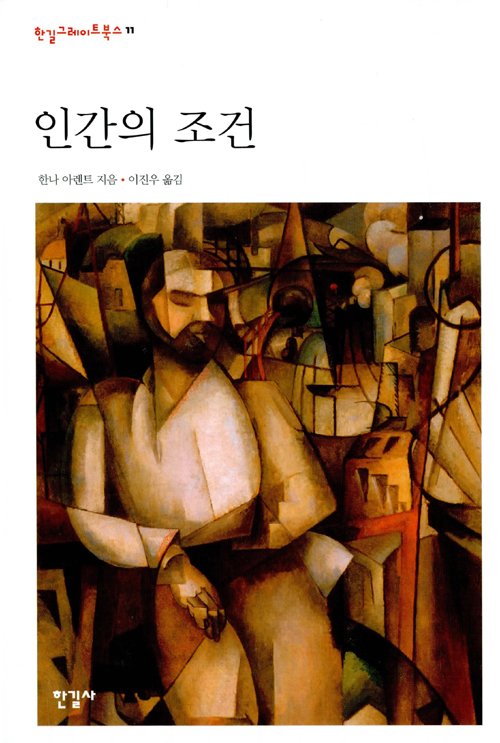 14. 노동 및 다산성Labor and Fertility 가장낮고, 가장 경멸받던 지위로부터 모든 인간활동들 가운데 가장높고 가장 존경받을만한 신분지위를 향한 노동의 갑작스러운 장대한 일어남은 로크가 노동이 모든 프로퍼티의 원천이라는 점을 발견했을 때 시작되었다(180)The sudden, spectacular rise of labor from the lowest, most despised position to the highest rank, as the most esteemed of all human activities, began when Locke discovered that labor is the source of all property. 그다음으로 노동이 모든 웰쓰의 원천이라고 단언한 아담 스미스가 그 경로를 좇았고, 노동이 생산성의 원천이고, 노동이 사람의 바로 그 인간다움이 되는 곳이 "노동의 체계"라는 맑스에게서 그 경로는 절정에 이르렀다(180)It followed its course when Adam Smith asserted that labor was the source of all wealth and found its climax in Marx's "system of labor,"39 where labor became the source of all productivity and the expression of the very humanity of man. Of the three, however, only Marx was interested in labor as such; 하지만, 로크는 사적인 프로퍼티의 제도화에 관심을 갖는데 그쳤고, 아담 스미스는 웰쓰의 제한없는 축적의 족쇄채워지지않는 과정을 안전보장받으려는 데에서 그쳤다(180)Locke was concerned with the institution of private property as the root of society and Smith wished to explain and to secure the unhampered progress of a limitless accumulation of wealth. But all three, though 오직 맑스만이, 가장 강력하게 그리고 공통지속해서, 노동이 사람의 최상의 세계짓는 역량이라고 주장했다(180)Marx with greatest force and consistency, held that labor was considered to be the supreme worldbuilding capacity of man, and 그러나 노동은 인간의 활동능력들 가운데 행동현실적으로 가장 본성자연적이지만 가장덜 세계있음이기 때문에, 이들 모두는 일정한 순정한 모순들의 손아귀에 빠져든다(180)since labor actually is the most natural and least worldly of man's activities, each of them, and again none more than Marx, found himself in the grip of certain genuine contradictions. 이러한 모순들의 가장 명확한 해결책을 또는 그 모순들을 이들 커다란 이론가들이 알아차리지 못했던 까닭은 작업과 노동이 동등하다고 여겼기 때문이다. 그결과 오직 작업만이 포제션(소유)하는 일정한 능력들을 이들은 노동에게 부여했다. 이러한 작업과 노동의 동등화는 늘상 전매특허의 불합리함을 낳는다(180~ 181)It seems to lie in the very nature of this matter that the most obvious solution of these contradictions, or rather the most obvious reason why these great authors should have remained unaware of them is their equation of work with labor, so that labor is endowed by them with certain faculties which only work possesses. This equation always leads into patent absurdities, though they usually are not so neatly manifest as in the following sentence of Veblen: "The lasting evidence of productive labor is its material product— commonly some article of consumption,"40 where the "lasting evidence" with which he begins, because he needs it for the alleged productivity of labor, is immediately destroyed by the "consumption" of the product with which he ends, forced, as it were, by the factual evidence of the phenomenon itself. 39. The expression is Karl Dunkmann's(Soziologie der Arbeit [1933], p. 71), who rightly remarks that the title of Marx's great work is a misnomer and should better have been called System der Arbeit. 40. The curious formulation occurs in Thorstein Veblen, The Theory of the Leisure Class(1917), p. 44. Thus Locke, in order to save labor from its manifest disgrace of producing only "things of short duration," had to introduce money — a "lasting thing which men may keep without spoiling"— a kind otdeus ex machina without which the laboring body, in its obedience to the life process, could never have become the origin of anything so permanent and lasting as property, because there are no "durable things" to be kept to survive the activity of the laboring process. And even Marx, who actually defined man as an animal laborans, had to admit that productivity of labor, properly speaking, begins only with reiflcation(Vergegenstmdlichung), with "the erection of an objective world of things"(Erzeugung einer gegenst'dndlichen Welt). il But the effort of labor never frees the laboring animal from repeating it all over again and remains therefore an "eternal necessity imposed by nature. "42 When Marx insists that the labor "process comes to its end in the product,"43 he forgets his own definition of this process as the "metabolism between man and nature" into which the product is immediately "incorporated," consumed, and annihilated by the body's life process. 41. The term vergegenstandtichen occurs not very frequently in Marx, but always in a crucial context. Cf. Jugendschriften, p. 88: "Das praktische Erzeugen einer gegenstandlichen Welt, die Bearbeitung der unorganischen Natur ist die Bewahrung des Menschen als eines bewussten Gattungswesens... [Das Tier] produziert unter der Herrschaft des unmittelbaren Bedurfhisses, wahrend der Mensch selbst frei vom physischen Bediirfhis produziert und erst wahrhaft produziert in der Freiheit von demselben. " Here, as in the passage from Capital quoted in note 36, Marx obviously introduces an altogether different concept of labor, that is, speaks about work and fabrication. The same reification is mentioned in Das Kapital(Vol. I, Part 3, ch. 5), though somewhat equivocally: "[Die Arbeit] ist vergegenstandlicht und der Gegenstand ist verarbeitet. " The play on words with the term Gegenstand obscures what actually happens in the process: through reification, a new thing has been produced, but the "object" that this process transformed into a thing is, from the viewpoint of the process, only material and not a thing. (The Engish translation, Modern Library ed. , p. 201, misses the meaning of the German text and therefore escapes the equivocality. ) 42. This is a recurrent formulation in Marx's works. See, for instance, Das Kapital, Vol. I(Modern Library ed. , p. SO) and Vol. Ill, pp. 873-74. 43. "Des Prozess erlischt im Produkt"(Das Kapital, Vol. I, Part 3, ch. 5) . Since neither Locke nor Smith is concerned with labor as such, they can afford to admit certain distinctions which actually would amount to a distinction in principle between labor and work, if it were not for an interpretation that treats of the genuine traits of laboring as merely irrelevant. Thus, Smith calls "unproductive labor" all activities connected with consumption, as though this were a negligible and accidental trait of something whose true nature was to be productive. The very contempt with which he describes how "menial tasks and services generally perish in the instant of their performance and seldom leave any trace or value behind them"44 is much more closely related to premodern opinion on this matter than to its modern glorification. Smith and Locke were still quite aware of the fact that not every kind of labor "puts the difference of value on everything"45 and that there exists a kind of activity which adds nothing "to the value of the materials which [it] works upon. "46 To be sure, labor, too, joins to nature something of man's own, but the proportion between what nature gives— the "good things"— and what man adds is the very opposite in the products of labor and the products of work. The "good things" for consumption never lose their naturalness altogether, and the grain never quite disappears in the bread as the tree has disappeared in the table. Thus, Locke, although he paid little attention to his own distinction between "the labour of our body and the work of our hands," had to acknowledge the distinction between things "of short duration" and those "lasting" long enough "that men might keep them without spoiling. "47 The difficulty for Smith and Locke was the same; their "products" had to stay long enough in the world of tangible things to become "valuable," whereby it is immaterial whether value is defined by Locke as something which can be kept and becomes property or by Smith as something which lasts long enough to be exchangeable for something else. 44. Adam Smith, op. cit. , I, 295. 45. Locke, op. cit. , sec. 40. 46. Adam Smith, op. cit. , I, 294. 47. Op. cit. , sees. 46 and 47. 48. Jules Vuillemin's Litre et le travail(1949) is a good example of what happens if one tries to resolve the central contradictions and equivocalities of Marx's thoughts. This is possible only if one abandons the phenomenal evidence altogether and begins to treat Marx's concepts as though they constituted in themselves a complicated jigsaw puzzle of abstractions. Thus, labor "springs apparently from necessity" but "actually realizes the work of liberty and affirms our power"; in labor "necessity expresses [for man] a hidden freedom"(pp. 15, 16). Against these attempts at a sophisticated vulgarization, one may remember Marx's own sovereign attitude toward his work as Kautsky reports it in the following anecdote: Kautsky asked Marx in 1881 if he did not contemplate an edition of his complete works, whereupon Marx replied: "These works must first be written"(Kautsky, Aus der Fruhzeit des Marxmismus [1935], p. 53). These certainly are minor points if compared with the fundamental contradiction which runs like a red thread through the whole of Marx's thought, and is present no less in the third volume of Capital than in the writings of the young Marx. 맑스의 노동에 대한 태도 곧 그의 생각의 바로 그 중심을 향한 태도는 처음부터 끝까지 애매모호하고 이중적이었다(183)Marx's attitude toward labor, and that is toward the very center of his thought, has never ceased to be equivocal. 48 While it was an "eternal necessity imposed by nature" and the most human and productive of man's activities, the revolution, according to Marx, has not the task of emancipating the laboring classes but of emancipating man from labor; only when labor is abolished can the "realm of freedom" supplant the "realm of necessity. " For "the realm of freedom begins only where labor determined through want and external utility ceases," where "the rule of immediate physical needs" ends. 49 Such fundamental and flagrant contradictions rarely occur in second-rate writers; in the work of the great authors they lead into the very center of their work. In the case of Marx, whose loyalty and integrity in describing phenomena as they presented themselves to his view cannot be doubted, the important discrepancies in his work, noted by all Marx scholars, can neither be blamed upon the difference "between the scientific point of view of the historian and the moral point of view of the prophet"60 nor on a dialectical movement which needs the negative, or evil, to produce the positive, or good. 그의 작업의 모든 단계들에서 맑스는 사람을 애니멀 라보란스로 규정한 다음, 이 가장위대하고 가장 인간다운 권력이 더는 필수욕구되지 않는 어떤 사회 안을향해 이끈다(184)The fact remains that in all stages of his work he defines man as an animal laborans and then leads him into a society in which this greatest and most human power is no longer necessary. We are left with the rather distressing alternative between productive slavery and unproductive freedom. ● * 이 부분은 디컴인이 꽤 어려울 수가 있겠네요. 아렌트가 지적하는 맑스의 자기모순이라는 것은, <최고의 인간다운 역량을 완전실현하는 것이 끝목표가 아니라, 그것을 철폐하는 것이 끝목표이다>라는 궤변을 맑스가 늘어놓는다는 아렌트의 지적입니다. 노동이 인간활동들 가운데 가장 인간적이고 생산적인 활동이라고 규정해두고서는, 그렇지만 노동을 철폐하는 것이 인간해방이다!!라고 맑스가 주장한다는 것이죠. 이건 불합리이고, 자가당착이고, 모순이 맞습니다. <가장 인간다운 최상의 역량(노동)이 완전실현되는 것이 인간다움의 완전실현이다>라고 해야 수미일관되는 것이니까요. 왜 이런 자가당착모순에 맑스가 빠졌느냐는 것을 아렌트가 지적하는 것입니다. 바로 맑스가 <노동= 작업>이라고 동등화한 데에 그 원인이 있다는 것이죠. <인간해방이라는 것은, 노동하기 역량을 완전철폐하고, 작업하기 역량을 완전실현하는 것이다>라고 주장해야만 무모순하다는 것이 아렌트의 지적입니다. 49. Das Kapital, III, 873. In the Deutsche Ideologic Marx states that "die kommunistische Revolution... die Arbeit beseitigt"(p. 59), after having stated some pages earlier(p. 10) that only through labor does man distinguish himself from animals. 50. The formulation is Edmund Wilson's in To the Finland Station(Anchor ed. , 1953), but this criticism is familiar in Marxian literature. Thus, the question arises why Locke and all his successors, their own insights notwithstanding, clung so obstinately to labor as the origin of property, of wealth, of all values and, finally, of the very humanity of man. Or, to put it another way, 그렇게나 커다란 중요성을 증명한 노동하기 활동에 내재된 근대의 경험들은 도대체 무엇인가?(184)what were the experiences inherent in the laboring activity that proved of such great importance to the modern age? 역사적으로 17세기 이후의 정치이론가들은 전대미문의 성장하는 웰쓰의 과정, 성장하는 프로퍼티의 과정, 성장하는 획득의 과정에 직면했다(185)Historically, political theorists from the seventeenth century onward were confronted with a hitherto unheard-of process of growing wealth, growing property, growing acquisition. In the attempt to account for this steady growth, their attention was naturally drawn to the phenomenon of a progressing process itself, so that, for reasons we shall have to discuss later,61 the concept of process became the very key term of the new age as well as the sciences, historical and natural, developed by it. 그 시작부터 이 과정은 그것의 현상적인 끝없음 때문에 본성자연의 어떤 과정으로 이해되었고, 더욱 피상적으로 생명삶의 과정 그자체의 이미지 안에서 이해되었다(185)From its beginning, this process, because of its apparent endlessness, was understood as a natural process and more specifically in the image of the life process itself. The crudest superstition of the modern age— that "money begets money"— as well as its sharpest political insight— that power generates power— owes (이러한 거의 미신에 가까운 관념들 아래에는) 생명삶의 본성자연적인 다산성의 은유가 깔려있다(185)its plausibility to the underlying metaphor of the natural fertility of life. 모든 인간활동들 가운데 오직 노동만이, 행동도 아니도 작업도 아니고, 생명삶 그자체와 일치해서, 그리고 의지에찬 결단들 또는 인간적으로 의미에찬 퍼포즈들의 범위을 벗어나서, 끝나지않고 자동적으로 진행하기 때문이다(185)Of all human activities, only labor, and neither action nor work, is unending, progressing automatically in accordance with life itself and outside the range of wilful decisions or humanly meaningful purposes. 51. See ch. vi, § 42, below. 맑스의 이론 전체가 다산적인 생명삶의 두 양식인 노동과 생식의 이해에 바탕한다(185)Perhaps nothing indicates more clearly the level of Marx's thought and the faithfulness of his descriptions to phenomenal reality than that he based his whole theory on the understanding of laboring and begetting as two modes of the same fertile life process. 노동이 인디비두얼의 생존을 보전해주는 '자기자신의 생명삶의 재생산'이라면, 생식은 종의 생존을 보전해주는 '외계의 생명삶의 재생산'이다(185)labor was to him the "reproduction of one's own life" which assured the survival of the individual, and begetting was the production "of foreign life" which assured the survival of the species. 62 이런 통찰은 연대기적으로 그의 이론의 결코잊어선안될 기원이다(185)This insight is chronologically the never-forgotten origin of his theory, which he then elaborated by substituting for "abstract labor" the labor power of a living organism and by understanding labor's surplus as that amount of labor power still extant after the means for the laborer's own reproduction have been produced. With it, he sounded a depth of experience reached by none of his predecessors— to whom he otherwise owed almost all his decisive inspirations— and none of his successors. He squared his theory, the theory of the modern age, with the oldest and most persistent insights into 고전적인 전통과 마찬가지로 유태교에 따르자면, 노동의 본성자연은 출생을 주는 것으로써의 생명삶에 친밀하게 묶여있다(186)the nature of labor, which, according to the Hebrew as well as the classical tradition, was as intimately bound up with life as giving birth. By the same token, the true meaning of labor's newly discovered productivity becomes manifest only in Marx's work, where it rests on (맑스적인 노동의) 생산성은 다산성과 동등하다(186)the equation of productivity with fertility, so that the famous development of mankind's "productive forces" into a society of an abundance of "good things" actually obeys no other law and is subject to no other necessity than the aboriginal command, "Be ye fruitful and multiply," in which it is as though the voice of nature herself speaks to us. 52. Deutsche Ideologic, p. 17. The fertility of the human metabolism with nature, growing out of the natural redundancy of labor power, still partakes of the superabundance we see everywhere in nature's household. The "blessing or the joy" of labor is the human way to experience the sheer bliss of being alive which we share with all living creatures, and it is even the only way men, too, can remain and swing contentedly in nature's prescribed cycle, toiling and resting, laboring and consuming, with the same happy and purposeless regularity with which day and night and life and death follow each other. The reward of toil and trouble lies in nature's fertility, in the quiet confidence that he who in "toil and trouble" has done his part, remains a part of nature in the future of his children and his children's children. 고전고대와 달리, [하나님과 사람 사이의 오래된 약조]는 생명삶을 거룩하다고 붙들었고, 따라서 죽음도 노동도 어떤 사악함이라고 여기지 않았다(186)The Old Testament, which, unlike classical antiquity, held life to be sacred and therefore neither death nor labor to be an evil(and least of all an argument against life),6* shows in the stories of the patriarchs how unconcerned about death their lives were, how they needed neither an individual, earthly immortality nor an assurance of the eternity of their souls, how death came to them in the familiar shape of night and quiet and eternal rest "in a good old age and full of years. " 53. Nowhere in the Old Testament is death "the wage of sin. " Nor did the curse by which man was expelled from paradise punish him with labor and birth; it only made labor harsh and birth full of sorrow. According to Genesis, man(adeem) had been created to take care and watch over the soil(adamah), as even his name, the masculine form of "soil," indicates(see Gen. 2:5, 15). "And Adam was not to till adamah... and He, God, created Adam of the dust of adamah... He, God, took Adam and put him into the garden of Eden to till and to watch it"(I follow the translation of Martin Buber and Franz Rosenzweig, Die Sckrift [Berlin, n. d. ]). The word for "tilling" which later became the word for laboring in Hebrew, kaivod, has the connotation of "to serve. " The curse(3 :17-19) does not mention this word, but the meaning is clear: the service for which man was created now became servitude. The current popular misunderstanding of the curse is due to an unconscious interpretation of the Old Testament in the light of Greek thinking. The misunderstanding is usually avoided by Catholic writers. See, for instance, Jacques Leclercq, Le$ms de droit naturel, Vol. IV, Part 2, "Travail, propriete,"(1946), p. 31: "(노동이 아니라) 노동의 <고통>이 원죄의 결과이다(187)La peine du travail est le resultat du peche original... L'homme non dechu eut travaille dans la joie, mais il eut travaille"; or J. Chr. Nattermann, Die moderne Arbeit, soziologisch und theologisch betrachtet(1953), p. 9. It is interesting in this context to compare the curse of the Old Testament with the seemingly similar explanation of the harshness of labor in Hesiod. Hesiod reports that the gods, in order to punish man, hid life from him(see n. 8) so that he had to search for it, while before, he apparently did not have to do anything but pluck the fruits of the earth from fields and trees. Here the curse consists not only in the harshness of labor but in labor itself. 어떤 전일체로써 생명삶의 은총은 노동 안에 내재된 것일 뿐이며, 결코 작업(을 달성하거나 성취할 때 찾아오는 안도감이나 기쁨과 착각하지 말아야하고) 안에서는 발견될 수 없다(187)The blessing of life as a whole, inherent in labor, can never be found in work and should not be mistaken for the inevitably brief spell of relief and joy which follows accomplishment and attends achievement. 노동의 은총은, 생계수단자산의 생산하기와 소비하기가 그러하듯이, 노력과 댓가가 서로를 잇따른다는 점이다(187)The blessing of labor is that effort and gratification follow each other as closely as producing and consuming the means of subsistence, so that happiness is a concomitant of the process itself, just as pleasure is a concomitant of the functioning of a healthy body. "최대다수의 최대행복"은, 지상의 생명삶은 늘상 은총받는다는 그러한 축복을 통속적으로 일반화한 것이자, 노동하는 어떤 사람다움의 근본기초적인 실재현실의 어떤 "이상"을 개념화한 것이다(187)The "happiness of the greatest number," into which we have generalized and vulgarized the felicity with which earthly life has always been blessed, conceptualized into an "ideal" the fundamental reality of a laboring humanity. (이제) 행복을 추구할 라이트는 진실로 생명삶의 라이트로써 부정할 수 없게 되고, 심지어는 동일정체시된다(187)The right to the pursuit of this happiness is indeed as undeniable as the right to life; it is even identical with it. 그러나 행복은 좋은 큰돈행운과는 아무런 공통된 거시기가 없다(188)But it has nothing in common with good fortune, which is rare and never lasts and cannot be pursued, because fortune depends on luck and what chance gives and takes, 그럼에도 불구하고 대부분의 인민은 좋은 큰돈행운을 뒤쫓고, 심지어는 큰돈행운이 그들에게 떨어졌을 때조차도 스스로들을 불행하게 만든다, 왜냐하면 큰돈행운이라는 것이 "좋은 거시기들"의 소모되지않는풍부함이라는 그 요행을 지키고 즐기려하기 때문이다(188)although most people in their "pursuit of happiness" run after good fortune and make themselves unhappy even when it befalls them, because they want to keep and enjoy luck as though it were an inexhaustible abundance of "good things. " There is no lasting happiness outside the prescribed cycle of painful exhaustion and pleasurable regeneration, and whatever throws this cycle out of balance — poverty and misery where exhaustion is followed by wretchedness instead of regeneration, or great riches and an entirely effortless life where boredom takes the place of exhaustion and where the mills of necessity, of consumption and digestion, grind an impotent human body mercilessly and barrenly to death— ruins the elemental happiness that comes from being alive. 생명삶의 강제력은 다산성이다(188)The force of life is fertility. The living organism is not exhausted when it has provided for its own reproduction, and 살아있는 유기체의 "잉여"는 그것의 잠재적인 다원성 안에 놓여있다(188)its "surplus" lies in its potential multiplication. 맑스는 생명삶의 강제력 곧 다산성의 특별하게 인간적인 양식으로써 노동력들을 발견했고, 본성자연 그자체가 그러하듯이 어떤 "잉여"를 창조하는 역량으로써 노동력들을 규정했다. 이러한 맑스식 자연주의는 (그의 생각 전반에) 공통지속된다(188)Marx's consistent naturalism discovered "labor power" as the specifically human mode of the life force which is as capable of creating a "surplus" as nature herself. Since he was almost exclusively interested in this process itself, the process of the "productive forces of society," in whose life, as in the life of every animal species, production and consumption always strike a balance, (이러한 노동력 개념 탓에) 세계있음의 거시기들의 분리된 실존이라는 문제, 곧 세계있음의 거시기들이 생명삶의 게걸스런 과정보다 더 내구적이며, 더 오래 생존할 것이고, 세계있음의 거시기들이 생명삶의 게걸스런 과정과 맞부딪칠 것이라는 문제는 맑스에게는 전혀 일어날 수가 없었다(188)the question of a separate existence of worldly things, whose durability will survive and withstand the devouring processes of life, does not occur to him at all. From the viewpoint of the life of the species, all activities indeed find their common denominator in laboring, and the only distinguishing criterion left is the abundance or scarcity of the goods to be fed into the life process. When every thing has become an object for consumption, the fact that labor's surplus does not change the nature, the "short duration," of the products themselves loses all importance, and this loss is manifest in Marx's work in the contempt with which he treats the belabored distinctions of his predecessors between productive and unproductive, or skilled and unskilled labor. The reason why Marx's predecessors were not able to rid themselves of these distinctions, which essentially are equivalent to the more fundamental distinction between work and labor, was not that they were less "scientific" but that 그들(로크, 흄, 스미스)은 사적인 프로퍼티 또는 적어도 국민적인 웰쓰의 인디비두얼한 사적화를 주장하려고 여전히 글을 쓰고 있었다(189)they were still writing on the assumption of private property, or at least individual appropriation of national wealth. For the establishment of property, mere abundance can never be enough; labor's products do not become more durable by their abundance and cannot be "heaped up" and stored away to become part of a man's property; on the contrary, they are only too likely to disappear in the process of appropriation or to "perish uselessly" if they are not consumed "before they spoil. " ● 여기까지가 14장인데, 이 장은 전적으로 맑스(뿐만 아니라 로크, 흄, 등등)의 노동(력) 또는 애니멀 라보란스 개념의 지성사적 개념사적 뿌리를 파헤치고 있습니다. 사회적인 교환장1) "17세기 이후의 전대미문의 성장하는 웰쓰의 과정, 성장하는 프로퍼티의 과정, 성장하는 획득의 과정"이라는 사회적인것들(국민경제)의 일어남사회적인 공론장2) 맑스가 속했던 쪽수집단(여기서는 특히 유태교를 강조함)의 R커뮤니티 센스, 곧 유태교적인 다산성= 생식개념 및 유태교적인 노동 개념의 영향이 두가지가 맑스의 노동개념형성에 근본기초적인 영향을 끼쳤다는 것이, 이 장의 주된 내용입니다. 1)과 2)의 영향 탓에, 맑스로써는 어쩔수없이 <노동= 작업>이 인간활동의 전부이자 최상위라고 여기게 되었다는 거죠. 이미 앞에서도 아렌트가 쭈욱 분석논증하고 있습니다만, 결론적으로, 실재현실로써의 문명(아렌트 개념용어로는 '세계')에 대한 맑스와 맑시즘 일반의 그릇되고 잘못되고 틀려먹은 이해하기 곧 실재현실에 대한 맑스식의 손가락-뉴런표상화가 만들어졌다는 것이 아렌트의 분석입니다. |
| json metadata | {"tags":["kr","sugunzag","hannah-arendt","human-condition","political-philosophy"],"image":["https://cdn.steemitimages.com/DQmQdGk9aUrYiYRaoZJFiJot4LJHoKFdvS7NaCJUV31e5FG/8935664553_f.jpg"],"app":"steemit/0.1","format":"markdown"} |
| Transaction Info | Block #25990536/Trx 60c2d6d09fd63c686c443e6c49e3bdbe15cd10bf |
View Raw JSON Data
{
"trx_id": "60c2d6d09fd63c686c443e6c49e3bdbe15cd10bf",
"block": 25990536,
"trx_in_block": 0,
"op_in_trx": 0,
"virtual_op": 0,
"timestamp": "2018-09-15T20:00:54",
"op": [
"comment",
{
"parent_author": "",
"parent_permlink": "kr",
"author": "sugunzag",
"permlink": "3-14",
"title": "한나 아렌트 [인간의 조건상태(인간의 조건)] 3부 14장. 노동 및 다산성",
"body": "\n\n\n\n\n14. 노동 및 다산성Labor and Fertility\n\n가장낮고, 가장 경멸받던 지위로부터 모든 인간활동들 가운데 가장높고 가장 존경받을만한 신분지위를 향한 노동의 갑작스러운 장대한 일어남은 로크가 노동이 모든 프로퍼티의 원천이라는 점을 발견했을 때 시작되었다(180)The sudden, spectacular rise of labor from the lowest, most despised position to the highest rank, as the most esteemed of all human activities, began when Locke discovered that labor is the source of all property. 그다음으로 노동이 모든 웰쓰의 원천이라고 단언한 아담 스미스가 그 경로를 좇았고, 노동이 생산성의 원천이고, 노동이 사람의 바로 그 인간다움이 되는 곳이 \"노동의 체계\"라는 맑스에게서 그 경로는 절정에 이르렀다(180)It followed its course when Adam Smith asserted that labor was the source of all wealth and found its climax in Marx's \"system of labor,\"39 where labor became the source of all productivity and the expression of the very humanity of man. Of the three, however, only Marx was interested in labor as such; 하지만, 로크는 사적인 프로퍼티의 제도화에 관심을 갖는데 그쳤고, 아담 스미스는 웰쓰의 제한없는 축적의 족쇄채워지지않는 과정을 안전보장받으려는 데에서 그쳤다(180)Locke was concerned with the institution of private property as the root of society and Smith wished to explain and to secure the unhampered progress of a limitless accumulation of wealth. But all three, though 오직 맑스만이, 가장 강력하게 그리고 공통지속해서, 노동이 사람의 최상의 세계짓는 역량이라고 주장했다(180)Marx with greatest force and consistency, held that labor was considered to be the supreme worldbuilding capacity of man, and 그러나 노동은 인간의 활동능력들 가운데 행동현실적으로 가장 본성자연적이지만 가장덜 세계있음이기 때문에, 이들 모두는 일정한 순정한 모순들의 손아귀에 빠져든다(180)since labor actually is the most natural and least worldly of man's activities, each of them, and again none more than Marx, found himself in the grip of certain genuine contradictions. 이러한 모순들의 가장 명확한 해결책을 또는 그 모순들을 이들 커다란 이론가들이 알아차리지 못했던 까닭은 작업과 노동이 동등하다고 여겼기 때문이다. 그결과 오직 작업만이 포제션(소유)하는 일정한 능력들을 이들은 노동에게 부여했다. 이러한 작업과 노동의 동등화는 늘상 전매특허의 불합리함을 낳는다(180~ 181)It seems to lie in the very nature of this matter that the most obvious solution of these contradictions, or rather the most obvious reason why these great authors should have remained unaware of them is their equation of work with labor, so that labor is endowed by them with certain faculties which only work possesses. This equation always leads into patent absurdities, though they usually are not so neatly manifest as in the following sentence of Veblen: \"The lasting evidence of productive labor is its material product— commonly some article of consumption,\"40 where the \"lasting evidence\" with which he begins, because he needs it for the alleged productivity of labor, is immediately destroyed by the \"consumption\" of the product with which he ends, forced, as it were, by the factual evidence of the phenomenon itself. \n\n39. The expression is Karl Dunkmann's(Soziologie der Arbeit [1933], p. 71), who rightly remarks that the title of Marx's great work is a misnomer and should better have been called System der Arbeit. \n\n40. The curious formulation occurs in Thorstein Veblen, The Theory of the Leisure Class(1917), p. 44. \n\nThus Locke, in order to save labor from its manifest disgrace of producing only \"things of short duration,\" had to introduce money — a \"lasting thing which men may keep without spoiling\"— a kind otdeus ex machina without which the laboring body, in its obedience to the life process, could never have become the origin of anything so permanent and lasting as property, because there are no \"durable things\" to be kept to survive the activity of the laboring process. And even Marx, who actually defined man as an animal laborans, had to admit that productivity of labor, properly speaking, begins only with reiflcation(Vergegenstmdlichung), with \"the erection of an objective world of things\"(Erzeugung einer gegenst'dndlichen Welt). il But the effort of labor never frees the laboring animal from repeating it all over again and remains therefore an \"eternal necessity imposed by nature. \"42 When Marx insists that the labor \"process comes to its end in the product,\"43 he forgets his own definition of this process as the \"metabolism between man and nature\" into which the product is immediately \"incorporated,\" consumed, and annihilated by the body's life process. \n\n41. The term vergegenstandtichen occurs not very frequently in Marx, but always in a crucial context. Cf. Jugendschriften, p. 88: \"Das praktische Erzeugen einer gegenstandlichen Welt, die Bearbeitung der unorganischen Natur ist die Bewahrung des Menschen als eines bewussten Gattungswesens... [Das Tier] produziert unter der Herrschaft des unmittelbaren Bedurfhisses, wahrend der Mensch selbst frei vom physischen Bediirfhis produziert und erst wahrhaft produziert in der Freiheit von demselben. \" Here, as in the passage from Capital quoted in note 36, Marx obviously introduces an altogether different concept of labor, that is, speaks about work and fabrication. The same reification is mentioned in Das Kapital(Vol. I, Part 3, ch. 5), though somewhat equivocally: \"[Die Arbeit] ist vergegenstandlicht und der Gegenstand ist verarbeitet. \" The play on words with the term Gegenstand obscures what actually happens in the process: through reification, a new thing has been produced, but the \"object\" that this process transformed into a thing is, from the viewpoint of the process, only material and not a thing. (The Engish translation, Modern Library ed. , p. 201, misses the meaning of the German text and therefore escapes the equivocality. ) \n\n42. This is a recurrent formulation in Marx's works. See, for instance, Das Kapital, Vol. I(Modern Library ed. , p. SO) and Vol. Ill, pp. 873-74. \n\n43. \"Des Prozess erlischt im Produkt\"(Das Kapital, Vol. I, Part 3, ch. 5) . \n\nSince neither Locke nor Smith is concerned with labor as such, they can afford to admit certain distinctions which actually would amount to a distinction in principle between labor and work, if it were not for an interpretation that treats of the genuine traits of laboring as merely irrelevant. Thus, Smith calls \"unproductive labor\" all activities connected with consumption, as though this were a negligible and accidental trait of something whose true nature was to be productive. The very contempt with which he describes how \"menial tasks and services generally perish in the instant of their performance and seldom leave any trace or value behind them\"44 is much more closely related to premodern opinion on this matter than to its modern glorification. Smith and Locke were still quite aware of the fact that not every kind of labor \"puts the difference of value on everything\"45 and that there exists a kind of activity which adds nothing \"to the value of the materials which [it] works upon. \"46 To be sure, labor, too, joins to nature something of man's own, but the proportion between what nature gives— the \"good things\"— and what man adds is the very opposite in the products of labor and the products of work. The \"good things\" for consumption never lose their naturalness altogether, and the grain never quite disappears in the bread as the tree has disappeared in the table. Thus, Locke, although he paid little attention to his own distinction between \"the labour of our body and the work of our hands,\" had to acknowledge the distinction between things \"of short duration\" and those \"lasting\" long enough \"that men might keep them without spoiling. \"47 The difficulty for Smith and Locke was the same; their \"products\" had to stay long enough in the world of tangible things to become \"valuable,\" whereby it is immaterial whether value is defined by Locke as something which can be kept and becomes property or by Smith as something which lasts long enough to be exchangeable for something else. \n\n44. Adam Smith, op. cit. , I, 295. \n\n45. Locke, op. cit. , sec. 40. \n\n46. Adam Smith, op. cit. , I, 294. \n\n47. Op. cit. , sees. 46 and 47. \n\n48. Jules Vuillemin's Litre et le travail(1949) is a good example of what happens if one tries to resolve the central contradictions and equivocalities of Marx's thoughts. This is possible only if one abandons the phenomenal evidence altogether and begins to treat Marx's concepts as though they constituted in themselves a complicated jigsaw puzzle of abstractions. Thus, labor \"springs apparently from necessity\" but \"actually realizes the work of liberty and affirms our power\"; in labor \"necessity expresses [for man] a hidden freedom\"(pp. 15, 16). Against these attempts at a sophisticated vulgarization, one may remember Marx's own sovereign attitude toward his work as Kautsky reports it in the following anecdote: Kautsky asked Marx in 1881 if he did not contemplate an edition of his complete works, whereupon Marx replied: \"These works must first be written\"(Kautsky, Aus der Fruhzeit des Marxmismus [1935], p. 53). \n\nThese certainly are minor points if compared with the fundamental contradiction which runs like a red thread through the whole of Marx's thought, and is present no less in the third volume of Capital than in the writings of the young Marx. 맑스의 노동에 대한 태도 곧 그의 생각의 바로 그 중심을 향한 태도는 처음부터 끝까지 애매모호하고 이중적이었다(183)Marx's attitude toward labor, and that is toward the very center of his thought, has never ceased to be equivocal. 48 While it was an \"eternal necessity imposed by nature\" and the most human and productive of man's activities, the revolution, according to Marx, has not the task of emancipating the laboring classes but of emancipating man from labor; only when labor is abolished can the \"realm of freedom\" supplant the \"realm of necessity. \" For \"the realm of freedom begins only where labor determined through want and external utility ceases,\" where \"the rule of immediate physical needs\" ends. 49 Such fundamental and flagrant contradictions rarely occur in second-rate writers; in the work of the great authors they lead into the very center of their work. In the case of Marx, whose loyalty and integrity in describing phenomena as they presented themselves to his view cannot be doubted, the important discrepancies in his work, noted by all Marx scholars, can neither be blamed upon the difference \"between the scientific point of view of the historian and the moral point of view of the prophet\"60 nor on a dialectical movement which needs the negative, or evil, to produce the positive, or good. 그의 작업의 모든 단계들에서 맑스는 사람을 애니멀 라보란스로 규정한 다음, 이 가장위대하고 가장 인간다운 권력이 더는 필수욕구되지 않는 어떤 사회 안을향해 이끈다(184)The fact remains that in all stages of his work he defines man as an animal laborans and then leads him into a society in which this greatest and most human power is no longer necessary. We are left with the rather distressing alternative between productive slavery and unproductive freedom. \n\n● * 이 부분은 디컴인이 꽤 어려울 수가 있겠네요. 아렌트가 지적하는 맑스의 자기모순이라는 것은, <최고의 인간다운 역량을 완전실현하는 것이 끝목표가 아니라, 그것을 철폐하는 것이 끝목표이다>라는 궤변을 맑스가 늘어놓는다는 아렌트의 지적입니다. 노동이 인간활동들 가운데 가장 인간적이고 생산적인 활동이라고 규정해두고서는, 그렇지만 노동을 철폐하는 것이 인간해방이다!!라고 맑스가 주장한다는 것이죠. 이건 불합리이고, 자가당착이고, 모순이 맞습니다. <가장 인간다운 최상의 역량(노동)이 완전실현되는 것이 인간다움의 완전실현이다>라고 해야 수미일관되는 것이니까요. 왜 이런 자가당착모순에 맑스가 빠졌느냐는 것을 아렌트가 지적하는 것입니다. 바로 맑스가 <노동= 작업>이라고 동등화한 데에 그 원인이 있다는 것이죠. <인간해방이라는 것은, 노동하기 역량을 완전철폐하고, 작업하기 역량을 완전실현하는 것이다>라고 주장해야만 무모순하다는 것이 아렌트의 지적입니다. \n\n49. Das Kapital, III, 873. In the Deutsche Ideologic Marx states that \"die kommunistische Revolution... die Arbeit beseitigt\"(p. 59), after having stated some pages earlier(p. 10) that only through labor does man distinguish himself from animals. \n\n50. The formulation is Edmund Wilson's in To the Finland Station(Anchor ed. , 1953), but this criticism is familiar in Marxian literature. \n\nThus, the question arises why Locke and all his successors, their own insights notwithstanding, clung so obstinately to labor as the origin of property, of wealth, of all values and, finally, of the very humanity of man. Or, to put it another way, 그렇게나 커다란 중요성을 증명한 노동하기 활동에 내재된 근대의 경험들은 도대체 무엇인가?(184)what were the experiences inherent in the laboring activity that proved of such great importance to the modern age? \n\n역사적으로 17세기 이후의 정치이론가들은 전대미문의 성장하는 웰쓰의 과정, 성장하는 프로퍼티의 과정, 성장하는 획득의 과정에 직면했다(185)Historically, political theorists from the seventeenth century onward were confronted with a hitherto unheard-of process of growing wealth, growing property, growing acquisition. In the attempt to account for this steady growth, their attention was naturally drawn to the phenomenon of a progressing process itself, so that, for reasons we shall have to discuss later,61 the concept of process became the very key term of the new age as well as the sciences, historical and natural, developed by it. 그 시작부터 이 과정은 그것의 현상적인 끝없음 때문에 본성자연의 어떤 과정으로 이해되었고, 더욱 피상적으로 생명삶의 과정 그자체의 이미지 안에서 이해되었다(185)From its beginning, this process, because of its apparent endlessness, was understood as a natural process and more specifically in the image of the life process itself. The crudest superstition of the modern age— that \"money begets money\"— as well as its sharpest political insight— that power generates power— owes (이러한 거의 미신에 가까운 관념들 아래에는) 생명삶의 본성자연적인 다산성의 은유가 깔려있다(185)its plausibility to the underlying metaphor of the natural fertility of life. 모든 인간활동들 가운데 오직 노동만이, 행동도 아니도 작업도 아니고, 생명삶 그자체와 일치해서, 그리고 의지에찬 결단들 또는 인간적으로 의미에찬 퍼포즈들의 범위을 벗어나서, 끝나지않고 자동적으로 진행하기 때문이다(185)Of all human activities, only labor, and neither action nor work, is unending, progressing automatically in accordance with life itself and outside the range of wilful decisions or humanly meaningful purposes. \n\n51. See ch. vi, § 42, below. \n\n맑스의 이론 전체가 다산적인 생명삶의 두 양식인 노동과 생식의 이해에 바탕한다(185)Perhaps nothing indicates more clearly the level of Marx's thought and the faithfulness of his descriptions to phenomenal reality than that he based his whole theory on the understanding of laboring and begetting as two modes of the same fertile life process. 노동이 인디비두얼의 생존을 보전해주는 '자기자신의 생명삶의 재생산'이라면, 생식은 종의 생존을 보전해주는 '외계의 생명삶의 재생산'이다(185)labor was to him the \"reproduction of one's own life\" which assured the survival of the individual, and begetting was the production \"of foreign life\" which assured the survival of the species. 62 이런 통찰은 연대기적으로 그의 이론의 결코잊어선안될 기원이다(185)This insight is chronologically the never-forgotten origin of his theory, which he then elaborated by substituting for \"abstract labor\" the labor power of a living organism and by understanding labor's surplus as that amount of labor power still extant after the means for the laborer's own reproduction have been produced. With it, he sounded a depth of experience reached by none of his predecessors— to whom he otherwise owed almost all his decisive inspirations— and none of his successors. He squared his theory, the theory of the modern age, with the oldest and most persistent insights into 고전적인 전통과 마찬가지로 유태교에 따르자면, 노동의 본성자연은 출생을 주는 것으로써의 생명삶에 친밀하게 묶여있다(186)the nature of labor, which, according to the Hebrew as well as the classical tradition, was as intimately bound up with life as giving birth. By the same token, the true meaning of labor's newly discovered productivity becomes manifest only in Marx's work, where it rests on (맑스적인 노동의) 생산성은 다산성과 동등하다(186)the equation of productivity with fertility, so that the famous development of mankind's \"productive forces\" into a society of an abundance of \"good things\" actually obeys no other law and is subject to no other necessity than the aboriginal command, \"Be ye fruitful and multiply,\" in which it is as though the voice of nature herself speaks to us. \n\n52. Deutsche Ideologic, p. 17. \n\nThe fertility of the human metabolism with nature, growing out of the natural redundancy of labor power, still partakes of the superabundance we see everywhere in nature's household. The \"blessing or the joy\" of labor is the human way to experience the sheer bliss of being alive which we share with all living creatures, and it is even the only way men, too, can remain and swing contentedly in nature's prescribed cycle, toiling and resting, laboring and consuming, with the same happy and purposeless regularity with which day and night and life and death follow each other. \n\nThe reward of toil and trouble lies in nature's fertility, in the quiet confidence that he who in \"toil and trouble\" has done his part, remains a part of nature in the future of his children and his children's children. 고전고대와 달리, [하나님과 사람 사이의 오래된 약조]는 생명삶을 거룩하다고 붙들었고, 따라서 죽음도 노동도 어떤 사악함이라고 여기지 않았다(186)The Old Testament, which, unlike classical antiquity, held life to be sacred and therefore neither death nor labor to be an evil(and least of all an argument against life),6* shows in the stories of the patriarchs how unconcerned about death their lives were, how they needed neither an individual, earthly immortality nor an assurance of the eternity of their souls, how death came to them in the familiar shape of night and quiet and eternal rest \"in a good old age and full of years. \" \n\n53. Nowhere in the Old Testament is death \"the wage of sin. \" Nor did the curse by which man was expelled from paradise punish him with labor and birth; it only made labor harsh and birth full of sorrow. According to Genesis, man(adeem) had been created to take care and watch over the soil(adamah), as even his name, the masculine form of \"soil,\" indicates(see Gen. 2:5, 15). \"And Adam was not to till adamah... and He, God, created Adam of the dust of adamah... He, God, took Adam and put him into the garden of Eden to till and to watch it\"(I follow the translation of Martin Buber and Franz Rosenzweig, Die Sckrift [Berlin, n. d. ]). The word for \"tilling\" which later became the word for laboring in Hebrew, kaivod, has the connotation of \"to serve. \" The curse(3 :17-19) does not mention this word, but the meaning is clear: the service for which man was created now became servitude. The current popular misunderstanding of the curse is due to an unconscious interpretation of the Old Testament in the light of Greek thinking. The misunderstanding is usually avoided by Catholic writers. See, for instance, Jacques Leclercq, Le$ms de droit naturel, Vol. IV, Part 2, \"Travail, propriete,\"(1946), p. 31: \"(노동이 아니라) 노동의 <고통>이 원죄의 결과이다(187)La peine du travail est le resultat du peche original... L'homme non dechu eut travaille dans la joie, mais il eut travaille\"; or J. Chr. Nattermann, Die moderne Arbeit, soziologisch und theologisch betrachtet(1953), p. 9. It is interesting in this context to compare the curse of the Old Testament with the seemingly similar explanation of the harshness of labor in Hesiod. Hesiod reports that the gods, in order to punish man, hid life from him(see n. 8) so that he had to search for it, while before, he apparently did not have to do anything but pluck the fruits of the earth from fields and trees. Here the curse consists not only in the harshness of labor but in labor itself. \n\n어떤 전일체로써 생명삶의 은총은 노동 안에 내재된 것일 뿐이며, 결코 작업(을 달성하거나 성취할 때 찾아오는 안도감이나 기쁨과 착각하지 말아야하고) 안에서는 발견될 수 없다(187)The blessing of life as a whole, inherent in labor, can never be found in work and should not be mistaken for the inevitably brief spell of relief and joy which follows accomplishment and attends achievement. 노동의 은총은, 생계수단자산의 생산하기와 소비하기가 그러하듯이, 노력과 댓가가 서로를 잇따른다는 점이다(187)The blessing of labor is that effort and gratification follow each other as closely as producing and consuming the means of subsistence, so that happiness is a concomitant of the process itself, just as pleasure is a concomitant of the functioning of a healthy body. \"최대다수의 최대행복\"은, 지상의 생명삶은 늘상 은총받는다는 그러한 축복을 통속적으로 일반화한 것이자, 노동하는 어떤 사람다움의 근본기초적인 실재현실의 어떤 \"이상\"을 개념화한 것이다(187)The \"happiness of the greatest number,\" into which we have generalized and vulgarized the felicity with which earthly life has always been blessed, conceptualized into an \"ideal\" the fundamental reality of a laboring humanity. (이제) 행복을 추구할 라이트는 진실로 생명삶의 라이트로써 부정할 수 없게 되고, 심지어는 동일정체시된다(187)The right to the pursuit of this happiness is indeed as undeniable as the right to life; it is even identical with it. 그러나 행복은 좋은 큰돈행운과는 아무런 공통된 거시기가 없다(188)But it has nothing in common with good fortune, which is rare and never lasts and cannot be pursued, because fortune depends on luck and what chance gives and takes, 그럼에도 불구하고 대부분의 인민은 좋은 큰돈행운을 뒤쫓고, 심지어는 큰돈행운이 그들에게 떨어졌을 때조차도 스스로들을 불행하게 만든다, 왜냐하면 큰돈행운이라는 것이 \"좋은 거시기들\"의 소모되지않는풍부함이라는 그 요행을 지키고 즐기려하기 때문이다(188)although most people in their \"pursuit of happiness\" run after good fortune and make themselves unhappy even when it befalls them, because they want to keep and enjoy luck as though it were an inexhaustible abundance of \"good things. \" There is no lasting happiness outside the prescribed cycle of painful exhaustion and pleasurable regeneration, and whatever throws this cycle out of balance — poverty and misery where exhaustion is followed by wretchedness instead of regeneration, or great riches and an entirely effortless life where boredom takes the place of exhaustion and where the mills of necessity, of consumption and digestion, grind an impotent human body mercilessly and barrenly to death— ruins the elemental happiness that comes from being alive. \n\n생명삶의 강제력은 다산성이다(188)The force of life is fertility. The living organism is not exhausted when it has provided for its own reproduction, and 살아있는 유기체의 \"잉여\"는 그것의 잠재적인 다원성 안에 놓여있다(188)its \"surplus\" lies in its potential multiplication. 맑스는 생명삶의 강제력 곧 다산성의 특별하게 인간적인 양식으로써 노동력들을 발견했고, 본성자연 그자체가 그러하듯이 어떤 \"잉여\"를 창조하는 역량으로써 노동력들을 규정했다. 이러한 맑스식 자연주의는 (그의 생각 전반에) 공통지속된다(188)Marx's consistent naturalism discovered \"labor power\" as the specifically human mode of the life force which is as capable of creating a \"surplus\" as nature herself. Since he was almost exclusively interested in this process itself, the process of the \"productive forces of society,\" in whose life, as in the life of every animal species, production and consumption always strike a balance, (이러한 노동력 개념 탓에) 세계있음의 거시기들의 분리된 실존이라는 문제, 곧 세계있음의 거시기들이 생명삶의 게걸스런 과정보다 더 내구적이며, 더 오래 생존할 것이고, 세계있음의 거시기들이 생명삶의 게걸스런 과정과 맞부딪칠 것이라는 문제는 맑스에게는 전혀 일어날 수가 없었다(188)the question of a separate existence of worldly things, whose durability will survive and withstand the devouring processes of life, does not occur to him at all. From the viewpoint of the life of the species, all activities indeed find their common denominator in laboring, and the only distinguishing criterion left is the abundance or scarcity of the goods to be fed into the life process. When every thing has become an object for consumption, the fact that labor's surplus does not change the nature, the \"short duration,\" of the products themselves loses all importance, and this loss is manifest in Marx's work in the contempt with which he treats the belabored distinctions of his predecessors between productive and unproductive, or skilled and unskilled labor. \n\nThe reason why Marx's predecessors were not able to rid themselves of these distinctions, which essentially are equivalent to the more fundamental distinction between work and labor, was not that they were less \"scientific\" but that 그들(로크, 흄, 스미스)은 사적인 프로퍼티 또는 적어도 국민적인 웰쓰의 인디비두얼한 사적화를 주장하려고 여전히 글을 쓰고 있었다(189)they were still writing on the assumption of private property, or at least individual appropriation of national wealth. For the establishment of property, mere abundance can never be enough; labor's products do not become more durable by their abundance and cannot be \"heaped up\" and stored away to become part of a man's property; on the contrary, they are only too likely to disappear in the process of appropriation or to \"perish uselessly\" if they are not consumed \"before they spoil. \" \n\n● 여기까지가 14장인데, 이 장은 전적으로 맑스(뿐만 아니라 로크, 흄, 등등)의 노동(력) 또는 애니멀 라보란스 개념의 지성사적 개념사적 뿌리를 파헤치고 있습니다. 사회적인 교환장1) \"17세기 이후의 전대미문의 성장하는 웰쓰의 과정, 성장하는 프로퍼티의 과정, 성장하는 획득의 과정\"이라는 사회적인것들(국민경제)의 일어남사회적인 공론장2) 맑스가 속했던 쪽수집단(여기서는 특히 유태교를 강조함)의 R커뮤니티 센스, 곧 유태교적인 다산성= 생식개념 및 유태교적인 노동 개념의 영향이 두가지가 맑스의 노동개념형성에 근본기초적인 영향을 끼쳤다는 것이, 이 장의 주된 내용입니다. 1)과 2)의 영향 탓에, 맑스로써는 어쩔수없이 <노동= 작업>이 인간활동의 전부이자 최상위라고 여기게 되었다는 거죠. 이미 앞에서도 아렌트가 쭈욱 분석논증하고 있습니다만, 결론적으로, 실재현실로써의 문명(아렌트 개념용어로는 '세계')에 대한 맑스와 맑시즘 일반의 그릇되고 잘못되고 틀려먹은 이해하기 곧 실재현실에 대한 맑스식의 손가락-뉴런표상화가 만들어졌다는 것이 아렌트의 분석입니다.",
"json_metadata": "{\"tags\":[\"kr\",\"sugunzag\",\"hannah-arendt\",\"human-condition\",\"political-philosophy\"],\"image\":[\"https://cdn.steemitimages.com/DQmQdGk9aUrYiYRaoZJFiJot4LJHoKFdvS7NaCJUV31e5FG/8935664553_f.jpg\"],\"app\":\"steemit/0.1\",\"format\":\"markdown\"}"
}
]
}2018/09/15 20:00:09
2018/09/15 20:00:09
| voter | obaku |
| author | sugunzag |
| permlink | 3-13 |
| weight | 60 (0.60%) |
| Transaction Info | Block #25990521/Trx 045ac8d740fe2e75238c71cce8ef200f61d8f312 |
View Raw JSON Data
{
  "trx_id": "045ac8d740fe2e75238c71cce8ef200f61d8f312",
  "block": 25990521,
  "trx_in_block": 67,
  "op_in_trx": 0,
  "virtual_op": 0,
  "timestamp": "2018-09-15T20:00:09",
  "op": [
    "vote",
    {
      "voter": "obaku",
      "author": "sugunzag",
      "permlink": "3-13",
      "weight": 60
    }
  ]
}raise-me-upupvoted (0.02%) @sugunzag / 3-132018/09/15 20:00:09
raise-me-upupvoted (0.02%) @sugunzag / 3-13
2018/09/15 20:00:09
| voter | raise-me-up |
| author | sugunzag |
| permlink | 3-13 |
| weight | 2 (0.02%) |
| Transaction Info | Block #25990521/Trx 709dfe5b3803a37c7a611de14ac24e3009aa1fcc |
View Raw JSON Data
{
  "trx_id": "709dfe5b3803a37c7a611de14ac24e3009aa1fcc",
  "block": 25990521,
  "trx_in_block": 50,
  "op_in_trx": 0,
  "virtual_op": 0,
  "timestamp": "2018-09-15T20:00:09",
  "op": [
    "vote",
    {
      "voter": "raise-me-up",
      "author": "sugunzag",
      "permlink": "3-13",
      "weight": 2
    }
  ]
}johnstaffreplied to @sugunzag / re-sugunzag-3-13-20180915t195536038z2018/09/15 19:55:36
johnstaffreplied to @sugunzag / re-sugunzag-3-13-20180915t195536038z
2018/09/15 19:55:36
| parent author | sugunzag |
| parent permlink | 3-13 |
| author | johnstaff |
| permlink | re-sugunzag-3-13-20180915t195536038z |
| title | |
| body | Chic article. I learned a lot of new things. I signed up and voted. I will be glad to mutual subscription)))) |
| json metadata | {"tags":["kr"],"app":"steemit/0.1"} |
| Transaction Info | Block #25990430/Trx a9201cff49f4a0bbaba9277d8cb48d26ebec3bc5 |
View Raw JSON Data
{
  "trx_id": "a9201cff49f4a0bbaba9277d8cb48d26ebec3bc5",
  "block": 25990430,
  "trx_in_block": 17,
  "op_in_trx": 0,
  "virtual_op": 0,
  "timestamp": "2018-09-15T19:55:36",
  "op": [
    "comment",
    {
      "parent_author": "sugunzag",
      "parent_permlink": "3-13",
      "author": "johnstaff",
      "permlink": "re-sugunzag-3-13-20180915t195536038z",
      "title": "",
      "body": "Chic  article. I learned a lot of new things. I signed up and voted. I will be glad to mutual subscription))))",
      "json_metadata": "{\"tags\":[\"kr\"],\"app\":\"steemit/0.1\"}"
    }
  ]
}2018/09/15 19:54:48
2018/09/15 19:54:48
| voter | johnstaff |
| author | sugunzag |
| permlink | 3-13 |
| weight | 10000 (100.00%) |
| Transaction Info | Block #25990414/Trx 7d224ad7073aa4c9003eed53e8e30af61610d26d |
View Raw JSON Data
{
  "trx_id": "7d224ad7073aa4c9003eed53e8e30af61610d26d",
  "block": 25990414,
  "trx_in_block": 15,
  "op_in_trx": 0,
  "virtual_op": 0,
  "timestamp": "2018-09-15T19:54:48",
  "op": [
    "vote",
    {
      "voter": "johnstaff",
      "author": "sugunzag",
      "permlink": "3-13",
      "weight": 10000
    }
  ]
}2018/09/15 19:53:30
2018/09/15 19:53:30
| parent author | |
| parent permlink | kr |
| author | sugunzag |
| permlink | 3-13 |
| title | 한나 아렌트 [인간의 조건상태(인간의 조건)] 3부 13장. 노동 및 생명삶 |
| body |  13.. 노동 및 생명삶Labor and Life 만져지는 거시기들 가운데 가장 내구성이 적은 것들(노동의 생산물들, 소비자의 좋은것들)은 생명삶과정 그자체를 위해 욕구되는 것들이다. 그것들은 생산되자마자 소비된다(174)The least durable of tangible things are those needed for the life process itself. Their consumption barely survives the act of their production; in the words of Locke, all those "good things" which are "really useful to the life of man," to the "necessity of subsisting," are "generally of short duration, such as— if they are not consumed by use— -will decay and perish by themselves."81 After a brief stay in the world, they return into the natural process which yielded them either through absorption into the life process of the human animal or through decay; 사람이만든 모습 안에서, 자체들의 하루살이 자리를 사람이만든 거시기들의 세계 안에서 획득하는, 이것들은 세계의 어떠한 다른 부분보다도 더욱 순식간에 사라진다(174)in their man-made shape, through which they acquired their ephemeral place in the world of manmade things, they disappear more quickly than any other part of the world. 그것들의 세계있음을 살펴보면, 이것들은 모든 거시기들 가운데 가장 덜 세계있음인 동시에 가장 본성자연적이다(174)Considered in their worldliness, they are the least worldly and at the same time the most natural of all things. Although they are man-made, they come and go, are produced and consumed, in accordance with the ever-recurrent cyclical movement of nature. Cyclical, too, is the movement of the living organism, the human body not excluded, as long as it can withstand the process that permeates its being and makes it alive. Life is a process that everywhere uses up durability, wears it down, makes it disappear, until eventually dead matter, the result of small, single, cyclical, life processes, returns into the over-all gigantic circle of nature herself, 본성자연에는 아무런 시작도 끝도 실존하지 않는다. 모든 자연적인 거시기들은 변함없이 죽음없이 반복 속에서 왔다리갔다리 할 뿐이다(175)where no beginning and no end exist and where all natural things swing in changeless, deathless repetition. 본성자연과 순환주기적인 운동은... 출생도 죽음도 알지못한다(175)Nature and the cyclical movement into which she forces all living things know neither birth nor death as we understand them. 태어남과 죽음은 단순한 본성자연적인 과정이 아니라 유니크하고 교환불가능하고 반복불가능한 실체들인 단일한 인디비두얼들의 세계와 관계된다(175)The birth and death of human beings are not simple natural occurrences, but are related to a world into which single individuals, unique, unexchangeable, and unrepeatable entities, appear and from which they depart. Birth and death presuppose a world which is not in constant movement, but whose durability and relative permanence makes appearance and disappearance possible, which existed before any one individual appeared into it and will survive his eventual departure. Without a world into which men are born and from which they die, there would be nothing but changeless eternal recurrence, the deathless everlastingness of the human as of all other animal species. A philosophy of life that does not arrive, as did Nietzsche, at the affirmation of "eternal recurrence"(ewige Wiederkehr) as the highest principle of all being, simply does not know what it is talking about. "생명삶"이라는 낱말은... 세계와 관계된... 태어남과 죽음 사이의 시간적인 간격일 때 의미를 갖는다(175)The word "life," however, has an altogether different meaning if it is related to the world and meant to designate the time interval between birth and death. Limited by a beginning and an end, that is, by the two supreme events of appearance and disappearance within the world, it follows a strictly linear movement whose very motion nevertheless is driven by the motor of biological life which man shares with other living things and which forever retains the cyclical movement of nature. The chief characteristic of this specifically human life, whose appearance and disappearance constitute worldly events, is that it is itself always full of events which ultimately can be told as a story, establish a biography; 아리스토텔레스는, 이러한 생명삶을 단지 조에(하나님이주신 생명; 본성자연의 생명)가 아니라 바이오스(세계 내 존재의 삶) 곧 "일정정도는 실천의 어떤 종류" 곧 행동 및 로고스(발언; 이성; 낱말)이라고 말했다(175)it is of this life, bios as distinguished from mere zoe, that Aristotle said that it "somehow is a kind of praxis."32 For action and speech, which, as we saw before, belonged close together in the Greek understanding of politics, are indeed the two activities whose end result will always be a story with enough coherence to be told, no matter how accidental or haphazard the single events and their causation may appear to be. 본성자연의 순환주기적인 운동이 성장과 부패를 선언하는 곳은 오직 인간세계 속에서 뿐이다(176)It is only within the human world that nature's cyclical movement manifests itself as growth and decay. Like birth and death, they, too, are not natural occurrences, properly speaking; they have no place in the unceasing, indefatigable cycle in which the whole household of nature swings perpetually. 오직 거시기들이 사람이만든 세계로 들어올 때에만, 본성자연의 과정들은 성장 및 부패에 의해 특징지워진다(176)Only when they enter the man-made world can nature's processes be characterized by growth and decay; 본성자연의 생산물들을 '이 나무' 또는 '이 개'라는 인디비두얼한 거시기로써 우리가 여길 때에만, 그에의해서 그것들을 에워싼 '본성자연의' 주위환경들로부터 그것들을 떼어내어 우리의 세계 안을향해 집어넣을 때에만, 그것들은 성장하기 시작하고 부패하기 시작한다(176)only if we consider nature's products, this tree or this dog, as individual things, thereby already removing them from their "natural" surroundings and putting them into our world, do they begin to grow and to decay. While nature manifests itself in human existence through the circular movement of our bodily functions, she makes her presence felt in the man-made world through the constant threat of overgrowing or decaying it. The common characteristic of both, the biological process in man and the process of growth and decay in the world, is that they are part of the cyclical movement of nature and therefore endlessly repetitive; all human activities which arise out of the necessity to cope with them are bound to the recurring cycles of nature and have in themselves no beginning and no end, properly speaking; 오브젝트를 거시기들의 공통된 세계에 더함으로써 끝목표가 달성되는 작업하기와 달리, 노동하기는 늘 똑같은 순환주기 안에서 움직이고, 이 순환주기는... 이 유기체의 오직 죽음에 의해서만 '노고와 고생' 역시 끝난다(176)unlike working, whose end has come when the object is finished, ready to be added to the common world of things, laboring always moves in the same circle, which is prescribed by the biological process of the living organism and the end of its "toil and trouble" comes only with the death of this organism.33 33. In the earlier literature on labor up to the last third of the nineteenth century, it was not uncommon to insist on the connection between labor and the cyclical movement of the life process. Thus, Schulze-Delitzsch, in a lecture Die Arbeit(Leipzig, 1863), begins with a description of the cycle of desire-effortsatisfaction— "Beim letzten Bissen fangt schon die Verdauung an." However, in the huge post-Marxian literature on the labor problem, the only author who emphasizes and theorizes about this most elementary aspect of the laboring activity is Pierre Naville, whose La vie de travail et ses problimes(1954) is one of the most interesting and perhaps the most original recent contribution. Discussing the particular traits of the workday as distinguished from other measurement of labor time, he says as follows: "Le trait principal est son caractere cyclique ou rythmique. Ce caractere est lie a la fois a l'esprit naturel et cosmologique de la journee ... et au caractere des fonctions physiologiques de l'etre humain, qu'il a en commun avec Ies especes anirnales superieures, ... II est evident que le travail devait etre de prime abord lie a des rythmes et fonctions naturels." From this follows the cyclical character in the expenditure and reproduction of labor power that determines the time unit of the workday. Naville's most important insight is that the time character of human life, inasmuch as it is not merely part of the life of the species, stands in stark contrast to the cyclical time character of the workday. "Les limites naturelles superieures de la vie ... ne sont pas dictees, comme celle de la journee, par la necessite et la possibilite de se reproduire, mais au contraire, par I'impossibilit6 de se renouveler, sinon a Fechelle de l'espece. Le cycle s'accomplit en une fois, et ne se renouvelle pas"(pp. 19-24). When 맑스는 노동을 "본성자연과더불은 사람의 신진대사"로 규정했다(177)Marx defined labor as "man's metabolism with nature," in whose process "nature's material [is] adapted by a change of form to the wants of man," so that "labour has incorporated itself with its subject," he indicated clearly that he was "speaking physiologically" and that labor and consumption are but two stages of the ever-recurring cycle of biological life.34 This cycle needs to be sustained through consumption, and the activity which provides the means of consumption is laboring.36 Whatever labor produces is meant to be fed into the human life process almost immediately, and this consumption, regenerating the life process, produces— or rather, reproduces— new "labor power," needed for the further sustenance of the body.36 From the viewpoint of 생명삶과정 그자체의 절박함... 로크가 말한 "서브시스턴스(생계; 아래-지속됨)의 너쎄시티(필수욕구됨; 먹고사니즘)"(178)the exigencies of the life process itself, the "necessity of subsisting," as Locke put it, laboring and consuming follow each other so closely that they almost constitute one and the same movement, which is hardly ended when it must be started all over again. "서브시스턴스(생계; 아래-지속됨)의 너쎄시티(필수욕구됨; 먹고사니즘)"은 노동과 소비, 둘다를 모두 지배한다(178)The "necessity of subsisting" rules over both labor and consumption, and labor, when it incorporates, "gathers," and bodily "mixes with" the things provided by nature,37 does actively what the body does even more intimately when it consumes its nourishment. Both are devouring processes that seize and destroy matter, and the "work" done by labor upon its material is only the preparation for its eventual destruction. 34. Capital(Modern Library ed.), p. 201. This formula is frequent in Marx's work and always repeated almost verbatim: labor is the eternal natural necessity to effect the metabolism between man and nature.(See, for instance, Das Kapital, Vol. I, Part 1, ch. 1, sec. 2, and Part 3, ch. 5. The standard English translation, Modern Library ed., pp. 50, 205, falls short of Marx's precision.) We find almost the same formulation in Vol. Ill of Das Kapital, p. 872. Obviously, when Marx speaks as he frequently does of the "life process of society," he is not thinking in metaphors. 35. Marx called labor "productive consumption"(Capital [Modern Library ed.], p. 204) and never lost sight of its being a physiological condition. 36. Marx's whole theory hinges on the early insight that the laborer first of all reproduces his own life by producing his 생계수단means of subsistence. In his early writings he thought "that men begin to distinguish themselves from animals when they begin to produce their means of subsistence"(Deutsche Ideologic, p. 10). This indeed is the very content of the definition of man as animal laborans. It is all the more noteworthy that in other passages Marx is not satisfied with this definition because it does not distinguish man sharply enough from animals. "A spider conducts operations that resemble those of a weaver, and a bee puts to shame many an architect in the construction of her cells. But what distinguishes the worst architect from the best of bees is this, that the architect raises his structure in imagination before he erects it in reality. At the end of every labourprocess, we get a result that already existed in the imagination of the labourer at its commencement"(Capital [Modern Library ed.], p. 198). Obviously, Marx no longer speaks of labor, but of work— with which he is not concerned; and the best proof of this is that the apparently all-important element of "imagination" plays no role whatsoever in his labor theory. In the third volume of Das Kapital he repeats that surplus labor beyond immediate needs serves the "progressive extension of the reproduction process"(pp. 872, 278). Despite occasional hesitations, Marx remained convinced that "Milton produced Paradise Lost for the same reason a silk worm produces silk"(Theories of Surplus Value [London, 1951], p. 186). 37. Locke, op. cit., sees. 46, 26, and 27, respectively. 38. Ibid., sec. 34. 노동하기 활동의 파괴적이고 게걸스러운 국면은 오직 세계의 관점으로부터만 그리고 작업으로부터 구별할 때에만 확실하게 보인다. 작업은 재료를 신체화하기 위해서 준비하지 않으며, 재료를 작업을 위한 원료로 바꾸고, 그 원료를 생산물을 완성하는 데에 쓴다(179)This destructive, devouring aspect of the laboring activity, to be sure, is visible only from the standpoint of the world and in distinction from work, which does not prepare matter for incorporation but changes it into material in order to work upon it and use the finished product. 본성자연의 관점으로부터 보자면, 파괴적인 것은 노동이 아니라 오히려 작업인데, 왜냐하면 작업과정은 재료들을 본성자연의 손들 바깥으로 취해버리며, (노동처럼) 살아있는 신체의 본성자연적인 신진대사의 즉각적인 경로를 통해서 본성자연에게 되돌려주지 않기 때문이다(179)From the viewpoint of nature, it is work rather than labor that is destructive, since the work process takes matter out of nature's hands without giving it back to her in the swift course of the natural metabolism of the living body. Equally bound up with the recurring cycles of natural movements, but not quite so urgently imposed upon man by "the condition of human life" itself,38 is 노동하기의 둘째 과제는, 세계의 내구성을 위협하는 그리고 인간의 쓸모를 위한 그것의 피트니스(들어맞음; 적응)를 위협하는, 인간의 인공체를 침입하는, (인간 스스로가 초래한) 본성자연의 성장과 부패에 맞선, 끝나지않는 항상적인 싸움, 그것이다(179)the second task of laboring— its constant, unending fight against the processes of growth and decay through which nature forever invades the human artifice, threatening the durability of the world and its fitness for human use. The protection and preservation of the world against natural processes are among the toils which need the monotonous performance of daily repeated chores. 즉각적인 몸의 욕구들의 질서명령에 복종하여, 본질적으로 평화로운 (욕구충족의) 완성됨(이라는 첫째 노동의 과제)과 달리, 노동하기의 (둘째 과제인) 이러한 싸움은, 본성자연에 맞서 그것이 방어해야하는, 세계와 더욱 밀접한 연결을 가진다(179)This laboring fight, as distinguished from the essentially peaceful fulfilment in which labor obeys the orders of immediate bodily needs, although it may be even less "productive" than man's direct metabolism with nature, has a much closer connection with the world, which it defends against nature. In old tales and mythological stories it has often assumed the grandeur of heroic rights against overwhelming odds, as in the account of Hercules, whose cleaning of the Augean stables is among the twelve heroic "labors." A similar connotation of heroic deeds requiring great strength and courage and performed in a fighting spirit is manifest in the medieval use of the word: labor, travail, arebeit. However, the daily fight in which the human body is engaged to keep the world clean and prevent its decay bears little resemblance to heroic deeds; the endurance it needs to repair every day anew the waste of yesterday is not courage, and what makes the effort painful is not danger but its relentless repetition. The Herculean "labors" share with all great deeds that they are unique; but unfortunately it is only the mythological Augean stable that will remain clean once the effort is made and the task achieved. ● 여기까지가 3부 13장 노동 및 생명삶Labor and Life인데, 아렌트는 <노동과 본성자연 또는 생명삶 사이의 관계됨>을 집중적으로 정리해나가고 있습니다.첫째 노동의 과제는 몸의 욕구충족, 곧 생계(서브시스턴스)의 너쎄시티(필수욕구됨; 먹고사니즘)을 생산하는 것입니다. 그러나 이러한 노동에 의한 생산물들(필수품; 소비재)은 예상수명이 가장 짧은 하루살이들이며, 생산되자 마자 소비되는 것들이란 특징을 갖는다고 아렌트는 규정합니다. 그러므로 작업에 의한 생산물들 곧 몇세대를 견뎌내는 오브젝트들과 달리 이들 '소비되는 좋은것'들은 가장덜 세계적이며 그런 점에서 상대적으로 인간세계 안의 거시기들 가운데에서는 가장 본성자연적인 것이지만, 노동에 의해 아티큘레이션되어져서 인간세계 안으로 들어왔기 때문에, 성장과 부패의 운명을 갖습니다. 이로부터 둘째 노동의 과제가 생긴다고 아렌트는 추론해냅니다.둘째 노동의 과제는, 인간세계 자체를 본성자연의 공격으로부터 안전보장하려는 싸움으로써의 노동하기입니다. 인공체 안에 들어온 필수품들의 성장과 부패(경제학 용어로는 공황, 과잉생산, 재고넘침 등등)에 맞서서, 그리고 본성자연의 위협(자연재난 등)에 맞서서, 인간세계의 인공체들을 방어하는 노동이, 바로 이 둘째 과제의 노동하기입니다.아렌트의 관점에서 볼 때, 인간생명삶 안에서 노동(하기)은 필요조건이지 충분조건이 될 수는 없으며, 그러한 충분조건은 오직 행동(하기)라는 것이다보니, 노동을 신격화하는 맑스계보들과 계속해서 대립하는 그의 분석논증을 접하게 되는군요. |
| json metadata | {"tags":["kr","sugunzag","hannah-arendt","human-condition","political-philosophy"],"image":["https://cdn.steemitimages.com/DQmQdGk9aUrYiYRaoZJFiJot4LJHoKFdvS7NaCJUV31e5FG/8935664553_f.jpg"],"app":"steemit/0.1","format":"markdown"} |
| Transaction Info | Block #25990388/Trx ef74d8b956385a597f23bbd5f22bc0122f2db3ff |
View Raw JSON Data
{
"trx_id": "ef74d8b956385a597f23bbd5f22bc0122f2db3ff",
"block": 25990388,
"trx_in_block": 9,
"op_in_trx": 0,
"virtual_op": 0,
"timestamp": "2018-09-15T19:53:30",
"op": [
"comment",
{
"parent_author": "",
"parent_permlink": "kr",
"author": "sugunzag",
"permlink": "3-13",
"title": "한나 아렌트 [인간의 조건상태(인간의 조건)] 3부 13장. 노동 및 생명삶",
"body": "\n\n\n\n13.. 노동 및 생명삶Labor and Life\n\n만져지는 거시기들 가운데 가장 내구성이 적은 것들(노동의 생산물들, 소비자의 좋은것들)은 생명삶과정 그자체를 위해 욕구되는 것들이다. 그것들은 생산되자마자 소비된다(174)The least durable of tangible things are those needed for the life process itself. Their consumption barely survives the act of their production; in the words of Locke, all those \"good things\" which are \"really useful to the life of man,\" to the \"necessity of subsisting,\" are \"generally of short duration, such as— if they are not consumed by use— -will decay and perish by themselves.\"81 After a brief stay in the world, they return into the natural process which yielded them either through absorption into the life process of the human animal or through decay; 사람이만든 모습 안에서, 자체들의 하루살이 자리를 사람이만든 거시기들의 세계 안에서 획득하는, 이것들은 세계의 어떠한 다른 부분보다도 더욱 순식간에 사라진다(174)in their man-made shape, through which they acquired their ephemeral place in the world of manmade things, they disappear more quickly than any other part of the world. 그것들의 세계있음을 살펴보면, 이것들은 모든 거시기들 가운데 가장 덜 세계있음인 동시에 가장 본성자연적이다(174)Considered in their worldliness, they are the least worldly and at the same time the most natural of all things. Although they are man-made, they come and go, are produced and consumed, in accordance with the ever-recurrent cyclical movement of nature. Cyclical, too, is the movement of the living organism, the human body not excluded, as long as it can withstand the process that permeates its being and makes it alive. Life is a process that everywhere uses up durability, wears it down, makes it disappear, until eventually dead matter, the result of small, single, cyclical, life processes, returns into the over-all gigantic circle of nature herself, 본성자연에는 아무런 시작도 끝도 실존하지 않는다. 모든 자연적인 거시기들은 변함없이 죽음없이 반복 속에서 왔다리갔다리 할 뿐이다(175)where no beginning and no end exist and where all natural things swing in changeless, deathless repetition. \n\n본성자연과 순환주기적인 운동은... 출생도 죽음도 알지못한다(175)Nature and the cyclical movement into which she forces all living things know neither birth nor death as we understand them. 태어남과 죽음은 단순한 본성자연적인 과정이 아니라 유니크하고 교환불가능하고 반복불가능한 실체들인 단일한 인디비두얼들의 세계와 관계된다(175)The birth and death of human beings are not simple natural occurrences, but are related to a world into which single individuals, unique, unexchangeable, and unrepeatable entities, appear and from which they depart. Birth and death presuppose a world which is not in constant movement, but whose durability and relative permanence makes appearance and disappearance possible, which existed before any one individual appeared into it and will survive his eventual departure. Without a world into which men are born and from which they die, there would be nothing but changeless eternal recurrence, the deathless everlastingness of the human as of all other animal species. A philosophy of life that does not arrive, as did Nietzsche, at the affirmation of \"eternal recurrence\"(ewige Wiederkehr) as the highest principle of all being, simply does not know what it is talking about. \n\n\"생명삶\"이라는 낱말은... 세계와 관계된... 태어남과 죽음 사이의 시간적인 간격일 때 의미를 갖는다(175)The word \"life,\" however, has an altogether different meaning if it is related to the world and meant to designate the time interval between birth and death. Limited by a beginning and an end, that is, by the two supreme events of appearance and disappearance within the world, it follows a strictly linear movement whose very motion nevertheless is driven by the motor of biological life which man shares with other living things and which forever retains the cyclical movement of nature. The chief characteristic of this specifically human life, whose appearance and disappearance constitute worldly events, is that it is itself always full of events which ultimately can be told as a story, establish a biography; 아리스토텔레스는, 이러한 생명삶을 단지 조에(하나님이주신 생명; 본성자연의 생명)가 아니라 바이오스(세계 내 존재의 삶) 곧 \"일정정도는 실천의 어떤 종류\" 곧 행동 및 로고스(발언; 이성; 낱말)이라고 말했다(175)it is of this life, bios as distinguished from mere zoe, that Aristotle said that it \"somehow is a kind of praxis.\"32 For action and speech, which, as we saw before, belonged close together in the Greek understanding of politics, are indeed the two activities whose end result will always be a story with enough coherence to be told, no matter how accidental or haphazard the single events and their causation may appear to be. \n\n\n본성자연의 순환주기적인 운동이 성장과 부패를 선언하는 곳은 오직 인간세계 속에서 뿐이다(176)It is only within the human world that nature's cyclical movement manifests itself as growth and decay. Like birth and death, they, too, are not natural occurrences, properly speaking; they have no place in the unceasing, indefatigable cycle in which the whole household of nature swings perpetually. 오직 거시기들이 사람이만든 세계로 들어올 때에만, 본성자연의 과정들은 성장 및 부패에 의해 특징지워진다(176)Only when they enter the man-made world can nature's processes be characterized by growth and decay; 본성자연의 생산물들을 '이 나무' 또는 '이 개'라는 인디비두얼한 거시기로써 우리가 여길 때에만, 그에의해서 그것들을 에워싼 '본성자연의' 주위환경들로부터 그것들을 떼어내어 우리의 세계 안을향해 집어넣을 때에만, 그것들은 성장하기 시작하고 부패하기 시작한다(176)only if we consider nature's products, this tree or this dog, as individual things, thereby already removing them from their \"natural\" surroundings and putting them into our world, do they begin to grow and to decay. While nature manifests itself in human existence through the circular movement of our bodily functions, she makes her presence felt in the man-made world through the constant threat of overgrowing or decaying it. The common characteristic of both, the biological process in man and the process of growth and decay in the world, is that they are part of the cyclical movement of nature and therefore endlessly repetitive; all human activities which arise out of the necessity to cope with them are bound to the recurring cycles of nature and have in themselves no beginning and no end, properly speaking; 오브젝트를 거시기들의 공통된 세계에 더함으로써 끝목표가 달성되는 작업하기와 달리, 노동하기는 늘 똑같은 순환주기 안에서 움직이고, 이 순환주기는... 이 유기체의 오직 죽음에 의해서만 '노고와 고생' 역시 끝난다(176)unlike working, whose end has come when the object is finished, ready to be added to the common world of things, laboring always moves in the same circle, which is prescribed by the biological process of the living organism and the end of its \"toil and trouble\" comes only with the death of this organism.33 \n\n33. In the earlier literature on labor up to the last third of the nineteenth century, it was not uncommon to insist on the connection between labor and the cyclical movement of the life process. Thus, Schulze-Delitzsch, in a lecture Die Arbeit(Leipzig, 1863), begins with a description of the cycle of desire-effortsatisfaction— \"Beim letzten Bissen fangt schon die Verdauung an.\" However, in the huge post-Marxian literature on the labor problem, the only author who emphasizes and theorizes about this most elementary aspect of the laboring activity is Pierre Naville, whose La vie de travail et ses problimes(1954) is one of the most interesting and perhaps the most original recent contribution. Discussing the particular traits of the workday as distinguished from other measurement of labor time, he says as follows: \"Le trait principal est son caractere cyclique ou rythmique. Ce caractere est lie a la fois a l'esprit naturel et cosmologique de la journee ... et au caractere des fonctions physiologiques de l'etre humain, qu'il a en commun avec Ies especes anirnales superieures, ... II est evident que le travail devait etre de prime abord lie a des rythmes et fonctions naturels.\" From this follows the cyclical character in the expenditure and reproduction of labor power that determines the time unit of the workday. Naville's most important insight is that the time character of human life, inasmuch as it is not merely part of the life of the species, stands in stark contrast to the cyclical time character of the workday. \"Les limites naturelles superieures de la vie ... ne sont pas dictees, comme celle de la journee, par la necessite et la possibilite de se reproduire, mais au contraire, par I'impossibilit6 de se renouveler, sinon a Fechelle de l'espece. Le cycle s'accomplit en une fois, et ne se renouvelle pas\"(pp. 19-24). \n\nWhen 맑스는 노동을 \"본성자연과더불은 사람의 신진대사\"로 규정했다(177)Marx defined labor as \"man's metabolism with nature,\" in whose process \"nature's material [is] adapted by a change of form to the wants of man,\" so that \"labour has incorporated itself with its subject,\" he indicated clearly that he was \"speaking physiologically\" and that labor and consumption are but two stages of the ever-recurring cycle of biological life.34 This cycle needs to be sustained through consumption, and the activity which provides the means of consumption is laboring.36 Whatever labor produces is meant to be fed into the human life process almost immediately, and this consumption, regenerating the life process, produces— or rather, reproduces— new \"labor power,\" needed for the further sustenance of the body.36 From the viewpoint of 생명삶과정 그자체의 절박함... 로크가 말한 \"서브시스턴스(생계; 아래-지속됨)의 너쎄시티(필수욕구됨; 먹고사니즘)\"(178)the exigencies of the life process itself, the \"necessity of subsisting,\" as Locke put it, laboring and consuming follow each other so closely that they almost constitute one and the same movement, which is hardly ended when it must be started all over again. \"서브시스턴스(생계; 아래-지속됨)의 너쎄시티(필수욕구됨; 먹고사니즘)\"은 노동과 소비, 둘다를 모두 지배한다(178)The \"necessity of subsisting\" rules over both labor and consumption, and labor, when it incorporates, \"gathers,\" and bodily \"mixes with\" the things provided by nature,37 does actively what the body does even more intimately when it consumes its nourishment. Both are devouring processes that seize and destroy matter, and the \"work\" done by labor upon its material is only the preparation for its eventual destruction. \n\n34. Capital(Modern Library ed.), p. 201. This formula is frequent in Marx's work and always repeated almost verbatim: labor is the eternal natural necessity to effect the metabolism between man and nature.(See, for instance, Das Kapital, Vol. I, Part 1, ch. 1, sec. 2, and Part 3, ch. 5. The standard English translation, Modern Library ed., pp. 50, 205, falls short of Marx's precision.) We find almost the same formulation in Vol. Ill of Das Kapital, p. 872. Obviously, when Marx speaks as he frequently does of the \"life process of society,\" he is not thinking in metaphors. \n\n35. Marx called labor \"productive consumption\"(Capital [Modern Library ed.], p. 204) and never lost sight of its being a physiological condition. \n\n36. Marx's whole theory hinges on the early insight that the laborer first of all reproduces his own life by producing his 생계수단means of subsistence. In his early writings he thought \"that men begin to distinguish themselves from animals when they begin to produce their means of subsistence\"(Deutsche Ideologic, p. 10). This indeed is the very content of the definition of man as animal laborans. It is all the more noteworthy that in other passages Marx is not satisfied with this definition because it does not distinguish man sharply enough from animals. \"A spider conducts operations that resemble those of a weaver, and a bee puts to shame many an architect in the construction of her cells. But what distinguishes the worst architect from the best of bees is this, that the architect raises his structure in imagination before he erects it in reality. At the end of every labourprocess, we get a result that already existed in the imagination of the labourer at its commencement\"(Capital [Modern Library ed.], p. 198). Obviously, Marx no longer speaks of labor, but of work— with which he is not concerned; and the best proof of this is that the apparently all-important element of \"imagination\" plays no role whatsoever in his labor theory. In the third volume of Das Kapital he repeats that surplus labor beyond immediate needs serves the \"progressive extension of the reproduction process\"(pp. 872, 278). Despite occasional hesitations, Marx remained convinced that \"Milton produced Paradise Lost for the same reason a silk worm produces silk\"(Theories of Surplus Value [London, 1951], p. 186). \n\n37. Locke, op. cit., sees. 46, 26, and 27, respectively. \n\n38. Ibid., sec. 34. \n\n노동하기 활동의 파괴적이고 게걸스러운 국면은 오직 세계의 관점으로부터만 그리고 작업으로부터 구별할 때에만 확실하게 보인다. 작업은 재료를 신체화하기 위해서 준비하지 않으며, 재료를 작업을 위한 원료로 바꾸고, 그 원료를 생산물을 완성하는 데에 쓴다(179)This destructive, devouring aspect of the laboring activity, to be sure, is visible only from the standpoint of the world and in distinction from work, which does not prepare matter for incorporation but changes it into material in order to work upon it and use the finished product. 본성자연의 관점으로부터 보자면, 파괴적인 것은 노동이 아니라 오히려 작업인데, 왜냐하면 작업과정은 재료들을 본성자연의 손들 바깥으로 취해버리며, (노동처럼) 살아있는 신체의 본성자연적인 신진대사의 즉각적인 경로를 통해서 본성자연에게 되돌려주지 않기 때문이다(179)From the viewpoint of nature, it is work rather than labor that is destructive, since the work process takes matter out of nature's hands without giving it back to her in the swift course of the natural metabolism of the living body. \n\nEqually bound up with the recurring cycles of natural movements, but not quite so urgently imposed upon man by \"the condition of human life\" itself,38 is 노동하기의 둘째 과제는, 세계의 내구성을 위협하는 그리고 인간의 쓸모를 위한 그것의 피트니스(들어맞음; 적응)를 위협하는, 인간의 인공체를 침입하는, (인간 스스로가 초래한) 본성자연의 성장과 부패에 맞선, 끝나지않는 항상적인 싸움, 그것이다(179)the second task of laboring— its constant, unending fight against the processes of growth and decay through which nature forever invades the human artifice, threatening the durability of the world and its fitness for human use. The protection and preservation of the world against natural processes are among the toils which need the monotonous performance of daily repeated chores. 즉각적인 몸의 욕구들의 질서명령에 복종하여, 본질적으로 평화로운 (욕구충족의) 완성됨(이라는 첫째 노동의 과제)과 달리, 노동하기의 (둘째 과제인) 이러한 싸움은, 본성자연에 맞서 그것이 방어해야하는, 세계와 더욱 밀접한 연결을 가진다(179)This laboring fight, as distinguished from the essentially peaceful fulfilment in which labor obeys the orders of immediate bodily needs, although it may be even less \"productive\" than man's direct metabolism with nature, has a much closer connection with the world, which it defends against nature. In old tales and mythological stories it has often assumed the grandeur of heroic rights against overwhelming odds, as in the account of Hercules, whose cleaning of the Augean stables is among the twelve heroic \"labors.\" A similar connotation of heroic deeds requiring great strength and courage and performed in a fighting spirit is manifest in the medieval use of the word: labor, travail, arebeit. However, the daily fight in which the human body is engaged to keep the world clean and prevent its decay bears little resemblance to heroic deeds; the endurance it needs to repair every day anew the waste of yesterday is not courage, and what makes the effort painful is not danger but its relentless repetition. The Herculean \"labors\" share with all great deeds that they are unique; but unfortunately it is only the mythological Augean stable that will remain clean once the effort is made and the task achieved. \n\n● 여기까지가 3부 13장 노동 및 생명삶Labor and Life인데, 아렌트는 <노동과 본성자연 또는 생명삶 사이의 관계됨>을 집중적으로 정리해나가고 있습니다.첫째 노동의 과제는 몸의 욕구충족, 곧 생계(서브시스턴스)의 너쎄시티(필수욕구됨; 먹고사니즘)을 생산하는 것입니다. 그러나 이러한 노동에 의한 생산물들(필수품; 소비재)은 예상수명이 가장 짧은 하루살이들이며, 생산되자 마자 소비되는 것들이란 특징을 갖는다고 아렌트는 규정합니다. 그러므로 작업에 의한 생산물들 곧 몇세대를 견뎌내는 오브젝트들과 달리 이들 '소비되는 좋은것'들은 가장덜 세계적이며 그런 점에서 상대적으로 인간세계 안의 거시기들 가운데에서는 가장 본성자연적인 것이지만, 노동에 의해 아티큘레이션되어져서 인간세계 안으로 들어왔기 때문에, 성장과 부패의 운명을 갖습니다. 이로부터 둘째 노동의 과제가 생긴다고 아렌트는 추론해냅니다.둘째 노동의 과제는, 인간세계 자체를 본성자연의 공격으로부터 안전보장하려는 싸움으로써의 노동하기입니다. 인공체 안에 들어온 필수품들의 성장과 부패(경제학 용어로는 공황, 과잉생산, 재고넘침 등등)에 맞서서, 그리고 본성자연의 위협(자연재난 등)에 맞서서, 인간세계의 인공체들을 방어하는 노동이, 바로 이 둘째 과제의 노동하기입니다.아렌트의 관점에서 볼 때, 인간생명삶 안에서 노동(하기)은 필요조건이지 충분조건이 될 수는 없으며, 그러한 충분조건은 오직 행동(하기)라는 것이다보니, 노동을 신격화하는 맑스계보들과 계속해서 대립하는 그의 분석논증을 접하게 되는군요.",
"json_metadata": "{\"tags\":[\"kr\",\"sugunzag\",\"hannah-arendt\",\"human-condition\",\"political-philosophy\"],\"image\":[\"https://cdn.steemitimages.com/DQmQdGk9aUrYiYRaoZJFiJot4LJHoKFdvS7NaCJUV31e5FG/8935664553_f.jpg\"],\"app\":\"steemit/0.1\",\"format\":\"markdown\"}"
}
]
}sd974201upvoted (5.00%) @sugunzag / 3-12-the-thing-character-of-the-worid2018/09/15 19:00:57
sd974201upvoted (5.00%) @sugunzag / 3-12-the-thing-character-of-the-worid
2018/09/15 19:00:57
| voter | sd974201 |
| author | sugunzag |
| permlink | 3-12-the-thing-character-of-the-worid |
| weight | 500 (5.00%) |
| Transaction Info | Block #25989337/Trx 4a6c1cd5134c811f6c7b5516f8380e31b1508f7d |
View Raw JSON Data
{
  "trx_id": "4a6c1cd5134c811f6c7b5516f8380e31b1508f7d",
  "block": 25989337,
  "trx_in_block": 32,
  "op_in_trx": 0,
  "virtual_op": 0,
  "timestamp": "2018-09-15T19:00:57",
  "op": [
    "vote",
    {
      "voter": "sd974201",
      "author": "sugunzag",
      "permlink": "3-12-the-thing-character-of-the-worid",
      "weight": 500
    }
  ]
}sugunzagpublished a new post: 3-12-the-thing-character-of-the-worid2018/09/15 17:17:42
sugunzagpublished a new post: 3-12-the-thing-character-of-the-worid
2018/09/15 17:17:42
| parent author | |
| parent permlink | kr |
| author | sugunzag |
| permlink | 3-12-the-thing-character-of-the-worid |
| title | 한나 아렌트 [인간의 조건상태(인간의 조건)] 3부 12장. 세계의 거시기-성격The Thing-character of the WorId |
| body |  12.. 세계의 거시기-성격The Thing-character of the WorId The contempt for labor in ancient theory and its glorification in modern theory both take their bearing from the subjective attitude or activity of the laborer, mistrusting his painful effort or praising his productivity. The subjectivity of the approach may be more obvious in the distinction between easy and hard work, but we saw that at least in the case of Marx— who, as the greatest of modern labor theorists, necessarily provides a kind of touchstone in these discussions— labor's productivity is measured and gauged against the requirements of the life process for its own reproduction; it resides in the potential surplus inherent in human labor power, not in the quality or character of the things it produces. Similarly, Greek opinion, which ranked painters higher than sculptors, certainly did not rest upon a higher regard for paintings.30 It seems that 노동과 작업 사이의 구별은... 생산된 거시기의 세계있음의 성질 또는 성격, 곧 그것의 장소, 그것의 기능, 세계 안에서 그것이 머무는 길이의 정도등급 안에서의 차이이다(122)the distinction between labor and work, which our theorists have so obstinately neglected and our languages so stubbornly preserved, indeed becomes merely a difference in degree if the worldly character of the produced thing— its location, function, and length of stay in the world— is not taken into account. 세계 안에서의 "예상수명"이 하루도 안되는 어떤 빵(노동의 생산물, 애니멀 라보란스)과 사람들의 몇세대를 쉽게 거치는 어떤 탁자(작업의 생산물; 호모 파베르)의 구별은 제빵사와 목수의 구별보다 일정하게 더 명확하고 결정적이다(172)The distinction between a bread, whose "life expectancy" in the world is hardly more than a day, and a table, which may easily survive generations of men, is certainly much more obvious and decisive than the difference between a baker and a carpenter. 30. On the contrary, it is doubtful whether any painting was ever as much admired as Phidias' statue of Zeus at Olympia, whose magical power was credited to make one forget all trouble and sorrow; whoever had not seen it had lived in vain, etc. The curious discrepancy between language and theory which we noted at the outset therefore turns out to be a discrepancy between the world-oriented, "objective" language we speak and the manoriented, subjective theories we use in our attempts at understanding. 비타 악티바가 스스로를 써버리는 곳인, 세계의 거시기들은 매우 다른 어떤 본성자연의 것이고, 그리고 활동들의 사뭇 다른 종류들에 의해 생산된다는 것을 우리에게 가르쳐주는 바, 그것은 그저 한낱 이론 따위가 아니라 그런 사실 아래 깔려있는 근본기초적인 인간경험들이고 언어이다 * 이것이 바로 <일언어>라고 여겨진다. 이 글줄 안 "이론"은 글언어라고 보면 되겠다(172)It is language, and the fundamental human experiences underlying it, rather than theory, that teaches us that the things of the world, among which the vita activa spends itself, are of a very different nature and produced by quite different kinds of activities. Viewed as part of the world, 그것들이 없으면 결코 존재할 수 없는, 어떤 세계의 영속성과 내구성을 보증하는 '그것들'이라는 것은, 노동의 생산물들이 아니라 작업의 생산물들이다(172)the products of work— and not the products of labor— guarantee the permanence and durability without which a world would not be possible at all. It is within this world of durable things that we find the consumer goods through which life assures the means of its own survival. Needed by our bodies and produced by its laboring, but without stability of their own, these things for incessant consumption appear and disappear in an environment of things that are not consumed but used, and to which, as we use them, we become used and accustomed. As such, they give rise to the familiarity of the world, its customs and habits of intercourse between men and things as well as between men and men. 소비자의 좋은것들(노동의 생산물들; 애니말 라보란스)이 사람의 생명삶을 위해 있다면, 쓸모있는 오브젝트들(작업의 생산물들; 호모 파베르)은 사람의 세계를 위해 있다(172)What consumer goods are for the life of man, use objects are for his world. 쓸모있는 오브젝트들로부터, 소비자의 좋은것들은 그것들의 거시기-성격을 갈래쳐받는다; (그렇지않다면) 노동하는 활동(애니멀 라보란스)으로하여금 어떠한것도 결코 그렇게 고체화되게 그리고 동사가 아닌 어떤 명사로써 형태화하도록 허락하지 않음을, 언어(가 말하고 있고)는 "우리의 손들의 작업(호모 파베르)"이라는 할만한 것을 우리 앞에 우리가 갖지 않는 이상, 심지어는 어떤 거시기가 무엇인지조차 우리가 알 수 없을 거라는 점을 강한 개연성으로 암시한다(172)From them, consumer goods derive their thing-character; and language, which does not permit the laboring activity to form anything so solid and non-verbal as a noun, hints at the strong probability that we would not even know what a thing is without having before us "the work of our hands." 소비자의 좋은것들 및 쓸모있는 오브젝트들, 이 둘과 구별되는, 마지막으로 행동의 '생산물들' 및 로고스(발언; 이성; 낱말)의 '생산물들'이 있다. 써그것들은 함께 인간의 관계됨들과 일들의 패브릭(짜임새)을 컨스티튜트한다(173)Distinguished from both, consumer goods and use objects, there are finally the "products" of action and speech, which together constitute the fabric of human relationships and affairs. Left to themselves, they lack not only the tangibility of other things, but are even less durable and more futile than what we produce for consumption. 행동과 발언(로고스)의 실재현실은 전적으로 인간의 여럿됨 상에, 그리고 보고 듣고 그래서 그것들의 실존을 증언해주는, 타자의 항상적인 현전 상에 종속된다(173)Their reality depends entirely upon human plurality, upon the constant presence of others who can see and hear and therefore testify to their existence. 행동하기와 발언하기는 인간생명삶의 바깥을향한 선언들이다(173)acting and speaking are still outward manifestations of human life, which knows only one activity that, though related to the exterior world in many ways, is not necessarily manifest in it and needs neither to be seen nor heard nor used nor consumed in order to be real: the activity of thought. Viewed, however, in their worldliness, action, speech, and thought have much more in common than any one of them has with work or labor. They themselves do not "produce," bring forth anything, they are as futile as life itself. In order to become worldly things, that is, deeds and facts and events and patterns of thoughts or ideas, they must first be seen, heard, and remembered and then transformed, reified as it were, into things— into sayings of poetry, the written page or the printed book, into paintings or sculpture, into all sorts of records, documents, and monuments. The whole factual world of human affairs depends for its reality and its continued existence, first, upon (1)the presence of others who have seen and heard and will remember, and, second, on (2)the transformation of the intangible into the tangibility of things. Without remembrance and without (2')the reification which remembrance needs for its own fulfilment and which makes it, indeed, as the Greeks held, the mother of all arts, the living activities of action, speech, and thought would lose their reality at the end of each process and disappear as though they never had been. The materialization they have to undergo in order to remain in the world at all is paid for in that always the "dead letter" replaces something which grew out of and for a fleeting moment indeed existed as the "living spirit." They must pay this price because they themselves are of an entirely unworldly nature and therefore need the help of an activity of an altogether different nature; 행동, 발언(로고스), 생각의 살아있는 활동들은 그것들의 실재현실과 물질화를 위해, 다른 거시기들을 인간의 인공체 안에 지어내는 것과 동일한, 워크맨쉽(작업하는이됨)에 종속된다(174)they depend for their reality and materialization upon the same workmanship that builds the other things in the human artifice. The reality and reliability of the human world rest primarily on the fact that we are surrounded by things more permanent than the activity by which they were produced, and potentially even more permanent than the lives of their authors. 인간생명삶은, 그것이 세계-짓기인 한, 항상적인 사물화의 어떤 과정 안에 참여한다. 그리고 모두 함께 인간의 인공체를 형태화하는, 생산된 거시기들의 세계있음의 정도등급은 세계 안에서의 더커다란 또는 덜커다란 영속성 그자체에 종속된다(174)Human life, in so far as it is world-building, is engaged in a constant process of reification, and the degree of worldliness of produced things, which all together form the human artifice, depends upon their greater or lesser permanence in the world itself. 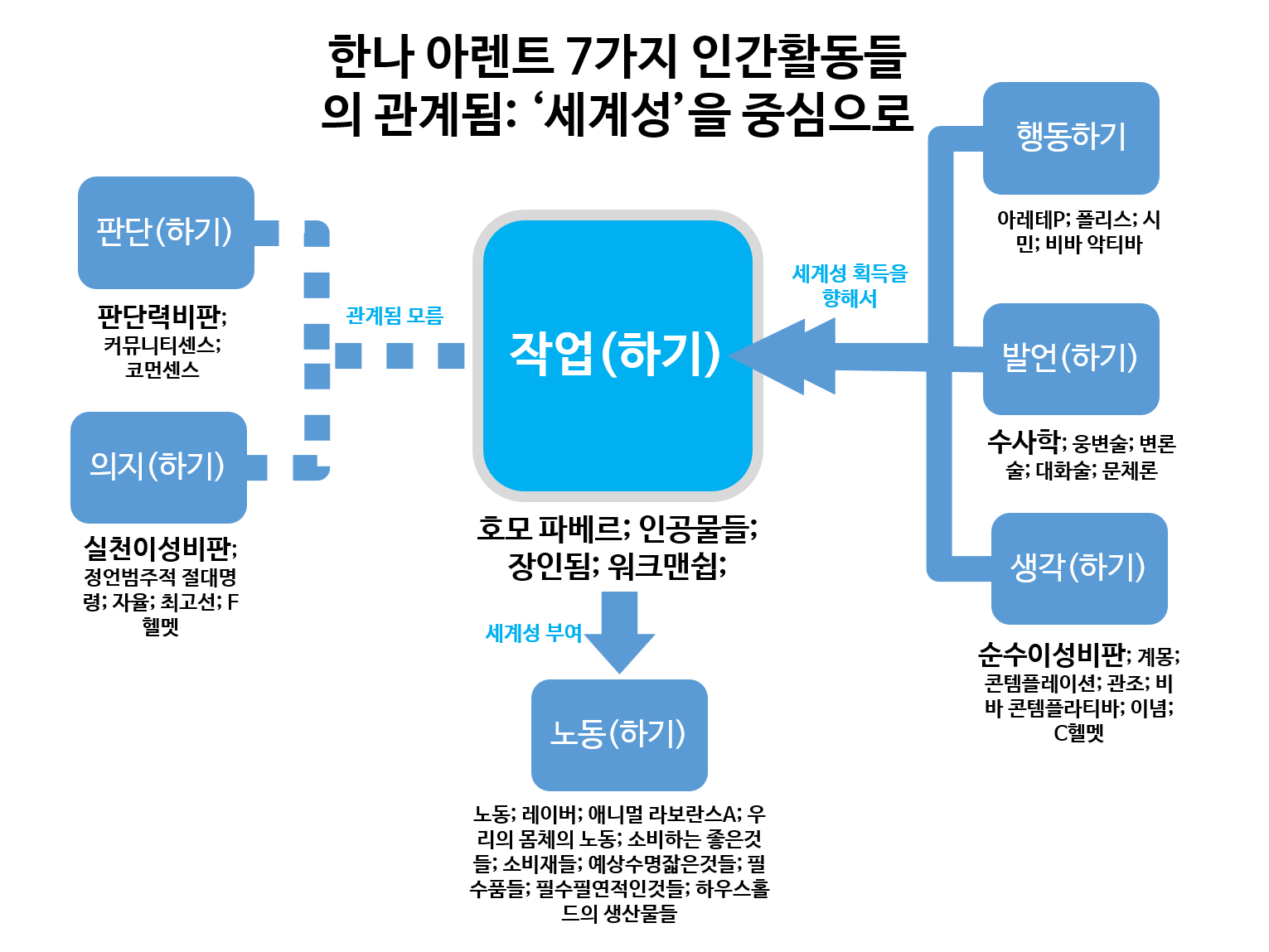 ● 이 3부 11장 안에서 아렌트는, 먼저 한번더 <노동 vs 작업>이 어떻게 다른지를 설명합니다. 먼저 아렌트는 노동의 생산물의 세계있음worldliness은 예상수명이 짧다는 점, 정반대로 작업의 그것은 길다는 점을 에로 듭니다.그다음으로 아렌트는 노동의 그것들 곧 소비자의 좋은것들(소비재)은 생활필수품에 그치는 반면, 작업의 그것들은 인간의 인공체들로써 세계의 지속성과 내구성을 보증하는 것들이라고 규정합니다. 더나아가 소비되는 좋은것들은 그것들의 거시기-성격 곧 세계있음을 작업된 인공체들로부터 수여받는다고 합니다(그 반대는 불가능함).이렇게 노동과 작업의 차이를 밝힌 다음, 아렌트는 행동, 발언, 생각(또는 이념)이라는 다른 또는 남아있는 인간활동들의 세계있음을 서술합니다. 이들 행동하기, 생각하기, 발언하기의 세계있음은 노동하기나 작업하기와는 무척 다른데,(1)타자들의 현전(2)만질수없는것들로부터 만져지는것들로의 트랜스포메이션( 곧 기억의 사물화)라는 과정들을 필요로 하며, 이러한 과정들 없이는 이들 3가지 활동들은 물질화될 수 없다고 아렌트는 생각합니다.그리고 11장 결론부에 이르는데, 아렌트는 여기서, 생각하기, 발언하기, 행동하기의 세계있음은 작업하기 상에 종속된다는 생각을 밝힙니다. 이렇게해서, 아렌트의 표상을 받아들인다면, 우리는 다섯가지 인간활동들(노동, 작업, 행동, 발언, 생각)이 어떻게 서로 관계되는지를 알 수 있게 됩니다. |
| json metadata | {"tags":["kr","sugunzag","hannah-arendt","human-condition","political-philosophy"],"image":["https://cdn.steemitimages.com/DQmQdGk9aUrYiYRaoZJFiJot4LJHoKFdvS7NaCJUV31e5FG/8935664553_f.jpg","https://cdn.steemitimages.com/DQmW4WeBz8wsKaWtB65R11C9hNCWGM4QLxw9uQLAJ6vC4ua/%EA%B7%B8%EB%A6%BC1.png"],"app":"steemit/0.1","format":"markdown"} |
| Transaction Info | Block #25987272/Trx 1c6f10a3cdbe24bdd86146629c52f4c2d790bbbf |
View Raw JSON Data
{
"trx_id": "1c6f10a3cdbe24bdd86146629c52f4c2d790bbbf",
"block": 25987272,
"trx_in_block": 27,
"op_in_trx": 0,
"virtual_op": 0,
"timestamp": "2018-09-15T17:17:42",
"op": [
"comment",
{
"parent_author": "",
"parent_permlink": "kr",
"author": "sugunzag",
"permlink": "3-12-the-thing-character-of-the-worid",
"title": "한나 아렌트 [인간의 조건상태(인간의 조건)] 3부 12장. 세계의 거시기-성격The Thing-character of the WorId",
"body": "\n\n\n\n\n12.. 세계의 거시기-성격The Thing-character of the WorId\n\nThe contempt for labor in ancient theory and its glorification in modern theory both take their bearing from the subjective attitude or activity of the laborer, mistrusting his painful effort or praising his productivity. The subjectivity of the approach may be more obvious in the distinction between easy and hard work, but we saw that at least in the case of Marx— who, as the greatest of modern labor theorists, necessarily provides a kind of touchstone in these discussions— labor's productivity is measured and gauged against the requirements of the life process for its own reproduction; it resides in the potential surplus inherent in human labor power, not in the quality or character of the things it produces. Similarly, Greek opinion, which ranked painters higher than sculptors, certainly did not rest upon a higher regard for paintings.30 It seems that 노동과 작업 사이의 구별은... 생산된 거시기의 세계있음의 성질 또는 성격, 곧 그것의 장소, 그것의 기능, 세계 안에서 그것이 머무는 길이의 정도등급 안에서의 차이이다(122)the distinction between labor and work, which our theorists have so obstinately neglected and our languages so stubbornly preserved, indeed becomes merely a difference in degree if the worldly character of the produced thing— its location, function, and length of stay in the world— is not taken into account. 세계 안에서의 \"예상수명\"이 하루도 안되는 어떤 빵(노동의 생산물, 애니멀 라보란스)과 사람들의 몇세대를 쉽게 거치는 어떤 탁자(작업의 생산물; 호모 파베르)의 구별은 제빵사와 목수의 구별보다 일정하게 더 명확하고 결정적이다(172)The distinction between a bread, whose \"life expectancy\" in the world is hardly more than a day, and a table, which may easily survive generations of men, is certainly much more obvious and decisive than the difference between a baker and a carpenter. \n\n30. On the contrary, it is doubtful whether any painting was ever as much admired as Phidias' statue of Zeus at Olympia, whose magical power was credited to make one forget all trouble and sorrow; whoever had not seen it had lived in vain, etc. \n\nThe curious discrepancy between language and theory which we noted at the outset therefore turns out to be a discrepancy between the world-oriented, \"objective\" language we speak and the manoriented, subjective theories we use in our attempts at understanding. 비타 악티바가 스스로를 써버리는 곳인, 세계의 거시기들은 매우 다른 어떤 본성자연의 것이고, 그리고 활동들의 사뭇 다른 종류들에 의해 생산된다는 것을 우리에게 가르쳐주는 바, 그것은 그저 한낱 이론 따위가 아니라 그런 사실 아래 깔려있는 근본기초적인 인간경험들이고 언어이다 * 이것이 바로 <일언어>라고 여겨진다. 이 글줄 안 \"이론\"은 글언어라고 보면 되겠다(172)It is language, and the fundamental human experiences underlying it, rather than theory, that teaches us that the things of the world, among which the vita activa spends itself, are of a very different nature and produced by quite different kinds of activities. Viewed as part of the world, 그것들이 없으면 결코 존재할 수 없는, 어떤 세계의 영속성과 내구성을 보증하는 '그것들'이라는 것은, 노동의 생산물들이 아니라 작업의 생산물들이다(172)the products of work— and not the products of labor— guarantee the permanence and durability without which a world would not be possible at all. It is within this world of durable things that we find the consumer goods through which life assures the means of its own survival. Needed by our bodies and produced by its laboring, but without stability of their own, these things for incessant consumption appear and disappear in an environment of things that are not consumed but used, and to which, as we use them, we become used and accustomed. As such, they give rise to the familiarity of the world, its customs and habits of intercourse between men and things as well as between men and men. 소비자의 좋은것들(노동의 생산물들; 애니말 라보란스)이 사람의 생명삶을 위해 있다면, 쓸모있는 오브젝트들(작업의 생산물들; 호모 파베르)은 사람의 세계를 위해 있다(172)What consumer goods are for the life of man, use objects are for his world. 쓸모있는 오브젝트들로부터, 소비자의 좋은것들은 그것들의 거시기-성격을 갈래쳐받는다; (그렇지않다면) 노동하는 활동(애니멀 라보란스)으로하여금 어떠한것도 결코 그렇게 고체화되게 그리고 동사가 아닌 어떤 명사로써 형태화하도록 허락하지 않음을, 언어(가 말하고 있고)는 \"우리의 손들의 작업(호모 파베르)\"이라는 할만한 것을 우리 앞에 우리가 갖지 않는 이상, 심지어는 어떤 거시기가 무엇인지조차 우리가 알 수 없을 거라는 점을 강한 개연성으로 암시한다(172)From them, consumer goods derive their thing-character; and language, which does not permit the laboring activity to form anything so solid and non-verbal as a noun, hints at the strong probability that we would not even know what a thing is without having before us \"the work of our hands.\" \n\n소비자의 좋은것들 및 쓸모있는 오브젝트들, 이 둘과 구별되는, 마지막으로 행동의 '생산물들' 및 로고스(발언; 이성; 낱말)의 '생산물들'이 있다. 써그것들은 함께 인간의 관계됨들과 일들의 패브릭(짜임새)을 컨스티튜트한다(173)Distinguished from both, consumer goods and use objects, there are finally the \"products\" of action and speech, which together constitute the fabric of human relationships and affairs. Left to themselves, they lack not only the tangibility of other things, but are even less durable and more futile than what we produce for consumption. 행동과 발언(로고스)의 실재현실은 전적으로 인간의 여럿됨 상에, 그리고 보고 듣고 그래서 그것들의 실존을 증언해주는, 타자의 항상적인 현전 상에 종속된다(173)Their reality depends entirely upon human plurality, upon the constant presence of others who can see and hear and therefore testify to their existence. 행동하기와 발언하기는 인간생명삶의 바깥을향한 선언들이다(173)acting and speaking are still outward manifestations of human life, which knows only one activity that, though related to the exterior world in many ways, is not necessarily manifest in it and needs neither to be seen nor heard nor used nor consumed in order to be real: the activity of thought. \n\nViewed, however, in their worldliness, action, speech, and thought have much more in common than any one of them has with work or labor. They themselves do not \"produce,\" bring forth anything, they are as futile as life itself. In order to become worldly things, that is, deeds and facts and events and patterns of thoughts or ideas, they must first be seen, heard, and remembered and then transformed, reified as it were, into things— into sayings of poetry, the written page or the printed book, into paintings or sculpture, into all sorts of records, documents, and monuments. The whole factual world of human affairs depends for its reality and its continued existence, first, upon (1)the presence of others who have seen and heard and will remember, and, second, on (2)the transformation of the intangible into the tangibility of things. Without remembrance and without (2')the reification which remembrance needs for its own fulfilment and which makes it, indeed, as the Greeks held, the mother of all arts, the living activities of action, speech, and thought would lose their reality at the end of each process and disappear as though they never had been. The materialization they have to undergo in order to remain in the world at all is paid for in that always the \"dead letter\" replaces something which grew out of and for a fleeting moment indeed existed as the \"living spirit.\" They must pay this price because they themselves are of an entirely unworldly nature and therefore need the help of an activity of an altogether different nature; 행동, 발언(로고스), 생각의 살아있는 활동들은 그것들의 실재현실과 물질화를 위해, 다른 거시기들을 인간의 인공체 안에 지어내는 것과 동일한, 워크맨쉽(작업하는이됨)에 종속된다(174)they depend for their reality and materialization upon the same workmanship that builds the other things in the human artifice. \n\nThe reality and reliability of the human world rest primarily on the fact that we are surrounded by things more permanent than the activity by which they were produced, and potentially even more permanent than the lives of their authors. 인간생명삶은, 그것이 세계-짓기인 한, 항상적인 사물화의 어떤 과정 안에 참여한다. 그리고 모두 함께 인간의 인공체를 형태화하는, 생산된 거시기들의 세계있음의 정도등급은 세계 안에서의 더커다란 또는 덜커다란 영속성 그자체에 종속된다(174)Human life, in so far as it is world-building, is engaged in a constant process of reification, and the degree of worldliness of produced things, which all together form the human artifice, depends upon their greater or lesser permanence in the world itself. \n\n\n\n● 이 3부 11장 안에서 아렌트는, 먼저 한번더 <노동 vs 작업>이 어떻게 다른지를 설명합니다. 먼저 아렌트는 노동의 생산물의 세계있음worldliness은 예상수명이 짧다는 점, 정반대로 작업의 그것은 길다는 점을 에로 듭니다.그다음으로 아렌트는 노동의 그것들 곧 소비자의 좋은것들(소비재)은 생활필수품에 그치는 반면, 작업의 그것들은 인간의 인공체들로써 세계의 지속성과 내구성을 보증하는 것들이라고 규정합니다. 더나아가 소비되는 좋은것들은 그것들의 거시기-성격 곧 세계있음을 작업된 인공체들로부터 수여받는다고 합니다(그 반대는 불가능함).이렇게 노동과 작업의 차이를 밝힌 다음, 아렌트는 행동, 발언, 생각(또는 이념)이라는 다른 또는 남아있는 인간활동들의 세계있음을 서술합니다. 이들 행동하기, 생각하기, 발언하기의 세계있음은 노동하기나 작업하기와는 무척 다른데,(1)타자들의 현전(2)만질수없는것들로부터 만져지는것들로의 트랜스포메이션( 곧 기억의 사물화)라는 과정들을 필요로 하며, 이러한 과정들 없이는 이들 3가지 활동들은 물질화될 수 없다고 아렌트는 생각합니다.그리고 11장 결론부에 이르는데, 아렌트는 여기서, 생각하기, 발언하기, 행동하기의 세계있음은 작업하기 상에 종속된다는 생각을 밝힙니다. 이렇게해서, 아렌트의 표상을 받아들인다면, 우리는 다섯가지 인간활동들(노동, 작업, 행동, 발언, 생각)이 어떻게 서로 관계되는지를 알 수 있게 됩니다.",
"json_metadata": "{\"tags\":[\"kr\",\"sugunzag\",\"hannah-arendt\",\"human-condition\",\"political-philosophy\"],\"image\":[\"https://cdn.steemitimages.com/DQmQdGk9aUrYiYRaoZJFiJot4LJHoKFdvS7NaCJUV31e5FG/8935664553_f.jpg\",\"https://cdn.steemitimages.com/DQmW4WeBz8wsKaWtB65R11C9hNCWGM4QLxw9uQLAJ6vC4ua/%EA%B7%B8%EB%A6%BC1.png\"],\"app\":\"steemit/0.1\",\"format\":\"markdown\"}"
}
]
}2018/09/14 13:54:24
2018/09/14 13:54:24
| voter | moby-dick |
| author | sugunzag |
| permlink | 3-11 |
| weight | 10000 (100.00%) |
| Transaction Info | Block #25954408/Trx 3b0285364cca5a1525b7a2b8a256c82cde397aa9 |
View Raw JSON Data
{
  "trx_id": "3b0285364cca5a1525b7a2b8a256c82cde397aa9",
  "block": 25954408,
  "trx_in_block": 51,
  "op_in_trx": 0,
  "virtual_op": 0,
  "timestamp": "2018-09-14T13:54:24",
  "op": [
    "vote",
    {
      "voter": "moby-dick",
      "author": "sugunzag",
      "permlink": "3-11",
      "weight": 10000
    }
  ]
}2018/09/14 05:53:42
2018/09/14 05:53:42
| voter | sensation |
| author | sugunzag |
| permlink | 3-11 |
| weight | 10000 (100.00%) |
| Transaction Info | Block #25944795/Trx 8a1d090a379e0ca53fb29fe786bcee2b8e69c6b6 |
View Raw JSON Data
{
  "trx_id": "8a1d090a379e0ca53fb29fe786bcee2b8e69c6b6",
  "block": 25944795,
  "trx_in_block": 23,
  "op_in_trx": 0,
  "virtual_op": 0,
  "timestamp": "2018-09-14T05:53:42",
  "op": [
    "vote",
    {
      "voter": "sensation",
      "author": "sugunzag",
      "permlink": "3-11",
      "weight": 10000
    }
  ]
}acknowledgementupvoted (10.00%) @sugunzag / 3-112018/09/14 05:03:15
acknowledgementupvoted (10.00%) @sugunzag / 3-11
2018/09/14 05:03:15
| voter | acknowledgement |
| author | sugunzag |
| permlink | 3-11 |
| weight | 1000 (10.00%) |
| Transaction Info | Block #25943786/Trx 099f7f9de5b2632fd8c352ab3cc345677006f391 |
View Raw JSON Data
{
  "trx_id": "099f7f9de5b2632fd8c352ab3cc345677006f391",
  "block": 25943786,
  "trx_in_block": 1,
  "op_in_trx": 0,
  "virtual_op": 0,
  "timestamp": "2018-09-14T05:03:15",
  "op": [
    "vote",
    {
      "voter": "acknowledgement",
      "author": "sugunzag",
      "permlink": "3-11",
      "weight": 1000
    }
  ]
}2018/09/14 04:41:06
2018/09/14 04:41:06
| voter | golgo-13 |
| author | sugunzag |
| permlink | 3-11 |
| weight | 800 (8.00%) |
| Transaction Info | Block #25943344/Trx 9940c3956c5b629e6dea704056abab9b9cf9c511 |
View Raw JSON Data
{
  "trx_id": "9940c3956c5b629e6dea704056abab9b9cf9c511",
  "block": 25943344,
  "trx_in_block": 15,
  "op_in_trx": 0,
  "virtual_op": 0,
  "timestamp": "2018-09-14T04:41:06",
  "op": [
    "vote",
    {
      "voter": "golgo-13",
      "author": "sugunzag",
      "permlink": "3-11",
      "weight": 800
    }
  ]
}largeadultsonupvoted (10.00%) @sugunzag / 3-112018/09/14 04:31:54
largeadultsonupvoted (10.00%) @sugunzag / 3-11
2018/09/14 04:31:54
| voter | largeadultson |
| author | sugunzag |
| permlink | 3-11 |
| weight | 1000 (10.00%) |
| Transaction Info | Block #25943160/Trx cf2e2ebaf5a409ffdb80dd9fc4614a0044d21e8f |
View Raw JSON Data
{
  "trx_id": "cf2e2ebaf5a409ffdb80dd9fc4614a0044d21e8f",
  "block": 25943160,
  "trx_in_block": 5,
  "op_in_trx": 0,
  "virtual_op": 0,
  "timestamp": "2018-09-14T04:31:54",
  "op": [
    "vote",
    {
      "voter": "largeadultson",
      "author": "sugunzag",
      "permlink": "3-11",
      "weight": 1000
    }
  ]
}2018/09/14 04:25:36
2018/09/14 04:25:36
| parent author | |
| parent permlink | kr |
| author | sugunzag |
| permlink | 3-11 |
| title | 한나 아렌트 [인간의 조건상태(인간의 조건)] 3부 11장. 우리 몸체의 노동(애니멀 라보란스) 및 우리 손들의 작업(호모 파베르) |
| body | @@ -129,16 +129,17 @@ bor%0A%0A11. +. %EC%9A%B0%EB%A6%AC %EB%AA%B8%EC%B2%B4%EC%9D%98 |
| json metadata | {"tags":["kr","sugunzag","hannah-arendt","human-condition","political-philosophy"],"image":["https://cdn.steemitimages.com/DQmQdGk9aUrYiYRaoZJFiJot4LJHoKFdvS7NaCJUV31e5FG/8935664553_f.jpg","https://cdn.steemitimages.com/DQmXjCi59ZerHo6GaWF32ULjgJjYTQcMR6e6g2WTKuXzhai/%ED%94%84%EB%9D%BC%EC%9D%B4%EB%B9%97%ED%8D%BC%EB%B8%94%EB%A6%AD.png"],"app":"steemit/0.1","format":"markdown"} |
| Transaction Info | Block #25943038/Trx 073fb9895398c587e0a16c7920ef4e8c23e2362b |
View Raw JSON Data
{
  "trx_id": "073fb9895398c587e0a16c7920ef4e8c23e2362b",
  "block": 25943038,
  "trx_in_block": 29,
  "op_in_trx": 0,
  "virtual_op": 0,
  "timestamp": "2018-09-14T04:25:36",
  "op": [
    "comment",
    {
      "parent_author": "",
      "parent_permlink": "kr",
      "author": "sugunzag",
      "permlink": "3-11",
      "title": "한나 아렌트 [인간의 조건상태(인간의 조건)]  3부 11장. 우리 몸체의 노동(애니멀 라보란스) 및 우리 손들의 작업(호모 파베르)",
      "body": "@@ -129,16 +129,17 @@\n bor%0A%0A11.\n+.\n  %EC%9A%B0%EB%A6%AC %EB%AA%B8%EC%B2%B4%EC%9D%98 \n",
      "json_metadata": "{\"tags\":[\"kr\",\"sugunzag\",\"hannah-arendt\",\"human-condition\",\"political-philosophy\"],\"image\":[\"https://cdn.steemitimages.com/DQmQdGk9aUrYiYRaoZJFiJot4LJHoKFdvS7NaCJUV31e5FG/8935664553_f.jpg\",\"https://cdn.steemitimages.com/DQmXjCi59ZerHo6GaWF32ULjgJjYTQcMR6e6g2WTKuXzhai/%ED%94%84%EB%9D%BC%EC%9D%B4%EB%B9%97%ED%8D%BC%EB%B8%94%EB%A6%AD.png\"],\"app\":\"steemit/0.1\",\"format\":\"markdown\"}"
    }
  ]
}2018/09/14 04:25:15
2018/09/14 04:25:15
| parent author | |
| parent permlink | kr |
| author | sugunzag |
| permlink | 2-10 |
| title | 한나 아렌트 [인간의 조건상태(인간의 조건)] 2부 10장. 인간활동들의 장소 |
| body | @@ -111,16 +111,18 @@ .jpg)%0A%0A%0A +%0A%0A 10.. %EC%9D%B8%EA%B0%84%ED%99%9C |
| json metadata | {"tags":["kr","sugunzag","hannah-arendt","human-condition","political-philosophy"],"image":["https://cdn.steemitimages.com/DQmQdGk9aUrYiYRaoZJFiJot4LJHoKFdvS7NaCJUV31e5FG/8935664553_f.jpg"],"app":"steemit/0.1","format":"markdown"} |
| Transaction Info | Block #25943031/Trx 5b15383f1d612b2881d9a9cbcca4cbabfe381c58 |
View Raw JSON Data
{
  "trx_id": "5b15383f1d612b2881d9a9cbcca4cbabfe381c58",
  "block": 25943031,
  "trx_in_block": 16,
  "op_in_trx": 0,
  "virtual_op": 0,
  "timestamp": "2018-09-14T04:25:15",
  "op": [
    "comment",
    {
      "parent_author": "",
      "parent_permlink": "kr",
      "author": "sugunzag",
      "permlink": "2-10",
      "title": "한나 아렌트 [인간의 조건상태(인간의 조건)]  2부 10장. 인간활동들의 장소",
      "body": "@@ -111,16 +111,18 @@\n .jpg)%0A%0A%0A\n+%0A%0A\n 10.. %EC%9D%B8%EA%B0%84%ED%99%9C\n",
      "json_metadata": "{\"tags\":[\"kr\",\"sugunzag\",\"hannah-arendt\",\"human-condition\",\"political-philosophy\"],\"image\":[\"https://cdn.steemitimages.com/DQmQdGk9aUrYiYRaoZJFiJot4LJHoKFdvS7NaCJUV31e5FG/8935664553_f.jpg\"],\"app\":\"steemit/0.1\",\"format\":\"markdown\"}"
    }
  ]
}2018/09/14 04:25:06
2018/09/14 04:25:06
| parent author | |
| parent permlink | kr |
| author | sugunzag |
| permlink | 3-11 |
| title | 한나 아렌트 [인간의 조건상태(인간의 조건)] 3부 11장. 우리 몸체의 노동(애니멀 라보란스) 및 우리 손들의 작업(호모 파베르) |
| body |  III. 노동Labor 11. 우리 몸체의 노동(애니멀 라보란스) 및 우리 손들의 작업(호모 파베르)"The Labour of Our Body and the Work of Our Hands" 내가 제안한 노동과 작업의 구별은 생소하다... 정치적인 생각의 전근대적인 전통 안에서건 또는 근대적인 노동이론의 큰 몸체 안에서건 나의 구별을 지원하는 것은 찾기 힘들다. 역사적인 증거가 없음에도 하지만 가즌 유럽언어들은... 동일한 활동을 표현하는... 두 개의 어원학적으로 관계없는 낱말들을 담고 있다(156)The distinction between labor and work which I propose is unusual. The phenomenal evidence in its favor is too striking to be ignored, and yet historically it is a fact that apart from a few scattered remarks, which moreover were never developed even in the theories of their authors, there is hardly anything in either the premodern tradition of political thought or in the large body of modern labor theories to support it. Against this scarcity of historical evidence, however, stands one very articulate and obstinate testimony, namely, the simple fact that every European language, ancient and modern, contains two etymologically unrelated words for what we have to come to think of as the same activity, and retains them in the face of their persistent synonymous usage. 로크의 <작업하는 손들>과 <노동하는 어떤 몸체> 사이의 구별은, <케이로테크네스(장인, 독일어의 한트베르커)>와 <토 소마티 에르가제스타이(주인의 생명삶의 너쎄시티(필수욕구됨; 먹고사니즘)들을 위해서 자체의 몸체들로 대신하는 노예들과 길들여진 동물들처럼 스스로들의 몸체들로써 작업하는)> 사이의 고대 그리스적인 구별을 회상하게 한다. 고대 그리스에서도 이미 노동과 작업은 동일하게 여겨졌다. 왜냐하면 이때 쓰인 낱말은 포네인(노동)이 아니라 에르가세스타이(작업)이기 때문이다(156~ 157)Thus, Locke's distinction between working hands and a laboring body is somewhat reminiscent of the ancient Greek distinction between the cheirotechnes, the craftsman, to whom the German Handwerker corresponds, and those who, like "slaves and tame animals with their bodies minister to the necessities of life," or in the Greek idiom, to somati ergazesthai, work with their bodies(yet even here, labor and work are already treated as identical, since the word used is not ponein [labor] but ergazesthai [work]). 노동에 대한 경멸은 기원적으로 정치적인 활동들 말고는 모든 것을 삼가야함(스콜레)에 대한 강요 및 시민들에게 폴리스의 생명삶을 위한 시간을 더늘리라는 요구들에 의해 확산되었고... 급기야는 노력을 요구하는 가즌거시기들로까지 확대되었다(157)Contempt for laboring, originally arising out of a passionate striving for freedom from necessity and a no less passionate impatience with every effort that left no trace, no monument, no great work worthy of remembrance, spread with the increasing demands of polis life upon the time of the citizens and its insistence on their abstention(skhole) from all but political activities, until it covered everything that demanded an effort. 원주7. 생존을 위한 활동은 18세기에도 여전히 노예의 일로 규정되었다(159)Politics 1258b35 ff. For Aristotle's discussion about admission of banausoi to citizenship see Politics iii. 5. His theory corresponds closely to reality: it is estimated that up to 80 per cent of free labor, work, and commerce consisted of non-citizens, either "strangers"(katoikountes and metoikoi) or emancipated slaves who advanced into these classes(see Fritz Heichelheim, Wirtsckaftsgeschichte des Altertums [1938], I, 398 ff.). Jacob Burckhardt, who in his Griechische Kulturgeschichte(Vol. II, sees. 6 and 8) relates Greek current opinion of who does and who does not belong to the class of banausoi, also notices that we do not know of any treatise about sculpture. In view of the many essays on music and poetry, this probably is no more an accident of tradition than the fact that we know so many stories about the great feeling of superiority and even arrogance among the famous painters which are not matched by anecdotes about sculptors. This estimate of painters and sculptors survived many centuries. It is still found in the Renaissance, where sculpturing is counted among the servile arts whereas painting takes up a middle position between liberal and servile arts(see Otto Neurath, "Beitrage zur Geschichte der Opera Servilia," Archivfur Sozialtvissenschaft und Sozialpolitik, Vol. XLI, No. 2 [1915]).. That Greek public opinion in the city-states judged occupations according to the effort required and the time consumed is supported by a remark of Aristotle about the life of shepherds: "There are great differences in human ways of life. The laziest are shepherds; for they get their food without labor [poms] from tame animals and have leisure [skhohzousin]"(Politics 1256a3O ff.). It is interesting that Aristotle, probably following current opinion, here mentions laziness(aereia) together with, and somehow as a condition for, skhole, abstention from certain activities which is the condition for a political life. Generally, the modern reader must be aware that aergia and skhole are not the same. Laziness had the same connotations it has for us, and a life of skhole was not considered to be a lazy life. The equation, however, of skhole and idleness is characteristic of a development within the polis. Thus Xenophon reports that Socrates was accused of having quoted Hesiod's line: "work is no disgrace, but laziness [aergia] is a disgrace." The accusation meant that Socrates had instilled in his pupils a slavish spirit(Memorabilia i. 2. 56). Historically, it is important to keep in mind the distinction between the contempt of the Greek city-states for all non-political occupations which arose out of the enormous demands upon the time and energy of the citizens, and the earlier, more original, and more general contempt for activities which serve only to sustain life— ad vitae sustentationem as the opera servilia are still defined in the eighteenth century. In the world of Homer, Paris and Odysseus help in the building of their houses, Nausicaa herself washes the linen of her brothers, etc. All this belongs to the self-sufficiency of the Homeric hero, to his independence and the autonomic supremacy of his person. No work is sordid if it means greater independence; the selfsame activity might well be a sign of slavishness if not personal independence but sheer survival is at stake, if it is not an expression of sovereignty but of subjection to necessity. The different estimate of craftsmanship in Homer is of course well known. But its actual meaning is beautifully presented in a recent essay by Richard Harder, Eigenart derGriechen(1949). 인간활동들에 대한 고대인들의 견적은, 욕구들에 의해서 필수욕구적이 되는 우리 몸체의 노동은 노예적이라는 확신에 근거하고 있다. 그래서 비록 노동하기는 아니지만, 생명삶의 너쎄시티(필수욕구됨; 먹고사니즘)들을 제공하기 위해 떠맡겨지는 직업들은 모두 노동의 신분지위에 동화되었다... 생명삶의 유지를 위한 욕구들에 용역하는 모든 직업들의 노예적 본성 때문에 노예들을 포제쎤하는 것이 필요하다고 생각되었다. 정확하게 노예제도를 방어하고 떳떳케한 것은 바로 이 논리였다. 노동한다는 것은 너쎄시티(필수욕구됨; 먹고사니즘)에 의해 노예화되는 것을 의미했다. 그리고 이러한 노예화는 인간생명삶의 조건상태들 안에 내재된 것이었다. 생명삶의 너쎄시티(필수욕구됨; 먹고사니즘)들에 의해 도미네이션되기 때문에, 너쎄시티(필수욕구됨; 먹고사니즘)에 예속된 노예들을 강제력에 의해서 도미네이션하기를 통해서만 사람들은 오직 스스로들의 프리덤을 승리해낼 수 있다. 노예로의 퇴행이라는 것은 숙명의 어떤 일격이었고 죽음보다 더 나쁜 어떤 숙명이었다. 왜냐하면 그것은 사람을 길들여진 어떤 동물을 닮은 어떤거시기로 메타모르포시스시키는 것이기 때문이다(160)We shall see later that, quite apart from their contempt for labor, the Greeks had reasons of their own to mistrust the craftsman, or rather, the homo faber mentality. This mistrust, however, is true only of certain periods, whereas all ancient estimates of human activities, including those which, like Hesiod, supposedly praise labor, rest on the conviction that the labor of our body which is necessitated by its needs is slavish. Hence, occupations which did not consist in laboring, yet were undertaken not for their own sake but in order to provide the necessities of life, were assimilated to the status of labor, and this explains changes and variations in their estimation and classification at different periods and in different places. The opinion that labor and work were despised in antiquity because only slaves were engaged in them is a prejudice of modern historians. The ancients reasoned the other way around and felt it necessary to possess slaves because of the slavish nature of all occupations that served the needs for the maintenance of life. It was precisely on these grounds that the institution of slavery was defended and justified. To labor meant to be enslaved by necessity, and this enslavement was inherent in the conditions of human life. Because men were dominated by the necessities of life, they could win their freedom only through the domination of those whom they subjected to necessity by force. The slave's degradation was a blow of fate and a fate worse than death, because it carried with it a metamorphosis of man into something akin to a tame animal. A change in a slave's status, therefore, such as manumission by his master or a change in general political circumstance that elevated certain occupations to public relevance, automatically entailed a change in the slave's "nature." 노예제도는 노동을 생명삶의 조건상태들로부터 배제하기 위한 어떤 장치였다(161)The institution of slavery in antiquity, though not in later times, was not a device for cheap labor or an instrument of exploitation for profit but rather the attempt to exclude labor from the conditions of man's life. 원주10. 에우리피데스는... 노예라는 것은 모든 것을 밥통의 관점에서 바라본다고 말했다(161)It is in this sense that Euripides calls all slaves "bad": they see everything from the viewpoint of the stomach(Suppiementum Eutipideum, ed. Arnim, frag. 49, no. 2). 고전고대에 노동과 작업 사이의 구별이 무시되었다는 것은 놀랍지 않다(162)It is not surprising that the distinction between labor and work was ignored in classical antiquity. 사적인 하우스홀드와 공적인 정치적인 권역 사이의 차이, 하우스홀드의 수용된이(노예)와 하우스홀드 우두머리(시민) 사이의 차이, 프라이버시(사적임) 안에 감춰져야할 활동들(노동, 작업)과 보여지고, 들려지고, 기억되어져야할 값어치있는 활동들(행동, 발언) 사이의 차이가 모든 다른 차이들을 무색하게 만들었고, 결국 오직 하나의 평가기준만이 남게 되었다: 시간과 노력의 더커다란 총량을 사적으로 썼는가, 아니면 공적으로 썼는가?(162)The differentiation between the private household and the public political realm, between the household inmate who was a slave and the household head who was a citizen, between activities which should be hidden in privacy and those which were worth being seen, heard, and remembered, overshadowed and predetermined all other distinctions until only one criterion was left: is the greater amount of time and effort spent in private or in public? 직업은 사적인 거시기를 위한 배려인가, 아니면 공적인 거시기를 위한 배려인가?(162)is the occupation motivated by cura privati negotii or cura rei publicae, care for private or for public business? 심지어는 활동들 사이에 최소한 구별되었던, 이러한 구별마저도, 정치적인 이론의 일어남과더불어써, 관조를 활동의 모든 종류들에 대립시켜버림에 의해, 사라졌다(162)With the rise of political theory, the philosophers overruled even these distinctions, which had at least distinguished between activities, by opposing contemplation to all kinds of activity alike. (이제는) 심지어는 정치적인 활동마저도 너쎄시티(필수욕구됨; 먹고사니즘)의 신분지위를 향해 평준화되어졌고, 너쎄시티(필수욕구됨; 먹고사니즘)이 따라서 비타 악티바 속의 모든 분절들의 공통분모가 되었다(162)With them, even political activity was leveled to the rank of necessity, which henceforth became the common denominator of all articulations within the vita activa. Nor can we reasonably expect any help from Christian political thought, which accepted the philosophers' distinction, refined it, and, religion being for the many and philosophy only for the few, gave it general validity, binding for all men. 근대는 모든 전통들을 뒤집어 버렸다. 근대는 행동과 관조 사이의 전통적인 신분지위를 비타 악티바 속의 전통적인 위계서열에 불과한 것으로 뒤집어 버렸다. 노동을 모든 가치들의 원천으로 영광스럽게 만들었고, 근대는 전통적으로 이성적인 동물이 붙들고 있었던 지위로까지 노동하는 동물을 신분상승시켰다. 이러한 근대였음에도 놀랍게도 애니멀 라보란스(우리 몸체의 노동)와 호모 파베르(우리 손들의 작업)를 깨끗하게 구별하는 단일한 어떤 이론을 내놓지 못했다(162)It is surprising at first glance, however, that the modern age— with its reversal of all traditions, the traditional rank of action and contemplation no less than the traditional hierarchy within the vita activa itself, with its glorification of labor as the source of all values and its elevation of the animal laborans to the position traditionally held by the animal rationale— should not have brought forth a single theory in which animal laborans and homo faber, "the labour of our body and the work of our hands," are clearly distinguished. 그대신에 첫째로 생산적인 노동과 비생산적인 노동 사이의 구별, 나중에는 숙련된 노동과 미숙련노동 사이의 구별, 마지막으로 육체노동과 지성의 노동 사이의 구별을 근대는 발견했다(162)Instead, we find first the distinction between productive and unproductive labor, then somewhat later the differentiation between skilled and unskilled work, and, finally, outranking both because seemingly of more elementary significance, the division of all activities into manual and intellectual labor. Of the three, however, only the distinction between productive and unproductive labor goes to the heart of the matter, and it is no accident that the two greatest theorists in the field, Adam Smith and Karl Marx, based the whole structure of their argument upon it. The very reason for the elevation of labor in the modern age was its "productivity," and 하나님이 아니라 노동이 사람을 창조했고 또는 이성이 아니라 노동이 사람을 다른 동물들로부터 구별한다는 불경스럽게 보이는 맑스의 개념 오직 근대가 전일적으로 합의한 바인 어떤 사실을 래디컬하고 공통-지속적으로 형태식화한 것일 따름이다(163)the seemingly blasphemous notion of Marx that labor(and not God) created man or that labor(and not reason) distinguished man from the other animals was only the most radical and consistent formulation of something upon which the whole modern age was agreed. 원주14. "The creation of man through human labor" was one of the most persistent ideas of Marx since his youth. It can be found in many variations in the Jugendschriften(where in the "Kritik der Hegelschen Dialektik" he credits Hegel with it).(See Marx-Engels Gesamtausgabe, Part I, Vol. 5 [Berlin, 1932], pp. 156 and 167.) That Marx actually meant to replace the traditional definition of man as an animal rationale by defining him as an animal laborans is manifest in the context. The theory is strengthened by a sentence from the Deutsche Ideologic which was later deleted: "Der erste geschichtliche Akt dieser Individuen, wodurch sie sich von den Tieren unterscheiden, ist nicht, dass sie denken, sondern, dass sie anfangen ihre Lebensmittel zu produzieren"(ibid., p. 568). Similar formulations occur in the "Okonomisch-philosophische A4anuskripte"(ibid., p. 125), and in "Die heilige Familie"(ibid., p. 189). Engels used similar formulations many times, for instance in the Preface of 1884 to Ursprung der Familie or in the newspaper article of 1876, "Labour in the Transition from Ape to Man"(see Marx and Engels, Selected works [London, 1950], Vol. II). 노동이 사람을 동물로부터 구별한다고 처음 주장한이는 맑스가 아니라 흄이다(163)It seems that Hume, and not Marx, was the first to insist that labor distinguishes man from animal(Adriano Tilgher, Homo faber [1929]; English ed.: work: What It Has Meant to Men through the Ages [1930]). As labor does not play any significant role in Hume's philosophy, this is of historical interest only; to him, this characteristic did not make human life more productive, but only harsher and more painful than animal life. It is, however, interesting in this context to note with what care Hume repeatedly insisted that neither thinking nor reasoning distinguishes man from animal and that the behavior of beasts demonstrates that they are capable of both. Moreover, both Smith and Marx were in agreement with modern public opinion when they despised unproductive labor as parasitical, actually a kind of perversion of labor, as though nothing were worthy of this name which did not enrich the world. Marx certainly shared Smith's contempt for the "menial servants" who like "idle guests... leave nothing behind them in return for their consumption."16 Yet it was precisely these menial servants, these household inmates, oiketai or familiares, laboring for sheer subsistence and needed for effortless consumption rather than for production, whom all ages prior to the modern had in mind when they identified the laboring condition with slavery. What they left behind them in return for their consumption was nothing more or less than their masters' freedom or, in modern language, their masters' potential productivity. In other words, 생산적인 노동과 비생산적인 노동 사이의 구별은... 작업과 노동 사이의 보다 근본기초적인 구별을 담고 있다(164)the distinction between productive and unproductive labor contains, albeit in a prejudicial manner, the more fundamental distinction between work and labor.16 It is indeed the mark of all laboring that it leaves nothing behind, that the result of its effort is almost as quickly consumed as the effort is spent. And yet this effort, despite its futility, is born of a great urgency and motivated by a more powerful drive than anything else, because life itself depends upon it. 근대는 일반적으로 그리고 맑스는 파티큘라하게, 모든 노동을 작업으로 간주한 나머지, 애니멀 라보란스라고 불러야 할 것을 호모 파베르라고 발언했다(164)The modern age in general and Karl Marx in particular, overwhelmed, as it were, by the unprecedented actual productivity of Western mankind, had an almost irresistible tendency to look upon all labor as work and to speak of the animal laborans in terms much more fitting for homo faber, hoping all the time that only one more step was needed to eliminate labor and necessity altogether.17 No doubt 행동현실적으로 노동을 숨겨진 (사적인 권역)으로부터 꺼내와서, 노동을 조직화하고 '분할'하는 공적인 권역 안을향해 끌어들이는 역사적인 개발이 이루어졌다(165)the actual historical development that brought labor out of hiding and into the public realm, where it could be organized and "divided,"18 constituted a powerful argument in the development of these theories. Yet an even more significant fact in this respect, already sensed by the classical economists and clearly discovered and articulated by Karl Marx, is that the laboring activity itself, regardless of historical circumstances and independent of its location in the private or the public realm, possesses indeed a "productivity" of its own, no matter how futile and non-durable its products may be. This productivity does not lie in any of labor's products but in the human "power," whose strength is not exhausted when it has produced the means of its own subsistence and survival but is capable of producing a "surplus," that is, more than is necessary for its own "reproduction." It is because not labor itself but the surplus of human "labor power"(Arbeitskraft) explains labor's productivity that Marx's introduction of this term, as Engels rightly remarked, constituted the most original and revolutionary element of his whole system.19 새로운 오브젝트들을 인간의 인공체에 더하는 작업의 생산성과 다르게, 노동력의 생산성은 오브젝트들을 오직 우발적으로 생산하고, 1차적으로 자체의 재생산의 수단자산에만 관심을 갖는다(165)Unlike the productivity of work, which adds new objects to the human artifice, the productivity of labor power produces objects only incidentally and is primarily concerned with the means of its own reproduction; since its power is not exhausted when its own reproduction has been secured, it can be used for the reproduction of more than one life process, but 노동력은 생명삶 말고는 결코 아무것도 생산하지 못한다(166)it never "produces" anything but life.20 Through violent oppression in a slave society or exploitation in the capitalist society of Marx's own time, it can be channeled in such a way that the labor of some suffices for the life of all. 16. The distinction between productive and unproductive labor is due to the physiocrats, who distinguished between producing, property-owning, and sterile classes. Since they held that the original source of all productivity lies in the natural forces of the earth, their standard for productivity was related to the creation of new objects and not to the needs and wants of men. Thus, the Marquis de iVIirabeau, father of the famous orator, calls sterile "la classe d'ouvriers dont les travaux, quoique necessaires aux besoins des hommes et utiles a la societe, ne sont pas neanmoins productifs" and illustrates his distinction between sterile and productive work by comparing it to the difference between cutting a stone and producing it(see Jean Dautry, "La notion de travail chez Saint-Simon et Fourier," Journal de psychologie normale et fathologique, Vol. LII, No. 1 [January-March, 1955]). 17. This hope accompanied Marx from beginning to end. We find it already in the Deutsche Ideologie: "Es handelt sich nicht darum die Arbeit zu befreien, sondern sie aufzuheben"(Gesamtausgabe, Part I, Vol. 3, p. 185) and many decades later in the third volume of Das Kapital, ch. 48: "Das Reich der Freiheit beginnt in der Tat erst da, wo das Arbeiten... aufhort"(Marx-Engels Gesamtausgabe, Part II [Zurich, 1933], p. 873). 18. In his Introduction to the second book of the wealth of Nations(Everyman's ed., I, 241 ff.), Adam Smith emphasizes that productivity is due to the division of labor rather than to labor itself. 19. See Engels' Introduction to Marx's "Wage, Labour and Capital"(in Marx and Engels, Selected works [London, 1950], I, 384), where Marx had introduced the new term with a certain emphasis. 20. Marx stressed always, and especially in his youth, that the chief function of labor was the "production of life" and therefore saw labor together with procreation(see Deutsche Ideologic, p. 19; also "Wage, Labour and Capital," p. 77). From 근대의 전일적인 관점인, 이러한 순수하게 사회적인 관점은... 맑스에게서 가장 일관되고 커다란 표현을 얻었다(166)this purely social viewpoint, which is the viewpoint of the whole modem age but which received its most coherent and greatest expression in Marx's work, all laboring is "productive," and the earlier distinction between the performance of "menial tasks" that leave no trace and the production of things durable enough to be accumulated loses its validity. The social viewpoint is identical, as we saw before, with an interpretation that takes nothing into account but the life process of mankind, and within its frame of reference all things become objects of consumption. 완전하게 "사회화된 인류" 속에서 노동과 작업 사이의 구별은 완전하게 사라지고, 모든 작업은 노동이 되고 말 것이다(167)Within a completely "socialized mankind," whose sole purpose would be the entertaining of the life process— and this is the unfortunately quite unutopian ideal that guides Marx's theories21— the distinction between labor and work would have completely disappeared; all work would have become labor because all things would be understood, not in their worldly, objective quality, but as results of living labor power and functions of the life process.22 21. The terms vergesellschafteter Mensch or gesellschaftliche Menschheit were frequently used by Marx to indicate the goal of socialism(see, for instance, the third volume of Das Kapital, p. 873, and the tenth of the "Theses on Feuerbach": "The standpoint of the old materialism is 'civil' society; the standpoint of the new is human society, or socialized humanity"(Selected works, II, 367]). It consisted in the elimination of the gap between the individual and social existence of man, so that man "in his most individual being would be at the same time a social being [a Gemeintaesen]"(Jugendschriften, p. 113). Marx frequently calls this social nature of man his Gattungstoesen, his being a member of the species, and the famous Marxian "self-alienation" is first of all man's alienation from being a Gattungsivesen(ibid., p. 89: "Eine unmittelbare Konsequenz davon, dass der Mensch dem Produkt seiner Arbeit, seiner Lebenstatigkeit, seinem Gattungswesen entfremdet ist, ist die Entfremdung des Menschen von dem Menschen"). The ideal society is a state of affairs where all human activities derive as naturally from human "nature" as the secretion of wax by bees for making the honeycomb; to live and to labor for life will have become one and the same, and life will no longer "begin for [the laborer] where [the activity of laboring] ceases"("Wage, Labour and Capital," p. 77). 22. Marx's original charge against capitalist society was not merely its transformation of all objects into commodities, but that "the laborer behaves toward the product of his labor as to an alien object"("dass der Arbeiter zum Produkt seiner Arbeit als einem fremden Gegenstand sich verhalt" [Jugendschriften, p. 83])— in other words, that the things of the world, once they have been produced by men, are to an extent independent of, "alien" to, human life. It is interesting to note that the distinctions between skilled and unskilled and between intellectual and manual work play no role in either classical political economy or in Marx's work. Compared with the productivity of labor, they are indeed of secondary importance. Every activity requires a certain amount of skill, the activity of cleaning and cooking no less than the writing of a book or the building of a house. The distinction does not apply to different activities but notes only certain stages and qualities within each of them. It could acquire a certain importance through the modem division of labor, where tasks formerly assigned to the young and inexperienced were frozen into lifelong occupations. But this consequence of the division of labor, where one activity is divided into so many minute parts that each specialized performer needs but a minimum of skill, tends to abolish skilled labor altogether, as Marx rightly predicted. Its result is that what is bought and sold in the labor market is not individual skill but "labor power," of which each living human being should possess approximately the same amount. Moreover, since unskilled work is a contradiction in terms, the distinction itself is valid only for the laboring activity, and the attempt to use it as a major frame of reference already indicates that the distinction between labor and work has been abandoned in favor of labor. Quite different is the case of the more popular category of manual and intellectual work. Here, the underlying tie between the laborer of the hand and the laborer of the head is again the laboring process, in one case performed by the head, in the other by some other part of the body. thinking, however, which is presumably the activity of the head, though it is in some way like laboring— also a process which probably comes to an end only with life itself— is even less "productive" than labor; if labor leaves no permanent trace, thinking leaves nothing tangible at all. By itself, thinking never materializes into any objects. Whenever the intellectual worker wishes to manifest his thoughts, he must use his hands and acquire manual skills just like any other worker. In other words, thinking and working are two different activities which never quite coincide; the thinker who wants the world to know the "content" of his thoughts must first of all stop thinking and remember his thoughts. Remembrance in this, as in all other cases, prepares the intangible and the futile for their eventual materialization; 기억은 작업과정의 시작이다(168)it is the beginning of the work process, and like the craftsman's consideration of the model which will guide his work, its most immaterial stage. The work itself then always requires some material upon which it will be performed and which through fabrication, 호모 파베르의 활동은 세계있음의 어떤 오브젝트로 (기억을) 트랜스포메이션시킨다(168)the activity of homo faber, will be transformed into a worldly object. 지성의 작업의 특별한 작업성질은 (다른 작업과 마찬가지로) "우리의 손들의 작업"이라는 점이다(168)The specific work quality of intellectual work is no less due to the "work of our hands" than any other kind of work. It seems plausible and is indeed quite common to connect and justify the modern distinction between intellectual and manual labor with 아르스 리베랄리스(리버럴 아트들)와 아르스 세르빌리스(서빌 아트들) 사이의 구별은... 지성의 더높은 등급정도도 아니고... 두뇌로 하는 작업하는 '자유로운 예술가'와 손을 쓰는 '천한 상인' 사이의 구별도 아니다(168)the ancient distinction between "liberal" and "servile arts." Yet the distinguishing mark between liberal and servile arts is not at all "a higher degree of intelligence," or that the "liberal artist" works with his brain and the "sordid tradesman" with his hands. 고대의 평가기준은 1차적으로 정치적이다(168)The ancient criterion is primarily political. 정치가들의 버츄인 신중한 판단의 역량인 프루덴티아를 갖는 직업들이나, 그리고 공적인 적합성(인간에게 효용있는)의 전문가들은... 자유롭다(169)Occupations involving prudentia, the capacity for prudent judgment which is the virtue of statesmen, and professions of public relevance(ad hominum utilitatem)™ such as architecture, medicine, and agriculture,24 are liberal. (둘째로) 모든 교역들, 어떤 목수의 거래와 다를 바 없는 어떤 글씨의 거래는, 어엿한 시민에게는 어울리지 않는, "천한" 것이다(169)All trades, the trade of a scribe no less than that of a carpenter, are "sordid," unbecoming for a full-fledged citizen, and (천한것들 가운데) 가장 최악은 가장 쓸모있다고 여기는 것들, '생선장사, 백정, 요리사, 새장수 그리고 어부들"이다(169)the worst are those we would deem most useful, such as "fishmongers, butchers, cooks, poulterers and fishermen."25 But not even these are necessarily sheer laboring. There is still 셋째 범주분류는 수고와 노력 자체가 돈을 받는다. 그리고 이 경우 '바로 그 임금이 노예의 표시이다'(169)a third category where the toil and effort itself(the operae as distinguished from the opus, the mere activity as distinguished from the work) is paid, and in these cases "the very wage is a pledge of slavery."26 23. For convenience' sake, I shall follow Cicero's discussion of liberal and servile occupations in De officiis i. 50-54. The criteria of prudentia and utilitas or utilitas hominum are stated in pars. 151 and 155.(The translation of prudentia as "a higher degree of intelligence" by Walter Miller in the Loeb Classical Library edition seems to me to be misleading.) 24. The classification of agriculture among the liberal arts is, of course, specifically Roman. It is not due to any special "usefulness" of farming as we would understand it, but much rather related to the Roman idea oipatria, according to which the ager Romctnus and not only the city of Rome is the place occupied by the public realm. 25. It is this usefulness for sheer living which Cicero calls mediocris utilitas (par. 151) and eliminates from liberal arts. The translation again seems to me to miss the point; these are not "professions . .. from which no small benefit to society is derived," but occupations which, in clear opposition to those mentioned before, transcend the vulgar usefulness of consumer goods. The distinction between manual and intellectual work, though its origin can be traced back to the Middle Ages,27 is modern and has two quite different causes, both of which, however, are equally characteristic of the general climate of the modern age. Since under modern conditions every occupation had to prove its "usefulness" for society at large, and since the usefulness of the intellectual occupations had become more than doubtful because of the modern glorification of labor, it was only natural that intellectuals, too, should desire to be counted among the working population. At the same time, however, and only in seeming contradiction to this development, the need and esteem of this society for certain "intellectual" performances rose to a degree unprecedented in our history except in the centuries of the decline of the Roman Empire. It may be well to remember in this context that throughout ancient history the "intellectual" services of the scribes, whether they served the needs of the public or the private realm, were performed by slaves and rated accordingly. Only the bureaucratization of the Roman Empire and the concomitant social and political rise of the Emperors brought a re-evaluation of "intellectual" services.28 In so far as the intellectual is indeed not a "worker"— who like all other workers, from the humblest craftsman to the greatest artist, is engaged in adding one more, if possible durable, thing to the human artifice— he resembles perhaps nobody so much as Adam Smith's "menial servant," although his function is less to keep the life process intact and provide for its regeneration than to care for the upkeep of the various gigantic bureaucratic machines whose processes consume their services and devour their products as quickly and mercilessly as the biological life process itself.29 26. The Romans deemed the difference between opus and operae to be so decisive that they had two different forms of contract, the locatio opens and the locatio operarum, of which the latter played an insignificant role because most laboring was done by slaves(see Edgar Loening, in Handivorterbuch der Staatswissenschaften [1890], I, 742 ff.). 27. The opera liberalia were identified with intellectual or rather spiritual work in the Middle Ages(see Otto Neurath, "Beitrage zur Geschichte der Opera Servilia," Archivfur Sozialwissenschaft und Sozialpolkik, Vol. XLI [1915], No. 2). 28. H. Wallon describes this process under the rule of Diocletian: "... les fonctions jadis serviles se trouverent anoblies, elevees au premier rang de Flstat. Cette haute consideration qui de Fempereur se re'pandait sur les premiers serviteurs du palais, sur les plus hauts dignitaires de 1'empire, descendait a tous les degres des fonctions publiques . .. ; le service public devint un office public." "Les charges les plus serviles, ... les noms que nous avons cites aux fonctions de l'esclavage, sont revetus de l'eclat qui rejaillit de la personne du prince"(Histoire de l'esclavage dans I'antiquite [1847], III, 126 and 131). Before this elevation of the services, the scribes had been classified with the watchmen of public buildings or even with the men who led the prize fighters down to the arena {ibid., p. 171). 지식인들의 신분상승이 관료통치의 수립과 일치한다는 것은 주목할 값어치가 있다(170)It seems noteworthy that the elevation of the "intellectuals" coincided with the establishment of a bureaucracy. 29. "The labour of some of the most respectable orders in the society is, like that of menial servants, unproductive of any value," says Adam Smith and ranks among them "the whole army and navy," the "servants of the public," and the liberal professions, such as "churchmen, lawyers, physicians, men of letters of all kinds." Their work, "like the declamation of the actors, the harangue of the orator, or the tune of the musician... perishes in the very instant of its production"(op. cit., I, 295-96). Obviously, Smith would not have had any difficulty classifying our "white-collar jobs." ● 써위까지가 3부 11장 우리 몸체의 노동(애니멀 라보란스) 및 우리 손들의 작업(호모 파베르)"The Labour of Our Body and the Work of Our Hands" 가운데서 나에게 다가온 글귀들입니다.아렌트는 이 11장 안에서, 주로 맑스 정치경제학의 핵심개념용어인 "노동"을 중심으로, 아렌트의 독특한 구별인 <애니멀 라보란스(레이버) vs 호모 파베르(워크)>를 비교검토합니다.* <포네인= 레이버= 우리 몸체의 노동= 애니멀 라보란스> vs <에르가제스타이= 워크= 우리 손들의 작업= 호모 파베르>1) 어원학적으로 어휘론적으로 훈고학적으로 <포네인(레이버) vs 에르가제스타이(워크)>라는 두 개념낱말의 다른 기원을 살핀 뒤,2) 고대 그리스 도시국가의 공적인 정치적인 권역(액트) 안에서, 포네인(레이버)= 에르가세스타이(워크)를 어떻게 가치평가되었었는지를 밝힙니다. 그리고 여기서 멈추게 아니라, 공적인 정치적인 권역 곧 비타 악티바마저도, (고대 그리스 정치철학자들 및 중세 그리스도교의 등장과 그 스콜라신학에 의해서) 비타 콘템플라티바(테오리아; 관조)의 일어남 때문에, 포네인/에르가제스타이와 동급평준화되어짐도 이야기합니다.3) 이러한 관조의 우뚝섬과 노동/작업/행동의 하향평준화는 중세 내내 유지되었는데, 마침내 근대에 와서 사회적인것들(국민경제학)의 일어남이 이러한 전통적인 위계서열을 뒤집어버리기는 했지만, 그러나 다른한편으로 근대에서도 <애니멀 라보란스와 호모 파베르의 동일시는 여전하다>고 아렌트는 지적합니다. 아렌트는 로크- 흄- 스미스- 프루동- 맑스로 이어지는 근대의 경제학 안에서의 노동 개념을 (맑스의 노동 개념을 중심으로) 살핍니다. 기억할만한 부분: 생산노동 vs 비생산노동, 숙련노동 vs 미숙련노동, 육체노동 vs 지성의 노동. 이런 새로 나타난 노동의 3개 범주분류들을 아렌트는 분석합니다. 이러한 3개의 분석들 가운데서 특히 3번째가 흥미롭습니다. 근대 국민경제학의 <육체노동 vs 지성의 노동>을 그것의 중세적인 구별에 해당하는 <아르스 리베랄리스 vs 아르스 세르빌리스>와 비교하고, 다시 고대의 <리버럴 오큐패이션 vs 소르디드(천한) 오큐패이션 vs 슬레이버리 오큐패이션>과 비교하는 부분입니다. 이미 앞에서도 여러차례 봐왔던 바에 따르자면, [인간의 조건상태(인간의 조건)]이라는 책 안에서, 아렌트의 생각의 촛점은 <비타 악티바(액션)를 되살리는 데>에 있습니다. 이 목적을 이뤄내려면, 첫째로, 고대 및 중세 정치철학자들의 비타 콘템플라티바(관조) 우월주의를 이겨내야 하고, 둘째로, 근대 정치경제학자들(특히 맑스)의 애니멀 라보란스= 호모 파베르 동일시 및 레이버의 신격화를 깨트려야 하고, 셋째로, 사회적인것들(국민경제)의 일어남 때문에 팽배해진 순응주의/생각하지않음/대중사회/다수자의 티란니/고독/소외 등등 탓에 위축되고 무기력해진 비타 악티바(정치적인것들)를 다시금 개발성숙시켜야 합니다.이러한 <비타 악티바 부활프로젝트>에 의해서 파헤쳐지고 점차 모습을 내보이기 시작하는 아렌트의 가치설계/ 개념설계/제도 및 정책설계의 제시를 따라가는 것은 나에게는 아주 어렵지만 설레는 일입니다. 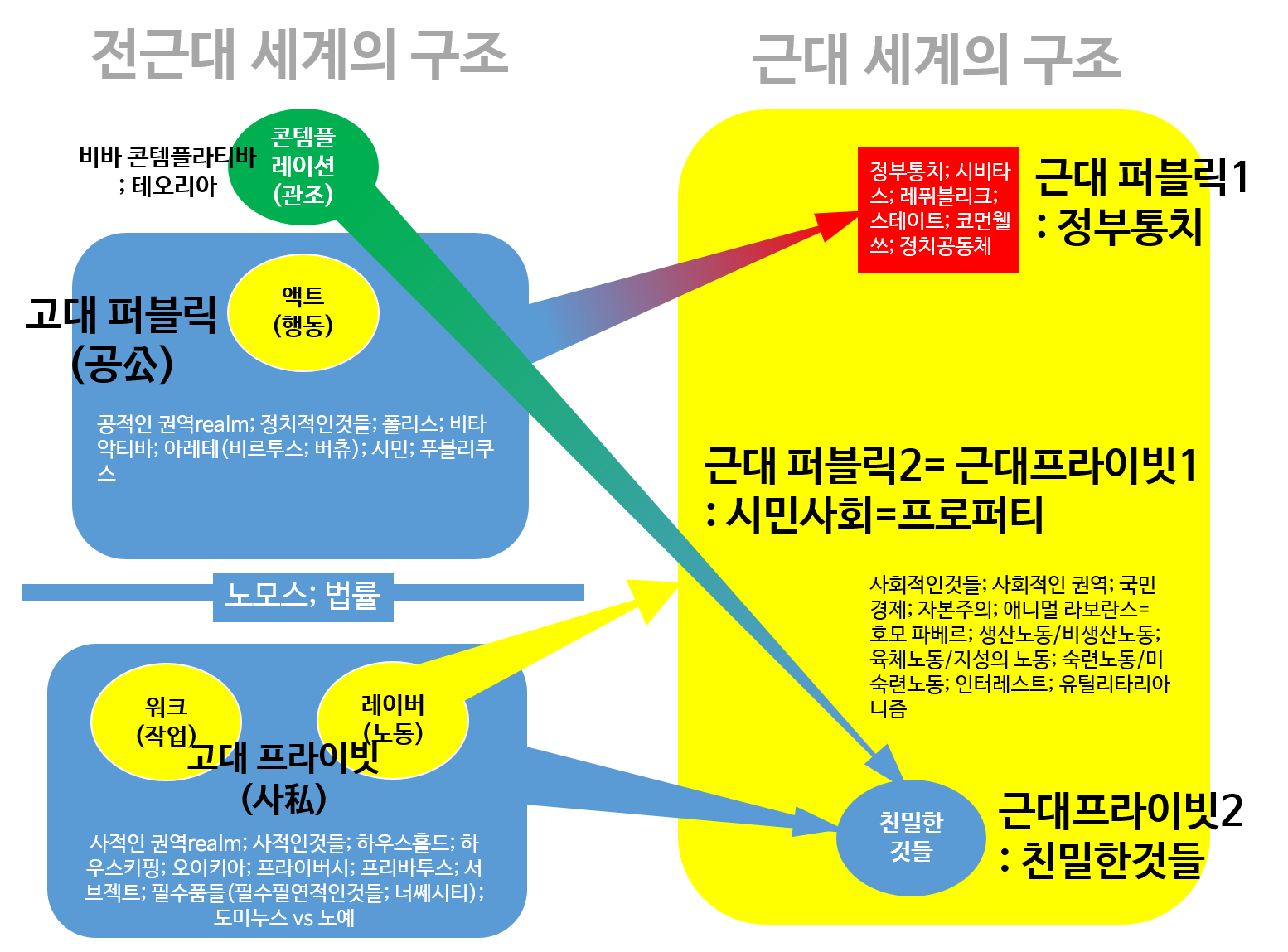 ● 아마도 위 그림은 3/4분면 사회적 교환장을 해부한 것이라고 보면 될 듯 합니다. 그림을 보면 느끼겠지만, <전근대로부터 근대로의 그레이트 트랜스포메이션(대변형)>이 상당히 복잡합니다. 각각의 핵심요소들의 트랜스포지션(자리바꿈)이 아주 복잡합니다. 이러한 복잡한 트랜스포지션들 가운데 유독 가장 먼저 눈에 띄는 것은, <사회적인것들의 출현>입니다.이 사회적인 권역(국민경제)은 전근대문명 안에서는 없었던 것인데, 왜냐하면 전근대문명 안에서는 <하우스홀드; 패밀리>를 벗어나면 직접적으로 <폴리스; 푸블리쿠스>와 맞딱드렸기 때문입니다. 전근대에서 사람은 두가지 방식으로 추방당할 수 있는데, 하나는 패밀리로부터 추방당하는 것이고, 다른하나는 폴리스로부터 추방당하는 것입니다. 둘 다 곧 죽음이지요.그런데 근대에 오면, 사람들은 쉽게 안죽을 수 있게 됩니다. 하우스홀드(패밀리)로부터 추방당해도, 폴리스(정부통치)로부터 추방당해도, 사회가 있고, 친밀한것들이 있기 때문입니다. 아나키즘의 가능성이 여기에 있네요.이런 점(쉽게 안죽는다는 점)은 좋은데, 근대세계의 문제는 사회적인것들이 부르조아유다적인 자본주의 곧 <빈곤하고 불행한이들의 노동과 부르조아유다적인 사적인 프로퍼티 사이의 적대>에 의해서 세계가 관리운영된다는 데에 있습니다. 동일한 달-실재현실을 다른 측면으로 말하자면, 정부통치가 부르조아유다의 인터레스트를 위해, 에 의해 지배조종된다는 것입니다. <넌도미네이션으로써의 프리덤; 이소노미아>가 이 때문에 무효화되고, 왜곡되고, 변질됩니다. 이게 문제입니다.이러한 사회적인것들의 도미네이션(주도장악)을 <하우스 홀드의 국민국가화 또는 경제의 거대화>라고 잠정적으로 불러볼까 합니다. 다시말해서, 근대의 사회적인것들은 국민경제로의 거대팽창과 동시에 액트(비타 악티바)와 콘템플레이션(비타 콘템플라티바) 그리고 프리덤과 진정성의 위축과 무기력을 동반했다는 것입니다.이렇게 무기력해지고 위축된 비타 악티바(액트)를 되살리는 것, 이것이 한나 아렌트의 문제의식이 아닌가하고 나는 표상화합니다. |
| json metadata | {"tags":["kr","sugunzag","hannah-arendt","human-condition","political-philosophy"],"image":["https://cdn.steemitimages.com/DQmQdGk9aUrYiYRaoZJFiJot4LJHoKFdvS7NaCJUV31e5FG/8935664553_f.jpg","https://cdn.steemitimages.com/DQmXjCi59ZerHo6GaWF32ULjgJjYTQcMR6e6g2WTKuXzhai/%ED%94%84%EB%9D%BC%EC%9D%B4%EB%B9%97%ED%8D%BC%EB%B8%94%EB%A6%AD.png"],"app":"steemit/0.1","format":"markdown"} |
| Transaction Info | Block #25943028/Trx d35ecdf686826ae8912c47a6bb0a49dc6873a05a |
View Raw JSON Data
{
"trx_id": "d35ecdf686826ae8912c47a6bb0a49dc6873a05a",
"block": 25943028,
"trx_in_block": 11,
"op_in_trx": 0,
"virtual_op": 0,
"timestamp": "2018-09-14T04:25:06",
"op": [
"comment",
{
"parent_author": "",
"parent_permlink": "kr",
"author": "sugunzag",
"permlink": "3-11",
"title": "한나 아렌트 [인간의 조건상태(인간의 조건)] 3부 11장. 우리 몸체의 노동(애니멀 라보란스) 및 우리 손들의 작업(호모 파베르)",
"body": "\n\n\n\nIII. 노동Labor\n\n11. 우리 몸체의 노동(애니멀 라보란스) 및 우리 손들의 작업(호모 파베르)\"The Labour of Our Body and the Work of Our Hands\"\n\n내가 제안한 노동과 작업의 구별은 생소하다... 정치적인 생각의 전근대적인 전통 안에서건 또는 근대적인 노동이론의 큰 몸체 안에서건 나의 구별을 지원하는 것은 찾기 힘들다. 역사적인 증거가 없음에도 하지만 가즌 유럽언어들은... 동일한 활동을 표현하는... 두 개의 어원학적으로 관계없는 낱말들을 담고 있다(156)The distinction between labor and work which I propose is unusual. The phenomenal evidence in its favor is too striking to be ignored, and yet historically it is a fact that apart from a few scattered remarks, which moreover were never developed even in the theories of their authors, there is hardly anything in either the premodern tradition of political thought or in the large body of modern labor theories to support it. Against this scarcity of historical evidence, however, stands one very articulate and obstinate testimony, namely, the simple fact that every European language, ancient and modern, contains two etymologically unrelated words for what we have to come to think of as the same activity, and retains them in the face of their persistent synonymous usage.\n\n로크의 <작업하는 손들>과 <노동하는 어떤 몸체> 사이의 구별은, <케이로테크네스(장인, 독일어의 한트베르커)>와 <토 소마티 에르가제스타이(주인의 생명삶의 너쎄시티(필수욕구됨; 먹고사니즘)들을 위해서 자체의 몸체들로 대신하는 노예들과 길들여진 동물들처럼 스스로들의 몸체들로써 작업하는)> 사이의 고대 그리스적인 구별을 회상하게 한다. 고대 그리스에서도 이미 노동과 작업은 동일하게 여겨졌다. 왜냐하면 이때 쓰인 낱말은 포네인(노동)이 아니라 에르가세스타이(작업)이기 때문이다(156~ 157)Thus, Locke's distinction between working hands and a laboring body is somewhat reminiscent of the ancient Greek distinction between the cheirotechnes, the craftsman, to whom the German Handwerker corresponds, and those who, like \"slaves and tame animals with their bodies minister to the necessities of life,\" or in the Greek idiom, to somati ergazesthai, work with their bodies(yet even here, labor and work are already treated as identical, since the word used is not ponein [labor] but ergazesthai [work]). \n\n노동에 대한 경멸은 기원적으로 정치적인 활동들 말고는 모든 것을 삼가야함(스콜레)에 대한 강요 및 시민들에게 폴리스의 생명삶을 위한 시간을 더늘리라는 요구들에 의해 확산되었고... 급기야는 노력을 요구하는 가즌거시기들로까지 확대되었다(157)Contempt for laboring, originally arising out of a passionate striving for freedom from necessity and a no less passionate impatience with every effort that left no trace, no monument, no great work worthy of remembrance, spread with the increasing demands of polis life upon the time of the citizens and its insistence on their abstention(skhole) from all but political activities, until it covered everything that demanded an effort. \n\n원주7. 생존을 위한 활동은 18세기에도 여전히 노예의 일로 규정되었다(159)Politics 1258b35 ff. For Aristotle's discussion about admission of banausoi to citizenship see Politics iii. 5. His theory corresponds closely to reality: it is estimated that up to 80 per cent of free labor, work, and commerce consisted of non-citizens, either \"strangers\"(katoikountes and metoikoi) or emancipated slaves who advanced into these classes(see Fritz Heichelheim, Wirtsckaftsgeschichte des Altertums [1938], I, 398 ff.). Jacob Burckhardt, who in his Griechische Kulturgeschichte(Vol. II, sees. 6 and 8) relates Greek current opinion of who does and who does not belong to the class of banausoi, also notices that we do not know of any treatise about sculpture. In view of the many essays on music and poetry, this probably is no more an accident of tradition than the fact that we know so many stories about the great feeling of superiority and even arrogance among the famous painters which are not matched by anecdotes about sculptors. This estimate of painters and sculptors survived many centuries. It is still found in the Renaissance, where sculpturing is counted among the servile arts whereas painting takes up a middle position between liberal and servile arts(see Otto Neurath, \"Beitrage zur Geschichte der Opera Servilia,\" Archivfur Sozialtvissenschaft und Sozialpolitik, Vol. XLI, No. 2 [1915]).. That Greek public opinion in the city-states judged occupations according to the effort required and the time consumed is supported by a remark of Aristotle about the life of shepherds: \"There are great differences in human ways of life. The laziest are shepherds; for they get their food without labor [poms] from tame animals and have leisure [skhohzousin]\"(Politics 1256a3O ff.). It is interesting that Aristotle, probably following current opinion, here mentions laziness(aereia) together with, and somehow as a condition for, skhole, abstention from certain activities which is the condition for a political life. Generally, the modern reader must be aware that aergia and skhole are not the same. Laziness had the same connotations it has for us, and a life of skhole was not considered to be a lazy life. The equation, however, of skhole and idleness is characteristic of a development within the polis. Thus Xenophon reports that Socrates was accused of having quoted Hesiod's line: \"work is no disgrace, but laziness [aergia] is a disgrace.\" The accusation meant that Socrates had instilled in his pupils a slavish spirit(Memorabilia i. 2. 56). Historically, it is important to keep in mind the distinction between the contempt of the Greek city-states for all non-political occupations which arose out of the enormous demands upon the time and energy of the citizens, and the earlier, more original, and more general contempt for activities which serve only to sustain life— ad vitae sustentationem as the opera servilia are still defined in the eighteenth century. In the world of Homer, Paris and Odysseus help in the building of their houses, Nausicaa herself washes the linen of her brothers, etc. All this belongs to the self-sufficiency of the Homeric hero, to his independence and the autonomic supremacy of his person. No work is sordid if it means greater independence; the selfsame activity might well be a sign of slavishness if not personal independence but sheer survival is at stake, if it is not an expression of sovereignty but of subjection to necessity. The different estimate of craftsmanship in Homer is of course well known. But its actual meaning is beautifully presented in a recent essay by Richard Harder, Eigenart derGriechen(1949). \n\n인간활동들에 대한 고대인들의 견적은, 욕구들에 의해서 필수욕구적이 되는 우리 몸체의 노동은 노예적이라는 확신에 근거하고 있다. 그래서 비록 노동하기는 아니지만, 생명삶의 너쎄시티(필수욕구됨; 먹고사니즘)들을 제공하기 위해 떠맡겨지는 직업들은 모두 노동의 신분지위에 동화되었다... 생명삶의 유지를 위한 욕구들에 용역하는 모든 직업들의 노예적 본성 때문에 노예들을 포제쎤하는 것이 필요하다고 생각되었다. 정확하게 노예제도를 방어하고 떳떳케한 것은 바로 이 논리였다. 노동한다는 것은 너쎄시티(필수욕구됨; 먹고사니즘)에 의해 노예화되는 것을 의미했다. 그리고 이러한 노예화는 인간생명삶의 조건상태들 안에 내재된 것이었다. 생명삶의 너쎄시티(필수욕구됨; 먹고사니즘)들에 의해 도미네이션되기 때문에, 너쎄시티(필수욕구됨; 먹고사니즘)에 예속된 노예들을 강제력에 의해서 도미네이션하기를 통해서만 사람들은 오직 스스로들의 프리덤을 승리해낼 수 있다. 노예로의 퇴행이라는 것은 숙명의 어떤 일격이었고 죽음보다 더 나쁜 어떤 숙명이었다. 왜냐하면 그것은 사람을 길들여진 어떤 동물을 닮은 어떤거시기로 메타모르포시스시키는 것이기 때문이다(160)We shall see later that, quite apart from their contempt for labor, the Greeks had reasons of their own to mistrust the craftsman, or rather, the homo faber mentality. This mistrust, however, is true only of certain periods, whereas all ancient estimates of human activities, including those which, like Hesiod, supposedly praise labor, rest on the conviction that the labor of our body which is necessitated by its needs is slavish. Hence, occupations which did not consist in laboring, yet were undertaken not for their own sake but in order to provide the necessities of life, were assimilated to the status of labor, and this explains changes and variations in their estimation and classification at different periods and in different places. The opinion that labor and work were despised in antiquity because only slaves were engaged in them is a prejudice of modern historians. The ancients reasoned the other way around and felt it necessary to possess slaves because of the slavish nature of all occupations that served the needs for the maintenance of life. It was precisely on these grounds that the institution of slavery was defended and justified. To labor meant to be enslaved by necessity, and this enslavement was inherent in the conditions of human life. Because men were dominated by the necessities of life, they could win their freedom only through the domination of those whom they subjected to necessity by force. The slave's degradation was a blow of fate and a fate worse than death, because it carried with it a metamorphosis of man into something akin to a tame animal. A change in a slave's status, therefore, such as manumission by his master or a change in general political circumstance that elevated certain occupations to public relevance, automatically entailed a change in the slave's \"nature.\"\n\n노예제도는 노동을 생명삶의 조건상태들로부터 배제하기 위한 어떤 장치였다(161)The institution of slavery in antiquity, though not in later times, was not a device for cheap labor or an instrument of exploitation for profit but rather the attempt to exclude labor from the conditions of man's life. \n\n원주10. 에우리피데스는... 노예라는 것은 모든 것을 밥통의 관점에서 바라본다고 말했다(161)It is in this sense that Euripides calls all slaves \"bad\": they see everything from the viewpoint of the stomach(Suppiementum Eutipideum, ed. Arnim, frag. 49, no. 2). \n\n고전고대에 노동과 작업 사이의 구별이 무시되었다는 것은 놀랍지 않다(162)It is not surprising that the distinction between labor and work was ignored in classical antiquity. 사적인 하우스홀드와 공적인 정치적인 권역 사이의 차이, 하우스홀드의 수용된이(노예)와 하우스홀드 우두머리(시민) 사이의 차이, 프라이버시(사적임) 안에 감춰져야할 활동들(노동, 작업)과 보여지고, 들려지고, 기억되어져야할 값어치있는 활동들(행동, 발언) 사이의 차이가 모든 다른 차이들을 무색하게 만들었고, 결국 오직 하나의 평가기준만이 남게 되었다: 시간과 노력의 더커다란 총량을 사적으로 썼는가, 아니면 공적으로 썼는가?(162)The differentiation between the private household and the public political realm, between the household inmate who was a slave and the household head who was a citizen, between activities which should be hidden in privacy and those which were worth being seen, heard, and remembered, overshadowed and predetermined all other distinctions until only one criterion was left: is the greater amount of time and effort spent in private or in public? 직업은 사적인 거시기를 위한 배려인가, 아니면 공적인 거시기를 위한 배려인가?(162)is the occupation motivated by cura privati negotii or cura rei publicae, care for private or for public business? 심지어는 활동들 사이에 최소한 구별되었던, 이러한 구별마저도, 정치적인 이론의 일어남과더불어써, 관조를 활동의 모든 종류들에 대립시켜버림에 의해, 사라졌다(162)With the rise of political theory, the philosophers overruled even these distinctions, which had at least distinguished between activities, by opposing contemplation to all kinds of activity alike. (이제는) 심지어는 정치적인 활동마저도 너쎄시티(필수욕구됨; 먹고사니즘)의 신분지위를 향해 평준화되어졌고, 너쎄시티(필수욕구됨; 먹고사니즘)이 따라서 비타 악티바 속의 모든 분절들의 공통분모가 되었다(162)With them, even political activity was leveled to the rank of necessity, which henceforth became the common denominator of all articulations within the vita activa. Nor can we reasonably expect any help from Christian political thought, which accepted the philosophers' distinction, refined it, and, religion being for the many and philosophy only for the few, gave it general validity, binding for all men. \n\n근대는 모든 전통들을 뒤집어 버렸다. 근대는 행동과 관조 사이의 전통적인 신분지위를 비타 악티바 속의 전통적인 위계서열에 불과한 것으로 뒤집어 버렸다. 노동을 모든 가치들의 원천으로 영광스럽게 만들었고, 근대는 전통적으로 이성적인 동물이 붙들고 있었던 지위로까지 노동하는 동물을 신분상승시켰다. 이러한 근대였음에도 놀랍게도 애니멀 라보란스(우리 몸체의 노동)와 호모 파베르(우리 손들의 작업)를 깨끗하게 구별하는 단일한 어떤 이론을 내놓지 못했다(162)It is surprising at first glance, however, that the modern age— with its reversal of all traditions, the traditional rank of action and contemplation no less than the traditional hierarchy within the vita activa itself, with its glorification of labor as the source of all values and its elevation of the animal laborans to the position traditionally held by the animal rationale— should not have brought forth a single theory in which animal laborans and homo faber, \"the labour of our body and the work of our hands,\" are clearly distinguished. 그대신에 첫째로 생산적인 노동과 비생산적인 노동 사이의 구별, 나중에는 숙련된 노동과 미숙련노동 사이의 구별, 마지막으로 육체노동과 지성의 노동 사이의 구별을 근대는 발견했다(162)Instead, we find first the distinction between productive and unproductive labor, then somewhat later the differentiation between skilled and unskilled work, and, finally, outranking both because seemingly of more elementary significance, the division of all activities into manual and intellectual labor. Of the three, however, only the distinction between productive and unproductive labor goes to the heart of the matter, and it is no accident that the two greatest theorists in the field, Adam Smith and Karl Marx, based the whole structure of their argument upon it. The very reason for the elevation of labor in the modern age was its \"productivity,\" and 하나님이 아니라 노동이 사람을 창조했고 또는 이성이 아니라 노동이 사람을 다른 동물들로부터 구별한다는 불경스럽게 보이는 맑스의 개념 오직 근대가 전일적으로 합의한 바인 어떤 사실을 래디컬하고 공통-지속적으로 형태식화한 것일 따름이다(163)the seemingly blasphemous notion of Marx that labor(and not God) created man or that labor(and not reason) distinguished man from the other animals was only the most radical and consistent formulation of something upon which the whole modern age was agreed.\n\n원주14. \"The creation of man through human labor\" was one of the most persistent ideas of Marx since his youth. It can be found in many variations in the Jugendschriften(where in the \"Kritik der Hegelschen Dialektik\" he credits Hegel with it).(See Marx-Engels Gesamtausgabe, Part I, Vol. 5 [Berlin, 1932], pp. 156 and 167.) That Marx actually meant to replace the traditional definition of man as an animal rationale by defining him as an animal laborans is manifest in the context. The theory is strengthened by a sentence from the Deutsche Ideologic which was later deleted: \"Der erste geschichtliche Akt dieser Individuen, wodurch sie sich von den Tieren unterscheiden, ist nicht, dass sie denken, sondern, dass sie anfangen ihre Lebensmittel zu produzieren\"(ibid., p. 568). Similar formulations occur in the \"Okonomisch-philosophische A4anuskripte\"(ibid., p. 125), and in \"Die heilige Familie\"(ibid., p. 189). Engels used similar formulations many times, for instance in the Preface of 1884 to Ursprung der Familie or in the newspaper article of 1876, \"Labour in the Transition from Ape to Man\"(see Marx and Engels, Selected works [London, 1950], Vol. II). 노동이 사람을 동물로부터 구별한다고 처음 주장한이는 맑스가 아니라 흄이다(163)It seems that Hume, and not Marx, was the first to insist that labor distinguishes man from animal(Adriano Tilgher, Homo faber [1929]; English ed.: work: What It Has Meant to Men through the Ages [1930]). As labor does not play any significant role in Hume's philosophy, this is of historical interest only; to him, this characteristic did not make human life more productive, but only harsher and more painful than animal life. It is, however, interesting in this context to note with what care Hume repeatedly insisted that neither thinking nor reasoning distinguishes man from animal and that the behavior of beasts demonstrates that they are capable of both. \n\nMoreover, both Smith and Marx were in agreement with modern public opinion when they despised unproductive labor as parasitical, actually a kind of perversion of labor, as though nothing were worthy of this name which did not enrich the world. Marx certainly shared Smith's contempt for the \"menial servants\" who like \"idle guests... leave nothing behind them in return for their consumption.\"16 Yet it was precisely these menial servants, these household inmates, oiketai or familiares, laboring for sheer subsistence and needed for effortless consumption rather than for production, whom all ages prior to the modern had in mind when they identified the laboring condition with slavery. What they left behind them in return for their consumption was nothing more or less than their masters' freedom or, in modern language, their masters' potential productivity. \n\nIn other words, 생산적인 노동과 비생산적인 노동 사이의 구별은... 작업과 노동 사이의 보다 근본기초적인 구별을 담고 있다(164)the distinction between productive and unproductive labor contains, albeit in a prejudicial manner, the more fundamental distinction between work and labor.16 It is indeed the mark of all laboring that it leaves nothing behind, that the result of its effort is almost as quickly consumed as the effort is spent. And yet this effort, despite its futility, is born of a great urgency and motivated by a more powerful drive than anything else, because life itself depends upon it. 근대는 일반적으로 그리고 맑스는 파티큘라하게, 모든 노동을 작업으로 간주한 나머지, 애니멀 라보란스라고 불러야 할 것을 호모 파베르라고 발언했다(164)The modern age in general and Karl Marx in particular, overwhelmed, as it were, by the unprecedented actual productivity of Western mankind, had an almost irresistible tendency to look upon all labor as work and to speak of the animal laborans in terms much more fitting for homo faber, hoping all the time that only one more step was needed to eliminate labor and necessity altogether.17 \n\nNo doubt 행동현실적으로 노동을 숨겨진 (사적인 권역)으로부터 꺼내와서, 노동을 조직화하고 '분할'하는 공적인 권역 안을향해 끌어들이는 역사적인 개발이 이루어졌다(165)the actual historical development that brought labor out of hiding and into the public realm, where it could be organized and \"divided,\"18 constituted a powerful argument in the development of these theories. Yet an even more significant fact in this respect, already sensed by the classical economists and clearly discovered and articulated by Karl Marx, is that the laboring activity itself, regardless of historical circumstances and independent of its location in the private or the public realm, possesses indeed a \"productivity\" of its own, no matter how futile and non-durable its products may be. This productivity does not lie in any of labor's products but in the human \"power,\" whose strength is not exhausted when it has produced the means of its own subsistence and survival but is capable of producing a \"surplus,\" that is, more than is necessary for its own \"reproduction.\" It is because not labor itself but the surplus of human \"labor power\"(Arbeitskraft) explains labor's productivity that Marx's introduction of this term, as Engels rightly remarked, constituted the most original and revolutionary element of his whole system.19 새로운 오브젝트들을 인간의 인공체에 더하는 작업의 생산성과 다르게, 노동력의 생산성은 오브젝트들을 오직 우발적으로 생산하고, 1차적으로 자체의 재생산의 수단자산에만 관심을 갖는다(165)Unlike the productivity of work, which adds new objects to the human artifice, the productivity of labor power produces objects only incidentally and is primarily concerned with the means of its own reproduction; since its power is not exhausted when its own reproduction has been secured, it can be used for the reproduction of more than one life process, but 노동력은 생명삶 말고는 결코 아무것도 생산하지 못한다(166)it never \"produces\" anything but life.20 Through violent oppression in a slave society or exploitation in the capitalist society of Marx's own time, it can be channeled in such a way that the labor of some suffices for the life of all. \n\n16. The distinction between productive and unproductive labor is due to the physiocrats, who distinguished between producing, property-owning, and sterile classes. Since they held that the original source of all productivity lies in the natural forces of the earth, their standard for productivity was related to the creation of new objects and not to the needs and wants of men. Thus, the Marquis de iVIirabeau, father of the famous orator, calls sterile \"la classe d'ouvriers dont les travaux, quoique necessaires aux besoins des hommes et utiles a la societe, ne sont pas neanmoins productifs\" and illustrates his distinction between sterile and productive work by comparing it to the difference between cutting a stone and producing it(see Jean Dautry, \"La notion de travail chez Saint-Simon et Fourier,\" Journal de psychologie normale et fathologique, Vol. LII, No. 1 [January-March, 1955]). \n\n17. This hope accompanied Marx from beginning to end. We find it already in the Deutsche Ideologie: \"Es handelt sich nicht darum die Arbeit zu befreien, sondern sie aufzuheben\"(Gesamtausgabe, Part I, Vol. 3, p. 185) and many decades later in the third volume of Das Kapital, ch. 48: \"Das Reich der Freiheit beginnt in der Tat erst da, wo das Arbeiten... aufhort\"(Marx-Engels Gesamtausgabe, Part II [Zurich, 1933], p. 873). \n\n18. In his Introduction to the second book of the wealth of Nations(Everyman's ed., I, 241 ff.), Adam Smith emphasizes that productivity is due to the division of labor rather than to labor itself. \n\n19. See Engels' Introduction to Marx's \"Wage, Labour and Capital\"(in Marx and Engels, Selected works [London, 1950], I, 384), where Marx had introduced the new term with a certain emphasis. \n\n20. Marx stressed always, and especially in his youth, that the chief function of labor was the \"production of life\" and therefore saw labor together with procreation(see Deutsche Ideologic, p. 19; also \"Wage, Labour and Capital,\" p. 77). \n\nFrom 근대의 전일적인 관점인, 이러한 순수하게 사회적인 관점은... 맑스에게서 가장 일관되고 커다란 표현을 얻었다(166)this purely social viewpoint, which is the viewpoint of the whole modem age but which received its most coherent and greatest expression in Marx's work, all laboring is \"productive,\" and the earlier distinction between the performance of \"menial tasks\" that leave no trace and the production of things durable enough to be accumulated loses its validity. The social viewpoint is identical, as we saw before, with an interpretation that takes nothing into account but the life process of mankind, and within its frame of reference all things become objects of consumption. 완전하게 \"사회화된 인류\" 속에서 노동과 작업 사이의 구별은 완전하게 사라지고, 모든 작업은 노동이 되고 말 것이다(167)Within a completely \"socialized mankind,\" whose sole purpose would be the entertaining of the life process— and this is the unfortunately quite unutopian ideal that guides Marx's theories21— the distinction between labor and work would have completely disappeared; all work would have become labor because all things would be understood, not in their worldly, objective quality, but as results of living labor power and functions of the life process.22 \n\n21. The terms vergesellschafteter Mensch or gesellschaftliche Menschheit were frequently used by Marx to indicate the goal of socialism(see, for instance, the third volume of Das Kapital, p. 873, and the tenth of the \"Theses on Feuerbach\": \"The standpoint of the old materialism is 'civil' society; the standpoint of the new is human society, or socialized humanity\"(Selected works, II, 367]). It consisted in the elimination of the gap between the individual and social existence of man, so that man \"in his most individual being would be at the same time a social being [a Gemeintaesen]\"(Jugendschriften, p. 113). Marx frequently calls this social nature of man his Gattungstoesen, his being a member of the species, and the famous Marxian \"self-alienation\" is first of all man's alienation from being a Gattungsivesen(ibid., p. 89: \"Eine unmittelbare Konsequenz davon, dass der Mensch dem Produkt seiner Arbeit, seiner Lebenstatigkeit, seinem Gattungswesen entfremdet ist, ist die Entfremdung des Menschen von dem Menschen\"). The ideal society is a state of affairs where all human activities derive as naturally from human \"nature\" as the secretion of wax by bees for making the honeycomb; to live and to labor for life will have become one and the same, and life will no longer \"begin for [the laborer] where [the activity of laboring] ceases\"(\"Wage, Labour and Capital,\" p. 77). \n\n22. Marx's original charge against capitalist society was not merely its transformation of all objects into commodities, but that \"the laborer behaves toward the product of his labor as to an alien object\"(\"dass der Arbeiter zum Produkt seiner Arbeit als einem fremden Gegenstand sich verhalt\" [Jugendschriften, p. 83])— in other words, that the things of the world, once they have been produced by men, are to an extent independent of, \"alien\" to, human life. \n\nIt is interesting to note that the distinctions between skilled and unskilled and between intellectual and manual work play no role in either classical political economy or in Marx's work. Compared with the productivity of labor, they are indeed of secondary importance. Every activity requires a certain amount of skill, the activity of cleaning and cooking no less than the writing of a book or the building of a house. The distinction does not apply to different activities but notes only certain stages and qualities within each of them. It could acquire a certain importance through the modem division of labor, where tasks formerly assigned to the young and inexperienced were frozen into lifelong occupations. But this consequence of the division of labor, where one activity is divided into so many minute parts that each specialized performer needs but a minimum of skill, tends to abolish skilled labor altogether, as Marx rightly predicted. Its result is that what is bought and sold in the labor market is not individual skill but \"labor power,\" of which each living human being should possess approximately the same amount. Moreover, since unskilled work is a contradiction in terms, the distinction itself is valid only for the laboring activity, and the attempt to use it as a major frame of reference already indicates that the distinction between labor and work has been abandoned in favor of labor. \n\nQuite different is the case of the more popular category of manual and intellectual work. Here, the underlying tie between the laborer of the hand and the laborer of the head is again the laboring process, in one case performed by the head, in the other by some other part of the body. thinking, however, which is presumably the activity of the head, though it is in some way like laboring— also a process which probably comes to an end only with life itself— is even less \"productive\" than labor; if labor leaves no permanent trace, thinking leaves nothing tangible at all. By itself, thinking never materializes into any objects. Whenever the intellectual worker wishes to manifest his thoughts, he must use his hands and acquire manual skills just like any other worker. In other words, thinking and working are two different activities which never quite coincide; the thinker who wants the world to know the \"content\" of his thoughts must first of all stop thinking and remember his thoughts. Remembrance in this, as in all other cases, prepares the intangible and the futile for their eventual materialization; 기억은 작업과정의 시작이다(168)it is the beginning of the work process, and like the craftsman's consideration of the model which will guide his work, its most immaterial stage. The work itself then always requires some material upon which it will be performed and which through fabrication, 호모 파베르의 활동은 세계있음의 어떤 오브젝트로 (기억을) 트랜스포메이션시킨다(168)the activity of homo faber, will be transformed into a worldly object. 지성의 작업의 특별한 작업성질은 (다른 작업과 마찬가지로) \"우리의 손들의 작업\"이라는 점이다(168)The specific work quality of intellectual work is no less due to the \"work of our hands\" than any other kind of work. \n\nIt seems plausible and is indeed quite common to connect and justify the modern distinction between intellectual and manual labor with 아르스 리베랄리스(리버럴 아트들)와 아르스 세르빌리스(서빌 아트들) 사이의 구별은... 지성의 더높은 등급정도도 아니고... 두뇌로 하는 작업하는 '자유로운 예술가'와 손을 쓰는 '천한 상인' 사이의 구별도 아니다(168)the ancient distinction between \"liberal\" and \"servile arts.\" Yet the distinguishing mark between liberal and servile arts is not at all \"a higher degree of intelligence,\" or that the \"liberal artist\" works with his brain and the \"sordid tradesman\" with his hands. 고대의 평가기준은 1차적으로 정치적이다(168)The ancient criterion is primarily political. 정치가들의 버츄인 신중한 판단의 역량인 프루덴티아를 갖는 직업들이나, 그리고 공적인 적합성(인간에게 효용있는)의 전문가들은... 자유롭다(169)Occupations involving prudentia, the capacity for prudent judgment which is the virtue of statesmen, and professions of public relevance(ad hominum utilitatem)™ such as architecture, medicine, and agriculture,24 are liberal. (둘째로) 모든 교역들, 어떤 목수의 거래와 다를 바 없는 어떤 글씨의 거래는, 어엿한 시민에게는 어울리지 않는, \"천한\" 것이다(169)All trades, the trade of a scribe no less than that of a carpenter, are \"sordid,\" unbecoming for a full-fledged citizen, and (천한것들 가운데) 가장 최악은 가장 쓸모있다고 여기는 것들, '생선장사, 백정, 요리사, 새장수 그리고 어부들\"이다(169)the worst are those we would deem most useful, such as \"fishmongers, butchers, cooks, poulterers and fishermen.\"25 But not even these are necessarily sheer laboring. There is still 셋째 범주분류는 수고와 노력 자체가 돈을 받는다. 그리고 이 경우 '바로 그 임금이 노예의 표시이다'(169)a third category where the toil and effort itself(the operae as distinguished from the opus, the mere activity as distinguished from the work) is paid, and in these cases \"the very wage is a pledge of slavery.\"26 \n\n23. For convenience' sake, I shall follow Cicero's discussion of liberal and servile occupations in De officiis i. 50-54. The criteria of prudentia and utilitas or utilitas hominum are stated in pars. 151 and 155.(The translation of prudentia as \"a higher degree of intelligence\" by Walter Miller in the Loeb Classical Library edition seems to me to be misleading.) \n\n24. The classification of agriculture among the liberal arts is, of course, specifically Roman. It is not due to any special \"usefulness\" of farming as we would understand it, but much rather related to the Roman idea oipatria, according to which the ager Romctnus and not only the city of Rome is the place occupied by the public realm. \n\n25. It is this usefulness for sheer living which Cicero calls mediocris utilitas (par. 151) and eliminates from liberal arts. The translation again seems to me to miss the point; these are not \"professions . .. from which no small benefit to society is derived,\" but occupations which, in clear opposition to those mentioned before, transcend the vulgar usefulness of consumer goods. \n\nThe distinction between manual and intellectual work, though its origin can be traced back to the Middle Ages,27 is modern and has two quite different causes, both of which, however, are equally characteristic of the general climate of the modern age. Since under modern conditions every occupation had to prove its \"usefulness\" for society at large, and since the usefulness of the intellectual occupations had become more than doubtful because of the modern glorification of labor, it was only natural that intellectuals, too, should desire to be counted among the working population. At the same time, however, and only in seeming contradiction to this development, the need and esteem of this society for certain \"intellectual\" performances rose to a degree unprecedented in our history except in the centuries of the decline of the Roman Empire. It may be well to remember in this context that throughout ancient history the \"intellectual\" services of the scribes, whether they served the needs of the public or the private realm, were performed by slaves and rated accordingly. Only the bureaucratization of the Roman Empire and the concomitant social and political rise of the Emperors brought a re-evaluation of \"intellectual\" services.28 In so far as the intellectual is indeed not a \"worker\"— who like all other workers, from the humblest craftsman to the greatest artist, is engaged in adding one more, if possible durable, thing to the human artifice— he resembles perhaps nobody so much as Adam Smith's \"menial servant,\" although his function is less to keep the life process intact and provide for its regeneration than to care for the upkeep of the various gigantic bureaucratic machines whose processes consume their services and devour their products as quickly and mercilessly as the biological life process itself.29 \n\n26. The Romans deemed the difference between opus and operae to be so decisive that they had two different forms of contract, the locatio opens and the locatio operarum, of which the latter played an insignificant role because most laboring was done by slaves(see Edgar Loening, in Handivorterbuch der Staatswissenschaften [1890], I, 742 ff.). \n\n27. The opera liberalia were identified with intellectual or rather spiritual work in the Middle Ages(see Otto Neurath, \"Beitrage zur Geschichte der Opera Servilia,\" Archivfur Sozialwissenschaft und Sozialpolkik, Vol. XLI [1915], No. 2). \n\n28. H. Wallon describes this process under the rule of Diocletian: \"... les fonctions jadis serviles se trouverent anoblies, elevees au premier rang de Flstat. Cette haute consideration qui de Fempereur se re'pandait sur les premiers serviteurs du palais, sur les plus hauts dignitaires de 1'empire, descendait a tous les degres des fonctions publiques . .. ; le service public devint un office public.\" \"Les charges les plus serviles, ... les noms que nous avons cites aux fonctions de l'esclavage, sont revetus de l'eclat qui rejaillit de la personne du prince\"(Histoire de l'esclavage dans I'antiquite [1847], III, 126 and 131). Before this elevation of the services, the scribes had been classified with the watchmen of public buildings or even with the men who led the prize fighters down to the arena {ibid., p. 171). 지식인들의 신분상승이 관료통치의 수립과 일치한다는 것은 주목할 값어치가 있다(170)It seems noteworthy that the elevation of the \"intellectuals\" coincided with the establishment of a bureaucracy. \n\n29. \"The labour of some of the most respectable orders in the society is, like that of menial servants, unproductive of any value,\" says Adam Smith and ranks among them \"the whole army and navy,\" the \"servants of the public,\" and the liberal professions, such as \"churchmen, lawyers, physicians, men of letters of all kinds.\" Their work, \"like the declamation of the actors, the harangue of the orator, or the tune of the musician... perishes in the very instant of its production\"(op. cit., I, 295-96). Obviously, Smith would not have had any difficulty classifying our \"white-collar jobs.\" \n\n● 써위까지가 3부 11장 우리 몸체의 노동(애니멀 라보란스) 및 우리 손들의 작업(호모 파베르)\"The Labour of Our Body and the Work of Our Hands\" 가운데서 나에게 다가온 글귀들입니다.아렌트는 이 11장 안에서, 주로 맑스 정치경제학의 핵심개념용어인 \"노동\"을 중심으로, 아렌트의 독특한 구별인 <애니멀 라보란스(레이버) vs 호모 파베르(워크)>를 비교검토합니다.* <포네인= 레이버= 우리 몸체의 노동= 애니멀 라보란스> vs <에르가제스타이= 워크= 우리 손들의 작업= 호모 파베르>1) 어원학적으로 어휘론적으로 훈고학적으로 <포네인(레이버) vs 에르가제스타이(워크)>라는 두 개념낱말의 다른 기원을 살핀 뒤,2) 고대 그리스 도시국가의 공적인 정치적인 권역(액트) 안에서, 포네인(레이버)= 에르가세스타이(워크)를 어떻게 가치평가되었었는지를 밝힙니다. 그리고 여기서 멈추게 아니라, 공적인 정치적인 권역 곧 비타 악티바마저도, (고대 그리스 정치철학자들 및 중세 그리스도교의 등장과 그 스콜라신학에 의해서) 비타 콘템플라티바(테오리아; 관조)의 일어남 때문에, 포네인/에르가제스타이와 동급평준화되어짐도 이야기합니다.3) 이러한 관조의 우뚝섬과 노동/작업/행동의 하향평준화는 중세 내내 유지되었는데, 마침내 근대에 와서 사회적인것들(국민경제학)의 일어남이 이러한 전통적인 위계서열을 뒤집어버리기는 했지만, 그러나 다른한편으로 근대에서도 <애니멀 라보란스와 호모 파베르의 동일시는 여전하다>고 아렌트는 지적합니다. 아렌트는 로크- 흄- 스미스- 프루동- 맑스로 이어지는 근대의 경제학 안에서의 노동 개념을 (맑스의 노동 개념을 중심으로) 살핍니다. 기억할만한 부분: 생산노동 vs 비생산노동, 숙련노동 vs 미숙련노동, 육체노동 vs 지성의 노동. 이런 새로 나타난 노동의 3개 범주분류들을 아렌트는 분석합니다. 이러한 3개의 분석들 가운데서 특히 3번째가 흥미롭습니다. 근대 국민경제학의 <육체노동 vs 지성의 노동>을 그것의 중세적인 구별에 해당하는 <아르스 리베랄리스 vs 아르스 세르빌리스>와 비교하고, 다시 고대의 <리버럴 오큐패이션 vs 소르디드(천한) 오큐패이션 vs 슬레이버리 오큐패이션>과 비교하는 부분입니다. 이미 앞에서도 여러차례 봐왔던 바에 따르자면, [인간의 조건상태(인간의 조건)]이라는 책 안에서, 아렌트의 생각의 촛점은 <비타 악티바(액션)를 되살리는 데>에 있습니다. 이 목적을 이뤄내려면, 첫째로, 고대 및 중세 정치철학자들의 비타 콘템플라티바(관조) 우월주의를 이겨내야 하고, 둘째로, 근대 정치경제학자들(특히 맑스)의 애니멀 라보란스= 호모 파베르 동일시 및 레이버의 신격화를 깨트려야 하고, 셋째로, 사회적인것들(국민경제)의 일어남 때문에 팽배해진 순응주의/생각하지않음/대중사회/다수자의 티란니/고독/소외 등등 탓에 위축되고 무기력해진 비타 악티바(정치적인것들)를 다시금 개발성숙시켜야 합니다.이러한 <비타 악티바 부활프로젝트>에 의해서 파헤쳐지고 점차 모습을 내보이기 시작하는 아렌트의 가치설계/ 개념설계/제도 및 정책설계의 제시를 따라가는 것은 나에게는 아주 어렵지만 설레는 일입니다.\n\n\n\n\n\n\n● 아마도 위 그림은 3/4분면 사회적 교환장을 해부한 것이라고 보면 될 듯 합니다. 그림을 보면 느끼겠지만, <전근대로부터 근대로의 그레이트 트랜스포메이션(대변형)>이 상당히 복잡합니다. 각각의 핵심요소들의 트랜스포지션(자리바꿈)이 아주 복잡합니다. 이러한 복잡한 트랜스포지션들 가운데 유독 가장 먼저 눈에 띄는 것은, <사회적인것들의 출현>입니다.이 사회적인 권역(국민경제)은 전근대문명 안에서는 없었던 것인데, 왜냐하면 전근대문명 안에서는 <하우스홀드; 패밀리>를 벗어나면 직접적으로 <폴리스; 푸블리쿠스>와 맞딱드렸기 때문입니다. 전근대에서 사람은 두가지 방식으로 추방당할 수 있는데, 하나는 패밀리로부터 추방당하는 것이고, 다른하나는 폴리스로부터 추방당하는 것입니다. 둘 다 곧 죽음이지요.그런데 근대에 오면, 사람들은 쉽게 안죽을 수 있게 됩니다. 하우스홀드(패밀리)로부터 추방당해도, 폴리스(정부통치)로부터 추방당해도, 사회가 있고, 친밀한것들이 있기 때문입니다. 아나키즘의 가능성이 여기에 있네요.이런 점(쉽게 안죽는다는 점)은 좋은데, 근대세계의 문제는 사회적인것들이 부르조아유다적인 자본주의 곧 <빈곤하고 불행한이들의 노동과 부르조아유다적인 사적인 프로퍼티 사이의 적대>에 의해서 세계가 관리운영된다는 데에 있습니다. 동일한 달-실재현실을 다른 측면으로 말하자면, 정부통치가 부르조아유다의 인터레스트를 위해, 에 의해 지배조종된다는 것입니다. <넌도미네이션으로써의 프리덤; 이소노미아>가 이 때문에 무효화되고, 왜곡되고, 변질됩니다. 이게 문제입니다.이러한 사회적인것들의 도미네이션(주도장악)을 <하우스 홀드의 국민국가화 또는 경제의 거대화>라고 잠정적으로 불러볼까 합니다. 다시말해서, 근대의 사회적인것들은 국민경제로의 거대팽창과 동시에 액트(비타 악티바)와 콘템플레이션(비타 콘템플라티바) 그리고 프리덤과 진정성의 위축과 무기력을 동반했다는 것입니다.이렇게 무기력해지고 위축된 비타 악티바(액트)를 되살리는 것, 이것이 한나 아렌트의 문제의식이 아닌가하고 나는 표상화합니다.",
"json_metadata": "{\"tags\":[\"kr\",\"sugunzag\",\"hannah-arendt\",\"human-condition\",\"political-philosophy\"],\"image\":[\"https://cdn.steemitimages.com/DQmQdGk9aUrYiYRaoZJFiJot4LJHoKFdvS7NaCJUV31e5FG/8935664553_f.jpg\",\"https://cdn.steemitimages.com/DQmXjCi59ZerHo6GaWF32ULjgJjYTQcMR6e6g2WTKuXzhai/%ED%94%84%EB%9D%BC%EC%9D%B4%EB%B9%97%ED%8D%BC%EB%B8%94%EB%A6%AD.png\"],\"app\":\"steemit/0.1\",\"format\":\"markdown\"}"
}
]
}2018/09/11 16:10:33
2018/09/11 16:10:33
| parent author | sugunzag |
| parent permlink | 2-10 |
| author | steemitboard |
| permlink | steemitboard-notify-sugunzag-20180911t161035000z |
| title | |
| body | Congratulations @sugunzag! You have completed the following achievement on the Steem blockchain and have been rewarded with new badge(s) : [](http://steemitboard.com/@sugunzag) Award for the number of posts published <sub>_Click on the badge to view your Board of Honor._</sub> <sub>_If you no longer want to receive notifications, reply to this comment with the word_ `STOP`</sub> **Do not miss the last post from @steemitboard:** <table><tr><td><a href="https://steemit.com/steemitboard/@steemitboard/steemitboard-witness-update-2018-09-07"><img src="https://steemitimages.com/64x128/http://i.cubeupload.com/7CiQEO.png"></a></td><td><a href="https://steemit.com/steemitboard/@steemitboard/steemitboard-witness-update-2018-09-07">SteemitBoard - Witness Update</a></td></tr></table> > Support [SteemitBoard's project](https://steemit.com/@steemitboard)! **[Vote for its witness](https://v2.steemconnect.com/sign/account-witness-vote?witness=steemitboard&approve=1)** and **get one more award**! |
| json metadata | {"image":["https://steemitboard.com/img/notify.png"]} |
| Transaction Info | Block #25870759/Trx 12924b51397e82aa48b7342fa837b12d586d8b2d |
View Raw JSON Data
{
"trx_id": "12924b51397e82aa48b7342fa837b12d586d8b2d",
"block": 25870759,
"trx_in_block": 64,
"op_in_trx": 0,
"virtual_op": 0,
"timestamp": "2018-09-11T16:10:33",
"op": [
"comment",
{
"parent_author": "sugunzag",
"parent_permlink": "2-10",
"author": "steemitboard",
"permlink": "steemitboard-notify-sugunzag-20180911t161035000z",
"title": "",
"body": "Congratulations @sugunzag! You have completed the following achievement on the Steem blockchain and have been rewarded with new badge(s) :\n\n[](http://steemitboard.com/@sugunzag) Award for the number of posts published\n\n<sub>_Click on the badge to view your Board of Honor._</sub>\n<sub>_If you no longer want to receive notifications, reply to this comment with the word_ `STOP`</sub>\n\n\n\n**Do not miss the last post from @steemitboard:**\n<table><tr><td><a href=\"https://steemit.com/steemitboard/@steemitboard/steemitboard-witness-update-2018-09-07\"><img src=\"https://steemitimages.com/64x128/http://i.cubeupload.com/7CiQEO.png\"></a></td><td><a href=\"https://steemit.com/steemitboard/@steemitboard/steemitboard-witness-update-2018-09-07\">SteemitBoard - Witness Update</a></td></tr></table>\n\n> Support [SteemitBoard's project](https://steemit.com/@steemitboard)! **[Vote for its witness](https://v2.steemconnect.com/sign/account-witness-vote?witness=steemitboard&approve=1)** and **get one more award**!",
"json_metadata": "{\"image\":[\"https://steemitboard.com/img/notify.png\"]}"
}
]
}2018/09/11 14:14:45
2018/09/11 14:14:45
| parent author | |
| parent permlink | kr |
| author | sugunzag |
| permlink | 2-10 |
| title | 한나 아렌트 [인간의 조건상태(인간의 조건)] 2부 10장. 인간활동들의 장소 |
| body | @@ -114,16 +114,17 @@ g)%0A%0A%0A10. +. %EC%9D%B8%EA%B0%84%ED%99%9C%EB%8F%99%EB%93%A4%EC%9D%98 |
| json metadata | {"tags":["kr","sugunzag","hannah-arendt","human-condition","political-philosophy"],"image":["https://cdn.steemitimages.com/DQmQdGk9aUrYiYRaoZJFiJot4LJHoKFdvS7NaCJUV31e5FG/8935664553_f.jpg"],"app":"steemit/0.1","format":"markdown"} |
| Transaction Info | Block #25868443/Trx 847af9037fbbf935598c39e5be0f1ef8e9f83f0d |
View Raw JSON Data
{
  "trx_id": "847af9037fbbf935598c39e5be0f1ef8e9f83f0d",
  "block": 25868443,
  "trx_in_block": 31,
  "op_in_trx": 0,
  "virtual_op": 0,
  "timestamp": "2018-09-11T14:14:45",
  "op": [
    "comment",
    {
      "parent_author": "",
      "parent_permlink": "kr",
      "author": "sugunzag",
      "permlink": "2-10",
      "title": "한나 아렌트 [인간의 조건상태(인간의 조건)]  2부 10장. 인간활동들의 장소",
      "body": "@@ -114,16 +114,17 @@\n g)%0A%0A%0A10.\n+.\n  %EC%9D%B8%EA%B0%84%ED%99%9C%EB%8F%99%EB%93%A4%EC%9D%98 \n",
      "json_metadata": "{\"tags\":[\"kr\",\"sugunzag\",\"hannah-arendt\",\"human-condition\",\"political-philosophy\"],\"image\":[\"https://cdn.steemitimages.com/DQmQdGk9aUrYiYRaoZJFiJot4LJHoKFdvS7NaCJUV31e5FG/8935664553_f.jpg\"],\"app\":\"steemit/0.1\",\"format\":\"markdown\"}"
    }
  ]
}2018/09/11 14:14:30
2018/09/11 14:14:30
| parent author | |
| parent permlink | kr |
| author | sugunzag |
| permlink | 2-9 |
| title | 한나 아렌트 [인간의 조건상태(인간의 조건)] 2부 9장. 사회적인것들 및 사적인것들 |
| body | @@ -114,16 +114,17 @@ g)%0A%0A%0A%0A9. +. %EC%82%AC%ED%9A%8C%EC%A0%81%EC%9D%B8%EA%B2%83%EB%93%A4 |
| json metadata | {"tags":["kr","sugunzag","hannah-arendt","human-condition","political-philosophy"],"image":["https://cdn.steemitimages.com/DQmQdGk9aUrYiYRaoZJFiJot4LJHoKFdvS7NaCJUV31e5FG/8935664553_f.jpg"],"app":"steemit/0.1","format":"markdown"} |
| Transaction Info | Block #25868438/Trx 2f6dad44eca22780ef50ca084c5ae76156527b0a |
View Raw JSON Data
{
  "trx_id": "2f6dad44eca22780ef50ca084c5ae76156527b0a",
  "block": 25868438,
  "trx_in_block": 35,
  "op_in_trx": 0,
  "virtual_op": 0,
  "timestamp": "2018-09-11T14:14:30",
  "op": [
    "comment",
    {
      "parent_author": "",
      "parent_permlink": "kr",
      "author": "sugunzag",
      "permlink": "2-9",
      "title": "한나 아렌트 [인간의 조건상태(인간의 조건)]  2부 9장. 사회적인것들 및 사적인것들",
      "body": "@@ -114,16 +114,17 @@\n g)%0A%0A%0A%0A9.\n+.\n  %EC%82%AC%ED%9A%8C%EC%A0%81%EC%9D%B8%EA%B2%83%EB%93%A4 \n",
      "json_metadata": "{\"tags\":[\"kr\",\"sugunzag\",\"hannah-arendt\",\"human-condition\",\"political-philosophy\"],\"image\":[\"https://cdn.steemitimages.com/DQmQdGk9aUrYiYRaoZJFiJot4LJHoKFdvS7NaCJUV31e5FG/8935664553_f.jpg\"],\"app\":\"steemit/0.1\",\"format\":\"markdown\"}"
    }
  ]
}2018/09/11 14:14:21
2018/09/11 14:14:21
| parent author | |
| parent permlink | kr |
| author | sugunzag |
| permlink | 2-10 |
| title | 한나 아렌트 [인간의 조건상태(인간의 조건)] 2부 10장. 인간활동들의 장소 |
| body |  10. 인간활동들의 장소The Location of Human Activities 그리스나 로마 안에서의 "~위한 좋음" 또는 "탁월한것들"과 구별되는 것으로써, 절대적인 어떤 의미에서 좋음은 오직 그리스도교의 일어남과 함께 우리 문명시민화 안에 알려지게 되었다. 그이후 우리는 좋은 작업들을 가능한 인간행동의 하나의 중요한 다양성으로써 알아왔다(149)Goodness in an absolute sense, as distinguished from the "good-for" or the "excellent" in Greek and Roman antiquity, became known in our civilization only with the rise of Christianity. Since then, we know of good works as one important variety of possible human action. 생명삶의 항상적인 어떤 방식으로써의 좋음은 따라서 공적인 권역의 공통규정 안에서는 불가능할 뿐만 아니라 심지어는 공적인 권역에 파괴적이기까지 하다(153)Goodness, therefore, as a consistent way of life, is not only impossible within the confines of the public realm, it is even destructive of it. ● 이 2부 10장은 계속해서 <좋음; 선>에 대한 얘기를 아렌트가 합니다. 물론 아렌트가 좋음에 대해서 펼친 의견들에 전적으로 나는 동의하지만, 왜? 왜 좋음에 대해서 이렇게 많이 얘기하지? ??? 이런 물음을 계속해서 갖고 읽었습니다. |
| json metadata | {"tags":["kr","sugunzag","hannah-arendt","human-condition","political-philosophy"],"image":["https://cdn.steemitimages.com/DQmQdGk9aUrYiYRaoZJFiJot4LJHoKFdvS7NaCJUV31e5FG/8935664553_f.jpg"],"app":"steemit/0.1","format":"markdown"} |
| Transaction Info | Block #25868435/Trx 52409e9fd7ca99ee0b34fc1fd902b6b3b862d370 |
View Raw JSON Data
{
"trx_id": "52409e9fd7ca99ee0b34fc1fd902b6b3b862d370",
"block": 25868435,
"trx_in_block": 36,
"op_in_trx": 0,
"virtual_op": 0,
"timestamp": "2018-09-11T14:14:21",
"op": [
"comment",
{
"parent_author": "",
"parent_permlink": "kr",
"author": "sugunzag",
"permlink": "2-10",
"title": "한나 아렌트 [인간의 조건상태(인간의 조건)] 2부 10장. 인간활동들의 장소",
"body": "\n\n\n10. 인간활동들의 장소The Location of Human Activities\n\n그리스나 로마 안에서의 \"~위한 좋음\" 또는 \"탁월한것들\"과 구별되는 것으로써, 절대적인 어떤 의미에서 좋음은 오직 그리스도교의 일어남과 함께 우리 문명시민화 안에 알려지게 되었다. 그이후 우리는 좋은 작업들을 가능한 인간행동의 하나의 중요한 다양성으로써 알아왔다(149)Goodness in an absolute sense, as distinguished from the \"good-for\" or the \"excellent\" in Greek and Roman antiquity, became known in our civilization only with the rise of Christianity. Since then, we know of good works as one important variety of possible human action. \n\n생명삶의 항상적인 어떤 방식으로써의 좋음은 따라서 공적인 권역의 공통규정 안에서는 불가능할 뿐만 아니라 심지어는 공적인 권역에 파괴적이기까지 하다(153)Goodness, therefore, as a consistent way of life, is not only impossible within the confines of the public realm, it is even destructive of it. \n\n● 이 2부 10장은 계속해서 <좋음; 선>에 대한 얘기를 아렌트가 합니다. 물론 아렌트가 좋음에 대해서 펼친 의견들에 전적으로 나는 동의하지만, 왜? 왜 좋음에 대해서 이렇게 많이 얘기하지? ??? 이런 물음을 계속해서 갖고 읽었습니다.",
"json_metadata": "{\"tags\":[\"kr\",\"sugunzag\",\"hannah-arendt\",\"human-condition\",\"political-philosophy\"],\"image\":[\"https://cdn.steemitimages.com/DQmQdGk9aUrYiYRaoZJFiJot4LJHoKFdvS7NaCJUV31e5FG/8935664553_f.jpg\"],\"app\":\"steemit/0.1\",\"format\":\"markdown\"}"
}
]
}2018/09/11 11:35:15
2018/09/11 11:35:15
| voter | steemitag |
| author | sugunzag |
| permlink | 2-9 |
| weight | 1000 (10.00%) |
| Transaction Info | Block #25865254/Trx 796ae5ab110e348025fd833bb27a110c95b627ef |
View Raw JSON Data
{
  "trx_id": "796ae5ab110e348025fd833bb27a110c95b627ef",
  "block": 25865254,
  "trx_in_block": 15,
  "op_in_trx": 0,
  "virtual_op": 0,
  "timestamp": "2018-09-11T11:35:15",
  "op": [
    "vote",
    {
      "voter": "steemitag",
      "author": "sugunzag",
      "permlink": "2-9",
      "weight": 1000
    }
  ]
}2018/09/11 11:16:57
2018/09/11 11:16:57
| voter | golgo-13 |
| author | sugunzag |
| permlink | 2-9 |
| weight | 800 (8.00%) |
| Transaction Info | Block #25864888/Trx cfe1aa76a2b320423f41447a7e9cddf12577c40a |
View Raw JSON Data
{
  "trx_id": "cfe1aa76a2b320423f41447a7e9cddf12577c40a",
  "block": 25864888,
  "trx_in_block": 6,
  "op_in_trx": 0,
  "virtual_op": 0,
  "timestamp": "2018-09-11T11:16:57",
  "op": [
    "vote",
    {
      "voter": "golgo-13",
      "author": "sugunzag",
      "permlink": "2-9",
      "weight": 800
    }
  ]
}raise-me-upupvoted (0.02%) @sugunzag / 2-92018/09/11 11:14:06
raise-me-upupvoted (0.02%) @sugunzag / 2-9
2018/09/11 11:14:06
| voter | raise-me-up |
| author | sugunzag |
| permlink | 2-9 |
| weight | 2 (0.02%) |
| Transaction Info | Block #25864831/Trx 3225d342282b286e6df8f6c453a921e9a5bdbf93 |
View Raw JSON Data
{
  "trx_id": "3225d342282b286e6df8f6c453a921e9a5bdbf93",
  "block": 25864831,
  "trx_in_block": 7,
  "op_in_trx": 0,
  "virtual_op": 0,
  "timestamp": "2018-09-11T11:14:06",
  "op": [
    "vote",
    {
      "voter": "raise-me-up",
      "author": "sugunzag",
      "permlink": "2-9",
      "weight": 2
    }
  ]
}2018/09/11 11:06:18
2018/09/11 11:06:18
| parent author | |
| parent permlink | kr |
| author | sugunzag |
| permlink | 2-9 |
| title | 한나 아렌트 [인간의 조건상태(인간의 조건)] 2부 9장. 사회적인것들 및 사적인것들 |
| body |  9. 사회적인것들 및 사적인것들The Social and the Private 사회적인것들의 일어남은 사적인 프로퍼티를 위한 사적인 보살핌이 공적인 어떤 관심으로 트랜스포메이션되는 것과 역사적으로 일치했다. 사회는, 그것이 공적인 권역으로 들어갈 때, 프로퍼티-오너들의 어떤 조직체로 위장했다. (고전고대처럼) 공적인 권역을 향한 접근을 클레임하기 위해서 자신들의 웰쓰를 주장한게 아니라, 이들은 더많은 웰쓰의 축적을 위해서 공적인 권역으로부터 자신들을 보호해달라고 요구했다. 장 보댕처럼... 신민들의 프로퍼티를 보호하는 것이... (주권의 의무였고)... 코먼웰쓰는 (글자그대로) 공통된 웰쓰를 위해서 거대하게 실존했다(142~143)What we called earlier the rise of the social coincided historically with the transformation of the private care for private property into a public concern. Society, when it first entered the public realm, assumed the disguise of an organization of property-owners who, instead of claiming access to the public realm because of their wealth, demanded protection from it for the accumulation of more wealth. In the words of Bodin, government belonged to kings and property to subjects, so that it was the duty of the kings to rule in the interest of their subjects' property. "The commonwealth," as has recently been pointed out, "largely existed for the common wealth,,"78 (고전고대에서) 하우스홀드들의 프라이버시(사적임) 안으로 내쫓겼었던 활동들(필수욕구적인들의 마스터링을 위한 노동)의 결과에 불과한 공통된 웰쓰가 공적인 권역을 점령하는 것이 허락되었을 때, 사적인 포제쎤들이 세계의 내구성을 파먹기 시작했다... 공통으로 공유된 세계 안에 내재한 영속성과 평등하게 되거나 또는 가까이라도 되려면, 웰쓰는 자본이 되어야 했다... 그러나 공통된 세게의 영속성이 안정된 구조의 그것이라면, 자본의 영속성은 과정의 것이다. 따라서 축적의 과정이 없다면, 자본의 웰쓰는 즉각적으로 쓰임과 소모를 통해서 해체되는 대립되는 과정 안을향해 글러 떨어진다(143)When this common wealth, the result of activities formerly banished to the privacy of the households, was permitted to take over the public realm, private possessions— which are essentially much less permanent and much more vulnerable to the mortality of their owners than the common world, which always grows out of the past and is intended to last for future generations— began to undermine the durability of the world. It is true that wealth can be accumulated to a point where no individual life-span can use it up, so that the family rather than the individual becomes its owner. Yet wealth remains something to be used and consumed no matter how many individual life-spans it may sustain. Only when wealth became capital, whose chief function was to generate more capital, did private property equal or come close to the permanence inherent in the commonly shared world. However, this permanence is of a different nature; it is the permanence of a process rather than the permanence of a stable structure. Without the process of accumulation, wealth would at once fall back into the opposite process of disintegration through use and consumption. 따라서, 공통된 웰쓰는 결코전혀 공통된 어떤 세계라고 발언하는 의미에서의 그러한 공통된 것이 될 수가 없다. 그것은 오히려 엄격하게 사적인 것으로 남는다... 오직 더많은 웰쓰를 위한 경쟁적인 투쟁 안에서 제각각 다른이로부터 사적인 오너들을 방패막이해주도록 지명된, 오직 정부통치만이 공통된 것이 되었다. 정부통치 안에서 사람들이 공통으로 갖는 것은 그들의 사적인 인터레스트들일 뿐이다... 사적인것들과 공적인것들의 모순은, 사적인 권역과 공적인 권역이 사회적인것들의 스피어 안에 둘다 침몰됨으로써 나타난, 근대초기의 일시적인 현상이다. 생명삶의 공적인 스피어와 사적인 스피어 둘다 모두 사라질 때, 공적인것들은 사적인것들의 어떤 기능이 되어버리고, 사적인것들이 유일한 공통된 관심사로 남았다(144)Common wealth, therefore, can never become common in the sense we speak of a common world; it remained, or rather was intended to remain, strictly private. Only the government, appointed to shield the private owners from each other in the competitive struggle for more wealth, was common. The obvious contradiction in this modern concept of government, where the only thing people have in common is their private interests, need no longer bother us as it still bothered Marx, since we know that the contradiction between private and public, typical of the initial stages of the modern age, has been a temporary phenomenon which introduced the utter extinction of the very difference between the private and public realms, the submersion of both in the sphere of the social. By the same token, we are in a far better position to realize the consequences for human existence when both the public and private spheres of life are gone, the public because it has become a function of the private and the private because it has become the only common concern left. 사적인 권역들과 공적인 권역들 사이의 구별은... 보여져야만 할 거시기들과 감추어져야만할 거시기들 사이의 구별과 같다... 역사의 시초부터 지금까지도 인간 실존의 몸체적인 부분은 프라이버시(사적임) 안에 숨겨지길 욕구한다... 노동자... 여자... 노예는 숨겨져야 했다(147)The distinction between the private and public realms, seen from the viewpoint of privacy rather than of the body politic, equals the distinction between things that should be shown and things that should be hidden. Only the modern age, in its rebellion against society, has discovered how rich and manifold the realm of the hidden can be under the conditions of intimacy; but it is striking that from the beginning of history to our own time it has always been the bodily part of human existence that needed to be hidden in privacy, all things connected with the necessity of the life process itself, which prior to the modern age comprehended all activities serving the subsistence of the individual and the survival of the species. 원주80. 여성의 생명삶을 아리스토텔레스는 포네티코스라고 불렀다. 여자와 노예는 같은 부류로써 함께 살았다... 신분지위는 출생보다는 "직업"나 기능에 종속되었다... 여자들의 신분이 어떠하든 간에, 노동은 그들의 고유한 일이었다. 전쟁이 남자들의 고유한 일이듯이(148)The life of a woman is called ponetikos by Aristotle, On the Generation of Animals 775a33. That women and slaves belonged and lived together, that no woman, not even the wife of the household head, lived among her equals— other free women— so that rank depended much less on birth than on "occupation" or function, is very well presented by Wallon(op. cit., I, 77 ff.), who speaks of a "confusion des rangs, ce partage de toutes les fonctions domestiques": "Les femmes... se confondaient avec leurs esclaves dans les soins habituels de la vie interieure. De quelque rang qu'elles fussent, Ie travail etait leur apanage, comme aux hommes la guerre." |
| json metadata | {"tags":["kr","sugunzag","hannah-arendt","human-condition","political-philosophy"],"image":["https://cdn.steemitimages.com/DQmQdGk9aUrYiYRaoZJFiJot4LJHoKFdvS7NaCJUV31e5FG/8935664553_f.jpg"],"app":"steemit/0.1","format":"markdown"} |
| Transaction Info | Block #25864675/Trx b9626ef42c45378dbb7b2eea2b1c780458da3157 |
View Raw JSON Data
{
"trx_id": "b9626ef42c45378dbb7b2eea2b1c780458da3157",
"block": 25864675,
"trx_in_block": 24,
"op_in_trx": 0,
"virtual_op": 0,
"timestamp": "2018-09-11T11:06:18",
"op": [
"comment",
{
"parent_author": "",
"parent_permlink": "kr",
"author": "sugunzag",
"permlink": "2-9",
"title": "한나 아렌트 [인간의 조건상태(인간의 조건)] 2부 9장. 사회적인것들 및 사적인것들",
"body": "\n\n\n\n9. 사회적인것들 및 사적인것들The Social and the Private\n\n사회적인것들의 일어남은 사적인 프로퍼티를 위한 사적인 보살핌이 공적인 어떤 관심으로 트랜스포메이션되는 것과 역사적으로 일치했다. 사회는, 그것이 공적인 권역으로 들어갈 때, 프로퍼티-오너들의 어떤 조직체로 위장했다. (고전고대처럼) 공적인 권역을 향한 접근을 클레임하기 위해서 자신들의 웰쓰를 주장한게 아니라, 이들은 더많은 웰쓰의 축적을 위해서 공적인 권역으로부터 자신들을 보호해달라고 요구했다. 장 보댕처럼... 신민들의 프로퍼티를 보호하는 것이... (주권의 의무였고)... 코먼웰쓰는 (글자그대로) 공통된 웰쓰를 위해서 거대하게 실존했다(142~143)What we called earlier the rise of the social coincided historically with the transformation of the private care for private property into a public concern. Society, when it first entered the public realm, assumed the disguise of an organization of property-owners who, instead of claiming access to the public realm because of their wealth, demanded protection from it for the accumulation of more wealth. In the words of Bodin, government belonged to kings and property to subjects, so that it was the duty of the kings to rule in the interest of their subjects' property. \"The commonwealth,\" as has recently been pointed out, \"largely existed for the common wealth,,\"78 \n\n(고전고대에서) 하우스홀드들의 프라이버시(사적임) 안으로 내쫓겼었던 활동들(필수욕구적인들의 마스터링을 위한 노동)의 결과에 불과한 공통된 웰쓰가 공적인 권역을 점령하는 것이 허락되었을 때, 사적인 포제쎤들이 세계의 내구성을 파먹기 시작했다... 공통으로 공유된 세계 안에 내재한 영속성과 평등하게 되거나 또는 가까이라도 되려면, 웰쓰는 자본이 되어야 했다... 그러나 공통된 세게의 영속성이 안정된 구조의 그것이라면, 자본의 영속성은 과정의 것이다. 따라서 축적의 과정이 없다면, 자본의 웰쓰는 즉각적으로 쓰임과 소모를 통해서 해체되는 대립되는 과정 안을향해 글러 떨어진다(143)When this common wealth, the result of activities formerly banished to the privacy of the households, was permitted to take over the public realm, private possessions— which are essentially much less permanent and much more vulnerable to the mortality of their owners than the common world, which always grows out of the past and is intended to last for future generations— began to undermine the durability of the world. It is true that wealth can be accumulated to a point where no individual life-span can use it up, so that the family rather than the individual becomes its owner. Yet wealth remains something to be used and consumed no matter how many individual life-spans it may sustain. Only when wealth became capital, whose chief function was to generate more capital, did private property equal or come close to the permanence inherent in the commonly shared world. However, this permanence is of a different nature; it is the permanence of a process rather than the permanence of a stable structure. Without the process of accumulation, wealth would at once fall back into the opposite process of disintegration through use and consumption. \n\n따라서, 공통된 웰쓰는 결코전혀 공통된 어떤 세계라고 발언하는 의미에서의 그러한 공통된 것이 될 수가 없다. 그것은 오히려 엄격하게 사적인 것으로 남는다... 오직 더많은 웰쓰를 위한 경쟁적인 투쟁 안에서 제각각 다른이로부터 사적인 오너들을 방패막이해주도록 지명된, 오직 정부통치만이 공통된 것이 되었다. 정부통치 안에서 사람들이 공통으로 갖는 것은 그들의 사적인 인터레스트들일 뿐이다... 사적인것들과 공적인것들의 모순은, 사적인 권역과 공적인 권역이 사회적인것들의 스피어 안에 둘다 침몰됨으로써 나타난, 근대초기의 일시적인 현상이다. 생명삶의 공적인 스피어와 사적인 스피어 둘다 모두 사라질 때, 공적인것들은 사적인것들의 어떤 기능이 되어버리고, 사적인것들이 유일한 공통된 관심사로 남았다(144)Common wealth, therefore, can never become common in the sense we speak of a common world; it remained, or rather was intended to remain, strictly private. Only the government, appointed to shield the private owners from each other in the competitive struggle for more wealth, was common. The obvious contradiction in this modern concept of government, where the only thing people have in common is their private interests, need no longer bother us as it still bothered Marx, since we know that the contradiction between private and public, typical of the initial stages of the modern age, has been a temporary phenomenon which introduced the utter extinction of the very difference between the private and public realms, the submersion of both in the sphere of the social. By the same token, we are in a far better position to realize the consequences for human existence when both the public and private spheres of life are gone, the public because it has become a function of the private and the private because it has become the only common concern left. \n\n사적인 권역들과 공적인 권역들 사이의 구별은... 보여져야만 할 거시기들과 감추어져야만할 거시기들 사이의 구별과 같다... 역사의 시초부터 지금까지도 인간 실존의 몸체적인 부분은 프라이버시(사적임) 안에 숨겨지길 욕구한다... 노동자... 여자... 노예는 숨겨져야 했다(147)The distinction between the private and public realms, seen from the viewpoint of privacy rather than of the body politic, equals the distinction between things that should be shown and things that should be hidden. Only the modern age, in its rebellion against society, has discovered how rich and manifold the realm of the hidden can be under the conditions of intimacy; but it is striking that from the beginning of history to our own time it has always been the bodily part of human existence that needed to be hidden in privacy, all things connected with the necessity of the life process itself, which prior to the modern age comprehended all activities serving the subsistence of the individual and the survival of the species. \n\n원주80. 여성의 생명삶을 아리스토텔레스는 포네티코스라고 불렀다. 여자와 노예는 같은 부류로써 함께 살았다... 신분지위는 출생보다는 \"직업\"나 기능에 종속되었다... 여자들의 신분이 어떠하든 간에, 노동은 그들의 고유한 일이었다. 전쟁이 남자들의 고유한 일이듯이(148)The life of a woman is called ponetikos by Aristotle, On the Generation of Animals 775a33. That women and slaves belonged and lived together, that no woman, not even the wife of the household head, lived among her equals— other free women— so that rank depended much less on birth than on \"occupation\" or function, is very well presented by Wallon(op. cit., I, 77 ff.), who speaks of a \"confusion des rangs, ce partage de toutes les fonctions domestiques\": \"Les femmes... se confondaient avec leurs esclaves dans les soins habituels de la vie interieure. De quelque rang qu'elles fussent, Ie travail etait leur apanage, comme aux hommes la guerre.\"",
"json_metadata": "{\"tags\":[\"kr\",\"sugunzag\",\"hannah-arendt\",\"human-condition\",\"political-philosophy\"],\"image\":[\"https://cdn.steemitimages.com/DQmQdGk9aUrYiYRaoZJFiJot4LJHoKFdvS7NaCJUV31e5FG/8935664553_f.jpg\"],\"app\":\"steemit/0.1\",\"format\":\"markdown\"}"
}
]
}2018/09/09 20:27:51
2018/09/09 20:27:51
| parent author | sugunzag |
| parent permlink | 2-8 |
| author | steemitboard |
| permlink | steemitboard-notify-sugunzag-20180909t202753000z |
| title | |
| body | Congratulations @sugunzag! You have completed the following achievement on the Steem blockchain and have been rewarded with new badge(s) : [](http://steemitboard.com/@sugunzag) Award for the number of upvotes received <sub>_Click on the badge to view your Board of Honor._</sub> <sub>_If you no longer want to receive notifications, reply to this comment with the word_ `STOP`</sub> **Do not miss the last post from @steemitboard:** <table><tr><td><a href="https://steemit.com/steemitboard/@steemitboard/steemitboard-witness-update-2018-09-07"><img src="https://steemitimages.com/64x128/http://i.cubeupload.com/7CiQEO.png"></a></td><td><a href="https://steemit.com/steemitboard/@steemitboard/steemitboard-witness-update-2018-09-07">SteemitBoard - Witness Update</a></td></tr><tr><td><a href="https://steemit.com/steemfest/@steemitboard/steemfest-steemitboard-support-the-travel-reimbursement-fund"><img src="https://steemitimages.com/64x128/https://cdn.steemitimages.com/DQmawPYDAwfrQM8YU6ejD1f87g64cvsmEFn8RQKHJMs4zxg/image.png"></a></td><td><a href="https://steemit.com/steemfest/@steemitboard/steemfest-steemitboard-support-the-travel-reimbursement-fund">SteemFest³ - SteemitBoard support the Travel Reimbursement Fund.</a></td></tr></table> > Support [SteemitBoard's project](https://steemit.com/@steemitboard)! **[Vote for its witness](https://v2.steemconnect.com/sign/account-witness-vote?witness=steemitboard&approve=1)** and **get one more award**! |
| json metadata | {"image":["https://steemitboard.com/img/notify.png"]} |
| Transaction Info | Block #25818320/Trx dab5dade0d3997b3e7b072b6c6971104bf44f686 |
View Raw JSON Data
{
"trx_id": "dab5dade0d3997b3e7b072b6c6971104bf44f686",
"block": 25818320,
"trx_in_block": 34,
"op_in_trx": 0,
"virtual_op": 0,
"timestamp": "2018-09-09T20:27:51",
"op": [
"comment",
{
"parent_author": "sugunzag",
"parent_permlink": "2-8",
"author": "steemitboard",
"permlink": "steemitboard-notify-sugunzag-20180909t202753000z",
"title": "",
"body": "Congratulations @sugunzag! You have completed the following achievement on the Steem blockchain and have been rewarded with new badge(s) :\n\n[](http://steemitboard.com/@sugunzag) Award for the number of upvotes received\n\n<sub>_Click on the badge to view your Board of Honor._</sub>\n<sub>_If you no longer want to receive notifications, reply to this comment with the word_ `STOP`</sub>\n\n\n\n**Do not miss the last post from @steemitboard:**\n<table><tr><td><a href=\"https://steemit.com/steemitboard/@steemitboard/steemitboard-witness-update-2018-09-07\"><img src=\"https://steemitimages.com/64x128/http://i.cubeupload.com/7CiQEO.png\"></a></td><td><a href=\"https://steemit.com/steemitboard/@steemitboard/steemitboard-witness-update-2018-09-07\">SteemitBoard - Witness Update</a></td></tr><tr><td><a href=\"https://steemit.com/steemfest/@steemitboard/steemfest-steemitboard-support-the-travel-reimbursement-fund\"><img src=\"https://steemitimages.com/64x128/https://cdn.steemitimages.com/DQmawPYDAwfrQM8YU6ejD1f87g64cvsmEFn8RQKHJMs4zxg/image.png\"></a></td><td><a href=\"https://steemit.com/steemfest/@steemitboard/steemfest-steemitboard-support-the-travel-reimbursement-fund\">SteemFest³ - SteemitBoard support the Travel Reimbursement Fund.</a></td></tr></table>\n\n> Support [SteemitBoard's project](https://steemit.com/@steemitboard)! **[Vote for its witness](https://v2.steemconnect.com/sign/account-witness-vote?witness=steemitboard&approve=1)** and **get one more award**!",
"json_metadata": "{\"image\":[\"https://steemitboard.com/img/notify.png\"]}"
}
]
}2018/09/09 14:48:36
2018/09/09 14:48:36
| voter | moby-dick |
| author | sugunzag |
| permlink | 2-6 |
| weight | 10000 (100.00%) |
| Transaction Info | Block #25811535/Trx 505e255750a5370b26e9620966122295cc61b57f |
View Raw JSON Data
{
  "trx_id": "505e255750a5370b26e9620966122295cc61b57f",
  "block": 25811535,
  "trx_in_block": 31,
  "op_in_trx": 0,
  "virtual_op": 0,
  "timestamp": "2018-09-09T14:48:36",
  "op": [
    "vote",
    {
      "voter": "moby-dick",
      "author": "sugunzag",
      "permlink": "2-6",
      "weight": 10000
    }
  ]
}2018/09/09 11:16:18
2018/09/09 11:16:18
| voter | wefund |
| author | sugunzag |
| permlink | 2-8 |
| weight | 10000 (100.00%) |
| Transaction Info | Block #25807289/Trx 36239152beef81fe833b410c34b793b4340e8f94 |
View Raw JSON Data
{
  "trx_id": "36239152beef81fe833b410c34b793b4340e8f94",
  "block": 25807289,
  "trx_in_block": 23,
  "op_in_trx": 0,
  "virtual_op": 0,
  "timestamp": "2018-09-09T11:16:18",
  "op": [
    "vote",
    {
      "voter": "wefund",
      "author": "sugunzag",
      "permlink": "2-8",
      "weight": 10000
    }
  ]
}2018/09/09 10:55:00
2018/09/09 10:55:00
| voter | sensation |
| author | sugunzag |
| permlink | 2-8 |
| weight | 10000 (100.00%) |
| Transaction Info | Block #25806864/Trx 4533c3a3df308193f5a15ddd1dc3894a5cca8559 |
View Raw JSON Data
{
  "trx_id": "4533c3a3df308193f5a15ddd1dc3894a5cca8559",
  "block": 25806864,
  "trx_in_block": 9,
  "op_in_trx": 0,
  "virtual_op": 0,
  "timestamp": "2018-09-09T10:55:00",
  "op": [
    "vote",
    {
      "voter": "sensation",
      "author": "sugunzag",
      "permlink": "2-8",
      "weight": 10000
    }
  ]
}2018/09/09 10:50:24
2018/09/09 10:50:24
| voter | ajuwaya |
| author | sugunzag |
| permlink | 2-8 |
| weight | 10000 (100.00%) |
| Transaction Info | Block #25806772/Trx d9a2e48e6a35439db19f702cd9243cdc3100d876 |
View Raw JSON Data
{
  "trx_id": "d9a2e48e6a35439db19f702cd9243cdc3100d876",
  "block": 25806772,
  "trx_in_block": 76,
  "op_in_trx": 0,
  "virtual_op": 0,
  "timestamp": "2018-09-09T10:50:24",
  "op": [
    "vote",
    {
      "voter": "ajuwaya",
      "author": "sugunzag",
      "permlink": "2-8",
      "weight": 10000
    }
  ]
}bigross123upvoted (100.00%) @sugunzag / 2-82018/09/09 10:40:48
bigross123upvoted (100.00%) @sugunzag / 2-8
2018/09/09 10:40:48
| voter | bigross123 |
| author | sugunzag |
| permlink | 2-8 |
| weight | 10000 (100.00%) |
| Transaction Info | Block #25806580/Trx 2ba9d506f467f3004715811e5da2dfe674d36720 |
View Raw JSON Data
{
  "trx_id": "2ba9d506f467f3004715811e5da2dfe674d36720",
  "block": 25806580,
  "trx_in_block": 9,
  "op_in_trx": 0,
  "virtual_op": 0,
  "timestamp": "2018-09-09T10:40:48",
  "op": [
    "vote",
    {
      "voter": "bigross123",
      "author": "sugunzag",
      "permlink": "2-8",
      "weight": 10000
    }
  ]
}2018/09/09 10:21:06
2018/09/09 10:21:06
| voter | khairiljr |
| author | sugunzag |
| permlink | 2-8 |
| weight | 10000 (100.00%) |
| Transaction Info | Block #25806186/Trx 8ccd4843b49c6f82889ded48cfb92290b5ce8666 |
View Raw JSON Data
{
  "trx_id": "8ccd4843b49c6f82889ded48cfb92290b5ce8666",
  "block": 25806186,
  "trx_in_block": 6,
  "op_in_trx": 0,
  "virtual_op": 0,
  "timestamp": "2018-09-09T10:21:06",
  "op": [
    "vote",
    {
      "voter": "khairiljr",
      "author": "sugunzag",
      "permlink": "2-8",
      "weight": 10000
    }
  ]
}steeming-hotupvoted (3.00%) @sugunzag / 2-82018/09/09 10:20:57
steeming-hotupvoted (3.00%) @sugunzag / 2-8
2018/09/09 10:20:57
| voter | steeming-hot |
| author | sugunzag |
| permlink | 2-8 |
| weight | 300 (3.00%) |
| Transaction Info | Block #25806183/Trx 3b6502460a4a28e63ea264bede7865af192c111b |
View Raw JSON Data
{
  "trx_id": "3b6502460a4a28e63ea264bede7865af192c111b",
  "block": 25806183,
  "trx_in_block": 4,
  "op_in_trx": 0,
  "virtual_op": 0,
  "timestamp": "2018-09-09T10:20:57",
  "op": [
    "vote",
    {
      "voter": "steeming-hot",
      "author": "sugunzag",
      "permlink": "2-8",
      "weight": 300
    }
  ]
}introduce.botreplied to @sugunzag / introduce-bot-re-sugunzag2-82018/09/09 10:20:12
introduce.botreplied to @sugunzag / introduce-bot-re-sugunzag2-8
2018/09/09 10:20:12
| parent author | sugunzag |
| parent permlink | 2-8 |
| author | introduce.bot |
| permlink | introduce-bot-re-sugunzag2-8 |
| title | |
| body | @sugunzag, I gave you a vote!<br>If you follow me, I will also follow you in return!<br>Enjoy some !popcorn courtesy of @nextgencrypto! |
| json metadata | |
| Transaction Info | Block #25806168/Trx b40e07da488d23f8197ff25642598a767d73e990 |
View Raw JSON Data
{
  "trx_id": "b40e07da488d23f8197ff25642598a767d73e990",
  "block": 25806168,
  "trx_in_block": 6,
  "op_in_trx": 0,
  "virtual_op": 0,
  "timestamp": "2018-09-09T10:20:12",
  "op": [
    "comment",
    {
      "parent_author": "sugunzag",
      "parent_permlink": "2-8",
      "author": "introduce.bot",
      "permlink": "introduce-bot-re-sugunzag2-8",
      "title": "",
      "body": " @sugunzag, I gave you a vote!<br>If you follow me, I will also follow you in return!<br>Enjoy some !popcorn courtesy of @nextgencrypto!",
      "json_metadata": ""
    }
  ]
}introduce.botupvoted (1.00%) @sugunzag / 2-82018/09/09 10:20:09
introduce.botupvoted (1.00%) @sugunzag / 2-8
2018/09/09 10:20:09
| voter | introduce.bot |
| author | sugunzag |
| permlink | 2-8 |
| weight | 100 (1.00%) |
| Transaction Info | Block #25806167/Trx c6fb7f6d6a4cbe2d0502233ae1a22c16f01b39c4 |
View Raw JSON Data
{
  "trx_id": "c6fb7f6d6a4cbe2d0502233ae1a22c16f01b39c4",
  "block": 25806167,
  "trx_in_block": 27,
  "op_in_trx": 0,
  "virtual_op": 0,
  "timestamp": "2018-09-09T10:20:09",
  "op": [
    "vote",
    {
      "voter": "introduce.bot",
      "author": "sugunzag",
      "permlink": "2-8",
      "weight": 100
    }
  ]
}2018/09/09 10:20:06
2018/09/09 10:20:06
| parent author | |
| parent permlink | kr |
| author | sugunzag |
| permlink | 2-8 |
| title | 한나 아렌트 [인간의 조건상태(인간의 조건)] 2부 8장. 사적인 권역: 프로퍼티 |
| body |  8.. 사적인 권역: 프로퍼티The Private Realm: Property "사적인"이라는 용어가 그것의 기원적인 센스를 '프리바트(박탈된)'로 갖고 있다는 것, 그것은 공적인 권역의 다원적인 의미심장함들과 관계된다. 전반적으로 사적인 생명삶을 산다는 것은 참다운 인간의 생명삶에 본질적인 거시기들을 디-프라이브당했다는 것을 의미했다. 타자들에 의한 보고 듣기로부터 오는 실재현실의 디-프라이브당함, 거시기들의 공통된 어떤 세계의 중개를 통해 타자들과 관계되거나 분리되기로부터 오는 "객관적인" 어떤 관계됨의 디-프라이브당함, 생명삶 그자체보다 더욱 영속적인 거시기들을 성취할 가능성의 디-프라이당함, 이러한 프라이버시(사적임)의 디-프리베이션은 타자들의 없음 탓이다; 타자들(의 관심)에게 사적인 사람은 현상하지 않는다. 따라서 사적인 사람은 존재하지 않는 것과 같다. 사적인 사람은 여하하더라도 타자들에게 그냥 의미심장함도 없고 결론도 없다. 사적인 사람은 그스스로에게 여하한 문제꺼리가 있더라도 타자들에게는 그냥 인터레스트가 되지 못한다(132)It is with respect to this multiple significance of the public realm that the term "private," in its original privative sense, has meaning. To live an entirely private life means above all to be deprived of things essential to a truly human life: to be deprived of the reality that comes from being seen and heard by others, to be deprived of an "objective" relationship with them that comes from being related to and separated from them through the intermediary of a common world of things, to be deprived of the possibility of achieving something more permanent than life itself. The privation of privacy lies in the absence of others; as far as they are concerned, private man does not appear, and therefore it is as though he did not exist. Whatever he does remains without significance and consequence to others, and what matters to him is without interest to other people. 근대적인 형편저치 아래에서 타자들을 향한 "객관적인" 관계됨의 이러한 디-프리베이션은 외로움이라는 대중현상이 되었다. 외로움은 디-프리베이션의 가장 극단적이고 가장 반인간적인 형태이다. 이러한 극단성의 그 까닭은 대중사회가 공적인 권역을 파괴했을 뿐만 아니라, 사적인 권역도 마찬가지로 파괴했고, 대중사회가 사람들로부터 세계 안에서 그들의 자리를 디-프라이브시켰을 뿐만 아니라, 사람들이 세계에 맞선 피난처로 느꼈던 곳, 어떤 정도이든지간에 심지어 세계로부터 배제당하더라도 화덕의 따스함 안에서 그리고 패밀리의 생명삶의 제한된 실재현실 안에서 어떤 대체물을 발견할 수 있었던 곳인, 그들의 사적인 홈마저도 디-프라이브시켰기 때문이다. 내적이고 사적인 어떤 공간 안을향한 화덕과 패밀리가 있는 생명삶의 전적인 개발은 로마인들의 비상한 정치적인 센스 덕분이다. 이들은 그리스인들과 달리 공적인 권역을 위해 사적인 권역을 희생시키지 않으려 했고, 공존의 형태 안에서만 오직 이들 두 개의 권역들이 존재할 수 있다고 여겼다(133)Under modern circumstances, this deprivation of "objective" relationships to others and of a reality guaranteed through them has become the mass phenomenon of loneliness, where it has assumed its most extreme and most antihuman form. The reason for this extremity is that mass society not only destroys the public realm but the private as well, deprives men not only of their place in the world but of their private home, where they once felt sheltered against the world and where, at any rate, even those excluded from the world could find a substitute in the warmth of the hearth and the limited reality of family life. The full development of the life of hearth and family into an inner and private space we owe to the extraordinary political sense of the Roman people who, unlike the Greeks, never sacrificed the private to the public, but on the contrary understood that these two realms could exist only in the form of coexistence. And although the conditions of slaves probably were hardly better in Rome than in Athens, it is quite characteristic that a Roman writer should have believed that to slaves the household of the master was what the res publica was to citizens. Yet no matter how bearable private life in the family might have been, it could obviously never be more than a substitute, even though the private realm in Rome as in Athens offered plenty of room for activities which we today class higher than political activity, such as the accumulation of wealth in Greece or the devotion to art and science in Rome. This "liberal" attitude, which could under certain circumstances result in very prosperous and highly educated slaves, meant only that to be prosperous had no reality in the Greek polis and to be a philosopher was without much consequence in the Roman republic.64 프라이버시(사적임)의 프리바티브한 형질, 곧 하우스홀드의 제약된 스피어 안에서 배타적으로 어떤 생명삶을 소비하는 것은 본질적인 어떤거시기를 디-프라이브당한 상태신분이라는 의식은 그리스도교의 일어남에 의해서 거의 멸종 지점에 이르도록 약화되었다(134)It is a matter of course that the privative trait of privacy, the consciousness of being deprived of something essential in a life spent exclusively in the restricted sphere of the household, should have been weakened almost to the point of extinction by the rise of Christianity. 원주55. "조용히 너의 일을 하기를 힘쓰라." 여기서 타 이디아(너의 일)은 공통의 일(타 코이나)와 반대된다(134)Augustine(De civitate Dei xix. 19) sees in the duty of caritas toward the utilhas proximi("the interest of one's neighbor") the limitation of otium and contemplation. But "in active life, it is not the honors or power of this life we should covet,... but the welfare of those who are under us [salutem subditorum]." Obviously, this kind of responsibility resembles the responsibility of the household head for his family more than political responsibility, properly speaking. The Christian precept to mind one's own business is derived from I Thess. 4:11: "that ye study to be quiet and to do your own business"(prattein ta idia, whereby ta idia is understood as opposed to ta koina ["public common affairs"]). 공적인 권역의 소멸은 반드시 사적인 권역의 제거라는 위험을 동반한다는 점은 공적인 권역과 사적인 권역 사이의 관계됨의 본성자연인 듯 하다... 고대 정치철학의 용어들 안에서, "사적인"이라는 낱말과 프로퍼티와의 연결은 즉각적으로 그 프리바티브한 성격을 잃어버리고, 또한 공적인 권역과의 대립 역시도 잃어버린다. 프로퍼티는, 비록 사적인 권역 안에 놓여있음에도 불구하고, 정치적인 몸체에 으뜸가는 중요성을 지닌 것으로 늘상 생각되는 일정한 성질들을 분명하게 소유했다(135)It seems to be in the nature of the relationship between the public and private realms that the final stage of the disappearance of the public realm should be accompanied by the threatened liquidation of the private realm as well. Nor is it an accident that the whole discussion has eventually turned into an argument about the desirability or undesirability of privately owned property. For the word "private" in connection with property, even in terms of ancient political thought, immediately loses its privative character and much of its opposition to the public realm in general; property apparently possesses certain qualifications which, though lying in the private realm, were always thought to be of utmost importance to the political body. 프로퍼티와 웰쓰는 전반적으로 다른 본성자연의 것들이다(135)The profound connection between private and public, manifest on its most elementary level in the question of private property, is likely to be misunderstood today because of the modern equation of property and wealth on one side and propertylessness and poverty on the other. This misunderstanding is all the more annoying as both, property as well as wealth, are historically of greater relevance to the public realm than any other private matter or concern and have played, at least formally, more or less the same role as the chief condition for admission to the public realm and full-fledged citizenship. It is therefore easy to forget that wealth and property, far from being the same, are of an entirely different nature. The present emergence everywhere of actually or potentially very wealthy societies which at the same time are essentially propertyless, because the wealth of any single individual consists of his share in the annual income of society as a whole, clearly shows how little these two things are connected. 기원적으로, 프로퍼티는, 더도덜도아닌, 세계의 파티큘라한 어떤 부분 안에서의 한사람의 장소를 의미했다. 따라서 바디 폴리틱에 속하는 것 곧, 함께 공적인 권역을 컨스티투트하는, 가문들의 우두머리가 되는 것을 의미했다. 사적으로 소유한 세계의 이러한 조각은 완전히 패밀리와 동일정체화되었고, 그결과 어떤 시민의 추방은 한낱 그의 에스테이트(부동산; 영토; 자산)의 몰수가 아니라 건물 자체의 행동현실적인 파괴였다(135~ 136)Prior to the modern age, which began with the expropriation of the poor and then proceeded to emancipate the new propertyless classes, all civilizations have rested upon the sacredness of private property. wealth, on the contrary, whether privately owned or publicly distributed, had never been sacred before. Originally, property meant no more or less than to have one's location in a particular part of the world and therefore to belong to the body politic, that is, to be the head of one of the families which together constituted the public realm. This piece of privately owned world was so completely identical with the family who owned it원주66 that the expulsion of a citizen could mean not merely the confiscation of his estate but the actual destruction of the building itself. 원주56. "파밀리아의 참다운 기호작용은 프로퍼티; 들판, 집, 돈, 그리고 노예들이다" 그러나 이 프로퍼티는 패밀리에 부착되었다고 여겨지지 않았다. 정반대로, "패밀리는 화덕에 부착되었고, 화덕은 흙에 부착되었다." 요점은 다음과 같다. "재산행운은, 그것이 부착되어진, 화덕과 무덤처럼 움직일 수 없는 것이다. 사라지는 것, 그것은 사람이다."(136)Coulanges(op. cit.) holds: "The true signification of familia is property; it designates the field, the house, money, and slaves"(p. 107). Yet, this "property" is not seen as attached to the family; on the contrary, "the family is attached to the hearth, the hearth is attached to the soil"(p. 62). The point is: "The fortune is immovable like the hearth and the tomb to which it is attached. It is the man who passes away"(p. 74). 법률은 기원적으로 한 하우스홀드와 다른 하우스홀드 사이의, 사적인것들과 공적인것들 사이의 사람없는 땅의 어떤 종류인, 행동현실적으로 어떤 공간인, 이러한 경계선과 동일정체시되었고... 두 권역을 구별해줄 뿐만 아니라 동시에 서로 분리시켰다... 법률은 글자그대로 벽이다. 벽이 없다면 집들의 덩어리인 어떤 마을(아스티)일 수는 있지만, 그러나 정치적인 어떤 공동체인 폴리스는 아니다... 벽없이 프로퍼티가 있을 수 없는 것처럼, 벽없이 공적인 권역 역시 실존할 수가 없다. 울타리가 패밀리의 생물학적인 생명삶의 과정과 프로퍼티를 보호하는 경게라면, 법률은 정치적인 생명삶을 둘러싸서 보호하는 울타리였던 것이다(138)Not the interior of this realm, which remains hidden and of no public significance, but its exterior appearance is important for the city as well, and it appears in the realm of the city through the boundaries between one household and the other. The law originally was identified with this boundary line,원주62 which in ancient times was still actually a space, a kind of no man's land between the private and the public, sheltering and protecting both realms while, at the same time, separating them from each other. The law of the polis, to be sure, transcended this ancient understanding from which, however, it retained its original spatial significance. The law of the city-state was neither the content of political action(the idea that political activity is primarily legislating, though Roman in origin, is essentially modern and found its greatest expession in Kant's political philosophy) nor was it a catalogue of prohibitions, resting, as all modern laws still do, upon the Thou Shalt Nots of the Decalogue. It was quite literally a wall, without which there might have been an agglomeration of houses, a town(asty), but not a city, a political community. This wall-like law was sacred, but only the inclosure was political.64 Without it a public realm could no more exist than a piece of property without a fence to hedge it in; the one harbored and inclosed political life as the other sheltered and protected the biological life process of the family. 원주62. 그리스 낱말 "법률"은 노모스이다. 이것은 네메인에서 갈래쳐나왔다... 노모스는 법률과 울타리가 조합된 낱말이다(137)The Greek word for law, nomos, derives from nemein, which means to distribute, to possess(what has been distributed), and to dwell. The combination of law and hedge in the word nomos is quite manifest in a fragment of Heraclitus: machesthai chre ton demon hyper tou nomou hokosper teicheos("the people should fight for the law as for a wall"). The Roman word for law, lex, has an entirely different meaning; it indicates a formal relationship between people rather than the wall that separates them from others. But the boundary and its god, Terminus, who separated the agrum publlcum a privato(Livius) was more highly revered than the corresponding theoi horoi in Greece. 따라서 전근대에 사적인 프로퍼티는 공적인 권역을 향한 승인조건 이상을 의미했다... 프라이버시(사적임)은 공적인 권역의 다른 측면, 어둡고 숨겨진 측면같은 것이었다(138)It is therefore not really accurate to say that private property, prior to the modern age, was thought to be a self-evident condition for admission to the public realm; it is much more than that. Privacy was like the other, the dark and hidden side of the public realm, and while to be political meant to attain the highest possibility of human existence, to have no private place of one's own(like a slave) meant to be no longer human. 사적인 웰쓰의 정치적인 의미심장함은 역사적으로 전혀 다른 후대의 기원을 갖는다... 사적인 웰쓰가 공적인 생명삶을 위한 조건상태가 되는 (시기가 온 것이다. 다시말해서) 웰쓰의 오너가 그것의 축적... 을 위해 노동할 필요가 없게된 것이다(139)Of an altogether different and historically later origin is the political significance of private wealth from which one draws the means of one's livelihood. We mentioned earlier the ancient identification of necessity with the private realm of the household, where each had to master the necessities of life for himself. The free man, who disposed of his own privacy and was not, like a slave, at the disposition of a master, could still be "forced" by poverty. Poverty forces the free man to act like a slave. Private wealth, therefore, became a condition for admission to public life not because its owner was engaged in accumulating it but, on the contrary, because it assured with reasonable certainty that its owner would not have to engage in providing for himself the means of use and consumption and was free for public activity.원주67 T Public life, obviously, was possible only after the much more urgent needs of life itself had been taken care of. The means to take care of them was labor, and the wealth of a person therefore was frequently counted in terms of the number of laborers, that is, slaves, he owned.원주68 To own property meant here to be master over one's own necessities of life and therefore potentially to be a free person, free to transcend his own life and enter the world all have in common. 원주67. 중세 초기... 도시길드의 장인이 자유인이 되기를 원한다면, 그는 우선 자신의 기술을 포기하고 집에 있는 모든 연장들을 없애야만 한다(139)This condition for admission to the public realm was still in existence in the earlier Middle Ages. The English "Books of Customs" still drew "a sharp distinction between the craftsman and the freeman, franke hmnme, of the town. ... If a craftsman became so rich that he wished to become a freeman, he must first foreswear his craft and get rid of all his tools from his house"(W. J. Ashley, op. cit., p. 83). It was only under the rule of Edward III that the craftsmen became so rich that "instead of the craftsmen being incapable of citizenship, citizenship came to be bound up with membership of one of the companies"(p. 89). 원주68. 웰쓰의 오너의 직업과 무관하게 웰쓰 자체가 시민됨의 어떤 자격이 된 것은 근대에 개발된 특징이다(139)Coulanges, in distinction from other authors, stresses the timeand strength-consuming activities demanded from an ancient citizen, rather than his "leisure," and sees rightly that Aristotle's statement that no man who had to work for his livelihood could be a citizen is a simple statement of fact rather than the expression of a prejudice(of. cit., pp. 335 ff.). It is characteristic of the modern development that riches as such, regardless of the occupation of their owner, became a qualification for citizenship: only now was it a mere privilege to be a citizen, unconnected with any specifically political activities. 도시국가의 일어남과 더불어써 비로소 사적인 오너쉽의 이러한 종류가 뛰어난 정치적인 어떤 의미심장함을 갖게 되었다. 프로퍼티-오너가 정치적인 어떤 생명삶을 이끌려고 프로퍼티를 쓰려는 게 아니라 자신의 프로퍼티를 키우려고 정치를 한다면, 그는 그의 프리덤을 희생시켜서 노예가 되기를 곧 너쎄시티(필수욕구됨; 먹고사니즘)의 종이 되고자 뜻을품은 것과 같다(140)Only with the emergence of such a common world in concrete tangibility, that is, with the rise of the city-state, could this kind of private ownership acquire its eminent political significance, and it is therefore almost a matter of course that the famous "disdain for menial occupations" is not yet to be found in the Homeric world. If the property-owner chose to enlarge his property instead of using it up in leading a political life, it was as though he willingly sacrificed his freedom and became voluntarily what the slave was against his own will, a servant of necessity. 근대의 시작에 이르기까지 프로퍼티의 이러한 종류는 결코 거룩하지 않았다... 사적인 프로퍼티의 근대적인 변호자들은 사적인 프로퍼티를 사적으로 소유한 웰쓰와 뭐가 다르냐고 이해했으며, 프라이버시(사적임)의 알맞은 수립과 보호없이는 자유로운 공적인 권력 또한 결코 있을수 없다는 전통을 따를 하등의 이유가 없었다(140) 근대사회 안에서의 웰쓰의 축적은 농민 계급들의 프로퍼티를 몰수(엑스-프로프리에이션)하는 데에서 출발했고... 종교개혁 시기의 교회와 수도원의 프로퍼티를 몰수한 거의 우발적인 결론이었다... 사적인 프로퍼티는 그것이 웰쓰의 축적과 갈등할 때는 언제나 희생당했다... 프루동은 프로퍼티와 웰쓰 사이의 구별을 몰랐다... 웰쓰의 인디비두얼한 앞-프로퍼티화(아-프로프리에이션)는 길게보면 축적과정의 사회화가 되는 사적인 프로퍼티일 뿐이다... 사적인 오너쉽은 사회적인 웰쓰의 영원히-증가하는 과정에 의해서 무효화되어야만 한다는 것은 바로 이 사회 그자체의 본성자연이다(142)Up to the beginning of the modern age, this kind of property had never been held to be sacred, and only where wealth as the source of income coincided with the piece of land on which a family was located, that is, in an essentially agricultural society, could these two types of property coincide to such an extent that all property assumed the character of sacredness. Modern advocates of private property, at any rate, who unanimously understand it as privately owned wealth and nothing else, have little cause to appeal to a tradition according to which there could be no free public realm without a proper establishment and protection of privacy. For the enormous and still proceeding accumulation of wealth in modern society, which was started by expropriation— the expropriation of the peasant classes which in turn was the almost accidental consequence of the expropriation of Church and monastic property after the Reformation — has never shown much consideration for private property but has sacrificed it whenever it came into conflict with the accumulation of wealth. Proudhon's dictum that property is theft has a solid basis of truth in the origins of modern capitalism; it is all the more significant that even Proudhon hesitated to accept the doubtful remedy of general expropriation, because he knew quite well that the abolition of private property, while it might cure the evil of poverty, was only too likely to invite the greater evil of tyranny.71 Since he did not distinguish between property and wealth, his two insights appear in his work like contradictions, which in fact they are not. Individual appropriation of wealth will in the long run respect private property no more than socialization of the accumulation process. It is not an invention of Karl Marx but actually in the very nature of this society itself that privacy in every sense can only hinder the development of social "productivity" and that considerations of private ownership therefore should be overruled in favor of the ever-increasing process of social wealth. ● 이 글토막은 굉장히 이해하기 어려운 부분이군요. 아렌트는 <프로퍼티 vs 웰쓰>의 대립스키마를 만들었는데, 아렌트의 놀라운 통찰은 다시한번 이 대립항을 통해서 빛이 납니다. <사회적인 웰쓰가 사적인 프로퍼티를 잡아먹는다>라는 간단한 글줄로 아렌트의 주장을 요약할 수 있지 않나 싶은데, 고전고대의 <바이오스 폴리티코스= 비타 악티바 안>에서는 <프로퍼티 vs 웰쓰>가 아주 중요한 뉘앙스와 정치적인 의미심장함의 차이를 지니고 있었다는 것입니다. 중세까지도, 이러한 둘 사이의 대립과 긴장은 지켜졌고, 그때문에, 자유인이 되려면, 더이상 너쎄시티(필수욕구됨; 먹고사니즘)들을 퍼포즈로 하는 '노동'을 하지않을 뿐만 아니라, 공적인 정치적인 프리덤을 위해서 사적인 웰쓰를 소비해야한다는 의무가 작동했다고 아렌트는 말합니다. 그런데 근대사회의 출현으로, <노동의 사회화>가 진행되면서, <프로퍼티= 웰쓰>라는 새로운 주장이 부르조아들에 의해서 시작되었고, 그결과, 웰쓰가 프로퍼티를 잡아먹는 역사사회적인 과정들(자본의 원시축적, 인클로저, 종교개혁을 통한 교회 및 수도원 프로퍼티들의 몰수 등)이 일어났다고 아렌트는 말합니다. 따라서, 사회적인 웰쓰가 사적인 프로퍼티를 엑스-프로프리에이션하고, 아-프로프리에이션하는 것이 바로 근대사회의 바로 그 본성자연이라는 것입니다. 결론적으로 아렌트는, 맑스나 프루동의 사회화 주장이 (나아가서는 가즌 좌파들의 이론들) 독창적인 것이 아니라, 그냥 이러한 근대사회를 표현한 것이라고 통찰합니다. 사적인 프로퍼티라는 것은 가만 내버려두어도 본성자연의 필수욕구적인 법칙처럼 하나씩 사회적인 웰쓰에게 잡아먹히게 되고, 이때 사회적인 웰쓰는 "사회적인 생산성의 개발을 방해한다"라는 명분을 내세워서, 사적인 프로퍼티를 작살낸다고 하는군요. 그런데 이진우의 한글옮김을 읽어서는 이러한 스키마를 디컴인해내기가 여간 어려운 게 아닐 듯 싶어서 걱정입니다. 이진우는 프로퍼티도 '소유', 오운own도 소유라고 옮긴 나머지 읽는이들로하여금 심각한 잘못이해하기로 이끕니다. |
| json metadata | {"tags":["kr","sugunzag","hannah-arendt","human-condition","political-philosophy"],"image":["https://cdn.steemitimages.com/DQmQdGk9aUrYiYRaoZJFiJot4LJHoKFdvS7NaCJUV31e5FG/8935664553_f.jpg"],"app":"steemit/0.1","format":"markdown"} |
| Transaction Info | Block #25806166/Trx 5ef50464664a78e7f25700430e80a72ef041c712 |
View Raw JSON Data
{
"trx_id": "5ef50464664a78e7f25700430e80a72ef041c712",
"block": 25806166,
"trx_in_block": 30,
"op_in_trx": 0,
"virtual_op": 0,
"timestamp": "2018-09-09T10:20:06",
"op": [
"comment",
{
"parent_author": "",
"parent_permlink": "kr",
"author": "sugunzag",
"permlink": "2-8",
"title": "한나 아렌트 [인간의 조건상태(인간의 조건)] 2부 8장. 사적인 권역: 프로퍼티",
"body": "\n\n\n\n\n8.. 사적인 권역: 프로퍼티The Private Realm: Property\n\n\n\"사적인\"이라는 용어가 그것의 기원적인 센스를 '프리바트(박탈된)'로 갖고 있다는 것, 그것은 공적인 권역의 다원적인 의미심장함들과 관계된다. 전반적으로 사적인 생명삶을 산다는 것은 참다운 인간의 생명삶에 본질적인 거시기들을 디-프라이브당했다는 것을 의미했다. 타자들에 의한 보고 듣기로부터 오는 실재현실의 디-프라이브당함, 거시기들의 공통된 어떤 세계의 중개를 통해 타자들과 관계되거나 분리되기로부터 오는 \"객관적인\" 어떤 관계됨의 디-프라이브당함, 생명삶 그자체보다 더욱 영속적인 거시기들을 성취할 가능성의 디-프라이당함, 이러한 프라이버시(사적임)의 디-프리베이션은 타자들의 없음 탓이다; 타자들(의 관심)에게 사적인 사람은 현상하지 않는다. 따라서 사적인 사람은 존재하지 않는 것과 같다. 사적인 사람은 여하하더라도 타자들에게 그냥 의미심장함도 없고 결론도 없다. 사적인 사람은 그스스로에게 여하한 문제꺼리가 있더라도 타자들에게는 그냥 인터레스트가 되지 못한다(132)It is with respect to this multiple significance of the public realm that the term \"private,\" in its original privative sense, has meaning. To live an entirely private life means above all to be deprived of things essential to a truly human life: to be deprived of the reality that comes from being seen and heard by others, to be deprived of an \"objective\" relationship with them that comes from being related to and separated from them through the intermediary of a common world of things, to be deprived of the possibility of achieving something more permanent than life itself. The privation of privacy lies in the absence of others; as far as they are concerned, private man does not appear, and therefore it is as though he did not exist. Whatever he does remains without significance and consequence to others, and what matters to him is without interest to other people. \n\n근대적인 형편저치 아래에서 타자들을 향한 \"객관적인\" 관계됨의 이러한 디-프리베이션은 외로움이라는 대중현상이 되었다. 외로움은 디-프리베이션의 가장 극단적이고 가장 반인간적인 형태이다. 이러한 극단성의 그 까닭은 대중사회가 공적인 권역을 파괴했을 뿐만 아니라, 사적인 권역도 마찬가지로 파괴했고, 대중사회가 사람들로부터 세계 안에서 그들의 자리를 디-프라이브시켰을 뿐만 아니라, 사람들이 세계에 맞선 피난처로 느꼈던 곳, 어떤 정도이든지간에 심지어 세계로부터 배제당하더라도 화덕의 따스함 안에서 그리고 패밀리의 생명삶의 제한된 실재현실 안에서 어떤 대체물을 발견할 수 있었던 곳인, 그들의 사적인 홈마저도 디-프라이브시켰기 때문이다. 내적이고 사적인 어떤 공간 안을향한 화덕과 패밀리가 있는 생명삶의 전적인 개발은 로마인들의 비상한 정치적인 센스 덕분이다. 이들은 그리스인들과 달리 공적인 권역을 위해 사적인 권역을 희생시키지 않으려 했고, 공존의 형태 안에서만 오직 이들 두 개의 권역들이 존재할 수 있다고 여겼다(133)Under modern circumstances, this deprivation of \"objective\" relationships to others and of a reality guaranteed through them has become the mass phenomenon of loneliness, where it has assumed its most extreme and most antihuman form. The reason for this extremity is that mass society not only destroys the public realm but the private as well, deprives men not only of their place in the world but of their private home, where they once felt sheltered against the world and where, at any rate, even those excluded from the world could find a substitute in the warmth of the hearth and the limited reality of family life. The full development of the life of hearth and family into an inner and private space we owe to the extraordinary political sense of the Roman people who, unlike the Greeks, never sacrificed the private to the public, but on the contrary understood that these two realms could exist only in the form of coexistence. And although the conditions of slaves probably were hardly better in Rome than in Athens, it is quite characteristic that a Roman writer should have believed that to slaves the household of the master was what the res publica was to citizens. Yet no matter how bearable private life in the family might have been, it could obviously never be more than a substitute, even though the private realm in Rome as in Athens offered plenty of room for activities which we today class higher than political activity, such as the accumulation of wealth in Greece or the devotion to art and science in Rome. This \"liberal\" attitude, which could under certain circumstances result in very prosperous and highly educated slaves, meant only that to be prosperous had no reality in the Greek polis and to be a philosopher was without much consequence in the Roman republic.64 \n\n프라이버시(사적임)의 프리바티브한 형질, 곧 하우스홀드의 제약된 스피어 안에서 배타적으로 어떤 생명삶을 소비하는 것은 본질적인 어떤거시기를 디-프라이브당한 상태신분이라는 의식은 그리스도교의 일어남에 의해서 거의 멸종 지점에 이르도록 약화되었다(134)It is a matter of course that the privative trait of privacy, the consciousness of being deprived of something essential in a life spent exclusively in the restricted sphere of the household, should have been weakened almost to the point of extinction by the rise of Christianity. \n\n원주55. \"조용히 너의 일을 하기를 힘쓰라.\" 여기서 타 이디아(너의 일)은 공통의 일(타 코이나)와 반대된다(134)Augustine(De civitate Dei xix. 19) sees in the duty of caritas toward the utilhas proximi(\"the interest of one's neighbor\") the limitation of otium and contemplation. But \"in active life, it is not the honors or power of this life we should covet,... but the welfare of those who are under us [salutem subditorum].\" Obviously, this kind of responsibility resembles the responsibility of the household head for his family more than political responsibility, properly speaking. The Christian precept to mind one's own business is derived from I Thess. 4:11: \"that ye study to be quiet and to do your own business\"(prattein ta idia, whereby ta idia is understood as opposed to ta koina [\"public common affairs\"]). \n\n공적인 권역의 소멸은 반드시 사적인 권역의 제거라는 위험을 동반한다는 점은 공적인 권역과 사적인 권역 사이의 관계됨의 본성자연인 듯 하다... 고대 정치철학의 용어들 안에서, \"사적인\"이라는 낱말과 프로퍼티와의 연결은 즉각적으로 그 프리바티브한 성격을 잃어버리고, 또한 공적인 권역과의 대립 역시도 잃어버린다. 프로퍼티는, 비록 사적인 권역 안에 놓여있음에도 불구하고, 정치적인 몸체에 으뜸가는 중요성을 지닌 것으로 늘상 생각되는 일정한 성질들을 분명하게 소유했다(135)It seems to be in the nature of the relationship between the public and private realms that the final stage of the disappearance of the public realm should be accompanied by the threatened liquidation of the private realm as well. Nor is it an accident that the whole discussion has eventually turned into an argument about the desirability or undesirability of privately owned property. For the word \"private\" in connection with property, even in terms of ancient political thought, immediately loses its privative character and much of its opposition to the public realm in general; property apparently possesses certain qualifications which, though lying in the private realm, were always thought to be of utmost importance to the political body. \n\n프로퍼티와 웰쓰는 전반적으로 다른 본성자연의 것들이다(135)The profound connection between private and public, manifest on its most elementary level in the question of private property, is likely to be misunderstood today because of the modern equation of property and wealth on one side and propertylessness and poverty on the other. This misunderstanding is all the more annoying as both, property as well as wealth, are historically of greater relevance to the public realm than any other private matter or concern and have played, at least formally, more or less the same role as the chief condition for admission to the public realm and full-fledged citizenship. It is therefore easy to forget that wealth and property, far from being the same, are of an entirely different nature. The present emergence everywhere of actually or potentially very wealthy societies which at the same time are essentially propertyless, because the wealth of any single individual consists of his share in the annual income of society as a whole, clearly shows how little these two things are connected. \n\n기원적으로, 프로퍼티는, 더도덜도아닌, 세계의 파티큘라한 어떤 부분 안에서의 한사람의 장소를 의미했다. 따라서 바디 폴리틱에 속하는 것 곧, 함께 공적인 권역을 컨스티투트하는, 가문들의 우두머리가 되는 것을 의미했다. 사적으로 소유한 세계의 이러한 조각은 완전히 패밀리와 동일정체화되었고, 그결과 어떤 시민의 추방은 한낱 그의 에스테이트(부동산; 영토; 자산)의 몰수가 아니라 건물 자체의 행동현실적인 파괴였다(135~ 136)Prior to the modern age, which began with the expropriation of the poor and then proceeded to emancipate the new propertyless classes, all civilizations have rested upon the sacredness of private property. wealth, on the contrary, whether privately owned or publicly distributed, had never been sacred before. Originally, property meant no more or less than to have one's location in a particular part of the world and therefore to belong to the body politic, that is, to be the head of one of the families which together constituted the public realm. This piece of privately owned world was so completely identical with the family who owned it원주66 that the expulsion of a citizen could mean not merely the confiscation of his estate but the actual destruction of the building itself.\n\n원주56. \"파밀리아의 참다운 기호작용은 프로퍼티; 들판, 집, 돈, 그리고 노예들이다\" 그러나 이 프로퍼티는 패밀리에 부착되었다고 여겨지지 않았다. 정반대로, \"패밀리는 화덕에 부착되었고, 화덕은 흙에 부착되었다.\" 요점은 다음과 같다. \"재산행운은, 그것이 부착되어진, 화덕과 무덤처럼 움직일 수 없는 것이다. 사라지는 것, 그것은 사람이다.\"(136)Coulanges(op. cit.) holds: \"The true signification of familia is property; it designates the field, the house, money, and slaves\"(p. 107). Yet, this \"property\" is not seen as attached to the family; on the contrary, \"the family is attached to the hearth, the hearth is attached to the soil\"(p. 62). The point is: \"The fortune is immovable like the hearth and the tomb to which it is attached. It is the man who passes away\"(p. 74). \n\n법률은 기원적으로 한 하우스홀드와 다른 하우스홀드 사이의, 사적인것들과 공적인것들 사이의 사람없는 땅의 어떤 종류인, 행동현실적으로 어떤 공간인, 이러한 경계선과 동일정체시되었고... 두 권역을 구별해줄 뿐만 아니라 동시에 서로 분리시켰다... 법률은 글자그대로 벽이다. 벽이 없다면 집들의 덩어리인 어떤 마을(아스티)일 수는 있지만, 그러나 정치적인 어떤 공동체인 폴리스는 아니다... 벽없이 프로퍼티가 있을 수 없는 것처럼, 벽없이 공적인 권역 역시 실존할 수가 없다. 울타리가 패밀리의 생물학적인 생명삶의 과정과 프로퍼티를 보호하는 경게라면, 법률은 정치적인 생명삶을 둘러싸서 보호하는 울타리였던 것이다(138)Not the interior of this realm, which remains hidden and of no public significance, but its exterior appearance is important for the city as well, and it appears in the realm of the city through the boundaries between one household and the other. The law originally was identified with this boundary line,원주62 which in ancient times was still actually a space, a kind of no man's land between the private and the public, sheltering and protecting both realms while, at the same time, separating them from each other. The law of the polis, to be sure, transcended this ancient understanding from which, however, it retained its original spatial significance. The law of the city-state was neither the content of political action(the idea that political activity is primarily legislating, though Roman in origin, is essentially modern and found its greatest expession in Kant's political philosophy) nor was it a catalogue of prohibitions, resting, as all modern laws still do, upon the Thou Shalt Nots of the Decalogue. It was quite literally a wall, without which there might have been an agglomeration of houses, a town(asty), but not a city, a political community. This wall-like law was sacred, but only the inclosure was political.64 Without it a public realm could no more exist than a piece of property without a fence to hedge it in; the one harbored and inclosed political life as the other sheltered and protected the biological life process of the family.\n\n원주62. 그리스 낱말 \"법률\"은 노모스이다. 이것은 네메인에서 갈래쳐나왔다... 노모스는 법률과 울타리가 조합된 낱말이다(137)The Greek word for law, nomos, derives from nemein, which means to distribute, to possess(what has been distributed), and to dwell. The combination of law and hedge in the word nomos is quite manifest in a fragment of Heraclitus: machesthai chre ton demon hyper tou nomou hokosper teicheos(\"the people should fight for the law as for a wall\"). The Roman word for law, lex, has an entirely different meaning; it indicates a formal relationship between people rather than the wall that separates them from others. But the boundary and its god, Terminus, who separated the agrum publlcum a privato(Livius) was more highly revered than the corresponding theoi horoi in Greece. \n\n따라서 전근대에 사적인 프로퍼티는 공적인 권역을 향한 승인조건 이상을 의미했다... 프라이버시(사적임)은 공적인 권역의 다른 측면, 어둡고 숨겨진 측면같은 것이었다(138)It is therefore not really accurate to say that private property, prior to the modern age, was thought to be a self-evident condition for admission to the public realm; it is much more than that. Privacy was like the other, the dark and hidden side of the public realm, and while to be political meant to attain the highest possibility of human existence, to have no private place of one's own(like a slave) meant to be no longer human. \n\n사적인 웰쓰의 정치적인 의미심장함은 역사적으로 전혀 다른 후대의 기원을 갖는다... 사적인 웰쓰가 공적인 생명삶을 위한 조건상태가 되는 (시기가 온 것이다. 다시말해서) 웰쓰의 오너가 그것의 축적... 을 위해 노동할 필요가 없게된 것이다(139)Of an altogether different and historically later origin is the political significance of private wealth from which one draws the means of one's livelihood. We mentioned earlier the ancient identification of necessity with the private realm of the household, where each had to master the necessities of life for himself. The free man, who disposed of his own privacy and was not, like a slave, at the disposition of a master, could still be \"forced\" by poverty. Poverty forces the free man to act like a slave. Private wealth, therefore, became a condition for admission to public life not because its owner was engaged in accumulating it but, on the contrary, because it assured with reasonable certainty that its owner would not have to engage in providing for himself the means of use and consumption and was free for public activity.원주67 T Public life, obviously, was possible only after the much more urgent needs of life itself had been taken care of. The means to take care of them was labor, and the wealth of a person therefore was frequently counted in terms of the number of laborers, that is, slaves, he owned.원주68 To own property meant here to be master over one's own necessities of life and therefore potentially to be a free person, free to transcend his own life and enter the world all have in common. \n\n원주67. 중세 초기... 도시길드의 장인이 자유인이 되기를 원한다면, 그는 우선 자신의 기술을 포기하고 집에 있는 모든 연장들을 없애야만 한다(139)This condition for admission to the public realm was still in existence in the earlier Middle Ages. The English \"Books of Customs\" still drew \"a sharp distinction between the craftsman and the freeman, franke hmnme, of the town. ... If a craftsman became so rich that he wished to become a freeman, he must first foreswear his craft and get rid of all his tools from his house\"(W. J. Ashley, op. cit., p. 83). It was only under the rule of Edward III that the craftsmen became so rich that \"instead of the craftsmen being incapable of citizenship, citizenship came to be bound up with membership of one of the companies\"(p. 89). \n\n원주68. 웰쓰의 오너의 직업과 무관하게 웰쓰 자체가 시민됨의 어떤 자격이 된 것은 근대에 개발된 특징이다(139)Coulanges, in distinction from other authors, stresses the timeand strength-consuming activities demanded from an ancient citizen, rather than his \"leisure,\" and sees rightly that Aristotle's statement that no man who had to work for his livelihood could be a citizen is a simple statement of fact rather than the expression of a prejudice(of. cit., pp. 335 ff.). It is characteristic of the modern development that riches as such, regardless of the occupation of their owner, became a qualification for citizenship: only now was it a mere privilege to be a citizen, unconnected with any specifically political activities. \n\n도시국가의 일어남과 더불어써 비로소 사적인 오너쉽의 이러한 종류가 뛰어난 정치적인 어떤 의미심장함을 갖게 되었다. 프로퍼티-오너가 정치적인 어떤 생명삶을 이끌려고 프로퍼티를 쓰려는 게 아니라 자신의 프로퍼티를 키우려고 정치를 한다면, 그는 그의 프리덤을 희생시켜서 노예가 되기를 곧 너쎄시티(필수욕구됨; 먹고사니즘)의 종이 되고자 뜻을품은 것과 같다(140)Only with the emergence of such a common world in concrete tangibility, that is, with the rise of the city-state, could this kind of private ownership acquire its eminent political significance, and it is therefore almost a matter of course that the famous \"disdain for menial occupations\" is not yet to be found in the Homeric world. If the property-owner chose to enlarge his property instead of using it up in leading a political life, it was as though he willingly sacrificed his freedom and became voluntarily what the slave was against his own will, a servant of necessity.\n\n근대의 시작에 이르기까지 프로퍼티의 이러한 종류는 결코 거룩하지 않았다... 사적인 프로퍼티의 근대적인 변호자들은 사적인 프로퍼티를 사적으로 소유한 웰쓰와 뭐가 다르냐고 이해했으며, 프라이버시(사적임)의 알맞은 수립과 보호없이는 자유로운 공적인 권력 또한 결코 있을수 없다는 전통을 따를 하등의 이유가 없었다(140) 근대사회 안에서의 웰쓰의 축적은 농민 계급들의 프로퍼티를 몰수(엑스-프로프리에이션)하는 데에서 출발했고... 종교개혁 시기의 교회와 수도원의 프로퍼티를 몰수한 거의 우발적인 결론이었다... 사적인 프로퍼티는 그것이 웰쓰의 축적과 갈등할 때는 언제나 희생당했다... 프루동은 프로퍼티와 웰쓰 사이의 구별을 몰랐다... 웰쓰의 인디비두얼한 앞-프로퍼티화(아-프로프리에이션)는 길게보면 축적과정의 사회화가 되는 사적인 프로퍼티일 뿐이다... 사적인 오너쉽은 사회적인 웰쓰의 영원히-증가하는 과정에 의해서 무효화되어야만 한다는 것은 바로 이 사회 그자체의 본성자연이다(142)Up to the beginning of the modern age, this kind of property had never been held to be sacred, and only where wealth as the source of income coincided with the piece of land on which a family was located, that is, in an essentially agricultural society, could these two types of property coincide to such an extent that all property assumed the character of sacredness. Modern advocates of private property, at any rate, who unanimously understand it as privately owned wealth and nothing else, have little cause to appeal to a tradition according to which there could be no free public realm without a proper establishment and protection of privacy. For the enormous and still proceeding accumulation of wealth in modern society, which was started by expropriation— the expropriation of the peasant classes which in turn was the almost accidental consequence of the expropriation of Church and monastic property after the Reformation — has never shown much consideration for private property but has sacrificed it whenever it came into conflict with the accumulation of wealth. Proudhon's dictum that property is theft has a solid basis of truth in the origins of modern capitalism; it is all the more significant that even Proudhon hesitated to accept the doubtful remedy of general expropriation, because he knew quite well that the abolition of private property, while it might cure the evil of poverty, was only too likely to invite the greater evil of tyranny.71 Since he did not distinguish between property and wealth, his two insights appear in his work like contradictions, which in fact they are not. Individual appropriation of wealth will in the long run respect private property no more than socialization of the accumulation process. It is not an invention of Karl Marx but actually in the very nature of this society itself that privacy in every sense can only hinder the development of social \"productivity\" and that considerations of private ownership therefore should be overruled in favor of the ever-increasing process of social wealth. \n\n● 이 글토막은 굉장히 이해하기 어려운 부분이군요. 아렌트는 <프로퍼티 vs 웰쓰>의 대립스키마를 만들었는데, 아렌트의 놀라운 통찰은 다시한번 이 대립항을 통해서 빛이 납니다. <사회적인 웰쓰가 사적인 프로퍼티를 잡아먹는다>라는 간단한 글줄로 아렌트의 주장을 요약할 수 있지 않나 싶은데, 고전고대의 <바이오스 폴리티코스= 비타 악티바 안>에서는 <프로퍼티 vs 웰쓰>가 아주 중요한 뉘앙스와 정치적인 의미심장함의 차이를 지니고 있었다는 것입니다. 중세까지도, 이러한 둘 사이의 대립과 긴장은 지켜졌고, 그때문에, 자유인이 되려면, 더이상 너쎄시티(필수욕구됨; 먹고사니즘)들을 퍼포즈로 하는 '노동'을 하지않을 뿐만 아니라, 공적인 정치적인 프리덤을 위해서 사적인 웰쓰를 소비해야한다는 의무가 작동했다고 아렌트는 말합니다. 그런데 근대사회의 출현으로, <노동의 사회화>가 진행되면서, <프로퍼티= 웰쓰>라는 새로운 주장이 부르조아들에 의해서 시작되었고, 그결과, 웰쓰가 프로퍼티를 잡아먹는 역사사회적인 과정들(자본의 원시축적, 인클로저, 종교개혁을 통한 교회 및 수도원 프로퍼티들의 몰수 등)이 일어났다고 아렌트는 말합니다. 따라서, 사회적인 웰쓰가 사적인 프로퍼티를 엑스-프로프리에이션하고, 아-프로프리에이션하는 것이 바로 근대사회의 바로 그 본성자연이라는 것입니다. 결론적으로 아렌트는, 맑스나 프루동의 사회화 주장이 (나아가서는 가즌 좌파들의 이론들) 독창적인 것이 아니라, 그냥 이러한 근대사회를 표현한 것이라고 통찰합니다. 사적인 프로퍼티라는 것은 가만 내버려두어도 본성자연의 필수욕구적인 법칙처럼 하나씩 사회적인 웰쓰에게 잡아먹히게 되고, 이때 사회적인 웰쓰는 \"사회적인 생산성의 개발을 방해한다\"라는 명분을 내세워서, 사적인 프로퍼티를 작살낸다고 하는군요. 그런데 이진우의 한글옮김을 읽어서는 이러한 스키마를 디컴인해내기가 여간 어려운 게 아닐 듯 싶어서 걱정입니다. 이진우는 프로퍼티도 '소유', 오운own도 소유라고 옮긴 나머지 읽는이들로하여금 심각한 잘못이해하기로 이끕니다.",
"json_metadata": "{\"tags\":[\"kr\",\"sugunzag\",\"hannah-arendt\",\"human-condition\",\"political-philosophy\"],\"image\":[\"https://cdn.steemitimages.com/DQmQdGk9aUrYiYRaoZJFiJot4LJHoKFdvS7NaCJUV31e5FG/8935664553_f.jpg\"],\"app\":\"steemit/0.1\",\"format\":\"markdown\"}"
}
]
}2018/09/09 09:53:12
2018/09/09 09:53:12
| voter | sensation |
| author | sugunzag |
| permlink | 2-7 |
| weight | 10000 (100.00%) |
| Transaction Info | Block #25805628/Trx 09fd0fb14035e1a846c764ded9c48365c4e9dcfa |
View Raw JSON Data
{
  "trx_id": "09fd0fb14035e1a846c764ded9c48365c4e9dcfa",
  "block": 25805628,
  "trx_in_block": 1,
  "op_in_trx": 0,
  "virtual_op": 0,
  "timestamp": "2018-09-09T09:53:12",
  "op": [
    "vote",
    {
      "voter": "sensation",
      "author": "sugunzag",
      "permlink": "2-7",
      "weight": 10000
    }
  ]
}2018/09/09 09:46:30
2018/09/09 09:46:30
| voter | moby-dick |
| author | sugunzag |
| permlink | 2-7 |
| weight | 10000 (100.00%) |
| Transaction Info | Block #25805494/Trx f5b34a6f83533c941f6720c648726ca855c8fc3d |
View Raw JSON Data
{
  "trx_id": "f5b34a6f83533c941f6720c648726ca855c8fc3d",
  "block": 25805494,
  "trx_in_block": 7,
  "op_in_trx": 0,
  "virtual_op": 0,
  "timestamp": "2018-09-09T09:46:30",
  "op": [
    "vote",
    {
      "voter": "moby-dick",
      "author": "sugunzag",
      "permlink": "2-7",
      "weight": 10000
    }
  ]
}2018/09/09 08:49:51
2018/09/09 08:49:51
| parent author | |
| parent permlink | kr |
| author | sugunzag |
| permlink | 2-7 |
| title | 한나 아렌트 [인간의 조건상태(인간의 조건)] 2부 7장. 공적인 권역 : 공통된것들 |
| body | @@ -114,16 +114,17 @@ g)%0A%0A%0A%0A7. +. %EA%B3%B5%EC%A0%81%EC%9D%B8 %EA%B6%8C%EC%97%AD |
| json metadata | {"tags":["kr","sugunzag","hannah-arendt","human-condition","political-philosophy"],"image":["https://cdn.steemitimages.com/DQmQdGk9aUrYiYRaoZJFiJot4LJHoKFdvS7NaCJUV31e5FG/8935664553_f.jpg"],"app":"steemit/0.1","format":"markdown"} |
| Transaction Info | Block #25804361/Trx 02908ce534ff78210254f86037c8a19ddabf55b0 |
View Raw JSON Data
{
  "trx_id": "02908ce534ff78210254f86037c8a19ddabf55b0",
  "block": 25804361,
  "trx_in_block": 25,
  "op_in_trx": 0,
  "virtual_op": 0,
  "timestamp": "2018-09-09T08:49:51",
  "op": [
    "comment",
    {
      "parent_author": "",
      "parent_permlink": "kr",
      "author": "sugunzag",
      "permlink": "2-7",
      "title": "한나 아렌트 [인간의 조건상태(인간의 조건)]  2부 7장. 공적인 권역 : 공통된것들",
      "body": "@@ -114,16 +114,17 @@\n g)%0A%0A%0A%0A7.\n+.\n  %EA%B3%B5%EC%A0%81%EC%9D%B8 %EA%B6%8C%EC%97%AD \n",
      "json_metadata": "{\"tags\":[\"kr\",\"sugunzag\",\"hannah-arendt\",\"human-condition\",\"political-philosophy\"],\"image\":[\"https://cdn.steemitimages.com/DQmQdGk9aUrYiYRaoZJFiJot4LJHoKFdvS7NaCJUV31e5FG/8935664553_f.jpg\"],\"app\":\"steemit/0.1\",\"format\":\"markdown\"}"
    }
  ]
}2018/09/09 08:49:24
2018/09/09 08:49:24
| parent author | |
| parent permlink | kr |
| author | sugunzag |
| permlink | 2-7 |
| title | 한나 아렌트 [인간의 조건상태(인간의 조건)] 2부 7장. 공적인 권역 : 공통된것들 |
| body |  7. 공적인 권역 : 공통된것들The Public Realm: The Common "공적인"이라는 용어는 밀접하게 서로-관계되었지만 함께 동일정체화되지는 않은 두 개의 현상을 기호화한다(122)The term "public" signifies two closely interrelated but not altogether identical phenomena: 이 용어는 첫째로, 공적으로 현상하는 가즌거시기들은 가장넓은 가능한 공개성을 갖는다는 점을 의미한다. 우리에게는, 타자들에 의해 보여지고 들려지는 거시기들 곧 현상이 실재현실을 컨스티튜트한다. 그것들이 디-프리바타이즈되지 않는한, 디-인디비두얼라이즈되지 않는한, 공적인 현상에 맞게끔 깔맞춤되도록 트랜스포메이션되지 않는한, 심정의 정념들과 마음의 생각들 및 감각들의 환희들, 곧 친밀한 생명삶의 가장커다란 강제력들조차도 일정치않고 그림자진 어떤 실존에 그치고 만다... 우리가 보는 바를 보는 타자들의 현전이, 우리가 듣는 바를 듣는 타자들의 현전이, 세계와 우리스스로들의 실재현실을 우리로하여금 확신케한다. 근대의 일어남 이전에는 그리고 그것에 동반된 공적인 권역의 쇠퇴 이전에는 결코 알려지지 않았던 전적으로 개발된 사적인 생명삶의 친밀함은 주체적인 이모션들 및 사적인 느낌들의 전일적인 규모를 늘상 커다랗게 강화하고 풍요롭게 할 듯 하다(122~ 123)It means, first, that everything that appears in public can be seen and heard by everybody and has the widest possible publicity. For us, appearance— something that is being seen and heard by others as well as by ourselves— constitutes reality. Compared with the reality which comes from being seen and heard, even the greatest forces of intimate life— the passions of the heart, the thoughts of the mind, the delights of the senses— lead an uncertain, shadowy kind of existence unless and until they are transformed, deprivatized and deindividualized, as it were, into a shape to fit them for public appearance.원주41 The most current of such transformations occurs in storytelling and generally in artistic transposition of individual experiences. But we do not need the form of the artist to witness this transfiguration. Each time we talk about things that can be experienced only in privacy or intimacy, we bring them out into a sphere where they will assume a kind of reality which, their intensity notwithstanding, they never could have had before. The presence of others who see what we see and hear what we hear assures us of the reality of the world and ourselves, and while the intimacy of a fully developed private life, such as had never been known before the rise of the modern age and the concomitant decline of the public realm, will always greatly intensify and enrich the whole scale of subjective emotions and private feelings, this intensification will always come to pass at the expense of the assurance of the reality of the world and men. 원주41. 이것은 또한 "살았던 어떠한 노예의 어떤 성격을 글로 쓰는 것"이 불가능한 까닭이다... "그들이 프리덤 및 악명 안을향해서 출현할 때까지, 그들은 인격들이라기보다는 그림자진 유형들로 남는다"(122)This is also the reason why it is impossible "to write a character sketch of any slave who lived.... Until they emerge into freedom and notoriety, they remain shadowy types rather than persons"(Barrow, Slavery in the Reman Empire, p. 156). 실재현실을 위한 우리의 느낌은 현상에 종속되고, 따라서 거시기들이 은폐된 실존의 어둠으로부터 나와 현상하는 곳인 공적인 어떤 권역의 실존에 종속된다... 우리의 사적이고 친밀한 생명삶들을 비추는 여명조차도 궁극적으로는 공적인 권역의 더많이 더가혹한 빛으로부터 갈래쳐나온 것이다. 공적인 장면 상에의 타자들의 항상적인 현전으로부터 오는 밝은 빛을 견디지못하는... 거시기들은 자동적으로 사적인 문제꺼리가 된다(124)Since our feeling for reality depends utterly upon appearance and therefore upon the existence of a public realm into which things can appear out of the darkness of sheltered existence, even the twilight which illuminates our private and intimate lives is ultimately derived from the much harsher light of the public realm. Yet there are a great many things which cannot withstand the implacable, bright light of the constant presence of others on the public scene; there, only what is considered to be relevant, worthy of being seen or heard, can be tolerated, so that the irrelevant becomes automatically a private matter. 원주43. 고통의 주체성, 그리고 그것에 해당하는 헤도니즘(즐거움주의) 및 센슈얼리즘(관능주의)의 모든 변이들에 대해서는 15장 및 43장을 보라... 괴테는 언젠가 늙는다는 것은 "현상으로부터 점점 물러나는 것"이라고 말했다(123~ 124)On the subjectivity of pain and its relevance for all variations of hedonism and sensualism, see §§15 and 43. For the living, death is primarily dis-appearance. But unlike pain, there is one aspect of death in which it is as though death appeared among the living, and that is in old age. Goethe once remarked that growing old is "gradually receding from appearance"(stufeniveises Zuriicktreten aus der Erscheinung); the truth of this remark as well as the actual appearance of this process of disappearing becomes quite tangible in the old-age self-portraits of the great masters— Rembrandt, Leonardo, etc.— in which the intensity of the eyes seems to illuminate and preside over the receding flesh. "작은거시기들"에 대한 근대적인 주술성은... 프랑스 인민의 쁘티트 본외르(작은 행복)에서 그 고전적인 현전을 발견한다... 이러한 사적인것들 곧 곧 주술성의 확대는... 공적인 권역이 완전히 후퇴해버렸고, 그결과 위대함이 아니라 매력이 가즌곳에서 설쳐댄다(125)Modern enchantment with "small things," though preached by early twentieth-century poetry in almost all European tongues, has found its classical presentation in the petit bonheur of the French people. Since the decay of their once great and glorious public realm, the French have become masters in the art of being happy among "small things," within the space of their own four walls, between chest and bed, table and chair, dog and cat and flowerpot, extending to these things a care and tenderness which, in a world where rapid industrialization constantly kills off the things of yesterday to produce today's objects, may even appear to be the world's last, purely humane corner. This enlargement of the private, the enchantment, as it were, of a whole people, does not make it public, does not constitute a public realm, but, on the contrary, means only that the public realm has almost completely receded, so that greatness has given way to charm everywhere; for while the public realm may be great, it cannot be charming precisely because it is unable to harbor the irrelevant. 둘째로, "공적인'이라는 용어는 세계 그자체를 기호화한다. 공적인것들이라는 것은 우리 모두에게 공통되고, 그 안에 우리가 사적으로 가진 자리들과는 구별된다. 하지만 이 세계는, 지구 또는 본성자연과 동일정체시해서는 안된다. 지구 또는 본성자연은 유기적인 생명삶의 일반적인 조건상태이고 그리고 사람들의 운동을 위한 제한된 공간이다. 세계는 오히려 인간의 인공체 곧 인간의 손들의 제조물들과 관계된다(125)Second, the term "public" signifies the world itself, in so far as it is common to all of us and distinguished from our privately owned place in it. This world, however, is not identical with the earth or with nature, as the limited space for the movement of men and the general condition of organic life. It is related, rather, to the human artifact, the fabrication of human hands, as well as to affairs which go on among those who inhabit the man-made world together. To live together in the world means essentially that a world of things is between those who have it in common, as a table is located between those who sit around it; the world, like every in-between, relates and separates men at the same time. 공통된 세계로써 공적인 권역은 우리를 함께 모아주고 그리고 우리로 하여금 제각각 타자들 넘어로 실수하지 않게끔 막는다. 대중사회가 그렇게나 견디기 어려운 바는, 쪽수가 많아서 때문이 아니라, (여기에서는) 사람들을 모아주고, 관계맺게하고, 분리해주는 자체의 권력을 세계가 잃어버렸기 때문이다(125)The public realm, as the common world, gathers us together and yet prevents our falling over each other, so to speak. What makes mass society so difficult to bear is not the number of people involved, or at least not primarily, but the fact that the world between them has lost its power to gather them together, to relate and to separate them. 공통된 세계에 대한 자신들의 인터레스트를 잃어버리고, 공통된 세계에 의해서 그들스스로를 관계시키고 그리고 분리시키던 느낌들을 더 이상 갖지 못하게 된 인민의 어떤 공동체를 지켜보려고 발명된 단 하나의 원리가 있다(면, 그것은 종교이다)(126)Historically, we know of only one principle that was ever devised to keep a community of people together who had lost their interest in the common world and felt themselves no longer related and separated by it. To find a bond between people strong enough to replace the world was the main political task of early Christian philosophy, and it was Augustine who proposed to found not only the Christian "brotherhood" but all human relationships on charity. But this charity, though its worldlessness clearly corresponds to the general human experience of love, is at the same time clearly distinguished from it in being something which, like the world, is between men: "Even robbers have between them [Inter se] what they call charity." This surprising illustration of the Christian political principle is in fact very well chosen, because the bond of charity between people, while it is incapable of founding a public realm of its own, is quite adequate to the main Christian principle of worldlessness and is admirably fit to carry a group of essentially worldless people through the world, a group of saints or a group of criminals, provided only it is understood that the world itself is doomed and that every activity in it is undertaken with the proviso quamdiu mundus durat("as long as the world lasts").원주46 The unpolitical, non-public character of the Christian community was early defined in the demand that it should form a corpus, a "body," whose members were to be related to each other like brothers of the same family.46 The structure of communal life was modeled on the relationships between the members of a family because these were known to be non-political and even antipolitical. A public realm had never come into being between the members of a family, and it was therefore not likely to develop from Christian community life if this life was ruled by the principle of charity and nothing else. Even then, as we know from the history and the rules of the monastic orders— the only communities in which the principle of charity as a political device was ever tried— the danger that the activities undertaken under "the necessity of present life"(necessitas vitaepraesentis)47 would lead by themselves, because they were performed in the presence of others, to the establishment of a kind of counterworld, a public realm within the orders themselves, was great enough to require additional rules and regulations, the most relevant one in our context being the prohibition of excellence and its subsequent pride.48 원주46. 코르푸스 레이 푸블리카이(공적인 것의 육체)라는 용어는 앞-그리스도교 라틴어 안에서 통용되었다. 그것은 주어진 어떤 정치적인 권역, 곧 어떤 레스 푸블리카에 거주하는 뭇쪽수의 의미내포를 가지고 있었다. 그것에 상응하는 그리스 용어인 소마(육체)는 결코 앞-그리스도교 그리스어 안에서 그러한 정치적인 센스로 쓰이지 않았다... 바울의 [코린트사람들에게 보내는 편지 앞부분] 12장 12~ 27절에서 처음 등장하며... 모든 사람은 하나의 육체와 같다고 한결같이 추정한 중세 정치이론의 가장 중요한 것이 되었다... 초기 지은이들이 전일체로써의 몸체의 웰빙을 위해서 모두가 평등하게 필수욕구적이라는, 평등함을 강조한 반면에, 나중에는 강조점이 우두머리와 구성원들 사이의 차이, 우두머리가 지배하고 구성원들은 복종하는 의무를 향해 이동했다(127)The term corpus rei publicae is current in pre-Christian Latin, but has the connotation of the population inhabiting a res publica, a given political realm. The corresponding Greek term soma is never used in pre-Christian Greek in a political sense. The metaphor seems to occur for the first time in Paul(I Cor. 12: 12-27) and is current in all early Christian writers(see, for instance, Tertullian Apologeticus 39, or Ambrosius De ojficiis ministrorum iii. 3. 17). It became of the greatest importance for medieval political theory, which unanimously assumed that all men were quasi unum corpus(Aquinas op. cit. ii. 1. 81. 1). But while the early writers stressed the equality of the members, which are all equally necessary for the well-being of the body as a whole, the emphasis later shifted to the difference between the head and the members, to the duty of the head to rule and of the members to obey.(For the Middle Ages, see Anton-Hermann Chroust, "The Corporate Idea in the Middle Ages," Review of Politics, Vol. VIII [1947].) 공적인 어떤 권역의 실존 그리고 거시기들의 어떤 공동체 안을향한 세계의 아래-시퀀스되는 트랜스포메이션은 반드시 영속성을 가져야만 한다... 세계는 반드시 죽어야만하는 사람의 생명삶의 길이를 트랜스센던트해야만 한다(128)Only the existence of a public realm and the world's subsequent transformation into a community of things which gathers men together and relates them to each other depends entirely on permanence. If the world is to contain a public space, it cannot be erected for one generation and planned for the living only; it must transcend the life-span of mortal men. 잠재적인 지상의 죽지않음을 향한 이러한 트랜스센던스없이는, 어떠한 정치도, 어떠한 공통된 세계도, 어떠한 공적인 권역도 불가능하다... 공통된 어떤 세계는 반드시 공적으로 현상해야만 한다... 근대 안에서 공적인 권역을 잃어버림은 죽지않음에 대한 진정한 관심을 잃어버린 것에서 가장 잘 증명된다(129)Without this transcendence into a potential earthly immortality, no politics, strictly speaking, no common world and no public realm, is possible. For unlike the common good as Christianity understood it— the salvation of one's soul as a concern common to all— the common world is what we enter when we are born and what we leave behind when we die. It transcends our lifespan into past and future alike; it was there before we came and will outlast our brief sojourn in it. It is what we have in common not only with those who live with us, but also with those who were here before and with those who will come after us. But such a common world can survive the coming and going of the generations only to the extent that it appears in public. It is the publicity of the public realm which can absorb and make shine through the centuries whatever men may want to save from the natural ruin of time. Through many ages before us— but now not any more— men entered the public realm because they wanted something of their own or something they had in common with others to be more permanent than their earthly lives.(Thus, the curse of slavery consisted not only in being deprived of freedom and of visibility, but also in the fear of these obscure people themselves "that from being obscure they should pass away leaving no trace that they have existed.")49 There is perhaps no clearer testimony to the loss of the public realm in the modern age than the almost complete loss of authentic concern with immortality, a loss somewhat overshadowed by the simultaneous loss of the metaphysical concern with eternity. 로마인들에게 레스 푸블리카(공화국)가 그랬듯이, 그리스인들에게 폴리스는 인디비두얼한 생명삶의 하찮음에 맞서는 그들의 보증이다. 다시말해 폴리스는 이러한 하찮음에 맞서 그들을 보호하는 공간이고, 죽지않음은 아니지만, 죽어야만하는이들을 위해 상대적인 영속성을 예비하는 공간이다(129~ 130)For the polis was for the Greeks, as the res publica was for the Romans, first of all their guarantee against the futility of individual life, the space protected against this futility and reserved for the relative permanence, if not immortality, of mortals. 공적인 권역의 실재현실은 셀 수 없는 관점들과 국면들의 동시적인 현전에 의존한다. 공통된 세계에 대한 공통된 측정 또는 공통된 분모는 발명될 수 없다... 국면들의 어떤 다양성 안에서 그것들의 동일정체성을 바꿈없이 거시기들이 많은이들에 의해서 보여질 수 있는 오직 그런 곳에서만이, 그결과 거시기들 주변에 모아진 사람들이 극도의 다양성 안에서도 동일함을 본다는 것을 아는 오직 그런 곳에서만이, 세계있음의 실재현실은 참답게 그리고 믿을만하게 현상할 수 있다(131)As distinguished from this "objectivity," whose only basis is money as a common denominator for the fulfilment of all needs, the reality of the public realm relies on the simultaneous presence of innumerable perspectives and aspects in which the common world presents itself and for which no common measurement or denominator can ever be devised. For though the common world is the common meeting ground of all, those who are present have different locations in it, and the location of one can no more coincide with the location of another than the location of two objects. Being seen and being heard by others derive their significance from the fact that everybody sees and hears from a different position. This is the meaning of public life, compared to which even the richest and most satisfying family life can offer only the prolongation or multiplication of one's own position with its attending aspects and perspectives. The subjectivity of privacy can be prolonged and multiplied in a family, it can even become so strong that its weight is felt in the public realm; but this family "world" can never replace the reality rising out of the sum total of aspects presented by one object to a multitude of spectators. Only where things can be seen by many in a variety of aspects without changing their identity, so that those who are gathered around them know they see sameness in utter diversity, can worldly reality truly and reliably appear. 공통된 어떤 세계의 조건상태들 아래에서, 실재현실은 그것을 컨스티튜트한 모든 사람들의 "공통된 본성자연"에 의해서가 아니라, 위치의 차이들에도 불구하고 그리고 관점들의 결과된 다양함에도 불구하고 가즌이들이 늘상 동일한 오브젝트에 관심을 갖는다는 사실에 의해서, 1차적으로 보증된다. 만약 오브젝트의 동일함이 더 이상 식별불가능해진다면, 사람들의 어떠한 공통된 본성자연도 대중사회의 모든 본성자연적이지않은 순응주의도 무기력해지고, 공통된 세계는 파괴된다. 공통된 세계의 파괴보다 앞서 보통은, 써그안에서 세계가 자기스스로를 인간의 여럿됨을 향해 현전했던, 많은 국면들의 파괴가 벌어진다... (이때) 사람들은 완전히 사적이 된다, 곧 사람들은 타자들을 보기와 듣기를 디-프라이브당하고, 타자들 또한 보기와 듣기를 디-프라이브당한다. 사람들은 그들의 가진바 단독의 경험의 주체성 안에 모두 수감된다, 동일한 경험이 셀수없이 다중화된다고 하더라도, 이러한 갇힘은 그치지 않는다. 오직 하나의 국면 아래에서 보도록 그리고 오직 하나의 관점 안에서만 스스로를 현전하도록 장악될 때 공통된 세계는 끝장에 이른다(131~132)Under the conditions of a common world, reality is not guaranteed primarily by the "common nature" of all men who constitute it, but rather by the fact that, differences of position and the resulting variety of perspectives notwithstanding, everybody is always concerned with the same object. If the sameness of the object can no longer be discerned, no common nature of men, least of all the unnatural conformism of a mass society, can prevent the destruction of the common world, which is usually preceded by the destruction of the many aspects in which it presents itself to human plurality. This can happen under conditions of radical isolation, where nobody can any longer agree with anybody else, as is usually the case in tyrannies. But it may also happen under conditions of mass society or mass hysteria, where we see all people suddenly behave as though they were members of one family, each multiplying and prolonging the perspective of his neighbor. In both instances, men have become entirely private, that is, they have been deprived of seeing and hearing others, of being seen and being heard by them. They are all imprisoned in the subjectivity of their own singular experience, which does not cease to be singular if the same experience is multiplied innumerable times. The end of the common world has come when it is seen only under one aspect and is permitted to present itself in only one perspective. ● 이렇게해서 2부 7장이 끝납니다. 전근대에서 공적인것들은 아주 심플했습니다. 공적인것들= 폴리스였으니까요. 그러나 근대로 들어오면서 사적인것들과 공적인것들은 이제 자리를 뒤바꾸고, 뒤섞이고, 흐릿해지고 점점 식별하기 어렵게 됩니다. 왜냐하면, 사회적인것들이 현상하기 때문입니다. 따라서 공적인것들 역시 새롭게 트랜스포메이션되고, 사적인것들도 덩달아 새롭게 트랜스포메이션됩니다. 전근대의 공적인것들과 사적인것들이 죄다 바뀝니다.그래서 아렌트가 자꾸 사회적인것들을 강조하고, 집요하게 파헤치고 있는 것입니다.근대에 들어서면, 사적인것들, 공적인것들, 정치적인것들, 사회적인것들이 점점더 구별해서 인식하기가 어려워진다고 아렌트는 말합니다. 정말 그렇습니다. C헬멧을 쓰지 않으면 더더욱 헤깔립니다. 특히 APR헬멧을 쓴 독수리들은 이게 무슨 날벼락! 이럴 것입니다.사적인것들은 가문(패밀리)과 하우스홀드로 당연하게 여기고 살아왔던 전근대적인 커뮤니티센스의 독수리들에게, 그리고 가문과 하우스홀드 안에서 절대지배자로써 군림해왔던 즐거운 가부장 독수리들에게, 이러한 근대적인 사적인것들, 공적인것들, 사회적인것들, 친밀한것들, 정치적인것들의 새로운 변이와 출현은 완전 날벼락 그자체라는 것입니다.사회의 출현은 사적인것들과 정치적인것들 사이의 오랜 경계선을 지웠다(109)고대인들은 사회적인 권력의 내용물을 사적인 문제꺼리들이라고 생각했다(110)사회적인것들과 친밀한것들 사이의 밀접한 관계(111)새로 출현한 사회적인것들이 공적인것들을 정복했다(112)정부통치의 가장 사회적인 형태가 관료통치이다(112)사회의 일어남과 패밀리의 쇠퇴가 놀랄만큼 일치한다는 사실을 통해 우리는 패밀리 단위가 그것에 상응하는 사회적 모둠들 안을향해 흡수되었다(112)모든 사회들 안에 내재하는 순응주의 곧 사회의 평준화 요구들은 근대적인 개발의 마지막 단계의 특징이다(112)경제학의 태어남은 사회의 일어남과 일치한다(113)사회라는 이 새로운 권역의 우뚝선 특징들 가운데 하나는, 정치적인것들과 사적인것들의 오래된 권역들을 먹어치우며 성장하는 저항불가능한 경향이다(117)(근대세계에서는) 사회가 생명삶의 과정의 공적인 조직화를 컨스티튜트한다(118)상대적으로 짧은 시간 안에 새로운 사회적인 권역이 모든 근대적인 공동체들을 노동자들 및 일자리붙든이들의 사회들로 트랜스포메이션시켰다(118)사회는 단지 살기위한 상호종속말고는 다른 아무것도 공적인 의미심장함을 갖지 않게 된 곳이 되고, 생존에 연관된 꾸밈없는 활동들만이 공적으로 현상하게끔 허락된 곳이 된다(118~ 119)사회에 맞서 그리고 항상적으로 성장중인 사회적인 권역에 맞서, 사적인것들 및 친밀한것들 그리고 정치적인것들은... 스스로들을 방어할 역량이 없음이 증명되었다(119)(근대적인) 사회적인 권역은... 공적인 수행과 탁월함 사이의 연결을 싹지워버렸다... 우리의 행동 및 발언의 역량을... 사회적인 권역의 일어남이 친밀한것들 및 사적인것들의 스피어 안을향해 내몰았다(121)노예의 날이 인간을 덮쳤을 때, 제우스는 사람의 탁월함(아레테)의 절반을 바깥으로 취해갔다(121)써위의 다시한번 더 인용한 글토막들이 근대의 전적으로 새로운 현상인 사회적인것들의 출현을 보여줍니다. 아렌트는 근대적인 사회적인것들을 "노예의 날, 순응주의, 패밀리의 해체, 경제학, 대중사회" 등등으로 뉴런표상화합니다. 이러한 사회적인것들의 출현 탓에, 이제 사적인것들은 "친밀한것들", "작은 행복", "주술성"으로 트랜스포메이션되고, 공적인것들은 전근대의 폴리스가 아니라 시민사회에 잡아먹힌, 종속된, 기능화된, 근대적인 정부통치 영역(마침내는 사회의 강제력에 의해서 관료통치 그리고 전체주의로 괴물화할)으로 트랜스포메이션됩니다. |
| json metadata | {"tags":["kr","sugunzag","hannah-arendt","human-condition","political-philosophy"],"image":["https://cdn.steemitimages.com/DQmQdGk9aUrYiYRaoZJFiJot4LJHoKFdvS7NaCJUV31e5FG/8935664553_f.jpg"],"app":"steemit/0.1","format":"markdown"} |
| Transaction Info | Block #25804352/Trx 3f73587d3cc3ab92d70efc19362319f26ab08bbe |
View Raw JSON Data
{
"trx_id": "3f73587d3cc3ab92d70efc19362319f26ab08bbe",
"block": 25804352,
"trx_in_block": 6,
"op_in_trx": 0,
"virtual_op": 0,
"timestamp": "2018-09-09T08:49:24",
"op": [
"comment",
{
"parent_author": "",
"parent_permlink": "kr",
"author": "sugunzag",
"permlink": "2-7",
"title": "한나 아렌트 [인간의 조건상태(인간의 조건)] 2부 7장. 공적인 권역 : 공통된것들",
"body": "\n\n\n\n7. 공적인 권역 : 공통된것들The Public Realm: The Common\n\n\"공적인\"이라는 용어는 밀접하게 서로-관계되었지만 함께 동일정체화되지는 않은 두 개의 현상을 기호화한다(122)The term \"public\" signifies two closely interrelated but not altogether identical phenomena: \n\n이 용어는 첫째로, 공적으로 현상하는 가즌거시기들은 가장넓은 가능한 공개성을 갖는다는 점을 의미한다. 우리에게는, 타자들에 의해 보여지고 들려지는 거시기들 곧 현상이 실재현실을 컨스티튜트한다. 그것들이 디-프리바타이즈되지 않는한, 디-인디비두얼라이즈되지 않는한, 공적인 현상에 맞게끔 깔맞춤되도록 트랜스포메이션되지 않는한, 심정의 정념들과 마음의 생각들 및 감각들의 환희들, 곧 친밀한 생명삶의 가장커다란 강제력들조차도 일정치않고 그림자진 어떤 실존에 그치고 만다... 우리가 보는 바를 보는 타자들의 현전이, 우리가 듣는 바를 듣는 타자들의 현전이, 세계와 우리스스로들의 실재현실을 우리로하여금 확신케한다. 근대의 일어남 이전에는 그리고 그것에 동반된 공적인 권역의 쇠퇴 이전에는 결코 알려지지 않았던 전적으로 개발된 사적인 생명삶의 친밀함은 주체적인 이모션들 및 사적인 느낌들의 전일적인 규모를 늘상 커다랗게 강화하고 풍요롭게 할 듯 하다(122~ 123)It means, first, that everything that appears in public can be seen and heard by everybody and has the widest possible publicity. For us, appearance— something that is being seen and heard by others as well as by ourselves— constitutes reality. Compared with the reality which comes from being seen and heard, even the greatest forces of intimate life— the passions of the heart, the thoughts of the mind, the delights of the senses— lead an uncertain, shadowy kind of existence unless and until they are transformed, deprivatized and deindividualized, as it were, into a shape to fit them for public appearance.원주41 The most current of such transformations occurs in storytelling and generally in artistic transposition of individual experiences. But we do not need the form of the artist to witness this transfiguration. Each time we talk about things that can be experienced only in privacy or intimacy, we bring them out into a sphere where they will assume a kind of reality which, their intensity notwithstanding, they never could have had before. The presence of others who see what we see and hear what we hear assures us of the reality of the world and ourselves, and while the intimacy of a fully developed private life, such as had never been known before the rise of the modern age and the concomitant decline of the public realm, will always greatly intensify and enrich the whole scale of subjective emotions and private feelings, this intensification will always come to pass at the expense of the assurance of the reality of the world and men. \n\n원주41. 이것은 또한 \"살았던 어떠한 노예의 어떤 성격을 글로 쓰는 것\"이 불가능한 까닭이다... \"그들이 프리덤 및 악명 안을향해서 출현할 때까지, 그들은 인격들이라기보다는 그림자진 유형들로 남는다\"(122)This is also the reason why it is impossible \"to write a character sketch of any slave who lived.... Until they emerge into freedom and notoriety, they remain shadowy types rather than persons\"(Barrow, Slavery in the Reman Empire, p. 156). \n\n실재현실을 위한 우리의 느낌은 현상에 종속되고, 따라서 거시기들이 은폐된 실존의 어둠으로부터 나와 현상하는 곳인 공적인 어떤 권역의 실존에 종속된다... 우리의 사적이고 친밀한 생명삶들을 비추는 여명조차도 궁극적으로는 공적인 권역의 더많이 더가혹한 빛으로부터 갈래쳐나온 것이다. 공적인 장면 상에의 타자들의 항상적인 현전으로부터 오는 밝은 빛을 견디지못하는... 거시기들은 자동적으로 사적인 문제꺼리가 된다(124)Since our feeling for reality depends utterly upon appearance and therefore upon the existence of a public realm into which things can appear out of the darkness of sheltered existence, even the twilight which illuminates our private and intimate lives is ultimately derived from the much harsher light of the public realm. Yet there are a great many things which cannot withstand the implacable, bright light of the constant presence of others on the public scene; there, only what is considered to be relevant, worthy of being seen or heard, can be tolerated, so that the irrelevant becomes automatically a private matter. \n\n원주43. 고통의 주체성, 그리고 그것에 해당하는 헤도니즘(즐거움주의) 및 센슈얼리즘(관능주의)의 모든 변이들에 대해서는 15장 및 43장을 보라... 괴테는 언젠가 늙는다는 것은 \"현상으로부터 점점 물러나는 것\"이라고 말했다(123~ 124)On the subjectivity of pain and its relevance for all variations of hedonism and sensualism, see §§15 and 43. For the living, death is primarily dis-appearance. But unlike pain, there is one aspect of death in which it is as though death appeared among the living, and that is in old age. Goethe once remarked that growing old is \"gradually receding from appearance\"(stufeniveises Zuriicktreten aus der Erscheinung); the truth of this remark as well as the actual appearance of this process of disappearing becomes quite tangible in the old-age self-portraits of the great masters— Rembrandt, Leonardo, etc.— in which the intensity of the eyes seems to illuminate and preside over the receding flesh. \n\n\"작은거시기들\"에 대한 근대적인 주술성은... 프랑스 인민의 쁘티트 본외르(작은 행복)에서 그 고전적인 현전을 발견한다... 이러한 사적인것들 곧 곧 주술성의 확대는... 공적인 권역이 완전히 후퇴해버렸고, 그결과 위대함이 아니라 매력이 가즌곳에서 설쳐댄다(125)Modern enchantment with \"small things,\" though preached by early twentieth-century poetry in almost all European tongues, has found its classical presentation in the petit bonheur of the French people. Since the decay of their once great and glorious public realm, the French have become masters in the art of being happy among \"small things,\" within the space of their own four walls, between chest and bed, table and chair, dog and cat and flowerpot, extending to these things a care and tenderness which, in a world where rapid industrialization constantly kills off the things of yesterday to produce today's objects, may even appear to be the world's last, purely humane corner. This enlargement of the private, the enchantment, as it were, of a whole people, does not make it public, does not constitute a public realm, but, on the contrary, means only that the public realm has almost completely receded, so that greatness has given way to charm everywhere; for while the public realm may be great, it cannot be charming precisely because it is unable to harbor the irrelevant. \n\n둘째로, \"공적인'이라는 용어는 세계 그자체를 기호화한다. 공적인것들이라는 것은 우리 모두에게 공통되고, 그 안에 우리가 사적으로 가진 자리들과는 구별된다. 하지만 이 세계는, 지구 또는 본성자연과 동일정체시해서는 안된다. 지구 또는 본성자연은 유기적인 생명삶의 일반적인 조건상태이고 그리고 사람들의 운동을 위한 제한된 공간이다. 세계는 오히려 인간의 인공체 곧 인간의 손들의 제조물들과 관계된다(125)Second, the term \"public\" signifies the world itself, in so far as it is common to all of us and distinguished from our privately owned place in it. This world, however, is not identical with the earth or with nature, as the limited space for the movement of men and the general condition of organic life. It is related, rather, to the human artifact, the fabrication of human hands, as well as to affairs which go on among those who inhabit the man-made world together. To live together in the world means essentially that a world of things is between those who have it in common, as a table is located between those who sit around it; the world, like every in-between, relates and separates men at the same time. \n\n공통된 세계로써 공적인 권역은 우리를 함께 모아주고 그리고 우리로 하여금 제각각 타자들 넘어로 실수하지 않게끔 막는다. 대중사회가 그렇게나 견디기 어려운 바는, 쪽수가 많아서 때문이 아니라, (여기에서는) 사람들을 모아주고, 관계맺게하고, 분리해주는 자체의 권력을 세계가 잃어버렸기 때문이다(125)The public realm, as the common world, gathers us together and yet prevents our falling over each other, so to speak. What makes mass society so difficult to bear is not the number of people involved, or at least not primarily, but the fact that the world between them has lost its power to gather them together, to relate and to separate them. \n\n공통된 세계에 대한 자신들의 인터레스트를 잃어버리고, 공통된 세계에 의해서 그들스스로를 관계시키고 그리고 분리시키던 느낌들을 더 이상 갖지 못하게 된 인민의 어떤 공동체를 지켜보려고 발명된 단 하나의 원리가 있다(면, 그것은 종교이다)(126)Historically, we know of only one principle that was ever devised to keep a community of people together who had lost their interest in the common world and felt themselves no longer related and separated by it. To find a bond between people strong enough to replace the world was the main political task of early Christian philosophy, and it was Augustine who proposed to found not only the Christian \"brotherhood\" but all human relationships on charity. But this charity, though its worldlessness clearly corresponds to the general human experience of love, is at the same time clearly distinguished from it in being something which, like the world, is between men: \"Even robbers have between them [Inter se] what they call charity.\" This surprising illustration of the Christian political principle is in fact very well chosen, because the bond of charity between people, while it is incapable of founding a public realm of its own, is quite adequate to the main Christian principle of worldlessness and is admirably fit to carry a group of essentially worldless people through the world, a group of saints or a group of criminals, provided only it is understood that the world itself is doomed and that every activity in it is undertaken with the proviso quamdiu mundus durat(\"as long as the world lasts\").원주46 The unpolitical, non-public character of the Christian community was early defined in the demand that it should form a corpus, a \"body,\" whose members were to be related to each other like brothers of the same family.46 The structure of communal life was modeled on the relationships between the members of a family because these were known to be non-political and even antipolitical. A public realm had never come into being between the members of a family, and it was therefore not likely to develop from Christian community life if this life was ruled by the principle of charity and nothing else. Even then, as we know from the history and the rules of the monastic orders— the only communities in which the principle of charity as a political device was ever tried— the danger that the activities undertaken under \"the necessity of present life\"(necessitas vitaepraesentis)47 would lead by themselves, because they were performed in the presence of others, to the establishment of a kind of counterworld, a public realm within the orders themselves, was great enough to require additional rules and regulations, the most relevant one in our context being the prohibition of excellence and its subsequent pride.48 \n\n원주46. 코르푸스 레이 푸블리카이(공적인 것의 육체)라는 용어는 앞-그리스도교 라틴어 안에서 통용되었다. 그것은 주어진 어떤 정치적인 권역, 곧 어떤 레스 푸블리카에 거주하는 뭇쪽수의 의미내포를 가지고 있었다. 그것에 상응하는 그리스 용어인 소마(육체)는 결코 앞-그리스도교 그리스어 안에서 그러한 정치적인 센스로 쓰이지 않았다... 바울의 [코린트사람들에게 보내는 편지 앞부분] 12장 12~ 27절에서 처음 등장하며... 모든 사람은 하나의 육체와 같다고 한결같이 추정한 중세 정치이론의 가장 중요한 것이 되었다... 초기 지은이들이 전일체로써의 몸체의 웰빙을 위해서 모두가 평등하게 필수욕구적이라는, 평등함을 강조한 반면에, 나중에는 강조점이 우두머리와 구성원들 사이의 차이, 우두머리가 지배하고 구성원들은 복종하는 의무를 향해 이동했다(127)The term corpus rei publicae is current in pre-Christian Latin, but has the connotation of the population inhabiting a res publica, a given political realm. The corresponding Greek term soma is never used in pre-Christian Greek in a political sense. The metaphor seems to occur for the first time in Paul(I Cor. 12: 12-27) and is current in all early Christian writers(see, for instance, Tertullian Apologeticus 39, or Ambrosius De ojficiis ministrorum iii. 3. 17). It became of the greatest importance for medieval political theory, which unanimously assumed that all men were quasi unum corpus(Aquinas op. cit. ii. 1. 81. 1). But while the early writers stressed the equality of the members, which are all equally necessary for the well-being of the body as a whole, the emphasis later shifted to the difference between the head and the members, to the duty of the head to rule and of the members to obey.(For the Middle Ages, see Anton-Hermann Chroust, \"The Corporate Idea in the Middle Ages,\" Review of Politics, Vol. VIII [1947].) \n\n공적인 어떤 권역의 실존 그리고 거시기들의 어떤 공동체 안을향한 세계의 아래-시퀀스되는 트랜스포메이션은 반드시 영속성을 가져야만 한다... 세계는 반드시 죽어야만하는 사람의 생명삶의 길이를 트랜스센던트해야만 한다(128)Only the existence of a public realm and the world's subsequent transformation into a community of things which gathers men together and relates them to each other depends entirely on permanence. If the world is to contain a public space, it cannot be erected for one generation and planned for the living only; it must transcend the life-span of mortal men. \n\n잠재적인 지상의 죽지않음을 향한 이러한 트랜스센던스없이는, 어떠한 정치도, 어떠한 공통된 세계도, 어떠한 공적인 권역도 불가능하다... 공통된 어떤 세계는 반드시 공적으로 현상해야만 한다... 근대 안에서 공적인 권역을 잃어버림은 죽지않음에 대한 진정한 관심을 잃어버린 것에서 가장 잘 증명된다(129)Without this transcendence into a potential earthly immortality, no politics, strictly speaking, no common world and no public realm, is possible. For unlike the common good as Christianity understood it— the salvation of one's soul as a concern common to all— the common world is what we enter when we are born and what we leave behind when we die. It transcends our lifespan into past and future alike; it was there before we came and will outlast our brief sojourn in it. It is what we have in common not only with those who live with us, but also with those who were here before and with those who will come after us. But such a common world can survive the coming and going of the generations only to the extent that it appears in public. It is the publicity of the public realm which can absorb and make shine through the centuries whatever men may want to save from the natural ruin of time. Through many ages before us— but now not any more— men entered the public realm because they wanted something of their own or something they had in common with others to be more permanent than their earthly lives.(Thus, the curse of slavery consisted not only in being deprived of freedom and of visibility, but also in the fear of these obscure people themselves \"that from being obscure they should pass away leaving no trace that they have existed.\")49 There is perhaps no clearer testimony to the loss of the public realm in the modern age than the almost complete loss of authentic concern with immortality, a loss somewhat overshadowed by the simultaneous loss of the metaphysical concern with eternity. \n\n로마인들에게 레스 푸블리카(공화국)가 그랬듯이, 그리스인들에게 폴리스는 인디비두얼한 생명삶의 하찮음에 맞서는 그들의 보증이다. 다시말해 폴리스는 이러한 하찮음에 맞서 그들을 보호하는 공간이고, 죽지않음은 아니지만, 죽어야만하는이들을 위해 상대적인 영속성을 예비하는 공간이다(129~ 130)For the polis was for the Greeks, as the res publica was for the Romans, first of all their guarantee against the futility of individual life, the space protected against this futility and reserved for the relative permanence, if not immortality, of mortals. \n\n공적인 권역의 실재현실은 셀 수 없는 관점들과 국면들의 동시적인 현전에 의존한다. 공통된 세계에 대한 공통된 측정 또는 공통된 분모는 발명될 수 없다... 국면들의 어떤 다양성 안에서 그것들의 동일정체성을 바꿈없이 거시기들이 많은이들에 의해서 보여질 수 있는 오직 그런 곳에서만이, 그결과 거시기들 주변에 모아진 사람들이 극도의 다양성 안에서도 동일함을 본다는 것을 아는 오직 그런 곳에서만이, 세계있음의 실재현실은 참답게 그리고 믿을만하게 현상할 수 있다(131)As distinguished from this \"objectivity,\" whose only basis is money as a common denominator for the fulfilment of all needs, the reality of the public realm relies on the simultaneous presence of innumerable perspectives and aspects in which the common world presents itself and for which no common measurement or denominator can ever be devised. For though the common world is the common meeting ground of all, those who are present have different locations in it, and the location of one can no more coincide with the location of another than the location of two objects. Being seen and being heard by others derive their significance from the fact that everybody sees and hears from a different position. This is the meaning of public life, compared to which even the richest and most satisfying family life can offer only the prolongation or multiplication of one's own position with its attending aspects and perspectives. The subjectivity of privacy can be prolonged and multiplied in a family, it can even become so strong that its weight is felt in the public realm; but this family \"world\" can never replace the reality rising out of the sum total of aspects presented by one object to a multitude of spectators. Only where things can be seen by many in a variety of aspects without changing their identity, so that those who are gathered around them know they see sameness in utter diversity, can worldly reality truly and reliably appear. \n\n공통된 어떤 세계의 조건상태들 아래에서, 실재현실은 그것을 컨스티튜트한 모든 사람들의 \"공통된 본성자연\"에 의해서가 아니라, 위치의 차이들에도 불구하고 그리고 관점들의 결과된 다양함에도 불구하고 가즌이들이 늘상 동일한 오브젝트에 관심을 갖는다는 사실에 의해서, 1차적으로 보증된다. 만약 오브젝트의 동일함이 더 이상 식별불가능해진다면, 사람들의 어떠한 공통된 본성자연도 대중사회의 모든 본성자연적이지않은 순응주의도 무기력해지고, 공통된 세계는 파괴된다. 공통된 세계의 파괴보다 앞서 보통은, 써그안에서 세계가 자기스스로를 인간의 여럿됨을 향해 현전했던, 많은 국면들의 파괴가 벌어진다... (이때) 사람들은 완전히 사적이 된다, 곧 사람들은 타자들을 보기와 듣기를 디-프라이브당하고, 타자들 또한 보기와 듣기를 디-프라이브당한다. 사람들은 그들의 가진바 단독의 경험의 주체성 안에 모두 수감된다, 동일한 경험이 셀수없이 다중화된다고 하더라도, 이러한 갇힘은 그치지 않는다. 오직 하나의 국면 아래에서 보도록 그리고 오직 하나의 관점 안에서만 스스로를 현전하도록 장악될 때 공통된 세계는 끝장에 이른다(131~132)Under the conditions of a common world, reality is not guaranteed primarily by the \"common nature\" of all men who constitute it, but rather by the fact that, differences of position and the resulting variety of perspectives notwithstanding, everybody is always concerned with the same object. If the sameness of the object can no longer be discerned, no common nature of men, least of all the unnatural conformism of a mass society, can prevent the destruction of the common world, which is usually preceded by the destruction of the many aspects in which it presents itself to human plurality. This can happen under conditions of radical isolation, where nobody can any longer agree with anybody else, as is usually the case in tyrannies. But it may also happen under conditions of mass society or mass hysteria, where we see all people suddenly behave as though they were members of one family, each multiplying and prolonging the perspective of his neighbor. In both instances, men have become entirely private, that is, they have been deprived of seeing and hearing others, of being seen and being heard by them. They are all imprisoned in the subjectivity of their own singular experience, which does not cease to be singular if the same experience is multiplied innumerable times. The end of the common world has come when it is seen only under one aspect and is permitted to present itself in only one perspective. \n\n● 이렇게해서 2부 7장이 끝납니다. 전근대에서 공적인것들은 아주 심플했습니다. 공적인것들= 폴리스였으니까요. 그러나 근대로 들어오면서 사적인것들과 공적인것들은 이제 자리를 뒤바꾸고, 뒤섞이고, 흐릿해지고 점점 식별하기 어렵게 됩니다. 왜냐하면, 사회적인것들이 현상하기 때문입니다. 따라서 공적인것들 역시 새롭게 트랜스포메이션되고, 사적인것들도 덩달아 새롭게 트랜스포메이션됩니다. 전근대의 공적인것들과 사적인것들이 죄다 바뀝니다.그래서 아렌트가 자꾸 사회적인것들을 강조하고, 집요하게 파헤치고 있는 것입니다.근대에 들어서면, 사적인것들, 공적인것들, 정치적인것들, 사회적인것들이 점점더 구별해서 인식하기가 어려워진다고 아렌트는 말합니다. 정말 그렇습니다. C헬멧을 쓰지 않으면 더더욱 헤깔립니다. 특히 APR헬멧을 쓴 독수리들은 이게 무슨 날벼락! 이럴 것입니다.사적인것들은 가문(패밀리)과 하우스홀드로 당연하게 여기고 살아왔던 전근대적인 커뮤니티센스의 독수리들에게, 그리고 가문과 하우스홀드 안에서 절대지배자로써 군림해왔던 즐거운 가부장 독수리들에게, 이러한 근대적인 사적인것들, 공적인것들, 사회적인것들, 친밀한것들, 정치적인것들의 새로운 변이와 출현은 완전 날벼락 그자체라는 것입니다.사회의 출현은 사적인것들과 정치적인것들 사이의 오랜 경계선을 지웠다(109)고대인들은 사회적인 권력의 내용물을 사적인 문제꺼리들이라고 생각했다(110)사회적인것들과 친밀한것들 사이의 밀접한 관계(111)새로 출현한 사회적인것들이 공적인것들을 정복했다(112)정부통치의 가장 사회적인 형태가 관료통치이다(112)사회의 일어남과 패밀리의 쇠퇴가 놀랄만큼 일치한다는 사실을 통해 우리는 패밀리 단위가 그것에 상응하는 사회적 모둠들 안을향해 흡수되었다(112)모든 사회들 안에 내재하는 순응주의 곧 사회의 평준화 요구들은 근대적인 개발의 마지막 단계의 특징이다(112)경제학의 태어남은 사회의 일어남과 일치한다(113)사회라는 이 새로운 권역의 우뚝선 특징들 가운데 하나는, 정치적인것들과 사적인것들의 오래된 권역들을 먹어치우며 성장하는 저항불가능한 경향이다(117)(근대세계에서는) 사회가 생명삶의 과정의 공적인 조직화를 컨스티튜트한다(118)상대적으로 짧은 시간 안에 새로운 사회적인 권역이 모든 근대적인 공동체들을 노동자들 및 일자리붙든이들의 사회들로 트랜스포메이션시켰다(118)사회는 단지 살기위한 상호종속말고는 다른 아무것도 공적인 의미심장함을 갖지 않게 된 곳이 되고, 생존에 연관된 꾸밈없는 활동들만이 공적으로 현상하게끔 허락된 곳이 된다(118~ 119)사회에 맞서 그리고 항상적으로 성장중인 사회적인 권역에 맞서, 사적인것들 및 친밀한것들 그리고 정치적인것들은... 스스로들을 방어할 역량이 없음이 증명되었다(119)(근대적인) 사회적인 권역은... 공적인 수행과 탁월함 사이의 연결을 싹지워버렸다... 우리의 행동 및 발언의 역량을... 사회적인 권역의 일어남이 친밀한것들 및 사적인것들의 스피어 안을향해 내몰았다(121)노예의 날이 인간을 덮쳤을 때, 제우스는 사람의 탁월함(아레테)의 절반을 바깥으로 취해갔다(121)써위의 다시한번 더 인용한 글토막들이 근대의 전적으로 새로운 현상인 사회적인것들의 출현을 보여줍니다. 아렌트는 근대적인 사회적인것들을 \"노예의 날, 순응주의, 패밀리의 해체, 경제학, 대중사회\" 등등으로 뉴런표상화합니다. 이러한 사회적인것들의 출현 탓에, 이제 사적인것들은 \"친밀한것들\", \"작은 행복\", \"주술성\"으로 트랜스포메이션되고, 공적인것들은 전근대의 폴리스가 아니라 시민사회에 잡아먹힌, 종속된, 기능화된, 근대적인 정부통치 영역(마침내는 사회의 강제력에 의해서 관료통치 그리고 전체주의로 괴물화할)으로 트랜스포메이션됩니다.",
"json_metadata": "{\"tags\":[\"kr\",\"sugunzag\",\"hannah-arendt\",\"human-condition\",\"political-philosophy\"],\"image\":[\"https://cdn.steemitimages.com/DQmQdGk9aUrYiYRaoZJFiJot4LJHoKFdvS7NaCJUV31e5FG/8935664553_f.jpg\"],\"app\":\"steemit/0.1\",\"format\":\"markdown\"}"
}
]
}2018/09/09 08:47:42
2018/09/09 08:47:42
| parent author | |
| parent permlink | kr |
| author | sugunzag |
| permlink | 2-6 |
| title | 한나 아렌트 [인간의 조건상태(인간의 조건)] 2부 6장. 사회적인것들의 일어남 |
| body |  6.. 사회적인것들의 일어남The Rise of the Social 하우스홀드의 그림자진 내부로부터 공적인 스피어의 빛 안을향한 하우스키핑(가정관리경영)의 일어남 곧 사회의 출현은 사적인것들과 정치적인것들 사이의 오랜 경계선을 지웠을 뿐만 아니라, 그것은 또한 인디비두얼 및 시민의 생명삶을 향해 가졌던 그것들의 의미심장함 및 두 용어들의 의미에 관한 인식마저도 거의 바꾸어 버렸다... 고대 그리스인들에게 이디온(어떤이의 가진바의 것) 곧 프라이버시(사적임)은 철자그대로 "이디오틱(바보스러운것)이었고, 로마인들에게 프라이버시(사적임)는 레스 푸블리카의 비즈니스로부터의 일시적인 어떤 피난처였을 뿐이다; 오늘날 프라이버시(사적임)는... 근대 이전의 어떤 시기에도 알려지지 않았던 특정한 많은겹들과 다양함을 지니는... 친밀함의 어떤 스피어가 되었다(109)The emergence of society— the rise of housekeeping, its activities, problems, and organizational devices— from the shadowy interior of the household into the light of the public sphere, has not only blurred the old borderline between private and political, it has also changed almost beyond recognition the meaning of the two terms and their significance for the life of the individual and the citizen. Not only would we not agree with the Greeks that a life spent in the privacy of "one's own"(idion), outside the world of the common, is "idiotic" by definition, or with the Romans to whom privacy offered but a temporary refuge from the business of the res publica; we call private today a sphere of intimacy whose beginnings we may be able to trace back to late Roman, though hardly to any period of Greek antiquity, but whose peculiar manifoldness and variety were certainly unknown to any period prior to the modern age. 고대적인 느낌 안에서 프라이버시(사적임)의 형질은 '프리바티브'라는 낱말 그자체가 가리키듯이, 철자그대로 일부거시기를 디-프라이브드(빼앗긴) 어떤 상태신분을 의미했다. 그것도 사람의 역량들 가운데 가장높고 가장 인간다운 것의 디-프리베이션(빼앗김)을 의미했다. 사적인 어떤 생명삶을 사는 어떤 사람, 노예처럼 공적인 권역에 들어옴을 허락받지못한 사람, 야만인처럼 그러한 어떤 권역을 수립할 수 없게끔 선택된 사람은 전적으로 인간이 아니었다. 더 이상 오늘날 우리는 프라이버시(사적임)라는 낱말을 쓸 때, 1차적으로 디-프리베이션(빼앗김)을 떠올리지 않는다. 근대적인 인디비두얼리즘으로 인해... (대신에) 근대적인 프라이버시(사적임)은... 정치적인 권역을 향해서 만큼이나 사회적인 권역을 향해서도 날카롭게 대립한다. 사회적인 권력의 내용물을 사적인 문제꺼리들이라고 생각했던 고대인들은 이러한 대립을 알지 못했다. 역사적인 사실은 근대의 사적인것들이 정치적인 스피어가 아니라 사회적인 스피어와 대립한다는 점이다(109~110)In ancient feeling the privative trait of privacy, indicated in the word itself, was all-important; it meant literally a state of being deprived of something, and even of the highest and most human of man's capacities. A man who lived only a private life, who like the slave was not permitted to enter the public realm, or like the barbarian had chosen not to establish such a realm, was not fully human. We no longer think primarily of deprivation when we use the word "privacy," and this is partly due to the enormous enrichment of the private sphere through modern individualism. However, it seems even more important that modern privacy is at least as sharply opposed to the social realm— unknown to the ancients who considered its content a private matter-— as it is to the political, properly speaking. The decisive historical fact is that modern privacy in its most relevant function, to shelter the intimate, was discovered as the opposite not of the political sphere but of the social, to which it is therefore more closely and authentically related. (근대적인 사적인것들 곧) 친밀함(의 스피어)을 처음 분절화해낸 탐구자이자 친밀함의 확장된 이론가는 장 자크 루쏘이다. 그의 친밀함의 이론은 국가의 억압에 맞선 어떤 반란이 아니라, 인간 심정을 참을수없이 변태화시키고, 그때까지는 별다른 보호를 욕구하지 않았던 사람 안의 가장내적인 리전(구역)까지 사회가 침투하는 것에 맞서는 어떤 반란이었다... 근대적인 인디비두얼과 그의 끝없는 갈등들, 그의 사회 안에서도 또는 밖에서도 불안한 그의 무기력함, 그의 변화무쌍한 기분들 및 그의 이모셔널한 생명삶의 급진적인 주관주의는 심정의 이러한 반란 안에서 태어났다... 루소가 발견한 것의 진정성은 의심할 여지가 없다. 18세기 중반부터 1860~ 70년 이후까지 놀랄만큼 (사적인 친밀함의) 시와 음악이 꽃피웠고, 동시에 특히 건축같은, 모든 공적인 예술의 현저한 쇠퇴는 사회적인것들과 친밀한것들 사이의 밀접한 관계를 증언하기에 충분하다. 루쏘와 낭만주의자들은 사회로부터 친밀함을 발견했고... 오늘날 모든 사회들 안에 내재하는 순응주의 곧 사회의 평준화 요구들(다수자의 티란니)에 반항했다... 왜냐하면 사회는 언제나 그 구성원들이 하나의 의견과 하나의 이해관계만을 가질 수 있는 하나의 거대한 패밀리인 것처럼 행동하기를 요구하기 때문이다... 사회의 일어남과 패밀리의 쇠퇴가 놀랄만큼 일치한다는 사실을 통해 우리는 패밀리 단위가 그것에 상응하는 사회적 모둠들 안을향해 흡수되었음을 행동현실적으로 알 수 있다... 순응주의는 이러한 근대적인 개발의 마지막 단계의 특징이다(110~ 112)The first articulate explorer and to an extent even theorist of intimacy was Jean-Jacques Rousseau who, characteristically enough, is the only great author still frequently cited by his first name alone. He arrived at his discovery through a rebellion not against the oppression of the state but against society's unbearable perversion of the human heart, its intrusion upon an innermost region in man which until then had needed no special protection. The intimacy of the heart, unlike the private household, has no objective tangible place in the world, nor can the society against which it protests and asserts itself be localized with the same certainty as the public space. To Rousseau, both the intimate and the social were, rather, subjective modes of human existence, and in his case, it was as though Jean-Jacques rebelled against a man called Rousseau. The modern individual and his endless conflicts, his inability either to be at home in society or to live outside it altogether, his ever-changing moods and the radical subjectivism of his emotional life, was born in this rebellion of the heart. The authenticity of Rousseau's discovery is beyond doubt, no matter how doubtful the authenticity of the individual who was Rousseau. The astonishing flowering of poetry and music from the middle of the eighteenth century until almost the last third of the nineteenth, accompanied by the rise of the novel, the only entirely social art form, coinciding with a no less striking decline of all the more public arts, especially architecture, is sufficient testimony to a close relationship between the social and the intimate. The rebellious reaction against society during which Rousseau and the Romanticists discovered intimacy was directed first of all against the leveling demands of the social, against what we would call today the conformism inherent in every society. It is important to remember that this rebellion took place before the principle of equality, upon which we have blamed conformism since Tocqueville, had had the time to assert itself in either the social or the political realm. Whether a nation consists of equals or non-equals is of no great importance in this respect, for society always demands that its members act as though they were members of one enormous family which has only one opinion and one interest. Before the modern disintegration of the family, this common interest and single opinion was represented by the household head who ruled in accordance with it and prevented possible disunity among the family members. The striking coincidence of the rise of society with the decline of the family indicates clearly that what actually took place was the absorption of the family unit into corresponding social groups. The equality of the members of these groups, far from being an equality among peers, resembles nothing so much as the equality of household members before the despotic power of the household head, except that in society, where the natural strength of one common interest and one unanimous opinion is tremendously enforced by sheer number, actual rule exerted by one man, representing the common interest and the right opinion, could eventually be dispensed with. The phenomenon of conformism is characteristic of the last stage of this modern development. 정부통치의 가장 사회적인 형태 곧 관료통치에서 알 수 있듯이, 베네볼런트한 전횡주의 및 절대주의 안에서는 한사람의 지배가 그 처음이지만, 국민국가 안에서는 관료통치가 마지막이다. 그리고 지배자가 필수욕구적으로 전혀 있지 않다 해서 지배가 결코 없는 것은 아니다. 어떤 일정한 형편처지 아래에서는 그것이 가장 잔인하고 폭군통치적인 버전들로 바뀔 수 있다(112)As we know from the most social form of government, that is, from bureaucracy(the last stage of government in the nation-state just as one-man rule in benevolent despotism and absolutism was its first), the rule by nobody is not necessarily no-rule; it may indeed, under certain circumstances, even turn out to be one of its crudest and most tyrannical versions. 예전에 하우스홀드가 그랬듯이, 이번에는 사회가, 자체의 모든 레벨들 상에서, 행동의 가능성들을 배제한다. 대신에, 사회는 자신의 구성원들 각자에게, 셀 수 없는 다양한 지배규칙들을 안에-자리세우면서, 행위의 일정한 어떤 종류를 기대한다. 구성원들을 "규범화시키고", 예의바르게 행위하도록 만들며, 자연발생적인 행동 또는 우뚝선 성취들을 배제한다... 대중사회가 출현함으로서, 사회적인것들의 권역은, 몇세기에 걸친 개발 끝에, 평등하게 그리고 평등한 강함으로써 주어진 어떤 사회의 모든 구성원들을 최종적으로 포옹하고 통제하는 지점에 다다랐다. 근대세계 안에서 평등함의 승리는 사회가 공적인 권역을 정복했다는 사실의, 그리고 구별과 차이는 인디비두얼의 사적인 문제꺼리들이 되었다는 사실의, 정치적이고 법률적인 인식에 불과하다(112~ 113)It is decisive that society, on all its levels, excludes the possibility of action, which formerly was excluded from the household. Instead, society expects from each of its members a certain kind of behavior, imposing innumerable and various rules, all of which tend to "normalize" its members, to make them behave, to exclude spontaneous action or outstanding achievement. With Rousseau, we find these demands in the salons of high society, whose conventions always equate the individual with his rank within the social framework. What matters is this equation with social status, and it is immaterial whether the framework happens to be actual rank in the half-feudal society of the eighteenth century, title in the class society of the nineteenth, or mere function in the mass society of today. The rise of mass society, on the contrary, only indicates that the various social groups have suffered the same absorption into one society that the family units had suffered earlier; with the emergence of mass society, the realm of the social has finally, after several centuries of development, reached the point where it embraces and controls all members of a given community equally and with equal strength. But society equalizes under all circumstances, and the victory of equality in the modern world is only the political and legal recognition of the fact that society has conquered the public realm, and that distinction and difference have become private matters of the individual. 사회 안에 내재된 순응주의에 바탕한, 그리고 인간적인 관계됨의 최고 양식인 행동을 행위가 갈아치울 때에만 오직 가능한, 이러한 근대적인 평등함은 모든 점에서 고대의 평등함 특히 그리스 도시국가들의... 격렬하게 아고날 스피릿으로 꽉차있었던 그리고 가즌이들이 항상적으로 스스로를 모든 타자들로부터 구별해야만 했고, 유일한 행함 또는 성취들을 통해서 자신이 모두들 중 최고임(아이엔 아리스테우에인)을 보여주어야먄 했던, 공적인 권역 그자체인 폴리스의, 그것과는 다르다... 달리말해, 공적인 권역은 개인됨(개성)을 위해 예비되었다(113)This modern equality, based on the conformism inherent in society and possible only because behavior has replaced action as the foremost mode of human relationship, is in every respect different from equality in antiquity, and notably in the Greek citystates. To belong to the few "equals"(homoioi) meant to be permitted to live among one's peers; but the public realm itself, the polis, was permeated by a fiercely agonal spirit, where everybody had constantly to distinguish himself from all others, to show through unique deeds or achievements that he was the best of all(aien aristeuein) .원주34 The public realm, in other words, was reserved for individuality; it was the only place where men could show who they really and inexchangeably were. It was for the sake of this chance, and out of love for a body politic that made it possible to them all, that each was more or less willing to share in the burden of jurisdiction, defense, and administration of public affairs. 원주34. "언제나 최고가 되어 타인들을 능가하라"는 호머적인 영웅들의 중심되는 관심이다. 그리고 호머는 "헬라인들의 교육자"였다(113)Aien aristeuein kai hypeirochon emmenai allon("always to be the best and to rise above others") is the central concern of Homer's heroes(Iliad vi. 208), and Homer was "the educator of Hellas." 사람들은 행위할 뿐 결코 서로 서로 존중하며 행동하지 않는다는 추정, 그것은 근대적인 경제학의 뿌리에 놓인 동일한 순응주의이다. 경제학의 태어남은 사회의 일어남과 일치한다... 근대 이전까지 경제학은 윤리학과 정치학의 전혀 중요치않은 부분이었다(113)It is the same conformism, the assumption that men behave and do not act with respect to each other, that lies at the root of the modern science of economics, whose birth coincided with the rise of society and which, together with its chief technical tool, statistics, became the social science par excellence. Economics— until the modern age a not too important part of ethics and politics and based on the assumption that men act with respect to their economic activities as they act in every other respect원주35— could achieve a scientific character only when men had become social beings and unanimously followed certain patterns of behavior, so that those who did not keep the rules could be considered to be asocial or abnormal. 원주35. 어떤 '과학'으로써의 정치경제라는 개념은 1차적으로 아담 스미스에게로 거슬러 올라간다. 고대와 중세에는 이 개념을 몰랐을 뿐 아니라, 교회법학자들의 "완전한 경제의 교리" 또한 어떤 '과학'이 아니라 어떤 '솜씨'에 지나지 않았다.... 맑스는 인디비두얼하고 인격적인 인테레스트들을 모둠의 또는 계급적인 인터레스트들로 대체했고, 이들 계급적인 인터레스트들을 두 개의 다수자 계급들인 자본주의자들과 작업자들로 환원시켰다... 맑스의 "사회화된 사람"은 자유주의 경제학의 "경제적인 사람"보다도 덜 행동하기의 존재이다(114)"The conception of political economy as primarily a 'science' dates only from Adam Smith" and was unknown not only to antiquity and the Middle Ages, but also to canonist doctrine, the first "complete and economic doctrine" which "differed from modern economics in being an 'art' rather than a 'science' "(W. J. Ashley, of. tit., pp. 379 ff.). Classical economics assumed that man, in so far as he is an active being, acts exclusively from self-interest and is driven by only one desire, the desire for acquisition. Adam Smith's introduction of an "invisible hand to promote an end which was no part of [anybody's] intention" proves that even this minimum of action with its uniform motivation still contains too much unpredictable initiative for the establishment of a science. Marx developed classical economics further by substituting group or class interests for individual and personal interests and by reducing these class interests to two major classes, capitalists and workers, so that he was left with one conflict, where classical economics had seen a multitude of contradictory conflicts. The reason why the Marxian economic system is more consistent and coherent, and therefore apparently so much more "scientific" than those of his predecessors, lies primarily in the construction of "socialized man," who is even less an acting being than the "economic man" of liberal economics. 행위주의에 관한 불행한 진실 및 그것의 "법칙들"의 타당성은, 인민은 많을수록 더욱더 닮게 행위하며, 더욱더 다른 행위를 관용하지 못한다는 사실이다... 통계학적인 획일성은... 사회는, 전반적으로 틀에박힌 일상적인 생명삶 속에 완전히 침몰해서, 자체의 바로 그 실존 안에 내재한 과학적인 조망과 평화를 이룬다는... 무해한 과학적인 어떤 이상... 정치적인 어떤 이상일 뿐이다(115)The unfortunate truth about behaviorism and the validity of its "laws" is that the more people there are, the more likely they are to behave and the less likely to tolerate non-behavior. Statistically, this will be shown in the leveling out of fluctuation. In reality, deeds will have less and less chance to stem the tide of behavior, and events will more and more lose their significance, that is, their capacity to illuminate historical time. Statistical uniformity is by no means a harmless scientific ideal; it is the no longer secret political ideal of a society which, entirely submerged in the routine of everyday living, is at peace with the scientific outlook inherent in its very existence. 원주36. 자유주의적 유틸리타리아니즘은... 통일체로써의 사회라는... '공산주의적인 허구' 안을향해 강제당한다. 그리고 경제학 상의 대부분들의 글쓰기들 안에는 '공산주의적인 허구'가 암시적으로 들어있다... 하나의 인터레스트가 전일체로써의 사회를 장악한다고 추정해야만 경제학은 어떤 과학일 수 있다... '인터레스트들의 조화' 뒤에는 '공산주의적인 허구'가 늘상 서있다.... 결론적으로 자유주의적인 경제학을 늘상 '공산주의적인' 어떤 이상 곧 '전일체로써의 사회의 인터레스트'에 의해 이끌린다... 이들 논증들의 난관은 사회를 단일한 어떤 주체로써 관념화해야만 한다는 데에 있다. 그러나 그러한 단일한 어떤 주체는 정확하게 관념활 될 수 없는 것일 뿐이다(116)That liberal utilitarianism, and not socialism, is "forced into an untenable 'communistic fiction' about the unity of society" and that "the communist fiction [is] implicit in most writings on economics" constitutes one of the chief theses of Myrdal's brilliant work(op. ck., pp. 54 and 150). He shows conclusively that economics can be a science only if one assumes that one interest pervades society as a whole. Behind the "harmony of interests" stands always the "communistic fiction" of one interest, which may then be called welfare or commonwealth. Liberal economists consequently were always guided by a "communistic" ideal, namely, by "interest of society as a whole"(pp. 194— 95). The crux of the argument is that this "amounts to the assertion that society must be conceived as a single subject. This, however, is precisely what cannot be conceived. If we tried, we would be attempting to abstract from the essential fact that social activity is the result of the intentions of several individuals"(p. 154). 사회의 일어남 이후, 하우스홀드 및 하우스키핑 활동들의 공적인 권역을 향한 어드미션 이후, 사회라는 이 새로운 권역의 우뚝선 특징들 가운데 하나는, 최근에 친밀함의 스피어(근대적인 프라이버시)의 새로운 수립 만큼이나, 정치적인것들과 사적인것들의 오래된 권역들을 먹어치우며 성장하는 저항불가능한 경향이다(117)Since the rise of society, since the admission of household and housekeeping activities to the public realm, an irresistible tendency to grow, to devour the older realms of the political and private as well as the more recently established sphere of intimacy, has been one of the outstanding characteristics of the new realm. (근대세계에서는) 사회가 생명삶의 과정의 공적인 조직화를 컨스티튜트한다는 점은... 상대적으로 짧은 시간 안에 새로운 사회적인 권역이 모든 근대적인 공동체들을 노동자들 및 일자리붙든이들의 사회들로 트랜스포메이션시켰다는 사실 안에서 가장 깨끗하게 발견된다... 사회는 단지 살기위한 상호종속말고는 다른 아무것도 공적인 의미심장함을 갖지 않게 된 곳이 되고, 생존에 연관된 꾸밈없는 활동들만이 공적으로 현상하게끔 허락된 곳이 된다(118~ 119)Perhaps the clearest indication that society constitutes the public organization of the life process itself may be found in the fact that in a relatively short time the new social realm transformed all modern communities into societies of laborers and jobholders; in other words, they became at once centered around the one activity necessary to sustain life.(To have a society of laborers, it is of course not necessary that every member actually be a laborer or worker— not even the emancipation of the working class and the enormous potential power which majority rule accords to it are decisive here;— but only that all members consider whatever they do primarily as a way to sustain their own lives and those of their families.) Society is the form in which the fact of mutual dependence for the sake of life and nothing else assumes public significance and where the activities connected with sheer survival are permitted to appear in public. 노동을 내몰아서 사적인 권역 안에 머물게하던 제약들로부터 노동하기의 모멘트가 자유로워지자, 모든 유기적인 생명삶 안에 내재해있던 성장요소가 (폭주하기 시작했다)... 생명삶의 과정이 스스로의 공적인 권역을 수립한 곳인, 사회적인 권역은 자연적인것들의 본성자연적이지않은 어떤 성장으로하여금 풀려나도록 해주었고... 사회에 맞서 그리고 항상적으로 성장중인 사회적인 권역에 맞서, 사적인것들 및 친밀한것들 그리고 정치적인것들은... 스스로들을 방어할 역량이 없음이 증명되었다(119)The moment laboring was liberated from the restrictions imposed by its banishment into the private realm— and this emancipation of labor was not a consequence of the emancipation of the working class, but preceded it— it was as though the growth element inherent in all organic life had completely overcome and overgrown the processes of decay by which organic life is checked and balanced in nature's household. The social realm, where the life process has established its own public domain, has let loose an unnatural growth, so to speak, of the natural; and it is against this growth, not merely against society but against a constantly growing social realm, that the private and intimate, on the one hand, and the political(in the narrower sense of the word), on the other, have proved incapable of defending themselves. 본성자연적인것들의 본성자연적이지않은 성장은 보통 항상적인 노동생산성의 가속화된 증대를 말한다(119)What we described as the unnatural growth of the natural is usually considered to be the constantly accelerated increase in the productivity of labor. 그리스인들의 아레테, 로마인들의 비르투스인 탁월함 그자체는, 한사람이 모든 타자들을 뛰어넘는, 스스로를 모든 타자들로부터 구별하는 곳인, 공적인 권역을 향해서 늘상 할당되어졌다... (근대적인) 사회적인 권역은... 공적인 수행과 탁월함 사이의 연결을 싹지워버렸다... 우리의 행동 및 발언(로고스)의 역량을... 사회적인 권역의 일어남이 친밀한것들 및 사적인것들의 스피어 안을향해 내몰았다(121)Excellence itself, arete as the Greeks, virtus as the Romans would have called it, has always been assigned to the public realm where one could excel, could distinguish oneself from all others. Every activity performed in public can attain an excellence never matched in privacy; for excellence, by definition, the presence of others is always required, and this presence needs the formality of the public, constituted by one's peers, it cannot be the casual, familiar presence of one's equals or inferiors. Not even the social realm— though it made excellence anonymous, emphasized the progress of mankind rather than the achievements of men, and changed the content of the public realm beyond recognition— has been able altogether to annihilate the connection between public performance and excellence. While we have become excellent in the laboring we perform in public, our capacity for action and speech has lost much of its former quality since the rise of the social realm banished these into the sphere of the intimate and the private. 원주40. 호머의 많이 인용되는 생각 : 노예의 날이 인간을 덮쳤을 때, 제우스는 사람의 탁월함(아레테)의 절반을 바깥으로 취해갔다(121)Homer's much quoted thought that Zeus takes away half of a man's excellence(arete) when the day of slavery catches him(Odyssey xvii. 320 ff.) is put into the mouth of Eumaios, a slave himself, and meant as an objective statement, not a criticism or a moral judgment. The slave lost excellence because he lost admission to the public realm, where excellence can show. ● 이렇게 2부 6장이 끝납니다. 2부 6장 안에서 아렌트는 집요하게, 공적인것들 the public(또는 공적인 권역 또는 공적인 스피어),사적인것들the private; privacy(또는 사적인 권역 또는 사적인 스피어), 정치적인것들the political(또는 정치적인 권역 또는 정치적인 스피어), 사회적인것들the social(또는 사회 또는 사뢰적인 권역 또는 사회적인 스피어), 친밀한것들the intimate(또는 친밀함의 권역 또는 친밀함의 스피어 또는 근대적인 사적인것들)사이의 관련성이 전근대(고대, 중세)와 근대에 어떻게 실존했었는지, 그리고 어떻게 트랜스포메이션되었는지를 집요하게 파헤쳐나갑니다. 이 모든 전근대로부터 근대로의 공적인것들, 사적인것들, 정치적인것들, 사회적인것들의 트랜스포메이션은 바로 인간의 활동들(액티비티들인 노동, 작업, 행동)의 변화 곧 생활방식의 변화 때문입니다. 아렌트의 놀라운 통찰은 (나의 좁다란 앎 속에서 이런 통찰은 놀랍습니다) 전근대에서는 인간세계가 사적인것들(하우스홀드/하우스키핑/패밀리/노동+ 작업)과 공적인 것(폴리스/정치적인것들/행동), 둘로 두부자르듯이 둘로 쪼개질 수 있었다는 점입니다. 그리고 이 둘 사이에는 아무것도 없습니다, 달리말하자자면, 아렌트가 걸프gulf(큰구렁)이라고 부르는 것만 있습니다. (더 정확히 말하자면 지구자연이 있다고 해야겠지요) 그러나 사회적인것들이 일어나rise, 출현하고emergence, 현상appearance합니다. 그 결과 근대세계는 사적인것들, 공적인것들, 사회적인것들, 이 3개가 각축하고 충돌하는 형편처지에 놓입니다. 그리고 아렌트는 사회적인것들의 과잉성장 앞에서 속수무책이고 무기력해진 사적인것들과 공적인것들의 처지를 밝혀냅니다. 사이사이, 아렌트는 관료통치가 무엇인지, 순응주의가 무엇인지 (이 둘은 결국 전체주의로 모아질 듯), 맑시즘, 유틸리타리아니즘, 자유주의 경제학, 맑스경제학의 정체가 무엇인지 등등에 관한 날카로운 통찰을 던져줍니다. 아렌트의 통찰들 또는 생각들 보면서, 나에게는 한가지 아쉬운 점이 있습니다. 아렌트가 쓰는 개념용어 아레테(비르투; 버츄) 곧 탁월함exellence라는 낱말이 나에게는 무척 아쉬운 쓰임새로 느껴집니다. 아렌트는 곳곳에서, '하이데거의 아이'라는 표지를 드러냅니다. (114쪽이 그 결정적인 증거인데, 발췌는 하지 않았습니다) 일상성, 대중성, 다수자, 정당성, 일반성에 맞서는 탁월함, 소수자, 개인됨의 찬양이 그것입니다. 이것은 상당히 복잡하고 깊은 분석이 요청되는 토픽인데, 왜냐하면, 자칫하다가 하이데거적인 탁월함은 슈미트적인 예외, 결단, 독재, 영웅의 찬양으로 뒤틀리기 때문입니다. 아렌트의 아슬아슬한 <윤리 vs 후흑> 외줄타기가 바로 이 아레테(비루투; 버츄; 엑셀런스)의 찬양에 있습니다. 아렌트의 탁월함(아레테; 비르투; 버츄)은 진정성으로 대체시켜서 읽어야만, 이러한 위험한 하이데거-슈미트적 영웅주의P의 반윤리학으로의 굴러떨어짐을 피할 수 있다고 나는 생각합니다. 아렌트의 아레테 찬양은 찰스 테일러의 진정성F의 윤리로 바꿔쳐야 합니다. 이걸 안하면, 아렌트의 버츄의 윤리찬양은 잘못됩니다. 탁월함을 진정성으로 바꿀 때, 하이데거-슈미트P의 '예외'가 키에르케고르F적인 '예외'가 됩니다. 키에르케고르의 '예외'는 찰스 테일러의 진정성입니다. 이 점은 마키아벨리의 [군주론]을 읽을 때에도 마찬가지로 적용가능합니다. 마키아벨리의 비르투(탁월함; 버츄)를 플라톤-아리스텔레스-스토아학파의 군사적인 정치적인 P커뮤니티센스의 용기로 읽을 수도 있고, 아니면 진정성과 키에르케고르적인 예외의 용기로 읽을 수도 있습니다. 물론 마키아벨리에게는 P헬멧이 더많이 강한 것은 사실이지만, 약간의 진정성F이 그 속에 있음을 부정하고 싶지는 않습니다. |
| json metadata | {"tags":["kr","sugunzag","hannah-arendt","human-condition","political-philosophy"],"image":["https://cdn.steemitimages.com/DQmQdGk9aUrYiYRaoZJFiJot4LJHoKFdvS7NaCJUV31e5FG/8935664553_f.jpg"],"app":"steemit/0.1","format":"markdown"} |
| Transaction Info | Block #25804318/Trx e86999d524397021ac97057442564d74996dcadd |
View Raw JSON Data
{
"trx_id": "e86999d524397021ac97057442564d74996dcadd",
"block": 25804318,
"trx_in_block": 2,
"op_in_trx": 0,
"virtual_op": 0,
"timestamp": "2018-09-09T08:47:42",
"op": [
"comment",
{
"parent_author": "",
"parent_permlink": "kr",
"author": "sugunzag",
"permlink": "2-6",
"title": "한나 아렌트 [인간의 조건상태(인간의 조건)] 2부 6장. 사회적인것들의 일어남",
"body": "\n\n\n6.. 사회적인것들의 일어남The Rise of the Social\n\n하우스홀드의 그림자진 내부로부터 공적인 스피어의 빛 안을향한 하우스키핑(가정관리경영)의 일어남 곧 사회의 출현은 사적인것들과 정치적인것들 사이의 오랜 경계선을 지웠을 뿐만 아니라, 그것은 또한 인디비두얼 및 시민의 생명삶을 향해 가졌던 그것들의 의미심장함 및 두 용어들의 의미에 관한 인식마저도 거의 바꾸어 버렸다... 고대 그리스인들에게 이디온(어떤이의 가진바의 것) 곧 프라이버시(사적임)은 철자그대로 \"이디오틱(바보스러운것)이었고, 로마인들에게 프라이버시(사적임)는 레스 푸블리카의 비즈니스로부터의 일시적인 어떤 피난처였을 뿐이다; 오늘날 프라이버시(사적임)는... 근대 이전의 어떤 시기에도 알려지지 않았던 특정한 많은겹들과 다양함을 지니는... 친밀함의 어떤 스피어가 되었다(109)The emergence of society— the rise of housekeeping, its activities, problems, and organizational devices— from the shadowy interior of the household into the light of the public sphere, has not only blurred the old borderline between private and political, it has also changed almost beyond recognition the meaning of the two terms and their significance for the life of the individual and the citizen. Not only would we not agree with the Greeks that a life spent in the privacy of \"one's own\"(idion), outside the world of the common, is \"idiotic\" by definition, or with the Romans to whom privacy offered but a temporary refuge from the business of the res publica; we call private today a sphere of intimacy whose beginnings we may be able to trace back to late Roman, though hardly to any period of Greek antiquity, but whose peculiar manifoldness and variety were certainly unknown to any period prior to the modern age. \n\n고대적인 느낌 안에서 프라이버시(사적임)의 형질은 '프리바티브'라는 낱말 그자체가 가리키듯이, 철자그대로 일부거시기를 디-프라이브드(빼앗긴) 어떤 상태신분을 의미했다. 그것도 사람의 역량들 가운데 가장높고 가장 인간다운 것의 디-프리베이션(빼앗김)을 의미했다. 사적인 어떤 생명삶을 사는 어떤 사람, 노예처럼 공적인 권역에 들어옴을 허락받지못한 사람, 야만인처럼 그러한 어떤 권역을 수립할 수 없게끔 선택된 사람은 전적으로 인간이 아니었다. 더 이상 오늘날 우리는 프라이버시(사적임)라는 낱말을 쓸 때, 1차적으로 디-프리베이션(빼앗김)을 떠올리지 않는다. 근대적인 인디비두얼리즘으로 인해... (대신에) 근대적인 프라이버시(사적임)은... 정치적인 권역을 향해서 만큼이나 사회적인 권역을 향해서도 날카롭게 대립한다. 사회적인 권력의 내용물을 사적인 문제꺼리들이라고 생각했던 고대인들은 이러한 대립을 알지 못했다. 역사적인 사실은 근대의 사적인것들이 정치적인 스피어가 아니라 사회적인 스피어와 대립한다는 점이다(109~110)In ancient feeling the privative trait of privacy, indicated in the word itself, was all-important; it meant literally a state of being deprived of something, and even of the highest and most human of man's capacities. A man who lived only a private life, who like the slave was not permitted to enter the public realm, or like the barbarian had chosen not to establish such a realm, was not fully human. We no longer think primarily of deprivation when we use the word \"privacy,\" and this is partly due to the enormous enrichment of the private sphere through modern individualism. However, it seems even more important that modern privacy is at least as sharply opposed to the social realm— unknown to the ancients who considered its content a private matter-— as it is to the political, properly speaking. The decisive historical fact is that modern privacy in its most relevant function, to shelter the intimate, was discovered as the opposite not of the political sphere but of the social, to which it is therefore more closely and authentically related. \n\n(근대적인 사적인것들 곧) 친밀함(의 스피어)을 처음 분절화해낸 탐구자이자 친밀함의 확장된 이론가는 장 자크 루쏘이다. 그의 친밀함의 이론은 국가의 억압에 맞선 어떤 반란이 아니라, 인간 심정을 참을수없이 변태화시키고, 그때까지는 별다른 보호를 욕구하지 않았던 사람 안의 가장내적인 리전(구역)까지 사회가 침투하는 것에 맞서는 어떤 반란이었다... 근대적인 인디비두얼과 그의 끝없는 갈등들, 그의 사회 안에서도 또는 밖에서도 불안한 그의 무기력함, 그의 변화무쌍한 기분들 및 그의 이모셔널한 생명삶의 급진적인 주관주의는 심정의 이러한 반란 안에서 태어났다... 루소가 발견한 것의 진정성은 의심할 여지가 없다. 18세기 중반부터 1860~ 70년 이후까지 놀랄만큼 (사적인 친밀함의) 시와 음악이 꽃피웠고, 동시에 특히 건축같은, 모든 공적인 예술의 현저한 쇠퇴는 사회적인것들과 친밀한것들 사이의 밀접한 관계를 증언하기에 충분하다. 루쏘와 낭만주의자들은 사회로부터 친밀함을 발견했고... 오늘날 모든 사회들 안에 내재하는 순응주의 곧 사회의 평준화 요구들(다수자의 티란니)에 반항했다... 왜냐하면 사회는 언제나 그 구성원들이 하나의 의견과 하나의 이해관계만을 가질 수 있는 하나의 거대한 패밀리인 것처럼 행동하기를 요구하기 때문이다... 사회의 일어남과 패밀리의 쇠퇴가 놀랄만큼 일치한다는 사실을 통해 우리는 패밀리 단위가 그것에 상응하는 사회적 모둠들 안을향해 흡수되었음을 행동현실적으로 알 수 있다... 순응주의는 이러한 근대적인 개발의 마지막 단계의 특징이다(110~ 112)The first articulate explorer and to an extent even theorist of intimacy was Jean-Jacques Rousseau who, characteristically enough, is the only great author still frequently cited by his first name alone. He arrived at his discovery through a rebellion not against the oppression of the state but against society's unbearable perversion of the human heart, its intrusion upon an innermost region in man which until then had needed no special protection. The intimacy of the heart, unlike the private household, has no objective tangible place in the world, nor can the society against which it protests and asserts itself be localized with the same certainty as the public space. To Rousseau, both the intimate and the social were, rather, subjective modes of human existence, and in his case, it was as though Jean-Jacques rebelled against a man called Rousseau. The modern individual and his endless conflicts, his inability either to be at home in society or to live outside it altogether, his ever-changing moods and the radical subjectivism of his emotional life, was born in this rebellion of the heart. The authenticity of Rousseau's discovery is beyond doubt, no matter how doubtful the authenticity of the individual who was Rousseau. The astonishing flowering of poetry and music from the middle of the eighteenth century until almost the last third of the nineteenth, accompanied by the rise of the novel, the only entirely social art form, coinciding with a no less striking decline of all the more public arts, especially architecture, is sufficient testimony to a close relationship between the social and the intimate. The rebellious reaction against society during which Rousseau and the Romanticists discovered intimacy was directed first of all against the leveling demands of the social, against what we would call today the conformism inherent in every society. It is important to remember that this rebellion took place before the principle of equality, upon which we have blamed conformism since Tocqueville, had had the time to assert itself in either the social or the political realm. Whether a nation consists of equals or non-equals is of no great importance in this respect, for society always demands that its members act as though they were members of one enormous family which has only one opinion and one interest. Before the modern disintegration of the family, this common interest and single opinion was represented by the household head who ruled in accordance with it and prevented possible disunity among the family members. The striking coincidence of the rise of society with the decline of the family indicates clearly that what actually took place was the absorption of the family unit into corresponding social groups. The equality of the members of these groups, far from being an equality among peers, resembles nothing so much as the equality of household members before the despotic power of the household head, except that in society, where the natural strength of one common interest and one unanimous opinion is tremendously enforced by sheer number, actual rule exerted by one man, representing the common interest and the right opinion, could eventually be dispensed with. The phenomenon of conformism is characteristic of the last stage of this modern development. \n\n정부통치의 가장 사회적인 형태 곧 관료통치에서 알 수 있듯이, 베네볼런트한 전횡주의 및 절대주의 안에서는 한사람의 지배가 그 처음이지만, 국민국가 안에서는 관료통치가 마지막이다. 그리고 지배자가 필수욕구적으로 전혀 있지 않다 해서 지배가 결코 없는 것은 아니다. 어떤 일정한 형편처지 아래에서는 그것이 가장 잔인하고 폭군통치적인 버전들로 바뀔 수 있다(112)As we know from the most social form of government, that is, from bureaucracy(the last stage of government in the nation-state just as one-man rule in benevolent despotism and absolutism was its first), the rule by nobody is not necessarily no-rule; it may indeed, under certain circumstances, even turn out to be one of its crudest and most tyrannical versions. \n\n예전에 하우스홀드가 그랬듯이, 이번에는 사회가, 자체의 모든 레벨들 상에서, 행동의 가능성들을 배제한다. 대신에, 사회는 자신의 구성원들 각자에게, 셀 수 없는 다양한 지배규칙들을 안에-자리세우면서, 행위의 일정한 어떤 종류를 기대한다. 구성원들을 \"규범화시키고\", 예의바르게 행위하도록 만들며, 자연발생적인 행동 또는 우뚝선 성취들을 배제한다... 대중사회가 출현함으로서, 사회적인것들의 권역은, 몇세기에 걸친 개발 끝에, 평등하게 그리고 평등한 강함으로써 주어진 어떤 사회의 모든 구성원들을 최종적으로 포옹하고 통제하는 지점에 다다랐다. 근대세계 안에서 평등함의 승리는 사회가 공적인 권역을 정복했다는 사실의, 그리고 구별과 차이는 인디비두얼의 사적인 문제꺼리들이 되었다는 사실의, 정치적이고 법률적인 인식에 불과하다(112~ 113)It is decisive that society, on all its levels, excludes the possibility of action, which formerly was excluded from the household. Instead, society expects from each of its members a certain kind of behavior, imposing innumerable and various rules, all of which tend to \"normalize\" its members, to make them behave, to exclude spontaneous action or outstanding achievement. With Rousseau, we find these demands in the salons of high society, whose conventions always equate the individual with his rank within the social framework. What matters is this equation with social status, and it is immaterial whether the framework happens to be actual rank in the half-feudal society of the eighteenth century, title in the class society of the nineteenth, or mere function in the mass society of today. The rise of mass society, on the contrary, only indicates that the various social groups have suffered the same absorption into one society that the family units had suffered earlier; with the emergence of mass society, the realm of the social has finally, after several centuries of development, reached the point where it embraces and controls all members of a given community equally and with equal strength. But society equalizes under all circumstances, and the victory of equality in the modern world is only the political and legal recognition of the fact that society has conquered the public realm, and that distinction and difference have become private matters of the individual. \n\n사회 안에 내재된 순응주의에 바탕한, 그리고 인간적인 관계됨의 최고 양식인 행동을 행위가 갈아치울 때에만 오직 가능한, 이러한 근대적인 평등함은 모든 점에서 고대의 평등함 특히 그리스 도시국가들의... 격렬하게 아고날 스피릿으로 꽉차있었던 그리고 가즌이들이 항상적으로 스스로를 모든 타자들로부터 구별해야만 했고, 유일한 행함 또는 성취들을 통해서 자신이 모두들 중 최고임(아이엔 아리스테우에인)을 보여주어야먄 했던, 공적인 권역 그자체인 폴리스의, 그것과는 다르다... 달리말해, 공적인 권역은 개인됨(개성)을 위해 예비되었다(113)This modern equality, based on the conformism inherent in society and possible only because behavior has replaced action as the foremost mode of human relationship, is in every respect different from equality in antiquity, and notably in the Greek citystates. To belong to the few \"equals\"(homoioi) meant to be permitted to live among one's peers; but the public realm itself, the polis, was permeated by a fiercely agonal spirit, where everybody had constantly to distinguish himself from all others, to show through unique deeds or achievements that he was the best of all(aien aristeuein) .원주34 The public realm, in other words, was reserved for individuality; it was the only place where men could show who they really and inexchangeably were. It was for the sake of this chance, and out of love for a body politic that made it possible to them all, that each was more or less willing to share in the burden of jurisdiction, defense, and administration of public affairs. \n\n원주34. \"언제나 최고가 되어 타인들을 능가하라\"는 호머적인 영웅들의 중심되는 관심이다. 그리고 호머는 \"헬라인들의 교육자\"였다(113)Aien aristeuein kai hypeirochon emmenai allon(\"always to be the best and to rise above others\") is the central concern of Homer's heroes(Iliad vi. 208), and Homer was \"the educator of Hellas.\" \n\n사람들은 행위할 뿐 결코 서로 서로 존중하며 행동하지 않는다는 추정, 그것은 근대적인 경제학의 뿌리에 놓인 동일한 순응주의이다. 경제학의 태어남은 사회의 일어남과 일치한다... 근대 이전까지 경제학은 윤리학과 정치학의 전혀 중요치않은 부분이었다(113)It is the same conformism, the assumption that men behave and do not act with respect to each other, that lies at the root of the modern science of economics, whose birth coincided with the rise of society and which, together with its chief technical tool, statistics, became the social science par excellence. Economics— until the modern age a not too important part of ethics and politics and based on the assumption that men act with respect to their economic activities as they act in every other respect원주35— could achieve a scientific character only when men had become social beings and unanimously followed certain patterns of behavior, so that those who did not keep the rules could be considered to be asocial or abnormal. \n\n원주35. 어떤 '과학'으로써의 정치경제라는 개념은 1차적으로 아담 스미스에게로 거슬러 올라간다. 고대와 중세에는 이 개념을 몰랐을 뿐 아니라, 교회법학자들의 \"완전한 경제의 교리\" 또한 어떤 '과학'이 아니라 어떤 '솜씨'에 지나지 않았다.... 맑스는 인디비두얼하고 인격적인 인테레스트들을 모둠의 또는 계급적인 인터레스트들로 대체했고, 이들 계급적인 인터레스트들을 두 개의 다수자 계급들인 자본주의자들과 작업자들로 환원시켰다... 맑스의 \"사회화된 사람\"은 자유주의 경제학의 \"경제적인 사람\"보다도 덜 행동하기의 존재이다(114)\"The conception of political economy as primarily a 'science' dates only from Adam Smith\" and was unknown not only to antiquity and the Middle Ages, but also to canonist doctrine, the first \"complete and economic doctrine\" which \"differed from modern economics in being an 'art' rather than a 'science' \"(W. J. Ashley, of. tit., pp. 379 ff.). Classical economics assumed that man, in so far as he is an active being, acts exclusively from self-interest and is driven by only one desire, the desire for acquisition. Adam Smith's introduction of an \"invisible hand to promote an end which was no part of [anybody's] intention\" proves that even this minimum of action with its uniform motivation still contains too much unpredictable initiative for the establishment of a science. Marx developed classical economics further by substituting group or class interests for individual and personal interests and by reducing these class interests to two major classes, capitalists and workers, so that he was left with one conflict, where classical economics had seen a multitude of contradictory conflicts. The reason why the Marxian economic system is more consistent and coherent, and therefore apparently so much more \"scientific\" than those of his predecessors, lies primarily in the construction of \"socialized man,\" who is even less an acting being than the \"economic man\" of liberal economics. \n\n행위주의에 관한 불행한 진실 및 그것의 \"법칙들\"의 타당성은, 인민은 많을수록 더욱더 닮게 행위하며, 더욱더 다른 행위를 관용하지 못한다는 사실이다... 통계학적인 획일성은... 사회는, 전반적으로 틀에박힌 일상적인 생명삶 속에 완전히 침몰해서, 자체의 바로 그 실존 안에 내재한 과학적인 조망과 평화를 이룬다는... 무해한 과학적인 어떤 이상... 정치적인 어떤 이상일 뿐이다(115)The unfortunate truth about behaviorism and the validity of its \"laws\" is that the more people there are, the more likely they are to behave and the less likely to tolerate non-behavior. Statistically, this will be shown in the leveling out of fluctuation. In reality, deeds will have less and less chance to stem the tide of behavior, and events will more and more lose their significance, that is, their capacity to illuminate historical time. Statistical uniformity is by no means a harmless scientific ideal; it is the no longer secret political ideal of a society which, entirely submerged in the routine of everyday living, is at peace with the scientific outlook inherent in its very existence. \n\n원주36. 자유주의적 유틸리타리아니즘은... 통일체로써의 사회라는... '공산주의적인 허구' 안을향해 강제당한다. 그리고 경제학 상의 대부분들의 글쓰기들 안에는 '공산주의적인 허구'가 암시적으로 들어있다... 하나의 인터레스트가 전일체로써의 사회를 장악한다고 추정해야만 경제학은 어떤 과학일 수 있다... '인터레스트들의 조화' 뒤에는 '공산주의적인 허구'가 늘상 서있다.... 결론적으로 자유주의적인 경제학을 늘상 '공산주의적인' 어떤 이상 곧 '전일체로써의 사회의 인터레스트'에 의해 이끌린다... 이들 논증들의 난관은 사회를 단일한 어떤 주체로써 관념화해야만 한다는 데에 있다. 그러나 그러한 단일한 어떤 주체는 정확하게 관념활 될 수 없는 것일 뿐이다(116)That liberal utilitarianism, and not socialism, is \"forced into an untenable 'communistic fiction' about the unity of society\" and that \"the communist fiction [is] implicit in most writings on economics\" constitutes one of the chief theses of Myrdal's brilliant work(op. ck., pp. 54 and 150). He shows conclusively that economics can be a science only if one assumes that one interest pervades society as a whole. Behind the \"harmony of interests\" stands always the \"communistic fiction\" of one interest, which may then be called welfare or commonwealth. Liberal economists consequently were always guided by a \"communistic\" ideal, namely, by \"interest of society as a whole\"(pp. 194— 95). The crux of the argument is that this \"amounts to the assertion that society must be conceived as a single subject. This, however, is precisely what cannot be conceived. If we tried, we would be attempting to abstract from the essential fact that social activity is the result of the intentions of several individuals\"(p. 154). \n\n사회의 일어남 이후, 하우스홀드 및 하우스키핑 활동들의 공적인 권역을 향한 어드미션 이후, 사회라는 이 새로운 권역의 우뚝선 특징들 가운데 하나는, 최근에 친밀함의 스피어(근대적인 프라이버시)의 새로운 수립 만큼이나, 정치적인것들과 사적인것들의 오래된 권역들을 먹어치우며 성장하는 저항불가능한 경향이다(117)Since the rise of society, since the admission of household and housekeeping activities to the public realm, an irresistible tendency to grow, to devour the older realms of the political and private as well as the more recently established sphere of intimacy, has been one of the outstanding characteristics of the new realm.\n\n(근대세계에서는) 사회가 생명삶의 과정의 공적인 조직화를 컨스티튜트한다는 점은... 상대적으로 짧은 시간 안에 새로운 사회적인 권역이 모든 근대적인 공동체들을 노동자들 및 일자리붙든이들의 사회들로 트랜스포메이션시켰다는 사실 안에서 가장 깨끗하게 발견된다... 사회는 단지 살기위한 상호종속말고는 다른 아무것도 공적인 의미심장함을 갖지 않게 된 곳이 되고, 생존에 연관된 꾸밈없는 활동들만이 공적으로 현상하게끔 허락된 곳이 된다(118~ 119)Perhaps the clearest indication that society constitutes the public organization of the life process itself may be found in the fact that in a relatively short time the new social realm transformed all modern communities into societies of laborers and jobholders; in other words, they became at once centered around the one activity necessary to sustain life.(To have a society of laborers, it is of course not necessary that every member actually be a laborer or worker— not even the emancipation of the working class and the enormous potential power which majority rule accords to it are decisive here;— but only that all members consider whatever they do primarily as a way to sustain their own lives and those of their families.) Society is the form in which the fact of mutual dependence for the sake of life and nothing else assumes public significance and where the activities connected with sheer survival are permitted to appear in public. \n\n노동을 내몰아서 사적인 권역 안에 머물게하던 제약들로부터 노동하기의 모멘트가 자유로워지자, 모든 유기적인 생명삶 안에 내재해있던 성장요소가 (폭주하기 시작했다)... 생명삶의 과정이 스스로의 공적인 권역을 수립한 곳인, 사회적인 권역은 자연적인것들의 본성자연적이지않은 어떤 성장으로하여금 풀려나도록 해주었고... 사회에 맞서 그리고 항상적으로 성장중인 사회적인 권역에 맞서, 사적인것들 및 친밀한것들 그리고 정치적인것들은... 스스로들을 방어할 역량이 없음이 증명되었다(119)The moment laboring was liberated from the restrictions imposed by its banishment into the private realm— and this emancipation of labor was not a consequence of the emancipation of the working class, but preceded it— it was as though the growth element inherent in all organic life had completely overcome and overgrown the processes of decay by which organic life is checked and balanced in nature's household. The social realm, where the life process has established its own public domain, has let loose an unnatural growth, so to speak, of the natural; and it is against this growth, not merely against society but against a constantly growing social realm, that the private and intimate, on the one hand, and the political(in the narrower sense of the word), on the other, have proved incapable of defending themselves. \n\n본성자연적인것들의 본성자연적이지않은 성장은 보통 항상적인 노동생산성의 가속화된 증대를 말한다(119)What we described as the unnatural growth of the natural is usually considered to be the constantly accelerated increase in the productivity of labor. \n\n그리스인들의 아레테, 로마인들의 비르투스인 탁월함 그자체는, 한사람이 모든 타자들을 뛰어넘는, 스스로를 모든 타자들로부터 구별하는 곳인, 공적인 권역을 향해서 늘상 할당되어졌다... (근대적인) 사회적인 권역은... 공적인 수행과 탁월함 사이의 연결을 싹지워버렸다... 우리의 행동 및 발언(로고스)의 역량을... 사회적인 권역의 일어남이 친밀한것들 및 사적인것들의 스피어 안을향해 내몰았다(121)Excellence itself, arete as the Greeks, virtus as the Romans would have called it, has always been assigned to the public realm where one could excel, could distinguish oneself from all others. Every activity performed in public can attain an excellence never matched in privacy; for excellence, by definition, the presence of others is always required, and this presence needs the formality of the public, constituted by one's peers, it cannot be the casual, familiar presence of one's equals or inferiors. Not even the social realm— though it made excellence anonymous, emphasized the progress of mankind rather than the achievements of men, and changed the content of the public realm beyond recognition— has been able altogether to annihilate the connection between public performance and excellence. While we have become excellent in the laboring we perform in public, our capacity for action and speech has lost much of its former quality since the rise of the social realm banished these into the sphere of the intimate and the private. \n\n원주40. 호머의 많이 인용되는 생각 : 노예의 날이 인간을 덮쳤을 때, 제우스는 사람의 탁월함(아레테)의 절반을 바깥으로 취해갔다(121)Homer's much quoted thought that Zeus takes away half of a man's excellence(arete) when the day of slavery catches him(Odyssey xvii. 320 ff.) is put into the mouth of Eumaios, a slave himself, and meant as an objective statement, not a criticism or a moral judgment. The slave lost excellence because he lost admission to the public realm, where excellence can show. \n\n● 이렇게 2부 6장이 끝납니다. 2부 6장 안에서 아렌트는 집요하게, 공적인것들 the public(또는 공적인 권역 또는 공적인 스피어),사적인것들the private; privacy(또는 사적인 권역 또는 사적인 스피어), 정치적인것들the political(또는 정치적인 권역 또는 정치적인 스피어), 사회적인것들the social(또는 사회 또는 사뢰적인 권역 또는 사회적인 스피어), 친밀한것들the intimate(또는 친밀함의 권역 또는 친밀함의 스피어 또는 근대적인 사적인것들)사이의 관련성이 전근대(고대, 중세)와 근대에 어떻게 실존했었는지, 그리고 어떻게 트랜스포메이션되었는지를 집요하게 파헤쳐나갑니다. 이 모든 전근대로부터 근대로의 공적인것들, 사적인것들, 정치적인것들, 사회적인것들의 트랜스포메이션은 바로 인간의 활동들(액티비티들인 노동, 작업, 행동)의 변화 곧 생활방식의 변화 때문입니다. 아렌트의 놀라운 통찰은 (나의 좁다란 앎 속에서 이런 통찰은 놀랍습니다) 전근대에서는 인간세계가 사적인것들(하우스홀드/하우스키핑/패밀리/노동+ 작업)과 공적인 것(폴리스/정치적인것들/행동), 둘로 두부자르듯이 둘로 쪼개질 수 있었다는 점입니다. 그리고 이 둘 사이에는 아무것도 없습니다, 달리말하자자면, 아렌트가 걸프gulf(큰구렁)이라고 부르는 것만 있습니다. (더 정확히 말하자면 지구자연이 있다고 해야겠지요) 그러나 사회적인것들이 일어나rise, 출현하고emergence, 현상appearance합니다. 그 결과 근대세계는 사적인것들, 공적인것들, 사회적인것들, 이 3개가 각축하고 충돌하는 형편처지에 놓입니다. 그리고 아렌트는 사회적인것들의 과잉성장 앞에서 속수무책이고 무기력해진 사적인것들과 공적인것들의 처지를 밝혀냅니다. 사이사이, 아렌트는 관료통치가 무엇인지, 순응주의가 무엇인지 (이 둘은 결국 전체주의로 모아질 듯), 맑시즘, 유틸리타리아니즘, 자유주의 경제학, 맑스경제학의 정체가 무엇인지 등등에 관한 날카로운 통찰을 던져줍니다. 아렌트의 통찰들 또는 생각들 보면서, 나에게는 한가지 아쉬운 점이 있습니다. 아렌트가 쓰는 개념용어 아레테(비르투; 버츄) 곧 탁월함exellence라는 낱말이 나에게는 무척 아쉬운 쓰임새로 느껴집니다. 아렌트는 곳곳에서, '하이데거의 아이'라는 표지를 드러냅니다. (114쪽이 그 결정적인 증거인데, 발췌는 하지 않았습니다) 일상성, 대중성, 다수자, 정당성, 일반성에 맞서는 탁월함, 소수자, 개인됨의 찬양이 그것입니다. 이것은 상당히 복잡하고 깊은 분석이 요청되는 토픽인데, 왜냐하면, 자칫하다가 하이데거적인 탁월함은 슈미트적인 예외, 결단, 독재, 영웅의 찬양으로 뒤틀리기 때문입니다. 아렌트의 아슬아슬한 <윤리 vs 후흑> 외줄타기가 바로 이 아레테(비루투; 버츄; 엑셀런스)의 찬양에 있습니다. 아렌트의 탁월함(아레테; 비르투; 버츄)은 진정성으로 대체시켜서 읽어야만, 이러한 위험한 하이데거-슈미트적 영웅주의P의 반윤리학으로의 굴러떨어짐을 피할 수 있다고 나는 생각합니다. 아렌트의 아레테 찬양은 찰스 테일러의 진정성F의 윤리로 바꿔쳐야 합니다. 이걸 안하면, 아렌트의 버츄의 윤리찬양은 잘못됩니다. 탁월함을 진정성으로 바꿀 때, 하이데거-슈미트P의 '예외'가 키에르케고르F적인 '예외'가 됩니다. 키에르케고르의 '예외'는 찰스 테일러의 진정성입니다. 이 점은 마키아벨리의 [군주론]을 읽을 때에도 마찬가지로 적용가능합니다. 마키아벨리의 비르투(탁월함; 버츄)를 플라톤-아리스텔레스-스토아학파의 군사적인 정치적인 P커뮤니티센스의 용기로 읽을 수도 있고, 아니면 진정성과 키에르케고르적인 예외의 용기로 읽을 수도 있습니다. 물론 마키아벨리에게는 P헬멧이 더많이 강한 것은 사실이지만, 약간의 진정성F이 그 속에 있음을 부정하고 싶지는 않습니다.",
"json_metadata": "{\"tags\":[\"kr\",\"sugunzag\",\"hannah-arendt\",\"human-condition\",\"political-philosophy\"],\"image\":[\"https://cdn.steemitimages.com/DQmQdGk9aUrYiYRaoZJFiJot4LJHoKFdvS7NaCJUV31e5FG/8935664553_f.jpg\"],\"app\":\"steemit/0.1\",\"format\":\"markdown\"}"
}
]
}2018/09/09 07:54:39
2018/09/09 07:54:39
| voter | sensation |
| author | sugunzag |
| permlink | 2-6 |
| weight | 10000 (100.00%) |
| Transaction Info | Block #25803257/Trx 3ff3c0d21d5ab090047c8215f7935db35a577ec6 |
View Raw JSON Data
{
  "trx_id": "3ff3c0d21d5ab090047c8215f7935db35a577ec6",
  "block": 25803257,
  "trx_in_block": 9,
  "op_in_trx": 0,
  "virtual_op": 0,
  "timestamp": "2018-09-09T07:54:39",
  "op": [
    "vote",
    {
      "voter": "sensation",
      "author": "sugunzag",
      "permlink": "2-6",
      "weight": 10000
    }
  ]
}jyinvestreplied to @sugunzag / re-sugunzag-2-6-20180909t063321696z2018/09/09 06:33:21
jyinvestreplied to @sugunzag / re-sugunzag-2-6-20180909t063321696z
2018/09/09 06:33:21
| parent author | sugunzag |
| parent permlink | 2-6 |
| author | jyinvest |
| permlink | re-sugunzag-2-6-20180909t063321696z |
| title | |
| body | 잘 읽었습니다. 행복한 주말 보내세요 @sugunzag님 |
| json metadata | {"tags":["kr"],"users":["sugunzag"],"app":"steemit/0.1"} |
| Transaction Info | Block #25801633/Trx 4f6ff451356088689e9e636d218031737dde5d2e |
View Raw JSON Data
{
  "trx_id": "4f6ff451356088689e9e636d218031737dde5d2e",
  "block": 25801633,
  "trx_in_block": 25,
  "op_in_trx": 0,
  "virtual_op": 0,
  "timestamp": "2018-09-09T06:33:21",
  "op": [
    "comment",
    {
      "parent_author": "sugunzag",
      "parent_permlink": "2-6",
      "author": "jyinvest",
      "permlink": "re-sugunzag-2-6-20180909t063321696z",
      "title": "",
      "body": "잘 읽었습니다. 행복한 주말 보내세요 @sugunzag님",
      "json_metadata": "{\"tags\":[\"kr\"],\"users\":[\"sugunzag\"],\"app\":\"steemit/0.1\"}"
    }
  ]
}ralph-rennoldsonupvoted (1.00%) @sugunzag / 2-62018/09/09 06:29:24
ralph-rennoldsonupvoted (1.00%) @sugunzag / 2-6
2018/09/09 06:29:24
| voter | ralph-rennoldson |
| author | sugunzag |
| permlink | 2-6 |
| weight | 100 (1.00%) |
| Transaction Info | Block #25801554/Trx 549b2e3dd9b05f80dee67124f82e6ed88da603d4 |
View Raw JSON Data
{
  "trx_id": "549b2e3dd9b05f80dee67124f82e6ed88da603d4",
  "block": 25801554,
  "trx_in_block": 24,
  "op_in_trx": 0,
  "virtual_op": 0,
  "timestamp": "2018-09-09T06:29:24",
  "op": [
    "vote",
    {
      "voter": "ralph-rennoldson",
      "author": "sugunzag",
      "permlink": "2-6",
      "weight": 100
    }
  ]
}2018/09/09 06:29:15
2018/09/09 06:29:15
| parent author | |
| parent permlink | kr |
| author | sugunzag |
| permlink | 2-6 |
| title | 한나 아렌트 [인간의 조건상태(인간의 조건)] 2부 6장. |
| body |  6.. 사회적인것들의 일어남The Rise of the Social 하우스홀드의 그림자진 내부로부터 공적인 스피어의 빛 안을향한 하우스키핑(가정관리경영)의 일어남 곧 사회의 출현은 사적인것들과 정치적인것들 사이의 오랜 경계선을 지웠을 뿐만 아니라, 그것은 또한 인디비두얼 및 시민의 생명삶을 향해 가졌던 그것들의 의미심장함 및 두 용어들의 의미에 관한 인식마저도 거의 바꾸어 버렸다... 고대 그리스인들에게 이디온(어떤이의 가진바의 것) 곧 프라이버시(사적임)은 철자그대로 "이디오틱(바보스러운것)이었고, 로마인들에게 프라이버시(사적임)는 레스 푸블리카의 비즈니스로부터의 일시적인 어떤 피난처였을 뿐이다; 오늘날 프라이버시(사적임)는... 근대 이전의 어떤 시기에도 알려지지 않았던 특정한 많은겹들과 다양함을 지니는... 친밀함의 어떤 스피어가 되었다(109)The emergence of society— the rise of housekeeping, its activities, problems, and organizational devices— from the shadowy interior of the household into the light of the public sphere, has not only blurred the old borderline between private and political, it has also changed almost beyond recognition the meaning of the two terms and their significance for the life of the individual and the citizen. Not only would we not agree with the Greeks that a life spent in the privacy of "one's own"(idion), outside the world of the common, is "idiotic" by definition, or with the Romans to whom privacy offered but a temporary refuge from the business of the res publica; we call private today a sphere of intimacy whose beginnings we may be able to trace back to late Roman, though hardly to any period of Greek antiquity, but whose peculiar manifoldness and variety were certainly unknown to any period prior to the modern age. 고대적인 느낌 안에서 프라이버시(사적임)의 형질은 '프리바티브'라는 낱말 그자체가 가리키듯이, 철자그대로 일부거시기를 디-프라이브드(빼앗긴) 어떤 상태신분을 의미했다. 그것도 사람의 역량들 가운데 가장높고 가장 인간다운 것의 디-프리베이션(빼앗김)을 의미했다. 사적인 어떤 생명삶을 사는 어떤 사람, 노예처럼 공적인 권역에 들어옴을 허락받지못한 사람, 야만인처럼 그러한 어떤 권역을 수립할 수 없게끔 선택된 사람은 전적으로 인간이 아니었다. 더 이상 오늘날 우리는 프라이버시(사적임)라는 낱말을 쓸 때, 1차적으로 디-프리베이션(빼앗김)을 떠올리지 않는다. 근대적인 인디비두얼리즘으로 인해... (대신에) 근대적인 프라이버시(사적임)은... 정치적인 권역을 향해서 만큼이나 사회적인 권역을 향해서도 날카롭게 대립한다. 사회적인 권력의 내용물을 사적인 문제꺼리들이라고 생각했던 고대인들은 이러한 대립을 알지 못했다. 역사적인 사실은 근대의 사적인것들이 정치적인 스피어가 아니라 사회적인 스피어와 대립한다는 점이다(109~110)In ancient feeling the privative trait of privacy, indicated in the word itself, was all-important; it meant literally a state of being deprived of something, and even of the highest and most human of man's capacities. A man who lived only a private life, who like the slave was not permitted to enter the public realm, or like the barbarian had chosen not to establish such a realm, was not fully human. We no longer think primarily of deprivation when we use the word "privacy," and this is partly due to the enormous enrichment of the private sphere through modern individualism. However, it seems even more important that modern privacy is at least as sharply opposed to the social realm— unknown to the ancients who considered its content a private matter-— as it is to the political, properly speaking. The decisive historical fact is that modern privacy in its most relevant function, to shelter the intimate, was discovered as the opposite not of the political sphere but of the social, to which it is therefore more closely and authentically related. (근대적인 사적인것들 곧) 친밀함(의 스피어)을 처음 분절화해낸 탐구자이자 친밀함의 확장된 이론가는 장 자크 루쏘이다. 그의 친밀함의 이론은 국가의 억압에 맞선 어떤 반란이 아니라, 인간 심정을 참을수없이 변태화시키고, 그때까지는 별다른 보호를 욕구하지 않았던 사람 안의 가장내적인 리전(구역)까지 사회가 침투하는 것에 맞서는 어떤 반란이었다... 근대적인 인디비두얼과 그의 끝없는 갈등들, 그의 사회 안에서도 또는 밖에서도 불안한 그의 무기력함, 그의 변화무쌍한 기분들 및 그의 이모셔널한 생명삶의 급진적인 주관주의는 심정의 이러한 반란 안에서 태어났다... 루소가 발견한 것의 진정성은 의심할 여지가 없다. 18세기 중반부터 1860~ 70년 이후까지 놀랄만큼 (사적인 친밀함의) 시와 음악이 꽃피웠고, 동시에 특히 건축같은, 모든 공적인 예술의 현저한 쇠퇴는 사회적인것들과 친밀한것들 사이의 밀접한 관계를 증언하기에 충분하다. 루쏘와 낭만주의자들은 사회로부터 친밀함을 발견했고... 오늘날 모든 사회들 안에 내재하는 순응주의 곧 사회의 평준화 요구들(다수자의 티란니)에 반항했다... 왜냐하면 사회는 언제나 그 구성원들이 하나의 의견과 하나의 이해관계만을 가질 수 있는 하나의 거대한 패밀리인 것처럼 행동하기를 요구하기 때문이다... 사회의 일어남과 패밀리의 쇠퇴가 놀랄만큼 일치한다는 사실을 통해 우리는 패밀리 단위가 그것에 상응하는 사회적 모둠들 안을향해 흡수되었음을 행동현실적으로 알 수 있다... 순응주의는 이러한 근대적인 개발의 마지막 단계의 특징이다(110~ 112)The first articulate explorer and to an extent even theorist of intimacy was Jean-Jacques Rousseau who, characteristically enough, is the only great author still frequently cited by his first name alone. He arrived at his discovery through a rebellion not against the oppression of the state but against society's unbearable perversion of the human heart, its intrusion upon an innermost region in man which until then had needed no special protection. The intimacy of the heart, unlike the private household, has no objective tangible place in the world, nor can the society against which it protests and asserts itself be localized with the same certainty as the public space. To Rousseau, both the intimate and the social were, rather, subjective modes of human existence, and in his case, it was as though Jean-Jacques rebelled against a man called Rousseau. The modern individual and his endless conflicts, his inability either to be at home in society or to live outside it altogether, his ever-changing moods and the radical subjectivism of his emotional life, was born in this rebellion of the heart. The authenticity of Rousseau's discovery is beyond doubt, no matter how doubtful the authenticity of the individual who was Rousseau. The astonishing flowering of poetry and music from the middle of the eighteenth century until almost the last third of the nineteenth, accompanied by the rise of the novel, the only entirely social art form, coinciding with a no less striking decline of all the more public arts, especially architecture, is sufficient testimony to a close relationship between the social and the intimate. The rebellious reaction against society during which Rousseau and the Romanticists discovered intimacy was directed first of all against the leveling demands of the social, against what we would call today the conformism inherent in every society. It is important to remember that this rebellion took place before the principle of equality, upon which we have blamed conformism since Tocqueville, had had the time to assert itself in either the social or the political realm. Whether a nation consists of equals or non-equals is of no great importance in this respect, for society always demands that its members act as though they were members of one enormous family which has only one opinion and one interest. Before the modern disintegration of the family, this common interest and single opinion was represented by the household head who ruled in accordance with it and prevented possible disunity among the family members. The striking coincidence of the rise of society with the decline of the family indicates clearly that what actually took place was the absorption of the family unit into corresponding social groups. The equality of the members of these groups, far from being an equality among peers, resembles nothing so much as the equality of household members before the despotic power of the household head, except that in society, where the natural strength of one common interest and one unanimous opinion is tremendously enforced by sheer number, actual rule exerted by one man, representing the common interest and the right opinion, could eventually be dispensed with. The phenomenon of conformism is characteristic of the last stage of this modern development. 정부통치의 가장 사회적인 형태 곧 관료통치에서 알 수 있듯이, 베네볼런트한 전횡주의 및 절대주의 안에서는 한사람의 지배가 그 처음이지만, 국민국가 안에서는 관료통치가 마지막이다. 그리고 지배자가 필수욕구적으로 전혀 있지 않다 해서 지배가 결코 없는 것은 아니다. 어떤 일정한 형편처지 아래에서는 그것이 가장 잔인하고 폭군통치적인 버전들로 바뀔 수 있다(112)As we know from the most social form of government, that is, from bureaucracy(the last stage of government in the nation-state just as one-man rule in benevolent despotism and absolutism was its first), the rule by nobody is not necessarily no-rule; it may indeed, under certain circumstances, even turn out to be one of its crudest and most tyrannical versions. 예전에 하우스홀드가 그랬듯이, 이번에는 사회가, 자체의 모든 레벨들 상에서, 행동의 가능성들을 배제한다. 대신에, 사회는 자신의 구성원들 각자에게, 셀 수 없는 다양한 지배규칙들을 안에-자리세우면서, 행위의 일정한 어떤 종류를 기대한다. 구성원들을 "규범화시키고", 예의바르게 행위하도록 만들며, 자연발생적인 행동 또는 우뚝선 성취들을 배제한다... 대중사회가 출현함으로서, 사회적인것들의 권역은, 몇세기에 걸친 개발 끝에, 평등하게 그리고 평등한 강함으로써 주어진 어떤 사회의 모든 구성원들을 최종적으로 포옹하고 통제하는 지점에 다다랐다. 근대세계 안에서 평등함의 승리는 사회가 공적인 권역을 정복했다는 사실의, 그리고 구별과 차이는 인디비두얼의 사적인 문제꺼리들이 되었다는 사실의, 정치적이고 법률적인 인식에 불과하다(112~ 113)It is decisive that society, on all its levels, excludes the possibility of action, which formerly was excluded from the household. Instead, society expects from each of its members a certain kind of behavior, imposing innumerable and various rules, all of which tend to "normalize" its members, to make them behave, to exclude spontaneous action or outstanding achievement. With Rousseau, we find these demands in the salons of high society, whose conventions always equate the individual with his rank within the social framework. What matters is this equation with social status, and it is immaterial whether the framework happens to be actual rank in the half-feudal society of the eighteenth century, title in the class society of the nineteenth, or mere function in the mass society of today. The rise of mass society, on the contrary, only indicates that the various social groups have suffered the same absorption into one society that the family units had suffered earlier; with the emergence of mass society, the realm of the social has finally, after several centuries of development, reached the point where it embraces and controls all members of a given community equally and with equal strength. But society equalizes under all circumstances, and the victory of equality in the modern world is only the political and legal recognition of the fact that society has conquered the public realm, and that distinction and difference have become private matters of the individual. 사회 안에 내재된 순응주의에 바탕한, 그리고 인간적인 관계됨의 최고 양식인 행동을 행위가 갈아치울 때에만 오직 가능한, 이러한 근대적인 평등함은 모든 점에서 고대의 평등함 특히 그리스 도시국가들의... 격렬하게 아고날 스피릿으로 꽉차있었던 그리고 가즌이들이 항상적으로 스스로를 모든 타자들로부터 구별해야만 했고, 유일한 행함 또는 성취들을 통해서 자신이 모두들 중 최고임(아이엔 아리스테우에인)을 보여주어야먄 했던, 공적인 권역 그자체인 폴리스의, 그것과는 다르다... 달리말해, 공적인 권역은 개인됨(개성)을 위해 예비되었다(113)This modern equality, based on the conformism inherent in society and possible only because behavior has replaced action as the foremost mode of human relationship, is in every respect different from equality in antiquity, and notably in the Greek citystates. To belong to the few "equals"(homoioi) meant to be permitted to live among one's peers; but the public realm itself, the polis, was permeated by a fiercely agonal spirit, where everybody had constantly to distinguish himself from all others, to show through unique deeds or achievements that he was the best of all(aien aristeuein) .원주34 The public realm, in other words, was reserved for individuality; it was the only place where men could show who they really and inexchangeably were. It was for the sake of this chance, and out of love for a body politic that made it possible to them all, that each was more or less willing to share in the burden of jurisdiction, defense, and administration of public affairs. 원주34. "언제나 최고가 되어 타인들을 능가하라"는 호머적인 영웅들의 중심되는 관심이다. 그리고 호머는 "헬라인들의 교육자"였다(113)Aien aristeuein kai hypeirochon emmenai allon("always to be the best and to rise above others") is the central concern of Homer's heroes(Iliad vi. 208), and Homer was "the educator of Hellas." 사람들은 행위할 뿐 결코 서로 서로 존중하며 행동하지 않는다는 추정, 그것은 근대적인 경제학의 뿌리에 놓인 동일한 순응주의이다. 경제학의 태어남은 사회의 일어남과 일치한다... 근대 이전까지 경제학은 윤리학과 정치학의 전혀 중요치않은 부분이었다(113)It is the same conformism, the assumption that men behave and do not act with respect to each other, that lies at the root of the modern science of economics, whose birth coincided with the rise of society and which, together with its chief technical tool, statistics, became the social science par excellence. Economics— until the modern age a not too important part of ethics and politics and based on the assumption that men act with respect to their economic activities as they act in every other respect원주35— could achieve a scientific character only when men had become social beings and unanimously followed certain patterns of behavior, so that those who did not keep the rules could be considered to be asocial or abnormal. 원주35. 어떤 '과학'으로써의 정치경제라는 개념은 1차적으로 아담 스미스에게로 거슬러 올라간다. 고대와 중세에는 이 개념을 몰랐을 뿐 아니라, 교회법학자들의 "완전한 경제의 교리" 또한 어떤 '과학'이 아니라 어떤 '솜씨'에 지나지 않았다.... 맑스는 인디비두얼하고 인격적인 인테레스트들을 모둠의 또는 계급적인 인터레스트들로 대체했고, 이들 계급적인 인터레스트들을 두 개의 다수자 계급들인 자본주의자들과 작업자들로 환원시켰다... 맑스의 "사회화된 사람"은 자유주의 경제학의 "경제적인 사람"보다도 덜 행동하기의 존재이다(114)"The conception of political economy as primarily a 'science' dates only from Adam Smith" and was unknown not only to antiquity and the Middle Ages, but also to canonist doctrine, the first "complete and economic doctrine" which "differed from modern economics in being an 'art' rather than a 'science' "(W. J. Ashley, of. tit., pp. 379 ff.). Classical economics assumed that man, in so far as he is an active being, acts exclusively from self-interest and is driven by only one desire, the desire for acquisition. Adam Smith's introduction of an "invisible hand to promote an end which was no part of [anybody's] intention" proves that even this minimum of action with its uniform motivation still contains too much unpredictable initiative for the establishment of a science. Marx developed classical economics further by substituting group or class interests for individual and personal interests and by reducing these class interests to two major classes, capitalists and workers, so that he was left with one conflict, where classical economics had seen a multitude of contradictory conflicts. The reason why the Marxian economic system is more consistent and coherent, and therefore apparently so much more "scientific" than those of his predecessors, lies primarily in the construction of "socialized man," who is even less an acting being than the "economic man" of liberal economics. 행위주의에 관한 불행한 진실 및 그것의 "법칙들"의 타당성은, 인민은 많을수록 더욱더 닮게 행위하며, 더욱더 다른 행위를 관용하지 못한다는 사실이다... 통계학적인 획일성은... 사회는, 전반적으로 틀에박힌 일상적인 생명삶 속에 완전히 침몰해서, 자체의 바로 그 실존 안에 내재한 과학적인 조망과 평화를 이룬다는... 무해한 과학적인 어떤 이상... 정치적인 어떤 이상일 뿐이다(115)The unfortunate truth about behaviorism and the validity of its "laws" is that the more people there are, the more likely they are to behave and the less likely to tolerate non-behavior. Statistically, this will be shown in the leveling out of fluctuation. In reality, deeds will have less and less chance to stem the tide of behavior, and events will more and more lose their significance, that is, their capacity to illuminate historical time. Statistical uniformity is by no means a harmless scientific ideal; it is the no longer secret political ideal of a society which, entirely submerged in the routine of everyday living, is at peace with the scientific outlook inherent in its very existence. 원주36. 자유주의적 유틸리타리아니즘은... 통일체로써의 사회라는... '공산주의적인 허구' 안을향해 강제당한다. 그리고 경제학 상의 대부분들의 글쓰기들 안에는 '공산주의적인 허구'가 암시적으로 들어있다... 하나의 인터레스트가 전일체로써의 사회를 장악한다고 추정해야만 경제학은 어떤 과학일 수 있다... '인터레스트들의 조화' 뒤에는 '공산주의적인 허구'가 늘상 서있다.... 결론적으로 자유주의적인 경제학을 늘상 '공산주의적인' 어떤 이상 곧 '전일체로써의 사회의 인터레스트'에 의해 이끌린다... 이들 논증들의 난관은 사회를 단일한 어떤 주체로써 관념화해야만 한다는 데에 있다. 그러나 그러한 단일한 어떤 주체는 정확하게 관념활 될 수 없는 것일 뿐이다(116)That liberal utilitarianism, and not socialism, is "forced into an untenable 'communistic fiction' about the unity of society" and that "the communist fiction [is] implicit in most writings on economics" constitutes one of the chief theses of Myrdal's brilliant work(op. ck., pp. 54 and 150). He shows conclusively that economics can be a science only if one assumes that one interest pervades society as a whole. Behind the "harmony of interests" stands always the "communistic fiction" of one interest, which may then be called welfare or commonwealth. Liberal economists consequently were always guided by a "communistic" ideal, namely, by "interest of society as a whole"(pp. 194— 95). The crux of the argument is that this "amounts to the assertion that society must be conceived as a single subject. This, however, is precisely what cannot be conceived. If we tried, we would be attempting to abstract from the essential fact that social activity is the result of the intentions of several individuals"(p. 154). 사회의 일어남 이후, 하우스홀드 및 하우스키핑 활동들의 공적인 권역을 향한 어드미션 이후, 사회라는 이 새로운 권역의 우뚝선 특징들 가운데 하나는, 최근에 친밀함의 스피어(근대적인 프라이버시)의 새로운 수립 만큼이나, 정치적인것들과 사적인것들의 오래된 권역들을 먹어치우며 성장하는 저항불가능한 경향이다(117)Since the rise of society, since the admission of household and housekeeping activities to the public realm, an irresistible tendency to grow, to devour the older realms of the political and private as well as the more recently established sphere of intimacy, has been one of the outstanding characteristics of the new realm. (근대세계에서는) 사회가 생명삶의 과정의 공적인 조직화를 컨스티튜트한다는 점은... 상대적으로 짧은 시간 안에 새로운 사회적인 권역이 모든 근대적인 공동체들을 노동자들 및 일자리붙든이들의 사회들로 트랜스포메이션시켰다는 사실 안에서 가장 깨끗하게 발견된다... 사회는 단지 살기위한 상호종속말고는 다른 아무것도 공적인 의미심장함을 갖지 않게 된 곳이 되고, 생존에 연관된 꾸밈없는 활동들만이 공적으로 현상하게끔 허락된 곳이 된다(118~ 119)Perhaps the clearest indication that society constitutes the public organization of the life process itself may be found in the fact that in a relatively short time the new social realm transformed all modern communities into societies of laborers and jobholders; in other words, they became at once centered around the one activity necessary to sustain life.(To have a society of laborers, it is of course not necessary that every member actually be a laborer or worker— not even the emancipation of the working class and the enormous potential power which majority rule accords to it are decisive here;— but only that all members consider whatever they do primarily as a way to sustain their own lives and those of their families.) Society is the form in which the fact of mutual dependence for the sake of life and nothing else assumes public significance and where the activities connected with sheer survival are permitted to appear in public. 노동을 내몰아서 사적인 권역 안에 머물게하던 제약들로부터 노동하기의 모멘트가 자유로워지자, 모든 유기적인 생명삶 안에 내재해있던 성장요소가 (폭주하기 시작했다)... 생명삶의 과정이 스스로의 공적인 권역을 수립한 곳인, 사회적인 권역은 자연적인것들의 본성자연적이지않은 어떤 성장으로하여금 풀려나도록 해주었고... 사회에 맞서 그리고 항상적으로 성장중인 사회적인 권역에 맞서, 사적인것들 및 친밀한것들 그리고 정치적인것들은... 스스로들을 방어할 역량이 없음이 증명되었다(119)The moment laboring was liberated from the restrictions imposed by its banishment into the private realm— and this emancipation of labor was not a consequence of the emancipation of the working class, but preceded it— it was as though the growth element inherent in all organic life had completely overcome and overgrown the processes of decay by which organic life is checked and balanced in nature's household. The social realm, where the life process has established its own public domain, has let loose an unnatural growth, so to speak, of the natural; and it is against this growth, not merely against society but against a constantly growing social realm, that the private and intimate, on the one hand, and the political(in the narrower sense of the word), on the other, have proved incapable of defending themselves. 본성자연적인것들의 본성자연적이지않은 성장은 보통 항상적인 노동생산성의 가속화된 증대를 말한다(119)What we described as the unnatural growth of the natural is usually considered to be the constantly accelerated increase in the productivity of labor. 그리스인들의 아레테, 로마인들의 비르투스인 탁월함 그자체는, 한사람이 모든 타자들을 뛰어넘는, 스스로를 모든 타자들로부터 구별하는 곳인, 공적인 권역을 향해서 늘상 할당되어졌다... (근대적인) 사회적인 권역은... 공적인 수행과 탁월함 사이의 연결을 싹지워버렸다... 우리의 행동 및 발언(로고스)의 역량을... 사회적인 권역의 일어남이 친밀한것들 및 사적인것들의 스피어 안을향해 내몰았다(121)Excellence itself, arete as the Greeks, virtus as the Romans would have called it, has always been assigned to the public realm where one could excel, could distinguish oneself from all others. Every activity performed in public can attain an excellence never matched in privacy; for excellence, by definition, the presence of others is always required, and this presence needs the formality of the public, constituted by one's peers, it cannot be the casual, familiar presence of one's equals or inferiors. Not even the social realm— though it made excellence anonymous, emphasized the progress of mankind rather than the achievements of men, and changed the content of the public realm beyond recognition— has been able altogether to annihilate the connection between public performance and excellence. While we have become excellent in the laboring we perform in public, our capacity for action and speech has lost much of its former quality since the rise of the social realm banished these into the sphere of the intimate and the private. 원주40. 호머의 많이 인용되는 생각 : 노예의 날이 인간을 덮쳤을 때, 제우스는 사람의 탁월함(아레테)의 절반을 바깥으로 취해갔다(121)Homer's much quoted thought that Zeus takes away half of a man's excellence(arete) when the day of slavery catches him(Odyssey xvii. 320 ff.) is put into the mouth of Eumaios, a slave himself, and meant as an objective statement, not a criticism or a moral judgment. The slave lost excellence because he lost admission to the public realm, where excellence can show. ● 이렇게 2부 6장이 끝납니다. 2부 6장 안에서 아렌트는 집요하게, 공적인것들 the public(또는 공적인 권역 또는 공적인 스피어),사적인것들the private; privacy(또는 사적인 권역 또는 사적인 스피어), 정치적인것들the political(또는 정치적인 권역 또는 정치적인 스피어), 사회적인것들the social(또는 사회 또는 사뢰적인 권역 또는 사회적인 스피어), 친밀한것들the intimate(또는 친밀함의 권역 또는 친밀함의 스피어 또는 근대적인 사적인것들)사이의 관련성이 전근대(고대, 중세)와 근대에 어떻게 실존했었는지, 그리고 어떻게 트랜스포메이션되었는지를 집요하게 파헤쳐나갑니다. 이 모든 전근대로부터 근대로의 공적인것들, 사적인것들, 정치적인것들, 사회적인것들의 트랜스포메이션은 바로 인간의 활동들(액티비티들인 노동, 작업, 행동)의 변화 곧 생활방식의 변화 때문입니다. 아렌트의 놀라운 통찰은 (나의 좁다란 앎 속에서 이런 통찰은 놀랍습니다) 전근대에서는 인간세계가 사적인것들(하우스홀드/하우스키핑/패밀리/노동+ 작업)과 공적인 것(폴리스/정치적인것들/행동), 둘로 두부자르듯이 둘로 쪼개질 수 있었다는 점입니다. 그리고 이 둘 사이에는 아무것도 없습니다, 달리말하자자면, 아렌트가 걸프gulf(큰구렁)이라고 부르는 것만 있습니다. (더 정확히 말하자면 지구자연이 있다고 해야겠지요) 그러나 사회적인것들이 일어나rise, 출현하고emergence, 현상appearance합니다. 그 결과 근대세계는 사적인것들, 공적인것들, 사회적인것들, 이 3개가 각축하고 충돌하는 형편처지에 놓입니다. 그리고 아렌트는 사회적인것들의 과잉성장 앞에서 속수무책이고 무기력해진 사적인것들과 공적인것들의 처지를 밝혀냅니다. 사이사이, 아렌트는 관료통치가 무엇인지, 순응주의가 무엇인지 (이 둘은 결국 전체주의로 모아질 듯), 맑시즘, 유틸리타리아니즘, 자유주의 경제학, 맑스경제학의 정체가 무엇인지 등등에 관한 날카로운 통찰을 던져줍니다. 아렌트의 통찰들 또는 생각들 보면서, 나에게는 한가지 아쉬운 점이 있습니다. 아렌트가 쓰는 개념용어 아레테(비르투; 버츄) 곧 탁월함exellence라는 낱말이 나에게는 무척 아쉬운 쓰임새로 느껴집니다. 아렌트는 곳곳에서, '하이데거의 아이'라는 표지를 드러냅니다. (114쪽이 그 결정적인 증거인데, 발췌는 하지 않았습니다) 일상성, 대중성, 다수자, 정당성, 일반성에 맞서는 탁월함, 소수자, 개인됨의 찬양이 그것입니다. 이것은 상당히 복잡하고 깊은 분석이 요청되는 토픽인데, 왜냐하면, 자칫하다가 하이데거적인 탁월함은 슈미트적인 예외, 결단, 독재, 영웅의 찬양으로 뒤틀리기 때문입니다. 아렌트의 아슬아슬한 <윤리 vs 후흑> 외줄타기가 바로 이 아레테(비루투; 버츄; 엑셀런스)의 찬양에 있습니다. 아렌트의 탁월함(아레테; 비르투; 버츄)은 진정성으로 대체시켜서 읽어야만, 이러한 위험한 하이데거-슈미트적 영웅주의P의 반윤리학으로의 굴러떨어짐을 피할 수 있다고 나는 생각합니다. 아렌트의 아레테 찬양은 찰스 테일러의 진정성F의 윤리로 바꿔쳐야 합니다. 이걸 안하면, 아렌트의 버츄의 윤리찬양은 잘못됩니다. 탁월함을 진정성으로 바꿀 때, 하이데거-슈미트P의 '예외'가 키에르케고르F적인 '예외'가 됩니다. 키에르케고르의 '예외'는 찰스 테일러의 진정성입니다. 이 점은 마키아벨리의 [군주론]을 읽을 때에도 마찬가지로 적용가능합니다. 마키아벨리의 비르투(탁월함; 버츄)를 플라톤-아리스텔레스-스토아학파의 군사적인 정치적인 P커뮤니티센스의 용기로 읽을 수도 있고, 아니면 진정성과 키에르케고르적인 예외의 용기로 읽을 수도 있습니다. 물론 마키아벨리에게는 P헬멧이 더많이 강한 것은 사실이지만, 약간의 진정성F이 그 속에 있음을 부정하고 싶지는 않습니다. |
| json metadata | {"tags":["kr","sugunzag","hannah-arendt","human-condition","political-philosophy"],"image":["https://cdn.steemitimages.com/DQmQdGk9aUrYiYRaoZJFiJot4LJHoKFdvS7NaCJUV31e5FG/8935664553_f.jpg"],"app":"steemit/0.1","format":"markdown"} |
| Transaction Info | Block #25801551/Trx c2f3fba0878648ed4082b04bef05097b27287c11 |
View Raw JSON Data
{
"trx_id": "c2f3fba0878648ed4082b04bef05097b27287c11",
"block": 25801551,
"trx_in_block": 21,
"op_in_trx": 0,
"virtual_op": 0,
"timestamp": "2018-09-09T06:29:15",
"op": [
"comment",
{
"parent_author": "",
"parent_permlink": "kr",
"author": "sugunzag",
"permlink": "2-6",
"title": "한나 아렌트 [인간의 조건상태(인간의 조건)] 2부 6장.",
"body": "\n\n\n6.. 사회적인것들의 일어남The Rise of the Social\n\n하우스홀드의 그림자진 내부로부터 공적인 스피어의 빛 안을향한 하우스키핑(가정관리경영)의 일어남 곧 사회의 출현은 사적인것들과 정치적인것들 사이의 오랜 경계선을 지웠을 뿐만 아니라, 그것은 또한 인디비두얼 및 시민의 생명삶을 향해 가졌던 그것들의 의미심장함 및 두 용어들의 의미에 관한 인식마저도 거의 바꾸어 버렸다... 고대 그리스인들에게 이디온(어떤이의 가진바의 것) 곧 프라이버시(사적임)은 철자그대로 \"이디오틱(바보스러운것)이었고, 로마인들에게 프라이버시(사적임)는 레스 푸블리카의 비즈니스로부터의 일시적인 어떤 피난처였을 뿐이다; 오늘날 프라이버시(사적임)는... 근대 이전의 어떤 시기에도 알려지지 않았던 특정한 많은겹들과 다양함을 지니는... 친밀함의 어떤 스피어가 되었다(109)The emergence of society— the rise of housekeeping, its activities, problems, and organizational devices— from the shadowy interior of the household into the light of the public sphere, has not only blurred the old borderline between private and political, it has also changed almost beyond recognition the meaning of the two terms and their significance for the life of the individual and the citizen. Not only would we not agree with the Greeks that a life spent in the privacy of \"one's own\"(idion), outside the world of the common, is \"idiotic\" by definition, or with the Romans to whom privacy offered but a temporary refuge from the business of the res publica; we call private today a sphere of intimacy whose beginnings we may be able to trace back to late Roman, though hardly to any period of Greek antiquity, but whose peculiar manifoldness and variety were certainly unknown to any period prior to the modern age. \n\n고대적인 느낌 안에서 프라이버시(사적임)의 형질은 '프리바티브'라는 낱말 그자체가 가리키듯이, 철자그대로 일부거시기를 디-프라이브드(빼앗긴) 어떤 상태신분을 의미했다. 그것도 사람의 역량들 가운데 가장높고 가장 인간다운 것의 디-프리베이션(빼앗김)을 의미했다. 사적인 어떤 생명삶을 사는 어떤 사람, 노예처럼 공적인 권역에 들어옴을 허락받지못한 사람, 야만인처럼 그러한 어떤 권역을 수립할 수 없게끔 선택된 사람은 전적으로 인간이 아니었다. 더 이상 오늘날 우리는 프라이버시(사적임)라는 낱말을 쓸 때, 1차적으로 디-프리베이션(빼앗김)을 떠올리지 않는다. 근대적인 인디비두얼리즘으로 인해... (대신에) 근대적인 프라이버시(사적임)은... 정치적인 권역을 향해서 만큼이나 사회적인 권역을 향해서도 날카롭게 대립한다. 사회적인 권력의 내용물을 사적인 문제꺼리들이라고 생각했던 고대인들은 이러한 대립을 알지 못했다. 역사적인 사실은 근대의 사적인것들이 정치적인 스피어가 아니라 사회적인 스피어와 대립한다는 점이다(109~110)In ancient feeling the privative trait of privacy, indicated in the word itself, was all-important; it meant literally a state of being deprived of something, and even of the highest and most human of man's capacities. A man who lived only a private life, who like the slave was not permitted to enter the public realm, or like the barbarian had chosen not to establish such a realm, was not fully human. We no longer think primarily of deprivation when we use the word \"privacy,\" and this is partly due to the enormous enrichment of the private sphere through modern individualism. However, it seems even more important that modern privacy is at least as sharply opposed to the social realm— unknown to the ancients who considered its content a private matter-— as it is to the political, properly speaking. The decisive historical fact is that modern privacy in its most relevant function, to shelter the intimate, was discovered as the opposite not of the political sphere but of the social, to which it is therefore more closely and authentically related. \n\n(근대적인 사적인것들 곧) 친밀함(의 스피어)을 처음 분절화해낸 탐구자이자 친밀함의 확장된 이론가는 장 자크 루쏘이다. 그의 친밀함의 이론은 국가의 억압에 맞선 어떤 반란이 아니라, 인간 심정을 참을수없이 변태화시키고, 그때까지는 별다른 보호를 욕구하지 않았던 사람 안의 가장내적인 리전(구역)까지 사회가 침투하는 것에 맞서는 어떤 반란이었다... 근대적인 인디비두얼과 그의 끝없는 갈등들, 그의 사회 안에서도 또는 밖에서도 불안한 그의 무기력함, 그의 변화무쌍한 기분들 및 그의 이모셔널한 생명삶의 급진적인 주관주의는 심정의 이러한 반란 안에서 태어났다... 루소가 발견한 것의 진정성은 의심할 여지가 없다. 18세기 중반부터 1860~ 70년 이후까지 놀랄만큼 (사적인 친밀함의) 시와 음악이 꽃피웠고, 동시에 특히 건축같은, 모든 공적인 예술의 현저한 쇠퇴는 사회적인것들과 친밀한것들 사이의 밀접한 관계를 증언하기에 충분하다. 루쏘와 낭만주의자들은 사회로부터 친밀함을 발견했고... 오늘날 모든 사회들 안에 내재하는 순응주의 곧 사회의 평준화 요구들(다수자의 티란니)에 반항했다... 왜냐하면 사회는 언제나 그 구성원들이 하나의 의견과 하나의 이해관계만을 가질 수 있는 하나의 거대한 패밀리인 것처럼 행동하기를 요구하기 때문이다... 사회의 일어남과 패밀리의 쇠퇴가 놀랄만큼 일치한다는 사실을 통해 우리는 패밀리 단위가 그것에 상응하는 사회적 모둠들 안을향해 흡수되었음을 행동현실적으로 알 수 있다... 순응주의는 이러한 근대적인 개발의 마지막 단계의 특징이다(110~ 112)The first articulate explorer and to an extent even theorist of intimacy was Jean-Jacques Rousseau who, characteristically enough, is the only great author still frequently cited by his first name alone. He arrived at his discovery through a rebellion not against the oppression of the state but against society's unbearable perversion of the human heart, its intrusion upon an innermost region in man which until then had needed no special protection. The intimacy of the heart, unlike the private household, has no objective tangible place in the world, nor can the society against which it protests and asserts itself be localized with the same certainty as the public space. To Rousseau, both the intimate and the social were, rather, subjective modes of human existence, and in his case, it was as though Jean-Jacques rebelled against a man called Rousseau. The modern individual and his endless conflicts, his inability either to be at home in society or to live outside it altogether, his ever-changing moods and the radical subjectivism of his emotional life, was born in this rebellion of the heart. The authenticity of Rousseau's discovery is beyond doubt, no matter how doubtful the authenticity of the individual who was Rousseau. The astonishing flowering of poetry and music from the middle of the eighteenth century until almost the last third of the nineteenth, accompanied by the rise of the novel, the only entirely social art form, coinciding with a no less striking decline of all the more public arts, especially architecture, is sufficient testimony to a close relationship between the social and the intimate. The rebellious reaction against society during which Rousseau and the Romanticists discovered intimacy was directed first of all against the leveling demands of the social, against what we would call today the conformism inherent in every society. It is important to remember that this rebellion took place before the principle of equality, upon which we have blamed conformism since Tocqueville, had had the time to assert itself in either the social or the political realm. Whether a nation consists of equals or non-equals is of no great importance in this respect, for society always demands that its members act as though they were members of one enormous family which has only one opinion and one interest. Before the modern disintegration of the family, this common interest and single opinion was represented by the household head who ruled in accordance with it and prevented possible disunity among the family members. The striking coincidence of the rise of society with the decline of the family indicates clearly that what actually took place was the absorption of the family unit into corresponding social groups. The equality of the members of these groups, far from being an equality among peers, resembles nothing so much as the equality of household members before the despotic power of the household head, except that in society, where the natural strength of one common interest and one unanimous opinion is tremendously enforced by sheer number, actual rule exerted by one man, representing the common interest and the right opinion, could eventually be dispensed with. The phenomenon of conformism is characteristic of the last stage of this modern development. \n\n정부통치의 가장 사회적인 형태 곧 관료통치에서 알 수 있듯이, 베네볼런트한 전횡주의 및 절대주의 안에서는 한사람의 지배가 그 처음이지만, 국민국가 안에서는 관료통치가 마지막이다. 그리고 지배자가 필수욕구적으로 전혀 있지 않다 해서 지배가 결코 없는 것은 아니다. 어떤 일정한 형편처지 아래에서는 그것이 가장 잔인하고 폭군통치적인 버전들로 바뀔 수 있다(112)As we know from the most social form of government, that is, from bureaucracy(the last stage of government in the nation-state just as one-man rule in benevolent despotism and absolutism was its first), the rule by nobody is not necessarily no-rule; it may indeed, under certain circumstances, even turn out to be one of its crudest and most tyrannical versions. \n\n예전에 하우스홀드가 그랬듯이, 이번에는 사회가, 자체의 모든 레벨들 상에서, 행동의 가능성들을 배제한다. 대신에, 사회는 자신의 구성원들 각자에게, 셀 수 없는 다양한 지배규칙들을 안에-자리세우면서, 행위의 일정한 어떤 종류를 기대한다. 구성원들을 \"규범화시키고\", 예의바르게 행위하도록 만들며, 자연발생적인 행동 또는 우뚝선 성취들을 배제한다... 대중사회가 출현함으로서, 사회적인것들의 권역은, 몇세기에 걸친 개발 끝에, 평등하게 그리고 평등한 강함으로써 주어진 어떤 사회의 모든 구성원들을 최종적으로 포옹하고 통제하는 지점에 다다랐다. 근대세계 안에서 평등함의 승리는 사회가 공적인 권역을 정복했다는 사실의, 그리고 구별과 차이는 인디비두얼의 사적인 문제꺼리들이 되었다는 사실의, 정치적이고 법률적인 인식에 불과하다(112~ 113)It is decisive that society, on all its levels, excludes the possibility of action, which formerly was excluded from the household. Instead, society expects from each of its members a certain kind of behavior, imposing innumerable and various rules, all of which tend to \"normalize\" its members, to make them behave, to exclude spontaneous action or outstanding achievement. With Rousseau, we find these demands in the salons of high society, whose conventions always equate the individual with his rank within the social framework. What matters is this equation with social status, and it is immaterial whether the framework happens to be actual rank in the half-feudal society of the eighteenth century, title in the class society of the nineteenth, or mere function in the mass society of today. The rise of mass society, on the contrary, only indicates that the various social groups have suffered the same absorption into one society that the family units had suffered earlier; with the emergence of mass society, the realm of the social has finally, after several centuries of development, reached the point where it embraces and controls all members of a given community equally and with equal strength. But society equalizes under all circumstances, and the victory of equality in the modern world is only the political and legal recognition of the fact that society has conquered the public realm, and that distinction and difference have become private matters of the individual. \n\n사회 안에 내재된 순응주의에 바탕한, 그리고 인간적인 관계됨의 최고 양식인 행동을 행위가 갈아치울 때에만 오직 가능한, 이러한 근대적인 평등함은 모든 점에서 고대의 평등함 특히 그리스 도시국가들의... 격렬하게 아고날 스피릿으로 꽉차있었던 그리고 가즌이들이 항상적으로 스스로를 모든 타자들로부터 구별해야만 했고, 유일한 행함 또는 성취들을 통해서 자신이 모두들 중 최고임(아이엔 아리스테우에인)을 보여주어야먄 했던, 공적인 권역 그자체인 폴리스의, 그것과는 다르다... 달리말해, 공적인 권역은 개인됨(개성)을 위해 예비되었다(113)This modern equality, based on the conformism inherent in society and possible only because behavior has replaced action as the foremost mode of human relationship, is in every respect different from equality in antiquity, and notably in the Greek citystates. To belong to the few \"equals\"(homoioi) meant to be permitted to live among one's peers; but the public realm itself, the polis, was permeated by a fiercely agonal spirit, where everybody had constantly to distinguish himself from all others, to show through unique deeds or achievements that he was the best of all(aien aristeuein) .원주34 The public realm, in other words, was reserved for individuality; it was the only place where men could show who they really and inexchangeably were. It was for the sake of this chance, and out of love for a body politic that made it possible to them all, that each was more or less willing to share in the burden of jurisdiction, defense, and administration of public affairs. \n\n원주34. \"언제나 최고가 되어 타인들을 능가하라\"는 호머적인 영웅들의 중심되는 관심이다. 그리고 호머는 \"헬라인들의 교육자\"였다(113)Aien aristeuein kai hypeirochon emmenai allon(\"always to be the best and to rise above others\") is the central concern of Homer's heroes(Iliad vi. 208), and Homer was \"the educator of Hellas.\" \n\n사람들은 행위할 뿐 결코 서로 서로 존중하며 행동하지 않는다는 추정, 그것은 근대적인 경제학의 뿌리에 놓인 동일한 순응주의이다. 경제학의 태어남은 사회의 일어남과 일치한다... 근대 이전까지 경제학은 윤리학과 정치학의 전혀 중요치않은 부분이었다(113)It is the same conformism, the assumption that men behave and do not act with respect to each other, that lies at the root of the modern science of economics, whose birth coincided with the rise of society and which, together with its chief technical tool, statistics, became the social science par excellence. Economics— until the modern age a not too important part of ethics and politics and based on the assumption that men act with respect to their economic activities as they act in every other respect원주35— could achieve a scientific character only when men had become social beings and unanimously followed certain patterns of behavior, so that those who did not keep the rules could be considered to be asocial or abnormal. \n\n원주35. 어떤 '과학'으로써의 정치경제라는 개념은 1차적으로 아담 스미스에게로 거슬러 올라간다. 고대와 중세에는 이 개념을 몰랐을 뿐 아니라, 교회법학자들의 \"완전한 경제의 교리\" 또한 어떤 '과학'이 아니라 어떤 '솜씨'에 지나지 않았다.... 맑스는 인디비두얼하고 인격적인 인테레스트들을 모둠의 또는 계급적인 인터레스트들로 대체했고, 이들 계급적인 인터레스트들을 두 개의 다수자 계급들인 자본주의자들과 작업자들로 환원시켰다... 맑스의 \"사회화된 사람\"은 자유주의 경제학의 \"경제적인 사람\"보다도 덜 행동하기의 존재이다(114)\"The conception of political economy as primarily a 'science' dates only from Adam Smith\" and was unknown not only to antiquity and the Middle Ages, but also to canonist doctrine, the first \"complete and economic doctrine\" which \"differed from modern economics in being an 'art' rather than a 'science' \"(W. J. Ashley, of. tit., pp. 379 ff.). Classical economics assumed that man, in so far as he is an active being, acts exclusively from self-interest and is driven by only one desire, the desire for acquisition. Adam Smith's introduction of an \"invisible hand to promote an end which was no part of [anybody's] intention\" proves that even this minimum of action with its uniform motivation still contains too much unpredictable initiative for the establishment of a science. Marx developed classical economics further by substituting group or class interests for individual and personal interests and by reducing these class interests to two major classes, capitalists and workers, so that he was left with one conflict, where classical economics had seen a multitude of contradictory conflicts. The reason why the Marxian economic system is more consistent and coherent, and therefore apparently so much more \"scientific\" than those of his predecessors, lies primarily in the construction of \"socialized man,\" who is even less an acting being than the \"economic man\" of liberal economics. \n\n행위주의에 관한 불행한 진실 및 그것의 \"법칙들\"의 타당성은, 인민은 많을수록 더욱더 닮게 행위하며, 더욱더 다른 행위를 관용하지 못한다는 사실이다... 통계학적인 획일성은... 사회는, 전반적으로 틀에박힌 일상적인 생명삶 속에 완전히 침몰해서, 자체의 바로 그 실존 안에 내재한 과학적인 조망과 평화를 이룬다는... 무해한 과학적인 어떤 이상... 정치적인 어떤 이상일 뿐이다(115)The unfortunate truth about behaviorism and the validity of its \"laws\" is that the more people there are, the more likely they are to behave and the less likely to tolerate non-behavior. Statistically, this will be shown in the leveling out of fluctuation. In reality, deeds will have less and less chance to stem the tide of behavior, and events will more and more lose their significance, that is, their capacity to illuminate historical time. Statistical uniformity is by no means a harmless scientific ideal; it is the no longer secret political ideal of a society which, entirely submerged in the routine of everyday living, is at peace with the scientific outlook inherent in its very existence. \n\n원주36. 자유주의적 유틸리타리아니즘은... 통일체로써의 사회라는... '공산주의적인 허구' 안을향해 강제당한다. 그리고 경제학 상의 대부분들의 글쓰기들 안에는 '공산주의적인 허구'가 암시적으로 들어있다... 하나의 인터레스트가 전일체로써의 사회를 장악한다고 추정해야만 경제학은 어떤 과학일 수 있다... '인터레스트들의 조화' 뒤에는 '공산주의적인 허구'가 늘상 서있다.... 결론적으로 자유주의적인 경제학을 늘상 '공산주의적인' 어떤 이상 곧 '전일체로써의 사회의 인터레스트'에 의해 이끌린다... 이들 논증들의 난관은 사회를 단일한 어떤 주체로써 관념화해야만 한다는 데에 있다. 그러나 그러한 단일한 어떤 주체는 정확하게 관념활 될 수 없는 것일 뿐이다(116)That liberal utilitarianism, and not socialism, is \"forced into an untenable 'communistic fiction' about the unity of society\" and that \"the communist fiction [is] implicit in most writings on economics\" constitutes one of the chief theses of Myrdal's brilliant work(op. ck., pp. 54 and 150). He shows conclusively that economics can be a science only if one assumes that one interest pervades society as a whole. Behind the \"harmony of interests\" stands always the \"communistic fiction\" of one interest, which may then be called welfare or commonwealth. Liberal economists consequently were always guided by a \"communistic\" ideal, namely, by \"interest of society as a whole\"(pp. 194— 95). The crux of the argument is that this \"amounts to the assertion that society must be conceived as a single subject. This, however, is precisely what cannot be conceived. If we tried, we would be attempting to abstract from the essential fact that social activity is the result of the intentions of several individuals\"(p. 154). \n\n사회의 일어남 이후, 하우스홀드 및 하우스키핑 활동들의 공적인 권역을 향한 어드미션 이후, 사회라는 이 새로운 권역의 우뚝선 특징들 가운데 하나는, 최근에 친밀함의 스피어(근대적인 프라이버시)의 새로운 수립 만큼이나, 정치적인것들과 사적인것들의 오래된 권역들을 먹어치우며 성장하는 저항불가능한 경향이다(117)Since the rise of society, since the admission of household and housekeeping activities to the public realm, an irresistible tendency to grow, to devour the older realms of the political and private as well as the more recently established sphere of intimacy, has been one of the outstanding characteristics of the new realm.\n\n(근대세계에서는) 사회가 생명삶의 과정의 공적인 조직화를 컨스티튜트한다는 점은... 상대적으로 짧은 시간 안에 새로운 사회적인 권역이 모든 근대적인 공동체들을 노동자들 및 일자리붙든이들의 사회들로 트랜스포메이션시켰다는 사실 안에서 가장 깨끗하게 발견된다... 사회는 단지 살기위한 상호종속말고는 다른 아무것도 공적인 의미심장함을 갖지 않게 된 곳이 되고, 생존에 연관된 꾸밈없는 활동들만이 공적으로 현상하게끔 허락된 곳이 된다(118~ 119)Perhaps the clearest indication that society constitutes the public organization of the life process itself may be found in the fact that in a relatively short time the new social realm transformed all modern communities into societies of laborers and jobholders; in other words, they became at once centered around the one activity necessary to sustain life.(To have a society of laborers, it is of course not necessary that every member actually be a laborer or worker— not even the emancipation of the working class and the enormous potential power which majority rule accords to it are decisive here;— but only that all members consider whatever they do primarily as a way to sustain their own lives and those of their families.) Society is the form in which the fact of mutual dependence for the sake of life and nothing else assumes public significance and where the activities connected with sheer survival are permitted to appear in public. \n\n노동을 내몰아서 사적인 권역 안에 머물게하던 제약들로부터 노동하기의 모멘트가 자유로워지자, 모든 유기적인 생명삶 안에 내재해있던 성장요소가 (폭주하기 시작했다)... 생명삶의 과정이 스스로의 공적인 권역을 수립한 곳인, 사회적인 권역은 자연적인것들의 본성자연적이지않은 어떤 성장으로하여금 풀려나도록 해주었고... 사회에 맞서 그리고 항상적으로 성장중인 사회적인 권역에 맞서, 사적인것들 및 친밀한것들 그리고 정치적인것들은... 스스로들을 방어할 역량이 없음이 증명되었다(119)The moment laboring was liberated from the restrictions imposed by its banishment into the private realm— and this emancipation of labor was not a consequence of the emancipation of the working class, but preceded it— it was as though the growth element inherent in all organic life had completely overcome and overgrown the processes of decay by which organic life is checked and balanced in nature's household. The social realm, where the life process has established its own public domain, has let loose an unnatural growth, so to speak, of the natural; and it is against this growth, not merely against society but against a constantly growing social realm, that the private and intimate, on the one hand, and the political(in the narrower sense of the word), on the other, have proved incapable of defending themselves. \n\n본성자연적인것들의 본성자연적이지않은 성장은 보통 항상적인 노동생산성의 가속화된 증대를 말한다(119)What we described as the unnatural growth of the natural is usually considered to be the constantly accelerated increase in the productivity of labor. \n\n그리스인들의 아레테, 로마인들의 비르투스인 탁월함 그자체는, 한사람이 모든 타자들을 뛰어넘는, 스스로를 모든 타자들로부터 구별하는 곳인, 공적인 권역을 향해서 늘상 할당되어졌다... (근대적인) 사회적인 권역은... 공적인 수행과 탁월함 사이의 연결을 싹지워버렸다... 우리의 행동 및 발언(로고스)의 역량을... 사회적인 권역의 일어남이 친밀한것들 및 사적인것들의 스피어 안을향해 내몰았다(121)Excellence itself, arete as the Greeks, virtus as the Romans would have called it, has always been assigned to the public realm where one could excel, could distinguish oneself from all others. Every activity performed in public can attain an excellence never matched in privacy; for excellence, by definition, the presence of others is always required, and this presence needs the formality of the public, constituted by one's peers, it cannot be the casual, familiar presence of one's equals or inferiors. Not even the social realm— though it made excellence anonymous, emphasized the progress of mankind rather than the achievements of men, and changed the content of the public realm beyond recognition— has been able altogether to annihilate the connection between public performance and excellence. While we have become excellent in the laboring we perform in public, our capacity for action and speech has lost much of its former quality since the rise of the social realm banished these into the sphere of the intimate and the private. \n\n원주40. 호머의 많이 인용되는 생각 : 노예의 날이 인간을 덮쳤을 때, 제우스는 사람의 탁월함(아레테)의 절반을 바깥으로 취해갔다(121)Homer's much quoted thought that Zeus takes away half of a man's excellence(arete) when the day of slavery catches him(Odyssey xvii. 320 ff.) is put into the mouth of Eumaios, a slave himself, and meant as an objective statement, not a criticism or a moral judgment. The slave lost excellence because he lost admission to the public realm, where excellence can show. \n\n● 이렇게 2부 6장이 끝납니다. 2부 6장 안에서 아렌트는 집요하게, 공적인것들 the public(또는 공적인 권역 또는 공적인 스피어),사적인것들the private; privacy(또는 사적인 권역 또는 사적인 스피어), 정치적인것들the political(또는 정치적인 권역 또는 정치적인 스피어), 사회적인것들the social(또는 사회 또는 사뢰적인 권역 또는 사회적인 스피어), 친밀한것들the intimate(또는 친밀함의 권역 또는 친밀함의 스피어 또는 근대적인 사적인것들)사이의 관련성이 전근대(고대, 중세)와 근대에 어떻게 실존했었는지, 그리고 어떻게 트랜스포메이션되었는지를 집요하게 파헤쳐나갑니다. 이 모든 전근대로부터 근대로의 공적인것들, 사적인것들, 정치적인것들, 사회적인것들의 트랜스포메이션은 바로 인간의 활동들(액티비티들인 노동, 작업, 행동)의 변화 곧 생활방식의 변화 때문입니다. 아렌트의 놀라운 통찰은 (나의 좁다란 앎 속에서 이런 통찰은 놀랍습니다) 전근대에서는 인간세계가 사적인것들(하우스홀드/하우스키핑/패밀리/노동+ 작업)과 공적인 것(폴리스/정치적인것들/행동), 둘로 두부자르듯이 둘로 쪼개질 수 있었다는 점입니다. 그리고 이 둘 사이에는 아무것도 없습니다, 달리말하자자면, 아렌트가 걸프gulf(큰구렁)이라고 부르는 것만 있습니다. (더 정확히 말하자면 지구자연이 있다고 해야겠지요) 그러나 사회적인것들이 일어나rise, 출현하고emergence, 현상appearance합니다. 그 결과 근대세계는 사적인것들, 공적인것들, 사회적인것들, 이 3개가 각축하고 충돌하는 형편처지에 놓입니다. 그리고 아렌트는 사회적인것들의 과잉성장 앞에서 속수무책이고 무기력해진 사적인것들과 공적인것들의 처지를 밝혀냅니다. 사이사이, 아렌트는 관료통치가 무엇인지, 순응주의가 무엇인지 (이 둘은 결국 전체주의로 모아질 듯), 맑시즘, 유틸리타리아니즘, 자유주의 경제학, 맑스경제학의 정체가 무엇인지 등등에 관한 날카로운 통찰을 던져줍니다. 아렌트의 통찰들 또는 생각들 보면서, 나에게는 한가지 아쉬운 점이 있습니다. 아렌트가 쓰는 개념용어 아레테(비르투; 버츄) 곧 탁월함exellence라는 낱말이 나에게는 무척 아쉬운 쓰임새로 느껴집니다. 아렌트는 곳곳에서, '하이데거의 아이'라는 표지를 드러냅니다. (114쪽이 그 결정적인 증거인데, 발췌는 하지 않았습니다) 일상성, 대중성, 다수자, 정당성, 일반성에 맞서는 탁월함, 소수자, 개인됨의 찬양이 그것입니다. 이것은 상당히 복잡하고 깊은 분석이 요청되는 토픽인데, 왜냐하면, 자칫하다가 하이데거적인 탁월함은 슈미트적인 예외, 결단, 독재, 영웅의 찬양으로 뒤틀리기 때문입니다. 아렌트의 아슬아슬한 <윤리 vs 후흑> 외줄타기가 바로 이 아레테(비루투; 버츄; 엑셀런스)의 찬양에 있습니다. 아렌트의 탁월함(아레테; 비르투; 버츄)은 진정성으로 대체시켜서 읽어야만, 이러한 위험한 하이데거-슈미트적 영웅주의P의 반윤리학으로의 굴러떨어짐을 피할 수 있다고 나는 생각합니다. 아렌트의 아레테 찬양은 찰스 테일러의 진정성F의 윤리로 바꿔쳐야 합니다. 이걸 안하면, 아렌트의 버츄의 윤리찬양은 잘못됩니다. 탁월함을 진정성으로 바꿀 때, 하이데거-슈미트P의 '예외'가 키에르케고르F적인 '예외'가 됩니다. 키에르케고르의 '예외'는 찰스 테일러의 진정성입니다. 이 점은 마키아벨리의 [군주론]을 읽을 때에도 마찬가지로 적용가능합니다. 마키아벨리의 비르투(탁월함; 버츄)를 플라톤-아리스텔레스-스토아학파의 군사적인 정치적인 P커뮤니티센스의 용기로 읽을 수도 있고, 아니면 진정성과 키에르케고르적인 예외의 용기로 읽을 수도 있습니다. 물론 마키아벨리에게는 P헬멧이 더많이 강한 것은 사실이지만, 약간의 진정성F이 그 속에 있음을 부정하고 싶지는 않습니다.",
"json_metadata": "{\"tags\":[\"kr\",\"sugunzag\",\"hannah-arendt\",\"human-condition\",\"political-philosophy\"],\"image\":[\"https://cdn.steemitimages.com/DQmQdGk9aUrYiYRaoZJFiJot4LJHoKFdvS7NaCJUV31e5FG/8935664553_f.jpg\"],\"app\":\"steemit/0.1\",\"format\":\"markdown\"}"
}
]
}2018/09/05 10:56:12
2018/09/05 10:56:12
| voter | sensation |
| author | sugunzag |
| permlink | 2-5 |
| weight | 10000 (100.00%) |
| Transaction Info | Block #25691731/Trx 01c4140c67bd8511976017706a2ce456d633fdbd |
View Raw JSON Data
{
  "trx_id": "01c4140c67bd8511976017706a2ce456d633fdbd",
  "block": 25691731,
  "trx_in_block": 2,
  "op_in_trx": 0,
  "virtual_op": 0,
  "timestamp": "2018-09-05T10:56:12",
  "op": [
    "vote",
    {
      "voter": "sensation",
      "author": "sugunzag",
      "permlink": "2-5",
      "weight": 10000
    }
  ]
}2018/09/05 10:55:57
2018/09/05 10:55:57
| voter | gs003 |
| author | sugunzag |
| permlink | 2-5 |
| weight | 10000 (100.00%) |
| Transaction Info | Block #25691726/Trx a8f3a6752c6a777a7f4ef400caf67d167ed5e09e |
View Raw JSON Data
{
  "trx_id": "a8f3a6752c6a777a7f4ef400caf67d167ed5e09e",
  "block": 25691726,
  "trx_in_block": 83,
  "op_in_trx": 0,
  "virtual_op": 0,
  "timestamp": "2018-09-05T10:55:57",
  "op": [
    "vote",
    {
      "voter": "gs003",
      "author": "sugunzag",
      "permlink": "2-5",
      "weight": 10000
    }
  ]
}2018/09/05 10:18:24
2018/09/05 10:18:24
| parent author | |
| parent permlink | kr |
| author | sugunzag |
| permlink | 2-5 |
| title | 한나 아렌트 [인간의 조건상태(인간의 조건)] 2부 5장. 폴리스 및 하우스홀드(가정경제; 가구; 가계) |
| body | @@ -7711,17 +7711,17 @@ %EB%A1%9C %EC%A0%95%EC%B9%98%EC%A0%81%EC%9D%B8 %EA%B6%8C -%EB%A0%A5 +%EC%97%AD %EC%95%88%EC%97%90 %EC%9E%A5%EC%86%8C%ED%95%9C%EB%8B%A4 |
| json metadata | {"tags":["kr","sugunzag","ardendt","human-condition","political-philosophy"],"image":["https://cdn.steemitimages.com/DQmQdGk9aUrYiYRaoZJFiJot4LJHoKFdvS7NaCJUV31e5FG/8935664553_f.jpg"],"app":"steemit/0.1","format":"markdown"} |
| Transaction Info | Block #25690976/Trx b0c883a4316cf8518cb0b15da3dbb7b286972543 |
View Raw JSON Data
{
  "trx_id": "b0c883a4316cf8518cb0b15da3dbb7b286972543",
  "block": 25690976,
  "trx_in_block": 34,
  "op_in_trx": 0,
  "virtual_op": 0,
  "timestamp": "2018-09-05T10:18:24",
  "op": [
    "comment",
    {
      "parent_author": "",
      "parent_permlink": "kr",
      "author": "sugunzag",
      "permlink": "2-5",
      "title": "한나 아렌트 [인간의 조건상태(인간의 조건)]  2부 5장. 폴리스 및 하우스홀드(가정경제; 가구; 가계)",
      "body": "@@ -7711,17 +7711,17 @@\n %EB%A1%9C %EC%A0%95%EC%B9%98%EC%A0%81%EC%9D%B8 %EA%B6%8C\n-%EB%A0%A5\n+%EC%97%AD\n  %EC%95%88%EC%97%90 %EC%9E%A5%EC%86%8C%ED%95%9C%EB%8B%A4\n",
      "json_metadata": "{\"tags\":[\"kr\",\"sugunzag\",\"ardendt\",\"human-condition\",\"political-philosophy\"],\"image\":[\"https://cdn.steemitimages.com/DQmQdGk9aUrYiYRaoZJFiJot4LJHoKFdvS7NaCJUV31e5FG/8935664553_f.jpg\"],\"app\":\"steemit/0.1\",\"format\":\"markdown\"}"
    }
  ]
}Manabar
Voting Power100.00%
Downvote Power100.00%
Resource Credits100.00%
Reputation Progress4.60%
{
  "voting_manabar": {
    "current_mana": "8143659806",
    "last_update_time": 1779087621
  },
  "downvote_manabar": {
    "current_mana": 2035914951,
    "last_update_time": 1779087621
  },
  "rc_account": {
    "account": "sugunzag",
    "rc_manabar": {
      "current_mana": "10164408779",
      "last_update_time": 1779087621
    },
    "max_rc_creation_adjustment": {
      "amount": "2020748973",
      "precision": 6,
      "nai": "@@000000037"
    },
    "max_rc": "10164408779"
  }
}
Account Metadata
| POSTING JSON METADATA | |
| profile | {"profile_image":"https://i.imgsafe.org/43/43a6ecf08d.png","name":"수군작","about":"프리바투스","location":"서울"} |
| JSON METADATA | |
| profile | {"profile_image":"https://i.imgsafe.org/43/43a6ecf08d.png","name":"수군작","about":"프리바투스","location":"서울"} |
{
  "posting_json_metadata": {
    "profile": {
      "profile_image": "https://i.imgsafe.org/43/43a6ecf08d.png",
      "name": "수군작",
      "about": "프리바투스",
      "location": "서울"
    }
  },
  "json_metadata": {
    "profile": {
      "profile_image": "https://i.imgsafe.org/43/43a6ecf08d.png",
      "name": "수군작",
      "about": "프리바투스",
      "location": "서울"
    }
  }
}
Auth Keys
Owner
Single Signature
Public Keys
STM6VpzZko1Yy4Dkoetat2binaVATqwx3nAEFwqAf5CJCfoEKgMLk1/1
Active
Single Signature
Public Keys
STM762XNGtMa2iu1XxpYidhTAKjHNqD9HjBHJMUXA6DDyg7yMGsDY1/1
Posting
Single Signature
Public Keys
STM5oykX3QG1AxaqgVZ7mKtyMSVrPGK3wQkp13WHU4N3Y5X2C9NCr1/1
Memo
STM6s8Mz5sck6Djkw3XnM1JWpwa3tDg35C7R8V26YjFtw5hufwoPq
{
  "owner": {
    "weight_threshold": 1,
    "account_auths": [],
    "key_auths": [
      [
        "STM6VpzZko1Yy4Dkoetat2binaVATqwx3nAEFwqAf5CJCfoEKgMLk",
        1
      ]
    ]
  },
  "active": {
    "weight_threshold": 1,
    "account_auths": [],
    "key_auths": [
      [
        "STM762XNGtMa2iu1XxpYidhTAKjHNqD9HjBHJMUXA6DDyg7yMGsDY",
        1
      ]
    ]
  },
  "posting": {
    "weight_threshold": 1,
    "account_auths": [],
    "key_auths": [
      [
        "STM5oykX3QG1AxaqgVZ7mKtyMSVrPGK3wQkp13WHU4N3Y5X2C9NCr",
        1
      ]
    ]
  },
  "memo": "STM6s8Mz5sck6Djkw3XnM1JWpwa3tDg35C7R8V26YjFtw5hufwoPq"
}
Witness Votes
0 / 30
No active witness votes.
[]