

@resreassure
25Robert is part-Canadian, part-British, somewhat autistic and lives in Geneva. He is going to link the crypto system to the real economy.
steemit.com/@resreassureVOTING POWER100.00%
DOWNVOTE POWER100.00%
RESOURCE CREDITS100.00%
REPUTATION PROGRESS0.00%
Net Worth
0.000USD
STEEM
0.000STEEM
SBD
0.000SBD
Effective Power
1.201SP
├── Own SP
0.000SP
└── Incoming DelegationsDeleg
+1.201SP
Detailed Balance
| STEEM | ||
| balance | 0.000STEEM | STEEM |
| market_balance | 0.000STEEM | STEEM |
| savings_balance | 0.000STEEM | STEEM |
| reward_steem_balance | 0.000STEEM | STEEM |
| STEEM POWER | ||
| Own SP | 0.000SP | SP |
| Delegated Out | 0.000SP | SP |
| Delegation In | 1.201SP | SP |
| Effective Power | 1.201SP | SP |
| Reward SP (pending) | 0.000SP | SP |
| SBD | ||
| sbd_balance | 0.000SBD | SBD |
| sbd_conversions | 0.000SBD | SBD |
| sbd_market_balance | 0.000SBD | SBD |
| savings_sbd_balance | 0.000SBD | SBD |
| reward_sbd_balance | 0.000SBD | SBD |
{
  "balance": "0.000 STEEM",
  "savings_balance": "0.000 STEEM",
  "reward_steem_balance": "0.000 STEEM",
  "vesting_shares": "0.000000 VESTS",
  "delegated_vesting_shares": "0.000000 VESTS",
  "received_vesting_shares": "1953.311140 VESTS",
  "sbd_balance": "0.000 SBD",
  "savings_sbd_balance": "0.000 SBD",
  "reward_sbd_balance": "0.000 SBD",
  "conversions": []
}
Account Info
| name | resreassure |
| id | 1186811 |
| rank | 1,587,034 |
| reputation | 58365719 |
| created | 2019-01-05T13:59:39 |
| recovery_account | steem |
| proxy | None |
| post_count | 6 |
| comment_count | 0 |
| lifetime_vote_count | 0 |
| witnesses_voted_for | 0 |
| last_post | 2019-01-09T18:10:09 |
| last_root_post | 2019-01-09T18:10:09 |
| last_vote_time | 1970-01-01T00:00:00 |
| proxied_vsf_votes | 0, 0, 0, 0 |
| can_vote | 1 |
| voting_power | 0 |
| delayed_votes | 0 |
| balance | 0.000 STEEM |
| savings_balance | 0.000 STEEM |
| sbd_balance | 0.000 SBD |
| savings_sbd_balance | 0.000 SBD |
| vesting_shares | 0.000000 VESTS |
| delegated_vesting_shares | 0.000000 VESTS |
| received_vesting_shares | 1953.311140 VESTS |
| reward_vesting_balance | 0.000000 VESTS |
| vesting_balance | 0.000 STEEM |
| vesting_withdraw_rate | 0.000000 VESTS |
| next_vesting_withdrawal | 1969-12-31T23:59:59 |
| withdrawn | 0 |
| to_withdraw | 0 |
| withdraw_routes | 0 |
| savings_withdraw_requests | 0 |
| last_account_recovery | 1970-01-01T00:00:00 |
| reset_account | null |
| last_owner_update | 1970-01-01T00:00:00 |
| last_account_update | 2019-01-05T14:04:06 |
| mined | No |
| sbd_seconds | 0 |
| sbd_last_interest_payment | 1970-01-01T00:00:00 |
| savings_sbd_last_interest_payment | 1970-01-01T00:00:00 |
{
  "id": 1186811,
  "name": "resreassure",
  "owner": {
    "weight_threshold": 1,
    "account_auths": [],
    "key_auths": [
      [
        "STM56uFJnyi1X7s9eCnGNZ8TvM4BSDsZb8tK5FfXHhy6YfLEfgqSX",
        1
      ]
    ]
  },
  "active": {
    "weight_threshold": 1,
    "account_auths": [],
    "key_auths": [
      [
        "STM7caCVFiLHKKnNbgkxHQsEmCnc7U6oLohsRm2xaDq1xqGtneUbp",
        1
      ]
    ]
  },
  "posting": {
    "weight_threshold": 1,
    "account_auths": [],
    "key_auths": [
      [
        "STM6QDSMt7p8ky7caJTFAK1nW5y7dttxo9gHwFqdBFxWtmXDVRPYw",
        1
      ]
    ]
  },
  "memo_key": "STM7bEsEXEdHkkfxL8iCt67xmcLMLH5pk31FitDPkTgJndLnVFGq6",
  "json_metadata": "{\"profile\":{\"profile_image\":\"https://cdn.steemitimages.com/DQmeimm3NbyND9fdLwR4kRb4CCCPeayBrGj9dnoQz12RjpR/RES%20photo.png\",\"name\":\"Robert Sharratt\",\"about\":\"Robert is part-Canadian, part-British, somewhat autistic and lives in Geneva.  He is going to link the crypto system to the real economy.\",\"location\":\"Geneva, Switzerland\",\"website\":\"https://reassurefinancial.com\"}}",
  "posting_json_metadata": "{\"profile\":{\"profile_image\":\"https://cdn.steemitimages.com/DQmeimm3NbyND9fdLwR4kRb4CCCPeayBrGj9dnoQz12RjpR/RES%20photo.png\",\"name\":\"Robert Sharratt\",\"about\":\"Robert is part-Canadian, part-British, somewhat autistic and lives in Geneva.  He is going to link the crypto system to the real economy.\",\"location\":\"Geneva, Switzerland\",\"website\":\"https://reassurefinancial.com\"}}",
  "proxy": "",
  "last_owner_update": "1970-01-01T00:00:00",
  "last_account_update": "2019-01-05T14:04:06",
  "created": "2019-01-05T13:59:39",
  "mined": false,
  "recovery_account": "steem",
  "last_account_recovery": "1970-01-01T00:00:00",
  "reset_account": "null",
  "comment_count": 0,
  "lifetime_vote_count": 0,
  "post_count": 6,
  "can_vote": true,
  "voting_manabar": {
    "current_mana": 1953311140,
    "last_update_time": 1588949421
  },
  "downvote_manabar": {
    "current_mana": 488327785,
    "last_update_time": 1588949421
  },
  "voting_power": 0,
  "balance": "0.000 STEEM",
  "savings_balance": "0.000 STEEM",
  "sbd_balance": "0.000 SBD",
  "sbd_seconds": "0",
  "sbd_seconds_last_update": "1970-01-01T00:00:00",
  "sbd_last_interest_payment": "1970-01-01T00:00:00",
  "savings_sbd_balance": "0.000 SBD",
  "savings_sbd_seconds": "0",
  "savings_sbd_seconds_last_update": "1970-01-01T00:00:00",
  "savings_sbd_last_interest_payment": "1970-01-01T00:00:00",
  "savings_withdraw_requests": 0,
  "reward_sbd_balance": "0.000 SBD",
  "reward_steem_balance": "0.000 STEEM",
  "reward_vesting_balance": "0.000000 VESTS",
  "reward_vesting_steem": "0.000 STEEM",
  "vesting_shares": "0.000000 VESTS",
  "delegated_vesting_shares": "0.000000 VESTS",
  "received_vesting_shares": "1953.311140 VESTS",
  "vesting_withdraw_rate": "0.000000 VESTS",
  "next_vesting_withdrawal": "1969-12-31T23:59:59",
  "withdrawn": 0,
  "to_withdraw": 0,
  "withdraw_routes": 0,
  "curation_rewards": 0,
  "posting_rewards": 0,
  "proxied_vsf_votes": [
    0,
    0,
    0,
    0
  ],
  "witnesses_voted_for": 0,
  "last_post": "2019-01-09T18:10:09",
  "last_root_post": "2019-01-09T18:10:09",
  "last_vote_time": "1970-01-01T00:00:00",
  "post_bandwidth": 0,
  "pending_claimed_accounts": 0,
  "vesting_balance": "0.000 STEEM",
  "reputation": 58365719,
  "transfer_history": [],
  "market_history": [],
  "post_history": [],
  "vote_history": [],
  "other_history": [],
  "witness_votes": [],
  "tags_usage": [],
  "guest_bloggers": [],
  "rank": 1587034
}
Withdraw Routes
| Incoming | Outgoing |
|---|---|
Empty | Empty |
{
  "incoming": [],
  "outgoing": []
}From Date
To Date
steemdelegated 1.201 SP to @resreassure2020/05/08 14:50:21
steemdelegated 1.201 SP to @resreassure
2020/05/08 14:50:21
| delegator | steem |
| delegatee | resreassure |
| vesting shares | 1953.311140 VESTS |
| Transaction Info | Block #43199577/Trx ae206ab8355fa52471266d5f1c7731f909c7b3c5 |
View Raw JSON Data
{
  "trx_id": "ae206ab8355fa52471266d5f1c7731f909c7b3c5",
  "block": 43199577,
  "trx_in_block": 23,
  "op_in_trx": 0,
  "virtual_op": 0,
  "timestamp": "2020-05-08T14:50:21",
  "op": [
    "delegate_vesting_shares",
    {
      "delegator": "steem",
      "delegatee": "resreassure",
      "vesting_shares": "1953.311140 VESTS"
    }
  ]
}steemdelegated 6.023 SP to @resreassure2020/03/10 01:30:15
steemdelegated 6.023 SP to @resreassure
2020/03/10 01:30:15
| delegator | steem |
| delegatee | resreassure |
| vesting shares | 9797.170121 VESTS |
| Transaction Info | Block #41516275/Trx 1931795b81adc829c92c0574d6d48132efd22d74 |
View Raw JSON Data
{
  "trx_id": "1931795b81adc829c92c0574d6d48132efd22d74",
  "block": 41516275,
  "trx_in_block": 11,
  "op_in_trx": 0,
  "virtual_op": 0,
  "timestamp": "2020-03-10T01:30:15",
  "op": [
    "delegate_vesting_shares",
    {
      "delegator": "steem",
      "delegatee": "resreassure",
      "vesting_shares": "9797.170121 VESTS"
    }
  ]
}2020/01/05 14:42:09
2020/01/05 14:42:09
| parent author | resreassure |
| parent permlink | why-do-people-buy-bitcoin |
| author | steemitboard |
| permlink | steemitboard-notify-resreassure-20200105t144208000z |
| title | |
| body | Congratulations @resreassure! You received a personal award! <table><tr><td>https://steemitimages.com/70x70/http://steemitboard.com/@resreassure/birthday1.png</td><td>Happy Birthday! - You are on the Steem blockchain for 1 year!</td></tr></table> <sub>_You can view [your badges on your Steem Board](https://steemitboard.com/@resreassure) and compare to others on the [Steem Ranking](https://steemitboard.com/ranking/index.php?name=resreassure)_</sub> ###### [Vote for @Steemitboard as a witness](https://v2.steemconnect.com/sign/account-witness-vote?witness=steemitboard&approve=1) to get one more award and increased upvotes! |
| json metadata | {"image":["https://steemitboard.com/img/notify.png"]} |
| Transaction Info | Block #39664940/Trx 1325e585562d8cda14413a81dd1987e56621fc7a |
View Raw JSON Data
{
  "trx_id": "1325e585562d8cda14413a81dd1987e56621fc7a",
  "block": 39664940,
  "trx_in_block": 8,
  "op_in_trx": 0,
  "virtual_op": 0,
  "timestamp": "2020-01-05T14:42:09",
  "op": [
    "comment",
    {
      "parent_author": "resreassure",
      "parent_permlink": "why-do-people-buy-bitcoin",
      "author": "steemitboard",
      "permlink": "steemitboard-notify-resreassure-20200105t144208000z",
      "title": "",
      "body": "Congratulations @resreassure! You received a personal award!\n\n<table><tr><td>https://steemitimages.com/70x70/http://steemitboard.com/@resreassure/birthday1.png</td><td>Happy Birthday! - You are on the Steem blockchain for 1 year!</td></tr></table>\n\n<sub>_You can view [your badges on your Steem Board](https://steemitboard.com/@resreassure) and compare to others on the [Steem Ranking](https://steemitboard.com/ranking/index.php?name=resreassure)_</sub>\n\n\n###### [Vote for @Steemitboard as a witness](https://v2.steemconnect.com/sign/account-witness-vote?witness=steemitboard&approve=1) to get one more award and increased upvotes!",
      "json_metadata": "{\"image\":[\"https://steemitboard.com/img/notify.png\"]}"
    }
  ]
}steemdelegated 6.144 SP to @resreassure2019/04/10 18:46:45
steemdelegated 6.144 SP to @resreassure
2019/04/10 18:46:45
| delegator | steem |
| delegatee | resreassure |
| vesting shares | 9993.157563 VESTS |
| Transaction Info | Block #31930263/Trx 311a2111cadd21da1e13327d467e8611d90217d0 |
View Raw JSON Data
{
  "trx_id": "311a2111cadd21da1e13327d467e8611d90217d0",
  "block": 31930263,
  "trx_in_block": 7,
  "op_in_trx": 0,
  "virtual_op": 0,
  "timestamp": "2019-04-10T18:46:45",
  "op": [
    "delegate_vesting_shares",
    {
      "delegator": "steem",
      "delegatee": "resreassure",
      "vesting_shares": "9993.157563 VESTS"
    }
  ]
}2019/02/26 02:43:06
2019/02/26 02:43:06
| parent author | resreassure |
| parent permlink | why-do-people-buy-bitcoin |
| author | partiko |
| permlink | partiko-re-resreassure-why-do-people-buy-bitcoin-20190226t024306061z |
| title | |
| body | Hello @resreassure! This is a friendly reminder that you have 3000 Partiko Points unclaimed in your Partiko account! Partiko is a fast and beautiful mobile app for Steem, and it’s the most popular Steem mobile app out there! Download Partiko using the link below and login using SteemConnect to claim your 3000 Partiko points! You can easily convert them into Steem token! https://partiko.app/referral/partiko  |
| json metadata | {"app":"partiko"} |
| Transaction Info | Block #30673784/Trx b0120af68e1f5eaf49ea67c23b9f94a76e294a00 |
View Raw JSON Data
{
"trx_id": "b0120af68e1f5eaf49ea67c23b9f94a76e294a00",
"block": 30673784,
"trx_in_block": 21,
"op_in_trx": 0,
"virtual_op": 0,
"timestamp": "2019-02-26T02:43:06",
"op": [
"comment",
{
"parent_author": "resreassure",
"parent_permlink": "why-do-people-buy-bitcoin",
"author": "partiko",
"permlink": "partiko-re-resreassure-why-do-people-buy-bitcoin-20190226t024306061z",
"title": "",
"body": "Hello @resreassure! This is a friendly reminder that you have 3000 Partiko Points unclaimed in your Partiko account!\n\nPartiko is a fast and beautiful mobile app for Steem, and it’s the most popular Steem mobile app out there! Download Partiko using the link below and login using SteemConnect to claim your 3000 Partiko points! You can easily convert them into Steem token!\n\nhttps://partiko.app/referral/partiko\n\n",
"json_metadata": "{\"app\":\"partiko\"}"
}
]
}steemdelegated 18.504 SP to @resreassure2019/01/31 20:02:12
steemdelegated 18.504 SP to @resreassure
2019/01/31 20:02:12
| delegator | steem |
| delegatee | resreassure |
| vesting shares | 30098.578710 VESTS |
| Transaction Info | Block #29946360/Trx ea3ddb431e67413c9ab14c7f0bc1b497b4e31dbb |
View Raw JSON Data
{
  "trx_id": "ea3ddb431e67413c9ab14c7f0bc1b497b4e31dbb",
  "block": 29946360,
  "trx_in_block": 31,
  "op_in_trx": 0,
  "virtual_op": 0,
  "timestamp": "2019-01-31T20:02:12",
  "op": [
    "delegate_vesting_shares",
    {
      "delegator": "steem",
      "delegatee": "resreassure",
      "vesting_shares": "30098.578710 VESTS"
    }
  ]
}2019/01/11 12:18:27
2019/01/11 12:18:27
| parent author | resreassure |
| parent permlink | crypto-and-sex |
| author | steemcleaners |
| permlink | re-resreassure-crypto-and-sex-20190111t121825278z |
| title | |
| body | [Source](https://medium.com/@res_reassure/omgno-crypto-and-womens-sexual-pleasure-74dd99db6bbe) [Plagiarism](http://www.plagiarism.org/plagiarism-101/what-is-plagiarism/) is the copying & pasting of others work without giving credit to the original author or artist. Plagiarized posts are considered spam. Spam is discouraged by the community, and may result in action from the [cheetah bot](https://steemit.com/faq.html#What_is__cheetah). [More information and tips on sharing content.](https://steemcleaners.org/copy-paste-plagiarism/) If you believe this comment is in error, please contact us in [#disputes on Discord](https://discord.gg/YR2Wy5A) |
| json metadata | {"app":"steemcleaners/0.3","format":"markdown+html","community":"steemcleaners"} |
| Transaction Info | Block #29361662/Trx 8a9ba7844034df874246d9930f0c04e43e401639 |
View Raw JSON Data
{
  "trx_id": "8a9ba7844034df874246d9930f0c04e43e401639",
  "block": 29361662,
  "trx_in_block": 3,
  "op_in_trx": 0,
  "virtual_op": 0,
  "timestamp": "2019-01-11T12:18:27",
  "op": [
    "comment",
    {
      "parent_author": "resreassure",
      "parent_permlink": "crypto-and-sex",
      "author": "steemcleaners",
      "permlink": "re-resreassure-crypto-and-sex-20190111t121825278z",
      "title": "",
      "body": "[Source](https://medium.com/@res_reassure/omgno-crypto-and-womens-sexual-pleasure-74dd99db6bbe)\n[Plagiarism](http://www.plagiarism.org/plagiarism-101/what-is-plagiarism/) is the copying & pasting of others work without giving credit to the original author or artist. Plagiarized posts are considered spam. \r\n\r\nSpam is discouraged by the community, and may result in action from the [cheetah bot](https://steemit.com/faq.html#What_is__cheetah).\r\n\r\n[More information and tips on sharing content.](https://steemcleaners.org/copy-paste-plagiarism/)\r\n\r\nIf you believe this comment is in error, please contact us in [#disputes on Discord](https://discord.gg/YR2Wy5A)",
      "json_metadata": "{\"app\":\"steemcleaners/0.3\",\"format\":\"markdown+html\",\"community\":\"steemcleaners\"}"
    }
  ]
}mikitsupvoted (100.00%) @resreassure / why-do-people-buy-bitcoin2019/01/09 18:40:30
mikitsupvoted (100.00%) @resreassure / why-do-people-buy-bitcoin
2019/01/09 18:40:30
| voter | mikits |
| author | resreassure |
| permlink | why-do-people-buy-bitcoin |
| weight | 10000 (100.00%) |
| Transaction Info | Block #29311725/Trx 9d8a20bc4bc81849b9b797a8e923f527b9a3e878 |
View Raw JSON Data
{
  "trx_id": "9d8a20bc4bc81849b9b797a8e923f527b9a3e878",
  "block": 29311725,
  "trx_in_block": 9,
  "op_in_trx": 0,
  "virtual_op": 0,
  "timestamp": "2019-01-09T18:40:30",
  "op": [
    "vote",
    {
      "voter": "mikits",
      "author": "resreassure",
      "permlink": "why-do-people-buy-bitcoin",
      "weight": 10000
    }
  ]
}muhammad69upvoted (100.00%) @resreassure / why-do-people-buy-bitcoin2019/01/09 18:12:51
muhammad69upvoted (100.00%) @resreassure / why-do-people-buy-bitcoin
2019/01/09 18:12:51
| voter | muhammad69 |
| author | resreassure |
| permlink | why-do-people-buy-bitcoin |
| weight | 10000 (100.00%) |
| Transaction Info | Block #29311172/Trx 3b49bc0cbb3a423787ff3243fc8ca30a96839447 |
View Raw JSON Data
{
  "trx_id": "3b49bc0cbb3a423787ff3243fc8ca30a96839447",
  "block": 29311172,
  "trx_in_block": 18,
  "op_in_trx": 0,
  "virtual_op": 0,
  "timestamp": "2019-01-09T18:12:51",
  "op": [
    "vote",
    {
      "voter": "muhammad69",
      "author": "resreassure",
      "permlink": "why-do-people-buy-bitcoin",
      "weight": 10000
    }
  ]
}resreassureupdated options for why-do-people-buy-bitcoin2019/01/09 18:10:09
resreassureupdated options for why-do-people-buy-bitcoin
2019/01/09 18:10:09
| author | resreassure |
| permlink | why-do-people-buy-bitcoin |
| max accepted payout | 0.000 SBD |
| percent steem dollars | 10000 |
| allow votes | true |
| allow curation rewards | true |
| extensions | [] |
| Transaction Info | Block #29311118/Trx fca004665a9758bdb3eeda921ee9e8db87b8f8ae |
View Raw JSON Data
{
  "trx_id": "fca004665a9758bdb3eeda921ee9e8db87b8f8ae",
  "block": 29311118,
  "trx_in_block": 28,
  "op_in_trx": 0,
  "virtual_op": 0,
  "timestamp": "2019-01-09T18:10:09",
  "op": [
    "comment_options",
    {
      "author": "resreassure",
      "permlink": "why-do-people-buy-bitcoin",
      "max_accepted_payout": "0.000 SBD",
      "percent_steem_dollars": 10000,
      "allow_votes": true,
      "allow_curation_rewards": true,
      "extensions": []
    }
  ]
}resreassurepublished a new post: why-do-people-buy-bitcoin2019/01/09 18:10:09
resreassurepublished a new post: why-do-people-buy-bitcoin
2019/01/09 18:10:09
| parent author | |
| parent permlink | bitcoin |
| author | resreassure |
| permlink | why-do-people-buy-bitcoin |
| title | Why do people buy bitcoin? |
| body | Why bitcoin? People buy bitcoin because of value and values. People buy bitcoin because it is a system of money that corresponds to how humanity has exchanged value for most of our history. Technologically, this system is based on mathematical formulae and a straight-forward verification and record system. The implications are spectacular: you can now trust exchanging value with another person or institution directly, even if you don’t know them. In terms of values, the crypto system is profoundly natural, a very human invention, based on the concepts of freedom and fairness. It is the most authentic form of money humanity has had since value was based on memory. It is characterised as set out below. Based only on PV money (i.e. value that exists today, not tied to any required future value creation). Allows value to be exchanged directly between two parties without any bank middlemen, almost instantaneously and at extremely low cost. A better description than the term crypto currencies is honest money. This money system is about more than just exchanging value; it is also about our values. The crypto system is digital technology to banking and paper money’s analogue technology. The potential, the combination of value and values, that this new (old really) system unlocks for humanity is hard to overstate. The fractional reserve banking system is intrinsically dishonest: bankers will tell you that your money is both safely in the bank and, at the same time, they are lending it out to others. They will tell you that it is your money while, legally, it belongs to the bank and they can do what they want with it. 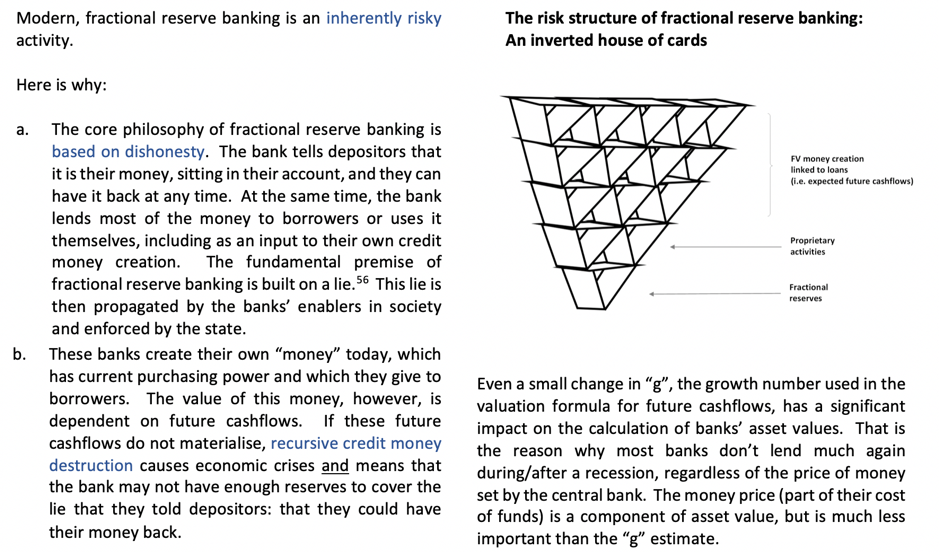 Why is bitcoin superior to other currencies? Bitcoin is a superior product to nation state currency and the fractional reserve banking system, for these reasons: 1. lower cost (transaction costs much lower than bank transfers) 2. more convenient (you transact directly, cuts out the bank/credit card company middlemen). 3. fixed supply. 4. Greater alignment with our better human values. 5. The crypto system is digital technology. Traditional banking/payments is analogue technology, that cannot be upgraded; the entire architecture is antiquated 1970s technology cobbled together in a fit of absent-mindedness. Why is limited supply important for a currency? A currency that does not have limited supply is subject to inflation. Inflation is simply a way of measuring a reduction in your purchasing power. It is better called a Theft Index and is essentially a transfer of value from holders of nation state currencies to debtors. Usually, this happens just a little bit at a time, so you don’t notice the missing money and don’t freak out. Debtors benefit from inflation because it means that they have to repay less value, in real terms. Here is a chart of the purchasing power of the US dollar since the inception of the Federal Reserve to the end of 2017. 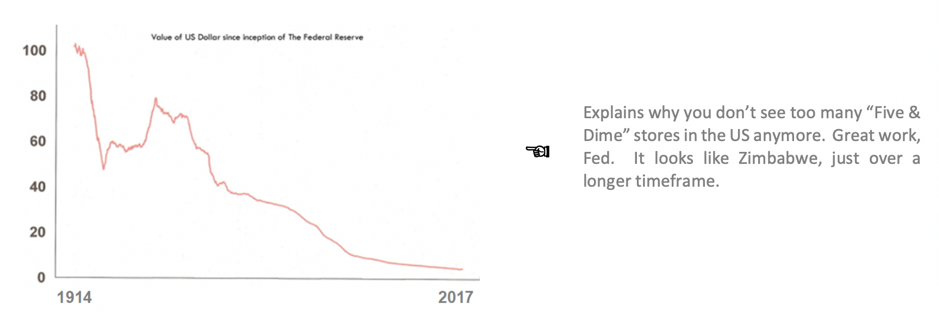 If you hold any nation state currency that doesn’t have a fixed supply, it is guaranteed that you will lose value. The US dollar has lost 95% of its value since the establishment of the Federal Reserve System in the US (which happened regardless of whether the country was on the gold standard or not). What can bitcoin do for society? Crypto currencies allow low income people to access a financial system. In the future, low income people everywhere will do their banking using the crypto system. The fractional reserve banking system has completely failed low income people. Of course, most poor people are not even accepted by these banks. The crypto system has significantly lower fixed costs than the traditional banking system and, consequently, allows everyone to benefit from financial inclusion. The poor will be able to make transfers at extremely low cost. Emerging crypto banks will allow them the benefits of the savings function, giving them the first opportunity ever to climb out of poverty. The effects for poor communities globally will be transformational. Here is a typical example of how banks treat those poor people who are fortunate enough even to have bank accounts. Bank of America will charge low-income customers $12 per month for their checking accounts unless they have a $1,500 account balance. @laura_nelson, Twitter, 2018 Finally, a bank with some fresh ideas on how to make poor people poorer. @kashanacauley, Twitter, 2018 Here is how blockchain is helping refugees. The UN's World Food Programme uses blockchain technology to provide identity and has distributed millions of dollars in food vouchers to tens of thousands of Syrian refugees in Jordan since May 2017. “The major benefit to the food program so far is a large drop in payments to financial services firms, the usual middlemen for transactions. Such fees have dropped ‘significantly,’ according to Houman Haddad”, the WFP executive leading the project. Quartz 3 Nov 2017. Note the major benefit: “the major benefit to the food program so far is a large drop in payments to financial services firms.” And what do banks think about bitcoin? A scam, used for buying drugs. Imagine them telling the truth: Well, people use it to make the lives of refugees better. Worse, it reduces the profits we make getting money to these refugee camps. So, it is really terrible. Asking a banker or central banker or their enablers what they think of bitcoin is like asking a taxi driver what he thinks about Uber. People like Jamie Dimon or Warren Buffett - one of the largest shareholders in Bank of America mentioned above. Maybe you don’t like the show of greed and all of the dodgy characters who tried to use crypto currencies to raise money, mostly for stupid projects, in 2018. No one does. But, you need to look beyond them to what bitcoin and blockchain can do for society. In the future, you will have to decide: do I stand with a community of people who want to make a better world, or do I stand with the 1% and their system of money and banking? Twitter: @ReassureFin |
| json metadata | {"tags":["bitcoin","blockchain","crypto","money","banking"],"users":["laura","kashanacauley","reassurefin"],"image":["https://cdn.steemitimages.com/DQmVxoNwZmEGeqC5pVidwiaagb59EwuWNxYwFNvJcjjGs1L/Invested%20house%20of%20cards%20main%20section.png","https://cdn.steemitimages.com/DQmTdGHWrfgwNP2dvRLbGGL28eFLHYQQBBtvYziPpz6xe5A/USD%20shitcoin%20in%20abstract.png"],"app":"steemit/0.1","format":"markdown"} |
| Transaction Info | Block #29311118/Trx fca004665a9758bdb3eeda921ee9e8db87b8f8ae |
View Raw JSON Data
{
"trx_id": "fca004665a9758bdb3eeda921ee9e8db87b8f8ae",
"block": 29311118,
"trx_in_block": 28,
"op_in_trx": 0,
"virtual_op": 0,
"timestamp": "2019-01-09T18:10:09",
"op": [
"comment",
{
"parent_author": "",
"parent_permlink": "bitcoin",
"author": "resreassure",
"permlink": "why-do-people-buy-bitcoin",
"title": "Why do people buy bitcoin?",
"body": "Why bitcoin?\n\nPeople buy bitcoin because of value and values.\n\nPeople buy bitcoin because it is a system of money that corresponds to how humanity has exchanged value for most of our history. Technologically, this system is based on mathematical formulae and a straight-forward verification and record system. The implications are spectacular: you can now trust exchanging value with another person or institution directly, even if you don’t know them.\n\nIn terms of values, the crypto system is profoundly natural, a very human invention, based on the concepts of freedom and fairness. It is the most authentic form of money humanity has had since value was based on memory. It is characterised as set out below.\n\nBased only on PV money (i.e. value that exists today, not tied to any required future value creation).\nAllows value to be exchanged directly between two parties without any bank middlemen, almost instantaneously and at extremely low cost.\nA better description than the term crypto currencies is honest money. This money system is about more than just exchanging value; it is also about our values. The crypto system is digital technology to banking and paper money’s analogue technology. The potential, the combination of value and values, that this new (old really) system unlocks for humanity is hard to overstate.\n\nThe fractional reserve banking system is intrinsically dishonest: bankers will tell you that your money is both safely in the bank and, at the same time, they are lending it out to others. They will tell you that it is your money while, legally, it belongs to the bank and they can do what they want with it.\n\n\n\nWhy is bitcoin superior to other currencies?\n\nBitcoin is a superior product to nation state currency and the fractional reserve banking system, for these reasons:\n\n1. lower cost (transaction costs much lower than bank transfers)\n2. more convenient (you transact directly, cuts out the bank/credit card company middlemen).\n3. fixed supply.\n4. Greater alignment with our better human values.\n5. The crypto system is digital technology. Traditional banking/payments is analogue technology, that cannot be upgraded; the entire architecture is antiquated 1970s technology cobbled together in a fit of absent-mindedness.\n\nWhy is limited supply important for a currency?\n\nA currency that does not have limited supply is subject to inflation. Inflation is simply a way of measuring a reduction in your purchasing power. It is better called a Theft Index and is essentially a transfer of value from holders of nation state currencies to debtors. Usually, this happens just a little bit at a time, so you don’t notice the missing money and don’t freak out. Debtors benefit from inflation because it means that they have to repay less value, in real terms.\n\nHere is a chart of the purchasing power of the US dollar since the inception of the Federal Reserve to the end of 2017.\n\n\n\nIf you hold any nation state currency that doesn’t have a fixed supply, it is guaranteed that you will lose value. The US dollar has lost 95% of its value since the establishment of the Federal Reserve System in the US (which happened regardless of whether the country was on the gold standard or not).\n\nWhat can bitcoin do for society?\n\nCrypto currencies allow low income people to access a financial system.\n\nIn the future, low income people everywhere will do their banking using the crypto system.\n\nThe fractional reserve banking system has completely failed low income people. Of course, most poor people are not even accepted by these banks. The crypto system has significantly lower fixed costs than the traditional banking system and, consequently, allows everyone to benefit from financial inclusion. The poor will be able to make transfers at extremely low cost. Emerging crypto banks will allow them the benefits of the savings function, giving them the first opportunity ever to climb out of poverty. The effects for poor communities globally will be transformational.\n\nHere is a typical example of how banks treat those poor people who are fortunate enough even to have bank accounts.\n\nBank of America will charge low-income customers $12 per month for their checking accounts unless they have a $1,500 account balance. @laura_nelson, Twitter, 2018\n\nFinally, a bank with some fresh ideas on how to make poor people poorer. @kashanacauley, Twitter, 2018\n\nHere is how blockchain is helping refugees.\n\nThe UN's World Food Programme uses blockchain technology to provide identity and has distributed millions of dollars in food vouchers to tens of thousands of Syrian refugees in Jordan since May 2017. “The major benefit to the food program so far is a large drop in payments to financial services firms, the usual middlemen for transactions. Such fees have dropped ‘significantly,’ according to Houman Haddad”, the WFP executive leading the project. Quartz 3 Nov 2017.\n\nNote the major benefit: “the major benefit to the food program so far is a large drop in payments to financial services firms.” And what do banks think about bitcoin? A scam, used for buying drugs.\n\nImagine them telling the truth: Well, people use it to make the lives of refugees better. Worse, it reduces the profits we make getting money to these refugee camps. So, it is really terrible.\n\nAsking a banker or central banker or their enablers what they think of bitcoin is like asking a taxi driver what he thinks about Uber.\n\nPeople like Jamie Dimon or Warren Buffett - one of the largest shareholders in Bank of America mentioned above.\n\nMaybe you don’t like the show of greed and all of the dodgy characters who tried to use crypto currencies to raise money, mostly for stupid projects, in 2018. No one does. But, you need to look beyond them to what bitcoin and blockchain can do for society.\n\nIn the future, you will have to decide: do I stand with a community of people who want to make a better world, or do I stand with the 1% and their system of money and banking?\n\n\nTwitter: @ReassureFin",
"json_metadata": "{\"tags\":[\"bitcoin\",\"blockchain\",\"crypto\",\"money\",\"banking\"],\"users\":[\"laura\",\"kashanacauley\",\"reassurefin\"],\"image\":[\"https://cdn.steemitimages.com/DQmVxoNwZmEGeqC5pVidwiaagb59EwuWNxYwFNvJcjjGs1L/Invested%20house%20of%20cards%20main%20section.png\",\"https://cdn.steemitimages.com/DQmTdGHWrfgwNP2dvRLbGGL28eFLHYQQBBtvYziPpz6xe5A/USD%20shitcoin%20in%20abstract.png\"],\"app\":\"steemit/0.1\",\"format\":\"markdown\"}"
}
]
}sensationupvoted (100.00%) @resreassure / crypto-and-the-payments-industry2019/01/07 21:54:18
sensationupvoted (100.00%) @resreassure / crypto-and-the-payments-industry
2019/01/07 21:54:18
| voter | sensation |
| author | resreassure |
| permlink | crypto-and-the-payments-industry |
| weight | 10000 (100.00%) |
| Transaction Info | Block #29258031/Trx eb56fa40ef2c7dc3b2b857b756e824578662653f |
View Raw JSON Data
{
  "trx_id": "eb56fa40ef2c7dc3b2b857b756e824578662653f",
  "block": 29258031,
  "trx_in_block": 20,
  "op_in_trx": 0,
  "virtual_op": 0,
  "timestamp": "2019-01-07T21:54:18",
  "op": [
    "vote",
    {
      "voter": "sensation",
      "author": "resreassure",
      "permlink": "crypto-and-the-payments-industry",
      "weight": 10000
    }
  ]
}magpieloverupvoted (100.00%) @resreassure / crypto-and-the-banking-industry2019/01/07 21:32:33
magpieloverupvoted (100.00%) @resreassure / crypto-and-the-banking-industry
2019/01/07 21:32:33
| voter | magpielover |
| author | resreassure |
| permlink | crypto-and-the-banking-industry |
| weight | 10000 (100.00%) |
| Transaction Info | Block #29257596/Trx 66fadfb4e0c4a118de15fd189e5aea26265feac1 |
View Raw JSON Data
{
  "trx_id": "66fadfb4e0c4a118de15fd189e5aea26265feac1",
  "block": 29257596,
  "trx_in_block": 3,
  "op_in_trx": 0,
  "virtual_op": 0,
  "timestamp": "2019-01-07T21:32:33",
  "op": [
    "vote",
    {
      "voter": "magpielover",
      "author": "resreassure",
      "permlink": "crypto-and-the-banking-industry",
      "weight": 10000
    }
  ]
}acknowledgementupvoted (10.00%) @resreassure / crypto-and-the-payments-industry2019/01/07 21:11:45
acknowledgementupvoted (10.00%) @resreassure / crypto-and-the-payments-industry
2019/01/07 21:11:45
| voter | acknowledgement |
| author | resreassure |
| permlink | crypto-and-the-payments-industry |
| weight | 1000 (10.00%) |
| Transaction Info | Block #29257181/Trx 64bdc56a408fefff81c639dacf4b8bda76f0b983 |
View Raw JSON Data
{
  "trx_id": "64bdc56a408fefff81c639dacf4b8bda76f0b983",
  "block": 29257181,
  "trx_in_block": 1,
  "op_in_trx": 0,
  "virtual_op": 0,
  "timestamp": "2019-01-07T21:11:45",
  "op": [
    "vote",
    {
      "voter": "acknowledgement",
      "author": "resreassure",
      "permlink": "crypto-and-the-payments-industry",
      "weight": 1000
    }
  ]
}acknowledgementupvoted (10.00%) @resreassure / crypto-and-the-banking-industry2019/01/07 21:11:18
acknowledgementupvoted (10.00%) @resreassure / crypto-and-the-banking-industry
2019/01/07 21:11:18
| voter | acknowledgement |
| author | resreassure |
| permlink | crypto-and-the-banking-industry |
| weight | 1000 (10.00%) |
| Transaction Info | Block #29257172/Trx 0a4bb93997d52008f669a55e4b69f23ded4243dd |
View Raw JSON Data
{
  "trx_id": "0a4bb93997d52008f669a55e4b69f23ded4243dd",
  "block": 29257172,
  "trx_in_block": 35,
  "op_in_trx": 0,
  "virtual_op": 0,
  "timestamp": "2019-01-07T21:11:18",
  "op": [
    "vote",
    {
      "voter": "acknowledgement",
      "author": "resreassure",
      "permlink": "crypto-and-the-banking-industry",
      "weight": 1000
    }
  ]
}2019/01/07 20:51:18
2019/01/07 20:51:18
| parent author | resreassure |
| parent permlink | crypto-and-the-banking-industry |
| author | cheetah |
| permlink | cheetah-re-resreassurecrypto-and-the-banking-industry |
| title | |
| body | Hi! I am a robot. I just upvoted you! I found similar content that readers might be interested in: https://www.cryptopedic.com/news/the-crypto-system-will-replace-the-banking-system-in-the-next-decade/ |
| json metadata | |
| Transaction Info | Block #29256772/Trx c69fc1249008942a6333dea159ddd1bbef7dd603 |
View Raw JSON Data
{
  "trx_id": "c69fc1249008942a6333dea159ddd1bbef7dd603",
  "block": 29256772,
  "trx_in_block": 18,
  "op_in_trx": 0,
  "virtual_op": 0,
  "timestamp": "2019-01-07T20:51:18",
  "op": [
    "comment",
    {
      "parent_author": "resreassure",
      "parent_permlink": "crypto-and-the-banking-industry",
      "author": "cheetah",
      "permlink": "cheetah-re-resreassurecrypto-and-the-banking-industry",
      "title": "",
      "body": "Hi! I am a robot. I just upvoted you! I found similar content that readers might be interested in:\nhttps://www.cryptopedic.com/news/the-crypto-system-will-replace-the-banking-system-in-the-next-decade/",
      "json_metadata": ""
    }
  ]
}cheetahupvoted (0.08%) @resreassure / crypto-and-the-banking-industry2019/01/07 20:51:15
cheetahupvoted (0.08%) @resreassure / crypto-and-the-banking-industry
2019/01/07 20:51:15
| voter | cheetah |
| author | resreassure |
| permlink | crypto-and-the-banking-industry |
| weight | 8 (0.08%) |
| Transaction Info | Block #29256771/Trx ed18eabdf7fbabf108131cb8ea0000dd41b754a7 |
View Raw JSON Data
{
  "trx_id": "ed18eabdf7fbabf108131cb8ea0000dd41b754a7",
  "block": 29256771,
  "trx_in_block": 11,
  "op_in_trx": 0,
  "virtual_op": 0,
  "timestamp": "2019-01-07T20:51:15",
  "op": [
    "vote",
    {
      "voter": "cheetah",
      "author": "resreassure",
      "permlink": "crypto-and-the-banking-industry",
      "weight": 8
    }
  ]
}resreassureupdated options for crypto-and-the-banking-industry2019/01/07 20:51:03
resreassureupdated options for crypto-and-the-banking-industry
2019/01/07 20:51:03
| author | resreassure |
| permlink | crypto-and-the-banking-industry |
| max accepted payout | 0.000 SBD |
| percent steem dollars | 10000 |
| allow votes | true |
| allow curation rewards | true |
| extensions | [] |
| Transaction Info | Block #29256767/Trx b265053d1f1af4875682427c5ac8b6a0d43751e3 |
View Raw JSON Data
{
  "trx_id": "b265053d1f1af4875682427c5ac8b6a0d43751e3",
  "block": 29256767,
  "trx_in_block": 25,
  "op_in_trx": 0,
  "virtual_op": 0,
  "timestamp": "2019-01-07T20:51:03",
  "op": [
    "comment_options",
    {
      "author": "resreassure",
      "permlink": "crypto-and-the-banking-industry",
      "max_accepted_payout": "0.000 SBD",
      "percent_steem_dollars": 10000,
      "allow_votes": true,
      "allow_curation_rewards": true,
      "extensions": []
    }
  ]
}resreassurepublished a new post: crypto-and-the-banking-industry2019/01/07 20:51:03
resreassurepublished a new post: crypto-and-the-banking-industry
2019/01/07 20:51:03
| parent author | |
| parent permlink | blockchain |
| author | resreassure |
| permlink | crypto-and-the-banking-industry |
| title | Crypto and the banking industry |
| body | Here is a little comparison of the crypto system and our current banking system. **Superior value and better values** Crypto currencies are a superior product to nation state currency and the fractional reserve banking system, for these reasons: 1. lower cost (transaction costs much lower than bank transfers) 2. more convenient (you transact directly, cuts out the bank/credit card company middlemen). 3. fixed supply. 4. Greater alignment with our better human values. The crypto system is digital technology. Traditional banking/payments is analogue technology, that cannot be upgraded; the entire architecture is antiquated 1970s technology cobbled together in a fit of absent-mindedness. Crypto is your smart phone. The banking system is like using a Blackberry. The payments system is like using a rotary dial fixed line phone. **Adoption** The biggest obstacle to crypto currencies is access to the real economy. The entities preventing this access are banks and their enablers. When a crypto bank emerges (in 2019) that links crypto to the real economy, adoption will increase exponentially. 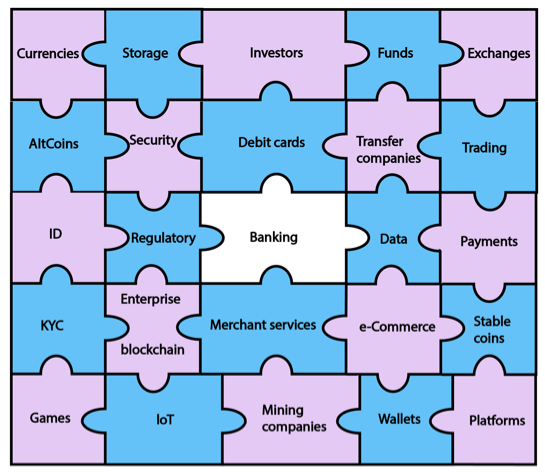 **Our current banking system** The fractional reserve banking system is intrinsically dishonest: bankers will tell you that your money is both safely in the bank and, at the same time, they are lending it out to others. They will tell you that it is your money while, legally, it belongs to the bank and they can do what they want with it.  **The crypto system** In 2009 Satoshi Nakamoto created a system of money that corresponds to how humanity has exchanged value for most of our history. Technologically, this system is based on mathematical formulae and a straight-forward verification and record system. The implications are spectacular: you can now trust exchanging value with another person or institution directly, even if you don’t know them. In terms of values, the crypto system is profoundly natural, a very human invention, based on the concepts of freedom and fairness. It is the most authentic form of money humanity has had since value was based on memory. It is characterised as set out below. 1. Based only on PV money (i.e. value that exists today, not tied to any required future value creation). 2. Allows value to be exchanged directly between two parties without any bank middlemen, almost instantaneously and at extremely low cost. A better description than the term crypto currencies is honest money. This money system is about more than just exchanging value; it is also about our values. The potential, the combination of value and values, that this new (old really) system unlocks for humanity is hard to overstate. **The future** The crypto system will offer higher returns for less risk and depositors will increasingly vote with their feet. Over the next decade, the crypto system will expand and the fractional reserve banking system will decline. An inflection point will be reached where the rate of change for both accelerates rapidly. The fractional reserve system is intrinsically structured like an inverted house of cards. Once enough deposits are pulled out of the bottom, the house will collapse. Asking a banker what he thinks about crypto is like asking a taxi driver what he thinks about Uber. The crypto system is an existential threat to nation state currency as well as to the fractional reserve banking system and to their enablers. It is incompatible with fractional reserve banking. The crypto system is based on a transparent record of truth, captured forever in a giant record paper, and on value that exists today. Only one of these two systems can survive. They cannot co-exist together in the long-term. They are not going to be best friends, give each other warm hugs, and talk about a win-win paradigm. Their values are completely contradictory. Expect the banks and their enablers to continue to be relentless and underhanded when attacking the crypto system.  *I’m delighted to join your Enterprise Alliance, my naive young Russian Canadian friend.* Twitter: @ReassureFin |
| json metadata | {"tags":["blockchain","crypto","banking","finance","money"],"users":["reassurefin"],"image":["https://cdn.steemitimages.com/DQmWU411mBwx7P8zQk8qWfHR56N3inPMFNSLabaQm3v1Ebu/Crypto%20puzzle.png","https://cdn.steemitimages.com/DQmVxoNwZmEGeqC5pVidwiaagb59EwuWNxYwFNvJcjjGs1L/Invested%20house%20of%20cards%20main%20section.png","https://cdn.steemitimages.com/DQmWm5UszLWiWMBTCv1UhwrLeppKVUoGQSQE8XWesXp7CfF/Wolf%20in%20sheeps%20clothing.png"],"app":"steemit/0.1","format":"markdown"} |
| Transaction Info | Block #29256767/Trx b265053d1f1af4875682427c5ac8b6a0d43751e3 |
View Raw JSON Data
{
"trx_id": "b265053d1f1af4875682427c5ac8b6a0d43751e3",
"block": 29256767,
"trx_in_block": 25,
"op_in_trx": 0,
"virtual_op": 0,
"timestamp": "2019-01-07T20:51:03",
"op": [
"comment",
{
"parent_author": "",
"parent_permlink": "blockchain",
"author": "resreassure",
"permlink": "crypto-and-the-banking-industry",
"title": "Crypto and the banking industry",
"body": "Here is a little comparison of the crypto system and our current banking system.\n\n**Superior value and better values**\n\nCrypto currencies are a superior product to nation state currency and the fractional reserve banking system, for these reasons:\n\n1. lower cost (transaction costs much lower than bank transfers)\n2. more convenient (you transact directly, cuts out the bank/credit card company middlemen).\n3. fixed supply.\n4. Greater alignment with our better human values.\n\nThe crypto system is digital technology. Traditional banking/payments is analogue technology, that cannot be upgraded; the entire architecture is antiquated 1970s technology cobbled together in a fit of absent-mindedness. Crypto is your smart phone. The banking system is like using a Blackberry. The payments system is like using a rotary dial fixed line phone.\n\n**Adoption**\n\nThe biggest obstacle to crypto currencies is access to the real economy. The entities preventing this access are banks and their enablers. When a crypto bank emerges (in 2019) that links crypto to the real economy, adoption will increase exponentially. \n\n\n\n**Our current banking system** \n\nThe fractional reserve banking system is intrinsically dishonest: bankers will tell you that your money is both safely in the bank and, at the same time, they are lending it out to others. They will tell you that it is your money while, legally, it belongs to the bank and they can do what they want with it. \n\n\n\n**The crypto system** \n\nIn 2009 Satoshi Nakamoto created a system of money that corresponds to how humanity has exchanged value for most of our history. Technologically, this system is based on mathematical formulae and a straight-forward verification and record system. The implications are spectacular: you can now trust exchanging value with another person or institution directly, even if you don’t know them. \n\nIn terms of values, the crypto system is profoundly natural, a very human invention, based on the concepts of freedom and fairness. It is the most authentic form of money humanity has had since value was based on memory. It is characterised as set out below.\n\n1. Based only on PV money (i.e. value that exists today, not tied to any required future value creation).\n2. Allows value to be exchanged directly between two parties without any bank middlemen, almost instantaneously and at extremely low cost. \n\nA better description than the term crypto currencies is honest money. This money system is about more than just exchanging value; it is also about our values. The potential, the combination of value and values, that this new (old really) system unlocks for humanity is hard to overstate. \n\n**The future**\n\nThe crypto system will offer higher returns for less risk and depositors will increasingly vote with their feet. Over the next decade, the crypto system will expand and the fractional reserve banking system will decline. An inflection point will be reached where the rate of change for both accelerates rapidly. The fractional reserve system is intrinsically structured like an inverted house of cards. Once enough deposits are pulled out of the bottom, the house will collapse. Asking a banker what he thinks about crypto is like asking a taxi driver what he thinks about Uber. \n\nThe crypto system is an existential threat to nation state currency as well as to the fractional reserve banking system and to their enablers. It is incompatible with fractional reserve banking. The crypto system is based on a transparent record of truth, captured forever in a giant record paper, and on value that exists today. \n\nOnly one of these two systems can survive. They cannot co-exist together in the long-term. They are not going to be best friends, give each other warm hugs, and talk about a win-win paradigm. Their values are completely contradictory. Expect the banks and their enablers to continue to be relentless and underhanded when attacking the crypto system. \n\n\n*I’m delighted to join your Enterprise Alliance, my naive young Russian Canadian friend.* \n\n\nTwitter: @ReassureFin",
"json_metadata": "{\"tags\":[\"blockchain\",\"crypto\",\"banking\",\"finance\",\"money\"],\"users\":[\"reassurefin\"],\"image\":[\"https://cdn.steemitimages.com/DQmWU411mBwx7P8zQk8qWfHR56N3inPMFNSLabaQm3v1Ebu/Crypto%20puzzle.png\",\"https://cdn.steemitimages.com/DQmVxoNwZmEGeqC5pVidwiaagb59EwuWNxYwFNvJcjjGs1L/Invested%20house%20of%20cards%20main%20section.png\",\"https://cdn.steemitimages.com/DQmWm5UszLWiWMBTCv1UhwrLeppKVUoGQSQE8XWesXp7CfF/Wolf%20in%20sheeps%20clothing.png\"],\"app\":\"steemit/0.1\",\"format\":\"markdown\"}"
}
]
}resreassureupdated options for crypto-and-the-payments-industry2019/01/07 20:45:12
resreassureupdated options for crypto-and-the-payments-industry
2019/01/07 20:45:12
| author | resreassure |
| permlink | crypto-and-the-payments-industry |
| max accepted payout | 0.000 SBD |
| percent steem dollars | 10000 |
| allow votes | true |
| allow curation rewards | true |
| extensions | [] |
| Transaction Info | Block #29256650/Trx 5c3a1fdefc1897906c7e1a50c8d3fb59919ac0e5 |
View Raw JSON Data
{
  "trx_id": "5c3a1fdefc1897906c7e1a50c8d3fb59919ac0e5",
  "block": 29256650,
  "trx_in_block": 25,
  "op_in_trx": 0,
  "virtual_op": 0,
  "timestamp": "2019-01-07T20:45:12",
  "op": [
    "comment_options",
    {
      "author": "resreassure",
      "permlink": "crypto-and-the-payments-industry",
      "max_accepted_payout": "0.000 SBD",
      "percent_steem_dollars": 10000,
      "allow_votes": true,
      "allow_curation_rewards": true,
      "extensions": []
    }
  ]
}resreassurepublished a new post: crypto-and-the-payments-industry2019/01/07 20:45:12
resreassurepublished a new post: crypto-and-the-payments-industry
2019/01/07 20:45:12
| parent author | |
| parent permlink | crypto |
| author | resreassure |
| permlink | crypto-and-the-payments-industry |
| title | Crypto and the payments industry |
| body | The crypto system will replace the current payments industry in the next decade. Here is why. **Current system** The existing cards - banking system is based on pull technology, which is complex, costly and prone to fraud. The crypto payment system, based on push technology, is simpler than and will replace the old system. A decade from now no one will use the pull-based system; it will completely disappear. The plumbing necessary for credit card payments, combined with the traditional banking industry, is illustrated below. 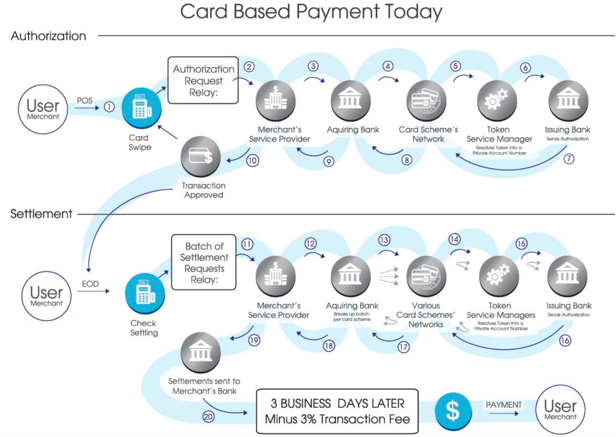 Add another 5–8 steps for cross-border payments. If it looks like it was cobbled together in a fit of absent-mindedness based on 1970s technology, that is because it was. The biggest weakness in the payment system is security, which is vastly inferior to the crypto system. **Crypto system** Here is how the crypto payment system works:[1] 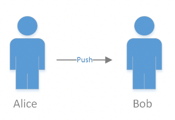 Visa, Mastercard, JCB, UnionPay: they will all face their Kodak moment in the next decade. Same for PayPal, Square, makers of point of sale equipment, etc. It is like fixed telephone line switchboard systems: no longer needed. Of course, people won't stop using credit cards overnight, but most people will not have a credit card a decade from now. But, bankruptcy? There are two important things to realise about the structure of the credit card processor industry (in addition to the vastly inferior technology): it has a high break-even point and a large number of self-interested, uncoordinated participants fighting for industry profits. Think they might adapt to the crypto system? Maybe about as easily as a school of fish might adapt to using bicycles as a new means of getting around. **Merchants will drive the change** The main impetus for switching from credit cards to crypto system payments will come from merchants. The average credit card processing cost for a retail business where cards are swiped is roughly 1.90%-2.15% for Visa and Mastercard transactions. The average cost for card-not-present transactions, such as online, is roughly 2.30%-2.50%. Worse, long transaction reconciliation times have a negative impact on merchant's working capital. With credit cards, maybe you think you have paid for that latte right away, but the money reaches the merchant days later. The merchant also bears the risk of chargebacks for a considerable period of time after: typically for up to 90–120 calendar days (based on a "Central Site Business Date"). Chargeback costs to merchants is expected to reach $31 billion by 2020.[2] In 2016, only 23% of chargebacks were in relation to identity theft. So-called "friendly fraud" accounted for 28% and "chargeback fraud" accounted for another 28%.[3] In comparison, with the crypto system the merchant gets the money right away. With the push system, the crypto system, there are no chargebacks. For the merchant, the best comparison is money in about 3 business days with no finality for a total of 90–120 days at a cost of maybe 2%, versus an x second/minute block time in crypto with finality and at zero cost. **Lack of security with the current system** The other major difference between the soon-to-die credit card push system and the crypto system that will replace it is security. With your credit card, you are not actually making a payment. What you are doing is giving an approval (based on your Personal Account Number) to the merchant to pull money from your account. Since the merchant is just the end link in the payments chain, the merchant's system needs to transmit your account details to every other entity in the process. So, you, the customer, effectively have to trust all of the 20 parties in this chain. Payment processors biggest cost is security; they spend billions each year on trying to prevent fraud. Think maybe you were not affected? In 2017, the Identity Theft Resource Center counted 1,579 data breaches in the United States, up 45 percent from 2016, affecting 178,955,069 records.[4] Credit card fraud in the US exceeded $7 billion in 2017.[5]In the United Kingdom, 4.7 million people reported their credit card lost or stolen or misused, with an average loss per person of £833 pounds.[6] Financial institutions globally are expected to spend $9.2 billion by 2020 to prevent credit card fraud.[7] In the crypto system, what keeps push payments from A to B (which could be individuals, or an individual to a merchant, or a business to a business) safe is simple and based on: (1) keeping your private keys (basically a long complex password) secure and (2) the community working together, based on economic incentives to keep the system database protected. All system users basically contribute a small amount to a diverse group of system supporters to ensure that it remains safe. The crypto system is mathematically almost impossible to break. There are some weak points (like exchanges, which are just SQL databases) but these are not part of the crypto system. In the crypto system, security costs are a tiny fraction of the amount spent by traditional players. To criticise the crypto system for excessive electricity costs is simply the big lie strategy: it isn't comparing the role the miners play in the system to the equivalent functions required in the fractional reserve banking and payments systems and by society. Losses in the genuine crypto system are almost non-existent, compared to an astronomical amount of money lost to payments fraud. The only effective way to eliminate payment fraud almost entirely and the costs of trying to prevent this fraud is to adopt the crypto system. **Trilemma issue and lattes** Vitalik Buterin has the annoying trait of being really honest and open about technical issues in the crypto system. In respect of payments, this is the scalability trilemma, which posits that (at the moment) a blockchain cannot have all three of these characteristics at the same time: decentralised, scalable, and secure; it can only have two of the three. It allows bank-funded economists to ignore the superiority of the crypto system over the fractional reserve banking system and the payments system and focus on issues important to them: the horrifying possibility of cold lattes. Being rude to Vitalik for slow processing[8]and concluding that the crypto system will never reach its potential is like yelling at Gordon Moore in the 1960s that there are not enough transistors on a microchip to do anything useful. First, tech scales exponentially; it is a bad idea to bet against that. Second, there are also many interim solutions. With a proper crypto bank, for example, the crypto bank could guarantee to the merchant the availability of funds immediately, even if it will take a few minutes after to settle on the blockchain. Third, the criticism applies to small payments where speed is important, but there is a vast market for larger payments where settlement could be in minutes, not seconds, and still be vastly superior to the present system. That is why crypto transfers will start at the larger end: payment for large shipments of coffee beans can take days to process through the banking system. In this part of the chain, commodity players would be ecstatic to wait 10 minutes for confirmation and finality. Twitter: @ReassureFin --- [1] You could add some minor complexity, like wallet details or maybe Alice and Bob will use a form of a crypto bank in the future, but the heart of the push system in crypto is just this simple. [2] The Nilson Report, 2017. [3] LexisNexis 2016 True Cost of Fraud study. [4] Note: only covers those data breaches notified by companies to authorities. Of these notified breaches, 37% of notifications did not quantify the number of records - such as Social Security numbers and payment card data - that was exposed. [5] FT Partners Research and Statistica. [6] Report commissioned by Comparethemarket.com, for the last 12 months to July 2018. [7] Juniper Research, Online Payment Fraud: Key Vertical Strategies and Management 2015–16. [8] From the latte buyer's, not the merchant's perspective. |
| json metadata | {"tags":["crypto","payments","banking","finance","blockchain"],"users":["reassurefin"],"image":["https://cdn.steemitimages.com/DQmPkewgHzs44BCrBfZ2v4cY9kpFuxT1e3f3SVWSMs1vbUd/Card%20payment%20what%20a%20joke%20in%2021st%20century.png","https://cdn.steemitimages.com/DQmV9Q5SML8ZAnkqjKrw4CKqyRaJokb7UgHea3Gf2i2hYUj/Alice%20Bob.png"],"app":"steemit/0.1","format":"markdown"} |
| Transaction Info | Block #29256650/Trx 5c3a1fdefc1897906c7e1a50c8d3fb59919ac0e5 |
View Raw JSON Data
{
"trx_id": "5c3a1fdefc1897906c7e1a50c8d3fb59919ac0e5",
"block": 29256650,
"trx_in_block": 25,
"op_in_trx": 0,
"virtual_op": 0,
"timestamp": "2019-01-07T20:45:12",
"op": [
"comment",
{
"parent_author": "",
"parent_permlink": "crypto",
"author": "resreassure",
"permlink": "crypto-and-the-payments-industry",
"title": "Crypto and the payments industry",
"body": "The crypto system will replace the current payments industry in the next decade. Here is why. \n\n**Current system**\n\nThe existing cards - banking system is based on pull technology, which is complex, costly and prone to fraud. The crypto payment system, based on push technology, is simpler than and will replace the old system. A decade from now no one will use the pull-based system; it will completely disappear.\n\nThe plumbing necessary for credit card payments, combined with the traditional banking industry, is illustrated below. \n\n\n\nAdd another 5–8 steps for cross-border payments.\n\nIf it looks like it was cobbled together in a fit of absent-mindedness based on 1970s technology, that is because it was.\n\nThe biggest weakness in the payment system is security, which is vastly inferior to the crypto system.\n\n**Crypto system**\n\nHere is how the crypto payment system works:[1]\n\n\n\nVisa, Mastercard, JCB, UnionPay: they will all face their Kodak moment in the next decade. Same for PayPal, Square, makers of point of sale equipment, etc. It is like fixed telephone line switchboard systems: no longer needed.\n\nOf course, people won't stop using credit cards overnight, but most people will not have a credit card a decade from now. \n\nBut, bankruptcy? There are two important things to realise about the structure of the credit card processor industry (in addition to the vastly inferior technology): it has a high break-even point and a large number of self-interested, uncoordinated participants fighting for industry profits. Think they might adapt to the crypto system? Maybe about as easily as a school of fish might adapt to using bicycles as a new means of getting around.\n\n**Merchants will drive the change**\n\nThe main impetus for switching from credit cards to crypto system payments will come from merchants. The average credit card processing cost for a retail business where cards are swiped is roughly 1.90%-2.15% for Visa and Mastercard transactions. The average cost for card-not-present transactions, such as online, is roughly 2.30%-2.50%. \n\nWorse, long transaction reconciliation times have a negative impact on merchant's working capital. With credit cards, maybe you think you have paid for that latte right away, but the money reaches the merchant days later. The merchant also bears the risk of chargebacks for a considerable period of time after: typically for up to 90–120 calendar days (based on a \"Central Site Business Date\"). Chargeback costs to merchants is expected to reach $31 billion by 2020.[2] In 2016, only 23% of chargebacks were in relation to identity theft. So-called \"friendly fraud\" accounted for 28% and \"chargeback fraud\" accounted for another 28%.[3]\n\nIn comparison, with the crypto system the merchant gets the money right away. With the push system, the crypto system, there are no chargebacks. For the merchant, the best comparison is money in about 3 business days with no finality for a total of 90–120 days at a cost of maybe 2%, versus an x second/minute block time in crypto with finality and at zero cost.\n\n**Lack of security with the current system**\n\nThe other major difference between the soon-to-die credit card push system and the crypto system that will replace it is security. With your credit card, you are not actually making a payment. What you are doing is giving an approval (based on your Personal Account Number) to the merchant to pull money from your account. Since the merchant is just the end link in the payments chain, the merchant's system needs to transmit your account details to every other entity in the process. So, you, the customer, effectively have to trust all of the 20 parties in this chain. Payment processors biggest cost is security; they spend billions each year on trying to prevent fraud. Think maybe you were not affected? In 2017, the Identity Theft Resource Center counted 1,579 data breaches in the United States, up 45 percent from 2016, affecting 178,955,069 records.[4] Credit card fraud in the US exceeded $7 billion in 2017.[5]In the United Kingdom, 4.7 million people reported their credit card lost or stolen or misused, with an average loss per person of £833 pounds.[6] Financial institutions globally are expected to spend $9.2 billion by 2020 to prevent credit card fraud.[7]\n\nIn the crypto system, what keeps push payments from A to B (which could be individuals, or an individual to a merchant, or a business to a business) safe is simple and based on: (1) keeping your private keys (basically a long complex password) secure and (2) the community working together, based on economic incentives to keep the system database protected. All system users basically contribute a small amount to a diverse group of system supporters to ensure that it remains safe. \n\nThe crypto system is mathematically almost impossible to break. There are some weak points (like exchanges, which are just SQL databases) but these are not part of the crypto system. \n\nIn the crypto system, security costs are a tiny fraction of the amount spent by traditional players. To criticise the crypto system for excessive electricity costs is simply the big lie strategy: it isn't comparing the role the miners play in the system to the equivalent functions required in the fractional reserve banking and payments systems and by society. Losses in the genuine crypto system are almost non-existent, compared to an astronomical amount of money lost to payments fraud. The only effective way to eliminate payment fraud almost entirely and the costs of trying to prevent this fraud is to adopt the crypto system.\n\n**Trilemma issue and lattes**\n\nVitalik Buterin has the annoying trait of being really honest and open about technical issues in the crypto system. In respect of payments, this is the scalability trilemma, which posits that (at the moment) a blockchain cannot have all three of these characteristics at the same time: decentralised, scalable, and secure; it can only have two of the three. It allows bank-funded economists to ignore the superiority of the crypto system over the fractional reserve banking system and the payments system and focus on issues important to them: the horrifying possibility of cold lattes.\n\nBeing rude to Vitalik for slow processing[8]and concluding that the crypto system will never reach its potential is like yelling at Gordon Moore in the 1960s that there are not enough transistors on a microchip to do anything useful. First, tech scales exponentially; it is a bad idea to bet against that. Second, there are also many interim solutions. With a proper crypto bank, for example, the crypto bank could guarantee to the merchant the availability of funds immediately, even if it will take a few minutes after to settle on the blockchain. Third, the criticism applies to small payments where speed is important, but there is a vast market for larger payments where settlement could be in minutes, not seconds, and still be vastly superior to the present system. That is why crypto transfers will start at the larger end: payment for large shipments of coffee beans can take days to process through the banking system. In this part of the chain, commodity players would be ecstatic to wait 10 minutes for confirmation and finality.\n\nTwitter: @ReassureFin\n\n\n---\n\n[1] You could add some minor complexity, like wallet details or maybe Alice and Bob will use a form of a crypto bank in the future, but the heart of the push system in crypto is just this simple.\n[2] The Nilson Report, 2017.\n[3] LexisNexis 2016 True Cost of Fraud study.\n[4] Note: only covers those data breaches notified by companies to authorities. Of these notified breaches, 37% of notifications did not quantify the number of records - such as Social Security numbers and payment card data - that was exposed.\n[5] FT Partners Research and Statistica.\n[6] Report commissioned by Comparethemarket.com, for the last 12 months to July 2018.\n[7] Juniper Research, Online Payment Fraud: Key Vertical Strategies and Management 2015–16.\n[8] From the latte buyer's, not the merchant's perspective.",
"json_metadata": "{\"tags\":[\"crypto\",\"payments\",\"banking\",\"finance\",\"blockchain\"],\"users\":[\"reassurefin\"],\"image\":[\"https://cdn.steemitimages.com/DQmPkewgHzs44BCrBfZ2v4cY9kpFuxT1e3f3SVWSMs1vbUd/Card%20payment%20what%20a%20joke%20in%2021st%20century.png\",\"https://cdn.steemitimages.com/DQmV9Q5SML8ZAnkqjKrw4CKqyRaJokb7UgHea3Gf2i2hYUj/Alice%20Bob.png\"],\"app\":\"steemit/0.1\",\"format\":\"markdown\"}"
}
]
}sensationupvoted (100.00%) @resreassure / a-history-of-money2019/01/05 16:53:39
sensationupvoted (100.00%) @resreassure / a-history-of-money
2019/01/05 16:53:39
| voter | sensation |
| author | resreassure |
| permlink | a-history-of-money |
| weight | 10000 (100.00%) |
| Transaction Info | Block #29194475/Trx a45f155c8fe01dc177c310b6f41b98418b9413a3 |
View Raw JSON Data
{
  "trx_id": "a45f155c8fe01dc177c310b6f41b98418b9413a3",
  "block": 29194475,
  "trx_in_block": 3,
  "op_in_trx": 0,
  "virtual_op": 0,
  "timestamp": "2019-01-05T16:53:39",
  "op": [
    "vote",
    {
      "voter": "sensation",
      "author": "resreassure",
      "permlink": "a-history-of-money",
      "weight": 10000
    }
  ]
}cmadupvoted (100.00%) @resreassure / crypto-and-sex2019/01/05 15:56:00
cmadupvoted (100.00%) @resreassure / crypto-and-sex
2019/01/05 15:56:00
| voter | cmad |
| author | resreassure |
| permlink | crypto-and-sex |
| weight | 10000 (100.00%) |
| Transaction Info | Block #29193324/Trx 5633ed4aa9294712c54acb16a9e043cb83ae99aa |
View Raw JSON Data
{
  "trx_id": "5633ed4aa9294712c54acb16a9e043cb83ae99aa",
  "block": 29193324,
  "trx_in_block": 4,
  "op_in_trx": 0,
  "virtual_op": 0,
  "timestamp": "2019-01-05T15:56:00",
  "op": [
    "vote",
    {
      "voter": "cmad",
      "author": "resreassure",
      "permlink": "crypto-and-sex",
      "weight": 10000
    }
  ]
}2019/01/05 15:55:36
2019/01/05 15:55:36
| voter | sensation |
| author | resreassure |
| permlink | the-crypto-system-will-replace-the-banking-system-in-the-next-decade-and-other-predictions |
| weight | 10000 (100.00%) |
| Transaction Info | Block #29193316/Trx 30027b32db67b3f023afe2e3f0251af91aaa8d59 |
View Raw JSON Data
{
  "trx_id": "30027b32db67b3f023afe2e3f0251af91aaa8d59",
  "block": 29193316,
  "trx_in_block": 15,
  "op_in_trx": 0,
  "virtual_op": 0,
  "timestamp": "2019-01-05T15:55:36",
  "op": [
    "vote",
    {
      "voter": "sensation",
      "author": "resreassure",
      "permlink": "the-crypto-system-will-replace-the-banking-system-in-the-next-decade-and-other-predictions",
      "weight": 10000
    }
  ]
}resreassureupdated options for a-history-of-money2019/01/05 15:25:03
resreassureupdated options for a-history-of-money
2019/01/05 15:25:03
| author | resreassure |
| permlink | a-history-of-money |
| max accepted payout | 0.000 SBD |
| percent steem dollars | 10000 |
| allow votes | true |
| allow curation rewards | true |
| extensions | [] |
| Transaction Info | Block #29192705/Trx 1413b46de496016705d780efb297f57715feb1ed |
View Raw JSON Data
{
  "trx_id": "1413b46de496016705d780efb297f57715feb1ed",
  "block": 29192705,
  "trx_in_block": 29,
  "op_in_trx": 0,
  "virtual_op": 0,
  "timestamp": "2019-01-05T15:25:03",
  "op": [
    "comment_options",
    {
      "author": "resreassure",
      "permlink": "a-history-of-money",
      "max_accepted_payout": "0.000 SBD",
      "percent_steem_dollars": 10000,
      "allow_votes": true,
      "allow_curation_rewards": true,
      "extensions": []
    }
  ]
}resreassurepublished a new post: a-history-of-money2019/01/05 15:25:03
resreassurepublished a new post: a-history-of-money
2019/01/05 15:25:03
| parent author | |
| parent permlink | crypto |
| author | resreassure |
| permlink | a-history-of-money |
| title | A history of money |
| body | **The story of money is the story of human evolution.** Our ancestors’ development of money was driven by our *biology* and our *values*. The history of money can be separated into two parts: (1) A period where money had an *explicit link* to value. This period existed from the dawn of money in Neolithic times, as humans started to cultivate crops and domesticate animals, and lasted for most of the rest of human history. (2) A recent period, where this explicit *link has been broken*. This period followed the rise of precious metal depositories (the forerunners of modern banks). **Money arose, essentially, as an extension of memory.** As our ancestors evolved, they assumed increasingly specialised roles in society. Some might concentrate on making footwear, others to tending livestock, others in raising crops. Money represented the *concept of value created through specialised effort*, which was used by the group and then, later, exchanged with others through trade. Small groups remembered that the makers of footwear had done their part earlier, when the meat came in from a hunt. We acquired the concept of stored memory to shift value across time periods. Between groups we learned to exchange valuable items, either at the same time or with one group giving food now in return for a promise to receive food in the future from the other group. As we specialised further and repeated exchanges across time, this gradually led to the concept of a standard of value, as barter exchange become too complex for us to remember. This was *the first step towards money* and a standard of value for exchange existed amongst communities in Mesopotamia and along the Nile River by ~3,000 BC. *Footnote 1* **A standard of value was necessary before any other aspects of money could emerge.** Exchanges of valuable items needed to be comparable and many societies used what was most available, such as wheat or barley. *Footnote 2* In Ancient Rome, cattle (pecus) become a standard of value, from which we get the word pecuniary. These standards of value also had other rudimentary, secondary characteristics useful for money: they are (somewhat) divisible, portable, durable, etc. and also their supply is naturally limited. Due to the rarity of double coincidence of wants, barter probably never really existed outside of small groups that didn’t want for much. As human groups became larger, *people conceived of value in relation to a common standard* (like barley); this allowed the emergence of a *medium of exchange*. So, a goat herder could sell a goat to a shoemaker, even if he already had enough shoes; the shoemaker could simply pay in barley. The goat would be valued according to a standard of value, measured in barley. Even if the goat herder didn’t want barley he could accept it as payment, as knew that he could use the barley as a way to buy something else he wanted. Barley also allowed him to buy a variety of items or to spend some now and keep the rest for future purchases. Any medium of exchange *implies that the item is also a store of value*, otherwise it would not be accepted in exchange. Barley is a store of value, as no one can magically create a huge supply of barley. A paper currency that is subject to inflation is a poor store of value, as it is worth less every day; therefore, it is a poor medium of exchange (because who would really choose it, if it is constantly declining in value?). **Through a process of evolution, our ancestors developed the concept of money.** Essentially, *money reflects the memory of something valuable that was created by our efforts*, like raising livestock or making shoes. It allowed us to specialise and exchange items of value, so we were all better off. Money is often defined using complex language, but it only has two simple, common-sense characteristics: (1) Money needs to be scarce. (2) Money needs to be accepted by others as having purchasing power. **Money co-evolved with our understanding of sacrifice.** Humans gradually learned that sacrifice today could mean more of something tomorrow. Some of our earliest writing dealt with loans from those who had surplus grains to those who presumably had the ability and inclination to put the grains to productive use. Seeds planted today, rather than eaten with a crop, could mean more next season. Borrowers could repay lenders from what was brought forth by their efforts: when the grain harvest was brought in, a certain percentage was given to those who had sacrificed. Loans and interest due were recorded on tablets and quoted in money *Footnote 3*; this usually happened at temples, which were principal meeting places for the community. Many societies set limits on interest rates, had rules for times when the harvest failed, etc. *Footnote 4* Sacrifice, a form of savings, and productive use of the savings, benefitted both parties. A primitive economy grew bigger: more land was brought under cultivation, more animals were raised. Savings (sacrifice), recorded as a form of money, led to a better existence for humanity. **Money itself has no intrinsic value.** Gold, US dollars, bitcoin, etc. have value only to the extent that they are scare and are commonly accepted to purchase goods and services. Money is a *symbol*, a representation of *purchasing power*; it is not valuable in itself. *Footnote 5* If aliens show up tomorrow and want to sell us a cure for cancer, they are unlikely to take gold bars in payment. Undoubtedly, their home planet also has the element Au (gold), caused by the explosion of neutron stars a few billion years ago, and they are not likely to value it very much. Probably they would find it amusing that we spend time digging up, refining and then guarding gold. They might think that if we didn’t waste our time like this we might have discovered a cure for cancer ourselves. **Since money has no intrinsic value, it must be trusted.** When you create something of value (for example, by making shoes, or selling your time to your employer), you need to trust the money you get in return for your effort. You need to trust that what you are getting in exchange will give you the ability to purchase things, now or in the future. The basis of all good money is *trust*, just as it is the basis for all good human relationships. **Precious metals emerged as the global money in many places.** Where precious metals were present geologically most societies adopted them as money. *Footnote 6* Why did this happen, in an uncoordinated manner, around the world? Most importantly, because precious metals are scarce. This allows something that has no intrinsic value to act as a symbol that retains purchasing power over time. *Footnote 7* This led to groups of people accepting that precious metals represented a store of value, which could be used as exchange for goods or services in ever distant trade. So, by definition, they had purchasing power; their common acceptance was a benefit for the real economy. The global acceptance of precious metals meant that their value was not tied to the actions of specific nation states. Precious metals had other, common-sense characteristics as a representation of value: they lasted a long time, were hard to damage, could be divided into smaller units, each unit had the same value as any other, etc. Their value was based on their weight. Eventually, probably in Lydia, *Footnote 8* precious metals were made into standard units called coins, to facilitate commerce. Since they come from distant, exploded stars they were rather hard to counterfeit. In addition, primitive humans, unlike us today, probably used gold and silver because they liked shiny things with a bit of bling to them. **Precious metal depositories led to the creation of modern banks. It was the end of an era for what our ancestors would have considered “money”.** Gold and silver were concentrated in the hands of governments and guilds, who acted as producers, issuers, and depositories. As carrying gold and silver around was sometimes inconvenient and risky, precious metal depositories issued paper IOUs to their customers, depositors like merchants. These paper IOUs, backed by the value of precious metal, could be used as a more convenient form of making purchases; the IOUs themselves began to circulate as a form of money. The depositories learned that not all customers demanded access to their gold or silver at the same time. This presented *an opportunity to make loans using paper receipts* for more than the total amount of precious metal that they physically held. In this way a “fraction” of the value was kept in reserve and the rest could be lent out to borrowers. *Footnote 9* Borrowers, doing something productive in the real economy, had an obligation to repay the lender a greater amount than was lent to them, secured against their real economy assets. This allowed the depository to earn a significant lending profit from each reserve amount. Of course, there was a risk as well: what if all customers came in and wanted their gold back? However, the real risk to the depository was relatively low: obligations were covered either by gold in storage or by real asset collateral. As further security, loans were also backed by the expected future cashflows of the productive use of the lent “money”. What became crucial was not the gold on deposit, but rather the confidence that users had in the depository. This confidence made the difference between a successful and an unsuccessful depository, not the ability of users to see how much gold really existed behind the scenes. Modern banks use *exactly the same model* as the depositories from history. If you want to solve the *greatest mystery* in modern economics, and help remove the cancer that is the extreme variance *Footnote 10* in the business cycle that metastasises every 1-2 decades, here is the question to ask yourself: *are the gold and the IOUs the same thing?* We know that no money has any intrinsic value. The gold is a symbolic representation, a token, that represents value. The IOU is a token on a token. They both have purchasing power. So, is there any difference between them? Let’s see if we can solve this mystery once and for all. **Money and banking are inextricably linked.** The history of money can be broadly divided into two periods, as set out below. 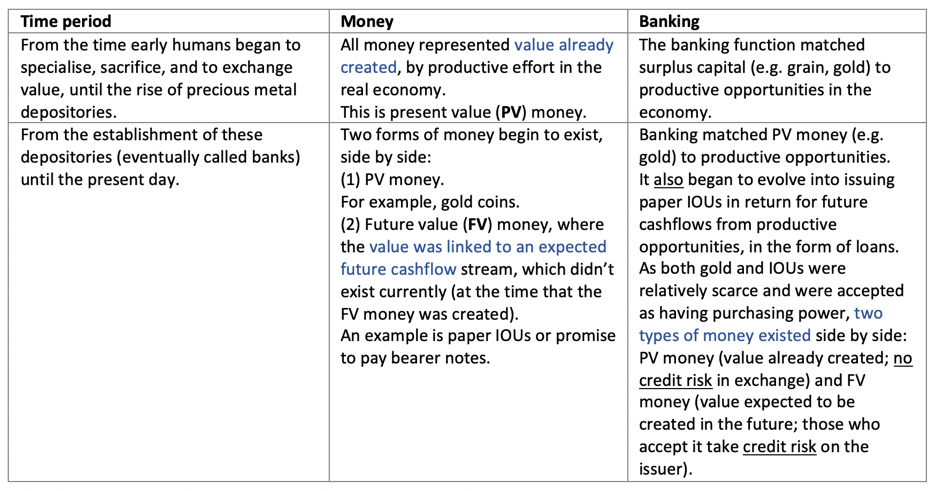 Although this was an evolution, it led to a decisive change in what money meant to humanity: *The rise of modern banking broke the historic link where money represented the memory of something valuable created.* Want to know more about what money really is? Follow me. --- 1. P. Einzig, *Primitive Money: In its Ethnological, Historical and Economic Aspects*, 2nd edn., London, Pergamon Press, 1966. M.Powell, ‘Money in Mesopotamia’, *Journal of the Economic and Social History of the Orient*, vol. 39, no. 3, 1996, pp. 224-242. 2. Amongst the earliest recorded civilisations to use money were the Sumerians. By the time they codified a standard of value, this was still expressed in barley, although silver had become the main medium of exchange. R.F. Harper, *The Code of Hammurabi*, Chicago, 1904, p. 37. S.Homer and R. Sylla, *A History of Interest Rates*, 4th edn., Hoboken, John Wiley & Sons, 2005. 3. Einzig, *op. cit.*,p. 206. 4. Homer and Sylla, *op. cit.* 5. Some items were used as money that have value in themselves, like barley or cigarettes, but, when used for an exchange purpose, their value was their scarcity and purchasing power, not because you could eat or smoke them. If the goat seller, for example, just wanted to buy barley, he probably would not have gone to the shoemaker. 6. The earliest form of precious metal money in Mesopotamia was originally copper. In Ancient Rome it was the *aes rude*, which was copper or bronze. In Indonesia, tin was used in trade and Sparta used iron. Eventually, gold and silver became more prominent. Einzig, *op. cit.* 7. Precious metals did not have consistent global pricing until the emergence of modern logistics, but acceptance of precious metals by diverse civilisations facilitated exchange amongst groups and, eventually, nations. In many ways, gold and silver were a global money for most of human history: they were scarce and they were accepted as having purchasing power. 8. From the Greek historian, Herodotus, *The Histories*. R. Cook, ‘Speculations on the Origin of Coinage’, *Historia*, vol. 7, no. 3, 1958, pp. 257-262. 9. This is *double spending(: the depository had gold on deposit from the customer and, at the same time, lent some of this gold to a borrower. The original gold is the only representation of value created in the real economy. Actually, depositories (banks) spend much more than twice. A 10% fractional reserve ratio means that ~9x the original “value” deposit is created in paper IOU money, in purchasing power. 10. Of course, some volatility is to be expected and at certain amount does, in fact, provide valuable information to participants in the economy. A natural amount of volatility is beneficial to the economy, as it gets rid of dead wood and makes the overall system stronger. Here, we refer to excess variance, the exponential effect of bank credit money on a natural process and also its abnormal impact on asset pricing. --- **Robert Sharratt** Robert is part-Canadian, part-British, somewhat autistic and lives in Geneva. He is going to link the crypto system to the real economy and create a better banking model, or die trying. His interests include mountain-climbing, chess, piano, programming and distrusting authority. In his early career, he was an M&A investment banker in London, then in private equity, and then moved to Switzerland to invest his own money. He holds an MSc degree in Finance from London Business School. Twitter: @ReassureFin LinkedIn: https://www.linkedin.com/in/robert-sharratt-1887a4129/ |
| json metadata | {"tags":["crypto","money","banking","finance","history"],"users":["reassurefin"],"image":["https://cdn.steemitimages.com/DQmRunbSJ8TDzbew857Ge1pPco2HVDKWexq5mTLojex1bMG/time%20periods%20money%20banking%20no%20superscript.png"],"links":["https://www.linkedin.com/in/robert-sharratt-1887a4129/"],"app":"steemit/0.1","format":"markdown"} |
| Transaction Info | Block #29192705/Trx 1413b46de496016705d780efb297f57715feb1ed |
View Raw JSON Data
{
"trx_id": "1413b46de496016705d780efb297f57715feb1ed",
"block": 29192705,
"trx_in_block": 29,
"op_in_trx": 0,
"virtual_op": 0,
"timestamp": "2019-01-05T15:25:03",
"op": [
"comment",
{
"parent_author": "",
"parent_permlink": "crypto",
"author": "resreassure",
"permlink": "a-history-of-money",
"title": "A history of money",
"body": "**The story of money is the story of human evolution.**\n\nOur ancestors’ development of money was driven by our *biology* and our *values*. The history of money can be separated into two parts: \n(1) A period where money had an *explicit link* to value. This period existed from the dawn of money in Neolithic times, as humans started to cultivate crops and domesticate animals, and lasted for most of the rest of human history. \n(2) A recent period, where this explicit *link has been broken*. This period followed the rise of precious metal depositories (the forerunners of modern banks). \n\n**Money arose, essentially, as an extension of memory.** \n\nAs our ancestors evolved, they assumed increasingly specialised roles in society. Some might concentrate on making footwear, others to tending livestock, others in raising crops. Money represented the *concept of value created through specialised effort*, which was used by the group and then, later, exchanged with others through trade. Small groups remembered that the makers of footwear had done their part earlier, when the meat came in from a hunt. We acquired the concept of stored memory to shift value across time periods. Between groups we learned to exchange valuable items, either at the same time or with one group giving food now in return for a promise to receive food in the future from the other group. As we specialised further and repeated exchanges across time, this gradually led to the concept of a standard of value, as barter exchange become too complex for us to remember. This was *the first step towards money* and a standard of value for exchange existed amongst communities in Mesopotamia and along the Nile River by ~3,000 BC. *Footnote 1*\n\n**A standard of value was necessary before any other aspects of money could emerge.** \n\nExchanges of valuable items needed to be comparable and many societies used what was most available, such as wheat or barley. *Footnote 2* In Ancient Rome, cattle (pecus) become a standard of value, from which we get the word pecuniary. These standards of value also had other rudimentary, secondary characteristics useful for money: they are (somewhat) divisible, portable, durable, etc. and also their supply is naturally limited. \n\nDue to the rarity of double coincidence of wants, barter probably never really existed outside of small groups that didn’t want for much. As human groups became larger, *people conceived of value in relation to a common standard* (like barley); this allowed the emergence of a *medium of exchange*. So, a goat herder could sell a goat to a shoemaker, even if he already had enough shoes; the shoemaker could simply pay in barley. The goat would be valued according to a standard of value, measured in barley. Even if the goat herder didn’t want barley he could accept it as payment, as knew that he could use the barley as a way to buy something else he wanted. Barley also allowed him to buy a variety of items or to spend some now and keep the rest for future purchases. \n\nAny medium of exchange *implies that the item is also a store of value*, otherwise it would not be accepted in exchange. Barley is a store of value, as no one can magically create a huge supply of barley. A paper currency that is subject to inflation is a poor store of value, as it is worth less every day; therefore, it is a poor medium of exchange (because who would really choose it, if it is constantly declining in value?). \n \n**Through a process of evolution, our ancestors developed the concept of money.** \n\nEssentially, *money reflects the memory of something valuable that was created by our efforts*, like raising livestock or making shoes. It allowed us to specialise and exchange items of value, so we were all better off. Money is often defined using complex language, but it only has two simple, common-sense characteristics: \n(1) Money needs to be scarce.\n(2) Money needs to be accepted by others as having purchasing power. \n\n**Money co-evolved with our understanding of sacrifice.** \n\nHumans gradually learned that sacrifice today could mean more of something tomorrow. Some of our earliest writing dealt with loans from those who had surplus grains to those who presumably had the ability and inclination to put the grains to productive use. Seeds planted today, rather than eaten with a crop, could mean more next season. Borrowers could repay lenders from what was brought forth by their efforts: when the grain harvest was brought in, a certain percentage was given to those who had sacrificed. Loans and interest due were recorded on tablets and quoted in money *Footnote 3*; this usually happened at temples, which were principal meeting places for the community. Many societies set limits on interest rates, had rules for times when the harvest failed, etc. *Footnote 4* Sacrifice, a form of savings, and productive use of the savings, benefitted both parties. A primitive economy grew bigger: more land was brought under cultivation, more animals were raised. Savings (sacrifice), recorded as a form of money, led to a better existence for humanity. \n\n**Money itself has no intrinsic value.** \n\nGold, US dollars, bitcoin, etc. have value only to the extent that they are scare and are commonly accepted to purchase goods and services. Money is a *symbol*, a representation of *purchasing power*; it is not valuable in itself. *Footnote 5* If aliens show up tomorrow and want to sell us a cure for cancer, they are unlikely to take gold bars in payment. Undoubtedly, their home planet also has the element Au (gold), caused by the explosion of neutron stars a few billion years ago, and they are not likely to value it very much. Probably they would find it amusing that we spend time digging up, refining and then guarding gold. They might think that if we didn’t waste our time like this we might have discovered a cure for cancer ourselves. \n\n**Since money has no intrinsic value, it must be trusted.** \n\nWhen you create something of value (for example, by making shoes, or selling your time to your employer), you need to trust the money you get in return for your effort. You need to trust that what you are getting in exchange will give you the ability to purchase things, now or in the future. The basis of all good money is *trust*, just as it is the basis for all good human relationships. \n\n**Precious metals emerged as the global money in many places.** \n\nWhere precious metals were present geologically most societies adopted them as money. *Footnote 6* Why did this happen, in an uncoordinated manner, around the world? Most importantly, because precious metals are scarce. This allows something that has no intrinsic value to act as a symbol that retains purchasing power over time. *Footnote 7* This led to groups of people accepting that precious metals represented a store of value, which could be used as exchange for goods or services in ever distant trade. So, by definition, they had purchasing power; their common acceptance was a benefit for the real economy. The global acceptance of precious metals meant that their value was not tied to the actions of specific nation states.\n\nPrecious metals had other, common-sense characteristics as a representation of value: they lasted a long time, were hard to damage, could be divided into smaller units, each unit had the same value as any other, etc. Their value was based on their weight. Eventually, probably in Lydia, *Footnote 8* precious metals were made into standard units called coins, to facilitate commerce. Since they come from distant, exploded stars they were rather hard to counterfeit. In addition, primitive humans, unlike us today, probably used gold and silver because they liked shiny things with a bit of bling to them. \n\n**Precious metal depositories led to the creation of modern banks. It was the end of an era for what our ancestors would have considered “money”.** \n\nGold and silver were concentrated in the hands of governments and guilds, who acted as producers, issuers, and depositories. As carrying gold and silver around was sometimes inconvenient and risky, precious metal depositories issued paper IOUs to their customers, depositors like merchants. These paper IOUs, backed by the value of precious metal, could be used as a more convenient form of making purchases; the IOUs themselves began to circulate as a form of money. The depositories learned that not all customers demanded access to their gold or silver at the same time. This presented *an opportunity to make loans using paper receipts* for more than the total amount of precious metal that they physically held. In this way a “fraction” of the value was kept in reserve and the rest could be lent out to borrowers. *Footnote 9* \n\nBorrowers, doing something productive in the real economy, had an obligation to repay the lender a greater amount than was lent to them, secured against their real economy assets. This allowed the depository to earn a significant lending profit from each reserve amount. Of course, there was a risk as well: what if all customers came in and wanted their gold back? However, the real risk to the depository was relatively low: obligations were covered either by gold in storage or by real asset collateral. As further security, loans were also backed by the expected future cashflows of the productive use of the lent “money”. What became crucial was not the gold on deposit, but rather the confidence that users had in the depository. This confidence made the difference between a successful and an unsuccessful depository, not the ability of users to see how much gold really existed behind the scenes. Modern banks use *exactly the same model* as the depositories from history. \n\nIf you want to solve the *greatest mystery* in modern economics, and help remove the cancer that is the extreme variance *Footnote 10* in the business cycle that metastasises every 1-2 decades, here is the question to ask yourself: *are the gold and the IOUs the same thing?* We know that no money has any intrinsic value. The gold is a symbolic representation, a token, that represents value. The IOU is a token on a token. They both have purchasing power. So, is there any difference between them? Let’s see if we can solve this mystery once and for all. \n\n**Money and banking are inextricably linked.** \n\nThe history of money can be broadly divided into two periods, as set out below. \n\n\n\nAlthough this was an evolution, it led to a decisive change in what money meant to humanity: \n\n\n*The rise of modern banking broke the historic link where money represented the memory of something valuable created.*\n\nWant to know more about what money really is? Follow me. \n\n---\n\n1. P. Einzig, *Primitive Money: In its Ethnological, Historical and Economic Aspects*, 2nd edn., London, Pergamon Press, 1966. M.Powell, ‘Money in Mesopotamia’, *Journal of the Economic and Social History of the Orient*, vol. 39, no. 3, 1996, pp. 224-242. \n\n2. Amongst the earliest recorded civilisations to use money were the Sumerians. By the time they codified a standard of value, this was still expressed in barley, although silver had become the main medium of exchange. R.F. Harper, *The Code of Hammurabi*, Chicago, 1904, p. 37. S.Homer and R. Sylla, *A History of Interest Rates*, 4th edn., Hoboken, John Wiley & Sons, 2005. \n\n3. Einzig, *op. cit.*,p. 206. \n\n4. Homer and Sylla, *op. cit.* \n \n5. Some items were used as money that have value in themselves, like barley or cigarettes, but, when used for an exchange purpose, their value was their scarcity and purchasing power, not because you could eat or smoke them. If the goat seller, for example, just wanted to buy barley, he probably would not have gone to the shoemaker. \n\n6. The earliest form of precious metal money in Mesopotamia was originally copper. In Ancient Rome it was the *aes rude*, which was copper or bronze. In Indonesia, tin was used in trade and Sparta used iron. Eventually, gold and silver became more prominent. Einzig, *op. cit.*\n \n7. Precious metals did not have consistent global pricing until the emergence of modern logistics, but acceptance of precious metals by diverse civilisations facilitated exchange amongst groups and, eventually, nations. In many ways, gold and silver were a global money for most of human history: they were scarce and they were accepted as having purchasing power. \n \n8. From the Greek historian, Herodotus, *The Histories*. R. Cook, ‘Speculations on the Origin of Coinage’, *Historia*, vol. 7, no. 3, 1958, pp. 257-262. \n \n9. This is *double spending(: the depository had gold on deposit from the customer and, at the same time, lent some of this gold to a borrower. The original gold is the only representation of value created in the real economy. Actually, depositories (banks) spend much more than twice. A 10% fractional reserve ratio means that ~9x the original “value” deposit is created in paper IOU money, in purchasing power. \n \n10. Of course, some volatility is to be expected and at certain amount does, in fact, provide valuable information to participants in the economy. A natural amount of volatility is beneficial to the economy, as it gets rid of dead wood and makes the overall system stronger. Here, we refer to excess variance, the exponential effect of bank credit money on a natural process and also its abnormal impact on asset pricing. \n\n---\n\n**Robert Sharratt**\nRobert is part-Canadian, part-British, somewhat autistic and lives in Geneva. He is going to link the crypto system to the real economy and create a better banking model, or die trying. His interests include mountain-climbing, chess, piano, programming and distrusting authority. In his early career, he was an M&A investment banker in London, then in private equity, and then moved to Switzerland to invest his own money. He holds an MSc degree in Finance from London Business School. \n\nTwitter: @ReassureFin\nLinkedIn: https://www.linkedin.com/in/robert-sharratt-1887a4129/",
"json_metadata": "{\"tags\":[\"crypto\",\"money\",\"banking\",\"finance\",\"history\"],\"users\":[\"reassurefin\"],\"image\":[\"https://cdn.steemitimages.com/DQmRunbSJ8TDzbew857Ge1pPco2HVDKWexq5mTLojex1bMG/time%20periods%20money%20banking%20no%20superscript.png\"],\"links\":[\"https://www.linkedin.com/in/robert-sharratt-1887a4129/\"],\"app\":\"steemit/0.1\",\"format\":\"markdown\"}"
}
]
}bebesofiupvoted (100.00%) @resreassure / crypto-and-sex2019/01/05 14:45:09
bebesofiupvoted (100.00%) @resreassure / crypto-and-sex
2019/01/05 14:45:09
| voter | bebesofi |
| author | resreassure |
| permlink | crypto-and-sex |
| weight | 10000 (100.00%) |
| Transaction Info | Block #29191907/Trx 2b7a4c51cdb9e3e4f9329e3f4f00dcde8a2df3aa |
View Raw JSON Data
{
  "trx_id": "2b7a4c51cdb9e3e4f9329e3f4f00dcde8a2df3aa",
  "block": 29191907,
  "trx_in_block": 3,
  "op_in_trx": 0,
  "virtual_op": 0,
  "timestamp": "2019-01-05T14:45:09",
  "op": [
    "vote",
    {
      "voter": "bebesofi",
      "author": "resreassure",
      "permlink": "crypto-and-sex",
      "weight": 10000
    }
  ]
}cheetahreplied to @resreassure / cheetah-re-resreassurecrypto-and-sex2019/01/05 14:42:21
cheetahreplied to @resreassure / cheetah-re-resreassurecrypto-and-sex
2019/01/05 14:42:21
| parent author | resreassure |
| parent permlink | crypto-and-sex |
| author | cheetah |
| permlink | cheetah-re-resreassurecrypto-and-sex |
| title | |
| body | Hi! I am a robot. I just upvoted you! I found similar content that readers might be interested in: https://medium.com/@res_reassure/omgno-crypto-and-womens-sexual-pleasure-74dd99db6bbe |
| json metadata | |
| Transaction Info | Block #29191851/Trx 54d9a0e8dc0f4c24ac2ae12d408c874c74945879 |
View Raw JSON Data
{
  "trx_id": "54d9a0e8dc0f4c24ac2ae12d408c874c74945879",
  "block": 29191851,
  "trx_in_block": 8,
  "op_in_trx": 0,
  "virtual_op": 0,
  "timestamp": "2019-01-05T14:42:21",
  "op": [
    "comment",
    {
      "parent_author": "resreassure",
      "parent_permlink": "crypto-and-sex",
      "author": "cheetah",
      "permlink": "cheetah-re-resreassurecrypto-and-sex",
      "title": "",
      "body": "Hi! I am a robot. I just upvoted you! I found similar content that readers might be interested in:\nhttps://medium.com/@res_reassure/omgno-crypto-and-womens-sexual-pleasure-74dd99db6bbe",
      "json_metadata": ""
    }
  ]
}cheetahupvoted (0.08%) @resreassure / crypto-and-sex2019/01/05 14:42:18
cheetahupvoted (0.08%) @resreassure / crypto-and-sex
2019/01/05 14:42:18
| voter | cheetah |
| author | resreassure |
| permlink | crypto-and-sex |
| weight | 8 (0.08%) |
| Transaction Info | Block #29191850/Trx 225a91428273b2ada97642f2f16319d3bf2c5ae8 |
View Raw JSON Data
{
  "trx_id": "225a91428273b2ada97642f2f16319d3bf2c5ae8",
  "block": 29191850,
  "trx_in_block": 1,
  "op_in_trx": 0,
  "virtual_op": 0,
  "timestamp": "2019-01-05T14:42:18",
  "op": [
    "vote",
    {
      "voter": "cheetah",
      "author": "resreassure",
      "permlink": "crypto-and-sex",
      "weight": 8
    }
  ]
}resreassureupdated options for crypto-and-sex2019/01/05 14:42:03
resreassureupdated options for crypto-and-sex
2019/01/05 14:42:03
| author | resreassure |
| permlink | crypto-and-sex |
| max accepted payout | 0.000 SBD |
| percent steem dollars | 10000 |
| allow votes | true |
| allow curation rewards | true |
| extensions | [] |
| Transaction Info | Block #29191845/Trx 83d4a3762d7cab35f06c60538b940e73bbc2481a |
View Raw JSON Data
{
  "trx_id": "83d4a3762d7cab35f06c60538b940e73bbc2481a",
  "block": 29191845,
  "trx_in_block": 12,
  "op_in_trx": 0,
  "virtual_op": 0,
  "timestamp": "2019-01-05T14:42:03",
  "op": [
    "comment_options",
    {
      "author": "resreassure",
      "permlink": "crypto-and-sex",
      "max_accepted_payout": "0.000 SBD",
      "percent_steem_dollars": 10000,
      "allow_votes": true,
      "allow_curation_rewards": true,
      "extensions": []
    }
  ]
}resreassurepublished a new post: crypto-and-sex2019/01/05 14:42:03
resreassurepublished a new post: crypto-and-sex
2019/01/05 14:42:03
| parent author | |
| parent permlink | crypto |
| author | resreassure |
| permlink | crypto-and-sex |
| title | Crypto and sex |
| body | **OMGNo!**  The failure by Stripe to provide services to OMGYes, a site the provides education in relation to women’s sexual pleasure, illustrates the difference between fintech and crypto. Fintech is the cool, slightly hippie version of the traditional financial system. But … it is still the traditional financial system. The Collison brothers from Limerick, Ireland who created Stripe seem to personify fintech: incredibly intelligent, disruptive, well-intentioned billionaires. Despite personally wanting to fund OMGYes, the traditional financial system that controls Stripe said no. The crypto system is **fundamentally** different: there is no middleman to tell you what you can do with your money (as long as it is legal, of course). No government, no bank. The decision is up to you. Payments go from you to the recipient. Economists use the term “repugnance” to describe activities that have a moral element to them, such as the sale of sex items. Many banks and financial intermediaries do not allow their customers to make purchases they deem repugnant, even if they are legal. A good example is provided by the fintech company, Stripe, which facilitates payments. Here is an excerpt from their website: *“Why can’t we work with some businesses?* *Behind the scenes, we work closely with payment networks (such as Visa and Mastercard) and banking partners across more than two dozen countries. Each institution has strict legal regulations that govern them and specific rules about the types of businesses they do and do not work with.”* Footnote 1 One such business they declined to provide financial services for is OMGYes, which provides educational videos in relation to women’s sexual pleasure. Here is what Stripe had to say about why they declined to provide services to OMGYes: *"The business approached us and we were eager to work with them, but after a month of deliberations, our financial partners did not agree. Instead, because the website has explicit tutorials, it still falls under the umbrella of unsupportable businesses. While we were not able to persuade our financial partners this time around, we will continue to holistically look at and advocate for businesses that sell adult products and services.”* One the one hand, you could perhaps say: well, they wanted to do the right thing. On the other hand, you might say: well, the end result is that they didn’t (couldn’t) do what they felt was the right thing. The traditional financial system just doesn’t allow it. You might also say: if it is my money and it is legal, why does some financial services company decide for me what is morally acceptable or not? Using nice terms like “holistically” and “advocating for businesses” doesn’t change the fact that they said **OMGNo** to **OMGYes**. Footnote 2 Finally, here is what Stripe says, *“As a result, the decision to support a business is not solely up to Stripe; it involves the various financial companies in the credit card processing chain.”* You want to know what the difference is between the traditional banking system, including “fintech” companies like Stripe, and the crypto system? Well, here it is: **In the crypto system, the decision to support a business is solely up to you.** It is your money and it is your moral value judgement. In the future, people will decide what is morally repugnant to them and what is not. Increasingly, they will decide that banks and the system that enables them are repugnant. In the future, when the crypto system replaces the traditional banking system, constraints due to “repugnance” (for legal activities) will cease to exist. --- 1. Danika Lyon, Industry Relations, Stripe Inc. “Why some businesses aren’t allowed.” 12 August 2016. As sourced from: Al Roth economics blog, guest post by Stephanie Hurder. 28 August 2018. 2. Of course, even if it doesn’t change the end result or the fact that it contributes to enabling the traditional financial system to decide morality for you (I know, what a joke), at least Stripe should get some credit for being open and honest about the decision process. You won’t find many articles like this on bank websites that say: well, we would have liked to have provided services to this customer, but, you know, the traditional financial system finds education about women’s sexual pleasure repugnant. Meanwhile, check out our services to strip mining companies in Africa, here …. --- **Robert Sharratt** Robert is part-Canadian, part-British, somewhat autistic and lives in Geneva. He is going to link the crypto system to the real economy and create a better banking model, or die trying. His interests include mountain-climbing, chess, piano, programming and distrusting authority. In his early career, he was an M&A investment banker in London, then in private equity, and then moved to Switzerland to invest his own money. He holds an MSc degree in Finance from London Business School. Twitter: @ReassureFin LinkedIn: https://www.linkedin.com/in/robert-sharratt-1887a4129/ |
| json metadata | {"tags":["crypto","sex","banking","finance","blockchain"],"users":["reassurefin"],"image":["https://cdn.steemitimages.com/DQmVtbXGB9JYfeNeBYPUVAFuDDLrDzKQcHyVa7ZkGKbvz7Z/OMGYes.png"],"links":["https://www.linkedin.com/in/robert-sharratt-1887a4129/"],"app":"steemit/0.1","format":"markdown"} |
| Transaction Info | Block #29191845/Trx 83d4a3762d7cab35f06c60538b940e73bbc2481a |
View Raw JSON Data
{
"trx_id": "83d4a3762d7cab35f06c60538b940e73bbc2481a",
"block": 29191845,
"trx_in_block": 12,
"op_in_trx": 0,
"virtual_op": 0,
"timestamp": "2019-01-05T14:42:03",
"op": [
"comment",
{
"parent_author": "",
"parent_permlink": "crypto",
"author": "resreassure",
"permlink": "crypto-and-sex",
"title": "Crypto and sex",
"body": "**OMGNo!** \n\n\n\nThe failure by Stripe to provide services to OMGYes, a site the provides education in relation to women’s sexual pleasure, illustrates the difference between fintech and crypto. Fintech is the cool, slightly hippie version of the traditional financial system. But … it is still the traditional financial system. The Collison brothers from Limerick, Ireland who created Stripe seem to personify fintech: incredibly intelligent, disruptive, well-intentioned billionaires. Despite personally wanting to fund OMGYes, the traditional financial system that controls Stripe said no. The crypto system is **fundamentally** different: there is no middleman to tell you what you can do with your money (as long as it is legal, of course). No government, no bank. The decision is up to you. Payments go from you to the recipient. \n\nEconomists use the term “repugnance” to describe activities that have a moral element to them, such as the sale of sex items. Many banks and financial intermediaries do not allow their customers to make purchases they deem repugnant, even if they are legal. A good example is provided by the fintech company, Stripe, which facilitates payments. Here is an excerpt from their website: \n\n*“Why can’t we work with some businesses?*\n\n*Behind the scenes, we work closely with payment networks (such as Visa and Mastercard) and banking partners across more than two dozen countries. Each institution has strict legal regulations that govern them and specific rules about the types of businesses they do and do not work with.”* Footnote 1\n\nOne such business they declined to provide financial services for is OMGYes, which provides educational videos in relation to women’s sexual pleasure. Here is what Stripe had to say about why they declined to provide services to OMGYes: \n\n*\"The business approached us and we were eager to work with them, but after a month of deliberations, our financial partners did not agree. Instead, because the website has explicit tutorials, it still falls under the umbrella of unsupportable businesses. While we were not able to persuade our financial partners this time around, we will continue to holistically look at and advocate for businesses that sell adult products and services.”*\n\nOne the one hand, you could perhaps say: well, they wanted to do the right thing. On the other hand, you might say: well, the end result is that they didn’t (couldn’t) do what they felt was the right thing. The traditional financial system just doesn’t allow it. You might also say: if it is my money and it is legal, why does some financial services company decide for me what is morally acceptable or not? Using nice terms like “holistically” and “advocating for businesses” doesn’t change the fact that they said **OMGNo** to **OMGYes**. Footnote 2 \n\nFinally, here is what Stripe says, \n\n*“As a result, the decision to support a business is not solely up to Stripe; it involves the various financial companies in the credit card processing chain.”*\n\nYou want to know what the difference is between the traditional banking system, including “fintech” companies like Stripe, and the crypto system? Well, here it is: \n\n**In the crypto system, the decision to support a business is solely up to you.**\n\nIt is your money and it is your moral value judgement. \n\nIn the future, people will decide what is morally repugnant to them and what is not. Increasingly, they will decide that banks and the system that enables them are repugnant. \n\nIn the future, when the crypto system replaces the traditional banking system, constraints due to “repugnance” (for legal activities) will cease to exist.\n\n---\n\n1. Danika Lyon, Industry Relations, Stripe Inc. “Why some businesses aren’t allowed.” 12 August 2016. As sourced from: Al Roth economics blog, guest post by Stephanie Hurder. 28 August 2018. \n\n2. Of course, even if it doesn’t change the end result or the fact that it contributes to enabling the traditional financial system to decide morality for you (I know, what a joke), at least Stripe should get some credit for being open and honest about the decision process. You won’t find many articles like this on bank websites that say: well, we would have liked to have provided services to this customer, but, you know, the traditional financial system finds education about women’s sexual pleasure repugnant. Meanwhile, check out our services to strip mining companies in Africa, here ….\n\n---\n\n**Robert Sharratt**\nRobert is part-Canadian, part-British, somewhat autistic and lives in Geneva. He is going to link the crypto system to the real economy and create a better banking model, or die trying. His interests include mountain-climbing, chess, piano, programming and distrusting authority. In his early career, he was an M&A investment banker in London, then in private equity, and then moved to Switzerland to invest his own money. He holds an MSc degree in Finance from London Business School. \n\nTwitter: @ReassureFin\nLinkedIn: https://www.linkedin.com/in/robert-sharratt-1887a4129/",
"json_metadata": "{\"tags\":[\"crypto\",\"sex\",\"banking\",\"finance\",\"blockchain\"],\"users\":[\"reassurefin\"],\"image\":[\"https://cdn.steemitimages.com/DQmVtbXGB9JYfeNeBYPUVAFuDDLrDzKQcHyVa7ZkGKbvz7Z/OMGYes.png\"],\"links\":[\"https://www.linkedin.com/in/robert-sharratt-1887a4129/\"],\"app\":\"steemit/0.1\",\"format\":\"markdown\"}"
}
]
}2019/01/05 14:24:33
2019/01/05 14:24:33
| author | resreassure |
| permlink | the-crypto-system-will-replace-the-banking-system-in-the-next-decade-and-other-predictions |
| max accepted payout | 0.000 SBD |
| percent steem dollars | 10000 |
| allow votes | true |
| allow curation rewards | true |
| extensions | [] |
| Transaction Info | Block #29191495/Trx 48c170b7f9727dbe3dc8cd261f254dad47821dbf |
View Raw JSON Data
{
  "trx_id": "48c170b7f9727dbe3dc8cd261f254dad47821dbf",
  "block": 29191495,
  "trx_in_block": 34,
  "op_in_trx": 0,
  "virtual_op": 0,
  "timestamp": "2019-01-05T14:24:33",
  "op": [
    "comment_options",
    {
      "author": "resreassure",
      "permlink": "the-crypto-system-will-replace-the-banking-system-in-the-next-decade-and-other-predictions",
      "max_accepted_payout": "0.000 SBD",
      "percent_steem_dollars": 10000,
      "allow_votes": true,
      "allow_curation_rewards": true,
      "extensions": []
    }
  ]
}2019/01/05 14:24:33
2019/01/05 14:24:33
| parent author | |
| parent permlink | crypto |
| author | resreassure |
| permlink | the-crypto-system-will-replace-the-banking-system-in-the-next-decade-and-other-predictions |
| title | The crypto system will replace the banking system in the next decade, and other predictions. |
| body | **1. A new banking model will emerge, in accordance with our better human values.** Fractional reserve banking sucks. Putting the fractional reserve banking model onto the blockchain does not make it suck less. Whether it is traditional banking, challenger banks, neo banks, fintechs, crypto banks: if it uses fractional reserve banking, it is dishonest and dangerous to the economy. Fractional reserve banking is antithetical to the crypto system and the movement of people who support it. A new banking model will emerge, for the crypto era. **2. Fractional reserve banking will be reformed.** The government charter to commercial banks that allows them to create credit money will become regulated. Internal credit money creation will be subject to regulatory limits. The free government deposit guarantee to commercial banks, which encourages speculation on future asset prices and is the cause of economic booms and busts, will be reformed. **3. But it won’t matter: the fractional reserve banking system will almost completely die out over the next decade.** The crypto system will offer higher returns for less risk and depositors will increasingly vote with their feet. Over the next decade, the crypto system will expand and the fractional reserve banking system will decline. An inflection point will be reached where the rate of change for both accelerates rapidly. The fractional reserve system is *intrinsically* structured like an inverted house of cards. Once enough deposits are pulled out of the bottom, the house will collapse. **4. International trade will increasingly be priced in a standard of value that is global and not tied to the currency of any particular country.** The US dollar will slowly decline as a standard of value in trade. It will be replaced by the Special Drawing Rights basket (USD, EUR, GBP, JPY, CNY) + BTC. **5. Bitcoin, once linked to productive use in the real economy, will emerge as the ultimate global store of value, mainly because its supply is fixed and because of wide adoption.** Bitcoin will increase significantly in price as adoption spreads. The price a decade from now will be in excess of $410,250 per BTC. **6. With greater adoption of the crypto system, excess economic variance in the economy will become like some diseases that human ingenuity has confronted: a distant memory.** The crypto system will reduce business cycle variance in two ways: a. Through the elimination of credit money creation by commercial banks. Crypto money supply is fixed; it cannot be arbitrarily created. b. By endowing money ownership rights in its proper holders: those who created the value in the first place. This will tap into distributed knowledge in society and will naturally introduce greater prudence in use of funds, particularly lending in the hope of future asset price appreciation. **7. Crypto currencies will be valued more like currencies in the future, rather than like assets, as the sector achieves greater financial depth.** There are two main problems with crypto currencies at the moment: there is little market depth and there is not much of a link to the real economy. In the future, as greater links are established to the real economy, leading to greater market depth, crypto currencies will be priced more like currencies and less like assets. **8. Most utility tokens will convert into equity tokens or companies will set the price for their product in relation to a stable standard of value, rather than in the token price.** The utility token value is often treated as a representation of the value of the issuing company. Many companies have encouraged this impression, which is economically to the long-term detriment of product adoption. There are two simple solutions: issue securities tokens and/or pricing usage based on a stable standard of value. **9. Stablecoins will be a very niche part of the crypto space, without much value.** Most stablecoins seek to provide price stability for crypto users, in relation to old standards of value, like the US dollar. While there are some use cases for such tokens, most participants will seek to achieve price stability through more efficient or financially rewarding means. Sellers and buyers of many internationally traded goods, for example, can achieve future price certainty by reference to a stable standard of value and/or using crypto derivatives markets, which will grow in importance in the future. **10. The future “unwinding” of fiat money created over the past decade will lead to an accelerated decline of nation state currencies over the next decade and drive savers to adopt crypto currencies.** The unbounded and continuing money creation of the past decade, to bail-out the fractional reserve banking system from asset mal investment, is historically unprecedented. Foresighted savers, particularly asset managers in advanced economies, will seek value preservation in the emerging crypto system at a level greatly in excess of today’s levels. **11. Enterprise “blockchains” will cease to exist.** Their very name is an *oxymoron*. Enterprises only adopt blockchain as a defensive measure, but they won’t be able to hold off the value that arises within global ecosystems from truly decentralised blockchains. The benefit of blockchains is to cut out the middleman. Enterprises are the middleman. As soon as a real crypto bank is in place, to link the crypto system to the real economy, industry ecosystem blockchains will arise to disintermediate these middlemen. **12. Centralised trading exchanges will cease to exist.** These exchanges are nothing more than SQL databases and have nothing to do with crypto except the assets that trade on them. Decentralised exchanges will arise. **13. Money transfer companies like Western Union will go bankrupt and cease to exist.** Western Union transfers money mainly amongst the poorest people in the world. They do this for up to 30% of the amount transferred. The crypto system will soon be able to do this for fixed fees of less than a dollar per transfer. Over the next decade, those institutions that have ethical investing guidelines will disinvest from Western Union, based how it preys on the poor. **14. Low income people everywhere will do their banking using the crypto system.** The fractional reserve banking system has completely failed low income people. Of course, most poor people are not even accepted by these banks. The crypto system has significantly lower fixed costs than the traditional banking system and, consequently, allows everyone to benefit from financial inclusion. The poor will be able to make transfers at extremely low cost. Emerging crypto banks will allow them the benefits of the savings function, giving them the first opportunity ever to climb out of poverty. The effects for poor communities globally will be transformational. *Bank of America will charge low-income customers $12 per month for their checking accounts unless they have a $1,500 account balance.* @laura_nelson, Twitter, 2018 *Finally, a bank with some fresh ideas on how to make poor people poorer.* @kashanacauley, Twitter, 2018 **15. Micro-everything will explode in use.** The crypto system allows extremely small amounts to be used in the financial system. For example, transfers for only a few dollars can be made. Emerging crypto banks will allow savers to put very small amounts of value to work, on which people can earn interest. The poor will be able to hold just a few satoshis worth of global stocks. Even the yield curve will be able to be constructed on a micro-level, for example the lending function could happen based on a day basis, rather than on wide fixed dates with interpolation between such dates for pricing at the moment. It will *revolutionise* finance. These are problems for which the only technology solution is the crypto system, which is like digital technology. As in so many improvements, the traditional banking system simply cannot offer such solutions; they are intrinsically stuck in an analogue technology world. The crypto system is your smart phone; fractional reserve banking is like using a Blackberry. **16. Constraints due to “repugnance” (for legal activities) will cease to exist.** Economists use the term “repugnance” to describe activities that have a moral element to them. Many banks and financial intermediaries do not allow their customers to make purchases they deem repugnant, even if they are legal. In the future, people will decide what is morally repugnant to them and what is not. The crypto system allows users to decide how they spend their money, not middlemen. **17. The various financial companies in the credit card processing chain will go bankrupt and cease to exist a decade from now.** The existing cards - banking system is based on *pull* technology, which is complex, costly and prone to fraud. The crypto payment system, based on *push* technology, is simpler and more secure than pull and will replace the old system. A decade from now no one will use the pull-based system; it will completely disappear. The main impetus for switching from credit cards to crypto system payments will come from merchants. **18. Criminals will continue to use the crypto system.** Sadly, criminality is just a fact of life and most criminals use financial systems, including crypto. The crypto system will put safeguards in place to protect against criminal activity, which is possible in a high-tech environment and less possible with traditional banks. **19. Gold will decline significantly in value, to the price level set by jewellery.** Crypto currencies are superior to gold in all respects and gold’s use as a store of value will be reduced as the crypto system increases in adoption and the fractional reserve banking system and national currency use declines. Eventually, both gold and nation state currencies will be seen as barbarous relics. **20. Until the crypto system matures, it will continue to attract some bad actors.** The exuberance related to the crypto system’s potential for humanity will continue to attract those who do not have the best interests of others at heart, those who seek only personal gain. This cannot be avoided and all new technologies, from railroads to the internet, attract such characters; it seems it is only human. For those who want to make the world a better place, we need to ignore critics’ attacks against the small number of these bad actors, weed out the opportunists, and focus on providing services that improve people’s lives. **Robert Sharratt** Robert is part-Canadian, part-British, somewhat autistic and lives in Geneva. He is going to link the crypto system to the real economy and create a better banking model, or die trying. His interests include mountain-climbing, chess, piano, programming and distrusting authority. In his early career, he was an M&A investment banker in London, then in private equity, and then moved to Switzerland to invest his own money. He holds an MSc degree in Finance from London Business School. Twitter: @ReassureFin LinkedIn: https://www.linkedin.com/in/robert-sharratt-1887a4129/ |
| json metadata | {"tags":["crypto","blockchain","banking","finance","ethics"],"users":["laura","kashanacauley","reassurefin"],"links":["https://www.linkedin.com/in/robert-sharratt-1887a4129/"],"app":"steemit/0.1","format":"markdown"} |
| Transaction Info | Block #29191495/Trx 48c170b7f9727dbe3dc8cd261f254dad47821dbf |
View Raw JSON Data
{
  "trx_id": "48c170b7f9727dbe3dc8cd261f254dad47821dbf",
  "block": 29191495,
  "trx_in_block": 34,
  "op_in_trx": 0,
  "virtual_op": 0,
  "timestamp": "2019-01-05T14:24:33",
  "op": [
    "comment",
    {
      "parent_author": "",
      "parent_permlink": "crypto",
      "author": "resreassure",
      "permlink": "the-crypto-system-will-replace-the-banking-system-in-the-next-decade-and-other-predictions",
      "title": "The crypto system will replace the banking system in the next decade, and other predictions.",
      "body": "**1. A new banking model will emerge, in accordance with our better human values.**  \n\nFractional reserve banking sucks.  Putting the fractional reserve banking model onto the blockchain does not make it suck less.  Whether it is traditional banking, challenger banks, neo banks, fintechs, crypto banks: if it uses fractional reserve banking, it is dishonest and dangerous to the economy.  Fractional reserve banking is antithetical to the crypto system and the movement of people who support it.  A new banking model will emerge, for the crypto era.  \n\n**2. Fractional reserve banking will be reformed.**  \n\nThe government charter to commercial banks that allows them to create credit money will become regulated.  Internal credit money creation will be subject to regulatory limits.   The free government deposit guarantee to commercial banks, which encourages speculation on future asset prices and is the cause of economic booms and busts, will be reformed.  \n\n**3.\tBut it won’t matter: the fractional reserve banking system will almost completely die out over the next decade.**  \n\nThe crypto system will offer higher returns for less risk and depositors will increasingly vote with their feet.  Over the next decade, the crypto system will expand and the fractional reserve banking system will decline.  An inflection point will be reached where the rate of change for both accelerates rapidly.  The fractional reserve system is *intrinsically* structured like an inverted house of cards.  Once enough deposits are pulled out of the bottom, the house will collapse.  \n\n**4.\tInternational trade will increasingly be priced in a standard of value that is global and not tied to the currency of any particular country.**  \n\nThe US dollar will slowly decline as a standard of value in trade.  It will be replaced by the Special Drawing Rights basket (USD, EUR, GBP, JPY, CNY) + BTC.  \n\n**5.\tBitcoin, once linked to productive use in the real economy, will emerge as the ultimate global store of value, mainly because its supply is fixed and because of wide adoption.**   \n\nBitcoin will increase significantly in price as adoption spreads.  The price a decade from now will be in excess of $410,250 per BTC.\n\n**6.\tWith greater adoption of the crypto system, excess economic variance in the economy will become like some diseases that human ingenuity has confronted: a distant memory.**  \n\nThe crypto system will reduce business cycle variance in two ways: \n\na.\tThrough the elimination of credit money creation by commercial banks.  Crypto money supply is fixed; it cannot be arbitrarily created.  \n\nb.\tBy endowing money ownership rights in its proper holders: those who created the value in the first place.  This will tap into distributed knowledge in society and will naturally introduce greater prudence in use of funds, particularly lending in the hope of future asset price appreciation.    \n\n**7.\tCrypto currencies will be valued more like currencies in the future, rather than like assets, as the sector achieves greater financial depth.**  \n\nThere are two main problems with crypto currencies at the moment: there is little market depth and there is not much of a link to the real economy.  In the future, as greater links are established to the real economy, leading to greater market depth, crypto currencies will be priced more like currencies and less like assets.  \n\n**8.\tMost utility tokens will convert into equity tokens or companies will set the price for their product in relation to a stable standard of value, rather than in the token price.**  \n\nThe utility token value is often treated as a representation of the value of the issuing company.  Many companies have encouraged this impression, which is economically to the long-term detriment of product adoption.  There are two simple solutions: issue securities tokens and/or pricing usage based on a stable standard of value.    \n\n**9.\tStablecoins will be a very niche part of the crypto space, without much value.**  \n\nMost stablecoins seek to provide price stability for crypto users, in relation to old standards of value, like the US dollar.  While there are some use cases for such tokens, most participants will seek to achieve price stability through more efficient or financially rewarding means.  Sellers and buyers of many internationally traded goods, for example, can achieve future price certainty by reference to a stable standard of value and/or using crypto derivatives markets, which will grow in importance in the future.  \n\n**10.\tThe future “unwinding” of fiat money created over the past decade will lead to an accelerated decline of nation state currencies over the next decade and drive savers to adopt crypto currencies.**  \n\nThe unbounded and continuing money creation of the past decade, to bail-out the fractional reserve banking system from asset mal investment, is historically unprecedented.  Foresighted savers, particularly asset managers in advanced economies, will seek value preservation in the emerging crypto system at a level greatly in excess of today’s levels.  \n\n**11.\tEnterprise “blockchains” will cease to exist.**  \n\nTheir very name is an *oxymoron*.  Enterprises only adopt blockchain as a defensive measure, but they won’t be able to hold off the value that arises within global ecosystems from truly decentralised blockchains.  The benefit of blockchains is to cut out the middleman.  Enterprises are the middleman.  As soon as a real crypto bank is in place, to link the crypto system to the real economy, industry ecosystem blockchains will arise to disintermediate these middlemen.  \n\n**12.\tCentralised trading exchanges will cease to exist.**  \n\nThese exchanges are nothing more than SQL databases and have nothing to do with crypto except the assets that trade on them.  Decentralised exchanges will arise.  \n\n**13.\tMoney transfer companies like Western Union will go bankrupt and cease to exist.**\n\nWestern Union transfers money mainly amongst the poorest people in the world.  They do this for up to 30% of the amount transferred.  The crypto system will soon be able to do this for fixed fees of less than a dollar per transfer.  Over the next decade, those institutions that have ethical investing guidelines will disinvest from Western Union, based how it preys on the poor.  \n\n**14.\tLow income people everywhere will do their banking using the crypto system.** \n\nThe fractional reserve banking system has completely failed low income people.  Of course, most poor people are not even accepted by these banks.   The crypto system has significantly lower fixed costs than the traditional banking system and, consequently, allows everyone to benefit from financial inclusion.  The poor will be able to make transfers at extremely low cost.  Emerging crypto banks will allow them the benefits of the savings function, giving them the first opportunity ever to climb out of poverty.  The effects for poor communities globally will be transformational.  \n\n*Bank of America will charge low-income customers $12 per month for their checking accounts unless they have a $1,500 account balance.*  \n@laura_nelson, Twitter, 2018\t\n\n*Finally, a bank with some fresh ideas on how to make poor people poorer.*  \n@kashanacauley, Twitter, 2018\n\n**15.\tMicro-everything will explode in use.** \n\nThe crypto system allows extremely small amounts to be used in the financial system.  For example, transfers for only a few dollars can be made.  Emerging crypto banks will allow savers to put very small amounts of value to work, on which people can earn interest.  The poor will be able to hold just a few satoshis worth of global stocks.  Even the yield curve will be able to be constructed on a micro-level, for example the lending function could happen based on a day basis, rather than on wide fixed dates with interpolation between such dates for pricing at the moment.  It will *revolutionise* finance.   \n\nThese are problems for which the only technology solution is the crypto system, which is like digital technology.  As in so many improvements, the traditional banking system simply cannot offer such solutions; they are intrinsically stuck in an analogue technology world.  The crypto system is your smart phone; fractional reserve banking is like using a Blackberry.  \n\n**16.\tConstraints due to “repugnance” (for legal activities) will cease to exist.**\n\nEconomists use the term “repugnance” to describe activities that have a moral element to them.  Many banks and financial intermediaries do not allow their customers to make purchases they deem repugnant, even if they are legal.  In the future, people will decide what is morally repugnant to them and what is not.  The crypto system allows users to decide how they spend their money, not middlemen.  \n\n**17.\tThe various financial companies in the credit card processing chain will go bankrupt and cease to exist a decade from now.**  \n\nThe existing cards - banking system is based on *pull* technology, which is complex, costly and prone to fraud.  The crypto payment system, based on *push* technology, is simpler and more secure than pull and will replace the old system.  A decade from now no one will use the pull-based system; it will completely disappear.   The main impetus for switching from credit cards to crypto system payments will come from merchants.  \n\n**18.\tCriminals will continue to use the crypto system.** \n\nSadly, criminality is just a fact of life and most criminals use financial systems, including crypto.  The crypto system will put safeguards in place to protect against criminal activity, which is possible in a high-tech environment and less possible with traditional banks.  \n\n**19.\tGold will decline significantly in value, to the price level set by jewellery.**  \n\nCrypto currencies are superior to gold in all respects and gold’s use as a store of value will be reduced as the crypto system increases in adoption and the fractional reserve banking system and national currency use declines.  Eventually, both gold and nation state currencies will be seen as barbarous relics. \n\n**20.\tUntil the crypto system matures, it will continue to attract some bad actors.**  \n\nThe exuberance related to the crypto system’s potential for humanity will continue to attract those who do not have the best interests of others at heart, those who seek only personal gain.  This cannot be avoided and all new technologies, from railroads to the internet, attract such characters; it seems it is only human.  For those who want to make the world a better place, we need to ignore critics’ attacks against the small number of these bad actors, weed out the opportunists, and focus on providing services that improve people’s lives.\n\n**Robert Sharratt**\nRobert is part-Canadian, part-British, somewhat autistic and lives in Geneva.  He is going to link the crypto system to the real economy and create a better banking model, or die trying.  His interests include mountain-climbing, chess, piano, programming and distrusting authority.  In his early career, he was an M&A investment banker in London, then in private equity, and then moved to Switzerland to invest his own money.  He holds an MSc degree in Finance from London Business School.  \n\nTwitter: @ReassureFin\nLinkedIn: https://www.linkedin.com/in/robert-sharratt-1887a4129/",
      "json_metadata": "{\"tags\":[\"crypto\",\"blockchain\",\"banking\",\"finance\",\"ethics\"],\"users\":[\"laura\",\"kashanacauley\",\"reassurefin\"],\"links\":[\"https://www.linkedin.com/in/robert-sharratt-1887a4129/\"],\"app\":\"steemit/0.1\",\"format\":\"markdown\"}"
    }
  ]
}resreassureupdated their account properties2019/01/05 14:04:06
resreassureupdated their account properties
2019/01/05 14:04:06
| account | resreassure |
| memo key | STM7bEsEXEdHkkfxL8iCt67xmcLMLH5pk31FitDPkTgJndLnVFGq6 |
| json metadata | {"profile":{"profile_image":"https://cdn.steemitimages.com/DQmeimm3NbyND9fdLwR4kRb4CCCPeayBrGj9dnoQz12RjpR/RES%20photo.png","name":"Robert Sharratt","about":"Robert is part-Canadian, part-British, somewhat autistic and lives in Geneva. He is going to link the crypto system to the real economy.","location":"Geneva, Switzerland","website":"https://reassurefinancial.com"}} |
| Transaction Info | Block #29191086/Trx 2fff68fd9e4d580a6040f58ee800409df092e15d |
View Raw JSON Data
{
  "trx_id": "2fff68fd9e4d580a6040f58ee800409df092e15d",
  "block": 29191086,
  "trx_in_block": 12,
  "op_in_trx": 0,
  "virtual_op": 0,
  "timestamp": "2019-01-05T14:04:06",
  "op": [
    "account_update",
    {
      "account": "resreassure",
      "memo_key": "STM7bEsEXEdHkkfxL8iCt67xmcLMLH5pk31FitDPkTgJndLnVFGq6",
      "json_metadata": "{\"profile\":{\"profile_image\":\"https://cdn.steemitimages.com/DQmeimm3NbyND9fdLwR4kRb4CCCPeayBrGj9dnoQz12RjpR/RES%20photo.png\",\"name\":\"Robert Sharratt\",\"about\":\"Robert is part-Canadian, part-British, somewhat autistic and lives in Geneva.  He is going to link the crypto system to the real economy.\",\"location\":\"Geneva, Switzerland\",\"website\":\"https://reassurefinancial.com\"}}"
    }
  ]
}resreassureupdated their account properties2019/01/05 14:02:51
resreassureupdated their account properties
2019/01/05 14:02:51
| account | resreassure |
| memo key | STM7bEsEXEdHkkfxL8iCt67xmcLMLH5pk31FitDPkTgJndLnVFGq6 |
| json metadata | {"profile":{"profile_image":"https://cdn.steemitimages.com/DQmeimm3NbyND9fdLwR4kRb4CCCPeayBrGj9dnoQz12RjpR/RES%20photo.png","name":"Robert Sharratt","about":"Robert is part-Canadian, part-British, somewhat autistic and lives in Geneva. He is going to link the crypto system to the real economy and create a better ban","location":"Geneva, Switzerland","website":"https://reassurefinancial.com"}} |
| Transaction Info | Block #29191061/Trx b4567ad08395c93acaeb9e3c2c710676b804bca4 |
View Raw JSON Data
{
  "trx_id": "b4567ad08395c93acaeb9e3c2c710676b804bca4",
  "block": 29191061,
  "trx_in_block": 24,
  "op_in_trx": 0,
  "virtual_op": 0,
  "timestamp": "2019-01-05T14:02:51",
  "op": [
    "account_update",
    {
      "account": "resreassure",
      "memo_key": "STM7bEsEXEdHkkfxL8iCt67xmcLMLH5pk31FitDPkTgJndLnVFGq6",
      "json_metadata": "{\"profile\":{\"profile_image\":\"https://cdn.steemitimages.com/DQmeimm3NbyND9fdLwR4kRb4CCCPeayBrGj9dnoQz12RjpR/RES%20photo.png\",\"name\":\"Robert Sharratt\",\"about\":\"Robert is part-Canadian, part-British, somewhat autistic and lives in Geneva.  He is going to link the crypto system to the real economy and create a better ban\",\"location\":\"Geneva, Switzerland\",\"website\":\"https://reassurefinancial.com\"}}"
    }
  ]
}resreassureupdated their account properties2019/01/05 14:02:00
resreassureupdated their account properties
2019/01/05 14:02:00
| account | resreassure |
| memo key | STM7bEsEXEdHkkfxL8iCt67xmcLMLH5pk31FitDPkTgJndLnVFGq6 |
| json metadata | {"profile":{"profile_image":"https://cdn.steemitimages.com/DQmeimm3NbyND9fdLwR4kRb4CCCPeayBrGj9dnoQz12RjpR/RES%20photo.png","website":"https://reassurefinancial.com"}} |
| Transaction Info | Block #29191044/Trx 0b08f1cda3698f755f72059670eb72c2b80c6bff |
View Raw JSON Data
{
  "trx_id": "0b08f1cda3698f755f72059670eb72c2b80c6bff",
  "block": 29191044,
  "trx_in_block": 9,
  "op_in_trx": 0,
  "virtual_op": 0,
  "timestamp": "2019-01-05T14:02:00",
  "op": [
    "account_update",
    {
      "account": "resreassure",
      "memo_key": "STM7bEsEXEdHkkfxL8iCt67xmcLMLH5pk31FitDPkTgJndLnVFGq6",
      "json_metadata": "{\"profile\":{\"profile_image\":\"https://cdn.steemitimages.com/DQmeimm3NbyND9fdLwR4kRb4CCCPeayBrGj9dnoQz12RjpR/RES%20photo.png\",\"website\":\"https://reassurefinancial.com\"}}"
    }
  ]
}resreassureupdated their account properties2019/01/05 14:01:09
resreassureupdated their account properties
2019/01/05 14:01:09
| account | resreassure |
| memo key | STM7bEsEXEdHkkfxL8iCt67xmcLMLH5pk31FitDPkTgJndLnVFGq6 |
| json metadata | {"profile":{"profile_image":"https://cdn.steemitimages.com/DQmeimm3NbyND9fdLwR4kRb4CCCPeayBrGj9dnoQz12RjpR/RES%20photo.png"}} |
| Transaction Info | Block #29191027/Trx 62f3a6655966b7c3846386aa859a8a0325174ff5 |
View Raw JSON Data
{
  "trx_id": "62f3a6655966b7c3846386aa859a8a0325174ff5",
  "block": 29191027,
  "trx_in_block": 23,
  "op_in_trx": 0,
  "virtual_op": 0,
  "timestamp": "2019-01-05T14:01:09",
  "op": [
    "account_update",
    {
      "account": "resreassure",
      "memo_key": "STM7bEsEXEdHkkfxL8iCt67xmcLMLH5pk31FitDPkTgJndLnVFGq6",
      "json_metadata": "{\"profile\":{\"profile_image\":\"https://cdn.steemitimages.com/DQmeimm3NbyND9fdLwR4kRb4CCCPeayBrGj9dnoQz12RjpR/RES%20photo.png\"}}"
    }
  ]
}steemdelegated 18.628 SP to @resreassure2019/01/05 13:59:39
steemdelegated 18.628 SP to @resreassure
2019/01/05 13:59:39
| delegator | steem |
| delegatee | resreassure |
| vesting shares | 30300.000000 VESTS |
| Transaction Info | Block #29190997/Trx 03c9e5f7ef645d1eacafd7027aa7fe2f048505cd |
View Raw JSON Data
{
  "trx_id": "03c9e5f7ef645d1eacafd7027aa7fe2f048505cd",
  "block": 29190997,
  "trx_in_block": 25,
  "op_in_trx": 0,
  "virtual_op": 0,
  "timestamp": "2019-01-05T13:59:39",
  "op": [
    "delegate_vesting_shares",
    {
      "delegator": "steem",
      "delegatee": "resreassure",
      "vesting_shares": "30300.000000 VESTS"
    }
  ]
}steemcreated a new account: @resreassure2019/01/05 13:59:39
steemcreated a new account: @resreassure
2019/01/05 13:59:39
| creator | steem |
| new account name | resreassure |
| owner | {"weight_threshold":1,"account_auths":[],"key_auths":[["STM56uFJnyi1X7s9eCnGNZ8TvM4BSDsZb8tK5FfXHhy6YfLEfgqSX",1]]} |
| active | {"weight_threshold":1,"account_auths":[],"key_auths":[["STM7caCVFiLHKKnNbgkxHQsEmCnc7U6oLohsRm2xaDq1xqGtneUbp",1]]} |
| posting | {"weight_threshold":1,"account_auths":[],"key_auths":[["STM6QDSMt7p8ky7caJTFAK1nW5y7dttxo9gHwFqdBFxWtmXDVRPYw",1]]} |
| memo key | STM7bEsEXEdHkkfxL8iCt67xmcLMLH5pk31FitDPkTgJndLnVFGq6 |
| json metadata | {} |
| extensions | [] |
| Transaction Info | Block #29190997/Trx 03c9e5f7ef645d1eacafd7027aa7fe2f048505cd |
View Raw JSON Data
{
  "trx_id": "03c9e5f7ef645d1eacafd7027aa7fe2f048505cd",
  "block": 29190997,
  "trx_in_block": 25,
  "op_in_trx": 0,
  "virtual_op": 0,
  "timestamp": "2019-01-05T13:59:39",
  "op": [
    "create_claimed_account",
    {
      "creator": "steem",
      "new_account_name": "resreassure",
      "owner": {
        "weight_threshold": 1,
        "account_auths": [],
        "key_auths": [
          [
            "STM56uFJnyi1X7s9eCnGNZ8TvM4BSDsZb8tK5FfXHhy6YfLEfgqSX",
            1
          ]
        ]
      },
      "active": {
        "weight_threshold": 1,
        "account_auths": [],
        "key_auths": [
          [
            "STM7caCVFiLHKKnNbgkxHQsEmCnc7U6oLohsRm2xaDq1xqGtneUbp",
            1
          ]
        ]
      },
      "posting": {
        "weight_threshold": 1,
        "account_auths": [],
        "key_auths": [
          [
            "STM6QDSMt7p8ky7caJTFAK1nW5y7dttxo9gHwFqdBFxWtmXDVRPYw",
            1
          ]
        ]
      },
      "memo_key": "STM7bEsEXEdHkkfxL8iCt67xmcLMLH5pk31FitDPkTgJndLnVFGq6",
      "json_metadata": "{}",
      "extensions": []
    }
  ]
}Manabar
Voting Power100.00%
Downvote Power100.00%
Resource Credits100.00%
Reputation Progress0.00%
{
  "voting_manabar": {
    "current_mana": 1953311140,
    "last_update_time": 1588949421
  },
  "downvote_manabar": {
    "current_mana": 488327785,
    "last_update_time": 1588949421
  },
  "rc_account": {
    "account": "resreassure",
    "rc_manabar": {
      "current_mana": "15825721948",
      "last_update_time": 1588949421
    },
    "max_rc_creation_adjustment": {
      "amount": "6028551827",
      "precision": 6,
      "nai": "@@000000037"
    },
    "max_rc": "7981862967"
  }
}
Account Metadata
| POSTING JSON METADATA | |
| profile | {"profile_image":"https://cdn.steemitimages.com/DQmeimm3NbyND9fdLwR4kRb4CCCPeayBrGj9dnoQz12RjpR/RES%20photo.png","name":"Robert Sharratt","about":"Robert is part-Canadian, part-British, somewhat autistic and lives in Geneva. He is going to link the crypto system to the real economy.","location":"Geneva, Switzerland","website":"https://reassurefinancial.com"} |
| JSON METADATA | |
| profile | {"profile_image":"https://cdn.steemitimages.com/DQmeimm3NbyND9fdLwR4kRb4CCCPeayBrGj9dnoQz12RjpR/RES%20photo.png","name":"Robert Sharratt","about":"Robert is part-Canadian, part-British, somewhat autistic and lives in Geneva. He is going to link the crypto system to the real economy.","location":"Geneva, Switzerland","website":"https://reassurefinancial.com"} |
{
  "posting_json_metadata": {
    "profile": {
      "profile_image": "https://cdn.steemitimages.com/DQmeimm3NbyND9fdLwR4kRb4CCCPeayBrGj9dnoQz12RjpR/RES%20photo.png",
      "name": "Robert Sharratt",
      "about": "Robert is part-Canadian, part-British, somewhat autistic and lives in Geneva.  He is going to link the crypto system to the real economy.",
      "location": "Geneva, Switzerland",
      "website": "https://reassurefinancial.com"
    }
  },
  "json_metadata": {
    "profile": {
      "profile_image": "https://cdn.steemitimages.com/DQmeimm3NbyND9fdLwR4kRb4CCCPeayBrGj9dnoQz12RjpR/RES%20photo.png",
      "name": "Robert Sharratt",
      "about": "Robert is part-Canadian, part-British, somewhat autistic and lives in Geneva.  He is going to link the crypto system to the real economy.",
      "location": "Geneva, Switzerland",
      "website": "https://reassurefinancial.com"
    }
  }
}
Auth Keys
Owner
Single Signature
Public Keys
STM56uFJnyi1X7s9eCnGNZ8TvM4BSDsZb8tK5FfXHhy6YfLEfgqSX1/1
Active
Single Signature
Public Keys
STM7caCVFiLHKKnNbgkxHQsEmCnc7U6oLohsRm2xaDq1xqGtneUbp1/1
Posting
Single Signature
Public Keys
STM6QDSMt7p8ky7caJTFAK1nW5y7dttxo9gHwFqdBFxWtmXDVRPYw1/1
Memo
STM7bEsEXEdHkkfxL8iCt67xmcLMLH5pk31FitDPkTgJndLnVFGq6
{
  "owner": {
    "weight_threshold": 1,
    "account_auths": [],
    "key_auths": [
      [
        "STM56uFJnyi1X7s9eCnGNZ8TvM4BSDsZb8tK5FfXHhy6YfLEfgqSX",
        1
      ]
    ]
  },
  "active": {
    "weight_threshold": 1,
    "account_auths": [],
    "key_auths": [
      [
        "STM7caCVFiLHKKnNbgkxHQsEmCnc7U6oLohsRm2xaDq1xqGtneUbp",
        1
      ]
    ]
  },
  "posting": {
    "weight_threshold": 1,
    "account_auths": [],
    "key_auths": [
      [
        "STM6QDSMt7p8ky7caJTFAK1nW5y7dttxo9gHwFqdBFxWtmXDVRPYw",
        1
      ]
    ]
  },
  "memo": "STM7bEsEXEdHkkfxL8iCt67xmcLMLH5pk31FitDPkTgJndLnVFGq6"
}
Witness Votes
0 / 30
No active witness votes.
[]