

VOTING POWER100.00%
DOWNVOTE POWER100.00%
RESOURCE CREDITS100.00%
REPUTATION PROGRESS68.01%
Net Worth
0.249USD
STEEM
0.001STEEM
SBD
0.425SBD
Effective Power
5.007SP
├── Own SP
0.780SP
└── Incoming DelegationsDeleg
+4.227SP
Detailed Balance
| STEEM | ||
| balance | 0.001STEEM | STEEM |
| market_balance | 0.000STEEM | STEEM |
| savings_balance | 0.000STEEM | STEEM |
| reward_steem_balance | 0.000STEEM | STEEM |
| STEEM POWER | ||
| Own SP | 0.780SP | SP |
| Delegated Out | 0.000SP | SP |
| Delegation In | 4.227SP | SP |
| Effective Power | 5.007SP | SP |
| Reward SP (pending) | 0.000SP | SP |
| SBD | ||
| sbd_balance | 0.425SBD | SBD |
| sbd_conversions | 0.000SBD | SBD |
| sbd_market_balance | 0.000SBD | SBD |
| savings_sbd_balance | 0.000SBD | SBD |
| reward_sbd_balance | 0.000SBD | SBD |
{
  "balance": "0.001 STEEM",
  "savings_balance": "0.000 STEEM",
  "reward_steem_balance": "0.000 STEEM",
  "vesting_shares": "1268.095456 VESTS",
  "delegated_vesting_shares": "0.000000 VESTS",
  "received_vesting_shares": "6875.564350 VESTS",
  "sbd_balance": "0.425 SBD",
  "savings_sbd_balance": "0.000 SBD",
  "reward_sbd_balance": "0.000 SBD",
  "conversions": []
}
Account Info
| name | nani121 |
| id | 718505 |
| rank | 243,020 |
| reputation | 5523808910 |
| created | 2018-02-05T10:49:51 |
| recovery_account | steem |
| proxy | None |
| post_count | 162 |
| comment_count | 0 |
| lifetime_vote_count | 0 |
| witnesses_voted_for | 1 |
| last_post | 2018-02-23T02:00:48 |
| last_root_post | 2018-02-23T02:00:48 |
| last_vote_time | 2018-02-11T20:48:24 |
| proxied_vsf_votes | 0, 0, 0, 0 |
| can_vote | 1 |
| voting_power | 0 |
| delayed_votes | 0 |
| balance | 0.001 STEEM |
| savings_balance | 0.000 STEEM |
| sbd_balance | 0.425 SBD |
| savings_sbd_balance | 0.000 SBD |
| vesting_shares | 1268.095456 VESTS |
| delegated_vesting_shares | 0.000000 VESTS |
| received_vesting_shares | 6875.564350 VESTS |
| reward_vesting_balance | 0.000000 VESTS |
| vesting_balance | 0.000 STEEM |
| vesting_withdraw_rate | 0.000000 VESTS |
| next_vesting_withdrawal | 1969-12-31T23:59:59 |
| withdrawn | 0 |
| to_withdraw | 0 |
| withdraw_routes | 0 |
| savings_withdraw_requests | 0 |
| last_account_recovery | 1970-01-01T00:00:00 |
| reset_account | null |
| last_owner_update | 1970-01-01T00:00:00 |
| last_account_update | 2018-02-11T20:37:45 |
| mined | No |
| sbd_seconds | 319,749,225 |
| sbd_last_interest_payment | 2018-02-14T09:02:21 |
| savings_sbd_last_interest_payment | 1970-01-01T00:00:00 |
{
  "active": {
    "account_auths": [],
    "key_auths": [
      [
        "STM5JHsaasM4tDAbTwnaCgVuEA312p7q5hATmoXVRZDaEkmoDDGTN",
        1
      ]
    ],
    "weight_threshold": 1
  },
  "balance": "0.001 STEEM",
  "can_vote": true,
  "comment_count": 0,
  "created": "2018-02-05T10:49:51",
  "curation_rewards": 0,
  "delegated_vesting_shares": "0.000000 VESTS",
  "downvote_manabar": {
    "current_mana": 2035914951,
    "last_update_time": 1779077862
  },
  "guest_bloggers": [],
  "id": 718505,
  "json_metadata": "{\"profile\":{\"profile_image\":\"http://i66.tinypic.com/207kygl.jpg\",\"name\":\"ALL SCIENCE MAN\",\"cover_image\":\"http://i68.tinypic.com/v5anls.jpg\"}}",
  "last_account_recovery": "1970-01-01T00:00:00",
  "last_account_update": "2018-02-11T20:37:45",
  "last_owner_update": "1970-01-01T00:00:00",
  "last_post": "2018-02-23T02:00:48",
  "last_root_post": "2018-02-23T02:00:48",
  "last_vote_time": "2018-02-11T20:48:24",
  "lifetime_vote_count": 0,
  "market_history": [],
  "memo_key": "STM6UBHbXActiMUMyHHPSAdifbPAM9dg3igLc6DdmsX978mbyWgBY",
  "mined": false,
  "name": "nani121",
  "next_vesting_withdrawal": "1969-12-31T23:59:59",
  "other_history": [],
  "owner": {
    "account_auths": [],
    "key_auths": [
      [
        "STM8AGRFGAnRwthRfspyEjgvcuRgrYnJ3SvNfMH8XYrQ6BDAWPQ4m",
        1
      ]
    ],
    "weight_threshold": 1
  },
  "pending_claimed_accounts": 0,
  "post_bandwidth": 0,
  "post_count": 162,
  "post_history": [],
  "posting": {
    "account_auths": [],
    "key_auths": [
      [
        "STM8HKCEe1TPHEcvrp3De8bfHkKFdcHfUxCAa1A7Ej1vhcVtVbPKt",
        1
      ]
    ],
    "weight_threshold": 1
  },
  "posting_json_metadata": "{\"profile\":{\"profile_image\":\"http://i66.tinypic.com/207kygl.jpg\",\"name\":\"ALL SCIENCE MAN\",\"cover_image\":\"http://i68.tinypic.com/v5anls.jpg\"}}",
  "posting_rewards": 232,
  "proxied_vsf_votes": [
    0,
    0,
    0,
    0
  ],
  "proxy": "",
  "received_vesting_shares": "6875.564350 VESTS",
  "recovery_account": "steem",
  "reputation": "5523808910",
  "reset_account": "null",
  "reward_sbd_balance": "0.000 SBD",
  "reward_steem_balance": "0.000 STEEM",
  "reward_vesting_balance": "0.000000 VESTS",
  "reward_vesting_steem": "0.000 STEEM",
  "savings_balance": "0.000 STEEM",
  "savings_sbd_balance": "0.000 SBD",
  "savings_sbd_last_interest_payment": "1970-01-01T00:00:00",
  "savings_sbd_seconds": "0",
  "savings_sbd_seconds_last_update": "1970-01-01T00:00:00",
  "savings_withdraw_requests": 0,
  "sbd_balance": "0.425 SBD",
  "sbd_last_interest_payment": "2018-02-14T09:02:21",
  "sbd_seconds": "319749225",
  "sbd_seconds_last_update": "2018-02-26T21:59:30",
  "tags_usage": [],
  "to_withdraw": 0,
  "transfer_history": [],
  "vesting_balance": "0.000 STEEM",
  "vesting_shares": "1268.095456 VESTS",
  "vesting_withdraw_rate": "0.000000 VESTS",
  "vote_history": [],
  "voting_manabar": {
    "current_mana": "8143659806",
    "last_update_time": 1779077862
  },
  "voting_power": 0,
  "withdraw_routes": 0,
  "withdrawn": 0,
  "witness_votes": [
    "jesta"
  ],
  "witnesses_voted_for": 1,
  "rank": 243020
}
Withdraw Routes
| Incoming | Outgoing |
|---|---|
Empty | Empty |
{
  "incoming": [],
  "outgoing": []
}From Date
To Date
2026/05/18 04:17:42
2026/05/18 04:17:42
| delegatee | nani121 |
| delegator | steem |
| vesting shares | 6875.564350 VESTS |
| Transaction Info | Block #106148274/Trx 1d191335810e38f32de25c7f3153eb4144f94c5d |
View Raw JSON Data
{
  "block": 106148274,
  "op": [
    "delegate_vesting_shares",
    {
      "delegatee": "nani121",
      "delegator": "steem",
      "vesting_shares": "6875.564350 VESTS"
    }
  ],
  "op_in_trx": 0,
  "timestamp": "2026-05-18T04:17:42",
  "trx_id": "1d191335810e38f32de25c7f3153eb4144f94c5d",
  "trx_in_block": 0,
  "virtual_op": 0
}2026/05/12 20:13:27
2026/05/12 20:13:27
| delegatee | nani121 |
| delegator | steem |
| vesting shares | 4163.353945 VESTS |
| Transaction Info | Block #105995329/Trx ad14c41d331fa7d4c8aa56fa4a38abdee6818e58 |
View Raw JSON Data
{
  "block": 105995329,
  "op": [
    "delegate_vesting_shares",
    {
      "delegatee": "nani121",
      "delegator": "steem",
      "vesting_shares": "4163.353945 VESTS"
    }
  ],
  "op_in_trx": 0,
  "timestamp": "2026-05-12T20:13:27",
  "trx_id": "ad14c41d331fa7d4c8aa56fa4a38abdee6818e58",
  "trx_in_block": 0,
  "virtual_op": 0
}2026/04/26 03:32:12
2026/04/26 03:32:12
| delegatee | nani121 |
| delegator | steem |
| vesting shares | 6888.080106 VESTS |
| Transaction Info | Block #105515811/Trx 7fe45c219f4f8c4473e8eda1ca4ebac3ddb460c2 |
View Raw JSON Data
{
  "block": 105515811,
  "op": [
    "delegate_vesting_shares",
    {
      "delegatee": "nani121",
      "delegator": "steem",
      "vesting_shares": "6888.080106 VESTS"
    }
  ],
  "op_in_trx": 0,
  "timestamp": "2026-04-26T03:32:12",
  "trx_id": "7fe45c219f4f8c4473e8eda1ca4ebac3ddb460c2",
  "trx_in_block": 1,
  "virtual_op": 0
}2026/01/23 18:38:54
2026/01/23 18:38:54
| delegatee | nani121 |
| delegator | steem |
| vesting shares | 4204.900764 VESTS |
| Transaction Info | Block #102864807/Trx 2b23657c4d56a233f3149fd45229b6cd7c4e9e85 |
View Raw JSON Data
{
  "block": 102864807,
  "op": [
    "delegate_vesting_shares",
    {
      "delegatee": "nani121",
      "delegator": "steem",
      "vesting_shares": "4204.900764 VESTS"
    }
  ],
  "op_in_trx": 0,
  "timestamp": "2026-01-23T18:38:54",
  "trx_id": "2b23657c4d56a233f3149fd45229b6cd7c4e9e85",
  "trx_in_block": 2,
  "virtual_op": 0
}2024/12/17 13:50:45
2024/12/17 13:50:45
| delegatee | nani121 |
| delegator | steem |
| vesting shares | 4369.119961 VESTS |
| Transaction Info | Block #91311056/Trx 911dd62432962631f06b2e471fcd5c8532c8e857 |
View Raw JSON Data
{
  "block": 91311056,
  "op": [
    "delegate_vesting_shares",
    {
      "delegatee": "nani121",
      "delegator": "steem",
      "vesting_shares": "4369.119961 VESTS"
    }
  ],
  "op_in_trx": 0,
  "timestamp": "2024-12-17T13:50:45",
  "trx_id": "911dd62432962631f06b2e471fcd5c8532c8e857",
  "trx_in_block": 6,
  "virtual_op": 0
}2023/11/14 05:32:30
2023/11/14 05:32:30
| delegatee | nani121 |
| delegator | steem |
| vesting shares | 4538.253493 VESTS |
| Transaction Info | Block #79865228/Trx 81e2a3197ab4799e8b9a01f0cada33262f50041d |
View Raw JSON Data
{
  "block": 79865228,
  "op": [
    "delegate_vesting_shares",
    {
      "delegatee": "nani121",
      "delegator": "steem",
      "vesting_shares": "4538.253493 VESTS"
    }
  ],
  "op_in_trx": 0,
  "timestamp": "2023-11-14T05:32:30",
  "trx_id": "81e2a3197ab4799e8b9a01f0cada33262f50041d",
  "trx_in_block": 1,
  "virtual_op": 0
}2023/09/22 08:01:24
2023/09/22 08:01:24
| delegatee | nani121 |
| delegator | steem |
| vesting shares | 7475.162279 VESTS |
| Transaction Info | Block #78360034/Trx fc83ee36c48f94a12bbf319b4dc5d3b8651c9ae9 |
View Raw JSON Data
{
  "block": 78360034,
  "op": [
    "delegate_vesting_shares",
    {
      "delegatee": "nani121",
      "delegator": "steem",
      "vesting_shares": "7475.162279 VESTS"
    }
  ],
  "op_in_trx": 0,
  "timestamp": "2023-09-22T08:01:24",
  "trx_id": "fc83ee36c48f94a12bbf319b4dc5d3b8651c9ae9",
  "trx_in_block": 0,
  "virtual_op": 0
}2022/11/03 15:48:06
2022/11/03 15:48:06
| delegatee | nani121 |
| delegator | steem |
| vesting shares | 7697.213717 VESTS |
| Transaction Info | Block #69118155/Trx 37c09c98e9cfeff738fc7aabe5df94b8deeac009 |
View Raw JSON Data
{
  "block": 69118155,
  "op": [
    "delegate_vesting_shares",
    {
      "delegatee": "nani121",
      "delegator": "steem",
      "vesting_shares": "7697.213717 VESTS"
    }
  ],
  "op_in_trx": 0,
  "timestamp": "2022-11-03T15:48:06",
  "trx_id": "37c09c98e9cfeff738fc7aabe5df94b8deeac009",
  "trx_in_block": 0,
  "virtual_op": 0
}2022/01/17 21:11:27
2022/01/17 21:11:27
| delegatee | nani121 |
| delegator | steem |
| vesting shares | 7917.321318 VESTS |
| Transaction Info | Block #60821633/Trx 96cb42dcad79e3ed8dd391a9e184bc9c948ebab8 |
View Raw JSON Data
{
  "block": 60821633,
  "op": [
    "delegate_vesting_shares",
    {
      "delegatee": "nani121",
      "delegator": "steem",
      "vesting_shares": "7917.321318 VESTS"
    }
  ],
  "op_in_trx": 0,
  "timestamp": "2022-01-17T21:11:27",
  "trx_id": "96cb42dcad79e3ed8dd391a9e184bc9c948ebab8",
  "trx_in_block": 12,
  "virtual_op": 0
}2021/06/14 04:27:36
2021/06/14 04:27:36
| delegatee | nani121 |
| delegator | steem |
| vesting shares | 8101.515606 VESTS |
| Transaction Info | Block #54612071/Trx 246d77ad02d77b2270da07087abb0a2ef0da082a |
View Raw JSON Data
{
  "block": 54612071,
  "op": [
    "delegate_vesting_shares",
    {
      "delegatee": "nani121",
      "delegator": "steem",
      "vesting_shares": "8101.515606 VESTS"
    }
  ],
  "op_in_trx": 0,
  "timestamp": "2021-06-14T04:27:36",
  "trx_id": "246d77ad02d77b2270da07087abb0a2ef0da082a",
  "trx_in_block": 5,
  "virtual_op": 0
}2020/12/11 14:41:45
2020/12/11 14:41:45
| delegatee | nani121 |
| delegator | steem |
| vesting shares | 8288.937580 VESTS |
| Transaction Info | Block #49359387/Trx 8a11b7c3e23572fbdbc9aba128314413facdd0ee |
View Raw JSON Data
{
  "block": 49359387,
  "op": [
    "delegate_vesting_shares",
    {
      "delegatee": "nani121",
      "delegator": "steem",
      "vesting_shares": "8288.937580 VESTS"
    }
  ],
  "op_in_trx": 0,
  "timestamp": "2020-12-11T14:41:45",
  "trx_id": "8a11b7c3e23572fbdbc9aba128314413facdd0ee",
  "trx_in_block": 2,
  "virtual_op": 0
}2020/12/06 08:18:06
2020/12/06 08:18:06
| delegatee | nani121 |
| delegator | steem |
| vesting shares | 1912.543513 VESTS |
| Transaction Info | Block #49210929/Trx fa79c871dde91676c7822cc539f20f694eeecbfb |
View Raw JSON Data
{
  "block": 49210929,
  "op": [
    "delegate_vesting_shares",
    {
      "delegatee": "nani121",
      "delegator": "steem",
      "vesting_shares": "1912.543513 VESTS"
    }
  ],
  "op_in_trx": 0,
  "timestamp": "2020-12-06T08:18:06",
  "trx_id": "fa79c871dde91676c7822cc539f20f694eeecbfb",
  "trx_in_block": 4,
  "virtual_op": 0
}2020/12/05 18:19:24
2020/12/05 18:19:24
| delegatee | nani121 |
| delegator | steem |
| vesting shares | 8295.145434 VESTS |
| Transaction Info | Block #49194472/Trx 3e93b7e92d03f049fdc27edf92f6bbed0aee4c0e |
View Raw JSON Data
{
  "block": 49194472,
  "op": [
    "delegate_vesting_shares",
    {
      "delegatee": "nani121",
      "delegator": "steem",
      "vesting_shares": "8295.145434 VESTS"
    }
  ],
  "op_in_trx": 0,
  "timestamp": "2020-12-05T18:19:24",
  "trx_id": "3e93b7e92d03f049fdc27edf92f6bbed0aee4c0e",
  "trx_in_block": 8,
  "virtual_op": 0
}2020/11/02 22:59:51
2020/11/02 22:59:51
| delegatee | nani121 |
| delegator | steem |
| vesting shares | 1920.017158 VESTS |
| Transaction Info | Block #48266471/Trx 6bf428e113e10dde7c5f6b75bc416db0aa9936bc |
View Raw JSON Data
{
  "block": 48266471,
  "op": [
    "delegate_vesting_shares",
    {
      "delegatee": "nani121",
      "delegator": "steem",
      "vesting_shares": "1920.017158 VESTS"
    }
  ],
  "op_in_trx": 0,
  "timestamp": "2020-11-02T22:59:51",
  "trx_id": "6bf428e113e10dde7c5f6b75bc416db0aa9936bc",
  "trx_in_block": 3,
  "virtual_op": 0
}2020/05/09 09:19:03
2020/05/09 09:19:03
| delegatee | nani121 |
| delegator | steem |
| vesting shares | 8497.950793 VESTS |
| Transaction Info | Block #43221225/Trx 5fae5e069ced797c8dfe5a8675b8861ee54fad5b |
View Raw JSON Data
{
  "block": 43221225,
  "op": [
    "delegate_vesting_shares",
    {
      "delegatee": "nani121",
      "delegator": "steem",
      "vesting_shares": "8497.950793 VESTS"
    }
  ],
  "op_in_trx": 0,
  "timestamp": "2020-05-09T09:19:03",
  "trx_id": "5fae5e069ced797c8dfe5a8675b8861ee54fad5b",
  "trx_in_block": 7,
  "virtual_op": 0
}2020/05/08 13:27:27
2020/05/08 13:27:27
| delegatee | nani121 |
| delegator | steem |
| vesting shares | 1953.311140 VESTS |
| Transaction Info | Block #43197957/Trx 8a958cffd735d03d317451b889b9551d23fbac62 |
View Raw JSON Data
{
  "block": 43197957,
  "op": [
    "delegate_vesting_shares",
    {
      "delegatee": "nani121",
      "delegator": "steem",
      "vesting_shares": "1953.311140 VESTS"
    }
  ],
  "op_in_trx": 0,
  "timestamp": "2020-05-08T13:27:27",
  "trx_id": "8a958cffd735d03d317451b889b9551d23fbac62",
  "trx_in_block": 18,
  "virtual_op": 0
}2020/04/27 03:44:21
2020/04/27 03:44:21
| delegatee | nani121 |
| delegator | steem |
| vesting shares | 8504.765491 VESTS |
| Transaction Info | Block #42877581/Trx cc269fa91ef5c86b0437c9f1a31f5953b8506529 |
View Raw JSON Data
{
  "block": 42877581,
  "op": [
    "delegate_vesting_shares",
    {
      "delegatee": "nani121",
      "delegator": "steem",
      "vesting_shares": "8504.765491 VESTS"
    }
  ],
  "op_in_trx": 0,
  "timestamp": "2020-04-27T03:44:21",
  "trx_id": "cc269fa91ef5c86b0437c9f1a31f5953b8506529",
  "trx_in_block": 25,
  "virtual_op": 0
}2020/02/05 12:21:51
2020/02/05 12:21:51
| author | steemitboard |
| body | Congratulations @nani121! You received a personal award! <table><tr><td>https://steemitimages.com/70x70/http://steemitboard.com/@nani121/birthday2.png</td><td>Happy Birthday! - You are on the Steem blockchain for 2 years!</td></tr></table> <sub>_You can view [your badges on your Steem Board](https://steemitboard.com/@nani121) and compare to others on the [Steem Ranking](https://steemitboard.com/ranking/index.php?name=nani121)_</sub> **Do not miss the last post from @steemitboard:** <table><tr><td><a href="https://steemit.com/steemitboard/@steemitboard/steemitboard-ranking-update-a-better-rich-list-comparator"><img src="https://steemitimages.com/64x128/https://cdn.steemitimages.com/DQmfRVpHQhLDhnjDtqck8GPv9NPvNKPfMsDaAFDE1D9Er2Z/header_ranking.png"></a></td><td><a href="https://steemit.com/steemitboard/@steemitboard/steemitboard-ranking-update-a-better-rich-list-comparator">SteemitBoard Ranking update - A better rich list comparator</a></td></tr></table> ###### [Vote for @Steemitboard as a witness](https://v2.steemconnect.com/sign/account-witness-vote?witness=steemitboard&approve=1) to get one more award and increased upvotes! |
| json metadata | {"image":["https://steemitboard.com/img/notify.png"]} |
| parent author | nani121 |
| parent permlink | wine-polyphenols-could-fend-off-bacteria-that-cause-cavities-and-gum-disease |
| permlink | steemitboard-notify-nani121-20200205t122150000z |
| title | |
| Transaction Info | Block #40553141/Trx ab6cbd581d2126a863d042fd11971ddf9f0e2afc |
View Raw JSON Data
{
  "block": 40553141,
  "op": [
    "comment",
    {
      "author": "steemitboard",
      "body": "Congratulations @nani121! You received a personal award!\n\n<table><tr><td>https://steemitimages.com/70x70/http://steemitboard.com/@nani121/birthday2.png</td><td>Happy Birthday! - You are on the Steem blockchain for 2 years!</td></tr></table>\n\n<sub>_You can view [your badges on your Steem Board](https://steemitboard.com/@nani121) and compare to others on the [Steem Ranking](https://steemitboard.com/ranking/index.php?name=nani121)_</sub>\n\n\n**Do not miss the last post from @steemitboard:**\n<table><tr><td><a href=\"https://steemit.com/steemitboard/@steemitboard/steemitboard-ranking-update-a-better-rich-list-comparator\"><img src=\"https://steemitimages.com/64x128/https://cdn.steemitimages.com/DQmfRVpHQhLDhnjDtqck8GPv9NPvNKPfMsDaAFDE1D9Er2Z/header_ranking.png\"></a></td><td><a href=\"https://steemit.com/steemitboard/@steemitboard/steemitboard-ranking-update-a-better-rich-list-comparator\">SteemitBoard Ranking update - A better rich list comparator</a></td></tr></table>\n\n###### [Vote for @Steemitboard as a witness](https://v2.steemconnect.com/sign/account-witness-vote?witness=steemitboard&approve=1) to get one more award and increased upvotes!",
      "json_metadata": "{\"image\":[\"https://steemitboard.com/img/notify.png\"]}",
      "parent_author": "nani121",
      "parent_permlink": "wine-polyphenols-could-fend-off-bacteria-that-cause-cavities-and-gum-disease",
      "permlink": "steemitboard-notify-nani121-20200205t122150000z",
      "title": ""
    }
  ],
  "op_in_trx": 0,
  "timestamp": "2020-02-05T12:21:51",
  "trx_id": "ab6cbd581d2126a863d042fd11971ddf9f0e2afc",
  "trx_in_block": 6,
  "virtual_op": 0
}2019/05/23 06:41:27
2019/05/23 06:41:27
| delegatee | nani121 |
| delegator | steem |
| vesting shares | 8700.275733 VESTS |
| Transaction Info | Block #33152237/Trx cf9a18d766c457eb099b2eec0b60861e39f70e25 |
View Raw JSON Data
{
  "block": 33152237,
  "op": [
    "delegate_vesting_shares",
    {
      "delegatee": "nani121",
      "delegator": "steem",
      "vesting_shares": "8700.275733 VESTS"
    }
  ],
  "op_in_trx": 0,
  "timestamp": "2019-05-23T06:41:27",
  "trx_id": "cf9a18d766c457eb099b2eec0b60861e39f70e25",
  "trx_in_block": 8,
  "virtual_op": 0
}2019/02/05 12:58:45
2019/02/05 12:58:45
| author | steemitboard |
| body | Congratulations @nani121! You received a personal award! <table><tr><td>https://steemitimages.com/70x70/http://steemitboard.com/@nani121/birthday1.png</td><td>Happy Birthday! - You are on the Steem blockchain for 1 year!</td></tr></table> <sub>_[Click here to view your Board](https://steemitboard.com/@nani121)_</sub> > Support [SteemitBoard's project](https://steemit.com/@steemitboard)! **[Vote for its witness](https://v2.steemconnect.com/sign/account-witness-vote?witness=steemitboard&approve=1)** and **get one more award**! |
| json metadata | {"image":["https://steemitboard.com/img/notify.png"]} |
| parent author | nani121 |
| parent permlink | wine-polyphenols-could-fend-off-bacteria-that-cause-cavities-and-gum-disease |
| permlink | steemitboard-notify-nani121-20190205t125844000z |
| title | |
| Transaction Info | Block #30081746/Trx d44470bfcd3c6bcd0236bbe89be28be64ae4ee72 |
View Raw JSON Data
{
  "block": 30081746,
  "op": [
    "comment",
    {
      "author": "steemitboard",
      "body": "Congratulations @nani121! You received a personal award!\n\n<table><tr><td>https://steemitimages.com/70x70/http://steemitboard.com/@nani121/birthday1.png</td><td>Happy Birthday! - You are on the Steem blockchain for 1 year!</td></tr></table>\n\n<sub>_[Click here to view your Board](https://steemitboard.com/@nani121)_</sub>\n\n\n> Support [SteemitBoard's project](https://steemit.com/@steemitboard)! **[Vote for its witness](https://v2.steemconnect.com/sign/account-witness-vote?witness=steemitboard&approve=1)** and **get one more award**!",
      "json_metadata": "{\"image\":[\"https://steemitboard.com/img/notify.png\"]}",
      "parent_author": "nani121",
      "parent_permlink": "wine-polyphenols-could-fend-off-bacteria-that-cause-cavities-and-gum-disease",
      "permlink": "steemitboard-notify-nani121-20190205t125844000z",
      "title": ""
    }
  ],
  "op_in_trx": 0,
  "timestamp": "2019-02-05T12:58:45",
  "trx_id": "d44470bfcd3c6bcd0236bbe89be28be64ae4ee72",
  "trx_in_block": 9,
  "virtual_op": 0
}2018/11/20 17:00:54
2018/11/20 17:00:54
| author | nani121 |
| permlink | who-wants-to-know-inside-pattren-of-nerve-tissue-of-brain-nervous-system-watching-myelin-patterns-form-evidence-for-sheath |
| voter | myco-molly |
| weight | 10000 (100.00%) |
| Transaction Info | Block #27870654/Trx 2e1d5a9ed8432b136331dad4ebdea95af79b0351 |
View Raw JSON Data
{
  "block": 27870654,
  "op": [
    "vote",
    {
      "author": "nani121",
      "permlink": "who-wants-to-know-inside-pattren-of-nerve-tissue-of-brain-nervous-system-watching-myelin-patterns-form-evidence-for-sheath",
      "voter": "myco-molly",
      "weight": 10000
    }
  ],
  "op_in_trx": 0,
  "timestamp": "2018-11-20T17:00:54",
  "trx_id": "2e1d5a9ed8432b136331dad4ebdea95af79b0351",
  "trx_in_block": 12,
  "virtual_op": 0
}2018/05/28 23:13:06
2018/05/28 23:13:06
| delegatee | nani121 |
| delegator | steem |
| vesting shares | 8899.687235 VESTS |
| Transaction Info | Block #22838531/Trx 8e4ca2fe1c994fcb85c6f6fd8c502ebd3101a41e |
View Raw JSON Data
{
  "block": 22838531,
  "op": [
    "delegate_vesting_shares",
    {
      "delegatee": "nani121",
      "delegator": "steem",
      "vesting_shares": "8899.687235 VESTS"
    }
  ],
  "op_in_trx": 0,
  "timestamp": "2018-05-28T23:13:06",
  "trx_id": "8e4ca2fe1c994fcb85c6f6fd8c502ebd3101a41e",
  "trx_in_block": 11,
  "virtual_op": 0
}2018/05/07 15:07:18
2018/05/07 15:07:18
| delegatee | nani121 |
| delegator | steem |
| vesting shares | 29269.112314 VESTS |
| Transaction Info | Block #22224477/Trx d7bb2cf8eb519f27c1249715459744e19977d0c9 |
View Raw JSON Data
{
  "block": 22224477,
  "op": [
    "delegate_vesting_shares",
    {
      "delegatee": "nani121",
      "delegator": "steem",
      "vesting_shares": "29269.112314 VESTS"
    }
  ],
  "op_in_trx": 0,
  "timestamp": "2018-05-07T15:07:18",
  "trx_id": "d7bb2cf8eb519f27c1249715459744e19977d0c9",
  "trx_in_block": 27,
  "virtual_op": 0
}nani121claimed reward balance: 0.082 SBD, 0.031 SP2018/02/26 21:59:30
nani121claimed reward balance: 0.082 SBD, 0.031 SP
2018/02/26 21:59:30
| account | nani121 |
| reward sbd | 0.082 SBD |
| reward steem | 0.000 STEEM |
| reward vests | 51.084081 VESTS |
| Transaction Info | Block #20219188/Trx 1140f084fc4a914c05a9cea0b2e3d5e710e54500 |
View Raw JSON Data
{
  "block": 20219188,
  "op": [
    "claim_reward_balance",
    {
      "account": "nani121",
      "reward_sbd": "0.082 SBD",
      "reward_steem": "0.000 STEEM",
      "reward_vests": "51.084081 VESTS"
    }
  ],
  "op_in_trx": 0,
  "timestamp": "2018-02-26T21:59:30",
  "trx_id": "1140f084fc4a914c05a9cea0b2e3d5e710e54500",
  "trx_in_block": 16,
  "virtual_op": 0
}nani121received 0.082 SBD, 0.031 SP author reward for @nani121 / babies-can-recover-language-skills-after-a-left-side-stroke2018/02/26 02:33:54
nani121received 0.082 SBD, 0.031 SP author reward for @nani121 / babies-can-recover-language-skills-after-a-left-side-stroke
2018/02/26 02:33:54
| author | nani121 |
| permlink | babies-can-recover-language-skills-after-a-left-side-stroke |
| sbd payout | 0.082 SBD |
| steem payout | 0.000 STEEM |
| vesting payout | 51.084081 VESTS |
| Transaction Info | Block #20195880/Virtual Operation #7 |
View Raw JSON Data
{
  "block": 20195880,
  "op": [
    "author_reward",
    {
      "author": "nani121",
      "permlink": "babies-can-recover-language-skills-after-a-left-side-stroke",
      "sbd_payout": "0.082 SBD",
      "steem_payout": "0.000 STEEM",
      "vesting_payout": "51.084081 VESTS"
    }
  ],
  "op_in_trx": 0,
  "timestamp": "2018-02-26T02:33:54",
  "trx_id": "0000000000000000000000000000000000000000",
  "trx_in_block": 4294967295,
  "virtual_op": 7
}2018/02/23 11:59:15
2018/02/23 11:59:15
| author | nani121 |
| permlink | surprising-new-study-redraws-family-tree-of-domesticated-and-wild-horses |
| voter | mosgwin |
| weight | 10000 (100.00%) |
| Transaction Info | Block #20120809/Trx b2ab4606a08b46d92a57da114938f64edd51fcf8 |
View Raw JSON Data
{
  "block": 20120809,
  "op": [
    "vote",
    {
      "author": "nani121",
      "permlink": "surprising-new-study-redraws-family-tree-of-domesticated-and-wild-horses",
      "voter": "mosgwin",
      "weight": 10000
    }
  ],
  "op_in_trx": 0,
  "timestamp": "2018-02-23T11:59:15",
  "trx_id": "b2ab4606a08b46d92a57da114938f64edd51fcf8",
  "trx_in_block": 9,
  "virtual_op": 0
}2018/02/23 11:59:03
2018/02/23 11:59:03
| author | nani121 |
| permlink | surprising-new-study-redraws-family-tree-of-domesticated-and-wild-horses |
| voter | trierdit |
| weight | 10000 (100.00%) |
| Transaction Info | Block #20120805/Trx 8caadf6f576591bd45f3c13b43b0d2bbaab35d64 |
View Raw JSON Data
{
  "block": 20120805,
  "op": [
    "vote",
    {
      "author": "nani121",
      "permlink": "surprising-new-study-redraws-family-tree-of-domesticated-and-wild-horses",
      "voter": "trierdit",
      "weight": 10000
    }
  ],
  "op_in_trx": 0,
  "timestamp": "2018-02-23T11:59:03",
  "trx_id": "8caadf6f576591bd45f3c13b43b0d2bbaab35d64",
  "trx_in_block": 36,
  "virtual_op": 0
}2018/02/23 02:57:06
2018/02/23 02:57:06
| author | nani121 |
| permlink | preparing-for-that-trip-to-mars-here-are-some-of-the-obstacles-that-scientists-are-hurdling-to-get-humans-to-the-red-planet |
| voter | sensation |
| weight | 10000 (100.00%) |
| Transaction Info | Block #20109967/Trx 2452f3401c5fe7ee6f34e2b4ea3975b5d5d25cd9 |
View Raw JSON Data
{
  "block": 20109967,
  "op": [
    "vote",
    {
      "author": "nani121",
      "permlink": "preparing-for-that-trip-to-mars-here-are-some-of-the-obstacles-that-scientists-are-hurdling-to-get-humans-to-the-red-planet",
      "voter": "sensation",
      "weight": 10000
    }
  ],
  "op_in_trx": 0,
  "timestamp": "2018-02-23T02:57:06",
  "trx_id": "2452f3401c5fe7ee6f34e2b4ea3975b5d5d25cd9",
  "trx_in_block": 27,
  "virtual_op": 0
}2018/02/23 02:01:06
2018/02/23 02:01:06
| author | cheetah |
| body | Hi! I am a robot. I just upvoted you! I found similar content that readers might be interested in: https://www.news-medical.net/news/20180221/Wine-polyphenols-may-be-good-for-oral-health.aspx |
| json metadata | |
| parent author | nani121 |
| parent permlink | wine-polyphenols-could-fend-off-bacteria-that-cause-cavities-and-gum-disease |
| permlink | cheetah-re-nani121wine-polyphenols-could-fend-off-bacteria-that-cause-cavities-and-gum-disease |
| title | |
| Transaction Info | Block #20108847/Trx 31d473467d0baaa84a24a8850e9d616be2555c8e |
View Raw JSON Data
{
  "block": 20108847,
  "op": [
    "comment",
    {
      "author": "cheetah",
      "body": "Hi! I am a robot. I just upvoted you! I found similar content that readers might be interested in:\nhttps://www.news-medical.net/news/20180221/Wine-polyphenols-may-be-good-for-oral-health.aspx",
      "json_metadata": "",
      "parent_author": "nani121",
      "parent_permlink": "wine-polyphenols-could-fend-off-bacteria-that-cause-cavities-and-gum-disease",
      "permlink": "cheetah-re-nani121wine-polyphenols-could-fend-off-bacteria-that-cause-cavities-and-gum-disease",
      "title": ""
    }
  ],
  "op_in_trx": 0,
  "timestamp": "2018-02-23T02:01:06",
  "trx_id": "31d473467d0baaa84a24a8850e9d616be2555c8e",
  "trx_in_block": 31,
  "virtual_op": 0
}2018/02/23 02:01:00
2018/02/23 02:01:00
| author | nani121 |
| permlink | wine-polyphenols-could-fend-off-bacteria-that-cause-cavities-and-gum-disease |
| voter | cheetah |
| weight | 8 (0.08%) |
| Transaction Info | Block #20108845/Trx b4c12ff01541385c8a823460bda7e9fbc0e5ac42 |
View Raw JSON Data
{
  "block": 20108845,
  "op": [
    "vote",
    {
      "author": "nani121",
      "permlink": "wine-polyphenols-could-fend-off-bacteria-that-cause-cavities-and-gum-disease",
      "voter": "cheetah",
      "weight": 8
    }
  ],
  "op_in_trx": 0,
  "timestamp": "2018-02-23T02:01:00",
  "trx_id": "b4c12ff01541385c8a823460bda7e9fbc0e5ac42",
  "trx_in_block": 24,
  "virtual_op": 0
}nani121published a new post: wine-polyphenols-could-fend-off-bacteria-that-cause-cavities-and-gum-disease2018/02/23 02:00:48
nani121published a new post: wine-polyphenols-could-fend-off-bacteria-that-cause-cavities-and-gum-disease
2018/02/23 02:00:48
| author | nani121 |
| body | American Chemical Society Summary: Evidence suggests that sipping wine may be good for your colon and heart, possibly because of the beverage's abundant and structurally diverse polyphenols. Now researchers report that wine polyphenols might also be good for your oral health  Red wine. Credit: © natashaphoto / Fotolia Evidence suggests that sipping wine may be good for your colon and heart, possibly because of the beverage's abundant and structurally diverse polyphenols. Now researchers report in ACS' Journal of Agricultural and Food Chemistry that wine polyphenols might also be good for your oral health. Traditionally, some health benefits of polyphenols have been attributed to the fact that these compounds are antioxidants, meaning they likely protect the body from harm caused by free radicals. However, recent work indicates polyphenols might also promote health by actively interacting with bacteria in the gut. That makes sense because plants and fruits produce polyphenols to ward off infection by harmful bacteria and other pathogens. M. Victoria Moreno-Arribas and colleagues wanted to know whether wine and grape polyphenols would also protect teeth and gums, and how this could work on a molecular level. The researchers checked out the effect of two red wine polyphenols, as well as commercially available grape seed and red wine extracts, on bacteria that stick to teeth and gums and cause dental plaque, cavities and periodontal disease. Working with cells that model gum tissue, they found that the two wine polyphenols in isolation -- caffeic and p-coumaric acids -- were generally better than the total wine extracts at cutting back on the bacteria's ability to stick to the cells. When combined with the Streptococcus dentisani, which is believed to be an oral probiotic, the polyphenols were even better at fending off the pathogenic bacteria. The researchers also showed that metabolites formed when digestion of the polyphenols begins in the mouth might be responsible for some of these effects. Story Source: Materials provided by American Chemical Society |
| json metadata | {"tags":["wine","polyphenols"],"image":["https://steemitimages.com/DQmTTkKXCccpsRWwP74xB6Up4UybCJssG51MPMdTSqhFrYh/180221091326_1_540x360.jpg"],"app":"steemit/0.1","format":"markdown"} |
| parent author | |
| parent permlink | wine |
| permlink | wine-polyphenols-could-fend-off-bacteria-that-cause-cavities-and-gum-disease |
| title | Wine polyphenols could fend off bacteria that cause cavities and gum disease |
| Transaction Info | Block #20108841/Trx 18fbdc32af4139e7f3660c7fae4425840389ea74 |
View Raw JSON Data
{
"block": 20108841,
"op": [
"comment",
{
"author": "nani121",
"body": "American Chemical Society\nSummary:\nEvidence suggests that sipping wine may be good for your colon and heart, possibly because of the beverage's abundant and structurally diverse polyphenols. Now researchers report that wine polyphenols might also be good for your oral health\n\nRed wine.\nCredit: © natashaphoto / Fotolia\nEvidence suggests that sipping wine may be good for your colon and heart, possibly because of the beverage's abundant and structurally diverse polyphenols. Now researchers report in ACS' Journal of Agricultural and Food Chemistry that wine polyphenols might also be good for your oral health.\n\nTraditionally, some health benefits of polyphenols have been attributed to the fact that these compounds are antioxidants, meaning they likely protect the body from harm caused by free radicals. However, recent work indicates polyphenols might also promote health by actively interacting with bacteria in the gut. That makes sense because plants and fruits produce polyphenols to ward off infection by harmful bacteria and other pathogens. M. Victoria Moreno-Arribas and colleagues wanted to know whether wine and grape polyphenols would also protect teeth and gums, and how this could work on a molecular level.\n\nThe researchers checked out the effect of two red wine polyphenols, as well as commercially available grape seed and red wine extracts, on bacteria that stick to teeth and gums and cause dental plaque, cavities and periodontal disease. Working with cells that model gum tissue, they found that the two wine polyphenols in isolation -- caffeic and p-coumaric acids -- were generally better than the total wine extracts at cutting back on the bacteria's ability to stick to the cells. When combined with the Streptococcus dentisani, which is believed to be an oral probiotic, the polyphenols were even better at fending off the pathogenic bacteria. The researchers also showed that metabolites formed when digestion of the polyphenols begins in the mouth might be responsible for some of these effects.\n\nStory Source:\n\nMaterials provided by American Chemical Society",
"json_metadata": "{\"tags\":[\"wine\",\"polyphenols\"],\"image\":[\"https://steemitimages.com/DQmTTkKXCccpsRWwP74xB6Up4UybCJssG51MPMdTSqhFrYh/180221091326_1_540x360.jpg\"],\"app\":\"steemit/0.1\",\"format\":\"markdown\"}",
"parent_author": "",
"parent_permlink": "wine",
"permlink": "wine-polyphenols-could-fend-off-bacteria-that-cause-cavities-and-gum-disease",
"title": "Wine polyphenols could fend off bacteria that cause cavities and gum disease"
}
],
"op_in_trx": 0,
"timestamp": "2018-02-23T02:00:48",
"trx_id": "18fbdc32af4139e7f3660c7fae4425840389ea74",
"trx_in_block": 1,
"virtual_op": 0
}pinoyupvoted (30.00%) @nani121 / cave-art-suggests-neandertals-were-ancient-humans-mental-equals2018/02/23 01:42:48
pinoyupvoted (30.00%) @nani121 / cave-art-suggests-neandertals-were-ancient-humans-mental-equals
2018/02/23 01:42:48
| author | nani121 |
| permlink | cave-art-suggests-neandertals-were-ancient-humans-mental-equals |
| voter | pinoy |
| weight | 3000 (30.00%) |
| Transaction Info | Block #20108481/Trx 50759e8ce9283b14759ce43785f2442dfcc691b0 |
View Raw JSON Data
{
  "block": 20108481,
  "op": [
    "vote",
    {
      "author": "nani121",
      "permlink": "cave-art-suggests-neandertals-were-ancient-humans-mental-equals",
      "voter": "pinoy",
      "weight": 3000
    }
  ],
  "op_in_trx": 0,
  "timestamp": "2018-02-23T01:42:48",
  "trx_id": "50759e8ce9283b14759ce43785f2442dfcc691b0",
  "trx_in_block": 5,
  "virtual_op": 0
}2018/02/23 01:33:06
2018/02/23 01:33:06
| author | cheetah |
| body | Hi! I am a robot. I just upvoted you! I found similar content that readers might be interested in: http://www.sirfnews.com/black-holes-erase-past/ |
| json metadata | |
| parent author | nani121 |
| parent permlink | einstein-s-equations-allow-a-non-determinist-future-inside-some-black-holes |
| permlink | cheetah-re-nani121einstein-s-equations-allow-a-non-determinist-future-inside-some-black-holes |
| title | |
| Transaction Info | Block #20108287/Trx fe21c984c8bf0d25c4b25bd54a35be9cadd3dd18 |
View Raw JSON Data
{
  "block": 20108287,
  "op": [
    "comment",
    {
      "author": "cheetah",
      "body": "Hi! I am a robot. I just upvoted you! I found similar content that readers might be interested in:\nhttp://www.sirfnews.com/black-holes-erase-past/",
      "json_metadata": "",
      "parent_author": "nani121",
      "parent_permlink": "einstein-s-equations-allow-a-non-determinist-future-inside-some-black-holes",
      "permlink": "cheetah-re-nani121einstein-s-equations-allow-a-non-determinist-future-inside-some-black-holes",
      "title": ""
    }
  ],
  "op_in_trx": 0,
  "timestamp": "2018-02-23T01:33:06",
  "trx_id": "fe21c984c8bf0d25c4b25bd54a35be9cadd3dd18",
  "trx_in_block": 26,
  "virtual_op": 0
}2018/02/23 01:33:03
2018/02/23 01:33:03
| author | nani121 |
| permlink | einstein-s-equations-allow-a-non-determinist-future-inside-some-black-holes |
| voter | cheetah |
| weight | 8 (0.08%) |
| Transaction Info | Block #20108286/Trx 11860cdd0e747624e9fffddb803f2b119eeab6db |
View Raw JSON Data
{
  "block": 20108286,
  "op": [
    "vote",
    {
      "author": "nani121",
      "permlink": "einstein-s-equations-allow-a-non-determinist-future-inside-some-black-holes",
      "voter": "cheetah",
      "weight": 8
    }
  ],
  "op_in_trx": 0,
  "timestamp": "2018-02-23T01:33:03",
  "trx_id": "11860cdd0e747624e9fffddb803f2b119eeab6db",
  "trx_in_block": 21,
  "virtual_op": 0
}nani121published a new post: einstein-s-equations-allow-a-non-determinist-future-inside-some-black-holes2018/02/23 01:32:54
nani121published a new post: einstein-s-equations-allow-a-non-determinist-future-inside-some-black-holes
2018/02/23 01:32:54
| author | nani121 |
| body | Some black holes erase your past University of California - Berkeley Summary: Physicists insist on determinism: your past and present determine your future uniquely, per Einstein's equations of general relativity. They call this strong cosmic censorship. A mathematician found some types of black holes -- charged, non-rotating objects in an expanding universe -- that allow an observer inside the black hole to travel across a horizon into a place where the past is obliterated and there are an infinite number of possible futures for every initial state.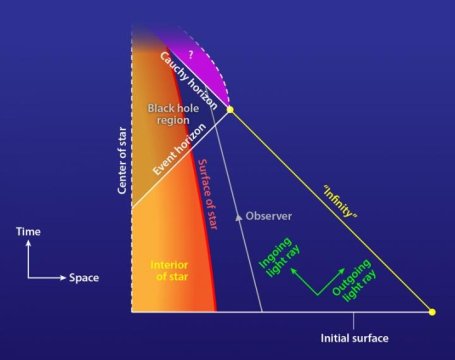 A spacetime diagram of the gravitational collapse of a charged spherical star to form a charged black hole. An observer traveling across the event horizon will eventually encounter the Cauchy horizon, the boundary of the region of spacetime that can be predicted from the initial data. UC Berkeley's Peter Hintz and his colleagues found that a region of spacetime, denoted by a question mark, cannot be predicted from the initial data in a universe with accelerating expansion, like our own. This violates the principle of strong cosmic censorship. Credit: APS/Alan Stonebraker In the real world, your past uniquely determines your future. If a physicist knows how the universe starts out, she can calculate its future for all time and all space. But a UC Berkeley mathematician has found some types of black holes in which this law breaks down. If someone were to venture into one of these relatively benign black holes, they could survive, but their past would be obliterated and they could have an infinite number of possible futures. Such claims have been made in the past, and physicists have invoked "strong cosmic censorship" to explain it away. That is, something catastrophic -- typically a horrible death -- would prevent observers from actually entering a region of spacetime where their future was not uniquely determined. This principle, first proposed 40 years ago by physicist Roger Penrose, keeps sacrosanct an idea -- determinism -- key to any physical theory. That is, given the past and present, the physical laws of the universe do not allow more than one possible future. But, says UC Berkeley postdoctoral fellow Peter Hintz, mathematical calculations show that for some specific types of black holes in a universe like ours, which is expanding at an accelerating rate, it is possible to survive the passage from a deterministic world into a non-deterministic black hole. What life would be like in a space where the future was unpredictable is unclear. But the finding does not mean that Einstein's equations of general relativity, which so far perfectly describe the evolution of the cosmos, are wrong, said Hintz, a Clay Research Fellow. "No physicist is going to travel into a black hole and measure it. This is a math question. But from that point of view, this makes Einstein's equations mathematically more interesting," he said. "This is a question one can really only study mathematically, but it has physical, almost philosophical implications, which makes it very cool." "This ... conclusion corresponds to a severe failure of determinism in general relativity that cannot be taken lightly in view of the importance in modern cosmology," of accelerating expansion, said his colleagues at the University of Lisbon in Portugal, Vitor Cardoso, João Costa and Kyriakos Destounis, and at Utrecht University, Aron Jansen. As quoted by Physics World, Gary Horowitz of UC Santa Barbara, who was not involved in the research, said that the study provides "the best evidence I know for a violation of strong cosmic censorship in a theory of gravity and electromagnetism." Hintz and his colleagues published a paper describing these unusual black holes last month in the journal Physical Review Letters. Beyond the event horizon Black holes are bizarre objects that get their name from the fact that nothing can escape their gravity, not even light. If you venture too close and cross the so-called event horizon, you'll never escape. For small black holes, you'd never survive such a close approach anyway. The tidal forces close to the event horizon are enough to spaghettify anything: that is, stretch it until it's a string of atoms. But for large black holes, like the supermassive objects at the cores of galaxies like the Milky Way, which weigh tens of millions if not billions of times the mass of a star, crossing the event horizon would be, well, uneventful. Because it should be possible to survive the transition from our world to the black hole world, physicists and mathematicians have long wondered what that world would look like, and have turned to Einstein's equations of general relativity to predict the world inside a black hole. These equations work well until an observer reaches the center or singularity, where in theoretical calculations the curvature of spacetime becomes infinite. Even before reaching the center, however, a black hole explorer -- who would never be able to communicate what she found to the outside world -- could encounter some weird and deadly milestones. Hintz studies a specific type of black hole -- a standard, non-rotating black hole with an electrical charge -- and such an object has a so-called Cauchy horizon within the event horizon. The Cauchy horizon is the spot where determinism breaks down, where the past no longer determines the future. Physicists, including Penrose, have argued that no observer could ever pass through the Cauchy horizon point because they would be annihilated. As the argument goes, as an observer approaches the horizon, time slows down, since clocks tick slower in a strong gravitational field. As light, gravitational waves and anything else encountering the black hole fall inevitably toward the Cauchy horizon, an observer also falling inward would eventually see all this energy barreling in at the same time. In effect, all the energy the black hole sees over the lifetime of the universe hits the Cauchy horizon at the same time, blasting into oblivion any observer who gets that far. You can't see forever in an expanding universe Hintz realized, however, that this may not apply in an expanding universe that is accelerating, such as our own. Because spacetime is being increasingly pulled apart, much of the distant universe will not affect the black hole at all, since that energy can't travel faster than the speed of light. In fact, the energy available to fall into the black hole is only that contained within the observable horizon: the volume of the universe that the black hole can expect to see over the course of its existence. For us, for example, the observable horizon is bigger than the 13.8 billion light years we can see into the past, because it includes everything that we will see forever into the future. The accelerating expansion of the universe will prevent us from seeing beyond a horizon of about 46.5 billion light years. In that scenario, the expansion of the universe counteracts the amplification caused by time dilation inside the black hole, and for certain situations, cancels it entirely. In those cases -- specifically, smooth, non-rotating black holes with a large electrical charge, so-called Reissner-Nordström-de Sitter black holes -- an observer could survive passing through the Cauchy horizon and into a non-deterministic world. "There are some exact solutions of Einstein's equations that are perfectly smooth, with no kinks, no tidal forces going to infinity, where everything is perfectly well behaved up to this Cauchy horizon and beyond," he said, noting that the passage through the horizon would be painful but brief. "After that, all bets are off; in some cases, such as a Reissner-Nordström-de Sitter black hole, one can avoid the central singularity altogether and live forever in a universe unknown." Admittedly, he said, charged black holes are unlikely to exist, since they'd attract oppositely charged matter until they became neutral. However, the mathematical solutions for charged black holes are used as proxies for what would happen inside rotating black holes, which are probably the norm. Hintz argues that smooth, rotating black holes, called Kerr-Newman-de Sitter black holes, would behave the same way. "That is upsetting, the idea that you could set out with an electrically charged star that undergoes collapse to a black hole, and then Alice travels inside this black hole and if the black hole parameters are sufficiently extremal, it could be that she can just cross the Cauchy horizon, survives that and reaches a region of the universe where knowing the complete initial state of the star, she will not be able to say what is going to happen," Hintz said. "It is no longer uniquely determined by full knowledge of the initial conditions. That is why it's very troublesome." He discovered these types of black holes by teaming up with Cardoso and his colleagues, who calculated how a black hole rings when struck by gravitational waves, and which of its tones and overtones lasted the longest. In some cases, even the longest surviving frequency decayed fast enough to prevent the amplification from turning the Cauchy horizon into a dead zone. Hintz's paper has already sparked other papers, one of which purports to show that most well-behaved black holes will not violate determinism. But Hintz insists that one instance of violation is one too many. "People had been complacent for some 20 years, since the mid '90s, that strong cosmological censorship is always verified," he said. "We challenge that point of view." Hintz's work was supported by the Clay Mathematics Institute and the Miller Institute for Basic Research in Science at UC Berkeley. Story Source: Materials provided by University of California - Berkeley. |
| json metadata | {"tags":["black","hole"],"image":["https://steemitimages.com/DQmUWZmFptokdwkGYD9XyknyGjs89SLi8HRFSCJRHjkxkBz/180221091334_1_540x360.jpg"],"app":"steemit/0.1","format":"markdown"} |
| parent author | |
| parent permlink | black |
| permlink | einstein-s-equations-allow-a-non-determinist-future-inside-some-black-holes |
| title | Einstein's equations allow a non-determinist future inside some black holes |
| Transaction Info | Block #20108283/Trx 82ed494f60cd280155970880705fc7ba3424528e |
View Raw JSON Data
{
"block": 20108283,
"op": [
"comment",
{
"author": "nani121",
"body": "Some black holes erase your past\nUniversity of California - Berkeley\nSummary:\nPhysicists insist on determinism: your past and present determine your future uniquely, per Einstein's equations of general relativity. They call this strong cosmic censorship. A mathematician found some types of black holes -- charged, non-rotating objects in an expanding universe -- that allow an observer inside the black hole to travel across a horizon into a place where the past is obliterated and there are an infinite number of possible futures for every initial state.\nA spacetime diagram of the gravitational collapse of a charged spherical star to form a charged black hole. An observer traveling across the event horizon will eventually encounter the Cauchy horizon, the boundary of the region of spacetime that can be predicted from the initial data. UC Berkeley's Peter Hintz and his colleagues found that a region of spacetime, denoted by a question mark, cannot be predicted from the initial data in a universe with accelerating expansion, like our own. This violates the principle of strong cosmic censorship.\nCredit: APS/Alan Stonebraker\nIn the real world, your past uniquely determines your future. If a physicist knows how the universe starts out, she can calculate its future for all time and all space.\n\nBut a UC Berkeley mathematician has found some types of black holes in which this law breaks down. If someone were to venture into one of these relatively benign black holes, they could survive, but their past would be obliterated and they could have an infinite number of possible futures.\n\nSuch claims have been made in the past, and physicists have invoked \"strong cosmic censorship\" to explain it away. That is, something catastrophic -- typically a horrible death -- would prevent observers from actually entering a region of spacetime where their future was not uniquely determined. This principle, first proposed 40 years ago by physicist Roger Penrose, keeps sacrosanct an idea -- determinism -- key to any physical theory. That is, given the past and present, the physical laws of the universe do not allow more than one possible future.\n\nBut, says UC Berkeley postdoctoral fellow Peter Hintz, mathematical calculations show that for some specific types of black holes in a universe like ours, which is expanding at an accelerating rate, it is possible to survive the passage from a deterministic world into a non-deterministic black hole.\n\nWhat life would be like in a space where the future was unpredictable is unclear. But the finding does not mean that Einstein's equations of general relativity, which so far perfectly describe the evolution of the cosmos, are wrong, said Hintz, a Clay Research Fellow.\n\n\"No physicist is going to travel into a black hole and measure it. This is a math question. But from that point of view, this makes Einstein's equations mathematically more interesting,\" he said. \"This is a question one can really only study mathematically, but it has physical, almost philosophical implications, which makes it very cool.\"\n\n\"This ... conclusion corresponds to a severe failure of determinism in general relativity that cannot be taken lightly in view of the importance in modern cosmology,\" of accelerating expansion, said his colleagues at the University of Lisbon in Portugal, Vitor Cardoso, João Costa and Kyriakos Destounis, and at Utrecht University, Aron Jansen.\n\nAs quoted by Physics World, Gary Horowitz of UC Santa Barbara, who was not involved in the research, said that the study provides \"the best evidence I know for a violation of strong cosmic censorship in a theory of gravity and electromagnetism.\"\n\nHintz and his colleagues published a paper describing these unusual black holes last month in the journal Physical Review Letters.\n\nBeyond the event horizon\n\nBlack holes are bizarre objects that get their name from the fact that nothing can escape their gravity, not even light. If you venture too close and cross the so-called event horizon, you'll never escape.\n\nFor small black holes, you'd never survive such a close approach anyway. The tidal forces close to the event horizon are enough to spaghettify anything: that is, stretch it until it's a string of atoms.\n\nBut for large black holes, like the supermassive objects at the cores of galaxies like the Milky Way, which weigh tens of millions if not billions of times the mass of a star, crossing the event horizon would be, well, uneventful.\n\nBecause it should be possible to survive the transition from our world to the black hole world, physicists and mathematicians have long wondered what that world would look like, and have turned to Einstein's equations of general relativity to predict the world inside a black hole. These equations work well until an observer reaches the center or singularity, where in theoretical calculations the curvature of spacetime becomes infinite.\n\nEven before reaching the center, however, a black hole explorer -- who would never be able to communicate what she found to the outside world -- could encounter some weird and deadly milestones. Hintz studies a specific type of black hole -- a standard, non-rotating black hole with an electrical charge -- and such an object has a so-called Cauchy horizon within the event horizon.\n\nThe Cauchy horizon is the spot where determinism breaks down, where the past no longer determines the future. Physicists, including Penrose, have argued that no observer could ever pass through the Cauchy horizon point because they would be annihilated.\n\nAs the argument goes, as an observer approaches the horizon, time slows down, since clocks tick slower in a strong gravitational field. As light, gravitational waves and anything else encountering the black hole fall inevitably toward the Cauchy horizon, an observer also falling inward would eventually see all this energy barreling in at the same time. In effect, all the energy the black hole sees over the lifetime of the universe hits the Cauchy horizon at the same time, blasting into oblivion any observer who gets that far.\n\nYou can't see forever in an expanding universe\n\nHintz realized, however, that this may not apply in an expanding universe that is accelerating, such as our own. Because spacetime is being increasingly pulled apart, much of the distant universe will not affect the black hole at all, since that energy can't travel faster than the speed of light.\n\nIn fact, the energy available to fall into the black hole is only that contained within the observable horizon: the volume of the universe that the black hole can expect to see over the course of its existence. For us, for example, the observable horizon is bigger than the 13.8 billion light years we can see into the past, because it includes everything that we will see forever into the future. The accelerating expansion of the universe will prevent us from seeing beyond a horizon of about 46.5 billion light years.\n\nIn that scenario, the expansion of the universe counteracts the amplification caused by time dilation inside the black hole, and for certain situations, cancels it entirely. In those cases -- specifically, smooth, non-rotating black holes with a large electrical charge, so-called Reissner-Nordström-de Sitter black holes -- an observer could survive passing through the Cauchy horizon and into a non-deterministic world.\n\n\"There are some exact solutions of Einstein's equations that are perfectly smooth, with no kinks, no tidal forces going to infinity, where everything is perfectly well behaved up to this Cauchy horizon and beyond,\" he said, noting that the passage through the horizon would be painful but brief. \"After that, all bets are off; in some cases, such as a Reissner-Nordström-de Sitter black hole, one can avoid the central singularity altogether and live forever in a universe unknown.\"\n\nAdmittedly, he said, charged black holes are unlikely to exist, since they'd attract oppositely charged matter until they became neutral. However, the mathematical solutions for charged black holes are used as proxies for what would happen inside rotating black holes, which are probably the norm. Hintz argues that smooth, rotating black holes, called Kerr-Newman-de Sitter black holes, would behave the same way.\n\n\"That is upsetting, the idea that you could set out with an electrically charged star that undergoes collapse to a black hole, and then Alice travels inside this black hole and if the black hole parameters are sufficiently extremal, it could be that she can just cross the Cauchy horizon, survives that and reaches a region of the universe where knowing the complete initial state of the star, she will not be able to say what is going to happen,\" Hintz said. \"It is no longer uniquely determined by full knowledge of the initial conditions. That is why it's very troublesome.\"\n\nHe discovered these types of black holes by teaming up with Cardoso and his colleagues, who calculated how a black hole rings when struck by gravitational waves, and which of its tones and overtones lasted the longest. In some cases, even the longest surviving frequency decayed fast enough to prevent the amplification from turning the Cauchy horizon into a dead zone.\n\nHintz's paper has already sparked other papers, one of which purports to show that most well-behaved black holes will not violate determinism. But Hintz insists that one instance of violation is one too many.\n\n\"People had been complacent for some 20 years, since the mid '90s, that strong cosmological censorship is always verified,\" he said. \"We challenge that point of view.\"\n\nHintz's work was supported by the Clay Mathematics Institute and the Miller Institute for Basic Research in Science at UC Berkeley.\n\nStory Source:\n\nMaterials provided by University of California - Berkeley.",
"json_metadata": "{\"tags\":[\"black\",\"hole\"],\"image\":[\"https://steemitimages.com/DQmUWZmFptokdwkGYD9XyknyGjs89SLi8HRFSCJRHjkxkBz/180221091334_1_540x360.jpg\"],\"app\":\"steemit/0.1\",\"format\":\"markdown\"}",
"parent_author": "",
"parent_permlink": "black",
"permlink": "einstein-s-equations-allow-a-non-determinist-future-inside-some-black-holes",
"title": "Einstein's equations allow a non-determinist future inside some black holes"
}
],
"op_in_trx": 0,
"timestamp": "2018-02-23T01:32:54",
"trx_id": "82ed494f60cd280155970880705fc7ba3424528e",
"trx_in_block": 30,
"virtual_op": 0
}nani121published a new post: surprising-new-study-redraws-family-tree-of-domesticated-and-wild-horses2018/02/23 01:26:36
nani121published a new post: surprising-new-study-redraws-family-tree-of-domesticated-and-wild-horses
2018/02/23 01:26:36
| author | nani121 |
| body | University of Kansas Summary: New research overturns a long-held assumption that Przewalski's horses, native to the Eurasian steppes, are the last wild horse species on Earth.  This is a modern Przewalksi horse. Credit: Alan Outram There are no such things as "wild" horses anymore. Research published in Science today overturns a long-held assumption that Przewalski's horses, native to the Eurasian steppes, are the last wild horse species on Earth. Instead, phylogenetic analysis shows Przewalski's horses are feral, descended from the earliest-known instance of horse domestication by the Botai people of northern Kazakhstan some 5,500 years ago. Further, the new paper finds that modern domesticated horses didn't descend from the Botai horses, an assumption previously held by many scientists. "This was a big surprise," said co-author Sandra Olsen, curator-in-charge of the archaeology division of the Biodiversity Institute and Natural History Museum at the University of Kansas, who led archaeological work at known Botai villages. "I was confident soon after we started excavating Botai sites in 1993 that we had found the earliest domesticated horses. We went about trying to prove it, but based on DNA results Botai horses didn't give rise to today's modern domesticated horses -- they gave rise to the Przewalski's horse." The findings signify there are no longer true "wild" horses left, only feral horses that descend from horses once domesticated by humans, including Przewalski's horses and mustangs that descend from horses brought to North America by the Spanish. "This means there are no living wild horses on Earth -- that's the sad part," said Olsen. "There are a lot of equine biologists who have been studying Przewalskis, and this will be a big shock to them. They thought they were studying the last wild horses. It's not a real loss of biodiversity -- but in our minds, it is. We thought there was one last wild species, and we're only just now aware that all wild horses went extinct." Many of the horse bones and teeth Olsen excavated at two Botai sites in Kazakhstan, called Botai and Krasnyi Yar, were used in the phylogenetic analysis. The international team of researchers behind the paper sequenced the genomes of 20 horses from the Botai and 22 horses from across Eurasia that spanned the last 5,500 years. They compared these ancient horse genomes with already published genomes of 18 ancient and 28 modern horses. "Phylogenetic reconstruction confirmed that domestic horses do not form a single monophyletic group as expected if descending from Botai," the authors wrote. "Earliest herded horses were the ancestors of feral Przewalski's horses but not of modern domesticates." Olsen said the findings give rise to a new scientific quest: locating the real origins of today's domesticated horses. "What's interesting is that we have two different domestication events from slightly different species, or separate sub-species," she said. (The Przewalski's horse's taxonomic position is still debated.) "It's thought that modern-day domesticated horses came from Equus ferus, the extinct European wild horse. The problem is they were thought to have existed until the early 1900s. But, the remains of two individuals in St. Petersburg, Russia, are probably feral, too, or at least probably had some domesticated genes." Olsen began excavating Botai village sites in Kazakhstan in 1993 after the fall of the Soviet Union made the region accessible to western scientists. Some of the horse remains collected by Olsen were tested as part of the new study showing their ancestry of modern-day Przewalskis. The Botai's ancestors were nomadic hunters until they became the first-known culture to domesticate horses around 5,500 years ago, using horses for meat, milk, work and likely transportation. "Once they domesticated horses they became sedentary, with large villages of up to 150 or more houses," said Olsen, who specializes in zooarchaeology, or the study of animal remains from ancient human occupation sites. "They lived primarily on horse meat, and they had no agriculture. We had several lines of evidence that supported domestication. The fact the Botai were sedentary must have meant they had domesticated animals, or plants, which they didn't have. More than 95 percent of the bones from the Botai sites were from horses -- they were in a sense mono-cropping one species with an incredible focus. If they were hunting horses on foot, they would have quickly depleted bands of horses in the vicinity of the villages and would have had to go farther afield to hunt -- it wouldn't have been feasible or supported that large human population." The KU researcher also cited bone artifacts from Botai sites used to make rawhide thongs that might have been fashioned into bridles, lassos, whips, riding crops and hobbles, as further evidence of horse domestication. Moreover, the Botai village sites include horse corrals. "We found a corral that contained high levels of nitrogen and sodium from manure and urine," said Olsen. "It was very concentrated within that corral. The final smoking gun was finding residues of mares' milk in the pottery. It's commonplace today in Mongolia and Kazakhstan to milk horses -- when it's fermented it has considerable nutritional value and is very high in vitamins." Interestingly, Olsen found that after slaughtering horses, the Botai buried some horse skulls and necks in pits with their snouts facing the southeast, toward where the sun rose in the morning in autumn. Mongols and Kazakhs slaughter most of their horses at that time of year because that is when they retain the most amount of nutritious fat in their bodies. "It's interesting because throughout the Indo-European diaspora there's a strong connection between the sun god and the horse," she said. "It may be that Botai people spoke an early proto-Indo-European language, and they also connected the horse to the sun god. Later in time, and this idea is in the historical record for the Indo-European diaspora, it was believed the sun god was born in the east and rode across the sky in a chariot, pulled by white horses. According to the belief, he would then die in the west and be reborn every day." The team behind the paper believe Przewalski's horses likely escaped from domestic Botai herds in eastern Kazakhstan or western Mongolia. "They started developing a semi-wild lifestyle like our mustangs, but they still have a wild appearance," Olsen said. "This is partly why biologists assumed they were genuinely wild animals. They have an upright mane, something associated with wild equids. They also have a dun coat, like the ones you see in the Ice Age cave paintings in France and Spain made when horses were wild. Their size, however, is very similar to what you see at Botai and other sites." By 1969, Przewalski's horses were declared extinct in the wild, and all living today originated from just 15 individuals captured around 1900. Today, there are approximately 2,000 Przewalski's horses, all descended from those captured horses, and they have been reintroduced on the Eurasian steppes. In a sense, the horses have fared better than the peoples who once domesticated them. "The Botai people seem to have vanished from their homeland in northern Kazakhstan," said Olsen. "Perhaps they migrated eastward to Mongolia since the later Bronze Age people there shared the practice of ritually burying the horse's head and neck pointing toward the rising sun in the autumn, the time of year they were slaughtered. That's a very specific shared trait." Story Source: Materials provided by University of Kansas |
| json metadata | {"tags":["horses"],"image":["https://steemitimages.com/DQmSYXahsR1UZVyUu7ETqHpoijCTY4aMASbd893x1D44zuG/180222145132_1_540x360.jpg"],"app":"steemit/0.1","format":"markdown"} |
| parent author | |
| parent permlink | horses |
| permlink | surprising-new-study-redraws-family-tree-of-domesticated-and-wild-horses |
| title | Surprising new study redraws family tree of domesticated and 'wild' horses |
| Transaction Info | Block #20108157/Trx 6a4606ae044ced63de7e4f45b0ef9f1d3f69d398 |
View Raw JSON Data
{
"block": 20108157,
"op": [
"comment",
{
"author": "nani121",
"body": "University of Kansas\nSummary:\nNew research overturns a long-held assumption that Przewalski's horses, native to the Eurasian steppes, are the last wild horse species on Earth.\n\nThis is a modern Przewalksi horse.\nCredit: Alan Outram\nThere are no such things as \"wild\" horses anymore.\n\nResearch published in Science today overturns a long-held assumption that Przewalski's horses, native to the Eurasian steppes, are the last wild horse species on Earth. Instead, phylogenetic analysis shows Przewalski's horses are feral, descended from the earliest-known instance of horse domestication by the Botai people of northern Kazakhstan some 5,500 years ago.\n\nFurther, the new paper finds that modern domesticated horses didn't descend from the Botai horses, an assumption previously held by many scientists.\n\n\"This was a big surprise,\" said co-author Sandra Olsen, curator-in-charge of the archaeology division of the Biodiversity Institute and Natural History Museum at the University of Kansas, who led archaeological work at known Botai villages. \"I was confident soon after we started excavating Botai sites in 1993 that we had found the earliest domesticated horses. We went about trying to prove it, but based on DNA results Botai horses didn't give rise to today's modern domesticated horses -- they gave rise to the Przewalski's horse.\"\n\nThe findings signify there are no longer true \"wild\" horses left, only feral horses that descend from horses once domesticated by humans, including Przewalski's horses and mustangs that descend from horses brought to North America by the Spanish.\n\n\"This means there are no living wild horses on Earth -- that's the sad part,\" said Olsen. \"There are a lot of equine biologists who have been studying Przewalskis, and this will be a big shock to them. They thought they were studying the last wild horses. It's not a real loss of biodiversity -- but in our minds, it is. We thought there was one last wild species, and we're only just now aware that all wild horses went extinct.\"\n\nMany of the horse bones and teeth Olsen excavated at two Botai sites in Kazakhstan, called Botai and Krasnyi Yar, were used in the phylogenetic analysis. The international team of researchers behind the paper sequenced the genomes of 20 horses from the Botai and 22 horses from across Eurasia that spanned the last 5,500 years. They compared these ancient horse genomes with already published genomes of 18 ancient and 28 modern horses.\n\n\"Phylogenetic reconstruction confirmed that domestic horses do not form a single monophyletic group as expected if descending from Botai,\" the authors wrote. \"Earliest herded horses were the ancestors of feral Przewalski's horses but not of modern domesticates.\"\n\nOlsen said the findings give rise to a new scientific quest: locating the real origins of today's domesticated horses.\n\n\"What's interesting is that we have two different domestication events from slightly different species, or separate sub-species,\" she said. (The Przewalski's horse's taxonomic position is still debated.) \"It's thought that modern-day domesticated horses came from Equus ferus, the extinct European wild horse. The problem is they were thought to have existed until the early 1900s. But, the remains of two individuals in St. Petersburg, Russia, are probably feral, too, or at least probably had some domesticated genes.\"\n\nOlsen began excavating Botai village sites in Kazakhstan in 1993 after the fall of the Soviet Union made the region accessible to western scientists. Some of the horse remains collected by Olsen were tested as part of the new study showing their ancestry of modern-day Przewalskis.\n\nThe Botai's ancestors were nomadic hunters until they became the first-known culture to domesticate horses around 5,500 years ago, using horses for meat, milk, work and likely transportation.\n\n\"Once they domesticated horses they became sedentary, with large villages of up to 150 or more houses,\" said Olsen, who specializes in zooarchaeology, or the study of animal remains from ancient human occupation sites. \"They lived primarily on horse meat, and they had no agriculture. We had several lines of evidence that supported domestication. The fact the Botai were sedentary must have meant they had domesticated animals, or plants, which they didn't have. More than 95 percent of the bones from the Botai sites were from horses -- they were in a sense mono-cropping one species with an incredible focus. If they were hunting horses on foot, they would have quickly depleted bands of horses in the vicinity of the villages and would have had to go farther afield to hunt -- it wouldn't have been feasible or supported that large human population.\"\n\nThe KU researcher also cited bone artifacts from Botai sites used to make rawhide thongs that might have been fashioned into bridles, lassos, whips, riding crops and hobbles, as further evidence of horse domestication. Moreover, the Botai village sites include horse corrals.\n\n\"We found a corral that contained high levels of nitrogen and sodium from manure and urine,\" said Olsen. \"It was very concentrated within that corral. The final smoking gun was finding residues of mares' milk in the pottery. It's commonplace today in Mongolia and Kazakhstan to milk horses -- when it's fermented it has considerable nutritional value and is very high in vitamins.\"\n\nInterestingly, Olsen found that after slaughtering horses, the Botai buried some horse skulls and necks in pits with their snouts facing the southeast, toward where the sun rose in the morning in autumn. Mongols and Kazakhs slaughter most of their horses at that time of year because that is when they retain the most amount of nutritious fat in their bodies.\n\n\"It's interesting because throughout the Indo-European diaspora there's a strong connection between the sun god and the horse,\" she said. \"It may be that Botai people spoke an early proto-Indo-European language, and they also connected the horse to the sun god. Later in time, and this idea is in the historical record for the Indo-European diaspora, it was believed the sun god was born in the east and rode across the sky in a chariot, pulled by white horses. According to the belief, he would then die in the west and be reborn every day.\"\n\nThe team behind the paper believe Przewalski's horses likely escaped from domestic Botai herds in eastern Kazakhstan or western Mongolia.\n\n\"They started developing a semi-wild lifestyle like our mustangs, but they still have a wild appearance,\" Olsen said. \"This is partly why biologists assumed they were genuinely wild animals. They have an upright mane, something associated with wild equids. They also have a dun coat, like the ones you see in the Ice Age cave paintings in France and Spain made when horses were wild. Their size, however, is very similar to what you see at Botai and other sites.\"\n\nBy 1969, Przewalski's horses were declared extinct in the wild, and all living today originated from just 15 individuals captured around 1900. Today, there are approximately 2,000 Przewalski's horses, all descended from those captured horses, and they have been reintroduced on the Eurasian steppes. In a sense, the horses have fared better than the peoples who once domesticated them.\n\n\"The Botai people seem to have vanished from their homeland in northern Kazakhstan,\" said Olsen. \"Perhaps they migrated eastward to Mongolia since the later Bronze Age people there shared the practice of ritually burying the horse's head and neck pointing toward the rising sun in the autumn, the time of year they were slaughtered. That's a very specific shared trait.\"\n\nStory Source:\n\nMaterials provided by University of Kansas",
"json_metadata": "{\"tags\":[\"horses\"],\"image\":[\"https://steemitimages.com/DQmSYXahsR1UZVyUu7ETqHpoijCTY4aMASbd893x1D44zuG/180222145132_1_540x360.jpg\"],\"app\":\"steemit/0.1\",\"format\":\"markdown\"}",
"parent_author": "",
"parent_permlink": "horses",
"permlink": "surprising-new-study-redraws-family-tree-of-domesticated-and-wild-horses",
"title": "Surprising new study redraws family tree of domesticated and 'wild' horses"
}
],
"op_in_trx": 0,
"timestamp": "2018-02-23T01:26:36",
"trx_id": "6a4606ae044ced63de7e4f45b0ef9f1d3f69d398",
"trx_in_block": 41,
"virtual_op": 0
}2018/02/23 01:21:48
2018/02/23 01:21:48
| author | cheetah |
| body | Hi! I am a robot. I just upvoted you! I found similar content that readers might be interested in: https://www.sciencenews.org/article/new-mapping-shows-just-how-much-fishing-impacts-world-seas |
| json metadata | |
| parent author | nani121 |
| parent permlink | new-mapping-shows-just-how-much-fishing-impacts-the-world-s-seas |
| permlink | cheetah-re-nani121new-mapping-shows-just-how-much-fishing-impacts-the-world-s-seas |
| title | |
| Transaction Info | Block #20108061/Trx 198c3400f318c45770a7672bbe73c47dac0aba56 |
View Raw JSON Data
{
  "block": 20108061,
  "op": [
    "comment",
    {
      "author": "cheetah",
      "body": "Hi! I am a robot. I just upvoted you! I found similar content that readers might be interested in:\nhttps://www.sciencenews.org/article/new-mapping-shows-just-how-much-fishing-impacts-world-seas",
      "json_metadata": "",
      "parent_author": "nani121",
      "parent_permlink": "new-mapping-shows-just-how-much-fishing-impacts-the-world-s-seas",
      "permlink": "cheetah-re-nani121new-mapping-shows-just-how-much-fishing-impacts-the-world-s-seas",
      "title": ""
    }
  ],
  "op_in_trx": 0,
  "timestamp": "2018-02-23T01:21:48",
  "trx_id": "198c3400f318c45770a7672bbe73c47dac0aba56",
  "trx_in_block": 37,
  "virtual_op": 0
}2018/02/23 01:21:45
2018/02/23 01:21:45
| author | nani121 |
| permlink | new-mapping-shows-just-how-much-fishing-impacts-the-world-s-seas |
| voter | cheetah |
| weight | 8 (0.08%) |
| Transaction Info | Block #20108060/Trx 17070984945745ba66c3341a01be7a89d13628bf |
View Raw JSON Data
{
  "block": 20108060,
  "op": [
    "vote",
    {
      "author": "nani121",
      "permlink": "new-mapping-shows-just-how-much-fishing-impacts-the-world-s-seas",
      "voter": "cheetah",
      "weight": 8
    }
  ],
  "op_in_trx": 0,
  "timestamp": "2018-02-23T01:21:45",
  "trx_id": "17070984945745ba66c3341a01be7a89d13628bf",
  "trx_in_block": 13,
  "virtual_op": 0
}nani121published a new post: new-mapping-shows-just-how-much-fishing-impacts-the-world-s-seas2018/02/23 01:21:33
nani121published a new post: new-mapping-shows-just-how-much-fishing-impacts-the-world-s-seas
2018/02/23 01:21:33
| author | nani121 |
| body | Fish are harvested from more than half the area covered by oceans, and some spots are super busy 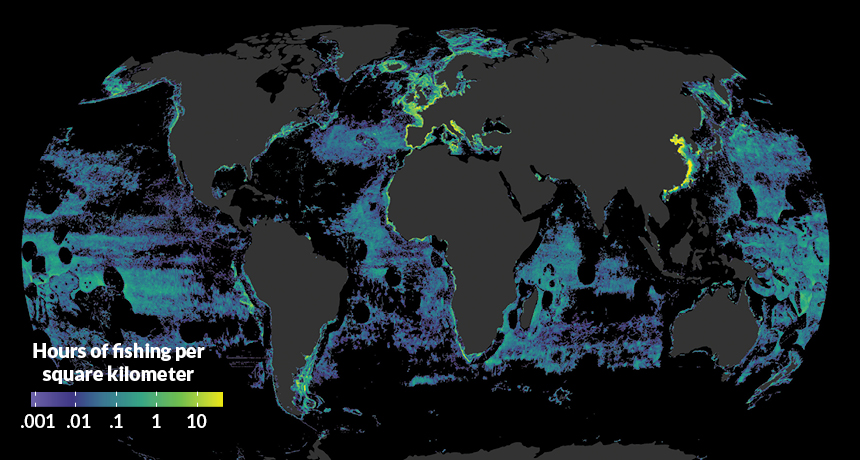 VESSEL VIEWER By tracking the activity of more than 70,000 fishing vessels, researchers made this 2016 map of total global fishing activity. Dots represent the average hours of activity within an area spanning 10,000 square kilometers. GLOBAL FISHING WATCH EmailPrintTwitterFacebookRedditGoogle+ SPONSOR MESSAGE Fishing has left a hefty footprint on Earth. Oceans cover more than two-thirds of the planet’s surface, and industrial fishing occurred across 55 percent of that ocean area in 2016, researchers report in the Feb. 23 Science. In comparison, only 34 percent of Earth’s land area is used for agriculture or grazing. Previous efforts to quantify global fishing have relied on a hodgepodge of scant data culled from electronic monitoring systems on some vessels, logbooks and onboard observers. But over the last 15 years, most commercial-scale ships have been outfitted with automatic identification system (AIS) transceivers, a tracking system meant to help ships avoid collisions. FISH FOOD Fish are drawn to upwelling zones, where prevailing winds transport away surface water and allow nutrient-rich deep water to rise toward the surface. Such upwelling regions, seen here near the east coast of South America, are also hot spots for fishing vessel activity. Here, the dots represent the average hours of activity within an area spanning one square kilometer. GLOBAL FISHING WATCH In the new study, the researchers examined 22 billion AIS positions from 2012 through 2016. Using a computer trained with a type of machine learning, the team then identified more than 70,000 fishing vessels and tracked their activity. Much of the fishing was concentrated in countries’ exclusive economic zones — ocean regions within about 370 kilometers of a nation’s coastline — and in certain hot spots farther out in the open ocean, the team found. Such hot spots included the northeastern Atlantic Ocean and the nutrient-rich upwelling regions off the coasts of South America and West Africa. Surprisingly, just five countries — China, Spain, Taiwan, Japan and South Korea — accounted for nearly 85 percent of fishing efforts on the high seas, the regions outside of any country’s exclusive economic zone. Tracking the fishing footprint in space and time, the researchers note, can help guide marine environmental protections and international conservation efforts for fish. That may be particularly important in a time of rapid change due to rising ocean temperatures and increasing human activity on the high seas. Who’s fishing the high seas? In 2016, five nations were responsible for nearly 85 percent of observed fishing activity in international waters, which can be particularly vulnerable to overfishing. Tap or hover over each circle for more details. Taiwan Spain South Korea Japan All others China Country All others China Japan South Korea Spain Taiwan Observed fishing on the high seas in 2016 Source: D. Kroodsma et al/ Science 2018 SN |
| json metadata | {"tags":["fishing"],"image":["https://steemitimages.com/DQmRBToDekA5FvvjZpkwMNidpvTVLL1xvm4D5DmsxbPkhUn/022218_CG_fisheries_feat.jpg"],"app":"steemit/0.1","format":"markdown"} |
| parent author | |
| parent permlink | fishing |
| permlink | new-mapping-shows-just-how-much-fishing-impacts-the-world-s-seas |
| title | New mapping shows just how much fishing impacts the world’s seas |
| Transaction Info | Block #20108056/Trx f4ce98ff70f3034f81c8baa8d4c3168a80fe4e9f |
View Raw JSON Data
{
"block": 20108056,
"op": [
"comment",
{
"author": "nani121",
"body": "Fish are harvested from more than half the area covered by oceans, and some spots are super busy\n\nVESSEL VIEWER By tracking the activity of more than 70,000 fishing vessels, researchers made this 2016 map of total global fishing activity. Dots represent the average hours of activity within an area spanning 10,000 square kilometers.\n\nGLOBAL FISHING WATCH\n\nEmailPrintTwitterFacebookRedditGoogle+\nSPONSOR MESSAGE\nFishing has left a hefty footprint on Earth. Oceans cover more than two-thirds of the planet’s surface, and industrial fishing occurred across 55 percent of that ocean area in 2016, researchers report in the Feb. 23 Science. In comparison, only 34 percent of Earth’s land area is used for agriculture or grazing.\n\nPrevious efforts to quantify global fishing have relied on a hodgepodge of scant data culled from electronic monitoring systems on some vessels, logbooks and onboard observers. But over the last 15 years, most commercial-scale ships have been outfitted with automatic identification system (AIS) transceivers, a tracking system meant to help ships avoid collisions.\n\n\nFISH FOOD Fish are drawn to upwelling zones, where prevailing winds transport away surface water and allow nutrient-rich deep water to rise toward the surface. Such upwelling regions, seen here near the east coast of South America, are also hot spots for fishing vessel activity. Here, the dots represent the average hours of activity within an area spanning one square kilometer.\nGLOBAL FISHING WATCH\nIn the new study, the researchers examined 22 billion AIS positions from 2012 through 2016. Using a computer trained with a type of machine learning, the team then identified more than 70,000 fishing vessels and tracked their activity.\n\nMuch of the fishing was concentrated in countries’ exclusive economic zones — ocean regions within about 370 kilometers of a nation’s coastline — and in certain hot spots farther out in the open ocean, the team found. Such hot spots included the northeastern Atlantic Ocean and the nutrient-rich upwelling regions off the coasts of South America and West Africa.\n\nSurprisingly, just five countries — China, Spain, Taiwan, Japan and South Korea — accounted for nearly 85 percent of fishing efforts on the high seas, the regions outside of any country’s exclusive economic zone.\n\nTracking the fishing footprint in space and time, the researchers note, can help guide marine environmental protections and international conservation efforts for fish. That may be particularly important in a time of rapid change due to rising ocean temperatures and increasing human activity on the high seas. \n\nWho’s fishing the high seas?\nIn 2016, five nations were responsible for nearly 85 percent of observed fishing activity in international waters, which can be particularly vulnerable to overfishing. Tap or hover over each circle for more details.\n\nTaiwan\nSpain\nSouth Korea\nJapan\nAll others China\nCountry\nAll others China Japan South Korea Spain Taiwan\nObserved fishing on the high seas in 2016\nSource: D. Kroodsma et al/ Science 2018 SN",
"json_metadata": "{\"tags\":[\"fishing\"],\"image\":[\"https://steemitimages.com/DQmRBToDekA5FvvjZpkwMNidpvTVLL1xvm4D5DmsxbPkhUn/022218_CG_fisheries_feat.jpg\"],\"app\":\"steemit/0.1\",\"format\":\"markdown\"}",
"parent_author": "",
"parent_permlink": "fishing",
"permlink": "new-mapping-shows-just-how-much-fishing-impacts-the-world-s-seas",
"title": "New mapping shows just how much fishing impacts the world’s seas"
}
],
"op_in_trx": 0,
"timestamp": "2018-02-23T01:21:33",
"trx_id": "f4ce98ff70f3034f81c8baa8d4c3168a80fe4e9f",
"trx_in_block": 41,
"virtual_op": 0
}2018/02/23 01:15:54
2018/02/23 01:15:54
| author | nani121 |
| body | 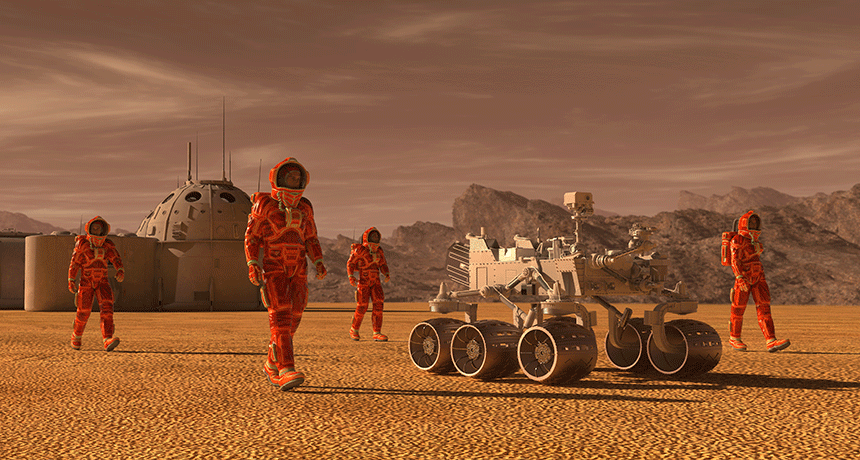 his artist’s illustration depicts what a possible mission to Mars might look like. To make it reality, though, scientists must first solve a lot of problems. E71LENA/ISTOCKPHOTO This is the first of a two-part series on preparations for upcoming human space missions to the Red Planet. Mark Watney has found himself stranded on Mars. It’s 2035 and his crewmates, thinking him dead, have left him behind in their evacuation of the Red Planet. He faces years, all alone, trying to survive in the face of radiation, storms and little food. That last problem turns out to be a solvable one. Watney is a botanist. And he figures out how to grow potatoes. The potato seedlings come from his Thanksgiving dinner. Water is derived from leftover rocket fuel. And his own poop becomes fertilizer. This scenario, from the book and movie The Martian, is science fiction. It is, however, based on fact. NASA studied potatoes in the 1980s and 1990s as a potential crop for human space missions. And though no one is yet growing potatoes on Mars, scientists are already developing tools to grow food in space. space lettuce This is what agriculture in space now looks like. Here, astronaut Peggy Whitson is harvesting lettuce on the International Space Station. NASA Why? People will likely travel to Mars sometime in your lifetime. NASA has said it plans to send people to Mars in the 2030s. And the private space company SpaceX may send its first crewed mission to Mars as early as 2024. But ferrying humans to Mars would be a much bigger challenge than getting them to the moon. To pull it off, we first need to solve a lot of problems. Getting to Mars is just one of them. Then we have to figure out where our food and water will come from. Planners also must figure out how space travelers will get any tools they may suddenly need when they’re millions of miles from the nearest hardware store. It’s a huge undertaking, but researchers around the world are already on the job. Space farmers Today’s space travelers don’t go to the moon or Mars; they head to the International Space Station (ISS). It’s orbiting 381 kilometers (237 miles) above Earth’s surface. There, astronauts live for weeks to months. Among their tasks are conducting experiments and testing equipment that could be useful for future missions to the moon, an asteroid, Mars or beyond. If you visited the ISS today, nearly every bit of food you ate would have been shipped up from Earth. The exception: leafy greens. Those are the first foods being grown on the ISS. There are many reasons NASA wants to learn to grow vegetables in space. Besides providing fresh food for astronauts, plants can provide life support by recycling air and water. “There’s also the psychological benefit that growing plants may have,” says Gioia Massa. She’s a plant scientist and the head of NASA’s Veggie Project at Kennedy Space Center in Cape Canaveral, Fla. As Mark Watney learned on Mars, potatoes might be good survival food. They’ve got decent amounts of protein, some vitamins and other nutrients. They’re also rich in carbohydrates (sugars and starches). You couldn’t survive on potatoes alone. They could, however, help to keep you from starvation. 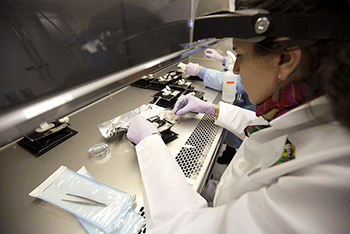 plant pillows Gioia Massa prepares “plant pillows” containing cabbage and lettuce seeds for delivery to the International Space Station. Ben Smegelsky/NASA There are some downsides, though. Potatoes need to be cooked before they can be eaten. And potato plants need a lot of room to grow. So Massa and her colleagues started with something easier: lettuce. In 2014, they sent ISS astronauts a garden. Lettuce seeds were packed into “plant pillows” with baked clay and fertilizer. Add water, some artificial light and voila! The lettuce grew! But the astronauts couldn’t eat it. They had to send every bit back to Earth to be studied. The next year, after NASA scientists confirmed this food was safe, the astronauts grew a second crop. This time they were allowed to chow down. The astronauts used their lettuce to garnish hamburgers. They also made lettuce wraps with lobster salad inside. “They got really creative,” Massa says. Not surprisingly, gardening is different in space than it is on Earth. Without gravity, plants don’t know which way is up. But they adapt. They send their shoots toward light and their roots in the opposite direction. Fans must circulate air. Otherwise, oxygen would gather in a ball around the plants, and they wouldn’t have enough carbon dioxide to do photosynthesis. The scientists also had trouble providing the plants enough water. The fabric plant pillows containing the seeds, clay and fertilizer were designed to draw water from a reservoir. But they didn’t work fast enough. The astronauts ended up needing to water the plants by hand. Massa and her team are now redesigning the watering system. ISS astronauts also have grown Chinese cabbage as well as flowers. In addition to being pretty, astronaut Scott Kelly’s garden of zinnias helped scientists study whether plants flower in space. They do! That’s important to know, because flowering is how some plants reproduce. It’s also part of how some plants make fruit. Future crops will include a bitter Asian green called mizuna and cherry tomatoes, which astronauts will have to pollinate by hand using a tiny brush. “We don’t have bees up there,” notes Massa. One day, they might also grow peppers and herbs. While the veggie garden is small for now, eventually it could someday help feed astronauts on long-distance space missions — or a colony on Mars. “Everything we do is a stepping stone,” Massa explains.  Building a faster engine NASA Orion NASA’s Orion spacecraft (artist’s illustration) could one day ferry astronauts to Mars. NASA Orion Spacecraft/Flickr (CC BY-NC-ND 2.0) Reaching the ISS from Earth takes less than a day. A trip to Mars might take nearly a year — and a huge amount of fuel. The chemical engines used to launch a rocket into space with a fiery blast are not good at propelling a spacecraft to another planet. With no gas stations between here and Mars, “You pretty much have to take all your fuel with you,” says Bill Emrich. He’s a nuclear engineer with NASA at the Marshall Space Flight Center in Huntsville, Ala. “If you’re going to do that, you want an engine that’s going to get a lot of miles per gallon.” To do that, he says, you have to go nuclear. The right engine can take a very light gas, such as hydrogen, and heat it to extremely high temperatures in a nuclear reactor. That super-heated gas is sprayed out the back through a nozzle to propel the spacecraft forward. “The hotter you can make the gas coming out of the nozzle, the more efficient it is,” Emrich explains. “Also the lighter the gas, the more efficient it is.” Nuclear engines aren’t just efficient, they’re fast. Unmanned spacecraft have been sent to the outer solar system using what’s known as ion propulsion. It works by accelerating electrically charged atoms, or ions, to push a spacecraft forward. Such a system could take a year to deliver people to Mars. In contrast, a nuclear thermal engine might shorten that journey to just four or five months, Emrich says. 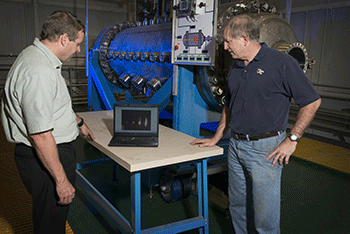 NTREES simulator Nuclear engineer Bill Emrich (right) and project manager Mike Houts discuss the Nuclear Thermal Rocket Element Environmental Simulator (seen in the background). Fred Deaton/NASA To get to Mars that quickly, a large spacecraft would need about 230 grams (a half pound) of uranium fuel. Uranium is radioactive, but the uranium fuel isn’t dangerous. “You could easily hold it in your hand and it wouldn’t hurt you,” Emrich notes. But once the reactor starts to operate, the uranium is split into other elements through fission. That’s when you have to be careful. “Those [fission products] are really very radioactive. And that’s where the deadliness comes in,” he says — “not from the uranium itself, but from the byproducts [of fission].” This system would get rid of one big worry: Even if there were an explosion at lift-off, humans and Earth’s environment would be safe. Why? The spacecraft would use conventional rocket fuel for lift-off. The nuclear-heated engine would not be turned on until the rocket was already in space. Then if there were any explosion, any radioactive material would be spewed into space. Emrich and his colleagues are working on testing the uranium fuel for this engine. Others are working on different parts. Some are looking to develop and test the reactor. Others are designing a way to integrate the reactor into the propulsion system. Building this next generation of space engines takes time. “If we have plenty of funding, it could probably be done in 10 to 15 years,” Emrich says. Print it Astronauts headed to Mars will have to take along almost everything they’ll need. They might be able to harvest some raw materials from the Red Planet. But afterward they’ll need some way to use them. “We have to be much more Earth-independent” than on missions closer to home, says Niki Werkheiser. Like Emrich, she too works at NASA’s Marshall Space Flight Center. Explainer: What is 3-D printing? Astronauts on the ISS have similar problems. If someone needs a special tool, they might have to wait months or longer for the next resupply mission. Werkheiser hopes to change that. She’s the lead scientist for a program that is bringing 3-D printing to space. With 3-D printing, astronauts could build the tools they need with the push of a button. A 3-D printer works a bit like a hot-glue gun. Following a pattern on a computer, the printer squirts out a layer of polymer onto a tray. After this hardens into a plastic, the printer will add another layer. Then another. And it will keep this up until it has built a three-dimensional object. “You can do some really complex designs,” Werkheiser says. “You can build things with gears inside and moving parts — all in one print.” Explainer: What are polymers? On the ISS, printing tools could save time and money. But such printers also offer other benefits. Many of the tools and gadgets sent to space on rockets are made from strong materials. To survive the stresses of launch, they also are heavily reinforced. If they were printed in space, they could be made lighter and thinner, with more room in them for electronics, scientific instruments or other pieces. Such make-your-own tools may even be a necessity on a mission to the moon or Mars, where the delivery of spare parts may not be possible. 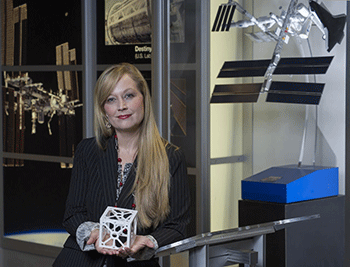 Niki Werkheiser Niki Werkheiser, manager of NASA’s 3-D printing team, holds the structure of a “cubesat,” or micro satellite, that was printed on a prototype of the first 3-D printer to be sent to the International Space Station. Emmett Given/NASA Printing in space doesn’t work exactly as it does on Earth. For instance, fans are needed to circulate air around the object to cool it during printing. But there are some advantages, too. “On the ground, gravity can actually cause some problems with 3-D printing,” Werkheiser says. Since hot plastic is flexible, earthbound printers sometimes need to add support structures to hold an object upright as it cools. I space, a printer can build in any direction. Werkheiser's team sent its first 3-D printer to the ISS in 2014. It printed paddle-shaped objects as a test. These were then compared to ones printed on Earth. “We really did not see any meaningful difference,” she says. Next, Werkheiser hopes to launch a printer this coming spring that can recycle plastic wastes into the material for printing new objects. And in the future, NASA hopes to develop a fabrication laboratory (the “Fab Lab,” for short) that will be able to print things — even electronics — out of metal. So now that the astronauts can print tools on demand, what was their first request? “We designed them a little back scratcher,” Werkheiser says. It turns out, the dry air on the space station causes astronauts skin to get itchy. Sometimes, at least, the problems of space exploration have very simple solutions. Power Words (for more about Power Words, click here) 3-D printing A means of producing physical items — including toys, foods and even body parts — using a machine that takes instructions from a computer program. That program tells the machine how and where to lay down successive layers of some raw material (the “ink”) to create a three-dimensional object. asteroid A rocky object in orbit around the sun. Most asteroids orbit in a region that falls between the orbits of Mars and Jupiter. Astronomers refer to this region as the asteroid belt. astronaut Someone trained to travel into space for research and exploration. atom The basic unit of a chemical element. Atoms are made up of a dense nucleus that contains positively charged protons and uncharged neutrons. The nucleus is orbited by a cloud of negatively charged electrons. carbohydrates Any of a large group of compounds occurring in foods and living tissues, including sugars, starch and cellulose. They contain hydrogen and oxygen in the same ratio as water (2:1) and typically can be broken down in an animal’s body to release energy. carbon The chemical element having the atomic number 6. It is the physical basis of all life on Earth. Carbon exists freely as graphite and diamond. It is an important part of coal, limestone and petroleum, and is capable of self-bonding, chemically, to form an enormous number of chemically, biologically and commercially important molecules. carbon dioxide (or CO2) A colorless, odorless gas produced by all animals when the oxygen they inhale reacts with the carbon-rich foods that they’ve eaten. Carbon dioxide also is released when organic matter burns (including fossil fuels like oil or gas). Carbon dioxide acts as a greenhouse gas, trapping heat in Earth’s atmosphere. Plants convert carbon dioxide into oxygen during photosynthesis, the process they use to make their own food. chemical A substance formed from two or more atoms that unite (bond) in a fixed proportion and structure. For example, water is a chemical made when two hydrogen atoms bond to one oxygen atom. Its chemical formula is H2O. Chemical also can be an adjective to describe properties of materials that are the result of various reactions between different compounds. clay Fine-grained particles of soil that stick together and can be molded when wet. When fired under intense heat, clay can become hard and brittle. That’s why it’s used to fashion pottery and bricks. colleague Someone who works with another; a co-worker or team member. electronics Devices that are powered by electricity but whose properties are controlled by the semiconductors or other circuitry that channel or gate the movement of electric charges. element (in chemistry) Each of more than one hundred substances for which the smallest unit of each is a single atom. Examples include hydrogen, oxygen, carbon, lithium and uranium. engine A machine designed to convert energy into useful mechanical motion. Sometimes an engine is called a motor. (in computer science) A computer program that performs a particular, narrow range of functions. engineer A person who uses science to solve problems. As a verb, to engineer means to design a device, material or process that will solve some problem or unmet need. fertilizer Nitrogen, phosphorus and other plant nutrients added to soil, water or foliage to boost crop growth or to replenish nutrients that were lost earlier as they were used by plant roots or leaves. fiction (adj. fictional) An idea or a story that is made-up, not a depiction of real events. fission The spontaneous splitting of a large unit into smaller self-sustaining parts. (in physics) A process in which large atomic nuclei break apart to form two or more lighter nuclei. The excess mass of the parent nuclei (compared to the resulting smaller ones) is converted into energy. fuel Any material that will release energy during a controlled chemical or nuclear reaction. Fossil fuels (coal, natural gas and petroleum) are a common type that liberate their energy through chemical reactions that take place when heated (usually to the point of burning). generation A group of individuals (in any species) born at about the same time or that are regarded as a single group. Your parents belong to one generation of your family, for example, and your grandparents to another. Similarly, you and everyone within a few years of your age across the planet are referred to as belonging to a particular generation of humans. The term also is sometimes extended to year classes of other animals or to types of inanimate objects (such as electronics or automobiles). gravity The force that attracts anything with mass, or bulk, toward any other thing with mass. The more mass that something has, the greater its gravity. hydrogen The lightest element in the universe. As a gas, it is colorless, odorless and highly flammable. It’s an integral part of many fuels, fats and chemicals that make up living tissues. International Space Station An artificial satellite that orbits Earth. Run by the United States and Russia, this station provides a research laboratory from which scientists can conduct experiments in biology, physics and astronomy — and make observations of Earth. ion (adj. ionized) An atom or molecule with an electric charge due to the loss or gain of one or more electrons. An ionized gas, or plasma, is where all of the electrons have been separated from their parent atoms. Mars The fourth planet from the sun, just one planet out from Earth. Like Earth, it has seasons and moisture. But its diameter is only about half as big as Earth’s. NASA Short for the National Aeronautics and Space Administration. Created in 1958, this U.S. agency has become a leader in space research and in stimulating public interest in space exploration. It was through NASA that the United States sent people into orbit and ultimately to the moon. It also has sent research craft to study planets and other celestial objects in our solar system. nozzle A round spout or slot at the end of a pipe, hose or tube. Nozzles are typically used to control the flow of a jet of some high-pressure liquid or gas. nutrient A vitamin, mineral, fat, carbohydrate or protein that a plant, animal or other organism requires as part of its food in order to survive. oxygen A gas that makes up about 21 percent of Earth's atmosphere. All animals and many microorganisms need oxygen to fuel their growth (and metabolism). photosynthesis (verb: photosynthesize) The process by which green plants and some other organisms use sunlight to produce foods from carbon dioxide and water. planet A celestial object that orbits a star, is big enough for gravity to have squashed it into a roundish ball and has cleared other objects out of the way in its orbital neighborhood. plastic Any of a series of materials that are easily deformable; or synthetic materials that have been made from polymers (long strings of some building-block molecule) that tend to be lightweight, inexpensive and resistant to degradation. pollinate To transport male reproductive cells — pollen — to female parts of a flower. This allows fertilization, the first step in plant reproduction. polymer A substance made from long chains of repeating groups of atoms. Manufactured polymers include nylon, polyvinyl chloride (better known as PVC) and many types of plastics. Natural polymers include rubber, silk and cellulose (found in plants and used to make paper, for example). pressure Force applied uniformly over a surface, measured as force per unit of area. propulsion The act or process of driving something forward, using a force. For instance, jet engines are one source of propulsion used for keeping airplanes aloft. protein A compound made from one or more long chains of amino acids. Proteins are an essential part of all living organisms. They form the basis of living cells, muscle and tissues; they also do the work inside of cells. Among the better-known, stand-alone proteins are the hemoglobin (in blood) and the antibodies (also in blood) that attempt to fight infections. Medicines frequently work by latching onto proteins. psychological An adjective that refers to how the human mind works, especially in relation to guiding actions and behavior. radiation (in physics) One of the three major ways that energy is transferred. (The other two are conduction and convection.) In radiation, electromagnetic waves carry energy from one place to another. Unlike conduction and convection, which need material to help transfer the energy, radiation can transfer energy across empty space. radioactive An adjective that describes unstable elements, such as certain forms (isotopes) of uranium and plutonium. Such elements are said to be unstable because their nucleus sheds energy that is carried away by photons and/or and often one or more subatomic particles. This emission of energy is by a process known as radioactive decay. recycle To find new uses for something — or parts of something — that might otherwise be discarded, or treated as waste. Red Planet A nickname for Mars. reservoir A large store of something. Lakes are reservoirs that hold water. People who study infections refer to the environment in which germs can survive safely (such as the bodies of birds or pigs) as living reservoirs. rocket Something propelled into the air or through space, sometimes as a weapon of war. A rocket usually is lofted by the release of exhaust gases as some fuel burns. (v.) Something that flings into space at high speed as if fueled by combustion. scenario A possible (or likely) sequence of events and how they might play out. science fiction A field of literary or filmed stories that take place against a backdrop of fantasy, usually based on speculations about how science and engineering will direct developments in the distant future. The plots in many of these stories focus on space travel, exaggerated changes attributed to evolution or life in (or on) alien worlds. seedling The initial plant that sprouts leaves and roots after emerging from a seed. solar system The eight major planets and their moons in orbit around our sun, together with smaller bodies in the form of dwarf planets, asteroids, meteoroids and comets. thermal Of or relating to heat. tungsten A dense, heavy, white metallic element that has the highest melting point of all elements. It is strong and resistant to corrosion, even at the very high temperatures encountered while moving quickly through the Martian atmosphere. uranium The heaviest naturally occurring element known. It’s called element 92, which refers to the number of protons in its nucleus. Uranium atoms are radioactive, which means they decay into different atomic nucle |
| json metadata | {"tags":["trip","to","mars"],"image":["https://steemitimages.com/DQmaQNb7832gdQGQirszscxi5DWLdoxh1XyPiQoVCcVZUi4/860_main_Marscolony.gif","https://steemitimages.com/DQmbczYW8bLMdMVkmYnSAjJP57vm1Td4ompiasm4vCrbWgR/350_inline_plantpillows.gif","https://steemitimages.com/DQmeT4J8WhV1G2yg9jXvtSNCkZbJwokzCpS8TW8Qni8VJXB/350_NASAOrion.gif","https://steemitimages.com/DQmaSs8yxNdAXRDVFyaHoNwG9iAvUCp28p2hdA17udM4jhj/350_inline_NTREES.gif","https://steemitimages.com/DQmVp8JmeJC9jLMN7YJQAcLyafSS4oyUH9pdRpHwpXTBWrx/350_inline_-NikiWerkheiser.gif"],"app":"steemit/0.1","format":"markdown"} |
| parent author | |
| parent permlink | trip |
| permlink | preparing-for-that-trip-to-mars-here-are-some-of-the-obstacles-that-scientists-are-hurdling-to-get-humans-to-the-red-planet |
| title | Preparing for that trip to Mars Here are some of the obstacles that scientists are hurdling to get humans to the Red Planet |
| Transaction Info | Block #20107943/Trx 01e19ea96ee77f00252d62cabc8642466f6c485c |
View Raw JSON Data
{
"block": 20107943,
"op": [
"comment",
{
"author": "nani121",
"body": "\nhis artist’s illustration depicts what a possible mission to Mars might look like. To make it reality, though, scientists must first solve a lot of problems.\nE71LENA/ISTOCKPHOTO\nThis is the first of a two-part series on preparations for upcoming human space missions to the Red Planet.\n\nMark Watney has found himself stranded on Mars. It’s 2035 and his crewmates, thinking him dead, have left him behind in their evacuation of the Red Planet. He faces years, all alone, trying to survive in the face of radiation, storms and little food.\n\nThat last problem turns out to be a solvable one. Watney is a botanist. And he figures out how to grow potatoes. The potato seedlings come from his Thanksgiving dinner. Water is derived from leftover rocket fuel. And his own poop becomes fertilizer.\n\nThis scenario, from the book and movie The Martian, is science fiction. It is, however, based on fact. NASA studied potatoes in the 1980s and 1990s as a potential crop for human space missions. And though no one is yet growing potatoes on Mars, scientists are already developing tools to grow food in space.\n\nspace lettuce\nThis is what agriculture in space now looks like. Here, astronaut Peggy Whitson is harvesting lettuce on the International Space Station.\nNASA\nWhy? People will likely travel to Mars sometime in your lifetime. NASA has said it plans to send people to Mars in the 2030s. And the private space company SpaceX may send its first crewed mission to Mars as early as 2024.\n\nBut ferrying humans to Mars would be a much bigger challenge than getting them to the moon. To pull it off, we first need to solve a lot of problems. Getting to Mars is just one of them. Then we have to figure out where our food and water will come from. Planners also must figure out how space travelers will get any tools they may suddenly need when they’re millions of miles from the nearest hardware store. It’s a huge undertaking, but researchers around the world are already on the job.\n\nSpace farmers\nToday’s space travelers don’t go to the moon or Mars; they head to the International Space Station (ISS). It’s orbiting 381 kilometers (237 miles) above Earth’s surface. There, astronauts live for weeks to months. Among their tasks are conducting experiments and testing equipment that could be useful for future missions to the moon, an asteroid, Mars or beyond.\n\nIf you visited the ISS today, nearly every bit of food you ate would have been shipped up from Earth. The exception: leafy greens. Those are the first foods being grown on the ISS.\n\nThere are many reasons NASA wants to learn to grow vegetables in space. Besides providing fresh food for astronauts, plants can provide life support by recycling air and water. “There’s also the psychological benefit that growing plants may have,” says Gioia Massa. She’s a plant scientist and the head of NASA’s Veggie Project at Kennedy Space Center in Cape Canaveral, Fla.\n\nAs Mark Watney learned on Mars, potatoes might be good survival food. They’ve got decent amounts of protein, some vitamins and other nutrients. They’re also rich in carbohydrates (sugars and starches). You couldn’t survive on potatoes alone. They could, however, help to keep you from starvation.\n\nplant pillows\nGioia Massa prepares “plant pillows” containing cabbage and lettuce seeds for delivery to the International Space Station.\nBen Smegelsky/NASA\nThere are some downsides, though. Potatoes need to be cooked before they can be eaten. And potato plants need a lot of room to grow. So Massa and her colleagues started with something easier: lettuce.\n\nIn 2014, they sent ISS astronauts a garden. Lettuce seeds were packed into “plant pillows” with baked clay and fertilizer. Add water, some artificial light and voila! The lettuce grew!\n\nBut the astronauts couldn’t eat it.\n\nThey had to send every bit back to Earth to be studied. The next year, after NASA scientists confirmed this food was safe, the astronauts grew a second crop. This time they were allowed to chow down.\n\nThe astronauts used their lettuce to garnish hamburgers. They also made lettuce wraps with lobster salad inside. “They got really creative,” Massa says.\n\nNot surprisingly, gardening is different in space than it is on Earth. Without gravity, plants don’t know which way is up. But they adapt. They send their shoots toward light and their roots in the opposite direction. Fans must circulate air. Otherwise, oxygen would gather in a ball around the plants, and they wouldn’t have enough carbon dioxide to do photosynthesis.\n\nThe scientists also had trouble providing the plants enough water. The fabric plant pillows containing the seeds, clay and fertilizer were designed to draw water from a reservoir. But they didn’t work fast enough. The astronauts ended up needing to water the plants by hand. Massa and her team are now redesigning the watering system.\n\nISS astronauts also have grown Chinese cabbage as well as flowers. In addition to being pretty, astronaut Scott Kelly’s garden of zinnias helped scientists study whether plants flower in space. They do! That’s important to know, because flowering is how some plants reproduce. It’s also part of how some plants make fruit.\n\nFuture crops will include a bitter Asian green called mizuna and cherry tomatoes, which astronauts will have to pollinate by hand using a tiny brush. “We don’t have bees up there,” notes Massa. One day, they might also grow peppers and herbs.\n\nWhile the veggie garden is small for now, eventually it could someday help feed astronauts on long-distance space missions — or a colony on Mars. “Everything we do is a stepping stone,” Massa explains.\n\nBuilding a faster engine\nNASA Orion\nNASA’s Orion spacecraft (artist’s illustration) could one day ferry astronauts to Mars.\nNASA Orion Spacecraft/Flickr (CC BY-NC-ND 2.0)\nReaching the ISS from Earth takes less than a day. A trip to Mars might take nearly a year — and a huge amount of fuel. The chemical engines used to launch a rocket into space with a fiery blast are not good at propelling a spacecraft to another planet. With no gas stations between here and Mars, “You pretty much have to take all your fuel with you,” says Bill Emrich. He’s a nuclear engineer with NASA at the Marshall Space Flight Center in Huntsville, Ala. “If you’re going to do that, you want an engine that’s going to get a lot of miles per gallon.”\n\nTo do that, he says, you have to go nuclear. The right engine can take a very light gas, such as hydrogen, and heat it to extremely high temperatures in a nuclear reactor. That super-heated gas is sprayed out the back through a nozzle to propel the spacecraft forward. “The hotter you can make the gas coming out of the nozzle, the more efficient it is,” Emrich explains. “Also the lighter the gas, the more efficient it is.”\n\nNuclear engines aren’t just efficient, they’re fast. Unmanned spacecraft have been sent to the outer solar system using what’s known as ion propulsion. It works by accelerating electrically charged atoms, or ions, to push a spacecraft forward. Such a system could take a year to deliver people to Mars. In contrast, a nuclear thermal engine might shorten that journey to just four or five months, Emrich says.\n\nNTREES simulator\nNuclear engineer Bill Emrich (right) and project manager Mike Houts discuss the Nuclear Thermal Rocket Element Environmental Simulator (seen in the background).\nFred Deaton/NASA\nTo get to Mars that quickly, a large spacecraft would need about 230 grams (a half pound) of uranium fuel. Uranium is radioactive, but the uranium fuel isn’t dangerous. “You could easily hold it in your hand and it wouldn’t hurt you,” Emrich notes. But once the reactor starts to operate, the uranium is split into other elements through fission. That’s when you have to be careful. “Those [fission products] are really very radioactive. And that’s where the deadliness comes in,” he says — “not from the uranium itself, but from the byproducts [of fission].”\n\nThis system would get rid of one big worry: Even if there were an explosion at lift-off, humans and Earth’s environment would be safe. Why? The spacecraft would use conventional rocket fuel for lift-off. The nuclear-heated engine would not be turned on until the rocket was already in space. Then if there were any explosion, any radioactive material would be spewed into space.\n\nEmrich and his colleagues are working on testing the uranium fuel for this engine. Others are working on different parts. Some are looking to develop and test the reactor. Others are designing a way to integrate the reactor into the propulsion system.\n\nBuilding this next generation of space engines takes time. “If we have plenty of funding, it could probably be done in 10 to 15 years,” Emrich says.\n\nPrint it\nAstronauts headed to Mars will have to take along almost everything they’ll need. They might be able to harvest some raw materials from the Red Planet. But afterward they’ll need some way to use them. “We have to be much more Earth-independent” than on missions closer to home, says Niki Werkheiser. Like Emrich, she too works at NASA’s Marshall Space Flight Center.\n\nExplainer: What is 3-D printing?\nAstronauts on the ISS have similar problems. If someone needs a special tool, they might have to wait months or longer for the next resupply mission. Werkheiser hopes to change that. She’s the lead scientist for a program that is bringing 3-D printing to space. With 3-D printing, astronauts could build the tools they need with the push of a button.\n\nA 3-D printer works a bit like a hot-glue gun. Following a pattern on a computer, the printer squirts out a layer of polymer onto a tray. After this hardens into a plastic, the printer will add another layer. Then another. And it will keep this up until it has built a three-dimensional object. “You can do some really complex designs,” Werkheiser says. “You can build things with gears inside and moving parts — all in one print.”\n\nExplainer: What are polymers?\nOn the ISS, printing tools could save time and money. But such printers also offer other benefits. Many of the tools and gadgets sent to space on rockets are made from strong materials. To survive the stresses of launch, they also are heavily reinforced. If they were printed in space, they could be made lighter and thinner, with more room in them for electronics, scientific instruments or other pieces. Such make-your-own tools may even be a necessity on a mission to the moon or Mars, where the delivery of spare parts may not be possible.\n\nNiki Werkheiser\nNiki Werkheiser, manager of NASA’s 3-D printing team, holds the structure of a “cubesat,” or micro satellite, that was printed on a prototype of the first 3-D printer to be sent to the International Space Station.\nEmmett Given/NASA\nPrinting in space doesn’t work exactly as it does on Earth. For instance, fans are needed to circulate air around the object to cool it during printing. But there are some advantages, too. “On the ground, gravity can actually cause some problems with 3-D printing,” Werkheiser says. Since hot plastic is flexible, earthbound printers sometimes need to add support structures to hold an object upright as it cools. I space, a printer can build in any direction.\n\nWerkheiser's team sent its first 3-D printer to the ISS in 2014. It printed paddle-shaped objects as a test. These were then compared to ones printed on Earth. “We really did not see any meaningful difference,” she says.\n\nNext, Werkheiser hopes to launch a printer this coming spring that can recycle plastic wastes into the material for printing new objects. And in the future, NASA hopes to develop a fabrication laboratory (the “Fab Lab,” for short) that will be able to print things — even electronics — out of metal.\n\nSo now that the astronauts can print tools on demand, what was their first request? “We designed them a little back scratcher,” Werkheiser says. It turns out, the dry air on the space station causes astronauts skin to get itchy. Sometimes, at least, the problems of space exploration have very simple solutions.\n\nPower Words\n(for more about Power Words, click here)\n\n3-D printing A means of producing physical items — including toys, foods and even body parts — using a machine that takes instructions from a computer program. That program tells the machine how and where to lay down successive layers of some raw material (the “ink”) to create a three-dimensional object.\n\nasteroid A rocky object in orbit around the sun. Most asteroids orbit in a region that falls between the orbits of Mars and Jupiter. Astronomers refer to this region as the asteroid belt.\n\nastronaut Someone trained to travel into space for research and exploration.\n\natom The basic unit of a chemical element. Atoms are made up of a dense nucleus that contains positively charged protons and uncharged neutrons. The nucleus is orbited by a cloud of negatively charged electrons.\n\ncarbohydrates Any of a large group of compounds occurring in foods and living tissues, including sugars, starch and cellulose. They contain hydrogen and oxygen in the same ratio as water (2:1) and typically can be broken down in an animal’s body to release energy.\n\ncarbon The chemical element having the atomic number 6. It is the physical basis of all life on Earth. Carbon exists freely as graphite and diamond. It is an important part of coal, limestone and petroleum, and is capable of self-bonding, chemically, to form an enormous number of chemically, biologically and commercially important molecules.\n\ncarbon dioxide (or CO2) A colorless, odorless gas produced by all animals when the oxygen they inhale reacts with the carbon-rich foods that they’ve eaten. Carbon dioxide also is released when organic matter burns (including fossil fuels like oil or gas). Carbon dioxide acts as a greenhouse gas, trapping heat in Earth’s atmosphere. Plants convert carbon dioxide into oxygen during photosynthesis, the process they use to make their own food.\n\nchemical A substance formed from two or more atoms that unite (bond) in a fixed proportion and structure. For example, water is a chemical made when two hydrogen atoms bond to one oxygen atom. Its chemical formula is H2O. Chemical also can be an adjective to describe properties of materials that are the result of various reactions between different compounds.\n\nclay Fine-grained particles of soil that stick together and can be molded when wet. When fired under intense heat, clay can become hard and brittle. That’s why it’s used to fashion pottery and bricks.\n\ncolleague Someone who works with another; a co-worker or team member.\n\nelectronics Devices that are powered by electricity but whose properties are controlled by the semiconductors or other circuitry that channel or gate the movement of electric charges.\n\nelement (in chemistry) Each of more than one hundred substances for which the smallest unit of each is a single atom. Examples include hydrogen, oxygen, carbon, lithium and uranium.\n\nengine A machine designed to convert energy into useful mechanical motion. Sometimes an engine is called a motor. (in computer science) A computer program that performs a particular, narrow range of functions.\n\nengineer A person who uses science to solve problems. As a verb, to engineer means to design a device, material or process that will solve some problem or unmet need.\n\nfertilizer Nitrogen, phosphorus and other plant nutrients added to soil, water or foliage to boost crop growth or to replenish nutrients that were lost earlier as they were used by plant roots or leaves.\n\nfiction (adj. fictional) An idea or a story that is made-up, not a depiction of real events.\n\nfission The spontaneous splitting of a large unit into smaller self-sustaining parts. (in physics) A process in which large atomic nuclei break apart to form two or more lighter nuclei. The excess mass of the parent nuclei (compared to the resulting smaller ones) is converted into energy.\n\nfuel Any material that will release energy during a controlled chemical or nuclear reaction. Fossil fuels (coal, natural gas and petroleum) are a common type that liberate their energy through chemical reactions that take place when heated (usually to the point of burning).\n\ngeneration A group of individuals (in any species) born at about the same time or that are regarded as a single group. Your parents belong to one generation of your family, for example, and your grandparents to another. Similarly, you and everyone within a few years of your age across the planet are referred to as belonging to a particular generation of humans. The term also is sometimes extended to year classes of other animals or to types of inanimate objects (such as electronics or automobiles).\n\ngravity The force that attracts anything with mass, or bulk, toward any other thing with mass. The more mass that something has, the greater its gravity.\n\nhydrogen The lightest element in the universe. As a gas, it is colorless, odorless and highly flammable. It’s an integral part of many fuels, fats and chemicals that make up living tissues.\n\nInternational Space Station An artificial satellite that orbits Earth. Run by the United States and Russia, this station provides a research laboratory from which scientists can conduct experiments in biology, physics and astronomy — and make observations of Earth.\n\nion (adj. ionized) An atom or molecule with an electric charge due to the loss or gain of one or more electrons. An ionized gas, or plasma, is where all of the electrons have been separated from their parent atoms.\n\nMars The fourth planet from the sun, just one planet out from Earth. Like Earth, it has seasons and moisture. But its diameter is only about half as big as Earth’s.\n\nNASA Short for the National Aeronautics and Space Administration. Created in 1958, this U.S. agency has become a leader in space research and in stimulating public interest in space exploration. It was through NASA that the United States sent people into orbit and ultimately to the moon. It also has sent research craft to study planets and other celestial objects in our solar system.\n\nnozzle A round spout or slot at the end of a pipe, hose or tube. Nozzles are typically used to control the flow of a jet of some high-pressure liquid or gas.\n\nnutrient A vitamin, mineral, fat, carbohydrate or protein that a plant, animal or other organism requires as part of its food in order to survive.\n\noxygen A gas that makes up about 21 percent of Earth's atmosphere. All animals and many microorganisms need oxygen to fuel their growth (and metabolism).\n\nphotosynthesis (verb: photosynthesize) The process by which green plants and some other organisms use sunlight to produce foods from carbon dioxide and water.\n\nplanet A celestial object that orbits a star, is big enough for gravity to have squashed it into a roundish ball and has cleared other objects out of the way in its orbital neighborhood. \n\nplastic Any of a series of materials that are easily deformable; or synthetic materials that have been made from polymers (long strings of some building-block molecule) that tend to be lightweight, inexpensive and resistant to degradation.\n\npollinate To transport male reproductive cells — pollen — to female parts of a flower. This allows fertilization, the first step in plant reproduction.\n\npolymer A substance made from long chains of repeating groups of atoms. Manufactured polymers include nylon, polyvinyl chloride (better known as PVC) and many types of plastics. Natural polymers include rubber, silk and cellulose (found in plants and used to make paper, for example).\n\npressure Force applied uniformly over a surface, measured as force per unit of area.\n\npropulsion The act or process of driving something forward, using a force. For instance, jet engines are one source of propulsion used for keeping airplanes aloft.\n\nprotein A compound made from one or more long chains of amino acids. Proteins are an essential part of all living organisms. They form the basis of living cells, muscle and tissues; they also do the work inside of cells. Among the better-known, stand-alone proteins are the hemoglobin (in blood) and the antibodies (also in blood) that attempt to fight infections. Medicines frequently work by latching onto proteins.\n\npsychological An adjective that refers to how the human mind works, especially in relation to guiding actions and behavior. \n\nradiation (in physics) One of the three major ways that energy is transferred. (The other two are conduction and convection.) In radiation, electromagnetic waves carry energy from one place to another. Unlike conduction and convection, which need material to help transfer the energy, radiation can transfer energy across empty space.\n\nradioactive An adjective that describes unstable elements, such as certain forms (isotopes) of uranium and plutonium. Such elements are said to be unstable because their nucleus sheds energy that is carried away by photons and/or and often one or more subatomic particles. This emission of energy is by a process known as radioactive decay.\n\nrecycle To find new uses for something — or parts of something — that might otherwise be discarded, or treated as waste.\n\nRed Planet A nickname for Mars.\n\nreservoir A large store of something. Lakes are reservoirs that hold water. People who study infections refer to the environment in which germs can survive safely (such as the bodies of birds or pigs) as living reservoirs.\n\nrocket Something propelled into the air or through space, sometimes as a weapon of war. A rocket usually is lofted by the release of exhaust gases as some fuel burns. (v.) Something that flings into space at high speed as if fueled by combustion.\n\nscenario A possible (or likely) sequence of events and how they might play out.\n\nscience fiction A field of literary or filmed stories that take place against a backdrop of fantasy, usually based on speculations about how science and engineering will direct developments in the distant future. The plots in many of these stories focus on space travel, exaggerated changes attributed to evolution or life in (or on) alien worlds.\n\nseedling The initial plant that sprouts leaves and roots after emerging from a seed.\n\nsolar system The eight major planets and their moons in orbit around our sun, together with smaller bodies in the form of dwarf planets, asteroids, meteoroids and comets.\n\nthermal Of or relating to heat. \n\ntungsten A dense, heavy, white metallic element that has the highest melting point of all elements. It is strong and resistant to corrosion, even at the very high temperatures encountered while moving quickly through the Martian atmosphere.\n\nuranium The heaviest naturally occurring element known. It’s called element 92, which refers to the number of protons in its nucleus. Uranium atoms are radioactive, which means they decay into different atomic nucle",
"json_metadata": "{\"tags\":[\"trip\",\"to\",\"mars\"],\"image\":[\"https://steemitimages.com/DQmaQNb7832gdQGQirszscxi5DWLdoxh1XyPiQoVCcVZUi4/860_main_Marscolony.gif\",\"https://steemitimages.com/DQmbczYW8bLMdMVkmYnSAjJP57vm1Td4ompiasm4vCrbWgR/350_inline_plantpillows.gif\",\"https://steemitimages.com/DQmeT4J8WhV1G2yg9jXvtSNCkZbJwokzCpS8TW8Qni8VJXB/350_NASAOrion.gif\",\"https://steemitimages.com/DQmaSs8yxNdAXRDVFyaHoNwG9iAvUCp28p2hdA17udM4jhj/350_inline_NTREES.gif\",\"https://steemitimages.com/DQmVp8JmeJC9jLMN7YJQAcLyafSS4oyUH9pdRpHwpXTBWrx/350_inline_-NikiWerkheiser.gif\"],\"app\":\"steemit/0.1\",\"format\":\"markdown\"}",
"parent_author": "",
"parent_permlink": "trip",
"permlink": "preparing-for-that-trip-to-mars-here-are-some-of-the-obstacles-that-scientists-are-hurdling-to-get-humans-to-the-red-planet",
"title": "Preparing for that trip to Mars Here are some of the obstacles that scientists are hurdling to get humans to the Red Planet"
}
],
"op_in_trx": 0,
"timestamp": "2018-02-23T01:15:54",
"trx_id": "01e19ea96ee77f00252d62cabc8642466f6c485c",
"trx_in_block": 47,
"virtual_op": 0
}2018/02/23 01:09:45
2018/02/23 01:09:45
| author | cheetah |
| body | Hi! I am a robot. I just upvoted you! I found similar content that readers might be interested in: https://www.sciencenews.org/article/cave-art-suggests-neandertals-were-ancient-humans-mental-equals |
| json metadata | |
| parent author | nani121 |
| parent permlink | cave-art-suggests-neandertals-were-ancient-humans-mental-equals |
| permlink | cheetah-re-nani121cave-art-suggests-neandertals-were-ancient-humans-mental-equals |
| title | |
| Transaction Info | Block #20107820/Trx 08daefc6886dc144ad9d2693185015e22af04088 |
View Raw JSON Data
{
  "block": 20107820,
  "op": [
    "comment",
    {
      "author": "cheetah",
      "body": "Hi! I am a robot. I just upvoted you! I found similar content that readers might be interested in:\nhttps://www.sciencenews.org/article/cave-art-suggests-neandertals-were-ancient-humans-mental-equals",
      "json_metadata": "",
      "parent_author": "nani121",
      "parent_permlink": "cave-art-suggests-neandertals-were-ancient-humans-mental-equals",
      "permlink": "cheetah-re-nani121cave-art-suggests-neandertals-were-ancient-humans-mental-equals",
      "title": ""
    }
  ],
  "op_in_trx": 0,
  "timestamp": "2018-02-23T01:09:45",
  "trx_id": "08daefc6886dc144ad9d2693185015e22af04088",
  "trx_in_block": 6,
  "virtual_op": 0
}2018/02/23 01:09:39
2018/02/23 01:09:39
| author | nani121 |
| permlink | cave-art-suggests-neandertals-were-ancient-humans-mental-equals |
| voter | cheetah |
| weight | 8 (0.08%) |
| Transaction Info | Block #20107818/Trx 314080e3af1a53e4ec03c291e57cfbadfea36f09 |
View Raw JSON Data
{
  "block": 20107818,
  "op": [
    "vote",
    {
      "author": "nani121",
      "permlink": "cave-art-suggests-neandertals-were-ancient-humans-mental-equals",
      "voter": "cheetah",
      "weight": 8
    }
  ],
  "op_in_trx": 0,
  "timestamp": "2018-02-23T01:09:39",
  "trx_id": "314080e3af1a53e4ec03c291e57cfbadfea36f09",
  "trx_in_block": 46,
  "virtual_op": 0
}nani121published a new post: cave-art-suggests-neandertals-were-ancient-humans-mental-equals2018/02/23 01:09:30
nani121published a new post: cave-art-suggests-neandertals-were-ancient-humans-mental-equals
2018/02/23 01:09:30
| author | nani121 |
| body | Newly dated rock drawings and shell ornaments predate Homo sapiens in Europe by at least 20,000 years  ARTISTIC SURPRISE Red horizontal and vertical lines painted on the walls of a Spanish cave date to at least 64,800 years ago, a new study finds. Since Homo sapiens had not reached Europe at that time, Neandertals must have created this art, researchers propose. The animal-shaped figure, right, was not dated and its makers remain unknown. Neandertals drew on cave walls and made personal ornaments long before encountering Homo sapiens, two new studies find. These discoveries paint bulky, jut-jawed Neandertals as the mental equals of ancient humans, scientists say. Rock art depicting abstract shapes and hand stencils in three Spanish caves dates back to at least 64,800 years ago, researchers report in the Feb. 23 Science. If these new estimates hold up, the Spanish finds become the world’s oldest known examples of cave art, preceding evidence of humans’ arrival in Europe by at least 20,000 years (SN Online: 11/2/11). The finds raise the possibility that “Neandertals took modern humans into caves and showed them how to paint,” says archaeologist Francesco d’Errico of the University of Bordeaux in France. Personal ornaments previously found at a coastal cave in southeastern Spain are older than the cave art, dating to around 120,000 to 115,000 years ago, scientists report February 22 in Science Advances. Only Neandertals inhabited Europe at that time. Those artifacts consist of pigment-stained seashells with artificial holes, presumably for use as necklaces, and seashells containing remnants of pigment mixtures, say geochronologist Dirk Hoffmann of the Max Planck Institute for Evolutionary Anthropology in Leipzig, Germany, and colleagues. Hoffmann is also an author of the cave art study. The new findings join previous reports of potentially symbolic Neandertal artifacts, such as a possible necklace made from eagle claws (SN: 4/18/15, p. 7) and bird-feather decorations. 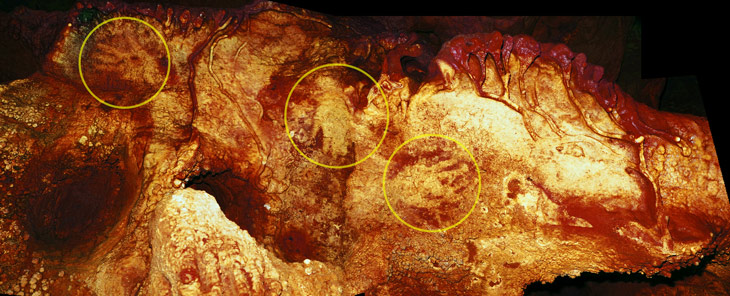 HAND OFF Three handprints on a Spanish cave wall (circles) were created by blowing or spitting pigment on hands. Neandertals made these hand stencils at least 66,000 years ago, a new study concludes. H. COLLADO If Neandertals did have the capacity for symbolic thinking — crucial for using drawings or language to represent ideas and objects — that ability may have developed at least 500,000 years ago in an ancestor shared with humans, the two research teams propose. “Neandertal social life was as complex as that of [contemporaneous] humans in Africa,” says archaeologist João Zilhão of the University of Barcelona, an author of both papers. But some scientists view the new findings cautiously. Neandertals communicated in sophisticated ways, but few clearly symbolic artifacts have been linked to them, says archaeologist Nicholas Conard of the University of Tübingen in Germany. “If Neandertals regularly produced paintings or similar kinds of symbolic artifacts, researchers will eventually demonstrate it at multiple sites,” he says. Analyses of thin mineral deposits partly covering painted cave areas provided minimum age estimates for the art, based on known decay rates of radioactive uranium in the rock. One red, rectangular painting dates to at least 64,800 years ago. One of several hand stencils in a second cave dates to at least 66,700 years ago. And in a third cave, patches of red paint were applied to the walls at least 65,500 years ago, with more paintings added over a period of 25,000 years or more — signaling a long Neandertal tradition of cave art, the researchers say. 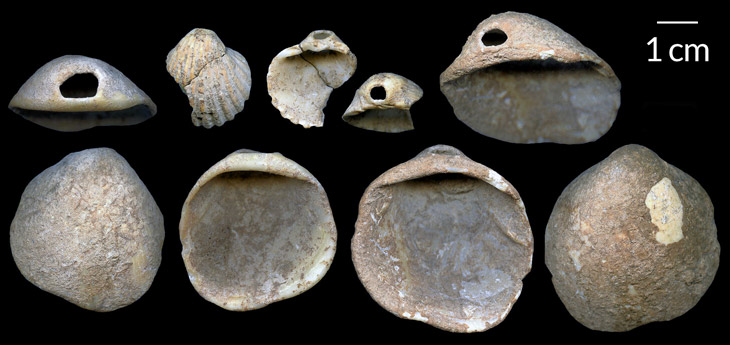 SHELL SHOCK Seashells probably intended to be strung on necklaces date to between 115,000 and 120,000 years ago, scientists report. Neandertals must have modified these shells, found at a cave on Spain’s Mediterranean coast, a new study finds. J. ZILHÃO Many dated deposits at the Spanish cave art sites contain rock particles from external sources that can throw off age estimates. The researchers statistically corrected for such contamination, “but whether that is sufficient enough remains to be seen,” says archaeologist Katerina Douka of the Max Planck Institute for the Science of Human History in Jena, Germany. At the coastal cave, dating relied on a one-two punch: uranium analyses of rock partly covering shell-bearing sediment and geologic estimates of when ancient sea levels declined enough to allow entry into the chamber. Still, it is “nearly impossible” to generate accurate age estimates of rock art based on uranium measures alone, researchers concluded in 2017 in Quaternary International. Depending on shifting cave conditions and varying amounts of uranium drainage from mineral deposits, this method can over- or underestimate when rock art was created, the scientists argued. Other researchers defend this technique as providing valuable minimum and maximum age estimates for rock art. If the new dates for the Spanish cave art are confirmed, they could indicate that Neandertals and H. sapiens exchanged artistic traditions earlier than previously thought, says paleoanthropologist Chris Stringer of the Natural History Museum in London, who was not involved in the studies. Members of both species may have reached western Asia and intermingled during rainy periods between 244,000 and 190,000 years ago, Stringer proposes |
| json metadata | {"tags":["ancient","humansmental","equals"],"image":["https://steemitimages.com/DQmRuPBtb8p3QNWdk3ddYED4Rjk85PUCBre47ck2mejs8C9/022118_bb_neadertal_feat.jpg","https://steemitimages.com/DQmPu8XndyzPTjPQo2uYR4gq8PNnGXuPzFGrdL367reSdQo/022118_bb_neadertal_inline1_730.jpg","https://steemitimages.com/DQmeyeqoXJ6p9RtDF1Cddq2bS1SwhxGFtfKrrRznEtN2LMG/022118_bb_neadertal_inline2_730.jpg"],"app":"steemit/0.1","format":"markdown"} |
| parent author | |
| parent permlink | ancient |
| permlink | cave-art-suggests-neandertals-were-ancient-humans-mental-equals |
| title | Cave art suggests Neandertals were ancient humans’ mental equals |
| Transaction Info | Block #20107815/Trx cf1b4a641eddf4f21c8ef8563ae6ec131eee9378 |
View Raw JSON Data
{
"block": 20107815,
"op": [
"comment",
{
"author": "nani121",
"body": "Newly dated rock drawings and shell ornaments predate Homo sapiens in Europe by at least 20,000 years\n\nARTISTIC SURPRISE Red horizontal and vertical lines painted on the walls of a Spanish cave date to at least 64,800 years ago, a new study finds. Since Homo sapiens had not reached Europe at that time, Neandertals must have created this art, researchers propose. The animal-shaped figure, right, was not dated and its makers remain unknown.\n\n\n\nNeandertals drew on cave walls and made personal ornaments long before encountering Homo sapiens, two new studies find. These discoveries paint bulky, jut-jawed Neandertals as the mental equals of ancient humans, scientists say.\n\nRock art depicting abstract shapes and hand stencils in three Spanish caves dates back to at least 64,800 years ago, researchers report in the Feb. 23 Science. If these new estimates hold up, the Spanish finds become the world’s oldest known examples of cave art, preceding evidence of humans’ arrival in Europe by at least 20,000 years (SN Online: 11/2/11).\n\nThe finds raise the possibility that “Neandertals took modern humans into caves and showed them how to paint,” says archaeologist Francesco d’Errico of the University of Bordeaux in France.\n\nPersonal ornaments previously found at a coastal cave in southeastern Spain are older than the cave art, dating to around 120,000 to 115,000 years ago, scientists report February 22 in Science Advances. Only Neandertals inhabited Europe at that time. Those artifacts consist of pigment-stained seashells with artificial holes, presumably for use as necklaces, and seashells containing remnants of pigment mixtures, say geochronologist Dirk Hoffmann of the Max Planck Institute for Evolutionary Anthropology in Leipzig, Germany, and colleagues. Hoffmann is also an author of the cave art study. The new findings join previous reports of potentially symbolic Neandertal artifacts, such as a possible necklace made from eagle claws (SN: 4/18/15, p. 7) and bird-feather decorations.\n\n\nHAND OFF Three handprints on a Spanish cave wall (circles) were created by blowing or spitting pigment on hands. Neandertals made these hand stencils at least 66,000 years ago, a new study concludes.\nH. COLLADO\nIf Neandertals did have the capacity for symbolic thinking — crucial for using drawings or language to represent ideas and objects — that ability may have developed at least 500,000 years ago in an ancestor shared with humans, the two research teams propose.\n\n“Neandertal social life was as complex as that of [contemporaneous] humans in Africa,” says archaeologist João Zilhão of the University of Barcelona, an author of both papers.\n\nBut some scientists view the new findings cautiously. Neandertals communicated in sophisticated ways, but few clearly symbolic artifacts have been linked to them, says archaeologist Nicholas Conard of the University of Tübingen in Germany. “If Neandertals regularly produced paintings or similar kinds of symbolic artifacts, researchers will eventually demonstrate it at multiple sites,” he says.\n\nAnalyses of thin mineral deposits partly covering painted cave areas provided minimum age estimates for the art, based on known decay rates of radioactive uranium in the rock. One red, rectangular painting dates to at least 64,800 years ago. One of several hand stencils in a second cave dates to at least 66,700 years ago. And in a third cave, patches of red paint were applied to the walls at least 65,500 years ago, with more paintings added over a period of 25,000 years or more — signaling a long Neandertal tradition of cave art, the researchers say.\n\n\nSHELL SHOCK Seashells probably intended to be strung on necklaces date to between 115,000 and 120,000 years ago, scientists report. Neandertals must have modified these shells, found at a cave on Spain’s Mediterranean coast, a new study finds.\nJ. ZILHÃO\nMany dated deposits at the Spanish cave art sites contain rock particles from external sources that can throw off age estimates. The researchers statistically corrected for such contamination, “but whether that is sufficient enough remains to be seen,” says archaeologist Katerina Douka of the Max Planck Institute for the Science of Human History in Jena, Germany.\n\nAt the coastal cave, dating relied on a one-two punch: uranium analyses of rock partly covering shell-bearing sediment and geologic estimates of when ancient sea levels declined enough to allow entry into the chamber.\n\nStill, it is “nearly impossible” to generate accurate age estimates of rock art based on uranium measures alone, researchers concluded in 2017 in Quaternary International. Depending on shifting cave conditions and varying amounts of uranium drainage from mineral deposits, this method can over- or underestimate when rock art was created, the scientists argued. Other researchers defend this technique as providing valuable minimum and maximum age estimates for rock art.\n\nIf the new dates for the Spanish cave art are confirmed, they could indicate that Neandertals and H. sapiens exchanged artistic traditions earlier than previously thought, says paleoanthropologist Chris Stringer of the Natural History Museum in London, who was not involved in the studies. Members of both species may have reached western Asia and intermingled during rainy periods between 244,000 and 190,000 years ago, Stringer proposes",
"json_metadata": "{\"tags\":[\"ancient\",\"humansmental\",\"equals\"],\"image\":[\"https://steemitimages.com/DQmRuPBtb8p3QNWdk3ddYED4Rjk85PUCBre47ck2mejs8C9/022118_bb_neadertal_feat.jpg\",\"https://steemitimages.com/DQmPu8XndyzPTjPQo2uYR4gq8PNnGXuPzFGrdL367reSdQo/022118_bb_neadertal_inline1_730.jpg\",\"https://steemitimages.com/DQmeyeqoXJ6p9RtDF1Cddq2bS1SwhxGFtfKrrRznEtN2LMG/022118_bb_neadertal_inline2_730.jpg\"],\"app\":\"steemit/0.1\",\"format\":\"markdown\"}",
"parent_author": "",
"parent_permlink": "ancient",
"permlink": "cave-art-suggests-neandertals-were-ancient-humans-mental-equals",
"title": "Cave art suggests Neandertals were ancient humans’ mental equals"
}
],
"op_in_trx": 0,
"timestamp": "2018-02-23T01:09:30",
"trx_id": "cf1b4a641eddf4f21c8ef8563ae6ec131eee9378",
"trx_in_block": 16,
"virtual_op": 0
}nani121claimed reward balance: 0.011 SBD, 0.004 SP2018/02/23 01:00:15
nani121claimed reward balance: 0.011 SBD, 0.004 SP
2018/02/23 01:00:15
| account | nani121 |
| reward sbd | 0.011 SBD |
| reward steem | 0.000 STEEM |
| reward vests | 6.131133 VESTS |
| Transaction Info | Block #20107630/Trx 7c1beff84d111a115ce1b83ce4f427a98cb0fe68 |
View Raw JSON Data
{
  "block": 20107630,
  "op": [
    "claim_reward_balance",
    {
      "account": "nani121",
      "reward_sbd": "0.011 SBD",
      "reward_steem": "0.000 STEEM",
      "reward_vests": "6.131133 VESTS"
    }
  ],
  "op_in_trx": 0,
  "timestamp": "2018-02-23T01:00:15",
  "trx_id": "7c1beff84d111a115ce1b83ce4f427a98cb0fe68",
  "trx_in_block": 46,
  "virtual_op": 0
}nani121received 0.011 SBD, 0.004 SP author reward for @nani121 / scientists-discover-almost-100-new-exoplanets2018/02/22 21:17:06
nani121received 0.011 SBD, 0.004 SP author reward for @nani121 / scientists-discover-almost-100-new-exoplanets
2018/02/22 21:17:06
| author | nani121 |
| permlink | scientists-discover-almost-100-new-exoplanets |
| sbd payout | 0.011 SBD |
| steem payout | 0.000 STEEM |
| vesting payout | 6.131133 VESTS |
| Transaction Info | Block #20103166/Virtual Operation #5 |
View Raw JSON Data
{
  "block": 20103166,
  "op": [
    "author_reward",
    {
      "author": "nani121",
      "permlink": "scientists-discover-almost-100-new-exoplanets",
      "sbd_payout": "0.011 SBD",
      "steem_payout": "0.000 STEEM",
      "vesting_payout": "6.131133 VESTS"
    }
  ],
  "op_in_trx": 0,
  "timestamp": "2018-02-22T21:17:06",
  "trx_id": "0000000000000000000000000000000000000000",
  "trx_in_block": 4294967295,
  "virtual_op": 5
}2018/02/21 15:32:27
2018/02/21 15:32:27
| author | nani121 |
| permlink | the-flowers-that-give-us-chocolate-are-ridiculously-hard-to-pollinate |
| voter | guujohnphyo |
| weight | 10000 (100.00%) |
| Transaction Info | Block #20067484/Trx dafffe4c13b776a5adcc9ffa96e9eea73ffe91db |
View Raw JSON Data
{
  "block": 20067484,
  "op": [
    "vote",
    {
      "author": "nani121",
      "permlink": "the-flowers-that-give-us-chocolate-are-ridiculously-hard-to-pollinate",
      "voter": "guujohnphyo",
      "weight": 10000
    }
  ],
  "op_in_trx": 0,
  "timestamp": "2018-02-21T15:32:27",
  "trx_id": "dafffe4c13b776a5adcc9ffa96e9eea73ffe91db",
  "trx_in_block": 3,
  "virtual_op": 0
}us1upvoted (100.00%) @nani121 / the-flowers-that-give-us-chocolate-are-ridiculously-hard-to-pollinate2018/02/21 14:52:00
us1upvoted (100.00%) @nani121 / the-flowers-that-give-us-chocolate-are-ridiculously-hard-to-pollinate
2018/02/21 14:52:00
| author | nani121 |
| permlink | the-flowers-that-give-us-chocolate-are-ridiculously-hard-to-pollinate |
| voter | us1 |
| weight | 10000 (100.00%) |
| Transaction Info | Block #20066675/Trx 83e0175fb4dc00a7dbd34246ee8326bd0b232667 |
View Raw JSON Data
{
  "block": 20066675,
  "op": [
    "vote",
    {
      "author": "nani121",
      "permlink": "the-flowers-that-give-us-chocolate-are-ridiculously-hard-to-pollinate",
      "voter": "us1",
      "weight": 10000
    }
  ],
  "op_in_trx": 0,
  "timestamp": "2018-02-21T14:52:00",
  "trx_id": "83e0175fb4dc00a7dbd34246ee8326bd0b232667",
  "trx_in_block": 34,
  "virtual_op": 0
}sensationupvoted (100.00%) @nani121 / how-to-build-a-human-brain2018/02/20 23:55:39
sensationupvoted (100.00%) @nani121 / how-to-build-a-human-brain
2018/02/20 23:55:39
| author | nani121 |
| permlink | how-to-build-a-human-brain |
| voter | sensation |
| weight | 10000 (100.00%) |
| Transaction Info | Block #20048750/Trx d53df4dc7ec79c2f25cdc7cf181f6ba66fbe0226 |
View Raw JSON Data
{
  "block": 20048750,
  "op": [
    "vote",
    {
      "author": "nani121",
      "permlink": "how-to-build-a-human-brain",
      "voter": "sensation",
      "weight": 10000
    }
  ],
  "op_in_trx": 0,
  "timestamp": "2018-02-20T23:55:39",
  "trx_id": "d53df4dc7ec79c2f25cdc7cf181f6ba66fbe0226",
  "trx_in_block": 24,
  "virtual_op": 0
}2018/02/20 22:25:33
2018/02/20 22:25:33
| author | cheetah |
| body | Hi! I am a robot. I just upvoted you! I found similar content that readers might be interested in: https://www.sciencenews.org/article/how-build-human-brain?mode=magazine&context=190368 |
| json metadata | |
| parent author | nani121 |
| parent permlink | how-to-build-a-human-brain |
| permlink | cheetah-re-nani121how-to-build-a-human-brain |
| title | |
| Transaction Info | Block #20046948/Trx 58588dad2921c17b217a3065168bff6b7a91293a |
View Raw JSON Data
{
  "block": 20046948,
  "op": [
    "comment",
    {
      "author": "cheetah",
      "body": "Hi! I am a robot. I just upvoted you! I found similar content that readers might be interested in:\nhttps://www.sciencenews.org/article/how-build-human-brain?mode=magazine&context=190368",
      "json_metadata": "",
      "parent_author": "nani121",
      "parent_permlink": "how-to-build-a-human-brain",
      "permlink": "cheetah-re-nani121how-to-build-a-human-brain",
      "title": ""
    }
  ],
  "op_in_trx": 0,
  "timestamp": "2018-02-20T22:25:33",
  "trx_id": "58588dad2921c17b217a3065168bff6b7a91293a",
  "trx_in_block": 19,
  "virtual_op": 0
}nani121published a new post: how-to-build-a-human-brain2018/02/20 22:24:33
nani121published a new post: how-to-build-a-human-brain
2018/02/20 22:24:33
| author | nani121 |
| body | Some steps for growing mini versions of human organs are easier than others 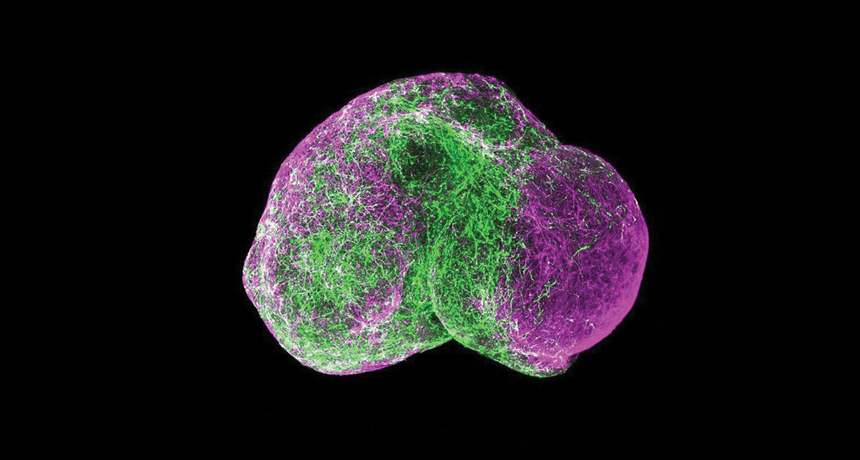 BRAIN-MAKING 101 As blobs of two types of brainlike tissue fuse, interneurons (green) migrate from the left clump to the right, linking with neurons (not stained) in the right blob. On both sides, neural support cells called glia appear in purple. PAŞCA LAB/STANFORD UNIV. 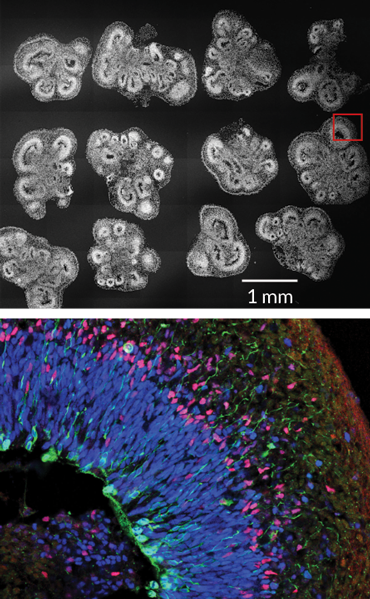 In a white lab coat and blue latex gloves, Neda Vishlaghi peers through a light microscope at six milky-white blobs. Each is about the size of a couscous grain, bathed in the pale orange broth of a petri dish. With tweezers in one hand and surgical scissors in the other, she deftly snips one tiny clump in half. When growing human brains, sometimes you need to do some pruning. The blobs are 8-week-old bits of brainlike tissue. While they wouldn’t be mistaken for Lilliputian-sized brains, some of their fine-grained features bear a remarkable resemblance to the human cerebral cortex, home to our memories, decision making and other high-level cognitive powers. Vishlaghi created these “minibrains” at the Eli and Edythe Broad Center of Regenerative Medicine and Stem Cell Research at UCLA, where she’s a research assistant. First she immersed batches of human pluripotent stem cells — which can morph into any cell type in the body — in a special mix of chemicals. .png) The free-floating cells multiplied and coalesced into itty-bitty balls of neural tissue. Nurtured with meticulously timed doses of growth-supporting ingredients, the cell clumps were eventually transferred to petri dishes of broth laced with Matrigel, a gelatin-like matrix of proteins. On day 56, the blobs display shadowy clusters of neural “rosettes.” Under a laser scanning microscope, razor-thin slices of those rosettes reveal loose-knit layers of a variety of dividing neural stem cells and the nerve cells, or neurons, they give rise to. The layered structures look similar to the architecture of a human fetal brain at 14 weeks of gestation. By eight weeks, brainlike clumps (top) show neural clusters called rosettes. Within one cluster (red box, expanded at bottom), stem cells (blue and teal) churn out layers of neural precursor cells (pink) and neurons (not stained). BOTH: M. WATANABE ET AL/CELL REPORTS 2017 Across the globe, labs such as this one, led by UCLA developmental biologist and neuroscientist Bennett Novitch, are cultivating thousands of these brainy clumps for research. Less than five years ago, a team of biologists in Austria and the United Kingdom and one in Japan wowed the world when they announced they had made rudimentary bits of 3-D human cerebral cortex in a dish. Since then, researchers have been eagerly tinkering with techniques for producing these miniature brain models, like chefs obsessively refining their favorite recipes. “It’s like making a cake: You have many different ways in which you can do it,” says Novitch, who prefers using the Japanese method with a few tweaks. “There are all sorts of little tricks that people have come up with to overcome some of the common challenges.” For instance, because the brain blobs lack a built-in blood supply, they must absorb enough oxygen and nutrients from the tissue-culture broth to remain healthy. To help, some labs circulate the broth around the tissue clumps. The UCLA researchers choose instead to grow theirs at higher oxygen levels and chop the blobs at the 35-day mark, when they are as wide as three millimeters, and then about every two weeks after. Sounds radical, but the slicing gives cells on the inside — some of which start dying — exposure to much-needed oxygen and nutrients. Those divided bits then continue growing separately. But cutting can be done only so many times before the expanding rosette structures inside are damaged. With all the experimenting, researchers have cooked up a lot of innovations, including some nifty progress reported in just the last year. Scientists have concocted tiny versions of several brain regions ranging from the hypothalamus, which regulates body temperature, thirst and hunger, to the movement-controlling basal ganglia. Electrical chatter among neurons, reflecting active brain circuits, has been detected. And research groups have recently begun linking bits of specific regions like Legos. Scientists have even observed some early developmental processes as they happen within the human brain blobs. Stem cell payoff The work is part of a broader scientific bonanza that comes from coaxing human stem cells to self-assemble into balls of organlike tissue, known as organoids, that are usually no bigger than a lentil. Although the organoids don’t grow enough to replicate entire human organs, these mini-versions can mimic the 3-D cellular infrastructure of everything from our guts to our lungs. That’s something you can’t get from studies of rodents, which have different biology than humans do. Mini-organ models promise enormous advantages for understanding basic human biology, teasing apart human disease processes, and offering an accurate testing ground for finding or vetting drug therapies. And by creating personalized organoids from the reprogrammed cells of patients, scientists could study disease in a very individualized way — or maybe even use organoid structures to replace certain damaged tissues, such as in the liver or spinal cord. “Organoids offer an unprecedented level of access into the inner workings of the human brain,” Novitch says, noting that our brains are largely off-limits to poking and cutting into for research. If scientists can study accurate models of working neural circuits in these brain bits, he and others say, researchers might finally get a handle on uniquely human neurological conditions. Such disorders, which include epilepsy and, experts theorize, schizophrenia and autism (SN Online: 7/17/15), can arise when the brain’s communication networks develop off-kilter. How to build a brain Methods for making bits of brainlike tissue tap the innate tendency of human pluripotent stem cells to form neural tissue. Here’s one group’s process. T. TIBBITTS Day 0: Around 9,000 stem cells are transferred into V-shaped wells and suspended in a cocktail of vitamins, amino acids and (for the first six days) Y-27632, a chemical to prevent the stem cells from committing suicide. Within a few days, the multiplying cells self-aggregate into tiny balls of neural tissue. The broth is refreshed every two to three days. Day 18: The enlarging neural balls are moved into petri dishes of broth with CDLC, a supplement that provides fats. High oxygen levels (40 percent oxygen, 5 percent carbon dioxide) help the tissue absorb enough oxygen. Well-defined clusters, or rosettes, show early layers of various types of developing neural cells by weeks four to five. Day 35: At 2 to 3 millimeters wide, the brainlike organoids are cut in half to give cells inside more access to nutrients and oxygen. The tissue clumps are nurtured in new broth infused with growth enhancers: a gelatin-like matrix of support proteins called Matrigel, B27 vitamin supplement, heparin and the growth promoter LIF. Day 56: Organoids are again snipped in half and transferred to new petri dishes made of oxygen-permeable plastic to optimize access to oxygen for healthy growth. From here on, the organoids are halved every two weeks or so, routinely surviving as long as 150 days. Source: M. Watanabe et al/Cell Reports 2017 But the research is still in its early days. Although there’s been exciting headway, studies sometimes overstate the extent to which human brain organoids reproduce features of actual developing brain tissue, says stem cell biologist Arnold Kriegstein of the University of California, San Francisco. The minimodels still lack many basic components, including certain cell types, a blood-vessel network and inputs from other neural regions. Another stumbling block is that brain organoids can vary a lot from protocol to protocol, or even batch to batch within the same lab. “The major focus now needs to be on reproducibility, and being able to get an approach that you can rely on to give you the same outcome each time,” Kriegstein says. DIY organs For decades, biology research has relied on cell lines grown in flat sheets in petri dishes, but those sheets lack the structural complexity of living tissue. Then came pioneering work that unveiled the do-it-yourself magic of stem cells raised free-floating in broth. Organlike tissue bits can be generated from pluripotent stem cells that are either plucked from embryos or created by taking a person’s adult skin or blood cells and chemically inducing them to revert to an embryonic-like state. Starting in the mid-2000s, Yoshiki Sasai’s team at the RIKEN Center for Developmental Biology in Kobe, Japan, demonstrated how to grow brainlike structures using embryonic stem cells, first from mice and then humans. In cross sections of 8-week-old brain organoids (top row), loose-knit cell layers roughly resemble the tighter bands in 14-week-old human fetal brain tissue (bottom row). The last column shows a zone of neural progenitor cells (red) and an outer layer of neurons (green). M. WATANABE ET AL/CELL REPORTS 2017 In their groundbreaking study in 2013 in Proceedings of the National Academy of Sciences, the researchers used chemical cues to direct human embryonic stem cells to form a specific region of the human cortex. (Tragically, Sasai committed suicide the next year, after two stem cell studies that he coauthored were retracted amid scientific misconduct charges against a research colleague [SN: 12/27/14, p. 25]. Before his death, Sasai was cleared of any direct involvement. The discredited studies were not related to the organoid research.) A few months before the 2013 Sasai team paper, Madeline Lancaster and Juergen Knoblich of the Institute of Molecular Biotechnology in Vienna and U.K. colleagues demonstrated their more freewheeling, landmark approach to growing brain organoids (SN: 9/21/13, p. 5). The recipe, described in Nature, allows human pluripotent stem cells to spontaneously attempt to assemble into a tiny approximation of a whole brain by making whatever brain structures the stem cells choose. Meanwhile, biologists elsewhere were whipping up other types of organoids, starting instead with adult stem cells. These rare, damage-repairing cells are found in many organs (including the brain), but the cells can transform into only a limited range of cell types. In 2009, Hans Clevers of the Hubrecht Institute in Utrecht, the Netherlands, announced that his lab unexpectedly created a miniature version of a gut while cultivating adult stem cells that the team had discovered in mouse intestinal tissue. Grown in a drop of Matrigel with a trio of growth-inducing factors, these cells coalesced into little spheres containing tiny projections that resembled the fingerlike villi that absorb nutrients in the gut. Scientists soon were concocting tiny facsimiles of human stomachs, livers, kidneys, lungs and more (SN: 12/28/13, p. 20). “We essentially are discovering the vitality of what the stem cells actually do,” says Clevers, who is president of the International Society for Stem Cell Research. “We give [the cells] a little push, and they do whatever they’re good at.” The trick is knowing exactly which ingredients to use to make different organs. For pluripotent stem cells, that means exposing them to just the right growth factors or inhibitors at just the right times, over about a month, says James Wells of the Center for Stem Cell and Organoid Medicine at Cincinnati Children’s Hospital Medical Center. Some of those essential instructions are well-known from decades of research on embryo development in fish, chickens and rodents; the same chemical cues generally work for all animals with spinal cords, including people. Under a microscope, rosettes of neural cells are visible along the perimeter of an 8-week-old brain organoid. The center, where cells have died, is dark. N. VISHLAGHI/UCLA However, for many body parts, organoid makers must suss out recipe instructions from scratch. Working with Jorge Múnera and other colleagues, Wells recently produced a minimodel of a human colon using human induced pluripotent stem cells. But first, the team conducted months of experiments on frog and mouse embryos to identify the signals for forming a colon. “It took a while to figure out what the special sauce was,” Wells says. Some scientists have distant dreams of using organoid methods to grow full-size livers or kidneys in the lab for transplantation. A more attainable goal may be regenerative tissue transplants, for example, replacing dying liver cells in someone with early-stage liver disease with chunks of healthy stem cells from a personalized liver organoid. Or, in patients who’ve had part of the small intestine removed, tiny pieces of gut organoid tissue could be implanted and, after growing larger, connected to the intestine. Head games The human brain, meanwhile, is vastly more complicated than any other organ. It’s unlikely that scientists will ever be able to build a full replica. While the initial brain-making recipes were stunning for what they could achieve, they left much room for improvement. In the years since the 2013 debut of human brain organoids, research groups have worked to grow bigger brain tissue clumps and more uniform structures. The Austrian method for making whole-brain organoids, in particular, produced a random mix of neural regions laid out in a topsy-turvy manner. But bioengineering tricks may help. In a study last year, Lancaster, now at the MRC Laboratory of Molecular Biology in Cambridge, England, and Knoblich got more consistent results by adding polymer filaments as scaffolding to guide the organization of the minibrain models. With surgical scissors, a UCLA biologist prepares to snip one of those organoids in half to give inner cells more access to oxygen and nutrients from the broth in the dish. INGFEI CHEN Other scientists, following the Japanese approach, which generally gives more predictable results, have concentrated on coaxing out specific cell types or structural features of the real brain. For instance, one constraint is that the organoids form slowly, more or less sticking to the same timeline of development as does a human brain during gestation. But without a blood supply, growth is limited; the brain bits reach only a few millimeters in size. That means organoid models are often short on cell types from later development stages, such as cells called astrocytes. These star-shaped cells are crucial for creating and curating the connections between neurons, and also may help with forming memories (SN Online: 11/15/17). Astrocytes don’t fully mature in a baby’s brain until after birth. But Stanford University neuroscientist Sergiu Paşca has crafted a method for making and maintaining 4-millimeter-wide balls of human cortex–like tissue (he calls them spheroids) in 3-D culture for an extended time. Last August in Neuron, his team described organoids that survived for more than 20 months — long enough, analyses showed, for astrocytes to mature and function in ways that mimic their real-brain counterparts. Of great interest, also, are the outer radial glial (oRG) cells, neural stem cells that are pivotal for constructing the unusually big cortex that’s unique to humans; oRG cells are scarce in mouse brains. When Novitch’s lab group at UCLA tried the original Japanese and Austrian organoid-making recipes, the output of oRG cells was underwhelming. So Novitch worked with Vishlaghi and postdoctoral researcher Momoko Watanabe to refine the protocol to pump up the cells’ production and reliably generate better cerebral blobs. Among other tweaks, Novitch’s team added a dash of a molecule dubbed LIF, which recent studies by others had suggested can spur the oRGs to multiply. It worked, leading to a threefold increase in the oRG populations and enhanced growth of upper neuron layers. The researchers shared their revised protocol last October in Cell Reports. 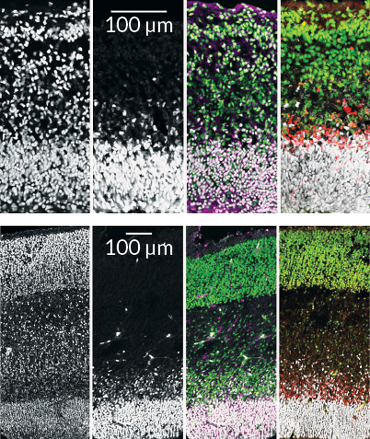 Helping hand Neural stem cells called outer radial glial (oRG) cells help fuel the expansion of the unusually big human brain. A growth factor called LIF tripled the number of oRG cells in growing minibrains by week 12. Applying a growth factor to mini brain models T. TIBBITTS Source: M. Watanabe et al/Cell Reports 2017 On a different front, labs have begun assembling more complex minibrain models, like playing with self-directed Legos. For two months, Paşca’s team at Stanford grew spheroids in separate sets of dishes that mimicked either cortex tissue or an adjacent underlying region known as the subpallium. Then the researchers put the different bits side-by-side and left them overnight in a culture tube. Similar to how the two regions normally connect in the developing brain, the little pieces knew what to do. “By the next day they are essentially fused to each other,” says Paşca, who announced the results in May in Nature. During the fusion process, the researchers took time-lapse videos of long, spaghetti-like cells called interneurons migrating from a spheroid of the subpallium into a cortexlike spheroid. “They don’t crawl, they actually jump,” Paşca says. The images capture aspects of a hallmark phenomenon that normally unfolds during the second and third trimester of fetal gestation. Testing ground Once on the other side, interneurons form a circuit with — and quell the activity of — excitatory neurons in the cortexlike tissue, electrophysiological tests suggest. If not quieted, excitatory neurons will trigger neighboring cells to fire. In the real brain, maintaining a proper balance in neural network activity is important; disruptions in it appear to foster disorders such as epilepsy, and perhaps schizophrenia and autism. Indeed, in the same paper, the Stanford team reported new discoveries using personalized brain spheroids derived from induced pluripotent stem cells of patients with Timothy syndrome — a rare condition caused by an overactive calcium channel found mainly in the brain and heart. Patients with the disorder have epilepsy, autism and heart problems. In the patients’ spheroids, interneurons migrated inefficiently but, by adding drugs that blocked the dysfunctional calcium channel, the researchers could reverse the problem. The brain organoids made these intriguing observations possible, Paşca says. “We couldn’t have done this in any other way.” Stunted A brain organoid infected by Zika virus at 28 days old is severely stunted two weeks later (right) compared with a healthy organoid of the same age (left). XUYU QIAN ET AL/CELL 2016 When sliced open, at higher magnification, a healthy cortexlike organoid (left) shows normal structure: a rosette with visible cavity in the middle, neural stem cells (red) and neurons (green and blue). A Zika-infected organoid (right) shows collapse of the rosette, with fewer neural stem cells and neurons. XUYU QIAN ET AL/CELL 2016 Organoid experiments by others have, meanwhile, helped confirm that the Zika virus targets and kills oRG cells and other neural precursor cells, contributing to small brain size in infected infants. In a 2016 study, Johns Hopkins University neuroscientists Guo-li Ming and Hongjun Song reported on their own techniques for creating brain bits that have a well-defined zone of oRG cells. After infecting these organoids with the Zika virus, the researchers observed a collapse of cortexlike tissue that may partly explain the stunted brain growth (SN: 4/2/16, p. 26). 2-D cell-culture and mouse experiments also provided key evidence of the virus’s modus operandi; although the rodent brain doesn’t harbor the full contingent of human neural stem cells, it has blood vessels and immune-system components that organoids lack. In search of Zika-fighting treatments, Ming and Song, both now at University of Pennsylvania, and their colleagues have been screening thousands of compounds in 2-D cell cultures, and then validating the most promising candidates with tests in 3-D brain organoids. The team has found several potential antiviral and neuron-protecting agents to pursue. Novitch’s UCLA lab group has likewise used its brain organoids to pinpoint additional receptors by which the virus may gain entry into neural stem cells, and identified a few other drug leads for blocking infection. Organoids may also prove valuable for tailoring treatments for patients, says David Panchision, chief of the developmental neurobiology program at the National Institute of Mental Health in Bethesda, Md. Researchers might generate personalized brain organoids from the reprogrammed skin cells of individuals with, say, schizophrenia and test which medications work best for patients with particular genetic profiles of the illness. In the Netherlands, based on research reported in 2016 in Science Translational Medicine, Clevers and colleagues are already using personalized gut organoids, derived from rectal biopsies, to test whether cystic fibrosis patients will benefit from available drugs. Tailored regenerative therapies with 3-D substructures of neural tissue may also be possible, Panchision adds, for conditions like Parkinson’s disease or spinal cord injury. Blocking infection Images show 4-week-old brain organoids with no infection (left) and with Zika infection (middle, virus is green, dead stem cells are pink). Treatment with the drug duramycin before exposure to Zika largely staves off infection and cell death (right). 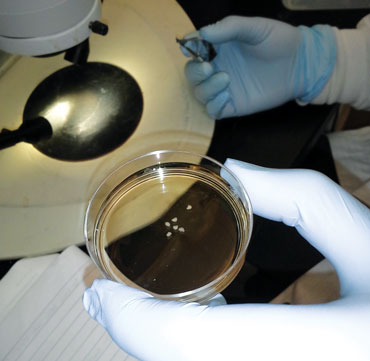 NOVITCH LAB/UCLA Growing pains For now, though, scientists have hefty challenges to overcome. Much work remains in optimizing how faithfully the bits of tissue reproduce normal brain function and architecture, Panchision says. For one thing, the organoids are developmentally young and don’t reflect a mature brain. And researchers must figure out how to build in some core features: the necessary blood vessels, immune-system cells called microglia and connections from other brain regions, such as the thalamus and cerebellum. Not to mention steroid and thyroid hormones, which also shape brain growth. However, scientists don’t necessarily need or want to create a comprehensive replica of the human brain in a dish, Panchision and others point out. Rather, the goal is to build robust and reliable models for studying specific aspects of brain function. 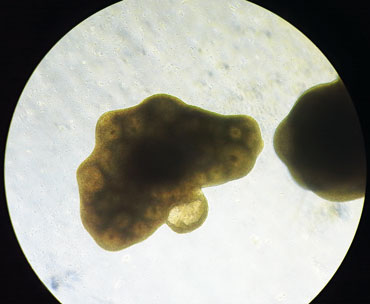 Thus the pressing need for standardized, reproducible organoid-making recipes. Novitch’s group and many other labs are still trying to figure out why the brain bits can vary so much in size, composition and structure. Part of the trouble is the ingredients: Subtle variations in tissue-culture chemicals and Matrigel, or in different stem cell lines and how they are grown first in 2-D culture, can have a big impact on how the organoids turn out, Novitch says. At the same time, researchers need to do a more thorough job of analyzing brain organoids to know what’s actually in them at different developmental time points, compared with actual human fetal brain tissue, says UCSF’s Kriegstein. It’s otherwise hard to say whether a brain blob truly recapitulates the neural tissue that scientists claim it does. Labs have started tackling the problem with a tool called single-cell transcriptome analysis, which gives readouts of all the genes that are active in individual cells.  “Greater rigor is needed,” Kriegstein says. “And I am sure we will eventually get there.” This story appears in the March 3, 2018 issue of Science News with the headline, "Brain-making 101: Self-assembling clumps bring a dose of 3-D reality to studies of human organs." |
| json metadata | {"tags":["human","brain"],"image":["https://steemitimages.com/DQmTUN1mzG6N6PihVdm74S64TkDPwcXZEN8aWHUJc6kjnAg/030318_organoids_main.jpg","https://steemitimages.com/DQmXe6rLv4pBrk8ffNq6Xa8qnwwKXuqvHTow1uVVzA2Mcp8/030318_organoids_inline_1_370.png","https://steemitimages.com/DQmXe6rLv4pBrk8ffNq6Xa8qnwwKXuqvHTow1uVVzA2Mcp8/030318_organoids_inline_1_370%20(1).png","https://steemitimages.com/DQmTw8sAoHqd7xmT8SiPRDeCawrSJqEGhLaiGy3yzBo7sz4/030318_organoids_inline_3_370.png","https://steemitimages.com/DQmTj7kTD1oM3ohFbY958ZYhSLeCZ2GzXFnMjKk2yce8SW7/030318_organoids_inline_5_370.jpg","https://steemitimages.com/DQmbSEJBf26RnrKkCGBSGWFMy6FAVFyfnx3KjxxN3thV7qL/030318_organoids_inline_4_370.jpg"],"app":"steemit/0.1","format":"markdown"} |
| parent author | |
| parent permlink | human |
| permlink | how-to-build-a-human-brain |
| title | How to build a human brain |
| Transaction Info | Block #20046928/Trx 5bc7bc4127af8bbb0dca0d1f3f57fd0b72efd5ba |
View Raw JSON Data
{
"block": 20046928,
"op": [
"comment",
{
"author": "nani121",
"body": "Some steps for growing mini versions of human organs are easier than others\n\nBRAIN-MAKING 101 As blobs of two types of brainlike tissue fuse, interneurons (green) migrate from the left clump to the right, linking with neurons (not stained) in the right blob. On both sides, neural support cells called glia appear in purple.\n\nPAŞCA LAB/STANFORD UNIV.\n\nIn a white lab coat and blue latex gloves, Neda Vishlaghi peers through a light microscope at six milky-white blobs. Each is about the size of a couscous grain, bathed in the pale orange broth of a petri dish. With tweezers in one hand and surgical scissors in the other, she deftly snips one tiny clump in half.\n\nWhen growing human brains, sometimes you need to do some pruning.\n\nThe blobs are 8-week-old bits of brainlike tissue. While they wouldn’t be mistaken for Lilliputian-sized brains, some of their fine-grained features bear a remarkable resemblance to the human cerebral cortex, home to our memories, decision making and other high-level cognitive powers.\n\nVishlaghi created these “minibrains” at the Eli and Edythe Broad Center of Regenerative Medicine and Stem Cell Research at UCLA, where she’s a research assistant. First she immersed batches of human pluripotent stem cells — which can morph into any cell type in the body — in a special mix of chemicals.\n.png)\nThe free-floating cells multiplied and coalesced into itty-bitty balls of neural tissue. Nurtured with meticulously timed doses of growth-supporting ingredients, the cell clumps were eventually transferred to petri dishes of broth laced with Matrigel, a gelatin-like matrix of proteins.\n\nOn day 56, the blobs display shadowy clusters of neural “rosettes.” Under a laser scanning microscope, razor-thin slices of those rosettes reveal loose-knit layers of a variety of dividing neural stem cells and the nerve cells, or neurons, they give rise to. The layered structures look similar to the architecture of a human fetal brain at 14 weeks of gestation.\n\n\nBy eight weeks, brainlike clumps (top) show neural clusters called rosettes. Within one cluster (red box, expanded at bottom), stem cells (blue and teal) churn out layers of neural precursor cells (pink) and neurons (not stained).\nBOTH: M. WATANABE ET AL/CELL REPORTS 2017\nAcross the globe, labs such as this one, led by UCLA developmental biologist and neuroscientist Bennett Novitch, are cultivating thousands of these brainy clumps for research. Less than five years ago, a team of biologists in Austria and the United Kingdom and one in Japan wowed the world when they announced they had made rudimentary bits of 3-D human cerebral cortex in a dish. Since then, researchers have been eagerly tinkering with techniques for producing these miniature brain models, like chefs obsessively refining their favorite recipes.\n“It’s like making a cake: You have many different ways in which you can do it,” says Novitch, who prefers using the Japanese method with a few tweaks. “There are all sorts of little tricks that people have come up with to overcome some of the common challenges.”\n\nFor instance, because the brain blobs lack a built-in blood supply, they must absorb enough oxygen and nutrients from the tissue-culture broth to remain healthy. To help, some labs circulate the broth around the tissue clumps. The UCLA researchers choose instead to grow theirs at higher oxygen levels and chop the blobs at the 35-day mark, when they are as wide as three millimeters, and then about every two weeks after. Sounds radical, but the slicing gives cells on the inside — some of which start dying — exposure to much-needed oxygen and nutrients. Those divided bits then continue growing separately. But cutting can be done only so many times before the expanding rosette structures inside are damaged.\n\nWith all the experimenting, researchers have cooked up a lot of innovations, including some nifty progress reported in just the last year. Scientists have concocted tiny versions of several brain regions ranging from the hypothalamus, which regulates body temperature, thirst and hunger, to the movement-controlling basal ganglia. Electrical chatter among neurons, reflecting active brain circuits, has been detected. And research groups have recently begun linking bits of specific regions like Legos. Scientists have even observed some early developmental processes as they happen within the human brain blobs.\n\nStem cell payoff\nThe work is part of a broader scientific bonanza that comes from coaxing human stem cells to self-assemble into balls of organlike tissue, known as organoids, that are usually no bigger than a lentil. Although the organoids don’t grow enough to replicate entire human organs, these mini-versions can mimic the 3-D cellular infrastructure of everything from our guts to our lungs. That’s something you can’t get from studies of rodents, which have different biology than humans do.\n\nMini-organ models promise enormous advantages for understanding basic human biology, teasing apart human disease processes, and offering an accurate testing ground for finding or vetting drug therapies. And by creating personalized organoids from the reprogrammed cells of patients, scientists could study disease in a very individualized way — or maybe even use organoid structures to replace certain damaged tissues, such as in the liver or spinal cord.\n\n“Organoids offer an unprecedented level of access into the inner workings of the human brain,” Novitch says, noting that our brains are largely off-limits to poking and cutting into for research. If scientists can study accurate models of working neural circuits in these brain bits, he and others say, researchers might finally get a handle on uniquely human neurological conditions. Such disorders, which include epilepsy and, experts theorize, schizophrenia and autism (SN Online: 7/17/15), can arise when the brain’s communication networks develop off-kilter.\n\nHow to build a brain\nMethods for making bits of brainlike tissue tap the innate tendency of human pluripotent stem cells to form neural tissue. Here’s one group’s process. \n\n\nT. TIBBITTS\nDay 0: Around 9,000 stem cells are transferred into V-shaped wells and suspended in a cocktail of vitamins, amino acids and (for the first six days) Y-27632, a chemical to prevent the stem cells from committing suicide. Within a few days, the multiplying cells self-aggregate into tiny balls of neural tissue. The broth is refreshed every two to three days.\n\nDay 18: The enlarging neural balls are moved into petri dishes of broth with CDLC, a supplement that provides fats. High oxygen levels (40 percent oxygen, 5 percent carbon dioxide) help the tissue absorb enough oxygen. Well-defined clusters, or rosettes, show early layers of various types of developing neural cells by weeks four to five.\n\nDay 35: At 2 to 3 millimeters wide, the brainlike organoids are cut in half to give cells inside more access to nutrients and oxygen. The tissue clumps are nurtured in new broth infused with growth enhancers: a gelatin-like matrix of support proteins called Matrigel, B27 vitamin supplement, heparin and the growth promoter LIF.\n\nDay 56: Organoids are again snipped in half and transferred to new petri dishes made of oxygen-permeable plastic to optimize access to oxygen for healthy growth. From here on, the organoids are halved every two weeks or so, routinely surviving as long as 150 days.\n\nSource: M. Watanabe et al/Cell Reports 2017\n\nBut the research is still in its early days. Although there’s been exciting headway, studies sometimes overstate the extent to which human brain organoids reproduce features of actual developing brain tissue, says stem cell biologist Arnold Kriegstein of the University of California, San Francisco. The minimodels still lack many basic components, including certain cell types, a blood-vessel network and inputs from other neural regions.\n\nAnother stumbling block is that brain organoids can vary a lot from protocol to protocol, or even batch to batch within the same lab. “The major focus now needs to be on reproducibility, and being able to get an approach that you can rely on to give you the same outcome each time,” Kriegstein says.\n\nDIY organs\nFor decades, biology research has relied on cell lines grown in flat sheets in petri dishes, but those sheets lack the structural complexity of living tissue. Then came pioneering work that unveiled the do-it-yourself magic of stem cells raised free-floating in broth.\n\nOrganlike tissue bits can be generated from pluripotent stem cells that are either plucked from embryos or created by taking a person’s adult skin or blood cells and chemically inducing them to revert to an embryonic-like state. Starting in the mid-2000s, Yoshiki Sasai’s team at the RIKEN Center for Developmental Biology in Kobe, Japan, demonstrated how to grow brainlike structures using embryonic stem cells, first from mice and then humans.\n\n\nIn cross sections of 8-week-old brain organoids (top row), loose-knit cell layers roughly resemble the tighter bands in 14-week-old human fetal brain tissue (bottom row). The last column shows a zone of neural progenitor cells (red) and an outer layer of neurons (green).\nM. WATANABE ET AL/CELL REPORTS 2017\nIn their groundbreaking study in 2013 in Proceedings of the National Academy of Sciences, the researchers used chemical cues to direct human embryonic stem cells to form a specific region of the human cortex. (Tragically, Sasai committed suicide the next year, after two stem cell studies that he coauthored were retracted amid scientific misconduct charges against a research colleague [SN: 12/27/14, p. 25]. Before his death, Sasai was cleared of any direct involvement. The discredited studies were not related to the organoid research.)\nA few months before the 2013 Sasai team paper, Madeline Lancaster and Juergen Knoblich of the Institute of Molecular Biotechnology in Vienna and U.K. colleagues demonstrated their more freewheeling, landmark approach to growing brain organoids (SN: 9/21/13, p. 5). The recipe, described in Nature, allows human pluripotent stem cells to spontaneously attempt to assemble into a tiny approximation of a whole brain by making whatever brain structures the stem cells choose.\n\nMeanwhile, biologists elsewhere were whipping up other types of organoids, starting instead with adult stem cells. These rare, damage-repairing cells are found in many organs (including the brain), but the cells can transform into only a limited range of cell types. In 2009, Hans Clevers of the Hubrecht Institute in Utrecht, the Netherlands, announced that his lab unexpectedly created a miniature version of a gut while cultivating adult stem cells that the team had discovered in mouse intestinal tissue. Grown in a drop of Matrigel with a trio of growth-inducing factors, these cells coalesced into little spheres containing tiny projections that resembled the fingerlike villi that absorb nutrients in the gut.\n\nScientists soon were concocting tiny facsimiles of human stomachs, livers, kidneys, lungs and more (SN: 12/28/13, p. 20). “We essentially are discovering the vitality of what the stem cells actually do,” says Clevers, who is president of the International Society for Stem Cell Research. “We give [the cells] a little push, and they do whatever they’re good at.”\n\nThe trick is knowing exactly which ingredients to use to make different organs. For pluripotent stem cells, that means exposing them to just the right growth factors or inhibitors at just the right times, over about a month, says James Wells of the Center for Stem Cell and Organoid Medicine at Cincinnati Children’s Hospital Medical Center. Some of those essential instructions are well-known from decades of research on embryo development in fish, chickens and rodents; the same chemical cues generally work for all animals with spinal cords, including people.\n\n\nUnder a microscope, rosettes of neural cells are visible along the perimeter of an 8-week-old brain organoid. The center, where cells have died, is dark.\nN. VISHLAGHI/UCLA\nHowever, for many body parts, organoid makers must suss out recipe instructions from scratch. Working with Jorge Múnera and other colleagues, Wells recently produced a minimodel of a human colon using human induced pluripotent stem cells. But first, the team conducted months of experiments on frog and mouse embryos to identify the signals for forming a colon. “It took a while to figure out what the special sauce was,” Wells says.\nSome scientists have distant dreams of using organoid methods to grow full-size livers or kidneys in the lab for transplantation. A more attainable goal may be regenerative tissue transplants, for example, replacing dying liver cells in someone with early-stage liver disease with chunks of healthy stem cells from a personalized liver organoid. Or, in patients who’ve had part of the small intestine removed, tiny pieces of gut organoid tissue could be implanted and, after growing larger, connected to the intestine.\n\nHead games\nThe human brain, meanwhile, is vastly more complicated than any other organ. It’s unlikely that scientists will ever be able to build a full replica. While the initial brain-making recipes were stunning for what they could achieve, they left much room for improvement. In the years since the 2013 debut of human brain organoids, research groups have worked to grow bigger brain tissue clumps and more uniform structures.\n\nThe Austrian method for making whole-brain organoids, in particular, produced a random mix of neural regions laid out in a topsy-turvy manner. But bioengineering tricks may help. In a study last year, Lancaster, now at the MRC Laboratory of Molecular Biology in Cambridge, England, and Knoblich got more consistent results by adding polymer filaments as scaffolding to guide the organization of the minibrain models.\n\n\nWith surgical scissors, a UCLA biologist prepares to snip one of those organoids in half to give inner cells more access to oxygen and nutrients from the broth in the dish.\nINGFEI CHEN\nOther scientists, following the Japanese approach, which generally gives more predictable results, have concentrated on coaxing out specific cell types or structural features of the real brain. For instance, one constraint is that the organoids form slowly, more or less sticking to the same timeline of development as does a human brain during gestation. But without a blood supply, growth is limited; the brain bits reach only a few millimeters in size. That means organoid models are often short on cell types from later development stages, such as cells called astrocytes. These star-shaped cells are crucial for creating and curating the connections between neurons, and also may help with forming memories (SN Online: 11/15/17).\nAstrocytes don’t fully mature in a baby’s brain until after birth. But Stanford University neuroscientist Sergiu Paşca has crafted a method for making and maintaining 4-millimeter-wide balls of human cortex–like tissue (he calls them spheroids) in 3-D culture for an extended time. Last August in Neuron, his team described organoids that survived for more than 20 months — long enough, analyses showed, for astrocytes to mature and function in ways that mimic their real-brain counterparts.\n\nOf great interest, also, are the outer radial glial (oRG) cells, neural stem cells that are pivotal for constructing the unusually big cortex that’s unique to humans; oRG cells are scarce in mouse brains. When Novitch’s lab group at UCLA tried the original Japanese and Austrian organoid-making recipes, the output of oRG cells was underwhelming. So Novitch worked with Vishlaghi and postdoctoral researcher Momoko Watanabe to refine the protocol to pump up the cells’ production and reliably generate better cerebral blobs.\n\nAmong other tweaks, Novitch’s team added a dash of a molecule dubbed LIF, which recent studies by others had suggested can spur the oRGs to multiply. It worked, leading to a threefold increase in the oRG populations and enhanced growth of upper neuron layers. The researchers shared their revised protocol last October in Cell Reports.\n\nHelping hand\nNeural stem cells called outer radial glial (oRG) cells help fuel the expansion of the unusually big human brain. A growth factor called LIF tripled the number of oRG cells in growing minibrains by week 12. \n\nApplying a growth factor to mini brain models\n\n\nT. TIBBITTS\nSource: M. Watanabe et al/Cell Reports 2017\n\nOn a different front, labs have begun assembling more complex minibrain models, like playing with self-directed Legos. For two months, Paşca’s team at Stanford grew spheroids in separate sets of dishes that mimicked either cortex tissue or an adjacent underlying region known as the subpallium. Then the researchers put the different bits side-by-side and left them overnight in a culture tube. Similar to how the two regions normally connect in the developing brain, the little pieces knew what to do. “By the next day they are essentially fused to each other,” says Paşca, who announced the results in May in Nature.\n\nDuring the fusion process, the researchers took time-lapse videos of long, spaghetti-like cells called interneurons migrating from a spheroid of the subpallium into a cortexlike spheroid.\n\n“They don’t crawl, they actually jump,” Paşca says. The images capture aspects of a hallmark phenomenon that normally unfolds during the second and third trimester of fetal gestation.\n\nTesting ground\nOnce on the other side, interneurons form a circuit with — and quell the activity of — excitatory neurons in the cortexlike tissue, electrophysiological tests suggest. If not quieted, excitatory neurons will trigger neighboring cells to fire. In the real brain, maintaining a proper balance in neural network activity is important; disruptions in it appear to foster disorders such as epilepsy, and perhaps schizophrenia and autism.\n\nIndeed, in the same paper, the Stanford team reported new discoveries using personalized brain spheroids derived from induced pluripotent stem cells of patients with Timothy syndrome — a rare condition caused by an overactive calcium channel found mainly in the brain and heart. Patients with the disorder have epilepsy, autism and heart problems. In the patients’ spheroids, interneurons migrated inefficiently but, by adding drugs that blocked the dysfunctional calcium channel, the researchers could reverse the problem. The brain organoids made these intriguing observations possible, Paşca says. “We couldn’t have done this in any other way.”\n\nStunted\nA brain organoid infected by Zika virus at 28 days old is severely stunted two weeks later (right) compared with a healthy organoid of the same age (left).\n\n\nXUYU QIAN ET AL/CELL 2016\nWhen sliced open, at higher magnification, a healthy cortexlike organoid (left) shows normal structure: a rosette with visible cavity in the middle, neural stem cells (red) and neurons (green and blue). A Zika-infected organoid (right) shows collapse of the rosette, with fewer neural stem cells and neurons. \n\n\nXUYU QIAN ET AL/CELL 2016\nOrganoid experiments by others have, meanwhile, helped confirm that the Zika virus targets and kills oRG cells and other neural precursor cells, contributing to small brain size in infected infants.\n\nIn a 2016 study, Johns Hopkins University neuroscientists Guo-li Ming and Hongjun Song reported on their own techniques for creating brain bits that have a well-defined zone of oRG cells. After infecting these organoids with the Zika virus, the researchers observed a collapse of cortexlike tissue that may partly explain the stunted brain growth (SN: 4/2/16, p. 26). 2-D cell-culture and mouse experiments also provided key evidence of the virus’s modus operandi; although the rodent brain doesn’t harbor the full contingent of human neural stem cells, it has blood vessels and immune-system components that organoids lack.\n\nIn search of Zika-fighting treatments, Ming and Song, both now at University of Pennsylvania, and their colleagues have been screening thousands of compounds in 2-D cell cultures, and then validating the most promising candidates with tests in 3-D brain organoids. The team has found several potential antiviral and neuron-protecting agents to pursue. Novitch’s UCLA lab group has likewise used its brain organoids to pinpoint additional receptors by which the virus may gain entry into neural stem cells, and identified a few other drug leads for blocking infection.\n\nOrganoids may also prove valuable for tailoring treatments for patients, says David Panchision, chief of the developmental neurobiology program at the National Institute of Mental Health in Bethesda, Md. Researchers might generate personalized brain organoids from the reprogrammed skin cells of individuals with, say, schizophrenia and test which medications work best for patients with particular genetic profiles of the illness.\n\nIn the Netherlands, based on research reported in 2016 in Science Translational Medicine, Clevers and colleagues are already using personalized gut organoids, derived from rectal biopsies, to test whether cystic fibrosis patients will benefit from available drugs. Tailored regenerative therapies with 3-D substructures of neural tissue may also be possible, Panchision adds, for conditions like Parkinson’s disease or spinal cord injury.\n\nBlocking infection\nImages show 4-week-old brain organoids with no infection (left) and with Zika infection (middle, virus is green, dead stem cells are pink). Treatment with the drug duramycin before exposure to Zika largely staves off infection and cell death (right).\n\n\nNOVITCH LAB/UCLA\nGrowing pains\nFor now, though, scientists have hefty challenges to overcome. Much work remains in optimizing how faithfully the bits of tissue reproduce normal brain function and architecture, Panchision says. For one thing, the organoids are developmentally young and don’t reflect a mature brain. And researchers must figure out how to build in some core features: the necessary blood vessels, immune-system cells called microglia and connections from other brain regions, such as the thalamus and cerebellum. Not to mention steroid and thyroid hormones, which also shape brain growth.\n\nHowever, scientists don’t necessarily need or want to create a comprehensive replica of the human brain in a dish, Panchision and others point out. Rather, the goal is to build robust and reliable models for studying specific aspects of brain function.\n\nThus the pressing need for standardized, reproducible organoid-making recipes. Novitch’s group and many other labs are still trying to figure out why the brain bits can vary so much in size, composition and structure. Part of the trouble is the ingredients: Subtle variations in tissue-culture chemicals and Matrigel, or in different stem cell lines and how they are grown first in 2-D culture, can have a big impact on how the organoids turn out, Novitch says.\n\nAt the same time, researchers need to do a more thorough job of analyzing brain organoids to know what’s actually in them at different developmental time points, compared with actual human fetal brain tissue, says UCSF’s Kriegstein. It’s otherwise hard to say whether a brain blob truly recapitulates the neural tissue that scientists claim it does. Labs have started tackling the problem with a tool called single-cell transcriptome analysis, which gives readouts of all the genes that are active in individual cells.\n\n“Greater rigor is needed,” Kriegstein says. “And I am sure we will eventually get there.”\n\nThis story appears in the March 3, 2018 issue of Science News with the headline, \"Brain-making 101: Self-assembling clumps bring a dose of 3-D reality to studies of human organs.\"",
"json_metadata": "{\"tags\":[\"human\",\"brain\"],\"image\":[\"https://steemitimages.com/DQmTUN1mzG6N6PihVdm74S64TkDPwcXZEN8aWHUJc6kjnAg/030318_organoids_main.jpg\",\"https://steemitimages.com/DQmXe6rLv4pBrk8ffNq6Xa8qnwwKXuqvHTow1uVVzA2Mcp8/030318_organoids_inline_1_370.png\",\"https://steemitimages.com/DQmXe6rLv4pBrk8ffNq6Xa8qnwwKXuqvHTow1uVVzA2Mcp8/030318_organoids_inline_1_370%20(1).png\",\"https://steemitimages.com/DQmTw8sAoHqd7xmT8SiPRDeCawrSJqEGhLaiGy3yzBo7sz4/030318_organoids_inline_3_370.png\",\"https://steemitimages.com/DQmTj7kTD1oM3ohFbY958ZYhSLeCZ2GzXFnMjKk2yce8SW7/030318_organoids_inline_5_370.jpg\",\"https://steemitimages.com/DQmbSEJBf26RnrKkCGBSGWFMy6FAVFyfnx3KjxxN3thV7qL/030318_organoids_inline_4_370.jpg\"],\"app\":\"steemit/0.1\",\"format\":\"markdown\"}",
"parent_author": "",
"parent_permlink": "human",
"permlink": "how-to-build-a-human-brain",
"title": "How to build a human brain"
}
],
"op_in_trx": 0,
"timestamp": "2018-02-20T22:24:33",
"trx_id": "5bc7bc4127af8bbb0dca0d1f3f57fd0b72efd5ba",
"trx_in_block": 30,
"virtual_op": 0
}2018/02/20 22:13:09
2018/02/20 22:13:09
| author | cheetah |
| body | Hi! I am a robot. I just upvoted you! I found similar content that readers might be interested in: https://www.sciencenews.org/article/modern-tech-unravels-mysteries-egyptian-mummy-portraits |
| json metadata | |
| parent author | nani121 |
| parent permlink | modern-tech-unravels-mysteries-of-egyptian-mummy-portraits |
| permlink | cheetah-re-nani121modern-tech-unravels-mysteries-of-egyptian-mummy-portraits |
| title | |
| Transaction Info | Block #20046700/Trx ba709ccb55b628209b9971313728a86d2b1b0b32 |
View Raw JSON Data
{
  "block": 20046700,
  "op": [
    "comment",
    {
      "author": "cheetah",
      "body": "Hi! I am a robot. I just upvoted you! I found similar content that readers might be interested in:\nhttps://www.sciencenews.org/article/modern-tech-unravels-mysteries-egyptian-mummy-portraits",
      "json_metadata": "",
      "parent_author": "nani121",
      "parent_permlink": "modern-tech-unravels-mysteries-of-egyptian-mummy-portraits",
      "permlink": "cheetah-re-nani121modern-tech-unravels-mysteries-of-egyptian-mummy-portraits",
      "title": ""
    }
  ],
  "op_in_trx": 0,
  "timestamp": "2018-02-20T22:13:09",
  "trx_id": "ba709ccb55b628209b9971313728a86d2b1b0b32",
  "trx_in_block": 30,
  "virtual_op": 0
}nani121published a new post: modern-tech-unravels-mysteries-of-egyptian-mummy-portraits2018/02/20 22:12:03
nani121published a new post: modern-tech-unravels-mysteries-of-egyptian-mummy-portraits
2018/02/20 22:12:03
| author | nani121 |
| body | A new exhibit explores the science of ancient funeral paintings. 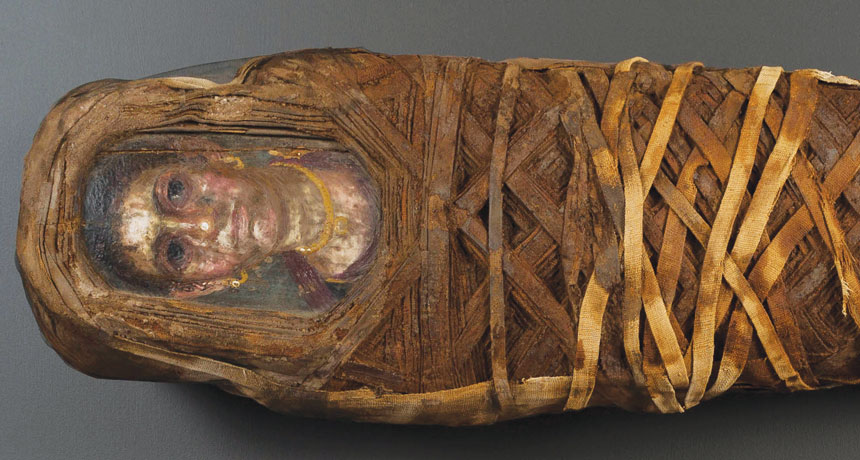 MUMMY MYSTERY The Hibbard mummy, now on display at Northwestern University, holds the body of a girl estimated to be 5 years old at death. Recent analyses might help reveal a cause of death. COURTESY GARRETT-EVANGELICAL THEOLOGICAL SEMINARY, EVANSTON, IL Everybody’s a critic. Even back in second century Egypt. While digging in Tebtunis in northern Egypt in the winter of 1899–1900, British archaeologists stumbled upon portraits of affluent Greco-Egyptians placed over the faces of mummies. One grave contained an ink and chalk sketch, a bit larger than a standard sheet of printer paper, of a woman from around the years A.D. 140 to 160. The sketch includes directions from an unidentified source to the artist to paint the “eyes softer.” That ancient critique is now the name of a temporary exhibit at Northwestern University’s Block Museum of Art in Evanston, Ill. “Paint the Eyes Softer: Mummy Portraits from Roman Egypt” features the sketch, along with six more intact or nearly intact Egyptian funeral portraits, one still attached to its mummy. All were discovered more than a century ago but recently examined using modern scientific tools. “Paint the Eyes Softer” Through April 22 Northwestern University’s Block Museum of Art | Evanston, Ill. The relics from this time period don’t resemble your granddad’s King Tut. Egyptians applied a new approach to mummies during the Roman-dominated era from the first through third centuries A.D. These mummies featured portraits of the deceased held in place by the linens wrapping the dead. Such paintings served as a prelude to other panel paintings in the ancient world, including Christian icons. Excavators separated the portraits from the mummies, which were supposed to have been together for eternity, says Essi Rönkkö, Block’s curatorial associate for special projects. Five of the portraits, on loan along with other materials from the University of California, Berkeley, are highlighted in one of the exhibit’s showcases: two men, a boy and two women. These lifelike paintings of well-dressed people in Roman attire stare back at you through the mists of time. The soulful (soft?) eyes draw you in and make you wonder who these people were and what their lives were like. The exhibit uses a series of labels, some with photographs, to trace the discovery of the portraits and explain Egyptian funerary techniques. Two mummy masks from the mid-third century B.C. to the mid-second century A.D. are also on display. The masks present an idealized image of the deceased in repose, ready for the afterlife. 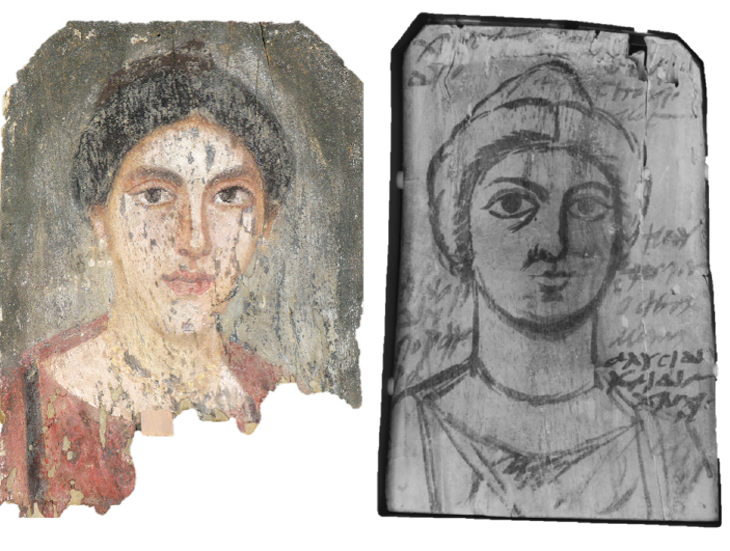 Funerary portraits discovered from ancient Egypt (one at left) covered the faces of mummies. A sketch (right) on the back of another portrait has instructions in Greek to paint the “eyes softer.” BOTH: COURTESY OF THE PHOEBE A. HEARST MUSEUM OF ANTHROPOLOGY AND THE REGENTS OF THE UNIVERSITY OF CALIFORNIA Northwestern students and researchers last fall applied modern analytical tools from archaeology, medicine and molecular biology to the portraits. The studies reveal that two types of wood were used in the portraits. Most panels were made from sycamore fig — a material native to Africa, including Egypt. A thin panel on one portrait was made from limewood found only in Central Europe. Ingredients for pigments were also imported, from Spain and Greece. The sources point to complex and far-reaching trade patterns. A computerized analysis of brushstrokes and paints suggests the male portraits came from the same workshop. All three wore a purple shoulder sash created with a blend of indigo and a red pigment extracted from the madder plant (SN: 3/5/16, p. 17). Tucked away in a corner is another exhibit highlight: an intact mummy with a still-attached portrait of a girl, estimated to be 5 years old at the time she died. Low lighting protects the mummy and, along with solemn music, provides a respectful tone. Known as the Hibbard mummy, the girl’s body was found in Hawara, not far from Tebtunis. The new research reveals that salts were harming the underlying linen as embedded soil reacted to changes in temperature and humidity. CT scanning reveals no blunt force trauma or other cause of death. The mummy was the first ever to be brought to the Argonne National Laboratory in Illinois, where it was exposed to synchrotron radiation from the lab’s Advanced Photon Source. High-energy X-ray beams could offer new information about the mummy. The exhibit points out the unknowns and unknowables. Were the paintings idealized or realistic? Were they displayed before or only after the person died? And finally, what do the instructions for “softer” eyes mean? “It could be shorthand for a specific style or linguistic meaning we no longer have access to,” Rönkkö says. “Perhaps it serves as a metaphor for the many aspects about these objects that — even with the latest technology at our fingertips — remain |
| json metadata | {"tags":["mysteries"],"image":["https://steemitimages.com/DQmcPLVw9GuXKHpwPx2gLEZe9V9kDgW6Ng2EEfWik2UyimX/030318_reviews_main.jpg","https://steemitimages.com/DQmUnv7z61esSk8FdRJxMKnAWNByNkcLQqMttFF7ymZjss6/030318_reviews_inline_730.png"],"app":"steemit/0.1","format":"markdown"} |
| parent author | |
| parent permlink | mysteries |
| permlink | modern-tech-unravels-mysteries-of-egyptian-mummy-portraits |
| title | Modern tech unravels mysteries of Egyptian mummy portraits |
| Transaction Info | Block #20046678/Trx 09cb0b46f736b0b57fc8f9a8448d6dae9cbd867c |
View Raw JSON Data
{
"block": 20046678,
"op": [
"comment",
{
"author": "nani121",
"body": "A new exhibit explores the science of ancient funeral paintings.\n\nMUMMY MYSTERY The Hibbard mummy, now on display at Northwestern University, holds the body of a girl estimated to be 5 years old at death. Recent analyses might help reveal a cause of death.\n\nCOURTESY GARRETT-EVANGELICAL THEOLOGICAL SEMINARY, EVANSTON, IL\n\n\nEverybody’s a critic. Even back in second century Egypt.\n\nWhile digging in Tebtunis in northern Egypt in the winter of 1899–1900, British archaeologists stumbled upon portraits of affluent Greco-Egyptians placed over the faces of mummies. One grave contained an ink and chalk sketch, a bit larger than a standard sheet of printer paper, of a woman from around the years A.D. 140 to 160. The sketch includes directions from an unidentified source to the artist to paint the “eyes softer.”\n\nThat ancient critique is now the name of a temporary exhibit at Northwestern University’s Block Museum of Art in Evanston, Ill. “Paint the Eyes Softer: Mummy Portraits from Roman Egypt” features the sketch, along with six more intact or nearly intact Egyptian funeral portraits, one still attached to its mummy. All were discovered more than a century ago but recently examined using modern scientific tools.\n\n“Paint the Eyes Softer”\nThrough April 22\nNorthwestern University’s\nBlock Museum of Art | Evanston, Ill.\n \nThe relics from this time period don’t resemble your granddad’s King Tut. Egyptians applied a new approach to mummies during the Roman-dominated era from the first through third centuries A.D. These mummies featured portraits of the deceased held in place by the linens wrapping the dead. Such paintings served as a prelude to other panel paintings in the ancient world, including Christian icons.\n\nExcavators separated the portraits from the mummies, which were supposed to have been together for eternity, says Essi Rönkkö, Block’s curatorial associate for special projects. Five of the portraits, on loan along with other materials from the University of California, Berkeley, are highlighted in one of the exhibit’s showcases: two men, a boy and two women. These lifelike paintings of well-dressed people in Roman attire stare back at you through the mists of time. The soulful (soft?) eyes draw you in and make you wonder who these people were and what their lives were like.\n\nThe exhibit uses a series of labels, some with photographs, to trace the discovery of the portraits and explain Egyptian funerary techniques. Two mummy masks from the mid-third century B.C. to the mid-second century A.D. are also on display. The masks present an idealized image of the deceased in repose, ready for the afterlife.\n\n\nFunerary portraits discovered from ancient Egypt (one at left) covered the faces of mummies. A sketch (right) on the back of another portrait has instructions in Greek to paint the “eyes softer.”\nBOTH: COURTESY OF THE PHOEBE A. HEARST MUSEUM OF ANTHROPOLOGY AND THE REGENTS OF THE UNIVERSITY OF CALIFORNIA\nNorthwestern students and researchers last fall applied modern analytical tools from archaeology, medicine and molecular biology to the portraits. The studies reveal that two types of wood were used in the portraits. Most panels were made from sycamore fig — a material native to Africa, including Egypt. A thin panel on one portrait was made from limewood found only in Central Europe. Ingredients for pigments were also imported, from Spain and Greece. The sources point to complex and far-reaching trade patterns.\n\nA computerized analysis of brushstrokes and paints suggests the male portraits came from the same workshop. All three wore a purple shoulder sash created with a blend of indigo and a red pigment extracted from the madder plant (SN: 3/5/16, p. 17).\n\nTucked away in a corner is another exhibit highlight: an intact mummy with a still-attached portrait of a girl, estimated to be 5 years old at the time she died. Low lighting protects the mummy and, along with solemn music, provides a respectful tone. Known as the Hibbard mummy, the girl’s body was found in Hawara, not far from Tebtunis.\n\nThe new research reveals that salts were harming the underlying linen as embedded soil reacted to changes in temperature and humidity. CT scanning reveals no blunt force trauma or other cause of death. The mummy was the first ever to be brought to the Argonne National Laboratory in Illinois, where it was exposed to synchrotron radiation from the lab’s Advanced Photon Source. High-energy X-ray beams could offer new information about the mummy.\n\nThe exhibit points out the unknowns and unknowables. Were the paintings idealized or realistic? Were they displayed before or only after the person died?\n\nAnd finally, what do the instructions for “softer” eyes mean? “It could be shorthand for a specific style or linguistic meaning we no longer have access to,” Rönkkö says. “Perhaps it serves as a metaphor for the many aspects about these objects that — even with the latest technology at our fingertips — remain",
"json_metadata": "{\"tags\":[\"mysteries\"],\"image\":[\"https://steemitimages.com/DQmcPLVw9GuXKHpwPx2gLEZe9V9kDgW6Ng2EEfWik2UyimX/030318_reviews_main.jpg\",\"https://steemitimages.com/DQmUnv7z61esSk8FdRJxMKnAWNByNkcLQqMttFF7ymZjss6/030318_reviews_inline_730.png\"],\"app\":\"steemit/0.1\",\"format\":\"markdown\"}",
"parent_author": "",
"parent_permlink": "mysteries",
"permlink": "modern-tech-unravels-mysteries-of-egyptian-mummy-portraits",
"title": "Modern tech unravels mysteries of Egyptian mummy portraits"
}
],
"op_in_trx": 0,
"timestamp": "2018-02-20T22:12:03",
"trx_id": "09cb0b46f736b0b57fc8f9a8448d6dae9cbd867c",
"trx_in_block": 33,
"virtual_op": 0
}nanydvpupvoted (100.00%) @nani121 / the-flowers-that-give-us-chocolate-are-ridiculously-hard-to-pollinate2018/02/20 21:59:03
nanydvpupvoted (100.00%) @nani121 / the-flowers-that-give-us-chocolate-are-ridiculously-hard-to-pollinate
2018/02/20 21:59:03
| author | nani121 |
| permlink | the-flowers-that-give-us-chocolate-are-ridiculously-hard-to-pollinate |
| voter | nanydvp |
| weight | 10000 (100.00%) |
| Transaction Info | Block #20046418/Trx 9bab897bd88d35dcdea82ee7293063d673b5e5b9 |
View Raw JSON Data
{
  "block": 20046418,
  "op": [
    "vote",
    {
      "author": "nani121",
      "permlink": "the-flowers-that-give-us-chocolate-are-ridiculously-hard-to-pollinate",
      "voter": "nanydvp",
      "weight": 10000
    }
  ],
  "op_in_trx": 0,
  "timestamp": "2018-02-20T21:59:03",
  "trx_id": "9bab897bd88d35dcdea82ee7293063d673b5e5b9",
  "trx_in_block": 69,
  "virtual_op": 0
}2018/02/20 21:57:36
2018/02/20 21:57:36
| author | cheetah |
| body | Hi! I am a robot. I just upvoted you! I found similar content that readers might be interested in: https://www.sciencenews.org/article/flowers-give-us-chocolate-are-ridiculously-hard-pollinate |
| json metadata | |
| parent author | nani121 |
| parent permlink | the-flowers-that-give-us-chocolate-are-ridiculously-hard-to-pollinate |
| permlink | cheetah-re-nani121the-flowers-that-give-us-chocolate-are-ridiculously-hard-to-pollinate |
| title | |
| Transaction Info | Block #20046389/Trx 8e17ba396b49a0d86025798e92bf489df710bc59 |
View Raw JSON Data
{
  "block": 20046389,
  "op": [
    "comment",
    {
      "author": "cheetah",
      "body": "Hi! I am a robot. I just upvoted you! I found similar content that readers might be interested in:\nhttps://www.sciencenews.org/article/flowers-give-us-chocolate-are-ridiculously-hard-pollinate",
      "json_metadata": "",
      "parent_author": "nani121",
      "parent_permlink": "the-flowers-that-give-us-chocolate-are-ridiculously-hard-to-pollinate",
      "permlink": "cheetah-re-nani121the-flowers-that-give-us-chocolate-are-ridiculously-hard-to-pollinate",
      "title": ""
    }
  ],
  "op_in_trx": 0,
  "timestamp": "2018-02-20T21:57:36",
  "trx_id": "8e17ba396b49a0d86025798e92bf489df710bc59",
  "trx_in_block": 28,
  "virtual_op": 0
}2018/02/20 21:57:30
2018/02/20 21:57:30
| author | nani121 |
| permlink | the-flowers-that-give-us-chocolate-are-ridiculously-hard-to-pollinate |
| voter | cheetah |
| weight | 8 (0.08%) |
| Transaction Info | Block #20046387/Trx 74a57f8e32882b7f6470cdbb432d0e22cd659232 |
View Raw JSON Data
{
  "block": 20046387,
  "op": [
    "vote",
    {
      "author": "nani121",
      "permlink": "the-flowers-that-give-us-chocolate-are-ridiculously-hard-to-pollinate",
      "voter": "cheetah",
      "weight": 8
    }
  ],
  "op_in_trx": 0,
  "timestamp": "2018-02-20T21:57:30",
  "trx_id": "74a57f8e32882b7f6470cdbb432d0e22cd659232",
  "trx_in_block": 60,
  "virtual_op": 0
}nani121published a new post: the-flowers-that-give-us-chocolate-are-ridiculously-hard-to-pollinate2018/02/20 21:57:21
nani121published a new post: the-flowers-that-give-us-chocolate-are-ridiculously-hard-to-pollinate
2018/02/20 21:57:21
| author | nani121 |
| body | A complicated reproductive system makes pollination a tough job 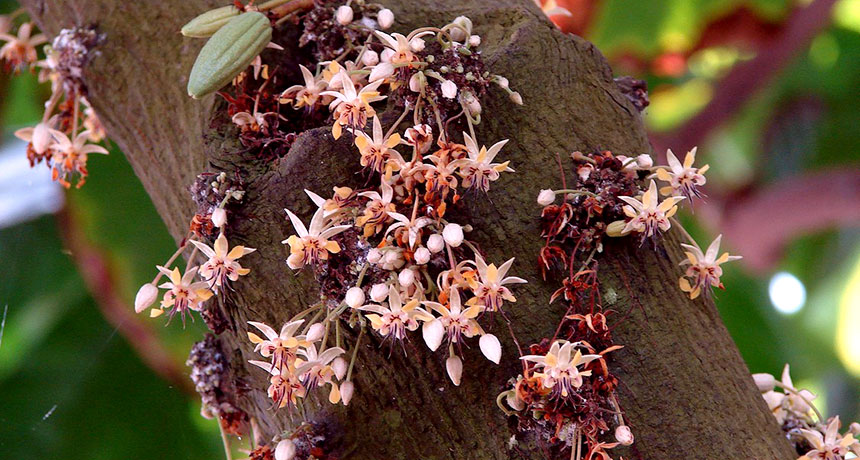 FLOWERS FOR CHOCOLATE Pale petals curl over a cacao flower’s male parts. Here, two developing fruits, or seedpods (top left), will eventually ripen, housing the seeds that give the world chocolate. TATTERS/FLICKR (CC BY 2.0) EmailPrintTwitterFacebookRedditGoogle+ SPONSOR MESSAGE It’s a wonder we have chocolate at all. Talk about persnickety, difficult flowers. Arguably some of the most important seeds on the planet — they give us candy bars and hot cocoa, after all — come from pods created by dime-sized flowers on cacao trees. Yet those flowers make pollination just barely possible. Growers of commercial fruit crops expect 50 to 60 percent of flowers to make a fruit, or pod, says Emily Kearney of the University of California, Berkeley. In some places, cacao crops manage to be that prolific. But worldwide norms run closer to 15 to 30 percent. In the traditional Ecuadorian plantings that Kearney studies, cacao achieves a mere 3 to 5 percent pollination. The first sight of a blooming cacao tree (Theobroma cacao) can be “disconcerting,” Kearney says. That’s because most flowers come directly out of the trunk, rather than sprouting from branches as in many other trees. For cacao, special trunk pads burst into little pale constellations of five-pointed starry blossoms. Some trunks, says Kearney, “are completely covered with flowers.” Those flowers make nothing easy. Each petal curves into a tiny hood that fits down around the male, pollen-making structure. A honeybee trying to reach the pollen would be a useless, giant blimp. Instead, flies not much bigger than a poppy seed, in the biting midge subfamily Forcipomyiinae, crawl up into the hoods and do — something. But what? The flower offers no nectar for the midges to collect. So far, researchers haven’t even demonstrated that there’s an odor luring in the midges. Some biologists have mused that red spikes on the flowers offer nutritious nibbling for midges, but Kearney knows of no tests of this notion. Another hitch: 100 to 250 grains of pollen are required to fertilize the 40 to 60 seeds that will make up a cacao pod (resembling a wrinkled, swollen cucumber in shades of purple, yellow or orange). Yet midges typically emerge from a flower hood dappled with just a few to 30 grains of the sticky white stuff. 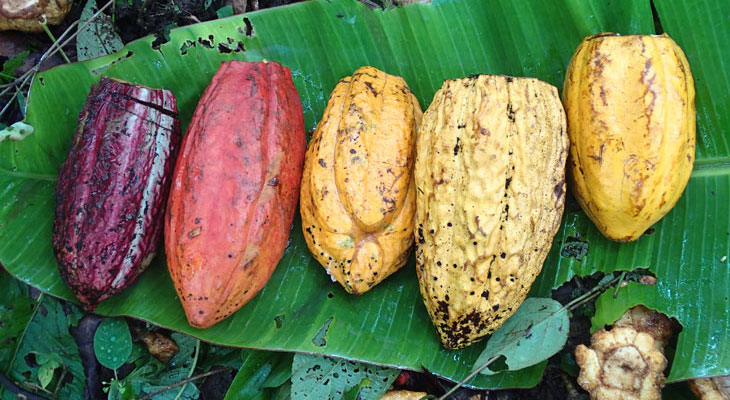 CACAO COLORS Plump pods from Theobroma cacao trees hold dozens of seeds and vary considerably in color. E. KEARNEY What’s more, the midge, dusted with that little bit of pollen like “clumpy sugar,” Kearney says, can’t just hike over to the same bloom’s female part, like a white-bristled paintbrush encircled by red spikes. Pollen is useless for fertilizing any blooms on the tree it came from or on really close relatives. “If we want to get answers about the cacao pollination system,” Kearney says, “I think it’s the wild individuals that are going to open up the field,” instead of cultivated cacao. The trees evolved in the Amazon Basin and a northern bit of the South American Pacific coast. There, they often grow in clusters of siblings that a monkey unintentionally planted when sucking pulp from a pod and dropping the seeds. To Kearney, those frail midges seem unlikely to fly the distance from too-close sibling clusters to unrelated trees that offer better cross-pollination chances. So she wonders: Could the cacao with its coy reproductive system have a clandestine, strong-flying native pollinator species that scientists just haven’t noticed? |
| json metadata | {"tags":["flowers","that","give","us","chocolate"],"image":["https://steemitimages.com/DQmYD8dfW4bs3enJRXf5i8QkJtMz8WuBbb728PtsEM5cFFm/020518_SM_chocolate_feat.jpg","https://steemitimages.com/DQmf3gpvUs54AGB8KX5eC57WHi91py7unikBMKCLSbrKt6F/020518_SM_chocolate_inline_730.jpg"],"app":"steemit/0.1","format":"markdown"} |
| parent author | |
| parent permlink | flowers |
| permlink | the-flowers-that-give-us-chocolate-are-ridiculously-hard-to-pollinate |
| title | The flowers that give us chocolate are ridiculously hard to pollinate |
| Transaction Info | Block #20046384/Trx 053673f7803f1804e7d5fe47f0fed6f7d35ff8c0 |
View Raw JSON Data
{
"block": 20046384,
"op": [
"comment",
{
"author": "nani121",
"body": "A complicated reproductive system makes pollination a tough job\n\nFLOWERS FOR CHOCOLATE Pale petals curl over a cacao flower’s male parts. Here, two developing fruits, or seedpods (top left), will eventually ripen, housing the seeds that give the world chocolate.\n\nTATTERS/FLICKR (CC BY 2.0)\n\nEmailPrintTwitterFacebookRedditGoogle+\nSPONSOR MESSAGE\nIt’s a wonder we have chocolate at all. Talk about persnickety, difficult flowers.\n\nArguably some of the most important seeds on the planet — they give us candy bars and hot cocoa, after all — come from pods created by dime-sized flowers on cacao trees. Yet those flowers make pollination just barely possible.\n\nGrowers of commercial fruit crops expect 50 to 60 percent of flowers to make a fruit, or pod, says Emily Kearney of the University of California, Berkeley. In some places, cacao crops manage to be that prolific. But worldwide norms run closer to 15 to 30 percent. In the traditional Ecuadorian plantings that Kearney studies, cacao achieves a mere 3 to 5 percent pollination.\n\nThe first sight of a blooming cacao tree (Theobroma cacao) can be “disconcerting,” Kearney says. That’s because most flowers come directly out of the trunk, rather than sprouting from branches as in many other trees. For cacao, special trunk pads burst into little pale constellations of five-pointed starry blossoms. Some trunks, says Kearney, “are completely covered with flowers.”\n\nThose flowers make nothing easy. Each petal curves into a tiny hood that fits down around the male, pollen-making structure. A honeybee trying to reach the pollen would be a useless, giant blimp. Instead, flies not much bigger than a poppy seed, in the biting midge subfamily Forcipomyiinae, crawl up into the hoods and do — something.\n\nBut what? The flower offers no nectar for the midges to collect. So far, researchers haven’t even demonstrated that there’s an odor luring in the midges. Some biologists have mused that red spikes on the flowers offer nutritious nibbling for midges, but Kearney knows of no tests of this notion.\n\nAnother hitch: 100 to 250 grains of pollen are required to fertilize the 40 to 60 seeds that will make up a cacao pod (resembling a wrinkled, swollen cucumber in shades of purple, yellow or orange). Yet midges typically emerge from a flower hood dappled with just a few to 30 grains of the sticky white stuff.\n\n\nCACAO COLORS Plump pods from Theobroma cacao trees hold dozens of seeds and vary considerably in color.\nE. KEARNEY\nWhat’s more, the midge, dusted with that little bit of pollen like “clumpy sugar,” Kearney says, can’t just hike over to the same bloom’s female part, like a white-bristled paintbrush encircled by red spikes. Pollen is useless for fertilizing any blooms on the tree it came from or on really close relatives.\n“If we want to get answers about the cacao pollination system,” Kearney says, “I think it’s the wild individuals that are going to open up the field,” instead of cultivated cacao.\n\nThe trees evolved in the Amazon Basin and a northern bit of the South American Pacific coast. There, they often grow in clusters of siblings that a monkey unintentionally planted when sucking pulp from a pod and dropping the seeds.\n\nTo Kearney, those frail midges seem unlikely to fly the distance from too-close sibling clusters to unrelated trees that offer better cross-pollination chances. So she wonders: Could the cacao with its coy reproductive system have a clandestine, strong-flying native pollinator species that scientists just haven’t noticed?",
"json_metadata": "{\"tags\":[\"flowers\",\"that\",\"give\",\"us\",\"chocolate\"],\"image\":[\"https://steemitimages.com/DQmYD8dfW4bs3enJRXf5i8QkJtMz8WuBbb728PtsEM5cFFm/020518_SM_chocolate_feat.jpg\",\"https://steemitimages.com/DQmf3gpvUs54AGB8KX5eC57WHi91py7unikBMKCLSbrKt6F/020518_SM_chocolate_inline_730.jpg\"],\"app\":\"steemit/0.1\",\"format\":\"markdown\"}",
"parent_author": "",
"parent_permlink": "flowers",
"permlink": "the-flowers-that-give-us-chocolate-are-ridiculously-hard-to-pollinate",
"title": "The flowers that give us chocolate are ridiculously hard to pollinate"
}
],
"op_in_trx": 0,
"timestamp": "2018-02-20T21:57:21",
"trx_id": "053673f7803f1804e7d5fe47f0fed6f7d35ff8c0",
"trx_in_block": 44,
"virtual_op": 0
}pobedasupvoted (100.00%) @nani121 / china-s-great-leap-forward-in-science2018/02/19 20:55:30
pobedasupvoted (100.00%) @nani121 / china-s-great-leap-forward-in-science
2018/02/19 20:55:30
| author | nani121 |
| permlink | china-s-great-leap-forward-in-science |
| voter | pobedas |
| weight | 10000 (100.00%) |
| Transaction Info | Block #20016355/Trx 525ecbf697661867e21c2df433a5067af9cf7bbf |
View Raw JSON Data
{
  "block": 20016355,
  "op": [
    "vote",
    {
      "author": "nani121",
      "permlink": "china-s-great-leap-forward-in-science",
      "voter": "pobedas",
      "weight": 10000
    }
  ],
  "op_in_trx": 0,
  "timestamp": "2018-02-19T20:55:30",
  "trx_id": "525ecbf697661867e21c2df433a5067af9cf7bbf",
  "trx_in_block": 23,
  "virtual_op": 0
}toporikupvoted (100.00%) @nani121 / fossil-footprints-may-put-lizards-on-two-feet-110-million-years-ago2018/02/19 13:24:48
toporikupvoted (100.00%) @nani121 / fossil-footprints-may-put-lizards-on-two-feet-110-million-years-ago
2018/02/19 13:24:48
| author | nani121 |
| permlink | fossil-footprints-may-put-lizards-on-two-feet-110-million-years-ago |
| voter | toporik |
| weight | 10000 (100.00%) |
| Transaction Info | Block #20007358/Trx 3b18c7b80875a7c092393b56a86dfd0fa59f2054 |
View Raw JSON Data
{
  "block": 20007358,
  "op": [
    "vote",
    {
      "author": "nani121",
      "permlink": "fossil-footprints-may-put-lizards-on-two-feet-110-million-years-ago",
      "voter": "toporik",
      "weight": 10000
    }
  ],
  "op_in_trx": 0,
  "timestamp": "2018-02-19T13:24:48",
  "trx_id": "3b18c7b80875a7c092393b56a86dfd0fa59f2054",
  "trx_in_block": 23,
  "virtual_op": 0
}marat84upvoted (100.00%) @nani121 / fossil-footprints-may-put-lizards-on-two-feet-110-million-years-ago2018/02/19 13:24:24
marat84upvoted (100.00%) @nani121 / fossil-footprints-may-put-lizards-on-two-feet-110-million-years-ago
2018/02/19 13:24:24
| author | nani121 |
| permlink | fossil-footprints-may-put-lizards-on-two-feet-110-million-years-ago |
| voter | marat84 |
| weight | 10000 (100.00%) |
| Transaction Info | Block #20007350/Trx 57c9682134c10c8543bdf69f279162bfddbeb3dd |
View Raw JSON Data
{
  "block": 20007350,
  "op": [
    "vote",
    {
      "author": "nani121",
      "permlink": "fossil-footprints-may-put-lizards-on-two-feet-110-million-years-ago",
      "voter": "marat84",
      "weight": 10000
    }
  ],
  "op_in_trx": 0,
  "timestamp": "2018-02-19T13:24:24",
  "trx_id": "57c9682134c10c8543bdf69f279162bfddbeb3dd",
  "trx_in_block": 27,
  "virtual_op": 0
}tealebselupvoted (100.00%) @nani121 / fossil-footprints-may-put-lizards-on-two-feet-110-million-years-ago2018/02/19 13:24:18
tealebselupvoted (100.00%) @nani121 / fossil-footprints-may-put-lizards-on-two-feet-110-million-years-ago
2018/02/19 13:24:18
| author | nani121 |
| permlink | fossil-footprints-may-put-lizards-on-two-feet-110-million-years-ago |
| voter | tealebsel |
| weight | 10000 (100.00%) |
| Transaction Info | Block #20007348/Trx 9273b9fa14c74a18b9f706bde628d0319aa52211 |
View Raw JSON Data
{
  "block": 20007348,
  "op": [
    "vote",
    {
      "author": "nani121",
      "permlink": "fossil-footprints-may-put-lizards-on-two-feet-110-million-years-ago",
      "voter": "tealebsel",
      "weight": 10000
    }
  ],
  "op_in_trx": 0,
  "timestamp": "2018-02-19T13:24:18",
  "trx_id": "9273b9fa14c74a18b9f706bde628d0319aa52211",
  "trx_in_block": 29,
  "virtual_op": 0
}geakgatesupvoted (100.00%) @nani121 / changing-toothpastes-change-your-toothbrush2018/02/19 13:19:03
geakgatesupvoted (100.00%) @nani121 / changing-toothpastes-change-your-toothbrush
2018/02/19 13:19:03
| author | nani121 |
| permlink | changing-toothpastes-change-your-toothbrush |
| voter | geakgates |
| weight | 10000 (100.00%) |
| Transaction Info | Block #20007243/Trx 7f6ac845004d4628712838b4b647da7db27305d2 |
View Raw JSON Data
{
  "block": 20007243,
  "op": [
    "vote",
    {
      "author": "nani121",
      "permlink": "changing-toothpastes-change-your-toothbrush",
      "voter": "geakgates",
      "weight": 10000
    }
  ],
  "op_in_trx": 0,
  "timestamp": "2018-02-19T13:19:03",
  "trx_id": "7f6ac845004d4628712838b4b647da7db27305d2",
  "trx_in_block": 25,
  "virtual_op": 0
}zhaalesumupvoted (100.00%) @nani121 / this-stick-on-patch-could-keep-tabs-on-stroke-patients-at-home2018/02/19 13:13:57
zhaalesumupvoted (100.00%) @nani121 / this-stick-on-patch-could-keep-tabs-on-stroke-patients-at-home
2018/02/19 13:13:57
| author | nani121 |
| permlink | this-stick-on-patch-could-keep-tabs-on-stroke-patients-at-home |
| voter | zhaalesum |
| weight | 10000 (100.00%) |
| Transaction Info | Block #20007141/Trx 808e13ae81f910c477de838dc31e1fc4787b6cdb |
View Raw JSON Data
{
  "block": 20007141,
  "op": [
    "vote",
    {
      "author": "nani121",
      "permlink": "this-stick-on-patch-could-keep-tabs-on-stroke-patients-at-home",
      "voter": "zhaalesum",
      "weight": 10000
    }
  ],
  "op_in_trx": 0,
  "timestamp": "2018-02-19T13:13:57",
  "trx_id": "808e13ae81f910c477de838dc31e1fc4787b6cdb",
  "trx_in_block": 1,
  "virtual_op": 0
}jamilsafiupvoted (100.00%) @nani121 / babies-can-recover-language-skills-after-a-left-side-stroke2018/02/19 13:06:30
jamilsafiupvoted (100.00%) @nani121 / babies-can-recover-language-skills-after-a-left-side-stroke
2018/02/19 13:06:30
| author | nani121 |
| permlink | babies-can-recover-language-skills-after-a-left-side-stroke |
| voter | jamilsafi |
| weight | 10000 (100.00%) |
| Transaction Info | Block #20006992/Trx 4caaeea374d9dc351b214a4a074bcb637e9bb200 |
View Raw JSON Data
{
  "block": 20006992,
  "op": [
    "vote",
    {
      "author": "nani121",
      "permlink": "babies-can-recover-language-skills-after-a-left-side-stroke",
      "voter": "jamilsafi",
      "weight": 10000
    }
  ],
  "op_in_trx": 0,
  "timestamp": "2018-02-19T13:06:30",
  "trx_id": "4caaeea374d9dc351b214a4a074bcb637e9bb200",
  "trx_in_block": 0,
  "virtual_op": 0
}2018/02/19 11:43:27
2018/02/19 11:43:27
| author | nani121 |
| permlink | former-student-opens-fire-at-florida-high-school-killing-at-least-17-this-is-soo-sad-where-the-world-is-going-on-ho-god-r-i-p |
| voter | moby-dick |
| weight | 10000 (100.00%) |
| Transaction Info | Block #20005332/Trx ac3f24cab728de7ac6e5579020e29782eedbcbc1 |
View Raw JSON Data
{
  "block": 20005332,
  "op": [
    "vote",
    {
      "author": "nani121",
      "permlink": "former-student-opens-fire-at-florida-high-school-killing-at-least-17-this-is-soo-sad-where-the-world-is-going-on-ho-god-r-i-p",
      "voter": "moby-dick",
      "weight": 10000
    }
  ],
  "op_in_trx": 0,
  "timestamp": "2018-02-19T11:43:27",
  "trx_id": "ac3f24cab728de7ac6e5579020e29782eedbcbc1",
  "trx_in_block": 48,
  "virtual_op": 0
}2018/02/19 10:59:12
2018/02/19 10:59:12
| author | nani121 |
| body | Broward Sheriff Scott Israel said 17 people were killed in a shooting at Marjory Stoneman Douglas High School in Parkland. Terry Spencer and Kelli Kennedy Associated Press  A former student opened fire with a semi-automatic rifle at a Florida high school Wednesday, killing at least 17 people and sending hundreds of students fleeing into the streets in the nation's deadliest school shooting since a gunman attacked an elementary school in Newtown, Connecticut. The shooter, who was equipped with a gas mask and smoke grenades, set off a fire alarm to draw students out of classrooms shortly before the day ended at one of the state's largest schools, officials said. Authorities offered no immediate details on the 19-year-old suspect or any possible motive, except to say that he had been kicked out of Marjory Stoneman Douglas High School, which has about 3,000 students. https://www.youtube.com/watch?v=-YTF3AwZebA Students who knew the shooter, identified as Nikolas Cruz, described a volatile teenager whose strange behavior had caused others to end friendships with him, particularly after the fight that led to his expulsion. Frantic parents rushed to the school to find SWAT team members and ambulances surrounding the huge campus. Live television footage showed emergency workers who appeared to be treating the wounded on sidewalks. A shooting at Marjory Stoneman Douglas High School in Parkland, Fla. "It is a horrific situation," said Robert Runcie, superintendent of the school district in Parkland, about an hour's drive north of Miami. "It is a horrible day for us." https://www.msnbc.com/velshi-ruhle/watch/two-brother-s-texts-during-the-parkland-school-shooting-1163363395881 The suspect was taken into custody without a fight in a residential neighborhood about a mile away. He had multiple magazines of ammunition, authorities said. "It's catastrophic. There really are no words," Broward County Sheriff Scott Israel told reporters. The attacker used the fire alarm "so the kids would come pouring out of the classrooms into the hall," Sen. Bill Nelson told CNN. "And there the carnage began," said Nelson, who said he was briefed by the FBI. The Florida Democrat said he did not know if the gunman used the smoke grenades, but he assumed that's why he had a gas mask on. Most of the fatalities were inside the building, though some victims were found outside. The dead included a football coach, the sheriff said. More than a dozen other people were wounded and taken to hospitals, doctors said. Victoria Olvera, a junior at the school, said Cruz was expelled last school year because he got into a fight with his ex-girlfriend's new boyfriend. She said he had been abusive to his girlfriend. "I think everyone had in their minds if anybody was going to do it, it was going to be him," she said. Dakota Mutchler, another junior, said he used to be friends with Cruz. But he cut off the friendship as Cruz's behavior "started progressively getting a little more weird." Cruz posted on Instagram about killing animals and threatened one of Mutchler's friends, he said. Florida high school shooting Authorities say 19-year-old Nikolas Cruz opened fire with a semi-automatic rifle at Marjory Stoneman Douglas High School in Parkland, Fla., on Feb. 14, 2018, killing 17 people. He remembered that Cruz had a pellet gun and did target practice in his backyard. Student Daniel Huerfano said he recognized Cruz from an Instagram photo in which Cruz had posed with a gun in front of his face. Cruz "was that weird kid that you see ... like a loner," he said. Freshman Max Charles was in class when he heard five gunshots. "We were in the corner, away from the windows," he said. "The teacher locked the door and turned off the light. I thought maybe I could die or something." As he was leaving the building, he saw four dead students and one dead teacher. He said he was relieved when he finally found his mother. "I was happy that I was alive," Max said. "She was crying when she saw me." About an hour after the attack, Michael Nembhard was sitting in his garage on a cul-de-sac when he saw a young man in a burgundy shirt walking down the street. In an instant, a police cruiser pulled up, and officers jumped out with guns drawn. "All I heard was 'Get on the ground! Get on the ground!'" Nembhard said. He said the man did as he was told. The day started normally at the school, which had a morning fire drill. Students were in class around 2:30 p.m. when another alarm sounded. Shots heard in Snapchat video during Marjory Stoneman Douglas High School shooting Shots heard in Snapchat video during Marjory Stoneman Douglas High School shooting Junior Noah Parness said he and the other students calmly went outside to their fire-drill areas when he suddenly heard popping sounds. "We saw a bunch of teachers running down the stairway, and then everybody shifted and broke into a sprint," Parness said. "I hopped a fence." Beth Feingold said her daughter, Brittani, sent a text that said, "We're on code red. I'm fine," but sent another text shortly afterward saying, "Mom, I'm so scared." She was later able to escape. Students heard loud bangs as the shooter fired. Many of them hid under desks or in closets and barricaded doors. Television footage showed students leaving in a single-file line with their hands over their heads as officers urged them to evacuate quickly. The scene was reminiscent of the Newtown attack, which shocked even a country numbed by the regularity of school shootings. The Dec. 14, 2012, assault at Sandy Hook Elementary School killed 26 people — 20 first-graders and six staff members. The 20-year-old Connecticut gunman, who also fatally shot his mother in her bed, then killed himself. When Caesar Figueroa got to the Florida school to check on his 16-year-old daughter, he saw helicopters and police officers wielding guns. "It was crazy and my daughter wasn't answering her phone." She finally texted him that she was inside a closet with friends. Len Murray's 17-year-old son, a junior at the school, sent his parents a chilling text: "Mom and Dad, there have been shots fired on campus at school. There are police sirens outside. I'm in the auditorium and the doors are locked." A few minutes later, he texted again, "I'm fine." Murray said he raced to the school only to be stopped by authorities under a highway overpass within view of the school buildings. He said he told his son to save his battery and stop texting. The boy's mother told him to turn off his ringer. Murray said he's had just one thought running through his mind since his son's text: "All I keep thinking about is when I dropped him off this morning. I usually say, 'I love you,' and I didn't this morning. He's 17, he's at that age. And I didn't say it this morning, and I'm just kicking myself right now over and over and over." https://www.youtube.com/watch?v=zoTxQEsBy-A The school was to be closed for the rest of the week. Associated Press writers Freida Frisaro, Jennifer N. Kay and David Fischer in Miami and Josh Replogle in Parkland contributed to this report |
| json metadata | {"tags":["crime","news"],"image":["https://steemitimages.com/DQmSkjFGU1G2nwcPuSnbc3zLTK2WKbGrni4TtzQ6Bs3ssC8/ct-florida-high-school-shooting-photos-20180214.jpg","https://img.youtube.com/vi/-YTF3AwZebA/0.jpg","https://img.youtube.com/vi/zoTxQEsBy-A/0.jpg"],"links":["https://www.youtube.com/watch?v=-YTF3AwZebA","https://www.msnbc.com/velshi-ruhle/watch/two-brother-s-texts-during-the-parkland-school-shooting-1163363395881","https://www.youtube.com/watch?v=zoTxQEsBy-A"],"app":"steemit/0.1","format":"markdown"} |
| parent author | |
| parent permlink | crime |
| permlink | former-student-opens-fire-at-florida-high-school-killing-at-least-17-this-is-soo-sad-where-the-world-is-going-on-ho-god-r-i-p |
| title | Former student opens fire at Florida high school, killing at least 17 THIS IS SOO SAD WHERE THE WORLD IS GOING ON HO GOD .........R.I.P |
| Transaction Info | Block #20004447/Trx aefd129e9f29a029a6b14d61d607b8e806b474cf |
View Raw JSON Data
{
"block": 20004447,
"op": [
"comment",
{
"author": "nani121",
"body": "Broward Sheriff Scott Israel said 17 people were killed in a shooting at Marjory Stoneman Douglas High School in Parkland.\nTerry Spencer and Kelli Kennedy\nAssociated Press\n \nA former student opened fire with a semi-automatic rifle at a Florida high school Wednesday, killing at least 17 people and sending hundreds of students fleeing into the streets in the nation's deadliest school shooting since a gunman attacked an elementary school in Newtown, Connecticut.\n\nThe shooter, who was equipped with a gas mask and smoke grenades, set off a fire alarm to draw students out of classrooms shortly before the day ended at one of the state's largest schools, officials said.\n\nAuthorities offered no immediate details on the 19-year-old suspect or any possible motive, except to say that he had been kicked out of Marjory Stoneman Douglas High School, which has about 3,000 students.\nhttps://www.youtube.com/watch?v=-YTF3AwZebA\nStudents who knew the shooter, identified as Nikolas Cruz, described a volatile teenager whose strange behavior had caused others to end friendships with him, particularly after the fight that led to his expulsion.\n\nFrantic parents rushed to the school to find SWAT team members and ambulances surrounding the huge campus. Live television footage showed emergency workers who appeared to be treating the wounded on sidewalks.\n\nA shooting at Marjory Stoneman Douglas High School in Parkland, Fla.\n\"It is a horrific situation,\" said Robert Runcie, superintendent of the school district in Parkland, about an hour's drive north of Miami. \"It is a horrible day for us.\"\nhttps://www.msnbc.com/velshi-ruhle/watch/two-brother-s-texts-during-the-parkland-school-shooting-1163363395881\nThe suspect was taken into custody without a fight in a residential neighborhood about a mile away. He had multiple magazines of ammunition, authorities said.\n\n\"It's catastrophic. There really are no words,\" Broward County Sheriff Scott Israel told reporters.\n\nThe attacker used the fire alarm \"so the kids would come pouring out of the classrooms into the hall,\" Sen. Bill Nelson told CNN.\n\n\"And there the carnage began,\" said Nelson, who said he was briefed by the FBI.\n\nThe Florida Democrat said he did not know if the gunman used the smoke grenades, but he assumed that's why he had a gas mask on.\n\nMost of the fatalities were inside the building, though some victims were found outside. The dead included a football coach, the sheriff said.\n\nMore than a dozen other people were wounded and taken to hospitals, doctors said.\n\nVictoria Olvera, a junior at the school, said Cruz was expelled last school year because he got into a fight with his ex-girlfriend's new boyfriend. She said he had been abusive to his girlfriend.\n\n\"I think everyone had in their minds if anybody was going to do it, it was going to be him,\" she said.\n\nDakota Mutchler, another junior, said he used to be friends with Cruz. But he cut off the friendship as Cruz's behavior \"started progressively getting a little more weird.\" Cruz posted on Instagram about killing animals and threatened one of Mutchler's friends, he said.\n\nFlorida high school shooting\nAuthorities say 19-year-old Nikolas Cruz opened fire with a semi-automatic rifle at Marjory Stoneman Douglas High School in Parkland, Fla., on Feb. 14, 2018, killing 17 people.\nHe remembered that Cruz had a pellet gun and did target practice in his backyard.\n\nStudent Daniel Huerfano said he recognized Cruz from an Instagram photo in which Cruz had posed with a gun in front of his face.\n\nCruz \"was that weird kid that you see ... like a loner,\" he said.\n\nFreshman Max Charles was in class when he heard five gunshots.\n\n\"We were in the corner, away from the windows,\" he said. \"The teacher locked the door and turned off the light. I thought maybe I could die or something.\"\n\nAs he was leaving the building, he saw four dead students and one dead teacher. He said he was relieved when he finally found his mother.\n\n\"I was happy that I was alive,\" Max said. \"She was crying when she saw me.\"\n\nAbout an hour after the attack, Michael Nembhard was sitting in his garage on a cul-de-sac when he saw a young man in a burgundy shirt walking down the street. In an instant, a police cruiser pulled up, and officers jumped out with guns drawn.\n\n\"All I heard was 'Get on the ground! Get on the ground!'\" Nembhard said. He said the man did as he was told.\n\nThe day started normally at the school, which had a morning fire drill. Students were in class around 2:30 p.m. when another alarm sounded.\n\n Shots heard in Snapchat video during Marjory Stoneman Douglas High School shooting\nShots heard in Snapchat video during Marjory Stoneman Douglas High School shooting\nJunior Noah Parness said he and the other students calmly went outside to their fire-drill areas when he suddenly heard popping sounds.\n\n\"We saw a bunch of teachers running down the stairway, and then everybody shifted and broke into a sprint,\" Parness said. \"I hopped a fence.\"\n\nBeth Feingold said her daughter, Brittani, sent a text that said, \"We're on code red. I'm fine,\" but sent another text shortly afterward saying, \"Mom, I'm so scared.\" She was later able to escape.\n\nStudents heard loud bangs as the shooter fired. Many of them hid under desks or in closets and barricaded doors.\n\nTelevision footage showed students leaving in a single-file line with their hands over their heads as officers urged them to evacuate quickly.\n\nThe scene was reminiscent of the Newtown attack, which shocked even a country numbed by the regularity of school shootings. The Dec. 14, 2012, assault at Sandy Hook Elementary School killed 26 people — 20 first-graders and six staff members.\n\nThe 20-year-old Connecticut gunman, who also fatally shot his mother in her bed, then killed himself.\n\nWhen Caesar Figueroa got to the Florida school to check on his 16-year-old daughter, he saw helicopters and police officers wielding guns.\n\n\"It was crazy and my daughter wasn't answering her phone.\" She finally texted him that she was inside a closet with friends.\n\nLen Murray's 17-year-old son, a junior at the school, sent his parents a chilling text: \"Mom and Dad, there have been shots fired on campus at school. There are police sirens outside. I'm in the auditorium and the doors are locked.\"\n\nA few minutes later, he texted again, \"I'm fine.\"\n\nMurray said he raced to the school only to be stopped by authorities under a highway overpass within view of the school buildings. He said he told his son to save his battery and stop texting. The boy's mother told him to turn off his ringer.\n\nMurray said he's had just one thought running through his mind since his son's text: \"All I keep thinking about is when I dropped him off this morning. I usually say, 'I love you,' and I didn't this morning. He's 17, he's at that age. And I didn't say it this morning, and I'm just kicking myself right now over and over and over.\"\nhttps://www.youtube.com/watch?v=zoTxQEsBy-A\nThe school was to be closed for the rest of the week.\n\nAssociated Press writers Freida Frisaro, Jennifer N. Kay and David Fischer in Miami and Josh Replogle in Parkland contributed to this report",
"json_metadata": "{\"tags\":[\"crime\",\"news\"],\"image\":[\"https://steemitimages.com/DQmSkjFGU1G2nwcPuSnbc3zLTK2WKbGrni4TtzQ6Bs3ssC8/ct-florida-high-school-shooting-photos-20180214.jpg\",\"https://img.youtube.com/vi/-YTF3AwZebA/0.jpg\",\"https://img.youtube.com/vi/zoTxQEsBy-A/0.jpg\"],\"links\":[\"https://www.youtube.com/watch?v=-YTF3AwZebA\",\"https://www.msnbc.com/velshi-ruhle/watch/two-brother-s-texts-during-the-parkland-school-shooting-1163363395881\",\"https://www.youtube.com/watch?v=zoTxQEsBy-A\"],\"app\":\"steemit/0.1\",\"format\":\"markdown\"}",
"parent_author": "",
"parent_permlink": "crime",
"permlink": "former-student-opens-fire-at-florida-high-school-killing-at-least-17-this-is-soo-sad-where-the-world-is-going-on-ho-god-r-i-p",
"title": "Former student opens fire at Florida high school, killing at least 17 THIS IS SOO SAD WHERE THE WORLD IS GOING ON HO GOD .........R.I.P"
}
],
"op_in_trx": 0,
"timestamp": "2018-02-19T10:59:12",
"trx_id": "aefd129e9f29a029a6b14d61d607b8e806b474cf",
"trx_in_block": 23,
"virtual_op": 0
}nani121published a new post: spacex-just-launched-its-biggest-rocket-for-the-first-time2018/02/19 10:27:30
nani121published a new post: spacex-just-launched-its-biggest-rocket-for-the-first-time
2018/02/19 10:27:30
| author | nani121 |
| body | The Falcon Heavy is the most powerful rocket since the Saturn V  ALCON IN FLIGHT The SpaceX Falcon Heavy rocket launched on its maiden voyage from Cape Canaveral February 6. SPACEX It’s another record for SpaceX. At 3:50 p.m. Eastern on February 6, the private spaceflight company launched the Falcon Heavy rocket for the first time. The Heavy — essentially three SpaceX Falcon 9 rocket boosters strapped together — is the most powerful rocket launched since the Saturn V, which shot astronauts to the moon during the Apollo program. SpaceX hopes to use the Heavy to send humans into space. The company is developing another rocket, dubbed the BFR, to eventually send people to Mars. Another first for this launch: the synchronized return of two of the boosters. (The third, from the center core, didn’t descend properly, and instead of landing on a droneship, it hit the ocean at 300 mph.) Part of SpaceX’s program is to reuse rockets, which brings down the cost of space launches. The company has successfully landed the cores of its Falcon 9 rockets 21 times and reflew a rocket six times. The company landed a previously used rocket for the first time in March. But the cargo for today’s launch is aimed at another planet. The rocket carried SpaceX CEO Elon Musk’s red Tesla Roadster with “Space Oddity” by David Bowie playing on the stereo. It is now heading toward Mars. “I love the thought of a car drifting apparently endlessly through space and perhaps being discovered by an alien race millions of years in the future,” Musk tweeted in December.  The two side boosters from the Falcon Heavy landed safely back at Cape Canaveral about eight minutes after launch. SPACEX/YOUTUBE The Falcon Heavy’s payload was Elon Musk’s red Tesla Roadster with a mannequin in a spacesuit at the wheel. SPACEX/YOUTUBE The Feb. 6 launch makes the Falcon Heavy the most powerful rocket launched since the Saturn V. SPACEX/YOUTUBE Editor's note: This story was updated on February 7 to update the status of the booster landings, and again on February 9 to correct the rocket that SpaceX hopes to use to send people to Mars. The company intends to use its BFR rocket, not the Falcon Heavy. |
| json metadata | {"tags":["astronomy"],"image":["https://steemitimages.com/DQmbNqC6hwT8zrfecMVnJQ6jzr4MA3JF5qPk5Ef6we3WrL6/spaceXlaunch.jpg","https://steemitimages.com/DQmdhGov4pQxYZH9B9ENqga8WrW1YK6EXf757VfrgMpkn1b/core-landing_canaveral.jpg"],"app":"steemit/0.1","format":"markdown"} |
| parent author | |
| parent permlink | astronomy |
| permlink | spacex-just-launched-its-biggest-rocket-for-the-first-time |
| title | SpaceX just launched its biggest rocket for the first time |
| Transaction Info | Block #20003813/Trx d06de9088eb764dbf6398cbb76fe6391d9ea4916 |
View Raw JSON Data
{
"block": 20003813,
"op": [
"comment",
{
"author": "nani121",
"body": "The Falcon Heavy is the most powerful rocket since the Saturn V\n\n\nALCON IN FLIGHT The SpaceX Falcon Heavy rocket launched on its maiden voyage from Cape Canaveral February 6.\n\nSPACEX\n\nIt’s another record for SpaceX. At 3:50 p.m. Eastern on February 6, the private spaceflight company launched the Falcon Heavy rocket for the first time.\n\nThe Heavy — essentially three SpaceX Falcon 9 rocket boosters strapped together — is the most powerful rocket launched since the Saturn V, which shot astronauts to the moon during the Apollo program. SpaceX hopes to use the Heavy to send humans into space. The company is developing another rocket, dubbed the BFR, to eventually send people to Mars. \n\nAnother first for this launch: the synchronized return of two of the boosters. (The third, from the center core, didn’t descend properly, and instead of landing on a droneship, it hit the ocean at 300 mph.) Part of SpaceX’s program is to reuse rockets, which brings down the cost of space launches. The company has successfully landed the cores of its Falcon 9 rockets 21 times and reflew a rocket six times. The company landed a previously used rocket for the first time in March.\n\nBut the cargo for today’s launch is aimed at another planet. The rocket carried SpaceX CEO Elon Musk’s red Tesla Roadster with “Space Oddity” by David Bowie playing on the stereo. It is now heading toward Mars.\n\n“I love the thought of a car drifting apparently endlessly through space and perhaps being discovered by an alien race millions of years in the future,” Musk tweeted in December.\n\n\n\nThe two side boosters from the Falcon Heavy landed safely back at Cape Canaveral about eight minutes after launch.\nSPACEX/YOUTUBE\n\nThe Falcon Heavy’s payload was Elon Musk’s red Tesla Roadster with a mannequin in a spacesuit at the wheel.\nSPACEX/YOUTUBE\n\nThe Feb. 6 launch makes the Falcon Heavy the most powerful rocket launched since the Saturn V.\nSPACEX/YOUTUBE\n\nEditor's note: This story was updated on February 7 to update the status of the booster landings, and again on February 9 to correct the rocket that SpaceX hopes to use to send people to Mars. The company intends to use its BFR rocket, not the Falcon Heavy.",
"json_metadata": "{\"tags\":[\"astronomy\"],\"image\":[\"https://steemitimages.com/DQmbNqC6hwT8zrfecMVnJQ6jzr4MA3JF5qPk5Ef6we3WrL6/spaceXlaunch.jpg\",\"https://steemitimages.com/DQmdhGov4pQxYZH9B9ENqga8WrW1YK6EXf757VfrgMpkn1b/core-landing_canaveral.jpg\"],\"app\":\"steemit/0.1\",\"format\":\"markdown\"}",
"parent_author": "",
"parent_permlink": "astronomy",
"permlink": "spacex-just-launched-its-biggest-rocket-for-the-first-time",
"title": "SpaceX just launched its biggest rocket for the first time"
}
],
"op_in_trx": 0,
"timestamp": "2018-02-19T10:27:30",
"trx_id": "d06de9088eb764dbf6398cbb76fe6391d9ea4916",
"trx_in_block": 22,
"virtual_op": 0
}2018/02/19 10:22:57
2018/02/19 10:22:57
| author | cheetah |
| body | Hi! I am a robot. I just upvoted you! I found similar content that readers might be interested in: https://www.theguardian.com/science/2018/feb/18/china-great-leap-forward-science-research-innovation-investment-5g-genetics-quantum-internet |
| json metadata | |
| parent author | nani121 |
| parent permlink | china-s-great-leap-forward-in-science |
| permlink | cheetah-re-nani121china-s-great-leap-forward-in-science |
| title | |
| Transaction Info | Block #20003722/Trx 0e1ba5a565906ff897f7fc08511d76367ab40cf1 |
View Raw JSON Data
{
  "block": 20003722,
  "op": [
    "comment",
    {
      "author": "cheetah",
      "body": "Hi! I am a robot. I just upvoted you! I found similar content that readers might be interested in:\nhttps://www.theguardian.com/science/2018/feb/18/china-great-leap-forward-science-research-innovation-investment-5g-genetics-quantum-internet",
      "json_metadata": "",
      "parent_author": "nani121",
      "parent_permlink": "china-s-great-leap-forward-in-science",
      "permlink": "cheetah-re-nani121china-s-great-leap-forward-in-science",
      "title": ""
    }
  ],
  "op_in_trx": 0,
  "timestamp": "2018-02-19T10:22:57",
  "trx_id": "0e1ba5a565906ff897f7fc08511d76367ab40cf1",
  "trx_in_block": 13,
  "virtual_op": 0
}nani121published a new post: china-s-great-leap-forward-in-science2018/02/19 10:22:09
nani121published a new post: china-s-great-leap-forward-in-science
2018/02/19 10:22:09
| author | nani121 |
| body | China’s great leap forward in science Chinese investment is paying off with serious advances in biotech, computing and space. Are they edging ahead of the west? 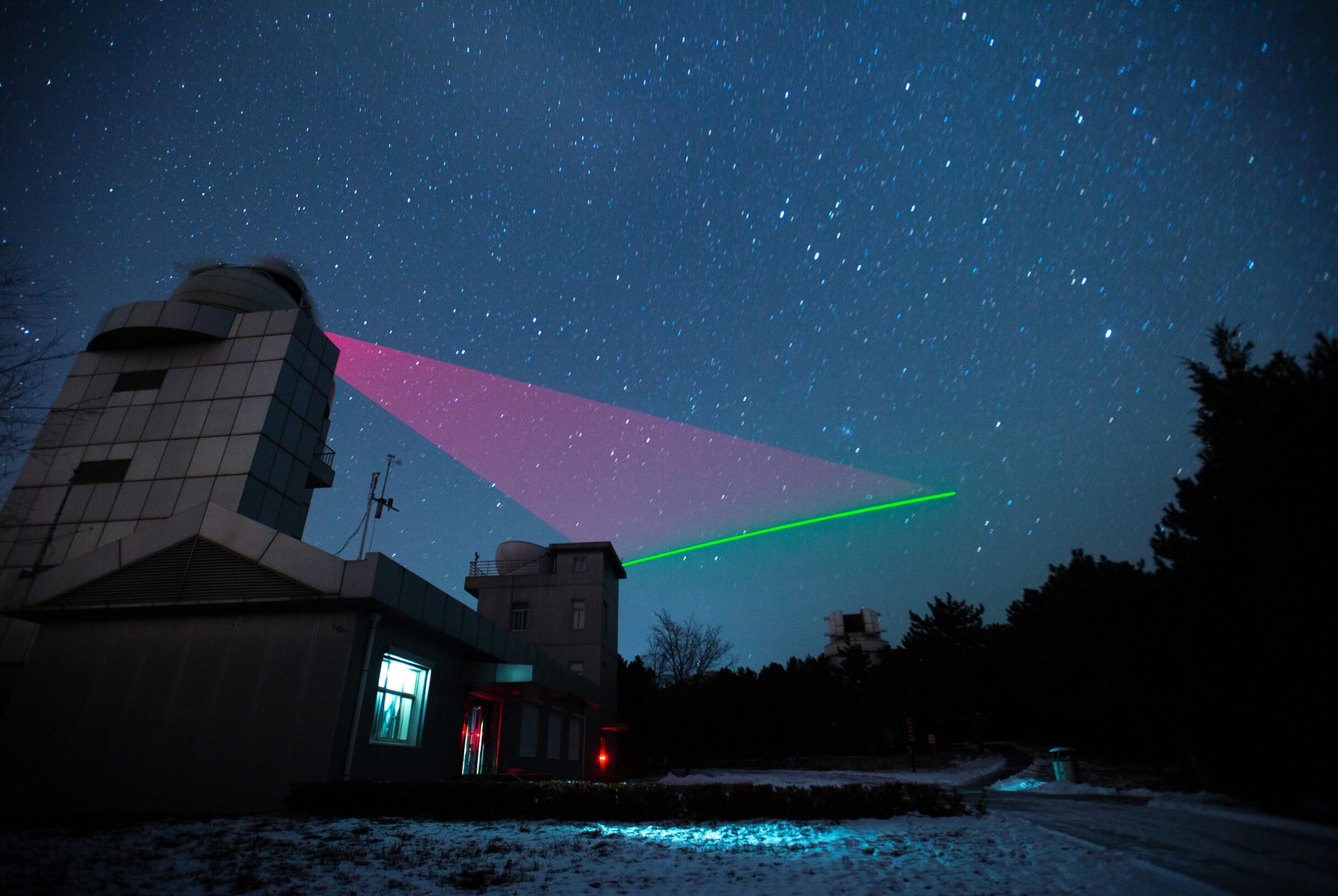 I first met Xiaogang Peng in the summer of 1992 at Jilin University in Changchun, in the remote north-east of China, where he was a postgraduate student in the department of chemistry. He told me that his dream was to get a place at a top American lab. Now, Xiaogang was evidently smart and hard-working – but so, as far as I could see, were most Chinese science students. I wished him well, but couldn’t help thinking he’d set himself a massive challenge. Fast forward four years to when, as an editor at Nature, I publish a paper on nanotechnology from world-leading chemists at the University of California at Berkeley. Among them was Xiaogang. That 1996 paper now appears in a 10-volume compendium of the all-time best of Nature papers being published in translation in China. I watched Xiaogang go on to forge a solid career in the US, as in 2005 he became a tenured professor at the University of Arkansas. But when I recently had reason to get in touch with Xiaogang again, I discovered that he had moved back to China and is now at Zhejiang University in Hangzhou – one of the country’s foremost academic institutions. For Xiaogang, it seems that America was no longer the only land of opportunity. These days, Chinese scientists stand at least as good a chance of making a global impact on science from within China itself. The economic rise of China has been accompanied by a waxing of its scientific prowess. In January, the United States National Science Foundation reported that the number of scientific publications from China in 2016 outnumbered those from the US for the first time: 426,000 versus 409,000. Sceptics might say that it’s about quality, not quantity. But the patronising old idea that China, like the rest of east Asia, can imitate but not innovate is certainly false now. In several scientific fields, China is starting to set the pace for others to follow. On my tour of Chinese labs in 1992, only those I saw at the flagship Peking University looked comparable to what you might find at a good university in the west. Today the resources available to China’s top scientists are enviable to many of their western counterparts. Whereas once the best Chinese scientists would pack their bags for greener pastures abroad, today it’s common for Chinese postdoctoral researchers to get experience in a leading lab in the west and then head home where the Chinese government will help them set up a lab that will eclipse their western competitors. There is always a certain fraction of talented, innovative people. China has the advantage of having lots of people Many have been lured back by the Thousand Talents Plan, in which scientists aged under 55 (whether Chinese citizens or not) are given full-time positions at prestigious universities and institutes, with larger than normal salaries and resources. “Deng Xiaoping sent many Chinese students and scholars out of China to developed countries 30 to 40 years ago, and now it is time for them to come back,” says George Fu Gao of the Institute of Microbiology of the Chinese Academy of Sciences in Beijing – who himself gained a PhD at Oxford before studying at Harvard. “The startup packages for researchers in good universities in China can be significantly higher than Hong Kong universities can offer,” says Che Ting Chan, a physicist at the Hong Kong University of Science & Technology in what was previously China’s affluent and westernised neighbour. “They provide more lab space and can help settle the spouse.” That, he notes ruefully, “makes recruiting young faculty staff increasingly challenging here.” Other well-off east Asian countries, such as Singapore and South Korea, are feeling the competition too. The Chinese authorities are pursuing scientific dominance with systematic resolve. The annual expenditure on research and development in China increased from 1995 to 2013 by a factor of more than 30, and reached $234bn in 2016. The number of international publications coming out of China has remained in step with this rise. “Money is plentiful to certain Chinese researchers, possibly more so than to their competitors, especially if it means gaining an edge,” says stem-cell biologist Robin Lovell-Badge of the Francis Crick Institute in London. The ultimate aim is to develop a homegrown, innovative research environment, says Mu-Ming Poo of the Institute of Neuroscience of the Chinese Academy of Sciences in Shanghai. “The government is beginning to recognise that big investment and recruitment of talent from abroad are not sufficient. We need to build infrastructure and mechanisms that facilitate innovation within China.” That’s not easy, and won’t happen fast. “Officially, government leaders say that taking risks is allowed, but the system of evaluating scientists and projects, and the philosophy and methods of instruction in university curricula, aren’t compatible with this policy.” China’s moon mission to boldly go a step further Read more China’s strength also comes down to sheer numbers, though. “There is always a certain fraction of talented people who are innovative,” says Chan. “China has the advantage of having a lot of people.” One of the more controversial ways Chinese institutions encourage their researchers to publish high-profile papers is to offer cash incentives. One study found that on average a paper in Nature or Science could earn the author a bonus of almost $44,000 in 2016. The highest prize on offer was as much as $165,000 for a single paper, up to 20 times a typical university professor’s annual salary. According to quantum physicist Jian-Wei Pan of the University of Science and Technology in Hefei, as a relative latecomer to the global scientific stage, China needs such incentives as a way of maintaining enthusiasm. Chan adds that “the rewarding system is transparent, and the expectation of the senior administration is clearly spelled out. Most of my friends in China don’t see this as a problem – many feel that any formula, even if it’s simple and naive, is better than no formula.” But could it not tempt researchers to cheat – fabricate or cherrypick results so that they can claim a dramatic discovery? The 2016 study of cash incentives also reported a rise in plagiarism, ghostwritten papers and other dishonest attempts to get published. Poo says that, whatever the case, the practice of cash incentives is not widespread. “Only a few low-level research institutions are doing this, not the Chinese Academy of Sciences or top universities,” he says. He thinks that problems with scientific misconduct and fraud in China have more to do with poor quality control or lack of punitive measures. However, the pattern seems clear, and is worth heeding by other nations: despite China’s reputation for authoritarian and hierarchical rule, in science the approach seems to be to ensure that top researchers are well supported with funding and resources, and then to leave them to get on with it. 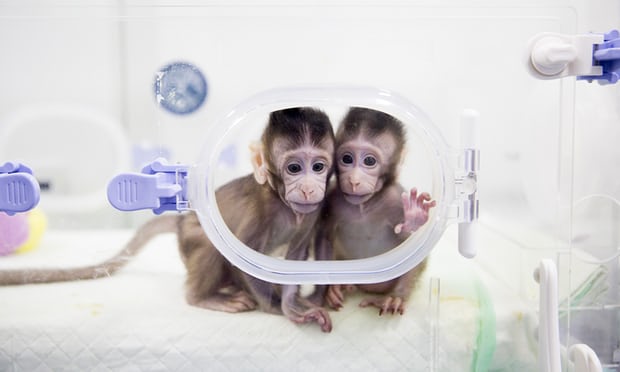 two cloned baby macaques in an incubator or transparent cage in china january 2018 Facebook Twitter Pinterest Pair bonding: cloned baby macaques Zhong Zhong and Hua Hua at the Chinese Academy of Sciences last month. Photograph: Xinhua/Barcroft Images Cloning, embryology and virology The recent news that a laboratory in Shanghai has succeeded in cloning macaque monkeys made world headlines not just because of the impressive scientific feat but because of the implications for humans. While mammals from sheep (Dolly in 1997) to pigs, dogs and cows have been cloned before, primates have been a problem. Mu-Ming Poo and his colleagues cracked the problem by treating the monkey eggs into which the genetic material of the cloned individual had been placed with a cocktail of molecules that awaken the genes needed to promote development into an embryo. The Chinese team has so far only produced healthy baby monkeys by cloning cells taken from other monkey foetuses, not from adult monkeys. But Poo tells me: “I think cloning using adult cells will be accomplished soon, probably within one year.” Such experiments on our close evolutionary relatives raise ethical concerns, all the more so because there were many failures: only two live births out of 79 attempts. Nonetheless, the work makes human reproductive cloning look more feasible in principle. And despite the ethical issues surrounding such research (many countries ban it, including the UK), the magnitude and cost of the work already undertaken reinforces a sense that if China sets its sights on a particular scientific or technological target, nothing will get in its way. It’s with good reason Poo asserts that China has become a world leader in stem-cell science and regenerative medicine. Researchers at Sun Yat-sen University in Guangzhou created similar surprise and alarm when in 2015 they announced the first use of high-precision gene-editing in a human embryo – not for reproductive medicine but to examine the viability of the technique to edit a disease-causing gene variant, using IVF embryos that could not develop further. That work was refused publication in the leading journals Nature and Science on ethical grounds, although related work has now been licensed and conducted in the UK. “Genome biology has been well supported in China for some time, with huge investment in genome sequencing projects,” says Lovell-Badge. There’s perhaps a temptation to ascribe some of China’s dominance here to a looser regulatory environment, but Lovell-Badge says that may not be the case. “Work on pigs and macaques is much easier and cheaper to do in China than in Europe and the US – it’s not necessarily anything to do with animal research ethics,” he says. “The best scientists want their work to be accepted in the west, so many have been trained by western scientists and their facilities designed with guidance from the west. But it is wrong to say that there are no restrictions. There may not be strict laws or even regulations, but there are strict guidelines – and if these are not followed, the consequences can be severe to the scientists involved.” China is taking great strides in other areas of biological science too. The waves of deadly bird flu that have afflicted the country annually since it was first detected in 2013 supply a very urgent need for research in virology. Chinese researchers had already learnt a lot about viral epidemics, says George Gao, after the outbreak of the particularly virulent form of influenza that caused SARS (severe acute respiratory syndrome) in 2002-3, originating in Guangzhou. Gao’s work has focused on understanding how ‘zoonotic’ viruses like bird flu, which cross from animals to humans, are transmitted across species. He has also looked at the structures and molecular mechanisms of the SARS, Ebola, Zika and MERS (Middle East respiratory syndrome) viruses, all of which potentially pose global threats. The government has invested heavily in this field, he says, but he has no illusions that China still has some catching up to do. “In my opinion we are yet far behind US science in general. And we need a better system to encourage businesses to develop basic research.” The quantum internet In January, Chinese researchers announced that they had sent data securely encrypted using the rules of quantum mechanics via satellite to Vienna in Austria – a demonstration of the potential of a “quantum internet” that Dutch quantum physicist Ronald Hanson of the Technical University of Delft describes to me as “a milestone towards future quantum networks”. Quantum information technologies harness the counterintuitive principles of quantum physics to do things with information that are impossible with the 1s and 0s of binary code in today’s devices. Quantum computers can, for some tasks, operate faster and with more computational resources than ordinary computers, while a quantum telecommunications network – the quantum internet – could employ data-encryption methods that are rendered tamper-proof by the fundamental quantum laws of nature. The principles of so-called quantum cryptography were worked out in the 1980s, but applying them to information encoded in light signals for long-distance transmission is an immense technical challenge. China’s approach here again exemplifies its can-do mentality. The government has begun to install a fibre-optic network for quantum telecommunication stretching from Shanghai to Beijing. But for longer-distance transmission optical fibres are no good because the light signal eventually gets too dim as it passes along the fibre. Instead signals must be through the air, using lasers to connect orbiting satellites with ground stations. In 2016 China initiated an international project called Quantum Experiments at Space Scale (Quess) and launched a satellite designed for quantum data handling, called Micius after the romanised name of the ancient Chinese philosopher Mozi. The satellite work is being led by Jian-Wei Pan, who studied for his PhD in Vienna under Anton Zeilinger, one of the foremost scientists in the field of quantum information science. With that pedigree, Pan could have had his pick of jobs in the field, but in 2001 he chose to return to China. In 2009 he oversaw the task of constructing a “quantum communication hotline” for the military parade on the 60th anniversary of the Chinese communist state, and in 2012 he won the prestigious biennial International Quantum Communication award. Pan’s success in getting this technology up and running feels almost inexorable. Last year his team in Hefei drew more hyperventilating headlines by demonstrating the first “teleportation” of quantum objects (photons or “particles” of light) from the ground-based observatory at Ngari in Tibet to Micius, up to 1,400km away. The feat is not quite as science-fictional as it sounds – quantum teleportation, unlike the Star Trek version, does not involve any transmission of matter – but it could be an important trick for quantum telecommunications. The team also reported transmission of the “key” used for quantum encryption of signals between ground stations in China and Micius. The latest advance was to get such keys all the way from Beijing to Vienna. This meant sending a laser signal with the quantum information from the Xinglong observatory near Beijing to Micius as it passed over China, and then having Micius communicate another such message with a station in Graz as it traversed the night sky over Austria. The link-up between Xinglong and Beijing, and between Graz and Vienna, was made along local fibre-optic networks. In this way, a video conference held between the Chinese Academy of Sciences in Beijing and the Austrian Academy of Sciences (of which Zeilinger is president) in Vienna was conducted with the robust security of quantum encryption – a striking harbinger of what a quantum internet might provide. Pan says that the key to the remarkable success of Quess so far is coordination and collaboration within the immense pool of talent that China possesses. “When researchers [in different disciplines] undertake joint research, they can truly innovate,”, he says.  Acquiring skills abroad is still important for Chinese researchers, says Pan, and will be for some time. But increasingly it’s working the other way around too. “In my laboratory there are quite a few foreign students from developed countries, and some of them are even learning Chinese”, he says. china long march 2f rocket launches with humans aboard in october 2016 Facebook Twitter Pinterest The Long March 2F carrier rocket, carrying China’s Shenzhou-11 manned spacecraft, takes off from a launch pad in Jiuquan, Gansu Province, China, October 2016. Photograph: How Hwee Young/EPA Space In China no goal seems too big – not even the sky is the limit. In June the Chinese space agency plans to launch a lunar space mission to deliver a satellite that will guide a rocket in 2019 to the far (“dark”) side of the moon, bearing a robotic lander vehicle. The satellite link is essential for relaying data from the rover back to Earth. It’s all part of a campaign aiming at a manned moon mission in the 2030s. China is already regarded as a serious contender with the US, Europe and Russia for predominance in space, although so far it has shown enthusiasm for collaborating with Europe. It has launched two prototype unmanned space stations in its Tiangong programme, a prelude to Tiangong-3, which, if launched in the early 2020s, will support a crew of three – potentially including astronauts from other UN member nations. China has even discussed building a moon base with the European Space Agency. Despite this apparently collaborative spirit, China’s space ambitions evoke the pioneering maritime voyages of Zheng He in the 15th century, which some historians today regard as a way of asserting the “soft power” and heavenly rule of the Ming emperor. Nothing like Zheng He’s “treasure ships” had ever been seen on the oceans before: they dwarfed the vessels in which Europeans like Vasco da Gama explored the world. Many are now wondering whether, in science and technology, those times are returning. Since you’re here … … we have a small favour to ask. More people are reading the Guardian than ever but advertising revenues across the media are falling fast. And unlike many news organisations, we haven’t put up a paywall – we want to keep our journalism as open as we can. So you can see why we need to ask for your help. The Guardian’s independent, investigative journalism takes a lot of time, money and hard work to produce. But we do it because we believe our perspective matters – because it might well be your perspective, too. |
| json metadata | {"tags":["science"],"image":["https://steemitimages.com/DQmfHAdZWvQhAvevGfmaGAvKMLf3D1chwmUxWUQbFpfo9vJ/4859.jpg","https://steemitimages.com/DQmX5PhMXGnCbqtLiXcyyqogao4AfmQj9i2PJhjTARMksvZ/3000.jpg","https://steemitimages.com/DQmez7ZphtCtB2s3n7b3XEJRejbEpSmBritNcy1SU5zYF2K/2188.jpg"],"app":"steemit/0.1","format":"markdown"} |
| parent author | |
| parent permlink | science |
| permlink | china-s-great-leap-forward-in-science |
| title | China’s great leap forward in science |
| Transaction Info | Block #20003706/Trx 407323dae927f40b3e737b65e37d149d75c032e5 |
View Raw JSON Data
{
"block": 20003706,
"op": [
"comment",
{
"author": "nani121",
"body": "China’s great leap forward in science\nChinese investment is paying off with serious advances in biotech, computing and space. Are they edging ahead of the west?\n\n\n\n\nI first met Xiaogang Peng in the summer of 1992 at Jilin University in Changchun, in the remote north-east of China, where he was a postgraduate student in the department of chemistry. He told me that his dream was to get a place at a top American lab. Now, Xiaogang was evidently smart and hard-working – but so, as far as I could see, were most Chinese science students. I wished him well, but couldn’t help thinking he’d set himself a massive challenge.\n\nFast forward four years to when, as an editor at Nature, I publish a paper on nanotechnology from world-leading chemists at the University of California at Berkeley. Among them was Xiaogang. That 1996 paper now appears in a 10-volume compendium of the all-time best of Nature papers being published in translation in China.\n\nI watched Xiaogang go on to forge a solid career in the US, as in 2005 he became a tenured professor at the University of Arkansas. But when I recently had reason to get in touch with Xiaogang again, I discovered that he had moved back to China and is now at Zhejiang University in Hangzhou – one of the country’s foremost academic institutions.\n\nFor Xiaogang, it seems that America was no longer the only land of opportunity. These days, Chinese scientists stand at least as good a chance of making a global impact on science from within China itself.\n\nThe economic rise of China has been accompanied by a waxing of its scientific prowess. In January, the United States National Science Foundation reported that the number of scientific publications from China in 2016 outnumbered those from the US for the first time: 426,000 versus 409,000. Sceptics might say that it’s about quality, not quantity. But the patronising old idea that China, like the rest of east Asia, can imitate but not innovate is certainly false now. In several scientific fields, China is starting to set the pace for others to follow. On my tour of Chinese labs in 1992, only those I saw at the flagship Peking University looked comparable to what you might find at a good university in the west. Today the resources available to China’s top scientists are enviable to many of their western counterparts. Whereas once the best Chinese scientists would pack their bags for greener pastures abroad, today it’s common for Chinese postdoctoral researchers to get experience in a leading lab in the west and then head home where the Chinese government will help them set up a lab that will eclipse their western competitors.\n\n There is always a certain fraction of talented, innovative people. China has the advantage of having lots of people\nMany have been lured back by the Thousand Talents Plan, in which scientists aged under 55 (whether Chinese citizens or not) are given full-time positions at prestigious universities and institutes, with larger than normal salaries and resources. “Deng Xiaoping sent many Chinese students and scholars out of China to developed countries 30 to 40 years ago, and now it is time for them to come back,” says George Fu Gao of the Institute of Microbiology of the Chinese Academy of Sciences in Beijing – who himself gained a PhD at Oxford before studying at Harvard.\n\n\n“The startup packages for researchers in good universities in China can be significantly higher than Hong Kong universities can offer,” says Che Ting Chan, a physicist at the Hong Kong University of Science & Technology in what was previously China’s affluent and westernised neighbour. “They provide more lab space and can help settle the spouse.” That, he notes ruefully, “makes recruiting young faculty staff increasingly challenging here.” Other well-off east Asian countries, such as Singapore and South Korea, are feeling the competition too.\n\nThe Chinese authorities are pursuing scientific dominance with systematic resolve. The annual expenditure on research and development in China increased from 1995 to 2013 by a factor of more than 30, and reached $234bn in 2016. The number of international publications coming out of China has remained in step with this rise. “Money is plentiful to certain Chinese researchers, possibly more so than to their competitors, especially if it means gaining an edge,” says stem-cell biologist Robin Lovell-Badge of the Francis Crick Institute in London.\n\nThe ultimate aim is to develop a homegrown, innovative research environment, says Mu-Ming Poo of the Institute of Neuroscience of the Chinese Academy of Sciences in Shanghai. “The government is beginning to recognise that big investment and recruitment of talent from abroad are not sufficient. We need to build infrastructure and mechanisms that facilitate innovation within China.” That’s not easy, and won’t happen fast. “Officially, government leaders say that taking risks is allowed, but the system of evaluating scientists and projects, and the philosophy and methods of instruction in university curricula, aren’t compatible with this policy.”\n\n\nChina’s moon mission to boldly go a step further\n Read more\nChina’s strength also comes down to sheer numbers, though. “There is always a certain fraction of talented people who are innovative,” says Chan. “China has the advantage of having a lot of people.”\n\nOne of the more controversial ways Chinese institutions encourage their researchers to publish high-profile papers is to offer cash incentives. One study found that on average a paper in Nature or Science could earn the author a bonus of almost $44,000 in 2016. The highest prize on offer was as much as $165,000 for a single paper, up to 20 times a typical university professor’s annual salary.\n\nAccording to quantum physicist Jian-Wei Pan of the University of Science and Technology in Hefei, as a relative latecomer to the global scientific stage, China needs such incentives as a way of maintaining enthusiasm. Chan adds that “the rewarding system is transparent, and the expectation of the senior administration is clearly spelled out. Most of my friends in China don’t see this as a problem – many feel that any formula, even if it’s simple and naive, is better than no formula.”\n\nBut could it not tempt researchers to cheat – fabricate or cherrypick results so that they can claim a dramatic discovery? The 2016 study of cash incentives also reported a rise in plagiarism, ghostwritten papers and other dishonest attempts to get published. Poo says that, whatever the case, the practice of cash incentives is not widespread. “Only a few low-level research institutions are doing this, not the Chinese Academy of Sciences or top universities,” he says. He thinks that problems with scientific misconduct and fraud in China have more to do with poor quality control or lack of punitive measures.\n\nHowever, the pattern seems clear, and is worth heeding by other nations: despite China’s reputation for authoritarian and hierarchical rule, in science the approach seems to be to ensure that top researchers are well supported with funding and resources, and then to leave them to get on with it.\n\n two cloned baby macaques in an incubator or transparent cage in china january 2018\nFacebook Twitter Pinterest\n Pair bonding: cloned baby macaques Zhong Zhong and Hua Hua at the Chinese Academy of Sciences last month. Photograph: Xinhua/Barcroft Images\nCloning, embryology and virology\nThe recent news that a laboratory in Shanghai has succeeded in cloning macaque monkeys made world headlines not just because of the impressive scientific feat but because of the implications for humans. While mammals from sheep (Dolly in 1997) to pigs, dogs and cows have been cloned before, primates have been a problem. Mu-Ming Poo and his colleagues cracked the problem by treating the monkey eggs into which the genetic material of the cloned individual had been placed with a cocktail of molecules that awaken the genes needed to promote development into an embryo. The Chinese team has so far only produced healthy baby monkeys by cloning cells taken from other monkey foetuses, not from adult monkeys. But Poo tells me: “I think cloning using adult cells will be accomplished soon, probably within one year.”\n\nSuch experiments on our close evolutionary relatives raise ethical concerns, all the more so because there were many failures: only two live births out of 79 attempts. Nonetheless, the work makes human reproductive cloning look more feasible in principle. And despite the ethical issues surrounding such research (many countries ban it, including the UK), the magnitude and cost of the work already undertaken reinforces a sense that if China sets its sights on a particular scientific or technological target, nothing will get in its way.\n\nIt’s with good reason Poo asserts that China has become a world leader in stem-cell science and regenerative medicine. Researchers at Sun Yat-sen University in Guangzhou created similar surprise and alarm when in 2015 they announced the first use of high-precision gene-editing in a human embryo – not for reproductive medicine but to examine the viability of the technique to edit a disease-causing gene variant, using IVF embryos that could not develop further. That work was refused publication in the leading journals Nature and Science on ethical grounds, although related work has now been licensed and conducted in the UK. “Genome biology has been well supported in China for some time, with huge investment in genome sequencing projects,” says Lovell-Badge.\n\nThere’s perhaps a temptation to ascribe some of China’s dominance here to a looser regulatory environment, but Lovell-Badge says that may not be the case. “Work on pigs and macaques is much easier and cheaper to do in China than in Europe and the US – it’s not necessarily anything to do with animal research ethics,” he says. “The best scientists want their work to be accepted in the west, so many have been trained by western scientists and their facilities designed with guidance from the west. But it is wrong to say that there are no restrictions. There may not be strict laws or even regulations, but there are strict guidelines – and if these are not followed, the consequences can be severe to the scientists involved.”\n\nChina is taking great strides in other areas of biological science too. The waves of deadly bird flu that have afflicted the country annually since it was first detected in 2013 supply a very urgent need for research in virology. Chinese researchers had already learnt a lot about viral epidemics, says George Gao, after the outbreak of the particularly virulent form of influenza that caused SARS (severe acute respiratory syndrome) in 2002-3, originating in Guangzhou.\n\nGao’s work has focused on understanding how ‘zoonotic’ viruses like bird flu, which cross from animals to humans, are transmitted across species. He has also looked at the structures and molecular mechanisms of the SARS, Ebola, Zika and MERS (Middle East respiratory syndrome) viruses, all of which potentially pose global threats. The government has invested heavily in this field, he says, but he has no illusions that China still has some catching up to do. “In my opinion we are yet far behind US science in general. And we need a better system to encourage businesses to develop basic research.”\n\nThe quantum internet\nIn January, Chinese researchers announced that they had sent data securely encrypted using the rules of quantum mechanics via satellite to Vienna in Austria – a demonstration of the potential of a “quantum internet” that Dutch quantum physicist Ronald Hanson of the Technical University of Delft describes to me as “a milestone towards future quantum networks”.\n\nQuantum information technologies harness the counterintuitive principles of quantum physics to do things with information that are impossible with the 1s and 0s of binary code in today’s devices. Quantum computers can, for some tasks, operate faster and with more computational resources than ordinary computers, while a quantum telecommunications network – the quantum internet – could employ data-encryption methods that are rendered tamper-proof by the fundamental quantum laws of nature. The principles of so-called quantum cryptography were worked out in the 1980s, but applying them to information encoded in light signals for long-distance transmission is an immense technical challenge.\n\nChina’s approach here again exemplifies its can-do mentality. The government has begun to install a fibre-optic network for quantum telecommunication stretching from Shanghai to Beijing. But for longer-distance transmission optical fibres are no good because the light signal eventually gets too dim as it passes along the fibre. Instead signals must be through the air, using lasers to connect orbiting satellites with ground stations. In 2016 China initiated an international project called Quantum Experiments at Space Scale (Quess) and launched a satellite designed for quantum data handling, called Micius after the romanised name of the ancient Chinese philosopher Mozi.\n\nThe satellite work is being led by Jian-Wei Pan, who studied for his PhD in Vienna under Anton Zeilinger, one of the foremost scientists in the field of quantum information science. With that pedigree, Pan could have had his pick of jobs in the field, but in 2001 he chose to return to China. In 2009 he oversaw the task of constructing a “quantum communication hotline” for the military parade on the 60th anniversary of the Chinese communist state, and in 2012 he won the prestigious biennial International Quantum Communication award.\n\nPan’s success in getting this technology up and running feels almost inexorable. Last year his team in Hefei drew more hyperventilating headlines by demonstrating the first “teleportation” of quantum objects (photons or “particles” of light) from the ground-based observatory at Ngari in Tibet to Micius, up to 1,400km away. The feat is not quite as science-fictional as it sounds – quantum teleportation, unlike the Star Trek version, does not involve any transmission of matter – but it could be an important trick for quantum telecommunications. The team also reported transmission of the “key” used for quantum encryption of signals between ground stations in China and Micius.\n\nThe latest advance was to get such keys all the way from Beijing to Vienna. This meant sending a laser signal with the quantum information from the Xinglong observatory near Beijing to Micius as it passed over China, and then having Micius communicate another such message with a station in Graz as it traversed the night sky over Austria. The link-up between Xinglong and Beijing, and between Graz and Vienna, was made along local fibre-optic networks. In this way, a video conference held between the Chinese Academy of Sciences in Beijing and the Austrian Academy of Sciences (of which Zeilinger is president) in Vienna was conducted with the robust security of quantum encryption – a striking harbinger of what a quantum internet might provide.\n\nPan says that the key to the remarkable success of Quess so far is coordination and collaboration within the immense pool of talent that China possesses. “When researchers [in different disciplines] undertake joint research, they can truly innovate,”, he says.\n\nAcquiring skills abroad is still important for Chinese researchers, says Pan, and will be for some time. But increasingly it’s working the other way around too. “In my laboratory there are quite a few foreign students from developed countries, and some of them are even learning Chinese”, he says.\n\n china long march 2f rocket launches with humans aboard in october 2016\nFacebook Twitter Pinterest\n The Long March 2F carrier rocket, carrying China’s Shenzhou-11 manned spacecraft, takes off from a launch pad in Jiuquan, Gansu Province, China, October 2016. Photograph: How Hwee Young/EPA\nSpace\nIn China no goal seems too big – not even the sky is the limit. In June the Chinese space agency plans to launch a lunar space mission to deliver a satellite that will guide a rocket in 2019 to the far (“dark”) side of the moon, bearing a robotic lander vehicle. The satellite link is essential for relaying data from the rover back to Earth. It’s all part of a campaign aiming at a manned moon mission in the 2030s. China is already regarded as a serious contender with the US, Europe and Russia for predominance in space, although so far it has shown enthusiasm for collaborating with Europe. It has launched two prototype unmanned space stations in its Tiangong programme, a prelude to Tiangong-3, which, if launched in the early 2020s, will support a crew of three – potentially including astronauts from other UN member nations. China has even discussed building a moon base with the European Space Agency.\n\nDespite this apparently collaborative spirit, China’s space ambitions evoke the pioneering maritime voyages of Zheng He in the 15th century, which some historians today regard as a way of asserting the “soft power” and heavenly rule of the Ming emperor. Nothing like Zheng He’s “treasure ships” had ever been seen on the oceans before: they dwarfed the vessels in which Europeans like Vasco da Gama explored the world. Many are now wondering whether, in science and technology, those times are returning.\n\nSince you’re here …\n… we have a small favour to ask. More people are reading the Guardian than ever but advertising revenues across the media are falling fast. And unlike many news organisations, we haven’t put up a paywall – we want to keep our journalism as open as we can. So you can see why we need to ask for your help. The Guardian’s independent, investigative journalism takes a lot of time, money and hard work to produce. But we do it because we believe our perspective matters – because it might well be your perspective, too.",
"json_metadata": "{\"tags\":[\"science\"],\"image\":[\"https://steemitimages.com/DQmfHAdZWvQhAvevGfmaGAvKMLf3D1chwmUxWUQbFpfo9vJ/4859.jpg\",\"https://steemitimages.com/DQmX5PhMXGnCbqtLiXcyyqogao4AfmQj9i2PJhjTARMksvZ/3000.jpg\",\"https://steemitimages.com/DQmez7ZphtCtB2s3n7b3XEJRejbEpSmBritNcy1SU5zYF2K/2188.jpg\"],\"app\":\"steemit/0.1\",\"format\":\"markdown\"}",
"parent_author": "",
"parent_permlink": "science",
"permlink": "china-s-great-leap-forward-in-science",
"title": "China’s great leap forward in science"
}
],
"op_in_trx": 0,
"timestamp": "2018-02-19T10:22:09",
"trx_id": "407323dae927f40b3e737b65e37d149d75c032e5",
"trx_in_block": 26,
"virtual_op": 0
}sensationupvoted (100.00%) @nani121 / skyrmions-open-a-door-to-next-level-data-storage2018/02/19 05:51:57
sensationupvoted (100.00%) @nani121 / skyrmions-open-a-door-to-next-level-data-storage
2018/02/19 05:51:57
| author | nani121 |
| permlink | skyrmions-open-a-door-to-next-level-data-storage |
| voter | sensation |
| weight | 10000 (100.00%) |
| Transaction Info | Block #19998302/Trx 38f27cbf5c436e652dd5264d6f3e4818e80f950b |
View Raw JSON Data
{
  "block": 19998302,
  "op": [
    "vote",
    {
      "author": "nani121",
      "permlink": "skyrmions-open-a-door-to-next-level-data-storage",
      "voter": "sensation",
      "weight": 10000
    }
  ],
  "op_in_trx": 0,
  "timestamp": "2018-02-19T05:51:57",
  "trx_id": "38f27cbf5c436e652dd5264d6f3e4818e80f950b",
  "trx_in_block": 59,
  "virtual_op": 0
}2018/02/19 05:20:09
2018/02/19 05:20:09
| author | cheetah |
| body | Hi! I am a robot. I just upvoted you! I found similar content that readers might be interested in: https://www.theguardian.com/travel/2016/dec/10/colombia-cano-cristales-coloured-river-farc |
| json metadata | |
| parent author | nani121 |
| parent permlink | colombia-s-rainbow-river-benefits-from-peace-deal |
| permlink | cheetah-re-nani121colombia-s-rainbow-river-benefits-from-peace-deal |
| title | |
| Transaction Info | Block #19997666/Trx d959beaff5d103a302684d4f5a34d7d9d1c341fc |
View Raw JSON Data
{
  "block": 19997666,
  "op": [
    "comment",
    {
      "author": "cheetah",
      "body": "Hi! I am a robot. I just upvoted you! I found similar content that readers might be interested in:\nhttps://www.theguardian.com/travel/2016/dec/10/colombia-cano-cristales-coloured-river-farc",
      "json_metadata": "",
      "parent_author": "nani121",
      "parent_permlink": "colombia-s-rainbow-river-benefits-from-peace-deal",
      "permlink": "cheetah-re-nani121colombia-s-rainbow-river-benefits-from-peace-deal",
      "title": ""
    }
  ],
  "op_in_trx": 0,
  "timestamp": "2018-02-19T05:20:09",
  "trx_id": "d959beaff5d103a302684d4f5a34d7d9d1c341fc",
  "trx_in_block": 10,
  "virtual_op": 0
}cheetahupvoted (0.08%) @nani121 / colombia-s-rainbow-river-benefits-from-peace-deal2018/02/19 05:20:03
cheetahupvoted (0.08%) @nani121 / colombia-s-rainbow-river-benefits-from-peace-deal
2018/02/19 05:20:03
| author | nani121 |
| permlink | colombia-s-rainbow-river-benefits-from-peace-deal |
| voter | cheetah |
| weight | 8 (0.08%) |
| Transaction Info | Block #19997664/Trx fd473e6ae23fa260139628c6f1ec7e55310c3c08 |
View Raw JSON Data
{
  "block": 19997664,
  "op": [
    "vote",
    {
      "author": "nani121",
      "permlink": "colombia-s-rainbow-river-benefits-from-peace-deal",
      "voter": "cheetah",
      "weight": 8
    }
  ],
  "op_in_trx": 0,
  "timestamp": "2018-02-19T05:20:03",
  "trx_id": "fd473e6ae23fa260139628c6f1ec7e55310c3c08",
  "trx_in_block": 32,
  "virtual_op": 0
}nani121published a new post: colombia-s-rainbow-river-benefits-from-peace-deal2018/02/19 05:18:45
nani121published a new post: colombia-s-rainbow-river-benefits-from-peace-deal
2018/02/19 05:18:45
| author | nani121 |
| body | One of Colombia’s natural wonders, the Caño Cristales river lies deep inside what was Farc rebel territory. But last month’s historic peace deal means tourists can enjoy its many-hued waters 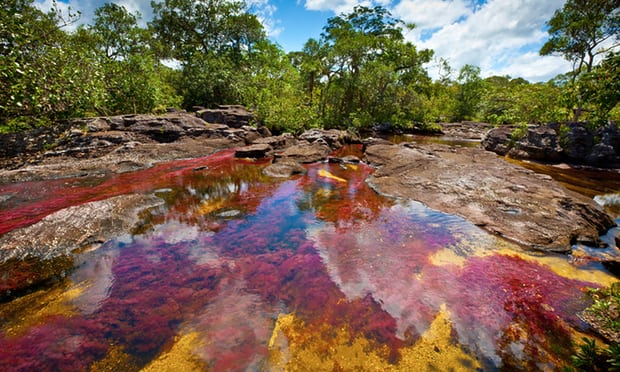 Water colours … Caño Cristales, Colombia’s ‘river of five colours’ Photograph: Tom Till/Alamy The first thing I felt when I saw the river running red was relief. The colour was more raspberry sorbet than blood red, flowing invitingly beneath soaring, skinny palm trees. Until this point, I had been slightly worried that Caño Cristales, Colombia’s so-called river of five colours, could be to water what the northern lights are to the night sky – unreliable and often nothing like the pictures. But Caño Cristales had performed on cue. A mix of aquatic plants and tricks of the light combined to turn its waters a whole spectrum of colours. Circular rock pools, known as giant’s cauldrons, added to the spectacle, their shingled bottoms appearing to glow yellow and then green. It was easy to see why this little-known natural wonder is locally known as the liquid rainbow. It hasn’t always gone smoothly, but progress here has been remarkable Yet until recently Caño Cristales, in the wildest depths of the country’s interior, was less of a must-see – more a mustn’t see. It’s in the heart of what was Farc guerrilla territory, so instead of being in the guidebooks’ lists of top attractions, the river spent much of the early 2000s on the UK Foreign and Commonwealth Office (FCO) warning list to avoid for “all-but-essential travel”. Things started to change when, 10 years ago, the state military launched a mission to take La Macarena, the river’s nearest town, back from Farc (the Revolutionary Armed Forces of Colombia). It hasn’t always gone smoothly, but progress has been remarkable. Gradually curious tourists have drifted in. In 2014, the FCO took Caño Cristales off the no-go list and instead advised going with a reputable tour operator.  Cano Cristales Facebook Twitter Pinterest Henry Quevedo, president of the Caño Cristales tourist board, believes tourism here is set to grow. At the end of last month, things took another big step forward when a revised peace treaty between the government of President Juan Manuel Santos – who has been awarded the 2016 Nobel peace prize – and Farc was approved by Congress. The first draft was rejected in a referendum – although La Macarena, one of the areas hardest hit by the conflict, voted 71% in its favour, a sure sign that it wants to move forward. “The ecotourism project here began before work on the Colombian peace deal started and it relies on cooperation with the Colombian Army,” he told me, adding that this would not change; there would still be boots on the ground. For a place that is still fairly new to tourism, La Macarena has blazed its way down the eco and community tourism route I had travelled to La Macarena in 30-seater plane from Bogotá, 170 miles to the north. The town is a small grid of dirt roads, roughly six streets by eight, with, at its centre, a public park, where amenities include some tired playground apparatus and free Wi-Fi. Scents of tropical fruit wafted through the air from a juice stall. My hotel, the Punto Verde, had motel-style chalets surrounding a small pool in a well-kept garden of citrus trees, coconut palms and tropical flowers. I had half-expected a semi-lawless land, where anyone can wander into the wilds like some sort of tourism pioneer, but there were rules here, lots of rules. Before I was allowed to go to the river, I had to attend a briefing along with all the other new arrivals. During a 10-minute presentation we were told sternly: no cigarettes, no feeding the fish, no treading on the aquatic plants, no plastic water bottles. And for those who wanted to swim in the river: no sun cream or insect repellant. 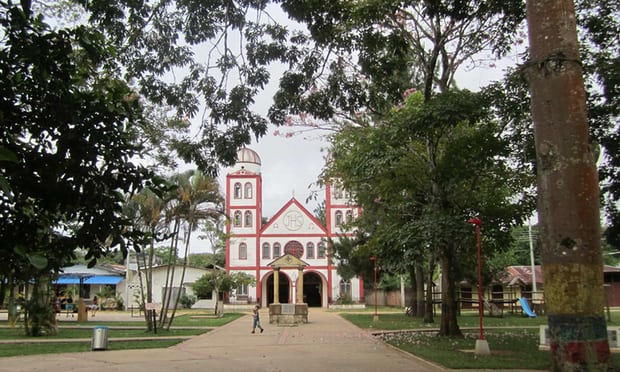 La Macarena. Facebook Twitter Pinterest La Macarena, the river’s nearest town For a place that is still fairly new to tourism, La Macarena has blazed its way down the eco and community tourism route. “I think it started when someone found some photos of the river 30 years ago and it had double the amount of plants,” said my guide, Franchy. Personally, I was happy to oblige. There were no mosquitoes, so the repellant was unnecessary. And for sun protection, I managed with long sleeves, long trousers and a hat – plus a dab of cream on my face. I vowed to keep my head above the water if I took a dip. From September onwards is the best time to visit, as there are fewer tropical downpours I had opted for a three-day trip, which meant I would have time to hit all the nearby highlights, including several waterfalls and swimming holes. Each day started in the same way: we would board a long, wooden boat and skim along the wide, tea-coloured Guayabero river: titi monkeys swung in the treetops, turtles basked at the water’s edge, and birds with neon-yellow breasts darted between the creepers. Caño Cristales is a tributary flowing into the Guayabero a few miles downriver on the opposite bank, amid a plain filled with squat, purple-flowered vellozia bushes. When I finally stood at the stream’s edge, I could see carpets of the all-important macarenia clavigera plant, swaying gently under the surface. This is the plant that changes in sunlight from Kermit green to a dusky pink, creating optical wonders. Up close, the plants were pretty, but not astonishing. It was only from a short distance that the water appeared to be flowing like lava.  Cano cristales waterfall Facebook Twitter Pinterest Photograph: Alamy The tourism season in Caño Cristales is short, from July to December. From September onwards is the best time to visit, as there are fewer tropical downpours. Rain can mute the colours and, indeed, there are no guarantees that visitors will see all of the famous five – red, orange, yellow, green and blue. The blue continually eluded me. https://www.youtube.com/watch?v=eF7rtii_qJM Local guides are working on plans to attract visitors year-round by developing trips to other natural attractions in the area, but in the meantime, there is another problem. The oil companies are coming. Just metres from one of the river’s most beautiful spots, shiny black gold oozes from the ground. “Some local people want the money it will bring. They want to see roads fixed, and more jobs,” said Maria Johanna, another local guide. “They say to me, ‘Oh, sure you just want to keep them out because you have a job in tourism’, but no – this river is a gift from God. We have to look it after it.” Sign up to The Flyer: weekly travel inspiration, emailed direct to you Read more On my last night in La Macarena, the town put on a cultural show for the tourists: around 80 of us, mostly Colombians, aged from 20 to 70. We sat in rows in a community hall to watch performances by local musicians and school-age dancers. It was slightly awkward, as if La Macarena hasn’t quite figured out what to do with its influx of visitors, but it was clearly desperate to make a good impression. As the entertainment drew to a close, the compère, a portly man in a large cowboy hat, looked emotional. “Tell your friends, tell your neighbours,” he called from the stage. “Here in La Macarena, you can live in peace. And you can visit the most beautiful river in the world.” • The trip was provided by RealWorld (0113 262 5329), which has a seven-day package to Bogotá and Caños Cristales, including B&B accommodation and domestic flights, transfers and river tours, from £1,495pp. Flights for this trip were provided by Avianca (Avianca.com), which flies from Heathrow to Bogotá from £513 return, and the Colombian tourist board (Colombia.travel) |
| json metadata | {"tags":["rainbow","river"],"image":["https://steemitimages.com/DQmNTx6JWqysHSqibqhNgJCJKfyp1q9WhectvpoZhyD7Xkw/5616.jpg","https://steemitimages.com/DQmNaZGP6g9tcvoNDGCSMAkfadBGmRtJGeMuczMD193BgKF/3745.jpg","https://steemitimages.com/DQmbjfi8qz8UwtuWwbJYa2vcLon48qKpkLKT1iRK1Kukahk/1536.jpg","https://steemitimages.com/DQmb7GgJod8YqGHrvD7ZQggq78feQH85Qy3TbNkG1ZmD4Xo/640.jpg","https://img.youtube.com/vi/eF7rtii_qJM/0.jpg"],"links":["https://www.youtube.com/watch?v=eF7rtii_qJM"],"app":"steemit/0.1","format":"markdown"} |
| parent author | |
| parent permlink | rainbow |
| permlink | colombia-s-rainbow-river-benefits-from-peace-deal |
| title | Colombia’s rainbow river benefits from peace deal |
| Transaction Info | Block #19997638/Trx 9ac094639779b1039d9b357b2dd71f8bd4314606 |
View Raw JSON Data
{
"block": 19997638,
"op": [
"comment",
{
"author": "nani121",
"body": "One of Colombia’s natural wonders, the Caño Cristales river lies deep inside what was Farc rebel territory. But last month’s historic peace deal means tourists can enjoy its many-hued waters\n\nWater colours … Caño Cristales, Colombia’s ‘river of five colours’ Photograph: Tom Till/Alamy\nThe first thing I felt when I saw the river running red was relief. The colour was more raspberry sorbet than blood red, flowing invitingly beneath soaring, skinny palm trees. Until this point, I had been slightly worried that Caño Cristales, Colombia’s so-called river of five colours, could be to water what the northern lights are to the night sky – unreliable and often nothing like the pictures.\n\nBut Caño Cristales had performed on cue. A mix of aquatic plants and tricks of the light combined to turn its waters a whole spectrum of colours. Circular rock pools, known as giant’s cauldrons, added to the spectacle, their shingled bottoms appearing to glow yellow and then green. It was easy to see why this little-known natural wonder is locally known as the liquid rainbow.\n\n It hasn’t always gone smoothly, but progress here has been remarkable\nYet until recently Caño Cristales, in the wildest depths of the country’s interior, was less of a must-see – more a mustn’t see. It’s in the heart of what was Farc guerrilla territory, so instead of being in the guidebooks’ lists of top attractions, the river spent much of the early 2000s on the UK Foreign and Commonwealth Office (FCO) warning list to avoid for “all-but-essential travel”.\n\nThings started to change when, 10 years ago, the state military launched a mission to take La Macarena, the river’s nearest town, back from Farc (the Revolutionary Armed Forces of Colombia). It hasn’t always gone smoothly, but progress has been remarkable. Gradually curious tourists have drifted in. In 2014, the FCO took Caño Cristales off the no-go list and instead advised going with a reputable tour operator.\n\n Cano Cristales\nFacebook Twitter Pinterest\nHenry Quevedo, president of the Caño Cristales tourist board, believes tourism here is set to grow. At the end of last month, things took another big step forward when a revised peace treaty between the government of President Juan Manuel Santos – who has been awarded the 2016 Nobel peace prize – and Farc was approved by Congress. The first draft was rejected in a referendum – although La Macarena, one of the areas hardest hit by the conflict, voted 71% in its favour, a sure sign that it wants to move forward.\n\n“The ecotourism project here began before work on the Colombian peace deal started and it relies on cooperation with the Colombian Army,” he told me, adding that this would not change; there would still be boots on the ground.\n\n For a place that is still fairly new to tourism, La Macarena has blazed its way down the eco and community tourism route\nI had travelled to La Macarena in 30-seater plane from Bogotá, 170 miles to the north. The town is a small grid of dirt roads, roughly six streets by eight, with, at its centre, a public park, where amenities include some tired playground apparatus and free Wi-Fi. Scents of tropical fruit wafted through the air from a juice stall. My hotel, the Punto Verde, had motel-style chalets surrounding a small pool in a well-kept garden of citrus trees, coconut palms and tropical flowers.\n\nI had half-expected a semi-lawless land, where anyone can wander into the wilds like some sort of tourism pioneer, but there were rules here, lots of rules. Before I was allowed to go to the river, I had to attend a briefing along with all the other new arrivals. During a 10-minute presentation we were told sternly: no cigarettes, no feeding the fish, no treading on the aquatic plants, no plastic water bottles. And for those who wanted to swim in the river: no sun cream or insect repellant.\n\n La Macarena.\nFacebook Twitter Pinterest\n La Macarena, the river’s nearest town\nFor a place that is still fairly new to tourism, La Macarena has blazed its way down the eco and community tourism route. “I think it started when someone found some photos of the river 30 years ago and it had double the amount of plants,” said my guide, Franchy.\n\nPersonally, I was happy to oblige. There were no mosquitoes, so the repellant was unnecessary. And for sun protection, I managed with long sleeves, long trousers and a hat – plus a dab of cream on my face. I vowed to keep my head above the water if I took a dip.\n\n From September onwards is the best time to visit, as there are fewer tropical downpours\nI had opted for a three-day trip, which meant I would have time to hit all the nearby highlights, including several waterfalls and swimming holes. Each day started in the same way: we would board a long, wooden boat and skim along the wide, tea-coloured Guayabero river: titi monkeys swung in the treetops, turtles basked at the water’s edge, and birds with neon-yellow breasts darted between the creepers.\n\nCaño Cristales is a tributary flowing into the Guayabero a few miles downriver on the opposite bank, amid a plain filled with squat, purple-flowered vellozia bushes. When I finally stood at the stream’s edge, I could see carpets of the all-important macarenia clavigera plant, swaying gently under the surface. This is the plant that changes in sunlight from Kermit green to a dusky pink, creating optical wonders. Up close, the plants were pretty, but not astonishing. It was only from a short distance that the water appeared to be flowing like lava.\n\n Cano cristales waterfall\nFacebook Twitter Pinterest Photograph: Alamy\nThe tourism season in Caño Cristales is short, from July to December. From September onwards is the best time to visit, as there are fewer tropical downpours. Rain can mute the colours and, indeed, there are no guarantees that visitors will see all of the famous five – red, orange, yellow, green and blue. The blue continually eluded me.\nhttps://www.youtube.com/watch?v=eF7rtii_qJM\nLocal guides are working on plans to attract visitors year-round by developing trips to other natural attractions in the area, but in the meantime, there is another problem. The oil companies are coming. Just metres from one of the river’s most beautiful spots, shiny black gold oozes from the ground.\n\n“Some local people want the money it will bring. They want to see roads fixed, and more jobs,” said Maria Johanna, another local guide. “They say to me, ‘Oh, sure you just want to keep them out because you have a job in tourism’, but no – this river is a gift from God. We have to look it after it.”\n\n\nSign up to The Flyer: weekly travel inspiration, emailed direct to you\n Read more\nOn my last night in La Macarena, the town put on a cultural show for the tourists: around 80 of us, mostly Colombians, aged from 20 to 70. We sat in rows in a community hall to watch performances by local musicians and school-age dancers. It was slightly awkward, as if La Macarena hasn’t quite figured out what to do with its influx of visitors, but it was clearly desperate to make a good impression.\n\nAs the entertainment drew to a close, the compère, a portly man in a large cowboy hat, looked emotional. “Tell your friends, tell your neighbours,” he called from the stage. “Here in La Macarena, you can live in peace. And you can visit the most beautiful river in the world.”\n\n\n• The trip was provided by RealWorld (0113 262 5329), which has a seven-day package to Bogotá and Caños Cristales, including B&B accommodation and domestic flights, transfers and river tours, from £1,495pp. Flights for this trip were provided by Avianca (Avianca.com), which flies from Heathrow to Bogotá from £513 return, and the Colombian tourist board (Colombia.travel)",
"json_metadata": "{\"tags\":[\"rainbow\",\"river\"],\"image\":[\"https://steemitimages.com/DQmNTx6JWqysHSqibqhNgJCJKfyp1q9WhectvpoZhyD7Xkw/5616.jpg\",\"https://steemitimages.com/DQmNaZGP6g9tcvoNDGCSMAkfadBGmRtJGeMuczMD193BgKF/3745.jpg\",\"https://steemitimages.com/DQmbjfi8qz8UwtuWwbJYa2vcLon48qKpkLKT1iRK1Kukahk/1536.jpg\",\"https://steemitimages.com/DQmb7GgJod8YqGHrvD7ZQggq78feQH85Qy3TbNkG1ZmD4Xo/640.jpg\",\"https://img.youtube.com/vi/eF7rtii_qJM/0.jpg\"],\"links\":[\"https://www.youtube.com/watch?v=eF7rtii_qJM\"],\"app\":\"steemit/0.1\",\"format\":\"markdown\"}",
"parent_author": "",
"parent_permlink": "rainbow",
"permlink": "colombia-s-rainbow-river-benefits-from-peace-deal",
"title": "Colombia’s rainbow river benefits from peace deal"
}
],
"op_in_trx": 0,
"timestamp": "2018-02-19T05:18:45",
"trx_id": "9ac094639779b1039d9b357b2dd71f8bd4314606",
"trx_in_block": 27,
"virtual_op": 0
}2018/02/19 04:39:06
2018/02/19 04:39:06
| author | cheetah |
| body | Hi! I am a robot. I just upvoted you! I found similar content that readers might be interested in: https://www.sciencenews.org/article/skyrmions-open-door-next-level-data-storage |
| json metadata | |
| parent author | nani121 |
| parent permlink | skyrmions-open-a-door-to-next-level-data-storage |
| permlink | cheetah-re-nani121skyrmions-open-a-door-to-next-level-data-storage |
| title | |
| Transaction Info | Block #19996845/Trx a3dcb7ed6c22120472a02fdf0917f7a592b9beb5 |
View Raw JSON Data
{
  "block": 19996845,
  "op": [
    "comment",
    {
      "author": "cheetah",
      "body": "Hi! I am a robot. I just upvoted you! I found similar content that readers might be interested in:\nhttps://www.sciencenews.org/article/skyrmions-open-door-next-level-data-storage",
      "json_metadata": "",
      "parent_author": "nani121",
      "parent_permlink": "skyrmions-open-a-door-to-next-level-data-storage",
      "permlink": "cheetah-re-nani121skyrmions-open-a-door-to-next-level-data-storage",
      "title": ""
    }
  ],
  "op_in_trx": 0,
  "timestamp": "2018-02-19T04:39:06",
  "trx_id": "a3dcb7ed6c22120472a02fdf0917f7a592b9beb5",
  "trx_in_block": 34,
  "virtual_op": 0
}cheetahupvoted (0.08%) @nani121 / skyrmions-open-a-door-to-next-level-data-storage2018/02/19 04:39:03
cheetahupvoted (0.08%) @nani121 / skyrmions-open-a-door-to-next-level-data-storage
2018/02/19 04:39:03
| author | nani121 |
| permlink | skyrmions-open-a-door-to-next-level-data-storage |
| voter | cheetah |
| weight | 8 (0.08%) |
| Transaction Info | Block #19996844/Trx 030c772daa9688d935061895d30ae79667b3548b |
View Raw JSON Data
{
  "block": 19996844,
  "op": [
    "vote",
    {
      "author": "nani121",
      "permlink": "skyrmions-open-a-door-to-next-level-data-storage",
      "voter": "cheetah",
      "weight": 8
    }
  ],
  "op_in_trx": 0,
  "timestamp": "2018-02-19T04:39:03",
  "trx_id": "030c772daa9688d935061895d30ae79667b3548b",
  "trx_in_block": 14,
  "virtual_op": 0
}nani121published a new post: skyrmions-open-a-door-to-next-level-data-storage2018/02/19 04:38:51
nani121published a new post: skyrmions-open-a-door-to-next-level-data-storage
2018/02/19 04:38:51
| author | nani121 |
| body | Knots in magnetic materials could one day make for faster, sturdier, tinier electronics 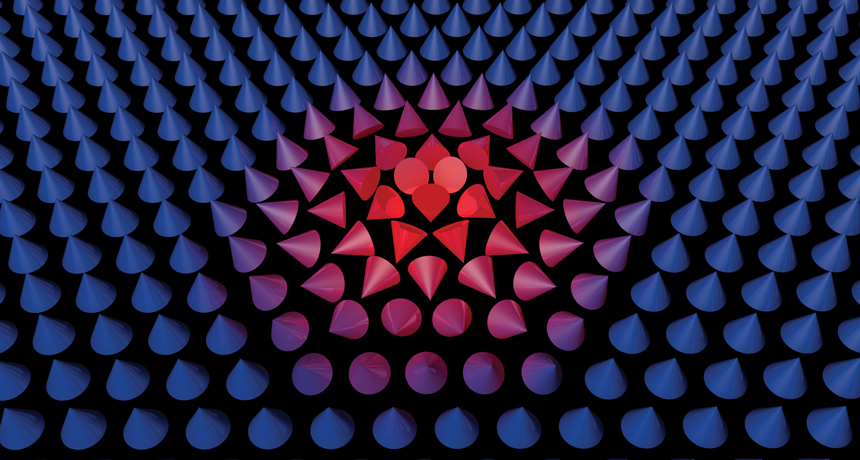 Knots in magnetic materials could one day make for faster, sturdier, tinier electronics MAGNETIC KNOTS A skyrmion is a swirl (red) among the atoms of a magnetic material. Here, cones point in the direction of each atom’s magnetization. Skyrmions come in several types; this one, a Néel skyrmion, is found in thin materials. ELLA MARU STUDIO Magazine issue: Vol. 193, No. 3, February 17, 2018 EmailPrintTwitterFacebookRedditGoogle+ SPONSOR MESSAGE Like sailors and spelunkers, physicists know the power of a sturdy knot. Some physicists have tied their hopes for a new generation of data storage to minuscule knotlike structures called skyrmions, which can form in magnetic materials. Incredibly tiny and tough to undo, magnetic skyrmions could help feed humankind’s hunger for ever-smaller electronics. On traditional hard drives, the magnetic regions that store data are about 10 times as large as the smallest skyrmions. Ranging from a nanometer to hundreds of nanometers in diameter, skyrmions “are probably the smallest magnetic systems … that can be imagined or that can be realized in nature,” says physicist Vincent Cros of Unité Mixte de Physique CNRS/Thales in Palaiseau, France. What’s more, skyrmions can easily move through a material, pushed along by an electric current. The magnetic knots’ nimble nature suggests that skyrmions storing data in a computer could be shuttled to a sensor that would read off the information as the skyrmions pass by. In contrast, traditional hard drives read and write data by moving a mechanical arm to the appropriate region on a spinning platter (SN: 10/19/13, p. 28). Those moving parts tend to be fragile, and the task slows down data recall. Scientists hope that skyrmions could one day make for more durable, faster, tinier gadgets. One thing, however, has held skyrmions back: Until recently, they could be created and controlled only in the frigid cold. When solid-state physicist Christian Pfleiderer and colleagues first reported the detection of magnetic skyrmions, in Science in 2009, the knots were impractical to work with, requiring very low temperatures of about 30 kelvins (–243° Celsius). Those are “conditions where you’d say, ‘This is of no use for anybody,’ ” says Pfleiderer of the Technical University of Munich. Skyrmions have finally come out of the cold, though they are finicky and difficult to control. Now, scientists are on the cusp of working out the kinks to create thawed-out skyrmions with all the desired characteristics. At the same time, researchers are chasing after new kinds of skyrmions, which may be an even better fit for data storage. The skyrmion field, Pfleiderer says, has “started to develop its own life.” 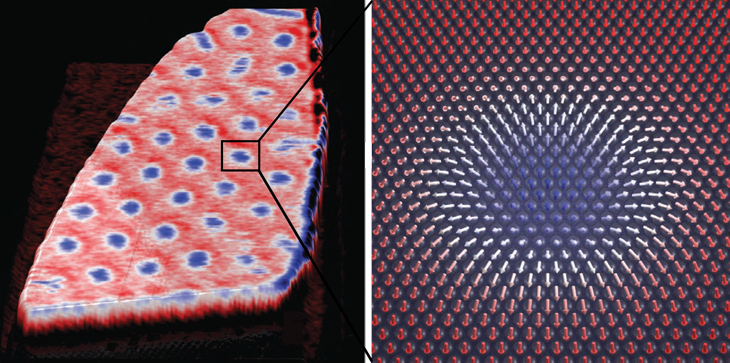 A grid of skyrmions (blue circled by white) is revealed in an ultrathin film of palladium and iron, in this image from a scanning tunneling microscope (left) and illustrated inset of a single skyrmion (right). K. VON BERGMANN Memories in magnets In a magnetic material, such as iron, each atom acts like a tiny bar magnet with its own north and south poles. This magnetization arises from spin, a quantum property of the atom’s electrons. In a ferromagnet, a standard magnet like the one holding up the grocery list on your refrigerator, the atoms’ magnetic poles point in the same direction (SN Online: 5/14/12). Skyrmions, which dwell within such magnetic habitats, are composed of groups of atoms with their magnetic poles oriented in whorls. Those spirals of magnetization disrupt the otherwise orderly alignment of atoms in the magnet, like a cowlick in freshly combed hair. Within a skyrmion, the direction of the atoms’ poles twists until the magnetization in the center points in the opposite direction of the magnetization outside. That twisting is difficult to undo, like a strong knot (SN Online: 10/31/08). So skyrmions won’t spontaneously disappear — a plus for long-term data storage. Using knots of various kinds to store information has a long history. Ancient Incas used khipu, a system of knotted cord, to keep records or send messages (SN Online: 5/8/17). In a more modern example, Pfleiderer says, “if you don’t want to forget something then you put a knot in your handkerchief.” Skyrmions could continue that tradition. GIVE IT A WHIRL Skyrmions move across magnetic material by sliding from atom to atom. Here, each atom is indicated by a cone that points in the direction of its magnetization. As the swirl travels, atoms stay in place, but their magnetic poles rotate. Skyrmions may be a future option for fast, sturdy, small data storage. On the right track Skyrmions are a type of “quasiparticle,” a disturbance within a material that behaves like a single particle, despite being a collective of many individual particles. Although skyrmions are made up of atoms, which remain stationary within the material, skyrmions can move around like a true particle, by sliding from one group of atoms to another. “The magnetism just twists around, and thus the skyrmion travels,” says condensed matter physicist Kirsten von Bergmann of the University of Hamburg. In fact, skyrmions were first proposed in the context of particles. British physicist Tony Skyrme, who lends his name to the knots, suggested about 60 years ago that particles such as neutrons and protons could be thought of as a kind of knot. In the late 1980s, physicists realized the math that supported Skyrme’s idea could also represent knots in the magnetization of solid materials. Such skyrmions could be used in futuristic data storage schemes, researchers later proposed. A chain of skyrmions could encode bits within a computer, with the presence of a skyrmion representing 1 and the absence representing 0. In particular, skyrmions might be ideal for what are known as “racetrack” memories, Cros and colleagues proposed in Nature Nanotechnology in 2013. In racetrack devices, information-holding skyrmions would speed along a magnetic nanoribbon, like cars on the Indianapolis Motor Speedway. Solid-state physicist Stuart Parkin proposed a first version of the racetrack concept years earlier. In a 2008 paper in Science, Parkin and colleagues demonstrated the beginnings of a racetrack memory based not on skyrmions, but on magnetic features called domain walls, which separate regions with different directions of magnetization in a material. Those domain walls could be pushed along the track using electric currents to a sensor that would read out the data encoded within. To maximize the available space, the racetrack could loop straight up and back down (like a wild Mario Kart ride), allowing for 3-D memory that could pack in more data than a flat chip. Drive it In a “racetrack” memory, skyrmions could be created to represent a 0 or 1. Pushed by an electric current, the magnetic whorls would travel to a sensor to be read. Squeezing the track into loops (inset) would store data in less space. T. TIBBITTS Source: S. Krause and R. Wiesendanger/Nature Materials 2016 “When I first proposed [racetrack memories] many years ago, I think people were very skeptical,” says Parkin, now at the Max Planck Institute of Microstructure Physics in Halle, Germany. Today, the idea — with and without skyrmions — has caught on. Racetrack memories are being tested in laboratories, though the technology is not yet available in computers. To make such a system work with skyrmions, scientists need to make the knots easier to wrangle at room temperature. For skyrmion-based racetrack memories to compete with current technologies, skyrmions must be small and move quickly and easily through a material. And they should be easy to create and destroy, using something simple like an electric current. Those are lofty demands: A step forward on one requirement sometimes leads to a step backward on the others. But scientists are drawing closer to reining in the magnetic marvels. Heating up Those first magnetic skyrmions found by Pfleiderer and colleagues appeared spontaneously in crystals with asymmetric structures that induce a twist between neighboring atoms. Only certain materials have that skyrmion-friendly asymmetric structure, limiting the possibilities for studying the quasiparticles or coaxing them to form under warmer conditions. Soon, physicists developed a way to artificially create an asymmetric structure by depositing material in thin layers. Interactions between atoms in different layers can induce a twist in the atoms’ orientations. “Now, we can suddenly use ordinary magnetic materials, combine them in a clever way with other materials, and make them work at room temperature,” says materials scientist Axel Hoffmann of Argonne National Laboratory in Illinois. Scientists produced such thin film skyrmions for the first time in a one-atom-thick layer of iron on top of iridium, but temperatures were still very low. Reported in Nature Physics in 2011, those thin film skyrmions required a chilly 11 kelvins (–262° C). That’s because the thin film of iron loses its magnetic properties above a certain temperature, says von Bergmann, who coauthored the study, along with nanoscientist Roland Wiesendanger of the University of Hamburg and colleagues. But thicker films can stay magnetic at higher temperatures. And so, “one important step was to increase the amount of magnetic material,” von Bergmann says. To go thicker, scientists began stacking sheets of various magnetic and nonmagnetic materials, like a club sandwich with repeating layers of meat, cheese and bread. Stacking multiple layers of iridium, platinum and cobalt, Cros and colleagues created the first room-temperature skyrmions smaller than 100 nanometers, the researchers reported in May 2016 in Nature Nanotechnology. By adjusting the types of materials, the number of layers and their thicknesses, scientists can fashion designer skyrmions with desirable properties. When condensed matter physicist Christos Panagopoulos of Nanyang Technological University in Singapore and colleagues fiddled with the composition of layers of iridium, iron, cobalt and platinum, a variety of skyrmions swirled into existence. The resulting knots came in different sizes, and some were more stable than others, the researchers reported in Nature Materials in September 2017. Although scientists now know how to make room-temperature skyrmions, the heat-tolerant swirls, tens to hundreds of nanometers in diameter, tend to be too big to be very useful. “If we want to compete with current state-of-the-art technology, we have to go for skyrmionic objects [that] are much smaller in size than 100 nanometers,” Wiesendanger says. The aim is to bring warmed-up skyrmions down to a few nanometers. Bloch skyrmion The first type of skyrmion detected, called a Bloch skyrmion, appears in asymmetric crystals. The magnetic poles tilt around the circle.  ELLA MARU STUDIO Néel skyrmion In a Néel skyrmion, the magnetic poles tilt outward instead of around the circle as they do in a Bloch skyrmion.  ELLA MARU STUDIO Antiskyrmion Newly discovered antiskyrmions are like a cross between Néel and Bloch skyrmions, and may have some advantages for memory devices, such as tolerating a range of temperatures.  ELLA MARU STUDIO As some try to shrink room-temp skyrmions down, others are bringing them up to speed, to make for fast reading and writing of data. In a study reported in Nature Materials in 2016, skyrmions at room temperature reached top speeds of 100 meters per second (about 220 miles per hour). Fittingly, that’s right around the fastest speed NASCAR drivers achieve. The result showed that a skyrmion racetrack might actually work, says study coauthor Mathias Kläui, a condensed matter physicist at Johannes Gutenberg University Mainz in Germany. “Fundamentally, it’s feasible at room temperature.” But to compete against domain walls, which can reach speeds of over 700 m/s, skyrmions still need to hit the gas. Despite progress, there are a few more challenges to work out. One possible issue: A skyrmion’s swirling pattern makes it behave like a rotating object. “When you have a rotating object moving, it may not want to move in a straight line,” Hoffmann says. “If you’re a bad golf player, you know this.” Skyrmions don’t move in the same direction as an electric current, but at an angle to it. On the racetrack, skyrmions might hit a wall instead of staying in their lanes. Now, researchers are seeking new kinds of skyrmions that stay on track. A new twist Just as there’s more than one way to tie a knot, there are several different types of skyrmions, formed with various shapes of magnetic twists. The two best known types are Bloch and Néel. Bloch skyrmions are found in the thick, asymmetric crystals in which skyrmions were first detected, and Néel skyrmions tend to show up in thin films. “The type of skyrmions you get is related to the crystal structure of the materials,” says physical chemist Claudia Felser of the Max Planck Institute for Chemical Physics of Solids in Dresden, Germany. Felser studies Heusler compounds, materials that have unusual properties particularly useful for manipulating magnetism. Felser, Parkin and colleagues detected a new kind of skyrmion, an antiskyrmion, in a thin layer of such a material. They reported the find in August 2017 in Nature. Antiskyrmions might avoid some of the pitfalls that their relatives face, Parkin says. “Potentially, they can move in straight lines with currents, rather than moving to the side.” Such straight-shooting skyrmions may be better suited for racetrack schemes. And the observed antiskyrmions are stable at a wide range of temperatures, including room temperature. Antiskyrmions also might be able to shrink down smaller than other kinds of skyrmions. Physicists are now on the hunt for skyrmions within a different realm: antiferromagnetic materials. Unlike in ferromagnetic materials — in which atoms all align their poles — in antiferromagnets, atoms’ poles point in alternating directions. If one atom points up, its neighbor points down. Like antiskyrmions, antiferromagnetic skyrmions wouldn’t zip off at an angle to an electric current, so they should be easier to control. Antiferromagnetic skyrmions might also move faster, Kläui says. Materials scientists still need to find an antiferromagnetic material with the necessary properties to form skyrmions, Kläui says. “I would expect that this would be realized in the next couple of years.” Finding the knots’ niche Once skyrmions behave as desired, creating a racetrack memory with them is an obvious next step. “It is a technology that combines the best of multiple worlds,” Kläui says — stability, easily accessible data and low energy requirements. But Kläui and others acknowledge the hurdles ahead for skyrmion racetrack memories. It will be difficult, these researchers say, to beat traditional magnetic hard drives — not to mention the flash memories available in newer computers — on storage density, speed and cost simultaneously. “The racetrack idea, I’m skeptical about,” Hoffmann says. Instead, skyrmions might be useful in devices meant for performing calculations. Because only a small electric current is required to move skyrmions around, such devices might be used to create energy-efficient computer processors. Another idea is to use skyrmions for biologically inspired computers, which attempt to mimic the human brain (SN: 9/6/14, p. 10). Brains consume about as much power as a lightbulb, yet can perform calculations that computers still can’t match, thanks to large interconnected networks of nerve cells. Skyrmions could help scientists achieve this kind of computation in the lab, without sapping much power. IN THEORY If found, antiferromagnetic skyrmions would move in a straight line when pushed by electric current. They would arise in materials with atoms that have alternating magnetic poles. X. ZHANG, Y. ZHOU, M. EZAWA/SCIENTIFIC REPORTS 2016, ADAPTED BY E. OTWELL A single skyrmion could behave like a nerve cell, or neuron, electrical engineer Sai Li of Beihang University in Beijing and colleagues suggest. In the human body, a neuron can add up signals from its neighbors, gradually building up a voltage across its membrane. When that voltage reaches a certain threshold, ions begin shifting across the membrane in waves, generating an electric pulse. Skyrmions could imitate this behavior: An electric current would push a skyrmion along a track, with the distance traveled acting as an analog for the neuron’s increasing voltage. A skyrmion reaching a detector at the end would be equivalent to a firing neuron, the researchers proposed in July 2017 in Nanotechnology. By combining a large number of neuron-imitating skyrmions, the thinking goes, scientists could create a computer that operates something like a brain. Additional ideas for how to use the magnetic whirls keep cropping up. “It’s still a growing field,” von Bergmann says. “There are several new ideas ahead.” Whether or not skyrmions end up in future gadgets, the swirls are part of a burgeoning electronics ecosystem. Ever since electricity was discovered, researchers have focused on the motion of electric charges. But physicists are now fashioning a new parallel system called spintronics — of which skyrmions are a part — based on the motion of electron spin, that property that makes atoms magnetic (SN Online: 9/26/17). By studying skyrmions, researchers are expanding their understanding of how spins move through materials. Like a kindergartner fumbling with shoelaces, studying how to tie spins up in knots is a learning process https://www.youtube.com/watch?v=3s3cmGjxPVc |
| json metadata | {"tags":["material","physics"],"image":["https://steemitimages.com/DQmcGsyoEVn36y2sxeevQsQZ8tsndrDozRKcapStGmGe9nW/021718_skyrmion_feat.jpg","https://steemitimages.com/DQmS6ckBF2cgQCaPa6Deun7oEguUGkasJxvTv6ovt13HxgX/021718_skyrmion_inline_1_730.png","https://steemitimages.com/DQmezMRkbPiPknmQRTRbBsw6zdZzfG7BC7gzPjHfMaYkT2j/021718_skyrmion_inline_bloch_370_REV.jpg","https://steemitimages.com/DQmS3UTtaFtiQq6UinEPmLvU14ckvm9HucBWYZNtUz8o5cZ/021718_skyrmion_inline_neel_370_REV.jpg","https://steemitimages.com/DQmP9Exm3yu9hiukEU9qcDKknqRmXaiDSHcmPiRYYmQcDhe/021718_skyrmion_inline_anti_370_REV.jpg","https://img.youtube.com/vi/3s3cmGjxPVc/0.jpg"],"links":["https://www.youtube.com/watch?v=3s3cmGjxPVc"],"app":"steemit/0.1","format":"markdown"} |
| parent author | |
| parent permlink | material |
| permlink | skyrmions-open-a-door-to-next-level-data-storage |
| title | Skyrmions open a door to next-level data storage |
| Transaction Info | Block #19996840/Trx 495b5a6ed22c155a43ad37c1eac3a598e0cddbb2 |
View Raw JSON Data
{
"block": 19996840,
"op": [
"comment",
{
"author": "nani121",
"body": "Knots in magnetic materials could one day make for faster, sturdier, tinier electronics\n\nKnots in magnetic materials could one day make for faster, sturdier, tinier electronics\nMAGNETIC KNOTS A skyrmion is a swirl (red) among the atoms of a magnetic material. Here, cones point in the direction of each atom’s magnetization. Skyrmions come in several types; this one, a Néel skyrmion, is found in thin materials.\n\nELLA MARU STUDIO\n\nMagazine issue: Vol. 193, No. 3, February 17, 2018\nEmailPrintTwitterFacebookRedditGoogle+\nSPONSOR MESSAGE\nLike sailors and spelunkers, physicists know the power of a sturdy knot.\n\nSome physicists have tied their hopes for a new generation of data storage to minuscule knotlike structures called skyrmions, which can form in magnetic materials. Incredibly tiny and tough to undo, magnetic skyrmions could help feed humankind’s hunger for ever-smaller electronics.\n\nOn traditional hard drives, the magnetic regions that store data are about 10 times as large as the smallest skyrmions. Ranging from a nanometer to hundreds of nanometers in diameter, skyrmions “are probably the smallest magnetic systems … that can be imagined or that can be realized in nature,” says physicist Vincent Cros of Unité Mixte de Physique CNRS/Thales in Palaiseau, France.\n\nWhat’s more, skyrmions can easily move through a material, pushed along by an electric current. The magnetic knots’ nimble nature suggests that skyrmions storing data in a computer could be shuttled to a sensor that would read off the information as the skyrmions pass by. In contrast, traditional hard drives read and write data by moving a mechanical arm to the appropriate region on a spinning platter (SN: 10/19/13, p. 28). Those moving parts tend to be fragile, and the task slows down data recall. Scientists hope that skyrmions could one day make for more durable, faster, tinier gadgets.\n\nOne thing, however, has held skyrmions back: Until recently, they could be created and controlled only in the frigid cold. When solid-state physicist Christian Pfleiderer and colleagues first reported the detection of magnetic skyrmions, in Science in 2009, the knots were impractical to work with, requiring very low temperatures of about 30 kelvins (–243° Celsius). Those are “conditions where you’d say, ‘This is of no use for anybody,’ ” says Pfleiderer of the Technical University of Munich.\n\nSkyrmions have finally come out of the cold, though they are finicky and difficult to control. Now, scientists are on the cusp of working out the kinks to create thawed-out skyrmions with all the desired characteristics. At the same time, researchers are chasing after new kinds of skyrmions, which may be an even better fit for data storage. The skyrmion field, Pfleiderer says, has “started to develop its own life.”\n\n\nA grid of skyrmions (blue circled by white) is revealed in an ultrathin film of palladium and iron, in this image from a scanning tunneling microscope (left) and illustrated inset of a single skyrmion (right).\nK. VON BERGMANN\nMemories in magnets\nIn a magnetic material, such as iron, each atom acts like a tiny bar magnet with its own north and south poles. This magnetization arises from spin, a quantum property of the atom’s electrons. In a ferromagnet, a standard magnet like the one holding up the grocery list on your refrigerator, the atoms’ magnetic poles point in the same direction (SN Online: 5/14/12).\n\nSkyrmions, which dwell within such magnetic habitats, are composed of groups of atoms with their magnetic poles oriented in whorls. Those spirals of magnetization disrupt the otherwise orderly alignment of atoms in the magnet, like a cowlick in freshly combed hair. Within a skyrmion, the direction of the atoms’ poles twists until the magnetization in the center points in the opposite direction of the magnetization outside. That twisting is difficult to undo, like a strong knot (SN Online: 10/31/08). So skyrmions won’t spontaneously disappear — a plus for long-term data storage.\n\nUsing knots of various kinds to store information has a long history. Ancient Incas used khipu, a system of knotted cord, to keep records or send messages (SN Online: 5/8/17). In a more modern example, Pfleiderer says, “if you don’t want to forget something then you put a knot in your handkerchief.” Skyrmions could continue that tradition.\n\n\nGIVE IT A WHIRL Skyrmions move across magnetic material by sliding from atom to atom. Here, each atom is indicated by a cone that points in the direction of its magnetization. As the swirl travels, atoms stay in place, but their magnetic poles rotate. Skyrmions may be a future option for fast, sturdy, small data storage.\n\nOn the right track\nSkyrmions are a type of “quasiparticle,” a disturbance within a material that behaves like a single particle, despite being a collective of many individual particles. Although skyrmions are made up of atoms, which remain stationary within the material, skyrmions can move around like a true particle, by sliding from one group of atoms to another. “The magnetism just twists around, and thus the skyrmion travels,” says condensed matter physicist Kirsten von Bergmann of the University of Hamburg.\n\nIn fact, skyrmions were first proposed in the context of particles. British physicist Tony Skyrme, who lends his name to the knots, suggested about 60 years ago that particles such as neutrons and protons could be thought of as a kind of knot. In the late 1980s, physicists realized the math that supported Skyrme’s idea could also represent knots in the magnetization of solid materials.\n\nSuch skyrmions could be used in futuristic data storage schemes, researchers later proposed. A chain of skyrmions could encode bits within a computer, with the presence of a skyrmion representing 1 and the absence representing 0.\n\nIn particular, skyrmions might be ideal for what are known as “racetrack” memories, Cros and colleagues proposed in Nature Nanotechnology in 2013. In racetrack devices, information-holding skyrmions would speed along a magnetic nanoribbon, like cars on the Indianapolis Motor Speedway.\n\nSolid-state physicist Stuart Parkin proposed a first version of the racetrack concept years earlier. In a 2008 paper in Science, Parkin and colleagues demonstrated the beginnings of a racetrack memory based not on skyrmions, but on magnetic features called domain walls, which separate regions with different directions of magnetization in a material. Those domain walls could be pushed along the track using electric currents to a sensor that would read out the data encoded within. To maximize the available space, the racetrack could loop straight up and back down (like a wild Mario Kart ride), allowing for 3-D memory that could pack in more data than a flat chip.\n\nDrive it\nIn a “racetrack” memory, skyrmions could be created to represent a 0 or 1. Pushed by an electric current, the magnetic whorls would travel to a sensor to be read. Squeezing the track into loops (inset) would store data in less space. \n\n\nT. TIBBITTS\nSource: S. Krause and R. Wiesendanger/Nature Materials 2016\n\n“When I first proposed [racetrack memories] many years ago, I think people were very skeptical,” says Parkin, now at the Max Planck Institute of Microstructure Physics in Halle, Germany. Today, the idea — with and without skyrmions — has caught on. Racetrack memories are being tested in laboratories, though the technology is not yet available in computers.\n\nTo make such a system work with skyrmions, scientists need to make the knots easier to wrangle at room temperature. For skyrmion-based racetrack memories to compete with current technologies, skyrmions must be small and move quickly and easily through a material. And they should be easy to create and destroy, using something simple like an electric current. Those are lofty demands: A step forward on one requirement sometimes leads to a step backward on the others. But scientists are drawing closer to reining in the magnetic marvels.\n\nHeating up\nThose first magnetic skyrmions found by Pfleiderer and colleagues appeared spontaneously in crystals with asymmetric structures that induce a twist between neighboring atoms. Only certain materials have that skyrmion-friendly asymmetric structure, limiting the possibilities for studying the quasiparticles or coaxing them to form under warmer conditions.\n\nSoon, physicists developed a way to artificially create an asymmetric structure by depositing material in thin layers. Interactions between atoms in different layers can induce a twist in the atoms’ orientations. “Now, we can suddenly use ordinary magnetic materials, combine them in a clever way with other materials, and make them work at room temperature,” says materials scientist Axel Hoffmann of Argonne National Laboratory in Illinois.\n\nScientists produced such thin film skyrmions for the first time in a one-atom-thick layer of iron on top of iridium, but temperatures were still very low. Reported in Nature Physics in 2011, those thin film skyrmions required a chilly 11 kelvins (–262° C). That’s because the thin film of iron loses its magnetic properties above a certain temperature, says von Bergmann, who coauthored the study, along with nanoscientist Roland Wiesendanger of the University of Hamburg and colleagues. But thicker films can stay magnetic at higher temperatures. And so, “one important step was to increase the amount of magnetic material,” von Bergmann says.\n\nTo go thicker, scientists began stacking sheets of various magnetic and nonmagnetic materials, like a club sandwich with repeating layers of meat, cheese and bread. Stacking multiple layers of iridium, platinum and cobalt, Cros and colleagues created the first room-temperature skyrmions smaller than 100 nanometers, the researchers reported in May 2016 in Nature Nanotechnology.\n\nBy adjusting the types of materials, the number of layers and their thicknesses, scientists can fashion designer skyrmions with desirable properties. When condensed matter physicist Christos Panagopoulos of Nanyang Technological University in Singapore and colleagues fiddled with the composition of layers of iridium, iron, cobalt and platinum, a variety of skyrmions swirled into existence. The resulting knots came in different sizes, and some were more stable than others, the researchers reported in Nature Materials in September 2017.\n\nAlthough scientists now know how to make room-temperature skyrmions, the heat-tolerant swirls, tens to hundreds of nanometers in diameter, tend to be too big to be very useful. “If we want to compete with current state-of-the-art technology, we have to go for skyrmionic objects [that] are much smaller in size than 100 nanometers,” Wiesendanger says. The aim is to bring warmed-up skyrmions down to a few nanometers.\n\nBloch skyrmion\nThe first type of skyrmion detected, called a Bloch skyrmion, appears in asymmetric crystals. The magnetic poles tilt around the circle. \n\n\nELLA MARU STUDIO\nNéel skyrmion\nIn a Néel skyrmion, the magnetic poles tilt outward instead of around the circle as they do in a Bloch skyrmion.\n\n\nELLA MARU STUDIO\nAntiskyrmion\nNewly discovered antiskyrmions are like a cross between Néel and Bloch skyrmions, and may have some advantages for memory devices, such as tolerating a range of temperatures. \n\n\n ELLA MARU STUDIO\nAs some try to shrink room-temp skyrmions down, others are bringing them up to speed, to make for fast reading and writing of data. In a study reported in Nature Materials in 2016, skyrmions at room temperature reached top speeds of 100 meters per second (about 220 miles per hour). Fittingly, that’s right around the fastest speed NASCAR drivers achieve. The result showed that a skyrmion racetrack might actually work, says study coauthor Mathias Kläui, a condensed matter physicist at Johannes Gutenberg University Mainz in Germany. “Fundamentally, it’s feasible at room temperature.” But to compete against domain walls, which can reach speeds of over 700 m/s, skyrmions still need to hit the gas.\n\nDespite progress, there are a few more challenges to work out. One possible issue: A skyrmion’s swirling pattern makes it behave like a rotating object. “When you have a rotating object moving, it may not want to move in a straight line,” Hoffmann says. “If you’re a bad golf player, you know this.” Skyrmions don’t move in the same direction as an electric current, but at an angle to it. On the racetrack, skyrmions might hit a wall instead of staying in their lanes. Now, researchers are seeking new kinds of skyrmions that stay on track.\n\nA new twist\nJust as there’s more than one way to tie a knot, there are several different types of skyrmions, formed with various shapes of magnetic twists. The two best known types are Bloch and Néel. Bloch skyrmions are found in the thick, asymmetric crystals in which skyrmions were first detected, and Néel skyrmions tend to show up in thin films.\n\n“The type of skyrmions you get is related to the crystal structure of the materials,” says physical chemist Claudia Felser of the Max Planck Institute for Chemical Physics of Solids in Dresden, Germany. Felser studies Heusler compounds, materials that have unusual properties particularly useful for manipulating magnetism. Felser, Parkin and colleagues detected a new kind of skyrmion, an antiskyrmion, in a thin layer of such a material. They reported the find in August 2017 in Nature.\n\nAntiskyrmions might avoid some of the pitfalls that their relatives face, Parkin says. “Potentially, they can move in straight lines with currents, rather than moving to the side.” Such straight-shooting skyrmions may be better suited for racetrack schemes. And the observed antiskyrmions are stable at a wide range of temperatures, including room temperature. Antiskyrmions also might be able to shrink down smaller than other kinds of skyrmions.\n\nPhysicists are now on the hunt for skyrmions within a different realm: antiferromagnetic materials. Unlike in ferromagnetic materials — in which atoms all align their poles — in antiferromagnets, atoms’ poles point in alternating directions. If one atom points up, its neighbor points down. Like antiskyrmions, antiferromagnetic skyrmions wouldn’t zip off at an angle to an electric current, so they should be easier to control. Antiferromagnetic skyrmions might also move faster, Kläui says.\n\nMaterials scientists still need to find an antiferromagnetic material with the necessary properties to form skyrmions, Kläui says. “I would expect that this would be realized in the next couple of years.”\n\nFinding the knots’ niche\nOnce skyrmions behave as desired, creating a racetrack memory with them is an obvious next step. “It is a technology that combines the best of multiple worlds,” Kläui says — stability, easily accessible data and low energy requirements. But Kläui and others acknowledge the hurdles ahead for skyrmion racetrack memories. It will be difficult, these researchers say, to beat traditional magnetic hard drives — not to mention the flash memories available in newer computers — on storage density, speed and cost simultaneously.\n\n“The racetrack idea, I’m skeptical about,” Hoffmann says. Instead, skyrmions might be useful in devices meant for performing calculations. Because only a small electric current is required to move skyrmions around, such devices might be used to create energy-efficient computer processors.\n\nAnother idea is to use skyrmions for biologically inspired computers, which attempt to mimic the human brain (SN: 9/6/14, p. 10). Brains consume about as much power as a lightbulb, yet can perform calculations that computers still can’t match, thanks to large interconnected networks of nerve cells. Skyrmions could help scientists achieve this kind of computation in the lab, without sapping much power.\n\n\nIN THEORY If found, antiferromagnetic skyrmions would move in a straight line when pushed by electric current. They would arise in materials with atoms that have alternating magnetic poles.\nX. ZHANG, Y. ZHOU, M. EZAWA/SCIENTIFIC REPORTS 2016, ADAPTED BY E. OTWELL\nA single skyrmion could behave like a nerve cell, or neuron, electrical engineer Sai Li of Beihang University in Beijing and colleagues suggest. In the human body, a neuron can add up signals from its neighbors, gradually building up a voltage across its membrane. When that voltage reaches a certain threshold, ions begin shifting across the membrane in waves, generating an electric pulse. Skyrmions could imitate this behavior: An electric current would push a skyrmion along a track, with the distance traveled acting as an analog for the neuron’s increasing voltage. A skyrmion reaching a detector at the end would be equivalent to a firing neuron, the researchers proposed in July 2017 in Nanotechnology.\nBy combining a large number of neuron-imitating skyrmions, the thinking goes, scientists could create a computer that operates something like a brain.\n\nAdditional ideas for how to use the magnetic whirls keep cropping up. “It’s still a growing field,” von Bergmann says. “There are several new ideas ahead.”\n\nWhether or not skyrmions end up in future gadgets, the swirls are part of a burgeoning electronics ecosystem. Ever since electricity was discovered, researchers have focused on the motion of electric charges. But physicists are now fashioning a new parallel system called spintronics — of which skyrmions are a part — based on the motion of electron spin, that property that makes atoms magnetic (SN Online: 9/26/17). By studying skyrmions, researchers are expanding their understanding of how spins move through materials.\n\nLike a kindergartner fumbling with shoelaces, studying how to tie spins up in knots is a learning process\nhttps://www.youtube.com/watch?v=3s3cmGjxPVc",
"json_metadata": "{\"tags\":[\"material\",\"physics\"],\"image\":[\"https://steemitimages.com/DQmcGsyoEVn36y2sxeevQsQZ8tsndrDozRKcapStGmGe9nW/021718_skyrmion_feat.jpg\",\"https://steemitimages.com/DQmS6ckBF2cgQCaPa6Deun7oEguUGkasJxvTv6ovt13HxgX/021718_skyrmion_inline_1_730.png\",\"https://steemitimages.com/DQmezMRkbPiPknmQRTRbBsw6zdZzfG7BC7gzPjHfMaYkT2j/021718_skyrmion_inline_bloch_370_REV.jpg\",\"https://steemitimages.com/DQmS3UTtaFtiQq6UinEPmLvU14ckvm9HucBWYZNtUz8o5cZ/021718_skyrmion_inline_neel_370_REV.jpg\",\"https://steemitimages.com/DQmP9Exm3yu9hiukEU9qcDKknqRmXaiDSHcmPiRYYmQcDhe/021718_skyrmion_inline_anti_370_REV.jpg\",\"https://img.youtube.com/vi/3s3cmGjxPVc/0.jpg\"],\"links\":[\"https://www.youtube.com/watch?v=3s3cmGjxPVc\"],\"app\":\"steemit/0.1\",\"format\":\"markdown\"}",
"parent_author": "",
"parent_permlink": "material",
"permlink": "skyrmions-open-a-door-to-next-level-data-storage",
"title": "Skyrmions open a door to next-level data storage"
}
],
"op_in_trx": 0,
"timestamp": "2018-02-19T04:38:51",
"trx_id": "495b5a6ed22c155a43ad37c1eac3a598e0cddbb2",
"trx_in_block": 0,
"virtual_op": 0
}Manabar
Voting Power100.00%
Downvote Power100.00%
Resource Credits100.00%
Reputation Progress68.01%
{
  "voting_manabar": {
    "current_mana": "8143659806",
    "last_update_time": 1779077862
  },
  "downvote_manabar": {
    "current_mana": 2035914951,
    "last_update_time": 1779077862
  },
  "rc_account": {
    "account": "nani121",
    "max_rc": "10164408779",
    "max_rc_creation_adjustment": {
      "amount": "2020748973",
      "nai": "@@000000037",
      "precision": 6
    },
    "rc_manabar": {
      "current_mana": "10164408779",
      "last_update_time": 1779077862
    }
  }
}
Account Metadata
| POSTING JSON METADATA | |
| profile | {"profile_image":"http://i66.tinypic.com/207kygl.jpg","name":"ALL SCIENCE MAN","cover_image":"http://i68.tinypic.com/v5anls.jpg"} |
| JSON METADATA | |
| profile | {"profile_image":"http://i66.tinypic.com/207kygl.jpg","name":"ALL SCIENCE MAN","cover_image":"http://i68.tinypic.com/v5anls.jpg"} |
{
  "posting_json_metadata": {
    "profile": {
      "profile_image": "http://i66.tinypic.com/207kygl.jpg",
      "name": "ALL SCIENCE MAN",
      "cover_image": "http://i68.tinypic.com/v5anls.jpg"
    }
  },
  "json_metadata": {
    "profile": {
      "profile_image": "http://i66.tinypic.com/207kygl.jpg",
      "name": "ALL SCIENCE MAN",
      "cover_image": "http://i68.tinypic.com/v5anls.jpg"
    }
  }
}
Auth Keys
Owner
Single Signature
Public Keys
STM8AGRFGAnRwthRfspyEjgvcuRgrYnJ3SvNfMH8XYrQ6BDAWPQ4m1/1
Active
Single Signature
Public Keys
STM5JHsaasM4tDAbTwnaCgVuEA312p7q5hATmoXVRZDaEkmoDDGTN1/1
Posting
Single Signature
Public Keys
STM8HKCEe1TPHEcvrp3De8bfHkKFdcHfUxCAa1A7Ej1vhcVtVbPKt1/1
Memo
STM6UBHbXActiMUMyHHPSAdifbPAM9dg3igLc6DdmsX978mbyWgBY
{
  "owner": {
    "account_auths": [],
    "key_auths": [
      [
        "STM8AGRFGAnRwthRfspyEjgvcuRgrYnJ3SvNfMH8XYrQ6BDAWPQ4m",
        1
      ]
    ],
    "weight_threshold": 1
  },
  "active": {
    "account_auths": [],
    "key_auths": [
      [
        "STM5JHsaasM4tDAbTwnaCgVuEA312p7q5hATmoXVRZDaEkmoDDGTN",
        1
      ]
    ],
    "weight_threshold": 1
  },
  "posting": {
    "account_auths": [],
    "key_auths": [
      [
        "STM8HKCEe1TPHEcvrp3De8bfHkKFdcHfUxCAa1A7Ej1vhcVtVbPKt",
        1
      ]
    ],
    "weight_threshold": 1
  },
  "memo": "STM6UBHbXActiMUMyHHPSAdifbPAM9dg3igLc6DdmsX978mbyWgBY"
}
Witness Votes
1 / 30
01.jesta |
[
  "jesta"
]