

VOTING POWER100.00%
DOWNVOTE POWER100.00%
RESOURCE CREDITS100.00%
REPUTATION PROGRESS0.00%
Net Worth
0.007USD
STEEM
0.000STEEM
SBD
0.000SBD
Effective Power
5.001SP
├── Own SP
0.125SP
└── Incoming DelegationsDeleg
+4.876SP
Detailed Balance
| STEEM | ||
| balance | 0.000STEEM | STEEM |
| market_balance | 0.000STEEM | STEEM |
| savings_balance | 0.000STEEM | STEEM |
| reward_steem_balance | 0.000STEEM | STEEM |
| STEEM POWER | ||
| Own SP | 0.125SP | SP |
| Delegated Out | 0.000SP | SP |
| Delegation In | 4.876SP | SP |
| Effective Power | 5.001SP | SP |
| Reward SP (pending) | 0.000SP | SP |
| SBD | ||
| sbd_balance | 0.000SBD | SBD |
| sbd_conversions | 0.000SBD | SBD |
| sbd_market_balance | 0.000SBD | SBD |
| savings_sbd_balance | 0.000SBD | SBD |
| reward_sbd_balance | 0.000SBD | SBD |
{
  "balance": "0.000 STEEM",
  "savings_balance": "0.000 STEEM",
  "reward_steem_balance": "0.000 STEEM",
  "vesting_shares": "204.132738 VESTS",
  "delegated_vesting_shares": "0.000000 VESTS",
  "received_vesting_shares": "7939.527068 VESTS",
  "sbd_balance": "0.000 SBD",
  "savings_sbd_balance": "0.000 SBD",
  "reward_sbd_balance": "0.000 SBD",
  "conversions": []
}
Account Info
| name | luismmribeiro |
| id | 865341 |
| rank | 445,945 |
| reputation | 39924996 |
| created | 2018-03-16T22:39:15 |
| recovery_account | steem |
| proxy | None |
| post_count | 3 |
| comment_count | 0 |
| lifetime_vote_count | 0 |
| witnesses_voted_for | 0 |
| last_post | 2018-03-17T22:23:57 |
| last_root_post | 2018-03-17T22:23:57 |
| last_vote_time | 2018-03-17T22:23:57 |
| proxied_vsf_votes | 0, 0, 0, 0 |
| can_vote | 1 |
| voting_power | 0 |
| delayed_votes | 0 |
| balance | 0.000 STEEM |
| savings_balance | 0.000 STEEM |
| sbd_balance | 0.000 SBD |
| savings_sbd_balance | 0.000 SBD |
| vesting_shares | 204.132738 VESTS |
| delegated_vesting_shares | 0.000000 VESTS |
| received_vesting_shares | 7939.527068 VESTS |
| reward_vesting_balance | 0.000000 VESTS |
| vesting_balance | 0.000 STEEM |
| vesting_withdraw_rate | 0.000000 VESTS |
| next_vesting_withdrawal | 1969-12-31T23:59:59 |
| withdrawn | 0 |
| to_withdraw | 0 |
| withdraw_routes | 0 |
| savings_withdraw_requests | 0 |
| last_account_recovery | 1970-01-01T00:00:00 |
| reset_account | null |
| last_owner_update | 1970-01-01T00:00:00 |
| last_account_update | 2018-03-17T14:08:36 |
| mined | No |
| sbd_seconds | 0 |
| sbd_last_interest_payment | 1970-01-01T00:00:00 |
| savings_sbd_last_interest_payment | 1970-01-01T00:00:00 |
{
  "id": 865341,
  "name": "luismmribeiro",
  "owner": {
    "weight_threshold": 1,
    "account_auths": [],
    "key_auths": [
      [
        "STM7jej7iU81ZgA4p8UaA4aBe5Cd32fga9xWwG8AMFxVPYMsEVDRS",
        1
      ]
    ]
  },
  "active": {
    "weight_threshold": 1,
    "account_auths": [],
    "key_auths": [
      [
        "STM5BG3mGYNgt1Qsk5vjWakPHgd8YmbmijdrYvhJWHbg3fmBMefK6",
        1
      ]
    ]
  },
  "posting": {
    "weight_threshold": 1,
    "account_auths": [],
    "key_auths": [
      [
        "STM7PADD1EubKQ5TLfwEofMgcaNDjaKXJkpjdhnzvAESKQnDV5vxJ",
        1
      ]
    ]
  },
  "memo_key": "STM6jpw1iotknrSE98tU5FJ9GQg7uQkSgscNtPg6JCWXc6t4U9d7K",
  "json_metadata": "{\"profile\":{\"profile_image\":\"https://media.licdn.com/dms/image/C5603AQFtaGTpypq5eg/profile-displayphoto-shrink_800_800/0?e=1526482800&v=alpha&t=pJqt8viETj-aJaqkEI_7ZalLCESkbNjGMLE0OOPI0nk\",\"name\":\"Luis Ribeiro\"}}",
  "posting_json_metadata": "{\"profile\":{\"profile_image\":\"https://media.licdn.com/dms/image/C5603AQFtaGTpypq5eg/profile-displayphoto-shrink_800_800/0?e=1526482800&v=alpha&t=pJqt8viETj-aJaqkEI_7ZalLCESkbNjGMLE0OOPI0nk\",\"name\":\"Luis Ribeiro\"}}",
  "proxy": "",
  "last_owner_update": "1970-01-01T00:00:00",
  "last_account_update": "2018-03-17T14:08:36",
  "created": "2018-03-16T22:39:15",
  "mined": false,
  "recovery_account": "steem",
  "last_account_recovery": "1970-01-01T00:00:00",
  "reset_account": "null",
  "comment_count": 0,
  "lifetime_vote_count": 0,
  "post_count": 3,
  "can_vote": true,
  "voting_manabar": {
    "current_mana": "8143659806",
    "last_update_time": 1779073770
  },
  "downvote_manabar": {
    "current_mana": 2035914951,
    "last_update_time": 1779073770
  },
  "voting_power": 0,
  "balance": "0.000 STEEM",
  "savings_balance": "0.000 STEEM",
  "sbd_balance": "0.000 SBD",
  "sbd_seconds": "0",
  "sbd_seconds_last_update": "1970-01-01T00:00:00",
  "sbd_last_interest_payment": "1970-01-01T00:00:00",
  "savings_sbd_balance": "0.000 SBD",
  "savings_sbd_seconds": "0",
  "savings_sbd_seconds_last_update": "1970-01-01T00:00:00",
  "savings_sbd_last_interest_payment": "1970-01-01T00:00:00",
  "savings_withdraw_requests": 0,
  "reward_sbd_balance": "0.000 SBD",
  "reward_steem_balance": "0.000 STEEM",
  "reward_vesting_balance": "0.000000 VESTS",
  "reward_vesting_steem": "0.000 STEEM",
  "vesting_shares": "204.132738 VESTS",
  "delegated_vesting_shares": "0.000000 VESTS",
  "received_vesting_shares": "7939.527068 VESTS",
  "vesting_withdraw_rate": "0.000000 VESTS",
  "next_vesting_withdrawal": "1969-12-31T23:59:59",
  "withdrawn": 0,
  "to_withdraw": 0,
  "withdraw_routes": 0,
  "curation_rewards": 0,
  "posting_rewards": 0,
  "proxied_vsf_votes": [
    0,
    0,
    0,
    0
  ],
  "witnesses_voted_for": 0,
  "last_post": "2018-03-17T22:23:57",
  "last_root_post": "2018-03-17T22:23:57",
  "last_vote_time": "2018-03-17T22:23:57",
  "post_bandwidth": 0,
  "pending_claimed_accounts": 0,
  "vesting_balance": "0.000 STEEM",
  "reputation": 39924996,
  "transfer_history": [],
  "market_history": [],
  "post_history": [],
  "vote_history": [],
  "other_history": [],
  "witness_votes": [],
  "tags_usage": [],
  "guest_bloggers": [],
  "rank": 445945
}
Withdraw Routes
| Incoming | Outgoing |
|---|---|
Empty | Empty |
{
  "incoming": [],
  "outgoing": []
}From Date
To Date
steemdelegated 4.876 SP to @luismmribeiro2026/05/18 03:09:30
steemdelegated 4.876 SP to @luismmribeiro
2026/05/18 03:09:30
| delegator | steem |
| delegatee | luismmribeiro |
| vesting shares | 7939.527068 VESTS |
| Transaction Info | Block #106146916/Trx 90486ca00084335e01c9a513805359b36e3f4f6b |
View Raw JSON Data
{
  "trx_id": "90486ca00084335e01c9a513805359b36e3f4f6b",
  "block": 106146916,
  "trx_in_block": 6,
  "op_in_trx": 0,
  "virtual_op": 0,
  "timestamp": "2026-05-18T03:09:30",
  "op": [
    "delegate_vesting_shares",
    {
      "delegator": "steem",
      "delegatee": "luismmribeiro",
      "vesting_shares": "7939.527068 VESTS"
    }
  ]
}steemdelegated 3.210 SP to @luismmribeiro2026/05/12 15:35:45
steemdelegated 3.210 SP to @luismmribeiro
2026/05/12 15:35:45
| delegator | steem |
| delegatee | luismmribeiro |
| vesting shares | 5227.316663 VESTS |
| Transaction Info | Block #105989786/Trx b540d52aca3f50345cb212c2e9b182378381f5cd |
View Raw JSON Data
{
  "trx_id": "b540d52aca3f50345cb212c2e9b182378381f5cd",
  "block": 105989786,
  "trx_in_block": 3,
  "op_in_trx": 0,
  "virtual_op": 0,
  "timestamp": "2026-05-12T15:35:45",
  "op": [
    "delegate_vesting_shares",
    {
      "delegator": "steem",
      "delegatee": "luismmribeiro",
      "vesting_shares": "5227.316663 VESTS"
    }
  ]
}steemdelegated 4.883 SP to @luismmribeiro2026/04/26 02:25:57
steemdelegated 4.883 SP to @luismmribeiro
2026/04/26 02:25:57
| delegator | steem |
| delegatee | luismmribeiro |
| vesting shares | 7952.042824 VESTS |
| Transaction Info | Block #105514488/Trx 3182c502505fa60d8d5543b33480280bdbb44047 |
View Raw JSON Data
{
  "trx_id": "3182c502505fa60d8d5543b33480280bdbb44047",
  "block": 105514488,
  "trx_in_block": 3,
  "op_in_trx": 0,
  "virtual_op": 0,
  "timestamp": "2026-04-26T02:25:57",
  "op": [
    "delegate_vesting_shares",
    {
      "delegator": "steem",
      "delegatee": "luismmribeiro",
      "vesting_shares": "7952.042824 VESTS"
    }
  ]
}steemdelegated 3.236 SP to @luismmribeiro2026/01/23 15:34:27
steemdelegated 3.236 SP to @luismmribeiro
2026/01/23 15:34:27
| delegator | steem |
| delegatee | luismmribeiro |
| vesting shares | 5268.863482 VESTS |
| Transaction Info | Block #102861125/Trx ec120def8a77a06fff9c06c1e42d527220e8fc59 |
View Raw JSON Data
{
  "trx_id": "ec120def8a77a06fff9c06c1e42d527220e8fc59",
  "block": 102861125,
  "trx_in_block": 1,
  "op_in_trx": 0,
  "virtual_op": 0,
  "timestamp": "2026-01-23T15:34:27",
  "op": [
    "delegate_vesting_shares",
    {
      "delegator": "steem",
      "delegatee": "luismmribeiro",
      "vesting_shares": "5268.863482 VESTS"
    }
  ]
}steemdelegated 3.337 SP to @luismmribeiro2024/12/17 10:48:24
steemdelegated 3.337 SP to @luismmribeiro
2024/12/17 10:48:24
| delegator | steem |
| delegatee | luismmribeiro |
| vesting shares | 5433.082679 VESTS |
| Transaction Info | Block #91307416/Trx 9ab3b2cd17df93cbe3207308a7bef337ce5b7720 |
View Raw JSON Data
{
  "trx_id": "9ab3b2cd17df93cbe3207308a7bef337ce5b7720",
  "block": 91307416,
  "trx_in_block": 1,
  "op_in_trx": 0,
  "virtual_op": 0,
  "timestamp": "2024-12-17T10:48:24",
  "op": [
    "delegate_vesting_shares",
    {
      "delegator": "steem",
      "delegatee": "luismmribeiro",
      "vesting_shares": "5433.082679 VESTS"
    }
  ]
}steemdelegated 3.440 SP to @luismmribeiro2023/11/14 02:30:33
steemdelegated 3.440 SP to @luismmribeiro
2023/11/14 02:30:33
| delegator | steem |
| delegatee | luismmribeiro |
| vesting shares | 5602.216211 VESTS |
| Transaction Info | Block #79861598/Trx 49817e6de36540c623986b5ead41965082498171 |
View Raw JSON Data
{
  "trx_id": "49817e6de36540c623986b5ead41965082498171",
  "block": 79861598,
  "trx_in_block": 7,
  "op_in_trx": 0,
  "virtual_op": 0,
  "timestamp": "2023-11-14T02:30:33",
  "op": [
    "delegate_vesting_shares",
    {
      "delegator": "steem",
      "delegatee": "luismmribeiro",
      "vesting_shares": "5602.216211 VESTS"
    }
  ]
}steemdelegated 5.244 SP to @luismmribeiro2023/09/22 01:14:27
steemdelegated 5.244 SP to @luismmribeiro
2023/09/22 01:14:27
| delegator | steem |
| delegatee | luismmribeiro |
| vesting shares | 8539.494997 VESTS |
| Transaction Info | Block #78351912/Trx b05511eedc061079e52637cb7abb902b2e563354 |
View Raw JSON Data
{
  "trx_id": "b05511eedc061079e52637cb7abb902b2e563354",
  "block": 78351912,
  "trx_in_block": 1,
  "op_in_trx": 0,
  "virtual_op": 0,
  "timestamp": "2023-09-22T01:14:27",
  "op": [
    "delegate_vesting_shares",
    {
      "delegator": "steem",
      "delegatee": "luismmribeiro",
      "vesting_shares": "8539.494997 VESTS"
    }
  ]
}steemdelegated 5.380 SP to @luismmribeiro2022/11/03 14:37:00
steemdelegated 5.380 SP to @luismmribeiro
2022/11/03 14:37:00
| delegator | steem |
| delegatee | luismmribeiro |
| vesting shares | 8761.176435 VESTS |
| Transaction Info | Block #69116739/Trx f56af65f4c6944994003e05f96e3d514f10840fc |
View Raw JSON Data
{
  "trx_id": "f56af65f4c6944994003e05f96e3d514f10840fc",
  "block": 69116739,
  "trx_in_block": 5,
  "op_in_trx": 0,
  "virtual_op": 0,
  "timestamp": "2022-11-03T14:37:00",
  "op": [
    "delegate_vesting_shares",
    {
      "delegator": "steem",
      "delegatee": "luismmribeiro",
      "vesting_shares": "8761.176435 VESTS"
    }
  ]
}steemdelegated 5.516 SP to @luismmribeiro2022/01/17 17:54:06
steemdelegated 5.516 SP to @luismmribeiro
2022/01/17 17:54:06
| delegator | steem |
| delegatee | luismmribeiro |
| vesting shares | 8981.411571 VESTS |
| Transaction Info | Block #60817708/Trx 496e4219881d75f642e258d27e36cc69500da144 |
View Raw JSON Data
{
  "trx_id": "496e4219881d75f642e258d27e36cc69500da144",
  "block": 60817708,
  "trx_in_block": 1,
  "op_in_trx": 0,
  "virtual_op": 0,
  "timestamp": "2022-01-17T17:54:06",
  "op": [
    "delegate_vesting_shares",
    {
      "delegator": "steem",
      "delegatee": "luismmribeiro",
      "vesting_shares": "8981.411571 VESTS"
    }
  ]
}steemdelegated 5.629 SP to @luismmribeiro2021/06/14 03:26:15
steemdelegated 5.629 SP to @luismmribeiro
2021/06/14 03:26:15
| delegator | steem |
| delegatee | luismmribeiro |
| vesting shares | 9165.478324 VESTS |
| Transaction Info | Block #54610852/Trx 910102fd2550224f1e6162d4403dfa9882af12b9 |
View Raw JSON Data
{
  "trx_id": "910102fd2550224f1e6162d4403dfa9882af12b9",
  "block": 54610852,
  "trx_in_block": 0,
  "op_in_trx": 0,
  "virtual_op": 0,
  "timestamp": "2021-06-14T03:26:15",
  "op": [
    "delegate_vesting_shares",
    {
      "delegator": "steem",
      "delegatee": "luismmribeiro",
      "vesting_shares": "9165.478324 VESTS"
    }
  ]
}steemdelegated 5.744 SP to @luismmribeiro2020/12/11 13:41:51
steemdelegated 5.744 SP to @luismmribeiro
2020/12/11 13:41:51
| delegator | steem |
| delegatee | luismmribeiro |
| vesting shares | 9352.900298 VESTS |
| Transaction Info | Block #49358213/Trx cc4afd9bb587d81e7cae35e4dba12bbaae447d84 |
View Raw JSON Data
{
  "trx_id": "cc4afd9bb587d81e7cae35e4dba12bbaae447d84",
  "block": 49358213,
  "trx_in_block": 1,
  "op_in_trx": 0,
  "virtual_op": 0,
  "timestamp": "2020-12-11T13:41:51",
  "op": [
    "delegate_vesting_shares",
    {
      "delegator": "steem",
      "delegatee": "luismmribeiro",
      "vesting_shares": "9352.900298 VESTS"
    }
  ]
}steemdelegated 1.175 SP to @luismmribeiro2020/12/06 07:18:12
steemdelegated 1.175 SP to @luismmribeiro
2020/12/06 07:18:12
| delegator | steem |
| delegatee | luismmribeiro |
| vesting shares | 1912.543513 VESTS |
| Transaction Info | Block #49209755/Trx c8cb35f17dfab0b1a303dd2451ecc8a54341fa25 |
View Raw JSON Data
{
  "trx_id": "c8cb35f17dfab0b1a303dd2451ecc8a54341fa25",
  "block": 49209755,
  "trx_in_block": 3,
  "op_in_trx": 0,
  "virtual_op": 0,
  "timestamp": "2020-12-06T07:18:12",
  "op": [
    "delegate_vesting_shares",
    {
      "delegator": "steem",
      "delegatee": "luismmribeiro",
      "vesting_shares": "1912.543513 VESTS"
    }
  ]
}steemdelegated 5.748 SP to @luismmribeiro2020/12/05 17:19:45
steemdelegated 5.748 SP to @luismmribeiro
2020/12/05 17:19:45
| delegator | steem |
| delegatee | luismmribeiro |
| vesting shares | 9359.108152 VESTS |
| Transaction Info | Block #49193302/Trx ecb41340f76d36fcb9d2dda502394c76d378098f |
View Raw JSON Data
{
  "trx_id": "ecb41340f76d36fcb9d2dda502394c76d378098f",
  "block": 49193302,
  "trx_in_block": 11,
  "op_in_trx": 0,
  "virtual_op": 0,
  "timestamp": "2020-12-05T17:19:45",
  "op": [
    "delegate_vesting_shares",
    {
      "delegator": "steem",
      "delegatee": "luismmribeiro",
      "vesting_shares": "9359.108152 VESTS"
    }
  ]
}steemdelegated 1.179 SP to @luismmribeiro2020/11/02 20:57:27
steemdelegated 1.179 SP to @luismmribeiro
2020/11/02 20:57:27
| delegator | steem |
| delegatee | luismmribeiro |
| vesting shares | 1920.017158 VESTS |
| Transaction Info | Block #48264066/Trx 8e9819cd3d36f49d031bf25f491c1e8026945bf2 |
View Raw JSON Data
{
  "trx_id": "8e9819cd3d36f49d031bf25f491c1e8026945bf2",
  "block": 48264066,
  "trx_in_block": 1,
  "op_in_trx": 0,
  "virtual_op": 0,
  "timestamp": "2020-11-02T20:57:27",
  "op": [
    "delegate_vesting_shares",
    {
      "delegator": "steem",
      "delegatee": "luismmribeiro",
      "vesting_shares": "1920.017158 VESTS"
    }
  ]
}steemdelegated 5.872 SP to @luismmribeiro2020/05/09 08:18:27
steemdelegated 5.872 SP to @luismmribeiro
2020/05/09 08:18:27
| delegator | steem |
| delegatee | luismmribeiro |
| vesting shares | 9561.913511 VESTS |
| Transaction Info | Block #43220042/Trx 1b27477a800d2f7b9eff3a7a49748ba252e45731 |
View Raw JSON Data
{
  "trx_id": "1b27477a800d2f7b9eff3a7a49748ba252e45731",
  "block": 43220042,
  "trx_in_block": 10,
  "op_in_trx": 0,
  "virtual_op": 0,
  "timestamp": "2020-05-09T08:18:27",
  "op": [
    "delegate_vesting_shares",
    {
      "delegator": "steem",
      "delegatee": "luismmribeiro",
      "vesting_shares": "9561.913511 VESTS"
    }
  ]
}steemdelegated 1.200 SP to @luismmribeiro2020/05/08 12:17:51
steemdelegated 1.200 SP to @luismmribeiro
2020/05/08 12:17:51
| delegator | steem |
| delegatee | luismmribeiro |
| vesting shares | 1953.311140 VESTS |
| Transaction Info | Block #43196596/Trx ad3b197232d7ca1ee58893087cf17a0aecfe744a |
View Raw JSON Data
{
  "trx_id": "ad3b197232d7ca1ee58893087cf17a0aecfe744a",
  "block": 43196596,
  "trx_in_block": 3,
  "op_in_trx": 0,
  "virtual_op": 0,
  "timestamp": "2020-05-08T12:17:51",
  "op": [
    "delegate_vesting_shares",
    {
      "delegator": "steem",
      "delegatee": "luismmribeiro",
      "vesting_shares": "1953.311140 VESTS"
    }
  ]
}2020/03/16 23:50:36
2020/03/16 23:50:36
| parent author | luismmribeiro |
| parent permlink | how-to-measure-scrum |
| author | steemitboard |
| permlink | steemitboard-notify-luismmribeiro-20200316t235036000z |
| title | |
| body | Congratulations @luismmribeiro! You received a personal award! <table><tr><td>https://steemitimages.com/70x70/http://steemitboard.com/@luismmribeiro/birthday2.png</td><td>Happy Steem Birthday! - You are on the Steem blockchain for 2 years!</td></tr></table> <sub>_You can view [your badges on your Steem Board](https://steemitboard.com/@luismmribeiro) and compare to others on the [Steem Ranking](https://steemitboard.com/ranking/index.php?name=luismmribeiro)_</sub> ###### [Vote for @Steemitboard as a witness](https://v2.steemconnect.com/sign/account-witness-vote?witness=steemitboard&approve=1) to get one more award and increased upvotes! |
| json metadata | {"image":["https://steemitboard.com/img/notify.png"]} |
| Transaction Info | Block #41715524/Trx 957363bad22bc1949088194ed43cfcff4274e780 |
View Raw JSON Data
{
  "trx_id": "957363bad22bc1949088194ed43cfcff4274e780",
  "block": 41715524,
  "trx_in_block": 9,
  "op_in_trx": 0,
  "virtual_op": 0,
  "timestamp": "2020-03-16T23:50:36",
  "op": [
    "comment",
    {
      "parent_author": "luismmribeiro",
      "parent_permlink": "how-to-measure-scrum",
      "author": "steemitboard",
      "permlink": "steemitboard-notify-luismmribeiro-20200316t235036000z",
      "title": "",
      "body": "Congratulations @luismmribeiro! You received a personal award!\n\n<table><tr><td>https://steemitimages.com/70x70/http://steemitboard.com/@luismmribeiro/birthday2.png</td><td>Happy Steem Birthday! - You are on the Steem blockchain for 2 years!</td></tr></table>\n\n<sub>_You can view [your badges on your Steem Board](https://steemitboard.com/@luismmribeiro) and compare to others on the [Steem Ranking](https://steemitboard.com/ranking/index.php?name=luismmribeiro)_</sub>\n\n\n###### [Vote for @Steemitboard as a witness](https://v2.steemconnect.com/sign/account-witness-vote?witness=steemitboard&approve=1) to get one more award and increased upvotes!",
      "json_metadata": "{\"image\":[\"https://steemitboard.com/img/notify.png\"]}"
    }
  ]
}steemdelegated 5.988 SP to @luismmribeiro2019/06/17 01:31:00
steemdelegated 5.988 SP to @luismmribeiro
2019/06/17 01:31:00
| delegator | steem |
| delegatee | luismmribeiro |
| vesting shares | 9749.917785 VESTS |
| Transaction Info | Block #33865227/Trx 1ffb0acc9dc7ac9f5eda04b404d58546243c2ed7 |
View Raw JSON Data
{
  "trx_id": "1ffb0acc9dc7ac9f5eda04b404d58546243c2ed7",
  "block": 33865227,
  "trx_in_block": 3,
  "op_in_trx": 0,
  "virtual_op": 0,
  "timestamp": "2019-06-17T01:31:00",
  "op": [
    "delegate_vesting_shares",
    {
      "delegator": "steem",
      "delegatee": "luismmribeiro",
      "vesting_shares": "9749.917785 VESTS"
    }
  ]
}2019/03/16 23:28:57
2019/03/16 23:28:57
| parent author | luismmribeiro |
| parent permlink | how-to-measure-scrum |
| author | steemitboard |
| permlink | steemitboard-notify-luismmribeiro-20190316t232856000z |
| title | |
| body | Congratulations @luismmribeiro! You received a personal award! <table><tr><td>https://steemitimages.com/70x70/http://steemitboard.com/@luismmribeiro/birthday1.png</td><td>Happy Birthday! - You are on the Steem blockchain for 1 year!</td></tr></table> <sub>_You can view [your badges on your Steem Board](https://steemitboard.com/@luismmribeiro) and compare to others on the [Steem Ranking](http://steemitboard.com/ranking/index.php?name=luismmribeiro)_</sub> **Do not miss the last post from @steemitboard:** <table><tr><td><a href="https://steemit.com/drugwars/@steemitboard/drugwars-early-adopter"><img src="https://steemitimages.com/64x128/https://cdn.steemitimages.com/DQmYGN7R653u4hDFyq1hM7iuhr2bdAP1v2ApACDNtecJAZ5/image.png"></a></td><td><a href="https://steemit.com/drugwars/@steemitboard/drugwars-early-adopter">Are you a DrugWars early adopter? Benvenuto in famiglia!</a></td></tr></table> ###### [Vote for @Steemitboard as a witness](https://v2.steemconnect.com/sign/account-witness-vote?witness=steemitboard&approve=1) to get one more award and increased upvotes! |
| json metadata | {"image":["https://steemitboard.com/img/notify.png"]} |
| Transaction Info | Block #31216697/Trx eeaa6100f6fc1ccb069d0bc63ce4ad893fbaa611 |
View Raw JSON Data
{
  "trx_id": "eeaa6100f6fc1ccb069d0bc63ce4ad893fbaa611",
  "block": 31216697,
  "trx_in_block": 7,
  "op_in_trx": 0,
  "virtual_op": 0,
  "timestamp": "2019-03-16T23:28:57",
  "op": [
    "comment",
    {
      "parent_author": "luismmribeiro",
      "parent_permlink": "how-to-measure-scrum",
      "author": "steemitboard",
      "permlink": "steemitboard-notify-luismmribeiro-20190316t232856000z",
      "title": "",
      "body": "Congratulations @luismmribeiro! You received a personal award!\n\n<table><tr><td>https://steemitimages.com/70x70/http://steemitboard.com/@luismmribeiro/birthday1.png</td><td>Happy Birthday! - You are on the Steem blockchain for 1 year!</td></tr></table>\n\n<sub>_You can view [your badges on your Steem Board](https://steemitboard.com/@luismmribeiro) and compare to others on the [Steem Ranking](http://steemitboard.com/ranking/index.php?name=luismmribeiro)_</sub>\n\n\n**Do not miss the last post from @steemitboard:**\n<table><tr><td><a href=\"https://steemit.com/drugwars/@steemitboard/drugwars-early-adopter\"><img src=\"https://steemitimages.com/64x128/https://cdn.steemitimages.com/DQmYGN7R653u4hDFyq1hM7iuhr2bdAP1v2ApACDNtecJAZ5/image.png\"></a></td><td><a href=\"https://steemit.com/drugwars/@steemitboard/drugwars-early-adopter\">Are you a DrugWars early adopter? Benvenuto in famiglia!</a></td></tr></table>\n\n###### [Vote for @Steemitboard as a witness](https://v2.steemconnect.com/sign/account-witness-vote?witness=steemitboard&approve=1) to get one more award and increased upvotes!",
      "json_metadata": "{\"image\":[\"https://steemitboard.com/img/notify.png\"]}"
    }
  ]
}steemdelegated 6.110 SP to @luismmribeiro2018/06/25 09:57:39
steemdelegated 6.110 SP to @luismmribeiro
2018/06/25 09:57:39
| delegator | steem |
| delegatee | luismmribeiro |
| vesting shares | 9949.040126 VESTS |
| Transaction Info | Block #23628239/Trx 52c342b71bd65a716e42597014988168dd8ca613 |
View Raw JSON Data
{
  "trx_id": "52c342b71bd65a716e42597014988168dd8ca613",
  "block": 23628239,
  "trx_in_block": 7,
  "op_in_trx": 0,
  "virtual_op": 0,
  "timestamp": "2018-06-25T09:57:39",
  "op": [
    "delegate_vesting_shares",
    {
      "delegator": "steem",
      "delegatee": "luismmribeiro",
      "vesting_shares": "9949.040126 VESTS"
    }
  ]
}luismmribeiroupvoted (100.00%) @storiesofbrad / scrum-the-beginning2018/03/26 06:50:48
luismmribeiroupvoted (100.00%) @storiesofbrad / scrum-the-beginning
2018/03/26 06:50:48
| voter | luismmribeiro |
| author | storiesofbrad |
| permlink | scrum-the-beginning |
| weight | 10000 (100.00%) |
| Transaction Info | Block #21005848/Trx 0e686005cd27f8506f290f1c6ff824b5a57ccad8 |
View Raw JSON Data
{
  "trx_id": "0e686005cd27f8506f290f1c6ff824b5a57ccad8",
  "block": 21005848,
  "trx_in_block": 22,
  "op_in_trx": 0,
  "virtual_op": 0,
  "timestamp": "2018-03-26T06:50:48",
  "op": [
    "vote",
    {
      "voter": "luismmribeiro",
      "author": "storiesofbrad",
      "permlink": "scrum-the-beginning",
      "weight": 10000
    }
  ]
}2018/03/26 02:07:27
2018/03/26 02:07:27
| parent author | luismmribeiro |
| parent permlink | what-is-scrum |
| author | moagile |
| permlink | re-luismmribeiro-what-is-scrum-20180326t020730207z |
| title | |
| body | Nice, brief summary of Scrum! Feel free to join me for in depth discussions on real-world experiences in Scrum on my new blog at @moagile I want to hear from experienced (and aspiring) Agilists - we have tons to learn from each other. Steem on! |
| json metadata | {"tags":["scrum"],"users":["moagile"],"app":"steemit/0.1"} |
| Transaction Info | Block #21000186/Trx 34ff7d17f3be6f22b4b304793f5e2e724f92ba07 |
View Raw JSON Data
{
  "trx_id": "34ff7d17f3be6f22b4b304793f5e2e724f92ba07",
  "block": 21000186,
  "trx_in_block": 31,
  "op_in_trx": 0,
  "virtual_op": 0,
  "timestamp": "2018-03-26T02:07:27",
  "op": [
    "comment",
    {
      "parent_author": "luismmribeiro",
      "parent_permlink": "what-is-scrum",
      "author": "moagile",
      "permlink": "re-luismmribeiro-what-is-scrum-20180326t020730207z",
      "title": "",
      "body": "Nice, brief summary of Scrum! Feel free to join me for in depth discussions on real-world experiences in Scrum on my new blog at @moagile \n\nI want to hear from experienced (and aspiring) Agilists - we have tons to learn from each other. Steem on!",
      "json_metadata": "{\"tags\":[\"scrum\"],\"users\":[\"moagile\"],\"app\":\"steemit/0.1\"}"
    }
  ]
}moagileupvoted (100.00%) @luismmribeiro / what-is-scrum2018/03/26 02:03:57
moagileupvoted (100.00%) @luismmribeiro / what-is-scrum
2018/03/26 02:03:57
| voter | moagile |
| author | luismmribeiro |
| permlink | what-is-scrum |
| weight | 10000 (100.00%) |
| Transaction Info | Block #21000116/Trx 7ce92b261170b72df34a4d25e993c7c164307fa2 |
View Raw JSON Data
{
  "trx_id": "7ce92b261170b72df34a4d25e993c7c164307fa2",
  "block": 21000116,
  "trx_in_block": 14,
  "op_in_trx": 0,
  "virtual_op": 0,
  "timestamp": "2018-03-26T02:03:57",
  "op": [
    "vote",
    {
      "voter": "moagile",
      "author": "luismmribeiro",
      "permlink": "what-is-scrum",
      "weight": 10000
    }
  ]
}2018/03/25 18:41:33
2018/03/25 18:41:33
| parent author | luismmribeiro |
| parent permlink | how-to-measure-scrum |
| author | steemitboard |
| permlink | steemitboard-notify-luismmribeiro-20180325t184135000z |
| title | |
| body | Congratulations @luismmribeiro! You have completed some achievement on Steemit and have been rewarded with new badge(s) : [](http://steemitboard.com/@luismmribeiro) Award for the number of upvotes Click on any badge to view your own Board of Honor on SteemitBoard. For more information about SteemitBoard, click [here](https://steemit.com/@steemitboard) If you no longer want to receive notifications, reply to this comment with the word `STOP` > Upvote this notification to help all Steemit users. Learn why [here](https://steemit.com/steemitboard/@steemitboard/http-i-cubeupload-com-7ciqeo-png)! |
| json metadata | {"image":["https://steemitboard.com/img/notifications.png"]} |
| Transaction Info | Block #20991270/Trx 17d715a3c3f6a7e459ab741f795d13d235fe6cb2 |
View Raw JSON Data
{
"trx_id": "17d715a3c3f6a7e459ab741f795d13d235fe6cb2",
"block": 20991270,
"trx_in_block": 77,
"op_in_trx": 0,
"virtual_op": 0,
"timestamp": "2018-03-25T18:41:33",
"op": [
"comment",
{
"parent_author": "luismmribeiro",
"parent_permlink": "how-to-measure-scrum",
"author": "steemitboard",
"permlink": "steemitboard-notify-luismmribeiro-20180325t184135000z",
"title": "",
"body": "Congratulations @luismmribeiro! You have completed some achievement on Steemit and have been rewarded with new badge(s) :\n\n[](http://steemitboard.com/@luismmribeiro) Award for the number of upvotes\n\nClick on any badge to view your own Board of Honor on SteemitBoard.\nFor more information about SteemitBoard, click [here](https://steemit.com/@steemitboard)\n\nIf you no longer want to receive notifications, reply to this comment with the word `STOP`\n\n> Upvote this notification to help all Steemit users. Learn why [here](https://steemit.com/steemitboard/@steemitboard/http-i-cubeupload-com-7ciqeo-png)!",
"json_metadata": "{\"image\":[\"https://steemitboard.com/img/notifications.png\"]}"
}
]
}luismmribeirofollowed @smashedturtle2018/03/25 14:39:06
luismmribeirofollowed @smashedturtle
2018/03/25 14:39:06
| required auths | [] |
| required posting auths | ["luismmribeiro"] |
| id | follow |
| json | ["follow",{"follower":"luismmribeiro","following":"smashedturtle","what":["blog"]}] |
| Transaction Info | Block #20986425/Trx 5dd672804ac54dfbe5a74cde58171a86787b7e2e |
View Raw JSON Data
{
  "trx_id": "5dd672804ac54dfbe5a74cde58171a86787b7e2e",
  "block": 20986425,
  "trx_in_block": 11,
  "op_in_trx": 0,
  "virtual_op": 0,
  "timestamp": "2018-03-25T14:39:06",
  "op": [
    "custom_json",
    {
      "required_auths": [],
      "required_posting_auths": [
        "luismmribeiro"
      ],
      "id": "follow",
      "json": "[\"follow\",{\"follower\":\"luismmribeiro\",\"following\":\"smashedturtle\",\"what\":[\"blog\"]}]"
    }
  ]
}2018/03/25 14:38:06
2018/03/25 14:38:06
| voter | luismmribeiro |
| author | aharonrossano |
| permlink | agile-scrum-framework-guide-and-the-breakdown-of-the-value-proposition-best-practices-and-useful-tips |
| weight | 10000 (100.00%) |
| Transaction Info | Block #20986405/Trx ba12d929c155a1efbef8c9df0b24850f8f017597 |
View Raw JSON Data
{
  "trx_id": "ba12d929c155a1efbef8c9df0b24850f8f017597",
  "block": 20986405,
  "trx_in_block": 40,
  "op_in_trx": 0,
  "virtual_op": 0,
  "timestamp": "2018-03-25T14:38:06",
  "op": [
    "vote",
    {
      "voter": "luismmribeiro",
      "author": "aharonrossano",
      "permlink": "agile-scrum-framework-guide-and-the-breakdown-of-the-value-proposition-best-practices-and-useful-tips",
      "weight": 10000
    }
  ]
}2018/03/25 14:38:00
2018/03/25 14:38:00
| voter | luismmribeiro |
| author | aharonrossano |
| permlink | agile-scrum-framework-guide-and-the-breakdown-of-the-value-proposition-best-practices-and-useful-tips |
| weight | 10000 (100.00%) |
| Transaction Info | Block #20986403/Trx 69ac4510f4f1fd2546992c2f72cf9759de1c6a10 |
View Raw JSON Data
{
  "trx_id": "69ac4510f4f1fd2546992c2f72cf9759de1c6a10",
  "block": 20986403,
  "trx_in_block": 33,
  "op_in_trx": 0,
  "virtual_op": 0,
  "timestamp": "2018-03-25T14:38:00",
  "op": [
    "vote",
    {
      "voter": "luismmribeiro",
      "author": "aharonrossano",
      "permlink": "agile-scrum-framework-guide-and-the-breakdown-of-the-value-proposition-best-practices-and-useful-tips",
      "weight": 10000
    }
  ]
}luismmribeiroupvoted (100.00%) @brianminister / moving-people-into-product-owner-positions2018/03/25 14:05:54
luismmribeiroupvoted (100.00%) @brianminister / moving-people-into-product-owner-positions
2018/03/25 14:05:54
| voter | luismmribeiro |
| author | brianminister |
| permlink | moving-people-into-product-owner-positions |
| weight | 10000 (100.00%) |
| Transaction Info | Block #20985762/Trx 7c76ab6af759f8f5771575abb600afb0848d1249 |
View Raw JSON Data
{
  "trx_id": "7c76ab6af759f8f5771575abb600afb0848d1249",
  "block": 20985762,
  "trx_in_block": 62,
  "op_in_trx": 0,
  "virtual_op": 0,
  "timestamp": "2018-03-25T14:05:54",
  "op": [
    "vote",
    {
      "voter": "luismmribeiro",
      "author": "brianminister",
      "permlink": "moving-people-into-product-owner-positions",
      "weight": 10000
    }
  ]
}luismmribeiroupvoted (100.00%) @brianminister / moving-people-into-product-owner-positions2018/03/25 14:05:45
luismmribeiroupvoted (100.00%) @brianminister / moving-people-into-product-owner-positions
2018/03/25 14:05:45
| voter | luismmribeiro |
| author | brianminister |
| permlink | moving-people-into-product-owner-positions |
| weight | 10000 (100.00%) |
| Transaction Info | Block #20985759/Trx 44d3ba3dc79feb51bd67f32c0bcdfad51cdaf172 |
View Raw JSON Data
{
  "trx_id": "44d3ba3dc79feb51bd67f32c0bcdfad51cdaf172",
  "block": 20985759,
  "trx_in_block": 20,
  "op_in_trx": 0,
  "virtual_op": 0,
  "timestamp": "2018-03-25T14:05:45",
  "op": [
    "vote",
    {
      "voter": "luismmribeiro",
      "author": "brianminister",
      "permlink": "moving-people-into-product-owner-positions",
      "weight": 10000
    }
  ]
}luismmribeiroupvoted (100.00%) @olafdk / scrum-story-point-estimates2018/03/25 14:04:27
luismmribeiroupvoted (100.00%) @olafdk / scrum-story-point-estimates
2018/03/25 14:04:27
| voter | luismmribeiro |
| author | olafdk |
| permlink | scrum-story-point-estimates |
| weight | 10000 (100.00%) |
| Transaction Info | Block #20985733/Trx fa3bb3ec034073ed4200a7c564af011d0fec53c2 |
View Raw JSON Data
{
  "trx_id": "fa3bb3ec034073ed4200a7c564af011d0fec53c2",
  "block": 20985733,
  "trx_in_block": 17,
  "op_in_trx": 0,
  "virtual_op": 0,
  "timestamp": "2018-03-25T14:04:27",
  "op": [
    "vote",
    {
      "voter": "luismmribeiro",
      "author": "olafdk",
      "permlink": "scrum-story-point-estimates",
      "weight": 10000
    }
  ]
}luismmribeiroupvoted (100.00%) @olafdk / scrum-story-point-estimates2018/03/25 14:04:15
luismmribeiroupvoted (100.00%) @olafdk / scrum-story-point-estimates
2018/03/25 14:04:15
| voter | luismmribeiro |
| author | olafdk |
| permlink | scrum-story-point-estimates |
| weight | 10000 (100.00%) |
| Transaction Info | Block #20985729/Trx 4c2f3f4a466201bd0accbdd3cd4712e05d255cd6 |
View Raw JSON Data
{
  "trx_id": "4c2f3f4a466201bd0accbdd3cd4712e05d255cd6",
  "block": 20985729,
  "trx_in_block": 55,
  "op_in_trx": 0,
  "virtual_op": 0,
  "timestamp": "2018-03-25T14:04:15",
  "op": [
    "vote",
    {
      "voter": "luismmribeiro",
      "author": "olafdk",
      "permlink": "scrum-story-point-estimates",
      "weight": 10000
    }
  ]
}luismmribeiroremoved vote from (0.00%) @storiesofbrad / scrum-master2018/03/22 10:30:57
luismmribeiroremoved vote from (0.00%) @storiesofbrad / scrum-master
2018/03/22 10:30:57
| voter | luismmribeiro |
| author | storiesofbrad |
| permlink | scrum-master |
| weight | 0 (0.00%) |
| Transaction Info | Block #20895427/Trx caec732e96574ac327756eb4aec9ba9748708ec3 |
View Raw JSON Data
{
  "trx_id": "caec732e96574ac327756eb4aec9ba9748708ec3",
  "block": 20895427,
  "trx_in_block": 2,
  "op_in_trx": 0,
  "virtual_op": 0,
  "timestamp": "2018-03-22T10:30:57",
  "op": [
    "vote",
    {
      "voter": "luismmribeiro",
      "author": "storiesofbrad",
      "permlink": "scrum-master",
      "weight": 0
    }
  ]
}viobosupvoted (100.00%) @luismmribeiro / how-about-agile2018/03/18 00:34:15
viobosupvoted (100.00%) @luismmribeiro / how-about-agile
2018/03/18 00:34:15
| voter | viobos |
| author | luismmribeiro |
| permlink | how-about-agile |
| weight | 10000 (100.00%) |
| Transaction Info | Block #20768778/Trx 7448f4d486fa197bd3bf351dcfc668ad2d0f3396 |
View Raw JSON Data
{
  "trx_id": "7448f4d486fa197bd3bf351dcfc668ad2d0f3396",
  "block": 20768778,
  "trx_in_block": 5,
  "op_in_trx": 0,
  "virtual_op": 0,
  "timestamp": "2018-03-18T00:34:15",
  "op": [
    "vote",
    {
      "voter": "viobos",
      "author": "luismmribeiro",
      "permlink": "how-about-agile",
      "weight": 10000
    }
  ]
}haikalfahmiupvoted (100.00%) @luismmribeiro / how-to-measure-scrum2018/03/17 22:27:45
haikalfahmiupvoted (100.00%) @luismmribeiro / how-to-measure-scrum
2018/03/17 22:27:45
| voter | haikalfahmi |
| author | luismmribeiro |
| permlink | how-to-measure-scrum |
| weight | 10000 (100.00%) |
| Transaction Info | Block #20766250/Trx d6fd6a9aed7e73085038ef488279e7a0504b7e7d |
View Raw JSON Data
{
  "trx_id": "d6fd6a9aed7e73085038ef488279e7a0504b7e7d",
  "block": 20766250,
  "trx_in_block": 2,
  "op_in_trx": 0,
  "virtual_op": 0,
  "timestamp": "2018-03-17T22:27:45",
  "op": [
    "vote",
    {
      "voter": "haikalfahmi",
      "author": "luismmribeiro",
      "permlink": "how-to-measure-scrum",
      "weight": 10000
    }
  ]
}luismmribeiropublished a new post: how-to-measure-scrum2018/03/17 22:25:33
luismmribeiropublished a new post: how-to-measure-scrum
2018/03/17 22:25:33
| parent author | |
| parent permlink | scrum |
| author | luismmribeiro |
| permlink | how-to-measure-scrum |
| title | How to measure Scrum? |
| body | @@ -4250,16 +4250,17 @@ planning +%0A !%5B%5D(http |
| json metadata | {"tags":["scrum","agile","kpi","project","management"],"image":["https://steemitimages.com/DQma3UUfjQStiFXtTuWoBWndk5Ay3ajqPJPvZc6NTrJMvot/image.png","https://steemitimages.com/DQmchF5bfQNHS4Vccm7KEaDGVYfqDffqxRjSwwcpotJHaXR/image.png","https://steemitimages.com/DQmVzMdgLTrmirtbdRLQtExcWaSnx94LMDCrQzLkrwm2uW3/image.png","https://steemitimages.com/DQmRW9yQEdyzF8VeuettSfp6R9BMfRrajeipf1HMdSKURpR/image.png"],"app":"steemit/0.1","format":"markdown"} |
| Transaction Info | Block #20766206/Trx f2913d196beeb6c12279c06ba333168f18785fe2 |
View Raw JSON Data
{
  "trx_id": "f2913d196beeb6c12279c06ba333168f18785fe2",
  "block": 20766206,
  "trx_in_block": 14,
  "op_in_trx": 0,
  "virtual_op": 0,
  "timestamp": "2018-03-17T22:25:33",
  "op": [
    "comment",
    {
      "parent_author": "",
      "parent_permlink": "scrum",
      "author": "luismmribeiro",
      "permlink": "how-to-measure-scrum",
      "title": "How to measure Scrum?",
      "body": "@@ -4250,16 +4250,17 @@\n planning\n+%0A\n !%5B%5D(http\n",
      "json_metadata": "{\"tags\":[\"scrum\",\"agile\",\"kpi\",\"project\",\"management\"],\"image\":[\"https://steemitimages.com/DQma3UUfjQStiFXtTuWoBWndk5Ay3ajqPJPvZc6NTrJMvot/image.png\",\"https://steemitimages.com/DQmchF5bfQNHS4Vccm7KEaDGVYfqDffqxRjSwwcpotJHaXR/image.png\",\"https://steemitimages.com/DQmVzMdgLTrmirtbdRLQtExcWaSnx94LMDCrQzLkrwm2uW3/image.png\",\"https://steemitimages.com/DQmRW9yQEdyzF8VeuettSfp6R9BMfRrajeipf1HMdSKURpR/image.png\"],\"app\":\"steemit/0.1\",\"format\":\"markdown\"}"
    }
  ]
}luismmribeiroupvoted (100.00%) @luismmribeiro / how-to-measure-scrum2018/03/17 22:23:57
luismmribeiroupvoted (100.00%) @luismmribeiro / how-to-measure-scrum
2018/03/17 22:23:57
| voter | luismmribeiro |
| author | luismmribeiro |
| permlink | how-to-measure-scrum |
| weight | 10000 (100.00%) |
| Transaction Info | Block #20766174/Trx 7ed6f21cd6d89581092c16d0e351f8bbc84d74b9 |
View Raw JSON Data
{
  "trx_id": "7ed6f21cd6d89581092c16d0e351f8bbc84d74b9",
  "block": 20766174,
  "trx_in_block": 12,
  "op_in_trx": 0,
  "virtual_op": 0,
  "timestamp": "2018-03-17T22:23:57",
  "op": [
    "vote",
    {
      "voter": "luismmribeiro",
      "author": "luismmribeiro",
      "permlink": "how-to-measure-scrum",
      "weight": 10000
    }
  ]
}luismmribeiropublished a new post: how-to-measure-scrum2018/03/17 22:23:57
luismmribeiropublished a new post: how-to-measure-scrum
2018/03/17 22:23:57
| parent author | |
| parent permlink | scrum |
| author | luismmribeiro |
| permlink | how-to-measure-scrum |
| title | How to measure Scrum? |
| body | There is a saying, that I like very much, that states: *“you can’t manage what you can’t measure"*. Scrum is no exception. However there is a common misconception about agile methodologies such as Scrum: it is not supposed to be measured. In fact, in my humble opinion, Scrum has the right characteristics and the proper motivation to be easily measured and controlled. Why?: - Scrum is oriented for quality and improvement. How can you know that you are improving or that you achieved your goal (quality) if you don’t measure it? - As opposition to other methodologies, the main measures proposed by Scrum are very easy to collect There are 2 metrics proposed by Scrum that are quite common: - **Velocity:** it measures the quantity of work finished in a sprint. You calculate it by adding the story points of all the user stories that arrived at the state of “Done" in a given sprint (I will describe what story points are and how story points are obtained in a future post). Velocity enables the comparison of performance between sprints. So, if you implement changes in a Sprint, velocity provides you the possibility to measure if this modification brought a performance increase to the team comparing its velocity to the previous sprints’ velocity. Theoretically the velocity should have a slow but steady growth during the project. However you should consider that velocity is based on story points which measure the complexity of the user story and are estimated by the team. But the team perception of complexity varies throughout the project 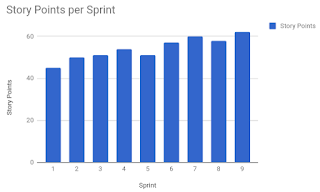 - **Sprint burndown chart:** it represents the evolution of work to do within the sprint. The x-axis represents the time (days of the sprint) and the y-axis represents the story points. The day 0 will have the number of story points that the team committed to in the sprint planning meeting. Each day you decrement the number of points that were completed until that day. Hopefully in the last day of the sprint you’ll have 0 points to complete, meaning that the team completed all the user stories that it has committed to. This chart enables the team to follow up the stories that were finished and those that, to this day, were not, giving a good idea if the team is inline with its forecast. Sometimes this chart also includes a straight line linking the point in the day 0 of the sprint (with the initial number of story points) to the last day of the sprint (with 0 points). The user story completion should follow, has close as possible, this straight line. If this is not the case, it may mean that, either the tasks/user stories should be broken down into granular pieces or that corrective measures should be applied 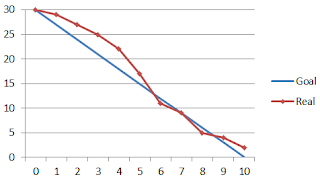 Besides these two metrics proposed by Scrum there are several others that also provide a good help on tracking the team performance and evolution. Here are two examples that I find interesting and that I already used in my professional activity: - **Cumulative flow diagram:** it allows the team to track the project evolution and to find bottlenecks. It shows the distribution of stories per state along the span of a project. The x-axis represents the time and the y-axis shows the number of stories. Each day you add all the stories in the system (organized per state) and represent them in the diagram. An ideal diagram would be a smooth growing set of lines or bands. If you find “bubbles” or “gaps” in any line or band, it means that you have a bottleneck somewhere: you must find it and correct it 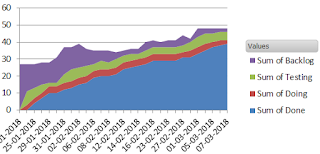 - **Committed vs completed user stories:** For each sprint, it measures the percentage of work completed related to the work that the team thought it would complete at the sprint planning. It gives the idea of team accomplishment and also the ability of the team to understand the requirements and predict its capabilities. In the other hand, we can also use this metric to take conclusions about the availability of relevant information or the quality of the user stories’ content at the sprint planning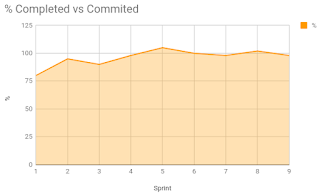 There are much more metrics that can be used in Scrum (the imagination is your limit). The most important part is that the team must be aware of these metrics and should “believe" in them. Otherwise they will be ignored or even worse: cheated in order to achieve the objectives. You must also remember that you should always choose very carefully what you measure. The KPIs should be aligned with what you want to monitor and improve. If they are not, eventually you’ll end up to optimize what you measure and not what you want. So choose wisely and the results will bring the team’s success. |
| json metadata | {"tags":["scrum","agile","kpi","project","management"],"image":["https://steemitimages.com/DQma3UUfjQStiFXtTuWoBWndk5Ay3ajqPJPvZc6NTrJMvot/image.png","https://steemitimages.com/DQmchF5bfQNHS4Vccm7KEaDGVYfqDffqxRjSwwcpotJHaXR/image.png","https://steemitimages.com/DQmVzMdgLTrmirtbdRLQtExcWaSnx94LMDCrQzLkrwm2uW3/image.png","https://steemitimages.com/DQmRW9yQEdyzF8VeuettSfp6R9BMfRrajeipf1HMdSKURpR/image.png"],"app":"steemit/0.1","format":"markdown"} |
| Transaction Info | Block #20766174/Trx 7ed6f21cd6d89581092c16d0e351f8bbc84d74b9 |
View Raw JSON Data
{
"trx_id": "7ed6f21cd6d89581092c16d0e351f8bbc84d74b9",
"block": 20766174,
"trx_in_block": 12,
"op_in_trx": 0,
"virtual_op": 0,
"timestamp": "2018-03-17T22:23:57",
"op": [
"comment",
{
"parent_author": "",
"parent_permlink": "scrum",
"author": "luismmribeiro",
"permlink": "how-to-measure-scrum",
"title": "How to measure Scrum?",
"body": "There is a saying, that I like very much, that states: *“you can’t manage what you can’t measure\"*. Scrum is no exception. However there is a common misconception about agile methodologies such as Scrum: it is not supposed to be measured. In fact, in my humble opinion, Scrum has the right characteristics and the proper motivation to be easily measured and controlled. Why?:\n- Scrum is oriented for quality and improvement. How can you know that you are improving or that you achieved your goal (quality) if you don’t measure it?\n- As opposition to other methodologies, the main measures proposed by Scrum are very easy to collect\n\nThere are 2 metrics proposed by Scrum that are quite common:\n- **Velocity:** it measures the quantity of work finished in a sprint. You calculate it by adding the story points of all the user stories that arrived at the state of “Done\" in a given sprint (I will describe what story points are and how story points are obtained in a future post). Velocity enables the comparison of performance between sprints. So, if you implement changes in a Sprint, velocity provides you the possibility to measure if this modification brought a performance increase to the team comparing its velocity to the previous sprints’ velocity. Theoretically the velocity should have a slow but steady growth during the project. However you should consider that velocity is based on story points which measure the complexity of the user story and are estimated by the team. But the team perception of complexity varies throughout the project\n\n- **Sprint burndown chart:** it represents the evolution of work to do within the sprint. The x-axis represents the time (days of the sprint) and the y-axis represents the story points. The day 0 will have the number of story points that the team committed to in the sprint planning meeting. Each day you decrement the number of points that were completed until that day. Hopefully in the last day of the sprint you’ll have 0 points to complete, meaning that the team completed all the user stories that it has committed to. This chart enables the team to follow up the stories that were finished and those that, to this day, were not, giving a good idea if the team is inline with its forecast. Sometimes this chart also includes a straight line linking the point in the day 0 of the sprint (with the initial number of story points) to the last day of the sprint (with 0 points). The user story completion should follow, has close as possible, this straight line. If this is not the case, it may mean that, either the tasks/user stories should be broken down into granular pieces or that corrective measures should be applied\n\n\nBesides these two metrics proposed by Scrum there are several others that also provide a good help on tracking the team performance and evolution. Here are two examples that I find interesting and that I already used in my professional activity:\n- **Cumulative flow diagram:** it allows the team to track the project evolution and to find bottlenecks. It shows the distribution of stories per state along the span of a project. The x-axis represents the time and the y-axis shows the number of stories. Each day you add all the stories in the system (organized per state) and represent them in the diagram. An ideal diagram would be a smooth growing set of lines or bands. If you find “bubbles” or “gaps” in any line or band, it means that you have a bottleneck somewhere: you must find it and correct it\n\n- **Committed vs completed user stories:** For each sprint, it measures the percentage of work completed related to the work that the team thought it would complete at the sprint planning. It gives the idea of team accomplishment and also the ability of the team to understand the requirements and predict its capabilities. In the other hand, we can also use this metric to take conclusions about the availability of relevant information or the quality of the user stories’ content at the sprint planning\n\nThere are much more metrics that can be used in Scrum (the imagination is your limit). The most important part is that the team must be aware of these metrics and should “believe\" in them. Otherwise they will be ignored or even worse: cheated in order to achieve the objectives. You must also remember that you should always choose very carefully what you measure. The KPIs should be aligned with what you want to monitor and improve. If they are not, eventually you’ll end up to optimize what you measure and not what you want. So choose wisely and the results will bring the team’s success.",
"json_metadata": "{\"tags\":[\"scrum\",\"agile\",\"kpi\",\"project\",\"management\"],\"image\":[\"https://steemitimages.com/DQma3UUfjQStiFXtTuWoBWndk5Ay3ajqPJPvZc6NTrJMvot/image.png\",\"https://steemitimages.com/DQmchF5bfQNHS4Vccm7KEaDGVYfqDffqxRjSwwcpotJHaXR/image.png\",\"https://steemitimages.com/DQmVzMdgLTrmirtbdRLQtExcWaSnx94LMDCrQzLkrwm2uW3/image.png\",\"https://steemitimages.com/DQmRW9yQEdyzF8VeuettSfp6R9BMfRrajeipf1HMdSKURpR/image.png\"],\"app\":\"steemit/0.1\",\"format\":\"markdown\"}"
}
]
}luismmribeiroupvoted (100.00%) @luismmribeiro / what-is-scrum2018/03/17 22:04:18
luismmribeiroupvoted (100.00%) @luismmribeiro / what-is-scrum
2018/03/17 22:04:18
| voter | luismmribeiro |
| author | luismmribeiro |
| permlink | what-is-scrum |
| weight | 10000 (100.00%) |
| Transaction Info | Block #20765781/Trx 8efa898a7762bafa6aa808eb26a6daf743460a64 |
View Raw JSON Data
{
  "trx_id": "8efa898a7762bafa6aa808eb26a6daf743460a64",
  "block": 20765781,
  "trx_in_block": 62,
  "op_in_trx": 0,
  "virtual_op": 0,
  "timestamp": "2018-03-17T22:04:18",
  "op": [
    "vote",
    {
      "voter": "luismmribeiro",
      "author": "luismmribeiro",
      "permlink": "what-is-scrum",
      "weight": 10000
    }
  ]
}luismmribeiropublished a new post: what-is-scrum2018/03/17 22:04:18
luismmribeiropublished a new post: what-is-scrum
2018/03/17 22:04:18
| parent author | |
| parent permlink | scrum |
| author | luismmribeiro |
| permlink | what-is-scrum |
| title | What is Scrum? |
| body | Scrum is one of the most famous agile methodologies. Its history can be traced back to a 1986 Harvard Business Review article, *“The New Product Development Game”* where Hirotaka Takeuchi and Ikujiro Nonaka introduced the term scrum in the context of product development. Scrum proposes two main concepts: - Decomposition of the work in short cycles of delivery and feedback - Empowering teams and trusting them to optimize their work The idea is to provide a framework to enable the team to organize itself around the context it is in and the available work, to find the best way to perform the work properly and to remove impediments. # Scrum Roles Scrum defines three roles that will keep the process flowing: - **Scrum Master:** which is responsible for making sure that the scrum process is being properly used and followed. Besides that, (s)he is also in charge for removing impediments from the team’s way - **Product Owner:** which is the voice of the customer next to the team. A PO has the responsibilities of define the priorities, manage the backlog and, above all, maximize the value of the product and the work of the team - **Team:** which is the group of people that really does the job. The team is responsible to find the most productive way of performing the work at hands. Usually the team should have between 3 and 8 people # Scrum Ceremonies Scrum defines a set of events or ceremonies that are always time limited and quality oriented. This time limitation is based on the concept that meetings are non productive time by definition and that developers should spend the most of their time doing what they are good at: developing great software! Besides that, they provide opportunities to plan the activities to foster predictability of results and, in the end, a quality work. Here you can find the list of ceremonies proposed by Scrum: - **Sprint:** The sprint is the unit of delivery and feedback. It is in a sprint that the real work happens. It usually takes between 2 and 4 weeks. This duration is defined by the team in conjunction with the scrum master and the product owner to maximize product value. Once the sprint duration is defined in the beginning of the project, it should remain the same during all the project - **Sprint planning:** this meeting is used to plan the work of the present sprint: the sprint backlog tasks are selected and estimated. The meeting is led by the scrum master and both the team members and the product owner must be present. The product owner should provide all kinds of clarification to enable a correct estimation and the grooming of the backlog items and sprint backlog definition. Once the sprint backlog is defined no changes should be accepted during the sprint (this rule can only be broken on very special situations and should be very uncommon). The duration of this meeting should be 2h per sprint week (for instance, a 2 weeks sprint should have a 4h sprint planning meeting duration) - **Daily stand up:** these meetings are the most well known and widespread, but not always well used meetings. Usually they involve the scrum master and the team. However, the product owner may also attend these meetings. They occur every day (usually at the beginning of the day) and they take, at most, 15 minutes. Everyone should be on their feet to incentive a quick meeting. The main purpose of these meetings is to plan the work day. Here each team member should report the main difficulties that (s)he is facing and the risks that (s)he foresees for this day. All the remaining subjects should be issued outside these meetings. It is the scrum master’s task to lead these meetings and ensure that they are quick and effective - **Sprint review:** this meeting is led by the scrum master and should be attended by the team, the product owner and other stakeholders invited by the product owner that may be relevant for the product or the specific features of this sprint. The duration of this meeting should be 1h per sprint week (for instance, a 2 weeks sprint should have a 2h sprint review meeting duration). In this meeting all the work performed (and finished) during the sprint will be presented to the product owner and relevant stakeholders. The attendees will, in turn, provide relevant feedback to the development team. The idea is always to show the increment of the sprint in the working product and collect relevant feedback to increase the product value. Now, with all this relevant people at the table is also time to discuss the next steps of the project in order to maximize the product value. This discussion will have, as output, a product backlog update - **Sprint retrospective:** this meeting is led by the scrum master and should be attended by the team. The duration of this meeting should be 1h per sprint week (for instance, a 2 weeks sprint should have a 2h sprint retrospective meeting duration). This meeting occurs after the sprint review and before the sprint planning meeting of the next sprint. Its goal is to analyze the sprint that is finishing and propose improvements to the next sprints in order to make the next sprints’ outcome more effective # Scrum Artifacts Scrum works around several artifacts that support all the process. I will describe here the ones that I think are important to the process itself. There are others that are important for the management of the process that I will refer and describe in detail in future posts. - **Product backlog:** describes all the work that needs to be done in order to finish the project/product. It is an ordered list of items and it is constantly improving - **Sprint backlog:** is a set of work select to the current sprint and a plan to complete it. It should be kept unchanged until the end of its sprint. The set of work is selected on the sprint planning meeting and should be dimensioned in order to be accomplished during the sprint. For quality improvement purposes it should include at least one high priority process improvement identified in the previous retrospective meeting - **Increment:** is the set of product backlog items that were finished during this sprint. This artifact will be very important for the measurement of the process and team improvement - **User story:** describes, from the user’s perspective, a feature that a user can use. A product/sprint backlog is composed by user stories and, when needed and the product owner accepts it, technical items # Adding all up Ideally a project may start with a set of user stories in the product backlog (however, in the real word, it may start with just an idea in someone’s head or a diffuse description of some requirements). There may be one or more sprints dedicated to the grooming (definition) of user stories or even to the technical project setup. Usually these initial setup sprints may start to include “normal” user stories. Hopefully as the team and the project stabilizes, there will be more and more percentage of “normal" user stories. A sprint should start with a sprint planning meeting. In this meeting a sprint backlog is extracted from the product backlog. Each of the following days of the sprint you’ll have a daily stand up meeting where the team organizes itself to accomplish all the items of the sprint backlog. At the end of the sprint, the accomplished items (comprising the sprint increment) are presented during the sprint review. Immediately after this meeting, a sprint retrospective should be held. Here all the problems that were faced during the sprint should be addressed and solutions should be proposed in order to improve the overall process. At the end of this meeting the sprint is officially finished and a new sprint with the correspondent sprint planning should be started. And all the process starts again. # Conclusion These are the basics about Scrum. In future posts I will enter in more detail about each of these parts, how they relate to each other and how all the process can be measured or, in other works, managed. |
| json metadata | {"tags":["scrum","agile","project","management","team"],"app":"steemit/0.1","format":"markdown"} |
| Transaction Info | Block #20765781/Trx 8efa898a7762bafa6aa808eb26a6daf743460a64 |
View Raw JSON Data
{
  "trx_id": "8efa898a7762bafa6aa808eb26a6daf743460a64",
  "block": 20765781,
  "trx_in_block": 62,
  "op_in_trx": 0,
  "virtual_op": 0,
  "timestamp": "2018-03-17T22:04:18",
  "op": [
    "comment",
    {
      "parent_author": "",
      "parent_permlink": "scrum",
      "author": "luismmribeiro",
      "permlink": "what-is-scrum",
      "title": "What is Scrum?",
      "body": "Scrum is one of the most famous agile methodologies. Its history can be traced back to a 1986 Harvard Business Review article, *“The New Product Development Game”* where Hirotaka Takeuchi and Ikujiro Nonaka introduced the term scrum in the context of product development.\nScrum proposes two main concepts:\n- Decomposition of the work in short cycles of delivery and feedback\n- Empowering teams and trusting them to optimize their work\n\nThe idea is to provide a framework to enable the team to organize itself around the context it is in and the available work, to find the best way to perform the work properly and to remove impediments.\n\n# Scrum Roles\nScrum defines three roles that will keep the process flowing:\n- **Scrum Master:** which is responsible for making sure that the scrum process is being properly used and followed. Besides that, (s)he is also in charge for removing impediments from the team’s way\n- **Product Owner:** which is the voice of the customer next to the team. A PO has the responsibilities of define the priorities, manage the backlog and, above all, maximize the value of the product and the work of the team\n- **Team:** which is the group of people that really does the job. The team is responsible to find the most productive way of performing the work at hands. Usually the team should have between 3 and 8 people\n# Scrum Ceremonies\nScrum defines a set of events or ceremonies that are always time limited and quality oriented. This time limitation is based on the concept that meetings are non productive time by definition and that developers should spend the most of their time doing what they are good at: developing great software! Besides that, they provide opportunities to plan the activities to foster predictability of results and, in the end, a quality work. Here you can find the list of ceremonies proposed by Scrum:\n- **Sprint:** The sprint is the unit of delivery and feedback. It is in a sprint that the real work happens. It usually takes between 2 and 4 weeks. This duration is defined by the team in conjunction with the scrum master and the product owner to maximize product value. Once the sprint duration is defined in the beginning of the project, it should remain the same during all the project\n- **Sprint planning:** this meeting is used to plan the work of the present sprint: the sprint backlog tasks are selected and estimated. The meeting is led by the scrum master and both the team members and the product owner must be present. The product owner should provide all kinds of clarification to enable a correct estimation and the grooming of the backlog items and sprint backlog definition. Once the sprint backlog is defined no changes should be accepted during the sprint (this rule can only be broken on very special situations and should be very uncommon). The duration of this meeting should be 2h per sprint week (for instance, a 2 weeks sprint should have a 4h sprint planning meeting duration)\n- **Daily stand up:** these meetings are the most well known and widespread, but not always well used meetings. Usually they involve the scrum master and the team. However, the product owner may also attend these meetings. They occur every day (usually at the beginning of the day) and they take, at most, 15 minutes. Everyone should be on their feet to incentive a quick meeting. The main purpose of these meetings is to plan the work day. Here each team member should report the main difficulties that (s)he is facing and the risks that (s)he foresees for this day. All the remaining subjects should be issued outside these meetings. It is the scrum master’s task to lead these meetings and ensure that they are quick and effective\n- **Sprint review:** this meeting is led by the scrum master and should be attended by the team, the product owner and other stakeholders invited by the product owner that may be relevant for the product or the specific features of this sprint. The duration of this meeting should be 1h per sprint week (for instance, a 2 weeks sprint should have a 2h sprint review meeting duration). In this meeting all the work performed (and finished) during the sprint will be presented to the product owner and relevant stakeholders. The attendees will, in turn, provide relevant feedback to the development team. The idea is always to show the increment of the sprint in the working product and collect relevant feedback to increase the product value. Now, with all this relevant people at the table is also time to discuss the next steps of the project in order to maximize the product value. This discussion will have, as output, a product backlog update\n- **Sprint retrospective:** this meeting is led by the scrum master and should be attended by the team. The duration of this meeting should be 1h per sprint week (for instance, a 2 weeks sprint should have a 2h sprint retrospective meeting duration). This meeting occurs after the sprint review and before the sprint planning meeting of the next sprint. Its goal is to analyze the sprint that is finishing and propose improvements to the next sprints in order to make the next sprints’ outcome more effective\n# Scrum Artifacts\nScrum works around several artifacts that support all the process. I will describe here the ones that I think are important to the process itself. There are others that are important for the management of the process that I will refer and describe in detail in future posts.\n- **Product backlog:** describes all the work that needs to be done in order to finish the project/product. It is an ordered list of items and it is constantly improving\n- **Sprint backlog:** is a set of work select to the current sprint and a plan to complete it. It should be kept unchanged until the end of its sprint. The set of work is selected on the sprint planning meeting and should be dimensioned in order to be accomplished during the sprint. For quality improvement purposes it should include at least one high priority process improvement identified in the previous retrospective meeting\n- **Increment:** is the set of product backlog items that were finished during this sprint. This artifact will be very important for the measurement of the process and team improvement\n- **User story:** describes, from the user’s perspective, a feature that a user can use. A product/sprint backlog is composed by user stories and, when needed and the product owner accepts it, technical items\n# Adding all up\nIdeally a project may start with a set of user stories in the product backlog (however, in the real word, it may start with just an idea in someone’s head or a diffuse description of some requirements). There may be one or more sprints dedicated to the grooming (definition) of user stories or even to the technical project setup. Usually these initial setup sprints may start to include “normal” user stories. Hopefully as the team and the project stabilizes, there will be more and more percentage of “normal\" user stories.\nA sprint should start with a sprint planning meeting. In this meeting a sprint backlog is extracted from the product backlog. Each of the following days of the sprint you’ll have a daily stand up meeting where the team organizes itself to accomplish all the items of the sprint backlog. At the end of the sprint, the accomplished items (comprising the sprint increment) are presented during the sprint review. Immediately after this meeting, a sprint retrospective should be held. Here all the problems that were faced during the sprint should be addressed and solutions should be proposed in order to improve the overall process. At the end of this meeting the sprint is officially finished and a new sprint with the correspondent sprint planning should be started. And all the process starts again.\n# Conclusion\nThese are the basics about Scrum. In future posts I will enter in more detail about each of these parts, how they relate to each other and how all the process can be measured or, in other works, managed.",
      "json_metadata": "{\"tags\":[\"scrum\",\"agile\",\"project\",\"management\",\"team\"],\"app\":\"steemit/0.1\",\"format\":\"markdown\"}"
    }
  ]
}luismmribeiroupvoted (100.00%) @storiesofbrad / scrum-master2018/03/17 14:43:15
luismmribeiroupvoted (100.00%) @storiesofbrad / scrum-master
2018/03/17 14:43:15
| voter | luismmribeiro |
| author | storiesofbrad |
| permlink | scrum-master |
| weight | 10000 (100.00%) |
| Transaction Info | Block #20756964/Trx 6a0d49b0472cb06ee9e00843366a036f72dcf18a |
View Raw JSON Data
{
  "trx_id": "6a0d49b0472cb06ee9e00843366a036f72dcf18a",
  "block": 20756964,
  "trx_in_block": 29,
  "op_in_trx": 0,
  "virtual_op": 0,
  "timestamp": "2018-03-17T14:43:15",
  "op": [
    "vote",
    {
      "voter": "luismmribeiro",
      "author": "storiesofbrad",
      "permlink": "scrum-master",
      "weight": 10000
    }
  ]
}luismmribeiroupdated their account properties2018/03/17 14:08:36
luismmribeiroupdated their account properties
2018/03/17 14:08:36
| account | luismmribeiro |
| memo key | STM6jpw1iotknrSE98tU5FJ9GQg7uQkSgscNtPg6JCWXc6t4U9d7K |
| json metadata | {"profile":{"profile_image":"https://media.licdn.com/dms/image/C5603AQFtaGTpypq5eg/profile-displayphoto-shrink_800_800/0?e=1526482800&v=alpha&t=pJqt8viETj-aJaqkEI_7ZalLCESkbNjGMLE0OOPI0nk","name":"Luis Ribeiro"}} |
| Transaction Info | Block #20756271/Trx de8933278a0b8c4f8d465e388294c133178c284c |
View Raw JSON Data
{
  "trx_id": "de8933278a0b8c4f8d465e388294c133178c284c",
  "block": 20756271,
  "trx_in_block": 83,
  "op_in_trx": 0,
  "virtual_op": 0,
  "timestamp": "2018-03-17T14:08:36",
  "op": [
    "account_update",
    {
      "account": "luismmribeiro",
      "memo_key": "STM6jpw1iotknrSE98tU5FJ9GQg7uQkSgscNtPg6JCWXc6t4U9d7K",
      "json_metadata": "{\"profile\":{\"profile_image\":\"https://media.licdn.com/dms/image/C5603AQFtaGTpypq5eg/profile-displayphoto-shrink_800_800/0?e=1526482800&v=alpha&t=pJqt8viETj-aJaqkEI_7ZalLCESkbNjGMLE0OOPI0nk\",\"name\":\"Luis Ribeiro\"}}"
    }
  ]
}luismmribeiroupvoted (100.00%) @luismmribeiro / how-about-agile2018/03/17 14:01:12
luismmribeiroupvoted (100.00%) @luismmribeiro / how-about-agile
2018/03/17 14:01:12
| voter | luismmribeiro |
| author | luismmribeiro |
| permlink | how-about-agile |
| weight | 10000 (100.00%) |
| Transaction Info | Block #20756123/Trx 102caf3e2d2b12351270e18512e219e138b8b47d |
View Raw JSON Data
{
  "trx_id": "102caf3e2d2b12351270e18512e219e138b8b47d",
  "block": 20756123,
  "trx_in_block": 20,
  "op_in_trx": 0,
  "virtual_op": 0,
  "timestamp": "2018-03-17T14:01:12",
  "op": [
    "vote",
    {
      "voter": "luismmribeiro",
      "author": "luismmribeiro",
      "permlink": "how-about-agile",
      "weight": 10000
    }
  ]
}luismmribeiropublished a new post: how-about-agile2018/03/17 14:01:12
luismmribeiropublished a new post: how-about-agile
2018/03/17 14:01:12
| parent author | |
| parent permlink | agile |
| author | luismmribeiro |
| permlink | how-about-agile |
| title | How about agile? |
| body | [Agile manifesto](http://agilemanifesto.org/) is around for about 17 years. Even so, there is a lot of unknowns and misconceptions about agile and agile methodologies. First of all let me start by showing the main and, for me, the most powerful declaration of the manifesto: **Individuals and interactions** over processes and tools **Working software** over comprehensive documentation **Customer collaboration** over contract negotiation **Responding to change** over following a plan That is, while there is value in the items on the right, we value the items on the left more. (Taken from Agile Manifesto: http://agilemanifesto.org/) As you can see in the last sentence, the manifesto guys recognize value and importance to processes, tools, documentation, contracts and planning. The only point is that they value MORE people, human contact and multidisciplinary teams, the working software and adaptation to changing requirements. Almost all of the 17 guys that developed the manifesto either had managing positions or they had their own companies. So, believe me, they knew the importance of a contract and what that mean. But, even so, they proposed a framework where the collaboration with customer, the adaptation to change and working software were more important than the contract which paid their salaries. Well, of course they cared about their salary and their companies: what they wanted is to get their customers happy by given them working software that fulfilled their needs. If these customers are happy they will spread the word and more customers would ask these guys for their services and everyone gets happy and with more money in their pockets. Hey, but isn’t that what everybody wants? The customers want to have its software done by the price they agreed (assuming a fixed price contract that still is the most used) and the provider wants the project done on schedule and on budget. Well, yes, but everyone has a different opinion on how to get there. # Waterfall vs Agile The agile manifesto just showed clearly that the waterfall methodology was being wrongly used for a great number of software development projects (there were also other methodologies that were a mid term between waterfall and agile, however they were not as widely used as waterfall, the *de facto* standard until then). Is like having a hammer and using it for everything. If you want to tighten a screw, if you hammer it enough times, eventually it will get stuck to the wall. However it is neither the right tool nor the most effective way to get a screw tighten. To tighten a screw you should use a screwdriver. The same happens with software development. Waterfall is the right development process to use when the requirements do not change much and you have clear objectives and application rules. Mathematical applications are good examples of that. First you learn the rules, master them and document them based on the clear goal that you have to your application, then you design your application based on the knowledge that you gained, then you code the application based on the design and finally you test it. It works well if you have a clear goal in mind and because the rules are objective and don’t change very often. The geometry invented by Euclid is still valid today. However, with a business application the same doesn’t happen. First of all, the rules are not clear to everyone (I’ve been in situations where they were clear to no one at all) neither the goal. Second, much of these rules to implement are subjective which means that different people have different answers to the same question of the developer/analyst. Third, and probably the most common one, the rules to implement and the goal change often during the development of the application which means that if you take, say, 3 months (to be optimistic) to do the analysis, then 4 months to do the design, then 7 months to development and another 4 months for testing and bug fixing… 1,5 years assuming that everything went for the best and that the project had a very competent project manager… This is a typical waterfall approach. How many applications do you know that don’t change during 1,5 years? Well, I’ve seen some, but far from being the majority. The bottom line is that waterfall and agile, both are good tools and both have proven its value. However, each should be used according to the characteristics of the project and the team. # Agile misconceptions There are some common mistakes that are linked to agile methodologies. Here you can find some of them: ### *Agile means no documentation* The minimum unit of documentation used in almost all the main agile methodologies is the user-story. This is the equivalent to a requirement or a use-case. It comprises a high-level description of what a customer wants to be done in a particular use-case. It is written or, at least, inspired by the customer and refined by anyone that participates in the project at anytime required. Not all the knowledge of the team is described by user stories (after all it is a slim and high-level description), but every single user-story is always the base of the job to be done by the team so it is always up-to-date. If the project or the team requires a more detailed documentation there will be specific user-stories or tasks that will take care of them. And this documentation is created ‘as required’ and not necessarily in the beginning of the project, since, as we all know, at the beginning of a project, things are not accurate by nature. ### *Agile has no planning* In my humble opinion, it is exactly the opposite: You do planning through all the project. The difference is: you plan what you can and need. Usually, at the beginning, you have a short high level plan that sets the goals, overall budget, priorities, but not specific days or duration. Then you do your planning for the first short period of time. At the end of that period you plan for the next short period of time and so on. This is similar to, but not exactly the same, as the rolling wave planning technique proposed by PMI. You plan what you need and leave the rest to the next period. Then, you will have more knowledge that will help you in the next planning step. Of course, all these short period plans take into account the high level plan created at the beginning. ### *Agile is only for software development* Agile methodologies propose guidelines for work delivered by a team. In fact, some of the most used methodologies (Kanban for instance) came from industry (automobile) and were later applied to software development. Besides that, there are now several areas successfully using agile methodologies to deliver their work. For instance IT support, finance, product development and marketing. ### *Agile needs no project manager* The agile team should organize/manage itself. However, you need someone to set the pace and guidelines of orientation. Undoubtedly the empowerment of the team and the individuals in the team help the “leader” (lets call it like this) and ease its work. However you will need someone to help the team to optimize its performance, to guide to product goals achievement, to follow the environment rules, to be on budget and on time. Depending on the methodology, you can have these tasks distributed by one or more roles. ### *Agile is good (bad) and waterfall is bad (good)* As stated before, every methodology has its own characteristics that will adapt better or worse to a given situation. Even “inside” agile, there are several different methodologies. Some adapt better to some cases than others. There is no universal panacea. You should evaluate the concrete case where you are and chose the methodology (waterfall or one agile methodology) that best suits your situation. Sometimes you must even change methodology after starting the project. It is the situation and not the methodology that defines what and how should be done to have good results. # Conclusion The agile methodologies arrived at the software industry in the early 2000’s and they proposed a new way of delivering software. Since then, nothing got back to the way it was before. A new way of thinking brought some sanity to the software world allowing cost reductions and quality improvement to many software projects. Does that mean that waterfall methodology is bad or is dead? No, because it still makes sense and it is the best choice in many types of situations. However a new option has emerged from the agile manifesto allowing you to be able to ask: “How about agile?”. |
| json metadata | {"tags":["agile","projectmanagement","scrum","waterfall"],"links":["http://agilemanifesto.org/"],"app":"steemit/0.1","format":"markdown"} |
| Transaction Info | Block #20756123/Trx 102caf3e2d2b12351270e18512e219e138b8b47d |
View Raw JSON Data
{
  "trx_id": "102caf3e2d2b12351270e18512e219e138b8b47d",
  "block": 20756123,
  "trx_in_block": 20,
  "op_in_trx": 0,
  "virtual_op": 0,
  "timestamp": "2018-03-17T14:01:12",
  "op": [
    "comment",
    {
      "parent_author": "",
      "parent_permlink": "agile",
      "author": "luismmribeiro",
      "permlink": "how-about-agile",
      "title": "How about agile?",
      "body": "[Agile manifesto](http://agilemanifesto.org/) is around for about 17 years. Even so, there is a lot of unknowns and misconceptions about agile and agile methodologies. First of all let me start by showing the main and, for me, the most powerful declaration of the manifesto:\n\n**Individuals and interactions** over processes and tools\n**Working software** over comprehensive documentation\n**Customer collaboration** over contract negotiation\n**Responding to change** over following a plan\n\nThat is, while there is value in the items on\nthe right, we value the items on the left more.\n(Taken from Agile Manifesto: http://agilemanifesto.org/)\n\nAs you can see in the last sentence, the manifesto guys recognize value and importance to processes, tools, documentation, contracts and planning. The only point is that they value MORE people, human contact and multidisciplinary teams, the working software and adaptation to changing requirements. Almost all of the 17 guys that developed the manifesto either had managing positions or they had their own companies. So, believe me, they knew the importance of a contract and what that mean. But, even so, they proposed a framework where the collaboration with customer, the adaptation to change and working software were more important than the contract which paid their salaries. Well, of course they cared about their salary and their companies: what they wanted is to get their customers happy by given them working software that fulfilled their needs. If these customers are happy they will spread the word and more customers would ask these guys for their services and everyone gets happy and with more money in their pockets. Hey, but isn’t that what everybody wants? The customers want to have its software done by the price they agreed (assuming a fixed price contract that still is the most used) and the provider wants the project done on schedule and on budget. Well, yes, but everyone has a different opinion on how to get there.\n\n# Waterfall vs Agile\nThe agile manifesto just showed clearly that the waterfall methodology was being wrongly used for a great number of software development projects (there were also other methodologies that were a mid term between waterfall and agile, however they were not as widely used as waterfall, the *de facto* standard until then). Is like having a hammer and using it for everything. If you want to tighten a screw, if you hammer it enough times, eventually it will get stuck to the wall. However it is neither the right tool nor the most effective way to get a screw tighten. To tighten a screw you should use a screwdriver. The same happens with software development. Waterfall is the right development process to use when the requirements do not change much and you have clear objectives and application rules. Mathematical applications are good examples of that. First you learn the rules, master them and document them based on the clear goal that you have to your application, then you design your application based on the knowledge that you gained, then you code the application based on the design and finally you test it. It works well if you have a clear goal in mind and because the rules are objective and don’t change very often. The geometry invented by Euclid is still valid today. However, with a business application the same doesn’t happen. First of all, the rules are not clear to everyone (I’ve been in situations where they were clear to no one at all) neither the goal. Second, much of these rules to implement are subjective which means that different people have different answers to the same question of the developer/analyst. Third, and probably the most common one, the rules to implement and the goal change often during the development of the application which means that if you take, say, 3 months (to be optimistic) to do the analysis, then 4 months to do the design, then 7 months to development and another 4 months for testing and bug fixing… 1,5 years assuming that everything went for the best and that the project had a very competent project manager… This is a typical waterfall approach. How many applications do you know that don’t change during 1,5 years? Well, I’ve seen some, but far from being the majority.\n\nThe bottom line is that waterfall and agile, both are good tools and both have proven its value. However, each should be used according to the characteristics of the project and the team.\n\n# Agile misconceptions\nThere are some common mistakes that are linked to agile methodologies. Here you can find some of them:\n\n### *Agile means no documentation*\nThe minimum unit of documentation used in almost all the main agile methodologies is the user-story. This is the equivalent to a requirement or a use-case. It comprises a high-level description of what a customer wants to be done in a particular use-case. It is written or, at least, inspired by the customer and refined by anyone that participates in the project at anytime required. Not all the knowledge of the team is described by user stories (after all it is a slim and high-level description), but every single user-story is always the base of the job to be done by the team so it is always up-to-date. If the project or the team requires a more detailed documentation there will be specific user-stories or tasks that will take care of them. And this documentation is created ‘as required’ and not necessarily in the beginning of the project, since, as we all know, at the beginning of a project, things are not accurate by nature.\n\n### *Agile has no planning*\nIn my humble opinion, it is exactly the opposite: You do planning through all the project. The difference is: you plan what you can and need. Usually, at the beginning, you have a short high level plan that sets the goals, overall budget, priorities, but not specific days or duration. Then you do your planning for the first short period of time. At the end of that period you plan for the next short period of time and so on. This is similar to, but not exactly the same, as the rolling wave planning technique proposed by PMI. You plan what you need and leave the rest to the next period. Then, you will have more knowledge that will help you in the next planning step. Of course, all these short period plans take into account the high level plan created at the beginning.\n\n### *Agile is only for software development*\nAgile methodologies propose guidelines for work delivered by a team. In fact, some of the most used methodologies (Kanban for instance) came from industry (automobile) and were later applied to software development. Besides that, there are now several areas successfully using agile methodologies to deliver their work. For instance IT support, finance, product development and marketing.\n\n### *Agile needs no project manager*\nThe agile team should organize/manage itself. However, you need someone to set the pace and guidelines of orientation. Undoubtedly the empowerment of the team and the individuals in the team help the “leader” (lets call it like this) and ease its work. However you will need someone to help the team to optimize its performance, to guide to product goals achievement, to follow the environment rules, to be on budget and on time. Depending on the methodology, you can have these tasks distributed by one or more roles.\n\n### *Agile is good (bad) and waterfall is bad (good)*\nAs stated before, every methodology has its own characteristics that will adapt better or worse to a given situation. Even “inside” agile, there are several different methodologies. Some adapt better to some cases than others. There is no universal panacea. You should evaluate the concrete case where you are and chose the methodology (waterfall or one agile methodology) that best suits your situation. Sometimes you must even change methodology after starting the project. It is the situation and not the methodology that defines what and how should be done to have good results.\n\n# Conclusion\nThe agile methodologies arrived at the software industry in the early 2000’s and they proposed a new way of delivering software. Since then, nothing got back to the way it was before. A new way of thinking brought some sanity to the software world allowing cost reductions and quality improvement to many software projects. Does that mean that waterfall methodology is bad or is dead? No, because it still makes sense and it is the best choice in many types of situations. However a new option has emerged from the agile manifesto allowing you to be able to ask: “How about agile?”.",
      "json_metadata": "{\"tags\":[\"agile\",\"projectmanagement\",\"scrum\",\"waterfall\"],\"links\":[\"http://agilemanifesto.org/\"],\"app\":\"steemit/0.1\",\"format\":\"markdown\"}"
    }
  ]
}steemdelegated 18.679 SP to @luismmribeiro2018/03/16 23:34:57
steemdelegated 18.679 SP to @luismmribeiro
2018/03/16 23:34:57
| delegator | steem |
| delegatee | luismmribeiro |
| vesting shares | 30415.728316 VESTS |
| Transaction Info | Block #20738801/Trx 809cbec41f927cb1c7b27c367c6caa54680e2edd |
View Raw JSON Data
{
  "trx_id": "809cbec41f927cb1c7b27c367c6caa54680e2edd",
  "block": 20738801,
  "trx_in_block": 7,
  "op_in_trx": 0,
  "virtual_op": 0,
  "timestamp": "2018-03-16T23:34:57",
  "op": [
    "delegate_vesting_shares",
    {
      "delegator": "steem",
      "delegatee": "luismmribeiro",
      "vesting_shares": "30415.728316 VESTS"
    }
  ]
}steemcreated a new account: @luismmribeiro2018/03/16 22:39:15
steemcreated a new account: @luismmribeiro
2018/03/16 22:39:15
| fee | 0.100 STEEM |
| delegation | 30690.000000 VESTS |
| creator | steem |
| new account name | luismmribeiro |
| owner | {"weight_threshold":1,"account_auths":[],"key_auths":[["STM7jej7iU81ZgA4p8UaA4aBe5Cd32fga9xWwG8AMFxVPYMsEVDRS",1]]} |
| active | {"weight_threshold":1,"account_auths":[],"key_auths":[["STM5BG3mGYNgt1Qsk5vjWakPHgd8YmbmijdrYvhJWHbg3fmBMefK6",1]]} |
| posting | {"weight_threshold":1,"account_auths":[],"key_auths":[["STM7PADD1EubKQ5TLfwEofMgcaNDjaKXJkpjdhnzvAESKQnDV5vxJ",1]]} |
| memo key | STM6jpw1iotknrSE98tU5FJ9GQg7uQkSgscNtPg6JCWXc6t4U9d7K |
| json metadata | {} |
| extensions | [] |
| Transaction Info | Block #20737689/Trx 12f5100a5d7545b6b1f77b1bbd15e2412e746476 |
View Raw JSON Data
{
  "trx_id": "12f5100a5d7545b6b1f77b1bbd15e2412e746476",
  "block": 20737689,
  "trx_in_block": 11,
  "op_in_trx": 0,
  "virtual_op": 0,
  "timestamp": "2018-03-16T22:39:15",
  "op": [
    "account_create_with_delegation",
    {
      "fee": "0.100 STEEM",
      "delegation": "30690.000000 VESTS",
      "creator": "steem",
      "new_account_name": "luismmribeiro",
      "owner": {
        "weight_threshold": 1,
        "account_auths": [],
        "key_auths": [
          [
            "STM7jej7iU81ZgA4p8UaA4aBe5Cd32fga9xWwG8AMFxVPYMsEVDRS",
            1
          ]
        ]
      },
      "active": {
        "weight_threshold": 1,
        "account_auths": [],
        "key_auths": [
          [
            "STM5BG3mGYNgt1Qsk5vjWakPHgd8YmbmijdrYvhJWHbg3fmBMefK6",
            1
          ]
        ]
      },
      "posting": {
        "weight_threshold": 1,
        "account_auths": [],
        "key_auths": [
          [
            "STM7PADD1EubKQ5TLfwEofMgcaNDjaKXJkpjdhnzvAESKQnDV5vxJ",
            1
          ]
        ]
      },
      "memo_key": "STM6jpw1iotknrSE98tU5FJ9GQg7uQkSgscNtPg6JCWXc6t4U9d7K",
      "json_metadata": "{}",
      "extensions": []
    }
  ]
}Manabar
Voting Power100.00%
Downvote Power100.00%
Resource Credits100.00%
Reputation Progress0.00%
{
  "voting_manabar": {
    "current_mana": "8143659806",
    "last_update_time": 1779073770
  },
  "downvote_manabar": {
    "current_mana": 2035914951,
    "last_update_time": 1779073770
  },
  "rc_account": {
    "account": "luismmribeiro",
    "rc_manabar": {
      "current_mana": "10164408779",
      "last_update_time": 1779073770
    },
    "max_rc_creation_adjustment": {
      "amount": "2020748973",
      "precision": 6,
      "nai": "@@000000037"
    },
    "max_rc": "10164408779"
  }
}
Account Metadata
| POSTING JSON METADATA | |
| profile | {"profile_image":"https://media.licdn.com/dms/image/C5603AQFtaGTpypq5eg/profile-displayphoto-shrink_800_800/0?e=1526482800&v=alpha&t=pJqt8viETj-aJaqkEI_7ZalLCESkbNjGMLE0OOPI0nk","name":"Luis Ribeiro"} |
| JSON METADATA | |
| profile | {"profile_image":"https://media.licdn.com/dms/image/C5603AQFtaGTpypq5eg/profile-displayphoto-shrink_800_800/0?e=1526482800&v=alpha&t=pJqt8viETj-aJaqkEI_7ZalLCESkbNjGMLE0OOPI0nk","name":"Luis Ribeiro"} |
{
  "posting_json_metadata": {
    "profile": {
      "profile_image": "https://media.licdn.com/dms/image/C5603AQFtaGTpypq5eg/profile-displayphoto-shrink_800_800/0?e=1526482800&v=alpha&t=pJqt8viETj-aJaqkEI_7ZalLCESkbNjGMLE0OOPI0nk",
      "name": "Luis Ribeiro"
    }
  },
  "json_metadata": {
    "profile": {
      "profile_image": "https://media.licdn.com/dms/image/C5603AQFtaGTpypq5eg/profile-displayphoto-shrink_800_800/0?e=1526482800&v=alpha&t=pJqt8viETj-aJaqkEI_7ZalLCESkbNjGMLE0OOPI0nk",
      "name": "Luis Ribeiro"
    }
  }
}
Auth Keys
Owner
Single Signature
Public Keys
STM7jej7iU81ZgA4p8UaA4aBe5Cd32fga9xWwG8AMFxVPYMsEVDRS1/1
Active
Single Signature
Public Keys
STM5BG3mGYNgt1Qsk5vjWakPHgd8YmbmijdrYvhJWHbg3fmBMefK61/1
Posting
Single Signature
Public Keys
STM7PADD1EubKQ5TLfwEofMgcaNDjaKXJkpjdhnzvAESKQnDV5vxJ1/1
Memo
STM6jpw1iotknrSE98tU5FJ9GQg7uQkSgscNtPg6JCWXc6t4U9d7K
{
  "owner": {
    "weight_threshold": 1,
    "account_auths": [],
    "key_auths": [
      [
        "STM7jej7iU81ZgA4p8UaA4aBe5Cd32fga9xWwG8AMFxVPYMsEVDRS",
        1
      ]
    ]
  },
  "active": {
    "weight_threshold": 1,
    "account_auths": [],
    "key_auths": [
      [
        "STM5BG3mGYNgt1Qsk5vjWakPHgd8YmbmijdrYvhJWHbg3fmBMefK6",
        1
      ]
    ]
  },
  "posting": {
    "weight_threshold": 1,
    "account_auths": [],
    "key_auths": [
      [
        "STM7PADD1EubKQ5TLfwEofMgcaNDjaKXJkpjdhnzvAESKQnDV5vxJ",
        1
      ]
    ]
  },
  "memo": "STM6jpw1iotknrSE98tU5FJ9GQg7uQkSgscNtPg6JCWXc6t4U9d7K"
}
Witness Votes
0 / 30
No active witness votes.
[]