

@leadus
25LeadUS is a newly established study group that seeks to promote fikrah (thought) and leadership capabilities for the younger Muslim generation
steemit.com/@leadusVOTING POWER100.00%
DOWNVOTE POWER100.00%
RESOURCE CREDITS100.00%
REPUTATION PROGRESS0.00%
Net Worth
0.036USD
STEEM
0.000STEEM
SBD
0.000SBD
Effective Power
5.007SP
├── Own SP
0.629SP
└── Incoming DelegationsDeleg
+4.378SP
Detailed Balance
| STEEM | ||
| balance | 0.000STEEM | STEEM |
| market_balance | 0.000STEEM | STEEM |
| savings_balance | 0.000STEEM | STEEM |
| reward_steem_balance | 0.000STEEM | STEEM |
| STEEM POWER | ||
| Own SP | 0.629SP | SP |
| Delegated Out | 0.000SP | SP |
| Delegation In | 4.378SP | SP |
| Effective Power | 5.007SP | SP |
| Reward SP (pending) | 0.000SP | SP |
| SBD | ||
| sbd_balance | 0.000SBD | SBD |
| sbd_conversions | 0.000SBD | SBD |
| sbd_market_balance | 0.000SBD | SBD |
| savings_sbd_balance | 0.000SBD | SBD |
| reward_sbd_balance | 0.000SBD | SBD |
{
  "balance": "0.000 STEEM",
  "savings_balance": "0.000 STEEM",
  "reward_steem_balance": "0.000 STEEM",
  "vesting_shares": "1023.137868 VESTS",
  "delegated_vesting_shares": "0.000000 VESTS",
  "received_vesting_shares": "7120.521938 VESTS",
  "sbd_balance": "0.000 SBD",
  "savings_sbd_balance": "0.000 SBD",
  "reward_sbd_balance": "0.000 SBD",
  "conversions": []
}
Account Info
| name | leadus |
| id | 679259 |
| rank | 467,546 |
| reputation | 169039018 |
| created | 2018-01-29T14:17:42 |
| recovery_account | steem |
| proxy | None |
| post_count | 18 |
| comment_count | 0 |
| lifetime_vote_count | 0 |
| witnesses_voted_for | 0 |
| last_post | 2018-08-02T07:33:00 |
| last_root_post | 2018-08-02T07:33:00 |
| last_vote_time | 2018-05-02T07:37:00 |
| proxied_vsf_votes | 0, 0, 0, 0 |
| can_vote | 1 |
| voting_power | 0 |
| delayed_votes | 0 |
| balance | 0.000 STEEM |
| savings_balance | 0.000 STEEM |
| sbd_balance | 0.000 SBD |
| savings_sbd_balance | 0.000 SBD |
| vesting_shares | 1023.137868 VESTS |
| delegated_vesting_shares | 0.000000 VESTS |
| received_vesting_shares | 7120.521938 VESTS |
| reward_vesting_balance | 0.000000 VESTS |
| vesting_balance | 0.000 STEEM |
| vesting_withdraw_rate | 0.000000 VESTS |
| next_vesting_withdrawal | 1969-12-31T23:59:59 |
| withdrawn | 0 |
| to_withdraw | 0 |
| withdraw_routes | 0 |
| savings_withdraw_requests | 0 |
| last_account_recovery | 1970-01-01T00:00:00 |
| reset_account | null |
| last_owner_update | 1970-01-01T00:00:00 |
| last_account_update | 2018-01-30T15:40:39 |
| mined | No |
| sbd_seconds | 0 |
| sbd_last_interest_payment | 1970-01-01T00:00:00 |
| savings_sbd_last_interest_payment | 1970-01-01T00:00:00 |
{
  "active": {
    "account_auths": [],
    "key_auths": [
      [
        "STM6y2j3J7yqSfWgQGrXzGDZhuXbzijsB9GGsHG9M4B3tRtpJsd5g",
        1
      ]
    ],
    "weight_threshold": 1
  },
  "balance": "0.000 STEEM",
  "can_vote": true,
  "comment_count": 0,
  "created": "2018-01-29T14:17:42",
  "curation_rewards": 0,
  "delegated_vesting_shares": "0.000000 VESTS",
  "downvote_manabar": {
    "current_mana": 2035914951,
    "last_update_time": 1779072627
  },
  "guest_bloggers": [],
  "id": 679259,
  "json_metadata": "{\"profile\":{\"profile_image\":\"https://photos.app.goo.gl/yshEtYnw7iDbdI4l1\",\"cover_image\":\"https://photos.app.goo.gl/qulmHMz7zpbH2JSB3\",\"name\":\"LeadUS\",\"about\":\"LeadUS is a newly established study group that seeks to promote fikrah (thought) and leadership capabilities for the younger Muslim generation\"}}",
  "last_account_recovery": "1970-01-01T00:00:00",
  "last_account_update": "2018-01-30T15:40:39",
  "last_owner_update": "1970-01-01T00:00:00",
  "last_post": "2018-08-02T07:33:00",
  "last_root_post": "2018-08-02T07:33:00",
  "last_vote_time": "2018-05-02T07:37:00",
  "lifetime_vote_count": 0,
  "market_history": [],
  "memo_key": "STM6aYgnLu4tRmWmRSR8skvgg4Zyp69rMCgktPifg7pWriF8HdtNt",
  "mined": false,
  "name": "leadus",
  "next_vesting_withdrawal": "1969-12-31T23:59:59",
  "other_history": [],
  "owner": {
    "account_auths": [],
    "key_auths": [
      [
        "STM8Zj2BjpzkRZJfuZE5rJAQ6oyMw3yEgfCkxiHjL9jcaFhSRP5po",
        1
      ]
    ],
    "weight_threshold": 1
  },
  "pending_claimed_accounts": 0,
  "post_bandwidth": 0,
  "post_count": 18,
  "post_history": [],
  "posting": {
    "account_auths": [],
    "key_auths": [
      [
        "STM7DaAFp3URX1H6uhqNaRnon9HzKfhqa5JZZN14gJr1pU622fTQP",
        1
      ]
    ],
    "weight_threshold": 1
  },
  "posting_json_metadata": "{\"profile\":{\"profile_image\":\"https://photos.app.goo.gl/yshEtYnw7iDbdI4l1\",\"cover_image\":\"https://photos.app.goo.gl/qulmHMz7zpbH2JSB3\",\"name\":\"LeadUS\",\"about\":\"LeadUS is a newly established study group that seeks to promote fikrah (thought) and leadership capabilities for the younger Muslim generation\"}}",
  "posting_rewards": 0,
  "proxied_vsf_votes": [
    0,
    0,
    0,
    0
  ],
  "proxy": "",
  "received_vesting_shares": "7120.521938 VESTS",
  "recovery_account": "steem",
  "reputation": 169039018,
  "reset_account": "null",
  "reward_sbd_balance": "0.000 SBD",
  "reward_steem_balance": "0.000 STEEM",
  "reward_vesting_balance": "0.000000 VESTS",
  "reward_vesting_steem": "0.000 STEEM",
  "savings_balance": "0.000 STEEM",
  "savings_sbd_balance": "0.000 SBD",
  "savings_sbd_last_interest_payment": "1970-01-01T00:00:00",
  "savings_sbd_seconds": "0",
  "savings_sbd_seconds_last_update": "1970-01-01T00:00:00",
  "savings_withdraw_requests": 0,
  "sbd_balance": "0.000 SBD",
  "sbd_last_interest_payment": "1970-01-01T00:00:00",
  "sbd_seconds": "0",
  "sbd_seconds_last_update": "1970-01-01T00:00:00",
  "tags_usage": [],
  "to_withdraw": 0,
  "transfer_history": [],
  "vesting_balance": "0.000 STEEM",
  "vesting_shares": "1023.137868 VESTS",
  "vesting_withdraw_rate": "0.000000 VESTS",
  "vote_history": [],
  "voting_manabar": {
    "current_mana": "8143659806",
    "last_update_time": 1779072627
  },
  "voting_power": 0,
  "withdraw_routes": 0,
  "withdrawn": 0,
  "witness_votes": [],
  "witnesses_voted_for": 0,
  "rank": 467546
}
Withdraw Routes
| Incoming | Outgoing |
|---|---|
Empty | Empty |
{
  "incoming": [],
  "outgoing": []
}From Date
To Date
2026/05/18 02:50:27
2026/05/18 02:50:27
| delegator | steem |
| delegatee | leadus |
| vesting shares | 7120.521938 VESTS |
| Transaction Info | Block #106146539/Trx e6378238b6546742d3c559aac38b5f4cfe513dab |
View Raw JSON Data
{
  "trx_id": "e6378238b6546742d3c559aac38b5f4cfe513dab",
  "block": 106146539,
  "trx_in_block": 1,
  "op_in_trx": 0,
  "virtual_op": 0,
  "timestamp": "2026-05-18T02:50:27",
  "op": [
    "delegate_vesting_shares",
    {
      "delegator": "steem",
      "delegatee": "leadus",
      "vesting_shares": "7120.521938 VESTS"
    }
  ]
}2026/05/12 14:18:12
2026/05/12 14:18:12
| delegator | steem |
| delegatee | leadus |
| vesting shares | 4408.311533 VESTS |
| Transaction Info | Block #105988238/Trx b6e3ab7d4f74bc05e65ec2792a72bcdb1118a9d3 |
View Raw JSON Data
{
  "trx_id": "b6e3ab7d4f74bc05e65ec2792a72bcdb1118a9d3",
  "block": 105988238,
  "trx_in_block": 0,
  "op_in_trx": 0,
  "virtual_op": 0,
  "timestamp": "2026-05-12T14:18:12",
  "op": [
    "delegate_vesting_shares",
    {
      "delegator": "steem",
      "delegatee": "leadus",
      "vesting_shares": "4408.311533 VESTS"
    }
  ]
}2026/04/26 02:07:18
2026/04/26 02:07:18
| delegator | steem |
| delegatee | leadus |
| vesting shares | 7133.037694 VESTS |
| Transaction Info | Block #105514117/Trx 36750aa5bb81c2ceb5a71655408b01b017a25d5b |
View Raw JSON Data
{
  "trx_id": "36750aa5bb81c2ceb5a71655408b01b017a25d5b",
  "block": 105514117,
  "trx_in_block": 2,
  "op_in_trx": 0,
  "virtual_op": 0,
  "timestamp": "2026-04-26T02:07:18",
  "op": [
    "delegate_vesting_shares",
    {
      "delegator": "steem",
      "delegatee": "leadus",
      "vesting_shares": "7133.037694 VESTS"
    }
  ]
}2026/01/23 14:43:39
2026/01/23 14:43:39
| delegator | steem |
| delegatee | leadus |
| vesting shares | 4449.858352 VESTS |
| Transaction Info | Block #102860110/Trx d4658d6ef54c4d14fab86845514e38dc788d9123 |
View Raw JSON Data
{
  "trx_id": "d4658d6ef54c4d14fab86845514e38dc788d9123",
  "block": 102860110,
  "trx_in_block": 0,
  "op_in_trx": 0,
  "virtual_op": 0,
  "timestamp": "2026-01-23T14:43:39",
  "op": [
    "delegate_vesting_shares",
    {
      "delegator": "steem",
      "delegatee": "leadus",
      "vesting_shares": "4449.858352 VESTS"
    }
  ]
}2024/12/17 09:58:00
2024/12/17 09:58:00
| delegator | steem |
| delegatee | leadus |
| vesting shares | 4614.077549 VESTS |
| Transaction Info | Block #91306408/Trx 68915bb9dee09b8966a55ecfa98e38be1ab22f5e |
View Raw JSON Data
{
  "trx_id": "68915bb9dee09b8966a55ecfa98e38be1ab22f5e",
  "block": 91306408,
  "trx_in_block": 3,
  "op_in_trx": 0,
  "virtual_op": 0,
  "timestamp": "2024-12-17T09:58:00",
  "op": [
    "delegate_vesting_shares",
    {
      "delegator": "steem",
      "delegatee": "leadus",
      "vesting_shares": "4614.077549 VESTS"
    }
  ]
}2023/11/14 01:40:09
2023/11/14 01:40:09
| delegator | steem |
| delegatee | leadus |
| vesting shares | 4783.211081 VESTS |
| Transaction Info | Block #79860594/Trx 51adc73e6fba333af6ef3711e1828e53da480bf4 |
View Raw JSON Data
{
  "trx_id": "51adc73e6fba333af6ef3711e1828e53da480bf4",
  "block": 79860594,
  "trx_in_block": 1,
  "op_in_trx": 0,
  "virtual_op": 0,
  "timestamp": "2023-11-14T01:40:09",
  "op": [
    "delegate_vesting_shares",
    {
      "delegator": "steem",
      "delegatee": "leadus",
      "vesting_shares": "4783.211081 VESTS"
    }
  ]
}2023/09/22 00:52:15
2023/09/22 00:52:15
| delegator | steem |
| delegatee | leadus |
| vesting shares | 7720.489867 VESTS |
| Transaction Info | Block #78351468/Trx 5d6fabb3d65c48e8cc4d5ac61f53da428517c2ec |
View Raw JSON Data
{
  "trx_id": "5d6fabb3d65c48e8cc4d5ac61f53da428517c2ec",
  "block": 78351468,
  "trx_in_block": 5,
  "op_in_trx": 0,
  "virtual_op": 0,
  "timestamp": "2023-09-22T00:52:15",
  "op": [
    "delegate_vesting_shares",
    {
      "delegator": "steem",
      "delegatee": "leadus",
      "vesting_shares": "7720.489867 VESTS"
    }
  ]
}2022/11/03 14:17:15
2022/11/03 14:17:15
| delegator | steem |
| delegatee | leadus |
| vesting shares | 7942.171305 VESTS |
| Transaction Info | Block #69116346/Trx 0d9f99c7ed77b4452dee6ed1a6e362821252e45f |
View Raw JSON Data
{
  "trx_id": "0d9f99c7ed77b4452dee6ed1a6e362821252e45f",
  "block": 69116346,
  "trx_in_block": 0,
  "op_in_trx": 0,
  "virtual_op": 0,
  "timestamp": "2022-11-03T14:17:15",
  "op": [
    "delegate_vesting_shares",
    {
      "delegator": "steem",
      "delegatee": "leadus",
      "vesting_shares": "7942.171305 VESTS"
    }
  ]
}2022/01/17 17:35:54
2022/01/17 17:35:54
| delegator | steem |
| delegatee | leadus |
| vesting shares | 8162.406441 VESTS |
| Transaction Info | Block #60817346/Trx 1ad33b8adfb173accbdc240e1c43318dc26ad474 |
View Raw JSON Data
{
  "trx_id": "1ad33b8adfb173accbdc240e1c43318dc26ad474",
  "block": 60817346,
  "trx_in_block": 0,
  "op_in_trx": 0,
  "virtual_op": 0,
  "timestamp": "2022-01-17T17:35:54",
  "op": [
    "delegate_vesting_shares",
    {
      "delegator": "steem",
      "delegatee": "leadus",
      "vesting_shares": "8162.406441 VESTS"
    }
  ]
}2021/06/14 03:08:54
2021/06/14 03:08:54
| delegator | steem |
| delegatee | leadus |
| vesting shares | 8346.473194 VESTS |
| Transaction Info | Block #54610508/Trx 7a90df7768b943b0e23a0b8425ecd65a1e9cb865 |
View Raw JSON Data
{
  "trx_id": "7a90df7768b943b0e23a0b8425ecd65a1e9cb865",
  "block": 54610508,
  "trx_in_block": 7,
  "op_in_trx": 0,
  "virtual_op": 0,
  "timestamp": "2021-06-14T03:08:54",
  "op": [
    "delegate_vesting_shares",
    {
      "delegator": "steem",
      "delegatee": "leadus",
      "vesting_shares": "8346.473194 VESTS"
    }
  ]
}2020/12/11 13:24:48
2020/12/11 13:24:48
| delegator | steem |
| delegatee | leadus |
| vesting shares | 8533.895168 VESTS |
| Transaction Info | Block #49357879/Trx 4bfac544e530b5ad7ef9b1d3a307cbe35a1706a8 |
View Raw JSON Data
{
  "trx_id": "4bfac544e530b5ad7ef9b1d3a307cbe35a1706a8",
  "block": 49357879,
  "trx_in_block": 2,
  "op_in_trx": 0,
  "virtual_op": 0,
  "timestamp": "2020-12-11T13:24:48",
  "op": [
    "delegate_vesting_shares",
    {
      "delegator": "steem",
      "delegatee": "leadus",
      "vesting_shares": "8533.895168 VESTS"
    }
  ]
}2020/12/06 07:01:15
2020/12/06 07:01:15
| delegator | steem |
| delegatee | leadus |
| vesting shares | 1912.543513 VESTS |
| Transaction Info | Block #49209424/Trx f4a76060aa59b0b5e21d25c8a8d8e2f0d26f521a |
View Raw JSON Data
{
  "trx_id": "f4a76060aa59b0b5e21d25c8a8d8e2f0d26f521a",
  "block": 49209424,
  "trx_in_block": 9,
  "op_in_trx": 0,
  "virtual_op": 0,
  "timestamp": "2020-12-06T07:01:15",
  "op": [
    "delegate_vesting_shares",
    {
      "delegator": "steem",
      "delegatee": "leadus",
      "vesting_shares": "1912.543513 VESTS"
    }
  ]
}2020/12/05 17:02:45
2020/12/05 17:02:45
| delegator | steem |
| delegatee | leadus |
| vesting shares | 8540.103022 VESTS |
| Transaction Info | Block #49192968/Trx e940b6f9ba7ed59f0e5b955d100c95ee7cb5cbed |
View Raw JSON Data
{
  "trx_id": "e940b6f9ba7ed59f0e5b955d100c95ee7cb5cbed",
  "block": 49192968,
  "trx_in_block": 4,
  "op_in_trx": 0,
  "virtual_op": 0,
  "timestamp": "2020-12-05T17:02:45",
  "op": [
    "delegate_vesting_shares",
    {
      "delegator": "steem",
      "delegatee": "leadus",
      "vesting_shares": "8540.103022 VESTS"
    }
  ]
}2020/11/02 20:23:27
2020/11/02 20:23:27
| delegator | steem |
| delegatee | leadus |
| vesting shares | 1920.017158 VESTS |
| Transaction Info | Block #48263399/Trx e5c338ecf6637df69dd7c69093fd8355d2dede06 |
View Raw JSON Data
{
  "trx_id": "e5c338ecf6637df69dd7c69093fd8355d2dede06",
  "block": 48263399,
  "trx_in_block": 0,
  "op_in_trx": 0,
  "virtual_op": 0,
  "timestamp": "2020-11-02T20:23:27",
  "op": [
    "delegate_vesting_shares",
    {
      "delegator": "steem",
      "delegatee": "leadus",
      "vesting_shares": "1920.017158 VESTS"
    }
  ]
}2020/05/09 08:01:06
2020/05/09 08:01:06
| delegator | steem |
| delegatee | leadus |
| vesting shares | 8742.908381 VESTS |
| Transaction Info | Block #43219707/Trx 55719265e0e6bcee728b1b81a12642c4dcdf70b1 |
View Raw JSON Data
{
  "trx_id": "55719265e0e6bcee728b1b81a12642c4dcdf70b1",
  "block": 43219707,
  "trx_in_block": 5,
  "op_in_trx": 0,
  "virtual_op": 0,
  "timestamp": "2020-05-09T08:01:06",
  "op": [
    "delegate_vesting_shares",
    {
      "delegator": "steem",
      "delegatee": "leadus",
      "vesting_shares": "8742.908381 VESTS"
    }
  ]
}2020/05/08 11:57:48
2020/05/08 11:57:48
| delegator | steem |
| delegatee | leadus |
| vesting shares | 1953.311140 VESTS |
| Transaction Info | Block #43196206/Trx f8ad2efefec68e9d6eab1d3ee367c947d53d87e1 |
View Raw JSON Data
{
  "trx_id": "f8ad2efefec68e9d6eab1d3ee367c947d53d87e1",
  "block": 43196206,
  "trx_in_block": 36,
  "op_in_trx": 0,
  "virtual_op": 0,
  "timestamp": "2020-05-08T11:57:48",
  "op": [
    "delegate_vesting_shares",
    {
      "delegator": "steem",
      "delegatee": "leadus",
      "vesting_shares": "1953.311140 VESTS"
    }
  ]
}2020/01/29 17:00:21
2020/01/29 17:00:21
| parent author | leadus |
| parent permlink | practical-meaning-of-kibr-arrogance |
| author | steemitboard |
| permlink | steemitboard-notify-leadus-20200129t170021000z |
| title | |
| body | Congratulations @leadus! You received a personal award! <table><tr><td>https://steemitimages.com/70x70/http://steemitboard.com/@leadus/birthday2.png</td><td>Happy Birthday! - You are on the Steem blockchain for 2 years!</td></tr></table> <sub>_You can view [your badges on your Steem Board](https://steemitboard.com/@leadus) and compare to others on the [Steem Ranking](https://steemitboard.com/ranking/index.php?name=leadus)_</sub> ###### [Vote for @Steemitboard as a witness](https://v2.steemconnect.com/sign/account-witness-vote?witness=steemitboard&approve=1) to get one more award and increased upvotes! |
| json metadata | {"image":["https://steemitboard.com/img/notify.png"]} |
| Transaction Info | Block #40357524/Trx 825584eebb2e38c71cb1a6835a37020657a31611 |
View Raw JSON Data
{
  "trx_id": "825584eebb2e38c71cb1a6835a37020657a31611",
  "block": 40357524,
  "trx_in_block": 12,
  "op_in_trx": 0,
  "virtual_op": 0,
  "timestamp": "2020-01-29T17:00:21",
  "op": [
    "comment",
    {
      "parent_author": "leadus",
      "parent_permlink": "practical-meaning-of-kibr-arrogance",
      "author": "steemitboard",
      "permlink": "steemitboard-notify-leadus-20200129t170021000z",
      "title": "",
      "body": "Congratulations @leadus! You received a personal award!\n\n<table><tr><td>https://steemitimages.com/70x70/http://steemitboard.com/@leadus/birthday2.png</td><td>Happy Birthday! - You are on the Steem blockchain for 2 years!</td></tr></table>\n\n<sub>_You can view [your badges on your Steem Board](https://steemitboard.com/@leadus) and compare to others on the [Steem Ranking](https://steemitboard.com/ranking/index.php?name=leadus)_</sub>\n\n\n###### [Vote for @Steemitboard as a witness](https://v2.steemconnect.com/sign/account-witness-vote?witness=steemitboard&approve=1) to get one more award and increased upvotes!",
      "json_metadata": "{\"image\":[\"https://steemitboard.com/img/notify.png\"]}"
    }
  ]
}2019/11/01 08:25:06
2019/11/01 08:25:06
| delegator | steem |
| delegatee | leadus |
| vesting shares | 8849.307464 VESTS |
| Transaction Info | Block #37788883/Trx 434d15f8be7a86d01d4e14c3561b43a7b4a5fa44 |
View Raw JSON Data
{
  "trx_id": "434d15f8be7a86d01d4e14c3561b43a7b4a5fa44",
  "block": 37788883,
  "trx_in_block": 20,
  "op_in_trx": 0,
  "virtual_op": 0,
  "timestamp": "2019-11-01T08:25:06",
  "op": [
    "delegate_vesting_shares",
    {
      "delegator": "steem",
      "delegatee": "leadus",
      "vesting_shares": "8849.307464 VESTS"
    }
  ]
}2019/01/29 16:08:12
2019/01/29 16:08:12
| parent author | leadus |
| parent permlink | practical-meaning-of-kibr-arrogance |
| author | steemitboard |
| permlink | steemitboard-notify-leadus-20190129t160811000z |
| title | |
| body | Congratulations @leadus! You received a personal award! <table><tr><td>https://steemitimages.com/70x70/http://steemitboard.com/@leadus/birthday1.png</td><td>Happy Birthday! - You are on the Steem blockchain for 1 year!</td></tr></table> <sub>_[Click here to view your Board](https://steemitboard.com/@leadus)_</sub> > Support [SteemitBoard's project](https://steemit.com/@steemitboard)! **[Vote for its witness](https://v2.steemconnect.com/sign/account-witness-vote?witness=steemitboard&approve=1)** and **get one more award**! |
| json metadata | {"image":["https://steemitboard.com/img/notify.png"]} |
| Transaction Info | Block #29884112/Trx 65e9f81ac74ac8694c0feb886771a3ccd9e0d56d |
View Raw JSON Data
{
  "trx_id": "65e9f81ac74ac8694c0feb886771a3ccd9e0d56d",
  "block": 29884112,
  "trx_in_block": 14,
  "op_in_trx": 0,
  "virtual_op": 0,
  "timestamp": "2019-01-29T16:08:12",
  "op": [
    "comment",
    {
      "parent_author": "leadus",
      "parent_permlink": "practical-meaning-of-kibr-arrogance",
      "author": "steemitboard",
      "permlink": "steemitboard-notify-leadus-20190129t160811000z",
      "title": "",
      "body": "Congratulations @leadus! You received a personal award!\n\n<table><tr><td>https://steemitimages.com/70x70/http://steemitboard.com/@leadus/birthday1.png</td><td>Happy Birthday! - You are on the Steem blockchain for 1 year!</td></tr></table>\n\n<sub>_[Click here to view your Board](https://steemitboard.com/@leadus)_</sub>\n\n\n> Support [SteemitBoard's project](https://steemit.com/@steemitboard)! **[Vote for its witness](https://v2.steemconnect.com/sign/account-witness-vote?witness=steemitboard&approve=1)** and **get one more award**!",
      "json_metadata": "{\"image\":[\"https://steemitboard.com/img/notify.png\"]}"
    }
  ]
}2018/11/26 18:18:45
2018/11/26 18:18:45
| delegator | steem |
| delegatee | leadus |
| vesting shares | 9046.782841 VESTS |
| Transaction Info | Block #28044916/Trx 2f058496938b883bbc5ab28df3bb0995f1768eb1 |
View Raw JSON Data
{
  "trx_id": "2f058496938b883bbc5ab28df3bb0995f1768eb1",
  "block": 28044916,
  "trx_in_block": 14,
  "op_in_trx": 0,
  "virtual_op": 0,
  "timestamp": "2018-11-26T18:18:45",
  "op": [
    "delegate_vesting_shares",
    {
      "delegator": "steem",
      "delegatee": "leadus",
      "vesting_shares": "9046.782841 VESTS"
    }
  ]
}2018/09/22 00:50:45
2018/09/22 00:50:45
| delegator | steem |
| delegatee | leadus |
| vesting shares | 29294.034816 VESTS |
| Transaction Info | Block #26153458/Trx 1e8680e32cf8a2c0afa433e2991b031fd2ad771b |
View Raw JSON Data
{
  "trx_id": "1e8680e32cf8a2c0afa433e2991b031fd2ad771b",
  "block": 26153458,
  "trx_in_block": 0,
  "op_in_trx": 0,
  "virtual_op": 0,
  "timestamp": "2018-09-22T00:50:45",
  "op": [
    "delegate_vesting_shares",
    {
      "delegator": "steem",
      "delegatee": "leadus",
      "vesting_shares": "29294.034816 VESTS"
    }
  ]
}fastresteemupvoted (1.00%) @leadus / practical-meaning-of-kibr-arrogance2018/08/02 07:33:09
fastresteemupvoted (1.00%) @leadus / practical-meaning-of-kibr-arrogance
2018/08/02 07:33:09
| voter | fastresteem |
| author | leadus |
| permlink | practical-meaning-of-kibr-arrogance |
| weight | 100 (1.00%) |
| Transaction Info | Block #24708908/Trx 18fd36f90533c366f355b4d6df6ea33a616e5703 |
View Raw JSON Data
{
  "trx_id": "18fd36f90533c366f355b4d6df6ea33a616e5703",
  "block": 24708908,
  "trx_in_block": 71,
  "op_in_trx": 0,
  "virtual_op": 0,
  "timestamp": "2018-08-02T07:33:09",
  "op": [
    "vote",
    {
      "voter": "fastresteem",
      "author": "leadus",
      "permlink": "practical-meaning-of-kibr-arrogance",
      "weight": 100
    }
  ]
}leaduspublished a new post: practical-meaning-of-kibr-arrogance2018/08/02 07:33:00
leaduspublished a new post: practical-meaning-of-kibr-arrogance
2018/08/02 07:33:00
| parent author | |
| parent permlink | islam |
| author | leadus |
| permlink | practical-meaning-of-kibr-arrogance |
| title | Practical Meaning of Kibr (Arrogance) |
| body | Kibr (Arrogance, Pride, Vanity) is despised in Islam. It is a certain way that we can condemn ourselves to hell, even if we are Muslims. Iblis believed in and worshipped Allah (SWT) but he was too arrogant to prostrate to Adam (AS) despite being commanded to by Allah (SWT). Iblis rejected the truth and looked down upon Adam (AS). And when We said to the angels: Make obeisance to Adam they did obeisance, but Iblis (did it not). He refused and he was proud, and he was one of the unbelievers. [2:34] He said: O Iblis! what prevented you that you should do obeisance to him whom I created with My two hands? Are you proud or are you of the exalted ones? He said: I am better than he; Thou hast created me of fire, and him Thou didst create of dust. [38:75-76] Iblis arrogantly claimed that he was better then Adam. He looked down upon Adam due to his physical nature. Likewise, all the nations that refused to believe in the Prophets, used to mock the Prophets and their followers. For example, Pharaoh, who is repeatedly quoted in the Quran for his arrogance, said: “O my people! Is not mine the dominion of Egypt, and these rivers flowing underneath me. See you not then? Am I not better than this one [Moses], who is “Mahin” [i.e. has no honor nor any respect, and is weak and despicable] and can scarcely express himself clearly?” [43:51-52] Thus our Prophet Muhammad (SAW) has aptly given a clear practical definition of this despicable characteristic of Kibr. Abdullah ibn Mas’ud reported: The Prophet (SAW) said, “No one who has the weight of a seed of arrogance in his heart will enter Paradise.” Someone said, “But a man loves to have beautiful clothes and shoes.” The Prophet said, “Verily, Allah is beautiful and He loves beauty. Arrogance means rejecting the truth and looking down on people.” Source: Ṣaḥīḥ Muslim 91 The second part of this definition is what the Muslim and the believer need to beware. Even pious people can fall into thinking that they are more pious than others. Whenever it crosses our mind or conscience that we are better than others and as such deserve better treatment that we are not entitled to, we must quickly repent and seek forgiveness from Allah (SWT). We cannot allow Kibr to creep and grow in us. 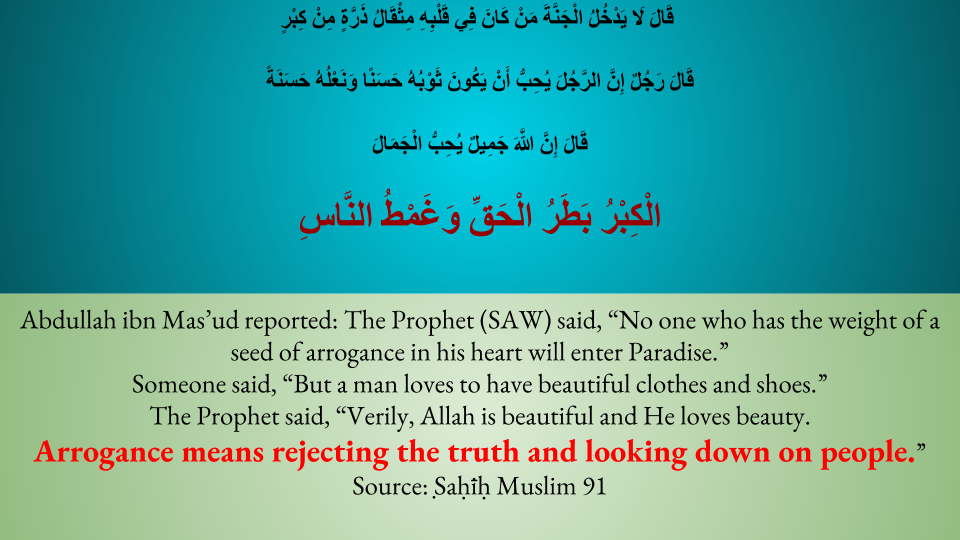.png) |
| json metadata | {"tags":["islam","quran","morals","arrogance"],"image":["https://cdn.steemitimages.com/DQmZbRVRGJrU4tgs2mHFfGAY4vuLtqdjFd1HrNFG1d91jg2/SteemQuotes%20(1).png"],"app":"steemit/0.1","format":"markdown"} |
| Transaction Info | Block #24708905/Trx ff2b3665472758b845765d406526b0144bfd38a9 |
View Raw JSON Data
{
"trx_id": "ff2b3665472758b845765d406526b0144bfd38a9",
"block": 24708905,
"trx_in_block": 5,
"op_in_trx": 0,
"virtual_op": 0,
"timestamp": "2018-08-02T07:33:00",
"op": [
"comment",
{
"parent_author": "",
"parent_permlink": "islam",
"author": "leadus",
"permlink": "practical-meaning-of-kibr-arrogance",
"title": "Practical Meaning of Kibr (Arrogance)",
"body": "Kibr (Arrogance, Pride, Vanity) is despised in Islam. It is a certain way that we can condemn ourselves to hell, even if we are Muslims. Iblis believed in and worshipped Allah (SWT) but he was too arrogant to prostrate to Adam (AS) despite being commanded to by Allah (SWT). Iblis rejected the truth and looked down upon Adam (AS).\n\nAnd when We said to the angels: Make obeisance to Adam they did obeisance, but Iblis (did it not). He refused and he was proud, and he was one of the unbelievers. [2:34]\n\nHe said: O Iblis! what prevented you that you should do obeisance to him whom I created with My two hands? Are you proud or are you of the exalted ones?\nHe said: I am better than he; Thou hast created me of fire, and him Thou didst create of dust. [38:75-76]\n\nIblis arrogantly claimed that he was better then Adam. He looked down upon Adam due to his physical nature. Likewise, all the nations that refused to believe in the Prophets, used to mock the Prophets and their followers. For example, Pharaoh, who is repeatedly quoted in the Quran for his arrogance, said: “O my people! Is not mine the dominion of Egypt, and these rivers flowing underneath me. See you not then? Am I not better than this one [Moses], who is “Mahin” [i.e. has no honor nor any respect, and is weak and despicable] and can scarcely express himself clearly?” [43:51-52]\n\nThus our Prophet Muhammad (SAW) has aptly given a clear practical definition of this despicable characteristic of Kibr.\nAbdullah ibn Mas’ud reported: The Prophet (SAW) said, “No one who has the weight of a seed of arrogance in his heart will enter Paradise.”\nSomeone said, “But a man loves to have beautiful clothes and shoes.”\nThe Prophet said, “Verily, Allah is beautiful and He loves beauty.\nArrogance means rejecting the truth and looking down on people.”\nSource: Ṣaḥīḥ Muslim 91\n\nThe second part of this definition is what the Muslim and the believer need to beware. Even pious people can fall into thinking that they are more pious than others. Whenever it crosses our mind or conscience that we are better than others and as such deserve better treatment that we are not entitled to, we must quickly repent and seek forgiveness from Allah (SWT). We cannot allow Kibr to creep and grow in us.\n.png)",
"json_metadata": "{\"tags\":[\"islam\",\"quran\",\"morals\",\"arrogance\"],\"image\":[\"https://cdn.steemitimages.com/DQmZbRVRGJrU4tgs2mHFfGAY4vuLtqdjFd1HrNFG1d91jg2/SteemQuotes%20(1).png\"],\"app\":\"steemit/0.1\",\"format\":\"markdown\"}"
}
]
}leaduspublished a new post: allah-s-mercy-and-knowledge-encompass-all-things2018/06/21 08:13:48
leaduspublished a new post: allah-s-mercy-and-knowledge-encompass-all-things
2018/06/21 08:13:48
| parent author | |
| parent permlink | allah |
| author | leadus |
| permlink | allah-s-mercy-and-knowledge-encompass-all-things |
| title | Allah's mercy and knowledge encompass all things |
| body |  We present different translations of the above verse (40:7) with a specific focus on the 15th word [1]. The different translations are You have encompassed, Thou comprehendest, Thy Reach, Thou embracest, You comprehend. One of the obvious meanings of this verse is that Allah's mercy and knowledge encompass all things. A study of the Quran will show that the only two attributes of Allah (SWT) that are associated with , 'Ilm (knowledge) and Rahmah (mercy). A very simple but powerful lesson from this verse is that we should use knowledge to understand all things. That knowledge will reveal to us the various degrees of Rahmah associated with the thing. We then chose the most appropriate act of Rahmah associated with it. Thus to be merciful we must have knowledge. This is why Islam encourages its followers to exert themselves to acquire knowledge so that they can know the most appropriate act of Rahmah or mercy with which they can respond to a happening. Sahih International: Those [angels] who carry the Throne and those around it exalt [Allah] with praise of their Lord and believe in Him and ask forgiveness for those who have believed, [saying], "Our Lord, You have encompassed all things in mercy and knowledge, so forgive those who have repented and followed Your way and protect them from the punishment of Hellfire. Pickthall: Those who bear the Throne, and all who are round about it, hymn the praises of their Lord and believe in Him and ask forgiveness for those who believe (saying): Our Lord! Thou comprehendest all things in mercy and knowledge, therefor forgive those who repent and follow Thy way. Ward off from them the punishment of hell. Yusuf Ali: Those who sustain the Throne (of Allah) and those around it Sing Glory and Praise to their Lord; believe in Him; and implore Forgiveness for those who believe: "Our Lord! Thy Reach is over all things, in Mercy and Knowledge. Forgive, then, those who turn in Repentance, and follow Thy Path; and preserve them from the Penalty of the Blazing Fire! Shakir: Those who bear the power and those around Him celebrate the praise of their Lord and believe in Him and ask protection for those who believe: Our Lord! Thou embracest all things in mercy and knowledge, therefore grant protection to those who turn (to Thee) and follow Thy way, and save them from the punishment of the hell: Muhammad Sarwar: The bearers of the Throne glorify their Lord with His praise. They believe in Him and ask Him to forgive the believers. They say, "Our Lord, Your mercy and knowledge encompass all things. Forgive those who turn to You in repentance and follow Your path. Lord, save them from the torment of hell. Mohsin Khan: Those (angels) who bear the Throne (of Allah) and those around it glorify the praises of their Lord, and believe in Him, and ask forgiveness for those who believe (in the Oneness of Allah) (saying): "Our Lord! You comprehend all things in mercy and knowledge, so forgive those who repent and follow Your Way, and save them from the torment of the blazing Fire! Arberry: Those who bear the Throne, and those round about it proclaim the praise of their Lord, and believe in Him, and they ask forgiveness for those who believe: 'Our Lord, Thou embracest every thing in mercy and knowledge; therefore forgive those who have repented, and follow Thy way, and guard them against the chastisement of Hell. References: 1. http://corpus.quran.com/translation.jsp?chapter=40&verse=7 |
| json metadata | {"tags":["allah","islam","mercy","knowledge","prophet"],"image":["https://cdn.steemitimages.com/DQmS9RXHy49Hy4UrQfYBuNS3nC8SWTMd2Cc4quxGVLkEGhZ/blob","https://cdn.steemitimages.com/DQmV4fWpcWD3k4PKQYBzkWtN3DeZ39eU7TjZEDcE22s3eS6/blob"],"links":["http://corpus.quran.com/translation.jsp?chapter=40&verse=7"],"app":"steemit/0.1","format":"markdown"} |
| Transaction Info | Block #23510976/Trx bd422e3786b91696516e4e33f9a028d977b309ef |
View Raw JSON Data
{
"trx_id": "bd422e3786b91696516e4e33f9a028d977b309ef",
"block": 23510976,
"trx_in_block": 6,
"op_in_trx": 0,
"virtual_op": 0,
"timestamp": "2018-06-21T08:13:48",
"op": [
"comment",
{
"parent_author": "",
"parent_permlink": "allah",
"author": "leadus",
"permlink": "allah-s-mercy-and-knowledge-encompass-all-things",
"title": "Allah's mercy and knowledge encompass all things",
"body": "\n\nWe present different translations of the above verse (40:7) with a specific focus on the 15th word [1]. The different translations are You have encompassed, Thou comprehendest, Thy Reach, Thou embracest, You comprehend. One of the obvious meanings of this verse is that Allah's mercy and knowledge encompass all things.\n\nA study of the Quran will show that the only two attributes of Allah (SWT) that are associated with , 'Ilm (knowledge) and Rahmah (mercy). A very simple but powerful lesson from this verse is that we should use knowledge to understand all things. That knowledge will reveal to us the various degrees of Rahmah associated with the thing. We then chose the most appropriate act of Rahmah associated with it. Thus to be merciful we must have knowledge. This is why Islam encourages its followers to exert themselves to acquire knowledge so that they can know the most appropriate act of Rahmah or mercy with which they can respond to a happening.\n\nSahih International: Those [angels] who carry the Throne and those around it exalt [Allah] with praise of their Lord and believe in Him and ask forgiveness for those who have believed, [saying], \"Our Lord, You have encompassed all things in mercy and knowledge, so forgive those who have repented and followed Your way and protect them from the punishment of Hellfire.\n\nPickthall: Those who bear the Throne, and all who are round about it, hymn the praises of their Lord and believe in Him and ask forgiveness for those who believe (saying): Our Lord! Thou comprehendest all things in mercy and knowledge, therefor forgive those who repent and follow Thy way. Ward off from them the punishment of hell.\n\nYusuf Ali: Those who sustain the Throne (of Allah) and those around it Sing Glory and Praise to their Lord; believe in Him; and implore Forgiveness for those who believe: \"Our Lord! Thy Reach is over all things, in Mercy and Knowledge. Forgive, then, those who turn in Repentance, and follow Thy Path; and preserve them from the Penalty of the Blazing Fire!\n\nShakir: Those who bear the power and those around Him celebrate the praise of their Lord and believe in Him and ask protection for those who believe: Our Lord! Thou embracest all things in mercy and knowledge, therefore grant protection to those who turn (to Thee) and follow Thy way, and save them from the punishment of the hell:\n\nMuhammad Sarwar: The bearers of the Throne glorify their Lord with His praise. They believe in Him and ask Him to forgive the believers. They say, \"Our Lord, Your mercy and knowledge encompass all things. Forgive those who turn to You in repentance and follow Your path. Lord, save them from the torment of hell.\n\nMohsin Khan: Those (angels) who bear the Throne (of Allah) and those around it glorify the praises of their Lord, and believe in Him, and ask forgiveness for those who believe (in the Oneness of Allah) (saying): \"Our Lord! You comprehend all things in mercy and knowledge, so forgive those who repent and follow Your Way, and save them from the torment of the blazing Fire!\n\nArberry: Those who bear the Throne, and those round about it proclaim the praise of their Lord, and believe in Him, and they ask forgiveness for those who believe: 'Our Lord, Thou embracest every thing in mercy and knowledge; therefore forgive those who have repented, and follow Thy way, and guard them against the chastisement of Hell.\n\nReferences:\n1. http://corpus.quran.com/translation.jsp?chapter=40&verse=7",
"json_metadata": "{\"tags\":[\"allah\",\"islam\",\"mercy\",\"knowledge\",\"prophet\"],\"image\":[\"https://cdn.steemitimages.com/DQmS9RXHy49Hy4UrQfYBuNS3nC8SWTMd2Cc4quxGVLkEGhZ/blob\",\"https://cdn.steemitimages.com/DQmV4fWpcWD3k4PKQYBzkWtN3DeZ39eU7TjZEDcE22s3eS6/blob\"],\"links\":[\"http://corpus.quran.com/translation.jsp?chapter=40&verse=7\"],\"app\":\"steemit/0.1\",\"format\":\"markdown\"}"
}
]
}2018/05/18 20:00:42
2018/05/18 20:00:42
| delegator | steem |
| delegatee | leadus |
| vesting shares | 29496.382057 VESTS |
| Transaction Info | Block #22547105/Trx a8b35abd7530238b4d8c234a841e71c72111bcc7 |
View Raw JSON Data
{
  "trx_id": "a8b35abd7530238b4d8c234a841e71c72111bcc7",
  "block": 22547105,
  "trx_in_block": 32,
  "op_in_trx": 0,
  "virtual_op": 0,
  "timestamp": "2018-05-18T20:00:42",
  "op": [
    "delegate_vesting_shares",
    {
      "delegator": "steem",
      "delegatee": "leadus",
      "vesting_shares": "29496.382057 VESTS"
    }
  ]
}leaduspublished a new post: separation-of-powers-and-the-rule-of-law2018/05/03 01:09:03
leaduspublished a new post: separation-of-powers-and-the-rule-of-law
2018/05/03 01:09:03
| parent author | |
| parent permlink | islam |
| author | leadus |
| permlink | separation-of-powers-and-the-rule-of-law |
| title | Samarkand - Separation of powers and the rule of law |
| body | This article is a rewrite in English of a section extracted from a soon to be published book in Arabic about the Future Muslim civilization by Dr. Tareq Al-Suwaidan. There are some doubts as to the exact details involved in this event but we try to present the most authentic narrations. Umar ibn Abdul Aziz was one of the great Caliphs of the Ummayyad rule. A short while before Umar’s became the Caliph in Damascus, Muslims had taken control of an important city in Central Asia, Samarkand (in today's Uzbekistan). Samarkand then was a great city located in North Asia with green mountains, hills and forests. It was a city filled with gold and silver, silk, porcelain and natural resources. The people of Samarkand used to worship idols they made of jewelry. The leader of the Muslim armies that conquered Samarkand was the famous General Qutaybah bin Muslim. He had led the Muslims into control over all of modern day Central Asia (Turkistan) reaching into Xinjiang, China. Qutaybah devised a strategy in the night prior to the attack on the city. He hid his armies in the hills behind the city so they could remain unnoticed. Before sunrise, the Muslims moved quickly and attacked the city by surprise. Upon seeing this, the people retreated into their homes and the religious elite escaped to the mountains. Knowing of the horrors of war and occupation, the people of Samarkand felt anxious and stayed within their homes. As supplies began to thin, they sent their children out for stocks. The children came across a friendly people speaking in a different language with polite manners and the city showing no signs of a war having taken place a few days ago. Surprised by what their children saw, the others began to come out of their homes. They found there was no hostility from the occupying armies. The feelings of trust and tranquility began to spread amongst the people of Samarkand. People returned to their shops, farms and properties after some time. They found them intact. Soon normal life returned between Muslims and people of Samarkand. They found that Muslims faithful in their dealings; they did not lie or cheat. This impression rose when one person from Samarkand and a Muslim had a dispute. They went to the judge who judged fairly in favour of the local person. As they understood more about Islam, the priests realized that the way the Muslims had conquered their city did not follow the Islamic procedure for combat. They were not offered the choice to accept Islam, pay the Jizyah or face war. Also the customary three days notice was not given. They assigned an individual (a delegation according to some narrations) to lodge a complaint with the Caliph Umar ibn Abdul Aziz in Damascus. The appointed delegation arrived in Damascus and proceeded to the Umayyad Mosque of Damascus and waited while the Muslims prayed. One of them then approached the Muslims to see the leader of the Muslims. The Muslim relayed that he had just led the prayers. The Samarkand delegate was given directions to Umar’s house. The man arrived at a clay hut with Umar busy mending a broken wall. He detailed his complaint to the Caliph that, according to Muslim tradition, Muslims always gave the inhabitants of any city three options before they attacked. Qutaybah had failed to provide these options and used surprise tactics. Upon hearing this complaint, Umar wrote down a few lines and asked the man to hand the paper to the then Governor of Samarkand. Upon returning with the letter the priests presented the letter to the Muslim Governor read “To the governor of Samarkand, peace and mercy of Allah be upon you. Appoint a judge between the priests of Samarkand and Qutaybah ibn Muslim….”, thereby investigating the complaint. The Governor appointed Jami’ ibn Hadhir Albaji as the Qadi (Judge) to adjudicate the matter. The judge wrote to the Muslim General (some narrations say that Quraybah had passed away by this point but there is no agreement) who was in China by now. He ordered that he return to face the court. The leader left his busy campaign and returned to Samarkand. The court was set up and the judge asked the General to respond. He explained that this had been a difficult expedition and one where Muslims expected to lose more life than would be suffered by the Samarkand armies. All previous cities in the region had rejected the options given to them and thereby, in light of this precedent, it was better that the Muslims proceed with stealth and preserve the Muslim army from harm. The judge however only wanted to know whether Qutaybah had provided the people of Samarkand with the three options as per the Islamic tradition? The General repeated that he had already answered the question and the answer was no. The judge decreed that the commander of the Muslim forces should have served an ultimatum of war to the city, and according to the Islamic Law relating to war, he should have canceled all the treaties with them so that the people of Samarqand could get time to prepare for the war. "Sudden attack on them without warning was unlawful." He said, “Qutaybah, Allah supports this nation only by the deen (Islam) and by avoiding treachery and setting up justice. We were out of our homes for jihad for Allah’s sake. We did not go out to conquer lands and occupy countries unjustly.” He ordered that the armies free the land of Samarkand from all Muslim rule. They were required to await the expiry or cancellation of any treaties with the people of Samarkand and allow the people of the city to prepare for war. They would leave the city without anything, just as they came in. The Muslims must then provide the three conditions and wait before deciding anything. The people watched as the Muslim armies, led by their great General and the judge and other Muslims, left the city. Just imagine. An army conquers a city and enters it. The people of that city complain to the victorious government and the judges of that government decide the case against the victorious army, and order that they leave the city. Where and when in the history of mankind do we find fighting men so strictly bound by the moral code, and followed such lofty principles of truth and justice, as demonstrated by the Muslim civilization? What was the response then of the people of Samarkand to the three conditions? The majority of them accepted Islam upon witnessing this rare demonstration of justice and fairness. Samarkand then grew to become a great and important city in the history of Islam. It is important to note that none of the characters involved were from the generation of the Companions. Yes they were from the early Muslim generation but they, like us Muslims today, have the Prophet and his Companions as examples. This unique episode in the Muslim history should inspire Muslims today to have a hope and vision that we should strive for. Hope for a system of government where the head of government is listens to the complaints of all. He does not decide but orders for an investigation. The judges are fair and learned. Even the powerful general with his armies will have to abide by the rules of Islam. 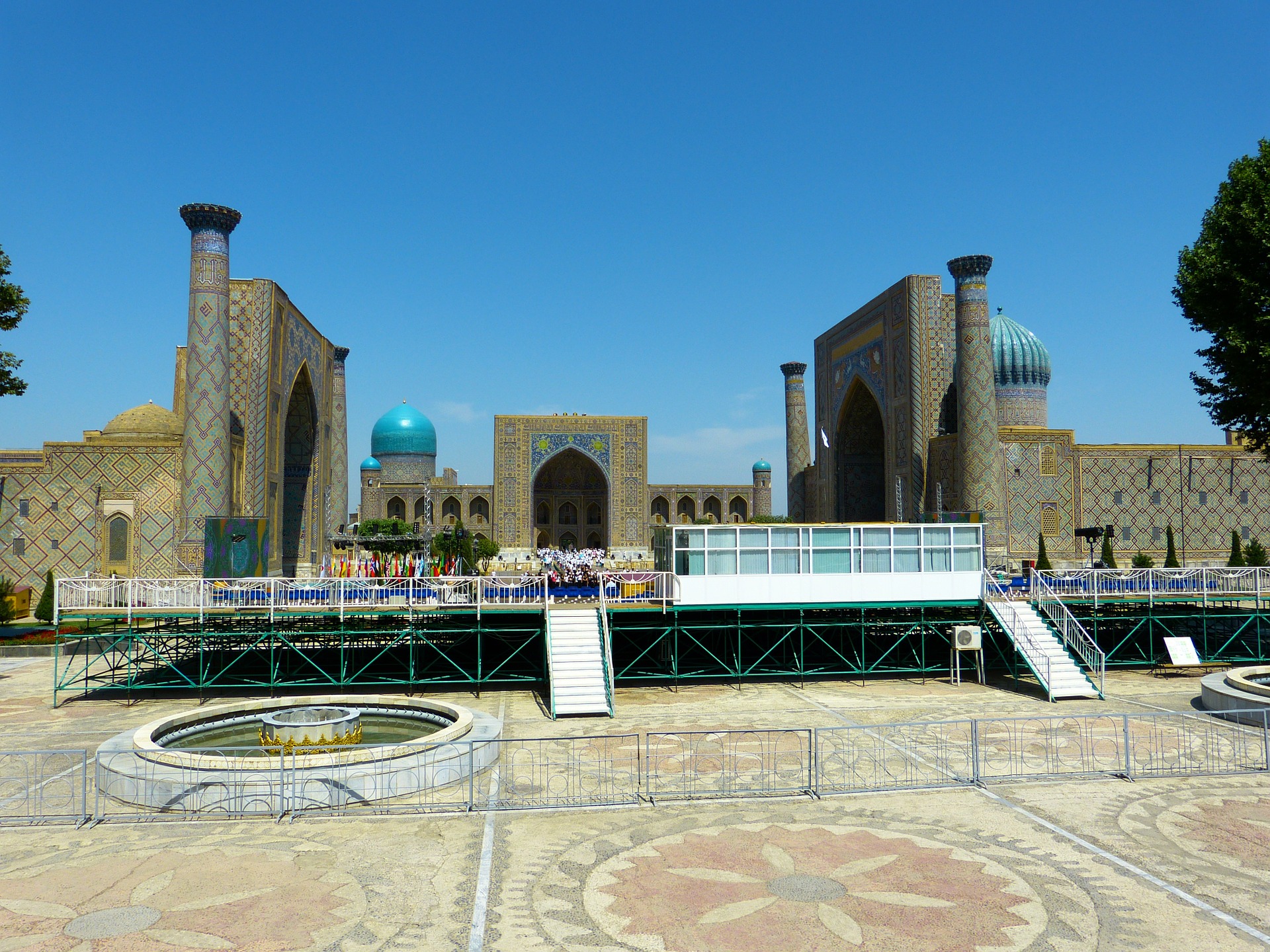 |
| json metadata | {"tags":["islam","history","justice","civilization"],"image":["https://steemitimages.com/DQmcLaUucA63S1m4b2sKTKUFgV1a5DqHeZEEFYSjUHfu6gP/samarkand-196903_1920.jpg"],"app":"steemit/0.1","format":"markdown"} |
| Transaction Info | Block #22092564/Trx a1cde8a1fc4aeaa58348ef96b47ea5e0372d8261 |
View Raw JSON Data
{
"trx_id": "a1cde8a1fc4aeaa58348ef96b47ea5e0372d8261",
"block": 22092564,
"trx_in_block": 86,
"op_in_trx": 0,
"virtual_op": 0,
"timestamp": "2018-05-03T01:09:03",
"op": [
"comment",
{
"parent_author": "",
"parent_permlink": "islam",
"author": "leadus",
"permlink": "separation-of-powers-and-the-rule-of-law",
"title": "Samarkand - Separation of powers and the rule of law",
"body": "This article is a rewrite in English of a section extracted from a soon to be published book in Arabic about the Future Muslim civilization by Dr. Tareq Al-Suwaidan. There are some doubts as to the exact details involved in this event but we try to present the most authentic narrations.\n\nUmar ibn Abdul Aziz was one of the great Caliphs of the Ummayyad rule. A short while before Umar’s became the Caliph in Damascus, Muslims had taken control of an important city in Central Asia, Samarkand (in today's Uzbekistan). Samarkand then was a great city located in North Asia with green mountains, hills and forests. It was a city filled with gold and silver, silk, porcelain and natural resources. The people of Samarkand used to worship idols they made of jewelry.\n\nThe leader of the Muslim armies that conquered Samarkand was the famous General Qutaybah bin Muslim. He had led the Muslims into control over all of modern day Central Asia (Turkistan) reaching into Xinjiang, China. Qutaybah devised a strategy in the night prior to the attack on the city. He hid his armies in the hills behind the city so they could remain unnoticed. Before sunrise, the Muslims moved quickly and attacked the city by surprise. Upon seeing this, the people retreated into their homes and the religious elite escaped to the mountains. Knowing of the horrors of war and occupation, the people of Samarkand felt anxious and stayed within their homes. As supplies began to thin, they sent their children out for stocks. The children came across a friendly people speaking in a different language with polite manners and the city showing no signs of a war having taken place a few days ago. Surprised by what their children saw, the others began to come out of their homes. They found there was no hostility from the occupying armies. The feelings of trust and tranquility began to spread amongst the people of Samarkand. People returned to their shops, farms and properties after some time. They found them intact. Soon normal life returned between Muslims and people of Samarkand. They found that Muslims faithful in their dealings; they did not lie or cheat. This impression rose when one person from Samarkand and a Muslim had a dispute. They went to the judge who judged fairly in favour of the local person.\n\nAs they understood more about Islam, the priests realized that the way the Muslims had conquered their city did not follow the Islamic procedure for combat. They were not offered the choice to accept Islam, pay the Jizyah or face war. Also the customary three days notice was not given. They assigned an individual (a delegation according to some narrations) to lodge a complaint with the Caliph Umar ibn Abdul Aziz in Damascus.\n\nThe appointed delegation arrived in Damascus and proceeded to the Umayyad Mosque of Damascus and waited while the Muslims prayed. One of them then approached the Muslims to see the leader of the Muslims. The Muslim relayed that he had just led the prayers. The Samarkand delegate was given directions to Umar’s house. The man arrived at a clay hut with Umar busy mending a broken wall. He detailed his complaint to the Caliph that, according to Muslim tradition, Muslims always gave the inhabitants of any city three options before they attacked. Qutaybah had failed to provide these options and used surprise tactics. Upon hearing this complaint, Umar wrote down a few lines and asked the man to hand the paper to the then Governor of Samarkand.\n\nUpon returning with the letter the priests presented the letter to the Muslim Governor read “To the governor of Samarkand, peace and mercy of Allah be upon you. Appoint a judge between the priests of Samarkand and Qutaybah ibn Muslim….”, thereby investigating the complaint. The Governor appointed Jami’ ibn Hadhir Albaji as the Qadi (Judge) to adjudicate the matter. The judge wrote to the Muslim General (some narrations say that Quraybah had passed away by this point but there is no agreement) who was in China by now. He ordered that he return to face the court. The leader left his busy campaign and returned to Samarkand.\n\nThe court was set up and the judge asked the General to respond. He explained that this had been a difficult expedition and one where Muslims expected to lose more life than would be suffered by the Samarkand armies. All previous cities in the region had rejected the options given to them and thereby, in light of this precedent, it was better that the Muslims proceed with stealth and preserve the Muslim army from harm.\n\nThe judge however only wanted to know whether Qutaybah had provided the people of Samarkand with the three options as per the Islamic tradition? The General repeated that he had already answered the question and the answer was no. The judge decreed that the commander of the Muslim forces should have served an ultimatum of war to the city, and according to the Islamic Law relating to war, he should have canceled all the treaties with them so that the people of Samarqand could get time to prepare for the war. \"Sudden attack on them without warning was unlawful.\" He said, “Qutaybah, Allah supports this nation only by the deen (Islam) and by avoiding treachery and setting up justice. We were out of our homes for jihad for Allah’s sake. We did not go out to conquer lands and occupy countries unjustly.”\n\nHe ordered that the armies free the land of Samarkand from all Muslim rule. They were required to await the expiry or cancellation of any treaties with the people of Samarkand and allow the people of the city to prepare for war. They would leave the city without anything, just as they came in. The Muslims must then provide the three conditions and wait before deciding anything.\n\nThe people watched as the Muslim armies, led by their great General and the judge and other Muslims, left the city. Just imagine. An army conquers a city and enters it. The people of that city complain to the victorious government and the judges of that government decide the case against the victorious army, and order that they leave the city. Where and when in the history of mankind do we find fighting men so strictly bound by the moral code, and followed such lofty principles of truth and justice, as demonstrated by the Muslim civilization?\n\nWhat was the response then of the people of Samarkand to the three conditions? The majority of them accepted Islam upon witnessing this rare demonstration of justice and fairness. Samarkand then grew to become a great and important city in the history of Islam.\n\nIt is important to note that none of the characters involved were from the generation of the Companions. Yes they were from the early Muslim generation but they, like us Muslims today, have the Prophet and his Companions as examples. This unique episode in the Muslim history should inspire Muslims today to have a hope and vision that we should strive for. Hope for a system of government where the head of government is listens to the complaints of all. He does not decide but orders for an investigation. The judges are fair and learned. Even the powerful general with his armies will have to abide by the rules of Islam.\n",
"json_metadata": "{\"tags\":[\"islam\",\"history\",\"justice\",\"civilization\"],\"image\":[\"https://steemitimages.com/DQmcLaUucA63S1m4b2sKTKUFgV1a5DqHeZEEFYSjUHfu6gP/samarkand-196903_1920.jpg\"],\"app\":\"steemit/0.1\",\"format\":\"markdown\"}"
}
]
}sensationupvoted (100.00%) @leadus / separation-of-powers-and-the-rule-of-law2018/05/02 08:52:09
sensationupvoted (100.00%) @leadus / separation-of-powers-and-the-rule-of-law
2018/05/02 08:52:09
| voter | sensation |
| author | leadus |
| permlink | separation-of-powers-and-the-rule-of-law |
| weight | 10000 (100.00%) |
| Transaction Info | Block #22073026/Trx 315490bd01527a419d8046c633465b9b14ce074d |
View Raw JSON Data
{
  "trx_id": "315490bd01527a419d8046c633465b9b14ce074d",
  "block": 22073026,
  "trx_in_block": 9,
  "op_in_trx": 0,
  "virtual_op": 0,
  "timestamp": "2018-05-02T08:52:09",
  "op": [
    "vote",
    {
      "voter": "sensation",
      "author": "leadus",
      "permlink": "separation-of-powers-and-the-rule-of-law",
      "weight": 10000
    }
  ]
}yeheyupvoted (10.00%) @leadus / separation-of-powers-and-the-rule-of-law2018/05/02 08:05:33
yeheyupvoted (10.00%) @leadus / separation-of-powers-and-the-rule-of-law
2018/05/02 08:05:33
| voter | yehey |
| author | leadus |
| permlink | separation-of-powers-and-the-rule-of-law |
| weight | 1000 (10.00%) |
| Transaction Info | Block #22072094/Trx 0335ad8b44ddabe34d725b8d6a32f3025febdcce |
View Raw JSON Data
{
  "trx_id": "0335ad8b44ddabe34d725b8d6a32f3025febdcce",
  "block": 22072094,
  "trx_in_block": 6,
  "op_in_trx": 0,
  "virtual_op": 0,
  "timestamp": "2018-05-02T08:05:33",
  "op": [
    "vote",
    {
      "voter": "yehey",
      "author": "leadus",
      "permlink": "separation-of-powers-and-the-rule-of-law",
      "weight": 1000
    }
  ]
}platopiaupvoted (100.00%) @leadus / separation-of-powers-and-the-rule-of-law2018/05/02 07:41:00
platopiaupvoted (100.00%) @leadus / separation-of-powers-and-the-rule-of-law
2018/05/02 07:41:00
| voter | platopia |
| author | leadus |
| permlink | separation-of-powers-and-the-rule-of-law |
| weight | 10000 (100.00%) |
| Transaction Info | Block #22071604/Trx b0209c0a3c9aab59d43fd01729e2a9c97a3a30c1 |
View Raw JSON Data
{
  "trx_id": "b0209c0a3c9aab59d43fd01729e2a9c97a3a30c1",
  "block": 22071604,
  "trx_in_block": 21,
  "op_in_trx": 0,
  "virtual_op": 0,
  "timestamp": "2018-05-02T07:41:00",
  "op": [
    "vote",
    {
      "voter": "platopia",
      "author": "leadus",
      "permlink": "separation-of-powers-and-the-rule-of-law",
      "weight": 10000
    }
  ]
}rhogerupvoted (100.00%) @leadus / separation-of-powers-and-the-rule-of-law2018/05/02 07:38:00
rhogerupvoted (100.00%) @leadus / separation-of-powers-and-the-rule-of-law
2018/05/02 07:38:00
| voter | rhoger |
| author | leadus |
| permlink | separation-of-powers-and-the-rule-of-law |
| weight | 10000 (100.00%) |
| Transaction Info | Block #22071544/Trx 0557fdd90afbdd829e19dccf21ded7df28242c7f |
View Raw JSON Data
{
  "trx_id": "0557fdd90afbdd829e19dccf21ded7df28242c7f",
  "block": 22071544,
  "trx_in_block": 18,
  "op_in_trx": 0,
  "virtual_op": 0,
  "timestamp": "2018-05-02T07:38:00",
  "op": [
    "vote",
    {
      "voter": "rhoger",
      "author": "leadus",
      "permlink": "separation-of-powers-and-the-rule-of-law",
      "weight": 10000
    }
  ]
}ax3upvoted (1.00%) @leadus / separation-of-powers-and-the-rule-of-law2018/05/02 07:37:12
ax3upvoted (1.00%) @leadus / separation-of-powers-and-the-rule-of-law
2018/05/02 07:37:12
| voter | ax3 |
| author | leadus |
| permlink | separation-of-powers-and-the-rule-of-law |
| weight | 100 (1.00%) |
| Transaction Info | Block #22071528/Trx 51d905054fe7b1f704b609bf077162f9a45bca29 |
View Raw JSON Data
{
  "trx_id": "51d905054fe7b1f704b609bf077162f9a45bca29",
  "block": 22071528,
  "trx_in_block": 20,
  "op_in_trx": 0,
  "virtual_op": 0,
  "timestamp": "2018-05-02T07:37:12",
  "op": [
    "vote",
    {
      "voter": "ax3",
      "author": "leadus",
      "permlink": "separation-of-powers-and-the-rule-of-law",
      "weight": 100
    }
  ]
}leadusupvoted (100.00%) @leadus / separation-of-powers-and-the-rule-of-law2018/05/02 07:37:00
leadusupvoted (100.00%) @leadus / separation-of-powers-and-the-rule-of-law
2018/05/02 07:37:00
| voter | leadus |
| author | leadus |
| permlink | separation-of-powers-and-the-rule-of-law |
| weight | 10000 (100.00%) |
| Transaction Info | Block #22071524/Trx 02a93dee98cf4518113d43aafe39322fc65b45e9 |
View Raw JSON Data
{
  "trx_id": "02a93dee98cf4518113d43aafe39322fc65b45e9",
  "block": 22071524,
  "trx_in_block": 18,
  "op_in_trx": 0,
  "virtual_op": 0,
  "timestamp": "2018-05-02T07:37:00",
  "op": [
    "vote",
    {
      "voter": "leadus",
      "author": "leadus",
      "permlink": "separation-of-powers-and-the-rule-of-law",
      "weight": 10000
    }
  ]
}leaduspublished a new post: separation-of-powers-and-the-rule-of-law2018/05/02 07:37:00
leaduspublished a new post: separation-of-powers-and-the-rule-of-law
2018/05/02 07:37:00
| parent author | |
| parent permlink | islam |
| author | leadus |
| permlink | separation-of-powers-and-the-rule-of-law |
| title | Separation of powers and the rule of law |
| body | This article is a rewrite in English of a section extracted from a soon to be published book in Arabic about the Future Muslim civilization by Dr. Tareq Al-Suwaidan. There are some doubts as to the exact details involved in this event but we try to present the most authentic narrations. Umar ibn Abdul Aziz was one of the great Caliphs of the Ummayyad rule. A short while before Umar’s became the Caliph in Damascus, Muslims had taken control of an important city in Central Asia, Samarkand (in today's Uzbekistan). Samarkand then was a great city located in North Asia with green mountains, hills and forests. It was a city filled with gold and silver, silk, porcelain and natural resources. The people of Samarkand used to worship idols they made of jewelry. The leader of the Muslim armies that conquered Samarkand was the famous General Qutaybah bin Muslim. He had led the Muslims into control over all of modern day Central Asia (Turkistan) reaching into Xinjiang, China. Qutaybah devised a strategy in the night prior to the attack on the city. He hid his armies in the hills behind the city so they could remain unnoticed. Before sunrise, the Muslims moved quickly and attacked the city by surprise. Upon seeing this, the people retreated into their homes and the religious elite escaped to the mountains. Knowing of the horrors of war and occupation, the people of Samarkand felt anxious and stayed within their homes. As supplies began to thin, they sent their children out for stocks. The children came across a friendly people speaking in a different language with polite manners and the city showing no signs of a war having taken place a few days ago. Surprised by what their children saw, the others began to come out of their homes. They found there was no hostility from the occupying armies. The feelings of trust and tranquility began to spread amongst the people of Samarkand. People returned to their shops, farms and properties after some time. They found them intact. Soon normal life returned between Muslims and people of Samarkand. They found that Muslims faithful in their dealings; they did not lie or cheat. This impression rose when one person from Samarkand and a Muslim had a dispute. They went to the judge who judged fairly in favour of the local person. As they understood more about Islam, the priests realized that the way the Muslims had conquered their city did not follow the Islamic procedure for combat. They were not offered the choice to accept Islam, pay the Jizyah or face war. Also the customary three days notice was not given. They assigned an individual (a delegation according to some narrations) to lodge a complaint with the Caliph Umar ibn Abdul Aziz in Damascus. The appointed delegation arrived in Damascus and proceeded to the Umayyad Mosque of Damascus and waited while the Muslims prayed. One of them then approached the Muslims to see the leader of the Muslims. The Muslim relayed that he had just led the prayers. The Samarkand delegate was given directions to Umar’s house. The man arrived at a clay hut with Umar busy mending a broken wall. He detailed his complaint to the Caliph that, according to Muslim tradition, Muslims always gave the inhabitants of any city three options before they attacked. Qutaybah had failed to provide these options and used surprise tactics. Upon hearing this complaint, Umar wrote down a few lines and asked the man to hand the paper to the then Governor of Samarkand. Upon returning with the letter the priests presented the letter to the Muslim Governor read “To the governor of Samarkand, peace and mercy of Allah be upon you. Appoint a judge between the priests of Samarkand and Qutaybah ibn Muslim….”, thereby investigating the complaint. The Governor appointed Jami’ ibn Hadhir Albaji as the Qadi (Judge) to adjudicate the matter. The judge wrote to the Muslim General (some narrations say that Quraybah had passed away by this point but there is no agreement) who was in China by now. He ordered that he return to face the court. The leader left his busy campaign and returned to Samarkand. The court was set up and the judge asked the General to respond. He explained that this had been a difficult expedition and one where Muslims expected to lose more life than would be suffered by the Samarkand armies. All previous cities in the region had rejected the options given to them and thereby, in light of this precedent, it was better that the Muslims proceed with stealth and preserve the Muslim army from harm. The judge however only wanted to know whether Qutaybah had provided the people of Samarkand with the three options as per the Islamic tradition? The General repeated that he had already answered the question and the answer was no. The judge decreed that the commander of the Muslim forces should have served an ultimatum of war to the city, and according to the Islamic Law relating to war, he should have canceled all the treaties with them so that the people of Samarqand could get time to prepare for the war. "Sudden attack on them without warning was unlawful." He said, “Qutaybah, Allah supports this nation only by the deen (Islam) and by avoiding treachery and setting up justice. We were out of our homes for jihad for Allah’s sake. We did not go out to conquer lands and occupy countries unjustly.” He ordered that the armies free the land of Samarkand from all Muslim rule. They were required to await the expiry or cancellation of any treaties with the people of Samarkand and allow the people of the city to prepare for war. They would leave the city without anything, just as they came in. The Muslims must then provide the three conditions and wait before deciding anything. The people watched as the Muslim armies, led by their great General and the judge and other Muslims, left the city. Just imagine. An army conquers a city and enters it. The people of that city complain to the victorious government and the judges of that government decide the case against the victorious army, and order that they leave the city. Where and when in the history of mankind do we find fighting men so strictly bound by the moral code, and followed such lofty principles of truth and justice, as demonstrated by the Muslim civilization? What was the response then of the people of Samarkand to the three conditions? The majority of them accepted Islam upon witnessing this rare demonstration of justice and fairness. Samarkand then grew to become a great and important city in the history of Islam. It is important to note that none of the characters involved were from the generation of the Companions. Yes they were from the early Muslim generation but they, like us Muslims today, have the Prophet and his Companions as examples. This unique episode in the Muslim history should inspire Muslims today to have a hope and vision that we should strive for. Hope for a system of government where the head of government is listens to the complaints of all. He does not decide but orders for an investigation. The judges are fair and learned. Even the powerful general with his armies will have to abide by the rules of Islam.  |
| json metadata | {"tags":["islam","history","justice","civilization"],"image":["https://steemitimages.com/DQmcLaUucA63S1m4b2sKTKUFgV1a5DqHeZEEFYSjUHfu6gP/samarkand-196903_1920.jpg"],"app":"steemit/0.1","format":"markdown"} |
| Transaction Info | Block #22071524/Trx 02a93dee98cf4518113d43aafe39322fc65b45e9 |
View Raw JSON Data
{
"trx_id": "02a93dee98cf4518113d43aafe39322fc65b45e9",
"block": 22071524,
"trx_in_block": 18,
"op_in_trx": 0,
"virtual_op": 0,
"timestamp": "2018-05-02T07:37:00",
"op": [
"comment",
{
"parent_author": "",
"parent_permlink": "islam",
"author": "leadus",
"permlink": "separation-of-powers-and-the-rule-of-law",
"title": "Separation of powers and the rule of law",
"body": "This article is a rewrite in English of a section extracted from a soon to be published book in Arabic about the Future Muslim civilization by Dr. Tareq Al-Suwaidan. There are some doubts as to the exact details involved in this event but we try to present the most authentic narrations.\n\nUmar ibn Abdul Aziz was one of the great Caliphs of the Ummayyad rule. A short while before Umar’s became the Caliph in Damascus, Muslims had taken control of an important city in Central Asia, Samarkand (in today's Uzbekistan). Samarkand then was a great city located in North Asia with green mountains, hills and forests. It was a city filled with gold and silver, silk, porcelain and natural resources. The people of Samarkand used to worship idols they made of jewelry.\n\nThe leader of the Muslim armies that conquered Samarkand was the famous General Qutaybah bin Muslim. He had led the Muslims into control over all of modern day Central Asia (Turkistan) reaching into Xinjiang, China. Qutaybah devised a strategy in the night prior to the attack on the city. He hid his armies in the hills behind the city so they could remain unnoticed. Before sunrise, the Muslims moved quickly and attacked the city by surprise. Upon seeing this, the people retreated into their homes and the religious elite escaped to the mountains. Knowing of the horrors of war and occupation, the people of Samarkand felt anxious and stayed within their homes. As supplies began to thin, they sent their children out for stocks. The children came across a friendly people speaking in a different language with polite manners and the city showing no signs of a war having taken place a few days ago. Surprised by what their children saw, the others began to come out of their homes. They found there was no hostility from the occupying armies. The feelings of trust and tranquility began to spread amongst the people of Samarkand. People returned to their shops, farms and properties after some time. They found them intact. Soon normal life returned between Muslims and people of Samarkand. They found that Muslims faithful in their dealings; they did not lie or cheat. This impression rose when one person from Samarkand and a Muslim had a dispute. They went to the judge who judged fairly in favour of the local person.\n\nAs they understood more about Islam, the priests realized that the way the Muslims had conquered their city did not follow the Islamic procedure for combat. They were not offered the choice to accept Islam, pay the Jizyah or face war. Also the customary three days notice was not given. They assigned an individual (a delegation according to some narrations) to lodge a complaint with the Caliph Umar ibn Abdul Aziz in Damascus.\n\nThe appointed delegation arrived in Damascus and proceeded to the Umayyad Mosque of Damascus and waited while the Muslims prayed. One of them then approached the Muslims to see the leader of the Muslims. The Muslim relayed that he had just led the prayers. The Samarkand delegate was given directions to Umar’s house. The man arrived at a clay hut with Umar busy mending a broken wall. He detailed his complaint to the Caliph that, according to Muslim tradition, Muslims always gave the inhabitants of any city three options before they attacked. Qutaybah had failed to provide these options and used surprise tactics. Upon hearing this complaint, Umar wrote down a few lines and asked the man to hand the paper to the then Governor of Samarkand.\n\nUpon returning with the letter the priests presented the letter to the Muslim Governor read “To the governor of Samarkand, peace and mercy of Allah be upon you. Appoint a judge between the priests of Samarkand and Qutaybah ibn Muslim….”, thereby investigating the complaint. The Governor appointed Jami’ ibn Hadhir Albaji as the Qadi (Judge) to adjudicate the matter. The judge wrote to the Muslim General (some narrations say that Quraybah had passed away by this point but there is no agreement) who was in China by now. He ordered that he return to face the court. The leader left his busy campaign and returned to Samarkand.\n\nThe court was set up and the judge asked the General to respond. He explained that this had been a difficult expedition and one where Muslims expected to lose more life than would be suffered by the Samarkand armies. All previous cities in the region had rejected the options given to them and thereby, in light of this precedent, it was better that the Muslims proceed with stealth and preserve the Muslim army from harm.\n\nThe judge however only wanted to know whether Qutaybah had provided the people of Samarkand with the three options as per the Islamic tradition? The General repeated that he had already answered the question and the answer was no. The judge decreed that the commander of the Muslim forces should have served an ultimatum of war to the city, and according to the Islamic Law relating to war, he should have canceled all the treaties with them so that the people of Samarqand could get time to prepare for the war. \"Sudden attack on them without warning was unlawful.\" He said, “Qutaybah, Allah supports this nation only by the deen (Islam) and by avoiding treachery and setting up justice. We were out of our homes for jihad for Allah’s sake. We did not go out to conquer lands and occupy countries unjustly.”\n\nHe ordered that the armies free the land of Samarkand from all Muslim rule. They were required to await the expiry or cancellation of any treaties with the people of Samarkand and allow the people of the city to prepare for war. They would leave the city without anything, just as they came in. The Muslims must then provide the three conditions and wait before deciding anything.\n\nThe people watched as the Muslim armies, led by their great General and the judge and other Muslims, left the city. Just imagine. An army conquers a city and enters it. The people of that city complain to the victorious government and the judges of that government decide the case against the victorious army, and order that they leave the city. Where and when in the history of mankind do we find fighting men so strictly bound by the moral code, and followed such lofty principles of truth and justice, as demonstrated by the Muslim civilization?\n\nWhat was the response then of the people of Samarkand to the three conditions? The majority of them accepted Islam upon witnessing this rare demonstration of justice and fairness. Samarkand then grew to become a great and important city in the history of Islam.\n\nIt is important to note that none of the characters involved were from the generation of the Companions. Yes they were from the early Muslim generation but they, like us Muslims today, have the Prophet and his Companions as examples. This unique episode in the Muslim history should inspire Muslims today to have a hope and vision that we should strive for. Hope for a system of government where the head of government is listens to the complaints of all. He does not decide but orders for an investigation. The judges are fair and learned. Even the powerful general with his armies will have to abide by the rules of Islam.\n",
"json_metadata": "{\"tags\":[\"islam\",\"history\",\"justice\",\"civilization\"],\"image\":[\"https://steemitimages.com/DQmcLaUucA63S1m4b2sKTKUFgV1a5DqHeZEEFYSjUHfu6gP/samarkand-196903_1920.jpg\"],\"app\":\"steemit/0.1\",\"format\":\"markdown\"}"
}
]
}tonyendzupvoted (100.00%) @leadus / rise-fall-and-future-of-the-muslim-civilization2018/04/27 01:17:54
tonyendzupvoted (100.00%) @leadus / rise-fall-and-future-of-the-muslim-civilization
2018/04/27 01:17:54
| voter | tonyendz |
| author | leadus |
| permlink | rise-fall-and-future-of-the-muslim-civilization |
| weight | 10000 (100.00%) |
| Transaction Info | Block #21919982/Trx b2471f3525ccd68dbc76ff8dcd934642e49f1372 |
View Raw JSON Data
{
  "trx_id": "b2471f3525ccd68dbc76ff8dcd934642e49f1372",
  "block": 21919982,
  "trx_in_block": 37,
  "op_in_trx": 0,
  "virtual_op": 0,
  "timestamp": "2018-04-27T01:17:54",
  "op": [
    "vote",
    {
      "voter": "tonyendz",
      "author": "leadus",
      "permlink": "rise-fall-and-future-of-the-muslim-civilization",
      "weight": 10000
    }
  ]
}2018/04/25 06:09:21
2018/04/25 06:09:21
| parent author | leadus |
| parent permlink | rise-fall-and-future-of-the-muslim-civilization |
| author | steemitboard |
| permlink | steemitboard-notify-leadus-20180425t060921000z |
| title | |
| body | Congratulations @leadus! You have completed some achievement on Steemit and have been rewarded with new badge(s) : [](http://steemitboard.com/@leadus) Award for the number of upvotes received Click on any badge to view your own Board of Honor on SteemitBoard. For more information about SteemitBoard, click [here](https://steemit.com/@steemitboard) If you no longer want to receive notifications, reply to this comment with the word `STOP` > Upvote this notification to help all Steemit users. Learn why [here](https://steemit.com/steemitboard/@steemitboard/http-i-cubeupload-com-7ciqeo-png)! |
| json metadata | {"image":["https://steemitboard.com/img/notifications.png"]} |
| Transaction Info | Block #21868232/Trx 8d6e3cf809194076fcee2f4f2782ff8058d1a056 |
View Raw JSON Data
{
"trx_id": "8d6e3cf809194076fcee2f4f2782ff8058d1a056",
"block": 21868232,
"trx_in_block": 5,
"op_in_trx": 0,
"virtual_op": 0,
"timestamp": "2018-04-25T06:09:21",
"op": [
"comment",
{
"parent_author": "leadus",
"parent_permlink": "rise-fall-and-future-of-the-muslim-civilization",
"author": "steemitboard",
"permlink": "steemitboard-notify-leadus-20180425t060921000z",
"title": "",
"body": "Congratulations @leadus! You have completed some achievement on Steemit and have been rewarded with new badge(s) :\n\n[](http://steemitboard.com/@leadus) Award for the number of upvotes received\n\nClick on any badge to view your own Board of Honor on SteemitBoard.\nFor more information about SteemitBoard, click [here](https://steemit.com/@steemitboard)\n\nIf you no longer want to receive notifications, reply to this comment with the word `STOP`\n\n> Upvote this notification to help all Steemit users. Learn why [here](https://steemit.com/steemitboard/@steemitboard/http-i-cubeupload-com-7ciqeo-png)!",
"json_metadata": "{\"image\":[\"https://steemitboard.com/img/notifications.png\"]}"
}
]
}lyubavazupvoted (100.00%) @leadus / rise-fall-and-future-of-the-muslim-civilization2018/04/25 00:09:09
lyubavazupvoted (100.00%) @leadus / rise-fall-and-future-of-the-muslim-civilization
2018/04/25 00:09:09
| voter | lyubavaz |
| author | leadus |
| permlink | rise-fall-and-future-of-the-muslim-civilization |
| weight | 10000 (100.00%) |
| Transaction Info | Block #21861047/Trx 3bd47c651ed8aa2fe93d340a08cc0f165bb0cabe |
View Raw JSON Data
{
  "trx_id": "3bd47c651ed8aa2fe93d340a08cc0f165bb0cabe",
  "block": 21861047,
  "trx_in_block": 16,
  "op_in_trx": 0,
  "virtual_op": 0,
  "timestamp": "2018-04-25T00:09:09",
  "op": [
    "vote",
    {
      "voter": "lyubavaz",
      "author": "leadus",
      "permlink": "rise-fall-and-future-of-the-muslim-civilization",
      "weight": 10000
    }
  ]
}sensationupvoted (100.00%) @leadus / rise-fall-and-future-of-the-muslim-civilization2018/04/24 17:57:39
sensationupvoted (100.00%) @leadus / rise-fall-and-future-of-the-muslim-civilization
2018/04/24 17:57:39
| voter | sensation |
| author | leadus |
| permlink | rise-fall-and-future-of-the-muslim-civilization |
| weight | 10000 (100.00%) |
| Transaction Info | Block #21853653/Trx 0b81ec2d7bf9b7dc5a9e70e002928c13e19be365 |
View Raw JSON Data
{
  "trx_id": "0b81ec2d7bf9b7dc5a9e70e002928c13e19be365",
  "block": 21853653,
  "trx_in_block": 22,
  "op_in_trx": 0,
  "virtual_op": 0,
  "timestamp": "2018-04-24T17:57:39",
  "op": [
    "vote",
    {
      "voter": "sensation",
      "author": "leadus",
      "permlink": "rise-fall-and-future-of-the-muslim-civilization",
      "weight": 10000
    }
  ]
}leaduspublished a new post: rise-fall-and-future-of-the-muslim-civilization2018/04/24 15:43:30
leaduspublished a new post: rise-fall-and-future-of-the-muslim-civilization
2018/04/24 15:43:30
| parent author | |
| parent permlink | islam |
| author | leadus |
| permlink | rise-fall-and-future-of-the-muslim-civilization |
| title | Rise, Fall and Future of the Muslim Civilization |
| body | Our project on defining the future Muslim civilization has completed the first milestone with a draft manuscript in Arabic written by Dr. Tareq Al-Suwaidan. The following article is are-write in English on one of the key sub-sections of the book. <strong>Trend of Civilizations</strong> Civilizations follow a definite trend, in which they rise and decline. Some rise again and some decline to obsolescence. The Islamic civilization also followed a similar trend throughout its very long history. The first stage of incorporation and development within the Arab peninsula, was followed by various stages of development and expansion as the Muslims extended their geographical influence through the various sultanates and dynasties. There were periods of decline and major setbacks in some parts of the Muslim world while it expanded in other parts. But the decline of the the Ottoman caliphate, in general, marked the decline of the Muslims in the other parts of the world. The decline led to large parts of the Muslim world being occupied and colonized until it reached its low ebb, the lost one of its religious icons, Palestine. But, God willing, it will rise again. This will be achieved only by an overall revival of the influence of Islam in the life of Muslim individuals and societies. As Imam Malik (may Allah have mercy on him) said, <strong> “the first of generation of this nation did not become good except through religion and its application”</strong>. <strong>History shows that no armies were invincible ~ Joseph Stalin</strong> In the following table, we will highlight the major events that happened throughout the Muslim history. We then present a rough curve showing the rise and decline trends of the Muslim civilization. <strong>622 - Hijrah (Migration from Mecca to Yathrib, which took upon a new name, Madinah)</strong> The Muslims did not have a state before the migration, and the focus of the Prophet Muhammad (SAW) in Mecca was on the construction of the belief and morals, correcting concepts and misconceptions. Because it is a foundation stage that lasted 13 years, we will consider that the beginning of Islamic civilization was the year 622. With the Hijrah, Prophet Muhammad (SAW) became a Prophet and the leader of a distinct state. Islam added to the belief and morals, social, family, economic and political laws and guidelines. The early Muslims began to form an Islamic state, which will bring all those who believe in the new religion (Islam), and will administer their affairs. The Hijrah became a dividing line in the life of the Prophet and in the history of Islam. It is the official start of Islam as a religion and a state together. <strong>656 - Conflict between the Companions during the Caliphate of Ali (RA)</strong> The great sedition between the Companions, may Allah's mercy be upon them all, due to the differences after the killing of the third Caliph Utman (RA). Because of the Muslims preoccupation with this sedition and their diligence to address them, it froze the movement of the Islamic tide, and stopped the cultural expansion of the State of Islam, The stalemate lasted close to 5 years. Caliph Ali was murdered by the Khawarij group. <strong>661 - Leadership conflict resolved; Start of the Umayyad dynasty</strong> There was a breakthrough in the division of the Ummah and the year was called the year of unity. The Ummah recovered something of its health, and collected its divided ranks. This would not have happened but for the virtue of God when Hassan Bin Ali, whom many regions of the Ummah supported him as the successor to Caliph Ali, voluntarily stepped down to allow Muawiya bin Abi Sufyan to be the sole leader of the Muslim Ummah. All the regions then gave their allegiance to Muawiya and the Ummah was united again. Hassan (RA) realized the prophecy of the Prophet (SAW) when he (SAW) said that Hassan (RA) is a master through whom Allah (SWT) will bring good among two great factions (Tirmidhi). May Allah (SWT) forgive all the Companions and their followers for the trials and tribulations they all went through during that difficult part of the early Muslim history. They were part of the great generation of Muslims and sacrificed much for Islam. We must look up to them and love them. <strong>750 - End of the Umayyad dynasty; Start of the Abbasid dynasty</strong> The Umayyad state collapsed and was replaced by the Abbasid state, which continued its cultural production, growth of Islam, close attention to knowledge and scholars. New science, knowledge and discoveries flourished during the Abbasid rule which reached its peak during the era of Harun al-Rashid. The pious scholar Al-Fudhail ibn ‘Iyadh said that no death touched him more severely than the death of the Amirul Mukminin Harun, and he wished that Allah took from his age and added to the age of Harun al-Rashid. <strong>785 - Start of the Umayyad dynasty in Andalusia</strong> In the same Abbasid period, a strong civilization of Muslims began to arise in Andalusia, led by the Umayyads. It reached its peak during the reign of Abd al-Rahman (III) al-Nasir (May Allah (SWT) have mercy on him), who made Cordoba the center of world civilization, for Muslims and non-Muslims. The rule of Abd al-Rahman al-Nasir lasted for fifty years, and it can be fairly stated that he was among the greatest rulers of the Islamic civilization. <strong>929 - Seljuk Sultanate</strong> The Seljuk Sultanate was started by the Seljuk Turks, who came from the Turkmen tribe of Qanq which is roughly the region of Turkmenistan today. During their rule, the Islamic civilization did not decline but continued to ascend. Islamic arts, science, knowledge and development continued to spread in different countries. This was evident in the movement of urbanization and the magnificent buildings they built. The Seljuk rule continued until they were defeated by the Mongols in the middle 13th century. <strong>1037 - Jerusalem occupied by the Crusaders</strong> The first major retreat and fracture in the growth of the Islamic civilization was the attack by the Crusaders. It reached its intensity when the city of Jerusalem fell into the hands of the Crusaders, who shed the blood of more than 100,000 of the inhabitants of Jerusalem. The Muslims and Jews were massacred, including the Arab Christians who stood by the Muslims. <strong>1187 - Salah al-Din al-Ayyubi liberates Jerusalem</strong> Allah (SWT) raises from among the Muslim Ummah someone to revive its glory and remove its weakness. Among these men, was Nasser Salah al-Din. He mastered the arts of war, united the Muslims and drew their eyes towards Jerusalem, so he realized his ambition. He took Jerusalem back and liberated it from the clutches of the Crusaders in the Battle of Hittin, one of the significant victories that made a difference in the Islamic history. <strong>1258 - Fall of Baghdad</strong> The Ummah fell back and broke again, this time from the Mongols who rolled over the Muslim lands from the east. It culminated with the fall of Baghdad, the capital of the Islamic caliphate at that time. All the libraries and schools and hospitals, all of the city's archives and records, all the artifacts of civilization, all the evidences of the Islamic civilization in its golden age, were completely destroyed. The Mongols destroyed a major part of the Islamic civilization, the most valuable and unrecoverable were the hundreds of thousands of handwritten volumes of books. <strong>1260 - Battle of Ain Jalut</strong> Just two years after the fall of Baghdad, the Mongols were defeated. The Mamluk leader, Saifuddin Qutz, defeated and humiliated them in the battle of Ain Jalut, which stopped the Mongol tide not only against the land of Islam, but against the whole world. If not for the battle of Ain Jalut, the Mongols could have reached the heart of Europe. Ain Jalut was a decisive battle in the history of the whole world. Egypt was the only one power that managed to defeat the Mongols. No one else ever dealt the Mongols a straight-up military defeat, not anywhere. <strong>1453 - Establishment of the Ottoman Caliphate</strong> The Ottomans started to become prominent during this period of time. Their origins date back to the Turkmen tribe at the beginning of the thirteenth century. They lived in Kurdistan and practiced grazing. One of the positive effects of the Ottoman Caliphate was the opening of the city of Constantinople (Istanbul), the capital of the Byzantines. This happened during the rule of the young believer Sultan Mohammed Al-Fateh, who did not exceed the age of twenty-one years when he conquered Constantinople. The Ottoman Caliphate reached its peak during the reign of Sultan Sulayman al-Qanuni, the tenth sultan of the Ottoman Caliphate. The Islamic state reached the outskirts of Europe, and vast areas of North Africa. He cared much for culture and science, spoke four languages, and died in 1566. <strong>1529 - Third Siege of Vienna</strong> This event marked the end of the growth of the Islamic civilization, after which it began to recede and descend. Those who follow the movement of the Islamic civilization will see its declining trend after the failure of the siege of Vienna. The main reason behind the failure is the prevailing weather at that time of heavy snowfall and severe flooding, which hampered movement and forced them to withdraw, but the biggest problem was that the Ottomans focused on the military conquest and forgot the conquest by da’wah and intellectual advocacy, which are more important. <strong>1571 - Naval Battle of Lepanto</strong> It was even worse when the Ottoman navy was defeated by a coalition of European navies in the Battle of Lepanto. <strong>1574 - Defeat by the Russians</strong> The Ottoman army lost a major battle against the Russians in the Black Sea region. This led to the Russians expanding at the expense of the territories of the Islamic state which was ruled by the Ottomans. <strong>1798 - Napoleon Bonaparte occupies Egypt</strong> The French General Napoleon Bonaparte occupied Egypt, entered Palestine but stopped his campaign when he could not penetrate the walls of Acre. <strong>1895 - Western laws being adopted</strong> For the first time, Western laws are adopted in the Ottoman state in the provisions of personal status relating to marriage, divorce and inheritance. <strong>1909 - Deposition of the Ottoman Sultan</strong> The deposition of the Ottoman Sultan Abdul Hamid II, the last Caliph (effectively) to the Muslims. He has long stood as a barrier against the greed of the Jews in Palestine. <strong>1924 - End of the Ottoman Caliphate</strong> The overthrow of the Ottoman Caliphate, the last caliphate in the Islamic civilization, and the emergence of Mustafa Kemal Ataturk as head of a secular state in Turkey. He abolished the Ottoman Caliphate, and expelled the last Caliph and his family from the country, and abolished the ministries of Awqaf and Islamic courts. He changed religious schools to national schools, changed the use of Arabic letters to Latin letters for the Turkish language and the Adhaan from Arabic to Turkish He announced Turkey as a secular state. <strong>1967 - Fall of Jerusalem</strong> Although the fall of the Ottoman caliphate was very hard on the soul, it was not the "bottom" for the Muslims. It was not the end of the decline and downfall of civilization for Muslims. The “bottom” for us was in (1967) when the city of Jerusalem fell into the hands of the Zionists, and the official Arab regimes did not rise to respond, and the Muslims too did not seriously protest the loss of Jerusalem. The establishment of Israel through an illegal occupation of Palestinian lands in 1948 followed the downward trend that led to this "bottom". <strong>1973 - October War</strong> After the fall of Jerusalem in the hands of the Jews, the Muslims began to be restless and began to notice the danger to them. The Muslim Ummah especially in the Arab world experienced an awakening in the form of stronger rallies for resistance against Israel especially from the Islamic movements. The climax of this phase was (October 16, 1973), during which the Egyptian army fought the "Ramadhan" war It restored to the Ummah something of its dignity and prestige. <strong>2011 - Arab Spring</strong> The Arab Spring is a huge jump, and the big step that will contribute in building the civilization of Islam again. It is a major step that will help to make the enable reform and change in many parts of the Ummah. Despite the setbacks and some disappointments following the Arab Spring, those who have tasted the freedom will not give up, and that the Ummah is destined to progress, reform and closer to glory than many people imagine. The curve below shows the rise and fall of the Muslim Mmmah based on the major milestones we presented above. We believe we have reached the bottom in the fall and decline. Now there is only one way for the Ummah, an upward and rising trend. It has started with the many Muslim countries gaining independence from the colonial powers. Although many of the new leaders that replaced the colonials were dictators and oppressive, the education of the masses improved and they now have higher ideals and aspirations. This led to the Arab Spring in 2011. As can be seen, the Muslim civilization is Insha Allah on the rise again. There will be hiccups and disappointments along the way, but Insha Allah, there is no mistake that we are on the rise. 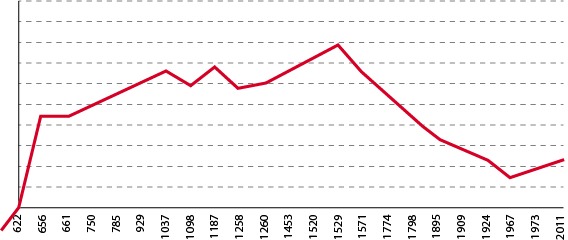 |
| json metadata | {"tags":["islam","civilization","history","ummah"],"image":["https://steemitimages.com/DQmPTBpHL9W8QBVs1eXXob78FxGsyHQw5gkTJpQz3QfRgwi/Timeline1.jpeg"],"app":"steemit/0.1","format":"markdown"} |
| Transaction Info | Block #21850986/Trx e2316403fbc2ab2cb36a9636cba0375700905e43 |
View Raw JSON Data
{
"trx_id": "e2316403fbc2ab2cb36a9636cba0375700905e43",
"block": 21850986,
"trx_in_block": 2,
"op_in_trx": 0,
"virtual_op": 0,
"timestamp": "2018-04-24T15:43:30",
"op": [
"comment",
{
"parent_author": "",
"parent_permlink": "islam",
"author": "leadus",
"permlink": "rise-fall-and-future-of-the-muslim-civilization",
"title": "Rise, Fall and Future of the Muslim Civilization",
"body": "Our project on defining the future Muslim civilization has completed the first milestone with a draft manuscript in Arabic written by Dr. Tareq Al-Suwaidan. The following article is are-write in English on one of the key sub-sections of the book.\n\n<strong>Trend of Civilizations</strong>\nCivilizations follow a definite trend, in which they rise and decline. Some rise again and some decline to obsolescence. The Islamic civilization also followed a similar trend throughout its very long history. The first stage of incorporation and development within the Arab peninsula, was followed by various stages of development and expansion as the Muslims extended their geographical influence through the various sultanates and dynasties. There were periods of decline and major setbacks in some parts of the Muslim world while it expanded in other parts. But the decline of the the Ottoman caliphate, in general, marked the decline of the Muslims in the other parts of the world. The decline led to large parts of the Muslim world being occupied and colonized until it reached its low ebb, the lost one of its religious icons, Palestine. But, God willing, it will rise again. This will be achieved only by an overall revival of the influence of Islam in the life of Muslim individuals and societies. As Imam Malik (may Allah have mercy on him) said, <strong> “the first of generation of this nation did not become good except through religion and its application”</strong>.\n\n<strong>History shows that no armies were invincible ~ Joseph Stalin</strong>\n\nIn the following table, we will highlight the major events that happened throughout the Muslim history. We then present a rough curve showing the rise and decline trends of the Muslim civilization.\n\n<strong>622 - Hijrah (Migration from Mecca to Yathrib, which took upon a new name, Madinah)</strong>\nThe Muslims did not have a state before the migration, and the focus of the Prophet Muhammad (SAW) in Mecca was on the construction of the belief and morals, correcting concepts and misconceptions. \nBecause it is a foundation stage that lasted 13 years, we will consider that the beginning of Islamic civilization was the year 622. \nWith the Hijrah, Prophet Muhammad (SAW) became a Prophet and the leader of a distinct state. Islam added to the belief and morals, social, family, economic and political laws and guidelines. The early Muslims began to form an Islamic state, which will bring all those who believe in the new religion (Islam), and will administer their affairs. \nThe Hijrah became a dividing line in the life of the Prophet and in the history of Islam. It is the official start of Islam as a religion and a state together.\n\n<strong>656 - Conflict between the Companions during the Caliphate of Ali (RA)</strong>\nThe great sedition between the Companions, may Allah's mercy be upon them all, due to the differences after the killing of the third Caliph Utman (RA).\nBecause of the Muslims preoccupation with this sedition and their diligence to address them, it froze the movement of the Islamic tide, and stopped the cultural expansion of the State of Islam,\nThe stalemate lasted close to 5 years.\nCaliph Ali was murdered by the Khawarij group.\n\n<strong>661 - Leadership conflict resolved; Start of the Umayyad dynasty</strong>\nThere was a breakthrough in the division of the Ummah and the year was called the year of unity.\nThe Ummah recovered something of its health, and collected its divided ranks. This would not have happened but for the virtue of God when Hassan Bin Ali, whom many regions of the Ummah supported him as the successor to Caliph Ali, voluntarily stepped down to allow Muawiya bin Abi Sufyan to be the sole leader of the Muslim Ummah. All the regions then gave their allegiance to Muawiya and the Ummah was united again.\nHassan (RA) realized the prophecy of the Prophet (SAW) when he (SAW) said that Hassan (RA) is a master through whom Allah (SWT) will bring good among two great factions (Tirmidhi).\nMay Allah (SWT) forgive all the Companions and their followers for the trials and tribulations they all went through during that difficult part of the early Muslim history. They were part of the great generation of Muslims and sacrificed much for Islam. We must look up to them and love them.\n\n<strong>750 - End of the Umayyad dynasty; Start of the Abbasid dynasty</strong>\nThe Umayyad state collapsed and was replaced by the Abbasid state, which continued its cultural production, growth of Islam, close attention to knowledge and scholars.\nNew science, knowledge and discoveries flourished during the Abbasid rule which reached its peak during the era of Harun al-Rashid.\nThe pious scholar Al-Fudhail ibn ‘Iyadh said that no death touched him more severely than the death of the Amirul Mukminin Harun, and he wished that Allah took from his age and added to the age of Harun al-Rashid.\n\n<strong>785 - Start of the Umayyad dynasty in Andalusia</strong>\nIn the same Abbasid period, a strong civilization of Muslims began to arise in Andalusia, led by the Umayyads.\nIt reached its peak during the reign of Abd al-Rahman (III) al-Nasir (May Allah (SWT) have mercy on him), who made Cordoba the center of world civilization, for Muslims and non-Muslims.\nThe rule of Abd al-Rahman al-Nasir lasted for fifty years, and it can be fairly stated that he was among the greatest rulers of the Islamic civilization.\n\n<strong>929 - Seljuk Sultanate</strong>\nThe Seljuk Sultanate was started by the Seljuk Turks, who came from the Turkmen tribe of Qanq which is roughly the region of Turkmenistan today.\nDuring their rule, the Islamic civilization did not decline but continued to ascend. Islamic arts, science, knowledge and development continued to spread in different countries. This was evident in the movement of urbanization and the magnificent buildings they built.\nThe Seljuk rule continued until they were defeated by the Mongols in the middle 13th century.\n\n<strong>1037 - Jerusalem occupied by the Crusaders</strong>\nThe first major retreat and fracture in the growth of the Islamic civilization was the attack by the Crusaders.\nIt reached its intensity when the city of Jerusalem fell into the hands of the Crusaders, who shed the blood of more than 100,000 of the inhabitants of Jerusalem.\nThe Muslims and Jews were massacred, including the Arab Christians who stood by the Muslims.\n\n<strong>1187 - Salah al-Din al-Ayyubi liberates Jerusalem</strong>\nAllah (SWT) raises from among the Muslim Ummah someone to revive its glory and remove its weakness. Among these men, was Nasser Salah al-Din.\nHe mastered the arts of war, united the Muslims and drew their eyes towards Jerusalem, so he realized his ambition.\nHe took Jerusalem back and liberated it from the clutches of the Crusaders in the Battle of Hittin, one of the significant victories that made a difference in the Islamic history.\n\n<strong>1258 - Fall of Baghdad</strong>\nThe Ummah fell back and broke again, this time from the Mongols who rolled over the Muslim lands from the east.\nIt culminated with the fall of Baghdad, the capital of the Islamic caliphate at that time.\nAll the libraries and schools and hospitals, all of the city's archives and records, all the artifacts of civilization, all the evidences of the Islamic civilization in its golden age, were completely destroyed.\nThe Mongols destroyed a major part of the Islamic civilization, the most valuable and unrecoverable were the hundreds of thousands of handwritten volumes of books.\n\n<strong>1260 - Battle of Ain Jalut</strong>\nJust two years after the fall of Baghdad, the Mongols were defeated.\nThe Mamluk leader, Saifuddin Qutz, defeated and humiliated them in the battle of Ain Jalut, which stopped the Mongol tide not only against the land of Islam, but against the whole world. If not for the battle of Ain Jalut, the Mongols could have reached the heart of Europe.\nAin Jalut was a decisive battle in the history of the whole world.\nEgypt was the only one power that managed to defeat the Mongols. No one else ever dealt the Mongols a straight-up military defeat, not anywhere.\n\n<strong>1453 - Establishment of the Ottoman Caliphate</strong>\nThe Ottomans started to become prominent during this period of time. Their origins date back to the Turkmen tribe at the beginning of the thirteenth century. They lived in Kurdistan and practiced grazing.\nOne of the positive effects of the Ottoman Caliphate was the opening of the city of Constantinople (Istanbul), the capital of the Byzantines. This happened during the rule of the young believer Sultan Mohammed Al-Fateh, who did not exceed the age of twenty-one years when he conquered Constantinople.\nThe Ottoman Caliphate reached its peak during the reign of Sultan Sulayman al-Qanuni, the tenth sultan of the Ottoman Caliphate. The Islamic state reached the outskirts of Europe, and vast areas of North Africa. He cared much for culture and science, spoke four languages, and died in 1566.\n\n<strong>1529 - Third Siege of Vienna</strong>\nThis event marked the end of the growth of the Islamic civilization, after which it began to recede and descend. Those who follow the movement of the Islamic civilization will see its declining trend after the failure of the siege of Vienna. \nThe main reason behind the failure is the prevailing weather at that time of heavy snowfall and severe flooding, which hampered movement and forced them to withdraw, but the biggest problem was that the Ottomans focused on the military conquest and forgot the conquest by da’wah and intellectual advocacy, which are more important.\n\n<strong>1571 - Naval Battle of Lepanto</strong>\nIt was even worse when the Ottoman navy was defeated by a coalition of European navies in the Battle of Lepanto.\n\n<strong>1574 - Defeat by the Russians</strong>\nThe Ottoman army lost a major battle against the Russians in the Black Sea region.\nThis led to the Russians expanding at the expense of the territories of the Islamic state which was ruled by the Ottomans.\n\n<strong>1798 - Napoleon Bonaparte occupies Egypt</strong>\nThe French General Napoleon Bonaparte occupied Egypt, entered Palestine but stopped his campaign when he could not penetrate the walls of Acre.\n\n<strong>1895 - Western laws being adopted</strong>\nFor the first time, Western laws are adopted in the Ottoman state in the provisions of personal status relating to marriage, divorce and inheritance.\n\n<strong>1909 - Deposition of the Ottoman Sultan</strong>\nThe deposition of the Ottoman Sultan Abdul Hamid II, the last Caliph (effectively) to the Muslims.\nHe has long stood as a barrier against the greed of the Jews in Palestine.\n\n<strong>1924 - End of the Ottoman Caliphate</strong>\nThe overthrow of the Ottoman Caliphate, the last caliphate in the Islamic civilization, and the emergence of Mustafa Kemal Ataturk as head of a secular state in Turkey.\nHe abolished the Ottoman Caliphate, and expelled the last Caliph and his family from the country, and abolished the ministries of Awqaf and Islamic courts.\nHe changed religious schools to national schools, changed the use of Arabic letters to Latin letters for the Turkish language and the Adhaan from Arabic to Turkish\nHe announced Turkey as a secular state.\n\n<strong>1967 - Fall of Jerusalem</strong>\nAlthough the fall of the Ottoman caliphate was very hard on the soul, it was not the \"bottom\" for the Muslims. It was not the end of the decline and downfall of civilization for Muslims. \nThe “bottom” for us was in (1967) when the city of Jerusalem fell into the hands of the Zionists, and the official Arab regimes did not rise to respond, and the Muslims too did not seriously protest the loss of Jerusalem.\nThe establishment of Israel through an illegal occupation of Palestinian lands in 1948 followed the downward trend that led to this \"bottom\".\n\n<strong>1973 - October War</strong>\nAfter the fall of Jerusalem in the hands of the Jews, the Muslims began to be restless and began to notice the danger to them.\nThe Muslim Ummah especially in the Arab world experienced an awakening in the form of stronger rallies for resistance against Israel especially from the Islamic movements.\nThe climax of this phase was (October 16, 1973), during which the Egyptian army fought the \"Ramadhan\" war\nIt restored to the Ummah something of its dignity and prestige.\n\n<strong>2011 - Arab Spring</strong>\nThe Arab Spring is a huge jump, and the big step that will contribute in building the civilization of Islam again.\nIt is a major step that will help to make the enable reform and change in many parts of the Ummah.\nDespite the setbacks and some disappointments following the Arab Spring, those who have tasted the freedom will not give up, and that the Ummah is destined to progress, reform and closer to glory than many people imagine.\n\nThe curve below shows the rise and fall of the Muslim Mmmah based on the major milestones we presented above. We believe we have reached the bottom in the fall and decline. Now there is only one way for the Ummah, an upward and rising trend. It has started with the many Muslim countries gaining independence from the colonial powers. Although many of the new leaders that replaced the colonials were dictators and oppressive, the education of the masses improved and they now have higher ideals and aspirations. This led to the Arab Spring in 2011. As can be seen, the Muslim civilization is Insha Allah on the rise again. There will be hiccups and disappointments along the way, but Insha Allah, there is no mistake that we are on the rise.\n",
"json_metadata": "{\"tags\":[\"islam\",\"civilization\",\"history\",\"ummah\"],\"image\":[\"https://steemitimages.com/DQmPTBpHL9W8QBVs1eXXob78FxGsyHQw5gkTJpQz3QfRgwi/Timeline1.jpeg\"],\"app\":\"steemit/0.1\",\"format\":\"markdown\"}"
}
]
}vaafelvakupvoted (100.00%) @leadus / guidance-on-wisdom-from-al-quran2018/04/06 12:26:54
vaafelvakupvoted (100.00%) @leadus / guidance-on-wisdom-from-al-quran
2018/04/06 12:26:54
| voter | vaafelvak |
| author | leadus |
| permlink | guidance-on-wisdom-from-al-quran |
| weight | 10000 (100.00%) |
| Transaction Info | Block #21329288/Trx e63d6ca80fdf05e6d26bb5ed69b51110c0fc83cd |
View Raw JSON Data
{
  "trx_id": "e63d6ca80fdf05e6d26bb5ed69b51110c0fc83cd",
  "block": 21329288,
  "trx_in_block": 9,
  "op_in_trx": 0,
  "virtual_op": 0,
  "timestamp": "2018-04-06T12:26:54",
  "op": [
    "vote",
    {
      "voter": "vaafelvak",
      "author": "leadus",
      "permlink": "guidance-on-wisdom-from-al-quran",
      "weight": 10000
    }
  ]
}leadusupvoted (100.00%) @leadus / guidance-on-wisdom-from-al-quran2018/04/06 01:54:27
leadusupvoted (100.00%) @leadus / guidance-on-wisdom-from-al-quran
2018/04/06 01:54:27
| voter | leadus |
| author | leadus |
| permlink | guidance-on-wisdom-from-al-quran |
| weight | 10000 (100.00%) |
| Transaction Info | Block #21316639/Trx ea7e9d91c04a0e1fc63bfb66692dbfeeb03e438c |
View Raw JSON Data
{
  "trx_id": "ea7e9d91c04a0e1fc63bfb66692dbfeeb03e438c",
  "block": 21316639,
  "trx_in_block": 28,
  "op_in_trx": 0,
  "virtual_op": 0,
  "timestamp": "2018-04-06T01:54:27",
  "op": [
    "vote",
    {
      "voter": "leadus",
      "author": "leadus",
      "permlink": "guidance-on-wisdom-from-al-quran",
      "weight": 10000
    }
  ]
}leaduspublished a new post: guidance-on-wisdom-from-al-quran2018/04/06 01:54:27
leaduspublished a new post: guidance-on-wisdom-from-al-quran
2018/04/06 01:54:27
| parent author | |
| parent permlink | quran |
| author | leadus |
| permlink | guidance-on-wisdom-from-al-quran |
| title | Guidance On Wisdom From Al-Quran |
| body | <strong></strong>Many of us aspire to be wise. We all look up to the wise person. We quote and repeat what we consider as wise sayings. In the hierarchy of knowledge, data when collated and interpreted form pieces of information which are often combined to form a body of knowledge. Many people can become knowledgeable in selected or multiple disciplines by studying, practicing, researching and experimenting in that body of knowledge. The methods to acquire knowledge are known. Hikmah (Wisdom), however, is a gift from the All-Wise, Allah (SWT). <p style="text-align: center;"><strong><em>He grants wisdom to whom He pleases; and he to whom wisdom is granted receives indeed a benefit overflowing; but none will grasp the Message but men of understanding. (2:269)</em></strong></p> As such, to understand hikmah, we must reference Al-Quran. If Allah (SWT) grants hikmah, then surely He addresses the topic in His Book. The word hikmah is mentioned 20 times in Al-Quran. <li>Hikmah as something that Allah (SWT) grants and the abundant goodness accompanies the person with hikmah. Surah 2: Verse 269 (Hikmah mentioned twice) <li>Hikmah as part of the message conveyed by the Prophets. Surah 3: Verse 81 <li>Hikmah in association with Al-Kitab (book) that Prophet Muhammad (SAW) conveyed (Al-Kitab wa Al-Hikmah). [Surah 2: Verse 129, 151 and 231, Surah 3: Verse 164, Surah 4: Verse 113, Surah 33: Verse 34, Surah 62: Verse 2 <li>Hikmah as part of the message conveyed by Prophet 'Isa (AS). Surah 3: Verse 48, Surah 5: Verse 110, Surah 43: Verse 63 <li>Hikmah as being bestowed upon Prophet Daud (AS). Surah 2: Verse 251, Surah 38: Verse 20 <li>Hikmah as being bestowed upon the family of Prophet Ibrahim (AS). Surah 4: Verse 54 <li>Command to invite to the path of Allah by Hikmah. Surah 16: Verse 125 <li>What Allah (SWT) has revealed to Prophet Muhammad (SAW) among the (precepts of) wisdom. Surah 17: Verse 39 <li>Hikmah as being bestowed upon Luqman. Surah 31: Verse 12 <li>Mature wisdom describing the recitals that have came to those who reject the message. Surah 54: Verse 5 </li> <p>From the above list we can safely conclude that Allah (SWT) the Most Wise grants Hikmah to whom He pleases. He has granted it to all His Prophets and Messengers. Hikmah is part of the message that the Prophets convey to people. It is in association with the revealed books that Allah (SWT) sent to them. Many scholars interpret that Al-Hikmah in association with Al-Kitab, refers to the teachings, practices and model behavior of the Prophets. Al-Hikmah is sometimes referred to as the Prophets' way or sunnah. <p style="text-align: center;"><em><strong>Behold! Allah took the covenant of the prophets, saying: "I give you a Book and Wisdom; then comes to you an apostle, confirming what is with you; do you believe in him and render him help." Allah said: "Do you agree, and take this my Covenant as binding on you?" They said: "We agree." He said: "Then bear witness, and I am with you among the witnesses." (3:81)</strong></em></p> 2. Apart from the Prophets and Messengers, Allah (SWT) also granted hikmah to Luqman. Thus we can conclude that Allah (SWT) also grants hikmah to those whom He (SWT) selects from the Believers. 3. Allah (SWT) explains the nature of Al-Hikmah through actions, deeds and behaviors. This is very evident from the group of verses in (Surah 17: Verse 23-39) and (Surah 31: Verse 12-19). The imperative verb is used to describe the actions in both these groups of verses to further emphasize that the Believers are commanded to behave likewise to have the chance to be granted Al-Hikmah. The group of verses in (Surah 17: Verse 23-39) end with a clear explanation that the related actions described in the preceding verses are part of Al-Hikmah. <p style="text-align: center;"><em><strong>These are among the (precepts of) wisdom, which thy Lord has revealed to thee. Take not, with Allah, another object of worship, lest thou shouldst be thrown into Hell, blameworthy and rejected. (17:39)</strong></em></p> <p>As a practical guidance for mankind and Believers in particular, Al-Quran strongly emphasizes the behavioral aspects of Al-Hikmah. It contradicts the common notion that persons of wisdom are mere thinkers or philosophers. Al-Quran prescribes actions and behaviors that can lead us to attain wisdom from the source of wisdom, Allah The All Wise. We quote the two groups of verses below. Insha Allah in the next posting we will do a brief analysis of these verses. <p style="text-align: center;"><em><strong>Your Lord has decreed that you worship none but Him, and that you be kind to parents. Whether one or both of them attain old age in your life, say not to them a word of contempt, nor repel them, but address them in terms of honor.</strong></em></p> <p style="text-align: center;"><em><strong>And, out of kindness, lower to them the wing of humility, and say: "My Lord! bestow on them Your Mercy even as they cherished me in childhood."</strong></em></p> <p style="text-align: center;"><em><strong>Your Lord knows best what is in your hearts: If you do deeds of righteousness, verily He is Most Forgiving to those who turn to Him again and again (in true penitence).</strong></em></p> <p style="text-align: center;"><em><strong>And render to the kindred their due rights, as (also) to those in want, and to the wayfarer: But squander not (your wealth) in the manner of a spendthrift.</strong></em></p> <p style="text-align: center;"><em><strong>Verily spendthrifts are brothers of the Evil Ones; and the Evil One is to his Lord (himself) ungrateful.</strong></em></p> <p style="text-align: center;"><em><strong>And even if you have to turn away from them in pursuit of the Mercy from your Lord which you do expect, yet speak to them a word of easy kindness.</strong></em></p> <p style="text-align: center;"><em><strong>Make not your hand tied (like a niggard's) to your neck, nor stretch it forth to its utmost reach, so that you become blameworthy and destitute.</strong></em></p> <p style="text-align: center;"><em><strong>Verily your Lord does provide sustenance in abundance for whom He pleasee, and He provides in a just measure. For He does know and regard all His servants.</strong></em></p> <p style="text-align: center;"><em><strong>Kill not your children for fear of want: We shall provide sustenance for them as well as for you. Verily the killing of them is a great sin.</strong></em></p> <p style="text-align: center;"><em><strong>Nor come nigh to adultery: for it is a shameful (deed) and an evil, opening the road (to other evils).</strong></em></p> <p style="text-align: center;"><em><strong>Nor take life - which Allah has made sacred - except for just cause. And if anyone is slain wrongfully, we have given his heir authority (to demand qisas or to forgive): but let him nor exceed bounds in the matter of taking life; for he is helped (by the Law).</strong></em></p> <p style="text-align: center;"><em><strong>Come not nigh to the orphan's property except to improve it, until he attains the age of full strength; and fulfill (every) engagement, for (every) engagement will be enquired into (on the Day of Reckoning).</strong></em></p> <p style="text-align: center;"><em><strong>Give full measure when you measure, and weigh with a balance that is straight: that is the most fitting and the most advantageous in the final determination.</strong></em></p> <p style="text-align: center;"><em><strong>And pursue not that of which you have no knowledge; for every act of hearing, or of seeing or of (feeling in) the heart will be enquired into (on the Day of Reckoning).</strong></em></p> <p style="text-align: center;"><em><strong>Nor walk on the earth with insolence: for you cannot rend the earth asunder, nor reach the mountains in height.</strong></em></p> <p style="text-align: center;"><em><strong>Of all such things the evil is hateful in the sight of your Lord.</strong></em></p> <p style="text-align: center;"><em><strong>These are among the (precepts of) wisdom, which your Lord has revealed to you. Take not, with Allah, another object of worship, lest you should be thrown into Hell, blameworthy and rejected. (17:23-39)</strong></em></p> <p style="text-align: center;"><em><strong>We bestowed (in the past) Wisdom on Luqman: "Show (your) gratitude to Allah." Any who is (so) grateful does so to the profit of his own soul: but if any is ungrateful, verily Allah is free of all wants, Worthy of all praise.</strong></em></p> <p style="text-align: center;"><em><strong>Behold, Luqman said to his son by way of instruction: "O my son! join not in worship (others) with Allah. for false worship is indeed the highest wrong-doing."</strong></em></p> <p style="text-align: center;"><em><strong>And We have enjoined on man (to be good) to his parents: in travail upon travail did his mother bear him, and in years twain was his weaning: (hear the command), "Show gratitude to Me and to your parents: to Me is (your final) Goal.</strong></em></p> <p style="text-align: center;"><em><strong>"But if they strive to make you join in worship with Me things of which you have no knowledge, obey them not; yet bear them company in this life with justice (and consideration), and follow the way of those who turn to me (in love): in the end the return of you all is to Me, and I will tell you the truth (and meaning) of all that you did."</strong></em></p> <p style="text-align: center;"><em><strong>"O my son!" (said Luqman), "If there be (but) the weight of a mustard-seed and it were (hidden) in a rock, or (anywhere) in the heavens or on earth, Allah will bring it forth: for Allah understands the finest mysteries, (and) is well-acquainted (with them).</strong></em></p> <p style="text-align: center;"><em><strong>"O my son! establish regular prayer, enjoin what is just, and forbid what is wrong: and bear with patient constancy whatever betide you; for this is firmness (of purpose) in (the conduct of) affairs.</strong></em></p> <p style="text-align: center;"><em><strong>"And swell not your cheek (for pride) at men, nor walk in insolence through the earth; for Allah loves not any arrogant boaster.</strong></em></p> <p style="text-align: center;"><em> <strong>"And be moderate in your pace, and lower your voice; for the harshest of sounds without doubt is the braying of the ass." (31:12-19)</strong></em></p> |
| json metadata | {"tags":["quran","islam","prophet","wisdom"],"app":"steemit/0.1","format":"markdown"} |
| Transaction Info | Block #21316639/Trx ea7e9d91c04a0e1fc63bfb66692dbfeeb03e438c |
View Raw JSON Data
{
"trx_id": "ea7e9d91c04a0e1fc63bfb66692dbfeeb03e438c",
"block": 21316639,
"trx_in_block": 28,
"op_in_trx": 0,
"virtual_op": 0,
"timestamp": "2018-04-06T01:54:27",
"op": [
"comment",
{
"parent_author": "",
"parent_permlink": "quran",
"author": "leadus",
"permlink": "guidance-on-wisdom-from-al-quran",
"title": "Guidance On Wisdom From Al-Quran",
"body": "<strong></strong>Many of us aspire to be wise. We all look up to the wise person. We quote and repeat what we consider as wise sayings. In the hierarchy of knowledge, data when collated and interpreted form pieces of information which are often combined to form a body of knowledge. Many people can become knowledgeable in selected or multiple disciplines by studying, practicing, researching and experimenting in that body of knowledge. The methods to acquire knowledge are known.\n\nHikmah (Wisdom), however, is a gift from the All-Wise, Allah (SWT).\n<p style=\"text-align: center;\"><strong><em>He grants wisdom to whom He pleases; and he to whom wisdom is granted receives indeed a benefit overflowing; but none will grasp the Message but men of understanding. (2:269)</em></strong></p>\nAs such, to understand hikmah, we must reference Al-Quran. If Allah (SWT) grants hikmah, then surely He addresses the topic in His Book.\n\nThe word hikmah is mentioned 20 times in Al-Quran.\n<li>Hikmah as something that Allah (SWT) grants and the abundant goodness accompanies the person with hikmah. Surah 2: Verse 269 (Hikmah mentioned twice)\n<li>Hikmah as part of the message conveyed by the Prophets. Surah 3: Verse 81\n<li>Hikmah in association with Al-Kitab (book) that Prophet Muhammad (SAW) conveyed (Al-Kitab wa Al-Hikmah). [Surah 2: Verse 129, 151 and 231, Surah 3: Verse 164, Surah 4: Verse 113, Surah 33: Verse 34, Surah 62: Verse 2\n<li>Hikmah as part of the message conveyed by Prophet 'Isa (AS). Surah 3: Verse 48, Surah 5: Verse 110, Surah 43: Verse 63\n<li>Hikmah as being bestowed upon Prophet Daud (AS). Surah 2: Verse 251, Surah 38: Verse 20\n<li>Hikmah as being bestowed upon the family of Prophet Ibrahim (AS). Surah 4: Verse 54\n<li>Command to invite to the path of Allah by Hikmah. Surah 16: Verse 125\n<li>What Allah (SWT) has revealed to Prophet Muhammad (SAW) among the (precepts of) wisdom. Surah 17: Verse 39\n<li>Hikmah as being bestowed upon Luqman. Surah 31: Verse 12\n<li>Mature wisdom describing the recitals that have came to those who reject the message. Surah 54: Verse 5\n</li>\n\n\n<p>From the above list we can safely conclude that Allah (SWT) the Most Wise grants Hikmah to whom He pleases. He has granted it to all His Prophets and Messengers. Hikmah is part of the message that the Prophets convey to people. It is in association with the revealed books that Allah (SWT) sent to them. Many scholars interpret that Al-Hikmah in association with Al-Kitab, refers to the teachings, practices and model behavior of the Prophets. Al-Hikmah is sometimes referred to as the Prophets' way or sunnah.\n<p style=\"text-align: center;\"><em><strong>Behold! Allah took the covenant of the prophets, saying: \"I give you a Book and Wisdom; then comes to you an apostle, confirming what is with you; do you believe in him and render him help.\" Allah said: \"Do you agree, and take this my Covenant as binding on you?\" They said: \"We agree.\" He said: \"Then bear witness, and I am with you among the witnesses.\" (3:81)</strong></em></p>\n\n2. Apart from the Prophets and Messengers, Allah (SWT) also granted hikmah to Luqman. Thus we can conclude that Allah (SWT) also grants hikmah to those whom He (SWT) selects from the Believers.\n\n3. Allah (SWT) explains the nature of Al-Hikmah through actions, deeds and behaviors. This is very evident from the group of verses in (Surah 17: Verse 23-39) and (Surah 31: Verse 12-19). The imperative verb is used to describe the actions in both these groups of verses to further emphasize that the Believers are commanded to behave likewise to have the chance to be granted Al-Hikmah. The group of verses in (Surah 17: Verse 23-39) end with a clear explanation that the related actions described in the preceding verses are part of Al-Hikmah.\n<p style=\"text-align: center;\"><em><strong>These are among the (precepts of) wisdom, which thy Lord has revealed to thee. Take not, with Allah, another object of worship, lest thou shouldst be thrown into Hell, blameworthy and rejected. (17:39)</strong></em></p>\n\n<p>As a practical guidance for mankind and Believers in particular, Al-Quran strongly emphasizes the behavioral aspects of Al-Hikmah. It contradicts the common notion that persons of wisdom are mere thinkers or philosophers. Al-Quran prescribes actions and behaviors that can lead us to attain wisdom from the source of wisdom, Allah The All Wise.\n\nWe quote the two groups of verses below. Insha Allah in the next posting we will do a brief analysis of these verses.\n\n \n<p style=\"text-align: center;\"><em><strong>Your Lord has decreed that you worship none but Him, and that you be kind to parents. Whether one or both of them attain old age in your life, say not to them a word of contempt, nor repel them, but address them in terms of honor.</strong></em></p>\n<p style=\"text-align: center;\"><em><strong>And, out of kindness, lower to them the wing of humility, and say: \"My Lord! bestow on them Your Mercy even as they cherished me in childhood.\"</strong></em></p>\n<p style=\"text-align: center;\"><em><strong>Your Lord knows best what is in your hearts: If you do deeds of righteousness, verily He is Most Forgiving to those who turn to Him again and again (in true penitence).</strong></em></p>\n<p style=\"text-align: center;\"><em><strong>And render to the kindred their due rights, as (also) to those in want, and to the wayfarer: But squander not (your wealth) in the manner of a spendthrift.</strong></em></p>\n<p style=\"text-align: center;\"><em><strong>Verily spendthrifts are brothers of the Evil Ones; and the Evil One is to his Lord (himself) ungrateful.</strong></em></p>\n<p style=\"text-align: center;\"><em><strong>And even if you have to turn away from them in pursuit of the Mercy from your Lord which you do expect, yet speak to them a word of easy kindness.</strong></em></p>\n<p style=\"text-align: center;\"><em><strong>Make not your hand tied (like a niggard's) to your neck, nor stretch it forth to its utmost reach, so that you become blameworthy and destitute.</strong></em></p>\n<p style=\"text-align: center;\"><em><strong>Verily your Lord does provide sustenance in abundance for whom He pleasee, and He provides in a just measure. For He does know and regard all His servants.</strong></em></p>\n<p style=\"text-align: center;\"><em><strong>Kill not your children for fear of want: We shall provide sustenance for them as well as for you. Verily the killing of them is a great sin.</strong></em></p>\n<p style=\"text-align: center;\"><em><strong>Nor come nigh to adultery: for it is a shameful (deed) and an evil, opening the road (to other evils).</strong></em></p>\n<p style=\"text-align: center;\"><em><strong>Nor take life - which Allah has made sacred - except for just cause. And if anyone is slain wrongfully, we have given his heir authority (to demand qisas or to forgive): but let him nor exceed bounds in the matter of taking life; for he is helped (by the Law).</strong></em></p>\n<p style=\"text-align: center;\"><em><strong>Come not nigh to the orphan's property except to improve it, until he attains the age of full strength; and fulfill (every) engagement, for (every) engagement will be enquired into (on the Day of Reckoning).</strong></em></p>\n<p style=\"text-align: center;\"><em><strong>Give full measure when you measure, and weigh with a balance that is straight: that is the most fitting and the most advantageous in the final determination.</strong></em></p>\n<p style=\"text-align: center;\"><em><strong>And pursue not that of which you have no knowledge; for every act of hearing, or of seeing or of (feeling in) the heart will be enquired into (on the Day of Reckoning).</strong></em></p>\n<p style=\"text-align: center;\"><em><strong>Nor walk on the earth with insolence: for you cannot rend the earth asunder, nor reach the mountains in height.</strong></em></p>\n<p style=\"text-align: center;\"><em><strong>Of all such things the evil is hateful in the sight of your Lord.</strong></em></p>\n<p style=\"text-align: center;\"><em><strong>These are among the (precepts of) wisdom, which your Lord has revealed to you. Take not, with Allah, another object of worship, lest you should be thrown into Hell, blameworthy and rejected. (17:23-39)</strong></em></p>\n \n<p style=\"text-align: center;\"><em><strong>We bestowed (in the past) Wisdom on Luqman: \"Show (your) gratitude to Allah.\" Any who is (so) grateful does so to the profit of his own soul: but if any is ungrateful, verily Allah is free of all wants, Worthy of all praise.</strong></em></p>\n<p style=\"text-align: center;\"><em><strong>Behold, Luqman said to his son by way of instruction: \"O my son! join not in worship (others) with Allah. for false worship is indeed the highest wrong-doing.\"</strong></em></p>\n<p style=\"text-align: center;\"><em><strong>And We have enjoined on man (to be good) to his parents: in travail upon travail did his mother bear him, and in years twain was his weaning: (hear the command), \"Show gratitude to Me and to your parents: to Me is (your final) Goal.</strong></em></p>\n<p style=\"text-align: center;\"><em><strong>\"But if they strive to make you join in worship with Me things of which you have no knowledge, obey them not; yet bear them company in this life with justice (and consideration), and follow the way of those who turn to me (in love): in the end the return of you all is to Me, and I will tell you the truth (and meaning) of all that you did.\"</strong></em></p>\n<p style=\"text-align: center;\"><em><strong>\"O my son!\" (said Luqman), \"If there be (but) the weight of a mustard-seed and it were (hidden) in a rock, or (anywhere) in the heavens or on earth, Allah will bring it forth: for Allah understands the finest mysteries, (and) is well-acquainted (with them).</strong></em></p>\n<p style=\"text-align: center;\"><em><strong>\"O my son! establish regular prayer, enjoin what is just, and forbid what is wrong: and bear with patient constancy whatever betide you; for this is firmness (of purpose) in (the conduct of) affairs.</strong></em></p>\n<p style=\"text-align: center;\"><em><strong>\"And swell not your cheek (for pride) at men, nor walk in insolence through the earth; for Allah loves not any arrogant boaster.</strong></em></p>\n<p style=\"text-align: center;\"><em> <strong>\"And be moderate in your pace, and lower your voice; for the harshest of sounds without doubt is the braying of the ass.\" (31:12-19)</strong></em></p>",
"json_metadata": "{\"tags\":[\"quran\",\"islam\",\"prophet\",\"wisdom\"],\"app\":\"steemit/0.1\",\"format\":\"markdown\"}"
}
]
}leaduspublished a new post: supplicating-for-the-big-requests2018/03/26 04:33:12
leaduspublished a new post: supplicating-for-the-big-requests
2018/03/26 04:33:12
| parent author | |
| parent permlink | islam |
| author | leadus |
| permlink | supplicating-for-the-big-requests |
| title | Companionship in the Hereafter - The Ultimate Request |
| body | @@ -3354,12 +3354,335 @@ strong%3E%3C/em%3E +%0A%0AWith all the promises in Paradise, which is the most valuable? Perhaps this story can give a hint; companionship with the best of peoples and, even more valuable, the following verse,%0A%D9%88%D9%8F%D8%AC%D9%8F%D9%88%D9%87%D9%8C %D9%8A%D9%8E%D9%88%D9%92%D9%85%D9%8E%D8%A6%D9%90%D8%B0%D9%8D %D9%86%D9%8E%D8%A7%D8%B6%D9%90%D8%B1%D9%8E%D8%A9%D9%8C %0A%5B75:22%5D (Some) faces on that day shall be bright,%0A%D8%A5%D9%90%D9%84%D9%8E%D9%89%D9%B0 %D8%B1%D9%8E%D8%A8%D9%91%D9%90%D9%87%D9%8E%D8%A7 %D9%86%D9%8E%D8%A7%D8%B8%D9%90%D8%B1%D9%8E%D8%A9%D9%8C %0A%5B75:23%5D Looking to their Lord. |
| json metadata | {"tags":["islam","supplication","ethics","prophet","ambition"],"app":"steemit/0.1","format":"markdown"} |
| Transaction Info | Block #21003097/Trx 9c75b505b277afa5d27a0f9d2058df1dbbedba9c |
View Raw JSON Data
{
  "trx_id": "9c75b505b277afa5d27a0f9d2058df1dbbedba9c",
  "block": 21003097,
  "trx_in_block": 1,
  "op_in_trx": 0,
  "virtual_op": 0,
  "timestamp": "2018-03-26T04:33:12",
  "op": [
    "comment",
    {
      "parent_author": "",
      "parent_permlink": "islam",
      "author": "leadus",
      "permlink": "supplicating-for-the-big-requests",
      "title": "Companionship in the Hereafter - The Ultimate Request",
      "body": "@@ -3354,12 +3354,335 @@\n strong%3E%3C/em%3E\n+%0A%0AWith all the promises in Paradise, which is the most valuable? Perhaps this story can give a hint; companionship with the best of peoples and, even more valuable, the following verse,%0A%D9%88%D9%8F%D8%AC%D9%8F%D9%88%D9%87%D9%8C %D9%8A%D9%8E%D9%88%D9%92%D9%85%D9%8E%D8%A6%D9%90%D8%B0%D9%8D %D9%86%D9%8E%D8%A7%D8%B6%D9%90%D8%B1%D9%8E%D8%A9%D9%8C %0A%5B75:22%5D (Some) faces on that day shall be bright,%0A%D8%A5%D9%90%D9%84%D9%8E%D9%89%D9%B0 %D8%B1%D9%8E%D8%A8%D9%91%D9%90%D9%87%D9%8E%D8%A7 %D9%86%D9%8E%D8%A7%D8%B8%D9%90%D8%B1%D9%8E%D8%A9%D9%8C %0A%5B75:23%5D Looking to their Lord.\n",
      "json_metadata": "{\"tags\":[\"islam\",\"supplication\",\"ethics\",\"prophet\",\"ambition\"],\"app\":\"steemit/0.1\",\"format\":\"markdown\"}"
    }
  ]
}leaduspublished a new post: supplicating-for-the-big-requests2018/03/26 04:21:30
leaduspublished a new post: supplicating-for-the-big-requests
2018/03/26 04:21:30
| parent author | |
| parent permlink | islam |
| author | leadus |
| permlink | supplicating-for-the-big-requests |
| title | Companionship in the Hereafter - The Ultimate Request |
| body | @@ -3105,8 +3105,261 @@ i%3E%0A%3C/ol%3E +%0A%0A%3Cp%3E%3Cstrong%3E%3Cem%3EAnd whoever obeys Allah and the Messenger, these are with those upon whom Allah has bestowed favors from among the prophets and the truthful and the martyrs and the good, and a goodly company are they! %5BAl-Quran, 4:69%5D%3C/p%3E%3C/strong%3E%3C/em%3E |
| json metadata | {"tags":["islam","supplication","ethics","prophet","ambition"],"app":"steemit/0.1","format":"markdown"} |
| Transaction Info | Block #21002863/Trx 5612209274e46ff9d5dab3875bb0860fa3635ed5 |
View Raw JSON Data
{
  "trx_id": "5612209274e46ff9d5dab3875bb0860fa3635ed5",
  "block": 21002863,
  "trx_in_block": 22,
  "op_in_trx": 0,
  "virtual_op": 0,
  "timestamp": "2018-03-26T04:21:30",
  "op": [
    "comment",
    {
      "parent_author": "",
      "parent_permlink": "islam",
      "author": "leadus",
      "permlink": "supplicating-for-the-big-requests",
      "title": "Companionship in the Hereafter - The Ultimate Request",
      "body": "@@ -3105,8 +3105,261 @@\n i%3E%0A%3C/ol%3E\n+%0A%0A%3Cp%3E%3Cstrong%3E%3Cem%3EAnd whoever obeys Allah and the Messenger, these are with those upon whom Allah has bestowed favors from among the prophets and the truthful and the martyrs and the good, and a goodly company are they! %5BAl-Quran, 4:69%5D%3C/p%3E%3C/strong%3E%3C/em%3E\n",
      "json_metadata": "{\"tags\":[\"islam\",\"supplication\",\"ethics\",\"prophet\",\"ambition\"],\"app\":\"steemit/0.1\",\"format\":\"markdown\"}"
    }
  ]
}ubgupvoted (1.00%) @leadus / supplicating-for-the-big-requests2018/03/25 10:47:36
ubgupvoted (1.00%) @leadus / supplicating-for-the-big-requests
2018/03/25 10:47:36
| voter | ubg |
| author | leadus |
| permlink | supplicating-for-the-big-requests |
| weight | 100 (1.00%) |
| Transaction Info | Block #20981796/Trx 1401d27fd6cef858f78c8ed9840d8ad2a0c6d69a |
View Raw JSON Data
{
  "trx_id": "1401d27fd6cef858f78c8ed9840d8ad2a0c6d69a",
  "block": 20981796,
  "trx_in_block": 0,
  "op_in_trx": 0,
  "virtual_op": 0,
  "timestamp": "2018-03-25T10:47:36",
  "op": [
    "vote",
    {
      "voter": "ubg",
      "author": "leadus",
      "permlink": "supplicating-for-the-big-requests",
      "weight": 100
    }
  ]
}2018/03/25 10:44:00
2018/03/25 10:44:00
| parent author | leadus |
| parent permlink | supplicating-for-the-big-requests |
| author | cheetah |
| permlink | cheetah-re-leadussupplicating-for-the-big-requests |
| title | |
| body | Hi! I am a robot. I just upvoted you! I found similar content that readers might be interested in: https://www.islamicboard.com/islamic-history-and-biographies/134330961-woman-bani-isra-il.html |
| json metadata | |
| Transaction Info | Block #20981724/Trx de9dd55eb583f8355c62a2b7248021516d26c94e |
View Raw JSON Data
{
  "trx_id": "de9dd55eb583f8355c62a2b7248021516d26c94e",
  "block": 20981724,
  "trx_in_block": 19,
  "op_in_trx": 0,
  "virtual_op": 0,
  "timestamp": "2018-03-25T10:44:00",
  "op": [
    "comment",
    {
      "parent_author": "leadus",
      "parent_permlink": "supplicating-for-the-big-requests",
      "author": "cheetah",
      "permlink": "cheetah-re-leadussupplicating-for-the-big-requests",
      "title": "",
      "body": "Hi! I am a robot. I just upvoted you! I found similar content that readers might be interested in:\nhttps://www.islamicboard.com/islamic-history-and-biographies/134330961-woman-bani-isra-il.html",
      "json_metadata": ""
    }
  ]
}cheetahupvoted (0.08%) @leadus / supplicating-for-the-big-requests2018/03/25 10:43:54
cheetahupvoted (0.08%) @leadus / supplicating-for-the-big-requests
2018/03/25 10:43:54
| voter | cheetah |
| author | leadus |
| permlink | supplicating-for-the-big-requests |
| weight | 8 (0.08%) |
| Transaction Info | Block #20981722/Trx 368abbfcd0e8f027af8c89a0fa1f45fc42c8d7c9 |
View Raw JSON Data
{
  "trx_id": "368abbfcd0e8f027af8c89a0fa1f45fc42c8d7c9",
  "block": 20981722,
  "trx_in_block": 53,
  "op_in_trx": 0,
  "virtual_op": 0,
  "timestamp": "2018-03-25T10:43:54",
  "op": [
    "vote",
    {
      "voter": "cheetah",
      "author": "leadus",
      "permlink": "supplicating-for-the-big-requests",
      "weight": 8
    }
  ]
}leadusupvoted (100.00%) @leadus / supplicating-for-the-big-requests2018/03/25 10:43:42
leadusupvoted (100.00%) @leadus / supplicating-for-the-big-requests
2018/03/25 10:43:42
| voter | leadus |
| author | leadus |
| permlink | supplicating-for-the-big-requests |
| weight | 10000 (100.00%) |
| Transaction Info | Block #20981718/Trx b9f780b1dabee8ab2c6800f3cc148ec4f090de09 |
View Raw JSON Data
{
  "trx_id": "b9f780b1dabee8ab2c6800f3cc148ec4f090de09",
  "block": 20981718,
  "trx_in_block": 37,
  "op_in_trx": 0,
  "virtual_op": 0,
  "timestamp": "2018-03-25T10:43:42",
  "op": [
    "vote",
    {
      "voter": "leadus",
      "author": "leadus",
      "permlink": "supplicating-for-the-big-requests",
      "weight": 10000
    }
  ]
}leaduspublished a new post: supplicating-for-the-big-requests2018/03/25 10:43:42
leaduspublished a new post: supplicating-for-the-big-requests
2018/03/25 10:43:42
| parent author | |
| parent permlink | islam |
| author | leadus |
| permlink | supplicating-for-the-big-requests |
| title | Supplicating for the Big Requests |
| body | The Messenger of Allah (SAW) once visited an Arab (villager). He received him very well and respected Prophet Muhammad (SAW) very much. The Prophet (SAW) was very happy and said to him, <em>O Arab ask what you want! </em>He said, Messenger of Allah, a she-camel with her saddle and a few sheep whose milk would satisfy my family members. He made this request twice. The Messenger of Allah (SAW) said, <em>Was it not possible for you to ask me as the old woman of the Bani Israel asked Musa? </em> The Companions (RA) asked him, O Messenger of Allah! What is the story of the old woman of the Bani Israel? He said to them, <strong><em>Musa (AS) decided to emigrate with the Bani Israel but he got lost on the way. So, their scholars said to him, We tell you that Yusuf (AS) had got our ancestors to promise that we would not go away from Egypt unless we took his bones with us. Perhaps, we are lost because we have not fulfilled the promise. Musa (AS) asked them who among them could point out his grave.</em></strong> <strong><em> They said that none apart from an old woman of the Bani Israel could point out the grave. Musa (AS) sent a messenger to fetch her and requested her to guide them to the grave of Yusuf (AS). She said, "No, by Allah, no! I will never do that unless (you promise me that) I will live with you in Paradise". Musa (AS) did not like what she said. However, he was told in a revelation that he should promise her what she wanted and he accepted her demand.</em></strong> <strong><em> The old woman took them to a small pond and said to them, "Take out this water!" When the water was pumped out, she said, "Dig here!" When they had dug out the earth, they found the bones of Yusuf (AS) inside. Then they continued their exile with the bones of Yusuf with them. The path was clear to them shining like day-light. </em></strong>[Reported by Hakim in Mustadrak. Similar narration in Tabarani's <em>Awsat </em>and Ibn Hibban] There are some lessons to be drawn from the story in this Hadith. <ol> <li> We learn that one should be clear of one's true ambition and ask for it when given the golden opportunity. For the believer, there cannot be a higher ambition than Paradise. The most noble ambition is companionship with the Prophets in Paradise. The old woman was aware of this noble ambition and objective of life and that she should not lose any opportunity to increase her chances of realizing it. She thus jumped on the opportunity to get from Musa (AS) what she most cherished: Paradise and the companionship of her Prophet.</li> <li> We may not get the chance to ask from our Prophet like the Arab had or like the old lady from Bani Israel. But at times we may get intimate with our Creator during the hours that He promised to answer all supplications, like when we are in Arafah on the day of Wuquf. During those moments we should ask for greater things rather than petty worldly things from Allah (SWT). This is what the Prophet (SAW) meant when he said to the simple villager, "Was it not possible for you to ask me as the old woman of the Bani Israel asked Musa"</li> </ol> |
| json metadata | {"tags":["islam","supplication","ethics","prophet","ambition"],"app":"steemit/0.1","format":"markdown"} |
| Transaction Info | Block #20981718/Trx b9f780b1dabee8ab2c6800f3cc148ec4f090de09 |
View Raw JSON Data
{
  "trx_id": "b9f780b1dabee8ab2c6800f3cc148ec4f090de09",
  "block": 20981718,
  "trx_in_block": 37,
  "op_in_trx": 0,
  "virtual_op": 0,
  "timestamp": "2018-03-25T10:43:42",
  "op": [
    "comment",
    {
      "parent_author": "",
      "parent_permlink": "islam",
      "author": "leadus",
      "permlink": "supplicating-for-the-big-requests",
      "title": "Supplicating for the Big Requests",
      "body": "The Messenger of Allah (SAW) once visited an Arab (villager). He received him very well and respected Prophet Muhammad (SAW) very much. The Prophet (SAW) was very happy and said to him, <em>O Arab ask what you want! </em>He said, Messenger of Allah, a she-camel with her saddle and a few sheep whose milk would satisfy my family members. He made this request twice. The Messenger of Allah (SAW) said, <em>Was it not possible for you to ask me as the old woman of the Bani Israel asked Musa? </em>\n\nThe Companions (RA) asked him, O Messenger of Allah! What is the story of the old woman of the Bani Israel? He said to them, <strong><em>Musa (AS) decided to emigrate with the Bani Israel but he got lost on the way. So, their scholars said to him, We tell you that Yusuf (AS) had got our ancestors to promise that we would not go away from Egypt unless we took his bones with us. Perhaps, we are lost because we have not fulfilled the promise. Musa (AS) asked them who among them could point out his grave.</em></strong>\n\n<strong><em> They said that none apart from an old woman of the Bani Israel could point out the grave. Musa (AS) sent a messenger to fetch her and requested her to guide them to the grave of Yusuf (AS). She said, \"No, by Allah, no! I will never do that unless (you promise me that) I will live with you in Paradise\". Musa (AS) did not like what she said. However, he was told in a revelation that he should promise her what she wanted and he accepted her demand.</em></strong>\n\n<strong><em> The old woman took them to a small pond and said to them, \"Take out this water!\" When the water was pumped out, she said, \"Dig here!\" When they had dug out the earth, they found the bones of Yusuf (AS) inside. Then they continued their exile with the bones of Yusuf with them. The path was clear to them shining like day-light. </em></strong>[Reported by Hakim in Mustadrak. Similar narration in Tabarani's <em>Awsat </em>and Ibn Hibban]\n\nThere are some lessons to be drawn from the story in this Hadith.\n<ol>\n\t<li> We learn that one should be clear of one's true ambition and ask for it when given the golden opportunity. For the believer, there cannot be a higher ambition than Paradise. The most noble ambition is companionship with the Prophets in Paradise. The old woman was aware of this noble ambition and objective of life and that she should not lose any opportunity to increase her chances of realizing it. She thus jumped on the opportunity to get from Musa (AS) what she most cherished: Paradise and the companionship of her Prophet.</li>\n\t<li> We may not get the chance to ask from our Prophet like the Arab had or like the old lady from Bani Israel. But at times we may get intimate with our Creator during the hours that He promised to answer all supplications, like when we are in Arafah on the day of Wuquf. During those moments we should ask for greater things rather than petty worldly things from Allah (SWT). This is what the Prophet (SAW) meant when he said to the simple villager, \"Was it not possible for you to ask me as the old woman of the Bani Israel asked Musa\"</li>\n</ol>",
      "json_metadata": "{\"tags\":[\"islam\",\"supplication\",\"ethics\",\"prophet\",\"ambition\"],\"app\":\"steemit/0.1\",\"format\":\"markdown\"}"
    }
  ]
}2018/03/22 04:05:54
2018/03/22 04:05:54
| parent author | leadus |
| parent permlink | leadership-and-ethics |
| author | rotjaeley |
| permlink | re-leadus-leadership-and-ethics-20180322t040544984z |
| title | |
| body | Vote exchange site https://mysteemup.club |
| json metadata | {"tags":["islam"],"links":["https://mysteemup.club"],"app":"steemit/0.1"} |
| Transaction Info | Block #20887726/Trx 199164dce0b6e895a6ef7862a63022830a0e6669 |
View Raw JSON Data
{
  "trx_id": "199164dce0b6e895a6ef7862a63022830a0e6669",
  "block": 20887726,
  "trx_in_block": 6,
  "op_in_trx": 0,
  "virtual_op": 0,
  "timestamp": "2018-03-22T04:05:54",
  "op": [
    "comment",
    {
      "parent_author": "leadus",
      "parent_permlink": "leadership-and-ethics",
      "author": "rotjaeley",
      "permlink": "re-leadus-leadership-and-ethics-20180322t040544984z",
      "title": "",
      "body": "Vote exchange site https://mysteemup.club",
      "json_metadata": "{\"tags\":[\"islam\"],\"links\":[\"https://mysteemup.club\"],\"app\":\"steemit/0.1\"}"
    }
  ]
}leadusupvoted (100.00%) @leadus / leadership-and-ethics2018/03/22 04:05:36
leadusupvoted (100.00%) @leadus / leadership-and-ethics
2018/03/22 04:05:36
| voter | leadus |
| author | leadus |
| permlink | leadership-and-ethics |
| weight | 10000 (100.00%) |
| Transaction Info | Block #20887720/Trx 5ec6ee788818dd0f2f870d9f0d703058477c6f92 |
View Raw JSON Data
{
  "trx_id": "5ec6ee788818dd0f2f870d9f0d703058477c6f92",
  "block": 20887720,
  "trx_in_block": 2,
  "op_in_trx": 0,
  "virtual_op": 0,
  "timestamp": "2018-03-22T04:05:36",
  "op": [
    "vote",
    {
      "voter": "leadus",
      "author": "leadus",
      "permlink": "leadership-and-ethics",
      "weight": 10000
    }
  ]
}leaduspublished a new post: leadership-and-ethics2018/03/22 04:05:36
leaduspublished a new post: leadership-and-ethics
2018/03/22 04:05:36
| parent author | |
| parent permlink | islam |
| author | leadus |
| permlink | leadership-and-ethics |
| title | Leadership and Ethics |
| body | Prophet Muhammad (SAW) is reported to have said:</p> <p style="text-align: center;"><strong><em>"Man reaches thanks to his ethical conduct the level of the fasting and night-praying person."</em></strong> <p style="text-align: center;"><strong><em>"Nothing is heavier upon the scale of the believer on the Day of Resurrection than his good character. Verily, Allah hates the shameless, obscene person."</em></strong></p> https://steemitimages.com/DQmaEpa3jFRZG7JbKYcQ8ycu6zdSi6udbj5EgAD8Bh9pFT8/SteemQuotes.png <p style="text-align: left;">In one simple sentence: <strong>"Faith is conduct"</strong> (Ad-din al mu'amalah). Ethics in Islam is one complete and integrated fabric. It encompasses all spheres of human life, and applies even in cases when it does not correspond to his selfish-interests.</p> The ethical conduct in Islam has two fundamental components: <ol> <li>Promoting good behavior through both words and actions</li> <li>Protecting from harmful behavior through both words and actions</li> </ol> It has also four pillars: <ol> <li>KNOWLEDGE: that allows discernment between what is ethical and what is not, and being sensitive to ethical issues. Knowledge also helps build a sound set of principles to guide one's decisions and actions.</li> <li>ALTRUISM: a generous soul towards all human beings as well as all living creatures. A readiness to sacrifice one's selfish pleasures or comfort for the well being of others.</li> <li>PATIENCE: is needed to withstand retaliation of isolation that can occur as a result of standing up for what is right.</li> <li>COMPASSION: Empathy and kindness that makes the compassionate person easily accept excuses from wrongdoers.</li> </ol> The ultimate role model of ethical conduct is embodied by the model of the Prophet Muhammad, in both words and actions, ranging from small to huge matters. Narrated Anas Ibn Malik who served the Prophet (SAW) for ten years and testified of his great ethical character. <strong>"The Prophet had the best character. He never told me for a thing I have done why have you done it, or for a thing I haven't done why haven't you done it'"</strong> Unethical behavior has four main sources: <ol> <li>IGNORANCE: of what is ethical and what is not. Some people see good as evil, and evil as good.</li> <li>INJUSTICE: can be defined as the process of putting something in the wrong place. Ex: Rewarding people who do not deserve to be rewarded, and depriving those who deserve it.</li> <li>LUST (Shahwah): in both materialistic and sexual issues. It can lead human beings to act like animals or worse.</li> <li>ANGER: can control human behavior and alter his judgement, thus making him blind to see what is right and what is wrong.</li> </ol> Ethics in Islam are also self-reinforcing. It means that the believer continues to act ethically even when the risk for sanction from state or society disappears. This consistent behavior in all situations is motivated by the believers' consciousness of the omnipresence of Allah, the All-encompassing, and his desire to please God alone who loves ethical conduct, and fears to displease Him. EXAMPLE: What happened in New York when it suddenly became deprived of power supply. Around 2 billion dollars were stolen in one night only. On the other hand, only four cases of punishment happened in the first 600 hundred years of the Islamic civilization throughout the whole Muslim empire. There are some factors that increase the temptation to act unethically : <ul> <li>Position of authority</li> <li>Richness or poverty</li> <li>A state of worry</li> <li>Sickness (loss of balance)</li> <li>Getting older</li> <li>Unethical friends or unethical environments</li> <li>Desire to appear flawless</li> <li><strong>Bad education (the most important factor)</strong></li> </ul> The most important ethical principles are: <ol> <li>Respect for others (Not seeing them as means to attain one's selfish goals)</li> <li>Service to others</li> <li>Fairness</li> <li>Honesty</li> <li>Building a healthy society that provides peace, justice and compassion to all</li> </ol> |
| json metadata | {"tags":["islam","quran","ethics","prophet","leadership"],"image":["https://steemitimages.com/DQmaEpa3jFRZG7JbKYcQ8ycu6zdSi6udbj5EgAD8Bh9pFT8/SteemQuotes.png"],"app":"steemit/0.1","format":"markdown"} |
| Transaction Info | Block #20887720/Trx 5ec6ee788818dd0f2f870d9f0d703058477c6f92 |
View Raw JSON Data
{
  "trx_id": "5ec6ee788818dd0f2f870d9f0d703058477c6f92",
  "block": 20887720,
  "trx_in_block": 2,
  "op_in_trx": 0,
  "virtual_op": 0,
  "timestamp": "2018-03-22T04:05:36",
  "op": [
    "comment",
    {
      "parent_author": "",
      "parent_permlink": "islam",
      "author": "leadus",
      "permlink": "leadership-and-ethics",
      "title": "Leadership and Ethics",
      "body": "Prophet Muhammad (SAW) is reported to have said:</p>\n<p style=\"text-align: center;\"><strong><em>\"Man reaches thanks to his ethical conduct the level of the fasting and night-praying person.\"</em></strong>\n<p style=\"text-align: center;\"><strong><em>\"Nothing is heavier upon the scale of the believer on the Day of Resurrection than his good character. Verily, Allah hates the shameless, obscene person.\"</em></strong></p>\nhttps://steemitimages.com/DQmaEpa3jFRZG7JbKYcQ8ycu6zdSi6udbj5EgAD8Bh9pFT8/SteemQuotes.png\n\n<p style=\"text-align: left;\">In one simple sentence: <strong>\"Faith is conduct\"</strong> (Ad-din al mu'amalah).\nEthics in Islam is one complete and integrated fabric. It encompasses all spheres of human life, and applies even in cases when it does not correspond to his selfish-interests.</p>\nThe ethical conduct in Islam has two fundamental components:\n<ol>\n\t<li>Promoting good behavior through both words and actions</li>\n\t<li>Protecting from harmful behavior through both words and actions</li>\n</ol>\nIt has also four pillars:\n<ol>\n\t<li>KNOWLEDGE: that allows discernment between what is ethical and what is not, and being sensitive to ethical issues. Knowledge also helps build a sound set of principles to guide one's decisions and actions.</li>\n\t<li>ALTRUISM: a generous soul towards all human beings as well as all living creatures. A readiness to sacrifice one's selfish pleasures or comfort for the well being of others.</li>\n\t<li>PATIENCE: is needed to withstand retaliation of isolation that can occur as a result of standing up for what is right.</li>\n\t<li>COMPASSION: Empathy and kindness that makes the compassionate person easily accept excuses from wrongdoers.</li>\n</ol>\nThe ultimate role model of ethical conduct is embodied by the model of the Prophet Muhammad, in both words and actions, ranging from small to huge matters.\n\nNarrated Anas Ibn Malik who served the Prophet (SAW) for ten years and testified of his great ethical character. <strong>\"The Prophet had the best character. He never told me for a thing I have done why have you done it, or for a thing I haven't done why haven't you done it'\"</strong>\n\nUnethical behavior has four main sources:\n<ol>\n\t<li>IGNORANCE: of what is ethical and what is not. Some people see good as evil, and evil as good.</li>\n\t<li>INJUSTICE: can be defined as the process of putting something in the wrong place. Ex: Rewarding people who do not deserve to be rewarded, and depriving those who deserve it.</li>\n\t<li>LUST (Shahwah): in both materialistic and sexual issues. It can lead human beings to act like animals or worse.</li>\n\t<li>ANGER: can control human behavior and alter his judgement, thus making him blind to see what is right and what is wrong.</li>\n</ol>\nEthics in Islam are also self-reinforcing.\nIt means that the believer continues to act ethically even when the risk for sanction from state or society disappears. This consistent behavior in all situations is motivated by the believers' consciousness of the omnipresence of Allah, the All-encompassing, and his desire to please God alone who loves ethical conduct, and fears to displease Him.\n\nEXAMPLE: What happened in New York when it suddenly became deprived of power supply. Around 2 billion dollars were stolen in one night only.\nOn the other hand, only four cases of punishment happened in the first 600 hundred years of the Islamic civilization throughout the whole Muslim empire.\n\nThere are some factors that increase the temptation to act unethically :\n<ul>\n\t<li>Position of authority</li>\n\t<li>Richness or poverty</li>\n\t<li>A state of worry</li>\n\t<li>Sickness (loss of balance)</li>\n\t<li>Getting older</li>\n\t<li>Unethical friends or unethical environments</li>\n\t<li>Desire to appear flawless</li>\n\t<li><strong>Bad education (the most important factor)</strong></li>\n</ul>\nThe most important ethical principles are:\n<ol>\n\t<li>Respect for others (Not seeing them as means to attain one's selfish goals)</li>\n\t<li>Service to others</li>\n\t<li>Fairness</li>\n\t<li>Honesty</li>\n\t<li>Building a healthy society that provides peace, justice and compassion to all</li>\n</ol>",
      "json_metadata": "{\"tags\":[\"islam\",\"quran\",\"ethics\",\"prophet\",\"leadership\"],\"image\":[\"https://steemitimages.com/DQmaEpa3jFRZG7JbKYcQ8ycu6zdSi6udbj5EgAD8Bh9pFT8/SteemQuotes.png\"],\"app\":\"steemit/0.1\",\"format\":\"markdown\"}"
    }
  ]
}leaduspublished a new post: freedom-before-shariah2018/03/14 05:10:30
leaduspublished a new post: freedom-before-shariah
2018/03/14 05:10:30
| parent author | |
| parent permlink | islam |
| author | leadus |
| permlink | freedom-before-shariah |
| title | Freedom Before Shariah |
| body | When I ponder deeply over the evidences in Al-Quran and the early history of Islam, it seems apparent that freedom for people is required before the implementation of Shari'ah. Consider the people of Quraish who refused to accept Islam despite the Prophet (SAW) having repeatedly called them to it. They then forced him and his fellow believers to migrate away from Mecca to Medina. After continued animosity and some notable battles through which the Quraish in collaboration with the other Arab tribes tried to destroy the community of believers in Medina, the believers continued to grow in strength. After about nine years since the Prophet (SAW) left Mecca, he (SAW) and the believers journeyed back to Mecca with the intention of performing the 'Umrah. Imam Al-Bukhari gave a detailed account of the events that occurred in Hudaibiya, on the way to Mecca. Narrated Al-Miswar bin Makhrama and Marwan: (whose narrations support each other). <em>Allah's Apostle set out at the time of Al-Hudaibiya (treaty), ... The Prophet went on advancing till he reached the Thaniya (i.e. a mountainous way) through which one would go to them (i.e. people of Quraish). The she-camel of the Prophet sat down. The people tried their best to cause the she-camel to get up but in vain, so they said, "Al-Qaswa' (i.e. the she-camel's name) has become stubborn! Al-Qaswa' has become stubborn!" The Prophet said, "Al-Qaswa' has not become stubborn, for stubbornness is not her habit, but she was stopped by Him Who stopped the elephant." Then he said, "By the Name of Him in Whose Hands my soul is, if they (i.e. the Quraish infidels) ask me anything which will respect the ordinances of Allah, I will grant it to them."</em> <em>"I left Kab bin Luai and 'Amir bin Luai residing at the profuse water of Al-Hudaibiya and they had milk camels (or their women and children) with them, and will wage war against you, and will prevent you from visiting the Kaba." Allah's Apostle said, "We have not come to fight anyone, but to perform the 'Umra. No doubt, the war has weakened Quraish and they have suffered great losses, so if they wish, I will conclude a truce with them, during which they should refrain from interfering between me and the people (i.e. the Arab infidels other than Quraish), and if I have victory over those infidels, Quraish will have the option to embrace Islam as the other people do, if they wish; they will at least get strong enough to fight. But if they do not accept the truce, by Allah in Whose Hands my life is, I will fight with them defending my Cause till I get killed, but (I am sure) Allah will definitely make His Cause victorious."</em> The above authentic (Sahih) hadith clearly states the stand of the Prophet (SAW); <strong><em>refrain from interfering between me and the people</em></strong>, putting a condition that the Quraish should not force the others to side with them in rejecting Islam and they should leave the other tribes free to make their own choices regarding religion. The Quraish had prevented the other tribes from the freedom to listen to the call for Islam since the early days when, even during the days of Haj, they tried to isolate the Prophet (SAW) away from these tribes. The Prophet (SAW) stipulated in the treaty of Al-Hudaibiya that the Quraish should not force other tribes to follow their (Quraish) religion but to grant them freedom to choose their own religion and to grant the Prophet (SAW) the freedom to offer his message of Islam to the other tribes. The treaty of Al-Hudaibiya was a truce to create an environment of freedom in the Arabian peninsula, freedom for people to listen and hear from the Prophet (SAW) and the believers directly about Islam, freedom to then make their own choices, to believe or otherwise. If this freedom is denied; <em><strong>"But if they do not accept the truce, by Allah in Whose Hands my life is, I will fight with them defending my Cause till I get killed, but (I am sure) Allah will definitely make His Cause victorious."</em></strong> The chapter Al-Fath (The Victory or Opening) in the Quran was revealed regarding the truce of Al-Hudaibiya. It was described as clear victory. For more than 20 years there was no freedom for the Arabs to really know Islam. The Quraish and their allies worked hard against the propagation of Islam during that time. Al-Hudaibiya was a truce for 10 years allowing the Muslims free, mutual interaction with the Arabs. Within one year of the truce, the number of Muslim converts increased by more then ten fold. Yes, when there is freedom of discussion and choice, Islam will prosper. Freedom is an important foundation objective of islam. 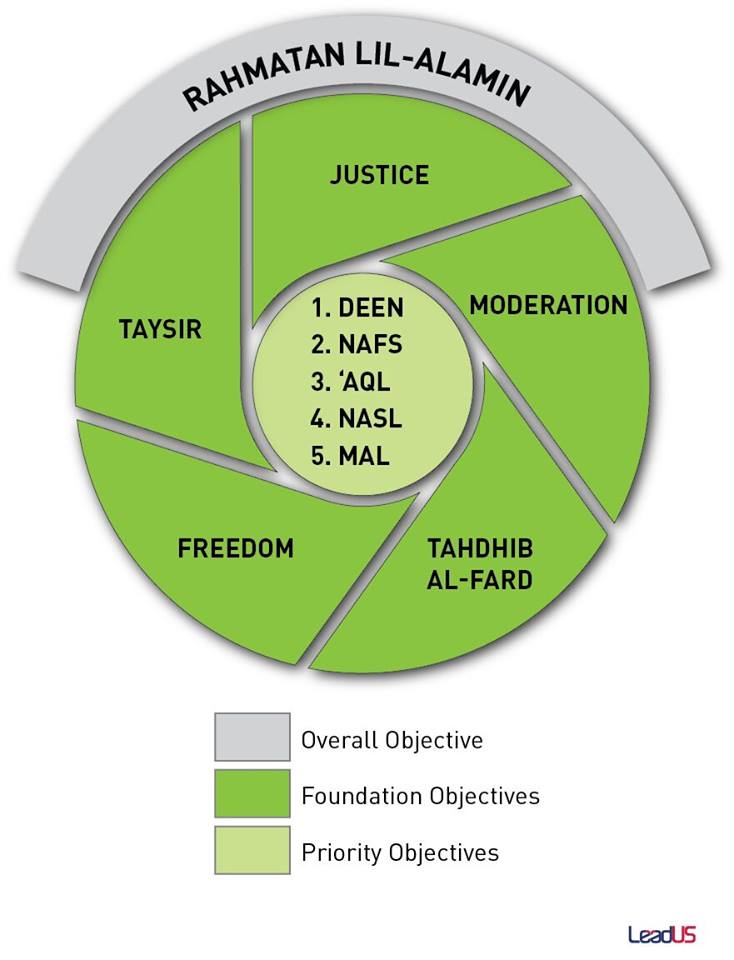 |
| json metadata | {"tags":["islam","quran","morals","freedom","prophet"],"image":["https://steemitimages.com/DQmbGw9QcUQqQMmDbJwJWEx2NUTmjTb6crbF9EGj6iT9PgU/RahmahSchema.jpg"],"app":"steemit/0.1","format":"markdown"} |
| Transaction Info | Block #20659228/Trx a46e6151d882f31c3e6ee6a206a29fbe6e68713d |
View Raw JSON Data
{
"trx_id": "a46e6151d882f31c3e6ee6a206a29fbe6e68713d",
"block": 20659228,
"trx_in_block": 10,
"op_in_trx": 0,
"virtual_op": 0,
"timestamp": "2018-03-14T05:10:30",
"op": [
"comment",
{
"parent_author": "",
"parent_permlink": "islam",
"author": "leadus",
"permlink": "freedom-before-shariah",
"title": "Freedom Before Shariah",
"body": "When I ponder deeply over the evidences in Al-Quran and the early history of Islam, it seems apparent that freedom for people is required before the implementation of Shari'ah. Consider the people of Quraish who refused to accept Islam despite the Prophet (SAW) having repeatedly called them to it. They then forced him and his fellow believers to migrate away from Mecca to Medina. After continued animosity and some notable battles through which the Quraish in collaboration with the other Arab tribes tried to destroy the community of believers in Medina, the believers continued to grow in strength. After about nine years since the Prophet (SAW) left Mecca, he (SAW) and the believers journeyed back to Mecca with the intention of performing the 'Umrah.\n\nImam Al-Bukhari gave a detailed account of the events that occurred in Hudaibiya, on the way to Mecca. Narrated Al-Miswar bin Makhrama and Marwan: (whose narrations support each other).\n\n<em>Allah's Apostle set out at the time of Al-Hudaibiya (treaty), ... The Prophet went on advancing till he reached the Thaniya (i.e. a mountainous way) through which one would go to them (i.e. people of Quraish). The she-camel of the Prophet sat down. The people tried their best to cause the she-camel to get up but in vain, so they said, \"Al-Qaswa' (i.e. the she-camel's name) has become stubborn! Al-Qaswa' has become stubborn!\" The Prophet said, \"Al-Qaswa' has not become stubborn, for stubbornness is not her habit, but she was stopped by Him Who stopped the elephant.\" Then he said, \"By the Name of Him in Whose Hands my soul is, if they (i.e. the Quraish infidels) ask me anything which will respect the ordinances of Allah, I will grant it to them.\"</em>\n\n<em>\"I left Kab bin Luai and 'Amir bin Luai residing at the profuse water of Al-Hudaibiya and they had milk camels (or their women and children) with them, and will wage war against you, and will prevent you from visiting the Kaba.\" Allah's Apostle said, \"We have not come to fight anyone, but to perform the 'Umra. No doubt, the war has weakened Quraish and they have suffered great losses, so if they wish, I will conclude a truce with them, during which they should refrain from interfering between me and the people (i.e. the Arab infidels other than Quraish), and if I have victory over those infidels, Quraish will have the option to embrace Islam as the other people do, if they wish; they will at least get strong enough to fight. But if they do not accept the truce, by Allah in Whose Hands my life is, I will fight with them defending my Cause till I get killed, but (I am sure) Allah will definitely make His Cause victorious.\"</em>\n\nThe above authentic (Sahih) hadith clearly states the stand of the Prophet (SAW); <strong><em>refrain from interfering between me and the people</em></strong>, putting a condition that the Quraish should not force the others to side with them in rejecting Islam and they should leave the other tribes free to make their own choices regarding religion. The Quraish had prevented the other tribes from the freedom to listen to the call for Islam since the early days when, even during the days of Haj, they tried to isolate the Prophet (SAW) away from these tribes. The Prophet (SAW) stipulated in the treaty of Al-Hudaibiya that the Quraish should not force other tribes to follow their (Quraish) religion but to grant them freedom to choose their own religion and to grant the Prophet (SAW) the freedom to offer his message of Islam to the other tribes.\n\nThe treaty of Al-Hudaibiya was a truce to create an environment of freedom in the Arabian peninsula, freedom for people to listen and hear from the Prophet (SAW) and the believers directly about Islam, freedom to then make their own choices, to believe or otherwise. If this freedom is denied; <em><strong>\"But if they do not accept the truce, by Allah in Whose Hands my life is, I will fight with them defending my Cause till I get killed, but (I am sure) Allah will definitely make His Cause victorious.\"</em></strong>\n\nThe chapter Al-Fath (The Victory or Opening) in the Quran was revealed regarding the truce of Al-Hudaibiya. It was described as clear victory. For more than 20 years there was no freedom for the Arabs to really know Islam. The Quraish and their allies worked hard against the propagation of Islam during that time. Al-Hudaibiya was a truce for 10 years allowing the Muslims free, mutual interaction with the Arabs. Within one year of the truce, the number of Muslim converts increased by more then ten fold. Yes, when there is freedom of discussion and choice, Islam will prosper. Freedom is an important foundation objective of islam.\n\n",
"json_metadata": "{\"tags\":[\"islam\",\"quran\",\"morals\",\"freedom\",\"prophet\"],\"image\":[\"https://steemitimages.com/DQmbGw9QcUQqQMmDbJwJWEx2NUTmjTb6crbF9EGj6iT9PgU/RahmahSchema.jpg\"],\"app\":\"steemit/0.1\",\"format\":\"markdown\"}"
}
]
}leaduspublished a new post: some-thoughts-about-freedom-in-islam2018/03/13 03:07:33
leaduspublished a new post: some-thoughts-about-freedom-in-islam
2018/03/13 03:07:33
| parent author | |
| parent permlink | islam |
| author | leadus |
| permlink | some-thoughts-about-freedom-in-islam |
| title | Some Thoughts About Freedom in Islam |
| body | <strong>What is freedom?</strong> After much reading, contemplating and thinking, I chose to define freedom as: <p style="text-align: center;"><strong>Freedom is to do and say what a person wishes but in a respectful manner and without transgressing the rights of others.</strong></p> One can say and do as he wishes but with two main conditions. The first condition is not to hurt others. Your freedom ends if the sayings and actions hurt people and transgress their rights as assumed or agreed upon within the society. The second condition is to observe basic manners in discussion and criticism. This definition applies to all aspects of freedom like the freedom to move, freedom to travel, freedom of expression and freedom of thought and ideas. Almost every society, however primitive they may be or were, has rules, regulations, customs and laws that guide societal behavior. These regulations and customs also protect the rights of others. Thus, no individual has the complete freedom to simply do as he wishes while he hurts and transgresses the rights of others in his society. He also must abide by basic manners and moral guidelines as determined by his society. The closest example of a society which the people claimed to have the right to do whatever they pleased without regard to manners or transgressing the rights of others, was the society of Saddum during the time of Prophet Lut (AS). They used to commit all kinds of evil, particularly sodomy, in open view of others. <p style="text-align: center;"><em>(We also sent) Lut (as an apostle): behold, He said to his people, "Do you do what is shameful and you see?</em> (Al-Naml; 27-54)</p> <p style="text-align: center;"><em>"Do you indeed approach men, and cut off the highway?- and practice wickedness (even) in your councils (meeting places)?"</em> (Al-Ankabut; 29:29)</p> They transgressed all boundaries when they all tried to break into the house of Prophet Lut (AS) lusting for his handsome looking guests, who were actually Angels in the guise of men. <p style="text-align: center;"><em>Now fear Allah, and cover me not with shame about my guests! Is there not among you a single right-minded man?"</em> (Hud; 11-87)</p> The people of Saddum were without doubt the most evil people on earth. Allah (SWT) attributed all the bad characteristics to these people. In fact, they despised Prophet Lut (AS) and his daughters and wanted to cast them away giving the reason, <em>But his people gave no other answer but this: they said, "Drive out the followers of Lut from your city: these are indeed men who want to be clean and pure!"</em> (Al-Ankabut; 29:56). For these evil people, Lut (AS) and his daughters were too clean and good to be part of their dirty and evil society. They had no manners, no regard or respect for others. Finally they were completely destroyed in a most severe manner. Thus there cannot be complete freedom for an individual living with others in a society or community. He is free to move, speak and do things provided he observes some manners and respect the rights of others in his society. <strong>Freedom of Religion</strong> When we ponder upon Al-Quran, there are so many verses that overwhelmingly convince us that Allah (SWT) has granted freedom of choice for the most basic issue in religion; to believe in Him (SWT) and His chosen religion. The great scholar of Tafseer, Imam Ibn Katheer, summarizes by saying, It is not part of Allah's decree to compel Belief and collects together the following verses of Al-Quran when providing his commentary on this verse in Surah Yunus. <p style="text-align: center;"><em>And had your Lord willed, those on earth would have believed, all of them together. So,will you then compel mankind, until they become believers.</em></p> <p style="text-align: center;"><em>It is not for any person to believe, except by the leave of Allah, and He will put the Rijs on those who do not reason.</em> (Yunus; 10:99-100)</p> Similarly, Allah (SWT) said: <p style="text-align: center;"><em>(And if your Lord had so willed, He could surely have made mankind one Ummah, but they will not cease to disagree. Except him on whom your Lord has bestowed His mercy and for that did He create them.</em></p> <p style="text-align: center;"><em>And the Word of your Lord has been fulfilled (His saying): "Surely, I shall fill Hell with Jinn and men all together.'')</em> (Hud; 11:118-119)</p> He (SWT) also said, <p style="text-align: center;"><em>(Have not then those who believed yet known that had Allah willed, He could have guided all mankind)</em> (Ra'd; 13:31)</p> Therefore, Allah (SWT) said: (<em>So, will you then compel mankind and force them to believe? (until they become believers.?</em> ) meaning, it is not for you to do that . You are not commanded to do that either. It is Allah Who (<em>sends astray whom He wills, and guides whom He wills.)</em> (Fatir; 35:8). <p style="text-align: center;"><em>Your duty is only to convey, and it is up to Us to reckon.</em> (Ra'd;13:40)</p> <p style="text-align: center;"><em>So remind, you are only one who reminds. You are not a dictator over them.</em> (Al-Ghashiyah; 88:21-22)</p> |
| json metadata | {"tags":["islam","quran","morals","freedom"],"app":"steemit/0.1","format":"markdown"} |
| Transaction Info | Block #20627985/Trx 92a4120cfc03b642ce4a09dca115c5b4fb25151f |
View Raw JSON Data
{
  "trx_id": "92a4120cfc03b642ce4a09dca115c5b4fb25151f",
  "block": 20627985,
  "trx_in_block": 31,
  "op_in_trx": 0,
  "virtual_op": 0,
  "timestamp": "2018-03-13T03:07:33",
  "op": [
    "comment",
    {
      "parent_author": "",
      "parent_permlink": "islam",
      "author": "leadus",
      "permlink": "some-thoughts-about-freedom-in-islam",
      "title": "Some Thoughts About Freedom in Islam",
      "body": "<strong>What is freedom?</strong>\n\nAfter much reading, contemplating and thinking, I chose to define freedom as:\n<p style=\"text-align: center;\"><strong>Freedom is to do and say what a person wishes but in a respectful manner and without transgressing the rights of others.</strong></p>\nOne can say and do as he wishes but with two main conditions. The first condition is not to hurt others. Your freedom ends if the sayings and actions hurt people and transgress their rights as assumed or agreed upon within the society. The second condition is to observe basic manners in discussion and criticism. This definition applies to all aspects of freedom like the freedom to move, freedom to travel, freedom of expression and freedom of thought and ideas.\n\nAlmost every society, however primitive they may be or were, has rules, regulations, customs and laws that guide societal behavior. These regulations and customs also protect the rights of others. Thus, no individual has the complete freedom to simply do as he wishes while he hurts and transgresses the rights of others in his society. He also must abide by basic manners and moral guidelines as determined by his society.\n\nThe closest example of a society which the people claimed to have the right to do whatever they pleased without regard to manners or transgressing the rights of others, was the society of Saddum during the time of Prophet Lut (AS). They used to commit all kinds of evil, particularly sodomy, in open view of others.\n<p style=\"text-align: center;\"><em>(We also sent) Lut (as an apostle): behold, He said to his people, \"Do you do what is shameful and you see?</em> (Al-Naml; 27-54)</p>\n<p style=\"text-align: center;\"><em>\"Do you indeed approach men, and cut off the highway?- and practice wickedness (even) in your councils (meeting places)?\"</em> (Al-Ankabut; 29:29)</p>\nThey transgressed all boundaries when they all tried to break into the house of Prophet Lut (AS) lusting for his handsome looking guests, who were actually Angels in the guise of men.\n<p style=\"text-align: center;\"><em>Now fear Allah, and cover me not with shame about my guests! Is there not among you a single right-minded man?\"</em> (Hud; 11-87)</p>\nThe people of Saddum were without doubt the most evil people on earth. Allah (SWT) attributed all the bad characteristics to these people. In fact, they despised Prophet Lut (AS) and his daughters and wanted to cast them away giving the reason, <em>But his people gave no other answer but this: they said, \"Drive out the followers of Lut from your city: these are indeed men who want to be clean and pure!\"</em> (Al-Ankabut; 29:56). For these evil people, Lut (AS) and his daughters were too clean and good to be part of their dirty and evil society. They had no manners, no regard or respect for others. Finally they were completely destroyed in a most severe manner.\n\nThus there cannot be complete freedom for an individual living with others in a society or community. He is free to move, speak and do things provided he observes some manners and respect the rights of others in his society.\n\n<strong>Freedom of Religion</strong>\n\nWhen we ponder upon Al-Quran, there are so many verses that overwhelmingly convince us that Allah (SWT) has granted freedom of choice for the most basic issue in religion; to believe in Him (SWT) and His chosen religion. The great scholar of Tafseer, Imam Ibn Katheer, summarizes by saying, It is not part of Allah's decree to compel Belief and collects together the following verses of Al-Quran when providing his commentary on this verse in Surah Yunus.\n<p style=\"text-align: center;\"><em>And had your Lord willed, those on earth would have believed, all of them together. So,will you then compel mankind, until they become believers.</em></p>\n<p style=\"text-align: center;\"><em>It is not for any person to believe, except by the leave of Allah, and He will put the Rijs on those who do not reason.</em> (Yunus; 10:99-100)</p>\n\nSimilarly, Allah (SWT) said:\n<p style=\"text-align: center;\"><em>(And if your Lord had so willed, He could surely have made mankind one Ummah, but they will not cease to disagree. Except him on whom your Lord has bestowed His mercy and for that did He create them.</em></p>\n<p style=\"text-align: center;\"><em>And the Word of your Lord has been fulfilled (His saying): \"Surely, I shall fill Hell with Jinn and men all together.'')</em> (Hud; 11:118-119)</p>\nHe (SWT) also said,\n<p style=\"text-align: center;\"><em>(Have not then those who believed yet known that had Allah willed, He could have guided all mankind)</em> (Ra'd; 13:31)</p>\nTherefore, Allah (SWT) said: (<em>So, will you then compel mankind and force them to believe? (until they become believers.?</em> ) meaning, it is not for you to do that . You are not commanded to do that either. It is Allah Who (<em>sends astray whom He wills, and guides whom He wills.)</em> (Fatir; 35:8).\n<p style=\"text-align: center;\"><em>Your duty is only to convey, and it is up to Us to reckon.</em> (Ra'd;13:40)</p>\n<p style=\"text-align: center;\"><em>So remind, you are only one who reminds. You are not a dictator over them.</em> (Al-Ghashiyah; 88:21-22)</p>",
      "json_metadata": "{\"tags\":[\"islam\",\"quran\",\"morals\",\"freedom\"],\"app\":\"steemit/0.1\",\"format\":\"markdown\"}"
    }
  ]
}leaduspublished a new post: fine-pointer-on-nourishment-in-relation-to-the-miraculous-birth2018/02/27 04:11:48
leaduspublished a new post: fine-pointer-on-nourishment-in-relation-to-the-miraculous-birth
2018/02/27 04:11:48
| parent author | |
| parent permlink | islam |
| author | leadus |
| permlink | fine-pointer-on-nourishment-in-relation-to-the-miraculous-birth |
| title | Fine Pointer on Nourishment in Relation to the Miraculous Birth |
| body | As we mentioned in our book <strong>Stories of the Prophets in Al-Quran</strong>, some of the stories related to the Prophets are revealed in general. It sometimes appears as a brief description of the Prophets virtues of patience or piety or righteousness. <p style="text-align: center;"><strong>And Zakariya and Yahya and Isa and Ilyas; every one was of the good;</strong> (Chapter 6, Verse 85) <strong>And Ismail and Al-Yasha and Yunus and Lut; and every one We made to excel (in) the worlds:</strong> (Chapter 6, Verse 86)</p> Then there are various stories that are mentioned in some level of detail. Since Al-Quran is a guide for the believers in particular and mankind in general, there are lessons to be derived from the details mentioned. One of the stories mentioned in relative detail is the miraculous birth of Prophet 'Isa (AS). In this short article we would like to focus on this particular verse. <p style="text-align: center;"><strong>The pains of labour drove her to the trunk of a date-palm. She [Maryam] said, "Oh if only I had died before this time and was something discarded and forgotten!" A voice called out to her from under her, "Do not grieve! Your Lord has placed a small stream at your feet. Shake the trunk of the palm towards you and fresh, ripe dates will drop down onto you. Eat and drink and delight your eyes?"</strong> (Chapter 19, Verse 23-26)</p> Allah (SWT) specifically mentions <em><strong>"fresh, ripe dates"</strong></em> as the food that He (SWT) provided for that sustained and nourished Maryam (AS) during her miraculous delivery of a son without the normal role of a father. (This probably included the time before labour and the days she took to recover after the delivery). It was not any kind of date fruit but <em><strong>"fresh, ripe dates"</strong></em>. Prior to this Maryam (AS) also received food as sustenance from Allah (SWT) in a somewhat unusual manner. <p style="text-align: center;"><strong>And her Lord accepted her with full acceptance and vouchsafed to her a goodly growth; and made Zakariya her guardian. Whenever Zakariya went into the sanctuary where she was, he found that she had food. He said: ?O Maryam! From where did this (food) come?? She answered: ?It is from Allah. Allah gives without stint to whom He wills.?</strong> (Chapter 3, Verse 37)</p> <p style="text-align: left;">We mentioned in our book that what surprised Prophet Zakariya was that Maryam had summer fruits during winter and winter fruits during summer. The specific fruits are not mentioned only the unusual phenomenon of having summer fruits during winter and winter fruits during summer. Maryam clearly indicated that it was from Allah (SWT).</p> Maryam (AS) is the noblest of all women. She was honored to be chosen as the medium of one of the miracles from Allah (SWT), to deliver a child without the normal role of a father. She was alone during that miraculous birth. Allah (SWT) provided her sustenance and nourishment through <em><strong>"fresh, ripe dates"</strong></em> and fresh natural water. This was the specific type of food Allah (SWT) provided her during that period although He (SWT) provided her before with summer fruits during winter and winter fruits during summer, and <strong>"Allah gives without stint to whom He wills."</strong> Thus we can conclude that <em><strong>"fresh, ripe dates"</strong></em> is one of the best food for women during the period of labour and post-delivery. <p>There is considerable wisdom in the way that Allah recommends Maryam to eat this fruit. The date is an excellent choice of food for the pregnant women and for those who have just given birth. This is a widely accepted scientific fact. Maryam was inspired to understand this point, in order to make her own labour easier. The date fruit has one of the highest sugar levels, 60-65%, of all fruits. Doctors recommend that pregnant women be given foods containing fruit sugar on the day they give birth. The aim behind this is to energize and revitalize the mother's weakened body and at the same time to stimulate the milk hormones and increase the levels of mother's milk essential to the new-born baby.</p> In addition, loss of blood during birth leads to a fall in body sugar levels. Dates are important from the point of view of enabling sugar to enter the body and prevent blood pressure from dropping. Their high calorific value strengthens people weakened by illness or suffering from extreme fatigue. These facts reveal the wisdom in the way that Allah recommended Maryam to eat dates, designed to energize and invigorate the woman and ensure the emergence of mother's milk. |
| json metadata | {"tags":["islam","prophet","miracle","quran","dates"],"app":"steemit/0.1","format":"markdown"} |
| Transaction Info | Block #20226533/Trx 447fb2b66e63aa4efa9e918735a222bdfc8454b5 |
View Raw JSON Data
{
  "trx_id": "447fb2b66e63aa4efa9e918735a222bdfc8454b5",
  "block": 20226533,
  "trx_in_block": 4,
  "op_in_trx": 0,
  "virtual_op": 0,
  "timestamp": "2018-02-27T04:11:48",
  "op": [
    "comment",
    {
      "parent_author": "",
      "parent_permlink": "islam",
      "author": "leadus",
      "permlink": "fine-pointer-on-nourishment-in-relation-to-the-miraculous-birth",
      "title": "Fine Pointer on Nourishment in Relation to the Miraculous Birth",
      "body": "As we mentioned in our book <strong>Stories of the Prophets in Al-Quran</strong>, some of the stories related to the Prophets are revealed in general.  It sometimes appears as a brief description of the Prophets virtues of patience or piety or righteousness.\n\n<p style=\"text-align: center;\"><strong>And Zakariya and Yahya and Isa and Ilyas; every one was of the good;</strong> (Chapter 6, Verse 85)\n<strong>And Ismail and Al-Yasha and Yunus and Lut; and every one We made to excel (in) the worlds:</strong> (Chapter 6, Verse 86)</p>\nThen there are various stories that are mentioned in some level of detail.  Since Al-Quran is a guide for the believers in particular and mankind in general, there are lessons to be derived from the details mentioned.\n\nOne of the stories mentioned in relative detail is the miraculous birth of Prophet 'Isa (AS).  In this short article we would like to focus on this particular verse.\n<p style=\"text-align: center;\"><strong>The pains of labour drove her to the trunk of a date-palm. She [Maryam] said, \"Oh if only I had died before this time and was something discarded and forgotten!\" A voice called out to her from under her, \"Do not grieve! Your Lord has placed a small stream at your feet. Shake the trunk of the palm towards you and fresh, ripe dates will drop down onto you. Eat and drink and delight your eyes?\"</strong> (Chapter 19, Verse 23-26)</p>\n\nAllah (SWT) specifically mentions <em><strong>\"fresh, ripe dates\"</strong></em> as the food that He (SWT) provided for that sustained and nourished Maryam (AS) during her miraculous delivery of a son without the normal role of a father. (This probably included the time before labour and the days she took to recover after the delivery).  It was not any kind of date fruit but <em><strong>\"fresh, ripe dates\"</strong></em>.\n\nPrior to this Maryam (AS) also received food as sustenance from Allah (SWT) in a somewhat unusual manner.\n<p style=\"text-align: center;\"><strong>And her Lord accepted her with full acceptance and vouchsafed to her a goodly growth; and made Zakariya her guardian. Whenever Zakariya went into the sanctuary where she was, he found that she had food. He said: ?O Maryam! From where did this (food) come?? She answered: ?It is from Allah. Allah gives without stint to whom He wills.?</strong> (Chapter 3, Verse 37)</p>\n<p style=\"text-align: left;\">We mentioned in our book that what surprised Prophet Zakariya was that Maryam had summer fruits during winter and winter fruits during summer.  The specific fruits are not mentioned only the unusual phenomenon of having summer fruits during winter and winter fruits during summer.  Maryam clearly indicated that it was from Allah (SWT).</p>\nMaryam (AS) is the noblest of all women.  She was honored to be chosen as the medium of one of the miracles from Allah (SWT), to deliver a child without the normal role of a father.  She was alone during that miraculous birth.  Allah (SWT) provided her sustenance and nourishment through <em><strong>\"fresh, ripe dates\"</strong></em> and fresh natural water. This was the specific type of food Allah (SWT) provided her during that period although He (SWT) provided her before with summer fruits during winter and winter fruits during summer, and <strong>\"Allah gives without stint to whom He wills.\"</strong> Thus we can conclude that <em><strong>\"fresh, ripe dates\"</strong></em> is one of the best food for women during the period of labour and post-delivery.\n\n<p>There is considerable wisdom in the way that Allah recommends Maryam to eat this fruit. The date is an excellent choice of food for the pregnant women and for those who have just given birth. This is a widely accepted scientific fact. Maryam was inspired to understand this point, in order to make her own labour easier. The date fruit has one of the highest sugar levels, 60-65%, of all fruits. Doctors recommend that pregnant women be given foods containing fruit sugar on the day they give birth. The aim behind this is to energize and revitalize the mother's weakened body and at the same time to stimulate the milk hormones and increase the levels of mother's milk essential to the new-born baby.</p>\n\nIn addition, loss of blood during birth leads to a fall in body sugar levels. Dates are important from the point of view of enabling sugar to enter the body and prevent blood pressure from dropping. Their high calorific value strengthens people weakened by illness or suffering from extreme fatigue.\nThese facts reveal the wisdom in the way that Allah recommended Maryam to eat dates, designed to energize and invigorate the woman and ensure the emergence of mother's milk.",
      "json_metadata": "{\"tags\":[\"islam\",\"prophet\",\"miracle\",\"quran\",\"dates\"],\"app\":\"steemit/0.1\",\"format\":\"markdown\"}"
    }
  ]
}2018/02/12 16:36:51
2018/02/12 16:36:51
| parent author | leadus |
| parent permlink | caliph-umar-s-famous-quote-on-freedom |
| author | cheetah |
| permlink | cheetah-re-leaduscaliph-umar-s-famous-quote-on-freedom |
| title | |
| body | Hi! I am a robot. I just upvoted you! I found similar content that readers might be interested in: https://islam.stackexchange.com/questions/38670/authenticity-of-story-of-umar-ibn-al-khattab-allowing-christian-to-beat-his-head |
| json metadata | |
| Transaction Info | Block #19809739/Trx abe54e1ff0a5837434a10a2f8ff0e2ee5ec8c206 |
View Raw JSON Data
{
  "trx_id": "abe54e1ff0a5837434a10a2f8ff0e2ee5ec8c206",
  "block": 19809739,
  "trx_in_block": 2,
  "op_in_trx": 0,
  "virtual_op": 0,
  "timestamp": "2018-02-12T16:36:51",
  "op": [
    "comment",
    {
      "parent_author": "leadus",
      "parent_permlink": "caliph-umar-s-famous-quote-on-freedom",
      "author": "cheetah",
      "permlink": "cheetah-re-leaduscaliph-umar-s-famous-quote-on-freedom",
      "title": "",
      "body": "Hi! I am a robot. I just upvoted you! I found similar content that readers might be interested in:\nhttps://islam.stackexchange.com/questions/38670/authenticity-of-story-of-umar-ibn-al-khattab-allowing-christian-to-beat-his-head",
      "json_metadata": ""
    }
  ]
}leaduspublished a new post: caliph-umar-s-famous-quote-on-freedom2018/02/12 16:35:45
leaduspublished a new post: caliph-umar-s-famous-quote-on-freedom
2018/02/12 16:35:45
| parent author | |
| parent permlink | islam |
| author | leadus |
| permlink | caliph-umar-s-famous-quote-on-freedom |
| title | Caliph Umar's Famous Quote On Freedom |
| body | A famous story illustrates the degree to which the caliphs of early Islam protected the dignity and freedom, even of non-Muslims. Amr ibn al-As was the governor of Egypt. One of his sons beat up a Coptic Christian with a whip, saying, "I am the son of a nobleman!" The Copt went to Umar ibn al-Khattab, the Muslim caliph who resided in Medina, and lodged a complaint. These are the details as related by Anas ibn Malik who used to be the personal servant of the Prophet (SAW). We were sitting with Umar ibn al-Khattab when an Egyptian came in and said, "Commander of the Faithful, I come to you to seek refuge." So, Umar asked him about his problem and he answered, "Amr had a custom of letting his horses run free in Egypt. One day, I came by riding my mare. When I passed by a group of people, they looked at me. Muhammad, the son of Amr got up and came to me, saying, 'I swear by the Lord of the Kaaba, this is my mare!' I responded, 'I swear by the Lord of the Kaaba, the mare is mine!' He came up to me and began beating me with a whip, saying, 'You may take her, because I am the son of a nobleman (meaning I am more generous than you).' The incident got to Amr, who feared that I might come to you, so he put me in jail. I escaped, and here I am before you." Anas continued: "I swear by God, the only response Umar made was to tell the Egyptian to take a seat. Then, Umar wrote a letter to Amr, saying, 'When this letter reaches you, come and bring me your son, Muhammad.' Then he told the Egyptian to stay in Medina until he was told Amr has arrived. When Amr received the note, he called his son and asked him, 'Did you commit a crime?' His son stated he has not. Amr asked, 'Then why is Umar writing about you?' They both went to Umar." Anas narrates further: "I swear by God, we were sitting with Umar, and Amr arrived wearing the clothes of common people. Umar looked around for the son, and saw him standing behind his father (to appear less conspicuous). Umar asked, 'Where is the Egyptian?' and he responded, 'Here I am!' Umar told him, 'Here is the whip. Take it and beat the son of the nobleman.' So he took it and beat him vigorously, while Umar said over and over, 'Beat the son of the nobleman.' We did not let him stop until we were satisfied he had beaten him enough. Then, Umar said, 'Now you must take it and hit me on my bald head. This all happened to you because of my power over you.' The Egyptian responded, 'I am satisfied and my anger has cooled.' Umar told him, 'If you had beaten me, I would not have stopped you until you had wished to. And you, Amr, <b><em>since when have you made the people your slaves? Verily their mothers gave birth to them free.</em></b> Amr began to apologize, telling him, 'I did not know that this is what happened.' So, Umar turned back to the Egyptian, telling him, 'You may go, and be guided. If anything untoward happens to you, write to me.' Despite being a Copt, the Egyptian still had his rights as a free person under Islamic rule. He cannot be hurt even by the son of the governor or be imprisoned wrongfully. Umar was particularly sensitive when it comes to the issue of justice and freedom. He quickly tried to correct the wrong behavior of his appointed Governor's son and prevent the early generation of Muslims from usurping the freedom for all citizens. These words of Caliph Umar have since become the symbol of freedom. 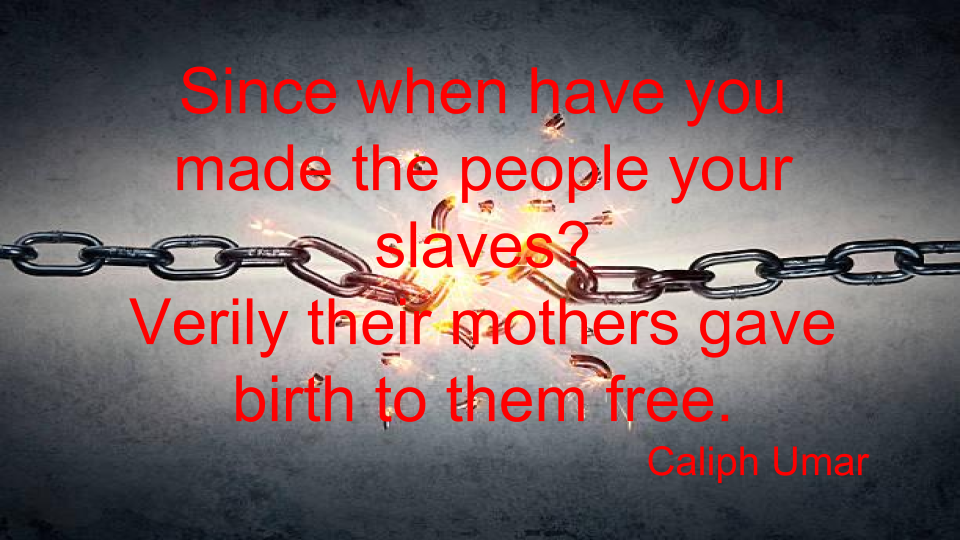 |
| json metadata | {"tags":["islam","prophet","ethics","quran","freedom"],"image":["https://steemitimages.com/DQmczQtXfjdVbVv16udY1MHEwcRYEwHGHb88UC3S3rmbaHA/SteemQuote04.png"],"app":"steemit/0.1","format":"markdown"} |
| Transaction Info | Block #19809717/Trx 9e4a9c92947c307e11731df3e6edf5291337876c |
View Raw JSON Data
{
"trx_id": "9e4a9c92947c307e11731df3e6edf5291337876c",
"block": 19809717,
"trx_in_block": 31,
"op_in_trx": 0,
"virtual_op": 0,
"timestamp": "2018-02-12T16:35:45",
"op": [
"comment",
{
"parent_author": "",
"parent_permlink": "islam",
"author": "leadus",
"permlink": "caliph-umar-s-famous-quote-on-freedom",
"title": "Caliph Umar's Famous Quote On Freedom",
"body": "A famous story illustrates the degree to which the caliphs of early Islam protected the dignity and freedom, even of non-Muslims. Amr ibn al-As was the governor of Egypt. One of his sons beat up a Coptic Christian with a whip, saying, \"I am the son of a nobleman!\" The Copt went to Umar ibn al-Khattab, the Muslim caliph who resided in Medina, and lodged a complaint. These are the details as related by Anas ibn Malik who used to be the personal servant of the Prophet (SAW).\n\nWe were sitting with Umar ibn al-Khattab when an Egyptian came in and said, \"Commander of the Faithful, I come to you to seek refuge.\" So, Umar asked him about his problem and he answered,\n\"Amr had a custom of letting his horses run free in Egypt. One day, I came by riding my mare. When I passed by a group of people, they looked at me. Muhammad, the son of Amr got up and came to me, saying, 'I swear by the Lord of the Kaaba, this is my mare!' I responded, 'I swear by the Lord of the Kaaba, the mare is mine!' He came up to me and began beating me with a whip, saying, 'You may take her, because I am the son of a nobleman (meaning I am more generous than you).' The incident got to Amr, who feared that I might come to you, so he put me in jail. I escaped, and here I am before you.\"\n\nAnas continued:\n\"I swear by God, the only response Umar made was to tell the Egyptian to take a seat. Then, Umar wrote a letter to Amr, saying, 'When this letter reaches you, come and bring me your son, Muhammad.' Then he told the Egyptian to stay in Medina until he was told Amr has arrived. When Amr received the note, he called his son and asked him, 'Did you commit a crime?' His son stated he has not. Amr asked, 'Then why is Umar writing about you?' They both went to Umar.\"\n\nAnas narrates further:\n\"I swear by God, we were sitting with Umar, and Amr arrived wearing the clothes of common people. Umar looked around for the son, and saw him standing behind his father (to appear less conspicuous). Umar asked, 'Where is the Egyptian?' and he responded, 'Here I am!' Umar told him, 'Here is the whip. Take it and beat the son of the nobleman.' So he took it and beat him vigorously, while Umar said over and over, 'Beat the son of the nobleman.' We did not let him stop until we were satisfied he had beaten him enough. Then, Umar said, 'Now you must take it and hit me on my bald head. This all happened to you because of my power over you.' The Egyptian responded, 'I am satisfied and my anger has cooled.' Umar told him, 'If you had beaten me, I would not have stopped you until you had wished to. And you, Amr, <b><em>since when have you made the people your slaves? Verily their mothers gave birth to them free.</em></b>\n\nAmr began to apologize, telling him, 'I did not know that this is what happened.' So, Umar turned back to the Egyptian, telling him, 'You may go, and be guided. If anything untoward happens to you, write to me.'\n\nDespite being a Copt, the Egyptian still had his rights as a free person under Islamic rule. He cannot be hurt even by the son of the governor or be imprisoned wrongfully. Umar was particularly sensitive when it comes to the issue of justice and freedom. He quickly tried to correct the wrong behavior of his appointed Governor's son and prevent the early generation of Muslims from usurping the freedom for all citizens. These words of Caliph Umar have since become the symbol of freedom.\n",
"json_metadata": "{\"tags\":[\"islam\",\"prophet\",\"ethics\",\"quran\",\"freedom\"],\"image\":[\"https://steemitimages.com/DQmczQtXfjdVbVv16udY1MHEwcRYEwHGHb88UC3S3rmbaHA/SteemQuote04.png\"],\"app\":\"steemit/0.1\",\"format\":\"markdown\"}"
}
]
}resteemyreplied to @leadus / 20180211t151943736z2018/02/11 15:19:45
resteemyreplied to @leadus / 20180211t151943736z
2018/02/11 15:19:45
| parent author | leadus |
| parent permlink | the-universal-law-of-justice |
| author | resteemy |
| permlink | 20180211t151943736z |
| title | |
| body | Congratulations, you were selected for a random upvote! Follow @resteemy and upvote this post to increase your chance of being upvoted again! Read more about @resteemy [here](https://steemit.com/resteemy/@resteemy/introducting-resteemy). |
| json metadata | {} |
| Transaction Info | Block #19779420/Trx e074d6ced1842adf6a2f840605cbdee19d38d537 |
View Raw JSON Data
{
  "trx_id": "e074d6ced1842adf6a2f840605cbdee19d38d537",
  "block": 19779420,
  "trx_in_block": 45,
  "op_in_trx": 0,
  "virtual_op": 0,
  "timestamp": "2018-02-11T15:19:45",
  "op": [
    "comment",
    {
      "parent_author": "leadus",
      "parent_permlink": "the-universal-law-of-justice",
      "author": "resteemy",
      "permlink": "20180211t151943736z",
      "title": "",
      "body": "Congratulations, you were selected for a random upvote! Follow @resteemy and upvote this post to increase your chance of being upvoted again!\nRead more about @resteemy [here](https://steemit.com/resteemy/@resteemy/introducting-resteemy).",
      "json_metadata": "{}"
    }
  ]
}resteemyupvoted (1.00%) @leadus / the-universal-law-of-justice2018/02/11 15:19:45
resteemyupvoted (1.00%) @leadus / the-universal-law-of-justice
2018/02/11 15:19:45
| voter | resteemy |
| author | leadus |
| permlink | the-universal-law-of-justice |
| weight | 100 (1.00%) |
| Transaction Info | Block #19779420/Trx bd8338702150e5f0ec98c3989fc6abec428bff6a |
View Raw JSON Data
{
  "trx_id": "bd8338702150e5f0ec98c3989fc6abec428bff6a",
  "block": 19779420,
  "trx_in_block": 38,
  "op_in_trx": 0,
  "virtual_op": 0,
  "timestamp": "2018-02-11T15:19:45",
  "op": [
    "vote",
    {
      "voter": "resteemy",
      "author": "leadus",
      "permlink": "the-universal-law-of-justice",
      "weight": 100
    }
  ]
}leaduspublished a new post: the-universal-law-of-justice2018/02/11 15:14:57
leaduspublished a new post: the-universal-law-of-justice
2018/02/11 15:14:57
| parent author | |
| parent permlink | islam |
| author | leadus |
| permlink | the-universal-law-of-justice |
| title | The Universal Law of Justice |
| body | In our daily prayers we recite Surah Al-Fatihah, the opening chapter of Al-Quran. In it we supplicate earnestly <em>(Keep us on the right path. [Al-Fatihah, 1:6])</em> Al-Quran is actually the answer to this request. Among the guidance contained in Al-Quran are the rules and laws that Allah (SWT) has stated and explained.? One category of these rules take the form of obligations, permissions and prohibitions; the dos and the donts. These rules however apply only to the believers. Examples include the obligation of fasting; <em>(O you who believe! Fasting is prescribed to you as it was prescribed to those before you, that you may (learn) self-restraint.) [Al-Baqarah, 2:183]</em> the general permissibility of food from the sea; <em>(Lawful to you is the pursuit of water-game and its use for food,- for the benefit of yourselves and those who travel;) [Al-Maidah, 5:96]</em> and the prohibition of drinking liquor and gambling. <em>(O you who believe! Intoxicants and gambling, (dedication of) stones, and (divination by) arrows, are an abomination, of Satan's handwork: eschew such (abomination), that you may prosper.) [Al-Maidah, 5:90]</em> In addition, there is the category of the general and universal laws that apply to all mankind; Muslims, believers and all others, regardless of faith. <em>(Many were the Laws of Life that have passed away before you: travel through the earth, and see what was the end of those who rejected Truth.) [Ali-'Imran, 3:137]</em> These laws encompass physical laws and phenomena like the lunar orbit; <em>(And the Moon, We have measured for her mansions (to traverse) till she returns like the old (and withered) lower part of a date-stalk.) [Yasin, 36:39]</em> and the law of social change.<em>(Verily never will Allah change the condition of a people until they change it themselves (with their own souls)) [Ar-Ra'd, 13:11]</em> These laws remain valid for all mankind, everywhere and at all times. There were limited occasions in history when the application of some of these laws were suspended or changed momentarily. Some of these incidents were the miracles that Allah (SWT) granted upon his Messengers (AS) like the huge fire that became cool and safe for Prophet Ibrahim [Al-Anbiya, 21:69] and the sharp knife that could not cut when Ibrahim (AS) tried to slaughter his son Ismail (AS) in obedience to Allah's (SWT) command. One of these universal laws is the law of justice. Justice and fairness form the main pillar and objective of the various rulings in Islam. <em>(Allah commands you to render back your Trusts to those to whom they are due; And when you judge between man and man, that you judge with justice: Verily how excellent is the teaching which He gives you! For Allah is He Who hears and sees all things.) [An-Nisaa, 4:58]</em> <em>(Allah commands justice, the doing of good, and liberality to kith and kin, and He forbids all shameful deeds, and injustice and rebellion: He instructs you, that you may receive admonition.) [An-Nahl, 16:90]</em> The example verses above impress upon us that Muslims are obligated to enshrine and uphold justice and fairness at all times in dealing with Muslims and non-Muslims. There is no provision for an exception. The Muslim cannot give an excuse to intentionally decide unfairly and deny justice to any person regardless of faith. The great scholar Imam Ibn Taimiyah expressed this law of justice in a bold but thoughtful way when he said, <b>Verily Allah (SWT) establishes/strengthens the just nation even if it disbelieves and He (SWT) does not strengthen the unjust nation even if it was Muslim.</b> This simply means that an unjust nation of Muslims will perish and the nation of disbelievers that is just will remain. Imam Ibn Taimiyah also said, <b>The world will last with justice and kufr but will not last with unjustice and Islam.</b> Thus even if we are Muslims, even if all our children memorize the Holy Quran, we will not rise, we will not establish ourselves until we establish <strong>justice</strong> among us. Verily from among the known laws of Allah (SWT) is the law of justice.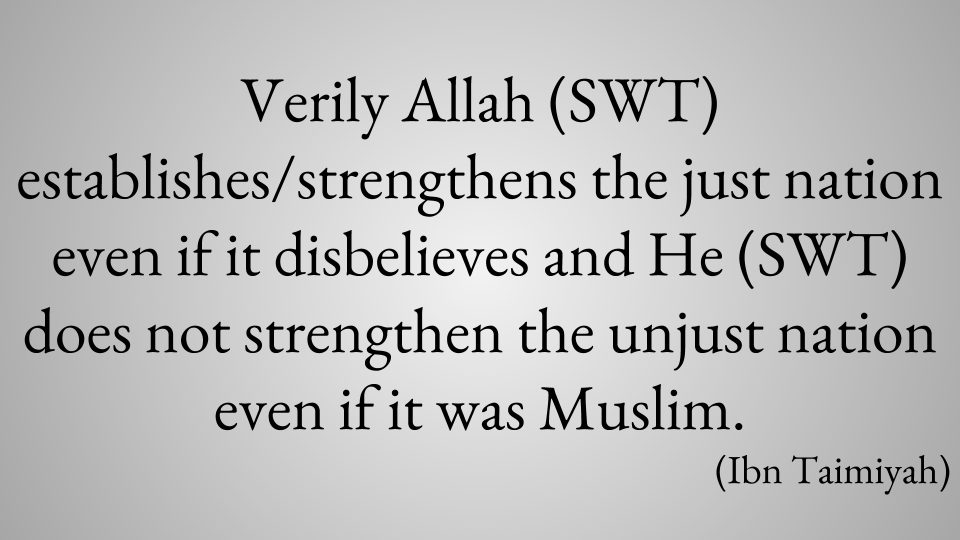 |
| json metadata | {"tags":["islam","prophet","ethics","quran","justice"],"image":["https://steemitimages.com/DQmTU4ZrpwZEZcKetQSkJmvJHFvEaoEhN9qF8FfWpbgzTCH/SteemQuotes03.png"],"app":"steemit/0.1","format":"markdown"} |
| Transaction Info | Block #19779324/Trx 571df967def2ef7397d5f614c1baaf64c27cdd62 |
View Raw JSON Data
{
"trx_id": "571df967def2ef7397d5f614c1baaf64c27cdd62",
"block": 19779324,
"trx_in_block": 54,
"op_in_trx": 0,
"virtual_op": 0,
"timestamp": "2018-02-11T15:14:57",
"op": [
"comment",
{
"parent_author": "",
"parent_permlink": "islam",
"author": "leadus",
"permlink": "the-universal-law-of-justice",
"title": "The Universal Law of Justice",
"body": "In our daily prayers we recite Surah Al-Fatihah, the opening chapter of Al-Quran. In it we supplicate earnestly <em>(Keep us on the right path. [Al-Fatihah, 1:6])</em> Al-Quran is actually the answer to this request.\n\nAmong the guidance contained in Al-Quran are the rules and laws that Allah (SWT) has stated and explained.? One category of these rules take the form of obligations, permissions and prohibitions; the dos and the donts. These rules however apply only to the believers. Examples include \n\nthe obligation of fasting; <em>(O you who believe! Fasting is prescribed to you as it was prescribed to those before you, that you may (learn) self-restraint.) [Al-Baqarah, 2:183]</em>\n\nthe general permissibility of food from the sea; <em>(Lawful to you is the pursuit of water-game and its use for food,- for the benefit of yourselves and those who travel;) [Al-Maidah, 5:96]</em>\n\nand the prohibition of drinking liquor and gambling. <em>(O you who believe! Intoxicants and gambling, (dedication of) stones, and (divination by) arrows, are an abomination, of Satan's handwork: eschew such (abomination), that you may prosper.) [Al-Maidah, 5:90]</em>\n\nIn addition, there is the category of the general and universal laws that apply to all mankind; Muslims, believers and all others, regardless of faith.\n<em>(Many were the Laws of Life that have passed away before you: travel through the earth, and see what was the end of those who rejected Truth.) [Ali-'Imran, 3:137]</em>\n\nThese laws encompass physical laws and phenomena like\n\nthe lunar orbit; <em>(And the Moon, We have measured for her mansions (to traverse) till she returns like the old (and withered) lower part of a date-stalk.) [Yasin, 36:39]</em>\n\nand the law of social change.<em>(Verily never will Allah change the condition of a people until they change it themselves (with their own souls)) [Ar-Ra'd, 13:11]</em>\n\nThese laws remain valid for all mankind, everywhere and at all times. There were limited occasions in history when the application of some of these laws were suspended or changed momentarily. Some of these incidents were the miracles that Allah (SWT) granted upon his Messengers (AS) like the huge fire that became cool and safe for Prophet Ibrahim [Al-Anbiya, 21:69] and the sharp knife that could not cut when Ibrahim (AS) tried to slaughter his son Ismail (AS) in obedience to Allah's (SWT) command.\n\nOne of these universal laws is the law of justice. Justice and fairness form the main pillar and objective of the various rulings in Islam.\n<em>(Allah commands you to render back your Trusts to those to whom they are due; And when you judge between man and man, that you judge with justice: Verily how excellent is the teaching which He gives you! For Allah is He Who hears and sees all things.) [An-Nisaa, 4:58]</em>\n\n<em>(Allah commands justice, the doing of good, and liberality to kith and kin, and He forbids all shameful deeds, and injustice and rebellion: He instructs you, that you may receive admonition.) [An-Nahl, 16:90]</em>\n\nThe example verses above impress upon us that Muslims are obligated to enshrine and uphold justice and fairness at all times in dealing with Muslims and non-Muslims. There is no provision for an exception. The Muslim cannot give an excuse to intentionally decide unfairly and deny justice to any person regardless of faith.\n\nThe great scholar Imam Ibn Taimiyah expressed this law of justice in a bold but thoughtful way when he said, <b>Verily Allah (SWT) establishes/strengthens the just nation even if it disbelieves and He (SWT) does not strengthen the unjust nation even if it was Muslim.</b> This simply means that an unjust nation of Muslims will perish and the nation of disbelievers that is just will remain.\n\nImam Ibn Taimiyah also said, <b>The world will last with justice and kufr but will not last with unjustice and Islam.</b> Thus even if we are Muslims, even if all our children memorize the Holy Quran, we will not rise, we will not establish ourselves until we establish <strong>justice</strong> among us. Verily from among the known laws of Allah (SWT) is the law of justice.",
"json_metadata": "{\"tags\":[\"islam\",\"prophet\",\"ethics\",\"quran\",\"justice\"],\"image\":[\"https://steemitimages.com/DQmTU4ZrpwZEZcKetQSkJmvJHFvEaoEhN9qF8FfWpbgzTCH/SteemQuotes03.png\"],\"app\":\"steemit/0.1\",\"format\":\"markdown\"}"
}
]
}2018/02/09 16:40:00
2018/02/09 16:40:00
| parent author | leadus |
| parent permlink | our-prophet-saw-seeks-refuge-from-factors-that-can-take-away-happiness |
| author | zainifahkrizal |
| permlink | re-leadus-our-prophet-saw-seeks-refuge-from-factors-that-can-take-away-happiness-20180209t163937394z |
| title | |
| body | good post follow me |
| json metadata | {"tags":["islam"],"app":"steemit/0.1"} |
| Transaction Info | Block #19723460/Trx d0e1809ced619e02d83c0ff22f853c2c35416008 |
View Raw JSON Data
{
  "trx_id": "d0e1809ced619e02d83c0ff22f853c2c35416008",
  "block": 19723460,
  "trx_in_block": 16,
  "op_in_trx": 0,
  "virtual_op": 0,
  "timestamp": "2018-02-09T16:40:00",
  "op": [
    "comment",
    {
      "parent_author": "leadus",
      "parent_permlink": "our-prophet-saw-seeks-refuge-from-factors-that-can-take-away-happiness",
      "author": "zainifahkrizal",
      "permlink": "re-leadus-our-prophet-saw-seeks-refuge-from-factors-that-can-take-away-happiness-20180209t163937394z",
      "title": "",
      "body": "good post follow me",
      "json_metadata": "{\"tags\":[\"islam\"],\"app\":\"steemit/0.1\"}"
    }
  ]
}2018/02/09 16:39:12
2018/02/09 16:39:12
| voter | zainifahkrizal |
| author | leadus |
| permlink | our-prophet-saw-seeks-refuge-from-factors-that-can-take-away-happiness |
| weight | 10000 (100.00%) |
| Transaction Info | Block #19723444/Trx 158ce7b028673da5d8d6519a19273a5a69008861 |
View Raw JSON Data
{
  "trx_id": "158ce7b028673da5d8d6519a19273a5a69008861",
  "block": 19723444,
  "trx_in_block": 46,
  "op_in_trx": 0,
  "virtual_op": 0,
  "timestamp": "2018-02-09T16:39:12",
  "op": [
    "vote",
    {
      "voter": "zainifahkrizal",
      "author": "leadus",
      "permlink": "our-prophet-saw-seeks-refuge-from-factors-that-can-take-away-happiness",
      "weight": 10000
    }
  ]
}leaduspublished a new post: our-prophet-saw-seeks-refuge-from-factors-that-can-take-away-happiness2018/02/09 16:08:21
leaduspublished a new post: our-prophet-saw-seeks-refuge-from-factors-that-can-take-away-happiness
2018/02/09 16:08:21
| parent author | |
| parent permlink | islam |
| author | leadus |
| permlink | our-prophet-saw-seeks-refuge-from-factors-that-can-take-away-happiness |
| title | Our Prophet (SAW) Seeks Refuge From Factors That Can Take Away Happiness |
| body | In the following Hadith Prophet Muhammad (SAW) summarizes the factors of happiness and misery in this world. He (SAW) regularly seeks refuge from Allah (SWT) so that these factors will not affect him and deny him happiness and bliss. 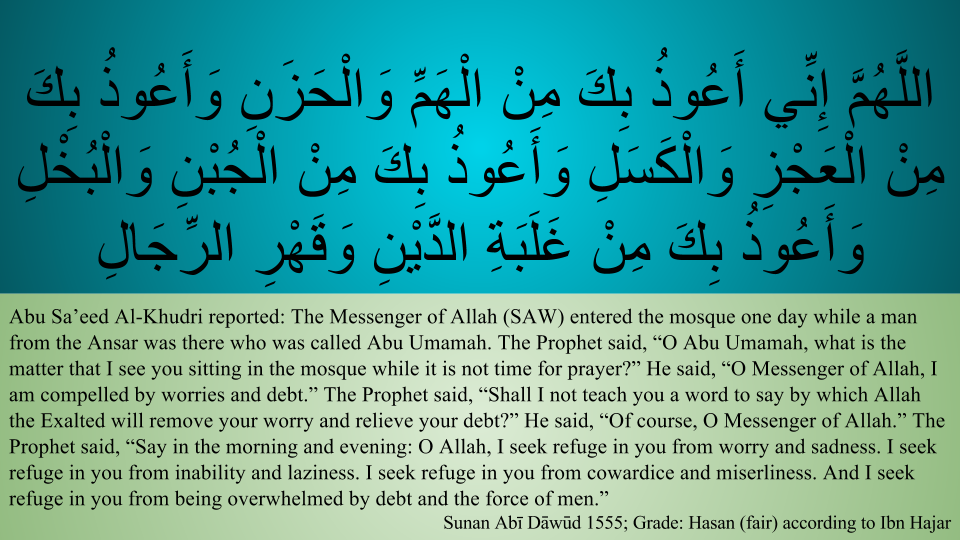 In another narration from Anas Ibn Malik (RA) who said "I used to be a servant to the messenger of Allah SAW. I used to frequently hear him (SAW) say: <em>'O Allah! Verily I seek refuge by You from worry and sadness, feeling weak and being lazy, miserliness and cowardice, over burdence of debt and dominated by men.'</em> " [This Hadith is narrated by Al-Bukhari] What is the difference between <em>worry</em> and <em>sadness</em>? Sadness is felt for a matter that has happened in the past and it has ended. Worry (or concern/anxiety) is related to future matters. The one who is pained in the heart by an event that has actually happened has a reason to be sad, but he should not be overcome by the sadness. There is a provision for natural sadness but he should allow it to pass quickly, accept the fact and attempt to move on. The Prophet (SAW) demonstrated sadness on the loss of loved ones like his sole wife for twenty-five years Khadijah (RA), his uncle Hamzah and his son Ibrahim, but the sadness did not consume him (SAW). When one is worried or concerned about the future he will be unduly preoccupied with negative thoughts. It is allowed to anticipate negative happenings in the future but one should not be burdened with worry. One should try to mitigate the events from happening and earnestly seek help from Allah (SWT). What is the difference between <em>feeling weak</em> and <em>being lazy</em>? Feeling weak is when someone lacks the will or desire to do something due to factors beyond one's control like being sick or due to old age. Laziness is not having the desire or motivation to do something out of one's own choice. Feeling weak and laziness are two major causes of defeat in most cases and also the cause or reason of failure in life. <em>Cowardice</em> is lack of courage. <em>Miserliness</em> is lack of generosity and hospitality. Together both these factors lead to greed and preference for the worldly life. Cowardice prevents us from sacrificing and giving everything to achieve our ambitions out of fear of failure or death. Miserliness prevents us from Infaq (giving) out of fear of poverty. Both are causes of misery in life. As such Allah (SWT) takes it upon His sole discretion in determining death and sustenance. What a paradox for the miserly? He lives in this world like the poor but he will be accounted for in the Hereafter like the rich. <em>Over-burdence of debt</em> means that one takes on debt to such an extent that one is incapable to repay the debt. Being over burdened with debt makes us worry at night and feel humiliated during the day when people claim against our debt. Clearly when one is over burdened with debt there is no more happiness. <em>Dominated by men</em> is when one is subject to the intensity of control and power by others upon oneself like if one is tortured by an unjust ruler or wicked leader. These two factors of being overburdened by debt and coerced by others destroys happiness since it takes away our sense of control over the affairs of life and makes us feel really humiliated. Prophet Muhammad (SAW) has taught us these factors of happiness and misery through this short and simple dua'. Let us try to make it a habit to recite this prophetic dua' daily in our lives. Reciting it daily is a sincere reflection of our reliance on His (SWT) power and help to grant us happiness in this life. |
| json metadata | {"tags":["islam","prophet","ethics","quran","happiness"],"image":["https://steemitimages.com/DQmWVmsHBShjzgnvQUMs9YGz6gF2a8ggArnMZuzBSpJyZfB/SteemQuote02.png"],"app":"steemit/0.1","format":"markdown"} |
| Transaction Info | Block #19722828/Trx 429cb34a4b83c6efe2b7f557c21ca2a0f382f429 |
View Raw JSON Data
{
"trx_id": "429cb34a4b83c6efe2b7f557c21ca2a0f382f429",
"block": 19722828,
"trx_in_block": 5,
"op_in_trx": 0,
"virtual_op": 0,
"timestamp": "2018-02-09T16:08:21",
"op": [
"comment",
{
"parent_author": "",
"parent_permlink": "islam",
"author": "leadus",
"permlink": "our-prophet-saw-seeks-refuge-from-factors-that-can-take-away-happiness",
"title": "Our Prophet (SAW) Seeks Refuge From Factors That Can Take Away Happiness",
"body": "In the following Hadith Prophet Muhammad (SAW) summarizes the factors of happiness and misery in this world. He (SAW) regularly seeks refuge from Allah (SWT) so that these factors will not affect him and deny him happiness and bliss.\n\n\nIn another narration from Anas Ibn Malik (RA) who said \"I used to be a servant to the messenger of Allah SAW. I used to frequently hear him (SAW) say: <em>'O Allah! Verily I seek refuge by You from worry and sadness, feeling weak and being lazy, miserliness and cowardice, over burdence of debt and dominated by men.'</em> \" [This Hadith is narrated by Al-Bukhari]\n\nWhat is the difference between <em>worry</em> and <em>sadness</em>? Sadness is felt for a matter that has happened in the past and it has ended. Worry (or concern/anxiety) is related to future matters. The one who is pained in the heart by an event that has actually happened has a reason to be sad, but he should not be overcome by the sadness. There is a provision for natural sadness but he should allow it to pass quickly, accept the fact and attempt to move on. The Prophet (SAW) demonstrated sadness on the loss of loved ones like his sole wife for twenty-five years Khadijah (RA), his uncle Hamzah and his son Ibrahim, but the sadness did not consume him (SAW).\n\nWhen one is worried or concerned about the future he will be unduly preoccupied with negative thoughts. It is allowed to anticipate negative happenings in the future but one should not be burdened with worry. One should try to mitigate the events from happening and earnestly seek help from Allah (SWT).\n\nWhat is the difference between <em>feeling weak</em> and <em>being lazy</em>? Feeling weak is when someone lacks the will or desire to do something due to factors beyond one's control like being sick or due to old age. Laziness is not having the desire or motivation to do something out of one's own choice. Feeling weak and laziness are two major causes of defeat in most cases and also the cause or reason of failure in life.\n\n<em>Cowardice</em> is lack of courage. <em>Miserliness</em> is lack of generosity and hospitality. Together both these factors lead to greed and preference for the worldly life. Cowardice prevents us from sacrificing and giving everything to achieve our ambitions out of fear of failure or death. Miserliness prevents us from Infaq (giving) out of fear of poverty. Both are causes of misery in life. As such Allah (SWT) takes it upon His sole discretion in determining death and sustenance.\n\nWhat a paradox for the miserly? He lives in this world like the poor but he will be accounted for in the Hereafter like the rich.\n\n<em>Over-burdence of debt</em> means that one takes on debt to such an extent that one is incapable to repay the debt. Being over burdened with debt makes us worry at night and feel humiliated during the day when people claim against our debt. Clearly when one is over burdened with debt there is no more happiness.\n\n<em>Dominated by men</em> is when one is subject to the intensity of control and power by others upon oneself like if one is tortured by an unjust ruler or wicked leader.\n\nThese two factors of being overburdened by debt and coerced by others destroys happiness since it takes away our sense of control over the affairs of life and makes us feel really humiliated.\n\nProphet Muhammad (SAW) has taught us these factors of happiness and misery through this short and simple dua'. Let us try to make it a habit to recite this prophetic dua' daily in our lives. Reciting it daily is a sincere reflection of our reliance on His (SWT) power and help to grant us happiness in this life.",
"json_metadata": "{\"tags\":[\"islam\",\"prophet\",\"ethics\",\"quran\",\"happiness\"],\"image\":[\"https://steemitimages.com/DQmWVmsHBShjzgnvQUMs9YGz6gF2a8ggArnMZuzBSpJyZfB/SteemQuote02.png\"],\"app\":\"steemit/0.1\",\"format\":\"markdown\"}"
}
]
}leaduspublished a new post: some-deeper-meanings-on-ethics-in-islam2018/02/08 03:12:21
leaduspublished a new post: some-deeper-meanings-on-ethics-in-islam
2018/02/08 03:12:21
| parent author | |
| parent permlink | islam |
| author | leadus |
| permlink | some-deeper-meanings-on-ethics-in-islam |
| title | Some Deeper Meanings on Ethics in Islam |
| body | Let us ponder on this noble Hadith where the Prophet (SAW) was asked about the Akhlaq (ethics/morals) of the believer and some of its attributes.? From Safwan ibn Sulaiman, ?It was said to the Messenger of Allah (SAW); Can the believer be a coward? He (SAW) said, "Yes" So it was said to him (SAW); Can the believer be a miser? He (SAW) said, "Yes" So it was said to him (SAW); Can the believer be a liar? He (SAW) said, "No" (Mentioned by Imam Malik in Al-Muwatta' (2/990) and Al-Baihaqi (4622) Portion on Faith/Iman) In this Hadith, the Prophet (SAW) points to an issue of far reaching importance, something that many of those who remind us about Akhlaq have forgotten. We rephrase the meaning of this Hadith in the form of another question; Is it mandatory for every Muslim to be brave? Is it mandatory for every Muslim to be charitable? Being brave and being charitable are often mentioned as important elements of Akhlaq. Although these two elements are important, the above Hadith points out that they are not obligatory. The Prophet (SAW) indicates to us that there are elements of Akhlaq that the Muslim has no latitude to abstain from; indeed these elements are a fundamental part of his character and belief system and are tied to his faith (Iman). There are also other elements of Akhlaq that completes his character and faith as a believer. On the question of courage and bravery, the Prophet (SAW) clearly indicated that it is permissible for the believer to not always be brave and courageous.? Not all Muslims have the capacity to come forward and fight courageously all the time.? Even during the early generation of the companions, not all of them were known for their courage and bravery.? There was the companion who even uttered words to indicate that he had reneged back to the old religion for fear of continued torture and persecution.? (Surah An-Nahl; 16-106) On the question of being miserly, the Prophet (SAW) again indicated that it is permissible. Being charitable is undoubtedly very encouraged in Islam and is a special trait of the Muslim behavior. Nevertheless, we even hear about a companion who was stingy. Abu Sufyan (RA) was greedy and miserly before Islam. When he became Muslim and his commitment to the Islamic practices and behavior improved, this negative trait in his character did not change much for the better. His wife Hind (RA) complained about him to the Prophet (SAW). "O Rasulullah (SAW), verily Abu Sufyan is a miserly man. He does not give me what is sufficient for me and my son except what I took from him without him knowing." He (SAW) said, "Take what is sufficient for you and your son rightly." [Narrated by Al-Bukhari] However on the third question about morals, the Prophet (SAW) firmly indicated that it is not permitted for a believer to become a liar. Lying is sinful. It is morally wrong and cannot be part of the character of the believer. 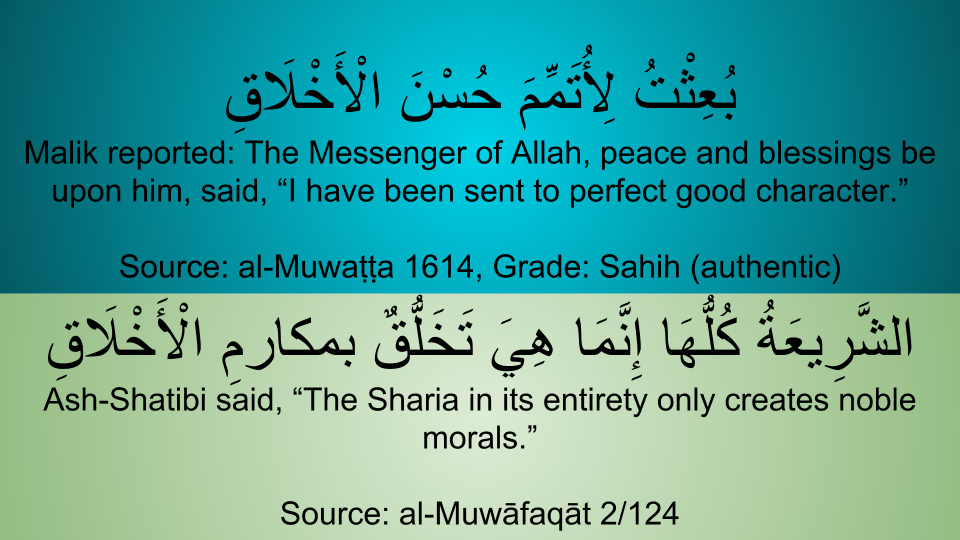 Akhlaq is a fundamental part of the message of Prophet Muhammad (SAW). There are elements of morality that are fundamental and take precedence; these elements cannot be compromised under any circumstance. Examples include lying, cheating, slandering and corruption. Then there are elements of morality that are secondary and make the Muslim behavior perfect. Courage and being charitable are examples of morality that really refines the Muslim morals and character to perfection although the Muslim is not faulted if at times he or she shows some cowardice or behaves miserly. On the other hand, truthfulness is a fundamental moral that shapes the Muslim character and he or she must remain truthful at all times, as the Prophet (SAW) indicated that the believer will never be a liar. |
| json metadata | {"tags":["islam","prophet","ethics","quran","truthfulness"],"image":["https://steemitimages.com/DQmWG3Znrwyo32ZBpY9E4b8Agi4fuY28ZDsqKe6nbnr2Agb/SteemQuotes.png"],"app":"steemit/0.1","format":"markdown"} |
| Transaction Info | Block #19678672/Trx 601cf0b81d42a33e448c9a16e5aa91f48fbb4948 |
View Raw JSON Data
{
"trx_id": "601cf0b81d42a33e448c9a16e5aa91f48fbb4948",
"block": 19678672,
"trx_in_block": 10,
"op_in_trx": 0,
"virtual_op": 0,
"timestamp": "2018-02-08T03:12:21",
"op": [
"comment",
{
"parent_author": "",
"parent_permlink": "islam",
"author": "leadus",
"permlink": "some-deeper-meanings-on-ethics-in-islam",
"title": "Some Deeper Meanings on Ethics in Islam",
"body": "Let us ponder on this noble Hadith where the Prophet (SAW) was asked about the Akhlaq (ethics/morals) of the believer and some of its attributes.? From Safwan ibn Sulaiman, ?It was said to the Messenger of Allah (SAW);\n\nCan the believer be a coward?\n\nHe (SAW) said, \"Yes\"\n\nSo it was said to him (SAW); Can the believer be a miser?\n\nHe (SAW) said, \"Yes\"\n\nSo it was said to him (SAW); Can the believer be a liar?\n\nHe (SAW) said, \"No\"\n\n(Mentioned by Imam Malik in Al-Muwatta' (2/990) and Al-Baihaqi (4622) Portion on Faith/Iman)\n\nIn this Hadith, the Prophet (SAW) points to an issue of far reaching importance, something that many of those who remind us about Akhlaq have forgotten. We rephrase the meaning of this Hadith in the form of another question; Is it mandatory for every Muslim to be brave? Is it mandatory for every Muslim to be charitable? Being brave and being charitable are often mentioned as important elements of Akhlaq. Although these two elements are important, the above Hadith points out that they are not obligatory.\n\nThe Prophet (SAW) indicates to us that there are elements of Akhlaq that the Muslim has no latitude to abstain from; indeed these elements are a fundamental part of his character and belief system and are tied to his faith (Iman). There are also other elements of Akhlaq that completes his character and faith as a believer.\n\nOn the question of courage and bravery, the Prophet (SAW) clearly indicated that it is permissible for the believer to not always be brave and courageous.? Not all Muslims have the capacity to come forward and fight courageously all the time.? Even during the early generation of the companions, not all of them were known for their courage and bravery.? There was the companion who even uttered words to indicate that he had reneged back to the old religion for fear of continued torture and persecution.? (Surah An-Nahl; 16-106)\n\nOn the question of being miserly, the Prophet (SAW) again indicated that it is permissible. Being charitable is undoubtedly very encouraged in Islam and is a special trait of the Muslim behavior. Nevertheless, we even hear about a companion who was stingy. Abu Sufyan (RA) was greedy and miserly before Islam. When he became Muslim and his commitment to the Islamic practices and behavior improved, this negative trait in his character did not change much for the better. His wife Hind (RA) complained about him to the Prophet (SAW). \"O Rasulullah (SAW), verily Abu Sufyan is a miserly man. He does not give me what is sufficient for me and my son except what I took from him without him knowing.\" He (SAW) said, \"Take what is sufficient for you and your son rightly.\" [Narrated by Al-Bukhari]\n\nHowever on the third question about morals, the Prophet (SAW) firmly indicated that it is not permitted for a believer to become a liar. Lying is sinful. It is morally wrong and cannot be part of the character of the believer.\n\n\n\nAkhlaq is a fundamental part of the message of Prophet Muhammad (SAW). There are elements of morality that are fundamental and take precedence; these elements cannot be compromised under any circumstance. Examples include lying, cheating, slandering and corruption. Then there are elements of morality that are secondary and make the Muslim behavior perfect. Courage and being charitable are examples of morality that really refines the Muslim morals and character to perfection although the Muslim is not faulted if at times he or she shows some cowardice or behaves miserly. On the other hand, truthfulness is a fundamental moral that shapes the Muslim character and he or she must remain truthful at all times, as the Prophet (SAW) indicated that the believer will never be a liar.",
"json_metadata": "{\"tags\":[\"islam\",\"prophet\",\"ethics\",\"quran\",\"truthfulness\"],\"image\":[\"https://steemitimages.com/DQmWG3Znrwyo32ZBpY9E4b8Agi4fuY28ZDsqKe6nbnr2Agb/SteemQuotes.png\"],\"app\":\"steemit/0.1\",\"format\":\"markdown\"}"
}
]
}leaduspublished a new post: with-the-prophet-saw-who-laughs-and-smiles2018/02/07 02:23:18
leaduspublished a new post: with-the-prophet-saw-who-laughs-and-smiles
2018/02/07 02:23:18
| parent author | |
| parent permlink | islam |
| author | leadus |
| permlink | with-the-prophet-saw-who-laughs-and-smiles |
| title | With The Prophet (SAW) Who Laughs and Smiles |
| body | When we read the Seerah (life history) of the Prophet (SAW) we will find many occasions when the Prophet (SAW) laughs and smiles. One of the Companions, Abdullah ibn al-Harith said, <em>"I have not seen a person who smiles more than Rasulullah (SAW)".</em> He also said, <em>"The laughter of Rasulullah (SAW) is but his smile".</em> [Narrated by At-Tirmizi]</p> <p style="text-align: left;">The Prophet (SAW) said this about himself. <em>"Verily I joke and I do not say except what is true".</em> [Narrated by At-Tabrani]. This means that although the Prophet (SAW) jokes and says things in jest he never ever lies and always conveys the truth. This is clearly indicated in the following incident.</p> <p style="text-align: left;">An old lady came to the Prophet (SAW) and said, <em>"O Rasulullah (SAW), invoke Allah (SWT) that He (SWT) admits me into Paradise". The Prophet (SAW) said to her in jest, "O Mother of so-and-so, verily the Paradise, an old lady does not enter it." The old lady turned away crying. Then the Prophet (SAW) said, "Inform her that she does not enter Paradise while she is old. Verily Allah (SWT) has said:</em></p> "Verily We have created (their companions) of special creation (35) And made them virgin-pure (36) Beloved and equal in age (37) For the companions of the Right Hand (38)." {Al-Waqiah, 56:35-38} The scholar An-Nakha'i (who was from the generation that lived with the Companions of the Prophet (SAW)) was asked, "Did the Companions of Rasulullah (SAW) use to laugh ?". He said, "Yes and the Iman (faith) in their hearts was more firm than the Mount Al-Rawasi (a mountain)". Bikr ibn Abdullah said, "The companions of the Prophet (SAW) used to play with watermelons although in truth they were real men." Thus these were the Companions. During times of worship, they were in full concentration and humility. When obedience is required from them, they will commit to obey seeking the pleasure of Allah (SWT) while cutting their ties with this world. However, in their normal lives they were people who were happy and smiling. This is how the Muslim should always be, obeying Allah (SWT) earnestly while not forgetting to smile to life. Islam strongly encourages us to draw a smile from the face of others. The Prophet (SAW) said, <em>"The best of deeds to Allah (SWT) is the happiness that it brings to a Muslim."</em> [Narrated by At-Tabrani] Adapted (with some commentaries) from the Chapter (Smile to Life) in the series on What Life Has Taught Me by Dr. Tareq Al-Suwaidan. |
| json metadata | {"tags":["islam","prophet","ethics","smile","quran"],"app":"steemit/0.1","format":"markdown"} |
| Transaction Info | Block #19648993/Trx aeee9768944b27305b54eb82f5d2198e43ccfb05 |
View Raw JSON Data
{
  "trx_id": "aeee9768944b27305b54eb82f5d2198e43ccfb05",
  "block": 19648993,
  "trx_in_block": 31,
  "op_in_trx": 0,
  "virtual_op": 0,
  "timestamp": "2018-02-07T02:23:18",
  "op": [
    "comment",
    {
      "parent_author": "",
      "parent_permlink": "islam",
      "author": "leadus",
      "permlink": "with-the-prophet-saw-who-laughs-and-smiles",
      "title": "With The Prophet (SAW) Who Laughs and Smiles",
      "body": "When we read the Seerah (life history) of the Prophet (SAW) we will find many occasions when the Prophet (SAW) laughs and smiles.  One of the Companions, Abdullah ibn al-Harith said, <em>\"I have not seen a person who smiles more than Rasulullah (SAW)\".</em> He also said, <em>\"The laughter of Rasulullah (SAW) is but his smile\".</em> [Narrated by At-Tirmizi]</p>\n<p style=\"text-align: left;\">The Prophet (SAW) said this about himself. <em>\"Verily I joke and I do not say except what is true\".</em> [Narrated by At-Tabrani].  This means that although the Prophet (SAW) jokes and says things in jest he never ever lies and always conveys the truth.  This is clearly indicated in the following incident.</p>\n<p style=\"text-align: left;\">An old lady came to the Prophet (SAW) and said, <em>\"O Rasulullah (SAW), invoke Allah (SWT) that He (SWT) admits me into Paradise\".  The Prophet (SAW) said to her in jest, \"O Mother of so-and-so, verily the Paradise, an old lady does not enter it.\" The old lady turned away crying.  Then the Prophet (SAW) said, \"Inform her that she does not enter Paradise while she is old. Verily Allah (SWT) has said:</em></p>\n\"Verily We have created (their companions) of special creation (35)\nAnd made them virgin-pure (36)\nBeloved and equal in age (37)\nFor the companions of the Right Hand (38).\" {Al-Waqiah, 56:35-38}\n\nThe scholar An-Nakha'i (who was from the generation that lived with the Companions of the Prophet (SAW)) was asked, \"Did the Companions of Rasulullah (SAW) use to laugh ?\".  He said, \"Yes and the Iman (faith) in their hearts was more firm than the Mount Al-Rawasi (a mountain)\".\n\nBikr ibn Abdullah said, \"The companions of the Prophet (SAW) used to play with watermelons although in truth they were real men.\"\n\nThus these were the Companions.  During times of worship, they were in full concentration and humility.  When obedience is required from them, they will commit to obey seeking the pleasure of Allah (SWT) while cutting their ties with this world.  However, in their normal lives they were people who were happy and smiling.  This is how the Muslim should always be, obeying Allah (SWT) earnestly while not forgetting to smile to life.\n\nIslam strongly encourages us to draw a smile from the face of others. The Prophet (SAW) said, <em>\"The best of deeds to Allah (SWT) is the happiness that it brings to a Muslim.\"</em> [Narrated by At-Tabrani]\n\nAdapted (with some commentaries) from the Chapter (Smile to Life) in the series on What Life Has Taught Me by Dr. Tareq Al-Suwaidan.",
      "json_metadata": "{\"tags\":[\"islam\",\"prophet\",\"ethics\",\"smile\",\"quran\"],\"app\":\"steemit/0.1\",\"format\":\"markdown\"}"
    }
  ]
}leadusfollowed @byresteem2018/02/04 04:42:24
leadusfollowed @byresteem
2018/02/04 04:42:24
| required auths | [] |
| required posting auths | ["leadus"] |
| id | follow |
| json | ["follow",{"follower":"leadus","following":"byresteem","what":["blog"]}] |
| Transaction Info | Block #19565415/Trx 3c357cfc507ac1a996c06174eb814f0b60741fcc |
View Raw JSON Data
{
  "trx_id": "3c357cfc507ac1a996c06174eb814f0b60741fcc",
  "block": 19565415,
  "trx_in_block": 35,
  "op_in_trx": 0,
  "virtual_op": 0,
  "timestamp": "2018-02-04T04:42:24",
  "op": [
    "custom_json",
    {
      "required_auths": [],
      "required_posting_auths": [
        "leadus"
      ],
      "id": "follow",
      "json": "[\"follow\",{\"follower\":\"leadus\",\"following\":\"byresteem\",\"what\":[\"blog\"]}]"
    }
  ]
}leaduspublished a new post: about-leadus2018/02/03 16:16:42
leaduspublished a new post: about-leadus
2018/02/03 16:16:42
| parent author | |
| parent permlink | islam |
| author | leadus |
| permlink | about-leadus |
| title | About LeadUS |
| body | LeadUS is a newly established study group that seeks to promote fikrah (thought) and leadership capabilities for the next generation of Islamic workers. The core members of LeadUS were mostly active as student leaders in the middle 1970s through the 1990s with a specific interest in promoting Islam. We continued to carry this interest in our various endeavors involving politics, government, corporate business, social work, academia, entrepreneurship and others. With this abundant wealth of shared experience and continual learning of Islam, we feel we have something unique to offer the young generation of Muslim activists in terms of ideas, thoughts and leadership. Azman Hussin is managing this Steemit account on behalf of LeadUS. This is his brief profile. Tertiary Education BSc (Physics), Ohio University, Athens, Ohio, USA 1979 MSc (Physics), Ohio University, Athens, Ohio, USA 1981 Doctor of Management, Universiti Utara Malaysia, Malaysia, 2014 Work Experience Lecturer, National University of Malaysia (1982-1989) Systems Engineer, IBM Malaysia (1989-1992) General Manager, Komputer Sistem Malaysia (1992-1993) Managing Director, eNCoral Digital Solutions Sdn Bhd (1994-1998). Founder member of the company. Director, eNCoral Digital Solutions Sdn Bhd (1998-present) Group Strategy, Qatar Telecom (now Oooredoo) (2006-2008) Director, Inix Technologies Berhad (2010-present) Board of Directors Experience Director, Progressive Impact Corporation PICORP (1993-2004), company was subsequently listed in Bursa Malaysia Main Board. Director, TSI-Telsys Corporation (1996-1998), listed in Montreal Stock Exchange Director, Silicon Vision Corporation (1997-1998), listed in Montreal Stock Exchange Majlis Amanah Rakyat MARA (1996-1998), one of the largest educational and entrepreneurial development agencies in Malaysia Director, Inix Technologies Berhad (2010-present), company listed in Bursa Malaysia Ace Market Current Interests Strategic Planning and Strategy Implementation Corporate Performance Management Data Science Organizational Change Business Innovation Leadership Muslim History Investments in technology companies like Apple, Microsoft, Nvidia, Intel etc. Recent Projects Completed Doctorate program in Management by thesis on “STRATEGY BY PROTOTYPING FRAMEWORK FOR SMEs THROUGH INTEGRATING DESIGN THINKING AND BALANCED SCORECARD”. (May 2014) Developed CORAL Framework for strategy management for SMEs (2014) Facilitated various strategy management training programs for SMEs (2012-2014) Content development for eBook application on Apple iOS platform Facilitated various business innovation training programs for SMEs (2013-2014) Completed major corporate exercise on rights issues and share reduction for Inix Technologies Bhd in November 2015. Co-authored book on leadership, Hussin, A., Al-Suwaidan, T.M., Othman, R. (2015). Prophet Muhammad the hallmark of leadership, Amazon.com. Wrote book on the Higher Objectives of Humanity, Amazon.com Strategy Made Simple, 300 page e-book for Masters course. Warna-Warna Keusahwanan, a coffee-table book of pictures and quotations on the journey of Enterpreneurship Recent Training/Teaching Strategy Management for Masters course on Entrepreneurship at MASMED UiTM (2015, 2016, 2017) 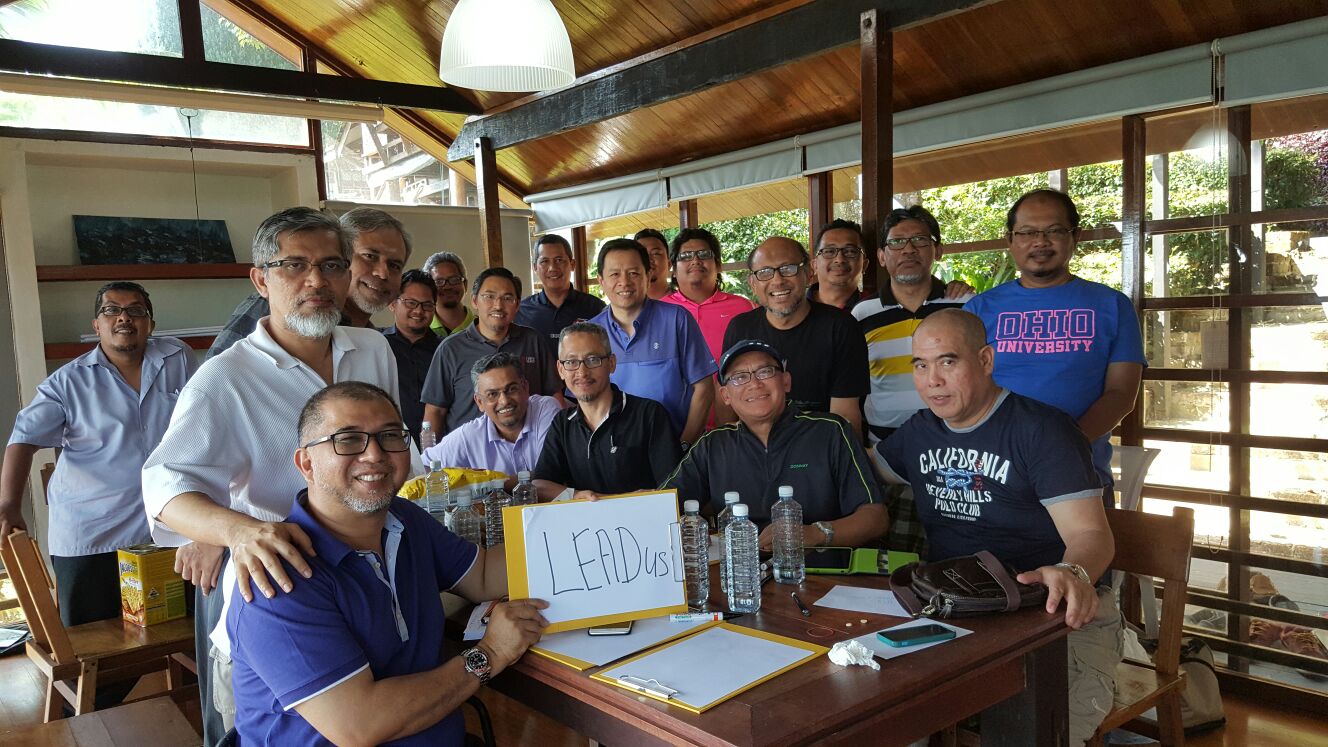  |
| json metadata | {"tags":["islam","leadership","malaysia","teammalaysia"],"image":["https://steemitimages.com/DQmTzAZ6ZA9KbDEk77D6EwcLot77GPPC2NbxC2iAr3XdwyG/IMG_0239.JPG","https://steemitimages.com/DQmPo8GxvV9Bk4HM33zcpA1EjJqdhUXLQaHT3bVSUd1vsua/PakCik80Birthday%202017-02-19_3.jpeg"],"app":"steemit/0.1","format":"markdown"} |
| Transaction Info | Block #19550605/Trx 487b5e28644339885915d471cba189d84ed6811c |
View Raw JSON Data
{
"trx_id": "487b5e28644339885915d471cba189d84ed6811c",
"block": 19550605,
"trx_in_block": 29,
"op_in_trx": 0,
"virtual_op": 0,
"timestamp": "2018-02-03T16:16:42",
"op": [
"comment",
{
"parent_author": "",
"parent_permlink": "islam",
"author": "leadus",
"permlink": "about-leadus",
"title": "About LeadUS",
"body": "LeadUS is a newly established study group that seeks to promote fikrah (thought) and leadership capabilities for the next generation of Islamic workers. The core members of LeadUS were mostly active as student leaders in the middle 1970s through the 1990s with a specific interest in promoting Islam. We continued to carry this interest in our various endeavors involving politics, government, corporate business, social work, academia, entrepreneurship and others.\n\nWith this abundant wealth of shared experience and continual learning of Islam, we feel we have something unique to offer the young generation of Muslim activists in terms of ideas, thoughts and leadership.\n\nAzman Hussin is managing this Steemit account on behalf of LeadUS. This is his brief profile.\n\nTertiary Education\n BSc (Physics), Ohio University, Athens, Ohio, USA 1979\n MSc (Physics), Ohio University, Athens, Ohio, USA 1981\n Doctor of Management, Universiti Utara Malaysia, Malaysia, 2014\n\nWork Experience\n Lecturer, National University of Malaysia (1982-1989)\n Systems Engineer, IBM Malaysia (1989-1992)\n General Manager, Komputer Sistem Malaysia (1992-1993)\n Managing Director, eNCoral Digital Solutions Sdn Bhd (1994-1998). Founder member of the company.\n Director, eNCoral Digital Solutions Sdn Bhd (1998-present)\n Group Strategy, Qatar Telecom (now Oooredoo) (2006-2008)\n Director, Inix Technologies Berhad (2010-present)\n\nBoard of Directors Experience\n\n Director, Progressive Impact Corporation PICORP (1993-2004), company was subsequently listed in Bursa Malaysia Main Board.\n Director, TSI-Telsys Corporation (1996-1998), listed in Montreal Stock Exchange\n Director, Silicon Vision Corporation (1997-1998), listed in Montreal Stock Exchange\n Majlis Amanah Rakyat MARA (1996-1998), one of the largest educational and entrepreneurial development agencies in Malaysia\n Director, Inix Technologies Berhad (2010-present), company listed in Bursa Malaysia Ace Market\n\nCurrent Interests\n Strategic Planning and Strategy Implementation\n Corporate Performance Management\n Data Science\n Organizational Change\n Business Innovation\n Leadership\n Muslim History\n Investments in technology companies like Apple, Microsoft, Nvidia, Intel etc.\n\nRecent Projects\n Completed Doctorate program in Management by thesis on “STRATEGY BY PROTOTYPING FRAMEWORK FOR SMEs THROUGH INTEGRATING DESIGN THINKING AND BALANCED SCORECARD”. (May 2014)\n Developed CORAL Framework for strategy management for SMEs (2014)\n Facilitated various strategy management training programs for SMEs (2012-2014)\n Content development for eBook application on Apple iOS platform\n Facilitated various business innovation training programs for SMEs (2013-2014)\n Completed major corporate exercise on rights issues and share reduction for Inix Technologies Bhd in November 2015.\n Co-authored book on leadership, Hussin, A., Al-Suwaidan, T.M., Othman, R. (2015). Prophet Muhammad the hallmark of leadership, Amazon.com.\n Wrote book on the Higher Objectives of Humanity, Amazon.com\n Strategy Made Simple, 300 page e-book for Masters course.\n Warna-Warna Keusahwanan, a coffee-table book of pictures and quotations on the journey of Enterpreneurship\n\nRecent Training/Teaching\n\n Strategy Management for Masters course on Entrepreneurship at MASMED UiTM (2015, 2016, 2017)\n\n",
"json_metadata": "{\"tags\":[\"islam\",\"leadership\",\"malaysia\",\"teammalaysia\"],\"image\":[\"https://steemitimages.com/DQmTzAZ6ZA9KbDEk77D6EwcLot77GPPC2NbxC2iAr3XdwyG/IMG_0239.JPG\",\"https://steemitimages.com/DQmPo8GxvV9Bk4HM33zcpA1EjJqdhUXLQaHT3bVSUd1vsua/PakCik80Birthday%202017-02-19_3.jpeg\"],\"app\":\"steemit/0.1\",\"format\":\"markdown\"}"
}
]
}leaduspublished a new post: leadership-of-prophet-muhammad-saw-credibility2018/02/01 08:16:09
leaduspublished a new post: leadership-of-prophet-muhammad-saw-credibility
2018/02/01 08:16:09
| parent author | |
| parent permlink | quran |
| author | leadus |
| permlink | leadership-of-prophet-muhammad-saw-credibility |
| title | Leadership of Prophet Muhammad (SAW) - Credibility |
| body | The book “The Leadership Challenge” by Kouzes and Posner is one of the deepest and meaningful studies on the topic of leadership. The book is a result of continuous research over a period of 25 years. Kouzes and Posner have introduced a new set of leadership guidelines, based upon more than thirty years of research, in their book first published in 2010, The Truth About Leadership. In their new volume, Kouzes and Posner set out to provide 10 universal truths of leadership. The authors posit that while the context of leadership has changed since their research began, those behaviors and habits that are successful have not. They proposed a collection of fundamental principles that inform and support the practices of leadership. The authors said that this book is different from their previous works for three reasons: this is a bolder book, making claims about leadership practices based upon all of their research; this research and data is all newer than when they wrote their original book; and these truths are universal because they are global and cross-generational. We mention these works because they typify the best in modern empirical research in the field of leadership. The leadership ideas, concepts, laws, practices and models proposed in these books are supported by reliable empirical data which is global and covers various levels of leadership from project leaders to CEOs and also various environments of leadership from schools, communities, sports, businesses and government. Although the example cases mentioned are numerous, can we find a single person in history that exemplifies all these leadership truths and principles as proposed by these well researched modern theories of leadership? We started to look at the primary characteristic of leadership that the two researchers studied from the responses of more than one and a half million individuals across the six continents. Among the questions they asked from the 1.5 million respondents was “What are the characteristics you like to see in the leader that you follow willingly?” The first results of the study appeared in 1998 and the research continued until today across the six continents. Since the first tabulation of the results, the primary preferred characteristic of leadership has not changed. In the second edition of their book, Credibility published in 2010, the authors highlighted that “Credibility Is the Foundation of Leadership” (p. 15). In this book, the two authors clarified the meaning of credibility through various examples and anecdotes but concluded that, “Of all the attributes of credibility, however, one is unquestionably of greatest importance. The dimension of honesty accounts for more of the variance in believability than all other factors combined. Being seen as someone who can be trusted, who has high integrity, and who is honest and truthful is essential to being believed” (p. 18). Credibility then is about truthfulness and honesty. This conclusion is a pleasant surprise since the expression “truthfulness and honesty” relates to something sacred to us Muslims. We have been taught from our childhood that truthfulness (الصدق) and honesty (الأمانة) are two characteristics that are considered mandatory for all Messengers of Allah (SWT). In fact our beloved Prophet Muhammad (SAW) was called As-Sadiq Al-Amin even before he was appointed a Prophet and a Messenger. Even the disbelievers in Mecca acknowledged him (SAW) likewise and called him (SAW) by this salutation. Truthfulness and honesty are two primary characteristics binding on anyone who leads others without force. When the leader exemplifies these two characteristics people will trust him and truly follow him. On mount Safa nearby Kaabah in Mecca, an event occurred which ascertained that truthfulness (الصدق) makes people trust the leader and willing to follow him. Narrated Ibnu Abbas: When the verse: “And warn your tribe of near-kindred”, was revealed, the Prophet ascended the Safa (mountain) and started calling, “O Bani Fihr! O Bani ‘Adi!”, addressing the various tribes of Quraish till they were assembled. Those who could not come themselves, sent their messengers to see what was there. Abu Lahab and other people from Quraish came and the Prophet then said, “Suppose I told you that there is an (enemy) cavalry in the valley intending to attack you, would you believe me?” They said, “Yes, for we have not found you telling anything other than the truth.” He then said, “I am a warner to you in face of a terrific punishment.” Abu Lahab said (to the Prophet) “May your hands perish all this day. Is it for this purpose you have gathered us?” Then it was revealed: “Perish the hands of Abu Lahab, and perish he! His wealth and his children will not profit him ...” [Al-Quran, 111:1-5] During the night of Prophet Muhammad’s (SAW) migration to Medina (Hijrah), another event happened which ascertained that honesty (الأمانة) is a primary characteristic of the leader who seeks to bring about change among his followers and the environment they are in. In the night of his (SAW) Hijrah, the Prophet (SAW) left his cousin ‘Ali Ibn Abi Talib (RA) to sleep on his bed and made him stay in Mecca for a while. All of us expect that this act was only to distract and deceive the Quraish. Actually another major purpose was also for ‘Ali to return the things that the various people of Quraish entrusted upon the Prophet (SAW) to keep. It was indeed strange that they opposed him (SAW) and wanted to even kill him, but when they wanted to entrust their belongings for safe keeping, they could not find anyone else more truthful and honest than Prophet Muhammad (SAW). Truthfulness and honesty are the moral foundations of leadership. Many Western scholars of leadership promote this concept. Kouzes and Posner conclude that truthfulness and honesty are the foundations of credibility and “Credibility Is the Foundation of Leadership”. In history, only the messengers of Allah (SWT) embody these two traits. Our Prophet Muhammad (SAW), the seal and leader of the prophets and messengers, was the pristine example of truthfulness and honesty. If Prophet Muhammad (SAW) is the best example of credibility from the conceptual point of view, did he also exemplify the various practical meanings of credibility and the other laws and practices of leadership that emanate from credibility as articulated by modern research? Our future postings are part of a humble effort to map the various laws, principles and roles of modern leadership theories with examples from the history and biography of Prophet Muhammad (SAW). We used the 10 universal truths of leadership by Kouzes and Posner as a sample recent work on modern leadership theory. Based on our readings on other modern leadership theories, this work is a fair representation of the other models. We will state the universal truths in sequence and then append examples from the history and biography of Prophet Muhammad (SAW) that relate to each universal truth. These examples are taken from the various books of Seerah and Hadith that we have referenced. Azman Hussin LeadUS |
| json metadata | {"tags":["quran","seerah","islam","prophet","leadership"],"app":"steemit/0.1","format":"markdown"} |
| Transaction Info | Block #19483492/Trx ce0f00008123dad0b46ce64cede3665c7070826c |
View Raw JSON Data
{
  "trx_id": "ce0f00008123dad0b46ce64cede3665c7070826c",
  "block": 19483492,
  "trx_in_block": 21,
  "op_in_trx": 0,
  "virtual_op": 0,
  "timestamp": "2018-02-01T08:16:09",
  "op": [
    "comment",
    {
      "parent_author": "",
      "parent_permlink": "quran",
      "author": "leadus",
      "permlink": "leadership-of-prophet-muhammad-saw-credibility",
      "title": "Leadership of Prophet Muhammad (SAW) - Credibility",
      "body": "The book “The Leadership Challenge” by Kouzes and Posner is one of the deepest and meaningful studies on the topic of leadership. The book is a result of continuous research over a period of 25 years. Kouzes and Posner have introduced a new set of leadership guidelines, based upon more than thirty years of research, in their book first published in 2010, The Truth About Leadership. In their new volume, Kouzes and Posner set out to provide 10 universal truths of leadership. The authors posit that while the context of leadership has changed since their research began, those behaviors and habits that are successful have not. They proposed a collection of fundamental principles that inform and support the practices of leadership. The authors said that this book is different from their previous works for three reasons: this is a bolder book, making claims about leadership practices based upon all of their research; this research and data is all newer than when they wrote their original book; and these truths are universal because they are global and cross-generational.\n\nWe mention these works because they typify the best in modern empirical research in the field of leadership. The leadership ideas, concepts, laws, practices and models proposed in these books are supported by reliable empirical data which is global and covers various levels of leadership from project leaders to CEOs and also various environments of leadership from schools, communities, sports, businesses and government. Although the example cases mentioned are numerous, can we find a single person in history that exemplifies all these leadership truths and principles as proposed by these well researched modern theories of leadership?\n\nWe started to look at the primary characteristic of leadership that the two researchers studied from the responses of more than one and a half million individuals across the six continents. Among the questions they asked from the 1.5 million respondents was “What are the characteristics you like to see in the leader that you follow willingly?” The first results of the study appeared in 1998 and the research continued until today across the six continents. Since the first tabulation of the results, the primary preferred characteristic of leadership has not changed. In the second edition of their book, Credibility published in 2010, the authors highlighted that “Credibility Is the Foundation of Leadership” (p. 15).\n\nIn this book, the two authors clarified the meaning of credibility through various examples and anecdotes but concluded that,\n“Of all the attributes of credibility, however, one is unquestionably of greatest importance. The dimension of honesty accounts for more of the variance in believability than all other factors combined. Being seen as someone who can be trusted, who has high integrity, and who is honest and truthful is essential to being believed” (p. 18).\nCredibility then is about truthfulness and honesty. \n\nThis conclusion is a pleasant surprise since the expression “truthfulness and honesty” relates to something sacred to us Muslims. We have been taught from our childhood that truthfulness (الصدق) and honesty (الأمانة) are two characteristics that are considered mandatory for all Messengers of Allah (SWT). In fact our beloved Prophet Muhammad (SAW) was called As-Sadiq Al-Amin even before he was appointed a Prophet and a Messenger. Even the disbelievers in Mecca acknowledged him (SAW) likewise and called him (SAW) by this salutation. Truthfulness and honesty are two primary characteristics binding on anyone who leads others without force. When the leader exemplifies these two characteristics people will trust him and truly follow him.\n\nOn mount Safa nearby Kaabah in Mecca, an event occurred which ascertained that truthfulness (الصدق) makes people trust the leader and willing to follow him. Narrated Ibnu Abbas: When the verse: “And warn your tribe of near-kindred”, was revealed, the Prophet ascended the Safa (mountain) and started calling, “O Bani Fihr! O Bani ‘Adi!”, addressing the various tribes of Quraish till they were assembled. Those who could not come themselves, sent their messengers to see what was there. Abu Lahab and other people from Quraish came and the Prophet then said, “Suppose I told you that there is an (enemy) cavalry in the valley intending to attack you, would you believe me?” They said, “Yes, for we have not found you telling anything other than the truth.” He then said, “I am a warner to you in face of a terrific punishment.” Abu Lahab said (to the Prophet) “May your hands perish all this day. Is it for this purpose you have gathered us?” Then it was revealed: “Perish the hands of Abu Lahab, and perish he! His wealth and his children will not profit him ...” [Al-Quran, 111:1-5]\n\nDuring the night of Prophet Muhammad’s (SAW) migration to Medina (Hijrah), another event happened which ascertained that honesty (الأمانة) is a primary characteristic of the leader who seeks to bring about change among his followers and the environment they are in. In the night of his (SAW) Hijrah, the Prophet (SAW) left his cousin ‘Ali Ibn Abi Talib (RA) to sleep on his bed and made him stay in Mecca for a while. All of us expect that this act was only to distract and deceive the Quraish. Actually another major purpose was also for ‘Ali to return the things that the various people of Quraish entrusted upon the Prophet (SAW) to keep. It was indeed strange that they opposed him (SAW) and wanted to even kill him, but when they wanted to entrust their belongings for safe keeping, they could not find anyone else more truthful and honest than Prophet Muhammad (SAW).\n\nTruthfulness and honesty are the moral foundations of leadership. Many Western scholars of leadership promote this concept. Kouzes and Posner conclude that truthfulness and honesty are the foundations of credibility and “Credibility Is the Foundation of Leadership”. In history, only the messengers of Allah (SWT) embody these two traits. Our Prophet Muhammad (SAW), the seal and leader of the prophets and messengers, was the pristine example of truthfulness and honesty. \n\nIf Prophet Muhammad (SAW) is the best example of credibility from the conceptual point of view, did he also exemplify the various practical meanings of credibility and the other laws and practices of leadership that emanate from credibility as articulated by modern research? Our future postings are part of a humble effort to map the various laws, principles and roles of modern leadership theories with examples from the history and biography of Prophet Muhammad (SAW). We used the 10 universal truths of leadership by Kouzes and Posner as a sample recent work on modern leadership theory. Based on our readings on other modern leadership theories, this work is a fair representation of the other models. We will state the universal truths in sequence and then append examples from the history and biography of Prophet Muhammad (SAW) that relate to each universal truth. These examples are taken from the various books of Seerah and Hadith that we have referenced.\n\nAzman Hussin\nLeadUS",
      "json_metadata": "{\"tags\":[\"quran\",\"seerah\",\"islam\",\"prophet\",\"leadership\"],\"app\":\"steemit/0.1\",\"format\":\"markdown\"}"
    }
  ]
}leaduspublished a new post: leading-through-rahmatan-lil-alamin-mercy-to-all-the-worlds2018/01/31 01:01:39
leaduspublished a new post: leading-through-rahmatan-lil-alamin-mercy-to-all-the-worlds
2018/01/31 01:01:39
| parent author | |
| parent permlink | rahmatan-lilalamin |
| author | leadus |
| permlink | leading-through-rahmatan-lil-alamin-mercy-to-all-the-worlds |
| title | Leadership of Prophet Muhammad (SAW) |
| body | We are planning a sequel to our recent books on "Prophet Muhammad (SAW): The Hallmark of Leadership" and "The Higher Objectives of Humanity". From the feedback we got from the first edition and also our own reviews, we decided to make the next book more practical for those interested in applying the leadership lessons from Prophet Muhammad (SAW). We will also simplify what we have learned from modern leadership theories and present it in a basic “why, what and how” model. We believe this will help to provide a simple guideline on how the reader can practice and apply the leadership lessons we present. We observe that many books and articles on leadership discuss in detail about selected techniques of leadership (the “how” of leadership) like coaching, mentoring, listening and showing empathy. But what makes a leader stand out? Why does someone wants to follow a leader? We think it is more about the values, principles and beliefs that a leader stands for. We classify this simply as the “why” of leadership. But people follow a leader also because they want to achieve something together like completing a project, winning an election or sports championship, or other tangible goals. It is related to a common or shared vision. We call this simply as the “what” of leadership. Thus the “why” relate to values, principles and beliefs of a leader. The “what” relates to the vision of a leader. The “how” describes how a leader leads effectively for which our focus will be on the major proven techniques of great leaders. It is the “how” to achieve the “what” that must be consistent with the “why”. Many leadership books talk about values being the foundation of leadership. Values drive the leader’s commitment to a cause and the followers’ commitment to the leader and the cause. Leaders must know their own values and beliefs to truly understand what motivates their followers. Leaders must work to help their groups develop values and ensure that the work they are doing aligns with those values. Leadership is a relationship, and clarity of values helps strengthen that relationship. When analyzing the leadership of Prophet Muhammad (SAW), we found out that the major value that he always upheld was being merciful. This is consistent with the main objective for which he was sent as the last and final prophet and messenger. وَمَا أَرْسَلْنَاكَ إِلَّا رَحْمَةً لِلْعَالَمِينَ And We have not sent you but as a mercy to the worlds. [21:107] We discussed the "why", "what" and "how" of Rahmatan lil-Alamin (RLA) in our book on "The Higher Objectives of Humanity". We proposed a visual framework on how to apply RLA and tested it with some case studies taken from the caliphate of Abu Bakar (RA) and Umar (RA), the first two leaders to succeed Prophet Muhammad (SAW). The book also contains many examples of Rahmah from Prophet Muhammad (SAW) himself. In the coming postings we will provide other examples of the Prophet and his companions exemplifying the value and principle of Rahmah. Leadership is founded on values. Rahmah is the fundamental value in Islam. Thus for we Muslims to make a difference in the way they lead, we must understand and apply Rahmah. Azman Hussin, LeadUS 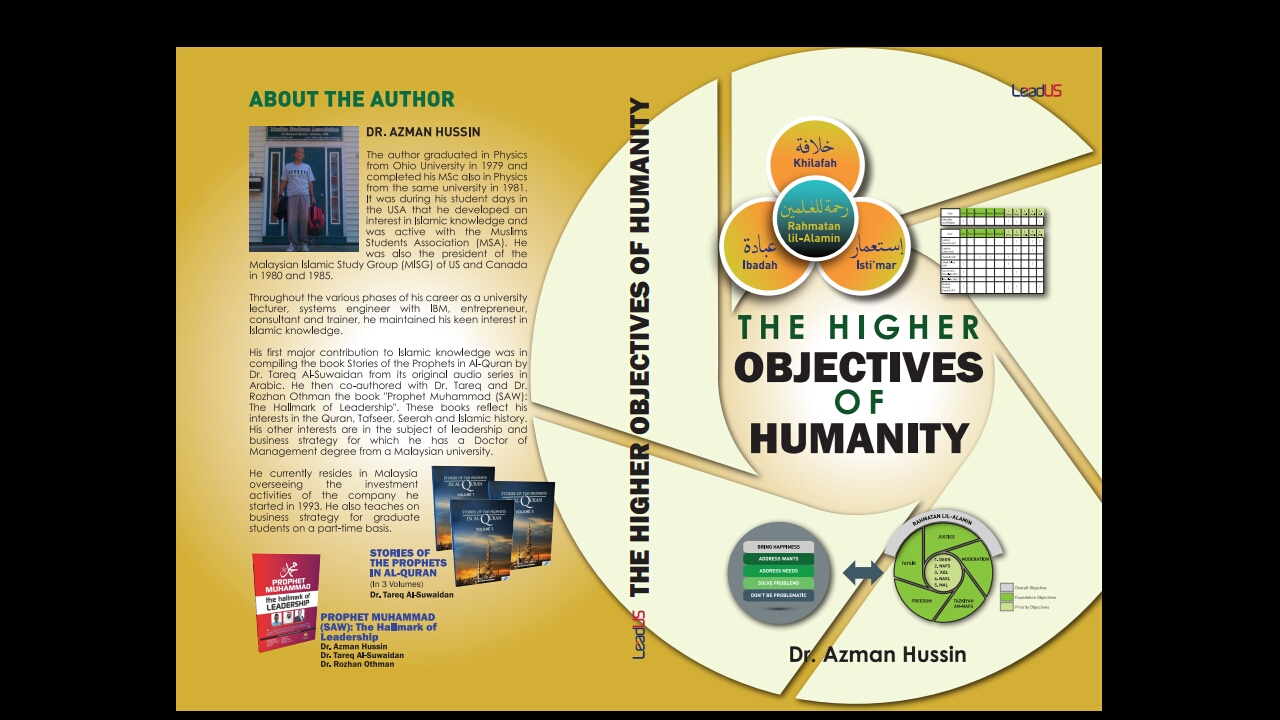 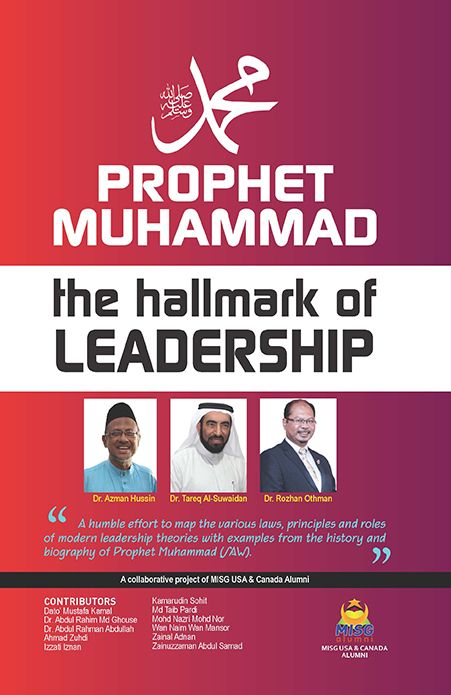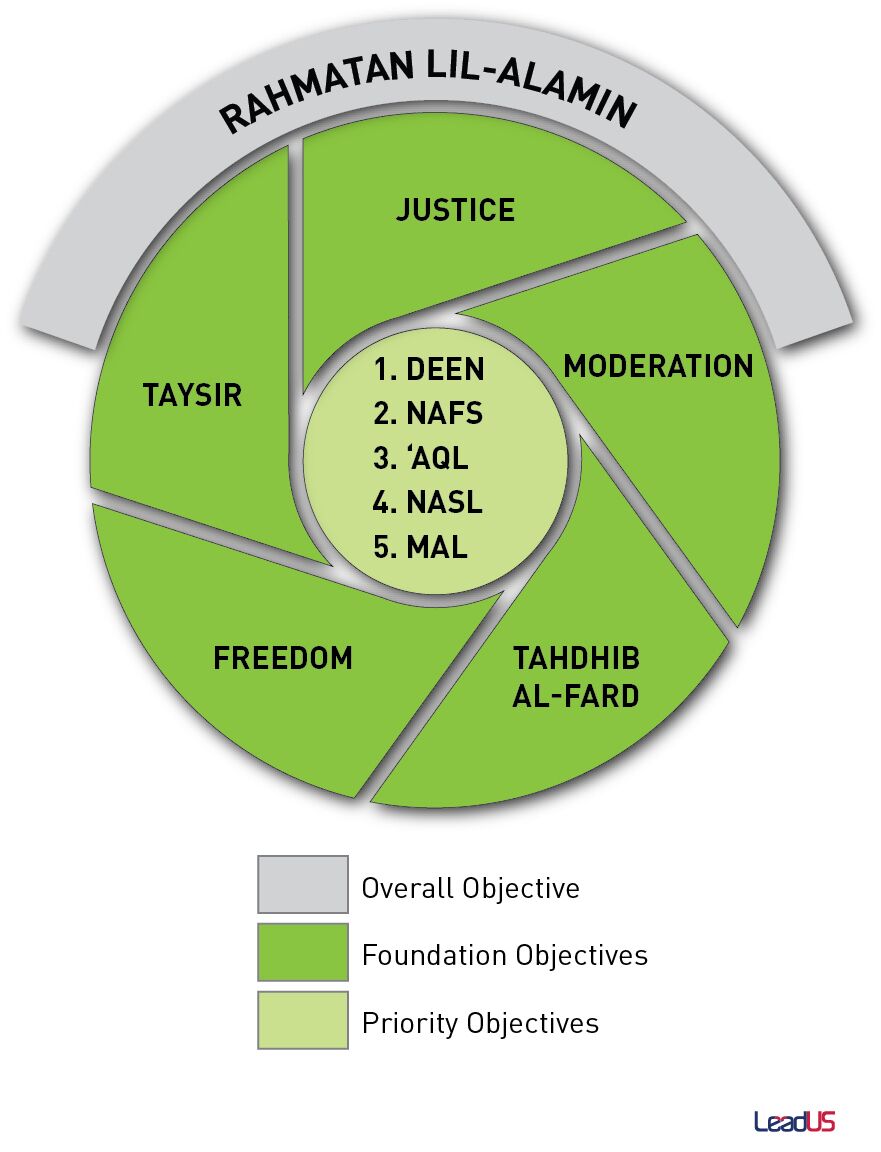 |
| json metadata | {"tags":["mercy","leadership","prophet","quran","rahmatan-lilalamin"],"image":["https://steemitimages.com/DQmP9CSQgfzhsswAd1UNhMJNnuSrDMD1Fs95GXdp67V5A6x/Cover_Humanity.jpeg","https://steemitimages.com/DQmQuTia5HNDcB7NAixvbu6iF7wRPpJLmevzwUHaf97yqte/Hallmark-Leadership_Front-Cover.jpg","https://steemitimages.com/DQmXdGCZ5BwwyRWQfZY6hsLdDF395C2uWv4X39XfFqCJcbD/MaqasidSchemaFinal.JPG"],"app":"steemit/0.1","format":"markdown"} |
| Transaction Info | Block #19446040/Trx 8b1abd896e15ba1ac60d8c843cd2fe103c45a7e3 |
View Raw JSON Data
{
"trx_id": "8b1abd896e15ba1ac60d8c843cd2fe103c45a7e3",
"block": 19446040,
"trx_in_block": 12,
"op_in_trx": 0,
"virtual_op": 0,
"timestamp": "2018-01-31T01:01:39",
"op": [
"comment",
{
"parent_author": "",
"parent_permlink": "rahmatan-lilalamin",
"author": "leadus",
"permlink": "leading-through-rahmatan-lil-alamin-mercy-to-all-the-worlds",
"title": "Leadership of Prophet Muhammad (SAW)",
"body": "We are planning a sequel to our recent books on \"Prophet Muhammad (SAW): The Hallmark of Leadership\" and \"The Higher Objectives of Humanity\". From the feedback we got from the first edition and also our own reviews, we decided to make the next book more practical for those interested in applying the leadership lessons from Prophet Muhammad (SAW).\n\nWe will also simplify what we have learned from modern leadership theories and present it in a basic “why, what and how” model. We believe this will help to provide a simple guideline on how the reader can practice and apply the leadership lessons we present. We observe that many books and articles on leadership discuss in detail about selected techniques of leadership (the “how” of leadership) like coaching, mentoring, listening and showing empathy. But what makes a leader stand out? Why does someone wants to follow a leader? We think it is more about the values, principles and beliefs that a leader stands for. We classify this simply as the “why” of leadership. But people follow a leader also because they want to achieve something together like completing a project, winning an election or sports championship, or other tangible goals. It is related to a common or shared vision. We call this simply as the “what” of leadership.\n\nThus the “why” relate to values, principles and beliefs of a leader. The “what” relates to the vision of a leader. The “how” describes how a leader leads effectively for which our focus will be on the major proven techniques of great leaders. It is the “how” to achieve the “what” that must be consistent with the “why”.\n\nMany leadership books talk about values being the foundation of leadership. Values drive the leader’s commitment to a cause and the followers’ commitment to the leader and the cause. Leaders must know their own values and beliefs to truly understand what motivates their followers. Leaders must work to help their groups develop values and ensure that the work they are doing aligns with those values. Leadership is a relationship, and clarity of values helps strengthen that relationship.\n\nWhen analyzing the leadership of Prophet Muhammad (SAW), we found out that the major value that he always upheld was being merciful. This is consistent with the main objective for which he was sent as the last and final prophet and messenger.\nوَمَا أَرْسَلْنَاكَ إِلَّا رَحْمَةً لِلْعَالَمِينَ\nAnd We have not sent you but as a mercy to the worlds. [21:107]\n\nWe discussed the \"why\", \"what\" and \"how\" of Rahmatan lil-Alamin (RLA) in our book on \"The Higher Objectives of Humanity\". We proposed a visual framework on how to apply RLA and tested it with some case studies taken from the caliphate of Abu Bakar (RA) and Umar (RA), the first two leaders to succeed Prophet Muhammad (SAW). The book also contains many examples of Rahmah from Prophet Muhammad (SAW) himself.\n\nIn the coming postings we will provide other examples of the Prophet and his companions exemplifying the value and principle of Rahmah. Leadership is founded on values. Rahmah is the fundamental value in Islam. Thus for we Muslims to make a difference in the way they lead, we must understand and apply Rahmah.\n\nAzman Hussin, LeadUS\n\n\n",
"json_metadata": "{\"tags\":[\"mercy\",\"leadership\",\"prophet\",\"quran\",\"rahmatan-lilalamin\"],\"image\":[\"https://steemitimages.com/DQmP9CSQgfzhsswAd1UNhMJNnuSrDMD1Fs95GXdp67V5A6x/Cover_Humanity.jpeg\",\"https://steemitimages.com/DQmQuTia5HNDcB7NAixvbu6iF7wRPpJLmevzwUHaf97yqte/Hallmark-Leadership_Front-Cover.jpg\",\"https://steemitimages.com/DQmXdGCZ5BwwyRWQfZY6hsLdDF395C2uWv4X39XfFqCJcbD/MaqasidSchemaFinal.JPG\"],\"app\":\"steemit/0.1\",\"format\":\"markdown\"}"
}
]
}leaduspublished a new post: leading-through-rahmatan-lil-alamin-mercy-to-all-the-worlds2018/01/31 00:45:00
leaduspublished a new post: leading-through-rahmatan-lil-alamin-mercy-to-all-the-worlds
2018/01/31 00:45:00
| parent author | |
| parent permlink | rahmatan-lilalamin |
| author | leadus |
| permlink | leading-through-rahmatan-lil-alamin-mercy-to-all-the-worlds |
| title | Leadership of Prophet Muhammad (SAW) |
| body | We are planning a sequel to our recent books on "Prophet Muhammad (SAW): The Hallmark of Leadership" and "The Higher Objectives of Humanity". From the feedback we got from the first edition and also our own reviews, we decided to make the next book more practical for those interested in applying the leadership lessons from Prophet Muhammad (SAW). We will also simplify what we have learned from modern leadership theories and present it in a basic “why, what and how” model. We believe this will help to provide a simple guideline on how the reader can practice and apply the leadership lessons we present. We observe that many books and articles on leadership discuss in detail about selected techniques of leadership (the “how” of leadership) like coaching, mentoring, listening and showing empathy. But what makes a leader stand out? Why does someone wants to follow a leader? We think it is more about the values, principles and beliefs that a leader stands for. We classify this simply as the “why” of leadership. But people follow a leader also because they want to achieve something together like completing a project, winning an election or sports championship, or other tangible goals. It is related to a common or shared vision. We call this simply as the “what” of leadership. Thus the “why” relate to values, principles and beliefs of a leader. The “what” relates to the vision of a leader. The “how” describes how a leader leads effectively for which our focus will be on the major proven techniques of great leaders. It is the “how” to achieve the “what” that must be consistent with the “why”. Many leadership books talk about values being the foundation of leadership. Values drive the leader’s commitment to a cause and the followers’ commitment to the leader and the cause. Leaders must know their own values and beliefs to truly understand what motivates their followers. Leaders must work to help their groups develop values and ensure that the work they are doing aligns with those values. Leadership is a relationship, and clarity of values helps strengthen that relationship. When analyzing the leadership of Prophet Muhammad (SAW), we found out that the major value that he always upheld was being merciful. This is consistent with the main objective for which he was sent as the last and final prophet and messenger. وَمَا أَرْسَلْنَاكَ إِلَّا رَحْمَةً لِلْعَالَمِينَ And We have not sent you but as a mercy to the worlds. [21:107] We discussed the "why", "what" and "how" of Rahmatan lil-Alamin (RLA) in our book on "The Higher Objectives of Humanity". We proposed a visual framework on how to apply RLA and tested it with some case studies taken from the caliphate of Abu Bakar (RA) and Umar (RA), the first two leaders to succeed Prophet Muhammad (SAW). The book also contains many examples of Rahmah from Prophet Muhammad (SAW) himself. In the coming postings we will provide other examples of the Prophet and his companions exemplifying the value and principle of Rahmah. Leadership is founded on values. Rahmah is the fundamental value in Islam. Thus for we Muslims to make a difference in the way they lead, we must understand and apply Rahmah. Azman Hussin, LeadUS   |
| json metadata | {"tags":["rahmatan-lilalamin","mercy","leadership","prophetmuhammad"],"image":["https://steemitimages.com/DQmP9CSQgfzhsswAd1UNhMJNnuSrDMD1Fs95GXdp67V5A6x/Cover_Humanity.jpeg","https://steemitimages.com/DQmQuTia5HNDcB7NAixvbu6iF7wRPpJLmevzwUHaf97yqte/Hallmark-Leadership_Front-Cover.jpg","https://steemitimages.com/DQmXdGCZ5BwwyRWQfZY6hsLdDF395C2uWv4X39XfFqCJcbD/MaqasidSchemaFinal.JPG"],"app":"steemit/0.1","format":"markdown"} |
| Transaction Info | Block #19445707/Trx f04aff982f79fe0c55f53e16848a53e42161e2c8 |
View Raw JSON Data
{
"trx_id": "f04aff982f79fe0c55f53e16848a53e42161e2c8",
"block": 19445707,
"trx_in_block": 36,
"op_in_trx": 0,
"virtual_op": 0,
"timestamp": "2018-01-31T00:45:00",
"op": [
"comment",
{
"parent_author": "",
"parent_permlink": "rahmatan-lilalamin",
"author": "leadus",
"permlink": "leading-through-rahmatan-lil-alamin-mercy-to-all-the-worlds",
"title": "Leadership of Prophet Muhammad (SAW)",
"body": "We are planning a sequel to our recent books on \"Prophet Muhammad (SAW): The Hallmark of Leadership\" and \"The Higher Objectives of Humanity\". From the feedback we got from the first edition and also our own reviews, we decided to make the next book more practical for those interested in applying the leadership lessons from Prophet Muhammad (SAW).\n\nWe will also simplify what we have learned from modern leadership theories and present it in a basic “why, what and how” model. We believe this will help to provide a simple guideline on how the reader can practice and apply the leadership lessons we present. We observe that many books and articles on leadership discuss in detail about selected techniques of leadership (the “how” of leadership) like coaching, mentoring, listening and showing empathy. But what makes a leader stand out? Why does someone wants to follow a leader? We think it is more about the values, principles and beliefs that a leader stands for. We classify this simply as the “why” of leadership. But people follow a leader also because they want to achieve something together like completing a project, winning an election or sports championship, or other tangible goals. It is related to a common or shared vision. We call this simply as the “what” of leadership.\n\nThus the “why” relate to values, principles and beliefs of a leader. The “what” relates to the vision of a leader. The “how” describes how a leader leads effectively for which our focus will be on the major proven techniques of great leaders. It is the “how” to achieve the “what” that must be consistent with the “why”.\n\nMany leadership books talk about values being the foundation of leadership. Values drive the leader’s commitment to a cause and the followers’ commitment to the leader and the cause. Leaders must know their own values and beliefs to truly understand what motivates their followers. Leaders must work to help their groups develop values and ensure that the work they are doing aligns with those values. Leadership is a relationship, and clarity of values helps strengthen that relationship.\n\nWhen analyzing the leadership of Prophet Muhammad (SAW), we found out that the major value that he always upheld was being merciful. This is consistent with the main objective for which he was sent as the last and final prophet and messenger.\nوَمَا أَرْسَلْنَاكَ إِلَّا رَحْمَةً لِلْعَالَمِينَ\nAnd We have not sent you but as a mercy to the worlds. [21:107]\n\nWe discussed the \"why\", \"what\" and \"how\" of Rahmatan lil-Alamin (RLA) in our book on \"The Higher Objectives of Humanity\". We proposed a visual framework on how to apply RLA and tested it with some case studies taken from the caliphate of Abu Bakar (RA) and Umar (RA), the first two leaders to succeed Prophet Muhammad (SAW). The book also contains many examples of Rahmah from Prophet Muhammad (SAW) himself.\n\nIn the coming postings we will provide other examples of the Prophet and his companions exemplifying the value and principle of Rahmah. Leadership is founded on values. Rahmah is the fundamental value in Islam. Thus for we Muslims to make a difference in the way they lead, we must understand and apply Rahmah.\n\nAzman Hussin, LeadUS\n\n\n",
"json_metadata": "{\"tags\":[\"rahmatan-lilalamin\",\"mercy\",\"leadership\",\"prophetmuhammad\"],\"image\":[\"https://steemitimages.com/DQmP9CSQgfzhsswAd1UNhMJNnuSrDMD1Fs95GXdp67V5A6x/Cover_Humanity.jpeg\",\"https://steemitimages.com/DQmQuTia5HNDcB7NAixvbu6iF7wRPpJLmevzwUHaf97yqte/Hallmark-Leadership_Front-Cover.jpg\",\"https://steemitimages.com/DQmXdGCZ5BwwyRWQfZY6hsLdDF395C2uWv4X39XfFqCJcbD/MaqasidSchemaFinal.JPG\"],\"app\":\"steemit/0.1\",\"format\":\"markdown\"}"
}
]
}leaduspublished a new post: leading-through-rahmatan-lil-alamin-mercy-to-all-the-worlds2018/01/30 16:31:45
leaduspublished a new post: leading-through-rahmatan-lil-alamin-mercy-to-all-the-worlds
2018/01/30 16:31:45
| parent author | |
| parent permlink | rahmatan-lilalamin |
| author | leadus |
| permlink | leading-through-rahmatan-lil-alamin-mercy-to-all-the-worlds |
| title | Leading Through Rahmatan lil-Alamin (Mercy to All the Worlds) |
| body | We are planning a sequel to our recent books on "Prophet Muhammad (SAW): The Hallmark of Leadership" and "The Higher Objectives of Humanity". From the feedback we got from the first edition and also our own reviews, we decided to make the next book more practical for those interested in applying the leadership lessons from Prophet Muhammad (SAW). We will also simplify what we have learned from modern leadership theories and present it in a basic “why, what and how” model. We believe this will help to provide a simple guideline on how the reader can practice and apply the leadership lessons we present. We observe that many books and articles on leadership discuss in detail about selected techniques of leadership (the “how” of leadership) like coaching, mentoring, listening and showing empathy. But what makes a leader stand out? Why does someone wants to follow a leader? We think it is more about the values, principles and beliefs that a leader stands for. We classify this simply as the “why” of leadership. But people follow a leader also because they want to achieve something together like completing a project, winning an election or sports championship, or other tangible goals. It is related to a common or shared vision. We call this simply as the “what” of leadership. Thus the “why” relate to values, principles and beliefs of a leader. The “what” relates to the vision of a leader. The “how” describes how a leader leads effectively for which our focus will be on the major proven techniques of great leaders. It is the “how” to achieve the “what” that must be consistent with the “why”. Many leadership books talk about values being the foundation of leadership. Values drive the leader’s commitment to a cause and the followers’ commitment to the leader and the cause. Leaders must know their own values and beliefs to truly understand what motivates their followers. Leaders must work to help their groups develop values and ensure that the work they are doing aligns with those values. Leadership is a relationship, and clarity of values helps strengthen that relationship. When analyzing the leadership of Prophet Muhammad (SAW), we found out that the major value that he always upheld was being merciful. This is consistent with the main objective for which he was sent as the last and final prophet and messenger. وَمَا أَرْسَلْنَاكَ إِلَّا رَحْمَةً لِلْعَالَمِينَ And We have not sent you but as a mercy to the worlds. [21:107] We discussed the "why", "what" and "how" of Rahmatan lil-Alamin (RLA) in our book on "The Higher Objectives of Humanity". We proposed a visual framework on how to apply RLA and tested it with some case studies taken from the caliphate of Abu Bakar (RA) and Umar (RA), the first two leaders to succeed Prophet Muhammad (SAW). The book also contains many examples of Rahmah from Prophet Muhammad (SAW) himself. In the coming postings we will provide other examples of the Prophet and his companions exemplifying the value and principle of Rahmah. Leadership is founded on values. Rahmah is the fundamental value in Islam. Thus for we Muslims to make a difference in the way they lead, we must understand and apply Rahmah. Azman Hussin, LeadUS   |
| json metadata | {"tags":["rahmatan-lilalamin","mercy","leadership","prophetmuhammad"],"image":["https://steemitimages.com/DQmP9CSQgfzhsswAd1UNhMJNnuSrDMD1Fs95GXdp67V5A6x/Cover_Humanity.jpeg","https://steemitimages.com/DQmQuTia5HNDcB7NAixvbu6iF7wRPpJLmevzwUHaf97yqte/Hallmark-Leadership_Front-Cover.jpg","https://steemitimages.com/DQmXdGCZ5BwwyRWQfZY6hsLdDF395C2uWv4X39XfFqCJcbD/MaqasidSchemaFinal.JPG"],"app":"steemit/0.1","format":"markdown"} |
| Transaction Info | Block #19435852/Trx da30d819620831f9a4a71b502702fef296134c2b |
View Raw JSON Data
{
"trx_id": "da30d819620831f9a4a71b502702fef296134c2b",
"block": 19435852,
"trx_in_block": 46,
"op_in_trx": 0,
"virtual_op": 0,
"timestamp": "2018-01-30T16:31:45",
"op": [
"comment",
{
"parent_author": "",
"parent_permlink": "rahmatan-lilalamin",
"author": "leadus",
"permlink": "leading-through-rahmatan-lil-alamin-mercy-to-all-the-worlds",
"title": "Leading Through Rahmatan lil-Alamin (Mercy to All the Worlds)",
"body": "We are planning a sequel to our recent books on \"Prophet Muhammad (SAW): The Hallmark of Leadership\" and \"The Higher Objectives of Humanity\". From the feedback we got from the first edition and also our own reviews, we decided to make the next book more practical for those interested in applying the leadership lessons from Prophet Muhammad (SAW).\n\nWe will also simplify what we have learned from modern leadership theories and present it in a basic “why, what and how” model. We believe this will help to provide a simple guideline on how the reader can practice and apply the leadership lessons we present. We observe that many books and articles on leadership discuss in detail about selected techniques of leadership (the “how” of leadership) like coaching, mentoring, listening and showing empathy. But what makes a leader stand out? Why does someone wants to follow a leader? We think it is more about the values, principles and beliefs that a leader stands for. We classify this simply as the “why” of leadership. But people follow a leader also because they want to achieve something together like completing a project, winning an election or sports championship, or other tangible goals. It is related to a common or shared vision. We call this simply as the “what” of leadership.\n\nThus the “why” relate to values, principles and beliefs of a leader. The “what” relates to the vision of a leader. The “how” describes how a leader leads effectively for which our focus will be on the major proven techniques of great leaders. It is the “how” to achieve the “what” that must be consistent with the “why”.\n\nMany leadership books talk about values being the foundation of leadership. Values drive the leader’s commitment to a cause and the followers’ commitment to the leader and the cause. Leaders must know their own values and beliefs to truly understand what motivates their followers. Leaders must work to help their groups develop values and ensure that the work they are doing aligns with those values. Leadership is a relationship, and clarity of values helps strengthen that relationship.\n\nWhen analyzing the leadership of Prophet Muhammad (SAW), we found out that the major value that he always upheld was being merciful. This is consistent with the main objective for which he was sent as the last and final prophet and messenger.\nوَمَا أَرْسَلْنَاكَ إِلَّا رَحْمَةً لِلْعَالَمِينَ\nAnd We have not sent you but as a mercy to the worlds. [21:107]\n\nWe discussed the \"why\", \"what\" and \"how\" of Rahmatan lil-Alamin (RLA) in our book on \"The Higher Objectives of Humanity\". We proposed a visual framework on how to apply RLA and tested it with some case studies taken from the caliphate of Abu Bakar (RA) and Umar (RA), the first two leaders to succeed Prophet Muhammad (SAW). The book also contains many examples of Rahmah from Prophet Muhammad (SAW) himself.\n\nIn the coming postings we will provide other examples of the Prophet and his companions exemplifying the value and principle of Rahmah. Leadership is founded on values. Rahmah is the fundamental value in Islam. Thus for we Muslims to make a difference in the way they lead, we must understand and apply Rahmah.\n\nAzman Hussin, LeadUS\n\n\n",
"json_metadata": "{\"tags\":[\"rahmatan-lilalamin\",\"mercy\",\"leadership\",\"prophetmuhammad\"],\"image\":[\"https://steemitimages.com/DQmP9CSQgfzhsswAd1UNhMJNnuSrDMD1Fs95GXdp67V5A6x/Cover_Humanity.jpeg\",\"https://steemitimages.com/DQmQuTia5HNDcB7NAixvbu6iF7wRPpJLmevzwUHaf97yqte/Hallmark-Leadership_Front-Cover.jpg\",\"https://steemitimages.com/DQmXdGCZ5BwwyRWQfZY6hsLdDF395C2uWv4X39XfFqCJcbD/MaqasidSchemaFinal.JPG\"],\"app\":\"steemit/0.1\",\"format\":\"markdown\"}"
}
]
}leadusupdated their account properties2018/01/30 15:40:39
leadusupdated their account properties
2018/01/30 15:40:39
| account | leadus |
| memo key | STM6aYgnLu4tRmWmRSR8skvgg4Zyp69rMCgktPifg7pWriF8HdtNt |
| json metadata | {"profile":{"profile_image":"https://photos.app.goo.gl/yshEtYnw7iDbdI4l1","cover_image":"https://photos.app.goo.gl/qulmHMz7zpbH2JSB3","name":"LeadUS","about":"LeadUS is a newly established study group that seeks to promote fikrah (thought) and leadership capabilities for the younger Muslim generation"}} |
| Transaction Info | Block #19434831/Trx 8a7db72e79a0a24e2b6e1276d89f9c100041674b |
View Raw JSON Data
{
  "trx_id": "8a7db72e79a0a24e2b6e1276d89f9c100041674b",
  "block": 19434831,
  "trx_in_block": 31,
  "op_in_trx": 0,
  "virtual_op": 0,
  "timestamp": "2018-01-30T15:40:39",
  "op": [
    "account_update",
    {
      "account": "leadus",
      "memo_key": "STM6aYgnLu4tRmWmRSR8skvgg4Zyp69rMCgktPifg7pWriF8HdtNt",
      "json_metadata": "{\"profile\":{\"profile_image\":\"https://photos.app.goo.gl/yshEtYnw7iDbdI4l1\",\"cover_image\":\"https://photos.app.goo.gl/qulmHMz7zpbH2JSB3\",\"name\":\"LeadUS\",\"about\":\"LeadUS is a newly established study group that seeks to promote fikrah (thought) and leadership capabilities for the younger Muslim generation\"}}"
    }
  ]
}leadusupdated their account properties2018/01/30 15:32:42
leadusupdated their account properties
2018/01/30 15:32:42
| account | leadus |
| memo key | STM6aYgnLu4tRmWmRSR8skvgg4Zyp69rMCgktPifg7pWriF8HdtNt |
| json metadata | {"profile":{"profile_image":"https://photos.google.com/photo/AF1QipNq32hgoGMD_F1z6ZlYVtiycz8m2ULdxCj_qB9G","cover_image":"https://photos.google.com/photo/AF1QipMrQoOkLcm0eDyQhgfR8m8rJ5BfLK_ZTPBevD-B","name":"LeadUS","about":"LeadUS is a newly established study group that seeks to promote fikrah (thought) and leadership capabilities for the younger Muslim generation"}} |
| Transaction Info | Block #19434672/Trx 2baad537a50b765220f849a884f2fcf48031d8a3 |
View Raw JSON Data
{
  "trx_id": "2baad537a50b765220f849a884f2fcf48031d8a3",
  "block": 19434672,
  "trx_in_block": 27,
  "op_in_trx": 0,
  "virtual_op": 0,
  "timestamp": "2018-01-30T15:32:42",
  "op": [
    "account_update",
    {
      "account": "leadus",
      "memo_key": "STM6aYgnLu4tRmWmRSR8skvgg4Zyp69rMCgktPifg7pWriF8HdtNt",
      "json_metadata": "{\"profile\":{\"profile_image\":\"https://photos.google.com/photo/AF1QipNq32hgoGMD_F1z6ZlYVtiycz8m2ULdxCj_qB9G\",\"cover_image\":\"https://photos.google.com/photo/AF1QipMrQoOkLcm0eDyQhgfR8m8rJ5BfLK_ZTPBevD-B\",\"name\":\"LeadUS\",\"about\":\"LeadUS is a newly established study group that seeks to promote fikrah (thought) and leadership capabilities for the younger Muslim generation\"}}"
    }
  ]
}2018/01/29 14:17:42
2018/01/29 14:17:42
| fee | 0.500 STEEM |
| delegation | 29700.000000 VESTS |
| creator | steem |
| new account name | leadus |
| owner | {"weight_threshold":1,"account_auths":[],"key_auths":[["STM8Zj2BjpzkRZJfuZE5rJAQ6oyMw3yEgfCkxiHjL9jcaFhSRP5po",1]]} |
| active | {"weight_threshold":1,"account_auths":[],"key_auths":[["STM6y2j3J7yqSfWgQGrXzGDZhuXbzijsB9GGsHG9M4B3tRtpJsd5g",1]]} |
| posting | {"weight_threshold":1,"account_auths":[],"key_auths":[["STM7DaAFp3URX1H6uhqNaRnon9HzKfhqa5JZZN14gJr1pU622fTQP",1]]} |
| memo key | STM6aYgnLu4tRmWmRSR8skvgg4Zyp69rMCgktPifg7pWriF8HdtNt |
| json metadata | |
| extensions | [] |
| Transaction Info | Block #19404410/Trx c4be7f5755a6bb76137874cf40e4de763c49e70c |
View Raw JSON Data
{
  "trx_id": "c4be7f5755a6bb76137874cf40e4de763c49e70c",
  "block": 19404410,
  "trx_in_block": 43,
  "op_in_trx": 0,
  "virtual_op": 0,
  "timestamp": "2018-01-29T14:17:42",
  "op": [
    "account_create_with_delegation",
    {
      "fee": "0.500 STEEM",
      "delegation": "29700.000000 VESTS",
      "creator": "steem",
      "new_account_name": "leadus",
      "owner": {
        "weight_threshold": 1,
        "account_auths": [],
        "key_auths": [
          [
            "STM8Zj2BjpzkRZJfuZE5rJAQ6oyMw3yEgfCkxiHjL9jcaFhSRP5po",
            1
          ]
        ]
      },
      "active": {
        "weight_threshold": 1,
        "account_auths": [],
        "key_auths": [
          [
            "STM6y2j3J7yqSfWgQGrXzGDZhuXbzijsB9GGsHG9M4B3tRtpJsd5g",
            1
          ]
        ]
      },
      "posting": {
        "weight_threshold": 1,
        "account_auths": [],
        "key_auths": [
          [
            "STM7DaAFp3URX1H6uhqNaRnon9HzKfhqa5JZZN14gJr1pU622fTQP",
            1
          ]
        ]
      },
      "memo_key": "STM6aYgnLu4tRmWmRSR8skvgg4Zyp69rMCgktPifg7pWriF8HdtNt",
      "json_metadata": "",
      "extensions": []
    }
  ]
}Manabar
Voting Power100.00%
Downvote Power100.00%
Resource Credits100.00%
Reputation Progress0.00%
{
  "voting_manabar": {
    "current_mana": "8143659806",
    "last_update_time": 1779072627
  },
  "downvote_manabar": {
    "current_mana": 2035914951,
    "last_update_time": 1779072627
  },
  "rc_account": {
    "account": "leadus",
    "max_rc": "10164408779",
    "max_rc_creation_adjustment": {
      "amount": "2020748973",
      "nai": "@@000000037",
      "precision": 6
    },
    "rc_manabar": {
      "current_mana": "10164408779",
      "last_update_time": 1779072627
    }
  }
}
Account Metadata
| POSTING JSON METADATA | |
| profile | {"profile_image":"https://photos.app.goo.gl/yshEtYnw7iDbdI4l1","cover_image":"https://photos.app.goo.gl/qulmHMz7zpbH2JSB3","name":"LeadUS","about":"LeadUS is a newly established study group that seeks to promote fikrah (thought) and leadership capabilities for the younger Muslim generation"} |
| JSON METADATA | |
| profile | {"profile_image":"https://photos.app.goo.gl/yshEtYnw7iDbdI4l1","cover_image":"https://photos.app.goo.gl/qulmHMz7zpbH2JSB3","name":"LeadUS","about":"LeadUS is a newly established study group that seeks to promote fikrah (thought) and leadership capabilities for the younger Muslim generation"} |
{
  "posting_json_metadata": {
    "profile": {
      "profile_image": "https://photos.app.goo.gl/yshEtYnw7iDbdI4l1",
      "cover_image": "https://photos.app.goo.gl/qulmHMz7zpbH2JSB3",
      "name": "LeadUS",
      "about": "LeadUS is a newly established study group that seeks to promote fikrah (thought) and leadership capabilities for the younger Muslim generation"
    }
  },
  "json_metadata": {
    "profile": {
      "profile_image": "https://photos.app.goo.gl/yshEtYnw7iDbdI4l1",
      "cover_image": "https://photos.app.goo.gl/qulmHMz7zpbH2JSB3",
      "name": "LeadUS",
      "about": "LeadUS is a newly established study group that seeks to promote fikrah (thought) and leadership capabilities for the younger Muslim generation"
    }
  }
}
Auth Keys
Owner
Single Signature
Public Keys
STM8Zj2BjpzkRZJfuZE5rJAQ6oyMw3yEgfCkxiHjL9jcaFhSRP5po1/1
Active
Single Signature
Public Keys
STM6y2j3J7yqSfWgQGrXzGDZhuXbzijsB9GGsHG9M4B3tRtpJsd5g1/1
Posting
Single Signature
Public Keys
STM7DaAFp3URX1H6uhqNaRnon9HzKfhqa5JZZN14gJr1pU622fTQP1/1
Memo
STM6aYgnLu4tRmWmRSR8skvgg4Zyp69rMCgktPifg7pWriF8HdtNt
{
  "owner": {
    "account_auths": [],
    "key_auths": [
      [
        "STM8Zj2BjpzkRZJfuZE5rJAQ6oyMw3yEgfCkxiHjL9jcaFhSRP5po",
        1
      ]
    ],
    "weight_threshold": 1
  },
  "active": {
    "account_auths": [],
    "key_auths": [
      [
        "STM6y2j3J7yqSfWgQGrXzGDZhuXbzijsB9GGsHG9M4B3tRtpJsd5g",
        1
      ]
    ],
    "weight_threshold": 1
  },
  "posting": {
    "account_auths": [],
    "key_auths": [
      [
        "STM7DaAFp3URX1H6uhqNaRnon9HzKfhqa5JZZN14gJr1pU622fTQP",
        1
      ]
    ],
    "weight_threshold": 1
  },
  "memo": "STM6aYgnLu4tRmWmRSR8skvgg4Zyp69rMCgktPifg7pWriF8HdtNt"
}
Witness Votes
0 / 30
No active witness votes.
[]