

@keevey
25Penta Network is a next generation platform for public blockchain projects for transferring value and operating high-performance decentralized applications.
steemit.com/@keeveyVOTING POWER100.00%
DOWNVOTE POWER100.00%
RESOURCE CREDITS100.00%
REPUTATION PROGRESS0.00%
Net Worth
0.005USD
STEEM
0.000STEEM
SBD
0.010SBD
Effective Power
1.200SP
├── Own SP
0.000SP
└── Incoming DelegationsDeleg
+1.200SP
Detailed Balance
| STEEM | ||
| balance | 0.000STEEM | STEEM |
| market_balance | 0.000STEEM | STEEM |
| savings_balance | 0.000STEEM | STEEM |
| reward_steem_balance | 0.000STEEM | STEEM |
| STEEM POWER | ||
| Own SP | 0.000SP | SP |
| Delegated Out | 0.000SP | SP |
| Delegation In | 1.200SP | SP |
| Effective Power | 1.200SP | SP |
| Reward SP (pending) | 0.014SP | SP |
| SBD | ||
| sbd_balance | 0.000SBD | SBD |
| sbd_conversions | 0.000SBD | SBD |
| sbd_market_balance | 0.000SBD | SBD |
| savings_sbd_balance | 0.000SBD | SBD |
| reward_sbd_balance | 0.010SBD | SBD |
{
  "balance": "0.000 STEEM",
  "savings_balance": "0.000 STEEM",
  "reward_steem_balance": "0.000 STEEM",
  "vesting_shares": "0.000000 VESTS",
  "delegated_vesting_shares": "0.000000 VESTS",
  "received_vesting_shares": "1953.311140 VESTS",
  "sbd_balance": "0.000 SBD",
  "savings_sbd_balance": "0.000 SBD",
  "reward_sbd_balance": "0.010 SBD",
  "conversions": []
}
Account Info
| name | keevey |
| id | 1147156 |
| rank | 1,613,231 |
| reputation | 638564754 |
| created | 2018-10-08T09:20:45 |
| recovery_account | steem |
| proxy | None |
| post_count | 15 |
| comment_count | 0 |
| lifetime_vote_count | 0 |
| witnesses_voted_for | 0 |
| last_post | 2018-10-16T02:34:45 |
| last_root_post | 2018-10-16T02:34:45 |
| last_vote_time | 2018-10-16T02:35:03 |
| proxied_vsf_votes | 0, 0, 0, 0 |
| can_vote | 1 |
| voting_power | 0 |
| delayed_votes | 0 |
| balance | 0.000 STEEM |
| savings_balance | 0.000 STEEM |
| sbd_balance | 0.000 SBD |
| savings_sbd_balance | 0.000 SBD |
| vesting_shares | 0.000000 VESTS |
| delegated_vesting_shares | 0.000000 VESTS |
| received_vesting_shares | 1953.311140 VESTS |
| reward_vesting_balance | 28.250509 VESTS |
| vesting_balance | 0.000 STEEM |
| vesting_withdraw_rate | 0.000000 VESTS |
| next_vesting_withdrawal | 1969-12-31T23:59:59 |
| withdrawn | 0 |
| to_withdraw | 0 |
| withdraw_routes | 0 |
| savings_withdraw_requests | 0 |
| last_account_recovery | 1970-01-01T00:00:00 |
| reset_account | null |
| last_owner_update | 1970-01-01T00:00:00 |
| last_account_update | 2018-10-10T02:06:15 |
| mined | No |
| sbd_seconds | 0 |
| sbd_last_interest_payment | 1970-01-01T00:00:00 |
| savings_sbd_last_interest_payment | 1970-01-01T00:00:00 |
{
  "id": 1147156,
  "name": "keevey",
  "owner": {
    "weight_threshold": 1,
    "account_auths": [],
    "key_auths": [
      [
        "STM6ETPNk6BFPBFCzV7vhesEm24haeHHiKAEWz3c52XW5MM84RTgT",
        1
      ]
    ]
  },
  "active": {
    "weight_threshold": 1,
    "account_auths": [],
    "key_auths": [
      [
        "STM8XxVCkJiRg86W5FwKMm19VY6BgpVZSrcAhkvbHc5MaUsK1T62Z",
        1
      ]
    ]
  },
  "posting": {
    "weight_threshold": 1,
    "account_auths": [],
    "key_auths": [
      [
        "STM79AJ9SWc6L7jTpF5Pco4z5PCPEw1SH7EjpDgzpZjKscA6hQ7Db",
        1
      ]
    ]
  },
  "memo_key": "STM61ixM125vLYvU1QCq8R7mwNsKNLq24CmeY6WLGNErX9QjarhMb",
  "json_metadata": "{\"profile\":{\"cover_image\":\"https://cdn.steemitimages.com/DQmWmUNDhBXBePkrXpKoUPCACuSZNs2UXZ12VhmP2dBsLWt/banner2.jpg\",\"profile_image\":\"https://cdn.steemitimages.com/DQmSnp1FhYpQRhpJbVayqAo61ncYFL6pX56eq3zzgUGJJkE/penta.jpg\",\"name\":\"Penta\",\"about\":\"Penta Network is a next generation platform for public blockchain projects for transferring value and operating high-performance decentralized applications.\"}}",
  "posting_json_metadata": "{\"profile\":{\"cover_image\":\"https://cdn.steemitimages.com/DQmWmUNDhBXBePkrXpKoUPCACuSZNs2UXZ12VhmP2dBsLWt/banner2.jpg\",\"profile_image\":\"https://cdn.steemitimages.com/DQmSnp1FhYpQRhpJbVayqAo61ncYFL6pX56eq3zzgUGJJkE/penta.jpg\",\"name\":\"Penta\",\"about\":\"Penta Network is a next generation platform for public blockchain projects for transferring value and operating high-performance decentralized applications.\"}}",
  "proxy": "",
  "last_owner_update": "1970-01-01T00:00:00",
  "last_account_update": "2018-10-10T02:06:15",
  "created": "2018-10-08T09:20:45",
  "mined": false,
  "recovery_account": "steem",
  "last_account_recovery": "1970-01-01T00:00:00",
  "reset_account": "null",
  "comment_count": 0,
  "lifetime_vote_count": 0,
  "post_count": 15,
  "can_vote": true,
  "voting_manabar": {
    "current_mana": 1953311140,
    "last_update_time": 1588937397
  },
  "downvote_manabar": {
    "current_mana": 488327785,
    "last_update_time": 1588937397
  },
  "voting_power": 0,
  "balance": "0.000 STEEM",
  "savings_balance": "0.000 STEEM",
  "sbd_balance": "0.000 SBD",
  "sbd_seconds": "0",
  "sbd_seconds_last_update": "1970-01-01T00:00:00",
  "sbd_last_interest_payment": "1970-01-01T00:00:00",
  "savings_sbd_balance": "0.000 SBD",
  "savings_sbd_seconds": "0",
  "savings_sbd_seconds_last_update": "1970-01-01T00:00:00",
  "savings_sbd_last_interest_payment": "1970-01-01T00:00:00",
  "savings_withdraw_requests": 0,
  "reward_sbd_balance": "0.010 SBD",
  "reward_steem_balance": "0.000 STEEM",
  "reward_vesting_balance": "28.250509 VESTS",
  "reward_vesting_steem": "0.014 STEEM",
  "vesting_shares": "0.000000 VESTS",
  "delegated_vesting_shares": "0.000000 VESTS",
  "received_vesting_shares": "1953.311140 VESTS",
  "vesting_withdraw_rate": "0.000000 VESTS",
  "next_vesting_withdrawal": "1969-12-31T23:59:59",
  "withdrawn": 0,
  "to_withdraw": 0,
  "withdraw_routes": 0,
  "curation_rewards": 0,
  "posting_rewards": 27,
  "proxied_vsf_votes": [
    0,
    0,
    0,
    0
  ],
  "witnesses_voted_for": 0,
  "last_post": "2018-10-16T02:34:45",
  "last_root_post": "2018-10-16T02:34:45",
  "last_vote_time": "2018-10-16T02:35:03",
  "post_bandwidth": 0,
  "pending_claimed_accounts": 0,
  "vesting_balance": "0.000 STEEM",
  "reputation": 638564754,
  "transfer_history": [],
  "market_history": [],
  "post_history": [],
  "vote_history": [],
  "other_history": [],
  "witness_votes": [],
  "tags_usage": [],
  "guest_bloggers": [],
  "rank": 1613231
}
Withdraw Routes
| Incoming | Outgoing |
|---|---|
Empty | Empty |
{
  "incoming": [],
  "outgoing": []
}From Date
To Date
2020/05/08 11:29:57
2020/05/08 11:29:57
| delegator | steem |
| delegatee | keevey |
| vesting shares | 1953.311140 VESTS |
| Transaction Info | Block #43195660/Trx 4c4e29b3835e2425ccadc8a13beed6113af06b0d |
View Raw JSON Data
{
  "trx_id": "4c4e29b3835e2425ccadc8a13beed6113af06b0d",
  "block": 43195660,
  "trx_in_block": 5,
  "op_in_trx": 0,
  "virtual_op": 0,
  "timestamp": "2020-05-08T11:29:57",
  "op": [
    "delegate_vesting_shares",
    {
      "delegator": "steem",
      "delegatee": "keevey",
      "vesting_shares": "1953.311140 VESTS"
    }
  ]
}2019/12/17 06:47:30
2019/12/17 06:47:30
| delegator | steem |
| delegatee | keevey |
| vesting shares | 9845.310688 VESTS |
| Transaction Info | Block #39109244/Trx ef38d1193728f7d0144dd3e648aaaf948700fba1 |
View Raw JSON Data
{
  "trx_id": "ef38d1193728f7d0144dd3e648aaaf948700fba1",
  "block": 39109244,
  "trx_in_block": 22,
  "op_in_trx": 0,
  "virtual_op": 0,
  "timestamp": "2019-12-17T06:47:30",
  "op": [
    "delegate_vesting_shares",
    {
      "delegator": "steem",
      "delegatee": "keevey",
      "vesting_shares": "9845.310688 VESTS"
    }
  ]
}2019/10/08 10:43:24
2019/10/08 10:43:24
| parent author | keevey |
| parent permlink | penta-pnt-biweekly-progress-report-from-october-1-to-october-14 |
| author | steemitboard |
| permlink | steemitboard-notify-keevey-20191008t104325000z |
| title | |
| body | Congratulations @keevey! You received a personal award! <table><tr><td>https://steemitimages.com/70x70/http://steemitboard.com/@keevey/birthday1.png</td><td>Happy Birthday! - You are on the Steem blockchain for 1 year!</td></tr></table> <sub>_You can view [your badges on your Steem Board](https://steemitboard.com/@keevey) and compare to others on the [Steem Ranking](https://steemitboard.com/ranking/index.php?name=keevey)_</sub> **Do not miss the last post from @steemitboard:** <table><tr><td><a href="https://steemit.com/steemfest/@steemitboard/the-new-steemfest-badge-is-ready"><img src="https://steemitimages.com/64x128/https://cdn.steemitimages.com/DQmRUkELn2Fd13pWFkmWU2wBMMx39EBX5V3cHBEZ2d7f3Ve/image.png"></a></td><td><a href="https://steemit.com/steemfest/@steemitboard/the-new-steemfest-badge-is-ready">The new SteemFest⁴ badge is ready</a></td></tr></table> ###### [Vote for @Steemitboard as a witness](https://v2.steemconnect.com/sign/account-witness-vote?witness=steemitboard&approve=1) to get one more award and increased upvotes! |
| json metadata | {"image":["https://steemitboard.com/img/notify.png"]} |
| Transaction Info | Block #37101835/Trx 55293602602c189639aec73601f8874e2b4e9a08 |
View Raw JSON Data
{
  "trx_id": "55293602602c189639aec73601f8874e2b4e9a08",
  "block": 37101835,
  "trx_in_block": 12,
  "op_in_trx": 0,
  "virtual_op": 0,
  "timestamp": "2019-10-08T10:43:24",
  "op": [
    "comment",
    {
      "parent_author": "keevey",
      "parent_permlink": "penta-pnt-biweekly-progress-report-from-october-1-to-october-14",
      "author": "steemitboard",
      "permlink": "steemitboard-notify-keevey-20191008t104325000z",
      "title": "",
      "body": "Congratulations @keevey! You received a personal award!\n\n<table><tr><td>https://steemitimages.com/70x70/http://steemitboard.com/@keevey/birthday1.png</td><td>Happy Birthday! - You are on the Steem blockchain for 1 year!</td></tr></table>\n\n<sub>_You can view [your badges on your Steem Board](https://steemitboard.com/@keevey) and compare to others on the [Steem Ranking](https://steemitboard.com/ranking/index.php?name=keevey)_</sub>\n\n\n**Do not miss the last post from @steemitboard:**\n<table><tr><td><a href=\"https://steemit.com/steemfest/@steemitboard/the-new-steemfest-badge-is-ready\"><img src=\"https://steemitimages.com/64x128/https://cdn.steemitimages.com/DQmRUkELn2Fd13pWFkmWU2wBMMx39EBX5V3cHBEZ2d7f3Ve/image.png\"></a></td><td><a href=\"https://steemit.com/steemfest/@steemitboard/the-new-steemfest-badge-is-ready\">The new SteemFest⁴  badge is ready</a></td></tr></table>\n\n###### [Vote for @Steemitboard as a witness](https://v2.steemconnect.com/sign/account-witness-vote?witness=steemitboard&approve=1) to get one more award and increased upvotes!",
      "json_metadata": "{\"image\":[\"https://steemitboard.com/img/notify.png\"]}"
    }
  ]
}2019/01/15 03:49:57
2019/01/15 03:49:57
| delegator | steem |
| delegatee | keevey |
| vesting shares | 10042.236066 VESTS |
| Transaction Info | Block #29466613/Trx f02e7fd724a1b71a136b8c72bcdaf2084f28ea5d |
View Raw JSON Data
{
  "trx_id": "f02e7fd724a1b71a136b8c72bcdaf2084f28ea5d",
  "block": 29466613,
  "trx_in_block": 9,
  "op_in_trx": 0,
  "virtual_op": 0,
  "timestamp": "2019-01-15T03:49:57",
  "op": [
    "delegate_vesting_shares",
    {
      "delegator": "steem",
      "delegatee": "keevey",
      "vesting_shares": "10042.236066 VESTS"
    }
  ]
}keeveyreceived 0.010 SBD, 0.017 SP author reward for @keevey / introduction-to-psg-sharding-solution2018/10/22 03:19:51
keeveyreceived 0.010 SBD, 0.017 SP author reward for @keevey / introduction-to-psg-sharding-solution
2018/10/22 03:19:51
| author | keevey |
| permlink | introduction-to-psg-sharding-solution |
| sbd payout | 0.010 SBD |
| steem payout | 0.000 STEEM |
| vesting payout | 28.250509 VESTS |
| Transaction Info | Block #27019630/Virtual Operation #3 |
View Raw JSON Data
{
  "trx_id": "0000000000000000000000000000000000000000",
  "block": 27019630,
  "trx_in_block": 4294967295,
  "op_in_trx": 0,
  "virtual_op": 3,
  "timestamp": "2018-10-22T03:19:51",
  "op": [
    "author_reward",
    {
      "author": "keevey",
      "permlink": "introduction-to-psg-sharding-solution",
      "sbd_payout": "0.010 SBD",
      "steem_payout": "0.000 STEEM",
      "vesting_payout": "28.250509 VESTS"
    }
  ]
}sensationupvoted (100.00%) @keevey / penta-pnt-biweekly-progress-report-from-october-1-to-october-142018/10/16 03:54:09
sensationupvoted (100.00%) @keevey / penta-pnt-biweekly-progress-report-from-october-1-to-october-14
2018/10/16 03:54:09
| voter | sensation |
| author | keevey |
| permlink | penta-pnt-biweekly-progress-report-from-october-1-to-october-14 |
| weight | 10000 (100.00%) |
| Transaction Info | Block #26847641/Trx c8d36f20d22ecd76616106a606dea8910b7c868f |
View Raw JSON Data
{
  "trx_id": "c8d36f20d22ecd76616106a606dea8910b7c868f",
  "block": 26847641,
  "trx_in_block": 0,
  "op_in_trx": 0,
  "virtual_op": 0,
  "timestamp": "2018-10-16T03:54:09",
  "op": [
    "vote",
    {
      "voter": "sensation",
      "author": "keevey",
      "permlink": "penta-pnt-biweekly-progress-report-from-october-1-to-october-14",
      "weight": 10000
    }
  ]
}2018/10/16 02:35:45
2018/10/16 02:35:45
| voter | hackerzizon |
| author | keevey |
| permlink | penta-pnt-biweekly-progress-report-from-october-1-to-october-14 |
| weight | 100 (1.00%) |
| Transaction Info | Block #26846073/Trx f74b50c67d599e09b50d62ce72ad0fe4e127e899 |
View Raw JSON Data
{
  "trx_id": "f74b50c67d599e09b50d62ce72ad0fe4e127e899",
  "block": 26846073,
  "trx_in_block": 8,
  "op_in_trx": 0,
  "virtual_op": 0,
  "timestamp": "2018-10-16T02:35:45",
  "op": [
    "vote",
    {
      "voter": "hackerzizon",
      "author": "keevey",
      "permlink": "penta-pnt-biweekly-progress-report-from-october-1-to-october-14",
      "weight": 100
    }
  ]
}keeveyupvoted (100.00%) @keevey / penta-pnt-biweekly-progress-report-from-october-1-to-october-142018/10/16 02:35:03
keeveyupvoted (100.00%) @keevey / penta-pnt-biweekly-progress-report-from-october-1-to-october-14
2018/10/16 02:35:03
| voter | keevey |
| author | keevey |
| permlink | penta-pnt-biweekly-progress-report-from-october-1-to-october-14 |
| weight | 10000 (100.00%) |
| Transaction Info | Block #26846059/Trx ab4424d6be9e5a7d9778cf3105b3c6bf3b78684b |
View Raw JSON Data
{
  "trx_id": "ab4424d6be9e5a7d9778cf3105b3c6bf3b78684b",
  "block": 26846059,
  "trx_in_block": 14,
  "op_in_trx": 0,
  "virtual_op": 0,
  "timestamp": "2018-10-16T02:35:03",
  "op": [
    "vote",
    {
      "voter": "keevey",
      "author": "keevey",
      "permlink": "penta-pnt-biweekly-progress-report-from-october-1-to-october-14",
      "weight": 10000
    }
  ]
}keeveypublished a new post: penta-pnt-biweekly-progress-report-from-october-1-to-october-142018/10/16 02:34:45
keeveypublished a new post: penta-pnt-biweekly-progress-report-from-october-1-to-october-14
2018/10/16 02:34:45
| parent author | |
| parent permlink | penta |
| author | keevey |
| permlink | penta-pnt-biweekly-progress-report-from-october-1-to-october-14 |
| title | Penta (PNT) Biweekly Progress Report from October 1 to October 14 |
| body | ## Technological Development: ### Penta Chain 1.Basic code review is underway for the Penta testnet. Code analysis using analytical tools such as gofmt govet golint, for non-compliant and unreasonable code adjustment, is ongoing: progress is 80%. 2. Modifications are being made to the solidity compiler to form a Penta solidity smart contract compiler. This will be able to support Penta smart contract compilation and new features such as the Penta account model: progress is 50%. 3.Increasing the default initialization and configuration data running on the test network. Connection to the corresponding network environment through startup parameters is ongoing. ### PC Wallet Component and Graphical Interface Development of the PC wallet user interface component is proceeding as planned. The main task in the first part of this month was to process the verification and development automate-test of the wallet project. The current overall progress is 87%. The subsequent tasks are as follows: 1.Complete the underlying development of penta-js-sdk’s WebSocket mode. 2.Complete the development of the wallet user graphical interface RPC mode and start the development automate-test stage. 3.Wallet user graphical interface IPC mode test is in progress, the current progress is 90%. 4.Code review progress is 20%. ### Penta Blockchain Explorer Design and development of the Penta Blockchain Explorer was completed as planned in the first half of this month. The current overall progress is 98%: 1.Completed the Java version and testing of penta_sdk. 2.Completed blockchain explorer development and testing. 3.Completed the main chain RPC, WEBSOCKET interface joint test. 4.Completed code development and testing. 5.Currently reviewing and proofreading documents. ## Marketing Activity: 【1】On September 28, 2018, Penta CEO David Ritter was invited to attend the 73rd United Nations General Assembly and participate in the “Blockchain as an Innovative Financing Mechanism” side-meeting, co-hosted by the United Nations Mission of Georgia and the Mission of France. At the meeting, David revealed that Penta is currently working on a blockchain project with UN peacekeeping forces. Penta’s work with the UN on this project is ongoing. In addition, David has said in recent interviews that Pent hopes to provide make meaningful contributions through blockchain and cryptocurrency financial markets to the UN’s efforts to achieve the 2030 Sustainable Development Goals. 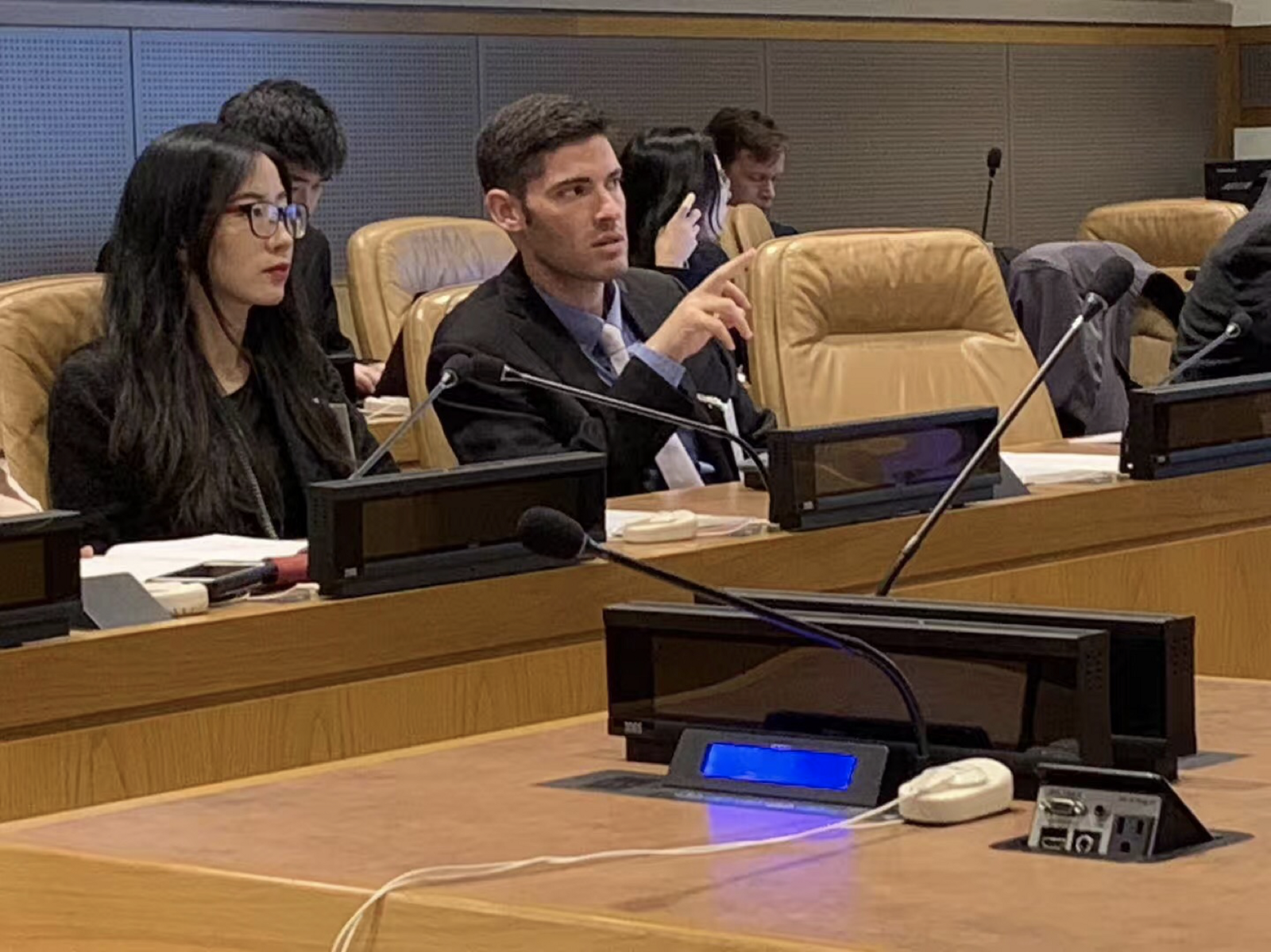 【2】September 30, 2018: Penta CEO David Ritter was invited to attend the first blockchain summit and launch ceremony for the 2018 Rui Coins Exchange in San Gabriel, part of the greater Los Angeles area. David congratulated the Rui Coins team on successfully securing a 50-state license to be a compliant digital currency exchange in the U.S., and drew widespread praise for the technical innovations of the Penta public chain and recent Hollywood project with Union Editorial, which he presented on stage at the Rui Coins event. 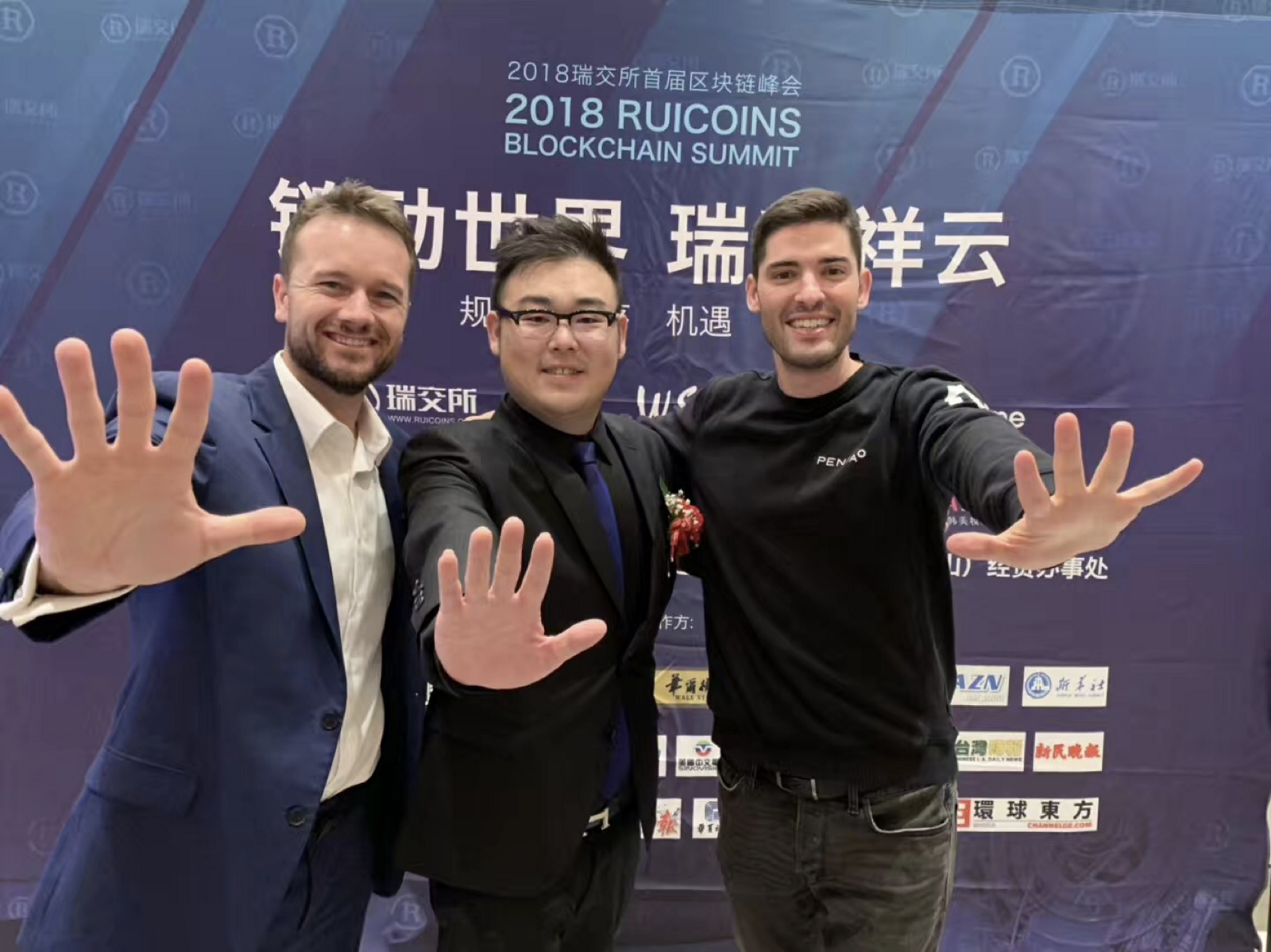 【3】October 5, 2018 (EST), Penta CEO David Ritter was invited to attend the 2018 Blockchain Summit hosted by Global Blockchain Foundation in San Francisco. There he joined a panel discussion moderated by an editor from TechCrunch, including a senior investor from Y Combinator, IOTEX founder, Chainfund Capital founder, GBIC senior partner, and Signia Venture Partners investor. The panel discussed differences between the United States and East Asia in terms of blockchain investment. David emphasized his belief that blockchain is a global movement and marketplace, with many market centers, including the US, China, South Korea, the UK, and more. Asked by the moderator whether Americans have a myopic view of blockchain being centered in the U.S., David answered, “Yes, and I encourage everyone to take note of the innovations coming to the industry from the parts of the world. In many innovative technologies, including blockchain and alternative energy, countries in East Asia, including China and South Korea, are seeing significantly more investment and support from governments than we have in America. In this country, while we debate whether or not climate change is real, the Chinese government is pouring hundreds of billions of R&D dollars into alternative energy. Governments in Asia are also investing billions of dollars into supporting the development of blockchain technology. So, in some key areas, we are falling behind.” 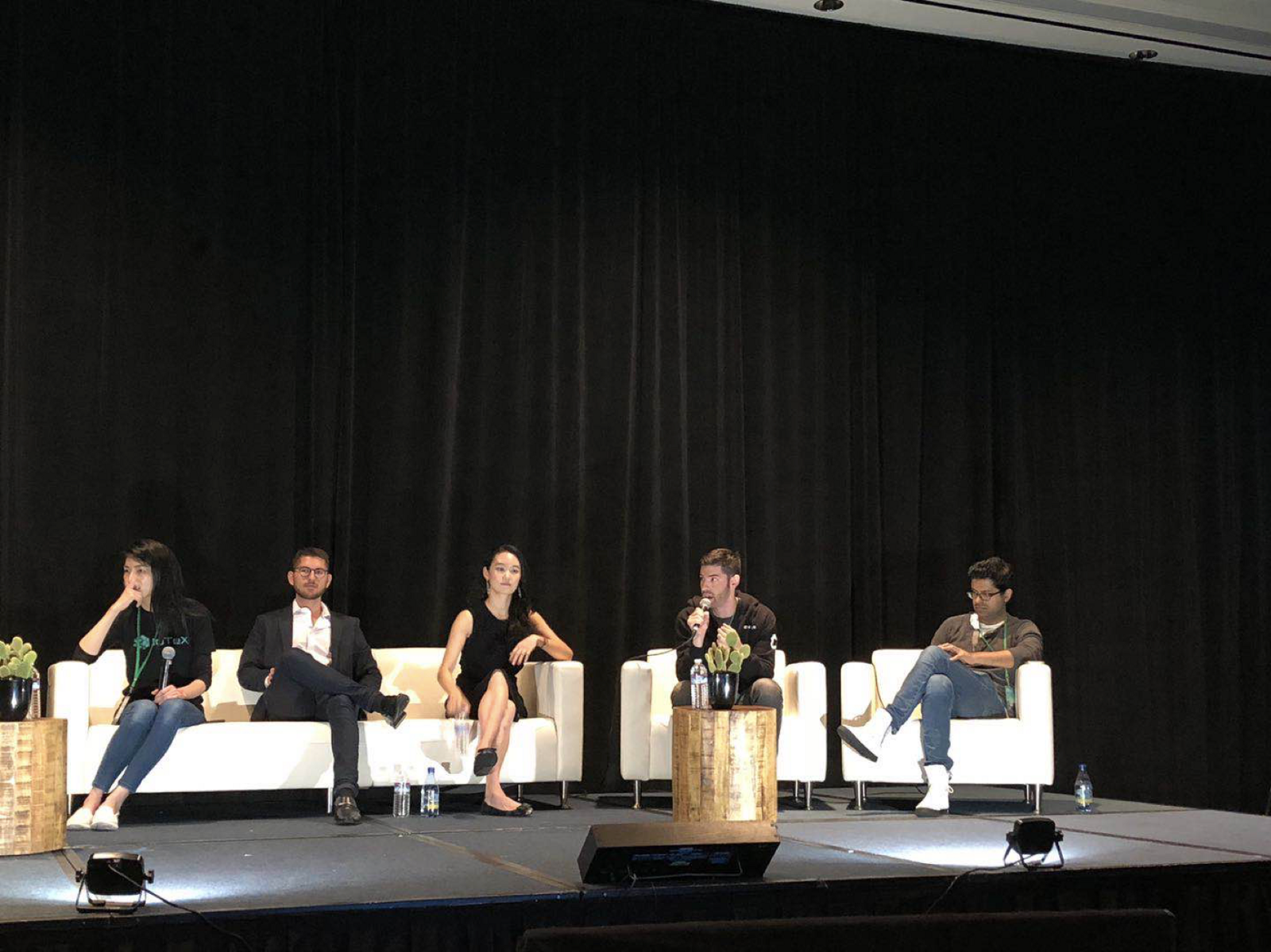 【4】October 10, 2018 (Santa Monica, California): David and Penta Ecosystem Leader, Alan Finkel, attended the Blockcon Conference in Santa Monica, California. The event was attended by many high profile speakers, including Muhammad Yunus, Nobel Peace Prize winner and founder of the Grameen Bank. David spoke with Professor Yunus during the conference on ways that blockchain technology can be used for social impact and to solve difficult societal problems. David also noted that Penta is currently in discussions with two Bangladeshi banks to deploy blockchain as a service (BAAS) solutions (Mr. Yunus is from Bangladesh). Inspired by his conversation with Professor Yunus, David posted on Twitter and Wechat about Penta’s commitment to participate in “Blockchain for good” projects. Penta is currently working with the United Nations and city governments on blockchain-for-impact projects. 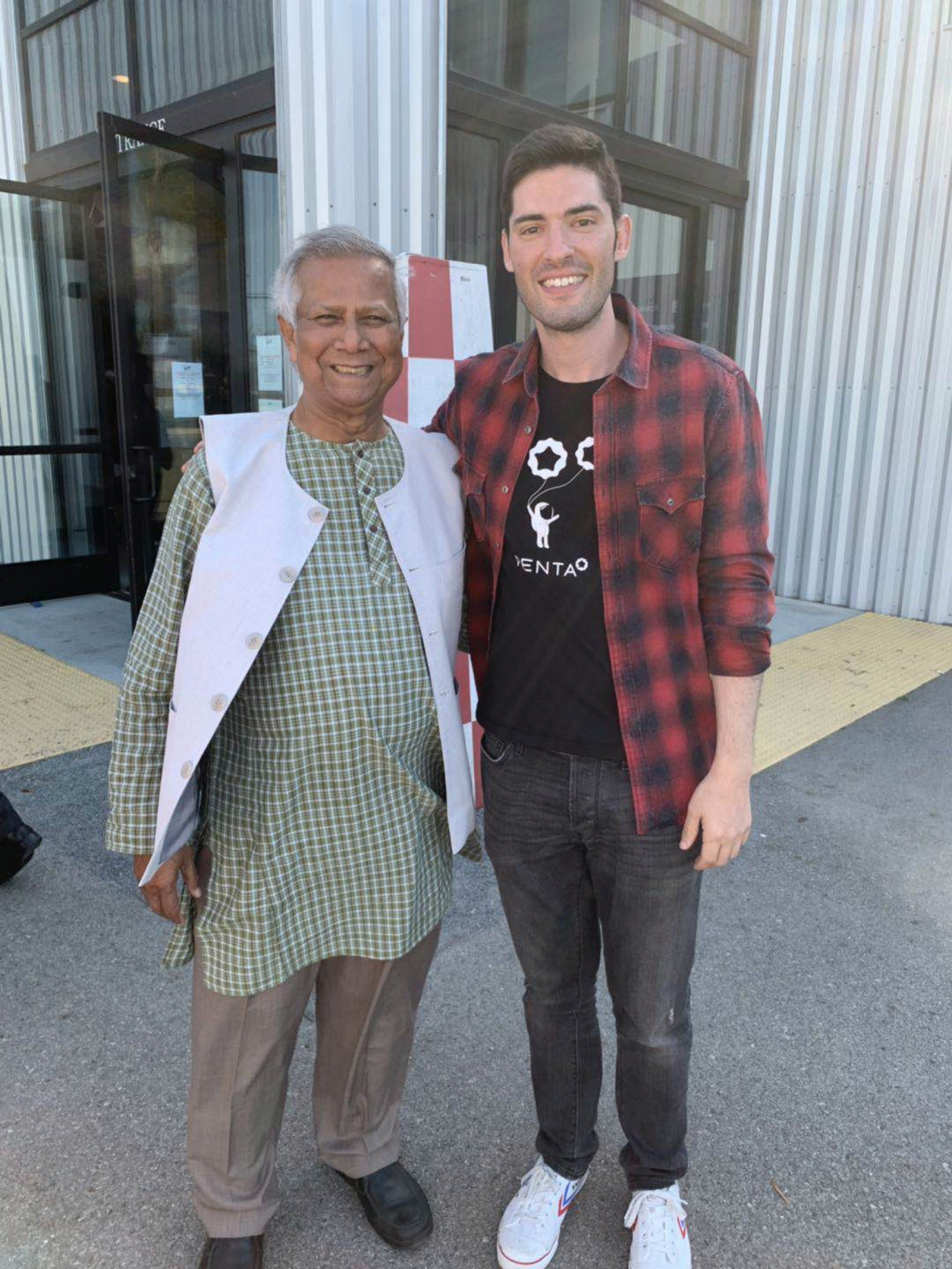 【5】October 11, 2018: The Chinese circular People’s Daily published an in-depth report entitled, “Blockchain serves SMEs, enabling the development of the real economy.” The article mentions Penta’s DSC consensus algorithm, expressing a positive view on the DSC algorithm’s innovative approach to solving the consensus problem and scalability for blockchains. The paper argues that the main technical barrier to large-scale application of blockchain is the lack of a commercially viable consensus algorithm. Penta’s DSC, as the article notes, is positioned to strike a balance point at the center of the consensus trilemma (also called the impossible triangle). In this way, DSC achieves a balance of security, efficiency and decentralization. Penta has a real opportunity with DSC to lead the pack for next generation base-layer blockchain protocols, which will form the underlying infrastructure of the blockchain powered economy. 【6】October 13, 2018 (Seattle, Washington): Penta CEO David Ritter was invited by the University of Washington Blockchain Society to attend its 2018 Blockchain Exposition. David joined a panel with students and blockchain project developers to debate whether “Bitcoin is a Fad”. During the panel, David noted how important university students have been in propelling the Blockchain Movement. “University students from all over the world”, he said, “are bringing people together to solve societal and economic problems with blockchain and innovative ideas”. Penta Ambassador, Ethan Finkel, is the Outreach Coordinator of the UW Blockchain Society. Penta welcomes the opportunity to work with universities all over the world as part of its continuing effort through Penta Labs to expand educational outreach and engage in academic inquiry connected with blockchain innovation. 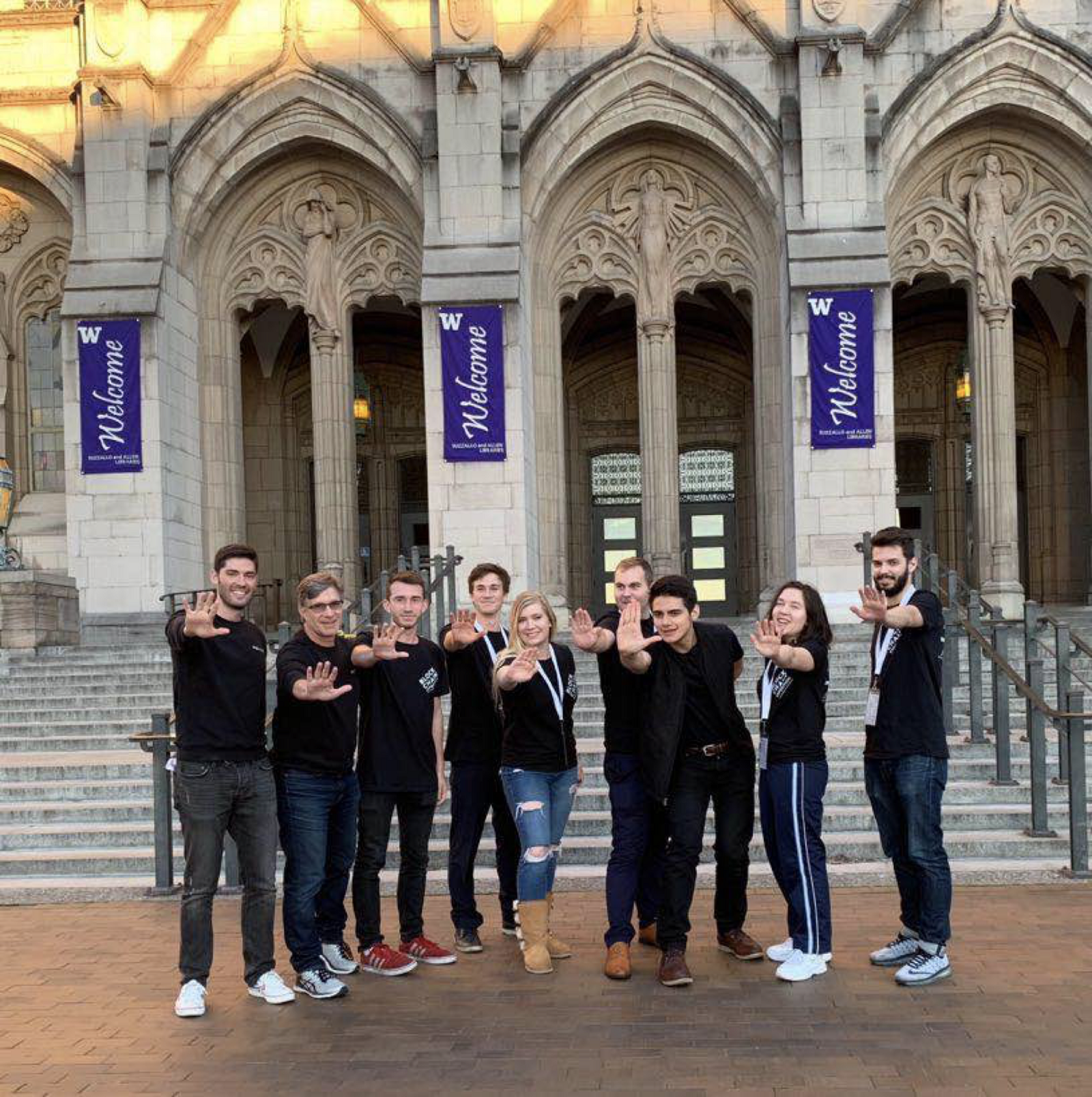 ## Community Activity: 【1】October 1, 2018 (Korea): The Penta community in Korea published a magazine article about Penta, following an interview between Penta CEO David and Korean media during David’s trip to Seoul Korea for the Huobi Chain event. For more information on the Penta community in Korea, please check out the Penta community Kakao Talk group.  【2】October 1 to 3, 2018 (China): In order to celebrate the National Day holiday with Chinese community members, Penta created the H5 activity, “1.3 billion people are on holiday, but this group of people…” It described how people working in the blockchain space were spending their holidays during the week-long National Day break. The post received nearly 10,000 retweets in Wechat moments, as well as the strategic cooperation and support of more than 40 media outlets and 5 blockchain communities. Retweeters found nine post credit scenes in the H5, and received 1,176 PNT in rewards as National Day prizes. More than 1,000 people participated. 【3】In first week after the National Day holiday, Chinese community members were suffering from the post-holiday blues. Penta Chinese community launched a “save the youth” campaign offering a gamified way to help Penta fans counteract their holiday blues, and win rewards. This activity attracted 300 people. As 2018 officially enters its final quarter, Penta hopes to continue offering good and positive news to the Penta community, and to move forward with its technical development timeline. |
| json metadata | {"tags":["penta","blockchain","technology","report"],"image":["https://cdn.steemitimages.com/DQmeVUrfiRc7Tjn1Zk9iVFU2MMPEo4CGFUVnVfeRooDR6a2/image.png","https://cdn.steemitimages.com/DQmTD5vQQfhkzWRE8Y1dDVqugbrxEBEa9hdUGGcehn3aKot/image.png","https://cdn.steemitimages.com/DQmPw8TrWM3kCE6kp1juSDc1C8EA4ZvVdYjsL8bvv57rc84/image.png","https://cdn.steemitimages.com/DQmNmRom8DxQeZrjdYyeskAzCFiQLhjPrJYM7xmUTNzuBw2/image.png","https://cdn.steemitimages.com/DQmPQDUuh45nLJNLUMpPWJosaVwjBV9gZqW78ZzFvs7ru4w/image.png","https://cdn.steemitimages.com/DQmWwPuwUvpz2bjMuNPE2FuRT37hHYavCPxipkkowxVouNi/image.png"],"app":"steemit/0.1","format":"markdown"} |
| Transaction Info | Block #26846053/Trx abc6c2a3190b5f978c30c53c170bcfe4b1143dec |
View Raw JSON Data
{
"trx_id": "abc6c2a3190b5f978c30c53c170bcfe4b1143dec",
"block": 26846053,
"trx_in_block": 25,
"op_in_trx": 0,
"virtual_op": 0,
"timestamp": "2018-10-16T02:34:45",
"op": [
"comment",
{
"parent_author": "",
"parent_permlink": "penta",
"author": "keevey",
"permlink": "penta-pnt-biweekly-progress-report-from-october-1-to-october-14",
"title": "Penta (PNT) Biweekly Progress Report from October 1 to October 14",
"body": "## Technological Development:\n\n### Penta Chain\n\n1.Basic code review is underway for the Penta testnet. Code analysis using analytical tools such as gofmt govet golint, for non-compliant and unreasonable code adjustment, is ongoing: progress is 80%.\n\n2. Modifications are being made to the solidity compiler to form a Penta solidity smart contract compiler. This will be able to support Penta smart contract compilation and new features such as the Penta account model: progress is 50%.\n\n3.Increasing the default initialization and configuration data running on the test network. Connection to the corresponding network environment through startup parameters is ongoing.\n\n### PC Wallet Component and Graphical Interface\nDevelopment of the PC wallet user interface component is proceeding as planned. The main task in the first part of this month was to process the verification and development automate-test of the wallet project. The current overall progress is 87%. The subsequent tasks are as follows:\n\n1.Complete the underlying development of penta-js-sdk’s WebSocket mode.\n\n2.Complete the development of the wallet user graphical interface RPC mode and start the development automate-test stage.\n\n3.Wallet user graphical interface IPC mode test is in progress, the current progress is 90%.\n\n4.Code review progress is 20%.\n\n### Penta Blockchain Explorer\nDesign and development of the Penta Blockchain Explorer was completed as planned in the first half of this month. The current overall progress is 98%:\n\n1.Completed the Java version and testing of penta_sdk.\n\n2.Completed blockchain explorer development and testing.\n\n3.Completed the main chain RPC, WEBSOCKET interface joint test.\n\n4.Completed code development and testing.\n\n5.Currently reviewing and proofreading documents.\n\n## Marketing Activity:\n\n【1】On September 28, 2018, Penta CEO David Ritter was invited to attend the 73rd United Nations General Assembly and participate in the “Blockchain as an Innovative Financing Mechanism” side-meeting, co-hosted by the United Nations Mission of Georgia and the Mission of France. At the meeting, David revealed that Penta is currently working on a blockchain project with UN peacekeeping forces. Penta’s work with the UN on this project is ongoing. In addition, David has said in recent interviews that Pent hopes to provide make meaningful contributions through blockchain and cryptocurrency financial markets to the UN’s efforts to achieve the 2030 Sustainable Development Goals.\n\n\n\n【2】September 30, 2018: Penta CEO David Ritter was invited to attend the first blockchain summit and launch ceremony for the 2018 Rui Coins Exchange in San Gabriel, part of the greater Los Angeles area. David congratulated the Rui Coins team on successfully securing a 50-state license to be a compliant digital currency exchange in the U.S., and drew widespread praise for the technical innovations of the Penta public chain and recent Hollywood project with Union Editorial, which he presented on stage at the Rui Coins event.\n\n\n\n【3】October 5, 2018 (EST), Penta CEO David Ritter was invited to attend the 2018 Blockchain Summit hosted by Global Blockchain Foundation in San Francisco. There he joined a panel discussion moderated by an editor from TechCrunch, including a senior investor from Y Combinator, IOTEX founder, Chainfund Capital founder, GBIC senior partner, and Signia Venture Partners investor. The panel discussed differences between the United States and East Asia in terms of blockchain investment. David emphasized his belief that blockchain is a global movement and marketplace, with many market centers, including the US, China, South Korea, the UK, and more. Asked by the moderator whether Americans have a myopic view of blockchain being centered in the U.S., David answered, “Yes, and I encourage everyone to take note of the innovations coming to the industry from the parts of the world. In many innovative technologies, including blockchain and alternative energy, countries in East Asia, including China and South Korea, are seeing significantly more investment and support from governments than we have in America. In this country, while we debate whether or not climate change is real, the Chinese government is pouring hundreds of billions of R&D dollars into alternative energy. Governments in Asia are also investing billions of dollars into supporting the development of blockchain technology. So, in some key areas, we are falling behind.”\n\n\n\n【4】October 10, 2018 (Santa Monica, California): David and Penta Ecosystem Leader, Alan Finkel, attended the Blockcon Conference in Santa Monica, California. The event was attended by many high profile speakers, including Muhammad Yunus, Nobel Peace Prize winner and founder of the Grameen Bank. David spoke with Professor Yunus during the conference on ways that blockchain technology can be used for social impact and to solve difficult societal problems. David also noted that Penta is currently in discussions with two Bangladeshi banks to deploy blockchain as a service (BAAS) solutions (Mr. Yunus is from Bangladesh). Inspired by his conversation with Professor Yunus, David posted on Twitter and Wechat about Penta’s commitment to participate in “Blockchain for good” projects. Penta is currently working with the United Nations and city governments on blockchain-for-impact projects.\n\n\n\n【5】October 11, 2018: The Chinese circular People’s Daily published an in-depth report entitled, “Blockchain serves SMEs, enabling the development of the real economy.” The article mentions Penta’s DSC consensus algorithm, expressing a positive view on the DSC algorithm’s innovative approach to solving the consensus problem and scalability for blockchains. The paper argues that the main technical barrier to large-scale application of blockchain is the lack of a commercially viable consensus algorithm. Penta’s DSC, as the article notes, is positioned to strike a balance point at the center of the consensus trilemma (also called the impossible triangle). In this way, DSC achieves a balance of security, efficiency and decentralization. Penta has a real opportunity with DSC to lead the pack for next generation base-layer blockchain protocols, which will form the underlying infrastructure of the blockchain powered economy.\n\n【6】October 13, 2018 (Seattle, Washington): Penta CEO David Ritter was invited by the University of Washington Blockchain Society to attend its 2018 Blockchain Exposition. David joined a panel with students and blockchain project developers to debate whether “Bitcoin is a Fad”. During the panel, David noted how important university students have been in propelling the Blockchain Movement. “University students from all over the world”, he said, “are bringing people together to solve societal and economic problems with blockchain and innovative ideas”. Penta Ambassador, Ethan Finkel, is the Outreach Coordinator of the UW Blockchain Society. Penta welcomes the opportunity to work with universities all over the world as part of its continuing effort through Penta Labs to expand educational outreach and engage in academic inquiry connected with blockchain innovation.\n\n\n\n## Community Activity:\n\n【1】October 1, 2018 (Korea): The Penta community in Korea published a magazine article about Penta, following an interview between Penta CEO David and Korean media during David’s trip to Seoul Korea for the Huobi Chain event. For more information on the Penta community in Korea, please check out the Penta community Kakao Talk group.\n\n\n\n【2】October 1 to 3, 2018 (China): In order to celebrate the National Day holiday with Chinese community members, Penta created the H5 activity, “1.3 billion people are on holiday, but this group of people…” It described how people working in the blockchain space were spending their holidays during the week-long National Day break. The post received nearly 10,000 retweets in Wechat moments, as well as the strategic cooperation and support of more than 40 media outlets and 5 blockchain communities. Retweeters found nine post credit scenes in the H5, and received 1,176 PNT in rewards as National Day prizes. More than 1,000 people participated.\n\n【3】In first week after the National Day holiday, Chinese community members were suffering from the post-holiday blues. Penta Chinese community launched a “save the youth” campaign offering a gamified way to help Penta fans counteract their holiday blues, and win rewards. This activity attracted 300 people. As 2018 officially enters its final quarter, Penta hopes to continue offering good and positive news to the Penta community, and to move forward with its technical development timeline.",
"json_metadata": "{\"tags\":[\"penta\",\"blockchain\",\"technology\",\"report\"],\"image\":[\"https://cdn.steemitimages.com/DQmeVUrfiRc7Tjn1Zk9iVFU2MMPEo4CGFUVnVfeRooDR6a2/image.png\",\"https://cdn.steemitimages.com/DQmTD5vQQfhkzWRE8Y1dDVqugbrxEBEa9hdUGGcehn3aKot/image.png\",\"https://cdn.steemitimages.com/DQmPw8TrWM3kCE6kp1juSDc1C8EA4ZvVdYjsL8bvv57rc84/image.png\",\"https://cdn.steemitimages.com/DQmNmRom8DxQeZrjdYyeskAzCFiQLhjPrJYM7xmUTNzuBw2/image.png\",\"https://cdn.steemitimages.com/DQmPQDUuh45nLJNLUMpPWJosaVwjBV9gZqW78ZzFvs7ru4w/image.png\",\"https://cdn.steemitimages.com/DQmWwPuwUvpz2bjMuNPE2FuRT37hHYavCPxipkkowxVouNi/image.png\"],\"app\":\"steemit/0.1\",\"format\":\"markdown\"}"
}
]
}yeheyupvoted (10.00%) @keevey / introduction-to-psg-sharding-solution2018/10/15 03:40:42
yeheyupvoted (10.00%) @keevey / introduction-to-psg-sharding-solution
2018/10/15 03:40:42
| voter | yehey |
| author | keevey |
| permlink | introduction-to-psg-sharding-solution |
| weight | 1000 (10.00%) |
| Transaction Info | Block #26818609/Trx 89f7db991ea26ee13f2b71659a2b7ec51944a18f |
View Raw JSON Data
{
  "trx_id": "89f7db991ea26ee13f2b71659a2b7ec51944a18f",
  "block": 26818609,
  "trx_in_block": 8,
  "op_in_trx": 0,
  "virtual_op": 0,
  "timestamp": "2018-10-15T03:40:42",
  "op": [
    "vote",
    {
      "voter": "yehey",
      "author": "keevey",
      "permlink": "introduction-to-psg-sharding-solution",
      "weight": 1000
    }
  ]
}keeveyupvoted (100.00%) @keevey / introduction-to-psg-sharding-solution2018/10/15 03:20:00
keeveyupvoted (100.00%) @keevey / introduction-to-psg-sharding-solution
2018/10/15 03:20:00
| voter | keevey |
| author | keevey |
| permlink | introduction-to-psg-sharding-solution |
| weight | 10000 (100.00%) |
| Transaction Info | Block #26818203/Trx fd9bd9bbf77187f1e2ba6e155d69dcc53a783420 |
View Raw JSON Data
{
  "trx_id": "fd9bd9bbf77187f1e2ba6e155d69dcc53a783420",
  "block": 26818203,
  "trx_in_block": 7,
  "op_in_trx": 0,
  "virtual_op": 0,
  "timestamp": "2018-10-15T03:20:00",
  "op": [
    "vote",
    {
      "voter": "keevey",
      "author": "keevey",
      "permlink": "introduction-to-psg-sharding-solution",
      "weight": 10000
    }
  ]
}keeveypublished a new post: introduction-to-psg-sharding-solution2018/10/15 03:19:51
keeveypublished a new post: introduction-to-psg-sharding-solution
2018/10/15 03:19:51
| parent author | |
| parent permlink | penta |
| author | keevey |
| permlink | introduction-to-psg-sharding-solution |
| title | Introduction to PSG sharding solution |
| body | With the constantly-increasing transaction amount, scalability has turned into a serious barrier for blockchain evolution. How to enhance parallel processing capabilities has become an issue that every exchange platform must deal with. Recently, most projects respond to the scalability issue with several mechanisms such as cutting down the decentralization, expanding the block size, state channel, side chain, directed acyclic graph, and sharding. We, Penta team, as we honestly believe in a decentralized ecosystem, recently introduced PSG sharding technology to increase the transaction without lowering Penta’s decentralization. For several years, enterprises have been dealing with a massive increase in data volume and computing power. To adapt, two solutions are available: vertical scaling (increase the power of the machine) or horizontal scaling (increase the number of machine and redistribute the load). Let’s see if it is applicable to blockchain and how it could be applied within Penta ecosystem. **What would it look in a blockchain network? Is it possible?** As for now, blockchain only acts as a single entity, as each node is handling all the transaction to independently reach consensus, neither vertical nor horizontal scaling is currently feasible. Adding more and more nodes does not enhance the throughput because the transactions are not processed in parallel. Having the possibility to process simultaneously a set of transactions would increase the throughput of the system. In the blockchain space, people are generally talking about two types of sharding solution. One solution means to deal with the storage scalability, the other solution aims to solve the transaction scalability. We, Penta team, are concentrating our technology on the second solution to strengthen our transaction throughput. ## Penta Sharding Graph, solution to solve scalability, latency and transaction throughput 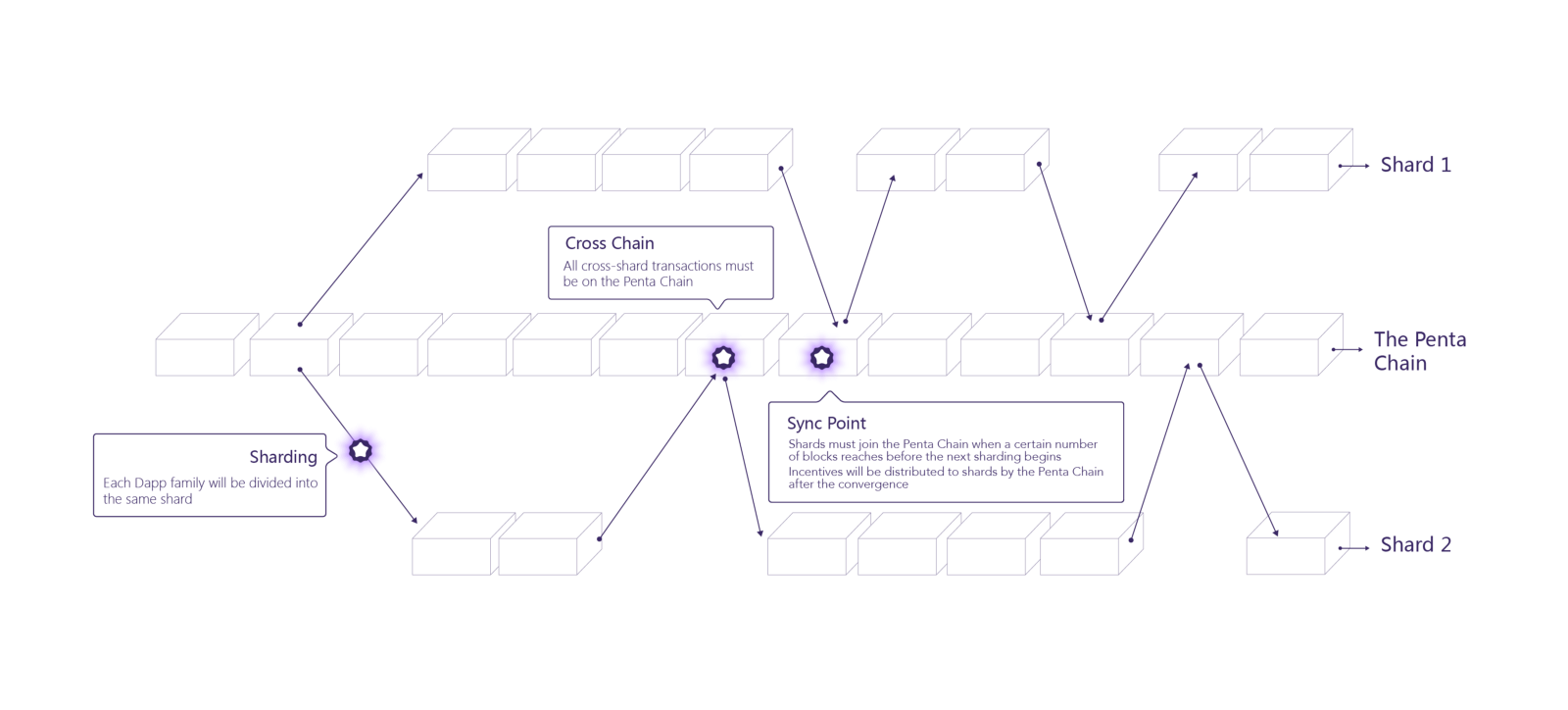 *Penta Chain PSG Diagram* ### Will Penta shard be secure, decentralized and efficient? **Efficiency** As I introduced previously, we embrace the transaction sharding method. By dynamically and randomly grouping nodes which are working to simultaneously deal with specific addresses range or DApp transactions. Penta Sharding Graph (PSG) will automatically readjust the number of shards to prevent unbalance load which could impact the smooth usage of the Penta chain. To fully benefit from load balancing, the transaction must be dispatched evenly among the shards. This partition is set at the shards level and relies on the address key. The protocol will set a value range each shard. **Consistency** The PSG sharding technology demands that once a particular quantity of block is reached, a Sync Point with Penta main chain is ordered. All the shards need to follow the DSC consensus, therefore avoiding a fork, and ensuring the consistency of the transactions, including smart contracts. The Sync Point is essential when it comes to a cross-shard transaction. I will explain more about this later. **Safety** PSG shards maintain the same security policy and governance structure as the Penta main chain, ensuring overall system security. As a shard will be formed of a shorter number of nodes, the risk of fraud/malicious attack is bigger. To ensure a reliable solution while working on a decentralized and democratic ecosystem, each shard needs to be generated randomly, without the possibility for a node to determine in which shard he will be assigned. A shard is by definition weaker than the main net. A method to ensure the high availability of each shard could be to randomly preselect a specific amount of nodes which have previously worked properly on the main chain, therefore insuring the accessibility of the entire shards. **Fairness** The PSG shards adopt the DSC consensus algorithm mechanism, in which the RSA random sorting algorithm provides impartiality. To make sure that we can run DSC consensus algorithm for each shard, we need to ensure that each shard is composed with delegates and witness. ( To learn more about our DSC feel free to read our white paper http://penta.global/ ) **Cross-segmentation technology** In the PSG sharding technology, the synchronization point technology of the Penta main chain Sync Point is set to establish the compatibility of cross-shard transactions. The establishment of vouchers in the shard permits the transaction to take effect rapidly between different shards. When the shards are imported into the main chain, they will control and separate the processing of cross-segment transaction vouchers. For transactions that are not handled due to network or other reasons, the target transactions are prioritized and guaranteed. Cross-shard transaction credentials can be processed in a timely manner. The interaction between vouchers always guarantees the security of transactions between shards and main chains and across shards. ## In Conclusion The new PSG sharding technology we offer does not simply seek strong-scalability but again aim to secure the system’s consistency, fairness, security, and availability. Just as the Penta chain uses the DSC consensus algorithm that balances efficiency with fairness, both of them follow Penta’s universal values. From a technological point of view, we always deal with the performance, stability, impartiality, and availability, and strive to find a harmony position for endless growth and optimization. Through ingenious research and analysis, we continue to work hard to bring the Penta ecosystem. |
| json metadata | {"tags":["penta","blockchain","technology","sharding"],"image":["https://cdn.steemitimages.com/DQmeB9KJo9aPhenvXQYDxomCyfL7R1DMxvKs3CvKATzxGm9/image.png"],"links":["http://penta.global/"],"app":"steemit/0.1","format":"markdown"} |
| Transaction Info | Block #26818200/Trx 86023a99a0441885161f45d6dca08c0c3bedb2ee |
View Raw JSON Data
{
"trx_id": "86023a99a0441885161f45d6dca08c0c3bedb2ee",
"block": 26818200,
"trx_in_block": 11,
"op_in_trx": 0,
"virtual_op": 0,
"timestamp": "2018-10-15T03:19:51",
"op": [
"comment",
{
"parent_author": "",
"parent_permlink": "penta",
"author": "keevey",
"permlink": "introduction-to-psg-sharding-solution",
"title": "Introduction to PSG sharding solution",
"body": "With the constantly-increasing transaction amount, scalability has turned into a serious barrier for blockchain evolution. How to enhance parallel processing capabilities has become an issue that every exchange platform must deal with. Recently, most projects respond to the scalability issue with several mechanisms such as cutting down the decentralization, expanding the block size, state channel, side chain, directed acyclic graph, and sharding. We, Penta team, as we honestly believe in a decentralized ecosystem, recently introduced PSG sharding technology to increase the transaction without lowering Penta’s decentralization.\n\nFor several years, enterprises have been dealing with a massive increase in data volume and computing power. To adapt, two solutions are available: vertical scaling (increase the power of the machine) or horizontal scaling (increase the number of machine and redistribute the load). Let’s see if it is applicable to blockchain and how it could be applied within Penta ecosystem.\n\n**What would it look in a blockchain network? Is it possible?**\n\nAs for now, blockchain only acts as a single entity, as each node is handling all the transaction to independently reach consensus, neither vertical nor horizontal scaling is currently feasible. Adding more and more nodes does not enhance the throughput because the transactions are not processed in parallel. Having the possibility to process simultaneously a set of transactions would increase the throughput of the system.\n\nIn the blockchain space, people are generally talking about two types of sharding solution. One solution means to deal with the storage scalability, the other solution aims to solve the transaction scalability. We, Penta team, are concentrating our technology on the second solution to strengthen our transaction throughput.\n\n## Penta Sharding Graph, solution to solve scalability, latency and transaction throughput\n\n\n*Penta Chain PSG Diagram*\n\n### Will Penta shard be secure, decentralized and efficient?\n\n**Efficiency**\nAs I introduced previously, we embrace the transaction sharding method. By dynamically and randomly grouping nodes which are working to simultaneously deal with specific addresses range or DApp transactions. Penta Sharding Graph (PSG) will automatically readjust the number of shards to prevent unbalance load which could impact the smooth usage of the Penta chain. To fully benefit from load balancing, the transaction must be dispatched evenly among the shards. This partition is set at the shards level and relies on the address key. The protocol will set a value range each shard.\n\n**Consistency**\nThe PSG sharding technology demands that once a particular quantity of block is reached, a Sync Point with Penta main chain is ordered. All the shards need to follow the DSC consensus, therefore avoiding a fork, and ensuring the consistency of the transactions, including smart contracts. The Sync Point is essential when it comes to a cross-shard transaction. I will explain more about this later.\n\n**Safety**\nPSG shards maintain the same security policy and governance structure as the Penta main chain, ensuring overall system security. As a shard will be formed of a shorter number of nodes, the risk of fraud/malicious attack is bigger. To ensure a reliable solution while working on a decentralized and democratic ecosystem, each shard needs to be generated randomly, without the possibility for a node to determine in which shard he will be assigned. A shard is by definition weaker than the main net. A method to ensure the high availability of each shard could be to randomly preselect a specific amount of nodes which have previously worked properly on the main chain, therefore insuring the accessibility of the entire shards.\n\n**Fairness**\nThe PSG shards adopt the DSC consensus algorithm mechanism, in which the RSA random sorting algorithm provides impartiality. To make sure that we can run DSC consensus algorithm for each shard, we need to ensure that each shard is composed with delegates and witness. ( To learn more about our DSC feel free to read our white paper http://penta.global/ )\n\n**Cross-segmentation technology**\nIn the PSG sharding technology, the synchronization point technology of the Penta main chain Sync Point is set to establish the compatibility of cross-shard transactions. The establishment of vouchers in the shard permits the transaction to take effect rapidly between different shards. When the shards are imported into the main chain, they will control and separate the processing of cross-segment transaction vouchers. For transactions that are not handled due to network or other reasons, the target transactions are prioritized and guaranteed. Cross-shard transaction credentials can be processed in a timely manner. The interaction between vouchers always guarantees the security of transactions between shards and main chains and across shards.\n \n## In Conclusion\nThe new PSG sharding technology we offer does not simply seek strong-scalability but again aim to secure the system’s consistency, fairness, security, and availability. Just as the Penta chain uses the DSC consensus algorithm that balances efficiency with fairness, both of them follow Penta’s universal values. From a technological point of view, we always deal with the performance, stability, impartiality, and availability, and strive to find a harmony position for endless growth and optimization. Through ingenious research and analysis, we continue to work hard to bring the Penta ecosystem.",
"json_metadata": "{\"tags\":[\"penta\",\"blockchain\",\"technology\",\"sharding\"],\"image\":[\"https://cdn.steemitimages.com/DQmeB9KJo9aPhenvXQYDxomCyfL7R1DMxvKs3CvKATzxGm9/image.png\"],\"links\":[\"http://penta.global/\"],\"app\":\"steemit/0.1\",\"format\":\"markdown\"}"
}
]
}sensationupvoted (100.00%) @keevey / economic-abstraction-penta-don-t-have-to-worry2018/10/12 04:55:15
sensationupvoted (100.00%) @keevey / economic-abstraction-penta-don-t-have-to-worry
2018/10/12 04:55:15
| voter | sensation |
| author | keevey |
| permlink | economic-abstraction-penta-don-t-have-to-worry |
| weight | 10000 (100.00%) |
| Transaction Info | Block #26733750/Trx 8cef77f2ce19a3924ae1cbeca6698ab51ded45b0 |
View Raw JSON Data
{
  "trx_id": "8cef77f2ce19a3924ae1cbeca6698ab51ded45b0",
  "block": 26733750,
  "trx_in_block": 0,
  "op_in_trx": 0,
  "virtual_op": 0,
  "timestamp": "2018-10-12T04:55:15",
  "op": [
    "vote",
    {
      "voter": "sensation",
      "author": "keevey",
      "permlink": "economic-abstraction-penta-don-t-have-to-worry",
      "weight": 10000
    }
  ]
}acknowledgementupvoted (10.00%) @keevey / economic-abstraction-penta-don-t-have-to-worry2018/10/12 04:11:15
acknowledgementupvoted (10.00%) @keevey / economic-abstraction-penta-don-t-have-to-worry
2018/10/12 04:11:15
| voter | acknowledgement |
| author | keevey |
| permlink | economic-abstraction-penta-don-t-have-to-worry |
| weight | 1000 (10.00%) |
| Transaction Info | Block #26732870/Trx cee27d159653db1670e7668b31d3e1799df59936 |
View Raw JSON Data
{
  "trx_id": "cee27d159653db1670e7668b31d3e1799df59936",
  "block": 26732870,
  "trx_in_block": 22,
  "op_in_trx": 0,
  "virtual_op": 0,
  "timestamp": "2018-10-12T04:11:15",
  "op": [
    "vote",
    {
      "voter": "acknowledgement",
      "author": "keevey",
      "permlink": "economic-abstraction-penta-don-t-have-to-worry",
      "weight": 1000
    }
  ]
}2018/10/12 03:53:09
2018/10/12 03:53:09
| voter | keevey |
| author | acknowledgement |
| permlink | re-keevey-dynamic-stake-consensus-dsc-the-penta-concensus-algorithm-for-optimized-decentralization-scalability-and-security-20181011t033210689z |
| weight | 10000 (100.00%) |
| Transaction Info | Block #26732508/Trx f24ade9ebd1899aa131bae3a4427d5e5d4cffe9e |
View Raw JSON Data
{
  "trx_id": "f24ade9ebd1899aa131bae3a4427d5e5d4cffe9e",
  "block": 26732508,
  "trx_in_block": 4,
  "op_in_trx": 0,
  "virtual_op": 0,
  "timestamp": "2018-10-12T03:53:09",
  "op": [
    "vote",
    {
      "voter": "keevey",
      "author": "acknowledgement",
      "permlink": "re-keevey-dynamic-stake-consensus-dsc-the-penta-concensus-algorithm-for-optimized-decentralization-scalability-and-security-20181011t033210689z",
      "weight": 10000
    }
  ]
}keeveyupvoted (100.00%) @keevey / economic-abstraction-penta-don-t-have-to-worry2018/10/12 03:51:03
keeveyupvoted (100.00%) @keevey / economic-abstraction-penta-don-t-have-to-worry
2018/10/12 03:51:03
| voter | keevey |
| author | keevey |
| permlink | economic-abstraction-penta-don-t-have-to-worry |
| weight | 10000 (100.00%) |
| Transaction Info | Block #26732466/Trx 8722c54815c74e812062d852fcfb61eb77567b20 |
View Raw JSON Data
{
  "trx_id": "8722c54815c74e812062d852fcfb61eb77567b20",
  "block": 26732466,
  "trx_in_block": 12,
  "op_in_trx": 0,
  "virtual_op": 0,
  "timestamp": "2018-10-12T03:51:03",
  "op": [
    "vote",
    {
      "voter": "keevey",
      "author": "keevey",
      "permlink": "economic-abstraction-penta-don-t-have-to-worry",
      "weight": 10000
    }
  ]
}keeveypublished a new post: economic-abstraction-penta-don-t-have-to-worry2018/10/12 03:50:51
keeveypublished a new post: economic-abstraction-penta-don-t-have-to-worry
2018/10/12 03:50:51
| parent author | |
| parent permlink | penta |
| author | keevey |
| permlink | economic-abstraction-penta-don-t-have-to-worry |
| title | Economic abstraction? Penta don’t have to worry! |
| body |  ## Introduction Recently, Bitcoin core developer Jeremy Rubin published the “The collapse of ETH is inevitable” article on TechCrunch, the largest technology media in the United States. The article proposes that due to the economic abstraction of the design of the Ethereum network, ETH value as a currency will be equal to zero, causing an uproar in the circle, and also triggered a sharp market volatility of ETH prices. Subsequently, Vitalik Buterin responded to the article on Reddit, acknowledging that there is indeed an economic abstraction in the Ethereum network. If you don’t change it, the situation described by Jeremy Rubin is also possible, but real economic abstraction is very difficult. So, what is the economic abstraction of Ethereum? Why is it possible that ETH value as a currency return to zero? The Penta team combine their own experience in public blockchain project to explain them in detail. ## What is economic abstraction? One of the ETH functions is named “Gas”, which is designed as a transaction fee. Gas is paid to the miners who package transaction to maintain the normal operation of ETH network. When building a new smart contract, in general, every transaction on the smart contract has a cost, in Gas. When the miner packages a block, it will preferentially package the transaction with the highest Gas price. This mechanism ensures that ETH has enough application scenarios, which is also the source of ETH’s value. However, Jeremy Rubin found that instead of paying for Gas in ETH, a transaction could deposit an ERC20 instead of consuming ETH. The user who executes the contract can directly deposit the ERC20 token he owns into the account address of the miner and set the Gas price to 0 to avoid using ETH. When dealing with such a transaction, the miner can pre-check the value of the received ERC20 token, and if it is higher than the normal Gas handling fee, it will be packaged. This use of non-ETH asset payment fees is the economic abstraction of the Ethereum community. The economic abstraction will lead to the continuous decline of ETH’s market demand, and its market value will be correspondingly reduced. When all transactions use this method without paying ETH Gas fees, the ETH price will be equal to zero. ## Opposing opinion The economic abstraction of Ethereum has also sparked heated debates in the community, and there are also many refutations. There are currently four main points of view that it is difficult to achieve: (1) lack of software support for economic abstraction (2) no effective market pricing (3) non-token contract (4) Proof-of-Stake. But these four views currently seem to be lack of persuasiveness. (1) Lack of software support Vitalik believes that considering the benefits of the ETH ecosystem, the increase in complexity may not be worth the gain. This view is very untenable, and any software and applications should be iterated as the needs of users change. For example, the wallet software of any particular ERC20 Token, the functional design is much more complicated than an ETH wallet. (2) No valid market pricing This is the view of Vlad Zamfir, the core developer of Ethereum. The need to monitor price market information can make economic abstraction difficult. In fact, a rational miner is pursuing the maximization of interests, so the miners are very sensitive to the price of the transaction fee. They may need only a tool to exchange the tokens included in the transaction fee according to the market conditions. The value is dynamically converted and sorted, and a perfect income model is established under the condition of cost control. On this basis, the mining union can reasonably package the transaction and pursue the maximum profit as much as possible. (3) Non-token contract Users who do not have a token contract can choose to pay in any token. If a miner receives an asset that he does not want to hold but has a higher market value at the time, he can exchange it for the desired asset through exchanges. (4) Proof-of-Stake Not to mention that the current ETH POS consensus still does not land on the main network. Even with POS, we can assume that a POS node with multiple assets in the Ethereum network chooses a weight vector for the voting rights of its assets. If the weight vectors are sufficiently like each other, the consensus can still be achieved. This idea is called a heterogeneous margin equity certificate, referred to as HD-PoS. Although the conditions under which HD-PoS can maintain consensus remain to be studied, the possibilities exist. This is also a problem that all POS projects will face. Although the Ethereum community has also proposed some countermeasures, they are all palliative. The origin of ETH’s economic abstraction lies in the design of the basic framework of ETH’s smart contract. Looking at the API documentation for the Smart Contract Solidity version, we can see that the block-related parameters are introduced in the global variables of the smart contract. One of the parameters is block.coinbase. It is through this parameter that an ERC20 token can be directly deposited into the address of the block miner to pay for the execution cost of the contract instead of the ETH payment fee. More broadly, for ETH networks or POS networks, since the miners in each block of Ethereum are unique, then this part of the token will eventually be obtained by the miner, and the miner can accept this. The transaction does not have to consider the price of the gas. ## Penta’s thinking and countermeasures Although the Penta project uses a similar fee mechanism like Ethereum, due to the unique DSC consensus algorithm and governance mechanism, there is no economic abstraction. This can be analyzed from two aspects: (1) Fee allocation Since Penta adopts the DSC consensus algorithm, there is no single miner. The BFT consensus group consisting of randomly selected delegates and witnesses to create a block, so it is impossible to predict who will come out in advance. The block.coinbase variable in the Penta smart contract represents the hash value of all signature nodes in the consensus group. In this way, it is impossible to pay non-PNT tokens to a miner through block.coinbase to replace PNT as a fee. In addition, in the design of the Penta fee model, the fee reward is shared by the delegates and witnesses are responsible for the BFT consensus group and is allocated by Penta’s incentive allocation algorithm. The transfer in the smart contract will not be available inside a consensus group. If a bribe is given to a certain member in the above-mentioned way, other nodes will naturally refuse to accept such a transaction, and naturally it is impossible to reach a broad consensus. 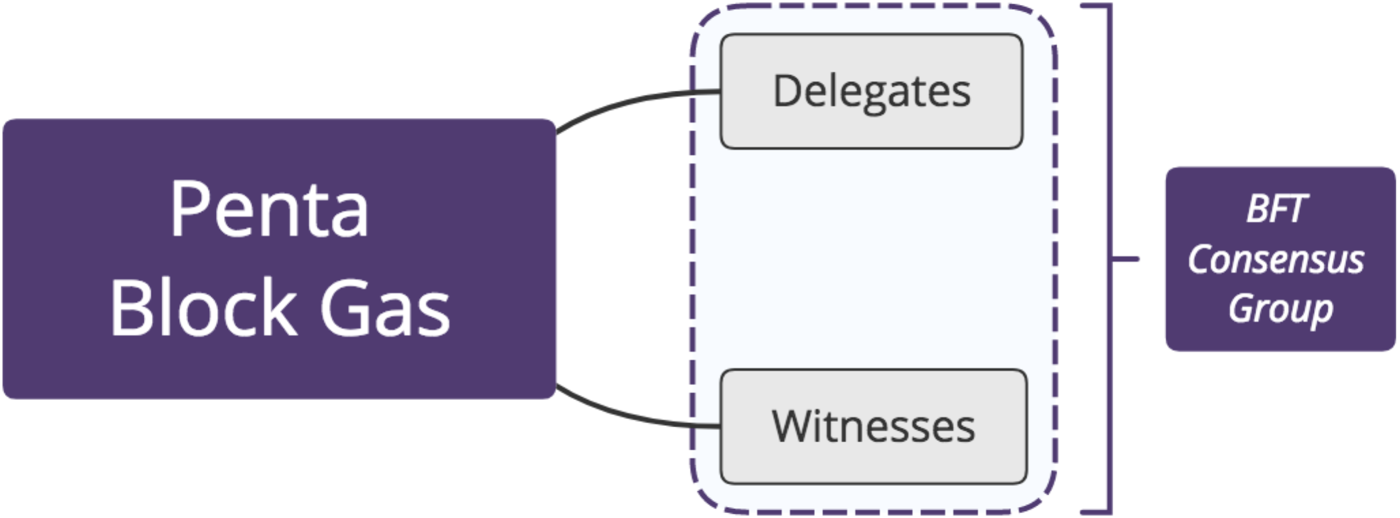 *Penta fee allocation model* (2) Governance mechanism In the governance mechanism, Penta introduced the voting mechanism of delegates, witnesses, and members of the consensus membership. Through these means, it will be possible to lock and maintain a considerable number of PNT tokens that can be controlled, which plays a role in regulating the economic ecology of Penta. In addition, all Penta users can also use PNT tokens to participate in voting and in the governance. It provides a wide range of usage scenarios for PNT tokens, and rich application requirements can guarantee the value of PNT. ## Conclusion In this paper, the Penta team conducted an in-depth analysis of the current economic abstraction issues faced by ETH, and introduced how Penta evaded economic abstraction through advanced technology architecture, demonstrating that PNT value will not collapse like ETH might. Of course, we believe that the economic abstraction of blockchain is not a savage beast, which just reflects the fact that blockchain technology tends to mature in evolution. The Penta team is more eager to provide more advice and inspiration for the future development of the public chain through the research and attention of this issue. |
| json metadata | {"tags":["penta","blockchain","technology","economic"],"image":["https://cdn.steemitimages.com/DQmP2SdAyKcVbWDJMm9SomhC4BXTZ6LXxShAeFtENoUtrES/image.png","https://cdn.steemitimages.com/DQmT3r6KVVowcewai1WJ97beH5wLxAUWLHuD2jTCgT5xuMm/image.png"],"app":"steemit/0.1","format":"markdown"} |
| Transaction Info | Block #26732462/Trx e38f6a54a3cc290da2224778e1348ea749934298 |
View Raw JSON Data
{
"trx_id": "e38f6a54a3cc290da2224778e1348ea749934298",
"block": 26732462,
"trx_in_block": 18,
"op_in_trx": 0,
"virtual_op": 0,
"timestamp": "2018-10-12T03:50:51",
"op": [
"comment",
{
"parent_author": "",
"parent_permlink": "penta",
"author": "keevey",
"permlink": "economic-abstraction-penta-don-t-have-to-worry",
"title": "Economic abstraction? Penta don’t have to worry!",
"body": "\n\n## Introduction\n\nRecently, Bitcoin core developer Jeremy Rubin published the “The collapse of ETH is inevitable” article on TechCrunch, the largest technology media in the United States. The article proposes that due to the economic abstraction of the design of the Ethereum network, ETH value as a currency will be equal to zero, causing an uproar in the circle, and also triggered a sharp market volatility of ETH prices.\n\nSubsequently, Vitalik Buterin responded to the article on Reddit, acknowledging that there is indeed an economic abstraction in the Ethereum network. If you don’t change it, the situation described by Jeremy Rubin is also possible, but real economic abstraction is very difficult. So, what is the economic abstraction of Ethereum? Why is it possible that ETH value as a currency return to zero? The Penta team combine their own experience in public blockchain project to explain them in detail.\n\n## What is economic abstraction?\n\nOne of the ETH functions is named “Gas”, which is designed as a transaction fee. Gas is paid to the miners who package transaction to maintain the normal operation of ETH network. When building a new smart contract, in general, every transaction on the smart contract has a cost, in Gas. When the miner packages a block, it will preferentially package the transaction with the highest Gas price. This mechanism ensures that ETH has enough application scenarios, which is also the source of ETH’s value.\n\nHowever, Jeremy Rubin found that instead of paying for Gas in ETH, a transaction could deposit an ERC20 instead of consuming ETH. The user who executes the contract can directly deposit the ERC20 token he owns into the account address of the miner and set the Gas price to 0 to avoid using ETH. When dealing with such a transaction, the miner can pre-check the value of the received ERC20 token, and if it is higher than the normal Gas handling fee, it will be packaged. This use of non-ETH asset payment fees is the economic abstraction of the Ethereum community. The economic abstraction will lead to the continuous decline of ETH’s market demand, and its market value will be correspondingly reduced. When all transactions use this method without paying ETH Gas fees, the ETH price will be equal to zero.\n\n## Opposing opinion\n\nThe economic abstraction of Ethereum has also sparked heated debates in the community, and there are also many refutations. There are currently four main points of view that it is difficult to achieve: (1) lack of software support for economic abstraction (2) no effective market pricing (3) non-token contract (4) Proof-of-Stake. But these four views currently seem to be lack of persuasiveness.\n\n(1) Lack of software support\n Vitalik believes that considering the benefits of the ETH ecosystem, the increase in complexity may not be worth the gain. This view is very untenable, and any software and applications should be iterated as the needs of users change. For example, the wallet software of any particular ERC20 Token, the functional design is much more complicated than an ETH wallet.\n\n(2) No valid market pricing\n This is the view of Vlad Zamfir, the core developer of Ethereum. The need to monitor price market information can make economic abstraction difficult. In fact, a rational miner is pursuing the maximization of interests, so the miners are very sensitive to the price of the transaction fee. They may need only a tool to exchange the tokens included in the transaction fee according to the market conditions. The value is dynamically converted and sorted, and a perfect income model is established under the condition of cost control. On this basis, the mining union can reasonably package the transaction and pursue the maximum profit as much as possible.\n\n(3) Non-token contract\n Users who do not have a token contract can choose to pay in any token. If a miner receives an asset that he does not want to hold but has a higher market value at the time, he can exchange it for the desired asset through exchanges.\n\n(4) Proof-of-Stake\nNot to mention that the current ETH POS consensus still does not land on the main network. Even with POS, we can assume that a POS node with multiple assets in the Ethereum network chooses a weight vector for the voting rights of its assets. If the weight vectors are sufficiently like each other, the consensus can still be achieved. This idea is called a heterogeneous margin equity certificate, referred to as HD-PoS. Although the conditions under which HD-PoS can maintain consensus remain to be studied, the possibilities exist. This is also a problem that all POS projects will face.\n\nAlthough the Ethereum community has also proposed some countermeasures, they are all palliative. The origin of ETH’s economic abstraction lies in the design of the basic framework of ETH’s smart contract. Looking at the API documentation for the Smart Contract Solidity version, we can see that the block-related parameters are introduced in the global variables of the smart contract.\n\nOne of the parameters is block.coinbase. It is through this parameter that an ERC20 token can be directly deposited into the address of the block miner to pay for the execution cost of the contract instead of the ETH payment fee. More broadly, for ETH networks or POS networks, since the miners in each block of Ethereum are unique, then this part of the token will eventually be obtained by the miner, and the miner can accept this. The transaction does not have to consider the price of the gas.\n\n## Penta’s thinking and countermeasures\n\nAlthough the Penta project uses a similar fee mechanism like Ethereum, due to the unique DSC consensus algorithm and governance mechanism, there is no economic abstraction. This can be analyzed from two aspects:\n\n(1) Fee allocation\n Since Penta adopts the DSC consensus algorithm, there is no single miner. The BFT consensus group consisting of randomly selected delegates and witnesses to create a block, so it is impossible to predict who will come out in advance. The block.coinbase variable in the Penta smart contract represents the hash value of all signature nodes in the consensus group. In this way, it is impossible to pay non-PNT tokens to a miner through block.coinbase to replace PNT as a fee.\n\nIn addition, in the design of the Penta fee model, the fee reward is shared by the delegates and witnesses are responsible for the BFT consensus group and is allocated by Penta’s incentive allocation algorithm. The transfer in the smart contract will not be available inside a consensus group. If a bribe is given to a certain member in the above-mentioned way, other nodes will naturally refuse to accept such a transaction, and naturally it is impossible to reach a broad consensus.\n\n*Penta fee allocation model*\n\n(2) Governance mechanism\nIn the governance mechanism, Penta introduced the voting mechanism of delegates, witnesses, and members of the consensus membership. Through these means, it will be possible to lock and maintain a considerable number of PNT tokens that can be controlled, which plays a role in regulating the economic ecology of Penta. In addition, all Penta users can also use PNT tokens to participate in voting and in the governance. It provides a wide range of usage scenarios for PNT tokens, and rich application requirements can guarantee the value of PNT.\n\n## Conclusion\n In this paper, the Penta team conducted an in-depth analysis of the current economic abstraction issues faced by ETH, and introduced how Penta evaded economic abstraction through advanced technology architecture, demonstrating that PNT value will not collapse like ETH might. Of course, we believe that the economic abstraction of blockchain is not a savage beast, which just reflects the fact that blockchain technology tends to mature in evolution. The Penta team is more eager to provide more advice and inspiration for the future development of the public chain through the research and attention of this issue.",
"json_metadata": "{\"tags\":[\"penta\",\"blockchain\",\"technology\",\"economic\"],\"image\":[\"https://cdn.steemitimages.com/DQmP2SdAyKcVbWDJMm9SomhC4BXTZ6LXxShAeFtENoUtrES/image.png\",\"https://cdn.steemitimages.com/DQmT3r6KVVowcewai1WJ97beH5wLxAUWLHuD2jTCgT5xuMm/image.png\"],\"app\":\"steemit/0.1\",\"format\":\"markdown\"}"
}
]
}2018/10/11 03:44:45
2018/10/11 03:44:45
| voter | pinoy |
| author | keevey |
| permlink | dynamic-stake-consensus-dsc-the-penta-concensus-algorithm-for-optimized-decentralization-scalability-and-security |
| weight | 1000 (10.00%) |
| Transaction Info | Block #26703581/Trx 3a9cebe6075118d62f162008c69fd1cf2b88db0e |
View Raw JSON Data
{
  "trx_id": "3a9cebe6075118d62f162008c69fd1cf2b88db0e",
  "block": 26703581,
  "trx_in_block": 5,
  "op_in_trx": 0,
  "virtual_op": 0,
  "timestamp": "2018-10-11T03:44:45",
  "op": [
    "vote",
    {
      "voter": "pinoy",
      "author": "keevey",
      "permlink": "dynamic-stake-consensus-dsc-the-penta-concensus-algorithm-for-optimized-decentralization-scalability-and-security",
      "weight": 1000
    }
  ]
}2018/10/11 03:32:12
2018/10/11 03:32:12
| parent author | keevey |
| parent permlink | dynamic-stake-consensus-dsc-the-penta-concensus-algorithm-for-optimized-decentralization-scalability-and-security |
| author | acknowledgement |
| permlink | re-keevey-dynamic-stake-consensus-dsc-the-penta-concensus-algorithm-for-optimized-decentralization-scalability-and-security-20181011t033210689z |
| title | fossbot voter comment |
| body | I upvoted your post. Keep steeming for a better tomorrow. @Acknowledgement - God Bless Posted using https://Steeming.com condenser site. |
| json metadata | {} |
| Transaction Info | Block #26703330/Trx c58059954a814a1ba17d7e0a2b8adca157350606 |
View Raw JSON Data
{
  "trx_id": "c58059954a814a1ba17d7e0a2b8adca157350606",
  "block": 26703330,
  "trx_in_block": 1,
  "op_in_trx": 0,
  "virtual_op": 0,
  "timestamp": "2018-10-11T03:32:12",
  "op": [
    "comment",
    {
      "parent_author": "keevey",
      "parent_permlink": "dynamic-stake-consensus-dsc-the-penta-concensus-algorithm-for-optimized-decentralization-scalability-and-security",
      "author": "acknowledgement",
      "permlink": "re-keevey-dynamic-stake-consensus-dsc-the-penta-concensus-algorithm-for-optimized-decentralization-scalability-and-security-20181011t033210689z",
      "title": "fossbot voter comment",
      "body": "I upvoted your post.\r\n\r\nKeep steeming for a better tomorrow.\r\n@Acknowledgement - God Bless\r\n\r\nPosted using https://Steeming.com condenser site.",
      "json_metadata": "{}"
    }
  ]
}2018/10/11 03:32:03
2018/10/11 03:32:03
| voter | acknowledgement |
| author | keevey |
| permlink | dynamic-stake-consensus-dsc-the-penta-concensus-algorithm-for-optimized-decentralization-scalability-and-security |
| weight | 1000 (10.00%) |
| Transaction Info | Block #26703327/Trx 3618c519f3c0f95b1b572d6fbb6dde9d2df07f63 |
View Raw JSON Data
{
  "trx_id": "3618c519f3c0f95b1b572d6fbb6dde9d2df07f63",
  "block": 26703327,
  "trx_in_block": 1,
  "op_in_trx": 0,
  "virtual_op": 0,
  "timestamp": "2018-10-11T03:32:03",
  "op": [
    "vote",
    {
      "voter": "acknowledgement",
      "author": "keevey",
      "permlink": "dynamic-stake-consensus-dsc-the-penta-concensus-algorithm-for-optimized-decentralization-scalability-and-security",
      "weight": 1000
    }
  ]
}2018/10/11 03:15:42
2018/10/11 03:15:42
| voter | council |
| author | keevey |
| permlink | dynamic-stake-consensus-dsc-the-penta-concensus-algorithm-for-optimized-decentralization-scalability-and-security |
| weight | 1000 (10.00%) |
| Transaction Info | Block #26703000/Trx 7fe039fb81df65aeda64630206fb66010db9359f |
View Raw JSON Data
{
  "trx_id": "7fe039fb81df65aeda64630206fb66010db9359f",
  "block": 26703000,
  "trx_in_block": 1,
  "op_in_trx": 0,
  "virtual_op": 0,
  "timestamp": "2018-10-11T03:15:42",
  "op": [
    "vote",
    {
      "voter": "council",
      "author": "keevey",
      "permlink": "dynamic-stake-consensus-dsc-the-penta-concensus-algorithm-for-optimized-decentralization-scalability-and-security",
      "weight": 1000
    }
  ]
}2018/10/11 02:56:27
2018/10/11 02:56:27
| voter | sensation |
| author | keevey |
| permlink | dynamic-stake-consensus-dsc-the-penta-concensus-algorithm-for-optimized-decentralization-scalability-and-security |
| weight | 10000 (100.00%) |
| Transaction Info | Block #26702615/Trx 377a535cf2b6c7491bfebd0f7a9cd5ce69ab2d48 |
View Raw JSON Data
{
  "trx_id": "377a535cf2b6c7491bfebd0f7a9cd5ce69ab2d48",
  "block": 26702615,
  "trx_in_block": 11,
  "op_in_trx": 0,
  "virtual_op": 0,
  "timestamp": "2018-10-11T02:56:27",
  "op": [
    "vote",
    {
      "voter": "sensation",
      "author": "keevey",
      "permlink": "dynamic-stake-consensus-dsc-the-penta-concensus-algorithm-for-optimized-decentralization-scalability-and-security",
      "weight": 10000
    }
  ]
}2018/10/11 02:32:48
2018/10/11 02:32:48
| voter | filipino |
| author | keevey |
| permlink | dynamic-stake-consensus-dsc-the-penta-concensus-algorithm-for-optimized-decentralization-scalability-and-security |
| weight | 1000 (10.00%) |
| Transaction Info | Block #26702142/Trx b1f2e493a93e6b5bc02b8395822bd371026a8044 |
View Raw JSON Data
{
  "trx_id": "b1f2e493a93e6b5bc02b8395822bd371026a8044",
  "block": 26702142,
  "trx_in_block": 2,
  "op_in_trx": 0,
  "virtual_op": 0,
  "timestamp": "2018-10-11T02:32:48",
  "op": [
    "vote",
    {
      "voter": "filipino",
      "author": "keevey",
      "permlink": "dynamic-stake-consensus-dsc-the-penta-concensus-algorithm-for-optimized-decentralization-scalability-and-security",
      "weight": 1000
    }
  ]
}2018/10/11 01:56:42
2018/10/11 01:56:42
| voter | argelsantiago |
| author | keevey |
| permlink | dynamic-stake-consensus-dsc-the-penta-concensus-algorithm-for-optimized-decentralization-scalability-and-security |
| weight | 10000 (100.00%) |
| Transaction Info | Block #26701420/Trx c6536aff503bd804d2cd762dac472443cf71e851 |
View Raw JSON Data
{
  "trx_id": "c6536aff503bd804d2cd762dac472443cf71e851",
  "block": 26701420,
  "trx_in_block": 13,
  "op_in_trx": 0,
  "virtual_op": 0,
  "timestamp": "2018-10-11T01:56:42",
  "op": [
    "vote",
    {
      "voter": "argelsantiago",
      "author": "keevey",
      "permlink": "dynamic-stake-consensus-dsc-the-penta-concensus-algorithm-for-optimized-decentralization-scalability-and-security",
      "weight": 10000
    }
  ]
}2018/10/11 01:56:42
2018/10/11 01:56:42
| voter | keevey |
| author | keevey |
| permlink | dynamic-stake-consensus-dsc-the-penta-concensus-algorithm-for-optimized-decentralization-scalability-and-security |
| weight | 10000 (100.00%) |
| Transaction Info | Block #26701420/Trx b0a8a816070683e90818788401ce50b21bb9f76f |
View Raw JSON Data
{
  "trx_id": "b0a8a816070683e90818788401ce50b21bb9f76f",
  "block": 26701420,
  "trx_in_block": 8,
  "op_in_trx": 0,
  "virtual_op": 0,
  "timestamp": "2018-10-11T01:56:42",
  "op": [
    "vote",
    {
      "voter": "keevey",
      "author": "keevey",
      "permlink": "dynamic-stake-consensus-dsc-the-penta-concensus-algorithm-for-optimized-decentralization-scalability-and-security",
      "weight": 10000
    }
  ]
}2018/10/11 01:56:42
2018/10/11 01:56:42
| parent author | keevey |
| parent permlink | dynamic-stake-consensus-dsc-the-penta-concensus-algorithm-for-optimized-decentralization-scalability-and-security |
| author | cheetah |
| permlink | cheetah-re-keeveydynamic-stake-consensus-dsc-the-penta-concensus-algorithm-for-optimized-decentralization-scalability-and-security |
| title | |
| body | Hi! I am a robot. I just upvoted you! I found similar content that readers might be interested in: https://medium.com/penta-network/dynamic-stake-consensus-dsc-the-penta-concensus-algorithm-for-optimized-decentralization-f37206ba93a |
| json metadata | |
| Transaction Info | Block #26701420/Trx 512bdc2699ae43caa80e1111f37a1bffdedd9388 |
View Raw JSON Data
{
  "trx_id": "512bdc2699ae43caa80e1111f37a1bffdedd9388",
  "block": 26701420,
  "trx_in_block": 6,
  "op_in_trx": 0,
  "virtual_op": 0,
  "timestamp": "2018-10-11T01:56:42",
  "op": [
    "comment",
    {
      "parent_author": "keevey",
      "parent_permlink": "dynamic-stake-consensus-dsc-the-penta-concensus-algorithm-for-optimized-decentralization-scalability-and-security",
      "author": "cheetah",
      "permlink": "cheetah-re-keeveydynamic-stake-consensus-dsc-the-penta-concensus-algorithm-for-optimized-decentralization-scalability-and-security",
      "title": "",
      "body": "Hi! I am a robot. I just upvoted you! I found similar content that readers might be interested in:\nhttps://medium.com/penta-network/dynamic-stake-consensus-dsc-the-penta-concensus-algorithm-for-optimized-decentralization-f37206ba93a",
      "json_metadata": ""
    }
  ]
}2018/10/11 01:56:39
2018/10/11 01:56:39
| voter | cheetah |
| author | keevey |
| permlink | dynamic-stake-consensus-dsc-the-penta-concensus-algorithm-for-optimized-decentralization-scalability-and-security |
| weight | 8 (0.08%) |
| Transaction Info | Block #26701419/Trx 2833d4bd89be3f48963a7502ba87a1ed03546d60 |
View Raw JSON Data
{
  "trx_id": "2833d4bd89be3f48963a7502ba87a1ed03546d60",
  "block": 26701419,
  "trx_in_block": 0,
  "op_in_trx": 0,
  "virtual_op": 0,
  "timestamp": "2018-10-11T01:56:39",
  "op": [
    "vote",
    {
      "voter": "cheetah",
      "author": "keevey",
      "permlink": "dynamic-stake-consensus-dsc-the-penta-concensus-algorithm-for-optimized-decentralization-scalability-and-security",
      "weight": 8
    }
  ]
}2018/10/11 01:56:30
2018/10/11 01:56:30
| parent author | |
| parent permlink | penta |
| author | keevey |
| permlink | dynamic-stake-consensus-dsc-the-penta-concensus-algorithm-for-optimized-decentralization-scalability-and-security |
| title | Dynamic Stake Consensus (DSC): The Penta Concensus Algorithm for Optimized Decentralization, Scalability, and Security |
| body | ## Abstract As an addendum to the Penta Whitepaper, this article provides a technical overview and description of the Penta blockchain consensus algorithm. Designated ‘Dynamic Stake Consensus,’ the objective of ‘DSC’ is an algorithm for generating validated blocks, and one that attains a functional optimum between decentralization, scalability and security. ## Motivation In part, Dynamic Stake Consensus is a novel consensus algorithm designed by a motivation to avoid forks and to promote ‘fairness’. Fairness, in the sense that participating nodes have equal opportunity to engage in the consensus process, and thereby receive an incentive token (PNT) allocation as compensation for their contribution(s). There are a number of general features that characterize DSC. Primary is consistently achieving ‘finality’ within a decentralised and multi-stakeholder ecosystem. Finality, being a guarantee that the blockchain data will be immutable, in other words: will never be changed. Following close to ‘finality’ is a triplet of properties: control over processing-time latencies, a secure operating environment and a nominal high transactions per second (tps) throughput rate. ## DSC Consensus Process ### Terminology Actor or Agent — any participating node in the consensus process Authorization — mechanism by which nodes are granted access to participate in the consensus process. For computer networks, Authorization generally is the process of granting access rights and privileges giving someone (or nodes) permission to do something with, or have administration of system resources BFT — Byzantine Fault Tolerance is the system or process characteristic defined as one that can tolerate the class of failures belonging to the Byzantine Generals’ Problem Block — a cryptographically signed data structure for storing a group of valid transactions, permanently recording the data on a blockchain (shared ledger) network Blockchain or Chain — a shared ledger for storing data in which groups of valid transactions, called blocks, form a chronological linked chain. Each block is cryptographically linked to the previous as a historical record of all transactions. Blockchains serve as a way to prevent data fraud and promote immutability of the data. Candidate — a block nominated, and put forward as validated for appending to a Penta blockchain prior to final block selection Candidate Node Batch or Candidate Batch — a set of validated Candidate blocks generated from all Consensus Groups Candidate Pool — the set of authorised nodes that can participate in the consensus process to generate and validate blocks Commit Message — a message sent to all nodes prior to appending of a block to the chain Consensus Group — a subset of the Candidate Pool, a group participating with other Consensus Groups to generate and validate blocks Consensus protocol — encoded in software, a process by which a decentralised computer network reaches agreement on the veracity of a set of data ensuring that shared ledgers are exact copies of one another. Decentralization — a distributed network where nodes operate in a peer-to-peer fashion. And, an informal measure of a network’s resistance to attack, a function of how broadly control is distributed among different nodes. Decentralized or Distributed Network — a type of computer network where processing power and data are spread over nodes rather than having a centralised data centre. Digital Signature — a hash of input data (a document) also called a ‘signature’ using a private key such that anyone with the corresponding public key, the signature and the input data can verify as being secure, not tampered with. Distributed Ledger — shared ledgers in which data is stored across a network of decentralized nodes. DSC Cycle, Epoch or Time Window — a specified amount of time, a ‘time window’, ‘cycle’ or ‘epoch’ during which DSC is carried out to generate, validate and append a block to the chain Ethereum — an open software platform based on blockchain technology enabling developers to deploy smart contracts and build and deploy decentralized applications. Fairness — a measure of the probability for DSC delegates to be designated as generators (producers) of candidate or validated blocks. If all delegates have an equal probability to become producers then the process is termed ‘completely fair’. Fork — forks create an alternate version of a blockchain, leaving two or more possible blockchains to run simultaneously on different parts of a network. Forks can mark changes in a blockchain’s validation protocols. Genesis Block — also known as Block 0 is the block that every other in a blockchain can be linked back to. Hash or Hashing — taking an arbitrary amount of input data, applying an algorithm to it and generating a fixed-size output data called a ‘hash’. A ‘good’ hash is a one-to-one map of input to output. ICOs, or Initial Coin Offerings — a form of blockchain project (company) financing where project tokens are made available privately and/or publicly sold on a market exchange. Incentive Redistribution — a token allocation between nodes taking part in the consensus process. Ledger — an append-only record store, where records are designed to be immutable, and may hold more general information than just financial transaction data Message — a data packet transmitted between two nodes in a peer-to-peer network Node — any one of a group of computers forming part of a decentralised network. Nodes each receive a synchronised, consensus-reached and validated copy of a distributed ledger, called a blockchain. Participant Pool — the assembly of validated Delegates and Witnesses. Project — a blockchain startup company. Or literally, an experiment in blockchain technology development Proposer — a Delegate node selected out of the Delegates in a Consensus Group to put forward a candidate block in the middle processing phase of DSC Protocols — formal network messaging rules describing how to transmit or exchange data Public Key Encryption (PKE) — an encryption method where there is a process for generating two keys at the same time (typically called a private and a public key), such that data encrypted using one key can be decrypted with the other ‘RESET’ Block — an empty block containing no transactions, utilised as part of the DSC ‘RESET’ mechanism to abort, restart and reinitialise a DSC cycle RSA — Random Sorting Algorithm, is Penta’s unique algorithm designed by the Penta research team and underpinning DSC node selection processes. RSA selects (samples) objects out of a ‘bag’ of similar objects, randomly and without bias. PNT — Penta Network Token, a utility token used as incentive for the DSC consensus process and block validation in the Penta Network. Staking — purchasing and holding tokens for a fixed period, and possibly earning interest on them Token — a token is a digital identity for something that can be owned, an alternative and extension to fiat currency. Transaction — a digitally signed data packet (message) authorizing some particular action associated with the blockchain Wallet — is a file that contains a collection of private, public keys and ancillary transaction data. 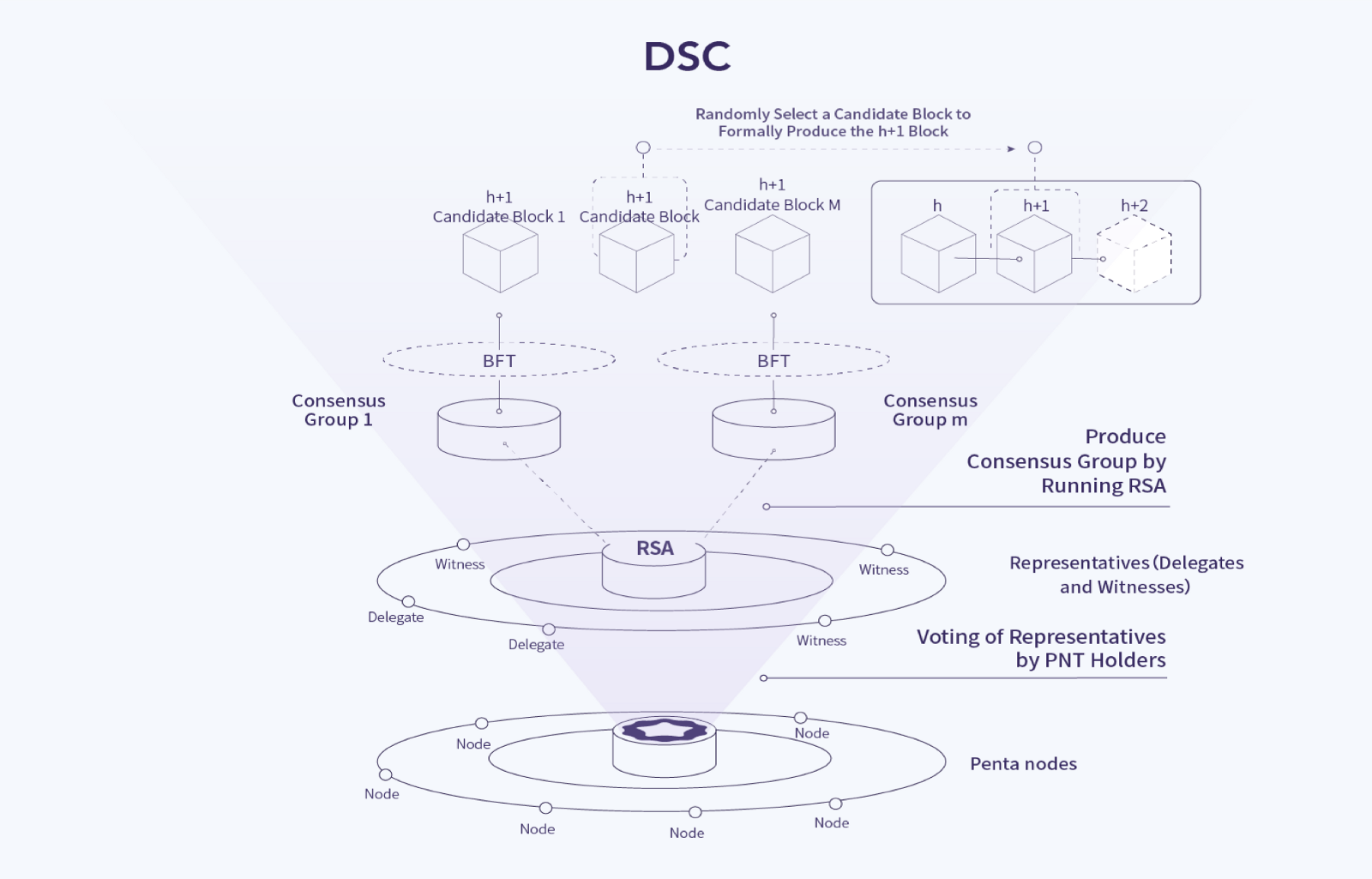 *The DSC Consensus Mechanism Diagram* ## DSC Overview and Description ### DSC Participants Delegates — nodes that take part in block generation and/or validation process. The requirements for nodes to function as delegates include pledging, or ’staking’ an amount of token while securing a specified number of ‘votes’ (node confirmations) to participate in the DSC process. Witnesses — nodes that function to validate generated blocks. Network voting selects nodes to function as witnesses. As with Delegates, Witnesses are required to stake a token amount, though smaller, to participate. Witnesses verify and cryptographically sign each generated block. ### Witness and Delegate Eligibility A systematic method authorizes nodes to function either as Delegates or Witnesses. During DSC block generation and validation cycles, both Delegate and Witness nodes enter into a dedicated Candidate Pool to participate in the DSC consensus process. Candidate nodes must satisfy at least three criteria in order to take part, including: 1) candidates must receive a minimum number of qualifying votes from active nodes in the network; 2) candidates must stake a specified amount of PNT as incentive to prevent sabotage or other malicious behaviour in the consensus process; 3) candidates must satisfy a basic set of hardware performance and high-availability configuration requirements. ### Consensus Groups and Proposer Delegates From the Candidate Pool, multiple sub-networks called Consensus Groups are formed using the Penta Random Sorting Algorithm, RSA, to select Delegates and Witnesses. Consensus Groups run a BFT to elect a single Proposer (node) from among the Delegates present in each Consensus Group. A Proposer then generates a new, signed block containing a set of transactions. Signed blocks are broadcast to the entire Consensus Group for supermajority approval (66%) and selection to be a Candidate Block. Each Consensus Group has a total of n Delegate and Witness nodes. The number of Delegates nodes (n1), are bounded as:  and with the number of Witnesses (n2) per group: n2 = n — n1. ### Block Finality The Candidate Node Batch or Batch contains a set of validated blocks generated from the Consensus Groups. RSA advances one of these for appending to the blockchain. To achieve finality a single block is promoted and appended per DSC cycle. Penta DSC finality is in strong contrast to ‘probabilistic transaction finality’ of other blockchain consensus mechanisms, meaning that transactions are not immediately immutable, but only become so eventually, over time and with subsequent block commits. ### Algorithm Model Flow This section outlines the process flow of the DSC algorithm for Delegates and Witnesses, as applicable to a typical use case. 1. *Allocate in-coming transactions to memory* — all Delegates receive every transaction. Each transaction is added to an in-memory stack awaiting commitment to a newly generated block by a particular Delegate. But, potentially each Delegate can hold a differently ordered set of transactions on their stack. And, not all transactions will necessarily be committed to the block subsequently generated. 2. *Selection to join a consensus group*, Delegates and Witnesses, as members of the Candidate Pool, may receive a message for membership in a particular Consensus Group. 3. *BFT mechanism initiated*, as part of the BFT consensus phase each Consensus Group selects one Delegate as Proposer. The role of the Proposer is to generate a new Candidate Block for their Consensus Group. 4. *Candidate Block generated*, Proposers group verified transactions together before generating the Candidate Block. Post generation, Proposers sign their candidate block prior to broadcasting a ‘generate’ message to all Consensus Group Witnesses. 5. *Block validation*, each Consensus Group Witness verifies and signs the messaged candidate block. 6. Consensus Group *Proposer collects votes*, the Proposer must collect a supermajority (66%) of verification votes to validate the Candidate Block. 7. *Candidate Node Batch generated*, each Candidate Block is added to the Candidate Node Batch. RSA then selects one of the contained Candidate Blocks, and it is this block that is the final ‘pre-commit candidate’ broadcast to the entire network for appending to the chain. 8. *Commit Message sent*, the end of a DSC cycle is with all nodes receiving a Commit Message to add the received Candidate Block to their copy of the blockchain (shared ledger). With all nodes agreeing to commit and append the Candidate Block to the ledger, finality is reached and the DSC cycle ends. 9. *Cycle restart*. ## Discussion ### Failure Modes This section outlines the general behaviour of the DSC algorithm following occurrence of a number of different failure modes. 1. *Malicious Proposer*, if a Consensus Group member discovers that the Proposer is not acting in accordance with consensus policies, the Proposer will be subject to ‘loss of stake’ penalties, and consensus will not be reached. In this case a ‘RESET‘ message is broadcast, and the on-going DSC cycle aborted to ensure stability of the ledger. 2. *Transmission error*, in case of a network communications issue it might happen that the Proposer does not receive sufficient numbers of votes to validate a Candidate Block. Then, a ‘RESET‘ message is triggered and the current DSC cycle stopped. 3. *Timeout*, If consensus is not reached within a specified time slice, a ‘RESET‘ message is triggered and all delegates will run BFT to produce a ‘RESET‘ block. ‘RESET’ blocks are empty, not containing any transactions and end the current DSC cycle. 4. *‘RESET‘ message*, If consensus is not reached within a specified timeout period or in the case of a malicious event, a ‘RESET’ mechanism (message) is triggered and all delegates will run BFT to produce a ‘RESET’ block that reinitializes a new DSC cycle for continued operation and performance of the Penta Network. ### Advantages Penta’s Dynamic Stake Consensus is designed to provide and judged as having a number of strategic advantages as part of its overall goals and objectives. *Avoiding bad actors*, any Delegate or Witness discovered through reporting by a majority of nodes to be engaging in malicious behaviour, or attempts to sabotage the network during the consensus process, will be subject to loss of stake penalties and suspension from participation for a specified time. Additionally, bad actors may lose Delegate or Witness status. *‘RESET’ blocks*, in the case of a specific failure mode, if malicious behaviour or bad network activity is discovered, then a ‘RESET’ block can be automatically generated to restart the consensus process. ‘RESET’ events may be initiated by any member of a Consensus Group. *Fault tolerance*, for DSC is an increasing function that goes with the size of the Candidate Pool (the number of nodes participating as Delegates or Witnesses). As there is no upper limit on the number of Witness nodes, the number of block validators are then unbounded, resulting in higher probabilities that failure modes will be successfully resolved in a timely way. *Fairness*, membership in a particular Consensus Group is determined completely at random. Every node has the same opportunity (equal probability) to participate in the consensus process. *Incentive redistribution* — redistribution of PNT incentives is separated into three categories to ensure a fair distribution and avoid any one node asserting undue influence over algorithm decisions. ### Considerations and Challenges RSA, the Random Sorting Algorithm is a key feature of Penta’s DSC Algorithm. Prior to production release RSA needs to be verified as having negligible biases, if any, and validated as robust when subjected to attack. RSA also needs to be shown as capable of the required DSC throughput rates too. Balancing performance and fairness, DSC is an innovative approach to consensus mechanisms for a distributed peer-to-peer network. The hallmark of DSC is that it seeks to simultaneously optimize three strategic properties of a blockchain consensus mechanism: scalability, security and decentralisation. To date, most and possibly all other algorithms have optimised two of the three, by letting one ‘float’. For instance, maximizing scalability by sacrificing fairness, through limiting block validation authority to a smallish number of trusted ‘super’ nodes. The realities of network technology infrastructure present another set of challenges for the Penta Network. As an international blockchain platform with opportunity and incentive for anyone from around the world to participate in block generation/validation, it is anticipated that network connectivity, latency, and bandwidth issues will negatively impact the overall performance of the Penta network. ## Conclusions This addendum presented a technical overview to the Penta network Dynamic Stake Consensus algorithm (DSC). A key strategy in its design is achieving an optimised balance between fairness, inclusive participation and scalability requirements. Technical features of DSC include the Random Sorting Algorithm (RSA, a unique random sampling algorithm), multiple Consensus Groups to increase participation and strengthen security, and a Byzantine Fault Tolerant (BFT) mechanism to ensure block finality. DSC has a high degree of decentralisation through RSA node selection, for high tps operating throughput without a central authority. Plus, Consensus Groups work through ‘short’ interconnected messaging pipelines, minimising network latencies within a group, and optimising overall network performance. Integrated are solutions to potential known failure modes, and a global ‘RESET‘ mechanism to ensure the stability of the entire network. There are pending technical challenges facing DSC, as with any blockchain consensus algorithm. The proposed resolutions of these issues will require stringent testing in real-world operating environments as part of both TestNet and production platform releases. But, we do not anticipate any immediate limitations on implementations of DSC and Penta blockchain technology to a diverse range of application areas. As Penta blockchain technology then matures by: international adoption, widespread application, and innovative adaption to a constellation of use cases, it fulfils a leadership role and delivers a host of socio-economic benefits for blockchain’s bright future ahead. |
| json metadata | {"tags":["penta","blockchain","technology","consensus"],"image":["https://cdn.steemitimages.com/DQmYG8taj3ncS9xVDNVk2sSHeauCLx4cCU1fsgaP2XXrezq/image.png","https://cdn.steemitimages.com/DQmYn6cP4ndCFjwGyZQii3aRZMSm2HmfzxT4uELDuFTns1B/image.png"],"app":"steemit/0.1","format":"markdown"} |
| Transaction Info | Block #26701416/Trx ba09400fd6a1778c76e6d000802202d0523e460f |
View Raw JSON Data
{
"trx_id": "ba09400fd6a1778c76e6d000802202d0523e460f",
"block": 26701416,
"trx_in_block": 5,
"op_in_trx": 0,
"virtual_op": 0,
"timestamp": "2018-10-11T01:56:30",
"op": [
"comment",
{
"parent_author": "",
"parent_permlink": "penta",
"author": "keevey",
"permlink": "dynamic-stake-consensus-dsc-the-penta-concensus-algorithm-for-optimized-decentralization-scalability-and-security",
"title": "Dynamic Stake Consensus (DSC): The Penta Concensus Algorithm for Optimized Decentralization, Scalability, and Security",
"body": "## Abstract\n\nAs an addendum to the Penta Whitepaper, this article provides a technical overview and description of the Penta blockchain consensus algorithm. Designated ‘Dynamic Stake Consensus,’ the objective of ‘DSC’ is an algorithm for generating validated blocks, and one that attains a functional optimum between decentralization, scalability and security.\n\n## Motivation\n\nIn part, Dynamic Stake Consensus is a novel consensus algorithm designed by a motivation to avoid forks and to promote ‘fairness’. Fairness, in the sense that participating nodes have equal opportunity to engage in the consensus process, and thereby receive an incentive token (PNT) allocation as compensation for their contribution(s).\n\nThere are a number of general features that characterize DSC. Primary is consistently achieving ‘finality’ within a decentralised and multi-stakeholder ecosystem. Finality, being a guarantee that the blockchain data will be immutable, in other words: will never be changed. Following close to ‘finality’ is a triplet of properties: control over processing-time latencies, a secure operating environment and a nominal high transactions per second (tps) throughput rate.\n\n## DSC Consensus Process\n### Terminology\n\nActor or Agent — any participating node in the consensus process\n\nAuthorization — mechanism by which nodes are granted access to participate in the consensus process. For computer networks, Authorization generally is the process of granting access rights and privileges giving someone (or nodes) permission to do something with, or have administration of system resources\n\nBFT — Byzantine Fault Tolerance is the system or process characteristic defined as one that can tolerate the class of failures belonging to the Byzantine Generals’ Problem\n\nBlock — a cryptographically signed data structure for storing a group of valid transactions, permanently recording the data on a blockchain (shared ledger) network\n\nBlockchain or Chain — a shared ledger for storing data in which groups of valid transactions, called blocks, form a chronological linked chain. Each block is cryptographically linked to the previous as a historical record of all transactions. Blockchains serve as a way to prevent data fraud and promote immutability of the data.\n\nCandidate — a block nominated, and put forward as validated for appending to a Penta blockchain prior to final block selection\n\nCandidate Node Batch or Candidate Batch — a set of validated Candidate blocks generated from all Consensus Groups\n\nCandidate Pool — the set of authorised nodes that can participate in the consensus process to generate and validate blocks\n\nCommit Message — a message sent to all nodes prior to appending of a block to the chain\n\nConsensus Group — a subset of the Candidate Pool, a group participating with other Consensus Groups to generate and validate blocks\n\nConsensus protocol — encoded in software, a process by which a decentralised computer network reaches agreement on the veracity of a set of data ensuring that shared ledgers are exact copies of one another.\n\nDecentralization — a distributed network where nodes operate in a peer-to-peer fashion. And, an informal measure of a network’s resistance to attack, a function of how broadly control is distributed among different nodes.\n\nDecentralized or Distributed Network — a type of computer network where processing power and data are spread over nodes rather than having a centralised data centre.\n\nDigital Signature — a hash of input data (a document) also called a ‘signature’ using a private key such that anyone with the corresponding public key, the signature and the input data can verify as being secure, not tampered with.\n\nDistributed Ledger — shared ledgers in which data is stored across a network of decentralized nodes.\n\nDSC Cycle, Epoch or Time Window — a specified amount of time, a ‘time window’, ‘cycle’ or ‘epoch’ during which DSC is carried out to generate, validate and append a block to the chain\n\nEthereum — an open software platform based on blockchain technology enabling developers to deploy smart contracts and build and deploy decentralized applications.\n\nFairness — a measure of the probability for DSC delegates to be designated as generators (producers) of candidate or validated blocks. If all delegates have an equal probability to become producers then the process is termed ‘completely fair’.\n\nFork — forks create an alternate version of a blockchain, leaving two or more possible blockchains to run simultaneously on different parts of a network. Forks can mark changes in a blockchain’s validation protocols.\n\nGenesis Block — also known as Block 0 is the block that every other in a blockchain can be linked back to.\n\nHash or Hashing — taking an arbitrary amount of input data, applying an algorithm to it and generating a fixed-size output data called a ‘hash’. A ‘good’ hash is a one-to-one map of input to output.\n\nICOs, or Initial Coin Offerings — a form of blockchain project (company) financing where project tokens are made available privately and/or publicly sold on a market exchange.\n\nIncentive Redistribution — a token allocation between nodes taking part in the consensus process.\n\nLedger — an append-only record store, where records are designed to be immutable, and may hold more general information than just financial transaction data\n\nMessage — a data packet transmitted between two nodes in a peer-to-peer network\n\nNode — any one of a group of computers forming part of a decentralised network. Nodes each receive a synchronised, consensus-reached and validated copy of a distributed ledger, called a blockchain.\n\nParticipant Pool — the assembly of validated Delegates and Witnesses.\n\nProject — a blockchain startup company. Or literally, an experiment in blockchain technology development\n\nProposer — a Delegate node selected out of the Delegates in a Consensus Group to put forward a candidate block in the middle processing phase of DSC\n\nProtocols — formal network messaging rules describing how to transmit or exchange data\n\nPublic Key Encryption (PKE) — an encryption method where there is a process for generating two keys at the same time (typically called a private and a public key), such that data encrypted using one key can be decrypted with the other\n\n‘RESET’ Block — an empty block containing no transactions, utilised as part of the DSC ‘RESET’ mechanism to abort, restart and reinitialise a DSC cycle\n\nRSA — Random Sorting Algorithm, is Penta’s unique algorithm designed by the Penta research team and underpinning DSC node selection processes. RSA selects (samples) objects out of a ‘bag’ of similar objects, randomly and without bias.\n\nPNT — Penta Network Token, a utility token used as incentive for the DSC consensus process and block validation in the Penta Network.\n\nStaking — purchasing and holding tokens for a fixed period, and possibly earning interest on them\n\nToken — a token is a digital identity for something that can be owned, an alternative and extension to fiat currency.\n\nTransaction — a digitally signed data packet (message) authorizing some particular action associated with the blockchain\n\nWallet — is a file that contains a collection of private, public keys and ancillary transaction data.\n\n\n*The DSC Consensus Mechanism Diagram*\n\n## DSC Overview and Description\n\n### DSC Participants\n\nDelegates — nodes that take part in block generation and/or validation process. The requirements for nodes to function as delegates include pledging, or ’staking’ an amount of token while securing a specified number of ‘votes’ (node confirmations) to participate in the DSC process.\n\nWitnesses — nodes that function to validate generated blocks. Network voting selects nodes to function as witnesses. As with Delegates, Witnesses are required to stake a token amount, though smaller, to participate. Witnesses verify and cryptographically sign each generated block.\n\n### Witness and Delegate Eligibility\n\nA systematic method authorizes nodes to function either as Delegates or Witnesses. During DSC block generation and validation cycles, both Delegate and Witness nodes enter into a dedicated Candidate Pool to participate in the DSC consensus process. Candidate nodes must satisfy at least three criteria in order to take part, including:\n\n1) candidates must receive a minimum number of qualifying votes from active nodes in the network;\n\n2) candidates must stake a specified amount of PNT as incentive to prevent sabotage or other malicious behaviour in the consensus process;\n\n3) candidates must satisfy a basic set of hardware performance and high-availability configuration requirements.\n\n### Consensus Groups and Proposer Delegates\n\nFrom the Candidate Pool, multiple sub-networks called Consensus Groups are formed using the Penta Random Sorting Algorithm, RSA, to select Delegates and Witnesses. Consensus Groups run a BFT to elect a single Proposer (node) from among the Delegates present in each Consensus Group. A Proposer then generates a new, signed block containing a set of transactions. Signed blocks are broadcast to the entire Consensus Group for supermajority approval (66%) and selection to be a Candidate Block.\n\nEach Consensus Group has a total of n Delegate and Witness nodes. The number of Delegates nodes (n1), are bounded as:\n\nand with the number of Witnesses (n2) per group:\n\nn2 = n — n1.\n\n### Block Finality\n\nThe Candidate Node Batch or Batch contains a set of validated blocks generated from the Consensus Groups. RSA advances one of these for appending to the blockchain. To achieve finality a single block is promoted and appended per DSC cycle. Penta DSC finality is in strong contrast to ‘probabilistic transaction finality’ of other blockchain consensus mechanisms, meaning that transactions are not immediately immutable, but only become so eventually, over time and with subsequent block commits.\n\n### Algorithm Model Flow\n\nThis section outlines the process flow of the DSC algorithm for Delegates and Witnesses, as applicable to a typical use case.\n\n1. *Allocate in-coming transactions to memory* — all Delegates receive every transaction. Each transaction is added to an in-memory stack awaiting commitment to a newly generated block by a particular Delegate. But, potentially each Delegate can hold a differently ordered set of transactions on their stack. And, not all transactions will necessarily be committed to the block subsequently generated.\n\n2. *Selection to join a consensus group*, Delegates and Witnesses, as members of the Candidate Pool, may receive a message for membership in a particular Consensus Group.\n\n3. *BFT mechanism initiated*, as part of the BFT consensus phase each Consensus Group selects one Delegate as Proposer. The role of the Proposer is to generate a new Candidate Block for their Consensus Group.\n\n4. *Candidate Block generated*, Proposers group verified transactions together before generating the Candidate Block. Post generation, Proposers sign their candidate block prior to broadcasting a ‘generate’ message to all Consensus Group Witnesses.\n\n5. *Block validation*, each Consensus Group Witness verifies and signs the messaged candidate block.\n\n6. Consensus Group *Proposer collects votes*, the Proposer must collect a supermajority (66%) of verification votes to validate the Candidate Block.\n\n7. *Candidate Node Batch generated*, each Candidate Block is added to the Candidate Node Batch. RSA then selects one of the contained Candidate Blocks, and it is this block that is the final ‘pre-commit candidate’ broadcast to the entire network for appending to the chain.\n\n8. *Commit Message sent*, the end of a DSC cycle is with all nodes receiving a Commit Message to add the received Candidate Block to their copy of the blockchain (shared ledger). With all nodes agreeing to commit and append the Candidate Block to the ledger, finality is reached and the DSC cycle ends.\n\n9. *Cycle restart*.\n\n## Discussion\n\n### Failure Modes\n\nThis section outlines the general behaviour of the DSC algorithm following occurrence of a number of different failure modes.\n\n1. *Malicious Proposer*, if a Consensus Group member discovers that the Proposer is not acting in accordance with consensus policies, the Proposer will be subject to ‘loss of stake’ penalties, and consensus will not be reached. In this case a ‘RESET‘ message is broadcast, and the on-going DSC cycle aborted to ensure stability of the ledger.\n\n2. *Transmission error*, in case of a network communications issue it might happen that the Proposer does not receive sufficient numbers of votes to validate a Candidate Block. Then, a ‘RESET‘ message is triggered and the current DSC cycle stopped.\n\n3. *Timeout*, If consensus is not reached within a specified time slice, a ‘RESET‘ message is triggered and all delegates will run BFT to produce a ‘RESET‘ block. ‘RESET’ blocks are empty, not containing any transactions and end the current DSC cycle.\n\n4. *‘RESET‘ message*, If consensus is not reached within a specified timeout period or in the case of a malicious event, a ‘RESET’ mechanism (message) is triggered and all delegates will run BFT to produce a ‘RESET’ block that reinitializes a new DSC cycle for continued operation and performance of the Penta Network.\n\n### Advantages\n\nPenta’s Dynamic Stake Consensus is designed to provide and judged as having a number of strategic advantages as part of its overall goals and objectives.\n\n*Avoiding bad actors*, any Delegate or Witness discovered through reporting by a majority of nodes to be engaging in malicious behaviour, or attempts to sabotage the network during the consensus process, will be subject to loss of stake penalties and suspension from participation for a specified time. Additionally, bad actors may lose Delegate or Witness status.\n\n*‘RESET’ blocks*, in the case of a specific failure mode, if malicious behaviour or bad network activity is discovered, then a ‘RESET’ block can be automatically generated to restart the consensus process. ‘RESET’ events may be initiated by any member of a Consensus Group.\n\n*Fault tolerance*, for DSC is an increasing function that goes with the size of the Candidate Pool (the number of nodes participating as Delegates or Witnesses). As there is no upper limit on the number of Witness nodes, the number of block validators are then unbounded, resulting in higher probabilities that failure modes will be successfully resolved in a timely way.\n\n*Fairness*, membership in a particular Consensus Group is determined completely at random. Every node has the same opportunity (equal probability) to participate in the consensus process.\n\n*Incentive redistribution* — redistribution of PNT incentives is separated into three categories to ensure a fair distribution and avoid any one node asserting undue influence over algorithm decisions.\n\n### Considerations and Challenges\n\nRSA, the Random Sorting Algorithm is a key feature of Penta’s DSC Algorithm. Prior to production release RSA needs to be verified as having negligible biases, if any, and validated as robust when subjected to attack. RSA also needs to be shown as capable of the required DSC throughput rates too.\n\nBalancing performance and fairness, DSC is an innovative approach to consensus mechanisms for a distributed peer-to-peer network. The hallmark of DSC is that it seeks to simultaneously optimize three strategic properties of a blockchain consensus mechanism: scalability, security and decentralisation. To date, most and possibly all other algorithms have optimised two of the three, by letting one ‘float’. For instance, maximizing scalability by sacrificing fairness, through limiting block validation authority to a smallish number of trusted ‘super’ nodes.\n\nThe realities of network technology infrastructure present another set of challenges for the Penta Network. As an international blockchain platform with opportunity and incentive for anyone from around the world to participate in block generation/validation, it is anticipated that network connectivity, latency, and bandwidth issues will negatively impact the overall performance of the Penta network.\n\n## Conclusions\n\nThis addendum presented a technical overview to the Penta network Dynamic Stake Consensus algorithm (DSC). A key strategy in its design is achieving an optimised balance between fairness, inclusive participation and scalability requirements. Technical features of DSC include the Random Sorting Algorithm (RSA, a unique random sampling algorithm), multiple Consensus Groups to increase participation and strengthen security, and a Byzantine Fault Tolerant (BFT) mechanism to ensure block finality.\n\nDSC has a high degree of decentralisation through RSA node selection, for high tps operating throughput without a central authority. Plus, Consensus Groups work through ‘short’ interconnected messaging pipelines, minimising network latencies within a group, and optimising overall network performance. Integrated are solutions to potential known failure modes, and a global ‘RESET‘ mechanism to ensure the stability of the entire network.\n\nThere are pending technical challenges facing DSC, as with any blockchain consensus algorithm. The proposed resolutions of these issues will require stringent testing in real-world operating environments as part of both TestNet and production platform releases. But, we do not anticipate any immediate limitations on implementations of DSC and Penta blockchain technology to a diverse range of application areas.\n\nAs Penta blockchain technology then matures by: international adoption, widespread application, and innovative adaption to a constellation of use cases, it fulfils a leadership role and delivers a host of socio-economic benefits for blockchain’s bright future ahead.",
"json_metadata": "{\"tags\":[\"penta\",\"blockchain\",\"technology\",\"consensus\"],\"image\":[\"https://cdn.steemitimages.com/DQmYG8taj3ncS9xVDNVk2sSHeauCLx4cCU1fsgaP2XXrezq/image.png\",\"https://cdn.steemitimages.com/DQmYn6cP4ndCFjwGyZQii3aRZMSm2HmfzxT4uELDuFTns1B/image.png\"],\"app\":\"steemit/0.1\",\"format\":\"markdown\"}"
}
]
}2018/10/10 14:33:09
2018/10/10 14:33:09
| parent author | keevey |
| parent permlink | penta-account-model-outline |
| author | steemcleaners |
| permlink | re-keevey-penta-account-model-outline-20181010t143309368z |
| title | |
| body | [Source](https://medium.com/penta-network/penta-account-model-outline-86973ef738ad) [Plagiarism](http://www.plagiarism.org/plagiarism-101/what-is-plagiarism/) is the copying & pasting of others work without giving credit to the original author or artist. Plagiarized posts are considered spam. Spam is discouraged by the community, and may result in action from the [cheetah bot](https://steemit.com/faq.html#What_is__cheetah). [More information and tips on sharing content.](https://steemcleaners.org/copy-paste-plagiarism/) If you believe this comment is in error, please contact us in [#disputes on Discord](https://discord.gg/YR2Wy5A) |
| json metadata | {"app":"steemcleaners/0.3","format":"markdown+html","community":"steemcleaners"} |
| Transaction Info | Block #26687763/Trx 49e1d41b1109fc216ad7f2ba8d49b8fd71284673 |
View Raw JSON Data
{
  "trx_id": "49e1d41b1109fc216ad7f2ba8d49b8fd71284673",
  "block": 26687763,
  "trx_in_block": 41,
  "op_in_trx": 0,
  "virtual_op": 0,
  "timestamp": "2018-10-10T14:33:09",
  "op": [
    "comment",
    {
      "parent_author": "keevey",
      "parent_permlink": "penta-account-model-outline",
      "author": "steemcleaners",
      "permlink": "re-keevey-penta-account-model-outline-20181010t143309368z",
      "title": "",
      "body": "[Source](https://medium.com/penta-network/penta-account-model-outline-86973ef738ad)\n[Plagiarism](http://www.plagiarism.org/plagiarism-101/what-is-plagiarism/) is the copying & pasting of others work without giving credit to the original author or artist. Plagiarized posts are considered spam. \r\n\r\nSpam is discouraged by the community, and may result in action from the [cheetah bot](https://steemit.com/faq.html#What_is__cheetah).\r\n\r\n[More information and tips on sharing content.](https://steemcleaners.org/copy-paste-plagiarism/)\r\n\r\nIf you believe this comment is in error, please contact us in [#disputes on Discord](https://discord.gg/YR2Wy5A)",
      "json_metadata": "{\"app\":\"steemcleaners/0.3\",\"format\":\"markdown+html\",\"community\":\"steemcleaners\"}"
    }
  ]
}keeveyupdated their account properties2018/10/10 02:06:15
keeveyupdated their account properties
2018/10/10 02:06:15
| account | keevey |
| memo key | STM61ixM125vLYvU1QCq8R7mwNsKNLq24CmeY6WLGNErX9QjarhMb |
| json metadata | {"profile":{"cover_image":"https://cdn.steemitimages.com/DQmWmUNDhBXBePkrXpKoUPCACuSZNs2UXZ12VhmP2dBsLWt/banner2.jpg","profile_image":"https://cdn.steemitimages.com/DQmSnp1FhYpQRhpJbVayqAo61ncYFL6pX56eq3zzgUGJJkE/penta.jpg","name":"Penta","about":"Penta Network is a next generation platform for public blockchain projects for transferring value and operating high-performance decentralized applications."}} |
| Transaction Info | Block #26672830/Trx cfb65490b792ee04b7ceee8b3e6c2a17a4a4658c |
View Raw JSON Data
{
  "trx_id": "cfb65490b792ee04b7ceee8b3e6c2a17a4a4658c",
  "block": 26672830,
  "trx_in_block": 20,
  "op_in_trx": 0,
  "virtual_op": 0,
  "timestamp": "2018-10-10T02:06:15",
  "op": [
    "account_update",
    {
      "account": "keevey",
      "memo_key": "STM61ixM125vLYvU1QCq8R7mwNsKNLq24CmeY6WLGNErX9QjarhMb",
      "json_metadata": "{\"profile\":{\"cover_image\":\"https://cdn.steemitimages.com/DQmWmUNDhBXBePkrXpKoUPCACuSZNs2UXZ12VhmP2dBsLWt/banner2.jpg\",\"profile_image\":\"https://cdn.steemitimages.com/DQmSnp1FhYpQRhpJbVayqAo61ncYFL6pX56eq3zzgUGJJkE/penta.jpg\",\"name\":\"Penta\",\"about\":\"Penta Network is a next generation platform for public blockchain projects for transferring value and operating high-performance decentralized applications.\"}}"
    }
  ]
}keeveyupdated their account properties2018/10/10 02:03:27
keeveyupdated their account properties
2018/10/10 02:03:27
| account | keevey |
| memo key | STM61ixM125vLYvU1QCq8R7mwNsKNLq24CmeY6WLGNErX9QjarhMb |
| json metadata | {"profile":{"cover_image":"https://cdn.steemitimages.com/DQmWmUNDhBXBePkrXpKoUPCACuSZNs2UXZ12VhmP2dBsLWt/banner2.jpg","profile_image":"https://cdn.steemitimages.com/DQmSnp1FhYpQRhpJbVayqAo61ncYFL6pX56eq3zzgUGJJkE/penta.jpg","name":"Penta"}} |
| Transaction Info | Block #26672774/Trx d20ff617a9c5afd8abde5ea1a95e6329b55ebe73 |
View Raw JSON Data
{
  "trx_id": "d20ff617a9c5afd8abde5ea1a95e6329b55ebe73",
  "block": 26672774,
  "trx_in_block": 38,
  "op_in_trx": 0,
  "virtual_op": 0,
  "timestamp": "2018-10-10T02:03:27",
  "op": [
    "account_update",
    {
      "account": "keevey",
      "memo_key": "STM61ixM125vLYvU1QCq8R7mwNsKNLq24CmeY6WLGNErX9QjarhMb",
      "json_metadata": "{\"profile\":{\"cover_image\":\"https://cdn.steemitimages.com/DQmWmUNDhBXBePkrXpKoUPCACuSZNs2UXZ12VhmP2dBsLWt/banner2.jpg\",\"profile_image\":\"https://cdn.steemitimages.com/DQmSnp1FhYpQRhpJbVayqAo61ncYFL6pX56eq3zzgUGJJkE/penta.jpg\",\"name\":\"Penta\"}}"
    }
  ]
}cheetahreplied to @keevey / cheetah-re-keeveypenta-network-governance2018/10/10 02:01:21
cheetahreplied to @keevey / cheetah-re-keeveypenta-network-governance
2018/10/10 02:01:21
| parent author | keevey |
| parent permlink | penta-network-governance |
| author | cheetah |
| permlink | cheetah-re-keeveypenta-network-governance |
| title | |
| body | Hi! I am a robot. I just upvoted you! I found similar content that readers might be interested in: https://medium.com/penta-network/penta-network-governance-8b9766284f57 |
| json metadata | |
| Transaction Info | Block #26672732/Trx 963509e0fd37998bd6674b047ee91b80e4f49de6 |
View Raw JSON Data
{
  "trx_id": "963509e0fd37998bd6674b047ee91b80e4f49de6",
  "block": 26672732,
  "trx_in_block": 17,
  "op_in_trx": 0,
  "virtual_op": 0,
  "timestamp": "2018-10-10T02:01:21",
  "op": [
    "comment",
    {
      "parent_author": "keevey",
      "parent_permlink": "penta-network-governance",
      "author": "cheetah",
      "permlink": "cheetah-re-keeveypenta-network-governance",
      "title": "",
      "body": "Hi! I am a robot. I just upvoted you! I found similar content that readers might be interested in:\nhttps://medium.com/penta-network/penta-network-governance-8b9766284f57",
      "json_metadata": ""
    }
  ]
}keeveyupvoted (100.00%) @keevey / penta-network-governance2018/10/10 02:01:18
keeveyupvoted (100.00%) @keevey / penta-network-governance
2018/10/10 02:01:18
| voter | keevey |
| author | keevey |
| permlink | penta-network-governance |
| weight | 10000 (100.00%) |
| Transaction Info | Block #26672731/Trx 18c173c20c99e908a20b1ec7d84547aa49963406 |
View Raw JSON Data
{
  "trx_id": "18c173c20c99e908a20b1ec7d84547aa49963406",
  "block": 26672731,
  "trx_in_block": 34,
  "op_in_trx": 0,
  "virtual_op": 0,
  "timestamp": "2018-10-10T02:01:18",
  "op": [
    "vote",
    {
      "voter": "keevey",
      "author": "keevey",
      "permlink": "penta-network-governance",
      "weight": 10000
    }
  ]
}fastresteemupvoted (1.00%) @keevey / penta-network-governance2018/10/10 02:01:18
fastresteemupvoted (1.00%) @keevey / penta-network-governance
2018/10/10 02:01:18
| voter | fastresteem |
| author | keevey |
| permlink | penta-network-governance |
| weight | 100 (1.00%) |
| Transaction Info | Block #26672731/Trx 7ee1c3b5c113e921a293ace12dc8e4db347a2ea1 |
View Raw JSON Data
{
  "trx_id": "7ee1c3b5c113e921a293ace12dc8e4db347a2ea1",
  "block": 26672731,
  "trx_in_block": 23,
  "op_in_trx": 0,
  "virtual_op": 0,
  "timestamp": "2018-10-10T02:01:18",
  "op": [
    "vote",
    {
      "voter": "fastresteem",
      "author": "keevey",
      "permlink": "penta-network-governance",
      "weight": 100
    }
  ]
}cheetahupvoted (0.08%) @keevey / penta-network-governance2018/10/10 02:01:18
cheetahupvoted (0.08%) @keevey / penta-network-governance
2018/10/10 02:01:18
| voter | cheetah |
| author | keevey |
| permlink | penta-network-governance |
| weight | 8 (0.08%) |
| Transaction Info | Block #26672731/Trx 73aa26123c2690db04338010ddd55ae45ebb9a38 |
View Raw JSON Data
{
  "trx_id": "73aa26123c2690db04338010ddd55ae45ebb9a38",
  "block": 26672731,
  "trx_in_block": 19,
  "op_in_trx": 0,
  "virtual_op": 0,
  "timestamp": "2018-10-10T02:01:18",
  "op": [
    "vote",
    {
      "voter": "cheetah",
      "author": "keevey",
      "permlink": "penta-network-governance",
      "weight": 8
    }
  ]
}keeveypublished a new post: penta-network-governance2018/10/10 02:01:09
keeveypublished a new post: penta-network-governance
2018/10/10 02:01:09
| parent author | |
| parent permlink | penta |
| author | keevey |
| permlink | penta-network-governance |
| title | Penta Network Governance |
| body | **Overview** The primary goals of the Penta public blockchain are: decentralization, fairness and trust. In order to meet these, besides Penta, any public blockchain project needs to have a clear governance structure to avoid destructive actions or misaligned intentions by the core developers, or the block producers. Penta aims for a governance process that is both transparent and robust to corruption. At the center of Penta’s mission to increase economic inclusion and the stability of its blockchain, is a lowering of barriers to entry and increased opportunities for stakeholders to participate in the ecosystem. Through fair incentive allocations, and stable core architecture, Penta has pioneered innovative technology and social governance mechanisms so as to thrive in the emerging Smart Economy. ## Participation in the Consensus Process ### Node Types, Definitions: **1. Common Nodes** Common Nodes synchronize and keep track of shared ledgers using the Penta Client. A Common Node votes to elect delegates/witnesses, or nominate to become a Delegate/Witness by pledging (staking) PNT. Common Nodes participate in maintaining the security and high-availability of the Penta network. **2. Witness Nodes** Requirements for eligibility to function as a Witness Node are to receive a number of votes and to stake a small (same here, how much is staked) amount of PNT. Next to Common Nodes, Witnesses are next in terms of numbers populating the Penta network. Witnesses are essential during the BFT and for block validation. Summarizing, the required eligibility criteria for Witness Nodes: - Stake a small number of PNT; - Receive a small number of votes; - A specified minimum hardware and network configuration; **3. Delegate Nodes** Common Nodes can nominate to become Delegate Nodes if certain criteria are met. As with Witness Nodes these are: a threshold number of votes, a specified amount of staked PNT, and a specified nominal hardware configuration. These requirements have to be met to participate in the block generation and consensus process. All Delegate Nodes have the same opportunity (probability) to participate in the consensus process, with responsibilities for block creation and block validation. Summarizing, the required eligibility criteria for Delegate Nodes: - Well-known to the community and a significant principal to drive the ecosystem; - Stake a large amount of PNT and receive a high number of votes; - Very stable, high-availability infrastructure and network configuration; - Participate in validating the core architecture and infrastructure of the Penta testNet as a community maintained blockchain test environment; ### Consensus Process Flow 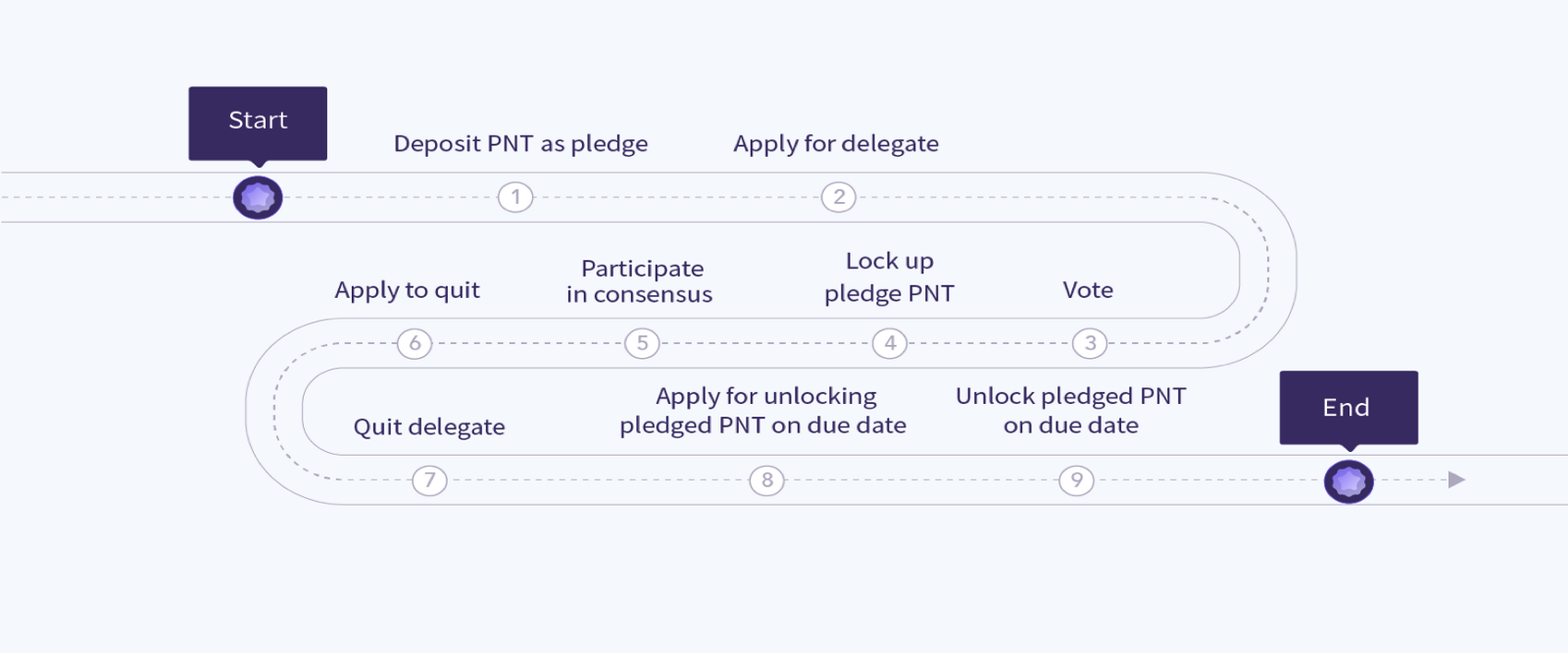 **1. Pledge PNT** Common Nodes pledge (stake) a specified amount of PNT to participate in the voting process. **2. Apply for participating in the consensus process** Delegate and Witness candidate nominations are broadcast to the entire Penta network. But, this process can be cancelled prior to any Delegates and Witnesses are elected. **3. Vote** Penta Common Notes vote through an official Penta Client. **4. PNT stake lock up** The PNT stake of a node will be locked after its successfully becoming a Witness or Delegate. A stake will be released only after a node successfully exits from the consensus process. **5. Participate in consensus process** Delegates and Witnesses participating in the DSC consensus process are eligible to receive ‘compensation’ incentives. Any Delegate or Witness taking part in malicious attempts to sabotage the consensus process will be subjected to penalties and under serious circumstances, possible exclusion from any further consensus participation (banning). **6. Application of an exit from consensus process** A delegate or witness may, and can easily, apply to exit (terminate participation) from the consensus process with the Penta Client. But, to promote the stability and high-availability of the network, early termination rules apply once a node puts forward an intent to exit request. **7. Exit from consensus process** Having satisfied all the early termination rules nodes are allowed to exit the consensus process without penalties. **8. Apply for PNT stake release on due date** After exiting from consensus process participation, nodes can request return of any pledged PNT. **9. Time for PNT stake final release** It may take up to 7 calendar days to unlock, and for final return of pledged PNT. ### Eligibility: Voting & Election rules Nodes can vote for other nodes or themselves during the consensus process. - PNT held by all voting nodes will be locked before a election round, with 1 PNT representing 1 vote; - Votes nodes obtain will be counted and results updated after a certain numbers of blocks are generated. Election as a Delegate or Witness is based on the amount of PNT pledged and votes obtained, being automatic if all the eligibility criteria are met; **The Incentive Plan is divided into three parts:** 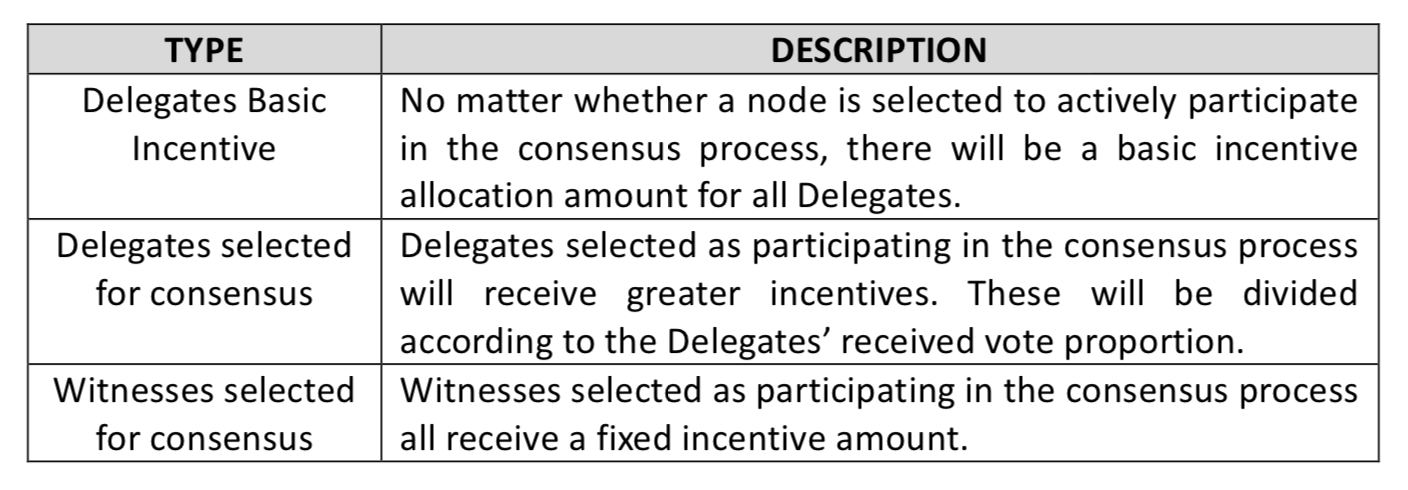 **Incentive Plan** PNT incentives originate from two sources: - A 50% reserve from the total 100 billion PNT token fund, or 50 billion of PNT - Transaction fee within the Penta Network **Penta Charity Program** The not-for-profit plan may designate certain Delegates as ‘nonprofit’ and any derived profits from those Delegates will be allocated to public benefit activities. **Penalties** Delegates or Witnesses discovered attempting sabotage of the network, or similar malicious behaviour during the consensus process, reported by a certain percentage of nodes will be subjected to penalties and then suspended from consensus participation for a specified period of time. **Discussion and Conclusions** The Penta governance model separates economic benefits available to consensus participants from governance responsibilities, to promote fairness and trust in a decentralized environment. The entire Penta Network is involved in the governance process. To ensure and sustain a fair network it is important that the entire community is working towards the ‘common good’ (commonwealth) of the ecosystem. The Penta governance model seeks to achieve this by a fair distribution of benefits, and by looking to avoid the formation of self-serving cartels. The Penta governance model optimizes the **transparency, inclusiveness, stability and overall intrinsic value of the Penta ecosystem**. The rights and responsibilities contained within reflect Penta’s operating philosophy, and its doctrines for fairness and inclusion. Under which, and with the cooperation of all the agents in the ecosystem: a secure, balanced, and sustainable network is created for the new economy. |
| json metadata | {"tags":["penta","blockchain","technology"],"image":["https://cdn.steemitimages.com/DQmeqjHbaHhRmCpgZ2AusKBzDso7mspS6nkrzY53GgFr9PZ/image.png","https://cdn.steemitimages.com/DQmXx2sVQyMDoMNSJVdoSYX5xXTabnNMwhAywd7NKm1EpiQ/image.png"],"app":"steemit/0.1","format":"markdown"} |
| Transaction Info | Block #26672728/Trx c5bbabdd57a1cfff2ffc678f8f5315e46836ea3a |
View Raw JSON Data
{
"trx_id": "c5bbabdd57a1cfff2ffc678f8f5315e46836ea3a",
"block": 26672728,
"trx_in_block": 12,
"op_in_trx": 0,
"virtual_op": 0,
"timestamp": "2018-10-10T02:01:09",
"op": [
"comment",
{
"parent_author": "",
"parent_permlink": "penta",
"author": "keevey",
"permlink": "penta-network-governance",
"title": "Penta Network Governance",
"body": "**Overview**\n\nThe primary goals of the Penta public blockchain are: decentralization, fairness and trust. In order to meet these, besides Penta, any public blockchain project needs to have a clear governance structure to avoid destructive actions or misaligned intentions by the core developers, or the block producers. Penta aims for a governance process that is both transparent and robust to corruption.\n\nAt the center of Penta’s mission to increase economic inclusion and the stability of its blockchain, is a lowering of barriers to entry and increased opportunities for stakeholders to participate in the ecosystem. Through fair incentive allocations, and stable core architecture, Penta has pioneered innovative technology and social governance mechanisms so as to thrive in the emerging Smart Economy.\n\n## Participation in the Consensus Process\n### Node Types, Definitions:\n\n**1. Common Nodes**\n\nCommon Nodes synchronize and keep track of shared ledgers using the Penta Client. A Common Node votes to elect delegates/witnesses, or nominate to become a Delegate/Witness by pledging (staking) PNT. Common Nodes participate in maintaining the security and high-availability of the Penta network.\n\n**2. Witness Nodes**\n\nRequirements for eligibility to function as a Witness Node are to receive a number of votes and to stake a small (same here, how much is staked) amount of PNT. Next to Common Nodes, Witnesses are next in terms of numbers populating the Penta network. Witnesses are essential during the BFT and for block validation. Summarizing, the required eligibility criteria for Witness Nodes:\n\n- Stake a small number of PNT;\n\n- Receive a small number of votes;\n\n- A specified minimum hardware and network configuration;\n\n**3. Delegate Nodes**\n\nCommon Nodes can nominate to become Delegate Nodes if certain criteria are met. As with Witness Nodes these are: a threshold number of votes, a specified amount of staked PNT, and a specified nominal hardware configuration. These requirements have to be met to participate in the block generation and consensus process. All Delegate Nodes have the same opportunity (probability) to participate in the consensus process, with responsibilities for block creation and block validation. Summarizing, the required eligibility criteria for Delegate Nodes:\n\n- Well-known to the community and a significant principal to drive the ecosystem;\n\n- Stake a large amount of PNT and receive a high number of votes;\n\n- Very stable, high-availability infrastructure and network configuration;\n\n- Participate in validating the core architecture and infrastructure of the Penta testNet as a community maintained blockchain test environment;\n\n### Consensus Process Flow\n\n\n\n**1. Pledge PNT**\n\nCommon Nodes pledge (stake) a specified amount of PNT to participate in the voting process.\n\n**2. Apply for participating in the consensus process**\n\nDelegate and Witness candidate nominations are broadcast to the entire Penta network. But, this process can be cancelled prior to any Delegates and Witnesses are elected.\n\n**3. Vote**\n\nPenta Common Notes vote through an official Penta Client.\n\n**4. PNT stake lock up**\n\nThe PNT stake of a node will be locked after its successfully becoming a Witness or Delegate. A stake will be released only after a node successfully exits from the consensus process.\n\n**5. Participate in consensus process**\n\nDelegates and Witnesses participating in the DSC consensus process are eligible to receive ‘compensation’ incentives. Any Delegate or Witness taking part in malicious attempts to sabotage the consensus process will be subjected to penalties and under serious circumstances, possible exclusion from any further consensus participation (banning).\n\n**6. Application of an exit from consensus process**\n\nA delegate or witness may, and can easily, apply to exit (terminate participation) from the consensus process with the Penta Client. But, to promote the stability and high-availability of the network, early termination rules apply once a node puts forward an intent to exit request.\n\n**7. Exit from consensus process**\n\nHaving satisfied all the early termination rules nodes are allowed to exit the consensus process without penalties.\n\n**8. Apply for PNT stake release on due date**\n\nAfter exiting from consensus process participation, nodes can request return of any pledged PNT.\n\n**9. Time for PNT stake final release**\n\nIt may take up to 7 calendar days to unlock, and for final return of pledged PNT.\n\n### Eligibility: Voting & Election rules\n\nNodes can vote for other nodes or themselves during the consensus process.\n\n- PNT held by all voting nodes will be locked before a election round, with 1 PNT representing 1 vote;\n\n- Votes nodes obtain will be counted and results updated after a certain numbers of blocks are generated. Election as a Delegate or Witness is based on the amount of PNT pledged and votes obtained, being automatic if all the eligibility criteria are met;\n\n**The Incentive Plan is divided into three parts:**\n\n\n\n**Incentive Plan**\n\nPNT incentives originate from two sources:\n\n- A 50% reserve from the total 100 billion PNT token fund, or 50 billion of PNT\n\n- Transaction fee within the Penta Network\n\n**Penta Charity Program**\n\nThe not-for-profit plan may designate certain Delegates as ‘nonprofit’ and any derived profits from those Delegates will be allocated to public benefit activities.\n\n**Penalties**\n\nDelegates or Witnesses discovered attempting sabotage of the network, or similar malicious behaviour during the consensus process, reported by a certain percentage of nodes will be subjected to penalties and then suspended from consensus participation for a specified period of time.\n\n**Discussion and Conclusions**\n\nThe Penta governance model separates economic benefits available to consensus participants from governance responsibilities, to promote fairness and trust in a decentralized environment.\n\nThe entire Penta Network is involved in the governance process. To ensure and sustain a fair network it is important that the entire community is working towards the ‘common good’ (commonwealth) of the ecosystem. The Penta governance model seeks to achieve this by a fair distribution of benefits, and by looking to avoid the formation of self-serving cartels.\n\nThe Penta governance model optimizes the **transparency, inclusiveness, stability and overall intrinsic value of the Penta ecosystem**. The rights and responsibilities contained within reflect Penta’s operating philosophy, and its doctrines for fairness and inclusion. Under which, and with the cooperation of all the agents in the ecosystem: a secure, balanced, and sustainable network is created for the new economy.",
"json_metadata": "{\"tags\":[\"penta\",\"blockchain\",\"technology\"],\"image\":[\"https://cdn.steemitimages.com/DQmeqjHbaHhRmCpgZ2AusKBzDso7mspS6nkrzY53GgFr9PZ/image.png\",\"https://cdn.steemitimages.com/DQmXx2sVQyMDoMNSJVdoSYX5xXTabnNMwhAywd7NKm1EpiQ/image.png\"],\"app\":\"steemit/0.1\",\"format\":\"markdown\"}"
}
]
}keeveyupvoted (100.00%) @keevey / penta-account-model-outline2018/10/09 02:23:06
keeveyupvoted (100.00%) @keevey / penta-account-model-outline
2018/10/09 02:23:06
| voter | keevey |
| author | keevey |
| permlink | penta-account-model-outline |
| weight | 10000 (100.00%) |
| Transaction Info | Block #26644375/Trx 0ffb092155161ae3e360a3d12fc731fc3d3ba1c8 |
View Raw JSON Data
{
  "trx_id": "0ffb092155161ae3e360a3d12fc731fc3d3ba1c8",
  "block": 26644375,
  "trx_in_block": 15,
  "op_in_trx": 0,
  "virtual_op": 0,
  "timestamp": "2018-10-09T02:23:06",
  "op": [
    "vote",
    {
      "voter": "keevey",
      "author": "keevey",
      "permlink": "penta-account-model-outline",
      "weight": 10000
    }
  ]
}fastresteemupvoted (1.00%) @keevey / penta-account-model-outline2018/10/09 02:22:48
fastresteemupvoted (1.00%) @keevey / penta-account-model-outline
2018/10/09 02:22:48
| voter | fastresteem |
| author | keevey |
| permlink | penta-account-model-outline |
| weight | 100 (1.00%) |
| Transaction Info | Block #26644369/Trx 2845ea460b63342296036a0884c79b5c04c9fc11 |
View Raw JSON Data
{
  "trx_id": "2845ea460b63342296036a0884c79b5c04c9fc11",
  "block": 26644369,
  "trx_in_block": 19,
  "op_in_trx": 0,
  "virtual_op": 0,
  "timestamp": "2018-10-09T02:22:48",
  "op": [
    "vote",
    {
      "voter": "fastresteem",
      "author": "keevey",
      "permlink": "penta-account-model-outline",
      "weight": 100
    }
  ]
}keeveypublished a new post: penta-account-model-outline2018/10/09 02:22:39
keeveypublished a new post: penta-account-model-outline
2018/10/09 02:22:39
| parent author | |
| parent permlink | penta |
| author | keevey |
| permlink | penta-account-model-outline |
| title | Penta Account Model Outline |
| body | ## Penta Account Model There are two types of Penta accounts: *common user* or just *user*, and contract accounts. External accounts fall into the common user account category, while contract accounts are utilised for smart contract information storage. Together they are core elements of the *Penta data model*. In Bitcoin nomenclature *addresses*, like bank account numbers, are where to deposit bitcoins (BTC). In the Penta data model these are instead referred to as *accounts*. Ownership of Penta accounts is either on an individual or group basis, and only account holders can transact on the Penta blockchain. Accounts are the fundamental machinery DApp users connect to the Penta blockchain with, and the basic data structure containing user summary data, like a total account balance. Among the benefits of the *Account-Balance Model* are: * Simplified developer (Penta blockchain integration) api usage, reducing the complexity of creating and maintaining a DApp model layer * Streamlined transaction processing. Basically, only validation of the payer account balance is needed to authorize a transaction, without a computationally intensive review of prior transactions on the chain. ## Penta Account Structure The Penta account model has a number of requirements, a few of which are: * Be fully compatible with the Penta Dynamic Stake Consensus (DSC) algorithm, while adding features and greater flexibility to the usage of each account * Distinguish between user and contract accounts in clearly demarked ways * Minimize computational requirements by storing some user state information with the account data What follows are the specification details for Penta user and contract accounts. ## Penta User Account The Penta user account is also referred to as the *common user account*. Every one stores four private keys: OwnerKey, TxKey, ConsensusKey and SeedKey. And each of these keys has a specific function, different from the others, as detailed here: * OwnerKey: used to set the transaction, consensus, and seed private key * TxKey: used for transaction signatures * ConsensusKey: signature used in the consensus accounting process * SeedKey: the signature used for the seed generation process in the block proposal process Generally only the OwnerKey and TxKey are needed for common users of the Penta Network. For nodes participating in the DSC consensus, the ConsensusKey and SeedKey are necessary. Each Penta account incorporates multiple private keys. For authentication purposes instead of a one-key-one-password policy (of one password) for each private key, a Penta user account sets a single, global owner password for all. Users are required to successfully authenticate with this global password to obtain authorization and control of an account. To facilitate greater security, a secondary password is attached to the core OwnerKey. That is, a second password must be provided before the OwnerKey can be utilized. In this way, user accounts are protected under a two-pass authentication method. ## Penta Contract Account The Penta contract account stores smart contract *state* information. The account also stores the smart contract code to be executed according to the specified rules encapsulated within the smart contract code. The Penta Network operates under the guiding principle that anything transacted on the blockchain has an associated cost that must be paid for. Whether a PNT transfer between accounts, or execution of smart contracts, all transactions involve an update to the blockchain and the associated fees paid. The updated data is then always placed into a transaction pool and incorporated in the next generated block. 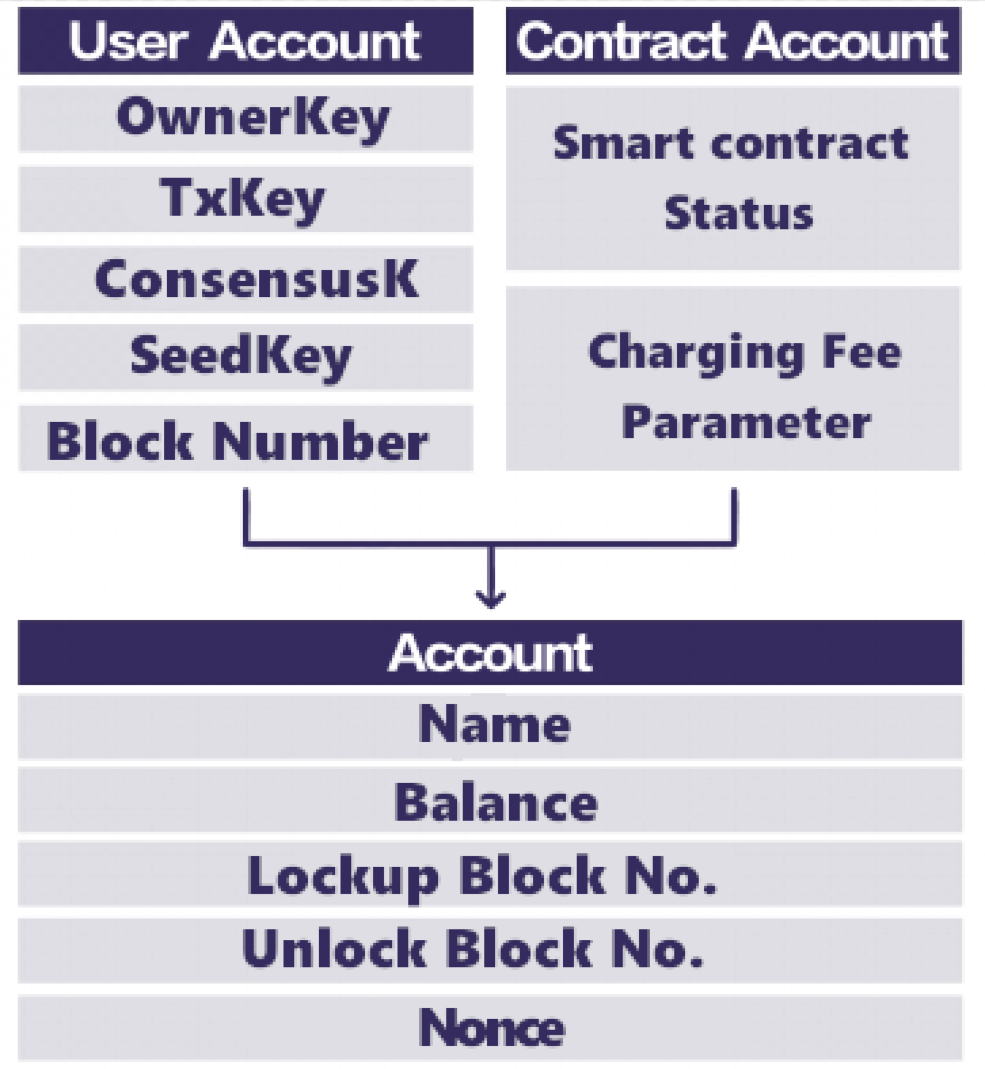 ## Penta Account Address Field The Penta account address consists of a 21-byte binary number, in the form of an encoded string (Base58) + 4-byte check digit. 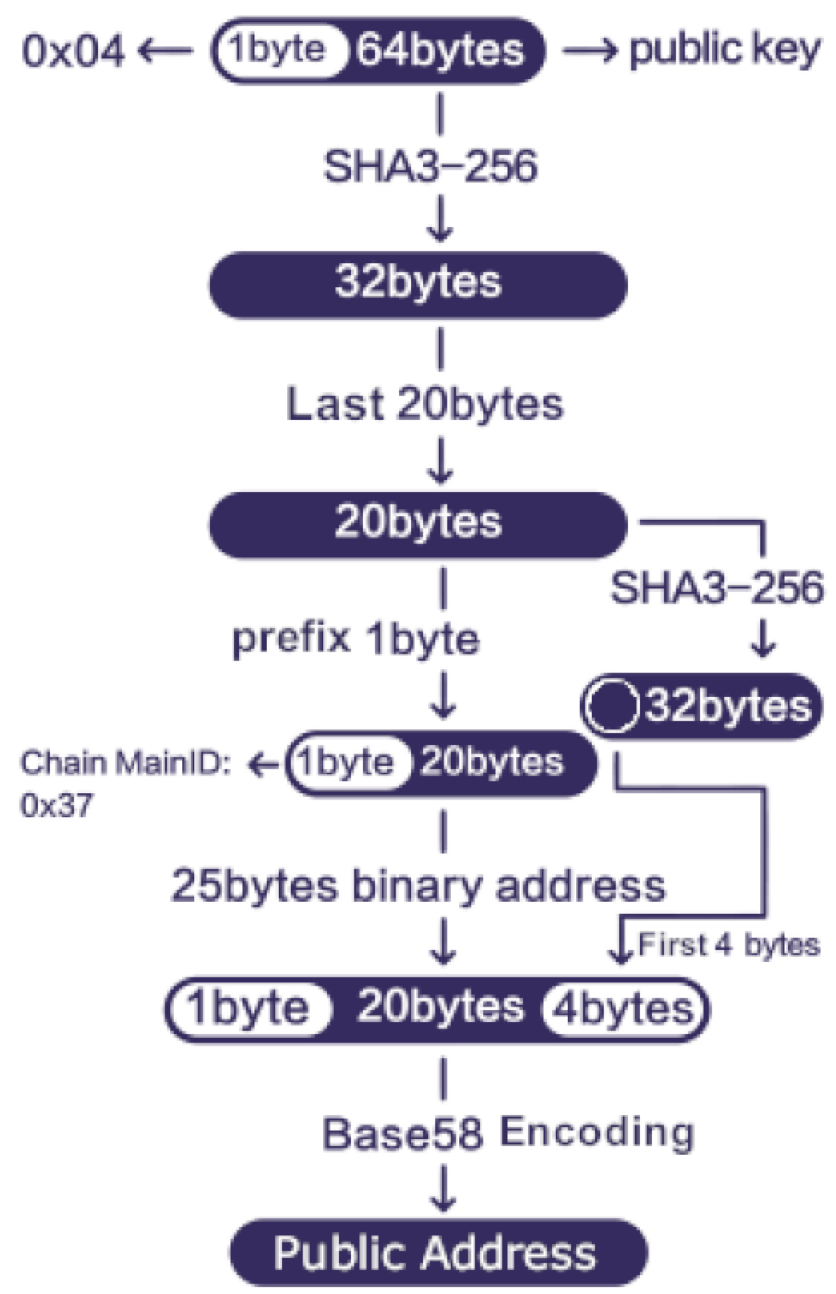 Generating a new Penta account public address is a multi-step process: 1. An elliptic curve encryption algorithm is used to calculate the uncompressed public key linked (associated with) to a random private key. Its total length is 65 bytes, with a first byte of 0x04 indicating an uncompressed state. 2. Next, the SHA3–256 hash value of the uncompressed public key is calculated, to produce a 32-byte binary value. The last 20 bytes of this result are taken as the (same) input for both of the next two steps (3,4). 3. Prefix the 20 bytes of step 2 with 1 byte as an identifier to distinguish between: the primary network, test network, or other adjunct networks. As an example, the 1 byte value for the main network chain is (MainID): 0x37. Use this 21 byte result as the ‘head’ value for step 5. 4. Calculate a SHA3–256 hash value, again using the 20 byte output of step 2. Take the first 4 bytes of the 32 byte result and use it as the ‘tail’ value for step 5. 5. Concatenate the 21 byte ‘head’ from step 3, and the 4 byte ‘tail’ of step 4 to generate a 25 byte result as input for step 6. 6. Perform a Base58 encoding on the concatenated 25 byte address of step 5. This final generated string is a Penta Account Public Address. The Penta Account Address Field algorithm is different from Ethereum’s. For example, when generating the 20 hash in step 2, Ethereum utilizes the ‘academic’ RIPEMD 160-bit hash scheme, in contrast to NIST backed SHA3–256 algorithm. Another major distinction, different to steps 3–5, Ethereum runs two SHA-256 operations to generate a 25-byte result for final address encoding. The Penta algorithm requires only a single SHA3–256 hash. ## Summary This article provides a technical overview of the Penta account structure and address scheme. In its design the Penta team has sought to: simplify development of DApps that integrate with the Penta Network, optimize transaction processing, and clarify the distinction between the functions of common user and contract accounts. The team also recognizes performance of the DSC algorithm, account security, and usability as priorities too. The articles that follow, extend this overview by introducing account management mechanisms, and the account creation process within the Penta ecosystem. |
| json metadata | {"tags":["penta","blockchain","technology"],"image":["https://cdn.steemitimages.com/DQmYD5sC28QaK8GrMsNe4xNhJqueCoRYd3YEY1haq17d7RN/image.png","https://cdn.steemitimages.com/DQmPCL1wPT9iYMgfWCshgUZN88AbVHooL8NrNUfyvAbdFms/image.png"],"app":"steemit/0.1","format":"markdown"} |
| Transaction Info | Block #26644366/Trx 1d15f059cfe5a222f79e4db4c4d4de2cabe1fada |
View Raw JSON Data
{
"trx_id": "1d15f059cfe5a222f79e4db4c4d4de2cabe1fada",
"block": 26644366,
"trx_in_block": 29,
"op_in_trx": 0,
"virtual_op": 0,
"timestamp": "2018-10-09T02:22:39",
"op": [
"comment",
{
"parent_author": "",
"parent_permlink": "penta",
"author": "keevey",
"permlink": "penta-account-model-outline",
"title": "Penta Account Model Outline",
"body": "## Penta Account Model\n\nThere are two types of Penta accounts: *common user* or just *user*, and contract accounts. External accounts fall into the common user account category, while contract accounts are utilised for smart contract information storage. Together they are core elements of the *Penta data model*.\n\nIn Bitcoin nomenclature *addresses*, like bank account numbers, are where to deposit bitcoins (BTC). In the Penta data model these are instead referred to as *accounts*. Ownership of Penta accounts is either on an individual or group basis, and only account holders can transact on the Penta blockchain. Accounts are the fundamental machinery DApp users connect to the Penta blockchain with, and the basic data structure containing user summary data, like a total account balance.\n\nAmong the benefits of the *Account-Balance Model* are:\n\n* Simplified developer (Penta blockchain integration) api usage, reducing the complexity of creating and maintaining a DApp model layer\n\n* Streamlined transaction processing. Basically, only validation of the payer account balance is needed to authorize a transaction, without a computationally intensive review of prior transactions on the chain.\n\n## Penta Account Structure\n\nThe Penta account model has a number of requirements, a few of which are:\n\n* Be fully compatible with the Penta Dynamic Stake Consensus (DSC) algorithm, while adding features and greater flexibility to the usage of each account\n\n* Distinguish between user and contract accounts in clearly demarked ways\n\n* Minimize computational requirements by storing some user state information with the account data\n\nWhat follows are the specification details for Penta user and contract accounts.\n\n## Penta User Account\n\nThe Penta user account is also referred to as the *common user account*. Every one stores four private keys: OwnerKey, TxKey, ConsensusKey and SeedKey. And each of these keys has a specific function, different from the others, as detailed here:\n\n* OwnerKey: used to set the transaction, consensus, and seed private key\n\n* TxKey: used for transaction signatures\n\n* ConsensusKey: signature used in the consensus accounting process\n\n* SeedKey: the signature used for the seed generation process in the block proposal process\n\nGenerally only the OwnerKey and TxKey are needed for common users of the Penta Network. For nodes participating in the DSC consensus, the ConsensusKey and SeedKey are necessary.\n\nEach Penta account incorporates multiple private keys. For authentication purposes instead of a one-key-one-password policy (of one password) for each private key, a Penta user account sets a single, global owner password for all. Users are required to successfully authenticate with this global password to obtain authorization and control of an account. To facilitate greater security, a secondary password is attached to the core OwnerKey. That is, a second password must be provided before the OwnerKey can be utilized. In this way, user accounts are protected under a two-pass authentication method.\n\n## Penta Contract Account\n\nThe Penta contract account stores smart contract *state* information. The account also stores the smart contract code to be executed according to the specified rules encapsulated within the smart contract code.\n\nThe Penta Network operates under the guiding principle that anything transacted on the blockchain has an associated cost that must be paid for. Whether a PNT transfer between accounts, or execution of smart contracts, all transactions involve an update to the blockchain and the associated fees paid. The updated data is then always placed into a transaction pool and incorporated in the next generated block.\n\n\n\n## Penta Account Address Field\n\nThe Penta account address consists of a 21-byte binary number, in the form of an encoded string (Base58) + 4-byte check digit.\n\n\n\nGenerating a new Penta account public address is a multi-step process:\n\n1. An elliptic curve encryption algorithm is used to calculate the uncompressed public key linked (associated with) to a random private key. Its total length is 65 bytes, with a first byte of 0x04 indicating an uncompressed state.\n\n2. Next, the SHA3–256 hash value of the uncompressed public key is calculated, to produce a 32-byte binary value. The last 20 bytes of this result are taken as the (same) input for both of the next two steps (3,4).\n\n3. Prefix the 20 bytes of step 2 with 1 byte as an identifier to distinguish between: the primary network, test network, or other adjunct networks. As an example, the 1 byte value for the main network chain is (MainID): 0x37. Use this 21 byte result as the ‘head’ value for step 5.\n\n4. Calculate a SHA3–256 hash value, again using the 20 byte output of step 2. Take the first 4 bytes of the 32 byte result and use it as the ‘tail’ value for step 5.\n\n5. Concatenate the 21 byte ‘head’ from step 3, and the 4 byte ‘tail’ of step 4 to generate a 25 byte result as input for step 6.\n\n6. Perform a Base58 encoding on the concatenated 25 byte address of step 5. This final generated string is a Penta Account Public Address.\n\nThe Penta Account Address Field algorithm is different from Ethereum’s. For example, when generating the 20 hash in step 2, Ethereum utilizes the ‘academic’ RIPEMD 160-bit hash scheme, in contrast to NIST backed SHA3–256 algorithm. Another major distinction, different to steps 3–5, Ethereum runs two SHA-256 operations to generate a 25-byte result for final address encoding. The Penta algorithm requires only a single SHA3–256 hash.\n\n## Summary\n\nThis article provides a technical overview of the Penta account structure and address scheme. In its design the Penta team has sought to: simplify development of DApps that integrate with the Penta Network, optimize transaction processing, and clarify the distinction between the functions of common user and contract accounts. The team also recognizes performance of the DSC algorithm, account security, and usability as priorities too. The articles that follow, extend this overview by introducing account management mechanisms, and the account creation process within the Penta ecosystem.",
"json_metadata": "{\"tags\":[\"penta\",\"blockchain\",\"technology\"],\"image\":[\"https://cdn.steemitimages.com/DQmYD5sC28QaK8GrMsNe4xNhJqueCoRYd3YEY1haq17d7RN/image.png\",\"https://cdn.steemitimages.com/DQmPCL1wPT9iYMgfWCshgUZN88AbVHooL8NrNUfyvAbdFms/image.png\"],\"app\":\"steemit/0.1\",\"format\":\"markdown\"}"
}
]
}keeveyupvoted (100.00%) @keevey / introduction-to-the-penta-account-system-v22018/10/09 01:58:21
keeveyupvoted (100.00%) @keevey / introduction-to-the-penta-account-system-v2
2018/10/09 01:58:21
| voter | keevey |
| author | keevey |
| permlink | introduction-to-the-penta-account-system-v2 |
| weight | 10000 (100.00%) |
| Transaction Info | Block #26643881/Trx 1915f786aedfc535758210738869d05c0936a426 |
View Raw JSON Data
{
  "trx_id": "1915f786aedfc535758210738869d05c0936a426",
  "block": 26643881,
  "trx_in_block": 6,
  "op_in_trx": 0,
  "virtual_op": 0,
  "timestamp": "2018-10-09T01:58:21",
  "op": [
    "vote",
    {
      "voter": "keevey",
      "author": "keevey",
      "permlink": "introduction-to-the-penta-account-system-v2",
      "weight": 10000
    }
  ]
}2018/10/08 10:15:42
2018/10/08 10:15:42
| parent author | keevey |
| parent permlink | introduction-to-the-penta-account-system-v2 |
| author | cheetah |
| permlink | cheetah-re-keeveyintroduction-to-the-penta-account-system-v2 |
| title | |
| body | Hi! I am a robot. I just upvoted you! I found similar content that readers might be interested in: https://medium.com/penta-network/introduction-to-the-penta-account-system-v2-1b22ec8dd9d6 |
| json metadata | |
| Transaction Info | Block #26625041/Trx d4c0e188fd1ffcf0945479b5abba57ab62526482 |
View Raw JSON Data
{
  "trx_id": "d4c0e188fd1ffcf0945479b5abba57ab62526482",
  "block": 26625041,
  "trx_in_block": 20,
  "op_in_trx": 0,
  "virtual_op": 0,
  "timestamp": "2018-10-08T10:15:42",
  "op": [
    "comment",
    {
      "parent_author": "keevey",
      "parent_permlink": "introduction-to-the-penta-account-system-v2",
      "author": "cheetah",
      "permlink": "cheetah-re-keeveyintroduction-to-the-penta-account-system-v2",
      "title": "",
      "body": "Hi! I am a robot. I just upvoted you! I found similar content that readers might be interested in:\nhttps://medium.com/penta-network/introduction-to-the-penta-account-system-v2-1b22ec8dd9d6",
      "json_metadata": ""
    }
  ]
}cheetahupvoted (0.08%) @keevey / introduction-to-the-penta-account-system-v22018/10/08 10:15:39
cheetahupvoted (0.08%) @keevey / introduction-to-the-penta-account-system-v2
2018/10/08 10:15:39
| voter | cheetah |
| author | keevey |
| permlink | introduction-to-the-penta-account-system-v2 |
| weight | 8 (0.08%) |
| Transaction Info | Block #26625040/Trx 5024e3651d9ae23e489f1ed457e4651cfe309aa8 |
View Raw JSON Data
{
  "trx_id": "5024e3651d9ae23e489f1ed457e4651cfe309aa8",
  "block": 26625040,
  "trx_in_block": 5,
  "op_in_trx": 0,
  "virtual_op": 0,
  "timestamp": "2018-10-08T10:15:39",
  "op": [
    "vote",
    {
      "voter": "cheetah",
      "author": "keevey",
      "permlink": "introduction-to-the-penta-account-system-v2",
      "weight": 8
    }
  ]
}keeveypublished a new post: introduction-to-the-penta-account-system-v22018/10/08 10:15:30
keeveypublished a new post: introduction-to-the-penta-account-system-v2
2018/10/08 10:15:30
| parent author | |
| parent permlink | penta |
| author | keevey |
| permlink | introduction-to-the-penta-account-system-v2 |
| title | Introduction to the Penta Account System V2 |
| body | ## Introduction The first article in the Penta Account Architecture (link to first article) series introduced the account structure and address scheme. This next article continues the ‘deep dive’ into Penta account creation and operations, with details of the Penta account name format, account creation process, and the account lock function. ## Account Name Format Most blockchain platforms constrain end-users with little control over individual account naming. Typical account ‘names’ are a sequence of difficult to remember random characters, hardly convenient as a (digital) wallet address. Personalized account names are one example of the Penta Network’s goal to function in as much a user-friendly fashion as possible. Account names are set according to users’ individual preferences. By default, this name is initialized as a null (empty) string. Accounts without an account name can only be accessed through their complete and permanent address. Once customized, access to accounts are either by the custom account name if it has been set, or by permanent address. Account names are ‘singletons’. That is, they are set a single, first time and are required to be unique across the network. Name collisions are resolved on a first come first served basis, the allowed characters for the account name are numbers from 0 to 9 and lowercase letters a to z. The length of an account name is between a minimum of 3 and a maximum of 13 characters. Plus, the length of the associated ordinary user name should be between 8 to 13 digits. User names less than 8 characters are subject to a premium fee. The general user names policy is: the shorter its length, the higher the accompanying fee. *A future article will be devoted to fee specifics and associated standards.* ## Account Management Introduction The design of the Penta account management system optimizes for the privacy and security of each key. Three private keys: *TxKey*, *ConsensusKey* and *SeedKey* are generated by the system. A fourth *OwnerKey* is used to control any account management action and will sign any account management transaction, which is then recorded on the ledger. After each management action the *OwnerKey* is regenerated and added to the ledger. *Details regarding account management will be part of a future dedicated paper.* ## Account Creation Process The specific steps for new Penta Network users to create an account are: **1) OwnerKey initialization** Users are prompted to enter an account and security password. With these, the system then automatically creates two keys: the *OwnerKey* and an uncompressed public key (pubKey). **2) Public account address** The system utilizes the uncompressed public key to generate an associated (corresponding) Penta public address. The process follows the Penta account address algorithm introduced in the previous article, which introduced the Penta Account Model (Link to the first article). *No account data is recorded on the permanent ledger at this point, and is only held locally in-memory.* **3) Allocate PNT for public account address storage** The newly generated public address is then allocated PNT to process the following steps as ledger recorded transactions. Following, the account public address is formally stored on the Penta Network ecosystem and can be used to search through the Penta Explorer ledger transaction history. **4) Generate the private TxKey** A new private *TxKey* is generated to sign and validate any one transaction. The account management scheme uses an *OwnerKey* to sign this new *TxKey*. The *TxKey* is sent and synchronized on the ledger. Having been synchronized with the ledger, the *Txkey* is then available to generate and sign a new transaction PNT transfer against the account’s token balance. **5) Safety first: reset OwnerKey** The account management process reset the *OwnerKey* after the *TxKey* generation, to add a higher level of security. Once signed and verified the *OwnerKey* will be regenerated and saved on the ledger. **6) Export the KeyStore file** *Before any further account activity, it is recommend the KeyStore file is saved and exported to external secure media.* To retrieve account access, the latest OwnerKey must be backed up. New account creation is now complete, the public account address saved to the ledger and locally encrypted. All the necessary private keys have been generated, and the public account address can be searched on the Penta Ecosystem Explorer. 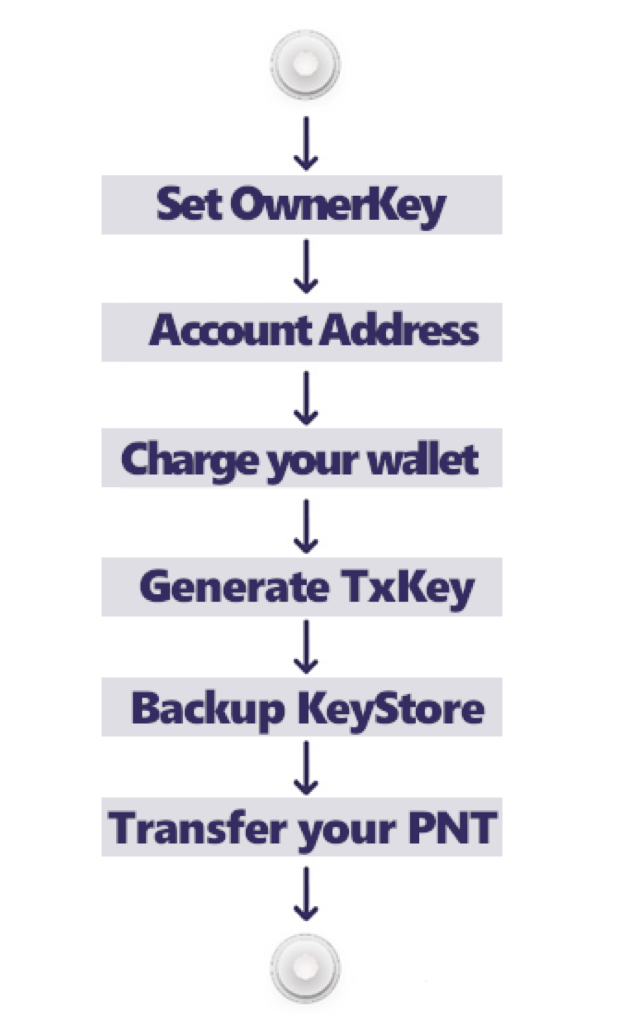 ## Account lock and unlock The Penta network architecture defines a set of node ‘rights and responsibilities’ with its governance model. Linked with the DSC consensus algorithm and the consensus management contract, the comprehensive (full and complete) Penta governance structure is set out. One ‘right’ as part of the governance model is participation of common nodes to vote for Delegates and Witness nodes; who take part in the DSC consensus. See the previous article for details on these two types of ‘actors’ in the consensus process. When common nodes vote for a Delegate or Witness candidate, or when a node nominates to become a candidate, those nodes need to ‘pledge’ in other words ‘lock’ a specified minimum number of PNT beforehand for eligibility to take part in the process. Whenever a node terminates participation in the consensus mechanism, it can unlock pledged PNT after a successful ‘exit request’ takes effect. The lock and unlock mechanisms are essential and crucial Penta account functions. Whether either a Penta User or a Penta Contract account, the lock and unlock status is recorded as part of a smart contract along with a corresponding (unique) block number. The system sets the relevant block number with reference to its governance rules. ## Conclusion This article introduces the account name, account creation process and account lock and unlock mechanism in the Penta account system. The design goals are account user-friendliness and implementation of accounts in DSC consensus and governance mechanisms. The next articles continue with outlining technical details regarding the account system. |
| json metadata | {"tags":["penta","blockchain","technology","bitcoin"],"image":["https://cdn.steemitimages.com/DQmVAR24ysK8z6ff8D8TBDwYfDbVsJ4zrMmWjpDiqxvVSpZ/image.png"],"app":"steemit/0.1","format":"markdown"} |
| Transaction Info | Block #26625037/Trx a515fd52d1e037c0945ec664548e7d0e0413d2a2 |
View Raw JSON Data
{
"trx_id": "a515fd52d1e037c0945ec664548e7d0e0413d2a2",
"block": 26625037,
"trx_in_block": 31,
"op_in_trx": 0,
"virtual_op": 0,
"timestamp": "2018-10-08T10:15:30",
"op": [
"comment",
{
"parent_author": "",
"parent_permlink": "penta",
"author": "keevey",
"permlink": "introduction-to-the-penta-account-system-v2",
"title": "Introduction to the Penta Account System V2",
"body": "## Introduction\n\nThe first article in the Penta Account Architecture (link to first article) series introduced the account structure and address scheme. This next article continues the ‘deep dive’ into Penta account creation and operations, with details of the Penta account name format, account creation process, and the account lock function.\n\n## Account Name Format\n\nMost blockchain platforms constrain end-users with little control over individual account naming. Typical account ‘names’ are a sequence of difficult to remember random characters, hardly convenient as a (digital) wallet address.\n\nPersonalized account names are one example of the Penta Network’s goal to function in as much a user-friendly fashion as possible. Account names are set according to users’ individual preferences. By default, this name is initialized as a null (empty) string. Accounts without an account name can only be accessed through their complete and permanent address.\n\nOnce customized, access to accounts are either by the custom account name if it has been set, or by permanent address. Account names are ‘singletons’. That is, they are set a single, first time and are required to be unique across the network. Name collisions are resolved on a first come first served basis, the allowed characters for the account name are numbers from 0 to 9 and lowercase letters a to z.\n\nThe length of an account name is between a minimum of 3 and a maximum of 13 characters. Plus, the length of the associated ordinary user name should be between 8 to 13 digits. User names less than 8 characters are subject to a premium fee. The general user names policy is: the shorter its length, the higher the accompanying fee. *A future article will be devoted to fee specifics and associated standards.*\n\n## Account Management Introduction\n\nThe design of the Penta account management system optimizes for the privacy and security of each key. Three private keys: *TxKey*, *ConsensusKey* and *SeedKey* are generated by the system. A fourth *OwnerKey* is used to control any account management action and will sign any account management transaction, which is then recorded on the ledger. After each management action the *OwnerKey* is regenerated and added to the ledger.\n\n*Details regarding account management will be part of a future dedicated paper.*\n\n## Account Creation Process\n\nThe specific steps for new Penta Network users to create an account are:\n\n**1) OwnerKey initialization**\n\nUsers are prompted to enter an account and security password. With these, the system then automatically creates two keys: the *OwnerKey* and an uncompressed public key (pubKey).\n\n**2) Public account address**\n\nThe system utilizes the uncompressed public key to generate an associated (corresponding) Penta public address. The process follows the Penta account address algorithm introduced in the previous article, which introduced the Penta Account Model (Link to the first article). *No account data is recorded on the permanent ledger at this point, and is only held locally in-memory.*\n\n**3) Allocate PNT for public account address storage**\n\nThe newly generated public address is then allocated PNT to process the following steps as ledger recorded transactions. Following, the account public address is formally stored on the Penta Network ecosystem and can be used to search through the Penta Explorer ledger transaction history.\n\n**4) Generate the private TxKey**\n\nA new private *TxKey* is generated to sign and validate any one transaction. The account management scheme uses an *OwnerKey* to sign this new *TxKey*. The *TxKey* is sent and synchronized on the ledger. Having been synchronized with the ledger, the *Txkey* is then available to generate and sign a new transaction PNT transfer against the account’s token balance.\n\n**5) Safety first: reset OwnerKey**\n\nThe account management process reset the *OwnerKey* after the *TxKey* generation, to add a higher level of security. Once signed and verified the *OwnerKey* will be regenerated and saved on the ledger.\n\n**6) Export the KeyStore file**\n\n*Before any further account activity, it is recommend the KeyStore file is saved and exported to external secure media.* To retrieve account access, the latest OwnerKey must be backed up.\n\nNew account creation is now complete, the public account address saved to the ledger and locally encrypted. All the necessary private keys have been generated, and the public account address can be searched on the Penta Ecosystem Explorer.\n\n\n## Account lock and unlock\n\nThe Penta network architecture defines a set of node ‘rights and responsibilities’ with its governance model. Linked with the DSC consensus algorithm and the consensus management contract, the comprehensive (full and complete) Penta governance structure is set out.\n\nOne ‘right’ as part of the governance model is participation of common nodes to vote for Delegates and Witness nodes; who take part in the DSC consensus. See the previous article for details on these two types of ‘actors’ in the consensus process.\n\nWhen common nodes vote for a Delegate or Witness candidate, or when a node nominates to become a candidate, those nodes need to ‘pledge’ in other words ‘lock’ a specified minimum number of PNT beforehand for eligibility to take part in the process. Whenever a node terminates participation in the consensus mechanism, it can unlock pledged PNT after a successful ‘exit request’ takes effect.\n\nThe lock and unlock mechanisms are essential and crucial Penta account functions. Whether either a Penta User or a Penta Contract account, the lock and unlock status is recorded as part of a smart contract along with a corresponding (unique) block number. The system sets the relevant block number with reference to its governance rules.\n\n## Conclusion\n\nThis article introduces the account name, account creation process and account lock and unlock mechanism in the Penta account system. The design goals are account user-friendliness and implementation of accounts in DSC consensus and governance mechanisms. The next articles continue with outlining technical details regarding the account system.",
"json_metadata": "{\"tags\":[\"penta\",\"blockchain\",\"technology\",\"bitcoin\"],\"image\":[\"https://cdn.steemitimages.com/DQmVAR24ysK8z6ff8D8TBDwYfDbVsJ4zrMmWjpDiqxvVSpZ/image.png\"],\"app\":\"steemit/0.1\",\"format\":\"markdown\"}"
}
]
}keeveyupvoted (100.00%) @apkdl / penta-pnt-usd0-022644-us-02-0-52018-new-coin2018/10/08 10:08:51
keeveyupvoted (100.00%) @apkdl / penta-pnt-usd0-022644-us-02-0-52018-new-coin
2018/10/08 10:08:51
| voter | keevey |
| author | apkdl |
| permlink | penta-pnt-usd0-022644-us-02-0-52018-new-coin |
| weight | 10000 (100.00%) |
| Transaction Info | Block #26624904/Trx 195a140b045a15c226bee3da9666acb40be8d8b8 |
View Raw JSON Data
{
  "trx_id": "195a140b045a15c226bee3da9666acb40be8d8b8",
  "block": 26624904,
  "trx_in_block": 9,
  "op_in_trx": 0,
  "virtual_op": 0,
  "timestamp": "2018-10-08T10:08:51",
  "op": [
    "vote",
    {
      "voter": "keevey",
      "author": "apkdl",
      "permlink": "penta-pnt-usd0-022644-us-02-0-52018-new-coin",
      "weight": 10000
    }
  ]
}2018/10/08 10:07:45
2018/10/08 10:07:45
| voter | keevey |
| author | keevey |
| permlink | re-keevey-penta-pnt-monthly-progress-report-september-1-30-2018-20181008t100733901z |
| weight | 10000 (100.00%) |
| Transaction Info | Block #26624882/Trx 3c4aea574975cdf2798dc66caeae6350777245e0 |
View Raw JSON Data
{
  "trx_id": "3c4aea574975cdf2798dc66caeae6350777245e0",
  "block": 26624882,
  "trx_in_block": 2,
  "op_in_trx": 0,
  "virtual_op": 0,
  "timestamp": "2018-10-08T10:07:45",
  "op": [
    "vote",
    {
      "voter": "keevey",
      "author": "keevey",
      "permlink": "re-keevey-penta-pnt-monthly-progress-report-september-1-30-2018-20181008t100733901z",
      "weight": 10000
    }
  ]
}2018/10/08 10:07:36
2018/10/08 10:07:36
| parent author | keevey |
| parent permlink | penta-pnt-monthly-progress-report-september-1-30-2018 |
| author | keevey |
| permlink | re-keevey-penta-pnt-monthly-progress-report-september-1-30-2018-20181008t100733901z |
| title | |
| body | The original link is: https://medium.com/penta-network/penta-pnt-monthly-progress-report-september-1-30-2018-5f529f420045 |
| json metadata | {"tags":["penta"],"links":["https://medium.com/penta-network/penta-pnt-monthly-progress-report-september-1-30-2018-5f529f420045"],"app":"steemit/0.1"} |
| Transaction Info | Block #26624879/Trx e0c8315dcaf89dee2396d7ead17f8c2e89e6ef17 |
View Raw JSON Data
{
  "trx_id": "e0c8315dcaf89dee2396d7ead17f8c2e89e6ef17",
  "block": 26624879,
  "trx_in_block": 4,
  "op_in_trx": 0,
  "virtual_op": 0,
  "timestamp": "2018-10-08T10:07:36",
  "op": [
    "comment",
    {
      "parent_author": "keevey",
      "parent_permlink": "penta-pnt-monthly-progress-report-september-1-30-2018",
      "author": "keevey",
      "permlink": "re-keevey-penta-pnt-monthly-progress-report-september-1-30-2018-20181008t100733901z",
      "title": "",
      "body": "The original link is: https://medium.com/penta-network/penta-pnt-monthly-progress-report-september-1-30-2018-5f529f420045",
      "json_metadata": "{\"tags\":[\"penta\"],\"links\":[\"https://medium.com/penta-network/penta-pnt-monthly-progress-report-september-1-30-2018-5f529f420045\"],\"app\":\"steemit/0.1\"}"
    }
  ]
}2018/10/08 10:07:24
2018/10/08 10:07:24
| parent author | keevey |
| parent permlink | penta-pnt-monthly-progress-report-september-1-30-2018 |
| author | cheetah |
| permlink | cheetah-re-keeveypenta-pnt-monthly-progress-report-september-1-30-2018 |
| title | |
| body | Hi! I am a robot. I just upvoted you! I found similar content that readers might be interested in: https://medium.com/penta-network/penta-pnt-monthly-progress-report-september-1-30-2018-5f529f420045 |
| json metadata | |
| Transaction Info | Block #26624875/Trx 8e0a215da05276f92daf5c1d403a9a298b4501d1 |
View Raw JSON Data
{
  "trx_id": "8e0a215da05276f92daf5c1d403a9a298b4501d1",
  "block": 26624875,
  "trx_in_block": 0,
  "op_in_trx": 0,
  "virtual_op": 0,
  "timestamp": "2018-10-08T10:07:24",
  "op": [
    "comment",
    {
      "parent_author": "keevey",
      "parent_permlink": "penta-pnt-monthly-progress-report-september-1-30-2018",
      "author": "cheetah",
      "permlink": "cheetah-re-keeveypenta-pnt-monthly-progress-report-september-1-30-2018",
      "title": "",
      "body": "Hi! I am a robot. I just upvoted you! I found similar content that readers might be interested in:\nhttps://medium.com/penta-network/penta-pnt-monthly-progress-report-september-1-30-2018-5f529f420045",
      "json_metadata": ""
    }
  ]
}keeveyupvoted (100.00%) @keevey / penta-pnt-monthly-progress-report-september-1-30-20182018/10/08 10:07:12
keeveyupvoted (100.00%) @keevey / penta-pnt-monthly-progress-report-september-1-30-2018
2018/10/08 10:07:12
| voter | keevey |
| author | keevey |
| permlink | penta-pnt-monthly-progress-report-september-1-30-2018 |
| weight | 10000 (100.00%) |
| Transaction Info | Block #26624871/Trx 1b80067f2b191ab73050f4920f99624888cfb8c6 |
View Raw JSON Data
{
  "trx_id": "1b80067f2b191ab73050f4920f99624888cfb8c6",
  "block": 26624871,
  "trx_in_block": 12,
  "op_in_trx": 0,
  "virtual_op": 0,
  "timestamp": "2018-10-08T10:07:12",
  "op": [
    "vote",
    {
      "voter": "keevey",
      "author": "keevey",
      "permlink": "penta-pnt-monthly-progress-report-september-1-30-2018",
      "weight": 10000
    }
  ]
}fastresteemupvoted (1.00%) @keevey / penta-pnt-monthly-progress-report-september-1-30-20182018/10/08 10:07:09
fastresteemupvoted (1.00%) @keevey / penta-pnt-monthly-progress-report-september-1-30-2018
2018/10/08 10:07:09
| voter | fastresteem |
| author | keevey |
| permlink | penta-pnt-monthly-progress-report-september-1-30-2018 |
| weight | 100 (1.00%) |
| Transaction Info | Block #26624870/Trx e42609b977a893c52d8258283d117951296561d0 |
View Raw JSON Data
{
  "trx_id": "e42609b977a893c52d8258283d117951296561d0",
  "block": 26624870,
  "trx_in_block": 3,
  "op_in_trx": 0,
  "virtual_op": 0,
  "timestamp": "2018-10-08T10:07:09",
  "op": [
    "vote",
    {
      "voter": "fastresteem",
      "author": "keevey",
      "permlink": "penta-pnt-monthly-progress-report-september-1-30-2018",
      "weight": 100
    }
  ]
}cheetahupvoted (0.08%) @keevey / penta-pnt-monthly-progress-report-september-1-30-20182018/10/08 10:07:06
cheetahupvoted (0.08%) @keevey / penta-pnt-monthly-progress-report-september-1-30-2018
2018/10/08 10:07:06
| voter | cheetah |
| author | keevey |
| permlink | penta-pnt-monthly-progress-report-september-1-30-2018 |
| weight | 8 (0.08%) |
| Transaction Info | Block #26624869/Trx e534ae78d8d09db32deb9d41e2b6568a91ef8592 |
View Raw JSON Data
{
  "trx_id": "e534ae78d8d09db32deb9d41e2b6568a91ef8592",
  "block": 26624869,
  "trx_in_block": 19,
  "op_in_trx": 0,
  "virtual_op": 0,
  "timestamp": "2018-10-08T10:07:06",
  "op": [
    "vote",
    {
      "voter": "cheetah",
      "author": "keevey",
      "permlink": "penta-pnt-monthly-progress-report-september-1-30-2018",
      "weight": 8
    }
  ]
}keeveypublished a new post: penta-pnt-monthly-progress-report-september-1-30-20182018/10/08 10:07:00
keeveypublished a new post: penta-pnt-monthly-progress-report-september-1-30-2018
2018/10/08 10:07:00
| parent author | |
| parent permlink | penta |
| author | keevey |
| permlink | penta-pnt-monthly-progress-report-september-1-30-2018 |
| title | Penta(PNT)Monthly Progress Report: September 1–30, 2018 |
| body |  ## 【Technology Development】 ### Penta Chain 1. Complete the integration and debug of the wallet components, API components, consensus components, and consensus governance contract components; 2. The development of the RPC API test cases related auto-execution program is completed; 3. Complete the adjustment of the system contract code according to the new stateDB API; 4. The DSC consensus process has been developed using an independent P2P broadcast network channel, and the initial test is working; 5. The development of the incentive code is completed; 6. Basic code review, the current progress is 20%. ### PC wallet component and graphical interface The development of the PC wallet graphical interface component is proceeding as planned. This month’s main task is to link the interface of the wallet graphical interface with self-testing; the current overall progress is 80%: 1. The voting, proposal and transfer module interface docking is completed in the wallet graphical interface; 2. The account import and account export module of wallet graphical interface in RPC mode are docking, overall progress is 90%; 3. The wallet graphical interface in IPC mode is under testing with a progress of 50%; 4. Start the development of penta-js-sdk in WebSocket mode. ### Penta blockchain explorer This month, the blockchain explorer has been completed according to the plan. The current overall progress is 97%: 1. Complete the Java version development and testing of penta_sdk 2. Complete blockchain explorer development and testing 3. Complete the main chain RPC, WEBSOCKET interface joint test 4. Start page display information tuning 5. Start verification of blockchain process information 6. Start verification of the security and robustness of the system ## 【Ecosystem Layout】 September 6, 2018 (Virginia): Penta CEO David Ritter was invited to meet with the USA Rice Federation in their Arlington, VA office, and discussed how Penta can use the application of blockchain technology for the rice supply chain in the U.S. September 6, 2018 (New York City): Penta had a New York Community Rooftop Party to promote Penta Labs. Penta CEO, David Ritter, and Penta Labs founder, Roy Liu, attended the party and met with the new Penta New York Community Ambassador. David and Roy were happy to join in substantive discussions regarding blockchain technology, and U.S. regulatory policy in the crypto markets. ## 【Activities Review】 September 7, 2018 (Paris): Penta Business Development Director, Florie Zheng, was invited attended the OECD Blockchain Policy Forum in Paris, France, where she was honored to speak with world leaders at the event including Prime Minister of Serbia, leaders from the World Bank and French Treasury, and the Secretary of the OECD. September 14, 2018 (Seoul): Penta CEO David Ritter was invited to attend the 2nd Huobi Chain Developers and Engineers Meetup, held in the Gangnam district of Seoul, South Korea. He represented the Steve M team, including Penta Co-Founder Dr. Steve Melnikoff and other leaders in blockchain. David was voted the top presentation of the Huobi Chain conference by live audience voting. September 20, 2018 (Los Angeles, California): Penta signed a strategic partnership agreement with famed Hollywood company, Union Editorial. Union has for decades been a major force in editing commercials and feature length films, including Emmy winning commercials. With this agreement, Union has joined the Penta Enterprise Community, through which vehicle Penta will extend its blockchain expertise and products to a number of targeted industries. Penta CEO, David Ritter, joined Penta Ambassador, Alan Finkel at the signing. David said “We are honored to enter into this partnership today, and to work with Union Editorial to develop and launch an innovative blockchain product that I am highly confident will disrupt an important part of the filmmaking business.” September 27, 2018(Hainan, China): Dr. Steve Melnikoff attended the Huobi Chain competition finale in Haikou, Hainan. Going into the competition, Dr. Steve was part of the top ranked team. The event was attended by some of the biggest names in blockchain. Dr. Steve met with Huobi founder, Li Lin, Huobi China CEO, Hubery Yuan, the investor and blockchain advocate Jeffrey Wernick, among others. Dr. Steve was warmly received by the audience when he took the stage at the event. September 28, 2018(EST), Penta CEO David Ritter and Penta Business Development Director, Florie Zheng, were invited to the United Nations in New York to attend panel hosted by the Mission of Georgia on “Blockchain as an Innovative Financing Mechanism.” The dialogue was co-hosted by the Mission of France, and attended by representatives of the Japanese, South Korean, Lichtenstein, and other U.N. missions. Penta’s recent invitations to the U.N. and OECD demonstrate that Penta is active on some of the world’s the highest international stages, receiving recognition by important geopolitical bodies. ## 【Community Building】 ### 1. Community Activities 【Live broadcast】 This month, Penta CEO David Ritter conducted two live broadcasts with Chinese community fans on the streaming platform Yi Zhibo (ID: 132642867). The broadcasts focused on Penta’s monthly progress report for August, 2018, and a biweekly biweekly progress report on the evening of September 17, attracting 300,000 views. David’s regular broadcasts follow his commitment to bring regular updates to the Penta community. He will continue with the September monthly progress report with a YouTube video in English and a live broadcast to Penta’s Chinese community on Sunday, September 30. Please be sure to check Penta’s official YouTube channel and/or Yi Zhibo to get the latest updates on the Penta Network! 【Chinese Telegram group】 This month, Penta’s Chinese community hosted two events: 1) Penta Trivia, Repost Competition, and Lucky Draw for Prizes; and 2) The second phase of “Penta’s community task project”, which attracted positive responses from nearly 5,000 fans. 【Wechat Group】 This month, Penta’s Chinese community held a two-day airdrop to celebrate Penta’s move to the global station of Huobi, covering 2,000 people. During the traditional Chinese Mid-Autumn festival, Penta Chinese community also launched the game called “winning the Mid-Autumn festival gift package” to celebrate reunion, attracting more than 1,000 people to participate. 【English Telegram Group】 This month, Penta global community launched the event: “UP UP UP! Share million PNT and support Penta on Huobi Global.”More than 200 people participated. 【Extra】 This month Penta registered a new official Facebook page (Go Penta), and its first official Instagram (penta_global). Please follow us on these platforms! ### 2. Community Growth (1) Wechat Public group added 483 people Sina Weibo added 119 people Twitter added 271 people Facebook added 92 people Medium added 68 people Reddit added 133 people Instagram added 50 people (2) Penta’s global community: 26,660 active fans. Penta’s Chinese community: Penta’s Chinese Telegram group currently has 4,504 fans. Penta’s community includes 118 wechat group with 50,233 active fans. |
| json metadata | {"tags":["penta","blockchain","technology","report"],"image":["https://cdn.steemitimages.com/DQmTaySytjHG1yiS682iuAfRGZfMdg1yiXiyN5EwxzX5bxQ/image.png"],"app":"steemit/0.1","format":"markdown"} |
| Transaction Info | Block #26624867/Trx 961208f014fe85482c4e58455d82054e96144ba6 |
View Raw JSON Data
{
"trx_id": "961208f014fe85482c4e58455d82054e96144ba6",
"block": 26624867,
"trx_in_block": 4,
"op_in_trx": 0,
"virtual_op": 0,
"timestamp": "2018-10-08T10:07:00",
"op": [
"comment",
{
"parent_author": "",
"parent_permlink": "penta",
"author": "keevey",
"permlink": "penta-pnt-monthly-progress-report-september-1-30-2018",
"title": "Penta(PNT)Monthly Progress Report: September 1–30, 2018",
"body": "\n\n## 【Technology Development】\n\n### Penta Chain\n\n1. Complete the integration and debug of the wallet components, API components, consensus components, and consensus governance contract components;\n2. The development of the RPC API test cases related auto-execution program is completed;\n3. Complete the adjustment of the system contract code according to the new stateDB API;\n4. The DSC consensus process has been developed using an independent P2P broadcast network channel, and the initial test is working;\n5. The development of the incentive code is completed;\n6. Basic code review, the current progress is 20%.\n\n### PC wallet component and graphical interface\nThe development of the PC wallet graphical interface component is proceeding as planned. This month’s main task is to link the interface of the wallet graphical interface with self-testing; the current overall progress is 80%:\n\n1. The voting, proposal and transfer module interface docking is completed in the wallet graphical interface;\n2. The account import and account export module of wallet graphical interface in RPC mode are docking, overall progress is 90%;\n3. The wallet graphical interface in IPC mode is under testing with a progress of 50%;\n4. Start the development of penta-js-sdk in WebSocket mode.\n\n### Penta blockchain explorer\nThis month, the blockchain explorer has been completed according to the plan. The current overall progress is 97%:\n 1. Complete the Java version development and testing of penta_sdk\n 2. Complete blockchain explorer development and testing\n 3. Complete the main chain RPC, WEBSOCKET interface joint test\n 4. Start page display information tuning\n 5. Start verification of blockchain process information\n6. Start verification of the security and robustness of the system\n\n\n## 【Ecosystem Layout】\n\nSeptember 6, 2018 (Virginia): Penta CEO David Ritter was invited to meet with the USA Rice Federation in their Arlington, VA office, and discussed how Penta can use the application of blockchain technology for the rice supply chain in the U.S.\n\nSeptember 6, 2018 (New York City): Penta had a New York Community Rooftop Party to promote Penta Labs. Penta CEO, David Ritter, and Penta Labs founder, Roy Liu, attended the party and met with the new Penta New York Community Ambassador. David and Roy were happy to join in substantive discussions regarding blockchain technology, and U.S. regulatory policy in the crypto markets.\n\n## 【Activities Review】\n\nSeptember 7, 2018 (Paris): Penta Business Development Director, Florie Zheng, was invited attended the OECD Blockchain Policy Forum in Paris, France, where she was honored to speak with world leaders at the event including Prime Minister of Serbia, leaders from the World Bank and French Treasury, and the Secretary of the OECD.\n\nSeptember 14, 2018 (Seoul): Penta CEO David Ritter was invited to attend the 2nd Huobi Chain Developers and Engineers Meetup, held in the Gangnam district of Seoul, South Korea. He represented the Steve M team, including Penta Co-Founder Dr. Steve Melnikoff and other leaders in blockchain. David was voted the top presentation of the Huobi Chain conference by live audience voting.\n\nSeptember 20, 2018 (Los Angeles, California): Penta signed a strategic partnership agreement with famed Hollywood company, Union Editorial. Union has for decades been a major force in editing commercials and feature length films, including Emmy winning commercials. With this agreement, Union has joined the Penta Enterprise Community, through which vehicle Penta will extend its blockchain expertise and products to a number of targeted industries. Penta CEO, David Ritter, joined Penta Ambassador, Alan Finkel at the signing. David said “We are honored to enter into this partnership today, and to work with Union Editorial to develop and launch an innovative blockchain product that I am highly confident will disrupt an important part of the filmmaking business.”\n\nSeptember 27, 2018(Hainan, China): Dr. Steve Melnikoff attended the Huobi Chain competition finale in Haikou, Hainan. Going into the competition, Dr. Steve was part of the top ranked team. The event was attended by some of the biggest names in blockchain. Dr. Steve met with Huobi founder, Li Lin, Huobi China CEO, Hubery Yuan, the investor and blockchain advocate Jeffrey Wernick, among others. Dr. Steve was warmly received by the audience when he took the stage at the event.\n\nSeptember 28, 2018(EST), Penta CEO David Ritter and Penta Business Development Director, Florie Zheng, were invited to the United Nations in New York to attend panel hosted by the Mission of Georgia on “Blockchain as an Innovative Financing Mechanism.” The dialogue was co-hosted by the Mission of France, and attended by representatives of the Japanese, South Korean, Lichtenstein, and other U.N. missions. Penta’s recent invitations to the U.N. and OECD demonstrate that Penta is active on some of the world’s the highest international stages, receiving recognition by important geopolitical bodies.\n\n## 【Community Building】\n\n### 1. Community Activities\n\n【Live broadcast】\n\nThis month, Penta CEO David Ritter conducted two live broadcasts with Chinese community fans on the streaming platform Yi Zhibo (ID: 132642867). The broadcasts focused on Penta’s monthly progress report for August, 2018, and a biweekly biweekly progress report on the evening of September 17, attracting 300,000 views. David’s regular broadcasts follow his commitment to bring regular updates to the Penta community. He will continue with the September monthly progress report with a YouTube video in English and a live broadcast to Penta’s Chinese community on Sunday, September 30. Please be sure to check Penta’s official YouTube channel and/or Yi Zhibo to get the latest updates on the Penta Network!\n\n【Chinese Telegram group】\n\nThis month, Penta’s Chinese community hosted two events: 1) Penta Trivia, Repost Competition, and Lucky Draw for Prizes; and 2) The second phase of “Penta’s community task project”, which attracted positive responses from nearly 5,000 fans.\n\n【Wechat Group】\n\nThis month, Penta’s Chinese community held a two-day airdrop to celebrate Penta’s move to the global station of Huobi, covering 2,000 people. During the traditional Chinese Mid-Autumn festival, Penta Chinese community also launched the game called “winning the Mid-Autumn festival gift package” to celebrate reunion, attracting more than 1,000 people to participate.\n\n【English Telegram Group】\n\nThis month, Penta global community launched the event: “UP UP UP! Share million PNT and support Penta on Huobi Global.”More than 200 people participated.\n\n【Extra】\n\nThis month Penta registered a new official Facebook page (Go Penta), and its first official Instagram (penta_global). Please follow us on these platforms!\n\n### 2. Community Growth\n\n(1)\n\nWechat Public group added 483 people\n\nSina Weibo added 119 people\n\nTwitter added 271 people\n\nFacebook added 92 people\n\nMedium added 68 people\n\nReddit added 133 people\n\nInstagram added 50 people\n\n(2)\n\nPenta’s global community: 26,660 active fans.\n\nPenta’s Chinese community:\n\nPenta’s Chinese Telegram group currently has 4,504 fans.\n\nPenta’s community includes 118 wechat group with 50,233 active fans.",
"json_metadata": "{\"tags\":[\"penta\",\"blockchain\",\"technology\",\"report\"],\"image\":[\"https://cdn.steemitimages.com/DQmTaySytjHG1yiS682iuAfRGZfMdg1yiXiyN5EwxzX5bxQ/image.png\"],\"app\":\"steemit/0.1\",\"format\":\"markdown\"}"
}
]
}davidfnckupvoted (30.00%) @keevey / introduction-to-penta-dlos-multi-consensus-framework-component2018/10/08 10:03:00
davidfnckupvoted (30.00%) @keevey / introduction-to-penta-dlos-multi-consensus-framework-component
2018/10/08 10:03:00
| voter | davidfnck |
| author | keevey |
| permlink | introduction-to-penta-dlos-multi-consensus-framework-component |
| weight | 3000 (30.00%) |
| Transaction Info | Block #26624787/Trx 2d65751e83c2899066d2d32980ffdc7424e9f8d7 |
View Raw JSON Data
{
  "trx_id": "2d65751e83c2899066d2d32980ffdc7424e9f8d7",
  "block": 26624787,
  "trx_in_block": 8,
  "op_in_trx": 0,
  "virtual_op": 0,
  "timestamp": "2018-10-08T10:03:00",
  "op": [
    "vote",
    {
      "voter": "davidfnck",
      "author": "keevey",
      "permlink": "introduction-to-penta-dlos-multi-consensus-framework-component",
      "weight": 3000
    }
  ]
}keeveyupvoted (100.00%) @ytrphoto / yotaro-s-food-photo-gallery-vol-72018/10/08 10:01:42
keeveyupvoted (100.00%) @ytrphoto / yotaro-s-food-photo-gallery-vol-7
2018/10/08 10:01:42
| voter | keevey |
| author | ytrphoto |
| permlink | yotaro-s-food-photo-gallery-vol-7 |
| weight | 10000 (100.00%) |
| Transaction Info | Block #26624761/Trx 81c02b1e8c16dd4ac3368c9ee8e4e935646a6f60 |
View Raw JSON Data
{
  "trx_id": "81c02b1e8c16dd4ac3368c9ee8e4e935646a6f60",
  "block": 26624761,
  "trx_in_block": 26,
  "op_in_trx": 0,
  "virtual_op": 0,
  "timestamp": "2018-10-08T10:01:42",
  "op": [
    "vote",
    {
      "voter": "keevey",
      "author": "ytrphoto",
      "permlink": "yotaro-s-food-photo-gallery-vol-7",
      "weight": 10000
    }
  ]
}keeveyupvoted (100.00%) @mdshahin786 / community-support-project-of-steemtuner2018/10/08 10:01:27
keeveyupvoted (100.00%) @mdshahin786 / community-support-project-of-steemtuner
2018/10/08 10:01:27
| voter | keevey |
| author | mdshahin786 |
| permlink | community-support-project-of-steemtuner |
| weight | 10000 (100.00%) |
| Transaction Info | Block #26624756/Trx 33c07b33ae225b413191151c0a4041f0f1bb3391 |
View Raw JSON Data
{
  "trx_id": "33c07b33ae225b413191151c0a4041f0f1bb3391",
  "block": 26624756,
  "trx_in_block": 8,
  "op_in_trx": 0,
  "virtual_op": 0,
  "timestamp": "2018-10-08T10:01:27",
  "op": [
    "vote",
    {
      "voter": "keevey",
      "author": "mdshahin786",
      "permlink": "community-support-project-of-steemtuner",
      "weight": 10000
    }
  ]
}keeveyupvoted (100.00%) @prime-cleric / holy-sanctuary-nibiru-mt-zion2018/10/08 10:01:24
keeveyupvoted (100.00%) @prime-cleric / holy-sanctuary-nibiru-mt-zion
2018/10/08 10:01:24
| voter | keevey |
| author | prime-cleric |
| permlink | holy-sanctuary-nibiru-mt-zion |
| weight | 10000 (100.00%) |
| Transaction Info | Block #26624755/Trx 362cc8cc62218723795cc03037238095a82abe64 |
View Raw JSON Data
{
  "trx_id": "362cc8cc62218723795cc03037238095a82abe64",
  "block": 26624755,
  "trx_in_block": 18,
  "op_in_trx": 0,
  "virtual_op": 0,
  "timestamp": "2018-10-08T10:01:24",
  "op": [
    "vote",
    {
      "voter": "keevey",
      "author": "prime-cleric",
      "permlink": "holy-sanctuary-nibiru-mt-zion",
      "weight": 10000
    }
  ]
}2018/10/08 10:01:15
2018/10/08 10:01:15
| voter | keevey |
| author | dahaz159 |
| permlink | testnet-release-or-updated-website-and-video-or-weyoume-state-of-the-network-or-oct-7th |
| weight | 10000 (100.00%) |
| Transaction Info | Block #26624752/Trx db9783c25b1f8be67f462503d80cddb0780d9f7d |
View Raw JSON Data
{
  "trx_id": "db9783c25b1f8be67f462503d80cddb0780d9f7d",
  "block": 26624752,
  "trx_in_block": 17,
  "op_in_trx": 0,
  "virtual_op": 0,
  "timestamp": "2018-10-08T10:01:15",
  "op": [
    "vote",
    {
      "voter": "keevey",
      "author": "dahaz159",
      "permlink": "testnet-release-or-updated-website-and-video-or-weyoume-state-of-the-network-or-oct-7th",
      "weight": 10000
    }
  ]
}keeveyupvoted (100.00%) @benadapt / 25-uses-for-duct-tape-on-your-next-camping-trip2018/10/08 10:01:12
keeveyupvoted (100.00%) @benadapt / 25-uses-for-duct-tape-on-your-next-camping-trip
2018/10/08 10:01:12
| voter | keevey |
| author | benadapt |
| permlink | 25-uses-for-duct-tape-on-your-next-camping-trip |
| weight | 10000 (100.00%) |
| Transaction Info | Block #26624751/Trx 7a6458d5091bd024cca5e7944e12b4a98d2bbc0f |
View Raw JSON Data
{
  "trx_id": "7a6458d5091bd024cca5e7944e12b4a98d2bbc0f",
  "block": 26624751,
  "trx_in_block": 18,
  "op_in_trx": 0,
  "virtual_op": 0,
  "timestamp": "2018-10-08T10:01:12",
  "op": [
    "vote",
    {
      "voter": "keevey",
      "author": "benadapt",
      "permlink": "25-uses-for-duct-tape-on-your-next-camping-trip",
      "weight": 10000
    }
  ]
}2018/10/08 10:01:03
2018/10/08 10:01:03
| voter | keevey |
| author | steemhunt |
| permlink | steemhunt-witness-focus-on-company-wide-steem-value-stream-and-scalable-dapp-experiences |
| weight | 10000 (100.00%) |
| Transaction Info | Block #26624748/Trx 1468c395dcb1b93402f2ed347e23044e5d035ec1 |
View Raw JSON Data
{
  "trx_id": "1468c395dcb1b93402f2ed347e23044e5d035ec1",
  "block": 26624748,
  "trx_in_block": 2,
  "op_in_trx": 0,
  "virtual_op": 0,
  "timestamp": "2018-10-08T10:01:03",
  "op": [
    "vote",
    {
      "voter": "keevey",
      "author": "steemhunt",
      "permlink": "steemhunt-witness-focus-on-company-wide-steem-value-stream-and-scalable-dapp-experiences",
      "weight": 10000
    }
  ]
}keeveyupdated their account properties2018/10/08 10:00:00
keeveyupdated their account properties
2018/10/08 10:00:00
| account | keevey |
| memo key | STM61ixM125vLYvU1QCq8R7mwNsKNLq24CmeY6WLGNErX9QjarhMb |
| json metadata | {"profile":{"cover_image":"https://cdn.steemitimages.com/DQmWmUNDhBXBePkrXpKoUPCACuSZNs2UXZ12VhmP2dBsLWt/banner2.jpg","profile_image":"https://cdn.steemitimages.com/DQmSnp1FhYpQRhpJbVayqAo61ncYFL6pX56eq3zzgUGJJkE/penta.jpg"}} |
| Transaction Info | Block #26624727/Trx 2c3c370bf5602607b31b57335662fdfdb240ef7f |
View Raw JSON Data
{
  "trx_id": "2c3c370bf5602607b31b57335662fdfdb240ef7f",
  "block": 26624727,
  "trx_in_block": 11,
  "op_in_trx": 0,
  "virtual_op": 0,
  "timestamp": "2018-10-08T10:00:00",
  "op": [
    "account_update",
    {
      "account": "keevey",
      "memo_key": "STM61ixM125vLYvU1QCq8R7mwNsKNLq24CmeY6WLGNErX9QjarhMb",
      "json_metadata": "{\"profile\":{\"cover_image\":\"https://cdn.steemitimages.com/DQmWmUNDhBXBePkrXpKoUPCACuSZNs2UXZ12VhmP2dBsLWt/banner2.jpg\",\"profile_image\":\"https://cdn.steemitimages.com/DQmSnp1FhYpQRhpJbVayqAo61ncYFL6pX56eq3zzgUGJJkE/penta.jpg\"}}"
    }
  ]
}2018/10/08 09:59:12
2018/10/08 09:59:12
| parent author | keevey |
| parent permlink | introduction-to-penta-dlos-multi-consensus-framework-component |
| author | keevey |
| permlink | re-keevey-introduction-to-penta-dlos-multi-consensus-framework-component-20181008t095909082z |
| title | |
| body | That's the original link: https://medium.com/penta-network/introduction-to-penta-dlos-multi-consensus-framework-component-a89b36bc8de3 |
| json metadata | {"tags":["penta"],"links":["https://medium.com/penta-network/introduction-to-penta-dlos-multi-consensus-framework-component-a89b36bc8de3"],"app":"steemit/0.1"} |
| Transaction Info | Block #26624711/Trx fb3daac3c93e6ee744465a8080d910614175ddf0 |
View Raw JSON Data
{
  "trx_id": "fb3daac3c93e6ee744465a8080d910614175ddf0",
  "block": 26624711,
  "trx_in_block": 3,
  "op_in_trx": 0,
  "virtual_op": 0,
  "timestamp": "2018-10-08T09:59:12",
  "op": [
    "comment",
    {
      "parent_author": "keevey",
      "parent_permlink": "introduction-to-penta-dlos-multi-consensus-framework-component",
      "author": "keevey",
      "permlink": "re-keevey-introduction-to-penta-dlos-multi-consensus-framework-component-20181008t095909082z",
      "title": "",
      "body": "That's the original link: https://medium.com/penta-network/introduction-to-penta-dlos-multi-consensus-framework-component-a89b36bc8de3",
      "json_metadata": "{\"tags\":[\"penta\"],\"links\":[\"https://medium.com/penta-network/introduction-to-penta-dlos-multi-consensus-framework-component-a89b36bc8de3\"],\"app\":\"steemit/0.1\"}"
    }
  ]
}2018/10/08 09:58:33
2018/10/08 09:58:33
| parent author | cheetah |
| parent permlink | cheetah-re-keeveyreflections-after-the-fomo3d-game-was-broken |
| author | keevey |
| permlink | re-cheetah-cheetah-re-keeveyreflections-after-the-fomo3d-game-was-broken-20181008t095829038z |
| title | |
| body | Yes, that's the original link |
| json metadata | {"tags":["penta"],"app":"steemit/0.1"} |
| Transaction Info | Block #26624698/Trx 23812912811b5c5bb4b3c9a41bb5f37c03ef18db |
View Raw JSON Data
{
  "trx_id": "23812912811b5c5bb4b3c9a41bb5f37c03ef18db",
  "block": 26624698,
  "trx_in_block": 0,
  "op_in_trx": 0,
  "virtual_op": 0,
  "timestamp": "2018-10-08T09:58:33",
  "op": [
    "comment",
    {
      "parent_author": "cheetah",
      "parent_permlink": "cheetah-re-keeveyreflections-after-the-fomo3d-game-was-broken",
      "author": "keevey",
      "permlink": "re-cheetah-cheetah-re-keeveyreflections-after-the-fomo3d-game-was-broken-20181008t095829038z",
      "title": "",
      "body": "Yes, that's the original link",
      "json_metadata": "{\"tags\":[\"penta\"],\"app\":\"steemit/0.1\"}"
    }
  ]
}keeveyupvoted (100.00%) @keevey / reflections-after-the-fomo3d-game-was-broken2018/10/08 09:58:00
keeveyupvoted (100.00%) @keevey / reflections-after-the-fomo3d-game-was-broken
2018/10/08 09:58:00
| voter | keevey |
| author | keevey |
| permlink | reflections-after-the-fomo3d-game-was-broken |
| weight | 10000 (100.00%) |
| Transaction Info | Block #26624687/Trx 6d5d01d8696671ae2156912e1aac9c768a5b7dbd |
View Raw JSON Data
{
  "trx_id": "6d5d01d8696671ae2156912e1aac9c768a5b7dbd",
  "block": 26624687,
  "trx_in_block": 9,
  "op_in_trx": 0,
  "virtual_op": 0,
  "timestamp": "2018-10-08T09:58:00",
  "op": [
    "vote",
    {
      "voter": "keevey",
      "author": "keevey",
      "permlink": "reflections-after-the-fomo3d-game-was-broken",
      "weight": 10000
    }
  ]
}keeveyupdated their account properties2018/10/08 09:56:18
keeveyupdated their account properties
2018/10/08 09:56:18
| account | keevey |
| memo key | STM61ixM125vLYvU1QCq8R7mwNsKNLq24CmeY6WLGNErX9QjarhMb |
| json metadata | {"profile":{"cover_image":"https://cdn.steemitimages.com/DQmbiL6XMoefdEtAwJSwEnyPf4NSmSfaQvPNKWEvywiFbBA/banner.jpg","profile_image":"https://cdn.steemitimages.com/DQmSnp1FhYpQRhpJbVayqAo61ncYFL6pX56eq3zzgUGJJkE/penta.jpg"}} |
| Transaction Info | Block #26624653/Trx 23961ce99b5e1378a291d3f7c529778b39b54b58 |
View Raw JSON Data
{
  "trx_id": "23961ce99b5e1378a291d3f7c529778b39b54b58",
  "block": 26624653,
  "trx_in_block": 18,
  "op_in_trx": 0,
  "virtual_op": 0,
  "timestamp": "2018-10-08T09:56:18",
  "op": [
    "account_update",
    {
      "account": "keevey",
      "memo_key": "STM61ixM125vLYvU1QCq8R7mwNsKNLq24CmeY6WLGNErX9QjarhMb",
      "json_metadata": "{\"profile\":{\"cover_image\":\"https://cdn.steemitimages.com/DQmbiL6XMoefdEtAwJSwEnyPf4NSmSfaQvPNKWEvywiFbBA/banner.jpg\",\"profile_image\":\"https://cdn.steemitimages.com/DQmSnp1FhYpQRhpJbVayqAo61ncYFL6pX56eq3zzgUGJJkE/penta.jpg\"}}"
    }
  ]
}2018/10/08 09:55:18
2018/10/08 09:55:18
| parent author | keevey |
| parent permlink | reflections-after-the-fomo3d-game-was-broken |
| author | cheetah |
| permlink | cheetah-re-keeveyreflections-after-the-fomo3d-game-was-broken |
| title | |
| body | Hi! I am a robot. I just upvoted you! I found similar content that readers might be interested in: https://medium.com/penta-network/reflections-after-the-fomo3d-game-was-broken-34f71d1f9469 |
| json metadata | |
| Transaction Info | Block #26624633/Trx c0c3bacae2b03daa861967a38c52b17214807878 |
View Raw JSON Data
{
  "trx_id": "c0c3bacae2b03daa861967a38c52b17214807878",
  "block": 26624633,
  "trx_in_block": 1,
  "op_in_trx": 0,
  "virtual_op": 0,
  "timestamp": "2018-10-08T09:55:18",
  "op": [
    "comment",
    {
      "parent_author": "keevey",
      "parent_permlink": "reflections-after-the-fomo3d-game-was-broken",
      "author": "cheetah",
      "permlink": "cheetah-re-keeveyreflections-after-the-fomo3d-game-was-broken",
      "title": "",
      "body": "Hi! I am a robot. I just upvoted you! I found similar content that readers might be interested in:\nhttps://medium.com/penta-network/reflections-after-the-fomo3d-game-was-broken-34f71d1f9469",
      "json_metadata": ""
    }
  ]
}alphabotupvoted (1.00%) @keevey / reflections-after-the-fomo3d-game-was-broken2018/10/08 09:55:15
alphabotupvoted (1.00%) @keevey / reflections-after-the-fomo3d-game-was-broken
2018/10/08 09:55:15
| voter | alphabot |
| author | keevey |
| permlink | reflections-after-the-fomo3d-game-was-broken |
| weight | 100 (1.00%) |
| Transaction Info | Block #26624632/Trx b80399ef1c8c04fbff1f85b864ffddf23175dec8 |
View Raw JSON Data
{
  "trx_id": "b80399ef1c8c04fbff1f85b864ffddf23175dec8",
  "block": 26624632,
  "trx_in_block": 2,
  "op_in_trx": 0,
  "virtual_op": 0,
  "timestamp": "2018-10-08T09:55:15",
  "op": [
    "vote",
    {
      "voter": "alphabot",
      "author": "keevey",
      "permlink": "reflections-after-the-fomo3d-game-was-broken",
      "weight": 100
    }
  ]
}cheetahupvoted (0.08%) @keevey / reflections-after-the-fomo3d-game-was-broken2018/10/08 09:55:12
cheetahupvoted (0.08%) @keevey / reflections-after-the-fomo3d-game-was-broken
2018/10/08 09:55:12
| voter | cheetah |
| author | keevey |
| permlink | reflections-after-the-fomo3d-game-was-broken |
| weight | 8 (0.08%) |
| Transaction Info | Block #26624631/Trx 018321b8259616ed60257e45642aef5020d22a6c |
View Raw JSON Data
{
  "trx_id": "018321b8259616ed60257e45642aef5020d22a6c",
  "block": 26624631,
  "trx_in_block": 24,
  "op_in_trx": 0,
  "virtual_op": 0,
  "timestamp": "2018-10-08T09:55:12",
  "op": [
    "vote",
    {
      "voter": "cheetah",
      "author": "keevey",
      "permlink": "reflections-after-the-fomo3d-game-was-broken",
      "weight": 8
    }
  ]
}keeveypublished a new post: reflections-after-the-fomo3d-game-was-broken2018/10/08 09:55:06
keeveypublished a new post: reflections-after-the-fomo3d-game-was-broken
2018/10/08 09:55:06
| parent author | |
| parent permlink | penta |
| author | keevey |
| permlink | reflections-after-the-fomo3d-game-was-broken |
| title | Reflections After the Fomo3D Game Was Broken |
| body | ## Introduction The first round of Fomo3D, a well-received and ‘never-ending exit scam’ game launched on the Ethereum platform ended August 22nd. It was a surprise for many people. The last prize was won by address 0xa169, and the total purse reached 10,469 Ethereum. Exitscam.me describes Fomo3D as ‘a psychological social experiment in greed’. They outlined the rules as: * Instead of tokens, players purchase keys to the ICO funds held on the contract * Being the last player to buy keys lets you exit scam the game and drain the ICO funds for yourself when time runs out. * Keys provide you passive ETH income the longer and higher the round runs. Even locking you an ever-increasing personal portion of the ending exit scam! * Every key purchased extends the round time upwards towards a hard cap. To always keep the exit scam within reach of **any** player * There is no limit to how many times a round can be extended. * Clever players can recruit others, bet early on how high a round might go, or collect **mini exit-pot** airdrops at any point in the round. * You won’t walk away empty handed when it ends… **if you let it end** 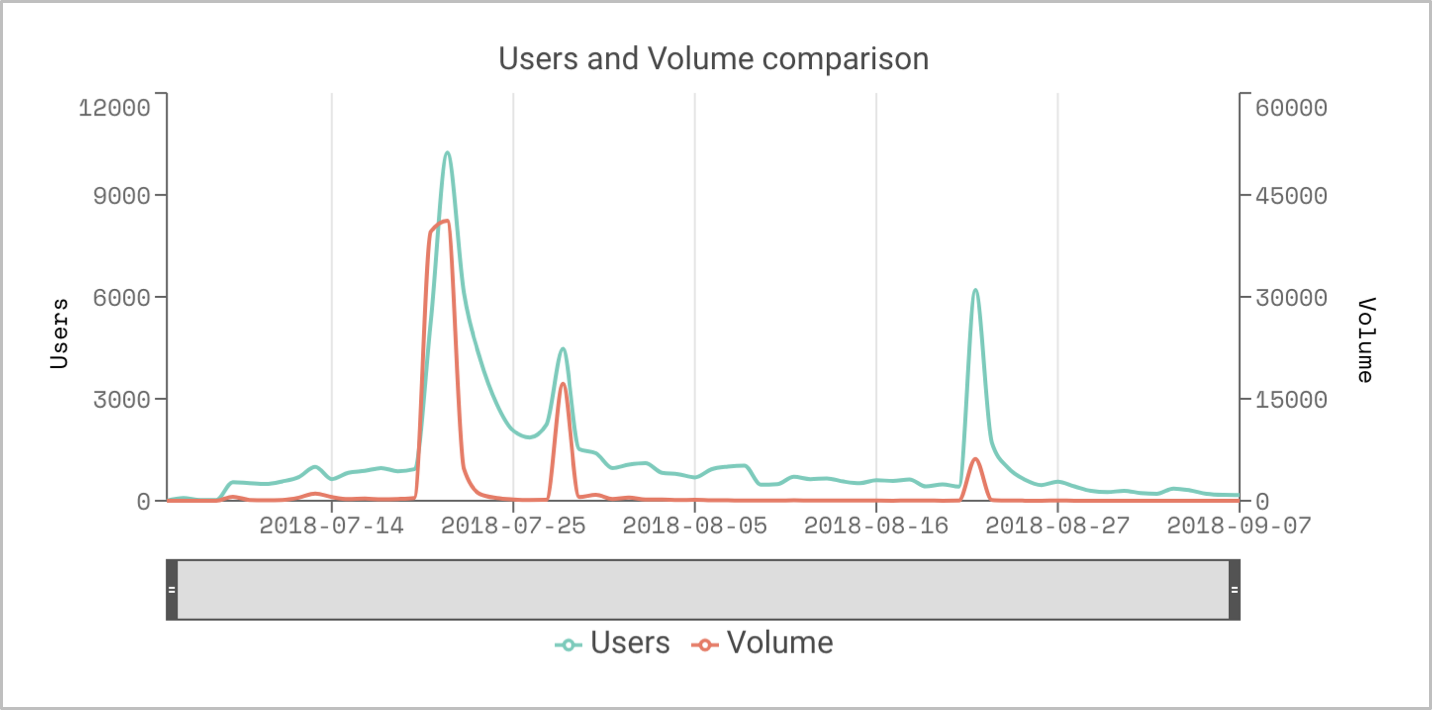 Was the final winner a lucky player? As will be detailed in the following, obviously not. The terminating outcome resulted from a well-designed and thoroughly tested (malicious) exploit using Ethereum’s limited scalability capacity. The grand prize winner skillfully manipulated this technical weakness of Ethereum with a unique attack strategy that caused the number of transactions packed into a specific set of blocks to be reduced. Although in theory the strategy was not guaranteed 100% success, but it does ‘bias’ the game towards much greater probability of improving your ‘luck.’ ## Exploit / Attack Chronology Let’s review the progress of the exploit: 1. At block height **6191896**, the attack key **0xa169** is added to the block. 2. From block heights **6191897** to **6191902**, the attacker begins to use a special smart contract to fill each block and set the gasPrice to an average of around 20G wei. One must admire the patience of hackers who passively monitor the transactions in the network. As a result, no one else was able to participate in Fomo3D in the next six blocks. 3. Starting from block height **6191903**, the attacker suddenly increased the gas price of the contract transaction to 190 GWei, well above the average level. The subsequent transaction set a super high gas price of 500 GWei and the real attack started. Until block height **6191908**, each of the six blocks contained less than 10 transactions, and the available gas was completely occupied by these invalid transactions consuming a high gas. The Ethereum network was now blocked. 4. At block height **6191909**, the attack is over, and the network status is back to normal. 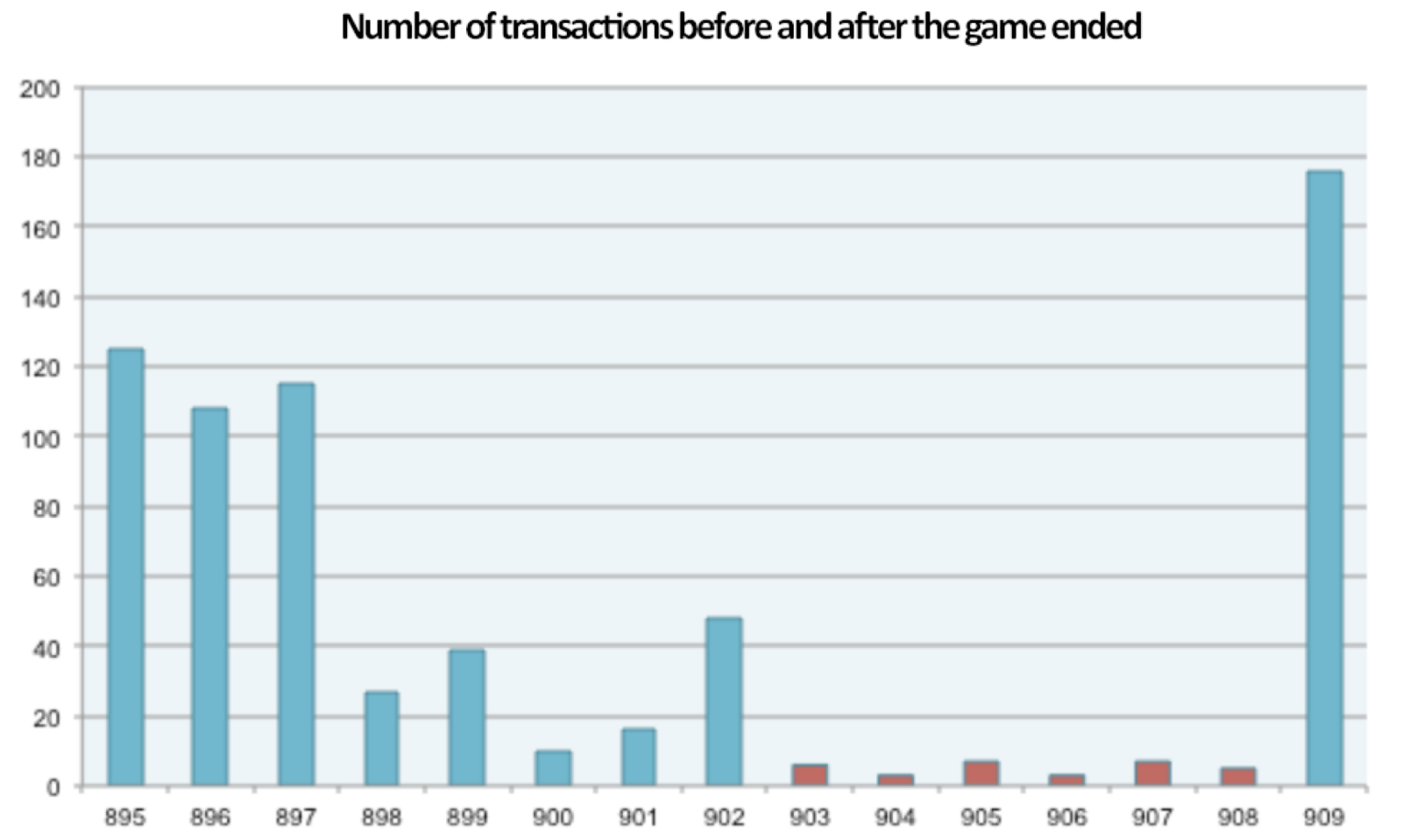 *red blocks are the one been part of the malicious exploit regarding Fomo3d* The attack strategy was planned to be rigorous and ruthlessly efficient. To start, a high gas price is used to attract ETH miners, then a ‘rigged’ smart contract at the Ethereum virtual machine execution level achieved the goal of subverting the entire ETH network. This prevented other Fomo3D players from participating at the critical buy-in moments. Of course, the attacker’s plan was not guaranteed. One transaction with a gas price up to 5559 Gwei tried to purchase a Fomo3D key appears into the block **6191907**. However, (it is a pity that) the gas limit of this transaction was only set at 379000. The lack of gas limit causes this transaction to fail (due to an out of gas error). It squanders a 2.1 Eths fee and eventually loses out on the grand prize. The only high gas price transaction that breaks through the malicious attack. ## Exploit / Attack General Analysis ### The transactions are not selected randomly 1. Fee competition a. Ethereum, the miners prioritize the package from the selection of transactions in which the gas price is significantly higher than other transactions, which is the selectivity of the transaction. Based on the principle of fee competition, the hacker can artificially increase the gas price including some invalid transaction calling a smart contract and use these meaningless transactions to occupy the available gas of the block in a short time, so that other normal transactions cannot be packaged. 2. Gas limit a. The number of transactions that can be included in a block in Ethereum is controlled by the gas limit of the block. The number of transactions that can be included in a block depends on whether the total gas consumed by the execution of these transactions reaches the gas limit of this block. The upper limit of the gas limit of the current block is generally 8 million gas. b. Each transaction on Ethereum also have a gas limit concept, which is set by the transaction initiator to represent the maximum gas consumption that can be consumed by the transaction. The actual gas consumption is subject to the specific execution cost of the transaction. 3. invalid instructions a. You may want to ask the attacker how to successfully take up the gas limit of the entire block through a small amount of transactions? Then you must mention that three instructions in the Ethereum smart contract Solidity can cancel all state changes in the contract execution and lead to the contract execution. The instructions that stop are “require”, “revert”, and “assert”. According to the instruction design of the EVM, calling require and revert uses the EVM opcode 0xfd. When the program stops executing, it will roll back and return the remaining gas for the transaction execution. When assert is called, the EVM opcode 0xfe invalid command is used when the condition is met, thus consuming all available gas attached to the transaction. The gas limit of the block is exactly the attacker’s goal, so we see that he used “Bad Instruction” which caused failed transactions using the 0xfe invalid command before the game ends, all due to “assert” instruction. ### Turing complete smart contract The concept of a ‘Turing complete smart contract’ proposed by Ethereum has many advantages compared with the simple scripting system of Bitcoin, but there are also great security risks. Since Ethereum’s is live, malicious incidents caused by smart contracts have emerged one after another. 1. We cannot predict the amount of used gas a. The reason why the above-mentioned transaction failed is because we cannot effectively predict the gas limit because the fomo3d project itself is only partially open source. Its main contract 0x9da1 is open source, but looking at its code, there are still three sub-contracts that are not open source. 2. Decompile a. The Ethereum Solidity language does not currently have any decompilation tools, so it is impossible to effectively predict or verify the results through the code. It can only be reversed by tracking the historical data. The lack of formal verification is a vulnerability of the contract. It is the Turing code level of the Ethereum that makes it possible to implement contracts with complex terms. Making it more difficult to analyze, it is convenient for hackers to launch attacks, which also allows us to see the need to limit code complexity and functionality. ## Enlightenment to the architecture of public blockchain projects 1. Design a more reasonable fee model, instead of Ethereum who only charge the gas by performing operations on the EVM. 2. Cancel 0xfe and other invalid instructions, gas consumption is limited to the actual use, do not allow the abuse of gas to submerge the network. 3. Limit the number of times a high gas consumption instruction can be used in the same block. Miners can block such transactions through static code checking. 4. Take measures to limit smart contracts that are not open source. Explicitly mark the unopened smart contracts and the contracts they call and provide effective smart contract decompilation tools. 5. Simplify the smart contract instruction set. Cancel jump instructions and limit the use of general loop instructions. At the same time, the use of predictable loop instructions is encouraged to facilitate the static checking of contracts. ## Conclusions Fomo3d’s frenzy and **0xa169**’s cool rapacity let us better understand the limitations of both Ethereum as a public blockchain, and its current generation of smart contracts. Fomo3D shows that the POW consensus algorithm which limits the transaction throughput and scalability of Ethereum, makes it easier for a malicious entity to subvert the network. Further, the complexity of smart contracts is a critical part of Ethereum’s security not being fully guaranteed. In response, as a next-generation public blockchain infrastructure, Penta is developing a unique DSC consensus algorithm, PSG sharding model and PDW to successfully meet similar challenges, to further improve blockchain performance, scalability and security. |
| json metadata | {"tags":["penta","blockchain","technology","ethereum","game"],"image":["https://cdn.steemitimages.com/DQmbcr1cnhidsXb4yPi7T5iknqbtjB5EnsfrQaKZaHLGFTL/image.png","https://cdn.steemitimages.com/DQmY2XXgW8pCrFqsTVDzv666wuTN9L6TLvaUvryC3633DTq/image.png"],"app":"steemit/0.1","format":"markdown"} |
| Transaction Info | Block #26624629/Trx b8a956a79d8713aea0c1ebdca6887ddb9a806ff0 |
View Raw JSON Data
{
"trx_id": "b8a956a79d8713aea0c1ebdca6887ddb9a806ff0",
"block": 26624629,
"trx_in_block": 34,
"op_in_trx": 0,
"virtual_op": 0,
"timestamp": "2018-10-08T09:55:06",
"op": [
"comment",
{
"parent_author": "",
"parent_permlink": "penta",
"author": "keevey",
"permlink": "reflections-after-the-fomo3d-game-was-broken",
"title": "Reflections After the Fomo3D Game Was Broken",
"body": "## Introduction\n\nThe first round of Fomo3D, a well-received and ‘never-ending exit scam’ game launched on the Ethereum platform ended August 22nd. It was a surprise for many people. The last prize was won by address 0xa169, and the total purse reached 10,469 Ethereum.\n\nExitscam.me describes Fomo3D as ‘a psychological social experiment in greed’. They outlined the rules as:\n\n* Instead of tokens, players purchase keys to the ICO funds held on the contract\n\n* Being the last player to buy keys lets you exit scam the game and drain the ICO funds for yourself when time runs out.\n\n* Keys provide you passive ETH income the longer and higher the round runs. Even locking you an ever-increasing personal portion of the ending exit scam!\n\n* Every key purchased extends the round time upwards towards a hard cap. To always keep the exit scam within reach of **any** player\n\n* There is no limit to how many times a round can be extended.\n\n* Clever players can recruit others, bet early on how high a round might go, or collect **mini exit-pot** airdrops at any point in the round.\n\n* You won’t walk away empty handed when it ends… **if you let it end**\n\n\n\nWas the final winner a lucky player? As will be detailed in the following, obviously not. The terminating outcome resulted from a well-designed and thoroughly tested (malicious) exploit using Ethereum’s limited scalability capacity. The grand prize winner skillfully manipulated this technical weakness of Ethereum with a unique attack strategy that caused the number of transactions packed into a specific set of blocks to be reduced. Although in theory the strategy was not guaranteed 100% success, but it does ‘bias’ the game towards much greater probability of improving your ‘luck.’\n\n## Exploit / Attack Chronology\n\nLet’s review the progress of the exploit:\n\n1. At block height **6191896**, the attack key **0xa169** is added to the block.\n\n2. From block heights **6191897** to **6191902**, the attacker begins to use a special smart contract to fill each block and set the gasPrice to an average of around 20G wei. One must admire the patience of hackers who passively monitor the transactions in the network. As a result, no one else was able to participate in Fomo3D in the next six blocks.\n\n3. Starting from block height **6191903**, the attacker suddenly increased the gas price of the contract transaction to 190 GWei, well above the average level. The subsequent transaction set a super high gas price of 500 GWei and the real attack started. Until block height **6191908**, each of the six blocks contained less than 10 transactions, and the available gas was completely occupied by these invalid transactions consuming a high gas. The Ethereum network was now blocked.\n\n4. At block height **6191909**, the attack is over, and the network status is back to normal.\n\n\n*red blocks are the one been part of the malicious exploit regarding Fomo3d*\n\nThe attack strategy was planned to be rigorous and ruthlessly efficient. To start, a high gas price is used to attract ETH miners, then a ‘rigged’ smart contract at the Ethereum virtual machine execution level achieved the goal of subverting the entire ETH network. This prevented other Fomo3D players from participating at the critical buy-in moments.\n\nOf course, the attacker’s plan was not guaranteed. One transaction with a gas price up to 5559 Gwei tried to purchase a Fomo3D key appears into the block **6191907**. However, (it is a pity that) the gas limit of this transaction was only set at 379000. The lack of gas limit causes this transaction to fail (due to an out of gas error). It squanders a 2.1 Eths fee and eventually loses out on the grand prize.\n\nThe only high gas price transaction that breaks through the malicious attack.\n\n## Exploit / Attack General Analysis\n\n### The transactions are not selected randomly\n\n1. Fee competition\n\na. Ethereum, the miners prioritize the package from the selection of transactions in which the gas price is significantly higher than other transactions, which is the selectivity of the transaction. Based on the principle of fee competition, the hacker can artificially increase the gas price including some invalid transaction calling a smart contract and use these meaningless transactions to occupy the available gas of the block in a short time, so that other normal transactions cannot be packaged.\n\n2. Gas limit\n\na. The number of transactions that can be included in a block in Ethereum is controlled by the gas limit of the block. The number of transactions that can be included in a block depends on whether the total gas consumed by the execution of these transactions reaches the gas limit of this block. The upper limit of the gas limit of the current block is generally 8 million gas.\n\nb. Each transaction on Ethereum also have a gas limit concept, which is set by the transaction initiator to represent the maximum gas consumption that can be consumed by the transaction. The actual gas consumption is subject to the specific execution cost of the transaction.\n\n3. invalid instructions\n\na. You may want to ask the attacker how to successfully take up the gas limit of the entire block through a small amount of transactions? Then you must mention that three instructions in the Ethereum smart contract Solidity can cancel all state changes in the contract execution and lead to the contract execution. The instructions that stop are “require”, “revert”, and “assert”. According to the instruction design of the EVM, calling require and revert uses the EVM opcode 0xfd. When the program stops executing, it will roll back and return the remaining gas for the transaction execution. When assert is called, the EVM opcode 0xfe invalid command is used when the condition is met, thus consuming all available gas attached to the transaction. The gas limit of the block is exactly the attacker’s goal, so we see that he used “Bad Instruction” which caused failed transactions using the 0xfe invalid command before the game ends, all due to “assert” instruction.\n\n### Turing complete smart contract\n\nThe concept of a ‘Turing complete smart contract’ proposed by Ethereum has many advantages compared with the simple scripting system of Bitcoin, but there are also great security risks. Since Ethereum’s is live, malicious incidents caused by smart contracts have emerged one after another.\n\n1. We cannot predict the amount of used gas\n\na. The reason why the above-mentioned transaction failed is because we cannot effectively predict the gas limit because the fomo3d project itself is only partially open source. Its main contract 0x9da1 is open source, but looking at its code, there are still three sub-contracts that are not open source.\n\n2. Decompile\n\na. The Ethereum Solidity language does not currently have any decompilation tools, so it is impossible to effectively predict or verify the results through the code. It can only be reversed by tracking the historical data. The lack of formal verification is a vulnerability of the contract. It is the Turing code level of the Ethereum that makes it possible to implement contracts with complex terms. Making it more difficult to analyze, it is convenient for hackers to launch attacks, which also allows us to see the need to limit code complexity and functionality.\n\n## Enlightenment to the architecture of public blockchain projects\n\n1. Design a more reasonable fee model, instead of Ethereum who only charge the gas by performing operations on the EVM.\n\n2. Cancel 0xfe and other invalid instructions, gas consumption is limited to the actual use, do not allow the abuse of gas to submerge the network.\n\n3. Limit the number of times a high gas consumption instruction can be used in the same block. Miners can block such transactions through static code checking.\n\n4. Take measures to limit smart contracts that are not open source. Explicitly mark the unopened smart contracts and the contracts they call and provide effective smart contract decompilation tools.\n\n5. Simplify the smart contract instruction set. Cancel jump instructions and limit the use of general loop instructions. At the same time, the use of predictable loop instructions is encouraged to facilitate the static checking of contracts.\n\n## Conclusions\n\nFomo3d’s frenzy and **0xa169**’s cool rapacity let us better understand the limitations of both Ethereum as a public blockchain, and its current generation of smart contracts. Fomo3D shows that the POW consensus algorithm which limits the transaction throughput and scalability of Ethereum, makes it easier for a malicious entity to subvert the network. Further, the complexity of smart contracts is a critical part of Ethereum’s security not being fully guaranteed. In response, as a next-generation public blockchain infrastructure, Penta is developing a unique DSC consensus algorithm, PSG sharding model and PDW to successfully meet similar challenges, to further improve blockchain performance, scalability and security.",
"json_metadata": "{\"tags\":[\"penta\",\"blockchain\",\"technology\",\"ethereum\",\"game\"],\"image\":[\"https://cdn.steemitimages.com/DQmbcr1cnhidsXb4yPi7T5iknqbtjB5EnsfrQaKZaHLGFTL/image.png\",\"https://cdn.steemitimages.com/DQmY2XXgW8pCrFqsTVDzv666wuTN9L6TLvaUvryC3633DTq/image.png\"],\"app\":\"steemit/0.1\",\"format\":\"markdown\"}"
}
]
}aalagenesisupvoted (100.00%) @keevey / introduction-to-penta-dlos-multi-consensus-framework-component2018/10/08 09:44:27
aalagenesisupvoted (100.00%) @keevey / introduction-to-penta-dlos-multi-consensus-framework-component
2018/10/08 09:44:27
| voter | aalagenesis |
| author | keevey |
| permlink | introduction-to-penta-dlos-multi-consensus-framework-component |
| weight | 10000 (100.00%) |
| Transaction Info | Block #26624416/Trx bedf73f38640c54f12365788bf339b1ca4ef523c |
View Raw JSON Data
{
  "trx_id": "bedf73f38640c54f12365788bf339b1ca4ef523c",
  "block": 26624416,
  "trx_in_block": 3,
  "op_in_trx": 0,
  "virtual_op": 0,
  "timestamp": "2018-10-08T09:44:27",
  "op": [
    "vote",
    {
      "voter": "aalagenesis",
      "author": "keevey",
      "permlink": "introduction-to-penta-dlos-multi-consensus-framework-component",
      "weight": 10000
    }
  ]
}keeveyupdated their account properties2018/10/08 09:43:42
keeveyupdated their account properties
2018/10/08 09:43:42
| account | keevey |
| memo key | STM61ixM125vLYvU1QCq8R7mwNsKNLq24CmeY6WLGNErX9QjarhMb |
| json metadata | {"profile":{"cover_image":"https://cdn.steemitimages.com/DQmSSe133PLgTgsXvqnp1D7dPTLatWXkxkEs9LjR64YURnF/banner2.jpg","profile_image":"https://cdn.steemitimages.com/DQmSnp1FhYpQRhpJbVayqAo61ncYFL6pX56eq3zzgUGJJkE/penta.jpg"}} |
| Transaction Info | Block #26624401/Trx b4413c7e15b751c4a46f8c35e7611f9c937cc3de |
View Raw JSON Data
{
  "trx_id": "b4413c7e15b751c4a46f8c35e7611f9c937cc3de",
  "block": 26624401,
  "trx_in_block": 20,
  "op_in_trx": 0,
  "virtual_op": 0,
  "timestamp": "2018-10-08T09:43:42",
  "op": [
    "account_update",
    {
      "account": "keevey",
      "memo_key": "STM61ixM125vLYvU1QCq8R7mwNsKNLq24CmeY6WLGNErX9QjarhMb",
      "json_metadata": "{\"profile\":{\"cover_image\":\"https://cdn.steemitimages.com/DQmSSe133PLgTgsXvqnp1D7dPTLatWXkxkEs9LjR64YURnF/banner2.jpg\",\"profile_image\":\"https://cdn.steemitimages.com/DQmSnp1FhYpQRhpJbVayqAo61ncYFL6pX56eq3zzgUGJJkE/penta.jpg\"}}"
    }
  ]
}keeveyupdated their account properties2018/10/08 09:42:36
keeveyupdated their account properties
2018/10/08 09:42:36
| account | keevey |
| memo key | STM61ixM125vLYvU1QCq8R7mwNsKNLq24CmeY6WLGNErX9QjarhMb |
| json metadata | {"profile":{"cover_image":"https://cdn.steemitimages.com/DQmSSe133PLgTgsXvqnp1D7dPTLatWXkxkEs9LjR64YURnF/banner2.jpg","profile_image":"https://cdn.steemitimages.com/DQma1sYr2zH8SywGwvabGdCMjQZJ5Ywto6L1vTdGCEmxgDu/2.pic.jpg"}} |
| Transaction Info | Block #26624379/Trx 66243886152e0d29a7d87411c42091107725ce45 |
View Raw JSON Data
{
  "trx_id": "66243886152e0d29a7d87411c42091107725ce45",
  "block": 26624379,
  "trx_in_block": 10,
  "op_in_trx": 0,
  "virtual_op": 0,
  "timestamp": "2018-10-08T09:42:36",
  "op": [
    "account_update",
    {
      "account": "keevey",
      "memo_key": "STM61ixM125vLYvU1QCq8R7mwNsKNLq24CmeY6WLGNErX9QjarhMb",
      "json_metadata": "{\"profile\":{\"cover_image\":\"https://cdn.steemitimages.com/DQmSSe133PLgTgsXvqnp1D7dPTLatWXkxkEs9LjR64YURnF/banner2.jpg\",\"profile_image\":\"https://cdn.steemitimages.com/DQma1sYr2zH8SywGwvabGdCMjQZJ5Ywto6L1vTdGCEmxgDu/2.pic.jpg\"}}"
    }
  ]
}keeveyupdated their account properties2018/10/08 09:40:09
keeveyupdated their account properties
2018/10/08 09:40:09
| account | keevey |
| memo key | STM61ixM125vLYvU1QCq8R7mwNsKNLq24CmeY6WLGNErX9QjarhMb |
| json metadata | {"profile":{"cover_image":"https://cdn.steemitimages.com/DQmSSe133PLgTgsXvqnp1D7dPTLatWXkxkEs9LjR64YURnF/banner2.jpg"}} |
| Transaction Info | Block #26624330/Trx af186d7ed91c2fe008619c478100442387d2d664 |
View Raw JSON Data
{
  "trx_id": "af186d7ed91c2fe008619c478100442387d2d664",
  "block": 26624330,
  "trx_in_block": 9,
  "op_in_trx": 0,
  "virtual_op": 0,
  "timestamp": "2018-10-08T09:40:09",
  "op": [
    "account_update",
    {
      "account": "keevey",
      "memo_key": "STM61ixM125vLYvU1QCq8R7mwNsKNLq24CmeY6WLGNErX9QjarhMb",
      "json_metadata": "{\"profile\":{\"cover_image\":\"https://cdn.steemitimages.com/DQmSSe133PLgTgsXvqnp1D7dPTLatWXkxkEs9LjR64YURnF/banner2.jpg\"}}"
    }
  ]
}keeveyupvoted (100.00%) @keevey / introduction-to-penta-dlos-multi-consensus-framework-component2018/10/08 09:38:54
keeveyupvoted (100.00%) @keevey / introduction-to-penta-dlos-multi-consensus-framework-component
2018/10/08 09:38:54
| voter | keevey |
| author | keevey |
| permlink | introduction-to-penta-dlos-multi-consensus-framework-component |
| weight | 10000 (100.00%) |
| Transaction Info | Block #26624305/Trx ee5aa71aedbca9460105b4a89dbd9195c1232b50 |
View Raw JSON Data
{
  "trx_id": "ee5aa71aedbca9460105b4a89dbd9195c1232b50",
  "block": 26624305,
  "trx_in_block": 15,
  "op_in_trx": 0,
  "virtual_op": 0,
  "timestamp": "2018-10-08T09:38:54",
  "op": [
    "vote",
    {
      "voter": "keevey",
      "author": "keevey",
      "permlink": "introduction-to-penta-dlos-multi-consensus-framework-component",
      "weight": 10000
    }
  ]
}2018/10/08 09:38:54
2018/10/08 09:38:54
| voter | fastresteem |
| author | keevey |
| permlink | introduction-to-penta-dlos-multi-consensus-framework-component |
| weight | 100 (1.00%) |
| Transaction Info | Block #26624305/Trx ead46ab78bacaa838625e35898a223e4efdb3439 |
View Raw JSON Data
{
  "trx_id": "ead46ab78bacaa838625e35898a223e4efdb3439",
  "block": 26624305,
  "trx_in_block": 1,
  "op_in_trx": 0,
  "virtual_op": 0,
  "timestamp": "2018-10-08T09:38:54",
  "op": [
    "vote",
    {
      "voter": "fastresteem",
      "author": "keevey",
      "permlink": "introduction-to-penta-dlos-multi-consensus-framework-component",
      "weight": 100
    }
  ]
}keeveypublished a new post: introduction-to-penta-dlos-multi-consensus-framework-component2018/10/08 09:38:45
keeveypublished a new post: introduction-to-penta-dlos-multi-consensus-framework-component
2018/10/08 09:38:45
| parent author | |
| parent permlink | penta |
| author | keevey |
| permlink | introduction-to-penta-dlos-multi-consensus-framework-component |
| title | Introduction to Penta DLOS Multi-Consensus Framework Component |
| body | ## Introduction When it comes to blockchain technology, consensus algorithms are always at the heart of it. Because it is the key to ensuring that the blockchain network has enough security to avoid malicious attacks and to achieve community self-operation through good mechanism design. It is worth noting that the current mainstream blockchain projects usually only support one consensus algorithm. For example, Bitcoin, Ethereum uses POW, and EOS uses DPOS. The relatively simple underlying distributed framework and interface design leads to singular algorithm support and cannot be fully applied to a variety of complex commercial scenarios. With the continuous evolution of blockchain technology, the importance of multi-consensus algorithm-compatible design has gradually been paid attention to and researched, and the Penta DLOS multi-consensus component framework is based on this concept. ## DLOS overview Before introducing the multi-consensus component framework, what is DLOS. DLOS, which stands for “Decentralized Ledger Operating System”, is a highly scalable, micro-service, distributed framework, and an important underlying infrastructure that implements a multi-chain network with Penta chain as its core and multiple side-chain. DLOS supports a variety of diverse network structures, a diverse account structure, and is compatible with many mainstream consensus algorithms. It effectively separates the functional modules such as computing, storage, and network, including the consensus algorithm. Each layer carries out interface and connects the service components through the service management and event components, effectively implementing the underlying foundation. Decoupling the architecture from the specific application, DApp developers only need to implement their own unique parts, without paying too much attention to the underlying technology that is not related to the application scenario. ## Design ideas The DLOS multi-consensus component is designed to treat DApps, side-chains, or individual blockchain as a component like Lego’s building blocks. It can be easily disassembled, plugged, and assembled on the Penta main chain. Multi-consensus algorithm support can also be used to accommodate different side-chains or permission chains for diverse commercial applications. In other words, mainstream consensus algorithms such as POW, POS, DPOS, and PBFT can be well-compatible with Penta networks thanks to a plug-in architecture. Separation from the DSC consensus mechanism, the Penta core chain ensures that DAPPs with different consensus mechanisms or sidechains and sub-chains can operate independently on the Penta core chain based on their own modules. 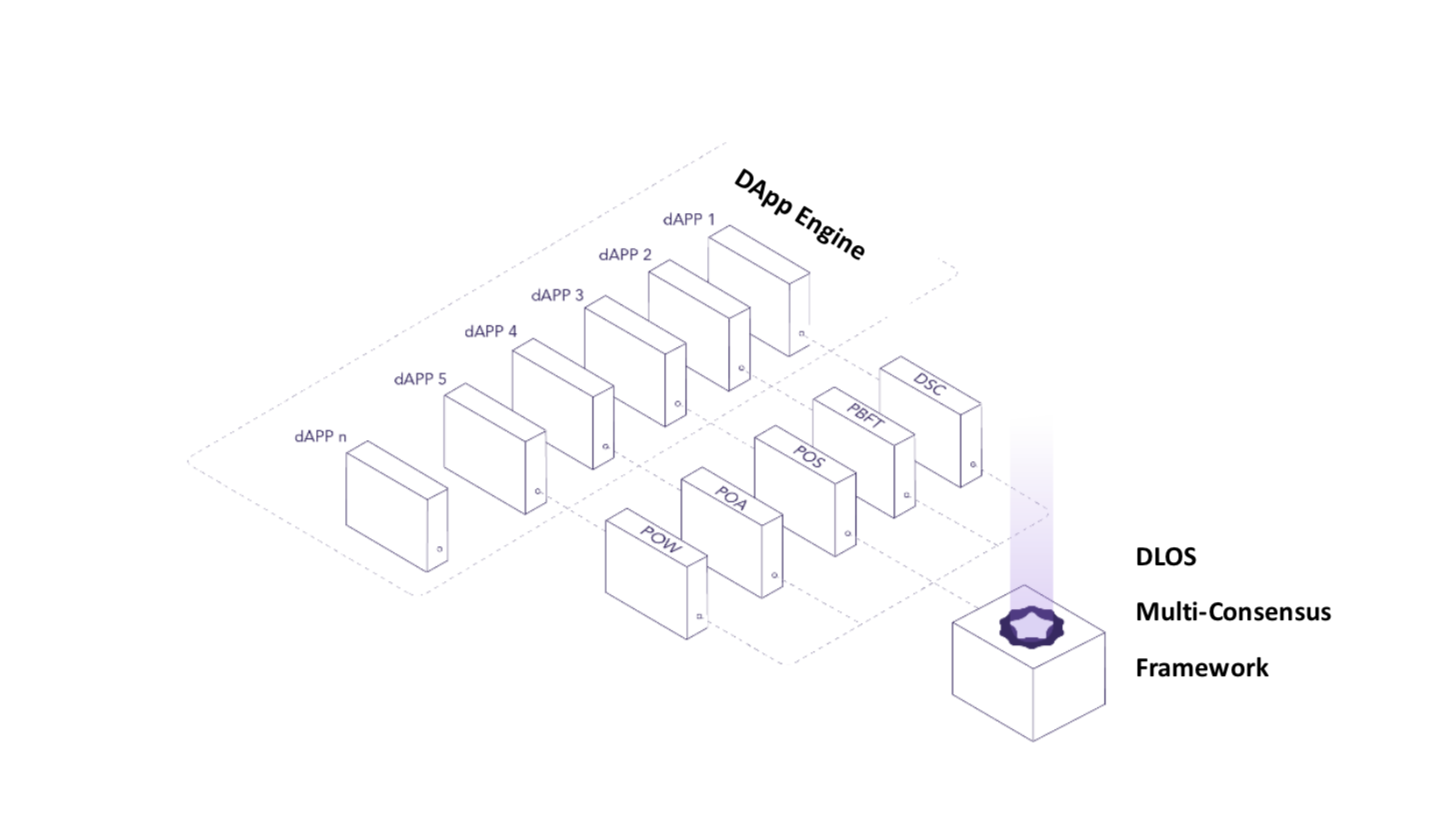 ## How should DLOS’s multi-consensus algorithm support be implemented? The consensus engine is the core component of DLOS and is used to implement consensus algorithms for block production and verification. To be compatible and to support multiple consensus algorithms and protocols, DLOS pioneered the consensus engine into two layers: the basic layer [figure1-Fundamental layer] for implementing the common function module, and the second layer [figure1-Non-interactive layer, Interactive layer] is the non-interactive layer with the interaction layer for implementing the unique consensus modules. The two-layers architecture granulates and abstracts the common and unique module functions of multiple consensus algorithms to achieve a flexible and efficient architecture. 1. In the base layer, the Miner and Worker interfaces are encapsulated, including some basic and common functional interfaces that any consensus algorithm will use, including general P2P communication, control block generation, acquisition of block information, and packing blocks. and many more. 2. The non-interactive layer in the upper layer encapsulates the functional interfaces provided specifically for non-interactive consensus algorithms. a. The so-called non-interactive consensus algorithm refers to an algorithm such as PoW, PoS, etc. that does not require mutual communication between nodes to finally reach a consensus. In this part, corresponding non-interactive function engines such as PoW/PoS Engine are provided according to different algorithm types to implement the block production and verification functions. b. The other part of the upper layer is the interaction layer, which encapsulates relatively more complex interfaces designed for interactive consensus algorithms, such as DSC, PBFT, etc. In this type of algorithm, the Byzantine fault-tolerant mechanism is adopted, and the consensus communication needs to be confirmed through interactive communication between nodes. Compared with the non-interactive consensus algorithm, the interaction process and the block validation are more complicated. 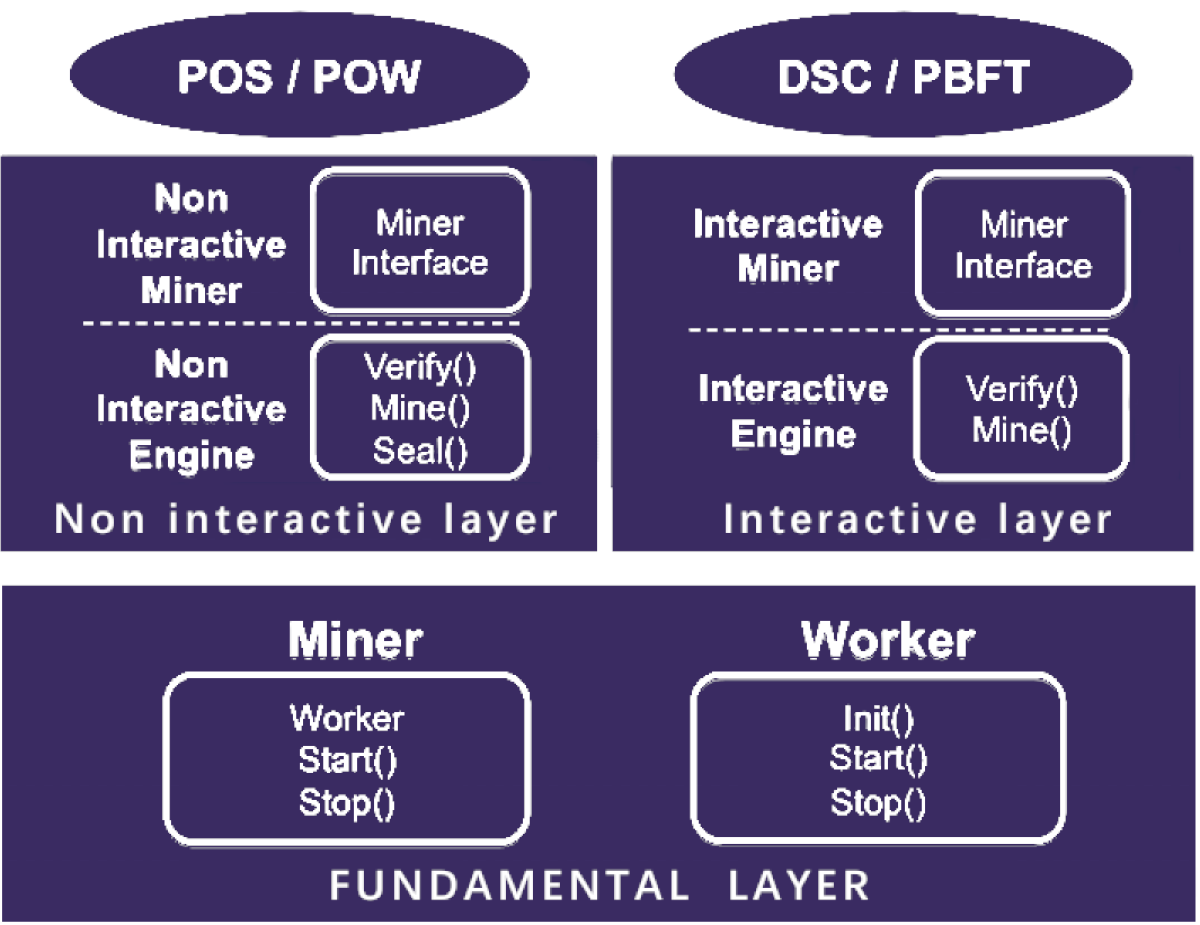 *DLOS double-layer consensus framework [figure1]* Using the above two-layer consensus engine framework and the corresponding abstract interface specification, DLOS implements plug-in support for mainstream consensus algorithms. Any consensus algorithm can select the corresponding layer in a pluggable manner, based on DLOS. Interface calls implement functions such as production block verification. The versatile framework enables DLOS to cover most of the functional requirements of mainstream consensus algorithms, reducing the amount of work and compatibility adaptation issues associated with additional feature development. ## Conclusion Today, the research and discussion around blockchain technology tends to focus on the direction of consensus algorithms and scalability, and often ignores the optimization and innovation of the infrastructure on which the underlying technology depends. The DLOS multi-consensus framework component is the result of the Penta team’s research in this area. It is believed that through this multi-consensus framework component enables enough flexibility to be able to answer to the future innovation regarding blockchain technology. |
| json metadata | {"tags":["penta","blockchain","technology","consensus"],"image":["https://cdn.steemitimages.com/DQmXmYVs6fWEU3D2MGQ7wC99QRQmG95DtsZ6QmnA1C7FT4P/image.png","https://cdn.steemitimages.com/DQmU9w3zxVtBaAP6hjzjnUSoL5fqb8PZyZUwatHz9zaFqQA/image.png"],"app":"steemit/0.1","format":"markdown"} |
| Transaction Info | Block #26624302/Trx c438da901b40578eb0b9a63fcdc27a39bf9ee4c0 |
View Raw JSON Data
{
"trx_id": "c438da901b40578eb0b9a63fcdc27a39bf9ee4c0",
"block": 26624302,
"trx_in_block": 9,
"op_in_trx": 0,
"virtual_op": 0,
"timestamp": "2018-10-08T09:38:45",
"op": [
"comment",
{
"parent_author": "",
"parent_permlink": "penta",
"author": "keevey",
"permlink": "introduction-to-penta-dlos-multi-consensus-framework-component",
"title": "Introduction to Penta DLOS Multi-Consensus Framework Component",
"body": "## Introduction\n\nWhen it comes to blockchain technology, consensus algorithms are always at the heart of it. Because it is the key to ensuring that the blockchain network has enough security to avoid malicious attacks and to achieve community self-operation through good mechanism design. It is worth noting that the current mainstream blockchain projects usually only support one consensus algorithm. For example, Bitcoin, Ethereum uses POW, and EOS uses DPOS. The relatively simple underlying distributed framework and interface design leads to singular algorithm support and cannot be fully applied to a variety of complex commercial scenarios. With the continuous evolution of blockchain technology, the importance of multi-consensus algorithm-compatible design has gradually been paid attention to and researched, and the Penta DLOS multi-consensus component framework is based on this concept.\n\n## DLOS overview\n\nBefore introducing the multi-consensus component framework, what is DLOS. DLOS, which stands for “Decentralized Ledger Operating System”, is a highly scalable, micro-service, distributed framework, and an important underlying infrastructure that implements a multi-chain network with Penta chain as its core and multiple side-chain. DLOS supports a variety of diverse network structures, a diverse account structure, and is compatible with many mainstream consensus algorithms. It effectively separates the functional modules such as computing, storage, and network, including the consensus algorithm. Each layer carries out interface and connects the service components through the service management and event components, effectively implementing the underlying foundation. Decoupling the architecture from the specific application, DApp developers only need to implement their own unique parts, without paying too much attention to the underlying technology that is not related to the application scenario.\n\n## Design ideas\n\nThe DLOS multi-consensus component is designed to treat DApps, side-chains, or individual blockchain as a component like Lego’s building blocks. It can be easily disassembled, plugged, and assembled on the Penta main chain. Multi-consensus algorithm support can also be used to accommodate different side-chains or permission chains for diverse commercial applications. In other words, mainstream consensus algorithms such as POW, POS, DPOS, and PBFT can be well-compatible with Penta networks thanks to a plug-in architecture. Separation from the DSC consensus mechanism, the Penta core chain ensures that DAPPs with different consensus mechanisms or sidechains and sub-chains can operate independently on the Penta core chain based on their own modules.\n\n\n\n## How should DLOS’s multi-consensus algorithm support be implemented?\n\nThe consensus engine is the core component of DLOS and is used to implement consensus algorithms for block production and verification. To be compatible and to support multiple consensus algorithms and protocols, DLOS pioneered the consensus engine into two layers: the basic layer [figure1-Fundamental layer] for implementing the common function module, and the second layer [figure1-Non-interactive layer, Interactive layer] is the non-interactive layer with the interaction layer for implementing the unique consensus modules. The two-layers architecture granulates and abstracts the common and unique module functions of multiple consensus algorithms to achieve a flexible and efficient architecture.\n\n1. In the base layer, the Miner and Worker interfaces are encapsulated, including some basic and common functional interfaces that any consensus algorithm will use, including general P2P communication, control block generation, acquisition of block information, and packing blocks. and many more.\n\n2. The non-interactive layer in the upper layer encapsulates the functional interfaces provided specifically for non-interactive consensus algorithms.\n\na. The so-called non-interactive consensus algorithm refers to an algorithm such as PoW, PoS, etc. that does not require mutual communication between nodes to finally reach a consensus. In this part, corresponding non-interactive function engines such as PoW/PoS Engine are provided according to different algorithm types to implement the block production and verification functions.\n\nb. The other part of the upper layer is the interaction layer, which encapsulates relatively more complex interfaces designed for interactive consensus algorithms, such as DSC, PBFT, etc. In this type of algorithm, the Byzantine fault-tolerant mechanism is adopted, and the consensus communication needs to be confirmed through interactive communication between nodes. Compared with the non-interactive consensus algorithm, the interaction process and the block validation are more complicated.\n\n\n*DLOS double-layer consensus framework [figure1]*\nUsing the above two-layer consensus engine framework and the corresponding abstract interface specification, DLOS implements plug-in support for mainstream consensus algorithms. Any consensus algorithm can select the corresponding layer in a pluggable manner, based on DLOS. Interface calls implement functions such as production block verification. The versatile framework enables DLOS to cover most of the functional requirements of mainstream consensus algorithms, reducing the amount of work and compatibility adaptation issues associated with additional feature development.\n\n## Conclusion\n\nToday, the research and discussion around blockchain technology tends to focus on the direction of consensus algorithms and scalability, and often ignores the optimization and innovation of the infrastructure on which the underlying technology depends. The DLOS multi-consensus framework component is the result of the Penta team’s research in this area. It is believed that through this multi-consensus framework component enables enough flexibility to be able to answer to the future innovation regarding blockchain technology.",
"json_metadata": "{\"tags\":[\"penta\",\"blockchain\",\"technology\",\"consensus\"],\"image\":[\"https://cdn.steemitimages.com/DQmXmYVs6fWEU3D2MGQ7wC99QRQmG95DtsZ6QmnA1C7FT4P/image.png\",\"https://cdn.steemitimages.com/DQmU9w3zxVtBaAP6hjzjnUSoL5fqb8PZyZUwatHz9zaFqQA/image.png\"],\"app\":\"steemit/0.1\",\"format\":\"markdown\"}"
}
]
}2018/10/08 09:34:54
2018/10/08 09:34:54
| voter | keevey |
| author | keevey |
| permlink | re-cheetah-cheetah-re-keeveyintroduction-to-penta-digital-signature-scheme-20181008t093536231z |
| weight | 10000 (100.00%) |
| Transaction Info | Block #26624225/Trx 8fe1ba3254fafba4442f2378f7514ff7c2b1faaa |
View Raw JSON Data
{
  "trx_id": "8fe1ba3254fafba4442f2378f7514ff7c2b1faaa",
  "block": 26624225,
  "trx_in_block": 7,
  "op_in_trx": 0,
  "virtual_op": 0,
  "timestamp": "2018-10-08T09:34:54",
  "op": [
    "vote",
    {
      "voter": "keevey",
      "author": "keevey",
      "permlink": "re-cheetah-cheetah-re-keeveyintroduction-to-penta-digital-signature-scheme-20181008t093536231z",
      "weight": 10000
    }
  ]
}Manabar
Voting Power100.00%
Downvote Power100.00%
Resource Credits100.00%
Reputation Progress0.00%
{
  "voting_manabar": {
    "current_mana": 1953311140,
    "last_update_time": 1588937397
  },
  "downvote_manabar": {
    "current_mana": 488327785,
    "last_update_time": 1588937397
  },
  "rc_account": {
    "account": "keevey",
    "rc_manabar": {
      "current_mana": "15903403309",
      "last_update_time": 1588937397
    },
    "max_rc_creation_adjustment": {
      "amount": "6058092621",
      "precision": 6,
      "nai": "@@000000037"
    },
    "max_rc": "8011403761"
  }
}
Account Metadata
| POSTING JSON METADATA | |
| profile | {"cover_image":"https://cdn.steemitimages.com/DQmWmUNDhBXBePkrXpKoUPCACuSZNs2UXZ12VhmP2dBsLWt/banner2.jpg","profile_image":"https://cdn.steemitimages.com/DQmSnp1FhYpQRhpJbVayqAo61ncYFL6pX56eq3zzgUGJJkE/penta.jpg","name":"Penta","about":"Penta Network is a next generation platform for public blockchain projects for transferring value and operating high-performance decentralized applications."} |
| JSON METADATA | |
| profile | {"cover_image":"https://cdn.steemitimages.com/DQmWmUNDhBXBePkrXpKoUPCACuSZNs2UXZ12VhmP2dBsLWt/banner2.jpg","profile_image":"https://cdn.steemitimages.com/DQmSnp1FhYpQRhpJbVayqAo61ncYFL6pX56eq3zzgUGJJkE/penta.jpg","name":"Penta","about":"Penta Network is a next generation platform for public blockchain projects for transferring value and operating high-performance decentralized applications."} |
{
  "posting_json_metadata": {
    "profile": {
      "cover_image": "https://cdn.steemitimages.com/DQmWmUNDhBXBePkrXpKoUPCACuSZNs2UXZ12VhmP2dBsLWt/banner2.jpg",
      "profile_image": "https://cdn.steemitimages.com/DQmSnp1FhYpQRhpJbVayqAo61ncYFL6pX56eq3zzgUGJJkE/penta.jpg",
      "name": "Penta",
      "about": "Penta Network is a next generation platform for public blockchain projects for transferring value and operating high-performance decentralized applications."
    }
  },
  "json_metadata": {
    "profile": {
      "cover_image": "https://cdn.steemitimages.com/DQmWmUNDhBXBePkrXpKoUPCACuSZNs2UXZ12VhmP2dBsLWt/banner2.jpg",
      "profile_image": "https://cdn.steemitimages.com/DQmSnp1FhYpQRhpJbVayqAo61ncYFL6pX56eq3zzgUGJJkE/penta.jpg",
      "name": "Penta",
      "about": "Penta Network is a next generation platform for public blockchain projects for transferring value and operating high-performance decentralized applications."
    }
  }
}
Auth Keys
Owner
Single Signature
Public Keys
STM6ETPNk6BFPBFCzV7vhesEm24haeHHiKAEWz3c52XW5MM84RTgT1/1
Active
Single Signature
Public Keys
STM8XxVCkJiRg86W5FwKMm19VY6BgpVZSrcAhkvbHc5MaUsK1T62Z1/1
Posting
Single Signature
Public Keys
STM79AJ9SWc6L7jTpF5Pco4z5PCPEw1SH7EjpDgzpZjKscA6hQ7Db1/1
Memo
STM61ixM125vLYvU1QCq8R7mwNsKNLq24CmeY6WLGNErX9QjarhMb
{
  "owner": {
    "weight_threshold": 1,
    "account_auths": [],
    "key_auths": [
      [
        "STM6ETPNk6BFPBFCzV7vhesEm24haeHHiKAEWz3c52XW5MM84RTgT",
        1
      ]
    ]
  },
  "active": {
    "weight_threshold": 1,
    "account_auths": [],
    "key_auths": [
      [
        "STM8XxVCkJiRg86W5FwKMm19VY6BgpVZSrcAhkvbHc5MaUsK1T62Z",
        1
      ]
    ]
  },
  "posting": {
    "weight_threshold": 1,
    "account_auths": [],
    "key_auths": [
      [
        "STM79AJ9SWc6L7jTpF5Pco4z5PCPEw1SH7EjpDgzpZjKscA6hQ7Db",
        1
      ]
    ]
  },
  "memo": "STM61ixM125vLYvU1QCq8R7mwNsKNLq24CmeY6WLGNErX9QjarhMb"
}
Witness Votes
0 / 30
No active witness votes.
[]