

VOTING POWER100.00%
DOWNVOTE POWER100.00%
RESOURCE CREDITS100.00%
REPUTATION PROGRESS77.23%
Net Worth
15.971USD
STEEM
24.009STEEM
SBD
29.536SBD
Effective Power
5.001SP
├── Own SP
1.903SP
└── Incoming DelegationsDeleg
+3.098SP
Detailed Balance
| STEEM | ||
| balance | 22.009STEEM | STEEM |
| market_balance | 0.000STEEM | STEEM |
| savings_balance | 2.000STEEM | STEEM |
| reward_steem_balance | 0.000STEEM | STEEM |
| STEEM POWER | ||
| Own SP | 1.903SP | SP |
| Delegated Out | 0.000SP | SP |
| Delegation In | 3.098SP | SP |
| Effective Power | 5.001SP | SP |
| Reward SP (pending) | 0.646SP | SP |
| SBD | ||
| sbd_balance | 28.766SBD | SBD |
| sbd_conversions | 0.000SBD | SBD |
| sbd_market_balance | 0.000SBD | SBD |
| savings_sbd_balance | 0.000SBD | SBD |
| reward_sbd_balance | 0.770SBD | SBD |
{
  "balance": "22.009 STEEM",
  "savings_balance": "2.000 STEEM",
  "reward_steem_balance": "0.000 STEEM",
  "vesting_shares": "3099.170760 VESTS",
  "delegated_vesting_shares": "0.000000 VESTS",
  "received_vesting_shares": "5044.489046 VESTS",
  "sbd_balance": "28.766 SBD",
  "savings_sbd_balance": "0.000 SBD",
  "reward_sbd_balance": "0.770 SBD",
  "conversions": []
}
Account Info
| name | jakeryan |
| id | 227201 |
| rank | 667,328 |
| reputation | 9434012125 |
| created | 2017-06-27T15:46:21 |
| recovery_account | steem |
| proxy | None |
| post_count | 34 |
| comment_count | 0 |
| lifetime_vote_count | 0 |
| witnesses_voted_for | 0 |
| last_post | 2018-07-20T18:05:00 |
| last_root_post | 2018-07-20T18:05:00 |
| last_vote_time | 2018-02-18T23:53:30 |
| proxied_vsf_votes | 0, 0, 0, 0 |
| can_vote | 1 |
| voting_power | 0 |
| delayed_votes | 0 |
| balance | 22.009 STEEM |
| savings_balance | 2.000 STEEM |
| sbd_balance | 28.766 SBD |
| savings_sbd_balance | 0.000 SBD |
| vesting_shares | 3099.170760 VESTS |
| delegated_vesting_shares | 0.000000 VESTS |
| received_vesting_shares | 5044.489046 VESTS |
| reward_vesting_balance | 1332.603413 VESTS |
| vesting_balance | 0.000 STEEM |
| vesting_withdraw_rate | 0.000000 VESTS |
| next_vesting_withdrawal | 1969-12-31T23:59:59 |
| withdrawn | 0 |
| to_withdraw | 0 |
| withdraw_routes | 0 |
| savings_withdraw_requests | 0 |
| last_account_recovery | 1970-01-01T00:00:00 |
| reset_account | null |
| last_owner_update | 2017-08-07T21:20:42 |
| last_account_update | 2017-08-07T21:20:42 |
| mined | No |
| sbd_seconds | 47,584,499,583 |
| sbd_last_interest_payment | 2017-08-09T00:55:12 |
| savings_sbd_last_interest_payment | 1970-01-01T00:00:00 |
{
  "id": 227201,
  "name": "jakeryan",
  "owner": {
    "weight_threshold": 1,
    "account_auths": [],
    "key_auths": [
      [
        "STM5zFSRt7taKx6gdLsWQBEp3xKCD8ycSLWkxzQo6Txx8TMYU4fZ2",
        1
      ]
    ]
  },
  "active": {
    "weight_threshold": 1,
    "account_auths": [],
    "key_auths": [
      [
        "STM7uvPpiXvW2Yr9oThp4ZmE2unyiVWWM1JM5BXyvNeKdHhsqJfr3",
        1
      ]
    ]
  },
  "posting": {
    "weight_threshold": 1,
    "account_auths": [],
    "key_auths": [
      [
        "STM7Wkt6USLnLkmkfdf9qiCp8JSqv7t9XNNWVpx6ZmEA6tUNU6z54",
        1
      ]
    ]
  },
  "memo_key": "STM7JVvYqeFBJFiVGy8ZRDuoPcjMhLj6bLjZgcHUbVy5CUYbsint2",
  "json_metadata": "{\"profile\":{\"profile_image\":\"https://static1.squarespace.com/static/58d40a801e5b6c804e69ef6b/t/58ee70be6b8f5b2252e3303c/1492021452565\",\"name\":\"Jake Ryan\",\"about\":\"CEO, PE/VC Advisor, Angel Investor & Author\",\"location\":\"Los Angeles\",\"website\":\"https://www.wealthrituals.co/\"}}",
  "posting_json_metadata": "{\"profile\":{\"profile_image\":\"https://static1.squarespace.com/static/58d40a801e5b6c804e69ef6b/t/58ee70be6b8f5b2252e3303c/1492021452565\",\"name\":\"Jake Ryan\",\"about\":\"CEO, PE/VC Advisor, Angel Investor & Author\",\"location\":\"Los Angeles\",\"website\":\"https://www.wealthrituals.co/\"}}",
  "proxy": "",
  "last_owner_update": "2017-08-07T21:20:42",
  "last_account_update": "2017-08-07T21:20:42",
  "created": "2017-06-27T15:46:21",
  "mined": false,
  "recovery_account": "steem",
  "last_account_recovery": "1970-01-01T00:00:00",
  "reset_account": "null",
  "comment_count": 0,
  "lifetime_vote_count": 0,
  "post_count": 34,
  "can_vote": true,
  "voting_manabar": {
    "current_mana": "8143659806",
    "last_update_time": 1779068346
  },
  "downvote_manabar": {
    "current_mana": 2035914951,
    "last_update_time": 1779068346
  },
  "voting_power": 0,
  "balance": "22.009 STEEM",
  "savings_balance": "2.000 STEEM",
  "sbd_balance": "28.766 SBD",
  "sbd_seconds": "47584499583",
  "sbd_seconds_last_update": "2017-08-27T11:48:39",
  "sbd_last_interest_payment": "2017-08-09T00:55:12",
  "savings_sbd_balance": "0.000 SBD",
  "savings_sbd_seconds": "0",
  "savings_sbd_seconds_last_update": "1970-01-01T00:00:00",
  "savings_sbd_last_interest_payment": "1970-01-01T00:00:00",
  "savings_withdraw_requests": 0,
  "reward_sbd_balance": "0.770 SBD",
  "reward_steem_balance": "0.000 STEEM",
  "reward_vesting_balance": "1332.603413 VESTS",
  "reward_vesting_steem": "0.646 STEEM",
  "vesting_shares": "3099.170760 VESTS",
  "delegated_vesting_shares": "0.000000 VESTS",
  "received_vesting_shares": "5044.489046 VESTS",
  "vesting_withdraw_rate": "0.000000 VESTS",
  "next_vesting_withdrawal": "1969-12-31T23:59:59",
  "withdrawn": 0,
  "to_withdraw": 0,
  "withdraw_routes": 0,
  "curation_rewards": 12,
  "posting_rewards": 1265,
  "proxied_vsf_votes": [
    0,
    0,
    0,
    0
  ],
  "witnesses_voted_for": 0,
  "last_post": "2018-07-20T18:05:00",
  "last_root_post": "2018-07-20T18:05:00",
  "last_vote_time": "2018-02-18T23:53:30",
  "post_bandwidth": 0,
  "pending_claimed_accounts": 0,
  "vesting_balance": "0.000 STEEM",
  "reputation": "9434012125",
  "transfer_history": [],
  "market_history": [],
  "post_history": [],
  "vote_history": [],
  "other_history": [],
  "witness_votes": [],
  "tags_usage": [],
  "guest_bloggers": [],
  "rank": 667328
}
Withdraw Routes
| Incoming | Outgoing |
|---|---|
Empty | Empty |
{
  "incoming": [],
  "outgoing": []
}From Date
To Date
2026/05/18 01:39:06
2026/05/18 01:39:06
| delegator | steem |
| delegatee | jakeryan |
| vesting shares | 5044.489046 VESTS |
| Transaction Info | Block #106145117/Trx 95c80aa70e4c823a3f72c96c2be9394548f90057 |
View Raw JSON Data
{
  "trx_id": "95c80aa70e4c823a3f72c96c2be9394548f90057",
  "block": 106145117,
  "trx_in_block": 1,
  "op_in_trx": 0,
  "virtual_op": 0,
  "timestamp": "2026-05-18T01:39:06",
  "op": [
    "delegate_vesting_shares",
    {
      "delegator": "steem",
      "delegatee": "jakeryan",
      "vesting_shares": "5044.489046 VESTS"
    }
  ]
}2026/05/12 09:31:39
2026/05/12 09:31:39
| delegator | steem |
| delegatee | jakeryan |
| vesting shares | 2332.278641 VESTS |
| Transaction Info | Block #105982521/Trx 8673c67ab6f74e7f060b531de08b1c7965993e97 |
View Raw JSON Data
{
  "trx_id": "8673c67ab6f74e7f060b531de08b1c7965993e97",
  "block": 105982521,
  "trx_in_block": 0,
  "op_in_trx": 0,
  "virtual_op": 0,
  "timestamp": "2026-05-12T09:31:39",
  "op": [
    "delegate_vesting_shares",
    {
      "delegator": "steem",
      "delegatee": "jakeryan",
      "vesting_shares": "2332.278641 VESTS"
    }
  ]
}2026/04/26 00:57:45
2026/04/26 00:57:45
| delegator | steem |
| delegatee | jakeryan |
| vesting shares | 5057.004802 VESTS |
| Transaction Info | Block #105512730/Trx 83488d3f5a0890feaed37f0ab179c6f080d61031 |
View Raw JSON Data
{
  "trx_id": "83488d3f5a0890feaed37f0ab179c6f080d61031",
  "block": 105512730,
  "trx_in_block": 0,
  "op_in_trx": 0,
  "virtual_op": 0,
  "timestamp": "2026-04-26T00:57:45",
  "op": [
    "delegate_vesting_shares",
    {
      "delegator": "steem",
      "delegatee": "jakeryan",
      "vesting_shares": "5057.004802 VESTS"
    }
  ]
}2026/01/23 11:34:18
2026/01/23 11:34:18
| delegator | steem |
| delegatee | jakeryan |
| vesting shares | 2373.825460 VESTS |
| Transaction Info | Block #102856330/Trx 0d544b42422b077a11794bdc3deb8c5d294ec7cc |
View Raw JSON Data
{
  "trx_id": "0d544b42422b077a11794bdc3deb8c5d294ec7cc",
  "block": 102856330,
  "trx_in_block": 0,
  "op_in_trx": 0,
  "virtual_op": 0,
  "timestamp": "2026-01-23T11:34:18",
  "op": [
    "delegate_vesting_shares",
    {
      "delegator": "steem",
      "delegatee": "jakeryan",
      "vesting_shares": "2373.825460 VESTS"
    }
  ]
}2024/12/17 06:51:24
2024/12/17 06:51:24
| delegator | steem |
| delegatee | jakeryan |
| vesting shares | 2538.044657 VESTS |
| Transaction Info | Block #91302688/Trx 39cea0b79eeeca2f8abc85b4ac07c541e38a331e |
View Raw JSON Data
{
  "trx_id": "39cea0b79eeeca2f8abc85b4ac07c541e38a331e",
  "block": 91302688,
  "trx_in_block": 3,
  "op_in_trx": 0,
  "virtual_op": 0,
  "timestamp": "2024-12-17T06:51:24",
  "op": [
    "delegate_vesting_shares",
    {
      "delegator": "steem",
      "delegatee": "jakeryan",
      "vesting_shares": "2538.044657 VESTS"
    }
  ]
}2023/11/13 22:33:33
2023/11/13 22:33:33
| delegator | steem |
| delegatee | jakeryan |
| vesting shares | 2707.178189 VESTS |
| Transaction Info | Block #79856875/Trx a75856fe4b0f43c89abe822018eae8834c64273b |
View Raw JSON Data
{
  "trx_id": "a75856fe4b0f43c89abe822018eae8834c64273b",
  "block": 79856875,
  "trx_in_block": 3,
  "op_in_trx": 0,
  "virtual_op": 0,
  "timestamp": "2023-11-13T22:33:33",
  "op": [
    "delegate_vesting_shares",
    {
      "delegator": "steem",
      "delegatee": "jakeryan",
      "vesting_shares": "2707.178189 VESTS"
    }
  ]
}2023/09/21 23:29:15
2023/09/21 23:29:15
| delegator | steem |
| delegatee | jakeryan |
| vesting shares | 5644.456975 VESTS |
| Transaction Info | Block #78349813/Trx 989e5fe28fdd378d41ef48508bb7861e252dd668 |
View Raw JSON Data
{
  "trx_id": "989e5fe28fdd378d41ef48508bb7861e252dd668",
  "block": 78349813,
  "trx_in_block": 0,
  "op_in_trx": 0,
  "virtual_op": 0,
  "timestamp": "2023-09-21T23:29:15",
  "op": [
    "delegate_vesting_shares",
    {
      "delegator": "steem",
      "delegatee": "jakeryan",
      "vesting_shares": "5644.456975 VESTS"
    }
  ]
}2022/11/03 13:03:39
2022/11/03 13:03:39
| delegator | steem |
| delegatee | jakeryan |
| vesting shares | 5866.138413 VESTS |
| Transaction Info | Block #69114882/Trx dffaba07875def4014882a9420e524db03ffcbc5 |
View Raw JSON Data
{
  "trx_id": "dffaba07875def4014882a9420e524db03ffcbc5",
  "block": 69114882,
  "trx_in_block": 1,
  "op_in_trx": 0,
  "virtual_op": 0,
  "timestamp": "2022-11-03T13:03:39",
  "op": [
    "delegate_vesting_shares",
    {
      "delegator": "steem",
      "delegatee": "jakeryan",
      "vesting_shares": "5866.138413 VESTS"
    }
  ]
}2022/01/17 12:12:45
2022/01/17 12:12:45
| delegator | steem |
| delegatee | jakeryan |
| vesting shares | 6086.671644 VESTS |
| Transaction Info | Block #60810914/Trx 829bd9f344f289d821d67007800a6d8b9cd83214 |
View Raw JSON Data
{
  "trx_id": "829bd9f344f289d821d67007800a6d8b9cd83214",
  "block": 60810914,
  "trx_in_block": 15,
  "op_in_trx": 0,
  "virtual_op": 0,
  "timestamp": "2022-01-17T12:12:45",
  "op": [
    "delegate_vesting_shares",
    {
      "delegator": "steem",
      "delegatee": "jakeryan",
      "vesting_shares": "6086.671644 VESTS"
    }
  ]
}2021/06/14 02:04:33
2021/06/14 02:04:33
| delegator | steem |
| delegatee | jakeryan |
| vesting shares | 6270.440302 VESTS |
| Transaction Info | Block #54609227/Trx 2935ce5c90ce7df1207c7165fa74d49ac4bbed97 |
View Raw JSON Data
{
  "trx_id": "2935ce5c90ce7df1207c7165fa74d49ac4bbed97",
  "block": 54609227,
  "trx_in_block": 4,
  "op_in_trx": 0,
  "virtual_op": 0,
  "timestamp": "2021-06-14T02:04:33",
  "op": [
    "delegate_vesting_shares",
    {
      "delegator": "steem",
      "delegatee": "jakeryan",
      "vesting_shares": "6270.440302 VESTS"
    }
  ]
}2020/12/11 12:21:30
2020/12/11 12:21:30
| delegator | steem |
| delegatee | jakeryan |
| vesting shares | 6457.862276 VESTS |
| Transaction Info | Block #49356631/Trx 257dd0c9cdf979a508761a09f70dd7ca11567a17 |
View Raw JSON Data
{
  "trx_id": "257dd0c9cdf979a508761a09f70dd7ca11567a17",
  "block": 49356631,
  "trx_in_block": 2,
  "op_in_trx": 0,
  "virtual_op": 0,
  "timestamp": "2020-12-11T12:21:30",
  "op": [
    "delegate_vesting_shares",
    {
      "delegator": "steem",
      "delegatee": "jakeryan",
      "vesting_shares": "6457.862276 VESTS"
    }
  ]
}2020/12/06 05:58:24
2020/12/06 05:58:24
| delegator | steem |
| delegatee | jakeryan |
| vesting shares | 1912.543513 VESTS |
| Transaction Info | Block #49208190/Trx 260dceef3423ba077c67377c0f9d00efc6056865 |
View Raw JSON Data
{
  "trx_id": "260dceef3423ba077c67377c0f9d00efc6056865",
  "block": 49208190,
  "trx_in_block": 1,
  "op_in_trx": 0,
  "virtual_op": 0,
  "timestamp": "2020-12-06T05:58:24",
  "op": [
    "delegate_vesting_shares",
    {
      "delegator": "steem",
      "delegatee": "jakeryan",
      "vesting_shares": "1912.543513 VESTS"
    }
  ]
}2020/12/05 15:59:27
2020/12/05 15:59:27
| delegator | steem |
| delegatee | jakeryan |
| vesting shares | 6464.070130 VESTS |
| Transaction Info | Block #49191727/Trx 14a789c2910a08b26b9ba8d21c1111b44a13c532 |
View Raw JSON Data
{
  "trx_id": "14a789c2910a08b26b9ba8d21c1111b44a13c532",
  "block": 49191727,
  "trx_in_block": 1,
  "op_in_trx": 0,
  "virtual_op": 0,
  "timestamp": "2020-12-05T15:59:27",
  "op": [
    "delegate_vesting_shares",
    {
      "delegator": "steem",
      "delegatee": "jakeryan",
      "vesting_shares": "6464.070130 VESTS"
    }
  ]
}2020/11/02 18:12:03
2020/11/02 18:12:03
| delegator | steem |
| delegatee | jakeryan |
| vesting shares | 1920.017158 VESTS |
| Transaction Info | Block #48260819/Trx 4a1621b6b38d1595dd7427b230e19f4c4647a7ba |
View Raw JSON Data
{
  "trx_id": "4a1621b6b38d1595dd7427b230e19f4c4647a7ba",
  "block": 48260819,
  "trx_in_block": 2,
  "op_in_trx": 0,
  "virtual_op": 0,
  "timestamp": "2020-11-02T18:12:03",
  "op": [
    "delegate_vesting_shares",
    {
      "delegator": "steem",
      "delegatee": "jakeryan",
      "vesting_shares": "1920.017158 VESTS"
    }
  ]
}2020/05/09 06:57:03
2020/05/09 06:57:03
| delegator | steem |
| delegatee | jakeryan |
| vesting shares | 6666.875489 VESTS |
| Transaction Info | Block #43218456/Trx 07a70b65c8b141387308971a4b8c8706b9a3950f |
View Raw JSON Data
{
  "trx_id": "07a70b65c8b141387308971a4b8c8706b9a3950f",
  "block": 43218456,
  "trx_in_block": 11,
  "op_in_trx": 0,
  "virtual_op": 0,
  "timestamp": "2020-05-09T06:57:03",
  "op": [
    "delegate_vesting_shares",
    {
      "delegator": "steem",
      "delegatee": "jakeryan",
      "vesting_shares": "6666.875489 VESTS"
    }
  ]
}2020/05/08 10:44:15
2020/05/08 10:44:15
| delegator | steem |
| delegatee | jakeryan |
| vesting shares | 1953.311140 VESTS |
| Transaction Info | Block #43194767/Trx 810f14ae8fecc689e009cb0e9686286c8f501c78 |
View Raw JSON Data
{
  "trx_id": "810f14ae8fecc689e009cb0e9686286c8f501c78",
  "block": 43194767,
  "trx_in_block": 0,
  "op_in_trx": 0,
  "virtual_op": 0,
  "timestamp": "2020-05-08T10:44:15",
  "op": [
    "delegate_vesting_shares",
    {
      "delegator": "steem",
      "delegatee": "jakeryan",
      "vesting_shares": "1953.311140 VESTS"
    }
  ]
}2019/09/28 03:30:27
2019/09/28 03:30:27
| delegator | steem |
| delegatee | jakeryan |
| vesting shares | 6793.516386 VESTS |
| Transaction Info | Block #36805787/Trx b3424a4f05036dce9f33ea87dd0eea28c6fb7fd6 |
View Raw JSON Data
{
  "trx_id": "b3424a4f05036dce9f33ea87dd0eea28c6fb7fd6",
  "block": 36805787,
  "trx_in_block": 11,
  "op_in_trx": 0,
  "virtual_op": 0,
  "timestamp": "2019-09-28T03:30:27",
  "op": [
    "delegate_vesting_shares",
    {
      "delegator": "steem",
      "delegatee": "jakeryan",
      "vesting_shares": "6793.516386 VESTS"
    }
  ]
}2019/06/27 17:27:39
2019/06/27 17:27:39
| parent author | jakeryan |
| parent permlink | crypto-s-role-in-the-age-of-autonomization |
| author | steemitboard |
| permlink | steemitboard-notify-jakeryan-20190627t172738000z |
| title | |
| body | Congratulations @jakeryan! You received a personal award! <table><tr><td>https://steemitimages.com/70x70/http://steemitboard.com/@jakeryan/birthday2.png</td><td>Happy Birthday! - You are on the Steem blockchain for 2 years!</td></tr></table> <sub>_You can view [your badges on your Steem Board](https://steemitboard.com/@jakeryan) and compare to others on the [Steem Ranking](https://steemitboard.com/ranking/index.php?name=jakeryan)_</sub> ###### [Vote for @Steemitboard as a witness](https://v2.steemconnect.com/sign/account-witness-vote?witness=steemitboard&approve=1) to get one more award and increased upvotes! |
| json metadata | {"image":["https://steemitboard.com/img/notify.png"]} |
| Transaction Info | Block #34171790/Trx f77bbbf1bd9da833b3567fa3866d191091835fb4 |
View Raw JSON Data
{
  "trx_id": "f77bbbf1bd9da833b3567fa3866d191091835fb4",
  "block": 34171790,
  "trx_in_block": 2,
  "op_in_trx": 0,
  "virtual_op": 0,
  "timestamp": "2019-06-27T17:27:39",
  "op": [
    "comment",
    {
      "parent_author": "jakeryan",
      "parent_permlink": "crypto-s-role-in-the-age-of-autonomization",
      "author": "steemitboard",
      "permlink": "steemitboard-notify-jakeryan-20190627t172738000z",
      "title": "",
      "body": "Congratulations @jakeryan! You received a personal award!\n\n<table><tr><td>https://steemitimages.com/70x70/http://steemitboard.com/@jakeryan/birthday2.png</td><td>Happy Birthday! - You are on the Steem blockchain for 2 years!</td></tr></table>\n\n<sub>_You can view [your badges on your Steem Board](https://steemitboard.com/@jakeryan) and compare to others on the [Steem Ranking](https://steemitboard.com/ranking/index.php?name=jakeryan)_</sub>\n\n\n###### [Vote for @Steemitboard as a witness](https://v2.steemconnect.com/sign/account-witness-vote?witness=steemitboard&approve=1) to get one more award and increased upvotes!",
      "json_metadata": "{\"image\":[\"https://steemitboard.com/img/notify.png\"]}"
    }
  ]
}2018/10/19 20:14:48
2018/10/19 20:14:48
| delegator | steem |
| delegatee | jakeryan |
| vesting shares | 6991.422768 VESTS |
| Transaction Info | Block #26953575/Trx 02159223b4df4174286da604df254b7de8be7b93 |
View Raw JSON Data
{
  "trx_id": "02159223b4df4174286da604df254b7de8be7b93",
  "block": 26953575,
  "trx_in_block": 2,
  "op_in_trx": 0,
  "virtual_op": 0,
  "timestamp": "2018-10-19T20:14:48",
  "op": [
    "delegate_vesting_shares",
    {
      "delegator": "steem",
      "delegatee": "jakeryan",
      "vesting_shares": "6991.422768 VESTS"
    }
  ]
}2018/07/21 18:52:00
2018/07/21 18:52:00
| parent author | jakeryan |
| parent permlink | crypto-s-role-in-the-age-of-autonomization |
| author | surikowstepanuk |
| permlink | re-jakeryan-crypto-s-role-in-the-age-of-autonomization-20180721t185201133z |
| title | |
| body | @jakeryan, you are interesting to read! |
| json metadata | {"tags":["economics"],"users":["jakeryan"],"app":"steemit/0.1"} |
| Transaction Info | Block #24377548/Trx 98a3a3927f0f7752dd2d5b633e419544f91268ef |
View Raw JSON Data
{
  "trx_id": "98a3a3927f0f7752dd2d5b633e419544f91268ef",
  "block": 24377548,
  "trx_in_block": 56,
  "op_in_trx": 0,
  "virtual_op": 0,
  "timestamp": "2018-07-21T18:52:00",
  "op": [
    "comment",
    {
      "parent_author": "jakeryan",
      "parent_permlink": "crypto-s-role-in-the-age-of-autonomization",
      "author": "surikowstepanuk",
      "permlink": "re-jakeryan-crypto-s-role-in-the-age-of-autonomization-20180721t185201133z",
      "title": "",
      "body": "@jakeryan, you are interesting to read!",
      "json_metadata": "{\"tags\":[\"economics\"],\"users\":[\"jakeryan\"],\"app\":\"steemit/0.1\"}"
    }
  ]
}sensationupvoted (100.00%) @jakeryan / crypto-s-role-in-the-age-of-autonomization2018/07/20 19:53:54
sensationupvoted (100.00%) @jakeryan / crypto-s-role-in-the-age-of-autonomization
2018/07/20 19:53:54
| voter | sensation |
| author | jakeryan |
| permlink | crypto-s-role-in-the-age-of-autonomization |
| weight | 10000 (100.00%) |
| Transaction Info | Block #24350005/Trx 1874c7ffa0f38a8adc806904a458cd1eea5935d2 |
View Raw JSON Data
{
  "trx_id": "1874c7ffa0f38a8adc806904a458cd1eea5935d2",
  "block": 24350005,
  "trx_in_block": 34,
  "op_in_trx": 0,
  "virtual_op": 0,
  "timestamp": "2018-07-20T19:53:54",
  "op": [
    "vote",
    {
      "voter": "sensation",
      "author": "jakeryan",
      "permlink": "crypto-s-role-in-the-age-of-autonomization",
      "weight": 10000
    }
  ]
}moby-dickupvoted (100.00%) @jakeryan / crypto-s-role-in-the-age-of-autonomization2018/07/20 18:43:03
moby-dickupvoted (100.00%) @jakeryan / crypto-s-role-in-the-age-of-autonomization
2018/07/20 18:43:03
| voter | moby-dick |
| author | jakeryan |
| permlink | crypto-s-role-in-the-age-of-autonomization |
| weight | 10000 (100.00%) |
| Transaction Info | Block #24348588/Trx 7e0a801633c08bcb49e68bb4aa53e2b747481d1e |
View Raw JSON Data
{
  "trx_id": "7e0a801633c08bcb49e68bb4aa53e2b747481d1e",
  "block": 24348588,
  "trx_in_block": 4,
  "op_in_trx": 0,
  "virtual_op": 0,
  "timestamp": "2018-07-20T18:43:03",
  "op": [
    "vote",
    {
      "voter": "moby-dick",
      "author": "jakeryan",
      "permlink": "crypto-s-role-in-the-age-of-autonomization",
      "weight": 10000
    }
  ]
}mrakodrapupvoted (10.00%) @jakeryan / crypto-s-role-in-the-age-of-autonomization2018/07/20 18:42:51
mrakodrapupvoted (10.00%) @jakeryan / crypto-s-role-in-the-age-of-autonomization
2018/07/20 18:42:51
| voter | mrakodrap |
| author | jakeryan |
| permlink | crypto-s-role-in-the-age-of-autonomization |
| weight | 1000 (10.00%) |
| Transaction Info | Block #24348584/Trx 03b6d0506f0d863461c306cdd038793c17fa2918 |
View Raw JSON Data
{
  "trx_id": "03b6d0506f0d863461c306cdd038793c17fa2918",
  "block": 24348584,
  "trx_in_block": 23,
  "op_in_trx": 0,
  "virtual_op": 0,
  "timestamp": "2018-07-20T18:42:51",
  "op": [
    "vote",
    {
      "voter": "mrakodrap",
      "author": "jakeryan",
      "permlink": "crypto-s-role-in-the-age-of-autonomization",
      "weight": 1000
    }
  ]
}elowinupvoted (80.00%) @jakeryan / crypto-s-role-in-the-age-of-autonomization2018/07/20 18:25:39
elowinupvoted (80.00%) @jakeryan / crypto-s-role-in-the-age-of-autonomization
2018/07/20 18:25:39
| voter | elowin |
| author | jakeryan |
| permlink | crypto-s-role-in-the-age-of-autonomization |
| weight | 8000 (80.00%) |
| Transaction Info | Block #24348240/Trx 585156a9ac2f61cd726b555b6e70dc3f944ccb10 |
View Raw JSON Data
{
  "trx_id": "585156a9ac2f61cd726b555b6e70dc3f944ccb10",
  "block": 24348240,
  "trx_in_block": 40,
  "op_in_trx": 0,
  "virtual_op": 0,
  "timestamp": "2018-07-20T18:25:39",
  "op": [
    "vote",
    {
      "voter": "elowin",
      "author": "jakeryan",
      "permlink": "crypto-s-role-in-the-age-of-autonomization",
      "weight": 8000
    }
  ]
}2018/07/20 18:05:24
2018/07/20 18:05:24
| parent author | jakeryan |
| parent permlink | crypto-s-role-in-the-age-of-autonomization |
| author | cheetah |
| permlink | cheetah-re-jakeryancrypto-s-role-in-the-age-of-autonomization |
| title | |
| body | Hi! I am a robot. I just upvoted you! I found similar content that readers might be interested in: https://www.bitcoininsider.org/article/32925/cryptos-role-age-autonomization |
| json metadata | |
| Transaction Info | Block #24347835/Trx 14490a26d459d1fe87b1a62f3facfeebbf479f28 |
View Raw JSON Data
{
  "trx_id": "14490a26d459d1fe87b1a62f3facfeebbf479f28",
  "block": 24347835,
  "trx_in_block": 10,
  "op_in_trx": 0,
  "virtual_op": 0,
  "timestamp": "2018-07-20T18:05:24",
  "op": [
    "comment",
    {
      "parent_author": "jakeryan",
      "parent_permlink": "crypto-s-role-in-the-age-of-autonomization",
      "author": "cheetah",
      "permlink": "cheetah-re-jakeryancrypto-s-role-in-the-age-of-autonomization",
      "title": "",
      "body": "Hi! I am a robot. I just upvoted you! I found similar content that readers might be interested in:\nhttps://www.bitcoininsider.org/article/32925/cryptos-role-age-autonomization",
      "json_metadata": ""
    }
  ]
}cheetahupvoted (0.08%) @jakeryan / crypto-s-role-in-the-age-of-autonomization2018/07/20 18:05:18
cheetahupvoted (0.08%) @jakeryan / crypto-s-role-in-the-age-of-autonomization
2018/07/20 18:05:18
| voter | cheetah |
| author | jakeryan |
| permlink | crypto-s-role-in-the-age-of-autonomization |
| weight | 8 (0.08%) |
| Transaction Info | Block #24347833/Trx f66e498aaf859020f56120883ef1515049229f5b |
View Raw JSON Data
{
  "trx_id": "f66e498aaf859020f56120883ef1515049229f5b",
  "block": 24347833,
  "trx_in_block": 41,
  "op_in_trx": 0,
  "virtual_op": 0,
  "timestamp": "2018-07-20T18:05:18",
  "op": [
    "vote",
    {
      "voter": "cheetah",
      "author": "jakeryan",
      "permlink": "crypto-s-role-in-the-age-of-autonomization",
      "weight": 8
    }
  ]
}fastresteemupvoted (1.00%) @jakeryan / crypto-s-role-in-the-age-of-autonomization2018/07/20 18:05:12
fastresteemupvoted (1.00%) @jakeryan / crypto-s-role-in-the-age-of-autonomization
2018/07/20 18:05:12
| voter | fastresteem |
| author | jakeryan |
| permlink | crypto-s-role-in-the-age-of-autonomization |
| weight | 100 (1.00%) |
| Transaction Info | Block #24347831/Trx 650e3efc162c6eb1e762de1f0747a05ca83adf2f |
View Raw JSON Data
{
  "trx_id": "650e3efc162c6eb1e762de1f0747a05ca83adf2f",
  "block": 24347831,
  "trx_in_block": 23,
  "op_in_trx": 0,
  "virtual_op": 0,
  "timestamp": "2018-07-20T18:05:12",
  "op": [
    "vote",
    {
      "voter": "fastresteem",
      "author": "jakeryan",
      "permlink": "crypto-s-role-in-the-age-of-autonomization",
      "weight": 100
    }
  ]
}jakeryanpublished a new post: crypto-s-role-in-the-age-of-autonomization2018/07/20 18:05:00
jakeryanpublished a new post: crypto-s-role-in-the-age-of-autonomization
2018/07/20 18:05:00
| parent author | |
| parent permlink | economics |
| author | jakeryan |
| permlink | crypto-s-role-in-the-age-of-autonomization |
| title | Crypto’s Role in the Age of Autonomization |
| body | Many people have stated that bitcoin is akin to tulip mania. It’s not. It’s true that cryptocurrencies may be in a mania phase where price is decoupled from productivity, but that does not tell the full story. Blockchain technology, and by extension cryptocurrency, is a technological revolution and it follows the cycle of other technological revolutions like the Industrial Age and the Information Age. At times, I’ll use blockchain and crypto interchangeably. For blockchain technology to change the world, it must be implemented as cryptocurrency. The two are inextricably linked. This article aims to explain the difference between bitcoin (and the entire crypto-asset class) and tulip mania. I intend to show that cryptocurrency, as a technology in concert with other technologies, is driving the next long wave economic cycle. Technological revolutions transform the world and I will illustrate how, when and where cryptoassets fit within that picture. Bitcoin was the first “killer app” of a technology called blockchain. Bitcoin brought forth something innovative by creating a global system to digitally transfer and store value. It does this through its design by using decentralization, immutability, incentivization in novel ways that allow commerce transactions without the need of a trusted third party (i.e. like a bank). Moreover, the next generation of cryptocurrencies bring forth the capability of smart contracts (i.e. programmable money). These capabilities are new and they will spark an entire wave of technological improvement centered around how we globally generate, store and transfer value. Let’s take a look at how technological revolutions and their long economic cycles are constructed. 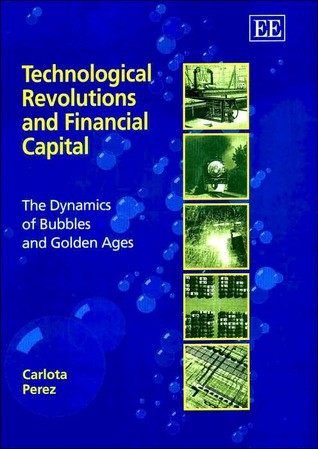 The Model of Technological Revolutions I just finished reading Technological Revolutions and Financial Capital: The Dynamics of Bubbles and Golden Ages by Carlota Perez. She outlines 5 surges over the past 200 years and explains the model and mechanics of how these long cycles evolve. It got me thinking about the past technological revolution during the Internet Surge. I wanted to see how my experience going through that cycle fit within the context of the book. It explained a lot and helped me think about the Internet Age in new ways. Then, I started to think if this could describe what’s currently going on with artificial intelligence (AI) and cryptocurrency. I believe it does. Each surge has has 2 periods that are very different in nature: the Installation Period and the Deployment Period. Generally, speaking each surge lasts 40–60 years and each period within the surge lasts 20–30 years. Each period has 2 phases within it. The Installation Period has the Irruption Phase and the Frenzy Phase. The Deployment Period has the Synergy Phase and the Maturity Phase. The Installation and Deployment periods are separated by a key milestone, something Perez calls the Turning Point. Among other things, this is where “the crash” happens. Since we’re focused on the current technological revolution, we’ll focus on the current Installation Period and its two phases, everything up to the current surge’s Turning Point. 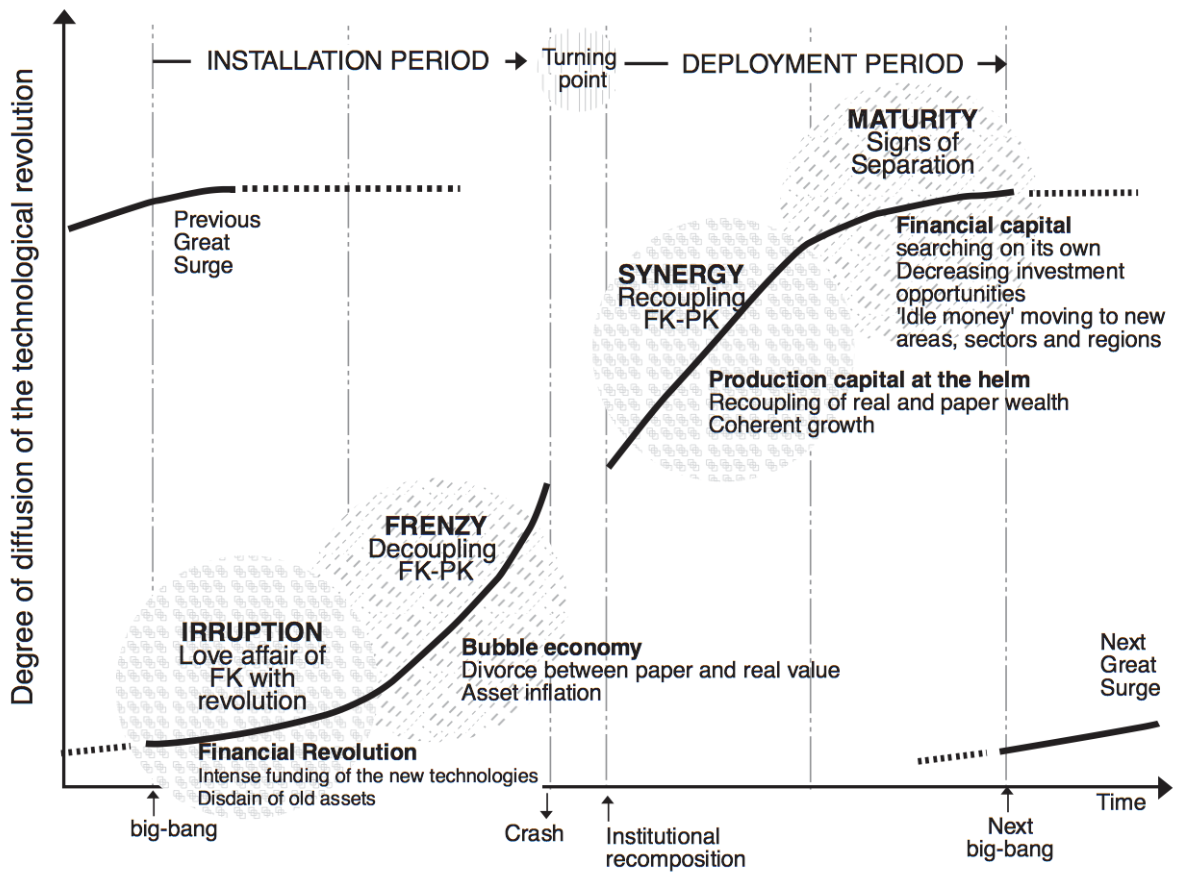 From “Technological Revolutions and Financial Capital” by Perez page 32 This book outlines some abstractions and models for how technological revolutions act similarly over time, describes the phases of the cycle and illustrates her model through past technological revolutions. The 5 surges over the past 200 years she discusses in the book are: - Industrial Revolution: 1771–1829 - Age of Steam & Railways: 1829–1873 - Age of Steel & Electricity: 1875–1918 - Age of Oil & Mass Production: 1908–1974 - Age of Information & Telecommunications: 1971–20?? - Age of Autonomization*: 2009 — ? * Note: This is my assertion or prediction and not a part of the book From the book, “Technological Revolution and Financial Capital” by Perez The 6th Surge — A New Age Based on the model outlined in the book, I think we’re in a new Age — the Age to Autonomization. Many have talked about the “Age of Automation”, but I don’t think that description captures the full picture. Automation focuses on making systems and processes automatic without the need for continuous intervention or input from an operator (a human). Autonomization focuses on making an agent or system self-governing. As we’ll see, this slight distinction is makes all the difference. This new technological revolution fits within the model of the Kondratieff Cycle or long wave paradigm and the model outlined in the book by Perez. Some have written about cryptocurrency itself following the Kondratieff long wave cycle. Below we’ll discuss the patterns within a cycle of technological revolution, enumerate some of the events for each period and phase and describe the greater context. Age of Automation — Descriptions to Date Many people have written about the Age of Automation. Just google the term. It’s about artificial intelligence (AI), internet of things (IoT) and robotics. There have been stories and documentaries aplenty the past couple of years on these topics. There are exchange-traded funds (ETF’s) investments focused on AI/robotics and automation like $BOTZ and $ROBO. Automation is an important trend but it’s not the important trend. I assert on their own these cannot bring about a technological revolution. The last required technology is blockchain and, within its architecture, the idea of decentralization. The important trend is autonomization. Blockchain — The Last Piece of the Puzzle While I think both points of view on automation and cryptocurrency add value to the general movement, I think the writers miss the application and model structure a bit. Technologies that advance automation, like AI or robotics, can easily fit within the current paradigm. Any company that invests in building these will reap the rewards of their investments. There is no paradigm shift and no change to the status quo. There are 3 innovations that empower cryptocurrency to be the last pillar. The first is a new digital model for the global generation, transference and store of value. The second is the ability of smart contracts that allow for rules-based transference of value, programmatically. The third is decentralization which allows us to cross organizational borders and break the constraints of a centralized organization or a central authority. The paradigm shift is in the transformation of how we come together to produce work and how we govern relationships. The shift occurs through decentralized autonomous organizations (DAO’s), smart contracts and new governance models. This shifts the power and the reward from the centralized organization back to the individual. All of these occur in the realm of cryptocurrency. Therefore, the last technology required to bring about a new age is cryptocurrency. Just like in the last surge, the Internet was an important component of the surge, but not its core focus. It was an integral mechanism, but the revolution was about something bigger. It was the Age of Information. In the same way, this new surge is about autonomization. Cryptocurrency will be an integral component, but the revolution isn’t just about cryptocurrency. It’s the final pillar that will support a broader Age — the Age of Autonomization. The Age of Autonomization — What’s Possible This new Age is going to bring about transformational change. It will alter every aspect of how a business or organization will go about producing goods and services. Throughout the globe, each industry, community and government will begin building autonomous agents to produce work, generate value then transfer and store value. These actions will be created and enforced by software — agents and bots implementing smart contracts through cryptocurrency platform networks. Robotics will achieve any movement in the physical world. The internet of things will provide the sensors and networks to measure and communicate data. Artificial intelligence will provide the judgement, expertise and evaluation within a closed system. And decentralized cryptocurrency platforms will provide movement across organizations via the smart contracts to govern and enforce the transfer and store of value from the work produced. This will also restore balance between the individual and the group. Autonomous agents working in a decentralized world will allow people to invest and work on projects they’re interested in and be paid or rewarded for their contribution. Earning tokens through work or investing in cryptoassets you believe in allow the benefit to be restored back to the individual. No longer will there be a rent-seeking intermediary like Facebook, Uber, Google or any other to extract value from the whole. Central organizations will no longer accumulate all the benefit. The power is restored to the individual because they will be able to vote within the governance systems without politics and without an intermediary circumventing the will of the collective individuals. Where Are We Now? It’s important to try and figure out where we are in the cycle. I believe the “Big Bang” milestone happened with the invention of bitcoin in 2009. Artificial intelligence, internet of things and robotics all made significant improvements in their respective space in the early and mid 2010’s. The last nine years have been about the technology and has not diffused to a wider audience, yet. These clues tell us that we’re somewhere at the end of the Irruption Phase. Additionally, we’ve seen some market fervor in cryptocurrency in 2017, so that puts us in the early stages of the Frenzy Phase. As such, I’ve marked where I estimate us to be in the cycle below. 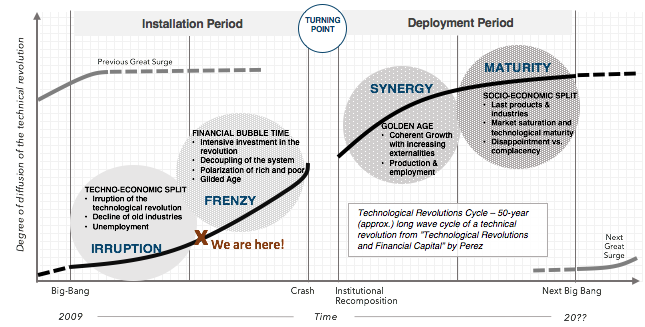 Irruption Phase — What has Happened? As Perez defines it, the Irruption Phase is the beginning of the cycle where the new technology is discovered. The focus is on technology. The phase starts with a “Big Bang” moment which is when some new technology is discovered. This is good news because the world is experiencing economic discord and unemployment from the decline of old industries of the past surge. The irruption of new technology creates new possibilities and during the Irruption Phase visionaries and early adopters are inventing and figuring out exactly what the new technology is and how it could impact the world. Frenzy Phase — What to Expect? The Frenzy Phase starts with intensive investment. The focus of this phase is investment and speculation. The Frenzy Phase brings out the speculators and during this phase we see a decoupling of investment and production. Moreover, increased polarization between the rich and the poor can be expected. The Frenzy Phase ends in a “crash” event that starts the Turning Point in the cycle. From Perez — “Neither the Tulip mania of the 1630’s nor the South Sea Bubble of 1720 qualifies in this sense as there were no technological revolutions driving the events. In fact, there are many psychology phenomena associated with speculative behavior, but not related to the assimilation of technological revolutions in a capitalist context.” Not all bubble or mania behavior is a part of a technological revolution. Tulips are not a technological revolution. However, there do exist bubbles or manias that fit within this stated paradigm. Blockchain technology, and by extension cryptocurrency, do fit within the described paradigm. Therefore, we can expect the future cycle to follow past technological revolutionary cycles. Photo by rawpixel on Unsplash Conclusion As you can see, we’ve started a new surge, a new technological revolution. Actions will be focused around building autonomy throughout the entire production cycle. Cryptocurrencies will play a key role. I predict by the end of this surge, we will no longer organize society around labor and production. Production, as a unit, will be solved. Robotics will automate production in the physical world, while sensors and data will move through the Internet of Things. Software, through bots, agents and cryptocurrency will generate, transfer and store the world’s value. Artificial intelligence will provide the brain power to learn, execute, measure and adapt each component within the decentralized system. New models will bring forth our new future. Right now, we’re in the middle of an exciting time to be an investor. We’ve just started a phase where speculation and investment in the new technological revolution will bring about massive fortunes. Like the railroads in the 19th century and the last surge of the Age of Information and Telecommunications, we’re starting a peak period where investments can produce enormous returns. Cryptocurrency is not like tulip mania because it’s being driven by the adoption of a new technology which ends up reorganizing how the entire globe functions. This won’t happen overnight, but if we look closely we can see that it’s just history repeating itself once again. Disclaimer: The above references an opinion and is for information purposes only. It is not intended to be investment advice. Please do your own homework. Jake Ryan is the founder of Tradecraft Capital, a crypto hedge fund. He is also a startup advisor, an angel investor & a writer on investing. If you enjoyed this article “clap” to help others find it! For more, join us on Facebook, Twitter. #crypto #cryptocurrency #bitcoin #investing #blockchain #tradecraft |
| json metadata | {"tags":["economics","bitcoin","cryptocurrency","blockchain","crypto"],"image":["https://cdn.steemitimages.com/DQmewv6nE3ZrHFfmJjfvNpRPQP9fsvT13gLZNSEUvKEJNLL/1_8Ro4JkzQp1DiGGNqqm23rw.jpeg","https://cdn.steemitimages.com/DQmRBCw1A28ieaVniAY1Ke9FRVUBvSkU1StFEahkXhSN6eu/1_4K8ilbiKgjifYoWVPX-NOg.png","https://cdn.steemitimages.com/DQmVZnbbJc8w4moUrEHkRVdn1cbBsW67WaoCfJG123S84jj/1_VIvGe0EWSCSlMZaQ1JCfWA.png"],"app":"steemit/0.1","format":"markdown"} |
| Transaction Info | Block #24347827/Trx 2344fb05b5f23cbcb8ce5d004ea396ab8abb0319 |
View Raw JSON Data
{
"trx_id": "2344fb05b5f23cbcb8ce5d004ea396ab8abb0319",
"block": 24347827,
"trx_in_block": 26,
"op_in_trx": 0,
"virtual_op": 0,
"timestamp": "2018-07-20T18:05:00",
"op": [
"comment",
{
"parent_author": "",
"parent_permlink": "economics",
"author": "jakeryan",
"permlink": "crypto-s-role-in-the-age-of-autonomization",
"title": "Crypto’s Role in the Age of Autonomization",
"body": "Many people have stated that bitcoin is akin to tulip mania. It’s not. It’s true that cryptocurrencies may be in a mania phase where price is decoupled from productivity, but that does not tell the full story. Blockchain technology, and by extension cryptocurrency, is a technological revolution and it follows the cycle of other technological revolutions like the Industrial Age and the Information Age. At times, I’ll use blockchain and crypto interchangeably. For blockchain technology to change the world, it must be implemented as cryptocurrency. The two are inextricably linked. This article aims to explain the difference between bitcoin (and the entire crypto-asset class) and tulip mania. I intend to show that cryptocurrency, as a technology in concert with other technologies, is driving the next long wave economic cycle. Technological revolutions transform the world and I will illustrate how, when and where cryptoassets fit within that picture.\n\nBitcoin was the first “killer app” of a technology called blockchain. Bitcoin brought forth something innovative by creating a global system to digitally transfer and store value. It does this through its design by using decentralization, immutability, incentivization in novel ways that allow commerce transactions without the need of a trusted third party (i.e. like a bank). Moreover, the next generation of cryptocurrencies bring forth the capability of smart contracts (i.e. programmable money). These capabilities are new and they will spark an entire wave of technological improvement centered around how we globally generate, store and transfer value. Let’s take a look at how technological revolutions and their long economic cycles are constructed.\n\n\n\nThe Model of Technological Revolutions\nI just finished reading Technological Revolutions and Financial Capital: The Dynamics of Bubbles and Golden Ages by Carlota Perez. She outlines 5 surges over the past 200 years and explains the model and mechanics of how these long cycles evolve. It got me thinking about the past technological revolution during the Internet Surge. I wanted to see how my experience going through that cycle fit within the context of the book. It explained a lot and helped me think about the Internet Age in new ways. Then, I started to think if this could describe what’s currently going on with artificial intelligence (AI) and cryptocurrency. I believe it does.\n\nEach surge has has 2 periods that are very different in nature: the Installation Period and the Deployment Period. Generally, speaking each surge lasts 40–60 years and each period within the surge lasts 20–30 years.\n\nEach period has 2 phases within it. The Installation Period has the Irruption Phase and the Frenzy Phase. The Deployment Period has the Synergy Phase and the Maturity Phase. The Installation and Deployment periods are separated by a key milestone, something Perez calls the Turning Point. Among other things, this is where “the crash” happens. Since we’re focused on the current technological revolution, we’ll focus on the current Installation Period and its two phases, everything up to the current surge’s Turning Point.\n\n\n\nFrom “Technological Revolutions and Financial Capital” by Perez page 32\n\nThis book outlines some abstractions and models for how technological revolutions act similarly over time, describes the phases of the cycle and illustrates her model through past technological revolutions. The 5 surges over the past 200 years she discusses in the book are:\n\n- Industrial Revolution: 1771–1829\n- Age of Steam & Railways: 1829–1873\n- Age of Steel & Electricity: 1875–1918\n- Age of Oil & Mass Production: 1908–1974\n- Age of Information & Telecommunications: 1971–20??\n- Age of Autonomization*: 2009 — ?\n\n* Note: This is my assertion or prediction and not a part of the book\n\n\nFrom the book, “Technological Revolution and Financial Capital” by Perez\n\nThe 6th Surge — A New Age\n\nBased on the model outlined in the book, I think we’re in a new Age — the Age to Autonomization. Many have talked about the “Age of Automation”, but I don’t think that description captures the full picture. Automation focuses on making systems and processes automatic without the need for continuous intervention or input from an operator (a human). Autonomization focuses on making an agent or system self-governing. As we’ll see, this slight distinction is makes all the difference.\n\nThis new technological revolution fits within the model of the Kondratieff Cycle or long wave paradigm and the model outlined in the book by Perez. Some have written about cryptocurrency itself following the Kondratieff long wave cycle. Below we’ll discuss the patterns within a cycle of technological revolution, enumerate some of the events for each period and phase and describe the greater context.\n\n\nAge of Automation — Descriptions to Date\nMany people have written about the Age of Automation. Just google the term. It’s about artificial intelligence (AI), internet of things (IoT) and robotics. There have been stories and documentaries aplenty the past couple of years on these topics. There are exchange-traded funds (ETF’s) investments focused on AI/robotics and automation like $BOTZ and $ROBO.\n\nAutomation is an important trend but it’s not the important trend. I assert on their own these cannot bring about a technological revolution. The last required technology is blockchain and, within its architecture, the idea of decentralization. The important trend is autonomization.\n\n\nBlockchain — The Last Piece of the Puzzle\nWhile I think both points of view on automation and cryptocurrency add value to the general movement, I think the writers miss the application and model structure a bit. Technologies that advance automation, like AI or robotics, can easily fit within the current paradigm. Any company that invests in building these will reap the rewards of their investments. There is no paradigm shift and no change to the status quo.\n\nThere are 3 innovations that empower cryptocurrency to be the last pillar. The first is a new digital model for the global generation, transference and store of value. The second is the ability of smart contracts that allow for rules-based transference of value, programmatically. The third is decentralization which allows us to cross organizational borders and break the constraints of a centralized organization or a central authority.\n\nThe paradigm shift is in the transformation of how we come together to produce work and how we govern relationships. The shift occurs through decentralized autonomous organizations (DAO’s), smart contracts and new governance models. This shifts the power and the reward from the centralized organization back to the individual. All of these occur in the realm of cryptocurrency. Therefore, the last technology required to bring about a new age is cryptocurrency.\n\nJust like in the last surge, the Internet was an important component of the surge, but not its core focus. It was an integral mechanism, but the revolution was about something bigger. It was the Age of Information. In the same way, this new surge is about autonomization. Cryptocurrency will be an integral component, but the revolution isn’t just about cryptocurrency. It’s the final pillar that will support a broader Age — the Age of Autonomization.\n\n\n\nThe Age of Autonomization — What’s Possible\n\nThis new Age is going to bring about transformational change. It will alter every aspect of how a business or organization will go about producing goods and services. Throughout the globe, each industry, community and government will begin building autonomous agents to produce work, generate value then transfer and store value.\n\nThese actions will be created and enforced by software — agents and bots implementing smart contracts through cryptocurrency platform networks. Robotics will achieve any movement in the physical world. The internet of things will provide the sensors and networks to measure and communicate data. Artificial intelligence will provide the judgement, expertise and evaluation within a closed system. And decentralized cryptocurrency platforms will provide movement across organizations via the smart contracts to govern and enforce the transfer and store of value from the work produced.\n\nThis will also restore balance between the individual and the group. Autonomous agents working in a decentralized world will allow people to invest and work on projects they’re interested in and be paid or rewarded for their contribution. Earning tokens through work or investing in cryptoassets you believe in allow the benefit to be restored back to the individual. No longer will there be a rent-seeking intermediary like Facebook, Uber, Google or any other to extract value from the whole. Central organizations will no longer accumulate all the benefit. The power is restored to the individual because they will be able to vote within the governance systems without politics and without an intermediary circumventing the will of the collective individuals.\n\nWhere Are We Now?\nIt’s important to try and figure out where we are in the cycle. I believe the “Big Bang” milestone happened with the invention of bitcoin in 2009. Artificial intelligence, internet of things and robotics all made significant improvements in their respective space in the early and mid 2010’s. The last nine years have been about the technology and has not diffused to a wider audience, yet. These clues tell us that we’re somewhere at the end of the Irruption Phase. Additionally, we’ve seen some market fervor in cryptocurrency in 2017, so that puts us in the early stages of the Frenzy Phase. As such, I’ve marked where I estimate us to be in the cycle below.\n\n\n\nIrruption Phase — What has Happened?\nAs Perez defines it, the Irruption Phase is the beginning of the cycle where the new technology is discovered. The focus is on technology. The phase starts with a “Big Bang” moment which is when some new technology is discovered. This is good news because the world is experiencing economic discord and unemployment from the decline of old industries of the past surge. The irruption of new technology creates new possibilities and during the Irruption Phase visionaries and early adopters are inventing and figuring out exactly what the new technology is and how it could impact the world.\n\nFrenzy Phase — What to Expect?\nThe Frenzy Phase starts with intensive investment. The focus of this phase is investment and speculation. The Frenzy Phase brings out the speculators and during this phase we see a decoupling of investment and production. Moreover, increased polarization between the rich and the poor can be expected. The Frenzy Phase ends in a “crash” event that starts the Turning Point in the cycle.\n\nFrom Perez — “Neither the Tulip mania of the 1630’s nor the South Sea Bubble of 1720 qualifies in this sense as there were no technological revolutions driving the events. In fact, there are many psychology phenomena associated with speculative behavior, but not related to the assimilation of technological revolutions in a capitalist context.”\n\nNot all bubble or mania behavior is a part of a technological revolution. Tulips are not a technological revolution. However, there do exist bubbles or manias that fit within this stated paradigm. Blockchain technology, and by extension cryptocurrency, do fit within the described paradigm. Therefore, we can expect the future cycle to follow past technological revolutionary cycles.\n\n\nPhoto by rawpixel on Unsplash\n\nConclusion\nAs you can see, we’ve started a new surge, a new technological revolution. Actions will be focused around building autonomy throughout the entire production cycle. Cryptocurrencies will play a key role. I predict by the end of this surge, we will no longer organize society around labor and production. Production, as a unit, will be solved. Robotics will automate production in the physical world, while sensors and data will move through the Internet of Things. Software, through bots, agents and cryptocurrency will generate, transfer and store the world’s value. Artificial intelligence will provide the brain power to learn, execute, measure and adapt each component within the decentralized system. New models will bring forth our new future.\n\nRight now, we’re in the middle of an exciting time to be an investor. We’ve just started a phase where speculation and investment in the new technological revolution will bring about massive fortunes. Like the railroads in the 19th century and the last surge of the Age of Information and Telecommunications, we’re starting a peak period where investments can produce enormous returns. Cryptocurrency is not like tulip mania because it’s being driven by the adoption of a new technology which ends up reorganizing how the entire globe functions. This won’t happen overnight, but if we look closely we can see that it’s just history repeating itself once again.\n\nDisclaimer: The above references an opinion and is for information purposes only. It is not intended to be investment advice. Please do your own homework.\n\nJake Ryan is the founder of Tradecraft Capital, a crypto hedge fund. He is also a startup advisor, an angel investor & a writer on investing. If you enjoyed this article “clap” to help others find it! For more, join us on Facebook, Twitter.\n\n#crypto #cryptocurrency #bitcoin #investing #blockchain #tradecraft",
"json_metadata": "{\"tags\":[\"economics\",\"bitcoin\",\"cryptocurrency\",\"blockchain\",\"crypto\"],\"image\":[\"https://cdn.steemitimages.com/DQmewv6nE3ZrHFfmJjfvNpRPQP9fsvT13gLZNSEUvKEJNLL/1_8Ro4JkzQp1DiGGNqqm23rw.jpeg\",\"https://cdn.steemitimages.com/DQmRBCw1A28ieaVniAY1Ke9FRVUBvSkU1StFEahkXhSN6eu/1_4K8ilbiKgjifYoWVPX-NOg.png\",\"https://cdn.steemitimages.com/DQmVZnbbJc8w4moUrEHkRVdn1cbBsW67WaoCfJG123S84jj/1_VIvGe0EWSCSlMZaQ1JCfWA.png\"],\"app\":\"steemit/0.1\",\"format\":\"markdown\"}"
}
]
}jakeryanupvoted (100.00%) @kyle.anderson / what-s-the-supply-an-ethereum-monetary-policy2018/07/20 17:55:48
jakeryanupvoted (100.00%) @kyle.anderson / what-s-the-supply-an-ethereum-monetary-policy
2018/07/20 17:55:48
| voter | jakeryan |
| author | kyle.anderson |
| permlink | what-s-the-supply-an-ethereum-monetary-policy |
| weight | 10000 (100.00%) |
| Transaction Info | Block #24347643/Trx 9a68f58c67232d62208fb6b845b966d35b6fe007 |
View Raw JSON Data
{
  "trx_id": "9a68f58c67232d62208fb6b845b966d35b6fe007",
  "block": 24347643,
  "trx_in_block": 7,
  "op_in_trx": 0,
  "virtual_op": 0,
  "timestamp": "2018-07-20T17:55:48",
  "op": [
    "vote",
    {
      "voter": "jakeryan",
      "author": "kyle.anderson",
      "permlink": "what-s-the-supply-an-ethereum-monetary-policy",
      "weight": 10000
    }
  ]
}2018/06/29 09:06:36
2018/06/29 09:06:36
| delegator | steem |
| delegatee | jakeryan |
| vesting shares | 27353.924121 VESTS |
| Transaction Info | Block #23742358/Trx 42d57e7a2a9e14673c22b83392a3fc78e5bc1f41 |
View Raw JSON Data
{
  "trx_id": "42d57e7a2a9e14673c22b83392a3fc78e5bc1f41",
  "block": 23742358,
  "trx_in_block": 24,
  "op_in_trx": 0,
  "virtual_op": 0,
  "timestamp": "2018-06-29T09:06:36",
  "op": [
    "delegate_vesting_shares",
    {
      "delegator": "steem",
      "delegatee": "jakeryan",
      "vesting_shares": "27353.924121 VESTS"
    }
  ]
}2018/06/27 17:42:48
2018/06/27 17:42:48
| parent author | jakeryan |
| parent permlink | crypto-asset-classes |
| author | steemitboard |
| permlink | steemitboard-notify-jakeryan-20180627t174250000z |
| title | |
| body | Congratulations @jakeryan! You have received a personal award! [](http://steemitboard.com/@jakeryan) 1 Year on Steemit <sub>_Click on the badge to view your Board of Honor._</sub> **Do not miss the [last post](https://steemit.com/steemitboard/@steemitboard/steemitboard-world-cup-contest-japan-vs-poland) from @steemitboard!** --- **Participate in the [SteemitBoard World Cup Contest](https://steemit.com/steemitboard/@steemitboard/steemitboard-world-cup-contest-collect-badges-and-win-free-sbd)!** Collect World Cup badges and win free SBD Support the Gold Sponsors of the contest: [@good-karma](https://v2.steemconnect.com/sign/account-witness-vote?witness=good-karma&approve=1) and [@lukestokes](https://v2.steemconnect.com/sign/account-witness-vote?witness=lukestokes.mhth&approve=1) --- > Do you like [SteemitBoard's project](https://steemit.com/@steemitboard)? Then **[Vote for its witness](https://v2.steemconnect.com/sign/account-witness-vote?witness=steemitboard&approve=1)** and **get one more award**! |
| json metadata | {"image":["https://steemitboard.com/img/notify.png"]} |
| Transaction Info | Block #23695127/Trx f931f062ac304349eba253b8ebb68243139243ee |
View Raw JSON Data
{
"trx_id": "f931f062ac304349eba253b8ebb68243139243ee",
"block": 23695127,
"trx_in_block": 27,
"op_in_trx": 0,
"virtual_op": 0,
"timestamp": "2018-06-27T17:42:48",
"op": [
"comment",
{
"parent_author": "jakeryan",
"parent_permlink": "crypto-asset-classes",
"author": "steemitboard",
"permlink": "steemitboard-notify-jakeryan-20180627t174250000z",
"title": "",
"body": "Congratulations @jakeryan! You have received a personal award!\n\n[](http://steemitboard.com/@jakeryan) 1 Year on Steemit\n<sub>_Click on the badge to view your Board of Honor._</sub>\n\n\n**Do not miss the [last post](https://steemit.com/steemitboard/@steemitboard/steemitboard-world-cup-contest-japan-vs-poland) from @steemitboard!**\n\n---\n**Participate in the [SteemitBoard World Cup Contest](https://steemit.com/steemitboard/@steemitboard/steemitboard-world-cup-contest-collect-badges-and-win-free-sbd)!**\nCollect World Cup badges and win free SBD\nSupport the Gold Sponsors of the contest: [@good-karma](https://v2.steemconnect.com/sign/account-witness-vote?witness=good-karma&approve=1) and [@lukestokes](https://v2.steemconnect.com/sign/account-witness-vote?witness=lukestokes.mhth&approve=1)\n\n---\n\n> Do you like [SteemitBoard's project](https://steemit.com/@steemitboard)? Then **[Vote for its witness](https://v2.steemconnect.com/sign/account-witness-vote?witness=steemitboard&approve=1)** and **get one more award**!",
"json_metadata": "{\"image\":[\"https://steemitboard.com/img/notify.png\"]}"
}
]
}sensationupvoted (100.00%) @jakeryan / crypto-asset-classes2018/05/23 23:53:03
sensationupvoted (100.00%) @jakeryan / crypto-asset-classes
2018/05/23 23:53:03
| voter | sensation |
| author | jakeryan |
| permlink | crypto-asset-classes |
| weight | 10000 (100.00%) |
| Transaction Info | Block #22695714/Trx 5d373d5b88963a19f91d5b0435e052372b956760 |
View Raw JSON Data
{
  "trx_id": "5d373d5b88963a19f91d5b0435e052372b956760",
  "block": 22695714,
  "trx_in_block": 32,
  "op_in_trx": 0,
  "virtual_op": 0,
  "timestamp": "2018-05-23T23:53:03",
  "op": [
    "vote",
    {
      "voter": "sensation",
      "author": "jakeryan",
      "permlink": "crypto-asset-classes",
      "weight": 10000
    }
  ]
}moby-dickupvoted (100.00%) @jakeryan / crypto-asset-classes2018/05/23 23:42:45
moby-dickupvoted (100.00%) @jakeryan / crypto-asset-classes
2018/05/23 23:42:45
| voter | moby-dick |
| author | jakeryan |
| permlink | crypto-asset-classes |
| weight | 10000 (100.00%) |
| Transaction Info | Block #22695508/Trx 5b7f7d509aaf32a43e90e329cfb7fe7f25a46235 |
View Raw JSON Data
{
  "trx_id": "5b7f7d509aaf32a43e90e329cfb7fe7f25a46235",
  "block": 22695508,
  "trx_in_block": 10,
  "op_in_trx": 0,
  "virtual_op": 0,
  "timestamp": "2018-05-23T23:42:45",
  "op": [
    "vote",
    {
      "voter": "moby-dick",
      "author": "jakeryan",
      "permlink": "crypto-asset-classes",
      "weight": 10000
    }
  ]
}jakeryanpublished a new post: crypto-asset-classes2018/05/23 22:51:33
jakeryanpublished a new post: crypto-asset-classes
2018/05/23 22:51:33
| parent author | |
| parent permlink | cryptocurrency |
| author | jakeryan |
| permlink | crypto-asset-classes |
| title | Crypto Asset Classes |
| body |  A lot of people have written about classification and categorization of crypto assets. Security tokens, utility tokens, cryptocurrencies, exchanges, appcoins, and altcoins are all labels in an effort to organize a collection of similar crypto assets. Some people, like Tom Lee (whom I respect very much) of <a href="https://www.fundstrat.com">Fundstrat Global Advisors</a>, break the collections into cohorts based on how they trade — more like sectors. For example, Lee breaks the sectors into commodities, platforms, privacy, exchanges and stablecoins. He does this because these cohorts trade similarly, and he can <a href="https://bitsonline.com/tom-lee-crypto-rotation/">model trading action</a> based on their collective attributes. Sector definition is important, but I think there’s one higher level of abstraction needed. That’s crypto asset classes. Commodities, platforms and stablecoins are of a different classification type than privacy coins and exchanges, and I would separate them as such. That way, we’ll have both asset classes and sectors like we do with traditional financial markets. Others, like the general partners at <a href="https://multicoin.capital">Multicoin Capital</a>, break the collections into 3 major cohorts: currencies (stores of value); security tokens (tokens backed by real-world assets); and utility tokens (work tokens). They’ve settled on this configuration because they think each has a separate and distinct valuation model. They outline a <a href="https://multicoin.capital/2018/02/13/new-models-utility-tokens/">valuation model</a> for currencies and work tokens. You’ll notice that they don’t distinguish platform coins from cryptocurrencies as they believe platform coins will be held for their own specific store of value. Some labels have just come to us through nomenclature “inheritance” which I don’t think is very helpful. An example of this is the moniker “altcoins”. It can be confusing as to exactly what an altcoin is and whether it can mean every other coin that is not bitcoin or ether. That’s a large subset that really doesn’t do anyone much good. I think of the crypto asset class superset a little differently. I would classify the mutually-exclusive subsets based on logical groupings. <i>I see eight distinct crypto asset classes — core, currencies, platforms, utility tokens, security tokens, commodities, appcoins and stable coins.</i> I use these crypto asset classes because members of the set have similar properties. They have similar functional goals and react to the market in a similar fashion. They have similar valuation models, compete with one another in some form or operate similarly within their set, have similar regulatory risk and generally define the highest subset under the umbrella crypto asset superset. Fundamentally, I’m coming at this as an investor. I want to have an asset allocation strategy, and then have multiple positions of the best coins I think will produce a return for that crypto asset class. I want to be able to manage target asset class percentages. I don’t want to commingle currencies, utility tokens, platforms and appcoins in the same asset class because it does not provide me with a satisfactory level of precision to allocate across the total market. The asset classes may have similar valuation models, but their stated goal and their functions are different. While all crypto assets are highly correlated, as the market matures and valuation models take hold this should change. From an investor’s perspective, it makes sense to create 7–12 classes that are mutually exclusive while also being exhaustively comprehensive to classify members in the entire crypto asset superset.  <b>Core / Reserve</b> The core crypto asset class contains just two — bitcoin and ether. I’m pulling Ethereum out of the platforms crypto asset class for now because it has special properties. Ultimately, investors need to convert their fiat currency into either bitcoin or ether to buy any other coin or token. These are considered core reserve crypto assets. While bitcoin and ether are different in many ways, they both have a market quality similar to one another and not shared by any other crypto assets. They are both mined and have set monetary policies. Cogent arguments have been made that bitcoin is its own distinct crypto asset class because its deflationary cryptocurrency with limited supply. The Ethereum network is a platform with different supply/demand mechanics. However, as long as these two crypto assets hold this special dynamic within the market, I’m going to combine them into their own special asset class. Let’s take a page from the financial analog. The entire current global asset structure starts with gold and builds from there. From gold, countries manage their fiat money supplies. It used to be that the amount of gold a country owned affected how much of its currency supply could be printed. From currencies, commodities are priced and fixed income (bonds) are created to produce a return on capital in the financial market. Equity can be created as a security, after pricing resources (commodities) and calculating interest rates and risk. While gold is classified as a commodity (for legal and other reasons), it’s treated as both a commodity and a currency. It has special properties which convince asset allocators and investors that gold is an asset class of its own. I agree. The same is true for the core crypto assets.  <b>Cryptocurrencies</b> Cryptocurrencies’ core benefit to the market is to be a digital form of payment. The fundamental question to test whether or not a coin is a currency asks “Is the primary use as a medium of exchange and/or a store of value?” That is, does it digitally fulfill on a currency’s ability to be: 1. a medium of exchange; 2. a store of value; and, ultimately, 3. a unit of account. While each cryptocurrency is at various stages of delivering on these, that is the primary goal or function. Cryptocurrencies collectively would have similar regulatory risk as a collection compared against other asset classes, i.e., utility tokens. Crypto currency has a similar value function as standard currency. The Equation of Exchange, M x V= P x Q, is applicable here. The valuation model of cryptocurrency is fundamentally based on unit costs and, most importantly, on the velocity of money. As money is used faster throughout the system, the value of that monetary system increases. Cryptocurrencies are all trying to address the same issues with payment. Cryptocurrencies are grouped logically, and there is no superset between this asset class and the crypto asset umbrella superset. Therefore cryptocurrency is its own crypto asset class. Examples of cryptocurrencies are: Bitcoin, Bitcoin Cash, Monero and Dash.  <b>Platforms</b> Platforms are going to be one of the most interesting cryptos because this is where smart contracts and programmatic money are going to exist. If a blockchain wants to implement smart contracts in some form, then it’s probably in the platform asset class. Programmatic enforcement of legal and financial contracts will transform the shape and velocity of what’s possible globally. We’re already seeing a fundamental change in what’s possible with the accumulation, transference and store of value. To understand what’s possible, let’s paint a picture of the future in 10 years. All corporations will effectively be smart contracts. Governance, voting, supply chain and contract enforcement will fundamentally change because we are going to be able to programmatically store and transfer value based on some previously agreed-upon logic. Value will be created globally just from the transparency and predictability of contract execution. We will be able to see exactly where our food comes from. We will be able to trust digital voting has not been tampered with. Land title disputes will no longer exist. Platforms will work to provide some of the fundamental building blocks of blockchain, like smart contracts, immutability and decentralization. However, they are distinct from cryptocurrency in their stated goal and function. They have different regulatory risk than other crypto asset classes. Platforms are closer to legal contracts than currency in the analog paradigm. Their valuation model is primarily based on network effects whereas cryptocurrencies are valued on the velocity of money and the equation of exchange. They are distinct from all other crypto asset classes, and thus they are an asset class of their own. Examples of Platforms are: EOS, NEO, Cardano & IOTA. <b>Utility Tokens</b> Utility tokens focus on a providing a service layer. They provide a function or a resource to address a specific need. They have partners and contributors who create applications on top of the protocol or create applications that use the utility token. Utility tokens valuation model is primarily based on network effects but will be influenced by supply/demand. Utility tokens run on a platform blockchain they do not directly manage or control. Most utility tokens to date run on the Ethereum platform. Utility tokens are distinct from platforms in that they aren’t providing a lower level or horizontal functionality built on top of a blockchain and they are distinct from appcoins because their stated functional goal is not limited to one application or service. Utility tokens may work on one blockchain for now, but in the future the utility tokens may operate on multiple networks to serve multiple app coins. Examples of Utility Tokens are: BAT, Civic, OmiseGO and Tron.  <b>Security Tokens</b> Security tokens are different from utility tokens and platforms by their functional nature and goal as well as by their regulatory risk profile. They derive their value from being linked to an external asset and are likely subject to federal securities regulations. The valuation model of a security token directly relates to valuing the underlying asset linked to the token. These tokens will have a much bigger play and their growth stage in 2018 and beyond. I predict within the next 12 months there will be companies that want to have their equity trade as security tokens on a crypto exchange. We’ll also see real estate secured on a blockchain with a security token. Security tokens are distinct from all other crypto asset classes because of their link to an external, real-world asset. An example of a Security Tokens is: BCAP. <b>Crypto Commodities</b> Commodities aim to provide a direct consumable resource. This is distinct from the platform asset class in that it’s vertical/industry specific and it seeks to exchange based on a specific subset of resources. Those resources could include disk space, computing power or other consumable services. Commodities are distinct from utility tokens in that their valuation model is mostly influenced by the supply and demand of a given resource. Crypto-commodities run their own blockchain which is different than how utility tokens operate. This is one of the main mechanics to how supply and demand affect price. Price surges and other scarcity risks could occur more frequently with commodities than may affect other asset classes like utility tokens or appcoins. Though, they will have less regulatory risk because of the work or resource exchanged. Their valuation model is influenced by network effects but the valuation model is different than currencies which are mostly valued by the velocity of money and platforms which are valued mostly by network effects. Examples of Crypto-commodities are: STORJ, FileCoin and Golem.  <b>Appcoins</b> Appcoins work on one specific network to provide a specific vertical application service. They are distinct from commodities in that their supply is not constrained like a commodity or resource that is consumed. They are different from platforms because they are vertical and application-specific. They aren’t providing a platform or protocol for others to build upon. Their goal and utility is distinct in focusing on their own narrow ecosystem. They have a many-to-one relationship in their network model whereas utility tokens have a many-to-many relationship. Appcoins are the most narrow applications and therefore levered to a specific use case as being a “pure play” to a particular application or service. As a result, their valuation model will be distinct from commodities, currencies or platforms. Examples of Appcoins are: Steem, Binance and SALT. <b>Stablecoins</b> Stablecoins are present to provide a stable store of value. Currently, there is one major player within this crypto asset class. That is Tether. However, that will change in the future. Currently there are several projects pursuing various methods on how they will achieve a stable coin. I recommend thisarticle from Multicoin Capital to learn more about stablecoins. This is a new and burgeoning asset class, and we will distinguish it on its own due to its stated goal and functional nature. Examples of Stablecoins: Tether, Maker, Basecoin & Digix  <b>Conclusion</b> Hopefully, this makes a case for a good classification model of crypto asset classes. My goal is to help investors build a portfolio with appropriate asset allocation to improve your risk-adjusted returns. To achieve that, we need a good framework for how to think about crypto asset classes. If Modern Portfolio Theory (MPT) suggests a return can be made only 3 ways — asset allocation, security selection and market timing — then we want a structure to help guide and enforce how we think about asset allocation. A comprehensive crypto asset class model will help in this effort. I’ll leave selection and market timing to other upcoming articles. Happy Hunting! Jake ________________________________________________________________ <i>Disclaimer: The above references an opinion and is for information purposes only. It is not intended to be investment advice. Please do your own homework.</i> <b>If you enjoyed this article, like it to help others find it! For more, join us on <a href="https://www.facebook.com/WealthRituals/">Facebook</a> and <a href="https://twitter.com/TradeCraftC">Twitter</a> .</b> |
| json metadata | {"tags":["cryptocurrency","cryptoclasses","assets","bitcoin","tokens"],"image":["https://images.steemitimages.com/DQmZyYBpi93FnF4kmQqJNGtbUe3kR9MhzRmfdP3mW9EvsmW/bitcoin.jpg","https://images.steemitimages.com/DQma7Fzbqef5vVLHysMk5C9mg8PU5zAhKT8eYDy6qGnpMCA/crypto%20coins.jpg","https://images.steemitimages.com/DQmZzTKefhUCD7LUChEN1nDWomeohVMXEL4n1zYLpyro6x3/cryptocurrencies.jpg","https://images.steemitimages.com/DQmcbRgbgrnjS353MYh5jNZPqxZLsMD2cUaEhM6U1qRKTcb/crypto%20asset%20classes.jpg","https://images.steemitimages.com/DQmNYn6eYDmiphrPejHMZvH3NmACvvVv1Ua7jABRFoMSpuj/security.jpg","https://images.steemitimages.com/DQmd8o1DkCu8HEnSrY2pEtBM8F3K123om7rR78SYV69oCM6/appcoins.jpg","https://images.steemitimages.com/DQmY4ZtDrXuHZst2PYEx5vY55MTVwU3Ng6MQVJU9FxQNiRc/blockchain.jpg"],"links":["https://www.fundstrat.com","https://bitsonline.com/tom-lee-crypto-rotation/","https://multicoin.capital","https://multicoin.capital/2018/02/13/new-models-utility-tokens/","https://www.facebook.com/WealthRituals/","https://twitter.com/TradeCraftC"],"app":"steemit/0.1","format":"markdown"} |
| Transaction Info | Block #22694484/Trx f8960fbaa738d1bf77437a664d21d620af7e8a63 |
View Raw JSON Data
{
"trx_id": "f8960fbaa738d1bf77437a664d21d620af7e8a63",
"block": 22694484,
"trx_in_block": 26,
"op_in_trx": 0,
"virtual_op": 0,
"timestamp": "2018-05-23T22:51:33",
"op": [
"comment",
{
"parent_author": "",
"parent_permlink": "cryptocurrency",
"author": "jakeryan",
"permlink": "crypto-asset-classes",
"title": "Crypto Asset Classes",
"body": "\n\nA lot of people have written about classification and categorization of crypto assets. Security tokens, utility tokens, cryptocurrencies, exchanges, appcoins, and altcoins are all labels in an effort to organize a collection of similar crypto assets.\n\nSome people, like Tom Lee (whom I respect very much) of <a href=\"https://www.fundstrat.com\">Fundstrat Global Advisors</a>, break the collections into cohorts based on how they trade — more like sectors. For example, Lee breaks the sectors into commodities, platforms, privacy, exchanges and stablecoins. He does this because these cohorts trade similarly, and he can <a href=\"https://bitsonline.com/tom-lee-crypto-rotation/\">model trading action</a> based on their collective attributes. Sector definition is important, but I think there’s one higher level of abstraction needed. That’s crypto asset classes. Commodities, platforms and stablecoins are of a different classification type than privacy coins and exchanges, and I would separate them as such. That way, we’ll have both asset classes and sectors like we do with traditional financial markets.\n\nOthers, like the general partners at <a href=\"https://multicoin.capital\">Multicoin Capital</a>, break the collections into 3 major cohorts: currencies (stores of value); security tokens (tokens backed by real-world assets); and utility tokens (work tokens). They’ve settled on this configuration because they think each has a separate and distinct valuation model. They outline a <a href=\"https://multicoin.capital/2018/02/13/new-models-utility-tokens/\">valuation model</a> for currencies and work tokens. You’ll notice that they don’t distinguish platform coins from cryptocurrencies as they believe platform coins will be held for their own specific store of value.\n\nSome labels have just come to us through nomenclature “inheritance” which I don’t think is very helpful. An example of this is the moniker “altcoins”. It can be confusing as to exactly what an altcoin is and whether it can mean every other coin that is not bitcoin or ether. That’s a large subset that really doesn’t do anyone much good.\n\nI think of the crypto asset class superset a little differently. I would classify the mutually-exclusive subsets based on logical groupings. <i>I see eight distinct crypto asset classes — core, currencies, platforms, utility tokens, security tokens, commodities, appcoins and stable coins.</i>\n\nI use these crypto asset classes because members of the set have similar properties. They have similar functional goals and react to the market in a similar fashion. They have similar valuation models, compete with one another in some form or operate similarly within their set, have similar regulatory risk and generally define the highest subset under the umbrella crypto asset superset.\n\nFundamentally, I’m coming at this as an investor. I want to have an asset allocation strategy, and then have multiple positions of the best coins I think will produce a return for that crypto asset class. I want to be able to manage target asset class percentages. I don’t want to commingle currencies, utility tokens, platforms and appcoins in the same asset class because it does not provide me with a satisfactory level of precision to allocate across the total market. The asset classes may have similar valuation models, but their stated goal and their functions are different. While all crypto assets are highly correlated, as the market matures and valuation models take hold this should change. From an investor’s perspective, it makes sense to create 7–12 classes that are mutually exclusive while also being exhaustively comprehensive to classify members in the entire crypto asset superset.\n\n\n\n<b>Core / Reserve</b>\n\nThe core crypto asset class contains just two — bitcoin and ether. I’m pulling Ethereum out of the platforms crypto asset class for now because it has special properties. Ultimately, investors need to convert their fiat currency into either bitcoin or ether to buy any other coin or token. These are considered core reserve crypto assets. While bitcoin and ether are different in many ways, they both have a market quality similar to one another and not shared by any other crypto assets. They are both mined and have set monetary policies. Cogent arguments have been made that bitcoin is its own distinct crypto asset class because its deflationary cryptocurrency with limited supply. The Ethereum network is a platform with different supply/demand mechanics. However, as long as these two crypto assets hold this special dynamic within the market, I’m going to combine them into their own special asset class.\n\nLet’s take a page from the financial analog. The entire current global asset structure starts with gold and builds from there. From gold, countries manage their fiat money supplies. It used to be that the amount of gold a country owned affected how much of its currency supply could be printed. From currencies, commodities are priced and fixed income (bonds) are created to produce a return on capital in the financial market. Equity can be created as a security, after pricing resources (commodities) and calculating interest rates and risk. While gold is classified as a commodity (for legal and other reasons), it’s treated as both a commodity and a currency. It has special properties which convince asset allocators and investors that gold is an asset class of its own. I agree. The same is true for the core crypto assets.\n\n\n\n<b>Cryptocurrencies</b>\n\nCryptocurrencies’ core benefit to the market is to be a digital form of payment. The fundamental question to test whether or not a coin is a currency asks “Is the primary use as a medium of exchange and/or a store of value?” That is, does it digitally fulfill on a currency’s ability to be:\n\n1. a medium of exchange;\n2. a store of value; and, ultimately,\n3. a unit of account.\n\nWhile each cryptocurrency is at various stages of delivering on these, that is the primary goal or function. Cryptocurrencies collectively would have similar regulatory risk as a collection compared against other asset classes, i.e., utility tokens.\nCrypto currency has a similar value function as standard currency. The Equation of Exchange, M x V= P x Q, is applicable here. The valuation model of cryptocurrency is fundamentally based on unit costs and, most importantly, on the velocity of money. As money is used faster throughout the system, the value of that monetary system increases.\n\nCryptocurrencies are all trying to address the same issues with payment. Cryptocurrencies are grouped logically, and there is no superset between this asset class and the crypto asset umbrella superset. Therefore cryptocurrency is its own crypto asset class.\n\nExamples of cryptocurrencies are: Bitcoin, Bitcoin Cash, Monero and Dash.\n\n\n\n<b>Platforms</b>\n\nPlatforms are going to be one of the most interesting cryptos because this is where smart contracts and programmatic money are going to exist. If a blockchain wants to implement smart contracts in some form, then it’s probably in the platform asset class. Programmatic enforcement of legal and financial contracts will transform the shape and velocity of what’s possible globally. We’re already seeing a fundamental change in what’s possible with the accumulation, transference and store of value.\n\nTo understand what’s possible, let’s paint a picture of the future in 10 years. All corporations will effectively be smart contracts. Governance, voting, supply chain and contract enforcement will fundamentally change because we are going to be able to programmatically store and transfer value based on some previously agreed-upon logic. Value will be created globally just from the transparency and predictability of contract execution. We will be able to see exactly where our food comes from. We will be able to trust digital voting has not been tampered with. Land title disputes will no longer exist.\n\nPlatforms will work to provide some of the fundamental building blocks of blockchain, like smart contracts, immutability and decentralization. However, they are distinct from cryptocurrency in their stated goal and function. They have different regulatory risk than other crypto asset classes. Platforms are closer to legal contracts than currency in the analog paradigm. Their valuation model is primarily based on network effects whereas cryptocurrencies are valued on the velocity of money and the equation of exchange. They are distinct from all other crypto asset classes, and thus they are an asset class of their own.\n\nExamples of Platforms are: EOS, NEO, Cardano & IOTA.\n\n<b>Utility Tokens</b>\n\nUtility tokens focus on a providing a service layer. They provide a function or a resource to address a specific need. They have partners and contributors who create applications on top of the protocol or create applications that use the utility token. Utility tokens valuation model is primarily based on network effects but will be influenced by supply/demand. Utility tokens run on a platform blockchain they do not directly manage or control. Most utility tokens to date run on the Ethereum platform. Utility tokens are distinct from platforms in that they aren’t providing a lower level or horizontal functionality built on top of a blockchain and they are distinct from appcoins because their stated functional goal is not limited to one application or service. Utility tokens may work on one blockchain for now, but in the future the utility tokens may operate on multiple networks to serve multiple app coins.\n\nExamples of Utility Tokens are: BAT, Civic, OmiseGO and Tron.\n\n\n\n<b>Security Tokens</b>\n\nSecurity tokens are different from utility tokens and platforms by their functional nature and goal as well as by their regulatory risk profile. They derive their value from being linked to an external asset and are likely subject to federal securities regulations. The valuation model of a security token directly relates to valuing the underlying asset linked to the token. These tokens will have a much bigger play and their growth stage in 2018 and beyond. I predict within the next 12 months there will be companies that want to have their equity trade as security tokens on a crypto exchange. We’ll also see real estate secured on a blockchain with a security token. Security tokens are distinct from all other crypto asset classes because of their link to an external, real-world asset.\n\nAn example of a Security Tokens is: BCAP.\n\n<b>Crypto Commodities</b>\n\nCommodities aim to provide a direct consumable resource. This is distinct from the platform asset class in that it’s vertical/industry specific and it seeks to exchange based on a specific subset of resources. Those resources could include disk space, computing power or other consumable services. Commodities are distinct from utility tokens in that their valuation model is mostly influenced by the supply and demand of a given resource. Crypto-commodities run their own blockchain which is different than how utility tokens operate. This is one of the main mechanics to how supply and demand affect price. Price surges and other scarcity risks could occur more frequently with commodities than may affect other asset classes like utility tokens or appcoins. Though, they will have less regulatory risk because of the work or resource exchanged. Their valuation model is influenced by network effects but the valuation model is different than currencies which are mostly valued by the velocity of money and platforms which are valued mostly by network effects.\n\nExamples of Crypto-commodities are: STORJ, FileCoin and Golem.\n\n\n\n<b>Appcoins</b>\n\nAppcoins work on one specific network to provide a specific vertical application service. They are distinct from commodities in that their supply is not constrained like a commodity or resource that is consumed. They are different from platforms because they are vertical and application-specific. They aren’t providing a platform or protocol for others to build upon. Their goal and utility is distinct in focusing on their own narrow ecosystem. They have a many-to-one relationship in their network model whereas utility tokens have a many-to-many relationship. Appcoins are the most narrow applications and therefore levered to a specific use case as being a “pure play” to a particular application or service. As a result, their valuation model will be distinct from commodities, currencies or platforms.\nExamples of Appcoins are: Steem, Binance and SALT.\n\n<b>Stablecoins</b>\n\nStablecoins are present to provide a stable store of value. Currently, there is one major player within this crypto asset class. That is Tether. However, that will change in the future. Currently there are several projects pursuing various methods on how they will achieve a stable coin. I recommend thisarticle from Multicoin Capital to learn more about stablecoins. This is a new and burgeoning asset class, and we will distinguish it on its own due to its stated goal and functional nature.\n\nExamples of Stablecoins: Tether, Maker, Basecoin & Digix\n\n\n\n<b>Conclusion</b>\n\nHopefully, this makes a case for a good classification model of crypto asset classes. My goal is to help investors build a portfolio with appropriate asset allocation to improve your risk-adjusted returns. To achieve that, we need a good framework for how to think about crypto asset classes. If Modern Portfolio Theory (MPT) suggests a return can be made only 3 ways — asset allocation, security selection and market timing — then we want a structure to help guide and enforce how we think about asset allocation. A comprehensive crypto asset class model will help in this effort. I’ll leave selection and market timing to other upcoming articles.\n\nHappy Hunting!\n\nJake\n\n________________________________________________________________\n\n<i>Disclaimer: The above references an opinion and is for information purposes only. It is not intended to be investment advice. Please do your own homework.</i>\n\n<b>If you enjoyed this article, like it to help others find it! For more, join us on <a href=\"https://www.facebook.com/WealthRituals/\">Facebook</a> and <a href=\"https://twitter.com/TradeCraftC\">Twitter</a> .</b>",
"json_metadata": "{\"tags\":[\"cryptocurrency\",\"cryptoclasses\",\"assets\",\"bitcoin\",\"tokens\"],\"image\":[\"https://images.steemitimages.com/DQmZyYBpi93FnF4kmQqJNGtbUe3kR9MhzRmfdP3mW9EvsmW/bitcoin.jpg\",\"https://images.steemitimages.com/DQma7Fzbqef5vVLHysMk5C9mg8PU5zAhKT8eYDy6qGnpMCA/crypto%20coins.jpg\",\"https://images.steemitimages.com/DQmZzTKefhUCD7LUChEN1nDWomeohVMXEL4n1zYLpyro6x3/cryptocurrencies.jpg\",\"https://images.steemitimages.com/DQmcbRgbgrnjS353MYh5jNZPqxZLsMD2cUaEhM6U1qRKTcb/crypto%20asset%20classes.jpg\",\"https://images.steemitimages.com/DQmNYn6eYDmiphrPejHMZvH3NmACvvVv1Ua7jABRFoMSpuj/security.jpg\",\"https://images.steemitimages.com/DQmd8o1DkCu8HEnSrY2pEtBM8F3K123om7rR78SYV69oCM6/appcoins.jpg\",\"https://images.steemitimages.com/DQmY4ZtDrXuHZst2PYEx5vY55MTVwU3Ng6MQVJU9FxQNiRc/blockchain.jpg\"],\"links\":[\"https://www.fundstrat.com\",\"https://bitsonline.com/tom-lee-crypto-rotation/\",\"https://multicoin.capital\",\"https://multicoin.capital/2018/02/13/new-models-utility-tokens/\",\"https://www.facebook.com/WealthRituals/\",\"https://twitter.com/TradeCraftC\"],\"app\":\"steemit/0.1\",\"format\":\"markdown\"}"
}
]
}jakeryanpublished a new post: level-vii-buy-cash-flow-businesses-and-real-estate2018/04/30 18:15:57
jakeryanpublished a new post: level-vii-buy-cash-flow-businesses-and-real-estate
2018/04/30 18:15:57
| parent author | |
| parent permlink | business |
| author | jakeryan |
| permlink | level-vii-buy-cash-flow-businesses-and-real-estate |
| title | Level VII — Buy Cash Flow Businesses and Real Estate |
| body |  Okay, now you’re at the final level of the game of Winning Financial Freedom. You’ve learned many lessons along the way. What is different about this level compared with all other levels? One aspect is the stakes. The deals we’re looking to do here are bigger. Another is moving into more active and direct investing. This means investing directly in businesses, real estate and commodities versus buying stocks (paper assets) in companies or real estate trusts. Another difference is the goal. We’re here to finalize the task of generating enough cash flow over expenses to win financial freedom. And the final difference is exactly what we’re investing in to achieve the goal. At this level, we’re looking to start, or buy, whole businesses (or majority ownership), or investing in whole pieces of real estate such that we’re owning corporations and/or direct property, not paper assets (e.g. shares of partnerships or in companies). In Level VI, we were looking at owning shares of companies and limited partnerships. At this level, however, we’re looking at being the majority owners and much more active in the investment.  <b>Active Management</b> Being more active in your investing activities provides several benefits. One is that you can set the terms. You can make active management decisions. You can leverage yourself to produce a better return. In Level VI, it was more about getting some deals down and being a minority owner, via owning shares or units. This level is about building long-term investment structures that are going to produce great cash flow returns directly for you. For that to happen, you’re going to need more control in the deals and in the decision-making. Also, being the primary decision maker in active management opportunities means you can always look to add leverage into the investment with other people’s time or other people’s money. In this position, you can always hire employees or invite investors to the table. <b>Strategy — Two Main Paths</b> There are many ways to get to the promised land. There’s no one set path that’s going to get you to financial freedom. You need to focus on what you’re interested in and your “why.” Having a good understanding of your “why” will provide the passionate, driving force that will help lead to success. I can’t provide the “way” to go about this, but I can provide a few examples. <b>Grow Existing Cash Flow</b> There are two main paths to achieve this goal. One way is to buy cash flow assets, like investment real estate. The investment grows over time, say 10 years, and the rent they produce will gradually increase to exceed the amount of your expenses. In this way, you’ll achieve a win. One small variant to the above is where the cash flow increases, but so does the value. You could potentially refinance the loan or do a partial sale, allowing you to take the new proceeds to buy another cash flow investment. In this way, you increase your cash flow from your original holdings and the cash flow increases to exceed your expenses. The other way involves capital appreciation. This means you’re buying some assets for capital appreciation and at some point in the future, the appreciation will pay off. At some point, you sell one or more of your original cash flow assets, which allows you to buy a much bigger cash flow asset. Most people use this second path. By leveraging cash flow and capital appreciation, you can ultimately get yourself across the finish line faster.  <b>Use Capital Appreciation In The Mix</b> There are a lot of ways to create capital appreciation. You can use paper assets, such as stocks in an investment account, and look for the stocks to appreciate in value over time. This way, in many regards, is the simplest way. One downside to this approach is that your investment is passive — you have no real ability to affect the outcome or the management of the investment. Another downside is that there is no real way to leverage your investment with other people’s time or other people’s money. But it is still an option to consider. Another way to look for capital appreciation is through real estate investing. In this mode, you’re looking to get a property for a good deal, perhaps fix it up and then sell it for a profit. In this approach, you’re able to be an active investor. You’re able to pick the deals, the price paid, the property where you will invest your money, and what fixes will produce the most upside. You can also leverage other people’s money by taking in investors and other people’s time by bringing in contractors to help with the fix-up, reducing overall time. Another way you can look to create some capital appreciation is by starting a business. In this approach, you’re an active investor. You will make the decisions in this new company. You can leverage other people’s time and money in a variety of ways to scale and increase value. There will be a many future articles on this topic, but suffice it to say, this is a great path to creating real wealth. Most millionaires become millionaires by starting a business. Of all the options, I would say this one is probably the approach that will get you across the finish line the fastest. <b>Sample Paths</b> Again, there are a lot of ways to achieve the final steps in winning financial freedom. One of the most common in the “old days,” (prior to 2000) would be to open a retirement account (401k or IRA) and start socking away money over 30 years. Then, that money would grow via compounded return, and at retirement you’d have enough money to live and enjoy your retirement years. One of the most common ways to convert a pile of cash into cash flow is the use of annuities. Like anything, there are good annuities and bad annuities. Using good annuities (which we’ll talk about in future posts), most financial advisors might recommend converting half of your retirement net worth into annuities creating an income stream for life. That, coupled with Social Security payments, potential pension payments and cash flow generated off your other investments would exceed your expenses. There, you’ve won! Another common way would be by building a cash flow real estate empire. Buy a house, fix it up, rent it out. Generate some cash flow. In a few years, raise rents and increase cash flow. Also, look at a refinance and take the proceeds to buy another property. Lather, rinse, repeat. A lot of people take this approach and it’s a great approach. I took another approach, which is the “building a company approach.” At the end of the dot-com bust in 2000, I started plotting how I could start a business. I was a software developer and worked for a boutique consulting firm. When I saw the opportunity, I took the nice lay-off package and started my own consulting firm, Venice Consulting Group. The first year we did fine and in the second year, I invited three partners to join the company. Over the next three years, we doubled the company’s revenues every year. We ended up buying another small consulting firm and continued our growth path. We got to a point where we could sell the company and we hired an investment banker to shop our deal. Unfortunately, we hired him in August of 2007. The Great Recession took out our sale potential and I ultimately ended up buying out my partners and selling the other consulting business back to its original owners, for a profit of course. While I didn’t achieve a “win” at the time, I did learn a lot about the process and how this option can really work to create wealth. And, it set me up for future business opportunities and successes. <b>Your Own Approach</b> Do you see a potential path for yourself? I always recommend reading a few books about building financial freedom and look for what inspires you. What inspired you? I also recommend to see if you can start with a small deal and learn along the way. And, if you can discover what you’re really passionate about, that will go a long way to adding fuel to your commitment in creating consistent success for yourself over a longer period of time. <b>Finale </b> So, you’re at the end of the game. You learned quite a lot in the beginning levels. You learned to budget and produce more than you consume. You learned to kill off all bad debt. You learned to save and build a pile of cash. In the middle levels, you learned to start a long-term retirement plan and put the structures in place to stay on track. You learned how to start an investment account. You learned to buy a home and take all the advantages of mortgage deductions and the leverage potential of other people’s money with a mortgage. And, in the advanced levels, you learned how to build cash flow assets and produce more passive cash flow than your expenses to become financially free. There are many different ways to win and hopefully, you too, will tell your story. You’ve won the game, congratulations. Remember, there’s more to play. ________________________________________________________________ <i>Disclaimer: The above references an opinion and is for information purposes only. It is not intended to be investment advice. Please do your own homework.</i> <b>If you enjoyed this article, like it to help others find it! For more, join us on <a href="https://www.facebook.com/WealthRituals/">Facebook</a> and <a href="https://twitter.com/WealthRituals">Twitter</a>.</b> |
| json metadata | {"tags":["money","realestate","finance","business","cash"],"image":["https://steemitimages.com/DQmS2cyE4b4ze3Twcu4WtzH6p61Mnb9f6L9a3B4ke5yTwqa/%24.jpg","https://steemitimages.com/DQmSH7jpT14UfiExSsvCtk8CJxtshFBrjMqeQu7sUvwaj5r/active%20management.jpg","https://steemitimages.com/DQme2ijG57yHFUcJV2xzcnGdFMk8JHy22KQh9h64koyEBN4/capital%20appreciation.jpg"],"links":["https://www.facebook.com/WealthRituals/","https://twitter.com/WealthRituals"],"app":"steemit/0.1","format":"markdown"} |
| Transaction Info | Block #22026714/Trx f8113adef5fe6a948bb2f79581f9ed42f1934cc2 |
View Raw JSON Data
{
"trx_id": "f8113adef5fe6a948bb2f79581f9ed42f1934cc2",
"block": 22026714,
"trx_in_block": 32,
"op_in_trx": 0,
"virtual_op": 0,
"timestamp": "2018-04-30T18:15:57",
"op": [
"comment",
{
"parent_author": "",
"parent_permlink": "business",
"author": "jakeryan",
"permlink": "level-vii-buy-cash-flow-businesses-and-real-estate",
"title": "Level VII — Buy Cash Flow Businesses and Real Estate",
"body": "\n\nOkay, now you’re at the final level of the game of Winning Financial Freedom. You’ve learned many lessons along the way. What is different about this level compared with all other levels? One aspect is the stakes. The deals we’re looking to do here are bigger. Another is moving into more active and direct investing. This means investing directly in businesses, real estate and commodities versus buying stocks (paper assets) in companies or real estate trusts. Another difference is the goal. We’re here to finalize the task of generating enough cash flow over expenses to win financial freedom. And the final difference is exactly what we’re investing in to achieve the goal.\n\nAt this level, we’re looking to start, or buy, whole businesses (or majority ownership), or investing in whole pieces of real estate such that we’re owning corporations and/or direct property, not paper assets (e.g. shares of partnerships or in companies). In Level VI, we were looking at owning shares of companies and limited partnerships. At this level, however, we’re looking at being the majority owners and much more active in the investment.\n\n\n\n<b>Active Management</b>\n\nBeing more active in your investing activities provides several benefits. One is that you can set the terms. You can make active management decisions. You can leverage yourself to produce a better return. In Level VI, it was more about getting some deals down and being a minority owner, via owning shares or units. This level is about building long-term investment structures that are going to produce great cash flow returns directly for you. For that to happen, you’re going to need more control in the deals and in the decision-making. Also, being the primary decision maker in active management opportunities means you can always look to add leverage into the investment with other people’s time or other people’s money. In this position, you can always hire employees or invite investors to the table.\n\n<b>Strategy — Two Main Paths</b>\n\nThere are many ways to get to the promised land. There’s no one set path that’s going to get you to financial freedom. You need to focus on what you’re interested in and your “why.” Having a good understanding of your “why” will provide the passionate, driving force that will help lead to success. I can’t provide the “way” to go about this, but I can provide a few examples.\n\n<b>Grow Existing Cash Flow</b>\n\nThere are two main paths to achieve this goal. One way is to buy cash flow assets, like investment real estate. The investment grows over time, say 10 years, and the rent they produce will gradually increase to exceed the amount of your expenses. In this way, you’ll achieve a win. One small variant to the above is where the cash flow increases, but so does the value. You could potentially refinance the loan or do a partial sale, allowing you to take the new proceeds to buy another cash flow investment. In this way, you increase your cash flow from your original holdings and the cash flow increases to exceed your expenses.\n\nThe other way involves capital appreciation. This means you’re buying some assets for capital appreciation and at some point in the future, the appreciation will pay off. At some point, you sell one or more of your original cash flow assets, which allows you to buy a much bigger cash flow asset. Most people use this second path. By leveraging cash flow and capital appreciation, you can ultimately get yourself across the finish line faster.\n\n\n\n<b>Use Capital Appreciation In The Mix</b>\n\nThere are a lot of ways to create capital appreciation. You can use paper assets, such as stocks in an investment account, and look for the stocks to appreciate in value over time. This way, in many regards, is the simplest way. One downside to this approach is that your investment is passive — you have no real ability to affect the outcome or the management of the investment. Another downside is that there is no real way to leverage your investment with other people’s time or other people’s money. But it is still an option to consider.\n\nAnother way to look for capital appreciation is through real estate investing. In this mode, you’re looking to get a property for a good deal, perhaps fix it up and then sell it for a profit. In this approach, you’re able to be an active investor. You’re able to pick the deals, the price paid, the property where you will invest your money, and what fixes will produce the most upside. You can also leverage other people’s money by taking in investors and other people’s time by bringing in contractors to help with the fix-up, reducing overall time.\n\nAnother way you can look to create some capital appreciation is by starting a business. In this approach, you’re an active investor. You will make the decisions in this new company. You can leverage other people’s time and money in a variety of ways to scale and increase value. There will be a many future articles on this topic, but suffice it to say, this is a great path to creating real wealth. Most millionaires become millionaires by starting a business. Of all the options, I would say this one is probably the approach that will get you across the finish line the fastest.\n\n<b>Sample Paths</b>\n\nAgain, there are a lot of ways to achieve the final steps in winning financial freedom. One of the most common in the “old days,” (prior to 2000) would be to open a retirement account (401k or IRA) and start socking away money over 30 years. Then, that money would grow via compounded return, and at retirement you’d have enough money to live and enjoy your retirement years. One of the most common ways to convert a pile of cash into cash flow is the use of annuities. Like anything, there are good annuities and bad annuities. Using good annuities (which we’ll talk about in future posts), most financial advisors might recommend converting half of your retirement net worth into annuities creating an income stream for life. That, coupled with Social Security payments, potential pension payments and cash flow generated off your other investments would exceed your expenses. There, you’ve won!\n\nAnother common way would be by building a cash flow real estate empire. Buy a house, fix it up, rent it out. Generate some cash flow. In a few years, raise rents and increase cash flow. Also, look at a refinance and take the proceeds to buy another property. Lather, rinse, repeat. A lot of people take this approach and it’s a great approach.\n\nI took another approach, which is the “building a company approach.” At the end of the dot-com bust in 2000, I started plotting how I could start a business. I was a software developer and worked for a boutique consulting firm.\nWhen I saw the opportunity, I took the nice lay-off package and started my own consulting firm, Venice Consulting Group. The first year we did fine and in the second year, I invited three partners to join the company. Over the next three years, we doubled the company’s revenues every year. We ended up buying another small consulting firm and continued our growth path.\n\nWe got to a point where we could sell the company and we hired an investment banker to shop our deal. Unfortunately, we hired him in August of 2007. The Great Recession took out our sale potential and I ultimately ended up buying out my partners and selling the other consulting business back to its original owners, for a profit of course. While I didn’t achieve a “win” at the time, I did learn a lot about the process and how this option can really work to create wealth. And, it set me up for future business opportunities and successes.\n\n<b>Your Own Approach</b>\n\nDo you see a potential path for yourself? I always recommend reading a few books about building financial freedom and look for what inspires you. What inspired you? I also recommend to see if you can start with a small deal and learn along the way. And, if you can discover what you’re really passionate about, that will go a long way to adding fuel to your commitment in creating consistent success for yourself over a longer period of time.\n\n<b>Finale </b>\n\nSo, you’re at the end of the game. You learned quite a lot in the beginning levels. You learned to budget and produce more than you consume. You learned to kill off all bad debt. You learned to save and build a pile of cash.\nIn the middle levels, you learned to start a long-term retirement plan and put the structures in place to stay on track. You learned how to start an investment account. You learned to buy a home and take all the advantages of mortgage deductions and the leverage potential of other people’s money with a mortgage.\nAnd, in the advanced levels, you learned how to build cash flow assets and produce more passive cash flow than your expenses to become financially free. There are many different ways to win and hopefully, you too, will tell your story. You’ve won the game, congratulations. Remember, there’s more to play.\n\n________________________________________________________________\n\n<i>Disclaimer: The above references an opinion and is for information purposes only. It is not intended to be investment advice. Please do your own homework.</i>\n\n<b>If you enjoyed this article, like it to help others find it! For more, join us on <a href=\"https://www.facebook.com/WealthRituals/\">Facebook</a> and <a href=\"https://twitter.com/WealthRituals\">Twitter</a>.</b>",
"json_metadata": "{\"tags\":[\"money\",\"realestate\",\"finance\",\"business\",\"cash\"],\"image\":[\"https://steemitimages.com/DQmS2cyE4b4ze3Twcu4WtzH6p61Mnb9f6L9a3B4ke5yTwqa/%24.jpg\",\"https://steemitimages.com/DQmSH7jpT14UfiExSsvCtk8CJxtshFBrjMqeQu7sUvwaj5r/active%20management.jpg\",\"https://steemitimages.com/DQme2ijG57yHFUcJV2xzcnGdFMk8JHy22KQh9h64koyEBN4/capital%20appreciation.jpg\"],\"links\":[\"https://www.facebook.com/WealthRituals/\",\"https://twitter.com/WealthRituals\"],\"app\":\"steemit/0.1\",\"format\":\"markdown\"}"
}
]
}jakeryanpublished a new post: level-vii-buy-cash-flow-businesses-and-real-estate2018/04/30 18:15:09
jakeryanpublished a new post: level-vii-buy-cash-flow-businesses-and-real-estate
2018/04/30 18:15:09
| parent author | |
| parent permlink | business |
| author | jakeryan |
| permlink | level-vii-buy-cash-flow-businesses-and-real-estate |
| title | Level VII — Buy Cash Flow Businesses and Real Estate |
| body |  Okay, now you’re at the final level of the game of Winning Financial Freedom. You’ve learned many lessons along the way. What is different about this level compared with all other levels? One aspect is the stakes. The deals we’re looking to do here are bigger. Another is moving into more active and direct investing. This means investing directly in businesses, real estate and commodities versus buying stocks (paper assets) in companies or real estate trusts. Another difference is the goal. We’re here to finalize the task of generating enough cash flow over expenses to win financial freedom. And the final difference is exactly what we’re investing in to achieve the goal. At this level, we’re looking to start, or buy, whole businesses (or majority ownership), or investing in whole pieces of real estate such that we’re owning corporations and/or direct property, not paper assets (e.g. shares of partnerships or in companies). In Level VI, we were looking at owning shares of companies and limited partnerships. At this level, however, we’re looking at being the majority owners and much more active in the investment.  <b>Active Management</b> Being more active in your investing activities provides several benefits. One is that you can set the terms. You can make active management decisions. You can leverage yourself to produce a better return. In Level VI, it was more about getting some deals down and being a minority owner, via owning shares or units. This level is about building long-term investment structures that are going to produce great cash flow returns directly for you. For that to happen, you’re going to need more control in the deals and in the decision-making. Also, being the primary decision maker in active management opportunities means you can always look to add leverage into the investment with other people’s time or other people’s money. In this position, you can always hire employees or invite investors to the table. <b>Strategy — Two Main Paths</b> There are many ways to get to the promised land. There’s no one set path that’s going to get you to financial freedom. You need to focus on what you’re interested in and your “why.” Having a good understanding of your “why” will provide the passionate, driving force that will help lead to success. I can’t provide the “way” to go about this, but I can provide a few examples. <b>Grow Existing Cash Flow</b> There are two main paths to achieve this goal. One way is to buy cash flow assets, like investment real estate. The investment grows over time, say 10 years, and the rent they produce will gradually increase to exceed the amount of your expenses. In this way, you’ll achieve a win. One small variant to the above is where the cash flow increases, but so does the value. You could potentially refinance the loan or do a partial sale, allowing you to take the new proceeds to buy another cash flow investment. In this way, you increase your cash flow from your original holdings and the cash flow increases to exceed your expenses. The other way involves capital appreciation. This means you’re buying some assets for capital appreciation and at some point in the future, the appreciation will pay off. At some point, you sell one or more of your original cash flow assets, which allows you to buy a much bigger cash flow asset. Most people use this second path. By leveraging cash flow and capital appreciation, you can ultimately get yourself across the finish line faster.  <b>Use Capital Appreciation In The Mix</b> There are a lot of ways to create capital appreciation. You can use paper assets, such as stocks in an investment account, and look for the stocks to appreciate in value over time. This way, in many regards, is the simplest way. One downside to this approach is that your investment is passive — you have no real ability to affect the outcome or the management of the investment. Another downside is that there is no real way to leverage your investment with other people’s time or other people’s money. But it is still an option to consider. Another way to look for capital appreciation is through real estate investing. In this mode, you’re looking to get a property for a good deal, perhaps fix it up and then sell it for a profit. In this approach, you’re able to be an active investor. You’re able to pick the deals, the price paid, the property where you will invest your money, and what fixes will produce the most upside. You can also leverage other people’s money by taking in investors and other people’s time by bringing in contractors to help with the fix-up, reducing overall time. Another way you can look to create some capital appreciation is by starting a business. In this approach, you’re an active investor. You will make the decisions in this new company. You can leverage other people’s time and money in a variety of ways to scale and increase value. There will be a many future articles on this topic, but suffice it to say, this is a great path to creating real wealth. Most millionaires become millionaires by starting a business. Of all the options, I would say this one is probably the approach that will get you across the finish line the fastest. <b>Sample Paths</b> Again, there are a lot of ways to achieve the final steps in winning financial freedom. One of the most common in the “old days,” (prior to 2000) would be to open a retirement account (401k or IRA) and start socking away money over 30 years. Then, that money would grow via compounded return, and at retirement you’d have enough money to live and enjoy your retirement years. One of the most common ways to convert a pile of cash into cash flow is the use of annuities. Like anything, there are good annuities and bad annuities. Using good annuities (which we’ll talk about in future posts), most financial advisors might recommend converting half of your retirement net worth into annuities creating an income stream for life. That, coupled with Social Security payments, potential pension payments and cash flow generated off your other investments would exceed your expenses. There, you’ve won! Another common way would be by building a cash flow real estate empire. Buy a house, fix it up, rent it out. Generate some cash flow. In a few years, raise rents and increase cash flow. Also, look at a refinance and take the proceeds to buy another property. Lather, rinse, repeat. A lot of people take this approach and it’s a great approach. I took another approach, which is the “building a company approach.” At the end of the dot-com bust in 2000, I started plotting how I could start a business. I was a software developer and worked for a boutique consulting firm. When I saw the opportunity, I took the nice lay-off package and started my own consulting firm, Venice Consulting Group. The first year we did fine and in the second year, I invited three partners to join the company. Over the next three years, we doubled the company’s revenues every year. We ended up buying another small consulting firm and continued our growth path. We got to a point where we could sell the company and we hired an investment banker to shop our deal. Unfortunately, we hired him in August of 2007. The Great Recession took out our sale potential and I ultimately ended up buying out my partners and selling the other consulting business back to its original owners, for a profit of course. While I didn’t achieve a “win” at the time, I did learn a lot about the process and how this option can really work to create wealth. And, it set me up for future business opportunities and successes. <b>Your Own Approach</b> Do you see a potential path for yourself? I always recommend reading a few books about building financial freedom and look for what inspires you. What inspired you? I also recommend to see if you can start with a small deal and learn along the way. And, if you can discover what you’re really passionate about, that will go a long way to adding fuel to your commitment in creating consistent success for yourself over a longer period of time. <b>Finale </b> So, you’re at the end of the game. You learned quite a lot in the beginning levels. You learned to budget and produce more than you consume. You learned to kill off all bad debt. You learned to save and build a pile of cash. In the middle levels, you learned to start a long-term retirement plan and put the structures in place to stay on track. You learned how to start an investment account. You learned to buy a home and take all the advantages of mortgage deductions and the leverage potential of other people’s money with a mortgage. And, in the advanced levels, you learned how to build cash flow assets and produce more passive cash flow than your expenses to become financially free. There are many different ways to win and hopefully, you too, will tell your story. You’ve won the game, congratulations. Remember, there’s more to play. ________________________________________________________________ <i>Disclaimer: The above references an opinion and is for information purposes only. It is not intended to be investment advice. Please do your own homework.</i> <b>If you enjoyed this article, like it to help others find it! For more, join us on <a href="https://www.facebook.com/WealthRituals/">Facebook</a> and <a href="https://twitter.com/WealthRituals">Twitter</a>.</b> |
| json metadata | {"tags":["money","realestate","finance","cash","business"],"image":["https://steemitimages.com/DQmS2cyE4b4ze3Twcu4WtzH6p61Mnb9f6L9a3B4ke5yTwqa/%24.jpg","https://steemitimages.com/DQmSH7jpT14UfiExSsvCtk8CJxtshFBrjMqeQu7sUvwaj5r/active%20management.jpg","https://steemitimages.com/DQme2ijG57yHFUcJV2xzcnGdFMk8JHy22KQh9h64koyEBN4/capital%20appreciation.jpg"],"links":["https://www.facebook.com/WealthRituals/","https://twitter.com/WealthRituals"],"app":"steemit/0.1","format":"markdown"} |
| Transaction Info | Block #22026698/Trx 3fcca82ec41ea4c63302769a477d31f7691ca7e9 |
View Raw JSON Data
{
"trx_id": "3fcca82ec41ea4c63302769a477d31f7691ca7e9",
"block": 22026698,
"trx_in_block": 15,
"op_in_trx": 0,
"virtual_op": 0,
"timestamp": "2018-04-30T18:15:09",
"op": [
"comment",
{
"parent_author": "",
"parent_permlink": "business",
"author": "jakeryan",
"permlink": "level-vii-buy-cash-flow-businesses-and-real-estate",
"title": "Level VII — Buy Cash Flow Businesses and Real Estate",
"body": "\n\nOkay, now you’re at the final level of the game of Winning Financial Freedom. You’ve learned many lessons along the way. What is different about this level compared with all other levels? One aspect is the stakes. The deals we’re looking to do here are bigger. Another is moving into more active and direct investing. This means investing directly in businesses, real estate and commodities versus buying stocks (paper assets) in companies or real estate trusts. Another difference is the goal. We’re here to finalize the task of generating enough cash flow over expenses to win financial freedom. And the final difference is exactly what we’re investing in to achieve the goal.\n\nAt this level, we’re looking to start, or buy, whole businesses (or majority ownership), or investing in whole pieces of real estate such that we’re owning corporations and/or direct property, not paper assets (e.g. shares of partnerships or in companies). In Level VI, we were looking at owning shares of companies and limited partnerships. At this level, however, we’re looking at being the majority owners and much more active in the investment.\n\n\n\n<b>Active Management</b>\n\nBeing more active in your investing activities provides several benefits. One is that you can set the terms. You can make active management decisions. You can leverage yourself to produce a better return. In Level VI, it was more about getting some deals down and being a minority owner, via owning shares or units. This level is about building long-term investment structures that are going to produce great cash flow returns directly for you. For that to happen, you’re going to need more control in the deals and in the decision-making. Also, being the primary decision maker in active management opportunities means you can always look to add leverage into the investment with other people’s time or other people’s money. In this position, you can always hire employees or invite investors to the table.\n\n<b>Strategy — Two Main Paths</b>\n\nThere are many ways to get to the promised land. There’s no one set path that’s going to get you to financial freedom. You need to focus on what you’re interested in and your “why.” Having a good understanding of your “why” will provide the passionate, driving force that will help lead to success. I can’t provide the “way” to go about this, but I can provide a few examples.\n\n<b>Grow Existing Cash Flow</b>\n\nThere are two main paths to achieve this goal. One way is to buy cash flow assets, like investment real estate. The investment grows over time, say 10 years, and the rent they produce will gradually increase to exceed the amount of your expenses. In this way, you’ll achieve a win. One small variant to the above is where the cash flow increases, but so does the value. You could potentially refinance the loan or do a partial sale, allowing you to take the new proceeds to buy another cash flow investment. In this way, you increase your cash flow from your original holdings and the cash flow increases to exceed your expenses.\n\nThe other way involves capital appreciation. This means you’re buying some assets for capital appreciation and at some point in the future, the appreciation will pay off. At some point, you sell one or more of your original cash flow assets, which allows you to buy a much bigger cash flow asset. Most people use this second path. By leveraging cash flow and capital appreciation, you can ultimately get yourself across the finish line faster.\n\n\n\n<b>Use Capital Appreciation In The Mix</b>\n\nThere are a lot of ways to create capital appreciation. You can use paper assets, such as stocks in an investment account, and look for the stocks to appreciate in value over time. This way, in many regards, is the simplest way. One downside to this approach is that your investment is passive — you have no real ability to affect the outcome or the management of the investment. Another downside is that there is no real way to leverage your investment with other people’s time or other people’s money. But it is still an option to consider.\n\nAnother way to look for capital appreciation is through real estate investing. In this mode, you’re looking to get a property for a good deal, perhaps fix it up and then sell it for a profit. In this approach, you’re able to be an active investor. You’re able to pick the deals, the price paid, the property where you will invest your money, and what fixes will produce the most upside. You can also leverage other people’s money by taking in investors and other people’s time by bringing in contractors to help with the fix-up, reducing overall time.\n\nAnother way you can look to create some capital appreciation is by starting a business. In this approach, you’re an active investor. You will make the decisions in this new company. You can leverage other people’s time and money in a variety of ways to scale and increase value. There will be a many future articles on this topic, but suffice it to say, this is a great path to creating real wealth. Most millionaires become millionaires by starting a business. Of all the options, I would say this one is probably the approach that will get you across the finish line the fastest.\n\n<b>Sample Paths</b>\n\nAgain, there are a lot of ways to achieve the final steps in winning financial freedom. One of the most common in the “old days,” (prior to 2000) would be to open a retirement account (401k or IRA) and start socking away money over 30 years. Then, that money would grow via compounded return, and at retirement you’d have enough money to live and enjoy your retirement years. One of the most common ways to convert a pile of cash into cash flow is the use of annuities. Like anything, there are good annuities and bad annuities. Using good annuities (which we’ll talk about in future posts), most financial advisors might recommend converting half of your retirement net worth into annuities creating an income stream for life. That, coupled with Social Security payments, potential pension payments and cash flow generated off your other investments would exceed your expenses. There, you’ve won!\n\nAnother common way would be by building a cash flow real estate empire. Buy a house, fix it up, rent it out. Generate some cash flow. In a few years, raise rents and increase cash flow. Also, look at a refinance and take the proceeds to buy another property. Lather, rinse, repeat. A lot of people take this approach and it’s a great approach.\n\nI took another approach, which is the “building a company approach.” At the end of the dot-com bust in 2000, I started plotting how I could start a business. I was a software developer and worked for a boutique consulting firm.\nWhen I saw the opportunity, I took the nice lay-off package and started my own consulting firm, Venice Consulting Group. The first year we did fine and in the second year, I invited three partners to join the company. Over the next three years, we doubled the company’s revenues every year. We ended up buying another small consulting firm and continued our growth path.\n\nWe got to a point where we could sell the company and we hired an investment banker to shop our deal. Unfortunately, we hired him in August of 2007. The Great Recession took out our sale potential and I ultimately ended up buying out my partners and selling the other consulting business back to its original owners, for a profit of course. While I didn’t achieve a “win” at the time, I did learn a lot about the process and how this option can really work to create wealth. And, it set me up for future business opportunities and successes.\n\n<b>Your Own Approach</b>\n\nDo you see a potential path for yourself? I always recommend reading a few books about building financial freedom and look for what inspires you. What inspired you? I also recommend to see if you can start with a small deal and learn along the way. And, if you can discover what you’re really passionate about, that will go a long way to adding fuel to your commitment in creating consistent success for yourself over a longer period of time.\n\n<b>Finale </b>\n\nSo, you’re at the end of the game. You learned quite a lot in the beginning levels. You learned to budget and produce more than you consume. You learned to kill off all bad debt. You learned to save and build a pile of cash.\nIn the middle levels, you learned to start a long-term retirement plan and put the structures in place to stay on track. You learned how to start an investment account. You learned to buy a home and take all the advantages of mortgage deductions and the leverage potential of other people’s money with a mortgage.\nAnd, in the advanced levels, you learned how to build cash flow assets and produce more passive cash flow than your expenses to become financially free. There are many different ways to win and hopefully, you too, will tell your story. You’ve won the game, congratulations. Remember, there’s more to play.\n\n________________________________________________________________\n\n<i>Disclaimer: The above references an opinion and is for information purposes only. It is not intended to be investment advice. Please do your own homework.</i>\n\n<b>If you enjoyed this article, like it to help others find it! For more, join us on <a href=\"https://www.facebook.com/WealthRituals/\">Facebook</a> and <a href=\"https://twitter.com/WealthRituals\">Twitter</a>.</b>",
"json_metadata": "{\"tags\":[\"money\",\"realestate\",\"finance\",\"cash\",\"business\"],\"image\":[\"https://steemitimages.com/DQmS2cyE4b4ze3Twcu4WtzH6p61Mnb9f6L9a3B4ke5yTwqa/%24.jpg\",\"https://steemitimages.com/DQmSH7jpT14UfiExSsvCtk8CJxtshFBrjMqeQu7sUvwaj5r/active%20management.jpg\",\"https://steemitimages.com/DQme2ijG57yHFUcJV2xzcnGdFMk8JHy22KQh9h64koyEBN4/capital%20appreciation.jpg\"],\"links\":[\"https://www.facebook.com/WealthRituals/\",\"https://twitter.com/WealthRituals\"],\"app\":\"steemit/0.1\",\"format\":\"markdown\"}"
}
]
}ax3upvoted (1.00%) @jakeryan / level-vii-buy-cash-flow-businesses-and-real-estate2018/04/30 18:13:09
ax3upvoted (1.00%) @jakeryan / level-vii-buy-cash-flow-businesses-and-real-estate
2018/04/30 18:13:09
| voter | ax3 |
| author | jakeryan |
| permlink | level-vii-buy-cash-flow-businesses-and-real-estate |
| weight | 100 (1.00%) |
| Transaction Info | Block #22026658/Trx 657971715fbab66d248bb32f017013ef74a9e5e4 |
View Raw JSON Data
{
  "trx_id": "657971715fbab66d248bb32f017013ef74a9e5e4",
  "block": 22026658,
  "trx_in_block": 3,
  "op_in_trx": 0,
  "virtual_op": 0,
  "timestamp": "2018-04-30T18:13:09",
  "op": [
    "vote",
    {
      "voter": "ax3",
      "author": "jakeryan",
      "permlink": "level-vii-buy-cash-flow-businesses-and-real-estate",
      "weight": 100
    }
  ]
}jakeryanpublished a new post: level-vii-buy-cash-flow-businesses-and-real-estate2018/04/30 18:12:57
jakeryanpublished a new post: level-vii-buy-cash-flow-businesses-and-real-estate
2018/04/30 18:12:57
| parent author | |
| parent permlink | business |
| author | jakeryan |
| permlink | level-vii-buy-cash-flow-businesses-and-real-estate |
| title | Level VII — Buy Cash Flow Businesses and Real Estate |
| body |  Okay, now you’re at the final level of the game of Winning Financial Freedom. You’ve learned many lessons along the way. What is different about this level compared with all other levels? One aspect is the stakes. The deals we’re looking to do here are bigger. Another is moving into more active and direct investing. This means investing directly in businesses, real estate and commodities versus buying stocks (paper assets) in companies or real estate trusts. Another difference is the goal. We’re here to finalize the task of generating enough cash flow over expenses to win financial freedom. And the final difference is exactly what we’re investing in to achieve the goal. At this level, we’re looking to start, or buy, whole businesses (or majority ownership), or investing in whole pieces of real estate such that we’re owning corporations and/or direct property, not paper assets (e.g. shares of partnerships or in companies). In Level VI, we were looking at owning shares of companies and limited partnerships. At this level, however, we’re looking at being the majority owners and much more active in the investment.  <b>Active Management</b> Being more active in your investing activities provides several benefits. One is that you can set the terms. You can make active management decisions. You can leverage yourself to produce a better return. In Level VI, it was more about getting some deals down and being a minority owner, via owning shares or units. This level is about building long-term investment structures that are going to produce great cash flow returns directly for you. For that to happen, you’re going to need more control in the deals and in the decision-making. Also, being the primary decision maker in active management opportunities means you can always look to add leverage into the investment with other people’s time or other people’s money. In this position, you can always hire employees or invite investors to the table. <b>Strategy — Two Main Paths</b> There are many ways to get to the promised land. There’s no one set path that’s going to get you to financial freedom. You need to focus on what you’re interested in and your “why.” Having a good understanding of your “why” will provide the passionate, driving force that will help lead to success. I can’t provide the “way” to go about this, but I can provide a few examples. <b>Grow Existing Cash Flow</b> There are two main paths to achieve this goal. One way is to buy cash flow assets, like investment real estate. The investment grows over time, say 10 years, and the rent they produce will gradually increase to exceed the amount of your expenses. In this way, you’ll achieve a win. One small variant to the above is where the cash flow increases, but so does the value. You could potentially refinance the loan or do a partial sale, allowing you to take the new proceeds to buy another cash flow investment. In this way, you increase your cash flow from your original holdings and the cash flow increases to exceed your expenses. The other way involves capital appreciation. This means you’re buying some assets for capital appreciation and at some point in the future, the appreciation will pay off. At some point, you sell one or more of your original cash flow assets, which allows you to buy a much bigger cash flow asset. Most people use this second path. By leveraging cash flow and capital appreciation, you can ultimately get yourself across the finish line faster.  <b>Use Capital Appreciation In The Mix</b> There are a lot of ways to create capital appreciation. You can use paper assets, such as stocks in an investment account, and look for the stocks to appreciate in value over time. This way, in many regards, is the simplest way. One downside to this approach is that your investment is passive — you have no real ability to affect the outcome or the management of the investment. Another downside is that there is no real way to leverage your investment with other people’s time or other people’s money. But it is still an option to consider. Another way to look for capital appreciation is through real estate investing. In this mode, you’re looking to get a property for a good deal, perhaps fix it up and then sell it for a profit. In this approach, you’re able to be an active investor. You’re able to pick the deals, the price paid, the property where you will invest your money, and what fixes will produce the most upside. You can also leverage other people’s money by taking in investors and other people’s time by bringing in contractors to help with the fix-up, reducing overall time. Another way you can look to create some capital appreciation is by starting a business. In this approach, you’re an active investor. You will make the decisions in this new company. You can leverage other people’s time and money in a variety of ways to scale and increase value. There will be a many future articles on this topic, but suffice it to say, this is a great path to creating real wealth. Most millionaires become millionaires by starting a business. Of all the options, I would say this one is probably the approach that will get you across the finish line the fastest. <b>Sample Paths</b> Again, there are a lot of ways to achieve the final steps in winning financial freedom. One of the most common in the “old days,” (prior to 2000) would be to open a retirement account (401k or IRA) and start socking away money over 30 years. Then, that money would grow via compounded return, and at retirement you’d have enough money to live and enjoy your retirement years. One of the most common ways to convert a pile of cash into cash flow is the use of annuities. Like anything, there are good annuities and bad annuities. Using good annuities (which we’ll talk about in future posts), most financial advisors might recommend converting half of your retirement net worth into annuities creating an income stream for life. That, coupled with Social Security payments, potential pension payments and cash flow generated off your other investments would exceed your expenses. There, you’ve won! Another common way would be by building a cash flow real estate empire. Buy a house, fix it up, rent it out. Generate some cash flow. In a few years, raise rents and increase cash flow. Also, look at a refinance and take the proceeds to buy another property. Lather, rinse, repeat. A lot of people take this approach and it’s a great approach. I took another approach, which is the “building a company approach.” At the end of the dot-com bust in 2000, I started plotting how I could start a business. I was a software developer and worked for a boutique consulting firm. When I saw the opportunity, I took the nice lay-off package and started my own consulting firm, Venice Consulting Group. The first year we did fine and in the second year, I invited three partners to join the company. Over the next three years, we doubled the company’s revenues every year. We ended up buying another small consulting firm and continued our growth path. We got to a point where we could sell the company and we hired an investment banker to shop our deal. Unfortunately, we hired him in August of 2007. The Great Recession took out our sale potential and I ultimately ended up buying out my partners and selling the other consulting business back to its original owners, for a profit of course. While I didn’t achieve a “win” at the time, I did learn a lot about the process and how this option can really work to create wealth. And, it set me up for future business opportunities and successes. <b>Your Own Approach</b> Do you see a potential path for yourself? I always recommend reading a few books about building financial freedom and look for what inspires you. What inspired you? I also recommend to see if you can start with a small deal and learn along the way. And, if you can discover what you’re really passionate about, that will go a long way to adding fuel to your commitment in creating consistent success for yourself over a longer period of time. <b>Finale </b> So, you’re at the end of the game. You learned quite a lot in the beginning levels. You learned to budget and produce more than you consume. You learned to kill off all bad debt. You learned to save and build a pile of cash. In the middle levels, you learned to start a long-term retirement plan and put the structures in place to stay on track. You learned how to start an investment account. You learned to buy a home and take all the advantages of mortgage deductions and the leverage potential of other people’s money with a mortgage. And, in the advanced levels, you learned how to build cash flow assets and produce more passive cash flow than your expenses to become financially free. There are many different ways to win and hopefully, you too, will tell your story. You’ve won the game, congratulations. Remember, there’s more to play. ________________________________________________________________ <i>Disclaimer: The above references an opinion and is for information purposes only. It is not intended to be investment advice. Please do your own homework.</i> <b>If you enjoyed this article, like it to help others find it! For more, join us on <a href="https://www.facebook.com/WealthRituals/">Facebook</a> and <a href="https://twitter.com/WealthRituals">Twitter</a>.</b> |
| json metadata | {"tags":["business","realestate","finance","cashflow","money"],"image":["https://steemitimages.com/DQmS2cyE4b4ze3Twcu4WtzH6p61Mnb9f6L9a3B4ke5yTwqa/%24.jpg","https://steemitimages.com/DQmSH7jpT14UfiExSsvCtk8CJxtshFBrjMqeQu7sUvwaj5r/active%20management.jpg","https://steemitimages.com/DQme2ijG57yHFUcJV2xzcnGdFMk8JHy22KQh9h64koyEBN4/capital%20appreciation.jpg"],"links":["https://www.facebook.com/WealthRituals/","https://twitter.com/WealthRituals"],"app":"steemit/0.1","format":"markdown"} |
| Transaction Info | Block #22026654/Trx 33a282fa8d863dec7b8e7e9259d6a64ad1fe3e96 |
View Raw JSON Data
{
"trx_id": "33a282fa8d863dec7b8e7e9259d6a64ad1fe3e96",
"block": 22026654,
"trx_in_block": 49,
"op_in_trx": 0,
"virtual_op": 0,
"timestamp": "2018-04-30T18:12:57",
"op": [
"comment",
{
"parent_author": "",
"parent_permlink": "business",
"author": "jakeryan",
"permlink": "level-vii-buy-cash-flow-businesses-and-real-estate",
"title": "Level VII — Buy Cash Flow Businesses and Real Estate",
"body": "\n\nOkay, now you’re at the final level of the game of Winning Financial Freedom. You’ve learned many lessons along the way. What is different about this level compared with all other levels? One aspect is the stakes. The deals we’re looking to do here are bigger. Another is moving into more active and direct investing. This means investing directly in businesses, real estate and commodities versus buying stocks (paper assets) in companies or real estate trusts. Another difference is the goal. We’re here to finalize the task of generating enough cash flow over expenses to win financial freedom. And the final difference is exactly what we’re investing in to achieve the goal.\n\nAt this level, we’re looking to start, or buy, whole businesses (or majority ownership), or investing in whole pieces of real estate such that we’re owning corporations and/or direct property, not paper assets (e.g. shares of partnerships or in companies). In Level VI, we were looking at owning shares of companies and limited partnerships. At this level, however, we’re looking at being the majority owners and much more active in the investment.\n\n\n\n<b>Active Management</b>\n\nBeing more active in your investing activities provides several benefits. One is that you can set the terms. You can make active management decisions. You can leverage yourself to produce a better return. In Level VI, it was more about getting some deals down and being a minority owner, via owning shares or units. This level is about building long-term investment structures that are going to produce great cash flow returns directly for you. For that to happen, you’re going to need more control in the deals and in the decision-making. Also, being the primary decision maker in active management opportunities means you can always look to add leverage into the investment with other people’s time or other people’s money. In this position, you can always hire employees or invite investors to the table.\n\n<b>Strategy — Two Main Paths</b>\n\nThere are many ways to get to the promised land. There’s no one set path that’s going to get you to financial freedom. You need to focus on what you’re interested in and your “why.” Having a good understanding of your “why” will provide the passionate, driving force that will help lead to success. I can’t provide the “way” to go about this, but I can provide a few examples.\n\n<b>Grow Existing Cash Flow</b>\n\nThere are two main paths to achieve this goal. One way is to buy cash flow assets, like investment real estate. The investment grows over time, say 10 years, and the rent they produce will gradually increase to exceed the amount of your expenses. In this way, you’ll achieve a win. One small variant to the above is where the cash flow increases, but so does the value. You could potentially refinance the loan or do a partial sale, allowing you to take the new proceeds to buy another cash flow investment. In this way, you increase your cash flow from your original holdings and the cash flow increases to exceed your expenses.\n\nThe other way involves capital appreciation. This means you’re buying some assets for capital appreciation and at some point in the future, the appreciation will pay off. At some point, you sell one or more of your original cash flow assets, which allows you to buy a much bigger cash flow asset. Most people use this second path. By leveraging cash flow and capital appreciation, you can ultimately get yourself across the finish line faster.\n\n\n\n<b>Use Capital Appreciation In The Mix</b>\n\nThere are a lot of ways to create capital appreciation. You can use paper assets, such as stocks in an investment account, and look for the stocks to appreciate in value over time. This way, in many regards, is the simplest way. One downside to this approach is that your investment is passive — you have no real ability to affect the outcome or the management of the investment. Another downside is that there is no real way to leverage your investment with other people’s time or other people’s money. But it is still an option to consider.\n\nAnother way to look for capital appreciation is through real estate investing. In this mode, you’re looking to get a property for a good deal, perhaps fix it up and then sell it for a profit. In this approach, you’re able to be an active investor. You’re able to pick the deals, the price paid, the property where you will invest your money, and what fixes will produce the most upside. You can also leverage other people’s money by taking in investors and other people’s time by bringing in contractors to help with the fix-up, reducing overall time.\n\nAnother way you can look to create some capital appreciation is by starting a business. In this approach, you’re an active investor. You will make the decisions in this new company. You can leverage other people’s time and money in a variety of ways to scale and increase value. There will be a many future articles on this topic, but suffice it to say, this is a great path to creating real wealth. Most millionaires become millionaires by starting a business. Of all the options, I would say this one is probably the approach that will get you across the finish line the fastest.\n\n<b>Sample Paths</b>\n\nAgain, there are a lot of ways to achieve the final steps in winning financial freedom. One of the most common in the “old days,” (prior to 2000) would be to open a retirement account (401k or IRA) and start socking away money over 30 years. Then, that money would grow via compounded return, and at retirement you’d have enough money to live and enjoy your retirement years. One of the most common ways to convert a pile of cash into cash flow is the use of annuities. Like anything, there are good annuities and bad annuities. Using good annuities (which we’ll talk about in future posts), most financial advisors might recommend converting half of your retirement net worth into annuities creating an income stream for life. That, coupled with Social Security payments, potential pension payments and cash flow generated off your other investments would exceed your expenses. There, you’ve won!\n\nAnother common way would be by building a cash flow real estate empire. Buy a house, fix it up, rent it out. Generate some cash flow. In a few years, raise rents and increase cash flow. Also, look at a refinance and take the proceeds to buy another property. Lather, rinse, repeat. A lot of people take this approach and it’s a great approach.\n\nI took another approach, which is the “building a company approach.” At the end of the dot-com bust in 2000, I started plotting how I could start a business. I was a software developer and worked for a boutique consulting firm.\nWhen I saw the opportunity, I took the nice lay-off package and started my own consulting firm, Venice Consulting Group. The first year we did fine and in the second year, I invited three partners to join the company. Over the next three years, we doubled the company’s revenues every year. We ended up buying another small consulting firm and continued our growth path.\n\nWe got to a point where we could sell the company and we hired an investment banker to shop our deal. Unfortunately, we hired him in August of 2007. The Great Recession took out our sale potential and I ultimately ended up buying out my partners and selling the other consulting business back to its original owners, for a profit of course. While I didn’t achieve a “win” at the time, I did learn a lot about the process and how this option can really work to create wealth. And, it set me up for future business opportunities and successes.\n\n<b>Your Own Approach</b>\n\nDo you see a potential path for yourself? I always recommend reading a few books about building financial freedom and look for what inspires you. What inspired you? I also recommend to see if you can start with a small deal and learn along the way. And, if you can discover what you’re really passionate about, that will go a long way to adding fuel to your commitment in creating consistent success for yourself over a longer period of time.\n\n<b>Finale </b>\n\nSo, you’re at the end of the game. You learned quite a lot in the beginning levels. You learned to budget and produce more than you consume. You learned to kill off all bad debt. You learned to save and build a pile of cash.\nIn the middle levels, you learned to start a long-term retirement plan and put the structures in place to stay on track. You learned how to start an investment account. You learned to buy a home and take all the advantages of mortgage deductions and the leverage potential of other people’s money with a mortgage.\nAnd, in the advanced levels, you learned how to build cash flow assets and produce more passive cash flow than your expenses to become financially free. There are many different ways to win and hopefully, you too, will tell your story. You’ve won the game, congratulations. Remember, there’s more to play.\n\n________________________________________________________________\n\n<i>Disclaimer: The above references an opinion and is for information purposes only. It is not intended to be investment advice. Please do your own homework.</i>\n\n<b>If you enjoyed this article, like it to help others find it! For more, join us on <a href=\"https://www.facebook.com/WealthRituals/\">Facebook</a> and <a href=\"https://twitter.com/WealthRituals\">Twitter</a>.</b>",
"json_metadata": "{\"tags\":[\"business\",\"realestate\",\"finance\",\"cashflow\",\"money\"],\"image\":[\"https://steemitimages.com/DQmS2cyE4b4ze3Twcu4WtzH6p61Mnb9f6L9a3B4ke5yTwqa/%24.jpg\",\"https://steemitimages.com/DQmSH7jpT14UfiExSsvCtk8CJxtshFBrjMqeQu7sUvwaj5r/active%20management.jpg\",\"https://steemitimages.com/DQme2ijG57yHFUcJV2xzcnGdFMk8JHy22KQh9h64koyEBN4/capital%20appreciation.jpg\"],\"links\":[\"https://www.facebook.com/WealthRituals/\",\"https://twitter.com/WealthRituals\"],\"app\":\"steemit/0.1\",\"format\":\"markdown\"}"
}
]
}sensationupvoted (100.00%) @jakeryan / winter-inflation-is-coming2018/03/27 19:54:06
sensationupvoted (100.00%) @jakeryan / winter-inflation-is-coming
2018/03/27 19:54:06
| voter | sensation |
| author | jakeryan |
| permlink | winter-inflation-is-coming |
| weight | 10000 (100.00%) |
| Transaction Info | Block #21050303/Trx a821dca3d5ec2d47258359fe74bbfd78d30e527f |
View Raw JSON Data
{
  "trx_id": "a821dca3d5ec2d47258359fe74bbfd78d30e527f",
  "block": 21050303,
  "trx_in_block": 62,
  "op_in_trx": 0,
  "virtual_op": 0,
  "timestamp": "2018-03-27T19:54:06",
  "op": [
    "vote",
    {
      "voter": "sensation",
      "author": "jakeryan",
      "permlink": "winter-inflation-is-coming",
      "weight": 10000
    }
  ]
}troiloupvoted (5.00%) @jakeryan / winter-inflation-is-coming2018/03/27 19:24:45
troiloupvoted (5.00%) @jakeryan / winter-inflation-is-coming
2018/03/27 19:24:45
| voter | troilo |
| author | jakeryan |
| permlink | winter-inflation-is-coming |
| weight | 500 (5.00%) |
| Transaction Info | Block #21049716/Trx 0b8e5a23e47313778f1c348d9c7e6e928a2fd743 |
View Raw JSON Data
{
  "trx_id": "0b8e5a23e47313778f1c348d9c7e6e928a2fd743",
  "block": 21049716,
  "trx_in_block": 25,
  "op_in_trx": 0,
  "virtual_op": 0,
  "timestamp": "2018-03-27T19:24:45",
  "op": [
    "vote",
    {
      "voter": "troilo",
      "author": "jakeryan",
      "permlink": "winter-inflation-is-coming",
      "weight": 500
    }
  ]
}jakeryanpublished a new post: winter-inflation-is-coming2018/03/27 19:19:24
jakeryanpublished a new post: winter-inflation-is-coming
2018/03/27 19:19:24
| parent author | |
| parent permlink | investing |
| author | jakeryan |
| permlink | winter-inflation-is-coming |
| title | Winter (Inflation) is Coming |
| body | @@ -3591,16 +3591,17 @@ n 2018.%0A +%0A When you @@ -7166,16 +7166,17 @@ rency).%0A +%0A My predi @@ -7524,16 +7524,161 @@ find it! + For more, join us on %3Ca href=%22https://www.facebook.com/WealthRituals/%22%3EFacebook%3C/a%3E and %3Ca href=%22https://twitter.com/WealthRituals%22%3ETwitter%3C/a%3E %3C/b%3E%3C/i%3E |
| json metadata | {"tags":["investing","money","gold","inflation","stocks"],"image":["https://steemitimages.com/DQmNufUfDBA2UAsy9r9UB4XmsiiBXFZc6yEEsWMkrp4cU1Y/winter%20is%20coming%20image.jpg","https://steemitimages.com/DQmf7WMXXtA24HVfakRhzQ8KaTzzFQAe8UXGLZcnEazEMWL/one-3125379_1920.jpg","https://steemitimages.com/DQmT2iufLZWxKGVkqp7DE15rWaJwwyXLKCHJwQ9rBREP4Qg/inflation.jpg","https://steemitimages.com/DQmaoKo2vCuwVknMxKdg7x8megYfgx17ug1W58TwTd3q96i/Harry%20Dent.jpg"],"links":["https://en.wikipedia.org/wiki/Kevin_O%27Leary","https://www.marketwatch.com/investing/index/dxy","https://www.treasury.gov/resource-center/data-chart-center/interest-rates/Pages/TextView.aspx?data=yieldYear&year=2018","https://tradingeconomics.com/united-states/money-supply-m2","http://www.infomine.com/Investment/","https://www.cnbc.com/quotes/?symbol=US10Y","https://medium.com/@jake_ryan/8-great-investing-themes-for-2018-f204c5362eff","https://www.facebook.com/WealthRituals/","https://twitter.com/WealthRituals"],"app":"steemit/0.1","format":"markdown"} |
| Transaction Info | Block #21049609/Trx 8c9ea41d7a81cb4d49a83558e57cf799e0f413cd |
View Raw JSON Data
{
  "trx_id": "8c9ea41d7a81cb4d49a83558e57cf799e0f413cd",
  "block": 21049609,
  "trx_in_block": 38,
  "op_in_trx": 0,
  "virtual_op": 0,
  "timestamp": "2018-03-27T19:19:24",
  "op": [
    "comment",
    {
      "parent_author": "",
      "parent_permlink": "investing",
      "author": "jakeryan",
      "permlink": "winter-inflation-is-coming",
      "title": "Winter (Inflation) is Coming",
      "body": "@@ -3591,16 +3591,17 @@\n n 2018.%0A\n+%0A\n When you\n@@ -7166,16 +7166,17 @@\n rency).%0A\n+%0A\n My predi\n@@ -7524,16 +7524,161 @@\n find it!\n+ For more, join us on %3Ca href=%22https://www.facebook.com/WealthRituals/%22%3EFacebook%3C/a%3E and %3Ca href=%22https://twitter.com/WealthRituals%22%3ETwitter%3C/a%3E \n %3C/b%3E%3C/i%3E\n",
      "json_metadata": "{\"tags\":[\"investing\",\"money\",\"gold\",\"inflation\",\"stocks\"],\"image\":[\"https://steemitimages.com/DQmNufUfDBA2UAsy9r9UB4XmsiiBXFZc6yEEsWMkrp4cU1Y/winter%20is%20coming%20image.jpg\",\"https://steemitimages.com/DQmf7WMXXtA24HVfakRhzQ8KaTzzFQAe8UXGLZcnEazEMWL/one-3125379_1920.jpg\",\"https://steemitimages.com/DQmT2iufLZWxKGVkqp7DE15rWaJwwyXLKCHJwQ9rBREP4Qg/inflation.jpg\",\"https://steemitimages.com/DQmaoKo2vCuwVknMxKdg7x8megYfgx17ug1W58TwTd3q96i/Harry%20Dent.jpg\"],\"links\":[\"https://en.wikipedia.org/wiki/Kevin_O%27Leary\",\"https://www.marketwatch.com/investing/index/dxy\",\"https://www.treasury.gov/resource-center/data-chart-center/interest-rates/Pages/TextView.aspx?data=yieldYear&year=2018\",\"https://tradingeconomics.com/united-states/money-supply-m2\",\"http://www.infomine.com/Investment/\",\"https://www.cnbc.com/quotes/?symbol=US10Y\",\"https://medium.com/@jake_ryan/8-great-investing-themes-for-2018-f204c5362eff\",\"https://www.facebook.com/WealthRituals/\",\"https://twitter.com/WealthRituals\"],\"app\":\"steemit/0.1\",\"format\":\"markdown\"}"
    }
  ]
}2018/03/27 19:17:27
2018/03/27 19:17:27
| parent author | jakeryan |
| parent permlink | winter-inflation-is-coming |
| author | cheetah |
| permlink | cheetah-re-jakeryanwinter-inflation-is-coming |
| title | |
| body | Hi! I am a robot. I just upvoted you! I found similar content that readers might be interested in: https://medium.com/@jake_ryan/winter-inflation-is-coming-380ea2d5565d |
| json metadata | |
| Transaction Info | Block #21049570/Trx 7f37321469ade8e1144f7cfa8ebe67e9835b064e |
View Raw JSON Data
{
  "trx_id": "7f37321469ade8e1144f7cfa8ebe67e9835b064e",
  "block": 21049570,
  "trx_in_block": 10,
  "op_in_trx": 0,
  "virtual_op": 0,
  "timestamp": "2018-03-27T19:17:27",
  "op": [
    "comment",
    {
      "parent_author": "jakeryan",
      "parent_permlink": "winter-inflation-is-coming",
      "author": "cheetah",
      "permlink": "cheetah-re-jakeryanwinter-inflation-is-coming",
      "title": "",
      "body": "Hi! I am a robot. I just upvoted you! I found similar content that readers might be interested in:\nhttps://medium.com/@jake_ryan/winter-inflation-is-coming-380ea2d5565d",
      "json_metadata": ""
    }
  ]
}jakeryanpublished a new post: winter-inflation-is-coming2018/03/27 19:16:57
jakeryanpublished a new post: winter-inflation-is-coming
2018/03/27 19:16:57
| parent author | |
| parent permlink | investing |
| author | jakeryan |
| permlink | winter-inflation-is-coming |
| title | Winter (Inflation) is Coming |
| body |  There are many times in life where I notice something is happening, I make a mental note of it and schedule time to think about that noticed “thing” at some point in the future. One of those things came back and really hit me in January — why was the U.S. dollar so weak in 2017? The U.S. Dollar Index, which measures the value of the dollar against a weighted basket of currencies, recently slipped to its lowest level in more than two years. As it was happening last year, it surprised me. At first glance, the U.S. has much more lucrative yields for its bonds than Japan or Europe, which is a factor in the currency. The German bonds are yielding 0.70% and Japan’s bonds spent much of last year in the negative (an investment that structurally costs money). The U.S. economy is doing better than most economies around the world. So why is the U.S. dollar falling in value? There are several factors that go into answering this question of what affects the price of a currency. One is the country’s overall economy. Another is how much the country’s debt yields in returns. Better yields attract money. Another factor, still, is the trade surplus/deficit. And yet, another factor is how much outstanding debt the country has, relative to GDP, and whether the rate of the deficit is expanding or contracting. As Mr. Wonderful (<a href="https://en.wikipedia.org/wiki/Kevin_O%27Leary">Kevin O’Leary</a>) says, “ Money goes where it’s treated best.” So, we have to ask the question — why is the U.S. dollar continuing to fall against other currencies? In 2017, the U.S. dollar lost 11% compared to a basket of currencies tracked by the <a href="https://www.marketwatch.com/investing/index/dxy">$DXY index</a>. Why did this happen? To answer that question we need to look at who is treating money the best.  On the surface it would seem that the U.S. would be the best place for money. Its bonds are <a href="https://www.treasury.gov/resource-center/data-chart-center/interest-rates/Pages/TextView.aspx?data=yieldYear&year=2018">yielding 2.8% on the 10-year treasury</a> in contrast to countries like Germany or Japan which are yielding near 0%. So why would the U.S. be experiencing outflows of money if it gives the highest return compared to other countries? The answer ultimately comes down to an investor’s belief that they are going to get paid back in the same amount of purchasing power as they lent, plus interest. I think the calculus right now is showing that most people do not believe the government of the U.S. will pay its debts in the same amount of purchasing power as when lenders’ lent the money. Borrowers will get paid back the dollars they lent; it’s just that each dollar will not have the same purchasing power at bond maturity as at the time it was lent. More deficits lead to more inflation will outpace yield. <b>Governmental Policy</b> There are several factors, and the most recent is probably the most compelling. The Trump tax plan, on the surface, looks good to companies. However, if you look a few years out, it is going to wildly add to the U.S. deficit and overall debt. That is going to reduce purchasing power for each dollar because more dollars, because more dollars are going to need to be printed to service the debt. This is the reason why the U.S. Dollar continues to slide in value in 2018. When you see the dollar falling against other currencies, you see the mechanics for how we import inflation from the dollar. This means we have to buy foreign products for more dollars because the value of each dollar is dropping in relation to the foreign currency. If the prices for foreign products are increasing, that is inflation. The market is seeing this and, as the dollar falls, our chances of getting high inflation here in the U.S. rise. I suspect we will see good to moderate inflation in 2018.  <b>Inflation</b> To watch for forecasted inflation, look at 3 criteria: • Money Supply (M2) — Currently Expanding • Price of Copper — Above $3 and slightly rising • Treasury Yield (10-Yr) — 2.8% and rising As of now, <a href="https://tradingeconomics.com/united-states/money-supply-m2"> M2 Money Supply has been steadily rising</a>, even with the normalization efforts from the Fed. This creates the potential for inflation because more money in circulation means each unit is worth less. Checking in on the <a href="http://www.infomine.com/Investment/">price of copper</a>, it’s over $3. That means a base commodity has an increasing price, and that leads to inflation. Many investors call it “Doctor Copper” because the price of copper is a very good leading indicator. Finally, the <a href="https://www.cnbc.com/quotes/?symbol=US10Y">10-Yr U.S. Treasury rates</a> are producing a yield of 2.8% and they are rising. These signs all point to rising inflation in 2018.  <b>The Case for Anti-Inflation (Stagflation)</b> There is work done by Harry Dent who outlines a case that inflation is not correlated to the money supply, that it’s directly correlated with demographics. He explains, with an aging economy, there is no way to get inflation. He is predicting a deflationary bust. You can check out some of his work, here. <b>Winter is Coming</b> I think indicators are pointing to some inflation in the medium-term. Some of the best investments in a rising inflation environment are: emerging markets, commodities, materials, industrials, real estate and precious metals. I would be focusing my research in each of these areas. All the heavy global government debt is having an impact on the financial markets. It’s time to consider this possibility in your investment plan. I tout some recommendations in my <a href="https://medium.com/@jake_ryan/8-great-investing-themes-for-2018-f204c5362eff">2018 Investing Themes post</a>. Based on how the foreign currency markets are reacting, traders think there’s going to be more inflation in the U.S. than expected. This is surmised from the fact that the U.S. dollar keeps losing value. It lost roughly <a href="https://www.marketwatch.com/investing/index/dxy">11% of its value in 2017 and roughly 2% already this year</a>. Traders think the deficits are going to be a lot greater than what’s being projected by the U.S. government. Many make a case for the deficit to blow up to over $1T per year starting in 2019, so an additional data point to watch is the projected deficit number for 2019 and beyond. That add $1T every year to the national debt. If that widens to over $1T, we can assume there will be more inflation because it’s one way to get out of debt faster (by inflating the currency, paying off debt with dollars worth less and reducing purchasing power per unit of currency). My prediction over the next two years? Winter (Inflation) is Coming. ________________________________________________________________ <i>Disclaimer: The above references an opinion and is for information purposes only. It is not intended to be investment advice. Please do your own homework. <b>If you enjoyed this article, like it to help others find it!</b></i> |
| json metadata | {"tags":["investing","money","gold","inflation","stocks"],"image":["https://steemitimages.com/DQmNufUfDBA2UAsy9r9UB4XmsiiBXFZc6yEEsWMkrp4cU1Y/winter%20is%20coming%20image.jpg","https://steemitimages.com/DQmf7WMXXtA24HVfakRhzQ8KaTzzFQAe8UXGLZcnEazEMWL/one-3125379_1920.jpg","https://steemitimages.com/DQmT2iufLZWxKGVkqp7DE15rWaJwwyXLKCHJwQ9rBREP4Qg/inflation.jpg","https://steemitimages.com/DQmaoKo2vCuwVknMxKdg7x8megYfgx17ug1W58TwTd3q96i/Harry%20Dent.jpg"],"links":["https://en.wikipedia.org/wiki/Kevin_O%27Leary","https://www.marketwatch.com/investing/index/dxy","https://www.treasury.gov/resource-center/data-chart-center/interest-rates/Pages/TextView.aspx?data=yieldYear&year=2018","https://tradingeconomics.com/united-states/money-supply-m2","http://www.infomine.com/Investment/","https://www.cnbc.com/quotes/?symbol=US10Y","https://medium.com/@jake_ryan/8-great-investing-themes-for-2018-f204c5362eff"],"app":"steemit/0.1","format":"markdown"} |
| Transaction Info | Block #21049560/Trx a0f5c15f34513005227981afc8483b77fb86c7a7 |
View Raw JSON Data
{
"trx_id": "a0f5c15f34513005227981afc8483b77fb86c7a7",
"block": 21049560,
"trx_in_block": 39,
"op_in_trx": 0,
"virtual_op": 0,
"timestamp": "2018-03-27T19:16:57",
"op": [
"comment",
{
"parent_author": "",
"parent_permlink": "investing",
"author": "jakeryan",
"permlink": "winter-inflation-is-coming",
"title": "Winter (Inflation) is Coming",
"body": "\n\nThere are many times in life where I notice something is happening, I make a mental note of it and schedule time to think about that noticed “thing” at some point in the future. One of those things came back and really hit me in January — why was the U.S. dollar so weak in 2017? The U.S. Dollar Index, which measures the value of the dollar against a weighted basket of currencies, recently slipped to its lowest level in more than two years.\n\nAs it was happening last year, it surprised me. At first glance, the U.S. has much more lucrative yields for its bonds than Japan or Europe, which is a factor in the currency. The German bonds are yielding 0.70% and Japan’s bonds spent much of last year in the negative (an investment that structurally costs money). The U.S. economy is doing better than most economies around the world. So why is the U.S. dollar falling in value?\n\nThere are several factors that go into answering this question of what affects the price of a currency. One is the country’s overall economy. Another is how much the country’s debt yields in returns. Better yields attract money. Another factor, still, is the trade surplus/deficit. And yet, another factor is how much outstanding debt the country has, relative to GDP, and whether the rate of the deficit is expanding or contracting.\n\nAs Mr. Wonderful (<a href=\"https://en.wikipedia.org/wiki/Kevin_O%27Leary\">Kevin O’Leary</a>) says, “ Money goes where it’s treated best.” So, we have to ask the question — why is the U.S. dollar continuing to fall against other currencies? In 2017, the U.S. dollar lost 11% compared to a basket of currencies tracked by the <a href=\"https://www.marketwatch.com/investing/index/dxy\">$DXY index</a>. Why did this happen? To answer that question we need to look at who is treating money the best.\n\n\n\nOn the surface it would seem that the U.S. would be the best place for money. Its bonds are <a href=\"https://www.treasury.gov/resource-center/data-chart-center/interest-rates/Pages/TextView.aspx?data=yieldYear&year=2018\">yielding 2.8% on the 10-year treasury</a> in contrast to countries like Germany or Japan which are yielding near 0%. So why would the U.S. be experiencing outflows of money if it gives the highest return compared to other countries? The answer ultimately comes down to an investor’s belief that they are going to get paid back in the same amount of purchasing power as they lent, plus interest. I think the calculus right now is showing that most people do not believe the government of the U.S. will pay its debts in the same amount of purchasing power as when lenders’ lent the money. Borrowers will get paid back the dollars they lent; it’s just that each dollar will not have the same purchasing power at bond maturity as at the time it was lent. More deficits lead to more inflation will outpace yield.\n\n<b>Governmental Policy</b>\n\nThere are several factors, and the most recent is probably the most compelling. The Trump tax plan, on the surface, looks good to companies. However, if you look a few years out, it is going to wildly add to the U.S. deficit and overall debt. That is going to reduce purchasing power for each dollar because more dollars, because more dollars are going to need to be printed to service the debt. This is the reason why the U.S. Dollar continues to slide in value in 2018.\nWhen you see the dollar falling against other currencies, you see the mechanics for how we import inflation from the dollar. This means we have to buy foreign products for more dollars because the value of each dollar is dropping in relation to the foreign currency. If the prices for foreign products are increasing, that is inflation. The market is seeing this and, as the dollar falls, our chances of getting high inflation here in the U.S. rise. I suspect we will see good to moderate inflation in 2018.\n\n\n\n<b>Inflation</b>\n\nTo watch for forecasted inflation, look at 3 criteria:\n\n• Money Supply (M2) — Currently Expanding\n• Price of Copper — Above $3 and slightly rising\n• Treasury Yield (10-Yr) — 2.8% and rising\n\nAs of now, <a href=\"https://tradingeconomics.com/united-states/money-supply-m2\"> M2 Money Supply has been steadily rising</a>, even with the normalization efforts from the Fed. This creates the potential for inflation because more money in circulation means each unit is worth less. Checking in on the <a href=\"http://www.infomine.com/Investment/\">price of copper</a>, it’s over $3. That means a base commodity has an increasing price, and that leads to inflation. Many investors call it “Doctor Copper” because the price of copper is a very good leading indicator. Finally, the <a href=\"https://www.cnbc.com/quotes/?symbol=US10Y\">10-Yr U.S. Treasury rates</a> are producing a yield of 2.8% and they are rising. These signs all point to rising inflation in 2018.\n\n\n\n<b>The Case for Anti-Inflation (Stagflation)</b>\n\nThere is work done by Harry Dent who outlines a case that inflation is not correlated to the money supply, that it’s directly correlated with demographics. He explains, with an aging economy, there is no way to get inflation. He is predicting a deflationary bust. You can check out some of his work, here.\n\n<b>Winter is Coming</b>\n\nI think indicators are pointing to some inflation in the medium-term. Some of the best investments in a rising inflation environment are: emerging markets, commodities, materials, industrials, real estate and precious metals. I would be focusing my research in each of these areas. All the heavy global government debt is having an impact on the financial markets. It’s time to consider this possibility in your investment plan. I tout some recommendations in my <a href=\"https://medium.com/@jake_ryan/8-great-investing-themes-for-2018-f204c5362eff\">2018 Investing Themes post</a>.\n\nBased on how the foreign currency markets are reacting, traders think there’s going to be more inflation in the U.S. than expected. This is surmised from the fact that the U.S. dollar keeps losing value. It lost roughly <a href=\"https://www.marketwatch.com/investing/index/dxy\">11% of its value in 2017 and roughly 2% already this year</a>. Traders think the deficits are going to be a lot greater than what’s being projected by the U.S. government. Many make a case for the deficit to blow up to over $1T per year starting in 2019, so an additional data point to watch is the projected deficit number for 2019 and beyond. That add $1T every year to the national debt. If that widens to over $1T, we can assume there will be more inflation because it’s one way to get out of debt faster (by inflating the currency, paying off debt with dollars worth less and reducing purchasing power per unit of currency).\nMy prediction over the next two years? Winter (Inflation) is Coming.\n________________________________________________________________\n\n<i>Disclaimer: The above references an opinion and is for information purposes only. It is not intended to be investment advice. Please do your own homework.\n\n<b>If you enjoyed this article, like it to help others find it!</b></i>",
"json_metadata": "{\"tags\":[\"investing\",\"money\",\"gold\",\"inflation\",\"stocks\"],\"image\":[\"https://steemitimages.com/DQmNufUfDBA2UAsy9r9UB4XmsiiBXFZc6yEEsWMkrp4cU1Y/winter%20is%20coming%20image.jpg\",\"https://steemitimages.com/DQmf7WMXXtA24HVfakRhzQ8KaTzzFQAe8UXGLZcnEazEMWL/one-3125379_1920.jpg\",\"https://steemitimages.com/DQmT2iufLZWxKGVkqp7DE15rWaJwwyXLKCHJwQ9rBREP4Qg/inflation.jpg\",\"https://steemitimages.com/DQmaoKo2vCuwVknMxKdg7x8megYfgx17ug1W58TwTd3q96i/Harry%20Dent.jpg\"],\"links\":[\"https://en.wikipedia.org/wiki/Kevin_O%27Leary\",\"https://www.marketwatch.com/investing/index/dxy\",\"https://www.treasury.gov/resource-center/data-chart-center/interest-rates/Pages/TextView.aspx?data=yieldYear&year=2018\",\"https://tradingeconomics.com/united-states/money-supply-m2\",\"http://www.infomine.com/Investment/\",\"https://www.cnbc.com/quotes/?symbol=US10Y\",\"https://medium.com/@jake_ryan/8-great-investing-themes-for-2018-f204c5362eff\"],\"app\":\"steemit/0.1\",\"format\":\"markdown\"}"
}
]
}2018/02/22 12:22:33
2018/02/22 12:22:33
| delegator | steem |
| delegatee | jakeryan |
| vesting shares | 27556.953149 VESTS |
| Transaction Info | Block #20092479/Trx ee8f06989d12dbced7b5a03969178ebd26e7c893 |
View Raw JSON Data
{
  "trx_id": "ee8f06989d12dbced7b5a03969178ebd26e7c893",
  "block": 20092479,
  "trx_in_block": 13,
  "op_in_trx": 0,
  "virtual_op": 0,
  "timestamp": "2018-02-22T12:22:33",
  "op": [
    "delegate_vesting_shares",
    {
      "delegator": "steem",
      "delegatee": "jakeryan",
      "vesting_shares": "27556.953149 VESTS"
    }
  ]
}jakeryanupvoted (100.00%) @sensay / introducing-sense-core-platform2018/02/18 23:53:30
jakeryanupvoted (100.00%) @sensay / introducing-sense-core-platform
2018/02/18 23:53:30
| voter | jakeryan |
| author | sensay |
| permlink | introducing-sense-core-platform |
| weight | 10000 (100.00%) |
| Transaction Info | Block #19991133/Trx e2c4bf1524b9c584021ba3bda79acf0892234799 |
View Raw JSON Data
{
  "trx_id": "e2c4bf1524b9c584021ba3bda79acf0892234799",
  "block": 19991133,
  "trx_in_block": 46,
  "op_in_trx": 0,
  "virtual_op": 0,
  "timestamp": "2018-02-18T23:53:30",
  "op": [
    "vote",
    {
      "voter": "jakeryan",
      "author": "sensay",
      "permlink": "introducing-sense-core-platform",
      "weight": 10000
    }
  ]
}jakeryanupvoted (100.00%) @sportsinvestor / top-5-crypto-friendly-banks2018/02/02 19:51:03
jakeryanupvoted (100.00%) @sportsinvestor / top-5-crypto-friendly-banks
2018/02/02 19:51:03
| voter | jakeryan |
| author | sportsinvestor |
| permlink | top-5-crypto-friendly-banks |
| weight | 10000 (100.00%) |
| Transaction Info | Block #19526114/Trx 99e4708c22b120abd19829ae01d941bab3dfb93c |
View Raw JSON Data
{
  "trx_id": "99e4708c22b120abd19829ae01d941bab3dfb93c",
  "block": 19526114,
  "trx_in_block": 18,
  "op_in_trx": 0,
  "virtual_op": 0,
  "timestamp": "2018-02-02T19:51:03",
  "op": [
    "vote",
    {
      "voter": "jakeryan",
      "author": "sportsinvestor",
      "permlink": "top-5-crypto-friendly-banks",
      "weight": 10000
    }
  ]
}larsandupvoted (100.00%) @jakeryan / money-and-the-debate-of-intrinsic-value2018/01/30 05:29:39
larsandupvoted (100.00%) @jakeryan / money-and-the-debate-of-intrinsic-value
2018/01/30 05:29:39
| voter | larsand |
| author | jakeryan |
| permlink | money-and-the-debate-of-intrinsic-value |
| weight | 10000 (100.00%) |
| Transaction Info | Block #19422632/Trx 6cf772a7b4bb39389d51a0411e4b7255d704eb58 |
View Raw JSON Data
{
  "trx_id": "6cf772a7b4bb39389d51a0411e4b7255d704eb58",
  "block": 19422632,
  "trx_in_block": 0,
  "op_in_trx": 0,
  "virtual_op": 0,
  "timestamp": "2018-01-30T05:29:39",
  "op": [
    "vote",
    {
      "voter": "larsand",
      "author": "jakeryan",
      "permlink": "money-and-the-debate-of-intrinsic-value",
      "weight": 10000
    }
  ]
}imovansupvoted (100.00%) @jakeryan / money-and-the-debate-of-intrinsic-value2018/01/30 05:29:33
imovansupvoted (100.00%) @jakeryan / money-and-the-debate-of-intrinsic-value
2018/01/30 05:29:33
| voter | imovans |
| author | jakeryan |
| permlink | money-and-the-debate-of-intrinsic-value |
| weight | 10000 (100.00%) |
| Transaction Info | Block #19422630/Trx 0ec7163a50e4a1c80297b081b56b40cbe9f3402f |
View Raw JSON Data
{
  "trx_id": "0ec7163a50e4a1c80297b081b56b40cbe9f3402f",
  "block": 19422630,
  "trx_in_block": 34,
  "op_in_trx": 0,
  "virtual_op": 0,
  "timestamp": "2018-01-30T05:29:33",
  "op": [
    "vote",
    {
      "voter": "imovans",
      "author": "jakeryan",
      "permlink": "money-and-the-debate-of-intrinsic-value",
      "weight": 10000
    }
  ]
}ponchikusupvoted (100.00%) @jakeryan / money-and-the-debate-of-intrinsic-value2018/01/30 05:28:36
ponchikusupvoted (100.00%) @jakeryan / money-and-the-debate-of-intrinsic-value
2018/01/30 05:28:36
| voter | ponchikus |
| author | jakeryan |
| permlink | money-and-the-debate-of-intrinsic-value |
| weight | 10000 (100.00%) |
| Transaction Info | Block #19422611/Trx d7d15094c786c3669ef6246016f5aab8896776da |
View Raw JSON Data
{
  "trx_id": "d7d15094c786c3669ef6246016f5aab8896776da",
  "block": 19422611,
  "trx_in_block": 1,
  "op_in_trx": 0,
  "virtual_op": 0,
  "timestamp": "2018-01-30T05:28:36",
  "op": [
    "vote",
    {
      "voter": "ponchikus",
      "author": "jakeryan",
      "permlink": "money-and-the-debate-of-intrinsic-value",
      "weight": 10000
    }
  ]
}myuasinmoupvoted (100.00%) @jakeryan / money-and-the-debate-of-intrinsic-value2018/01/30 05:27:54
myuasinmoupvoted (100.00%) @jakeryan / money-and-the-debate-of-intrinsic-value
2018/01/30 05:27:54
| voter | myuasinmo |
| author | jakeryan |
| permlink | money-and-the-debate-of-intrinsic-value |
| weight | 10000 (100.00%) |
| Transaction Info | Block #19422597/Trx b4c55f70f220c39ff8f652e01c244baa69665563 |
View Raw JSON Data
{
  "trx_id": "b4c55f70f220c39ff8f652e01c244baa69665563",
  "block": 19422597,
  "trx_in_block": 4,
  "op_in_trx": 0,
  "virtual_op": 0,
  "timestamp": "2018-01-30T05:27:54",
  "op": [
    "vote",
    {
      "voter": "myuasinmo",
      "author": "jakeryan",
      "permlink": "money-and-the-debate-of-intrinsic-value",
      "weight": 10000
    }
  ]
}ktoryaupvoted (100.00%) @jakeryan / money-and-the-debate-of-intrinsic-value2018/01/30 05:27:27
ktoryaupvoted (100.00%) @jakeryan / money-and-the-debate-of-intrinsic-value
2018/01/30 05:27:27
| voter | ktorya |
| author | jakeryan |
| permlink | money-and-the-debate-of-intrinsic-value |
| weight | 10000 (100.00%) |
| Transaction Info | Block #19422588/Trx b3788af1c1057a4f3013352d36fc60d2e612065e |
View Raw JSON Data
{
  "trx_id": "b3788af1c1057a4f3013352d36fc60d2e612065e",
  "block": 19422588,
  "trx_in_block": 8,
  "op_in_trx": 0,
  "virtual_op": 0,
  "timestamp": "2018-01-30T05:27:27",
  "op": [
    "vote",
    {
      "voter": "ktorya",
      "author": "jakeryan",
      "permlink": "money-and-the-debate-of-intrinsic-value",
      "weight": 10000
    }
  ]
}2018/01/29 19:41:33
2018/01/29 19:41:33
| parent author | jakeryan |
| parent permlink | money-and-the-debate-of-intrinsic-value |
| author | cheetah |
| permlink | cheetah-re-jakeryanmoney-and-the-debate-of-intrinsic-value |
| title | |
| body | Hi! I am a robot. I just upvoted you! I found similar content that readers might be interested in: https://medium.com/@jake_ryan/money-the-debate-of-intrinsic-value-49985a56982 |
| json metadata | |
| Transaction Info | Block #19410884/Trx d860b88ae32d680f04e2f84d31d256a5f9d396f8 |
View Raw JSON Data
{
  "trx_id": "d860b88ae32d680f04e2f84d31d256a5f9d396f8",
  "block": 19410884,
  "trx_in_block": 0,
  "op_in_trx": 0,
  "virtual_op": 0,
  "timestamp": "2018-01-29T19:41:33",
  "op": [
    "comment",
    {
      "parent_author": "jakeryan",
      "parent_permlink": "money-and-the-debate-of-intrinsic-value",
      "author": "cheetah",
      "permlink": "cheetah-re-jakeryanmoney-and-the-debate-of-intrinsic-value",
      "title": "",
      "body": "Hi! I am a robot. I just upvoted you! I found similar content that readers might be interested in:\nhttps://medium.com/@jake_ryan/money-the-debate-of-intrinsic-value-49985a56982",
      "json_metadata": ""
    }
  ]
}jakeryanpublished a new post: money-and-the-debate-of-intrinsic-value2018/01/29 19:41:03
jakeryanpublished a new post: money-and-the-debate-of-intrinsic-value
2018/01/29 19:41:03
| parent author | |
| parent permlink | investing |
| author | jakeryan |
| permlink | money-and-the-debate-of-intrinsic-value |
| title | Money & the Debate of Intrinsic Value |
| body |  I can remember five years ago when I first heard of bitcoin. I read through the <a href="https://bitcoin.org/bitcoin.pdf">bitcoin white paper</a> written by Satoshi Nakamoto. That’s not his real name. It’s a pseudonym. I think he was smart not to publicize his own name. It’s allowed us to focus on the technology, not a story which could be spun by the media. In this white paper, Nakamoto lays out a framework for how to manage a de-centralized ledger he calls the “Blockchain.” Blockchain technology could have many applications, but it’s first is implemented in the bitcoin platform. Every cryptocurrency has its own intrinsic value. Intrinsic value and money have been an argument going on for millennia. Does the U.S. Dollar have intrinsic value? Does gold have intrinsic value or is it a “barbarous relic?” Let’s start with bitcoin. It’s the first and largest market capitalized cryptocurrency, which makes it the most liquid. The intrinsic value of cryptocurrency is that it’s a de-centralized currency — no third party or “trusted” surrogate has the potential to dilute your purchasing power. No third party is charging you tons of fees at every stage of the transaction. There’s much less friction in each transaction. Bitcoin has intrinsic value because the money itself is a technology that allows for a store of value, a medium of exchange and ultimately a unit of account. The bitcoin platform itself provides the mechanisms for storage and transportation, and trading of value without the need of any other third party. As we’ll find, that’s a lot of intrinsic value, because no other money scheme provides that — not the U.S. Dollar, not any fiat currency, and not gold. Finally, if you want to see where and how blockchain technology is going to transform and disrupt most of the mainstream industries, <a href="https://www.cbinsights.com/research/industries-disrupted-blockchain/">read this</a>.  <b>Store of Value — Cryptocurrency vs. Fiat Money</b> If you think about what lies ahead for all developed countries, it all revolves around too much public debt. Whether its Europe with its <a href="https://tradingeconomics.com/euro-area/government-debt-to-gdp">89% Debt to GDP</a> or the United States with its <a href="https://tradingeconomics.com/united-states/government-debt-to-gdp">104% Debt to GDP</a> or even Japan with its <a href="https://tradingeconomics.com/japan/government-debt-to-gdp">250% Debt to GDP</a> all developed countries have amassed huge debt. It’s going to take drastic fiscal policy, which is always politically difficult to push through, to resolve the debt issue. Added to the problem is the fact that most developed countries are fighting against aging demographics. All of these factors point to the fact that world reserve currencies, like the Yen or the U.S. Dollar, are going to get diluted through quantitative easing, money printing and other monetary policies. Or worse, massive deflation will happen if debt cannot be serviced, and massive amounts of money will get written off and go to money heaven. This bolsters the argument for storing purchasing power in a decentralized currency like bitcoin. <b>Medium of Exchange — Cryptocurrency vs. National Fiat Money</b> As for medium of exchange, there are many cryptocurrencies vying to provide this service. Bitcoin is primarily looking to be a store of value, not a medium of exchange. That may change with the coming <a href="https://motherboard.vice.com/en_us/article/gyw9aq/wtf-is-the-lightning-network-and-will-it-save-bitcoin">Lightning Network</a>, which will provide off-chain scalability and speed for transactions with low fees. Many other cryptocurrencies are looking to become the medium of exchange. Dash, Zcash, Monero, Bcash and others are all competing to become the dominant player for digital cash and transactions. They all have the potential to beat out fiat paper money in many ways. ACH payments can take 3–7 business days to settle. Fees and remittance services are high. Paper money only settles during business days/hours. It’s because the entire money system is based on paper. Cryptocurrencies as digital money solves all that. Cryptocurrencies can be transmitted 24/7 and can be settled in minutes. Fees are 1/10th that of their paper ancestors. They solve so many problems that paper money just can’t address. While we’re in the early stages, cryptocurrency networks are being built out to scale, and in the coming 1–2 years, will rival the scale for ACH and Visa, in terms of processing transactions per second.  <b>Unit of Account — Early Stages</b> If you want a window into what can happen for developed countries without a large debt load, look no further than what is happening today in Venezuela, Argentina and Zimbabwe. As each of their respective national currencies experience hyperinflation, vendors and consumers have moved to seeing the value of bitcoin. You can see the <a href="https://www.cnbc.com/2017/08/24/bitcoin-mining-is-popular-in-venezuela-because-of-hyperinflation.html">people are turning to bitcoin in Venezuela</a>. They do their own internal calculus to see what’s the safest way to maintain their wealth and purchasing power. They will take the volatility of bitcoin over the baked-in-inflation of their national currency. It’s so bad in Zimbabwe, there’s an <a href="https://www.techzim.co.zw/2017/09/bitcoin-fetches-85pct-premium-in-zimbabwe/">85% premium on local exchanges</a> for bitcoin. People are losing purchasing power by the day because of 1,000% to 10,000% inflation. People will look for alternatives and bitcoin seems to be solving the problem at the economy level. People are able to transact with a currency that makes more sense than the national currency which is experiencing systemic erosion of purchasing power. A couple years ago, <a href="https://techcrunch.com/2016/03/16/why-latin-american-economies-are-turning-to-bitcoin/">Argentina was also experiencing inflation and people turned to bitcoin</a>. I’m not saying bitcoin should be the main global currency. I am saying that alternative currencies help keep national currencies honest. And when turmoil happens in a country’s monetary system like Venezuela, there is now an alternative that never existed before. Bitcoin is a self-contained system for storing and transferring value — and that is its intrinsic value. ________________________________________________________________ <i>Disclaimer: The above references an opinion and is for information purposes only. It is not intended to be investment advice. Please do your own homework.</i> <b>If you enjoyed this article, like it to help others find it! For more, join us on <a href="https://www.facebook.com/WealthRituals/">Facebook</a> and <a href="https://twitter.com/WealthRituals">Twitter</a> and if you want to receive the latest weekly updates on Investing, Entrepreneurship & Personal Finance, feel free to subscribe to our <a href="https://wealthrituals.lpages.co/wr-subscribe/">NEWSLETTER</a>.</b> |
| json metadata | {"tags":["investing","bitcoin","cryptocurrency","economics","money"],"image":["https://steemitimages.com/DQmQrdmqUPnTUmWiYHxsiLxSaUBMvBcURB3SdVS2pUXF7uN/bitcoin-3083578_1920.jpg","https://steemitimages.com/DQmTA79nBzfQfbR14YodcT7ZUfcd7JTqTAWgt7VJafF1tz8/wealth%20rituals%20cryptocurrency.png","https://steemitimages.com/DQmZnUc69WMKoVei3jBan6ua8jPLd1ZiDmT6LKeyXCTcBLK/bitcoin%204.jpg"],"links":["https://bitcoin.org/bitcoin.pdf","https://www.cbinsights.com/research/industries-disrupted-blockchain/","https://tradingeconomics.com/euro-area/government-debt-to-gdp","https://tradingeconomics.com/united-states/government-debt-to-gdp","https://tradingeconomics.com/japan/government-debt-to-gdp","https://motherboard.vice.com/en_us/article/gyw9aq/wtf-is-the-lightning-network-and-will-it-save-bitcoin","https://www.cnbc.com/2017/08/24/bitcoin-mining-is-popular-in-venezuela-because-of-hyperinflation.html","https://www.techzim.co.zw/2017/09/bitcoin-fetches-85pct-premium-in-zimbabwe/","https://techcrunch.com/2016/03/16/why-latin-american-economies-are-turning-to-bitcoin/","https://www.facebook.com/WealthRituals/","https://twitter.com/WealthRituals","https://wealthrituals.lpages.co/wr-subscribe/"],"app":"steemit/0.1","format":"markdown"} |
| Transaction Info | Block #19410874/Trx c16921a0b7c4fe35967acd39d0f7b2ea5bddd4dc |
View Raw JSON Data
{
"trx_id": "c16921a0b7c4fe35967acd39d0f7b2ea5bddd4dc",
"block": 19410874,
"trx_in_block": 1,
"op_in_trx": 0,
"virtual_op": 0,
"timestamp": "2018-01-29T19:41:03",
"op": [
"comment",
{
"parent_author": "",
"parent_permlink": "investing",
"author": "jakeryan",
"permlink": "money-and-the-debate-of-intrinsic-value",
"title": "Money & the Debate of Intrinsic Value",
"body": "\n\nI can remember five years ago when I first heard of bitcoin. I read through the <a href=\"https://bitcoin.org/bitcoin.pdf\">bitcoin white paper</a> written by Satoshi Nakamoto. That’s not his real name. It’s a pseudonym. I think he was smart not to publicize his own name. It’s allowed us to focus on the technology, not a story which could be spun by the media. In this white paper, Nakamoto lays out a framework for how to manage a de-centralized ledger he calls the “Blockchain.” Blockchain technology could have many applications, but it’s first is implemented in the bitcoin platform.\n\nEvery cryptocurrency has its own intrinsic value. Intrinsic value and money have been an argument going on for millennia. Does the U.S. Dollar have intrinsic value? Does gold have intrinsic value or is it a “barbarous relic?”\nLet’s start with bitcoin. It’s the first and largest market capitalized cryptocurrency, which makes it the most liquid. The intrinsic value of cryptocurrency is that it’s a de-centralized currency — no third party or “trusted” surrogate has the potential to dilute your purchasing power. No third party is charging you tons of fees at every stage of the transaction. There’s much less friction in each transaction.\n\nBitcoin has intrinsic value because the money itself is a technology that allows for a store of value, a medium of exchange and ultimately a unit of account. The bitcoin platform itself provides the mechanisms for storage and transportation, and trading of value without the need of any other third party. As we’ll find, that’s a lot of intrinsic value, because no other money scheme provides that — not the U.S. Dollar, not any fiat currency, and not gold.\n\nFinally, if you want to see where and how blockchain technology is going to transform and disrupt most of the mainstream industries, <a href=\"https://www.cbinsights.com/research/industries-disrupted-blockchain/\">read this</a>.\n\n\n\n<b>Store of Value — Cryptocurrency vs. Fiat Money</b>\n\nIf you think about what lies ahead for all developed countries, it all revolves around too much public debt. Whether its Europe with its <a href=\"https://tradingeconomics.com/euro-area/government-debt-to-gdp\">89% Debt to GDP</a> or the United States with its <a href=\"https://tradingeconomics.com/united-states/government-debt-to-gdp\">104% Debt to GDP</a> or even Japan with its <a href=\"https://tradingeconomics.com/japan/government-debt-to-gdp\">250% Debt to GDP</a> all developed countries have amassed huge debt. It’s going to take drastic fiscal policy, which is always politically difficult to push through, to resolve the debt issue. Added to the problem is the fact that most developed countries are fighting against aging demographics.\n\nAll of these factors point to the fact that world reserve currencies, like the Yen or the U.S. Dollar, are going to get diluted through quantitative easing, money printing and other monetary policies. Or worse, massive deflation will happen if debt cannot be serviced, and massive amounts of money will get written off and go to money heaven. This bolsters the argument for storing purchasing power in a decentralized currency like bitcoin.\n\n<b>Medium of Exchange — Cryptocurrency vs. National Fiat Money</b>\n\nAs for medium of exchange, there are many cryptocurrencies vying to provide this service. Bitcoin is primarily looking to be a store of value, not a medium of exchange. That may change with the coming <a href=\"https://motherboard.vice.com/en_us/article/gyw9aq/wtf-is-the-lightning-network-and-will-it-save-bitcoin\">Lightning Network</a>, which will provide off-chain scalability and speed for transactions with low fees.\n\nMany other cryptocurrencies are looking to become the medium of exchange. Dash, Zcash, Monero, Bcash and others are all competing to become the dominant player for digital cash and transactions. They all have the potential to beat out fiat paper money in many ways. ACH payments can take 3–7 business days to settle. Fees and remittance services are high. Paper money only settles during business days/hours. It’s because the entire money system is based on paper.\n\nCryptocurrencies as digital money solves all that. Cryptocurrencies can be transmitted 24/7 and can be settled in minutes. Fees are 1/10th that of their paper ancestors. They solve so many problems that paper money just can’t address. While we’re in the early stages, cryptocurrency networks are being built out to scale, and in the coming 1–2 years, will rival the scale for ACH and Visa, in terms of processing transactions per second.\n\n\n\n<b>Unit of Account — Early Stages</b>\n\nIf you want a window into what can happen for developed countries without a large debt load, look no further than what is happening today in Venezuela, Argentina and Zimbabwe. As each of their respective national currencies experience hyperinflation, vendors and consumers have moved to seeing the value of bitcoin. You can see the <a href=\"https://www.cnbc.com/2017/08/24/bitcoin-mining-is-popular-in-venezuela-because-of-hyperinflation.html\">people are turning to bitcoin in Venezuela</a>. They do their own internal calculus to see what’s the safest way to maintain their wealth and purchasing power. They will take the volatility of bitcoin over the baked-in-inflation of their national currency. It’s so bad in Zimbabwe, there’s an <a href=\"https://www.techzim.co.zw/2017/09/bitcoin-fetches-85pct-premium-in-zimbabwe/\">85% premium on local exchanges</a> for bitcoin. People are losing purchasing power by the day because of 1,000% to 10,000% inflation. People will look for alternatives and bitcoin seems to be solving the problem at the economy level. People are able to transact with a currency that makes more sense than the national currency which is experiencing systemic erosion of purchasing power. A couple years ago, <a href=\"https://techcrunch.com/2016/03/16/why-latin-american-economies-are-turning-to-bitcoin/\">Argentina was also experiencing inflation and people turned to bitcoin</a>.\n\nI’m not saying bitcoin should be the main global currency. I am saying that alternative currencies help keep national currencies honest. And when turmoil happens in a country’s monetary system like Venezuela, there is now an alternative that never existed before. Bitcoin is a self-contained system for storing and transferring value — and that is its intrinsic value.\n\n\n________________________________________________________________\n\n<i>Disclaimer: The above references an opinion and is for information purposes only. It is not intended to be investment advice. Please do your own homework.</i>\n\n<b>If you enjoyed this article, like it to help others find it! For more, join us on <a href=\"https://www.facebook.com/WealthRituals/\">Facebook</a> and <a href=\"https://twitter.com/WealthRituals\">Twitter</a> and if you want to receive the latest weekly updates on Investing, Entrepreneurship & Personal Finance, feel free to subscribe to our <a href=\"https://wealthrituals.lpages.co/wr-subscribe/\">NEWSLETTER</a>.</b>",
"json_metadata": "{\"tags\":[\"investing\",\"bitcoin\",\"cryptocurrency\",\"economics\",\"money\"],\"image\":[\"https://steemitimages.com/DQmQrdmqUPnTUmWiYHxsiLxSaUBMvBcURB3SdVS2pUXF7uN/bitcoin-3083578_1920.jpg\",\"https://steemitimages.com/DQmTA79nBzfQfbR14YodcT7ZUfcd7JTqTAWgt7VJafF1tz8/wealth%20rituals%20cryptocurrency.png\",\"https://steemitimages.com/DQmZnUc69WMKoVei3jBan6ua8jPLd1ZiDmT6LKeyXCTcBLK/bitcoin%204.jpg\"],\"links\":[\"https://bitcoin.org/bitcoin.pdf\",\"https://www.cbinsights.com/research/industries-disrupted-blockchain/\",\"https://tradingeconomics.com/euro-area/government-debt-to-gdp\",\"https://tradingeconomics.com/united-states/government-debt-to-gdp\",\"https://tradingeconomics.com/japan/government-debt-to-gdp\",\"https://motherboard.vice.com/en_us/article/gyw9aq/wtf-is-the-lightning-network-and-will-it-save-bitcoin\",\"https://www.cnbc.com/2017/08/24/bitcoin-mining-is-popular-in-venezuela-because-of-hyperinflation.html\",\"https://www.techzim.co.zw/2017/09/bitcoin-fetches-85pct-premium-in-zimbabwe/\",\"https://techcrunch.com/2016/03/16/why-latin-american-economies-are-turning-to-bitcoin/\",\"https://www.facebook.com/WealthRituals/\",\"https://twitter.com/WealthRituals\",\"https://wealthrituals.lpages.co/wr-subscribe/\"],\"app\":\"steemit/0.1\",\"format\":\"markdown\"}"
}
]
}jakeryanupvoted (100.00%) @nadejde / eos-key-generator2018/01/22 19:34:00
jakeryanupvoted (100.00%) @nadejde / eos-key-generator
2018/01/22 19:34:00
| voter | jakeryan |
| author | nadejde |
| permlink | eos-key-generator |
| weight | 10000 (100.00%) |
| Transaction Info | Block #19209230/Trx 6dd799241c5d91196104c74340133d9a5a9f8499 |
View Raw JSON Data
{
  "trx_id": "6dd799241c5d91196104c74340133d9a5a9f8499",
  "block": 19209230,
  "trx_in_block": 45,
  "op_in_trx": 0,
  "virtual_op": 0,
  "timestamp": "2018-01-22T19:34:00",
  "op": [
    "vote",
    {
      "voter": "jakeryan",
      "author": "nadejde",
      "permlink": "eos-key-generator",
      "weight": 10000
    }
  ]
}jakeryanupvoted (100.00%) @kingtylervvs / is-james-altucher-the-crypto-expert-predicting-the-next-bitcoin2018/01/18 22:00:06
jakeryanupvoted (100.00%) @kingtylervvs / is-james-altucher-the-crypto-expert-predicting-the-next-bitcoin
2018/01/18 22:00:06
| voter | jakeryan |
| author | kingtylervvs |
| permlink | is-james-altucher-the-crypto-expert-predicting-the-next-bitcoin |
| weight | 10000 (100.00%) |
| Transaction Info | Block #19097005/Trx 61786a39770e901a5a2f0e21f3700c2348c14725 |
View Raw JSON Data
{
  "trx_id": "61786a39770e901a5a2f0e21f3700c2348c14725",
  "block": 19097005,
  "trx_in_block": 39,
  "op_in_trx": 0,
  "virtual_op": 0,
  "timestamp": "2018-01-18T22:00:06",
  "op": [
    "vote",
    {
      "voter": "jakeryan",
      "author": "kingtylervvs",
      "permlink": "is-james-altucher-the-crypto-expert-predicting-the-next-bitcoin",
      "weight": 10000
    }
  ]
}ubgupvoted (1.00%) @jakeryan / level-vi-build-multiple-streams-of-income2018/01/08 23:23:15
ubgupvoted (1.00%) @jakeryan / level-vi-build-multiple-streams-of-income
2018/01/08 23:23:15
| voter | ubg |
| author | jakeryan |
| permlink | level-vi-build-multiple-streams-of-income |
| weight | 100 (1.00%) |
| Transaction Info | Block #18810879/Trx 06ea324630de2df86b4e929c1522fae972d07df8 |
View Raw JSON Data
{
  "trx_id": "06ea324630de2df86b4e929c1522fae972d07df8",
  "block": 18810879,
  "trx_in_block": 0,
  "op_in_trx": 0,
  "virtual_op": 0,
  "timestamp": "2018-01-08T23:23:15",
  "op": [
    "vote",
    {
      "voter": "ubg",
      "author": "jakeryan",
      "permlink": "level-vi-build-multiple-streams-of-income",
      "weight": 100
    }
  ]
}karyroaupvoted (100.00%) @jakeryan / level-vi-build-multiple-streams-of-income2018/01/08 23:02:51
karyroaupvoted (100.00%) @jakeryan / level-vi-build-multiple-streams-of-income
2018/01/08 23:02:51
| voter | karyroa |
| author | jakeryan |
| permlink | level-vi-build-multiple-streams-of-income |
| weight | 10000 (100.00%) |
| Transaction Info | Block #18810472/Trx b80090ace91c387b748b97473763a0251decd7d0 |
View Raw JSON Data
{
  "trx_id": "b80090ace91c387b748b97473763a0251decd7d0",
  "block": 18810472,
  "trx_in_block": 34,
  "op_in_trx": 0,
  "virtual_op": 0,
  "timestamp": "2018-01-08T23:02:51",
  "op": [
    "vote",
    {
      "voter": "karyroa",
      "author": "jakeryan",
      "permlink": "level-vi-build-multiple-streams-of-income",
      "weight": 10000
    }
  ]
}jakeryanpublished a new post: level-vi-build-multiple-streams-of-income2018/01/08 23:02:03
jakeryanpublished a new post: level-vi-build-multiple-streams-of-income
2018/01/08 23:02:03
| parent author | |
| parent permlink | investing |
| author | jakeryan |
| permlink | level-vi-build-multiple-streams-of-income |
| title | Level VI — Build Multiple Streams of Income |
| body |  Okay, so you’re ready to begin the advanced stages of the game we call Winning Financial Freedom. Level VI of this game is about building multiple streams of income. In this level, the goal is to create investments and businesses that generate streams of cash flow. There are many ways to go about this. In this post, we’ll talk about some of the general goals and themes to consider. <b>Cash Flow — Learn from Rich Dad</b> I want to start by giving a shout out to Robert Kiyosaki and his whole the Rich Dad, Poor Dad (RDPD) team. If you haven’t read any of Rich Dad, Poor Dad books, I recommend to stop reading this post and go get a couple of those books immediately! If you’re a total novice, you can start with the beginning book, Rich Dad, Poor Dad. If you have some experience, I think the best book to start with might be Rich Dad’s Cashflow Quadrant. I’m going to reference some of the knowledge and definitions that come out of RDPD. One aspect we need to talk about is Rich Dad’s Cashflow Quadrant. This is an explanation of the four ways to generate income. E/S/B/I stands for Employee, Self-Employed, Business Owner and Investor income. Most of us start with our income percentages like this — 100/0/0/0. Then, over time, we might add some small amounts of “I” income. When we do, our income mix might look like this — 95/0/0/5. There are many reasons to start shifting your income to the B and I quadrants of income. There are tax advantages for sure, plus the improved ability to control your time and capital. I’ll bring this full circle, but I first just want to mention this concept as it’ll be an important concept to win at this level. Personally, I started learning about Rich Dad’s Cashflow Quadrant in about 2001. My income looked like this — 99/0/0/1. I started thinking about everything I learned in the RDPD books and decided to start a consulting business. In the beginning, it was really just me, so I was basically considered self-employed. That moved my income to 0/99/0/1. A good litmus test for income between S and B is, “Can the business thrive/survive if you were to leave for six months?” Soon I brought in partners and employees and the consulting business was a real business. I was able to move my income to 0/45/50/5. At that point, I started looking to invest in cash flow assets. I bought a four-plex in Arizona and I rented out a “granny flat” that was behind my garage. So, in about five years I went from 99/0/0/1 to 0/40/50/10. Now, there are always ups and downs. I sold the four-plex for a good profit but then lost pretty big in the real estate bubble of 2007. I also lost much of the business in the Great Recession. However, I’ve continued to follow the path to get to financial freedom and I’m back on track towards my goal. My goal is to get to 0/30/50/20 in the next five years, so I think it’s a great strategy to track some of your progress toward creating multiple streams of income and what kind of income you are actually creating.  <b>Goal</b> With that knowledge, let’s talk about what it will take to achieve Level VI. The overall goal of this level of the game is to begin generating income via the I quadrant. At this level, you would be starting to move a portion of your net worth from liquid paper assets (e.g. stocks in an investing account), into businesses, real estate and commodities, including precious metals. In my opinion, a good goal for this level is to be able to produce 10% of your total income from the I quadrant. That means moving money into more active, direct investing. For example, if you generate $10,000 per month in Employment income, then the goal is to be able to produce $1,000 per month in Investor income. In general, there are four basics methods to generate Investor income. <b>Real Estate, direct investing</b> One is to look at cash flow real estate. Buying an investor property is one of the easiest and smartest ways to start generating investor cash flow. You can buy a single family residence, a duplex or perhaps a four-plex. You’ll be able to use leverage in this investment because you’ll be able to get a mortgage on the investment property. You will also get some great tax benefits like depreciation. One final, great benefit of an investment property is that the rental income you bring in will increase over time with inflation. After a few years, you’re investment will improve it’s overall cash flow. <b>Real Estate, via Limited Partnerships (LPs)</b> Another option that still falls under real estate might be to invest in a limited partnership (LP) that’s going to invest in real estate. This gives you a little more control than investing in a general real estate investment trust (REIT). This allows you to basically invest in real estate and generate cash flows, in a bigger property than what you could invest on your own and leverage other people’s money along side yours to improve cash flow and improve consistency. Investing in real estate projects with a group is a good way to start generating good cash flow as I income.  <b>Cash Flow Business</b> Another option to generate investment cash flow is to create a new business that focuses on royalties or other similar income streams. This could be a new book or publication. This could be song writing. This could be a YouTube channel. This could be some subscription model business. The great benefit of this type of business is that you can do some work one time and then get paid over a long period of time. You can also leverage other people’s time or other people’s money to scale the business. And finally, you get all the benefits from owning a business. Personally, I have started a blog and I’m in the middle of completing a book. I’m hoping to build an empire of published content and build the distribution channels through social media. So I am personally focusing on this aspect to create recurring cash flow. <b>Equity Income Investing</b> Another option is to create an investing account with a brokerage firm (e.g. TDAmeritrade or Fidelity), and invest solely in income and cash flow assets. You can build a diversified portfolio of income assets like REITs, business development companies (BDCs), energy infrastructure master limited partnerships (MLPs) and other dividend yielding companies to generate income. This would allow you to build a stream of income that could provide consistent cash flow returns. With this approach, an investor will not be leveraging other people’s time or other people’s money to produce returns. This one takes the least amount of time to produce, but may not be the highest producing option. However, it’s an effective option that could be considered as a partial component in an overall portfolio of investments to produce multiple streams of income. <b>Putting It All Together</b> Again, the goal is to generate multiple streams of income by creating businesses and direct investments that produce cash flow. The goal is to be able to produce 10% of your monthly income via income investing. Generating cash flow is tough, but it’s the key to getting out of the rat race. If you can generate passive streams of income that are higher than your expenses, you can exit the rat race and win the Game of Financial Freedom. I’m going to post a lot more about this in future emails, but this article forms the basis of what people should focus on in these advanced strategies. It’s about generating cash flow over capital appreciation. Once you’ve been able to produce 10% of your income via cash flow assets, you’ve completed Level VI. Then you’re on to the final level! ________________________________________________________________ <i>Disclaimer: The above references an opinion and is for information purposes only. It is not intended to be investment advice. Please do your own homework.</i> <b>If you enjoyed this article, like it to help others find it! For more, join us on <a href="https://www.facebook.com/WealthRituals/">Facebook</a> and <a href="https://twitter.com/WealthRituals">Twitter</a> and if you want to receive the latest weekly updates on Investing, Entrepreneurship & Personal Finance, feel free to subscribe to our <a href="https://wealthrituals.lpages.co/wr-subscribe/">NEWSLETTER</a>.</b> |
| json metadata | {"tags":["investing","realestate","money","financialfreedom","diversification"],"image":["https://steemitimages.com/DQmYpQgSGrg6jVRv3iHcz2mFQCQvF1mWDNL4EYmH64cqd2n/multiple_streams_of_income_wealth_rituals.jpg","https://steemitimages.com/DQmfXRPNj2KzhBpA18RxvLMT3XMHgDCpK2PT8m352ubxy28/hello-i-m-nik-281498.jpg","https://steemitimages.com/DQmf3DjX97RSEosQCiarcNddJJrSjiqAiTMzgMhiniXf8DT/aidan-bartos-313782.jpg"],"links":["https://www.facebook.com/WealthRituals/","https://twitter.com/WealthRituals","https://wealthrituals.lpages.co/wr-subscribe/"],"app":"steemit/0.1","format":"markdown"} |
| Transaction Info | Block #18810456/Trx a013c3fce03982e3c36b99e93ce0896b6a25fcd9 |
View Raw JSON Data
{
"trx_id": "a013c3fce03982e3c36b99e93ce0896b6a25fcd9",
"block": 18810456,
"trx_in_block": 21,
"op_in_trx": 0,
"virtual_op": 0,
"timestamp": "2018-01-08T23:02:03",
"op": [
"comment",
{
"parent_author": "",
"parent_permlink": "investing",
"author": "jakeryan",
"permlink": "level-vi-build-multiple-streams-of-income",
"title": "Level VI — Build Multiple Streams of Income",
"body": "\n\nOkay, so you’re ready to begin the advanced stages of the game we call Winning Financial Freedom. Level VI of this game is about building multiple streams of income. In this level, the goal is to create investments and businesses that generate streams of cash flow. There are many ways to go about this. In this post, we’ll talk about some of the general goals and themes to consider.\n\n<b>Cash Flow — Learn from Rich Dad</b>\n\nI want to start by giving a shout out to Robert Kiyosaki and his whole the Rich Dad, Poor Dad (RDPD) team. If you haven’t read any of Rich Dad, Poor Dad books, I recommend to stop reading this post and go get a couple of those books immediately! If you’re a total novice, you can start with the beginning book, Rich Dad, Poor Dad. If you have some experience, I think the best book to start with might be Rich Dad’s Cashflow Quadrant.\n\nI’m going to reference some of the knowledge and definitions that come out of RDPD. One aspect we need to talk about is Rich Dad’s Cashflow Quadrant. This is an explanation of the four ways to generate income. E/S/B/I stands for Employee, Self-Employed, Business Owner and Investor income. Most of us start with our income percentages like this — 100/0/0/0. Then, over time, we might add some small amounts of “I” income. When we do, our income mix might look like this — 95/0/0/5. There are many reasons to start shifting your income to the B and I quadrants of income. There are tax advantages for sure, plus the improved ability to control your time and capital. I’ll bring this full circle, but I first just want to mention this concept as it’ll be an important concept to win at this level.\n\nPersonally, I started learning about Rich Dad’s Cashflow Quadrant in about 2001. My income looked like this — 99/0/0/1. I started thinking about everything I learned in the RDPD books and decided to start a consulting business. In the beginning, it was really just me, so I was basically considered self-employed. That moved my income to 0/99/0/1. A good litmus test for income between S and B is, “Can the business thrive/survive if you were to leave for six months?” Soon I brought in partners and employees and the consulting business was a real business. I was able to move my income to 0/45/50/5.\n\nAt that point, I started looking to invest in cash flow assets. I bought a four-plex in Arizona and I rented out a “granny flat” that was behind my garage. So, in about five years I went from 99/0/0/1 to 0/40/50/10. Now, there are always ups and downs. I sold the four-plex for a good profit but then lost pretty big in the real estate bubble of 2007. I also lost much of the business in the Great Recession. However, I’ve continued to follow the path to get to financial freedom and I’m back on track towards my goal. My goal is to get to 0/30/50/20 in the next five years, so I think it’s a great strategy to track some of your progress toward creating multiple streams of income and what kind of income you are actually creating.\n\n\n\n<b>Goal</b>\n\nWith that knowledge, let’s talk about what it will take to achieve Level VI. The overall goal of this level of the game is to begin generating income via the I quadrant. At this level, you would be starting to move a portion of your net worth from liquid paper assets (e.g. stocks in an investing account), into businesses, real estate and commodities, including precious metals.\n\nIn my opinion, a good goal for this level is to be able to produce 10% of your total income from the I quadrant. That means moving money into more active, direct investing. For example, if you generate $10,000 per month in Employment income, then the goal is to be able to produce $1,000 per month in Investor income. In general, there are four basics methods to generate Investor income.\n\n<b>Real Estate, direct investing</b>\n\nOne is to look at cash flow real estate. Buying an investor property is one of the easiest and smartest ways to start generating investor cash flow. You can buy a single family residence, a duplex or perhaps a four-plex. You’ll be able to use leverage in this investment because you’ll be able to get a mortgage on the investment property. You will also get some great tax benefits like depreciation. One final, great benefit of an investment property is that the rental income you bring in will increase over time with inflation. After a few years, you’re investment will improve it’s overall cash flow.\n\n<b>Real Estate, via Limited Partnerships (LPs)</b>\n\nAnother option that still falls under real estate might be to invest in a limited partnership (LP) that’s going to invest in real estate. This gives you a little more control than investing in a general real estate investment trust (REIT). This allows you to basically invest in real estate and generate cash flows, in a bigger property than what you could invest on your own and leverage other people’s money along side yours to improve cash flow and improve consistency. Investing in real estate projects with a group is a good way to start generating good cash flow as I income.\n\n\n\n<b>Cash Flow Business</b>\n\nAnother option to generate investment cash flow is to create a new business that focuses on royalties or other similar income streams. This could be a new book or publication. This could be song writing. This could be a YouTube channel. This could be some subscription model business. The great benefit of this type of business is that you can do some work one time and then get paid over a long period of time. You can also leverage other people’s time or other people’s money to scale the business. And finally, you get all the benefits from owning a business.\n\nPersonally, I have started a blog and I’m in the middle of completing a book. I’m hoping to build an empire of published content and build the distribution channels through social media. So I am personally focusing on this aspect to create recurring cash flow.\n\n<b>Equity Income Investing</b>\n\nAnother option is to create an investing account with a brokerage firm (e.g. TDAmeritrade or Fidelity), and invest solely in income and cash flow assets. You can build a diversified portfolio of income assets like REITs, business development companies (BDCs), energy infrastructure master limited partnerships (MLPs) and other dividend yielding companies to generate income. This would allow you to build a stream of income that could provide consistent cash flow returns.\n\nWith this approach, an investor will not be leveraging other people’s time or other people’s money to produce returns. This one takes the least amount of time to produce, but may not be the highest producing option. However, it’s an effective option that could be considered as a partial component in an overall portfolio of investments to produce multiple streams of income.\n\n<b>Putting It All Together</b>\n\nAgain, the goal is to generate multiple streams of income by creating businesses and direct investments that produce cash flow. The goal is to be able to produce 10% of your monthly income via income investing. Generating cash flow is tough, but it’s the key to getting out of the rat race. If you can generate passive streams of income that are higher than your expenses, you can exit the rat race and win the Game of Financial Freedom.\n\nI’m going to post a lot more about this in future emails, but this article forms the basis of what people should focus on in these advanced strategies. It’s about generating cash flow over capital appreciation. Once you’ve been able to produce 10% of your income via cash flow assets, you’ve completed Level VI. Then you’re on to the final level!\n\n________________________________________________________________\n\n<i>Disclaimer: The above references an opinion and is for information purposes only. It is not intended to be investment advice. Please do your own homework.</i>\n\n<b>If you enjoyed this article, like it to help others find it! For more, join us on <a href=\"https://www.facebook.com/WealthRituals/\">Facebook</a> and <a href=\"https://twitter.com/WealthRituals\">Twitter</a> and if you want to receive the latest weekly updates on Investing, Entrepreneurship & Personal Finance, feel free to subscribe to our <a href=\"https://wealthrituals.lpages.co/wr-subscribe/\">NEWSLETTER</a>.</b>",
"json_metadata": "{\"tags\":[\"investing\",\"realestate\",\"money\",\"financialfreedom\",\"diversification\"],\"image\":[\"https://steemitimages.com/DQmYpQgSGrg6jVRv3iHcz2mFQCQvF1mWDNL4EYmH64cqd2n/multiple_streams_of_income_wealth_rituals.jpg\",\"https://steemitimages.com/DQmfXRPNj2KzhBpA18RxvLMT3XMHgDCpK2PT8m352ubxy28/hello-i-m-nik-281498.jpg\",\"https://steemitimages.com/DQmf3DjX97RSEosQCiarcNddJJrSjiqAiTMzgMhiniXf8DT/aidan-bartos-313782.jpg\"],\"links\":[\"https://www.facebook.com/WealthRituals/\",\"https://twitter.com/WealthRituals\",\"https://wealthrituals.lpages.co/wr-subscribe/\"],\"app\":\"steemit/0.1\",\"format\":\"markdown\"}"
}
]
}2018/01/07 16:35:18
2018/01/07 16:35:18
| parent author | jakeryan |
| parent permlink | 8-great-investing-themes-for-2018 |
| author | resteembot |
| permlink | re-jakeryan-8-great-investing-themes-for-2018-20180107t163515222z |
| title | |
| body | Resteemed by @resteembot! Good Luck! The resteem was paid by @greetbot Curious? The @resteembot's [introduction post](https://steemit.com/resteembot/@resteembot/how-to-use-resteembot-updated-2017824t202525149z) Get more from @resteembot with the #resteembotsentme initiative Check out the great posts I already resteemed. |
| json metadata | |
| Transaction Info | Block #18773973/Trx 7e346fcbd065a00eb2fc83cd24eaf25a221bdd60 |
View Raw JSON Data
{
  "trx_id": "7e346fcbd065a00eb2fc83cd24eaf25a221bdd60",
  "block": 18773973,
  "trx_in_block": 17,
  "op_in_trx": 0,
  "virtual_op": 0,
  "timestamp": "2018-01-07T16:35:18",
  "op": [
    "comment",
    {
      "parent_author": "jakeryan",
      "parent_permlink": "8-great-investing-themes-for-2018",
      "author": "resteembot",
      "permlink": "re-jakeryan-8-great-investing-themes-for-2018-20180107t163515222z",
      "title": "",
      "body": "Resteemed by @resteembot! Good Luck!\nThe resteem was paid by @greetbot\nCurious?\nThe @resteembot's [introduction post](https://steemit.com/resteembot/@resteembot/how-to-use-resteembot-updated-2017824t202525149z)\nGet more from @resteembot with the #resteembotsentme initiative\nCheck out the great posts I already resteemed.",
      "json_metadata": ""
    }
  ]
}jakeryanpublished a new post: 8-great-investing-themes-for-20182018/01/05 17:41:36
jakeryanpublished a new post: 8-great-investing-themes-for-2018
2018/01/05 17:41:36
| parent author | |
| parent permlink | investing |
| author | jakeryan |
| permlink | 8-great-investing-themes-for-2018 |
| title | 8 Great Investing Themes for 2018 |
| body |  Now that we’re midway through December, I’m starting to think about good investing opportunities for 2018. The business and credit cycle are in mid-cycle. Interest rates are still historically low, but they should be steadily rising over the next few years. The Federal Reserve is forecasting three small interest rate increases next year. We are seeing increased chance for inflation in 2018. There’s a lot going on around the world this year. We are farther along in the credit and economic cycles. After reviewing previous investing themes, I see eight great investing themes emerging. In general, we are looking to get in early on trends. If we can find markets or sectors that have had a correction, then we can get in cheap. Moreover, if we can find markets or sectors that are now back on an uptrend, we can get in early. In other words, our goal is to get in early by identifying cheap and up-trending investment themes. So, what does that mean for investing opportunity next year? Here are eight great investing themes to consider for 2018.  <b>China</b> China is a developing country with other countries like India, Brazil and Russia. China is growing at a pace of about 6%, which is 2–3 times greater than that of the United States. The Chinese economy is shifting from an export-driven economy to a Chinese consumer economy, and the economy will continue to shift. In 2018, I think we’ll see Chinese companies that are focused on selling to Chinese customers do well. China has also rebounded from the lows experienced in the index of stocks that fell greatly over the past year or so. As the global economic cycle continues, we expect inflation to start to rise and emerging markets’ equities to do well. One of the big reasons it is a good time to invest in China, is because shares are being added to the MSCI Emerging Markets Index as they buy more and more Chinese shares to keep portfolio percentages accurate within the MSCI EM index. This expansion will bring $1 trillion of investment into Chinese companies because of the increased percentages for China. You can find a general index Exchange Traded Fund (ETF) for China, or you can look for an index that focuses on Chinese “A-shares,” which is the direction that the bulk of the increased percentages are headed. Google “China Index ETF” or “China Consumer ETF.”  <b>Robots & Automation</b> Almost anything business-related in the media last year talked about either robots and artificial intelligence. Companies are pushing for more and more automation. From a company financial statement perspective, employees’ salaries are a recurring expense, while robots and software are assets. Both produce income, but robots cost less than employees. So, what is there to do? Invest in companies that are investing in robots and automation. Google “robots and automation ETF.”  <b>Cashless Society</b> There is a global push led by many countries to move to a “cashless” society. Countries tout convenience and how they could end money laundering and cash used for illicit activities. More importantly, it will make tax collection easier. There are many countries leading the way. Singapore and the Netherlands are two countries leading the way. For more, check out this article for top cashless countries. With this push, there are going to be companies that are winners. Increasing processing and payment systems is going to become more profitable in 2018. If you want to check out an investment vehicle, search “payments ETF.” <b>Commodities</b> With the improvement in the economic cycle, it can be expected that inflation will follow in 2018. The Federal Reserve has been waiting for inflation to come for many years. So why now? To forecast inflation, I like to use three criteria : the rate of increase of the Money Supply (M2), the price of copper and the 10-Yr US Treasury. As of now, M2 Money Supply has been steadily rising, even with the normalization efforts from the Fed. This creates the potential for inflation because more money in circulation means each unit is worth less. Checking in on the price of copper, it’s over $3, which means a base commodity has an increasing price and that leads to inflation. Finally, check the 10-Yr U.S. Treasury rates; it’s producing a yield of 2.39% and it’s rising. These signs all point to rising inflation in 2018. With inflation on the rise, you want to be investing in commodities. I would add commodities exposure to my portfolio. Google “commodities ETF” to find some investment options.  <b>Precious Metals — Silver</b> Since many global central banks are still in a manipulative easing mode, this creates a good opportunity for precious metals. As currencies weaken, their purchasing power also weakens. Last year, gold was up 10% and silver was up 2.6%. I think we will see somewhat similar returns for gold in 2018, but because of the commodities cycle, I think silver will do better than gold in 2018. Silver is cheap when compared historically to the gold:silver ratio. In the past, silver would average 40 times less than gold. Right now, silver is closer to 80 times less than the price of gold. I would buy the silver ETF and not the miners, but if you want to employ leverage to your trade, do some research on “silver streaming and royalty companies.”  <b>Artificial Intelligence (Still)</b> How much have we heard about AI in 2017? It was a topic of probably every other story that came out on the technology section. Will AI overpower humans and lead to a new world order? Some derivation of that story was printed every week this year. One truth is that we’ve made an amazing leap in the application of AI for two reasons. One, is that now we have processing power that is far more capable than in times past, which allows us to train larger and more complex models. Two, is that we have a lot more data to train these AI models. More data and more computing power means we can find a lot more practical application for artificial intelligence. While AI was a big story in 2017, I think investment in it and profits from it will continue in 2018. If you want some investment ideas, google, “AI ETF” or “artificial intelligence ETF. 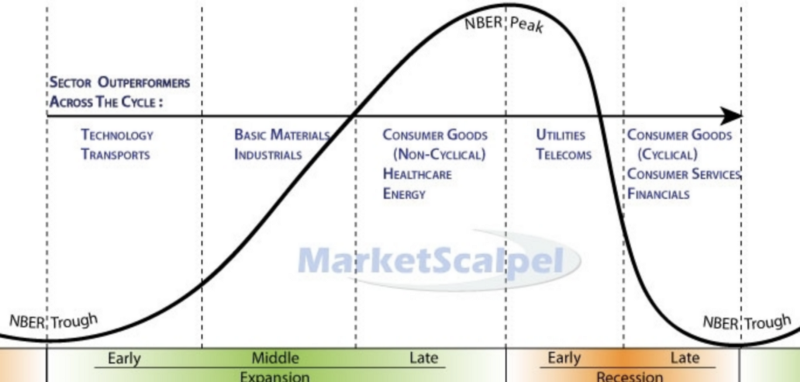 <b>Business Cycle Mid-Cycle — Industrials, Materials & Healthcare</b> Based on where we are in the business cycle, we are in the mid-stage of expansion. What did well last year was technology and transports. What I expect to do well this year is basic materials, industrials and healthcare. I would look at investing in three core S&P sector ETFs. This idea comes from the notion of sector rotation as we improve through the economic cycle. Other sectors may do well, but I expect these three to outperform the S&P 500 index in 2018.  <b>Cryptocurrency — Bitcoin & Ether</b> Bitcoin and all cryptocurrencies saw a large rise in market value in 2017. It was the year the early adopters got paid. But, in 2018, we’re going to see the year of wider mass adoption, so I expect cryptocurrencies to do well next year. A beginner in crypto investments could start with the two most popular cryptocurrencies: bitcoin and ether. They have the highest market cap, which you can track. I like to follow the total market cap of the cryptocurrency market, which is floating around $605B at my last reading of it. I expect to see the cryptocurrency market in total rise to at least $2T, and I expect it to rise to greater than $10T over the next 10 years. Just look at the size of several markets of money. Even if cryptocurrency disrupts a portion of each market, we’re talking about trillions of dollars in value. 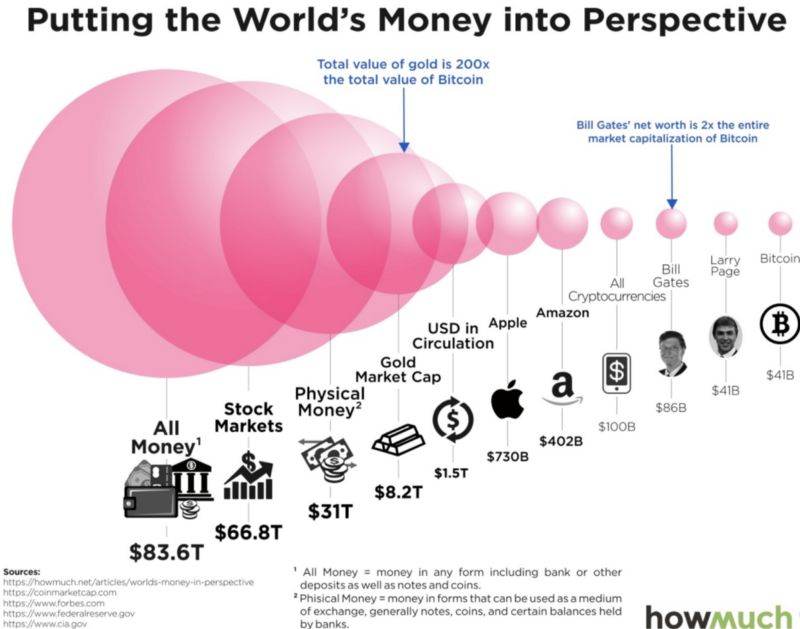 So, those are my eight investing ideas for 2018: Investing in China because of the relatively high growth rate, a bottoming in price a year ago and the steady march of more capital into their stock markets as the MCSI adds more Chinese shares to their index; investing in technology through robots, automation and artificial intelligence; investing in inflation through commodities, silver and basic materials; investing in the mid-cycle sector rotation with industrials and healthcare; investing in the world becoming a cashless society through payments systems and cryptocurrency. We’ll check in at the end of the year and see how I did. Happy Hunting! ________________________________________________________________ <i>Disclaimer: The above references an opinion and is for information purposes only. It is not intended to be investment advice. Please do your own homework.</i> <b>If you enjoyed this article, like it to help others find it! For more, join us on <a href="https://www.facebook.com/WealthRituals/">Facebook</a> and <a href="https://twitter.com/WealthRituals">Twitter</a> and if you want to receive the latest weekly updates on Investing, Entrepreneurship & Personal Finance, feel free to subscribe to our <a href="https://wealthrituals.lpages.co/wr-subscribe/">NEWSLETTER</a>.</b> |
| json metadata | {"tags":["investing","money","stocks","finance"],"image":["https://steemitimages.com/DQmPeq1PhugjinPVKCMzikVTswG7ZZNEhU3PEVAxYvey4ge/2018%20investing%20themes.jpg","https://steemitimages.com/DQmdFapCNQi9mhAL7nvjQj3yMmfZoJV6gbaSqzdgk7A7nNV/china%20investing.jpg","https://steemitimages.com/DQmWAT6eSHWQ54BJeThMYwfPwSrjiMRg9gJDX32i9LyYngv/robots%20investing.jpg","https://steemitimages.com/DQma67yiynqXRKBWmj3MHnQDvDohZjWhuygq8QHhzqyBYLb/investing%20theme.jpg","https://steemitimages.com/DQmR5FyBRPSxdWjm8U4F29kzbMddkzZHGFiPNTkFWtb8Sfw/investing%20theme%202018.jpg","https://steemitimages.com/DQmdzoBViWRhnsGe8BWxPddaSmhjmba5nB5TFtr7CKvaiu2/ai%20investing.png","https://steemitimages.com/DQmWoxrkNEhi47nYnpHs52FitkSwSfsX1p7yJeYBKWyFi4R/market%20scale.png","https://steemitimages.com/DQmeRmEygYEaoKy9bbnbRJPkdt4w8wbwsFZZ1J5nBWTtw7K/bitcoin%20and%20ethereum%20investing.jpg","https://steemitimages.com/DQmQ7c6QoGzrXRb4KGcDb8rGe9RXuGPHHd4q8W2QxBpUJvw/money%20investig.png"],"links":["https://www.facebook.com/WealthRituals/","https://twitter.com/WealthRituals","https://wealthrituals.lpages.co/wr-subscribe/"],"app":"steemit/0.1","format":"markdown"} |
| Transaction Info | Block #18717751/Trx 873592cb8de1d563de186797f0d10f43553a5490 |
View Raw JSON Data
{
"trx_id": "873592cb8de1d563de186797f0d10f43553a5490",
"block": 18717751,
"trx_in_block": 23,
"op_in_trx": 0,
"virtual_op": 0,
"timestamp": "2018-01-05T17:41:36",
"op": [
"comment",
{
"parent_author": "",
"parent_permlink": "investing",
"author": "jakeryan",
"permlink": "8-great-investing-themes-for-2018",
"title": "8 Great Investing Themes for 2018",
"body": "\n\nNow that we’re midway through December, I’m starting to think about good investing opportunities for 2018. The business and credit cycle are in mid-cycle. Interest rates are still historically low, but they should be steadily rising over the next few years. The Federal Reserve is forecasting three small interest rate increases next year. We are seeing increased chance for inflation in 2018.\n\nThere’s a lot going on around the world this year. We are farther along in the credit and economic cycles. After reviewing previous investing themes, I see eight great investing themes emerging.\n\nIn general, we are looking to get in early on trends. If we can find markets or sectors that have had a correction, then we can get in cheap. Moreover, if we can find markets or sectors that are now back on an uptrend, we can get in early. In other words, our goal is to get in early by identifying cheap and up-trending investment themes.\n\nSo, what does that mean for investing opportunity next year? Here are eight great investing themes to consider for 2018.\n\n\n\n<b>China</b>\n\nChina is a developing country with other countries like India, Brazil and Russia. China is growing at a pace of about 6%, which is 2–3 times greater than that of the United States. The Chinese economy is shifting from an export-driven economy to a Chinese consumer economy, and the economy will continue to shift. In 2018, I think we’ll see Chinese companies that are focused on selling to Chinese customers do well. China has also rebounded from the lows experienced in the index of stocks that fell greatly over the past year or so. As the global economic cycle continues, we expect inflation to start to rise and emerging markets’ equities to do well.\n\nOne of the big reasons it is a good time to invest in China, is because shares are being added to the MSCI Emerging Markets Index as they buy more and more Chinese shares to keep portfolio percentages accurate within the MSCI EM index. This expansion will bring $1 trillion of investment into Chinese companies because of the increased percentages for China. You can find a general index Exchange Traded Fund (ETF) for China, or you can look for an index that focuses on Chinese “A-shares,” which is the direction that the bulk of the increased percentages are headed. Google “China Index ETF” or “China Consumer ETF.”\n\n\n\n<b>Robots & Automation</b>\n\nAlmost anything business-related in the media last year talked about either robots and artificial intelligence. Companies are pushing for more and more automation. From a company financial statement perspective, employees’ salaries are a recurring expense, while robots and software are assets. Both produce income, but robots cost less than employees. So, what is there to do? Invest in companies that are investing in robots and automation. Google “robots and automation ETF.”\n\n\n\n<b>Cashless Society</b>\n\nThere is a global push led by many countries to move to a “cashless” society. Countries tout convenience and how they could end money laundering and cash used for illicit activities. More importantly, it will make tax collection easier.\nThere are many countries leading the way. Singapore and the Netherlands are two countries leading the way. For more, check out this article for top cashless countries. With this push, there are going to be companies that are winners. Increasing processing and payment systems is going to become more profitable in 2018. If you want to check out an investment vehicle, search “payments ETF.”\n\n<b>Commodities</b>\n\nWith the improvement in the economic cycle, it can be expected that inflation will follow in 2018. The Federal Reserve has been waiting for inflation to come for many years. So why now?\n\nTo forecast inflation, I like to use three criteria : the rate of increase of the Money Supply (M2), the price of copper and the 10-Yr US Treasury. As of now, M2 Money Supply has been steadily rising, even with the normalization efforts from the Fed. This creates the potential for inflation because more money in circulation means each unit is worth less. Checking in on the price of copper, it’s over $3, which means a base commodity has an increasing price and that leads to inflation. Finally, check the 10-Yr U.S. Treasury rates; it’s producing a yield of 2.39% and it’s rising. These signs all point to rising inflation in 2018. With inflation on the rise, you want to be investing in commodities. I would add commodities exposure to my portfolio. Google “commodities ETF” to find some investment options.\n\n\n\n<b>Precious Metals — Silver</b>\n\nSince many global central banks are still in a manipulative easing mode, this creates a good opportunity for precious metals. As currencies weaken, their purchasing power also weakens. Last year, gold was up 10% and silver was up 2.6%. I think we will see somewhat similar returns for gold in 2018, but because of the commodities cycle, I think silver will do better than gold in 2018. Silver is cheap when compared historically to the gold:silver ratio. In the past, silver would average 40 times less than gold. Right now, silver is closer to 80 times less than the price of gold. I would buy the silver ETF and not the miners, but if you want to employ leverage to your trade, do some research on “silver streaming and royalty companies.”\n\n\n\n<b>Artificial Intelligence (Still)</b>\n\nHow much have we heard about AI in 2017? It was a topic of probably every other story that came out on the technology section. Will AI overpower humans and lead to a new world order? Some derivation of that story was printed every week this year.\n\nOne truth is that we’ve made an amazing leap in the application of AI for two reasons. One, is that now we have processing power that is far more capable than in times past, which allows us to train larger and more complex models. Two, is that we have a lot more data to train these AI models. More data and more computing power means we can find a lot more practical application for artificial intelligence. While AI was a big story in 2017, I think investment in it and profits from it will continue in 2018. If you want some investment ideas, google, “AI ETF” or “artificial intelligence ETF.\n\n\n\n<b>Business Cycle Mid-Cycle — Industrials, Materials & Healthcare</b>\n\nBased on where we are in the business cycle, we are in the mid-stage of expansion. What did well last year was technology and transports. What I expect to do well this year is basic materials, industrials and healthcare. I would look at investing in three core S&P sector ETFs. This idea comes from the notion of sector rotation as we improve through the economic cycle. Other sectors may do well, but I expect these three to outperform the S&P 500 index in 2018.\n\n\n\n<b>Cryptocurrency — Bitcoin & Ether</b>\n\nBitcoin and all cryptocurrencies saw a large rise in market value in 2017. It was the year the early adopters got paid. But, in 2018, we’re going to see the year of wider mass adoption, so I expect cryptocurrencies to do well next year. A beginner in crypto investments could start with the two most popular cryptocurrencies: bitcoin and ether. They have the highest market cap, which you can track. I like to follow the total market cap of the cryptocurrency market, which is floating around $605B at my last reading of it. I expect to see the cryptocurrency market in total rise to at least $2T, and I expect it to rise to greater than $10T over the next 10 years. Just look at the size of several markets of money. Even if cryptocurrency disrupts a portion of each market, we’re talking about trillions of dollars in value.\n\n\n\nSo, those are my eight investing ideas for 2018: Investing in China because of the relatively high growth rate, a bottoming in price a year ago and the steady march of more capital into their stock markets as the MCSI adds more Chinese shares to their index; investing in technology through robots, automation and artificial intelligence; investing in inflation through commodities, silver and basic materials; investing in the mid-cycle sector rotation with industrials and healthcare; investing in the world becoming a cashless society through payments systems and cryptocurrency.\n\nWe’ll check in at the end of the year and see how I did.\n\nHappy Hunting!\n________________________________________________________________\n\n<i>Disclaimer: The above references an opinion and is for information purposes only. It is not intended to be investment advice. Please do your own homework.</i>\n\n<b>If you enjoyed this article, like it to help others find it! For more, join us on <a href=\"https://www.facebook.com/WealthRituals/\">Facebook</a> and <a href=\"https://twitter.com/WealthRituals\">Twitter</a> and if you want to receive the latest weekly updates on Investing, Entrepreneurship & Personal Finance, feel free to subscribe to our <a href=\"https://wealthrituals.lpages.co/wr-subscribe/\">NEWSLETTER</a>.</b>",
"json_metadata": "{\"tags\":[\"investing\",\"money\",\"stocks\",\"finance\"],\"image\":[\"https://steemitimages.com/DQmPeq1PhugjinPVKCMzikVTswG7ZZNEhU3PEVAxYvey4ge/2018%20investing%20themes.jpg\",\"https://steemitimages.com/DQmdFapCNQi9mhAL7nvjQj3yMmfZoJV6gbaSqzdgk7A7nNV/china%20investing.jpg\",\"https://steemitimages.com/DQmWAT6eSHWQ54BJeThMYwfPwSrjiMRg9gJDX32i9LyYngv/robots%20investing.jpg\",\"https://steemitimages.com/DQma67yiynqXRKBWmj3MHnQDvDohZjWhuygq8QHhzqyBYLb/investing%20theme.jpg\",\"https://steemitimages.com/DQmR5FyBRPSxdWjm8U4F29kzbMddkzZHGFiPNTkFWtb8Sfw/investing%20theme%202018.jpg\",\"https://steemitimages.com/DQmdzoBViWRhnsGe8BWxPddaSmhjmba5nB5TFtr7CKvaiu2/ai%20investing.png\",\"https://steemitimages.com/DQmWoxrkNEhi47nYnpHs52FitkSwSfsX1p7yJeYBKWyFi4R/market%20scale.png\",\"https://steemitimages.com/DQmeRmEygYEaoKy9bbnbRJPkdt4w8wbwsFZZ1J5nBWTtw7K/bitcoin%20and%20ethereum%20investing.jpg\",\"https://steemitimages.com/DQmQ7c6QoGzrXRb4KGcDb8rGe9RXuGPHHd4q8W2QxBpUJvw/money%20investig.png\"],\"links\":[\"https://www.facebook.com/WealthRituals/\",\"https://twitter.com/WealthRituals\",\"https://wealthrituals.lpages.co/wr-subscribe/\"],\"app\":\"steemit/0.1\",\"format\":\"markdown\"}"
}
]
}lightflowerupvoted (100.00%) @jakeryan / four-important-tactics-to-investing2018/01/05 17:12:03
lightflowerupvoted (100.00%) @jakeryan / four-important-tactics-to-investing
2018/01/05 17:12:03
| voter | lightflower |
| author | jakeryan |
| permlink | four-important-tactics-to-investing |
| weight | 10000 (100.00%) |
| Transaction Info | Block #18717160/Trx f52e1b00e10bc57ce5975c1cb992e8c6eb6026fc |
View Raw JSON Data
{
  "trx_id": "f52e1b00e10bc57ce5975c1cb992e8c6eb6026fc",
  "block": 18717160,
  "trx_in_block": 8,
  "op_in_trx": 0,
  "virtual_op": 0,
  "timestamp": "2018-01-05T17:12:03",
  "op": [
    "vote",
    {
      "voter": "lightflower",
      "author": "jakeryan",
      "permlink": "four-important-tactics-to-investing",
      "weight": 10000
    }
  ]
}jakeryanpublished a new post: four-important-tactics-to-investing2018/01/05 17:11:24
jakeryanpublished a new post: four-important-tactics-to-investing
2018/01/05 17:11:24
| parent author | |
| parent permlink | investing |
| author | jakeryan |
| permlink | four-important-tactics-to-investing |
| title | Four Important Tactics To Investing |
| body |  I constantly think about what factors improve investing. I’m on a quest to codify good investing behavior. As I look back at my 20+ years of investing, I can think of about 4 factors that have improved my chances of a good return, regardless of asset class. <b> Diversification — Asset Allocation</b> Diversification is the key to reducing risk and volatility in a portfolio and to increase risk-adjusted return. The goal is to invest across a broad set of asset classes that are not correlated. Non-correlated assets classes are assets that do not react the same to market conditions. In a retirement portfolio, have some stocks, some bonds and some alternative assets. Stocks are sensitive to an improving economic cycle. Bonds temper a portfolio’s volatility and do well in a fall-interest rate environment and during periods of deflation. Alternative assets, like gold and real estate, do well in inflationary environments. Therefore, diversification is key to an optimized return for the least risk taken.  <b>Position Size</b> This is one of the three most important aspects in investing. I wouldn’t invest more than 20% in any one asset class and typically not any more than 15% in one specific investment. I like to keep investments between 5% and 15% of my portfolio. A standard position is 10%; sometimes, I have a half position and sometimes I have a double position. I think what you’ll find with back testing is important to determine how your overall portfolio will behave. Investments need to play well with others, so it’s important to diversify and test your overall portfolio in a variety of conditions. I’ve been hurt before by not properly thinking about position size. There was a time when I had 40% of my total portfolio in precious metals. That was unwise. And when the trade started going against me, the pain was real. When I lost 20% I started to re-size my portfolio (due to another tactic below), but I lost a lot more than I needed to. I have a bunch of bets right now that should do well in rising inflation: some base metals, some precious metals. However, I don’t have more than 20% in metals. Same with cryptocurrency. I have a basket of cryptocurrencies, but I don’t want my total exposure to this asset class to be over 20%, period. Many investment firms talk about not having more than 4% in any one position and diversifying across a minimum of 5 asset classes. An individual investor doesn’t have enough time or money to go to these extremes. In my opinion, I like to run about 7–10 positions in my investment portfolio, with some positions being a double position and some being a half position. You want a position to be big enough that if it does well, then you see it in your portfolio return. When I used to run 20 positions, I rarely did well because my winners weren’t big enough, and running 20 positions meant I had 3–5 positions running against me. So, I wouldn’t apply the advice of an institutional investor to an individual investor. Keep it 5%-15% for each position and try to invest in 7–10 positions. For retirement accounts, I would have only 5–9 investments, just 1 for each asset class, but I would only use ETFs and mutual funds. Asset classes include Core Stock, Growth Stock, Developed Markets Stock, Developing Markets Stock, Alt Asset — Gold/TIP, Alt Asset — REIT/MLP, Bond — Government and Bond — Corporate. Maybe 1 more. I only use ETFs/Funds for retirement; I do not invest directly in stocks.  <b>Setting Trailing Stops</b> When investing in stocks, trailing stops are key. These allow you to lock in gains and avoid big losses. A trailing stop limit order is designed to allow an investor to specify a limit on the maximum possible loss, without setting a limit on the maximum possible gain. A SELL trailing stop limit moves with the market price and continually recalculates the stop trigger price at a fixed amount below the market price, based on the user-defined “trailing” amount (usually a percentage). The limit order price is also continually recalculated based on the limit offset percentage. As the market price rises, both the stop price and the limit price rise by the trail amount and limit offset respectively, but if the stock price falls, the stop price remains unchanged. When the stop price is hit, a limit order is submitted at the last calculated limit price. Using trailing stops has been a key to not losing too much on any one investment position. <b>Automatic Dollar Cost Averaging</b> Dollar cost averaging is a strategy in which an investor places a fixed dollar amount into a given investment (usually stock) on a regular basis. The investment generally takes place each and every month regardless of what is occurring in the financial markets. As a result, when the price of a given investment rises, the investor will be able to purchase fewer shares. When the price of a particular security declines, the investor will be able to purchase more shares. Making this process automatic has allowed me to accumulate large, profitable positions in my investments. This works for investment portfolios, retirements portfolios and even cryptocurrency portfolios. I recommend setting a consistent amount to invest every month and making the process automatic. ________________________________________________________________ <i>Disclaimer: The above references an opinion and is for information purposes only. It is not intended to be investment advice. Please do your own homework.</i> <b>If you enjoyed this article, like it to help others find it! For more, join us on <a href="https://www.facebook.com/WealthRituals/">Facebook</a> and <a href="https://twitter.com/WealthRituals">Twitter</a> and if you want to receive the latest weekly updates on Investing, Entrepreneurship & Personal Finance, feel free to subscribe to our <a href="https://wealthrituals.lpages.co/wr-subscribe/">NEWSLETTER</a>.</b> |
| json metadata | {"tags":["investing","assets","assetallocation","stocks","money"],"image":["https://steemitimages.com/DQmPeEJj6sniEdwEDuAxSm4rcnpDFeDnQRizEeeDjShbtMq/Four%20Important%20Tactics%20To%20Investing.jpg","https://steemitimages.com/DQmS5ix5Hiywck5bzSqbkxwatKxqvXL3BgSccuAMWQ3gjfp/position%20size.jpg","https://steemitimages.com/DQmdDBkeNzYfQ3JJgiFfxCatxQzgUQNQEVi6ZfCZrVaMdSa/trailing%20stops.jpg"],"links":["https://www.facebook.com/WealthRituals/","https://twitter.com/WealthRituals","https://wealthrituals.lpages.co/wr-subscribe/"],"app":"steemit/0.1","format":"markdown"} |
| Transaction Info | Block #18717147/Trx 0902a2122e6f9998c20dffb23ba8fb6529db8080 |
View Raw JSON Data
{
"trx_id": "0902a2122e6f9998c20dffb23ba8fb6529db8080",
"block": 18717147,
"trx_in_block": 0,
"op_in_trx": 0,
"virtual_op": 0,
"timestamp": "2018-01-05T17:11:24",
"op": [
"comment",
{
"parent_author": "",
"parent_permlink": "investing",
"author": "jakeryan",
"permlink": "four-important-tactics-to-investing",
"title": "Four Important Tactics To Investing",
"body": "\n\nI constantly think about what factors improve investing. I’m on a quest to codify good investing behavior. As I look back at my 20+ years of investing, I can think of about 4 factors that have improved my chances of a good return, regardless of asset class.\n\n<b> Diversification — Asset Allocation</b>\n\nDiversification is the key to reducing risk and volatility in a portfolio and to increase risk-adjusted return. The goal is to invest across a broad set of asset classes that are not correlated. Non-correlated assets classes are assets that do not react the same to market conditions. In a retirement portfolio, have some stocks, some bonds and some alternative assets.\nStocks are sensitive to an improving economic cycle. Bonds temper a portfolio’s volatility and do well in a fall-interest rate environment and during periods of deflation. Alternative assets, like gold and real estate, do well in inflationary environments. Therefore, diversification is key to an optimized return for the least risk taken.\n\n\n\n<b>Position Size</b>\n\nThis is one of the three most important aspects in investing. I wouldn’t invest more than 20% in any one asset class and typically not any more than 15% in one specific investment. I like to keep investments between 5% and 15% of my portfolio. A standard position is 10%; sometimes, I have a half position and sometimes I have a double position.\nI think what you’ll find with back testing is important to determine how your overall portfolio will behave. Investments need to play well with others, so it’s important to diversify and test your overall portfolio in a variety of conditions.\nI’ve been hurt before by not properly thinking about position size. There was a time when I had 40% of my total portfolio in precious metals. That was unwise. And when the trade started going against me, the pain was real. When I lost 20% I started to re-size my portfolio (due to another tactic below), but I lost a lot more than I needed to.\n\nI have a bunch of bets right now that should do well in rising inflation: some base metals, some precious metals. However, I don’t have more than 20% in metals. Same with cryptocurrency. I have a basket of cryptocurrencies, but I don’t want my total exposure to this asset class to be over 20%, period.\n\nMany investment firms talk about not having more than 4% in any one position and diversifying across a minimum of 5 asset classes. An individual investor doesn’t have enough time or money to go to these extremes. In my opinion, I like to run about 7–10 positions in my investment portfolio, with some positions being a double position and some being a half position.\n\nYou want a position to be big enough that if it does well, then you see it in your portfolio return. When I used to run 20 positions, I rarely did well because my winners weren’t big enough, and running 20 positions meant I had 3–5 positions running against me.\n\nSo, I wouldn’t apply the advice of an institutional investor to an individual investor. Keep it 5%-15% for each position and try to invest in 7–10 positions.\n\nFor retirement accounts, I would have only 5–9 investments, just 1 for each asset class, but I would only use ETFs and mutual funds. Asset classes include Core Stock, Growth Stock, Developed Markets Stock, Developing Markets Stock, Alt Asset — Gold/TIP, Alt Asset — REIT/MLP, Bond — Government and Bond — Corporate. Maybe 1 more. I only use ETFs/Funds for retirement; I do not invest directly in stocks.\n\n\n\n<b>Setting Trailing Stops</b>\n\nWhen investing in stocks, trailing stops are key. These allow you to lock in gains and avoid big losses. A trailing stop limit order is designed to allow an investor to specify a limit on the maximum possible loss, without setting a limit on the maximum possible gain. A SELL trailing stop limit moves with the market price and continually recalculates the stop trigger price at a fixed amount below the market price, based on the user-defined “trailing” amount (usually a percentage). The limit order price is also continually recalculated based on the limit offset percentage. As the market price rises, both the stop price and the limit price rise by the trail amount and limit offset respectively, but if the stock price falls, the stop price remains unchanged. When the stop price is hit, a limit order is submitted at the last calculated limit price. Using trailing stops has been a key to not losing too much on any one investment position.\n\n<b>Automatic Dollar Cost Averaging</b>\n\nDollar cost averaging is a strategy in which an investor places a fixed dollar amount into a given investment (usually stock) on a regular basis. The investment generally takes place each and every month regardless of what is occurring in the financial markets. As a result, when the price of a given investment rises, the investor will be able to purchase fewer shares. When the price of a particular security declines, the investor will be able to purchase more shares. Making this process automatic has allowed me to accumulate large, profitable positions in my investments. This works for investment portfolios, retirements portfolios and even cryptocurrency portfolios. I recommend setting a consistent amount to invest every month and making the process automatic.\n\n________________________________________________________________\n\n<i>Disclaimer: The above references an opinion and is for information purposes only. It is not intended to be investment advice. Please do your own homework.</i>\n\n<b>If you enjoyed this article, like it to help others find it! For more, join us on <a href=\"https://www.facebook.com/WealthRituals/\">Facebook</a> and <a href=\"https://twitter.com/WealthRituals\">Twitter</a> and if you want to receive the latest weekly updates on Investing, Entrepreneurship & Personal Finance, feel free to subscribe to our <a href=\"https://wealthrituals.lpages.co/wr-subscribe/\">NEWSLETTER</a>.</b>",
"json_metadata": "{\"tags\":[\"investing\",\"assets\",\"assetallocation\",\"stocks\",\"money\"],\"image\":[\"https://steemitimages.com/DQmPeEJj6sniEdwEDuAxSm4rcnpDFeDnQRizEeeDjShbtMq/Four%20Important%20Tactics%20To%20Investing.jpg\",\"https://steemitimages.com/DQmS5ix5Hiywck5bzSqbkxwatKxqvXL3BgSccuAMWQ3gjfp/position%20size.jpg\",\"https://steemitimages.com/DQmdDBkeNzYfQ3JJgiFfxCatxQzgUQNQEVi6ZfCZrVaMdSa/trailing%20stops.jpg\"],\"links\":[\"https://www.facebook.com/WealthRituals/\",\"https://twitter.com/WealthRituals\",\"https://wealthrituals.lpages.co/wr-subscribe/\"],\"app\":\"steemit/0.1\",\"format\":\"markdown\"}"
}
]
}jakeryanpublished a new post: level-v-buy-your-first-property2017/12/11 17:04:09
jakeryanpublished a new post: level-v-buy-your-first-property
2017/12/11 17:04:09
| parent author | |
| parent permlink | finance |
| author | jakeryan |
| permlink | level-v-buy-your-first-property |
| title | Level V — Buy Your First Property |
| body |  So now you’re half way through the game of Winning Financial Freedom. You’ve finished the three basic levels by eliminating bad debt, saving some cash and starting a retirement account. You have also started an investment account. Level V is about bringing real estate into your strategy and into your portfolio. The easiest way to do that is to buy your house. <b>REASONS TO BUY</b> There are several advantages to buying a house, especially if you live in a “hot” area like Austin, Los Angeles, Seattle or any of the cities that are really growing right now. There are several more reasons for buying a house, which we’ll talk about in a bit, but the two main reasons are mitigating your top two expenses — taxes and shelter (rent/mortgage and putting a roof over your head). Buying a home allows you to deduct the mortgage interest from your taxes which allows you to minimize/mitigate your single largest expense — taxes. This also allows you to lock in the amount it will cost to provide housing for yourself and your family which helps mitigate your second biggest expense — rent. Rent will NOT be going up for you over the coming years, because you’ve locked in a mortgage. For everyone else who rents, their cost will be increasing as demand increases and as inflation increases. There are also two more benefits to buying a home. The first, depreciation, is another tax advantage. Depreciation lets you recover certain losses associated with the depreciation of qualifying property. The other extra benefit is leverage through the use of a mortgage. If you’re able to put only 10% down and finance 90% of the price of the home, then you’re able to use leverage against the property’s value to improve your potential return. For example, let’s say you buy a house for $500,000. You put $50,000 down (10%) for the purchase and get a mortgage for $450,000 (90%), using simple terms and not factoring in PMI (private mortgage insurance or property taxes). Let’s say the home appreciates 10% in value over the next four years to $550,000. Your home value increased by 10% but relative to how much you put down, you generated a 100% return on your down payment. Reducing your two largest expenses (taxes and shelter) and creating a leveraged asset that can rise in value over time, provides compelling reasons for how buying a house can increase your overall net worth.  <b>FUTURE BENEFITS</b> There are some future benefits you can realize years after you’ve purchased a home. One is that, once the value of your property has increased, you can re-finance your mortgage and potentially pull money out as capital (in states like Texas that are considered non-homestead states). You can do investing or capital improvement projects on your home to continue advancing your net worth. I’m not necessarily saying you should do that, but depending on your situation it may be an option (and it’s always nice to have options.) Also, you can consider creating a cash flow asset by living elsewhere and renting out your home. Remember, rent usually increases over time with inflation. At some point, you’ll be able to rent out your home for a lot more than your mortgage payment, and be able to pocket the difference in the form of cash flow. You can then buy another home and live in that home, increasing your real estate empire. Or, you could move to a cheaper “cost of living” state and live off the difference. Again, I’m not recommending this, per se, but it sets up all kinds of options for you to get to your end goal. And, as a reminder, the end goal is to create more passive income than current expenses, therefore becoming financially free and out of the “financial rat race.” <b>ALTERNATIVES</b> Maybe you don’t want to own your own house. That’s okay, too. I would recommend some alternative where you’re investing using real estate. Maybe you go in with two friends and buy a rental income property. Maybe you buy a rental income property on your own. Maybe you find a limited partnership that’s looking for investors in cash flow real estate. All of these alternatives are okay, too. Just make sure you’re playing an active role in the selection of the property and the price you’re going to pay. Be involved in research. Learn. Real estate is one of the most direct ways to build compounding wealth over time, and it has a lot of tax-friendly advantages that you can leverage. Level V is about educating yourself on real estate investing and directly owning some real estate property. Buying a residential home is the most common way, but all alternative approaches are welcome. <b>PUTTING IT ALL TOGETHER</b> Okay, so let’s talk about where we’re at by this stage of the game. You’ve completed the basic levels of I, II and III. Now with buying a house, you’ve completed the two intermediate levels, IV and V. This puts you in a good position. You’ve eliminated all your “bad debt.” You’ve built an emergency fund and you have a nice cash position. You’ve started a retirement fund and you have a plan, including a goal and a portfolio asset allocation based on the core factors of your goal, time horizon and risk tolerance. Also, you’ve started an investment account where you’re investing in public equities and fixed income. Now, with the purchase of a home, you have a solid real estate asset. You are now truly diversified with liquid cash assets, invested paper assets for growth (stocks and bonds) and real estate in the form of direct home ownership. This is a really sound foundation. You’ve gotten to this point by learning lessons of producing more than you consume, being able to save, learning about retirement and investing. You’re taking advantage of the tax code to reduce and minimize your two largest expenses — taxes and shelter. By managing these expenses, you’re producing more towards your net worth. In addition, over time, this is what’s going to propel you farther, faster. By completing Level V, you’ve completed the intermediate rounds of the game. You’ve set up a mid-game where you can now start creating cash flow assets that, at some point, will be enough to take you out of the rat race and to true Financial Freedom. ________________________________________________________________ <b>If you enjoyed this article, like it to help others find it! For more, join us on <a href="https://www.facebook.com/WealthRituals/">Facebook</a> and <a href="https://twitter.com/WealthRituals">Twitter</a> and if you want to receive the latest weekly updates on Investing, Entrepreneurship & Personal Finance, feel free to subscribe to our <a href="https://wealthrituals.lpages.co/wr-subscribe/">NEWSLETTER</a>.</b> |
| json metadata | {"tags":["finance","property","mortgage","financialeducation","money"],"image":["https://steemitimages.com/DQmRXkBBPdKQrsJ9HTW74FptSExd9SqD4JofdqMS1ZTnLLf/house%20buy.jpg","https://steemitimages.com/DQmb1jBtcCntAcKCub29vrWfwTxx8YXoagYWr7SDrcVaU9s/scott-webb-167099.jpg"],"links":["https://www.facebook.com/WealthRituals/","https://twitter.com/WealthRituals","https://wealthrituals.lpages.co/wr-subscribe/"],"app":"steemit/0.1","format":"markdown"} |
| Transaction Info | Block #17997478/Trx 5a7be40a1f47795cf8e4878527ded5494439c734 |
View Raw JSON Data
{
"trx_id": "5a7be40a1f47795cf8e4878527ded5494439c734",
"block": 17997478,
"trx_in_block": 40,
"op_in_trx": 0,
"virtual_op": 0,
"timestamp": "2017-12-11T17:04:09",
"op": [
"comment",
{
"parent_author": "",
"parent_permlink": "finance",
"author": "jakeryan",
"permlink": "level-v-buy-your-first-property",
"title": "Level V — Buy Your First Property",
"body": "\n\nSo now you’re half way through the game of Winning Financial Freedom. You’ve finished the three basic levels by eliminating bad debt, saving some cash and starting a retirement account. You have also started an investment account. Level V is about bringing real estate into your strategy and into your portfolio. The easiest way to do that is to buy your house.\n\n<b>REASONS TO BUY</b>\n\nThere are several advantages to buying a house, especially if you live in a “hot” area like Austin, Los Angeles, Seattle or any of the cities that are really growing right now. There are several more reasons for buying a house, which we’ll talk about in a bit, but the two main reasons are mitigating your top two expenses — taxes and shelter (rent/mortgage and putting a roof over your head).\n\nBuying a home allows you to deduct the mortgage interest from your taxes which allows you to minimize/mitigate your single largest expense — taxes. This also allows you to lock in the amount it will cost to provide housing for yourself and your family which helps mitigate your second biggest expense — rent. Rent will NOT be going up for you over the coming years, because you’ve locked in a mortgage. For everyone else who rents, their cost will be increasing as demand increases and as inflation increases.\n\nThere are also two more benefits to buying a home. The first, depreciation, is another tax advantage. Depreciation lets you recover certain losses associated with the depreciation of qualifying property. The other extra benefit is leverage through the use of a mortgage. If you’re able to put only 10% down and finance 90% of the price of the home, then you’re able to use leverage against the property’s value to improve your potential return.\n\nFor example, let’s say you buy a house for $500,000. You put $50,000 down (10%) for the purchase and get a mortgage for $450,000 (90%), using simple terms and not factoring in PMI (private mortgage insurance or property taxes). Let’s say the home appreciates 10% in value over the next four years to $550,000. Your home value increased by 10% but relative to how much you put down, you generated a 100% return on your down payment.\nReducing your two largest expenses (taxes and shelter) and creating a leveraged asset that can rise in value over time, provides compelling reasons for how buying a house can increase your overall net worth.\n\n\n\n<b>FUTURE BENEFITS</b>\n\nThere are some future benefits you can realize years after you’ve purchased a home. One is that, once the value of your property has increased, you can re-finance your mortgage and potentially pull money out as capital (in states like Texas that are considered non-homestead states). You can do investing or capital improvement projects on your home to continue advancing your net worth. I’m not necessarily saying you should do that, but depending on your situation it may be an option (and it’s always nice to have options.)\n\nAlso, you can consider creating a cash flow asset by living elsewhere and renting out your home. Remember, rent usually increases over time with inflation. At some point, you’ll be able to rent out your home for a lot more than your mortgage payment, and be able to pocket the difference in the form of cash flow. You can then buy another home and live in that home, increasing your real estate empire. Or, you could move to a cheaper “cost of living” state and live off the difference. Again, I’m not recommending this, per se, but it sets up all kinds of options for you to get to your end goal. And, as a reminder, the end goal is to create more passive income than current expenses, therefore becoming financially free and out of the “financial rat race.”\n\n<b>ALTERNATIVES</b> \n\nMaybe you don’t want to own your own house. That’s okay, too. I would recommend some alternative where you’re investing using real estate. Maybe you go in with two friends and buy a rental income property. Maybe you buy a rental income property on your own. Maybe you find a limited partnership that’s looking for investors in cash flow real estate.\nAll of these alternatives are okay, too. Just make sure you’re playing an active role in the selection of the property and the price you’re going to pay. Be involved in research. Learn. Real estate is one of the most direct ways to build compounding wealth over time, and it has a lot of tax-friendly advantages that you can leverage. Level V is about educating yourself on real estate investing and directly owning some real estate property. Buying a residential home is the most common way, but all alternative approaches are welcome.\n\n<b>PUTTING IT ALL TOGETHER</b>\n\nOkay, so let’s talk about where we’re at by this stage of the game. You’ve completed the basic levels of I, II and III. Now with buying a house, you’ve completed the two intermediate levels, IV and V. This puts you in a good position. You’ve eliminated all your “bad debt.” You’ve built an emergency fund and you have a nice cash position. You’ve started a retirement fund and you have a plan, including a goal and a portfolio asset allocation based on the core factors of your goal, time horizon and risk tolerance. Also, you’ve started an investment account where you’re investing in public equities and fixed income.\n\nNow, with the purchase of a home, you have a solid real estate asset. You are now truly diversified with liquid cash assets, invested paper assets for growth (stocks and bonds) and real estate in the form of direct home ownership. This is a really sound foundation. You’ve gotten to this point by learning lessons of producing more than you consume, being able to save, learning about retirement and investing. You’re taking advantage of the tax code to reduce and minimize your two largest expenses — taxes and shelter. By managing these expenses, you’re producing more towards your net worth. In addition, over time, this is what’s going to propel you farther, faster.\n\nBy completing Level V, you’ve completed the intermediate rounds of the game. You’ve set up a mid-game where you can now start creating cash flow assets that, at some point, will be enough to take you out of the rat race and to true Financial Freedom.\n\n________________________________________________________________\n\n<b>If you enjoyed this article, like it to help others find it! For more, join us on <a href=\"https://www.facebook.com/WealthRituals/\">Facebook</a> and <a href=\"https://twitter.com/WealthRituals\">Twitter</a> and if you want to receive the latest weekly updates on Investing, Entrepreneurship & Personal Finance, feel free to subscribe to our <a href=\"https://wealthrituals.lpages.co/wr-subscribe/\">NEWSLETTER</a>.</b>",
"json_metadata": "{\"tags\":[\"finance\",\"property\",\"mortgage\",\"financialeducation\",\"money\"],\"image\":[\"https://steemitimages.com/DQmRXkBBPdKQrsJ9HTW74FptSExd9SqD4JofdqMS1ZTnLLf/house%20buy.jpg\",\"https://steemitimages.com/DQmb1jBtcCntAcKCub29vrWfwTxx8YXoagYWr7SDrcVaU9s/scott-webb-167099.jpg\"],\"links\":[\"https://www.facebook.com/WealthRituals/\",\"https://twitter.com/WealthRituals\",\"https://wealthrituals.lpages.co/wr-subscribe/\"],\"app\":\"steemit/0.1\",\"format\":\"markdown\"}"
}
]
}2017/11/27 23:01:18
2017/11/27 23:01:18
| parent author | jakeryan |
| parent permlink | biggest-winners-of-icos-seed-investors |
| author | cheetah |
| permlink | cheetah-re-jakeryanbiggest-winners-of-icos-seed-investors |
| title | |
| body | Hi! I am a robot. I just upvoted you! I found similar content that readers might be interested in: https://hackernoon.com/biggest-winners-of-icos-seed-investors-64bc08afb595 |
| json metadata | |
| Transaction Info | Block #17601611/Trx 87f568c1d23d89819fa0b2fb6547c6c44008db47 |
View Raw JSON Data
{
  "trx_id": "87f568c1d23d89819fa0b2fb6547c6c44008db47",
  "block": 17601611,
  "trx_in_block": 5,
  "op_in_trx": 0,
  "virtual_op": 0,
  "timestamp": "2017-11-27T23:01:18",
  "op": [
    "comment",
    {
      "parent_author": "jakeryan",
      "parent_permlink": "biggest-winners-of-icos-seed-investors",
      "author": "cheetah",
      "permlink": "cheetah-re-jakeryanbiggest-winners-of-icos-seed-investors",
      "title": "",
      "body": "Hi! I am a robot. I just upvoted you! I found similar content that readers might be interested in:\nhttps://hackernoon.com/biggest-winners-of-icos-seed-investors-64bc08afb595",
      "json_metadata": ""
    }
  ]
}cheetahupvoted (0.08%) @jakeryan / biggest-winners-of-icos-seed-investors2017/11/27 23:01:12
cheetahupvoted (0.08%) @jakeryan / biggest-winners-of-icos-seed-investors
2017/11/27 23:01:12
| voter | cheetah |
| author | jakeryan |
| permlink | biggest-winners-of-icos-seed-investors |
| weight | 8 (0.08%) |
| Transaction Info | Block #17601609/Trx 0155b666628371b1b5f31a655a87f697ef2756ac |
View Raw JSON Data
{
  "trx_id": "0155b666628371b1b5f31a655a87f697ef2756ac",
  "block": 17601609,
  "trx_in_block": 14,
  "op_in_trx": 0,
  "virtual_op": 0,
  "timestamp": "2017-11-27T23:01:12",
  "op": [
    "vote",
    {
      "voter": "cheetah",
      "author": "jakeryan",
      "permlink": "biggest-winners-of-icos-seed-investors",
      "weight": 8
    }
  ]
}jakeryanpublished a new post: biggest-winners-of-icos-seed-investors2017/11/27 23:00:36
jakeryanpublished a new post: biggest-winners-of-icos-seed-investors
2017/11/27 23:00:36
| parent author | |
| parent permlink | cryptocurrency |
| author | jakeryan |
| permlink | biggest-winners-of-icos-seed-investors |
| title | Biggest Winners of ICOs — Seed Investors |
| body |  Over the hot lattes from the cafe and the cool air off the ocean at the beach, I sit with a venture partner of a seed-stage investment company. We discuss the current landscape of the early-stage investor. We’re curious about how the initial coin offering (ICO) landscape will play out. No one really knows yet. Will ICOs become the best thing that ever happened to seed-stage investors? I’m an angel investor. I’ve invested in 10 startups over the past 2 1/2 years. Four of those startups have gone on to raise subsequent rounds of funding and that’s a good thing. That means they’re growing. But, it also means my shares get diluted every time the company raises an additional round of capital. Of course, the overall value of the company should be rising proportionally, so it all makes sense for all investors in each round. I’ve also had another path carved out for three of my angel investments. Three companies have completed or are in the process of completing an initial coin offering or ICO. Each company is raising, or looking to raise, $10 — $25million through an ICO. I started to think about how the ICO will affect early stage equity investors. .jpg) <b>SEED INVESTORS GET EQUITY</b> Seed-stage investors investing in growth startups still do it for one reason. They are hoping for an exit either through an initial public offering (IPO) or buyout (a financial or strategic acquirer buys the company). This has always been the angle of all seed investors. One thing to mention is that seed-stage investors investments are illiquid. They can’t sell or access their shares. They are along for the ride until the company has a public exit or sells to an acquirer. Most seed-stage investments are not going work out. Most investments are going to zero because the companies are startups. If they fail to grow, they die. The strategy of a seed investor, angel investor or venture capital (VC) firm is to have those few winners pay for all the losers in their investment portfolio. With the chance of making 10x to 100x to 1,000x return on their investment (ROI), seed-stage investors are looking to swing for the fences. How venture capital works down the line, is that growth companies get investments in stages. First they may have a seed round then a series A or venture round followed by a series B or growth round and then a series C. They may even have D and E rounds. Each time a new series raises capital the previous shareholders get diluted. The overall goal is that value is still created higher and higher as the company grows. In the end, even after the dilution of each round, the seed-stage investor should be seeing multiples of their original principal investment in return. It’s a “paper return” until there is a sale (IPO or acquisition). <b>ICOs GENERATE TOKENS THAT ADD AN ASSET TO THE BALANCE SHEET</b> Initial coin offerings or ICOs are different. ICOs create the opportunity for a startup to sell a token which is an asset to potential employees/developers, users and investors. The token that gets generated from the ICO is an asset that sits on the company’s balance sheet. So, it’s different than equity. ICOs don’t dilute the company’s equity since it isn’t involved in that part of the corporate structure. This means that there could be a good upside for token holders after the ICO if the token appreciates. The real winners are the equity holders prior to the ICO. They get all the benefit of the capital injection from selling the token without any dilution of their equity. These are interesting times and this will be an interesting fact to follow as we see early-stage companies continue to initiate ICO’s.  <b>NO EQUITY DILUTION</b> Think about that. Let that marinate. All the equity investors prior to the ICO get all the advantage of raising capital to further company growth efforts with none of the downside of having their equity diluted from future rounds. <b>ONE DOWNSIDE FOR EQUITY HOLDERS - STILL ILLIQUID</b> There is still one downside to being a VC/Angel investor. If you’re investing in (private) equity, then your investment is illiquid. This means you can’t sell it. There is no market for it. That’s one of the benefits that cryptocurrency/tokens tout — you can buy or sell your coins on an exchange whenever you want. Those of us with equity must still wait for an exit, either an IPO or a buyout. <b>WALK-THROUGH AN EXAMPLE</b> So, let’s walk through an example of a seed, venture and growth round in a typical VC investment and then walk through one with an ICO. Let’s say I’m a seed investor in a growth startup, a new blockchain company called ValueA. ValueA just raised a seed round and it’s got a pre-money valuation of $5m. I invested $50k of seed round. For round numbers, I own 1% of the company. Post-capital injection, it’s now $6m. Over twelve months it doubles in growth and, because of the growth rate, more than doubles its valuation. Now, it’s worth $12m in a pre-money valuation of a venture round. They raise $3m, which dilutes my shares by 25%. So, now I own .75% of a $15m company. My initial investment has grown to $112.5k. Now, ValueA the startup, grows again by a factor of 4 in 18 months. It looks to do a growth round at a $75m pre-money valuation. It takes in $25m in its series B round, diluting my shares 33%. Now, I own 0.50% of a $100m company. My investment is now worth $500,000. That’s pretty good right? I’ve got a 10x return on my investment. Now, let’s walk through the same example that uses an ICO for its venture round. This company we’re about to invest in is a new blockchain company called ValueB. It starts out the same, I invest $50k for 1% of the company (round numbers) and with a post-money valuation of $6m. It takes in $10m in an ICO (after taxes) because it’s in such a hot industry. This can happen before any product is built and any revenue growth is established, which is accurate to the current ICO landscape. Now, after the ICO the company is worth $16m. Following the same example, it goes up by a factor of 8 (doubles, then grows by a factor of 4). Now, it’s worth $128m. I still own 1% of the company. My equity didn’t dilute during the ICO round. My investment is worth $1.28m, which is a 24x return on my investment. The difference is even greater with higher growth examples and higher valuation multiple examples. As a seed investor, I like ValueB’s ICO and what it’s done to my return. <b>SUPERCHARGED RETURNS WORTH IT?</b> Will it turn out that equity investors are the ultimate winners from the ICO craze? We’ll have to wait three–seven years, most likely, before we see an exit from one of the companies that are just now completing ICO’s. One risk is that the equity holders lie dormant, illiquid with no exit event happening, or a delayed exit since the company can continue to raise money via an ICO. Only time will tell. Happy Hunting! ________________________________________________________________ <i>Disclaimer: The above references an opinion and is for information purposes only. It is not intended to be investment advice. Please do your own homework.</i> <b>If you enjoyed this article, like it to help others find it! For more, join us on <a href="https://www.facebook.com/WealthRituals/">Facebook</a> and <a href="https://twitter.com/WealthRituals">Twitter</a> and if you want to receive the latest weekly updates on Investing, Entrepreneurship & Personal Finance, feel free to subscribe to our <a href="https://wealthrituals.lpages.co/wr-subscribe/">NEWSLETTER</a>.</b> |
| json metadata | {"tags":["cryptocurrency","venturebeat","ico","bitcoin","angelinvestors"],"image":["https://steemitimages.com/DQmTvbvfhFgTbzVzvFeJ2BkvTBcH9N3bJ69eGFK3wqDBxhd/startup-594090_1920.jpg","https://steemitimages.com/DQmaA9dqtS8iVQ9MG9yaoE8eF5H3L8U48p4Quw5XFuRjLTW/money-2696219_1920%20(1).jpg","https://steemitimages.com/DQmSeFyitgbtigjAf6U4z73BMZkLphaHKGEWvgLMxpDLJdK/seed%2Binvestors%2BICO_wealth%2Brituals.jpg"],"links":["https://www.facebook.com/WealthRituals/","https://twitter.com/WealthRituals","https://wealthrituals.lpages.co/wr-subscribe/"],"app":"steemit/0.1","format":"markdown"} |
| Transaction Info | Block #17601597/Trx 3083fa7470c71eff58f14d38c381479fcfe64bcc |
View Raw JSON Data
{
"trx_id": "3083fa7470c71eff58f14d38c381479fcfe64bcc",
"block": 17601597,
"trx_in_block": 18,
"op_in_trx": 0,
"virtual_op": 0,
"timestamp": "2017-11-27T23:00:36",
"op": [
"comment",
{
"parent_author": "",
"parent_permlink": "cryptocurrency",
"author": "jakeryan",
"permlink": "biggest-winners-of-icos-seed-investors",
"title": "Biggest Winners of ICOs — Seed Investors",
"body": "\n\nOver the hot lattes from the cafe and the cool air off the ocean at the beach, I sit with a venture partner of a seed-stage investment company. We discuss the current landscape of the early-stage investor. We’re curious about how the initial coin offering (ICO) landscape will play out. No one really knows yet. Will ICOs become the best thing that ever happened to seed-stage investors?\n\nI’m an angel investor. I’ve invested in 10 startups over the past 2 1/2 years. Four of those startups have gone on to raise subsequent rounds of funding and that’s a good thing. That means they’re growing. But, it also means my shares get diluted every time the company raises an additional round of capital. Of course, the overall value of the company should be rising proportionally, so it all makes sense for all investors in each round.\n\nI’ve also had another path carved out for three of my angel investments. Three companies have completed or are in the process of completing an initial coin offering or ICO. Each company is raising, or looking to raise, $10 — $25million through an ICO. I started to think about how the ICO will affect early stage equity investors.\n\n.jpg)\n\n<b>SEED INVESTORS GET EQUITY</b>\n\nSeed-stage investors investing in growth startups still do it for one reason. They are hoping for an exit either through an initial public offering (IPO) or buyout (a financial or strategic acquirer buys the company). This has always been the angle of all seed investors. One thing to mention is that seed-stage investors investments are illiquid. They can’t sell or access their shares. They are along for the ride until the company has a public exit or sells to an acquirer.\n\nMost seed-stage investments are not going work out. Most investments are going to zero because the companies are startups. If they fail to grow, they die. The strategy of a seed investor, angel investor or venture capital (VC) firm is to have those few winners pay for all the losers in their investment portfolio. With the chance of making 10x to 100x to 1,000x return on their investment (ROI), seed-stage investors are looking to swing for the fences.\n\nHow venture capital works down the line, is that growth companies get investments in stages. First they may have a seed round then a series A or venture round followed by a series B or growth round and then a series C. They may even have D and E rounds. Each time a new series raises capital the previous shareholders get diluted. The overall goal is that value is still created higher and higher as the company grows. In the end, even after the dilution of each round, the seed-stage investor should be seeing multiples of their original principal investment in return. It’s a “paper return” until there is a sale (IPO or acquisition).\n\n<b>ICOs GENERATE TOKENS THAT ADD AN ASSET TO THE BALANCE SHEET</b> \n\nInitial coin offerings or ICOs are different. ICOs create the opportunity for a startup to sell a token which is an asset to potential employees/developers, users and investors. The token that gets generated from the ICO is an asset that sits on the company’s balance sheet. So, it’s different than equity. ICOs don’t dilute the company’s equity since it isn’t involved in that part of the corporate structure. This means that there could be a good upside for token holders after the ICO if the token appreciates. The real winners are the equity holders prior to the ICO. They get all the benefit of the capital injection from selling the token without any dilution of their equity. These are interesting times and this will be an interesting fact to follow as we see early-stage companies continue to initiate ICO’s.\n\n\n\n<b>NO EQUITY DILUTION</b>\n\nThink about that. Let that marinate. All the equity investors prior to the ICO get all the advantage of raising capital to further company growth efforts with none of the downside of having their equity diluted from future rounds.\n\n<b>ONE DOWNSIDE FOR EQUITY HOLDERS - STILL ILLIQUID</b>\n\nThere is still one downside to being a VC/Angel investor. If you’re investing in (private) equity, then your investment is illiquid. This means you can’t sell it. There is no market for it. That’s one of the benefits that cryptocurrency/tokens tout — you can buy or sell your coins on an exchange whenever you want. Those of us with equity must still wait for an exit, either an IPO or a buyout.\n\n<b>WALK-THROUGH AN EXAMPLE</b> \n\nSo, let’s walk through an example of a seed, venture and growth round in a typical VC investment and then walk through one with an ICO. Let’s say I’m a seed investor in a growth startup, a new blockchain company called ValueA. ValueA just raised a seed round and it’s got a pre-money valuation of $5m. I invested $50k of seed round. For round numbers, I own 1% of the company. Post-capital injection, it’s now $6m. Over twelve months it doubles in growth and, because of the growth rate, more than doubles its valuation. Now, it’s worth $12m in a pre-money valuation of a venture round. They raise $3m, which dilutes my shares by 25%. So, now I own .75% of a $15m company. My initial investment has grown to $112.5k. Now, ValueA the startup, grows again by a factor of 4 in 18 months. It looks to do a growth round at a $75m pre-money valuation. It takes in $25m in its series B round, diluting my shares 33%. Now, I own 0.50% of a $100m company. My investment is now worth $500,000. That’s pretty good right? I’ve got a 10x return on my investment.\n\nNow, let’s walk through the same example that uses an ICO for its venture round. This company we’re about to invest in is a new blockchain company called ValueB. It starts out the same, I invest $50k for 1% of the company (round numbers) and with a post-money valuation of $6m. It takes in $10m in an ICO (after taxes) because it’s in such a hot industry. This can happen before any product is built and any revenue growth is established, which is accurate to the current ICO landscape. Now, after the ICO the company is worth $16m. Following the same example, it goes up by a factor of 8 (doubles, then grows by a factor of 4). Now, it’s worth $128m. I still own 1% of the company. My equity didn’t dilute during the ICO round. My investment is worth $1.28m, which is a 24x return on my investment. The difference is even greater with higher growth examples and higher valuation multiple examples. As a seed investor, I like ValueB’s ICO and what it’s done to my return.\n\n<b>SUPERCHARGED RETURNS WORTH IT?</b> \n\nWill it turn out that equity investors are the ultimate winners from the ICO craze? We’ll have to wait three–seven years, most likely, before we see an exit from one of the companies that are just now completing ICO’s. One risk is that the equity holders lie dormant, illiquid with no exit event happening, or a delayed exit since the company can continue to raise money via an ICO.\n\nOnly time will tell.\n\nHappy Hunting!\n\n\n________________________________________________________________\n\n<i>Disclaimer: The above references an opinion and is for information purposes only. It is not intended to be investment advice. Please do your own homework.</i>\n\n<b>If you enjoyed this article, like it to help others find it! For more, join us on <a href=\"https://www.facebook.com/WealthRituals/\">Facebook</a> and <a href=\"https://twitter.com/WealthRituals\">Twitter</a> and if you want to receive the latest weekly updates on Investing, Entrepreneurship & Personal Finance, feel free to subscribe to our <a href=\"https://wealthrituals.lpages.co/wr-subscribe/\">NEWSLETTER</a>.</b>",
"json_metadata": "{\"tags\":[\"cryptocurrency\",\"venturebeat\",\"ico\",\"bitcoin\",\"angelinvestors\"],\"image\":[\"https://steemitimages.com/DQmTvbvfhFgTbzVzvFeJ2BkvTBcH9N3bJ69eGFK3wqDBxhd/startup-594090_1920.jpg\",\"https://steemitimages.com/DQmaA9dqtS8iVQ9MG9yaoE8eF5H3L8U48p4Quw5XFuRjLTW/money-2696219_1920%20(1).jpg\",\"https://steemitimages.com/DQmSeFyitgbtigjAf6U4z73BMZkLphaHKGEWvgLMxpDLJdK/seed%2Binvestors%2BICO_wealth%2Brituals.jpg\"],\"links\":[\"https://www.facebook.com/WealthRituals/\",\"https://twitter.com/WealthRituals\",\"https://wealthrituals.lpages.co/wr-subscribe/\"],\"app\":\"steemit/0.1\",\"format\":\"markdown\"}"
}
]
}smartonelegalupvoted (1.00%) @jakeryan / level-iv-start-an-investment-account2017/11/23 23:58:48
smartonelegalupvoted (1.00%) @jakeryan / level-iv-start-an-investment-account
2017/11/23 23:58:48
| voter | smartonelegal |
| author | jakeryan |
| permlink | level-iv-start-an-investment-account |
| weight | 100 (1.00%) |
| Transaction Info | Block #17487601/Trx e8a621c81c589a57008e355fa1a77ed81c6d038c |
View Raw JSON Data
{
  "trx_id": "e8a621c81c589a57008e355fa1a77ed81c6d038c",
  "block": 17487601,
  "trx_in_block": 6,
  "op_in_trx": 0,
  "virtual_op": 0,
  "timestamp": "2017-11-23T23:58:48",
  "op": [
    "vote",
    {
      "voter": "smartonelegal",
      "author": "jakeryan",
      "permlink": "level-iv-start-an-investment-account",
      "weight": 100
    }
  ]
}smartonelegalupvoted (1.00%) @jakeryan / level-iv-start-an-investment-account2017/11/23 23:58:48
smartonelegalupvoted (1.00%) @jakeryan / level-iv-start-an-investment-account
2017/11/23 23:58:48
| voter | smartonelegal |
| author | jakeryan |
| permlink | level-iv-start-an-investment-account |
| weight | 100 (1.00%) |
| Transaction Info | Block #17487601/Trx c636f770e36e588d3a8a395f1dc4fc1b4de2ab6b |
View Raw JSON Data
{
  "trx_id": "c636f770e36e588d3a8a395f1dc4fc1b4de2ab6b",
  "block": 17487601,
  "trx_in_block": 1,
  "op_in_trx": 0,
  "virtual_op": 0,
  "timestamp": "2017-11-23T23:58:48",
  "op": [
    "vote",
    {
      "voter": "smartonelegal",
      "author": "jakeryan",
      "permlink": "level-iv-start-an-investment-account",
      "weight": 100
    }
  ]
}smartonelegalupvoted (1.00%) @jakeryan / level-iv-start-an-investment-account2017/11/23 23:58:45
smartonelegalupvoted (1.00%) @jakeryan / level-iv-start-an-investment-account
2017/11/23 23:58:45
| voter | smartonelegal |
| author | jakeryan |
| permlink | level-iv-start-an-investment-account |
| weight | 100 (1.00%) |
| Transaction Info | Block #17487600/Trx 0b708b26a50f6ab83271200c876006462b9dc344 |
View Raw JSON Data
{
  "trx_id": "0b708b26a50f6ab83271200c876006462b9dc344",
  "block": 17487600,
  "trx_in_block": 11,
  "op_in_trx": 0,
  "virtual_op": 0,
  "timestamp": "2017-11-23T23:58:45",
  "op": [
    "vote",
    {
      "voter": "smartonelegal",
      "author": "jakeryan",
      "permlink": "level-iv-start-an-investment-account",
      "weight": 100
    }
  ]
}smartonelegalupvoted (1.00%) @jakeryan / level-iv-start-an-investment-account2017/11/23 23:58:45
smartonelegalupvoted (1.00%) @jakeryan / level-iv-start-an-investment-account
2017/11/23 23:58:45
| voter | smartonelegal |
| author | jakeryan |
| permlink | level-iv-start-an-investment-account |
| weight | 100 (1.00%) |
| Transaction Info | Block #17487600/Trx cd39c770c05826bdddc11c7d1d709c1473db6469 |
View Raw JSON Data
{
  "trx_id": "cd39c770c05826bdddc11c7d1d709c1473db6469",
  "block": 17487600,
  "trx_in_block": 5,
  "op_in_trx": 0,
  "virtual_op": 0,
  "timestamp": "2017-11-23T23:58:45",
  "op": [
    "vote",
    {
      "voter": "smartonelegal",
      "author": "jakeryan",
      "permlink": "level-iv-start-an-investment-account",
      "weight": 100
    }
  ]
}mindsportsioupvoted (1.00%) @jakeryan / level-iv-start-an-investment-account2017/11/21 08:31:42
mindsportsioupvoted (1.00%) @jakeryan / level-iv-start-an-investment-account
2017/11/21 08:31:42
| voter | mindsportsio |
| author | jakeryan |
| permlink | level-iv-start-an-investment-account |
| weight | 100 (1.00%) |
| Transaction Info | Block #17411510/Trx f3b09ac46e390f6038960ed6a33cfb82f7a21e59 |
View Raw JSON Data
{
  "trx_id": "f3b09ac46e390f6038960ed6a33cfb82f7a21e59",
  "block": 17411510,
  "trx_in_block": 24,
  "op_in_trx": 0,
  "virtual_op": 0,
  "timestamp": "2017-11-21T08:31:42",
  "op": [
    "vote",
    {
      "voter": "mindsportsio",
      "author": "jakeryan",
      "permlink": "level-iv-start-an-investment-account",
      "weight": 100
    }
  ]
}mindsportsioupvoted (1.00%) @jakeryan / level-iv-start-an-investment-account2017/11/21 08:31:42
mindsportsioupvoted (1.00%) @jakeryan / level-iv-start-an-investment-account
2017/11/21 08:31:42
| voter | mindsportsio |
| author | jakeryan |
| permlink | level-iv-start-an-investment-account |
| weight | 100 (1.00%) |
| Transaction Info | Block #17411510/Trx fed4d33ce4bbade595cd2a9b2fc971c5ff829f6b |
View Raw JSON Data
{
  "trx_id": "fed4d33ce4bbade595cd2a9b2fc971c5ff829f6b",
  "block": 17411510,
  "trx_in_block": 5,
  "op_in_trx": 0,
  "virtual_op": 0,
  "timestamp": "2017-11-21T08:31:42",
  "op": [
    "vote",
    {
      "voter": "mindsportsio",
      "author": "jakeryan",
      "permlink": "level-iv-start-an-investment-account",
      "weight": 100
    }
  ]
}fivestargroupupvoted (0.02%) @jakeryan / level-iv-start-an-investment-account2017/11/13 22:36:00
fivestargroupupvoted (0.02%) @jakeryan / level-iv-start-an-investment-account
2017/11/13 22:36:00
| voter | fivestargroup |
| author | jakeryan |
| permlink | level-iv-start-an-investment-account |
| weight | 2 (0.02%) |
| Transaction Info | Block #17198063/Trx 4f1eac1d41200d0c092bbbd3bd7f3f2e3d6f612d |
View Raw JSON Data
{
  "trx_id": "4f1eac1d41200d0c092bbbd3bd7f3f2e3d6f612d",
  "block": 17198063,
  "trx_in_block": 14,
  "op_in_trx": 0,
  "virtual_op": 0,
  "timestamp": "2017-11-13T22:36:00",
  "op": [
    "vote",
    {
      "voter": "fivestargroup",
      "author": "jakeryan",
      "permlink": "level-iv-start-an-investment-account",
      "weight": 2
    }
  ]
}primetimesportsupvoted (0.02%) @jakeryan / level-iv-start-an-investment-account2017/11/13 22:35:51
primetimesportsupvoted (0.02%) @jakeryan / level-iv-start-an-investment-account
2017/11/13 22:35:51
| voter | primetimesports |
| author | jakeryan |
| permlink | level-iv-start-an-investment-account |
| weight | 2 (0.02%) |
| Transaction Info | Block #17198060/Trx b7c2e79543532ed0963a3b985969e0de643d860f |
View Raw JSON Data
{
  "trx_id": "b7c2e79543532ed0963a3b985969e0de643d860f",
  "block": 17198060,
  "trx_in_block": 0,
  "op_in_trx": 0,
  "virtual_op": 0,
  "timestamp": "2017-11-13T22:35:51",
  "op": [
    "vote",
    {
      "voter": "primetimesports",
      "author": "jakeryan",
      "permlink": "level-iv-start-an-investment-account",
      "weight": 2
    }
  ]
}2017/11/13 22:29:06
2017/11/13 22:29:06
| parent author | jakeryan |
| parent permlink | level-iv-start-an-investment-account |
| author | cheetah |
| permlink | cheetah-re-jakeryanlevel-iv-start-an-investment-account |
| title | |
| body | Hi! I am a robot. I just upvoted you! I found similar content that readers might be interested in: https://traveltoabroda.blogspot.com/ |
| json metadata | |
| Transaction Info | Block #17197925/Trx 42f495655325c195be14f956ccab066407c14102 |
View Raw JSON Data
{
  "trx_id": "42f495655325c195be14f956ccab066407c14102",
  "block": 17197925,
  "trx_in_block": 1,
  "op_in_trx": 0,
  "virtual_op": 0,
  "timestamp": "2017-11-13T22:29:06",
  "op": [
    "comment",
    {
      "parent_author": "jakeryan",
      "parent_permlink": "level-iv-start-an-investment-account",
      "author": "cheetah",
      "permlink": "cheetah-re-jakeryanlevel-iv-start-an-investment-account",
      "title": "",
      "body": "Hi! I am a robot. I just upvoted you! I found similar content that readers might be interested in:\nhttps://traveltoabroda.blogspot.com/",
      "json_metadata": ""
    }
  ]
}Manabar
Voting Power100.00%
Downvote Power100.00%
Resource Credits100.00%
Reputation Progress77.23%
{
  "voting_manabar": {
    "current_mana": "8143659806",
    "last_update_time": 1779068346
  },
  "downvote_manabar": {
    "current_mana": 2035914951,
    "last_update_time": 1779068346
  },
  "rc_account": {
    "account": "jakeryan",
    "rc_manabar": {
      "current_mana": "10164408779",
      "last_update_time": 1779068346
    },
    "max_rc_creation_adjustment": {
      "amount": "2020748973",
      "precision": 6,
      "nai": "@@000000037"
    },
    "max_rc": "10164408779"
  }
}
Account Metadata
| POSTING JSON METADATA | |
| profile | {"profile_image":"https://static1.squarespace.com/static/58d40a801e5b6c804e69ef6b/t/58ee70be6b8f5b2252e3303c/1492021452565","name":"Jake Ryan","about":"CEO, PE/VC Advisor, Angel Investor & Author","location":"Los Angeles","website":"https://www.wealthrituals.co/"} |
| JSON METADATA | |
| profile | {"profile_image":"https://static1.squarespace.com/static/58d40a801e5b6c804e69ef6b/t/58ee70be6b8f5b2252e3303c/1492021452565","name":"Jake Ryan","about":"CEO, PE/VC Advisor, Angel Investor & Author","location":"Los Angeles","website":"https://www.wealthrituals.co/"} |
{
  "posting_json_metadata": {
    "profile": {
      "profile_image": "https://static1.squarespace.com/static/58d40a801e5b6c804e69ef6b/t/58ee70be6b8f5b2252e3303c/1492021452565",
      "name": "Jake Ryan",
      "about": "CEO, PE/VC Advisor, Angel Investor & Author",
      "location": "Los Angeles",
      "website": "https://www.wealthrituals.co/"
    }
  },
  "json_metadata": {
    "profile": {
      "profile_image": "https://static1.squarespace.com/static/58d40a801e5b6c804e69ef6b/t/58ee70be6b8f5b2252e3303c/1492021452565",
      "name": "Jake Ryan",
      "about": "CEO, PE/VC Advisor, Angel Investor & Author",
      "location": "Los Angeles",
      "website": "https://www.wealthrituals.co/"
    }
  }
}
Auth Keys
Owner
Single Signature
Public Keys
STM5zFSRt7taKx6gdLsWQBEp3xKCD8ycSLWkxzQo6Txx8TMYU4fZ21/1
Active
Single Signature
Public Keys
STM7uvPpiXvW2Yr9oThp4ZmE2unyiVWWM1JM5BXyvNeKdHhsqJfr31/1
Posting
Single Signature
Public Keys
STM7Wkt6USLnLkmkfdf9qiCp8JSqv7t9XNNWVpx6ZmEA6tUNU6z541/1
Memo
STM7JVvYqeFBJFiVGy8ZRDuoPcjMhLj6bLjZgcHUbVy5CUYbsint2
{
  "owner": {
    "weight_threshold": 1,
    "account_auths": [],
    "key_auths": [
      [
        "STM5zFSRt7taKx6gdLsWQBEp3xKCD8ycSLWkxzQo6Txx8TMYU4fZ2",
        1
      ]
    ]
  },
  "active": {
    "weight_threshold": 1,
    "account_auths": [],
    "key_auths": [
      [
        "STM7uvPpiXvW2Yr9oThp4ZmE2unyiVWWM1JM5BXyvNeKdHhsqJfr3",
        1
      ]
    ]
  },
  "posting": {
    "weight_threshold": 1,
    "account_auths": [],
    "key_auths": [
      [
        "STM7Wkt6USLnLkmkfdf9qiCp8JSqv7t9XNNWVpx6ZmEA6tUNU6z54",
        1
      ]
    ]
  },
  "memo": "STM7JVvYqeFBJFiVGy8ZRDuoPcjMhLj6bLjZgcHUbVy5CUYbsint2"
}
Witness Votes
0 / 30
No active witness votes.
[]