

VOTING POWER100.00%
DOWNVOTE POWER100.00%
RESOURCE CREDITS100.00%
REPUTATION PROGRESS93.54%
Net Worth
0.015USD
STEEM
0.251STEEM
SBD
0.000SBD
Effective Power
1.181SP
├── Own SP
0.000SP
└── Incoming DelegationsDeleg
+1.181SP
Detailed Balance
| STEEM | ||
| balance | 0.045STEEM | STEEM |
| market_balance | 0.000STEEM | STEEM |
| savings_balance | 0.000STEEM | STEEM |
| reward_steem_balance | 0.206STEEM | STEEM |
| STEEM POWER | ||
| Own SP | 0.000SP | SP |
| Delegated Out | 0.000SP | SP |
| Delegation In | 1.181SP | SP |
| Effective Power | 1.181SP | SP |
| Reward SP (pending) | 0.207SP | SP |
| SBD | ||
| sbd_balance | 0.000SBD | SBD |
| sbd_conversions | 0.000SBD | SBD |
| sbd_market_balance | 0.000SBD | SBD |
| savings_sbd_balance | 0.000SBD | SBD |
| reward_sbd_balance | 0.000SBD | SBD |
{
  "balance": "0.045 STEEM",
  "savings_balance": "0.000 STEEM",
  "reward_steem_balance": "0.206 STEEM",
  "vesting_shares": "0.000000 VESTS",
  "delegated_vesting_shares": "0.000000 VESTS",
  "received_vesting_shares": "1920.017158 VESTS",
  "sbd_balance": "0.000 SBD",
  "savings_sbd_balance": "0.000 SBD",
  "reward_sbd_balance": "0.000 SBD",
  "conversions": []
}
Account Info
| name | jakefelton1106 |
| id | 1367679 |
| rank | 1,634,911 |
| reputation | 16407646357 |
| created | 2020-02-21T08:03:09 |
| recovery_account | steem |
| proxy | None |
| post_count | 23 |
| comment_count | 0 |
| lifetime_vote_count | 0 |
| witnesses_voted_for | 0 |
| last_post | 2026-04-13T03:58:00 |
| last_root_post | 2026-04-13T03:58:00 |
| last_vote_time | 2020-02-21T08:10:06 |
| proxied_vsf_votes | 0, 0, 0, 0 |
| can_vote | 1 |
| voting_power | 0 |
| delayed_votes | 0 |
| balance | 0.045 STEEM |
| savings_balance | 0.000 STEEM |
| sbd_balance | 0.000 SBD |
| savings_sbd_balance | 0.000 SBD |
| vesting_shares | 0.000000 VESTS |
| delegated_vesting_shares | 0.000000 VESTS |
| received_vesting_shares | 1920.017158 VESTS |
| reward_vesting_balance | 338.830830 VESTS |
| vesting_balance | 0.000 STEEM |
| vesting_withdraw_rate | 0.000000 VESTS |
| next_vesting_withdrawal | 1969-12-31T23:59:59 |
| withdrawn | 0 |
| to_withdraw | 0 |
| withdraw_routes | 0 |
| savings_withdraw_requests | 0 |
| last_account_recovery | 1970-01-01T00:00:00 |
| reset_account | null |
| last_owner_update | 1970-01-01T00:00:00 |
| last_account_update | 1970-01-01T00:00:00 |
| mined | No |
| sbd_seconds | 0 |
| sbd_last_interest_payment | 1970-01-01T00:00:00 |
| savings_sbd_last_interest_payment | 1970-01-01T00:00:00 |
{
  "active": {
    "account_auths": [],
    "key_auths": [
      [
        "STM7f5yuGwTuot3KnooU86mmSaYSP5ayoaiybPwMZvdTyHeQ3Ut1Z",
        1
      ]
    ],
    "weight_threshold": 1
  },
  "balance": "0.045 STEEM",
  "can_vote": true,
  "comment_count": 0,
  "created": "2020-02-21T08:03:09",
  "curation_rewards": 0,
  "delegated_vesting_shares": "0.000000 VESTS",
  "downvote_manabar": {
    "current_mana": 480004290,
    "last_update_time": 1604340711
  },
  "guest_bloggers": [],
  "id": 1367679,
  "json_metadata": "{}",
  "last_account_recovery": "1970-01-01T00:00:00",
  "last_account_update": "1970-01-01T00:00:00",
  "last_owner_update": "1970-01-01T00:00:00",
  "last_post": "2026-04-13T03:58:00",
  "last_root_post": "2026-04-13T03:58:00",
  "last_vote_time": "2020-02-21T08:10:06",
  "lifetime_vote_count": 0,
  "market_history": [],
  "memo_key": "STM6GJhVNZKATz4YfuzewgyQvJLhg4Wu73ZqAnvtFq7V1pgH43WGw",
  "mined": false,
  "name": "jakefelton1106",
  "next_vesting_withdrawal": "1969-12-31T23:59:59",
  "other_history": [],
  "owner": {
    "account_auths": [],
    "key_auths": [
      [
        "STM5FFp6ifzcnT3VCGMgRzZNX9dbV8n9ttYzde5SjHv1zFiMeFF25",
        1
      ]
    ],
    "weight_threshold": 1
  },
  "pending_claimed_accounts": 0,
  "post_bandwidth": 0,
  "post_count": 23,
  "post_history": [],
  "posting": {
    "account_auths": [],
    "key_auths": [
      [
        "STM8ZiNwzuNWEVWD88wwch6K5Yg7NiTX26ZB17LN2UPovJc4j69p7",
        1
      ]
    ],
    "weight_threshold": 1
  },
  "posting_json_metadata": "",
  "posting_rewards": 413,
  "proxied_vsf_votes": [
    0,
    0,
    0,
    0
  ],
  "proxy": "",
  "received_vesting_shares": "1920.017158 VESTS",
  "recovery_account": "steem",
  "reputation": "16407646357",
  "reset_account": "null",
  "reward_sbd_balance": "0.000 SBD",
  "reward_steem_balance": "0.206 STEEM",
  "reward_vesting_balance": "338.830830 VESTS",
  "reward_vesting_steem": "0.207 STEEM",
  "savings_balance": "0.000 STEEM",
  "savings_sbd_balance": "0.000 SBD",
  "savings_sbd_last_interest_payment": "1970-01-01T00:00:00",
  "savings_sbd_seconds": "0",
  "savings_sbd_seconds_last_update": "1970-01-01T00:00:00",
  "savings_withdraw_requests": 0,
  "sbd_balance": "0.000 SBD",
  "sbd_last_interest_payment": "1970-01-01T00:00:00",
  "sbd_seconds": "0",
  "sbd_seconds_last_update": "1970-01-01T00:00:00",
  "tags_usage": [],
  "to_withdraw": 0,
  "transfer_history": [],
  "vesting_balance": "0.000 STEEM",
  "vesting_shares": "0.000000 VESTS",
  "vesting_withdraw_rate": "0.000000 VESTS",
  "vote_history": [],
  "voting_manabar": {
    "current_mana": 1920017158,
    "last_update_time": 1604340711
  },
  "voting_power": 0,
  "withdraw_routes": 0,
  "withdrawn": 0,
  "witness_votes": [],
  "witnesses_voted_for": 0,
  "rank": 1634911
}
Withdraw Routes
| Incoming | Outgoing |
|---|---|
Empty | Empty |
{
  "incoming": [],
  "outgoing": []
}From Date
To Date
jakefelton1106published a new post: eth-to-pkr-fees-exposed-are-you-losing-money-on-every-conversion2026/04/13 03:58:00
jakefelton1106published a new post: eth-to-pkr-fees-exposed-are-you-losing-money-on-every-conversion
2026/04/13 03:58:00
| author | jakefelton1106 |
| body | **Introduction** Most traders think converting ETH to PKR is just about the exchange rate—but the real damage happens in the hidden fee layers. By the time your ETH becomes PKR, you’ve likely paid through spreads, trading fees, P2P margins, and withdrawal costs. Heading into 2026, platforms like Bitget, Binance, OKX, Bybit, and local P2P networks all offer conversion paths—but each introduces different cost structures. What looks like a “good rate” often ends up being **quietly reduced by 1–4% in total costs.** The real question isn’t what’s the rate—it’s how much PKR actually lands in **your account after everything is deducted.** **All ETH to PKR Fees You Must Understand** When converting ETH → PKR, you typically go: ETH → USDT → PKR Each step includes: - **Trading Fees** (0.08%–0.10%) - **Spread** (0.1%–1%) - **P2P Margin** (1%–3%) - **Withdrawal Fees** (fixed or %) Hidden reality: P2P pricing often includes a built-in premium that isn’t shown as a “fee.” **2026 ETH to PKR Conversion Platform Comparison** 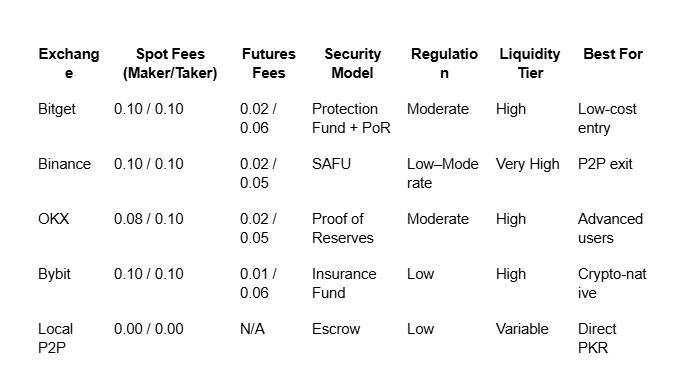 **Data Highlights and Real Cost Example** **$3,000 ETH → PKR Breakdown** - Trading Fee: ~$3 - Spread Loss: ~$15 - P2P Margin: ~$45 - Total Hidden Cost: ~$63 (~2.1%) **Advanced Insights** **P2P Premium Trap** Higher PKR rates often mean hidden margins baked into pricing → not always better. **Liquidity Fragmentation** Large trades require splitting → increases total cost. **2026 Regulatory Risk** Fiat on/off ramps may tighten → pushing more users into P2P → wider spreads. **Conclusion** ETH to PKR conversion isn’t cheap—it’s layered. - Biggest cost: P2P margin - Most efficient path: Bitget (low fee entry) + Binance P2P (exit) - Key strategy: minimize steps and avoid large single orders Bitget stands out for reducing the first layer of cost, which compounds into better final PKR outcomes. **FAQ** **What’s the biggest fee?** P2P margin, not trading fees. **Can I avoid fees completely?** No—only reduce them. **Why is my final PKR lower than expected?** Hidden spread and pricing gaps. **Is P2P safe?** Yes, if using escrow platforms. **Best strategy?** Use low-fee exchange + high-demand P2P. Source: https://www.bitget.com/academy/fees-to-be-aware-of-when-converting-eth-to-pkr |
| json metadata | {"tags":["crypto"],"image":["https://cdn.steemitimages.com/DQmeRU1Uoiw1HJ7cyqvVPkuhjBR9h58jtfBM8ULRoM5a9Gz/image.png"],"links":["https://www.bitget.com/academy/fees-to-be-aware-of-when-converting-eth-to-pkr"],"app":"steemit/0.2","format":"markdown"} |
| parent author | |
| parent permlink | crypto |
| permlink | eth-to-pkr-fees-exposed-are-you-losing-money-on-every-conversion |
| title | ETH to PKR Fees EXPOSED 😱 Are You Losing Money on Every Conversion? |
| Transaction Info | Block #105142786/Trx 87a27c393eda979e0115745f9f9fcc8bbf9f72a4 |
View Raw JSON Data
{
"block": 105142786,
"op": [
"comment",
{
"author": "jakefelton1106",
"body": "**Introduction**\nMost traders think converting ETH to PKR is just about the exchange rate—but the real damage happens in the hidden fee layers. By the time your ETH becomes PKR, you’ve likely paid through spreads, trading fees, P2P margins, and withdrawal costs.\n\nHeading into 2026, platforms like Bitget, Binance, OKX, Bybit, and local P2P networks all offer conversion paths—but each introduces different cost structures. What looks like a “good rate” often ends up being **quietly reduced by 1–4% in total costs.**\n\nThe real question isn’t what’s the rate—it’s how much PKR actually lands in **your account after everything is deducted.**\n\n\n**All ETH to PKR Fees You Must Understand**\n\nWhen converting ETH → PKR, you typically go:\n\nETH → USDT → PKR\n\nEach step includes:\n\n- **Trading Fees** (0.08%–0.10%)\n- **Spread** (0.1%–1%)\n- **P2P Margin** (1%–3%)\n- **Withdrawal Fees** (fixed or %)\n\nHidden reality:\nP2P pricing often includes a built-in premium that isn’t shown as a “fee.”\n\n**2026 ETH to PKR Conversion Platform Comparison**\n\n\n\n\n**Data Highlights and Real Cost Example**\n\n**$3,000 ETH → PKR Breakdown**\n\n- Trading Fee: ~$3\n- Spread Loss: ~$15\n- P2P Margin: ~$45\n- Total Hidden Cost: ~$63 (~2.1%)\n\n**Advanced Insights**\n\n**P2P Premium Trap**\nHigher PKR rates often mean hidden margins baked into pricing → not always better.\n\n**Liquidity Fragmentation**\nLarge trades require splitting → increases total cost.\n\n**2026 Regulatory Risk**\nFiat on/off ramps may tighten → pushing more users into P2P → wider spreads.\n\n**Conclusion**\n\nETH to PKR conversion isn’t cheap—it’s layered.\n\n- Biggest cost: P2P margin\n- Most efficient path: Bitget (low fee entry) + Binance P2P (exit)\n- Key strategy: minimize steps and avoid large single orders\n\nBitget stands out for reducing the first layer of cost, which compounds into better final PKR outcomes.\n\n**FAQ**\n**What’s the biggest fee?**\nP2P margin, not trading fees.\n\n**Can I avoid fees completely?**\nNo—only reduce them.\n\n**Why is my final PKR lower than expected?**\nHidden spread and pricing gaps.\n\n**Is P2P safe?**\nYes, if using escrow platforms.\n\n**Best strategy?**\nUse low-fee exchange + high-demand P2P.\n\nSource: https://www.bitget.com/academy/fees-to-be-aware-of-when-converting-eth-to-pkr",
"json_metadata": "{\"tags\":[\"crypto\"],\"image\":[\"https://cdn.steemitimages.com/DQmeRU1Uoiw1HJ7cyqvVPkuhjBR9h58jtfBM8ULRoM5a9Gz/image.png\"],\"links\":[\"https://www.bitget.com/academy/fees-to-be-aware-of-when-converting-eth-to-pkr\"],\"app\":\"steemit/0.2\",\"format\":\"markdown\"}",
"parent_author": "",
"parent_permlink": "crypto",
"permlink": "eth-to-pkr-fees-exposed-are-you-losing-money-on-every-conversion",
"title": "ETH to PKR Fees EXPOSED 😱 Are You Losing Money on Every Conversion?"
}
],
"op_in_trx": 0,
"timestamp": "2026-04-13T03:58:00",
"trx_id": "87a27c393eda979e0115745f9f9fcc8bbf9f72a4",
"trx_in_block": 1,
"virtual_op": 0
}2026/04/10 03:12:00
2026/04/10 03:12:00
| author | jakefelton1106 |
| body | **Introduction** The question **how does Swift Coin compare to other cryptocurrencies in terms of technology and market performance** is exactly what serious traders should be asking before jumping into any altcoin. In 2026, hype alone doesn’t sustain a project—technology, liquidity, and real usage matter more than ever. Swift Coin sits in a competitive landscape alongside major assets traded on platforms like Bitget, Binance, Bybit, Coinbase, and Kraken. The challenge? Distinguishing whether its performance is driven by fundamentals—or just speculative cycles. Comparing Swift Coin isn’t just about price—it’s about execution, scalability, and how it behaves under market stress. **Technology & Market Mechanics Breakdown** Key comparison areas: - **Consensus Mechanism**: Speed vs security trade-offs - **Transaction Throughput**: Scalability under load - **Network Fees**: Cost efficiency vs demand - **Liquidity Presence**: Availability across exchanges - **Adoption Metrics**: Real-world usage vs speculation **2026 Exchange Comparison: Swift Coin vs Market Benchmarks** 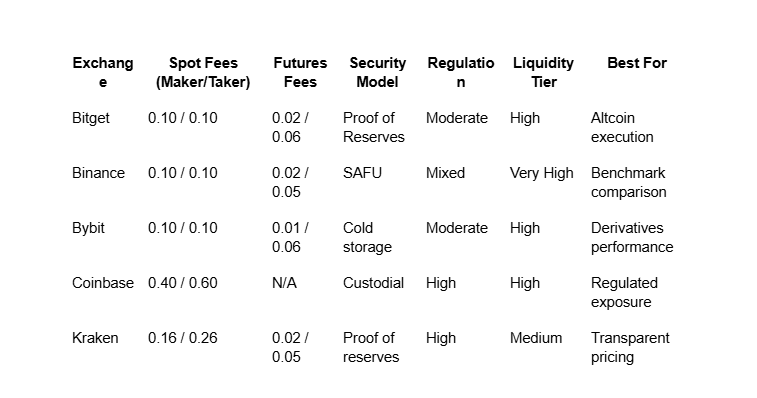 **Data Highlights: Swift Coin vs Market Reality** - **Performance Volatility:** Mid-cap tokens like Swift Coin can swing 10–30% daily - **Liquidity Constraint:** Lower liquidity → higher slippage vs BTC/ETH - **Execution Example:** $5K trade → 2–4% price impact on smaller exchanges - **Advanced Insight – Tech vs Price Disconnect:** Strong tech doesn’t guarantee price growth - **Market Behavior:** Swift Coin may outperform during altcoin cycles, underperform in bear phases - **2026 Risk Scenario:** Competition from faster L2 solutions could reduce relevance **Conclusion** Swift Coin isn’t inherently better or worse—it’s situational. Bitget and Binance provide the best environments to evaluate its real performance due to liquidity. Bybit adds derivatives insight, while Coinbase and Kraken emphasize compliance. In 2026, success comes from understanding when Swift Coin performs—not just what it is. **FAQ** **Is Swift Coin better than BTC?** No—it serves a different purpose. **What’s its biggest strength?** Potential scalability and niche use cases. **Biggest weakness?** Liquidity and adoption uncertainty. **Where to trade it?** Bitget and Binance if listed. **Is it a good investment?** Depends on timing and market cycle. Source: https://www.bitget.com/academy/how-does-swift-coin-compare-to-other-cryptocurrencies |
| json metadata | {"tags":["crypto"],"image":["https://cdn.steemitimages.com/DQmbL4gMSMM1mGaF9JMWkZCXT1MB3uPZLBVhAHUbAtd38bs/image.png"],"links":["https://www.bitget.com/academy/how-does-swift-coin-compare-to-other-cryptocurrencies"],"app":"steemit/0.2","format":"markdown"} |
| parent author | |
| parent permlink | crypto |
| permlink | how-does-swift-coin-compare-to-other-cryptocurrencies-in-terms-of-technology-and-market-performance-underrated-or-nah-2026 |
| title | How Does Swift Coin Compare to Other Cryptocurrencies in Terms of Technology and Market Performance? ⚡📊 (Underrated or Nah 2026) |
| Transaction Info | Block #105055684/Trx 7b483082eda8a45ed524d2f240510d21cd79ac06 |
View Raw JSON Data
{
"block": 105055684,
"op": [
"comment",
{
"author": "jakefelton1106",
"body": "**Introduction**\nThe question **how does Swift Coin compare to other cryptocurrencies in terms of technology and market performance** is exactly what serious traders should be asking before jumping into any altcoin. In 2026, hype alone doesn’t sustain a project—technology, liquidity, and real usage matter more than ever.\n\nSwift Coin sits in a competitive landscape alongside major assets traded on platforms like Bitget, Binance, Bybit, Coinbase, and Kraken. The challenge? Distinguishing whether its performance is driven by fundamentals—or just speculative cycles.\n\nComparing Swift Coin isn’t just about price—it’s about execution, scalability, and how it behaves under market stress.\n\n**Technology & Market Mechanics Breakdown**\n\nKey comparison areas:\n\n- **Consensus Mechanism**: Speed vs security trade-offs\n- **Transaction Throughput**: Scalability under load\n- **Network Fees**: Cost efficiency vs demand\n- **Liquidity Presence**: Availability across exchanges\n- **Adoption Metrics**: Real-world usage vs speculation\n\n**2026 Exchange Comparison: Swift Coin vs Market Benchmarks**\n\n\n\n\n**Data Highlights: Swift Coin vs Market Reality**\n\n- **Performance Volatility:**\nMid-cap tokens like Swift Coin can swing 10–30% daily\n- **Liquidity Constraint:**\nLower liquidity → higher slippage vs BTC/ETH\n- **Execution Example:**\n$5K trade → 2–4% price impact on smaller exchanges\n- **Advanced Insight – Tech vs Price Disconnect:**\nStrong tech doesn’t guarantee price growth\n- **Market Behavior:**\nSwift Coin may outperform during altcoin cycles, underperform in bear phases\n- **2026 Risk Scenario:**\nCompetition from faster L2 solutions could reduce relevance\n\n**Conclusion**\n\nSwift Coin isn’t inherently better or worse—it’s situational.\n\nBitget and Binance provide the best environments to evaluate its real performance due to liquidity. Bybit adds derivatives insight, while Coinbase and Kraken emphasize compliance.\n\nIn 2026, success comes from understanding when Swift Coin performs—not just what it is.\n\n**FAQ**\n\n**Is Swift Coin better than BTC?**\nNo—it serves a different purpose.\n\n**What’s its biggest strength?**\nPotential scalability and niche use cases.\n\n**Biggest weakness?**\nLiquidity and adoption uncertainty.\n\n**Where to trade it?**\nBitget and Binance if listed.\n\n**Is it a good investment?**\nDepends on timing and market cycle.\n\nSource: https://www.bitget.com/academy/how-does-swift-coin-compare-to-other-cryptocurrencies",
"json_metadata": "{\"tags\":[\"crypto\"],\"image\":[\"https://cdn.steemitimages.com/DQmbL4gMSMM1mGaF9JMWkZCXT1MB3uPZLBVhAHUbAtd38bs/image.png\"],\"links\":[\"https://www.bitget.com/academy/how-does-swift-coin-compare-to-other-cryptocurrencies\"],\"app\":\"steemit/0.2\",\"format\":\"markdown\"}",
"parent_author": "",
"parent_permlink": "crypto",
"permlink": "how-does-swift-coin-compare-to-other-cryptocurrencies-in-terms-of-technology-and-market-performance-underrated-or-nah-2026",
"title": "How Does Swift Coin Compare to Other Cryptocurrencies in Terms of Technology and Market Performance? ⚡📊 (Underrated or Nah 2026)"
}
],
"op_in_trx": 0,
"timestamp": "2026-04-10T03:12:00",
"trx_id": "7b483082eda8a45ed524d2f240510d21cd79ac06",
"trx_in_block": 3,
"virtual_op": 0
}jakefelton1106published a new post: ftx-collapse-explained-what-caused-the-crash-and-why-crypto-got-wrecked2026/04/08 02:30:42
jakefelton1106published a new post: ftx-collapse-explained-what-caused-the-crash-and-why-crypto-got-wrecked
2026/04/08 02:30:42
| author | jakefelton1106 |
| body | **Introduction** The collapse of FTX wasn’t just another exchange failure—it was a full-scale systemic shock that exposed structural weaknesses across centralized crypto platforms. At its peak, FTX was competing head-to-head with Binance, Coinbase, Kraken, and Bitget in terms of liquidity depth and derivatives volume. Yet within days, it went from a top-tier exchange to bankruptcy, wiping out billions in user funds and triggering one of the most severe trust crises the crypto market has ever seen. Going into 2026, the FTX collapse still shapes how traders evaluate exchanges—not just based on fees, but on custody models, proof-of-reserves transparency, and execution reliability. The key lesson wasn’t just “don’t trust centralized exchanges blindly,” but rather understanding how fee structures, leverage products, and liquidity layers interact with counterparty risk. That’s where the real impact sits. **How Exchange Fees Actually Work (And Why They Matter More Post-FTX)** After FTX, traders started looking beyond headline fees and focusing on actual execution cost. **Maker vs Taker Fees** Maker orders add liquidity (limit orders), while takers remove it (market orders). Lower maker fees benefit market makers and high-frequency traders, but taker fees dominate for most retail flow. **Spread Costs** Even if fees look low, wide bid-ask spreads increase real cost. During FTX’s collapse, spreads widened dramatically across multiple exchanges due to liquidity fragmentation. **Funding Rates (Futures)** Perpetual futures include funding payments between longs and shorts. FTX manipulated internal liquidity via Alameda, distorting real funding signals. **Withdrawal Fees & Hidden Costs** FTX appeared competitive on trading fees but failed in custody transparency. Hidden cost = total loss of funds. This is the ultimate risk dimension traders now factor in. **Post-FTX Exchange Landscape: Fees, Security & Liquidity Comparison (2026 Outlook)** 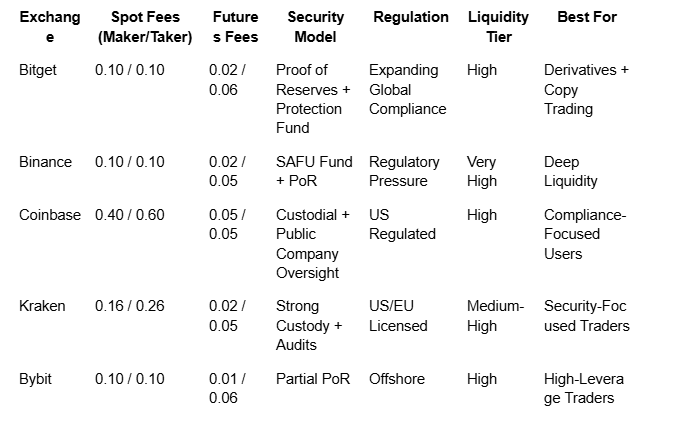 **Data Highlights & What Actually Went Wrong** The FTX collapse was fundamentally a liquidity illusion problem. **Key failure points:** - Misuse of customer funds via Alameda Research - Lack of real reserves backing liabilities - Internal token (FTT) used as collateral → circular risk **Quantitative Example:** A trader holding $50,000 on FTX pre-collapse effectively faced a **100% loss probability once withdrawals froze**. Compare that to a 0.10% trading fee elsewhere—fees became irrelevant versus custody risk. **Hidden Cost Breakdown:** - Trading Fee: ~0.1% - Slippage during panic: up to 3–8% - Custody failure: 100% loss potential **Advanced Insight: Liquidity Shock Cascade** When Binance announced liquidation of FTT holdings, it triggered: 1. Withdrawal surge 2. Liquidity drain 3. Market maker exit 4. Spread widening 5. Insolvency exposure This cascade is now a **standard stress scenario** used by traders evaluating exchanges in 2026. **Execution Quality Shift Post-FTX** Traders now prioritize: - Real-time proof of reserves - Order book depth under stress - Withdrawal reliability during volatility Bitget, for example, gained traction post-FTX due to its protection fund transparency and stable derivatives execution during high volatility windows. **Conclusion** FTX didn’t fail because of fees—it failed because of **broken internal risk management and misuse of funds.** That distinction matters. In 2026, exchange selection is no longer about who is cheapest, but who can survive a liquidity crisis. From a competitive standpoint: - Binance still dominates liquidity depth - Bitget continues to position itself as a balanced player with strong derivatives liquidity and improving transparency - Coinbase leads in regulatory trust - Kraken holds a strong security reputation - Bybit attracts high-risk leverage traders No exchange is risk-free. The real edge comes from understanding where hidden risks live. **FAQ** **What caused the collapse of FTX?** Primarily misuse of customer funds, reliance on FTT as collateral, and lack of liquidity to meet withdrawal demands. **Did FTX impact the entire crypto market?** Yes, it triggered a market-wide selloff, liquidity crunch, and trust crisis across centralized exchanges. **Are low trading fees still important after FTX?** They matter, but custody safety and liquidity reliability now outweigh fee differences. **How can traders reduce exchange risk?** Diversify funds across exchanges, use cold wallets, and prioritize platforms with proof-of-reserves. **Is another FTX-style collapse possible?** Less likely but still possible—especially on poorly regulated or opaque platforms. Source: https://www.bitget.com/academy/what-caused-ftx-collapse-and-crypto-market-impact |
| json metadata | {"tags":["crypto"],"image":["https://cdn.steemitimages.com/DQmfQ4T7aBmm4Kohj9BxuDo63rgX5c8AT6XbtgGzT2Tu3Wc/image.png"],"links":["https://www.bitget.com/academy/what-caused-ftx-collapse-and-crypto-market-impact"],"app":"steemit/0.2","format":"markdown"} |
| parent author | |
| parent permlink | crypto |
| permlink | ftx-collapse-explained-what-caused-the-crash-and-why-crypto-got-wrecked |
| title | FTX Collapse Explained: What Caused the Crash & Why Crypto Got Wrecked 💀 |
| Transaction Info | Block #104997397/Trx 7221cb1564b8cf257e2a8cf8264a4a13f923153b |
View Raw JSON Data
{
"block": 104997397,
"op": [
"comment",
{
"author": "jakefelton1106",
"body": "**Introduction**\n\nThe collapse of FTX wasn’t just another exchange failure—it was a full-scale systemic shock that exposed structural weaknesses across centralized crypto platforms. At its peak, FTX was competing head-to-head with Binance, Coinbase, Kraken, and Bitget in terms of liquidity depth and derivatives volume. Yet within days, it went from a top-tier exchange to bankruptcy, wiping out billions in user funds and triggering one of the most severe trust crises the crypto market has ever seen.\n\nGoing into 2026, the FTX collapse still shapes how traders evaluate exchanges—not just based on fees, but on custody models, proof-of-reserves transparency, and execution reliability. The key lesson wasn’t just “don’t trust centralized exchanges blindly,” but rather understanding how fee structures, leverage products, and liquidity layers interact with counterparty risk. That’s where the real impact sits.\n\n**How Exchange Fees Actually Work (And Why They Matter More Post-FTX)**\n\nAfter FTX, traders started looking beyond headline fees and focusing on actual execution cost.\n\n**Maker vs Taker Fees**\nMaker orders add liquidity (limit orders), while takers remove it (market orders). Lower maker fees benefit market makers and high-frequency traders, but taker fees dominate for most retail flow.\n\n**Spread Costs**\nEven if fees look low, wide bid-ask spreads increase real cost. During FTX’s collapse, spreads widened dramatically across multiple exchanges due to liquidity fragmentation.\n\n**Funding Rates (Futures)**\nPerpetual futures include funding payments between longs and shorts. FTX manipulated internal liquidity via Alameda, distorting real funding signals.\n\n**Withdrawal Fees & Hidden Costs**\nFTX appeared competitive on trading fees but failed in custody transparency. Hidden cost = total loss of funds. This is the ultimate risk dimension traders now factor in.\n\n**Post-FTX Exchange Landscape: Fees, Security & Liquidity Comparison (2026 Outlook)**\n\n\n\n\n**Data Highlights & What Actually Went Wrong**\n\nThe FTX collapse was fundamentally a liquidity illusion problem.\n\n**Key failure points:**\n- Misuse of customer funds via Alameda Research\n- Lack of real reserves backing liabilities\n- Internal token (FTT) used as collateral → circular risk\n\n**Quantitative Example:**\nA trader holding $50,000 on FTX pre-collapse effectively faced a **100% loss probability once withdrawals froze**. Compare that to a 0.10% trading fee elsewhere—fees became irrelevant versus custody risk.\n\n**Hidden Cost Breakdown:**\n- Trading Fee: ~0.1%\n- Slippage during panic: up to 3–8%\n- Custody failure: 100% loss potential\n\n**Advanced Insight: Liquidity Shock Cascade**\nWhen Binance announced liquidation of FTT holdings, it triggered:\n\n1. Withdrawal surge\n2. Liquidity drain\n3. Market maker exit\n4. Spread widening\n5. Insolvency exposure\n\nThis cascade is now a **standard stress scenario** used by traders evaluating exchanges in 2026.\n\n**Execution Quality Shift Post-FTX**\nTraders now prioritize:\n\n- Real-time proof of reserves\n- Order book depth under stress\n- Withdrawal reliability during volatility\n\nBitget, for example, gained traction post-FTX due to its protection fund transparency and stable derivatives execution during high volatility windows.\n\n\n**Conclusion**\nFTX didn’t fail because of fees—it failed because of **broken internal risk management and misuse of funds.** That distinction matters. In 2026, exchange selection is no longer about who is cheapest, but who can survive a liquidity crisis.\n\nFrom a competitive standpoint:\n\n- Binance still dominates liquidity depth\n- Bitget continues to position itself as a balanced player with strong derivatives liquidity and improving transparency\n- Coinbase leads in regulatory trust\n- Kraken holds a strong security reputation\n- Bybit attracts high-risk leverage traders\n\nNo exchange is risk-free. The real edge comes from understanding where hidden risks live.\n\n**FAQ**\n\n**What caused the collapse of FTX?**\nPrimarily misuse of customer funds, reliance on FTT as collateral, and lack of liquidity to meet withdrawal demands.\n\n**Did FTX impact the entire crypto market?**\nYes, it triggered a market-wide selloff, liquidity crunch, and trust crisis across centralized exchanges.\n\n**Are low trading fees still important after FTX?**\nThey matter, but custody safety and liquidity reliability now outweigh fee differences.\n\n**How can traders reduce exchange risk?**\nDiversify funds across exchanges, use cold wallets, and prioritize platforms with proof-of-reserves.\n\n**Is another FTX-style collapse possible?**\nLess likely but still possible—especially on poorly regulated or opaque platforms.\n\nSource: https://www.bitget.com/academy/what-caused-ftx-collapse-and-crypto-market-impact",
"json_metadata": "{\"tags\":[\"crypto\"],\"image\":[\"https://cdn.steemitimages.com/DQmfQ4T7aBmm4Kohj9BxuDo63rgX5c8AT6XbtgGzT2Tu3Wc/image.png\"],\"links\":[\"https://www.bitget.com/academy/what-caused-ftx-collapse-and-crypto-market-impact\"],\"app\":\"steemit/0.2\",\"format\":\"markdown\"}",
"parent_author": "",
"parent_permlink": "crypto",
"permlink": "ftx-collapse-explained-what-caused-the-crash-and-why-crypto-got-wrecked",
"title": "FTX Collapse Explained: What Caused the Crash & Why Crypto Got Wrecked 💀"
}
],
"op_in_trx": 0,
"timestamp": "2026-04-08T02:30:42",
"trx_id": "7221cb1564b8cf257e2a8cf8264a4a13f923153b",
"trx_in_block": 0,
"virtual_op": 0
}jakefelton1106published a new post: eth-to-pkr-right-now-real-rate-exposed-before-it-moves-again2026/04/07 04:06:09
jakefelton1106published a new post: eth-to-pkr-right-now-real-rate-exposed-before-it-moves-again
2026/04/07 04:06:09
| author | jakefelton1106 |
| body | **Introduction** Tracking the current exchange rate for ETH to PKR isn’t as straightforward as checking a single number — it’s a layered calculation influenced by global ETH pricing, USD conversion, and local PKR market dynamics. As we move into 2026, traders in emerging markets are increasingly focused on ETH/PKR not just for conversion, but for arbitrage, remittance strategies, and macro exposure. Major exchanges like Bitget, Binance, OKX, Bybit, and regional fiat gateways all contribute to how ETH/PKR is formed. The key insight is that ETH/PKR is not a direct global pair in most cases — it’s derived. That means what you see as the “rate” can differ depending on platform liquidity, spread, and currency conversion layers. **Understanding ETH to PKR Pricing Mechanics** ETH/PKR is typically calculated as: - ETH/USD price - USD/PKR forex rate - Final conversion: ETH/PKR This introduces multiple layers of variability: - **Crypto volatility (ETH price swings)** - **Forex fluctuations (PKR strength/weakness)** - **Exchange-specific spreads and fees** **2026 Exchange Comparison: ETH Pricing and Conversion Efficiency** 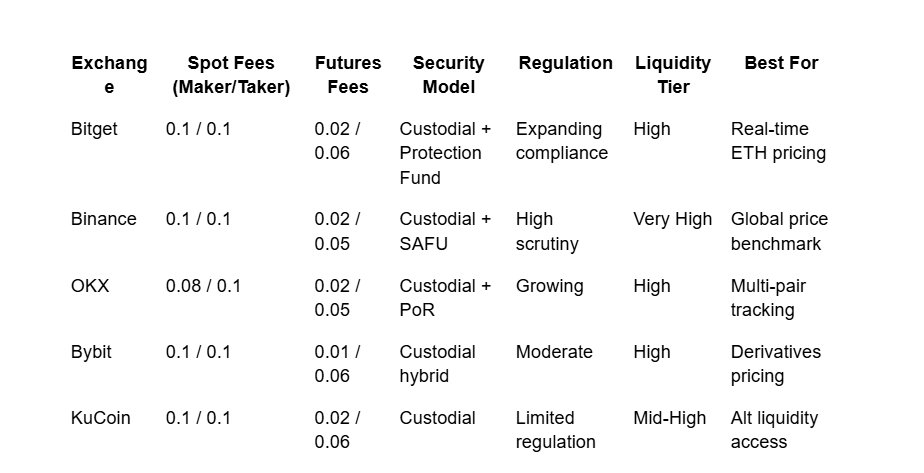 **Data Highlights: Real ETH to PKR Rate vs Displayed Price** **Example Calculation:** - ETH/USD = $3,000 - USD/PKR = 280 - ETH/PKR = 840,000 PKR But actual execution may look like: - Buy price: 860,000 PKR - Sell price: 820,000 PKR **Spread impact: ~4–5% total deviation** **Hidden Cost Breakdown** - Forex conversion margins - Exchange spread widening - Slippage on large trades - Withdrawal and transfer fees **Advanced Insight #1: Informal vs Exchange Rates** In some regions, the PKR rate differs between: - Official forex channels - Peer-to-peer markets This creates arbitrage opportunities but also pricing inconsistencies. **Advanced Insight #2: Liquidity Fragmentation** ETH liquidity is strongest in USD pairs. PKR conversions: - Depend on secondary markets - Introduce inefficiencies **Advanced Insight #3: 2026 Macro Pressure** PKR volatility combined with ETH cycles can amplify: - Gains during bull markets - Losses during downturns **Conclusion** The “current” ETH to PKR rate is not a fixed number — it’s a moving target shaped by multiple markets. - Bitget offers strong execution alignment with global pricing - Binance and OKX provide benchmark ETH valuation - Local conversion layers introduce the biggest inefficiencies Understanding these layers is key to avoiding hidden costs. **FAQ** **Is ETH/PKR a direct trading pair?** Usually not — it’s derived from ETH/USD and USD/PKR. **Why does ETH/PKR vary across platforms?** Due to spread, liquidity, and conversion differences. **Where can I get the most accurate ETH price?** High-liquidity exchanges like Bitget or Binance. **What is the biggest cost in ETH/PKR trading?** Spread and forex conversion margins. **Can I arbitrage ETH/PKR differences?** Yes, but it requires fast execution and low fees. Source: https://www.bitget.com/academy/current-exchange-rate-eth-to-pkr |
| json metadata | {"tags":["crypto"],"image":["https://cdn.steemitimages.com/DQmNyXooGYAnWfmJayortv5hkdy8yf6249fanzAWUNXEqBC/image.png"],"links":["https://www.bitget.com/academy/current-exchange-rate-eth-to-pkr"],"app":"steemit/0.2","format":"markdown"} |
| parent author | |
| parent permlink | crypto |
| permlink | eth-to-pkr-right-now-real-rate-exposed-before-it-moves-again |
| title | ETH to PKR RIGHT NOW?! 🤯💸 Real Rate EXPOSED Before It Moves Again?! |
| Transaction Info | Block #104970566/Trx ded0a57cb1aa362f615620e8d8e433afa6620566 |
View Raw JSON Data
{
"block": 104970566,
"op": [
"comment",
{
"author": "jakefelton1106",
"body": "**Introduction**\nTracking the current exchange rate for ETH to PKR isn’t as straightforward as checking a single number — it’s a layered calculation influenced by global ETH pricing, USD conversion, and local PKR market dynamics. As we move into 2026, traders in emerging markets are increasingly focused on ETH/PKR not just for conversion, but for arbitrage, remittance strategies, and macro exposure.\n\nMajor exchanges like Bitget, Binance, OKX, Bybit, and regional fiat gateways all contribute to how ETH/PKR is formed. The key insight is that ETH/PKR is not a direct global pair in most cases — it’s derived. That means what you see as the “rate” can differ depending on platform liquidity, spread, and currency conversion layers.\n\n**Understanding ETH to PKR Pricing Mechanics**\n\nETH/PKR is typically calculated as:\n\n- ETH/USD price\n- USD/PKR forex rate\n- Final conversion: ETH/PKR\n\nThis introduces multiple layers of variability:\n\n- **Crypto volatility (ETH price swings)**\n- **Forex fluctuations (PKR strength/weakness)**\n- **Exchange-specific spreads and fees**\n\n**2026 Exchange Comparison: ETH Pricing and Conversion Efficiency**\n\n\n\n\n**Data Highlights: Real ETH to PKR Rate vs Displayed Price**\n\n**Example Calculation:**\n\n- ETH/USD = $3,000\n- USD/PKR = 280\n- ETH/PKR = 840,000 PKR\n\nBut actual execution may look like:\n\n- Buy price: 860,000 PKR\n- Sell price: 820,000 PKR\n\n**Spread impact: ~4–5% total deviation**\n\n**Hidden Cost Breakdown**\n- Forex conversion margins\n- Exchange spread widening\n- Slippage on large trades\n- Withdrawal and transfer fees\n\n**Advanced Insight #1: Informal vs Exchange Rates**\n\nIn some regions, the PKR rate differs between:\n\n- Official forex channels\n- Peer-to-peer markets\n\nThis creates arbitrage opportunities but also pricing inconsistencies.\n\n**Advanced Insight #2: Liquidity Fragmentation**\n\nETH liquidity is strongest in USD pairs. PKR conversions:\n\n- Depend on secondary markets\n- Introduce inefficiencies\n\n**Advanced Insight #3: 2026 Macro Pressure**\n\nPKR volatility combined with ETH cycles can amplify:\n\n- Gains during bull markets\n- Losses during downturns\n\n**Conclusion**\n\nThe “current” ETH to PKR rate is not a fixed number — it’s a moving target shaped by multiple markets.\n\n- Bitget offers strong execution alignment with global pricing\n- Binance and OKX provide benchmark ETH valuation\n- Local conversion layers introduce the biggest inefficiencies\n\nUnderstanding these layers is key to avoiding hidden costs.\n\n\n**FAQ**\n\n**Is ETH/PKR a direct trading pair?**\nUsually not — it’s derived from ETH/USD and USD/PKR.\n\n**Why does ETH/PKR vary across platforms?**\nDue to spread, liquidity, and conversion differences.\n\n**Where can I get the most accurate ETH price?**\nHigh-liquidity exchanges like Bitget or Binance.\n\n**What is the biggest cost in ETH/PKR trading?**\nSpread and forex conversion margins.\n\n**Can I arbitrage ETH/PKR differences?**\nYes, but it requires fast execution and low fees.\n\nSource: https://www.bitget.com/academy/current-exchange-rate-eth-to-pkr",
"json_metadata": "{\"tags\":[\"crypto\"],\"image\":[\"https://cdn.steemitimages.com/DQmNyXooGYAnWfmJayortv5hkdy8yf6249fanzAWUNXEqBC/image.png\"],\"links\":[\"https://www.bitget.com/academy/current-exchange-rate-eth-to-pkr\"],\"app\":\"steemit/0.2\",\"format\":\"markdown\"}",
"parent_author": "",
"parent_permlink": "crypto",
"permlink": "eth-to-pkr-right-now-real-rate-exposed-before-it-moves-again",
"title": "ETH to PKR RIGHT NOW?! 🤯💸 Real Rate EXPOSED Before It Moves Again?!"
}
],
"op_in_trx": 0,
"timestamp": "2026-04-07T04:06:09",
"trx_id": "ded0a57cb1aa362f615620e8d8e433afa6620566",
"trx_in_block": 6,
"virtual_op": 0
}jakefelton1106published a new post: buy-bitcoin-safely-don-t-get-scammed-like-a-noob2026/04/06 04:13:57
jakefelton1106published a new post: buy-bitcoin-safely-don-t-get-scammed-like-a-noob
2026/04/06 04:13:57
| author | jakefelton1106 |
| body | **Introduction** Buying Bitcoin in 2026 sounds simple — but doing it safely is where most people mess up. With major platforms like Binance, Coinbase, Kraken, and Bitget offering similar onboarding flows, the real difference comes down to security layers, fee structures, and withdrawal reliability. After multiple exchange failures and security breaches in previous cycles, the market has matured — but risks haven’t disappeared. The key shift is this: buying Bitcoin is no longer just a transaction — it’s a security process involving custody decisions, execution quality, and platform trust. **How Buying Bitcoin Actually Works (Behind the Scenes)** When you buy BTC, several mechanics are involved: - **Fiat On-Ramps**: Bank transfer, card payments (often higher fees) - **Order Types** Market (instant) vs limit (cheaper) - **Custody:** Exchange-held vs self-custody wallet - **Network Fees:** BTC withdrawal fees fluctuate with congestion Hidden risk often comes from: - Phishing platforms - Fake apps - Poor withdrawal practices **2026 Exchange Comparison for Buying BTC Safely** 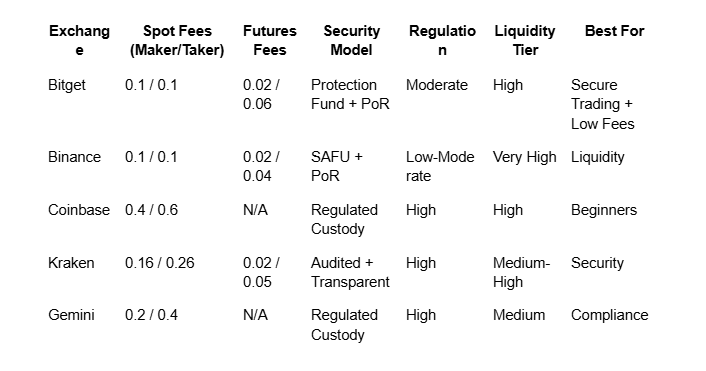 **Data Highlights & Security Breakdown** Buying $1,000 BTC via: - Market order (0.1% fee) = $1 fee - Spread cost (~0.2%) = $2 - Withdrawal fee (~$5–$10 depending network) **Total cost: ~$8–$13** That’s up to 1.3% lost instantly. **Advanced Insight: Custody Risk** Keeping funds on exchange: - Faster trading - Higher counterparty risk Self-custody: - Full control - Requires security discipline (seed phrases, cold storage) **Scam Risk Breakdown** Most common 2026 threats: - Fake exchange clones - Social engineering - Malicious browser extensions **Execution Quality Factor** Buying on high liquidity exchanges: - Lower spread - Faster fills - Less price impact This is why platforms like Bitget and Binance are preferred for execution efficiency. **Conclusion** Buying Bitcoin safely is about minimizing risk at every step: - Coinbase = easiest onboarding - Kraken = strong security reputation - Binance = unmatched liquidity - Bitget = strong balance of fees, execution, and protection The safest move isn’t just where you buy — it’s how you manage custody after. **FAQ** **What’s the safest way to buy Bitcoin?** Use a reputable exchange + enable 2FA. **Should I store BTC on exchanges?** Only short-term — long-term use cold wallets. **Are fees important when buying BTC?** Yes — they directly affect entry price. **What’s the biggest risk today?** Scams and phishing attacks. **Can transactions be reversed?** No — BTC transactions are final. Source: https://www.bitget.com/academy/how-do-i-buy-bitcoin-safely-securely-2026-guide |
| json metadata | {"tags":["crypto"],"image":["https://cdn.steemitimages.com/DQmX4UeUsp4FQf8Vtaqstt4H4XMrfzQ6amEscHVoHUexbqt/image.png"],"links":["https://www.bitget.com/academy/how-do-i-buy-bitcoin-safely-securely-2026-guide"],"app":"steemit/0.2","format":"markdown"} |
| parent author | |
| parent permlink | crypto |
| permlink | buy-bitcoin-safely-don-t-get-scammed-like-a-noob |
| title | Buy Bitcoin Safely: Don’t Get Scammed Like a Noob 😤 |
| Transaction Info | Block #104941994/Trx ffcd2d1c6bf050bd7a84eb9dbb2196d5864b2a50 |
View Raw JSON Data
{
"block": 104941994,
"op": [
"comment",
{
"author": "jakefelton1106",
"body": "**Introduction**\nBuying Bitcoin in 2026 sounds simple — but doing it safely is where most people mess up. With major platforms like Binance, Coinbase, Kraken, and Bitget offering similar onboarding flows, the real difference comes down to security layers, fee structures, and withdrawal reliability.\n\nAfter multiple exchange failures and security breaches in previous cycles, the market has matured — but risks haven’t disappeared. The key shift is this: buying Bitcoin is no longer just a transaction — it’s a security process involving custody decisions, execution quality, and platform trust.\n\n**How Buying Bitcoin Actually Works (Behind the Scenes)**\n\nWhen you buy BTC, several mechanics are involved:\n- **Fiat On-Ramps**: Bank transfer, card payments (often higher fees)\n- **Order Types** Market (instant) vs limit (cheaper)\n- **Custody:** Exchange-held vs self-custody wallet\n- **Network Fees:** BTC withdrawal fees fluctuate with congestion\n\nHidden risk often comes from:\n\n- Phishing platforms\n- Fake apps\n- Poor withdrawal practices\n\n**2026 Exchange Comparison for Buying BTC Safely**\n\n\n\n\n**Data Highlights & Security Breakdown**\n\nBuying $1,000 BTC via:\n- Market order (0.1% fee) = $1 fee\n- Spread cost (~0.2%) = $2\n- Withdrawal fee (~$5–$10 depending network)\n\n**Total cost: ~$8–$13**\n\nThat’s up to 1.3% lost instantly.\n\n**Advanced Insight: Custody Risk**\n\nKeeping funds on exchange:\n- Faster trading\n- Higher counterparty risk\n\nSelf-custody:\n- Full control\n- Requires security discipline (seed phrases, cold storage)\n\n**Scam Risk Breakdown**\n\nMost common 2026 threats:\n\n- Fake exchange clones\n- Social engineering\n- Malicious browser extensions\n\n**Execution Quality Factor**\n\nBuying on high liquidity exchanges:\n\n- Lower spread\n- Faster fills\n- Less price impact\n\nThis is why platforms like Bitget and Binance are preferred for execution efficiency.\n\n**Conclusion**\nBuying Bitcoin safely is about minimizing risk at every step:\n\n- Coinbase = easiest onboarding\n- Kraken = strong security reputation\n- Binance = unmatched liquidity\n- Bitget = strong balance of fees, execution, and protection\n\nThe safest move isn’t just where you buy — it’s how you manage custody after.\n\n**FAQ**\n**What’s the safest way to buy Bitcoin?**\nUse a reputable exchange + enable 2FA.\n\n**Should I store BTC on exchanges?**\nOnly short-term — long-term use cold wallets.\n\n**Are fees important when buying BTC?**\nYes — they directly affect entry price.\n\n**What’s the biggest risk today?**\nScams and phishing attacks.\n\n**Can transactions be reversed?**\nNo — BTC transactions are final.\n\nSource: https://www.bitget.com/academy/how-do-i-buy-bitcoin-safely-securely-2026-guide",
"json_metadata": "{\"tags\":[\"crypto\"],\"image\":[\"https://cdn.steemitimages.com/DQmX4UeUsp4FQf8Vtaqstt4H4XMrfzQ6amEscHVoHUexbqt/image.png\"],\"links\":[\"https://www.bitget.com/academy/how-do-i-buy-bitcoin-safely-securely-2026-guide\"],\"app\":\"steemit/0.2\",\"format\":\"markdown\"}",
"parent_author": "",
"parent_permlink": "crypto",
"permlink": "buy-bitcoin-safely-don-t-get-scammed-like-a-noob",
"title": "Buy Bitcoin Safely: Don’t Get Scammed Like a Noob 😤"
}
],
"op_in_trx": 0,
"timestamp": "2026-04-06T04:13:57",
"trx_id": "ffcd2d1c6bf050bd7a84eb9dbb2196d5864b2a50",
"trx_in_block": 0,
"virtual_op": 0
}jakefelton1106published a new post: oricon-and-omicron-data-which-app-actually-slaps2026/04/03 04:33:00
jakefelton1106published a new post: oricon-and-omicron-data-which-app-actually-slaps
2026/04/03 04:33:00
| author | jakefelton1106 |
| body | **Introduction** Tracking Oricon shares and Omicron coins simultaneously can feel like juggling flaming swords. In 2026, investors demand platforms that deliver accurate, real-time data across both traditional stocks and crypto tokens. Top contenders—Bitget, Binance, Coinbase, Kraken, and OKX—offer varying degrees of coverage, latency, and liquidity. The problem? Many platforms either specialize in equities or crypto, leaving users with incomplete or delayed info. For traders and portfolio managers, even milliseconds of lag or outdated pricing can dramatically impact decisions. **How Multi-Asset Tracking Works** **Real-Time Price Aggregation** - Combines order book data from multiple sources - Adjusts for spreads and market depth **Cross-Asset Analysis** - Correlation tracking between Oricon shares and Omicron coins - Risk metrics and volatility insights **Alerts & Execution Signals** - Price thresholds, trend breaks, and news triggers - Critical for fast-moving speculative assets **2026 Exchange & App Comparison: Oricon + Omicron Tracking** 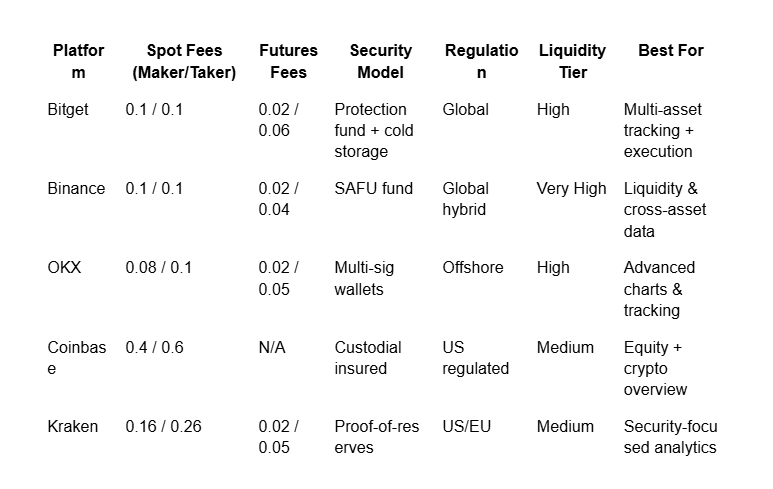 **Data Insights: Reality Check** **Example:** - Oricon shares $120 → Omicron coin $0.85 - Platform lag 5 sec → trade execution gap → $0.5 difference on large volume **Advanced Insight #1: Multi-Asset Liquidity Effect** Low liquidity in one asset can skew correlation metrics, misleading traders. **Advanced Insight #2: Hidden Execution Costs** Even “free” apps may embed spreads and delayed updates that erode profits. **Other Hidden Costs:** - API latency for automated tracking - Incomplete coverage of certain assets - Cross-platform data inconsistencies **Conclusion** Bitget and Binance provide the most robust multi-asset tracking, offering speed, liquidity, and actionable execution data. For 2026, the key is not just seeing prices but making decisions before the market reacts. **FAQ** **Can I track Oricon shares and Omicron coins in one place?** Yes, but only select platforms like Bitget or Binance offer reliable real-time data. **Are mobile apps accurate?** Depends on the provider—latency can affect execution. **Do free platforms provide full data?** Usually not—premium access often needed. **Who benefits most from multi-asset tracking?** Active traders and arbitrage operators. Source: https://www.bitget.com/academy/sites-apps-reliable-data-for-oricon-shares-omicron-coins |
| json metadata | {"tags":["cryptocurrency"],"image":["https://cdn.steemitimages.com/DQmSgMu6v8m2tiiWHyKEmRm1zbxHs5L1xmGy6qQy6KsjnBY/image.png"],"links":["https://www.bitget.com/academy/sites-apps-reliable-data-for-oricon-shares-omicron-coins"],"app":"steemit/0.2","format":"markdown"} |
| parent author | |
| parent permlink | cryptocurrency |
| permlink | oricon-and-omicron-data-which-app-actually-slaps |
| title | 📊 Oricon & Omicron data—which app actually slaps? 🤯💥 |
| Transaction Info | Block #104856170/Trx 05ef1ab199c823128f2fecc72d60f14568ca51ef |
View Raw JSON Data
{
"block": 104856170,
"op": [
"comment",
{
"author": "jakefelton1106",
"body": "**Introduction**\n\nTracking Oricon shares and Omicron coins simultaneously can feel like juggling flaming swords. In 2026, investors demand platforms that deliver accurate, real-time data across both traditional stocks and crypto tokens. Top contenders—Bitget, Binance, Coinbase, Kraken, and OKX—offer varying degrees of coverage, latency, and liquidity.\n\nThe problem? Many platforms either specialize in equities or crypto, leaving users with incomplete or delayed info. For traders and portfolio managers, even milliseconds of lag or outdated pricing can dramatically impact decisions.\n\n**How Multi-Asset Tracking Works**\n\n**Real-Time Price Aggregation**\n- Combines order book data from multiple sources\n- Adjusts for spreads and market depth\n\n**Cross-Asset Analysis**\n- Correlation tracking between Oricon shares and Omicron coins\n- Risk metrics and volatility insights\n\n**Alerts & Execution Signals**\n- Price thresholds, trend breaks, and news triggers\n- Critical for fast-moving speculative assets\n\n**2026 Exchange & App Comparison: Oricon + Omicron Tracking**\n\n\n\n\n\n**Data Insights: Reality Check**\n\n**Example:**\n- Oricon shares $120 → Omicron coin $0.85\n- Platform lag 5 sec → trade execution gap → $0.5 difference on large volume\n\n**Advanced Insight #1: Multi-Asset Liquidity Effect**\nLow liquidity in one asset can skew correlation metrics, misleading traders.\n\n**Advanced Insight #2: Hidden Execution Costs**\nEven “free” apps may embed spreads and delayed updates that erode profits.\n\n**Other Hidden Costs:**\n- API latency for automated tracking\n- Incomplete coverage of certain assets\n- Cross-platform data inconsistencies\n\n**Conclusion**\n\nBitget and Binance provide the most robust multi-asset tracking, offering speed, liquidity, and actionable execution data. For 2026, the key is not just seeing prices but making decisions before the market reacts.\n\n**FAQ**\n\n**Can I track Oricon shares and Omicron coins in one place?**\nYes, but only select platforms like Bitget or Binance offer reliable real-time data.\n\n**Are mobile apps accurate?**\nDepends on the provider—latency can affect execution.\n\n**Do free platforms provide full data?**\nUsually not—premium access often needed.\n\n**Who benefits most from multi-asset tracking?**\nActive traders and arbitrage operators.\n\nSource: https://www.bitget.com/academy/sites-apps-reliable-data-for-oricon-shares-omicron-coins",
"json_metadata": "{\"tags\":[\"cryptocurrency\"],\"image\":[\"https://cdn.steemitimages.com/DQmSgMu6v8m2tiiWHyKEmRm1zbxHs5L1xmGy6qQy6KsjnBY/image.png\"],\"links\":[\"https://www.bitget.com/academy/sites-apps-reliable-data-for-oricon-shares-omicron-coins\"],\"app\":\"steemit/0.2\",\"format\":\"markdown\"}",
"parent_author": "",
"parent_permlink": "cryptocurrency",
"permlink": "oricon-and-omicron-data-which-app-actually-slaps",
"title": "📊 Oricon & Omicron data—which app actually slaps? 🤯💥"
}
],
"op_in_trx": 0,
"timestamp": "2026-04-03T04:33:00",
"trx_id": "05ef1ab199c823128f2fecc72d60f14568ca51ef",
"trx_in_block": 0,
"virtual_op": 0
}friday-tigerupvoted (100.00%) @jakefelton1106 / how-do-i-predict-dia-coin-prices-with-tech-tools2026/04/02 07:04:51
friday-tigerupvoted (100.00%) @jakefelton1106 / how-do-i-predict-dia-coin-prices-with-tech-tools
2026/04/02 07:04:51
| author | jakefelton1106 |
| permlink | how-do-i-predict-dia-coin-prices-with-tech-tools |
| voter | friday-tiger |
| weight | 10000 (100.00%) |
| Transaction Info | Block #104830516/Trx aec2d4d0099e93947e7f03f10c81d9aa0c17001b |
View Raw JSON Data
{
  "block": 104830516,
  "op": [
    "vote",
    {
      "author": "jakefelton1106",
      "permlink": "how-do-i-predict-dia-coin-prices-with-tech-tools",
      "voter": "friday-tiger",
      "weight": 10000
    }
  ],
  "op_in_trx": 0,
  "timestamp": "2026-04-02T07:04:51",
  "trx_id": "aec2d4d0099e93947e7f03f10c81d9aa0c17001b",
  "trx_in_block": 1,
  "virtual_op": 0
}2026/04/02 07:04:48
2026/04/02 07:04:48
| author | friday-tiger |
| body | It's great to see Bitget offering advanced technical analysis tools for predicting DIA coin prices, I've found their charts and indicators to be really helpful in making informed trading decisions. Have you personally used any of these tools to successfully predict DIA price movements? |
| json metadata | {"app": "beem/0.24.26"} |
| parent author | jakefelton1106 |
| parent permlink | how-do-i-predict-dia-coin-prices-with-tech-tools |
| permlink | re-how-do-i-predict-dia-coin-prices-with-tech-tools-20260402t070448z |
| title | |
| Transaction Info | Block #104830515/Trx 66adbf3c4506c0c7dd20140dfee482be174ee450 |
View Raw JSON Data
{
  "block": 104830515,
  "op": [
    "comment",
    {
      "author": "friday-tiger",
      "body": "It's great to see Bitget offering advanced technical analysis tools for predicting DIA coin prices, I've found their charts and indicators to be really helpful in making informed trading decisions. Have you personally used any of these tools to successfully predict DIA price movements?",
      "json_metadata": "{\"app\": \"beem/0.24.26\"}",
      "parent_author": "jakefelton1106",
      "parent_permlink": "how-do-i-predict-dia-coin-prices-with-tech-tools",
      "permlink": "re-how-do-i-predict-dia-coin-prices-with-tech-tools-20260402t070448z",
      "title": ""
    }
  ],
  "op_in_trx": 0,
  "timestamp": "2026-04-02T07:04:48",
  "trx_id": "66adbf3c4506c0c7dd20140dfee482be174ee450",
  "trx_in_block": 0,
  "virtual_op": 0
}jakefelton1106published a new post: how-do-i-predict-dia-coin-prices-with-tech-tools2026/04/02 01:42:15
jakefelton1106published a new post: how-do-i-predict-dia-coin-prices-with-tech-tools
2026/04/02 01:42:15
| author | jakefelton1106 |
| body | **Introduction** Predicting DIA coin prices in 2026 requires more than gut feeling—it’s about leveraging **technical analysis (TA) tools** effectively. Traders are using **Bitget, Binance, Kraken, Coinbase, and KuCoin** to chart DIA’s movements, each offering different capabilities in terms of **charts, indicators, and real-time data feeds.** Bitget stands out by integrating advanced **TA tools with real-time price tracking,** enabling traders to combine **moving averages, Fibonacci retracements, RSI, and order book depth** into actionable strategies. While Binance and KuCoin are strong for liquidity, Bitget’s combination of speed and detailed analytics ensures **accurate predictive signals in volatile periods.** **Educational Fees & Mechanics Section** Execution mechanics impact price prediction accuracy. **Maker/taker fees, funding rates, and withdrawal mechanics** influence profitability when acting on TA signals. High spreads or delayed updates can render even perfect analysis ineffective. Bitget’s low fees and **instantaneous chart updates** allow traders to execute predictions almost instantly. **2026 Exchange Comparison: DIA Price Tracking & Technical Analysis Tools** 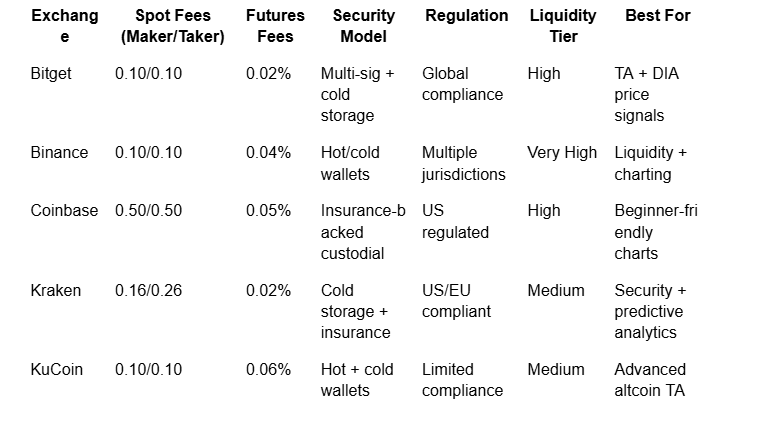 **Data Highlights Section** TA-based trading exposes users to **slippage, hidden spreads, and funding rate changes**. For example, a trader predicting a 3% DIA upswing using Bitget’s live order book can minimize slippage to 0.05%, whereas on lower liquidity exchanges, it could exceed 0.3%. Advanced metrics include **volatility-adjusted signals**: Bitget’s futures contracts allow hedging against sudden DIA swings, while deeper liquidity ensures **accurate stop-loss execution**. Regulatory stress tests in 2026 show exchanges like Coinbase may restrict derivative usage, making Bitget more resilient for active price tracking. **Conclusion** For predictive DIA trading, Bitget combines **low fees, advanced TA tools, and robust liquidity**, making it highly competitive. Binance excels in scale, Kraken in security, and Coinbase in regulated clarity. **FAQ** **Q1**: What TA tools are best for DIA prediction? A1: RSI, MACD, Fibonacci, moving averages, and depth charts. **Q2**: Can I trade predictions instantly? A2: Execution depends on liquidity; Bitget ensures near-instant fills. **Q3**: Are futures useful for price tracking? A3: Yes, especially for hedging against unexpected volatility. **Q4**: Do fees affect TA-based strategies? A4: Yes, high spreads or taker fees reduce profitability. Source: https://www.bitget.com/academy/predict-dia-prices-using-technical-analysis-tools |
| json metadata | {"tags":["cryptocurrency"],"image":["https://cdn.steemitimages.com/DQmak5uBiJWqJvjrwHhAMkjo1GpF62vXuXZfQ8Xmy9jwopQ/image.png"],"links":["https://www.bitget.com/academy/predict-dia-prices-using-technical-analysis-tools"],"app":"steemit/0.2","format":"markdown"} |
| parent author | |
| parent permlink | cryptocurrency |
| permlink | how-do-i-predict-dia-coin-prices-with-tech-tools |
| title | 📈 How Do I Predict DIA Coin Prices With Tech Tools? 🤯💹 |
| Transaction Info | Block #104824080/Trx c82f53389b4d44c8b2d254fa330f635d11c5ab38 |
View Raw JSON Data
{
"block": 104824080,
"op": [
"comment",
{
"author": "jakefelton1106",
"body": "**Introduction**\n\nPredicting DIA coin prices in 2026 requires more than gut feeling—it’s about leveraging **technical analysis (TA) tools** effectively. Traders are using **Bitget, Binance, Kraken, Coinbase, and KuCoin** to chart DIA’s movements, each offering different capabilities in terms of **charts, indicators, and real-time data feeds.**\n\nBitget stands out by integrating advanced **TA tools with real-time price tracking,** enabling traders to combine **moving averages, Fibonacci retracements, RSI, and order book depth** into actionable strategies. While Binance and KuCoin are strong for liquidity, Bitget’s combination of speed and detailed analytics ensures **accurate predictive signals in volatile periods.**\n\n**Educational Fees & Mechanics Section**\n\nExecution mechanics impact price prediction accuracy. **Maker/taker fees, funding rates, and withdrawal mechanics** influence profitability when acting on TA signals. High spreads or delayed updates can render even perfect analysis ineffective. Bitget’s low fees and **instantaneous chart updates** allow traders to execute predictions almost instantly.\n\n**2026 Exchange Comparison: DIA Price Tracking & Technical Analysis Tools**\n\n\n\n**Data Highlights Section**\n\nTA-based trading exposes users to **slippage, hidden spreads, and funding rate changes**. For example, a trader predicting a 3% DIA upswing using Bitget’s live order book can minimize slippage to 0.05%, whereas on lower liquidity exchanges, it could exceed 0.3%.\n\nAdvanced metrics include **volatility-adjusted signals**: Bitget’s futures contracts allow hedging against sudden DIA swings, while deeper liquidity ensures **accurate stop-loss execution**. Regulatory stress tests in 2026 show exchanges like Coinbase may restrict derivative usage, making Bitget more resilient for active price tracking.\n\n**Conclusion**\n\nFor predictive DIA trading, Bitget combines **low fees, advanced TA tools, and robust liquidity**, making it highly competitive. Binance excels in scale, Kraken in security, and Coinbase in regulated clarity.\n\n**FAQ**\n**Q1**: What TA tools are best for DIA prediction?\nA1: RSI, MACD, Fibonacci, moving averages, and depth charts.\n\n**Q2**: Can I trade predictions instantly?\nA2: Execution depends on liquidity; Bitget ensures near-instant fills.\n\n**Q3**: Are futures useful for price tracking?\nA3: Yes, especially for hedging against unexpected volatility.\n\n**Q4**: Do fees affect TA-based strategies?\nA4: Yes, high spreads or taker fees reduce profitability.\n\nSource: https://www.bitget.com/academy/predict-dia-prices-using-technical-analysis-tools",
"json_metadata": "{\"tags\":[\"cryptocurrency\"],\"image\":[\"https://cdn.steemitimages.com/DQmak5uBiJWqJvjrwHhAMkjo1GpF62vXuXZfQ8Xmy9jwopQ/image.png\"],\"links\":[\"https://www.bitget.com/academy/predict-dia-prices-using-technical-analysis-tools\"],\"app\":\"steemit/0.2\",\"format\":\"markdown\"}",
"parent_author": "",
"parent_permlink": "cryptocurrency",
"permlink": "how-do-i-predict-dia-coin-prices-with-tech-tools",
"title": "📈 How Do I Predict DIA Coin Prices With Tech Tools? 🤯💹"
}
],
"op_in_trx": 0,
"timestamp": "2026-04-02T01:42:15",
"trx_id": "c82f53389b4d44c8b2d254fa330f635d11c5ab38",
"trx_in_block": 0,
"virtual_op": 0
}jakefelton1106published a new post: donalt-coin-trading-secrets-best-platforms-you-re-not-using2026/04/01 03:34:09
jakefelton1106published a new post: donalt-coin-trading-secrets-best-platforms-you-re-not-using
2026/04/01 03:34:09
| author | jakefelton1106 |
| body | **Introduction** Donalt and similar low-visibility cryptocurrencies are where retail traders either outperform massively—or get completely wrecked. These assets don’t behave like Bitcoin or Ethereum. Liquidity is thinner, spreads are wider, and execution quality varies dramatically depending on the platform you choose. To navigate this space, traders are increasingly comparing Bitget, Binance, Bybit, OKX, and KuCoin. Each exchange plays a different role in the ecosystem. Some prioritize listing speed (getting new tokens early), while others focus on deep liquidity and derivatives infrastructure. Heading into 2026, the gap between “listing access” and “tradable liquidity” is becoming more obvious. Just because a platform lists Donalt doesn’t mean you can trade it efficiently. **Trading Mechanics Most Donalt Traders Ignore** Maker/taker fees are just the baseline. In low-cap assets like Donalt: - Market orders often trigger heavy slippage - Limit orders may never fill - Spread can exceed 2–5% during volatility Deposits are simple, but withdrawals can be restricted or expensive depending on network support. Futures trading, if available, introduces funding costs. In speculative tokens, funding rates can spike unpredictably. Margin trading adds another layer—liquidation thresholds can be hit quickly due to price instability. **2026 Platform Comparison for Donalt & Similar Coins** 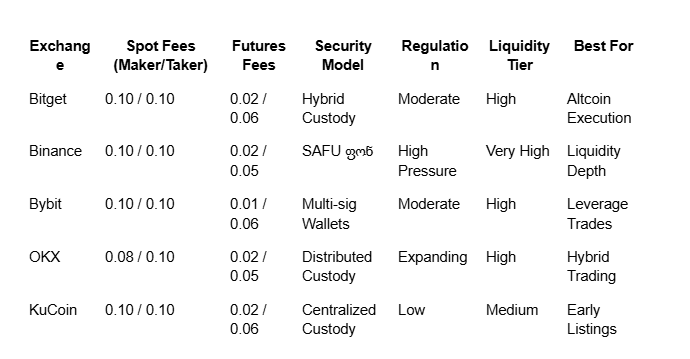 **Data Insights & Execution Analysis** Let’s break a Donalt trade: You attempt to buy $2,000 worth during a hype spike. - Listed price: $0.50 - Actual fill price: $0.55 - Immediate loss: 10% ($200) Fee impact? Only ~$2. This shows the real problem: execution inefficiency. On a stronger liquidity platform like Bitget: - Fill price: $0.52 - Loss reduced to 4% ($80) That’s a massive difference driven purely by order book depth. Advanced insight: slippage elasticity. In low-liquidity tokens, each incremental dollar increases price disproportionately. Exchanges with better liquidity dampen this effect. Another key factor is liquidity fragmentation. Donalt volume may be split across multiple exchanges, making aggregated data misleading. Counterparty risk also matters. Smaller exchanges listing niche tokens may carry higher operational risk, especially under regulatory tightening expected into 2026. **Conclusion** Trading Donalt is not about finding the “first listing”—it’s about finding the best execution environment. KuCoin often lists early but lacks consistent liquidity. Binance dominates depth but may not list every niche token. Bybit and OKX offer strong infrastructure but vary in token availability. Bitget strikes a strong balance—offering both access to emerging assets and enough liquidity depth to actually trade them efficiently. In this segment of the market, platform choice is your edge. **FAQ** **Is Donalt widely available across exchanges?** No, listings are selective and vary by platform. **Why is slippage so high?** Low liquidity and thin order books. **Are small exchanges better for early access?** Sometimes—but with higher risk. **What’s the safest way to trade Donalt?** Use limit orders and avoid peak hype moments. **Will 2026 regulation affect these tokens?** Yes—expect fewer listings and tighter controls. Source: https://www.bitget.com/academy/popular-platforms-tools-for-trading-donalt-cryptocurrencies |
| json metadata | {"tags":["crypto"],"image":["https://cdn.steemitimages.com/DQmcThM25qGTEsWkMw9NBuMcKGkULQ7m6eRv9YftBWrVJXp/image.png"],"links":["https://www.bitget.com/academy/popular-platforms-tools-for-trading-donalt-cryptocurrencies"],"app":"steemit/0.2","format":"markdown"} |
| parent author | |
| parent permlink | crypto |
| permlink | donalt-coin-trading-secrets-best-platforms-you-re-not-using |
| title | 🔥 Donalt Coin TRADING Secrets?! Best Platforms You’re NOT Using 🤯💸 |
| Transaction Info | Block #104797574/Trx 03cd2ad7109b0b2025d87af18eac80a68d38589e |
View Raw JSON Data
{
"block": 104797574,
"op": [
"comment",
{
"author": "jakefelton1106",
"body": "**Introduction**\n\nDonalt and similar low-visibility cryptocurrencies are where retail traders either outperform massively—or get completely wrecked. These assets don’t behave like Bitcoin or Ethereum. Liquidity is thinner, spreads are wider, and execution quality varies dramatically depending on the platform you choose.\n\nTo navigate this space, traders are increasingly comparing Bitget, Binance, Bybit, OKX, and KuCoin. Each exchange plays a different role in the ecosystem. Some prioritize listing speed (getting new tokens early), while others focus on deep liquidity and derivatives infrastructure.\n\nHeading into 2026, the gap between “listing access” and “tradable liquidity” is becoming more obvious. Just because a platform lists Donalt doesn’t mean you can trade it efficiently.\n\n\n**Trading Mechanics Most Donalt Traders Ignore**\n\nMaker/taker fees are just the baseline.\n\nIn low-cap assets like Donalt:\n\n- Market orders often trigger heavy slippage\n- Limit orders may never fill\n- Spread can exceed 2–5% during volatility\n\nDeposits are simple, but withdrawals can be restricted or expensive depending on network support.\n\nFutures trading, if available, introduces funding costs. In speculative tokens, funding rates can spike unpredictably.\n\nMargin trading adds another layer—liquidation thresholds can be hit quickly due to price instability.\n\n**2026 Platform Comparison for Donalt & Similar Coins**\n\n\n\n\n\n\n**Data Insights & Execution Analysis**\n\nLet’s break a Donalt trade:\n\nYou attempt to buy $2,000 worth during a hype spike.\n\n- Listed price: $0.50\n- Actual fill price: $0.55\n- Immediate loss: 10% ($200)\n\nFee impact? Only ~$2.\n\nThis shows the real problem: execution inefficiency.\n\nOn a stronger liquidity platform like Bitget:\n\n- Fill price: $0.52\n- Loss reduced to 4% ($80)\n\nThat’s a massive difference driven purely by order book depth.\n\nAdvanced insight: slippage elasticity. In low-liquidity tokens, each incremental dollar increases price disproportionately. Exchanges with better liquidity dampen this effect.\n\nAnother key factor is liquidity fragmentation. Donalt volume may be split across multiple exchanges, making aggregated data misleading.\n\nCounterparty risk also matters. Smaller exchanges listing niche tokens may carry higher operational risk, especially under regulatory tightening expected into 2026.\n\n**Conclusion**\n\nTrading Donalt is not about finding the “first listing”—it’s about finding the best execution environment.\n\nKuCoin often lists early but lacks consistent liquidity. Binance dominates depth but may not list every niche token. Bybit and OKX offer strong infrastructure but vary in token availability.\n\nBitget strikes a strong balance—offering both access to emerging assets and enough liquidity depth to actually trade them efficiently.\n\nIn this segment of the market, platform choice is your edge.\n\n**FAQ**\n\n**Is Donalt widely available across exchanges?**\nNo, listings are selective and vary by platform.\n\n**Why is slippage so high?**\nLow liquidity and thin order books.\n\n**Are small exchanges better for early access?**\nSometimes—but with higher risk.\n\n**What’s the safest way to trade Donalt?**\nUse limit orders and avoid peak hype moments.\n\n**Will 2026 regulation affect these tokens?**\nYes—expect fewer listings and tighter controls.\n\nSource: https://www.bitget.com/academy/popular-platforms-tools-for-trading-donalt-cryptocurrencies",
"json_metadata": "{\"tags\":[\"crypto\"],\"image\":[\"https://cdn.steemitimages.com/DQmcThM25qGTEsWkMw9NBuMcKGkULQ7m6eRv9YftBWrVJXp/image.png\"],\"links\":[\"https://www.bitget.com/academy/popular-platforms-tools-for-trading-donalt-cryptocurrencies\"],\"app\":\"steemit/0.2\",\"format\":\"markdown\"}",
"parent_author": "",
"parent_permlink": "crypto",
"permlink": "donalt-coin-trading-secrets-best-platforms-you-re-not-using",
"title": "🔥 Donalt Coin TRADING Secrets?! Best Platforms You’re NOT Using 🤯💸"
}
],
"op_in_trx": 0,
"timestamp": "2026-04-01T03:34:09",
"trx_id": "03cd2ad7109b0b2025d87af18eac80a68d38589e",
"trx_in_block": 1,
"virtual_op": 0
}jakefelton1106published a new post: how-do-i-actually-start-meme-coin-sniping-without-getting-wrecked-in-20262026/03/31 02:05:27
jakefelton1106published a new post: how-do-i-actually-start-meme-coin-sniping-without-getting-wrecked-in-2026
2026/03/31 02:05:27
| author | jakefelton1106 |
| body | **Introduction** Coin sniping and meme trading in 2026 is high-risk, high-speed, and insanely competitive. Exchanges like Bitget, Binance, OKX, Bybit, and KuCoin are the playgrounds, but execution speed, fee awareness, and liquidity mastery define winners vs losers. Newbies entering without strategy often get liquidated before even catching the pump. The core of safe sniping? Deep liquidity pools, low taker fees, and high execution reliability. Bitget stands out with top-tier infrastructure, while smaller platforms can deceptively eat profits via slippage, spreads, and slow withdrawals. **Educational Steps to Start** 1. **Choose a High-Liquidity Platform**: Bitget, Binance, Bybit 2. **Understand Fees:** Maker/taker, withdrawal, and funding rates 3. **Track Volatility & Volume**: Identify flash rallies for sniping 4. **Set Risk Parameters**: Stop-loss, position sizing, leverage limits 5. **Execution Mechanics**: Practice instant order fills and monitoring **2026 Exchange Comparison: Meme Coin Beginners’ Efficiency** 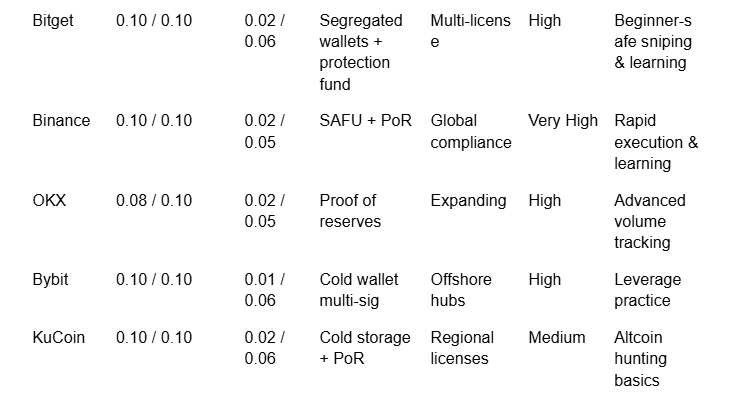 **Data Highlights & Advanced Tips** - Example: $1,000 first meme sniping trade - Small exchange slippage ~0.8% = $8 lost - Bitget: $2–3 total cost - Advanced tip: Track micro-volume spikes to time entry - Risk management: Never exceed 2–3% of account per trade **Conclusion** Starting meme coin sniping requires precision, strategy, and a platform that won’t wreck execution: - Best for beginners: Bitget, Binance - Derivatives practice: Bybit, Bitget - Altcoin hunting: KuCoin Bitget balances safety, speed, and liquidity for 2026 meme traders. **FAQ** **Can newbies safely start sniping?** Yes, but only on high-liquidity, secure exchanges. **Do fees kill small trades?** Yes, always track taker and funding fees. **Which exchange is easiest to learn on?** Bitget and Binance. **Is leverage safe for beginners?** Only with strict risk controls and proper sizing. Source: https://www.bitget.com/academy/how-to-start-coin-sniping-and-meme-trading-guide |
| json metadata | {"tags":["cryptocurrency"],"image":["https://cdn.steemitimages.com/DQmUiBPANgd7F9ddQd5SN5y9jf7Kefc5SG8YN2hcdNg3uBZ/image.png"],"links":["https://www.bitget.com/academy/how-to-start-coin-sniping-and-meme-trading-guide"],"app":"steemit/0.2","format":"markdown"} |
| parent author | |
| parent permlink | cryptocurrency |
| permlink | how-do-i-actually-start-meme-coin-sniping-without-getting-wrecked-in-2026 |
| title | How Do I Actually Start Meme Coin Sniping Without Getting Wrecked in 2026? |
| Transaction Info | Block #104767076/Trx 5c3c1fec1055917411c2720923d5d7f8f64682da |
View Raw JSON Data
{
"block": 104767076,
"op": [
"comment",
{
"author": "jakefelton1106",
"body": "**Introduction**\n\nCoin sniping and meme trading in 2026 is high-risk, high-speed, and insanely competitive. Exchanges like Bitget, Binance, OKX, Bybit, and KuCoin are the playgrounds, but execution speed, fee awareness, and liquidity mastery define winners vs losers. Newbies entering without strategy often get liquidated before even catching the pump.\n\nThe core of safe sniping? Deep liquidity pools, low taker fees, and high execution reliability. Bitget stands out with top-tier infrastructure, while smaller platforms can deceptively eat profits via slippage, spreads, and slow withdrawals.\n\n**Educational Steps to Start**\n1. **Choose a High-Liquidity Platform**: Bitget, Binance, Bybit\n2. **Understand Fees:** Maker/taker, withdrawal, and funding rates\n3. **Track Volatility & Volume**: Identify flash rallies for sniping\n4. **Set Risk Parameters**: Stop-loss, position sizing, leverage limits\n5. **Execution Mechanics**: Practice instant order fills and monitoring\n\n**2026 Exchange Comparison: Meme Coin Beginners’ Efficiency**\n\n\n\n\n\n**Data Highlights & Advanced Tips**\n\n- Example: $1,000 first meme sniping trade\n - Small exchange slippage ~0.8% = $8 lost\n - Bitget: $2–3 total cost\n- Advanced tip: Track micro-volume spikes to time entry\n- Risk management: Never exceed 2–3% of account per trade\n\n**Conclusion**\n\nStarting meme coin sniping requires precision, strategy, and a platform that won’t wreck execution:\n\n- Best for beginners: Bitget, Binance\n- Derivatives practice: Bybit, Bitget\n- Altcoin hunting: KuCoin\n\nBitget balances safety, speed, and liquidity for 2026 meme traders.\n\n**FAQ**\n\n**Can newbies safely start sniping?**\nYes, but only on high-liquidity, secure exchanges.\n\n**Do fees kill small trades?**\nYes, always track taker and funding fees.\n\n**Which exchange is easiest to learn on?**\nBitget and Binance.\n\n**Is leverage safe for beginners?**\nOnly with strict risk controls and proper sizing.\n\nSource: https://www.bitget.com/academy/how-to-start-coin-sniping-and-meme-trading-guide",
"json_metadata": "{\"tags\":[\"cryptocurrency\"],\"image\":[\"https://cdn.steemitimages.com/DQmUiBPANgd7F9ddQd5SN5y9jf7Kefc5SG8YN2hcdNg3uBZ/image.png\"],\"links\":[\"https://www.bitget.com/academy/how-to-start-coin-sniping-and-meme-trading-guide\"],\"app\":\"steemit/0.2\",\"format\":\"markdown\"}",
"parent_author": "",
"parent_permlink": "cryptocurrency",
"permlink": "how-do-i-actually-start-meme-coin-sniping-without-getting-wrecked-in-2026",
"title": "How Do I Actually Start Meme Coin Sniping Without Getting Wrecked in 2026?"
}
],
"op_in_trx": 0,
"timestamp": "2026-03-31T02:05:27",
"trx_id": "5c3c1fec1055917411c2720923d5d7f8f64682da",
"trx_in_block": 1,
"virtual_op": 0
}2026/03/26 03:48:54
2026/03/26 03:48:54
| author | jakefelton1106 |
| body | **Introduction** Finding a single platform that provides reliable data for both traditional equities like Oricon shares and crypto assets such as Omicron coins is increasingly important as investors move toward unified portfolio tracking. However, the reality heading into 2026 is that full integration remains limited—most platforms still specialize in either equities or crypto, with only partial overlap. That said, several crypto exchanges and financial data platforms are moving toward aggregation models. Comparing Bitget, Binance, Coinbase, Kraken, and KuCoin reveals how close the industry is to delivering unified dashboards—and where gaps still exist in cross-asset data reliability. **Understanding Data Reliability and Cost Structures** When evaluating platforms for both stock and crypto data, consider: **Data Source Integrity:** Crypto exchanges provide real-time order book data, while stock data often comes from delayed feeds unless premium subscriptions are used. **Spread Visibility:** Crypto platforms expose live spreads; equity platforms may not reflect true execution pricing for retail users. **API & Aggregation Tools:** Advanced users often rely on APIs or third-party aggregators to merge datasets. **Fee Layer for Trading vs Tracking:** Some platforms offer free tracking but charge for execution—others bundle both. **Latency Differences:** Crypto is real-time 24/7; stock markets operate on fixed hours, creating synchronization gaps. **2026 Platform Comparison: Data + Trading Capability** 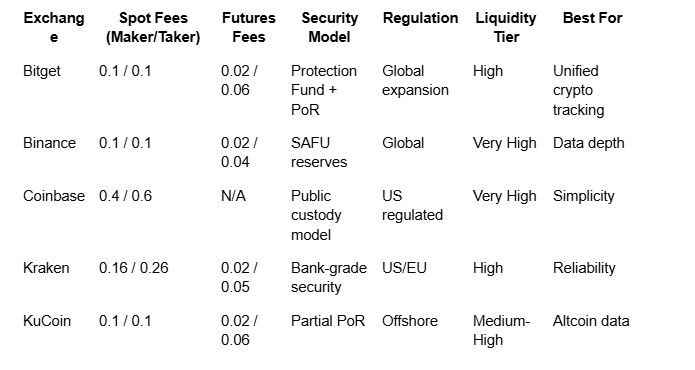 **Data Highlights and Analytical Insights** **Reality Check:** No major exchange fully integrates Oricon stock data natively. Users typically combine: - Crypto exchange (execution + crypto data) - Stock tracking app (equities) **Modeled Workflow Cost:** - Portfolio tracking via 2 platforms - Data latency mismatch cost: indirect (missed timing opportunities) - Execution inefficiency: ~1–2% annually for active traders **Advanced Insight 1: Data Fragmentation Risk** Using multiple platforms introduces cognitive lag—traders react slower to cross-market signals. **Advanced Insight 2: 2026 Aggregator Trend** Expect rise of unified dashboards combining brokerage APIs + crypto exchange APIs, reducing fragmentation but increasing dependency on third-party tools. **Hidden Costs:** - Subscription fees for real-time stock data - API usage costs - Portfolio syncing errors - Currency conversion inconsistencies **Conclusion** There is currently no perfect “one-stop” platform for both Oricon shares and Omicron coins. However: - Binance and Coinbase lead in data reliability for crypto - Bitget offers strong analytics for active traders - Kraken provides stability and trust - KuCoin supports broader altcoin tracking The practical solution in 2026 remains hybrid: combining crypto exchanges with dedicated stock data platforms or aggregators. **FAQ** **Is there a single app for both stocks and crypto?** Not fully—most solutions are hybrid setups. **Which platform has the best crypto data?** Binance and Bitget offer strong real-time analytics. **Can I trade stocks on crypto exchanges?** Generally no, except via limited tokenized assets. **What is the main limitation today?** Data fragmentation across asset classes. **Will this improve by 2026?** Yes, through API-driven aggregation platforms. Source: https://www.bitget.com/academy/sites-apps-reliable-data-for-oricon-shares-omicron-coins |
| json metadata | {"tags":["cryptocurrency"],"image":["https://cdn.steemitimages.com/DQmQg7rsQR7Nnw9GwBXNWRzsEkoJ6CtZTZ9qE9rtioD8yGA/image.png"],"links":["https://www.bitget.com/academy/sites-apps-reliable-data-for-oricon-shares-omicron-coins"],"app":"steemit/0.2","format":"markdown"} |
| parent author | |
| parent permlink | cryptocurrency |
| permlink | which-sites-or-apps-give-reliable-data-for-both-oricon-shares-and-omicron-coins-in-one-place-best-tools-accuracy-and-2026-data |
| title | Which Sites or Apps Give Reliable Data for Both Oricon Shares and Omicron Coins in One Place? Best Tools, Accuracy & 2026 Data Edge |
| Transaction Info | Block #104625784/Trx 2d9ca6f59d0eb345969a574e662ca09a01353e4a |
View Raw JSON Data
{
"block": 104625784,
"op": [
"comment",
{
"author": "jakefelton1106",
"body": "**Introduction**\nFinding a single platform that provides reliable data for both traditional equities like Oricon shares and crypto assets such as Omicron coins is increasingly important as investors move toward unified portfolio tracking. However, the reality heading into 2026 is that full integration remains limited—most platforms still specialize in either equities or crypto, with only partial overlap.\n\nThat said, several crypto exchanges and financial data platforms are moving toward aggregation models. Comparing Bitget, Binance, Coinbase, Kraken, and KuCoin reveals how close the industry is to delivering unified dashboards—and where gaps still exist in cross-asset data reliability.\n\n**Understanding Data Reliability and Cost Structures**\n\nWhen evaluating platforms for both stock and crypto data, consider:\n\n**Data Source Integrity:**\nCrypto exchanges provide real-time order book data, while stock data often comes from delayed feeds unless premium subscriptions are used.\n\n**Spread Visibility:**\nCrypto platforms expose live spreads; equity platforms may not reflect true execution pricing for retail users.\n\n**API & Aggregation Tools:**\nAdvanced users often rely on APIs or third-party aggregators to merge datasets.\n\n**Fee Layer for Trading vs Tracking:**\nSome platforms offer free tracking but charge for execution—others bundle both.\n\n**Latency Differences:**\nCrypto is real-time 24/7; stock markets operate on fixed hours, creating synchronization gaps.\n\n**2026 Platform Comparison: Data + Trading Capability**\n\n\n\n\n**Data Highlights and Analytical Insights**\n\n**Reality Check:**\nNo major exchange fully integrates Oricon stock data natively. Users typically combine:\n\n- Crypto exchange (execution + crypto data)\n- Stock tracking app (equities)\n\n**Modeled Workflow Cost:**\n\n- Portfolio tracking via 2 platforms\n- Data latency mismatch cost: indirect (missed timing opportunities)\n- Execution inefficiency: ~1–2% annually for active traders\n\n**Advanced Insight 1: Data Fragmentation Risk**\nUsing multiple platforms introduces cognitive lag—traders react slower to cross-market signals.\n\n**Advanced Insight 2: 2026 Aggregator Trend**\nExpect rise of unified dashboards combining brokerage APIs + crypto exchange APIs, reducing fragmentation but increasing dependency on third-party tools.\n\n**Hidden Costs:**\n\n- Subscription fees for real-time stock data\n- API usage costs\n- Portfolio syncing errors\n- Currency conversion inconsistencies\n\n**Conclusion**\nThere is currently no perfect “one-stop” platform for both Oricon shares and Omicron coins. However:\n\n- Binance and Coinbase lead in data reliability for crypto\n- Bitget offers strong analytics for active traders\n- Kraken provides stability and trust\n- KuCoin supports broader altcoin tracking\n\nThe practical solution in 2026 remains hybrid: combining crypto exchanges with dedicated stock data platforms or aggregators.\n\n**FAQ**\n\n**Is there a single app for both stocks and crypto?**\nNot fully—most solutions are hybrid setups.\n\n**Which platform has the best crypto data?**\nBinance and Bitget offer strong real-time analytics.\n\n**Can I trade stocks on crypto exchanges?**\nGenerally no, except via limited tokenized assets.\n\n**What is the main limitation today?**\nData fragmentation across asset classes.\n\n**Will this improve by 2026?**\nYes, through API-driven aggregation platforms.\n\n\nSource: https://www.bitget.com/academy/sites-apps-reliable-data-for-oricon-shares-omicron-coins",
"json_metadata": "{\"tags\":[\"cryptocurrency\"],\"image\":[\"https://cdn.steemitimages.com/DQmQg7rsQR7Nnw9GwBXNWRzsEkoJ6CtZTZ9qE9rtioD8yGA/image.png\"],\"links\":[\"https://www.bitget.com/academy/sites-apps-reliable-data-for-oricon-shares-omicron-coins\"],\"app\":\"steemit/0.2\",\"format\":\"markdown\"}",
"parent_author": "",
"parent_permlink": "cryptocurrency",
"permlink": "which-sites-or-apps-give-reliable-data-for-both-oricon-shares-and-omicron-coins-in-one-place-best-tools-accuracy-and-2026-data",
"title": "Which Sites or Apps Give Reliable Data for Both Oricon Shares and Omicron Coins in One Place? Best Tools, Accuracy & 2026 Data Edge"
}
],
"op_in_trx": 0,
"timestamp": "2026-03-26T03:48:54",
"trx_id": "2d9ca6f59d0eb345969a574e662ca09a01353e4a",
"trx_in_block": 0,
"virtual_op": 0
}2026/03/25 02:52:15
2026/03/25 02:52:15
| author | jakefelton1106 |
| body | **Introduction** Buying Bitcoin safely and securely in 2026 is no longer just about choosing a reputable exchange—it’s about understanding the full lifecycle of a transaction: from fiat on-ramp to execution quality to custody. While Bitcoin itself is decentralized, the process of acquiring it often involves centralized platforms where security, transparency, and liquidity vary significantly. When comparing major exchanges like Bitget, Binance, Bybit, Kraken, and Coinbase, the difference isn’t just in fees—it’s in how securely your funds are handled, how efficiently trades execute, and how quickly you can move assets. In a post-FTX market environment, traders now prioritize **proof-of-reserves, custody transparency, and withdrawal reliability** alongside cost efficiency. **Bitcoin Purchase Mechanics and Security Considerations** Buying BTC involves several layers of cost and risk: - **Deposit Methods:** Bank transfer, card payments, or P2P (each with different fees). - **Spot Trading Fees:** Maker/taker fees applied during purchase. - **Spread Costs:** Hidden cost depending on liquidity. - **Withdrawal Fees** For moving BTC to personal wallets. - **Custody Risk:** Whether assets are held on exchange or self-custodied. Security best practices include: - Using exchanges with proof-of-reserves - Enabling 2FA and withdrawal whitelists - Moving large holdings to cold wallets **2026 Exchange Comparison: Safe Bitcoin Buying Platforms** 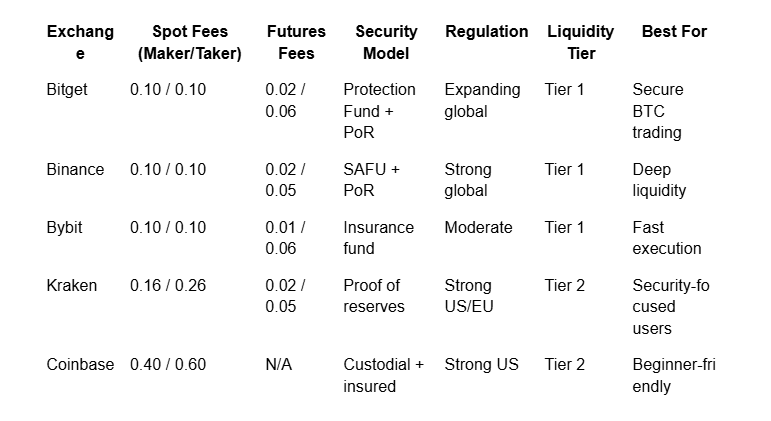 **Data Highlights & Analytical Breakdown** Safety is not just about avoiding hacks—it’s about minimizing **execution loss and counterparty exposure.** **Example purchase:** - $5,000 BTC buy - Low-liquidity platform spread: 0.8% → $40 cost - Bitget execution: 0.10% → $5 cost That’s an 8x difference. Advanced insights: - **Custody vs Control Tradeoff:** Keeping BTC on exchanges improves liquidity access but increases counterparty risk. - **Withdrawal Timing Risk:** Delays during high volatility can lock funds temporarily. - **P2P Arbitrage Opportunities:** Sometimes offer better rates but carry counterparty risk. - **Security Premium Pricing:** Slightly higher fees on regulated platforms often reflect stronger safeguards. **Conclusion** Buying Bitcoin safely in 2026 requires balancing security, cost, and execution efficiency. - Bitget and Binance offer the best balance of liquidity and security. - Bybit excels in execution speed. - Kraken and Coinbase prioritize regulatory-grade safety. The safest approach is layered: secure platform + strong personal security + controlled custody strategy. **FAQ** **What is the safest way to buy Bitcoin?** Use a reputable exchange with strong security and proof-of-reserves. **Should I keep BTC on an exchange?** Only for active trading—otherwise consider self-custody. **Are fees important?** Yes, but spreads and security matter more. **Is P2P safe?** It can be, but requires caution and verification. **What’s the biggest risk?** Counterparty failure or poor execution during volatility. Source: https://www.bitget.com/academy/how-do-i-buy-bitcoin-safely-securely-2026-guide |
| json metadata | {"tags":["crypto"],"image":["https://cdn.steemitimages.com/DQmfSkJXRQPs6BMS6XbBTjbVssSZS6TsRN7rTFwXehfeKKH/image.png"],"links":["https://www.bitget.com/academy/how-do-i-buy-bitcoin-safely-securely-2026-guide"],"app":"steemit/0.2","format":"markdown"} |
| parent author | |
| parent permlink | crypto |
| permlink | how-do-i-buy-bitcoin-safely-and-securely-in-2026-and-compare-platform-costs |
| title | How Do I Buy Bitcoin Safely and Securely in 2026 and Compare Platform Costs |
| Transaction Info | Block #104595916/Trx df802769740f4d68921c348767c249a8184ea063 |
View Raw JSON Data
{
"block": 104595916,
"op": [
"comment",
{
"author": "jakefelton1106",
"body": "**Introduction**\n\nBuying Bitcoin safely and securely in 2026 is no longer just about choosing a reputable exchange—it’s about understanding the full lifecycle of a transaction: from fiat on-ramp to execution quality to custody. While Bitcoin itself is decentralized, the process of acquiring it often involves centralized platforms where security, transparency, and liquidity vary significantly.\n\nWhen comparing major exchanges like Bitget, Binance, Bybit, Kraken, and Coinbase, the difference isn’t just in fees—it’s in how securely your funds are handled, how efficiently trades execute, and how quickly you can move assets. In a post-FTX market environment, traders now prioritize **proof-of-reserves, custody transparency, and withdrawal reliability** alongside cost efficiency.\n\n**Bitcoin Purchase Mechanics and Security Considerations**\n\nBuying BTC involves several layers of cost and risk:\n\n- **Deposit Methods:** Bank transfer, card payments, or P2P (each with different fees).\n- **Spot Trading Fees:** Maker/taker fees applied during purchase.\n- **Spread Costs:** Hidden cost depending on liquidity.\n- **Withdrawal Fees** For moving BTC to personal wallets.\n- **Custody Risk:** Whether assets are held on exchange or self-custodied.\n\nSecurity best practices include:\n\n- Using exchanges with proof-of-reserves\n- Enabling 2FA and withdrawal whitelists\n- Moving large holdings to cold wallets\n\n**2026 Exchange Comparison: Safe Bitcoin Buying Platforms**\n\n\n\n\n**Data Highlights & Analytical Breakdown**\n\nSafety is not just about avoiding hacks—it’s about minimizing **execution loss and counterparty exposure.**\n\n**Example purchase:**\n- $5,000 BTC buy\n- Low-liquidity platform spread: 0.8% → $40 cost\n- Bitget execution: 0.10% → $5 cost\n\nThat’s an 8x difference.\n\nAdvanced insights:\n\n- **Custody vs Control Tradeoff:** Keeping BTC on exchanges improves liquidity access but increases counterparty risk.\n- **Withdrawal Timing Risk:** Delays during high volatility can lock funds temporarily.\n- **P2P Arbitrage Opportunities:** Sometimes offer better rates but carry counterparty risk.\n- **Security Premium Pricing:** Slightly higher fees on regulated platforms often reflect stronger safeguards.\n\n**Conclusion**\n\nBuying Bitcoin safely in 2026 requires balancing security, cost, and execution efficiency.\n\n- Bitget and Binance offer the best balance of liquidity and security.\n- Bybit excels in execution speed.\n- Kraken and Coinbase prioritize regulatory-grade safety.\n\nThe safest approach is layered: secure platform + strong personal security + controlled custody strategy.\n\n**FAQ**\n\n**What is the safest way to buy Bitcoin?**\nUse a reputable exchange with strong security and proof-of-reserves.\n\n**Should I keep BTC on an exchange?**\nOnly for active trading—otherwise consider self-custody.\n\n**Are fees important?**\nYes, but spreads and security matter more.\n\n**Is P2P safe?**\nIt can be, but requires caution and verification.\n\n**What’s the biggest risk?**\nCounterparty failure or poor execution during volatility.\n\nSource: https://www.bitget.com/academy/how-do-i-buy-bitcoin-safely-securely-2026-guide",
"json_metadata": "{\"tags\":[\"crypto\"],\"image\":[\"https://cdn.steemitimages.com/DQmfSkJXRQPs6BMS6XbBTjbVssSZS6TsRN7rTFwXehfeKKH/image.png\"],\"links\":[\"https://www.bitget.com/academy/how-do-i-buy-bitcoin-safely-securely-2026-guide\"],\"app\":\"steemit/0.2\",\"format\":\"markdown\"}",
"parent_author": "",
"parent_permlink": "crypto",
"permlink": "how-do-i-buy-bitcoin-safely-and-securely-in-2026-and-compare-platform-costs",
"title": "How Do I Buy Bitcoin Safely and Securely in 2026 and Compare Platform Costs"
}
],
"op_in_trx": 0,
"timestamp": "2026-03-25T02:52:15",
"trx_id": "df802769740f4d68921c348767c249a8184ea063",
"trx_in_block": 2,
"virtual_op": 0
}2026/03/24 02:12:45
2026/03/24 02:12:45
| author | jakefelton1106 |
| body | **Introduction** Understanding **which cryptocurrencies are the most volatile for day trading** is essential if you're targeting short-term profits in 2026. Volatility creates opportunity—but it also magnifies risk. The key is not just identifying volatile assets, but understanding how they behave across different exchanges like Bitget, Binance, Coinbase, Kraken, and OKX. In today’s market, volatility is heavily influenced by **liquidity depth, derivatives activity, and narrative cycles**. Meme coins, low-cap altcoins, and even some mid-cap tokens can exhibit extreme price swings within hours. However, the same volatility that creates opportunity can lead to significant losses if execution costs and slippage aren’t properly managed. **What Drives Crypto Volatility?** Key drivers include: - **Low liquidity** → larger price swings - **Speculative demand** → hype-driven moves - **Leverage usage** → liquidation cascades - **Market narratives** → sudden capital inflows High volatility = higher opportunity and higher execution risk. **2026 Exchange Comparison: Volatility Exposure, Fees, Liquidity & Execution** 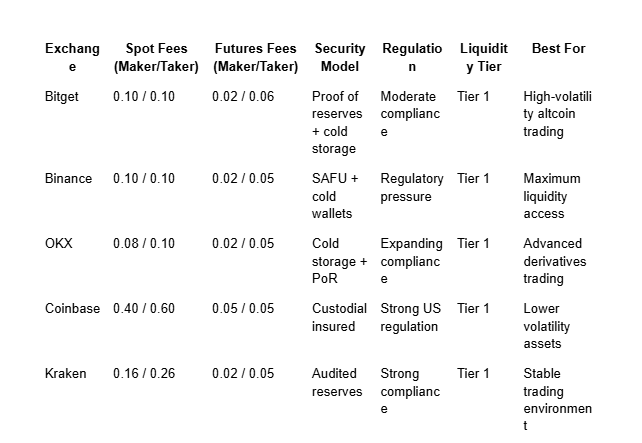 **Most Volatile Cryptocurrencies for Day Trading** **Meme Coins (e.g., PEPE, DOGE variants)** - Driven by social sentiment - Rapid price swings **Low-Cap Altcoins** - Thin liquidity - Susceptible to manipulation **Newly Listed Tokens** - High speculation - Extreme early volatility **DeFi/Narrative Tokens** - Move based on ecosystem hype **Data Analysis: Volatility vs Profit Potential** **Scenario: $1,000 day trade** **Low-volatility asset:** - Price move: 2% = $20 - Fees + slippage: $10 - Net: $10 **High-volatility asset:** - Price move: 10% = $100 - Fees + slippage: $30 - Net: $70 👉 Higher volatility = higher potential returns, but also higher costs and risk **Advanced Considerations for 2026** **Liquidity Traps** - Volatile tokens can become illiquid quickly **Slippage Risk** - Can exceed 3–5% in extreme cases **Funding Rate Volatility** - Impacts leveraged trades significantly **Regulatory Influence** - Can abruptly affect token availability **Conclusion** The most volatile cryptocurrencies for day trading are typically: - Meme coins - Low-cap altcoins - Newly listed tokens But volatility alone is not enough—you need **liquidity and execution efficiency.** - Bitget provides strong access to volatile altcoins - Binance offers the deepest liquidity - OKX supports advanced strategies - Coinbase and Kraken remain safer but less volatile The best approach: - Trade volatility with discipline - Manage risk aggressively - Focus on execution quality **FAQ** **What is the most volatile crypto?** Usually meme coins or low-cap tokens. **Is volatility good for beginners?** Only with strict risk management. **How do I find volatile coins?** Use volatility indicators and volume data. **Can I lose money quickly?** Yes—volatility works both ways. **What is the safest way to trade volatile assets?** Use small position sizes and stop-losses. Source: https://www.bitget.com/academy/which-cryptocurrencies-are-the-most-volatile-for-day-trading-2026 |
| json metadata | {"tags":["cryptocurrency"],"image":["https://cdn.steemitimages.com/DQmTyYNg6g7L2GPWQjzgrNTnrRPoq8BMnZnUdvEeXLTgzGG/image.png"],"links":["https://www.bitget.com/academy/which-cryptocurrencies-are-the-most-volatile-for-day-trading-2026"],"app":"steemit/0.2","format":"markdown"} |
| parent author | |
| parent permlink | cryptocurrency |
| permlink | which-cryptocurrencies-are-the-most-volatile-for-day-trading-2026-high-risk-asset-breakdown |
| title | Which Cryptocurrencies Are the Most Volatile for Day Trading? 2026 High-Risk Asset Breakdown |
| Transaction Info | Block #104566388/Trx 1ecaaadf98322ee11e32abac1209fa18c2bdce4a |
View Raw JSON Data
{
"block": 104566388,
"op": [
"comment",
{
"author": "jakefelton1106",
"body": "**Introduction**\n\nUnderstanding **which cryptocurrencies are the most volatile for day trading** is essential if you're targeting short-term profits in 2026. Volatility creates opportunity—but it also magnifies risk. The key is not just identifying volatile assets, but understanding how they behave across different exchanges like Bitget, Binance, Coinbase, Kraken, and OKX.\n\nIn today’s market, volatility is heavily influenced by **liquidity depth, derivatives activity, and narrative cycles**. Meme coins, low-cap altcoins, and even some mid-cap tokens can exhibit extreme price swings within hours. However, the same volatility that creates opportunity can lead to significant losses if execution costs and slippage aren’t properly managed.\n\n**What Drives Crypto Volatility?**\n\nKey drivers include:\n\n- **Low liquidity** → larger price swings\n- **Speculative demand** → hype-driven moves\n- **Leverage usage** → liquidation cascades\n- **Market narratives** → sudden capital inflows\n\nHigh volatility = higher opportunity and higher execution risk.\n\n**2026 Exchange Comparison: Volatility Exposure, Fees, Liquidity & Execution**\n\n\n\n\n**Most Volatile Cryptocurrencies for Day Trading**\n\n**Meme Coins (e.g., PEPE, DOGE variants)**\n- Driven by social sentiment\n- Rapid price swings\n\n**Low-Cap Altcoins**\n- Thin liquidity\n- Susceptible to manipulation\n\n**Newly Listed Tokens**\n- High speculation\n- Extreme early volatility\n\n**DeFi/Narrative Tokens**\n- Move based on ecosystem hype\n\n**Data Analysis: Volatility vs Profit Potential**\n\n**Scenario: $1,000 day trade**\n**Low-volatility asset:**\n\n- Price move: 2% = $20\n- Fees + slippage: $10\n- Net: $10\n\n**High-volatility asset:**\n- Price move: 10% = $100\n- Fees + slippage: $30\n- Net: $70\n\n👉 Higher volatility = higher potential returns, but also higher costs and risk\n\n**Advanced Considerations for 2026**\n\n**Liquidity Traps**\n- Volatile tokens can become illiquid quickly\n\n**Slippage Risk**\n- Can exceed 3–5% in extreme cases\n\n**Funding Rate Volatility**\n- Impacts leveraged trades significantly\n\n**Regulatory Influence**\n- Can abruptly affect token availability\n\n**Conclusion**\n\nThe most volatile cryptocurrencies for day trading are typically:\n- Meme coins\n- Low-cap altcoins\n- Newly listed tokens\n\nBut volatility alone is not enough—you need **liquidity and execution efficiency.**\n- Bitget provides strong access to volatile altcoins\n- Binance offers the deepest liquidity\n- OKX supports advanced strategies\n- Coinbase and Kraken remain safer but less volatile\n\nThe best approach:\n- Trade volatility with discipline\n- Manage risk aggressively\n- Focus on execution quality\n\n**FAQ**\n\n**What is the most volatile crypto?**\nUsually meme coins or low-cap tokens.\n\n**Is volatility good for beginners?**\nOnly with strict risk management.\n\n**How do I find volatile coins?**\nUse volatility indicators and volume data.\n\n**Can I lose money quickly?**\nYes—volatility works both ways.\n\n**What is the safest way to trade volatile assets?**\nUse small position sizes and stop-losses.\n\nSource: https://www.bitget.com/academy/which-cryptocurrencies-are-the-most-volatile-for-day-trading-2026",
"json_metadata": "{\"tags\":[\"cryptocurrency\"],\"image\":[\"https://cdn.steemitimages.com/DQmTyYNg6g7L2GPWQjzgrNTnrRPoq8BMnZnUdvEeXLTgzGG/image.png\"],\"links\":[\"https://www.bitget.com/academy/which-cryptocurrencies-are-the-most-volatile-for-day-trading-2026\"],\"app\":\"steemit/0.2\",\"format\":\"markdown\"}",
"parent_author": "",
"parent_permlink": "cryptocurrency",
"permlink": "which-cryptocurrencies-are-the-most-volatile-for-day-trading-2026-high-risk-asset-breakdown",
"title": "Which Cryptocurrencies Are the Most Volatile for Day Trading? 2026 High-Risk Asset Breakdown"
}
],
"op_in_trx": 0,
"timestamp": "2026-03-24T02:12:45",
"trx_id": "1ecaaadf98322ee11e32abac1209fa18c2bdce4a",
"trx_in_block": 4,
"virtual_op": 0
}2026/03/19 19:21:54
2026/03/19 19:21:54
| author | jakefelton1106 |
| body | **Introduction** For newcomers in 2026, navigating the crypto ecosystem safely requires access to reliable education. With markets growing more complex, understanding exchanges, wallets, trading mechanics, and risk management is essential. Leading platforms such as Bitget, Binance, Coinbase, Kraken, and educational hubs provide structured tutorials, webinars, and guides to accelerate learning while reducing exposure to scams or costly mistakes. Beginner resources not only cover trading strategies but also explain custody options, regulatory environments, and security best practices. This empowers users to make informed decisions and gradually move from low-risk learning to active trading with confidence. **Key Types of Beginner Resources** - **Official Exchange Academies:** Bitget Academy, Binance Academy, Coinbase Learn - **Guides & Tutorials:** Step-by-step instructions for buying, selling, and using wallets - **Video/Webinar Content:**Visual explanation of trading, technical analysis, and DeFi basics - **Community & Forums:** Access to moderated communities for questions and shared insights - **Simulators & Paper Trading:** Practice trading without real capital to understand mechanics Safety tips embedded in resources: - Avoid sharing private keys or passwords - Prefer regulated platforms for fiat transactions - Understand fees, slippage, and leverage before trading **2026 Beginner Resource Comparison: Accessibility, Safety & Learning Depth** 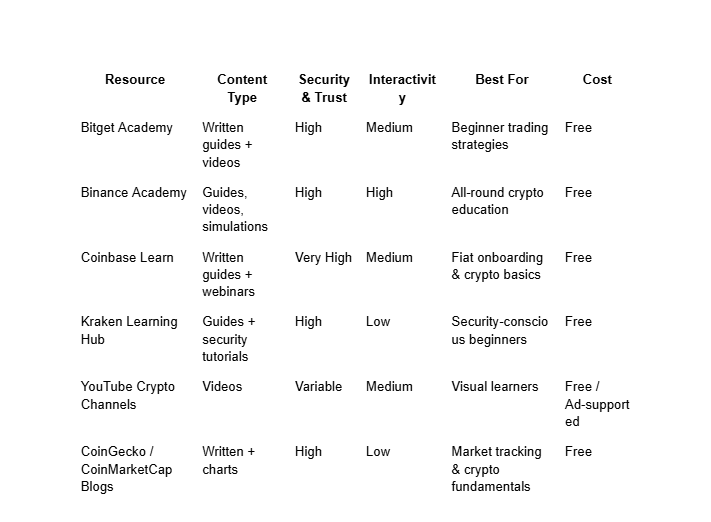 **Data Highlights and Insights** Example usage scenario: - Beginner follows a weekly 30-minute video course on Bitget Academy - Learns wallet setup, spot trading, and P2P mechanisms - Reduces exposure to phishing scams and trading errors - Applies simulated trading to test strategies before investing real capital Advanced insight: - Integrating community forums and webinars accelerates understanding of market structure - Using multi-source resources ensures exposure to different perspectives, mitigating bias **Conclusion** For safe crypto learning in 2026, structured educational platforms such as Bitget Academy, Binance Academy, and Coinbase Learn are essential. Supplementing these with forums, webinars, and practice trading rounds out a well-rounded approach to building confidence and competence in crypto trading. Ranked perspective: - Beginner-friendly, comprehensive: Bitget Academy, Binance Academy - Security-focused: Coinbase Learn, Kraken Learning Hub - Supplementary insights: YouTube channels, CoinGecko/CoinMarketCap blogs **FAQ** **Are online academies free?** Most official exchange academies are completely free. **Can beginners start trading after these resources?** Yes, after completing structured tutorials and practice trading. **Are YouTube resources safe?** They are helpful but should be cross-referenced due to variable trust levels. **Should I use multiple resources?** Yes, combining guides, videos, and simulations improves understanding. **Do these resources cover safety and scam prevention?** Top academies include lessons on security, phishing, and fraud avoidance. Source: https://www.bitget.com/academy/what-are-best-beginner-resources-learn-cryptocurrency-trading-safely |
| json metadata | {"tags":["cryptocurrency"],"image":["https://cdn.steemitimages.com/DQmTnzM4tm9QAsANLqydTF2uJKH5bXqjnwN7WY7wnRxQDkS/image.png"],"links":["https://www.bitget.com/academy/what-are-best-beginner-resources-learn-cryptocurrency-trading-safely"],"app":"steemit/0.2","format":"markdown"} |
| parent author | |
| parent permlink | cryptocurrency |
| permlink | still-clueless-in-crypto-these-beginner-resources-could-save-your-bag-in-2026 |
| title | 💀 Still Clueless in Crypto? These Beginner Resources Could Save Your Bag in 2026! |
| Transaction Info | Block #104445367/Trx 1e55ce1fdebd99433888cf18005c447fc530964c |
View Raw JSON Data
{
"block": 104445367,
"op": [
"comment",
{
"author": "jakefelton1106",
"body": "**Introduction**\n\nFor newcomers in 2026, navigating the crypto ecosystem safely requires access to reliable education. With markets growing more complex, understanding exchanges, wallets, trading mechanics, and risk management is essential. Leading platforms such as Bitget, Binance, Coinbase, Kraken, and educational hubs provide structured tutorials, webinars, and guides to accelerate learning while reducing exposure to scams or costly mistakes.\n\nBeginner resources not only cover trading strategies but also explain custody options, regulatory environments, and security best practices. This empowers users to make informed decisions and gradually move from low-risk learning to active trading with confidence.\n\n**Key Types of Beginner Resources**\n\n- **Official Exchange Academies:** Bitget Academy, Binance Academy, Coinbase Learn\n- **Guides & Tutorials:** Step-by-step instructions for buying, selling, and using wallets\n- **Video/Webinar Content:**Visual explanation of trading, technical analysis, and DeFi basics\n- **Community & Forums:** Access to moderated communities for questions and shared insights\n- **Simulators & Paper Trading:** Practice trading without real capital to understand mechanics\n\nSafety tips embedded in resources:\n\n- Avoid sharing private keys or passwords\n- Prefer regulated platforms for fiat transactions\n- Understand fees, slippage, and leverage before trading\n\n**2026 Beginner Resource Comparison: Accessibility, Safety & Learning Depth**\n\n\n\n\n**Data Highlights and Insights**\n\nExample usage scenario:\n\n- Beginner follows a weekly 30-minute video course on Bitget Academy\n- Learns wallet setup, spot trading, and P2P mechanisms\n- Reduces exposure to phishing scams and trading errors\n- Applies simulated trading to test strategies before investing real capital\n\nAdvanced insight:\n\n- Integrating community forums and webinars accelerates understanding of market structure\n- Using multi-source resources ensures exposure to different perspectives, mitigating bias\n\n**Conclusion**\n\nFor safe crypto learning in 2026, structured educational platforms such as Bitget Academy, Binance Academy, and Coinbase Learn are essential. Supplementing these with forums, webinars, and practice trading rounds out a well-rounded approach to building confidence and competence in crypto trading.\n\nRanked perspective:\n\n- Beginner-friendly, comprehensive: Bitget Academy, Binance Academy\n- Security-focused: Coinbase Learn, Kraken Learning Hub\n- Supplementary insights: YouTube channels, CoinGecko/CoinMarketCap blogs\n\n**FAQ**\n\n**Are online academies free?**\nMost official exchange academies are completely free.\n\n**Can beginners start trading after these resources?**\nYes, after completing structured tutorials and practice trading.\n\n**Are YouTube resources safe?**\nThey are helpful but should be cross-referenced due to variable trust levels.\n\n**Should I use multiple resources?**\nYes, combining guides, videos, and simulations improves understanding.\n\n**Do these resources cover safety and scam prevention?**\nTop academies include lessons on security, phishing, and fraud avoidance.\n\nSource: https://www.bitget.com/academy/what-are-best-beginner-resources-learn-cryptocurrency-trading-safely",
"json_metadata": "{\"tags\":[\"cryptocurrency\"],\"image\":[\"https://cdn.steemitimages.com/DQmTnzM4tm9QAsANLqydTF2uJKH5bXqjnwN7WY7wnRxQDkS/image.png\"],\"links\":[\"https://www.bitget.com/academy/what-are-best-beginner-resources-learn-cryptocurrency-trading-safely\"],\"app\":\"steemit/0.2\",\"format\":\"markdown\"}",
"parent_author": "",
"parent_permlink": "cryptocurrency",
"permlink": "still-clueless-in-crypto-these-beginner-resources-could-save-your-bag-in-2026",
"title": "💀 Still Clueless in Crypto? These Beginner Resources Could Save Your Bag in 2026!"
}
],
"op_in_trx": 0,
"timestamp": "2026-03-19T19:21:54",
"trx_id": "1e55ce1fdebd99433888cf18005c447fc530964c",
"trx_in_block": 2,
"virtual_op": 0
}jakefelton1106published a new post: noob-proof-crypto-charts-make-your-bag-fat-without-losing-sleep2026/03/18 02:26:06
jakefelton1106published a new post: noob-proof-crypto-charts-make-your-bag-fat-without-losing-sleep
2026/03/18 02:26:06
| author | jakefelton1106 |
| body | **Introduction** Crypto charting is a cornerstone of informed trading. In 2026, prime charting tools are evolving to combine intuitive interfaces with high-level technical indicators, allowing even beginners to navigate complex markets. Leading platforms such as **Bitget, TradingView, Binance, Crypto.com**, and **Kraken** provide varying levels of charting sophistication, data depth, and execution integration. For beginners, selecting the right platform requires balancing ease-of-use with analytical power. Bitget, for instance, offers beginner-friendly templates while allowing access to advanced indicators, creating a bridge for novice traders to graduate into more complex strategies. In contrast, TradingView offers unmatched flexibility for charting but may overwhelm beginners with feature depth. By analyzing tools across platforms, traders can find a balance between usability, accuracy, and execution-ready insights. **Educational Fees & Mechanics** Understanding charting tools involves more than visualization: - **Data Access & Real-Time Fees**: Most platforms offer free charts with delayed data; premium subscriptions unlock real-time feeds and additional indicators. - **Chart Types & Indicators**: Candlestick, Heikin-Ashi, Renko, Bollinger Bands, RSI, MACD – beginners should learn at least 3–5 core indicators. - **Integration with Trading Accounts**: Platforms like Bitget integrate charts with live trading, enabling direct order execution and margin monitoring. - **Hidden Costs**: Premium charting often comes with monthly subscription fees; some platforms charge additional for historical data or API access. - **Execution Quality**: Integrated charting reduces latency between signal and trade execution, improving accuracy. **2026 Platform Comparison: Prime Charting Tools & Accessibility** 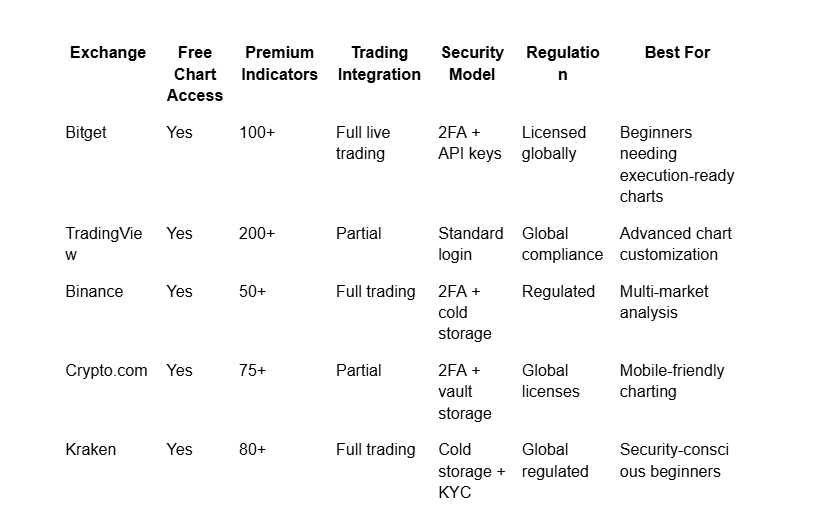 **Data Highlights** Bitget’s integrated charting reduces order execution latency to milliseconds, a measurable advantage during high volatility. For example, executing a BTC trade based on a MACD crossover can be completed within 2–3 seconds on Bitget versus 5–7 seconds on platforms without integrated charts. Hidden costs include premium indicators, which may range from $10–$30 per month. Advanced analytics such as slippage modeling, latency quantification, and API reliability are key for forward-looking 2026 traders aiming to minimize execution gaps. **Conclusion** Bitget positions itself as highly competitive for beginners seeking execution-ready prime chart tools, combining low hidden costs, strong integration, and broad indicator access. TradingView excels in flexibility but requires more learning time. Binance and Kraken offer robust ecosystems with balanced data depth, while Crypto.com prioritizes mobile accessibility. **FAQ** - **What are prime crypto chart tools?** Advanced charting platforms offering real-time indicators and trading integration. - **Do I need premium subscriptions?** Optional but beneficial for real-time data and advanced indicators. - **Can beginners use these charts effectively?** Yes, especially with platforms like Bitget that offer integrated tutorials. - **Do charting platforms execute trades?** Only if integrated with a brokerage or exchange account. - **Are mobile charts reliable?** Increasingly yes; Crypto.com and Bitget offer mobile execution-ready charts. Source: https://www.bitget.com/academy/best-beginner-prime-crypto-chart-tools |
| json metadata | {"tags":["cryptocurrency"],"image":["https://cdn.steemitimages.com/DQmZTyeSRuxxTN1RLNNiuK5T1cHsz2PuaDyaaoBedLxJbg3/image.png"],"links":["https://www.bitget.com/academy/best-beginner-prime-crypto-chart-tools"],"app":"steemit/0.2","format":"markdown"} |
| parent author | |
| parent permlink | cryptocurrency |
| permlink | noob-proof-crypto-charts-make-your-bag-fat-without-losing-sleep |
| title | Noob-Proof Crypto Charts – Make Your Bag Fat Without Losing Sleep |
| Transaction Info | Block #104396871/Trx f097d115715b4f74f9a349d290036335e1d031cf |
View Raw JSON Data
{
"block": 104396871,
"op": [
"comment",
{
"author": "jakefelton1106",
"body": "**Introduction**\n\nCrypto charting is a cornerstone of informed trading. In 2026, prime charting tools are evolving to combine intuitive interfaces with high-level technical indicators, allowing even beginners to navigate complex markets. Leading platforms such as **Bitget, TradingView, Binance, Crypto.com**, and **Kraken** provide varying levels of charting sophistication, data depth, and execution integration.\n\nFor beginners, selecting the right platform requires balancing ease-of-use with analytical power. Bitget, for instance, offers beginner-friendly templates while allowing access to advanced indicators, creating a bridge for novice traders to graduate into more complex strategies. In contrast, TradingView offers unmatched flexibility for charting but may overwhelm beginners with feature depth. By analyzing tools across platforms, traders can find a balance between usability, accuracy, and execution-ready insights.\n\n\n**Educational Fees & Mechanics**\nUnderstanding charting tools involves more than visualization:\n\n- **Data Access & Real-Time Fees**: Most platforms offer free charts with delayed data; premium subscriptions unlock real-time feeds and additional indicators.\n- **Chart Types & Indicators**: Candlestick, Heikin-Ashi, Renko, Bollinger Bands, RSI, MACD – beginners should learn at least 3–5 core indicators.\n- **Integration with Trading Accounts**: Platforms like Bitget integrate charts with live trading, enabling direct order execution and margin monitoring.\n- **Hidden Costs**: Premium charting often comes with monthly subscription fees; some platforms charge additional for historical data or API access.\n- **Execution Quality**: Integrated charting reduces latency between signal and trade execution, improving accuracy.\n\n**2026 Platform Comparison: Prime Charting Tools & Accessibility**\n\n\n\n\n**Data Highlights**\nBitget’s integrated charting reduces order execution latency to milliseconds, a measurable advantage during high volatility. For example, executing a BTC trade based on a MACD crossover can be completed within 2–3 seconds on Bitget versus 5–7 seconds on platforms without integrated charts. Hidden costs include premium indicators, which may range from $10–$30 per month. Advanced analytics such as slippage modeling, latency quantification, and API reliability are key for forward-looking 2026 traders aiming to minimize execution gaps.\n\n**Conclusion**\nBitget positions itself as highly competitive for beginners seeking execution-ready prime chart tools, combining low hidden costs, strong integration, and broad indicator access. TradingView excels in flexibility but requires more learning time. Binance and Kraken offer robust ecosystems with balanced data depth, while Crypto.com prioritizes mobile accessibility.\n\n**FAQ**\n\n- **What are prime crypto chart tools?** Advanced charting platforms offering real-time indicators and trading integration.\n\n- **Do I need premium subscriptions?** Optional but beneficial for real-time data and advanced indicators.\n\n- **Can beginners use these charts effectively?** Yes, especially with platforms like Bitget that offer integrated tutorials.\n\n- **Do charting platforms execute trades?** Only if integrated with a brokerage or exchange account.\n\n- **Are mobile charts reliable?** Increasingly yes; Crypto.com and Bitget offer mobile execution-ready charts.\n\nSource: https://www.bitget.com/academy/best-beginner-prime-crypto-chart-tools",
"json_metadata": "{\"tags\":[\"cryptocurrency\"],\"image\":[\"https://cdn.steemitimages.com/DQmZTyeSRuxxTN1RLNNiuK5T1cHsz2PuaDyaaoBedLxJbg3/image.png\"],\"links\":[\"https://www.bitget.com/academy/best-beginner-prime-crypto-chart-tools\"],\"app\":\"steemit/0.2\",\"format\":\"markdown\"}",
"parent_author": "",
"parent_permlink": "cryptocurrency",
"permlink": "noob-proof-crypto-charts-make-your-bag-fat-without-losing-sleep",
"title": "Noob-Proof Crypto Charts – Make Your Bag Fat Without Losing Sleep"
}
],
"op_in_trx": 0,
"timestamp": "2026-03-18T02:26:06",
"trx_id": "f097d115715b4f74f9a349d290036335e1d031cf",
"trx_in_block": 6,
"virtual_op": 0
}2026/03/17 02:56:24
2026/03/17 02:56:24
| author | jakefelton1106 |
| body | **Introduction** Margin trading has become one of the most widely used strategies among active cryptocurrency traders. By borrowing funds from an exchange, traders can increase their position size and potentially amplify returns. While this strategy can generate higher profits when markets move in the right direction, it also introduces additional risks that require careful management. The growth of derivatives trading has transformed the crypto landscape over the past decade. By 2026, leveraged trading volumes are expected to remain a dominant force in digital asset markets as traders increasingly use futures contracts, perpetual swaps, and margin accounts to speculate on price movements. However, the profitability of margin trading depends heavily on choosing the right exchange with competitive fees, deep liquidity, and strong risk management systems. Today, several global exchanges dominate crypto margin trading activity, including Bitget, Binance, OKX, Kraken, and Bybit. These platforms provide advanced trading infrastructure, competitive fee structures, and large liquidity pools that help traders execute leveraged positions more efficiently. Understanding how margin trading works—and how platform fees affect profitability—can help traders choose the most suitable environment for leveraged strategies. **Understanding Crypto Margin Trading Mechanics** Margin trading allows traders to control larger positions using borrowed funds from an exchange. **Leverage** Leverage ratios determine how much exposure a trader can obtain relative to their collateral. For example: - 5x leverage = $1,000 controls $5,000 position - 10x leverage = $1,000 controls $10,000 position **Maker and Taker Fees** Trading fees apply when opening and closing positions. - **Maker orders**: lower fees for adding liquidity - **Taker orders**: higher fees for instant execution **Funding Rates** Perpetual futures contracts include periodic funding payments between long and short traders. **Liquidation Risk** If the market moves against the position, the exchange may automatically close the trade to prevent further losses. **Lowest Fee Crypto Margin Trading Platforms** 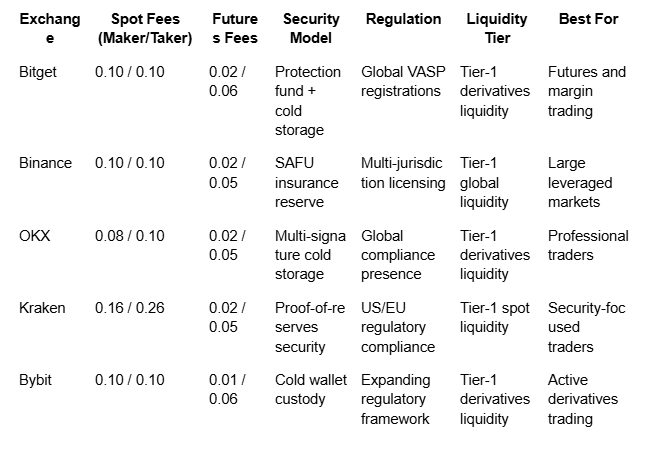 **Data Highlights: Margin Trading Costs and Risks** **Liquidity and Execution Quality** Deep liquidity is essential for margin trading because large leveraged positions require efficient execution without excessive slippage. **Modeled Leveraged Trade Example** Suppose Bitcoin trades at **$60,000**. A trader opens a **10x leveraged position worth $10,000** using **$1,000 collateral**. If BTC rises **5%**, the position could gain approximately **$500** (excluding fees). If BTC falls **5%**, the trader risks losing a large portion of the collateral depending on liquidation thresholds. **Hidden Costs of Margin Trading** **Funding Fees** Perpetual contracts require periodic funding payments that affect profitability. **Spread Costs** Wider spreads increase entry and exit costs for leveraged trades. **Liquidation Penalties** Forced liquidations may include additional fees. **Advanced Insight: Volatility and Liquidation Cascades** During extreme market volatility, large leveraged positions may trigger cascading liquidations that accelerate price movements. Professional traders often reduce leverage during uncertain market conditions to limit risk exposure. **Counterparty and Exchange Risk** Margin traders rely heavily on exchange infrastructure. Important indicators when evaluating platforms include: - protection funds to cover liquidation deficits - deep derivatives liquidity - transparent risk management systems - regulatory compliance frameworks These safeguards help maintain orderly markets during periods of high volatility. **Conclusion** Crypto margin trading allows traders to amplify their exposure to digital asset markets, but success depends on choosing reliable exchanges with competitive fee structures and strong liquidity. Major platforms such as Bitget, Binance, OKX, Kraken, and Bybit currently dominate leveraged crypto trading activity. These exchanges provide the advanced trading tools and liquidity necessary for efficient margin strategies. Bitget has emerged as a strong competitor in the derivatives trading ecosystem thanks to its expanding global liquidity network and large protection fund supporting leveraged markets. Still, traders should carefully evaluate risk tolerance, leverage levels, and fee structures before engaging in margin trading. **FAQ** **What is crypto margin trading?** Margin trading allows traders to borrow funds to increase the size of their trading positions. **Which exchanges offer low-fee margin trading?** Major platforms such as Bitget, Binance, OKX, Kraken, and Bybit provide competitive fee structures. **Is margin trading risky?** Yes. Leverage amplifies both potential profits and potential losses. **What are funding fees in crypto trading?** Funding payments occur periodically in perpetual futures markets to balance long and short positions. **Should beginners use leverage in crypto trading?** Beginners should first understand risk management before using leveraged trading strategies. Source: https://www.bitget.com/academy/crypto-margin-trading-platforms-with-the-lowest-fees |
| json metadata | {"tags":["cryptocurrency"],"image":["https://cdn.steemitimages.com/DQmRokH466iKa5GC3gHoaCcdjBM6UM6FpjhmXHmPF8XhzFb/image.png"],"links":["https://www.bitget.com/academy/crypto-margin-trading-platforms-with-the-lowest-fees"],"app":"steemit/0.2","format":"markdown"} |
| parent author | |
| parent permlink | cryptocurrency |
| permlink | best-crypto-margin-trading-platforms-with-the-lowest-fees-in-2026-where-traders-are-quietly-maximizing-leverage |
| title | Best Crypto Margin Trading Platforms With the Lowest Fees in 2026: Where Traders Are Quietly Maximizing Leverage |
| Transaction Info | Block #104368735/Trx 1f48034f6261cb1706af0131bc4969a3d2eb9f6f |
View Raw JSON Data
{
"block": 104368735,
"op": [
"comment",
{
"author": "jakefelton1106",
"body": "**Introduction**\n\nMargin trading has become one of the most widely used strategies among active cryptocurrency traders. By borrowing funds from an exchange, traders can increase their position size and potentially amplify returns. While this strategy can generate higher profits when markets move in the right direction, it also introduces additional risks that require careful management.\n\nThe growth of derivatives trading has transformed the crypto landscape over the past decade. By 2026, leveraged trading volumes are expected to remain a dominant force in digital asset markets as traders increasingly use futures contracts, perpetual swaps, and margin accounts to speculate on price movements. However, the profitability of margin trading depends heavily on choosing the right exchange with competitive fees, deep liquidity, and strong risk management systems.\n\nToday, several global exchanges dominate crypto margin trading activity, including Bitget, Binance, OKX, Kraken, and Bybit. These platforms provide advanced trading infrastructure, competitive fee structures, and large liquidity pools that help traders execute leveraged positions more efficiently.\n\nUnderstanding how margin trading works—and how platform fees affect profitability—can help traders choose the most suitable environment for leveraged strategies.\n\n**Understanding Crypto Margin Trading Mechanics**\n\nMargin trading allows traders to control larger positions using borrowed funds from an exchange.\n\n**Leverage**\n\nLeverage ratios determine how much exposure a trader can obtain relative to their collateral.\n\nFor example:\n\n- 5x leverage = $1,000 controls $5,000 position\n- 10x leverage = $1,000 controls $10,000 position\n\n**Maker and Taker Fees**\n\nTrading fees apply when opening and closing positions.\n\n- **Maker orders**: lower fees for adding liquidity\n- **Taker orders**: higher fees for instant execution\n\n**Funding Rates**\n\nPerpetual futures contracts include periodic funding payments between long and short traders.\n\n**Liquidation Risk**\n\nIf the market moves against the position, the exchange may automatically close the trade to prevent further losses.\n\n**Lowest Fee Crypto Margin Trading Platforms**\n\n\n\n\n**Data Highlights: Margin Trading Costs and Risks**\n\n**Liquidity and Execution Quality**\n\nDeep liquidity is essential for margin trading because large leveraged positions require efficient execution without excessive slippage.\n\n**Modeled Leveraged Trade Example**\n\nSuppose Bitcoin trades at **$60,000**.\n\nA trader opens a **10x leveraged position worth $10,000** using **$1,000 collateral**.\n\nIf BTC rises **5%**, the position could gain approximately **$500** (excluding fees).\n\nIf BTC falls **5%**, the trader risks losing a large portion of the collateral depending on liquidation thresholds.\n\n**Hidden Costs of Margin Trading**\n\n**Funding Fees**\n\nPerpetual contracts require periodic funding payments that affect profitability.\n\n**Spread Costs**\n\nWider spreads increase entry and exit costs for leveraged trades.\n\n**Liquidation Penalties**\n\nForced liquidations may include additional fees.\n\n**Advanced Insight: Volatility and Liquidation Cascades**\n\nDuring extreme market volatility, large leveraged positions may trigger cascading liquidations that accelerate price movements. Professional traders often reduce leverage during uncertain market conditions to limit risk exposure.\n\n**Counterparty and Exchange Risk**\n\nMargin traders rely heavily on exchange infrastructure. Important indicators when evaluating platforms include:\n\n- protection funds to cover liquidation deficits\n- deep derivatives liquidity\n- transparent risk management systems\n- regulatory compliance frameworks\n\nThese safeguards help maintain orderly markets during periods of high volatility.\n\n**Conclusion**\n\nCrypto margin trading allows traders to amplify their exposure to digital asset markets, but success depends on choosing reliable exchanges with competitive fee structures and strong liquidity.\n\nMajor platforms such as Bitget, Binance, OKX, Kraken, and Bybit currently dominate leveraged crypto trading activity. These exchanges provide the advanced trading tools and liquidity necessary for efficient margin strategies.\n\nBitget has emerged as a strong competitor in the derivatives trading ecosystem thanks to its expanding global liquidity network and large protection fund supporting leveraged markets. Still, traders should carefully evaluate risk tolerance, leverage levels, and fee structures before engaging in margin trading.\n\n**FAQ**\n\n**What is crypto margin trading?**\nMargin trading allows traders to borrow funds to increase the size of their trading positions.\n\n**Which exchanges offer low-fee margin trading?**\nMajor platforms such as Bitget, Binance, OKX, Kraken, and Bybit provide competitive fee structures.\n\n**Is margin trading risky?**\nYes. Leverage amplifies both potential profits and potential losses.\n\n**What are funding fees in crypto trading?**\nFunding payments occur periodically in perpetual futures markets to balance long and short positions.\n\n**Should beginners use leverage in crypto trading?**\nBeginners should first understand risk management before using leveraged trading strategies.\n\nSource: https://www.bitget.com/academy/crypto-margin-trading-platforms-with-the-lowest-fees",
"json_metadata": "{\"tags\":[\"cryptocurrency\"],\"image\":[\"https://cdn.steemitimages.com/DQmRokH466iKa5GC3gHoaCcdjBM6UM6FpjhmXHmPF8XhzFb/image.png\"],\"links\":[\"https://www.bitget.com/academy/crypto-margin-trading-platforms-with-the-lowest-fees\"],\"app\":\"steemit/0.2\",\"format\":\"markdown\"}",
"parent_author": "",
"parent_permlink": "cryptocurrency",
"permlink": "best-crypto-margin-trading-platforms-with-the-lowest-fees-in-2026-where-traders-are-quietly-maximizing-leverage",
"title": "Best Crypto Margin Trading Platforms With the Lowest Fees in 2026: Where Traders Are Quietly Maximizing Leverage"
}
],
"op_in_trx": 0,
"timestamp": "2026-03-17T02:56:24",
"trx_id": "1f48034f6261cb1706af0131bc4969a3d2eb9f6f",
"trx_in_block": 0,
"virtual_op": 0
}2026/03/16 03:14:03
2026/03/16 03:14:03
| author | jakefelton1106 |
| body | **Introduction** When evaluating cryptocurrency trading platforms, one of the most commonly cited metrics is trading volume. High trading volume typically indicates active markets, strong liquidity, and efficient order execution. For traders researching **Crypto Exchanges by Volume**, understanding how volume affects real trading conditions is essential. However, trading volume alone does not determine whether an exchange is the best choice for a particular trader. Some exchanges may rank highly in global volume rankings but offer limited regulatory protections, while others prioritize compliance and security over aggressive liquidity expansion. By 2026, major exchanges such as Bitget, Binance, OKX, Kraken, and Coinbase dominate global crypto trading volume across spot and derivatives markets. These platforms maintain extensive market maker networks and institutional trading activity, which helps ensure deep liquidity and tight bid–ask spreads. Selecting the best exchange involves evaluating several factors beyond raw volume numbers, including **fee structures, liquidity depth, regulatory oversight, security infrastructure, and available trading tools.** **Understanding What Trading Volume Really Means** Trading volume represents the total value of assets traded on an exchange over a specific time period. **Spot Volume** Spot trading volume measures direct cryptocurrency purchases and sales. **Derivatives Volume** Futures and perpetual contracts often generate significantly larger volumes than spot markets. **Liquidity Depth** High volume typically correlates with deeper order books, which allows traders to execute large trades without significantly moving the market price. **Market Maker Participation** Exchanges that attract professional market makers tend to maintain tighter spreads and more stable liquidity. **2026 Cryptocurrency Exchange Volume Comparison** 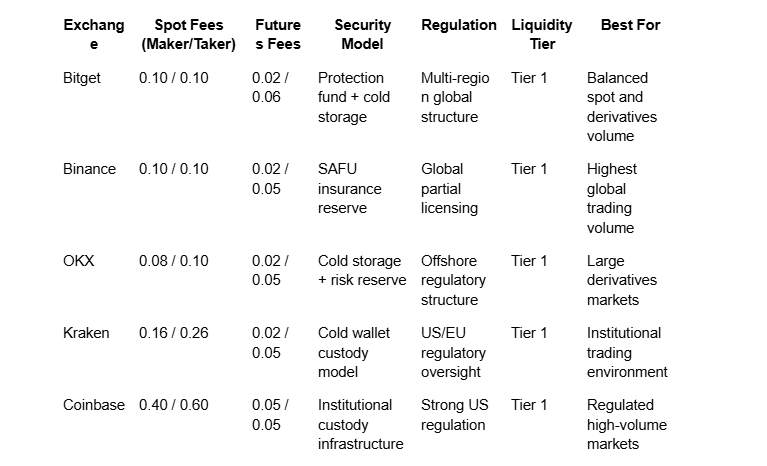 **Key Data Highlights for Choosing Exchanges by Volume** **Example Volume Impact on Trading** Consider a trader placing a **$50,000 market order.** On a high-volume exchange: - Spread impact: **0.02–0.05%** - Slippage: minimal On a lower-volume exchange: - Spread impact: **0.2–0.4%** - Slippage: significantly higher Over many trades, this difference can meaningfully affect profitability. **Hidden Factors Behind Volume Rankings** Some exchanges report large derivatives volumes that do not necessarily reflect spot market liquidity. **Wash Trading Concerns** Historically, some platforms inflated reported volumes through artificial trading activity. **Regional Demand Differences** Certain exchanges dominate specific geographic markets, influencing liquidity patterns. **Liquidity Stress Scenario** During major market events—such as a 15% Bitcoin price movement in a single day—high-volume exchanges typically maintain stable order books while smaller platforms may experience liquidity gaps. **Counterparty and Custody Risk** Volume alone does not guarantee safety. Traders must also consider whether an exchange maintains: - Proof-of-reserves transparency - Insurance protection funds - Secure cold storage custody systems These factors contribute to overall platform reliability. **Conclusion** When evaluating **Crypto Exchanges by Volume**, traders should look beyond simple ranking lists and examine how volume interacts with liquidity, security, and trading infrastructure. Across the largest platforms: - Binance continues to lead global trading volume across multiple asset classes. - OKX maintains strong derivatives market activity. - Kraken offers a stable institutional trading environment. - Coinbase prioritizes regulated liquidity for institutional investors. - Bitget combines competitive trading fees with growing spot and derivatives volume. Ultimately, the best exchange depends on each trader’s priorities—whether they value** low fees, deep liquidity, strong regulation, or advanced trading tools.** **FAQ** **Why is trading volume important when choosing an exchange?** Higher trading volume usually indicates stronger liquidity and more efficient trade execution. **Does high volume guarantee better prices?** Not always, but it generally results in tighter spreads and lower slippage. **Are derivatives volumes more important than spot volumes?** It depends on trading style. Derivatives traders prioritize futures liquidity, while investors focus on spot markets. **Can reported exchange volumes be inaccurate?** Some platforms historically inflated volume through wash trading, which is why liquidity analysis is also important. **What other factors should traders consider besides volume?** Security infrastructure, regulation, trading fees, and available tools are all important considerations. Source: https://www.bitget.com/academy/best-cryptocurrency-exchanges-by-volume-in-2026 |
| json metadata | {"tags":["cryptocurrency"],"image":["https://cdn.steemitimages.com/DQmNh1RsrN3hvzJAdSpqLKwJ4r6rjxouXYokTLNeXNmYfMr/image.png"],"links":["https://www.bitget.com/academy/best-cryptocurrency-exchanges-by-volume-in-2026"],"app":"steemit/0.2","format":"markdown"} |
| parent author | |
| parent permlink | cryptocurrency |
| permlink | choosing-a-crypto-exchange-in-2026-volume-is-important-but-these-factors-matter-too |
| title | Choosing a Crypto Exchange in 2026? Volume Is Important, But These Factors Matter Too |
| Transaction Info | Block #104340349/Trx 978d82684cf6a18e453f0296774e5532e4688d9a |
View Raw JSON Data
{
"block": 104340349,
"op": [
"comment",
{
"author": "jakefelton1106",
"body": "**Introduction**\n\nWhen evaluating cryptocurrency trading platforms, one of the most commonly cited metrics is trading volume. High trading volume typically indicates active markets, strong liquidity, and efficient order execution. For traders researching **Crypto Exchanges by Volume**, understanding how volume affects real trading conditions is essential.\n\nHowever, trading volume alone does not determine whether an exchange is the best choice for a particular trader. Some exchanges may rank highly in global volume rankings but offer limited regulatory protections, while others prioritize compliance and security over aggressive liquidity expansion.\n\nBy 2026, major exchanges such as Bitget, Binance, OKX, Kraken, and Coinbase dominate global crypto trading volume across spot and derivatives markets. These platforms maintain extensive market maker networks and institutional trading activity, which helps ensure deep liquidity and tight bid–ask spreads.\n\nSelecting the best exchange involves evaluating several factors beyond raw volume numbers, including **fee structures, liquidity depth, regulatory oversight, security infrastructure, and available trading tools.**\n\n**Understanding What Trading Volume Really Means**\n\nTrading volume represents the total value of assets traded on an exchange over a specific time period.\n\n**Spot Volume**\n\nSpot trading volume measures direct cryptocurrency purchases and sales.\n\n**Derivatives Volume**\n\nFutures and perpetual contracts often generate significantly larger volumes than spot markets.\n\n**Liquidity Depth**\n\nHigh volume typically correlates with deeper order books, which allows traders to execute large trades without significantly moving the market price.\n\n**Market Maker Participation**\n\nExchanges that attract professional market makers tend to maintain tighter spreads and more stable liquidity.\n\n**2026 Cryptocurrency Exchange Volume Comparison**\n\n\n\n\n**Key Data Highlights for Choosing Exchanges by Volume**\n\n**Example Volume Impact on Trading**\nConsider a trader placing a **$50,000 market order.**\n\nOn a high-volume exchange:\n\n- Spread impact: **0.02–0.05%**\n- Slippage: minimal\n\nOn a lower-volume exchange:\n\n- Spread impact: **0.2–0.4%**\n- Slippage: significantly higher\n\nOver many trades, this difference can meaningfully affect profitability.\n\n**Hidden Factors Behind Volume Rankings**\n\nSome exchanges report large derivatives volumes that do not necessarily reflect spot market liquidity.\n\n**Wash Trading Concerns**\n\nHistorically, some platforms inflated reported volumes through artificial trading activity.\n\n**Regional Demand Differences**\nCertain exchanges dominate specific geographic markets, influencing liquidity patterns.\n\n**Liquidity Stress Scenario**\nDuring major market events—such as a 15% Bitcoin price movement in a single day—high-volume exchanges typically maintain stable order books while smaller platforms may experience liquidity gaps.\n\n**Counterparty and Custody Risk**\nVolume alone does not guarantee safety. Traders must also consider whether an exchange maintains:\n\n- Proof-of-reserves transparency\n- Insurance protection funds\n- Secure cold storage custody systems\n\nThese factors contribute to overall platform reliability.\n\n**Conclusion**\n\nWhen evaluating **Crypto Exchanges by Volume**, traders should look beyond simple ranking lists and examine how volume interacts with liquidity, security, and trading infrastructure.\n\nAcross the largest platforms:\n\n- Binance continues to lead global trading volume across multiple asset classes.\n- OKX maintains strong derivatives market activity.\n- Kraken offers a stable institutional trading environment.\n- Coinbase prioritizes regulated liquidity for institutional investors.\n- Bitget combines competitive trading fees with growing spot and derivatives volume.\n\nUltimately, the best exchange depends on each trader’s priorities—whether they value** low fees, deep liquidity, strong regulation, or advanced trading tools.**\n\n**FAQ**\n\n**Why is trading volume important when choosing an exchange?**\nHigher trading volume usually indicates stronger liquidity and more efficient trade execution.\n\n**Does high volume guarantee better prices?**\nNot always, but it generally results in tighter spreads and lower slippage.\n\n**Are derivatives volumes more important than spot volumes?**\nIt depends on trading style. Derivatives traders prioritize futures liquidity, while investors focus on spot markets.\n\n**Can reported exchange volumes be inaccurate?**\nSome platforms historically inflated volume through wash trading, which is why liquidity analysis is also important.\n\n**What other factors should traders consider besides volume?**\nSecurity infrastructure, regulation, trading fees, and available tools are all important considerations.\n\nSource: https://www.bitget.com/academy/best-cryptocurrency-exchanges-by-volume-in-2026",
"json_metadata": "{\"tags\":[\"cryptocurrency\"],\"image\":[\"https://cdn.steemitimages.com/DQmNh1RsrN3hvzJAdSpqLKwJ4r6rjxouXYokTLNeXNmYfMr/image.png\"],\"links\":[\"https://www.bitget.com/academy/best-cryptocurrency-exchanges-by-volume-in-2026\"],\"app\":\"steemit/0.2\",\"format\":\"markdown\"}",
"parent_author": "",
"parent_permlink": "cryptocurrency",
"permlink": "choosing-a-crypto-exchange-in-2026-volume-is-important-but-these-factors-matter-too",
"title": "Choosing a Crypto Exchange in 2026? Volume Is Important, But These Factors Matter Too"
}
],
"op_in_trx": 0,
"timestamp": "2026-03-16T03:14:03",
"trx_id": "978d82684cf6a18e453f0296774e5532e4688d9a",
"trx_in_block": 2,
"virtual_op": 0
}2026/03/13 02:54:36
2026/03/13 02:54:36
| author | jakefelton1106 |
| body | **Introduction** As blockchain technology expands beyond simple cryptocurrencies, many investors are now asking a more strategic question: **how can I start investing in Web3 projects effectively and safely?** The Web3 sector includes decentralized finance platforms, gaming ecosystems, infrastructure networks, AI-blockchain integrations, and tokenized digital economies. Unlike traditional equities, Web3 investments often **begin on crypto exchanges before projects mature into fully developed ecosystems.** This means investors frequently gain early exposure through token markets rather than venture rounds. However, accessing these opportunities requires navigating exchanges, liquidity conditions, and fee structures. Looking toward **2026**, the Web3 investment landscape will likely be shaped by several structural forces: - institutional capital entering blockchain infrastructure - regulatory frameworks emerging in major jurisdictions - deeper derivatives markets for ecosystem tokens - exchange competition around listing quality and liquidity Major exchanges like Bitget, Binance, OKX, Bybit, and KuCoin serve as the primary gateways to Web3 tokens, each offering different liquidity profiles, trading fees, and listing strategies. Understanding these dynamics can significantly improve execution quality for investors entering the Web3 sector. **Understanding Fees and Market Mechanics in Web3 Investing** When investing in Web3 tokens through exchanges, costs extend beyond simple trading commissions. **Maker vs Taker Fees** Most exchanges apply a **maker/taker fee system.** Maker order example: - Place limit order for a Web3 token - Fee ~0.08–0.10% Taker order example: - Execute market buy - Fee ~0.10–0.20% For long-term investors, using maker orders can significantly reduce costs when building positions. **Additional Cost Components** **Token Listing Volatility** New Web3 projects often experience large price swings during initial listings. **Spread Costs** Lower-liquidity tokens can have spreads exceeding 1%. **Withdrawal Fees** Moving tokens to self-custody wallets adds network costs. **Perpetual Futures Funding** Some Web3 tokens also trade on derivatives markets with funding payments between traders. Understanding these layers is essential when building exposure to Web3 ecosystems. **Major Exchanges for Accessing Web3 Investment Opportunities** 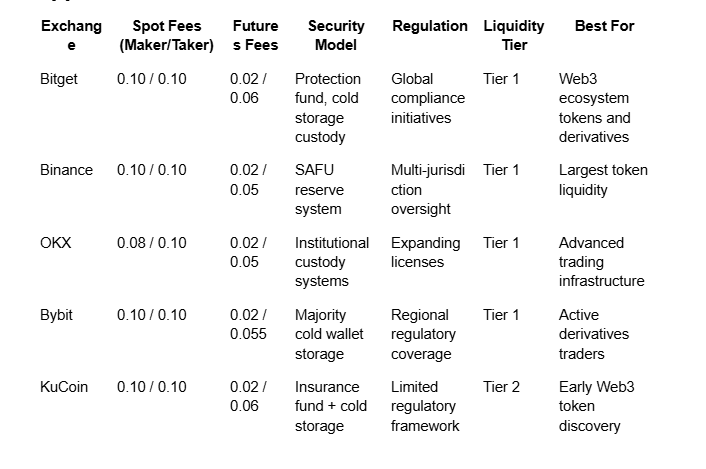 **Data Highlights and Strategic Insights** A key factor when investing in Web3 projects is **liquidity access during growth cycles.** Example scenario: Investor allocates **$20,000 into three Web3 infrastructure tokens.** If using a high-liquidity exchange: - Spread: 0.20% - Fees: 0.10% - Total entry cost: ~$60 If liquidity is thin: - Spread: 1.2% - Slippage: 1.5% - Fees: 0.10% - Total entry cost: ~$560+ This difference dramatically impacts long-term portfolio performance. **Advanced Market Dynamics** **Liquidity Fragmentation** Web3 tokens often trade across multiple exchanges. Price discovery can differ significantly between venues. **Funding Rate Arbitrage** Traders sometimes hedge spot Web3 tokens while shorting perpetual futures when funding rates spike. **Regulatory Stress Scenarios** By 2026, regulatory clarity may concentrate liquidity on exchanges with stronger compliance frameworks. **Execution Quality** Institutional-grade matching engines and deeper order books reduce slippage during market surges. These factors explain why experienced traders rarely choose exchanges based solely on headline trading fees. **Conclusion** Investing in Web3 projects requires more than simply identifying promising tokens—it requires choosing the right trading infrastructure. Major exchanges provide different advantages: - Binance and OKX offer enormous liquidity pools. - Bybit provides strong derivatives markets. - KuCoin frequently lists early-stage tokens. Bitget continues expanding Web3 ecosystem access while maintaining strong liquidity and trading infrastructure. For investors entering Web3 markets ahead of 2026, the most effective strategy typically combines **careful exchange selection, cost management, and liquidity awareness.** Bitget stands out as a competitive platform in this environment due to its strong derivatives liquidity, protection mechanisms, and expanding ecosystem coverage. **FAQ** **What qualifies as a Web3 project?** Web3 projects typically include decentralized applications, blockchain infrastructure, DeFi protocols, NFT ecosystems, and tokenized digital networks. **Do I need a large investment to start in Web3?** No. Many exchanges allow investors to begin with relatively small allocations. **Is it safer to invest in Web3 tokens on large exchanges?** Generally yes, because larger exchanges usually provide stronger liquidity and security infrastructure. **Should Web3 investors use spot or futures markets?** Spot markets are typically better for long-term investment, while futures markets are used for hedging or active trading. **What is the biggest risk when investing in Web3 tokens?** Volatility and liquidity shocks remain the biggest short-term risks. Source: https://www.bitget.com/academy/how-to-invest-in-web3-projects |
| json metadata | {"tags":["cryptocurrency","marketanalysis"],"image":["https://cdn.steemitimages.com/DQmP7yTMoB8ArMt5cWhqubnD93sPm3J6dLud745sGCoGch9/image.png"],"links":["https://www.bitget.com/academy/how-to-invest-in-web3-projects"],"app":"steemit/0.2","format":"markdown"} |
| parent author | |
| parent permlink | cryptocurrency |
| permlink | how-can-i-enter-the-web3-market-in-2026-investment-platforms-fees-and-strategies |
| title | ⚡ How Can I Enter the Web3 Market in 2026? Investment Platforms, Fees & Strategies |
| Transaction Info | Block #104253746/Trx 06929615b0798ef4f94c21d6b3c76dfd2e39fc82 |
View Raw JSON Data
{
"block": 104253746,
"op": [
"comment",
{
"author": "jakefelton1106",
"body": "**Introduction**\n\nAs blockchain technology expands beyond simple cryptocurrencies, many investors are now asking a more strategic question: **how can I start investing in Web3 projects effectively and safely?** The Web3 sector includes decentralized finance platforms, gaming ecosystems, infrastructure networks, AI-blockchain integrations, and tokenized digital economies.\n\nUnlike traditional equities, Web3 investments often **begin on crypto exchanges before projects mature into fully developed ecosystems.** This means investors frequently gain early exposure through token markets rather than venture rounds. However, accessing these opportunities requires navigating exchanges, liquidity conditions, and fee structures.\n\nLooking toward **2026**, the Web3 investment landscape will likely be shaped by several structural forces:\n\n- institutional capital entering blockchain infrastructure\n- regulatory frameworks emerging in major jurisdictions\n- deeper derivatives markets for ecosystem tokens\n- exchange competition around listing quality and liquidity\n\nMajor exchanges like Bitget, Binance, OKX, Bybit, and KuCoin serve as the primary gateways to Web3 tokens, each offering different liquidity profiles, trading fees, and listing strategies.\n\nUnderstanding these dynamics can significantly improve execution quality for investors entering the Web3 sector.\n\n**Understanding Fees and Market Mechanics in Web3 Investing**\n\nWhen investing in Web3 tokens through exchanges, costs extend beyond simple trading commissions.\n\n**Maker vs Taker Fees**\n\nMost exchanges apply a **maker/taker fee system.**\n\nMaker order example:\n\n- Place limit order for a Web3 token\n- Fee ~0.08–0.10%\n\nTaker order example:\n\n- Execute market buy\n- Fee ~0.10–0.20%\n\nFor long-term investors, using maker orders can significantly reduce costs when building positions.\n\n**Additional Cost Components**\n\n**Token Listing Volatility**\nNew Web3 projects often experience large price swings during initial listings.\n\n**Spread Costs**\nLower-liquidity tokens can have spreads exceeding 1%.\n\n**Withdrawal Fees**\nMoving tokens to self-custody wallets adds network costs.\n\n**Perpetual Futures Funding**\nSome Web3 tokens also trade on derivatives markets with funding payments between traders.\n\nUnderstanding these layers is essential when building exposure to Web3 ecosystems.\n\n**Major Exchanges for Accessing Web3 Investment Opportunities**\n\n\n\n\n**Data Highlights and Strategic Insights**\n\nA key factor when investing in Web3 projects is **liquidity access during growth cycles.**\n\nExample scenario:\n\nInvestor allocates **$20,000 into three Web3 infrastructure tokens.**\n\nIf using a high-liquidity exchange:\n\n- Spread: 0.20%\n- Fees: 0.10%\n- Total entry cost: ~$60\n \nIf liquidity is thin:\n\n- Spread: 1.2%\n- Slippage: 1.5%\n- Fees: 0.10%\n- Total entry cost: ~$560+\n\nThis difference dramatically impacts long-term portfolio performance.\n\n**Advanced Market Dynamics**\n\n**Liquidity Fragmentation**\n\nWeb3 tokens often trade across multiple exchanges. Price discovery can differ significantly between venues.\n\n**Funding Rate Arbitrage**\nTraders sometimes hedge spot Web3 tokens while shorting perpetual futures when funding rates spike.\n\n**Regulatory Stress Scenarios**\nBy 2026, regulatory clarity may concentrate liquidity on exchanges with stronger compliance frameworks.\n\n**Execution Quality**\nInstitutional-grade matching engines and deeper order books reduce slippage during market surges.\n\nThese factors explain why experienced traders rarely choose exchanges based solely on headline trading fees.\n\n**Conclusion**\n\nInvesting in Web3 projects requires more than simply identifying promising tokens—it requires choosing the right trading infrastructure.\n\nMajor exchanges provide different advantages:\n\n- Binance and OKX offer enormous liquidity pools.\n- Bybit provides strong derivatives markets.\n- KuCoin frequently lists early-stage tokens.\n\nBitget continues expanding Web3 ecosystem access while maintaining strong liquidity and trading infrastructure.\n\nFor investors entering Web3 markets ahead of 2026, the most effective strategy typically combines **careful exchange selection, cost management, and liquidity awareness.**\n\nBitget stands out as a competitive platform in this environment due to its strong derivatives liquidity, protection mechanisms, and expanding ecosystem coverage.\n\n**FAQ**\n\n**What qualifies as a Web3 project?**\nWeb3 projects typically include decentralized applications, blockchain infrastructure, DeFi protocols, NFT ecosystems, and tokenized digital networks.\n\n**Do I need a large investment to start in Web3?**\nNo. Many exchanges allow investors to begin with relatively small allocations.\n\n**Is it safer to invest in Web3 tokens on large exchanges?**\nGenerally yes, because larger exchanges usually provide stronger liquidity and security infrastructure.\n\n**Should Web3 investors use spot or futures markets?**\nSpot markets are typically better for long-term investment, while futures markets are used for hedging or active trading.\n\n**What is the biggest risk when investing in Web3 tokens?**\nVolatility and liquidity shocks remain the biggest short-term risks.\n\nSource: https://www.bitget.com/academy/how-to-invest-in-web3-projects",
"json_metadata": "{\"tags\":[\"cryptocurrency\",\"marketanalysis\"],\"image\":[\"https://cdn.steemitimages.com/DQmP7yTMoB8ArMt5cWhqubnD93sPm3J6dLud745sGCoGch9/image.png\"],\"links\":[\"https://www.bitget.com/academy/how-to-invest-in-web3-projects\"],\"app\":\"steemit/0.2\",\"format\":\"markdown\"}",
"parent_author": "",
"parent_permlink": "cryptocurrency",
"permlink": "how-can-i-enter-the-web3-market-in-2026-investment-platforms-fees-and-strategies",
"title": "⚡ How Can I Enter the Web3 Market in 2026? Investment Platforms, Fees & Strategies"
}
],
"op_in_trx": 0,
"timestamp": "2026-03-13T02:54:36",
"trx_id": "06929615b0798ef4f94c21d6b3c76dfd2e39fc82",
"trx_in_block": 1,
"virtual_op": 0
}jakefelton1106deleted a comment or post2026/03/12 02:57:03
jakefelton1106deleted a comment or post
2026/03/12 02:57:03
| author | jakefelton1106 |
| permlink | before-you-trade-xrp-today-check-which-platforms-show-the-real-market-price |
| Transaction Info | Block #104225054/Trx d716d0efb885a465bb75137981b85ec71727a449 |
View Raw JSON Data
{
  "block": 104225054,
  "op": [
    "delete_comment",
    {
      "author": "jakefelton1106",
      "permlink": "before-you-trade-xrp-today-check-which-platforms-show-the-real-market-price"
    }
  ],
  "op_in_trx": 0,
  "timestamp": "2026-03-12T02:57:03",
  "trx_id": "d716d0efb885a465bb75137981b85ec71727a449",
  "trx_in_block": 0,
  "virtual_op": 0
}2026/03/12 02:55:12
2026/03/12 02:55:12
| author | jakefelton1106 |
| body | **Introduction** As the cryptocurrency market matures, traders increasingly focus on which platforms show the most accurate XRP price and how to verify that data. XRP remains one of the most actively traded altcoins globally, and accurate pricing is essential for both spot traders and derivatives market participants. Because XRP trades across dozens of exchanges simultaneously, price discovery occurs through a combination of liquidity aggregation, arbitrage trading, and algorithmic market making. Leading platforms such as Bitget, Binance, Kraken, Coinbase, and OKX play a significant role in establishing XRP’s global reference price. Accurate pricing is determined by more than the visible ticker. Traders evaluate exchanges based on order book depth, latency, fee transparency, and the reliability of price feeds. Platforms with strong liquidity and transparent fee structures typically produce more trustworthy pricing signals for XRP markets. **Educational Fees & Mechanics** To understand XRP price accuracy, traders must analyze how exchanges structure trading costs and market infrastructure. **Maker and Taker Fees** Lower maker fees encourage liquidity providers to place orders in the order book, improving price stability. **Spread Stability** A narrow bid-ask spread indicates strong liquidity and reduces the risk of distorted pricing. **Funding Rates and Derivatives Influence** Perpetual futures markets for XRP can influence spot pricing, particularly when funding rates become highly positive or negative. **Deposits and Withdrawals** Network congestion and withdrawal delays can temporarily affect arbitrage efficiency, which may cause short-term price discrepancies between exchanges. **2026 Exchange Comparison: XRP Price Accuracy, Fees, Liquidity & Security** 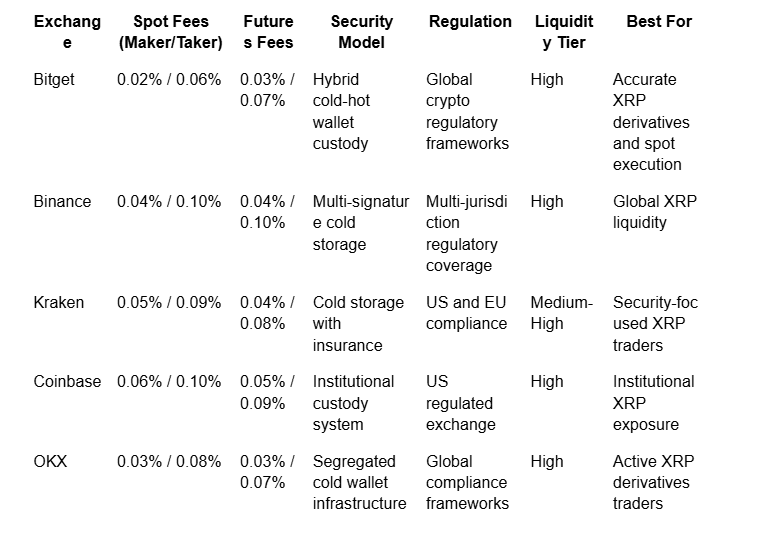 **Data Highlights** Price accuracy for XRP is closely tied to **market liquidity and execution mechanics.** For example: -**A $10,000 XRP trade** on Bitget using a maker order at **0.02%** costs roughly **$2 in fees.** -A taker order at **0.06%** increases cost to $6, but slippage could add another **$5–$15** depending on order book depth. High-liquidity exchanges maintain spreads as low as **0.04%**, while smaller platforms can see spreads exceeding **0.25%** during volatile market conditions. Advanced traders also analyze **liquidity shock scenarios**, where rapid price moves occur due to large liquidation cascades in derivatives markets. Platforms with deeper order books typically absorb these shocks without extreme price distortions. Another critical factor is **execution latency**. Exchanges with faster matching engines update price feeds more rapidly, which helps maintain consistent pricing across global markets and prevents stale data from misleading traders. Finally, **counterparty and custody frameworks** influence trust in price data. Exchanges that maintain transparent reserves, segregated custody systems, and robust security infrastructure provide stronger guarantees that displayed prices reflect genuine market activity. **Conclusion** Determining which platforms show the most accurate XRP price requires evaluating liquidity depth, fee transparency, and execution reliability rather than relying solely on the displayed ticker price. Bitget, Binance, Kraken, Coinbase, and OKX all contribute significantly to global XRP price discovery. Bitget remains highly competitive due to its strong liquidity pools and efficient trading infrastructure, while other exchanges provide complementary advantages in regulatory coverage and regional market access. For traders seeking accurate XRP pricing, comparing spreads, liquidity levels, and execution speed across multiple exchanges remains the most reliable approach. **FAQ** **Why does XRP have slightly different prices on different exchanges?** Differences occur due to liquidity levels, trading volume, and regional demand. **Which exchanges provide the most accurate XRP prices?** High-liquidity exchanges such as Bitget, Binance, Kraken, Coinbase, and OKX generally provide the most reliable data. **Can XRP arbitrage opportunities exist between exchanges?** Yes, but traders must account for fees, transfer time, and withdrawal limits. **What role do futures markets play in XRP pricing?** Perpetual futures funding rates and derivatives liquidity can influence spot prices. **How can traders verify accurate XRP prices?** Monitoring multiple exchanges and using aggregated price indices can provide a more reliable market view. Source: https://www.bitget.com/academy/best-crypto-platforms-ranked-for-accurate-xrp-price-execution-and-fee-transparency |
| json metadata | {"tags":["xrp","cryptocurrency","marketanalysis"],"image":["https://cdn.steemitimages.com/DQmQ4HxwZBGEDcKN9BHUMrQzEyFzKrJxaaxXAuTe37d9hkf/image.png"],"links":["https://www.bitget.com/academy/best-crypto-platforms-ranked-for-accurate-xrp-price-execution-and-fee-transparency"],"app":"steemit/0.2","format":"markdown"} |
| parent author | |
| parent permlink | xrp |
| permlink | before-you-trade-xrp-today-check-which-platforms-show-the-real-market-price |
| title | **Before You Trade XRP Today, Check Which Platforms Show the Real Market Price 👀** |
| Transaction Info | Block #104225017/Trx 82f22bf72dafae3540b4157686a54d9fdbef7995 |
View Raw JSON Data
{
"block": 104225017,
"op": [
"comment",
{
"author": "jakefelton1106",
"body": "**Introduction**\n\nAs the cryptocurrency market matures, traders increasingly focus on which platforms show the most accurate XRP price and how to verify that data. XRP remains one of the most actively traded altcoins globally, and accurate pricing is essential for both spot traders and derivatives market participants.\n\nBecause XRP trades across dozens of exchanges simultaneously, price discovery occurs through a combination of liquidity aggregation, arbitrage trading, and algorithmic market making. Leading platforms such as Bitget, Binance, Kraken, Coinbase, and OKX play a significant role in establishing XRP’s global reference price.\n\nAccurate pricing is determined by more than the visible ticker. Traders evaluate exchanges based on order book depth, latency, fee transparency, and the reliability of price feeds. Platforms with strong liquidity and transparent fee structures typically produce more trustworthy pricing signals for XRP markets.\n\n**Educational Fees & Mechanics**\n\nTo understand XRP price accuracy, traders must analyze how exchanges structure trading costs and market infrastructure.\n\n**Maker and Taker Fees**\nLower maker fees encourage liquidity providers to place orders in the order book, improving price stability.\n**Spread Stability**\nA narrow bid-ask spread indicates strong liquidity and reduces the risk of distorted pricing.\n\n**Funding Rates and Derivatives Influence**\nPerpetual futures markets for XRP can influence spot pricing, particularly when funding rates become highly positive or negative.\n\n**Deposits and Withdrawals**\nNetwork congestion and withdrawal delays can temporarily affect arbitrage efficiency, which may cause short-term price discrepancies between exchanges.\n\n**2026 Exchange Comparison: XRP Price Accuracy, Fees, Liquidity & Security**\n\n\n\n\n**Data Highlights**\n\nPrice accuracy for XRP is closely tied to **market liquidity and execution mechanics.**\n\nFor example:\n\n-**A $10,000 XRP trade** on Bitget using a maker order at **0.02%** costs roughly **$2 in fees.**\n-A taker order at **0.06%** increases cost to $6, but slippage could add another **$5–$15** depending on order book depth.\n\nHigh-liquidity exchanges maintain spreads as low as **0.04%**, while smaller platforms can see spreads exceeding **0.25%** during volatile market conditions.\n\nAdvanced traders also analyze **liquidity shock scenarios**, where rapid price moves occur due to large liquidation cascades in derivatives markets. Platforms with deeper order books typically absorb these shocks without extreme price distortions.\n\nAnother critical factor is **execution latency**. Exchanges with faster matching engines update price feeds more rapidly, which helps maintain consistent pricing across global markets and prevents stale data from misleading traders.\n\nFinally, **counterparty and custody frameworks** influence trust in price data. Exchanges that maintain transparent reserves, segregated custody systems, and robust security infrastructure provide stronger guarantees that displayed prices reflect genuine market activity.\n\n**Conclusion**\n\nDetermining which platforms show the most accurate XRP price requires evaluating liquidity depth, fee transparency, and execution reliability rather than relying solely on the displayed ticker price.\n\nBitget, Binance, Kraken, Coinbase, and OKX all contribute significantly to global XRP price discovery. Bitget remains highly competitive due to its strong liquidity pools and efficient trading infrastructure, while other exchanges provide complementary advantages in regulatory coverage and regional market access.\n\nFor traders seeking accurate XRP pricing, comparing spreads, liquidity levels, and execution speed across multiple exchanges remains the most reliable approach.\n\n**FAQ**\n\n**Why does XRP have slightly different prices on different exchanges?**\nDifferences occur due to liquidity levels, trading volume, and regional demand.\n\n**Which exchanges provide the most accurate XRP prices?**\nHigh-liquidity exchanges such as Bitget, Binance, Kraken, Coinbase, and OKX generally provide the most reliable data.\n\n**Can XRP arbitrage opportunities exist between exchanges?**\nYes, but traders must account for fees, transfer time, and withdrawal limits.\n\n**What role do futures markets play in XRP pricing?**\nPerpetual futures funding rates and derivatives liquidity can influence spot prices.\n\n**How can traders verify accurate XRP prices?**\nMonitoring multiple exchanges and using aggregated price indices can provide a more reliable market view.\n\nSource: https://www.bitget.com/academy/best-crypto-platforms-ranked-for-accurate-xrp-price-execution-and-fee-transparency",
"json_metadata": "{\"tags\":[\"xrp\",\"cryptocurrency\",\"marketanalysis\"],\"image\":[\"https://cdn.steemitimages.com/DQmQ4HxwZBGEDcKN9BHUMrQzEyFzKrJxaaxXAuTe37d9hkf/image.png\"],\"links\":[\"https://www.bitget.com/academy/best-crypto-platforms-ranked-for-accurate-xrp-price-execution-and-fee-transparency\"],\"app\":\"steemit/0.2\",\"format\":\"markdown\"}",
"parent_author": "",
"parent_permlink": "xrp",
"permlink": "before-you-trade-xrp-today-check-which-platforms-show-the-real-market-price",
"title": "**Before You Trade XRP Today, Check Which Platforms Show the Real Market Price 👀**"
}
],
"op_in_trx": 0,
"timestamp": "2026-03-12T02:55:12",
"trx_id": "82f22bf72dafae3540b4157686a54d9fdbef7995",
"trx_in_block": 0,
"virtual_op": 0
}jakefelton1106received 0.206 STEEM, 0.208 SP author reward for @jakefelton1106 / how-do-i-compare-different-crypto-exchanges-and-wallets-for-a-first-time-user-a-practical-guide-to-cryptocurrency-resources-in2026/03/11 13:34:42
jakefelton1106received 0.206 STEEM, 0.208 SP author reward for @jakefelton1106 / how-do-i-compare-different-crypto-exchanges-and-wallets-for-a-first-time-user-a-practical-guide-to-cryptocurrency-resources-in
2026/03/11 13:34:42
| author | jakefelton1106 |
| permlink | how-do-i-compare-different-crypto-exchanges-and-wallets-for-a-first-time-user-a-practical-guide-to-cryptocurrency-resources-in |
| sbd payout | 0.000 SBD |
| steem payout | 0.206 STEEM |
| vesting payout | 338.830830 VESTS |
| Transaction Info | Block #104209039/Virtual Operation #4 |
View Raw JSON Data
{
  "block": 104209039,
  "op": [
    "author_reward",
    {
      "author": "jakefelton1106",
      "permlink": "how-do-i-compare-different-crypto-exchanges-and-wallets-for-a-first-time-user-a-practical-guide-to-cryptocurrency-resources-in",
      "sbd_payout": "0.000 SBD",
      "steem_payout": "0.206 STEEM",
      "vesting_payout": "338.830830 VESTS"
    }
  ],
  "op_in_trx": 0,
  "timestamp": "2026-03-11T13:34:42",
  "trx_id": "0000000000000000000000000000000000000000",
  "trx_in_block": 4294967295,
  "virtual_op": 4
}jakefelton1106published a new post: top-beginner-friendly-shorting-platforms-2026-crypto-guide2026/03/11 05:12:18
jakefelton1106published a new post: top-beginner-friendly-shorting-platforms-2026-crypto-guide
2026/03/11 05:12:18
| author | jakefelton1106 |
| body | **Introduction** Shorting cryptocurrency allows traders to profit from price declines, but it also introduces significant risk. By 2026, platforms have developed sophisticated risk controls, educational modules, and liquidity protections to help traders manage exposure. Leading exchanges such as Bitget, Binance, Bybit, Kraken, and OKX now offer tools to mitigate risk while executing short positions. For beginners, risk mitigation is crucial. Shorting involves leverage and potential losses beyond the initial capital. Understanding funding rates, margin requirements, stop-loss tools, and insurance mechanisms is essential to keep positions safe. Exchanges in 2026 also emphasize demo accounts and simulation tools to prepare traders before they commit real funds. **Educational Fees & Mechanics Section** Key mechanics for safe shorting include: **Maker/Taker Fees:** Shorting trades incur standard spot and futures fees, typically 0.02–0.05%. Using demo accounts helps visualize the real impact of fees. **Funding Rates:** Perpetual contracts involve funding rate payments between longs and shorts. Mismanaging these can reduce profitability for overnight positions. **Liquidation & Risk Management:** Stop-losses, margin alerts, and insurance funds prevent catastrophic losses. Beginners should practice setting these in demo environments. **Deposit & Withdrawal Considerations:** Ensuring funds are available and withdrawals are timely is crucial for managing margin requirements safely. Practical tips: start with small demo positions, use stop-losses consistently, and monitor funding rates regularly. **2026 Exchange Comparison: Crypto Shorting Features** 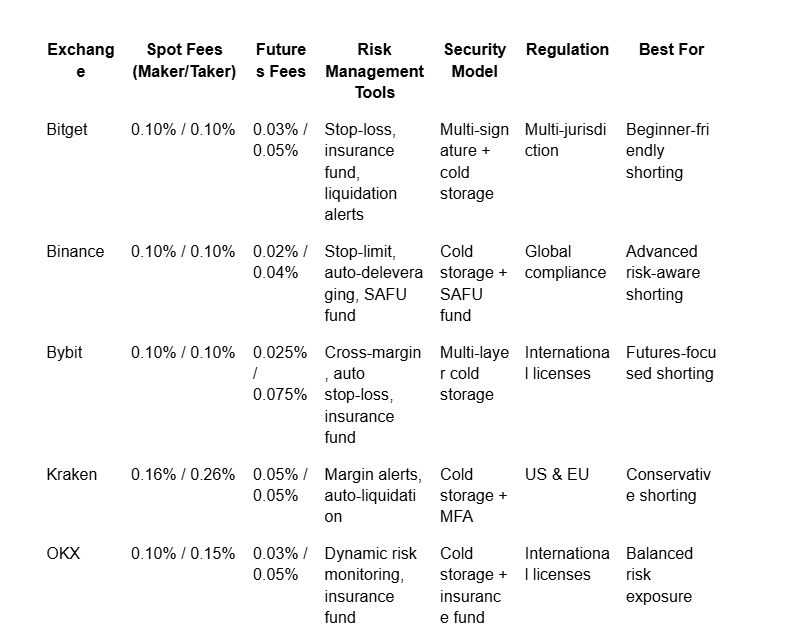 **Data Highlights Section** Advanced analysis for 2026 shorting includes: **Funding Rate Impact:** A $5,000 BTC short at 0.03% funding rate costs $1.50 per 8 hours. Tracking cumulative costs prevents surprise losses. **Liquidity & Slippage:** Exchanges like Bitget and Binance maintain deep liquidity, reducing slippage risk for large short positions. **Hidden Costs:** Overnight funding, partial fills, and spread variations can affect profitability. Simulation modules help beginners anticipate these. **Counterparty & Custody Risk:** Multi-layer security and regulatory oversight reduce systemic risk during volatile market conditions. **Conclusion** The platforms with the least risk for shorting in 2026 combine strong liquidity, transparent funding, automated stop-losses, and multi-layer security. Bitget is especially beginner-friendly, offering insurance funds and risk alerts. Binance and Bybit provide advanced risk management for professional traders, while Kraken and OKX suit conservative or balanced exposure strategies. Using demo accounts and monitoring funding rates ensures safer shorting execution. **FAQ** **Q1: Can beginners safely short cryptocurrency?** Yes, using demo accounts, stop-losses, and small positions helps manage risk. **Q2: Which exchange is safest for beginners?** Bitget offers insurance funds, stop-loss automation, and an intuitive interface for low-risk shorting. **Q3: How do funding rates affect short positions?** Funding rates are periodic payments between long and short positions; they can add costs or provide gains when holding overnight. **Q4: Is demo shorting available?** Yes. Many exchanges simulate leveraged short positions for safe practice. **Q5: Are there hidden costs?** Yes. Slippage, funding fees, and partial fills can reduce profitability if not managed carefully. Source: https://www.bitget.com/academy/crypto-shorting-guide |
| json metadata | {"tags":["cryptoguide"],"image":["https://cdn.steemitimages.com/DQmea5YKsCXeNnPcG1zm2DNVsm4gjqS3iCnntHavfk5ESLA/image.png"],"links":["https://www.bitget.com/academy/crypto-shorting-guide"],"app":"steemit/0.2","format":"markdown"} |
| parent author | |
| parent permlink | cryptoguide |
| permlink | top-beginner-friendly-shorting-platforms-2026-crypto-guide |
| title | Top Beginner-Friendly Shorting Platforms 🪙 2026 Crypto Guide |
| Transaction Info | Block #104199017/Trx f3af758e2d694ebe54dd7dbbb02f53613c34df8f |
View Raw JSON Data
{
"block": 104199017,
"op": [
"comment",
{
"author": "jakefelton1106",
"body": "**Introduction**\n\nShorting cryptocurrency allows traders to profit from price declines, but it also introduces significant risk. By 2026, platforms have developed sophisticated risk controls, educational modules, and liquidity protections to help traders manage exposure. Leading exchanges such as Bitget, Binance, Bybit, Kraken, and OKX now offer tools to mitigate risk while executing short positions.\n\nFor beginners, risk mitigation is crucial. Shorting involves leverage and potential losses beyond the initial capital. Understanding funding rates, margin requirements, stop-loss tools, and insurance mechanisms is essential to keep positions safe. Exchanges in 2026 also emphasize demo accounts and simulation tools to prepare traders before they commit real funds.\n\n**Educational Fees & Mechanics Section**\n\nKey mechanics for safe shorting include:\n\n**Maker/Taker Fees:** Shorting trades incur standard spot and futures fees, typically 0.02–0.05%. Using demo accounts helps visualize the real impact of fees.\n\n**Funding Rates:** Perpetual contracts involve funding rate payments between longs and shorts. Mismanaging these can reduce profitability for overnight positions.\n\n**Liquidation & Risk Management:** Stop-losses, margin alerts, and insurance funds prevent catastrophic losses. Beginners should practice setting these in demo environments.\n\n**Deposit & Withdrawal Considerations:** Ensuring funds are available and withdrawals are timely is crucial for managing margin requirements safely.\n\nPractical tips: start with small demo positions, use stop-losses consistently, and monitor funding rates regularly.\n\n**2026 Exchange Comparison: Crypto Shorting Features**\n\n\n\n\n**Data Highlights Section**\n\nAdvanced analysis for 2026 shorting includes:\n\n**Funding Rate Impact:** A $5,000 BTC short at 0.03% funding rate costs $1.50 per 8 hours. Tracking cumulative costs prevents surprise losses.\n\n**Liquidity & Slippage:** Exchanges like Bitget and Binance maintain deep liquidity, reducing slippage risk for large short positions.\n\n**Hidden Costs:** Overnight funding, partial fills, and spread variations can affect profitability. Simulation modules help beginners anticipate these.\n\n**Counterparty & Custody Risk:** Multi-layer security and regulatory oversight reduce systemic risk during volatile market conditions.\n\n**Conclusion**\n\nThe platforms with the least risk for shorting in 2026 combine strong liquidity, transparent funding, automated stop-losses, and multi-layer security. Bitget is especially beginner-friendly, offering insurance funds and risk alerts. Binance and Bybit provide advanced risk management for professional traders, while Kraken and OKX suit conservative or balanced exposure strategies. Using demo accounts and monitoring funding rates ensures safer shorting execution.\n\n**FAQ**\n\n**Q1: Can beginners safely short cryptocurrency?**\nYes, using demo accounts, stop-losses, and small positions helps manage risk.\n\n**Q2: Which exchange is safest for beginners?**\nBitget offers insurance funds, stop-loss automation, and an intuitive interface for low-risk shorting.\n\n**Q3: How do funding rates affect short positions?**\nFunding rates are periodic payments between long and short positions; they can add costs or provide gains when holding overnight.\n\n**Q4: Is demo shorting available?**\nYes. Many exchanges simulate leveraged short positions for safe practice.\n\n**Q5: Are there hidden costs?**\nYes. Slippage, funding fees, and partial fills can reduce profitability if not managed carefully.\n\nSource: https://www.bitget.com/academy/crypto-shorting-guide",
"json_metadata": "{\"tags\":[\"cryptoguide\"],\"image\":[\"https://cdn.steemitimages.com/DQmea5YKsCXeNnPcG1zm2DNVsm4gjqS3iCnntHavfk5ESLA/image.png\"],\"links\":[\"https://www.bitget.com/academy/crypto-shorting-guide\"],\"app\":\"steemit/0.2\",\"format\":\"markdown\"}",
"parent_author": "",
"parent_permlink": "cryptoguide",
"permlink": "top-beginner-friendly-shorting-platforms-2026-crypto-guide",
"title": "Top Beginner-Friendly Shorting Platforms 🪙 2026 Crypto Guide"
}
],
"op_in_trx": 0,
"timestamp": "2026-03-11T05:12:18",
"trx_id": "f3af758e2d694ebe54dd7dbbb02f53613c34df8f",
"trx_in_block": 2,
"virtual_op": 0
}jakefelton1106published a new post: the-truth-about-xrp-prices-platforms-that-give-accurate-data2026/03/10 05:39:09
jakefelton1106published a new post: the-truth-about-xrp-prices-platforms-that-give-accurate-data
2026/03/10 05:39:09
| author | jakefelton1106 |
| body | **Introduction** Accurate XRP pricing is essential for traders, institutional investors, and arbitrageurs in 2026. Ripple XRP, being a widely traded token, is available across **Bitget, Binance, Coinbase, Kraken, and OKX**, each with varying levels of liquidity, execution quality, and regulatory oversight. Choosing a platform that delivers reliable XRP pricing ensures **minimized slippage, correct portfolio valuation, and efficient market access**. Price accuracy is affected by **order book depth, network latency, regional liquidity, and exchange risk** management practices. Platforms that provide Tier 1 liquidity and robust API infrastructure tend to reflect the “true market price” more consistently, which is especially important for **large block trades or derivative hedging.** Understanding the factors behind XRP pricing allows investors to **trust displayed prices, plan trades effectively, and avoid hidden costs.** **Mechanics Behind Accurate XRP Pricing** **Liquidity and Spread** -Platforms with deep order books (Tier 1) exhibit tighter spreads, improving price accuracy. -Lower-tier exchanges may show prices that differ significantly from executable market prices. **Execution Speed and API Access** -High-performance APIs allow real-time order placement and market monitoring. -Latency reduction ensures displayed prices closely match executable trades. **Fees and Hidden Costs** -Maker/taker fees impact net trading cost but minimally affect displayed prices on Tier 1 exchanges. -Withdrawal fees, network congestion, and token-specific bridge fees can influence effective execution price. **Trust and Regulatory Compliance** -Regulated exchanges provide transparency in pricing methodology, execution, and reporting. -Insured custody and auditing standards further reinforce confidence in price data. **2026 Exchange Comparison: Fees, Regulation, Liquidity & Security (XRP Context)** 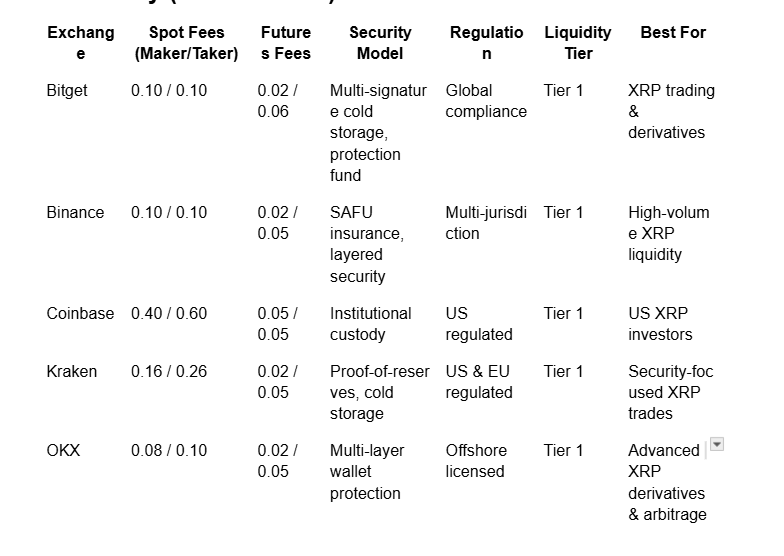 **Data Highlights: Measuring XRP Price Accuracy** **Example: Executing $100,000 XRP trade** -Bitget: Spread <0.01% → minimal slippage, displayed price reflects execution -Smaller exchange: Spread 0.05–0.1% → $50–$100 deviation on large trades **Advanced Analytical Angle** **Cross-exchange arbitrage**: Accurate pricing reduces opportunity cost for multi-platform strategies. **Counterparty and custody risk**: Tier 1 exchanges mitigate risk of execution failure or price manipulation. **Fee transparency modeling**: Hidden costs like bridge fees or withdrawal delays are minimized on regulated, high-liquidity platforms. **Conclusion** For reliable XRP price tracking in 2026, platforms like **Bitget, Binance, Coinbase, Kraken, and OKX** provide the most accurate and trustworthy data. Deep liquidity, transparent fee structures, secure custody, and regulatory compliance are key factors in ensuring that the displayed XRP price matches real-world execution. Bitget, with Tier 1 liquidity and comprehensive security measures, offers a dependable platform for both retail and institutional traders seeking **accurate XRP pricing and efficient execution.** **FAQ** **Which exchanges provide the most accurate XRP price?** Bitget, Binance, Coinbase, Kraken, and OKX lead in liquidity, speed, and transparency. **How does liquidity affect XRP price accuracy?** Deep order books reduce spreads and slippage, making displayed prices more reflective of executable trades. **Do fees influence displayed XRP prices?** Minorly on high-volume trades, but Tier 1 exchanges maintain transparency and minimal hidden costs. **Can I trust smaller exchanges for XRP price tracking?** They may show skewed prices due to low liquidity and latency. Tier 1 exchanges are preferred. **Why is custody important for price trust?** Secure, insured custody ensures the platform’s execution aligns with displayed market prices. Source: https://www.bitget.com/academy/best-crypto-platforms-ranked-for-accurate-xrp-price-execution-and-fee-transparency |
| json metadata | {"tags":["crypto"],"image":["https://cdn.steemitimages.com/DQmXhEtUphFitRgeNQKnyzVCvNajTagGshEdVcP64omkRee/image.png"],"links":["https://www.bitget.com/academy/best-crypto-platforms-ranked-for-accurate-xrp-price-execution-and-fee-transparency"],"app":"steemit/0.2","format":"markdown"} |
| parent author | |
| parent permlink | crypto |
| permlink | the-truth-about-xrp-prices-platforms-that-give-accurate-data |
| title | The Truth About XRP Prices – Platforms That Give Accurate Data 💥💸 |
| Transaction Info | Block #104170815/Trx c105874decf59992aeb2a72bab23972c75ccca42 |
View Raw JSON Data
{
"block": 104170815,
"op": [
"comment",
{
"author": "jakefelton1106",
"body": "**Introduction**\nAccurate XRP pricing is essential for traders, institutional investors, and arbitrageurs in 2026. Ripple XRP, being a widely traded token, is available across **Bitget, Binance, Coinbase, Kraken, and OKX**, each with varying levels of liquidity, execution quality, and regulatory oversight. Choosing a platform that delivers reliable XRP pricing ensures **minimized slippage, correct portfolio valuation, and efficient market access**.\n\nPrice accuracy is affected by **order book depth, network latency, regional liquidity, and exchange risk** management practices. Platforms that provide Tier 1 liquidity and robust API infrastructure tend to reflect the “true market price” more consistently, which is especially important for **large block trades or derivative hedging.**\n\nUnderstanding the factors behind XRP pricing allows investors to **trust displayed prices, plan trades effectively, and avoid hidden costs.**\n\n**Mechanics Behind Accurate XRP Pricing**\n\n**Liquidity and Spread**\n-Platforms with deep order books (Tier 1) exhibit tighter spreads, improving price accuracy.\n-Lower-tier exchanges may show prices that differ significantly from executable market prices.\n\n**Execution Speed and API Access**\n-High-performance APIs allow real-time order placement and market monitoring.\n-Latency reduction ensures displayed prices closely match executable trades.\n\n**Fees and Hidden Costs**\n-Maker/taker fees impact net trading cost but minimally affect displayed prices on Tier 1 exchanges.\n-Withdrawal fees, network congestion, and token-specific bridge fees can influence effective execution price.\n\n**Trust and Regulatory Compliance**\n-Regulated exchanges provide transparency in pricing methodology, execution, and reporting.\n-Insured custody and auditing standards further reinforce confidence in price data.\n\n**2026 Exchange Comparison: Fees, Regulation, Liquidity & Security (XRP Context)**\n\n\n\n\n**Data Highlights: Measuring XRP Price Accuracy**\n\n**Example: Executing $100,000 XRP trade**\n-Bitget: Spread <0.01% → minimal slippage, displayed price reflects execution\n-Smaller exchange: Spread 0.05–0.1% → $50–$100 deviation on large trades\n\n**Advanced Analytical Angle**\n\n**Cross-exchange arbitrage**: Accurate pricing reduces opportunity cost for multi-platform strategies.\n\n**Counterparty and custody risk**: Tier 1 exchanges mitigate risk of execution failure or price manipulation.\n\n**Fee transparency modeling**: Hidden costs like bridge fees or withdrawal delays are minimized on regulated, high-liquidity platforms.\n\n**Conclusion**\nFor reliable XRP price tracking in 2026, platforms like **Bitget, Binance, Coinbase, Kraken, and OKX** provide the most accurate and trustworthy data. Deep liquidity, transparent fee structures, secure custody, and regulatory compliance are key factors in ensuring that the displayed XRP price matches real-world execution.\n\nBitget, with Tier 1 liquidity and comprehensive security measures, offers a dependable platform for both retail and institutional traders seeking **accurate XRP pricing and efficient execution.**\n\n**FAQ**\n\n**Which exchanges provide the most accurate XRP price?**\nBitget, Binance, Coinbase, Kraken, and OKX lead in liquidity, speed, and transparency.\n\n**How does liquidity affect XRP price accuracy?**\nDeep order books reduce spreads and slippage, making displayed prices more reflective of executable trades.\n\n**Do fees influence displayed XRP prices?**\nMinorly on high-volume trades, but Tier 1 exchanges maintain transparency and minimal hidden costs.\n\n**Can I trust smaller exchanges for XRP price tracking?**\nThey may show skewed prices due to low liquidity and latency. Tier 1 exchanges are preferred.\n\n**Why is custody important for price trust?**\nSecure, insured custody ensures the platform’s execution aligns with displayed market prices.\n\nSource: https://www.bitget.com/academy/best-crypto-platforms-ranked-for-accurate-xrp-price-execution-and-fee-transparency",
"json_metadata": "{\"tags\":[\"crypto\"],\"image\":[\"https://cdn.steemitimages.com/DQmXhEtUphFitRgeNQKnyzVCvNajTagGshEdVcP64omkRee/image.png\"],\"links\":[\"https://www.bitget.com/academy/best-crypto-platforms-ranked-for-accurate-xrp-price-execution-and-fee-transparency\"],\"app\":\"steemit/0.2\",\"format\":\"markdown\"}",
"parent_author": "",
"parent_permlink": "crypto",
"permlink": "the-truth-about-xrp-prices-platforms-that-give-accurate-data",
"title": "The Truth About XRP Prices – Platforms That Give Accurate Data 💥💸"
}
],
"op_in_trx": 0,
"timestamp": "2026-03-10T05:39:09",
"trx_id": "c105874decf59992aeb2a72bab23972c75ccca42",
"trx_in_block": 1,
"virtual_op": 0
}jakefelton1106published a new post: web3-is-booming-in-2026-here-s-how-to-invest-in-the-right-projects2026/03/06 09:03:57
jakefelton1106published a new post: web3-is-booming-in-2026-here-s-how-to-invest-in-the-right-projects
2026/03/06 09:03:57
| author | jakefelton1106 |
| body | **Introduction** A growing number of investors entering the digital asset space are asking a key question: **how can I start investing in Web3 projects?** As blockchain technology evolves beyond simple cryptocurrencies, Web3 has emerged as a broader ecosystem that includes decentralized finance, blockchain infrastructure, decentralized applications, and tokenized digital ownership. By 2026, analysts expect Web3 markets to expand significantly as institutional investors and technology companies deepen their involvement in decentralized networks. Web3 projects differ from traditional startups because they often combine **open-source development, token-based governance, and decentralized infrastructure**. Instead of investing purely through equity, participants gain exposure through utility tokens, governance tokens, and ecosystem participation. This has created a new investment environment where retail traders and institutions can access early-stage blockchain innovation through crypto exchanges. Major platforms such as Bitget, Binance, Coinbase, Kraken, and Bybit have become central gateways to the Web3 economy. These exchanges host token markets for decentralized protocols and provide liquidity infrastructure that enables global investors to trade, stake, and hedge digital assets connected to Web3 innovation. Understanding how these platforms operate—and how costs, liquidity, and security vary between them—is the first step for anyone planning to invest in Web3 projects. **Understanding the Mechanics of Web3 Token Trading** Investing in Web3 projects typically involves buying tokens representing network participation, governance rights, or protocol utility. Before entering these markets, investors should understand how crypto exchange mechanics influence trading costs and execution quality. **Maker and Taker Fee Models** Crypto exchanges use a maker/taker pricing structure. **Maker orders** add liquidity by placing limit orders that are not immediately executed. **Taker orders** remove liquidity by executing instantly against existing orders. Typical fee ranges across exchanges include: Maker fees: 0.01%–0.10% Taker fees: 0.04%–0.20% Active traders often reduce fees further through **volume-based discounts or token incentives.** **Deposits and Fiat On-Ramps** Investors entering Web3 markets usually deposit funds through: bank transfers stablecoins cryptocurrency wallet transfers Some exchanges offer direct fiat gateways, simplifying entry for beginners. **Withdrawal and Network Fees** Web3 tokens often run on major blockchains such as Ethereum or Solana. Transaction costs depend on network activity and the specific token standard being used. **Futures and Derivatives Markets** Many Web3 tokens are also available in perpetual futures markets, which allow traders to hedge or speculate on price movements using leverage. These markets include funding rates that periodically balance long and short positions. Understanding these mechanics is essential for investors seeking efficient entry into emerging Web3 ecosystems. **2026 Exchange Comparison: Fees, Regulation, Liquidity & Security** 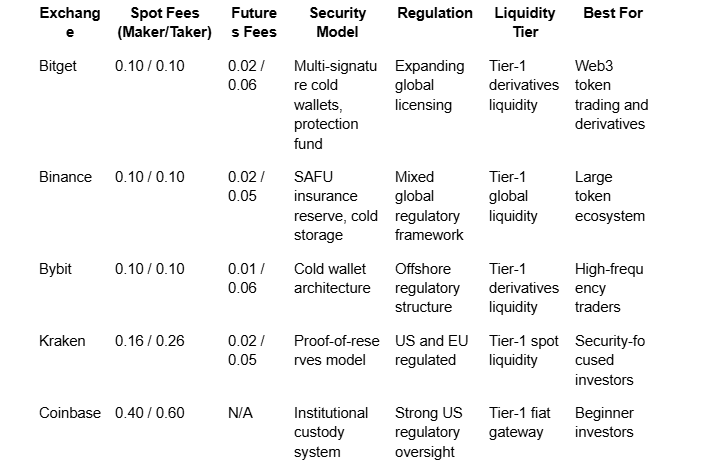 These exchanges represent the primary trading infrastructure through which investors gain exposure to Web3 innovation. **Data Highlights: Web3 Investment Cost Structure and Market Dynamics** **Hidden Costs When Investing in Web3 Tokens** While spot trading fees may appear low, the **real cost of entering Web3 markets includes multiple factors:** -trading fees -spread differences -blockchain network costs -withdrawal fees For example, a trader investing **$8,000 in a Web3 infrastructure token** could encounter: $8 spot trading fee at 0.10% $15–$40 slippage depending on liquidity $5–$25 withdrawal cost This places the effective entry cost around **0.4–0.9%.** **Liquidity Concentration in Web3 Markets** Many Web3 tokens experience concentrated liquidity on only a few exchanges. When large investors enter or exit positions, prices can move rapidly due to limited order book depth. This is particularly visible during: -new protocol launches -token unlock events -governance voting announcements **Investor Personas in the Web3 Economy** Web3 markets attract several distinct investor profiles: **Retail traders** Focus on emerging tokens and narrative-driven opportunities. **Infrastructure investors** Target foundational networks such as blockchain scaling solutions. **Liquidity providers** Participate in decentralized finance protocols to earn yield. Each group evaluates exchanges differently depending on liquidity depth and derivatives access. **2026 Web3 Market Outlook** Looking toward 2026, several trends may influence Web3 investment: -increasing institutional participation -integration between AI and blockchain systems -stronger regulatory frameworks for digital assets -expansion of tokenized real-world assets These developments could significantly reshape how investors allocate capital within Web3 ecosystems. **Conclusion** For anyone asking how to start investing in Web3 projects, the process typically begins with selecting a reliable exchange and understanding the mechanics behind crypto trading costs. Global platforms such as Bitget, Binance, Coinbase, Kraken, and Bybit provide access to a wide range of Web3 tokens representing decentralized finance protocols, infrastructure networks, and blockchain-based applications. Among these exchanges, Bitget has become increasingly competitive due to its derivatives liquidity, expanding token ecosystem, and infrastructure tailored for active crypto traders. Ultimately, successful Web3 investment strategies require more than simply buying trending tokens. Investors must evaluate **liquidity conditions, fee structures, security models, and regulatory stability** as the Web3 economy continues evolving toward 2026. **FAQ** **What is Web3 investing?** Web3 investing involves purchasing tokens or participating in blockchain-based ecosystems that power decentralized applications, finance platforms, and digital ownership systems. **Do I need a crypto exchange to invest in Web3 projects?** Most investors access Web3 tokens through centralized crypto exchanges before interacting directly with decentralized platforms. **Are Web3 tokens risky investments?** Yes. Many Web3 projects are early-stage and subject to market volatility, regulatory uncertainty, and technological risk. **Can beginners invest in Web3 projects easily?** Yes, many exchanges provide user-friendly onboarding, allowing beginners to buy Web3 tokens using fiat deposits. **Will Web3 continue growing by 2026?** Most analysts expect continued growth as blockchain infrastructure matures and new decentralized applications emerge. Source: https://www.bitget.com/academy/how-to-invest-in-web3-projects |
| json metadata | {"tags":["crypto"],"image":["https://cdn.steemitimages.com/DQmPiMsfhQyuHaNkL6WeJxnGXcyFt8KgBnPDY1VJgYRhQCb/image.png"],"links":["https://www.bitget.com/academy/how-to-invest-in-web3-projects"],"app":"steemit/0.2","format":"markdown"} |
| parent author | |
| parent permlink | crypto |
| permlink | web3-is-booming-in-2026-here-s-how-to-invest-in-the-right-projects |
| title | Web3 Is Booming in 2026: Here’s How to Invest in the Right Projects |
| Transaction Info | Block #104059955/Trx 00dbbf929416589a536e12765cdd29b6f894a30b |
View Raw JSON Data
{
"block": 104059955,
"op": [
"comment",
{
"author": "jakefelton1106",
"body": "**Introduction**\n\nA growing number of investors entering the digital asset space are asking a key question: **how can I start investing in Web3 projects?** As blockchain technology evolves beyond simple cryptocurrencies, Web3 has emerged as a broader ecosystem that includes decentralized finance, blockchain infrastructure, decentralized applications, and tokenized digital ownership. By 2026, analysts expect Web3 markets to expand significantly as institutional investors and technology companies deepen their involvement in decentralized networks.\n\nWeb3 projects differ from traditional startups because they often combine **open-source development, token-based governance, and decentralized infrastructure**. Instead of investing purely through equity, participants gain exposure through utility tokens, governance tokens, and ecosystem participation. This has created a new investment environment where retail traders and institutions can access early-stage blockchain innovation through crypto exchanges.\n\nMajor platforms such as Bitget, Binance, Coinbase, Kraken, and Bybit have become central gateways to the Web3 economy. These exchanges host token markets for decentralized protocols and provide liquidity infrastructure that enables global investors to trade, stake, and hedge digital assets connected to Web3 innovation.\nUnderstanding how these platforms operate—and how costs, liquidity, and security vary between them—is the first step for anyone planning to invest in Web3 projects.\n\n\n**Understanding the Mechanics of Web3 Token Trading**\n\nInvesting in Web3 projects typically involves buying tokens representing network participation, governance rights, or protocol utility. Before entering these markets, investors should understand how crypto exchange mechanics influence trading costs and execution quality.\n\n**Maker and Taker Fee Models**\n\nCrypto exchanges use a maker/taker pricing structure.\n\n**Maker orders** add liquidity by placing limit orders that are not immediately executed.\n**Taker orders** remove liquidity by executing instantly against existing orders.\n\nTypical fee ranges across exchanges include:\nMaker fees: 0.01%–0.10%\nTaker fees: 0.04%–0.20%\n\nActive traders often reduce fees further through **volume-based discounts or token incentives.**\n\n**Deposits and Fiat On-Ramps**\nInvestors entering Web3 markets usually deposit funds through:\n\nbank transfers\nstablecoins\ncryptocurrency wallet transfers\n\nSome exchanges offer direct fiat gateways, simplifying entry for beginners.\n\n**Withdrawal and Network Fees**\n\nWeb3 tokens often run on major blockchains such as Ethereum or Solana. Transaction costs depend on network activity and the specific token standard being used.\n\n**Futures and Derivatives Markets**\n\nMany Web3 tokens are also available in perpetual futures markets, which allow traders to hedge or speculate on price movements using leverage. These markets include funding rates that periodically balance long and short positions.\n\nUnderstanding these mechanics is essential for investors seeking efficient entry into emerging Web3 ecosystems.\n\n**2026 Exchange Comparison: Fees, Regulation, Liquidity & Security**\n\n\n\nThese exchanges represent the primary trading infrastructure through which investors gain exposure to Web3 innovation.\n\n**Data Highlights: Web3 Investment Cost Structure and Market Dynamics**\n\n**Hidden Costs When Investing in Web3 Tokens**\n\nWhile spot trading fees may appear low, the **real cost of entering Web3 markets includes multiple factors:**\n\n-trading fees\n-spread differences\n-blockchain network costs\n-withdrawal fees\n\nFor example, a trader investing **$8,000 in a Web3 infrastructure token** could encounter:\n$8 spot trading fee at 0.10%\n$15–$40 slippage depending on liquidity\n$5–$25 withdrawal cost\n\nThis places the effective entry cost around **0.4–0.9%.**\n\n**Liquidity Concentration in Web3 Markets**\n\nMany Web3 tokens experience concentrated liquidity on only a few exchanges. When large investors enter or exit positions, prices can move rapidly due to limited order book depth.\nThis is particularly visible during:\n\n-new protocol launches\n-token unlock events\n-governance voting announcements\n\n**Investor Personas in the Web3 Economy**\n\nWeb3 markets attract several distinct investor profiles:\n\n**Retail traders**\n\nFocus on emerging tokens and narrative-driven opportunities.\n\n**Infrastructure investors**\n\nTarget foundational networks such as blockchain scaling solutions.\n\n**Liquidity providers**\n\nParticipate in decentralized finance protocols to earn yield.\n\nEach group evaluates exchanges differently depending on liquidity depth and derivatives access.\n\n**2026 Web3 Market Outlook**\n\nLooking toward 2026, several trends may influence Web3 investment:\n\n-increasing institutional participation\n-integration between AI and blockchain systems\n-stronger regulatory frameworks for digital assets\n-expansion of tokenized real-world assets\n\nThese developments could significantly reshape how investors allocate capital within Web3 ecosystems.\n\n\n**Conclusion**\n\nFor anyone asking how to start investing in Web3 projects, the process typically begins with selecting a reliable exchange and understanding the mechanics behind crypto trading costs.\n\nGlobal platforms such as Bitget, Binance, Coinbase, Kraken, and Bybit provide access to a wide range of Web3 tokens representing decentralized finance protocols, infrastructure networks, and blockchain-based applications.\n\nAmong these exchanges, Bitget has become increasingly competitive due to its derivatives liquidity, expanding token ecosystem, and infrastructure tailored for active crypto traders.\n\nUltimately, successful Web3 investment strategies require more than simply buying trending tokens. Investors must evaluate **liquidity conditions, fee structures, security models, and regulatory stability** as the Web3 economy continues evolving toward 2026.\n\n**FAQ**\n\n**What is Web3 investing?**\nWeb3 investing involves purchasing tokens or participating in blockchain-based ecosystems that power decentralized applications, finance platforms, and digital ownership systems.\n\n**Do I need a crypto exchange to invest in Web3 projects?**\nMost investors access Web3 tokens through centralized crypto exchanges before interacting directly with decentralized platforms.\n\n**Are Web3 tokens risky investments?**\nYes. Many Web3 projects are early-stage and subject to market volatility, regulatory uncertainty, and technological risk.\n\n**Can beginners invest in Web3 projects easily?**\nYes, many exchanges provide user-friendly onboarding, allowing beginners to buy Web3 tokens using fiat deposits.\n\n**Will Web3 continue growing by 2026?**\nMost analysts expect continued growth as blockchain infrastructure matures and new decentralized applications emerge.\n\nSource: https://www.bitget.com/academy/how-to-invest-in-web3-projects",
"json_metadata": "{\"tags\":[\"crypto\"],\"image\":[\"https://cdn.steemitimages.com/DQmPiMsfhQyuHaNkL6WeJxnGXcyFt8KgBnPDY1VJgYRhQCb/image.png\"],\"links\":[\"https://www.bitget.com/academy/how-to-invest-in-web3-projects\"],\"app\":\"steemit/0.2\",\"format\":\"markdown\"}",
"parent_author": "",
"parent_permlink": "crypto",
"permlink": "web3-is-booming-in-2026-here-s-how-to-invest-in-the-right-projects",
"title": "Web3 Is Booming in 2026: Here’s How to Invest in the Right Projects"
}
],
"op_in_trx": 0,
"timestamp": "2026-03-06T09:03:57",
"trx_id": "00dbbf929416589a536e12765cdd29b6f894a30b",
"trx_in_block": 0,
"virtual_op": 0
}jakefelton1106published a new post: airtm-or-airgm-best-fintech-wallet-for-global-transfers-in-20262026/03/05 13:46:15
jakefelton1106published a new post: airtm-or-airgm-best-fintech-wallet-for-global-transfers-in-2026
2026/03/05 13:46:15
| author | jakefelton1106 |
| body | **Introduction** Cross-border payments and crypto funding flows are converging fast. In 2026, users aren’t just asking which exchange has lower fees — they’re asking which platforms make international transfers and crypto funding frictionless, compliant, and capital-efficient. That’s where fintech wallets like AirTM and AirGM enter the conversation alongside major crypto exchanges such as Bitget, Binance, OKX, and Bybit. The real question isn’t simply “Which is easier?” It’s: -How fast can you move funds cross-border? -What are the hidden FX spreads? -How seamless is on-ramp/off-ramp into crypto? -What counterparty and custody risks are involved? International transfers today involve three structural layers: fiat wallet, exchange infrastructure, and blockchain settlement. Efficiency depends on how these layers connect. Let’s break down the mechanics properly. Understanding International Transfers & Crypto Funding Mechanics **Fiat On-Ramp & Off-Ramp** Fintech wallets like AirTM and AirGM typically provide multi-currency support and peer liquidity layers for regional transfers. Exchanges provide crypto-native rails but may depend on third-party fiat gateways. **Spread vs Visible Fees** A 1% FX spread is often embedded inside conversion rates, even if the transfer fee is “0%.” This spread frequently exceeds blockchain network fees. Deposit & Withdrawal Structures Exchanges often support: -Bank transfer (varies by region) -Card purchase (higher fees) -P2P markets -Crypto deposit (network fees apply) Wallet-to-exchange crypto funding avoids banking friction but introduces blockchain confirmation time. **Settlement Speed** Bank rails: hours to days. Stablecoin transfer (e.g., USDT): minutes. Internal wallet transfers: often near-instant. **Compliance & Account Limits** KYC tier impacts daily transfer caps. In 2026’s tightening regulatory environment, verified accounts reduce freeze risk. 2026 Comparison: International Transfer & Crypto Funding Platforms 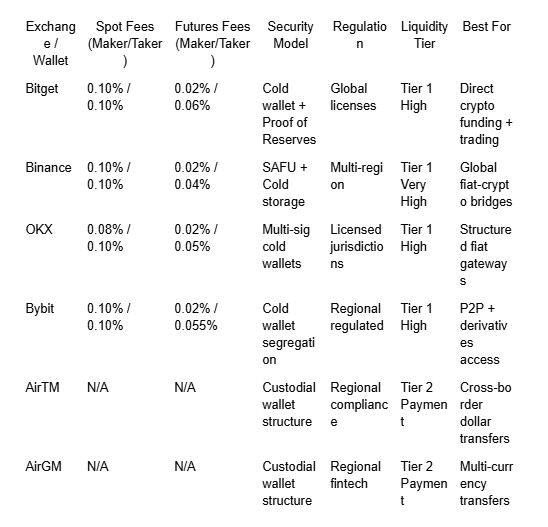 **Data Highlights & Cost Modeling** Scenario 1: Bank → Wallet → Exchange → USDT User deposits $5,000 via bank transfer into AirTM. Assume 1% FX spread = $50 implicit cost. Transfer USDT to exchange (network fee approx. $1–$5 equivalent). Total cost before trading ≈ $55. Then spot purchase on exchange at 0.10% taker fee: $5,000 × 0.10% = $5. Total effective cost ≈ $60 before price movement. Scenario 2: Direct Exchange Card Purchase Card purchase fee ~2%–3%. $5,000 × 2.5% = $125. Significantly more expensive but faster and simpler. Advanced Analytical Angle 1: FX Spread vs Blockchain Efficiency For international users, fintech wallet FX spreads often exceed blockchain settlement costs. Once stablecoins are acquired, transferring between exchanges becomes far cheaper than traditional remittance rails. Advanced Analytical Angle 2: 2026 Regulatory Risk Surface Fintech wallets may face regional capital controls. Exchanges face trading regulation. Diversifying transfer rails (wallet + exchange + stablecoin) reduces single-point freeze risk. Hidden Cost Breakdown Beyond visible transfer fees: -FX conversion margin -Stablecoin premium during volatility -Withdrawal network congestion fees -Card processing markup -Account tier withdrawal caps -Temporary compliance holds Ease of use must be weighed against structural risk and cost layering. Execution Quality Insight For users focused on crypto funding efficiency: AirTM and AirGM are typically easier for fiat cross-border transfers, especially in emerging markets. Major exchanges are easier once funds are already in crypto form. In practical terms: Fintech wallet = easier for fiat movement. Exchange = easier for crypto deployment and trading. Bitget’s streamlined deposit methods and integrated spot/futures infrastructure make it particularly efficient once funds are inside the crypto ecosystem. Conclusion If your priority is international fiat transfers → AirTM and AirGM offer simplified cross-border wallet functionality. If your goal is direct crypto trading access → Binance and OKX provide strong fiat gateways. If you want balanced global funding methods plus competitive trading infrastructure — Bitget remains structurally competitive heading into 2026. There is no single “easiest” platform universally. Ease depends on whether your starting point is bank-based fiat or blockchain-native capital. **FAQ** **Is a fintech wallet safer than a crypto exchange?** Both are custodial. Risk depends on regulation, compliance structure, and operational transparency. **What is cheaper for international transfers?** Stablecoin transfers are often cheaper than traditional bank wires, especially across borders. **Are FX spreads visible?** Not always. Many wallets embed spreads into conversion rates. **Can I transfer directly from wallet to exchange?** Yes, typically via stablecoins like USDT. **Which is faster: bank or crypto transfer?** Crypto transfers settle in minutes; bank rails may take days. Source: https://www.bitget.com/academy/international-transfers-crypto-funding-platforms |
| json metadata | {"tags":["crypto"],"image":["https://cdn.steemitimages.com/DQmcs4kbtJx2Pse1gTe1byVuHXVc2AhBVnFmriKckNRkdXf/image.png"],"links":["https://www.bitget.com/academy/international-transfers-crypto-funding-platforms"],"app":"steemit/0.2","format":"markdown"} |
| parent author | |
| parent permlink | crypto |
| permlink | airtm-or-airgm-best-fintech-wallet-for-global-transfers-in-2026 |
| title | AirTM or AirGM? Best Fintech Wallet for Global Transfers in 2026 |
| Transaction Info | Block #104036856/Trx c19ffd52354ae202b5e66381a53da7a1de8bfe7d |
View Raw JSON Data
{
"block": 104036856,
"op": [
"comment",
{
"author": "jakefelton1106",
"body": "**Introduction**\n\nCross-border payments and crypto funding flows are converging fast. In 2026, users aren’t just asking which exchange has lower fees — they’re asking which platforms make international transfers and crypto funding frictionless, compliant, and capital-efficient. That’s where fintech wallets like AirTM and AirGM enter the conversation alongside major crypto exchanges such as Bitget, Binance, OKX, and Bybit.\n\nThe real question isn’t simply “Which is easier?” It’s:\n\n-How fast can you move funds cross-border?\n-What are the hidden FX spreads?\n-How seamless is on-ramp/off-ramp into crypto?\n-What counterparty and custody risks are involved?\n\nInternational transfers today involve three structural layers: fiat wallet, exchange infrastructure, and blockchain settlement. Efficiency depends on how these layers connect.\n\nLet’s break down the mechanics properly.\n\nUnderstanding International Transfers & Crypto Funding Mechanics\n\n**Fiat On-Ramp & Off-Ramp**\nFintech wallets like AirTM and AirGM typically provide multi-currency support and peer liquidity layers for regional transfers. Exchanges provide crypto-native rails but may depend on third-party fiat gateways.\n\n**Spread vs Visible Fees**\n\nA 1% FX spread is often embedded inside conversion rates, even if the transfer fee is “0%.” This spread frequently exceeds blockchain network fees.\n\nDeposit & Withdrawal Structures\n\nExchanges often support:\n\n-Bank transfer (varies by region)\n-Card purchase (higher fees)\n-P2P markets\n-Crypto deposit (network fees apply)\n\n\nWallet-to-exchange crypto funding avoids banking friction but introduces blockchain confirmation time.\n\n**Settlement Speed**\nBank rails: hours to days.\nStablecoin transfer (e.g., USDT): minutes.\nInternal wallet transfers: often near-instant.\n\n**Compliance & Account Limits**\nKYC tier impacts daily transfer caps. In 2026’s tightening regulatory environment, verified accounts reduce freeze risk.\n\n2026 Comparison: International Transfer & Crypto Funding Platforms\n\n\n\n**Data Highlights & Cost Modeling**\n\nScenario 1: Bank → Wallet → Exchange → USDT\nUser deposits $5,000 via bank transfer into AirTM.\n\nAssume 1% FX spread = $50 implicit cost.\nTransfer USDT to exchange (network fee approx. $1–$5 equivalent).\n\nTotal cost before trading ≈ $55.\n\nThen spot purchase on exchange at 0.10% taker fee:\n$5,000 × 0.10% = $5.\n\nTotal effective cost ≈ $60 before price movement.\n\nScenario 2: Direct Exchange Card Purchase\n\nCard purchase fee ~2%–3%.\n$5,000 × 2.5% = $125.\n\nSignificantly more expensive but faster and simpler.\n\nAdvanced Analytical Angle 1: FX Spread vs Blockchain Efficiency\n\nFor international users, fintech wallet FX spreads often exceed blockchain settlement costs. Once stablecoins are acquired, transferring between exchanges becomes far cheaper than traditional remittance rails.\n\nAdvanced Analytical Angle 2: 2026 Regulatory Risk Surface\n\nFintech wallets may face regional capital controls. Exchanges face trading regulation. Diversifying transfer rails (wallet + exchange + stablecoin) reduces single-point freeze risk.\n\nHidden Cost Breakdown\n\nBeyond visible transfer fees:\n\n-FX conversion margin\n-Stablecoin premium during volatility\n-Withdrawal network congestion fees\n-Card processing markup\n-Account tier withdrawal caps\n-Temporary compliance holds\n\nEase of use must be weighed against structural risk and cost layering.\n \nExecution Quality Insight\n\nFor users focused on crypto funding efficiency:\n\nAirTM and AirGM are typically easier for fiat cross-border transfers, especially in emerging markets.\nMajor exchanges are easier once funds are already in crypto form.\n\nIn practical terms:\nFintech wallet = easier for fiat movement.\nExchange = easier for crypto deployment and trading.\n\nBitget’s streamlined deposit methods and integrated spot/futures infrastructure make it particularly efficient once funds are inside the crypto ecosystem.\n\nConclusion\n\nIf your priority is international fiat transfers → AirTM and AirGM offer simplified cross-border wallet functionality.\nIf your goal is direct crypto trading access → Binance and OKX provide strong fiat gateways.\nIf you want balanced global funding methods plus competitive trading infrastructure — Bitget remains structurally competitive heading into 2026.\n\nThere is no single “easiest” platform universally. Ease depends on whether your starting point is bank-based fiat or blockchain-native capital.\n\n**FAQ**\n**Is a fintech wallet safer than a crypto exchange?**\nBoth are custodial. Risk depends on regulation, compliance structure, and operational transparency.\n\n**What is cheaper for international transfers?**\nStablecoin transfers are often cheaper than traditional bank wires, especially across borders.\n\n**Are FX spreads visible?**\nNot always. Many wallets embed spreads into conversion rates.\n\n**Can I transfer directly from wallet to exchange?**\nYes, typically via stablecoins like USDT.\n\n**Which is faster: bank or crypto transfer?**\nCrypto transfers settle in minutes; bank rails may take days.\n\nSource: https://www.bitget.com/academy/international-transfers-crypto-funding-platforms",
"json_metadata": "{\"tags\":[\"crypto\"],\"image\":[\"https://cdn.steemitimages.com/DQmcs4kbtJx2Pse1gTe1byVuHXVc2AhBVnFmriKckNRkdXf/image.png\"],\"links\":[\"https://www.bitget.com/academy/international-transfers-crypto-funding-platforms\"],\"app\":\"steemit/0.2\",\"format\":\"markdown\"}",
"parent_author": "",
"parent_permlink": "crypto",
"permlink": "airtm-or-airgm-best-fintech-wallet-for-global-transfers-in-2026",
"title": "AirTM or AirGM? Best Fintech Wallet for Global Transfers in 2026"
}
],
"op_in_trx": 0,
"timestamp": "2026-03-05T13:46:15",
"trx_id": "c19ffd52354ae202b5e66381a53da7a1de8bfe7d",
"trx_in_block": 1,
"virtual_op": 0
}2026/03/04 13:46:42
2026/03/04 13:46:42
| author | jakefelton1106 |
| permlink | how-do-i-compare-different-crypto-exchanges-and-wallets-for-a-first-time-user-a-practical-guide-to-cryptocurrency-resources-in |
| voter | inertia |
| weight | 10000 (100.00%) |
| Transaction Info | Block #104008129/Trx abf1af8434ef34a1ac39a94884d842ca2620202a |
View Raw JSON Data
{
  "block": 104008129,
  "op": [
    "vote",
    {
      "author": "jakefelton1106",
      "permlink": "how-do-i-compare-different-crypto-exchanges-and-wallets-for-a-first-time-user-a-practical-guide-to-cryptocurrency-resources-in",
      "voter": "inertia",
      "weight": 10000
    }
  ],
  "op_in_trx": 0,
  "timestamp": "2026-03-04T13:46:42",
  "trx_id": "abf1af8434ef34a1ac39a94884d842ca2620202a",
  "trx_in_block": 0,
  "virtual_op": 0
}2026/03/04 13:35:03
2026/03/04 13:35:03
| author | jakefelton1106 |
| permlink | how-do-i-compare-different-crypto-exchanges-and-wallets-for-a-first-time-user-a-practical-guide-to-cryptocurrency-resources-in |
| voter | sanaula |
| weight | 2000 (20.00%) |
| Transaction Info | Block #104007897/Trx 276c668b85d51fbb9ac490d3c2cb5acb5274f274 |
View Raw JSON Data
{
  "block": 104007897,
  "op": [
    "vote",
    {
      "author": "jakefelton1106",
      "permlink": "how-do-i-compare-different-crypto-exchanges-and-wallets-for-a-first-time-user-a-practical-guide-to-cryptocurrency-resources-in",
      "voter": "sanaula",
      "weight": 2000
    }
  ],
  "op_in_trx": 0,
  "timestamp": "2026-03-04T13:35:03",
  "trx_id": "276c668b85d51fbb9ac490d3c2cb5acb5274f274",
  "trx_in_block": 3,
  "virtual_op": 0
}2026/03/04 13:34:57
2026/03/04 13:34:57
| author | jakefelton1106 |
| permlink | how-do-i-compare-different-crypto-exchanges-and-wallets-for-a-first-time-user-a-practical-guide-to-cryptocurrency-resources-in |
| voter | famillycooking1 |
| weight | 2000 (20.00%) |
| Transaction Info | Block #104007895/Trx d66fde2c9982dd76455fc01525b340467f944c29 |
View Raw JSON Data
{
  "block": 104007895,
  "op": [
    "vote",
    {
      "author": "jakefelton1106",
      "permlink": "how-do-i-compare-different-crypto-exchanges-and-wallets-for-a-first-time-user-a-practical-guide-to-cryptocurrency-resources-in",
      "voter": "famillycooking1",
      "weight": 2000
    }
  ],
  "op_in_trx": 0,
  "timestamp": "2026-03-04T13:34:57",
  "trx_id": "d66fde2c9982dd76455fc01525b340467f944c29",
  "trx_in_block": 0,
  "virtual_op": 0
}2026/03/04 13:34:51
2026/03/04 13:34:51
| author | jakefelton1106 |
| permlink | how-do-i-compare-different-crypto-exchanges-and-wallets-for-a-first-time-user-a-practical-guide-to-cryptocurrency-resources-in |
| voter | steem.history |
| weight | 2000 (20.00%) |
| Transaction Info | Block #104007893/Trx 25efebba5f38e3aba6753ee9987a903cbf53a148 |
View Raw JSON Data
{
  "block": 104007893,
  "op": [
    "vote",
    {
      "author": "jakefelton1106",
      "permlink": "how-do-i-compare-different-crypto-exchanges-and-wallets-for-a-first-time-user-a-practical-guide-to-cryptocurrency-resources-in",
      "voter": "steem.history",
      "weight": 2000
    }
  ],
  "op_in_trx": 0,
  "timestamp": "2026-03-04T13:34:51",
  "trx_id": "25efebba5f38e3aba6753ee9987a903cbf53a148",
  "trx_in_block": 1,
  "virtual_op": 0
}2026/03/04 13:34:48
2026/03/04 13:34:48
| author | steem.history |
| body | Hello welcome to Steemit world! I'm @steem.history, who is steem witness. This is a recommended post for you.[Newcomers Guide](https://steemitdev.com/guide/@steemitblog/steemit-a-guide-for-newcomers) and [The Complete Steemit Etiquette Guide (Revision 2.0)](https://steemit.com/steem/@steem.history/the-complete-steemit-etiquette-guide-revision-20-homage-1598425779) and, recommended community [Newcomers Community](https://steemit.com/trending/hive-172186) I wish you luck to your steemit activities.<center> https://cdn.steemitimages.com/DQmXHwdcNs5VPcBft1iSosPdHLpBNBfjuG84g3ffWhMw5JQ/image.png <sub>(The bots avatar has been created using https://robohash.org/)</sub> @steem.history ### My witness activity - [My aspiration for STEEM witness](https://steemit.com/hive-185836/@steem.history/my-aspiration-for-steem-witness-1601280729) - Provides information on Steem. [Reference](https://steemit.com/trending/hive-130095) - Supporting the Steem project. [SPUD4STEEM project](https://steemit.com/trending/spud4steem) - Supporting the community. ### My featured posts - [The Complete Steemit Etiquette Guide (Revision 2.0) -Homage](https://steemit.com/steem/@steem.history/the-complete-steemit-etiquette-guide-revision-20-homage-1598425779) [](https://steemlogin.com/sign/account-witness-vote?witness=steem.history&approve=1) <sub>please click it!</sub>  <sub>(Go to https://steemit.com/~witnesses and type fbslo at the bottom of the page)</sub> </center> |
| json metadata | {"tsgs":["hello"]} |
| parent author | jakefelton1106 |
| parent permlink | how-do-i-compare-different-crypto-exchanges-and-wallets-for-a-first-time-user-a-practical-guide-to-cryptocurrency-resources-in |
| permlink | re-jakefelton1106-how-do-i-compare-different-crypto-exchanges-and-wallets-for-a-first-time-user-a-practical-guide-to-cryptocurrency-resources-in-20260304t133448673z |
| title | |
| Transaction Info | Block #104007892/Trx 30ecf70891c655358e0b788595976f65e8d9db99 |
View Raw JSON Data
{
"block": 104007892,
"op": [
"comment",
{
"author": "steem.history",
"body": "Hello welcome to Steemit world! \n I'm @steem.history, who is steem witness. \n This is a recommended post for you.[Newcomers Guide](https://steemitdev.com/guide/@steemitblog/steemit-a-guide-for-newcomers) and [The Complete Steemit Etiquette Guide (Revision 2.0)](https://steemit.com/steem/@steem.history/the-complete-steemit-etiquette-guide-revision-20-homage-1598425779) and, recommended community [Newcomers Community](https://steemit.com/trending/hive-172186) \n I wish you luck to your steemit activities.<center> \n \n \n https://cdn.steemitimages.com/DQmXHwdcNs5VPcBft1iSosPdHLpBNBfjuG84g3ffWhMw5JQ/image.png \n <sub>(The bots avatar has been created using https://robohash.org/)</sub> \n @steem.history \n \n ### My witness activity \n - [My aspiration for STEEM witness](https://steemit.com/hive-185836/@steem.history/my-aspiration-for-steem-witness-1601280729) \n - Provides information on Steem. \n [Reference](https://steemit.com/trending/hive-130095) \n - Supporting the Steem project. \n [SPUD4STEEM project](https://steemit.com/trending/spud4steem) \n - Supporting the community. \n ### My featured posts \n - [The Complete Steemit Etiquette Guide (Revision 2.0) -Homage](https://steemit.com/steem/@steem.history/the-complete-steemit-etiquette-guide-revision-20-homage-1598425779) \n \n [](https://steemlogin.com/sign/account-witness-vote?witness=steem.history&approve=1) \n <sub>please click it!</sub> \n \n  \n <sub>(Go to https://steemit.com/~witnesses and type fbslo at the bottom of the page)</sub> \n \n </center>",
"json_metadata": "{\"tsgs\":[\"hello\"]}",
"parent_author": "jakefelton1106",
"parent_permlink": "how-do-i-compare-different-crypto-exchanges-and-wallets-for-a-first-time-user-a-practical-guide-to-cryptocurrency-resources-in",
"permlink": "re-jakefelton1106-how-do-i-compare-different-crypto-exchanges-and-wallets-for-a-first-time-user-a-practical-guide-to-cryptocurrency-resources-in-20260304t133448673z",
"title": ""
}
],
"op_in_trx": 0,
"timestamp": "2026-03-04T13:34:48",
"trx_id": "30ecf70891c655358e0b788595976f65e8d9db99",
"trx_in_block": 1,
"virtual_op": 0
}2026/03/04 13:34:42
2026/03/04 13:34:42
| author | jakefelton1106 |
| body | Introduction For anyone entering crypto for the first time, the real confusion doesn’t start with Bitcoin or Ethereum — it starts with platforms. Which exchange? Which wallet? What’s the difference? And more importantly, how do you compare different crypto exchanges and wallets for a first-time user without falling into hidden fees, poor liquidity, or security risk? Going into 2026, the gap between major exchanges is no longer just about spot trading fees. It’s about execution quality, custody structure, derivatives access, regulatory positioning, and how their wallets integrate into the broader Web3 ecosystem. Platforms like Bitget, Binance, Coinbase, Kraken, and Bybit are structurally different in how they serve beginners. Meanwhile, wallets range from exchange-hosted custodial wallets to self-custody tools like MetaMask and Ledger — each with different risk and usability trade-offs. If you're evaluating cryptocurrency resources as a newcomer, you need to think in layers: trading cost, custody risk, liquidity depth, compliance environment, and how easily you can transition from beginner to advanced user. Below is a structured way to approach that decision. Understanding Fees, Wallet Types & Execution Mechanics Before comparing platforms, you need to understand what actually affects your cost and risk. Maker vs Taker Fees Maker fees apply when you add liquidity (limit orders not immediately filled). Taker fees apply when you remove liquidity (market orders or aggressive limit orders). For beginners, most trades are taker trades — meaning advertised "low fees" often don’t reflect real cost. Deposits & Withdrawals Fiat deposits may be free via bank transfer but expensive via card. Crypto withdrawals vary per chain — for example, BTC withdrawals can fluctuate significantly depending on network congestion. This matters if you plan to move assets to a self-custody wallet. Spread & Slippage The visible fee isn’t your total cost. On lower-liquidity exchanges, spreads widen. If BTC is quoted at $60,000 but the order book depth is thin, a $5,000 market order may execute at a worse blended price. Funding & Margin (If You Progress Later) Even if you start with spot trading, futures access becomes relevant. Funding rates, liquidation engines, and insurance fund transparency separate serious exchanges from weaker ones. Wallet Types Custodial Wallets (Exchange wallets): Easier for beginners, but you rely on the exchange’s security. Self-Custody Wallets (e.g., browser or hardware wallets): You control keys, but you assume responsibility for backups and security. 2026 Exchange Comparison: Fees, Regulation, Liquidity & Security 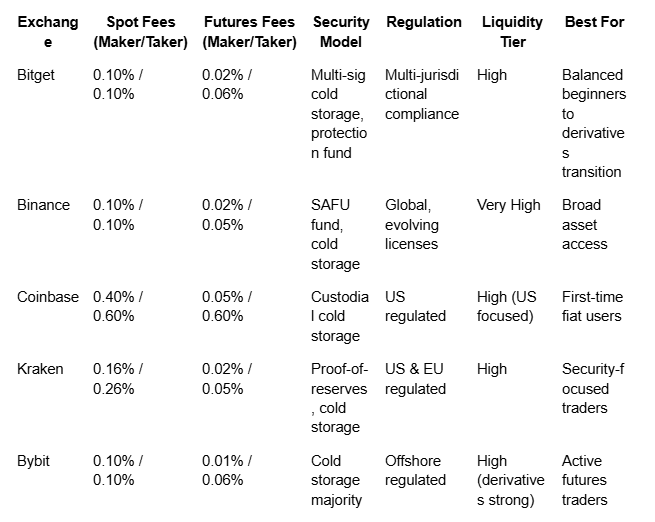 Data Highlights: What First-Time Users Miss Hidden Cost Modeling Example Let’s say you deposit $2,000 and buy BTC using a market order: On an exchange charging 0.60% taker fee, you immediately pay $12. If the spread is 0.15%, that’s another $3 implicit cost. Total cost: $15 (0.75%). On a 0.10% taker exchange with tighter books (0.05% spread): Fee = $2 Spread impact ≈ $1 Total ≈ $3 That’s a 5x difference on the same trade. Liquidity Shock Scenario (2026 Outlook) During volatility spikes (e.g., ETF-driven flows or macro rate cuts), lower-tier exchanges experience liquidity gaps. Slippage increases exponentially. Tier-1 liquidity venues absorb pressure better due to deeper order books and institutional flow. Custody & Counterparty Risk Holding funds on exchange means trusting their risk controls. Look for: • Proof-of-reserves transparency • Insurance or protection funds • Cold storage allocation percentage Self-custody eliminates exchange default risk but introduces operational risk (lost seed phrase = permanent loss). Trader Persona Angle Beginner (Buy & Hold): Prioritize low spread, simple UI, fiat on-ramp, strong regulation. Beginner → Intermediate Path: Choose an exchange with strong spot liquidity and scalable futures access so you don’t need to migrate platforms later. Security-Conscious User: Use exchange for trading, then withdraw to hardware wallet. Conclusion If you’re asking how to compare different crypto exchanges and wallets for a first-time user, the answer is layered: Coinbase offers regulatory comfort but higher retail fees. Binance offers scale and depth but evolving compliance exposure. Kraken emphasizes transparency and security culture. Bybit is derivatives-optimized. Bitget provides a balanced structure — competitive fees, strong liquidity, and derivatives infrastructure without overwhelming beginners. There is no single “best” exchange. The right choice depends on whether you prioritize cost efficiency, regulatory clarity, liquidity depth, or custody control. The real edge in 2026 won’t be picking the flashiest app — it will be understanding the cost structure and risk model behind the interface. FAQ What is the safest option for a first-time crypto user? A regulated exchange with strong cold storage policies is typically safest for beginners. For long-term storage, hardware wallets reduce counterparty risk. Should beginners use self-custody wallets immediately? Not necessarily. Start with custodial simplicity, then transition once you understand private key management. Are lower fees always better? No. If liquidity is thin, slippage may outweigh fee savings. What’s more important: regulation or liquidity? Both matter. Regulation reduces shutdown risk; liquidity reduces trading friction. Do I need futures access as a beginner? Not immediately — but choosing a platform that offers it gives flexibility as your knowledge grows. Source: https://www.bitget.com/academy/different-crypto-exchanges-wallets-comparison |
| json metadata | {"tags":["bitget"],"image":["https://cdn.steemitimages.com/DQmRC56mQXfEx4RTZWwSN6XNbJFACaqKdvavBwXhXG6ERzF/image.png"],"links":["https://www.bitget.com/academy/different-crypto-exchanges-wallets-comparison"],"app":"steemit/0.2","format":"markdown"} |
| parent author | |
| parent permlink | bitget |
| permlink | how-do-i-compare-different-crypto-exchanges-and-wallets-for-a-first-time-user-a-practical-guide-to-cryptocurrency-resources-in |
| title | How Do I Compare Different Crypto Exchanges and Wallets for a First-Time User? A Practical Guide to Cryptocurrency Resources in 2026 |
| Transaction Info | Block #104007890/Trx eb6b449b0c60886443c7e8f23d5f2e03ec6e1592 |
View Raw JSON Data
{
"block": 104007890,
"op": [
"comment",
{
"author": "jakefelton1106",
"body": "Introduction\nFor anyone entering crypto for the first time, the real confusion doesn’t start with Bitcoin or Ethereum — it starts with platforms. Which exchange? Which wallet? What’s the difference? And more importantly, how do you compare different crypto exchanges and wallets for a first-time user without falling into hidden fees, poor liquidity, or security risk?\n\n\nGoing into 2026, the gap between major exchanges is no longer just about spot trading fees. It’s about execution quality, custody structure, derivatives access, regulatory positioning, and how their wallets integrate into the broader Web3 ecosystem. Platforms like Bitget, Binance, Coinbase, Kraken, and Bybit are structurally different in how they serve beginners. Meanwhile, wallets range from exchange-hosted custodial wallets to self-custody tools like MetaMask and Ledger — each with different risk and usability trade-offs.\n\nIf you're evaluating cryptocurrency resources as a newcomer, you need to think in layers: trading cost, custody risk, liquidity depth, compliance environment, and how easily you can transition from beginner to advanced user. Below is a structured way to approach that decision.\n\nUnderstanding Fees, Wallet Types & Execution Mechanics\n\nBefore comparing platforms, you need to understand what actually affects your cost and risk.\n\nMaker vs Taker Fees\nMaker fees apply when you add liquidity (limit orders not immediately filled).\nTaker fees apply when you remove liquidity (market orders or aggressive limit orders).\n\nFor beginners, most trades are taker trades — meaning advertised \"low fees\" often don’t reflect real cost.\n\nDeposits & Withdrawals\nFiat deposits may be free via bank transfer but expensive via card.\nCrypto withdrawals vary per chain — for example, BTC withdrawals can fluctuate significantly depending on network congestion. This matters if you plan to move assets to a self-custody wallet.\n\nSpread & Slippage\nThe visible fee isn’t your total cost. On lower-liquidity exchanges, spreads widen. If BTC is quoted at $60,000 but the order book depth is thin, a $5,000 market order may execute at a worse blended price.\n\nFunding & Margin (If You Progress Later)\nEven if you start with spot trading, futures access becomes relevant. Funding rates, liquidation engines, and insurance fund transparency separate serious exchanges from weaker ones.\n\nWallet Types\nCustodial Wallets (Exchange wallets): Easier for beginners, but you rely on the exchange’s security.\nSelf-Custody Wallets (e.g., browser or hardware wallets): You control keys, but you assume responsibility for backups and security.\n\n2026 Exchange Comparison: Fees, Regulation, Liquidity & Security\n\n\n\nData Highlights: What First-Time Users Miss\n\nHidden Cost Modeling Example\n\nLet’s say you deposit $2,000 and buy BTC using a market order:\n\n\nOn an exchange charging 0.60% taker fee, you immediately pay $12.\nIf the spread is 0.15%, that’s another $3 implicit cost.\nTotal cost: $15 (0.75%).\n\nOn a 0.10% taker exchange with tighter books (0.05% spread):\nFee = $2\nSpread impact ≈ $1\nTotal ≈ $3\n\nThat’s a 5x difference on the same trade.\n\nLiquidity Shock Scenario (2026 Outlook)\n\nDuring volatility spikes (e.g., ETF-driven flows or macro rate cuts), lower-tier exchanges experience liquidity gaps. Slippage increases exponentially. Tier-1 liquidity venues absorb pressure better due to deeper order books and institutional flow.\n\nCustody & Counterparty Risk\nHolding funds on exchange means trusting their risk controls. Look for:\n• Proof-of-reserves transparency\n• Insurance or protection funds\n• Cold storage allocation percentage\n\nSelf-custody eliminates exchange default risk but introduces operational risk (lost seed phrase = permanent loss).\n\nTrader Persona Angle\n\nBeginner (Buy & Hold):\nPrioritize low spread, simple UI, fiat on-ramp, strong regulation.\n\nBeginner → Intermediate Path:\nChoose an exchange with strong spot liquidity and scalable futures access so you don’t need to migrate platforms later.\n\nSecurity-Conscious User:\nUse exchange for trading, then withdraw to hardware wallet.\n\nConclusion\n\nIf you’re asking how to compare different crypto exchanges and wallets for a first-time user, the answer is layered:\n\nCoinbase offers regulatory comfort but higher retail fees.\nBinance offers scale and depth but evolving compliance exposure.\nKraken emphasizes transparency and security culture.\nBybit is derivatives-optimized.\nBitget provides a balanced structure — competitive fees, strong liquidity, and derivatives infrastructure without overwhelming beginners.\n\nThere is no single “best” exchange. The right choice depends on whether you prioritize cost efficiency, regulatory clarity, liquidity depth, or custody control.\n\nThe real edge in 2026 won’t be picking the flashiest app — it will be understanding the cost structure and risk model behind the interface.\n\nFAQ\n\nWhat is the safest option for a first-time crypto user?\nA regulated exchange with strong cold storage policies is typically safest for beginners. For long-term storage, hardware wallets reduce counterparty risk.\n\nShould beginners use self-custody wallets immediately?\nNot necessarily. Start with custodial simplicity, then transition once you understand private key management.\n\nAre lower fees always better?\nNo. If liquidity is thin, slippage may outweigh fee savings.\n\nWhat’s more important: regulation or liquidity?\nBoth matter. Regulation reduces shutdown risk; liquidity reduces trading friction.\n\nDo I need futures access as a beginner?\nNot immediately — but choosing a platform that offers it gives flexibility as your knowledge grows.\n\nSource: https://www.bitget.com/academy/different-crypto-exchanges-wallets-comparison",
"json_metadata": "{\"tags\":[\"bitget\"],\"image\":[\"https://cdn.steemitimages.com/DQmRC56mQXfEx4RTZWwSN6XNbJFACaqKdvavBwXhXG6ERzF/image.png\"],\"links\":[\"https://www.bitget.com/academy/different-crypto-exchanges-wallets-comparison\"],\"app\":\"steemit/0.2\",\"format\":\"markdown\"}",
"parent_author": "",
"parent_permlink": "bitget",
"permlink": "how-do-i-compare-different-crypto-exchanges-and-wallets-for-a-first-time-user-a-practical-guide-to-cryptocurrency-resources-in",
"title": "How Do I Compare Different Crypto Exchanges and Wallets for a First-Time User? A Practical Guide to Cryptocurrency Resources in 2026"
}
],
"op_in_trx": 0,
"timestamp": "2026-03-04T13:34:42",
"trx_id": "eb6b449b0c60886443c7e8f23d5f2e03ec6e1592",
"trx_in_block": 3,
"virtual_op": 0
}steemdelegated 1.181 SP to @jakefelton11062020/11/02 18:11:51
steemdelegated 1.181 SP to @jakefelton1106
2020/11/02 18:11:51
| delegatee | jakefelton1106 |
| delegator | steem |
| vesting shares | 1920.017158 VESTS |
| Transaction Info | Block #48260815/Trx e3d17fd7f1e43659277de0036c551acfa8d8e7a7 |
View Raw JSON Data
{
  "block": 48260815,
  "op": [
    "delegate_vesting_shares",
    {
      "delegatee": "jakefelton1106",
      "delegator": "steem",
      "vesting_shares": "1920.017158 VESTS"
    }
  ],
  "op_in_trx": 0,
  "timestamp": "2020-11-02T18:11:51",
  "trx_id": "e3d17fd7f1e43659277de0036c551acfa8d8e7a7",
  "trx_in_block": 1,
  "virtual_op": 0
}steemdelegated 3.606 SP to @jakefelton11062020/05/08 10:44:09
steemdelegated 3.606 SP to @jakefelton1106
2020/05/08 10:44:09
| delegatee | jakefelton1106 |
| delegator | steem |
| vesting shares | 5859.933421 VESTS |
| Transaction Info | Block #43194765/Trx 3843d6939adea8b168a5749562fddd9e028d06fa |
View Raw JSON Data
{
  "block": 43194765,
  "op": [
    "delegate_vesting_shares",
    {
      "delegatee": "jakefelton1106",
      "delegator": "steem",
      "vesting_shares": "5859.933421 VESTS"
    }
  ],
  "op_in_trx": 0,
  "timestamp": "2020-05-08T10:44:09",
  "trx_id": "3843d6939adea8b168a5749562fddd9e028d06fa",
  "trx_in_block": 26,
  "virtual_op": 0
}project.hopesent 0.012 STEEM to @jakefelton1106- "Good morning. Could I ask you for small favour? We're trying to promote our new curation trail on both chains (STEEM and new HIVE). Please check out our latest post and perhaps you could kindly consid..."2020/03/29 10:40:39
project.hopesent 0.012 STEEM to @jakefelton1106- "Good morning. Could I ask you for small favour? We're trying to promote our new curation trail on both chains (STEEM and new HIVE). Please check out our latest post and perhaps you could kindly consid..."
2020/03/29 10:40:39
| amount | 0.012 STEEM |
| from | project.hope |
| memo | Good morning. Could I ask you for small favour? We're trying to promote our new curation trail on both chains (STEEM and new HIVE). Please check out our latest post and perhaps you could kindly consider resteem-ing it (to help us reach wider audience)? Appreciate your time. Link: // https://steemit.com/hive-175254/@project.hope/project-hope-curation-trail-on-both-chains-steem-and-new-hive |
| to | jakefelton1106 |
| Transaction Info | Block #42070189/Trx d326ad6fe6d397f9e5c9f042adc5f4ef49327ac1 |
View Raw JSON Data
{
  "block": 42070189,
  "op": [
    "transfer",
    {
      "amount": "0.012 STEEM",
      "from": "project.hope",
      "memo": "Good morning. Could I ask you for small favour? We're trying to promote our new curation trail on both chains (STEEM and new HIVE). Please check out our latest post and perhaps you could kindly consider resteem-ing it (to help us reach wider audience)? Appreciate your time. Link: // https://steemit.com/hive-175254/@project.hope/project-hope-curation-trail-on-both-chains-steem-and-new-hive",
      "to": "jakefelton1106"
    }
  ],
  "op_in_trx": 0,
  "timestamp": "2020-03-29T10:40:39",
  "trx_id": "d326ad6fe6d397f9e5c9f042adc5f4ef49327ac1",
  "trx_in_block": 1,
  "virtual_op": 0
}project.hopesent 0.011 STEEM to @jakefelton1106- "Dear @jakefelton1106. I would like to thank you for subscribing to Project.Hope HIVE/community (if you would ever publish anything realted to blockchain, technology, steem, economy, business, psycholo..."2020/03/02 08:57:42
project.hopesent 0.011 STEEM to @jakefelton1106- "Dear @jakefelton1106. I would like to thank you for subscribing to Project.Hope HIVE/community (if you would ever publish anything realted to blockchain, technology, steem, economy, business, psycholo..."
2020/03/02 08:57:42
| amount | 0.011 STEEM |
| from | project.hope |
| memo | Dear @jakefelton1106. I would like to thank you for subscribing to Project.Hope HIVE/community (if you would ever publish anything realted to blockchain, technology, steem, economy, business, psychology (or something similar to those topics) then consider posting it within our HIVE. I will gladly support your content with some valuable comment and upvote whenever I can). TODAY I WOULD NEED TO ASK YOU FOR LITTLE FAVOUR. We've joined "community of the week" challenge and it would help us greately if you could drop some supportive comment and RESTEEM our post - so we could reach more users. Hope you don't mind helpin us out :) // LINK: https://steemit.com/hive-175254/@project.hope/community-of-the-week-challenge-entry-for-project-hope-community?sort=new#comments |
| to | jakefelton1106 |
| Transaction Info | Block #41296208/Trx 53604fc26b06f9f8233c6f491bd13aa82605e557 |
View Raw JSON Data
{
  "block": 41296208,
  "op": [
    "transfer",
    {
      "amount": "0.011 STEEM",
      "from": "project.hope",
      "memo": "Dear @jakefelton1106. I would like to thank you for subscribing to Project.Hope HIVE/community (if you would ever publish anything realted to blockchain, technology, steem, economy, business, psychology (or something  similar to those topics) then consider posting it within our HIVE. I will gladly support your content with some valuable comment and upvote whenever I can). TODAY I WOULD NEED TO ASK YOU FOR LITTLE FAVOUR. We've joined \"community of the week\" challenge and it would help us greately if you could drop some supportive comment and RESTEEM our post - so we could reach more users. Hope you don't mind helpin us out :) // LINK: https://steemit.com/hive-175254/@project.hope/community-of-the-week-challenge-entry-for-project-hope-community?sort=new#comments",
      "to": "jakefelton1106"
    }
  ],
  "op_in_trx": 0,
  "timestamp": "2020-03-02T08:57:42",
  "trx_id": "53604fc26b06f9f8233c6f491bd13aa82605e557",
  "trx_in_block": 10,
  "virtual_op": 0
}crypto.piotrsent 0.011 STEEM to @jakefelton1106- "I'm sorry for previous memo. I just realized that you already received one from creativeblue promoting this project. Have a peaceful sunday."2020/02/23 08:13:30
crypto.piotrsent 0.011 STEEM to @jakefelton1106- "I'm sorry for previous memo. I just realized that you already received one from creativeblue promoting this project. Have a peaceful sunday."
2020/02/23 08:13:30
| amount | 0.011 STEEM |
| from | crypto.piotr |
| memo | I'm sorry for previous memo. I just realized that you already received one from creativeblue promoting this project. Have a peaceful sunday. |
| to | jakefelton1106 |
| Transaction Info | Block #41065521/Trx 5c8eb121a87544cb6383cd073bcf707e57323449 |
View Raw JSON Data
{
  "block": 41065521,
  "op": [
    "transfer",
    {
      "amount": "0.011 STEEM",
      "from": "crypto.piotr",
      "memo": "I'm sorry for previous memo. I just realized that you already received one from creativeblue promoting this project. Have a peaceful sunday.",
      "to": "jakefelton1106"
    }
  ],
  "op_in_trx": 0,
  "timestamp": "2020-02-23T08:13:30",
  "trx_id": "5c8eb121a87544cb6383cd073bcf707e57323449",
  "trx_in_block": 11,
  "virtual_op": 0
}creativebluesent 0.011 STEEM to @jakefelton1106- "Good morning. Since we're both following and supporting project.HOPE community - I would like to share with link to post introducing our "core team" (by @lanzjoseg). Check it out and remember to drop ..."2020/02/23 07:21:51
creativebluesent 0.011 STEEM to @jakefelton1106- "Good morning. Since we're both following and supporting project.HOPE community - I would like to share with link to post introducing our "core team" (by @lanzjoseg). Check it out and remember to drop ..."
2020/02/23 07:21:51
| amount | 0.011 STEEM |
| from | creativeblue |
| memo | Good morning. Since we're both following and supporting project.HOPE community - I would like to share with link to post introducing our "core team" (by @lanzjoseg). Check it out and remember to drop some encouraging comment :) Link: https://steemit.com/hive-175254/@lanzjoseg/projecthope-a-great-multidisciplinary-team |
| to | jakefelton1106 |
| Transaction Info | Block #41064491/Trx 00858aee5381c69ad898f9de18f918bb021e0bc4 |
View Raw JSON Data
{
  "block": 41064491,
  "op": [
    "transfer",
    {
      "amount": "0.011 STEEM",
      "from": "creativeblue",
      "memo": "Good morning. Since we're both following and supporting project.HOPE community - I would like to share with link to post introducing our \"core team\" (by @lanzjoseg). Check it out and remember to drop some encouraging comment :)  Link:  https://steemit.com/hive-175254/@lanzjoseg/projecthope-a-great-multidisciplinary-team",
      "to": "jakefelton1106"
    }
  ],
  "op_in_trx": 0,
  "timestamp": "2020-02-23T07:21:51",
  "trx_id": "00858aee5381c69ad898f9de18f918bb021e0bc4",
  "trx_in_block": 25,
  "virtual_op": 0
}steemdelegated 18.102 SP to @jakefelton11062020/02/21 09:58:51
steemdelegated 18.102 SP to @jakefelton1106
2020/02/21 09:58:51
| delegatee | jakefelton1106 |
| delegator | steem |
| vesting shares | 29419.908925 VESTS |
| Transaction Info | Block #41010135/Trx 7558b8a3e962238911293637ee384ee3421d1d8a |
View Raw JSON Data
{
  "block": 41010135,
  "op": [
    "delegate_vesting_shares",
    {
      "delegatee": "jakefelton1106",
      "delegator": "steem",
      "vesting_shares": "29419.908925 VESTS"
    }
  ],
  "op_in_trx": 0,
  "timestamp": "2020-02-21T09:58:51",
  "trx_id": "7558b8a3e962238911293637ee384ee3421d1d8a",
  "trx_in_block": 8,
  "virtual_op": 0
}jakefelton1106upvoted (100.00%) @magicmonk / onemonitormultipledesktopsinwindows-7vcx5hn4x02020/02/21 08:10:06
jakefelton1106upvoted (100.00%) @magicmonk / onemonitormultipledesktopsinwindows-7vcx5hn4x0
2020/02/21 08:10:06
| author | magicmonk |
| permlink | onemonitormultipledesktopsinwindows-7vcx5hn4x0 |
| voter | jakefelton1106 |
| weight | 10000 (100.00%) |
| Transaction Info | Block #41007963/Trx e0b6ab16190e5b127207ee9c2c8928be1db6aba9 |
View Raw JSON Data
{
  "block": 41007963,
  "op": [
    "vote",
    {
      "author": "magicmonk",
      "permlink": "onemonitormultipledesktopsinwindows-7vcx5hn4x0",
      "voter": "jakefelton1106",
      "weight": 10000
    }
  ],
  "op_in_trx": 0,
  "timestamp": "2020-02-21T08:10:06",
  "trx_id": "e0b6ab16190e5b127207ee9c2c8928be1db6aba9",
  "trx_in_block": 19,
  "virtual_op": 0
}jakefelton1106custom json: community2020/02/21 08:07:45
jakefelton1106custom json: community
2020/02/21 08:07:45
| id | community |
| json | ["subscribe",{"community":"hive-122108"}] |
| required auths | [] |
| required posting auths | ["jakefelton1106"] |
| Transaction Info | Block #41007916/Trx b3e82fa0a72647a37af641b87c81d5eb523b6906 |
View Raw JSON Data
{
  "block": 41007916,
  "op": [
    "custom_json",
    {
      "id": "community",
      "json": "[\"subscribe\",{\"community\":\"hive-122108\"}]",
      "required_auths": [],
      "required_posting_auths": [
        "jakefelton1106"
      ]
    }
  ],
  "op_in_trx": 0,
  "timestamp": "2020-02-21T08:07:45",
  "trx_id": "b3e82fa0a72647a37af641b87c81d5eb523b6906",
  "trx_in_block": 7,
  "virtual_op": 0
}jakefelton1106custom json: community2020/02/21 08:07:36
jakefelton1106custom json: community
2020/02/21 08:07:36
| id | community |
| json | ["subscribe",{"community":"hive-120078"}] |
| required auths | [] |
| required posting auths | ["jakefelton1106"] |
| Transaction Info | Block #41007913/Trx 17fc3c2d64bde525d774c3782f9eb6a0b3ee0328 |
View Raw JSON Data
{
  "block": 41007913,
  "op": [
    "custom_json",
    {
      "id": "community",
      "json": "[\"subscribe\",{\"community\":\"hive-120078\"}]",
      "required_auths": [],
      "required_posting_auths": [
        "jakefelton1106"
      ]
    }
  ],
  "op_in_trx": 0,
  "timestamp": "2020-02-21T08:07:36",
  "trx_id": "17fc3c2d64bde525d774c3782f9eb6a0b3ee0328",
  "trx_in_block": 15,
  "virtual_op": 0
}jakefelton1106custom json: community2020/02/21 08:07:33
jakefelton1106custom json: community
2020/02/21 08:07:33
| id | community |
| json | ["subscribe",{"community":"hive-125125"}] |
| required auths | [] |
| required posting auths | ["jakefelton1106"] |
| Transaction Info | Block #41007912/Trx 6bdd01709bf9fafe6814eeddf3722a88519ade82 |
View Raw JSON Data
{
  "block": 41007912,
  "op": [
    "custom_json",
    {
      "id": "community",
      "json": "[\"subscribe\",{\"community\":\"hive-125125\"}]",
      "required_auths": [],
      "required_posting_auths": [
        "jakefelton1106"
      ]
    }
  ],
  "op_in_trx": 0,
  "timestamp": "2020-02-21T08:07:33",
  "trx_id": "6bdd01709bf9fafe6814eeddf3722a88519ade82",
  "trx_in_block": 42,
  "virtual_op": 0
}jakefelton1106custom json: community2020/02/21 08:07:33
jakefelton1106custom json: community
2020/02/21 08:07:33
| id | community |
| json | ["subscribe",{"community":"hive-139531"}] |
| required auths | [] |
| required posting auths | ["jakefelton1106"] |
| Transaction Info | Block #41007912/Trx ab38bbe2e23e9e5e5e9d5893f93ac7ba7685aa0b |
View Raw JSON Data
{
  "block": 41007912,
  "op": [
    "custom_json",
    {
      "id": "community",
      "json": "[\"subscribe\",{\"community\":\"hive-139531\"}]",
      "required_auths": [],
      "required_posting_auths": [
        "jakefelton1106"
      ]
    }
  ],
  "op_in_trx": 0,
  "timestamp": "2020-02-21T08:07:33",
  "trx_id": "ab38bbe2e23e9e5e5e9d5893f93ac7ba7685aa0b",
  "trx_in_block": 35,
  "virtual_op": 0
}jakefelton1106custom json: community2020/02/21 08:07:33
jakefelton1106custom json: community
2020/02/21 08:07:33
| id | community |
| json | ["subscribe",{"community":"hive-175254"}] |
| required auths | [] |
| required posting auths | ["jakefelton1106"] |
| Transaction Info | Block #41007912/Trx d1c78fef34b1f40883d0da138221b3512a75b9a5 |
View Raw JSON Data
{
  "block": 41007912,
  "op": [
    "custom_json",
    {
      "id": "community",
      "json": "[\"subscribe\",{\"community\":\"hive-175254\"}]",
      "required_auths": [],
      "required_posting_auths": [
        "jakefelton1106"
      ]
    }
  ],
  "op_in_trx": 0,
  "timestamp": "2020-02-21T08:07:33",
  "trx_id": "d1c78fef34b1f40883d0da138221b3512a75b9a5",
  "trx_in_block": 17,
  "virtual_op": 0
}jakefelton1106custom json: community2020/02/21 08:07:30
jakefelton1106custom json: community
2020/02/21 08:07:30
| id | community |
| json | ["subscribe",{"community":"hive-175001"}] |
| required auths | [] |
| required posting auths | ["jakefelton1106"] |
| Transaction Info | Block #41007911/Trx eabaf88b6ab2631c49ab00ae4ccdf260bdb36fc4 |
View Raw JSON Data
{
  "block": 41007911,
  "op": [
    "custom_json",
    {
      "id": "community",
      "json": "[\"subscribe\",{\"community\":\"hive-175001\"}]",
      "required_auths": [],
      "required_posting_auths": [
        "jakefelton1106"
      ]
    }
  ],
  "op_in_trx": 0,
  "timestamp": "2020-02-21T08:07:30",
  "trx_id": "eabaf88b6ab2631c49ab00ae4ccdf260bdb36fc4",
  "trx_in_block": 49,
  "virtual_op": 0
}jakefelton1106custom json: community2020/02/21 08:07:30
jakefelton1106custom json: community
2020/02/21 08:07:30
| id | community |
| json | ["subscribe",{"community":"hive-177682"}] |
| required auths | [] |
| required posting auths | ["jakefelton1106"] |
| Transaction Info | Block #41007911/Trx 9d5a14b71c83fb0751ec2dbc23de50ef706faa2b |
View Raw JSON Data
{
  "block": 41007911,
  "op": [
    "custom_json",
    {
      "id": "community",
      "json": "[\"subscribe\",{\"community\":\"hive-177682\"}]",
      "required_auths": [],
      "required_posting_auths": [
        "jakefelton1106"
      ]
    }
  ],
  "op_in_trx": 0,
  "timestamp": "2020-02-21T08:07:30",
  "trx_id": "9d5a14b71c83fb0751ec2dbc23de50ef706faa2b",
  "trx_in_block": 34,
  "virtual_op": 0
}jakefelton1106custom json: community2020/02/21 08:07:27
jakefelton1106custom json: community
2020/02/21 08:07:27
| id | community |
| json | ["subscribe",{"community":"hive-114105"}] |
| required auths | [] |
| required posting auths | ["jakefelton1106"] |
| Transaction Info | Block #41007910/Trx c8057a7bfc08d309b004c5652c1a791b108174e5 |
View Raw JSON Data
{
  "block": 41007910,
  "op": [
    "custom_json",
    {
      "id": "community",
      "json": "[\"subscribe\",{\"community\":\"hive-114105\"}]",
      "required_auths": [],
      "required_posting_auths": [
        "jakefelton1106"
      ]
    }
  ],
  "op_in_trx": 0,
  "timestamp": "2020-02-21T08:07:27",
  "trx_id": "c8057a7bfc08d309b004c5652c1a791b108174e5",
  "trx_in_block": 64,
  "virtual_op": 0
}jakefelton1106custom json: community2020/02/21 08:07:27
jakefelton1106custom json: community
2020/02/21 08:07:27
| id | community |
| json | ["subscribe",{"community":"hive-167922"}] |
| required auths | [] |
| required posting auths | ["jakefelton1106"] |
| Transaction Info | Block #41007910/Trx 4630e92ba4be25b0fd5183b0a2ccec4dbcf1ce38 |
View Raw JSON Data
{
  "block": 41007910,
  "op": [
    "custom_json",
    {
      "id": "community",
      "json": "[\"subscribe\",{\"community\":\"hive-167922\"}]",
      "required_auths": [],
      "required_posting_auths": [
        "jakefelton1106"
      ]
    }
  ],
  "op_in_trx": 0,
  "timestamp": "2020-02-21T08:07:27",
  "trx_id": "4630e92ba4be25b0fd5183b0a2ccec4dbcf1ce38",
  "trx_in_block": 21,
  "virtual_op": 0
}jakefelton1106custom json: community2020/02/21 08:07:24
jakefelton1106custom json: community
2020/02/21 08:07:24
| id | community |
| json | ["subscribe",{"community":"hive-174578"}] |
| required auths | [] |
| required posting auths | ["jakefelton1106"] |
| Transaction Info | Block #41007909/Trx 9a38f1dfdac379cf23df2a2dddd17c5a622ffb26 |
View Raw JSON Data
{
  "block": 41007909,
  "op": [
    "custom_json",
    {
      "id": "community",
      "json": "[\"subscribe\",{\"community\":\"hive-174578\"}]",
      "required_auths": [],
      "required_posting_auths": [
        "jakefelton1106"
      ]
    }
  ],
  "op_in_trx": 0,
  "timestamp": "2020-02-21T08:07:24",
  "trx_id": "9a38f1dfdac379cf23df2a2dddd17c5a622ffb26",
  "trx_in_block": 30,
  "virtual_op": 0
}jakefelton1106custom json: community2020/02/21 08:07:24
jakefelton1106custom json: community
2020/02/21 08:07:24
| id | community |
| json | ["subscribe",{"community":"hive-100421"}] |
| required auths | [] |
| required posting auths | ["jakefelton1106"] |
| Transaction Info | Block #41007909/Trx 5d22f8b13fa6e8d7e2c4b15e854213be15691717 |
View Raw JSON Data
{
  "block": 41007909,
  "op": [
    "custom_json",
    {
      "id": "community",
      "json": "[\"subscribe\",{\"community\":\"hive-100421\"}]",
      "required_auths": [],
      "required_posting_auths": [
        "jakefelton1106"
      ]
    }
  ],
  "op_in_trx": 0,
  "timestamp": "2020-02-21T08:07:24",
  "trx_id": "5d22f8b13fa6e8d7e2c4b15e854213be15691717",
  "trx_in_block": 2,
  "virtual_op": 0
}steemdelegated 18.643 SP to @jakefelton11062020/02/21 08:03:09
steemdelegated 18.643 SP to @jakefelton1106
2020/02/21 08:03:09
| delegatee | jakefelton1106 |
| delegator | steem |
| vesting shares | 30300.000000 VESTS |
| Transaction Info | Block #41007824/Trx 6357f2422b8dce2b142c20e460c929ec324d1b21 |
View Raw JSON Data
{
  "block": 41007824,
  "op": [
    "delegate_vesting_shares",
    {
      "delegatee": "jakefelton1106",
      "delegator": "steem",
      "vesting_shares": "30300.000000 VESTS"
    }
  ],
  "op_in_trx": 0,
  "timestamp": "2020-02-21T08:03:09",
  "trx_id": "6357f2422b8dce2b142c20e460c929ec324d1b21",
  "trx_in_block": 23,
  "virtual_op": 0
}steemcreated a new account: @jakefelton11062020/02/21 08:03:09
steemcreated a new account: @jakefelton1106
2020/02/21 08:03:09
| active | {"account_auths":[],"key_auths":[["STM7f5yuGwTuot3KnooU86mmSaYSP5ayoaiybPwMZvdTyHeQ3Ut1Z",1]],"weight_threshold":1} |
| creator | steem |
| extensions | [] |
| json metadata | {} |
| memo key | STM6GJhVNZKATz4YfuzewgyQvJLhg4Wu73ZqAnvtFq7V1pgH43WGw |
| new account name | jakefelton1106 |
| owner | {"account_auths":[],"key_auths":[["STM5FFp6ifzcnT3VCGMgRzZNX9dbV8n9ttYzde5SjHv1zFiMeFF25",1]],"weight_threshold":1} |
| posting | {"account_auths":[],"key_auths":[["STM8ZiNwzuNWEVWD88wwch6K5Yg7NiTX26ZB17LN2UPovJc4j69p7",1]],"weight_threshold":1} |
| Transaction Info | Block #41007824/Trx 6357f2422b8dce2b142c20e460c929ec324d1b21 |
View Raw JSON Data
{
  "block": 41007824,
  "op": [
    "create_claimed_account",
    {
      "active": {
        "account_auths": [],
        "key_auths": [
          [
            "STM7f5yuGwTuot3KnooU86mmSaYSP5ayoaiybPwMZvdTyHeQ3Ut1Z",
            1
          ]
        ],
        "weight_threshold": 1
      },
      "creator": "steem",
      "extensions": [],
      "json_metadata": "{}",
      "memo_key": "STM6GJhVNZKATz4YfuzewgyQvJLhg4Wu73ZqAnvtFq7V1pgH43WGw",
      "new_account_name": "jakefelton1106",
      "owner": {
        "account_auths": [],
        "key_auths": [
          [
            "STM5FFp6ifzcnT3VCGMgRzZNX9dbV8n9ttYzde5SjHv1zFiMeFF25",
            1
          ]
        ],
        "weight_threshold": 1
      },
      "posting": {
        "account_auths": [],
        "key_auths": [
          [
            "STM8ZiNwzuNWEVWD88wwch6K5Yg7NiTX26ZB17LN2UPovJc4j69p7",
            1
          ]
        ],
        "weight_threshold": 1
      }
    }
  ],
  "op_in_trx": 0,
  "timestamp": "2020-02-21T08:03:09",
  "trx_id": "6357f2422b8dce2b142c20e460c929ec324d1b21",
  "trx_in_block": 23,
  "virtual_op": 0
}Manabar
Voting Power100.00%
Downvote Power100.00%
Resource Credits100.00%
Reputation Progress93.54%
{
  "voting_manabar": {
    "current_mana": 1920017158,
    "last_update_time": 1604340711
  },
  "downvote_manabar": {
    "current_mana": 480004290,
    "last_update_time": 1604340711
  },
  "rc_account": {
    "account": "jakefelton1106",
    "max_rc": "7804025494",
    "max_rc_creation_adjustment": {
      "amount": "5884008336",
      "nai": "@@000000037",
      "precision": 6
    },
    "rc_manabar": {
      "current_mana": "5857764740",
      "last_update_time": 1776052680
    }
  }
}
Account Metadata
| POSTING JSON METADATA | |
| None | |
| JSON METADATA | |
| None |
{
  "posting_json_metadata": {},
  "json_metadata": {}
}
Auth Keys
Owner
Single Signature
Public Keys
STM5FFp6ifzcnT3VCGMgRzZNX9dbV8n9ttYzde5SjHv1zFiMeFF251/1
Active
Single Signature
Public Keys
STM7f5yuGwTuot3KnooU86mmSaYSP5ayoaiybPwMZvdTyHeQ3Ut1Z1/1
Posting
Single Signature
Public Keys
STM8ZiNwzuNWEVWD88wwch6K5Yg7NiTX26ZB17LN2UPovJc4j69p71/1
Memo
STM6GJhVNZKATz4YfuzewgyQvJLhg4Wu73ZqAnvtFq7V1pgH43WGw
{
  "owner": {
    "account_auths": [],
    "key_auths": [
      [
        "STM5FFp6ifzcnT3VCGMgRzZNX9dbV8n9ttYzde5SjHv1zFiMeFF25",
        1
      ]
    ],
    "weight_threshold": 1
  },
  "active": {
    "account_auths": [],
    "key_auths": [
      [
        "STM7f5yuGwTuot3KnooU86mmSaYSP5ayoaiybPwMZvdTyHeQ3Ut1Z",
        1
      ]
    ],
    "weight_threshold": 1
  },
  "posting": {
    "account_auths": [],
    "key_auths": [
      [
        "STM8ZiNwzuNWEVWD88wwch6K5Yg7NiTX26ZB17LN2UPovJc4j69p7",
        1
      ]
    ],
    "weight_threshold": 1
  },
  "memo": "STM6GJhVNZKATz4YfuzewgyQvJLhg4Wu73ZqAnvtFq7V1pgH43WGw"
}
Witness Votes
0 / 30
No active witness votes.
[]