

VOTING POWER100.00%
DOWNVOTE POWER100.00%
RESOURCE CREDITS100.00%
REPUTATION PROGRESS0.00%
Net Worth
0.007USD
STEEM
0.000STEEM
SBD
0.000SBD
Effective Power
5.008SP
├── Own SP
0.125SP
└── Incoming DelegationsDeleg
+4.883SP
Detailed Balance
| STEEM | ||
| balance | 0.000STEEM | STEEM |
| market_balance | 0.000STEEM | STEEM |
| savings_balance | 0.000STEEM | STEEM |
| reward_steem_balance | 0.000STEEM | STEEM |
| STEEM POWER | ||
| Own SP | 0.125SP | SP |
| Delegated Out | 0.000SP | SP |
| Delegation In | 4.883SP | SP |
| Effective Power | 5.008SP | SP |
| Reward SP (pending) | 0.000SP | SP |
| SBD | ||
| sbd_balance | 0.000SBD | SBD |
| sbd_conversions | 0.000SBD | SBD |
| sbd_market_balance | 0.000SBD | SBD |
| savings_sbd_balance | 0.000SBD | SBD |
| reward_sbd_balance | 0.000SBD | SBD |
{
  "balance": "0.000 STEEM",
  "savings_balance": "0.000 STEEM",
  "reward_steem_balance": "0.000 STEEM",
  "vesting_shares": "202.521364 VESTS",
  "delegated_vesting_shares": "0.000000 VESTS",
  "received_vesting_shares": "7941.138442 VESTS",
  "sbd_balance": "0.000 SBD",
  "savings_sbd_balance": "0.000 SBD",
  "reward_sbd_balance": "0.000 SBD",
  "conversions": []
}
Account Info
| name | hgrdigitalag |
| id | 1109660 |
| rank | 1,191,879 |
| reputation | 482254074 |
| created | 2018-08-15T01:59:00 |
| recovery_account | steem |
| proxy | None |
| post_count | 41 |
| comment_count | 0 |
| lifetime_vote_count | 0 |
| witnesses_voted_for | 0 |
| last_post | 2018-08-18T11:08:24 |
| last_root_post | 2018-08-18T11:08:24 |
| last_vote_time | 2018-08-18T10:58:18 |
| proxied_vsf_votes | 0, 0, 0, 0 |
| can_vote | 1 |
| voting_power | 0 |
| delayed_votes | 0 |
| balance | 0.000 STEEM |
| savings_balance | 0.000 STEEM |
| sbd_balance | 0.000 SBD |
| savings_sbd_balance | 0.000 SBD |
| vesting_shares | 202.521364 VESTS |
| delegated_vesting_shares | 0.000000 VESTS |
| received_vesting_shares | 7941.138442 VESTS |
| reward_vesting_balance | 0.000000 VESTS |
| vesting_balance | 0.000 STEEM |
| vesting_withdraw_rate | 0.000000 VESTS |
| next_vesting_withdrawal | 1969-12-31T23:59:59 |
| withdrawn | 0 |
| to_withdraw | 0 |
| withdraw_routes | 0 |
| savings_withdraw_requests | 0 |
| last_account_recovery | 1970-01-01T00:00:00 |
| reset_account | null |
| last_owner_update | 1970-01-01T00:00:00 |
| last_account_update | 1970-01-01T00:00:00 |
| mined | No |
| sbd_seconds | 0 |
| sbd_last_interest_payment | 1970-01-01T00:00:00 |
| savings_sbd_last_interest_payment | 1970-01-01T00:00:00 |
{
  "id": 1109660,
  "name": "hgrdigitalag",
  "owner": {
    "weight_threshold": 1,
    "account_auths": [],
    "key_auths": [
      [
        "STM5vYXTJhWS71n55rYAUX4Kh1kGzNjcJVN2ERaHwfMxYHqSpGFni",
        1
      ]
    ]
  },
  "active": {
    "weight_threshold": 1,
    "account_auths": [],
    "key_auths": [
      [
        "STM83TzGAQzzrkunqJRELTJZAuT9itzkgRKQPa72xv4zHnGBRZ9Bt",
        1
      ]
    ]
  },
  "posting": {
    "weight_threshold": 1,
    "account_auths": [],
    "key_auths": [
      [
        "STM8kXcZxFRyQgrLj63kWXjTCJhr2UmMgHDFx31QNMAn7BrxbbJu4",
        1
      ]
    ]
  },
  "memo_key": "STM5fGhsAVVNktZFrrAbFMSR9SncrpyPjpEGmzEn26kw6sFJZnshr",
  "json_metadata": "{}",
  "posting_json_metadata": "",
  "proxy": "",
  "last_owner_update": "1970-01-01T00:00:00",
  "last_account_update": "1970-01-01T00:00:00",
  "created": "2018-08-15T01:59:00",
  "mined": false,
  "recovery_account": "steem",
  "last_account_recovery": "1970-01-01T00:00:00",
  "reset_account": "null",
  "comment_count": 0,
  "lifetime_vote_count": 0,
  "post_count": 41,
  "can_vote": true,
  "voting_manabar": {
    "current_mana": "8143659806",
    "last_update_time": 1779066450
  },
  "downvote_manabar": {
    "current_mana": 2035914951,
    "last_update_time": 1779066450
  },
  "voting_power": 0,
  "balance": "0.000 STEEM",
  "savings_balance": "0.000 STEEM",
  "sbd_balance": "0.000 SBD",
  "sbd_seconds": "0",
  "sbd_seconds_last_update": "1970-01-01T00:00:00",
  "sbd_last_interest_payment": "1970-01-01T00:00:00",
  "savings_sbd_balance": "0.000 SBD",
  "savings_sbd_seconds": "0",
  "savings_sbd_seconds_last_update": "1970-01-01T00:00:00",
  "savings_sbd_last_interest_payment": "1970-01-01T00:00:00",
  "savings_withdraw_requests": 0,
  "reward_sbd_balance": "0.000 SBD",
  "reward_steem_balance": "0.000 STEEM",
  "reward_vesting_balance": "0.000000 VESTS",
  "reward_vesting_steem": "0.000 STEEM",
  "vesting_shares": "202.521364 VESTS",
  "delegated_vesting_shares": "0.000000 VESTS",
  "received_vesting_shares": "7941.138442 VESTS",
  "vesting_withdraw_rate": "0.000000 VESTS",
  "next_vesting_withdrawal": "1969-12-31T23:59:59",
  "withdrawn": 0,
  "to_withdraw": 0,
  "withdraw_routes": 0,
  "curation_rewards": 0,
  "posting_rewards": 0,
  "proxied_vsf_votes": [
    0,
    0,
    0,
    0
  ],
  "witnesses_voted_for": 0,
  "last_post": "2018-08-18T11:08:24",
  "last_root_post": "2018-08-18T11:08:24",
  "last_vote_time": "2018-08-18T10:58:18",
  "post_bandwidth": 0,
  "pending_claimed_accounts": 0,
  "vesting_balance": "0.000 STEEM",
  "reputation": 482254074,
  "transfer_history": [],
  "market_history": [],
  "post_history": [],
  "vote_history": [],
  "other_history": [],
  "witness_votes": [],
  "tags_usage": [],
  "guest_bloggers": [],
  "rank": 1191879
}
Withdraw Routes
| Incoming | Outgoing |
|---|---|
Empty | Empty |
{
  "incoming": [],
  "outgoing": []
}From Date
To Date
steemdelegated 4.883 SP to @hgrdigitalag2026/05/18 01:07:30
steemdelegated 4.883 SP to @hgrdigitalag
2026/05/18 01:07:30
| delegator | steem |
| delegatee | hgrdigitalag |
| vesting shares | 7941.138442 VESTS |
| Transaction Info | Block #106144490/Trx 0ff2a66c60d3ddc6cdc8695a17d0f8e9ffaf8cb4 |
View Raw JSON Data
{
  "trx_id": "0ff2a66c60d3ddc6cdc8695a17d0f8e9ffaf8cb4",
  "block": 106144490,
  "trx_in_block": 0,
  "op_in_trx": 0,
  "virtual_op": 0,
  "timestamp": "2026-05-18T01:07:30",
  "op": [
    "delegate_vesting_shares",
    {
      "delegator": "steem",
      "delegatee": "hgrdigitalag",
      "vesting_shares": "7941.138442 VESTS"
    }
  ]
}steemdelegated 3.215 SP to @hgrdigitalag2026/05/12 07:22:36
steemdelegated 3.215 SP to @hgrdigitalag
2026/05/12 07:22:36
| delegator | steem |
| delegatee | hgrdigitalag |
| vesting shares | 5228.928037 VESTS |
| Transaction Info | Block #105979945/Trx d02db1bf61cd7025e2503e46af562870edca5203 |
View Raw JSON Data
{
  "trx_id": "d02db1bf61cd7025e2503e46af562870edca5203",
  "block": 105979945,
  "trx_in_block": 0,
  "op_in_trx": 0,
  "virtual_op": 0,
  "timestamp": "2026-05-12T07:22:36",
  "op": [
    "delegate_vesting_shares",
    {
      "delegator": "steem",
      "delegatee": "hgrdigitalag",
      "vesting_shares": "5228.928037 VESTS"
    }
  ]
}steemdelegated 4.891 SP to @hgrdigitalag2026/04/26 00:26:57
steemdelegated 4.891 SP to @hgrdigitalag
2026/04/26 00:26:57
| delegator | steem |
| delegatee | hgrdigitalag |
| vesting shares | 7953.654198 VESTS |
| Transaction Info | Block #105512116/Trx 1f39b27f763f712d46e6994d2198ea7ba12e4548 |
View Raw JSON Data
{
  "trx_id": "1f39b27f763f712d46e6994d2198ea7ba12e4548",
  "block": 105512116,
  "trx_in_block": 1,
  "op_in_trx": 0,
  "virtual_op": 0,
  "timestamp": "2026-04-26T00:26:57",
  "op": [
    "delegate_vesting_shares",
    {
      "delegator": "steem",
      "delegatee": "hgrdigitalag",
      "vesting_shares": "7953.654198 VESTS"
    }
  ]
}steemdelegated 3.241 SP to @hgrdigitalag2026/01/23 10:08:27
steemdelegated 3.241 SP to @hgrdigitalag
2026/01/23 10:08:27
| delegator | steem |
| delegatee | hgrdigitalag |
| vesting shares | 5270.474856 VESTS |
| Transaction Info | Block #102854615/Trx 342f5b835839cb02bfbff119a73f7f445b8086b9 |
View Raw JSON Data
{
  "trx_id": "342f5b835839cb02bfbff119a73f7f445b8086b9",
  "block": 102854615,
  "trx_in_block": 1,
  "op_in_trx": 0,
  "virtual_op": 0,
  "timestamp": "2026-01-23T10:08:27",
  "op": [
    "delegate_vesting_shares",
    {
      "delegator": "steem",
      "delegatee": "hgrdigitalag",
      "vesting_shares": "5270.474856 VESTS"
    }
  ]
}steemdelegated 3.342 SP to @hgrdigitalag2024/12/17 05:26:27
steemdelegated 3.342 SP to @hgrdigitalag
2024/12/17 05:26:27
| delegator | steem |
| delegatee | hgrdigitalag |
| vesting shares | 5434.694053 VESTS |
| Transaction Info | Block #91300994/Trx 98195d342beeb0eb7cdacf84b3219a3a9b85a2df |
View Raw JSON Data
{
  "trx_id": "98195d342beeb0eb7cdacf84b3219a3a9b85a2df",
  "block": 91300994,
  "trx_in_block": 0,
  "op_in_trx": 0,
  "virtual_op": 0,
  "timestamp": "2024-12-17T05:26:27",
  "op": [
    "delegate_vesting_shares",
    {
      "delegator": "steem",
      "delegatee": "hgrdigitalag",
      "vesting_shares": "5434.694053 VESTS"
    }
  ]
}steemdelegated 3.446 SP to @hgrdigitalag2023/11/13 21:08:51
steemdelegated 3.446 SP to @hgrdigitalag
2023/11/13 21:08:51
| delegator | steem |
| delegatee | hgrdigitalag |
| vesting shares | 5603.827585 VESTS |
| Transaction Info | Block #79855185/Trx 5561460d992c17461d7d6998fdb73e74c77bf952 |
View Raw JSON Data
{
  "trx_id": "5561460d992c17461d7d6998fdb73e74c77bf952",
  "block": 79855185,
  "trx_in_block": 2,
  "op_in_trx": 0,
  "virtual_op": 0,
  "timestamp": "2023-11-13T21:08:51",
  "op": [
    "delegate_vesting_shares",
    {
      "delegator": "steem",
      "delegatee": "hgrdigitalag",
      "vesting_shares": "5603.827585 VESTS"
    }
  ]
}steemdelegated 5.252 SP to @hgrdigitalag2023/09/21 22:51:27
steemdelegated 5.252 SP to @hgrdigitalag
2023/09/21 22:51:27
| delegator | steem |
| delegatee | hgrdigitalag |
| vesting shares | 8541.106371 VESTS |
| Transaction Info | Block #78349058/Trx 657056ee8b1dad8bcb6a32ab585b577a71ed4b99 |
View Raw JSON Data
{
  "trx_id": "657056ee8b1dad8bcb6a32ab585b577a71ed4b99",
  "block": 78349058,
  "trx_in_block": 0,
  "op_in_trx": 0,
  "virtual_op": 0,
  "timestamp": "2023-09-21T22:51:27",
  "op": [
    "delegate_vesting_shares",
    {
      "delegator": "steem",
      "delegatee": "hgrdigitalag",
      "vesting_shares": "8541.106371 VESTS"
    }
  ]
}steemdelegated 5.388 SP to @hgrdigitalag2022/11/03 12:31:03
steemdelegated 5.388 SP to @hgrdigitalag
2022/11/03 12:31:03
| delegator | steem |
| delegatee | hgrdigitalag |
| vesting shares | 8762.787809 VESTS |
| Transaction Info | Block #69114234/Trx 3a2723bcf3a6967ca68b4f761b5ef40e9dd7ba00 |
View Raw JSON Data
{
  "trx_id": "3a2723bcf3a6967ca68b4f761b5ef40e9dd7ba00",
  "block": 69114234,
  "trx_in_block": 6,
  "op_in_trx": 0,
  "virtual_op": 0,
  "timestamp": "2022-11-03T12:31:03",
  "op": [
    "delegate_vesting_shares",
    {
      "delegator": "steem",
      "delegatee": "hgrdigitalag",
      "vesting_shares": "8762.787809 VESTS"
    }
  ]
}steemdelegated 5.524 SP to @hgrdigitalag2022/01/17 11:43:00
steemdelegated 5.524 SP to @hgrdigitalag
2022/01/17 11:43:00
| delegator | steem |
| delegatee | hgrdigitalag |
| vesting shares | 8983.321040 VESTS |
| Transaction Info | Block #60810322/Trx 9778f339d7bd092f23af733cdd525a9444f103bb |
View Raw JSON Data
{
  "trx_id": "9778f339d7bd092f23af733cdd525a9444f103bb",
  "block": 60810322,
  "trx_in_block": 4,
  "op_in_trx": 0,
  "virtual_op": 0,
  "timestamp": "2022-01-17T11:43:00",
  "op": [
    "delegate_vesting_shares",
    {
      "delegator": "steem",
      "delegatee": "hgrdigitalag",
      "vesting_shares": "8983.321040 VESTS"
    }
  ]
}steemdelegated 5.637 SP to @hgrdigitalag2021/06/14 01:36:06
steemdelegated 5.637 SP to @hgrdigitalag
2021/06/14 01:36:06
| delegator | steem |
| delegatee | hgrdigitalag |
| vesting shares | 9167.089698 VESTS |
| Transaction Info | Block #54608664/Trx 0cee404c0d57f9418867e7f3ff71c0dd26e416ef |
View Raw JSON Data
{
  "trx_id": "0cee404c0d57f9418867e7f3ff71c0dd26e416ef",
  "block": 54608664,
  "trx_in_block": 5,
  "op_in_trx": 0,
  "virtual_op": 0,
  "timestamp": "2021-06-14T01:36:06",
  "op": [
    "delegate_vesting_shares",
    {
      "delegator": "steem",
      "delegatee": "hgrdigitalag",
      "vesting_shares": "9167.089698 VESTS"
    }
  ]
}steemdelegated 5.752 SP to @hgrdigitalag2020/12/11 11:53:39
steemdelegated 5.752 SP to @hgrdigitalag
2020/12/11 11:53:39
| delegator | steem |
| delegatee | hgrdigitalag |
| vesting shares | 9354.511672 VESTS |
| Transaction Info | Block #49356085/Trx 0a373484c9a80211a2166acfcb3ac1b409eae669 |
View Raw JSON Data
{
  "trx_id": "0a373484c9a80211a2166acfcb3ac1b409eae669",
  "block": 49356085,
  "trx_in_block": 2,
  "op_in_trx": 0,
  "virtual_op": 0,
  "timestamp": "2020-12-11T11:53:39",
  "op": [
    "delegate_vesting_shares",
    {
      "delegator": "steem",
      "delegatee": "hgrdigitalag",
      "vesting_shares": "9354.511672 VESTS"
    }
  ]
}steemdelegated 1.176 SP to @hgrdigitalag2020/12/06 05:30:42
steemdelegated 1.176 SP to @hgrdigitalag
2020/12/06 05:30:42
| delegator | steem |
| delegatee | hgrdigitalag |
| vesting shares | 1912.543513 VESTS |
| Transaction Info | Block #49207646/Trx 66471c2936a8c0de558be35df46588855e68f978 |
View Raw JSON Data
{
  "trx_id": "66471c2936a8c0de558be35df46588855e68f978",
  "block": 49207646,
  "trx_in_block": 2,
  "op_in_trx": 0,
  "virtual_op": 0,
  "timestamp": "2020-12-06T05:30:42",
  "op": [
    "delegate_vesting_shares",
    {
      "delegator": "steem",
      "delegatee": "hgrdigitalag",
      "vesting_shares": "1912.543513 VESTS"
    }
  ]
}steemdelegated 5.756 SP to @hgrdigitalag2020/12/05 15:31:36
steemdelegated 5.756 SP to @hgrdigitalag
2020/12/05 15:31:36
| delegator | steem |
| delegatee | hgrdigitalag |
| vesting shares | 9360.719526 VESTS |
| Transaction Info | Block #49191181/Trx 6f38432e04ae73be49cbefdedf2ff49128c9aa10 |
View Raw JSON Data
{
  "trx_id": "6f38432e04ae73be49cbefdedf2ff49128c9aa10",
  "block": 49191181,
  "trx_in_block": 0,
  "op_in_trx": 0,
  "virtual_op": 0,
  "timestamp": "2020-12-05T15:31:36",
  "op": [
    "delegate_vesting_shares",
    {
      "delegator": "steem",
      "delegatee": "hgrdigitalag",
      "vesting_shares": "9360.719526 VESTS"
    }
  ]
}steemdelegated 1.181 SP to @hgrdigitalag2020/11/02 17:13:00
steemdelegated 1.181 SP to @hgrdigitalag
2020/11/02 17:13:00
| delegator | steem |
| delegatee | hgrdigitalag |
| vesting shares | 1920.017158 VESTS |
| Transaction Info | Block #48259659/Trx 1e311e4e2a849070b2d30278fa6dc3e164d8eace |
View Raw JSON Data
{
  "trx_id": "1e311e4e2a849070b2d30278fa6dc3e164d8eace",
  "block": 48259659,
  "trx_in_block": 5,
  "op_in_trx": 0,
  "virtual_op": 0,
  "timestamp": "2020-11-02T17:13:00",
  "op": [
    "delegate_vesting_shares",
    {
      "delegator": "steem",
      "delegatee": "hgrdigitalag",
      "vesting_shares": "1920.017158 VESTS"
    }
  ]
}steemdelegated 5.881 SP to @hgrdigitalag2020/05/09 06:28:48
steemdelegated 5.881 SP to @hgrdigitalag
2020/05/09 06:28:48
| delegator | steem |
| delegatee | hgrdigitalag |
| vesting shares | 9563.524885 VESTS |
| Transaction Info | Block #43217905/Trx c510445424556d2750931c9326e16c033ccb9d7e |
View Raw JSON Data
{
  "trx_id": "c510445424556d2750931c9326e16c033ccb9d7e",
  "block": 43217905,
  "trx_in_block": 3,
  "op_in_trx": 0,
  "virtual_op": 0,
  "timestamp": "2020-05-09T06:28:48",
  "op": [
    "delegate_vesting_shares",
    {
      "delegator": "steem",
      "delegatee": "hgrdigitalag",
      "vesting_shares": "9563.524885 VESTS"
    }
  ]
}steemdelegated 1.201 SP to @hgrdigitalag2020/05/08 10:12:06
steemdelegated 1.201 SP to @hgrdigitalag
2020/05/08 10:12:06
| delegator | steem |
| delegatee | hgrdigitalag |
| vesting shares | 1953.311140 VESTS |
| Transaction Info | Block #43194139/Trx af99a00a2a72a5ffc65f4f849a2c49c0f8a2cd6a |
View Raw JSON Data
{
  "trx_id": "af99a00a2a72a5ffc65f4f849a2c49c0f8a2cd6a",
  "block": 43194139,
  "trx_in_block": 3,
  "op_in_trx": 0,
  "virtual_op": 0,
  "timestamp": "2020-05-08T10:12:06",
  "op": [
    "delegate_vesting_shares",
    {
      "delegator": "steem",
      "delegatee": "hgrdigitalag",
      "vesting_shares": "1953.311140 VESTS"
    }
  ]
}steemdelegated 5.946 SP to @hgrdigitalag2019/11/01 07:53:54
steemdelegated 5.946 SP to @hgrdigitalag
2019/11/01 07:53:54
| delegator | steem |
| delegatee | hgrdigitalag |
| vesting shares | 9669.923968 VESTS |
| Transaction Info | Block #37788260/Trx eb7c73b3d524051e03bebe588589b9412b1eb122 |
View Raw JSON Data
{
  "trx_id": "eb7c73b3d524051e03bebe588589b9412b1eb122",
  "block": 37788260,
  "trx_in_block": 4,
  "op_in_trx": 0,
  "virtual_op": 0,
  "timestamp": "2019-11-01T07:53:54",
  "op": [
    "delegate_vesting_shares",
    {
      "delegator": "steem",
      "delegatee": "hgrdigitalag",
      "vesting_shares": "9669.923968 VESTS"
    }
  ]
}2019/08/15 03:02:21
2019/08/15 03:02:21
| parent author | hgrdigitalag |
| parent permlink | hgr-sample-investment-memo-zrx-jorge-go |
| author | steemitboard |
| permlink | steemitboard-notify-hgrdigitalag-20190815t030220000z |
| title | |
| body | Congratulations @hgrdigitalag! You received a personal award! <table><tr><td>https://steemitimages.com/70x70/http://steemitboard.com/@hgrdigitalag/birthday1.png</td><td>Happy Birthday! - You are on the Steem blockchain for 1 year!</td></tr></table> <sub>_You can view [your badges on your Steem Board](https://steemitboard.com/@hgrdigitalag) and compare to others on the [Steem Ranking](https://steemitboard.com/ranking/index.php?name=hgrdigitalag)_</sub> ###### [Vote for @Steemitboard as a witness](https://v2.steemconnect.com/sign/account-witness-vote?witness=steemitboard&approve=1) to get one more award and increased upvotes! |
| json metadata | {"image":["https://steemitboard.com/img/notify.png"]} |
| Transaction Info | Block #35562428/Trx 9efa691135fd6395da8349d32e09ed6b1f0a60e0 |
View Raw JSON Data
{
  "trx_id": "9efa691135fd6395da8349d32e09ed6b1f0a60e0",
  "block": 35562428,
  "trx_in_block": 2,
  "op_in_trx": 0,
  "virtual_op": 0,
  "timestamp": "2019-08-15T03:02:21",
  "op": [
    "comment",
    {
      "parent_author": "hgrdigitalag",
      "parent_permlink": "hgr-sample-investment-memo-zrx-jorge-go",
      "author": "steemitboard",
      "permlink": "steemitboard-notify-hgrdigitalag-20190815t030220000z",
      "title": "",
      "body": "Congratulations @hgrdigitalag! You received a personal award!\n\n<table><tr><td>https://steemitimages.com/70x70/http://steemitboard.com/@hgrdigitalag/birthday1.png</td><td>Happy Birthday! - You are on the Steem blockchain for 1 year!</td></tr></table>\n\n<sub>_You can view [your badges on your Steem Board](https://steemitboard.com/@hgrdigitalag) and compare to others on the [Steem Ranking](https://steemitboard.com/ranking/index.php?name=hgrdigitalag)_</sub>\n\n\n###### [Vote for @Steemitboard as a witness](https://v2.steemconnect.com/sign/account-witness-vote?witness=steemitboard&approve=1) to get one more award and increased upvotes!",
      "json_metadata": "{\"image\":[\"https://steemitboard.com/img/notify.png\"]}"
    }
  ]
}bitproupvoted (100.00%) @hgrdigitalag / grin-mimblewimble-overview-jc-li2019/01/27 23:12:12
bitproupvoted (100.00%) @hgrdigitalag / grin-mimblewimble-overview-jc-li
2019/01/27 23:12:12
| voter | bitpro |
| author | hgrdigitalag |
| permlink | grin-mimblewimble-overview-jc-li |
| weight | 10000 (100.00%) |
| Transaction Info | Block #29835042/Trx 827c8fe82bfb4184b9f06f6bfa90cfe2b22d7266 |
View Raw JSON Data
{
  "trx_id": "827c8fe82bfb4184b9f06f6bfa90cfe2b22d7266",
  "block": 29835042,
  "trx_in_block": 7,
  "op_in_trx": 0,
  "virtual_op": 0,
  "timestamp": "2019-01-27T23:12:12",
  "op": [
    "vote",
    {
      "voter": "bitpro",
      "author": "hgrdigitalag",
      "permlink": "grin-mimblewimble-overview-jc-li",
      "weight": 10000
    }
  ]
}steemdelegated 6.067 SP to @hgrdigitalag2018/11/26 17:46:09
steemdelegated 6.067 SP to @hgrdigitalag
2018/11/26 17:46:09
| delegator | steem |
| delegatee | hgrdigitalag |
| vesting shares | 9867.399345 VESTS |
| Transaction Info | Block #28044264/Trx 777509282b25087d84bf7d210377b727cd8ede56 |
View Raw JSON Data
{
  "trx_id": "777509282b25087d84bf7d210377b727cd8ede56",
  "block": 28044264,
  "trx_in_block": 53,
  "op_in_trx": 0,
  "virtual_op": 0,
  "timestamp": "2018-11-26T17:46:09",
  "op": [
    "delegate_vesting_shares",
    {
      "delegator": "steem",
      "delegatee": "hgrdigitalag",
      "vesting_shares": "9867.399345 VESTS"
    }
  ]
}2018/08/18 19:12:45
2018/08/18 19:12:45
| parent author | hgrdigitalag |
| parent permlink | hgr-sample-investment-memo-zrx-jorge-go |
| author | steemitboard |
| permlink | steemitboard-notify-hgrdigitalag-20180818t191247000z |
| title | |
| body | Congratulations @hgrdigitalag! You have completed the following achievement on Steemit and have been rewarded with new badge(s) : [](http://steemitboard.com/@hgrdigitalag) You made your First Vote [](http://steemitboard.com/@hgrdigitalag) Award for the number of posts published <sub>_Click on the badge to view your Board of Honor._</sub> <sub>_If you no longer want to receive notifications, reply to this comment with the word_ `STOP`</sub> > Do you like [SteemitBoard's project](https://steemit.com/@steemitboard)? Then **[Vote for its witness](https://v2.steemconnect.com/sign/account-witness-vote?witness=steemitboard&approve=1)** and **get one more award**! |
| json metadata | {"image":["https://steemitboard.com/img/notify.png"]} |
| Transaction Info | Block #25183531/Trx 9092acbea5352f319402c4698b5909d4af81782c |
View Raw JSON Data
{
"trx_id": "9092acbea5352f319402c4698b5909d4af81782c",
"block": 25183531,
"trx_in_block": 27,
"op_in_trx": 0,
"virtual_op": 0,
"timestamp": "2018-08-18T19:12:45",
"op": [
"comment",
{
"parent_author": "hgrdigitalag",
"parent_permlink": "hgr-sample-investment-memo-zrx-jorge-go",
"author": "steemitboard",
"permlink": "steemitboard-notify-hgrdigitalag-20180818t191247000z",
"title": "",
"body": "Congratulations @hgrdigitalag! You have completed the following achievement on Steemit and have been rewarded with new badge(s) :\n\n[](http://steemitboard.com/@hgrdigitalag) You made your First Vote\n[](http://steemitboard.com/@hgrdigitalag) Award for the number of posts published\n\n<sub>_Click on the badge to view your Board of Honor._</sub>\n<sub>_If you no longer want to receive notifications, reply to this comment with the word_ `STOP`</sub>\n\n\n\n> Do you like [SteemitBoard's project](https://steemit.com/@steemitboard)? Then **[Vote for its witness](https://v2.steemconnect.com/sign/account-witness-vote?witness=steemitboard&approve=1)** and **get one more award**!",
"json_metadata": "{\"image\":[\"https://steemitboard.com/img/notify.png\"]}"
}
]
}coin.infoupvoted (6.94%) @hgrdigitalag / a-look-into-monero-s-development-jc-li2018/08/18 15:49:45
coin.infoupvoted (6.94%) @hgrdigitalag / a-look-into-monero-s-development-jc-li
2018/08/18 15:49:45
| voter | coin.info |
| author | hgrdigitalag |
| permlink | a-look-into-monero-s-development-jc-li |
| weight | 694 (6.94%) |
| Transaction Info | Block #25179471/Trx e91c6bf4adb7ed3014a964e1a992113c74b4bd07 |
View Raw JSON Data
{
  "trx_id": "e91c6bf4adb7ed3014a964e1a992113c74b4bd07",
  "block": 25179471,
  "trx_in_block": 21,
  "op_in_trx": 0,
  "virtual_op": 0,
  "timestamp": "2018-08-18T15:49:45",
  "op": [
    "vote",
    {
      "voter": "coin.info",
      "author": "hgrdigitalag",
      "permlink": "a-look-into-monero-s-development-jc-li",
      "weight": 694
    }
  ]
}2018/08/18 15:49:42
2018/08/18 15:49:42
| parent author | hgrdigitalag |
| parent permlink | a-look-into-monero-s-development-jc-li |
| author | coin.info |
| permlink | re-hgrdigitalag-a-look-into-monero-s-development-jc-li-20180818t154941995z |
| title | |
| body | **Coins mentioned in post:** Coin | | Price (USD) | 📉 24h | 📉 7d - | - | - | - | - **BTC** | Bitcoin | 6381.404$ | _-1.84%_ | _2.14%_ **DASH** | Dash | 154.482$ | _-2.89%_ | _-7.13%_ **XMR** | Monero | 96.780$ | _0.72%_ | _4.96%_ **ZEC** | Zcash | 141.049$ | _-2.02%_ | _-10.2%_ |
| json metadata | {"app":"coininfo/1.0.0","format":"markdown"} |
| Transaction Info | Block #25179470/Trx d871732ba8583a4a9f35e835ac2fab666ebb1f1c |
View Raw JSON Data
{
  "trx_id": "d871732ba8583a4a9f35e835ac2fab666ebb1f1c",
  "block": 25179470,
  "trx_in_block": 26,
  "op_in_trx": 0,
  "virtual_op": 0,
  "timestamp": "2018-08-18T15:49:42",
  "op": [
    "comment",
    {
      "parent_author": "hgrdigitalag",
      "parent_permlink": "a-look-into-monero-s-development-jc-li",
      "author": "coin.info",
      "permlink": "re-hgrdigitalag-a-look-into-monero-s-development-jc-li-20180818t154941995z",
      "title": "",
      "body": "**Coins mentioned in post:**\n\nCoin | | Price (USD) | 📉 24h | 📉 7d\n- | - | - | - | -\n**BTC** | Bitcoin | 6381.404$ | _-1.84%_ | _2.14%_\n**DASH** | Dash | 154.482$ | _-2.89%_ | _-7.13%_\n**XMR** | Monero | 96.780$ | _0.72%_ | _4.96%_\n**ZEC** | Zcash | 141.049$ | _-2.02%_ | _-10.2%_",
      "json_metadata": "{\"app\":\"coininfo/1.0.0\",\"format\":\"markdown\"}"
    }
  ]
}sensationupvoted (100.00%) @hgrdigitalag / framing-the-cryptoasset-investment-opportunity-jorge-go2018/08/18 11:54:48
sensationupvoted (100.00%) @hgrdigitalag / framing-the-cryptoasset-investment-opportunity-jorge-go
2018/08/18 11:54:48
| voter | sensation |
| author | hgrdigitalag |
| permlink | framing-the-cryptoasset-investment-opportunity-jorge-go |
| weight | 10000 (100.00%) |
| Transaction Info | Block #25174773/Trx 5e036150a874d5581b1a596aec9691c0f869ba21 |
View Raw JSON Data
{
  "trx_id": "5e036150a874d5581b1a596aec9691c0f869ba21",
  "block": 25174773,
  "trx_in_block": 27,
  "op_in_trx": 0,
  "virtual_op": 0,
  "timestamp": "2018-08-18T11:54:48",
  "op": [
    "vote",
    {
      "voter": "sensation",
      "author": "hgrdigitalag",
      "permlink": "framing-the-cryptoasset-investment-opportunity-jorge-go",
      "weight": 10000
    }
  ]
}sensationupvoted (100.00%) @hgrdigitalag / hgr-sample-investment-memo-zrx-jorge-go2018/08/18 11:54:39
sensationupvoted (100.00%) @hgrdigitalag / hgr-sample-investment-memo-zrx-jorge-go
2018/08/18 11:54:39
| voter | sensation |
| author | hgrdigitalag |
| permlink | hgr-sample-investment-memo-zrx-jorge-go |
| weight | 10000 (100.00%) |
| Transaction Info | Block #25174770/Trx 7dc5ea71d3d04a93b38bc5f29d22c375ed2346f1 |
View Raw JSON Data
{
  "trx_id": "7dc5ea71d3d04a93b38bc5f29d22c375ed2346f1",
  "block": 25174770,
  "trx_in_block": 1,
  "op_in_trx": 0,
  "virtual_op": 0,
  "timestamp": "2018-08-18T11:54:39",
  "op": [
    "vote",
    {
      "voter": "sensation",
      "author": "hgrdigitalag",
      "permlink": "hgr-sample-investment-memo-zrx-jorge-go",
      "weight": 10000
    }
  ]
}2018/08/18 11:52:24
2018/08/18 11:52:24
| voter | sensation |
| author | hgrdigitalag |
| permlink | news-update-japan-s-gumi-launches-usd30m-blockchain-vc-fund-led-by-miko-matsumura-taotao-he |
| weight | 10000 (100.00%) |
| Transaction Info | Block #25174725/Trx 5a4ed002c24c7ade6363e2039bf5af5905de5b85 |
View Raw JSON Data
{
  "trx_id": "5a4ed002c24c7ade6363e2039bf5af5905de5b85",
  "block": 25174725,
  "trx_in_block": 35,
  "op_in_trx": 0,
  "virtual_op": 0,
  "timestamp": "2018-08-18T11:52:24",
  "op": [
    "vote",
    {
      "voter": "sensation",
      "author": "hgrdigitalag",
      "permlink": "news-update-japan-s-gumi-launches-usd30m-blockchain-vc-fund-led-by-miko-matsumura-taotao-he",
      "weight": 10000
    }
  ]
}moby-dickupvoted (100.00%) @hgrdigitalag / hgr-sample-investment-memo-zrx-jorge-go2018/08/18 11:44:06
moby-dickupvoted (100.00%) @hgrdigitalag / hgr-sample-investment-memo-zrx-jorge-go
2018/08/18 11:44:06
| voter | moby-dick |
| author | hgrdigitalag |
| permlink | hgr-sample-investment-memo-zrx-jorge-go |
| weight | 10000 (100.00%) |
| Transaction Info | Block #25174560/Trx 999d50a9fc50fc1733fd0ffc94169ba6482b0158 |
View Raw JSON Data
{
  "trx_id": "999d50a9fc50fc1733fd0ffc94169ba6482b0158",
  "block": 25174560,
  "trx_in_block": 8,
  "op_in_trx": 0,
  "virtual_op": 0,
  "timestamp": "2018-08-18T11:44:06",
  "op": [
    "vote",
    {
      "voter": "moby-dick",
      "author": "hgrdigitalag",
      "permlink": "hgr-sample-investment-memo-zrx-jorge-go",
      "weight": 10000
    }
  ]
}magpieloverupvoted (100.00%) @hgrdigitalag / framing-the-cryptoasset-investment-opportunity-jorge-go2018/08/18 11:31:39
magpieloverupvoted (100.00%) @hgrdigitalag / framing-the-cryptoasset-investment-opportunity-jorge-go
2018/08/18 11:31:39
| voter | magpielover |
| author | hgrdigitalag |
| permlink | framing-the-cryptoasset-investment-opportunity-jorge-go |
| weight | 10000 (100.00%) |
| Transaction Info | Block #25174312/Trx 0a2d7e5841abd3704ecb9693d7e6c5f223fc7114 |
View Raw JSON Data
{
  "trx_id": "0a2d7e5841abd3704ecb9693d7e6c5f223fc7114",
  "block": 25174312,
  "trx_in_block": 19,
  "op_in_trx": 0,
  "virtual_op": 0,
  "timestamp": "2018-08-18T11:31:39",
  "op": [
    "vote",
    {
      "voter": "magpielover",
      "author": "hgrdigitalag",
      "permlink": "framing-the-cryptoasset-investment-opportunity-jorge-go",
      "weight": 10000
    }
  ]
}steeming-hotupvoted (3.00%) @hgrdigitalag / hgr-sample-investment-memo-zrx-jorge-go2018/08/18 11:08:27
steeming-hotupvoted (3.00%) @hgrdigitalag / hgr-sample-investment-memo-zrx-jorge-go
2018/08/18 11:08:27
| voter | steeming-hot |
| author | hgrdigitalag |
| permlink | hgr-sample-investment-memo-zrx-jorge-go |
| weight | 300 (3.00%) |
| Transaction Info | Block #25173849/Trx 3a91b4aee1e5705afe0a31b982fa18dcf097c4d9 |
View Raw JSON Data
{
  "trx_id": "3a91b4aee1e5705afe0a31b982fa18dcf097c4d9",
  "block": 25173849,
  "trx_in_block": 21,
  "op_in_trx": 0,
  "virtual_op": 0,
  "timestamp": "2018-08-18T11:08:27",
  "op": [
    "vote",
    {
      "voter": "steeming-hot",
      "author": "hgrdigitalag",
      "permlink": "hgr-sample-investment-memo-zrx-jorge-go",
      "weight": 300
    }
  ]
}hgrdigitalagpublished a new post: hgr-sample-investment-memo-zrx-jorge-go2018/08/18 11:08:24
hgrdigitalagpublished a new post: hgr-sample-investment-memo-zrx-jorge-go
2018/08/18 11:08:24
| parent author | |
| parent permlink | crypto |
| author | hgrdigitalag |
| permlink | hgr-sample-investment-memo-zrx-jorge-go |
| title | HGR Sample Investment Memo (ZRX) -- Jorge Go |
| body | Disclaimer The below write-up is an internal memo on the 0x protocol (or ZRX) written and circulated by HGR Digital Asset Group. It is presented here as a reflection of the fund’s investment deliberation process by which the team evaluates and decides upon whether or not a specific cryptoasset has investment merit. As a caveat, please note that all data presented below may be outdated as per the release of this article. Recommendation and Investment Thesis HGR believes the 0x protocol (“ZRX”, or the “Project”) is interesting, given: Imminent (<18 months) structural and secular shifts towards scalable decentralized exchanges (“DEXs”) amidst multiple pain points with current centralized exchanges (“CEXs”), as described in the Key Hypotheses section below. ZRX’s likely path to market leadership as a result of its hybrid approach of pairing on-chain execution of trades (ETH as settlement layer) with off-chain order matching via “Relayers” — third-parties who can run a DEX built on top of ZRX (i.e. host their own order books and UI but conduct trades using ZRX smart contracts). More relayer signups translate to greater network effects as the ecosystem benefits from “networked liquidity” — while each relayer hosts its own off-chain orderbook, order matching and settlement can be done across all relayers built on top of the 0x protocol. Thematic consistence with HGR’s view on near-term value accretion to “middleware” layer and IAAS / crypto-to-crypto projects. ZRX is a protocol which developers can use to face user-facing DEXs, as well as be utilized by dApps requiring back-end token exchange functions such as Augur, Aragon, Maker and Melonport. HGR will look for longer-term, required public infrastructure if we believe the number of token trading pairs will trend towards infinity (digitized assets, non-fungible tokens, etc.). Current emergence of a real ecosystem that will kick-start usage and potentially trigger immediate catalysts. In line with this: (i) new upcoming relayers should validate the Project as POCs Radar Relay, Paradex, EthFinex, (ii) CEXs may set up ZRX-based DEX arms that will drive ZRX ecosystem volume and validate DEXs as a genuine threat / competitor to CEXs. This may also lead to the emergence of governance utility in the near-future, especially in light of large players (e.g. Coinbase acquisition of relayer Paradex) putting skin in the ZRX game. Other deep-pocketed CEXs (e.g. Binance, Bittrex) may follow Coinbase’s lead in acquiring ZRX relayers, which incentivizes them to participate in and influence protocol policy, increasing governance-based utility demand for the token. Potential for a near-term ZRX listing on Coinbase / GDAX where, similar to Liteoin’s path to a Coinbase listing, ZRX investors / advisors include 3 former Coinbase employees — Fred Ehrsam, Olaf Carlson-Wee (Polychain), and Linda Xie (Scalar). In March 2018, Coinbase announced its intention to support selected ERC-20 tokens in the coming months, and ZRX is a nice fit with the GDAX Digital Asset Framework, consistent with the themes of open financial markets, economic freedom, and providing decentralization. This criteria match has been noted by Linda Xie, who was an advisor to the creation of the GDAX Digital Asset Framework. Note also that the management team appears to be backable (good (“A-”to “A”) but not “A+” spectacular, CTO doesn’t have formal engineering training), and project is backed by respectable investors (e.g. Polychain, Pantera, BCAP, Multicoin). The team is passionate, meticulous, and disciplined as evidenced by Github development activity and cadence of updates / blog articles — milestones largely hit and management ships product at commendable pace. Summary Project Description ZRX is a collection of smart contracts on Ethereum that can be used by anyone to build user facing DEXs or facilitate back-end exchange functions for dApps. It features core business logic smart contracts that accept signed data, processes them, allows settlement on-chain. ZRX also showcases governance contracts which enables voting for upgrades to trading smart contract system. Ethereum used as settlement layer, with off-chain relays / orderbooks that do high-throughput transactions to achieve scalability. The ZRX token represents in-network currency to pay for fees to use ZRX smart contracts (i.e. use the underlying protocol), as well as governance rights. Key Hypotheses (hypotheses that HGR needs to prove true upon further diligence that will provide higher conviction in the asset) The industry will see an obviation of CEXs in the next 12–24 months as a result of: (i) Third-party custodial risk (insolvencies, fractional reserve systems, unpredictable downtim), (ii) limits on judgment resistance (withdrawal limits, arduous KYC/AML, subject to local regulations). For instance, local trading bans will drive DEX volumes, which can route around censorship and remain globally accessible, (iii) single point of failure (vulnerable to centralized attack vectors given “honeypot” targets), (iv) speed (moving funds to and from hot/cold wallets vs. direct trading on cold wallet), (v) CEX economic rent seeking (trading fees order of magnitude higher than equity exchanges, usually 25 bps). ZRX’s hybrid / Relayer model is best positioned to be the winning DEX architecture. It is better than 100% on-chain solutions like Etherdelta, where trades are subject to miner front-running (20%+ order failure rate) and UX is poor. There is also a low cost of setting up Relayer based exchange (vs. centralized) results in a broader liquidity pool and overall network effects for everyone using ZRX. Accordingly, Relayers do not need to maintain internal ledger of customer balances, build settlement infrastructure, and no KYC/AML (no asset custody). Relayers can also invest in high-quality UI and charge add’l fees for specialized services but never touch user funds. Finally, a Hybrid model can be implemented in a way that facilitates secure, reliable and fair trading. ZRX token needs to remain relevant to the network, meaning that i) no one is incentivized to fork ZRX and suggest BTC/ETH as fee currency; and / or ii) governance rights are valued by users of ZRX protocol (DEXs, dAppss, CEXs hedging part of their business via DEX acquisitions) to justify valuations. The ZRX DEX ecosystem must have an acceptable level of liquidity relative to CEXs. This should be supported by an increasing number of relayer build-outs, including blue-chip backed relayers (e.g. Paradex / Coinbase). Valuation Commentary Current Val (April 2018): <$1/ZRX; $450-$550mm (high of $900mm in Jan 2018) DEX Comps — Market Caps OmiseGo — $1.8 bn BitShares — $700mm Kyber Network — $360mm AirSwap — $75mm CEX Comps — Market Caps Binance Coin — $1.7bn KuCoin Shares — $330mm GS-backed Circle acquires Poloniex (CEX) for $400mm Based on discussions with other actively managed funds, reasonable valuations are believed to lie in the range of $1.2-$2.6 Investment Risks Execution Risk: (i) Difficult challenges with off-chain order book security — on-chain, you get security for free and (ii)concerns over miner front-running. Fork risk, obviation/replacement of ZRX token as fee currency: No specifics on token governance model has yet been release. ZRX may lose market share to competing projects: (i)AirSwap — potentially closest comp, but very weak token use case, lower adoption, (ii)Kyber Network — depends on 3rd parties to set up trading reserves which requires up front capital, weak tokenomics,(iii) EtherDelta — on-chain orderbook, poor UX, (iv) OMG — on-chain orderbook that relies on complex cross-chain interoperability, and (v) Non-custodial centralized exchanges — Shapeshift, Evercoin. Next Steps (i) Investment team to conduct deeper desktop research [Completed] (ii) HGR to build Q&D [Completed] (iii) Engineering Team to diligence system architecture and tech stack, understand WP [Completed] (iv) Investment & Engineering teams to hop on call with management [TBD] (v) Investment team to decide position sizing and trade execution [TBD] (vi) Conduct final approval IC on [ TBD] May 2018 Update, Q&D Model & Recommendation 1. The price of ZRX has almost doubled in the last month, and the investment is now expensive on a fundamental / utility basis (please see model summary below). While there may still be upside in the form of catalysts (e.g. exchange listings, marketing announcements, new developments), HGR prefers to stand down for now and revisit ZRX when prices retrace to the <$1/ZRX level HGR has completed a code audit (please see separate tech writeup) with positive findings Follow-up questions from IC have been addressed (please see separate response sheet) 2. Model Outputs attached below Model is intended to provide directional conviction (not hard underwriting standards), given uncertainty and irrationality in the crypto markets. Note: This model may be conservative given that it does not adjust for future compatibility beyond ERC-20 volumes. At a price of $1.30, model suggests MoMs in the range of 3–5x, with mid-teens IRR, which is relatively unattractive compared to other opportunities in HGR’s near-term pipeline. Investment becomes more attractive closer to $1 entry price, AND if one has conviction that trading volumes will ultimately exceed that of the NASDAQ (imperfect but helpful benchmark). The latter may be reasonable given: (i) Higher velocity / trading turnover of cryptoassets (lower friction, lower transaction fees, 24/7/365 trading) vis a vis traditional fiat securities leading to more trading volume and therefore more trading fees, and (ii) ZRX’s fundamentally larger TAM than the NASDAQ as a function of global reach (not just tech-focused stocks in the United States), and trading of new digital assets that would otherwise not have existed (e.g. ERC 721 non-fungible tokens + crypto-collectibles, ownership in art, video game items, etc.), beyond traditionally defined securities. ZRX velocity may also be lower than expected, contributing to higher terminal value, if large stakeholders show bona fide interest in governance influence; key buyers of ZRX tokens for the governance use cases include but are not limited to: (i ) Relayers (e.g. EthFinex, Paradex) building on ZRX that want to steer protocol policy, (ii) dApps (e.g. Augur) utilizing ZRX infrastructure, and (iii)Activist funds (such as HGR) that want a seat at the table to push business building initiatives. HGR Q&D Model Output 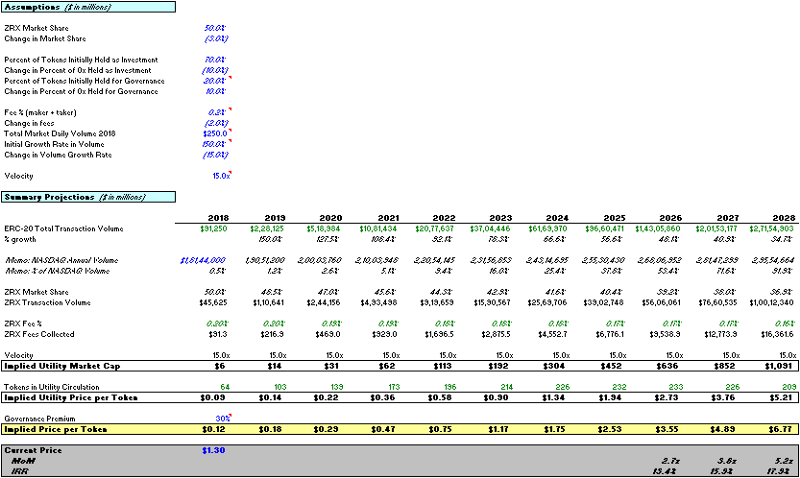 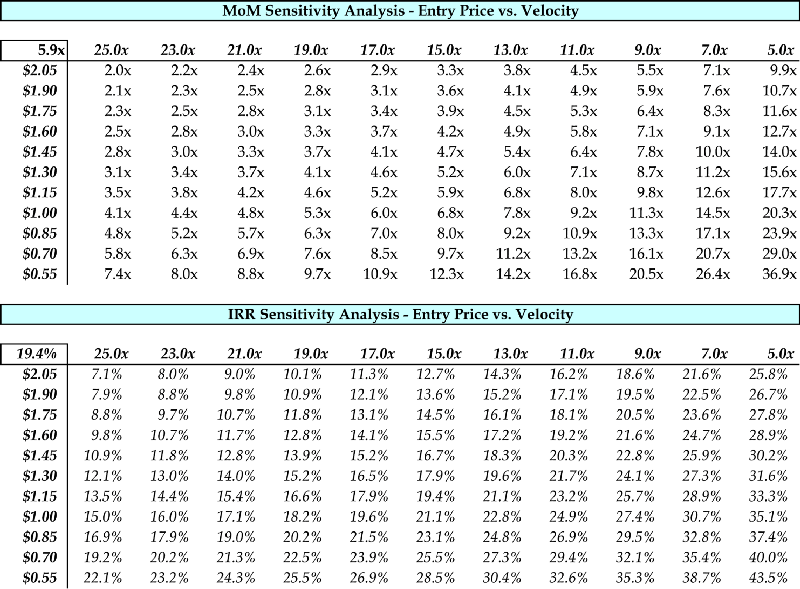 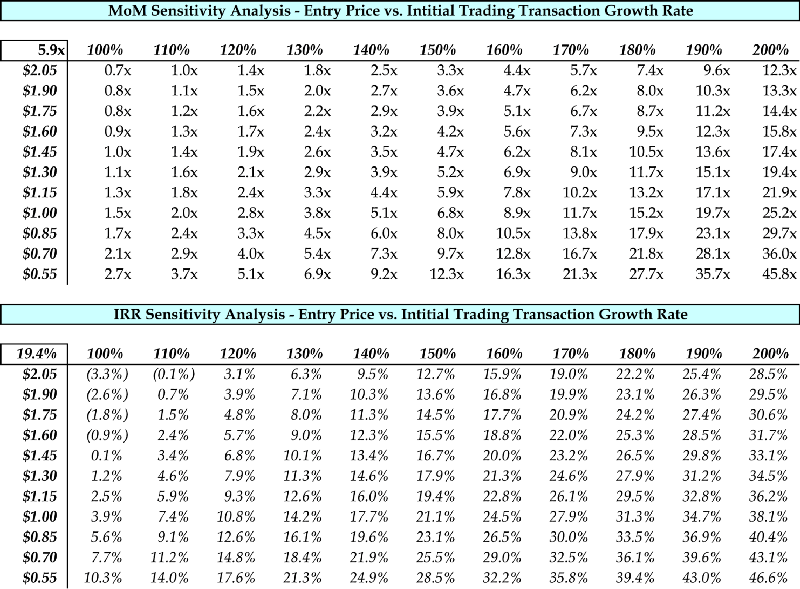 Appendix Links Website & Blog: https://0xproject.com/ Whitepaper: https://0xproject.com/pdfs/0x_white_paper.pdf Multicoin Research: https://multicoin.capital/2017/12/14/0x-zrx-analysis-valuation/ Epicenter Podcast: https://epicenter.tv/episode/222/ DevCon3: https://youtu.be/9d019RycObk?t=16m51s CEX/DEX attack vectors and miner front-running: https://blog.0xproject.com/front-running-griefing-and-the-perils-of-virtual-settlement-part-1-8554ab283e97 GitHub: https://github.com/0xProject |
| json metadata | {"tags":["crypto","bitcoin","ethereum","blockchain","investing"],"image":["https://cdn.steemitimages.com/DQmUpXKtbY2xG13yEaAvQX13Fr9zLp2LsJuqGDJycQixLPr/image.png","https://cdn.steemitimages.com/DQmULzTJwrxPCEYkPYUpngtHxVUJVtbkPWMhBLqUGbp3Jkn/image.png","https://cdn.steemitimages.com/DQmbrnybDpEupUdKaXShsTQhxmiuVwKirTXY1hJYA53Xky8/image.png","https://img.youtube.com/vi/9d019RycObk/0.jpg"],"links":["https://0xproject.com/","https://0xproject.com/pdfs/0x_white_paper.pdf","https://multicoin.capital/2017/12/14/0x-zrx-analysis-valuation/","https://epicenter.tv/episode/222/","https://youtu.be/9d019RycObk?t=16m51s","https://blog.0xproject.com/front-running-griefing-and-the-perils-of-virtual-settlement-part-1-8554ab283e97","https://github.com/0xProject"],"app":"steemit/0.1","format":"markdown"} |
| Transaction Info | Block #25173848/Trx bf9992b74f87937152afe05fef2674de949585eb |
View Raw JSON Data
{
"trx_id": "bf9992b74f87937152afe05fef2674de949585eb",
"block": 25173848,
"trx_in_block": 28,
"op_in_trx": 0,
"virtual_op": 0,
"timestamp": "2018-08-18T11:08:24",
"op": [
"comment",
{
"parent_author": "",
"parent_permlink": "crypto",
"author": "hgrdigitalag",
"permlink": "hgr-sample-investment-memo-zrx-jorge-go",
"title": "HGR Sample Investment Memo (ZRX) -- Jorge Go",
"body": "Disclaimer\n\nThe below write-up is an internal memo on the 0x protocol (or ZRX) written and circulated by HGR Digital Asset Group. It is presented here as a reflection of the fund’s investment deliberation process by which the team evaluates and decides upon whether or not a specific cryptoasset has investment merit. As a caveat, please note that all data presented below may be outdated as per the release of this article.\n\nRecommendation and Investment Thesis\n\nHGR believes the 0x protocol (“ZRX”, or the “Project”) is interesting, given:\n\nImminent (<18 months) structural and secular shifts towards scalable decentralized exchanges (“DEXs”) amidst multiple pain points with current centralized exchanges (“CEXs”), as described in the Key Hypotheses section below.\nZRX’s likely path to market leadership as a result of its hybrid approach of pairing on-chain execution of trades (ETH as settlement layer) with off-chain order matching via “Relayers” — third-parties who can run a DEX built on top of ZRX (i.e. host their own order books and UI but conduct trades using ZRX smart contracts). More relayer signups translate to greater network effects as the ecosystem benefits from “networked liquidity” — while each relayer hosts its own off-chain orderbook, order matching and settlement can be done across all relayers built on top of the 0x protocol.\n\nThematic consistence with HGR’s view on near-term value accretion to “middleware” layer and IAAS / crypto-to-crypto projects. ZRX is a protocol which developers can use to face user-facing DEXs, as well as be utilized by dApps requiring back-end token exchange functions such as Augur, Aragon, Maker and Melonport. HGR will look for longer-term, required public infrastructure if we believe the number of token trading pairs will trend towards infinity (digitized assets, non-fungible tokens, etc.).\n\nCurrent emergence of a real ecosystem that will kick-start usage and potentially trigger immediate catalysts. In line with this: (i) new upcoming relayers should validate the Project as POCs Radar Relay, Paradex, EthFinex, (ii) CEXs may set up ZRX-based DEX arms that will drive ZRX ecosystem volume and validate DEXs as a genuine threat / competitor to CEXs. This may also lead to the emergence of governance utility in the near-future, especially in light of large players (e.g. \nCoinbase acquisition of relayer Paradex) putting skin in the ZRX game. Other deep-pocketed CEXs (e.g. Binance, Bittrex) may follow Coinbase’s lead in acquiring ZRX relayers, which incentivizes them to participate in and influence protocol policy, increasing governance-based utility demand for the token.\n\nPotential for a near-term ZRX listing on Coinbase / GDAX where, similar to Liteoin’s path to a Coinbase listing, ZRX investors / advisors include 3 former Coinbase employees — Fred Ehrsam, Olaf Carlson-Wee (Polychain), and Linda Xie (Scalar). In March 2018, Coinbase announced its intention to support selected ERC-20 tokens in the coming months, and ZRX is a nice fit with the GDAX Digital Asset Framework, consistent with the themes of open financial markets, economic freedom, and providing decentralization. This criteria match has been noted by Linda Xie, who was an advisor to the creation of the GDAX Digital Asset Framework. Note also that the management team appears to be backable (good (“A-”to “A”) but not “A+” spectacular, CTO doesn’t have formal engineering training), and project is backed by respectable investors (e.g. Polychain, Pantera, BCAP, Multicoin). The team is passionate, meticulous, and disciplined as evidenced by Github development activity and cadence of updates / blog articles — milestones largely hit and management ships product at commendable pace.\n\nSummary Project Description\n\nZRX is a collection of smart contracts on Ethereum that can be used by anyone to build user facing DEXs or facilitate back-end exchange functions for dApps. It features core business logic smart contracts that accept signed data, processes them, allows settlement on-chain. ZRX also showcases governance contracts which enables voting for upgrades to trading smart contract system.\nEthereum used as settlement layer, with off-chain relays / orderbooks that do high-throughput transactions to achieve scalability.\n\nThe ZRX token represents in-network currency to pay for fees to use ZRX smart contracts (i.e. use the underlying protocol), as well as governance rights.\n\nKey Hypotheses (hypotheses that HGR needs to prove true upon further diligence that will provide higher conviction in the asset)\n\nThe industry will see an obviation of CEXs in the next 12–24 months as a result of: (i) Third-party custodial risk (insolvencies, fractional reserve systems, unpredictable downtim), (ii) limits on judgment resistance (withdrawal limits, arduous KYC/AML, subject to local regulations). For instance, local trading bans will drive DEX volumes, which can route around censorship and remain globally accessible, (iii) single point of failure (vulnerable to centralized attack vectors given “honeypot” targets), (iv) speed (moving funds to and from hot/cold wallets vs. direct trading on cold wallet), (v) CEX economic rent seeking (trading fees order of magnitude higher than equity exchanges, usually 25 bps).\nZRX’s hybrid / Relayer model is best positioned to be the winning DEX architecture. It is better than 100% on-chain solutions like Etherdelta, where trades are subject to miner front-running (20%+ order failure rate) and UX is poor. There is also a low cost of setting up Relayer based exchange (vs. centralized) results in a broader liquidity pool and overall network effects for everyone using ZRX. Accordingly, Relayers do not need to maintain internal ledger of customer balances, build settlement infrastructure, and no KYC/AML (no asset custody). Relayers can also invest in high-quality UI and charge add’l fees for specialized services but never touch user funds. Finally, a Hybrid model can be implemented in a way that facilitates secure, reliable and fair trading.\n\nZRX token needs to remain relevant to the network, meaning that i) no one is incentivized to fork ZRX and suggest BTC/ETH as fee currency; and / or ii) governance rights are valued by users of ZRX protocol (DEXs, dAppss, CEXs hedging part of their business via DEX acquisitions) to justify valuations.\n\nThe ZRX DEX ecosystem must have an acceptable level of liquidity relative to CEXs. This should be supported by an increasing number of relayer build-outs, including blue-chip backed relayers (e.g. Paradex / Coinbase).\n\nValuation Commentary\n\nCurrent Val (April 2018): <$1/ZRX; $450-$550mm (high of $900mm in Jan 2018)\nDEX Comps — Market Caps\nOmiseGo — $1.8 bn\nBitShares — $700mm\nKyber Network — $360mm\nAirSwap — $75mm\n\nCEX Comps — Market Caps\nBinance Coin — $1.7bn\nKuCoin Shares — $330mm\nGS-backed Circle acquires Poloniex (CEX) for $400mm\nBased on discussions with other actively managed funds, reasonable valuations are believed to lie in the range of $1.2-$2.6\n\nInvestment Risks\n\nExecution Risk: (i) Difficult challenges with off-chain order book security — on-chain, you get security for free and (ii)concerns over miner front-running.\nFork risk, obviation/replacement of ZRX token as fee currency: No specifics on token governance model has yet been release.\n\nZRX may lose market share to competing projects: (i)AirSwap — potentially closest comp, but very weak token use case, lower adoption, (ii)Kyber Network — depends on 3rd parties to set up trading reserves which requires up front capital, weak tokenomics,(iii) EtherDelta — on-chain orderbook, poor UX, (iv) OMG — on-chain orderbook that relies on complex cross-chain interoperability, and (v) Non-custodial centralized exchanges — Shapeshift, Evercoin.\n\nNext Steps\n\n(i) Investment team to conduct deeper desktop research [Completed]\n(ii) HGR to build Q&D [Completed]\n(iii) Engineering Team to diligence system architecture and tech stack, understand WP [Completed]\n(iv) Investment & Engineering teams to hop on call with management [TBD]\n(v) Investment team to decide position sizing and trade execution [TBD]\n(vi) Conduct final approval IC on [ TBD]\n\nMay 2018 Update, Q&D Model & Recommendation\n\n1. The price of ZRX has almost doubled in the last month, and the investment is now expensive on a fundamental / utility basis (please see model summary below). While there may still be upside in the form of catalysts (e.g. exchange listings, marketing announcements, new developments), HGR prefers to stand down for now and revisit ZRX when prices retrace to the <$1/ZRX level\n\nHGR has completed a code audit (please see separate tech writeup) with positive findings\nFollow-up questions from IC have been addressed (please see separate response sheet)\n\n2. Model Outputs attached below\n\nModel is intended to provide directional conviction (not hard underwriting standards), given uncertainty and irrationality in the crypto markets. Note: This model may be conservative given that it does not adjust for future compatibility beyond ERC-20 volumes.\n\nAt a price of $1.30, model suggests MoMs in the range of 3–5x, with mid-teens IRR, which is relatively unattractive compared to other opportunities in HGR’s near-term pipeline.\nInvestment becomes more attractive closer to $1 entry price, AND if one has conviction that trading volumes will ultimately exceed that of the NASDAQ (imperfect but helpful benchmark). The latter may be reasonable given: (i) Higher velocity / trading turnover of cryptoassets (lower friction, lower transaction fees, 24/7/365 trading) vis a vis traditional fiat securities leading to more trading volume and therefore more trading fees, and (ii) ZRX’s fundamentally larger TAM than the NASDAQ as a function of global reach (not just tech-focused stocks in the United States), and trading of new digital assets that would otherwise not have existed (e.g. ERC 721 non-fungible tokens + crypto-collectibles, ownership in art, video game items, etc.), beyond traditionally defined securities.\n\nZRX velocity may also be lower than expected, contributing to higher terminal value, if large stakeholders show bona fide interest in governance influence; key buyers of ZRX tokens for the governance use cases include but are not limited to: (i ) Relayers (e.g. EthFinex, Paradex) building on ZRX that want to steer protocol policy, (ii) dApps (e.g. Augur) utilizing ZRX infrastructure, and (iii)Activist funds (such as HGR) that want a seat at the table to push business building initiatives.\nHGR Q&D Model Output\n\n\n\n\n\n\n\nAppendix Links\n\nWebsite & Blog: https://0xproject.com/\nWhitepaper: https://0xproject.com/pdfs/0x_white_paper.pdf\nMulticoin Research: https://multicoin.capital/2017/12/14/0x-zrx-analysis-valuation/\nEpicenter Podcast: https://epicenter.tv/episode/222/\nDevCon3: https://youtu.be/9d019RycObk?t=16m51s\nCEX/DEX attack vectors and miner front-running: https://blog.0xproject.com/front-running-griefing-and-the-perils-of-virtual-settlement-part-1-8554ab283e97\nGitHub: https://github.com/0xProject",
"json_metadata": "{\"tags\":[\"crypto\",\"bitcoin\",\"ethereum\",\"blockchain\",\"investing\"],\"image\":[\"https://cdn.steemitimages.com/DQmUpXKtbY2xG13yEaAvQX13Fr9zLp2LsJuqGDJycQixLPr/image.png\",\"https://cdn.steemitimages.com/DQmULzTJwrxPCEYkPYUpngtHxVUJVtbkPWMhBLqUGbp3Jkn/image.png\",\"https://cdn.steemitimages.com/DQmbrnybDpEupUdKaXShsTQhxmiuVwKirTXY1hJYA53Xky8/image.png\",\"https://img.youtube.com/vi/9d019RycObk/0.jpg\"],\"links\":[\"https://0xproject.com/\",\"https://0xproject.com/pdfs/0x_white_paper.pdf\",\"https://multicoin.capital/2017/12/14/0x-zrx-analysis-valuation/\",\"https://epicenter.tv/episode/222/\",\"https://youtu.be/9d019RycObk?t=16m51s\",\"https://blog.0xproject.com/front-running-griefing-and-the-perils-of-virtual-settlement-part-1-8554ab283e97\",\"https://github.com/0xProject\"],\"app\":\"steemit/0.1\",\"format\":\"markdown\"}"
}
]
}2018/08/18 10:59:45
2018/08/18 10:59:45
| voter | coin.info |
| author | hgrdigitalag |
| permlink | news-update-japan-s-gumi-launches-usd30m-blockchain-vc-fund-led-by-miko-matsumura-taotao-he |
| weight | 694 (6.94%) |
| Transaction Info | Block #25173675/Trx d0352aafe8771d0e372503ddeb9f390681968d38 |
View Raw JSON Data
{
  "trx_id": "d0352aafe8771d0e372503ddeb9f390681968d38",
  "block": 25173675,
  "trx_in_block": 22,
  "op_in_trx": 0,
  "virtual_op": 0,
  "timestamp": "2018-08-18T10:59:45",
  "op": [
    "vote",
    {
      "voter": "coin.info",
      "author": "hgrdigitalag",
      "permlink": "news-update-japan-s-gumi-launches-usd30m-blockchain-vc-fund-led-by-miko-matsumura-taotao-he",
      "weight": 694
    }
  ]
}2018/08/18 10:59:42
2018/08/18 10:59:42
| parent author | hgrdigitalag |
| parent permlink | news-update-japan-s-gumi-launches-usd30m-blockchain-vc-fund-led-by-miko-matsumura-taotao-he |
| author | coin.info |
| permlink | re-hgrdigitalag-news-update-japan-s-gumi-launches-usd30m-blockchain-vc-fund-led-by-miko-matsumura-taotao-he-20180818t105941800z |
| title | |
| body | **Coins mentioned in post:** Coin | | Price (USD) | 📈 24h | 📈 7d - | - | - | - | - **BTC** | Bitcoin | 6531.371$ | _0.68%_ | _6.28%_ **CVC** | Civic | 0.129$ | _7.4%_ | _5.84%_ **POLY** | Polymath | 0.205$ | _2.99%_ | _-4.99%_ **PRO** | Propy | 0.360$ | _-1.24%_ | _-9.22%_ **XRP** | XRP | 0.347$ | _10.04%_ | _16.43%_ |
| json metadata | {"app":"coininfo/1.0.0","format":"markdown"} |
| Transaction Info | Block #25173674/Trx 53f26338d08e04bf27acc58c089017db1d0b8972 |
View Raw JSON Data
{
  "trx_id": "53f26338d08e04bf27acc58c089017db1d0b8972",
  "block": 25173674,
  "trx_in_block": 17,
  "op_in_trx": 0,
  "virtual_op": 0,
  "timestamp": "2018-08-18T10:59:42",
  "op": [
    "comment",
    {
      "parent_author": "hgrdigitalag",
      "parent_permlink": "news-update-japan-s-gumi-launches-usd30m-blockchain-vc-fund-led-by-miko-matsumura-taotao-he",
      "author": "coin.info",
      "permlink": "re-hgrdigitalag-news-update-japan-s-gumi-launches-usd30m-blockchain-vc-fund-led-by-miko-matsumura-taotao-he-20180818t105941800z",
      "title": "",
      "body": "**Coins mentioned in post:**\n\nCoin | | Price (USD) | 📈 24h | 📈 7d\n- | - | - | - | -\n**BTC** | Bitcoin | 6531.371$ | _0.68%_ | _6.28%_\n**CVC** | Civic | 0.129$ | _7.4%_ | _5.84%_\n**POLY** | Polymath | 0.205$ | _2.99%_ | _-4.99%_\n**PRO** | Propy | 0.360$ | _-1.24%_ | _-9.22%_\n**XRP** | XRP | 0.347$ | _10.04%_ | _16.43%_",
      "json_metadata": "{\"app\":\"coininfo/1.0.0\",\"format\":\"markdown\"}"
    }
  ]
}hgrdigitalagupvoted (100.00%) @hgrdigitalag / framing-the-cryptoasset-investment-opportunity-jorge-go2018/08/18 10:58:18
hgrdigitalagupvoted (100.00%) @hgrdigitalag / framing-the-cryptoasset-investment-opportunity-jorge-go
2018/08/18 10:58:18
| voter | hgrdigitalag |
| author | hgrdigitalag |
| permlink | framing-the-cryptoasset-investment-opportunity-jorge-go |
| weight | 10000 (100.00%) |
| Transaction Info | Block #25173646/Trx 632829a9272da43d1f14309e143e5db43555af4b |
View Raw JSON Data
{
  "trx_id": "632829a9272da43d1f14309e143e5db43555af4b",
  "block": 25173646,
  "trx_in_block": 29,
  "op_in_trx": 0,
  "virtual_op": 0,
  "timestamp": "2018-08-18T10:58:18",
  "op": [
    "vote",
    {
      "voter": "hgrdigitalag",
      "author": "hgrdigitalag",
      "permlink": "framing-the-cryptoasset-investment-opportunity-jorge-go",
      "weight": 10000
    }
  ]
}hgrdigitalagpublished a new post: framing-the-cryptoasset-investment-opportunity-jorge-go2018/08/18 10:58:00
hgrdigitalagpublished a new post: framing-the-cryptoasset-investment-opportunity-jorge-go
2018/08/18 10:58:00
| parent author | |
| parent permlink | crypto |
| author | hgrdigitalag |
| permlink | framing-the-cryptoasset-investment-opportunity-jorge-go |
| title | Framing the Cryptoasset Investment Opportunity -- Jorge Go |
| body | It’s always hard to explain blockchain (or broader distributed ledger technology, “DLT”) in one to two minutes, because blockchain is in many ways similar to a 400-level class that is built on a set of pre-requisite 101 classes — cryptography, game theory, psychology, politics, mathematics, economics, software engineering, and a host of many more disciplines. At a high level, without going into the technicals, blockchain technology combines all these fields mentioned above to create an open, permisionless and distributed ledger that anyone in the world can access and audit from anywhere. The four main benefits of distributed ledger technology include i) judgment/censorship resistance, ii) decentralization/broad points of failure, ii) immutability, and iv) perhaps most important, trustlessness. The most game-changing aspect of DLT is that it allows for the automated programming of incentives; and if you can program incentives, you can start programming human behavior — and ultimately remove the need for a trusted third party (“TTP”). The Total Addressable Market (“TAM”) for this is huge. Blockchain’s TAM includes all the disruptable markets dominated by TTPs, from insurance to gambling / prediction markets, to virtual real estate — with market sizes discounted for blockchain-based cost-savings, but grossed up for new markets created that would have otherwise been too impractical to set up without blockchain technology. We think that could be at least a third of global GDP ($80 trillion), plus a non-trivial amount of Global Wealth ($300 trillion). The opportunity here is ultimately more than just store of value (“SoV”) or medium of exchange (“MoE”), but when thinking about the broader space, it helps to first explore Bitcoin (the granddaddy SoV / MoE asset) before starting to dabble in the edgier use cases of blockchain. If humans were to get together today and design a financial system from scratch, tabula rasa, it would look very different from what we have today. The manual, paper and pen systems that we have today are largely still vestiges of a bygone era that have been forced into today’s digitally interconnected world by legacy incumbents. Take Bitcoin for instance as its use case as “digital gold”. Compared to gold, it is faster to send, cheaper to send, inherently deflationary, easier to store, easier to divide and is a true non-correlated hedge (volatility that is decoupled from equities, bonds, and other “fiat” investments). And unlike gold or the US dollar, it works on weekends, 24/7/365. It is judgment and censorship resistant — subject to no capital controls, bank restrictions, or asset freezes. It is trustless in that a TTP is not necessary to handle your assets, and in the sense that you do not have to trust a government to preserve value on your behalf (e.g. The Fed pumping trillions of dollars in the last recession to devalue the dollar, India decommissioning certain bills arbitrarily wiping out value, Venezuela/Zimbabwe’s hyperinflation). We wrote a more in-depth research and valuation on this here (https://medium.com/hgr-digital-asset-group/bitcoins-march-towards-200k-442de3d05d46), but if you buy the premise that BTC is better than gold, perhaps the TAM in an ultimate bull case is global wealth — which assuming a modest growth rate at current levels of $300 trillion, becomes $400 trillion in 10 years. Imprecisely, if BTC takes just 2% of this TAM, it would have an $8 trillion cap, vs. the $150 billion it is now. If you have something that can potentially 50x, you must have 98% conviction that it’s not going to happen for you to not put money in. Once you get comfortable with Bitcoin, you can start to explore how the same properties underlying the Bitcoin blockchain can be leveraged to broker cheap trust — creating models that disrupt today’s TTPs — financial service firms, social media companies, and other “value-added” intermediaries. If we were to operate as students of history and look back at the biggest tech booms and their respective winners, there is always a pattern where each boom is heralded by an open source development that commoditizes the previous cycle’s differentiators. For instance, the mass production of transistors paved the way for the first modern computers and the “IBM mainframe era” — then microprocessors commoditized what IBM did, punting value to the software layer which the likes of MSFT dominated. Then you had the development of the internet + Linux deconstructing MSFT’s differentiated moat of proprietary software on proprietary machines, commoditizing that software layer and punting value to the data layer, where you now have the FANG (FCBK, AMZN, NFLX, GOOGL) crowd acting as rent-seeking state aggregators sitting on mountains of proprietary data. A good chunk of crypto’s TAM will be the commoditization of that proprietary data into platform-agnostic use cases. Oftentimes, people look at investing in crypto as this binary concept — do I invest given the asymmetric upside, or do I not invest because it’s a scam that could go to zero? This is a false dilemma. The reconciler is simply a matter of sizing. From a portfolio theory perspective, you have an asset that is non-correlated (volatile yes, but volatility that is unrelated to other investments) and therefore a true method of diversification that boosts the overall portfolio’s Sharpe Ratio, and with plenty of upside that is premised on secular and defensible trends. One must ask themselves, is it worth putting a dollar into the space? The answer is undoubtedly “yes.” How about two dollars, three, four — and you go from there. We believe every well-balanced portfolio includes a crypto allocation — and the only question is one of sizing. |
| json metadata | {"tags":["crypto","bitcoin","ethereum","blockchain","investing"],"links":["https://medium.com/hgr-digital-asset-group/bitcoins-march-towards-200k-442de3d05d46"],"app":"steemit/0.1","format":"markdown"} |
| Transaction Info | Block #25173640/Trx 38e43c86b57d6d03eface082a0a8890aa16a448f |
View Raw JSON Data
{
  "trx_id": "38e43c86b57d6d03eface082a0a8890aa16a448f",
  "block": 25173640,
  "trx_in_block": 15,
  "op_in_trx": 0,
  "virtual_op": 0,
  "timestamp": "2018-08-18T10:58:00",
  "op": [
    "comment",
    {
      "parent_author": "",
      "parent_permlink": "crypto",
      "author": "hgrdigitalag",
      "permlink": "framing-the-cryptoasset-investment-opportunity-jorge-go",
      "title": "Framing the Cryptoasset Investment Opportunity -- Jorge Go",
      "body": "It’s always hard to explain blockchain (or broader distributed ledger technology, “DLT”) in one to two minutes, because blockchain is in many ways similar to a 400-level class that is built on a set of pre-requisite 101 classes — cryptography, game theory, psychology, politics, mathematics, economics, software engineering, and a host of many more disciplines.\n\nAt a high level, without going into the technicals, blockchain technology combines all these fields mentioned above to create an open, permisionless and distributed ledger that anyone in the world can access and audit from anywhere. The four main benefits of distributed ledger technology include i) judgment/censorship resistance, ii) decentralization/broad points of failure, ii) immutability, and iv) perhaps most important, trustlessness. The most game-changing aspect of DLT is that it allows for the automated programming of incentives; and if you can program incentives, you can start programming human behavior — and ultimately remove the need for a trusted third party (“TTP”). The Total Addressable Market (“TAM”) for this is huge. Blockchain’s TAM includes all the disruptable markets dominated by TTPs, from insurance to gambling / prediction markets, to virtual real estate — with market sizes discounted for blockchain-based cost-savings, but grossed up for new markets created that would have otherwise been too impractical to set up without blockchain technology. We think that could be at least a third of global GDP ($80 trillion), plus a non-trivial amount of Global Wealth ($300 trillion).\n\nThe opportunity here is ultimately more than just store of value (“SoV”) or medium of exchange (“MoE”), but when thinking about the broader space, it helps to first explore Bitcoin (the granddaddy SoV / MoE asset) before starting to dabble in the edgier use cases of blockchain.\n\nIf humans were to get together today and design a financial system from scratch, tabula rasa, it would look very different from what we have today. The manual, paper and pen systems that we have today are largely still vestiges of a bygone era that have been forced into today’s digitally interconnected world by legacy incumbents. Take Bitcoin for instance as its use case as “digital gold”. Compared to gold, it is faster to send, cheaper to send, inherently deflationary, easier to store, easier to divide and is a true non-correlated hedge (volatility that is decoupled from equities, bonds, and other “fiat” investments). And unlike gold or the US dollar, it works on weekends, 24/7/365. It is judgment and censorship resistant — subject to no capital controls, bank restrictions, or asset freezes. It is trustless in that a TTP is not necessary to handle your assets, and in the sense that you do not have to trust a government to preserve value on your behalf (e.g. The Fed pumping trillions of dollars in the last recession to devalue the dollar, India decommissioning certain bills arbitrarily wiping out value, Venezuela/Zimbabwe’s hyperinflation). We wrote a more in-depth research and valuation on this here (https://medium.com/hgr-digital-asset-group/bitcoins-march-towards-200k-442de3d05d46), but if you buy the premise that BTC is better than gold, perhaps the TAM in an ultimate bull case is global wealth — which assuming a modest growth rate at current levels of $300 trillion, becomes $400 trillion in 10 years. Imprecisely, if BTC takes just 2% of this TAM, it would have an $8 trillion cap, vs. the $150 billion it is now. If you have something that can potentially 50x, you must have 98% conviction that it’s not going to happen for you to not put money in.\n\nOnce you get comfortable with Bitcoin, you can start to explore how the same properties underlying the Bitcoin blockchain can be leveraged to broker cheap trust — creating models that disrupt today’s TTPs — financial service firms, social media companies, and other “value-added” intermediaries. If we were to operate as students of history and look back at the biggest tech booms and their respective winners, there is always a pattern where each boom is heralded by an open source development that commoditizes the previous cycle’s differentiators. For instance, the mass production of transistors paved the way for the first modern computers and the “IBM mainframe era” — then microprocessors commoditized what IBM did, punting value to the software layer which the likes of MSFT dominated. Then you had the development of the internet + Linux deconstructing MSFT’s differentiated moat of proprietary software on proprietary machines, commoditizing that software layer and punting value to the data layer, where you now have the FANG (FCBK, AMZN, NFLX, GOOGL) crowd acting as rent-seeking state aggregators sitting on mountains of proprietary data. A good chunk of crypto’s TAM will be the commoditization of that proprietary data into platform-agnostic use cases.\n\nOftentimes, people look at investing in crypto as this binary concept — do I invest given the asymmetric upside, or do I not invest because it’s a scam that could go to zero? This is a false dilemma. The reconciler is simply a matter of sizing. From a portfolio theory perspective, you have an asset that is non-correlated (volatile yes, but volatility that is unrelated to other investments) and therefore a true method of diversification that boosts the overall portfolio’s Sharpe Ratio, and with plenty of upside that is premised on secular and defensible trends. One must ask themselves, is it worth putting a dollar into the space? The answer is undoubtedly “yes.” How about two dollars, three, four — and you go from there. We believe every well-balanced portfolio includes a crypto allocation — and the only question is one of sizing.",
      "json_metadata": "{\"tags\":[\"crypto\",\"bitcoin\",\"ethereum\",\"blockchain\",\"investing\"],\"links\":[\"https://medium.com/hgr-digital-asset-group/bitcoins-march-towards-200k-442de3d05d46\"],\"app\":\"steemit/0.1\",\"format\":\"markdown\"}"
    }
  ]
}sensationupvoted (100.00%) @hgrdigitalag / deciphering-enigma-eng-ting-wai-to2018/08/18 10:54:30
sensationupvoted (100.00%) @hgrdigitalag / deciphering-enigma-eng-ting-wai-to
2018/08/18 10:54:30
| voter | sensation |
| author | hgrdigitalag |
| permlink | deciphering-enigma-eng-ting-wai-to |
| weight | 10000 (100.00%) |
| Transaction Info | Block #25173570/Trx e11c6fb5af83db933ff64a813c39ab8a287f79c1 |
View Raw JSON Data
{
  "trx_id": "e11c6fb5af83db933ff64a813c39ab8a287f79c1",
  "block": 25173570,
  "trx_in_block": 10,
  "op_in_trx": 0,
  "virtual_op": 0,
  "timestamp": "2018-08-18T10:54:30",
  "op": [
    "vote",
    {
      "voter": "sensation",
      "author": "hgrdigitalag",
      "permlink": "deciphering-enigma-eng-ting-wai-to",
      "weight": 10000
    }
  ]
}2018/08/18 10:53:42
2018/08/18 10:53:42
| voter | hackerzizon |
| author | hgrdigitalag |
| permlink | news-update-japan-s-gumi-launches-usd30m-blockchain-vc-fund-led-by-miko-matsumura-taotao-he |
| weight | 100 (1.00%) |
| Transaction Info | Block #25173554/Trx 067667e4f80596d156a62431931a223234577bff |
View Raw JSON Data
{
  "trx_id": "067667e4f80596d156a62431931a223234577bff",
  "block": 25173554,
  "trx_in_block": 32,
  "op_in_trx": 0,
  "virtual_op": 0,
  "timestamp": "2018-08-18T10:53:42",
  "op": [
    "vote",
    {
      "voter": "hackerzizon",
      "author": "hgrdigitalag",
      "permlink": "news-update-japan-s-gumi-launches-usd30m-blockchain-vc-fund-led-by-miko-matsumura-taotao-he",
      "weight": 100
    }
  ]
}2018/08/18 10:50:51
2018/08/18 10:50:51
| parent author | hgrdigitalag |
| parent permlink | news-update-japan-s-gumi-launches-usd30m-blockchain-vc-fund-led-by-miko-matsumura-taotao-he |
| author | cheetah |
| permlink | cheetah-re-hgrdigitalagnews-update-japan-s-gumi-launches-usd30m-blockchain-vc-fund-led-by-miko-matsumura-taotao-he |
| title | |
| body | Hi! I am a robot. I just upvoted you! I found similar content that readers might be interested in: https://medium.com/hgr-digital-asset-group/news-3f09f9aea62c |
| json metadata | |
| Transaction Info | Block #25173497/Trx 6492e1be97b0e98cf21ac8ac67791d8f1370fb69 |
View Raw JSON Data
{
  "trx_id": "6492e1be97b0e98cf21ac8ac67791d8f1370fb69",
  "block": 25173497,
  "trx_in_block": 45,
  "op_in_trx": 0,
  "virtual_op": 0,
  "timestamp": "2018-08-18T10:50:51",
  "op": [
    "comment",
    {
      "parent_author": "hgrdigitalag",
      "parent_permlink": "news-update-japan-s-gumi-launches-usd30m-blockchain-vc-fund-led-by-miko-matsumura-taotao-he",
      "author": "cheetah",
      "permlink": "cheetah-re-hgrdigitalagnews-update-japan-s-gumi-launches-usd30m-blockchain-vc-fund-led-by-miko-matsumura-taotao-he",
      "title": "",
      "body": "Hi! I am a robot. I just upvoted you! I found similar content that readers might be interested in:\nhttps://medium.com/hgr-digital-asset-group/news-3f09f9aea62c",
      "json_metadata": ""
    }
  ]
}2018/08/18 10:50:48
2018/08/18 10:50:48
| voter | cheetah |
| author | hgrdigitalag |
| permlink | news-update-japan-s-gumi-launches-usd30m-blockchain-vc-fund-led-by-miko-matsumura-taotao-he |
| weight | 8 (0.08%) |
| Transaction Info | Block #25173496/Trx fb0ff0ffcdd85e1dbb40cf8ec2e1a894f937e084 |
View Raw JSON Data
{
  "trx_id": "fb0ff0ffcdd85e1dbb40cf8ec2e1a894f937e084",
  "block": 25173496,
  "trx_in_block": 30,
  "op_in_trx": 0,
  "virtual_op": 0,
  "timestamp": "2018-08-18T10:50:48",
  "op": [
    "vote",
    {
      "voter": "cheetah",
      "author": "hgrdigitalag",
      "permlink": "news-update-japan-s-gumi-launches-usd30m-blockchain-vc-fund-led-by-miko-matsumura-taotao-he",
      "weight": 8
    }
  ]
}2018/08/18 10:50:39
2018/08/18 10:50:39
| parent author | |
| parent permlink | crypto |
| author | hgrdigitalag |
| permlink | news-update-japan-s-gumi-launches-usd30m-blockchain-vc-fund-led-by-miko-matsumura-taotao-he |
| title | NEWS UPDATE: "Japan’s gumi Launches $30M Blockchain VC Fund Led by Miko Matsumura" -- Taotao He |
| body | Hi Miko Matsumura, thank you for coming on our podcast series again. Before delving into this podcast I first wanted to congratulate you, Kunimitsu san and Gumi on behalf of HGR. A few days ago Japanese mobile game publisher Gumi announced they’ll be launching a $30 million investment fund focused on cryptocurrencies and blockchain with you and Kunimitsu san at the helm. (You can find the entire press release below) Taotao: Everyone these days are always talking about the next step for cryptos is predicated on corporate and mainstream adoption. By forming a fund Gumi Inc is showing that corporate adoption is on the rise — what do you was the catalyst for this decision? Do you expect other companies to follow suit? Miko: Gumi is a sizeable and successful publicly traded game company in Japan, but in some ways Gumi is not a very traditional enterprise. The founder CEO Kunimitsu san is a very bold and creative visionary and has run multiple venture capital funds already in gaming as well as in AR/VR. I expect with the coming regulatory clarity and mass adoption of crypto assets that many institutional players are trying to find a way into this industry, some in the form of a hedge and others with stronger conviction. Since our thesis is that we are in the middle of the transformation of our global economy, there should be no way for any surviving enterprise to stay out of it. The right question for any organization to ask is whether they should consider incentivizing the value-adders in their ecosystem including their developers, their users, their partners and their employees. Once things are framed in those terms, it becomes clear that any organization that refuses to incentivize their ecosystem becomes vulnerable to competitors who do. Taotao: The new fund has a lot of inherent synergies between you and Kunimitsu san. You having years of experience and a deep understanding of the crypto space and Kunimitsu from a business and corporate standpoint. This isn’t the first time you started a fund, how is this time different? Miko: One of the incredible ways in which this partnership has a strong synergy is how connected Kunimitsu san is in Japan and how deep his operating experience is. This enables him both to strongly diligence new companies as well as to make them hugely successful in Japan through his deep and well established contact network. Contrast that with my role as a visible speaker, analyst, advisor and blogger and you will find that I would be able to source high quality deal flow and work with partners across the world, but at the same time rely on the partnership to deliver Japanese business connections. To me this is a very strong offering designed for not the early stage of cryptoeconomy but for the more mature and growthful phase where the best deals in the world are oversubscribed and will only provide allocation for strategic investors. Gumi wants to be strategic to them by delivering them Japanese business networks, which most foreign entrepreneurs outside of Japan find difficult. Taotao: How do you plan on sourcing deals and finding promising projects? Miko: We principally would like to source deals through our relationships with great investors. Part of our model is that we would like to maintain our own humility and station in the market as a great partner and humble servant of the crypto economy and it’s most successful entrepreneurs. So instead of taking the model of having a large number of analysts who do intense diligence, we would rather invest in delivering value to our portfolio post investment. This means that we will appreciate and likely follow some of the best VC firms and partners in the world. We would like to earn our allocation and their trust by delivering on our promises and building those relationships through helping them navigate in Japan. Taotao: What are you most excited about this new fund and what do you hope to achieve? Miko: I love the Japanese culture and gamers, so it’s excited to be involved with both professionally. It goes without saying that I am 100% dedicated to the emergence of the global cryptoeconomy and feel grateful to be offered an opportunity to accelerate global adoption of crypto assets. Through our initial fund, we hope to accelerate at least 50 new ventures with capital infusion and Japanese business networks which will further the growth of the global crypto economy, generate millions of new wallets, establish new infrastructure tokens and platforms, popularize cryptocurrency worldwide and further establish Japan as the world’s largest and most liquid cryptoeconomy. Taotao: From a corporate and institutional angle how would you go about analyzing the ICOs? You mentioned in our earlier podcast you place a lot of emphasis on team and governance — going forward with gumi cryptos do you have additional criteria’s? Miko: The main thing I obsess about are teams. We look for experienced teams who have shown responsibility and execution power by delivering shareholder value through past exits. We also look for what I call “Time-to-Cryptoeconomy” which is a bit like time to market for companies. This means that already shipping product with existing users and a pre-existing fiat revenue base are all traction signals that convert well to real-world crypto economics. Governance is an important final criteria for us, as we are experienced VCs and we want to ensure that there are proper controls over the use of proceeds. Nobody wants to see misappropriation of funds and we all want clear accountability of the management team to deliver the vision in their white papers. We understand how dynamic young companies can be and we deeply respect entrepreneurs who can find “the pivot” which can catapult their business to the next level. But there’s a world of difference between changing your business plan and simply pocketing the ICO proceeds. So governance is of course important to us and to the entire industry. Taotao: Instances like this remind us how receptive the Japanese community is receptive and understand the potential of cryptocurrencies. You mentioned a lot of high quality projects struggle to find traction in Japan — how do you plan on addressing this? Miko: Yes, Japan is surprisingly not the first country most token startups think of. I say surprisingly because it is the largest single cryptoeconomy in the world and is the friendliest large economy in the world to this emerging phenomenon. The exciting thing is that Gumi has build very deep and trusted networks in Japan by taking a large gaming company (Gumi the game company) public on the Tokyo Stock Exchange. These networks as well as the new relationships already created by investing in a half dozen global crypto companies will form the basis of a Gumi Japan Crypto business network. This will allow all of our portfolio companies to come to Japan and have an instant network of friends and supporters including regulators, exchanges, investors, enterprises, users, bloggers, meetups, review sites, marketing agencies and an entire Japanese crypto ecosystem ready to deploy on your behalf. Taotao: With all the regulatory uncertainty in the west, we are seeing a shift of sentiment and projects to other areas such as Malta, Japan and Singapore. What are your thoughts on the different regulatory approaches and investor sentiments towards crypto? Miko: I feel that the culture of open source money and therefore the base of crypto is based on an internet fueled borderless consent model. And because it’s an internet based model it flows seamlessly across borders. The mindset of open source is really one of choosing platforms wisely, and each country and its regulatory framework is viewed as a “platform provider” by people in the open source money movement. So much in the way that open source entrepreneurs choose a database platform or a web application server platform to build their applications on, these entrepreneurs choose their legal and regulatory platform which best runs their “applications”. If you look at regulators like the SEC, we see them attempting to push definitions such as Securities laws from the 1930’s onto crypto assets. To me, this is an extreme form of “legacy code” that will inherently be restrictive towards new asset classes that simply don’t meet those requirements. I’m fully committed to regulatory compliance, to user and investor protections and to the elimination of bad actors including fraud, money laundering, terrorist financing, market manipulation, predatory practices and I’m all in favor of the facilitation of capital formation. Believe me, I respect the SEC greatly and think they are doing a fantastic job so far given how understaffed they are and how fast this phenomenon is growing. But if I were to give advice to entrepreneurs, they should study some of the more nimble jurisdictions who can refactor the legal frameworks such as the Malta VFA legislation for “Virtual Financial Assets”. There’s also great work being done in the state of Wyoming, in Taiwan and many other points around the world. The Internet is global and it routes around damage — and it experiences censorship as damage. So we will see the global talent in ICO, currently a 14 billion dollar phenomenon flow to where it’s most welcome. So far, of the largest economies in the world, Japan is the leader in that. Among smaller economies there are some very nimble countries doing well also. JAPAN’S GUMI LAUNCHES GLOBAL BLOCKCHAIN INVESTMENT FUND $30 Million USD in initial investment secured for gumi Cryptos fund to invest in global cryptocurrency companies TOKYO, Japan — May 30, 2018 — gumi Inc., a leading global mobile game publisher and developer, today launched a dedicated fund to invest in promising cryptocurrency and blockchain technology companies, called gumi Cryptos. The fund offers its portfolio companies a strategic venture capital investment partner with unique access to the Japan cryptocurrency market through its network of investors and management board. The first projects funded by gumi Cryptos include Basis, Origin Protocol, Robot Cache and Pryze. With an initial investment of $30 million, gumi Cryptos is led by proven operators Hironao Kunimitsu, Founder and CEO of gumi Inc., and Miko Matsumura, founder of US-based virtual currency exchange Evercoin. Matsumura is a Venture Partner at BitBull Capital and an advisor at Arrington XRP Capital. He is an investor in Lyft, FileCoin, Brave, CIVIC, Basecoin, Propy, Polymath and more. Matsumura has also served as an advisor to over a dozen ICOs and startups, having raised over $250 million to date for companies such as Bee Token (Decentralized AirBnB) and Celsius Network (Crypto Lending Platform). The full list is available at http://miko.com. gumi Cryptos fills a specific void in the investment spectrum of the blockchain and cryptocurrency industry. In many cases, even the top cryptocurrency organizations in the world struggle to understand and access markets in Japan, including investment and industrial networks, customers, exchanges and regulators. Kunimitsu said, “We decided to create a fund that enables us to engage more directly with early-stage blockchain and cryptocurrency startups, in order to be more effective partners and have a real impact in the market. Our team brings tremendous expertise in emerging technology, and with gumi Cryptos, we can truly partner with these companies as they achieve amazing results for all stakeholders.” Matsumura said, “Having advised top global cryptocurrency startups alongside some of the best investors in the world, I’ve come to realize that all of them struggle to break into Japan, the largest cryptocurrency market in the world. I’m excited to join gumi and their well-respected network in Japan.” White & Case LLP, a global law firm, acted for gumi Inc. in establishing gumi Cryptos LLC and negotiated the joint venture arrangements between the partners. The Tokyo-led legal team included Nels Hansen, Ayako Kawano, Fumika Cho and Kei Horiguchi. Voyage Group Co., Ltd., an entertainment company, and YJM Games Co., Ltd., a Korean game company, and other major domestic financial institutions are invested in this fund. Some facts about the Japan market: • Japan is the third largest economy in the world • Japan was the first country to legalize Bitcoin • As of January 15, 2018, Japanese Yen accounts for 56.2 percent of Bitcoin (BTC) volume, according to coinhills.com. Yen is followed by U.S. dollars at 28.4 percent, while all others account for 15.4 percent. For more information, visit http://www.gumi-cryptos.com. About gumi Inc. Founded in 2007, gumi Inc. (Tokyo Stock Exchange: 3903) is a leading global mobile game publisher and developer headquartered in Japan, with overseas operations in France, Korea, Singapore, Taiwan and the United States. The company has proven success in launching titles worldwide, such as the widely popular role-playing games Brave Frontier and THE ALCHEMIST CODE. In 2016, gumi established a Silicon Valley-based investment group with partners, called The Venture Reality Fund, which focuses on seed and early stage augmented reality and virtual reality startups. Additionally, its VR incubation subsidiaries have expanded globally, including Tokyo XR Startups, Seoul XR Startups, and Nordic XR Startups. With ongoing publishing and development projects on a wide array of mobile, AR and VR platforms, gumi aims to change the world through innovative entertainment products and services, including both original content and collaborations with popular IP. For more information, please visit http://www.gu3.co.jp/en/. Media Contact Kate Pietrelli [email protected] +1 760–518–2633 |
| json metadata | {"tags":["crypto","bitcoin","ethereum","blockchain","investing"],"links":["http://miko.com","http://www.gumi-cryptos.com","http://www.gu3.co.jp/en/"],"app":"steemit/0.1","format":"markdown"} |
| Transaction Info | Block #25173493/Trx 11c9cbcd501b31a28e3af0c40485706178c63dd1 |
View Raw JSON Data
{
  "trx_id": "11c9cbcd501b31a28e3af0c40485706178c63dd1",
  "block": 25173493,
  "trx_in_block": 9,
  "op_in_trx": 0,
  "virtual_op": 0,
  "timestamp": "2018-08-18T10:50:39",
  "op": [
    "comment",
    {
      "parent_author": "",
      "parent_permlink": "crypto",
      "author": "hgrdigitalag",
      "permlink": "news-update-japan-s-gumi-launches-usd30m-blockchain-vc-fund-led-by-miko-matsumura-taotao-he",
      "title": "NEWS UPDATE: \"Japan’s gumi Launches $30M Blockchain VC Fund Led by Miko Matsumura\" -- Taotao He",
      "body": "Hi Miko Matsumura, thank you for coming on our podcast series again. Before delving into this podcast I first wanted to congratulate you, Kunimitsu san and Gumi on behalf of HGR. A few days ago Japanese mobile game publisher Gumi announced they’ll be launching a $30 million investment fund focused on cryptocurrencies and blockchain with you and Kunimitsu san at the helm. (You can find the entire press release below)\n\nTaotao: Everyone these days are always talking about the next step for cryptos is predicated on corporate and mainstream adoption. By forming a fund Gumi Inc is showing that corporate adoption is on the rise — what do you was the catalyst for this decision? Do you expect other companies to follow suit?\n\nMiko: Gumi is a sizeable and successful publicly traded game company in Japan, but in some ways Gumi is not a very traditional enterprise. The founder CEO Kunimitsu san is a very bold and creative visionary and has run multiple venture capital funds already in gaming as well as in AR/VR. I expect with the coming regulatory clarity and mass adoption of crypto assets that many institutional players are trying to find a way into this industry, some in the form of a hedge and others with stronger conviction. Since our thesis is that we are in the middle of the transformation of our global economy, there should be no way for any surviving enterprise to stay out of it. The right question for any organization to ask is whether they should consider incentivizing the value-adders in their ecosystem including their developers, their users, their partners and their employees. Once things are framed in those terms, it becomes clear that any organization that refuses to incentivize their ecosystem becomes vulnerable to competitors who do.\n\nTaotao: The new fund has a lot of inherent synergies between you and Kunimitsu san. You having years of experience and a deep understanding of the crypto space and Kunimitsu from a business and corporate standpoint. This isn’t the first time you started a fund, how is this time different?\n\nMiko: One of the incredible ways in which this partnership has a strong synergy is how connected Kunimitsu san is in Japan and how deep his operating experience is. This enables him both to strongly diligence new companies as well as to make them hugely successful in Japan through his deep and well established contact network. Contrast that with my role as a visible speaker, analyst, advisor and blogger and you will find that I would be able to source high quality deal flow and work with partners across the world, but at the same time rely on the partnership to deliver Japanese business connections. To me this is a very strong offering designed for not the early stage of cryptoeconomy but for the more mature and growthful phase where the best deals in the world are oversubscribed and will only provide allocation for strategic investors. Gumi wants to be strategic to them by delivering them Japanese business networks, which most foreign entrepreneurs outside of Japan find difficult.\n\nTaotao: How do you plan on sourcing deals and finding promising projects?\n\nMiko: We principally would like to source deals through our relationships with great investors. Part of our model is that we would like to maintain our own humility and station in the market as a great partner and humble servant of the crypto economy and it’s most successful entrepreneurs. So instead of taking the model of having a large number of analysts who do intense diligence, we would rather invest in delivering value to our portfolio post investment. This means that we will appreciate and likely follow some of the best VC firms and partners in the world. We would like to earn our allocation and their trust by delivering on our promises and building those relationships through helping them navigate in Japan.\n\nTaotao: What are you most excited about this new fund and what do you hope to achieve?\n\nMiko: I love the Japanese culture and gamers, so it’s excited to be involved with both professionally. It goes without saying that I am 100% dedicated to the emergence of the global cryptoeconomy and feel grateful to be offered an opportunity to accelerate global adoption of crypto assets. Through our initial fund, we hope to accelerate at least 50 new ventures with capital infusion and Japanese business networks which will further the growth of the global crypto economy, generate millions of new wallets, establish new infrastructure tokens and platforms, popularize cryptocurrency worldwide and further establish Japan as the world’s largest and most liquid cryptoeconomy.\n\nTaotao: From a corporate and institutional angle how would you go about analyzing the ICOs? You mentioned in our earlier podcast you place a lot of emphasis on team and governance — going forward with gumi cryptos do you have additional criteria’s?\n\nMiko: The main thing I obsess about are teams. We look for experienced teams who have shown responsibility and execution power by delivering shareholder value through past exits. We also look for what I call “Time-to-Cryptoeconomy” which is a bit like time to market for companies. This means that already shipping product with existing users and a pre-existing fiat revenue base are all traction signals that convert well to real-world crypto economics. Governance is an important final criteria for us, as we are experienced VCs and we want to ensure that there are proper controls over the use of proceeds. Nobody wants to see misappropriation of funds and we all want clear accountability of the management team to deliver the vision in their white papers. We understand how dynamic young companies can be and we deeply respect entrepreneurs who can find “the pivot” which can catapult their business to the next level. But there’s a world of difference between changing your business plan and simply pocketing the ICO proceeds. So governance is of course important to us and to the entire industry.\n\nTaotao: Instances like this remind us how receptive the Japanese community is receptive and understand the potential of cryptocurrencies. You mentioned a lot of high quality projects struggle to find traction in Japan — how do you plan on addressing this?\n\nMiko: Yes, Japan is surprisingly not the first country most token startups think of. I say surprisingly because it is the largest single cryptoeconomy in the world and is the friendliest large economy in the world to this emerging phenomenon. The exciting thing is that Gumi has build very deep and trusted networks in Japan by taking a large gaming company (Gumi the game company) public on the Tokyo Stock Exchange. These networks as well as the new relationships already created by investing in a half dozen global crypto companies will form the basis of a Gumi Japan Crypto business network. This will allow all of our portfolio companies to come to Japan and have an instant network of friends and supporters including regulators, exchanges, investors, enterprises, users, bloggers, meetups, review sites, marketing agencies and an entire Japanese crypto ecosystem ready to deploy on your behalf.\n\nTaotao: With all the regulatory uncertainty in the west, we are seeing a shift of sentiment and projects to other areas such as Malta, Japan and Singapore. What are your thoughts on the different regulatory approaches and investor sentiments towards crypto?\n\nMiko: I feel that the culture of open source money and therefore the base of crypto is based on an internet fueled borderless consent model. And because it’s an internet based model it flows seamlessly across borders. The mindset of open source is really one of choosing platforms wisely, and each country and its regulatory framework is viewed as a “platform provider” by people in the open source money movement. So much in the way that open source entrepreneurs choose a database platform or a web application server platform to build their applications on, these entrepreneurs choose their legal and regulatory platform which best runs their “applications”. If you look at regulators like the SEC, we see them attempting to push definitions such as Securities laws from the 1930’s onto crypto assets. To me, this is an extreme form of “legacy code” that will inherently be restrictive towards new asset classes that simply don’t meet those requirements. I’m fully committed to regulatory compliance, to user and investor protections and to the elimination of bad actors including fraud, money laundering, terrorist financing, market manipulation, predatory practices and I’m all in favor of the facilitation of capital formation. Believe me, I respect the SEC greatly and think they are doing a fantastic job so far given how understaffed they are and how fast this phenomenon is growing. But if I were to give advice to entrepreneurs, they should study some of the more nimble jurisdictions who can refactor the legal frameworks such as the Malta VFA legislation for “Virtual Financial Assets”. There’s also great work being done in the state of Wyoming, in Taiwan and many other points around the world. The Internet is global and it routes around damage — and it experiences censorship as damage. So we will see the global talent in ICO, currently a 14 billion dollar phenomenon flow to where it’s most welcome. So far, of the largest economies in the world, Japan is the leader in that. Among smaller economies there are some very nimble countries doing well also.\n\nJAPAN’S GUMI LAUNCHES GLOBAL BLOCKCHAIN\n\nINVESTMENT FUND\n\n$30 Million USD in initial investment secured for gumi Cryptos fund to invest in global cryptocurrency companies\n\nTOKYO, Japan — May 30, 2018 — gumi Inc., a leading global mobile game publisher and developer, today launched a dedicated fund to invest in promising cryptocurrency and blockchain technology companies, called gumi Cryptos. The fund offers its portfolio companies a strategic venture capital investment partner with unique access to the Japan cryptocurrency market through its network of investors and management board. The first projects funded by gumi Cryptos include Basis, Origin Protocol, Robot Cache and Pryze. With an initial investment of $30 million, gumi Cryptos is led by proven operators Hironao Kunimitsu, Founder and CEO of gumi Inc., and Miko Matsumura, founder of US-based virtual currency exchange Evercoin. Matsumura is a Venture Partner at BitBull Capital and an advisor at Arrington XRP Capital. He is an investor in Lyft, FileCoin, Brave, CIVIC, Basecoin, Propy, Polymath and more. Matsumura has also served as an advisor to over a dozen ICOs and startups, having raised over $250 million to date for companies such as Bee Token (Decentralized AirBnB) and Celsius Network (Crypto Lending Platform). The full list is available at http://miko.com.\n\ngumi Cryptos fills a specific void in the investment spectrum of the blockchain and cryptocurrency industry. In many cases, even the top cryptocurrency organizations in the world struggle to understand and access markets in Japan, including investment and industrial networks, customers, exchanges and regulators. Kunimitsu said, “We decided to create a fund that enables us to engage more directly with early-stage blockchain and cryptocurrency startups, in order to be more effective partners and have a real impact in the market. Our team brings tremendous expertise in emerging technology, and with gumi Cryptos, we can truly partner with these companies as they achieve amazing results for all stakeholders.”\n\nMatsumura said, “Having advised top global cryptocurrency startups alongside some of the best investors in the world, I’ve come to realize that all of them struggle to break into Japan, the largest cryptocurrency market in the world. I’m excited to join gumi and their well-respected network in Japan.”\n\nWhite & Case LLP, a global law firm, acted for gumi Inc. in establishing gumi Cryptos LLC and negotiated the joint venture arrangements between the partners. The Tokyo-led legal team included Nels Hansen, Ayako Kawano, Fumika Cho and Kei Horiguchi. Voyage Group Co., Ltd., an entertainment company, and YJM Games Co., Ltd., a Korean game company, and other major domestic financial institutions are invested in this fund.\n\nSome facts about the Japan market:\n\n• Japan is the third largest economy in the world\n\n• Japan was the first country to legalize Bitcoin\n\n• As of January 15, 2018, Japanese Yen accounts for 56.2 percent of Bitcoin (BTC) volume, according to coinhills.com. Yen is followed by U.S. dollars at 28.4 percent, while all others account for 15.4 percent.\n\nFor more information, visit http://www.gumi-cryptos.com.\n\nAbout gumi Inc.\n\nFounded in 2007, gumi Inc. (Tokyo Stock Exchange: 3903) is a leading global mobile game publisher and developer headquartered in Japan, with overseas operations in France, Korea, Singapore, Taiwan and the United States. The company has proven success in launching titles worldwide, such as the widely popular role-playing games Brave Frontier and THE ALCHEMIST CODE. In 2016, gumi established a Silicon Valley-based investment group with partners, called The Venture Reality Fund, which focuses on seed and early stage augmented reality and virtual reality startups. Additionally, its VR incubation subsidiaries have expanded globally, including Tokyo XR Startups, Seoul XR Startups, and Nordic XR Startups. With ongoing publishing and development projects on a wide array of mobile, AR and VR platforms, gumi aims to change the world through innovative entertainment products and services, including both original content and collaborations with popular IP. For more information, please visit\n\nhttp://www.gu3.co.jp/en/.\n\nMedia Contact\n\nKate Pietrelli\n\[email protected]\n\n+1 760–518–2633",
      "json_metadata": "{\"tags\":[\"crypto\",\"bitcoin\",\"ethereum\",\"blockchain\",\"investing\"],\"links\":[\"http://miko.com\",\"http://www.gumi-cryptos.com\",\"http://www.gu3.co.jp/en/\"],\"app\":\"steemit/0.1\",\"format\":\"markdown\"}"
    }
  ]
}moby-dickupvoted (100.00%) @hgrdigitalag / deciphering-enigma-eng-ting-wai-to2018/08/18 10:42:48
moby-dickupvoted (100.00%) @hgrdigitalag / deciphering-enigma-eng-ting-wai-to
2018/08/18 10:42:48
| voter | moby-dick |
| author | hgrdigitalag |
| permlink | deciphering-enigma-eng-ting-wai-to |
| weight | 10000 (100.00%) |
| Transaction Info | Block #25173336/Trx 7a201b4a76cecb214b7f3ed8180465422d22297e |
View Raw JSON Data
{
  "trx_id": "7a201b4a76cecb214b7f3ed8180465422d22297e",
  "block": 25173336,
  "trx_in_block": 29,
  "op_in_trx": 0,
  "virtual_op": 0,
  "timestamp": "2018-08-18T10:42:48",
  "op": [
    "vote",
    {
      "voter": "moby-dick",
      "author": "hgrdigitalag",
      "permlink": "deciphering-enigma-eng-ting-wai-to",
      "weight": 10000
    }
  ]
}steeming-hotupvoted (3.00%) @hgrdigitalag / hgr-2018-market-outlook2018/08/18 10:09:39
steeming-hotupvoted (3.00%) @hgrdigitalag / hgr-2018-market-outlook
2018/08/18 10:09:39
| voter | steeming-hot |
| author | hgrdigitalag |
| permlink | hgr-2018-market-outlook |
| weight | 300 (3.00%) |
| Transaction Info | Block #25172673/Trx e49a2ab203b723a75da01db3da5b52718dbe0f1d |
View Raw JSON Data
{
  "trx_id": "e49a2ab203b723a75da01db3da5b52718dbe0f1d",
  "block": 25172673,
  "trx_in_block": 36,
  "op_in_trx": 0,
  "virtual_op": 0,
  "timestamp": "2018-08-18T10:09:39",
  "op": [
    "vote",
    {
      "voter": "steeming-hot",
      "author": "hgrdigitalag",
      "permlink": "hgr-2018-market-outlook",
      "weight": 300
    }
  ]
}2018/08/18 10:04:48
2018/08/18 10:04:48
| parent author | hgrdigitalag |
| parent permlink | hgr-2018-market-outlook |
| author | cheetah |
| permlink | cheetah-re-hgrdigitalaghgr-2018-market-outlook |
| title | |
| body | Hi! I am a robot. I just upvoted you! I found similar content that readers might be interested in: https://medium.com/hgr-digital-asset-group/titan-2018-market-outlook-cab5bf38cd2f |
| json metadata | |
| Transaction Info | Block #25172576/Trx b4b58c834141937829bb7964b7d11cdd388cbfda |
View Raw JSON Data
{
  "trx_id": "b4b58c834141937829bb7964b7d11cdd388cbfda",
  "block": 25172576,
  "trx_in_block": 123,
  "op_in_trx": 0,
  "virtual_op": 0,
  "timestamp": "2018-08-18T10:04:48",
  "op": [
    "comment",
    {
      "parent_author": "hgrdigitalag",
      "parent_permlink": "hgr-2018-market-outlook",
      "author": "cheetah",
      "permlink": "cheetah-re-hgrdigitalaghgr-2018-market-outlook",
      "title": "",
      "body": "Hi! I am a robot. I just upvoted you! I found similar content that readers might be interested in:\nhttps://medium.com/hgr-digital-asset-group/titan-2018-market-outlook-cab5bf38cd2f",
      "json_metadata": ""
    }
  ]
}cheetahupvoted (0.08%) @hgrdigitalag / hgr-2018-market-outlook2018/08/18 10:04:45
cheetahupvoted (0.08%) @hgrdigitalag / hgr-2018-market-outlook
2018/08/18 10:04:45
| voter | cheetah |
| author | hgrdigitalag |
| permlink | hgr-2018-market-outlook |
| weight | 8 (0.08%) |
| Transaction Info | Block #25172575/Trx d9ea1ad2da064c822e9964e3622f6a777c0ff0fe |
View Raw JSON Data
{
  "trx_id": "d9ea1ad2da064c822e9964e3622f6a777c0ff0fe",
  "block": 25172575,
  "trx_in_block": 14,
  "op_in_trx": 0,
  "virtual_op": 0,
  "timestamp": "2018-08-18T10:04:45",
  "op": [
    "vote",
    {
      "voter": "cheetah",
      "author": "hgrdigitalag",
      "permlink": "hgr-2018-market-outlook",
      "weight": 8
    }
  ]
}hgrdigitalagpublished a new post: hgr-2018-market-outlook2018/08/18 10:04:36
hgrdigitalagpublished a new post: hgr-2018-market-outlook
2018/08/18 10:04:36
| parent author | |
| parent permlink | crypto |
| author | hgrdigitalag |
| permlink | hgr-2018-market-outlook |
| title | HGR 2018 Market Outlook |
| body | 2017 and the first month of 2018 have been quite a ride in the crypto world. At the beginning of 2017, Bitcoin and Ethereum were at $1,000 and $8, respectively. Global mindshare and capital piled into the space throughout the year, driving the two bellwether cryptoassets to a local maximum of ~$20,000 and $1,450, respectively, during January 2018. As we write this today, sentiment in the market is much more subdued and we are experiencing a long overdue correction. That said, given our conviction that many significant developments will be achieved during 2018, and that the crypto space will generate considerable investor surplus over the long run, we could not be more excited to be evaluating projects amidst this market drawdown. As we have detailed, our investment sourcing process is driven by multiple sources, including a top-down view on attractive investable themes. Today we would like to share with you three of such themes below. We look forward to an eventful 2018. Sincerely, The HGR team The Pronounced Need for Scaling Solutions Mature blockchain-powered tokens such as Bitcoin and Ethereum have experienced well-documented growing pains during 2017, with both chains’ experiencing more unconfirmed transactions in their mempools, which have driven higher transaction fees and prolonged confirmations. Most industry-grade applications require throughput capability of thousands of transactions per second. For mature blockchains to reach such levels, scaling solutions are necessary. While there are many approaches to scaling, here we focus on token-level investable opportunities, which typically can be categorized as either: layer 2 solutions and parallelization. We believe both present investable opportunities in 2018 as scaling becomes more of a topical issue. Layer 2 solutions, or side/off chains, are networks that process transactions on offline channels, thereby taking the transaction load off the main chain. Investable layer 2 solution tokens include: Enigma, Raiden Network, and iExec RLC. Lightning Network and Plasma, as projects without tokens, are uninvestable. Parallelization refers to distributing the work of validating new transactions to multiple nodes to be performed simultaneously, thereby increasing transaction throughput and confirmation speed. The most visible example currently is sharding as contemplated in Ethereum (Casper), though this is uninvestable. Investable parallelization tokens include: Zilliqa. Directed acyclic graphs (DAG), altogether an alternative to blockchains as a potentially better way to reach high levels of native processing without additional add-on solutions, are likely to gain attention in 2018 as well. Early indications of such projects prove promising. Besides IOTA, DAG-powered tokens with a potentially better risk-reward include Byteball Bytes and RaiBlocks. Consistent with scaling issues, we believe that the most valuable tokens in the near term will be those providing the “middleware” layer of the decentralized tech stack. We believe infrastructure-related projects that provide solutions within the crypto space (e.g. stablecoins, off-chain computation, decentralized exchange protocols, digital identity) will see value realized quicker in the near term, which will then be subsequently used to facilitate the rollout of projects that target end users. For example, 0x offers a protocol for developers to build user-facing decentralized exchanges. Beyond decentralized exchanges such as Paradex and Radar Relay, its infrastructure is also being utilized by dApps requiring back-end token exchange functions such as Augur, Aragon, Maker and Melonport. Modern Demand for Privacy and the Liberalization of Personal Data Catalyzed by Edward Snowden’s surveillance disclosures in 2013 and subsequent mass security breaches (Equifax, Adult Friend Finder, Ashley Madison, Anthem, eBay, JP Morgan, Yahoo), privacy as a fundamental right appears to be gaining mindshare inside and outside the crypto community, especially in Western countries. Since then, there have been increased interest in a more private way of life by using tools such as private messages (Snapchat, Telegram, Messenger’s secret messages) and private transfers of wealth (crypto tokens such as Monero, Zcash). Several ongoing consumer privacy-related class action lawsuits have been filed against Google and Facebook. The European Union’s General Data Protection Regulation (“GDPR”) takes into effect during Q2 2018, which empowers EU citizens to gain control of their personal data from companies that currently hold them. The crypto community is also responding with increased privacy measures. Ethereum implemented zk-SNARKs in the Byzantium upgrade. Monero’s Project Coral Reef outreach effort has been successful at increasing awareness of privacy and adoption of its coin, signing up 50+ prominent music stars to accept XMR. We believe that privacy in medium of exchange is a near eventual certainty given evolving consumer and merchant needs. Given this, privacy coins are a focus (Dash, Monero, Verge, Zcash, and Zcoin), as well as protocols that enable privacy, such as Enigma. Tokens that emphasize consumer privacy are also likely to gain faster adoption and experience increased interest in 2018. Such include Enigma and Shopin (currently launching ICO). Chinese Crypto Adoption by Enterprises and Governments to Accelerate Despite China’s ICO and crypto exchange bans/shutdowns in 2017, we believe such measures are meant to protect Chinese citizens from speculation and not reflective of crypto adoption in the country. In fact, we believe crypto adoption for enterprise use cases is among the fastest in the world, facilitated by structurally close alignment between crypto projects, governments at various levels, and companies. A number of such partnerships have already been announced. Notable ones include VeChain with the government of Gui’an (national level partnership) and Waltonchain with China Mobile IoT Alliance. We expect a large number of partnerships to be announced over the next couple years given the increasing amount of focus on the space by all players (crypto, government, and enterprise). Tokens that natively support the Chinese market include NEO, Qtum, VeChain, and Waltonchain |
| json metadata | {"tags":["crypto","bitcoin","ethereum","blockchain","investing"],"app":"steemit/0.1","format":"markdown"} |
| Transaction Info | Block #25172572/Trx 739078974ea798ea1ccc0ccf137c5e966de26360 |
View Raw JSON Data
{
  "trx_id": "739078974ea798ea1ccc0ccf137c5e966de26360",
  "block": 25172572,
  "trx_in_block": 23,
  "op_in_trx": 0,
  "virtual_op": 0,
  "timestamp": "2018-08-18T10:04:36",
  "op": [
    "comment",
    {
      "parent_author": "",
      "parent_permlink": "crypto",
      "author": "hgrdigitalag",
      "permlink": "hgr-2018-market-outlook",
      "title": "HGR 2018 Market Outlook",
      "body": "2017 and the first month of 2018 have been quite a ride in the crypto world. At the beginning of 2017, Bitcoin and Ethereum were at $1,000 and $8, respectively. Global mindshare and capital piled into the space throughout the year, driving the two bellwether cryptoassets to a local maximum of ~$20,000 and $1,450, respectively, during January 2018. As we write this today, sentiment in the market is much more subdued and we are experiencing a long overdue correction. That said, given our conviction that many significant developments will be achieved during 2018, and that the crypto space will generate considerable investor surplus over the long run, we could not be more excited to be evaluating projects amidst this market drawdown.\n\nAs we have detailed, our investment sourcing process is driven by multiple sources, including a top-down view on attractive investable themes. Today we would like to share with you three of such themes below.\n\nWe look forward to an eventful 2018.\n\nSincerely,\n\nThe HGR team\n\nThe Pronounced Need for Scaling Solutions\nMature blockchain-powered tokens such as Bitcoin and Ethereum have experienced well-documented growing pains during 2017, with both chains’ experiencing more unconfirmed transactions in their mempools, which have driven higher transaction fees and prolonged confirmations.\n\nMost industry-grade applications require throughput capability of thousands of transactions per second. For mature blockchains to reach such levels, scaling solutions are necessary. While there are many approaches to scaling, here we focus on token-level investable opportunities, which typically can be categorized as either: layer 2 solutions and parallelization. We believe both present investable opportunities in 2018 as scaling becomes more of a topical issue.\n\nLayer 2 solutions, or side/off chains, are networks that process transactions on offline channels, thereby taking the transaction load off the main chain. Investable layer 2 solution tokens include: Enigma, Raiden Network, and iExec RLC. Lightning Network and Plasma, as projects without tokens, are uninvestable.\n\nParallelization refers to distributing the work of validating new transactions to multiple nodes to be performed simultaneously, thereby increasing transaction throughput and confirmation speed. The most visible example currently is sharding as contemplated in Ethereum (Casper), though this is uninvestable. Investable parallelization tokens include: Zilliqa.\n\nDirected acyclic graphs (DAG), altogether an alternative to blockchains as a potentially better way to reach high levels of native processing without additional add-on solutions, are likely to gain attention in 2018 as well. Early indications of such projects prove promising. Besides IOTA, DAG-powered tokens with a potentially better risk-reward include Byteball Bytes and RaiBlocks.\n\nConsistent with scaling issues, we believe that the most valuable tokens in the near term will be those providing the “middleware” layer of the decentralized tech stack. We believe infrastructure-related projects that provide solutions within the crypto space (e.g. stablecoins, off-chain computation, decentralized exchange protocols, digital identity) will see value realized quicker in the near term, which will then be subsequently used to facilitate the rollout of projects that target end users. For example, 0x offers a protocol for developers to build user-facing decentralized exchanges. Beyond decentralized exchanges such as Paradex and Radar Relay, its infrastructure is also being utilized by dApps requiring back-end token exchange functions such as Augur, Aragon, Maker and Melonport.\n\nModern Demand for Privacy and the Liberalization of Personal Data\nCatalyzed by Edward Snowden’s surveillance disclosures in 2013 and subsequent mass security breaches (Equifax, Adult Friend Finder, Ashley Madison, Anthem, eBay, JP Morgan, Yahoo), privacy as a fundamental right appears to be gaining mindshare inside and outside the crypto community, especially in Western countries.\n\nSince then, there have been increased interest in a more private way of life by using tools such as private messages (Snapchat, Telegram, Messenger’s secret messages) and private transfers of wealth (crypto tokens such as Monero, Zcash). Several ongoing consumer privacy-related class action lawsuits have been filed against Google and Facebook. The European Union’s General Data Protection Regulation (“GDPR”) takes into effect during Q2 2018, which empowers EU citizens to gain control of their personal data from companies that currently hold them.\n\nThe crypto community is also responding with increased privacy measures. Ethereum implemented zk-SNARKs in the Byzantium upgrade. Monero’s Project Coral Reef outreach effort has been successful at increasing awareness of privacy and adoption of its coin, signing up 50+ prominent music stars to accept XMR.\n\nWe believe that privacy in medium of exchange is a near eventual certainty given evolving consumer and merchant needs. Given this, privacy coins are a focus (Dash, Monero, Verge, Zcash, and Zcoin), as well as protocols that enable privacy, such as Enigma.\n\nTokens that emphasize consumer privacy are also likely to gain faster adoption and experience increased interest in 2018. Such include Enigma and Shopin (currently launching ICO).\n\nChinese Crypto Adoption by Enterprises and Governments to Accelerate\nDespite China’s ICO and crypto exchange bans/shutdowns in 2017, we believe such measures are meant to protect Chinese citizens from speculation and not reflective of crypto adoption in the country. In fact, we believe crypto adoption for enterprise use cases is among the fastest in the world, facilitated by structurally close alignment between crypto projects, governments at various levels, and companies.\n\nA number of such partnerships have already been announced. Notable ones include VeChain with the government of Gui’an (national level partnership) and Waltonchain with China Mobile IoT Alliance. We expect a large number of partnerships to be announced over the next couple years given the increasing amount of focus on the space by all players (crypto, government, and enterprise).\n\nTokens that natively support the Chinese market include NEO, Qtum, VeChain, and Waltonchain",
      "json_metadata": "{\"tags\":[\"crypto\",\"bitcoin\",\"ethereum\",\"blockchain\",\"investing\"],\"app\":\"steemit/0.1\",\"format\":\"markdown\"}"
    }
  ]
}sensationupvoted (100.00%) @hgrdigitalag / scaling-ethereum-for-global-adoption-jc-li2018/08/18 09:52:54
sensationupvoted (100.00%) @hgrdigitalag / scaling-ethereum-for-global-adoption-jc-li
2018/08/18 09:52:54
| voter | sensation |
| author | hgrdigitalag |
| permlink | scaling-ethereum-for-global-adoption-jc-li |
| weight | 10000 (100.00%) |
| Transaction Info | Block #25172338/Trx 9e1ee1f8f70697f899219b4c10c018d12a112ae0 |
View Raw JSON Data
{
  "trx_id": "9e1ee1f8f70697f899219b4c10c018d12a112ae0",
  "block": 25172338,
  "trx_in_block": 7,
  "op_in_trx": 0,
  "virtual_op": 0,
  "timestamp": "2018-08-18T09:52:54",
  "op": [
    "vote",
    {
      "voter": "sensation",
      "author": "hgrdigitalag",
      "permlink": "scaling-ethereum-for-global-adoption-jc-li",
      "weight": 10000
    }
  ]
}2018/08/18 09:49:30
2018/08/18 09:49:30
| parent author | hgrdigitalag |
| parent permlink | deciphering-enigma-eng-ting-wai-to |
| author | cheetah |
| permlink | cheetah-re-hgrdigitalagdeciphering-enigma-eng-ting-wai-to |
| title | |
| body | Hi! I am a robot. I just upvoted you! I found similar content that readers might be interested in: https://medium.com/hgr-digital-asset-group/deciphering-enigma-49437594a0f4 |
| json metadata | |
| Transaction Info | Block #25172270/Trx a137788f0da3c48627c8173d2377f47e51b0efc8 |
View Raw JSON Data
{
  "trx_id": "a137788f0da3c48627c8173d2377f47e51b0efc8",
  "block": 25172270,
  "trx_in_block": 31,
  "op_in_trx": 0,
  "virtual_op": 0,
  "timestamp": "2018-08-18T09:49:30",
  "op": [
    "comment",
    {
      "parent_author": "hgrdigitalag",
      "parent_permlink": "deciphering-enigma-eng-ting-wai-to",
      "author": "cheetah",
      "permlink": "cheetah-re-hgrdigitalagdeciphering-enigma-eng-ting-wai-to",
      "title": "",
      "body": "Hi! I am a robot. I just upvoted you! I found similar content that readers might be interested in:\nhttps://medium.com/hgr-digital-asset-group/deciphering-enigma-49437594a0f4",
      "json_metadata": ""
    }
  ]
}cheetahupvoted (0.08%) @hgrdigitalag / deciphering-enigma-eng-ting-wai-to2018/08/18 09:49:18
cheetahupvoted (0.08%) @hgrdigitalag / deciphering-enigma-eng-ting-wai-to
2018/08/18 09:49:18
| voter | cheetah |
| author | hgrdigitalag |
| permlink | deciphering-enigma-eng-ting-wai-to |
| weight | 8 (0.08%) |
| Transaction Info | Block #25172266/Trx 39d546325eedd37c6f809c70878881df28b1283a |
View Raw JSON Data
{
  "trx_id": "39d546325eedd37c6f809c70878881df28b1283a",
  "block": 25172266,
  "trx_in_block": 1,
  "op_in_trx": 0,
  "virtual_op": 0,
  "timestamp": "2018-08-18T09:49:18",
  "op": [
    "vote",
    {
      "voter": "cheetah",
      "author": "hgrdigitalag",
      "permlink": "deciphering-enigma-eng-ting-wai-to",
      "weight": 8
    }
  ]
}hgrdigitalagpublished a new post: deciphering-enigma-eng-ting-wai-to2018/08/18 09:48:57
hgrdigitalagpublished a new post: deciphering-enigma-eng-ting-wai-to
2018/08/18 09:48:57
| parent author | |
| parent permlink | crypto |
| author | hgrdigitalag |
| permlink | deciphering-enigma-eng-ting-wai-to |
| title | Deciphering Enigma (ENG) -- Ting-Wai To |
| body | In a previous article, we covered the privacy coin landscape. We believe that as cryptocurrencies and blockchain start to gain traction in the business world, there will be an increased need for privacy. Enigma (ENG) aims to be a blockchain agnostic privacy protocol. This means that multiple blockchains such as Ethereum and NEO can utilize Enigma for private calculations and transactions. Enigma’s utility goes beyond privacy coins such as Monero and Zcoin, which only serves the singular purpose of being a currency that keeps your transactions private. While Monero is commonly compared to a privacy-centric Bitcoin, Enigma is somewhat akin to a privacy-centric Ethereum. Using ENG’s “secret contracts”, developers can launch decentralized applications that preserves privacy of data on the blockchain. Enigma’s prime directive is to revolutionize the way data is shared, aggregated, and monetized through its decentralized protocol. Enigma Overview Enigma’s overarching goal is to implement 1) a scalable off-chain smart contracts that preserves privacy of all data that flows in and out and 2) a decentralized data warehouse + marketplace. “The Enigma protocol is a second-layer, off-chain network that aims to solve the two biggest problems for blockchains: scalability and privacy. By enabling secure, decentralized data computation and exchange, Enigma allows blockchains to truly fulfill their powerful promise.” Enigma is a very ambitious project that aims to solve the privacy issues facing blockchain technology. They are promising a revolutionary privacy-enabling protocol along with a suite of products to accompany it. The scope of Enigma’s projects is rather big (protocol, Catalyst, data marketplace, etc) and each one could almost be a startup by itself. That said, Enigma agrees that tackling privacy is their top priority right now and other issues like scalability and data storage will solved in a later stage. Enigma is a project in for the long run and, if successful, could change the landscape of blockchain technology. Enigma’s Roadmap Discovery: 2018 Q2 — Q3 To introduce the concept of “secret contracts”. Developers will be able to create smart contracts with all data and computation encrypted. Smart contract development going from Ethereum to Enigma should be seamless and require no change to the code, exception for a line to indicate the contract will be run privately. Voyager: 2019 Q1 — Q2 Release a distributed VM that can run general-purpose secure multi-party computation (MPC). Enigma will also launch its own chain and allow dapps to transition to run on their network instead of Ethereum’s. This should increase scalability greatly while still using Ethereum as a parent-chain. Valiant: 2019 Q4–2020 Q1 Further strengthen decentralization and scalability of the network. Network should be fully open and secure consensus at this point. Defiant: 2020 Q3 Achieve complete chain-independence and potentially move the Enigma token off of Ethereum where it’d become a native coin in Enigma. Here Enigma does not need to rely on any other network for its backbone. Further security and decentralization improvements will continue to be made. dApps Catalyst Catalyst is an open source tool for backtesting trading algos and can help execute trades on exchanges like Bittrex based on trading algos. Users write Python to create and test their trading algos. Catayst can also tap into datasets on the Enigma data marketplace. An example use case would be for a trader to continuously stream data, paid with ENG tokens, from the marketplace directly into training his/her machine learning model. It is worth noting that Catalyst is not an entirely original product, it was forked off a popular backtesting tool called Zipline. That said, Engima’s continuous work on Catalyst is differentiating it from Zipline daily. Data Marketplace The Enigma Data Marketplace is a decentralized smart contract to coordinate the buying and selling of data sets. Through the smart contract, sellers register their datasets with details such as how often the data is updated and the subscription cost. Consumers can then gain access to datasets by paying a subscription fee. The contract essentially acts as a gateway to authenticate paid users to the datasets they subscribe to. The actual data lives off-chain. As of right now, when consumers “ingest” data that they have subscribed to, the data is directly downloaded onto their machine. This means the paid data can be nefariously redistributed to non-payers. Until data on the marketplace can be consumed in an encrypted and private manner, the marketplace is currently unfit for distributors looking to put their data for sale. It is currently deployed on the Ethereum mainnet, users can interact with the marketplace using ENG tokens. ENG’s Highlights: Pedigreed team Enigma boasts one of the more accomplished teams within the crypto universe. Co-Founder and CEO Guy Zyskind has a Master of Science from the Massachusetts Institutional of Technology (MIT) and has over 10 years of software development. Co-Founder and CPO Can Kisagun has an MBA from MIT and has worked at McKinsey. Other developers all have extensive and relevant work experience. Enigma also has an all-star advisor team with individuals who have backgrounds from prominent hedge funds, budding startups, and incubators. Among them include world renowned computer scientist Alex Pentland (in 2011, Forbes named him one of the world’s seven most powerful data scientists along with a founder of Google and the CTO of the United States), and Kevin Zhou, co-founder of Galois Capital and former head of trading at Kraken. Enigma also has solid backing from institutions such as the Digital Currency Group and MIT. Partnerships Over the past few months, Enigma has not only continued to develop its product but also formed key partnerships with other blockchain firms to build momentum and speed up Enigma’s adoption. 1. Ethlend Ethlend is the first decentralized lending marketplace. ENG will bring computational data to decentralized lending, which allows Ethlend to devise collateral management strategies by analyzing private user data. 2. Aion Aion is a platform that aims to solve the problem of interoperability and scalability of blockchains. A partnership with Aion will allow Enigma to become blockchain agnostic and able to interact with any blockchain. This mutually beneficial partnership will provide security for Aion and allow Enigma to freely transact across multiple blockchains. 3. KyberNetwork KyberNetwork allows for an instant exchange of crypto assets with guaranteed liquidity. KyberNetwork’s partnership mainly revolves around Enigma’s product — Catalyst. The collaboration of the two firms will allow for a safe and secure platform for the transaction of crypto assets in the future. Potential to disrupt multibillion dollar industries Enigma has the potential to disrupt several multibillion dollar industries. The Enigma team comprehensively covers Enigma’s Total Addressable Market in the their blog post (link). To summarize: Data Marketplace for Personal Data: $100 bn + Computations on Genomic Data: $50 — $100 bn + Artificial Intelligence on Healthcare Data: $50 — $100 bn Credit Assessment / Decentralized Lending: $50 — $100 bn Identity: $10 — $50 bn IoT: $50 — $100 bn Enigma Token Use Case A security deposit to ensure the integrity of the network (proof-of-stake) Fees to store and buy data on the platform Gas — fees for any computations on the network Enigma vs zk-SNARKs zk-SNARKs is expected to solve some aspects concerning privacy since it allows privacy for computations on small data sets, but it is not practical to be used on large datasets without having a centralized authority which is privy to the data. On the other hand, Enigma’s encryption of data allows multiple parties to run computations off the large data set. This allows companies to analyze the encrypted data and make informed decisions. With all these milestones and catalysts (no pun intended) coming to light in 2018, we expect 2018 to be quite the year for Enigma. Scalability Technology Many blockchains today face scalability issues. The Enigma blockchain is unique. Unlike a traditional blockchain, it doesn’t need every node in the network to replicate all the computations and data storage — only a small subset performs each computation over different parts of the data. This decreased redundancy in computation and storage enables more complex computations. But as previously mentioned, privacy will be the primary focus before moving onto solving scalability. Masternode Incentives Enigma also plans to allow ENG holders to stake their ENG tokens (Rumors range between 10,000 to 15,000 tokens). Masternode holders will compute transactions on the network. In the process, the Masternode will periodically produce ENG tokens for the Masternode holder. To stake a node, one must effectively lock up a supply of tokens. As supply shifts to the left and assuming demand stays constant, the price of ENG will appreciate. Macro backdrop and legal catalysts GDPR legislation coming out in May 2018 will harmonize data privacy across Europe. GDPR is designed to bring companies into compliance with new laws that allow individuals to identify who has their data, determine what the data is used for, and remove personal data if the individual so desires. The Enigma protocol is primed to capitalize on this as the protocol allows users to own their own data and choose how it is shared. Regulatory Risks The events leading to Enigma’s ICO was tainted when a hacker was able to gain access to Enigma’s mailing list, website, and Slack account because CEO Guy Zyskind failed to change a previously compromised password for his email account. The hacker tricked token buyers into sending Ethereum to his / her wallet and left with around $500,000 worth of Ethereum. The Enigma team then decided to increase the hard cap by 50% less than a week before the crowd sale (to $45 million). As regulatory bodies are starting to scrutinize ICOs and their practices, these two events could draw more attention than the average ICO from regulatory bodies due to a lack of oversight and bad business practices. Summary If Guy Zyskind and the Engima team can set out and create what they intend Engima to be, we could see the rise of a new protocol which will rival Ethereum and NEO. As mentioned earlier, the Enigma project is very ambitious and will require many years and overcoming multiple hurdles to achieve its vision. Fundamentally, Enigma plans to tackle two key issues, which currently plague the crypto scene — privacy and scalability. Even if Enigma can achieve just one of its goals, we could expect the valuation of this protocol to multiply many times. While the vision is grand and the project has a lot of potential, there hasn’t been any code release on the protocol itself so we cannot verify the project’s progress. We believe the Enigma Project to be an ideal case study in analyzing a token. On the business side the project looks great, they have a strong team, great vision and recently released a clear roadmap. However, due to the intricacies and multi disciplinary nature of crypto currencies we also have to look at the project Github and code. For a cryptocurrency to truly succeed, it not only has to be viable from a business side but also from a technical perspective. |
| json metadata | {"tags":["crypto","bitcoin","ethereum","blockchain","investing"],"app":"steemit/0.1","format":"markdown"} |
| Transaction Info | Block #25172259/Trx 53cff6493ed9c35ceea2863ef4737872cc59124b |
View Raw JSON Data
{
  "trx_id": "53cff6493ed9c35ceea2863ef4737872cc59124b",
  "block": 25172259,
  "trx_in_block": 20,
  "op_in_trx": 0,
  "virtual_op": 0,
  "timestamp": "2018-08-18T09:48:57",
  "op": [
    "comment",
    {
      "parent_author": "",
      "parent_permlink": "crypto",
      "author": "hgrdigitalag",
      "permlink": "deciphering-enigma-eng-ting-wai-to",
      "title": "Deciphering Enigma (ENG) -- Ting-Wai To",
      "body": "In a previous article, we covered the privacy coin landscape. We believe that as cryptocurrencies and blockchain start to gain traction in the business world, there will be an increased need for privacy.\n\nEnigma (ENG) aims to be a blockchain agnostic privacy protocol. This means that multiple blockchains such as Ethereum and NEO can utilize Enigma for private calculations and transactions. Enigma’s utility goes beyond privacy coins such as Monero and Zcoin, which only serves the singular purpose of being a currency that keeps your transactions private.\n\nWhile Monero is commonly compared to a privacy-centric Bitcoin, Enigma is somewhat akin to a privacy-centric Ethereum. Using ENG’s “secret contracts”, developers can launch decentralized applications that preserves privacy of data on the blockchain. Enigma’s prime directive is to revolutionize the way data is shared, aggregated, and monetized through its decentralized protocol.\n\nEnigma Overview\nEnigma’s overarching goal is to implement 1) a scalable off-chain smart contracts that preserves privacy of all data that flows in and out and 2) a decentralized data warehouse + marketplace.\n\n“The Enigma protocol is a second-layer, off-chain network that aims to solve the two biggest problems for blockchains: scalability and privacy. By enabling secure, decentralized data computation and exchange, Enigma allows blockchains to truly fulfill their powerful promise.”\nEnigma is a very ambitious project that aims to solve the privacy issues facing blockchain technology. They are promising a revolutionary privacy-enabling protocol along with a suite of products to accompany it. The scope of Enigma’s projects is rather big (protocol, Catalyst, data marketplace, etc) and each one could almost be a startup by itself. That said, Enigma agrees that tackling privacy is their top priority right now and other issues like scalability and data storage will solved in a later stage. Enigma is a project in for the long run and, if successful, could change the landscape of blockchain technology.\n\nEnigma’s Roadmap\nDiscovery: 2018 Q2 — Q3\nTo introduce the concept of “secret contracts”. Developers will be able to create smart contracts with all data and computation encrypted. Smart contract development going from Ethereum to Enigma should be seamless and require no change to the code, exception for a line to indicate the contract will be run privately.\n\nVoyager: 2019 Q1 — Q2\nRelease a distributed VM that can run general-purpose secure multi-party computation (MPC). Enigma will also launch its own chain and allow dapps to transition to run on their network instead of Ethereum’s. This should increase scalability greatly while still using Ethereum as a parent-chain.\n\nValiant: 2019 Q4–2020 Q1\nFurther strengthen decentralization and scalability of the network. Network should be fully open and secure consensus at this point.\n\nDefiant: 2020 Q3\nAchieve complete chain-independence and potentially move the Enigma token off of Ethereum where it’d become a native coin in Enigma. Here Enigma does not need to rely on any other network for its backbone. Further security and decentralization improvements will continue to be made.\n\ndApps\nCatalyst\nCatalyst is an open source tool for backtesting trading algos and can help execute trades on exchanges like Bittrex based on trading algos. Users write Python to create and test their trading algos. Catayst can also tap into datasets on the Enigma data marketplace. An example use case would be for a trader to continuously stream data, paid with ENG tokens, from the marketplace directly into training his/her machine learning model.\n\nIt is worth noting that Catalyst is not an entirely original product, it was forked off a popular backtesting tool called Zipline. That said, Engima’s continuous work on Catalyst is differentiating it from Zipline daily.\n\nData Marketplace\nThe Enigma Data Marketplace is a decentralized smart contract to coordinate the buying and selling of data sets. Through the smart contract, sellers register their datasets with details such as how often the data is updated and the subscription cost. Consumers can then gain access to datasets by paying a subscription fee. The contract essentially acts as a gateway to authenticate paid users to the datasets they subscribe to. The actual data lives off-chain.\n\nAs of right now, when consumers “ingest” data that they have subscribed to, the data is directly downloaded onto their machine. This means the paid data can be nefariously redistributed to non-payers. Until data on the marketplace can be consumed in an encrypted and private manner, the marketplace is currently unfit for distributors looking to put their data for sale.\n\nIt is currently deployed on the Ethereum mainnet, users can interact with the marketplace using ENG tokens.\n\nENG’s Highlights:\nPedigreed team\nEnigma boasts one of the more accomplished teams within the crypto universe. Co-Founder and CEO Guy Zyskind has a Master of Science from the Massachusetts Institutional of Technology (MIT) and has over 10 years of software development. Co-Founder and CPO Can Kisagun has an MBA from MIT and has worked at McKinsey. Other developers all have extensive and relevant work experience.\n\nEnigma also has an all-star advisor team with individuals who have backgrounds from prominent hedge funds, budding startups, and incubators. Among them include world renowned computer scientist Alex Pentland (in 2011, Forbes named him one of the world’s seven most powerful data scientists along with a founder of Google and the CTO of the United States), and Kevin Zhou, co-founder of Galois Capital and former head of trading at Kraken. Enigma also has solid backing from institutions such as the Digital Currency Group and MIT.\n\nPartnerships\nOver the past few months, Enigma has not only continued to develop its product but also formed key partnerships with other blockchain firms to build momentum and speed up Enigma’s adoption.\n\n1. Ethlend\nEthlend is the first decentralized lending marketplace. ENG will bring computational data to decentralized lending, which allows Ethlend to devise collateral management strategies by analyzing private user data.\n\n2. Aion\nAion is a platform that aims to solve the problem of interoperability and scalability of blockchains. A partnership with Aion will allow Enigma to become blockchain agnostic and able to interact with any blockchain. This mutually beneficial partnership will provide security for Aion and allow Enigma to freely transact across multiple blockchains.\n\n3. KyberNetwork\nKyberNetwork allows for an instant exchange of crypto assets with guaranteed liquidity. KyberNetwork’s partnership mainly revolves around Enigma’s product — Catalyst. The collaboration of the two firms will allow for a safe and secure platform for the transaction of crypto assets in the future.\n\nPotential to disrupt multibillion dollar industries\nEnigma has the potential to disrupt several multibillion dollar industries. The Enigma team comprehensively covers Enigma’s Total Addressable Market in the their blog post (link).\n\nTo summarize:\n\nData Marketplace for Personal Data: $100 bn +\nComputations on Genomic Data: $50 — $100 bn +\nArtificial Intelligence on Healthcare Data: $50 — $100 bn\nCredit Assessment / Decentralized Lending: $50 — $100 bn\nIdentity: $10 — $50 bn\nIoT: $50 — $100 bn\nEnigma Token Use Case\nA security deposit to ensure the integrity of the network (proof-of-stake)\nFees to store and buy data on the platform\nGas — fees for any computations on the network\nEnigma vs zk-SNARKs\nzk-SNARKs is expected to solve some aspects concerning privacy since it allows privacy for computations on small data sets, but it is not practical to be used on large datasets without having a centralized authority which is privy to the data. On the other hand, Enigma’s encryption of data allows multiple parties to run computations off the large data set. This allows companies to analyze the encrypted data and make informed decisions.\n\nWith all these milestones and catalysts (no pun intended) coming to light in 2018, we expect 2018 to be quite the year for Enigma.\n\nScalability Technology\nMany blockchains today face scalability issues. The Enigma blockchain is unique. Unlike a traditional blockchain, it doesn’t need every node in the network to replicate all the computations and data storage — only a small subset performs each computation over different parts of the data. This decreased redundancy in computation and storage enables more complex computations. But as previously mentioned, privacy will be the primary focus before moving onto solving scalability.\n\nMasternode Incentives\nEnigma also plans to allow ENG holders to stake their ENG tokens (Rumors range between 10,000 to 15,000 tokens).\n\nMasternode holders will compute transactions on the network. In the process, the Masternode will periodically produce ENG tokens for the Masternode holder. To stake a node, one must effectively lock up a supply of tokens. As supply shifts to the left and assuming demand stays constant, the price of ENG will appreciate.\n\nMacro backdrop and legal catalysts\nGDPR legislation coming out in May 2018 will harmonize data privacy across Europe. GDPR is designed to bring companies into compliance with new laws that allow individuals to identify who has their data, determine what the data is used for, and remove personal data if the individual so desires. The Enigma protocol is primed to capitalize on this as the protocol allows users to own their own data and choose how it is shared.\n\nRegulatory Risks\nThe events leading to Enigma’s ICO was tainted when a hacker was able to gain access to Enigma’s mailing list, website, and Slack account because CEO Guy Zyskind failed to change a previously compromised password for his email account. The hacker tricked token buyers into sending Ethereum to his / her wallet and left with around $500,000 worth of Ethereum. The Enigma team then decided to increase the hard cap by 50% less than a week before the crowd sale (to $45 million).\n\nAs regulatory bodies are starting to scrutinize ICOs and their practices, these two events could draw more attention than the average ICO from regulatory bodies due to a lack of oversight and bad business practices.\n\nSummary\nIf Guy Zyskind and the Engima team can set out and create what they intend Engima to be, we could see the rise of a new protocol which will rival Ethereum and NEO. As mentioned earlier, the Enigma project is very ambitious and will require many years and overcoming multiple hurdles to achieve its vision. Fundamentally, Enigma plans to tackle two key issues, which currently plague the crypto scene — privacy and scalability. Even if Enigma can achieve just one of its goals, we could expect the valuation of this protocol to multiply many times.\n\nWhile the vision is grand and the project has a lot of potential, there hasn’t been any code release on the protocol itself so we cannot verify the project’s progress. We believe the Enigma Project to be an ideal case study in analyzing a token. On the business side the project looks great, they have a strong team, great vision and recently released a clear roadmap. However, due to the intricacies and multi disciplinary nature of crypto currencies we also have to look at the project Github and code. For a cryptocurrency to truly succeed, it not only has to be viable from a business side but also from a technical perspective.",
      "json_metadata": "{\"tags\":[\"crypto\",\"bitcoin\",\"ethereum\",\"blockchain\",\"investing\"],\"app\":\"steemit/0.1\",\"format\":\"markdown\"}"
    }
  ]
}coin.infoupvoted (6.94%) @hgrdigitalag / grin-mimblewimble-overview-jc-li2018/08/18 09:39:45
coin.infoupvoted (6.94%) @hgrdigitalag / grin-mimblewimble-overview-jc-li
2018/08/18 09:39:45
| voter | coin.info |
| author | hgrdigitalag |
| permlink | grin-mimblewimble-overview-jc-li |
| weight | 694 (6.94%) |
| Transaction Info | Block #25172075/Trx 3d023253123dcd778bf942411cf56d148e46bb60 |
View Raw JSON Data
{
  "trx_id": "3d023253123dcd778bf942411cf56d148e46bb60",
  "block": 25172075,
  "trx_in_block": 35,
  "op_in_trx": 0,
  "virtual_op": 0,
  "timestamp": "2018-08-18T09:39:45",
  "op": [
    "vote",
    {
      "voter": "coin.info",
      "author": "hgrdigitalag",
      "permlink": "grin-mimblewimble-overview-jc-li",
      "weight": 694
    }
  ]
}2018/08/18 09:39:42
2018/08/18 09:39:42
| parent author | hgrdigitalag |
| parent permlink | grin-mimblewimble-overview-jc-li |
| author | coin.info |
| permlink | re-hgrdigitalag-grin-mimblewimble-overview-jc-li-20180818t093941751z |
| title | |
| body | **Coins mentioned in post:** Coin | | Price (USD) | 📈 24h | 📈 7d - | - | - | - | - **BTC** | Bitcoin | 6531.693$ | _0.56%_ | _6.29%_ **ECC** | ECC | 0.000$ | _10.23%_ | _20.77%_ **ETH** | Ethereum | 311.362$ | _3.3%_ | _-1.87%_ **XMR** | Monero | 99.651$ | _3.76%_ | _9.96%_ **ZEC** | Zcash | 149.156$ | _1.89%_ | _-4.88%_ |
| json metadata | {"app":"coininfo/1.0.0","format":"markdown"} |
| Transaction Info | Block #25172074/Trx 0be64e8a286eb68d0d136afb796ef7b527da2417 |
View Raw JSON Data
{
  "trx_id": "0be64e8a286eb68d0d136afb796ef7b527da2417",
  "block": 25172074,
  "trx_in_block": 37,
  "op_in_trx": 0,
  "virtual_op": 0,
  "timestamp": "2018-08-18T09:39:42",
  "op": [
    "comment",
    {
      "parent_author": "hgrdigitalag",
      "parent_permlink": "grin-mimblewimble-overview-jc-li",
      "author": "coin.info",
      "permlink": "re-hgrdigitalag-grin-mimblewimble-overview-jc-li-20180818t093941751z",
      "title": "",
      "body": "**Coins mentioned in post:**\n\nCoin | | Price (USD) | 📈 24h | 📈 7d\n- | - | - | - | -\n**BTC** | Bitcoin | 6531.693$ | _0.56%_ | _6.29%_\n**ECC** | ECC | 0.000$ | _10.23%_ | _20.77%_\n**ETH** | Ethereum | 311.362$ | _3.3%_ | _-1.87%_\n**XMR** | Monero | 99.651$ | _3.76%_ | _9.96%_\n**ZEC** | Zcash | 149.156$ | _1.89%_ | _-4.88%_",
      "json_metadata": "{\"app\":\"coininfo/1.0.0\",\"format\":\"markdown\"}"
    }
  ]
}2018/08/18 09:33:06
2018/08/18 09:33:06
| parent author | hgrdigitalag |
| parent permlink | grin-mimblewimble-overview-jc-li |
| author | cheetah |
| permlink | cheetah-re-hgrdigitalaggrin-mimblewimble-overview-jc-li |
| title | |
| body | Hi! I am a robot. I just upvoted you! I found similar content that readers might be interested in: https://medium.com/hgr-digital-asset-group/grin-mimblewimble-overview-e5ce642f0c13 |
| json metadata | |
| Transaction Info | Block #25171942/Trx 64d18651e4c5d4f96b08a166b2fe090982f2cfc6 |
View Raw JSON Data
{
  "trx_id": "64d18651e4c5d4f96b08a166b2fe090982f2cfc6",
  "block": 25171942,
  "trx_in_block": 5,
  "op_in_trx": 0,
  "virtual_op": 0,
  "timestamp": "2018-08-18T09:33:06",
  "op": [
    "comment",
    {
      "parent_author": "hgrdigitalag",
      "parent_permlink": "grin-mimblewimble-overview-jc-li",
      "author": "cheetah",
      "permlink": "cheetah-re-hgrdigitalaggrin-mimblewimble-overview-jc-li",
      "title": "",
      "body": "Hi! I am a robot. I just upvoted you! I found similar content that readers might be interested in:\nhttps://medium.com/hgr-digital-asset-group/grin-mimblewimble-overview-e5ce642f0c13",
      "json_metadata": ""
    }
  ]
}cheetahupvoted (0.08%) @hgrdigitalag / grin-mimblewimble-overview-jc-li2018/08/18 09:32:54
cheetahupvoted (0.08%) @hgrdigitalag / grin-mimblewimble-overview-jc-li
2018/08/18 09:32:54
| voter | cheetah |
| author | hgrdigitalag |
| permlink | grin-mimblewimble-overview-jc-li |
| weight | 8 (0.08%) |
| Transaction Info | Block #25171938/Trx d4c6b203439133a08055de5a0e903606a4aad109 |
View Raw JSON Data
{
  "trx_id": "d4c6b203439133a08055de5a0e903606a4aad109",
  "block": 25171938,
  "trx_in_block": 24,
  "op_in_trx": 0,
  "virtual_op": 0,
  "timestamp": "2018-08-18T09:32:54",
  "op": [
    "vote",
    {
      "voter": "cheetah",
      "author": "hgrdigitalag",
      "permlink": "grin-mimblewimble-overview-jc-li",
      "weight": 8
    }
  ]
}hgrdigitalagpublished a new post: grin-mimblewimble-overview-jc-li2018/08/18 09:32:45
hgrdigitalagpublished a new post: grin-mimblewimble-overview-jc-li
2018/08/18 09:32:45
| parent author | |
| parent permlink | crypto |
| author | hgrdigitalag |
| permlink | grin-mimblewimble-overview-jc-li |
| title | Grin / Mimblewimble Overview -- JC Li |
| body | In July 2016, a short whitepaper providing details on a protocol named MimbleWimble was released by a pseudonymous author. The whitepaper laid out a solution that could not only improve various scaling properties of Bitcoin, but also drastically improve transaction privacy, much like a privacy coin. Grin is implementation of the MimbleWimble protocol currently in development. Currently, the project is still in its early stages and being actively developed. The original proposal was meant to be a radical reformation of Bitcoin itself, but such a drastic change will be unlikely in the near future. More realistically, it would be deployed as a separate blockchain or a sidechain. Tech Comparison The original MimbleWimble whitepaper draws a direct comparison to Bitcoin, and details how it would be more scalable, private and fungible. The MimbleWimble blockchain would make use of various existing cryptocurrency technologies as well as introduce a few more novel innovations to achieve these improvements. Elliptic curve cryptography (ECC) is a key component in MimbleWimble’s design. ECC is based on the algebraic properties of elliptic curves and has been shown to provide good security with smaller key sizes compared to more traditional methods. With ECC, transactions in MimbleWimble still utilizes private keys like other cryptocurrencies, but also uses zero sum proofs, which shows that a transaction didn’t create new fund without revealing the input and output amounts. This privacy is on by default in grin and can rival that of coins such as Monero or Zcash. Grin also uses a method called “cut-through” to drastically reduce the total size of blocks by essentially eliminating inputs and outputs that have been spent and are no longer relevant, while leaving a guarantee of validity. With cut-though, the fact that transactions are occurring can be obscured, and inputs and outputs are no long able to be matched as well. A MimbleWimble blockchain with as much history as Bitcoin would only be a few gigabytes in size. It is important to keep in mind that while MimbleWimble has a lot of showable upsides, it is still being developed and weaknesses not currently apparent may surface. The ECC and other cryptographic methods that MimbleWimble uses are already somewhat established, but their applications together could mean that there are potentially undiscovered security issues with the protocol. One apparent weakness that it is already known is that the current grin implementation would have trouble matching the TPS of Bitcoin because of the additional processing required for each transaction and block. Furthermore, under the current design, a receiving party needs to be online in order to provide their keys in to accept a transaction. Development Progress Grin is active development, and not yet ready for a full public release. However, the basic core features of the blockchain are mostly complete. At this point, community members who download or fork the project can build and execute the project, as well as run a node and stat testing the mining of tokens. The developers of grin have launched a testnet of grin last November. The testnet launch was a good milestone for grin development, but also revealed bugs and overlooked issues for the grim team to address. They are currently planning on launching the mainnet sometime this year. Open Source Community Grin is open source and on GitHub. It currently has nearly 1000 stars and around 170 forks. Their repository is quite active — a meaningful volume of additions is being added into the codebase each week. By looking at their recent pull requests and issues, a great deal of effort is going into both features that need to be filled out, and a good amount of tweaking, optimization and testing. Grin has about three developers that are actively programming, discussing issues and running the project, at least one of who is working on the project full time. There are a handful of additional contributors that have made significant pull requests as well. Additionally, there is a long tail of contributors that have simply fixed typos and made text changes as well, for a total of about 50 contributors at the time of writing. Issues are being opened, tagged, discussed and kept track of through GitHub. While most of the issues are opened by one of grin’s active developers, there are a handful being opened by various community members as well. In total, we can see from grin’s repository that the project is indeed being actively worked on and seems to have a healthy community. Conclusion Grin has made significant progress and can provide strong scalability and privacy properties. Development on Grin has been progressing quickly and it certainly is a legitimate project. If Grin is a successful implementation of MimbleWimble, it could easily be the one of the most technically powerful transactional blockchains on the market when it releases. It would have a leg up on projects such as Bitcoin and Monero but wouldn’t be able to provide smart contract capabilities such as Ethereum. It’s also important to keep in mind that while MimbleWimble provides improvements in various aspects, it doesn’t introduce any completely new features. Grin was originally meant to be a restructuring of the main Bitcoin blockchain, but if it were to be released as a sidechain, it would only be a strong altcoin. A handful of similar projects with incremental improvements on Bitcoin or privacy coins already exist and have had varying degrees of success. Additionally, as Grin is being developed, many of its potential competitors are also working to improve their own scalability and privacy properties as well. |
| json metadata | {"tags":["crypto","bitcoin","ethereum","blockchain","investing"],"app":"steemit/0.1","format":"markdown"} |
| Transaction Info | Block #25171935/Trx 70c58fdab0e2bdcf4f8479b6c3d5b326ee53bd93 |
View Raw JSON Data
{
  "trx_id": "70c58fdab0e2bdcf4f8479b6c3d5b326ee53bd93",
  "block": 25171935,
  "trx_in_block": 6,
  "op_in_trx": 0,
  "virtual_op": 0,
  "timestamp": "2018-08-18T09:32:45",
  "op": [
    "comment",
    {
      "parent_author": "",
      "parent_permlink": "crypto",
      "author": "hgrdigitalag",
      "permlink": "grin-mimblewimble-overview-jc-li",
      "title": "Grin / Mimblewimble Overview -- JC Li",
      "body": "In July 2016, a short whitepaper providing details on a protocol named MimbleWimble was released by a pseudonymous author. The whitepaper laid out a solution that could not only improve various scaling properties of Bitcoin, but also drastically improve transaction privacy, much like a privacy coin.\n\nGrin is implementation of the MimbleWimble protocol currently in development. Currently, the project is still in its early stages and being actively developed. The original proposal was meant to be a radical reformation of Bitcoin itself, but such a drastic change will be unlikely in the near future. More realistically, it would be deployed as a separate blockchain or a sidechain.\n\nTech Comparison\n\nThe original MimbleWimble whitepaper draws a direct comparison to Bitcoin, and details how it would be more scalable, private and fungible. The MimbleWimble blockchain would make use of various existing cryptocurrency technologies as well as introduce a few more novel innovations to achieve these improvements.\n\nElliptic curve cryptography (ECC) is a key component in MimbleWimble’s design. ECC is based on the algebraic properties of elliptic curves and has been shown to provide good security with smaller key sizes compared to more traditional methods. With ECC, transactions in MimbleWimble still utilizes private keys like other cryptocurrencies, but also uses zero sum proofs, which shows that a transaction didn’t create new fund without revealing the input and output amounts. This privacy is on by default in grin and can rival that of coins such as Monero or Zcash.\n\nGrin also uses a method called “cut-through” to drastically reduce the total size of blocks by essentially eliminating inputs and outputs that have been spent and are no longer relevant, while leaving a guarantee of validity. With cut-though, the fact that transactions are occurring can be obscured, and inputs and outputs are no long able to be matched as well. A MimbleWimble blockchain with as much history as Bitcoin would only be a few gigabytes in size.\n\nIt is important to keep in mind that while MimbleWimble has a lot of showable upsides, it is still being developed and weaknesses not currently apparent may surface. The ECC and other cryptographic methods that MimbleWimble uses are already somewhat established, but their applications together could mean that there are potentially undiscovered security issues with the protocol. One apparent weakness that it is already known is that the current grin implementation would have trouble matching the TPS of Bitcoin because of the additional processing required for each transaction and block. Furthermore, under the current design, a receiving party needs to be online in order to provide their keys in to accept a transaction.\n\nDevelopment Progress\n\nGrin is active development, and not yet ready for a full public release. However, the basic core features of the blockchain are mostly complete. At this point, community members who download or fork the project can build and execute the project, as well as run a node and stat testing the mining of tokens.\n\nThe developers of grin have launched a testnet of grin last November. The testnet launch was a good milestone for grin development, but also revealed bugs and overlooked issues for the grim team to address. They are currently planning on launching the mainnet sometime this year.\n\nOpen Source Community\n\nGrin is open source and on GitHub. It currently has nearly 1000 stars and around 170 forks. Their repository is quite active — a meaningful volume of additions is being added into the codebase each week. By looking at their recent pull requests and issues, a great deal of effort is going into both features that need to be filled out, and a good amount of tweaking, optimization and testing.\n\nGrin has about three developers that are actively programming, discussing issues and running the project, at least one of who is working on the project full time. There are a handful of additional contributors that have made significant pull requests as well. Additionally, there is a long tail of contributors that have simply fixed typos and made text changes as well, for a total of about 50 contributors at the time of writing.\n\nIssues are being opened, tagged, discussed and kept track of through GitHub. While most of the issues are opened by one of grin’s active developers, there are a handful being opened by various community members as well.\n\nIn total, we can see from grin’s repository that the project is indeed being actively worked on and seems to have a healthy community.\n\nConclusion\n\nGrin has made significant progress and can provide strong scalability and privacy properties. Development on Grin has been progressing quickly and it certainly is a legitimate project.\n\nIf Grin is a successful implementation of MimbleWimble, it could easily be the one of the most technically powerful transactional blockchains on the market when it releases. It would have a leg up on projects such as Bitcoin and Monero but wouldn’t be able to provide smart contract capabilities such as Ethereum. It’s also important to keep in mind that while MimbleWimble provides improvements in various aspects, it doesn’t introduce any completely new features. Grin was originally meant to be a restructuring of the main Bitcoin blockchain, but if it were to be released as a sidechain, it would only be a strong altcoin. A handful of similar projects with incremental improvements on Bitcoin or privacy coins already exist and have had varying degrees of success. Additionally, as Grin is being developed, many of its potential competitors are also working to improve their own scalability and privacy properties as well.",
      "json_metadata": "{\"tags\":[\"crypto\",\"bitcoin\",\"ethereum\",\"blockchain\",\"investing\"],\"app\":\"steemit/0.1\",\"format\":\"markdown\"}"
    }
  ]
}2018/08/18 09:04:09
2018/08/18 09:04:09
| parent author | hgrdigitalag |
| parent permlink | a-look-into-monero-s-development-jc-li |
| author | cheetah |
| permlink | cheetah-re-hgrdigitalaga-look-into-monero-s-development-jc-li |
| title | |
| body | Hi! I am a robot. I just upvoted you! I found similar content that readers might be interested in: https://medium.com/hgr-digital-asset-group/a-look-into-moneros-development-3b0ffca357b |
| json metadata | |
| Transaction Info | Block #25171363/Trx da0664c8433bd56427ef4e87ec65551667bc7c0d |
View Raw JSON Data
{
  "trx_id": "da0664c8433bd56427ef4e87ec65551667bc7c0d",
  "block": 25171363,
  "trx_in_block": 31,
  "op_in_trx": 0,
  "virtual_op": 0,
  "timestamp": "2018-08-18T09:04:09",
  "op": [
    "comment",
    {
      "parent_author": "hgrdigitalag",
      "parent_permlink": "a-look-into-monero-s-development-jc-li",
      "author": "cheetah",
      "permlink": "cheetah-re-hgrdigitalaga-look-into-monero-s-development-jc-li",
      "title": "",
      "body": "Hi! I am a robot. I just upvoted you! I found similar content that readers might be interested in:\nhttps://medium.com/hgr-digital-asset-group/a-look-into-moneros-development-3b0ffca357b",
      "json_metadata": ""
    }
  ]
}cheetahupvoted (0.08%) @hgrdigitalag / a-look-into-monero-s-development-jc-li2018/08/18 09:04:06
cheetahupvoted (0.08%) @hgrdigitalag / a-look-into-monero-s-development-jc-li
2018/08/18 09:04:06
| voter | cheetah |
| author | hgrdigitalag |
| permlink | a-look-into-monero-s-development-jc-li |
| weight | 8 (0.08%) |
| Transaction Info | Block #25171362/Trx f71ae62365db9584f32d24030f13250ceec95dd3 |
View Raw JSON Data
{
  "trx_id": "f71ae62365db9584f32d24030f13250ceec95dd3",
  "block": 25171362,
  "trx_in_block": 15,
  "op_in_trx": 0,
  "virtual_op": 0,
  "timestamp": "2018-08-18T09:04:06",
  "op": [
    "vote",
    {
      "voter": "cheetah",
      "author": "hgrdigitalag",
      "permlink": "a-look-into-monero-s-development-jc-li",
      "weight": 8
    }
  ]
}hgrdigitalagpublished a new post: a-look-into-monero-s-development-jc-li2018/08/18 09:03:54
hgrdigitalagpublished a new post: a-look-into-monero-s-development-jc-li
2018/08/18 09:03:54
| parent author | |
| parent permlink | crypto |
| author | hgrdigitalag |
| permlink | a-look-into-monero-s-development-jc-li |
| title | A Look into Monero’s Development -- JC Li |
| body | Monero is a cryptocurrency that aims to be secure, private and untraceable. It tries to achieve these goals through a combination of protocols that allow transactions to have their receiving addresses and amounts cryptographically hidden away, and a sender’s address to be obfuscated with ring signatures. Ring signatures present a mechanism wherein a sender’s identity is hidden within a group of other fake senders. Mining One of Monero’s goals is to be more egalitarian than coins like Bitcoin. In practice, this means that Monero’s proof-of-work algorithm is resistant to ASIC mining, and should be efficient when mined on consumer grade GPUs and CPUs. This is great in theory, but it also opens a new issue (that isn’t necessarily limited to just Monero) where malicious actors can hide code in websites or employ botnets to force unknowing computers to mine Monero for them (the degree of which is currently notable in Monero’s network, see https://www.proofpoint.com/us/threat-insight/post/smominru-monero-mining-botnet-making-millions-operators). If this issue does get out of hand it could lead to a situation where it’s not feasible for everyday consumers to mine the cryptocurrency, and botnet operators may accrue a large amount of undue influence in the network. Scalability The ability for the blockchain to scale to thousands of transactions per second is a topic relevant to many blockchain projects and Monero is no exception. The good news is that Monero has some nice built in properties that already help it with scaling. It has a dynamic block size that allows throughput to change with demand. Its block time is currently 2 minutes, meaning it takes around 20 minutes to get to a recommended 10 confirmations. There’s currently a good amount of headway before scaling becomes a major bottleneck for Monero. Barring a significant step-change in the influx of volume, it is reasonable that improvements in computing and storage keep pace with Monero and that additional scaling solutions aren’t needed. Still, there are significant scaling solutions being explored both in the short and long term. One such solution currently undergoing testing is “bulletproofs”, which would significantly increase transaction speed by decreasing transaction sizes, and in turn, decrease fees as a result. Security Monero has been running since 2014, and has only been successfully attacked once in Sept. 2014, though the flaw that allowed the breach has been patched. Since then, Monero has grown considerably and gained a lot of popularity, so we can reasonably say that its security is quite battle tested. There has been research literature showing that there are potential issues with Monero’s transaction linkability, but Monero’s developers have already acknowledged or addressed most of these issues. As it stands, the security behind Monero is solid, but it’s important to keep in mind that this is still new technology and could still have vulnerabilities that have yet to surface. Fungibility One important aspect of Monero is that is fully fungible, meaning that each unit of Monero is equal. Compare this to coins like Bitcoin or Ether, where the transaction history stays with the coin, and people can potentially treat coins differently because of it (e.g. units used in illegal transactions). Monero is also the only popular privacy coin that implements its fungibility at the protocol level. Projects like DASH or Zcash make their private sends “opt-in”, meaning that they won’t always be fungible. Monero institutes privacy by default. Open-source Activity Monero is an open-source project and its primary repository can be found at https://github.com/monero-project/monero. At this point, Monero is already a very well-established project and their open-source repos reflect that as well. We can see that Monero has a very active community reporting issues and writing pull requests as well. The codebase is actively being updated and the majority pull requests from the community are reviewed and responded to in a timely fashion. Most of the reported issues have meaningful discussion on them as well. They have a handful of regular contributors writing a large volume of code and a long tail of other community contributors coming to a total of more than 140, which is a good sign as well. There are plenty for resources on how you can build the code that they have and contribute to the code as well. They also have an automated build system and automated testing (although their code coverage isn’t perfect). All in all, their GitHub projects look very healthy and active. Take-Aways From a technology perspective Monero is in a healthy state. It is already well established and has been able to prove an extent of its security and throughput over that last few years. Development is still very active with a sizable open source community. Although scaling could still be an issue if Monero gains a significant amount of momentum in the future, it’s currently less of a pressing issue compared to other popular coins. Some of Monero’s larger challenges aren’t directly related to its technology. For instance, there are many other privacy coins on the market that can fill the same niche as Monero, and differences in technological performance among them aren’t large enough to point to any clear winners. Nonetheless, Monero does have arguably the largest community and most momentum at the moment. Although botnets may be considered a threat to Monero, especially regarding its egalitarian mining, botnet operators are still economically incentivized not to completely degrade the network. It would take something closer to an operation run by a group such as a government three letter agency to significantly cripple Monero. Government intervention, either publicly or through furtive methods could have significant consequences for Monero, but seems unlikely in the near future. For greater adoption over a much longer term, it is important to consider how far Monero will be able to distance itself from its reputation as being used for illicit transactions, and how much average consumers will ultimately want to leverage the privacy provided by Monero compared something like Bitcoin in the end. |
| json metadata | {"tags":["crypto","bitcoin","ethereum","blockchain","investing"],"links":["https://www.proofpoint.com/us/threat-insight/post/smominru-monero-mining-botnet-making-millions-operators","https://github.com/monero-project/monero"],"app":"steemit/0.1","format":"markdown"} |
| Transaction Info | Block #25171358/Trx 2855ffc7cae8d8e6ddaf86753aa7476ce12523e5 |
View Raw JSON Data
{
  "trx_id": "2855ffc7cae8d8e6ddaf86753aa7476ce12523e5",
  "block": 25171358,
  "trx_in_block": 21,
  "op_in_trx": 0,
  "virtual_op": 0,
  "timestamp": "2018-08-18T09:03:54",
  "op": [
    "comment",
    {
      "parent_author": "",
      "parent_permlink": "crypto",
      "author": "hgrdigitalag",
      "permlink": "a-look-into-monero-s-development-jc-li",
      "title": "A Look into Monero’s Development -- JC Li",
      "body": "Monero is a cryptocurrency that aims to be secure, private and untraceable. It tries to achieve these goals through a combination of protocols that allow transactions to have their receiving addresses and amounts cryptographically hidden away, and a sender’s address to be obfuscated with ring signatures. Ring signatures present a mechanism wherein a sender’s identity is hidden within a group of other fake senders.\n\nMining\n\nOne of Monero’s goals is to be more egalitarian than coins like Bitcoin. In practice, this means that Monero’s proof-of-work algorithm is resistant to ASIC mining, and should be efficient when mined on consumer grade GPUs and CPUs. This is great in theory, but it also opens a new issue (that isn’t necessarily limited to just Monero) where malicious actors can hide code in websites or employ botnets to force unknowing computers to mine Monero for them (the degree of which is currently notable in Monero’s network, see https://www.proofpoint.com/us/threat-insight/post/smominru-monero-mining-botnet-making-millions-operators). If this issue does get out of hand it could lead to a situation where it’s not feasible for everyday consumers to mine the cryptocurrency, and botnet operators may accrue a large amount of undue influence in the network.\n\nScalability\n\nThe ability for the blockchain to scale to thousands of transactions per second is a topic relevant to many blockchain projects and Monero is no exception. The good news is that Monero has some nice built in properties that already help it with scaling. It has a dynamic block size that allows throughput to change with demand. Its block time is currently 2 minutes, meaning it takes around 20 minutes to get to a recommended 10 confirmations.\n\nThere’s currently a good amount of headway before scaling becomes a major bottleneck for Monero. Barring a significant step-change in the influx of volume, it is reasonable that improvements in computing and storage keep pace with Monero and that additional scaling solutions aren’t needed. Still, there are significant scaling solutions being explored both in the short and long term. One such solution currently undergoing testing is “bulletproofs”, which would significantly increase transaction speed by decreasing transaction sizes, and in turn, decrease fees as a result.\n\nSecurity\n\nMonero has been running since 2014, and has only been successfully attacked once in Sept. 2014, though the flaw that allowed the breach has been patched. Since then, Monero has grown considerably and gained a lot of popularity, so we can reasonably say that its security is quite battle tested.\n\nThere has been research literature showing that there are potential issues with Monero’s transaction linkability, but Monero’s developers have already acknowledged or addressed most of these issues. As it stands, the security behind Monero is solid, but it’s important to keep in mind that this is still new technology and could still have vulnerabilities that have yet to surface.\n\nFungibility\n\nOne important aspect of Monero is that is fully fungible, meaning that each unit of Monero is equal. Compare this to coins like Bitcoin or Ether, where the transaction history stays with the coin, and people can potentially treat coins differently because of it (e.g. units used in illegal transactions).\n\nMonero is also the only popular privacy coin that implements its fungibility at the protocol level. Projects like DASH or Zcash make their private sends “opt-in”, meaning that they won’t always be fungible. Monero institutes privacy by default.\n\nOpen-source Activity\n\nMonero is an open-source project and its primary repository can be found at https://github.com/monero-project/monero. At this point, Monero is already a very well-established project and their open-source repos reflect that as well.\n\nWe can see that Monero has a very active community reporting issues and writing pull requests as well. The codebase is actively being updated and the majority pull requests from the community are reviewed and responded to in a timely fashion. Most of the reported issues have meaningful discussion on them as well. They have a handful of regular contributors writing a large volume of code and a long tail of other community contributors coming to a total of more than 140, which is a good sign as well.\n\nThere are plenty for resources on how you can build the code that they have and contribute to the code as well. They also have an automated build system and automated testing (although their code coverage isn’t perfect). All in all, their GitHub projects look very healthy and active.\n\nTake-Aways\n\nFrom a technology perspective Monero is in a healthy state. It is already well established and has been able to prove an extent of its security and throughput over that last few years. Development is still very active with a sizable open source community. Although scaling could still be an issue if Monero gains a significant amount of momentum in the future, it’s currently less of a pressing issue compared to other popular coins.\n\nSome of Monero’s larger challenges aren’t directly related to its technology. For instance, there are many other privacy coins on the market that can fill the same niche as Monero, and differences in technological performance among them aren’t large enough to point to any clear winners. Nonetheless, Monero does have arguably the largest community and most momentum at the moment.\n\nAlthough botnets may be considered a threat to Monero, especially regarding its egalitarian mining, botnet operators are still economically incentivized not to completely degrade the network. It would take something closer to an operation run by a group such as a government three letter agency to significantly cripple Monero. Government intervention, either publicly or through furtive methods could have significant consequences for Monero, but seems unlikely in the near future.\n\nFor greater adoption over a much longer term, it is important to consider how far Monero will be able to distance itself from its reputation as being used for illicit transactions, and how much average consumers will ultimately want to leverage the privacy provided by Monero compared something like Bitcoin in the end.",
      "json_metadata": "{\"tags\":[\"crypto\",\"bitcoin\",\"ethereum\",\"blockchain\",\"investing\"],\"links\":[\"https://www.proofpoint.com/us/threat-insight/post/smominru-monero-mining-botnet-making-millions-operators\",\"https://github.com/monero-project/monero\"],\"app\":\"steemit/0.1\",\"format\":\"markdown\"}"
    }
  ]
}2018/08/18 09:01:00
2018/08/18 09:01:00
| parent author | hgrdigitalag |
| parent permlink | scaling-ethereum-for-global-adoption-jc-li |
| author | steemitboard |
| permlink | steemitboard-notify-hgrdigitalag-20180818t090102000z |
| title | |
| body | Congratulations @hgrdigitalag! You have completed the following achievement on Steemit and have been rewarded with new badge(s) : [](http://steemitboard.com/@hgrdigitalag) Award for the number of posts published <sub>_Click on the badge to view your Board of Honor._</sub> <sub>_If you no longer want to receive notifications, reply to this comment with the word_ `STOP`</sub> > Do you like [SteemitBoard's project](https://steemit.com/@steemitboard)? Then **[Vote for its witness](https://v2.steemconnect.com/sign/account-witness-vote?witness=steemitboard&approve=1)** and **get one more award**! |
| json metadata | {"image":["https://steemitboard.com/img/notify.png"]} |
| Transaction Info | Block #25171300/Trx 7025a2765b9260b44e4a6be186d528be683c003d |
View Raw JSON Data
{
"trx_id": "7025a2765b9260b44e4a6be186d528be683c003d",
"block": 25171300,
"trx_in_block": 57,
"op_in_trx": 0,
"virtual_op": 0,
"timestamp": "2018-08-18T09:01:00",
"op": [
"comment",
{
"parent_author": "hgrdigitalag",
"parent_permlink": "scaling-ethereum-for-global-adoption-jc-li",
"author": "steemitboard",
"permlink": "steemitboard-notify-hgrdigitalag-20180818t090102000z",
"title": "",
"body": "Congratulations @hgrdigitalag! You have completed the following achievement on Steemit and have been rewarded with new badge(s) :\n\n[](http://steemitboard.com/@hgrdigitalag) Award for the number of posts published\n\n<sub>_Click on the badge to view your Board of Honor._</sub>\n<sub>_If you no longer want to receive notifications, reply to this comment with the word_ `STOP`</sub>\n\n\n\n> Do you like [SteemitBoard's project](https://steemit.com/@steemitboard)? Then **[Vote for its witness](https://v2.steemconnect.com/sign/account-witness-vote?witness=steemitboard&approve=1)** and **get one more award**!",
"json_metadata": "{\"image\":[\"https://steemitboard.com/img/notify.png\"]}"
}
]
}2018/08/18 08:53:57
2018/08/18 08:53:57
| voter | sensation |
| author | hgrdigitalag |
| permlink | waltonchain-ushering-an-era-of-iot-mass-market-adoption-jeff-kuan |
| weight | 10000 (100.00%) |
| Transaction Info | Block #25171159/Trx ef2b756b12f4e9fd8f8334eb8ebbfd011b2580f6 |
View Raw JSON Data
{
  "trx_id": "ef2b756b12f4e9fd8f8334eb8ebbfd011b2580f6",
  "block": 25171159,
  "trx_in_block": 2,
  "op_in_trx": 0,
  "virtual_op": 0,
  "timestamp": "2018-08-18T08:53:57",
  "op": [
    "vote",
    {
      "voter": "sensation",
      "author": "hgrdigitalag",
      "permlink": "waltonchain-ushering-an-era-of-iot-mass-market-adoption-jeff-kuan",
      "weight": 10000
    }
  ]
}hackerzizonupvoted (1.00%) @hgrdigitalag / scaling-ethereum-for-global-adoption-jc-li2018/08/18 08:35:15
hackerzizonupvoted (1.00%) @hgrdigitalag / scaling-ethereum-for-global-adoption-jc-li
2018/08/18 08:35:15
| voter | hackerzizon |
| author | hgrdigitalag |
| permlink | scaling-ethereum-for-global-adoption-jc-li |
| weight | 100 (1.00%) |
| Transaction Info | Block #25170785/Trx 0f85f8b19d191016f43ecc8df9b09b4afd9abcc2 |
View Raw JSON Data
{
  "trx_id": "0f85f8b19d191016f43ecc8df9b09b4afd9abcc2",
  "block": 25170785,
  "trx_in_block": 0,
  "op_in_trx": 0,
  "virtual_op": 0,
  "timestamp": "2018-08-18T08:35:15",
  "op": [
    "vote",
    {
      "voter": "hackerzizon",
      "author": "hgrdigitalag",
      "permlink": "scaling-ethereum-for-global-adoption-jc-li",
      "weight": 100
    }
  ]
}2018/08/18 08:34:21
2018/08/18 08:34:21
| parent author | hgrdigitalag |
| parent permlink | scaling-ethereum-for-global-adoption-jc-li |
| author | cheetah |
| permlink | cheetah-re-hgrdigitalagscaling-ethereum-for-global-adoption-jc-li |
| title | |
| body | Hi! I am a robot. I just upvoted you! I found similar content that readers might be interested in: https://medium.com/hgr-digital-asset-group/scaling-ethereum-for-global-adoption-d0168fa66297 |
| json metadata | |
| Transaction Info | Block #25170767/Trx e0e3eeeda67be5e5cf84d9e872ba0c2493ed0f12 |
View Raw JSON Data
{
  "trx_id": "e0e3eeeda67be5e5cf84d9e872ba0c2493ed0f12",
  "block": 25170767,
  "trx_in_block": 7,
  "op_in_trx": 0,
  "virtual_op": 0,
  "timestamp": "2018-08-18T08:34:21",
  "op": [
    "comment",
    {
      "parent_author": "hgrdigitalag",
      "parent_permlink": "scaling-ethereum-for-global-adoption-jc-li",
      "author": "cheetah",
      "permlink": "cheetah-re-hgrdigitalagscaling-ethereum-for-global-adoption-jc-li",
      "title": "",
      "body": "Hi! I am a robot. I just upvoted you! I found similar content that readers might be interested in:\nhttps://medium.com/hgr-digital-asset-group/scaling-ethereum-for-global-adoption-d0168fa66297",
      "json_metadata": ""
    }
  ]
}cheetahupvoted (0.08%) @hgrdigitalag / scaling-ethereum-for-global-adoption-jc-li2018/08/18 08:34:15
cheetahupvoted (0.08%) @hgrdigitalag / scaling-ethereum-for-global-adoption-jc-li
2018/08/18 08:34:15
| voter | cheetah |
| author | hgrdigitalag |
| permlink | scaling-ethereum-for-global-adoption-jc-li |
| weight | 8 (0.08%) |
| Transaction Info | Block #25170765/Trx 8986f59228c3b1b03343ed37ceea775932e798bb |
View Raw JSON Data
{
  "trx_id": "8986f59228c3b1b03343ed37ceea775932e798bb",
  "block": 25170765,
  "trx_in_block": 17,
  "op_in_trx": 0,
  "virtual_op": 0,
  "timestamp": "2018-08-18T08:34:15",
  "op": [
    "vote",
    {
      "voter": "cheetah",
      "author": "hgrdigitalag",
      "permlink": "scaling-ethereum-for-global-adoption-jc-li",
      "weight": 8
    }
  ]
}hgrdigitalagpublished a new post: scaling-ethereum-for-global-adoption-jc-li2018/08/18 08:34:06
hgrdigitalagpublished a new post: scaling-ethereum-for-global-adoption-jc-li
2018/08/18 08:34:06
| parent author | |
| parent permlink | crypto |
| author | hgrdigitalag |
| permlink | scaling-ethereum-for-global-adoption-jc-li |
| title | Scaling Ethereum for Global Adoption -- JC Li |
| body | Over the past few months, Ethereum has seen a massive influx of users and capital into its platform. However, as Ethereum gains popularity, the big question on everyone’s lips is how Ethereum can scale to support large commercial-ready distributed applications (dApps). In its current state, Ethereum can only support about 13 transactions per second. This means we’re still an order of magnitude away from supporting the load of even a single dApp with a million daily users each making a transaction on the blockchain. We’ve already seen the effects of the looming scaling issues with the release of CryptoKitties, a game where player breed and trade cartoon cats built on the Ethereum blockchain. Following CryptoKitties’ release, the number of unprocessed transactions rose from an average of around 2,000 to over 10,000, causing significant delays in all transaction confirmations [1]. While Ethereum may not be able to fulfill its grand initial vision of being a globally adopted computing infrastructure in its current form, there are already a variety of different projects and proposals to help optimize and scale various bottlenecks within the Ethereum network. Casper A general problem that most cryptocurrencies need to solve is the question of how the network can come to a distributed consensus when individual nodes may have an economic incentive for falsifying or altering data. Ether, which is the primary currency within the Ethereum platform uses a proof of work (PoW) system, meaning that miners need to solve complex cryptographic puzzles to receive payment for a block. Requiring miners to perform this task means that to able to reliably attack or spam the network, a group of attackers would need to control more than 50% of the total computer power within the network. While the PoW system provides a simple solution the issue, solving these cryptographic puzzles requires a large amount of electrical power. The mining of Ether alone consumes about 1.2 billion USD in electricity per year [2]. Ethereum aims to address this potentially unsustainable / unscalable construct by moving to a proof of stake (PoS) protocol dubbed Casper. In contrast to PoW, a PoS protocol consumes significantly less power, and achieves its consensus by having miners “stake” their coins — locking them in specialized wallets — to bet on the confirmation of a block of transactions. These coins are lost if miners bet on a block that isn’t chosen, providing a deterrent from people maliciously betting on bad blocks. This means that a failed attempt to attack a PoS network results in direct economic loss to the attackers, compared to PoW where the attack simply fails with no other repercussions than the lost time and power. Taking this a step further, Casper should have the ability to effect economic finality at a level that a PoW system cannot (as described in multiple places including https://ethereum.stackexchange.com/questions/16121/understanding-economic-finality-in-pow-and-pos). In BTC for example, one could invest $10 billion in ASICs/hardware (maybe more as it is a logistical nightmare to collude at this size [3]) to temporarily attack a PoW chain and force a hard fork of the protocol to migrate from ASIC mining to GPU mining, where at this point a malicious actor could spend another $10 billion on GPU rigs to permanently attack the chain (because they’ve already moved from specific to general mining, and have nowhere else to turn, on a hardware security basis). While the PoW chain may perpetually hard fork the chain, the malicious attacker could still use the same hardware (a fixed cost at this point, with little incremental spend) to perpetually compromise the chain. Vitalik calls this “spawn camping”. In Casper, an initially well-resourced malicious attacker can’t spawn camp without spending new ETH every time (as these will get slashed), and the cost of buying ETH will theoretically be more expensive every time as large sums of ETH get slashed in previous attacks, decreasing overall supply in each iteration (although network value/market cap may fall as the security of the system erodes, albeit temporarily, which might offset the supply crunch). In addition to decreased power costs, a PoS system has reduced centralization risks as well. Having the capital to stake ten times more coins as someone else gives you ten times more of a reward in PoS, but in PoW, having additional capital to spend on mining power allows provides you a disproportionate amount of access to mass-production and specialized hardware. Specific to Ethereum, its proposed implementation of Casper may reduce the block time from the current 15 seconds to 2–7.5 seconds, providing a direct increase in transaction capacity on the network [4]. Additionally, Casper will provide the groundwork that will allow sharding, another major scaling improvement that will be discussed below.  Temporary hybrid PoS/PoW system where PoS would be used to validated epochs of blocks While Casper brings a variety of benefits to the table, there are some associated challenges as well. Casper relies having more than 2/3 of validators to behave honestly to achieve a non-conflicting canonical chain, with a risk of the chain getting stuck without consensus when the number of malfunctioning or misbehaving validators rises above 1/3, compared to needing more than 1/2 of the computing power in PoW systems to maliciously affect the chain (i.e. lower threshold for fault tolerance) [5]. Nonetheless, this can be considered a somewhat marginal risk in practice, as a successful attack would require the perpetrators to hold a very large amount of Ether, but may also likely drive its price down, which misaligns malicious incentives. Thus, the energy, scaling and decentralization advantages that Casper does provide will be a step in the right direction for the Ethereum platform. Casper will be introduced in 2018 with Ethereum’s next hardfork, Constantinople. This hard fork will introduce a hybrid PoS/PoW system, which will gradually be transitioned into a fully PoS system over time. Sharding In order to validate transactions on the blockchain, Ethereum’s nodes need to store a copy of all past transactions and process all new transactions in each block. Although this is a serviceable and secure approach, it has some unfortunate scaling properties. Currently, the most direct way to allow Ethereum to process more transactions is simply to make blocks larger to allow for more transactions per block, but this would mean that each node would have to do that much more work in the same amount of time and may eventually preclude consumer grade hardware from running full nodes. Adding more nodes into the network also doesn’t decrease the work any other node would have to do. Ethereum’s plan to address this particular property of the network is called sharding. The basic premise of sharding is to split Ethereum’s nodes and transactions into smaller groups or “shards”, all running in parallel, with each shard acting similar to how the entire Ethereum network acts today. This way, nodes in each shard only need to keep a small fraction of the entire blockchain that is relevant to their shard, and each shard’s nodes would only need to process the transactions for that shard. Interacting across shards will be possible, but likely require a longer and more complex method of confirmation. You could have situations where isolated shards have to go through additional legwork to communicate with each other, putting additional onus on developers to think about cross-shard interoperability. That said, the Foundation is trying to abstract this mechanism away from developers so they don’t have to worry about the back-end nuances of inter-shard communication. An effective sharding solution in Ethereum could provide a many magnitude boost to transaction throughput without sacrificing much in the way of security, safety or decentralization that other solutions such as trying to use altcoins to bring more transactions off-chain or having powerful masternodes.  Sharding would split all Ethereum addresses into smaller interoperable subsets Unlike some of the other Ethereum projects discussed in this article, plans for sharding are still being developed, and we’re still many months out from seeing any meaningful implementation of sharding. Because a specific approach to sharding in Ethereum hasn’t been finalized, we don’t know exactly how large of a scaling increase sharding will provide, or what specific disadvantages sharding will bring. The Ethereum foundation is currently working on a formal specification on sharding, after which they will look for teams to implement and deploy onto the testnet. They recently announced that they would be providing grants ranging from $50,000 to $1 million to various groups in order to facilitate the development of protocols such as sharding [6]. Raiden Currently, every transaction on Ethereum’s platform is saved onto the blockchain. These transactions incentivize miners to add the transaction into their block by providing a reward in the form of a transaction fee. As the value of the currency and the number of transactions grow, not only will transactions take longer to confirm, transaction fees will increase as well drastically as well. However, it may be feasible to perform quick and cheap transactions without instantly attempting to record them onto the primary Ethereum blockchain. The Raiden Network is one such off-chain scaling solution. For those following Bitcoin’s tech, Raiden is similar to Bitcoin’s Lightning Network for ETH and other ERC-20 compliant tokens. Raiden introduces the concept of payment channels through a smart contract to enable secure off-chain transfers that don’t require blockchain consensus. A sender can initialize a payment channel to a receiver and place an initial deposit of tokens into escrow. By sending a digitally signed message to the Raiden smart contract, some or all of the deposited currency within the channel can be sent to the receiver. Either party may submit a signed message at any time to close the channel and have the results written to the blockchain. Setting up two channels that are bidirectional allows sending back and forth up to the initial token limit held by the smart contract. The requirements for placing tokens into escrow mean that it may become expensive to open a new payment channel to each address you want to pay. However, Raiden allows you to route payments through the network in with multihop transfers. For example, if Alice want to pay Bob, she doesn’t necessarily need to open a new payment channel to Bob if they both have another channel already open to a common receiver. Transactions sent though Raiden’s payment channels are designed to be fully confirmed within less than a second; on the blockchain, Ethereum transactions take seconds to confirm, but it is generally recommended to wait for multiple blocks to pass before before considering a transaction finalized, which can take minutes. Additionally, these payment channel transactions do not have any fees. However, it is very likely that intermediaries providing the channels to facilitate multihop transfers will be charging their own fee for providing access to the network. Nevertheless, these intermediary fees are expected to be an order of magnitude smaller than simply paying for an on-chain transaction. 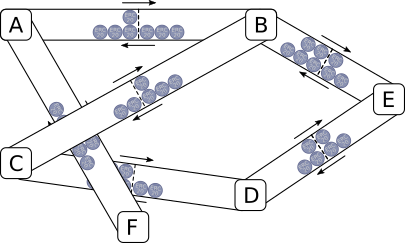 A network of Raiden state channels Raiden Network’s design of using of using a graph of off-chain payment channels also has some interesting scaling and privacy properties. Transaction are only saved onto the blockchain when a payment channel is closed, so only the one total resultant payment is visible on-chain. More importantly, most payment channels consumers open are likely to intermediaries, meaning that most of the time, the receiver transactions can be hidden as well. In terms of scaling, there should be a linear relationship between the number of people using Raiden and opening payment channels, and the network capacity. Although Raiden has the potential to address many of issues currently affecting Ethereum, it has a few challenges of its own it needs to resolve as well. Raiden is not well suited for larger transactions since each channel is secured through escrow, and channels might have smaller amounts. This is not too significant of an issue since larger transactions can be facilitated directly on the blockchain, where the transaction fee will still be very small percentage of the amount transferred. The main hurdle that Raiden will have to jump is community adoption. If many people are on Raiden, then connecting yourself to the network will give you easy access to fast and cheap payments to many parties, but if there are fewer people already on the network, the time and monetary cost for setting up Raiden may cause some users to turn away. Ethereum Virtual Machine Improvements A quick look into Ethereum repository for their Ethereum Improvement Protocols (EIPs) and their core devs meetings will show you that while they are indeed working on many of these long term massive scaling improvements, the are also still continuously working on smaller, more immediate upgrades to the Ethereum Virtual Machine (EVM). The EVM is a turing complete virtual machine that executes EVM bytecode; smart contracts are run on the EVM after being compiled down into the bytecode. Some of the improvements to the EVM are proposals to modify the set of opcodes that the EVM supports, or how they function, in order to try to either reduce the size of compiled bytecode or improve its optimization. This would decrease the space smart contracts would take on a block and reduce the amount of gas needed for them as well. While such improvements to the EVM may only provide fractional improvements in scalability compared to the multi-magnitude solutions discussed above, as Ethereum process more and more transactions, their total impact may be quite significant. Vyper Vyper is a programming language being developed for writing smart contracts. Currently, most Ethereum smart contracts are written in another programming language, Solidity. While Solidity is capable of expressing any smart contract a developer would want to create, Vyper aims to improve smart contract development in a few key aspects. 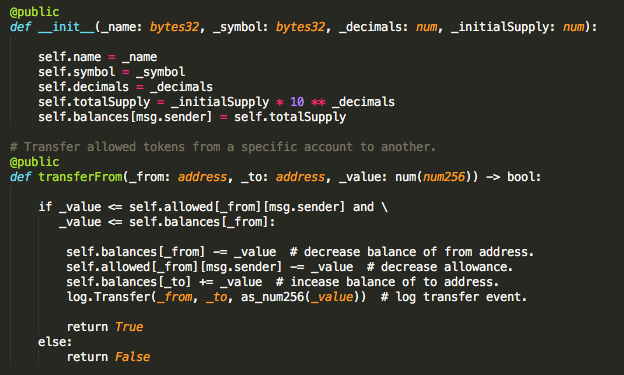 Python developers should feel right at home with Vyper Vyper is designed for the code to be easy to read and understand. Vyper’s syntax is very similar to Python, which is a very popular scripting language; on the other hand, while Solidity does draw much of its design inspiration from Javascript, there are still a few major syntax differences. A Python developer would likely feel more at home with Vyper’s syntax than a Javascript developer with Solidity. Vyper also removes certain features that Solidity has such as operator overloading, modifiers and class inheritance. Although from a traditional programming standpoint, these features do help with architecture and design, they provide avenues for malicious developers to hide misleading code. This could damage long-term smart contract adoption as well, as one day, people may want to show each other and agree to smart contracts instead of drafting lengthy legal documents, but can only do so with human-readable and auditable code. Thus, between the tighter feature set and simple syntax decisions, Vyper is poised to be a easier to learn, more auditable and easier to secure counterpart for the more expressive Solidity. [1] https://etherscan.io/chart/pendingtx [2] https://digiconomist.net/ethereum-energy-consumption [3] https://gobitcoin.io/tools/cost-51-attack/ [4] https://ethereum.stackexchange.com/questions/1343/what-is-the-target-block-time-for-casper [5] https://github.com/ethereum/wiki/wiki/Proof-of-Stake-FAQ [6] https://blog.ethereum.org/2018/01/02/ethereum-scalability-research-development-subsidy-programs/ |
| json metadata | {"tags":["crypto","bitcoin","ethereum","blockchain","investing"],"image":["https://cdn.steemitimages.com/DQmY4QF7i3jXjdQPCtKzdsN5NN54R6KXSxNWofMV3kPQC1s/image.png","https://cdn.steemitimages.com/DQmZknccNuVWfDwgn4f29UJ7gvwcn9txMKrx2PXaaRRu4Lq/image.png","https://cdn.steemitimages.com/DQmctKKtaXSp1RtbgAUNR8CG5vSCQJnRCwsUcn1hKPqbAi4/image.png","https://cdn.steemitimages.com/DQmeabqfQhpwmjG9TMNjDJQ26MGQgpMxhR2AvPxrex7Y19s/image.png"],"links":["https://ethereum.stackexchange.com/questions/16121/understanding-economic-finality-in-pow-and-pos","https://etherscan.io/chart/pendingtx","https://digiconomist.net/ethereum-energy-consumption","https://gobitcoin.io/tools/cost-51-attack/","https://ethereum.stackexchange.com/questions/1343/what-is-the-target-block-time-for-casper","https://github.com/ethereum/wiki/wiki/Proof-of-Stake-FAQ","https://blog.ethereum.org/2018/01/02/ethereum-scalability-research-development-subsidy-programs/"],"app":"steemit/0.1","format":"markdown"} |
| Transaction Info | Block #25170762/Trx 478a38f96020a98203e5375533ddf2ec7a25f855 |
View Raw JSON Data
{
"trx_id": "478a38f96020a98203e5375533ddf2ec7a25f855",
"block": 25170762,
"trx_in_block": 14,
"op_in_trx": 0,
"virtual_op": 0,
"timestamp": "2018-08-18T08:34:06",
"op": [
"comment",
{
"parent_author": "",
"parent_permlink": "crypto",
"author": "hgrdigitalag",
"permlink": "scaling-ethereum-for-global-adoption-jc-li",
"title": "Scaling Ethereum for Global Adoption -- JC Li",
"body": "Over the past few months, Ethereum has seen a massive influx of users and capital into its platform. However, as Ethereum gains popularity, the big question on everyone’s lips is how Ethereum can scale to support large commercial-ready distributed applications (dApps).\n\nIn its current state, Ethereum can only support about 13 transactions per second. This means we’re still an order of magnitude away from supporting the load of even a single dApp with a million daily users each making a transaction on the blockchain. We’ve already seen the effects of the looming scaling issues with the release of CryptoKitties, a game where player breed and trade cartoon cats built on the Ethereum blockchain. Following CryptoKitties’ release, the number of unprocessed transactions rose from an average of around 2,000 to over 10,000, causing significant delays in all transaction confirmations [1].\n\nWhile Ethereum may not be able to fulfill its grand initial vision of being a globally adopted computing infrastructure in its current form, there are already a variety of different projects and proposals to help optimize and scale various bottlenecks within the Ethereum network.\n\nCasper\nA general problem that most cryptocurrencies need to solve is the question of how the network can come to a distributed consensus when individual nodes may have an economic incentive for falsifying or altering data. Ether, which is the primary currency within the Ethereum platform uses a proof of work (PoW) system, meaning that miners need to solve complex cryptographic puzzles to receive payment for a block. Requiring miners to perform this task means that to able to reliably attack or spam the network, a group of attackers would need to control more than 50% of the total computer power within the network.\n\nWhile the PoW system provides a simple solution the issue, solving these cryptographic puzzles requires a large amount of electrical power. The mining of Ether alone consumes about 1.2 billion USD in electricity per year [2]. Ethereum aims to address this potentially unsustainable / unscalable construct by moving to a proof of stake (PoS) protocol dubbed Casper. In contrast to PoW, a PoS protocol consumes significantly less power, and achieves its consensus by having miners “stake” their coins — locking them in specialized wallets — to bet on the confirmation of a block of transactions. These coins are lost if miners bet on a block that isn’t chosen, providing a deterrent from people maliciously betting on bad blocks. This means that a failed attempt to attack a PoS network results in direct economic loss to the attackers, compared to PoW where the attack simply fails with no other repercussions than the lost time and power.\n\nTaking this a step further, Casper should have the ability to effect economic finality at a level that a PoW system cannot (as described in multiple places including https://ethereum.stackexchange.com/questions/16121/understanding-economic-finality-in-pow-and-pos). In BTC for example, one could invest $10 billion in ASICs/hardware (maybe more as it is a logistical nightmare to collude at this size [3]) to temporarily attack a PoW chain and force a hard fork of the protocol to migrate from ASIC mining to GPU mining, where at this point a malicious actor could spend another $10 billion on GPU rigs to permanently attack the chain (because they’ve already moved from specific to general mining, and have nowhere else to turn, on a hardware security basis). While the PoW chain may perpetually hard fork the chain, the malicious attacker could still use the same hardware (a fixed cost at this point, with little incremental spend) to perpetually compromise the chain. Vitalik calls this “spawn camping”.\n\nIn Casper, an initially well-resourced malicious attacker can’t spawn camp without spending new ETH every time (as these will get slashed), and the cost of buying ETH will theoretically be more expensive every time as large sums of ETH get slashed in previous attacks, decreasing overall supply in each iteration (although network value/market cap may fall as the security of the system erodes, albeit temporarily, which might offset the supply crunch).\n\nIn addition to decreased power costs, a PoS system has reduced centralization risks as well. Having the capital to stake ten times more coins as someone else gives you ten times more of a reward in PoS, but in PoW, having additional capital to spend on mining power allows provides you a disproportionate amount of access to mass-production and specialized hardware.\n\nSpecific to Ethereum, its proposed implementation of Casper may reduce the block time from the current 15 seconds to 2–7.5 seconds, providing a direct increase in transaction capacity on the network [4]. Additionally, Casper will provide the groundwork that will allow sharding, another major scaling improvement that will be discussed below.\n\n\nTemporary hybrid PoS/PoW system where PoS would be used to validated epochs of blocks\n\nWhile Casper brings a variety of benefits to the table, there are some associated challenges as well. Casper relies having more than 2/3 of validators to behave honestly to achieve a non-conflicting canonical chain, with a risk of the chain getting stuck without consensus when the number of malfunctioning or misbehaving validators rises above 1/3, compared to needing more than 1/2 of the computing power in PoW systems to maliciously affect the chain (i.e. lower threshold for fault tolerance) [5]. Nonetheless, this can be considered a somewhat marginal risk in practice, as a successful attack would require the perpetrators to hold a very large amount of Ether, but may also likely drive its price down, which misaligns malicious incentives. Thus, the energy, scaling and decentralization advantages that Casper does provide will be a step in the right direction for the Ethereum platform. Casper will be introduced in 2018 with Ethereum’s next hardfork, Constantinople. This hard fork will introduce a hybrid PoS/PoW system, which will gradually be transitioned into a fully PoS system over time.\n\nSharding\nIn order to validate transactions on the blockchain, Ethereum’s nodes need to store a copy of all past transactions and process all new transactions in each block. Although this is a serviceable and secure approach, it has some unfortunate scaling properties. Currently, the most direct way to allow Ethereum to process more transactions is simply to make blocks larger to allow for more transactions per block, but this would mean that each node would have to do that much more work in the same amount of time and may eventually preclude consumer grade hardware from running full nodes. Adding more nodes into the network also doesn’t decrease the work any other node would have to do.\n\nEthereum’s plan to address this particular property of the network is called sharding. The basic premise of sharding is to split Ethereum’s nodes and transactions into smaller groups or “shards”, all running in parallel, with each shard acting similar to how the entire Ethereum network acts today. This way, nodes in each shard only need to keep a small fraction of the entire blockchain that is relevant to their shard, and each shard’s nodes would only need to process the transactions for that shard. Interacting across shards will be possible, but likely require a longer and more complex method of confirmation. You could have situations where isolated shards have to go through additional legwork to communicate with each other, putting additional onus on developers to think about cross-shard interoperability. That said, the Foundation is trying to abstract this mechanism away from developers so they don’t have to worry about the back-end nuances of inter-shard communication. An effective sharding solution in Ethereum could provide a many magnitude boost to transaction throughput without sacrificing much in the way of security, safety or decentralization that other solutions such as trying to use altcoins to bring more transactions off-chain or having powerful masternodes.\n\n\nSharding would split all Ethereum addresses into smaller interoperable subsets\n\nUnlike some of the other Ethereum projects discussed in this article, plans for sharding are still being developed, and we’re still many months out from seeing any meaningful implementation of sharding. Because a specific approach to sharding in Ethereum hasn’t been finalized, we don’t know exactly how large of a scaling increase sharding will provide, or what specific disadvantages sharding will bring. The Ethereum foundation is currently working on a formal specification on sharding, after which they will look for teams to implement and deploy onto the testnet. They recently announced that they would be providing grants ranging from $50,000 to $1 million to various groups in order to facilitate the development of protocols such as sharding [6].\n\nRaiden\nCurrently, every transaction on Ethereum’s platform is saved onto the blockchain. These transactions incentivize miners to add the transaction into their block by providing a reward in the form of a transaction fee. As the value of the currency and the number of transactions grow, not only will transactions take longer to confirm, transaction fees will increase as well drastically as well. However, it may be feasible to perform quick and cheap transactions without instantly attempting to record them onto the primary Ethereum blockchain. The Raiden Network is one such off-chain scaling solution. For those following Bitcoin’s tech, Raiden is similar to Bitcoin’s Lightning Network for ETH and other ERC-20 compliant tokens.\n\nRaiden introduces the concept of payment channels through a smart contract to enable secure off-chain transfers that don’t require blockchain consensus. A sender can initialize a payment channel to a receiver and place an initial deposit of tokens into escrow. By sending a digitally signed message to the Raiden smart contract, some or all of the deposited currency within the channel can be sent to the receiver. Either party may submit a signed message at any time to close the channel and have the results written to the blockchain. Setting up two channels that are bidirectional allows sending back and forth up to the initial token limit held by the smart contract.\n\nThe requirements for placing tokens into escrow mean that it may become expensive to open a new payment channel to each address you want to pay. However, Raiden allows you to route payments through the network in with multihop transfers. For example, if Alice want to pay Bob, she doesn’t necessarily need to open a new payment channel to Bob if they both have another channel already open to a common receiver.\n\nTransactions sent though Raiden’s payment channels are designed to be fully confirmed within less than a second; on the blockchain, Ethereum transactions take seconds to confirm, but it is generally recommended to wait for multiple blocks to pass before before considering a transaction finalized, which can take minutes. Additionally, these payment channel transactions do not have any fees. However, it is very likely that intermediaries providing the channels to facilitate multihop transfers will be charging their own fee for providing access to the network. Nevertheless, these intermediary fees are expected to be an order of magnitude smaller than simply paying for an on-chain transaction.\n\n\nA network of Raiden state channels\n\nRaiden Network’s design of using of using a graph of off-chain payment channels also has some interesting scaling and privacy properties. Transaction are only saved onto the blockchain when a payment channel is closed, so only the one total resultant payment is visible on-chain. More importantly, most payment channels consumers open are likely to intermediaries, meaning that most of the time, the receiver transactions can be hidden as well. In terms of scaling, there should be a linear relationship between the number of people using Raiden and opening payment channels, and the network capacity.\n\nAlthough Raiden has the potential to address many of issues currently affecting Ethereum, it has a few challenges of its own it needs to resolve as well. Raiden is not well suited for larger transactions since each channel is secured through escrow, and channels might have smaller amounts. This is not too significant of an issue since larger transactions can be facilitated directly on the blockchain, where the transaction fee will still be very small percentage of the amount transferred. The main hurdle that Raiden will have to jump is community adoption. If many people are on Raiden, then connecting yourself to the network will give you easy access to fast and cheap payments to many parties, but if there are fewer people already on the network, the time and monetary cost for setting up Raiden may cause some users to turn away.\n\nEthereum Virtual Machine Improvements\nA quick look into Ethereum repository for their Ethereum Improvement Protocols (EIPs) and their core devs meetings will show you that while they are indeed working on many of these long term massive scaling improvements, the are also still continuously working on smaller, more immediate upgrades to the Ethereum Virtual Machine (EVM).\n\nThe EVM is a turing complete virtual machine that executes EVM bytecode; smart contracts are run on the EVM after being compiled down into the bytecode. Some of the improvements to the EVM are proposals to modify the set of opcodes that the EVM supports, or how they function, in order to try to either reduce the size of compiled bytecode or improve its optimization. This would decrease the space smart contracts would take on a block and reduce the amount of gas needed for them as well. While such improvements to the EVM may only provide fractional improvements in scalability compared to the multi-magnitude solutions discussed above, as Ethereum process more and more transactions, their total impact may be quite significant.\n\nVyper\nVyper is a programming language being developed for writing smart contracts. Currently, most Ethereum smart contracts are written in another programming language, Solidity. While Solidity is capable of expressing any smart contract a developer would want to create, Vyper aims to improve smart contract development in a few key aspects.\n\n\nPython developers should feel right at home with Vyper\n\nVyper is designed for the code to be easy to read and understand. Vyper’s syntax is very similar to Python, which is a very popular scripting language; on the other hand, while Solidity does draw much of its design inspiration from Javascript, there are still a few major syntax differences. A Python developer would likely feel more at home with Vyper’s syntax than a Javascript developer with Solidity. Vyper also removes certain features that Solidity has such as operator overloading, modifiers and class inheritance. Although from a traditional programming standpoint, these features do help with architecture and design, they provide avenues for malicious developers to hide misleading code. This could damage long-term smart contract adoption as well, as one day, people may want to show each other and agree to smart contracts instead of drafting lengthy legal documents, but can only do so with human-readable and auditable code. Thus, between the tighter feature set and simple syntax decisions, Vyper is poised to be a easier to learn, more auditable and easier to secure counterpart for the more expressive Solidity.\n\n[1] https://etherscan.io/chart/pendingtx\n\n[2] https://digiconomist.net/ethereum-energy-consumption\n\n[3] https://gobitcoin.io/tools/cost-51-attack/\n\n[4] https://ethereum.stackexchange.com/questions/1343/what-is-the-target-block-time-for-casper\n\n[5] https://github.com/ethereum/wiki/wiki/Proof-of-Stake-FAQ\n\n[6] https://blog.ethereum.org/2018/01/02/ethereum-scalability-research-development-subsidy-programs/",
"json_metadata": "{\"tags\":[\"crypto\",\"bitcoin\",\"ethereum\",\"blockchain\",\"investing\"],\"image\":[\"https://cdn.steemitimages.com/DQmY4QF7i3jXjdQPCtKzdsN5NN54R6KXSxNWofMV3kPQC1s/image.png\",\"https://cdn.steemitimages.com/DQmZknccNuVWfDwgn4f29UJ7gvwcn9txMKrx2PXaaRRu4Lq/image.png\",\"https://cdn.steemitimages.com/DQmctKKtaXSp1RtbgAUNR8CG5vSCQJnRCwsUcn1hKPqbAi4/image.png\",\"https://cdn.steemitimages.com/DQmeabqfQhpwmjG9TMNjDJQ26MGQgpMxhR2AvPxrex7Y19s/image.png\"],\"links\":[\"https://ethereum.stackexchange.com/questions/16121/understanding-economic-finality-in-pow-and-pos\",\"https://etherscan.io/chart/pendingtx\",\"https://digiconomist.net/ethereum-energy-consumption\",\"https://gobitcoin.io/tools/cost-51-attack/\",\"https://ethereum.stackexchange.com/questions/1343/what-is-the-target-block-time-for-casper\",\"https://github.com/ethereum/wiki/wiki/Proof-of-Stake-FAQ\",\"https://blog.ethereum.org/2018/01/02/ethereum-scalability-research-development-subsidy-programs/\"],\"app\":\"steemit/0.1\",\"format\":\"markdown\"}"
}
]
}zedpalupvoted (100.00%) @hgrdigitalag / waltonchain-ushering-an-era-of-iot-mass-market-adoption-jeff-kuan2018/08/18 07:59:36
zedpalupvoted (100.00%) @hgrdigitalag / waltonchain-ushering-an-era-of-iot-mass-market-adoption-jeff-kuan
2018/08/18 07:59:36
| voter | zedpal |
| author | hgrdigitalag |
| permlink | waltonchain-ushering-an-era-of-iot-mass-market-adoption-jeff-kuan |
| weight | 10000 (100.00%) |
| Transaction Info | Block #25170072/Trx 9b42a191d69d0baa511908bfa20d789152e3744c |
View Raw JSON Data
{
  "trx_id": "9b42a191d69d0baa511908bfa20d789152e3744c",
  "block": 25170072,
  "trx_in_block": 1,
  "op_in_trx": 0,
  "virtual_op": 0,
  "timestamp": "2018-08-18T07:59:36",
  "op": [
    "vote",
    {
      "voter": "zedpal",
      "author": "hgrdigitalag",
      "permlink": "waltonchain-ushering-an-era-of-iot-mass-market-adoption-jeff-kuan",
      "weight": 10000
    }
  ]
}2018/08/18 07:30:51
2018/08/18 07:30:51
| voter | blockchain2018 |
| author | hgrdigitalag |
| permlink | waltonchain-ushering-an-era-of-iot-mass-market-adoption-jeff-kuan |
| weight | 10000 (100.00%) |
| Transaction Info | Block #25169497/Trx 81c37a6c8d59277d7dbe7ef0086589de9671d2c2 |
View Raw JSON Data
{
  "trx_id": "81c37a6c8d59277d7dbe7ef0086589de9671d2c2",
  "block": 25169497,
  "trx_in_block": 18,
  "op_in_trx": 0,
  "virtual_op": 0,
  "timestamp": "2018-08-18T07:30:51",
  "op": [
    "vote",
    {
      "voter": "blockchain2018",
      "author": "hgrdigitalag",
      "permlink": "waltonchain-ushering-an-era-of-iot-mass-market-adoption-jeff-kuan",
      "weight": 10000
    }
  ]
}2018/08/18 07:29:45
2018/08/18 07:29:45
| voter | coin.info |
| author | hgrdigitalag |
| permlink | waltonchain-ushering-an-era-of-iot-mass-market-adoption-jeff-kuan |
| weight | 694 (6.94%) |
| Transaction Info | Block #25169475/Trx 20e3007d72f674fcc4bade0c3fa3dbec628843cb |
View Raw JSON Data
{
  "trx_id": "20e3007d72f674fcc4bade0c3fa3dbec628843cb",
  "block": 25169475,
  "trx_in_block": 15,
  "op_in_trx": 0,
  "virtual_op": 0,
  "timestamp": "2018-08-18T07:29:45",
  "op": [
    "vote",
    {
      "voter": "coin.info",
      "author": "hgrdigitalag",
      "permlink": "waltonchain-ushering-an-era-of-iot-mass-market-adoption-jeff-kuan",
      "weight": 694
    }
  ]
}2018/08/18 07:29:42
2018/08/18 07:29:42
| parent author | hgrdigitalag |
| parent permlink | waltonchain-ushering-an-era-of-iot-mass-market-adoption-jeff-kuan |
| author | coin.info |
| permlink | re-hgrdigitalag-waltonchain-ushering-an-era-of-iot-mass-market-adoption-jeff-kuan-20180818t072941687z |
| title | |
| body | **Coins mentioned in post:** Coin | | Price (USD) | 📈 24h | 📈 7d - | - | - | - | - **ETH** | Ethereum | 307.061$ | _2.14%_ | _-4.13%_ **GAS** | Gas | 5.300$ | _13.9%_ | _-1.82%_ **NEO** | NEO | 18.875$ | _7.72%_ | _2.47%_ **VET** | VeChain | 0.013$ | _-9.93%_ | _40.86%_ **WTC** | Waltonchain | 2.625$ | _-2.21%_ | _2.62%_ |
| json metadata | {"app":"coininfo/1.0.0","format":"markdown"} |
| Transaction Info | Block #25169474/Trx cd9b5d417aa96ff5047e24e3dca92497d5870dc6 |
View Raw JSON Data
{
  "trx_id": "cd9b5d417aa96ff5047e24e3dca92497d5870dc6",
  "block": 25169474,
  "trx_in_block": 20,
  "op_in_trx": 0,
  "virtual_op": 0,
  "timestamp": "2018-08-18T07:29:42",
  "op": [
    "comment",
    {
      "parent_author": "hgrdigitalag",
      "parent_permlink": "waltonchain-ushering-an-era-of-iot-mass-market-adoption-jeff-kuan",
      "author": "coin.info",
      "permlink": "re-hgrdigitalag-waltonchain-ushering-an-era-of-iot-mass-market-adoption-jeff-kuan-20180818t072941687z",
      "title": "",
      "body": "**Coins mentioned in post:**\n\nCoin | | Price (USD) | 📈 24h | 📈 7d\n- | - | - | - | -\n**ETH** | Ethereum | 307.061$ | _2.14%_ | _-4.13%_\n**GAS** | Gas | 5.300$ | _13.9%_ | _-1.82%_\n**NEO** | NEO | 18.875$ | _7.72%_ | _2.47%_\n**VET** | VeChain | 0.013$ | _-9.93%_ | _40.86%_\n**WTC** | Waltonchain | 2.625$ | _-2.21%_ | _2.62%_",
      "json_metadata": "{\"app\":\"coininfo/1.0.0\",\"format\":\"markdown\"}"
    }
  ]
}2018/08/18 07:28:54
2018/08/18 07:28:54
| parent author | hgrdigitalag |
| parent permlink | waltonchain-ushering-an-era-of-iot-mass-market-adoption-jeff-kuan |
| author | cheetah |
| permlink | cheetah-re-hgrdigitalagwaltonchain-ushering-an-era-of-iot-mass-market-adoption-jeff-kuan |
| title | |
| body | Hi! I am a robot. I just upvoted you! I found similar content that readers might be interested in: https://medium.com/hgr-digital-asset-group/an-introduction-to-waltonchain-1cb4d28b72cf |
| json metadata | |
| Transaction Info | Block #25169458/Trx 8bde156bdc5b7acac108bc329459d105ab6fb7b7 |
View Raw JSON Data
{
  "trx_id": "8bde156bdc5b7acac108bc329459d105ab6fb7b7",
  "block": 25169458,
  "trx_in_block": 27,
  "op_in_trx": 0,
  "virtual_op": 0,
  "timestamp": "2018-08-18T07:28:54",
  "op": [
    "comment",
    {
      "parent_author": "hgrdigitalag",
      "parent_permlink": "waltonchain-ushering-an-era-of-iot-mass-market-adoption-jeff-kuan",
      "author": "cheetah",
      "permlink": "cheetah-re-hgrdigitalagwaltonchain-ushering-an-era-of-iot-mass-market-adoption-jeff-kuan",
      "title": "",
      "body": "Hi! I am a robot. I just upvoted you! I found similar content that readers might be interested in:\nhttps://medium.com/hgr-digital-asset-group/an-introduction-to-waltonchain-1cb4d28b72cf",
      "json_metadata": ""
    }
  ]
}2018/08/18 07:28:39
2018/08/18 07:28:39
| voter | cheetah |
| author | hgrdigitalag |
| permlink | waltonchain-ushering-an-era-of-iot-mass-market-adoption-jeff-kuan |
| weight | 8 (0.08%) |
| Transaction Info | Block #25169453/Trx e00e51b6015ed5360a1a6c404ce23158ca50316a |
View Raw JSON Data
{
  "trx_id": "e00e51b6015ed5360a1a6c404ce23158ca50316a",
  "block": 25169453,
  "trx_in_block": 21,
  "op_in_trx": 0,
  "virtual_op": 0,
  "timestamp": "2018-08-18T07:28:39",
  "op": [
    "vote",
    {
      "voter": "cheetah",
      "author": "hgrdigitalag",
      "permlink": "waltonchain-ushering-an-era-of-iot-mass-market-adoption-jeff-kuan",
      "weight": 8
    }
  ]
}2018/08/18 07:28:27
2018/08/18 07:28:27
| voter | hgrdigitalag |
| author | hgrdigitalag |
| permlink | waltonchain-ushering-an-era-of-iot-mass-market-adoption-jeff-kuan |
| weight | 10000 (100.00%) |
| Transaction Info | Block #25169449/Trx 765877acbe4a848ad9526cd21ebff967cdb3a960 |
View Raw JSON Data
{
  "trx_id": "765877acbe4a848ad9526cd21ebff967cdb3a960",
  "block": 25169449,
  "trx_in_block": 18,
  "op_in_trx": 0,
  "virtual_op": 0,
  "timestamp": "2018-08-18T07:28:27",
  "op": [
    "vote",
    {
      "voter": "hgrdigitalag",
      "author": "hgrdigitalag",
      "permlink": "waltonchain-ushering-an-era-of-iot-mass-market-adoption-jeff-kuan",
      "weight": 10000
    }
  ]
}hgrdigitalagpublished a new post: waltonchain-ushering-an-era-of-iot-mass-market-adoption-jeff-kuan2018/08/18 07:28:18
hgrdigitalagpublished a new post: waltonchain-ushering-an-era-of-iot-mass-market-adoption-jeff-kuan
2018/08/18 07:28:18
| parent author | |
| parent permlink | crypto |
| author | hgrdigitalag |
| permlink | waltonchain-ushering-an-era-of-iot-mass-market-adoption-jeff-kuan |
| title | Waltonchain: ushering an era of IoT mass market adoption -- Jeff Kuan |
| body | The purpose of this article is to provide an overview of the Waltonchain project from a commercial perspective. In future write-ups, I intend to conduct a technical deep-dive of the project, as well as highlight similar projects in the space. 1. What is Waltonchain? Founded in November 2016, WaltonChain is a Chinese-Korean project that aims to solve the issue of centralization in the Internet of Things (“IoT”). IoT is a network which enables all things to exchange information and data with each other. This industry is growing rapidly: By 2020, IDC estimates that the installed base of IoT units will to grow to ~28B, and A.T. Kearney predicts there will be $1.9 trillion in productivity improvements and $177B in cost reductions realized by customers utilizing IoT over the same time period (source). Why is centralization in IoT a problem? Under a centralized structure, different stakeholders/machines/devices cannot seamlessly and autonomously communicate with each other, because data often belongs to different parties. As a result, stakeholders can only collaborate if they belong to the same network that all involved parties trust. Let’s take the example of smart home appliances. There are currently many different smart home products on the market: Google Nest, Amazon Alexa, Apple TV, etc. Under the current centralized IoT structure, if I wanted all of my smart appliances to all function together and communicate with each other, I would either have to build a customized solution or as is the case for many people, buy all of the products from the same company. If I wanted my Amazon Alexa to adjust the volume on my Apple TV or to tell my Google Nest to raise the temperature of my house on a cold day, I currently do not have an elegant solution. And remember, this is just a consumer use case for a single household. Now scale this idea to the enterprise-level use case. Under the current centralization schema, a company that engages various IoT platforms/devices to collect data about its machines, products and processes has highly isolated data, which is of little use externally. Centralized solutions, such as the Open Platform Communications (“OPC”) standard, have been developed to address this problem. The issues with OPC are similarly true of any other centralized solution: OPC services are dominated by a single company called OSIsoft, which doesn’t allow for easy customization on top of what they already have. Additionally, there are many different variants of the OPC protocol, which makes data collection and processing difficult for 3rd party software solutions. Not only does this stifle innovation, but centralization also ultimately results in oligopoly/monopoly, where market share is concentrated with a few large players. These inefficiencies caused by centralization greatly limit the potential benefits of IoT to companies. A decentralized solution would unlock the benefits of IoT to the masses. How does Waltonchain fit into all of this? Walton’s solution is to create a business ecosystem that marries the capabilities of radio-frequency identification (“RFID”) and blockchain technology. Unlike the majority of blockchain projects that exist today, Walton is one of the few attempting to combine proprietary hardware and software solutions to address this problem to create an ecosystem that they are calling the Value Internet of Things (“VIoT”). The core technology has two key facets: (i) A blockchain solution that enables parties to collaborate within an ecosystem without first establishing a trust relationship (i.e. decentralized). (ii) Use of RFID technology to commoditize the incorporation of information about physical assets onto the blockchain in a cheap and scalable way. Many projects are doing the first. To my knowledge, there are only a few other projects, such as Wabi and VeChain, that are doing both. We will conduct an in-depth competitor analysis in a future article. The Waltonchain project has applications from both a B2B and B2C perspective. Its most obvious B2B use case is in supply chain/logistics, where one of the main issues is transfer risk of products between different key stakeholders. Using Walton’s technology, companies can track products at every point along their supply chain, and all inventory can be accounted for as data is written to the blockchain. Taking this one step further, by layering on top a smart contract mechanism, once a set of goods are accounted for, funds for payment can automatically be released from one party to another. The result is an efficient, trackable, instantaneous, and automated system that does not exist with current technology. The B2C use case is most obvious in any industry where customer feedback is useful to stakeholders upstream in a supply chain. For example, having access to high-quality data collected about how, when, and in what quantities customers purchase products in stores is valuable to manufacturers in thinking about how to more effectively address changes in customer preferences. This allows companies to be more agile, innovative, and smarter about how they allocate their resources. Although Walton is currently known primarily as a supply chain project, I hope it’s beginning to become clear that its scope is much, much larger. In addition to supply chain, the technology has potential applications in and has won awards for its project on waste management systems for smart cities (source). In reality, Walton should be thought of as a big data project. They are striving to create an all-inclusive, decentralized, enterprise-level IOT solution to make it easy for any company to implement and benefit from blockchain and RFID technology. 2. What kind of technology is Waltonchain developing? We will dig deeper into this topic in our technical write up, but at a high level, Walton is investing resources to develop both proprietary hardware and software solutions. As mentioned above, this is not too common in the industry right now; most projects are focused only on software development. Hardware Walton’s hardware is what truly differentiates this project from other blockchain projects. There are few teams in the space with the same level of hardware expertise as the Walton team; the company consists of a diverse group of seasoned engineers, businessmen, and professors. Profiles of these individuals have already been covered extensively here, here, and here. Walton is designing RFID chips and scanners. RFID technology is a communication technology that can identify targets through radio signals. The chips will be embedded on objects as a way to track and gather data about these objects. This is not new technology; RFID is currently widely used in industries as diverse as commerce, to infrastructure management and protection, to library access control systems. In 2014, the world RFID market was worth US$8.89 billion, up from US$6.96 billion in 2012. The market value is expected to rise to US$18.68 billion by 2026. The RFID chips that Walton is designing provide several major improvements over existing RFID technology. Much of what I’ve included below has already been covered in /u/thelateMercutio’s post here. These benefits include: (i) Higher sensitivity (ii) higher transmission power (iii) better anti-interference capabilities (iv) lower reading error (v) better compatibility: the chip can achieve high-frequency and ultra-high frequency functions at the same time, so the end customer can read the information through their smart phone and inquire about reliable product information (vi) the ability to be recognized en masse, versus current solutions that must be scanned in smaller groups/individually (vii)the ability to write directly onto Walton’s blockchain (viii)Additionally the chips are designed with an eye towards security: the chips will be written into the world’s only electronic product code (“EPC”), a unique number that identifies a specific item in the supply chain, as well as integrate a real random number generator, which will generate a unique address through encryption logic (Source). The result is that each item tagged with a chip has a unique identifier on the Waltonchain, and can therefore neither be forged nor tampered with. From a cost perspective, the chips will be sold at ~30% of the price of comparable products currently on the market; current estimates price a single chip at $0.05, and this price is expected to decrease further as production scales. For their manufacturing processes, Waltonchain is able to leverage Silicon Electronic Technology Co, one of the companies under the Waltonchain Umbrella Foundation (Source), to manufacture and design the chips at cost. In total, the team has spent over USD $8MM on hardware R&D. Obviously, there are pros and cons of designing hardware in-house. The main benefit is that Waltonchain will have the ability to customize its chips based on the needs of the various partner businesses and address specific problems in the industries in which their technology is being applied. As an example, Walton has created customized RFID chips with washing marks to address counterfeiting specifically for the apparels industry. To address the same problem in the food and beverage industry, they’ve designed their RFID tags to be placed at the package’s seal and to break under stress. These are necessary customizations given the diverse nature of the industries and different contexts in which their chips will be ultimately be used. This ability to customize also provides an interesting value proposition to partner companies looking to leverage Waltonchain’s technology; tailored solutions are obviously more attractive than generic ones, and I think this will be a big point of differentiation in the longer term. Secondly, as anyone who works in hardware knows, hardware is hard. Hardware R&D is capital intensive, resulting in high barriers to entry. To offset initial production costs, the project won several competitions, including the Straight Elite Talents Festival in October 2017, and was awarded 3,000,000 yuan (USD $500,000) (source). In addition, because Waltonchain is vertically integrated, meaning that they own their entire supply chain process from production to sale, the company will be able to control costs as they scale. In short, their business model should be more defensible in the long-term relative to that of any competitor relying on manufacturing partners for hardware development. The technology for Waltonchain’s scanner is also unique, and the device plays a meaningful role in the overall ecosystem. One of its most important features is that the scanner serves as a light node on the chain, meaning that not only will it have the ability to mine, but it will also have the ability to authenticate and upload data to the network. These attributes create circular incentives for customers: by utilizing the scanner to authenticate and upload data about their products onto the Waltonchain network, they can also use the scanner to secure their own child chain, be rewarded in WTC for doing so, and use the awarded WTC for paying future transaction fees on the Waltonchain. This is a win-win for both customers and Waltonchain — this has the effect of adding security to the overall network by incentivizing more scanners to be used (thereby increasing the amount of nodes online), while also significantly decreasing costs to customers who buy into all the features of the ecosystem. Functionally, Waltonchain’s scanners have the ability to read up to 1,500 products simultaneously and can write directly onto the blockchain as well (source). This mainly has applications from a logistics perspective. As a simple example, it’s easy to see how this would have the ability to greatly increase supply chain efficiencies by decreasing the time spent for inventory management in warehousing. On the flip side, there are also significant costs associated with a dual hardware-software strategy, the main one being the company is allocating a percentage of total resources, specifically money and human capital, to also designing hardware versus focusing 100% of available resources on developing their blockchain software. This has tangible effects on the ability for the company to execute on the milestones set on the roadmap, ultimately leading to longer time to market. This has left the competitive field open to competitors like VeChain, which has a similar vision but is focused exclusively on software development while leveraging industry partnerships for their hardware. That being said, both Waltonchain’s and VeChain’s mainnets are set to be launched in Q1/Q2 of 2018. Software Walton’s software development efforts are equally ambitious. The team’s project will have several features that are unique relative to existing blockchain software solutions. Leveraging the learnings from scaling issues faced by the earliest blockchain projects (e.g. cryptokitties), Walton has created their blockchain using a parent-child chain structure. At a basic level, the parent chain (“Waltonchain”) is responsible for the circulation and creation of child chains, while the child chains are responsible for the implementation of various applications. To explain via analogy, the Walton parent chain acts as a spinal cord: it serves as the highway for communication between the brain (database) and all of the different parts of the human body (child chains). Companies utilizing the Waltonchain can create their own child chains to store proprietary information, while only utilizing the parent chain to broadcast necessary, public information; the majority of data would be kept on the individual child chains. This solution allows the child chains to bear the burden of the data load, resulting in limited congestion on the parent chain. This gives Waltonchain the capability to handle a larger aggregate number of transactions, making it significantly more scalable than existing blockchain projects, like Ethereum (in its current state). The Walton parent chain itself will utilize a dual-chain consensus structure, a combination of Proof of Stake & Trust (“PoST”), which is an upgrade over Proof of Stake (“PoS”), and Proof Work (“PoW”). PoST creates a system for nodes to be evaluated based on reputation. Over time, the “higher quality” nodes and the more senior nodes will be rewarded more heavily (with WTC tokens), which has the effect of incentivizing good nodes to stay on the network, thereby improving the overall security of the ecosystem. Synergistically, PoW increases the security of the PoST chain, and the PoST will increase the speed of the PoW chain. Most importantly, the child chains are capable of using independent infrastructure from the parent chain (e.g. consensus mechanisms). The main benefit of this is that companies creating child chains on Waltonchain’s technology will be able to select from a suite of pre-engineered, customized blockchain solutions and choose the one that is best tailored to their specific business use case. Waltoncoins (“WTC”) Waltoncoins are the token used for circulation and payment on the Waltonchain. There is a total supply of 100,000,000 (100M) tokens. The maximum supply is currently 70M tokens, with the remaining 30M left to be mined. Currently, the circulating supply is around 25M, while the rest is held by the Walton Foundation. WTC are used for a variety of functions on the Waltonchain. Credit to this post and to /u/thelatemercutio and NetworkTraveler for simplifying things and contributing to my thoughts below. Examples of potential token use cases highlighted in the white paper are explained in more detail below: The Issuance of child chains. Any company utilizing Waltonchain’s technology can create a child chain by paying a byte fee in exchange for network bandwidth. This must be paid in WTC. For those who are familiar with NEO, WTC functions like GAS in this respect. The cost of the byte fee will be variable based on supply/demand principles; accounting nodes (stakers) will set the minimum cost accepted per transaction, and the node initiating the transaction will set the maximum cost to be paid. At the point where supply meets demand, the transaction will be written onto the blockchain. This puts into place the proper incentives such that accounting nodes will be properly incentivized for their work. Companies will be rewarded for being early adopters (lower fees), and as network demand grows and accounting node resources become scarce, the price that companies pay to issue a child chain will increase. As costs increase, Walton has built in mechanisms to adjust the economic price for transactions on the Waltonchain. These range from adjusting the various input variables in the reward structure payout to the nodes, to creating an upper bound for transaction fees. These provisions would assure that it remains economical for network partners to continue to utilize the Waltonchain network. Dividend interest. Stakers will be rewarded for the efforts via the PoST consensus mechanism. As mentioned earlier, the PoST mechanism is an upgrade over the PoS mechanism: it creates a system for nodes to be evaluated based on reputation, whereby nodes with better reputations that have been online for longer would be rewarded more heavily for their efforts relative to new nodes. This alignment in incentives has the effect of improving the overall security of the ecosystem. To ensure that there is the proper allocation of resources to ensure the quality of both the Waltonchain and child chains, fees will be split between accounting nodes for both the parent chains and child chains. Credit and mortgage system. Because WTC will be the main coin in the Waltonchain ecosystem, WTC can serve as a credit reserve for transactions on child chains, and create a credit-scoring system for users. Think of WTC like any major currency. Because everyone uses U.S. dollars, you can trust that when someone pays you in dollars, that it has value. This analogy can also applied to the Waltonchain ecosystem: because you know that WTC has transaction value, WTC inherently has value, and can be used to borrow and make payments. To simplify the example used in the whitepaper, imagine a scenario where you go to buy something from the Titan Store, which is built on the Waltonchain ecosystem. To buy products in the Titan Store, you need Titan Coins, but you don’t actually have any. As a result, you can lock up some of your WTC to borrow some Titan Coins. At some agreed upon date later in time, you will pay back the Titan Coins that you owe, and your WTC will be released back to you via a smart contract. The more you make payments on-time, the higher your creditworthiness. And as your creditworthiness increases, the fewer WTCs you need to mortgage for payment. The opposite effect will occur if you fail to make payments on time. Distributed asset exchange. As the key link between the parent chain and different child chains, WTC will be used for parent chain token transactions, child chain transactions, as well as cross child-chain transactions. The Waltonchain ledger will be able to store balances held by user accounts and offers that user accounts make to buy or sell assets. The scope of this is not only limited to tokens, but will also include assets such as data. For example, if Company A and Company B both have child chains on the Waltonchain network, and Company A wanted to buy Company B’s data, this exchange could be made possible via WTC tokens. Distributed voting and governance system. This system will allow safe and anonymous voting on both the parent chain as well as all child chains. Few details have been released about this specific use case, but this is a common feature for tokens of blockchain projects. Obviously the larger one’s WTC position, the more voting influence one would have. 3. Industry spotlight: the Chinese apparels market The purpose of this next section is to analyze the marketplace dynamics of a single industry that Walton is currently focusing on. At project inception, Walton saw the ability for its product to make an immediate impact in the apparels industry. Based on existing relationships of the executive team with Septwolves (USD$6.5B market cap), this made sense as a starting point. This is not meant to imply that apparels is the only industry that Walton is currently focusing on, nor the only industry where its technology can be applied. Despite the seemingly narrow industry and geographical focus, the Chinese apparels market provides an interesting starting point for the Walton project. The complexity of the industry has created ample opportunity for its technology to add value, including, but not limited to manufacturing, warehousing, logistics, sorting, and inventory management. Walton’s B2C use case will facilitate the collection of high volumes of customer data, and is a good way for the team to gather initial feedback about their technology, both from a durability (hardware) and scalability (software) perspective. In a fast-moving industry like blockchain, I believe that the incorporation of customer feedback to iterate on product development will be a key differentiator for competing companies. Additionally, a number of secular trends, both globally and domestically within China, create a favorable environment for Walton’s pilot. Demand-side market dynamics China’s economy grew at a rate of 6.5% in 2016. For its size, this is truly remarkable. As a point of reference, over the same period, the other largest economies in the world grew at a significantly slower rate: the U.S. at rate of 1.6%, Japan at 1.0%, and Germany at 1.8%. Greater demand for consumer goods is being driven by an increase in the overall purchasing power of the average Chinese consumer, as well as by shifts in the demographic mix of the country. Chinese consumers are making more money and therefore spending more. Some quick stats: Between 2010–2016, the average annual salary for a Chinese citizen increased at a CAGR of 10.4% (source). Over the same period, annual per capita consumption expenditure in China increased at a CAGR of 9.4% (source). Research by the Economist Intelligence Unit (EIU), a think tank, estimates that the proportion of the Chinese population earning upper-middle and high incomes in China will expand from 10% in 2016 to 35% by 2030. This has resulted in consumers purchasing higher quality goods at increased rates. As can be seen in the survey data below, compared to consumers surveyed in 2011, Chinese consumers surveyed in 2015 increasingly desire premium products, with a more pronounced increase for apparels. Despite the tremendous growth of online retail sales, Chinese consumers still prefer the traditional in-person retail experience. China’s online retail market has grown at a tremendous clip over the last few years; and this growth is only expected to accelerate. A report by Goldman Sachs estimates that China’s online retail market will grow at a CAGR of 23% from $750B in 2016 to $1.7T in 2020, nearly triple the pace of the country’s offline retail market. Despite this, the experience of buying in brick-and-mortar stores continues to be preferred among Chinese consumers. Surprisingly, online retail accounted for only 19% of total retail dollars spent in China in 2016. Although the share of online is growing, data indicates that the brick and mortar purchasing will remain a fundamental part of the Chinese consumer experience. A survey conducted by Deloitte (source) found that ⅔ of Chinese millennials preferred buying high-end fashion and luxury items in-person, the highest percentage of any other group from the countries surveyed. What do these trends mean for Waltonchain? The demand-side trends for the apparels market can be summarized into two main points: Chinese consumers have more money to spend, and Chinese consumers are not only becoming more selective about what they are buying, they are also still very deliberate about where they are buying. One of Waltonchain’s largest value propositions and a benefit of targeting the B2C apparels market is that their technology will streamline the process and lower the barrier for collecting customer data. Key performance indicators (KPIs) such as ‘grab rates’ and ‘purchase rates’ are key industry metrics that help manufacturers and retailers make decisions about what to make, sell, and how they manage inventory. As volumes of purchases increase and as Chinese consumers become increasingly sophisticated, the value of customer data to all members of the ecosystem will increase. I believe Waltonchain’s solution is primed to benefit significantly from these trends. Supply-side market dynamics Chinese companies are embracing an omnichannel retail strategy to extend their reach to customers. In 2015, Alibaba announced their “New Retail” strategy: “We anticipate the birth of a re-imagined retail industry driven by the integration of online, offline, logistics and data across a single value chain.” — Jack Ma, Chairman, Alibaba The online retail giant envisioned the integration of the online-offline shopping experience as a way to gather more data about consumers and capture additional revenues. Traditional brick and mortar retailers also saw this as an opportunity to partner with online companies and gain momentum to jump start slowing offline (brick-and-mortar) revenues. The largest Chinese internet companies moved quickly, shortly after the announcement. In August 2015 JD.com, one of the two largest e-commerce companies in China, announced they were investing $700M in Younghui Superstores. In the same month, Alibaba announced they were making a $4.6B investment in Suning Commerce Group, a Chinese electronics retailer. Alibaba Chief Executive Daniel Zhang said he would consider striking more deals with brick-and-mortar stores beyond electronics, as long as those retail chains “can bring us additional customers…We are trying to build an integrated online-offline platform for both customers and merchants,” Zhang said. This trend of internet companies digitizing the offline shopping experience is accelerating. Earlier this year, Alibaba opened up another 3 stores in Shanghai and Beijing, bringing their total number of brick and mortar stores in the country to 13. This strategy has not only enabled Alibaba to reap the benefits of increased supply chain efficiencies, but has also helped the company successfully tailor their products to changing customer preferences. Since the opening of their first retail store (Hema) in 2015, the e-commerce giant said sales per unit area were three to five times higher than traditional supermarkets and conversation rates for Hema app users making a purchase reached up to 35 percent (source). Chinese manufacturers need to adapt to increased global competition. A 2016 report by the World Trade Organization showed that China was the leader in and was estimated to account for 37.2% and 36.4% of global textile and apparel exports, respectively. Despite the large lead in market share, each industry has seen a 3% and 7% decline year over year, due to incumbent countries with low relative manufacturing and labor costs ramping up production, such as Pakistan, Cambodia and Vietnam. Subsequently, Walton provides a seemingly attractive value proposition to Chinese apparel and textile companies facing increased global competition: a solution to streamline and ultimately decrease costs across the value chain to make them more competitive on pricing relative to products made in lower-cost countries. The Amazon.com of the blockchain era? Walton’s focused approach on Chinese apparels can be likened to amazon.com’s initial focus on the book market in the U.S. In my opinion, there are too many companies claiming to be a one-size-fit-all blockchain solution or be the “Ethereum of [insert country here].” Instead of trying to be a blockchain solution for everything, Walton’s focus on specific technology, the combination of RFID and blockchain, and focus on a specific industry to prove out the value proposition of that technology will give them a strong platform to rapidly expand into new industries in the future. As evidenced by the projects currently being launched on the first child chains, such as the smart cities project, its clear that despite Walton’s initial focus on just the apparels market, there has been ample demand to warrant the implementation of additional projects with the launch of the mainnet. And due to the versatility of the company’s technology, although it was not something they planned for, this was something that the team was able to quickly capitalize on. It’s clear that the team is taking steps in the right direction to become the IoT platform of choice for enterprises, and they’re doing it in a logical and credible way. Although the project is in its early innings, initial tests with partner companies have yielded very positive results: “Up to now, many companies such as Tries, Joeone, SMEN in the apparel industry, Kehua, Lipson plastic in the manufacturing industry and Xiangyu group in the warehouse industry have applied for our WTC & RFID integration system. What is impressive is that all of them have benefited a lot by integrating our system. Compared to before integration, their yield rate has increased by 1.2%, the stock turnover increased by 5.8%, the distribution efficiency has improved by almost 100%, and the inventory efficiency almost tripled in their stores.” Source: Waltonchain First AMA Questions & Answers 4. Concluding thoughts The WaltonChain project initially caught my attention because of its real world applicability. If there is nothing else you take away from this, understand that: Waltonchain is not just a supply chain focused blockchain company. They are striving to create an all-inclusive, decentralized, enterprise-level IoT solution. The company is starting with a few specific industries as their bread and butter to prove out its value proposition and refine its product offerings. The project’s focus on both hardware and software development differentiate it in the blockchain space, and if successful, will ultimately create a more defensible business in the long-term relative to software-only focused projects. Unlike many blockchain projects that are, for now, just a highly ambitious idea, Waltonchain has a working product being used by real companies. The team has piloted its tech with companies in the apparels, plastics manufacturing, and the warehousing industries. The Q1/Q2 2018 main-net launch will include immediate industry partner adoption. Three child chains are currently in development, one for a Korean smart city, one for a smart agriculture project in China, and one that is under NDA. These projects may or may not have ICOs on the Waltonchain platform, but this functionality is supported by the project’s technology. The company has developed strong corporate and government partnerships. These have been covered extensively here. The project recently announced a partnership with Coinnest and Coinlink, the #1 and #3 exchanges by volume in Korea, respectively. This is important because it further adds to the full-suite capabilities offered to their customers. As a company trying to take advantage of Waltonchain’s RFID + blockchain technology, you can buy their chips, which are cheaper than existing solutions, and are compatible on their blockchain. And if you are planning an ICO, you don’t have to find a place to list your tokens because they already have the partnerships with exchanges. On January 12th, the team announced that it was working with the China Mobile IoT Alliance on a global initiative to incorporate Waltonchain IoT in 2018 (source). Details of the official partnership are still pending, but the implications of this should not be taken lightly. Mobile network providers like China Mobile are exceptionally positioned to further drive the benefits of IoT to the masses, and specifically, to power smart cities of the future. They already have the technology deployed to connect billions of devices on their networks, and Walton has the chips to connect these billions of devices to the blockchain. It’s hard to extrapolate all of the potential implications, but this partnership will give Waltonchain a global platform to deploy its products. Given that the team is able to continue successfully hitting all of its milestones, it’s not difficult to see a world where Waltonchain becomes the industry standard for enterprises looking to integrate RFID + blockchain into its own processes. This is a project that I am very excited about and will be following closely in 2018. |
| json metadata | {"tags":["crypto","bitcoin","ethereum","blockchain","investing"],"app":"steemit/0.1","format":"markdown"} |
| Transaction Info | Block #25169446/Trx 96495d71ac9d1dd7b70bff9743ba07512992dcdd |
View Raw JSON Data
{
  "trx_id": "96495d71ac9d1dd7b70bff9743ba07512992dcdd",
  "block": 25169446,
  "trx_in_block": 15,
  "op_in_trx": 0,
  "virtual_op": 0,
  "timestamp": "2018-08-18T07:28:18",
  "op": [
    "comment",
    {
      "parent_author": "",
      "parent_permlink": "crypto",
      "author": "hgrdigitalag",
      "permlink": "waltonchain-ushering-an-era-of-iot-mass-market-adoption-jeff-kuan",
      "title": "Waltonchain: ushering an era of IoT mass market adoption -- Jeff Kuan",
      "body": "The purpose of this article is to provide an overview of the Waltonchain project from a commercial perspective. In future write-ups, I intend to conduct a technical deep-dive of the project, as well as highlight similar projects in the space.\n\n1. What is Waltonchain?\n\nFounded in November 2016, WaltonChain is a Chinese-Korean project that aims to solve the issue of centralization in the Internet of Things (“IoT”). IoT is a network which enables all things to exchange information and data with each other. This industry is growing rapidly: By 2020, IDC estimates that the installed base of IoT units will to grow to ~28B, and A.T. Kearney predicts there will be $1.9 trillion in productivity improvements and $177B in cost reductions realized by customers utilizing IoT over the same time period (source).\n\nWhy is centralization in IoT a problem? \n\nUnder a centralized structure, different stakeholders/machines/devices cannot seamlessly and autonomously communicate with each other, because data often belongs to different parties. As a result, stakeholders can only collaborate if they belong to the same network that all involved parties trust.\n\nLet’s take the example of smart home appliances. There are currently many different smart home products on the market: Google Nest, Amazon Alexa, Apple TV, etc. Under the current centralized IoT structure, if I wanted all of my smart appliances to all function together and communicate with each other, I would either have to build a customized solution or as is the case for many people, buy all of the products from the same company.\n\nIf I wanted my Amazon Alexa to adjust the volume on my Apple TV or to tell my Google Nest to raise the temperature of my house on a cold day, I currently do not have an elegant solution. And remember, this is just a consumer use case for a single household. Now scale this idea to the enterprise-level use case. Under the current centralization schema, a company that engages various IoT platforms/devices to collect data about its machines, products and processes has highly isolated data, which is of little use externally.\n\nCentralized solutions, such as the Open Platform Communications (“OPC”) standard, have been developed to address this problem. The issues with OPC are similarly true of any other centralized solution: OPC services are dominated by a single company called OSIsoft, which doesn’t allow for easy customization on top of what they already have. Additionally, there are many different variants of the OPC protocol, which makes data collection and processing difficult for 3rd party software solutions. Not only does this stifle innovation, but centralization also ultimately results in oligopoly/monopoly, where market share is concentrated with a few large players. These inefficiencies caused by centralization greatly limit the potential benefits of IoT to companies. A decentralized solution would unlock the benefits of IoT to the masses.\n\nHow does Waltonchain fit into all of this?\n\nWalton’s solution is to create a business ecosystem that marries the capabilities of radio-frequency identification (“RFID”) and blockchain technology. Unlike the majority of blockchain projects that exist today, Walton is one of the few attempting to combine proprietary hardware and software solutions to address this problem to create an ecosystem that they are calling the Value Internet of Things (“VIoT”). The core technology has two key facets: (i) A blockchain solution that enables parties to collaborate within an ecosystem without first establishing a trust relationship (i.e. decentralized). (ii) Use of RFID technology to commoditize the incorporation of information about physical assets onto the blockchain in a cheap and scalable way.\n\nMany projects are doing the first. To my knowledge, there are only a few other projects, such as Wabi and VeChain, that are doing both. We will conduct an in-depth competitor analysis in a future article.\n\nThe Waltonchain project has applications from both a B2B and B2C perspective. Its most obvious B2B use case is in supply chain/logistics, where one of the main issues is transfer risk of products between different key stakeholders. Using Walton’s technology, companies can track products at every point along their supply chain, and all inventory can be accounted for as data is written to the blockchain. Taking this one step further, by layering on top a smart contract mechanism, once a set of goods are accounted for, funds for payment can automatically be released from one party to another. The result is an efficient, trackable, instantaneous, and automated system that does not exist with current technology.\n\nThe B2C use case is most obvious in any industry where customer feedback is useful to stakeholders upstream in a supply chain. For example, having access to high-quality data collected about how, when, and in what quantities customers purchase products in stores is valuable to manufacturers in thinking about how to more effectively address changes in customer preferences. This allows companies to be more agile, innovative, and smarter about how they allocate their resources.\n\nAlthough Walton is currently known primarily as a supply chain project, I hope it’s beginning to become clear that its scope is much, much larger. In addition to supply chain, the technology has potential applications in and has won awards for its project on waste management systems for smart cities (source). In reality, Walton should be thought of as a big data project. They are striving to create an all-inclusive, decentralized, enterprise-level IOT solution to make it easy for any company to implement and benefit from blockchain and RFID technology.\n\n2. What kind of technology is Waltonchain developing?\n\nWe will dig deeper into this topic in our technical write up, but at a high level, Walton is investing resources to develop both proprietary hardware and software solutions. As mentioned above, this is not too common in the industry right now; most projects are focused only on software development.\n\nHardware\nWalton’s hardware is what truly differentiates this project from other blockchain projects. There are few teams in the space with the same level of hardware expertise as the Walton team; the company consists of a diverse group of seasoned engineers, businessmen, and professors. Profiles of these individuals have already been covered extensively here, here, and here.\n\nWalton is designing RFID chips and scanners. RFID technology is a communication technology that can identify targets through radio signals. The chips will be embedded on objects as a way to track and gather data about these objects. This is not new technology; RFID is currently widely used in industries as diverse as commerce, to infrastructure management and protection, to library access control systems. In 2014, the world RFID market was worth US$8.89 billion, up from US$6.96 billion in 2012. The market value is expected to rise to US$18.68 billion by 2026.\n\nThe RFID chips that Walton is designing provide several major improvements over existing RFID technology. Much of what I’ve included below has already been covered in /u/thelateMercutio’s post here. These benefits include:\n\n(i) Higher sensitivity\n(ii) higher transmission power\n(iii) better anti-interference capabilities\n(iv) lower reading error\n(v) better compatibility: the chip can achieve high-frequency and ultra-high frequency functions at the same time, so the end customer can read the information through their smart phone and inquire about reliable product information\n(vi) the ability to be recognized en masse, versus current solutions that must be scanned in smaller groups/individually\n(vii)the ability to write directly onto Walton’s blockchain\n(viii)Additionally the chips are designed with an eye towards security: the chips will be written into the world’s only electronic product code (“EPC”), a unique number that identifies a specific item in the supply chain, as well as integrate a real random number generator, which will generate a unique address through encryption logic (Source). The result is that each item tagged with a chip has a unique identifier on the Waltonchain, and can therefore neither be forged nor tampered with.\n\nFrom a cost perspective, the chips will be sold at ~30% of the price of comparable products currently on the market; current estimates price a single chip at $0.05, and this price is expected to decrease further as production scales. For their manufacturing processes, Waltonchain is able to leverage Silicon Electronic Technology Co, one of the companies under the Waltonchain Umbrella Foundation (Source), to manufacture and design the chips at cost. In total, the team has spent over USD $8MM on hardware R&D.\n\nObviously, there are pros and cons of designing hardware in-house. The main benefit is that Waltonchain will have the ability to customize its chips based on the needs of the various partner businesses and address specific problems in the industries in which their technology is being applied. As an example, Walton has created customized RFID chips with washing marks to address counterfeiting specifically for the apparels industry. To address the same problem in the food and beverage industry, they’ve designed their RFID tags to be placed at the package’s seal and to break under stress. These are necessary customizations given the diverse nature of the industries and different contexts in which their chips will be ultimately be used. This ability to customize also provides an interesting value proposition to partner companies looking to leverage Waltonchain’s technology; tailored solutions are obviously more attractive than generic ones, and I think this will be a big point of differentiation in the longer term.\n\nSecondly, as anyone who works in hardware knows, hardware is hard. Hardware R&D is capital intensive, resulting in high barriers to entry. To offset initial production costs, the project won several competitions, including the Straight Elite Talents Festival in October 2017, and was awarded 3,000,000 yuan (USD $500,000) (source). In addition, because Waltonchain is vertically integrated, meaning that they own their entire supply chain process from production to sale, the company will be able to control costs as they scale. In short, their business model should be more defensible in the long-term relative to that of any competitor relying on manufacturing partners for hardware development.\n\nThe technology for Waltonchain’s scanner is also unique, and the device plays a meaningful role in the overall ecosystem. One of its most important features is that the scanner serves as a light node on the chain, meaning that not only will it have the ability to mine, but it will also have the ability to authenticate and upload data to the network. These attributes create circular incentives for customers: by utilizing the scanner to authenticate and upload data about their products onto the Waltonchain network, they can also use the scanner to secure their own child chain, be rewarded in WTC for doing so, and use the awarded WTC for paying future transaction fees on the Waltonchain. This is a win-win for both customers and Waltonchain — this has the effect of adding security to the overall network by incentivizing more scanners to be used (thereby increasing the amount of nodes online), while also significantly decreasing costs to customers who buy into all the features of the ecosystem.\n\nFunctionally, Waltonchain’s scanners have the ability to read up to 1,500 products simultaneously and can write directly onto the blockchain as well (source). This mainly has applications from a logistics perspective. As a simple example, it’s easy to see how this would have the ability to greatly increase supply chain efficiencies by decreasing the time spent for inventory management in warehousing.\n\nOn the flip side, there are also significant costs associated with a dual hardware-software strategy, the main one being the company is allocating a percentage of total resources, specifically money and human capital, to also designing hardware versus focusing 100% of available resources on developing their blockchain software. This has tangible effects on the ability for the company to execute on the milestones set on the roadmap, ultimately leading to longer time to market. This has left the competitive field open to competitors like VeChain, which has a similar vision but is focused exclusively on software development while leveraging industry partnerships for their hardware. That being said, both Waltonchain’s and VeChain’s mainnets are set to be launched in Q1/Q2 of 2018.\n\nSoftware\nWalton’s software development efforts are equally ambitious. The team’s project will have several features that are unique relative to existing blockchain software solutions.\n\nLeveraging the learnings from scaling issues faced by the earliest blockchain projects (e.g. cryptokitties), Walton has created their blockchain using a parent-child chain structure. At a basic level, the parent chain (“Waltonchain”) is responsible for the circulation and creation of child chains, while the child chains are responsible for the implementation of various applications. To explain via analogy, the Walton parent chain acts as a spinal cord: it serves as the highway for communication between the brain (database) and all of the different parts of the human body (child chains).\n\nCompanies utilizing the Waltonchain can create their own child chains to store proprietary information, while only utilizing the parent chain to broadcast necessary, public information; the majority of data would be kept on the individual child chains. This solution allows the child chains to bear the burden of the data load, resulting in limited congestion on the parent chain. This gives Waltonchain the capability to handle a larger aggregate number of transactions, making it significantly more scalable than existing blockchain projects, like Ethereum (in its current state).\n\nThe Walton parent chain itself will utilize a dual-chain consensus structure, a combination of Proof of Stake & Trust (“PoST”), which is an upgrade over Proof of Stake (“PoS”), and Proof Work (“PoW”). PoST creates a system for nodes to be evaluated based on reputation. Over time, the “higher quality” nodes and the more senior nodes will be rewarded more heavily (with WTC tokens), which has the effect of incentivizing good nodes to stay on the network, thereby improving the overall security of the ecosystem. Synergistically, PoW increases the security of the PoST chain, and the PoST will increase the speed of the PoW chain.\n\nMost importantly, the child chains are capable of using independent infrastructure from the parent chain (e.g. consensus mechanisms). The main benefit of this is that companies creating child chains on Waltonchain’s technology will be able to select from a suite of pre-engineered, customized blockchain solutions and choose the one that is best tailored to their specific business use case.\n\nWaltoncoins (“WTC”)\nWaltoncoins are the token used for circulation and payment on the Waltonchain. There is a total supply of 100,000,000 (100M) tokens. The maximum supply is currently 70M tokens, with the remaining 30M left to be mined. Currently, the circulating supply is around 25M, while the rest is held by the Walton Foundation.\n\nWTC are used for a variety of functions on the Waltonchain. Credit to this post and to /u/thelatemercutio and NetworkTraveler for simplifying things and contributing to my thoughts below. Examples of potential token use cases highlighted in the white paper are explained in more detail below:\n\nThe Issuance of child chains. Any company utilizing Waltonchain’s technology can create a child chain by paying a byte fee in exchange for network bandwidth. This must be paid in WTC. For those who are familiar with NEO, WTC functions like GAS in this respect.\n\nThe cost of the byte fee will be variable based on supply/demand principles; accounting nodes (stakers) will set the minimum cost accepted per transaction, and the node initiating the transaction will set the maximum cost to be paid. At the point where supply meets demand, the transaction will be written onto the blockchain.\n\nThis puts into place the proper incentives such that accounting nodes will be properly incentivized for their work. Companies will be rewarded for being early adopters (lower fees), and as network demand grows and accounting node resources become scarce, the price that companies pay to issue a child chain will increase.\n\nAs costs increase, Walton has built in mechanisms to adjust the economic price for transactions on the Waltonchain. These range from adjusting the various input variables in the reward structure payout to the nodes, to creating an upper bound for transaction fees. These provisions would assure that it remains economical for network partners to continue to utilize the Waltonchain network.\n\nDividend interest. Stakers will be rewarded for the efforts via the PoST consensus mechanism. As mentioned earlier, the PoST mechanism is an upgrade over the PoS mechanism: it creates a system for nodes to be evaluated based on reputation, whereby nodes with better reputations that have been online for longer would be rewarded more heavily for their efforts relative to new nodes. This alignment in incentives has the effect of improving the overall security of the ecosystem.\n\nTo ensure that there is the proper allocation of resources to ensure the quality of both the Waltonchain and child chains, fees will be split between accounting nodes for both the parent chains and child chains.\n\nCredit and mortgage system. Because WTC will be the main coin in the Waltonchain ecosystem, WTC can serve as a credit reserve for transactions on child chains, and create a credit-scoring system for users.\n\nThink of WTC like any major currency. Because everyone uses U.S. dollars, you can trust that when someone pays you in dollars, that it has value. This analogy can also applied to the Waltonchain ecosystem: because you know that WTC has transaction value, WTC inherently has value, and can be used to borrow and make payments.\n\nTo simplify the example used in the whitepaper, imagine a scenario where you go to buy something from the Titan Store, which is built on the Waltonchain ecosystem. To buy products in the Titan Store, you need Titan Coins, but you don’t actually have any. As a result, you can lock up some of your WTC to borrow some Titan Coins. At some agreed upon date later in time, you will pay back the Titan Coins that you owe, and your WTC will be released back to you via a smart contract.\n\nThe more you make payments on-time, the higher your creditworthiness. And as your creditworthiness increases, the fewer WTCs you need to mortgage for payment. The opposite effect will occur if you fail to make payments on time.\n\nDistributed asset exchange. As the key link between the parent chain and different child chains, WTC will be used for parent chain token transactions, child chain transactions, as well as cross child-chain transactions. The Waltonchain ledger will be able to store balances held by user accounts and offers that user accounts make to buy or sell assets. The scope of this is not only limited to tokens, but will also include assets such as data. For example, if Company A and Company B both have child chains on the Waltonchain network, and Company A wanted to buy Company B’s data, this exchange could be made possible via WTC tokens.\n\nDistributed voting and governance system. This system will allow safe and anonymous voting on both the parent chain as well as all child chains. Few details have been released about this specific use case, but this is a common feature for tokens of blockchain projects. Obviously the larger one’s WTC position, the more voting influence one would have.\n\n3. Industry spotlight: the Chinese apparels market\n\nThe purpose of this next section is to analyze the marketplace dynamics of a single industry that Walton is currently focusing on.\n\nAt project inception, Walton saw the ability for its product to make an immediate impact in the apparels industry. Based on existing relationships of the executive team with Septwolves (USD$6.5B market cap), this made sense as a starting point. This is not meant to imply that apparels is the only industry that Walton is currently focusing on, nor the only industry where its technology can be applied.\n\nDespite the seemingly narrow industry and geographical focus, the Chinese apparels market provides an interesting starting point for the Walton project. The complexity of the industry has created ample opportunity for its technology to add value, including, but not limited to manufacturing, warehousing, logistics, sorting, and inventory management.\n\nWalton’s B2C use case will facilitate the collection of high volumes of customer data, and is a good way for the team to gather initial feedback about their technology, both from a durability (hardware) and scalability (software) perspective. In a fast-moving industry like blockchain, I believe that the incorporation of customer feedback to iterate on product development will be a key differentiator for competing companies.\n\nAdditionally, a number of secular trends, both globally and domestically within China, create a favorable environment for Walton’s pilot.\n\nDemand-side market dynamics\nChina’s economy grew at a rate of 6.5% in 2016. For its size, this is truly remarkable. As a point of reference, over the same period, the other largest economies in the world grew at a significantly slower rate: the U.S. at rate of 1.6%, Japan at 1.0%, and Germany at 1.8%. Greater demand for consumer goods is being driven by an increase in the overall purchasing power of the average Chinese consumer, as well as by shifts in the demographic mix of the country.\n\nChinese consumers are making more money and therefore spending more. Some quick stats: Between 2010–2016, the average annual salary for a Chinese citizen increased at a CAGR of 10.4% (source). Over the same period, annual per capita consumption expenditure in China increased at a CAGR of 9.4% (source). Research by the Economist Intelligence Unit (EIU), a think tank, estimates that the proportion of the Chinese population earning upper-middle and high incomes in China will expand from 10% in 2016 to 35% by 2030.\n\nThis has resulted in consumers purchasing higher quality goods at increased rates. As can be seen in the survey data below, compared to consumers surveyed in 2011, Chinese consumers surveyed in 2015 increasingly desire premium products, with a more pronounced increase for apparels.\n\n\nDespite the tremendous growth of online retail sales, Chinese consumers still prefer the traditional in-person retail experience. China’s online retail market has grown at a tremendous clip over the last few years; and this growth is only expected to accelerate. A report by Goldman Sachs estimates that China’s online retail market will grow at a CAGR of 23% from $750B in 2016 to $1.7T in 2020, nearly triple the pace of the country’s offline retail market. Despite this, the experience of buying in brick-and-mortar stores continues to be preferred among Chinese consumers. Surprisingly, online retail accounted for only 19% of total retail dollars spent in China in 2016. Although the share of online is growing, data indicates that the brick and mortar purchasing will remain a fundamental part of the Chinese consumer experience. A survey conducted by Deloitte (source) found that ⅔ of Chinese millennials preferred buying high-end fashion and luxury items in-person, the highest percentage of any other group from the countries surveyed.\n\nWhat do these trends mean for Waltonchain?\n\nThe demand-side trends for the apparels market can be summarized into two main points:\n\nChinese consumers have more money to spend,\nand Chinese consumers are not only becoming more selective about what they are buying, they are also still very deliberate about where they are buying.\nOne of Waltonchain’s largest value propositions and a benefit of targeting the B2C apparels market is that their technology will streamline the process and lower the barrier for collecting customer data. Key performance indicators (KPIs) such as ‘grab rates’ and ‘purchase rates’ are key industry metrics that help manufacturers and retailers make decisions about what to make, sell, and how they manage inventory. As volumes of purchases increase and as Chinese consumers become increasingly sophisticated, the value of customer data to all members of the ecosystem will increase. I believe Waltonchain’s solution is primed to benefit significantly from these trends.\n\nSupply-side market dynamics\n\nChinese companies are embracing an omnichannel retail strategy to extend their reach to customers. In 2015, Alibaba announced their “New Retail” strategy:\n\n“We anticipate the birth of a re-imagined retail industry driven by the integration of online, offline, logistics and data across a single value chain.”\n— Jack Ma, Chairman, Alibaba\nThe online retail giant envisioned the integration of the online-offline shopping experience as a way to gather more data about consumers and capture additional revenues. Traditional brick and mortar retailers also saw this as an opportunity to partner with online companies and gain momentum to jump start slowing offline (brick-and-mortar) revenues.\n\nThe largest Chinese internet companies moved quickly, shortly after the announcement. In August 2015 JD.com, one of the two largest e-commerce companies in China, announced they were investing $700M in Younghui Superstores. In the same month, Alibaba announced they were making a $4.6B investment in Suning Commerce Group, a Chinese electronics retailer.\n\nAlibaba Chief Executive Daniel Zhang said he would consider striking more deals with brick-and-mortar stores beyond electronics, as long as those retail chains “can bring us additional customers…We are trying to build an integrated online-offline platform for both customers and merchants,” Zhang said.\nThis trend of internet companies digitizing the offline shopping experience is accelerating. Earlier this year, Alibaba opened up another 3 stores in Shanghai and Beijing, bringing their total number of brick and mortar stores in the country to 13. This strategy has not only enabled Alibaba to reap the benefits of increased supply chain efficiencies, but has also helped the company successfully tailor their products to changing customer preferences. Since the opening of their first retail store (Hema) in 2015, the e-commerce giant said sales per unit area were three to five times higher than traditional supermarkets and conversation rates for Hema app users making a purchase reached up to 35 percent (source).\n\n\nChinese manufacturers need to adapt to increased global competition. A 2016 report by the World Trade Organization showed that China was the leader in and was estimated to account for 37.2% and 36.4% of global textile and apparel exports, respectively. Despite the large lead in market share, each industry has seen a 3% and 7% decline year over year, due to incumbent countries with low relative manufacturing and labor costs ramping up production, such as Pakistan, Cambodia and Vietnam.\n\nSubsequently, Walton provides a seemingly attractive value proposition to Chinese apparel and textile companies facing increased global competition: a solution to streamline and ultimately decrease costs across the value chain to make them more competitive on pricing relative to products made in lower-cost countries.\n\nThe Amazon.com of the blockchain era?\nWalton’s focused approach on Chinese apparels can be likened to amazon.com’s initial focus on the book market in the U.S. In my opinion, there are too many companies claiming to be a one-size-fit-all blockchain solution or be the “Ethereum of [insert country here].” Instead of trying to be a blockchain solution for everything, Walton’s focus on specific technology, the combination of RFID and blockchain, and focus on a specific industry to prove out the value proposition of that technology will give them a strong platform to rapidly expand into new industries in the future. \nAs evidenced by the projects currently being launched on the first child chains, such as the smart cities project, its clear that despite Walton’s initial focus on just the apparels market, there has been ample demand to warrant the implementation of additional projects with the launch of the mainnet. And due to the versatility of the company’s technology, although it was not something they planned for, this was something that the team was able to quickly capitalize on. It’s clear that the team is taking steps in the right direction to become the IoT platform of choice for enterprises, and they’re doing it in a logical and credible way.\n\nAlthough the project is in its early innings, initial tests with partner companies have yielded very positive results:\n\n“Up to now, many companies such as Tries, Joeone, SMEN in the apparel industry, Kehua, Lipson plastic in the manufacturing industry and Xiangyu group in the warehouse industry have applied for our WTC & RFID integration system. What is impressive is that all of them have benefited a lot by integrating our system. Compared to before integration, their yield rate has increased by 1.2%, the stock turnover increased by 5.8%, the distribution efficiency has improved by almost 100%, and the inventory efficiency almost tripled in their stores.”\nSource: Waltonchain First AMA Questions & Answers\n\n4. Concluding thoughts\n\nThe WaltonChain project initially caught my attention because of its real world applicability. If there is nothing else you take away from this, understand that:\n\nWaltonchain is not just a supply chain focused blockchain company. They are striving to create an all-inclusive, decentralized, enterprise-level IoT solution. The company is starting with a few specific industries as their bread and butter to prove out its value proposition and refine its product offerings.\n\nThe project’s focus on both hardware and software development differentiate it in the blockchain space, and if successful, will ultimately create a more defensible business in the long-term relative to software-only focused projects.\nUnlike many blockchain projects that are, for now, just a highly ambitious idea, Waltonchain has a working product being used by real companies. The team has piloted its tech with companies in the apparels, plastics manufacturing, and the warehousing industries. The Q1/Q2 2018 main-net launch will include immediate industry partner adoption.\nThree child chains are currently in development, one for a Korean smart city, one for a smart agriculture project in China, and one that is under NDA. These projects may or may not have ICOs on the Waltonchain platform, but this functionality is supported by the project’s technology.\n\nThe company has developed strong corporate and government partnerships. These have been covered extensively here.\nThe project recently announced a partnership with Coinnest and Coinlink, the #1 and #3 exchanges by volume in Korea, respectively. This is important because it further adds to the full-suite capabilities offered to their customers. As a company trying to take advantage of Waltonchain’s RFID + blockchain technology, you can buy their chips, which are cheaper than existing solutions, and are compatible on their blockchain. And if you are planning an ICO, you don’t have to find a place to list your tokens because they already have the partnerships with exchanges.\n\nOn January 12th, the team announced that it was working with the China Mobile IoT Alliance on a global initiative to incorporate Waltonchain IoT in 2018 (source). Details of the official partnership are still pending, but the implications of this should not be taken lightly. Mobile network providers like China Mobile are exceptionally positioned to further drive the benefits of IoT to the masses, and specifically, to power smart cities of the future. They already have the technology deployed to connect billions of devices on their networks, and Walton has the chips to connect these billions of devices to the blockchain. It’s hard to extrapolate all of the potential implications, but this partnership will give Waltonchain a global platform to deploy its products.\n\nGiven that the team is able to continue successfully hitting all of its milestones, it’s not difficult to see a world where Waltonchain becomes the industry standard for enterprises looking to integrate RFID + blockchain into its own processes. This is a project that I am very excited about and will be following closely in 2018.",
      "json_metadata": "{\"tags\":[\"crypto\",\"bitcoin\",\"ethereum\",\"blockchain\",\"investing\"],\"app\":\"steemit/0.1\",\"format\":\"markdown\"}"
    }
  ]
}sensationupvoted (100.00%) @hgrdigitalag / ethereum-priced-for-perfection-jorge-go2018/08/18 06:54:18
sensationupvoted (100.00%) @hgrdigitalag / ethereum-priced-for-perfection-jorge-go
2018/08/18 06:54:18
| voter | sensation |
| author | hgrdigitalag |
| permlink | ethereum-priced-for-perfection-jorge-go |
| weight | 10000 (100.00%) |
| Transaction Info | Block #25168766/Trx 3a23a349294d0b1a2bcf435481f7587c0b0dc3f8 |
View Raw JSON Data
{
  "trx_id": "3a23a349294d0b1a2bcf435481f7587c0b0dc3f8",
  "block": 25168766,
  "trx_in_block": 8,
  "op_in_trx": 0,
  "virtual_op": 0,
  "timestamp": "2018-08-18T06:54:18",
  "op": [
    "vote",
    {
      "voter": "sensation",
      "author": "hgrdigitalag",
      "permlink": "ethereum-priced-for-perfection-jorge-go",
      "weight": 10000
    }
  ]
}sensationupvoted (100.00%) @hgrdigitalag / the-right-to-privacy-taotao-he2018/08/18 06:52:42
sensationupvoted (100.00%) @hgrdigitalag / the-right-to-privacy-taotao-he
2018/08/18 06:52:42
| voter | sensation |
| author | hgrdigitalag |
| permlink | the-right-to-privacy-taotao-he |
| weight | 10000 (100.00%) |
| Transaction Info | Block #25168734/Trx 4577a3c71736accfd8166271aaded89f42a50caa |
View Raw JSON Data
{
  "trx_id": "4577a3c71736accfd8166271aaded89f42a50caa",
  "block": 25168734,
  "trx_in_block": 20,
  "op_in_trx": 0,
  "virtual_op": 0,
  "timestamp": "2018-08-18T06:52:42",
  "op": [
    "vote",
    {
      "voter": "sensation",
      "author": "hgrdigitalag",
      "permlink": "the-right-to-privacy-taotao-he",
      "weight": 10000
    }
  ]
}moby-dickupvoted (100.00%) @hgrdigitalag / ethereum-priced-for-perfection-jorge-go2018/08/18 06:44:09
moby-dickupvoted (100.00%) @hgrdigitalag / ethereum-priced-for-perfection-jorge-go
2018/08/18 06:44:09
| voter | moby-dick |
| author | hgrdigitalag |
| permlink | ethereum-priced-for-perfection-jorge-go |
| weight | 10000 (100.00%) |
| Transaction Info | Block #25168563/Trx 30d59a61fc6692d843fdf209df033160dccd842d |
View Raw JSON Data
{
  "trx_id": "30d59a61fc6692d843fdf209df033160dccd842d",
  "block": 25168563,
  "trx_in_block": 2,
  "op_in_trx": 0,
  "virtual_op": 0,
  "timestamp": "2018-08-18T06:44:09",
  "op": [
    "vote",
    {
      "voter": "moby-dick",
      "author": "hgrdigitalag",
      "permlink": "ethereum-priced-for-perfection-jorge-go",
      "weight": 10000
    }
  ]
}oopgamesandhobbyupvoted (100.00%) @hgrdigitalag / ethereum-priced-for-perfection-jorge-go2018/08/18 06:03:42
oopgamesandhobbyupvoted (100.00%) @hgrdigitalag / ethereum-priced-for-perfection-jorge-go
2018/08/18 06:03:42
| voter | oopgamesandhobby |
| author | hgrdigitalag |
| permlink | ethereum-priced-for-perfection-jorge-go |
| weight | 10000 (100.00%) |
| Transaction Info | Block #25167754/Trx 7a9d60876f148595fc127fb22adb435ff53b396b |
View Raw JSON Data
{
  "trx_id": "7a9d60876f148595fc127fb22adb435ff53b396b",
  "block": 25167754,
  "trx_in_block": 40,
  "op_in_trx": 0,
  "virtual_op": 0,
  "timestamp": "2018-08-18T06:03:42",
  "op": [
    "vote",
    {
      "voter": "oopgamesandhobby",
      "author": "hgrdigitalag",
      "permlink": "ethereum-priced-for-perfection-jorge-go",
      "weight": 10000
    }
  ]
}davidfnckupvoted (30.00%) @hgrdigitalag / the-right-to-privacy-taotao-he2018/08/18 06:02:54
davidfnckupvoted (30.00%) @hgrdigitalag / the-right-to-privacy-taotao-he
2018/08/18 06:02:54
| voter | davidfnck |
| author | hgrdigitalag |
| permlink | the-right-to-privacy-taotao-he |
| weight | 3000 (30.00%) |
| Transaction Info | Block #25167738/Trx 6c28f663ed8ef2b4248d6dff583e23a123aaf343 |
View Raw JSON Data
{
  "trx_id": "6c28f663ed8ef2b4248d6dff583e23a123aaf343",
  "block": 25167738,
  "trx_in_block": 13,
  "op_in_trx": 0,
  "virtual_op": 0,
  "timestamp": "2018-08-18T06:02:54",
  "op": [
    "vote",
    {
      "voter": "davidfnck",
      "author": "hgrdigitalag",
      "permlink": "the-right-to-privacy-taotao-he",
      "weight": 3000
    }
  ]
}Manabar
Voting Power100.00%
Downvote Power100.00%
Resource Credits100.00%
Reputation Progress0.00%
{
  "voting_manabar": {
    "current_mana": "8143659806",
    "last_update_time": 1779066450
  },
  "downvote_manabar": {
    "current_mana": 2035914951,
    "last_update_time": 1779066450
  },
  "rc_account": {
    "account": "hgrdigitalag",
    "rc_manabar": {
      "current_mana": "10164408779",
      "last_update_time": 1779066450
    },
    "max_rc_creation_adjustment": {
      "amount": "2020748973",
      "precision": 6,
      "nai": "@@000000037"
    },
    "max_rc": "10164408779"
  }
}
Account Metadata
| POSTING JSON METADATA | |
| None | |
| JSON METADATA | |
| None |
{
  "posting_json_metadata": {},
  "json_metadata": {}
}
Auth Keys
Owner
Single Signature
Public Keys
STM5vYXTJhWS71n55rYAUX4Kh1kGzNjcJVN2ERaHwfMxYHqSpGFni1/1
Active
Single Signature
Public Keys
STM83TzGAQzzrkunqJRELTJZAuT9itzkgRKQPa72xv4zHnGBRZ9Bt1/1
Posting
Single Signature
Public Keys
STM8kXcZxFRyQgrLj63kWXjTCJhr2UmMgHDFx31QNMAn7BrxbbJu41/1
Memo
STM5fGhsAVVNktZFrrAbFMSR9SncrpyPjpEGmzEn26kw6sFJZnshr
{
  "owner": {
    "weight_threshold": 1,
    "account_auths": [],
    "key_auths": [
      [
        "STM5vYXTJhWS71n55rYAUX4Kh1kGzNjcJVN2ERaHwfMxYHqSpGFni",
        1
      ]
    ]
  },
  "active": {
    "weight_threshold": 1,
    "account_auths": [],
    "key_auths": [
      [
        "STM83TzGAQzzrkunqJRELTJZAuT9itzkgRKQPa72xv4zHnGBRZ9Bt",
        1
      ]
    ]
  },
  "posting": {
    "weight_threshold": 1,
    "account_auths": [],
    "key_auths": [
      [
        "STM8kXcZxFRyQgrLj63kWXjTCJhr2UmMgHDFx31QNMAn7BrxbbJu4",
        1
      ]
    ]
  },
  "memo": "STM5fGhsAVVNktZFrrAbFMSR9SncrpyPjpEGmzEn26kw6sFJZnshr"
}
Witness Votes
0 / 30
No active witness votes.
[]