

VOTING POWER100.00%
DOWNVOTE POWER100.00%
RESOURCE CREDITS100.00%
REPUTATION PROGRESS0.00%
Net Worth
0.000USD
STEEM
0.005STEEM
SBD
0.000SBD
Effective Power
1.179SP
├── Own SP
0.000SP
└── Incoming DelegationsDeleg
+1.179SP
Detailed Balance
| STEEM | ||
| balance | 0.005STEEM | STEEM |
| market_balance | 0.000STEEM | STEEM |
| savings_balance | 0.000STEEM | STEEM |
| reward_steem_balance | 0.000STEEM | STEEM |
| STEEM POWER | ||
| Own SP | 0.000SP | SP |
| Delegated Out | 0.000SP | SP |
| Delegation In | 1.179SP | SP |
| Effective Power | 1.179SP | SP |
| Reward SP (pending) | 0.000SP | SP |
| SBD | ||
| sbd_balance | 0.000SBD | SBD |
| sbd_conversions | 0.000SBD | SBD |
| sbd_market_balance | 0.000SBD | SBD |
| savings_sbd_balance | 0.000SBD | SBD |
| reward_sbd_balance | 0.000SBD | SBD |
{
  "balance": "0.005 STEEM",
  "savings_balance": "0.000 STEEM",
  "reward_steem_balance": "0.000 STEEM",
  "vesting_shares": "0.000000 VESTS",
  "delegated_vesting_shares": "0.000000 VESTS",
  "received_vesting_shares": "1920.017158 VESTS",
  "sbd_balance": "0.000 SBD",
  "savings_sbd_balance": "0.000 SBD",
  "reward_sbd_balance": "0.000 SBD",
  "conversions": []
}
Account Info
| name | hardikshah |
| id | 1397707 |
| rank | 1,630,576 |
| reputation | 185261868 |
| created | 2020-07-02T08:58:24 |
| recovery_account | steem |
| proxy | None |
| post_count | 28 |
| comment_count | 0 |
| lifetime_vote_count | 0 |
| witnesses_voted_for | 0 |
| last_post | 2022-01-18T11:46:51 |
| last_root_post | 2022-01-18T11:46:51 |
| last_vote_time | 1970-01-01T00:00:00 |
| proxied_vsf_votes | 0, 0, 0, 0 |
| can_vote | 1 |
| voting_power | 0 |
| delayed_votes | 0 |
| balance | 0.005 STEEM |
| savings_balance | 0.000 STEEM |
| sbd_balance | 0.000 SBD |
| savings_sbd_balance | 0.000 SBD |
| vesting_shares | 0.000000 VESTS |
| delegated_vesting_shares | 0.000000 VESTS |
| received_vesting_shares | 1920.017158 VESTS |
| reward_vesting_balance | 0.000000 VESTS |
| vesting_balance | 0.000 STEEM |
| vesting_withdraw_rate | 0.000000 VESTS |
| next_vesting_withdrawal | 1969-12-31T23:59:59 |
| withdrawn | 0 |
| to_withdraw | 0 |
| withdraw_routes | 0 |
| savings_withdraw_requests | 0 |
| last_account_recovery | 1970-01-01T00:00:00 |
| reset_account | null |
| last_owner_update | 1970-01-01T00:00:00 |
| last_account_update | 2020-07-02T09:01:45 |
| mined | No |
| sbd_seconds | 0 |
| sbd_last_interest_payment | 1970-01-01T00:00:00 |
| savings_sbd_last_interest_payment | 1970-01-01T00:00:00 |
{
  "active": {
    "account_auths": [],
    "key_auths": [
      [
        "STM5AzayZLGomRkp5LbTyZcht6E2TBNfaR3nP8skcSF3h5FfnTyo6",
        1
      ]
    ],
    "weight_threshold": 1
  },
  "balance": "0.005 STEEM",
  "can_vote": true,
  "comment_count": 0,
  "created": "2020-07-02T08:58:24",
  "curation_rewards": 0,
  "delegated_vesting_shares": "0.000000 VESTS",
  "downvote_manabar": {
    "current_mana": 480004289,
    "last_update_time": 1604336316
  },
  "guest_bloggers": [],
  "id": 1397707,
  "json_metadata": "{}",
  "last_account_recovery": "1970-01-01T00:00:00",
  "last_account_update": "2020-07-02T09:01:45",
  "last_owner_update": "1970-01-01T00:00:00",
  "last_post": "2022-01-18T11:46:51",
  "last_root_post": "2022-01-18T11:46:51",
  "last_vote_time": "1970-01-01T00:00:00",
  "lifetime_vote_count": 0,
  "market_history": [],
  "memo_key": "STM5ofL22E2ramJdoTJqdzLHCZAqoqKpnaDS2nC5vpVqcXKzNDXsw",
  "mined": false,
  "name": "hardikshah",
  "next_vesting_withdrawal": "1969-12-31T23:59:59",
  "other_history": [],
  "owner": {
    "account_auths": [],
    "key_auths": [
      [
        "STM7bv8Z7G6CdRMjJcuaQEMD6msviAhKbGgRX2pKeET9q2vYUi48b",
        1
      ]
    ],
    "weight_threshold": 1
  },
  "pending_claimed_accounts": 0,
  "post_bandwidth": 0,
  "post_count": 28,
  "post_history": [],
  "posting": {
    "account_auths": [],
    "key_auths": [
      [
        "STM6LiakncFqgiY8ckpu5BrK5BQpiCpDChWutX1Y56mN8fhjAKUNd",
        1
      ]
    ],
    "weight_threshold": 1
  },
  "posting_json_metadata": "{\"profile\":{\"profile_image\":\"https://cdn.steemitimages.com/DQmP8ov6HAyvoJwrBm2mNG9JfFVU2UJndifNdMWw3GxQ69z/Hardik-Shah.png\",\"name\":\"Hardik Shah\",\"website\":\"https://www.simform.com/\",\"version\":2}}",
  "posting_rewards": 0,
  "proxied_vsf_votes": [
    0,
    0,
    0,
    0
  ],
  "proxy": "",
  "received_vesting_shares": "1920.017158 VESTS",
  "recovery_account": "steem",
  "reputation": 185261868,
  "reset_account": "null",
  "reward_sbd_balance": "0.000 SBD",
  "reward_steem_balance": "0.000 STEEM",
  "reward_vesting_balance": "0.000000 VESTS",
  "reward_vesting_steem": "0.000 STEEM",
  "savings_balance": "0.000 STEEM",
  "savings_sbd_balance": "0.000 SBD",
  "savings_sbd_last_interest_payment": "1970-01-01T00:00:00",
  "savings_sbd_seconds": "0",
  "savings_sbd_seconds_last_update": "1970-01-01T00:00:00",
  "savings_withdraw_requests": 0,
  "sbd_balance": "0.000 SBD",
  "sbd_last_interest_payment": "1970-01-01T00:00:00",
  "sbd_seconds": "0",
  "sbd_seconds_last_update": "1970-01-01T00:00:00",
  "tags_usage": [],
  "to_withdraw": 0,
  "transfer_history": [],
  "vesting_balance": "0.000 STEEM",
  "vesting_shares": "0.000000 VESTS",
  "vesting_withdraw_rate": "0.000000 VESTS",
  "vote_history": [],
  "voting_manabar": {
    "current_mana": 1920017158,
    "last_update_time": 1604336316
  },
  "voting_power": 0,
  "withdraw_routes": 0,
  "withdrawn": 0,
  "witness_votes": [],
  "witnesses_voted_for": 0,
  "rank": 1630576
}
Withdraw Routes
| Incoming | Outgoing |
|---|---|
Empty | Empty |
{
  "incoming": [],
  "outgoing": []
}From Date
To Date
southcidereplied to @hardikshah / teasog2026/05/01 07:09:33
southcidereplied to @hardikshah / teasog
2026/05/01 07:09:33
| author | southcide |
| body | @@ -172,31 +172,23 @@ use -a %5Bgame backend service +%5Ba managed BaaS %5D(ht |
| json metadata | {"links":["https://gsb.supercraft.host/"],"app":"steemit/0.2"} |
| parent author | hardikshah |
| parent permlink | node-js-vs-express-choose-the-best-backend-technology |
| permlink | teasog |
| title | |
| Transaction Info | Block #105663770/Trx bd90f87e9418084f692398816bae06ebc261f592 |
View Raw JSON Data
{
  "block": 105663770,
  "op": [
    "comment",
    {
      "author": "southcide",
      "body": "@@ -172,31 +172,23 @@\n use \n-a %5Bgame backend service\n+%5Ba managed BaaS\n %5D(ht\n",
      "json_metadata": "{\"links\":[\"https://gsb.supercraft.host/\"],\"app\":\"steemit/0.2\"}",
      "parent_author": "hardikshah",
      "parent_permlink": "node-js-vs-express-choose-the-best-backend-technology",
      "permlink": "teasog",
      "title": ""
    }
  ],
  "op_in_trx": 0,
  "timestamp": "2026-05-01T07:09:33",
  "trx_id": "bd90f87e9418084f692398816bae06ebc261f592",
  "trx_in_block": 0,
  "virtual_op": 0
}southcidereplied to @hardikshah / teasog2026/04/30 08:24:15
southcidereplied to @hardikshah / teasog
2026/04/30 08:24:15
| author | southcide |
| body | For anyone building a multiplayer game, I think there's an option worth considering. Instead of picking a framework and building everything yourself from scratch, you can use a [game backend service](https://gsb.supercraft.host/) that comes with player auth, leaderboards, and matchmaking already built in. You still get solid performance under the hood, but you skip weeks of wiring everything up. Just my two cents from someone who wasted months reinventing the wheel. |
| json metadata | {"links":["https://gsb.supercraft.host/"],"app":"steemit/0.2"} |
| parent author | hardikshah |
| parent permlink | node-js-vs-express-choose-the-best-backend-technology |
| permlink | teasog |
| title | |
| Transaction Info | Block #105636526/Trx 7ee985242074c616f293eec825cf4e7b7c591407 |
View Raw JSON Data
{
  "block": 105636526,
  "op": [
    "comment",
    {
      "author": "southcide",
      "body": "For anyone building a multiplayer game, I think there's an option worth considering. Instead of picking a framework and building everything yourself from scratch, you can use a [game backend service](https://gsb.supercraft.host/) that comes with player auth, leaderboards, and matchmaking already built in. You still get solid performance under the hood, but you skip weeks of wiring everything up. Just my two cents from someone who wasted months reinventing the wheel.",
      "json_metadata": "{\"links\":[\"https://gsb.supercraft.host/\"],\"app\":\"steemit/0.2\"}",
      "parent_author": "hardikshah",
      "parent_permlink": "node-js-vs-express-choose-the-best-backend-technology",
      "permlink": "teasog",
      "title": ""
    }
  ],
  "op_in_trx": 0,
  "timestamp": "2026-04-30T08:24:15",
  "trx_id": "7ee985242074c616f293eec825cf4e7b7c591407",
  "trx_in_block": 1,
  "virtual_op": 0
}dmtkymtsreplied to @hardikshah / rged8b2022/08/10 11:31:03
dmtkymtsreplied to @hardikshah / rged8b
2022/08/10 11:31:03
| author | dmtkymts |
| body | This is a feel good article if any of the business person are looking for assistance regarding there web application development services. I found this site <a href=”https://www.ymtsindia.com/web-application-development-services”>web application development services..</a> young minds technology solutions is the company name for more details visit their site. |
| json metadata | {"links":["”https://www.ymtsindia.com/web-application-development-services”"],"app":"steemit/0.2"} |
| parent author | hardikshah |
| parent permlink | a-top-notch-guide-on-web-application-development-for-super-success |
| permlink | rged8b |
| title | |
| Transaction Info | Block #66680365/Trx e3a25d10cad014d67a3d580cc6262676e6920af9 |
View Raw JSON Data
{
  "block": 66680365,
  "op": [
    "comment",
    {
      "author": "dmtkymts",
      "body": "This is a feel good article if any of the business person are looking for assistance regarding there web application development services. I found this site <a href=”https://www.ymtsindia.com/web-application-development-services”>web application development services..</a> young minds technology solutions is the company name for more details visit their site.",
      "json_metadata": "{\"links\":[\"”https://www.ymtsindia.com/web-application-development-services”\"],\"app\":\"steemit/0.2\"}",
      "parent_author": "hardikshah",
      "parent_permlink": "a-top-notch-guide-on-web-application-development-for-super-success",
      "permlink": "rged8b",
      "title": ""
    }
  ],
  "op_in_trx": 0,
  "timestamp": "2022-08-10T11:31:03",
  "trx_id": "e3a25d10cad014d67a3d580cc6262676e6920af9",
  "trx_in_block": 8,
  "virtual_op": 0
}luciuscatoupvoted (32.00%) @hardikshah / how-much-does-it-cost-to-hire-a-remote-angular-developer2022/01/18 11:48:54
luciuscatoupvoted (32.00%) @hardikshah / how-much-does-it-cost-to-hire-a-remote-angular-developer
2022/01/18 11:48:54
| author | hardikshah |
| permlink | how-much-does-it-cost-to-hire-a-remote-angular-developer |
| voter | luciuscato |
| weight | 3200 (32.00%) |
| Transaction Info | Block #60839087/Trx f74355c1c9a400f550f8938898c31c781c696b60 |
View Raw JSON Data
{
  "block": 60839087,
  "op": [
    "vote",
    {
      "author": "hardikshah",
      "permlink": "how-much-does-it-cost-to-hire-a-remote-angular-developer",
      "voter": "luciuscato",
      "weight": 3200
    }
  ],
  "op_in_trx": 0,
  "timestamp": "2022-01-18T11:48:54",
  "trx_id": "f74355c1c9a400f550f8938898c31c781c696b60",
  "trx_in_block": 23,
  "virtual_op": 0
}hardikshahpublished a new post: how-much-does-it-cost-to-hire-a-remote-angular-developer2022/01/18 11:46:51
hardikshahpublished a new post: how-much-does-it-cost-to-hire-a-remote-angular-developer
2022/01/18 11:46:51
| author | hardikshah |
| body |  If deciding on a Javascript framework like Angular for building your web application was time-consuming, hiring a developer does not get any better. No framework is perfect, and Angular is not an exception. It comes along with many benefits, but there are some limitations to it that you must be aware of while hiring an Angular developer. To handle this nitty-gritty effectively, you need an Angular developer with a specific skill set to make your project a big success. However, several aspects other than skills influence the overall cost of hiring Angular developers. In this article, we will discover significant factors that influence the cost of hiring an Angular developer and the average price you will have to pay. Simform provides end-to-end [web application development services](https://www.simform.com/services/web-apps-development/) that help you improve business agility and improve engagement. Our teams with expertise in leading technologies and high-skilled experts deliver reliable solutions. So, If you’re looking to develop agile solutions for your business, [get in touch with us today!](https://www.simform.com/contact/) ### Factors that affect cost of hiring remote Angular developer ### A standard Angular developer has a specific skill set, usually costing a specific, predictable, and fixed amount. However, these skill sets and time of engagement also depend on the app’s size and its complexity of features. This brings us to the point that hiring an Angular developer has more variables than one can imagine, which we’ll discuss in the following sections. ### Scale of projects ### Developing an application has several aspects of being considered, including scale, type, methodology, and more. However, the scale of the project will be different for each organization and use case which impacts the cost of hiring remote Angular developers. #### Small-scale projects #### A small-scale project will have basic features taking less time and effort for development than medium or enterprise-level projects. Here no complex integrations reduce the cost as you may not need an entire team of developers. So, hiring an Angular developer for a small-scale app is the cheapest because maintenance is less, and the features to be developed are simple and fewer. #### Medium-scale project #### Small-scale apps may need higher operational features with customized APIs and more third-party integrations than small-scale ones. This also influences the variations in costs of hiring remote Angular developers. #### Enterprise-grade projects #### Building an enterprise-level app may require extensive features, advanced integrations, and complex management tools, leading to higher hiring costs. In addition, enterprises need highly functional features with secure access across the organization, which is why you need more than just one team of developers. ### Complexity of features ### An application may be simple or complex based on the kind and amount of features it requires. Therefore, the cost of hiring an Angular developer varies based on this factor too. For example, simple features and basic functions like login/signup, notifications, etc., may need less development time and basic skills. Thus, the cost of hiring Angular developers could be anywhere between $16500 and $39000, considering the average cost of hiring a full stack developer to be $30 per hour. #### Skills required #### Angular developers’ skillset is the backbone of hiring decisions and directly impacts the overall cost of hiring Angular developers. In addition, extensive knowledge of the Angular framework and skills to optimize app development can offer value to your projects. So, here are some skills related to Angular that you can seek while hiring. Architecture- Angular developers must know different modules and components associated with the framework. It is embedded with MVC at its core but works well with an MVVM architecture which enables two-way binding between View and ViewModel. Developers with these skills can improve the performance of your application and build an enhanced user experience. Templates- Knowledge of templates can be a great addition to the basic skill sets while evaluating Angular developers. Typescript Excellence- Angular is built on Typescript, a superset of Javascript. Given this fact, even a JavaScript developer can handle TypeScript coding to some extent in some instances. Hence, it is essential to identify if the developer has experience with both languages or at least one of them. Build Tools- There are several Angular build tools like Angular CLI, Angular Schematics, Webpack, Angular Material, etc. Knowledge of these tools is essential to create custom services, components, and modules for your app. ### Engagement model ### There are many flexible hiring models that you can explore, like the time-based (hourly/monthly), fixed price, and dedicated models. In addition to that, you can also engage remote Angular developers in different ways like dedicated-based, offshore-based, or even freelance-based depending on the business needs. Although offshore developers may be cost-effective for your app development, they are from different time zones, making it difficult to collaborate without proper tools. Apart from that, you can always choose to hire in-house developers if you wish to create a development team. #### Average cost of hiring Angular developer #### When it comes to the average cost of hiring, you will have to consider the aspects like experience and location from where the developers will be hired or sourced. Let’s discuss some of those factors, #### Experience-based Cost #### There are three different levels of experienced developers that you can hire, - Junior developer - Mid-level developer - Senior developer Junior developers- Fresh graduates or beginners with 0 to 3 years of experience in Angular development. They are expected to have basic knowledge of the framework with troubleshooting and debugging skills. Mid-level developers- Developers with a basic knowledge of Angular and experience of 4 to 6 years. They have enough expertise in optimizing app performance, integrating third-party services, and building custom features. Senior-level developers- Senior frontend developers have expertise in Angular, HTML, CSS, TypeScript, and responsive web design. They should have average experience working with Angular technologies for more than seven years. Senior developers can provide leadership qualities in developing quality codes and guide other team members to continually improve the services. #### Location-based cost ##### When it comes to the cost of hiring Angular developers, location plays an important role. Developers at different geographic locations have different costs of hiring. For example, In North America, the price of hiring a senior-level angular developer can go up to $157,440 per year, and at the same time, in Asia, it can be up to $9,533. ### Asia ### Asia offers highly skilled Angular talents at reduced costs compared to other geographical locations. On the other hand, India offers the cheapest opportunity for hiring developers with different levels of experience. 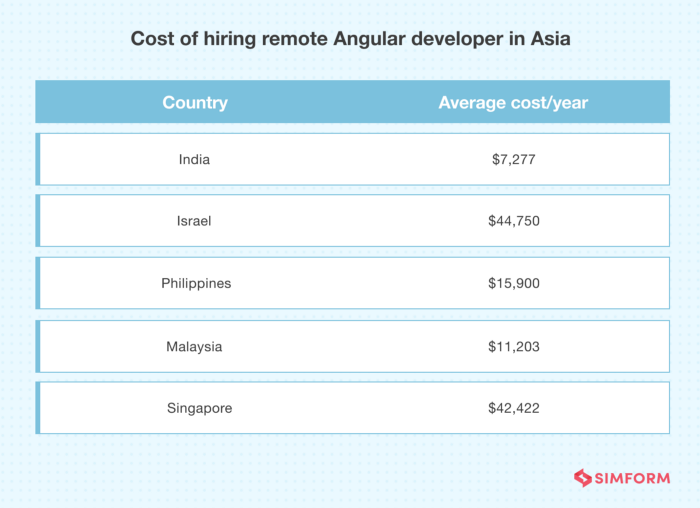 ### North America ### The United States, Canada, and Mexico are the other most popular markets to find the top 1% Angular developers for your business needs. 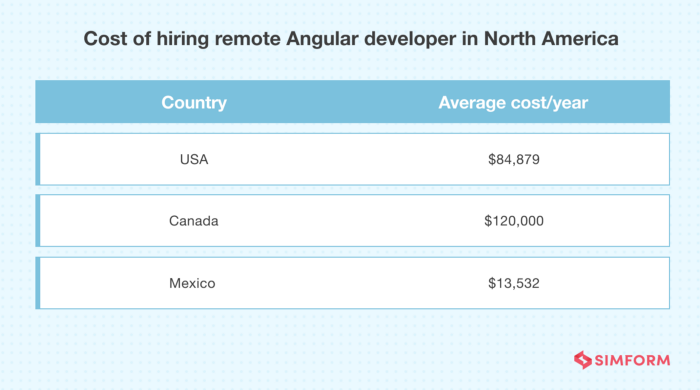 ### West Europe ### Western Europe has a reputation for offering one of the finest talents in the world for Angular development. Countries like the United Kingdom, Germany, Sweden have been at the forefront of building Angular-based apps. 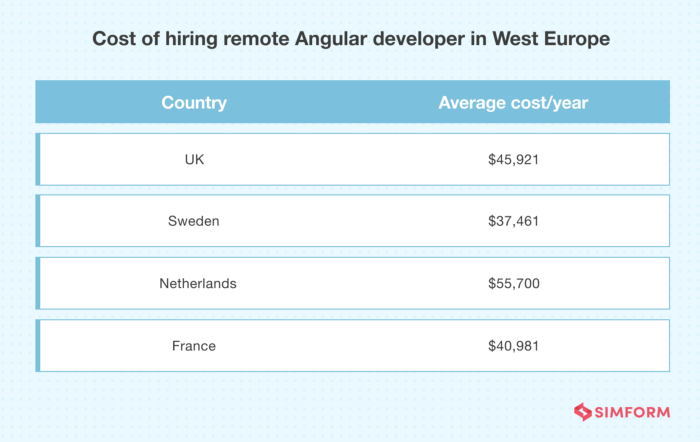 ### Australia ### Australia is also a top-notch market to hire Angular developers, but prices can be a little overwhelming. The local developers charge between $38,400 and $90,931 depending on the developer experience required and the apps’ complexity. ### Eastern Europe ### The average cost of hiring an Angular developer in Ukraine is within the range of $9120 and $42,000 per year. And, Polish developers may charge anywhere between $17,280 and $53,208. ### Freelancers vs. dedicated developers: Which one is practical? ### The cost of hiring a remote Angular developer can vary depending on whether you hire a freelancer or a dedicated developer. If you are looking for a project with a limited scope, and a predefined budget, freelance developers are the best choice. Finding a freelancer is easy with Upwork, Freelancer.com, or even Linkedin platforms. At the same time, you can find the best software company to hire dedicated remote Angular developers from [GoodFirms](https://www.goodfirms.co/company/simform) or [Clutch](https://clutch.co/profile/simform). The cost of hiring dedicated remote developers from such software companies is between $25/hour and $49/hour. ### Conclusion ### Hiring a remote Angular developer is just one step towards developing your next application, which is why doing it right is a wise choice. Many staff augmentation services, freelancers, and firms offer dedicated Angular development teams. However, choosing the right resource can be tedious and often confusing. In addition to that, the decision to [hire a remote Angular developer](https://www.simform.com/hire/angular-developers/) depends upon your organization’s specific requirements and the type of engagement model you are suitable for. So, before you decide on hiring Angular developers and how; there should be an answer ready to questions like, Answering these frequently asked questions will help you gauge the development cost, including the right developer’s hiring expenses. If you are still wondering how to hire remote Angular developers or a dedicated Angular team for your projects at affordable rates, [get in touch with us today](https://www.simform.com/contact/). Originally published at Simform: [How Much Does it Cost to Hire a Remote Angular Developer?](https://www.simform.com/blog/cost-to-hire-a-remote-angular-developer/) |
| json metadata | {"tags":["remoteangulardeveloper","hireangulardeveloper","costofangulardeveloper","hireremotedeveloper","costofdeveloper"],"image":["https://cdn.steemitimages.com/DQmNYJuZ35fkeEZNb6NkJeoWHNp9pw6XETzQdE36XErGDnP/0_vHmOl4dwlXS1MdJq.png","https://cdn.steemitimages.com/DQmeRXRVX5iFsUKBaNzQf4hiPRSXTavs3WS3TygUhoK5NnH/0_5cqfIHVpdgYIRA7u.png","https://cdn.steemitimages.com/DQmU5XEcx19TY9TEEqRLChRD4mJ133mR6euswc9LGDsZRNq/0_0y9bM5gnQJPnZeMB.png","https://cdn.steemitimages.com/DQmSiGuqdNaSmAAMzCAqLn4fwp9sDQAxbLjjxwy2ccdcPMz/0_gdD9IkI7EepoeaDa.png"],"links":["https://www.simform.com/services/web-apps-development/","https://www.simform.com/contact/","https://www.goodfirms.co/company/simform","https://clutch.co/profile/simform","https://www.simform.com/hire/angular-developers/","https://www.simform.com/blog/cost-to-hire-a-remote-angular-developer/"],"app":"steemit/0.2","format":"markdown"} |
| parent author | |
| parent permlink | remoteangulardeveloper |
| permlink | how-much-does-it-cost-to-hire-a-remote-angular-developer |
| title | How Much Does it Cost to Hire a Remote Angular Developer? |
| Transaction Info | Block #60839046/Trx 2bbe41321a49ed892af4e87103c8c4ce0db9fe06 |
View Raw JSON Data
{
"block": 60839046,
"op": [
"comment",
{
"author": "hardikshah",
"body": "\n\n\nIf deciding on a Javascript framework like Angular for building your web application was time-consuming, hiring a developer does not get any better. No framework is perfect, and Angular is not an exception. It comes along with many benefits, but there are some limitations to it that you must be aware of while hiring an Angular developer.\n\nTo handle this nitty-gritty effectively, you need an Angular developer with a specific skill set to make your project a big success. However, several aspects other than skills influence the overall cost of hiring Angular developers.\n\nIn this article, we will discover significant factors that influence the cost of hiring an Angular developer and the average price you will have to pay.\n\nSimform provides end-to-end [web application development services](https://www.simform.com/services/web-apps-development/) that help you improve business agility and improve engagement. Our teams with expertise in leading technologies and high-skilled experts deliver reliable solutions. So, If you’re looking to develop agile solutions for your business, [get in touch with us today!](https://www.simform.com/contact/)\n\n### Factors that affect cost of hiring remote Angular developer ###\n\nA standard Angular developer has a specific skill set, usually costing a specific, predictable, and fixed amount. However, these skill sets and time of engagement also depend on the app’s size and its complexity of features. This brings us to the point that hiring an Angular developer has more variables than one can imagine, which we’ll discuss in the following sections.\n\n### Scale of projects ###\n\nDeveloping an application has several aspects of being considered, including scale, type, methodology, and more. However, the scale of the project will be different for each organization and use case which impacts the cost of hiring remote Angular developers.\n\n#### Small-scale projects ####\n\nA small-scale project will have basic features taking less time and effort for development than medium or enterprise-level projects.\n\nHere no complex integrations reduce the cost as you may not need an entire team of developers. So, hiring an Angular developer for a small-scale app is the cheapest because maintenance is less, and the features to be developed are simple and fewer.\n\n#### Medium-scale project ####\nSmall-scale apps may need higher operational features with customized APIs and more third-party integrations than small-scale ones. This also influences the variations in costs of hiring remote Angular developers.\n\n#### Enterprise-grade projects ####\n\nBuilding an enterprise-level app may require extensive features, advanced integrations, and complex management tools, leading to higher hiring costs. In addition, enterprises need highly functional features with secure access across the organization, which is why you need more than just one team of developers.\n\n### Complexity of features ###\n\nAn application may be simple or complex based on the kind and amount of features it requires. Therefore, the cost of hiring an Angular developer varies based on this factor too. For example, simple features and basic functions like login/signup, notifications, etc., may need less development time and basic skills.\n\nThus, the cost of hiring Angular developers could be anywhere between $16500 and $39000, considering the average cost of hiring a full stack developer to be $30 per hour.\n\n#### Skills required ####\n\nAngular developers’ skillset is the backbone of hiring decisions and directly impacts the overall cost of hiring Angular developers. In addition, extensive knowledge of the Angular framework and skills to optimize app development can offer value to your projects. So, here are some skills related to Angular that you can seek while hiring.\n\nArchitecture- Angular developers must know different modules and components associated with the framework. It is embedded with MVC at its core but works well with an MVVM architecture which enables two-way binding between View and ViewModel. Developers with these skills can improve the performance of your application and build an enhanced user experience.\n\nTemplates- Knowledge of templates can be a great addition to the basic skill sets while evaluating Angular developers.\n\nTypescript Excellence- Angular is built on Typescript, a superset of Javascript. Given this fact, even a JavaScript developer can handle TypeScript coding to some extent in some instances. Hence, it is essential to identify if the developer has experience with both languages or at least one of them.\n\nBuild Tools- There are several Angular build tools like Angular CLI, Angular Schematics, Webpack, Angular Material, etc. Knowledge of these tools is essential to create custom services, components, and modules for your app.\n\n### Engagement model ###\nThere are many flexible hiring models that you can explore, like the time-based (hourly/monthly), fixed price, and dedicated models. In addition to that, you can also engage remote Angular developers in different ways like dedicated-based, offshore-based, or even freelance-based depending on the business needs.\n\nAlthough offshore developers may be cost-effective for your app development, they are from different time zones, making it difficult to collaborate without proper tools. Apart from that, you can always choose to hire in-house developers if you wish to create a development team.\n\n#### Average cost of hiring Angular developer ####\n\nWhen it comes to the average cost of hiring, you will have to consider the aspects like experience and location from where the developers will be hired or sourced. Let’s discuss some of those factors,\n\n#### Experience-based Cost ####\n\nThere are three different levels of experienced developers that you can hire,\n- Junior developer\n- Mid-level developer\n- Senior developer\n\nJunior developers- Fresh graduates or beginners with 0 to 3 years of experience in Angular development. They are expected to have basic knowledge of the framework with troubleshooting and debugging skills.\n\nMid-level developers- Developers with a basic knowledge of Angular and experience of 4 to 6 years. They have enough expertise in optimizing app performance, integrating third-party services, and building custom features.\n\nSenior-level developers- Senior frontend developers have expertise in Angular, HTML, CSS, TypeScript, and responsive web design. They should have average experience working with Angular technologies for more than seven years. Senior developers can provide leadership qualities in developing quality codes and guide other team members to continually improve the services.\n\n#### Location-based cost #####\nWhen it comes to the cost of hiring Angular developers, location plays an important role. Developers at different geographic locations have different costs of hiring. For example, In North America, the price of hiring a senior-level angular developer can go up to $157,440 per year, and at the same time, in Asia, it can be up to $9,533.\n\n### Asia ###\n\nAsia offers highly skilled Angular talents at reduced costs compared to other geographical locations. On the other hand, India offers the cheapest opportunity for hiring developers with different levels of experience.\n\n\n\n### North America ###\nThe United States, Canada, and Mexico are the other most popular markets to find the top 1% Angular developers for your business needs.\n\n\n\n### West Europe ###\nWestern Europe has a reputation for offering one of the finest talents in the world for Angular development. Countries like the United Kingdom, Germany, Sweden have been at the forefront of building Angular-based apps.\n\n\n\n### Australia ###\n\nAustralia is also a top-notch market to hire Angular developers, but prices can be a little overwhelming. The local developers charge between $38,400 and $90,931 depending on the developer experience required and the apps’ complexity.\n\n### Eastern Europe ###\n\nThe average cost of hiring an Angular developer in Ukraine is within the range of $9120 and $42,000 per year. And, Polish developers may charge anywhere between $17,280 and $53,208.\n\n### Freelancers vs. dedicated developers: Which one is practical? ###\n\nThe cost of hiring a remote Angular developer can vary depending on whether you hire a freelancer or a dedicated developer. If you are looking for a project with a limited scope, and a predefined budget, freelance developers are the best choice.\n\nFinding a freelancer is easy with Upwork, Freelancer.com, or even Linkedin platforms. At the same time, you can find the best software company to hire dedicated remote Angular developers from [GoodFirms](https://www.goodfirms.co/company/simform) or [Clutch](https://clutch.co/profile/simform). The cost of hiring dedicated remote developers from such software companies is between $25/hour and $49/hour.\n\n### Conclusion ###\nHiring a remote Angular developer is just one step towards developing your next application, which is why doing it right is a wise choice. Many staff augmentation services, freelancers, and firms offer dedicated Angular development teams.\n\nHowever, choosing the right resource can be tedious and often confusing. In addition to that, the decision to [hire a remote Angular developer](https://www.simform.com/hire/angular-developers/) depends upon your organization’s specific requirements and the type of engagement model you are suitable for. So, before you decide on hiring Angular developers and how; there should be an answer ready to questions like,\n\nAnswering these frequently asked questions will help you gauge the development cost, including the right developer’s hiring expenses. If you are still wondering how to hire remote Angular developers or a dedicated Angular team for your projects at affordable rates, [get in touch with us today](https://www.simform.com/contact/).\n\nOriginally published at Simform: [How Much Does it Cost to Hire a Remote Angular Developer?](https://www.simform.com/blog/cost-to-hire-a-remote-angular-developer/)",
"json_metadata": "{\"tags\":[\"remoteangulardeveloper\",\"hireangulardeveloper\",\"costofangulardeveloper\",\"hireremotedeveloper\",\"costofdeveloper\"],\"image\":[\"https://cdn.steemitimages.com/DQmNYJuZ35fkeEZNb6NkJeoWHNp9pw6XETzQdE36XErGDnP/0_vHmOl4dwlXS1MdJq.png\",\"https://cdn.steemitimages.com/DQmeRXRVX5iFsUKBaNzQf4hiPRSXTavs3WS3TygUhoK5NnH/0_5cqfIHVpdgYIRA7u.png\",\"https://cdn.steemitimages.com/DQmU5XEcx19TY9TEEqRLChRD4mJ133mR6euswc9LGDsZRNq/0_0y9bM5gnQJPnZeMB.png\",\"https://cdn.steemitimages.com/DQmSiGuqdNaSmAAMzCAqLn4fwp9sDQAxbLjjxwy2ccdcPMz/0_gdD9IkI7EepoeaDa.png\"],\"links\":[\"https://www.simform.com/services/web-apps-development/\",\"https://www.simform.com/contact/\",\"https://www.goodfirms.co/company/simform\",\"https://clutch.co/profile/simform\",\"https://www.simform.com/hire/angular-developers/\",\"https://www.simform.com/blog/cost-to-hire-a-remote-angular-developer/\"],\"app\":\"steemit/0.2\",\"format\":\"markdown\"}",
"parent_author": "",
"parent_permlink": "remoteangulardeveloper",
"permlink": "how-much-does-it-cost-to-hire-a-remote-angular-developer",
"title": "How Much Does it Cost to Hire a Remote Angular Developer?"
}
],
"op_in_trx": 0,
"timestamp": "2022-01-18T11:46:51",
"trx_id": "2bbe41321a49ed892af4e87103c8c4ce0db9fe06",
"trx_in_block": 71,
"virtual_op": 0
}hardikshahpublished a new post: what-is-regression-testing-explained-with-test-cases-tools-and-methods2022/01/05 11:06:33
hardikshahpublished a new post: what-is-regression-testing-explained-with-test-cases-tools-and-methods
2022/01/05 11:06:33
| author | hardikshah |
| body | 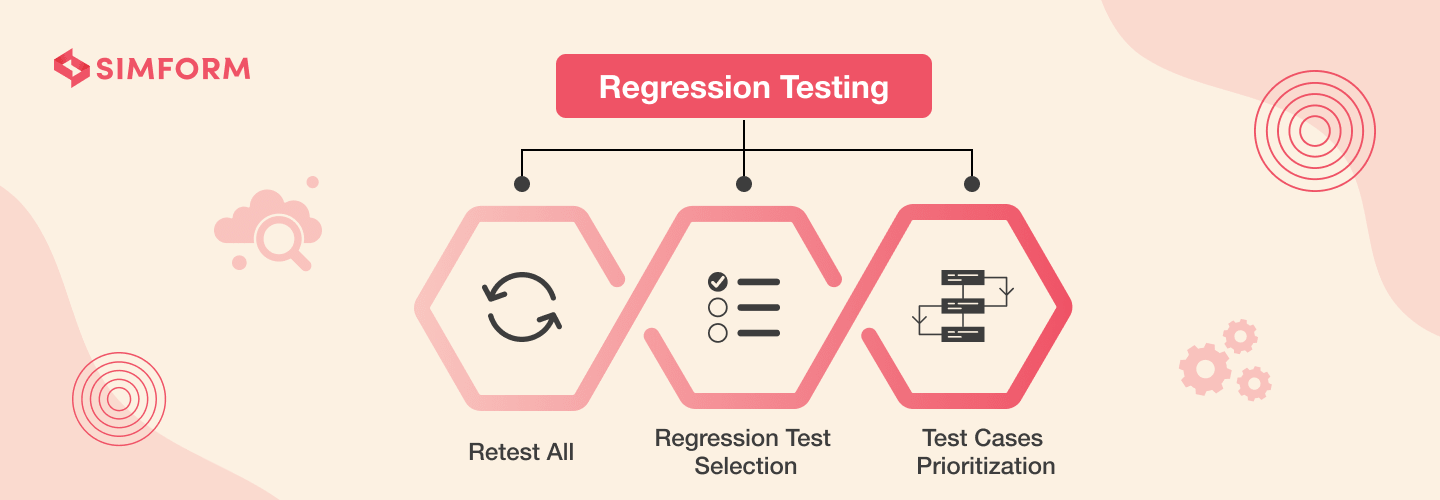 In the software development lifecycle, testing is often overlooked or not given the same amount of significance as development. However, it is as important or more important than development because a buggy application with various features can cost you money and loss of user base. In this blog, we’re going to walk you through in detail related to regression testing, its test cases, types, tools, and everything else you need to know. So, let’s get things moving! ## What is Regression Testing? Suppose you’re a software development firm, and the client has assigned you the project to develop an application for image and video editing. With the primary requirements, you create the first build with core features. Once done, you conduct regression testing with 1000 test cases to ensure that the app works correctly. After the app passes the regression test, you send the copy to the client for feedback. The client is happy with the first build but wants some extra features. So, you develop those features and add them to the existing app. But, with the addition of new codes, you will be required to conduct regression testing again. Hence, you write 100 new test cases and verify the functionality of the app. But along with that, you will have to run the 1000 old test cases already conducted to ensure essential functions haven’t been affected. ## Regression Testing Example Suppose you’re a software development firm, and the client has assigned you the project to develop an application for image and video editing. With the primary requirements, you create the first build with core features. Once done, you conduct regression testing with 1000 test cases to ensure that the app works correctly. After the app passes the regression test, you send the copy to the client for feedback. ## Pros and Cons of Regression Testing ### Pros - Ensures that any change in code doesn’t adversely affect other functionality. - Makes sure that already fixed issues don’t re-occur. - Serves as a risk mitigation strategy during testing. - Easy to learn, understand and analyze. ### Cons - Without automation, regression testing can be time-consuming. - Need to perform for every small change of code. - A highly repetitive process may affect the agile sprint. - Requires you to create complex test cases. ## Challenges in Regression Testing - High Upfront Cost: Regression testing is very time-consuming if done manually. - Testing Approach: Selecting a proper testing approach is crucial to success as far as regression testing goes. - Enormous Scope and Coverage: The success of regression testing depends on the type of test cases suite you have built. - Complexity: As you move from the first build to the second and then so on, the number of test cases increases. ## How to Conduct Regression Testing? Generally, there is no fixed pattern for implementing regression testing. However, there are some popular regression testing methods that a QA analyst should keep in mind. Generally, there is no fixed pattern for implementing regression testing. However, there are some popular regression testing methods that a QA analyst should keep in mind. ### Step 1: Regression Test Selection As the name suggests, here, you select the test cases that require re-testing. You won’t test the entire test suite, and the selection of test cases will depend on the module where there is a change in the source code. ### Step 2: Determine the Time for Executing Test Cases The next step is to estimate the time it will take to execute the selected test cases. Few factors that affect the execution time are test data creation, regression test planning by the QA team, review of all test cases, etc. ### Step 3: Identify the Test Cases that can be Automated In this step, based on the results of exploratory testing, the QA team can decide the test cases that they can automate. Automated test cases are faster than manual testing and allow you to re-use the same script repeatedly. So, divide the test cases into two groups – (i) manual test cases and (ii) automated test cases. ### Step 4: Test Cases Prioritization Here, you gather all the test cases and prioritize them, i.e., high, medium, and low. Based on this evaluation, you will execute the high-priority test cases first, followed by medium and low priority test cases. The priority will depend on the product’s functionality and user involvement. ### Step 5: Executing Test Cases Finally, it’s time to execute all the test cases one by one and test whether the product is working as it should or not. You can opt for manual testing or automation based on the requirement. For automated regression testing, utilizing tools like Selenium, QTP, Watir, etc., allows you to execute the test cases faster. ## Regression Testing Methods There are primarily four most popular regression testing methods: - Regression Test Selection: Here, you select the test cases that need to be re-tested. - Test Case Prioritization: Here, you gather all the test cases and prioritize them. - Retest All: Here, you re-test the entire regression test suite. - Hybrid: Here, you combine Regression Test Selection and Test Case Prioritization method. ## How to Create an Effective Regression Testing Suite? A regression testing suite is a set of test cases designed to ensure that your software is accurately working as it should after any changes or updates. Below are the five steps to creating an effective regression testing suite. ### Step 1: Prioritizing Regression Tests ### Step 2: Developing Smoke Test ### Step 3: Take Assistance of Manual Testing ### Step 4: Test the Integrations ### Step 5: Take Performance into Account ### Regression Testing Types 1. Corrective 2. Progressive 3. Selective 4. Partial 5. Complete 6. Retest-All ## Top Regression Testing Tools 1. [Selenium](https://www.simform.com/blog/software-testing-cost/) 2. [Katalan Studio](https://www.katalon.com/) 3. [Watir](http://watir.com/) 4. [IBM Rational Functional Tester](https://www.ibm.com/products/rational-functional-tester) 5. [Apache JMeter](https://jmeter.apache.org/) 6. [AdventNet QEngine](https://www.manageengine.com/products/qengine/qengine-eol.html) 7. [Subject7](https://www.subject-7.com/) 8. [TimeShiftX](https://www.vornexinc.com/) 9. [Cerberus Testing](https://cerberus-testing.com/) 10. [Testsigma](https://testsigma.com/) ## Regression Testing Best Practices Most people believe that retesting and regression testing is the same. However, that is not true; both these terms have a separate meaning. ### 1. Regression Testing Best Practices Like keeping up with any technology, you need to stay up-to-date with the latest regression testing suites too. For that purpose, always consider the functional and non-functional requirements. The high-priority and high-value test cases in the suite should always be executed first by the QA team. ### 2. Knowing Every Change Hands-on Have regular communication between developers and testers to know the latest upgraded version and be aware of immediate changes. They can plan their testing well in advance to stay on track with the app or product release. ### 3. Assigning Grade to Test Cases If you want to succeed with regression testing, you need to assign grades to all your test cases. You should compare and track their business impact on different platforms, and based on those evaluations; you should set high, medium, and low priority to various test scenarios. ### 4. Understanding the Scope of Testing Before starting the regression testing process, it’s essential to know its scope. The reason being each testing project can vary in terms of scope, time, and goals. Understanding differences in scope will allow you to plan your regression cycle execution better ### 5. Automate the Right Test Cases Automation gives you a competitive advantage only if you utilize it properly. So first, you need to identify which test cases you can automate and those that don’t have a scope of automation. Then, automating suitable test cases will increase your productivity and save precious time. ### 6. Track RoI QA teams should always track RoI based on the advanced analytics and reports generated by automation tools. It will help you to witness the on-ground reality and areas that need improvements. ## Regression Testing and Agile Methodology Agile teams should prepare the regression test suite from the initial stages of the product development cycle and then follow that until the final deployment. In agile methodology, you can conduct regression testing in two ways: - Sprint Level Regression - End-to-End Regression ## Summing Up Things Organizations could have avoided these fatalities if they had conducted regression testing before updating or adding a new feature. From the above example, you must have realized the importance of regression testing in this day and age. Regression testing becomes vital if you want to deliver high-quality and robust applications where users could be loyal. Taking those scenarios into consideration, in this article, we have provided you with a comprehensive view of regression testing, its types, tools, methods, and everything else you need to be aware of. Originally published at Simform: [What is Regression Testing? Explained with Test Cases, Tools, and Methods](https://www.simform.com/blog/regression-testing/) |
| json metadata | {"tags":["qaservices","integrationtesting","testcoverage","regressiontestingtools","selenium","katalanstudio","watir"],"image":["https://cdn.steemitimages.com/DQmbkeKZCjdJZCkb1zPHHDefWnbNt4iHLMjkLWt2FPDyJzV/image.png"],"links":["https://www.simform.com/blog/software-testing-cost/","https://www.katalon.com/","http://watir.com/","https://www.ibm.com/products/rational-functional-tester","https://jmeter.apache.org/","https://www.manageengine.com/products/qengine/qengine-eol.html","https://www.subject-7.com/","https://www.vornexinc.com/","https://cerberus-testing.com/","https://testsigma.com/","https://www.simform.com/blog/regression-testing/"],"app":"steemit/0.2","format":"markdown"} |
| parent author | |
| parent permlink | softwaretesting |
| permlink | what-is-regression-testing-explained-with-test-cases-tools-and-methods |
| title | What is Regression Testing? Explained with Test Cases, Tools, and Methods |
| Transaction Info | Block #60465970/Trx df5fb56b43ca0abde9b39bc654dec716223f3d29 |
View Raw JSON Data
{
"block": 60465970,
"op": [
"comment",
{
"author": "hardikshah",
"body": "\n\nIn the software development lifecycle, testing is often overlooked or not given the same amount of significance as development. However, it is as important or more important than development because a buggy application with various features can cost you money and loss of user base.\n\nIn this blog, we’re going to walk you through in detail related to regression testing, its test cases, types, tools, and everything else you need to know. So, let’s get things moving!\n\n## What is Regression Testing?\nSuppose you’re a software development firm, and the client has assigned you the project to develop an application for image and video editing. With the primary requirements, you create the first build with core features. Once done, you conduct regression testing with 1000 test cases to ensure that the app works correctly. After the app passes the regression test, you send the copy to the client for feedback.\n\nThe client is happy with the first build but wants some extra features. So, you develop those features and add them to the existing app. But, with the addition of new codes, you will be required to conduct regression testing again. Hence, you write 100 new test cases and verify the functionality of the app. But along with that, you will have to run the 1000 old test cases already conducted to ensure essential functions haven’t been affected.\n\n## Regression Testing Example\nSuppose you’re a software development firm, and the client has assigned you the project to develop an application for image and video editing. With the primary requirements, you create the first build with core features. Once done, you conduct regression testing with 1000 test cases to ensure that the app works correctly. After the app passes the regression test, you send the copy to the client for feedback.\n\n## Pros and Cons of Regression Testing\n### Pros\n- Ensures that any change in code doesn’t adversely affect other functionality.\n- Makes sure that already fixed issues don’t re-occur.\n- Serves as a risk mitigation strategy during testing.\n- Easy to learn, understand and analyze.\n### Cons\n- Without automation, regression testing can be time-consuming.\n- Need to perform for every small change of code.\n- A highly repetitive process may affect the agile sprint.\n- Requires you to create complex test cases.\n\n## Challenges in Regression Testing\n- High Upfront Cost: Regression testing is very time-consuming if done manually.\n- Testing Approach: Selecting a proper testing approach is crucial to success as far as regression testing goes.\n- Enormous Scope and Coverage: The success of regression testing depends on the type of test cases suite you have built.\n- Complexity: As you move from the first build to the second and then so on, the number of test cases increases.\n\n## How to Conduct Regression Testing?\nGenerally, there is no fixed pattern for implementing regression testing. However, there are some popular regression testing methods that a QA analyst should keep in mind.\n\nGenerally, there is no fixed pattern for implementing regression testing. However, there are some popular regression testing methods that a QA analyst should keep in mind.\n\n### Step 1: Regression Test Selection\nAs the name suggests, here, you select the test cases that require re-testing. You won’t test the entire test suite, and the selection of test cases will depend on the module where there is a change in the source code.\n\n### Step 2: Determine the Time for Executing Test Cases\nThe next step is to estimate the time it will take to execute the selected test cases. Few factors that affect the execution time are test data creation, regression test planning by the QA team, review of all test cases, etc. \n\n### Step 3: Identify the Test Cases that can be Automated\nIn this step, based on the results of exploratory testing, the QA team can decide the test cases that they can automate. Automated test cases are faster than manual testing and allow you to re-use the same script repeatedly. So, divide the test cases into two groups – (i) manual test cases and (ii) automated test cases.\n\n### Step 4: Test Cases Prioritization\nHere, you gather all the test cases and prioritize them, i.e., high, medium, and low. Based on this evaluation, you will execute the high-priority test cases first, followed by medium and low priority test cases. The priority will depend on the product’s functionality and user involvement.\n\n### Step 5: Executing Test Cases\nFinally, it’s time to execute all the test cases one by one and test whether the product is working as it should or not. You can opt for manual testing or automation based on the requirement. For automated regression testing, utilizing tools like Selenium, QTP, Watir, etc., allows you to execute the test cases faster.\n\n## Regression Testing Methods\nThere are primarily four most popular regression testing methods: \n- Regression Test Selection: Here, you select the test cases that need to be re-tested.\n- Test Case Prioritization: Here, you gather all the test cases and prioritize them.\n- Retest All: Here, you re-test the entire regression test suite.\n- Hybrid: Here, you combine Regression Test Selection and Test Case Prioritization method. \n\n## How to Create an Effective Regression Testing Suite?\nA regression testing suite is a set of test cases designed to ensure that your software is accurately working as it should after any changes or updates. Below are the five steps to creating an effective regression testing suite.\n\n### Step 1: Prioritizing Regression Tests\n### Step 2: Developing Smoke Test\n### Step 3: Take Assistance of Manual Testing\n### Step 4: Test the Integrations\n### Step 5: Take Performance into Account\n\n### Regression Testing Types\n1. Corrective\n2. Progressive\n3. Selective\n4. Partial\n5. Complete\n6. Retest-All\n\n## Top Regression Testing Tools\n1. [Selenium](https://www.simform.com/blog/software-testing-cost/)\n2. [Katalan Studio](https://www.katalon.com/)\n3. [Watir](http://watir.com/)\n4. [IBM Rational Functional Tester](https://www.ibm.com/products/rational-functional-tester)\n5. [Apache JMeter](https://jmeter.apache.org/)\n6. [AdventNet QEngine](https://www.manageengine.com/products/qengine/qengine-eol.html)\n7. [Subject7](https://www.subject-7.com/)\n8. [TimeShiftX](https://www.vornexinc.com/)\n9. [Cerberus Testing](https://cerberus-testing.com/)\n10. [Testsigma](https://testsigma.com/)\n\n## Regression Testing Best Practices\nMost people believe that retesting and regression testing is the same. However, that is not true; both these terms have a separate meaning.\n\n### 1. Regression Testing Best Practices\nLike keeping up with any technology, you need to stay up-to-date with the latest regression testing suites too. For that purpose, always consider the functional and non-functional requirements. The high-priority and high-value test cases in the suite should always be executed first by the QA team.\n\n### 2. Knowing Every Change Hands-on\nHave regular communication between developers and testers to know the latest upgraded version and be aware of immediate changes. They can plan their testing well in advance to stay on track with the app or product release.\n\n### 3. Assigning Grade to Test Cases\nIf you want to succeed with regression testing, you need to assign grades to all your test cases. You should compare and track their business impact on different platforms, and based on those evaluations; you should set high, medium, and low priority to various test scenarios.\n\n### 4. Understanding the Scope of Testing\nBefore starting the regression testing process, it’s essential to know its scope. The reason being each testing project can vary in terms of scope, time, and goals. Understanding differences in scope will allow you to plan your regression cycle execution better\n\n### 5. Automate the Right Test Cases\nAutomation gives you a competitive advantage only if you utilize it properly. So first, you need to identify which test cases you can automate and those that don’t have a scope of automation. Then, automating suitable test cases will increase your productivity and save precious time.\n\n### 6. Track RoI\nQA teams should always track RoI based on the advanced analytics and reports generated by automation tools. It will help you to witness the on-ground reality and areas that need improvements.\n\n## Regression Testing and Agile Methodology\nAgile teams should prepare the regression test suite from the initial stages of the product development cycle and then follow that until the final deployment. In agile methodology, you can conduct regression testing in two ways:\n- Sprint Level Regression\n- End-to-End Regression\n\n## Summing Up Things\nOrganizations could have avoided these fatalities if they had conducted regression testing before updating or adding a new feature. From the above example, you must have realized the importance of regression testing in this day and age.\n\nRegression testing becomes vital if you want to deliver high-quality and robust applications where users could be loyal. Taking those scenarios into consideration, in this article, we have provided you with a comprehensive view of regression testing, its types, tools, methods, and everything else you need to be aware of.\n\nOriginally published at Simform: [What is Regression Testing? Explained with Test Cases, Tools, and Methods](https://www.simform.com/blog/regression-testing/)",
"json_metadata": "{\"tags\":[\"qaservices\",\"integrationtesting\",\"testcoverage\",\"regressiontestingtools\",\"selenium\",\"katalanstudio\",\"watir\"],\"image\":[\"https://cdn.steemitimages.com/DQmbkeKZCjdJZCkb1zPHHDefWnbNt4iHLMjkLWt2FPDyJzV/image.png\"],\"links\":[\"https://www.simform.com/blog/software-testing-cost/\",\"https://www.katalon.com/\",\"http://watir.com/\",\"https://www.ibm.com/products/rational-functional-tester\",\"https://jmeter.apache.org/\",\"https://www.manageengine.com/products/qengine/qengine-eol.html\",\"https://www.subject-7.com/\",\"https://www.vornexinc.com/\",\"https://cerberus-testing.com/\",\"https://testsigma.com/\",\"https://www.simform.com/blog/regression-testing/\"],\"app\":\"steemit/0.2\",\"format\":\"markdown\"}",
"parent_author": "",
"parent_permlink": "softwaretesting",
"permlink": "what-is-regression-testing-explained-with-test-cases-tools-and-methods",
"title": "What is Regression Testing? Explained with Test Cases, Tools, and Methods"
}
],
"op_in_trx": 0,
"timestamp": "2022-01-05T11:06:33",
"trx_id": "df5fb56b43ca0abde9b39bc654dec716223f3d29",
"trx_in_block": 0,
"virtual_op": 0
}hardikshahpublished a new post: how-to-make-a-social-media-app-and-how-much-does-it-cost2021/12/29 13:33:48
hardikshahpublished a new post: how-to-make-a-social-media-app-and-how-much-does-it-cost
2021/12/29 13:33:48
| author | hardikshah |
| body |  Social media apps have redefined how we connect and build networks, becoming a prominent part of our daily lives. As of 2021, [4.48 billion](https://backlinko.com/social-media-users#social-media-usage-stats) people worldwide are active social media users, accounting for more than half the world’s population. The increasing demand has led to an emerging, prosperous market for social networking apps. With the social media app market booming with ample potential opportunities, there is no better time than now to ignite your inner Zuckerberg, Krieger (Instagram’s co-founder), or Dorsey (Twitter’s co-founder). And turn your unique idea into the next big social media app by following the below-mentioned steps. This blog explains the complete process of building a social media app from scratch, with each phase explained in detail. In addition, it also talks about the cost breakdown of the app. Typically, the cost of a social media app can range from $45,000- $75,000, depending on many different factors. Simform provides end-to-end [application development services](https://www.simform.com/services/application-development/) that help you build top-notch apps with leading technologies and high-skilled experts. If you’re looking to develop innovative and reliable software solutions for your business, [reach out to us](https://www.simform.com/contact/) today! ## Phase 1: Conduct comprehensive research to ensure success Bringing your social media app idea to life requires comprehensive market and competition research, which makes up the business analysis phase. ### Market research The number of social media users globally has almost doubled since [2016](https://datareportal.com/reports/digital-2021-global-overview-report) and the significant rise can be seen in the graph below. Such increasing demand makes the social media app market one of the most favorable ones to enter. 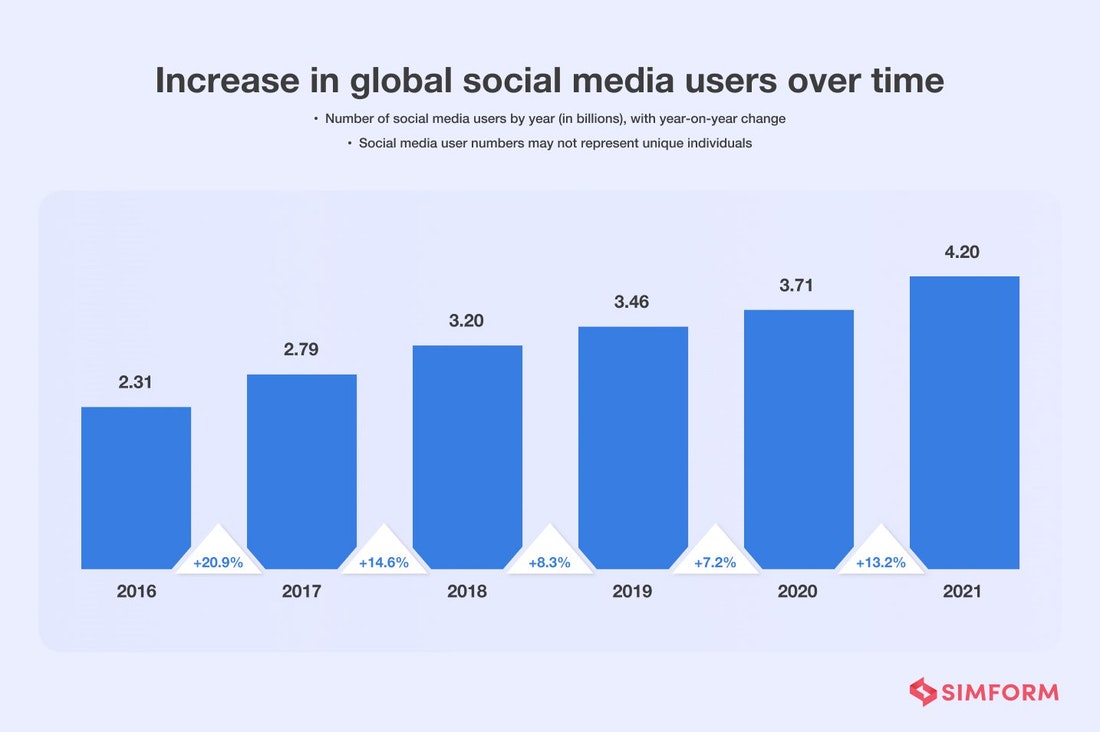 Market research will further help understand the unique needs of users and help define your social media app’s exact purpose. It will also help you know the target audience better, understand the niche you’re going to enter and its inherent features. According to the existing trends in the social media app market, your app will fall into either of these categories shown below along with some examples. 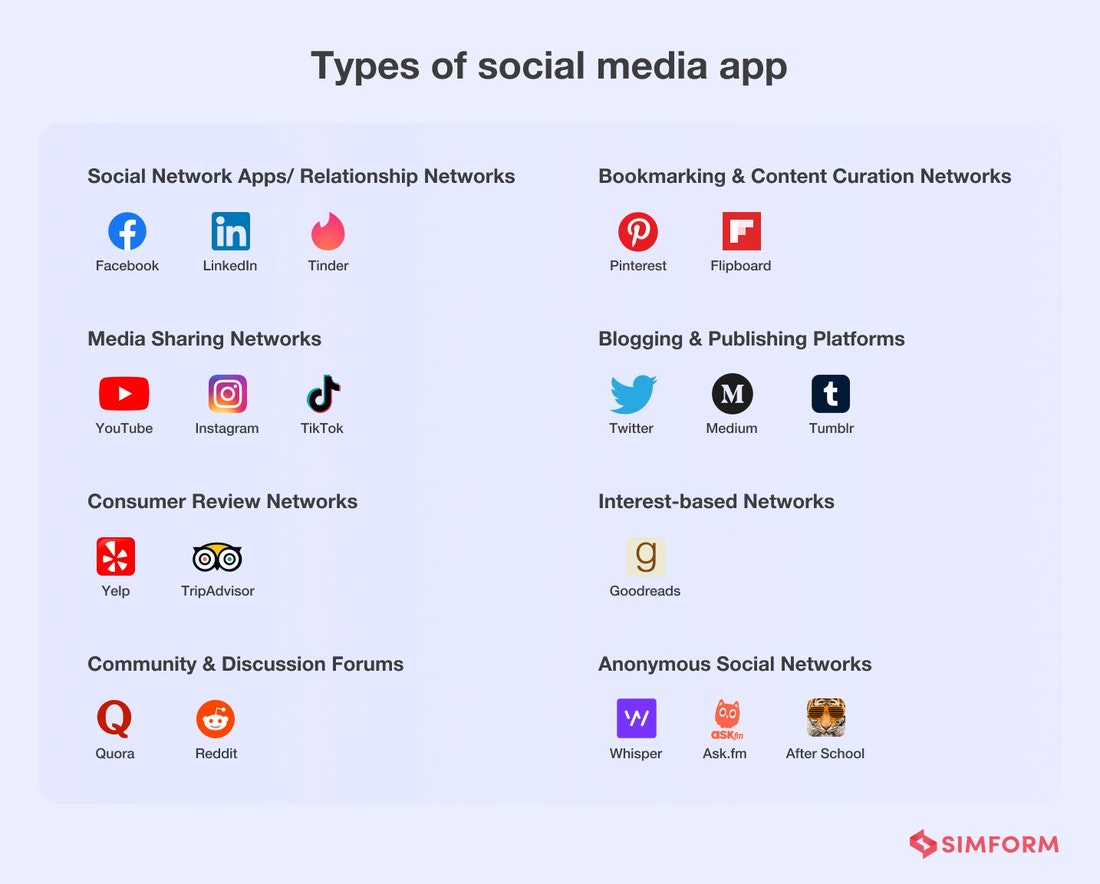 ### Competition research Furthermore, competition research will help identify the strengths of competitors’ apps and what they lack, so you can identify the potential and opportunities for your product. It helps decide what features you must or must not include in your app to make it stand out in the market. ### Phase 2: Plan out the features of your app All the above research and analysis will help you plan the features, functionalities, and other technical aspects of your app. In this phase, you will also define a profitable monetization model of your social media app. ### Monetization models for social media apps You can either opt for a freemium model like LinkedIn or an advertising model used by apps like Facebook, Instagram, and YouTube. Moreover, you can also offer in-app purchases to your users for more revenue. For example, you can charge for specific podcasts, ebooks, courses, avatars, etc. Depending on the app’s functionality and target audience, you can also mix up the strategies and get creative. Now let us look at the key features you should consider for your app as well as some advanced features. ### Must-have features of a social media app 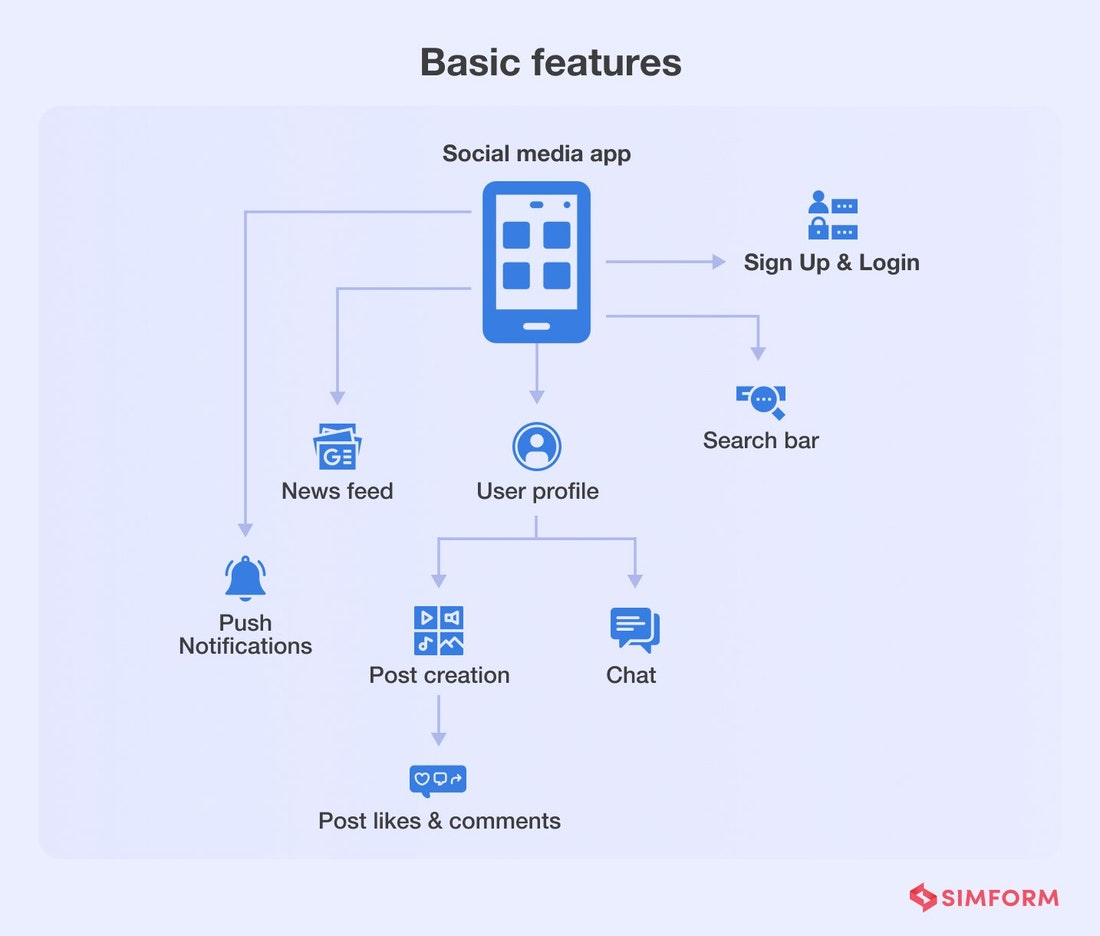 #### Sign up & login It is the most basic but irreplaceable feature which gives users access to your app. However, it should be easy and convenient for users to sign up or log in to the app. You can provide multiple ways such as phone registration, email, and password, and integrating with users’ existing accounts on Google, Facebook or Twitter. #### User profile A user profile is a primary requirement for every social media app. It helps users add their name, location, photo, short bio, etc. It is preferable to make this feature customizable and multi-dimensional for users’ delight. #### Chat: It is vital to provide in-app messaging to users for private communication, whether social or professional networking. An advanced version of this feature can also include group chats, voice notes, audio/video calls, chat pop-ups, etc. #### Push notifications: Push notifications are critical drivers of user engagement that instantly notify users of activities in the app without logging in to the app. It is also necessary to implement this feature with a settings panel so users can mute, disable or receive notifications and set alerts according to their preferences. ## Advanced features of a social media app 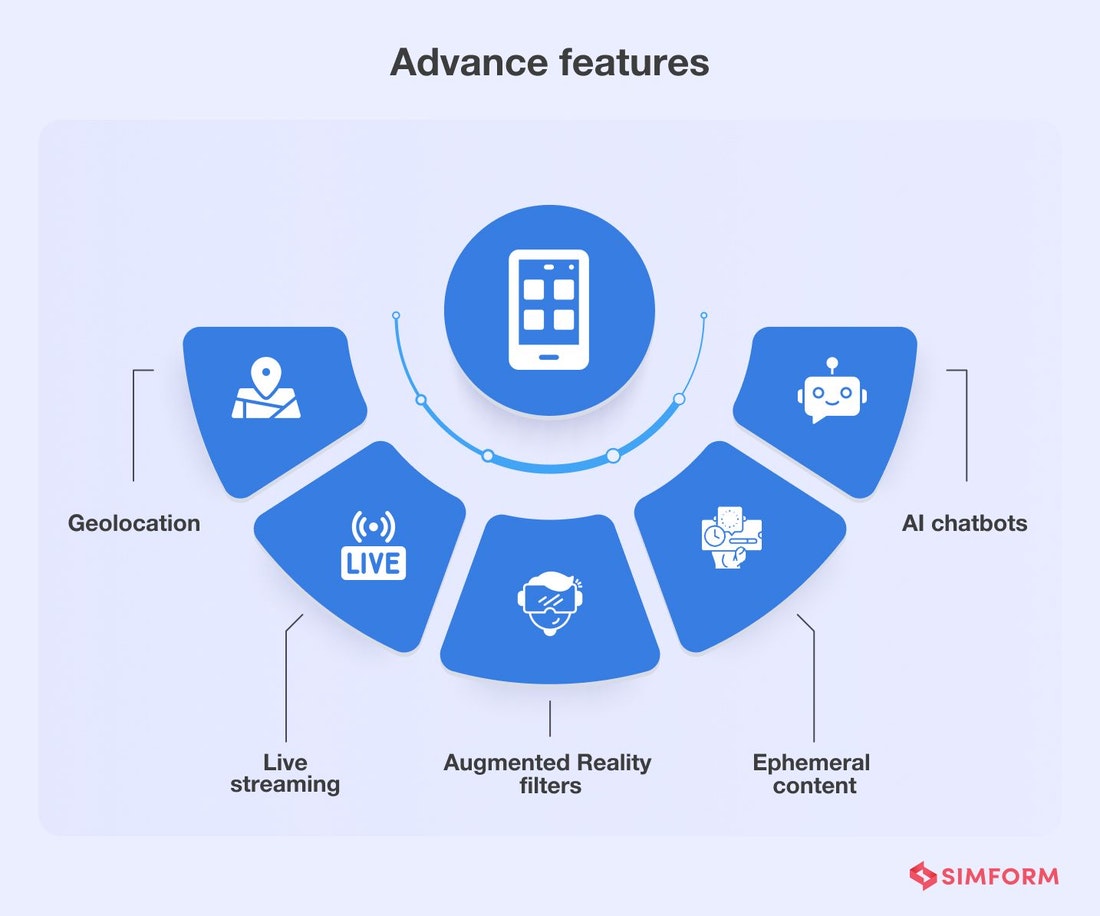 ### Geolocation: The geolocation feature allows users to mark locations on pictures, find other users nearby, update one’s location, and more. It also helps businesses see users nearby and promote brands or ads per users’ interests. For instance, geolocation is a must-have feature in dating apps. ### Live streaming: Live video streaming has become extremely popular with Gen-Z as it allows users to communicate in real-time with their followers and share experiences. It is also a great way to do live Q&A sessions, interviews, product or fitness demos, and instantly connect with the audience. ### Artificial Intelligence chatbots Automated AI chatbots are also trending as they predict and respond to frequently asked questions, facilitate user interactions easily and save time. Adding this feature to your application toolkit can also help analyze user behavior and improve targeted audience marketing to boost business growth. ## Phase 3: Design & development After having a mind map and functional specifications of your social media app, it is time to start the development process. It entails UI/UX design, front-end, and back-end development. Below we will discuss all these aspects in detail. ## Design best practices 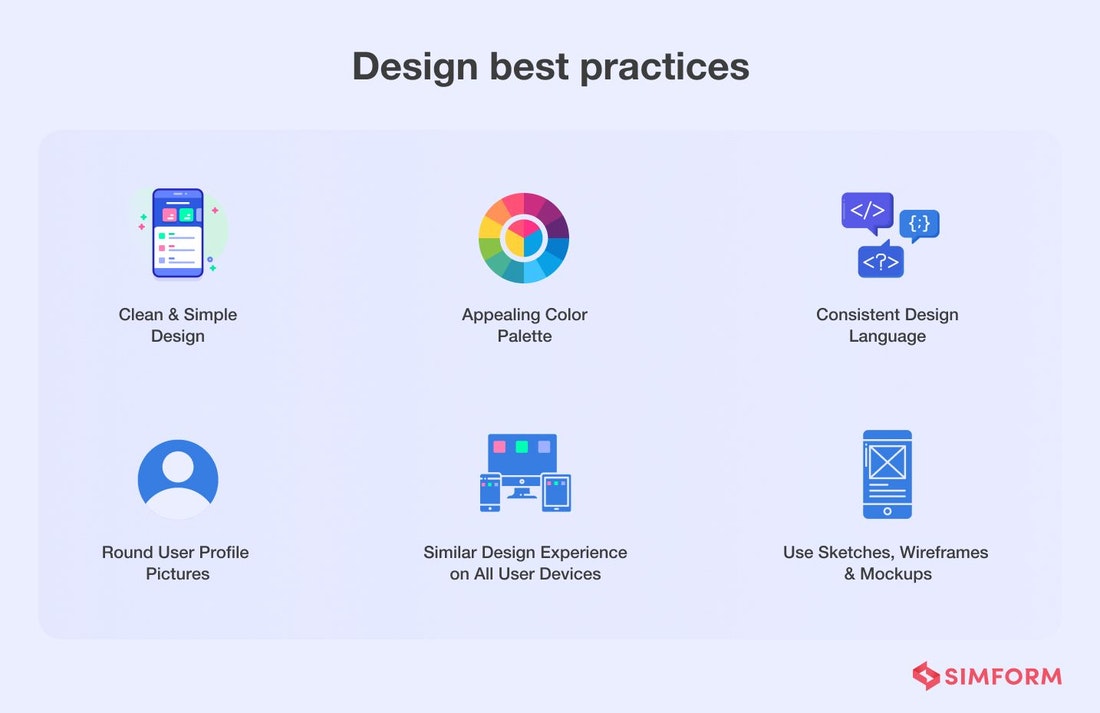 UI and UX of an app are the first aspects that the users see. Therefore, the app’s design must be attractive, intuitive, and user-friendly. Here are a few best practices our designers keep in mind while designing the UI/UX of a social media app: - A clean, simple design that users can quickly familiarize themselves with is preferable. For instance, have a minimal number of steps to find and use a feature. - A good choice of color palette is also crucial to a successful design. Include colors that appeal to users as well as emphasize your brand to increase its recognition. - Lastly, using design tools like sketches, wireframes and mockups will help the entire team visualize how the app works, making the design process seamless. The UI/UX design process and front-end development usually run together in the SDLC of a social media app. So next, we will examine the technology stack and frameworks for iOS and Android. The choice of technologies used will directly affect the performance and security of your future application. ## Technology stack for a social media app A social media app architecture has a three-tier structure consisting of a mobile client, backend, and database. Below is what an approximate tech stack of a social media app would look like: 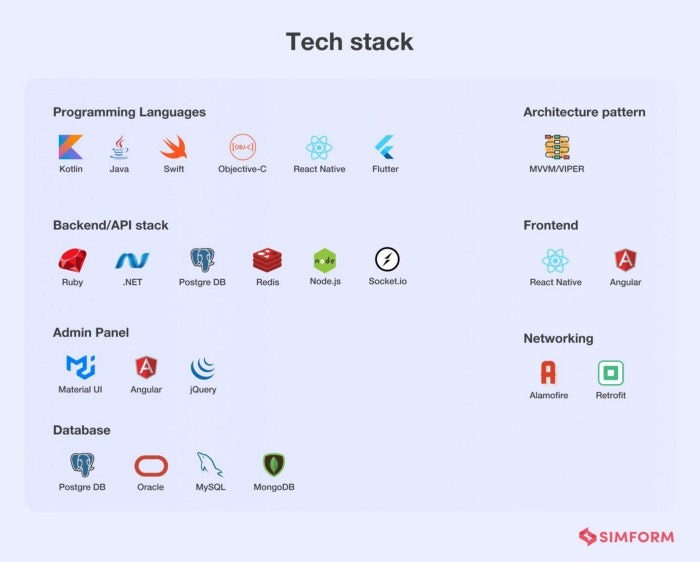 You will also need to decide the platforms you want to target: iOS, Android, or cross-platform development. Both Android and Apple use different technology stacks that we’ll discuss in the next section. ## Frontend development Frontend development is equally essential to a social media app as users spend most of the time interacting with the user interface. Angular and React are excellent options for building a mobile frontend of social media apps. These frameworks are used widely and can also be effectively used for the microservices approach or component-based approach to frontend development. The client-side of a social media app is essentially defined by its key features like user profiles, feed, connections, and other such features as they keep the users engaged. Below we examine the technical implementation of these core social media mobile app features. ## Backend development As for backend development or server-side programming, the choice of technology needs to be more robust. Backend determines the performance, scalability, and efficiency of your social media app. It also includes setting up databases, servers, storage solutions, APIs, etc. It must be based on the requirement of your app, like the number of users it will have or the amount of load the backend will be expected to handle. The entire infrastructure of your app, including frontend, backend, and databases, can also be hosted on the cloud. It allows you to upscale when needed to help save costs and eliminate idle resources when there is less traffic. The key backend features of a social media app include an admin panel and database. Let’s discuss them in detail. ### Database Social media apps require enormous amounts of data to be included, processed, and put away. Hence, they need a database tier. There are multiple choices for SQL and NoSQL databases available. Based on the app’s requirements, you can choose from options like MySQL, PostgreSQL, MongoDB, and more. ### Admin panel Social media apps require an admin panel to monitor and access all the data sourced from the app. It provides information like the number of active users, the content they share, posts they interact with, and other users’ activities. Admin panel is a must for apps with user-generated content. It allows you to manage users and the content. For example, you can remove abusive or threatening content, block or delete a user account, etc. ## Development best practices for a social media app 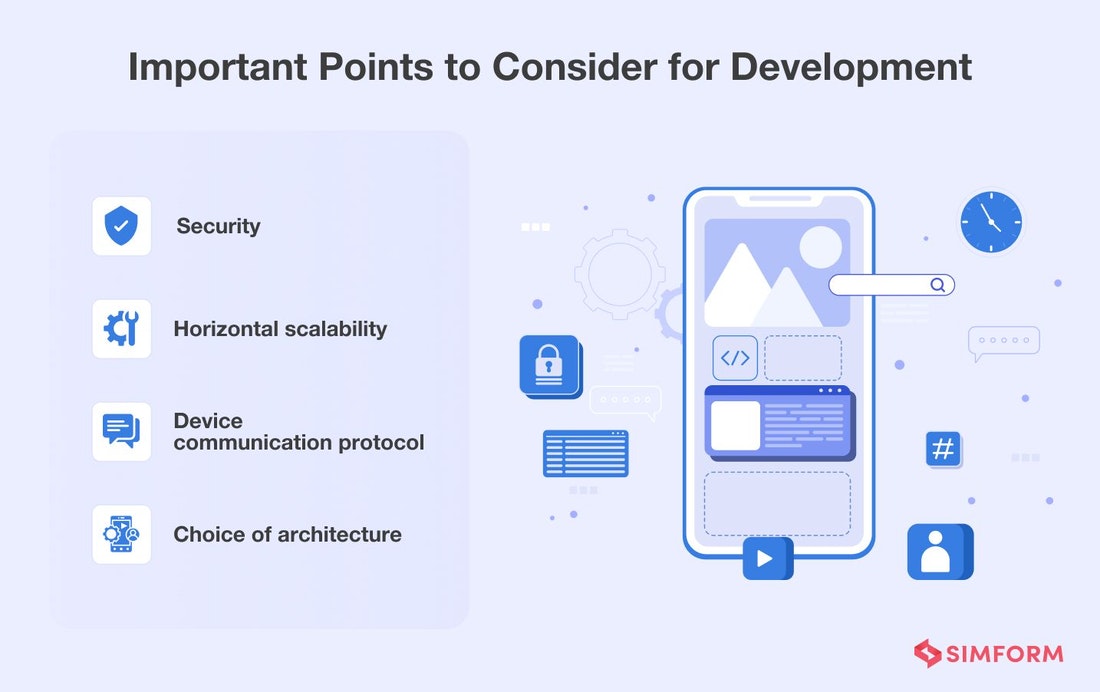 ### 1. Security: Users’ data security and privacy are of utmost importance in social media apps. Security vulnerabilities and inefficient permission-based mechanisms in Android have paved the way for different security hazards. Android developers can implement additional security measures such as: - complex data encryption, - high-level cryptography tools/technologies, - integration with authorized APIs, - Android Keystore system. As for iOS apps, weak cryptography, jailbreaking, or insecure data storage are possible hazards that can compromise iOS’s strong security. iOS developers can apply the following additional measures: - Use authorized APIs, - Avoid storing cryptographic keys in the code or locally, - Use long-lasting cryptographic standards and algorithms like ATS ### 2. Horizontal scalability: To handle user growth and expanding data, your architecture must be horizontally scalable. Different types of load balancers can help provide proper functioning with the following solutions: - Hardware load balancing - Software load balancing - Mixed load balancing - DNS load balancing Check out this case study on how we built a scalable tech architecture for the ONA Dating app. ### 3. Device communication protocol: The choice of technology also affects the communication and the immediate response of the mobile app to the server-side. Therefore, REST API is a must for social media apps as it obtains all the necessary data from the server. Developers can also consider WebSocket, which enables open connection between the client-side and web server or the long-polling technology. ### 4. Choice of architecture: The efficiency of your social media application directly depends on the back-end architecture. So you need to choose the model of development during initial planning carefully. For instance, opting for microservices architecture allows writing a project in different programming languages simultaneously, thus, providing flexibility and scalability. And in case you want to host your services in the cloud, ready-made microservices management systems will ease the development process, such as AWS Lambda. ## Phase 4: Testing and quality assurance Testing and Quality Assurance are essential elements of a successful app development process. And these steps need not be carried out only after the development. On the contrary, it is best to integrate testing and QA from the beginning of the project and carry it out simultaneously throughout the SDLC. For instance, load testing is significant for social media applications. It helps verify if the app performs equally well with one active user or a million active users. ## Phase 5: Growth analysis after app launch Now your social network app is ready to be launched on the app stores. And once it is deployed to the market, your app will require regular updates and bug fixing, if any. However, you can track the growth of your app with quantitative metrics and KPIs from the app. It helps identify gaps, weaknesses and generate data-driven insights to improve your app to better fit the users’ needs. Below are some essential user engagement and revenue-focused KPIs that will help you analyze and boost business growth. ## Quantitative metrics for social media apps - Acquisition: CPI & CAC Customer Acquisition Cost (CAC) is the overall cost incurred to acquire a new user, including the cost of marketing ads, campaigns, and other promotional activities. It helps determine if the app’s revenue model is viable and improves RoI. - User activation rate User activation rate shows the number of active users in comparison to app downloads. Various actions of a user can be a sign of activation, such as uploading the first post, sending the first message, or interacting with a key feature for the first time. - Burn rate Burn rate shows the amount of money you spend on your app monthly, including server costs, app maintenance, staff, marketing and sales cost, etc. It helps social media startups plan and track monthly expenditures, future fundraising, and revenue growth. ## Social media app development cost A myriad of factors affects the cost of a social media app, such as the number of features you want to include, their complexity, the development team, their location, etc. It also includes expenses of marketing, maintenance, regular updates, and other costs. Below we will discuss the key factors that will help determine a rough estimate for social networking app development. And we will also understand the cost breakdown based on stages of mobile app development for a better estimate. ## Development cost The number of features, functionalities, and their complexity directly influence the development hours and, thus, the app cost. Moreover, the integrated APIs or the complexity of the backend will also require more financial resources. The below tables show the approximate development cost (based on an agency’s $25/hr average rate) for the basic features of a social media app, advanced features, and other backend features. ## Cost Breakdown Based on Stages of Social Media App Development A complete app development process starts with business research and ends with launching, maintenance, and upgrading the app. Each stage requires a chunk of the total app development budget. To estimate the overall cost of your social media app, let’s look at the time and cost required stage-wise. The below estimates are for a basic social media app with a few advanced features and are calculated based on an agency’s $25/hr average rate. *Note:* The above figures are ballpark estimates, and the actual cost may vary depending on the project needs. For accurate estimations, you can get in touch with us and [set up a free consultation](https://www.simform.com/contact/). ## Target platforms and devices Social media app development cost is also directly affected by the number of platforms and devices you want to target. Based on essential aspects such as your target audience, market fragmentation, localization, etc., you can choose between iOS and Android for a mobile app. You can also consider a web app version for compatibility with other operating systems and devices. ## Development partner and engagement model The cost to develop a social media app also largely depends on the hourly rates of the developers involved. But building social media apps requires experience and the right skill sets. And the development process also requires designers, testers, and project managers. While hiring a team to build your social media app, you can take three major routes, which are as follows: - Hire freelancers Freelance app developers charge lower hourly rates than app development companies or agencies. But you will need to hire different freelancers for designing, coding, and testing while managing the team yourself. And the hourly rates will also differ as per their location. For example, freelance developer rates in India start from $10 per hour, whereas hourly rates of developers from the USA start from $50 per hour. - Hire app development agency aka Outsourcing Outsourcing your social media app project is more advantageous in terms of reliability, security, and getting timely, quality-assured results. The teams of app development agencies will guide you through all the phases from planning to deployment. The teams are highly qualified, experienced and consist of the following professionals: - Business Analyst - UI/UX Designers - iOS/Android Developers The size of the team will directly depend on the complexity of the project, its size, and the engagement model you choose. The hourly rates charged by app development companies are comparatively higher and depend on the company’s location. For example, US-based companies charge $100-$250/hour, whereas Indian companies with the same quality and expertise charge $25-$40/hour. - Hire dedicated remote developers/extended team Hiring [dedicated professionals](https://www.simform.com/blog/when-to-hire-dedicated-development-team/) from a software development company like Simform is another excellent option. You can hire dedicated remote developers, project managers, and other required professionals without any legwork of vetting candidates, payroll, etc. In addition, dedicated developers will only work on your project, as opposed to freelancers, which does not hamper the quality of work. It is also preferable when you already have an in-house team but want to add development capacity or extend your team on demand. To sum up, a social media app can cost anywhere between $45,000- $80,000. More complex apps with advanced features and design can even cost above $200,000. Additionally, apps require regular maintenance and updates that add to the cost. You will also need to include other costs such as app store charges, database, server costs, app patenting, and marketing costs. Originally published at Simform: [How to Make A Social Media App and How Much Does it Cost?](https://www.simform.com/blog/how-to-make-social-media-app/) |
| json metadata | {"tags":["socialmediaapp","costofsocialmediapp","socialmediaappcost"],"image":["https://cdn.steemitimages.com/DQmRcNKspC5LfPsTaVEydNa2jMdtCmtPTJzttWMfrdnuzHK/how-to-make-social-media-app.jpg","https://cdn.steemitimages.com/DQmduuzWxMBNKw9YDapfdhpkH4qYx661dKoSeRjHngeWQw7/https___bucketeer-e05bbc84-baa3-437e-9518-adb32be77984.s3.amazonaws.com_public_images_8c6f3f77-d822-4862-a3c4-334d795eeb16_1434x954.jpg","https://cdn.steemitimages.com/DQmerSGsuWT64sFHg1P26PJLGZL4SEa2wd4U1EVEE8oygp2/https___bucketeer-e05bbc84-baa3-437e-9518-adb32be77984.s3.amazonaws.com_public_images_cdddda0c-43a5-4850-a418-fc794471c7bc_1434x1152.jpg","https://cdn.steemitimages.com/DQmZBvfA2R6RN2R79HzAV8nNfK4spZroz9d9nkE8crEbKm8/https___bucketeer-e05bbc84-baa3-437e-9518-adb32be77984.s3.amazonaws.com_public_images_2933d745-09b2-4353-9da8-7ebcd09afad7_1434x1220.jpg","https://cdn.steemitimages.com/DQmTjxUEm912vqvP3KbKN9UeSS3ZVCAXzeWWCFqieWxYD6r/https___bucketeer-e05bbc84-baa3-437e-9518-adb32be77984.s3.amazonaws.com_public_images_8e3bb739-7c43-4e02-9423-2a58ddd52097_1434x1194.jpg","https://cdn.steemitimages.com/DQmUXegtgQyzuPusRRRDv7LeCy8XqanV2PP7mzJQRnsyypy/https___bucketeer-e05bbc84-baa3-437e-9518-adb32be77984.s3.amazonaws.com_public_images_9723a2b9-ba35-472d-a5ac-981e3771ad49_1434x930.jpg","https://cdn.steemitimages.com/DQmbqtyhz3E8wvct8e8f58Jsg29WppTWUmUtEuMMtEb3dNM/https___bucketeer-e05bbc84-baa3-437e-9518-adb32be77984.s3.amazonaws.com_public_images_e858b67a-26bc-4fbf-8ef9-a006a83b3a99_700x562.jpg","https://cdn.steemitimages.com/DQmagsPT7SmouWZ4K4MfyyX7GXCQRNMqJRbkzsKF2TnMfkb/https___bucketeer-e05bbc84-baa3-437e-9518-adb32be77984.s3.amazonaws.com_public_images_c5191c3b-73d6-43d4-8bb3-bcabc823311c_1434x902.jpg"],"links":["https://backlinko.com/social-media-users#social-media-usage-stats","https://www.simform.com/services/application-development/","https://www.simform.com/contact/","https://datareportal.com/reports/digital-2021-global-overview-report","https://www.simform.com/blog/when-to-hire-dedicated-development-team/","https://www.simform.com/blog/how-to-make-social-media-app/"],"app":"steemit/0.2","format":"markdown"} |
| parent author | |
| parent permlink | socialmediaapp |
| permlink | how-to-make-a-social-media-app-and-how-much-does-it-cost |
| title | How to Make A Social Media App and How Much Does it Cost? |
| Transaction Info | Block #60268409/Trx cc2d36f9d157bc0d11fc239166182ff80251d6d9 |
View Raw JSON Data
{
"block": 60268409,
"op": [
"comment",
{
"author": "hardikshah",
"body": "\n\nSocial media apps have redefined how we connect and build networks, becoming a prominent part of our daily lives. As of 2021, [4.48 billion](https://backlinko.com/social-media-users#social-media-usage-stats) people worldwide are active social media users, accounting for more than half the world’s population. The increasing demand has led to an emerging, prosperous market for social networking apps.\n\nWith the social media app market booming with ample potential opportunities, there is no better time than now to ignite your inner Zuckerberg, Krieger (Instagram’s co-founder), or Dorsey (Twitter’s co-founder). And turn your unique idea into the next big social media app by following the below-mentioned steps.\n\nThis blog explains the complete process of building a social media app from scratch, with each phase explained in detail. In addition, it also talks about the cost breakdown of the app. Typically, the cost of a social media app can range from $45,000- $75,000, depending on many different factors.\n\nSimform provides end-to-end [application development services](https://www.simform.com/services/application-development/) that help you build top-notch apps with leading technologies and high-skilled experts. If you’re looking to develop innovative and reliable software solutions for your business, [reach out to us](https://www.simform.com/contact/) today!\n\n## Phase 1: Conduct comprehensive research to ensure success\n\nBringing your social media app idea to life requires comprehensive market and competition research, which makes up the business analysis phase.\n\n### Market research\nThe number of social media users globally has almost doubled since [2016](https://datareportal.com/reports/digital-2021-global-overview-report) and the significant rise can be seen in the graph below. Such increasing demand makes the social media app market one of the most favorable ones to enter.\n\n\n\nMarket research will further help understand the unique needs of users and help define your social media app’s exact purpose. It will also help you know the target audience better, understand the niche you’re going to enter and its inherent features. According to the existing trends in the social media app market, your app will fall into either of these categories shown below along with some examples.\n\n\n\n### Competition research\nFurthermore, competition research will help identify the strengths of competitors’ apps and what they lack, so you can identify the potential and opportunities for your product. It helps decide what features you must or must not include in your app to make it stand out in the market.\n\n### Phase 2: Plan out the features of your app\nAll the above research and analysis will help you plan the features, functionalities, and other technical aspects of your app. In this phase, you will also define a profitable monetization model of your social media app.\n\n### Monetization models for social media apps\nYou can either opt for a freemium model like LinkedIn or an advertising model used by apps like Facebook, Instagram, and YouTube. Moreover, you can also offer in-app purchases to your users for more revenue. For example, you can charge for specific podcasts, ebooks, courses, avatars, etc.\n\nDepending on the app’s functionality and target audience, you can also mix up the strategies and get creative. Now let us look at the key features you should consider for your app as well as some advanced features.\n\n### Must-have features of a social media app\n\n\n\n#### Sign up & login\n\nIt is the most basic but irreplaceable feature which gives users access to your app. However, it should be easy and convenient for users to sign up or log in to the app. You can provide multiple ways such as phone registration, email, and password, and integrating with users’ existing accounts on Google, Facebook or Twitter.\n\n#### User profile\n\nA user profile is a primary requirement for every social media app. It helps users add their name, location, photo, short bio, etc. It is preferable to make this feature customizable and multi-dimensional for users’ delight.\n\n#### Chat:\n\nIt is vital to provide in-app messaging to users for private communication, whether social or professional networking. An advanced version of this feature can also include group chats, voice notes, audio/video calls, chat pop-ups, etc.\n\n#### Push notifications:\n\nPush notifications are critical drivers of user engagement that instantly notify users of activities in the app without logging in to the app. It is also necessary to implement this feature with a settings panel so users can mute, disable or receive notifications and set alerts according to their preferences.\n\n## Advanced features of a social media app\n\n\n\n### Geolocation:\n\nThe geolocation feature allows users to mark locations on pictures, find other users nearby, update one’s location, and more. It also helps businesses see users nearby and promote brands or ads per users’ interests. For instance, geolocation is a must-have feature in dating apps.\n\n### Live streaming:\n\nLive video streaming has become extremely popular with Gen-Z as it allows users to communicate in real-time with their followers and share experiences. It is also a great way to do live Q&A sessions, interviews, product or fitness demos, and instantly connect with the audience.\n\n### Artificial Intelligence chatbots\n\nAutomated AI chatbots are also trending as they predict and respond to frequently asked questions, facilitate user interactions easily and save time. Adding this feature to your application toolkit can also help analyze user behavior and improve targeted audience marketing to boost business growth.\n\n## Phase 3: Design & development\nAfter having a mind map and functional specifications of your social media app, it is time to start the development process. It entails UI/UX design, front-end, and back-end development. Below we will discuss all these aspects in detail.\n\n## Design best practices\n\n\n\nUI and UX of an app are the first aspects that the users see. Therefore, the app’s design must be attractive, intuitive, and user-friendly. Here are a few best practices our designers keep in mind while designing the UI/UX of a social media app:\n\n- A clean, simple design that users can quickly familiarize themselves with is preferable. For instance, have a minimal number of steps to find and use a feature.\n\n- A good choice of color palette is also crucial to a successful design. Include colors that appeal to users as well as emphasize your brand to increase its recognition.\n\n- Lastly, using design tools like sketches, wireframes and mockups will help the entire team visualize how the app works, making the design process seamless.\n\nThe UI/UX design process and front-end development usually run together in the SDLC of a social media app. So next, we will examine the technology stack and frameworks for iOS and Android. The choice of technologies used will directly affect the performance and security of your future application.\n\n## Technology stack for a social media app\nA social media app architecture has a three-tier structure consisting of a mobile client, backend, and database. Below is what an approximate tech stack of a social media app would look like:\n\n\n\nYou will also need to decide the platforms you want to target: iOS, Android, or cross-platform development. Both Android and Apple use different technology stacks that we’ll discuss in the next section.\n\n## Frontend development\nFrontend development is equally essential to a social media app as users spend most of the time interacting with the user interface. Angular and React are excellent options for building a mobile frontend of social media apps. These frameworks are used widely and can also be effectively used for the microservices approach or component-based approach to frontend development.\n\nThe client-side of a social media app is essentially defined by its key features like user profiles, feed, connections, and other such features as they keep the users engaged. Below we examine the technical implementation of these core social media mobile app features.\n\n## Backend development\nAs for backend development or server-side programming, the choice of technology needs to be more robust. Backend determines the performance, scalability, and efficiency of your social media app. It also includes setting up databases, servers, storage solutions, APIs, etc. It must be based on the requirement of your app, like the number of users it will have or the amount of load the backend will be expected to handle.\n\nThe entire infrastructure of your app, including frontend, backend, and databases, can also be hosted on the cloud. It allows you to upscale when needed to help save costs and eliminate idle resources when there is less traffic.\n\nThe key backend features of a social media app include an admin panel and database. Let’s discuss them in detail.\n\n### Database\nSocial media apps require enormous amounts of data to be included, processed, and put away. Hence, they need a database tier. There are multiple choices for SQL and NoSQL databases available. Based on the app’s requirements, you can choose from options like MySQL, PostgreSQL, MongoDB, and more.\n\n### Admin panel\nSocial media apps require an admin panel to monitor and access all the data sourced from the app. It provides information like the number of active users, the content they share, posts they interact with, and other users’ activities. Admin panel is a must for apps with user-generated content. It allows you to manage users and the content. For example, you can remove abusive or threatening content, block or delete a user account, etc.\n\n## Development best practices for a social media app\n\n\n\n### 1. Security:\n\nUsers’ data security and privacy are of utmost importance in social media apps. Security vulnerabilities and inefficient permission-based mechanisms in Android have paved the way for different security hazards. Android developers can implement additional security measures such as:\n\n- complex data encryption,\n- high-level cryptography tools/technologies,\n- integration with authorized APIs,\n- Android Keystore system.\n\nAs for iOS apps, weak cryptography, jailbreaking, or insecure data storage are possible hazards that can compromise iOS’s strong security. iOS developers can apply the following additional measures:\n\n- Use authorized APIs,\n- Avoid storing cryptographic keys in the code or locally,\n- Use long-lasting cryptographic standards and algorithms like ATS\n\n### 2. Horizontal scalability:\n\nTo handle user growth and expanding data, your architecture must be horizontally scalable. Different types of load balancers can help provide proper functioning with the following solutions:\n\n- Hardware load balancing\n- Software load balancing\n- Mixed load balancing\n- DNS load balancing\n\nCheck out this case study on how we built a scalable tech architecture for the ONA Dating app.\n\n### 3. Device communication protocol:\n\nThe choice of technology also affects the communication and the immediate response of the mobile app to the server-side. Therefore, REST API is a must for social media apps as it obtains all the necessary data from the server. Developers can also consider WebSocket, which enables open connection between the client-side and web server or the long-polling technology.\n\n### 4. Choice of architecture:\n\nThe efficiency of your social media application directly depends on the back-end architecture. So you need to choose the model of development during initial planning carefully. For instance, opting for microservices architecture allows writing a project in different programming languages simultaneously, thus, providing flexibility and scalability. And in case you want to host your services in the cloud, ready-made microservices management systems will ease the development process, such as AWS Lambda.\n\n## Phase 4: Testing and quality assurance\nTesting and Quality Assurance are essential elements of a successful app development process. And these steps need not be carried out only after the development. On the contrary, it is best to integrate testing and QA from the beginning of the project and carry it out simultaneously throughout the SDLC.\n\nFor instance, load testing is significant for social media applications. It helps verify if the app performs equally well with one active user or a million active users.\n\n## Phase 5: Growth analysis after app launch\nNow your social network app is ready to be launched on the app stores. And once it is deployed to the market, your app will require regular updates and bug fixing, if any. However, you can track the growth of your app with quantitative metrics and KPIs from the app. It helps identify gaps, weaknesses and generate data-driven insights to improve your app to better fit the users’ needs. Below are some essential user engagement and revenue-focused KPIs that will help you analyze and boost business growth.\n\n## Quantitative metrics for social media apps\n\n- Acquisition: CPI & CAC\nCustomer Acquisition Cost (CAC) is the overall cost incurred to acquire a new user, including the cost of marketing ads, campaigns, and other promotional activities. It helps determine if the app’s revenue model is viable and improves RoI.\n\n- User activation rate\nUser activation rate shows the number of active users in comparison to app downloads. Various actions of a user can be a sign of activation, such as uploading the first post, sending the first message, or interacting with a key feature for the first time.\n\n- Burn rate\nBurn rate shows the amount of money you spend on your app monthly, including server costs, app maintenance, staff, marketing and sales cost, etc. It helps social media startups plan and track monthly expenditures, future fundraising, and revenue growth.\n\n## Social media app development cost\nA myriad of factors affects the cost of a social media app, such as the number of features you want to include, their complexity, the development team, their location, etc. It also includes expenses of marketing, maintenance, regular updates, and other costs. Below we will discuss the key factors that will help determine a rough estimate for social networking app development. And we will also understand the cost breakdown based on stages of mobile app development for a better estimate.\n\n## Development cost\nThe number of features, functionalities, and their complexity directly influence the development hours and, thus, the app cost. Moreover, the integrated APIs or the complexity of the backend will also require more financial resources.\n\nThe below tables show the approximate development cost (based on an agency’s $25/hr average rate) for the basic features of a social media app, advanced features, and other backend features.\n\n## Cost Breakdown Based on Stages of Social Media App Development\nA complete app development process starts with business research and ends with launching, maintenance, and upgrading the app. Each stage requires a chunk of the total app development budget. To estimate the overall cost of your social media app, let’s look at the time and cost required stage-wise. The below estimates are for a basic social media app with a few advanced features and are calculated based on an agency’s $25/hr average rate.\n\n*Note:* The above figures are ballpark estimates, and the actual cost may vary depending on the project needs. For accurate estimations, you can get in touch with us and [set up a free consultation](https://www.simform.com/contact/).\n\n## Target platforms and devices\nSocial media app development cost is also directly affected by the number of platforms and devices you want to target. Based on essential aspects such as your target audience, market fragmentation, localization, etc., you can choose between iOS and Android for a mobile app. You can also consider a web app version for compatibility with other operating systems and devices.\n\n## Development partner and engagement model\nThe cost to develop a social media app also largely depends on the hourly rates of the developers involved. But building social media apps requires experience and the right skill sets. And the development process also requires designers, testers, and project managers. While hiring a team to build your social media app, you can take three major routes, which are as follows:\n\n- Hire freelancers\nFreelance app developers charge lower hourly rates than app development companies or agencies. But you will need to hire different freelancers for designing, coding, and testing while managing the team yourself. And the hourly rates will also differ as per their location. For example, freelance developer rates in India start from $10 per hour, whereas hourly rates of developers from the USA start from $50 per hour.\n\n- Hire app development agency aka Outsourcing\nOutsourcing your social media app project is more advantageous in terms of reliability, security, and getting timely, quality-assured results. The teams of app development agencies will guide you through all the phases from planning to deployment. The teams are highly qualified, experienced and consist of the following professionals:\n\n- Business Analyst\n- UI/UX Designers\n- iOS/Android Developers\n\nThe size of the team will directly depend on the complexity of the project, its size, and the engagement model you choose. The hourly rates charged by app development companies are comparatively higher and depend on the company’s location. For example, US-based companies charge $100-$250/hour, whereas Indian companies with the same quality and expertise charge $25-$40/hour.\n\n- Hire dedicated remote developers/extended team\nHiring [dedicated professionals](https://www.simform.com/blog/when-to-hire-dedicated-development-team/) from a software development company like Simform is another excellent option. You can hire dedicated remote developers, project managers, and other required professionals without any legwork of vetting candidates, payroll, etc. In addition, dedicated developers will only work on your project, as opposed to freelancers, which does not hamper the quality of work. It is also preferable when you already have an in-house team but want to add development capacity or extend your team on demand.\n\nTo sum up, a social media app can cost anywhere between $45,000- $80,000. More complex apps with advanced features and design can even cost above $200,000. Additionally, apps require regular maintenance and updates that add to the cost. You will also need to include other costs such as app store charges, database, server costs, app patenting, and marketing costs.\n\nOriginally published at Simform: [How to Make A Social Media App and How Much Does it Cost?](https://www.simform.com/blog/how-to-make-social-media-app/)",
"json_metadata": "{\"tags\":[\"socialmediaapp\",\"costofsocialmediapp\",\"socialmediaappcost\"],\"image\":[\"https://cdn.steemitimages.com/DQmRcNKspC5LfPsTaVEydNa2jMdtCmtPTJzttWMfrdnuzHK/how-to-make-social-media-app.jpg\",\"https://cdn.steemitimages.com/DQmduuzWxMBNKw9YDapfdhpkH4qYx661dKoSeRjHngeWQw7/https___bucketeer-e05bbc84-baa3-437e-9518-adb32be77984.s3.amazonaws.com_public_images_8c6f3f77-d822-4862-a3c4-334d795eeb16_1434x954.jpg\",\"https://cdn.steemitimages.com/DQmerSGsuWT64sFHg1P26PJLGZL4SEa2wd4U1EVEE8oygp2/https___bucketeer-e05bbc84-baa3-437e-9518-adb32be77984.s3.amazonaws.com_public_images_cdddda0c-43a5-4850-a418-fc794471c7bc_1434x1152.jpg\",\"https://cdn.steemitimages.com/DQmZBvfA2R6RN2R79HzAV8nNfK4spZroz9d9nkE8crEbKm8/https___bucketeer-e05bbc84-baa3-437e-9518-adb32be77984.s3.amazonaws.com_public_images_2933d745-09b2-4353-9da8-7ebcd09afad7_1434x1220.jpg\",\"https://cdn.steemitimages.com/DQmTjxUEm912vqvP3KbKN9UeSS3ZVCAXzeWWCFqieWxYD6r/https___bucketeer-e05bbc84-baa3-437e-9518-adb32be77984.s3.amazonaws.com_public_images_8e3bb739-7c43-4e02-9423-2a58ddd52097_1434x1194.jpg\",\"https://cdn.steemitimages.com/DQmUXegtgQyzuPusRRRDv7LeCy8XqanV2PP7mzJQRnsyypy/https___bucketeer-e05bbc84-baa3-437e-9518-adb32be77984.s3.amazonaws.com_public_images_9723a2b9-ba35-472d-a5ac-981e3771ad49_1434x930.jpg\",\"https://cdn.steemitimages.com/DQmbqtyhz3E8wvct8e8f58Jsg29WppTWUmUtEuMMtEb3dNM/https___bucketeer-e05bbc84-baa3-437e-9518-adb32be77984.s3.amazonaws.com_public_images_e858b67a-26bc-4fbf-8ef9-a006a83b3a99_700x562.jpg\",\"https://cdn.steemitimages.com/DQmagsPT7SmouWZ4K4MfyyX7GXCQRNMqJRbkzsKF2TnMfkb/https___bucketeer-e05bbc84-baa3-437e-9518-adb32be77984.s3.amazonaws.com_public_images_c5191c3b-73d6-43d4-8bb3-bcabc823311c_1434x902.jpg\"],\"links\":[\"https://backlinko.com/social-media-users#social-media-usage-stats\",\"https://www.simform.com/services/application-development/\",\"https://www.simform.com/contact/\",\"https://datareportal.com/reports/digital-2021-global-overview-report\",\"https://www.simform.com/blog/when-to-hire-dedicated-development-team/\",\"https://www.simform.com/blog/how-to-make-social-media-app/\"],\"app\":\"steemit/0.2\",\"format\":\"markdown\"}",
"parent_author": "",
"parent_permlink": "socialmediaapp",
"permlink": "how-to-make-a-social-media-app-and-how-much-does-it-cost",
"title": "How to Make A Social Media App and How Much Does it Cost?"
}
],
"op_in_trx": 0,
"timestamp": "2021-12-29T13:33:48",
"trx_id": "cc2d36f9d157bc0d11fc239166182ff80251d6d9",
"trx_in_block": 43,
"virtual_op": 0
}2021/12/15 05:36:30
2021/12/15 05:36:30
| author | hardikshah |
| permlink | unit-testing-best-practices-10-ways-to-make-the-most-out-of-your-tests |
| voter | hardikshah |
| weight | 10000 (100.00%) |
| Transaction Info | Block #59859444/Trx c39366d8d2f19a2a1055fae52d60e4863e63a524 |
View Raw JSON Data
{
  "block": 59859444,
  "op": [
    "vote",
    {
      "author": "hardikshah",
      "permlink": "unit-testing-best-practices-10-ways-to-make-the-most-out-of-your-tests",
      "voter": "hardikshah",
      "weight": 10000
    }
  ],
  "op_in_trx": 0,
  "timestamp": "2021-12-15T05:36:30",
  "trx_id": "c39366d8d2f19a2a1055fae52d60e4863e63a524",
  "trx_in_block": 9,
  "virtual_op": 0
}hardikshahupvoted (100.00%) @tejkrishna / java-certification-classes2021/12/15 05:36:09
hardikshahupvoted (100.00%) @tejkrishna / java-certification-classes
2021/12/15 05:36:09
| author | tejkrishna |
| permlink | java-certification-classes |
| voter | hardikshah |
| weight | 10000 (100.00%) |
| Transaction Info | Block #59859437/Trx 8d26a6e8c75d99e8d4b001c14f59084dc2700545 |
View Raw JSON Data
{
  "block": 59859437,
  "op": [
    "vote",
    {
      "author": "tejkrishna",
      "permlink": "java-certification-classes",
      "voter": "hardikshah",
      "weight": 10000
    }
  ],
  "op_in_trx": 0,
  "timestamp": "2021-12-15T05:36:09",
  "trx_id": "8d26a6e8c75d99e8d4b001c14f59084dc2700545",
  "trx_in_block": 11,
  "virtual_op": 0
}hardikshahupvoted (100.00%) @raikuhen / code-repeater-project-c2021/12/15 05:35:45
hardikshahupvoted (100.00%) @raikuhen / code-repeater-project-c
2021/12/15 05:35:45
| author | raikuhen |
| permlink | code-repeater-project-c |
| voter | hardikshah |
| weight | 10000 (100.00%) |
| Transaction Info | Block #59859429/Trx a0693d8e187253fce1dcfafc3639cf964c4cd92d |
View Raw JSON Data
{
  "block": 59859429,
  "op": [
    "vote",
    {
      "author": "raikuhen",
      "permlink": "code-repeater-project-c",
      "voter": "hardikshah",
      "weight": 10000
    }
  ],
  "op_in_trx": 0,
  "timestamp": "2021-12-15T05:35:45",
  "trx_id": "a0693d8e187253fce1dcfafc3639cf964c4cd92d",
  "trx_in_block": 42,
  "virtual_op": 0
}hardikshahupvoted (100.00%) @dericus / qqummg2021/12/15 05:35:09
hardikshahupvoted (100.00%) @dericus / qqummg
2021/12/15 05:35:09
| author | dericus |
| permlink | qqummg |
| voter | hardikshah |
| weight | 10000 (100.00%) |
| Transaction Info | Block #59859417/Trx c24369f366cc3e001622a4a6e4466f4d47a19324 |
View Raw JSON Data
{
  "block": 59859417,
  "op": [
    "vote",
    {
      "author": "dericus",
      "permlink": "qqummg",
      "voter": "hardikshah",
      "weight": 10000
    }
  ],
  "op_in_trx": 0,
  "timestamp": "2021-12-15T05:35:09",
  "trx_id": "c24369f366cc3e001622a4a6e4466f4d47a19324",
  "trx_in_block": 29,
  "virtual_op": 0
}hardikshahupvoted (100.00%) @kingtutlearning / java-with-intellij-8-conditional-statement-iii-switch-case2021/12/15 05:34:36
hardikshahupvoted (100.00%) @kingtutlearning / java-with-intellij-8-conditional-statement-iii-switch-case
2021/12/15 05:34:36
| author | kingtutlearning |
| permlink | java-with-intellij-8-conditional-statement-iii-switch-case |
| voter | hardikshah |
| weight | 10000 (100.00%) |
| Transaction Info | Block #59859406/Trx 08051456d2967fa18ae96e63300e0051c4887c45 |
View Raw JSON Data
{
  "block": 59859406,
  "op": [
    "vote",
    {
      "author": "kingtutlearning",
      "permlink": "java-with-intellij-8-conditional-statement-iii-switch-case",
      "voter": "hardikshah",
      "weight": 10000
    }
  ],
  "op_in_trx": 0,
  "timestamp": "2021-12-15T05:34:36",
  "trx_id": "08051456d2967fa18ae96e63300e0051c4887c45",
  "trx_in_block": 26,
  "virtual_op": 0
}hardikshahupvoted (100.00%) @mawattoo8 / good-morning-as-on-07-12-20212021/12/15 05:33:57
hardikshahupvoted (100.00%) @mawattoo8 / good-morning-as-on-07-12-2021
2021/12/15 05:33:57
| author | mawattoo8 |
| permlink | good-morning-as-on-07-12-2021 |
| voter | hardikshah |
| weight | 10000 (100.00%) |
| Transaction Info | Block #59859393/Trx ba0b89d56c8f9475f3c5c0048472922fef1c9fea |
View Raw JSON Data
{
  "block": 59859393,
  "op": [
    "vote",
    {
      "author": "mawattoo8",
      "permlink": "good-morning-as-on-07-12-2021",
      "voter": "hardikshah",
      "weight": 10000
    }
  ],
  "op_in_trx": 0,
  "timestamp": "2021-12-15T05:33:57",
  "trx_id": "ba0b89d56c8f9475f3c5c0048472922fef1c9fea",
  "trx_in_block": 17,
  "virtual_op": 0
}hardikshahupvoted (100.00%) @mawattoo8 / good-morning-as-on-07-12-20212021/12/15 05:33:48
hardikshahupvoted (100.00%) @mawattoo8 / good-morning-as-on-07-12-2021
2021/12/15 05:33:48
| author | mawattoo8 |
| permlink | good-morning-as-on-07-12-2021 |
| voter | hardikshah |
| weight | 10000 (100.00%) |
| Transaction Info | Block #59859390/Trx 2478ad99a78e76314351bc06dc7bfc9ec33c11e4 |
View Raw JSON Data
{
  "block": 59859390,
  "op": [
    "vote",
    {
      "author": "mawattoo8",
      "permlink": "good-morning-as-on-07-12-2021",
      "voter": "hardikshah",
      "weight": 10000
    }
  ],
  "op_in_trx": 0,
  "timestamp": "2021-12-15T05:33:48",
  "trx_id": "2478ad99a78e76314351bc06dc7bfc9ec33c11e4",
  "trx_in_block": 40,
  "virtual_op": 0
}hardikshahfollowed @mawattoo82021/12/15 05:33:45
hardikshahfollowed @mawattoo8
2021/12/15 05:33:45
| id | follow |
| json | ["follow",{"follower":"hardikshah","following":"mawattoo8","what":["blog",""]}] |
| required auths | [] |
| required posting auths | ["hardikshah"] |
| Transaction Info | Block #59859389/Trx 327d123bbb6f64a138323dcaf08c5aabd4a83c62 |
View Raw JSON Data
{
  "block": 59859389,
  "op": [
    "custom_json",
    {
      "id": "follow",
      "json": "[\"follow\",{\"follower\":\"hardikshah\",\"following\":\"mawattoo8\",\"what\":[\"blog\",\"\"]}]",
      "required_auths": [],
      "required_posting_auths": [
        "hardikshah"
      ]
    }
  ],
  "op_in_trx": 0,
  "timestamp": "2021-12-15T05:33:45",
  "trx_id": "327d123bbb6f64a138323dcaf08c5aabd4a83c62",
  "trx_in_block": 3,
  "virtual_op": 0
}hardikshahfollowed @mawattoo82021/12/15 05:33:36
hardikshahfollowed @mawattoo8
2021/12/15 05:33:36
| id | follow |
| json | ["follow",{"follower":"hardikshah","following":"mawattoo8","what":["blog",""]}] |
| required auths | [] |
| required posting auths | ["hardikshah"] |
| Transaction Info | Block #59859386/Trx 1ac87f0fbfc412377be53d4c20a66c5d7542b616 |
View Raw JSON Data
{
  "block": 59859386,
  "op": [
    "custom_json",
    {
      "id": "follow",
      "json": "[\"follow\",{\"follower\":\"hardikshah\",\"following\":\"mawattoo8\",\"what\":[\"blog\",\"\"]}]",
      "required_auths": [],
      "required_posting_auths": [
        "hardikshah"
      ]
    }
  ],
  "op_in_trx": 0,
  "timestamp": "2021-12-15T05:33:36",
  "trx_id": "1ac87f0fbfc412377be53d4c20a66c5d7542b616",
  "trx_in_block": 39,
  "virtual_op": 0
}hardikshahfollowed @sunnywattoo2021/12/15 05:32:42
hardikshahfollowed @sunnywattoo
2021/12/15 05:32:42
| id | follow |
| json | ["follow",{"follower":"hardikshah","following":"sunnywattoo","what":["blog",""]}] |
| required auths | [] |
| required posting auths | ["hardikshah"] |
| Transaction Info | Block #59859368/Trx cd376bdee924c07a35871b986f089ff70a1b64d0 |
View Raw JSON Data
{
  "block": 59859368,
  "op": [
    "custom_json",
    {
      "id": "follow",
      "json": "[\"follow\",{\"follower\":\"hardikshah\",\"following\":\"sunnywattoo\",\"what\":[\"blog\",\"\"]}]",
      "required_auths": [],
      "required_posting_auths": [
        "hardikshah"
      ]
    }
  ],
  "op_in_trx": 0,
  "timestamp": "2021-12-15T05:32:42",
  "trx_id": "cd376bdee924c07a35871b986f089ff70a1b64d0",
  "trx_in_block": 10,
  "virtual_op": 0
}hardikshahupvoted (100.00%) @sunnywattoo / java-what-is-java-language-a-short-intro-to-java2021/12/15 05:32:33
hardikshahupvoted (100.00%) @sunnywattoo / java-what-is-java-language-a-short-intro-to-java
2021/12/15 05:32:33
| author | sunnywattoo |
| permlink | java-what-is-java-language-a-short-intro-to-java |
| voter | hardikshah |
| weight | 10000 (100.00%) |
| Transaction Info | Block #59859365/Trx 8ff124541f95aa92193708ab90ae4fb494729d28 |
View Raw JSON Data
{
  "block": 59859365,
  "op": [
    "vote",
    {
      "author": "sunnywattoo",
      "permlink": "java-what-is-java-language-a-short-intro-to-java",
      "voter": "hardikshah",
      "weight": 10000
    }
  ],
  "op_in_trx": 0,
  "timestamp": "2021-12-15T05:32:33",
  "trx_id": "8ff124541f95aa92193708ab90ae4fb494729d28",
  "trx_in_block": 27,
  "virtual_op": 0
}hardikshahfollowed @the-gorilla2021/12/15 05:28:45
hardikshahfollowed @the-gorilla
2021/12/15 05:28:45
| id | follow |
| json | ["follow",{"follower":"hardikshah","following":"the-gorilla","what":["blog",""]}] |
| required auths | [] |
| required posting auths | ["hardikshah"] |
| Transaction Info | Block #59859289/Trx fa9a9169a2ccf73e60ac8382600fc01d50ca21c8 |
View Raw JSON Data
{
  "block": 59859289,
  "op": [
    "custom_json",
    {
      "id": "follow",
      "json": "[\"follow\",{\"follower\":\"hardikshah\",\"following\":\"the-gorilla\",\"what\":[\"blog\",\"\"]}]",
      "required_auths": [],
      "required_posting_auths": [
        "hardikshah"
      ]
    }
  ],
  "op_in_trx": 0,
  "timestamp": "2021-12-15T05:28:45",
  "trx_id": "fa9a9169a2ccf73e60ac8382600fc01d50ca21c8",
  "trx_in_block": 53,
  "virtual_op": 0
}hardikshahfollowed @shahriar332021/12/15 05:28:36
hardikshahfollowed @shahriar33
2021/12/15 05:28:36
| id | follow |
| json | ["follow",{"follower":"hardikshah","following":"shahriar33","what":["blog",""]}] |
| required auths | [] |
| required posting auths | ["hardikshah"] |
| Transaction Info | Block #59859286/Trx 87e933b3479b0abc49bfc9281649e00834ddfc29 |
View Raw JSON Data
{
  "block": 59859286,
  "op": [
    "custom_json",
    {
      "id": "follow",
      "json": "[\"follow\",{\"follower\":\"hardikshah\",\"following\":\"shahriar33\",\"what\":[\"blog\",\"\"]}]",
      "required_auths": [],
      "required_posting_auths": [
        "hardikshah"
      ]
    }
  ],
  "op_in_trx": 0,
  "timestamp": "2021-12-15T05:28:36",
  "trx_id": "87e933b3479b0abc49bfc9281649e00834ddfc29",
  "trx_in_block": 27,
  "virtual_op": 0
}hardikshahfollowed @tonig492021/12/15 05:28:27
hardikshahfollowed @tonig49
2021/12/15 05:28:27
| id | follow |
| json | ["follow",{"follower":"hardikshah","following":"tonig49","what":["blog",""]}] |
| required auths | [] |
| required posting auths | ["hardikshah"] |
| Transaction Info | Block #59859283/Trx 3b682f53466cc0bdda859d444b8e377c859b29ac |
View Raw JSON Data
{
  "block": 59859283,
  "op": [
    "custom_json",
    {
      "id": "follow",
      "json": "[\"follow\",{\"follower\":\"hardikshah\",\"following\":\"tonig49\",\"what\":[\"blog\",\"\"]}]",
      "required_auths": [],
      "required_posting_auths": [
        "hardikshah"
      ]
    }
  ],
  "op_in_trx": 0,
  "timestamp": "2021-12-15T05:28:27",
  "trx_id": "3b682f53466cc0bdda859d444b8e377c859b29ac",
  "trx_in_block": 29,
  "virtual_op": 0
}hardikshahfollowed @torrance2021/12/15 05:27:33
hardikshahfollowed @torrance
2021/12/15 05:27:33
| id | follow |
| json | ["follow",{"follower":"hardikshah","following":"torrance","what":["blog",""]}] |
| required auths | [] |
| required posting auths | ["hardikshah"] |
| Transaction Info | Block #59859265/Trx dfecbe90a8040cb1f759d3003ea588f387b6f708 |
View Raw JSON Data
{
  "block": 59859265,
  "op": [
    "custom_json",
    {
      "id": "follow",
      "json": "[\"follow\",{\"follower\":\"hardikshah\",\"following\":\"torrance\",\"what\":[\"blog\",\"\"]}]",
      "required_auths": [],
      "required_posting_auths": [
        "hardikshah"
      ]
    }
  ],
  "op_in_trx": 0,
  "timestamp": "2021-12-15T05:27:33",
  "trx_id": "dfecbe90a8040cb1f759d3003ea588f387b6f708",
  "trx_in_block": 26,
  "virtual_op": 0
}hardikshahupvoted (100.00%) @torrance / function-components-and-hooks-are-better2021/12/15 05:27:06
hardikshahupvoted (100.00%) @torrance / function-components-and-hooks-are-better
2021/12/15 05:27:06
| author | torrance |
| permlink | function-components-and-hooks-are-better |
| voter | hardikshah |
| weight | 10000 (100.00%) |
| Transaction Info | Block #59859256/Trx 8ef76611319c817f58137aea5c2dd70410351931 |
View Raw JSON Data
{
  "block": 59859256,
  "op": [
    "vote",
    {
      "author": "torrance",
      "permlink": "function-components-and-hooks-are-better",
      "voter": "hardikshah",
      "weight": 10000
    }
  ],
  "op_in_trx": 0,
  "timestamp": "2021-12-15T05:27:06",
  "trx_id": "8ef76611319c817f58137aea5c2dd70410351931",
  "trx_in_block": 20,
  "virtual_op": 0
}hardikshahdeleted a comment or post2021/12/13 08:29:57
hardikshahdeleted a comment or post
2021/12/13 08:29:57
| author | hardikshah |
| permlink | wiki |
| Transaction Info | Block #59807379/Trx c24b3143c18287da42194ac0e8729f241c266428 |
View Raw JSON Data
{
  "block": 59807379,
  "op": [
    "delete_comment",
    {
      "author": "hardikshah",
      "permlink": "wiki"
    }
  ],
  "op_in_trx": 0,
  "timestamp": "2021-12-13T08:29:57",
  "trx_id": "c24b3143c18287da42194ac0e8729f241c266428",
  "trx_in_block": 47,
  "virtual_op": 0
}hardikshahpublished a new post: wiki2021/12/13 08:29:39
hardikshahpublished a new post: wiki
2021/12/13 08:29:39
| author | hardikshah |
| body | wiki pedia testing |
| json metadata | {"tags":["wiki"],"app":"steemit/0.2","format":"markdown"} |
| parent author | |
| parent permlink | wiki |
| permlink | wiki |
| title | wiki |
| Transaction Info | Block #59807373/Trx 2cefa96d17a555c8b7bbbe8ffb93e0d262297a46 |
View Raw JSON Data
{
  "block": 59807373,
  "op": [
    "comment",
    {
      "author": "hardikshah",
      "body": "wiki pedia testing",
      "json_metadata": "{\"tags\":[\"wiki\"],\"app\":\"steemit/0.2\",\"format\":\"markdown\"}",
      "parent_author": "",
      "parent_permlink": "wiki",
      "permlink": "wiki",
      "title": "wiki"
    }
  ],
  "op_in_trx": 0,
  "timestamp": "2021-12-13T08:29:39",
  "trx_id": "2cefa96d17a555c8b7bbbe8ffb93e0d262297a46",
  "trx_in_block": 23,
  "virtual_op": 0
}hardikshahpublished a new post: unit-testing-best-practices-10-ways-to-make-the-most-out-of-your-tests2021/11/03 11:22:03
hardikshahpublished a new post: unit-testing-best-practices-10-ways-to-make-the-most-out-of-your-tests
2021/11/03 11:22:03
| author | hardikshah |
| body |  When Google’s [Web Server team](https://martinfowler.com/articles/testing-culture.html) introduced a unit testing culture, they determined that no code or code review should be accepted without accompanying unit tests. This made an incredible difference, and they were able to reap numerous benefits from the practice. It geared up their development speed, increased test coverage, and significantly reduced the number of defects, production rollbacks, and emergency releases. Overall, unit testing disciplined the entire team and remained as concrete documentation for new members joining the team. No wonder unit testing is adopted by many organizations to prevent buggy code and enhance software quality. However, organizations may fail to get the desired output from the unit testing process if not done right. This blog introduces you to some best ways to integrate unit testing in your development and testing cycle so that you can reap the most benefits of this essential testing strategy. ## What is Unit Testing? Unit testing is a type of testing in which one segregates the code into the smallest, testable units that can be logically isolated from the program. These units are then tested individually to check if each performs as expected. The small units make it easier to design tests, execute, record, and analyze results than larger chunks of code. It allows you to locate the errors quickly and fix them early in the development cycle. Unit tests are types of [functional tests](https://www.simform.com/blog/functional-vs-integration-testing/) that are written and run by software developers. ## Role of Unit Testing * Provides early, rapid and continuous feedback in SDLC. * Offers super-precise feedback with their laser-sharp focus. * Ensures quality standards are met before deploying the product. * Created by software engineers to verify how units work when completely isolated. Developers use test doubles like stubs, mock objects, etc., to replace the missing parts in a test module for isolated testing. * It enables continuous testing in-app modules without any hassles of dealing with external services or dependencies. * Overall, it provides developers with a reliable engineering environment where efficiency, productivity, and quality code are paramount. ## Characteristics of A Good Unit Test * **Fast:** Unit tests should run quickly since a project can have thousands of unit tests. * Reliable: Reliable unit tests only fail if there is a bug in the underlying code, which is pretty obvious. But at times, tests fail even if there are no bugs in the source code due to a design flaw. * **Isolated:** Unit tests are run in isolation without any interdependencies and external dependencies (file system, database, etc.) or external environment factors. * **Self-checking:** Unit tests should automatically determine if they passed or failed without any human intervention. * **Timely:** If a unit test code takes longer to write than the time taken for writing the code being tested, consider a more viable design. * **Truly unit, not integration:** Unit tests can easily turn into integration tests if tested together with multiple other components. Unit tests are standalone and should not be influenced by external factors. ## Unit Testing Best Practices **1. Write Readable Tests** Easy-to-read tests are comforting to understand how your code works, its intent, and what went wrong when the test fails. Tests revealing the setup logic at first glance are more convenient for figuring out how to fix the problem without debugging the code. **2. Avoid magic numbers and magic strings** The use of magic strings or numbers confuses readers since it makes the tests less readable. In addition, it diverts readers from looking at the implementation details and makes them wonder why a particular value has been chosen instead of focusing on the actual test. **3. Write Deterministic Tests** Deterministic tests either pass all the time or fail all the time until fixed. But they exhibit the same behavior every time they are run unless the code is changed. So a flaky test, aka a non-deterministic test that sometimes passes and sometimes fails, is as good as having no test at all. **4. Avoid test interdependencies** Test runners generally run multiple unit tests at a time without sticking to any particular order, so interdependencies between tests make them unstable and difficult to execute and debug. You should ensure each test case has its own setup and teardown mechanism to avoid test interdependencies. **5. Avoid logic in tests** Writing unit tests with logical conditions and manual strings concatenation increase the chances of bugs in your test suite. Tests should focus on the expected end result instead of the implementation details. **6. Refrain multiple asserts in a single unit test** For a unit test to be effective, keep one use case at a time, that is to have only one assertion in the tests. If you’re wondering what would happen if you include multiple assets in a single test, let’s take a simple example. **7. Keep your tests away from too many implementation details** Tests are difficult to maintain if they keep failing even for the slightest changes made to the implementation code. So the best bet is to keep implementation details at bay and save your time from rewriting the tests repeatedly. Thus, coupling tests with implementation details decrease the value of tests. **8. Write tests during development, not after it** Unit tests are at the base of the testing pyramid and are the earliest tests conducted in the development cycle. Therefore, they work best when they are run alongside the development and not after it. **9. Automate tests using CI/CD tools** Automating the tests by including them in a CI/CD pipeline allows you to easily run tests multiple times in a day. It enables continuous testing and test execution on each code commit. Even if you forget to run a test, the CI (Continuous Integration) server won’t and will prevent passing on buggy code to the customers. **10. Update the tests periodically** Unit tests are ideal for long-term projects since it helps new team members with detailed documentation by making the code and its behavior easier to understand. So maintaining and updating the tests periodically makes them ideal test suites for creating helpful documentation. ## What about Code Coverage? Code coverage measures how much of the code is actually executed by a test. It helps identify the untested parts of a codebase. So high code coverage is often used to indicate higher quality of code. Although it is not the sole measure of code quality, it is a useful tool. To state its importance, I would like to quote Adam Kolawa, co-founder and former CEO of [Parasoft](https://cdn2.hubspot.net/hub/69806/file-15289438-pdf). ### The Bottom Line The above-mentioned best practices aren’t the only ways to maximize your outcomes, but they’d surely ease your unit testing process, with automation being the key. Also, what’s the best way to do unit testing than using its frameworks available in various languages to simplify the process? Except for some advanced features that need to be hand-coded for complex requirements. Unit testing, for one, is focused, unique and you cannot match its outcome with any other type of testing. Check out the original article to read more about [Unit Testing Best Practices](https://www.simform.com/blog/unit-testing-best-practices/). |
| json metadata | {"tags":["unittesting","unittestingbestpractices","softwaretesting"],"image":["https://cdn.steemitimages.com/DQmNzHr82xqYvoeMRWs87y7vNpQj8hiQPLdfnMkyQtbHB1H/unit-testing-best-practices.png"],"links":["https://martinfowler.com/articles/testing-culture.html","https://www.simform.com/blog/functional-vs-integration-testing/","https://cdn2.hubspot.net/hub/69806/file-15289438-pdf","https://www.simform.com/blog/unit-testing-best-practices/"],"app":"steemit/0.2","format":"markdown"} |
| parent author | |
| parent permlink | unittesting |
| permlink | unit-testing-best-practices-10-ways-to-make-the-most-out-of-your-tests |
| title | Unit Testing Best Practices: 10 Ways To Make The Most Out Of Your Tests |
| Transaction Info | Block #58673719/Trx 02536cae979c8160a4fba63c25f7cc71392dc890 |
View Raw JSON Data
{
"block": 58673719,
"op": [
"comment",
{
"author": "hardikshah",
"body": "\n\nWhen Google’s [Web Server team](https://martinfowler.com/articles/testing-culture.html) introduced a unit testing culture, they determined that no code or code review should be accepted without accompanying unit tests. This made an incredible difference, and they were able to reap numerous benefits from the practice. It geared up their development speed, increased test coverage, and significantly reduced the number of defects, production rollbacks, and emergency releases. \n\nOverall, unit testing disciplined the entire team and remained as concrete documentation for new members joining the team. No wonder unit testing is adopted by many organizations to prevent buggy code and enhance software quality.\n\nHowever, organizations may fail to get the desired output from the unit testing process if not done right. This blog introduces you to some best ways to integrate unit testing in your development and testing cycle so that you can reap the most benefits of this essential testing strategy.\n\n## What is Unit Testing?\nUnit testing is a type of testing in which one segregates the code into the smallest, testable units that can be logically isolated from the program. These units are then tested individually to check if each performs as expected. The small units make it easier to design tests, execute, record, and analyze results than larger chunks of code. It allows you to locate the errors quickly and fix them early in the development cycle. Unit tests are types of [functional tests](https://www.simform.com/blog/functional-vs-integration-testing/) that are written and run by software developers. \n\n## Role of Unit Testing\n* Provides early, rapid and continuous feedback in SDLC. \n* Offers super-precise feedback with their laser-sharp focus. \n* Ensures quality standards are met before deploying the product.\n* Created by software engineers to verify how units work when completely isolated. Developers use test doubles like stubs, mock objects, etc., to replace the missing parts in a test module for isolated testing. \n* It enables continuous testing in-app modules without any hassles of dealing with external services or dependencies.\n* Overall, it provides developers with a reliable engineering environment where efficiency, productivity, and quality code are paramount. \n\n## Characteristics of A Good Unit Test\n* **Fast:** Unit tests should run quickly since a project can have thousands of unit tests.\n* Reliable: Reliable unit tests only fail if there is a bug in the underlying code, which is pretty obvious. But at times, tests fail even if there are no bugs in the source code due to a design flaw.\n* **Isolated:** Unit tests are run in isolation without any interdependencies and external dependencies (file system, database, etc.) or external environment factors.\n* **Self-checking:** Unit tests should automatically determine if they passed or failed without any human intervention.\n* **Timely:** If a unit test code takes longer to write than the time taken for writing the code being tested, consider a more viable design. \n* **Truly unit, not integration:** Unit tests can easily turn into integration tests if tested together with multiple other components. Unit tests are standalone and should not be influenced by external factors.\n\n## Unit Testing Best Practices\n**1. Write Readable Tests**\nEasy-to-read tests are comforting to understand how your code works, its intent, and what went wrong when the test fails. Tests revealing the setup logic at first glance are more convenient for figuring out how to fix the problem without debugging the code.\n\n**2. Avoid magic numbers and magic strings**\nThe use of magic strings or numbers confuses readers since it makes the tests less readable. In addition, it diverts readers from looking at the implementation details and makes them wonder why a particular value has been chosen instead of focusing on the actual test.\n\n**3. Write Deterministic Tests**\nDeterministic tests either pass all the time or fail all the time until fixed. But they exhibit the same behavior every time they are run unless the code is changed. So a flaky test, aka a non-deterministic test that sometimes passes and sometimes fails, is as good as having no test at all. \n\n**4. Avoid test interdependencies**\nTest runners generally run multiple unit tests at a time without sticking to any particular order, so interdependencies between tests make them unstable and difficult to execute and debug. You should ensure each test case has its own setup and teardown mechanism to avoid test interdependencies.\n\n**5. Avoid logic in tests**\nWriting unit tests with logical conditions and manual strings concatenation increase the chances of bugs in your test suite. Tests should focus on the expected end result instead of the implementation details.\n\n**6. Refrain multiple asserts in a single unit test**\nFor a unit test to be effective, keep one use case at a time, that is to have only one assertion in the tests. If you’re wondering what would happen if you include multiple assets in a single test, let’s take a simple example. \n\n**7. Keep your tests away from too many implementation details**\nTests are difficult to maintain if they keep failing even for the slightest changes made to the implementation code. So the best bet is to keep implementation details at bay and save your time from rewriting the tests repeatedly. Thus, coupling tests with implementation details decrease the value of tests. \n\n**8. Write tests during development, not after it**\nUnit tests are at the base of the testing pyramid and are the earliest tests conducted in the development cycle. Therefore, they work best when they are run alongside the development and not after it.\n\n**9. Automate tests using CI/CD tools**\nAutomating the tests by including them in a CI/CD pipeline allows you to easily run tests multiple times in a day. It enables continuous testing and test execution on each code commit. Even if you forget to run a test, the CI (Continuous Integration) server won’t and will prevent passing on buggy code to the customers.\n\n**10. Update the tests periodically**\nUnit tests are ideal for long-term projects since it helps new team members with detailed documentation by making the code and its behavior easier to understand. So maintaining and updating the tests periodically makes them ideal test suites for creating helpful documentation.\n\n## What about Code Coverage?\nCode coverage measures how much of the code is actually executed by a test. It helps identify the untested parts of a codebase. So high code coverage is often used to indicate higher quality of code. Although it is not the sole measure of code quality, it is a useful tool. To state its importance, I would like to quote Adam Kolawa, co-founder and former CEO of [Parasoft](https://cdn2.hubspot.net/hub/69806/file-15289438-pdf).\n\n### The Bottom Line\nThe above-mentioned best practices aren’t the only ways to maximize your outcomes, but they’d surely ease your unit testing process, with automation being the key. Also, what’s the best way to do unit testing than using its frameworks available in various languages to simplify the process? Except for some advanced features that need to be hand-coded for complex requirements. Unit testing, for one, is focused, unique and you cannot match its outcome with any other type of testing.\n\nCheck out the original article to read more about [Unit Testing Best Practices](https://www.simform.com/blog/unit-testing-best-practices/).",
"json_metadata": "{\"tags\":[\"unittesting\",\"unittestingbestpractices\",\"softwaretesting\"],\"image\":[\"https://cdn.steemitimages.com/DQmNzHr82xqYvoeMRWs87y7vNpQj8hiQPLdfnMkyQtbHB1H/unit-testing-best-practices.png\"],\"links\":[\"https://martinfowler.com/articles/testing-culture.html\",\"https://www.simform.com/blog/functional-vs-integration-testing/\",\"https://cdn2.hubspot.net/hub/69806/file-15289438-pdf\",\"https://www.simform.com/blog/unit-testing-best-practices/\"],\"app\":\"steemit/0.2\",\"format\":\"markdown\"}",
"parent_author": "",
"parent_permlink": "unittesting",
"permlink": "unit-testing-best-practices-10-ways-to-make-the-most-out-of-your-tests",
"title": "Unit Testing Best Practices: 10 Ways To Make The Most Out Of Your Tests"
}
],
"op_in_trx": 0,
"timestamp": "2021-11-03T11:22:03",
"trx_id": "02536cae979c8160a4fba63c25f7cc71392dc890",
"trx_in_block": 7,
"virtual_op": 0
}hardikshahpublished a new post: what-is-regression-testing-explained-with-test-cases-tools-and-methods2021/10/12 04:04:39
hardikshahpublished a new post: what-is-regression-testing-explained-with-test-cases-tools-and-methods
2021/10/12 04:04:39
| author | hardikshah |
| body | @@ -1,12 +1,115 @@ +!%5Bimage.png%5D(https://cdn.steemitimages.com/DQmbkeKZCjdJZCkb1zPHHDefWnbNt4iHLMjkLWt2FPDyJzV/image.png)%0A%0A In the softw @@ -8405,149 +8405,8 @@ s.%0A%0A -## Regression Testing vs. ReTesting%0A%0A!%5Bimage.png%5D(https://cdn.steemitimages.com/DQma5AScwJ7e2UkZA8cfVbqjsGL92V1gfc2ogu2ZPhWfem6/image.png)%0A%0A%0A ## R |
| json metadata | {"tags":["qaservices","integrationtesting","testcoverage","regressiontestingtools","selenium","katalanstudio","watir"],"image":["https://cdn.steemitimages.com/DQmbkeKZCjdJZCkb1zPHHDefWnbNt4iHLMjkLWt2FPDyJzV/image.png"],"links":["https://www.simform.com/blog/software-testing-cost/","https://www.katalon.com/","http://watir.com/","https://www.ibm.com/products/rational-functional-tester","https://jmeter.apache.org/","https://www.manageengine.com/products/qengine/qengine-eol.html","https://www.subject-7.com/","https://www.vornexinc.com/","https://cerberus-testing.com/","https://testsigma.com/","https://www.simform.com/blog/regression-testing/"],"app":"steemit/0.2","format":"markdown"} |
| parent author | |
| parent permlink | softwaretesting |
| permlink | what-is-regression-testing-explained-with-test-cases-tools-and-methods |
| title | What is Regression Testing? Explained with Test Cases, Tools, and Methods |
| Transaction Info | Block #58035228/Trx d32eb9af8e83b25eef104c026f29a00b12a7146f |
View Raw JSON Data
{
  "block": 58035228,
  "op": [
    "comment",
    {
      "author": "hardikshah",
      "body": "@@ -1,12 +1,115 @@\n+!%5Bimage.png%5D(https://cdn.steemitimages.com/DQmbkeKZCjdJZCkb1zPHHDefWnbNt4iHLMjkLWt2FPDyJzV/image.png)%0A%0A\n In the softw\n@@ -8405,149 +8405,8 @@\n s.%0A%0A\n-## Regression Testing vs. ReTesting%0A%0A!%5Bimage.png%5D(https://cdn.steemitimages.com/DQma5AScwJ7e2UkZA8cfVbqjsGL92V1gfc2ogu2ZPhWfem6/image.png)%0A%0A%0A\n ## R\n",
      "json_metadata": "{\"tags\":[\"qaservices\",\"integrationtesting\",\"testcoverage\",\"regressiontestingtools\",\"selenium\",\"katalanstudio\",\"watir\"],\"image\":[\"https://cdn.steemitimages.com/DQmbkeKZCjdJZCkb1zPHHDefWnbNt4iHLMjkLWt2FPDyJzV/image.png\"],\"links\":[\"https://www.simform.com/blog/software-testing-cost/\",\"https://www.katalon.com/\",\"http://watir.com/\",\"https://www.ibm.com/products/rational-functional-tester\",\"https://jmeter.apache.org/\",\"https://www.manageengine.com/products/qengine/qengine-eol.html\",\"https://www.subject-7.com/\",\"https://www.vornexinc.com/\",\"https://cerberus-testing.com/\",\"https://testsigma.com/\",\"https://www.simform.com/blog/regression-testing/\"],\"app\":\"steemit/0.2\",\"format\":\"markdown\"}",
      "parent_author": "",
      "parent_permlink": "softwaretesting",
      "permlink": "what-is-regression-testing-explained-with-test-cases-tools-and-methods",
      "title": "What is Regression Testing? Explained with Test Cases, Tools, and Methods"
    }
  ],
  "op_in_trx": 0,
  "timestamp": "2021-10-12T04:04:39",
  "trx_id": "d32eb9af8e83b25eef104c026f29a00b12a7146f",
  "trx_in_block": 2,
  "virtual_op": 0
}hardikshahpublished a new post: what-is-regression-testing-explained-with-test-cases-tools-and-methods2021/10/11 12:30:03
hardikshahpublished a new post: what-is-regression-testing-explained-with-test-cases-tools-and-methods
2021/10/11 12:30:03
| author | hardikshah |
| body | In the software development lifecycle, testing is often overlooked or not given the same amount of significance as development. However, it is as important or more important than development because a buggy application with various features can cost you money and loss of user base. In this blog, we’re going to walk you through in detail related to regression testing, its test cases, types, tools, and everything else you need to know. So, let’s get things moving! ## What is Regression Testing? Suppose you’re a software development firm, and the client has assigned you the project to develop an application for image and video editing. With the primary requirements, you create the first build with core features. Once done, you conduct regression testing with 1000 test cases to ensure that the app works correctly. After the app passes the regression test, you send the copy to the client for feedback. The client is happy with the first build but wants some extra features. So, you develop those features and add them to the existing app. But, with the addition of new codes, you will be required to conduct regression testing again. Hence, you write 100 new test cases and verify the functionality of the app. But along with that, you will have to run the 1000 old test cases already conducted to ensure essential functions haven’t been affected. ## Regression Testing Example Suppose you’re a software development firm, and the client has assigned you the project to develop an application for image and video editing. With the primary requirements, you create the first build with core features. Once done, you conduct regression testing with 1000 test cases to ensure that the app works correctly. After the app passes the regression test, you send the copy to the client for feedback. ## Pros and Cons of Regression Testing ### Pros - Ensures that any change in code doesn’t adversely affect other functionality. - Makes sure that already fixed issues don’t re-occur. - Serves as a risk mitigation strategy during testing. - Easy to learn, understand and analyze. ### Cons - Without automation, regression testing can be time-consuming. - Need to perform for every small change of code. - A highly repetitive process may affect the agile sprint. - Requires you to create complex test cases. ## Challenges in Regression Testing - High Upfront Cost: Regression testing is very time-consuming if done manually. - Testing Approach: Selecting a proper testing approach is crucial to success as far as regression testing goes. - Enormous Scope and Coverage: The success of regression testing depends on the type of test cases suite you have built. - Complexity: As you move from the first build to the second and then so on, the number of test cases increases. ## How to Conduct Regression Testing? Generally, there is no fixed pattern for implementing regression testing. However, there are some popular regression testing methods that a QA analyst should keep in mind. Generally, there is no fixed pattern for implementing regression testing. However, there are some popular regression testing methods that a QA analyst should keep in mind. ### Step 1: Regression Test Selection As the name suggests, here, you select the test cases that require re-testing. You won’t test the entire test suite, and the selection of test cases will depend on the module where there is a change in the source code. ### Step 2: Determine the Time for Executing Test Cases The next step is to estimate the time it will take to execute the selected test cases. Few factors that affect the execution time are test data creation, regression test planning by the QA team, review of all test cases, etc. ### Step 3: Identify the Test Cases that can be Automated In this step, based on the results of exploratory testing, the QA team can decide the test cases that they can automate. Automated test cases are faster than manual testing and allow you to re-use the same script repeatedly. So, divide the test cases into two groups – (i) manual test cases and (ii) automated test cases. ### Step 4: Test Cases Prioritization Here, you gather all the test cases and prioritize them, i.e., high, medium, and low. Based on this evaluation, you will execute the high-priority test cases first, followed by medium and low priority test cases. The priority will depend on the product’s functionality and user involvement. ### Step 5: Executing Test Cases Finally, it’s time to execute all the test cases one by one and test whether the product is working as it should or not. You can opt for manual testing or automation based on the requirement. For automated regression testing, utilizing tools like Selenium, QTP, Watir, etc., allows you to execute the test cases faster. ## Regression Testing Methods There are primarily four most popular regression testing methods: - Regression Test Selection: Here, you select the test cases that need to be re-tested. - Test Case Prioritization: Here, you gather all the test cases and prioritize them. - Retest All: Here, you re-test the entire regression test suite. - Hybrid: Here, you combine Regression Test Selection and Test Case Prioritization method. ## How to Create an Effective Regression Testing Suite? A regression testing suite is a set of test cases designed to ensure that your software is accurately working as it should after any changes or updates. Below are the five steps to creating an effective regression testing suite. ### Step 1: Prioritizing Regression Tests ### Step 2: Developing Smoke Test ### Step 3: Take Assistance of Manual Testing ### Step 4: Test the Integrations ### Step 5: Take Performance into Account ### Regression Testing Types 1. Corrective 2. Progressive 3. Selective 4. Partial 5. Complete 6. Retest-All ## Top Regression Testing Tools 1. [Selenium](https://www.simform.com/blog/software-testing-cost/) 2. [Katalan Studio](https://www.katalon.com/) 3. [Watir](http://watir.com/) 4. [IBM Rational Functional Tester](https://www.ibm.com/products/rational-functional-tester) 5. [Apache JMeter](https://jmeter.apache.org/) 6. [AdventNet QEngine](https://www.manageengine.com/products/qengine/qengine-eol.html) 7. [Subject7](https://www.subject-7.com/) 8. [TimeShiftX](https://www.vornexinc.com/) 9. [Cerberus Testing](https://cerberus-testing.com/) 10. [Testsigma](https://testsigma.com/) ## Regression Testing Best Practices Most people believe that retesting and regression testing is the same. However, that is not true; both these terms have a separate meaning. ### 1. Regression Testing Best Practices Like keeping up with any technology, you need to stay up-to-date with the latest regression testing suites too. For that purpose, always consider the functional and non-functional requirements. The high-priority and high-value test cases in the suite should always be executed first by the QA team. ### 2. Knowing Every Change Hands-on Have regular communication between developers and testers to know the latest upgraded version and be aware of immediate changes. They can plan their testing well in advance to stay on track with the app or product release. ### 3. Assigning Grade to Test Cases If you want to succeed with regression testing, you need to assign grades to all your test cases. You should compare and track their business impact on different platforms, and based on those evaluations; you should set high, medium, and low priority to various test scenarios. ### 4. Understanding the Scope of Testing Before starting the regression testing process, it’s essential to know its scope. The reason being each testing project can vary in terms of scope, time, and goals. Understanding differences in scope will allow you to plan your regression cycle execution better ### 5. Automate the Right Test Cases Automation gives you a competitive advantage only if you utilize it properly. So first, you need to identify which test cases you can automate and those that don’t have a scope of automation. Then, automating suitable test cases will increase your productivity and save precious time. ### 6. Track RoI QA teams should always track RoI based on the advanced analytics and reports generated by automation tools. It will help you to witness the on-ground reality and areas that need improvements. ## Regression Testing vs. ReTesting 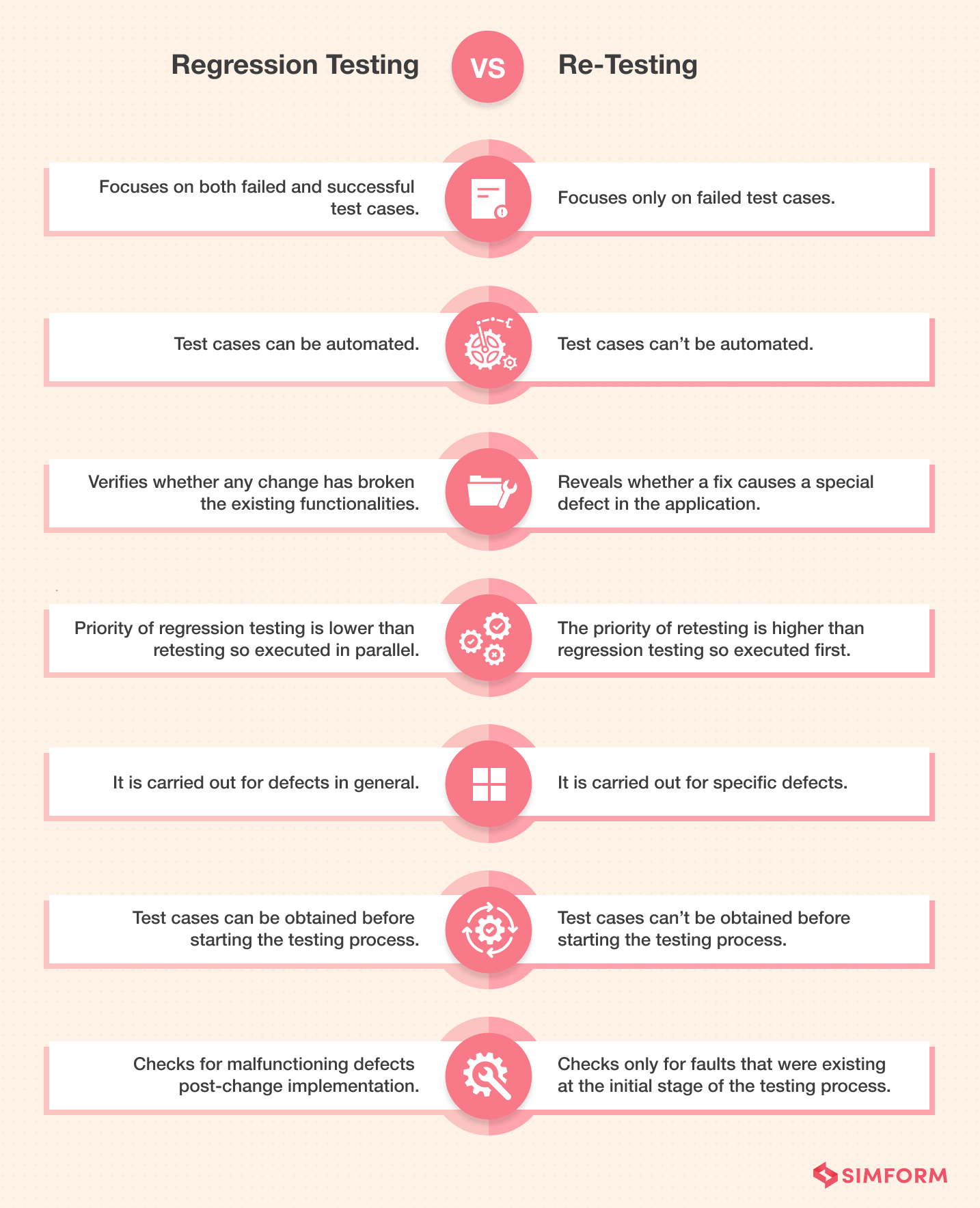 ## Regression Testing and Agile Methodology Agile teams should prepare the regression test suite from the initial stages of the product development cycle and then follow that until the final deployment. In agile methodology, you can conduct regression testing in two ways: - Sprint Level Regression - End-to-End Regression ## Summing Up Things Organizations could have avoided these fatalities if they had conducted regression testing before updating or adding a new feature. From the above example, you must have realized the importance of regression testing in this day and age. Regression testing becomes vital if you want to deliver high-quality and robust applications where users could be loyal. Taking those scenarios into consideration, in this article, we have provided you with a comprehensive view of regression testing, its types, tools, methods, and everything else you need to be aware of. Originally published at Simform: [What is Regression Testing? Explained with Test Cases, Tools, and Methods](https://www.simform.com/blog/regression-testing/) |
| json metadata | {"tags":["softwaretesting","qaservices","integrationtesting","testcoverage","regressiontestingtools","selenium","katalanstudio","watir"],"image":["https://cdn.steemitimages.com/DQma5AScwJ7e2UkZA8cfVbqjsGL92V1gfc2ogu2ZPhWfem6/image.png"],"links":["https://www.simform.com/blog/software-testing-cost/","https://www.katalon.com/","http://watir.com/","https://www.ibm.com/products/rational-functional-tester","https://jmeter.apache.org/","https://www.manageengine.com/products/qengine/qengine-eol.html","https://www.subject-7.com/","https://www.vornexinc.com/","https://cerberus-testing.com/","https://testsigma.com/","https://www.simform.com/blog/regression-testing/"],"app":"steemit/0.2","format":"markdown"} |
| parent author | |
| parent permlink | softwaretesting |
| permlink | what-is-regression-testing-explained-with-test-cases-tools-and-methods |
| title | What is Regression Testing? Explained with Test Cases, Tools, and Methods |
| Transaction Info | Block #58016653/Trx f48181a1e2d8bed8d0b30a4a1bb199eda5bf649a |
View Raw JSON Data
{
"block": 58016653,
"op": [
"comment",
{
"author": "hardikshah",
"body": "In the software development lifecycle, testing is often overlooked or not given the same amount of significance as development. However, it is as important or more important than development because a buggy application with various features can cost you money and loss of user base.\n\nIn this blog, we’re going to walk you through in detail related to regression testing, its test cases, types, tools, and everything else you need to know. So, let’s get things moving!\n\n## What is Regression Testing?\nSuppose you’re a software development firm, and the client has assigned you the project to develop an application for image and video editing. With the primary requirements, you create the first build with core features. Once done, you conduct regression testing with 1000 test cases to ensure that the app works correctly. After the app passes the regression test, you send the copy to the client for feedback.\n\nThe client is happy with the first build but wants some extra features. So, you develop those features and add them to the existing app. But, with the addition of new codes, you will be required to conduct regression testing again. Hence, you write 100 new test cases and verify the functionality of the app. But along with that, you will have to run the 1000 old test cases already conducted to ensure essential functions haven’t been affected.\n\n## Regression Testing Example\nSuppose you’re a software development firm, and the client has assigned you the project to develop an application for image and video editing. With the primary requirements, you create the first build with core features. Once done, you conduct regression testing with 1000 test cases to ensure that the app works correctly. After the app passes the regression test, you send the copy to the client for feedback.\n\n## Pros and Cons of Regression Testing\n### Pros\n- Ensures that any change in code doesn’t adversely affect other functionality.\n- Makes sure that already fixed issues don’t re-occur.\n- Serves as a risk mitigation strategy during testing.\n- Easy to learn, understand and analyze.\n### Cons\n- Without automation, regression testing can be time-consuming.\n- Need to perform for every small change of code.\n- A highly repetitive process may affect the agile sprint.\n- Requires you to create complex test cases.\n\n## Challenges in Regression Testing\n- High Upfront Cost: Regression testing is very time-consuming if done manually.\n- Testing Approach: Selecting a proper testing approach is crucial to success as far as regression testing goes.\n- Enormous Scope and Coverage: The success of regression testing depends on the type of test cases suite you have built.\n- Complexity: As you move from the first build to the second and then so on, the number of test cases increases.\n\n## How to Conduct Regression Testing?\nGenerally, there is no fixed pattern for implementing regression testing. However, there are some popular regression testing methods that a QA analyst should keep in mind.\n\nGenerally, there is no fixed pattern for implementing regression testing. However, there are some popular regression testing methods that a QA analyst should keep in mind.\n\n### Step 1: Regression Test Selection\nAs the name suggests, here, you select the test cases that require re-testing. You won’t test the entire test suite, and the selection of test cases will depend on the module where there is a change in the source code.\n\n### Step 2: Determine the Time for Executing Test Cases\nThe next step is to estimate the time it will take to execute the selected test cases. Few factors that affect the execution time are test data creation, regression test planning by the QA team, review of all test cases, etc. \n\n### Step 3: Identify the Test Cases that can be Automated\nIn this step, based on the results of exploratory testing, the QA team can decide the test cases that they can automate. Automated test cases are faster than manual testing and allow you to re-use the same script repeatedly. So, divide the test cases into two groups – (i) manual test cases and (ii) automated test cases.\n\n### Step 4: Test Cases Prioritization\nHere, you gather all the test cases and prioritize them, i.e., high, medium, and low. Based on this evaluation, you will execute the high-priority test cases first, followed by medium and low priority test cases. The priority will depend on the product’s functionality and user involvement.\n\n### Step 5: Executing Test Cases\nFinally, it’s time to execute all the test cases one by one and test whether the product is working as it should or not. You can opt for manual testing or automation based on the requirement. For automated regression testing, utilizing tools like Selenium, QTP, Watir, etc., allows you to execute the test cases faster.\n\n## Regression Testing Methods\nThere are primarily four most popular regression testing methods: \n- Regression Test Selection: Here, you select the test cases that need to be re-tested.\n- Test Case Prioritization: Here, you gather all the test cases and prioritize them.\n- Retest All: Here, you re-test the entire regression test suite.\n- Hybrid: Here, you combine Regression Test Selection and Test Case Prioritization method. \n\n## How to Create an Effective Regression Testing Suite?\nA regression testing suite is a set of test cases designed to ensure that your software is accurately working as it should after any changes or updates. Below are the five steps to creating an effective regression testing suite.\n\n### Step 1: Prioritizing Regression Tests\n### Step 2: Developing Smoke Test\n### Step 3: Take Assistance of Manual Testing\n### Step 4: Test the Integrations\n### Step 5: Take Performance into Account\n\n### Regression Testing Types\n1. Corrective\n2. Progressive\n3. Selective\n4. Partial\n5. Complete\n6. Retest-All\n\n## Top Regression Testing Tools\n1. [Selenium](https://www.simform.com/blog/software-testing-cost/)\n2. [Katalan Studio](https://www.katalon.com/)\n3. [Watir](http://watir.com/)\n4. [IBM Rational Functional Tester](https://www.ibm.com/products/rational-functional-tester)\n5. [Apache JMeter](https://jmeter.apache.org/)\n6. [AdventNet QEngine](https://www.manageengine.com/products/qengine/qengine-eol.html)\n7. [Subject7](https://www.subject-7.com/)\n8. [TimeShiftX](https://www.vornexinc.com/)\n9. [Cerberus Testing](https://cerberus-testing.com/)\n10. [Testsigma](https://testsigma.com/)\n\n## Regression Testing Best Practices\nMost people believe that retesting and regression testing is the same. However, that is not true; both these terms have a separate meaning.\n\n### 1. Regression Testing Best Practices\nLike keeping up with any technology, you need to stay up-to-date with the latest regression testing suites too. For that purpose, always consider the functional and non-functional requirements. The high-priority and high-value test cases in the suite should always be executed first by the QA team.\n\n### 2. Knowing Every Change Hands-on\nHave regular communication between developers and testers to know the latest upgraded version and be aware of immediate changes. They can plan their testing well in advance to stay on track with the app or product release.\n\n### 3. Assigning Grade to Test Cases\nIf you want to succeed with regression testing, you need to assign grades to all your test cases. You should compare and track their business impact on different platforms, and based on those evaluations; you should set high, medium, and low priority to various test scenarios.\n\n### 4. Understanding the Scope of Testing\nBefore starting the regression testing process, it’s essential to know its scope. The reason being each testing project can vary in terms of scope, time, and goals. Understanding differences in scope will allow you to plan your regression cycle execution better\n\n### 5. Automate the Right Test Cases\nAutomation gives you a competitive advantage only if you utilize it properly. So first, you need to identify which test cases you can automate and those that don’t have a scope of automation. Then, automating suitable test cases will increase your productivity and save precious time.\n\n### 6. Track RoI\nQA teams should always track RoI based on the advanced analytics and reports generated by automation tools. It will help you to witness the on-ground reality and areas that need improvements.\n\n## Regression Testing vs. ReTesting\n\n\n\n\n## Regression Testing and Agile Methodology\nAgile teams should prepare the regression test suite from the initial stages of the product development cycle and then follow that until the final deployment. In agile methodology, you can conduct regression testing in two ways:\n- Sprint Level Regression\n- End-to-End Regression\n\n## Summing Up Things\nOrganizations could have avoided these fatalities if they had conducted regression testing before updating or adding a new feature. From the above example, you must have realized the importance of regression testing in this day and age.\n\nRegression testing becomes vital if you want to deliver high-quality and robust applications where users could be loyal. Taking those scenarios into consideration, in this article, we have provided you with a comprehensive view of regression testing, its types, tools, methods, and everything else you need to be aware of.\n\nOriginally published at Simform: [What is Regression Testing? Explained with Test Cases, Tools, and Methods](https://www.simform.com/blog/regression-testing/)",
"json_metadata": "{\"tags\":[\"softwaretesting\",\"qaservices\",\"integrationtesting\",\"testcoverage\",\"regressiontestingtools\",\"selenium\",\"katalanstudio\",\"watir\"],\"image\":[\"https://cdn.steemitimages.com/DQma5AScwJ7e2UkZA8cfVbqjsGL92V1gfc2ogu2ZPhWfem6/image.png\"],\"links\":[\"https://www.simform.com/blog/software-testing-cost/\",\"https://www.katalon.com/\",\"http://watir.com/\",\"https://www.ibm.com/products/rational-functional-tester\",\"https://jmeter.apache.org/\",\"https://www.manageengine.com/products/qengine/qengine-eol.html\",\"https://www.subject-7.com/\",\"https://www.vornexinc.com/\",\"https://cerberus-testing.com/\",\"https://testsigma.com/\",\"https://www.simform.com/blog/regression-testing/\"],\"app\":\"steemit/0.2\",\"format\":\"markdown\"}",
"parent_author": "",
"parent_permlink": "softwaretesting",
"permlink": "what-is-regression-testing-explained-with-test-cases-tools-and-methods",
"title": "What is Regression Testing? Explained with Test Cases, Tools, and Methods"
}
],
"op_in_trx": 0,
"timestamp": "2021-10-11T12:30:03",
"trx_id": "f48181a1e2d8bed8d0b30a4a1bb199eda5bf649a",
"trx_in_block": 11,
"virtual_op": 0
}hardikshahcustom json: follow2021/10/11 09:57:24
hardikshahcustom json: follow
2021/10/11 09:57:24
| id | follow |
| json | ["reblog",{"account":"hardikshah","author":"hardikshah","permlink":"how-much-does-software-testing-cost-9-proven-ways-to-optimize-it"}] |
| required auths | [] |
| required posting auths | ["hardikshah"] |
| Transaction Info | Block #58013618/Trx 4173f1876af0020944700b5c81ddf7c0e5dab721 |
View Raw JSON Data
{
  "block": 58013618,
  "op": [
    "custom_json",
    {
      "id": "follow",
      "json": "[\"reblog\",{\"account\":\"hardikshah\",\"author\":\"hardikshah\",\"permlink\":\"how-much-does-software-testing-cost-9-proven-ways-to-optimize-it\"}]",
      "required_auths": [],
      "required_posting_auths": [
        "hardikshah"
      ]
    }
  ],
  "op_in_trx": 0,
  "timestamp": "2021-10-11T09:57:24",
  "trx_id": "4173f1876af0020944700b5c81ddf7c0e5dab721",
  "trx_in_block": 3,
  "virtual_op": 0
}hardikshahpublished a new post: how-much-does-software-testing-cost-9-proven-ways-to-optimize-it2021/10/11 09:57:06
hardikshahpublished a new post: how-much-does-software-testing-cost-9-proven-ways-to-optimize-it
2021/10/11 09:57:06
| author | hardikshah |
| body |  This blog begins with understanding the importance of software testing, followed by an insight into cost-effective testing solutions and strategies to reduce software testing cost. Meanwhile, if you’re looking for a reliable outsourcing partner, [Simform’s software testing services](https://www.simform.com/services/software-testing/) are here to help you. ## How Much does Software Testing Cost and How to Measure it? The overall software testing costs are observed somewhere between 15 to 25% of the total project cost as per the industry standards. Also, [as of 2019, a panel of CIOs and senior technology professionals reported](https://www.statista.com/statistics/500641/worldwide-qa-budget-allocation-as-percent-it-spend/) of 2019, a panel of CIOs and senior technology professionals reported that around 23% of their organization’s annual IT budget was allocated towards quality assurance and testing on average. ## 9 Best practices to Reduce Software Testing Costs ### Test Early, Test Often According to [Systems Sciences Institute](https://www.isixsigma.com/industries/software-it/defect-prevention-reducing-costs-and-enhancing-quality/), the cost to fix an error post product release is 4 to 5 times as much as one uncovered during the design phase. Also, this increases to up to 100 times more than one identified in the maintenance phase. In addition, many organizations have experienced that it is more challenging to fix post-release bugs than identifying them during the early stages. For instance, a bug caught during unit tests costs much less than the same bug during integration level testing. ## Adopt Test-Driven Development TDD implies writing unit tests even before writing the code. It starts with [unit testing](https://www.simform.com/blog/unit-testing-tdd/)of functionalities by specifying the exact function of code from the earlier stages. For example, suppose a function has 3 conditional statements, and there are 3 operations based on these conditions. So, using the TDD approach, you’re supposed to write 3 individual test cases. Practicing TDD will help you identify functionalities that are failing and for whatever reasons. Not only that, developers can quickly work on the identified issues resulting in smooth code refactoring, better documentation, and less debugging. ## Use Modern Tools for Feasible UI Testing One of the best approaches for effective UI testing is to automate visual regression testing using low code solutions. The main reason is that there are multiple testing tools that enable you to run UI tests in less than 5 minutes without needing developers to code. These tools use smart image comparison, analyze and verify DOM structure and on-page elements, automatic handling of timeouts, and also helps with user acceptance testing. ## Consider Risk-based Testing Risk-based testing covers all possible risks that may appear while testing the software. It involves prioritizing the risk factors that may affect the code quality. For example, testing features and functions based on the risk of failure, the importance of the functions, and the possible impact of such failures. This strategy determines the testing goals by organizing the testing team’s efforts in a unidirectional way to reduce risks of failure once the product goes to production. Hence, using this strategy eliminates the possibility of external failure of software products along with several benefits related to productivity and software quality such as, ## Use Reusable Materials in Training the Employees Training is an ongoing process for any growing organization, and so is the case for new testers joining the QA team. You’ll need to introduce your organization’s methodologies and testing team’s work patterns to them. So instead of allocating dedicated resources for training employees, you can use reusable materials and courses. Also, you can ask experts to provide recorded materials that can be used multiple times and host one-time on-site training sessions. ## Optimize use of Manual Testing Manual testing is prone to more human errors, and optimizing its usage would ease your software testing cycle, especially in enterprise-level projects. Because as the project scope expands, it’d eventually increase the time, workforce, and overall software testing costs. ## Consider the Hidden Costs No matter how accurately you try to work around reducing software testing costs, some unexpected hidden costs are bound to emerge due to a variety of circumstances. Because, here’s a thing: ## Use Hyper Testing Strategy This strategy is a part of agile testing, which addresses testing issues from three angles, process, practices, and tools ### Understand the Impact of Enterprise Application Upgrades Understanding the impact of smaller updates made to enterprise applications is essential since it may impact critical business processes. To further analyze this, you can use AI-powered analytical tools that show the impact areas with each release. These tools effectively ensure the testing gaps created and also create test cases for the same. This kind of analysis and testing reduces testing time by almost 80% and saves you a lot of time and money while covering 100% risk. ### Manual and Automation testing– Which one is cost-effective? Manual testing involves exploratory and scripted tests. The former requires testers to explore the application features individually, while the latter suggests manual testers follow step-by-step instructions manually. ### What is the real “Cost of Software Quality” and how it affects Business The cost of software quality is directly related to software testing. Therefore, the more good you and your team are at optimizing testing, the better business value you receive. Conversely, bad testing teams or compromised software testing process results in poor software quality, ultimately impacting customer experiences. ## Conclusion The discussion about software testing costs is endless until you have project requirements at hand and are sure about the project scope. Once you’re all set with the technology stack and project scope, you may go ahead and explore options for the final stage—software testing cost estimation. Originally published at Simform: [How Much Does Software Testing Cost? 9 Proven Ways to Optimize it](https://www.simform.com/blog/software-testing-cost/). |
| json metadata | {"tags":["softwaretestingservices","unittesting","testdrivendevelopment","functionaltestingtools","testautomation"],"image":["https://cdn.steemitimages.com/DQmSzfDRhzkubrhxta7w7zeSRFJqPRPnfJivu3AymL6SL8T/How%20Much%20Does%20Software%20Testing%20Cost?%209%20Proven%20Ways%20to%20Optimize%20it%20-%20Simform.png"],"links":["https://www.simform.com/services/software-testing/","https://www.statista.com/statistics/500641/worldwide-qa-budget-allocation-as-percent-it-spend/","https://www.isixsigma.com/industries/software-it/defect-prevention-reducing-costs-and-enhancing-quality/","https://www.simform.com/blog/unit-testing-tdd/","https://www.simform.com/blog/software-testing-cost/"],"app":"steemit/0.2","format":"markdown"} |
| parent author | |
| parent permlink | softwaretestingservices |
| permlink | how-much-does-software-testing-cost-9-proven-ways-to-optimize-it |
| title | How Much Does Software Testing Cost? 9 Proven Ways to Optimize it. |
| Transaction Info | Block #58013612/Trx 3b96d550e1684dd58bdfc24902028a6cb1089bf1 |
View Raw JSON Data
{
"block": 58013612,
"op": [
"comment",
{
"author": "hardikshah",
"body": "\n\nThis blog begins with understanding the importance of software testing, followed by an insight into cost-effective testing solutions and strategies to reduce software testing cost. Meanwhile, if you’re looking for a reliable outsourcing partner, [Simform’s software testing services](https://www.simform.com/services/software-testing/) are here to help you.\n\n## How Much does Software Testing Cost and How to Measure it?\nThe overall software testing costs are observed somewhere between 15 to 25% of the total project cost as per the industry standards. Also, [as of 2019, a panel of CIOs and senior technology professionals reported](https://www.statista.com/statistics/500641/worldwide-qa-budget-allocation-as-percent-it-spend/) of 2019, a panel of CIOs and senior technology professionals reported that around 23% of their organization’s annual IT budget was allocated towards quality assurance and testing on average.\n\n## 9 Best practices to Reduce Software Testing Costs\n\n### Test Early, Test Often\n\nAccording to [Systems Sciences Institute](https://www.isixsigma.com/industries/software-it/defect-prevention-reducing-costs-and-enhancing-quality/), the cost to fix an error post product release is 4 to 5 times as much as one uncovered during the design phase. Also, this increases to up to 100 times more than one identified in the maintenance phase. In addition, many organizations have experienced that it is more challenging to fix post-release bugs than identifying them during the early stages. For instance, a bug caught during unit tests costs much less than the same bug during integration level testing.\n\n## Adopt Test-Driven Development\nTDD implies writing unit tests even before writing the code. It starts with [unit testing](https://www.simform.com/blog/unit-testing-tdd/)of functionalities by specifying the exact function of code from the earlier stages. For example, suppose a function has 3 conditional statements, and there are 3 operations based on these conditions. So, using the TDD approach, you’re supposed to write 3 individual test cases. Practicing TDD will help you identify functionalities that are failing and for whatever reasons. Not only that, developers can quickly work on the identified issues resulting in smooth code refactoring, better documentation, and less debugging. \n\n## Use Modern Tools for Feasible UI Testing\nOne of the best approaches for effective UI testing is to automate visual regression testing using low code solutions. The main reason is that there are multiple testing tools that enable you to run UI tests in less than 5 minutes without needing developers to code. These tools use smart image comparison, analyze and verify DOM structure and on-page elements, automatic handling of timeouts, and also helps with user acceptance testing. \n\n## Consider Risk-based Testing\nRisk-based testing covers all possible risks that may appear while testing the software. It involves prioritizing the risk factors that may affect the code quality. For example, testing features and functions based on the risk of failure, the importance of the functions, and the possible impact of such failures. This strategy determines the testing goals by organizing the testing team’s efforts in a unidirectional way to reduce risks of failure once the product goes to production. Hence, using this strategy eliminates the possibility of external failure of software products along with several benefits related to productivity and software quality such as, \n\n## Use Reusable Materials in Training the Employees\nTraining is an ongoing process for any growing organization, and so is the case for new testers joining the QA team. You’ll need to introduce your organization’s methodologies and testing team’s work patterns to them. So instead of allocating dedicated resources for training employees, you can use reusable materials and courses. Also, you can ask experts to provide recorded materials that can be used multiple times and host one-time on-site training sessions. \n\n## Optimize use of Manual Testing\nManual testing is prone to more human errors, and optimizing its usage would ease your software testing cycle, especially in enterprise-level projects. Because as the project scope expands, it’d eventually increase the time, workforce, and overall software testing costs.\n\n## Consider the Hidden Costs\nNo matter how accurately you try to work around reducing software testing costs, some unexpected hidden costs are bound to emerge due to a variety of circumstances. Because, here’s a thing:\n\n## Use Hyper Testing Strategy\nThis strategy is a part of agile testing, which addresses testing issues from three angles,\n\nprocess, \npractices, \nand tools\n\n### Understand the Impact of Enterprise Application Upgrades\nUnderstanding the impact of smaller updates made to enterprise applications is essential since it may impact critical business processes. To further analyze this, you can use AI-powered analytical tools that show the impact areas with each release. These tools effectively ensure the testing gaps created and also create test cases for the same. This kind of analysis and testing reduces testing time by almost 80% and saves you a lot of time and money while covering 100% risk. \n\n### Manual and Automation testing– Which one is cost-effective?\nManual testing involves exploratory and scripted tests. The former requires testers to explore the application features individually, while the latter suggests manual testers follow step-by-step instructions manually. \n\n### What is the real “Cost of Software Quality” and how it affects Business\nThe cost of software quality is directly related to software testing. Therefore, the more good you and your team are at optimizing testing, the better business value you receive. Conversely, bad testing teams or compromised software testing process results in poor software quality, ultimately impacting customer experiences. \n\n## Conclusion\nThe discussion about software testing costs is endless until you have project requirements at hand and are sure about the project scope. Once you’re all set with the technology stack and project scope, you may go ahead and explore options for the final stage—software testing cost estimation. \n\nOriginally published at Simform: [How Much Does Software Testing Cost? 9 Proven Ways to Optimize it](https://www.simform.com/blog/software-testing-cost/).",
"json_metadata": "{\"tags\":[\"softwaretestingservices\",\"unittesting\",\"testdrivendevelopment\",\"functionaltestingtools\",\"testautomation\"],\"image\":[\"https://cdn.steemitimages.com/DQmSzfDRhzkubrhxta7w7zeSRFJqPRPnfJivu3AymL6SL8T/How%20Much%20Does%20Software%20Testing%20Cost?%209%20Proven%20Ways%20to%20Optimize%20it%20-%20Simform.png\"],\"links\":[\"https://www.simform.com/services/software-testing/\",\"https://www.statista.com/statistics/500641/worldwide-qa-budget-allocation-as-percent-it-spend/\",\"https://www.isixsigma.com/industries/software-it/defect-prevention-reducing-costs-and-enhancing-quality/\",\"https://www.simform.com/blog/unit-testing-tdd/\",\"https://www.simform.com/blog/software-testing-cost/\"],\"app\":\"steemit/0.2\",\"format\":\"markdown\"}",
"parent_author": "",
"parent_permlink": "softwaretestingservices",
"permlink": "how-much-does-software-testing-cost-9-proven-ways-to-optimize-it",
"title": "How Much Does Software Testing Cost? 9 Proven Ways to Optimize it."
}
],
"op_in_trx": 0,
"timestamp": "2021-10-11T09:57:06",
"trx_id": "3b96d550e1684dd58bdfc24902028a6cb1089bf1",
"trx_in_block": 9,
"virtual_op": 0
}squbeupvoted (1.00%) @hardikshah / top-8-most-popular-web-frameworks-to-use-in-20212021/09/30 08:51:06
squbeupvoted (1.00%) @hardikshah / top-8-most-popular-web-frameworks-to-use-in-2021
2021/09/30 08:51:06
| author | hardikshah |
| permlink | top-8-most-popular-web-frameworks-to-use-in-2021 |
| voter | sqube |
| weight | 100 (1.00%) |
| Transaction Info | Block #57697437/Trx 4541548bb2fd3ed07d4db3e0332acb9c6ff76647 |
View Raw JSON Data
{
  "block": 57697437,
  "op": [
    "vote",
    {
      "author": "hardikshah",
      "permlink": "top-8-most-popular-web-frameworks-to-use-in-2021",
      "voter": "sqube",
      "weight": 100
    }
  ],
  "op_in_trx": 0,
  "timestamp": "2021-09-30T08:51:06",
  "trx_id": "4541548bb2fd3ed07d4db3e0332acb9c6ff76647",
  "trx_in_block": 4,
  "virtual_op": 0
}hardikshahpublished a new post: top-8-most-popular-web-frameworks-to-use-in-20212021/09/30 08:51:00
hardikshahpublished a new post: top-8-most-popular-web-frameworks-to-use-in-2021
2021/09/30 08:51:00
| author | hardikshah |
| body |  Web frameworks play a vital role in [ building robust and interactive web applications](https://www.simform.com/services/web-apps-development/) for both frontend and backend. If we were to talk about some of the most popular web applications, the prominent names would be Netflix, Facebook, LinkedIn, and YouTube. These tech giants have set an example of how web apps should be built. Companies wanting to achieve such magnanimous success often end up replicating the entire tech stack of these tech giants. However, one must note that what works for them might not work for you. And that every web app framework isn’t suitable for all kinds of use cases. ## List of Web Frameworks Based on the Popularity 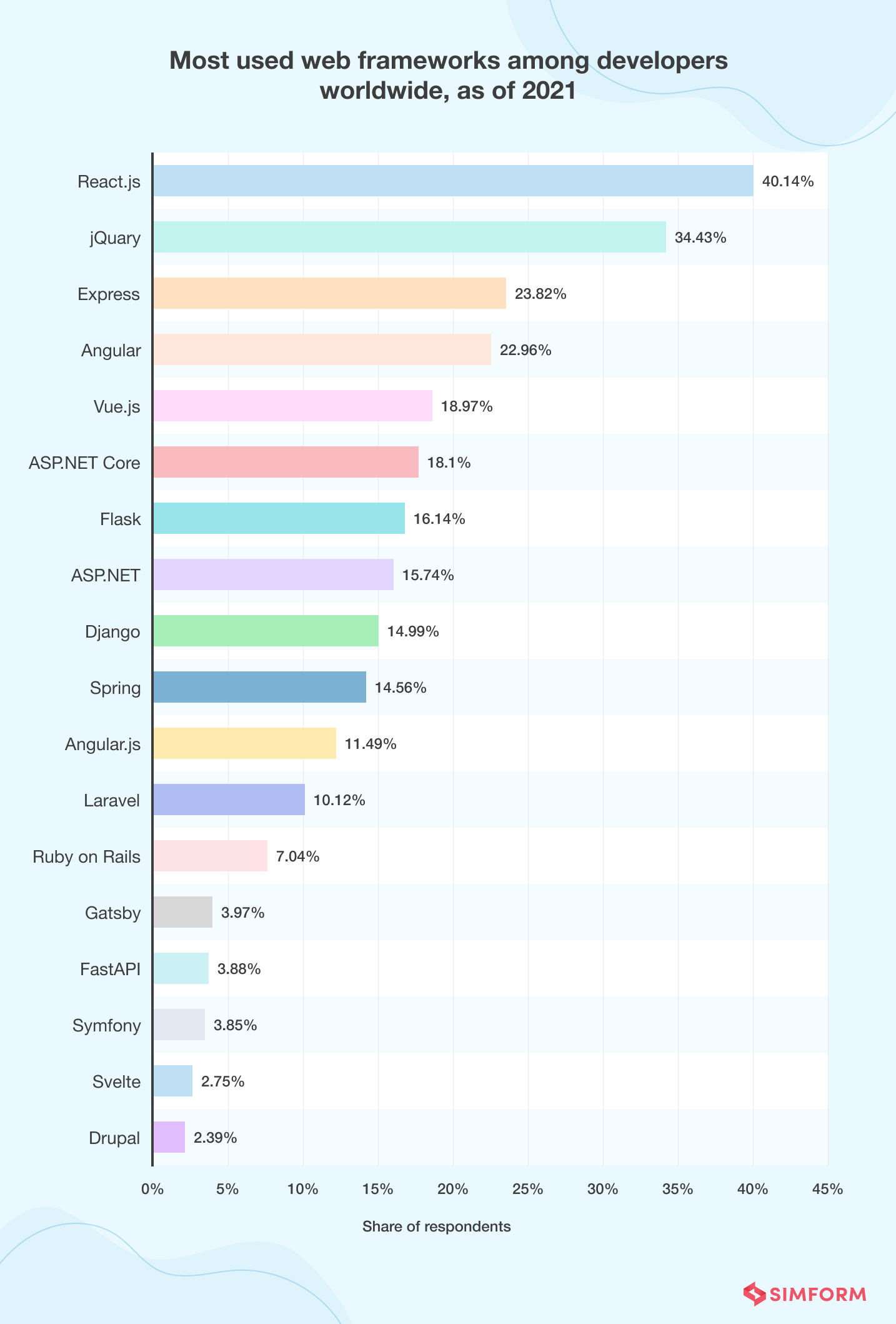 ### React React was released by Facebook in 2013, and in no time, it became popular among developers and enterprises. It is a JavaScript library that can be used to build interactive user interfaces that are enough to lure any developer and business into picking React as their frontend framework for web app development. Simform has also utilized the component-driven React framework for one of our projects, [FIH](https://www.simform.com/case-studies/fih/), to build the frontend to deliver an excellent user experience and ensure flexibility. ### jQuery jQuery is one of the oldest players in the race, which is still embracing the opportunity of being loved by the majority of developers. More than 41 million websites are using jQuery alone in the United States. Apart from this, [82.64% of websites](https://trends.builtwith.com/javascript/jQuery) among the top 10K websites are also earning profits using jQuery for their web applications. ### Express.js Express.js is a lightweight and fast server-side framework based on Node.js, introduced to develop backend web applications and APIs. Since its release, it’s rising in popularity due to its robust features and minimalistic functionality. Apart from this, it’s being utilized by millions of web development firms for developing highly scalable enterprise apps and APIs. Simform has also used this framework to create the backend of a sentiment-based real-time market analytics engine named [SentMap](https://www.simform.com/case-studies/sentmap/). ### Angular Angular is another open-source JavaScript framework that is dominating the list of web frameworks that exist today. Google introduced Angular.js in 2010 and then rewrote it from scratch and released it in 2016 as Angular 2 (a.k.a. Angular) to build high-performance and large-scale JavaScript-based web apps. Unarguably, it’s a mature framework to create SPAs and web pages for mobile and desktop platforms. ### Vue.js It was introduced in 2014 as the best alternative to Angular and React for building SPAs and creating visually appealing user interfaces. It’s a progressive JavaScript framework that has combined the excellent traits of Angular (View Layer) and React.js (Virtual DOM). It made sure that Vue gained traction in no time. As a result, this is one of the most popular frameworks used widely for building responsive web applications. ### Flask Flask is a WSGI framework written in Python that runs on a web server instead of the user’s browser. It is categorized as a microframework as it doesn’t require tools and libraries by default. The database abstraction layer, form validation, and components are also not available in this framework. It doesn’t mean that Flask is lacking in functionality. It is intended to keep the core simple but extensible. After all, it supports extensions by letting developers add libraries and plugins to web apps like it was implemented in this framework. It’s a highly lightweight framework, which is gradually climbing the charts and gaining attention due to its flexibility. ### Django Django is another Python-based framework that is winning the hearts of developers and enterprises for [building highly scalable web applications](https://www.simform.com/blog/tips-building-scalable-web-applications/). From news sites to social networking web apps, this framework can work well with any client-side requirement. This framework can be used in any format such as HTML, JSON, and XML. It is a high-level Python framework, which developers like for its pragmatic and clean design. ### ASP.NET Core This advanced version of ASP.NET is luring enterprises and developers worldwide with its flexible, scalable, and high-performance features. A Core version was introduced in 2016 as an open-source and modular framework to modernize and innovate its old tech stack ASP.NET in order to meet modern web development needs. Since then, this web framework is gaining immense popularity for creating high-performance, secure, and modern web applications. Furthermore, it can work seamlessly with JavaScript-based client-side frameworks. ### In a Nutshell Now you know about the eight web application frameworks that are in demand among developers and businesses. Unarguably, JavaScript frameworks are dominating the market with their excellent features and rich functionalities. However, Python frameworks are also leading the market with their advanced functionalities and fast development. Originally published at Simform: [Top 8 Most Popular Web Frameworks to Use in 2021](https://www.simform.com/blog/top-web-frameworks/) |
| json metadata | {"tags":["webframeworks","webappframeworks","react","jquery","expressjs","angular","vuejs","flask"],"image":["https://cdn.steemitimages.com/DQmdaHZ7Viss6XTseS3EfFPNgn8nkzTd9QsJ1UjXV8tn1u3/Most%20Popular%20Web%20Frameworks%20-%20Simform.png","https://cdn.steemitimages.com/DQmcLTLApxUZTr71thJrdmppgfZDUqc9RGm3z5yBY7VQ13B/Web-frameworks-statistics.png"],"links":["https://www.simform.com/services/web-apps-development/","https://www.simform.com/case-studies/fih/","https://trends.builtwith.com/javascript/jQuery","https://www.simform.com/case-studies/sentmap/","https://www.simform.com/blog/tips-building-scalable-web-applications/","https://www.simform.com/blog/top-web-frameworks/"],"app":"steemit/0.2","format":"markdown"} |
| parent author | |
| parent permlink | webframeworks |
| permlink | top-8-most-popular-web-frameworks-to-use-in-2021 |
| title | Top 8 Most Popular Web Frameworks to Use in 2021 |
| Transaction Info | Block #57697435/Trx d01b1a5b82d6ab14c0ca57824cecca124c6894ce |
View Raw JSON Data
{
"block": 57697435,
"op": [
"comment",
{
"author": "hardikshah",
"body": "\n\n\nWeb frameworks play a vital role in [ building robust and interactive web applications](https://www.simform.com/services/web-apps-development/) for both frontend and backend. If we were to talk about some of the most popular web applications, the prominent names would be Netflix, Facebook, LinkedIn, and YouTube. These tech giants have set an example of how web apps should be built.\n\nCompanies wanting to achieve such magnanimous success often end up replicating the entire tech stack of these tech giants. However, one must note that what works for them might not work for you. And that every web app framework isn’t suitable for all kinds of use cases. \n\n## List of Web Frameworks Based on the Popularity\n\n\n\n\n### React\nReact was released by Facebook in 2013, and in no time, it became popular among developers and enterprises. It is a JavaScript library that can be used to build interactive user interfaces that are enough to lure any developer and business into picking React as their frontend framework for web app development. Simform has also utilized the component-driven React framework for one of our projects, [FIH](https://www.simform.com/case-studies/fih/), to build the frontend to deliver an excellent user experience and ensure flexibility. \n\n### jQuery\njQuery is one of the oldest players in the race, which is still embracing the opportunity of being loved by the majority of developers. More than 41 million websites are using jQuery alone in the United States. Apart from this, [82.64% of websites](https://trends.builtwith.com/javascript/jQuery) among the top 10K websites are also earning profits using jQuery for their web applications.\n\n### Express.js\nExpress.js is a lightweight and fast server-side framework based on Node.js, introduced to develop backend web applications and APIs. Since its release, it’s rising in popularity due to its robust features and minimalistic functionality. Apart from this, it’s being utilized by millions of web development firms for developing highly scalable enterprise apps and APIs. Simform has also used this framework to create the backend of a sentiment-based real-time market analytics engine named [SentMap](https://www.simform.com/case-studies/sentmap/).\n\n### Angular\nAngular is another open-source JavaScript framework that is dominating the list of web frameworks that exist today. Google introduced Angular.js in 2010 and then rewrote it from scratch and released it in 2016 as Angular 2 (a.k.a. Angular) to build high-performance and large-scale JavaScript-based web apps. Unarguably, it’s a mature framework to create SPAs and web pages for mobile and desktop platforms.\n\n### Vue.js\nIt was introduced in 2014 as the best alternative to Angular and React for building SPAs and creating visually appealing user interfaces. It’s a progressive JavaScript framework that has combined the excellent traits of Angular (View Layer) and React.js (Virtual DOM). It made sure that Vue gained traction in no time. As a result, this is one of the most popular frameworks used widely for building responsive web applications.\n\n### Flask\nFlask is a WSGI framework written in Python that runs on a web server instead of the user’s browser. It is categorized as a microframework as it doesn’t require tools and libraries by default. The database abstraction layer, form validation, and components are also not available in this framework. It doesn’t mean that Flask is lacking in functionality. It is intended to keep the core simple but extensible. After all, it supports extensions by letting developers add libraries and plugins to web apps like it was implemented in this framework. It’s a highly lightweight framework, which is gradually climbing the charts and gaining attention due to its flexibility.\n\n### Django\nDjango is another Python-based framework that is winning the hearts of developers and enterprises for [building highly scalable web applications](https://www.simform.com/blog/tips-building-scalable-web-applications/). From news sites to social networking web apps, this framework can work well with any client-side requirement. This framework can be used in any format such as HTML, JSON, and XML. It is a high-level Python framework, which developers like for its pragmatic and clean design. \n\n### ASP.NET Core\nThis advanced version of ASP.NET is luring enterprises and developers worldwide with its flexible, scalable, and high-performance features. A Core version was introduced in 2016 as an open-source and modular framework to modernize and innovate its old tech stack ASP.NET in order to meet modern web development needs. Since then, this web framework is gaining immense popularity for creating high-performance, secure, and modern web applications. Furthermore, it can work seamlessly with JavaScript-based client-side frameworks.\n\n### In a Nutshell\nNow you know about the eight web application frameworks that are in demand among developers and businesses. Unarguably, JavaScript frameworks are dominating the market with their excellent features and rich functionalities. However, Python frameworks are also leading the market with their advanced functionalities and fast development.\n\nOriginally published at Simform: [Top 8 Most Popular Web Frameworks to Use in 2021](https://www.simform.com/blog/top-web-frameworks/)",
"json_metadata": "{\"tags\":[\"webframeworks\",\"webappframeworks\",\"react\",\"jquery\",\"expressjs\",\"angular\",\"vuejs\",\"flask\"],\"image\":[\"https://cdn.steemitimages.com/DQmdaHZ7Viss6XTseS3EfFPNgn8nkzTd9QsJ1UjXV8tn1u3/Most%20Popular%20Web%20Frameworks%20-%20Simform.png\",\"https://cdn.steemitimages.com/DQmcLTLApxUZTr71thJrdmppgfZDUqc9RGm3z5yBY7VQ13B/Web-frameworks-statistics.png\"],\"links\":[\"https://www.simform.com/services/web-apps-development/\",\"https://www.simform.com/case-studies/fih/\",\"https://trends.builtwith.com/javascript/jQuery\",\"https://www.simform.com/case-studies/sentmap/\",\"https://www.simform.com/blog/tips-building-scalable-web-applications/\",\"https://www.simform.com/blog/top-web-frameworks/\"],\"app\":\"steemit/0.2\",\"format\":\"markdown\"}",
"parent_author": "",
"parent_permlink": "webframeworks",
"permlink": "top-8-most-popular-web-frameworks-to-use-in-2021",
"title": "Top 8 Most Popular Web Frameworks to Use in 2021"
}
],
"op_in_trx": 0,
"timestamp": "2021-09-30T08:51:00",
"trx_id": "d01b1a5b82d6ab14c0ca57824cecca124c6894ce",
"trx_in_block": 3,
"virtual_op": 0
}2021/09/23 17:45:45
2021/09/23 17:45:45
| author | hardikshah |
| body | 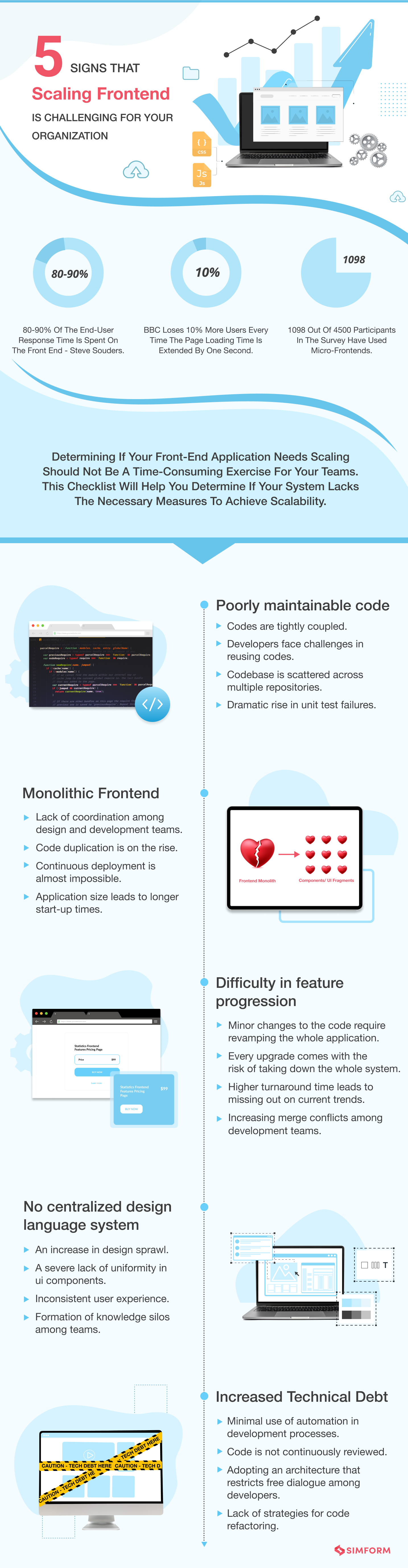 Scaling a front-end is not as easy it sounds. You can simply talk about scaling up front-end as your business grows, but to implement in reality requires a hell of a lot of skill, experience, and knowledge. CTO’s of any organization is often challenged with scaling their front-end. They want to know whether their front-end is scalable or not? The infographic shared below will provide you with a list of signs that indicates that scaling a front-end would be challenging for your organization. Scalability is no joke, and it certainly demands the combined efforts of many teams to keep a system running smoothly. With rapidly growing businesses and expanding teams, organizations often have a tough time scaling up their applications and maintaining consistent UI behavior. Inevitably, it affects the performance and speed of the application. But how do you know if your application needs scaling? Check out this blog cum infographic on [Scaling Frontend](https://www.simform.com/blog/scaling-frontend/) to know the answer. |
| json metadata | {"tags":["frontend","frontendchallanges","frontenddevelopment","scalingfrontend"],"image":["https://cdn.steemitimages.com/DQmaDVwiULPCVTCFf95L8gdb3vLC8CUdeZJMshQ817FanzX/Scaling-Frontend-Challenge-Infographic.png"],"links":["https://www.simform.com/blog/scaling-frontend/"],"app":"steemit/0.2","format":"markdown"} |
| parent author | |
| parent permlink | frontend |
| permlink | scaling-frontend-challenge-infographic5-signs-that-scaling-frontend-is-challenging-for-your-organization-infographic |
| title | Scaling-Frontend-Challenge-Infographic5 Signs that Scaling Frontend is Challenging for Your Organization [Infographic] |
| Transaction Info | Block #57508357/Trx 2ca3b99cf30fb319cd97bb9a386b56bc76949955 |
View Raw JSON Data
{
"block": 57508357,
"op": [
"comment",
{
"author": "hardikshah",
"body": "\n\nScaling a front-end is not as easy it sounds. You can simply talk about scaling up front-end as your business grows, but to implement in reality requires a hell of a lot of skill, experience, and knowledge. CTO’s of any organization is often challenged with scaling their front-end. They want to know whether their front-end is scalable or not? The infographic shared below will provide you with a list of signs that indicates that scaling a front-end would be challenging for your organization.\n\nScalability is no joke, and it certainly demands the combined efforts of many teams to keep a system running smoothly. With rapidly growing businesses and expanding teams, organizations often have a tough time scaling up their applications and maintaining consistent UI behavior. Inevitably, it affects the performance and speed of the application.\n\nBut how do you know if your application needs scaling?\nCheck out this blog cum infographic on [Scaling Frontend](https://www.simform.com/blog/scaling-frontend/) to know the answer.",
"json_metadata": "{\"tags\":[\"frontend\",\"frontendchallanges\",\"frontenddevelopment\",\"scalingfrontend\"],\"image\":[\"https://cdn.steemitimages.com/DQmaDVwiULPCVTCFf95L8gdb3vLC8CUdeZJMshQ817FanzX/Scaling-Frontend-Challenge-Infographic.png\"],\"links\":[\"https://www.simform.com/blog/scaling-frontend/\"],\"app\":\"steemit/0.2\",\"format\":\"markdown\"}",
"parent_author": "",
"parent_permlink": "frontend",
"permlink": "scaling-frontend-challenge-infographic5-signs-that-scaling-frontend-is-challenging-for-your-organization-infographic",
"title": "Scaling-Frontend-Challenge-Infographic5 Signs that Scaling Frontend is Challenging for Your Organization [Infographic]"
}
],
"op_in_trx": 0,
"timestamp": "2021-09-23T17:45:45",
"trx_id": "2ca3b99cf30fb319cd97bb9a386b56bc76949955",
"trx_in_block": 3,
"virtual_op": 0
}hardikshahpublished a new post: a-top-notch-guide-on-web-application-development-for-super-success2021/09/22 17:22:51
hardikshahpublished a new post: a-top-notch-guide-on-web-application-development-for-super-success
2021/09/22 17:22:51
| author | hardikshah |
| body | @@ -1,28 +1,162 @@ +!%5BWeb-developmentguide.png%5D(https://cdn.steemitimages.com/DQmWNjD58gMW12UZAk9ygzdUQfVK9DTg2Spkb5RJEE3fML4/Web-developmentguide.png)%0A%0A%0A Web application development |
| json metadata | {"tags":["webdevelopment"],"links":["https://www.simform.com/services/web-apps-development/","https://www.simform.com/blog/web-application-development-guide/"],"app":"steemit/0.2","format":"markdown","image":["https://cdn.steemitimages.com/DQmWNjD58gMW12UZAk9ygzdUQfVK9DTg2Spkb5RJEE3fML4/Web-developmentguide.png"]} |
| parent author | |
| parent permlink | webappdevelopment |
| permlink | a-top-notch-guide-on-web-application-development-for-super-success |
| title | A Top-Notch Guide on Web Application Development For Super Success |
| Transaction Info | Block #57479341/Trx 0ff59d1920b5e5f00aca89bc64bc5ea8387bce10 |
View Raw JSON Data
{
  "block": 57479341,
  "op": [
    "comment",
    {
      "author": "hardikshah",
      "body": "@@ -1,28 +1,162 @@\n+!%5BWeb-developmentguide.png%5D(https://cdn.steemitimages.com/DQmWNjD58gMW12UZAk9ygzdUQfVK9DTg2Spkb5RJEE3fML4/Web-developmentguide.png)%0A%0A%0A\n Web application development \n",
      "json_metadata": "{\"tags\":[\"webdevelopment\"],\"links\":[\"https://www.simform.com/services/web-apps-development/\",\"https://www.simform.com/blog/web-application-development-guide/\"],\"app\":\"steemit/0.2\",\"format\":\"markdown\",\"image\":[\"https://cdn.steemitimages.com/DQmWNjD58gMW12UZAk9ygzdUQfVK9DTg2Spkb5RJEE3fML4/Web-developmentguide.png\"]}",
      "parent_author": "",
      "parent_permlink": "webappdevelopment",
      "permlink": "a-top-notch-guide-on-web-application-development-for-super-success",
      "title": "A Top-Notch Guide on Web Application Development For Super Success"
    }
  ],
  "op_in_trx": 0,
  "timestamp": "2021-09-22T17:22:51",
  "trx_id": "0ff59d1920b5e5f00aca89bc64bc5ea8387bce10",
  "trx_in_block": 3,
  "virtual_op": 0
}2021/09/22 17:21:51
2021/09/22 17:21:51
| author | hardikshah |
| permlink | a-top-notch-guide-on-web-application-development-for-super-success |
| voter | sqube |
| weight | 25 (0.25%) |
| Transaction Info | Block #57479321/Trx bf413dc08f88f816c2b8453a79fef36a0da4fde6 |
View Raw JSON Data
{
  "block": 57479321,
  "op": [
    "vote",
    {
      "author": "hardikshah",
      "permlink": "a-top-notch-guide-on-web-application-development-for-super-success",
      "voter": "sqube",
      "weight": 25
    }
  ],
  "op_in_trx": 0,
  "timestamp": "2021-09-22T17:21:51",
  "trx_id": "bf413dc08f88f816c2b8453a79fef36a0da4fde6",
  "trx_in_block": 0,
  "virtual_op": 0
}hardikshahpublished a new post: a-top-notch-guide-on-web-application-development-for-super-success2021/09/22 17:21:42
hardikshahpublished a new post: a-top-notch-guide-on-web-application-development-for-super-success
2021/09/22 17:21:42
| author | hardikshah |
| body | Web application development has come a long way from static web pages and offers interactive features that almost resemble a mobile application. While mobile applications are faster and provide native capabilities, they need users to update apps regularly. On the other hand, Web applications update automatically, and users can access them across devices without installation. Thus, it makes [web application development](https://www.simform.com/services/web-apps-development/) far more attractive option for several organizations. Here, we will discuss the web application development process, its types, stages, frameworks used, and its cost of development. So, let’s start with the basic concepts of web application! ## What is a web application? A web application is a computer program that leverages the browser to execute specific functions. It communicates with the server-side for processing data through an HTML, AJAX, or API request. ### How is a web application different from others? Mobile applications need native environments of a mobile device to offer more interactive functionalities. While websites are entirely different, focusing on the presentation of information through web pages. A web application is a combination of both a mobile application and a website. ## Types of web applications All types of web applications differ in terms of architecture and their interaction with the server. From Progressive Web Apps(PWAs) to Single Page Apps, every type has different functionality that sets them apart. ### 1. Progressive Web Apps(PWAs) Progressive web applications offer a mobile app-like experience through enhanced web capabilities. It is a single solution-based type of web app that caters to more than one platform as per need. ### 2. Single Page Applications(SPAs) SPAs are browser-based applications that do not need to reload for displaying content on a given page or any changes in the interface. The entire architecture is split into two layers, server-side and client-side. Both these layers communicate via API requests(AJAX). The client-side deals with the user interface through the browser, and the server-side handles the database with third-party services. ### 3. Multi-Page Applications(MPAs) Multi-page applications are conventional web applications that need to reload for changes in a page to be displayed. For example, after a user requests data exchange, a new page is requested to be displayed on the browser from the server. It has a complex architecture with several pages linked with each other. ### 4. Static Web Applications Static web applications exhibit content that is not flexible or interactive. These web applications are developed using jQuery, HTML, AJAX, and CSS. Though it may be static in its characteristics, it allows gifs, animated elements, banners, and videos to make a web app aesthetically pleasing. ### 5. Dynamic Web Applications Unlike static web apps, dynamic web applications are complex in structure. They use a database for loading data, and contents get updated each time a user accesses the app. Content modification according to the user request is performed through a central admin panel. ### 6. eCommerce Web Apps Most eCommerce web applications are an extension of MPAs or multi-page applications. For example, large-scale online marketplaces like Amazon or eBay are multi-page apps by structure with several pages interlinked. ### 7. CMS Web Apps A CMS web application is designed to create, curate, modify and manage website content. Expertise knowledge in a programming language is not required. However, there are tools that the Content Management System(CMS) offers to make the changes in web apps. ## Top web application development frameworks A web application development framework is not just a suite of tools; it can also offer pre-written scripts or codes for specific functions. In addition, some of these frameworks have massive libraries with ready-made components and scripts that you can use for the web app development process. ### Ruby on Rails(RoR) Ruby on Rails(RoR) is an open-sourced server-side web application development framework. It uses the Ruby programming language to build powerful web applications. RoR or also known as Rails, has an MVC(Model-View-Controller) architecture at its core. It is an opinionated framework with a default code structure that works on the assumption of choosing the best way to develop a web app. ### PHP PHP is an HTML-embedded scripting language also known as a hypertext preprocessor. It combines the Common Gateway Interface (CGI) with an HTML document to help you develop dynamic web applications. It can easily embed HTML codes and is compatible with MySQL, Oracle, and other such database tools. ### Node.Js Node.Js is a Javascript-based runtime environment that offers server-side capabilities. It is an open-source framework that provides high-performance and scalability for web applications through async programming. In addition, there are several Node. Js-based frameworks like Express, Socket.io, and Meteor.js that you can use to enhance the back-end capability of a web app. ### Angular Angular is a typescript-based frontend framework that enables scalable web app development. It offers several in-built tools and libraries that help develop web applications of any size or scope. The best part about Angular is that it provides reusable codes across different deployment platforms. ### React React.JS is an open-source front-end Javascript library that helps in building rich user interfaces for web applications. In addition to that, it offers the flexibility of creating reusable components, which makes the entire frontend development process faster. The best part about React is an extensive library with ready-made components that you can use to build a web app as quickly as possible from scratch. ## Stages of web application development From problem definition to developing a wireframe, building the web application, to deployment, there are several stages that you need to consider as follows. **1. Problem definition** Every web application project begins with the definition of the problem that it will solve. Definition of the problem depends on the type of the market, customer needs, and users’ pain points. There are several ways to define the problem through online surveys, Big Data, and analytics. **2. Build a wireframe** Creating wireframe of the entire development process will help you plan on different aspects like resources, tools, frameworks, and testing requirements. This stage also enables laying down the development approach and its process. **3. Determine the architecture** Web application architecture is the backbone that enables the system, respond efficiently to each user request. Every web app architecture is a multi-layered structure. **4. Design & Build your web app** Web app design and development begins with a wireframe of the entire interface to understand critical touchpoints where users interact with the system. It will enable visualization of user experience and ways to improve them. **5 Test, iterate & deploy** The best part about agile methodology is testing at the end of each sprint to make changes before deploying the subsequent iterations quickly. Here, quality assurance is essential to ensure the high performance of web apps. ## How much does web app development cost? When you are planning for web application development, the cost is an essential aspect to consider. However, estimating the cost of web application development is a daunting task as several factors affect it, as mentioned below. **Complexity of features** The type of feature to be built depends upon your project requirement. For example, simple features like logins, navigational functions, or even social sharing buttons do not need extensive knowledge, reducing the cost of hiring an experienced developer. **Developer’s cost** There are three levels of experience for which you can hire developers for web app development- junior, mid-level, and senior. ### Conclusion Web application development has picked up the pace, especially during the pandemic. In addition, as more users are online due to COVID-related restrictions, web applications offer interactive experiences on the go. However, you need to go beyond conventional approaches to reap the benefits of web application development. Originally published at Simform: [A Top-Notch Guide on Web Application Development For Super Success](https://www.simform.com/blog/web-application-development-guide/). |
| json metadata | {"tags":["webappdevelopment","webdevelopment"],"links":["https://www.simform.com/services/web-apps-development/","https://www.simform.com/blog/web-application-development-guide/"],"app":"steemit/0.2","format":"markdown"} |
| parent author | |
| parent permlink | webappdevelopment |
| permlink | a-top-notch-guide-on-web-application-development-for-super-success |
| title | A Top-Notch Guide on Web Application Development For Super Success |
| Transaction Info | Block #57479318/Trx f95ce2e66fdded7c30c44a138b7ff750d1ddf204 |
View Raw JSON Data
{
  "block": 57479318,
  "op": [
    "comment",
    {
      "author": "hardikshah",
      "body": "Web application development has come a long way from static web pages and offers interactive features that almost resemble a mobile application. While mobile applications are faster and provide native capabilities, they need users to update apps regularly.\n\nOn the other hand, Web applications update automatically, and users can access them across devices without installation. Thus, it makes [web application development](https://www.simform.com/services/web-apps-development/) far more attractive option for several organizations.\nHere, we will discuss the web application development process, its types, stages, frameworks used, and its cost of development. So, let’s start with the basic concepts of web application!\n\n## What is a web application?\nA web application is a computer program that leverages the browser to execute specific functions. It communicates with the server-side for processing data through an HTML, AJAX, or API request.\n\n### How is a web application different from others?\nMobile applications need native environments of a mobile device to offer more interactive functionalities. While websites are entirely different, focusing on the presentation of information through web pages. A web application is a combination of both a mobile application and a website.\n\n## Types of web applications\nAll types of web applications differ in terms of architecture and their interaction with the server. From Progressive Web Apps(PWAs) to Single Page Apps, every type has different functionality that sets them apart.\n\n### 1. Progressive Web Apps(PWAs)\nProgressive web applications offer a mobile app-like experience through enhanced web capabilities. It is a single solution-based type of web app that caters to more than one platform as per need.\n\n### 2. Single Page Applications(SPAs)\nSPAs are browser-based applications that do not need to reload for displaying content on a given page or any changes in the interface. The entire architecture is split into two layers, server-side and client-side. Both these layers communicate via API requests(AJAX). The client-side deals with the user interface through the browser, and the server-side handles the database with third-party services.\n\n### 3. Multi-Page Applications(MPAs)\nMulti-page applications are conventional web applications that need to reload for changes in a page to be displayed. For example, after a user requests data exchange, a new page is requested to be displayed on the browser from the server. It has a complex architecture with several pages linked with each other.\n\n### 4. Static Web Applications\nStatic web applications exhibit content that is not flexible or interactive. These web applications are developed using jQuery, HTML, AJAX, and CSS. Though it may be static in its characteristics, it allows gifs, animated elements, banners, and videos to make a web app aesthetically pleasing.\n\n### 5. Dynamic Web Applications\nUnlike static web apps, dynamic web applications are complex in structure. They use a database for loading data, and contents get updated each time a user accesses the app. Content modification according to the user request is performed through a central admin panel.\n\n### 6. eCommerce Web Apps\nMost eCommerce web applications are an extension of MPAs or multi-page applications. For example, large-scale online marketplaces like Amazon or eBay are multi-page apps by structure with several pages interlinked.\n\n### 7. CMS Web Apps\nA CMS web application is designed to create, curate, modify and manage website content. Expertise knowledge in a programming language is not required. However, there are tools that the Content Management System(CMS) offers to make the changes in web apps.\n\n## Top web application development frameworks\nA web application development framework is not just a suite of tools; it can also offer pre-written scripts or codes for specific functions. In addition, some of these frameworks have massive libraries with ready-made components and scripts that you can use for the web app development process.\n\n### Ruby on Rails(RoR)\nRuby on Rails(RoR) is an open-sourced server-side web application development framework. It uses the Ruby programming language to build powerful web applications. RoR or also known as Rails, has an MVC(Model-View-Controller) architecture at its core. It is an opinionated framework with a default code structure that works on the assumption of choosing the best way to develop a web app.\n\n### PHP\nPHP is an HTML-embedded scripting language also known as a hypertext preprocessor. It combines the Common Gateway Interface (CGI) with an HTML document to help you develop dynamic web applications. It can easily embed HTML codes and is compatible with MySQL, Oracle, and other such database tools.\n\n### Node.Js\nNode.Js is a Javascript-based runtime environment that offers server-side capabilities. It is an open-source framework that provides high-performance and scalability for web applications through async programming. In addition, there are several Node. Js-based frameworks like Express, Socket.io, and Meteor.js that you can use to enhance the back-end capability of a web app.\n\n### Angular\nAngular is a typescript-based frontend framework that enables scalable web app development. It offers several in-built tools and libraries that help develop web applications of any size or scope. The best part about Angular is that it provides reusable codes across different deployment platforms.\n\n### React\nReact.JS is an open-source front-end Javascript library that helps in building rich user interfaces for web applications. In addition to that, it offers the flexibility of creating reusable components, which makes the entire frontend development process faster. The best part about React is an extensive library with ready-made components that you can use to build a web app as quickly as possible from scratch.\n\n## Stages of web application development\nFrom problem definition to developing a wireframe, building the web application, to deployment, there are several stages that you need to consider as follows.\n\n**1. Problem definition**\nEvery web application project begins with the definition of the problem that it will solve. Definition of the problem depends on the type of the market, customer needs, and users’ pain points. There are several ways to define the problem through online surveys, Big Data, and analytics.\n\n**2. Build a wireframe**\nCreating wireframe of the entire development process will help you plan on different aspects like resources, tools, frameworks, and testing requirements. This stage also enables laying down the development approach and its process.\n\n**3. Determine the architecture**\nWeb application architecture is the backbone that enables the system, respond efficiently to each user request. Every web app architecture is a multi-layered structure.\n\n**4. Design & Build your web app**\nWeb app design and development begins with a wireframe of the entire interface to understand critical touchpoints where users interact with the system. It will enable visualization of user experience and ways to improve them.\n\n**5 Test, iterate & deploy**\nThe best part about agile methodology is testing at the end of each sprint to make changes before deploying the subsequent iterations quickly. Here, quality assurance is essential to ensure the high performance of web apps.\n\n## How much does web app development cost?\nWhen you are planning for web application development, the cost is an essential aspect to consider. However, estimating the cost of web application development is a daunting task as several factors affect it, as mentioned below.\n\n**Complexity of features**\nThe type of feature to be built depends upon your project requirement. For example, simple features like logins, navigational functions, or even social sharing buttons do not need extensive knowledge, reducing the cost of hiring an experienced developer.\n\n**Developer’s cost**\nThere are three levels of experience for which you can hire developers for web app development- junior, mid-level, and senior.\n\n### Conclusion\nWeb application development has picked up the pace, especially during the pandemic. In addition, as more users are online due to COVID-related restrictions, web applications offer interactive experiences on the go. However, you need to go beyond conventional approaches to reap the benefits of web application development.\n\nOriginally published at Simform: [A Top-Notch Guide on Web Application Development For Super Success](https://www.simform.com/blog/web-application-development-guide/).",
      "json_metadata": "{\"tags\":[\"webappdevelopment\",\"webdevelopment\"],\"links\":[\"https://www.simform.com/services/web-apps-development/\",\"https://www.simform.com/blog/web-application-development-guide/\"],\"app\":\"steemit/0.2\",\"format\":\"markdown\"}",
      "parent_author": "",
      "parent_permlink": "webappdevelopment",
      "permlink": "a-top-notch-guide-on-web-application-development-for-super-success",
      "title": "A Top-Notch Guide on Web Application Development For Super Success"
    }
  ],
  "op_in_trx": 0,
  "timestamp": "2021-09-22T17:21:42",
  "trx_id": "f95ce2e66fdded7c30c44a138b7ff750d1ddf204",
  "trx_in_block": 23,
  "virtual_op": 0
}2021/09/16 04:09:30
2021/09/16 04:09:30
| author | hardikshah |
| permlink | 11-lessons-learned-from-the-early-adopters-of-cloud-migration |
| voter | sqube |
| weight | 25 (0.25%) |
| Transaction Info | Block #57291951/Trx ef42b8649c16de64f7a73a2795701055bbe303c7 |
View Raw JSON Data
{
  "block": 57291951,
  "op": [
    "vote",
    {
      "author": "hardikshah",
      "permlink": "11-lessons-learned-from-the-early-adopters-of-cloud-migration",
      "voter": "sqube",
      "weight": 25
    }
  ],
  "op_in_trx": 0,
  "timestamp": "2021-09-16T04:09:30",
  "trx_id": "ef42b8649c16de64f7a73a2795701055bbe303c7",
  "trx_in_block": 2,
  "virtual_op": 0
}hardikshahpublished a new post: 11-lessons-learned-from-the-early-adopters-of-cloud-migration2021/09/16 04:09:21
hardikshahpublished a new post: 11-lessons-learned-from-the-early-adopters-of-cloud-migration
2021/09/16 04:09:21
| author | hardikshah |
| body |  Cloud migrations need elaborate planning and strategizing to reap the benefits of cloud-based resources. However, it is not that easy to strategize a cloud migration without enough experience in the cloud landscape. This is where you can learn from industry experts how to strategize, execute and leverage different cloud-based technologies for your migrations. Here, we have discussed 11 such lessons learned from cloud adopters and leaders for your cloud migrations. ## Lesson 1: Containerization, microservices, naming conventions, and cloud migration partner Mcdonald’s decided to take external help from the cloud engineers and consultants expert in the subject since cloud migration was an entirely new concept even for the technical teams due to the short span and its steep learning curve. ## Lesson 2: Break down the goals and organize the requirements Jack in the Box, during its cloud migration process, kept breaking down big transformation goals into smaller, more specific, and priority-based goals. It teaches us that implementing project scope in sprints is the key to infrastructure transformation. ## Lesson 3: Critical monitoring and choosing the right cloud-services partner Wyndham Hotels & Resorts figured that their cloud migration process needed critical monitoring and data assessment to handle massive data size––like 9000+ hotels across 18 brands. So naturally, this dictates that you should avoid issues that could hamper migration. ## Lesson 4: Embrace re-engineering and re-architecting Netflix’s example changes the way companies think about reengineering what’s already existing in their infrastructure. It urges adoption and appreciation of the IT infrastructure re-engineering process for a successful migration to public clouds. ## Lesson 5: Taking one task at a time, dedicated team & rigorous preparation Spotify’s case teaches us to to take one thing at a time. Their engineering team migrated 50-70 services a week that helped their stakeholders, development team, and other members keep up with the progress. It shows us how conducting multiple processes simultaneously slows down the entire migration process. ## Lesson 6: Choose a cloud platform that secures reliable communication among application components. We learned from Aldo’s case that architecture with multiple APIs fails the systems when the platform needs real-time interactions and data. Since the mobile platform of Aldo had multiple APIs, they disrupted real-time communication with multiple data sources. ## Lesson 7: Customized migration approach brings better outcomes A+E networks picked a systematic approach to migrate multiple applications. They didn’t re-architect all of the 38 apps but kept its architecture requirement-oriented. They refactored a couple of apps to a service-based architecture running on serverless technology like Amazon Aurora and DynamoDB. ## Lesson 8: In-depth estimation is a game-changer Coca-Cola’s journey to cloud migration started from the initial estimation that had pushed them into complete denial. But when they consulted a technical partner and eventually did the in-depth analysis, it resulted in 40% operational saving and an 80% reduction in help-desk tickets. ## Lesson 9: Optimizing the usage of cloud assets and autoscaling Pinterest had already been using AWS EC2 for quite some time then and needed a solution to reduce the reliance on resources and optimize the development. AWS EC2 charges for the instances that you use for development. With docker containerization powered by Kubernetes, the team reduced the instance hours and, in turn, made it cost-effective. ## Lesson 10: Leveraging cloud-native tools and services Symantec managed to reduce 40% of database-running costs by moving to cloud-based services from Microsoft Azure. So you could also leverage database infrastructures on the cloud-like AWS RDS, Azure Cosmos DB, and others to reduce the infrastructure overhead and optimize the operational costs. ## Lesson 11: Distribution of content and autoscaling through AWS EC2 Instances Any content-based business can leverage Amazon CloudFront to deliver different content forms at lower latency and faster transfer speeds. For example, WWF leveraged the Amazon CloudFront through PoPs(Points of Presence) for rapid content distribution. ### Conclusion Remember, cloud migration is not about being ‘reluctant.’ Instead, it’s an origin to start your journey as a more prominent platform available for the world by making it endlessly scalable. We’ve studied the cloud migration experiences of many tech giants, and as a select partner of AWS cloud services, we’ll be delighted to assist you in transforming your cloud migration goals. So head over to our ebook for more details on the [cloud migration](https://www.simform.com/services/cloud-migration/) checklist, strategies, challenges, and case studies. Originally published at Simform: [Lessons from The Early Adopters of Cloud Migration](https://www.simform.com/blog/cloud-migration-lessons/) |
| json metadata | {"tags":["cloud","cloudmigration","cloudcomputing","cloudservices"],"image":["https://cdn.steemitimages.com/DQmSRSxYvpZ8ZZ4S1J9J4DccjPGF5xaNweNqyu4xv4HngE2/Preview-11lessons-Migrating.png"],"links":["https://www.simform.com/services/cloud-migration/","https://www.simform.com/blog/cloud-migration-lessons/"],"app":"steemit/0.2","format":"markdown"} |
| parent author | |
| parent permlink | cloud |
| permlink | 11-lessons-learned-from-the-early-adopters-of-cloud-migration |
| title | 11 Lessons Learned from The Early Adopters of Cloud Migration |
| Transaction Info | Block #57291948/Trx 41585f26b990725b38768a0bf555f972af0842c8 |
View Raw JSON Data
{
"block": 57291948,
"op": [
"comment",
{
"author": "hardikshah",
"body": "\n\n\nCloud migrations need elaborate planning and strategizing to reap the benefits of cloud-based resources. However, it is not that easy to strategize a cloud migration without enough experience in the cloud landscape. This is where you can learn from industry experts how to strategize, execute and leverage different cloud-based technologies for your migrations. Here, we have discussed 11 such lessons learned from cloud adopters and leaders for your cloud migrations.\n\n## Lesson 1: Containerization, microservices, naming conventions, and cloud migration partner\nMcdonald’s decided to take external help from the cloud engineers and consultants expert in the subject since cloud migration was an entirely new concept even for the technical teams due to the short span and its steep learning curve. \n\n## Lesson 2: Break down the goals and organize the requirements\nJack in the Box, during its cloud migration process, kept breaking down big transformation goals into smaller, more specific, and priority-based goals. It teaches us that implementing project scope in sprints is the key to infrastructure transformation. \n\n## Lesson 3: Critical monitoring and choosing the right cloud-services partner\nWyndham Hotels & Resorts figured that their cloud migration process needed critical monitoring and data assessment to handle massive data size––like 9000+ hotels across 18 brands. So naturally, this dictates that you should avoid issues that could hamper migration. \n\n## Lesson 4: Embrace re-engineering and re-architecting\nNetflix’s example changes the way companies think about reengineering what’s already existing in their infrastructure. It urges adoption and appreciation of the IT infrastructure re-engineering process for a successful migration to public clouds. \n\n## Lesson 5: Taking one task at a time, dedicated team & rigorous preparation\nSpotify’s case teaches us to to take one thing at a time. Their engineering team migrated 50-70 services a week that helped their stakeholders, development team, and other members keep up with the progress. It shows us how conducting multiple processes simultaneously slows down the entire migration process.\n\n## Lesson 6: Choose a cloud platform that secures reliable communication among application components.\nWe learned from Aldo’s case that architecture with multiple APIs fails the systems when the platform needs real-time interactions and data. Since the mobile platform of Aldo had multiple APIs, they disrupted real-time communication with multiple data sources.\n\n## Lesson 7: Customized migration approach brings better outcomes\nA+E networks picked a systematic approach to migrate multiple applications. They didn’t re-architect all of the 38 apps but kept its architecture requirement-oriented. They refactored a couple of apps to a service-based architecture running on serverless technology like Amazon Aurora and DynamoDB. \n\n## Lesson 8: In-depth estimation is a game-changer\nCoca-Cola’s journey to cloud migration started from the initial estimation that had pushed them into complete denial. But when they consulted a technical partner and eventually did the in-depth analysis, it resulted in 40% operational saving and an 80% reduction in help-desk tickets.\n\n## Lesson 9: Optimizing the usage of cloud assets and autoscaling\nPinterest had already been using AWS EC2 for quite some time then and needed a solution to reduce the reliance on resources and optimize the development. AWS EC2 charges for the instances that you use for development. With docker containerization powered by Kubernetes, the team reduced the instance hours and, in turn, made it cost-effective. \n\n## Lesson 10: Leveraging cloud-native tools and services\nSymantec managed to reduce 40% of database-running costs by moving to cloud-based services from Microsoft Azure. So you could also leverage database infrastructures on the cloud-like AWS RDS, Azure Cosmos DB, and others to reduce the infrastructure overhead and optimize the operational costs. \n\n## Lesson 11: Distribution of content and autoscaling through AWS EC2 Instances\nAny content-based business can leverage Amazon CloudFront to deliver different content forms at lower latency and faster transfer speeds. For example, WWF leveraged the Amazon CloudFront through PoPs(Points of Presence) for rapid content distribution.\n\n### Conclusion\nRemember, cloud migration is not about being ‘reluctant.’ Instead, it’s an origin to start your journey as a more prominent platform available for the world by making it endlessly scalable.\nWe’ve studied the cloud migration experiences of many tech giants, and as a select partner of AWS cloud services, we’ll be delighted to assist you in transforming your cloud migration goals. So head over to our ebook for more details on the [cloud migration](https://www.simform.com/services/cloud-migration/) checklist, strategies, challenges, and case studies.\n\nOriginally published at Simform: [Lessons from The Early Adopters of Cloud Migration](https://www.simform.com/blog/cloud-migration-lessons/)",
"json_metadata": "{\"tags\":[\"cloud\",\"cloudmigration\",\"cloudcomputing\",\"cloudservices\"],\"image\":[\"https://cdn.steemitimages.com/DQmSRSxYvpZ8ZZ4S1J9J4DccjPGF5xaNweNqyu4xv4HngE2/Preview-11lessons-Migrating.png\"],\"links\":[\"https://www.simform.com/services/cloud-migration/\",\"https://www.simform.com/blog/cloud-migration-lessons/\"],\"app\":\"steemit/0.2\",\"format\":\"markdown\"}",
"parent_author": "",
"parent_permlink": "cloud",
"permlink": "11-lessons-learned-from-the-early-adopters-of-cloud-migration",
"title": "11 Lessons Learned from The Early Adopters of Cloud Migration"
}
],
"op_in_trx": 0,
"timestamp": "2021-09-16T04:09:21",
"trx_id": "41585f26b990725b38768a0bf555f972af0842c8",
"trx_in_block": 2,
"virtual_op": 0
}luciuscatoupvoted (33.00%) @hardikshah / a-qa-manager-s-guide-to-software-testing-methodologies2021/08/18 13:37:18
luciuscatoupvoted (33.00%) @hardikshah / a-qa-manager-s-guide-to-software-testing-methodologies
2021/08/18 13:37:18
| author | hardikshah |
| permlink | a-qa-manager-s-guide-to-software-testing-methodologies |
| voter | luciuscato |
| weight | 3300 (33.00%) |
| Transaction Info | Block #56473788/Trx 6c4ac32e1f9f5a87c18c6a0285f4f84e5ddd7ab1 |
View Raw JSON Data
{
  "block": 56473788,
  "op": [
    "vote",
    {
      "author": "hardikshah",
      "permlink": "a-qa-manager-s-guide-to-software-testing-methodologies",
      "voter": "luciuscato",
      "weight": 3300
    }
  ],
  "op_in_trx": 0,
  "timestamp": "2021-08-18T13:37:18",
  "trx_id": "6c4ac32e1f9f5a87c18c6a0285f4f84e5ddd7ab1",
  "trx_in_block": 2,
  "virtual_op": 0
}hardikshahpublished a new post: a-qa-manager-s-guide-to-software-testing-methodologies2021/08/18 13:35:48
hardikshahpublished a new post: a-qa-manager-s-guide-to-software-testing-methodologies
2021/08/18 13:35:48
| author | hardikshah |
| body | Within the competitive software industry, there can be no space for mistakes. Software testing methodologies are pivotal for the software development life cycle, giving a sense of direction of how tests should be conducted. Let me tell give you an example – It was during the cold January of 2016 that [Google Nest Smart Thermostat](https://www.nytimes.com/2016/01/14/fashion/nest-thermostat-glitch-battery-dies-software-freeze.html) had one of the epic software failures – talk about being unlucky! A software update caused the entire application to glitch, causing the batteries to drain out and leaving its consumers in a freezing cold situation, literally and metaphorically. The company was forced to respond immediately after an outcry by thousands of its users in America by releasing a new version that fixed the bug causing the issue. ## Software Testing Methodologies vs. Types of Software Testing Let’s start with the differences between [testing methodologies](https://www.simform.com/services/software-testing/) and types of software testing. **Software Testing Methodology** The methodology is a testing strategy for simultaneously developing and testing a software application to meet the clients’ requirements. The testing approach defines the project management, organizational structure, and software testing methods. **Types of Software Testing** The different types of software testing are the technical side of the testing process that ensures the application is performing as intended. It is categorized into functional testing and non-functional testing. ## Five Popular Software Testing Methodologies While there are several models for testing, the list below emphasizes some of the popular and most used ones. **1. Waterfall Methodology** Amongst the rigid software testing methodologies, the waterfall methodology is one of those models where the focus is on a development process that follows a vertical path. **Testing Approach** The sequential path of a waterfall methodology has defined steps of order – The ‘requirements’ phase ensures all the necessary requirements like testing objectives, organizational planning, draft documents, and the testing strategy is defined and fixed. **Advantages** * It is a step-by-step laid out test strategy. * The methodology can be used to easily to plan and manage project requirements. * It is inexpensive and provides faster delivery of projects. **Disadvantages** * Each step in the methodology is predefined and cannot be skipped. * It can’t absorb unplanned iterations. * Testing is pushed down for later in the list. * Even a slight iteration to the project plan can be expensive. **Use Cases** * Customer Relationship Management systems * Human Resource Management systems * Supply Chain Management systems * Inventory Management systems * Point of Sale systems **2. Agile Methodology** The agile testing methodology is based on the idea of iterative development, where development progress is made in rapid incremental cycles, also known as sprints. **Testing Approach** The origin of the agile methodology was meant to break away from the rigid and model of development and testing that does not give space for iterations. This is one of the reasons that the testing team prefers using this approach for dynamic applications to accommodate constant feedback from stakeholders. **Advantages** * Complex application processes can be easily managed, changed, and tested. * Incremental tests minimize the cost and risks associated with numerous changes. * The constant communication between developers and clients determines the progress of the software application. * The focus of the methodology is on testing rather than planning. **Disadvantages** * Increased to and fro with clients may lead to longer delivery times. * Less priority on planning may lead to documentation inefficiencies. * Constant changes make maintenance difficult. **Use Cases** * Defining the testing scope of an application. * New functionalities in an application * Load and performance testing **3. Iterative Development Methodology** The methodology works by breaking down a large project into smaller components, where each component goes through a series of testing cycles. **Testing Approach** The iterative development model follows a cyclical pattern for testing smaller components of a large project. Each iteration cycle is identical to a complete development cycle and consists of planning, design, testing, and evaluation phases. **Advantages** * Smaller iterations for complex software applications decrease the time and cost of development. * Feedbacks of the iterative cycles are immediately available. * With each iteration cycle, the errors and bugs get removed at the initial development stages. * The model allows more flexibility and focuses on the design instead of documentation. **Disadvantages** * Communication overheads might increase significantly after each feedback. iteration * The iteration cycle is rigid and cannot be overlapped. * Unpredictable feedback might delay the delivery of the final product. * A low priority on planning might lead to unforeseen circumstances. * User engagement is necessary for identifying risks. **Use Cases** * Gaming applications * Streaming applications * SaaS applications * Prototype testing **4. Verification and Validation Methodology** The V-methodology is considered an extension of the waterfall model, used for small projects with defined software requirements. It follows a ‘V-shaped’ model that is categorized into coding, verification, and validation. **Testing Approach** The ‘V-model’ stands apart from the waterfall model in terms of parallel testing procedures conducted at each development stage. The verification process ensures that the product is developed correctly, while the validation process ensures that it’s the right product as per requirements. **Advantages** * Testing/validation at each stage allows the identification of errors early in the development cycle. * It’s a cost and time-effective testing model. * The rigidity makes it ideal for small projects. * Each stage of the validation and verification has well-defined objectives. **Disadvantages** * There is no inherent ability to respond to errors during the testing process. * There is no defined solution for eliminating the software defect. * The model is not suitable for large projects with higher chances of changes. * It cannot handle concurrent events. * There is no going back after a module has entered the testing phase. **Use Cases** * Medical devices and software applications. * Government applications and software projects. * Defense projects and applications. * Commercial applications. **5. Rapid Action Development Methodology** The testing model is a form of an incremental methodology that originated out of the agile software development system. The cornerstone of RAD is prototyping while parallelly developing components for the software, therefore, focusing more on testing rather than planning and documentation. **Testing Approach** The RAD methodology consists of five phases through which the system components are developed and tested simultaneously. Each of these phases is time-bound and must be done promptly, making it suitable for projects with a tight deadline. **Advantages** * Simultaneous designing and reusability of the prototypes reduce development and testing time. * The time-box approach at each incremental stage reduces the overall risks in the software project. * Feedback cycles increase customer satisfaction. * The progress is measurable and data-driven. * Changes can be easily accommodated. **Disadvantages** * The methodology is challenging to use with legacy systems. * Continuous client feedback and modifications can delay the deployment. * There is a high dependency on technical skills and resources. * Automation testing, tools, and code generation lead to higher costs. **Use Cases** * Enhancing application graphic user interface. * Application prototypes (Wireframe, Design, and Clickable prototype) * System modularization. ### Conclusion Testing has always been an integral part of the software development life cycle. It enhances application performance, improves security, and provides quality assurance. But it is not as simple as utilizing a testing tool and running the application to look for errors. Check out the original article to read more about [Software Testing Methodologies](https://www.simform.com/blog/software-testing-methodologies/). |
| json metadata | {"tags":["softwaretesting","softwaretestingservices","softwaredevelopment","softwareengineering"],"links":["https://www.nytimes.com/2016/01/14/fashion/nest-thermostat-glitch-battery-dies-software-freeze.html","https://www.simform.com/services/software-testing/","https://www.simform.com/blog/software-testing-methodologies/"],"app":"steemit/0.2","format":"markdown"} |
| parent author | |
| parent permlink | softwaretesting |
| permlink | a-qa-manager-s-guide-to-software-testing-methodologies |
| title | A QA Manager’s Guide to Software Testing Methodologies |
| Transaction Info | Block #56473758/Trx cac80b25993686df9bee8d2e5b23bf0108400135 |
View Raw JSON Data
{
  "block": 56473758,
  "op": [
    "comment",
    {
      "author": "hardikshah",
      "body": "Within the competitive software industry, there can be no space for mistakes. Software testing methodologies are pivotal for the software development life cycle, giving a sense of direction of how tests should be conducted. Let me tell give you an example – \n\nIt was during the cold January of 2016 that [Google Nest Smart Thermostat](https://www.nytimes.com/2016/01/14/fashion/nest-thermostat-glitch-battery-dies-software-freeze.html) had one of the epic software failures – talk about being unlucky!\n\nA software update caused the entire application to glitch, causing the batteries to drain out and leaving its consumers in a freezing cold situation, literally and metaphorically. The company was forced to respond immediately after an outcry by thousands of its users in America by releasing a new version that fixed the bug causing the issue.\n\n## Software Testing Methodologies vs. Types of Software Testing\n\nLet’s start with the differences between [testing methodologies](https://www.simform.com/services/software-testing/) and types of software testing.\n\n**Software Testing Methodology**\n\nThe methodology is a testing strategy for simultaneously developing and testing a software application to meet the clients’ requirements. The testing approach defines the project management, organizational structure, and software testing methods.\n\n**Types of Software Testing**\n\nThe different types of software testing are the technical side of the testing process that ensures the application is performing as intended. It is categorized into functional testing and non-functional testing.\n\n## Five Popular Software Testing Methodologies\n\nWhile there are several models for testing, the list below emphasizes some of the popular and most used ones.\n\n**1. Waterfall Methodology**\n\nAmongst the rigid software testing methodologies, the waterfall methodology is one of those models where the focus is on a development process that follows a vertical path. \n\n**Testing Approach**\nThe sequential path of a waterfall methodology has defined steps of order –\nThe ‘requirements’ phase ensures all the necessary requirements like testing objectives, organizational planning, draft documents, and the testing strategy is defined and fixed.\n\n**Advantages**\n* It is a step-by-step laid out test strategy.\n* The methodology can be used to easily to plan and manage project requirements.\n* It is inexpensive and provides faster delivery of projects.\n\n**Disadvantages**\n* Each step in the methodology is predefined and cannot be skipped.\n* It can’t absorb unplanned iterations.\n* Testing is pushed down for later in the list.\n* Even a slight iteration to the project plan can be expensive.\n\n**Use Cases**\n* Customer Relationship Management systems\n* Human Resource Management systems\n* Supply Chain Management systems\n* Inventory Management systems\n* Point of Sale systems\n\n**2. Agile Methodology**\nThe agile testing methodology is based on the idea of iterative development, where development progress is made in rapid incremental cycles, also known as sprints.\n\n**Testing Approach**\nThe origin of the agile methodology was meant to break away from the rigid and model of development and testing that does not give space for iterations. This is one of the reasons that the testing team prefers using this approach for dynamic applications to accommodate constant feedback from stakeholders.\n\n**Advantages**\n* Complex application processes can be easily managed, changed, and tested.\n* Incremental tests minimize the cost and risks associated with numerous changes.\n* The constant communication between developers and clients determines the progress of the software application.\n* The focus of the methodology is on testing rather than planning.\n\n**Disadvantages**\n* Increased to and fro with clients may lead to longer delivery times.\n* Less priority on planning may lead to documentation inefficiencies.\n* Constant changes make maintenance difficult.\n\n**Use Cases**\n* Defining the testing scope of an application.\n* New functionalities in an application\n* Load and performance testing\n\n**3. Iterative Development Methodology**\nThe methodology works by breaking down a large project into smaller components, where each component goes through a series of testing cycles.\n\n**Testing Approach**\nThe iterative development model follows a cyclical pattern for testing smaller components of a large project. Each iteration cycle is identical to a complete development cycle and consists of planning, design, testing, and evaluation phases.\n\n**Advantages**\n* Smaller iterations for complex software applications decrease the time and cost of development.\n* Feedbacks of the iterative cycles are immediately available.\n* With each iteration cycle, the errors and bugs get removed at the initial development stages.\n* The model allows more flexibility and focuses on the design instead of documentation. \n\n**Disadvantages**\n* Communication overheads might increase significantly after each feedback. iteration \n* The iteration cycle is rigid and cannot be overlapped.\n* Unpredictable feedback might delay the delivery of the final product.\n* A low priority on planning might lead to unforeseen circumstances.\n* User engagement is necessary for identifying risks.\n\n**Use Cases**\n* Gaming applications\n* Streaming applications\n* SaaS applications\n* Prototype testing\n\n**4. Verification and Validation Methodology**\nThe V-methodology is considered an extension of the waterfall model, used for small projects with defined software requirements. It follows a ‘V-shaped’ model that is categorized into coding, verification, and validation.\n\n**Testing Approach**\nThe ‘V-model’ stands apart from the waterfall model in terms of parallel testing procedures conducted at each development stage. The verification process ensures that the product is developed correctly, while the validation process ensures that it’s the right product as per requirements. \n\n**Advantages**\n* Testing/validation at each stage allows the identification of errors early in the development cycle. \n* It’s a cost and time-effective testing model.\n* The rigidity makes it ideal for small projects.\n* Each stage of the validation and verification has well-defined objectives.\n\n**Disadvantages**\n* There is no inherent ability to respond to errors during the testing process.\n* There is no defined solution for eliminating the software defect.\n* The model is not suitable for large projects with higher chances of changes.\n* It cannot handle concurrent events.\n* There is no going back after a module has entered the testing phase.\n\n**Use Cases**\n* Medical devices and software applications.\n* Government applications and software projects.\n* Defense projects and applications.\n* Commercial applications.\n\n**5. Rapid Action Development Methodology**\nThe testing model is a form of an incremental methodology that originated out of the agile software development system. The cornerstone of RAD is prototyping while parallelly developing components for the software, therefore, focusing more on testing rather than planning and documentation.\n\n**Testing Approach**\nThe RAD methodology consists of five phases through which the system components are developed and tested simultaneously. Each of these phases is time-bound and must be done promptly, making it suitable for projects with a tight deadline. \n\n**Advantages**\n* Simultaneous designing and reusability of the prototypes reduce development and testing time.\n* The time-box approach at each incremental stage reduces the overall risks in the software project. \n* Feedback cycles increase customer satisfaction.\n* The progress is measurable and data-driven.\n* Changes can be easily accommodated.\n\n**Disadvantages**\n* The methodology is challenging to use with legacy systems.\n* Continuous client feedback and modifications can delay the deployment.\n* There is a high dependency on technical skills and resources.\n* Automation testing, tools, and code generation lead to higher costs.\n\n**Use Cases**\n* Enhancing application graphic user interface.\n* Application prototypes (Wireframe, Design, and Clickable prototype)\n* System modularization.\n\n### Conclusion\nTesting has always been an integral part of the software development life cycle. It enhances application performance, improves security, and provides quality assurance. But it is not as simple as utilizing a testing tool and running the application to look for errors. \n\nCheck out the original article to read more about [Software Testing Methodologies](https://www.simform.com/blog/software-testing-methodologies/).",
      "json_metadata": "{\"tags\":[\"softwaretesting\",\"softwaretestingservices\",\"softwaredevelopment\",\"softwareengineering\"],\"links\":[\"https://www.nytimes.com/2016/01/14/fashion/nest-thermostat-glitch-battery-dies-software-freeze.html\",\"https://www.simform.com/services/software-testing/\",\"https://www.simform.com/blog/software-testing-methodologies/\"],\"app\":\"steemit/0.2\",\"format\":\"markdown\"}",
      "parent_author": "",
      "parent_permlink": "softwaretesting",
      "permlink": "a-qa-manager-s-guide-to-software-testing-methodologies",
      "title": "A QA Manager’s Guide to Software Testing Methodologies"
    }
  ],
  "op_in_trx": 0,
  "timestamp": "2021-08-18T13:35:48",
  "trx_id": "cac80b25993686df9bee8d2e5b23bf0108400135",
  "trx_in_block": 3,
  "virtual_op": 0
}hardikshahcustom json: follow2021/07/23 10:08:42
hardikshahcustom json: follow
2021/07/23 10:08:42
| id | follow |
| json | ["reblog",{"account":"hardikshah","author":"hardikshah","permlink":"technical-debt-at-frontend-how-to-identify-and-mitigate-it"}] |
| required auths | [] |
| required posting auths | ["hardikshah"] |
| Transaction Info | Block #55728028/Trx 838f811abf15cb2946120af14fb8accb85f365ce |
View Raw JSON Data
{
  "block": 55728028,
  "op": [
    "custom_json",
    {
      "id": "follow",
      "json": "[\"reblog\",{\"account\":\"hardikshah\",\"author\":\"hardikshah\",\"permlink\":\"technical-debt-at-frontend-how-to-identify-and-mitigate-it\"}]",
      "required_auths": [],
      "required_posting_auths": [
        "hardikshah"
      ]
    }
  ],
  "op_in_trx": 0,
  "timestamp": "2021-07-23T10:08:42",
  "trx_id": "838f811abf15cb2946120af14fb8accb85f365ce",
  "trx_in_block": 5,
  "virtual_op": 0
}hardikshahcustom json: follow2021/07/23 10:08:42
hardikshahcustom json: follow
2021/07/23 10:08:42
| id | follow |
| json | ["reblog",{"account":"hardikshah","author":"techcedence","permlink":"benefits-of-asp-net-core"}] |
| required auths | [] |
| required posting auths | ["hardikshah"] |
| Transaction Info | Block #55728028/Trx 3242905e07f8629eddbda710459e620dd24707a5 |
View Raw JSON Data
{
  "block": 55728028,
  "op": [
    "custom_json",
    {
      "id": "follow",
      "json": "[\"reblog\",{\"account\":\"hardikshah\",\"author\":\"techcedence\",\"permlink\":\"benefits-of-asp-net-core\"}]",
      "required_auths": [],
      "required_posting_auths": [
        "hardikshah"
      ]
    }
  ],
  "op_in_trx": 0,
  "timestamp": "2021-07-23T10:08:42",
  "trx_id": "3242905e07f8629eddbda710459e620dd24707a5",
  "trx_in_block": 3,
  "virtual_op": 0
}hardikshahcustom json: follow2021/07/23 10:08:39
hardikshahcustom json: follow
2021/07/23 10:08:39
| id | follow |
| json | ["reblog",{"account":"hardikshah","author":"solwininfotech","permlink":"top-13-benefits-of-using-laravel-framework"}] |
| required auths | [] |
| required posting auths | ["hardikshah"] |
| Transaction Info | Block #55728027/Trx 14fb80f23342e95ffaf7ed71a4e7dad0eac4a1aa |
View Raw JSON Data
{
  "block": 55728027,
  "op": [
    "custom_json",
    {
      "id": "follow",
      "json": "[\"reblog\",{\"account\":\"hardikshah\",\"author\":\"solwininfotech\",\"permlink\":\"top-13-benefits-of-using-laravel-framework\"}]",
      "required_auths": [],
      "required_posting_auths": [
        "hardikshah"
      ]
    }
  ],
  "op_in_trx": 0,
  "timestamp": "2021-07-23T10:08:39",
  "trx_id": "14fb80f23342e95ffaf7ed71a4e7dad0eac4a1aa",
  "trx_in_block": 3,
  "virtual_op": 0
}hardikshahcustom json: follow2021/07/23 10:08:36
hardikshahcustom json: follow
2021/07/23 10:08:36
| id | follow |
| json | ["reblog",{"account":"hardikshah","author":"hardikshah","permlink":"ending-monorepo-vs-polyrepo-debate"}] |
| required auths | [] |
| required posting auths | ["hardikshah"] |
| Transaction Info | Block #55728026/Trx bdc1575313ac7d136129e5570ca0d93d5f26aa79 |
View Raw JSON Data
{
  "block": 55728026,
  "op": [
    "custom_json",
    {
      "id": "follow",
      "json": "[\"reblog\",{\"account\":\"hardikshah\",\"author\":\"hardikshah\",\"permlink\":\"ending-monorepo-vs-polyrepo-debate\"}]",
      "required_auths": [],
      "required_posting_auths": [
        "hardikshah"
      ]
    }
  ],
  "op_in_trx": 0,
  "timestamp": "2021-07-23T10:08:36",
  "trx_id": "bdc1575313ac7d136129e5570ca0d93d5f26aa79",
  "trx_in_block": 2,
  "virtual_op": 0
}hardikshahpublished a new post: ending-monorepo-vs-polyrepo-debate2021/07/23 10:08:06
hardikshahpublished a new post: ending-monorepo-vs-polyrepo-debate
2021/07/23 10:08:06
| author | hardikshah |
| body |  Monorepo vs polyrepo is increasingly becoming an ongoing debate among frontend teams. In this article, we take you through the pros and cons of both these approaches. You'll get to know about the use cases suitable for each of these approaches and have a better idea as to which one you should employ. Component-driven development and micro frontend architecture are the two most sought after ways to build scalable frontend during [web app development](https://www.simform.com/services/web-apps-development/). The crux behind both these approaches is to break down the frontend into smaller entities. One method enables you to achieve this through smaller components while the other has the provision for building micro frontends. While both these approaches offer a great deal of flexibility and scalability to your frontend, they also leave you with a lot more moving parts compared to what you’d have on a conventional frontend monolith. With a lot more on the plate, companies start feeling the need of a system that offers them better visibility over the disparate components, makes it easier to manage dependencies, and facilitates product reusability at the same time. ## What Is Monorepo? Monorepo refers to a single repository from which multiple packages are published. These packages remain isolated, and therefore, can be independently upgraded while adhering to all the dependencies. People often make the mistake of comparing a monrepo with a monolith. But monorepo is a code repository while monoliths are usually massive codebases. Monoliths can be used for monoliths, [micro frontends](https://www.simform.com/micro-frontend-architecture/) and microservices alike. ## Advantages Of Monorepo Monorepo packs in a ton of advantages for those looking to scale their digital product quickly. Let’s have a quick look at some of them. * Visibility * Dependency management * Consistency * Easier refactoring * Improved reusability #### Monorepo Use Cases For Frontend Given the benefits of monorepo, and the need to scale quickly in the current digital landscape, a lot of companies use monorepo for their frontend. Let’s have a look at such examples and understand how organizations are benefiting from this strategy. #### Zocdoc leveraged atomic commits for speed Zocdoc is a leading online platform that books medical appointments and connects patients with doctors worldwide. From their humble beginning as a service to locate dentists in Manhattan to operating in 2,000 cities with over 5 million monthly appointments, their growth has been exceptional. #### Easier product development for ABC Life Going by Zocdoc’s experience, monorepo sounds like a must-have for any enterprise relying on a shared component library for product development. ABC Life is another big player who adopted monorepo in conjunction with a component library. #### Smoother migration for HMH HMH is a popular publisher of a variety of work from various genres such as fictional, educational, and non-fictional. Their educational platform, Ed, has millions of users worldwide. To cater to this large a user base, they had to undertake a few scaling projects. ## Disadvantages Of Monorepo So far we discussed all the benefits that monorepo brings along with it. But as we mentioned earlier, it doesn’t fit the bill for all. Here’s where it doesn’t shine bright: * Can’t restrict access * Steep learning curve * Not suitable for for Git ## Polyrepo To The Rescue Multirepo or polyrepo is the usual state of repositories when you work on various components independently. One clear benefit of such an arrangement is the decoupled nature and version-controlled repository for each project. Outbrain’s Switch From Monorepo To Multirepo To Hybrid-repo Outbrain is a leading web advertising platform that displays those small boxes containing links on webpages. And they had their fair share of experiences when it came to deciding upon the codebase repositories for the product. ### The Wrap-up The key takeaway here is that you can’t blindly follow any approach. You’ll have to sit down and weigh-in all your options against the goals you have. Check out the original article to read more about [Ending Monorepo Vs Polyrepo Debate](https://www.simform.com/monorepo-vs-polyrepo/). |
| json metadata | {"tags":["webappdevelopment","webdevelopment"],"image":["https://www.simform.com/wp-content/uploads/2021/07/Monorepo-vs-polyrepo-banner.png"],"links":["https://www.simform.com/services/web-apps-development/","https://www.simform.com/micro-frontend-architecture/","https://www.simform.com/monorepo-vs-polyrepo/"],"app":"steemit/0.2","format":"markdown"} |
| parent author | |
| parent permlink | webappdevelopment |
| permlink | ending-monorepo-vs-polyrepo-debate |
| title | Ending Monorepo Vs Polyrepo Debate |
| Transaction Info | Block #55728016/Trx cada894f6af3b3509b7a34528b6bb01ea6d7ca53 |
View Raw JSON Data
{
"block": 55728016,
"op": [
"comment",
{
"author": "hardikshah",
"body": "\n\nMonorepo vs polyrepo is increasingly becoming an ongoing debate among frontend teams. In this article, we take you through the pros and cons of both these approaches. You'll get to know about the use cases suitable for each of these approaches and have a better idea as to which one you should employ.\n\nComponent-driven development and micro frontend architecture are the two most sought after ways to build scalable frontend during [web app development](https://www.simform.com/services/web-apps-development/). The crux behind both these approaches is to break down the frontend into smaller entities. One method enables you to achieve this through smaller components while the other has the provision for building micro frontends.\n\nWhile both these approaches offer a great deal of flexibility and scalability to your frontend, they also leave you with a lot more moving parts compared to what you’d have on a conventional frontend monolith. With a lot more on the plate, companies start feeling the need of a system that offers them better visibility over the disparate components, makes it easier to manage dependencies, and facilitates product reusability at the same time.\n\n## What Is Monorepo?\n\nMonorepo refers to a single repository from which multiple packages are published. These packages remain isolated, and therefore, can be independently upgraded while adhering to all the dependencies.\n\nPeople often make the mistake of comparing a monrepo with a monolith. But monorepo is a code repository while monoliths are usually massive codebases. Monoliths can be used for monoliths, [micro frontends](https://www.simform.com/micro-frontend-architecture/) and microservices alike.\n\n## Advantages Of Monorepo\n\nMonorepo packs in a ton of advantages for those looking to scale their digital product quickly. Let’s have a quick look at some of them.\n* Visibility\n* Dependency management\n* Consistency\n* Easier refactoring\n* Improved reusability\n\n#### Monorepo Use Cases For Frontend\n\nGiven the benefits of monorepo, and the need to scale quickly in the current digital landscape, a lot of companies use monorepo for their frontend. Let’s have a look at such examples and understand how organizations are benefiting from this strategy.\n\n#### Zocdoc leveraged atomic commits for speed\n\nZocdoc is a leading online platform that books medical appointments and connects patients with doctors worldwide. From their humble beginning as a service to locate dentists in Manhattan to operating in 2,000 cities with over 5 million monthly appointments, their growth has been exceptional.\n\n#### Easier product development for ABC Life\n\nGoing by Zocdoc’s experience, monorepo sounds like a must-have for any enterprise relying on a shared component library for product development. ABC Life is another big player who adopted monorepo in conjunction with a component library.\n\n#### Smoother migration for HMH\n\nHMH is a popular publisher of a variety of work from various genres such as fictional, educational, and non-fictional. Their educational platform, Ed, has millions of users worldwide. To cater to this large a user base, they had to undertake a few scaling projects.\n\n## Disadvantages Of Monorepo\n\nSo far we discussed all the benefits that monorepo brings along with it. But as we mentioned earlier, it doesn’t fit the bill for all. Here’s where it doesn’t shine bright:\n* Can’t restrict access\n* Steep learning curve\n* Not suitable for for Git\n\n## Polyrepo To The Rescue\n\nMultirepo or polyrepo is the usual state of repositories when you work on various components independently. One clear benefit of such an arrangement is the decoupled nature and version-controlled repository for each project. \nOutbrain’s Switch From Monorepo To Multirepo To Hybrid-repo\n\nOutbrain is a leading web advertising platform that displays those small boxes containing links on webpages. And they had their fair share of experiences when it came to deciding upon the codebase repositories for the product.\n\n### The Wrap-up\n\nThe key takeaway here is that you can’t blindly follow any approach. You’ll have to sit down and weigh-in all your options against the goals you have.\n\nCheck out the original article to read more about [Ending Monorepo Vs Polyrepo Debate](https://www.simform.com/monorepo-vs-polyrepo/).",
"json_metadata": "{\"tags\":[\"webappdevelopment\",\"webdevelopment\"],\"image\":[\"https://www.simform.com/wp-content/uploads/2021/07/Monorepo-vs-polyrepo-banner.png\"],\"links\":[\"https://www.simform.com/services/web-apps-development/\",\"https://www.simform.com/micro-frontend-architecture/\",\"https://www.simform.com/monorepo-vs-polyrepo/\"],\"app\":\"steemit/0.2\",\"format\":\"markdown\"}",
"parent_author": "",
"parent_permlink": "webappdevelopment",
"permlink": "ending-monorepo-vs-polyrepo-debate",
"title": "Ending Monorepo Vs Polyrepo Debate"
}
],
"op_in_trx": 0,
"timestamp": "2021-07-23T10:08:06",
"trx_id": "cada894f6af3b3509b7a34528b6bb01ea6d7ca53",
"trx_in_block": 9,
"virtual_op": 0
}hardikshahpublished a new post: technical-debt-at-frontend-how-to-identify-and-mitigate-it2021/07/13 16:24:09
hardikshahpublished a new post: technical-debt-at-frontend-how-to-identify-and-mitigate-it
2021/07/13 16:24:09
| author | hardikshah |
| body |  Technical debt slow development life cycles and even brings some of them to a screeching halt. And while CTOs and project managers devote enough attention to technical debt at the backend, nothing much has been done about the frontend. In this article, we'll understand all the nuances of technical debt at the frontend and learn ways to minimize it. ## What is Technical Debt? Technical debt is all the development work you need to do in the future that you skipped to maintain agility and profitability in the present. Organizations, teams, and individuals don’t always stick to ideal development practices. Sometimes deadlines creep up, and developers decide to take a shortcut to expedite the product shipment. Other times, the team might not have the necessary resources to go the ideal route, so they implement a workaround to deliver the software. Technical debt can be both deliberate as well as inadvertent and can stem from both reckless and prudent decisions. [Technical debt quadrant](https://martinfowler.com/bliki/TechnicalDebtQuadrant.html), defined by Martin Fowler, is an apt representation of various situations under which companies draw technical debt. However, unlike financial debt, technical debt is inevitable. [Frameworks](https://www.simform.com/best-frontend-frameworks/) become obsolete, new testing methodologies show up, and you learn new design practices on the job. The cleanest of codebases accrue technical debt over time by virtue of technological advancements. ## Why Shouldn’t You Overlook Technical Debt? Technical debt is tricky to deal with and have no specific metrics attached to it. You can’t quantify the principal debt amount for when the shortcut was first taken and quantify the resources needed to pay off the interest and the principal. You also can’t accurately predict the expenditure of resources on technical debt with time. All this fogginess around the quantification of technical debt gives birth to ignorance. Since you don’t see a tangible loss associated with it, you’ll ignore it for as long as possible. However, there’s only so long you can go before the debt becomes too much to handle. The repercussions of unattended technical debt can be observed at all levels within the company. Here’s how it affects the entire organization tree: ## Technical debt and developers Engineers are the first to feel the brunt of technical debt. It directly impacts their productivity as it adds a lot of resistance to the forward motion in the development lifecycle. Fixing problems in the existing codebase is challenging. If a developer has to spend a larger chunk of time on paying off technical debt rather than adding value to the software, their morale will take a hit. It’s why developers want to join organizations with a cleaner codebase. So too much technical debt not only makes your organization less appealing for potential candidates but also gets the existing developers to start looking for other opportunities. Technical debt and sales and marketing Sales teams thrive on boasting about the advanced software features or the ability to pivot quickly based on customer’s needs. Technical debt leaves them with very few tricks up their sleeves to close the deal, affecting their commissions. Marketing campaigns require a lot of upfront planning. It’s crucial for the team to know when a specific feature or even the product will be launched. But since you lose predictability with increasing technical debt, these folks find it challenging to run profitable campaigns. ## Technical debt and engineering teams The poor predictability affects velocity. The workflows don’t go as planned, and the overall rigidity also affects their relationships with other teams. And then getting back from the rut of technical debt becomes even more difficult as the entire team experiences the hit on morale. ## Technical debt and the organization It doesn’t take long for the technical debt to reflect on the entire company’s performance. Leaders find it difficult to add value to the software product and subsequently entice new and existing products. It chokes the revenue stream, which further makes it difficult to deal with the technical debt. The internal friction between teams shows up in the form of bugs and errors on the final product, eventually shrinking the customer base. Frontend technical debt relays the anomalies fastest to the customer side. You must develop a sound understanding of how technical debt accumulates at the frontend and the steps you can take to keep it under control. ## How Technical Debt Can Grow at the Frontend 1. Poor coordination between frontend and middleware teams 2. Outdated, poor, or no documentation 3. Design debt 4. Inappropriate organizational architecture 5. Lack of backward compatibility 6. Lack of code automation 7. Unnecessary locked dependencies ## What can Frontend Teams do to Reduce Technical Debt? 1. Continuous integration and regular build reviews 2. Refactor early, not daily 3. Document everything 4. Take ownership of the project 5. Continuous testing 6. Plan your technical debt sprints 7. Instill a centralised design system ## A Remote Frontend Team That Won’t Drown You in Technical Debt Often, the goal of remote frontend teams is to ship out the product as quickly as possible without much emphasis on the long-term maintenance of the codebase. Check out the original article to read more about [Technical Debt At Frontend: How to Identify and Mitigate it](https://href.li/?https://www.simform.com/frontend-technical-debt/). |
| json metadata | {"tags":["frontend","frontenddevelopment","webappdevelopment","webdevelopment"],"image":["https://www.simform.com/wp-content/uploads/2021/07/Mitigate-frontend-technical-debt-banner.png"],"links":["https://martinfowler.com/bliki/TechnicalDebtQuadrant.html","https://www.simform.com/best-frontend-frameworks/","https://href.li/?https://www.simform.com/frontend-technical-debt/"],"app":"steemit/0.2","format":"markdown"} |
| parent author | |
| parent permlink | frontend |
| permlink | technical-debt-at-frontend-how-to-identify-and-mitigate-it |
| title | Technical Debt At Frontend: How to Identify and Mitigate it |
| Transaction Info | Block #55449941/Trx 1f3616bc2004b158c14b0175f80452285c4a4de6 |
View Raw JSON Data
{
"block": 55449941,
"op": [
"comment",
{
"author": "hardikshah",
"body": "\nTechnical debt slow development life cycles and even brings some of them to a screeching halt. And while CTOs and project managers devote enough attention to technical debt at the backend, nothing much has been done about the frontend. In this article, we'll understand all the nuances of technical debt at the frontend and learn ways to minimize it.\n\n## What is Technical Debt?\nTechnical debt is all the development work you need to do in the future that you skipped to maintain agility and profitability in the present.\n\nOrganizations, teams, and individuals don’t always stick to ideal development practices. Sometimes deadlines creep up, and developers decide to take a shortcut to expedite the product shipment. Other times, the team might not have the necessary resources to go the ideal route, so they implement a workaround to deliver the software.\n\nTechnical debt can be both deliberate as well as inadvertent and can stem from both reckless and prudent decisions. [Technical debt quadrant](https://martinfowler.com/bliki/TechnicalDebtQuadrant.html), defined by Martin Fowler, is an apt representation of various situations under which companies draw technical debt.\n\nHowever, unlike financial debt, technical debt is inevitable. [Frameworks](https://www.simform.com/best-frontend-frameworks/) become obsolete, new testing methodologies show up, and you learn new design practices on the job. The cleanest of codebases accrue technical debt over time by virtue of technological advancements.\n\n## Why Shouldn’t You Overlook Technical Debt?\nTechnical debt is tricky to deal with and have no specific metrics attached to it. You can’t quantify the principal debt amount for when the shortcut was first taken and quantify the resources needed to pay off the interest and the principal. You also can’t accurately predict the expenditure of resources on technical debt with time.\n\nAll this fogginess around the quantification of technical debt gives birth to ignorance. Since you don’t see a tangible loss associated with it, you’ll ignore it for as long as possible. However, there’s only so long you can go before the debt becomes too much to handle. The repercussions of unattended technical debt can be observed at all levels within the company. Here’s how it affects the entire organization tree:\n\n## Technical debt and developers\nEngineers are the first to feel the brunt of technical debt. It directly impacts their productivity as it adds a lot of resistance to the forward motion in the development lifecycle.\n\nFixing problems in the existing codebase is challenging. If a developer has to spend a larger chunk of time on paying off technical debt rather than adding value to the software, their morale will take a hit. It’s why developers want to join organizations with a cleaner codebase. So too much technical debt not only makes your organization less appealing for potential candidates but also gets the existing developers to start looking for other opportunities.\nTechnical debt and sales and marketing\n\nSales teams thrive on boasting about the advanced software features or the ability to pivot quickly based on customer’s needs. Technical debt leaves them with very few tricks up their sleeves to close the deal, affecting their commissions.\nMarketing campaigns require a lot of upfront planning. It’s crucial for the team to know when a specific feature or even the product will be launched. But since you lose predictability with increasing technical debt, these folks find it challenging to run profitable campaigns.\n\n## Technical debt and engineering teams\nThe poor predictability affects velocity. The workflows don’t go as planned, and the overall rigidity also affects their relationships with other teams. And then getting back from the rut of technical debt becomes even more difficult as the entire team experiences the hit on morale.\n\n## Technical debt and the organization\nIt doesn’t take long for the technical debt to reflect on the entire company’s performance. Leaders find it difficult to add value to the software product and subsequently entice new and existing products. It chokes the revenue stream, which further makes it difficult to deal with the technical debt.\n\nThe internal friction between teams shows up in the form of bugs and errors on the final product, eventually shrinking the customer base. Frontend technical debt relays the anomalies fastest to the customer side. You must develop a sound understanding of how technical debt accumulates at the frontend and the steps you can take to keep it under control.\n\n## How Technical Debt Can Grow at the Frontend\n1. Poor coordination between frontend and middleware teams\n2. Outdated, poor, or no documentation\n3. Design debt\n4. Inappropriate organizational architecture\n5. Lack of backward compatibility\n6. Lack of code automation\n7. Unnecessary locked dependencies\n\n## What can Frontend Teams do to Reduce Technical Debt?\n1. Continuous integration and regular build reviews\n2. Refactor early, not daily\n3. Document everything\n4. Take ownership of the project\n5. Continuous testing\n6. Plan your technical debt sprints\n7. Instill a centralised design system\n\n## A Remote Frontend Team That Won’t Drown You in Technical Debt\nOften, the goal of remote frontend teams is to ship out the product as quickly as possible without much emphasis on the long-term maintenance of the codebase. \n\nCheck out the original article to read more about [Technical Debt At Frontend: How to Identify and Mitigate it](https://href.li/?https://www.simform.com/frontend-technical-debt/).",
"json_metadata": "{\"tags\":[\"frontend\",\"frontenddevelopment\",\"webappdevelopment\",\"webdevelopment\"],\"image\":[\"https://www.simform.com/wp-content/uploads/2021/07/Mitigate-frontend-technical-debt-banner.png\"],\"links\":[\"https://martinfowler.com/bliki/TechnicalDebtQuadrant.html\",\"https://www.simform.com/best-frontend-frameworks/\",\"https://href.li/?https://www.simform.com/frontend-technical-debt/\"],\"app\":\"steemit/0.2\",\"format\":\"markdown\"}",
"parent_author": "",
"parent_permlink": "frontend",
"permlink": "technical-debt-at-frontend-how-to-identify-and-mitigate-it",
"title": "Technical Debt At Frontend: How to Identify and Mitigate it"
}
],
"op_in_trx": 0,
"timestamp": "2021-07-13T16:24:09",
"trx_id": "1f3616bc2004b158c14b0175f80452285c4a4de6",
"trx_in_block": 7,
"virtual_op": 0
}hardikshahpublished a new post: cloud-migration-strategy-the-ultimate-guide-to-the-6-r-s2021/07/09 07:05:12
hardikshahpublished a new post: cloud-migration-strategy-the-ultimate-guide-to-the-6-r-s
2021/07/09 07:05:12
| author | hardikshah |
| body | 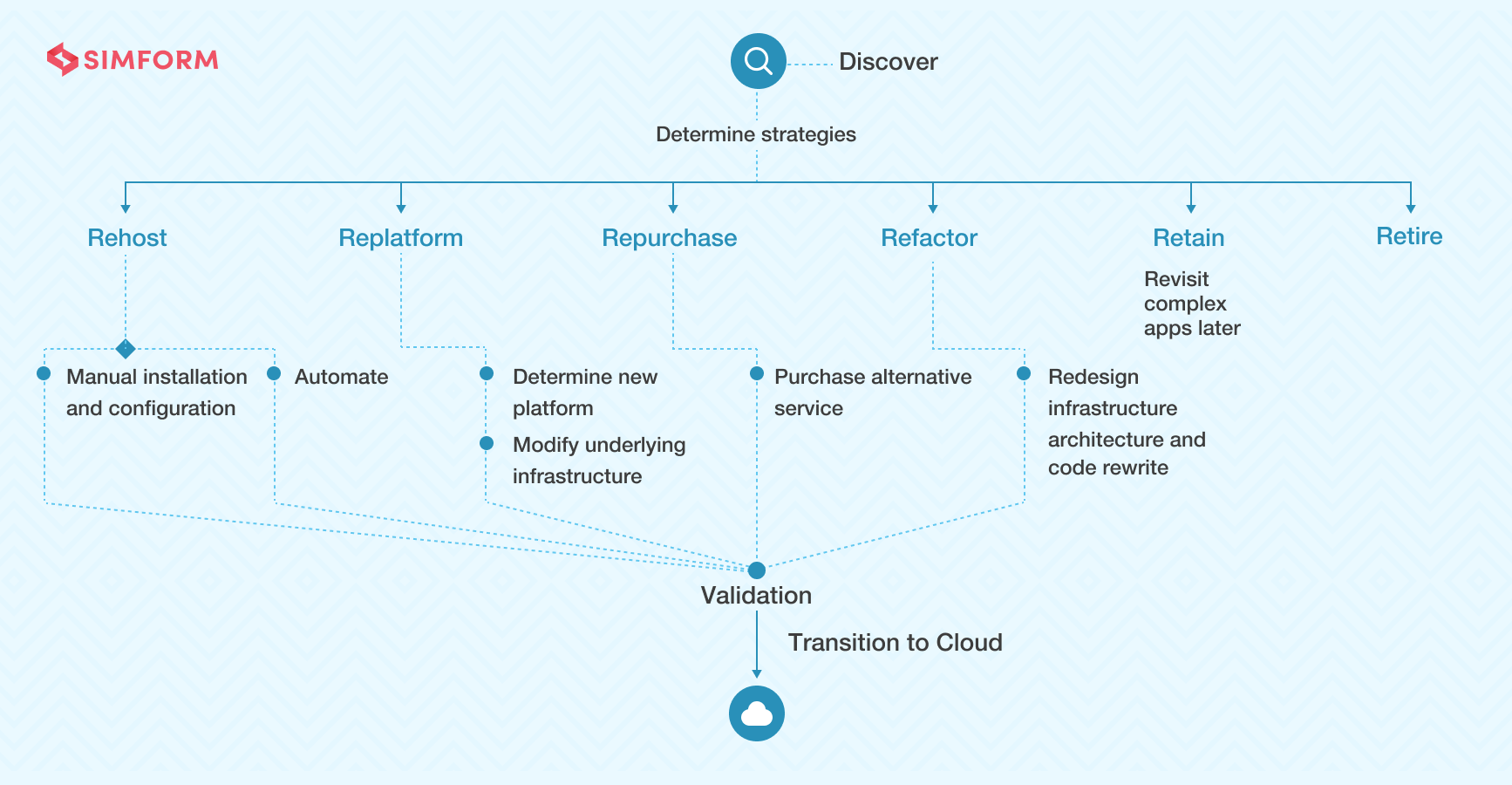 Move your business elements, data, and applications to a cloud environment by choosing the most suitable cloud migration strategy. This blog introduces you to those six cloud migration strategies, including their use cases, popular examples, and best practices. So get started to reading a useful post before your organization plans a migration process. Embracing the power of the cloud has become inevitable to succeed in today’s digital era, especially when organizations are increasingly migrating their applications to the [cloud](https://www.simform.com/services/serverless-app-development-consulting/) to drive growth. According to Gartner, the worldwide spending on public-cloud services is forecast to grow up to [$304.9 billion](https://www.gartner.com/en/newsroom/press-releases/2020-11-17-gartner-forecasts-worldwide-public-cloud-end-user-spending-to-grow-18-percent-in-2021) in 2021, up from $257.5 billion in 2020. By 2024, more than [45% of the IT](https://www.gartner.com/smarterwithgartner/cloud-shift-impacts-all-it-markets/) spending will shift from traditional solutions to the cloud. Despite such heavy spending on the cloud, one in every three organizations fail to realize its benefits. 33% of organizations have seen no or slight improvement in organizational effectiveness after cloud adoption, as per Unisys Cloud Success barometer report. Cloud migration is a complex and costly affair. So how do you avoid a cloud project failure? The answer lies in proper planning and selecting the right cloud migration approach for your IT assets. This blog aims to give you a better understanding of a suitable cloud migration strategy to help you create a path for migration and smoothly transition to the cloud. ## What is Cloud Migration? Cloud migration isn’t just about moving to the cloud; it is an iterative process of optimization to reduce costs and reach the full potential of the cloud. It impacts all the organizational aspects including people, processes, and technology. But with flexible consumption and pricing models, the cloud can support high scalability, performance, agility, remote work, and cost-efficiency. ## The 6 R’s of Cloud Migration Strategy ### 1. Rehost Say you want to move your on-premises Oracle database to an EC2 instance in AWS with little upfront effort. Then rehosting is for you! It’s one of the quickest and easiest cloud migration strategies that moves data without code-level changes. ### 2. Replatform This ‘lift, tinker and shift’ strategy is a modified version of rehosting. Replatform enables you to make a few configurational changes to the apps to better suit the cloud environment without changing their core architecture. Developers commonly apply this approach to change the way apps interact with the database so they can run on managed platforms like Google CloudSQL or Amazon RDS. ### 3. Refactor/Re-architect Refactor or Re-architect method involves rewriting your applications from scratch to make them cloud-native. This strategy allows you to realize the full potential of cloud-native technologies like microservices architecture, serverless, containers, function-as-a-service, and load balancers. For example, you can refactor assets when you move your digital assets from an on-premise monolithic architecture to a fully serverless architecture in the cloud. These refactored applications are scalable, agile, efficient, and return ROI in the long run, even in the most competitive markets. ### 4. Repurchase Repurchase, also known as the “drop and shop” strategy, replaces the on-premise application with a cloud-native vendor-packaged software. It typically means moving to a SaaS (Software as a Service) application with the same capabilities. Effectively, it entails a licensing change sometimes––you drop the existing on-premise license and start a new license agreement with the cloud provider for their solution. The newer, upgraded cloud version offers you a better value with higher efficiency, savings on app storage, and maintenance costs. ### 5. Retire In the ‘retire’ strategy, you get rid of applications no longer needed or productive for your IT portfolio. If an application is considered not worth migrating to the cloud, it can either be eliminated or downsized. It allows you to explore all your applications in terms of their uses, dependencies, and cost to the company. It is a rather passive strategy as there is no migration. According to Stephen Orban at AWS, as much as 10% of an enterprise IT portfolio is no longer useful when migrating to the cloud and can be simply turned off. ### 6. Retain Retaining, also referred to as re-visit, is revisiting some critical applications/portions of your digital assets that need a significant amount of refactoring before migrating them to the cloud. Eventually, you may figure out some applications are more suitable to on-premise arrangements or have been recently upgraded and need to be retained. In other cases, applications are retained due to latency requirements, compliance or regulatory constraints, or it’s simply not cost-efficient. ## Best Practices for a Successful Cloud Migration * Know your IT portfolio inside out –the data, applications, and infrastructure * Design your migration strategy * Select the right partner for your cloud migration journey * Prepare your team and the existing IT environment for the transition * Leverage automated tools and managed services from cloud services provider wherever possible * Track and monitor the migration process continuously * Test and validate for optimization Check out the original article to read more about [Cloud Migration Strategy](https://www.simform.com/cloud-migration-strategy/). |
| json metadata | {"tags":["cloud","cloudmigration","cloudcomputing","softwaredevelopment","softwareengineering"],"image":["https://www.simform.com/wp-content/uploads/2021/06/cloud-migration-strategy.png"],"links":["https://www.simform.com/services/serverless-app-development-consulting/","https://www.gartner.com/en/newsroom/press-releases/2020-11-17-gartner-forecasts-worldwide-public-cloud-end-user-spending-to-grow-18-percent-in-2021","https://www.gartner.com/smarterwithgartner/cloud-shift-impacts-all-it-markets/","https://www.simform.com/cloud-migration-strategy/"],"app":"steemit/0.2","format":"markdown"} |
| parent author | |
| parent permlink | cloud |
| permlink | cloud-migration-strategy-the-ultimate-guide-to-the-6-r-s |
| title | Cloud Migration Strategy – The Ultimate Guide to the 6 R’s |
| Transaction Info | Block #55324434/Trx 9e24488eb27acf52232dc064c921948d681001ed |
View Raw JSON Data
{
"block": 55324434,
"op": [
"comment",
{
"author": "hardikshah",
"body": "\n\nMove your business elements, data, and applications to a cloud environment by choosing the most suitable cloud migration strategy. This blog introduces you to those six cloud migration strategies, including their use cases, popular examples, and best practices. So get started to reading a useful post before your organization plans a migration process.\n\nEmbracing the power of the cloud has become inevitable to succeed in today’s digital era, especially when organizations are increasingly migrating their applications to the [cloud](https://www.simform.com/services/serverless-app-development-consulting/) to drive growth. According to Gartner, the worldwide spending on public-cloud services is forecast to grow up to [$304.9 billion](https://www.gartner.com/en/newsroom/press-releases/2020-11-17-gartner-forecasts-worldwide-public-cloud-end-user-spending-to-grow-18-percent-in-2021) in 2021, up from $257.5 billion in 2020. By 2024, more than [45% of the IT](https://www.gartner.com/smarterwithgartner/cloud-shift-impacts-all-it-markets/) spending will shift from traditional solutions to the cloud.\n\nDespite such heavy spending on the cloud, one in every three organizations fail to realize its benefits. 33% of organizations have seen no or slight improvement in organizational effectiveness after cloud adoption, as per Unisys Cloud Success barometer report. Cloud migration is a complex and costly affair. So how do you avoid a cloud project failure?\n\nThe answer lies in proper planning and selecting the right cloud migration approach for your IT assets. This blog aims to give you a better understanding of a suitable cloud migration strategy to help you create a path for migration and smoothly transition to the cloud.\n\n## What is Cloud Migration?\nCloud migration isn’t just about moving to the cloud; it is an iterative process of optimization to reduce costs and reach the full potential of the cloud. It impacts all the organizational aspects including people, processes, and technology. But with flexible consumption and pricing models, the cloud can support high scalability, performance, agility, remote work, and cost-efficiency.\n\n## The 6 R’s of Cloud Migration Strategy\n### 1.\tRehost\nSay you want to move your on-premises Oracle database to an EC2 instance in AWS with little upfront effort. Then rehosting is for you! It’s one of the quickest and easiest cloud migration strategies that moves data without code-level changes.\n\n### 2.\tReplatform\nThis ‘lift, tinker and shift’ strategy is a modified version of rehosting. Replatform enables you to make a few configurational changes to the apps to better suit the cloud environment without changing their core architecture. Developers commonly apply this approach to change the way apps interact with the database so they can run on managed platforms like Google CloudSQL or Amazon RDS.\n\n### 3.\tRefactor/Re-architect\nRefactor or Re-architect method involves rewriting your applications from scratch to make them cloud-native. This strategy allows you to realize the full potential of cloud-native technologies like microservices architecture, serverless, containers, function-as-a-service, and load balancers. For example, you can refactor assets when you move your digital assets from an on-premise monolithic architecture to a fully serverless architecture in the cloud. These refactored applications are scalable, agile, efficient, and return ROI in the long run, even in the most competitive markets.\n\n### 4.\tRepurchase\nRepurchase, also known as the “drop and shop” strategy, replaces the on-premise application with a cloud-native vendor-packaged software. It typically means moving to a SaaS (Software as a Service) application with the same capabilities. Effectively, it entails a licensing change sometimes––you drop the existing on-premise license and start a new license agreement with the cloud provider for their solution. The newer, upgraded cloud version offers you a better value with higher efficiency, savings on app storage, and maintenance costs.\n\n### 5.\tRetire\nIn the ‘retire’ strategy, you get rid of applications no longer needed or productive for your IT portfolio. If an application is considered not worth migrating to the cloud, it can either be eliminated or downsized. It allows you to explore all your applications in terms of their uses, dependencies, and cost to the company. It is a rather passive strategy as there is no migration. According to Stephen Orban at AWS, as much as 10% of an enterprise IT portfolio is no longer useful when migrating to the cloud and can be simply turned off.\n\n### 6.\tRetain\nRetaining, also referred to as re-visit, is revisiting some critical applications/portions of your digital assets that need a significant amount of refactoring before migrating them to the cloud. Eventually, you may figure out some applications are more suitable to on-premise arrangements or have been recently upgraded and need to be retained. In other cases, applications are retained due to latency requirements, compliance or regulatory constraints, or it’s simply not cost-efficient.\n\n## Best Practices for a Successful Cloud Migration\n* Know your IT portfolio inside out –the data, applications, and infrastructure\n* Design your migration strategy\n* Select the right partner for your cloud migration journey\n* Prepare your team and the existing IT environment for the transition\n* Leverage automated tools and managed services from cloud services provider wherever possible\n* Track and monitor the migration process continuously\n* Test and validate for optimization\n\nCheck out the original article to read more about [Cloud Migration Strategy](https://www.simform.com/cloud-migration-strategy/).",
"json_metadata": "{\"tags\":[\"cloud\",\"cloudmigration\",\"cloudcomputing\",\"softwaredevelopment\",\"softwareengineering\"],\"image\":[\"https://www.simform.com/wp-content/uploads/2021/06/cloud-migration-strategy.png\"],\"links\":[\"https://www.simform.com/services/serverless-app-development-consulting/\",\"https://www.gartner.com/en/newsroom/press-releases/2020-11-17-gartner-forecasts-worldwide-public-cloud-end-user-spending-to-grow-18-percent-in-2021\",\"https://www.gartner.com/smarterwithgartner/cloud-shift-impacts-all-it-markets/\",\"https://www.simform.com/cloud-migration-strategy/\"],\"app\":\"steemit/0.2\",\"format\":\"markdown\"}",
"parent_author": "",
"parent_permlink": "cloud",
"permlink": "cloud-migration-strategy-the-ultimate-guide-to-the-6-r-s",
"title": "Cloud Migration Strategy – The Ultimate Guide to the 6 R’s"
}
],
"op_in_trx": 0,
"timestamp": "2021-07-09T07:05:12",
"trx_id": "9e24488eb27acf52232dc064c921948d681001ed",
"trx_in_block": 4,
"virtual_op": 0
}hardikshahdeleted a comment or post2021/07/09 07:01:45
hardikshahdeleted a comment or post
2021/07/09 07:01:45
| author | hardikshah |
| permlink | cloud-migration-strategy-the-ultimate-guide-to-the-6-r-s |
| Transaction Info | Block #55324365/Trx 6039ade9e4cf01adadb32ce14103f0f1f33cdee4 |
View Raw JSON Data
{
  "block": 55324365,
  "op": [
    "delete_comment",
    {
      "author": "hardikshah",
      "permlink": "cloud-migration-strategy-the-ultimate-guide-to-the-6-r-s"
    }
  ],
  "op_in_trx": 0,
  "timestamp": "2021-07-09T07:01:45",
  "trx_id": "6039ade9e4cf01adadb32ce14103f0f1f33cdee4",
  "trx_in_block": 4,
  "virtual_op": 0
}hardikshahpublished a new post: cloud-migration-strategy-the-ultimate-guide-to-the-6-r-s2021/07/09 06:57:21
hardikshahpublished a new post: cloud-migration-strategy-the-ultimate-guide-to-the-6-r-s
2021/07/09 06:57:21
| author | hardikshah |
| body | Move your business elements, data, and applications to a cloud environment by choosing the most suitable cloud migration strategy. This blog introduces you to those six cloud migration strategies, including their use cases, popular examples, and best practices. So get started to reading a useful post before your organization plans a migration process. Embracing the power of the cloud has become inevitable to succeed in today’s digital era, especially when organizations are increasingly migrating their applications to the cloud to drive growth. According to Gartner, the worldwide spending on public-cloud services is forecast to grow up to $304.9 billion in 2021, up from $257.5 billion in 2020. By 2024, more than 45% of the IT spending will shift from traditional solutions to the cloud. Despite such heavy spending on the cloud, one in every three organizations fail to realize its benefits. 33% of organizations have seen no or slight improvement in organizational effectiveness after cloud adoption, as per Unisys Cloud Success barometer report. Cloud migration is a complex and costly affair. So how do you avoid a cloud project failure? The answer lies in proper planning and selecting the right cloud migration approach for your IT assets. This blog aims to give you a better understanding of a suitable cloud migration strategy to help you create a path for migration and smoothly transition to the cloud. What is Cloud Migration? Cloud migration isn’t just about moving to the cloud; it is an iterative process of optimization to reduce costs and reach the full potential of the cloud. It impacts all the organizational aspects including people, processes, and technology. But with flexible consumption and pricing models, the cloud can support high scalability, performance, agility, remote work, and cost-efficiency. The 6 R’s of Cloud Migration Strategy 1. Rehost Say you want to move your on-premises Oracle database to an EC2 instance in AWS with little upfront effort. Then rehosting is for you! It’s one of the quickest and easiest cloud migration strategies that moves data without code-level changes. 2. Replatform This ‘lift, tinker and shift’ strategy is a modified version of rehosting. Replatform enables you to make a few configurational changes to the apps to better suit the cloud environment without changing their core architecture. Developers commonly apply this approach to change the way apps interact with the database so they can run on managed platforms like Google CloudSQL or Amazon RDS. 3. Refactor/Re-architect Refactor or Re-architect method involves rewriting your applications from scratch to make them cloud-native. This strategy allows you to realize the full potential of cloud-native technologies like microservices architecture, serverless, containers, function-as-a-service, and load balancers. For example, you can refactor assets when you move your digital assets from an on-premise monolithic architecture to a fully serverless architecture in the cloud. These refactored applications are scalable, agile, efficient, and return ROI in the long run, even in the most competitive markets. 4. Repurchase Repurchase, also known as the “drop and shop” strategy, replaces the on-premise application with a cloud-native vendor-packaged software. It typically means moving to a SaaS (Software as a Service) application with the same capabilities. Effectively, it entails a licensing change sometimes––you drop the existing on-premise license and start a new license agreement with the cloud provider for their solution. The newer, upgraded cloud version offers you a better value with higher efficiency, savings on app storage, and maintenance costs. 5. Retire In the ‘retire’ strategy, you get rid of applications no longer needed or productive for your IT portfolio. If an application is considered not worth migrating to the cloud, it can either be eliminated or downsized. It allows you to explore all your applications in terms of their uses, dependencies, and cost to the company. It is a rather passive strategy as there is no migration. According to Stephen Orban at AWS, as much as 10% of an enterprise IT portfolio is no longer useful when migrating to the cloud and can be simply turned off. 6. Retain Retaining, also referred to as re-visit, is revisiting some critical applications/portions of your digital assets that need a significant amount of refactoring before migrating them to the cloud. Eventually, you may figure out some applications are more suitable to on-premise arrangements or have been recently upgraded and need to be retained. In other cases, applications are retained due to latency requirements, compliance or regulatory constraints, or it’s simply not cost-efficient. Best Practices for a Successful Cloud Migration • Know your IT portfolio inside out –the data, applications, and infrastructure • Design your migration strategy • Select the right partner for your cloud migration journey • Prepare your team and the existing IT environment for the transition • Leverage automated tools and managed services from cloud services provider wherever possible • Track and monitor the migration process continuously • Test and validate for optimization Check out the original article to read more about Cloud Migration Strategy. |
| json metadata | {"tags":["cloud"],"app":"steemit/0.2","format":"markdown"} |
| parent author | |
| parent permlink | cloud |
| permlink | cloud-migration-strategy-the-ultimate-guide-to-the-6-r-s |
| title | Cloud Migration Strategy – The Ultimate Guide to the 6 R’s |
| Transaction Info | Block #55324277/Trx c659c32d1067c4d1722c2da0c3afc4b17faedf1e |
View Raw JSON Data
{
  "block": 55324277,
  "op": [
    "comment",
    {
      "author": "hardikshah",
      "body": "Move your business elements, data, and applications to a cloud environment by choosing the most suitable cloud migration strategy. This blog introduces you to those six cloud migration strategies, including their use cases, popular examples, and best practices. So get started to reading a useful post before your organization plans a migration process.\n\nEmbracing the power of the cloud has become inevitable to succeed in today’s digital era, especially when organizations are increasingly migrating their applications to the cloud to drive growth. According to Gartner, the worldwide spending on public-cloud services is forecast to grow up to $304.9 billion in 2021, up from $257.5 billion in 2020. By 2024, more than 45% of the IT spending will shift from traditional solutions to the cloud.\n\nDespite such heavy spending on the cloud, one in every three organizations fail to realize its benefits. 33% of organizations have seen no or slight improvement in organizational effectiveness after cloud adoption, as per Unisys Cloud Success barometer report. Cloud migration is a complex and costly affair. So how do you avoid a cloud project failure?\n\nThe answer lies in proper planning and selecting the right cloud migration approach for your IT assets. This blog aims to give you a better understanding of a suitable cloud migration strategy to help you create a path for migration and smoothly transition to the cloud.\n\nWhat is Cloud Migration?\nCloud migration isn’t just about moving to the cloud; it is an iterative process of optimization to reduce costs and reach the full potential of the cloud. It impacts all the organizational aspects including people, processes, and technology. But with flexible consumption and pricing models, the cloud can support high scalability, performance, agility, remote work, and cost-efficiency.\n\nThe 6 R’s of Cloud Migration Strategy\n1.\tRehost\nSay you want to move your on-premises Oracle database to an EC2 instance in AWS with little upfront effort. Then rehosting is for you! It’s one of the quickest and easiest cloud migration strategies that moves data without code-level changes.\n\n2.\tReplatform\nThis ‘lift, tinker and shift’ strategy is a modified version of rehosting.  Replatform enables you to make a few configurational changes to the apps to better suit the cloud environment without changing their core architecture. Developers commonly apply this approach to change the way apps interact with the database so they can run on managed platforms like Google CloudSQL or Amazon RDS.\n\n3.\tRefactor/Re-architect\nRefactor or Re-architect method involves rewriting your applications from scratch to make them cloud-native. This strategy allows you to realize the full potential of cloud-native technologies like microservices architecture, serverless, containers, function-as-a-service, and load balancers. For example, you can refactor assets when you move your digital assets from an on-premise monolithic architecture to a fully serverless architecture in the cloud. These refactored applications are scalable, agile, efficient, and return ROI in the long run, even in the most competitive markets.\n\n4.\tRepurchase\nRepurchase, also known as the “drop and shop” strategy, replaces the on-premise application with a cloud-native vendor-packaged software. It typically means moving to a SaaS (Software as a Service) application with the same capabilities. Effectively, it entails a licensing change sometimes––you drop the existing on-premise license and start a new license agreement with the cloud provider for their solution. The newer, upgraded cloud version offers you a better value with higher efficiency, savings on app storage, and maintenance costs.\n\n5.\tRetire\nIn the ‘retire’ strategy, you get rid of applications no longer needed or productive for your IT portfolio. If an application is considered not worth migrating to the cloud, it can either be eliminated or downsized. It allows you to explore all your applications in terms of their uses, dependencies, and cost to the company. It is a rather passive strategy as there is no migration. According to Stephen Orban at AWS, as much as 10% of an enterprise IT portfolio is no longer useful when migrating to the cloud and can be simply turned off.\n\n6.\tRetain\nRetaining, also referred to as re-visit, is revisiting some critical applications/portions of your digital assets that need a significant amount of refactoring before migrating them to the cloud. Eventually, you may figure out some applications are more suitable to on-premise arrangements or have been recently upgraded and need to be retained.  In other cases, applications are retained due to latency requirements, compliance or regulatory constraints, or it’s simply not cost-efficient.\n\nBest Practices for a Successful Cloud Migration\n• Know your IT portfolio inside out –the data, applications, and infrastructure\n• Design your migration strategy\n• Select the right partner for your cloud migration journey\n• Prepare your team and the existing IT environment for the transition\n• Leverage automated tools and managed services from cloud services provider wherever possible\n• Track and monitor the migration process continuously\n• Test and validate for optimization\n\nCheck out the original article to read more about Cloud Migration Strategy.",
      "json_metadata": "{\"tags\":[\"cloud\"],\"app\":\"steemit/0.2\",\"format\":\"markdown\"}",
      "parent_author": "",
      "parent_permlink": "cloud",
      "permlink": "cloud-migration-strategy-the-ultimate-guide-to-the-6-r-s",
      "title": "Cloud Migration Strategy – The Ultimate Guide to the 6 R’s"
    }
  ],
  "op_in_trx": 0,
  "timestamp": "2021-07-09T06:57:21",
  "trx_id": "c659c32d1067c4d1722c2da0c3afc4b17faedf1e",
  "trx_in_block": 1,
  "virtual_op": 0
}hardikshahpublished a new post: top-frontend-trends-organizations-are-embracing-in-20212021/06/17 11:45:03
hardikshahpublished a new post: top-frontend-trends-organizations-are-embracing-in-2021
2021/06/17 11:45:03
| author | hardikshah |
| body | https://www.simform.com/wp-content/uploads/2021/06/Banner-Frontend-Trends.png New frontend trends do not pop out of the blue in the software world. The trends become popular when either a prominent organization has adopted it, or there have been promising and evidential incentives to embrace the trend. Netflix was amongst the first companies to adopt a headless architecture for effortless content management and to manage their frontend. As a result, the microservices and its multi-tenant architecture allowed easy data transmission amongst its high number of users and prevented minor server errors from disturbing the entire system. Considering the case example, we can already imagine how it became an inspiration for thousands of other web applications to follow a similar trend. Irrespective of the frontend trends having a positive impact on the company, it is always worth a shot to understand the user requirements and make changes to our [web applications](https://www.simform.com/services/web-apps-development/). Given that it is imperative to keep a tab on the changing requirements, let us dive into some of the top frontend trends organizations are embracing in 2021. ## Catching Up with the New Frontend Trends **1. The Popular Frameworks in Use** JavaScript has always been a constant when it comes to the most influential programming languages for frontend development. **2. Headless Architecture for Content Management** With a rise in user base on online applications, companies are slowly shifting their content management strategy that adopts a hybrid approach in providing consistency and uniformity across different platforms. **3. Moving Towards a Micro Frontend Architecture** Taking the inspiration from microservices at the backend, a micro frontend architecture was built as a solution for the monolithic frontend structure. **4. Component Driven Development** The component-driven development works on the principle of modularity that gives the components the advantage of reusability and composability. **5. A Rising Dominance of JAMstack** JAMstack (JavaScript, API, & Markup) is an architecture that works on the core principles of pre-rendering and decoupling, making a website that is faster, secured, and easy to scale. **6. Development of Progressive Web Applications** Progressive Web Application is a cross-platform web app that uses emerging browser APIs and features along with a traditional progressive enhancement strategy. **7. Introducing Motion-UI** Incorporating motion designs, web animation APIs, and CSS animations in the frontend is a new movement that would define the trends in the future. **8. Adopting GraphQL** The query language is an updated tool that enables data retrieval in a precise manner. Check out the original article to read more about [Top Frontend Trends Organizations are Embracing in 2021](https://href.li/?https://www.simform.com/top-frontend-trends/). |
| json metadata | {"tags":["frontend","frontendtrends","softwaredevelopment","softwareengineering"],"image":["https://www.simform.com/wp-content/uploads/2021/06/Banner-Frontend-Trends.png"],"links":["https://www.simform.com/services/web-apps-development/","https://href.li/?https://www.simform.com/top-frontend-trends/"],"app":"steemit/0.2","format":"markdown"} |
| parent author | |
| parent permlink | frontend |
| permlink | top-frontend-trends-organizations-are-embracing-in-2021 |
| title | Top Frontend Trends Organizations are Embracing in 2021 |
| Transaction Info | Block #54706487/Trx e16efa905eb7713708742ff699778393b89dc913 |
View Raw JSON Data
{
  "block": 54706487,
  "op": [
    "comment",
    {
      "author": "hardikshah",
      "body": "https://www.simform.com/wp-content/uploads/2021/06/Banner-Frontend-Trends.png\n\nNew frontend trends do not pop out of the blue in the software world. The trends become popular when either a prominent organization has adopted it, or there have been promising and evidential incentives to embrace the trend. Netflix was amongst the first companies to adopt a headless architecture for effortless content management and to manage their frontend. As a result, the microservices and its multi-tenant architecture allowed easy data transmission amongst its high number of users and prevented minor server errors from disturbing the entire system.\n\nConsidering the case example, we can already imagine how it became an inspiration for thousands of other web applications to follow a similar trend. Irrespective of the frontend trends having a positive impact on the company, it is always worth a shot to understand the user requirements and make changes to our [web applications](https://www.simform.com/services/web-apps-development/). Given that it is imperative to keep a tab on the changing requirements, let us dive into some of the top frontend trends organizations are embracing in 2021.\n\n## Catching Up with the New Frontend Trends\n**1. The Popular Frameworks in Use**\nJavaScript has always been a constant when it comes to the most influential programming languages for frontend development.\n\n**2. Headless Architecture for Content Management**\nWith a rise in user base on online applications, companies are slowly shifting their content management strategy that adopts a hybrid approach in providing consistency and uniformity across different platforms.\n\n**3. Moving Towards a Micro Frontend Architecture**\nTaking the inspiration from microservices at the backend, a micro frontend architecture was built as a solution for the monolithic frontend structure.\n\n**4. Component Driven Development**\nThe component-driven development works on the principle of modularity that gives the components the advantage of reusability and composability.\n\n**5. A Rising Dominance of JAMstack**\nJAMstack (JavaScript, API, & Markup) is an architecture that works on the core principles of pre-rendering and decoupling, making a website that is faster, secured, and easy to scale.\n\n**6. Development of Progressive Web Applications**\nProgressive Web Application is a cross-platform web app that uses emerging browser APIs and features along with a traditional progressive enhancement strategy.\n\n**7. Introducing Motion-UI**\nIncorporating motion designs, web animation APIs, and CSS animations in the frontend is a new movement that would define the trends in the future.\n\n**8. Adopting GraphQL**\nThe query language is an updated tool that enables data retrieval in a precise manner.\n\nCheck out the original article to read more about [Top Frontend Trends Organizations are Embracing in 2021](https://href.li/?https://www.simform.com/top-frontend-trends/).",
      "json_metadata": "{\"tags\":[\"frontend\",\"frontendtrends\",\"softwaredevelopment\",\"softwareengineering\"],\"image\":[\"https://www.simform.com/wp-content/uploads/2021/06/Banner-Frontend-Trends.png\"],\"links\":[\"https://www.simform.com/services/web-apps-development/\",\"https://href.li/?https://www.simform.com/top-frontend-trends/\"],\"app\":\"steemit/0.2\",\"format\":\"markdown\"}",
      "parent_author": "",
      "parent_permlink": "frontend",
      "permlink": "top-frontend-trends-organizations-are-embracing-in-2021",
      "title": "Top Frontend Trends Organizations are Embracing in 2021"
    }
  ],
  "op_in_trx": 0,
  "timestamp": "2021-06-17T11:45:03",
  "trx_id": "e16efa905eb7713708742ff699778393b89dc913",
  "trx_in_block": 17,
  "virtual_op": 0
}crypto.piotrsent 0.003 STEEM to @hardikshah- "Regarding the latest information and development of Steemauto. Old SteemAuto is already being switched off. Today, I would like to introduce you to new version of SteemAuto launched by one of most rep..."2021/06/12 11:35:00
crypto.piotrsent 0.003 STEEM to @hardikshah- "Regarding the latest information and development of Steemauto. Old SteemAuto is already being switched off. Today, I would like to introduce you to new version of SteemAuto launched by one of most rep..."
2021/06/12 11:35:00
| amount | 0.003 STEEM |
| from | crypto.piotr |
| memo | Regarding the latest information and development of Steemauto. Old SteemAuto is already being switched off. Today, I would like to introduce you to new version of SteemAuto launched by one of most reputable witness. You can find it here: https://worldofxpilar.com/dash.php . I've helped testing it and it's WORKING GREAT so far (In case if you would have any questions, consider joining their discord channel: https://discord.com/invite/VAHHsmnNaJ ) |
| to | hardikshah |
| Transaction Info | Block #54563374/Trx e55f136db367c55ab4a55195b6e632853c60135c |
View Raw JSON Data
{
  "block": 54563374,
  "op": [
    "transfer",
    {
      "amount": "0.003 STEEM",
      "from": "crypto.piotr",
      "memo": "Regarding the latest information and development of Steemauto. Old SteemAuto is already being switched off. Today, I would like to introduce you to new version of SteemAuto launched by one of most reputable witness. You can find it here: https://worldofxpilar.com/dash.php . I've helped testing it and it's WORKING GREAT so far (In case if you would have any questions, consider joining their discord channel: https://discord.com/invite/VAHHsmnNaJ )",
      "to": "hardikshah"
    }
  ],
  "op_in_trx": 0,
  "timestamp": "2021-06-12T11:35:00",
  "trx_id": "e55f136db367c55ab4a55195b6e632853c60135c",
  "trx_in_block": 0,
  "virtual_op": 0
}hardikshahpublished a new post: how-to-avoid-aws-lambda-cold-starts2021/06/10 17:17:06
hardikshahpublished a new post: how-to-avoid-aws-lambda-cold-starts
2021/06/10 17:17:06
| author | hardikshah |
| body | 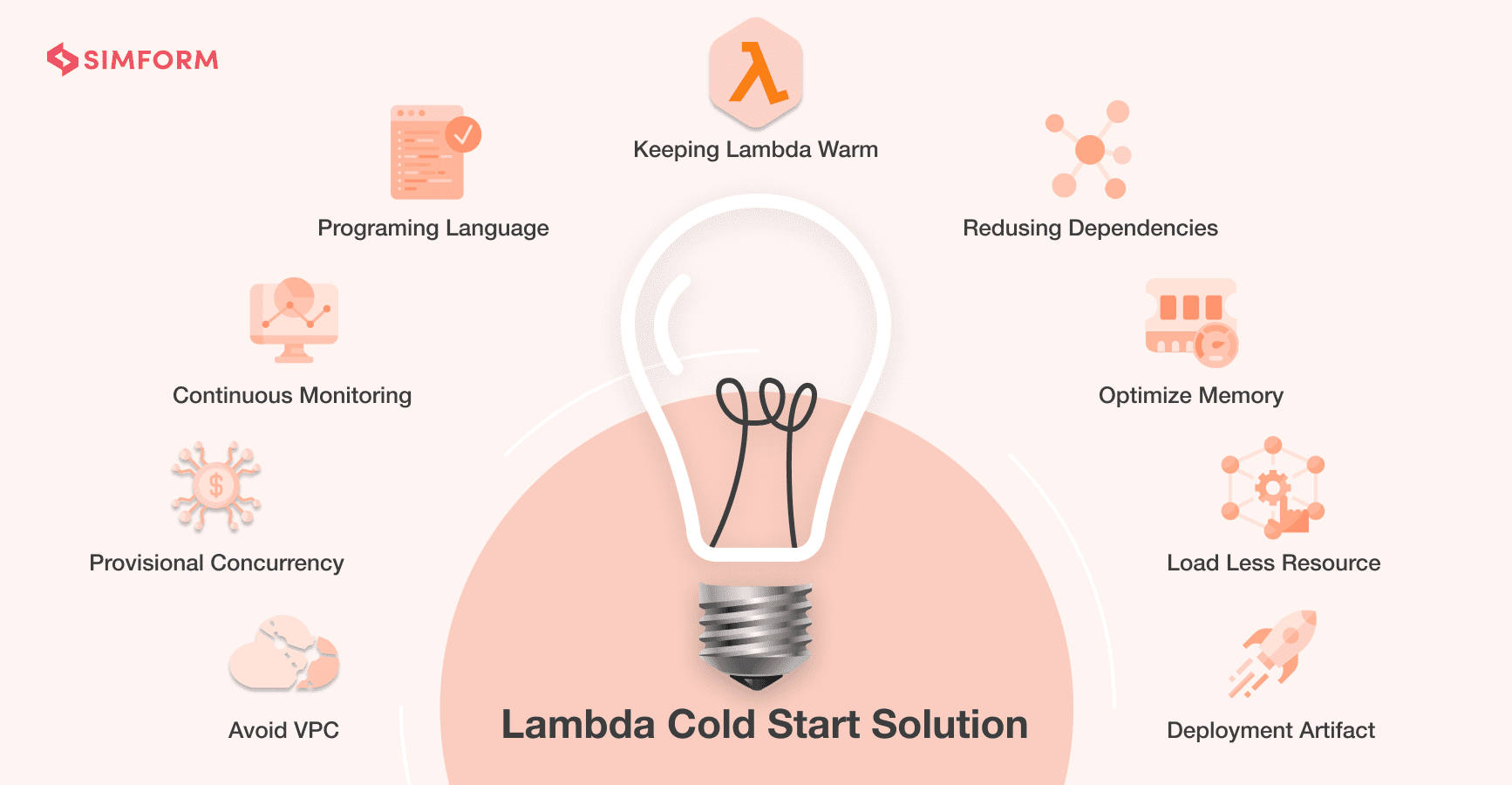 Say your company is facing major database corruption and you moved to cloud services like AWS for reliability, fault-tolerance, and scalability. Eventually, you switched to [Serverless architecture](https://www.simform.com/serverless-architecture-guide/), and AWS Lambda became a core part of its ecosystem with many critical functions being handled by it. Now, just when you thought you’ve solved a problem, you experience a cold start that created a startup latency. It’s a common problem associated with AWS Lambda that takes initial setup time in [serverless app development](https://www.simform.com/services/serverless-app-development-consulting/), slowing the Lambda function and disrupting the user experience. This blog discusses how you can prevent this scenario and solutions based on experiments carried out by serverless experts. ### Reasons for AWS Lambda Cold Starts A cold start is a common occurrence when a function is called for the first time after deployment as its container takes time to form. Ergo, this causes a few seconds delay, hampering an application’s productivity. In other cases, programming languages with higher latencies and a number of dependencies associated with Lambda functions affect cold starts. For instance, when you call a function, all its dependencies are imported into the container for Lambda functions which further adds to latency. ### Ways to Reduce AWS Lambda Cold Start 1. Avoid HTTP/HTTPS Calls Inside Lambda 2. Preload All Dependencies 3. Avoid Colossal Functions 4. Reducing Setup Variables ### Experimentation-based Techniques to Prevent Cold Start 1. Run Lambdas Out of VPC 2. Provisional Concurrency 3. Keeping Your Lambda Functions Warm 4. Choosing Right Programming Language 5. Continuous Monitoring Using Log Data 6. Reducing Function Dependencies 7. Optimize Memory and Code Size 8. Load Less Resources 9. Deployment Artifact Size Matters Check out the original article to read more about [how to avoid AWS lambda cold starts](https://www.simform.com/lambda-cold-starts/). |
| json metadata | {"tags":["cloud","cloudcomputing","awslambda","softwaredevelopment","softwareengineering"],"image":["https://www.simform.com/wp-content/uploads/2021/06/Lambda-Cold-Start-Solution-Cover.png"],"links":["https://www.simform.com/serverless-architecture-guide/","https://www.simform.com/services/serverless-app-development-consulting/","https://www.simform.com/lambda-cold-starts/"],"app":"steemit/0.2","format":"markdown"} |
| parent author | |
| parent permlink | cloud |
| permlink | how-to-avoid-aws-lambda-cold-starts |
| title | How to Avoid AWS Lambda Cold Starts? |
| Transaction Info | Block #54512989/Trx 1b0e322ed717f7d9fba03a11ab8e3d25ea5e04b1 |
View Raw JSON Data
{
"block": 54512989,
"op": [
"comment",
{
"author": "hardikshah",
"body": "\n\nSay your company is facing major database corruption and you moved to cloud services like AWS for reliability, fault-tolerance, and scalability. Eventually, you switched to [Serverless architecture](https://www.simform.com/serverless-architecture-guide/), and AWS Lambda became a core part of its ecosystem with many critical functions being handled by it.\n\nNow, just when you thought you’ve solved a problem, you experience a cold start that created a startup latency. It’s a common problem associated with AWS Lambda that takes initial setup time in [serverless app development](https://www.simform.com/services/serverless-app-development-consulting/), slowing the Lambda function and disrupting the user experience. This blog discusses how you can prevent this scenario and solutions based on experiments carried out by serverless experts.\n\n### Reasons for AWS Lambda Cold Starts\nA cold start is a common occurrence when a function is called for the first time after deployment as its container takes time to form. Ergo, this causes a few seconds delay, hampering an application’s productivity. In other cases, programming languages with higher latencies and a number of dependencies associated with Lambda functions affect cold starts. For instance, when you call a function, all its dependencies are imported into the container for Lambda functions which further adds to latency.\n\n### Ways to Reduce AWS Lambda Cold Start\n1.\tAvoid HTTP/HTTPS Calls Inside Lambda \n2.\tPreload All Dependencies\n3.\tAvoid Colossal Functions\n4.\tReducing Setup Variables \n\n### Experimentation-based Techniques to Prevent Cold Start\n1.\tRun Lambdas Out of VPC\n2.\tProvisional Concurrency \n3.\tKeeping Your Lambda Functions Warm\n4.\tChoosing Right Programming Language\n5.\tContinuous Monitoring Using Log Data\n6.\tReducing Function Dependencies\n7.\tOptimize Memory and Code Size\n8.\tLoad Less Resources \n9.\tDeployment Artifact Size Matters\n\nCheck out the original article to read more about [how to avoid AWS lambda cold starts](https://www.simform.com/lambda-cold-starts/).",
"json_metadata": "{\"tags\":[\"cloud\",\"cloudcomputing\",\"awslambda\",\"softwaredevelopment\",\"softwareengineering\"],\"image\":[\"https://www.simform.com/wp-content/uploads/2021/06/Lambda-Cold-Start-Solution-Cover.png\"],\"links\":[\"https://www.simform.com/serverless-architecture-guide/\",\"https://www.simform.com/services/serverless-app-development-consulting/\",\"https://www.simform.com/lambda-cold-starts/\"],\"app\":\"steemit/0.2\",\"format\":\"markdown\"}",
"parent_author": "",
"parent_permlink": "cloud",
"permlink": "how-to-avoid-aws-lambda-cold-starts",
"title": "How to Avoid AWS Lambda Cold Starts?"
}
],
"op_in_trx": 0,
"timestamp": "2021-06-10T17:17:06",
"trx_id": "1b0e322ed717f7d9fba03a11ab8e3d25ea5e04b1",
"trx_in_block": 0,
"virtual_op": 0
}hardikshahpublished a new post: micro-frontend-architecture-the-best-way-to-build-scalable-frontend2021/06/10 11:37:18
hardikshahpublished a new post: micro-frontend-architecture-the-best-way-to-build-scalable-frontend
2021/06/10 11:37:18
| author | hardikshah |
| body | 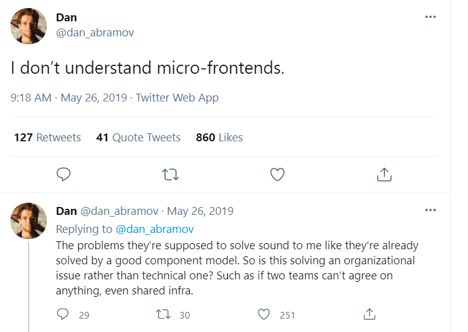 This <a href="https://twitter.com/dan_abramov/status/1132493678730252288">tweet</a> from Dan Abramov stirred up the frontend development community. People even supported his tweet citing the larger payload size and difficult implementation against the micro-frontend architecture. So why even look beyond component-driven development? These people answered why: 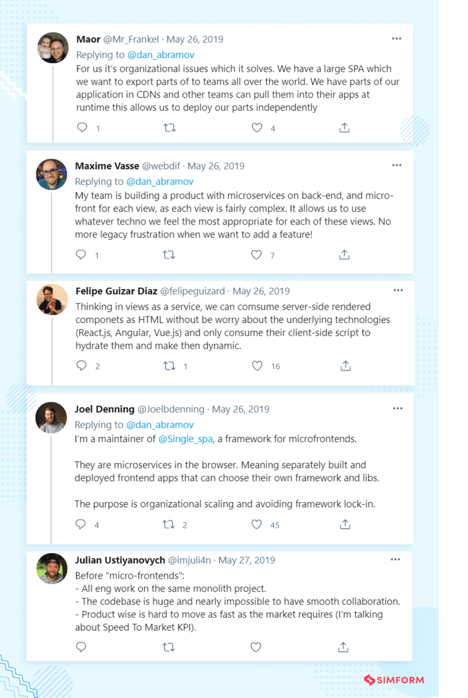 The micro-frontend architecture is especially effective in imparting organizational stability and its efficacy depends on the use case. Neither component-driven development nor micro-frontend architecture is a panacea for frontend scaling. The onus is always on the business owner to map needs against the advantages of these strategies and pick them immediately. We’ve already extensively covered component-driven development in our other blog and highlighted how it can be the key to building a scalable frontend. And now we want to discuss another extremely successful strategy for scaling frontend— micro-frontend architecture. Micro-frontend architecture is an incredibly lucrative approach for growing organizations as they often face multiple bottlenecks and anomalies at the frontend, no matter how streamlined the backend is. This is understandable since it doesn’t make much sense to meddle with the codebase for frequent feature additions and upgrades. The modular approach drastically reduces the impact of upgrades and changes for one element on the rest of the codebase. This article will explore all there is to know about micro-frontend architecture and equip you with the knowledge needed for its implementation. By the end, you’ll also see if it’s the right architectural approach for your frontend. So let’s get started: <h2>What is Micro-frontend Architecture?</h2> Micro-frontend architecture is a strategy in which the traditionally monolithic frontend codebase is split into smaller apps, ideally addressing the various business domains. All these smaller elements form a seamless frontend interface that delivers top-notch user experience and is easy to modify and scale. You know it’s time to adopt such an architecture when you want to add more features and functionalities but the bloated frontend codebase requires you to spend an awful lot of resources. Before the micro-frontend architecture went mainstream, the most common web-application development strategy involved a frontend monolith sitting on top of a microservices backend. Data coming from various microservices made things complicated with time. Say one of the microservices went through an upgrade at the backend. The frontend would need extensive changes, and we all know how developers would ignore such tedious tasks. Conclusively, the situation would get so out of hand that a revamp would seem like the only logical solution. Micro frontend framework allows cross-functional teams to take care of end-to-end development and deployment of individual micro applications. There are multiple implementation methods to deploy micro frontends. But before we get there, let’s figure out all the compelling reasons why you need to use micro frontends. <h2>11 Reasons Why You Should Use Micro-Frontend Architecture</h2> - Design and development flexibility - Decoupled codebases - Favours native browser over custom APIs - Automation - Fault isolation - Scalability - Faster build time - Simpler maintenance - Autonomous teams - Independent deployment - Reusability <h2>How to Implement Micro-frontend Architecture?</h2> Before you start composing micro frontends, you need to decide how you wish to split the application frontend. Primarily, there are two ways to go about it— horizontal split and vertical split. The horizontal split lets you break down an interface into multiple parts that can be assigned to different teams. However, you also need to give it a cohesive, consistent look and feel. If we look at the vertical split, here you prioritize business domains and assign each domain to different teams. Since a single team would be responsible for the entire interface, it’ll gradually gain more expertise in that particular business domain. Multiple strategies can account for a micro-frontend architecture approach based on how and where the different micro-frontend elements are composed. However, the superiority of one method over another is highly debatable. Let’s understand these different implementation strategies and try to find out which one suits you the most. - Server-side composition - Build-time integration - Run-time via iframes - Run-time via JavaScript - Run-time via web components <h2>Challenges to Micro-frontend Architecture</h2> Nothing comes without a cost, not even the micro-frontend architecture. There are a few tradeoffs that you need to consider before getting started with this framework: - Operational complexity - Inconsistent user experience - Poor communication between components - Larger payload <h2>Concluding…</h2> With multiple implementation strategies and tons of advantages, the micro-frontend architecture seems set to revolutionize frontend development and scaling. Check out the original article published here: <a href="https://www.simform.com/micro-frontend-architecture/">Micro Frontend Architecture: The Newest Approach To Building Scalable Frontend</a> |
| json metadata | {"tags":["frontend"],"image":["https://cdn.steemitimages.com/DQmTe7aiRrjPwCzscN5caxSGdXJg7UTeJR77FP3A8aU1p77/image.png","https://cdn.steemitimages.com/DQmSZyWYttCUkasw3eV9y8Lm7aFSpGJGxNgbzi7uCwVK67Q/image.png"],"links":["https://twitter.com/dan_abramov/status/1132493678730252288","https://www.simform.com/micro-frontend-architecture/"],"app":"steemit/0.2","format":"markdown"} |
| parent author | |
| parent permlink | frontend |
| permlink | micro-frontend-architecture-the-best-way-to-build-scalable-frontend |
| title | Micro Frontend Architecture: The Best Way To Build Scalable Frontend |
| Transaction Info | Block #54506249/Trx 80cbda71dc15da1fff2491d9a336a49ad7610eb6 |
View Raw JSON Data
{
"block": 54506249,
"op": [
"comment",
{
"author": "hardikshah",
"body": "\n\nThis <a href=\"https://twitter.com/dan_abramov/status/1132493678730252288\">tweet</a> from Dan Abramov stirred up the frontend development community. People even supported his tweet citing the larger payload size and difficult implementation against the micro-frontend architecture.\n\nSo why even look beyond component-driven development?\n\nThese people answered why:\n\n\n\n \n\nThe micro-frontend architecture is especially effective in imparting organizational stability and its efficacy depends on the use case. Neither component-driven development nor micro-frontend architecture is a panacea for frontend scaling. The onus is always on the business owner to map needs against the advantages of these strategies and pick them immediately. \n\nWe’ve already extensively covered component-driven development in our other blog and highlighted how it can be the key to building a scalable frontend. And now we want to discuss another extremely successful strategy for scaling frontend— micro-frontend architecture.\n\nMicro-frontend architecture is an incredibly lucrative approach for growing organizations as they often face multiple bottlenecks and anomalies at the frontend, no matter how streamlined the backend is. This is understandable since it doesn’t make much sense to meddle with the codebase for frequent feature additions and upgrades. The modular approach drastically reduces the impact of upgrades and changes for one element on the rest of the codebase.\n\nThis article will explore all there is to know about micro-frontend architecture and equip you with the knowledge needed for its implementation. By the end, you’ll also see if it’s the right architectural approach for your frontend. So let’s get started:\n\n\n<h2>What is Micro-frontend Architecture?</h2>\n\nMicro-frontend architecture is a strategy in which the traditionally monolithic frontend codebase is split into smaller apps, ideally addressing the various business domains. All these smaller elements form a seamless frontend interface that delivers top-notch user experience and is easy to modify and scale.\n\nYou know it’s time to adopt such an architecture when you want to add more features and functionalities but the bloated frontend codebase requires you to spend an awful lot of resources.\n\nBefore the micro-frontend architecture went mainstream, the most common web-application development strategy involved a frontend monolith sitting on top of a microservices backend. Data coming from various microservices made things complicated with time. Say one of the microservices went through an upgrade at the backend. The frontend would need extensive changes, and we all know how developers would ignore such tedious tasks. Conclusively, the situation would get so out of hand that a revamp would seem like the only logical solution.\n\nMicro frontend framework allows cross-functional teams to take care of end-to-end development and deployment of individual micro applications. There are multiple implementation methods to deploy micro frontends. But before we get there, let’s figure out all the compelling reasons why you need to use micro frontends.\n\n<h2>11 Reasons Why You Should Use Micro-Frontend Architecture</h2>\n\n\n- Design and development flexibility\n- Decoupled codebases\n- Favours native browser over custom APIs\n- Automation\n- Fault isolation\n- Scalability\n- Faster build time\n- Simpler maintenance\n- Autonomous teams\n- Independent deployment\n- Reusability\n\n\n<h2>How to Implement Micro-frontend Architecture?</h2>\n\nBefore you start composing micro frontends, you need to decide how you wish to split the application frontend. Primarily, there are two ways to go about it— horizontal split and vertical split. \n\nThe horizontal split lets you break down an interface into multiple parts that can be assigned to different teams. However, you also need to give it a cohesive, consistent look and feel.\n\nIf we look at the vertical split, here you prioritize business domains and assign each domain to different teams. Since a single team would be responsible for the entire interface, it’ll gradually gain more expertise in that particular business domain.\n\nMultiple strategies can account for a micro-frontend architecture approach based on how and where the different micro-frontend elements are composed. However, the superiority of one method over another is highly debatable. Let’s understand these different implementation strategies and try to find out which one suits you the most.\n\n- Server-side composition\n- Build-time integration\n- Run-time via iframes\n- Run-time via JavaScript\n- Run-time via web components\n\n\n<h2>Challenges to Micro-frontend Architecture</h2>\n\nNothing comes without a cost, not even the micro-frontend architecture. There are a few tradeoffs that you need to consider before getting started with this framework:\n\n- Operational complexity\n- Inconsistent user experience\n- Poor communication between components\n- Larger payload\n\n<h2>Concluding…</h2>\n\nWith multiple implementation strategies and tons of advantages, the micro-frontend architecture seems set to revolutionize frontend development and scaling.\n\nCheck out the original article published here: <a href=\"https://www.simform.com/micro-frontend-architecture/\">Micro Frontend Architecture: The Newest Approach To Building Scalable Frontend</a>",
"json_metadata": "{\"tags\":[\"frontend\"],\"image\":[\"https://cdn.steemitimages.com/DQmTe7aiRrjPwCzscN5caxSGdXJg7UTeJR77FP3A8aU1p77/image.png\",\"https://cdn.steemitimages.com/DQmSZyWYttCUkasw3eV9y8Lm7aFSpGJGxNgbzi7uCwVK67Q/image.png\"],\"links\":[\"https://twitter.com/dan_abramov/status/1132493678730252288\",\"https://www.simform.com/micro-frontend-architecture/\"],\"app\":\"steemit/0.2\",\"format\":\"markdown\"}",
"parent_author": "",
"parent_permlink": "frontend",
"permlink": "micro-frontend-architecture-the-best-way-to-build-scalable-frontend",
"title": "Micro Frontend Architecture: The Best Way To Build Scalable Frontend"
}
],
"op_in_trx": 0,
"timestamp": "2021-06-10T11:37:18",
"trx_id": "80cbda71dc15da1fff2491d9a336a49ad7610eb6",
"trx_in_block": 16,
"virtual_op": 0
}hardikshahpublished a new post: serverless-for-startups-a-quick-way-to-build-products2021/06/07 12:51:24
hardikshahpublished a new post: serverless-for-startups-a-quick-way-to-build-products
2021/06/07 12:51:24
| author | hardikshah |
| body | From FinTechs to eCommerce giants, serverless has use cases in every business verticals. Breaking down large applications into self-contained functional units makes serverless an exemplary architecture for a startup that needs quicker iterations. When it comes to adopting serverless technologies, many startups get inspired by the use cases of successful tech giants, while others choose to customize architecture. However, according to a recent discussion on <a href="https://www.reddit.com/r/ExperiencedDevs/comments/hnj1u0/does_anybody_else_hate_serverless_architectures/">Reddit</a>, one user points out, “many startups fear from imitating/adopting tech giant’s tech stack and architectures. This is usually under the assumption that they are going to have tech giant challenges which may potentially close down their business.“ Yet, this is neither entirely true nor false. When you are choosing serverless for a startup, understanding the compatibility of the tech stack with your business requirements is vital. We’ll discuss the core principles of serverless, its advantages, and different serverless vendors with this blog. Let’s first start with the evolution of serverless and how it changed the development landscape. <h2>Evolution of Serverless Technology</h2> “Serverless” was first <a href="https://readwrite.com/2012/10/15/why-the-future-of-software-and-apps-is-serverless">mentioned</a> in a piece written by Ken Fromm in 2012. The road to the evolution of serverless started back in the 1990s and not in 2012. Software development back in the ’90s saw organizations separating frontend and backend. It was great for development purposes, but firms were paying for an idle resource that could not scale down according to the traffic. Problems of scaling on-demand computing resources were first addressed through the introduction of VMs in the 2000s. Although, the actual evolution of computing resources began after introducing EC2, S3, and SQS. However, the real breakthrough was the <a href="https://aws.amazon.com/about-aws/whats-new/2014/11/13/introducing-aws-lambda/">launch of AWS Lambda</a> in 2014. AWS Lambda is an on-demand cloud computing resource that offers FaaS capabilities. Earlier, operation teams allocated the resources based on demand forecasting, which had overhead issues, and the computations were not to exceed the system’s capabilities. AWS Lambda helps you handle the system’s restrictive capabilities by offering computing resources that scale up or down in real-time. Eventually, the subsequent launch of Google Cloud Platform and Microsoft Azure created more options for startups in the market. Since then, the evolution of serverless has seen a significant boost. According to <a href="https://martinfowler.com/articles/serverless.html">Martin Fowler</a>, there are two overlapping areas which serverless encompasses, 1. Serverless was first used as a concept that describes the application with integrated third-party services and cloud-hosted apps which manage server-side logic. Such services are often described as the “(Mobile) Backend as a Service” or BaaS. 2. Serverless can also be described as an architecture where server-side logic is written from scratch and is run in stateless compute containers that are event-triggered and fully managed by third-party services. It is often referred to as “Functions as a Service” or “FaaS,” and one of the most significant examples of its implementation is AWS Lambda. BaaS and FaaS offer a similar attribute of no need for resource management, but they are different in their approach. Backend-as-a-Service (BaaS) is a serverless architecture where the service provider manages all behind-the-scenes aspects of web or mobile apps. BaaS vendors offer pre-written software that automatically manages user authentication, database management, remote upgrading, and even cloud hosting. FaaS also allows you to write codes but rather than completely outsourcing the backend, it offers a modular approach. So, you can write and update a piece of code on the fly in response to an event like a user clicking on the download button in a web application. FaaS makes it easy for you to implement code and scale it through the execution of microservices. <h2>Benefits of Serverless Architecture</h2> - Agility of Deployments - Modular Approach - High Adaptability - Pay Per Use Model <h2>Serverless Platforms For Startups</h2> #1. AWS Lambda #2. Google Cloud Functions #3. Azure Functions #4. Alibaba Functions #5. Apache OpenWhisk <h2>Conclusion</h2> Adopting serverless technologies is not an easy decision. As a CTO or CEO, you should understand the business requirements, existing infrastructure, and future needs for expanding the startup. All these factors contribute to the decision of whether to choose serverless or not. However, you can opt for serverless if, - You want to create an app that can process multi-media with ease. - You need to have comprehensive data logging capabilities in your application. - You are creating an IoT(Internet of Things) application to respond to sensor input messages. - You want a streaming service app with parallelly working functions. - You need a chatbot that can scale on-demand as per peak traffic. These are just the tip of the iceberg. Serverless is not restricted, and its possibilities are endless. If you have specific requirements for your application, then at Simform, we have reliable serverless solutions that might help. Check out the original published article here: <a href="https://www.simform.com/serverless-for-startups/">Serverless for Startups: An Evolutionary Way to Build Successful Products</a> |
| json metadata | {"tags":["serverless","startups"],"links":["https://www.reddit.com/r/ExperiencedDevs/comments/hnj1u0/does_anybody_else_hate_serverless_architectures/","https://readwrite.com/2012/10/15/why-the-future-of-software-and-apps-is-serverless","https://aws.amazon.com/about-aws/whats-new/2014/11/13/introducing-aws-lambda/","https://martinfowler.com/articles/serverless.html","https://www.simform.com/serverless-for-startups/"],"app":"steemit/0.2","format":"markdown"} |
| parent author | |
| parent permlink | serverless |
| permlink | serverless-for-startups-a-quick-way-to-build-products |
| title | Serverless for Startups: A quick way to build products |
| Transaction Info | Block #54421964/Trx 4cea9c40bd3e1a897293093cff99eb0dcd57d741 |
View Raw JSON Data
{
  "block": 54421964,
  "op": [
    "comment",
    {
      "author": "hardikshah",
      "body": "From FinTechs to eCommerce giants, serverless has use cases in every business verticals. Breaking down large applications into self-contained functional units makes serverless an exemplary architecture for a startup that needs quicker iterations.\n\nWhen it comes to adopting serverless technologies, many startups get inspired by the use cases of successful tech giants, while others choose to customize architecture. \n\nHowever, according to a recent discussion on <a href=\"https://www.reddit.com/r/ExperiencedDevs/comments/hnj1u0/does_anybody_else_hate_serverless_architectures/\">Reddit</a>, one user points out, “many startups fear from imitating/adopting tech giant’s tech stack and architectures. This is usually under the assumption that they are going to have tech giant challenges which may potentially close down their business.“\n\nYet, this is neither entirely true nor false. When you are choosing serverless for a startup, understanding the compatibility of the tech stack with your business requirements is vital. \n\nWe’ll discuss the core principles of serverless, its advantages, and different serverless vendors with this blog. Let’s first start with the evolution of serverless and how it changed the development landscape.\n\n<h2>Evolution of Serverless Technology</h2>\n\n“Serverless” was first <a href=\"https://readwrite.com/2012/10/15/why-the-future-of-software-and-apps-is-serverless\">mentioned</a> in a piece written by Ken Fromm in 2012. The road to the evolution of serverless started back in the 1990s and not in 2012. Software development back in the ’90s saw organizations separating frontend and backend. It was great for development purposes, but firms were paying for an idle resource that could not scale down according to the traffic.\n\nProblems of scaling on-demand computing resources were first addressed through the introduction of VMs in the 2000s. Although, the actual evolution of computing resources began after introducing EC2, S3, and SQS. \n\nHowever, the real breakthrough was the <a href=\"https://aws.amazon.com/about-aws/whats-new/2014/11/13/introducing-aws-lambda/\">launch of AWS Lambda</a> in 2014. AWS Lambda is an on-demand cloud computing resource that offers FaaS capabilities. Earlier, operation teams allocated the resources based on demand forecasting, which had overhead issues, and the computations were not to exceed the system’s capabilities. AWS Lambda helps you handle the system’s restrictive capabilities by offering computing resources that scale up or down in real-time.  \n\nEventually, the subsequent launch of Google Cloud Platform and Microsoft Azure created more options for startups in the market. Since then, the evolution of serverless has seen a significant boost. \n\nAccording to <a href=\"https://martinfowler.com/articles/serverless.html\">Martin Fowler</a>, there are two overlapping areas which serverless encompasses,\n\n1. Serverless was first used as a concept that describes the application with integrated third-party services and cloud-hosted apps which manage server-side logic. Such services are often described as the “(Mobile) Backend as a Service” or BaaS.\n2. Serverless can also be described as an architecture where server-side logic is written from scratch and is run in stateless compute containers that are event-triggered and fully managed by third-party services. It is often referred to as “Functions as a Service” or “FaaS,” and one of the most significant examples of its implementation is AWS Lambda.\n\nBaaS and FaaS offer a similar attribute of no need for resource management, but they are different in their approach. Backend-as-a-Service (BaaS) is a serverless architecture where the service provider manages all behind-the-scenes aspects of web or mobile apps. BaaS vendors offer pre-written software that automatically manages user authentication, database management, remote upgrading, and even cloud hosting.\n\nFaaS also allows you to write codes but rather than completely outsourcing the backend, it offers a modular approach. So, you can write and update a piece of code on the fly in response to an event like a user clicking on the download button in a web application. FaaS makes it easy for you to implement code and scale it through the execution of microservices.\n\n<h2>Benefits of Serverless Architecture</h2>\n\n- Agility of Deployments\n- Modular Approach\n- High Adaptability\n- Pay Per Use Model\n\n<h2>Serverless Platforms For Startups</h2>\n\n#1. AWS Lambda\n#2. Google Cloud Functions\n#3. Azure Functions\n#4. Alibaba Functions\n#5. Apache OpenWhisk\n\n<h2>Conclusion</h2>\n\nAdopting serverless technologies is not an easy decision. As a CTO or CEO, you should understand the business requirements, existing infrastructure, and future needs for expanding the startup. All these factors contribute to the decision of whether to choose serverless or not.\n\nHowever, you can opt for serverless if,\n\n- You want to create an app that can process multi-media with ease.\n- You need to have comprehensive data logging capabilities in your application.\n- You are creating an IoT(Internet of Things) application to respond to sensor input messages.\n- You want a streaming service app with parallelly working functions.\n- You need a chatbot that can scale on-demand as per peak traffic.\n\nThese are just the tip of the iceberg. Serverless is not restricted, and its possibilities are endless. If you have specific requirements for your application, then at Simform, we have reliable serverless solutions that might help. \n\nCheck out the original published article here: <a href=\"https://www.simform.com/serverless-for-startups/\">Serverless for Startups: An Evolutionary Way to Build Successful Products</a>",
      "json_metadata": "{\"tags\":[\"serverless\",\"startups\"],\"links\":[\"https://www.reddit.com/r/ExperiencedDevs/comments/hnj1u0/does_anybody_else_hate_serverless_architectures/\",\"https://readwrite.com/2012/10/15/why-the-future-of-software-and-apps-is-serverless\",\"https://aws.amazon.com/about-aws/whats-new/2014/11/13/introducing-aws-lambda/\",\"https://martinfowler.com/articles/serverless.html\",\"https://www.simform.com/serverless-for-startups/\"],\"app\":\"steemit/0.2\",\"format\":\"markdown\"}",
      "parent_author": "",
      "parent_permlink": "serverless",
      "permlink": "serverless-for-startups-a-quick-way-to-build-products",
      "title": "Serverless for Startups: A quick way to build products"
    }
  ],
  "op_in_trx": 0,
  "timestamp": "2021-06-07T12:51:24",
  "trx_id": "4cea9c40bd3e1a897293093cff99eb0dcd57d741",
  "trx_in_block": 1,
  "virtual_op": 0
}hardikshahpublished a new post: an-ultimate-guide-of-web-application-architecture2021/06/07 06:23:03
hardikshahpublished a new post: an-ultimate-guide-of-web-application-architecture
2021/06/07 06:23:03
| author | hardikshah |
| body |  An efficient, quality-induced web architecture has become the de-facto of a good product and is indeed instrumental for data and information flow to achieve desired business goals. It acts as a blueprint for data and information flow that can solve business problems effectively. An architecture with well-thought features and intuitive interface ensures seamless user experience. It also reduces the chances of the application from crashing to avoid downtime. For any business to avoid paying through the nose to <a hrefs="https://www.simform.com/services/web-apps-development/">develop an application</a> is an important goal. To accomplish that you should know what is a good architecture? Is your architecture future-proof? Can it scale and obtain market sustenance? And how do you identify which components and functionalities are significant to be added in a web app? The list of questions is endless and determining answers to them might prove to be challenging unless you have an understanding of a good Web application architecture, its components, and modules. Fear not, in this blog, we will be addressing everything you need to know. An efficient, quality-induced web architecture has become the de-facto of a good product and is indeed instrumental for data and information flow to achieve desired business goals. It acts as a blueprint for data and information flow that can solve business problems effectively. An architecture with well-thought features and intuitive interface ensures seamless user experience. It also reduces the chances of the application from crashing to avoid downtime. For any business to avoid paying through the nose to develop an application is an important goal. To accomplish that you should know what is a good architecture? Is your architecture future-proof? Can it scale and obtain market sustenance? And how do you identify which components and functionalities are significant to be added in a web app? The list of questions is endless and determining answers to them might prove to be challenging unless you have an understanding of a good Web application architecture, its components, and modules. Fear not, in this blog, we will be addressing everything you need to know. <h2>What is Web Application Architecture?</h2> Web application architecture is a blueprint of simultaneous interactions between components, databases, middleware systems, user interfaces, and servers in an application. It can also be described as the layout that logically defines the connection between the server and client-side for a better web experience. <h2>Why is Web App Architecture Important?</h2> Market trends keep changing, user expectations keep evolving, and the growth of a business is never-ending. A web app needs an architecture to lay a strong foundation, and without it, your business app will be diving in the big ball of mud architecture anti-pattern. A well-thought web app architecture can handle the various loads and adapt to the changing business requirement skillfully to deliver a fast user experience that further improves the app performance. You can also take on several development tasks at the same time by dividing the structure into several small modules, eventually reducing the development time as well. Furthermore, it becomes easier to integrate new functionalities without affecting the overall structure. And how about security you may ask. Well, web architecture divides the application into several blocks that are secured separately to minimize security threats, including the risk posed by malicious codes. Apart from that, applications with a future-proof architecture provide the opportunity to add new features and maintain low latency, even when user count increases. <h2>How does the Web App Architecture Work?</h2> All applications are made up of two primary components: • <b>Client-side</b>, popularly called: the frontend, where the code is written in HTML, CSS, JavaScript and stored within the browser. It’s where user interaction takes place. • <b>Server-side</b>, also known as the backend, controls the business logic and responds to HTTP requests. The server-side code is written in Java, PHP, Ruby, Python, etc. Apart from this, there is an additional component i.e. database server, which sends the requested data to the server-side. <h2>Layers of Web App Architecture</h2> 1. Presentation layer 2. Business layer 3. Persistence layer 4. Database layer <h2>Web Application Components</h2> • User interface components • Structural web components <h2>Models of Web Applications</h2> • One web server, one database model • Multiple web servers, one database model • Multiple web servers, multiple databases model <h2>Types of Web Application Architecture</h2> • Single Page Application Architecture • Microservice Architecture • Serverless Architecture • Progressive Web Applications <h2>Web Application Architecture Best Practices & Tools</h2> 1. <b>IDE tools:</b> Webstorm, Github’s Atom, NetBeans, AWS Cloud9 are a few IDEs for productivity enhancement. 2. <b>UX Builder tools:</b> Invision, Figma, Sketch, etc., are commonly used today to design and improve user experience. 3. <b>Integration tools:</b> MuliSoft, Cleo, JitterBit, Automate.io deliver a seamless, engaging, and unified experience. 4. <b>Frameworks & Libraries:</b> React, Angular, Python, Veu, Express, Django, etc., are the most popular frameworks to deliver quality end-products. Check out the original article to read more about the <a hrefs="https://www.simform.com/web-application-architecture/">web application architecture</a>. |
| json metadata | {"tags":["webdevelopment","webapplication"],"image":["https://www.simform.com/wp-content/uploads/2021/05/Banner-webapparchitecture.png"],"app":"steemit/0.2","format":"markdown"} |
| parent author | |
| parent permlink | webdevelopment |
| permlink | an-ultimate-guide-of-web-application-architecture |
| title | An Ultimate Guide of Web Application Architecture |
| Transaction Info | Block #54414254/Trx f7106f0b95b16aaa201f37a3f61a1929d1bc8641 |
View Raw JSON Data
{
"block": 54414254,
"op": [
"comment",
{
"author": "hardikshah",
"body": "\n\nAn efficient, quality-induced web architecture has become the de-facto of a good product and is indeed instrumental for data and information flow to achieve desired business goals. It acts as a blueprint for data and information flow that can solve business problems effectively. An architecture with well-thought features and intuitive interface ensures seamless user experience. It also reduces the chances of the application from crashing to avoid downtime.\n\nFor any business to avoid paying through the nose to <a hrefs=\"https://www.simform.com/services/web-apps-development/\">develop an application</a> is an important goal. To accomplish that you should know what is a good architecture? Is your architecture future-proof? Can it scale and obtain market sustenance? And how do you identify which components and functionalities are significant to be added in a web app?\n\nThe list of questions is endless and determining answers to them might prove to be challenging unless you have an understanding of a good Web application architecture, its components, and modules. Fear not, in this blog, we will be addressing everything you need to know.\n\nAn efficient, quality-induced web architecture has become the de-facto of a good product and is indeed instrumental for data and information flow to achieve desired business goals. It acts as a blueprint for data and information flow that can solve business problems effectively. An architecture with well-thought features and intuitive interface ensures seamless user experience. It also reduces the chances of the application from crashing to avoid downtime.\n\nFor any business to avoid paying through the nose to develop an application is an important goal. To accomplish that you should know what is a good architecture? Is your architecture future-proof? Can it scale and obtain market sustenance? And how do you identify which components and functionalities are significant to be added in a web app?\nThe list of questions is endless and determining answers to them might prove to be challenging unless you have an understanding of a good Web application architecture, its components, and modules. Fear not, in this blog, we will be addressing everything you need to know.\n\n<h2>What is Web Application Architecture?</h2>\nWeb application architecture is a blueprint of simultaneous interactions between components, databases, middleware systems, user interfaces, and servers in an application. It can also be described as the layout that logically defines the connection between the server and client-side for a better web experience.\n\n<h2>Why is Web App Architecture Important?</h2>\nMarket trends keep changing, user expectations keep evolving, and the growth of a business is never-ending. A web app needs an architecture to lay a strong foundation, and without it, your business app will be diving in the big ball of mud architecture anti-pattern.\n\nA well-thought web app architecture can handle the various loads and adapt to the changing business requirement skillfully to deliver a fast user experience that further improves the app performance. You can also take on several development tasks at the same time by dividing the structure into several small modules, eventually reducing the development time as well. Furthermore, it becomes easier to integrate new functionalities without affecting the overall structure.\n\nAnd how about security you may ask. Well, web architecture divides the application into several blocks that are secured separately to minimize security threats, including the risk posed by malicious codes. Apart from that, applications with a future-proof architecture provide the opportunity to add new features and maintain low latency, even when user count increases.\n\n<h2>How does the Web App Architecture Work?</h2>\nAll applications are made up of two primary components:\n\n•\t<b>Client-side</b>, popularly called: the frontend, where the code is written in HTML, CSS, JavaScript and stored within the browser. It’s where user interaction takes place.\n•\t<b>Server-side</b>, also known as the backend, controls the business logic and responds to HTTP requests. The server-side code is written in Java, PHP, Ruby, Python, etc.\n\nApart from this, there is an additional component i.e. database server, which sends the requested data to the server-side.\n\n<h2>Layers of Web App Architecture</h2>\n1. Presentation layer\n2. Business layer\n3. Persistence layer\n4. Database layer\n\n<h2>Web Application Components</h2>\n•\tUser interface components\n•\tStructural web components\n\n<h2>Models of Web Applications</h2>\n•\tOne web server, one database model\n•\tMultiple web servers, one database model\n•\tMultiple web servers, multiple databases model\n\n<h2>Types of Web Application Architecture</h2>\n•\tSingle Page Application Architecture\n•\tMicroservice Architecture\n•\tServerless Architecture\n•\tProgressive Web Applications\n\n<h2>Web Application Architecture Best Practices & Tools</h2>\n1. <b>IDE tools:</b> Webstorm, Github’s Atom, NetBeans, AWS Cloud9 are a few IDEs for productivity enhancement.\n2. <b>UX Builder tools:</b> Invision, Figma, Sketch, etc., are commonly used today to design and improve user experience.\n3. <b>Integration tools:</b> MuliSoft, Cleo, JitterBit, Automate.io deliver a seamless, engaging, and unified experience.\n4. <b>Frameworks & Libraries:</b> React, Angular, Python, Veu, Express, Django, etc., are the most popular frameworks to deliver quality end-products.\n\nCheck out the original article to read more about the <a hrefs=\"https://www.simform.com/web-application-architecture/\">web application architecture</a>.",
"json_metadata": "{\"tags\":[\"webdevelopment\",\"webapplication\"],\"image\":[\"https://www.simform.com/wp-content/uploads/2021/05/Banner-webapparchitecture.png\"],\"app\":\"steemit/0.2\",\"format\":\"markdown\"}",
"parent_author": "",
"parent_permlink": "webdevelopment",
"permlink": "an-ultimate-guide-of-web-application-architecture",
"title": "An Ultimate Guide of Web Application Architecture"
}
],
"op_in_trx": 0,
"timestamp": "2021-06-07T06:23:03",
"trx_id": "f7106f0b95b16aaa201f37a3f61a1929d1bc8641",
"trx_in_block": 15,
"virtual_op": 0
}hardikshahpublished a new post: express-vs-hapi-choosing-the-best-node-js-framework2021/06/02 18:14:06
hardikshahpublished a new post: express-vs-hapi-choosing-the-best-node-js-framework
2021/06/02 18:14:06
| author | hardikshah |
| body | Express and Hapi are both based on Node.Js at the core, and that is why it becomes a challenge to choose one of them. Though they have a lot in common, there are some stark differences that one should be aware of. Express is more closely related to Node, and Hapi is a newer framework and yet there are some features in Hapi that make it an exciting choice. One of the most significant differences between Hapi or HttpAPI and Express is the presence of middleware. Express needs middleware to parse objects, while Hapi does not need it. Apart from the middleware, many other features differ in Express and Hapi. As a CTO or CEO, outlining the two web app development frameworks’ differences becomes vital to make an informed decision. Here we are with a comprehensive differentiation of the two frameworks based on their performance, ease of testing, architecture, microservice support, and even size of the community. <h2>Overview of Frameworks – Express vs. Hapi</h2> <strong>What is Express? – An Overview</strong> Express.js or Express is an open-source server-side framework built for Node.js. Written in Javascript, it is part of MEAN, MEVN, and MERN stacks. Express provides plugins, template code, middleware packages, and routing functionality for faster and efficient web development. Additionally, the framework allows third-party integrations of libraries and features to make customization easier. <strong>Use Cases </strong> - Single-page apps - Reusable apps - Middleware Applications - RESTful APIs - Serve and access static files using a browser - Enterprise web applications - eCommerce web applications <strong>Popular Apps </strong> - Twitter moved to Node.js Express in 2017 to speed up its mobile web app Twitter Lite. - Uber utilized Express to develop their base web server, Bedrock, and optimize the middleware to provide security, internationalization, and other integrations for its infrastructure. - Accuweather leveraged Express to build APIs for integration into other apps - IMDB also applied Express features to create APIs for developers to integrate them into their apps. <strong>What is Hapi? – An Overview</strong> Hapi is a Javascript framework that can provide API development opportunities for servers, websites, and HTTP proxy applications. It is an open-sourced Node.Js framework founded by Eran Hammer at Walmart Labs. Hapi offers a configuration-centric structure that comes with pre-built caching and authorization features. This framework allows you to develop web applications using Javascript readily. It also comes with built-in authorization schemes like anonymous, basic-auth, cookie-based, and token-based authentication schemes. With Hapi, Walmart handled peak traffic during their Black Friday sale with 10 CPU cores and 28 GB RAM, keeping 0.75% of load idle. The Node-based framework also offers client and server-side caching via catbox. Apart from authorizations and caching, it provides API and web application routing. <strong>Use cases of Hapi</strong> - Network applications - Server component for Single Page Applications (SPAs) - HTTP-based software applications - eCommerce web applications - JSON APIs for web applications - Static websites or data-driven websites What are popular apps made with Hapi? - Colonizers- Used Hapi to power HTML5 multiplayer games based on the popular board game “Catan” by Klaus Teuber. - MasteryJs- Used Hapi to create an API server framework to build scalable web applications. - PayDash- Leveraged Hapi to create payment API for India’s most significant employment guarantee program called MGNREGA. - Postmile– Built a collaborative list-making tool using hapi.js, Node.Js, and MongoDB. <h2>Express vs. Hapi— Pros and Cons</h2> <strong>Pros of Express </strong> - Lesser Development Time: Express uses Javascript for both backend and frontend development. Thus, developers can generate codes faster without the need to learn a new language. - Effective Error Handling: Express’s middleware is built to support catching errors in synchronous and asynchronous codes. - Handling I/O Requests: Express is an excellent choice for businesses that receive thousands of requests and notifications from users daily. - Unopinionated Framework: Express has no strict rules on dealing with specific tasks, and you can leverage middleware packages and components in any way convenient for you. - Easy Installation: Being a minimalistic framework, Express is easy to install, set up, and has a steep learning curve. This characteristic makes it suitable for beginners with a basic understanding of backend development. <strong>Cons of Express</strong> - Lack of Standardization: While Express does not require a specific structure, it can be an issue as team members increases and developers work on different functionalities of the app. Therefore, it becomes essential for teams to stick to a structure for the entire project. - Callback Hell: Callbacks are among the most discussed issues with the Express framework as developers fail to comprehend the complicated writing style. However, the Express team has looked into the recurring problem and introduced some relief. - Philosophy of Middleware: For developers who have never worked with Express, understanding and executing the middleware functions can be tricky. <strong>Pros of Hapi</strong> - Robust Plugins: Offers rapid feature development and quicker identification of bus to fix through customized modules. Ease of Coding: Helps developers to write manageable, controllable, and distributable code. - Secure Framework: Blocks error messages which may leak data or echo back unsecured loopholes. - Caching Advantage: Improves the web application performance through continuous caching. - Microservice Support: Chairo plugin allows integration of Seneca functionality which is a microservice toolkit for organizing an application’s business logic. - Integrated Authorization: Accessibility to pre-built authentication and authorization APIs. <strong>Cons of Hapi</strong> - Code Configuration: Developers have to figure the code structure without community support - Compatibility Issues: Some of the Hapi-specific modules and plugins such as catbox, joi, boom, etc. are not compatible with Express/Connect. - Manual Testing: Creation of endpoints and testing is manual, due to lack of automation. <h2>Express vs. Hapi—Performance Comparison</h2> <strong>How does Express stand out in terms of performance?</strong> Express is a big hit among developers for the speed it delivers to Node.js applications. In terms of speed, a simple ‘Hello, World’ benchmark performance shows that an Express program can handle 11,202 requests per second. <strong>How does Hapi stand out in terms of performance?</strong> According to a performance test conducted by Raygun on Ubuntu Subsystem on Windows 10, Hapi parses about 1094 requests per second. Simultaneously, performance tests run on Ubuntu VM(Virtual Machine) with Hapi indicated parsing of 688 requests per second. Another test was performed on D-series Azure VM running Ubuntu using Node.Js, Hapi.Js, and Express.Js. The results for Hapi indicated a parsing of 3992.902 requests per second which is slower than Express, and Node.Js. <h2>Comparison points:</h2> - Performance & speed comparison - Application architecture - Scalability - Ease of testing - Microservices compatibility - Database support - Community Check out this original article published here to know more about the comparison between <a href="https://www.simform.com/express-vs-hapi/">Express vs Hapi</a>. |
| json metadata | {"tags":["nodejs","expressjs","hapi"],"links":["https://www.simform.com/express-vs-hapi/"],"app":"steemit/0.2","format":"markdown"} |
| parent author | |
| parent permlink | nodejs |
| permlink | express-vs-hapi-choosing-the-best-node-js-framework |
| title | Express vs Hapi - Choosing the Best Node.js Framework |
| Transaction Info | Block #54285445/Trx eb878ce6ec039f8483767263e1b664629b5cda46 |
View Raw JSON Data
{
  "block": 54285445,
  "op": [
    "comment",
    {
      "author": "hardikshah",
      "body": "Express and Hapi are both based on Node.Js at the core, and that is why it becomes a challenge to choose one of them. Though they have a lot in common, there are some stark differences that one should be aware of. Express is more closely related to Node, and Hapi is a newer framework and yet there are some features in Hapi that make it an exciting choice. \n\nOne of the most significant differences between Hapi or HttpAPI and Express is the presence of middleware. Express needs middleware to parse objects, while Hapi does not need it. Apart from the middleware, many other features differ in Express and Hapi.\n\nAs a CTO or CEO, outlining the two web app development frameworks’ differences becomes vital to make an informed decision. Here we are with a comprehensive differentiation of the two frameworks based on their performance, ease of testing, architecture, microservice support, and even size of the community.\n\n<h2>Overview of Frameworks – Express vs. Hapi</h2>\n\n<strong>What is Express? – An Overview</strong>\n\nExpress.js or Express is an open-source server-side framework built for Node.js. Written in Javascript, it is part of MEAN, MEVN, and MERN stacks. Express provides plugins, template code, middleware packages, and routing functionality for faster and efficient web development. Additionally, the framework allows third-party integrations of libraries and features to make customization easier.\n\n<strong>Use Cases </strong>\n\n- Single-page apps\n- Reusable apps\n- Middleware Applications\n- RESTful APIs\n- Serve and access static files using a browser \n- Enterprise web applications \n- eCommerce web applications \n\n<strong>Popular Apps </strong>\n\n- Twitter moved to Node.js Express in 2017 to speed up its mobile web app Twitter Lite.\n- Uber utilized Express to develop their base web server, Bedrock, and optimize the middleware to provide security, internationalization, and other integrations for its infrastructure. \n- Accuweather leveraged Express to build APIs for integration into other apps\n- IMDB also applied Express features to create APIs for developers to integrate them into their apps.\n\n\n<strong>What is Hapi? – An Overview</strong>\n\nHapi is a Javascript framework that can provide API development opportunities for servers, websites, and HTTP proxy applications. It is an open-sourced Node.Js framework founded by  Eran Hammer at Walmart Labs. \n\nHapi offers a configuration-centric structure that comes with pre-built caching and authorization features. This framework allows you to develop web applications using Javascript readily. It also comes with built-in authorization schemes like anonymous, basic-auth, cookie-based, and token-based authentication schemes. With Hapi, Walmart handled peak traffic during their Black Friday sale with 10 CPU cores and 28 GB RAM, keeping 0.75% of load idle. \n\nThe Node-based framework also offers client and server-side caching via catbox. Apart from authorizations and caching, it provides API and web application routing.   \n\n<strong>Use cases of Hapi</strong>\n\n- Network applications\n- Server component for Single Page Applications (SPAs)\n- HTTP-based software applications\n- eCommerce web applications\n- JSON APIs for web applications\n- Static websites or data-driven websites\n\nWhat are popular apps made with Hapi?\n\n- Colonizers- Used Hapi to power HTML5 multiplayer games based on the popular board game “Catan” by Klaus Teuber.\n- MasteryJs- Used Hapi to create an API server framework to build scalable web applications.\n- PayDash- Leveraged Hapi to create payment API for India’s most significant employment guarantee program called MGNREGA.\n- Postmile– Built a collaborative list-making tool using hapi.js, Node.Js, and MongoDB.\n\n<h2>Express vs. Hapi— Pros and Cons</h2>\n\n<strong>Pros of Express </strong>\n\n- Lesser Development Time: Express uses Javascript for both backend and frontend development. Thus, developers can generate codes faster without the need to learn a new language.\n\n- Effective Error Handling: Express’s middleware is built to support catching errors in synchronous and asynchronous codes.\n\n- Handling I/O Requests: Express is an excellent choice for businesses that receive thousands of requests and notifications from users daily.\n\n- Unopinionated Framework: Express has no strict rules on dealing with specific tasks, and you can leverage middleware packages and components in any way convenient for you.\n\n- Easy Installation: Being a minimalistic framework, Express is easy to install, set up, and has a steep learning curve. This characteristic makes it suitable for beginners with a basic understanding of backend development.\n\n<strong>Cons of Express</strong>\n\n- Lack of Standardization: While Express does not require a specific structure, it can be an issue as team members increases and developers work on different functionalities of the app. Therefore, it becomes essential for teams to stick to a structure for the entire project.\n\n- Callback Hell: Callbacks are among the most discussed issues with the Express framework as developers fail to comprehend the complicated writing style. However, the Express team has looked into the recurring problem and introduced some relief.\n\n- Philosophy of Middleware: For developers who have never worked with Express, understanding and executing the middleware functions can be tricky.\n\n<strong>Pros of Hapi</strong>\n\n- Robust Plugins: Offers rapid feature development and quicker identification of bus to fix through customized modules. \nEase of Coding: Helps developers to write manageable, controllable, and distributable code.\n\n- Secure Framework: Blocks error messages which may leak data or echo back unsecured loopholes.\n\n- Caching Advantage: Improves the web application performance through continuous caching. \n\n- Microservice Support:  Chairo plugin allows integration of Seneca functionality which is a microservice toolkit for organizing an application’s business logic. \n\n- Integrated Authorization: Accessibility to pre-built authentication and authorization APIs.\n\n<strong>Cons of Hapi</strong>\n\n- Code Configuration: Developers have to figure the code structure without community support\n\n- Compatibility Issues: Some of the Hapi-specific modules and plugins such as catbox, joi, boom, etc. are not compatible with Express/Connect.\n\n- Manual Testing: Creation of endpoints and testing is manual, due to lack of automation.\n\n<h2>Express vs. Hapi—Performance Comparison</h2>\n\n<strong>How does Express stand out in terms of performance?</strong>\n\nExpress is a big hit among developers for the speed it delivers to Node.js applications. In terms of speed, a simple ‘Hello, World’ benchmark performance shows that an Express program can handle 11,202 requests per second.\n\n<strong>How does Hapi stand out in terms of performance?</strong>\n\nAccording to a performance test conducted by Raygun on Ubuntu Subsystem on Windows 10, Hapi parses about 1094 requests per second. Simultaneously, performance tests run on Ubuntu VM(Virtual Machine) with Hapi indicated parsing of 688 requests per second.\n \nAnother test was performed on D-series Azure VM running Ubuntu using Node.Js, Hapi.Js, and Express.Js. The results for Hapi indicated a parsing of 3992.902 requests per second which is slower than Express, and Node.Js.\n\n<h2>Comparison points:</h2>\n\n- Performance & speed comparison\n- Application architecture\n- Scalability\n- Ease of testing\n- Microservices compatibility\n- Database support\n- Community\n\nCheck out this original article published here to know more about the comparison between <a href=\"https://www.simform.com/express-vs-hapi/\">Express vs Hapi</a>.",
      "json_metadata": "{\"tags\":[\"nodejs\",\"expressjs\",\"hapi\"],\"links\":[\"https://www.simform.com/express-vs-hapi/\"],\"app\":\"steemit/0.2\",\"format\":\"markdown\"}",
      "parent_author": "",
      "parent_permlink": "nodejs",
      "permlink": "express-vs-hapi-choosing-the-best-node-js-framework",
      "title": "Express vs Hapi - Choosing the Best Node.js Framework"
    }
  ],
  "op_in_trx": 0,
  "timestamp": "2021-06-02T18:14:06",
  "trx_id": "eb878ce6ec039f8483767263e1b664629b5cda46",
  "trx_in_block": 10,
  "virtual_op": 0
}hardikshahpublished a new post: detailed-comparison-between-bootstrap-and-angular2021/06/02 17:37:18
hardikshahpublished a new post: detailed-comparison-between-bootstrap-and-angular
2021/06/02 17:37:18
| author | hardikshah |
| body | Within the competitive market of choosing the <a href="https://www.simform.com/best-frontend-frameworks/">best frontend framework</a> for application development, Bootstrap and Angular have come up to the hot-seat. The fundamentals of both frameworks are different – starting from its architecture, components, development style, testing, code maintainability, and even its learning curve. While on the one hand, Bootstrap is an HTML/CSS/JS framework with ready-made components, Angular is a TypeScript based framework with vast tools and immense codes for app development. Instead of getting into the competitive debate, you can read through our comprehensive guide outlining the fundamentals of both the frameworks and know their suitability for your next project. <h2>What is Bootstrap? – An Overview</h2> Bootstrap, also known as Twitter Bootstrap, is an open-source front-end CSS framework used to create responsive mobile-first websites. While the front-end framework template is primarily based on CSS, there are various HTML templates available along with support from JavaScript components like jQuery. It has become the second popular UI development framework for its responsive design templates, frameworks, grids, and most importantly, multi-site compatibility. Mark Otto and Jacob Thornton developed this framework with the idea of standardizing the use of a framework by Twitter employees. This is how the framework came to be known as Twitter Bootstrap. In 2011, the developers launched this project on GitHub for everyone’s access. <strong>Use Cases of Bootstrap</strong> - Microblogging applications - Social media applications - Video streaming applications - E-commerce websites - Content-based website - Geo-location applications - On-demand applications - Payment applications - Messaging service web app - Responsive web applications <strong>Popular Apps Built with Bootstrap</strong> - Vogue – The fashion magazine uses Bootstrap for its flat responsive website templates, making the site compatible with all devices. It also uses Bootstrap’s 12 grid layout to fit in various content-based details within a single screen. - Apple Maps Connect – Apple uses MapKit JS for creating its interactive maps for multiple platforms. The Mapkit JS employs Bootstrap to build its user interface designs. - Lyft – The ride-sharing company utilized Bootstrap’s grid features along with the drop-down plugins for their website. The framework also helped in the website’s development within a short span of time. - Paypal – The online payment processing website uses Bootstrap’s Pricing Sliders to create the payment forms while checking out, adding cards, or paying bills through the site. - Whatsapp – The user interface of Web Whatsapp has been created using Bootstrap for better interactive features and facilities over the desktop application. <h2>What is Angular? – An Overview</h2> Angular is a typescript-based Javascript framework that helps businesses build scalable web applications. It is a standalone front-end framework with in-built tools and libraries that don’t hamper the size or application speed. It provides development opportunities across all platforms through its reusable code that can be used for any deployment target. It has a dynamic UI binding at plain object or property level, and a two-way data binding that is integral to its architecture. Angular was initially released in 2016, which was a complete rewrite of the 2010 AngularJS. The application framework was developed by Misko Hevery and the Angular team at Google. It is the same team that is handling the framework today, along with other external developers. <strong>Use Cases of Angular</strong> - Video streaming applications - eCommerce applications - Real-time data application - User-generated content portals - Content-based websites - Progressive web applications - Native mobile applications - Single page web applications - Gaming applications - Cloud-based applications <strong>Popular Apps Built with Angular</strong> - Mixer – The live streaming platform for video games incorporated Angular to create the interface of its video streaming facilities. It also helped the team to update data of single-page applications in real-time. - Gmail – The single-page mailing application uses Angular for its dynamic interface. The site renders data on the front-end, enables access to the cached data offline, and incorporates several SPA advantages. - PayPal – The online payment processing website incorporated Angular to carry out stunning website performance and easily handle spikes in user transactions. Its few-clicks authorization and the checkout page are some of the other features built with the help of Angular. - Forbes – The digital edition of the American magazine uses Angular 5 for its user interface, which has the capability to respond to 74 million monthly users in the US. - Weather.com – The Weather Channel incorporates Angular for its UI that is managed by separate teams for its separate directories. Angular allows the site to integrate multiple maps, real-time broadcasting, and video streaming for news updates. <h2>Bootstrap vs. Angular – Pros and Cons</h2> Before you choose a framework, it’s important that you understand the opportunities and shortcomings it brings along. This comparison between Bootstrap and Angular should help you select the most compatible technology for your application. <strong>Pros of Bootstrap</strong> - Responsive design – Provides the necessary features of creating a user interface that is responsive in styles and structures and is compatible with multiple platforms. - Time-saving – Provides excellent documentation on each component, and its readily available resources help omit the process of writing codes and debug the sites quickly. The CSS preprocessor, LESS, can be used to save time on the custom development process. - Styling Components – Provides various user templates, themes, and plugins and a grid system that are free and customizable as per project requirements. - Consistency and Compatibility – Excellent CSS and Javascript compatibility enables excellent cross-browser consistency - Substantial community support – A free and open-source framework available on Github with significant community support contributing to its development. <strong>Cons of Bootstrap</strong> - Similar website templates – Usually criticized for having limited templates, making websites and applications made with Bootstrap look the same. Avoiding this similarity might require extensive manual customization which can be time-consuming and beats the purpose of using this framework. - Learning curve – Developers may have to invest some time, though depending on their prior knowledge of frontend technologies, to learn more about the class components and combinations. - Unused Resources from JavaScript Library – The JavaScript of Bootstrap is tied to jQuery, which is an extensive, heavy-to-run library with several unnecessary or unused components. These unused resources make the website bulky, thus making it slower in terms of performance. - Rewriting and Overriding – Significant amount of customization might lead to deviation from the customary Bootstrap designs, creating compatibility and consistency issues. <strong>Pros of Angular</strong> - Advantage of TypeScript – The superset for JavaScript offers superior navigation, refactoring services, and autocomplete, eliminating errors within code while developing enterprise-scale applications. - Google Support – Long-term Google support backed with detailed documentation and further possibilities of expanding the framework with improved developmental features. - High Performance – Provides high performance to the developers ensured by the hierarchical dependency injection, Ivy renderer, AOT compiler, differential loading, and Angular Universal support. - Recommendation of Updates – Angular command-line interface provides time-to-time recommendations required for dependencies, loaders, and plugins. - Third-party Integrations – The framework allows easy integration of third-party applications, providing more flexibility and tools for the development progress. - Customizable Framework – Elements and modules can be easily integrated from other frameworks and customized as per the developer’s requirements. Reusing and managing Angular HTML elements is also possible by wrapping them as a DOM element. <strong>Cons of Angular</strong> - Complexity – Despite its component-based architecture, the management of components and repetitiveness make the frontend framework verbose for its development community. - Angular Versions – Migrating from AngularJS to Angular is a huge hassle for the developers, even more, when the framework application is vast. Moreover, learning about each version makes the learning curve steeper and decreases its popularity. - Heavily weighted framework – Simple and small applications can become bloated because of their requirements of boilerplate codes, abstractions, and other bundled features. <h2>Comparison points:</h2> - Performance Comparison - Application Architecture - Ease of Testing - Scalability - Suitability for Building Complex Applications - Security - User Experience - Rapid Development - Application Size - Code Maintainability - Learning Curve Check out the original article published here: <a href="https://www.simform.com/bootstrap-vs-angular/" target="_blank"><em>Bootstrap vs Angular: A Brief Comparison of Frontend Frameworks</em></a></p> |
| json metadata | {"tags":["angular","bootstrap"],"links":["https://www.simform.com/best-frontend-frameworks/","https://www.simform.com/bootstrap-vs-angular/"],"app":"steemit/0.2","format":"markdown"} |
| parent author | |
| parent permlink | angular |
| permlink | detailed-comparison-between-bootstrap-and-angular |
| title | Detailed Comparison between Bootstrap and Angular |
| Transaction Info | Block #54284713/Trx 17bb938802ff686c71a6b49b641c52a5426f457a |
View Raw JSON Data
{
  "block": 54284713,
  "op": [
    "comment",
    {
      "author": "hardikshah",
      "body": "Within the competitive market of choosing the <a href=\"https://www.simform.com/best-frontend-frameworks/\">best frontend framework</a> for application development, Bootstrap and Angular have come up to the hot-seat. The fundamentals of both frameworks are different – starting from its architecture, components, development style, testing, code maintainability, and even its learning curve. While on the one hand, Bootstrap is an HTML/CSS/JS framework with ready-made components, Angular is a TypeScript based framework with vast tools and immense codes for app development.\n\nInstead of getting into the competitive debate, you can read through our comprehensive guide outlining the fundamentals of both the frameworks and know their suitability for your next project.\n\n<h2>What is Bootstrap? – An Overview</h2>\n\nBootstrap, also known as Twitter Bootstrap, is an open-source front-end CSS framework used to create responsive mobile-first websites. While the front-end framework template is primarily based on CSS, there are various HTML templates available along with support from JavaScript components like jQuery. It has become the second popular UI development framework for its responsive design templates, frameworks, grids, and most importantly, multi-site compatibility.\n\nMark Otto and Jacob Thornton developed this framework with the idea of standardizing the use of a framework by Twitter employees. This is how the framework came to be known as Twitter Bootstrap. In 2011, the developers launched this project on GitHub for everyone’s access.\n\n\t\n<strong>Use Cases of Bootstrap</strong>\n\n- Microblogging applications\n- Social media applications\n- Video streaming applications\n- E-commerce websites\n- Content-based website\n- Geo-location applications\n- On-demand applications\n- Payment applications\n- Messaging service web app\n- Responsive web applications\n\n<strong>Popular Apps Built with Bootstrap</strong>\n\n- Vogue – The fashion magazine uses Bootstrap for its flat responsive website templates, making the site compatible with all devices. It also uses Bootstrap’s 12 grid layout to fit in various content-based details within a single screen. \n\n- Apple Maps Connect – Apple uses MapKit JS for creating its interactive maps for multiple platforms. The Mapkit JS employs Bootstrap to build its user interface designs. \n\n- Lyft – The ride-sharing company utilized Bootstrap’s grid features along with the drop-down plugins for their website. The framework also helped in the website’s development within a short span of time.\n\n- Paypal – The online payment processing website uses Bootstrap’s Pricing Sliders to create the payment forms while checking out, adding cards, or paying bills through the site. \n\n- Whatsapp – The user interface of Web Whatsapp has been created using Bootstrap for better interactive features and facilities over the desktop application.\n\n<h2>What is Angular? – An Overview</h2>\n\nAngular is a typescript-based Javascript framework that helps businesses build scalable web applications. It is a standalone front-end framework with in-built tools and libraries that don’t hamper the size or application speed. It provides development opportunities across all platforms through its reusable code that can be used for any deployment target. It has a dynamic UI binding at plain object or property level, and a two-way data binding that is integral to its architecture.  \n\nAngular was initially released in 2016, which was a complete rewrite of the 2010 AngularJS. The application framework was developed by Misko Hevery and the Angular team at Google. It is the same team that is handling the framework today, along with other external developers.\n\n\n<strong>Use Cases of Angular</strong>\n\n- Video streaming applications\n- eCommerce applications\n- Real-time data application\n- User-generated content portals\n- Content-based websites\n- Progressive web applications\n- Native mobile applications\n- Single page web applications\n- Gaming applications\n- Cloud-based applications\n\n\n<strong>Popular Apps Built with Angular</strong>\n\n- Mixer – The live streaming platform for video games incorporated Angular to create the interface of its video streaming facilities. It also helped the team to update data of single-page applications in real-time.\n\n- Gmail – The single-page mailing application uses Angular for its dynamic interface. The site renders data on the front-end, enables access to the cached data offline, and incorporates several SPA advantages. \n\n- PayPal – The online payment processing website incorporated Angular to carry out stunning website performance and easily handle spikes in user transactions. Its few-clicks authorization and the checkout page are some of the other features built with the help of Angular. \n\n- Forbes – The digital edition of the American magazine uses Angular 5 for its user interface, which has the capability to respond to 74 million monthly users in the US. \n\n- Weather.com – The Weather Channel incorporates Angular for its UI that is managed by separate teams for its separate directories. Angular allows the site to integrate multiple maps, real-time broadcasting, and video streaming for news updates.\n\n\n<h2>Bootstrap vs. Angular – Pros and Cons</h2>\n\nBefore you choose a framework, it’s important that you understand the opportunities and shortcomings it brings along. This comparison between Bootstrap and Angular should help you select the most compatible technology for your application.\n\n<strong>Pros of Bootstrap</strong>\n\n- Responsive design – Provides the necessary features of creating a user interface that is responsive in styles and structures and is compatible with multiple platforms.\n\n- Time-saving – Provides excellent documentation on each component, and its readily available resources help omit the process of writing codes and debug the sites quickly. The CSS preprocessor, LESS, can be used to save time on the custom development process. \n\n- Styling Components – Provides various user templates, themes, and plugins and a grid system that are free and customizable as per project requirements.\n\n- Consistency and Compatibility – Excellent CSS and Javascript compatibility enables excellent cross-browser consistency\n\n- Substantial community support – A free and open-source framework available on Github with significant community support contributing to its development.\n\n<strong>Cons of Bootstrap</strong>\n\n- Similar website templates – Usually criticized for having limited templates, making websites and applications made with Bootstrap look the same. Avoiding this similarity might require extensive manual customization which can be time-consuming and beats the purpose of using this framework. \n\n- Learning curve – Developers may have to invest some time, though depending on their prior knowledge of frontend technologies, to learn more about the class components and combinations. \n\n- Unused Resources from JavaScript Library – The JavaScript of Bootstrap is tied to jQuery, which is an extensive, heavy-to-run library with several unnecessary or unused components. These unused resources make the website bulky, thus making it slower in terms of performance. \n\n- Rewriting and Overriding – Significant amount of customization might lead to deviation from the customary Bootstrap designs, creating compatibility and consistency issues.\n\n<strong>Pros of Angular</strong>\n\n- Advantage of TypeScript – The superset for JavaScript offers superior navigation, refactoring services, and autocomplete, eliminating errors within code while developing enterprise-scale applications. \n\n- Google Support – Long-term Google support backed with detailed documentation and further possibilities of expanding the framework with improved developmental features. \n\n- High Performance – Provides high performance to the developers ensured by the hierarchical dependency injection, Ivy renderer, AOT compiler, differential loading, and Angular Universal support. \n\n- Recommendation of Updates – Angular command-line interface provides time-to-time recommendations required for dependencies, loaders, and plugins. \n\n- Third-party Integrations – The framework allows easy integration of third-party applications, providing more flexibility and tools for the development progress. \n\n- Customizable Framework – Elements and modules can be easily integrated from other frameworks and customized as per the developer’s requirements. Reusing and managing Angular HTML elements is also possible by wrapping them as a DOM element.\n\n<strong>Cons of Angular</strong>\n\n- Complexity – Despite its component-based architecture, the management of components and repetitiveness make the frontend framework verbose for its development community. \n\n- Angular Versions – Migrating from AngularJS to Angular is a huge hassle for the developers, even more, when the framework application is vast. Moreover, learning about each version makes the learning curve steeper and decreases its popularity.\n\n- Heavily weighted framework – Simple and small applications can become bloated because of their requirements of boilerplate codes, abstractions, and other bundled features.\n\n<h2>Comparison points:</h2>\n\n- Performance Comparison\n- Application Architecture\n- Ease of Testing\n- Scalability\n- Suitability for Building Complex Applications\n- Security\n- User Experience\n- Rapid Development\n- Application Size\n- Code Maintainability\n- Learning Curve\n\n\nCheck out the original article published here: <a href=\"https://www.simform.com/bootstrap-vs-angular/\" target=\"_blank\"><em>Bootstrap vs Angular: A Brief Comparison of Frontend Frameworks</em></a></p>",
      "json_metadata": "{\"tags\":[\"angular\",\"bootstrap\"],\"links\":[\"https://www.simform.com/best-frontend-frameworks/\",\"https://www.simform.com/bootstrap-vs-angular/\"],\"app\":\"steemit/0.2\",\"format\":\"markdown\"}",
      "parent_author": "",
      "parent_permlink": "angular",
      "permlink": "detailed-comparison-between-bootstrap-and-angular",
      "title": "Detailed Comparison between Bootstrap and Angular"
    }
  ],
  "op_in_trx": 0,
  "timestamp": "2021-06-02T17:37:18",
  "trx_id": "17bb938802ff686c71a6b49b641c52a5426f457a",
  "trx_in_block": 13,
  "virtual_op": 0
}hardikshahpublished a new post: node-js-vs-express-choose-the-best-backend-technology2021/05/31 13:36:12
hardikshahpublished a new post: node-js-vs-express-choose-the-best-backend-technology
2021/05/31 13:36:12
| author | hardikshah |
| body | <p>One of the stepping stones to any web app development project is adopting a robust backend technology. While there are naturally a few technology trends gaining popularity in the industry, there can never be a one-size-fits-all solution. Adopting a backend technology depends on the type of organization, its development practices, and the target audience. This is, without a doubt, an exhausting exercise.</p> <p>Understanding your dilemma, we have compared two of the leading backend technologies - Express.js and Node.js. Based on their standard features and functionalities, this comparative guide will help you understand which technology suits your organization and its backend requirements best. What's more, all this information without any technical jargon or statistical analysis. We have kept it simple for you.</p> <p>So, let's get started!</p> <p><strong>What is Node.js? - An Overview</strong></p> <p>Node.js is a server-side, Javascript-based runtime environment that's a massive open-source tool. It attributes its success as a high-performance, scalable framework to the single-threaded process used for web loads and async programming. What's more, you can use Node.js-based frameworks such as Express, Socket.io, and Meteor.js within it to enhance the backend capability of a project. Designed with real-time and push-based architectures, the technology is known to build single-page applications, websites, and backend API services.</p> <h3><strong>Here are some market usage stats of Node.js as a backend technology:</strong></h3> <ul> <li>8% of developers rated Node.js as the most loved tool in <a href="https://insights.stackoverflow.com/survey/2020">Stackoverflow Developer Survey Report 2020</a>.</li> <li><a href="https://nodejs.org/en/user-survey-report/">85% of Node.js developers </a>use it for web app development, and the other 43% use it for enterprise-grade applications.</li> <li><a href="https://www.statista.com/statistics/793840/worldwide-developer-survey-most-used-frameworks/">4% of developers</a> regarded Node.js as the most-used tool earlier in 2020.</li> <li><a href="https://insights.stackoverflow.com/trends?tags=node.js">StackOverflow Trends</a>has noted an increase in the discussion around Node.js over the last decade covering almost 3.5% of questions.</li> </ul> <h2>What is Express?</h2> <p>Express.js or Express is an open-source server-side framework built for Node.js. Written in Javascript, it is part of MEAN, MEVN, and MERN stacks. Express provides plugins, template code, middleware packages, and routing functionality for faster and efficient web development. Additionally, the framework allows third-party integrations of libraries and features to make customization easier.</p> <h3><strong>Here are some market usage stats of Express as a backend technology:-</strong></h3> <ul> <li><a href="https://trends.builtwith.com/framework/traffic/Top-10k">A study by BuiltWith</a>shows that <a href="https://www.similartech.com/technologies/express">Express</a> is the 10th most popular framework in the Top 10k sites.</li> <li><a href="https://www.similartech.com/technologies/express">SimilarTech</a>reports around 193,346 websites are built with Express worldwide, out of which 38,847 are made exclusively in the US.</li> <li>According to <a href="https://statisticsanddata.org/data/most-popular-backend-frameworks-2012-2021/">a study by Statistics & Data</a>, Express ranks 4th among the top 5 backend frameworks for 2021.</li> </ul> <h2>Pros and Cons - Node.js vs Express</h2> <h3><strong>Pros of Node.js</strong></h3> <ul> <li><strong>Unopinionated</strong>: Builds everything from scratch with fewer restrictions, which gives developers the freedom to code their own way.</li> <li><strong>Non-blocking I/O System</strong>: Lets you process several requests simultaneously, resulting in more scalability and faster performance.</li> <li><strong>Active Community</strong>: Allows access to readily available solutions and codes that make it easy for startups and beginner developers.</li> <li><strong>Easy to learn</strong>: Developers with experience in Javascript as a frontend language can easily adapt to the framework.</li> <li><strong>Full-Stack Privilege</strong>: Allows Node.js developers to write frontend and backend both in Javascript. This enables the smooth deployment of apps and reduces the learning curve.</li> <li><strong>Caching facility</strong>: Caches single modules in the application memory and eliminates the need to re-execute the code for faster response times.</li> <li><strong>Extensive support</strong>: Assists developers with commonly used tools for different purposes such as testing or identifying project dependencies.</li> </ul> <p><strong>Cons of Node.js</strong></p> <ul> <li><strong>Productivity loss</strong>: Since everything needs to be written from scratch, you may experience a decline in productivity. Beginners find it difficult to build apps from scratch due to the non-opinionated nature of Node.js.</li> <li><strong>Not suitable for extensive computing</strong>: Although Node.js supports complex apps, it doesn't fare well with heavy computing (CPU intensive) apps. Additionally, it is less efficient at heavy calculations as it doesn't support multi-threaded programming.</li> <li><strong>Difficult to maintain code due to Async nature</strong>: Due to nested callbacks in Node.js and its heavy reliance on asynchronicity, it becomes tedious to maintain and difficult to understand code.</li> <li><strong>Some of its tools lack quality</strong>: Some Node.js tools don't match high-coding standards and are not correctly structured due to the open-source ecosystem.</li> </ul> <h3><strong>Pros of Express</strong></h3> <ul> <li><strong>Lesser Development Time</strong>: Express uses Javascript for both backend and frontend development. Thus, developers can generate codes faster without the need to learn a new language.</li> <li><strong>Effective Error Handling</strong>: Express's middleware is built to support catching errors in both synchronous and asynchronous codes.</li> <li><strong>Handling I/O Requests</strong>: Express is an excellent choice for businesses that receive thousands of requests and notifications from users daily.</li> <li><strong>Unopinionated Framework</strong>: Express has no strict rules on dealing with specific tasks, and you can leverage middleware packages and components in any way convenient for you.</li> <li><strong>Easy Installation</strong>: Being a minimalistic framework, Express is easy to install, set up, and has a steep learning curve. This characteristic makes it suitable for beginners with a basic understanding of backend development.</li> </ul> <h3><strong>Cons of Express</strong></h3> <ul> <li><strong>Lack of Standardization</strong>: While Express does not require a specific structure, it can be an issue as team members increases and developers work on different functionalities of the app. Therefore, it becomes essential for teams to stick to a structure for the entire project.</li> <li><strong>Callback Hell</strong>: <a href="http://callbackhell.com/">Callbacks</a> are among the most discussed issues with the Express framework as developers fail to comprehend the complicated writing style. However, the Express team has looked into the recurring problem and introduced some relief.</li> <li><strong>Philosophy of Middleware</strong>: For developers who have never worked with Express, understanding and executing the middleware functions can be tricky.</li> </ul> <h2>Application architecture - Node.js vs. Express</h2> <p>When choosing a framework, it's important to choose flexibility and avoid any strict enforcement of architecture and guidelines. As a matter of fact, it's always recommended to treat a framework as a guide, not methods, and standards. That said, let's juxtapose Node.js and Express with each other and check whether they are flexible in terms of architecture.</p> <h3><strong>What kind of architecture does Node.js support?</strong></h3> <p>Under the hood, Node. js leverages the Single-threaded Event Loop architecture that enables it to handle multiple concurrent requests with high performance. However, Node.js also lets you use MVC/ MVP architecture pattern, which eases isolating and onboarding issues in the application codebase. In addition to this, it creates multiple views for the same data and supports asynchronous communication between various components.</p> <p>Here's how you benefit from the async architecture of Node.js:</p> <ul> <li>Processes multiple concurrent requests simultaneously and offers high performance.</li> <li>Ensures faster and flexible development of modules.</li> <li>Reduces time-to-market of applications.</li> </ul> <h3><strong>What kind of architecture does Express support?</strong></h3> <p>Express does not require a specific architecture, and developers have the liberty to determine a structure for their web apps. However, MVC (Model-View-Controller) is the preferred and most common architecture type for Express's apps.</p> <h2>Concluding...</h2> <p>Here is a list of famous use cases for Node.js and Express to help you make a final call-</p> <h3><strong>Choose Node.js if:</strong></h3> <ul> <li>You want to build a web application to stream content.</li> <li>You want to build a performant single-page application.</li> <li>You want to build web applications enriched with efficient data processing capabilities.</li> <li>You wish to create a real-time multi-user web application.</li> <li>You want to create browser-based game applications.</li> </ul> <h3><strong>Choose Express if:</strong></h3> <ul> <li>You want to scale up your app and handle multiple user requests on the app</li> <li>You want to build a real-time application that leverages the non-blocking Express servers.</li> <li>You want to build a website where millions of users share and export images similar to Unsplash.</li> <li>You want to create an app like GoDaddy for registering domains and offering web hosting services.</li> <li>You want to develop a web app like Coursera that provides open online courses.</li> </ul> Check originally published here: <a href="https://www.simform.com/node-js-vs-express/">Node.js vs. Express: Determining the Best Backend Technology</a> |
| json metadata | {"tags":["nodejs"],"links":["https://insights.stackoverflow.com/survey/2020","https://nodejs.org/en/user-survey-report/","https://www.statista.com/statistics/793840/worldwide-developer-survey-most-used-frameworks/","https://insights.stackoverflow.com/trends?tags=node.js","https://trends.builtwith.com/framework/traffic/Top-10k","https://www.similartech.com/technologies/express","https://statisticsanddata.org/data/most-popular-backend-frameworks-2012-2021/","http://callbackhell.com/","https://www.simform.com/node-js-vs-express/"],"app":"steemit/0.2","format":"markdown"} |
| parent author | |
| parent permlink | nodejs |
| permlink | node-js-vs-express-choose-the-best-backend-technology |
| title | Node.js vs. Express:Choose the Best Backend Technology |
| Transaction Info | Block #54222760/Trx d27de05516a818388ea68ffecef50425efc1221e |
View Raw JSON Data
{
"block": 54222760,
"op": [
"comment",
{
"author": "hardikshah",
"body": "<p>One of the stepping stones to any web app development project is adopting a robust backend technology. While there are naturally a few technology trends gaining popularity in the industry, there can never be a one-size-fits-all solution. Adopting a backend technology depends on the type of organization, its development practices, and the target audience. This is, without a doubt, an exhausting exercise.</p>\n\n<p>Understanding your dilemma, we have compared two of the leading backend technologies - Express.js and Node.js. Based on their standard features and functionalities, this comparative guide will help you understand which technology suits your organization and its backend requirements best. What's more, all this information without any technical jargon or statistical analysis. We have kept it simple for you.</p>\n\n<p>So, let's get started!</p>\n\n<p><strong>What is Node.js? - An Overview</strong></p>\n\n<p>Node.js is a server-side, Javascript-based runtime environment that's a massive open-source tool. It attributes its success as a high-performance, scalable framework to the single-threaded process used for web loads and async programming. What's more, you can use Node.js-based frameworks such as Express, Socket.io, and Meteor.js within it to enhance the backend capability of a project. Designed with real-time and push-based architectures, the technology is known to build single-page applications, websites, and backend API services.</p>\n\n<h3><strong>Here are some market usage stats of Node.js as a backend technology:</strong></h3>\n\n<ul>\n<li>8% of developers rated Node.js as the most loved tool in <a href=\"https://insights.stackoverflow.com/survey/2020\">Stackoverflow Developer Survey Report 2020</a>.</li>\n<li><a href=\"https://nodejs.org/en/user-survey-report/\">85% of Node.js developers </a>use it for web app development, and the other 43% use it for enterprise-grade applications.</li>\n<li><a href=\"https://www.statista.com/statistics/793840/worldwide-developer-survey-most-used-frameworks/\">4% of developers</a> regarded Node.js as the most-used tool earlier in 2020.</li>\n<li><a href=\"https://insights.stackoverflow.com/trends?tags=node.js\">StackOverflow Trends</a>has noted an increase in the discussion around Node.js over the last decade covering almost 3.5% of questions.</li>\n</ul>\n\n<h2>What is Express?</h2>\n\n<p>Express.js or Express is an open-source server-side framework built for Node.js. Written in Javascript, it is part of MEAN, MEVN, and MERN stacks. Express provides plugins, template code, middleware packages, and routing functionality for faster and efficient web development. Additionally, the framework allows third-party integrations of libraries and features to make customization easier.</p>\n\n<h3><strong>Here are some market usage stats of Express as a backend technology:-</strong></h3>\n\n<ul>\n<li><a href=\"https://trends.builtwith.com/framework/traffic/Top-10k\">A study by BuiltWith</a>shows that <a href=\"https://www.similartech.com/technologies/express\">Express</a> is the 10th most popular framework in the Top 10k sites.</li>\n<li><a href=\"https://www.similartech.com/technologies/express\">SimilarTech</a>reports around 193,346 websites are built with Express worldwide, out of which 38,847 are made exclusively in the US.</li>\n<li>According to <a href=\"https://statisticsanddata.org/data/most-popular-backend-frameworks-2012-2021/\">a study by Statistics & Data</a>, Express ranks 4th among the top 5 backend frameworks for 2021.</li>\n</ul>\n\n<h2>Pros and Cons - Node.js vs Express</h2>\n\n<h3><strong>Pros of Node.js</strong></h3>\n<ul>\n<li><strong>Unopinionated</strong>: Builds everything from scratch with fewer restrictions, which gives developers the freedom to code their own way.</li>\n<li><strong>Non-blocking I/O System</strong>: Lets you process several requests simultaneously, resulting in more scalability and faster performance.</li>\n<li><strong>Active Community</strong>: Allows access to readily available solutions and codes that make it easy for startups and beginner developers.</li>\n<li><strong>Easy to learn</strong>: Developers with experience in Javascript as a frontend language can easily adapt to the framework.</li>\n<li><strong>Full-Stack Privilege</strong>: Allows Node.js developers to write frontend and backend both in Javascript. This enables the smooth deployment of apps and reduces the learning curve.</li>\n<li><strong>Caching facility</strong>: Caches single modules in the application memory and eliminates the need to re-execute the code for faster response times.</li>\n<li><strong>Extensive support</strong>: Assists developers with commonly used tools for different purposes such as testing or identifying project dependencies.</li>\n</ul>\n\n<p><strong>Cons of Node.js</strong></p>\n\n<ul>\n<li><strong>Productivity loss</strong>: Since everything needs to be written from scratch, you may experience a decline in productivity. Beginners find it difficult to build apps from scratch due to the non-opinionated nature of Node.js.</li>\n<li><strong>Not suitable for extensive computing</strong>: Although Node.js supports complex apps, it doesn't fare well with heavy computing (CPU intensive) apps. Additionally, it is less efficient at heavy calculations as it doesn't support multi-threaded programming.</li>\n<li><strong>Difficult to maintain code due to Async nature</strong>: Due to nested callbacks in Node.js and its heavy reliance on asynchronicity, it becomes tedious to maintain and difficult to understand code.</li>\n<li><strong>Some of its tools lack quality</strong>: Some Node.js tools don't match high-coding standards and are not correctly structured due to the open-source ecosystem.</li>\n</ul>\n<h3><strong>Pros of Express</strong></h3>\n<ul>\n<li><strong>Lesser Development Time</strong>: Express uses Javascript for both backend and frontend development. Thus, developers can generate codes faster without the need to learn a new language.</li>\n<li><strong>Effective Error Handling</strong>: Express's middleware is built to support catching errors in both synchronous and asynchronous codes.</li>\n<li><strong>Handling I/O Requests</strong>: Express is an excellent choice for businesses that receive thousands of requests and notifications from users daily.</li>\n<li><strong>Unopinionated Framework</strong>: Express has no strict rules on dealing with specific tasks, and you can leverage middleware packages and components in any way convenient for you.</li>\n<li><strong>Easy Installation</strong>: Being a minimalistic framework, Express is easy to install, set up, and has a steep learning curve. This characteristic makes it suitable for beginners with a basic understanding of backend development.</li>\n</ul>\n\n<h3><strong>Cons of Express</strong></h3>\n\n<ul>\n<li><strong>Lack of Standardization</strong>: While Express does not require a specific structure, it can be an issue as team members increases and developers work on different functionalities of the app. Therefore, it becomes essential for teams to stick to a structure for the entire project.</li>\n<li><strong>Callback Hell</strong>: <a href=\"http://callbackhell.com/\">Callbacks</a> are among the most discussed issues with the Express framework as developers fail to comprehend the complicated writing style. However, the Express team has looked into the recurring problem and introduced some relief.</li>\n<li><strong>Philosophy of Middleware</strong>: For developers who have never worked with Express, understanding and executing the middleware functions can be tricky.</li>\n</ul>\n\n<h2>Application architecture - Node.js vs. Express</h2>\n\n<p>When choosing a framework, it's important to choose flexibility and avoid any strict enforcement of architecture and guidelines. As a matter of fact, it's always recommended to treat a framework as a guide, not methods, and standards. That said, let's juxtapose Node.js and Express with each other and check whether they are flexible in terms of architecture.</p>\n\n<h3><strong>What kind of architecture does Node.js support?</strong></h3>\n\n<p>Under the hood, Node. js leverages the Single-threaded Event Loop architecture that enables it to handle multiple concurrent requests with high performance. However, Node.js also lets you use MVC/ MVP architecture pattern, which eases isolating and onboarding issues in the application codebase. In addition to this, it creates multiple views for the same data and supports asynchronous communication between various components.</p>\n\n<p>Here's how you benefit from the async architecture of Node.js:</p>\n\n<ul>\n<li>Processes multiple concurrent requests simultaneously and offers high performance.</li>\n<li>Ensures faster and flexible development of modules.</li>\n<li>Reduces time-to-market of applications.</li>\n</ul>\n\n<h3><strong>What kind of architecture does Express support?</strong></h3>\n<p>Express does not require a specific architecture, and developers have the liberty to determine a structure for their web apps. However, MVC (Model-View-Controller) is the preferred and most common architecture type for Express's apps.</p>\n\n<h2>Concluding...</h2>\n\n<p>Here is a list of famous use cases for Node.js and Express to help you make a final call-</p>\n<h3><strong>Choose Node.js if:</strong></h3>\n<ul>\n<li>You want to build a web application to stream content.</li>\n<li>You want to build a performant single-page application.</li>\n<li>You want to build web applications enriched with efficient data processing capabilities.</li>\n<li>You wish to create a real-time multi-user web application.</li>\n<li>You want to create browser-based game applications.</li>\n</ul>\n<h3><strong>Choose Express if:</strong></h3>\n<ul>\n<li>You want to scale up your app and handle multiple user requests on the app</li>\n<li>You want to build a real-time application that leverages the non-blocking Express servers.</li>\n<li>You want to build a website where millions of users share and export images similar to Unsplash.</li>\n<li>You want to create an app like GoDaddy for registering domains and offering web hosting services.</li>\n<li>You want to develop a web app like Coursera that provides open online courses.</li>\n</ul>\n\nCheck originally published here: <a href=\"https://www.simform.com/node-js-vs-express/\">Node.js vs. Express: Determining the Best Backend Technology</a>",
"json_metadata": "{\"tags\":[\"nodejs\"],\"links\":[\"https://insights.stackoverflow.com/survey/2020\",\"https://nodejs.org/en/user-survey-report/\",\"https://www.statista.com/statistics/793840/worldwide-developer-survey-most-used-frameworks/\",\"https://insights.stackoverflow.com/trends?tags=node.js\",\"https://trends.builtwith.com/framework/traffic/Top-10k\",\"https://www.similartech.com/technologies/express\",\"https://statisticsanddata.org/data/most-popular-backend-frameworks-2012-2021/\",\"http://callbackhell.com/\",\"https://www.simform.com/node-js-vs-express/\"],\"app\":\"steemit/0.2\",\"format\":\"markdown\"}",
"parent_author": "",
"parent_permlink": "nodejs",
"permlink": "node-js-vs-express-choose-the-best-backend-technology",
"title": "Node.js vs. Express:Choose the Best Backend Technology"
}
],
"op_in_trx": 0,
"timestamp": "2021-05-31T13:36:12",
"trx_id": "d27de05516a818388ea68ffecef50425efc1221e",
"trx_in_block": 3,
"virtual_op": 0
}hardikshahpublished a new post: bootstrap-vs-vue-comparing-performance2021/05/25 16:44:09
hardikshahpublished a new post: bootstrap-vs-vue-comparing-performance
2021/05/25 16:44:09
| author | hardikshah |
| body | @@ -4851,17 +4851,16 @@ %3Ca href -s =%22https: |
| json metadata | {"tags":["vue"],"app":"steemit/0.2","format":"markdown","links":["https://www.simform.com/bootstrap-vs-vue/"]} |
| parent author | |
| parent permlink | bootstrap |
| permlink | bootstrap-vs-vue-comparing-performance |
| title | Bootstrap vs Vue: Comparing Performance |
| Transaction Info | Block #54054982/Trx e2da22499de150b8aa5e699b6a63198a677aea6e |
View Raw JSON Data
{
  "block": 54054982,
  "op": [
    "comment",
    {
      "author": "hardikshah",
      "body": "@@ -4851,17 +4851,16 @@\n  %3Ca href\n-s\n =%22https:\n",
      "json_metadata": "{\"tags\":[\"vue\"],\"app\":\"steemit/0.2\",\"format\":\"markdown\",\"links\":[\"https://www.simform.com/bootstrap-vs-vue/\"]}",
      "parent_author": "",
      "parent_permlink": "bootstrap",
      "permlink": "bootstrap-vs-vue-comparing-performance",
      "title": "Bootstrap vs Vue: Comparing Performance"
    }
  ],
  "op_in_trx": 0,
  "timestamp": "2021-05-25T16:44:09",
  "trx_id": "e2da22499de150b8aa5e699b6a63198a677aea6e",
  "trx_in_block": 4,
  "virtual_op": 0
}hardikshahpublished a new post: bootstrap-vs-vue-comparing-performance2021/05/25 16:33:45
hardikshahpublished a new post: bootstrap-vs-vue-comparing-performance
2021/05/25 16:33:45
| author | hardikshah |
| body | The modern website and application interfaces are constantly changing to offer the best user experience. However, modern application interfaces demand modern development tools. These days, the business preference of the developers’ community has directed us towards two noteworthy frameworks – Bootstrap and Vue. Both of these have unique developmental approaches, and choosing one of them for your next project is obviously going to be a tough decision. This comprehensive guide gives a detailed comparison of Bootstrap and Vue as a modern UI framework and provides various criteria you should look out for. <h2>What is Bootstrap? – An Overview</h2> Bootstrap, also known as Twitter Bootstrap, is an open-source front-end CSS framework used to create responsive mobile-first websites. While the front-end framework template is primarily based on CSS, there are various HTML templates available along with support from JavaScript components like jQuery. It has become the second popular UI development framework for its responsive design templates, frameworks, grids, and most importantly, multi-site compatibility. Mark Otto and Jacob Thornton developed this framework with the idea of standardizing the use of a framework by Twitter employees. This is how the framework came to be known as Twitter Bootstrap. In 2011, the developers launched this project on GitHub for everyone’s access. <strong>Use Cases of Bootstrap</strong> • Microblogging applications • Social media applications • Video streaming applications • E-commerce websites • Content-based website • Geo-location applications • On-demand applications • Payment applications • Messaging service web app • Responsive web applications <strong>Popular Apps Built with Bootstrap</strong> • Vogue • Apple Maps Connect • Lyft • Whatsapp <h2>What is Vue? – An Overview</h2> Vue is a lightweight and flexible JavaScript-based framework that offers advanced web tools to develop modernistic SPAs and front-end web apps. It’s also considered versatile and progressive because it allows change creation in an application code without influencing core features. This gives you an opportunity to create a progressive UI. Vue also extends the functionalities of a web application with high decoupling, customized modules, and visual components. <strong>Use Cases of Vue</strong> • Progressive web apps • Single-page apps • Small project applications • Large scale enterprise apps • Existing application design extension • Existing application functionality extension <strong>Popular Apps Built with Vue</strong> • Grammarly • Laravel Spark • Behance • Gitlab • Adobe Portfolio <h2>Bootstrap vs. Vue – Performance Comparison</h2> While performance should not be a killer factor for small projects, it becomes extremely important to consider when building complex and large projects. With that being said, let’s compare Bootstrap and Vue in terms of performance. <strong>How does Bootstrap stand out in terms of performance?</strong> Bootstrap is known for its user-centric ease for developing websites and web applications, but when it comes to performance, one has to keep a close eye on it. Developers have often criticized the framework for its vast library and unutilized resources, leading to slower performance. But, what they miss is that it also offers extensive customization features to increase the app’s performance, irrespective of it being content-heavy. Utilizing requirement-specific resources reduces the bulk over the website, such as using the source code rather than the entire library. Minimal and lean use of CSS and JavaScript codes minimizes the load on the downloading browser and increases efficiency while displaying. Other common workarounds would include compressing images, moving the server closer to the audience, and using a CDN for a high-performance loaded website. With the best practices, Bootstrap can have a lower fully loading time of 2.1 seconds of a page size that is 1.3 MB. <strong>How does Vue stand out in terms of performance?</strong> With each new feature added or extension of a component, the condition of a Vue application becomes uncertain, making it harder for the app to load faster. But luckily, this framework has a virtual DOM, which serves as a default tool that optimizes the performance of an application. Lazy loading, for one, is a prominent feature of Vue that helps in improving the load time. Vue manages a third-party library asynchronously by handling critical dependencies. It segregates libraries into the main application bundle and leftover routes away from the core bundle. <h2>Wrapping up</h2> Bootstrap and Vue have proven to be essential and optimal frameworks for developing the frontend UI of applications within startups and establishing companies. Check out the original article here: <a hrefs="https://www.simform.com/bootstrap-vs-vue/">Bootstrap vs Vue: Which Framework Would Win the Tug of War</a> |
| json metadata | {"tags":["bootstrap","vue"],"app":"steemit/0.2","format":"markdown"} |
| parent author | |
| parent permlink | bootstrap |
| permlink | bootstrap-vs-vue-comparing-performance |
| title | Bootstrap vs Vue: Comparing Performance |
| Transaction Info | Block #54054776/Trx 19b8bd05dd2bdeae679de5aabfa3b4686e897102 |
View Raw JSON Data
{
  "block": 54054776,
  "op": [
    "comment",
    {
      "author": "hardikshah",
      "body": "The modern website and application interfaces are constantly changing to offer the best user experience. However, modern application interfaces demand modern development tools. These days, the business preference of the developers’ community has directed us towards two noteworthy frameworks – Bootstrap and Vue. Both of these have unique developmental approaches, and choosing one of them for your next project is obviously going to be a tough decision.\n \nThis comprehensive guide gives a detailed comparison of Bootstrap and Vue as a modern UI framework and provides various criteria you should look out for.\n\n<h2>What is Bootstrap? – An Overview</h2>\n\nBootstrap, also known as Twitter Bootstrap, is an open-source front-end CSS framework used to create responsive mobile-first websites. While the front-end framework template is primarily based on CSS, there are various HTML templates available along with support from JavaScript components like jQuery. It has become the second popular UI development framework for its responsive design templates, frameworks, grids, and most importantly, multi-site compatibility.\n\nMark Otto and Jacob Thornton developed this framework with the idea of standardizing the use of a framework by Twitter employees. This is how the framework came to be known as Twitter Bootstrap. In 2011, the developers launched this project on GitHub for everyone’s access.\n\n<strong>Use Cases of Bootstrap</strong>\n\n•\tMicroblogging applications\n•\tSocial media applications\n•\tVideo streaming applications\n•\tE-commerce websites\n•\tContent-based website\n•\tGeo-location applications\n•\tOn-demand applications\n•\tPayment applications\n•\tMessaging service web app\n•\tResponsive web applications\n\n<strong>Popular Apps Built with Bootstrap</strong>\n\n•\tVogue\n•\tApple Maps Connect\n•\tLyft \n•\tWhatsapp\n\n<h2>What is Vue? – An Overview</h2>\n\nVue is a lightweight and flexible JavaScript-based framework that offers advanced web tools to develop modernistic SPAs and front-end web apps. It’s also considered versatile and progressive because it allows change creation in an application code without influencing core features. This gives you an opportunity to create a progressive UI.  Vue also extends the functionalities of a web application with high decoupling, customized modules, and visual components. \n\n<strong>Use Cases of Vue</strong>\n\n•\tProgressive web apps \n•\tSingle-page apps \n•\tSmall project applications \n•\tLarge scale enterprise apps \n•\tExisting application design extension \n•\tExisting application functionality extension\n\n<strong>Popular Apps Built with Vue</strong>\n\n•\tGrammarly\n•\tLaravel Spark\n•\tBehance\n•\tGitlab\n•\tAdobe Portfolio\n\n<h2>Bootstrap vs. Vue – Performance Comparison</h2>\n\nWhile performance should not be a killer factor for small projects, it becomes extremely important to consider when building complex and large projects. With that being said, let’s compare Bootstrap and Vue in terms of performance.\n\n<strong>How does Bootstrap stand out in terms of performance?</strong>\n\nBootstrap is known for its user-centric ease for developing websites and web applications, but when it comes to performance, one has to keep a close eye on it. Developers have often criticized the framework for its vast library and unutilized resources, leading to slower performance. But, what they miss is that it also offers extensive customization features to increase the app’s performance, irrespective of it being content-heavy.\n\nUtilizing requirement-specific resources reduces the bulk over the website, such as using the source code rather than the entire library. Minimal and lean use of CSS and JavaScript codes minimizes the load on the downloading browser and increases efficiency while displaying. Other common workarounds would include compressing images, moving the server closer to the audience, and using a CDN for a high-performance loaded website. With the best practices, Bootstrap can have a lower fully loading time of 2.1 seconds of a page size that is 1.3 MB. \n\n<strong>How does Vue stand out in terms of performance?</strong>\n\nWith each new feature added or extension of a component, the condition of a Vue application becomes uncertain, making it harder for the app to load faster. But luckily, this framework has a virtual DOM, which serves as a default tool that optimizes the performance of an application. Lazy loading, for one, is a prominent feature of Vue that helps in improving the load time. Vue manages a third-party library asynchronously by handling critical dependencies. It segregates libraries into the main application bundle and leftover routes away from the core bundle. \n\n <h2>Wrapping up</h2>\n\nBootstrap and Vue have proven to be essential and optimal frameworks for developing the frontend UI of applications within startups and establishing companies.\n\nCheck out the original article here: <a hrefs=\"https://www.simform.com/bootstrap-vs-vue/\">Bootstrap vs Vue: Which Framework Would Win the Tug of War</a>",
      "json_metadata": "{\"tags\":[\"bootstrap\",\"vue\"],\"app\":\"steemit/0.2\",\"format\":\"markdown\"}",
      "parent_author": "",
      "parent_permlink": "bootstrap",
      "permlink": "bootstrap-vs-vue-comparing-performance",
      "title": "Bootstrap vs Vue: Comparing Performance"
    }
  ],
  "op_in_trx": 0,
  "timestamp": "2021-05-25T16:33:45",
  "trx_id": "19b8bd05dd2bdeae679de5aabfa3b4686e897102",
  "trx_in_block": 0,
  "virtual_op": 0
}hardikshahpublished a new post: bootstrap-vs-react-which-one-you-should-choose2021/05/11 10:06:03
hardikshahpublished a new post: bootstrap-vs-react-which-one-you-should-choose
2021/05/11 10:06:03
| author | hardikshah |
| body | Bootstrap is often referred to as an open-source frontend toolkit, while Reactjs is a JavaScript library for building UI. With the building popularity and an emerging market share of Bootstrap, it has proved to be a good competition against React. With distinct qualities, characteristics, and features in each of these frameworks, the question that comes to our mind is, <i>“ Which one is the optimal framework for our project?”</i> This blog provides a comprehensive guide between Bootstrap and React by comparing both the frameworks and outlining 12 critical criteria you would need to consider for creating the best web application. <h2>What is Bootstrap? — An Overview</h2> Bootstrap, also known as Twitter Bootstrap, is an open-source front-end CSS framework used to create responsive mobile-first websites. While the front-end framework template is primarily based on CSS, there are various HTML templates available along with support from JavaScript components like jQuery. It has become the second popular UI development framework for its responsive design templates, frameworks, grids, and most importantly, multi-site compatibility. Mark Otto and Jacob Thornton developed this framework with the idea of standardizing the use of a framework by Twitter employees. This is how the framework came to be known as Twitter Bootstrap. In 2011, the developers launched this project on GitHub for everyone’s access. <strong>Market Usage Statistics</strong> Here are some interesting market usage statistics of Bootstrap: - As of March 2021, approximately 3 million people have downloaded Bootstrap for web development. - Till April 2021, Bootstrap is used by 22% of all websites amongst the JavaScript libraries. - In terms of popularity and traffic, Bootstrap holds 2nd position with 14.8% of the market share. <strong>Use Cases of Bootstrap</strong> - Microblogging applications - Social media applications - Video streaming applications - E-commerce websites - Content-based website - Geo-location applications - On-demand applications - Payment applications - Messaging service web app - Responsive web applications <strong>Popular Apps Built with Bootstrap</strong> - Vogue - Apple Maps Connect - Lyft - Paypal - Whatsapp <h2>What is React? — An Overview</h2> Reactjs is an open-source Javascript library to build web apps with rich user interfaces. React offers developers the flexibility to create reusable custom components that encourage rapid development processes. Furthermore, its ability to allow quick rendering of a web page makes it more search engine friendly. All in all, it’s a great library that promotes the development of lightweight and complex business applications. <strong>Market Usage Statistics</strong> Here are some cool market usage statistics for React js: - React tops the list of “ Most loved frameworks of Stackflow 2019” for almost 74 percent and features “ Topmost wanted frameworks” by StackOverflow at 21.5 percentage. - The framework boasts over 150k Github stars along with the continuously progressive community. <strong>Use Cases of React</strong> - Web apps (React.js) - Video streaming platforms - Media sites - Software as a Service tools - Mobile apps (React Native) - Desktop Apps (React + Electron.js) - Progressive Web Apps (React + Ionic) - JAMstack sites (Gatsby.js) <strong>Popular Apps Built with React</strong> - Paypal - The BBC - Facebook - Netflix - Twitter <h2>Comparison </h2> - Performance Comparison - Application Architecture - Ease of Testing - Scalability - Suitability for Building Complex Applications - Security - User Experience - Rapid Development - Application Size - Code Maintainability - Learning Curve Check out the original article to read more <a href="https://www.simform.com/bootstrap-vs-react/">comparison points between Boostrap and React.</a> |
| json metadata | {"tags":["react","bootstrap"],"links":["https://www.simform.com/bootstrap-vs-react/"],"app":"steemit/0.2","format":"markdown"} |
| parent author | |
| parent permlink | react |
| permlink | bootstrap-vs-react-which-one-you-should-choose |
| title | Bootstrap vs React: Which one you should choose |
| Transaction Info | Block #53647195/Trx a067ccc8c919c8865faa1a4bbef45be2d280904e |
View Raw JSON Data
{
  "block": 53647195,
  "op": [
    "comment",
    {
      "author": "hardikshah",
      "body": "Bootstrap is often referred to as an open-source frontend toolkit, while Reactjs is a JavaScript library for building UI. With the building popularity and an emerging market share of Bootstrap, it has proved to be a good competition against React.\n\nWith distinct qualities, characteristics, and features in each of these frameworks, the question that comes to our mind is, <i>“ Which one is the optimal framework for our project?”</i>\n\nThis blog provides a comprehensive guide between Bootstrap and React by comparing both the frameworks and outlining 12 critical criteria you would need to consider for creating the best web application.\n\n<h2>What is Bootstrap? — An Overview</h2>\n\nBootstrap, also known as Twitter Bootstrap, is an open-source front-end CSS framework used to create responsive mobile-first websites. While the front-end framework template is primarily based on CSS, there are various HTML templates available along with support from JavaScript components like jQuery. It has become the second popular UI development framework for its responsive design templates, frameworks, grids, and most importantly, multi-site compatibility.\n\nMark Otto and Jacob Thornton developed this framework with the idea of standardizing the use of a framework by Twitter employees. This is how the framework came to be known as Twitter Bootstrap. In 2011, the developers launched this project on GitHub for everyone’s access.\n\n<strong>Market Usage Statistics</strong>\n\nHere are some interesting market usage statistics of Bootstrap:\n\n- As of March 2021, approximately 3 million people have downloaded Bootstrap for web development.\n- Till April 2021, Bootstrap is used by 22% of all websites amongst the JavaScript libraries.\n- In terms of popularity and traffic, Bootstrap holds 2nd position with 14.8% of the market share.\n\n<strong>Use Cases of Bootstrap</strong>\n\n- Microblogging applications\n- Social media applications\n- Video streaming applications\n- E-commerce websites\n- Content-based website\n- Geo-location applications\n- On-demand applications\n- Payment applications\n- Messaging service web app\n- Responsive web applications\n\n<strong>Popular Apps Built with Bootstrap</strong>\n\n- Vogue\n- Apple Maps Connect\n- Lyft\n- Paypal\n- Whatsapp\n\n<h2>What is React? — An Overview</h2>\n\nReactjs is an open-source Javascript library to build web apps with rich user interfaces. React offers developers the flexibility to create reusable custom components that encourage rapid development processes. Furthermore, its ability to allow quick rendering of a web page makes it more search engine friendly. All in all, it’s a great library that promotes the development of lightweight and complex business applications.\n\n<strong>Market Usage Statistics</strong>\n\nHere are some cool market usage statistics for React js:\n\n- React tops the list of “ Most loved frameworks of Stackflow 2019” for almost 74 percent and features “ Topmost wanted frameworks” by StackOverflow at 21.5 percentage.\n- The framework boasts over 150k Github stars along with the continuously progressive community.\n\n<strong>Use Cases of React</strong>\n\n- Web apps (React.js)\n- Video streaming platforms\n- Media sites\n- Software as a Service tools\n- Mobile apps (React Native)\n- Desktop Apps (React + Electron.js)\n- Progressive Web Apps (React + Ionic)\n- JAMstack sites (Gatsby.js)\n\n<strong>Popular Apps Built with React</strong>\n\n- Paypal\n- The BBC\n- Facebook\n- Netflix\n- Twitter\n\n<h2>Comparison </h2>\n\n- Performance Comparison\n- Application Architecture\n- Ease of Testing\n- Scalability\n- Suitability for Building Complex Applications\n- Security\n- User Experience\n- Rapid Development\n- Application Size\n- Code Maintainability\n- Learning Curve\n\nCheck out the original article to read more <a href=\"https://www.simform.com/bootstrap-vs-react/\">comparison points between Boostrap and React.</a>",
      "json_metadata": "{\"tags\":[\"react\",\"bootstrap\"],\"links\":[\"https://www.simform.com/bootstrap-vs-react/\"],\"app\":\"steemit/0.2\",\"format\":\"markdown\"}",
      "parent_author": "",
      "parent_permlink": "react",
      "permlink": "bootstrap-vs-react-which-one-you-should-choose",
      "title": "Bootstrap vs React: Which one you should choose"
    }
  ],
  "op_in_trx": 0,
  "timestamp": "2021-05-11T10:06:03",
  "trx_id": "a067ccc8c919c8865faa1a4bbef45be2d280904e",
  "trx_in_block": 7,
  "virtual_op": 0
}hardikshahpublished a new post: multi-site-management-using-headless-cms2021/05/03 13:56:57
hardikshahpublished a new post: multi-site-management-using-headless-cms
2021/05/03 13:56:57
| author | hardikshah |
| body | @@ -2426,17 +2426,16 @@ gement%3C/ -/ h2%3E%0A%0ALet @@ -6032,12 +6032,172 @@ cused users. +%0A%0ACheck out the original article published here: %3Ca href=%22https://www.simform.com/multisite-management/%22%3EA Guide on Multi-Site Management Using Headless CMS%3C/a%3E |
| json metadata | {"tags":["cms","multisite"],"app":"steemit/0.2","format":"markdown","links":["https://www.simform.com/multisite-management/"]} |
| parent author | |
| parent permlink | headless |
| permlink | multi-site-management-using-headless-cms |
| title | Multi-Site Management Using Headless CMS |
| Transaction Info | Block #53423245/Trx 8f9d29cafa352b30f5e287a8ec162c0ad384b2e9 |
View Raw JSON Data
{
  "block": 53423245,
  "op": [
    "comment",
    {
      "author": "hardikshah",
      "body": "@@ -2426,17 +2426,16 @@\n gement%3C/\n-/\n h2%3E%0A%0ALet\n@@ -6032,12 +6032,172 @@\n cused users.\n+%0A%0ACheck out the original article published here: %3Ca href=%22https://www.simform.com/multisite-management/%22%3EA Guide on Multi-Site Management Using Headless CMS%3C/a%3E\n",
      "json_metadata": "{\"tags\":[\"cms\",\"multisite\"],\"app\":\"steemit/0.2\",\"format\":\"markdown\",\"links\":[\"https://www.simform.com/multisite-management/\"]}",
      "parent_author": "",
      "parent_permlink": "headless",
      "permlink": "multi-site-management-using-headless-cms",
      "title": "Multi-Site Management Using Headless CMS"
    }
  ],
  "op_in_trx": 0,
  "timestamp": "2021-05-03T13:56:57",
  "trx_id": "8f9d29cafa352b30f5e287a8ec162c0ad384b2e9",
  "trx_in_block": 2,
  "virtual_op": 0
}hardikshahpublished a new post: multi-site-management-using-headless-cms2021/05/03 13:53:45
hardikshahpublished a new post: multi-site-management-using-headless-cms
2021/05/03 13:53:45
| author | hardikshah |
| body | Today, consumers of online digital platforms demand consistency of content, easy accessibility of websites from different devices, user-friendly setup, speed, and quick response. But reaching that level of consistency to maintain various websites would require a huge team, high budget, and painstaking efforts to keep their content consistent. Deliveroo, an online food delivery company, experienced something similar. They witnessed a huge demand for service in the European market. It operates not just in Europe but also in more than 200 locations across various countries. However, keeping up with separate site management and user experience were two crucial challenges. To centralize their global experience and improve site management, the online delivery company adopted a multi-site management system to facilitate the user onboarding experiences and allow personalized content for targeted segments. Multi-site management is known for answering the calls of business holders with the wish of expanding their business, attracting new consumers, or even increasing market penetration. While it comes with its challenges, it is a new promise to reach more consumers locally and globally, given that it is utilised in the proper manner. <h2>What is Multi-Site Management?</h2> Multi-site management is used as a strategy that you could use to manage websites, microsites, single-page applications, landing pages, and more through a single platform. It means that the developer can utilize a single user-centric platform to develop several individual websites with its unique features and elements. The backend of the multi-site management system can be considered as the central unit, giving complete content management authority to the users. Here, a single user interface allows the user to manage individual websites and their domains simultaneously. Considering that each site’s front end is distinct and unique, meant for appealing to the customer’s user experience, these sites are distinguished by their domain name. Through a DNS, each domain is mapped and accessed by the site manager for its content management. The architecture of a multi-site management system omits duplicating efforts to create the content of each site separately. The approach lessens the pressure of recruiting a large team for managing each site and reduces the developers’ cost and time. <h2>Use Cases of Multi-Site Management<//h2> Let’s check out some use cases to understand how a multi-site management system works: <strong>Organizations Overseeing Multiple Brands</strong> Although overseeing multiple brands can be done through a diverse development team, it may not be the most cost and time-effective for your organization. Moreover, with diverse products and target consumer segments, a single website is not enough to reach a wider demographic. Therefore, a multi-site management system reduces the time, cost, and effort to manage and develop several sites simultaneously. For instance, Kao Corporation witnessed a 20% rate of quicker updates and localization after embracing a multi-site management system. It provided smooth management, delivery, and maintenance to approximately 250 websites and more than 500,000 digital assets owned by the company. <strong>International Organizations</strong> International organizations often face the challenges of maintaining a regional team, systems, sites, products, and even services for specific consumers. Multi-site business offers low-cost digital asset management with a globally distributed web architecture. This approach enables teams to focus on regional-specific target consumers, content, SEO-based promotions, marketing trends, product and service categorization. In an effort to increase market penetration into China, Oriflame made use of a multi-site management system to create a range of digital sites. Along with its existing website, it launched a mobile application and integrated it with AliPay and WeChat. This allowed the developers to create customized and personalized content for regional consumers. <strong>Organizations Maintaining Microsites and Campaigns</strong> With multiple client bases and brands, processing each site requires a faster management approach in organizations that oversees microsites and campaigns. Multi-site management allows you to manage and handle separate microsites and their campaigns economically. As a result, you receive greater investment returns. MasterControl remodeled its backend and frontend user experience, modernized the localized websites, and shifted to a content-based platform through a multi-site management system. With a digital asset of over 3,000 web pages, it developed a quick and modern website with widgets and themes, resulting in a 47% rise on its homepage. <h2>Multi-Site Management: Adopting a Headless CMS</h2> Content Management System is a software platform that allows you to create content, manage, modify, collaborate and publish it over the internet. CMS does not require developers to create websites through HTML or CSS codes. Since it’s easy to use and can be quickly built, it allows you to focus more on content activities, website analytics, and maintaining customer satisfaction. The content management system is made up of two core elements – A Content Management Application that manages anything that is being typed, added as graphics, or anything that could consist of the site content. A Content Delivery Application that stores the content saved in the CMA and makes it visible to the visitors of the website. Amongst the variants of a CMS, two of those are most commonly used – the traditional or couples CMS and the headless CMS. The traditional CMS architecture has the frontend and backend coupled together, which means that the content stored and edited in the backend is bound by the same system that delivers the frontend content. On the other hand, the headless CMS does not have a frontend and is designed explicitly for content-focused users. |
| json metadata | {"tags":["headless","cms"],"app":"steemit/0.2","format":"markdown"} |
| parent author | |
| parent permlink | headless |
| permlink | multi-site-management-using-headless-cms |
| title | Multi-Site Management Using Headless CMS |
| Transaction Info | Block #53423182/Trx dd97269bb67dca872bd044cd447b55dbcdda2311 |
View Raw JSON Data
{
  "block": 53423182,
  "op": [
    "comment",
    {
      "author": "hardikshah",
      "body": "Today, consumers of online digital platforms demand consistency of content, easy accessibility of websites from different devices, user-friendly setup, speed, and quick response. But reaching that level of consistency to maintain various websites would require a huge team, high budget, and painstaking efforts to keep their content consistent.\n\nDeliveroo, an online food delivery company, experienced something similar. They witnessed a huge demand for service in the European market. It operates not just in Europe but also in more than 200 locations across various countries. However,  keeping up with separate site management and user experience were two crucial challenges. \n\nTo centralize their global experience and improve site management, the online delivery company adopted a multi-site management system to facilitate the user onboarding experiences and allow personalized content for targeted segments.\n\nMulti-site management is known for answering the calls of business holders with the wish of expanding their business, attracting new consumers, or even increasing market penetration. While it comes with its challenges, it is a new promise to reach more consumers locally and globally, given that it is utilised in the proper manner.\n\n<h2>What is Multi-Site Management?</h2>\n\nMulti-site management is used as a strategy that you could use to manage websites, microsites, single-page applications, landing pages, and more through a single platform. It means that the developer can utilize a single user-centric platform to develop several individual websites with its unique features and elements. \n\nThe backend of the multi-site management system can be considered as the central unit, giving complete content management authority to the users. Here, a single user interface allows the user to manage individual websites and their domains simultaneously.\n\nConsidering that each site’s front end is distinct and unique, meant for appealing to the customer’s user experience, these sites are distinguished by their domain name. Through a DNS, each domain is mapped and accessed by the site manager for its content management. \n\nThe architecture of a multi-site management system omits duplicating efforts to create the content of each site separately. The approach lessens the pressure of recruiting a large team for managing each site and reduces the developers’ cost and time.\n\n<h2>Use Cases of Multi-Site Management<//h2>\n\nLet’s check out some use cases to understand how a multi-site management system works: \n\n<strong>Organizations Overseeing Multiple Brands</strong>\n\nAlthough overseeing multiple brands can be done through a diverse development team, it may not be the most cost and time-effective for your organization. Moreover, with diverse products and target consumer segments, a single website is not enough to reach a wider demographic. Therefore, a multi-site management system reduces the time, cost, and effort to manage and develop several sites simultaneously. \n\nFor instance, Kao Corporation witnessed a 20% rate of quicker updates and localization after embracing a multi-site management system. It provided smooth management, delivery, and maintenance to approximately 250 websites and more than 500,000 digital assets owned by the company.\n\n<strong>International Organizations</strong>\n\nInternational organizations often face the challenges of maintaining a regional team, systems, sites, products, and even services for specific consumers. Multi-site business offers low-cost digital asset management with a globally distributed web architecture. This approach enables teams to focus on regional-specific target consumers, content, SEO-based promotions, marketing trends, product and service categorization. \n\nIn an effort to increase market penetration into China, Oriflame made use of a multi-site management system to create a range of digital sites. Along with its existing website, it launched a mobile application and integrated it with AliPay and WeChat. This allowed the developers to create customized and personalized content for regional consumers. \n\n<strong>Organizations Maintaining Microsites and Campaigns</strong>\n\nWith multiple client bases and brands, processing each site requires a faster management approach in organizations that oversees microsites and campaigns. Multi-site management allows you to manage and handle separate microsites and their campaigns economically. As a result, you receive greater investment returns.\n\nMasterControl remodeled its backend and frontend user experience, modernized the localized websites, and shifted to a content-based platform through a multi-site management system. With a digital asset of over 3,000 web pages, it developed a quick and modern website with widgets and themes, resulting in a 47% rise on its homepage. \n\n<h2>Multi-Site Management: Adopting a Headless CMS</h2>\n\nContent Management System is a software platform that allows you to create content, manage, modify, collaborate and publish it over the internet. CMS does not require developers to create websites through HTML or CSS codes. Since it’s easy to use and can be quickly built,  it allows you to focus more on content activities, website analytics, and maintaining customer satisfaction. \n\nThe content management system is made up of two core elements –\n\nA Content Management Application that manages anything that is being typed, added as graphics, or anything that could consist of the site content.\n\nA Content Delivery Application that stores the content saved in the CMA and makes it visible to the visitors of the website. \n\nAmongst the variants of a CMS, two of those are most commonly used – the traditional or couples CMS and the headless CMS. The traditional CMS architecture has the frontend and backend coupled together, which means that the content stored and edited in the backend is bound by the same system that delivers the frontend content. On the other hand, the headless CMS does not have a frontend and is designed explicitly for content-focused users.",
      "json_metadata": "{\"tags\":[\"headless\",\"cms\"],\"app\":\"steemit/0.2\",\"format\":\"markdown\"}",
      "parent_author": "",
      "parent_permlink": "headless",
      "permlink": "multi-site-management-using-headless-cms",
      "title": "Multi-Site Management Using Headless CMS"
    }
  ],
  "op_in_trx": 0,
  "timestamp": "2021-05-03T13:53:45",
  "trx_id": "dd97269bb67dca872bd044cd447b55dbcdda2311",
  "trx_in_block": 17,
  "virtual_op": 0
}beemenginesent 0.001 STEEM to @hardikshah- "🚀 Auto Promoting Your New Posts 24/24. Community Curation, Passive Earnings & Support. Checkout http://beemengine.live"2021/03/10 12:28:36
beemenginesent 0.001 STEEM to @hardikshah- "🚀 Auto Promoting Your New Posts 24/24. Community Curation, Passive Earnings & Support. Checkout http://beemengine.live"
2021/03/10 12:28:36
| amount | 0.001 STEEM |
| from | beemengine |
| memo | 🚀 Auto Promoting Your New Posts 24/24. Community Curation, Passive Earnings & Support. Checkout http://beemengine.live |
| to | hardikshah |
| Transaction Info | Block #51884507/Trx 2ff47df279524f6fce5cdb651b61db3f1d37ef06 |
View Raw JSON Data
{
  "block": 51884507,
  "op": [
    "transfer",
    {
      "amount": "0.001 STEEM",
      "from": "beemengine",
      "memo": "🚀 Auto Promoting Your New Posts 24/24. Community Curation, Passive Earnings & Support. Checkout http://beemengine.live",
      "to": "hardikshah"
    }
  ],
  "op_in_trx": 0,
  "timestamp": "2021-03-10T12:28:36",
  "trx_id": "2ff47df279524f6fce5cdb651b61db3f1d37ef06",
  "trx_in_block": 6,
  "virtual_op": 0
}hardikshahpublished a new post: api-security-best-practices-for-enterprise-grade-applications2021/03/10 12:27:36
hardikshahpublished a new post: api-security-best-practices-for-enterprise-grade-applications
2021/03/10 12:27:36
| author | hardikshah |
| body | API security for enterprise-grade mobile and web apps is vital in today's era. APIs are a crucial part of modern mobile web applications and now play a pivotal role in integrating various customer-facing, partner-facing, and internal applications. APIs are intimately connected with the development and deployment of applications. Nowadays, APIs are fundamentally essential to the new development model. It has become more cost-effective and straightforward for companies to [develop mobile applications](https://www.simform.com/services/mobile-app-development/) instead of taking months or millions to build or procure one. In the cyber world, everything we use -any device, app, or technology; comes with its share of unique security risk factors. Similarly, that applies to APIs as well. APIs might unknowingly or accidentally enable cyber-intruders an easy entry into enterprise systems or networks. Many security breaches have made it to hot headlines putting thousands of leading names in jeopardy, and have highlighted the glaring security incompetencies in various infrastructures. For example, WikiLeaks, the NSA spying case, Snapchat's hack, the infamous Facebook API breach, and many more made users think twice about continuing with many businesses. Security is a vital element of an app and APIs, especially where you get hundreds of apps making daily calls. Daily new vulnerabilities and threats come up, and companies are racing against time to catch up with the latest security practices to protect their data from attacks. API vulnerabilities can cause severe security headaches for businesses, whether small or big. So, what's to do to keep API secure? How to overcome the number of API-based attacks and protect your company from reputation-based damages or financial losses? You don't want to be one such unfortunate business falling victim to cybercrime. Here are a few API security best practices to ensure they are adequately secured based on how they are applied in organizations. ## What is API security? API security is the protection of APIs' integrity; this applies to both fronts, the APIs you use and the APIs you own. That means, say, you are a part of the DevOps team and using containers and microservices to develop a cloud-native app in a robust and accelerated method. Or for example, you may be working with IoT applying everyday objects to probably connecting your home automation to your smartphone so you can monitor your home security if there is an intruder. Like any other apps and systems, API needs interconnectivity and integration with more security and best practices. ## Why is API security important? Today, businesses of all sizes and types are increasingly relying on mobile apps and APIs to continually interact with their customers. Unfortunately, this brings in their own set of vulnerabilities. When it comes to cyberattackers, nothing is off-limits; they continue to exploit and misuse every little overlooked exposure and vulnerable spot. However, many companies have started developing their security protocols. It is vital to keep all API security best practices in mind because each step will reflect on how you approach API security and what company's data has been given access to and to whom. Many organizations use APIs but accidentally expose sensitive financial, personal, and medical data accessible to the public. These broken, unauthenticated gaps create data-breach resulting in chaos in many folds. After many API adversaries were reported, API security, in particular, has become the new attack frontier for intruders. Essentially due to enormous growth in API implementation has now made it the new target to exploit. With this, guarding APIs is becoming exceedingly valuable. Many leading organizations have been functioning their day-to-day operations through APIs. Though, we know that the concepts of API security are somewhat new. But many companies have now experienced repeated threats targeting their apps and networks. Now more than ever, companies must focus all their efforts on API security policies and back-end servers to keep their data secure. ## Unsuitable Assets Management It is imperative to maintain accurate and updated documentation as APIs expose multiple endpoints than a traditional web application. As APIs are typically developer's tools, they should be consciously protected since they contain personal information such as user accounts and passwords. If they are skipped or overlooked during asset management, it can create many profound implications. Companies also should make it a practice to incorporate scanning tools. Keeping an API version inventory of all the assets is also one way to manage conflicts or data breach exposure in check while debugging endpoints. ## Broken Object Level Authorization Ideally, object-level authorization inspections should be a part of a periodical check for every function which accesses data sources using client input. APIs tend to expose endpoints that manage object identifiers. Intruders can exploit these vulnerabilities to break object-level authorization by manipulating an object's ID. It can lead to unauthorized access to sensitive data. This specific issue is prevalent in API-based applications. ## Security Misconfiguration Security misconfiguration is usually a result of overlooked default configurations, sketchy configurations, open cloud storage, improper HTTP headers, unnecessary HTTP rules, and verbose error messages. Attackers will often sneak in to find unpatched flaws or unprotected files, endpoints, and directories. Security misconfiguration can occur on many levels of the API stack, from the network-to-application level. Security misconfigurations disclose sensitive user data and risk the system details that can leave the entire server vulnerable. ## Unnecessary Data Exposure Intruders usually come sniffing around the traffic to analyze a gap that can allow them to exploit sensitive data. At times developers rely on APIs to filter data and use data sources. Unfortunately, they are used generically and leave data exposed to many leaks. The security practice here is to monitor automatic tools to detect the type of vulnerability closely. It's difficult for tools to identify and differentiate the data without an in-depth app understanding. You can enforce data access controls at the API level to monitor closely and fulfill its function. ## Insufficient Logging & Monitoring APIAttackers take advantage of the absence of logging and monitoring to misuse systems undercover. Due to insufficient logging and monitoring, it is tough to track questionable activities and tackle them timely. Maintain a log of all relevant cases of troubleshooting, errors, and resources for debugging in case of any incident reports. A monitoring dashboard can also be helpful to track API consumptions. ## Broken Function Level Authorization Usually, functional level authorization flaws erupt when unnecessarily complicated access control policies, unstructured hierarchies, roles/groups are not separated according to their functions properly. The attackers need to send a legitimate API call to the endpoint. Ideally, they should not have access to this endpoint, but they can successfully perform data breaches if they are vulnerable to the non-privileged user. If your APIs are more structured, it is easier to identify and resolve flaws beforehand and make functions more predictable. ## Mass Assignment JSON can be exploited if it is neglected with flaws during the data filtering process. In case there are many API endpoints or object properties, guessing object properties intruders can create this flaw. The additional payloads enable the attackers to modify the object properties and confuse the data models leading to the mass assignment. This is where the data hacks occur. If an appropriate filter mechanism and accurate whitelist are in place, these mass assignment loopholes don't happen. ## Lack of Resources & Rate Limiting Generally, APIs do not inflict restrictions on the size of a data file or the number of resources. Neither does it create any limitations requested by a user. Often, SPI server performance gets impacted, which leads to Denial of Service, leaving authentication flaws exposed for brute force attacks. At times in the absence of skilled resources, regular checks are overlooked, and monitoring gets weak, leading to limitations. Usually, these attackers use brute force attacks, and the exploitation leads to resource exhaustion due to credential stuffing and triggering excess errors. Keeping a conscious monitoring log and regular checks on resources will reduce the chances of putting your API security at risk. ## Injection Code injection data breaches have now become very common. However, it takes quite a while to realize and resolve it unless an incident is reported. The intruder creates this injection flaw by inserting malicious code or command in between the program placed at the user input is expected. The attacker attempts to trick the interpreter into executing an unintended command to access unauthorized data. This weakens the control of the SQL database function and makes the entire system vulnerable to data-breach attacks. ## Broken User Authentication API authentication can be a complicated and confusing mechanism to implement. It has to be carefully structured by the software experts and security engineers and then executed correctly. However, periodical security checks and monitoring needs to take place to keep the attackers at bay. The faulty user authentication component in security protocol is the most significant parameter as it can be the most potential and equally vulnerable to misuse. Intruders can gain control of any number of user accounts and abuse their privileged rights or even extract sensitive information on their behalf and create chaos. If carefully monitored API implementations and user authentication structure, this threat can be eliminated as a vulnerability. ### Wrap Up: The world has come to a "Zero Trust" state today. Whether you are a small startup or a large enterprise, security compliance across the globe has come to an alert phase after repeated incidents reported during the covid lockdown. Cybersecurity is now a more significant part of API security best practices, including any organization's security policies. Understand and implement flawless API integrations to your project. Speak to our experts today and put your mind at ease. |
| json metadata | {"tags":["api","appdevelopment","security","apisecurity"],"links":["https://www.simform.com/services/mobile-app-development/"],"app":"steemit/0.2","format":"markdown"} |
| parent author | |
| parent permlink | api |
| permlink | api-security-best-practices-for-enterprise-grade-applications |
| title | API Security Best Practices for Enterprise-grade Applications |
| Transaction Info | Block #51884489/Trx 3753b60ad9fd889b5aa8a7ae592ba5318dd02e8f |
View Raw JSON Data
{
"block": 51884489,
"op": [
"comment",
{
"author": "hardikshah",
"body": "API security for enterprise-grade mobile and web apps is vital in today's era. APIs are a crucial part of modern mobile web applications and now play a pivotal role in integrating various customer-facing, partner-facing, and internal applications. APIs are intimately connected with the development and deployment of applications.\n\nNowadays, APIs are fundamentally essential to the new development model. It has become more cost-effective and straightforward for companies to [develop mobile applications](https://www.simform.com/services/mobile-app-development/) instead of taking months or millions to build or procure one. In the cyber world, everything we use -any device, app, or technology; comes with its share of unique security risk factors. Similarly, that applies to APIs as well. APIs might unknowingly or accidentally enable cyber-intruders an easy entry into enterprise systems or networks.\n\nMany security breaches have made it to hot headlines putting thousands of leading names in jeopardy, and have highlighted the glaring security incompetencies in various infrastructures. For example, WikiLeaks, the NSA spying case, Snapchat's hack, the infamous Facebook API breach, and many more made users think twice about continuing with many businesses.\n\nSecurity is a vital element of an app and APIs, especially where you get hundreds of apps making daily calls. Daily new vulnerabilities and threats come up, and companies are racing against time to catch up with the latest security practices to protect their data from attacks. API vulnerabilities can cause severe security headaches for businesses, whether small or big.\n\nSo, what's to do to keep API secure? How to overcome the number of API-based attacks and protect your company from reputation-based damages or financial losses? You don't want to be one such unfortunate business falling victim to cybercrime. Here are a few API security best practices to ensure they are adequately secured based on how they are applied in organizations.\n\n## What is API security?\n\nAPI security is the protection of APIs' integrity; this applies to both fronts, the APIs you use and the APIs you own. That means, say, you are a part of the DevOps team and using containers and microservices to develop a cloud-native app in a robust and accelerated method. Or for example, you may be working with IoT applying everyday objects to probably connecting your home automation to your smartphone so you can monitor your home security if there is an intruder. Like any other apps and systems, API needs interconnectivity and integration with more security and best practices.\n\n## Why is API security important? \n\nToday, businesses of all sizes and types are increasingly relying on mobile apps and APIs to continually interact with their customers. Unfortunately, this brings in their own set of vulnerabilities. When it comes to cyberattackers, nothing is off-limits; they continue to exploit and misuse every little overlooked exposure and vulnerable spot.\n\nHowever, many companies have started developing their security protocols. It is vital to keep all API security best practices in mind because each step will reflect on how you approach API security and what company's data has been given access to and to whom.\n\nMany organizations use APIs but accidentally expose sensitive financial, personal, and medical data accessible to the public. These broken, unauthenticated gaps create data-breach resulting in chaos in many folds. After many API adversaries were reported, API security, in particular, has become the new attack frontier for intruders. Essentially due to enormous growth in API implementation has now made it the new target to exploit. With this, guarding APIs is becoming exceedingly valuable.\n\nMany leading organizations have been functioning their day-to-day operations through APIs. Though, we know that the concepts of API security are somewhat new. But many companies have now experienced repeated threats targeting their apps and networks. Now more than ever, companies must focus all their efforts on API security policies and back-end servers to keep their data secure.\n\n## Unsuitable Assets Management\n\nIt is imperative to maintain accurate and updated documentation as APIs expose multiple endpoints than a traditional web application. As APIs are typically developer's tools, they should be consciously protected since they contain personal information such as user accounts and passwords. If they are skipped or overlooked during asset management, it can create many profound implications.\n\nCompanies also should make it a practice to incorporate scanning tools. Keeping an API version inventory of all the assets is also one way to manage conflicts or data breach exposure in check while debugging endpoints.\n\n## Broken Object Level Authorization\n\nIdeally, object-level authorization inspections should be a part of a periodical check for every function which accesses data sources using client input. APIs tend to expose endpoints that manage object identifiers.\n\nIntruders can exploit these vulnerabilities to break object-level authorization by manipulating an object's ID. It can lead to unauthorized access to sensitive data. This specific issue is prevalent in API-based applications.\n\n## Security Misconfiguration\n\nSecurity misconfiguration is usually a result of overlooked default configurations, sketchy configurations, open cloud storage, improper HTTP headers, unnecessary HTTP rules, and verbose error messages. Attackers will often sneak in to find unpatched flaws or unprotected files, endpoints, and directories.\n\nSecurity misconfiguration can occur on many levels of the API stack, from the network-to-application level. Security misconfigurations disclose sensitive user data and risk the system details that can leave the entire server vulnerable.\n\n## Unnecessary Data Exposure\n\nIntruders usually come sniffing around the traffic to analyze a gap that can allow them to exploit sensitive data. At times developers rely on APIs to filter data and use data sources. Unfortunately, they are used generically and leave data exposed to many leaks.\n\nThe security practice here is to monitor automatic tools to detect the type of vulnerability closely. It's difficult for tools to identify and differentiate the data without an in-depth app understanding. You can enforce data access controls at the API level to monitor closely and fulfill its function.\n\n## Insufficient Logging & Monitoring\n\nAPIAttackers take advantage of the absence of logging and monitoring to misuse systems undercover. Due to insufficient logging and monitoring, it is tough to track questionable activities and tackle them timely.\n\nMaintain a log of all relevant cases of troubleshooting, errors, and resources for debugging in case of any incident reports. A monitoring dashboard can also be helpful to track API consumptions.\n\n## Broken Function Level Authorization\n\nUsually, functional level authorization flaws erupt when unnecessarily complicated access control policies, unstructured hierarchies, roles/groups are not separated according to their functions properly.\n\nThe attackers need to send a legitimate API call to the endpoint. Ideally, they should not have access to this endpoint, but they can successfully perform data breaches if they are vulnerable to the non-privileged user. If your APIs are more structured, it is easier to identify and resolve flaws beforehand and make functions more predictable.\n\n## Mass Assignment\n\nJSON can be exploited if it is neglected with flaws during the data filtering process. In case there are many API endpoints or object properties, guessing object properties intruders can create this flaw.\n\nThe additional payloads enable the attackers to modify the object properties and confuse the data models leading to the mass assignment. This is where the data hacks occur. If an appropriate filter mechanism and accurate whitelist are in place, these mass assignment loopholes don't happen.\n\n## Lack of Resources & Rate Limiting\n\nGenerally, APIs do not inflict restrictions on the size of a data file or the number of resources. Neither does it create any limitations requested by a user. Often, SPI server performance gets impacted, which leads to Denial of Service, leaving authentication flaws exposed for brute force attacks.\n\nAt times in the absence of skilled resources, regular checks are overlooked, and monitoring gets weak, leading to limitations. Usually, these attackers use brute force attacks, and the exploitation leads to resource exhaustion due to credential stuffing and triggering excess errors. Keeping a conscious monitoring log and regular checks on resources will reduce the chances of putting your API security at risk.\n\n## Injection\n\nCode injection data breaches have now become very common. However, it takes quite a while to realize and resolve it unless an incident is reported. The intruder creates this injection flaw by inserting malicious code or command in between the program placed at the user input is expected.\n\nThe attacker attempts to trick the interpreter into executing an unintended command to access unauthorized data. This weakens the control of the SQL database function and makes the entire system vulnerable to data-breach attacks.\n\n## Broken User Authentication\n\nAPI authentication can be a complicated and confusing mechanism to implement. It has to be carefully structured by the software experts and security engineers and then executed correctly. However, periodical security checks and monitoring needs to take place to keep the attackers at bay.\n\nThe faulty user authentication component in security protocol is the most significant parameter as it can be the most potential and equally vulnerable to misuse. Intruders can gain control of any number of user accounts and abuse their privileged rights or even extract sensitive information on their behalf and create chaos. If carefully monitored API implementations and user authentication structure, this threat can be eliminated as a vulnerability.\n\n### Wrap Up:\n\nThe world has come to a "Zero Trust" state today. Whether you are a small startup or a large enterprise, security compliance across the globe has come to an alert phase after repeated incidents reported during the covid lockdown. Cybersecurity is now a more significant part of API security best practices, including any organization's security policies. Understand and implement flawless API integrations to your project. Speak to our experts today and put your mind at ease.",
"json_metadata": "{\"tags\":[\"api\",\"appdevelopment\",\"security\",\"apisecurity\"],\"links\":[\"https://www.simform.com/services/mobile-app-development/\"],\"app\":\"steemit/0.2\",\"format\":\"markdown\"}",
"parent_author": "",
"parent_permlink": "api",
"permlink": "api-security-best-practices-for-enterprise-grade-applications",
"title": "API Security Best Practices for Enterprise-grade Applications"
}
],
"op_in_trx": 0,
"timestamp": "2021-03-10T12:27:36",
"trx_id": "3753b60ad9fd889b5aa8a7ae592ba5318dd02e8f",
"trx_in_block": 4,
"virtual_op": 0
}steemdelegated 1.179 SP to @hardikshah2020/11/02 16:58:36
steemdelegated 1.179 SP to @hardikshah
2020/11/02 16:58:36
| delegatee | hardikshah |
| delegator | steem |
| vesting shares | 1920.017158 VESTS |
| Transaction Info | Block #48259375/Trx df7f9f58fe8061b6b18d8b4811165b41f7157fc3 |
View Raw JSON Data
{
  "block": 48259375,
  "op": [
    "delegate_vesting_shares",
    {
      "delegatee": "hardikshah",
      "delegator": "steem",
      "vesting_shares": "1920.017158 VESTS"
    }
  ],
  "op_in_trx": 0,
  "timestamp": "2020-11-02T16:58:36",
  "trx_id": "df7f9f58fe8061b6b18d8b4811165b41f7157fc3",
  "trx_in_block": 10,
  "virtual_op": 0
}steemdelegated 5.917 SP to @hardikshah2020/10/01 11:49:18
steemdelegated 5.917 SP to @hardikshah
2020/10/01 11:49:18
| delegatee | hardikshah |
| delegator | steem |
| vesting shares | 9636.102051 VESTS |
| Transaction Info | Block #47345555/Trx ac588d7d26a5eb2fdc836f7bc845cb0798afd3e6 |
View Raw JSON Data
{
  "block": 47345555,
  "op": [
    "delegate_vesting_shares",
    {
      "delegatee": "hardikshah",
      "delegator": "steem",
      "vesting_shares": "9636.102051 VESTS"
    }
  ],
  "op_in_trx": 0,
  "timestamp": "2020-10-01T11:49:18",
  "trx_id": "ac588d7d26a5eb2fdc836f7bc845cb0798afd3e6",
  "trx_in_block": 0,
  "virtual_op": 0
}steemdelegated 17.797 SP to @hardikshah2020/09/09 15:59:21
steemdelegated 17.797 SP to @hardikshah
2020/09/09 15:59:21
| delegatee | hardikshah |
| delegator | steem |
| vesting shares | 28981.567830 VESTS |
| Transaction Info | Block #46724482/Trx 8c76ea9863147d0496cb2e6c609b00e11f2e4686 |
View Raw JSON Data
{
  "block": 46724482,
  "op": [
    "delegate_vesting_shares",
    {
      "delegatee": "hardikshah",
      "delegator": "steem",
      "vesting_shares": "28981.567830 VESTS"
    }
  ],
  "op_in_trx": 0,
  "timestamp": "2020-09-09T15:59:21",
  "trx_id": "8c76ea9863147d0496cb2e6c609b00e11f2e4686",
  "trx_in_block": 6,
  "virtual_op": 0
}2020/07/03 09:40:09
2020/07/03 09:40:09
| author | hardikshah |
| permlink | a-react-ecommerce-guide-learn-the-easiest-way-to-build-an-ecommerce-web-app |
| voter | recluch |
| weight | -10000 (-100.00%) |
| Transaction Info | Block #44780689/Trx 0719ec9d67efbfece1c94a7bd1355a9abdc0b9eb |
View Raw JSON Data
{
  "block": 44780689,
  "op": [
    "vote",
    {
      "author": "hardikshah",
      "permlink": "a-react-ecommerce-guide-learn-the-easiest-way-to-build-an-ecommerce-web-app",
      "voter": "recluch",
      "weight": -10000
    }
  ],
  "op_in_trx": 0,
  "timestamp": "2020-07-03T09:40:09",
  "trx_id": "0719ec9d67efbfece1c94a7bd1355a9abdc0b9eb",
  "trx_in_block": 9,
  "virtual_op": 0
}steemdelegated 17.916 SP to @hardikshah2020/07/02 10:31:30
steemdelegated 17.916 SP to @hardikshah
2020/07/02 10:31:30
| delegatee | hardikshah |
| delegator | steem |
| vesting shares | 29174.997994 VESTS |
| Transaction Info | Block #44753191/Trx 43339be953ad76a38d77696d44211df986f00854 |
View Raw JSON Data
{
  "block": 44753191,
  "op": [
    "delegate_vesting_shares",
    {
      "delegatee": "hardikshah",
      "delegator": "steem",
      "vesting_shares": "29174.997994 VESTS"
    }
  ],
  "op_in_trx": 0,
  "timestamp": "2020-07-02T10:31:30",
  "trx_id": "43339be953ad76a38d77696d44211df986f00854",
  "trx_in_block": 1,
  "virtual_op": 0
}hardikshahcustom json: community2020/07/02 09:38:45
hardikshahcustom json: community
2020/07/02 09:38:45
| id | community |
| json | ["subscribe",{"community":"hive-185669"}] |
| required auths | [] |
| required posting auths | ["hardikshah"] |
| Transaction Info | Block #44752144/Trx 5814c41b0fd8b75bfab886bb8294b7da88c6d51e |
View Raw JSON Data
{
  "block": 44752144,
  "op": [
    "custom_json",
    {
      "id": "community",
      "json": "[\"subscribe\",{\"community\":\"hive-185669\"}]",
      "required_auths": [],
      "required_posting_auths": [
        "hardikshah"
      ]
    }
  ],
  "op_in_trx": 0,
  "timestamp": "2020-07-02T09:38:45",
  "trx_id": "5814c41b0fd8b75bfab886bb8294b7da88c6d51e",
  "trx_in_block": 3,
  "virtual_op": 0
}hardikshahpublished a new post: a-react-ecommerce-guide-learn-the-easiest-way-to-build-an-ecommerce-web-app2020/07/02 09:34:54
hardikshahpublished a new post: a-react-ecommerce-guide-learn-the-easiest-way-to-build-an-ecommerce-web-app
2020/07/02 09:34:54
| author | hardikshah |
| body | @@ -697,23 +697,17 @@ eact, it -’ +' s easy t @@ -1044,23 +1044,17 @@ on. What -’ +' s more? @@ -1558,23 +1558,17 @@ ment. It -’ +' s also w @@ -1972,23 +1972,17 @@ e. React -’ +' s virtua @@ -2111,23 +2111,17 @@ eact, it -’ +' s possib @@ -2562,23 +2562,17 @@ hant, it -’ +' s too ha @@ -3195,23 +3195,17 @@ velopers -’ +' product @@ -3280,23 +3280,17 @@ ng%3EReact -’ +' s core f @@ -3625,23 +3625,17 @@ which we -’ +' ve liste @@ -5732,23 +5732,17 @@ face. We -’ +' re explo @@ -6523,23 +6523,18 @@ pt. Here -’ + i s the st @@ -6682,23 +6682,17 @@ ses. Let -’ +' s check @@ -7167,23 +7167,17 @@ Now, let -’ +' s get in @@ -10622,23 +10622,17 @@ once it -’ +' s open. @@ -10738,23 +10738,17 @@ icle, we -’ +' ve expla @@ -10866,15 +10866,9 @@ . It -’ +' s an |
| json metadata | {"tags":["ecommerce"],"app":"steemit/0.2","format":"markdown","links":["https://www.simform.com/services/web-apps-development/","https://www.simform.com/build-ecommerce-app-reactjs/","https://github.com/ipragmatechadmin/React-Ecommerce-Builder","http://localhost:3000/api/docs","https://ipragmatech-ecommmerce.herokuapp.com/api/docs","https://github.com/sequelize/cli"]} |
| parent author | |
| parent permlink | react |
| permlink | a-react-ecommerce-guide-learn-the-easiest-way-to-build-an-ecommerce-web-app |
| title | A React eCommerce Guide: Learn the Easiest Way to Build an eCommerce Web App |
| Transaction Info | Block #44752067/Trx 89292839a22dbb87e62d7429a1bb30e949ffcb6a |
View Raw JSON Data
{
  "block": 44752067,
  "op": [
    "comment",
    {
      "author": "hardikshah",
      "body": "@@ -697,23 +697,17 @@\n eact, it\n-’\n+'\n s easy t\n@@ -1044,23 +1044,17 @@\n on. What\n-’\n+'\n s more? \n@@ -1558,23 +1558,17 @@\n ment. It\n-’\n+'\n s also w\n@@ -1972,23 +1972,17 @@\n e. React\n-’\n+'\n s virtua\n@@ -2111,23 +2111,17 @@\n eact, it\n-’\n+'\n s possib\n@@ -2562,23 +2562,17 @@\n hant, it\n-’\n+'\n s too ha\n@@ -3195,23 +3195,17 @@\n velopers\n-’\n+'\n  product\n@@ -3280,23 +3280,17 @@\n ng%3EReact\n-’\n+'\n s core f\n@@ -3625,23 +3625,17 @@\n which we\n-’\n+'\n ve liste\n@@ -5732,23 +5732,17 @@\n face. We\n-’\n+'\n re explo\n@@ -6523,23 +6523,18 @@\n pt. Here\n-’\n+ i\n s the st\n@@ -6682,23 +6682,17 @@\n ses. Let\n-’\n+'\n s check \n@@ -7167,23 +7167,17 @@\n Now, let\n-’\n+'\n s get in\n@@ -10622,23 +10622,17 @@\n  once it\n-’\n+'\n s open. \n@@ -10738,23 +10738,17 @@\n icle, we\n-’\n+'\n ve expla\n@@ -10866,15 +10866,9 @@\n . It\n-’\n+'\n s an\n",
      "json_metadata": "{\"tags\":[\"ecommerce\"],\"app\":\"steemit/0.2\",\"format\":\"markdown\",\"links\":[\"https://www.simform.com/services/web-apps-development/\",\"https://www.simform.com/build-ecommerce-app-reactjs/\",\"https://github.com/ipragmatechadmin/React-Ecommerce-Builder\",\"http://localhost:3000/api/docs\",\"https://ipragmatech-ecommmerce.herokuapp.com/api/docs\",\"https://github.com/sequelize/cli\"]}",
      "parent_author": "",
      "parent_permlink": "react",
      "permlink": "a-react-ecommerce-guide-learn-the-easiest-way-to-build-an-ecommerce-web-app",
      "title": "A React eCommerce Guide: Learn the Easiest Way to Build an eCommerce Web App"
    }
  ],
  "op_in_trx": 0,
  "timestamp": "2020-07-02T09:34:54",
  "trx_id": "89292839a22dbb87e62d7429a1bb30e949ffcb6a",
  "trx_in_block": 4,
  "virtual_op": 0
}hardikshahpublished a new post: a-react-ecommerce-guide-learn-the-easiest-way-to-build-an-ecommerce-web-app2020/07/02 09:31:48
hardikshahpublished a new post: a-react-ecommerce-guide-learn-the-easiest-way-to-build-an-ecommerce-web-app
2020/07/02 09:31:48
| author | hardikshah |
| body | <p>You may have heard of React and Redux a lot. You may also have learned a bunch of tutorials and resources to learn the basics. When it comes to the real-world, you need to get started and build something using what you have learned.</p> <p>In this article, you will learn here:</p> <ul> <li>Why you should use React for eCommerce</li> <li>Benefits of using eCommerce website</li> <li>How to build an eCommerce web application<strong> </strong></li> </ul> <p><strong>Why You Should Use React for eCommerce</strong></p> <p>Generally, an eCommerce website comprises a plethora of forms to fill, elements, complex filters that interact with different APIs, maps, etc. Do you know with React, it’s easy to build highly-interactive eCommerce websites? It enables you to implement all of those features into a website easily. Not only this, but you may also probably know that React provides a convenient way of storing and manipulating the state of an app, for example, filtering through items is a change in the state of the application. What’s more? React comprises a bunch of ready-made modules, which are easy to test and scale.</p> <p>React has been at the forefront of front-end <a href="https://www.simform.com/services/web-apps-development/" target="_blank" rel="noopener">web app development</a> for a few years now. It is used by tech giants like Airbnb, Netflix, and Instagram.</p> <p>Due to its features like component-centric development, JSX syntax, React has already proven its awesomeness. It has completely changed front-end development. It’s also worth-mentioning to check out quickly some features of React:</p> <p><strong>The Virtual DOM: </strong>React constructs a representation of the page in virtual memory and utilizes memory recognition algorithms to ensure that the minimum number of operations is conducted to render the page. It enables the creation of web apps with superior performance. Performance plays a crucial role in eCommerce. React’s virtual DOM provides an efficient way of updating the view in a web app.</p> <p><strong>Reusability of components:</strong> In React, it’s possible to reuse the code. React components can be used multiple times in an application. It also results in less maintainability. When it comes to building an eCommerce website, its component-based development enables easy code reuse through a web app and writing of small features. It also becomes handy once you start scaling and expanding shopping cart integration.</p> <p><strong>Popularity & Vast Community: </strong>Being a merchant, it’s too hard to find developers to maintain <a href="https://www.simform.com/build-ecommerce-app-reactjs/" target="_blank" rel="noopener">React-based eCommerce web apps</a>. On the other side, being a developer, if there is an issue, it has already been documented. Its ecosystem has comprised dozens of excellent dev tools to optimize React development.</p> <p><strong>Benefits of using React for eCommerce Website</strong></p> <ul> <li><strong>Development Efficiency:</strong> React allows you to write modular and clean code and breaks the project into separate components. It also allows for code reuse that can boost developers’ productivity.</li> </ul> <ul> <li><strong>High Performance of App: </strong>React’s core features are virtual DOM and server-side rendering, allowing users to create large-scale apps that are fast.</li> </ul> <ul> <li><strong>SEO-friendly: </strong>React provides more visibility to your website. Thanks to backend rendering. React projects are better optimized for search engines. Thus, high speed and performance, which we’ve listed above, contribute to a better SEO and provide an overall better user experience.</li> </ul> <ul> <li><strong>Flexibility & Ease to Maintenance: </strong>React code is easy to maintain and update due to its modular structure, unlike large monolithic projects. The products of React are extremely flexible and can be scaled easily. It can significantly save time and money in the long run.</li> </ul> <ul> <li><strong>Strong Community:</strong> React library is supported and maintained by Facebook and has more than 1,000 independent contributors worldwide. Thanks to the vibrant community and corporate support. Undeniably, React is reliable and up-to-date technology.</li> <li><strong>Easy transition to React Native: </strong>A mobile development framework, based on React. React Native, is easy for developers to switch to React Native and develop mobile apps with a native look and feel. Furthermore, some parts of the React web application can be reused in a React Native mobile app, which enhances the speed of development.</li> </ul> <p> </p> <ul> <li><strong>React eCommerce tools:</strong> Numerous solutions will help you to kickstart your eCommerce development with React: <ul> <li><strong>Cezerin:</strong> A React and Node.js based eCommerce platform, Cezerin, allows users to create PWAs.</li> <li><strong>Reaction Commerce: </strong>It is an open-source, real-time platform that is built on Node.js. However, it works well with React.</li> <li><strong>Moltin:</strong> An API-based eCommerce solution that allows you to use React natively to power your apps.</li> </ul> </li> </ul> <p><strong>How to build an eCommerce web application</strong></p> <p><a href="https://github.com/ipragmatechadmin/React-Ecommerce-Builder">React eCommerce builder</a> is a React and Node.js based eCommerce platform. The project includes two components i.e., client (react) and server-side (Node.js).</p> <p><strong>Client:</strong></p> <p>The React eCommerce project is relying on React, a powerful javascript library, for building the user interface. We’re exploring some features of React/React components as an eCommerce platform. The structure of the project can provide the ability with the developers to develop their projects on their idea and movement.</p> <p><strong>Features:</strong></p> <ul> <li>Product listing</li> <li>Search the product by text</li> <li>Product details</li> <li>SignIn and Signup</li> <li>Add to Cart</li> <li>Payment through PayPal</li> <li>Update Shipping Details</li> </ul> <p><strong>Structure:</strong></p> <p>The current structure makes the project easy to change and scale-up. By using the current structure, it is possible to develop the mobile app in parallel with a web app only with changing the Components layer. It means that Core, Data layers, Actions, Reducers, etc. can be kept. Here’s the structure of the project: These instructions will get you a copy of the project and run on your local machine for development and testing purposes. Let’s check out how to deploy the project on a live system.</p> <p> </p> <p><strong>Requirements:</strong><strong> </strong></p> <ul> <li>js installed</li> <li>A terminal (One can install Git Bash for Windows if a Windows user)</li> </ul> <p>Inside the directory, execute the following command:</p> <pre class="language-markup"><code>npx create-react-app shopping-cart</code></pre> <p>This command will allow you to create the basic structure of a React app.</p> <p>Now, let’s get inside the new directory and run the project on localhost:</p> <pre class="language-markup"><code>cd shopping-cart npm start</code></pre> <p><strong>Quick Start:</strong></p> <p>The platform has basic web APIs for the eCommerce app. It uses backend as a MySQL database but can be used for other platforms like dynamodb, firebase, etc.</p> <ul> <li>Download the source code file or clone it from <a href="https://github.com/ipragmatechadmin/React-Ecommerce-Builder">https://github.com/ipragmatechadmin/React-Ecommerce-Builder</a>.</li> <li>Setup the database on configuration/database.js with the MySQL database configurations.</li> <li>Go to the root directory server</li> <li>Install the dependencies with yarn or npm</li> <li>npm install Or yarn install</li> </ul> <ul> <li>Create the development and test databases you have to set up on config/database.js:</li> </ul> <pre class="language-markup"><code>module.exports = { development: { username: 'root', password: 'admin123', database: 'ecommerce', host: 'localhost', dialect: 'mysql' }, test: { username: 'root', password: 'admin123', database: 'ecommerce', host: 'localhost', dialect: 'mysql', dialectModule: 'mysql2', logging: null }, production: process.env.DATABASE_URL }; </code></pre> <p> </p> <ul> <li>Run the database script located at src/infra/database scripts. It will create the sample data along with tables and stored procedures.</li> <li>If MySQL is not present with the local system, download the MySQL to the system.1</li> <li>Start the MySQL Server and import the database tables like:</li> <li><strong>cd src/infra/database</strong></li> </ul> <p><strong>mysql -u root -p ecommerce <ecommerce.sql</strong></p> <p>enter password</p> <ul> <li>For database backup, there is no need to export the database like:</li> <li>cd desktop</li> </ul> <p><strong>mysqldump -u root -p ecommerce > ecommerce.sql</strong></p> <p>Enter password</p> <ul> <li>Run the application in development mode with npm run dev</li> <li>Access <a href="http://localhost:3000/api/docs"><strong>http://localhost:3000/api/docs</strong></a> and you can check the APIs documentation. You can test the APIs by only changing the base URL.</li> </ul> <p><strong>Server: </strong></p> <p>An eCommerce platform for Node web APIs focused on the separation of concerns and scalability. The app is deployed on Heroku and APIs documentation is available at <a href="https://ipragmatech-ecommmerce.herokuapp.com/api/docs">https://ipragmatech-ecommmerce.herokuapp.com/api/docs</a></p> <p><strong>Script</strong></p> <p>This boilerplate comes with a collection of npm scripts to make life easier. You can run them with npm run <script name> or yarn run <script name>:</p> <ul> <li>dev: Run the app in development mode</li> <li>start: Run the app in production mode</li> <li>test: Run the test suite</li> <li>test:unit: Run only the unit tests</li> <li>test:features: Run only the feature tests</li> <li>test:single: Run only the single test case</li> <li>coverage: Run only the unit tests and generate code coverage for them, the output will be on coverage folder</li> <li>lint: Lint the codebase</li> <li>sequelize: Alias to the <a href="https://github.com/sequelize/cli">Sequelize CLI</a></li> <li>console: Open the built-in console, you can access the DI container via container variable once it’s open. The console is promise-friendly.</li> </ul> <p><strong>Closing Thoughts</strong></p> <p>In this article, we’ve explained the easiest way to build an eCommerce web app. React is a robust library for building an eCommerce web app. It’s an excellent add-on to the projects that require component reusability and impressive user interactions.</p> <p>If you want to share your thoughts with us, you can comment below.</p> |
| json metadata | {"tags":["ecommerce"],"app":"steemit/0.2","format":"markdown","links":["https://www.simform.com/services/web-apps-development/","https://www.simform.com/build-ecommerce-app-reactjs/","https://github.com/ipragmatechadmin/React-Ecommerce-Builder","http://localhost:3000/api/docs","https://ipragmatech-ecommmerce.herokuapp.com/api/docs","https://github.com/sequelize/cli"]} |
| parent author | |
| parent permlink | react |
| permlink | a-react-ecommerce-guide-learn-the-easiest-way-to-build-an-ecommerce-web-app |
| title | A React eCommerce Guide: Learn the Easiest Way to Build an eCommerce Web App |
| Transaction Info | Block #44752005/Trx a558e30702034d3e3785633dc3d2a9c03eacbd5a |
View Raw JSON Data
{
"block": 44752005,
"op": [
"comment",
{
"author": "hardikshah",
"body": "<p>You may have heard of React and Redux a lot. You may also have learned a bunch of tutorials and resources to learn the basics. When it comes to the real-world, you need to get started and build something using what you have learned.</p>\n<p>In this article, you will learn here:</p>\n<ul>\n <li>Why you should use React for eCommerce</li>\n <li>Benefits of using eCommerce website</li>\n <li>How to build an eCommerce web application<strong> </strong></li>\n</ul>\n<p><strong>Why You Should Use React for eCommerce</strong></p>\n<p>Generally, an eCommerce website comprises a plethora of forms to fill, elements, complex filters that interact with different APIs, maps, etc. Do you know with React, it’s easy to build highly-interactive eCommerce websites? It enables you to implement all of those features into a website easily. Not only this, but you may also probably know that React provides a convenient way of storing and manipulating the state of an app, for example, filtering through items is a change in the state of the application. What’s more? React comprises a bunch of ready-made modules, which are easy to test and scale.</p>\n<p>React has been at the forefront of front-end <a href=\"https://www.simform.com/services/web-apps-development/\" target=\"_blank\" rel=\"noopener\">web app development</a> for a few years now. It is used by tech giants like Airbnb, Netflix, and Instagram.</p>\n<p>Due to its features like component-centric development, JSX syntax, React has already proven its awesomeness. It has completely changed front-end development. It’s also worth-mentioning to check out quickly some features of React:</p>\n<p><strong>The Virtual DOM: </strong>React constructs a representation of the page in virtual memory and utilizes memory recognition algorithms to ensure that the minimum number of operations is conducted to render the page. It enables the creation of web apps with superior performance. Performance plays a crucial role in eCommerce. React’s virtual DOM provides an efficient way of updating the view in a web app.</p>\n<p><strong>Reusability of components:</strong> In React, it’s possible to reuse the code. React components can be used multiple times in an application. It also results in less maintainability. When it comes to building an eCommerce website, its component-based development enables easy code reuse through a web app and writing of small features. It also becomes handy once you start scaling and expanding shopping cart integration.</p>\n<p><strong>Popularity & Vast Community: </strong>Being a merchant, it’s too hard to find developers to maintain <a href=\"https://www.simform.com/build-ecommerce-app-reactjs/\" target=\"_blank\" rel=\"noopener\">React-based eCommerce web apps</a>. On the other side, being a developer, if there is an issue, it has already been documented. Its ecosystem has comprised dozens of excellent dev tools to optimize React development.</p>\n<p><strong>Benefits of using React for eCommerce Website</strong></p>\n<ul>\n <li><strong>Development Efficiency:</strong> React allows you to write modular and clean code and breaks the project into separate components. It also allows for code reuse that can boost developers’ productivity.</li>\n</ul>\n<ul>\n <li><strong>High Performance of App: </strong>React’s core features are virtual DOM and server-side rendering, allowing users to create large-scale apps that are fast.</li>\n</ul>\n<ul>\n <li><strong>SEO-friendly: </strong>React provides more visibility to your website. Thanks to backend rendering. React projects are better optimized for search engines. Thus, high speed and performance, which we’ve listed above, contribute to a better SEO and provide an overall better user experience.</li>\n</ul>\n<ul>\n <li><strong>Flexibility & Ease to Maintenance: </strong>React code is easy to maintain and update due to its modular structure, unlike large monolithic projects. The products of React are extremely flexible and can be scaled easily. It can significantly save time and money in the long run.</li>\n</ul>\n<ul>\n <li><strong>Strong Community:</strong> React library is supported and maintained by Facebook and has more than 1,000 independent contributors worldwide. Thanks to the vibrant community and corporate support. Undeniably, React is reliable and up-to-date technology.</li>\n <li><strong>Easy transition to React Native: </strong>A mobile development framework, based on React. React Native, is easy for developers to switch to React Native and develop mobile apps with a native look and feel. Furthermore, some parts of the React web application can be reused in a React Native mobile app, which enhances the speed of development.</li>\n</ul>\n<p> </p>\n<ul>\n <li><strong>React eCommerce tools:</strong> Numerous solutions will help you to kickstart your eCommerce development with React:\n <ul>\n <li><strong>Cezerin:</strong> A React and Node.js based eCommerce platform, Cezerin, allows users to create PWAs.</li>\n <li><strong>Reaction Commerce: </strong>It is an open-source, real-time platform that is built on Node.js. However, it works well with React.</li>\n <li><strong>Moltin:</strong> An API-based eCommerce solution that allows you to use React natively to power your apps.</li>\n </ul>\n </li>\n</ul>\n<p><strong>How to build an eCommerce web application</strong></p>\n<p><a href=\"https://github.com/ipragmatechadmin/React-Ecommerce-Builder\">React eCommerce builder</a> is a React and Node.js based eCommerce platform. The project includes two components i.e., client (react) and server-side (Node.js).</p>\n<p><strong>Client:</strong></p>\n<p>The React eCommerce project is relying on React, a powerful javascript library, for building the user interface. We’re exploring some features of React/React components as an eCommerce platform. The structure of the project can provide the ability with the developers to develop their projects on their idea and movement.</p>\n<p><strong>Features:</strong></p>\n<ul>\n <li>Product listing</li>\n <li>Search the product by text</li>\n <li>Product details</li>\n <li>SignIn and Signup</li>\n <li>Add to Cart</li>\n <li>Payment through PayPal</li>\n <li>Update Shipping Details</li>\n</ul>\n<p><strong>Structure:</strong></p>\n<p>The current structure makes the project easy to change and scale-up. By using the current structure, it is possible to develop the mobile app in parallel with a web app only with changing the Components layer. It means that Core, Data layers, Actions, Reducers, etc. can be kept. Here’s the structure of the project: These instructions will get you a copy of the project and run on your local machine for development and testing purposes. Let’s check out how to deploy the project on a live system.</p>\n<p> </p>\n<p><strong>Requirements:</strong><strong> </strong></p>\n<ul>\n <li>js installed</li>\n <li>A terminal (One can install Git Bash for Windows if a Windows user)</li>\n</ul>\n<p>Inside the directory, execute the following command:</p>\n<pre class=\"language-markup\"><code>npx create-react-app shopping-cart</code></pre>\n<p>This command will allow you to create the basic structure of a React app.</p>\n<p>Now, let’s get inside the new directory and run the project on localhost:</p>\n<pre class=\"language-markup\"><code>cd shopping-cart\n\nnpm start</code></pre>\n<p><strong>Quick Start:</strong></p>\n<p>The platform has basic web APIs for the eCommerce app. It uses backend as a MySQL database but can be used for other platforms like dynamodb, firebase, etc.</p>\n<ul>\n <li>Download the source code file or clone it from <a href=\"https://github.com/ipragmatechadmin/React-Ecommerce-Builder\">https://github.com/ipragmatechadmin/React-Ecommerce-Builder</a>.</li>\n <li>Setup the database on configuration/database.js with the MySQL database configurations.</li>\n <li>Go to the root directory server</li>\n <li>Install the dependencies with yarn or npm</li>\n <li>npm install Or yarn install</li>\n</ul>\n<ul>\n <li>Create the development and test databases you have to set up on config/database.js:</li>\n</ul>\n<pre class=\"language-markup\"><code>module.exports = {\n\n\n development: {\n\n username: 'root',\n password: 'admin123',\n database: 'ecommerce',\n host: 'localhost',\n dialect: 'mysql'\n },\n\n\n test: {\n\n username: 'root',\n password: 'admin123',\n database: 'ecommerce',\n host: 'localhost',\n dialect: 'mysql',\n dialectModule: 'mysql2',\n logging: null\n },\n\n\n production: process.env.DATABASE_URL\n\n\n};\n</code></pre>\n<p> </p>\n<ul>\n <li>Run the database script located at src/infra/database scripts. It will create the sample data along with tables and stored procedures.</li>\n <li>If MySQL is not present with the local system, download the MySQL to the system.1</li>\n <li>Start the MySQL Server and import the database tables like:</li>\n <li><strong>cd src/infra/database</strong></li>\n</ul>\n<p><strong>mysql -u root -p ecommerce <ecommerce.sql</strong></p>\n<p>enter password</p>\n<ul>\n <li>For database backup, there is no need to export the database like:</li>\n <li>cd desktop</li>\n</ul>\n<p><strong>mysqldump -u root -p ecommerce > ecommerce.sql</strong></p>\n<p>Enter password</p>\n<ul>\n <li>Run the application in development mode with npm run dev</li>\n <li>Access <a href=\"http://localhost:3000/api/docs\"><strong>http://localhost:3000/api/docs</strong></a> and you can check the APIs documentation. You can test the APIs by only changing the base URL.</li>\n</ul>\n<p><strong>Server: </strong></p>\n<p>An eCommerce platform for Node web APIs focused on the separation of concerns and scalability. The app is deployed on Heroku and APIs documentation is available at <a href=\"https://ipragmatech-ecommmerce.herokuapp.com/api/docs\">https://ipragmatech-ecommmerce.herokuapp.com/api/docs</a></p>\n<p><strong>Script</strong></p>\n<p>This boilerplate comes with a collection of npm scripts to make life easier. You can run them with npm run <script name> or yarn run <script name>:</p>\n<ul>\n <li>dev: Run the app in development mode</li>\n <li>start: Run the app in production mode</li>\n <li>test: Run the test suite</li>\n <li>test:unit: Run only the unit tests</li>\n <li>test:features: Run only the feature tests</li>\n <li>test:single: Run only the single test case</li>\n <li>coverage: Run only the unit tests and generate code coverage for them, the output will be on coverage folder</li>\n <li>lint: Lint the codebase</li>\n <li>sequelize: Alias to the <a href=\"https://github.com/sequelize/cli\">Sequelize CLI</a></li>\n <li>console: Open the built-in console, you can access the DI container via container variable once it’s open. The console is promise-friendly.</li>\n</ul>\n<p><strong>Closing Thoughts</strong></p>\n<p>In this article, we’ve explained the easiest way to build an eCommerce web app. React is a robust library for building an eCommerce web app. It’s an excellent add-on to the projects that require component reusability and impressive user interactions.</p>\n<p>If you want to share your thoughts with us, you can comment below.</p>",
"json_metadata": "{\"tags\":[\"ecommerce\"],\"app\":\"steemit/0.2\",\"format\":\"markdown\",\"links\":[\"https://www.simform.com/services/web-apps-development/\",\"https://www.simform.com/build-ecommerce-app-reactjs/\",\"https://github.com/ipragmatechadmin/React-Ecommerce-Builder\",\"http://localhost:3000/api/docs\",\"https://ipragmatech-ecommmerce.herokuapp.com/api/docs\",\"https://github.com/sequelize/cli\"]}",
"parent_author": "",
"parent_permlink": "react",
"permlink": "a-react-ecommerce-guide-learn-the-easiest-way-to-build-an-ecommerce-web-app",
"title": "A React eCommerce Guide: Learn the Easiest Way to Build an eCommerce Web App"
}
],
"op_in_trx": 0,
"timestamp": "2020-07-02T09:31:48",
"trx_id": "a558e30702034d3e3785633dc3d2a9c03eacbd5a",
"trx_in_block": 3,
"virtual_op": 0
}hardikshahpublished a new post: a-react-ecommerce-guide-learn-the-easiest-way-to-build-an-ecommerce-web-app2020/07/02 09:11:33
hardikshahpublished a new post: a-react-ecommerce-guide-learn-the-easiest-way-to-build-an-ecommerce-web-app
2020/07/02 09:11:33
| author | hardikshah |
| body | You may have heard of React and Redux a lot. You may also have learned a bunch of tutorials and resources to learn the basics. When it comes to the real-world, you need to get started and build something using what you have learned. <strong>In this article, you will learn here:</strong> Why you should use React for eCommerce <a hrefs="https://steemit.com/">Benefits of using eCommerce website</a> How to build an eCommerce web application |
| json metadata | {"tags":["react","ecommerce"],"app":"steemit/0.2","format":"markdown"} |
| parent author | |
| parent permlink | react |
| permlink | a-react-ecommerce-guide-learn-the-easiest-way-to-build-an-ecommerce-web-app |
| title | A React eCommerce Guide: Learn the Easiest Way to Build an eCommerce Web App |
| Transaction Info | Block #44751608/Trx 13309b5c16f82497d94881d9a0b33ee447c9d1f4 |
View Raw JSON Data
{
  "block": 44751608,
  "op": [
    "comment",
    {
      "author": "hardikshah",
      "body": "You may have heard of React and Redux a lot. You may also have learned a bunch of tutorials and resources to learn the basics. When it comes to the real-world, you need to get started and build something using what you have learned. \n\n<strong>In this article, you will learn here:</strong>\n\nWhy you should use React for eCommerce\n<a hrefs=\"https://steemit.com/\">Benefits of using eCommerce website</a>\nHow to build an eCommerce web application",
      "json_metadata": "{\"tags\":[\"react\",\"ecommerce\"],\"app\":\"steemit/0.2\",\"format\":\"markdown\"}",
      "parent_author": "",
      "parent_permlink": "react",
      "permlink": "a-react-ecommerce-guide-learn-the-easiest-way-to-build-an-ecommerce-web-app",
      "title": "A React eCommerce Guide: Learn the Easiest Way to Build an eCommerce Web App"
    }
  ],
  "op_in_trx": 0,
  "timestamp": "2020-07-02T09:11:33",
  "trx_id": "13309b5c16f82497d94881d9a0b33ee447c9d1f4",
  "trx_in_block": 0,
  "virtual_op": 0
}hardikshahcustom json: notify2020/07/02 09:07:36
hardikshahcustom json: notify
2020/07/02 09:07:36
| id | notify |
| json | ["setLastRead",{"date":"2020-07-02T09:07:36"}] |
| required auths | [] |
| required posting auths | ["hardikshah"] |
| Transaction Info | Block #44751529/Trx 3094d435f2dba7a3bdc18979e6478cfbbdc99dd4 |
View Raw JSON Data
{
  "block": 44751529,
  "op": [
    "custom_json",
    {
      "id": "notify",
      "json": "[\"setLastRead\",{\"date\":\"2020-07-02T09:07:36\"}]",
      "required_auths": [],
      "required_posting_auths": [
        "hardikshah"
      ]
    }
  ],
  "op_in_trx": 0,
  "timestamp": "2020-07-02T09:07:36",
  "trx_id": "3094d435f2dba7a3bdc18979e6478cfbbdc99dd4",
  "trx_in_block": 2,
  "virtual_op": 0
}Manabar
Voting Power100.00%
Downvote Power100.00%
Resource Credits100.00%
Reputation Progress0.00%
{
  "voting_manabar": {
    "current_mana": 1920017158,
    "last_update_time": 1604336316
  },
  "downvote_manabar": {
    "current_mana": 480004289,
    "last_update_time": 1604336316
  },
  "rc_account": {
    "account": "hardikshah",
    "rc_manabar": {
      "current_mana": 3363165663,
      "last_update_time": 1642506411
    },
    "max_rc_creation_adjustment": {
      "amount": "5835030915",
      "precision": 6,
      "nai": "@@000000037"
    },
    "max_rc": "7755048073"
  }
}
Account Metadata
| POSTING JSON METADATA | |
| profile | {"profile_image":"https://cdn.steemitimages.com/DQmP8ov6HAyvoJwrBm2mNG9JfFVU2UJndifNdMWw3GxQ69z/Hardik-Shah.png","name":"Hardik Shah","website":"https://www.simform.com/","version":2} |
| JSON METADATA | |
| None | |
{
  "posting_json_metadata": {
    "profile": {
      "profile_image": "https://cdn.steemitimages.com/DQmP8ov6HAyvoJwrBm2mNG9JfFVU2UJndifNdMWw3GxQ69z/Hardik-Shah.png",
      "name": "Hardik Shah",
      "website": "https://www.simform.com/",
      "version": 2
    }
  },
  "json_metadata": {}
}
Auth Keys
Owner
Single Signature
Public Keys
STM7bv8Z7G6CdRMjJcuaQEMD6msviAhKbGgRX2pKeET9q2vYUi48b1/1
Active
Single Signature
Public Keys
STM5AzayZLGomRkp5LbTyZcht6E2TBNfaR3nP8skcSF3h5FfnTyo61/1
Posting
Single Signature
Public Keys
STM6LiakncFqgiY8ckpu5BrK5BQpiCpDChWutX1Y56mN8fhjAKUNd1/1
Memo
STM5ofL22E2ramJdoTJqdzLHCZAqoqKpnaDS2nC5vpVqcXKzNDXsw
{
  "owner": {
    "account_auths": [],
    "key_auths": [
      [
        "STM7bv8Z7G6CdRMjJcuaQEMD6msviAhKbGgRX2pKeET9q2vYUi48b",
        1
      ]
    ],
    "weight_threshold": 1
  },
  "active": {
    "account_auths": [],
    "key_auths": [
      [
        "STM5AzayZLGomRkp5LbTyZcht6E2TBNfaR3nP8skcSF3h5FfnTyo6",
        1
      ]
    ],
    "weight_threshold": 1
  },
  "posting": {
    "account_auths": [],
    "key_auths": [
      [
        "STM6LiakncFqgiY8ckpu5BrK5BQpiCpDChWutX1Y56mN8fhjAKUNd",
        1
      ]
    ],
    "weight_threshold": 1
  },
  "memo": "STM5ofL22E2ramJdoTJqdzLHCZAqoqKpnaDS2nC5vpVqcXKzNDXsw"
}
Witness Votes
0 / 30
No active witness votes.
[]