

VOTING POWER100.00%
DOWNVOTE POWER100.00%
RESOURCE CREDITS100.00%
REPUTATION PROGRESS0.00%
Net Worth
0.037USD
STEEM
0.000STEEM
SBD
0.000SBD
Effective Power
5.007SP
├── Own SP
0.632SP
└── Incoming DelegationsDeleg
+4.375SP
Detailed Balance
| STEEM | ||
| balance | 0.000STEEM | STEEM |
| market_balance | 0.000STEEM | STEEM |
| savings_balance | 0.000STEEM | STEEM |
| reward_steem_balance | 0.000STEEM | STEEM |
| STEEM POWER | ||
| Own SP | 0.632SP | SP |
| Delegated Out | 0.000SP | SP |
| Delegation In | 4.375SP | SP |
| Effective Power | 5.007SP | SP |
| Reward SP (pending) | 0.000SP | SP |
| SBD | ||
| sbd_balance | 0.000SBD | SBD |
| sbd_conversions | 0.000SBD | SBD |
| sbd_market_balance | 0.000SBD | SBD |
| savings_sbd_balance | 0.000SBD | SBD |
| reward_sbd_balance | 0.000SBD | SBD |
{
  "balance": "0.000 STEEM",
  "savings_balance": "0.000 STEEM",
  "reward_steem_balance": "0.000 STEEM",
  "vesting_shares": "1027.259124 VESTS",
  "delegated_vesting_shares": "0.000000 VESTS",
  "received_vesting_shares": "7116.400682 VESTS",
  "sbd_balance": "0.000 SBD",
  "savings_sbd_balance": "0.000 SBD",
  "reward_sbd_balance": "0.000 SBD",
  "conversions": []
}
Account Info
| name | giorgos |
| id | 436009 |
| rank | 1,375,662 |
| reputation | 178717957 |
| created | 2017-11-10T12:06:39 |
| recovery_account | steem |
| proxy | None |
| post_count | 6 |
| comment_count | 0 |
| lifetime_vote_count | 0 |
| witnesses_voted_for | 0 |
| last_post | 2017-11-28T22:19:30 |
| last_root_post | 2017-11-28T22:19:30 |
| last_vote_time | 2018-01-24T14:54:39 |
| proxied_vsf_votes | 0, 0, 0, 0 |
| can_vote | 1 |
| voting_power | 0 |
| delayed_votes | 0 |
| balance | 0.000 STEEM |
| savings_balance | 0.000 STEEM |
| sbd_balance | 0.000 SBD |
| savings_sbd_balance | 0.000 SBD |
| vesting_shares | 1027.259124 VESTS |
| delegated_vesting_shares | 0.000000 VESTS |
| received_vesting_shares | 7116.400682 VESTS |
| reward_vesting_balance | 0.000000 VESTS |
| vesting_balance | 0.000 STEEM |
| vesting_withdraw_rate | 0.000000 VESTS |
| next_vesting_withdrawal | 1969-12-31T23:59:59 |
| withdrawn | 0 |
| to_withdraw | 0 |
| withdraw_routes | 0 |
| savings_withdraw_requests | 0 |
| last_account_recovery | 1970-01-01T00:00:00 |
| reset_account | null |
| last_owner_update | 1970-01-01T00:00:00 |
| last_account_update | 2017-11-25T18:24:39 |
| mined | No |
| sbd_seconds | 0 |
| sbd_last_interest_payment | 1970-01-01T00:00:00 |
| savings_sbd_last_interest_payment | 1970-01-01T00:00:00 |
{
  "id": 436009,
  "name": "giorgos",
  "owner": {
    "weight_threshold": 1,
    "account_auths": [],
    "key_auths": [
      [
        "STM6H2xjFstBQKTwbDqqsomH3MTi3wYgCKx2SzmFpAamKFi6wSBZs",
        1
      ]
    ]
  },
  "active": {
    "weight_threshold": 1,
    "account_auths": [],
    "key_auths": [
      [
        "STM4vFiBubohzGMZNj6r7sxHtPRbyk6yVbyY6UJTEsf83GaUiaMa3",
        1
      ]
    ]
  },
  "posting": {
    "weight_threshold": 1,
    "account_auths": [],
    "key_auths": [
      [
        "STM7mfQWvEgE4i2TmmTUnqgSrqZZ8tyuCAquEq4SAb3ypwx9QtGp8",
        1
      ]
    ]
  },
  "memo_key": "STM5VupVgPY16TKzEvkTCcDTP5HXoMZNsZvJcavtGFByRtDN4p9D9",
  "json_metadata": "{\"profile\":{\"profile_image\":\"https://www.facebook.com/photo.php?fbid=10155499730249733&set=a.438266199732.207096.585659732&type=3&theater\"}}",
  "posting_json_metadata": "{\"profile\":{\"profile_image\":\"https://www.facebook.com/photo.php?fbid=10155499730249733&set=a.438266199732.207096.585659732&type=3&theater\"}}",
  "proxy": "",
  "last_owner_update": "1970-01-01T00:00:00",
  "last_account_update": "2017-11-25T18:24:39",
  "created": "2017-11-10T12:06:39",
  "mined": false,
  "recovery_account": "steem",
  "last_account_recovery": "1970-01-01T00:00:00",
  "reset_account": "null",
  "comment_count": 0,
  "lifetime_vote_count": 0,
  "post_count": 6,
  "can_vote": true,
  "voting_manabar": {
    "current_mana": "8143659806",
    "last_update_time": 1779064884
  },
  "downvote_manabar": {
    "current_mana": 2035914951,
    "last_update_time": 1779064884
  },
  "voting_power": 0,
  "balance": "0.000 STEEM",
  "savings_balance": "0.000 STEEM",
  "sbd_balance": "0.000 SBD",
  "sbd_seconds": "0",
  "sbd_seconds_last_update": "1970-01-01T00:00:00",
  "sbd_last_interest_payment": "1970-01-01T00:00:00",
  "savings_sbd_balance": "0.000 SBD",
  "savings_sbd_seconds": "0",
  "savings_sbd_seconds_last_update": "1970-01-01T00:00:00",
  "savings_sbd_last_interest_payment": "1970-01-01T00:00:00",
  "savings_withdraw_requests": 0,
  "reward_sbd_balance": "0.000 SBD",
  "reward_steem_balance": "0.000 STEEM",
  "reward_vesting_balance": "0.000000 VESTS",
  "reward_vesting_steem": "0.000 STEEM",
  "vesting_shares": "1027.259124 VESTS",
  "delegated_vesting_shares": "0.000000 VESTS",
  "received_vesting_shares": "7116.400682 VESTS",
  "vesting_withdraw_rate": "0.000000 VESTS",
  "next_vesting_withdrawal": "1969-12-31T23:59:59",
  "withdrawn": 0,
  "to_withdraw": 0,
  "withdraw_routes": 0,
  "curation_rewards": 0,
  "posting_rewards": 0,
  "proxied_vsf_votes": [
    0,
    0,
    0,
    0
  ],
  "witnesses_voted_for": 0,
  "last_post": "2017-11-28T22:19:30",
  "last_root_post": "2017-11-28T22:19:30",
  "last_vote_time": "2018-01-24T14:54:39",
  "post_bandwidth": 0,
  "pending_claimed_accounts": 0,
  "vesting_balance": "0.000 STEEM",
  "reputation": 178717957,
  "transfer_history": [],
  "market_history": [],
  "post_history": [],
  "vote_history": [],
  "other_history": [],
  "witness_votes": [],
  "tags_usage": [],
  "guest_bloggers": [],
  "rank": 1375662
}
Withdraw Routes
| Incoming | Outgoing |
|---|---|
Empty | Empty |
{
  "incoming": [],
  "outgoing": []
}From Date
To Date
2026/05/18 00:41:24
2026/05/18 00:41:24
| delegatee | giorgos |
| delegator | steem |
| vesting shares | 7116.400682 VESTS |
| Transaction Info | Block #106143971/Trx d44bf560307f661110307a49b26b40cc56ee457d |
View Raw JSON Data
{
  "block": 106143971,
  "op": [
    "delegate_vesting_shares",
    {
      "delegatee": "giorgos",
      "delegator": "steem",
      "vesting_shares": "7116.400682 VESTS"
    }
  ],
  "op_in_trx": 0,
  "timestamp": "2026-05-18T00:41:24",
  "trx_id": "d44bf560307f661110307a49b26b40cc56ee457d",
  "trx_in_block": 1,
  "virtual_op": 0
}2026/05/12 05:37:00
2026/05/12 05:37:00
| delegatee | giorgos |
| delegator | steem |
| vesting shares | 4404.190277 VESTS |
| Transaction Info | Block #105977838/Trx 4044ab87a5f789eddb88f6db02218f978e6059ef |
View Raw JSON Data
{
  "block": 105977838,
  "op": [
    "delegate_vesting_shares",
    {
      "delegatee": "giorgos",
      "delegator": "steem",
      "vesting_shares": "4404.190277 VESTS"
    }
  ],
  "op_in_trx": 0,
  "timestamp": "2026-05-12T05:37:00",
  "trx_id": "4044ab87a5f789eddb88f6db02218f978e6059ef",
  "trx_in_block": 3,
  "virtual_op": 0
}2026/04/26 00:01:42
2026/04/26 00:01:42
| delegatee | giorgos |
| delegator | steem |
| vesting shares | 7128.916438 VESTS |
| Transaction Info | Block #105511612/Trx b49228fa143d12e249a71aaf6e8cc3d53ea3e7c3 |
View Raw JSON Data
{
  "block": 105511612,
  "op": [
    "delegate_vesting_shares",
    {
      "delegatee": "giorgos",
      "delegator": "steem",
      "vesting_shares": "7128.916438 VESTS"
    }
  ],
  "op_in_trx": 0,
  "timestamp": "2026-04-26T00:01:42",
  "trx_id": "b49228fa143d12e249a71aaf6e8cc3d53ea3e7c3",
  "trx_in_block": 0,
  "virtual_op": 0
}2026/01/23 08:58:30
2026/01/23 08:58:30
| delegatee | giorgos |
| delegator | steem |
| vesting shares | 4445.737096 VESTS |
| Transaction Info | Block #102853216/Trx 347e70888f85854e4c73cad27ba76b6802c7b2f0 |
View Raw JSON Data
{
  "block": 102853216,
  "op": [
    "delegate_vesting_shares",
    {
      "delegatee": "giorgos",
      "delegator": "steem",
      "vesting_shares": "4445.737096 VESTS"
    }
  ],
  "op_in_trx": 0,
  "timestamp": "2026-01-23T08:58:30",
  "trx_id": "347e70888f85854e4c73cad27ba76b6802c7b2f0",
  "trx_in_block": 3,
  "virtual_op": 0
}2024/12/17 04:17:03
2024/12/17 04:17:03
| delegatee | giorgos |
| delegator | steem |
| vesting shares | 4609.956293 VESTS |
| Transaction Info | Block #91299611/Trx cba7dd7ddc517f44e295113e00f813451129ccd6 |
View Raw JSON Data
{
  "block": 91299611,
  "op": [
    "delegate_vesting_shares",
    {
      "delegatee": "giorgos",
      "delegator": "steem",
      "vesting_shares": "4609.956293 VESTS"
    }
  ],
  "op_in_trx": 0,
  "timestamp": "2024-12-17T04:17:03",
  "trx_id": "cba7dd7ddc517f44e295113e00f813451129ccd6",
  "trx_in_block": 2,
  "virtual_op": 0
}2023/11/13 20:00:15
2023/11/13 20:00:15
| delegatee | giorgos |
| delegator | steem |
| vesting shares | 4779.089825 VESTS |
| Transaction Info | Block #79853817/Trx 5dda2c0cc3979c962de068093fb549322d09b3f3 |
View Raw JSON Data
{
  "block": 79853817,
  "op": [
    "delegate_vesting_shares",
    {
      "delegatee": "giorgos",
      "delegator": "steem",
      "vesting_shares": "4779.089825 VESTS"
    }
  ],
  "op_in_trx": 0,
  "timestamp": "2023-11-13T20:00:15",
  "trx_id": "5dda2c0cc3979c962de068093fb549322d09b3f3",
  "trx_in_block": 1,
  "virtual_op": 0
}2023/09/21 22:20:36
2023/09/21 22:20:36
| delegatee | giorgos |
| delegator | steem |
| vesting shares | 7716.368611 VESTS |
| Transaction Info | Block #78348442/Trx 1dec366a858e457af75b47a0d008064b1f0946d6 |
View Raw JSON Data
{
  "block": 78348442,
  "op": [
    "delegate_vesting_shares",
    {
      "delegatee": "giorgos",
      "delegator": "steem",
      "vesting_shares": "7716.368611 VESTS"
    }
  ],
  "op_in_trx": 0,
  "timestamp": "2023-09-21T22:20:36",
  "trx_id": "1dec366a858e457af75b47a0d008064b1f0946d6",
  "trx_in_block": 0,
  "virtual_op": 0
}2022/11/03 12:04:09
2022/11/03 12:04:09
| delegatee | giorgos |
| delegator | steem |
| vesting shares | 7938.050049 VESTS |
| Transaction Info | Block #69113699/Trx 14f2cb387d65a5b6d8d4274e315a9e51bbe158f5 |
View Raw JSON Data
{
  "block": 69113699,
  "op": [
    "delegate_vesting_shares",
    {
      "delegatee": "giorgos",
      "delegator": "steem",
      "vesting_shares": "7938.050049 VESTS"
    }
  ],
  "op_in_trx": 0,
  "timestamp": "2022-11-03T12:04:09",
  "trx_id": "14f2cb387d65a5b6d8d4274e315a9e51bbe158f5",
  "trx_in_block": 1,
  "virtual_op": 0
}2022/01/17 11:18:27
2022/01/17 11:18:27
| delegatee | giorgos |
| delegator | steem |
| vesting shares | 8158.583280 VESTS |
| Transaction Info | Block #60809833/Trx 17d0a9adccddf8b8799e520d8d989053b6257286 |
View Raw JSON Data
{
  "block": 60809833,
  "op": [
    "delegate_vesting_shares",
    {
      "delegatee": "giorgos",
      "delegator": "steem",
      "vesting_shares": "8158.583280 VESTS"
    }
  ],
  "op_in_trx": 0,
  "timestamp": "2022-01-17T11:18:27",
  "trx_id": "17d0a9adccddf8b8799e520d8d989053b6257286",
  "trx_in_block": 103,
  "virtual_op": 0
}2021/06/14 01:12:48
2021/06/14 01:12:48
| delegatee | giorgos |
| delegator | steem |
| vesting shares | 8342.351938 VESTS |
| Transaction Info | Block #54608201/Trx ab0a32479ce847cfddbf54fa3d2da701c524d2e3 |
View Raw JSON Data
{
  "block": 54608201,
  "op": [
    "delegate_vesting_shares",
    {
      "delegatee": "giorgos",
      "delegator": "steem",
      "vesting_shares": "8342.351938 VESTS"
    }
  ],
  "op_in_trx": 0,
  "timestamp": "2021-06-14T01:12:48",
  "trx_id": "ab0a32479ce847cfddbf54fa3d2da701c524d2e3",
  "trx_in_block": 1,
  "virtual_op": 0
}2020/12/11 11:30:54
2020/12/11 11:30:54
| delegatee | giorgos |
| delegator | steem |
| vesting shares | 8529.773912 VESTS |
| Transaction Info | Block #49355641/Trx 2b75ba80a3a6f6646d7aa08869c9ec6923e26fa4 |
View Raw JSON Data
{
  "block": 49355641,
  "op": [
    "delegate_vesting_shares",
    {
      "delegatee": "giorgos",
      "delegator": "steem",
      "vesting_shares": "8529.773912 VESTS"
    }
  ],
  "op_in_trx": 0,
  "timestamp": "2020-12-11T11:30:54",
  "trx_id": "2b75ba80a3a6f6646d7aa08869c9ec6923e26fa4",
  "trx_in_block": 8,
  "virtual_op": 0
}2020/12/06 05:08:03
2020/12/06 05:08:03
| delegatee | giorgos |
| delegator | steem |
| vesting shares | 1912.543513 VESTS |
| Transaction Info | Block #49207201/Trx 6cc9255c184b761e3a01676dd22497824c0fcd9a |
View Raw JSON Data
{
  "block": 49207201,
  "op": [
    "delegate_vesting_shares",
    {
      "delegatee": "giorgos",
      "delegator": "steem",
      "vesting_shares": "1912.543513 VESTS"
    }
  ],
  "op_in_trx": 0,
  "timestamp": "2020-12-06T05:08:03",
  "trx_id": "6cc9255c184b761e3a01676dd22497824c0fcd9a",
  "trx_in_block": 2,
  "virtual_op": 0
}2020/12/05 15:09:00
2020/12/05 15:09:00
| delegatee | giorgos |
| delegator | steem |
| vesting shares | 8535.981766 VESTS |
| Transaction Info | Block #49190735/Trx 467a1b717fed3dff99216aad728a426945f1bba7 |
View Raw JSON Data
{
  "block": 49190735,
  "op": [
    "delegate_vesting_shares",
    {
      "delegatee": "giorgos",
      "delegator": "steem",
      "vesting_shares": "8535.981766 VESTS"
    }
  ],
  "op_in_trx": 0,
  "timestamp": "2020-12-05T15:09:00",
  "trx_id": "467a1b717fed3dff99216aad728a426945f1bba7",
  "trx_in_block": 0,
  "virtual_op": 0
}2020/11/02 16:27:06
2020/11/02 16:27:06
| delegatee | giorgos |
| delegator | steem |
| vesting shares | 1920.017158 VESTS |
| Transaction Info | Block #48258757/Trx 3827af6ec9ca96ca22f21ba8e99a4de2b8115500 |
View Raw JSON Data
{
  "block": 48258757,
  "op": [
    "delegate_vesting_shares",
    {
      "delegatee": "giorgos",
      "delegator": "steem",
      "vesting_shares": "1920.017158 VESTS"
    }
  ],
  "op_in_trx": 0,
  "timestamp": "2020-11-02T16:27:06",
  "trx_id": "3827af6ec9ca96ca22f21ba8e99a4de2b8115500",
  "trx_in_block": 17,
  "virtual_op": 0
}2020/05/09 06:05:48
2020/05/09 06:05:48
| delegatee | giorgos |
| delegator | steem |
| vesting shares | 8738.787125 VESTS |
| Transaction Info | Block #43217456/Trx b97ada3d6ccb8a07382aa70d139efc8422a4d04b |
View Raw JSON Data
{
  "block": 43217456,
  "op": [
    "delegate_vesting_shares",
    {
      "delegatee": "giorgos",
      "delegator": "steem",
      "vesting_shares": "8738.787125 VESTS"
    }
  ],
  "op_in_trx": 0,
  "timestamp": "2020-05-09T06:05:48",
  "trx_id": "b97ada3d6ccb8a07382aa70d139efc8422a4d04b",
  "trx_in_block": 9,
  "virtual_op": 0
}2020/05/08 09:45:39
2020/05/08 09:45:39
| delegatee | giorgos |
| delegator | steem |
| vesting shares | 1953.311140 VESTS |
| Transaction Info | Block #43193624/Trx c8ae4a4cb1d597ced559067495098b32f80a0c19 |
View Raw JSON Data
{
  "block": 43193624,
  "op": [
    "delegate_vesting_shares",
    {
      "delegatee": "giorgos",
      "delegator": "steem",
      "vesting_shares": "1953.311140 VESTS"
    }
  ],
  "op_in_trx": 0,
  "timestamp": "2020-05-08T09:45:39",
  "trx_id": "c8ae4a4cb1d597ced559067495098b32f80a0c19",
  "trx_in_block": 13,
  "virtual_op": 0
}2020/04/16 00:09:09
2020/04/16 00:09:09
| delegatee | giorgos |
| delegator | steem |
| vesting shares | 8751.674573 VESTS |
| Transaction Info | Block #42565506/Trx 4bc89baef2c6b3ee65ce96d84a575246db60e72b |
View Raw JSON Data
{
  "block": 42565506,
  "op": [
    "delegate_vesting_shares",
    {
      "delegatee": "giorgos",
      "delegator": "steem",
      "vesting_shares": "8751.674573 VESTS"
    }
  ],
  "op_in_trx": 0,
  "timestamp": "2020-04-16T00:09:09",
  "trx_id": "4bc89baef2c6b3ee65ce96d84a575246db60e72b",
  "trx_in_block": 3,
  "virtual_op": 0
}2019/11/10 12:33:15
2019/11/10 12:33:15
| author | steemitboard |
| body | Congratulations @giorgos! You received a personal award! <table><tr><td>https://steemitimages.com/70x70/http://steemitboard.com/@giorgos/birthday2.png</td><td>Happy Birthday! - You are on the Steem blockchain for 2 years!</td></tr></table> <sub>_You can view [your badges on your Steem Board](https://steemitboard.com/@giorgos) and compare to others on the [Steem Ranking](https://steemitboard.com/ranking/index.php?name=giorgos)_</sub> **Do not miss the last post from @steemitboard:** <table><tr><td><a href="https://steemit.com/steemfest/@steemitboard/steemfest-meet-the-stemians-contest-the-mysterious-rule-revealed"><img src="https://steemitimages.com/64x128/https://cdn.steemitimages.com/DQmasWw4jQHwxng82DKxY6Q6tVg9mWcto4xcDURs8knFgCa/image.png"></a></td><td><a href="https://steemit.com/steemfest/@steemitboard/steemfest-meet-the-stemians-contest-the-mysterious-rule-revealed">SteemFest Meet The Stemians Contest - The mysterious rule revealed</a></td></tr></table> ###### [Vote for @Steemitboard as a witness](https://v2.steemconnect.com/sign/account-witness-vote?witness=steemitboard&approve=1) to get one more award and increased upvotes! |
| json metadata | {"image":["https://steemitboard.com/img/notify.png"]} |
| parent author | giorgos |
| parent permlink | souvlaki-addicted |
| permlink | steemitboard-notify-giorgos-20191110t123315000z |
| title | |
| Transaction Info | Block #38052550/Trx eab663b2972b260dd14f6a9673946a8210f90612 |
View Raw JSON Data
{
  "block": 38052550,
  "op": [
    "comment",
    {
      "author": "steemitboard",
      "body": "Congratulations @giorgos! You received a personal award!\n\n<table><tr><td>https://steemitimages.com/70x70/http://steemitboard.com/@giorgos/birthday2.png</td><td>Happy Birthday! - You are on the Steem blockchain for 2 years!</td></tr></table>\n\n<sub>_You can view [your badges on your Steem Board](https://steemitboard.com/@giorgos) and compare to others on the [Steem Ranking](https://steemitboard.com/ranking/index.php?name=giorgos)_</sub>\n\n\n**Do not miss the last post from @steemitboard:**\n<table><tr><td><a href=\"https://steemit.com/steemfest/@steemitboard/steemfest-meet-the-stemians-contest-the-mysterious-rule-revealed\"><img src=\"https://steemitimages.com/64x128/https://cdn.steemitimages.com/DQmasWw4jQHwxng82DKxY6Q6tVg9mWcto4xcDURs8knFgCa/image.png\"></a></td><td><a href=\"https://steemit.com/steemfest/@steemitboard/steemfest-meet-the-stemians-contest-the-mysterious-rule-revealed\">SteemFest Meet The Stemians Contest - The mysterious rule revealed</a></td></tr></table>\n\n###### [Vote for @Steemitboard as a witness](https://v2.steemconnect.com/sign/account-witness-vote?witness=steemitboard&approve=1) to get one more award and increased upvotes!",
      "json_metadata": "{\"image\":[\"https://steemitboard.com/img/notify.png\"]}",
      "parent_author": "giorgos",
      "parent_permlink": "souvlaki-addicted",
      "permlink": "steemitboard-notify-giorgos-20191110t123315000z",
      "title": ""
    }
  ],
  "op_in_trx": 0,
  "timestamp": "2019-11-10T12:33:15",
  "trx_id": "eab663b2972b260dd14f6a9673946a8210f90612",
  "trx_in_block": 16,
  "virtual_op": 0
}2019/05/12 17:13:51
2019/05/12 17:13:51
| delegatee | giorgos |
| delegator | steem |
| vesting shares | 8947.291386 VESTS |
| Transaction Info | Block #32848280/Trx f851d246c8cd8c6fd3f1a582bebd53a8c3b92dfb |
View Raw JSON Data
{
  "block": 32848280,
  "op": [
    "delegate_vesting_shares",
    {
      "delegatee": "giorgos",
      "delegator": "steem",
      "vesting_shares": "8947.291386 VESTS"
    }
  ],
  "op_in_trx": 0,
  "timestamp": "2019-05-12T17:13:51",
  "trx_id": "f851d246c8cd8c6fd3f1a582bebd53a8c3b92dfb",
  "trx_in_block": 7,
  "virtual_op": 0
}2018/11/10 13:48:06
2018/11/10 13:48:06
| author | steemitboard |
| body | Congratulations @giorgos! You have received a personal award! [](http://steemitboard.com/@giorgos) 1 Year on Steemit <sub>_Click on the badge to view your Board of Honor._</sub> **Do not miss the last post from @steemitboard:** <table><tr><td><a href="https://steemit.com/steemfest/@steemitboard/steemfest3-and-steemitboard-meet-the-steemians-contest"><img src="https://steemitimages.com/64x128/https://cdn.steemitimages.com/DQmeLukvNFRsa7RURqsFpiLGEZZD49MiU52JtWmjS5S2wtW/image.png"></a></td><td><a href="https://steemit.com/steemfest/@steemitboard/steemfest3-and-steemitboard-meet-the-steemians-contest">SteemFest3 and SteemitBoard - Meet the Steemians Contest</a></td></tr></table> > Support [SteemitBoard's project](https://steemit.com/@steemitboard)! **[Vote for its witness](https://v2.steemconnect.com/sign/account-witness-vote?witness=steemitboard&approve=1)** and **get one more award**! |
| json metadata | {"image":["https://steemitboard.com/img/notify.png"]} |
| parent author | giorgos |
| parent permlink | souvlaki-addicted |
| permlink | steemitboard-notify-giorgos-20181110t134805000z |
| title | |
| Transaction Info | Block #27578981/Trx 143e404004d3eff85d73159d5107b0f5cd2b3567 |
View Raw JSON Data
{
"block": 27578981,
"op": [
"comment",
{
"author": "steemitboard",
"body": "Congratulations @giorgos! You have received a personal award!\n\n[](http://steemitboard.com/@giorgos) 1 Year on Steemit\n<sub>_Click on the badge to view your Board of Honor._</sub>\n\n\n**Do not miss the last post from @steemitboard:**\n<table><tr><td><a href=\"https://steemit.com/steemfest/@steemitboard/steemfest3-and-steemitboard-meet-the-steemians-contest\"><img src=\"https://steemitimages.com/64x128/https://cdn.steemitimages.com/DQmeLukvNFRsa7RURqsFpiLGEZZD49MiU52JtWmjS5S2wtW/image.png\"></a></td><td><a href=\"https://steemit.com/steemfest/@steemitboard/steemfest3-and-steemitboard-meet-the-steemians-contest\">SteemFest3 and SteemitBoard - Meet the Steemians Contest</a></td></tr></table>\n\n> Support [SteemitBoard's project](https://steemit.com/@steemitboard)! **[Vote for its witness](https://v2.steemconnect.com/sign/account-witness-vote?witness=steemitboard&approve=1)** and **get one more award**!",
"json_metadata": "{\"image\":[\"https://steemitboard.com/img/notify.png\"]}",
"parent_author": "giorgos",
"parent_permlink": "souvlaki-addicted",
"permlink": "steemitboard-notify-giorgos-20181110t134805000z",
"title": ""
}
],
"op_in_trx": 0,
"timestamp": "2018-11-10T13:48:06",
"trx_id": "143e404004d3eff85d73159d5107b0f5cd2b3567",
"trx_in_block": 5,
"virtual_op": 0
}2018/05/16 20:18:48
2018/05/16 20:18:48
| delegatee | giorgos |
| delegator | steem |
| vesting shares | 9146.939784 VESTS |
| Transaction Info | Block #22489877/Trx f3434266968e138ffa8f0ebddcabc42fdd88a0ea |
View Raw JSON Data
{
  "block": 22489877,
  "op": [
    "delegate_vesting_shares",
    {
      "delegatee": "giorgos",
      "delegator": "steem",
      "vesting_shares": "9146.939784 VESTS"
    }
  ],
  "op_in_trx": 0,
  "timestamp": "2018-05-16T20:18:48",
  "trx_id": "f3434266968e138ffa8f0ebddcabc42fdd88a0ea",
  "trx_in_block": 0,
  "virtual_op": 0
}2018/04/21 20:43:30
2018/04/21 20:43:30
| delegatee | giorgos |
| delegator | steem |
| vesting shares | 29534.908824 VESTS |
| Transaction Info | Block #21771158/Trx 5be9a9f85720360335508fa3c4d687fab5b2b262 |
View Raw JSON Data
{
  "block": 21771158,
  "op": [
    "delegate_vesting_shares",
    {
      "delegatee": "giorgos",
      "delegator": "steem",
      "vesting_shares": "29534.908824 VESTS"
    }
  ],
  "op_in_trx": 0,
  "timestamp": "2018-04-21T20:43:30",
  "trx_id": "5be9a9f85720360335508fa3c4d687fab5b2b262",
  "trx_in_block": 49,
  "virtual_op": 0
}giorgosupvoted (100.00%) @foteinik / good-or-bad-luck2018/01/24 14:54:48
giorgosupvoted (100.00%) @foteinik / good-or-bad-luck
2018/01/24 14:54:48
| author | foteinik |
| permlink | good-or-bad-luck |
| voter | giorgos |
| weight | 10000 (100.00%) |
| Transaction Info | Block #19261224/Trx c2b070bbac0642a7f5f99ac9027af5b2e9712f6c |
View Raw JSON Data
{
  "block": 19261224,
  "op": [
    "vote",
    {
      "author": "foteinik",
      "permlink": "good-or-bad-luck",
      "voter": "giorgos",
      "weight": 10000
    }
  ],
  "op_in_trx": 0,
  "timestamp": "2018-01-24T14:54:48",
  "trx_id": "c2b070bbac0642a7f5f99ac9027af5b2e9712f6c",
  "trx_in_block": 6,
  "virtual_op": 0
}giorgosupvoted (100.00%) @foteinik / patong-beach2018/01/24 14:54:39
giorgosupvoted (100.00%) @foteinik / patong-beach
2018/01/24 14:54:39
| author | foteinik |
| permlink | patong-beach |
| voter | giorgos |
| weight | 10000 (100.00%) |
| Transaction Info | Block #19261221/Trx d22dd45950367db36a3417eec66393d6e9ba2c13 |
View Raw JSON Data
{
  "block": 19261221,
  "op": [
    "vote",
    {
      "author": "foteinik",
      "permlink": "patong-beach",
      "voter": "giorgos",
      "weight": 10000
    }
  ],
  "op_in_trx": 0,
  "timestamp": "2018-01-24T14:54:39",
  "trx_id": "d22dd45950367db36a3417eec66393d6e9ba2c13",
  "trx_in_block": 32,
  "virtual_op": 0
}2017/12/12 22:22:09
2017/12/12 22:22:09
| delegatee | giorgos |
| delegator | steem |
| vesting shares | 29738.740876 VESTS |
| Transaction Info | Block #18032626/Trx 3553872be02c3034c4a7a742ba071840d4453776 |
View Raw JSON Data
{
  "block": 18032626,
  "op": [
    "delegate_vesting_shares",
    {
      "delegatee": "giorgos",
      "delegator": "steem",
      "vesting_shares": "29738.740876 VESTS"
    }
  ],
  "op_in_trx": 0,
  "timestamp": "2017-12-12T22:22:09",
  "trx_id": "3553872be02c3034c4a7a742ba071840d4453776",
  "trx_in_block": 8,
  "virtual_op": 0
}giorgosremoved vote from (0.00%) @foteinik / run-vs-run2017/12/11 18:19:00
giorgosremoved vote from (0.00%) @foteinik / run-vs-run
2017/12/11 18:19:00
| author | foteinik |
| permlink | run-vs-run |
| voter | giorgos |
| weight | 0 (0.00%) |
| Transaction Info | Block #17998975/Trx 96d0f1e9186c022bdcd4fc986dedf686c5fb5dc9 |
View Raw JSON Data
{
  "block": 17998975,
  "op": [
    "vote",
    {
      "author": "foteinik",
      "permlink": "run-vs-run",
      "voter": "giorgos",
      "weight": 0
    }
  ],
  "op_in_trx": 0,
  "timestamp": "2017-12-11T18:19:00",
  "trx_id": "96d0f1e9186c022bdcd4fc986dedf686c5fb5dc9",
  "trx_in_block": 13,
  "virtual_op": 0
}giorgosupvoted (100.00%) @foteinik / run-vs-run2017/12/11 18:18:48
giorgosupvoted (100.00%) @foteinik / run-vs-run
2017/12/11 18:18:48
| author | foteinik |
| permlink | run-vs-run |
| voter | giorgos |
| weight | 10000 (100.00%) |
| Transaction Info | Block #17998971/Trx 3c398bb26c112f3a4a4893f0aec79439dd467ec9 |
View Raw JSON Data
{
  "block": 17998971,
  "op": [
    "vote",
    {
      "author": "foteinik",
      "permlink": "run-vs-run",
      "voter": "giorgos",
      "weight": 10000
    }
  ],
  "op_in_trx": 0,
  "timestamp": "2017-12-11T18:18:48",
  "trx_id": "3c398bb26c112f3a4a4893f0aec79439dd467ec9",
  "trx_in_block": 4,
  "virtual_op": 0
}giorgosupvoted (100.00%) @foteinik / ostrich-s-portrait2017/12/10 16:53:45
giorgosupvoted (100.00%) @foteinik / ostrich-s-portrait
2017/12/10 16:53:45
| author | foteinik |
| permlink | ostrich-s-portrait |
| voter | giorgos |
| weight | 10000 (100.00%) |
| Transaction Info | Block #17968477/Trx 15a78c2816d8c2d512af3b8f93e2503678e37823 |
View Raw JSON Data
{
  "block": 17968477,
  "op": [
    "vote",
    {
      "author": "foteinik",
      "permlink": "ostrich-s-portrait",
      "voter": "giorgos",
      "weight": 10000
    }
  ],
  "op_in_trx": 0,
  "timestamp": "2017-12-10T16:53:45",
  "trx_id": "15a78c2816d8c2d512af3b8f93e2503678e37823",
  "trx_in_block": 12,
  "virtual_op": 0
}2017/12/10 16:53:36
2017/12/10 16:53:36
| author | foteinik |
| permlink | colours |
| voter | giorgos |
| weight | 10000 (100.00%) |
| Transaction Info | Block #17968474/Trx 233d7829b3d96e2319eaa93b16261cd05c4b99de |
View Raw JSON Data
{
  "block": 17968474,
  "op": [
    "vote",
    {
      "author": "foteinik",
      "permlink": "colours",
      "voter": "giorgos",
      "weight": 10000
    }
  ],
  "op_in_trx": 0,
  "timestamp": "2017-12-10T16:53:36",
  "trx_id": "233d7829b3d96e2319eaa93b16261cd05c4b99de",
  "trx_in_block": 27,
  "virtual_op": 0
}giorgosupvoted (100.00%) @foteinik / love-is-in-the-air2017/12/08 17:39:42
giorgosupvoted (100.00%) @foteinik / love-is-in-the-air
2017/12/08 17:39:42
| author | foteinik |
| permlink | love-is-in-the-air |
| voter | giorgos |
| weight | 10000 (100.00%) |
| Transaction Info | Block #17911816/Trx 5018ebad001ff2a980e77f94d12d1a6586fbb747 |
View Raw JSON Data
{
  "block": 17911816,
  "op": [
    "vote",
    {
      "author": "foteinik",
      "permlink": "love-is-in-the-air",
      "voter": "giorgos",
      "weight": 10000
    }
  ],
  "op_in_trx": 0,
  "timestamp": "2017-12-08T17:39:42",
  "trx_id": "5018ebad001ff2a980e77f94d12d1a6586fbb747",
  "trx_in_block": 13,
  "virtual_op": 0
}giorgosupvoted (100.00%) @foteinik / blackandwhite2017/12/08 17:39:33
giorgosupvoted (100.00%) @foteinik / blackandwhite
2017/12/08 17:39:33
| author | foteinik |
| permlink | blackandwhite |
| voter | giorgos |
| weight | 10000 (100.00%) |
| Transaction Info | Block #17911813/Trx ff2b73942d5804bb7f5152580ad6fcce4c9bb05e |
View Raw JSON Data
{
  "block": 17911813,
  "op": [
    "vote",
    {
      "author": "foteinik",
      "permlink": "blackandwhite",
      "voter": "giorgos",
      "weight": 10000
    }
  ],
  "op_in_trx": 0,
  "timestamp": "2017-12-08T17:39:33",
  "trx_id": "ff2b73942d5804bb7f5152580ad6fcce4c9bb05e",
  "trx_in_block": 25,
  "virtual_op": 0
}giorgosupvoted (100.00%) @foteinik / sunset-paragliding2017/12/08 17:39:27
giorgosupvoted (100.00%) @foteinik / sunset-paragliding
2017/12/08 17:39:27
| author | foteinik |
| permlink | sunset-paragliding |
| voter | giorgos |
| weight | 10000 (100.00%) |
| Transaction Info | Block #17911811/Trx ba922638d0bfb02b29a74871f42db66c25a925b6 |
View Raw JSON Data
{
  "block": 17911811,
  "op": [
    "vote",
    {
      "author": "foteinik",
      "permlink": "sunset-paragliding",
      "voter": "giorgos",
      "weight": 10000
    }
  ],
  "op_in_trx": 0,
  "timestamp": "2017-12-08T17:39:27",
  "trx_id": "ba922638d0bfb02b29a74871f42db66c25a925b6",
  "trx_in_block": 27,
  "virtual_op": 0
}giorgosupvoted (100.00%) @foteinik / street-music2017/12/08 17:39:15
giorgosupvoted (100.00%) @foteinik / street-music
2017/12/08 17:39:15
| author | foteinik |
| permlink | street-music |
| voter | giorgos |
| weight | 10000 (100.00%) |
| Transaction Info | Block #17911807/Trx 8fbd5d9b3988f27403a0ef4247a6c5e3dce1d7c2 |
View Raw JSON Data
{
  "block": 17911807,
  "op": [
    "vote",
    {
      "author": "foteinik",
      "permlink": "street-music",
      "voter": "giorgos",
      "weight": 10000
    }
  ],
  "op_in_trx": 0,
  "timestamp": "2017-12-08T17:39:15",
  "trx_id": "8fbd5d9b3988f27403a0ef4247a6c5e3dce1d7c2",
  "trx_in_block": 23,
  "virtual_op": 0
}giorgosupvoted (100.00%) @foteinik / my-cat-loves-x-mas2017/12/02 23:21:36
giorgosupvoted (100.00%) @foteinik / my-cat-loves-x-mas
2017/12/02 23:21:36
| author | foteinik |
| permlink | my-cat-loves-x-mas |
| voter | giorgos |
| weight | 10000 (100.00%) |
| Transaction Info | Block #17745981/Trx 777ef4b8bf6cdcc05899411b43ed4ac4f6efb326 |
View Raw JSON Data
{
  "block": 17745981,
  "op": [
    "vote",
    {
      "author": "foteinik",
      "permlink": "my-cat-loves-x-mas",
      "voter": "giorgos",
      "weight": 10000
    }
  ],
  "op_in_trx": 0,
  "timestamp": "2017-12-02T23:21:36",
  "trx_id": "777ef4b8bf6cdcc05899411b43ed4ac4f6efb326",
  "trx_in_block": 14,
  "virtual_op": 0
}giorgosupvoted (100.00%) @foteinik / tahinichocolatecake2017/11/30 19:11:21
giorgosupvoted (100.00%) @foteinik / tahinichocolatecake
2017/11/30 19:11:21
| author | foteinik |
| permlink | tahinichocolatecake |
| voter | giorgos |
| weight | 10000 (100.00%) |
| Transaction Info | Block #17683384/Trx e08f0fad81391264ee0c4eba744f9a33b05f5a19 |
View Raw JSON Data
{
  "block": 17683384,
  "op": [
    "vote",
    {
      "author": "foteinik",
      "permlink": "tahinichocolatecake",
      "voter": "giorgos",
      "weight": 10000
    }
  ],
  "op_in_trx": 0,
  "timestamp": "2017-11-30T19:11:21",
  "trx_id": "e08f0fad81391264ee0c4eba744f9a33b05f5a19",
  "trx_in_block": 23,
  "virtual_op": 0
}2017/11/29 22:35:03
2017/11/29 22:35:03
| author | steemitboard |
| body | Congratulations @giorgos! You have completed some achievement on Steemit and have been rewarded with new badge(s) : [](http://steemitboard.com/@giorgos) Award for the number of upvotes received [](http://steemitboard.com/@giorgos) Award for the number of upvotes Click on any badge to view your own Board of Honor on SteemitBoard. For more information about SteemitBoard, click [here](https://steemit.com/@steemitboard) If you no longer want to receive notifications, reply to this comment with the word `STOP` > By upvoting this notification, you can help all Steemit users. Learn how [here](https://steemit.com/steemitboard/@steemitboard/http-i-cubeupload-com-7ciqeo-png)! |
| json metadata | {"image":["https://steemitboard.com/img/notifications.png"]} |
| parent author | giorgos |
| parent permlink | souvlaki-addicted |
| permlink | steemitboard-notify-giorgos-20171129t223505000z |
| title | |
| Transaction Info | Block #17658661/Trx c67404e4b003c031e4beb397748cf65d4e3bc256 |
View Raw JSON Data
{
"block": 17658661,
"op": [
"comment",
{
"author": "steemitboard",
"body": "Congratulations @giorgos! You have completed some achievement on Steemit and have been rewarded with new badge(s) :\n\n[](http://steemitboard.com/@giorgos) Award for the number of upvotes received\n[](http://steemitboard.com/@giorgos) Award for the number of upvotes\n\nClick on any badge to view your own Board of Honor on SteemitBoard.\nFor more information about SteemitBoard, click [here](https://steemit.com/@steemitboard)\n\nIf you no longer want to receive notifications, reply to this comment with the word `STOP`\n\n> By upvoting this notification, you can help all Steemit users. Learn how [here](https://steemit.com/steemitboard/@steemitboard/http-i-cubeupload-com-7ciqeo-png)!",
"json_metadata": "{\"image\":[\"https://steemitboard.com/img/notifications.png\"]}",
"parent_author": "giorgos",
"parent_permlink": "souvlaki-addicted",
"permlink": "steemitboard-notify-giorgos-20171129t223505000z",
"title": ""
}
],
"op_in_trx": 0,
"timestamp": "2017-11-29T22:35:03",
"trx_id": "c67404e4b003c031e4beb397748cf65d4e3bc256",
"trx_in_block": 23,
"virtual_op": 0
}foteinikupvoted (100.00%) @giorgos / kfc-original-style-chicken2017/11/29 22:06:36
foteinikupvoted (100.00%) @giorgos / kfc-original-style-chicken
2017/11/29 22:06:36
| author | giorgos |
| permlink | kfc-original-style-chicken |
| voter | foteinik |
| weight | 10000 (100.00%) |
| Transaction Info | Block #17658092/Trx 9d675c21c69cd727cc736721a20c47846bc3dbc2 |
View Raw JSON Data
{
  "block": 17658092,
  "op": [
    "vote",
    {
      "author": "giorgos",
      "permlink": "kfc-original-style-chicken",
      "voter": "foteinik",
      "weight": 10000
    }
  ],
  "op_in_trx": 0,
  "timestamp": "2017-11-29T22:06:36",
  "trx_id": "9d675c21c69cd727cc736721a20c47846bc3dbc2",
  "trx_in_block": 6,
  "virtual_op": 0
}foteinikupvoted (100.00%) @giorgos / crime-and-justice-in-ancient-greece2017/11/29 22:06:21
foteinikupvoted (100.00%) @giorgos / crime-and-justice-in-ancient-greece
2017/11/29 22:06:21
| author | giorgos |
| permlink | crime-and-justice-in-ancient-greece |
| voter | foteinik |
| weight | 10000 (100.00%) |
| Transaction Info | Block #17658087/Trx 00d892175c04783d01348591f1e0e0c02e329f18 |
View Raw JSON Data
{
  "block": 17658087,
  "op": [
    "vote",
    {
      "author": "giorgos",
      "permlink": "crime-and-justice-in-ancient-greece",
      "voter": "foteinik",
      "weight": 10000
    }
  ],
  "op_in_trx": 0,
  "timestamp": "2017-11-29T22:06:21",
  "trx_id": "00d892175c04783d01348591f1e0e0c02e329f18",
  "trx_in_block": 10,
  "virtual_op": 0
}giorgosupvoted (100.00%) @foteinik / can-you-help-me2017/11/29 20:54:18
giorgosupvoted (100.00%) @foteinik / can-you-help-me
2017/11/29 20:54:18
| author | foteinik |
| permlink | can-you-help-me |
| voter | giorgos |
| weight | 10000 (100.00%) |
| Transaction Info | Block #17656649/Trx eeb4d3785fdaf4b2f99308e2f0953e67590f8b71 |
View Raw JSON Data
{
  "block": 17656649,
  "op": [
    "vote",
    {
      "author": "foteinik",
      "permlink": "can-you-help-me",
      "voter": "giorgos",
      "weight": 10000
    }
  ],
  "op_in_trx": 0,
  "timestamp": "2017-11-29T20:54:18",
  "trx_id": "eeb4d3785fdaf4b2f99308e2f0953e67590f8b71",
  "trx_in_block": 21,
  "virtual_op": 0
}giorgosupvoted (100.00%) @foteinik / re-curazao-re-foteinik-can-you-help-me-20171129t194942405z2017/11/29 20:15:30
giorgosupvoted (100.00%) @foteinik / re-curazao-re-foteinik-can-you-help-me-20171129t194942405z
2017/11/29 20:15:30
| author | foteinik |
| permlink | re-curazao-re-foteinik-can-you-help-me-20171129t194942405z |
| voter | giorgos |
| weight | 10000 (100.00%) |
| Transaction Info | Block #17655873/Trx c2af48dc3acda4fd494b01a07518b4d5b605df03 |
View Raw JSON Data
{
  "block": 17655873,
  "op": [
    "vote",
    {
      "author": "foteinik",
      "permlink": "re-curazao-re-foteinik-can-you-help-me-20171129t194942405z",
      "voter": "giorgos",
      "weight": 10000
    }
  ],
  "op_in_trx": 0,
  "timestamp": "2017-11-29T20:15:30",
  "trx_id": "c2af48dc3acda4fd494b01a07518b4d5b605df03",
  "trx_in_block": 0,
  "virtual_op": 0
}giorgosupvoted (100.00%) @foteinik / romepaddling-skills2017/11/29 19:23:03
giorgosupvoted (100.00%) @foteinik / romepaddling-skills
2017/11/29 19:23:03
| author | foteinik |
| permlink | romepaddling-skills |
| voter | giorgos |
| weight | 10000 (100.00%) |
| Transaction Info | Block #17654824/Trx 3615534e2fd17429a4a4325eeedb9692e3f80794 |
View Raw JSON Data
{
  "block": 17654824,
  "op": [
    "vote",
    {
      "author": "foteinik",
      "permlink": "romepaddling-skills",
      "voter": "giorgos",
      "weight": 10000
    }
  ],
  "op_in_trx": 0,
  "timestamp": "2017-11-29T19:23:03",
  "trx_id": "3615534e2fd17429a4a4325eeedb9692e3f80794",
  "trx_in_block": 13,
  "virtual_op": 0
}2017/11/29 12:40:45
2017/11/29 12:40:45
| id | follow |
| json | ["follow",{"follower":"giorgos","following":"foteinik","what":["blog"]}] |
| required auths | [] |
| required posting auths | ["giorgos"] |
| Transaction Info | Block #17646781/Trx fe1a0f568bc9546c59e51be3d937066685a97eef |
View Raw JSON Data
{
  "block": 17646781,
  "op": [
    "custom_json",
    {
      "id": "follow",
      "json": "[\"follow\",{\"follower\":\"giorgos\",\"following\":\"foteinik\",\"what\":[\"blog\"]}]",
      "required_auths": [],
      "required_posting_auths": [
        "giorgos"
      ]
    }
  ],
  "op_in_trx": 0,
  "timestamp": "2017-11-29T12:40:45",
  "trx_id": "fe1a0f568bc9546c59e51be3d937066685a97eef",
  "trx_in_block": 17,
  "virtual_op": 0
}foteinikupvoted (100.00%) @giorgos / souvlaki-addicted2017/11/28 22:30:24
foteinikupvoted (100.00%) @giorgos / souvlaki-addicted
2017/11/28 22:30:24
| author | giorgos |
| permlink | souvlaki-addicted |
| voter | foteinik |
| weight | 10000 (100.00%) |
| Transaction Info | Block #17629775/Trx 1c4077b2e071b6f5b0cff00e0f36d7d2fc62125f |
View Raw JSON Data
{
  "block": 17629775,
  "op": [
    "vote",
    {
      "author": "giorgos",
      "permlink": "souvlaki-addicted",
      "voter": "foteinik",
      "weight": 10000
    }
  ],
  "op_in_trx": 0,
  "timestamp": "2017-11-28T22:30:24",
  "trx_id": "1c4077b2e071b6f5b0cff00e0f36d7d2fc62125f",
  "trx_in_block": 23,
  "virtual_op": 0
}giorgosupvoted (100.00%) @giorgos / souvlaki-addicted2017/11/28 22:19:30
giorgosupvoted (100.00%) @giorgos / souvlaki-addicted
2017/11/28 22:19:30
| author | giorgos |
| permlink | souvlaki-addicted |
| voter | giorgos |
| weight | 10000 (100.00%) |
| Transaction Info | Block #17629557/Trx b849519e85f945354a7e02f9b3afaa090af1aa23 |
View Raw JSON Data
{
  "block": 17629557,
  "op": [
    "vote",
    {
      "author": "giorgos",
      "permlink": "souvlaki-addicted",
      "voter": "giorgos",
      "weight": 10000
    }
  ],
  "op_in_trx": 0,
  "timestamp": "2017-11-28T22:19:30",
  "trx_id": "b849519e85f945354a7e02f9b3afaa090af1aa23",
  "trx_in_block": 4,
  "virtual_op": 0
}giorgospublished a new post: souvlaki-addicted2017/11/28 22:19:30
giorgospublished a new post: souvlaki-addicted
2017/11/28 22:19:30
| author | giorgos |
| body |  |
| json metadata | {"tags":["photo"],"image":["https://steemitimages.com/DQmNQsxQDeDZzMchdZeWWZuqtzdbPD2UCHPiUWiXLsCD2ru/image.png"],"app":"steemit/0.1","format":"markdown"} |
| parent author | |
| parent permlink | photo |
| permlink | souvlaki-addicted |
| title | Souvlaki addicted |
| Transaction Info | Block #17629557/Trx b849519e85f945354a7e02f9b3afaa090af1aa23 |
View Raw JSON Data
{
"block": 17629557,
"op": [
"comment",
{
"author": "giorgos",
"body": "",
"json_metadata": "{\"tags\":[\"photo\"],\"image\":[\"https://steemitimages.com/DQmNQsxQDeDZzMchdZeWWZuqtzdbPD2UCHPiUWiXLsCD2ru/image.png\"],\"app\":\"steemit/0.1\",\"format\":\"markdown\"}",
"parent_author": "",
"parent_permlink": "photo",
"permlink": "souvlaki-addicted",
"title": "Souvlaki addicted"
}
],
"op_in_trx": 0,
"timestamp": "2017-11-28T22:19:30",
"trx_id": "b849519e85f945354a7e02f9b3afaa090af1aa23",
"trx_in_block": 4,
"virtual_op": 0
}giorgosfollowed @crypto-power2017/11/27 18:22:06
giorgosfollowed @crypto-power
2017/11/27 18:22:06
| id | follow |
| json | ["follow",{"follower":"giorgos","following":"crypto-power","what":["blog"]}] |
| required auths | [] |
| required posting auths | ["giorgos"] |
| Transaction Info | Block #17596032/Trx 0c992f719f53f842cda6ac4cb5bfd413f5efd08e |
View Raw JSON Data
{
  "block": 17596032,
  "op": [
    "custom_json",
    {
      "id": "follow",
      "json": "[\"follow\",{\"follower\":\"giorgos\",\"following\":\"crypto-power\",\"what\":[\"blog\"]}]",
      "required_auths": [],
      "required_posting_auths": [
        "giorgos"
      ]
    }
  ],
  "op_in_trx": 0,
  "timestamp": "2017-11-27T18:22:06",
  "trx_id": "0c992f719f53f842cda6ac4cb5bfd413f5efd08e",
  "trx_in_block": 14,
  "virtual_op": 0
}giorgosfollowed @thumbsappstudios2017/11/27 18:22:06
giorgosfollowed @thumbsappstudios
2017/11/27 18:22:06
| id | follow |
| json | ["follow",{"follower":"giorgos","following":"thumbsappstudios","what":["blog"]}] |
| required auths | [] |
| required posting auths | ["giorgos"] |
| Transaction Info | Block #17596032/Trx 59dc7706749ed1bf1eb06bee9029e68faaca7d98 |
View Raw JSON Data
{
  "block": 17596032,
  "op": [
    "custom_json",
    {
      "id": "follow",
      "json": "[\"follow\",{\"follower\":\"giorgos\",\"following\":\"thumbsappstudios\",\"what\":[\"blog\"]}]",
      "required_auths": [],
      "required_posting_auths": [
        "giorgos"
      ]
    }
  ],
  "op_in_trx": 0,
  "timestamp": "2017-11-27T18:22:06",
  "trx_id": "59dc7706749ed1bf1eb06bee9029e68faaca7d98",
  "trx_in_block": 1,
  "virtual_op": 0
}giorgosfollowed @scientificmemo2017/11/27 18:22:03
giorgosfollowed @scientificmemo
2017/11/27 18:22:03
| id | follow |
| json | ["follow",{"follower":"giorgos","following":"scientificmemo","what":["blog"]}] |
| required auths | [] |
| required posting auths | ["giorgos"] |
| Transaction Info | Block #17596031/Trx 8ea759c3cc5bcb27ffc5d8e589162fbacf63d0ef |
View Raw JSON Data
{
  "block": 17596031,
  "op": [
    "custom_json",
    {
      "id": "follow",
      "json": "[\"follow\",{\"follower\":\"giorgos\",\"following\":\"scientificmemo\",\"what\":[\"blog\"]}]",
      "required_auths": [],
      "required_posting_auths": [
        "giorgos"
      ]
    }
  ],
  "op_in_trx": 0,
  "timestamp": "2017-11-27T18:22:03",
  "trx_id": "8ea759c3cc5bcb27ffc5d8e589162fbacf63d0ef",
  "trx_in_block": 25,
  "virtual_op": 0
}2017/11/27 18:22:03
2017/11/27 18:22:03
| id | follow |
| json | ["follow",{"follower":"giorgos","following":"rmp","what":["blog"]}] |
| required auths | [] |
| required posting auths | ["giorgos"] |
| Transaction Info | Block #17596031/Trx a1ffca973d6c5ca0d9bb46ed12e658dc96eefa99 |
View Raw JSON Data
{
  "block": 17596031,
  "op": [
    "custom_json",
    {
      "id": "follow",
      "json": "[\"follow\",{\"follower\":\"giorgos\",\"following\":\"rmp\",\"what\":[\"blog\"]}]",
      "required_auths": [],
      "required_posting_auths": [
        "giorgos"
      ]
    }
  ],
  "op_in_trx": 0,
  "timestamp": "2017-11-27T18:22:03",
  "trx_id": "a1ffca973d6c5ca0d9bb46ed12e658dc96eefa99",
  "trx_in_block": 15,
  "virtual_op": 0
}2017/11/27 18:22:00
2017/11/27 18:22:00
| id | follow |
| json | ["follow",{"follower":"giorgos","following":"ormus","what":["blog"]}] |
| required auths | [] |
| required posting auths | ["giorgos"] |
| Transaction Info | Block #17596030/Trx cfb73307269518bc4be58539dc3a9c3fc595fbcc |
View Raw JSON Data
{
  "block": 17596030,
  "op": [
    "custom_json",
    {
      "id": "follow",
      "json": "[\"follow\",{\"follower\":\"giorgos\",\"following\":\"ormus\",\"what\":[\"blog\"]}]",
      "required_auths": [],
      "required_posting_auths": [
        "giorgos"
      ]
    }
  ],
  "op_in_trx": 0,
  "timestamp": "2017-11-27T18:22:00",
  "trx_id": "cfb73307269518bc4be58539dc3a9c3fc595fbcc",
  "trx_in_block": 28,
  "virtual_op": 0
}2017/11/26 18:20:24
2017/11/26 18:20:24
| author | giorgos |
| permlink | re-boxmining-daily-wtf-is-bitcoin-diamond-altcoins-attack-20171125t203620732z |
| voter | giorgos |
| weight | 10000 (100.00%) |
| Transaction Info | Block #17567225/Trx a2ef79d13b3c21fbf66739e21dcee7d321105050 |
View Raw JSON Data
{
  "block": 17567225,
  "op": [
    "vote",
    {
      "author": "giorgos",
      "permlink": "re-boxmining-daily-wtf-is-bitcoin-diamond-altcoins-attack-20171125t203620732z",
      "voter": "giorgos",
      "weight": 10000
    }
  ],
  "op_in_trx": 0,
  "timestamp": "2017-11-26T18:20:24",
  "trx_id": "a2ef79d13b3c21fbf66739e21dcee7d321105050",
  "trx_in_block": 32,
  "virtual_op": 0
}2017/11/26 03:41:15
2017/11/26 03:41:15
| author | steemitboard |
| body | Congratulations @giorgos! You have completed some achievement on Steemit and have been rewarded with new badge(s) : [](http://steemitboard.com/@giorgos) You published 4 posts in one day Click on any badge to view your own Board of Honor on SteemitBoard. For more information about SteemitBoard, click [here](https://steemit.com/@steemitboard) If you no longer want to receive notifications, reply to this comment with the word `STOP` > By upvoting this notification, you can help all Steemit users. Learn how [here](https://steemit.com/steemitboard/@steemitboard/http-i-cubeupload-com-7ciqeo-png)! |
| json metadata | {"image":["https://steemitboard.com/img/notifications.png"]} |
| parent author | giorgos |
| parent permlink | kfc-original-style-chicken |
| permlink | steemitboard-notify-giorgos-20171126t034117000z |
| title | |
| Transaction Info | Block #17549643/Trx 15a6dd9a1b5a6ff69049bca02bfdf83614630b88 |
View Raw JSON Data
{
"block": 17549643,
"op": [
"comment",
{
"author": "steemitboard",
"body": "Congratulations @giorgos! You have completed some achievement on Steemit and have been rewarded with new badge(s) :\n\n[](http://steemitboard.com/@giorgos) You published 4 posts in one day\n\nClick on any badge to view your own Board of Honor on SteemitBoard.\nFor more information about SteemitBoard, click [here](https://steemit.com/@steemitboard)\n\nIf you no longer want to receive notifications, reply to this comment with the word `STOP`\n\n> By upvoting this notification, you can help all Steemit users. Learn how [here](https://steemit.com/steemitboard/@steemitboard/http-i-cubeupload-com-7ciqeo-png)!",
"json_metadata": "{\"image\":[\"https://steemitboard.com/img/notifications.png\"]}",
"parent_author": "giorgos",
"parent_permlink": "kfc-original-style-chicken",
"permlink": "steemitboard-notify-giorgos-20171126t034117000z",
"title": ""
}
],
"op_in_trx": 0,
"timestamp": "2017-11-26T03:41:15",
"trx_id": "15a6dd9a1b5a6ff69049bca02bfdf83614630b88",
"trx_in_block": 8,
"virtual_op": 0
}2017/11/25 23:09:33
2017/11/25 23:09:33
| author | steemitboard |
| body | Congratulations @giorgos! You have completed some achievement on Steemit and have been rewarded with new badge(s) : [](http://steemitboard.com/@giorgos) You made your First Comment Click on any badge to view your own Board of Honor on SteemitBoard. For more information about SteemitBoard, click [here](https://steemit.com/@steemitboard) If you no longer want to receive notifications, reply to this comment with the word `STOP` > By upvoting this notification, you can help all Steemit users. Learn how [here](https://steemit.com/steemitboard/@steemitboard/http-i-cubeupload-com-7ciqeo-png)! |
| json metadata | {"image":["https://steemitboard.com/img/notifications.png"]} |
| parent author | giorgos |
| parent permlink | kfc-original-style-chicken |
| permlink | steemitboard-notify-giorgos-20171125t230935000z |
| title | |
| Transaction Info | Block #17544209/Trx e822aa9bfa0b64807dbda51b91f11cc98e7088d8 |
View Raw JSON Data
{
"block": 17544209,
"op": [
"comment",
{
"author": "steemitboard",
"body": "Congratulations @giorgos! You have completed some achievement on Steemit and have been rewarded with new badge(s) :\n\n[](http://steemitboard.com/@giorgos) You made your First Comment\n\nClick on any badge to view your own Board of Honor on SteemitBoard.\nFor more information about SteemitBoard, click [here](https://steemit.com/@steemitboard)\n\nIf you no longer want to receive notifications, reply to this comment with the word `STOP`\n\n> By upvoting this notification, you can help all Steemit users. Learn how [here](https://steemit.com/steemitboard/@steemitboard/http-i-cubeupload-com-7ciqeo-png)!",
"json_metadata": "{\"image\":[\"https://steemitboard.com/img/notifications.png\"]}",
"parent_author": "giorgos",
"parent_permlink": "kfc-original-style-chicken",
"permlink": "steemitboard-notify-giorgos-20171125t230935000z",
"title": ""
}
],
"op_in_trx": 0,
"timestamp": "2017-11-25T23:09:33",
"trx_id": "e822aa9bfa0b64807dbda51b91f11cc98e7088d8",
"trx_in_block": 20,
"virtual_op": 0
}2017/11/25 20:36:15
2017/11/25 20:36:15
| author | giorgos |
| body | The forks will be the beginning of a long bear market for bitcoin because it will inflate it and people will start abandon it.... Iota is coming to replace it! |
| json metadata | {"tags":["bitcoin"],"app":"steemit/0.1"} |
| parent author | boxmining |
| parent permlink | daily-wtf-is-bitcoin-diamond-altcoins-attack |
| permlink | re-boxmining-daily-wtf-is-bitcoin-diamond-altcoins-attack-20171125t203620732z |
| title | |
| Transaction Info | Block #17541143/Trx 5ee3f0f4841991a03f767bb509862127db51387e |
View Raw JSON Data
{
  "block": 17541143,
  "op": [
    "comment",
    {
      "author": "giorgos",
      "body": "The forks will be the beginning of a long bear market for bitcoin because it will inflate it and people will start abandon it.... Iota is coming to replace it!",
      "json_metadata": "{\"tags\":[\"bitcoin\"],\"app\":\"steemit/0.1\"}",
      "parent_author": "boxmining",
      "parent_permlink": "daily-wtf-is-bitcoin-diamond-altcoins-attack",
      "permlink": "re-boxmining-daily-wtf-is-bitcoin-diamond-altcoins-attack-20171125t203620732z",
      "title": ""
    }
  ],
  "op_in_trx": 0,
  "timestamp": "2017-11-25T20:36:15",
  "trx_id": "5ee3f0f4841991a03f767bb509862127db51387e",
  "trx_in_block": 20,
  "virtual_op": 0
}2017/11/25 18:44:42
2017/11/25 18:44:42
| author | steemitboard |
| body | Congratulations @giorgos! You have completed some achievement on Steemit and have been rewarded with new badge(s) : [](http://steemitboard.com/@giorgos) You made your First Vote [](http://steemitboard.com/@giorgos) You published your First Post [](http://steemitboard.com/@giorgos) You got a First Vote Click on any badge to view your own Board of Honor on SteemitBoard. For more information about SteemitBoard, click [here](https://steemit.com/@steemitboard) If you no longer want to receive notifications, reply to this comment with the word `STOP` > By upvoting this notification, you can help all Steemit users. Learn how [here](https://steemit.com/steemitboard/@steemitboard/http-i-cubeupload-com-7ciqeo-png)! |
| json metadata | {"image":["https://steemitboard.com/img/notifications.png"]} |
| parent author | giorgos |
| parent permlink | kfc-original-style-chicken |
| permlink | steemitboard-notify-giorgos-20171125t184442000z |
| title | |
| Transaction Info | Block #17538912/Trx 488380b69c123e8e100fe27418588e041d6524d3 |
View Raw JSON Data
{
"block": 17538912,
"op": [
"comment",
{
"author": "steemitboard",
"body": "Congratulations @giorgos! You have completed some achievement on Steemit and have been rewarded with new badge(s) :\n\n[](http://steemitboard.com/@giorgos) You made your First Vote\n[](http://steemitboard.com/@giorgos) You published your First Post\n[](http://steemitboard.com/@giorgos) You got a First Vote\n\nClick on any badge to view your own Board of Honor on SteemitBoard.\nFor more information about SteemitBoard, click [here](https://steemit.com/@steemitboard)\n\nIf you no longer want to receive notifications, reply to this comment with the word `STOP`\n\n> By upvoting this notification, you can help all Steemit users. Learn how [here](https://steemit.com/steemitboard/@steemitboard/http-i-cubeupload-com-7ciqeo-png)!",
"json_metadata": "{\"image\":[\"https://steemitboard.com/img/notifications.png\"]}",
"parent_author": "giorgos",
"parent_permlink": "kfc-original-style-chicken",
"permlink": "steemitboard-notify-giorgos-20171125t184442000z",
"title": ""
}
],
"op_in_trx": 0,
"timestamp": "2017-11-25T18:44:42",
"trx_id": "488380b69c123e8e100fe27418588e041d6524d3",
"trx_in_block": 4,
"virtual_op": 0
}giorgosfollowed @boxmining2017/11/25 18:36:30
giorgosfollowed @boxmining
2017/11/25 18:36:30
| id | follow |
| json | ["follow",{"follower":"giorgos","following":"boxmining","what":["blog"]}] |
| required auths | [] |
| required posting auths | ["giorgos"] |
| Transaction Info | Block #17538748/Trx a2f6f229c28baf39ccc0b8e767775cca25b09bd4 |
View Raw JSON Data
{
  "block": 17538748,
  "op": [
    "custom_json",
    {
      "id": "follow",
      "json": "[\"follow\",{\"follower\":\"giorgos\",\"following\":\"boxmining\",\"what\":[\"blog\"]}]",
      "required_auths": [],
      "required_posting_auths": [
        "giorgos"
      ]
    }
  ],
  "op_in_trx": 0,
  "timestamp": "2017-11-25T18:36:30",
  "trx_id": "a2f6f229c28baf39ccc0b8e767775cca25b09bd4",
  "trx_in_block": 19,
  "virtual_op": 0
}giorgoscustom json: follow2017/11/25 18:35:48
giorgoscustom json: follow
2017/11/25 18:35:48
| id | follow |
| json | ["reblog",{"account":"giorgos","author":"boxmining","permlink":"daily-wtf-is-bitcoin-diamond-altcoins-attack"}] |
| required auths | [] |
| required posting auths | ["giorgos"] |
| Transaction Info | Block #17538734/Trx b24bae72d51654c491c7b4df1174a621dc977d1b |
View Raw JSON Data
{
  "block": 17538734,
  "op": [
    "custom_json",
    {
      "id": "follow",
      "json": "[\"reblog\",{\"account\":\"giorgos\",\"author\":\"boxmining\",\"permlink\":\"daily-wtf-is-bitcoin-diamond-altcoins-attack\"}]",
      "required_auths": [],
      "required_posting_auths": [
        "giorgos"
      ]
    }
  ],
  "op_in_trx": 0,
  "timestamp": "2017-11-25T18:35:48",
  "trx_id": "b24bae72d51654c491c7b4df1174a621dc977d1b",
  "trx_in_block": 22,
  "virtual_op": 0
}giorgosupdated their account properties2017/11/25 18:24:39
giorgosupdated their account properties
2017/11/25 18:24:39
| account | giorgos |
| json metadata | {"profile":{"profile_image":"https://www.facebook.com/photo.php?fbid=10155499730249733&set=a.438266199732.207096.585659732&type=3&theater"}} |
| memo key | STM5VupVgPY16TKzEvkTCcDTP5HXoMZNsZvJcavtGFByRtDN4p9D9 |
| Transaction Info | Block #17538511/Trx 62b7bd60b8224ea71650922d9af461dcf99cf72d |
View Raw JSON Data
{
  "block": 17538511,
  "op": [
    "account_update",
    {
      "account": "giorgos",
      "json_metadata": "{\"profile\":{\"profile_image\":\"https://www.facebook.com/photo.php?fbid=10155499730249733&set=a.438266199732.207096.585659732&type=3&theater\"}}",
      "memo_key": "STM5VupVgPY16TKzEvkTCcDTP5HXoMZNsZvJcavtGFByRtDN4p9D9"
    }
  ],
  "op_in_trx": 0,
  "timestamp": "2017-11-25T18:24:39",
  "trx_id": "62b7bd60b8224ea71650922d9af461dcf99cf72d",
  "trx_in_block": 10,
  "virtual_op": 0
}2017/11/25 18:21:39
2017/11/25 18:21:39
| id | follow |
| json | ["follow",{"follower":"giorgos","following":"mrswhale","what":[]}] |
| required auths | [] |
| required posting auths | ["giorgos"] |
| Transaction Info | Block #17538451/Trx c1ed0eaf9fef02d2ea33e98bec08812148c404f9 |
View Raw JSON Data
{
  "block": 17538451,
  "op": [
    "custom_json",
    {
      "id": "follow",
      "json": "[\"follow\",{\"follower\":\"giorgos\",\"following\":\"mrswhale\",\"what\":[]}]",
      "required_auths": [],
      "required_posting_auths": [
        "giorgos"
      ]
    }
  ],
  "op_in_trx": 0,
  "timestamp": "2017-11-25T18:21:39",
  "trx_id": "c1ed0eaf9fef02d2ea33e98bec08812148c404f9",
  "trx_in_block": 24,
  "virtual_op": 0
}2017/11/25 18:21:03
2017/11/25 18:21:03
| id | follow |
| json | ["follow",{"follower":"giorgos","following":"mrswhale","what":["blog"]}] |
| required auths | [] |
| required posting auths | ["giorgos"] |
| Transaction Info | Block #17538439/Trx 8efe2ee6237ba3e2adc457e54bc525a1500e77e7 |
View Raw JSON Data
{
  "block": 17538439,
  "op": [
    "custom_json",
    {
      "id": "follow",
      "json": "[\"follow\",{\"follower\":\"giorgos\",\"following\":\"mrswhale\",\"what\":[\"blog\"]}]",
      "required_auths": [],
      "required_posting_auths": [
        "giorgos"
      ]
    }
  ],
  "op_in_trx": 0,
  "timestamp": "2017-11-25T18:21:03",
  "trx_id": "8efe2ee6237ba3e2adc457e54bc525a1500e77e7",
  "trx_in_block": 29,
  "virtual_op": 0
}giorgosfollowed @cryptoriddler2017/11/25 18:21:03
giorgosfollowed @cryptoriddler
2017/11/25 18:21:03
| id | follow |
| json | ["follow",{"follower":"giorgos","following":"cryptoriddler","what":["blog"]}] |
| required auths | [] |
| required posting auths | ["giorgos"] |
| Transaction Info | Block #17538439/Trx 213fb4c47891710acb7aa12db39257d4e0844dfc |
View Raw JSON Data
{
  "block": 17538439,
  "op": [
    "custom_json",
    {
      "id": "follow",
      "json": "[\"follow\",{\"follower\":\"giorgos\",\"following\":\"cryptoriddler\",\"what\":[\"blog\"]}]",
      "required_auths": [],
      "required_posting_auths": [
        "giorgos"
      ]
    }
  ],
  "op_in_trx": 0,
  "timestamp": "2017-11-25T18:21:03",
  "trx_id": "213fb4c47891710acb7aa12db39257d4e0844dfc",
  "trx_in_block": 12,
  "virtual_op": 0
}2017/11/25 18:21:00
2017/11/25 18:21:00
| id | follow |
| json | ["follow",{"follower":"giorgos","following":"a-a-a","what":["blog"]}] |
| required auths | [] |
| required posting auths | ["giorgos"] |
| Transaction Info | Block #17538438/Trx 3d75b8701258e86aef5f0c8256a4288f460c0ae4 |
View Raw JSON Data
{
  "block": 17538438,
  "op": [
    "custom_json",
    {
      "id": "follow",
      "json": "[\"follow\",{\"follower\":\"giorgos\",\"following\":\"a-a-a\",\"what\":[\"blog\"]}]",
      "required_auths": [],
      "required_posting_auths": [
        "giorgos"
      ]
    }
  ],
  "op_in_trx": 0,
  "timestamp": "2017-11-25T18:21:00",
  "trx_id": "3d75b8701258e86aef5f0c8256a4288f460c0ae4",
  "trx_in_block": 31,
  "virtual_op": 0
}2017/11/25 18:13:00
2017/11/25 18:13:00
| author | simivalleyjeff53 |
| permlink | re-giorgos-crime-and-justice-in-ancient-greece-20171125t165610359z |
| voter | giorgos |
| weight | 10000 (100.00%) |
| Transaction Info | Block #17538278/Trx 929b4adcc14a7a0397226f3312f3e705f9c6716e |
View Raw JSON Data
{
  "block": 17538278,
  "op": [
    "vote",
    {
      "author": "simivalleyjeff53",
      "permlink": "re-giorgos-crime-and-justice-in-ancient-greece-20171125t165610359z",
      "voter": "giorgos",
      "weight": 10000
    }
  ],
  "op_in_trx": 0,
  "timestamp": "2017-11-25T18:13:00",
  "trx_id": "929b4adcc14a7a0397226f3312f3e705f9c6716e",
  "trx_in_block": 7,
  "virtual_op": 0
}giorgosupvoted (100.00%) @giorgos / kfc-original-style-chicken2017/11/25 18:02:15
giorgosupvoted (100.00%) @giorgos / kfc-original-style-chicken
2017/11/25 18:02:15
| author | giorgos |
| permlink | kfc-original-style-chicken |
| voter | giorgos |
| weight | 10000 (100.00%) |
| Transaction Info | Block #17538063/Trx cb044b789ee1e5e50c05f14a0b36d0a4a7f25774 |
View Raw JSON Data
{
  "block": 17538063,
  "op": [
    "vote",
    {
      "author": "giorgos",
      "permlink": "kfc-original-style-chicken",
      "voter": "giorgos",
      "weight": 10000
    }
  ],
  "op_in_trx": 0,
  "timestamp": "2017-11-25T18:02:15",
  "trx_id": "cb044b789ee1e5e50c05f14a0b36d0a4a7f25774",
  "trx_in_block": 27,
  "virtual_op": 0
}giorgospublished a new post: kfc-original-style-chicken2017/11/25 18:02:15
giorgospublished a new post: kfc-original-style-chicken
2017/11/25 18:02:15
| author | giorgos |
| body |  A homemade version of KFC’s™ original-style fried chicken with 11-ingredient seasoning mix Prep 20 MIN Total 60 MIN Servings 4 Ingredients 1 whole chicken (2 breasts, 2 thighs, 2 drumsticks, 2 wings) 2 quarts neutral oil, for frying 1 egg white 1 1/2 cups all-purpose flour 1 tablespoon brown sugar 1 tablespoon kosher salt SPICE MIX: 1 tablespoon paprika 2 teaspoons onion salt 1teaspoon chili powder 1 teaspoon black pepper 1/2 teaspoon celery salt 1/2 teaspoon dried sage 1/2 teaspoon garlic powder 1/2 teaspoon ground allspice 1/2 teaspoon dried oregano 1/2 teaspoon dried basil 1/2 teaspoon dried marjoram Steps 1 Preheat fryer to 350°F. Thoroughly mix together all the spice mix ingredients.  2 Combine spice mix with flour, brown sugar and salt.  3 Dip chicken pieces in egg white to lightly coat them, then transfer to flour mixture. Turn a few times and make sure the flour mix is really stuck to the chicken. Repeat with all the chicken pieces.  4 Let chicken pieces rest for 5 minutes so crust has a chance to dry a bit.  5 Fry chicken in batches. Breasts and wings should take 12-14 minutes, and legs and thighs will need a few more minutes. Chicken pieces are done when a meat thermometer inserted into the thickest part reads 165°F.  6 Let chicken drain on a few paper towels when it comes out of the fryer.  Serve hot!!! |
| json metadata | {"tags":["food"],"image":["https://steemitimages.com/DQmZrWX1LF82t6GynymeRDk7SvERHbUFrowQrEDmGRKtzEV/image.png","https://steemitimages.com/DQmahMBmTi2Ju5pyVsGafwGvpcXjz7RYQ63Zmvx5ZTeaaLF/image.png","https://steemitimages.com/DQmP4QAuTRPwBqeM8nLaFu8GfTXnwvfxyDEpjdAxv2fXiiu/image.png","https://steemitimages.com/DQmZcr2Vd5kJpZrk6LtasagdxAPei8ybNYsNTigrb9TgsTE/image.png","https://steemitimages.com/DQmcW5rfCsssHuWwh9wpfjvSN3XgkDMv1d1s3Ga5vrRR6yz/image.png","https://steemitimages.com/DQmdYfkRJj4Rr4WYTkGyqadPqH3fN4WAg5DpM7A7LW1Aofe/image.png","https://steemitimages.com/DQmQ4asnVQQckHk7yud7EYLB4xCAZTweCqbXTeSFur76h68/image.png"],"app":"steemit/0.1","format":"markdown"} |
| parent author | |
| parent permlink | food |
| permlink | kfc-original-style-chicken |
| title | KFC Original-Style Chicken |
| Transaction Info | Block #17538063/Trx cb044b789ee1e5e50c05f14a0b36d0a4a7f25774 |
View Raw JSON Data
{
"block": 17538063,
"op": [
"comment",
{
"author": "giorgos",
"body": "\n\nA homemade version of KFC’s™ original-style fried chicken with 11-ingredient seasoning mix\n\nPrep 20 MIN \n\n Total 60 MIN \n\n Servings 4\n\nIngredients\n\n1 whole chicken (2 breasts, 2 thighs, 2 drumsticks, 2 wings)\n2 quarts neutral oil, for frying\n1 egg white\n1 1/2 cups all-purpose flour\n1 tablespoon brown sugar\n1 tablespoon kosher salt\n\nSPICE MIX:\n\n1 tablespoon paprika\n2 teaspoons onion salt\n 1teaspoon chili powder\n1 teaspoon black pepper\n1/2 teaspoon celery salt\n1/2 teaspoon dried sage\n1/2 teaspoon garlic powder\n1/2 teaspoon ground allspice\n1/2 teaspoon dried oregano\n1/2 teaspoon dried basil\n1/2 teaspoon dried marjoram\n\nSteps \n\n1 Preheat fryer to 350°F. Thoroughly mix together all the spice mix ingredients.\n\n\n\n2 Combine spice mix with flour, brown sugar and salt.\n\n\n\n3 Dip chicken pieces in egg white to lightly coat them, then transfer to flour mixture. Turn a few times and make sure the flour mix is really stuck to the chicken. Repeat with all the chicken pieces.\n\n\n\n\n4 Let chicken pieces rest for 5 minutes so crust has a chance to dry a bit.\n\n\n\n5 Fry chicken in batches. Breasts and wings should take 12-14 minutes, and legs and thighs will need a few more minutes. Chicken pieces are done when a meat thermometer inserted into the thickest part reads 165°F.\n\n\n\n\n6 Let chicken drain on a few paper towels when it comes out of the fryer. \n\n\n\nServe hot!!!",
"json_metadata": "{\"tags\":[\"food\"],\"image\":[\"https://steemitimages.com/DQmZrWX1LF82t6GynymeRDk7SvERHbUFrowQrEDmGRKtzEV/image.png\",\"https://steemitimages.com/DQmahMBmTi2Ju5pyVsGafwGvpcXjz7RYQ63Zmvx5ZTeaaLF/image.png\",\"https://steemitimages.com/DQmP4QAuTRPwBqeM8nLaFu8GfTXnwvfxyDEpjdAxv2fXiiu/image.png\",\"https://steemitimages.com/DQmZcr2Vd5kJpZrk6LtasagdxAPei8ybNYsNTigrb9TgsTE/image.png\",\"https://steemitimages.com/DQmcW5rfCsssHuWwh9wpfjvSN3XgkDMv1d1s3Ga5vrRR6yz/image.png\",\"https://steemitimages.com/DQmdYfkRJj4Rr4WYTkGyqadPqH3fN4WAg5DpM7A7LW1Aofe/image.png\",\"https://steemitimages.com/DQmQ4asnVQQckHk7yud7EYLB4xCAZTweCqbXTeSFur76h68/image.png\"],\"app\":\"steemit/0.1\",\"format\":\"markdown\"}",
"parent_author": "",
"parent_permlink": "food",
"permlink": "kfc-original-style-chicken",
"title": "KFC Original-Style Chicken"
}
],
"op_in_trx": 0,
"timestamp": "2017-11-25T18:02:15",
"trx_id": "cb044b789ee1e5e50c05f14a0b36d0a4a7f25774",
"trx_in_block": 27,
"virtual_op": 0
}giorgosfollowed @simivalleyjeff532017/11/25 17:34:15
giorgosfollowed @simivalleyjeff53
2017/11/25 17:34:15
| id | follow |
| json | ["follow",{"follower":"giorgos","following":"simivalleyjeff53","what":["blog"]}] |
| required auths | [] |
| required posting auths | ["giorgos"] |
| Transaction Info | Block #17537504/Trx 6e6514f7ec69647c640441e3b0cbc19db0559fc6 |
View Raw JSON Data
{
  "block": 17537504,
  "op": [
    "custom_json",
    {
      "id": "follow",
      "json": "[\"follow\",{\"follower\":\"giorgos\",\"following\":\"simivalleyjeff53\",\"what\":[\"blog\"]}]",
      "required_auths": [],
      "required_posting_auths": [
        "giorgos"
      ]
    }
  ],
  "op_in_trx": 0,
  "timestamp": "2017-11-25T17:34:15",
  "trx_id": "6e6514f7ec69647c640441e3b0cbc19db0559fc6",
  "trx_in_block": 10,
  "virtual_op": 0
}anomalyupvoted (1.00%) @giorgos / ancient-greek-people-festivals-customs-and-humor2017/11/25 17:32:36
anomalyupvoted (1.00%) @giorgos / ancient-greek-people-festivals-customs-and-humor
2017/11/25 17:32:36
| author | giorgos |
| permlink | ancient-greek-people-festivals-customs-and-humor |
| voter | anomaly |
| weight | 100 (1.00%) |
| Transaction Info | Block #17537471/Trx 992f991df0727d51bec93afa8a7a55f5ebe83548 |
View Raw JSON Data
{
  "block": 17537471,
  "op": [
    "vote",
    {
      "author": "giorgos",
      "permlink": "ancient-greek-people-festivals-customs-and-humor",
      "voter": "anomaly",
      "weight": 100
    }
  ],
  "op_in_trx": 0,
  "timestamp": "2017-11-25T17:32:36",
  "trx_id": "992f991df0727d51bec93afa8a7a55f5ebe83548",
  "trx_in_block": 1,
  "virtual_op": 0
}giorgosupvoted (100.00%) @giorgos / ancient-greek-people-festivals-customs-and-humor2017/11/25 17:31:24
giorgosupvoted (100.00%) @giorgos / ancient-greek-people-festivals-customs-and-humor
2017/11/25 17:31:24
| author | giorgos |
| permlink | ancient-greek-people-festivals-customs-and-humor |
| voter | giorgos |
| weight | 10000 (100.00%) |
| Transaction Info | Block #17537447/Trx d7f66e7aa5011f1802d446af80acabb10aa93f9a |
View Raw JSON Data
{
  "block": 17537447,
  "op": [
    "vote",
    {
      "author": "giorgos",
      "permlink": "ancient-greek-people-festivals-customs-and-humor",
      "voter": "giorgos",
      "weight": 10000
    }
  ],
  "op_in_trx": 0,
  "timestamp": "2017-11-25T17:31:24",
  "trx_id": "d7f66e7aa5011f1802d446af80acabb10aa93f9a",
  "trx_in_block": 9,
  "virtual_op": 0
}giorgospublished a new post: ancient-greek-people-festivals-customs-and-humor2017/11/25 17:31:24
giorgospublished a new post: ancient-greek-people-festivals-customs-and-humor
2017/11/25 17:31:24
| author | giorgos |
| body | POPULATION OF ANCIENT GREECE  Calyx krater When ancient Greece was at its height it was resource poor and overpopulated. The Greeks needed to colonize the Mediterranean to get resources. Half of the population in some city states were farmers who lived outside the city. By the 4th century B.C. it has been estimated that in all of ancient Greece there were only about 250,000 people. After the Peloponnesian wars and the plague the population city-state of Athens had been reduced by from around 80,000 to as a low as 21,000. Birth Control and Contraceptives in Ancient Greece According to historians, demographic studies suggest the ancients attempted to limit family size. Greek historians wrote that urban families in the first and second centuries B.C. tried to have only one or two children. Between A.D. 1 and 500, it was estimated the population within the bounds of the Roman Empire declined from 32.8 million to 27.5 million (but there can be all sorts of reason for this excluding birth control). Birth control methods in ancient Greece included avoiding deep penetration when menstruation was "ending and abating" (the time Greeks thought a woman was most fertile); sneezing and drinking something cold after having sex; and wiping the cervix with a lock of fine wool or smearing it with salves and oils made from aged olive oil, honey, cedar resin, white lead and balsam tree oil. Before intercourse women tried applying a perceived spermicidal oil made from juniper trees or blocking their cervix with a block of wood. Women also ate dates and pomegranates to avoid pregnancy (modern studies have shown that the fertility of rats decreases when they ingest these foods). Women in Greece and the Mediterranean were told that scooped out pomegranates halves could be used as cervical caps and sea sponges rinsed in acidic lemon juice could serve as contraceptives. The Greek physician Soranus wrote in the 2nd century A.D. : "the woman ought, in the moment during coitus when the man ejaculates his sperm, to hold her breath, draw her body back a little so the semen cannot penetrate into the uteri, then immediately get up and sit down with bent knees, and this position provoke sneezes." Valuable Ancient Greek Contraceptive Plant  silphion In the seventh century B.C., Greek colonists in Libya discovered a plant called silphion , a member of the fennel family which also includes asafoetida , one of the important flavorings in Worcester sauce. The pungent sap from silphion, the ancient Greeks found, helped relieve coughs and tasted good on food, but more importantly it proved to be an effective after-intercourse contraceptive. A substance from a similar plant called ferujol has been shown in modern clinical studies to be 100 percent successful in preventing pregnancy in female rats up to three days after coitus. [Source: John Riddle, J. Worth Estes and Josiah Russell, Archaeology magazine, March/April 1994] Known to the Greeks as silphion and to the Romans as silphium, the plant brought prosperity to the Greek city-state of Cyrene. Worth more than is weight on silver, it was described by Hippocrates, Diosorides and a play by Aristophanes. Sixth century B.C. coins depicted women touching the silphion plant with one hand and pointing at their genitals with the other. The plant was so much in demand in ancient Greece it eventually became scarce, and attempts to grow it outside of the 125-mile-long mountainous region it grew in Libya failed. By the 5th century B.C., Aristophanes wrote in his play The Knights , "Do you remember when a stalk of silphion sold so cheap?" By the third or forth century A.D., the contraceptive plant was extinct. Abortions in Ancient Greece  silphion symbol Abortions were performed in ancient times, says North Carolina State history professor John Riddle, and discussions about featured many of the same arguments we hear today. The Greeks and Romans made a distinction between a fetus with features and one without features. The latter could be aborted without having to worry about legal or religious reprisals. Plato advocated population control in the ideal city state and Aristotle suggested that "if conception occurs in excess...have abortion induced before sense and life have begun in the embryo." The Stoics believed the human soul appeared when first exposed to cool air, and the potential for a soul existed at conception. Hippocrates warned physicians in his oath not to use one kind of abortive suppository, but the statement was misinterpreted as a blanket condemnation of all of abortion. John Chrystom, the Byzantine bishop of Constantinople compared abortion to murder in A.D. 390, but a few years earlier Bishop Gregory of Nyssa said the unformed embryo could not be considered a human being. [Riddle has written a book called Contraception and Abortion from the Ancient World to the Renaissance ]. Ancient Greek Holidays and Festivals  Festivals and feasts were held throughout the year. In Athens alone there were 120 days of festivals a year. Most festivals were harvest festivals or religious festivals. As Greece became urbanized more people turned out for these festivals and the activities became more elaborate. Festivals were often financed by the state and were regarded as a reflection on the city's image. The citizens of Athens gathered once a year for the Panathanaic procession in which they dressed in woven robes like the one believed to be worn by Athena and marched through the city to the Acropolis. The procession was led by the Athenian cavalry and included priests, sacrificial animals, chariots, athletes, and maidens. One of the marque events was the apobates , in which contestants in full armor leapt on and off moving chariots. The Greeks had some strange festivals associated with destroying things and ideas thought to be impure. During Bouphonia in Athens a sacrifice was held, then the ax used in the sacrifice was tried and condemned to death and thrown in the sea. After a hanging in Cos the rope and tree were banished. During the Ionian festival honoring Apollo sins were loaded onto a cart and taken out of town. ["World Religions" edited by Geoffrey Parrinder, Facts on File Publications, New York] Comic playwrights had the most fun on the Day of Misrule, a holiday when nothing was sacred. Arcane philosophers were satirized, sexual morality was mocked, and even the gods were objects of ridicule. Mary Renault's The Mask of Apollo contains good descriptions of religious festivals. Ancient Greek Parties and Symposia 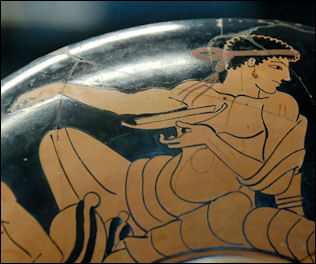 Symposia Banqueter A symposium was a dinner party with family, friends or associates. It generally began with a bout of drinking, followed by a big meal. There were often rules to ensure equality. Conversation topics included philosophy, politics, gossip. For a short period Greeks used birthday cakes. The word symposia was used to describe the party and the place were it was held and is the source of the modern word symposium. The parties were usually lead by a feast master. Sometimes the guests wore garlands. Some people drank heavily; others held back. There are vivid description of party entertainment in Xenophon's dialogue Symposium (380 B.C.). The host pays a man from Syracuse to bring traveling performers (probably slaves), a girl flutists, acrobats, a dancing girl and a boy who dances and plays the kithara , a kind of lyre. The group played music and did performances involving music, dance, acrobatics and mine. The girl juggled hoops, performed acrobatic stunts over a hoop rimmed with knives, and acted out mythical love scenes with the boy. Socrates, one of the guests, was quite taken with the boy. The citizens of Sybaris in present-day southern Italy were such big partiers they reportedly banned roosters so the populous would not be woken to early in the morning. They also supposedly had wine piped directly from the vineyards to the city. Wild Dionysus Festivals 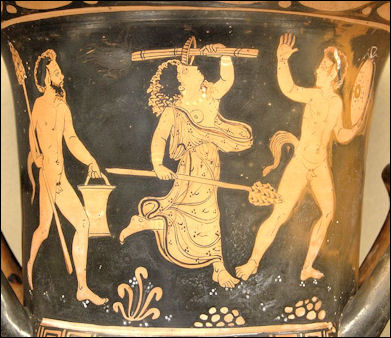 Maenads To pay their respect to Dionysus, the citizens of Athens, and other city-states, held a winter-time festival in which a large phallus was erected and displayed. After competitions were held to see who could empty their jug of wine the quickest, a procession from the sea to the city was held with flute players, garland bearers and honored citizens dressed as satyrs and maenads (nymphs), which were often paired together. At the end of the procession a bull was sacrificed symbolizing the fertility god's marriage to the queen of the city. [Source: "The Creators" by Daniel Boorstin,"] The word “maenad” is derived from the same root that gave us the words “manic” and “madness”. Maenads were subjects of numerous vase paintings. Like Dionysus himself they often depicted with a crown of iv and fawn skins draped over one shoulder. To express the speed and wildness of their movement the figures in the vase images had flying tresses and cocked back head. Their limbs were often in awkward positions, suggesting drunkenness. The main purveyors of the Dionysus fertility cult "These drunken devotees of Dionysus," wrote Boorstin, "filled with their god, felt no pain or fatigue, for they possessed the powers of the god himself. And they enjoyed one another to the rhythm of drum and pipe. At the climax of their mad dances the maenads, with their bare hands would tear apart some little animal that they had nourished at their breast. Then, as Euripides observed, they would enjoy 'the banquet of raw flesh.' On some occasions, it was said, they tore apart a tender child as if it were a fawn'"μ One time the maenads got so involved in what they were doing they had to be rescued from a snow storm in which they were found dancing in clothes frozen solid. On another occasion a government official that forbade the worship of Dionysus was bewitched into dressing up like a maenad and enticed into one of their orgies. When the maenads discovered him, he was torn to pieces until only a severed head remained." It is not totally clear whether the maenad dances were based purely on mythology and were acted out by festival goers or whether there were really episodes of mass hysteria, triggered perhaps by disease and pent up frustration by women living in a male'dominate society. On at least one occasion these dances were banned and an effort was made to chancel the energy into something else such as poetry reading contests. Other Ancient Greek Festivals 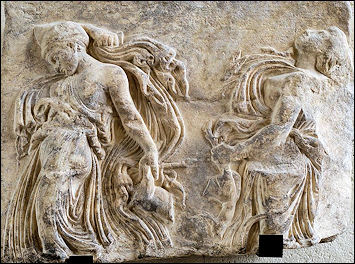 Dancing maenad There were two major festival for Athenian women every year: The Thesmophoria promoted fertility and honored Persephone with piglet sacrifices and the offering of mass-produced statues of the goddess to receive her blessing. The Adonia honored Aphrodite's lover Adonis. It was a riotous festival in which lovers had openly licentious affairs and seeds were planting to mark the beginning of the planting season. During Thesmophoria, an annual Athenian event to honor Demeter and Persephone, women and men who required to abstain from sex and fast for three days. Women erected bowers made of branches and sat there during their fast. On the third day they carried serpent-shaped images thought to have magical powers and entered caves to claim decayed bodied of piglets left the previous years. Pigs were sacred animals to Demeter. The piglet remains were laid on an Thesmphoria altar with offerings, launching a party with feasting, dancing and praying. This rite also featured little girls dressed up as bears. Athena, see Greek Gods Under Religion Ancient Greek Character Based on ancient Greek mythology and art and stereotypes of modern Greeks, many people think of the ancient Greeks as a fun-loving people who indulged themselves in the good life: they drank lots of wine, cherished the sun and the sea, and participated in wild Dionysian festivals. Even so the Greeks regarded overindulgent people as possible traitors who might put their appetites before their loyalty to the state. Important virtues included: style, grace, eloquence and self control. The Greeks looked down on conspicuous consumption and lack of self-control. The historical James Davidson wrote: "The Greeks imposed few rules from outside, but felt a civic responsibility to manage all appetites, to train themselves to deal with them, without trying to conquer them absolutely... The true gentleman manages his appetites. He is in charge of himself...Those who consume immoderately are the true slaves, being slaves to their appetites. It is the profligate and inconsistent who really engage in menial tasks as they are for ever running back and forth trying to fill their leaky jar with desire." The Greeks were very competitive. They were obsessed with battles and sports and even made speech making and poetry-reading into competitive events. The key piece of advise that Achilles was given by his father was: “Always to be the best and outdo the others." Greek had a deep sense melancholy and pessimism based on submission to fate. The historian Jacob Burckhard wrote : “The hero of myth scrupulously directs his whole life according to obscure sayings of the gods, but all vain; the predestined infants (Paris, Oedipus among ethers) left to die of exposure, are rescued and afterwards fulfill what was predicted for them." Some Greeks believed it was best not to be born. The great sage Solon even went as far as saying: “Not one mortal is happy; everyone under the sun is unhappy." 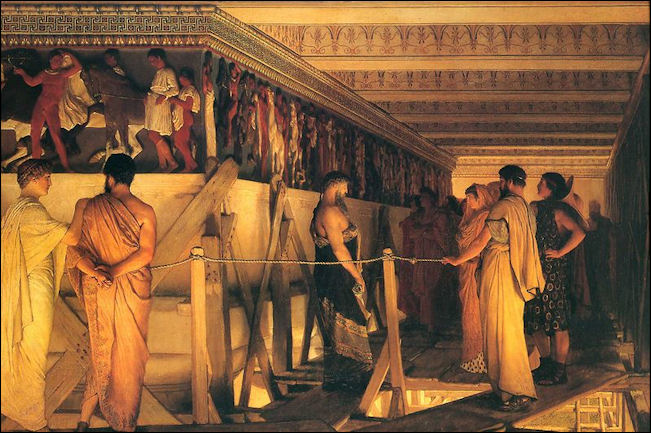 Lawrence Alma-Tadema painting of Phidias Showing the Frieze of the Parthenon to his Friends What Made the Ancient Greeks Laugh? Mary Beard wrote in the Times of London, “In the third century BC, when Roman ambassadors were negotiating with the Greek city of Tarentum, an ill-judged laugh put paid to any hope of peace. Ancient writers disagree about the exact cause of the mirth, but they agree that Greek laughter was the final straw in driving the Romans to war. One account points the finger at the bad Greek of the leading Roman ambassador, Postumius. It was so ungrammatical and strangely accented that the Tarentines could not conceal their amusement."Source: Mary Beard, Times of London, February 2009. Mary Beard is the author of The Roman Triumph published in 2007 and Pompeii: The Life of a Roman Town, 2008 . She is Classics editor of the TLS." The historian Dio Cassius, by contrast, laid the blame on the Romans’national dress. “So far from receiving them decently”, he wrote, “the Tarentines laughed at the Roman toga among other things. It was the city garb, which we use in the Forum. And the envoys had put this on, whether to make a suitably dignified impression or out of fear---thinking that it would make the Tarentines respect them. But in fact groups of revellers jeered at them." One of these revellers, he goes on, even went so far as “to bend down and shit” all over the offending garment. If true, this may also have contributed to the Roman outrage. Yet it is the laughter that Postumius emphasized in his menacing, and prophetic, reply. “Laugh, laugh while you can. For you'll be weeping a long time when you wash this garment clean with your blood." Despite the menace, this story has an immediate appeal. It offers a rare glimpse of how the pompous, toga-clad Romans could appear to their fellow inhabitants of the ancient Mediterranean; and a rare confirmation that the billowing, cumbersome wrap-around toga could look as comic to the Greeks of South Italy as it does to us. But at the same time the story combines some of the key ingredients of ancient laughter: power, ethnicity and the nagging sense that those who mocked their enemies would soon find themselves laughed at. It was, in fact, a firm rule of ancient “gelastics”---to borrow a term (from the Greek gelan, to laugh) from Stephen Halliwell's weighty new study of Greek laughter---that the joker was never far from being the butt of his own jokes Ancient Greco-Roman Joke Book On the only joke book to have survived from the ancient was a Roman-period work written in Greek. Beard wrote, “Known as the Philogelos, this is a composite collection of 260 or so gags in Greek probably put together in the A.D. fourth century but including---as such collections often do---some that go back many years earlier. It is a moot point whether the Philogelos offers a window onto the world of ancient popular laughter (the kind of book you took to the barber's shop, as one antiquarian Byzantine commentary has been taken to imply), or whether it is, more likely, an encyclopedic compilation by some late imperial academic. Either way, here we find jokes about doctors, men with bad breath, eunuchs, barbers, men with hernias, bald men, shady fortune-tellers, and more of the colourful (mostly male) characters of ancient life. [Source: Mary Beard, Times of London, February 2009] The "egghead", or absent-minded professor, is a particular figure of fun, along with the eunuch, and people with hernias or bad breath. "They're also poking fun at certain types of foreigners---people from Abdera, a city in Thrace, were very, very stupid, almost as stupid as [they thought] eggheads [were]," said Beard. Pride of place in the Philogelos, Beard wrote, goes to the “egg-heads”, who are the subject of almost half the jokes for their literal-minded scholasticism (“An egg-head doctor was seeing a patient. “Doctor”, he said, “when I get up in the morning I feel dizzy for 20 minutes." “Get up 20 minutes later, then?”). After the “egg-heads”, various ethnic jokes come a close second. In a series of gags reminiscent of modern Irish or Polish jokes, the residents of three Greek towns---Abdera, Kyme and Sidon---are ridiculed for their “how many Abderites does it take to change a light bulb?” style of stupidity. Why these three places in particular, we have no idea. But their inhabitants are portrayed as being as literal-minded as the egg-heads, and even more obtuse. “An Abderite saw a eunuch talking to a woman and asked if she was his wife. When he replied that eunuchs can't have wives, the Abderite asked, “So is she your daughter then?” And there are many others on predictably similar lines. Beard said the Philogelos shows the Romans were not the "pompous, bridge-building toga wearers" they were often made out to be but rather were a race ready to laugh at themselves. Alison Flood of The Guardian wrote, “Beard's favourite joke is a version of the Englishman, Irishman, Scotsman variety, with a barber, a bald man and an absent-minded professor taking a journey together. They have to camp overnight, so decide to take turns watching the luggage. When it's the barber's turn, he gets bored, so amuses himself by shaving the head of the professor. When the professor is woken up for his shift, he feels his head, and says "How stupid is that barber? He's woken up the bald man instead of me." [Source: Alison Flood, guardian.co.uk, March 13 2009 ] 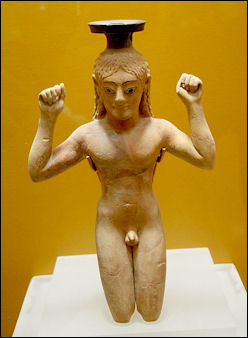 perfume bottle "It's one of the better ones," said Beard. "It has a nice identity resonance ... A lot of the jokes play on the obviously quite problematic idea in Roman times of knowing who you are." Another "identity" joke sees a man meet an acquaintance and say "it's funny, I was told you were dead". He says "well, you can see I'm still alive." But the first man disputes this on the grounds that "the man who told me you were dead is much more reliable than you". An ancient version of Monty Python's dead parrot sketch sees a man buy a slave, who dies shortly afterwards. When he complains to the seller, he is told: "He didn't die when I owned him." In her quest to find out if people today found the same things funny as the Romans she told a a joke to one of her graduate classes, in which an absent-minded professor is asked by a friend to bring back two 15-year-old slave boys from his trip abroad, and replies "fine, and if I can't find two 15-year-olds I will bring you one 30-year-old," she found they "chortled no end". "They thought it was a sex joke, equivalent to someone being asked for two 30-year-old women, and being told okay, I'll bring you one 60-year-old. But I suspect it's a joke about numbers---are numbers real? If so two 15-year-olds should be like one 30-year-old---it's about the strange unnaturalness of the number system." 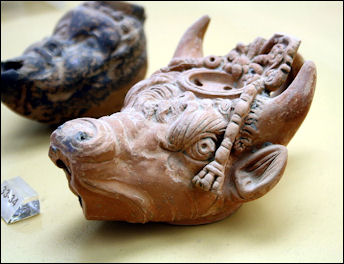 boar head oil llmp Beard, who discovered the title while carrying out research for a new book she's working on about humour in the ancient world, pointed out that when we're told a joke, we make a huge effort to make it funny for ourselves, or it's an admission of failure. "Are we doing that to these Roman jokes? Were they actually laughing at something quite different?" Analysis of Ancient Greek Jokes 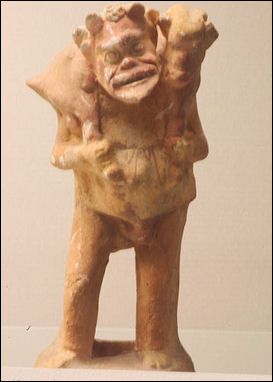 comedian actor with goat, 3d century BC The most puzzling aspect of the jokes in the Philogelos is the fact that so many of them still seem vaguely funny. Across two millennia, their hit-rate for raising a smile is better than that of most modern joke books. And unlike the impenetrably obscure cartoons in nineteenth-century editions of Punch, these seem to speak our own comic language. In fact, the stand-up comedian Jim Bowen has recently managed to get a good laugh out of twenty-first-century audiences with a show entirely based on jokes from the Philogelos. Why do ancient Greek jokes seem so modern? In the case of Jim Bowen's performance, careful translation and selection has something to do with it (I doubt that contemporary audiences would split their sides at the one about the crucified athlete who looked as if he was flying instead of running). There is also very little background knowledge required to see the point of these stories, in contrast to the precisely topical references that underlie so many Punch cartoons. Not to mention the fact that some of Bowen's audience are no doubt laughing at the sheer incongruity of listening to a modern comic telling 2,000-year-old gags, good or bad. [Source: Mary Beard, Times of London, February 2009] But there is more to it than that. It is not, I suspect, much to do with supposedly “universal” topics of humour (though death and mistaken identity bulked large then as now). It is more a question of a direct legacy from the ancient world to our own, modern, traditions of laughter. Anyone who has been a parent, or has watched parents with their children, will know that human beings learn how to laugh, and what to laugh at (clowns OK, the disabled not). On a grander scale, it is---in large part at least---from the Renaissance tradition of joking that modern Western culture itself has learned how to laugh at “jokes”; and that tradition looked straight back to antiquity. One of the favourite gags in Renaissance joke books was the “No-but-my-father-did” quip about paternity, while the legendary Cambridge classicist Richard Porson is supposed to have claimed that most of the jokes in the famous eighteenth-century joke book Joe Miller's Jests could be traced back to the Philogelos. We can still laugh at these ancient jokes, in other words, because it is from them that we have learned what “laughing at jokes” is. 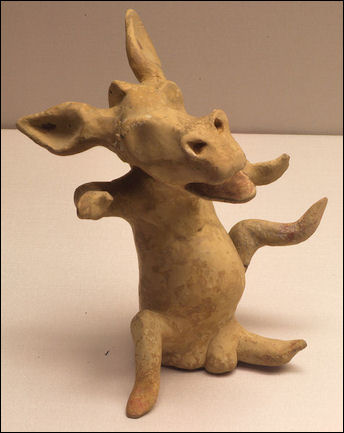 actor as donkey 5th century BC This is not to say, of course, that all the coordinates of ancient laughter map directly onto our own. Far from it. Even in the Philogelos a few of the jokes remain totally baffling (though perhaps they are just bad jokes). But, more generally, Greeks and Romans could laugh at different things (the blind, for example---though rarely, unlike us, the deaf); and they could laugh, and provoke laughter, on different occasions to gain different ends. Ridicule was a standard weapon in the ancient courtroom, as it is only rarely in our own. Cicero, antiquity's greatest orator, was also by repute its greatest joker; far too funny for his own good, some sober citizens thought. There are some particular puzzles, too, ancient comedy foremost among them. There may be little doubt that the Athenian audience laughed heartily at the plays of Aristophanes, as we can still. But very few modern readers have been able to find much to laugh at in the hugely successful comedies of the fourth-century dramatist Menander, formulaic and moralizing as they were. Are we missing the joke? Or were they simply not funny in that laugh-out-loud sense? Discussing the plays in Greek Laughter, Halliwell offers a possible solution. Conceding that “Menandrian humour, in the broadest sense of the term, is resistant to confident diagnosis? (that is, we don't know if, or how, it is funny), he neatly turns the problem on its head. They are not intended to raise laughs; rather “they are actually in part about laughter”. Their complicated “comic” plots, and the contrasts set up within them between characters we might want to laugh at and those we want to laugh with, must prompt the audience or reader to reflect on the very conditions that make laughter possible or impossible, socially acceptable or unacceptable. For Halliwell, in other words, Menander's “comedy” functions as a dramatic essay on the fundamental principles of Greek gelastics. On other occasions, it is not always immediately clear how or why the ancients ranked things as they did, on the scale between faintly amusing and very funny indeed. Halliwell mentions in passing a series of anecdotes that tell of famous characters from antiquity who laughed so much that they died. Zeuxis, the famous fourth-century Greek painter, is one. He collapsed, it is said, after looking at his own painting of an elderly woman. The philosopher Chrysippus and the dramatist Polemon, a contemporary of Menander, are others. Both of these were finished off, as a similar story in each case relates, after they had seen an ass eating some figs that had been prepared for their own meal. They told their servants to give the animal some wine as well---and died laughing at the sight. The conceit of death by laughter is a curious one and not restricted to the ancient world. Anthony Trollope, for example, is reputed to have “corpsed” during a reading of F. Anstey's comic novel Vice Versa. But what was it about these particular sights (or Vice Versa, for that matter) that proved so devastatingly funny” In the case of Zeuxis, it is not hard to detect a well-known strain of ancient misogyny. In the other cases, it is presumably the confusion of categories between animal and human that produces the laughter---as we can see in other such stories from antiquity. Ancient Greek Customs The custom of making a toast to one's health dates back to 5th century B.C. Greece when a host took a drink of wine from a decanter to show it was safe to drink before his guest took a drink. Later the act became associated with pledge of friendship. The Romans sometimes dropped a piece of burnt toast into a cup of wine, which gave birth to expression toast. The Ancient Egyptians, Asian, Persians, Greeks and Romans showed respect by kissing the hand, feet or hem of the shirt of important people. Herodotus wrote that Persian kisses ranged from lip on lip for equals to the ground or feet by an exorbitantly lower status person to a higher one. A Babylonian creation story recorded on stone tablets in the seventh-century B.C."--based on much older oral legends---includes references to a kiss of greeting and a kiss of the ground or feet in supplication. The Roman emperor Caligula had subjects kiss his feet, which also was a custom throughout the Middle Ages. [Source: Leanne Italie, Associated Press, March 12, 2011]  Roman-era mosaic of slaves Ancient Greek Society and the Rich, the Poor and Middle Class Greek aristocrats were not very fond of the masses. One member of the ruling elite used to walk through the streets clubbing people he disliked. Aristotle classified humanity into two kinds of people: The few, smart people destined to be masters: and the multitudes of less talented people designated to be slaves. As people were able to make a living by trading and selling crafts, a fledgling middle class emerged. Labor and Slaves in Ancient Greece The Greeks were not known for having a strong work ethic. Citizens abhorred physical labor and came to rely on slaves. Even the tireless classifier himself, Aristotle, believed that the goal of a civilized man was to attain a life of leisure so that he was free to pursue the higher things in life. How was this life of leisure attained?...With slaves, of course. Tradesmen and merchants were looked down upon and teachers and doctors had about the same status as a craftsman. The only respectable occupations were farming, politics and philosophizing. Aristotle also believed that the laws of nature dictated that free men should rule and dominate slaves and women."[Source: "Greek and Roman Life" by Ian Jenkins from the British Museum,"|] Slaves were bought at the market. The were used in mining, agriculture, construction and as household slaves. Slaves could be craftsmen, entertainers, teachers, secretaries or even businessmen trading for themselves. One thing a slave was not was a citizen. Mycenaean tablets, dated at 1200 B.C., described slave women who worked as grain grinders, spinners, and pourers of baths, They were often grouped by the places they were captured: "women in Asia," "women of Knidoes," "women of Miletos." The Greeks used slaves and prisoners to build their temples. Most slaves were people captured in wars or pirates raids. In many cases they were serfs, or conquered people, that came with the land and passed their statuses down from generation to generation .  collared slaves The status of a slave was often closer to that of an animal than a human being. They were tortured on the stand in a court of law until they told the "truth" and put to death for simply belonging to a murdered man. They sometimes held their chamber pots of their masters. Slaves were branded on their faces until the A.D. 4th century when Constantine, the first Christianized Roman emperor, decided that it was a inhuman thing to do to a creation of God, so he ordered that they be branded on their arms and legs instead. [Source: "Greek and Roman Life" by Ian Jenkins from the British Museum,"|] A good book on slavery in the ancient world is Ancient Slavery and Modern Ideology by Moses Finley. On this book Cambridge classics professor Mary Beard said, “When I read this book it was the first time I realized that there could be, and ought to be, an explicit connection between a modern political stance and the ancient history that I was studying. Slavery is a classic case for thinking about those connections. Greece and Rome were one of the few mass slave-owning societies that there have ever been. What Finley was interested in doing was looking hard at ancient slavery and thinking about how it was the same or different from modern slavery. One key difference that comes out is that modern slavery is tinged by racism, whereas ancient slavery wasn’t. He was the first person I had read who looked ancient slavery in the eye and said it was something really terrible. All the stuff that I had read before had been slightly embarrassed about ancient slavery and saw it as a blot on the landscape. They said: “The Greeks were so wonderful and slavery was a bit of a problem but you shouldn't think about it. It was more like domestic service really!” And Finley says you can't let the ancient world off the hook. You have to have a moral stance on this one. Slaves were often freed or allowed to buy their freedom. Slaves, See Labor Under Economics Minorities and Racism in Ancient Greece Different states had different personalities: Sparta was the land of warriors. Sybaris was known for its love of luxury. The word barbaros , from which “barbarian” is derived did not originally have pejorative connotations. It simple meant people who didn't speak Greek and their speech sounded to the Greeks like bar-bar-bar . On racism in ancient Greece and Rome, Cambridge classics professor Mary Beard wrote in her blog A Don's Life: “There is no doubt at all that they often treated outsiders badly. The idea of the “barbarian” (someone whose speech is just an incomprehensible “ba ba”) is a well known Greek invention. But the cultural identity of both societies was even more pervasively based on what we would now see as an unhealthy distrust of anyone different from themselves. Xenophobia in other words. [Source: Mary Beard, A Don's Life Blogg, January 22, 2007] The list of unnatural things that foreigners were supposed to get up to is a long one. It ranged from peculiar eating habits (not just frogs legs or poppadoms, but at its worst cannibalism) to strange regimes of hygiene (women standing up to piss was a notable source of wonderment and/or disdain) and topsy-turvy ideas of sex and gender (women in charge). The Greeks painted a contemptuous picture of the Persians as trousered, decadent softies who wore far too much perfume. Then the Romans came along and, minus the trousers, said much the same about the Greeks: a nice example of being given a taste of your own medicine. But, strikingly, it's usually claimed that neither Greeks nor Romans bothered very much about skin colour. This was a time “before colour prejudice”. It's certainly the case that there seems to have been no general idea of social, cultural or intellectual inferiority based on the colour of a person's skin. There was no homogeneous slave class, of a different race and colour from their masters. And, in fact, exactly what skin colours were represented, and in what numbers, in the multi-cultural population of the Roman empire is something of puzzle. The second century AD emperor, Septimius Severus who came from modern Libya definitely wasn't black (even though that's sometimes asserted); but then he probably wasn't as white as some of his marble busts make him seem either. Ancient stories too suggest a very different set of assumptions about blackness and whiteness. There is marvellous episode which touches just this subject in the Aethiopica (Ethiopian Story), a novel by Heliodorus, a third-century AD Greek writer from Syria. Persinna, the black queen of Ethiopia, with a black husband, gave birth to a white daughter. How did she explain it? She had been looking at a picture of (white) Andromeda at the time of the girl's conception. But is it all quite so simple? Probably not. There's a recent book by Ben Isaac, The Invention of Racism in Classical Antiquity, which claims to have identified if not racism, then at least “proto-racism” in the ancient world. Isaac insists (as do most serious analysts) that racism goes beyond casual xenophobia. It is a deterministic ideology, which sees some groups as unalterably inferior, thanks to natural or inherited characteristics. In modern society, the key natural characteristic has been skin colour. Not so in the ancient world. But Isaac thinks he can identify something similarly deterministic (and so racist) in other, quite different, natural factors. For him, the ancients were not colour-prejudiced; instead they were geographical and environmental determinists. To over-simplify a bit, he charges the Greeks and Romans with being “proto-racists” in the sense that they believed that the characteristics which certain races derived from their (inferior) environment and from the climate in which they lived---the rain and fog of Northern Europe, for example -- were fixed and irreversibly inferior. Image Sources: Wikimedia Commons, The Louvre, The British Museum Text Sources: New York Times, Washington Post, Los Angeles Times, Times of London, Yomiuri Shimbun, The Guardian, National Geographic, The New Yorker, Time, Newsweek, Reuters, AP, Lonely Planet Guides, Compton's Encyclopedia and various books and other publications. Most of the information about Greco-Roman science, geography, medicine, time, sculpture and drama was taken from "The Discoverers" [∞] and "The Creators" [μ]" by Daniel Boorstin. Most of the information about Greek everyday life was taken from a book entitled "Greek and Roman Life" by Ian Jenkins from the British Museum. |
| json metadata | {"tags":["history"],"image":["https://steemitimages.com/DQmejo9LRNi6WfiTkMDjYE26fiboe8m7stNKfpTyNrtRkEx/image.png","https://steemitimages.com/DQmYxLdxYZCVVXGWaYScFBm9NzzXrGFe5q5VdYcpzPdFCfD/image.png","https://steemitimages.com/DQmS3DAZFGSCZb9TaPcyTmyk7s8cMDfmbgK61WkXKmUEVMm/image.png","https://steemitimages.com/DQmXSWgyBytS3cwjQQ1tuB4mXmYDqNB7yv6rR1DP8FQwS4d/image.png","https://steemitimages.com/DQmdX33NU6qzbK1RXMzXuz3iCrxVxyw3hWNRQTPEnbY7Swr/image.png","https://steemitimages.com/DQmaf8PeRQRq4zUUJMqrnMoDNLpUxvNcioDxv2UMVrFTtpA/image.png","https://steemitimages.com/DQmVqmNFojLUfrzsDCgJLjGbZNnaK8W3AgM5Ue1wNe6zSAC/image.png","https://steemitimages.com/DQmPnn4z1yQztZ6E92vZm9urqdsc4aCgrVWh3xC3gY24o2x/image.png","https://steemitimages.com/DQmbQmKhgsxUgBx89saT5EivGFdbDCog17pZ1PWqciKThiD/image.png","https://steemitimages.com/DQmfXSmfKRjiwPH3pZDxMG8ufdP1jZNtHMSGFCw5DwgoRqC/image.png","https://steemitimages.com/DQmcQKmQmoUdffektH8ceLQCNmDxnyaWTVg7qVMtTu5PPSL/image.png","https://steemitimages.com/DQmcKm23LDTbXNgVWtV21pYJQ6TU6xYZdu8eYEwqyBnzQb1/image.png","https://steemitimages.com/DQmWqAbw5T5yJixFTXtSAsMmkwAk5KYU7CRKqdtLmPLFS8j/image.png","https://steemitimages.com/DQmXeo2o68ABrmizvvgFMEhdpFNoDw41TjYswp5AE2otQyG/image.png"],"app":"steemit/0.1","format":"markdown"} |
| parent author | |
| parent permlink | history |
| permlink | ancient-greek-people-festivals-customs-and-humor |
| title | ANCIENT GREEK PEOPLE, FESTIVALS, CUSTOMS AND HUMOR |
| Transaction Info | Block #17537447/Trx d7f66e7aa5011f1802d446af80acabb10aa93f9a |
View Raw JSON Data
{
"block": 17537447,
"op": [
"comment",
{
"author": "giorgos",
"body": "POPULATION OF ANCIENT GREECE\n\n\nCalyx krater\n\n When ancient Greece was at its height it was resource poor and overpopulated. The Greeks needed to colonize the Mediterranean to get resources. Half of the population in some city states were farmers who lived outside the city.\n\n By the 4th century B.C. it has been estimated that in all of ancient Greece there were only about 250,000 people. After the Peloponnesian wars and the plague the population city-state of Athens had been reduced by from around 80,000 to as a low as 21,000.\n\nBirth Control and Contraceptives in Ancient Greece\n\n According to historians, demographic studies suggest the ancients attempted to limit family size. Greek historians wrote that urban families in the first and second centuries B.C. tried to have only one or two children. Between A.D. 1 and 500, it was estimated the population within the bounds of the Roman Empire declined from 32.8 million to 27.5 million (but there can be all sorts of reason for this excluding birth control).\n\n Birth control methods in ancient Greece included avoiding deep penetration when menstruation was \"ending and abating\" (the time Greeks thought a woman was most fertile); sneezing and drinking something cold after having sex; and wiping the cervix with a lock of fine wool or smearing it with salves and oils made from aged olive oil, honey, cedar resin, white lead and balsam tree oil. Before intercourse women tried applying a perceived spermicidal oil made from juniper trees or blocking their cervix with a block of wood. Women also ate dates and pomegranates to avoid pregnancy (modern studies have shown that the fertility of rats decreases when they ingest these foods).\n\n Women in Greece and the Mediterranean were told that scooped out pomegranates halves could be used as cervical caps and sea sponges rinsed in acidic lemon juice could serve as contraceptives. The Greek physician Soranus wrote in the 2nd century A.D. : \"the woman ought, in the moment during coitus when the man ejaculates his sperm, to hold her breath, draw her body back a little so the semen cannot penetrate into the uteri, then immediately get up and sit down with bent knees, and this position provoke sneezes.\"\n\nValuable Ancient Greek Contraceptive Plant\n\n\nsilphion\n\nIn the seventh century B.C., Greek colonists in Libya discovered a plant called silphion , a member of the fennel family which also includes asafoetida , one of the important flavorings in Worcester sauce. The pungent sap from silphion, the ancient Greeks found, helped relieve coughs and tasted good on food, but more importantly it proved to be an effective after-intercourse contraceptive. A substance from a similar plant called ferujol has been shown in modern clinical studies to be 100 percent successful in preventing pregnancy in female rats up to three days after coitus. [Source: John Riddle, J. Worth Estes and Josiah Russell, Archaeology magazine, March/April 1994]\n\n Known to the Greeks as silphion and to the Romans as silphium, the plant brought prosperity to the Greek city-state of Cyrene. Worth more than is weight on silver, it was described by Hippocrates, Diosorides and a play by Aristophanes.\n\n Sixth century B.C. coins depicted women touching the silphion plant with one hand and pointing at their genitals with the other. The plant was so much in demand in ancient Greece it eventually became scarce, and attempts to grow it outside of the 125-mile-long mountainous region it grew in Libya failed. By the 5th century B.C., Aristophanes wrote in his play The Knights , \"Do you remember when a stalk of silphion sold so cheap?\" By the third or forth century A.D., the contraceptive plant was extinct.\n\nAbortions in Ancient Greece\n\n \nsilphion symbol\n\n Abortions were performed in ancient times, says North Carolina State history professor John Riddle, and discussions about featured many of the same arguments we hear today. The Greeks and Romans made a distinction between a fetus with features and one without features. The latter could be aborted without having to worry about legal or religious reprisals. Plato advocated population control in the ideal city state and Aristotle suggested that \"if conception occurs in excess...have abortion induced before sense and life have begun in the embryo.\"\n\nThe Stoics believed the human soul appeared when first exposed to cool air, and the potential for a soul existed at conception. Hippocrates warned physicians in his oath not to use one kind of abortive suppository, but the statement was misinterpreted as a blanket condemnation of all of abortion. John Chrystom, the Byzantine bishop of Constantinople compared abortion to murder in A.D. 390, but a few years earlier Bishop Gregory of Nyssa said the unformed embryo could not be considered a human being. [Riddle has written a book called Contraception and Abortion from the Ancient World to the Renaissance ].\n\nAncient Greek Holidays and Festivals\n\n\n\nFestivals and feasts were held throughout the year. In Athens alone there were 120 days of festivals a year. Most festivals were harvest festivals or religious festivals. As Greece became urbanized more people turned out for these festivals and the activities became more elaborate. Festivals were often financed by the state and were regarded as a reflection on the city's image.\n\n The citizens of Athens gathered once a year for the Panathanaic procession in which they dressed in woven robes like the one believed to be worn by Athena and marched through the city to the Acropolis. The procession was led by the Athenian cavalry and included priests, sacrificial animals, chariots, athletes, and maidens. One of the marque events was the apobates , in which contestants in full armor leapt on and off moving chariots.\n\n The Greeks had some strange festivals associated with destroying things and ideas thought to be impure. During Bouphonia in Athens a sacrifice was held, then the ax used in the sacrifice was tried and condemned to death and thrown in the sea. After a hanging in Cos the rope and tree were banished. During the Ionian festival honoring Apollo sins were loaded onto a cart and taken out of town. [\"World Religions\" edited by Geoffrey Parrinder, Facts on File Publications, New York]\n\n Comic playwrights had the most fun on the Day of Misrule, a holiday when nothing was sacred. Arcane philosophers were satirized, sexual morality was mocked, and even the gods were objects of ridicule.\n\n Mary Renault's The Mask of Apollo contains good descriptions of religious festivals.\n\nAncient Greek Parties and Symposia\n\n\nSymposia Banqueter\n\nA symposium was a dinner party with family, friends or associates. It generally began with a bout of drinking, followed by a big meal. There were often rules to ensure equality. Conversation topics included philosophy, politics, gossip. For a short period Greeks used birthday cakes.\n\n The word symposia was used to describe the party and the place were it was held and is the source of the modern word symposium. The parties were usually lead by a feast master. Sometimes the guests wore garlands. Some people drank heavily; others held back.\n\n There are vivid description of party entertainment in Xenophon's dialogue Symposium (380 B.C.). The host pays a man from Syracuse to bring traveling performers (probably slaves), a girl flutists, acrobats, a dancing girl and a boy who dances and plays the kithara , a kind of lyre. The group played music and did performances involving music, dance, acrobatics and mine. The girl juggled hoops, performed acrobatic stunts over a hoop rimmed with knives, and acted out mythical love scenes with the boy. Socrates, one of the guests, was quite taken with the boy.\n\n The citizens of Sybaris in present-day southern Italy were such big partiers they reportedly banned roosters so the populous would not be woken to early in the morning. They also supposedly had wine piped directly from the vineyards to the city.\n\nWild Dionysus Festivals\n\n\nMaenads\n\nTo pay their respect to Dionysus, the citizens of Athens, and other city-states, held a winter-time festival in which a large phallus was erected and displayed. After competitions were held to see who could empty their jug of wine the quickest, a procession from the sea to the city was held with flute players, garland bearers and honored citizens dressed as satyrs and maenads (nymphs), which were often paired together. At the end of the procession a bull was sacrificed symbolizing the fertility god's marriage to the queen of the city. [Source: \"The Creators\" by Daniel Boorstin,\"]\n\n The word “maenad” is derived from the same root that gave us the words “manic” and “madness”. Maenads were subjects of numerous vase paintings. Like Dionysus himself they often depicted with a crown of iv and fawn skins draped over one shoulder. To express the speed and wildness of their movement the figures in the vase images had flying tresses and cocked back head. Their limbs were often in awkward positions, suggesting drunkenness.\n\nThe main purveyors of the Dionysus fertility cult \"These drunken devotees of Dionysus,\" wrote Boorstin, \"filled with their god, felt no pain or fatigue, for they possessed the powers of the god himself. And they enjoyed one another to the rhythm of drum and pipe. At the climax of their mad dances the maenads, with their bare hands would tear apart some little animal that they had nourished at their breast. Then, as Euripides observed, they would enjoy 'the banquet of raw flesh.' On some occasions, it was said, they tore apart a tender child as if it were a fawn'\"μ\n\n One time the maenads got so involved in what they were doing they had to be rescued from a snow storm in which they were found dancing in clothes frozen solid. On another occasion a government official that forbade the worship of Dionysus was bewitched into dressing up like a maenad and enticed into one of their orgies. When the maenads discovered him, he was torn to pieces until only a severed head remained.\"\n\n It is not totally clear whether the maenad dances were based purely on mythology and were acted out by festival goers or whether there were really episodes of mass hysteria, triggered perhaps by disease and pent up frustration by women living in a male'dominate society. On at least one occasion these dances were banned and an effort was made to chancel the energy into something else such as poetry reading contests.\n\nOther Ancient Greek Festivals\n\n\nDancing maenad\n\nThere were two major festival for Athenian women every year: The Thesmophoria promoted fertility and honored Persephone with piglet sacrifices and the offering of mass-produced statues of the goddess to receive her blessing. The Adonia honored Aphrodite's lover Adonis. It was a riotous festival in which lovers had openly licentious affairs and seeds were planting to mark the beginning of the planting season.\n\n During Thesmophoria, an annual Athenian event to honor Demeter and Persephone, women and men who required to abstain from sex and fast for three days. Women erected bowers made of branches and sat there during their fast. On the third day they carried serpent-shaped images thought to have magical powers and entered caves to claim decayed bodied of piglets left the previous years. Pigs were sacred animals to Demeter. The piglet remains were laid on an Thesmphoria altar with offerings, launching a party with feasting, dancing and praying. This rite also featured little girls dressed up as bears.\n\nAthena, see Greek Gods Under Religion\n\nAncient Greek Character\n\n Based on ancient Greek mythology and art and stereotypes of modern Greeks, many people think of the ancient Greeks as a fun-loving people who indulged themselves in the good life: they drank lots of wine, cherished the sun and the sea, and participated in wild Dionysian festivals. Even so the Greeks regarded overindulgent people as possible traitors who might put their appetites before their loyalty to the state.\n\n Important virtues included: style, grace, eloquence and self control. The Greeks looked down on conspicuous consumption and lack of self-control. The historical James Davidson wrote: \"The Greeks imposed few rules from outside, but felt a civic responsibility to manage all appetites, to train themselves to deal with them, without trying to conquer them absolutely... The true gentleman manages his appetites. He is in charge of himself...Those who consume immoderately are the true slaves, being slaves to their appetites. It is the profligate and inconsistent who really engage in menial tasks as they are for ever running back and forth trying to fill their leaky jar with desire.\"\n\n The Greeks were very competitive. They were obsessed with battles and sports and even made speech making and poetry-reading into competitive events. The key piece of advise that Achilles was given by his father was: “Always to be the best and outdo the others.\"\n\n Greek had a deep sense melancholy and pessimism based on submission to fate. The historian Jacob Burckhard wrote : “The hero of myth scrupulously directs his whole life according to obscure sayings of the gods, but all vain; the predestined infants (Paris, Oedipus among ethers) left to die of exposure, are rescued and afterwards fulfill what was predicted for them.\" Some Greeks believed it was best not to be born. The great sage Solon even went as far as saying: “Not one mortal is happy; everyone under the sun is unhappy.\"\n\n\nLawrence Alma-Tadema painting of Phidias Showing the Frieze of the Parthenon to his Friends\n\nWhat Made the Ancient Greeks Laugh?\n\n Mary Beard wrote in the Times of London, “In the third century BC, when Roman ambassadors were negotiating with the Greek city of Tarentum, an ill-judged laugh put paid to any hope of peace. Ancient writers disagree about the exact cause of the mirth, but they agree that Greek laughter was the final straw in driving the Romans to war. One account points the finger at the bad Greek of the leading Roman ambassador, Postumius. It was so ungrammatical and strangely accented that the Tarentines could not conceal their amusement.\"Source: Mary Beard, Times of London, February 2009. Mary Beard is the author of The Roman Triumph published in 2007 and Pompeii: The Life of a Roman Town, 2008 . She is Classics editor of the TLS.\"\n\n The historian Dio Cassius, by contrast, laid the blame on the Romans’national dress. “So far from receiving them decently”, he wrote, “the Tarentines laughed at the Roman toga among other things. It was the city garb, which we use in the Forum. And the envoys had put this on, whether to make a suitably dignified impression or out of fear---thinking that it would make the Tarentines respect them. But in fact groups of revellers jeered at them.\" One of these revellers, he goes on, even went so far as “to bend down and shit” all over the offending garment. If true, this may also have contributed to the Roman outrage. Yet it is the laughter that Postumius emphasized in his menacing, and prophetic, reply. “Laugh, laugh while you can. For you'll be weeping a long time when you wash this garment clean with your blood.\"\n\n Despite the menace, this story has an immediate appeal. It offers a rare glimpse of how the pompous, toga-clad Romans could appear to their fellow inhabitants of the ancient Mediterranean; and a rare confirmation that the billowing, cumbersome wrap-around toga could look as comic to the Greeks of South Italy as it does to us. But at the same time the story combines some of the key ingredients of ancient laughter: power, ethnicity and the nagging sense that those who mocked their enemies would soon find themselves laughed at. It was, in fact, a firm rule of ancient “gelastics”---to borrow a term (from the Greek gelan, to laugh) from Stephen Halliwell's weighty new study of Greek laughter---that the joker was never far from being the butt of his own jokes\n\nAncient Greco-Roman Joke Book\n\n \n On the only joke book to have survived from the ancient was a Roman-period work written in Greek. Beard wrote, “Known as the Philogelos, this is a composite collection of 260 or so gags in Greek probably put together in the A.D. fourth century but including---as such collections often do---some that go back many years earlier. It is a moot point whether the Philogelos offers a window onto the world of ancient popular laughter (the kind of book you took to the barber's shop, as one antiquarian Byzantine commentary has been taken to imply), or whether it is, more likely, an encyclopedic compilation by some late imperial academic. Either way, here we find jokes about doctors, men with bad breath, eunuchs, barbers, men with hernias, bald men, shady fortune-tellers, and more of the colourful (mostly male) characters of ancient life. [Source: Mary Beard, Times of London, February 2009]\n\n The \"egghead\", or absent-minded professor, is a particular figure of fun, along with the eunuch, and people with hernias or bad breath. \"They're also poking fun at certain types of foreigners---people from Abdera, a city in Thrace, were very, very stupid, almost as stupid as [they thought] eggheads [were],\" said Beard. Pride of place in the Philogelos, Beard wrote, goes to the “egg-heads”, who are the subject of almost half the jokes for their literal-minded scholasticism (“An egg-head doctor was seeing a patient. “Doctor”, he said, “when I get up in the morning I feel dizzy for 20 minutes.\" “Get up 20 minutes later, then?”). After the “egg-heads”, various ethnic jokes come a close second. In a series of gags reminiscent of modern Irish or Polish jokes, the residents of three Greek towns---Abdera, Kyme and Sidon---are ridiculed for their “how many Abderites does it take to change a light bulb?” style of stupidity. Why these three places in particular, we have no idea. But their inhabitants are portrayed as being as literal-minded as the egg-heads, and even more obtuse. “An Abderite saw a eunuch talking to a woman and asked if she was his wife. When he replied that eunuchs can't have wives, the Abderite asked, “So is she your daughter then?” And there are many others on predictably similar lines.\n\nBeard said the Philogelos shows the Romans were not the \"pompous, bridge-building toga wearers\" they were often made out to be but rather were a race ready to laugh at themselves. Alison Flood of The Guardian wrote, “Beard's favourite joke is a version of the Englishman, Irishman, Scotsman variety, with a barber, a bald man and an absent-minded professor taking a journey together. They have to camp overnight, so decide to take turns watching the luggage. When it's the barber's turn, he gets bored, so amuses himself by shaving the head of the professor. When the professor is woken up for his shift, he feels his head, and says \"How stupid is that barber? He's woken up the bald man instead of me.\" [Source: Alison Flood, guardian.co.uk, March 13 2009 ]\n\n\nperfume bottle\n\n\"It's one of the better ones,\" said Beard. \"It has a nice identity resonance ... A lot of the jokes play on the obviously quite problematic idea in Roman times of knowing who you are.\" Another \"identity\" joke sees a man meet an acquaintance and say \"it's funny, I was told you were dead\". He says \"well, you can see I'm still alive.\" But the first man disputes this on the grounds that \"the man who told me you were dead is much more reliable than you\". An ancient version of Monty Python's dead parrot sketch sees a man buy a slave, who dies shortly afterwards. When he complains to the seller, he is told: \"He didn't die when I owned him.\"\n\n In her quest to find out if people today found the same things funny as the Romans she told a a joke to one of her graduate classes, in which an absent-minded professor is asked by a friend to bring back two 15-year-old slave boys from his trip abroad, and replies \"fine, and if I can't find two 15-year-olds I will bring you one 30-year-old,\" she found they \"chortled no end\". \"They thought it was a sex joke, equivalent to someone being asked for two 30-year-old women, and being told okay, I'll bring you one 60-year-old. But I suspect it's a joke about numbers---are numbers real? If so two 15-year-olds should be like one 30-year-old---it's about the strange unnaturalness of the number system.\"\n\n\nboar head oil llmp\n\n Beard, who discovered the title while carrying out research for a new book she's working on about humour in the ancient world, pointed out that when we're told a joke, we make a huge effort to make it funny for ourselves, or it's an admission of failure. \"Are we doing that to these Roman jokes? Were they actually laughing at something quite different?\"\n\nAnalysis of Ancient Greek Jokes\n\n\ncomedian actor with goat, \n3d century BC\n\nThe most puzzling aspect of the jokes in the Philogelos is the fact that so many of them still seem vaguely funny. Across two millennia, their hit-rate for raising a smile is better than that of most modern joke books. And unlike the impenetrably obscure cartoons in nineteenth-century editions of Punch, these seem to speak our own comic language. In fact, the stand-up comedian Jim Bowen has recently managed to get a good laugh out of twenty-first-century audiences with a show entirely based on jokes from the Philogelos.\n\n Why do ancient Greek jokes seem so modern? In the case of Jim Bowen's performance, careful translation and selection has something to do with it (I doubt that contemporary audiences would split their sides at the one about the crucified athlete who looked as if he was flying instead of running). There is also very little background knowledge required to see the point of these stories, in contrast to the precisely topical references that underlie so many Punch cartoons. Not to mention the fact that some of Bowen's audience are no doubt laughing at the sheer incongruity of listening to a modern comic telling 2,000-year-old gags, good or bad. [Source: Mary Beard, Times of London, February 2009]\n\n But there is more to it than that. It is not, I suspect, much to do with supposedly “universal” topics of humour (though death and mistaken identity bulked large then as now). It is more a question of a direct legacy from the ancient world to our own, modern, traditions of laughter. Anyone who has been a parent, or has watched parents with their children, will know that human beings learn how to laugh, and what to laugh at (clowns OK, the disabled not). On a grander scale, it is---in large part at least---from the Renaissance tradition of joking that modern Western culture itself has learned how to laugh at “jokes”; and that tradition looked straight back to antiquity. One of the favourite gags in Renaissance joke books was the “No-but-my-father-did” quip about paternity, while the legendary Cambridge classicist Richard Porson is supposed to have claimed that most of the jokes in the famous eighteenth-century joke book Joe Miller's Jests could be traced back to the Philogelos. We can still laugh at these ancient jokes, in other words, because it is from them that we have learned what “laughing at jokes” is.\n\n\nactor as donkey \n5th century BC\n\nThis is not to say, of course, that all the coordinates of ancient laughter map directly onto our own. Far from it. Even in the Philogelos a few of the jokes remain totally baffling (though perhaps they are just bad jokes). But, more generally, Greeks and Romans could laugh at different things (the blind, for example---though rarely, unlike us, the deaf); and they could laugh, and provoke laughter, on different occasions to gain different ends. Ridicule was a standard weapon in the ancient courtroom, as it is only rarely in our own. Cicero, antiquity's greatest orator, was also by repute its greatest joker; far too funny for his own good, some sober citizens thought.\n\n There are some particular puzzles, too, ancient comedy foremost among them. There may be little doubt that the Athenian audience laughed heartily at the plays of Aristophanes, as we can still. But very few modern readers have been able to find much to laugh at in the hugely successful comedies of the fourth-century dramatist Menander, formulaic and moralizing as they were. Are we missing the joke? Or were they simply not funny in that laugh-out-loud sense? Discussing the plays in Greek Laughter, Halliwell offers a possible solution. Conceding that “Menandrian humour, in the broadest sense of the term, is resistant to confident diagnosis? (that is, we don't know if, or how, it is funny), he neatly turns the problem on its head. They are not intended to raise laughs; rather “they are actually in part about laughter”. Their complicated “comic” plots, and the contrasts set up within them between characters we might want to laugh at and those we want to laugh with, must prompt the audience or reader to reflect on the very conditions that make laughter possible or impossible, socially acceptable or unacceptable. For Halliwell, in other words, Menander's “comedy” functions as a dramatic essay on the fundamental principles of Greek gelastics.\n\n On other occasions, it is not always immediately clear how or why the ancients ranked things as they did, on the scale between faintly amusing and very funny indeed. Halliwell mentions in passing a series of anecdotes that tell of famous characters from antiquity who laughed so much that they died. Zeuxis, the famous fourth-century Greek painter, is one. He collapsed, it is said, after looking at his own painting of an elderly woman. The philosopher Chrysippus and the dramatist Polemon, a contemporary of Menander, are others. Both of these were finished off, as a similar story in each case relates, after they had seen an ass eating some figs that had been prepared for their own meal. They told their servants to give the animal some wine as well---and died laughing at the sight.\n\n The conceit of death by laughter is a curious one and not restricted to the ancient world. Anthony Trollope, for example, is reputed to have “corpsed” during a reading of F. Anstey's comic novel Vice Versa. But what was it about these particular sights (or Vice Versa, for that matter) that proved so devastatingly funny” In the case of Zeuxis, it is not hard to detect a well-known strain of ancient misogyny. In the other cases, it is presumably the confusion of categories between animal and human that produces the laughter---as we can see in other such stories from antiquity.\n\nAncient Greek Customs\n\n The custom of making a toast to one's health dates back to 5th century B.C. Greece when a host took a drink of wine from a decanter to show it was safe to drink before his guest took a drink. Later the act became associated with pledge of friendship. The Romans sometimes dropped a piece of burnt toast into a cup of wine, which gave birth to expression toast.\n\n The Ancient Egyptians, Asian, Persians, Greeks and Romans showed respect by kissing the hand, feet or hem of the shirt of important people. Herodotus wrote that Persian kisses ranged from lip on lip for equals to the ground or feet by an exorbitantly lower status person to a higher one. A Babylonian creation story recorded on stone tablets in the seventh-century B.C.\"--based on much older oral legends---includes references to a kiss of greeting and a kiss of the ground or feet in supplication. The Roman emperor Caligula had subjects kiss his feet, which also was a custom throughout the Middle Ages. [Source: Leanne Italie, Associated Press, March 12, 2011]\n\n\nRoman-era mosaic of slaves\n\nAncient Greek Society and the Rich, the Poor and Middle Class\n\n Greek aristocrats were not very fond of the masses. One member of the ruling elite used to walk through the streets clubbing people he disliked. Aristotle classified humanity into two kinds of people: The few, smart people destined to be masters: and the multitudes of less talented people designated to be slaves.\n\n As people were able to make a living by trading and selling crafts, a fledgling middle class emerged.\n\n\nLabor and Slaves in Ancient Greece\n\n The Greeks were not known for having a strong work ethic. Citizens abhorred physical labor and came to rely on slaves. Even the tireless classifier himself, Aristotle, believed that the goal of a civilized man was to attain a life of leisure so that he was free to pursue the higher things in life. How was this life of leisure attained?...With slaves, of course. Tradesmen and merchants were looked down upon and teachers and doctors had about the same status as a craftsman. The only respectable occupations were farming, politics and philosophizing. Aristotle also believed that the laws of nature dictated that free men should rule and dominate slaves and women.\"[Source: \"Greek and Roman Life\" by Ian Jenkins from the British Museum,\"|]\n\n Slaves were bought at the market. The were used in mining, agriculture, construction and as household slaves. Slaves could be craftsmen, entertainers, teachers, secretaries or even businessmen trading for themselves. One thing a slave was not was a citizen. Mycenaean tablets, dated at 1200 B.C., described slave women who worked as grain grinders, spinners, and pourers of baths, They were often grouped by the places they were captured: \"women in Asia,\" \"women of Knidoes,\" \"women of Miletos.\"\n\n The Greeks used slaves and prisoners to build their temples. Most slaves were people captured in wars or pirates raids. In many cases they were serfs, or conquered people, that came with the land and passed their statuses down from generation to generation .\n\n\ncollared slaves\n\nThe status of a slave was often closer to that of an animal than a human being. They were tortured on the stand in a court of law until they told the \"truth\" and put to death for simply belonging to a murdered man. They sometimes held their chamber pots of their masters. Slaves were branded on their faces until the A.D. 4th century when Constantine, the first Christianized Roman emperor, decided that it was a inhuman thing to do to a creation of God, so he ordered that they be branded on their arms and legs instead. [Source: \"Greek and Roman Life\" by Ian Jenkins from the British Museum,\"|]\n\n A good book on slavery in the ancient world is Ancient Slavery and Modern Ideology by Moses Finley. On this book Cambridge classics professor Mary Beard said, “When I read this book it was the first time I realized that there could be, and ought to be, an explicit connection between a modern political stance and the ancient history that I was studying. Slavery is a classic case for thinking about those connections. Greece and Rome were one of the few mass slave-owning societies that there have ever been. What Finley was interested in doing was looking hard at ancient slavery and thinking about how it was the same or different from modern slavery. One key difference that comes out is that modern slavery is tinged by racism, whereas ancient slavery wasn’t. He was the first person I had read who looked ancient slavery in the eye and said it was something really terrible. All the stuff that I had read before had been slightly embarrassed about ancient slavery and saw it as a blot on the landscape. They said: “The Greeks were so wonderful and slavery was a bit of a problem but you shouldn't think about it. It was more like domestic service really!” And Finley says you can't let the ancient world off the hook. You have to have a moral stance on this one.\n\n Slaves were often freed or allowed to buy their freedom.\n\nSlaves, See Labor Under Economics\n\n\nMinorities and Racism in Ancient Greece\n\n Different states had different personalities: Sparta was the land of warriors. Sybaris was known for its love of luxury. The word barbaros , from which “barbarian” is derived did not originally have pejorative connotations. It simple meant people who didn't speak Greek and their speech sounded to the Greeks like bar-bar-bar .\n\n On racism in ancient Greece and Rome, Cambridge classics professor Mary Beard wrote in her blog A Don's Life: “There is no doubt at all that they often treated outsiders badly. The idea of the “barbarian” (someone whose speech is just an incomprehensible “ba ba”) is a well known Greek invention. But the cultural identity of both societies was even more pervasively based on what we would now see as an unhealthy distrust of anyone different from themselves. Xenophobia in other words. [Source: Mary Beard, A Don's Life Blogg, January 22, 2007]\n\n The list of unnatural things that foreigners were supposed to get up to is a long one. It ranged from peculiar eating habits (not just frogs legs or poppadoms, but at its worst cannibalism) to strange regimes of hygiene (women standing up to piss was a notable source of wonderment and/or disdain) and topsy-turvy ideas of sex and gender (women in charge).\n\n The Greeks painted a contemptuous picture of the Persians as trousered, decadent softies who wore far too much perfume. Then the Romans came along and, minus the trousers, said much the same about the Greeks: a nice example of being given a taste of your own medicine. But, strikingly, it's usually claimed that neither Greeks nor Romans bothered very much about skin colour. This was a time “before colour prejudice”.\n\n It's certainly the case that there seems to have been no general idea of social, cultural or intellectual inferiority based on the colour of a person's skin. There was no homogeneous slave class, of a different race and colour from their masters. And, in fact, exactly what skin colours were represented, and in what numbers, in the multi-cultural population of the Roman empire is something of puzzle. The second century AD emperor, Septimius Severus who came from modern Libya definitely wasn't black (even though that's sometimes asserted); but then he probably wasn't as white as some of his marble busts make him seem either.\n\n Ancient stories too suggest a very different set of assumptions about blackness and whiteness. There is marvellous episode which touches just this subject in the Aethiopica (Ethiopian Story), a novel by Heliodorus, a third-century AD Greek writer from Syria. Persinna, the black queen of Ethiopia, with a black husband, gave birth to a white daughter. How did she explain it? She had been looking at a picture of (white) Andromeda at the time of the girl's conception.\n\n But is it all quite so simple? Probably not. There's a recent book by Ben Isaac, The Invention of Racism in Classical Antiquity, which claims to have identified if not racism, then at least “proto-racism” in the ancient world. Isaac insists (as do most serious analysts) that racism goes beyond casual xenophobia. It is a deterministic ideology, which sees some groups as unalterably inferior, thanks to natural or inherited characteristics. In modern society, the key natural characteristic has been skin colour.\n\n Not so in the ancient world. But Isaac thinks he can identify something similarly deterministic (and so racist) in other, quite different, natural factors. For him, the ancients were not colour-prejudiced; instead they were geographical and environmental determinists. To over-simplify a bit, he charges the Greeks and Romans with being “proto-racists” in the sense that they believed that the characteristics which certain races derived from their (inferior) environment and from the climate in which they lived---the rain and fog of Northern Europe, for example -- were fixed and irreversibly inferior.\n\nImage Sources: Wikimedia Commons, The Louvre, The British Museum\n\nText Sources: New York Times, Washington Post, Los Angeles Times, Times of London, Yomiuri Shimbun, The Guardian, National Geographic, The New Yorker, Time, Newsweek, Reuters, AP, Lonely Planet Guides, Compton's Encyclopedia and various books and other publications. Most of the information about Greco-Roman science, geography, medicine, time, sculpture and drama was taken from \"The Discoverers\" [∞] and \"The Creators\" [μ]\" by Daniel Boorstin. Most of the information about Greek everyday life was taken from a book entitled \"Greek and Roman Life\" by Ian Jenkins from the British Museum.",
"json_metadata": "{\"tags\":[\"history\"],\"image\":[\"https://steemitimages.com/DQmejo9LRNi6WfiTkMDjYE26fiboe8m7stNKfpTyNrtRkEx/image.png\",\"https://steemitimages.com/DQmYxLdxYZCVVXGWaYScFBm9NzzXrGFe5q5VdYcpzPdFCfD/image.png\",\"https://steemitimages.com/DQmS3DAZFGSCZb9TaPcyTmyk7s8cMDfmbgK61WkXKmUEVMm/image.png\",\"https://steemitimages.com/DQmXSWgyBytS3cwjQQ1tuB4mXmYDqNB7yv6rR1DP8FQwS4d/image.png\",\"https://steemitimages.com/DQmdX33NU6qzbK1RXMzXuz3iCrxVxyw3hWNRQTPEnbY7Swr/image.png\",\"https://steemitimages.com/DQmaf8PeRQRq4zUUJMqrnMoDNLpUxvNcioDxv2UMVrFTtpA/image.png\",\"https://steemitimages.com/DQmVqmNFojLUfrzsDCgJLjGbZNnaK8W3AgM5Ue1wNe6zSAC/image.png\",\"https://steemitimages.com/DQmPnn4z1yQztZ6E92vZm9urqdsc4aCgrVWh3xC3gY24o2x/image.png\",\"https://steemitimages.com/DQmbQmKhgsxUgBx89saT5EivGFdbDCog17pZ1PWqciKThiD/image.png\",\"https://steemitimages.com/DQmfXSmfKRjiwPH3pZDxMG8ufdP1jZNtHMSGFCw5DwgoRqC/image.png\",\"https://steemitimages.com/DQmcQKmQmoUdffektH8ceLQCNmDxnyaWTVg7qVMtTu5PPSL/image.png\",\"https://steemitimages.com/DQmcKm23LDTbXNgVWtV21pYJQ6TU6xYZdu8eYEwqyBnzQb1/image.png\",\"https://steemitimages.com/DQmWqAbw5T5yJixFTXtSAsMmkwAk5KYU7CRKqdtLmPLFS8j/image.png\",\"https://steemitimages.com/DQmXeo2o68ABrmizvvgFMEhdpFNoDw41TjYswp5AE2otQyG/image.png\"],\"app\":\"steemit/0.1\",\"format\":\"markdown\"}",
"parent_author": "",
"parent_permlink": "history",
"permlink": "ancient-greek-people-festivals-customs-and-humor",
"title": "ANCIENT GREEK PEOPLE, FESTIVALS, CUSTOMS AND HUMOR"
}
],
"op_in_trx": 0,
"timestamp": "2017-11-25T17:31:24",
"trx_id": "d7f66e7aa5011f1802d446af80acabb10aa93f9a",
"trx_in_block": 9,
"virtual_op": 0
}2017/11/25 16:56:09
2017/11/25 16:56:09
| author | simivalleyjeff53 |
| body | The idea of Serfdom being passed down from generation to generation is akin to what is happening in the North Korean Gulag where entire families are placed into their concentration camp system generation after generation |
| json metadata | {"tags":["history"],"app":"steemit/0.1"} |
| parent author | giorgos |
| parent permlink | crime-and-justice-in-ancient-greece |
| permlink | re-giorgos-crime-and-justice-in-ancient-greece-20171125t165610359z |
| title | |
| Transaction Info | Block #17536742/Trx 564cb7c88d5287f04d41ad0418b3e7b18c4db857 |
View Raw JSON Data
{
  "block": 17536742,
  "op": [
    "comment",
    {
      "author": "simivalleyjeff53",
      "body": "The idea of Serfdom being passed down from generation to generation is akin to what is happening in the North Korean Gulag where entire families are placed into their concentration camp system generation  after generation",
      "json_metadata": "{\"tags\":[\"history\"],\"app\":\"steemit/0.1\"}",
      "parent_author": "giorgos",
      "parent_permlink": "crime-and-justice-in-ancient-greece",
      "permlink": "re-giorgos-crime-and-justice-in-ancient-greece-20171125t165610359z",
      "title": ""
    }
  ],
  "op_in_trx": 0,
  "timestamp": "2017-11-25T16:56:09",
  "trx_id": "564cb7c88d5287f04d41ad0418b3e7b18c4db857",
  "trx_in_block": 25,
  "virtual_op": 0
}simivalleyjeff53upvoted (100.00%) @giorgos / crime-and-justice-in-ancient-greece2017/11/25 16:53:09
simivalleyjeff53upvoted (100.00%) @giorgos / crime-and-justice-in-ancient-greece
2017/11/25 16:53:09
| author | giorgos |
| permlink | crime-and-justice-in-ancient-greece |
| voter | simivalleyjeff53 |
| weight | 10000 (100.00%) |
| Transaction Info | Block #17536682/Trx 442418976722b97dfbf379216efe311d8bfbf1b6 |
View Raw JSON Data
{
  "block": 17536682,
  "op": [
    "vote",
    {
      "author": "giorgos",
      "permlink": "crime-and-justice-in-ancient-greece",
      "voter": "simivalleyjeff53",
      "weight": 10000
    }
  ],
  "op_in_trx": 0,
  "timestamp": "2017-11-25T16:53:09",
  "trx_id": "442418976722b97dfbf379216efe311d8bfbf1b6",
  "trx_in_block": 20,
  "virtual_op": 0
}giorgosupvoted (100.00%) @giorgos / 6bjref-crime-and-justice-in-ancient-greece2017/11/25 16:52:36
giorgosupvoted (100.00%) @giorgos / 6bjref-crime-and-justice-in-ancient-greece
2017/11/25 16:52:36
| author | giorgos |
| permlink | 6bjref-crime-and-justice-in-ancient-greece |
| voter | giorgos |
| weight | 10000 (100.00%) |
| Transaction Info | Block #17536671/Trx 3459f9d9315a2698d13fca7402341c6a2637715d |
View Raw JSON Data
{
  "block": 17536671,
  "op": [
    "vote",
    {
      "author": "giorgos",
      "permlink": "6bjref-crime-and-justice-in-ancient-greece",
      "voter": "giorgos",
      "weight": 10000
    }
  ],
  "op_in_trx": 0,
  "timestamp": "2017-11-25T16:52:36",
  "trx_id": "3459f9d9315a2698d13fca7402341c6a2637715d",
  "trx_in_block": 7,
  "virtual_op": 0
}giorgospublished a new post: 6bjref-crime-and-justice-in-ancient-greece2017/11/25 16:52:36
giorgospublished a new post: 6bjref-crime-and-justice-in-ancient-greece
2017/11/25 16:52:36
| author | giorgos |
| body | CRIME AND JUSTICE IN ANCIENT GREECE  Socrates death Poisoning was a common way of murdering people. King Mithridates VI of Pontus was obsessed with the idea of being assassinated by poison. In an efforts to create a defense against such attacks he took minute amounts of toxins to be build up a tolerance to them and developed a complex compound---called methridatium---comprised of 54 toxins, which was taken by him took regularly and leaders after him who feared assassinations. According to a myth, Medea murdered the uncle of Jason (of the Argonauts fame) by giving him a bath in a deadly poison that the king thought was going to restore his lost youth. Agamemnon was also murdered in a bathtub. His wife struck him twice on the head with an ax after he returned home from the Trojan War." Laws varied from city to city state. The scholar John Gager, told National Geographic, "With the possible exception of modern America, no society has been more notorious for litigation than classical Athens. Women were not normally allowed to testify in Athenian courts. In ancient times men sometimes made a pledge by putting their hands on their testicles as if to say, "If I am lying you can cut off my balls." The practice of making a pledge on the Bible is said to have its roots in this practice. See Curse Tablets Under Superstitions Under Religion Ancient Greek Citizens  Ostrakon Megacles Beginning in the 7th century B.C., ordinary people were freed from the bonds of slavery, debt and serfdom to wealthy aristocrats. "I took away the mortgage stones stuck in earth's breast," wrote Solon. “And she, who was a slave before, is now free." Most Greek citizens were landowners although the criteria for citizenship varied from city-state to city-state. In Sparta citizens had to be at least thirty and unanimously approved by the existing citizenry. Some states were democracies where citizens voted for city-state magistrates and passed laws. Other were oligarchies or constitutional governments. Citizens had the right to vote, express their opinions, and participate in policy decisions in the assembly on matters like taxation and war. In wartime citizens were expected to serve as soldiers. In peacetime they were obliged to show up and serve as members of the assembly and as judges. Any citizen who was over 30 could run for office. Women and slaves were not allowed to be citizens. Citizenship was inherited by offspring of two Athenian citizens. Private citizens not part of the ruling class were called idiots . True representative government was something that never occurred to the ancient Greeks. Serfdom was also passed down from generation to generation. Their labor freed the land owners to make war among themselves and establish philosophy and the arts. Good and Bad Side of Greek Democracy 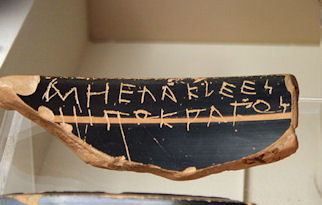 Ostrakon against Melakles, son of Hyppokrates Mary Beard wrote in the New Statesman, “In 440BC, a few months after his Antigone won first prize at the Athenian drama festival, Sophocles served as one of the commanding officers of an Athenian task force that sailed off to put down a rebellion on the island of Samos. The inhabitants had decided to break away from Athens's empire - the network of Athenian satellite states spread all over the eastern Mediterranean - and they had to be brought back into the fold. The irony was that a few decades earlier, Athens had led Greece to victory against a vast Persian invasion; now, the Athenians had imposed their own tight control over their former allies (which may have left some wondering whether conquest by the Persians might have been the better option). [Source: Mary Beard, New Statesman, October 14, 2010] For modern historians with a rose-tinted view of ancient Athenian democracy, the military command of Sophocles counts as a feather in the Athenian cap. The guiding principle of this system was that every citizen should play a full part in political, military and civic life; there were to be no bystanders. By the middle of the 5th century BC, most jobs - from those on the city council to executive officers and juries - were assigned by lot to give everyone an equal chance of running the city. Admittedly, Sophocles's command was one of the very few military offices still assigned by election (not even the Athenians were wide-eyed enough to draw their generals out of a hat), but having a dramatist who was also a general fits nicely with the spirit of their politics. Their slogans were all about equality: citizens were equal in power and equal before the law and had an equal chance of getting their voice heard. None of this is bad, as democratic aspirations go. In fact, most modern political systems could learn something from Athens. But there is a darker side to this democracy. Part of that darkness is well known. Athens may have been a city in which every citizen was equal, but those equal citizens were a tiny minority of the population: perhaps 30,000 men out of 250,000 inhabitants altogether. The vast majority - slaves, women and immigrants - were totally excluded from the political process. Ancient Athenian politics was more an exclusive gentleman's club than a democracy in our terms. Even the autocratic Romans welcomed immigrants more warmly than democratic Athens. But the case of Sophocles raises other issues. The campaign to regain control of Samos was a brutal piece of imperial control: the local leaders in Samos had wanted to get out of Athens's orbit and the Athenians had wanted to keep them in. Not unlike some sections of the modern United States, Athens might deny an overtly imperialist agenda but it pursued regime change and the imposition of democracy wherever it suited Athenian interests. Lawyers and Jurors in Ancient Greece 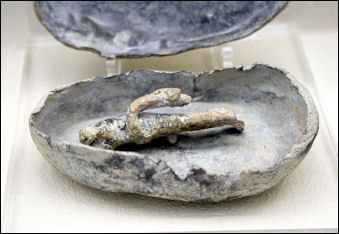 Curse inscription In the 4th century B.C. , Athenian jurors cast their votes in terra-cotta ballot boxes. The ballots, stamped "official ballot," resembled metal tops. Each juror was given two ballots: a solid one represented innocent and a hollow one represented guilty. The ballots were made in such a way that they could be deposited in the ballot box without any one seeing the juror's choice. The first lawyers were 5th century B.C. logographoi , professional Athenian speech writers who were trained in rhetoric and used their persuasive powers to write speeches to help defendants argue cases before a magistrate, to prepare the details of the case, to advise their clients which courts to use, and to come up with a strategy. They differed from modern lawyers however in that they didn't argue the cases themselves for their clients. Describing a young lawyer in action, the satirical dramatist Aristophanes wrote: "We take our stand before the bench...Your youngster opens fire by discharging a verbal volley. Then he drags up some poor Methuselah and cross-examines him, baiting word traps, tearing, snaring and curdling him. The old fellow mumbles through his toothless gums and goes off with his case lost." Describing another lawyer in Clouds , Aristophanes wrote: he was a "lawbook on legs, who can snoop like a beagle,"a double-faced, lethal-tongued legal eagle." Athenian lawyers used many tactics well-known modern attorneys: They raised innumerable facts and details to bolster their own case and obscure the main points of their opponents arguments; they brought in weeping wives and children to solicit sympathy. A judge in one of Aristophanes plays said: "There isn't a form of flattery they don't pour into a jury's ear. And some try pleading poverty and giving me hard luck stories...Some crack jokes to get me to laugh and forget I've got it in for them. And, if I prove immune to all these, they'll right away drag up their babes by the hand." In the same play a judge hears a case concerning a dog accused of stealing cheese from a kitchen. The dog wins acquittal by bring his yowling pups to the stand. Draconian Laws and Other Punishment in Ancient Greece Burning garments were used to punish criminals in ancient Greece and Rome. Plato described gruesome tortures involving tunics soaked in pitch. Many sentenced to death were poisoned. Excavations have revealed thimble-size terra cotta vessels in which executioners measured doses of hemlock. Draco produced a code of laws for Athens in which some relatively minor crimes were punished with death. His form of absolutism gave birth to the term "Draconian." Draco was popular however. In 590 B.C., so many well wishers showed up to see him in an Athens stadium he was smothered under a mountain of cloaks and hats thrown in by fans. Trial of Socrates In Socrates trial there were no lawyers and Socrates defended himself, saying simply he was a humble seeker of truth. One by one his accusers, limited by the time established by a water clock, addressed the 501 member jury. His chief accuser, Meletus, was. Socrates said, “an unknown youth with straight hair and a skimpy beard." Socrates, then 70 years old, "gave a bumbling performance. He was no orator" said Historian M.I. Finley. In the trial, Socrates said that people were threatened by his self appointed role as "the gadfly of Athens." Socrates's questioning of the existence of the gods, cross-examination of conventional wisdom and criticizing of the government had won him many enemies. Some say he was used as a scapegoat for Athens' loss in the Peloponnesian War. The jury found Socrates guilty by a vote of 281 to 220 and advocated the death penalty. Socrates was given an opportunity to suggest an alternative punishment. He said he deserved to be treated like an Olympic champion and receive a life-time pension. The jury was not amused and he was sentencing to die by drinking a cup off hemlock. Accountability, Corruption and Bribes in Ancient Greece John McK. Campo, a classic professor at Randolph-Macon College in Virginia, wrote in the New York Times: “The Athenians were better than we are at enforcing accountability in their public officials. They had an examination to check the qualifications of an individual before entering office (a dokimasia ), but they also had a formal rendering of accounts at the end of a term of office ( euthynai ) and ostracism in the meantime." Legislators were wined and dined at public expense using official drinking cups and tableware that one can see today in Athens. Bribe-taking was not taken lightly in ancient Greece. In Laws Plato said that it merited “disgrace”. In Athens it was grounds for having one's citizenship revoked. Demosthenes was found guilty of accepting bribes in 324 B.C. and was fined 50 talens---which by some estimated is equal to $20 million in today's money---and ultimately got off with being exiled. Other officials were executed for taking bribes, University of Texas classic professor Michael Gagarin told the New York Times, “Bribery was taken very seriously and certainly could lead to capital punishment." Tyrants and Ostracism in Ancient Greece The first Greek "tyrants" were not tyrants as we think of them today. They were rulers who ousted local oligarchies with the support of the people. On one level they raised expectations of accountability but on other they were often corrupted by power and evolved in despots, who themselves were overthrown with the support of the people. Politicians who fell out of favor could be ostracized---exiled for 10 years---by a vote of the assembled citizens, who cast their ballots by scratching the name of the ostracized person on a shard of pottery, or ostrakon (source of the word ostracize) used as ballots. The measure was set up not to punishment in any harsh or cruel way; the idea was simply to remove them from the political arena and public life. Many prominent Athenian politicians were ostracized. Ostracism was introduced by Cleisthenes in 508 B.C. after exiling the tyrant Hippias, reportedly with the aim of preventing the emergence of a dictator who might seize powerful unlawfully by whipping up public discontent. It was used from 487 to 417 B.C., which some historians have pointed out was when Athens was at its peak, According to the procedure, citizens of ancient Athens were instructed to gather once a year and asked if they knew of anyone aiming to be a tyrant. If a simple majority voted yes the members were dispersed and told to come back in two months time and used an ostrakon to scratch the name of the citizen whom they deemed most likely to become a tyrant. The person who received the most votes in excess of a set number was expelled from the city-state for 10 years. This simple act is regarded by some historians as the foundation of democracy in ancient Athens. Pottery shards that were used for secret votes have been found by archaeologists. Among the names that have been found on ostrakons are Pericles, Aristides and Thucydides. Pericles was nearly ostracized over opposition to his plan to build the Parthenon. A pile of 190 shards with the name Themosticles written on them by 12 individuals found in a well and is believed to be one of the first examples of vote rigging. There were abuses of the system, notibly when strong politicians wanted to oust rivals. Pericles used the system to get rid of his main challenger, Thucydides. Ostracism itself was dropped when the powerful politicians Alcibiades and Nikias ganged to on Hyperbolos, a rival to both of them, and had him exiled. Image Sources: Wikimedia Commons, The Louvre, The British Museum Text Sources: New York Times, Washington Post, Los Angeles Times, Times of London, Yomiuri Shimbun, The Guardian, National Geographic, The New Yorker, Time, Newsweek, Reuters, AP, Lonely Planet Guides, Compton's Encyclopedia and various books and other publications. Most of the information about Greco-Roman science, geography, medicine, time, sculpture and drama was taken from "The Discoverers" [∞] and "The Creators" [μ]" by Daniel Boorstin. Most of the information about Greek everyday life was taken from a book entitled "Greek and Roman Life" by Ian Jenkins from the British Museum. |
| json metadata | {"tags":["history"],"image":["https://steemitimages.com/DQmfFMvidX1AESorpnycbQCPoixMbsiyxibkbEcnFLS2zMd/image.png","https://steemitimages.com/DQmeuPds62PUYrvbk871S4a5b3dEmi96MLiH1EcmPNJWzAj/image.png","https://steemitimages.com/DQmWK7rRsUJX5jbZ3RJb9pU9FG3iDRUposhzqq8375wvYtk/image.png","https://steemitimages.com/DQmYtCyabGjZGRQ5KRZ9fe2cdeuFfCeZQT64fJ59d6bKXTA/image.png"],"app":"steemit/0.1","format":"markdown"} |
| parent author | |
| parent permlink | history |
| permlink | 6bjref-crime-and-justice-in-ancient-greece |
| title | CRIME AND JUSTICE IN ANCIENT GREECE |
| Transaction Info | Block #17536671/Trx 3459f9d9315a2698d13fca7402341c6a2637715d |
View Raw JSON Data
{
"block": 17536671,
"op": [
"comment",
{
"author": "giorgos",
"body": "CRIME AND JUSTICE IN ANCIENT GREECE\n\n \nSocrates death\n\n Poisoning was a common way of murdering people. King Mithridates VI of Pontus was obsessed with the idea of being assassinated by poison. In an efforts to create a defense against such attacks he took minute amounts of toxins to be build up a tolerance to them and developed a complex compound---called methridatium---comprised of 54 toxins, which was taken by him took regularly and leaders after him who feared assassinations.\n\n According to a myth, Medea murdered the uncle of Jason (of the Argonauts fame) by giving him a bath in a deadly poison that the king thought was going to restore his lost youth. Agamemnon was also murdered in a bathtub. His wife struck him twice on the head with an ax after he returned home from the Trojan War.\"\n\n Laws varied from city to city state. The scholar John Gager, told National Geographic, \"With the possible exception of modern America, no society has been more notorious for litigation than classical Athens. Women were not normally allowed to testify in Athenian courts.\n\n In ancient times men sometimes made a pledge by putting their hands on their testicles as if to say, \"If I am lying you can cut off my balls.\" The practice of making a pledge on the Bible is said to have its roots in this practice.\n\nSee Curse Tablets Under Superstitions Under Religion\n\n\nAncient Greek Citizens\n\nOstrakon Megacles\n\n Beginning in the 7th century B.C., ordinary people were freed from the bonds of slavery, debt and serfdom to wealthy aristocrats. \"I took away the mortgage stones stuck in earth's breast,\" wrote Solon. “And she, who was a slave before, is now free.\"\n\n Most Greek citizens were landowners although the criteria for citizenship varied from city-state to city-state. In Sparta citizens had to be at least thirty and unanimously approved by the existing citizenry. Some states were democracies where citizens voted for city-state magistrates and passed laws. Other were oligarchies or constitutional governments.\n\n Citizens had the right to vote, express their opinions, and participate in policy decisions in the assembly on matters like taxation and war. In wartime citizens were expected to serve as soldiers. In peacetime they were obliged to show up and serve as members of the assembly and as judges. Any citizen who was over 30 could run for office. Women and slaves were not allowed to be citizens. Citizenship was inherited by offspring of two Athenian citizens. Private citizens not part of the ruling class were called idiots .\n\n True representative government was something that never occurred to the ancient Greeks. Serfdom was also passed down from generation to generation. Their labor freed the land owners to make war among themselves and establish philosophy and the arts.\n\n\nGood and Bad Side of Greek Democracy\n\n \nOstrakon against Melakles, \n\nson of Hyppokrates Mary Beard wrote in the New Statesman, “In 440BC, a few months after his Antigone won first prize at the Athenian drama festival, Sophocles served as one of the commanding officers of an Athenian task force that sailed off to put down a rebellion on the island of Samos. The inhabitants had decided to break away from Athens's empire - the network of Athenian satellite states spread all over the eastern Mediterranean - and they had to be brought back into the fold. The irony was that a few decades earlier, Athens had led Greece to victory against a vast Persian invasion; now, the Athenians had imposed their own tight control over their former allies (which may have left some wondering whether conquest by the Persians might have been the better option). [Source: Mary Beard, New Statesman, October 14, 2010]\n\n For modern historians with a rose-tinted view of ancient Athenian democracy, the military command of Sophocles counts as a feather in the Athenian cap. The guiding principle of this system was that every citizen should play a full part in political, military and civic life; there were to be no bystanders. By the middle of the 5th century BC, most jobs - from those on the city council to executive officers and juries - were assigned by lot to give everyone an equal chance of running the city. Admittedly, Sophocles's command was one of the very few military offices still assigned by election (not even the Athenians were wide-eyed enough to draw their generals out of a hat), but having a dramatist who was also a general fits nicely with the spirit of their politics. Their slogans were all about equality: citizens were equal in power and equal before the law and had an equal chance of getting their voice heard. None of this is bad, as democratic aspirations go. In fact, most modern political systems could learn something from Athens. But there is a darker side to this democracy. Part of that darkness is well known. Athens may have been a city in which every citizen was equal, but those equal citizens were a tiny minority of the population: perhaps 30,000 men out of 250,000 inhabitants altogether. The vast majority - slaves, women and immigrants - were totally excluded from the political process. Ancient Athenian politics was more an exclusive gentleman's club than a democracy in our terms. Even the autocratic Romans welcomed immigrants more warmly than democratic Athens.\n\n But the case of Sophocles raises other issues. The campaign to regain control of Samos was a brutal piece of imperial control: the local leaders in Samos had wanted to get out of Athens's orbit and the Athenians had wanted to keep them in. Not unlike some sections of the modern United States, Athens might deny an overtly imperialist agenda but it pursued regime change and the imposition of democracy wherever it suited Athenian interests.\n\n\nLawyers and Jurors in Ancient Greece\n\n \nCurse inscription\n\n In the 4th century B.C. , Athenian jurors cast their votes in terra-cotta ballot boxes. The ballots, stamped \"official ballot,\" resembled metal tops. Each juror was given two ballots: a solid one represented innocent and a hollow one represented guilty. The ballots were made in such a way that they could be deposited in the ballot box without any one seeing the juror's choice.\n\n The first lawyers were 5th century B.C. logographoi , professional Athenian speech writers who were trained in rhetoric and used their persuasive powers to write speeches to help defendants argue cases before a magistrate, to prepare the details of the case, to advise their clients which courts to use, and to come up with a strategy. They differed from modern lawyers however in that they didn't argue the cases themselves for their clients.\n\n Describing a young lawyer in action, the satirical dramatist Aristophanes wrote: \"We take our stand before the bench...Your youngster opens fire by discharging a verbal volley. Then he drags up some poor Methuselah and cross-examines him, baiting word traps, tearing, snaring and curdling him. The old fellow mumbles through his toothless gums and goes off with his case lost.\" Describing another lawyer in Clouds , Aristophanes wrote: he was a \"lawbook on legs, who can snoop like a beagle,\"a double-faced, lethal-tongued legal eagle.\"\n\n Athenian lawyers used many tactics well-known modern attorneys: They raised innumerable facts and details to bolster their own case and obscure the main points of their opponents arguments; they brought in weeping wives and children to solicit sympathy. A judge in one of Aristophanes plays said: \"There isn't a form of flattery they don't pour into a jury's ear. And some try pleading poverty and giving me hard luck stories...Some crack jokes to get me to laugh and forget I've got it in for them. And, if I prove immune to all these, they'll right away drag up their babes by the hand.\" In the same play a judge hears a case concerning a dog accused of stealing cheese from a kitchen. The dog wins acquittal by bring his yowling pups to the stand.\n\n\nDraconian Laws and Other Punishment in Ancient Greece\n\n Burning garments were used to punish criminals in ancient Greece and Rome. Plato described gruesome tortures involving tunics soaked in pitch. Many sentenced to death were poisoned. Excavations have revealed thimble-size terra cotta vessels in which executioners measured doses of hemlock.\n\n Draco produced a code of laws for Athens in which some relatively minor crimes were punished with death. His form of absolutism gave birth to the term \"Draconian.\" Draco was popular however. In 590 B.C., so many well wishers showed up to see him in an Athens stadium he was smothered under a mountain of cloaks and hats thrown in by fans.\n\n\nTrial of Socrates\n\n In Socrates trial there were no lawyers and Socrates defended himself, saying simply he was a humble seeker of truth. One by one his accusers, limited by the time established by a water clock, addressed the 501 member jury. His chief accuser, Meletus, was. Socrates said, “an unknown youth with straight hair and a skimpy beard.\"\n\n Socrates, then 70 years old, \"gave a bumbling performance. He was no orator\" said Historian M.I. Finley. In the trial, Socrates said that people were threatened by his self appointed role as \"the gadfly of Athens.\" Socrates's questioning of the existence of the gods, cross-examination of conventional wisdom and criticizing of the government had won him many enemies. Some say he was used as a scapegoat for Athens' loss in the Peloponnesian War.\n\n The jury found Socrates guilty by a vote of 281 to 220 and advocated the death penalty. Socrates was given an opportunity to suggest an alternative punishment. He said he deserved to be treated like an Olympic champion and receive a life-time pension. The jury was not amused and he was sentencing to die by drinking a cup off hemlock.\n\n\nAccountability, Corruption and Bribes in Ancient Greece\n\n John McK. Campo, a classic professor at Randolph-Macon College in Virginia, wrote in the New York Times: “The Athenians were better than we are at enforcing accountability in their public officials. They had an examination to check the qualifications of an individual before entering office (a dokimasia ), but they also had a formal rendering of accounts at the end of a term of office ( euthynai ) and ostracism in the meantime.\"\n\n Legislators were wined and dined at public expense using official drinking cups and tableware that one can see today in Athens.\n\n Bribe-taking was not taken lightly in ancient Greece. In Laws Plato said that it merited “disgrace”. In Athens it was grounds for having one's citizenship revoked. Demosthenes was found guilty of accepting bribes in 324 B.C. and was fined 50 talens---which by some estimated is equal to $20 million in today's money---and ultimately got off with being exiled. Other officials were executed for taking bribes, University of Texas classic professor Michael Gagarin told the New York Times, “Bribery was taken very seriously and certainly could lead to capital punishment.\"\n\n\nTyrants and Ostracism in Ancient Greece\n\n The first Greek \"tyrants\" were not tyrants as we think of them today. They were rulers who ousted local oligarchies with the support of the people. On one level they raised expectations of accountability but on other they were often corrupted by power and evolved in despots, who themselves were overthrown with the support of the people.\n\n Politicians who fell out of favor could be ostracized---exiled for 10 years---by a vote of the assembled citizens, who cast their ballots by scratching the name of the ostracized person on a shard of pottery, or ostrakon (source of the word ostracize) used as ballots. The measure was set up not to punishment in any harsh or cruel way; the idea was simply to remove them from the political arena and public life. Many prominent Athenian politicians were ostracized.\n\n Ostracism was introduced by Cleisthenes in 508 B.C. after exiling the tyrant Hippias, reportedly with the aim of preventing the emergence of a dictator who might seize powerful unlawfully by whipping up public discontent. It was used from 487 to 417 B.C., which some historians have pointed out was when Athens was at its peak, According to the procedure, citizens of ancient Athens were instructed to gather once a year and asked if they knew of anyone aiming to be a tyrant. If a simple majority voted yes the members were dispersed and told to come back in two months time and used an ostrakon to scratch the name of the citizen whom they deemed most likely to become a tyrant. The person who received the most votes in excess of a set number was expelled from the city-state for 10 years. This simple act is regarded by some historians as the foundation of democracy in ancient Athens.\n\n Pottery shards that were used for secret votes have been found by archaeologists. Among the names that have been found on ostrakons are Pericles, Aristides and Thucydides. Pericles was nearly ostracized over opposition to his plan to build the Parthenon. A pile of 190 shards with the name Themosticles written on them by 12 individuals found in a well and is believed to be one of the first examples of vote rigging.\n\n There were abuses of the system, notibly when strong politicians wanted to oust rivals. Pericles used the system to get rid of his main challenger, Thucydides. Ostracism itself was dropped when the powerful politicians Alcibiades and Nikias ganged to on Hyperbolos, a rival to both of them, and had him exiled.\n\nImage Sources: Wikimedia Commons, The Louvre, The British Museum\n\nText Sources: New York Times, Washington Post, Los Angeles Times, Times of London, Yomiuri Shimbun, The Guardian, National Geographic, The New Yorker, Time, Newsweek, Reuters, AP, Lonely Planet Guides, Compton's Encyclopedia and various books and other publications. Most of the information about Greco-Roman science, geography, medicine, time, sculpture and drama was taken from \"The Discoverers\" [∞] and \"The Creators\" [μ]\" by Daniel Boorstin. Most of the information about Greek everyday life was taken from a book entitled \"Greek and Roman Life\" by Ian Jenkins from the British Museum.",
"json_metadata": "{\"tags\":[\"history\"],\"image\":[\"https://steemitimages.com/DQmfFMvidX1AESorpnycbQCPoixMbsiyxibkbEcnFLS2zMd/image.png\",\"https://steemitimages.com/DQmeuPds62PUYrvbk871S4a5b3dEmi96MLiH1EcmPNJWzAj/image.png\",\"https://steemitimages.com/DQmWK7rRsUJX5jbZ3RJb9pU9FG3iDRUposhzqq8375wvYtk/image.png\",\"https://steemitimages.com/DQmYtCyabGjZGRQ5KRZ9fe2cdeuFfCeZQT64fJ59d6bKXTA/image.png\"],\"app\":\"steemit/0.1\",\"format\":\"markdown\"}",
"parent_author": "",
"parent_permlink": "history",
"permlink": "6bjref-crime-and-justice-in-ancient-greece",
"title": "CRIME AND JUSTICE IN ANCIENT GREECE"
}
],
"op_in_trx": 0,
"timestamp": "2017-11-25T16:52:36",
"trx_id": "3459f9d9315a2698d13fca7402341c6a2637715d",
"trx_in_block": 7,
"virtual_op": 0
}salutonreplied to @giorgos / 0onmqbjyekwdfmnj0aayaq2017/11/25 16:47:57
salutonreplied to @giorgos / 0onmqbjyekwdfmnj0aayaq
2017/11/25 16:47:57
| author | saluton |
| body | Hello! |
| json metadata | {"tags": [""]} |
| parent author | giorgos |
| parent permlink | crime-and-justice-in-ancient-greece |
| permlink | 0onmqbjyekwdfmnj0aayaq |
| title | |
| Transaction Info | Block #17536578/Trx 798bd0994f34a3d02f0618b47dd826529255ea0d |
View Raw JSON Data
{
  "block": 17536578,
  "op": [
    "comment",
    {
      "author": "saluton",
      "body": "Hello!",
      "json_metadata": "{\"tags\": [\"\"]}",
      "parent_author": "giorgos",
      "parent_permlink": "crime-and-justice-in-ancient-greece",
      "permlink": "0onmqbjyekwdfmnj0aayaq",
      "title": ""
    }
  ],
  "op_in_trx": 0,
  "timestamp": "2017-11-25T16:47:57",
  "trx_id": "798bd0994f34a3d02f0618b47dd826529255ea0d",
  "trx_in_block": 30,
  "virtual_op": 0
}salutonupvoted (5.00%) @giorgos / crime-and-justice-in-ancient-greece2017/11/25 16:47:57
salutonupvoted (5.00%) @giorgos / crime-and-justice-in-ancient-greece
2017/11/25 16:47:57
| author | giorgos |
| permlink | crime-and-justice-in-ancient-greece |
| voter | saluton |
| weight | 500 (5.00%) |
| Transaction Info | Block #17536578/Trx e30c1bb445884edf114e74e233d2417aaa9e0411 |
View Raw JSON Data
{
  "block": 17536578,
  "op": [
    "vote",
    {
      "author": "giorgos",
      "permlink": "crime-and-justice-in-ancient-greece",
      "voter": "saluton",
      "weight": 500
    }
  ],
  "op_in_trx": 0,
  "timestamp": "2017-11-25T16:47:57",
  "trx_id": "e30c1bb445884edf114e74e233d2417aaa9e0411",
  "trx_in_block": 26,
  "virtual_op": 0
}Manabar
Voting Power100.00%
Downvote Power100.00%
Resource Credits100.00%
Reputation Progress0.00%
{
  "voting_manabar": {
    "current_mana": "8143659806",
    "last_update_time": 1779064884
  },
  "downvote_manabar": {
    "current_mana": 2035914951,
    "last_update_time": 1779064884
  },
  "rc_account": {
    "account": "giorgos",
    "rc_manabar": {
      "current_mana": "10164408779",
      "last_update_time": 1779064884
    },
    "max_rc_creation_adjustment": {
      "amount": "2020748973",
      "precision": 6,
      "nai": "@@000000037"
    },
    "max_rc": "10164408779"
  }
}
Account Metadata
| POSTING JSON METADATA | |
| profile | {"profile_image":"https://www.facebook.com/photo.php?fbid=10155499730249733&set=a.438266199732.207096.585659732&type=3&theater"} |
| JSON METADATA | |
| profile | {"profile_image":"https://www.facebook.com/photo.php?fbid=10155499730249733&set=a.438266199732.207096.585659732&type=3&theater"} |
{
  "posting_json_metadata": {
    "profile": {
      "profile_image": "https://www.facebook.com/photo.php?fbid=10155499730249733&set=a.438266199732.207096.585659732&type=3&theater"
    }
  },
  "json_metadata": {
    "profile": {
      "profile_image": "https://www.facebook.com/photo.php?fbid=10155499730249733&set=a.438266199732.207096.585659732&type=3&theater"
    }
  }
}
Auth Keys
Owner
Single Signature
Public Keys
STM6H2xjFstBQKTwbDqqsomH3MTi3wYgCKx2SzmFpAamKFi6wSBZs1/1
Active
Single Signature
Public Keys
STM4vFiBubohzGMZNj6r7sxHtPRbyk6yVbyY6UJTEsf83GaUiaMa31/1
Posting
Single Signature
Public Keys
STM7mfQWvEgE4i2TmmTUnqgSrqZZ8tyuCAquEq4SAb3ypwx9QtGp81/1
Memo
STM5VupVgPY16TKzEvkTCcDTP5HXoMZNsZvJcavtGFByRtDN4p9D9
{
  "owner": {
    "weight_threshold": 1,
    "account_auths": [],
    "key_auths": [
      [
        "STM6H2xjFstBQKTwbDqqsomH3MTi3wYgCKx2SzmFpAamKFi6wSBZs",
        1
      ]
    ]
  },
  "active": {
    "weight_threshold": 1,
    "account_auths": [],
    "key_auths": [
      [
        "STM4vFiBubohzGMZNj6r7sxHtPRbyk6yVbyY6UJTEsf83GaUiaMa3",
        1
      ]
    ]
  },
  "posting": {
    "weight_threshold": 1,
    "account_auths": [],
    "key_auths": [
      [
        "STM7mfQWvEgE4i2TmmTUnqgSrqZZ8tyuCAquEq4SAb3ypwx9QtGp8",
        1
      ]
    ]
  },
  "memo": "STM5VupVgPY16TKzEvkTCcDTP5HXoMZNsZvJcavtGFByRtDN4p9D9"
}
Witness Votes
0 / 30
No active witness votes.
[]