

VOTING POWER100.00%
DOWNVOTE POWER100.00%
RESOURCE CREDITS100.00%
REPUTATION PROGRESS0.00%
Net Worth
0.020USD
STEEM
0.000STEEM
SBD
0.024SBD
Effective Power
5.001SP
├── Own SP
0.148SP
└── Incoming DelegationsDeleg
+4.853SP
Detailed Balance
| STEEM | ||
| balance | 0.000STEEM | STEEM |
| market_balance | 0.000STEEM | STEEM |
| savings_balance | 0.000STEEM | STEEM |
| reward_steem_balance | 0.000STEEM | STEEM |
| STEEM POWER | ||
| Own SP | 0.148SP | SP |
| Delegated Out | 0.000SP | SP |
| Delegation In | 4.853SP | SP |
| Effective Power | 5.001SP | SP |
| Reward SP (pending) | 0.000SP | SP |
| SBD | ||
| sbd_balance | 0.024SBD | SBD |
| sbd_conversions | 0.000SBD | SBD |
| sbd_market_balance | 0.000SBD | SBD |
| savings_sbd_balance | 0.000SBD | SBD |
| reward_sbd_balance | 0.000SBD | SBD |
{
  "balance": "0.000 STEEM",
  "savings_balance": "0.000 STEEM",
  "reward_steem_balance": "0.000 STEEM",
  "vesting_shares": "240.716150 VESTS",
  "delegated_vesting_shares": "0.000000 VESTS",
  "received_vesting_shares": "7902.943656 VESTS",
  "sbd_balance": "0.024 SBD",
  "savings_sbd_balance": "0.000 SBD",
  "reward_sbd_balance": "0.000 SBD",
  "conversions": []
}
Account Info
| name | dialexandro |
| id | 854647 |
| rank | 1,344,756 |
| reputation | 630809538 |
| created | 2018-03-13T18:38:03 |
| recovery_account | steem |
| proxy | None |
| post_count | 10 |
| comment_count | 0 |
| lifetime_vote_count | 0 |
| witnesses_voted_for | 0 |
| last_post | 2018-08-02T18:46:42 |
| last_root_post | 2018-08-02T18:46:42 |
| last_vote_time | 2018-07-31T18:32:45 |
| proxied_vsf_votes | 0, 0, 0, 0 |
| can_vote | 1 |
| voting_power | 0 |
| delayed_votes | 0 |
| balance | 0.000 STEEM |
| savings_balance | 0.000 STEEM |
| sbd_balance | 0.024 SBD |
| savings_sbd_balance | 0.000 SBD |
| vesting_shares | 240.716150 VESTS |
| delegated_vesting_shares | 0.000000 VESTS |
| received_vesting_shares | 7902.943656 VESTS |
| reward_vesting_balance | 0.000000 VESTS |
| vesting_balance | 0.000 STEEM |
| vesting_withdraw_rate | 0.000000 VESTS |
| next_vesting_withdrawal | 1969-12-31T23:59:59 |
| withdrawn | 0 |
| to_withdraw | 0 |
| withdraw_routes | 0 |
| savings_withdraw_requests | 0 |
| last_account_recovery | 1970-01-01T00:00:00 |
| reset_account | null |
| last_owner_update | 1970-01-01T00:00:00 |
| last_account_update | 2018-07-31T21:13:06 |
| mined | No |
| sbd_seconds | 0 |
| sbd_last_interest_payment | 2018-07-28T16:40:54 |
| savings_sbd_last_interest_payment | 1970-01-01T00:00:00 |
{
  "id": 854647,
  "name": "dialexandro",
  "owner": {
    "weight_threshold": 1,
    "account_auths": [],
    "key_auths": [
      [
        "STM5TFYjvsS7beAMmqvBvpRmX9fQdgkNwAro1Y59PGYdpEAE6gLEC",
        1
      ]
    ]
  },
  "active": {
    "weight_threshold": 1,
    "account_auths": [],
    "key_auths": [
      [
        "STM7G2Bs1Ts8ap275qiNWXZi4KTTGakzWvorQWdHsxgwojQEYVF5B",
        1
      ]
    ]
  },
  "posting": {
    "weight_threshold": 1,
    "account_auths": [],
    "key_auths": [
      [
        "STM5K4Cc2RfUCrhKW3BihbvKTCPrb6DZpU4CMBpq2tSDTSPxqExsQ",
        1
      ]
    ]
  },
  "memo_key": "STM8EgLWWsmJWThR6rwYySohaSanHvHxcR5U7EvQePtEs2G9xRNGb",
  "json_metadata": "{\"profile\":{\"profile_image\":\"https://cdn.steemitimages.com/DQmZL5saTNozfx9CLXma84zPTuxrrHbjW4Qw1oPura3zJLL/20180127_130741.jpg\"}}",
  "posting_json_metadata": "{\"profile\":{\"profile_image\":\"https://cdn.steemitimages.com/DQmZL5saTNozfx9CLXma84zPTuxrrHbjW4Qw1oPura3zJLL/20180127_130741.jpg\"}}",
  "proxy": "",
  "last_owner_update": "1970-01-01T00:00:00",
  "last_account_update": "2018-07-31T21:13:06",
  "created": "2018-03-13T18:38:03",
  "mined": false,
  "recovery_account": "steem",
  "last_account_recovery": "1970-01-01T00:00:00",
  "reset_account": "null",
  "comment_count": 0,
  "lifetime_vote_count": 0,
  "post_count": 10,
  "can_vote": true,
  "voting_manabar": {
    "current_mana": "8143659806",
    "last_update_time": 1779060501
  },
  "downvote_manabar": {
    "current_mana": 2035914951,
    "last_update_time": 1779060501
  },
  "voting_power": 0,
  "balance": "0.000 STEEM",
  "savings_balance": "0.000 STEEM",
  "sbd_balance": "0.024 SBD",
  "sbd_seconds": "0",
  "sbd_seconds_last_update": "2018-07-28T16:40:54",
  "sbd_last_interest_payment": "2018-07-28T16:40:54",
  "savings_sbd_balance": "0.000 SBD",
  "savings_sbd_seconds": "0",
  "savings_sbd_seconds_last_update": "1970-01-01T00:00:00",
  "savings_sbd_last_interest_payment": "1970-01-01T00:00:00",
  "savings_withdraw_requests": 0,
  "reward_sbd_balance": "0.000 SBD",
  "reward_steem_balance": "0.000 STEEM",
  "reward_vesting_balance": "0.000000 VESTS",
  "reward_vesting_steem": "0.000 STEEM",
  "vesting_shares": "240.716150 VESTS",
  "delegated_vesting_shares": "0.000000 VESTS",
  "received_vesting_shares": "7902.943656 VESTS",
  "vesting_withdraw_rate": "0.000000 VESTS",
  "next_vesting_withdrawal": "1969-12-31T23:59:59",
  "withdrawn": 0,
  "to_withdraw": 0,
  "withdraw_routes": 0,
  "curation_rewards": 0,
  "posting_rewards": 35,
  "proxied_vsf_votes": [
    0,
    0,
    0,
    0
  ],
  "witnesses_voted_for": 0,
  "last_post": "2018-08-02T18:46:42",
  "last_root_post": "2018-08-02T18:46:42",
  "last_vote_time": "2018-07-31T18:32:45",
  "post_bandwidth": 0,
  "pending_claimed_accounts": 0,
  "vesting_balance": "0.000 STEEM",
  "reputation": 630809538,
  "transfer_history": [],
  "market_history": [],
  "post_history": [],
  "vote_history": [],
  "other_history": [],
  "witness_votes": [],
  "tags_usage": [],
  "guest_bloggers": [],
  "rank": 1344756
}
Withdraw Routes
| Incoming | Outgoing |
|---|---|
Empty | Empty |
{
  "incoming": [],
  "outgoing": []
}From Date
To Date
steemdelegated 4.853 SP to @dialexandro2026/05/17 23:28:21
steemdelegated 4.853 SP to @dialexandro
2026/05/17 23:28:21
| delegator | steem |
| delegatee | dialexandro |
| vesting shares | 7902.943656 VESTS |
| Transaction Info | Block #106142515/Trx d54e06fb6b8ee98ba323155f3799e4f3d1956690 |
View Raw JSON Data
{
  "trx_id": "d54e06fb6b8ee98ba323155f3799e4f3d1956690",
  "block": 106142515,
  "trx_in_block": 1,
  "op_in_trx": 0,
  "virtual_op": 0,
  "timestamp": "2026-05-17T23:28:21",
  "op": [
    "delegate_vesting_shares",
    {
      "delegator": "steem",
      "delegatee": "dialexandro",
      "vesting_shares": "7902.943656 VESTS"
    }
  ]
}steemdelegated 3.188 SP to @dialexandro2026/05/12 00:41:09
steemdelegated 3.188 SP to @dialexandro
2026/05/12 00:41:09
| delegator | steem |
| delegatee | dialexandro |
| vesting shares | 5190.733251 VESTS |
| Transaction Info | Block #105971934/Trx a746eb1d1d8b577cf153d64cd5f226f60d29934b |
View Raw JSON Data
{
  "trx_id": "a746eb1d1d8b577cf153d64cd5f226f60d29934b",
  "block": 105971934,
  "trx_in_block": 2,
  "op_in_trx": 0,
  "virtual_op": 0,
  "timestamp": "2026-05-12T00:41:09",
  "op": [
    "delegate_vesting_shares",
    {
      "delegator": "steem",
      "delegatee": "dialexandro",
      "vesting_shares": "5190.733251 VESTS"
    }
  ]
}steemdelegated 4.861 SP to @dialexandro2026/04/25 22:50:30
steemdelegated 4.861 SP to @dialexandro
2026/04/25 22:50:30
| delegator | steem |
| delegatee | dialexandro |
| vesting shares | 7915.459412 VESTS |
| Transaction Info | Block #105510190/Trx 29bd5d9a243c72698fc894d708da7ae73bf55dac |
View Raw JSON Data
{
  "trx_id": "29bd5d9a243c72698fc894d708da7ae73bf55dac",
  "block": 105510190,
  "trx_in_block": 2,
  "op_in_trx": 0,
  "virtual_op": 0,
  "timestamp": "2026-04-25T22:50:30",
  "op": [
    "delegate_vesting_shares",
    {
      "delegator": "steem",
      "delegatee": "dialexandro",
      "vesting_shares": "7915.459412 VESTS"
    }
  ]
}steemdelegated 3.213 SP to @dialexandro2026/01/23 05:42:18
steemdelegated 3.213 SP to @dialexandro
2026/01/23 05:42:18
| delegator | steem |
| delegatee | dialexandro |
| vesting shares | 5232.280070 VESTS |
| Transaction Info | Block #102849296/Trx 8de5ff0b401163868bd0b3023d83b6ff2392220e |
View Raw JSON Data
{
  "trx_id": "8de5ff0b401163868bd0b3023d83b6ff2392220e",
  "block": 102849296,
  "trx_in_block": 0,
  "op_in_trx": 0,
  "virtual_op": 0,
  "timestamp": "2026-01-23T05:42:18",
  "op": [
    "delegate_vesting_shares",
    {
      "delegator": "steem",
      "delegatee": "dialexandro",
      "vesting_shares": "5232.280070 VESTS"
    }
  ]
}steemdelegated 3.314 SP to @dialexandro2024/12/17 01:02:03
steemdelegated 3.314 SP to @dialexandro
2024/12/17 01:02:03
| delegator | steem |
| delegatee | dialexandro |
| vesting shares | 5396.499267 VESTS |
| Transaction Info | Block #91295719/Trx 05f075d334b207390adce60d16d411149b6c7432 |
View Raw JSON Data
{
  "trx_id": "05f075d334b207390adce60d16d411149b6c7432",
  "block": 91295719,
  "trx_in_block": 3,
  "op_in_trx": 0,
  "virtual_op": 0,
  "timestamp": "2024-12-17T01:02:03",
  "op": [
    "delegate_vesting_shares",
    {
      "delegator": "steem",
      "delegatee": "dialexandro",
      "vesting_shares": "5396.499267 VESTS"
    }
  ]
}steemdelegated 3.418 SP to @dialexandro2023/11/13 16:45:30
steemdelegated 3.418 SP to @dialexandro
2023/11/13 16:45:30
| delegator | steem |
| delegatee | dialexandro |
| vesting shares | 5565.632799 VESTS |
| Transaction Info | Block #79849945/Trx 0ab2940d946314d0238d21ebd1adb8e202fba9ca |
View Raw JSON Data
{
  "trx_id": "0ab2940d946314d0238d21ebd1adb8e202fba9ca",
  "block": 79849945,
  "trx_in_block": 1,
  "op_in_trx": 0,
  "virtual_op": 0,
  "timestamp": "2023-11-13T16:45:30",
  "op": [
    "delegate_vesting_shares",
    {
      "delegator": "steem",
      "delegatee": "dialexandro",
      "vesting_shares": "5565.632799 VESTS"
    }
  ]
}steemdelegated 5.221 SP to @dialexandro2023/09/21 20:54:36
steemdelegated 5.221 SP to @dialexandro
2023/09/21 20:54:36
| delegator | steem |
| delegatee | dialexandro |
| vesting shares | 8502.911585 VESTS |
| Transaction Info | Block #78346727/Trx 1f37d07b60d24cacc5935415b98f96d421ee78cc |
View Raw JSON Data
{
  "trx_id": "1f37d07b60d24cacc5935415b98f96d421ee78cc",
  "block": 78346727,
  "trx_in_block": 5,
  "op_in_trx": 0,
  "virtual_op": 0,
  "timestamp": "2023-09-21T20:54:36",
  "op": [
    "delegate_vesting_shares",
    {
      "delegator": "steem",
      "delegatee": "dialexandro",
      "vesting_shares": "8502.911585 VESTS"
    }
  ]
}steemdelegated 5.358 SP to @dialexandro2022/11/03 10:49:27
steemdelegated 5.358 SP to @dialexandro
2022/11/03 10:49:27
| delegator | steem |
| delegatee | dialexandro |
| vesting shares | 8724.593023 VESTS |
| Transaction Info | Block #69112212/Trx 05a35ce74207b28f5a3ec13d66ddbaadc8013d6c |
View Raw JSON Data
{
  "trx_id": "05a35ce74207b28f5a3ec13d66ddbaadc8013d6c",
  "block": 69112212,
  "trx_in_block": 2,
  "op_in_trx": 0,
  "virtual_op": 0,
  "timestamp": "2022-11-03T10:49:27",
  "op": [
    "delegate_vesting_shares",
    {
      "delegator": "steem",
      "delegatee": "dialexandro",
      "vesting_shares": "8724.593023 VESTS"
    }
  ]
}steemdelegated 5.493 SP to @dialexandro2022/01/17 10:09:39
steemdelegated 5.493 SP to @dialexandro
2022/01/17 10:09:39
| delegator | steem |
| delegatee | dialexandro |
| vesting shares | 8945.126254 VESTS |
| Transaction Info | Block #60808464/Trx db6f04f4d0e3a8b0a5f6ae618ac84210794b29df |
View Raw JSON Data
{
  "trx_id": "db6f04f4d0e3a8b0a5f6ae618ac84210794b29df",
  "block": 60808464,
  "trx_in_block": 12,
  "op_in_trx": 0,
  "virtual_op": 0,
  "timestamp": "2022-01-17T10:09:39",
  "op": [
    "delegate_vesting_shares",
    {
      "delegator": "steem",
      "delegatee": "dialexandro",
      "vesting_shares": "8945.126254 VESTS"
    }
  ]
}steemdelegated 5.606 SP to @dialexandro2021/06/14 00:06:48
steemdelegated 5.606 SP to @dialexandro
2021/06/14 00:06:48
| delegator | steem |
| delegatee | dialexandro |
| vesting shares | 9128.894912 VESTS |
| Transaction Info | Block #54606891/Trx 6e285c9d88c825f89ddf282dc7bb06948729bf79 |
View Raw JSON Data
{
  "trx_id": "6e285c9d88c825f89ddf282dc7bb06948729bf79",
  "block": 54606891,
  "trx_in_block": 2,
  "op_in_trx": 0,
  "virtual_op": 0,
  "timestamp": "2021-06-14T00:06:48",
  "op": [
    "delegate_vesting_shares",
    {
      "delegator": "steem",
      "delegatee": "dialexandro",
      "vesting_shares": "9128.894912 VESTS"
    }
  ]
}steemdelegated 5.721 SP to @dialexandro2020/12/11 10:27:00
steemdelegated 5.721 SP to @dialexandro
2020/12/11 10:27:00
| delegator | steem |
| delegatee | dialexandro |
| vesting shares | 9316.316886 VESTS |
| Transaction Info | Block #49354385/Trx 952d6e909d9e07ffc4d174141377eb92cfa97677 |
View Raw JSON Data
{
  "trx_id": "952d6e909d9e07ffc4d174141377eb92cfa97677",
  "block": 49354385,
  "trx_in_block": 1,
  "op_in_trx": 0,
  "virtual_op": 0,
  "timestamp": "2020-12-11T10:27:00",
  "op": [
    "delegate_vesting_shares",
    {
      "delegator": "steem",
      "delegatee": "dialexandro",
      "vesting_shares": "9316.316886 VESTS"
    }
  ]
}steemdelegated 1.174 SP to @dialexandro2020/12/06 04:04:15
steemdelegated 1.174 SP to @dialexandro
2020/12/06 04:04:15
| delegator | steem |
| delegatee | dialexandro |
| vesting shares | 1912.543513 VESTS |
| Transaction Info | Block #49205948/Trx 0bdf46609f969582ddbc372dd83c8387fb676582 |
View Raw JSON Data
{
  "trx_id": "0bdf46609f969582ddbc372dd83c8387fb676582",
  "block": 49205948,
  "trx_in_block": 5,
  "op_in_trx": 0,
  "virtual_op": 0,
  "timestamp": "2020-12-06T04:04:15",
  "op": [
    "delegate_vesting_shares",
    {
      "delegator": "steem",
      "delegatee": "dialexandro",
      "vesting_shares": "1912.543513 VESTS"
    }
  ]
}steemdelegated 5.725 SP to @dialexandro2020/12/05 12:01:27
steemdelegated 5.725 SP to @dialexandro
2020/12/05 12:01:27
| delegator | steem |
| delegatee | dialexandro |
| vesting shares | 9322.683525 VESTS |
| Transaction Info | Block #49187058/Trx 845358d23f830e37b501967f32b59933bbe855e2 |
View Raw JSON Data
{
  "trx_id": "845358d23f830e37b501967f32b59933bbe855e2",
  "block": 49187058,
  "trx_in_block": 23,
  "op_in_trx": 0,
  "virtual_op": 0,
  "timestamp": "2020-12-05T12:01:27",
  "op": [
    "delegate_vesting_shares",
    {
      "delegator": "steem",
      "delegatee": "dialexandro",
      "vesting_shares": "9322.683525 VESTS"
    }
  ]
}steemdelegated 1.179 SP to @dialexandro2020/11/02 14:10:06
steemdelegated 1.179 SP to @dialexandro
2020/11/02 14:10:06
| delegator | steem |
| delegatee | dialexandro |
| vesting shares | 1920.017158 VESTS |
| Transaction Info | Block #48256072/Trx 0256a57d48668ffe9a95e3891cdacc3898b829ee |
View Raw JSON Data
{
  "trx_id": "0256a57d48668ffe9a95e3891cdacc3898b829ee",
  "block": 48256072,
  "trx_in_block": 16,
  "op_in_trx": 0,
  "virtual_op": 0,
  "timestamp": "2020-11-02T14:10:06",
  "op": [
    "delegate_vesting_shares",
    {
      "delegator": "steem",
      "delegatee": "dialexandro",
      "vesting_shares": "1920.017158 VESTS"
    }
  ]
}steemdelegated 5.849 SP to @dialexandro2020/05/09 05:00:36
steemdelegated 5.849 SP to @dialexandro
2020/05/09 05:00:36
| delegator | steem |
| delegatee | dialexandro |
| vesting shares | 9525.330099 VESTS |
| Transaction Info | Block #43216182/Trx 0ac7d588322213e9d6ebd809d958e415318fdf45 |
View Raw JSON Data
{
  "trx_id": "0ac7d588322213e9d6ebd809d958e415318fdf45",
  "block": 43216182,
  "trx_in_block": 14,
  "op_in_trx": 0,
  "virtual_op": 0,
  "timestamp": "2020-05-09T05:00:36",
  "op": [
    "delegate_vesting_shares",
    {
      "delegator": "steem",
      "delegatee": "dialexandro",
      "vesting_shares": "9525.330099 VESTS"
    }
  ]
}steemdelegated 1.199 SP to @dialexandro2020/05/08 08:30:18
steemdelegated 1.199 SP to @dialexandro
2020/05/08 08:30:18
| delegator | steem |
| delegatee | dialexandro |
| vesting shares | 1953.311140 VESTS |
| Transaction Info | Block #43192154/Trx a3562f151618df9eea5c096c87d1d543f400800c |
View Raw JSON Data
{
  "trx_id": "a3562f151618df9eea5c096c87d1d543f400800c",
  "block": 43192154,
  "trx_in_block": 10,
  "op_in_trx": 0,
  "virtual_op": 0,
  "timestamp": "2020-05-08T08:30:18",
  "op": [
    "delegate_vesting_shares",
    {
      "delegator": "steem",
      "delegatee": "dialexandro",
      "vesting_shares": "1953.311140 VESTS"
    }
  ]
}2020/03/16 02:13:33
2020/03/16 02:13:33
| parent author | dialexandro |
| parent permlink | the-final-battle-hiv-or-human-immunodeficiency-virus |
| author | steemitboard |
| permlink | steemitboard-notify-dialexandro-20200316t021333000z |
| title | |
| body | Congratulations @dialexandro! You received a personal award! <table><tr><td>https://steemitimages.com/70x70/http://steemitboard.com/@dialexandro/birthday2.png</td><td>Happy Steem Birthday! - You are on the Steem blockchain for 2 years!</td></tr></table> <sub>_You can view [your badges on your Steem Board](https://steemitboard.com/@dialexandro) and compare to others on the [Steem Ranking](https://steemitboard.com/ranking/index.php?name=dialexandro)_</sub> ###### [Vote for @Steemitboard as a witness](https://v2.steemconnect.com/sign/account-witness-vote?witness=steemitboard&approve=1) to get one more award and increased upvotes! |
| json metadata | {"image":["https://steemitboard.com/img/notify.png"]} |
| Transaction Info | Block #41689640/Trx fb5cd99d6a635cd75538d1196ed346c2eb4820ab |
View Raw JSON Data
{
  "trx_id": "fb5cd99d6a635cd75538d1196ed346c2eb4820ab",
  "block": 41689640,
  "trx_in_block": 8,
  "op_in_trx": 0,
  "virtual_op": 0,
  "timestamp": "2020-03-16T02:13:33",
  "op": [
    "comment",
    {
      "parent_author": "dialexandro",
      "parent_permlink": "the-final-battle-hiv-or-human-immunodeficiency-virus",
      "author": "steemitboard",
      "permlink": "steemitboard-notify-dialexandro-20200316t021333000z",
      "title": "",
      "body": "Congratulations @dialexandro! You received a personal award!\n\n<table><tr><td>https://steemitimages.com/70x70/http://steemitboard.com/@dialexandro/birthday2.png</td><td>Happy Steem Birthday! - You are on the Steem blockchain for 2 years!</td></tr></table>\n\n<sub>_You can view [your badges on your Steem Board](https://steemitboard.com/@dialexandro) and compare to others on the [Steem Ranking](https://steemitboard.com/ranking/index.php?name=dialexandro)_</sub>\n\n\n###### [Vote for @Steemitboard as a witness](https://v2.steemconnect.com/sign/account-witness-vote?witness=steemitboard&approve=1) to get one more award and increased upvotes!",
      "json_metadata": "{\"image\":[\"https://steemitboard.com/img/notify.png\"]}"
    }
  ]
}steemdelegated 5.915 SP to @dialexandro2019/11/01 07:23:51
steemdelegated 5.915 SP to @dialexandro
2019/11/01 07:23:51
| delegator | steem |
| delegatee | dialexandro |
| vesting shares | 9631.729182 VESTS |
| Transaction Info | Block #37787659/Trx ef0f15d18f417938bf9c7beb5bb24c913cb4d5fc |
View Raw JSON Data
{
  "trx_id": "ef0f15d18f417938bf9c7beb5bb24c913cb4d5fc",
  "block": 37787659,
  "trx_in_block": 3,
  "op_in_trx": 0,
  "virtual_op": 0,
  "timestamp": "2019-11-01T07:23:51",
  "op": [
    "delegate_vesting_shares",
    {
      "delegator": "steem",
      "delegatee": "dialexandro",
      "vesting_shares": "9631.729182 VESTS"
    }
  ]
}2019/03/13 22:49:54
2019/03/13 22:49:54
| parent author | dialexandro |
| parent permlink | the-final-battle-hiv-or-human-immunodeficiency-virus |
| author | steemitboard |
| permlink | steemitboard-notify-dialexandro-20190313t224953000z |
| title | |
| body | Congratulations @dialexandro! You received a personal award! <table><tr><td>https://steemitimages.com/70x70/http://steemitboard.com/@dialexandro/birthday1.png</td><td>Happy Birthday! - You are on the Steem blockchain for 1 year!</td></tr></table> <sub>_You can view [your badges on your Steem Board](https://steemitboard.com/@dialexandro) and compare to others on the [Steem Ranking](http://steemitboard.com/ranking/index.php?name=dialexandro)_</sub> **Do not miss the last post from @steemitboard:** <table><tr><td><a href="https://steemit.com/drugwars/@steemitboard/drugwars-early-adopter"><img src="https://steemitimages.com/64x128/https://cdn.steemitimages.com/DQmYGN7R653u4hDFyq1hM7iuhr2bdAP1v2ApACDNtecJAZ5/image.png"></a></td><td><a href="https://steemit.com/drugwars/@steemitboard/drugwars-early-adopter">Are you a DrugWars early adopter? Benvenuto in famiglia!</a></td></tr></table> ###### [Vote for @Steemitboard as a witness](https://v2.steemconnect.com/sign/account-witness-vote?witness=steemitboard&approve=1) to get one more award and increased upvotes! |
| json metadata | {"image":["https://steemitboard.com/img/notify.png"]} |
| Transaction Info | Block #31129617/Trx 8052425e3964d71ba0ed93e3ca686efcf8960e51 |
View Raw JSON Data
{
  "trx_id": "8052425e3964d71ba0ed93e3ca686efcf8960e51",
  "block": 31129617,
  "trx_in_block": 11,
  "op_in_trx": 0,
  "virtual_op": 0,
  "timestamp": "2019-03-13T22:49:54",
  "op": [
    "comment",
    {
      "parent_author": "dialexandro",
      "parent_permlink": "the-final-battle-hiv-or-human-immunodeficiency-virus",
      "author": "steemitboard",
      "permlink": "steemitboard-notify-dialexandro-20190313t224953000z",
      "title": "",
      "body": "Congratulations @dialexandro! You received a personal award!\n\n<table><tr><td>https://steemitimages.com/70x70/http://steemitboard.com/@dialexandro/birthday1.png</td><td>Happy Birthday! - You are on the Steem blockchain for 1 year!</td></tr></table>\n\n<sub>_You can view [your badges on your Steem Board](https://steemitboard.com/@dialexandro) and compare to others on the [Steem Ranking](http://steemitboard.com/ranking/index.php?name=dialexandro)_</sub>\n\n\n**Do not miss the last post from @steemitboard:**\n<table><tr><td><a href=\"https://steemit.com/drugwars/@steemitboard/drugwars-early-adopter\"><img src=\"https://steemitimages.com/64x128/https://cdn.steemitimages.com/DQmYGN7R653u4hDFyq1hM7iuhr2bdAP1v2ApACDNtecJAZ5/image.png\"></a></td><td><a href=\"https://steemit.com/drugwars/@steemitboard/drugwars-early-adopter\">Are you a DrugWars early adopter? Benvenuto in famiglia!</a></td></tr></table>\n\n###### [Vote for @Steemitboard as a witness](https://v2.steemconnect.com/sign/account-witness-vote?witness=steemitboard&approve=1) to get one more award and increased upvotes!",
      "json_metadata": "{\"image\":[\"https://steemitboard.com/img/notify.png\"]}"
    }
  ]
}steemdelegated 6.036 SP to @dialexandro2018/11/26 17:14:54
steemdelegated 6.036 SP to @dialexandro
2018/11/26 17:14:54
| delegator | steem |
| delegatee | dialexandro |
| vesting shares | 9829.204559 VESTS |
| Transaction Info | Block #28043639/Trx ee38b8d272afc9995fd3474ef7bfd65fff930178 |
View Raw JSON Data
{
  "trx_id": "ee38b8d272afc9995fd3474ef7bfd65fff930178",
  "block": 28043639,
  "trx_in_block": 34,
  "op_in_trx": 0,
  "virtual_op": 0,
  "timestamp": "2018-11-26T17:14:54",
  "op": [
    "delegate_vesting_shares",
    {
      "delegator": "steem",
      "delegatee": "dialexandro",
      "vesting_shares": "9829.204559 VESTS"
    }
  ]
}dialexandrosent 0.392 STEEM to @orinoco- "6j34296w9p"2018/11/07 17:57:06
dialexandrosent 0.392 STEEM to @orinoco- "6j34296w9p"
2018/11/07 17:57:06
| from | dialexandro |
| to | orinoco |
| amount | 0.392 STEEM |
| memo | 6j34296w9p |
| Transaction Info | Block #27497602/Trx a31fc36acb7295365d396ec2217c0638949091ac |
View Raw JSON Data
{
  "trx_id": "a31fc36acb7295365d396ec2217c0638949091ac",
  "block": 27497602,
  "trx_in_block": 15,
  "op_in_trx": 0,
  "virtual_op": 0,
  "timestamp": "2018-11-07T17:57:06",
  "op": [
    "transfer",
    {
      "from": "dialexandro",
      "to": "orinoco",
      "amount": "0.392 STEEM",
      "memo": "6j34296w9p"
    }
  ]
}albanilagunasent 0.392 STEEM to @dialexandro- "cvfdb"2018/11/07 17:53:30
albanilagunasent 0.392 STEEM to @dialexandro- "cvfdb"
2018/11/07 17:53:30
| from | albanilaguna |
| to | dialexandro |
| amount | 0.392 STEEM |
| memo | cvfdb |
| Transaction Info | Block #27497530/Trx 09f2607fc8d3b64606afaa1ec7aeb44a3d771918 |
View Raw JSON Data
{
  "trx_id": "09f2607fc8d3b64606afaa1ec7aeb44a3d771918",
  "block": 27497530,
  "trx_in_block": 26,
  "op_in_trx": 0,
  "virtual_op": 0,
  "timestamp": "2018-11-07T17:53:30",
  "op": [
    "transfer",
    {
      "from": "albanilaguna",
      "to": "dialexandro",
      "amount": "0.392 STEEM",
      "memo": "cvfdb"
    }
  ]
}dialexandrosent 0.392 STEEM to @theprinc- "vbvxcbcxv"2018/10/30 16:09:03
dialexandrosent 0.392 STEEM to @theprinc- "vbvxcbcxv"
2018/10/30 16:09:03
| from | dialexandro |
| to | theprinc |
| amount | 0.392 STEEM |
| memo | vbvxcbcxv |
| Transaction Info | Block #27265228/Trx 850a81786a2e7e2b4c4b43ab9ab35ed010f1a621 |
View Raw JSON Data
{
  "trx_id": "850a81786a2e7e2b4c4b43ab9ab35ed010f1a621",
  "block": 27265228,
  "trx_in_block": 1,
  "op_in_trx": 0,
  "virtual_op": 0,
  "timestamp": "2018-10-30T16:09:03",
  "op": [
    "transfer",
    {
      "from": "dialexandro",
      "to": "theprinc",
      "amount": "0.392 STEEM",
      "memo": "vbvxcbcxv"
    }
  ]
}albanilagunasent 0.392 STEEM to @dialexandro- "fdf"2018/10/30 16:07:21
albanilagunasent 0.392 STEEM to @dialexandro- "fdf"
2018/10/30 16:07:21
| from | albanilaguna |
| to | dialexandro |
| amount | 0.392 STEEM |
| memo | fdf |
| Transaction Info | Block #27265194/Trx 2912aa993cd2bf9c5f3bf6f68d8a2b02edd16ee0 |
View Raw JSON Data
{
  "trx_id": "2912aa993cd2bf9c5f3bf6f68d8a2b02edd16ee0",
  "block": 27265194,
  "trx_in_block": 27,
  "op_in_trx": 0,
  "virtual_op": 0,
  "timestamp": "2018-10-30T16:07:21",
  "op": [
    "transfer",
    {
      "from": "albanilaguna",
      "to": "dialexandro",
      "amount": "0.392 STEEM",
      "memo": "fdf"
    }
  ]
}dialexandrosent 0.398 STEEM to @theprinc- "cvbdfbdf"2018/10/23 17:20:42
dialexandrosent 0.398 STEEM to @theprinc- "cvbdfbdf"
2018/10/23 17:20:42
| from | dialexandro |
| to | theprinc |
| amount | 0.398 STEEM |
| memo | cvbdfbdf |
| Transaction Info | Block #27065223/Trx 3595190c36f9fd1c1664c90c65a92b9bbf53604d |
View Raw JSON Data
{
  "trx_id": "3595190c36f9fd1c1664c90c65a92b9bbf53604d",
  "block": 27065223,
  "trx_in_block": 33,
  "op_in_trx": 0,
  "virtual_op": 0,
  "timestamp": "2018-10-23T17:20:42",
  "op": [
    "transfer",
    {
      "from": "dialexandro",
      "to": "theprinc",
      "amount": "0.398 STEEM",
      "memo": "cvbdfbdf"
    }
  ]
}albanilagunasent 0.392 STEEM to @dialexandro- "dsdfsdfd"2018/10/23 17:18:36
albanilagunasent 0.392 STEEM to @dialexandro- "dsdfsdfd"
2018/10/23 17:18:36
| from | albanilaguna |
| to | dialexandro |
| amount | 0.392 STEEM |
| memo | dsdfsdfd |
| Transaction Info | Block #27065181/Trx 9ec7a268992ba3123e8bbbffa91784a09068d6a7 |
View Raw JSON Data
{
  "trx_id": "9ec7a268992ba3123e8bbbffa91784a09068d6a7",
  "block": 27065181,
  "trx_in_block": 16,
  "op_in_trx": 0,
  "virtual_op": 0,
  "timestamp": "2018-10-23T17:18:36",
  "op": [
    "transfer",
    {
      "from": "albanilaguna",
      "to": "dialexandro",
      "amount": "0.392 STEEM",
      "memo": "dsdfsdfd"
    }
  ]
}sensationupvoted (100.00%) @dialexandro / the-final-battle-hiv-or-human-immunodeficiency-virus2018/08/02 19:53:00
sensationupvoted (100.00%) @dialexandro / the-final-battle-hiv-or-human-immunodeficiency-virus
2018/08/02 19:53:00
| voter | sensation |
| author | dialexandro |
| permlink | the-final-battle-hiv-or-human-immunodeficiency-virus |
| weight | 10000 (100.00%) |
| Transaction Info | Block #24723701/Trx e378813d1f7ff5cdbf461c2cdb5281f0ce92b5fb |
View Raw JSON Data
{
  "trx_id": "e378813d1f7ff5cdbf461c2cdb5281f0ce92b5fb",
  "block": 24723701,
  "trx_in_block": 21,
  "op_in_trx": 0,
  "virtual_op": 0,
  "timestamp": "2018-08-02T19:53:00",
  "op": [
    "vote",
    {
      "voter": "sensation",
      "author": "dialexandro",
      "permlink": "the-final-battle-hiv-or-human-immunodeficiency-virus",
      "weight": 10000
    }
  ]
}filipinoupvoted (10.00%) @dialexandro / the-final-battle-hiv-or-human-immunodeficiency-virus2018/08/02 19:32:48
filipinoupvoted (10.00%) @dialexandro / the-final-battle-hiv-or-human-immunodeficiency-virus
2018/08/02 19:32:48
| voter | filipino |
| author | dialexandro |
| permlink | the-final-battle-hiv-or-human-immunodeficiency-virus |
| weight | 1000 (10.00%) |
| Transaction Info | Block #24723297/Trx 84563470a602fae24efb0db4b6d121f3d96eff14 |
View Raw JSON Data
{
  "trx_id": "84563470a602fae24efb0db4b6d121f3d96eff14",
  "block": 24723297,
  "trx_in_block": 6,
  "op_in_trx": 0,
  "virtual_op": 0,
  "timestamp": "2018-08-02T19:32:48",
  "op": [
    "vote",
    {
      "voter": "filipino",
      "author": "dialexandro",
      "permlink": "the-final-battle-hiv-or-human-immunodeficiency-virus",
      "weight": 1000
    }
  ]
}dialexandropublished a new post: the-final-battle-hiv-or-human-immunodeficiency-virus2018/08/02 18:46:42
dialexandropublished a new post: the-final-battle-hiv-or-human-immunodeficiency-virus
2018/08/02 18:46:42
| parent author | |
| parent permlink | steemstem |
| author | dialexandro |
| permlink | the-final-battle-hiv-or-human-immunodeficiency-virus |
| title | The final battle - HIV or human immunodeficiency virus |
| body | >Hi friends, greetings, today I will talk about a topic that is very sensitive for this society. It is about the final battle, if that disease that kills millions of people every day that disease called HIV, what is HIV? How is HIV spread? Types Risks Stages Signs and symptoms Handling Symptoms Tests Prevention Safe sex Is there a vaccine against HIV? Vaccines to get if you have HIV Frequently asked questions about HIV / AIDS, I invite you to observe this interesting article. <center>https://upload.wikimedia.org/wikipedia/commons/1/1a/HIV-budding-Color.jpg</center> image fuente[wikimedia](https://upload.wikimedia.org/wikipedia/commons/1/1a/HIV-budding-Color.jpg) HIV is a virus that lives in human blood, sexual fluids and breast milk. It weakens your immune system, so your body has difficulty fighting common germs, viruses, fungi and other invaders. It spreads mainly through unprotected sexual contact and exchange of needles. AIDS, acquired immunodeficiency syndrome, is the condition that occurs when the immune system stops functioning and becomes sick from HIV. # Who gets it? The infection is spread from person to person when certain body fluids are shared, usually during vaginal or anal sex, or when sharing medications that are injected. You can also go through dirty tattoo needles and body piercing. It can also be transmitted through oral sex, although the probability is small. A mother can transmit HIV to her child during birth, when the baby is exposed to their infected blood or in their breast milk. But in some areas of the developing world, it is safer for a mother with HIV to breastfeed for a few months than to give a newborn baby. formula for potentially contaminated water, especially if you are receiving treatment for HIV (see below). HIV does not live in saliva, tears, pee or sweat, so it can not be transmitted by casual contact with these body fluids. HIV is not as easy to obtain as other infectious diseases. The virus can not survive for long outside the human body; It dies quickly when the body fluid dries. It is not transmitted by animals or insects. You will not find it on public surfaces such as door handles or toilet seats. All blood products used today in the United States and Western Europe are tested for HIV. The blood banks get rid of any donation of blood that yields positive results, so it never enters the public supply. Someone who donates blood with HIV will be contacted so that the doctor can do the test and can not re-administer blood. # Where is it extended? Sub-Saharan Africa (the southern part) has the highest number of people infected. The World Health Organization and the United Nations UNAIDS office estimate that more than a third of adults are infected with HIV in some areas of Africa. The number of people living with HIV in Eastern Europe and parts of Asia is growing due to the use of injectable drugs. There are two main types of viruses: HIV-1 and HIV-2. HIV-2 is most commonly found in West Africa, although places in other parts of the world are seeing it too. HIV tests usually look for both types. # Types and varieties of HIV There are two main types of human immunodeficiency virus (HIV): HIV -1 and HIV-2. Both can lead to AIDS. However, they are very different from each other. HIV-1 is the most common type. When you hear the term "HIV," it is probably HIV-1. HIV-2 occurs in a much smaller number of people, mostly in West Africa. In the USA UU., Represents only 0.01% of all cases of HIV, and those are mainly people from West Africa. It is more difficult to transmit HIV-2 from person to person, and the infection takes longer to become AIDS. Both HIV-1 and HIV-2 have multiple groups within them. These groups branch further into subtypes or strains. HIV constantly makes copies of itself. Some strains multiply faster and can be transmitted from person to person more easily than others. Your doctor can treat your HIV better if you know what tension you have. A blood test can tell you. The same test can also indicate if certain anti-HIV drugs will not work well for you. # Groups of HIV-1 HIV-1 has four groups: one large and three much smaller. This group is responsible for the HIV epidemic. Almost 90% of all cases of HIV-1 come from this group. The group has nine strains with names: A, B, C, D, F, G, H, J and K. Some have sub-strains. Researchers find new strains all the time as they learn more about HIV-1 group M. Strain B is the most common in the USA. UU Across the world, the most common HIV strain is C. Scientists have not investigated much about strains other than B, so information about the rest is limited. Medications that treat strain B (antiretroviral drugs) also work in most others. ## Groups N, O and P The smallest groups of HIV-1 are rare outside West Central Africa, specifically Cameroon. They are: - N (new group, not M or not O): this form of the virus has only been seen in a small group of people in Cameroon. Researchers have not named any strain for this group because there are very few cases of this disease. - O (Atypical group): this group has almost as many variations as the M group. However, researchers have not yet identified their separate strains because it is very rare. - Group P: this is the newest group of HIV-1. It was given its own name because of how different it is from the M, N and O strains. # What puts you at risk of contracting HIV? What is HIV? How is HIV spread? Types Risks Stages Signs and symptoms Handling Symptoms Tests Prevention Safe sex Is there a vaccine against HIV? Vaccines to get if you have HIV Frequently asked questions about HIV / AIDS Find a doctor HIV is passed from person to person in the blood, semen, pre-seminal fluid, fluids in the vagina and rectum, and breast milk. Therefore, it is at risk when the bodily fluids of someone infected can enter and mix with theirs. Some things you do now may increase your chances of getting HIV, but you can not change the things you were born with or had in the past. Unsafe sex One of the most common ways to get HIV is to have vaginal or anal sex with someone who has HIV. It could also transmit HIV during oral sex, but that is less common. It is also risky when you do not know if your partner is HIV positive or not, because they could be. The more sexual partners you have, the more your chances of getting HIV will increase. Using condoms, barriers and dental barriers will help a lot to keep you safe, but they are not perfect. Your choice of partner also matters. Having sex with someone who is more likely to get (and, therefore, have) HIV, a sex worker, or an intravenous drug user, for example, also increases your chances. Shared needles The other big risk is reusing needles, syringes or other equipment that a person with HIV uses to inject drugs, whether it has been prescribed by a doctor or illegal. You should not even reuse yours. CONTINUE READING BELOW YOU MAY LIKE You could also get HIV with a needle used to pierce or tattoo if you did not get sterilized after piercing or tattooing someone with HIV. An accidental cane from a contaminated needle or medical device could cause HIV, but that is very rare. Alcohol and recreational drugs Because this can weaken your judgment, you are more likely to do other risky things, such as having unprotected sex. - A sexually transmitted disease An STD such as herpes, chlamydia, syphilis, or gonorrhea can cause changes in the tissue of the vagina or penis that make it easier for HIV to pass while having sex. - From mother to son A mother infected with HIV can transmit the virus to her baby before or during birth, or breastfeeding. This is one reason why pregnant women should get tested for HIV. - Donated blood It is possible if you had a blood transfusion or were given blood products before 1985. Since then, all blood in the United States and Western Europe has been tested for HIV. - Your genes Some people have fewer copies of a gene that helps fight HIV. We may one day have a test that can tell you if you are more likely to get HIV and develop AIDS, but there is not one yet. leer mas aqui : https://es.wikipedia.org/wiki/VIH/sida https://es.wikipedia.org/wiki/Usuario:Jmieres/SIDA https://ast.wikipedia.org/wiki/SIDA https://ast.wikipedia.org/wiki/SIDA |
| json metadata | {"tags":["steemstem","stemng","ciencia","salud","nigeria"],"image":["https://upload.wikimedia.org/wikipedia/commons/1/1a/HIV-budding-Color.jpg"],"links":["https://upload.wikimedia.org/wikipedia/commons/1/1a/HIV-budding-Color.jpg","https://es.wikipedia.org/wiki/VIH/sida","https://es.wikipedia.org/wiki/Usuario:Jmieres/SIDA","https://ast.wikipedia.org/wiki/SIDA"],"app":"steemit/0.1","format":"markdown"} |
| Transaction Info | Block #24722375/Trx cf891738a925754cbc6004694c49fd3213439cbd |
View Raw JSON Data
{
  "trx_id": "cf891738a925754cbc6004694c49fd3213439cbd",
  "block": 24722375,
  "trx_in_block": 14,
  "op_in_trx": 0,
  "virtual_op": 0,
  "timestamp": "2018-08-02T18:46:42",
  "op": [
    "comment",
    {
      "parent_author": "",
      "parent_permlink": "steemstem",
      "author": "dialexandro",
      "permlink": "the-final-battle-hiv-or-human-immunodeficiency-virus",
      "title": "The final battle - HIV or human immunodeficiency virus",
      "body": ">Hi friends, greetings, today I will talk about a topic that is very sensitive for this society. It is about the final battle, if that disease that kills millions of people every day that disease called HIV, what is HIV? How is HIV spread? Types Risks Stages Signs and symptoms Handling Symptoms Tests Prevention Safe sex Is there a vaccine against HIV? Vaccines to get if you have HIV Frequently asked questions about HIV / AIDS, I invite you to observe this interesting article.\n\n<center>https://upload.wikimedia.org/wikipedia/commons/1/1a/HIV-budding-Color.jpg</center>\nimage fuente[wikimedia](https://upload.wikimedia.org/wikipedia/commons/1/1a/HIV-budding-Color.jpg)\n\nHIV is a virus that lives in human blood, sexual fluids and breast milk. It weakens your immune system, so your body has difficulty fighting common germs, viruses, fungi and other invaders. It spreads mainly through unprotected sexual contact and exchange of needles.\n\nAIDS, acquired immunodeficiency syndrome, is the condition that occurs when the immune system stops functioning and becomes sick from HIV.\n\n# Who gets it?\n\nThe infection is spread from person to person when certain body fluids are shared, usually during vaginal or anal sex, or when sharing medications that are injected. You can also go through dirty tattoo needles and body piercing. It can also be transmitted through oral sex, although the probability is small.\n\nA mother can transmit HIV to her child during birth, when the baby is exposed to their infected blood or in their breast milk. But in some areas of the developing world, it is safer for a mother with HIV to breastfeed for a few months than to give a newborn baby. formula for potentially contaminated water, especially if you are receiving treatment for HIV (see below).\n\nHIV does not live in saliva, tears, pee or sweat, so it can not be transmitted by casual contact with these body fluids.\n\nHIV is not as easy to obtain as other infectious diseases. The virus can not survive for long outside the human body; It dies quickly when the body fluid dries. It is not transmitted by animals or insects. You will not find it on public surfaces such as door handles or toilet seats.\n\nAll blood products used today in the United States and Western Europe are tested for HIV. The blood banks get rid of any donation of blood that yields positive results, so it never enters the public supply. Someone who donates blood with HIV will be contacted so that the doctor can do the test and can not re-administer blood.\n\n\n# Where is it extended?\n\nSub-Saharan Africa (the southern part) has the highest number of people infected. The World Health Organization and the United Nations UNAIDS office estimate that more than a third of adults are infected with HIV in some areas of Africa. The number of people living with HIV in Eastern Europe and parts of Asia is growing due to the use of injectable drugs.\n\nThere are two main types of viruses: HIV-1 and HIV-2. HIV-2 is most commonly found in West Africa, although places in other parts of the world are seeing it too. HIV tests usually look for both types.\n\n# Types and varieties of HIV\n\nThere are two main types of human immunodeficiency virus (HIV): HIV -1 and HIV-2. Both can lead to AIDS. However, they are very different from each other.\n\nHIV-1 is the most common type. When you hear the term \"HIV,\" it is probably HIV-1.\n\nHIV-2 occurs in a much smaller number of people, mostly in West Africa. In the USA UU., Represents only 0.01% of all cases of HIV, and those are mainly people from West Africa. It is more difficult to transmit HIV-2 from person to person, and the infection takes longer to become AIDS.\n\nBoth HIV-1 and HIV-2 have multiple groups within them. These groups branch further into subtypes or strains.\n\nHIV constantly makes copies of itself. Some strains multiply faster and can be transmitted from person to person more easily than others.\n\nYour doctor can treat your HIV better if you know what tension you have. A blood test can tell you. The same test can also indicate if certain anti-HIV drugs will not work well for you.\n\n# Groups of HIV-1\n\nHIV-1 has four groups: one large and three much smaller.\n\nThis group is responsible for the HIV epidemic. Almost 90% of all cases of HIV-1 come from this group.\n\nThe group has nine strains with names: A, B, C, D, F, G, H, J and K. Some have sub-strains. Researchers find new strains all the time as they learn more about HIV-1 group M.\n\nStrain B is the most common in the USA. UU Across the world, the most common HIV strain is C.\n\nScientists have not investigated much about strains other than B, so information about the rest is limited. Medications that treat strain B (antiretroviral drugs) also work in most others.\n\n\n## Groups N, O and P\n\nThe smallest groups of HIV-1 are rare outside West Central Africa, specifically Cameroon. They are:\n\n- N (new group, not M or not O): this form of the virus has only been seen in a small group of people in Cameroon. Researchers have not named any strain for this group because there are very few cases of this disease.\n- O (Atypical group): this group has almost as many variations as the M group. However, researchers have not yet identified their separate strains because it is very rare.\n- Group P: this is the newest group of HIV-1. It was given its own name because of how different it is from the M, N and O strains.\n\n# What puts you at risk of contracting HIV?\n\nWhat is HIV? How is HIV spread? Types Risks Stages Signs and symptoms Handling Symptoms Tests Prevention Safe sex Is there a vaccine against HIV? Vaccines to get if you have HIV Frequently asked questions about HIV / AIDS Find a doctor\nHIV is passed from person to person in the blood, semen, pre-seminal fluid, fluids in the vagina and rectum, and breast milk. Therefore, it is at risk when the bodily fluids of someone infected can enter and mix with theirs.\n\nSome things you do now may increase your chances of getting HIV, but you can not change the things you were born with or had in the past.\n\nUnsafe sex\nOne of the most common ways to get HIV is to have vaginal or anal sex with someone who has HIV. It could also transmit HIV during oral sex, but that is less common. It is also risky when you do not know if your partner is HIV positive or not, because they could be. The more sexual partners you have, the more your chances of getting HIV will increase.\n\nUsing condoms, barriers and dental barriers will help a lot to keep you safe, but they are not perfect.\n\nYour choice of partner also matters. Having sex with someone who is more likely to get (and, therefore, have) HIV, a sex worker, or an intravenous drug user, for example, also increases your chances.\n\nShared needles\nThe other big risk is reusing needles, syringes or other equipment that a person with HIV uses to inject drugs, whether it has been prescribed by a doctor or illegal. You should not even reuse yours.\n\nCONTINUE READING BELOW\nYOU MAY LIKE\nYou could also get HIV with a needle used to pierce or tattoo if you did not get sterilized after piercing or tattooing someone with HIV.\n\nAn accidental cane from a contaminated needle or medical device could cause HIV, but that is very rare.\n\nAlcohol and recreational drugs\nBecause this can weaken your judgment, you are more likely to do other risky things, such as having unprotected sex.\n\n- A sexually transmitted disease\n\nAn STD such as herpes, chlamydia, syphilis, or gonorrhea can cause changes in the tissue of the vagina or penis that make it easier for HIV to pass while having sex.\n\n\n- From mother to son\n\nA mother infected with HIV can transmit the virus to her baby before or during birth, or breastfeeding. This is one reason why pregnant women should get tested for HIV.\n\n- Donated blood\n\nIt is possible if you had a blood transfusion or were given blood products before 1985. Since then, all blood in the United States and Western Europe has been tested for HIV.\n\n- Your genes\n\nSome people have fewer copies of a gene that helps fight HIV. We may one day have a test that can tell you if you are more likely to get HIV and develop AIDS, but there is not one yet.\n\nleer mas aqui :\n\nhttps://es.wikipedia.org/wiki/VIH/sida\nhttps://es.wikipedia.org/wiki/Usuario:Jmieres/SIDA\nhttps://ast.wikipedia.org/wiki/SIDA\nhttps://ast.wikipedia.org/wiki/SIDA",
      "json_metadata": "{\"tags\":[\"steemstem\",\"stemng\",\"ciencia\",\"salud\",\"nigeria\"],\"image\":[\"https://upload.wikimedia.org/wikipedia/commons/1/1a/HIV-budding-Color.jpg\"],\"links\":[\"https://upload.wikimedia.org/wikipedia/commons/1/1a/HIV-budding-Color.jpg\",\"https://es.wikipedia.org/wiki/VIH/sida\",\"https://es.wikipedia.org/wiki/Usuario:Jmieres/SIDA\",\"https://ast.wikipedia.org/wiki/SIDA\"],\"app\":\"steemit/0.1\",\"format\":\"markdown\"}"
    }
  ]
}2018/08/02 18:25:27
2018/08/02 18:25:27
| voter | sooflauschig |
| author | dialexandro |
| permlink | seismic-methods-introduction-to-the-technique-of-seismic-methods-of-geological-exploration |
| weight | 10000 (100.00%) |
| Transaction Info | Block #24721950/Trx e29719db536cd3420ed747dac3ebb01d6402666e |
View Raw JSON Data
{
  "trx_id": "e29719db536cd3420ed747dac3ebb01d6402666e",
  "block": 24721950,
  "trx_in_block": 12,
  "op_in_trx": 0,
  "virtual_op": 0,
  "timestamp": "2018-08-02T18:25:27",
  "op": [
    "vote",
    {
      "voter": "sooflauschig",
      "author": "dialexandro",
      "permlink": "seismic-methods-introduction-to-the-technique-of-seismic-methods-of-geological-exploration",
      "weight": 10000
    }
  ]
}dialexandrocustom json: follow2018/08/02 18:08:57
dialexandrocustom json: follow
2018/08/02 18:08:57
| required auths | [] |
| required posting auths | ["dialexandro"] |
| id | follow |
| json | ["reblog",{"account":"dialexandro","author":"steemstem","permlink":"steemstem-goes-mainstream"}] |
| Transaction Info | Block #24721620/Trx a629abe87127e461f09592bb3234c0cd2065e2b5 |
View Raw JSON Data
{
  "trx_id": "a629abe87127e461f09592bb3234c0cd2065e2b5",
  "block": 24721620,
  "trx_in_block": 49,
  "op_in_trx": 0,
  "virtual_op": 0,
  "timestamp": "2018-08-02T18:08:57",
  "op": [
    "custom_json",
    {
      "required_auths": [],
      "required_posting_auths": [
        "dialexandro"
      ],
      "id": "follow",
      "json": "[\"reblog\",{\"account\":\"dialexandro\",\"author\":\"steemstem\",\"permlink\":\"steemstem-goes-mainstream\"}]"
    }
  ]
}2018/08/02 07:50:45
2018/08/02 07:50:45
| voter | effofex |
| author | dialexandro |
| permlink | seismic-methods-introduction-to-the-technique-of-seismic-methods-of-geological-exploration |
| weight | 500 (5.00%) |
| Transaction Info | Block #24709260/Trx 1972146411a615e7e1c6a6ce915ca6ef9f5010d0 |
View Raw JSON Data
{
  "trx_id": "1972146411a615e7e1c6a6ce915ca6ef9f5010d0",
  "block": 24709260,
  "trx_in_block": 44,
  "op_in_trx": 0,
  "virtual_op": 0,
  "timestamp": "2018-08-02T07:50:45",
  "op": [
    "vote",
    {
      "voter": "effofex",
      "author": "dialexandro",
      "permlink": "seismic-methods-introduction-to-the-technique-of-seismic-methods-of-geological-exploration",
      "weight": 500
    }
  ]
}2018/08/02 07:25:42
2018/08/02 07:25:42
| parent author | dialexandro |
| parent permlink | seismic-methods-introduction-to-the-technique-of-seismic-methods-of-geological-exploration |
| author | geopolis |
| permlink | re-seismic-methods-introduction-to-the-technique-of-seismic-methods-of-geological-exploration-20180802t072541 |
| title | |
| body | <center>Your post has been read and you did great! You received a 10.0% upvote from us for your post with the geology tag since you are not yet a member of the geopolis community. You are always welcome to join us and get more recognition for your posts. You can find more information about geopolis [here](https://steemit.com/geopolis/@geopolis/geopolis-the-community-for-global-sciences-update-4) or join our [Discord server](https://discordapp.com/invite/HtyHbZf). [](https://steemit.com/geopolis/@geopolis/geopolis-the-community-for-global-sciences-update-4) </center> |
| json metadata | {"app": "piston-lib/0.5.7"} |
| Transaction Info | Block #24708759/Trx 99aec3cb0d9258b164c2bb06efaba6e9b7c68123 |
View Raw JSON Data
{
"trx_id": "99aec3cb0d9258b164c2bb06efaba6e9b7c68123",
"block": 24708759,
"trx_in_block": 16,
"op_in_trx": 0,
"virtual_op": 0,
"timestamp": "2018-08-02T07:25:42",
"op": [
"comment",
{
"parent_author": "dialexandro",
"parent_permlink": "seismic-methods-introduction-to-the-technique-of-seismic-methods-of-geological-exploration",
"author": "geopolis",
"permlink": "re-seismic-methods-introduction-to-the-technique-of-seismic-methods-of-geological-exploration-20180802t072541",
"title": "",
"body": "<center>Your post has been read and you did great! You received a 10.0% upvote from us for your post with the geology tag since you are not yet a member of the geopolis community.\n\tYou are always welcome to join us and get more recognition for your posts. You can find more information about geopolis [here](https://steemit.com/geopolis/@geopolis/geopolis-the-community-for-global-sciences-update-4) or join our [Discord server](https://discordapp.com/invite/HtyHbZf).\n\t[](https://steemit.com/geopolis/@geopolis/geopolis-the-community-for-global-sciences-update-4)\n\t</center>",
"json_metadata": "{\"app\": \"piston-lib/0.5.7\"}"
}
]
}2018/08/02 07:25:39
2018/08/02 07:25:39
| voter | geopolis |
| author | dialexandro |
| permlink | seismic-methods-introduction-to-the-technique-of-seismic-methods-of-geological-exploration |
| weight | 1000 (10.00%) |
| Transaction Info | Block #24708758/Trx 3acacba0abbdacf4c19bb471c08ef43040848abd |
View Raw JSON Data
{
  "trx_id": "3acacba0abbdacf4c19bb471c08ef43040848abd",
  "block": 24708758,
  "trx_in_block": 31,
  "op_in_trx": 0,
  "virtual_op": 0,
  "timestamp": "2018-08-02T07:25:39",
  "op": [
    "vote",
    {
      "voter": "geopolis",
      "author": "dialexandro",
      "permlink": "seismic-methods-introduction-to-the-technique-of-seismic-methods-of-geological-exploration",
      "weight": 1000
    }
  ]
}2018/08/02 07:25:39
2018/08/02 07:25:39
| voter | samve |
| author | dialexandro |
| permlink | seismic-methods-introduction-to-the-technique-of-seismic-methods-of-geological-exploration |
| weight | 5000 (50.00%) |
| Transaction Info | Block #24708758/Trx 264bf2949fb6dccca6a726bbccf345f10ccb0db3 |
View Raw JSON Data
{
  "trx_id": "264bf2949fb6dccca6a726bbccf345f10ccb0db3",
  "block": 24708758,
  "trx_in_block": 15,
  "op_in_trx": 0,
  "virtual_op": 0,
  "timestamp": "2018-08-02T07:25:39",
  "op": [
    "vote",
    {
      "voter": "samve",
      "author": "dialexandro",
      "permlink": "seismic-methods-introduction-to-the-technique-of-seismic-methods-of-geological-exploration",
      "weight": 5000
    }
  ]
}dialexandroupdated their account properties2018/07/31 21:13:06
dialexandroupdated their account properties
2018/07/31 21:13:06
| account | dialexandro |
| memo key | STM8EgLWWsmJWThR6rwYySohaSanHvHxcR5U7EvQePtEs2G9xRNGb |
| json metadata | {"profile":{"profile_image":"https://cdn.steemitimages.com/DQmZL5saTNozfx9CLXma84zPTuxrrHbjW4Qw1oPura3zJLL/20180127_130741.jpg"}} |
| Transaction Info | Block #24667738/Trx d8e12c27be5616ea0ba9f3e21feb0e19e957e1cb |
View Raw JSON Data
{
  "trx_id": "d8e12c27be5616ea0ba9f3e21feb0e19e957e1cb",
  "block": 24667738,
  "trx_in_block": 13,
  "op_in_trx": 0,
  "virtual_op": 0,
  "timestamp": "2018-07-31T21:13:06",
  "op": [
    "account_update",
    {
      "account": "dialexandro",
      "memo_key": "STM8EgLWWsmJWThR6rwYySohaSanHvHxcR5U7EvQePtEs2G9xRNGb",
      "json_metadata": "{\"profile\":{\"profile_image\":\"https://cdn.steemitimages.com/DQmZL5saTNozfx9CLXma84zPTuxrrHbjW4Qw1oPura3zJLL/20180127_130741.jpg\"}}"
    }
  ]
}2018/07/31 19:41:18
2018/07/31 19:41:18
| voter | bestwaypay |
| author | dialexandro |
| permlink | sindromes-cromosomicos-enfermedades-presente-desde-el-nacimiento-de-los-ninos-el-sindrome-de-down |
| weight | 10000 (100.00%) |
| Transaction Info | Block #24665903/Trx c248cfd7957c46670c5cb4ac8779b1c313c81f6d |
View Raw JSON Data
{
  "trx_id": "c248cfd7957c46670c5cb4ac8779b1c313c81f6d",
  "block": 24665903,
  "trx_in_block": 13,
  "op_in_trx": 0,
  "virtual_op": 0,
  "timestamp": "2018-07-31T19:41:18",
  "op": [
    "vote",
    {
      "voter": "bestwaypay",
      "author": "dialexandro",
      "permlink": "sindromes-cromosomicos-enfermedades-presente-desde-el-nacimiento-de-los-ninos-el-sindrome-de-down",
      "weight": 10000
    }
  ]
}2018/07/31 18:55:33
2018/07/31 18:55:33
| voter | sensation |
| author | dialexandro |
| permlink | sindromes-cromosomicos-enfermedades-presente-desde-el-nacimiento-de-los-ninos-el-sindrome-de-down |
| weight | 10000 (100.00%) |
| Transaction Info | Block #24664990/Trx 4a12316860909cffa723ee37ee272db114673c8d |
View Raw JSON Data
{
  "trx_id": "4a12316860909cffa723ee37ee272db114673c8d",
  "block": 24664990,
  "trx_in_block": 12,
  "op_in_trx": 0,
  "virtual_op": 0,
  "timestamp": "2018-07-31T18:55:33",
  "op": [
    "vote",
    {
      "voter": "sensation",
      "author": "dialexandro",
      "permlink": "sindromes-cromosomicos-enfermedades-presente-desde-el-nacimiento-de-los-ninos-el-sindrome-de-down",
      "weight": 10000
    }
  ]
}2018/07/31 18:41:42
2018/07/31 18:41:42
| voter | pinoy |
| author | dialexandro |
| permlink | sindromes-cromosomicos-enfermedades-presente-desde-el-nacimiento-de-los-ninos-el-sindrome-de-down |
| weight | 1000 (10.00%) |
| Transaction Info | Block #24664713/Trx 835634a7249d10ebf90ce98360a58b4b8769d53e |
View Raw JSON Data
{
  "trx_id": "835634a7249d10ebf90ce98360a58b4b8769d53e",
  "block": 24664713,
  "trx_in_block": 16,
  "op_in_trx": 0,
  "virtual_op": 0,
  "timestamp": "2018-07-31T18:41:42",
  "op": [
    "vote",
    {
      "voter": "pinoy",
      "author": "dialexandro",
      "permlink": "sindromes-cromosomicos-enfermedades-presente-desde-el-nacimiento-de-los-ninos-el-sindrome-de-down",
      "weight": 1000
    }
  ]
}2018/07/31 18:32:45
2018/07/31 18:32:45
| voter | dialexandro |
| author | dialexandro |
| permlink | sindromes-cromosomicos-enfermedades-presente-desde-el-nacimiento-de-los-ninos-el-sindrome-de-down |
| weight | 10000 (100.00%) |
| Transaction Info | Block #24664534/Trx d1dbf1204580a5760a57c35f6f5ccb6fadea5830 |
View Raw JSON Data
{
  "trx_id": "d1dbf1204580a5760a57c35f6f5ccb6fadea5830",
  "block": 24664534,
  "trx_in_block": 25,
  "op_in_trx": 0,
  "virtual_op": 0,
  "timestamp": "2018-07-31T18:32:45",
  "op": [
    "vote",
    {
      "voter": "dialexandro",
      "author": "dialexandro",
      "permlink": "sindromes-cromosomicos-enfermedades-presente-desde-el-nacimiento-de-los-ninos-el-sindrome-de-down",
      "weight": 10000
    }
  ]
}2018/07/31 18:23:45
2018/07/31 18:23:45
| parent author | |
| parent permlink | stem-espanol |
| author | dialexandro |
| permlink | sindromes-cromosomicos-enfermedades-presente-desde-el-nacimiento-de-los-ninos-el-sindrome-de-down |
| title | Sindromes Cromosómicos : Enfermedades presente desde el nacimiento de los Niños - " El Sindrome de Down" |
| body | @@ -15136,17 +15136,16 @@ kimedia%5D -%0A (https:/ |
| json metadata | {"tags":["stem-espanol","steemstem","spanish","ciencia","castellano"],"users":["stem-espanol","steemstem"],"image":["https://upload.wikimedia.org/wikipedia/commons/1/15/Down_syndrome_lg.jpg","https://upload.wikimedia.org/wikipedia/commons/8/81/Brushfield_eye_crop.jpg","https://upload.wikimedia.org/wikipedia/commons/8/8c/Feet_of_a_boy_with_Down_Syndrome.JPG","https://upload.wikimedia.org/wikipedia/commons/1/11/Down_Syndrome_Karyotype.png","https://upload.wikimedia.org/wikipedia/commons/5/5e/T21.JPG","https://upload.wikimedia.org/wikipedia/commons/1/1a/Nuchal_edema_in_Down_Syndrome_Dr._W._Moroder.jpg","https://cdn.steemitimages.com/DQmajFaAcbkdvYaCQmMn2BNxNNoFhpbP3ZBrDHhHdTUAR2y/eres4.png","https://upload.wikimedia.org/wikipedia/commons/7/72/Down_risk_by_maternal_age.png"],"links":["https://upload.wikimedia.org/wikipedia/commons/1/15/Down_syndrome_lg.jpg","https://upload.wikimedia.org/wikipedia/commons/8/81/Brushfield_eye_crop.jpg","https://upload.wikimedia.org/wikipedia/commons/8/8c/Feet_of_a_boy_with_Down_Syndrome.JPG","https://upload.wikimedia.org/wikipedia/commons/1/11/Down_Syndrome_Karyotype.png","https://upload.wikimedia.org/wikipedia/commons/5/5e/T21.JPG","https://upload.wikimedia.org/wikipedia/commons/1/1a/Nuchal_edema_in_Down_Syndrome_Dr._W._Moroder.jpg","https://cdn.steemitimages.com/DQmajFaAcbkdvYaCQmMn2BNxNNoFhpbP3ZBrDHhHdTUAR2y/eres4.png","https://upload.wikimedia.org/wikipedia/commons/7/72/Down_risk_by_maternal_age.png"],"app":"steemit/0.1","format":"markdown"} |
| Transaction Info | Block #24664354/Trx 6bee91757b47940f1d73589e2f954a2418c96032 |
View Raw JSON Data
{
  "trx_id": "6bee91757b47940f1d73589e2f954a2418c96032",
  "block": 24664354,
  "trx_in_block": 54,
  "op_in_trx": 0,
  "virtual_op": 0,
  "timestamp": "2018-07-31T18:23:45",
  "op": [
    "comment",
    {
      "parent_author": "",
      "parent_permlink": "stem-espanol",
      "author": "dialexandro",
      "permlink": "sindromes-cromosomicos-enfermedades-presente-desde-el-nacimiento-de-los-ninos-el-sindrome-de-down",
      "title": "Sindromes Cromosómicos : Enfermedades presente desde el nacimiento de los Niños - \" El Sindrome de Down\"",
      "body": "@@ -15136,17 +15136,16 @@\n kimedia%5D\n-%0A\n (https:/\n",
      "json_metadata": "{\"tags\":[\"stem-espanol\",\"steemstem\",\"spanish\",\"ciencia\",\"castellano\"],\"users\":[\"stem-espanol\",\"steemstem\"],\"image\":[\"https://upload.wikimedia.org/wikipedia/commons/1/15/Down_syndrome_lg.jpg\",\"https://upload.wikimedia.org/wikipedia/commons/8/81/Brushfield_eye_crop.jpg\",\"https://upload.wikimedia.org/wikipedia/commons/8/8c/Feet_of_a_boy_with_Down_Syndrome.JPG\",\"https://upload.wikimedia.org/wikipedia/commons/1/11/Down_Syndrome_Karyotype.png\",\"https://upload.wikimedia.org/wikipedia/commons/5/5e/T21.JPG\",\"https://upload.wikimedia.org/wikipedia/commons/1/1a/Nuchal_edema_in_Down_Syndrome_Dr._W._Moroder.jpg\",\"https://cdn.steemitimages.com/DQmajFaAcbkdvYaCQmMn2BNxNNoFhpbP3ZBrDHhHdTUAR2y/eres4.png\",\"https://upload.wikimedia.org/wikipedia/commons/7/72/Down_risk_by_maternal_age.png\"],\"links\":[\"https://upload.wikimedia.org/wikipedia/commons/1/15/Down_syndrome_lg.jpg\",\"https://upload.wikimedia.org/wikipedia/commons/8/81/Brushfield_eye_crop.jpg\",\"https://upload.wikimedia.org/wikipedia/commons/8/8c/Feet_of_a_boy_with_Down_Syndrome.JPG\",\"https://upload.wikimedia.org/wikipedia/commons/1/11/Down_Syndrome_Karyotype.png\",\"https://upload.wikimedia.org/wikipedia/commons/5/5e/T21.JPG\",\"https://upload.wikimedia.org/wikipedia/commons/1/1a/Nuchal_edema_in_Down_Syndrome_Dr._W._Moroder.jpg\",\"https://cdn.steemitimages.com/DQmajFaAcbkdvYaCQmMn2BNxNNoFhpbP3ZBrDHhHdTUAR2y/eres4.png\",\"https://upload.wikimedia.org/wikipedia/commons/7/72/Down_risk_by_maternal_age.png\"],\"app\":\"steemit/0.1\",\"format\":\"markdown\"}"
    }
  ]
}2018/07/31 18:22:00
2018/07/31 18:22:00
| parent author | |
| parent permlink | stem-espanol |
| author | dialexandro |
| permlink | sindromes-cromosomicos-enfermedades-presente-desde-el-nacimiento-de-los-ninos-el-sindrome-de-down |
| title | Sindromes Cromosómicos : Enfermedades presente desde el nacimiento de los Niños - " El Sindrome de Down" |
| body | @@ -19,17 +19,16 @@ gos de @ - stem-esp |
| json metadata | {"tags":["stem-espanol","steemstem","spanish","ciencia","castellano"],"users":["stem-espanol","steemstem"],"image":["https://upload.wikimedia.org/wikipedia/commons/1/15/Down_syndrome_lg.jpg","https://upload.wikimedia.org/wikipedia/commons/8/81/Brushfield_eye_crop.jpg","https://upload.wikimedia.org/wikipedia/commons/8/8c/Feet_of_a_boy_with_Down_Syndrome.JPG","https://upload.wikimedia.org/wikipedia/commons/1/11/Down_Syndrome_Karyotype.png","https://upload.wikimedia.org/wikipedia/commons/5/5e/T21.JPG","https://upload.wikimedia.org/wikipedia/commons/1/1a/Nuchal_edema_in_Down_Syndrome_Dr._W._Moroder.jpg","https://cdn.steemitimages.com/DQmajFaAcbkdvYaCQmMn2BNxNNoFhpbP3ZBrDHhHdTUAR2y/eres4.png","https://upload.wikimedia.org/wikipedia/commons/7/72/Down_risk_by_maternal_age.png"],"links":["https://upload.wikimedia.org/wikipedia/commons/1/15/Down_syndrome_lg.jpg","https://upload.wikimedia.org/wikipedia/commons/8/81/Brushfield_eye_crop.jpg","https://upload.wikimedia.org/wikipedia/commons/8/8c/Feet_of_a_boy_with_Down_Syndrome.JPG","https://upload.wikimedia.org/wikipedia/commons/5/5e/T21.JPG","https://upload.wikimedia.org/wikipedia/commons/1/1a/Nuchal_edema_in_Down_Syndrome_Dr._W._Moroder.jpg","https://cdn.steemitimages.com/DQmajFaAcbkdvYaCQmMn2BNxNNoFhpbP3ZBrDHhHdTUAR2y/eres4.png","https://upload.wikimedia.org/wikipedia/commons/7/72/Down_risk_by_maternal_age.png"],"app":"steemit/0.1","format":"markdown"} |
| Transaction Info | Block #24664319/Trx 701821efbccb7e8c05f62125c22e291e57456b7e |
View Raw JSON Data
{
  "trx_id": "701821efbccb7e8c05f62125c22e291e57456b7e",
  "block": 24664319,
  "trx_in_block": 1,
  "op_in_trx": 0,
  "virtual_op": 0,
  "timestamp": "2018-07-31T18:22:00",
  "op": [
    "comment",
    {
      "parent_author": "",
      "parent_permlink": "stem-espanol",
      "author": "dialexandro",
      "permlink": "sindromes-cromosomicos-enfermedades-presente-desde-el-nacimiento-de-los-ninos-el-sindrome-de-down",
      "title": "Sindromes Cromosómicos : Enfermedades presente desde el nacimiento de los Niños - \" El Sindrome de Down\"",
      "body": "@@ -19,17 +19,16 @@\n gos de @\n- \n stem-esp\n",
      "json_metadata": "{\"tags\":[\"stem-espanol\",\"steemstem\",\"spanish\",\"ciencia\",\"castellano\"],\"users\":[\"stem-espanol\",\"steemstem\"],\"image\":[\"https://upload.wikimedia.org/wikipedia/commons/1/15/Down_syndrome_lg.jpg\",\"https://upload.wikimedia.org/wikipedia/commons/8/81/Brushfield_eye_crop.jpg\",\"https://upload.wikimedia.org/wikipedia/commons/8/8c/Feet_of_a_boy_with_Down_Syndrome.JPG\",\"https://upload.wikimedia.org/wikipedia/commons/1/11/Down_Syndrome_Karyotype.png\",\"https://upload.wikimedia.org/wikipedia/commons/5/5e/T21.JPG\",\"https://upload.wikimedia.org/wikipedia/commons/1/1a/Nuchal_edema_in_Down_Syndrome_Dr._W._Moroder.jpg\",\"https://cdn.steemitimages.com/DQmajFaAcbkdvYaCQmMn2BNxNNoFhpbP3ZBrDHhHdTUAR2y/eres4.png\",\"https://upload.wikimedia.org/wikipedia/commons/7/72/Down_risk_by_maternal_age.png\"],\"links\":[\"https://upload.wikimedia.org/wikipedia/commons/1/15/Down_syndrome_lg.jpg\",\"https://upload.wikimedia.org/wikipedia/commons/8/81/Brushfield_eye_crop.jpg\",\"https://upload.wikimedia.org/wikipedia/commons/8/8c/Feet_of_a_boy_with_Down_Syndrome.JPG\",\"https://upload.wikimedia.org/wikipedia/commons/5/5e/T21.JPG\",\"https://upload.wikimedia.org/wikipedia/commons/1/1a/Nuchal_edema_in_Down_Syndrome_Dr._W._Moroder.jpg\",\"https://cdn.steemitimages.com/DQmajFaAcbkdvYaCQmMn2BNxNNoFhpbP3ZBrDHhHdTUAR2y/eres4.png\",\"https://upload.wikimedia.org/wikipedia/commons/7/72/Down_risk_by_maternal_age.png\"],\"app\":\"steemit/0.1\",\"format\":\"markdown\"}"
    }
  ]
}2018/07/31 18:10:57
2018/07/31 18:10:57
| parent author | |
| parent permlink | stem-espanol |
| author | dialexandro |
| permlink | sindromes-cromosomicos-enfermedades-presente-desde-el-nacimiento-de-los-ninos-el-sindrome-de-down |
| title | Sindromes Cromosómicos : Enfermedades presente desde el nacimiento de los Niños - " El Sindrome de Down" |
| body | _Hola queridos amigos de @ stem-espanol y @steemstem hoy quiero mostrar mi primera publicación en inglés, la cual esta referencia a uno de los Sindromes mas Comunes que existe en el mundo "El síndrome de Down", el síndrome de Down es una variación genética que afecta a uno de cada 800 a 1,000 bebés nacidos en los Estados Unidos. Aunque todos los niños son únicos en sus patrones de desarrollo, los niños que nacen con el síndrome de Down aprenden de manera diferente. Tienen más variaciones en su desarrollo intelectual, de lenguaje y de movimiento._ _Algunos niños con síndrome de Down también tienen problemas visuales, auditivos, cardíacos y gastrointestinales. Muchos de estos ahora se pueden corregir a través de intervenciones médicas. Con atención médica adecuada, intervención temprana, educación y apoyo durante toda su vida, muchos adultos con síndrome de Down disfrutan de oportunidades laborales y recreativas significativas. Incluso pueden vivir de manera independiente dentro de la comunidad. Sin embargo, pueden vivir de manera independiente en esta comunidad._ <center>https://upload.wikimedia.org/wikipedia/commons/1/15/Down_syndrome_lg.jpg</center> [Un dibujo de las características faciales de un bebé con síndrome de Down: Uso justo de Wikimedia](https://upload.wikimedia.org/wikipedia/commons/1/15/Down_syndrome_lg.jpg) _El síndrome de Down (DS o DNS), también conocido como trisomía 21, es un trastorno genético causado por la presencia de la totalidad o una parte de una tercera copia del cromosoma 21. Generalmente se asocia con retrasos en el crecimiento físico, rasgos faciales característicos y leves discapacidad intelectual moderada. El CI promedio de un adulto joven con síndrome de Down es de 50, lo que equivale a la capacidad mental de un niño de 8 o 9 años, pero esto puede variar ampliamente._ _Los padres del individuo afectado son típicamente genéticamente normales. El cromosoma extra ocurre por casualidad. La probabilidad aumenta de menos del 0.1% en madres de 20 años al 3% en aquellas de 45 años. No se conoce actividad conductual o factor ambiental que cambie la probabilidad. El síndrome de Down puede identificarse durante el embarazo mediante un examen prenatal seguido de pruebas de diagnóstico o después del nacimiento mediante observación directa y pruebas genéticas. Desde la introducción del cribado, los embarazos con el diagnóstico a menudo se interrumpen. Se recomienda la detección regular de los problemas de salud comunes en el síndrome de Down durante toda la vida de la persona._ _No hay cura para el síndrome de Down. Se ha demostrado que la educación y la atención adecuada mejoran la calidad de vida. Algunos niños con síndrome de Down reciben educación en clases típicas de la escuela, mientras que otros requieren una educación más especializada. Algunas personas con síndrome de Down se gradúan de la escuela secundaria, y algunas asisten a la educación postsecundaria. En la edad adulta, alrededor del 20% en los Estados Unidos realizan algún tipo de trabajo remunerado, y muchas requieren un ambiente de trabajo protegido. El apoyo en asuntos financieros y legales a menudo es necesario. La esperanza de vida es de alrededor de 50 a 60 años en el mundo desarrollado con una atención médica adecuada._ _El síndrome de Down es una de las anormalidades cromosómicas más comunes en los humanos. Ocurre en aproximadamente uno por cada 1,000 bebés que nacen cada año. En 2015, el síndrome de Down estuvo presente en 5.4 millones de personas y dio como resultado 27,000 muertes, por debajo de las 43,000 muertes en 1990. Se llama así por John Langdon Down, un médico británico que describió completamente el síndrome en 1866. Algunos aspectos de la condición fueron descritos anteriormente por Jean-Étienne Dominique Esquirol en 1838 y Édouard Séguin en 1844. En 1959, se descubrió la causa genética del síndrome de Down, una copia extra del cromosoma 21._ # Signos y síntomas _Las personas con síndrome de Down casi siempre tienen discapacidades físicas e intelectuales. Como adultos, sus habilidades mentales son típicamente similares a las de un niño de 8 o 9 años. También suelen tener una función inmune pobre y, en general, alcanzan los hitos del desarrollo a una edad posterior. Tienen un mayor riesgo de una serie de otros problemas de salud, incluidos defectos cardíacos congénitos, epilepsia, leucemia, enfermedades de la tiroides y trastornos mentales._ <center>https://upload.wikimedia.org/wikipedia/commons/8/81/Brushfield_eye_crop.jpg</center> [Manchas de Brushfield, visibles en los iris de un bebé con síndrome de Down: Uso justo de Wikimedia](https://upload.wikimedia.org/wikipedia/commons/8/81/Brushfield_eye_crop.jpg) # Caracteristicas Físicas : _Las personas con síndrome de Down pueden tener algunas o todas estas características físicas: mentón pequeño, ojos rasgados, tono muscular pobre, puente nasal plano, un solo pliegue de la palma y una lengua que sobresale debido a una boca pequeña y una lengua relativamente grande. . Estos cambios en las vías respiratorias conducen a la apnea obstructiva del sueño en alrededor de la mitad de las personas con síndrome de Down. Otras características comunes incluyen: una cara plana y ancha, un cuello corto, flexibilidad excesiva de la articulación, espacio extra entre el dedo gordo y el segundo dedo del pie, patrones anormales en las yemas de los dedos y los dedos cortos. La inestabilidad de la articulación atlantoaxial se produce en alrededor del 20% y puede provocar una lesión de la médula espinal en 1-2%. Las dislocaciones de cadera pueden ocurrir sin trauma en hasta un tercio de las personas con síndrome de Down._ _El crecimiento en altura es más lento, lo que resulta en adultos que tienden a tener baja estatura: la altura promedio para los hombres es de 154 cm (5 pies 1 pulgada) y para las mujeres es de 142 cm (4 pies y 8 pulgadas). Las personas con síndrome de Down tienen un mayor riesgo de obesidad a medida que envejecen. Las tablas de crecimiento se han desarrollado específicamente para niños con síndrome de Down._ <center>https://upload.wikimedia.org/wikipedia/commons/8/8c/Feet_of_a_boy_with_Down_Syndrome.JPG</center> [Pies de un niño con síndrome de Down: Uso justo de Wikimedia](https://upload.wikimedia.org/wikipedia/commons/8/8c/Feet_of_a_boy_with_Down_Syndrome.JPG) # Neurológico _La mayoría de las personas con síndrome de Down tienen una discapacidad intelectual leve (IQ: 50-69) o moderada (IQ: 35-50), con algunos casos con dificultades graves (IQ: 20-35). Las personas con síndrome de Down en mosaico suelen tener puntuaciones de IQ de 10 a 30 puntos más. A medida que envejecen, las personas con síndrome de Down suelen rendir menos que sus compañeros de la misma edad. Algunos después de los 30 años de edad pueden perder su capacidad de hablar. Este síndrome causa aproximadamente un tercio de los casos de discapacidad intelectual. Muchos hitos del desarrollo se retrasan, con la capacidad de gatear que generalmente ocurre alrededor de 8 meses en lugar de 5 meses y la capacidad de caminar de forma independiente suele ser de aproximadamente 21 meses en lugar de 14 meses._ _Comúnmente, las personas con síndrome de Down tienen una mejor comprensión del lenguaje que la capacidad de hablar. Entre el 10 y el 45% tienen un tartamudeo o un habla rápida e irregular, lo que dificulta su comprensión. Por lo general, les va bastante bien con las habilidades sociales. Los problemas de conducta generalmente no son tan importantes como en otros síndromes asociados con la discapacidad intelectual. En los niños con síndrome de Down, la enfermedad mental ocurre en casi un 30% y el autismo ocurre en un 5-10%. Las personas con síndrome de Down experimentan una amplia gama de emociones. Mientras que las personas con síndrome de Down son generalmente felices, pueden desarrollarse síntomas de depresión y ansiedad. adultez temprana._ _Los niños y adultos con síndrome de Down tienen un mayor riesgo de sufrir ataques epilépticos, que ocurren en un 5-10% de los niños y hasta en un 50% de los adultos. Esto incluye un mayor riesgo de un tipo específico de convulsión llamado espasmos infantiles. Muchos (15%) que viven 40 años o más desarrollan la enfermedad de Alzheimer. En aquellos que alcanzan los 60 años de edad, 50-70% tienen la enfermedad._ ## Sentido _Los trastornos de la audición y la vista ocurren en más de la mitad de las personas con síndrome de Down. Los problemas de visión ocurren en un 38 a 80%. Entre el 20 y el 50% tienen estrabismo, en el cual los dos ojos no se mueven juntos. Las cataratas (nubosidad de la lente del ojo) ocurren en 15% y pueden estar presentes al nacer. El queratocono (una córnea delgada en forma de cono) y el glaucoma (presión ocular aumentada) también son más comunes, así como los errores refractivos que requieren gafas o contactos. Las manchas de frotis (pequeñas manchas blancas o grisáceas / marrones en la parte externa del iris) son presente en 38 a 85% de las personas._ _Los problemas de audición se encuentran en 50-90% de los niños con síndrome de Down. Esto a menudo es el resultado de la otitis media con derrame que ocurre en 50-70% y las infecciones crónicas del oído que ocurren en 40 a 60%. Las infecciones de oído a menudo comienzan en el primer año de vida y se deben en parte a la función deficiente de la trompa de Eustaquio. La cera excesiva del oído también puede causar pérdida de la audición debido a la obstrucción del conducto auditivo externo. Incluso un leve grado de pérdida de audición puede tener consecuencias negativas para el habla, la comprensión del lenguaje y los aspectos académicos. Además, es importante descartar la pérdida de audición como un factor en el deterioro social y cognitivo. La pérdida auditiva relacionada con la edad del tipo neurosensorial ocurre a una edad mucho más temprana y afecta al 10-70% de las personas con síndrome de Down._ ## Corazón _La tasa de cardiopatía congénita en recién nacidos con síndrome de Down es de alrededor del 40%. De aquellos con enfermedad cardíaca, alrededor del 80% tienen un defecto septal auriculoventricular o un defecto del tabique ventricular siendo el primero el más común. Los problemas de la válvula mitral se vuelven comunes a medida que las personas envejecen, incluso en aquellos que no tienen problemas cardíacos al nacer. Otros problemas que pueden ocurrir incluyen la tetralogía de Fallot y el ductus arterioso permeable. Las personas con síndrome de Down tienen un menor riesgo de endurecimiento de las arterias._ ## Cáncer _Aunque el riesgo general de cáncer en DS no cambia, el riesgo de cáncer testicular y ciertos cánceres de sangre, incluida la leucemia linfoblástica aguda (ALL) y la leucemia megacarioblástica aguda (AMKL) aumenta, mientras que disminuye el riesgo de otros cánceres no sanguíneos. Se cree que las personas con SD tienen un mayor riesgo de desarrollar cánceres derivados de células germinales, ya sea que estos cánceres sean de origen sanguíneo o no relacionados con la sangre._ ## Cánceres de sangre _Los cánceres de la sangre son de 10 a 15 veces más comunes en los niños con síndrome de Down. En particular, la leucemia linfoblástica aguda es 20 veces más común y la forma megacarioblástica de la leucemia mieloide aguda (leucemia megacarioblástica aguda) es 500 veces más común.La leucemia megacarioblástica aguda (AMKL) es una leucemia de megacarioblastos, las células precursoras de los megacariocitos que forman plaquetas de la sangre. La leucemia linfoblástica aguda en el síndrome de Down representa el 1-3% de todos los casos infantiles de LLA. Ocurre con mayor frecuencia en personas mayores de 9 años o que tienen un recuento de glóbulos blancos mayor de 50,000 por microlitro y es raro en los menores de 1 año. TODO en DS tiende a tener peores resultados que otros casos de ALL en personas sin DS._ # Genética del síndrome de Down _El síndrome de Down es causado por tener tres copias de los genes en el cromosoma 21, en lugar de los dos habituales. Los padres del individuo afectado son típicamente genéticamente normales. Los que tienen un hijo con síndrome de Down tienen aproximadamente un 1% de riesgo de tener un segundo hijo con el síndrome, si se descubre que ambos padres tienen cariotipos normales._ _El contenido extra de cromosomas puede surgir de diferentes maneras. La causa más común (alrededor del 92-95% de los casos) es una copia extra completa del cromosoma 21, que da como resultado la trisomía 21. En el 1.0 al 2.5% de los casos, algunas de las células del cuerpo son normales y otras tienen trisomía 21. conocido como síndrome de Down mosaico. Los otros mecanismos comunes que pueden dar lugar al síndrome de Down incluyen: una translocación Robertsoniana, isocromosoma o cromosoma en anillo. Estos contienen material adicional del cromosoma 21 y ocurren en aproximadamente el 2.5% de los casos. Un isocromosoma se produce cuando los dos brazos largos de un cromosoma se separan en lugar de separarse del brazo largo y corto durante el desarrollo del óvulo o el esperma._ # Trisomía 21 _La trisomía 21 (también conocida por el cariotipo 47, XX, + 21 para las mujeres y 47, XY, + 21 para los hombres) [65] es causada por una falla del 21º cromosoma para separarse durante el desarrollo de óvulos o espermatozoides. [61] Como resultado, se produce un espermatozoide o óvulo con una copia adicional del cromosoma 21; esta célula tiene 24 cromosomas. Cuando se combina con una célula normal del otro progenitor, el bebé tiene 47 cromosomas, con tres copias del cromosoma 21. Aproximadamente el 88% de los casos de trisomía 21 son el resultado de la no separación de los cromosomas en la madre, el 8% de la no separación en el padre y el 3% después de que el óvulo y el espermatozoide se fusionaron._ # Translocación _El material adicional del cromosoma 21 también puede ocurrir debido a una translocación Robertsoniana en 2-4% de los casos. En esta situación, el brazo largo del cromosoma 21 está unido a otro cromosoma, a menudo el cromosoma 14. En un hombre afectado con síndrome de Down, resulta en un cariotipo de 46XY, t (14q21q). Esta puede ser una nueva mutación o previamente presente en uno de los padres. El padre con dicha translocación suele ser normal física y mentalmente; sin embargo, durante la producción de óvulos o espermatozoides, existe una mayor probabilidad de crear células reproductivas con material cromosómico 21 adicional. Esto ocasiona un 15% de posibilidades de tener un hijo con síndrome de Down cuando la madre se ve afectada y una probabilidad de menos del 5% si el padre está afectado La probabilidad de este tipo de síndrome de Down no está relacionada con la edad de la madre. Algunos niños sin síndrome de Down pueden heredar la translocación y tener una mayor probabilidad de tener hijos propios con síndrome de Down. En este caso, a veces se lo conoce como síndrome de Down familiar._ <center>https://upload.wikimedia.org/wikipedia/commons/1/11/Down_Syndrome_Karyotype.png</center> [Cariotipo para el síndrome de Down de trisomía: observe las tres copias del cromosoma 21: Uso justo de Wikimedia] (https://upload.wikimedia.org/wikipedia/commons/1/11/Down_Syndrome_Karyotype.png) # Diagnóstico ## Antes del nacimiento _Cuando las pruebas de detección predicen un alto riesgo de síndrome de Down, se necesita una prueba de diagnóstico más invasiva (amniocentesis o muestra de vellosidades coriónicas) para confirmar el diagnóstico. Si el síndrome de Down ocurre en uno de cada 500 embarazos y la prueba utilizada tiene una tasa de falsos positivos del 5%, esto significa que de 26 mujeres que dan positivo en el examen de detección, solo uno tendrá el síndrome de Down confirmado. Si la prueba de detección tiene una tasa de falsos positivos del 2%, esto significa que uno de los once que dan positivo en la detección tienen un feto con DS. La amniocentesis y el muestreo de vellosidades coriónicas son pruebas más confiables, pero aumentan el riesgo de aborto espontáneo entre 0,5 y 1%. El riesgo de problemas en las extremidades aumenta en la descendencia debido al procedimiento. El riesgo del procedimiento es mayor cuanto antes se realiza, por lo tanto, no se recomienda la amniocentesis antes de las 15 semanas de edad gestacional y el muestreo de vellosidades coriónicas antes de las 10 semanas de edad gestacional._ ## Tasas de aborto _Alrededor del 92% de los embarazos en Europa con un diagnóstico de síndrome de Down se dan por terminados. En los Estados Unidos, las tasas de terminación rondan el 67%, pero esta tasa varió del 61% al 93% entre las diferentes poblaciones. Las tasas son más bajas entre las mujeres que son más jóvenes y han disminuido con el tiempo. Cuando se pregunta a las personas no embarazadas si tendrían una interrupción si su feto dio positivo, 23-33% dijo que sí, cuando se preguntó a mujeres embarazadas de alto riesgo, 46-86% dijo que sí, y cuando se preguntó a las mujeres que respondieron positivo, 89 -97% dice que sí._ ## Después del nacimiento _El diagnóstico a menudo puede sospecharse en función de la apariencia física del niño al nacer. Se necesita un análisis de los cromosomas del niño para confirmar el diagnóstico y determinar si existe una translocación, ya que esto puede ayudar a determinar el riesgo de que los padres del niño tengan más hijos con síndrome de Down. Los padres generalmente desean saber el posible diagnóstico una vez que se sospecha y no desean piedad._ # Ultrasonido _La ecografía se puede utilizar para detectar el síndrome de Down. Los hallazgos que indican mayor riesgo cuando se observan a las 14 a 24 semanas de gestación incluyen un hueso nasal pequeño o nulo, ventrículos grandes, grosor de la nuca y una arteria subclavia derecha anormal, entre otros. La presencia o ausencia de muchos marcadores es más precisa. El aumento de la translucidez de la nuca fetal (TN) indica un aumento del riesgo de que el síndrome de Down capte entre el 75% y el 80% de los casos y sea falsamente positivo en el 6%._ <center>https://upload.wikimedia.org/wikipedia/commons/5/5e/T21.JPG</center> [Ultrasonido del feto con síndrome de Down que muestra una gran vejiga: Uso justo de wikimedia](https://upload.wikimedia.org/wikipedia/commons/5/5e/T21.JPG) # Análisis de sangre _Se pueden medir varios marcadores sanguíneos para predecir el riesgo de síndrome de Down durante el primer o segundo trimestre. Las pruebas en ambos trimestres a veces se recomiendan y los resultados de las pruebas a menudo se combinan con resultados de ultrasonido. En el segundo trimestre, a menudo se usan dos o tres pruebas en combinación con dos o tres de: α-fetoproteína, estriol no conjugado, hCG total y βhCG libre que detecta aproximadamente 60-70% de los casos._ _Las pruebas de ADN de la sangre de la madre se están estudiando y parecen prometedoras en el primer trimestre. La Sociedad Internacional de Diagnóstico Prenatal considera que es una opción de detección razonable para aquellas mujeres cuyos embarazos tienen un alto riesgo de trisomía 21. Se ha informado que la precisión fue del 98.6% en el primer trimestre del embarazo. Todavía se requieren pruebas confirmatorias mediante técnicas invasivas (amniocentesis, CVS) para confirmar el resultado de la detección._ <center>https://upload.wikimedia.org/wikipedia/commons/1/1a/Nuchal_edema_in_Down_Syndrome_Dr._W._Moroder.jpg</center> [NT agrandada y ausencia de hueso nasal en un feto a las 11 semanas con síndrome de Down: Uso justo de wikimedia](https://upload.wikimedia.org/wikipedia/commons/1/1a/Nuchal_edema_in_Down_Syndrome_Dr._W._Moroder.jpg) # Pronóstico a Nivel Mundial _Entre el 5 y el 15% de los niños con síndrome de Down en Suecia asisten a la escuela regular. Algunos se gradúan de la escuela secundaria; sin embargo, la mayoría no lo hace. De las personas con discapacidad intelectual en los Estados Unidos que asistieron a la escuela secundaria se graduaron alrededor del 40%. Muchos aprenden a leer y escribir y algunos son capaces de hacer un trabajo remunerado. En la edad adulta, alrededor del 20% en los Estados Unidos realizan trabajos remunerados en alguna capacidad. Sin embargo, en Suecia, menos del 1% tiene trabajos regulares. Muchos pueden vivir de forma semiindependiente, pero a menudo requieren ayuda con asuntos financieros, médicos y legales. Aquellos con síndrome de Down mosaico generalmente tienen mejores resultados._ <center>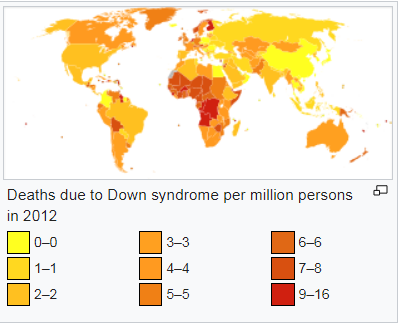</center> [uso de wikimedia.](https://cdn.steemitimages.com/DQmajFaAcbkdvYaCQmMn2BNxNNoFhpbP3ZBrDHhHdTUAR2y/eres4.png) _Las personas con síndrome de Down tienen un mayor riesgo de muerte prematura que la población general. Esto es más a menudo de problemas cardíacos o infecciones. Después de una mejor atención médica, particularmente para problemas cardíacos y gastrointestinales, la esperanza de vida ha aumentado. Este aumento ha sido de 12 años en 1912, a 25 años en la década de 1980, a 50 a 60 años en el mundo desarrollado en la década de 2000. Actualmente, entre el 4 y el 12% muere en el primer año de vida. La probabilidad de supervivencia a largo plazo está parcialmente determinada por la presencia de problemas cardíacos. En las personas con problemas cardíacos congénitos, el 60% sobreviven hasta los 10 años y el 50% sobreviven hasta los 30 años. En las personas sin problemas cardíacos, el 85% sobreviven hasta los 10 años y el 80% sobreviven hasta los 30 años. Alrededor del 10% vive hasta los 70 años de edad. La Sociedad Nacional de Síndrome de Down ha desarrollado información sobre los aspectos positivos de la vida con síndrome de Down._ # Epidemiología _A nivel mundial, a partir de 2010, el síndrome de Down se produce en aproximadamente 1 por cada 1000 nacimientos y resulta en alrededor de 17,000 muertes. Más niños nacen con síndrome de Down en países donde no se permite el aborto y en países donde el embarazo ocurre con mayor frecuencia a una edad posterior. Aproximadamente 1.4 por cada 1000 nacidos vivos en los Estados Unidos y 1.1 por cada 1000 nacidos vivos en Noruega se ven afectados. En la década de 1950, en los Estados Unidos, se produjo en 2 por cada 1000 nacidos vivos, con la disminución desde entonces debido a la detección prenatal y los abortos. El número de embarazos con síndrome de Down es más de dos veces mayor con muchos abortos espontáneos. Es la causa del 8% de todos los trastornos congénitos._ _La edad materna afecta las posibilidades de tener un embarazo con síndrome de Down. A los 20 años, la oportunidad es uno en 1441; a los 30 años, es uno en 959; a los 40 años, es uno en 84; y a los 50 años es uno de cada 44. Aunque la probabilidad aumenta con la edad materna, el 70% de los niños con síndrome de Down nacen de mujeres de 35 años o menos, porque las personas más jóvenes tienen más hijos. La edad avanzada del padre también es un factor de riesgo en mujeres mayores de 35 años, pero no en mujeres menores de 35 años, y puede explicar en parte el aumento del riesgo a medida que las mujeres envejecen._ <center>https://upload.wikimedia.org/wikipedia/commons/7/72/Down_risk_by_maternal_age.png</center> [El riesgo de tener un embarazo con síndrome de Down en relación con la edad de la madre: Uso justo de wikimedia](https://upload.wikimedia.org/wikipedia/commons/7/72/Down_risk_by_maternal_age.png) ## Referencias : - Weijerman, ME; de Winter, JP (diciembre de 2010). "Práctica clínica. El cuidado de niños con síndrome de Down". Revista Europea de Pediatría. 169. - Patterson, D (julio de 2009). "Análisis genético molecular del síndrome de Down". Genética humana. 126 (1): 195 - 214. - Morris, JK; Mutton, DE; Alberman, E (2002). "Estimaciones revisadas de la prevalencia de nacimiento vivo específico de la edad materna del síndrome de Down". Revista de evaluación médica. 9 (1): 2-6. - "¿Cómo diagnostican los proveedores de atención médica el síndrome de Down?". Eunice Kennedy Shriver Instituto Nacional de Salud Infantil y Desarrollo Humano. 2014-01-17. Archivado desde el original el 7 de marzo de 2016. Consultado el 4 de marzo de 2016. - Roizen, NJ; Patterson, D (abril de 2003). "Síndrome de Down". Lancet (Revisión). 361 (9365): 1281-89. - "Hechos sobre el síndrome de Down". Asociación Nacional para el Síndrome de Down. Archivado desde el original el 3 de abril de 2012. Consultado el 20 de marzo de 2012. - Malt, EA; Dahl, RC; Haugsand, TM; Ulvestad, IH; Emilsen, NM; Hansen, B; Cárdenas, sí; Skøld, RO; Thorsen, AT; Davidsen, EM (5 de febrero de 2013). "Salud y enfermedad en adultos con síndrome de Down". Gary D. (2010). |
| json metadata | {"tags":["stem-espanol","steemstem","spanish","ciencia","castellano"],"users":["steemstem"],"image":["https://upload.wikimedia.org/wikipedia/commons/1/15/Down_syndrome_lg.jpg","https://upload.wikimedia.org/wikipedia/commons/8/81/Brushfield_eye_crop.jpg","https://upload.wikimedia.org/wikipedia/commons/8/8c/Feet_of_a_boy_with_Down_Syndrome.JPG","https://upload.wikimedia.org/wikipedia/commons/1/11/Down_Syndrome_Karyotype.png","https://upload.wikimedia.org/wikipedia/commons/5/5e/T21.JPG","https://upload.wikimedia.org/wikipedia/commons/1/1a/Nuchal_edema_in_Down_Syndrome_Dr._W._Moroder.jpg","https://cdn.steemitimages.com/DQmajFaAcbkdvYaCQmMn2BNxNNoFhpbP3ZBrDHhHdTUAR2y/eres4.png","https://upload.wikimedia.org/wikipedia/commons/7/72/Down_risk_by_maternal_age.png"],"links":["https://upload.wikimedia.org/wikipedia/commons/1/15/Down_syndrome_lg.jpg","https://upload.wikimedia.org/wikipedia/commons/8/81/Brushfield_eye_crop.jpg","https://upload.wikimedia.org/wikipedia/commons/8/8c/Feet_of_a_boy_with_Down_Syndrome.JPG","https://upload.wikimedia.org/wikipedia/commons/5/5e/T21.JPG","https://upload.wikimedia.org/wikipedia/commons/1/1a/Nuchal_edema_in_Down_Syndrome_Dr._W._Moroder.jpg","https://cdn.steemitimages.com/DQmajFaAcbkdvYaCQmMn2BNxNNoFhpbP3ZBrDHhHdTUAR2y/eres4.png","https://upload.wikimedia.org/wikipedia/commons/7/72/Down_risk_by_maternal_age.png"],"app":"steemit/0.1","format":"markdown"} |
| Transaction Info | Block #24664098/Trx 9213fade1090575eba989763440912e507fcfa92 |
View Raw JSON Data
{
"trx_id": "9213fade1090575eba989763440912e507fcfa92",
"block": 24664098,
"trx_in_block": 34,
"op_in_trx": 0,
"virtual_op": 0,
"timestamp": "2018-07-31T18:10:57",
"op": [
"comment",
{
"parent_author": "",
"parent_permlink": "stem-espanol",
"author": "dialexandro",
"permlink": "sindromes-cromosomicos-enfermedades-presente-desde-el-nacimiento-de-los-ninos-el-sindrome-de-down",
"title": "Sindromes Cromosómicos : Enfermedades presente desde el nacimiento de los Niños - \" El Sindrome de Down\"",
"body": "_Hola queridos amigos de @ stem-espanol y @steemstem hoy quiero mostrar mi primera publicación en inglés, la cual esta referencia a uno de los Sindromes mas Comunes que existe en el mundo \"El síndrome de Down\", el síndrome de Down es una variación genética que afecta a uno de cada 800 a 1,000 bebés nacidos en los Estados Unidos. Aunque todos los niños son únicos en sus patrones de desarrollo, los niños que nacen con el síndrome de Down aprenden de manera diferente. Tienen más variaciones en su desarrollo intelectual, de lenguaje y de movimiento._\n\n_Algunos niños con síndrome de Down también tienen problemas visuales, auditivos, cardíacos y gastrointestinales. Muchos de estos ahora se pueden corregir a través de intervenciones médicas. Con atención médica adecuada, intervención temprana, educación y apoyo durante toda su vida, muchos adultos con síndrome de Down disfrutan de oportunidades laborales y recreativas significativas. Incluso pueden vivir de manera independiente dentro de la comunidad. Sin embargo, pueden vivir de manera independiente en esta comunidad._\n\n<center>https://upload.wikimedia.org/wikipedia/commons/1/15/Down_syndrome_lg.jpg</center>\n[Un dibujo de las características faciales de un bebé con síndrome de Down: Uso justo de Wikimedia](https://upload.wikimedia.org/wikipedia/commons/1/15/Down_syndrome_lg.jpg)\n\n_El síndrome de Down (DS o DNS), también conocido como trisomía 21, es un trastorno genético causado por la presencia de la totalidad o una parte de una tercera copia del cromosoma 21. Generalmente se asocia con retrasos en el crecimiento físico, rasgos faciales característicos y leves discapacidad intelectual moderada. El CI promedio de un adulto joven con síndrome de Down es de 50, lo que equivale a la capacidad mental de un niño de 8 o 9 años, pero esto puede variar ampliamente._\n\n_Los padres del individuo afectado son típicamente genéticamente normales. El cromosoma extra ocurre por casualidad. La probabilidad aumenta de menos del 0.1% en madres de 20 años al 3% en aquellas de 45 años. No se conoce actividad conductual o factor ambiental que cambie la probabilidad. El síndrome de Down puede identificarse durante el embarazo mediante un examen prenatal seguido de pruebas de diagnóstico o después del nacimiento mediante observación directa y pruebas genéticas. Desde la introducción del cribado, los embarazos con el diagnóstico a menudo se interrumpen. Se recomienda la detección regular de los problemas de salud comunes en el síndrome de Down durante toda la vida de la persona._\n\n_No hay cura para el síndrome de Down. Se ha demostrado que la educación y la atención adecuada mejoran la calidad de vida. Algunos niños con síndrome de Down reciben educación en clases típicas de la escuela, mientras que otros requieren una educación más especializada. Algunas personas con síndrome de Down se gradúan de la escuela secundaria, y algunas asisten a la educación postsecundaria. En la edad adulta, alrededor del 20% en los Estados Unidos realizan algún tipo de trabajo remunerado, y muchas requieren un ambiente de trabajo protegido. El apoyo en asuntos financieros y legales a menudo es necesario. La esperanza de vida es de alrededor de 50 a 60 años en el mundo desarrollado con una atención médica adecuada._\n\n_El síndrome de Down es una de las anormalidades cromosómicas más comunes en los humanos. Ocurre en aproximadamente uno por cada 1,000 bebés que nacen cada año. En 2015, el síndrome de Down estuvo presente en 5.4 millones de personas y dio como resultado 27,000 muertes, por debajo de las 43,000 muertes en 1990. Se llama así por John Langdon Down, un médico británico que describió completamente el síndrome en 1866. Algunos aspectos de la condición fueron descritos anteriormente por Jean-Étienne Dominique Esquirol en 1838 y Édouard Séguin en 1844. En 1959, se descubrió la causa genética del síndrome de Down, una copia extra del cromosoma 21._\n\n# Signos y síntomas\n\n\n_Las personas con síndrome de Down casi siempre tienen discapacidades físicas e intelectuales. Como adultos, sus habilidades mentales son típicamente similares a las de un niño de 8 o 9 años. También suelen tener una función inmune pobre y, en general, alcanzan los hitos del desarrollo a una edad posterior. Tienen un mayor riesgo de una serie de otros problemas de salud, incluidos defectos cardíacos congénitos, epilepsia, leucemia, enfermedades de la tiroides y trastornos mentales._\n\n<center>https://upload.wikimedia.org/wikipedia/commons/8/81/Brushfield_eye_crop.jpg</center>\n[Manchas de Brushfield, visibles en los iris de un bebé con síndrome de Down: Uso justo de Wikimedia](https://upload.wikimedia.org/wikipedia/commons/8/81/Brushfield_eye_crop.jpg)\n\n# Caracteristicas Físicas :\n\n\n_Las personas con síndrome de Down pueden tener algunas o todas estas características físicas: mentón pequeño, ojos rasgados, tono muscular pobre, puente nasal plano, un solo pliegue de la palma y una lengua que sobresale debido a una boca pequeña y una lengua relativamente grande. . Estos cambios en las vías respiratorias conducen a la apnea obstructiva del sueño en alrededor de la mitad de las personas con síndrome de Down. Otras características comunes incluyen: una cara plana y ancha, un cuello corto, flexibilidad excesiva de la articulación, espacio extra entre el dedo gordo y el segundo dedo del pie, patrones anormales en las yemas de los dedos y los dedos cortos. La inestabilidad de la articulación atlantoaxial se produce en alrededor del 20% y puede provocar una lesión de la médula espinal en 1-2%. Las dislocaciones de cadera pueden ocurrir sin trauma en hasta un tercio de las personas con síndrome de Down._\n\n_El crecimiento en altura es más lento, lo que resulta en adultos que tienden a tener baja estatura: la altura promedio para los hombres es de 154 cm (5 pies 1 pulgada) y para las mujeres es de 142 cm (4 pies y 8 pulgadas). Las personas con síndrome de Down tienen un mayor riesgo de obesidad a medida que envejecen. Las tablas de crecimiento se han desarrollado específicamente para niños con síndrome de Down._\n\n<center>https://upload.wikimedia.org/wikipedia/commons/8/8c/Feet_of_a_boy_with_Down_Syndrome.JPG</center>\n[Pies de un niño con síndrome de Down: Uso justo de Wikimedia](https://upload.wikimedia.org/wikipedia/commons/8/8c/Feet_of_a_boy_with_Down_Syndrome.JPG)\n\n# Neurológico\n\n_La mayoría de las personas con síndrome de Down tienen una discapacidad intelectual leve (IQ: 50-69) o moderada (IQ: 35-50), con algunos casos con dificultades graves (IQ: 20-35). Las personas con síndrome de Down en mosaico suelen tener puntuaciones de IQ de 10 a 30 puntos más. A medida que envejecen, las personas con síndrome de Down suelen rendir menos que sus compañeros de la misma edad. Algunos después de los 30 años de edad pueden perder su capacidad de hablar. Este síndrome causa aproximadamente un tercio de los casos de discapacidad intelectual. Muchos hitos del desarrollo se retrasan, con la capacidad de gatear que generalmente ocurre alrededor de 8 meses en lugar de 5 meses y la capacidad de caminar de forma independiente suele ser de aproximadamente 21 meses en lugar de 14 meses._\n\n_Comúnmente, las personas con síndrome de Down tienen una mejor comprensión del lenguaje que la capacidad de hablar. Entre el 10 y el 45% tienen un tartamudeo o un habla rápida e irregular, lo que dificulta su comprensión. Por lo general, les va bastante bien con las habilidades sociales. Los problemas de conducta generalmente no son tan importantes como en otros síndromes asociados con la discapacidad intelectual. En los niños con síndrome de Down, la enfermedad mental ocurre en casi un 30% y el autismo ocurre en un 5-10%. Las personas con síndrome de Down experimentan una amplia gama de emociones. Mientras que las personas con síndrome de Down son generalmente felices, pueden desarrollarse síntomas de depresión y ansiedad. adultez temprana._\n\n_Los niños y adultos con síndrome de Down tienen un mayor riesgo de sufrir ataques epilépticos, que ocurren en un 5-10% de los niños y hasta en un 50% de los adultos. Esto incluye un mayor riesgo de un tipo específico de convulsión llamado espasmos infantiles. Muchos (15%) que viven 40 años o más desarrollan la enfermedad de Alzheimer. En aquellos que alcanzan los 60 años de edad, 50-70% tienen la enfermedad._\n\n## Sentido\n\n\n_Los trastornos de la audición y la vista ocurren en más de la mitad de las personas con síndrome de Down. Los problemas de visión ocurren en un 38 a 80%. Entre el 20 y el 50% tienen estrabismo, en el cual los dos ojos no se mueven juntos. Las cataratas (nubosidad de la lente del ojo) ocurren en 15% y pueden estar presentes al nacer. El queratocono (una córnea delgada en forma de cono) y el glaucoma (presión ocular aumentada) también son más comunes, así como los errores refractivos que requieren gafas o contactos. Las manchas de frotis (pequeñas manchas blancas o grisáceas / marrones en la parte externa del iris) son presente en 38 a 85% de las personas._\n\n_Los problemas de audición se encuentran en 50-90% de los niños con síndrome de Down. Esto a menudo es el resultado de la otitis media con derrame que ocurre en 50-70% y las infecciones crónicas del oído que ocurren en 40 a 60%. Las infecciones de oído a menudo comienzan en el primer año de vida y se deben en parte a la función deficiente de la trompa de Eustaquio. La cera excesiva del oído también puede causar pérdida de la audición debido a la obstrucción del conducto auditivo externo. Incluso un leve grado de pérdida de audición puede tener consecuencias negativas para el habla, la comprensión del lenguaje y los aspectos académicos. Además, es importante descartar la pérdida de audición como un factor en el deterioro social y cognitivo. La pérdida auditiva relacionada con la edad del tipo neurosensorial ocurre a una edad mucho más temprana y afecta al 10-70% de las personas con síndrome de Down._\n\n## Corazón\n\n_La tasa de cardiopatía congénita en recién nacidos con síndrome de Down es de alrededor del 40%. De aquellos con enfermedad cardíaca, alrededor del 80% tienen un defecto septal auriculoventricular o un defecto del tabique ventricular siendo el primero el más común. Los problemas de la válvula mitral se vuelven comunes a medida que las personas envejecen, incluso en aquellos que no tienen problemas cardíacos al nacer. Otros problemas que pueden ocurrir incluyen la tetralogía de Fallot y el ductus arterioso permeable. Las personas con síndrome de Down tienen un menor riesgo de endurecimiento de las arterias._\n\n## Cáncer\n\n_Aunque el riesgo general de cáncer en DS no cambia, el riesgo de cáncer testicular y ciertos cánceres de sangre, incluida la leucemia linfoblástica aguda (ALL) y la leucemia megacarioblástica aguda (AMKL) aumenta, mientras que disminuye el riesgo de otros cánceres no sanguíneos. Se cree que las personas con SD tienen un mayor riesgo de desarrollar cánceres derivados de células germinales, ya sea que estos cánceres sean de origen sanguíneo o no relacionados con la sangre._\n\n## Cánceres de sangre\n\n_Los cánceres de la sangre son de 10 a 15 veces más comunes en los niños con síndrome de Down. En particular, la leucemia linfoblástica aguda es 20 veces más común y la forma megacarioblástica de la leucemia mieloide aguda (leucemia megacarioblástica aguda) es 500 veces más común.La leucemia megacarioblástica aguda (AMKL) es una leucemia de megacarioblastos, las células precursoras de los megacariocitos que forman plaquetas de la sangre. La leucemia linfoblástica aguda en el síndrome de Down representa el 1-3% de todos los casos infantiles de LLA. Ocurre con mayor frecuencia en personas mayores de 9 años o que tienen un recuento de glóbulos blancos mayor de 50,000 por microlitro y es raro en los menores de 1 año. TODO en DS tiende a tener peores resultados que otros casos de ALL en personas sin DS._\n\n# Genética del síndrome de Down\n\n_El síndrome de Down es causado por tener tres copias de los genes en el cromosoma 21, en lugar de los dos habituales. Los padres del individuo afectado son típicamente genéticamente normales. Los que tienen un hijo con síndrome de Down tienen aproximadamente un 1% de riesgo de tener un segundo hijo con el síndrome, si se descubre que ambos padres tienen cariotipos normales._\n\n_El contenido extra de cromosomas puede surgir de diferentes maneras. La causa más común (alrededor del 92-95% de los casos) es una copia extra completa del cromosoma 21, que da como resultado la trisomía 21. En el 1.0 al 2.5% de los casos, algunas de las células del cuerpo son normales y otras tienen trisomía 21. conocido como síndrome de Down mosaico. Los otros mecanismos comunes que pueden dar lugar al síndrome de Down incluyen: una translocación Robertsoniana, isocromosoma o cromosoma en anillo. Estos contienen material adicional del cromosoma 21 y ocurren en aproximadamente el 2.5% de los casos. Un isocromosoma se produce cuando los dos brazos largos de un cromosoma se separan en lugar de separarse del brazo largo y corto durante el desarrollo del óvulo o el esperma._\n\n# Trisomía 21\n\n_La trisomía 21 (también conocida por el cariotipo 47, XX, + 21 para las mujeres y 47, XY, + 21 para los hombres) [65] es causada por una falla del 21º cromosoma para separarse durante el desarrollo de óvulos o espermatozoides. [61] Como resultado, se produce un espermatozoide o óvulo con una copia adicional del cromosoma 21; esta célula tiene 24 cromosomas. Cuando se combina con una célula normal del otro progenitor, el bebé tiene 47 cromosomas, con tres copias del cromosoma 21. Aproximadamente el 88% de los casos de trisomía 21 son el resultado de la no separación de los cromosomas en la madre, el 8% de la no separación en el padre y el 3% después de que el óvulo y el espermatozoide se fusionaron._\n\n# Translocación\n\n_El material adicional del cromosoma 21 también puede ocurrir debido a una translocación Robertsoniana en 2-4% de los casos. En esta situación, el brazo largo del cromosoma 21 está unido a otro cromosoma, a menudo el cromosoma 14. En un hombre afectado con síndrome de Down, resulta en un cariotipo de 46XY, t (14q21q). Esta puede ser una nueva mutación o previamente presente en uno de los padres. El padre con dicha translocación suele ser normal física y mentalmente; sin embargo, durante la producción de óvulos o espermatozoides, existe una mayor probabilidad de crear células reproductivas con material cromosómico 21 adicional. Esto ocasiona un 15% de posibilidades de tener un hijo con síndrome de Down cuando la madre se ve afectada y una probabilidad de menos del 5% si el padre está afectado La probabilidad de este tipo de síndrome de Down no está relacionada con la edad de la madre. Algunos niños sin síndrome de Down pueden heredar la translocación y tener una mayor probabilidad de tener hijos propios con síndrome de Down. En este caso, a veces se lo conoce como síndrome de Down familiar._\n\n<center>https://upload.wikimedia.org/wikipedia/commons/1/11/Down_Syndrome_Karyotype.png</center>\n[Cariotipo para el síndrome de Down de trisomía: observe las tres copias del cromosoma 21: Uso justo de Wikimedia]\n(https://upload.wikimedia.org/wikipedia/commons/1/11/Down_Syndrome_Karyotype.png)\n\n# Diagnóstico\n## Antes del nacimiento\n\n_Cuando las pruebas de detección predicen un alto riesgo de síndrome de Down, se necesita una prueba de diagnóstico más invasiva (amniocentesis o muestra de vellosidades coriónicas) para confirmar el diagnóstico. Si el síndrome de Down ocurre en uno de cada 500 embarazos y la prueba utilizada tiene una tasa de falsos positivos del 5%, esto significa que de 26 mujeres que dan positivo en el examen de detección, solo uno tendrá el síndrome de Down confirmado. Si la prueba de detección tiene una tasa de falsos positivos del 2%, esto significa que uno de los once que dan positivo en la detección tienen un feto con DS. La amniocentesis y el muestreo de vellosidades coriónicas son pruebas más confiables, pero aumentan el riesgo de aborto espontáneo entre 0,5 y 1%. El riesgo de problemas en las extremidades aumenta en la descendencia debido al procedimiento. El riesgo del procedimiento es mayor cuanto antes se realiza, por lo tanto, no se recomienda la amniocentesis antes de las 15 semanas de edad gestacional y el muestreo de vellosidades coriónicas antes de las 10 semanas de edad gestacional._\n\n## Tasas de aborto\n\n_Alrededor del 92% de los embarazos en Europa con un diagnóstico de síndrome de Down se dan por terminados. En los Estados Unidos, las tasas de terminación rondan el 67%, pero esta tasa varió del 61% al 93% entre las diferentes poblaciones. Las tasas son más bajas entre las mujeres que son más jóvenes y han disminuido con el tiempo. Cuando se pregunta a las personas no embarazadas si tendrían una interrupción si su feto dio positivo, 23-33% dijo que sí, cuando se preguntó a mujeres embarazadas de alto riesgo, 46-86% dijo que sí, y cuando se preguntó a las mujeres que respondieron positivo, 89 -97% dice que sí._\n\n## Después del nacimiento\n\n_El diagnóstico a menudo puede sospecharse en función de la apariencia física del niño al nacer. Se necesita un análisis de los cromosomas del niño para confirmar el diagnóstico y determinar si existe una translocación, ya que esto puede ayudar a determinar el riesgo de que los padres del niño tengan más hijos con síndrome de Down. Los padres generalmente desean saber el posible diagnóstico una vez que se sospecha y no desean piedad._\n\n# Ultrasonido\n\n_La ecografía se puede utilizar para detectar el síndrome de Down. Los hallazgos que indican mayor riesgo cuando se observan a las 14 a 24 semanas de gestación incluyen un hueso nasal pequeño o nulo, ventrículos grandes, grosor de la nuca y una arteria subclavia derecha anormal, entre otros. La presencia o ausencia de muchos marcadores es más precisa. El aumento de la translucidez de la nuca fetal (TN) indica un aumento del riesgo de que el síndrome de Down capte entre el 75% y el 80% de los casos y sea falsamente positivo en el 6%._\n\n<center>https://upload.wikimedia.org/wikipedia/commons/5/5e/T21.JPG</center>\n[Ultrasonido del feto con síndrome de Down que muestra una gran vejiga: Uso justo de wikimedia](https://upload.wikimedia.org/wikipedia/commons/5/5e/T21.JPG)\n\n# Análisis de sangre\n\n_Se pueden medir varios marcadores sanguíneos para predecir el riesgo de síndrome de Down durante el primer o segundo trimestre. Las pruebas en ambos trimestres a veces se recomiendan y los resultados de las pruebas a menudo se combinan con resultados de ultrasonido. En el segundo trimestre, a menudo se usan dos o tres pruebas en combinación con dos o tres de: α-fetoproteína, estriol no conjugado, hCG total y βhCG libre que detecta aproximadamente 60-70% de los casos._\n\n_Las pruebas de ADN de la sangre de la madre se están estudiando y parecen prometedoras en el primer trimestre. La Sociedad Internacional de Diagnóstico Prenatal considera que es una opción de detección razonable para aquellas mujeres cuyos embarazos tienen un alto riesgo de trisomía 21. Se ha informado que la precisión fue del 98.6% en el primer trimestre del embarazo. Todavía se requieren pruebas confirmatorias mediante técnicas invasivas (amniocentesis, CVS) para confirmar el resultado de la detección._\n\n<center>https://upload.wikimedia.org/wikipedia/commons/1/1a/Nuchal_edema_in_Down_Syndrome_Dr._W._Moroder.jpg</center>\n[NT agrandada y ausencia de hueso nasal en un feto a las 11 semanas con síndrome de Down: Uso justo de wikimedia](https://upload.wikimedia.org/wikipedia/commons/1/1a/Nuchal_edema_in_Down_Syndrome_Dr._W._Moroder.jpg)\n\n# Pronóstico a Nivel Mundial \n\n_Entre el 5 y el 15% de los niños con síndrome de Down en Suecia asisten a la escuela regular. Algunos se gradúan de la escuela secundaria; sin embargo, la mayoría no lo hace. De las personas con discapacidad intelectual en los Estados Unidos que asistieron a la escuela secundaria se graduaron alrededor del 40%. Muchos aprenden a leer y escribir y algunos son capaces de hacer un trabajo remunerado. En la edad adulta, alrededor del 20% en los Estados Unidos realizan trabajos remunerados en alguna capacidad. Sin embargo, en Suecia, menos del 1% tiene trabajos regulares. Muchos pueden vivir de forma semiindependiente, pero a menudo requieren ayuda con asuntos financieros, médicos y legales. Aquellos con síndrome de Down mosaico generalmente tienen mejores resultados._\n\n<center></center>\n[uso de wikimedia.](https://cdn.steemitimages.com/DQmajFaAcbkdvYaCQmMn2BNxNNoFhpbP3ZBrDHhHdTUAR2y/eres4.png)\n\n_Las personas con síndrome de Down tienen un mayor riesgo de muerte prematura que la población general. Esto es más a menudo de problemas cardíacos o infecciones. Después de una mejor atención médica, particularmente para problemas cardíacos y gastrointestinales, la esperanza de vida ha aumentado. Este aumento ha sido de 12 años en 1912, a 25 años en la década de 1980, a 50 a 60 años en el mundo desarrollado en la década de 2000. Actualmente, entre el 4 y el 12% muere en el primer año de vida. La probabilidad de supervivencia a largo plazo está parcialmente determinada por la presencia de problemas cardíacos. En las personas con problemas cardíacos congénitos, el 60% sobreviven hasta los 10 años y el 50% sobreviven hasta los 30 años. En las personas sin problemas cardíacos, el 85% sobreviven hasta los 10 años y el 80% sobreviven hasta los 30 años. Alrededor del 10% vive hasta los 70 años de edad. La Sociedad Nacional de Síndrome de Down ha desarrollado información sobre los aspectos positivos de la vida con síndrome de Down._\n\n# Epidemiología\n\n\n_A nivel mundial, a partir de 2010, el síndrome de Down se produce en aproximadamente 1 por cada 1000 nacimientos y resulta en alrededor de 17,000 muertes. Más niños nacen con síndrome de Down en países donde no se permite el aborto y en países donde el embarazo ocurre con mayor frecuencia a una edad posterior. Aproximadamente 1.4 por cada 1000 nacidos vivos en los Estados Unidos y 1.1 por cada 1000 nacidos vivos en Noruega se ven afectados. En la década de 1950, en los Estados Unidos, se produjo en 2 por cada 1000 nacidos vivos, con la disminución desde entonces debido a la detección prenatal y los abortos. El número de embarazos con síndrome de Down es más de dos veces mayor con muchos abortos espontáneos. Es la causa del 8% de todos los trastornos congénitos._\n\n_La edad materna afecta las posibilidades de tener un embarazo con síndrome de Down. A los 20 años, la oportunidad es uno en 1441; a los 30 años, es uno en 959; a los 40 años, es uno en 84; y a los 50 años es uno de cada 44. Aunque la probabilidad aumenta con la edad materna, el 70% de los niños con síndrome de Down nacen de mujeres de 35 años o menos, porque las personas más jóvenes tienen más hijos. La edad avanzada del padre también es un factor de riesgo en mujeres mayores de 35 años, pero no en mujeres menores de 35 años, y puede explicar en parte el aumento del riesgo a medida que las mujeres envejecen._\n\n<center>https://upload.wikimedia.org/wikipedia/commons/7/72/Down_risk_by_maternal_age.png</center>\n[El riesgo de tener un embarazo con síndrome de Down en relación con la edad de la madre: Uso justo de wikimedia](https://upload.wikimedia.org/wikipedia/commons/7/72/Down_risk_by_maternal_age.png)\n\n## Referencias :\n\n - Weijerman, ME; de Winter, JP (diciembre de 2010). \"Práctica clínica. El cuidado de niños con síndrome de Down\". Revista Europea de Pediatría. 169.\n\n- Patterson, D (julio de 2009). \"Análisis genético molecular del síndrome de Down\". Genética humana. 126 (1): 195 - 214.\n\n- Morris, JK; Mutton, DE; Alberman, E (2002). \"Estimaciones revisadas de la prevalencia de nacimiento vivo específico de la edad materna del síndrome de Down\". Revista de evaluación médica. 9 (1): 2-6.\n\n- \"¿Cómo diagnostican los proveedores de atención médica el síndrome de Down?\". Eunice Kennedy Shriver Instituto Nacional de Salud Infantil y Desarrollo Humano. 2014-01-17. Archivado desde el original el 7 de marzo de 2016. Consultado el 4 de marzo de 2016.\n\n- Roizen, NJ; Patterson, D (abril de 2003). \"Síndrome de Down\". Lancet (Revisión). 361 (9365): 1281-89.\n\n - \"Hechos sobre el síndrome de Down\". Asociación Nacional para el Síndrome de Down. Archivado desde el original el 3 de abril de 2012. Consultado el 20 de marzo de 2012.\n - Malt, EA; Dahl, RC; Haugsand, TM; Ulvestad, IH; Emilsen, NM; Hansen, B; Cárdenas, sí; Skøld, RO; Thorsen, AT; Davidsen, EM (5 de febrero de 2013). \"Salud y enfermedad en adultos con síndrome de Down\". Gary D. (2010).",
"json_metadata": "{\"tags\":[\"stem-espanol\",\"steemstem\",\"spanish\",\"ciencia\",\"castellano\"],\"users\":[\"steemstem\"],\"image\":[\"https://upload.wikimedia.org/wikipedia/commons/1/15/Down_syndrome_lg.jpg\",\"https://upload.wikimedia.org/wikipedia/commons/8/81/Brushfield_eye_crop.jpg\",\"https://upload.wikimedia.org/wikipedia/commons/8/8c/Feet_of_a_boy_with_Down_Syndrome.JPG\",\"https://upload.wikimedia.org/wikipedia/commons/1/11/Down_Syndrome_Karyotype.png\",\"https://upload.wikimedia.org/wikipedia/commons/5/5e/T21.JPG\",\"https://upload.wikimedia.org/wikipedia/commons/1/1a/Nuchal_edema_in_Down_Syndrome_Dr._W._Moroder.jpg\",\"https://cdn.steemitimages.com/DQmajFaAcbkdvYaCQmMn2BNxNNoFhpbP3ZBrDHhHdTUAR2y/eres4.png\",\"https://upload.wikimedia.org/wikipedia/commons/7/72/Down_risk_by_maternal_age.png\"],\"links\":[\"https://upload.wikimedia.org/wikipedia/commons/1/15/Down_syndrome_lg.jpg\",\"https://upload.wikimedia.org/wikipedia/commons/8/81/Brushfield_eye_crop.jpg\",\"https://upload.wikimedia.org/wikipedia/commons/8/8c/Feet_of_a_boy_with_Down_Syndrome.JPG\",\"https://upload.wikimedia.org/wikipedia/commons/5/5e/T21.JPG\",\"https://upload.wikimedia.org/wikipedia/commons/1/1a/Nuchal_edema_in_Down_Syndrome_Dr._W._Moroder.jpg\",\"https://cdn.steemitimages.com/DQmajFaAcbkdvYaCQmMn2BNxNNoFhpbP3ZBrDHhHdTUAR2y/eres4.png\",\"https://upload.wikimedia.org/wikipedia/commons/7/72/Down_risk_by_maternal_age.png\"],\"app\":\"steemit/0.1\",\"format\":\"markdown\"}"
}
]
}2018/07/31 17:02:21
2018/07/31 17:02:21
| parent author | gentleshaid |
| parent permlink | deadly-plant-series-riccinus-communis-and-the-curious-case-of-georgi-markov |
| author | dialexandro |
| permlink | re-gentleshaid-deadly-plant-series-riccinus-communis-and-the-curious-case-of-georgi-markov-20180731t170303352z |
| title | |
| body | @gentleshaid Many congratulations for supporting the quality content, and I invite you to observe my content @dialexandro |
| json metadata | {"tags":["stemng"],"users":["gentleshaid","dialexandro"],"app":"steemit/0.1"} |
| Transaction Info | Block #24662729/Trx 5df321e12788f217f08b7395bf70a6b60c90ab8c |
View Raw JSON Data
{
  "trx_id": "5df321e12788f217f08b7395bf70a6b60c90ab8c",
  "block": 24662729,
  "trx_in_block": 76,
  "op_in_trx": 0,
  "virtual_op": 0,
  "timestamp": "2018-07-31T17:02:21",
  "op": [
    "comment",
    {
      "parent_author": "gentleshaid",
      "parent_permlink": "deadly-plant-series-riccinus-communis-and-the-curious-case-of-georgi-markov",
      "author": "dialexandro",
      "permlink": "re-gentleshaid-deadly-plant-series-riccinus-communis-and-the-curious-case-of-georgi-markov-20180731t170303352z",
      "title": "",
      "body": "@gentleshaid Many congratulations for supporting the quality content, and I invite you to observe my content @dialexandro",
      "json_metadata": "{\"tags\":[\"stemng\"],\"users\":[\"gentleshaid\",\"dialexandro\"],\"app\":\"steemit/0.1\"}"
    }
  ]
}dialexandrocustom json: follow2018/07/31 17:00:45
dialexandrocustom json: follow
2018/07/31 17:00:45
| required auths | [] |
| required posting auths | ["dialexandro"] |
| id | follow |
| json | ["reblog",{"account":"dialexandro","author":"gentleshaid","permlink":"deadly-plant-series-riccinus-communis-and-the-curious-case-of-georgi-markov"}] |
| Transaction Info | Block #24662697/Trx 7896bb05cdd5ca9bcf4790431220ae4f0d1dee67 |
View Raw JSON Data
{
  "trx_id": "7896bb05cdd5ca9bcf4790431220ae4f0d1dee67",
  "block": 24662697,
  "trx_in_block": 52,
  "op_in_trx": 0,
  "virtual_op": 0,
  "timestamp": "2018-07-31T17:00:45",
  "op": [
    "custom_json",
    {
      "required_auths": [],
      "required_posting_auths": [
        "dialexandro"
      ],
      "id": "follow",
      "json": "[\"reblog\",{\"account\":\"dialexandro\",\"author\":\"gentleshaid\",\"permlink\":\"deadly-plant-series-riccinus-communis-and-the-curious-case-of-georgi-markov\"}]"
    }
  ]
}2018/07/31 16:59:33
2018/07/31 16:59:33
| parent author | steemstem |
| parent permlink | steemstem-distilled-68 |
| author | dialexandro |
| permlink | re-steemstem-steemstem-distilled-68-20180731t170012511z |
| title | |
| body | @steemstem Many congratulations for supporting the quality content, and I invite you to observe my content @dialexandro |
| json metadata | {"tags":["steemstem"],"users":["steemstem","dialexandro"],"app":"steemit/0.1"} |
| Transaction Info | Block #24662673/Trx 66320806094d371a1e0654fa65f6f2b1f1803433 |
View Raw JSON Data
{
  "trx_id": "66320806094d371a1e0654fa65f6f2b1f1803433",
  "block": 24662673,
  "trx_in_block": 29,
  "op_in_trx": 0,
  "virtual_op": 0,
  "timestamp": "2018-07-31T16:59:33",
  "op": [
    "comment",
    {
      "parent_author": "steemstem",
      "parent_permlink": "steemstem-distilled-68",
      "author": "dialexandro",
      "permlink": "re-steemstem-steemstem-distilled-68-20180731t170012511z",
      "title": "",
      "body": "@steemstem Many congratulations for supporting the quality content, and I invite you to observe my content @dialexandro",
      "json_metadata": "{\"tags\":[\"steemstem\"],\"users\":[\"steemstem\",\"dialexandro\"],\"app\":\"steemit/0.1\"}"
    }
  ]
}dialexandrocustom json: follow2018/07/31 16:56:03
dialexandrocustom json: follow
2018/07/31 16:56:03
| required auths | [] |
| required posting auths | ["dialexandro"] |
| id | follow |
| json | ["reblog",{"account":"dialexandro","author":"steemstem","permlink":"steemstem-distilled-68"}] |
| Transaction Info | Block #24662603/Trx 85a461dcd2b3a405ae2d681545ab897cb623c624 |
View Raw JSON Data
{
  "trx_id": "85a461dcd2b3a405ae2d681545ab897cb623c624",
  "block": 24662603,
  "trx_in_block": 7,
  "op_in_trx": 0,
  "virtual_op": 0,
  "timestamp": "2018-07-31T16:56:03",
  "op": [
    "custom_json",
    {
      "required_auths": [],
      "required_posting_auths": [
        "dialexandro"
      ],
      "id": "follow",
      "json": "[\"reblog\",{\"account\":\"dialexandro\",\"author\":\"steemstem\",\"permlink\":\"steemstem-distilled-68\"}]"
    }
  ]
}2018/07/30 23:54:03
2018/07/30 23:54:03
| voter | sensation |
| author | dialexandro |
| permlink | seismic-methods-introduction-to-the-technique-of-seismic-methods-of-geological-exploration |
| weight | 10000 (100.00%) |
| Transaction Info | Block #24642170/Trx babe505b25edddfa5070af0ff2ba5040f760bf64 |
View Raw JSON Data
{
  "trx_id": "babe505b25edddfa5070af0ff2ba5040f760bf64",
  "block": 24642170,
  "trx_in_block": 1,
  "op_in_trx": 0,
  "virtual_op": 0,
  "timestamp": "2018-07-30T23:54:03",
  "op": [
    "vote",
    {
      "voter": "sensation",
      "author": "dialexandro",
      "permlink": "seismic-methods-introduction-to-the-technique-of-seismic-methods-of-geological-exploration",
      "weight": 10000
    }
  ]
}2018/07/30 22:15:00
2018/07/30 22:15:00
| voter | council |
| author | dialexandro |
| permlink | seismic-methods-introduction-to-the-technique-of-seismic-methods-of-geological-exploration |
| weight | 1000 (10.00%) |
| Transaction Info | Block #24640189/Trx 51e639c7046320499356eea7724a83146ae9c8aa |
View Raw JSON Data
{
  "trx_id": "51e639c7046320499356eea7724a83146ae9c8aa",
  "block": 24640189,
  "trx_in_block": 7,
  "op_in_trx": 0,
  "virtual_op": 0,
  "timestamp": "2018-07-30T22:15:00",
  "op": [
    "vote",
    {
      "voter": "council",
      "author": "dialexandro",
      "permlink": "seismic-methods-introduction-to-the-technique-of-seismic-methods-of-geological-exploration",
      "weight": 1000
    }
  ]
}2018/07/30 21:21:09
2018/07/30 21:21:09
| voter | alphabot |
| author | dialexandro |
| permlink | seismic-methods-introduction-to-the-technique-of-seismic-methods-of-geological-exploration |
| weight | 100 (1.00%) |
| Transaction Info | Block #24639112/Trx fe2dabc378d8cb27ae2778ce836d770a1c48b677 |
View Raw JSON Data
{
  "trx_id": "fe2dabc378d8cb27ae2778ce836d770a1c48b677",
  "block": 24639112,
  "trx_in_block": 43,
  "op_in_trx": 0,
  "virtual_op": 0,
  "timestamp": "2018-07-30T21:21:09",
  "op": [
    "vote",
    {
      "voter": "alphabot",
      "author": "dialexandro",
      "permlink": "seismic-methods-introduction-to-the-technique-of-seismic-methods-of-geological-exploration",
      "weight": 100
    }
  ]
}2018/07/30 21:20:57
2018/07/30 21:20:57
| parent author | |
| parent permlink | steemstem |
| author | dialexandro |
| permlink | seismic-methods-introduction-to-the-technique-of-seismic-methods-of-geological-exploration |
| title | Seismic Methods: Introduction to the Technique of Seismic Methods of Geological Exploration |
| body | _Hello friends this is my first publication here in @steemstem, today I want to start a series that I have called Seismic Methods: starting with the introduction of this technique we will know what this method is about and what areas of studies it covers in science Seismic exploration methods are based on the generation of seismic waves, for example by means of an explosion or by means of a falling breaker. Seismic waves are mechanical and elastic waves, because seismic waves cause non-permanent deformations in the environment, in which they propagate. The deformation is constituted by an alternation of compression and expansion in such a way that the particles of the medium approach and move away, responding to the forces associated with the waves, as for example in an extended elastic. Its propagation is described by the wave equation. The speed of the seismic wave depends on the elastic parameters of the medium, in which the wave propagates._ <center>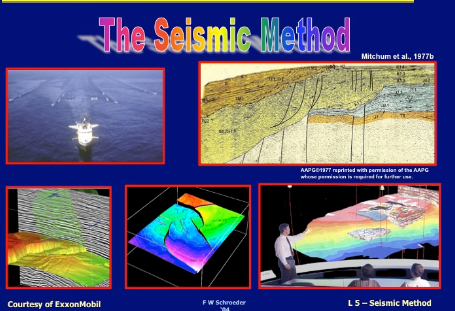</center> image source:[https://www.geovirtual2.cl](https://cdn.steemitimages.com/DQmYa7ARHK1xnvSt6hvArzh1GjLkmUHt1N2hjTCtn2QNL9X/eres3.png) # Elastic stress or strain (stress), strain (strain) and elastic constants Stress S is defined as the force F per unit area A: F / A, where F is the force applied uniformly to a small surface area. Pressure or traction refers to the tension directed perpendicular to the area, as it is exerted towards the body on which it acts (pressure) or in the opposite direction (traction). The pressure causes a shortening inside the body, in which it acts, the traction produces an elongation inside the body, in which it acts. The longitudinal deformation εl is the ratio between the elongation or shortening Δl caused by a tension and the original length l before the application of tension: ε l = Δl / l. The transverse deformation ε a is defined as the relation between the variation of the width Δ a caused by a tension and the primitive width a of the body before the application of tension: ε a = Δ a / a. <center>https://www.geovirtual2.cl/EXPLORAC/FIGURAS/Tension-cuerpo-01.png</center> image source:[https://www.geovirtual2.cl](https://www.geovirtual2.cl/EXPLORAC/FIGURAS/Tension-cuerpo-01.png) # Poisson's coefficient When a body is shortened by compression, it stretches in the direction perpendicular to the compression. A body elongated by the effect of a traction, decreases its width in the direction perpendicular to the tension. The relation between the longitudinal deformation εl and the transverse deformation εa is called the Poisson's ratio σ. σ = ε a / ε l = (Δ a / a) / (Δ l / l). When a voltage acts on a body in one direction and the volume of the body is constant, the Poisson's coefficient has its maximum value equal to 0.5. <center>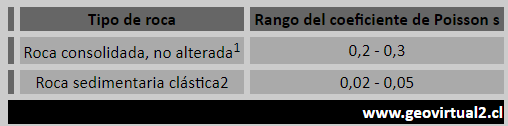</center> image source:[https://www.geovirtual2.cl](https://cdn.steemitimages.com/DQmd5oyN5JBQkkwbT4ow5GSaTMrLcYt2LCVDGJyvwg6soXk/eres.png) 1: For example fine-grained limestone, crystalline rocks. 2: Varying with porosity and weathering status. # Young E module In the case of compressive or tensile stresses, which give rise to a small deformation, the magnitude of this deformation is proportional to the tension according to: ε = k x S = (1 / E) x S → S = E x ε, Module Young E, where S = voltage ε = deformation E = proportionality constant and called the YOUNG module. For a solid with a numerically high value YOUNG E module, the strain caused by a given voltage will be smaller compared to a solid of E of smaller value. (Values of E see table). <center>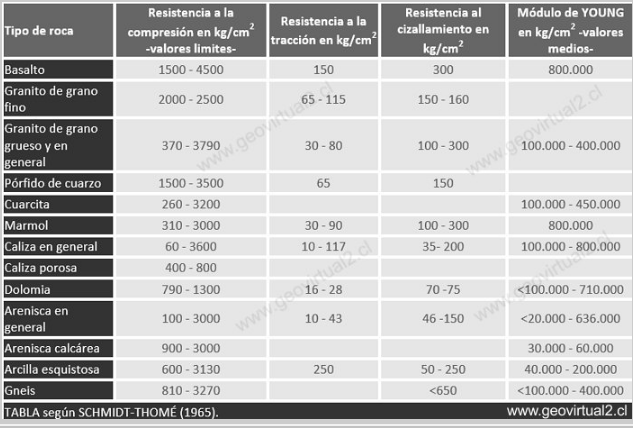</center> image source:[https://www.geovirtual2.cl](https://cdn.steemitimages.com/DQmVBi6EASdNfdN7cztHq7jrFRGYnqfXS5btSvwYsPC46yJ/eres1.png) # Stiffness or shear modulus The shear stress is called tension, which acts parallel to the area. The shear stress gives rise to a fracture deformation. The shear deformation is expressed by the deformation angle F. The angle of deformation is formed by the original surface of the area and the surface deformed by the tension exerted parallel to the area. <center>https://www.geovirtual2.cl/EXPLORAC/FIGURAS/Cizallamiento-01.png</center> image source:[https://www.geovirtual2.cl](https://www.geovirtual2.cl/EXPLORAC/FIGURAS/Cizallamiento-01.png) In the case of a shear stress and a small deformation the tension Ssh is proportional to the deformation: Ssh = m 'f. In this relation m is the proportionality constant called the stiffness or shear modulus ɸ is the deformation angle. For liquids it is worth μ = 0, for most other materials μ approximately and numerically worth half of E. # Compressibility and volumetric module (see fig.) Considering a body of volume V, which is subjected to a uniform compression force in all directions and consequently will decrease its volume by an amount ΔV, the compression exerted on this body is proportional to the deformation or that is to say the relationship between the variation of the volume and the primitive volume of this body before the application of compression according to: Scompression = k (ΔV / V), where the proportionality constant k is called compressibility. The reciprocal value of the compressibility 1 / k = k '= Scompression / (ΔV / V) is called the volumetric module. There are the following relationships between the elastic constants introduced above: μ = / [2 (1 + σ)] and k = E / [3 (1 - 2σ)], compressibility see the following figure. The seismic waves propagate in the solid substances in such a way that the deformation of the particles, which constitute the solid substance, pass through the substance with a velocity, which depends on their elastic properties and their density. ## Deformation (strain) by dilatation Deformation by dilation is the relation of the variation in the distance between two distinct and separate points (A and B), which is produced by a dilation movement, and the original distance between these two points. # Seismic waves The internal seismic waves and the superficial seismic waves are distinguished. The internal waves are: ● Waves for longitudinal waves or compression waves ● Waves or transverse waves or shear waves The surface waves are for example: ● Love waves ● Rayleigh waves Waves for longitudinal waves or compression waves Particles of a p, longitudinal or compression wave oscillate in the direction of propagation of the wave. The p waves are similar to ordinary sound waves. The p waves are faster than the s waves or that is, after a tremor in an observatory the p waves arrive first, secondarily the s waves. The speed of the p waves is calculated as follows: <center>https://www.geovirtual2.cl/EXPLORAC/TEXT/sismo-ondas-p-01.jpg</center> image source:[https://www.geovirtual2.cl](https://www.geovirtual2.cl/EXPLORAC/TEXT/sismo-ondas-p-01.jpg) # Waves or transverse waves or shear waves The particles of a s, transverse or shear wave oscillate perpendicular to the direction of propagation. We distinguish the sh waves, whose particles oscillate in the horizontal plane and perpendicular to the direction of propagation, and the sv waves, whose particles oscillate in the vertical plane and perpendicular to the direction of propagation. In polarized waves, its particles oscillate in a single plane perpendicular to its direction of propagation. The speed of the wave s is calculated as follows: <center>https://www.geovirtual2.cl/EXPLORAC/TEXT/sismo-ondas-s-01.jpg</center> image source:[https://www.geovirtual2.cl](https://www.geovirtual2.cl/EXPLORAC/TEXT/sismo-ondas-s-01.jpg) ## Rayleigh waves Rayleigh (1885) predicted the presence of surface waves by mathematically designing the motion of flat waves in a semi-elastic elastic space. Rayleigh waves cause a rolling movement similar to sea waves and their particles move in ellipsoidal form in the vertical plane, which passes through the direction of propagation. On the surface the movement of the particles is retrograde with respect to the advance of the waves. The speed of the Rayleigh vRayleigh waves is less than the speed of the s waves (transverse) and is approximately vRaleigh = 0.9 'vs, according to DOBRIN (1988). ## Love waves Love (1911) discovered the surface wave, which bears his name studying the effect of elastic vibrations on a surface layer. Love waves require the existence of a superficial layer of lower speed in comparison to the underlying formations or that is, a positive velocity gradient (speed increases) with depth. Love waves are shear waves, which oscillate only in the horizontal plane, that is, Love waves are horizontally polarized shear waves. The wave velocity of Love is approximately vLove = 0.9 x vs., according to Doyle, (1995). The internal waves extend in three dimensions. The surface waves extend in only two dimensions. The speeds of the internal and surface waves are related as follows: vp> vs> vLove> vRayleigh. Generally for the amplitudes (A) of the waves the reverse order is valid: ARayleigh> ALove> As> Ap. As the amplitudes of the surface waves are decreased with the depth of focus, the ratio between the amplitudes of the surface waves and the amplitudes of the internal waves indicates approximately the depth of the focus. In comparison with the internal waves, the amplitudes of the surface waves decrease less rapidly with distance, consequently over long distances with respect to a tremor, the surface waves generate higher signals and dominate the records conserved in the seismograms. Surface waves are characterized by scattering, or the speed of surface waves depends on their frequency and wavelength. The variation of velocity with frequency or wavelength is called dispersion. In a wave affected by dispersion different wavelengths propagate with different speeds appearing as a train of events, whose successive cycles are of increasing or decreasing periods. Analyzing the dispersion of Rayleigh waves, the scientists obtained very useful information about the structure of the Earth's crust and the Earth's upper mantle. On the contrary, in the exploration by the method of seismic reflections Rayleigh waves are less useful, because they contribute appreciably to the background noise. The characteristic parameters of the rocks, which are determined with seismic methods are the speed of the waves p and s, the coefficient of reflection, the density. Properties of the rocks, which influence these parameters are among others: ● Petrography, mineral content. ● Compactness status. ● Porosity = percentage or proportion of empty space (pores) in a rock. ● Filling of empty space or that is, pores such as air, water, oil, gas. ● Texture and structure of the rock. ● Temperature. ● Pressure. A variation in one of these properties of the rock can be related for example with a boundary between two lithological strata, with a fault or a zone of faults, with a change in the filling of the porous space of the rock. #### Velocities of the p waves and s of some rocks are presented in the following table: <center><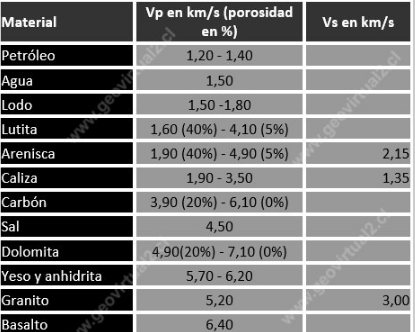</center> imagen source:[https://www.geovirtual2.cl](https://cdn.steemitimages.com/DQmRE1DrQRSmRfQdtKqjrCjbZUTHiPKsPVTjPYgW2BUribS/eres2.png) The internal seismic waves such as the waves p and s are elastic waves, so that they are worth the laws of reflection and refraction. An incident seismic wave on a separation surface between two media such as two strata is partly reflected, partly refracted. The internal seismic waves such as the waves p and s are elastic waves, so that they are worth the laws of reflection and refraction. An incident seismic wave on a separation surface between two media, such as two layers, is partly reflected, partly refracted. For reflection, the law of reflection is valid: <center>https://www.geovirtual2.cl/EXPLORAC/TEXT/sismo-texto-ley-Snell-01.jpg</center> image source:[https://www.geovirtual2.cl](https://www.geovirtual2.cl/EXPLORAC/TEXT/sismo-texto-ley-Snell-01.jpg) When the angle of incidence reaches a critical value (Φ inc, so that sinΦ refraction = 90 °), a wave is generated, which propagates along the separation surface with the velocity of the wave corresponding to stratum2. This wave is called the MINTROP wave, according to Ludger Mintrop, a German, who in 1914 invented the first mechanical seismograph with sufficient precision for exploration. In reflection and refraction phenomena, the two different seismic methods are based: the seismic refraction and the seismic reflections The behavior and trajectory of seismic waves, which propagate in the subsoil can be presented: ● By a profile, which includes shot and several detectors (geophones) aligned on the earth's surface and which illustrates the penetration of wave fronts or wave beams respectively into the geological formations of the subsoil. ● For a graph of the time of the first arrival of the seismic wave as a function of the distance from the shot to the geophones, see distance-time graph. Generating seismic waves artificially (mechanical vibrations or vibrations) at or near the surface and observing their arrival time at the observation stations (geophones) aligned along a profile, you can reconstruct the travel of the waves in the subsoil and locate discontinuities as lithological limits or faults. https://www.youtube.com/watch?v=r7G_zUFy-bk _Good friends of @steemstem I hope that this introductory content on the Seismic Exploration Method is of great interest to all of you I hope for your support, to continue publishing quality content then I will publish the topics that we will be talking about later as a continuation of this content:_ [2 . Elastic effort (stress)](https://archive.epa.gov/esd/archive-geophysics/web/html/index-10.html) [3 . Deformation (strain)](https://archive.epa.gov/esd/archive-geophysics/web/html/index-10.html) [4 . Elastic constants](https://archive.epa.gov/esd/archive-geophysics/web/html/index-10.html) [5 . Seismic waves Behavior](https://archive.epa.gov/esd/archive-geophysics/web/html/index-10.html) ## Bibliography : - Brown, Alistair R. (2004). Interpretation of three-dimensional seismic data (sixth ed.). Society of Exploration Geophysicists and American Association of Petroleum Geologists. - Biondi, B. (2006). 3D seismic images: Three-dimensional seismic images. Exploration geophysical society. - Claerbout, Jon F. (1976). Fundamentals of geophysical data processing. McGraw-Hill. ISBN 1-56080-137-9. Ikelle, Luc T. and Lasse Amundsen (2005). Introduction to oil seismology. Exploration geophysical society. . - Scales, John (1997). Theory of seismic images. Golden, Colorado: Samizdat press. Archived from the original on August 18, 2015. - Yilmaz, Öz (2001). Analysis of seismic data. Exploration geophysical society. . - Milsom, J., University College of London (2005). Field geophysics Wiley Publications. - Chapman, CH. (2004) Fundamentals of the Propagation of Seismic Waves. Press of the University of Cambridge. ## References : - Grusic, V. and Orlic, M., early observations of rotating clouds by Andrija Mohorovičić, Bulletin of the American Meteorological Society, May 2007, p. 693-700, accessed January 4, 2010: [1] - W. M. Telford and others, Applied Geophysics (Cambridge Univ. Press, 1976) 220. - Sheriff, RE, and Geldart, LP, 1995, Seismology Exploration, Second Edition, Cambridge University Press, pp. 3-6. EE Rosaire and Joseph H. Adler, "Applications and limitations of the immersion method", Bulletin of the American Association of Petroleum Geologists, January 1934, v.18 n.1 p.121. - Sheriff, RE, Geldart, LP, (1995), 2nd Edition. Seismological Exploration. Press of the University of Cambridge. - "Physics and chemistry of the interior of the Earth - Seismic Reflection" (PDF). Retrieved on March 10, 2015. - Shuey, RT [1985] A simplification of the Zoeppritz equations. Geophysics, 50: 609-614 - Avseth, P, T Mukerji and G Mavko (2005). Quantitative seismic interpretation. Cambridge University Press, Cambridge, p. 183 - "Roll of earth". Schlumberger Oifield Glossary. Retrieved on September 8, 2013. - Zheng; Yingcai; et al. (2013). "Scholte waves generated by the topography of the eafloor s". arXiv: 1306.4383 freely accessible. Bibcode: 2013arXiv1306.4383Z. - "Reflection of multiples". Schlumberger Oifield Glossary. Retrieved on September 8, 2013. |
| json metadata | {"tags":["steemstem","physical","science","geology","education"],"users":["steemstem"],"image":["https://cdn.steemitimages.com/DQmYa7ARHK1xnvSt6hvArzh1GjLkmUHt1N2hjTCtn2QNL9X/eres3.png","https://www.geovirtual2.cl/EXPLORAC/FIGURAS/Tension-cuerpo-01.png","https://cdn.steemitimages.com/DQmd5oyN5JBQkkwbT4ow5GSaTMrLcYt2LCVDGJyvwg6soXk/eres.png","https://cdn.steemitimages.com/DQmVBi6EASdNfdN7cztHq7jrFRGYnqfXS5btSvwYsPC46yJ/eres1.png","https://www.geovirtual2.cl/EXPLORAC/FIGURAS/Cizallamiento-01.png","https://www.geovirtual2.cl/EXPLORAC/TEXT/sismo-ondas-p-01.jpg","https://www.geovirtual2.cl/EXPLORAC/TEXT/sismo-ondas-s-01.jpg","https://cdn.steemitimages.com/DQmRE1DrQRSmRfQdtKqjrCjbZUTHiPKsPVTjPYgW2BUribS/eres2.png","https://www.geovirtual2.cl/EXPLORAC/TEXT/sismo-texto-ley-Snell-01.jpg","https://img.youtube.com/vi/r7G_zUFy-bk/0.jpg"],"links":["https://cdn.steemitimages.com/DQmYa7ARHK1xnvSt6hvArzh1GjLkmUHt1N2hjTCtn2QNL9X/eres3.png","https://www.geovirtual2.cl/EXPLORAC/FIGURAS/Tension-cuerpo-01.png","https://cdn.steemitimages.com/DQmd5oyN5JBQkkwbT4ow5GSaTMrLcYt2LCVDGJyvwg6soXk/eres.png","https://cdn.steemitimages.com/DQmVBi6EASdNfdN7cztHq7jrFRGYnqfXS5btSvwYsPC46yJ/eres1.png","https://www.geovirtual2.cl/EXPLORAC/FIGURAS/Cizallamiento-01.png","https://www.geovirtual2.cl/EXPLORAC/TEXT/sismo-ondas-p-01.jpg","https://www.geovirtual2.cl/EXPLORAC/TEXT/sismo-ondas-s-01.jpg","https://cdn.steemitimages.com/DQmRE1DrQRSmRfQdtKqjrCjbZUTHiPKsPVTjPYgW2BUribS/eres2.png","https://www.geovirtual2.cl/EXPLORAC/TEXT/sismo-texto-ley-Snell-01.jpg","https://www.youtube.com/watch?v=r7G_zUFy-bk","https://archive.epa.gov/esd/archive-geophysics/web/html/index-10.html"],"app":"steemit/0.1","format":"markdown"} |
| Transaction Info | Block #24639108/Trx 2c61d7220ad26bd3c882f226f467a10ecee7704d |
View Raw JSON Data
{
"trx_id": "2c61d7220ad26bd3c882f226f467a10ecee7704d",
"block": 24639108,
"trx_in_block": 24,
"op_in_trx": 0,
"virtual_op": 0,
"timestamp": "2018-07-30T21:20:57",
"op": [
"comment",
{
"parent_author": "",
"parent_permlink": "steemstem",
"author": "dialexandro",
"permlink": "seismic-methods-introduction-to-the-technique-of-seismic-methods-of-geological-exploration",
"title": "Seismic Methods: Introduction to the Technique of Seismic Methods of Geological Exploration",
"body": "_Hello friends this is my first publication here in @steemstem, today I want to start a series that I have called Seismic Methods: starting with the introduction of this technique we will know what this method is about and what areas of studies it covers in science Seismic exploration methods are based on the generation of seismic waves, for example by means of an explosion or by means of a falling breaker. Seismic waves are mechanical and elastic waves, because seismic waves cause non-permanent deformations in the environment, in which they propagate. The deformation is constituted by an alternation of compression and expansion in such a way that the particles of the medium approach and move away, responding to the forces associated with the waves, as for example in an extended elastic. Its propagation is described by the wave equation. The speed of the seismic wave depends on the elastic parameters of the medium, in which the wave propagates._\n\n<center></center>\nimage source:[https://www.geovirtual2.cl](https://cdn.steemitimages.com/DQmYa7ARHK1xnvSt6hvArzh1GjLkmUHt1N2hjTCtn2QNL9X/eres3.png)\n\n# Elastic stress or strain (stress), strain (strain) and elastic constants\n\nStress S is defined as the force F per unit area A: F / A, where F is the force applied uniformly to a small surface area.\n\nPressure or traction refers to the tension directed perpendicular to the area, as it is exerted towards the body on which it acts (pressure) or in the opposite direction (traction). The pressure causes a shortening inside the body, in which it acts, the traction produces an elongation inside the body, in which it acts.\n\nThe longitudinal deformation εl is the ratio between the elongation or shortening Δl caused by a tension and the original length l before the application of tension: ε l = Δl / l. The transverse deformation ε a is defined as the relation between the variation of the width Δ a caused by a tension and the primitive width a of the body before the application of tension: ε a = Δ a / a.\n\n<center>https://www.geovirtual2.cl/EXPLORAC/FIGURAS/Tension-cuerpo-01.png</center>\nimage source:[https://www.geovirtual2.cl](https://www.geovirtual2.cl/EXPLORAC/FIGURAS/Tension-cuerpo-01.png)\n\n# Poisson's coefficient\n\nWhen a body is shortened by compression, it stretches in the direction perpendicular to the compression. A body elongated by the effect of a traction, decreases its width in the direction perpendicular to the tension. The relation between the longitudinal deformation εl and the transverse deformation εa is called the Poisson's ratio σ.\n\nσ = ε a / ε l = (Δ a / a) / (Δ l / l).\n\nWhen a voltage acts on a body in one direction and the volume of the body is constant, the Poisson's coefficient has its maximum value equal to 0.5.\n\n<center></center>\nimage source:[https://www.geovirtual2.cl](https://cdn.steemitimages.com/DQmd5oyN5JBQkkwbT4ow5GSaTMrLcYt2LCVDGJyvwg6soXk/eres.png)\n\n1: For example fine-grained limestone, crystalline rocks.\n2: Varying with porosity and weathering status.\n\n# Young E module\n\nIn the case of compressive or tensile stresses, which give rise to a small deformation, the magnitude of this deformation is proportional to the tension according to:\n\nε = k x S = (1 / E) x S → S = E x ε,\nModule Young E, where\n\nS = voltage\nε = deformation\nE = proportionality constant and called the YOUNG module.\n\nFor a solid with a numerically high value YOUNG E module, the strain caused by a given voltage will be smaller compared to a solid of E of smaller value. (Values of E see table).\n\n<center></center>\nimage source:[https://www.geovirtual2.cl](https://cdn.steemitimages.com/DQmVBi6EASdNfdN7cztHq7jrFRGYnqfXS5btSvwYsPC46yJ/eres1.png)\n\n# Stiffness or shear modulus\n\nThe shear stress is called tension, which acts parallel to the area. The shear stress gives rise to a fracture deformation. The shear deformation is expressed by the deformation angle F. The angle of deformation is formed by the original surface of the area and the surface deformed by the tension exerted parallel to the area.\n\n<center>https://www.geovirtual2.cl/EXPLORAC/FIGURAS/Cizallamiento-01.png</center>\nimage source:[https://www.geovirtual2.cl](https://www.geovirtual2.cl/EXPLORAC/FIGURAS/Cizallamiento-01.png)\n\nIn the case of a shear stress and a small deformation the tension Ssh is proportional to the deformation: Ssh = m 'f. In this relation m is the proportionality constant called the stiffness or shear modulus ɸ is the deformation angle. For liquids it is worth μ = 0, for most other materials μ approximately and numerically worth half of E.\n\n\n# Compressibility and volumetric module (see fig.)\n\nConsidering a body of volume V, which is subjected to a uniform compression force in all directions and consequently will decrease its volume by an amount ΔV, the compression exerted on this body is proportional to the deformation or that is to say the relationship between the variation of the volume and the primitive volume of this body before the application of compression according to: Scompression = k (ΔV / V), where the proportionality constant k is called compressibility. The reciprocal value of the compressibility 1 / k = k '= Scompression / (ΔV / V) is called the volumetric module.\n\nThere are the following relationships between the elastic constants introduced above:\n\nμ = / [2 (1 + σ)] and k = E / [3 (1 - 2σ)],\ncompressibility see the following figure.\n\nThe seismic waves propagate in the solid substances in such a way that the deformation of the particles, which constitute the solid substance, pass through the substance with a velocity, which depends on their elastic properties and their density.\n\n\n## Deformation (strain) by dilatation\n\nDeformation by dilation is the relation of the variation in the distance between two distinct and separate points (A and B), which is produced by a dilation movement, and the original distance between these two points.\n\n# Seismic waves\n\nThe internal seismic waves and the superficial seismic waves are distinguished.\n\nThe internal waves are:\n● Waves for longitudinal waves or compression waves\n● Waves or transverse waves or shear waves\n\nThe surface waves are for example:\n● Love waves\n● Rayleigh waves\n\n\nWaves for longitudinal waves or compression waves\n\nParticles of a p, longitudinal or compression wave oscillate in the direction of propagation of the wave. The p waves are similar to ordinary sound waves. The p waves are faster than the s waves or that is, after a tremor in an observatory the p waves arrive first, secondarily the s waves. The speed of the p waves is calculated as follows:\n\n<center>https://www.geovirtual2.cl/EXPLORAC/TEXT/sismo-ondas-p-01.jpg</center>\nimage source:[https://www.geovirtual2.cl](https://www.geovirtual2.cl/EXPLORAC/TEXT/sismo-ondas-p-01.jpg)\n\n# Waves or transverse waves or shear waves\n\nThe particles of a s, transverse or shear wave oscillate perpendicular to the direction of propagation. We distinguish the sh waves, whose particles oscillate in the horizontal plane and perpendicular to the direction of propagation, and the sv waves, whose particles oscillate in the vertical plane and perpendicular to the direction of propagation. In polarized waves, its particles oscillate in a single plane perpendicular to its direction of propagation. The speed of the wave s is calculated as follows:\n\n<center>https://www.geovirtual2.cl/EXPLORAC/TEXT/sismo-ondas-s-01.jpg</center>\nimage source:[https://www.geovirtual2.cl](https://www.geovirtual2.cl/EXPLORAC/TEXT/sismo-ondas-s-01.jpg)\n\n## Rayleigh waves\n\nRayleigh (1885) predicted the presence of surface waves by mathematically designing the motion of flat waves in a semi-elastic elastic space.\n\nRayleigh waves cause a rolling movement similar to sea waves and their particles move in ellipsoidal form in the vertical plane, which passes through the direction of propagation. On the surface the movement of the particles is retrograde with respect to the advance of the waves. The speed of the Rayleigh vRayleigh waves is less than the speed of the s waves (transverse) and is approximately vRaleigh = 0.9 'vs, according to DOBRIN (1988).\n\n\n\n## Love waves\n\nLove (1911) discovered the surface wave, which bears his name studying the effect of elastic vibrations on a surface layer.\n\nLove waves require the existence of a superficial layer of lower speed in comparison to the underlying formations or that is, a positive velocity gradient (speed increases) with depth. Love waves are shear waves, which oscillate only in the horizontal plane, that is, Love waves are horizontally polarized shear waves. The wave velocity of Love is approximately vLove = 0.9 x vs., according to Doyle, (1995).\n\n\nThe internal waves extend in three dimensions. The surface waves extend in only two dimensions. The speeds of the internal and surface waves are related as follows: vp> vs> vLove> vRayleigh. Generally for the amplitudes (A) of the waves the reverse order is valid: ARayleigh> ALove> As> Ap. As the amplitudes of the surface waves are decreased with the depth of focus, the ratio between the amplitudes of the surface waves and the amplitudes of the internal waves indicates approximately the depth of the focus.\n\nIn comparison with the internal waves, the amplitudes of the surface waves decrease less rapidly with distance, consequently over long distances with respect to a tremor, the surface waves generate higher signals and dominate the records conserved in the seismograms.\n\nSurface waves are characterized by scattering, or the speed of surface waves depends on their frequency and wavelength. The variation of velocity with frequency or wavelength is called dispersion. In a wave affected by dispersion different wavelengths propagate with different speeds appearing as a train of events, whose successive cycles are of increasing or decreasing periods.\n\nAnalyzing the dispersion of Rayleigh waves, the scientists obtained very useful information about the structure of the Earth's crust and the Earth's upper mantle. On the contrary, in the exploration by the method of seismic reflections Rayleigh waves are less useful, because they contribute appreciably to the background noise.\n\n\nThe characteristic parameters of the rocks, which are determined with seismic methods are the speed of the waves p and s, the coefficient of reflection, the density. Properties of the rocks, which influence these parameters are among others:\n\n● Petrography, mineral content.\n● Compactness status.\n● Porosity = percentage or proportion of empty space (pores) in a rock.\n● Filling of empty space or that is, pores such as air, water, oil, gas.\n● Texture and structure of the rock.\n● Temperature.\n● Pressure.\n\n\nA variation in one of these properties of the rock can be related for example with a boundary between two lithological strata, with a fault or a zone of faults, with a change in the filling of the porous space of the rock.\n\n#### Velocities of the p waves and s of some rocks are presented in the following table:\n\n<center><</center>\nimagen source:[https://www.geovirtual2.cl](https://cdn.steemitimages.com/DQmRE1DrQRSmRfQdtKqjrCjbZUTHiPKsPVTjPYgW2BUribS/eres2.png)\n\n\nThe internal seismic waves such as the waves p and s are elastic waves, so that they are worth the laws of reflection and refraction. An incident seismic wave on a separation surface between two media such as two strata is partly reflected, partly refracted.\n\nThe internal seismic waves such as the waves p and s are elastic waves, so that they are worth the laws of reflection and refraction. An incident seismic wave on a separation surface between two media, such as two layers, is partly reflected, partly refracted. For reflection, the law of reflection is valid:\n\n<center>https://www.geovirtual2.cl/EXPLORAC/TEXT/sismo-texto-ley-Snell-01.jpg</center>\nimage source:[https://www.geovirtual2.cl](https://www.geovirtual2.cl/EXPLORAC/TEXT/sismo-texto-ley-Snell-01.jpg)\n\nWhen the angle of incidence reaches a critical value (Φ inc, so that sinΦ refraction = 90 °), a wave is generated, which propagates along the separation surface with the velocity of the wave corresponding to stratum2. This wave is called the MINTROP wave, according to Ludger Mintrop, a German, who in 1914 invented the first mechanical seismograph with sufficient precision for exploration.\n\nIn reflection and refraction phenomena, the two different seismic methods are based: the seismic refraction and the seismic reflections\n\n\nThe behavior and trajectory of seismic waves, which propagate in the subsoil can be presented:\n\n● By a profile, which includes shot and several detectors (geophones) aligned on the earth's surface and which illustrates the penetration of wave fronts or wave beams respectively into the geological formations of the subsoil.\n\n● For a graph of the time of the first arrival of the seismic wave as a function of the distance from the shot to the geophones, see distance-time graph.\n\nGenerating seismic waves artificially (mechanical vibrations or vibrations) at or near the surface and observing their arrival time at the observation stations (geophones) aligned along a profile, you can reconstruct the travel of the waves in the subsoil and locate discontinuities as lithological limits or faults.\n\nhttps://www.youtube.com/watch?v=r7G_zUFy-bk\n\n_Good friends of @steemstem I hope that this introductory content on the Seismic Exploration Method is of great interest to all of you I hope for your support, to continue publishing quality content then I will publish the topics that we will be talking about later as a continuation of this content:_\n\n[2 . Elastic effort (stress)](https://archive.epa.gov/esd/archive-geophysics/web/html/index-10.html)\n [3 . Deformation (strain)](https://archive.epa.gov/esd/archive-geophysics/web/html/index-10.html)\n[4 . Elastic constants](https://archive.epa.gov/esd/archive-geophysics/web/html/index-10.html)\n[5 . Seismic waves Behavior](https://archive.epa.gov/esd/archive-geophysics/web/html/index-10.html)\n\n\n## Bibliography :\n\n- Brown, Alistair R. (2004). Interpretation of three-dimensional seismic data (sixth ed.). Society of Exploration Geophysicists and American Association of Petroleum Geologists.\n- Biondi, B. (2006). 3D seismic images: Three-dimensional seismic images. Exploration geophysical society.\n- Claerbout, Jon F. (1976). Fundamentals of geophysical data processing. McGraw-Hill. ISBN 1-56080-137-9.\nIkelle, Luc T. and Lasse Amundsen (2005). Introduction to oil seismology. Exploration geophysical society. .\n- Scales, John (1997). Theory of seismic images. Golden, Colorado: Samizdat press. Archived from the original on August 18, 2015.\n- Yilmaz, Öz (2001). Analysis of seismic data. Exploration geophysical society. .\n- Milsom, J., University College of London (2005). Field geophysics Wiley Publications.\n- Chapman, CH. (2004) Fundamentals of the Propagation of Seismic Waves. Press of the University of Cambridge.\n\n## References :\n\n- Grusic, V. and Orlic, M., early observations of rotating clouds by Andrija Mohorovičić, Bulletin of the American Meteorological Society, May 2007, p. 693-700, accessed January 4, 2010: [1]\n- W. M. Telford and others, Applied Geophysics (Cambridge Univ. Press, 1976) 220.\n- Sheriff, RE, and Geldart, LP, 1995, Seismology Exploration, Second Edition, Cambridge University Press, pp. 3-6.\n EE Rosaire and Joseph H. Adler, \"Applications and limitations of the immersion method\", Bulletin of the American Association of Petroleum Geologists, January 1934, v.18 n.1 p.121.\n- Sheriff, RE, Geldart, LP, (1995), 2nd Edition. Seismological Exploration. Press of the University of Cambridge.\n- \"Physics and chemistry of the interior of the Earth - Seismic Reflection\" (PDF). Retrieved on March 10, 2015.\n- Shuey, RT [1985] A simplification of the Zoeppritz equations. Geophysics, 50: 609-614\n- Avseth, P, T Mukerji and G Mavko (2005). Quantitative seismic interpretation. Cambridge University Press, Cambridge, p. 183\n- \"Roll of earth\". Schlumberger Oifield Glossary. Retrieved on September 8, 2013.\n- Zheng; Yingcai; et al. (2013). \"Scholte waves generated by the topography of the eafloor s\". arXiv: 1306.4383 freely accessible. Bibcode: 2013arXiv1306.4383Z.\n\n- \"Reflection of multiples\". Schlumberger Oifield Glossary. Retrieved on September 8, 2013.",
"json_metadata": "{\"tags\":[\"steemstem\",\"physical\",\"science\",\"geology\",\"education\"],\"users\":[\"steemstem\"],\"image\":[\"https://cdn.steemitimages.com/DQmYa7ARHK1xnvSt6hvArzh1GjLkmUHt1N2hjTCtn2QNL9X/eres3.png\",\"https://www.geovirtual2.cl/EXPLORAC/FIGURAS/Tension-cuerpo-01.png\",\"https://cdn.steemitimages.com/DQmd5oyN5JBQkkwbT4ow5GSaTMrLcYt2LCVDGJyvwg6soXk/eres.png\",\"https://cdn.steemitimages.com/DQmVBi6EASdNfdN7cztHq7jrFRGYnqfXS5btSvwYsPC46yJ/eres1.png\",\"https://www.geovirtual2.cl/EXPLORAC/FIGURAS/Cizallamiento-01.png\",\"https://www.geovirtual2.cl/EXPLORAC/TEXT/sismo-ondas-p-01.jpg\",\"https://www.geovirtual2.cl/EXPLORAC/TEXT/sismo-ondas-s-01.jpg\",\"https://cdn.steemitimages.com/DQmRE1DrQRSmRfQdtKqjrCjbZUTHiPKsPVTjPYgW2BUribS/eres2.png\",\"https://www.geovirtual2.cl/EXPLORAC/TEXT/sismo-texto-ley-Snell-01.jpg\",\"https://img.youtube.com/vi/r7G_zUFy-bk/0.jpg\"],\"links\":[\"https://cdn.steemitimages.com/DQmYa7ARHK1xnvSt6hvArzh1GjLkmUHt1N2hjTCtn2QNL9X/eres3.png\",\"https://www.geovirtual2.cl/EXPLORAC/FIGURAS/Tension-cuerpo-01.png\",\"https://cdn.steemitimages.com/DQmd5oyN5JBQkkwbT4ow5GSaTMrLcYt2LCVDGJyvwg6soXk/eres.png\",\"https://cdn.steemitimages.com/DQmVBi6EASdNfdN7cztHq7jrFRGYnqfXS5btSvwYsPC46yJ/eres1.png\",\"https://www.geovirtual2.cl/EXPLORAC/FIGURAS/Cizallamiento-01.png\",\"https://www.geovirtual2.cl/EXPLORAC/TEXT/sismo-ondas-p-01.jpg\",\"https://www.geovirtual2.cl/EXPLORAC/TEXT/sismo-ondas-s-01.jpg\",\"https://cdn.steemitimages.com/DQmRE1DrQRSmRfQdtKqjrCjbZUTHiPKsPVTjPYgW2BUribS/eres2.png\",\"https://www.geovirtual2.cl/EXPLORAC/TEXT/sismo-texto-ley-Snell-01.jpg\",\"https://www.youtube.com/watch?v=r7G_zUFy-bk\",\"https://archive.epa.gov/esd/archive-geophysics/web/html/index-10.html\"],\"app\":\"steemit/0.1\",\"format\":\"markdown\"}"
}
]
}dialexandroclaimed reward balance: 0.006 STEEM, 0.005 SBD, 0.012 SP2018/07/28 16:40:54
dialexandroclaimed reward balance: 0.006 STEEM, 0.005 SBD, 0.012 SP
2018/07/28 16:40:54
| account | dialexandro |
| reward steem | 0.006 STEEM |
| reward sbd | 0.005 SBD |
| reward vests | 20.271942 VESTS |
| Transaction Info | Block #24575922/Trx 464fab4b6c249c8ecc25fb602d38edcab9d0a35f |
View Raw JSON Data
{
  "trx_id": "464fab4b6c249c8ecc25fb602d38edcab9d0a35f",
  "block": 24575922,
  "trx_in_block": 35,
  "op_in_trx": 0,
  "virtual_op": 0,
  "timestamp": "2018-07-28T16:40:54",
  "op": [
    "claim_reward_balance",
    {
      "account": "dialexandro",
      "reward_steem": "0.006 STEEM",
      "reward_sbd": "0.005 SBD",
      "reward_vests": "20.271942 VESTS"
    }
  ]
}dialexandroreceived 0.006 STEEM, 0.005 SBD, 0.012 SP author reward for @dialexandro / rutherford-radioactivity-and-the-discovery-of-the-atomic-nucleus-part-i2018/07/27 21:49:12
dialexandroreceived 0.006 STEEM, 0.005 SBD, 0.012 SP author reward for @dialexandro / rutherford-radioactivity-and-the-discovery-of-the-atomic-nucleus-part-i
2018/07/27 21:49:12
| author | dialexandro |
| permlink | rutherford-radioactivity-and-the-discovery-of-the-atomic-nucleus-part-i |
| sbd payout | 0.005 SBD |
| steem payout | 0.006 STEEM |
| vesting payout | 20.271942 VESTS |
| Transaction Info | Block #24553727/Virtual Operation #6 |
View Raw JSON Data
{
  "trx_id": "0000000000000000000000000000000000000000",
  "block": 24553727,
  "trx_in_block": 4294967295,
  "op_in_trx": 0,
  "virtual_op": 6,
  "timestamp": "2018-07-27T21:49:12",
  "op": [
    "author_reward",
    {
      "author": "dialexandro",
      "permlink": "rutherford-radioactivity-and-the-discovery-of-the-atomic-nucleus-part-i",
      "sbd_payout": "0.005 SBD",
      "steem_payout": "0.006 STEEM",
      "vesting_payout": "20.271942 VESTS"
    }
  ]
}sensationupvoted (100.00%) @dialexandro / knowing-isaac-newton-so-on-earth-as-in-heaven-episode-12018/07/22 15:52:54
sensationupvoted (100.00%) @dialexandro / knowing-isaac-newton-so-on-earth-as-in-heaven-episode-1
2018/07/22 15:52:54
| voter | sensation |
| author | dialexandro |
| permlink | knowing-isaac-newton-so-on-earth-as-in-heaven-episode-1 |
| weight | 10000 (100.00%) |
| Transaction Info | Block #24402718/Trx 33c14e8a1fa4cd7609008d8c9f9b7ea7f2b49cda |
View Raw JSON Data
{
  "trx_id": "33c14e8a1fa4cd7609008d8c9f9b7ea7f2b49cda",
  "block": 24402718,
  "trx_in_block": 66,
  "op_in_trx": 0,
  "virtual_op": 0,
  "timestamp": "2018-07-22T15:52:54",
  "op": [
    "vote",
    {
      "voter": "sensation",
      "author": "dialexandro",
      "permlink": "knowing-isaac-newton-so-on-earth-as-in-heaven-episode-1",
      "weight": 10000
    }
  ]
}dialexandroupvoted (100.00%) @dialexandro / knowing-isaac-newton-so-on-earth-as-in-heaven-episode-12018/07/22 14:51:36
dialexandroupvoted (100.00%) @dialexandro / knowing-isaac-newton-so-on-earth-as-in-heaven-episode-1
2018/07/22 14:51:36
| voter | dialexandro |
| author | dialexandro |
| permlink | knowing-isaac-newton-so-on-earth-as-in-heaven-episode-1 |
| weight | 10000 (100.00%) |
| Transaction Info | Block #24401494/Trx 34bd458eb5bcf2fa7d2037e24ca6c2687e06c80b |
View Raw JSON Data
{
  "trx_id": "34bd458eb5bcf2fa7d2037e24ca6c2687e06c80b",
  "block": 24401494,
  "trx_in_block": 46,
  "op_in_trx": 0,
  "virtual_op": 0,
  "timestamp": "2018-07-22T14:51:36",
  "op": [
    "vote",
    {
      "voter": "dialexandro",
      "author": "dialexandro",
      "permlink": "knowing-isaac-newton-so-on-earth-as-in-heaven-episode-1",
      "weight": 10000
    }
  ]
}dialexandropublished a new post: knowing-isaac-newton-so-on-earth-as-in-heaven-episode-12018/07/22 14:48:57
dialexandropublished a new post: knowing-isaac-newton-so-on-earth-as-in-heaven-episode-1
2018/07/22 14:48:57
| parent author | |
| parent permlink | steemstem |
| author | dialexandro |
| permlink | knowing-isaac-newton-so-on-earth-as-in-heaven-episode-1 |
| title | KNOWING ISAAC NEWTON: So on earth as in heaven Episode # 1 |
| body | Hi friends, today I want to start a very special series called Knowing Issac Newton: So on earth as in heaven, this series will be dedicated to the life of this famous scientist who changed the history of science with all its theories, every day. to know a new Episode on Newton, now we speak who was saac Newton was born of premature form the 4 of January of 1643 in the bosom of a family farmer in Woolsthorpe Manor, a small village of the county of Lincolnshire, England. He had a complicated childhood. Three months before her birth her father died and at three years old her mother left him in charge of her grandparents when her new husband refused to raise a stepchild. Newton would not return to his native village until the death of his stepfather in 1653. During his childhood and youth he was an introverted child, with few friendships and little interest in his studies, although he did not lack intelligence, curiosity and imagination. At the age of 12, he began studying elementary studies at Grantham Elementary School. In 1661, at 18 years of age, he entered Trinity College at the University of Cambridge to study mathematics under the tutelage of Isaac Barrow. After his graduation (four years later), Newton would finish completely dedicating himself to the study of mathematics and natural philosophy making transcendental discoveries in the field of calculus (with the development of integral and differential calculus, among other findings), physics ( describing the laws that explain the movement of macroscopic bodies) and optics (with his theory of colors). Of all his studies and discoveries, he highlights his work "Mathematical Principles of Natural Philosophy" (Philosophiae Naturalis Principia Mathematica), published in 1687, in which he laid the foundations of modern physics and engineering through his laws of motion and the theory of gravity, marking a before and after in the history of science (nowadays it is still widely considered as the most influential work in the history of physics). >"Newton was the greatest genius that ever existed and also the most fortunate since you can only find once a system that governs the world." <center>https://www.saberespractico.com/wp-content/uploads/2016/01/isaac-newton.jpg</center> Image source [wikipedia](https://www.saberespractico.com/wp-content/uploads/2016/01/isaac-newton.jpg) Newton was the first to demonstrate that the natural laws that govern movement on Earth and those that govern the movement of celestial bodies are the same. He is often qualified as the greatest scientist of all time, and his work as the culmination of the scientific revolution. The mathematician and physicist Joseph Louis Lagrange (1736-1813), said that "Newton was the greatest genius that existed and also the most fortunate, since only one system can be found once that governs the world." # First contributions From the end of 1664 he worked intensively on different mathematical problems. He then addressed the binomial theorem, based on the works of John Wallis, and developed a method of his own called calculation of fluxions. Shortly after he returned to the family farm because of an epidemic of bubonic plague. Retired with his family between 1665 and 1666, he experienced a very intense period of discoveries, among which the law of the inverse of the square of distance in gravitation, his development of the bases of classical mechanics, the formalization of the method of fluxiones and the generalization of the binomial theorem, also showing the physical nature of the colors. However, he remained silent for a long time about his discoveries due to the fear of criticism and the theft of his ideas. In 1667 he resumed his studies at the University of Cambridge. # Development of the calculation From 1667 to 1670 he undertook research on optics and was elected fellow of Trinity College. In 1669, his mentor, Isaac Barrow, renounced his Lucasiana Chair of mathematics, position in which Newton would succeed him until 1696. The same year he sent John Collins, through Barrow, his Analysis per aequationes infinite terminorum number. For Newton, this manuscript represents the introduction to a powerful general method, which he would develop later: his differential and integral calculus. Newton had discovered the principles of his differential and integral calculus around 1665-1666 and, during the next decade, he developed at least three different approaches to his new analysis. Newton and Leibniz staged a bitter controversy about the authorship of the development of this branch of mathematics. The historians of science consider that both developed the calculation independently, although the notation of Leibniz was better and the formulation of Newton was better applied to practical problems. The controversy further divided the British and continental mathematicians. However, this separation was not so deep that Newton and Leibniz stopped exchanging results. Newton approached the development of the calculation from the analytical geometry developing a geometric and analytical approach of the applied mathematical derivatives on curves defined through equations. Newton was also looking for how to square different curves, and the relationship between square and tangent theory. After Roberval's studies, Newton realized that the tangent method could be used to obtain the instantaneous velocities of a known trajectory. In his first investigations Newton deals only with geometric problems, such as finding tangents, curvatures and areas using the analytical geometry of Descartes as a mathematical basis. However, with the desire to separate his theory from that of Descartes, he began to work only with the equations and their variables without having to resort to the Cartesian system. After 1666 Newton abandoned his mathematical works, and felt increasingly interested in the study of nature and the creation of his Principia. # Works on light His experiments on the nature of light led him to formulate his general theory about it, which, according to him, is made up of corpuscles and propagates in a straight line and not by means of waves. The book in which he presented this theory was severely criticized by most of his contemporaries, among them Hooke (1635-1703) and Huygens, who held different ideas defending a wave nature. These criticisms caused his distrust of the publications, so he retired to the solitude of his study in Cambridge. In 1704, Newton wrote his most important work on optics, Opticks, in which he expounded his earlier theories and the corpuscular nature of light, as well as a detailed study of phenomena such as refraction, reflection and scattering of light. Although their ideas about the corpuscular nature of light were soon discredited in favor of wave theory, current scientists have come to the conclusion (thanks to the works of Max Planck and Albert Einstein) that light has a dual nature: it is wave and corpuscle at the same time. This is the basis on which all quantum mechanics is based. # Law of universal gravitation ### Newton's Principia Bernard Cohen states that "The culminating moment of the Scientific Revolution was the discovery made by Isaac Newton of the law of universal gravitation." With a simple law, Newton hinted at the most important physical phenomena of the observable universe, explaining Kepler's three laws. https://youtu.be/xO70CCH68t8 ## The laws of dynamics Another of the topics dealt with in the Principia were the three laws of the dynamics or laws of Newton, in which he explained the movement of bodies as well as their effects and causes. These are: >Newton's first law or law of inertia >Every body will remain in its state of rest or uniform and rectilinear movement unless it is forced by external forces to change its state. In this law, Newton states that a body on which external forces do not act (or those that act cancel each other) will remain at rest or moving at a constant speed. This idea, which had already been enunciated by Descartes and Galileo, supposed to break with the Aristotelian physics, according to which a body only stayed in movement while a force acted on it. https://youtu.be/WzvhuQ5RWJE # Newton's second law or law of interaction and force >The change of motion is proportional to the external driving force and occurs according to the straight line along which that force is printed. This law explains the conditions necessary to modify the state of movement or rest of a body. According to Newton these modifications only take place if there is an interaction between two bodies, entering or not in contact (for example, gravity acts without physical contact). # The third law of Newton or law of action-reaction >With all action always occurs an equal and opposite reaction; the mutual actions of two bodies are always the same and directed in opposite directions. This law is constantly reflected in nature: you have a sensation of pain when hitting a table, since the table exerts a force on you with the same intensity; the impulse that a swimmer achieves when exerting a force on the edge of the pool, being the force that drives the reaction of the edge to the force that he is exerting. https://youtu.be/cP0Bb3WXJ_k Newton invented a universal scientific method, established four rules that were indicated in the Principia and aimed at scientific reasoning which are: 1 . We must admit that no more causes of natural things, for example, are not true and sufficient to explain their aspects. 2 . The same natural effects must be assigned to the same causes. 3 . The qualities of bodies should be estimated as universal Four . The issues that are deduced by the observation of phenomena must be considered exact, until other phenomena contradict them. He used these four rules to solve day-to-day problems, but he always saw his rules for reasoning in the future, so he really described how they can be applied to the solution of a given problem. This analytical method that the invention goes far beyond the philosophical approaches that had Aristotle and Aquinas. This refined Galileo's experimental method, creating the compositional method of experimentation that is still used today. The analysis of the method of composition consists in making experiments and observations, and in the drawing of general conclusions of them by induction, for this we observe that in the analysis we can find compounds to the ingredients, and the movements of force that produce it , as well as, effects and their causes, and from particular causes to more general ones. This is the method of analysis and the Synthesis is that if it is assumed that the discovered causes will establish the principles and the phenomena that precede them, they prove the explanations. ## Bibliography - Ball, W.W. Rouse (1908). A Short Account of the History of Mathematics. New York: Dover. ISBN 0-486-20630-0. - Casini, Paolo. The machine universe. Origins of Newtonian philosophy, Barcelona, M. Roca, 1971 (1969). Christianson, Gale E .. In the Presence of Creator, Isaac Newton and His Times. The Free Press, 1984 ISBN 0-02-905190-8. Translation: Newton, Barcelona, Salvat - Great Biographies, 1987 (2 vols.) ISBN 84-345-8244-9 and ISBN 84-345-8245-7 Cohen, I. Bernard. The Newtonian Revolution, Madrid, Alliance, 1983 (or 1980) Craig, John (1958). «Isaac Newton - Crime Investigator». Nature 182 (4629): 149-152. Bibcode: 1958Natur.182..149C. doi: 10.1038 / 182149a0. Craig, John (1963). «Isaac Newton and the Counterfeiters». Notes and Records of the Royal Society of London 18 (2): 136-145. doi: 10.1098 / rsnr.1963.0017. - Gardner, Martin. Isaac Newton, alchemist and fundamentalist. In: Did Adam and Eve Have Navels ?: Debunking - --- Pseudoscience, W.W. Norton, 2001 ISBN 0-393-04963-9. Translation: Did they have a navel Adam and Eve ?, Barcelona, Debate, 2001 ## Greetings friends later publish the episode # 2 on Knowing Newton, I hope your vote and support for this interesting series. |
| json metadata | {"tags":["steemstem","physical","science","education","story"],"image":["https://www.saberespractico.com/wp-content/uploads/2016/01/isaac-newton.jpg","https://img.youtube.com/vi/xO70CCH68t8/0.jpg","https://img.youtube.com/vi/WzvhuQ5RWJE/0.jpg","https://img.youtube.com/vi/cP0Bb3WXJ_k/0.jpg"],"links":["https://www.saberespractico.com/wp-content/uploads/2016/01/isaac-newton.jpg","https://youtu.be/xO70CCH68t8","https://youtu.be/WzvhuQ5RWJE","https://youtu.be/cP0Bb3WXJ_k"],"app":"steemit/0.1","format":"markdown"} |
| Transaction Info | Block #24401441/Trx da40a7412a79eb78a9e3f83acc951974d8d180bf |
View Raw JSON Data
{
"trx_id": "da40a7412a79eb78a9e3f83acc951974d8d180bf",
"block": 24401441,
"trx_in_block": 29,
"op_in_trx": 0,
"virtual_op": 0,
"timestamp": "2018-07-22T14:48:57",
"op": [
"comment",
{
"parent_author": "",
"parent_permlink": "steemstem",
"author": "dialexandro",
"permlink": "knowing-isaac-newton-so-on-earth-as-in-heaven-episode-1",
"title": "KNOWING ISAAC NEWTON: So on earth as in heaven Episode # 1",
"body": "Hi friends, today I want to start a very special series called Knowing Issac Newton: So on earth as in heaven, this series will be dedicated to the life of this famous scientist who changed the history of science with all its theories, every day. to know a new Episode on Newton, now we speak who was saac Newton was born of premature form the 4 of January of 1643 in the bosom of a family farmer in Woolsthorpe Manor, a small village of the county of Lincolnshire, England.\n\nHe had a complicated childhood. Three months before her birth her father died and at three years old her mother left him in charge of her grandparents when her new husband refused to raise a stepchild. Newton would not return to his native village until the death of his stepfather in 1653.\n\nDuring his childhood and youth he was an introverted child, with few friendships and little interest in his studies, although he did not lack intelligence, curiosity and imagination.\n\nAt the age of 12, he began studying elementary studies at Grantham Elementary School. In 1661, at 18 years of age, he entered Trinity College at the University of Cambridge to study mathematics under the tutelage of Isaac Barrow.\n\nAfter his graduation (four years later), Newton would finish completely dedicating himself to the study of mathematics and natural philosophy making transcendental discoveries in the field of calculus (with the development of integral and differential calculus, among other findings), physics ( describing the laws that explain the movement of macroscopic bodies) and optics (with his theory of colors).\n\nOf all his studies and discoveries, he highlights his work \"Mathematical Principles of Natural Philosophy\" (Philosophiae Naturalis Principia Mathematica), published in 1687, in which he laid the foundations of modern physics and engineering through his laws of motion and the theory of gravity, marking a before and after in the history of science (nowadays it is still widely considered as the most influential work in the history of physics).\n\n>\"Newton was the greatest genius that ever existed and also the most fortunate since you can only find once a system that governs the world.\"\n\n<center>https://www.saberespractico.com/wp-content/uploads/2016/01/isaac-newton.jpg</center>\nImage source [wikipedia](https://www.saberespractico.com/wp-content/uploads/2016/01/isaac-newton.jpg)\n\nNewton was the first to demonstrate that the natural laws that govern movement on Earth and those that govern the movement of celestial bodies are the same. He is often qualified as the greatest scientist of all time, and his work as the culmination of the scientific revolution. The mathematician and physicist Joseph Louis Lagrange (1736-1813), said that \"Newton was the greatest genius that existed and also the most fortunate, since only one system can be found once that governs the world.\"\n\n# First contributions\n\nFrom the end of 1664 he worked intensively on different mathematical problems. He then addressed the binomial theorem, based on the works of John Wallis, and developed a method of his own called calculation of fluxions. Shortly after he returned to the family farm because of an epidemic of bubonic plague.\n\nRetired with his family between 1665 and 1666, he experienced a very intense period of discoveries, among which the law of the inverse of the square of distance in gravitation, his development of the bases of classical mechanics, the formalization of the method of fluxiones and the generalization of the binomial theorem, also showing the physical nature of the colors. However, he remained silent for a long time about his discoveries due to the fear of criticism and the theft of his ideas. In 1667 he resumed his studies at the University of Cambridge.\n\n# Development of the calculation\n\nFrom 1667 to 1670 he undertook research on optics and was elected fellow of Trinity College. In 1669, his mentor, Isaac Barrow, renounced his Lucasiana Chair of mathematics, position in which Newton would succeed him until 1696. The same year he sent John Collins, through Barrow, his Analysis per aequationes infinite terminorum number. For Newton, this manuscript represents the introduction to a powerful general method, which he would develop later: his differential and integral calculus.\n\nNewton had discovered the principles of his differential and integral calculus around 1665-1666 and, during the next decade, he developed at least three different approaches to his new analysis.\n\nNewton and Leibniz staged a bitter controversy about the authorship of the development of this branch of mathematics. The historians of science consider that both developed the calculation independently, although the notation of Leibniz was better and the formulation of Newton was better applied to practical problems. The controversy further divided the British and continental mathematicians. However, this separation was not so deep that Newton and Leibniz stopped exchanging results.\n\nNewton approached the development of the calculation from the analytical geometry developing a geometric and analytical approach of the applied mathematical derivatives on curves defined through equations. Newton was also looking for how to square different curves, and the relationship between square and tangent theory. After Roberval's studies, Newton realized that the tangent method could be used to obtain the instantaneous velocities of a known trajectory. In his first investigations Newton deals only with geometric problems, such as finding tangents, curvatures and areas using the analytical geometry of Descartes as a mathematical basis. However, with the desire to separate his theory from that of Descartes, he began to work only with the equations and their variables without having to resort to the Cartesian system.\n\nAfter 1666 Newton abandoned his mathematical works, and felt increasingly interested in the study of nature and the creation of his Principia.\n\n# Works on light\n\nHis experiments on the nature of light led him to formulate his general theory about it, which, according to him, is made up of corpuscles and propagates in a straight line and not by means of waves. The book in which he presented this theory was severely criticized by most of his contemporaries, among them Hooke (1635-1703) and Huygens, who held different ideas defending a wave nature. These criticisms caused his distrust of the publications, so he retired to the solitude of his study in Cambridge.\n\nIn 1704, Newton wrote his most important work on optics, Opticks, in which he expounded his earlier theories and the corpuscular nature of light, as well as a detailed study of phenomena such as refraction, reflection and scattering of light.\n\nAlthough their ideas about the corpuscular nature of light were soon discredited in favor of wave theory, current scientists have come to the conclusion (thanks to the works of Max Planck and Albert Einstein) that light has a dual nature: it is wave and corpuscle at the same time. This is the basis on which all quantum mechanics is based.\n\n# Law of universal gravitation\n\n### Newton's Principia\n\nBernard Cohen states that \"The culminating moment of the Scientific Revolution was the discovery made by Isaac Newton of the law of universal gravitation.\" With a simple law, Newton hinted at the most important physical phenomena of the observable universe, explaining Kepler's three laws.\n\nhttps://youtu.be/xO70CCH68t8\n\n\n## The laws of dynamics\n\nAnother of the topics dealt with in the Principia were the three laws of the dynamics or laws of Newton, in which he explained the movement of bodies as well as their effects and causes. These are:\n\n>Newton's first law or law of inertia\n>Every body will remain in its state of rest or uniform and rectilinear movement unless it is forced by external forces to change its state.\n\nIn this law, Newton states that a body on which external forces do not act (or those that act cancel each other) will remain at rest or moving at a constant speed.\n\nThis idea, which had already been enunciated by Descartes and Galileo, supposed to break with the Aristotelian physics, according to which a body only stayed in movement while a force acted on it.\n\nhttps://youtu.be/WzvhuQ5RWJE\n\n\n# Newton's second law or law of interaction and force\n\n>The change of motion is proportional to the external driving force and occurs according to the straight line along which that force is printed.\n\nThis law explains the conditions necessary to modify the state of movement or rest of a body. According to Newton these modifications only take place if there is an interaction between two bodies, entering or not in contact (for example, gravity acts without physical contact).\n\n# The third law of Newton or law of action-reaction\n\n>With all action always occurs an equal and opposite reaction; the mutual actions of two bodies are always the same and directed in opposite directions.\n\nThis law is constantly reflected in nature: you have a sensation of pain when hitting a table, since the table exerts a force on you with the same intensity; the impulse that a swimmer achieves when exerting a force on the edge of the pool, being the force that drives the reaction of the edge to the force that he is exerting.\n\nhttps://youtu.be/cP0Bb3WXJ_k\n\n\nNewton invented a universal scientific method, established four rules that were indicated in the Principia and aimed at scientific reasoning which are:\n\n1 . We must admit that no more causes of natural things, for example, are not true and sufficient to explain their aspects.\n2 . The same natural effects must be assigned to the same causes.\n3 . The qualities of bodies should be estimated as universal\nFour . The issues that are deduced by the observation of phenomena must be considered exact, until other phenomena contradict them.\n\nHe used these four rules to solve day-to-day problems, but he always saw his rules for reasoning in the future, so he really described how they can be applied to the solution of a given problem. This analytical method that the invention goes far beyond the philosophical approaches that had Aristotle and Aquinas. This refined Galileo's experimental method, creating the compositional method of experimentation that is still used today. The analysis of the method of composition consists in making experiments and observations, and in the drawing of general conclusions of them by induction, for this we observe that in the analysis we can find compounds to the ingredients, and the movements of force that produce it , as well as, effects and their causes, and from particular causes to more general ones. This is the method of analysis and the Synthesis is that if it is assumed that the discovered causes will establish the principles and the phenomena that precede them, they prove the explanations.\n\n## Bibliography\n\n- Ball, W.W. Rouse (1908). A Short Account of the History of Mathematics. New York: Dover. ISBN 0-486-20630-0.\n- Casini, Paolo. The machine universe. Origins of Newtonian philosophy, Barcelona, M. Roca, 1971 (1969).\nChristianson, Gale E .. In the Presence of Creator, Isaac Newton and His Times. The Free Press, 1984 ISBN 0-02-905190-8. Translation: Newton, Barcelona, Salvat - Great Biographies, 1987 (2 vols.) ISBN 84-345-8244-9 and ISBN 84-345-8245-7\nCohen, I. Bernard. The Newtonian Revolution, Madrid, Alliance, 1983 (or 1980)\nCraig, John (1958). «Isaac Newton - Crime Investigator». Nature 182 (4629): 149-152. Bibcode: 1958Natur.182..149C. doi: 10.1038 / 182149a0.\nCraig, John (1963). «Isaac Newton and the Counterfeiters». Notes and Records of the Royal Society of London 18 (2): 136-145. doi: 10.1098 / rsnr.1963.0017.\n- Gardner, Martin. Isaac Newton, alchemist and fundamentalist. In: Did Adam and Eve Have Navels ?: Debunking - --- \n Pseudoscience, W.W. Norton, 2001 ISBN 0-393-04963-9. Translation: Did they have a navel Adam and Eve ?, Barcelona, Debate, 2001 \n\n\n## Greetings friends later publish the episode # 2 on Knowing Newton, I hope your vote and support for this interesting series.",
"json_metadata": "{\"tags\":[\"steemstem\",\"physical\",\"science\",\"education\",\"story\"],\"image\":[\"https://www.saberespractico.com/wp-content/uploads/2016/01/isaac-newton.jpg\",\"https://img.youtube.com/vi/xO70CCH68t8/0.jpg\",\"https://img.youtube.com/vi/WzvhuQ5RWJE/0.jpg\",\"https://img.youtube.com/vi/cP0Bb3WXJ_k/0.jpg\"],\"links\":[\"https://www.saberespractico.com/wp-content/uploads/2016/01/isaac-newton.jpg\",\"https://youtu.be/xO70CCH68t8\",\"https://youtu.be/WzvhuQ5RWJE\",\"https://youtu.be/cP0Bb3WXJ_k\"],\"app\":\"steemit/0.1\",\"format\":\"markdown\"}"
}
]
}2018/07/21 00:42:09
2018/07/21 00:42:09
| parent author | dialexandro |
| parent permlink | rutherford-radioactivity-and-the-discovery-of-the-atomic-nucleus-part-i |
| author | dialexandro |
| permlink | re-dialexandro-rutherford-radioactivity-and-the-discovery-of-the-atomic-nucleus-part-i-20180721t004147581z |
| title | |
| body | hello @introduce.bot and I'll follow you I appreciate your support I hope I can count on you to grow on this platform and if you can you make me reestimen this publication thank you greetings. |
| json metadata | {"tags":["steemstem"],"users":["introduce.bot"],"app":"steemit/0.1"} |
| Transaction Info | Block #24355759/Trx c3cf8859fcab5dd16a0d44fb7af42266421dd71a |
View Raw JSON Data
{
  "trx_id": "c3cf8859fcab5dd16a0d44fb7af42266421dd71a",
  "block": 24355759,
  "trx_in_block": 5,
  "op_in_trx": 0,
  "virtual_op": 0,
  "timestamp": "2018-07-21T00:42:09",
  "op": [
    "comment",
    {
      "parent_author": "dialexandro",
      "parent_permlink": "rutherford-radioactivity-and-the-discovery-of-the-atomic-nucleus-part-i",
      "author": "dialexandro",
      "permlink": "re-dialexandro-rutherford-radioactivity-and-the-discovery-of-the-atomic-nucleus-part-i-20180721t004147581z",
      "title": "",
      "body": "hello @introduce.bot and I'll follow you I appreciate your support I hope I can count on you to grow on this platform and if you can you make me reestimen this publication thank you greetings.",
      "json_metadata": "{\"tags\":[\"steemstem\"],\"users\":[\"introduce.bot\"],\"app\":\"steemit/0.1\"}"
    }
  ]
}dialexandrofollowed @introduce.bot2018/07/21 00:37:36
dialexandrofollowed @introduce.bot
2018/07/21 00:37:36
| required auths | [] |
| required posting auths | ["dialexandro"] |
| id | follow |
| json | ["follow",{"follower":"dialexandro","following":"introduce.bot","what":["blog"]}] |
| Transaction Info | Block #24355668/Trx 508593c553061ed3fa65bed54f1925d6d13f06a8 |
View Raw JSON Data
{
  "trx_id": "508593c553061ed3fa65bed54f1925d6d13f06a8",
  "block": 24355668,
  "trx_in_block": 4,
  "op_in_trx": 0,
  "virtual_op": 0,
  "timestamp": "2018-07-21T00:37:36",
  "op": [
    "custom_json",
    {
      "required_auths": [],
      "required_posting_auths": [
        "dialexandro"
      ],
      "id": "follow",
      "json": "[\"follow\",{\"follower\":\"dialexandro\",\"following\":\"introduce.bot\",\"what\":[\"blog\"]}]"
    }
  ]
}2018/07/20 22:53:06
2018/07/20 22:53:06
| voter | sensation |
| author | dialexandro |
| permlink | rutherford-radioactivity-and-the-discovery-of-the-atomic-nucleus-part-i |
| weight | 10000 (100.00%) |
| Transaction Info | Block #24353589/Trx b60d3e7909197cb2cd9e396e08d7a4117ef3406d |
View Raw JSON Data
{
  "trx_id": "b60d3e7909197cb2cd9e396e08d7a4117ef3406d",
  "block": 24353589,
  "trx_in_block": 33,
  "op_in_trx": 0,
  "virtual_op": 0,
  "timestamp": "2018-07-20T22:53:06",
  "op": [
    "vote",
    {
      "voter": "sensation",
      "author": "dialexandro",
      "permlink": "rutherford-radioactivity-and-the-discovery-of-the-atomic-nucleus-part-i",
      "weight": 10000
    }
  ]
}2018/07/20 22:43:15
2018/07/20 22:43:15
| voter | moby-dick |
| author | dialexandro |
| permlink | rutherford-radioactivity-and-the-discovery-of-the-atomic-nucleus-part-i |
| weight | 10000 (100.00%) |
| Transaction Info | Block #24353392/Trx 9699db2eb0201d5c3cbdadd5dc0a60c0f69e17a2 |
View Raw JSON Data
{
  "trx_id": "9699db2eb0201d5c3cbdadd5dc0a60c0f69e17a2",
  "block": 24353392,
  "trx_in_block": 2,
  "op_in_trx": 0,
  "virtual_op": 0,
  "timestamp": "2018-07-20T22:43:15",
  "op": [
    "vote",
    {
      "voter": "moby-dick",
      "author": "dialexandro",
      "permlink": "rutherford-radioactivity-and-the-discovery-of-the-atomic-nucleus-part-i",
      "weight": 10000
    }
  ]
}2018/07/20 22:19:21
2018/07/20 22:19:21
| parent author | dialexandro |
| parent permlink | rutherford-radioactivity-and-the-discovery-of-the-atomic-nucleus-part-i |
| author | introduce.bot |
| permlink | introduce-bot-re-dialexandrorutherford-radioactivity-and-the-discovery-of-the-atomic-nucleus-part-i |
| title | |
| body | ✅ @dialexandro, I gave you an upvote on your post! **Please give me a follow** and I will give you a follow in return and possible future votes!<br><br>Thank you in advance! |
| json metadata | |
| Transaction Info | Block #24352914/Trx 7f17786b9addbe9c90c9c850e1a50bd707df6533 |
View Raw JSON Data
{
  "trx_id": "7f17786b9addbe9c90c9c850e1a50bd707df6533",
  "block": 24352914,
  "trx_in_block": 23,
  "op_in_trx": 0,
  "virtual_op": 0,
  "timestamp": "2018-07-20T22:19:21",
  "op": [
    "comment",
    {
      "parent_author": "dialexandro",
      "parent_permlink": "rutherford-radioactivity-and-the-discovery-of-the-atomic-nucleus-part-i",
      "author": "introduce.bot",
      "permlink": "introduce-bot-re-dialexandrorutherford-radioactivity-and-the-discovery-of-the-atomic-nucleus-part-i",
      "title": "",
      "body": "✅  @dialexandro, I gave you an upvote on your post! **Please give me a follow** and I will give you a follow in return and possible future votes!<br><br>Thank you in advance!",
      "json_metadata": ""
    }
  ]
}2018/07/20 22:19:21
2018/07/20 22:19:21
| voter | introduce.bot |
| author | dialexandro |
| permlink | rutherford-radioactivity-and-the-discovery-of-the-atomic-nucleus-part-i |
| weight | 200 (2.00%) |
| Transaction Info | Block #24352914/Trx 0b1ebeb282b28ebe976941e2da8c32c1998b29f4 |
View Raw JSON Data
{
  "trx_id": "0b1ebeb282b28ebe976941e2da8c32c1998b29f4",
  "block": 24352914,
  "trx_in_block": 0,
  "op_in_trx": 0,
  "virtual_op": 0,
  "timestamp": "2018-07-20T22:19:21",
  "op": [
    "vote",
    {
      "voter": "introduce.bot",
      "author": "dialexandro",
      "permlink": "rutherford-radioactivity-and-the-discovery-of-the-atomic-nucleus-part-i",
      "weight": 200
    }
  ]
}2018/07/20 21:49:21
2018/07/20 21:49:21
| voter | fastresteem |
| author | dialexandro |
| permlink | rutherford-radioactivity-and-the-discovery-of-the-atomic-nucleus-part-i |
| weight | 100 (1.00%) |
| Transaction Info | Block #24352314/Trx 6153e629496dab3db4f61d025f51bf236936b2eb |
View Raw JSON Data
{
  "trx_id": "6153e629496dab3db4f61d025f51bf236936b2eb",
  "block": 24352314,
  "trx_in_block": 32,
  "op_in_trx": 0,
  "virtual_op": 0,
  "timestamp": "2018-07-20T21:49:21",
  "op": [
    "vote",
    {
      "voter": "fastresteem",
      "author": "dialexandro",
      "permlink": "rutherford-radioactivity-and-the-discovery-of-the-atomic-nucleus-part-i",
      "weight": 100
    }
  ]
}dialexandropublished a new post: rutherford-radioactivity-and-the-discovery-of-the-atomic-nucleus-part-i2018/07/20 21:49:12
dialexandropublished a new post: rutherford-radioactivity-and-the-discovery-of-the-atomic-nucleus-part-i
2018/07/20 21:49:12
| parent author | |
| parent permlink | steemstem |
| author | dialexandro |
| permlink | rutherford-radioactivity-and-the-discovery-of-the-atomic-nucleus-part-i |
| title | Rutherford: radioactivity and the discovery of the atomic nucleus Part I |
| body | >Geiger and Marsden went to Rutherford's desk. Ern looked up and asked: >- How was the experiment? >-The alpha particles are being deflected by the sheet and we have verified that 1 out of 8000 particles is bounced, it is deflected with an angle greater than 90º! >-But that's like shooting a shell against a piece of paper and bouncing! >Ernest Rutherford is known mainly for the discovery of the atomic nucleus and for the great figures of physics who studied and worked under his direction. But these facts that would suffice to define a great figure of science, were only a part of his career. >When Ern left New Zealand in 1895 on his way to England, he was 23 years old, three undergraduate degrees under his belt and a deserved fame in the experimentation with electricity. His first destination was the Cavendish laboratory of the University of Cambridge and there he took it under his tutelage J.J. Thomson. # Curiosities of science. Thomson and Rutherford, electron and nucleus. Thomson discovered the electron, as we discussed in this blog, and took under his tutelage a young Rutherford. But Ern was a restless man and, as soon as he had the opportunity, he emigrated to Canada to obtain a titular position at McGill University in Montreal. However, the discovery of the nucleus did not occur until his return to England, in particular to the University of Manchester. Rutherford's investigations in Cavendish were initially focused on the detection of electromagnetic waves but, seeing the great value of the New Zealander, Thomson asked him to investigate the propagation of the electric current in the gases, moving him away from works that seemed to lead him towards the creation Of the radio. Rutherford also became interested in radioactivity, very much in vogue after the discoveries of Becquerel and the Curies; this interest would end up giving him great joys. <center>https://schrochicken.files.wordpress.com/2013/01/rutherford-half-life-fig2.gif</center> Image source [cuantozombi.com](https://schrochicken.files.wordpress.com/2013/01/rutherford-half-life-fig2.gif) _Graphic included by Rutherford in the article in which he described the period of atomic disintegration_ <div class=”text-justify”> <div class="pull-right"><center><img src=https://https://thumbs.dreamstime.com/b/atoom-kern-17187842.jpg/><a href=https://thumbs.dreamstime.com/b/atoom-kern-17187842.jpg>Image source </a></center></div> <p><center><H3>Atomic model of Rutherford</H3></center><p> The atomic model of Rutherford1 is an atomic model or theory about the internal structure of the atom proposed by the British-New Zealander chemist and physicist Ernest Rutherford2 in 1911, to explain the results of his «gold foil experiment». Rutherford concluded that the mass of the atom was concentrated in a small region of positive charges that impeded the passage of alpha particles. He suggested a new model in which the atom had a nucleus or center in which the mass and the positive charge are concentrated, and in the extra nuclear zone the negatively charged electrons are found. </div> # Importance of the model and limitations The importance of Rutherford's model lay in proposing for the first time the existence of a central nucleus in the atom (a term coined by Rutherford himself in 1912, a year after the results of Geiger and Mardsen were officially announced4). What Rutherford considered essential, to explain the experimental results, was "a concentration of charge" in the center of the atom, since, without it, it could not be explained that some particles were bounced in a direction almost opposite to the incident. This was a crucial step in the understanding of the matter, since it implied the existence of an atomic nucleus where all the positive charge and more than 99.9% of the mass were concentrated. Core estimates revealed that the atom for the most part was empty. Rutherford proposed that electrons would orbit in that empty space around a tiny atomic nucleus, located in the center of the atom. In addition, several new problems were opened that would lead to the discovery of new facts and theories when trying to explain them: On the one hand, the problem of how a set of positive charges could be held together in such a small volume was raised, a fact that later led to the postulation and discovery of the strong nuclear force, which is one of the four fundamental interactions. On the other hand there was another difficulty coming from classical electrodynamics that predicts that a charged and accelerated particle, as would be the case of electrons orbiting around the nucleus, would produce electromagnetic radiation, losing energy and finally falling on the nucleus. Newton's laws, together with Maxwell's equations of electromagnetism applied to the Rutherford atom, lead to a time of the order of {\ displaystyle 10 ^ {- 10}} 10 ^ {- 10} s, all the energy of the atom it would have radiated, with the consequent drop of electrons on the nucleus.5 It is, therefore, a physically unstable model, from the point of view of classical physics. According to Rutherford, the orbits of the electrons are not very well defined and form a complex structure around the nucleus, giving it a somewhat indefinite size and shape. The results of his experiment allowed him to calculate that the atomic radius was ten thousand times greater than the nucleus itself, and consequently, that the interior of an atom is practically empty. # What is radioactivity? The radioactivity was discovered by the French scientist Antoine Henri Becquerel in 1896 on an almost occasional basis when conducting research on the fluorescence of double uranium and potassium sulfate. He discovered that the uranium spontaneously emitted a mysterious radiation. This property of uranium, then it would be seen that there are other elements that possess it, to emit radiation, without being previously excited, received the name of radioactivity. The discovery led to a large number of research on the subject. Perhaps the most important in terms of the characterization of other radioactive substances were those made by the couple, also French, Pierre and Marie Curie, who discovered polonium and radium, both in 1898. The nature of the radiation emitted and the phenomenon of radioactivity were studied in England by Ernest Rutherford, principally, and by Frederick Soddy. As a result it was soon known that the emitted radiation could be of three different classes, which were called alpha, beta and gamma, and that at the end of the process the original radioactive atom had been transformed into an atom of a different nature, that is, a transmutation of an atomic species had taken place in a different one. It is also said (and this is the current terminology) that the radioactive atom has experienced a disintegration. Radioactivity is a nuclear reaction of "spontaneous decomposition", that is, an unstable nuclide is decomposed into a more stable one, while emitting a "radiation". The daughter nuclide (the one that results from the decay) may not be stable, and then disintegrates into a third one, which may continue the process, until finally a stable nuclide is reached. It is said that the successive nuclides of a set of decays form a radioactive series or radioactive family. All isotopes of elements with an atomic number greater than or equal to 84 (polonium is the first of them) can be considered to be radioactive (natural radioactivity) but, currently, radioactive isotopes of elements whose isotopes can be obtained in the laboratory natural are stable (artificial radioactivity). The first laboratory production of a radioactive artificial isotope (that is, the discovery of artificial radioactivity) was carried out in 1934 by the marriage of Fréderic Joliot and Irene Curie, daughter of the Curie couple. # Characteristics of the Model In 1911, Rutherford introduces the planetary model, which is the most used even today. Consider that the atom is divided into: · A central nucleus, which contains protons and neutrons (and therefore concentrates all the positive charge and almost all the mass of the atom). · A crust, formed by electrons, that revolve around the nucleus in circular orbits, similar to how the planets revolve around the Sun. Rutherford's experiments showed that the nucleus is very small compared to the size of the entire atom: the atom is practically hollow. ### Insufficiencies of the Rutherford model: 1- Contradicted with the laws of electromagnetism of Maxwell, which were widely tested by numerous experimental data. According to Maxwell's laws, an electric charge in motion (such as the electron) should emit energy continuously in the form of radiation, with which a time would come when the electron would fall on the nucleus and matter would be destroyed; This should happen in a very short time. 2- It did not explain the atomic spectra. https://www.youtube.com/watch?v=acj9JjSsgWA ## References - Ron, José Manuel Sánchez (November 11, 1993). Space, time and atómos. Relativity and quantum mechanics. AKAL editions. Consulted on December 11, 2015. - Calahorro, Cristóbal Valenzuela (January 1, 1995). General chemistry. Introduction to Theoretical Chemistry. - - --University of Salamanca. ISBN 9788474817836. Accessed December 11, 2015. - Landau & Lifshitz, pp. 63-65 -Gribbin, John (2003). «13». History of Science 1543-2001. RBA Collectibles. p. 413 - Bransden, B. H. and C. J. Joachain (1992), Physics of Atoms and Molecules. Harlow-Essex-England, Longman Group Limited. 0-582-44401-2 ## Bibliography -Landau & Lifshitz: Mechanics, Ed. Reverté, Barcelona, 1991 |
| json metadata | {"tags":["steemstem","science","education","atomic"],"image":["https://schrochicken.files.wordpress.com/2013/01/rutherford-half-life-fig2.gif","https://https://thumbs.dreamstime.com/b/atoom-kern-17187842.jpg","https://img.youtube.com/vi/acj9JjSsgWA/0.jpg"],"links":["https://schrochicken.files.wordpress.com/2013/01/rutherford-half-life-fig2.gif","https://thumbs.dreamstime.com/b/atoom-kern-17187842.jpg","https://www.youtube.com/watch?v=acj9JjSsgWA"],"app":"steemit/0.1","format":"markdown"} |
| Transaction Info | Block #24352311/Trx 74788c4775410aa706df58773af816b49d44061f |
View Raw JSON Data
{
  "trx_id": "74788c4775410aa706df58773af816b49d44061f",
  "block": 24352311,
  "trx_in_block": 16,
  "op_in_trx": 0,
  "virtual_op": 0,
  "timestamp": "2018-07-20T21:49:12",
  "op": [
    "comment",
    {
      "parent_author": "",
      "parent_permlink": "steemstem",
      "author": "dialexandro",
      "permlink": "rutherford-radioactivity-and-the-discovery-of-the-atomic-nucleus-part-i",
      "title": "Rutherford: radioactivity and the discovery of the atomic nucleus Part I",
      "body": ">Geiger and Marsden went to Rutherford's desk. Ern looked up and asked:\n\n>- How was the experiment?\n\n>-The alpha particles are being deflected by the sheet and we have verified that 1 out of 8000 particles is bounced, it is deflected with an angle greater than 90º!\n\n>-But that's like shooting a shell against a piece of paper and bouncing!\n\n>Ernest Rutherford is known mainly for the discovery of the atomic nucleus and for the great figures of physics who studied and worked under his direction. But these facts that would suffice to define a great figure of science, were only a part of his career.\n\n>When Ern left New Zealand in 1895 on his way to England, he was 23 years old, three undergraduate degrees under his belt and a deserved fame in the experimentation with electricity. His first destination was the Cavendish laboratory of the University of Cambridge and there he took it under his tutelage J.J. Thomson.\n\n# Curiosities of science.\n\nThomson and Rutherford, electron and nucleus. Thomson discovered the electron, as we discussed in this blog, and took under his tutelage a young Rutherford. But Ern was a restless man and, as soon as he had the opportunity, he emigrated to Canada to obtain a titular position at McGill University in Montreal. However, the discovery of the nucleus did not occur until his return to England, in particular to the University of Manchester.\n\nRutherford's investigations in Cavendish were initially focused on the detection of electromagnetic waves but, seeing the great value of the New Zealander, Thomson asked him to investigate the propagation of the electric current in the gases, moving him away from works that seemed to lead him towards the creation Of the radio. Rutherford also became interested in radioactivity, very much in vogue after the discoveries of Becquerel and the Curies; this interest would end up giving him great joys.\n\n\n<center>https://schrochicken.files.wordpress.com/2013/01/rutherford-half-life-fig2.gif</center>\nImage source [cuantozombi.com](https://schrochicken.files.wordpress.com/2013/01/rutherford-half-life-fig2.gif)\n_Graphic included by Rutherford in the article in which he described the period of atomic disintegration_\n\n<div class=”text-justify”>\n<div class=\"pull-right\"><center><img\nsrc=https://https://thumbs.dreamstime.com/b/atoom-kern-17187842.jpg/><a href=https://thumbs.dreamstime.com/b/atoom-kern-17187842.jpg>Image source </a></center></div>\n<p><center><H3>Atomic model of Rutherford</H3></center><p>\nThe atomic model of Rutherford1 is an atomic model or theory about the internal structure of the atom proposed by the British-New Zealander chemist and physicist Ernest Rutherford2 in 1911, to explain the results of his «gold foil experiment».\n\nRutherford concluded that the mass of the atom was concentrated in a small region of positive charges that impeded the passage of alpha particles. He suggested a new model in which the atom had a nucleus or center in which the mass and the positive charge are concentrated, and in the extra nuclear zone the negatively charged electrons are found.\n</div>\n\n# Importance of the model and limitations\n\nThe importance of Rutherford's model lay in proposing for the first time the existence of a central nucleus in the atom (a term coined by Rutherford himself in 1912, a year after the results of Geiger and Mardsen were officially announced4). What Rutherford considered essential, to explain the experimental results, was \"a concentration of charge\" in the center of the atom, since, without it, it could not be explained that some particles were bounced in a direction almost opposite to the incident. This was a crucial step in the understanding of the matter, since it implied the existence of an atomic nucleus where all the positive charge and more than 99.9% of the mass were concentrated. Core estimates revealed that the atom for the most part was empty.\n\nRutherford proposed that electrons would orbit in that empty space around a tiny atomic nucleus, located in the center of the atom. In addition, several new problems were opened that would lead to the discovery of new facts and theories when trying to explain them:\n\nOn the one hand, the problem of how a set of positive charges could be held together in such a small volume was raised, a fact that later led to the postulation and discovery of the strong nuclear force, which is one of the four fundamental interactions.\nOn the other hand there was another difficulty coming from classical electrodynamics that predicts that a charged and accelerated particle, as would be the case of electrons orbiting around the nucleus, would produce electromagnetic radiation, losing energy and finally falling on the nucleus. Newton's laws, together with Maxwell's equations of electromagnetism applied to the Rutherford atom, lead to a time of the order of {\\ displaystyle 10 ^ {- 10}} 10 ^ {- 10} s, all the energy of the atom it would have radiated, with the consequent drop of electrons on the nucleus.5 It is, therefore, a physically unstable model, from the point of view of classical physics.\nAccording to Rutherford, the orbits of the electrons are not very well defined and form a complex structure around the nucleus, giving it a somewhat indefinite size and shape. The results of his experiment allowed him to calculate that the atomic radius was ten thousand times greater than the nucleus itself, and consequently, that the interior of an atom is practically empty.\n\n# What is radioactivity?\n    \nThe radioactivity was discovered by the French scientist Antoine Henri Becquerel in 1896 on an almost occasional basis when conducting research on the fluorescence of double uranium and potassium sulfate. He discovered that the uranium spontaneously emitted a mysterious radiation. This property of uranium, then it would be seen that there are other elements that possess it, to emit radiation, without being previously excited, received the name of radioactivity.\n\nThe discovery led to a large number of research on the subject. Perhaps the most important in terms of the characterization of other radioactive substances were those made by the couple, also French, Pierre and Marie Curie, who discovered polonium and radium, both in 1898.\n\nThe nature of the radiation emitted and the phenomenon of radioactivity were studied in England by Ernest Rutherford, principally, and by Frederick Soddy. As a result it was soon known that the emitted radiation could be of three different classes, which were called alpha, beta and gamma, and that at the end of the process the original radioactive atom had been transformed into an atom of a different nature, that is, a transmutation of an atomic species had taken place in a different one. It is also said (and this is the current terminology) that the radioactive atom has experienced a disintegration.\n\nRadioactivity is a nuclear reaction of \"spontaneous decomposition\", that is, an unstable nuclide is decomposed into a more stable one, while emitting a \"radiation\". The daughter nuclide (the one that results from the decay) may not be stable, and then disintegrates into a third one, which may continue the process, until finally a stable nuclide is reached. It is said that the successive nuclides of a set of decays form a radioactive series or radioactive family.\n\nAll isotopes of elements with an atomic number greater than or equal to 84 (polonium is the first of them) can be considered to be radioactive (natural radioactivity) but, currently, radioactive isotopes of elements whose isotopes can be obtained in the laboratory natural are stable (artificial radioactivity).\n\nThe first laboratory production of a radioactive artificial isotope (that is, the discovery of artificial radioactivity) was carried out in 1934 by the marriage of Fréderic Joliot and Irene Curie, daughter of the Curie couple.\n\n# Characteristics of the Model\n\n    In 1911, Rutherford introduces the planetary model, which is the most used even today. Consider that the atom is divided into:\n    · A central nucleus, which contains protons and neutrons (and therefore concentrates all the positive charge and almost all the mass of the atom).\n    · A crust, formed by electrons, that revolve around the nucleus in circular orbits, similar to how the planets revolve around the Sun.\n\n    Rutherford's experiments showed that the nucleus is very small compared to the size of the entire atom: the atom is practically hollow.\n\n\n    ###   Insufficiencies of the Rutherford model:\n\n1- Contradicted with the laws of electromagnetism of Maxwell, which were widely tested by numerous experimental data. According to Maxwell's laws, an electric charge in motion (such as the electron) should emit energy continuously in the form of radiation, with which a time would come when the electron would fall on the nucleus and matter would be destroyed; This should happen in a very short time.\n\n2- It did not explain the atomic spectra.\n\nhttps://www.youtube.com/watch?v=acj9JjSsgWA\n\n## References\n\n- Ron, José Manuel Sánchez (November 11, 1993). Space, time and atómos. Relativity and quantum mechanics. AKAL editions. Consulted on December 11, 2015.\n  - Calahorro, Cristóbal Valenzuela (January 1, 1995). General chemistry. Introduction to Theoretical Chemistry. - - --University of Salamanca. ISBN 9788474817836. Accessed December 11, 2015.\n- Landau & Lifshitz, pp. 63-65\n  -Gribbin, John (2003). «13». History of Science 1543-2001. RBA Collectibles. p. 413\n- Bransden, B. H. and C. J. Joachain (1992), Physics of Atoms and Molecules. Harlow-Essex-England, Longman Group Limited. 0-582-44401-2\n\n## Bibliography\n\n-Landau & Lifshitz: Mechanics, Ed. Reverté, Barcelona, 1991",
      "json_metadata": "{\"tags\":[\"steemstem\",\"science\",\"education\",\"atomic\"],\"image\":[\"https://schrochicken.files.wordpress.com/2013/01/rutherford-half-life-fig2.gif\",\"https://https://thumbs.dreamstime.com/b/atoom-kern-17187842.jpg\",\"https://img.youtube.com/vi/acj9JjSsgWA/0.jpg\"],\"links\":[\"https://schrochicken.files.wordpress.com/2013/01/rutherford-half-life-fig2.gif\",\"https://thumbs.dreamstime.com/b/atoom-kern-17187842.jpg\",\"https://www.youtube.com/watch?v=acj9JjSsgWA\"],\"app\":\"steemit/0.1\",\"format\":\"markdown\"}"
    }
  ]
}2018/07/20 21:08:12
2018/07/20 21:08:12
| voter | dialexandro |
| author | steenshare |
| permlink | la-chimie-derriere-cette-substance-delicieuse-creee-par-les-abeilles |
| weight | 10000 (100.00%) |
| Transaction Info | Block #24351491/Trx 7d00af641d6ee7873f3b6902c7e2026f6cfc934d |
View Raw JSON Data
{
  "trx_id": "7d00af641d6ee7873f3b6902c7e2026f6cfc934d",
  "block": 24351491,
  "trx_in_block": 30,
  "op_in_trx": 0,
  "virtual_op": 0,
  "timestamp": "2018-07-20T21:08:12",
  "op": [
    "vote",
    {
      "voter": "dialexandro",
      "author": "steenshare",
      "permlink": "la-chimie-derriere-cette-substance-delicieuse-creee-par-les-abeilles",
      "weight": 10000
    }
  ]
}steemdelegated 18.548 SP to @dialexandro2018/07/16 22:25:42
steemdelegated 18.548 SP to @dialexandro
2018/07/16 22:25:42
| delegator | steem |
| delegatee | dialexandro |
| vesting shares | 30204.866253 VESTS |
| Transaction Info | Block #24237935/Trx aa38fef41fbb374913f2298143b4aa4d58e0df08 |
View Raw JSON Data
{
  "trx_id": "aa38fef41fbb374913f2298143b4aa4d58e0df08",
  "block": 24237935,
  "trx_in_block": 4,
  "op_in_trx": 0,
  "virtual_op": 0,
  "timestamp": "2018-07-16T22:25:42",
  "op": [
    "delegate_vesting_shares",
    {
      "delegator": "steem",
      "delegatee": "dialexandro",
      "vesting_shares": "30204.866253 VESTS"
    }
  ]
}dialexandroclaimed reward balance: 0.019 SBD, 0.010 SP2018/07/16 21:41:39
dialexandroclaimed reward balance: 0.019 SBD, 0.010 SP
2018/07/16 21:41:39
| account | dialexandro |
| reward steem | 0.000 STEEM |
| reward sbd | 0.019 SBD |
| reward vests | 16.277433 VESTS |
| Transaction Info | Block #24237054/Trx edb797929e23ab37b8b7c7f46d354bfb05805a91 |
View Raw JSON Data
{
  "trx_id": "edb797929e23ab37b8b7c7f46d354bfb05805a91",
  "block": 24237054,
  "trx_in_block": 17,
  "op_in_trx": 0,
  "virtual_op": 0,
  "timestamp": "2018-07-16T21:41:39",
  "op": [
    "claim_reward_balance",
    {
      "account": "dialexandro",
      "reward_steem": "0.000 STEEM",
      "reward_sbd": "0.019 SBD",
      "reward_vests": "16.277433 VESTS"
    }
  ]
}dialexandroreceived 0.019 SBD, 0.010 SP author reward for @dialexandro / voice-larynx-and-vocal-strings2018/05/18 11:56:27
dialexandroreceived 0.019 SBD, 0.010 SP author reward for @dialexandro / voice-larynx-and-vocal-strings
2018/05/18 11:56:27
| author | dialexandro |
| permlink | voice-larynx-and-vocal-strings |
| sbd payout | 0.019 SBD |
| steem payout | 0.000 STEEM |
| vesting payout | 16.277433 VESTS |
| Transaction Info | Block #22537421/Virtual Operation #9 |
View Raw JSON Data
{
  "trx_id": "0000000000000000000000000000000000000000",
  "block": 22537421,
  "trx_in_block": 4294967295,
  "op_in_trx": 0,
  "virtual_op": 9,
  "timestamp": "2018-05-18T11:56:27",
  "op": [
    "author_reward",
    {
      "author": "dialexandro",
      "permlink": "voice-larynx-and-vocal-strings",
      "sbd_payout": "0.019 SBD",
      "steem_payout": "0.000 STEEM",
      "vesting_payout": "16.277433 VESTS"
    }
  ]
}dialexandroupvoted (100.00%) @theprinc / crazy-for-geology-what-are-the-seismic-waves-part-i2018/05/11 19:44:39
dialexandroupvoted (100.00%) @theprinc / crazy-for-geology-what-are-the-seismic-waves-part-i
2018/05/11 19:44:39
| voter | dialexandro |
| author | theprinc |
| permlink | crazy-for-geology-what-are-the-seismic-waves-part-i |
| weight | 10000 (100.00%) |
| Transaction Info | Block #22345208/Trx 89ab5c2bad4840df2447f50c7d7ed3f09d55ecce |
View Raw JSON Data
{
  "trx_id": "89ab5c2bad4840df2447f50c7d7ed3f09d55ecce",
  "block": 22345208,
  "trx_in_block": 40,
  "op_in_trx": 0,
  "virtual_op": 0,
  "timestamp": "2018-05-11T19:44:39",
  "op": [
    "vote",
    {
      "voter": "dialexandro",
      "author": "theprinc",
      "permlink": "crazy-for-geology-what-are-the-seismic-waves-part-i",
      "weight": 10000
    }
  ]
}mizanurrahman199upvoted (100.00%) @dialexandro / voice-larynx-and-vocal-strings2018/05/11 12:06:57
mizanurrahman199upvoted (100.00%) @dialexandro / voice-larynx-and-vocal-strings
2018/05/11 12:06:57
| voter | mizanurrahman199 |
| author | dialexandro |
| permlink | voice-larynx-and-vocal-strings |
| weight | 10000 (100.00%) |
| Transaction Info | Block #22336054/Trx 28ace157e4365080dafa9871cd366529317f07c6 |
View Raw JSON Data
{
  "trx_id": "28ace157e4365080dafa9871cd366529317f07c6",
  "block": 22336054,
  "trx_in_block": 6,
  "op_in_trx": 0,
  "virtual_op": 0,
  "timestamp": "2018-05-11T12:06:57",
  "op": [
    "vote",
    {
      "voter": "mizanurrahman199",
      "author": "dialexandro",
      "permlink": "voice-larynx-and-vocal-strings",
      "weight": 10000
    }
  ]
}steenshareupvoted (100.00%) @dialexandro / voice-larynx-and-vocal-strings2018/05/11 12:02:54
steenshareupvoted (100.00%) @dialexandro / voice-larynx-and-vocal-strings
2018/05/11 12:02:54
| voter | steenshare |
| author | dialexandro |
| permlink | voice-larynx-and-vocal-strings |
| weight | 10000 (100.00%) |
| Transaction Info | Block #22335973/Trx 09eda90dd329c404e84c48a3282be7f52518a8f0 |
View Raw JSON Data
{
  "trx_id": "09eda90dd329c404e84c48a3282be7f52518a8f0",
  "block": 22335973,
  "trx_in_block": 32,
  "op_in_trx": 0,
  "virtual_op": 0,
  "timestamp": "2018-05-11T12:02:54",
  "op": [
    "vote",
    {
      "voter": "steenshare",
      "author": "dialexandro",
      "permlink": "voice-larynx-and-vocal-strings",
      "weight": 10000
    }
  ]
}dialexandroupvoted (100.00%) @dialexandro / voice-larynx-and-vocal-strings2018/05/11 11:57:03
dialexandroupvoted (100.00%) @dialexandro / voice-larynx-and-vocal-strings
2018/05/11 11:57:03
| voter | dialexandro |
| author | dialexandro |
| permlink | voice-larynx-and-vocal-strings |
| weight | 10000 (100.00%) |
| Transaction Info | Block #22335856/Trx 2612a763d8b691bf32775ae38cacf5467a5a2133 |
View Raw JSON Data
{
  "trx_id": "2612a763d8b691bf32775ae38cacf5467a5a2133",
  "block": 22335856,
  "trx_in_block": 42,
  "op_in_trx": 0,
  "virtual_op": 0,
  "timestamp": "2018-05-11T11:57:03",
  "op": [
    "vote",
    {
      "voter": "dialexandro",
      "author": "dialexandro",
      "permlink": "voice-larynx-and-vocal-strings",
      "weight": 10000
    }
  ]
}purna-anandaupvoted (100.00%) @dialexandro / voice-larynx-and-vocal-strings2018/05/11 11:56:57
purna-anandaupvoted (100.00%) @dialexandro / voice-larynx-and-vocal-strings
2018/05/11 11:56:57
| voter | purna-ananda |
| author | dialexandro |
| permlink | voice-larynx-and-vocal-strings |
| weight | 10000 (100.00%) |
| Transaction Info | Block #22335854/Trx a0162170cc3b91a6a1b8d167f1c6ebb38ec4336a |
View Raw JSON Data
{
  "trx_id": "a0162170cc3b91a6a1b8d167f1c6ebb38ec4336a",
  "block": 22335854,
  "trx_in_block": 41,
  "op_in_trx": 0,
  "virtual_op": 0,
  "timestamp": "2018-05-11T11:56:57",
  "op": [
    "vote",
    {
      "voter": "purna-ananda",
      "author": "dialexandro",
      "permlink": "voice-larynx-and-vocal-strings",
      "weight": 10000
    }
  ]
}ax3upvoted (1.00%) @dialexandro / voice-larynx-and-vocal-strings2018/05/11 11:56:36
ax3upvoted (1.00%) @dialexandro / voice-larynx-and-vocal-strings
2018/05/11 11:56:36
| voter | ax3 |
| author | dialexandro |
| permlink | voice-larynx-and-vocal-strings |
| weight | 100 (1.00%) |
| Transaction Info | Block #22335847/Trx 053cd42350616b02671c2a45767cef8aa1e672b6 |
View Raw JSON Data
{
  "trx_id": "053cd42350616b02671c2a45767cef8aa1e672b6",
  "block": 22335847,
  "trx_in_block": 54,
  "op_in_trx": 0,
  "virtual_op": 0,
  "timestamp": "2018-05-11T11:56:36",
  "op": [
    "vote",
    {
      "voter": "ax3",
      "author": "dialexandro",
      "permlink": "voice-larynx-and-vocal-strings",
      "weight": 100
    }
  ]
}dialexandropublished a new post: voice-larynx-and-vocal-strings2018/05/11 11:56:27
dialexandropublished a new post: voice-larynx-and-vocal-strings
2018/05/11 11:56:27
| parent author | |
| parent permlink | steemstem |
| author | dialexandro |
| permlink | voice-larynx-and-vocal-strings |
| title | Voice, Larynx and Vocal Strings |
| body | Greetings, friends steemians. Today I want to share with you the first of three publications related to voice and vocal cords. The importance of the voice in daily communication is no secret to anyone. The characteristics of a person's voice depend mainly on sex, age, physical constitution and occupation. The care and prevention of vocal health is of vital importance for all; moreover, for those people whose voice is used as a means of work. Such is the case of singers, social communicators, speakers, teachers, lecturers, receptionists, among others. <center>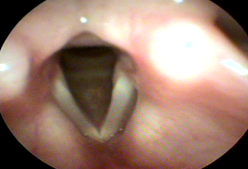</center> _Source: Unpublished image captured with my flexible Olympus endoscope and edited with the Microsoft Power Point program_ # How is the voice produced? The production of the voice is the most sophisticated of laryngeal functions. Coupling phonation, articulation and resonance allows us to talk and communicate. This requires the intervention of various structures of the: - Breathing: nose, lungs, bronchi and trachea. - Phonation: vocal cords or vocal folds, larynx. - Articulation: tongue, palate, teeth, lips. - Resonators: paranasal sinuses, tonsils, adenoids, pharynx. The process begins with the inhalation of air and the posterior glottic closure. An increase in subglottic pressure continues until the pressure exceeds the closing glottal force and air is allowed to escape between the vocal cords. There must be adequate support of the breath to produce sufficient subglottic pressure; control of the laryngeal musculature to generate glottic closure and reach the appropriate length and tension in the vocal cords, together with the flexibility and vibratory capacity. Thus, in a summarized form, the voice is produced. # Is the larynx the same as the vocal cords? No, the larynx is a complex and specialized organ that intervenes in the protection of the airway, control of respiration and in the production of sound and speech. It is a muscular and cartilaginous structure, in the form of a tube, that joins the pharynx with the trachea, it is located between the cervical vertebrae C3 to C6. It is constituted by the hyoid bone and 3 odd cartilages: thyroid, cricoid and epiglottis and 3 pairs of cartilages: arytenoid, corniculate, cuneiform. In the larynx we find the vocal cords or true vocal folds, and the ventricular bands (also known as false folds or vocal cords). <center>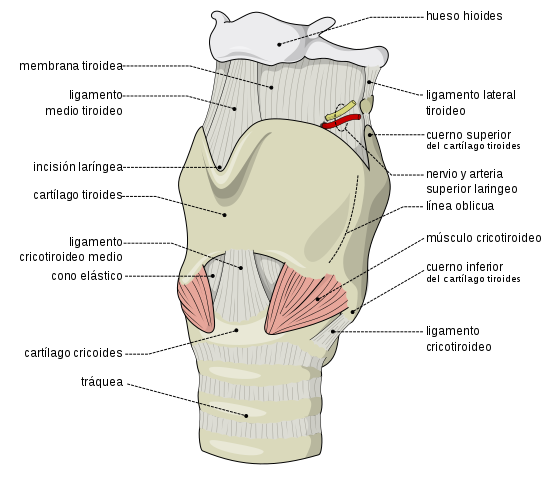</center> _By derivative work: Alejandro Navarro López (User: Manchego) (talk) Larynx_external_en.svg: Olek Remesz (wiki-pl: Orem, commons: Orem) - Larynx_external_en.svg, CC BY-SA 2.5-2.0-1.0. [Source](https://steemitimages.com/DQmcQnbnP4A7jw5sym1yv4qPe6531rDVXLg6WuLi41LDQSZ/fdfd.png)_ # How are the vocal cords? Vocal cords or vocal folds (most appropriate name). They are a pair of white, pearly structures, located in the larynx, whose vibration generates the sound we know as voice. These are formed by a layer of loose and flexible surface mucosa, which vibrates on the more rigid lower layers. <center>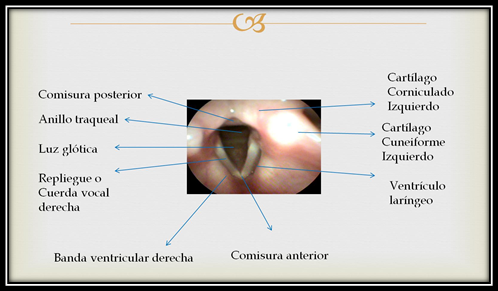</center> _Source: Unpublished image captured with my flexible Olympus endoscope and edited with the Microsoft Power Point program_ <center>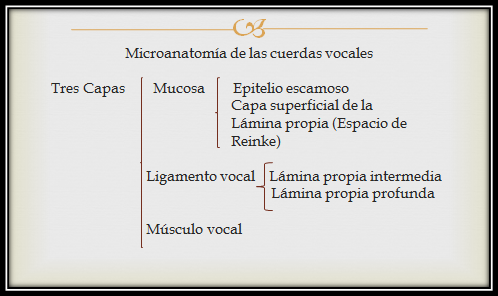</center> _<center>Source: Own diagram</center>_ <center>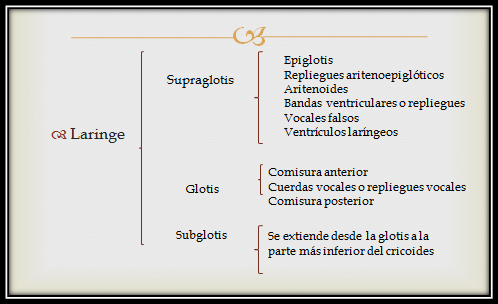</center> _<center>Source: Own diagram</center>_ # What methods do you use to examine the larynx and vocal cords? At present, a series of diagnostic methods are available, which allow us to identify different pathologies that settle in the larynx and vocal cords. Visualization of the larynx and vocal cords is essential for the evaluation of patients with voice disorders. These range from laryngoscopy with mirror, videolaryngoscopy, to video-ostroboscopy, which allows us to analyze the vibration of the vocal cords and detect so-called minimal structural lesions (nodules, polyps, vocal sulcus). <center>Laryngoscopy mirror examination</center> <center>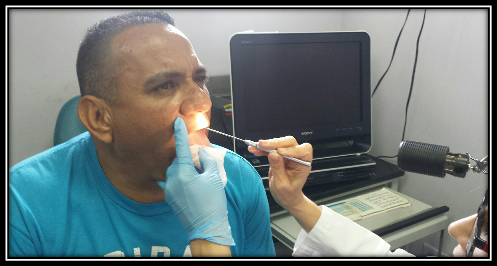</center> _<center>Source: Unpublished image captured with my Samsung device</center>_ <center>**Flexible videolaryngoscopy**</center> <center>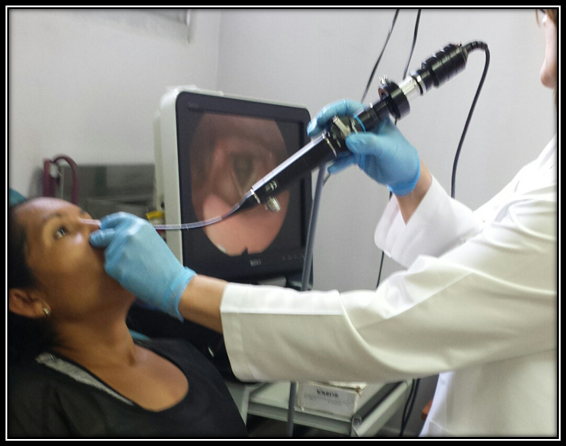</center> _<center>Source: Unpublished image captured with my Samsung device</center>_ # When should I evaluate my vocal cords? Any alteration in the qualities of the voice (timbre, tone and intensity), known as hoarseness or hoarseness, is reason for you to make an evaluation by the otolaryngologist, phoniatrist or phonoaudiologist. The dysphonia is a change in the voice that can appear suddenly, for example, in an intense vocal effort in a singer when wanting to reach a very high vocal note, which can produce a vocal hematoma or vocal bleeding. It can also happen gradually, such is the case of nodules, polyps or tumors; in which the voice gradually changes; It can even be accompanied by a feeling of shortness of breath or dyspnea and also drowning with food. <center>**Right vocal cord polyp**</center> <center>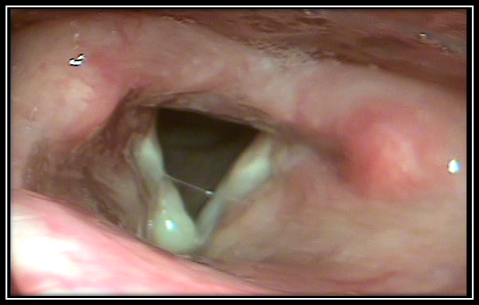</center> _Source: Unpublished image captured with my rigid endoscope Ecleris and edited with the Microsoft Power Point program_ Similarly, dysphonia may develop when thyroid surgery is performed and the recurrent laryngeal nerve-the vagus nerve branch-that innervates the thyroarytenoid muscles (internal and external branches), interarytenoid (transverse and oblique) and the cricoaritenoids is injured. lateral and posterior. <center><center> center>Source: Unpublished image captured with my Samsung device</center> # If I have a vocal cord injury, can I operate? Yes, laryngeal and vocal cord surgeries are performed using a surgical microscope, because the structures are very small. In the case of benign lesions such as polyps, nodules or cysts, which produce changes in the quality of the voice; A phonosurgery or phonomicrosurgery is performed and what is sought is to reestablish the vibration of the superficial lamina propria, and thus improve the patient's voice. In the case of tumors, a biopsy (laryngeal microsurgery) should be performed first to determine the type of tumor. Later, according to the anatomopathological characteristics of the lesion, a new surgery will be performed, total or partial laryngectomy, with combined treatment with radiotherapy or chemotherapy depending on the case. It is very important that the doctor perform a clinical examination of the characteristics of the voice. That is, educate the ear to determine if the patient's voice has the tone, timbre and intensity appropriate to their age, sex, physical constitution and occupation. In this way, even when the patient does not consult for alterations in his voice, these can be detected during the medical consultation and thus make an early diagnosis. I'm Eadams, otolaryngologist. Until the next post. ## References - Flint, P; Haughey, B; Lund, V; Niparko, J; Robbins, T; Thomas, R; Lesperance, M. (2015). Cummings Otolaryngology - Head and Neck Surgery. Sixth Edition. Elsevier Saunders Philadelphia. - Peñaranda, A; García, J; Pinzón, M. (2007). Manual of otolaryngology, head and neck. Amolca editions. Colombia. Rosen, C; Simpson, B. (2013). Surgical Techniques in Laryngology. Germany. Edition in Spanish language. Amolca |
| json metadata | {"tags":["steemstem","health","science","life","education"],"image":["https://steemitimages.com/DQmWeUQqoKbHkiTpDUSTHjvvegPBUeAZRE3qsYNRFWvh4bw/hjghj.png","https://steemitimages.com/DQmcQnbnP4A7jw5sym1yv4qPe6531rDVXLg6WuLi41LDQSZ/fdfd.png","https://steemitimages.com/DQmNXhvrbERS5FMX7QpZaYSopYPZAv8iJ2jJf6HRJwfz6ch/hjghjhg.png","https://steemitimages.com/DQmeU53yqNmJgFeCdkrmy7Czva43gynZqUZD7N16LdCjYwq/hjgh.png","https://steemitimages.com/DQmX2s6543J1ZtR671eKjYSJxEFUugKtZE9X8eyyQU9XKXW/hnh.png","https://steemitimages.com/DQmZzedNCKKCthNfsAFmCzp6vUrrsuZR9LStsAb1SM37uxN/jhg.png","https://steemitimages.com/DQmNfPtwvAPgT1w2edM7uCq49F2zqbcqZLxwPwzXETthYRz/bcv.png","https://steemitimages.com/DQmXDYPbWG23BUQwtCC2BXSagu7xRJ9V3KWPtqguBjTrrie/gvbdfbgrdt.png","https://steemitimages.com/DQmbiD4XjExM4vRSgpWBcXef19UiJJ2yxduuaBSro3mLVvU/3%20fbd.png"],"links":["https://steemitimages.com/DQmcQnbnP4A7jw5sym1yv4qPe6531rDVXLg6WuLi41LDQSZ/fdfd.png"],"app":"steemit/0.1","format":"markdown"} |
| Transaction Info | Block #22335844/Trx af26f496219602ea2af191198c3a64315bce9104 |
View Raw JSON Data
{
"trx_id": "af26f496219602ea2af191198c3a64315bce9104",
"block": 22335844,
"trx_in_block": 53,
"op_in_trx": 0,
"virtual_op": 0,
"timestamp": "2018-05-11T11:56:27",
"op": [
"comment",
{
"parent_author": "",
"parent_permlink": "steemstem",
"author": "dialexandro",
"permlink": "voice-larynx-and-vocal-strings",
"title": "Voice, Larynx and Vocal Strings",
"body": "Greetings, friends steemians. Today I want to share with you the first of three publications related to voice and vocal cords.\n\n\nThe importance of the voice in daily communication is no secret to anyone. The characteristics of a person's voice depend mainly on sex, age, physical constitution and occupation.\n\nThe care and prevention of vocal health is of vital importance for all; moreover, for those people whose voice is used as a means of work. Such is the case of singers, social communicators, speakers, teachers, lecturers, receptionists, among others.\n\n<center></center>\n_Source: Unpublished image captured with my flexible Olympus endoscope and edited with the Microsoft Power Point program_\n\n# How is the voice produced?\n\nThe production of the voice is the most sophisticated of laryngeal functions. Coupling phonation, articulation and resonance allows us to talk and communicate.\n\nThis requires the intervention of various structures of the:\n\n- Breathing: nose, lungs, bronchi and trachea.\n- Phonation: vocal cords or vocal folds, larynx.\n- Articulation: tongue, palate, teeth, lips.\n- Resonators: paranasal sinuses, tonsils, adenoids, pharynx.\nThe process begins with the inhalation of air and the posterior glottic closure. An increase in subglottic pressure continues until the pressure exceeds the closing glottal force and air is allowed to escape between the vocal cords.\n\nThere must be adequate support of the breath to produce sufficient subglottic pressure; control of the laryngeal musculature to generate glottic closure and reach the appropriate length and tension in the vocal cords, together with the flexibility and vibratory capacity. Thus, in a summarized form, the voice is produced.\n\n# Is the larynx the same as the vocal cords?\n\nNo, the larynx is a complex and specialized organ that intervenes in the protection of the airway, control of respiration and in the production of sound and speech.\nIt is a muscular and cartilaginous structure, in the form of a tube, that joins the pharynx with the trachea, it is located between the cervical vertebrae C3 to C6. It is constituted by the hyoid bone and 3 odd cartilages: thyroid, cricoid and epiglottis and 3 pairs of cartilages: arytenoid, corniculate, cuneiform.\nIn the larynx we find the vocal cords or true vocal folds, and the ventricular bands (also known as false folds or vocal cords).\n\n<center></center>\n_By derivative work: Alejandro Navarro López (User: Manchego) (talk) Larynx_external_en.svg: Olek Remesz (wiki-pl: Orem, commons: Orem) - Larynx_external_en.svg, CC BY-SA 2.5-2.0-1.0. [Source](https://steemitimages.com/DQmcQnbnP4A7jw5sym1yv4qPe6531rDVXLg6WuLi41LDQSZ/fdfd.png)_\n\n# How are the vocal cords?\n\nVocal cords or vocal folds (most appropriate name). They are a pair of white, pearly structures, located in the larynx, whose vibration generates the sound we know as voice. These are formed by a layer of loose and flexible surface mucosa, which vibrates on the more rigid lower layers.\n\n<center></center>\n_Source: Unpublished image captured with my flexible Olympus endoscope and edited with the Microsoft Power Point program_\n\n\n<center></center>\n_<center>Source: Own diagram</center>_\n\n<center></center>\n_<center>Source: Own diagram</center>_\n\n# What methods do you use to examine the larynx and vocal cords?\n\nAt present, a series of diagnostic methods are available, which allow us to identify different pathologies that settle in the larynx and vocal cords.\nVisualization of the larynx and vocal cords is essential for the evaluation of patients with voice disorders. These range from laryngoscopy with mirror, videolaryngoscopy, to video-ostroboscopy, which allows us to analyze the vibration of the vocal cords and detect so-called minimal structural lesions (nodules, polyps, vocal sulcus).\n\n<center>Laryngoscopy mirror examination</center>\n\n\n<center></center>\n_<center>Source: Unpublished image captured with my Samsung device</center>_\n\n<center>**Flexible videolaryngoscopy**</center>\n<center></center>\n_<center>Source: Unpublished image captured with my Samsung device</center>_\n\n# When should I evaluate my vocal cords?\n\nAny alteration in the qualities of the voice (timbre, tone and intensity), known as hoarseness or hoarseness, is reason for you to make an evaluation by the otolaryngologist, phoniatrist or phonoaudiologist.\nThe dysphonia is a change in the voice that can appear suddenly, for example, in an intense vocal effort in a singer when wanting to reach a very high vocal note, which can produce a vocal hematoma or vocal bleeding.\n\nIt can also happen gradually, such is the case of nodules, polyps or tumors; in which the voice gradually changes; It can even be accompanied by a feeling of shortness of breath or dyspnea and also drowning with food.\n\n<center>**Right vocal cord polyp**</center>\n<center></center>\n_Source: Unpublished image captured with my rigid endoscope Ecleris and edited with the Microsoft Power Point program_\n\nSimilarly, dysphonia may develop when thyroid surgery is performed and the recurrent laryngeal nerve-the vagus nerve branch-that innervates the thyroarytenoid muscles (internal and external branches), interarytenoid (transverse and oblique) and the cricoaritenoids is injured. lateral and posterior.\n\n<center><center>\n\ncenter>Source: Unpublished image captured with my Samsung device</center>\n\n# If I have a vocal cord injury, can I operate?\n\nYes, laryngeal and vocal cord surgeries are performed using a surgical microscope, because the structures are very small.\n\nIn the case of benign lesions such as polyps, nodules or cysts, which produce changes in the quality of the voice; A phonosurgery or phonomicrosurgery is performed and what is sought is to reestablish the vibration of the superficial lamina propria, and thus improve the patient's voice.\n\nIn the case of tumors, a biopsy (laryngeal microsurgery) should be performed first to determine the type of tumor. Later, according to the anatomopathological characteristics of the lesion, a new surgery will be performed, total or partial laryngectomy, with combined treatment with radiotherapy or chemotherapy depending on the case.\n\nIt is very important that the doctor perform a clinical examination of the characteristics of the voice. That is, educate the ear to determine if the patient's voice has the tone, timbre and intensity appropriate to their age, sex, physical constitution and occupation. In this way, even when the patient does not consult for alterations in his voice, these can be detected during the medical consultation and thus make an early diagnosis.\nI'm Eadams, otolaryngologist. Until the next post.\n\n## References\n\n- Flint, P; Haughey, B; Lund, V; Niparko, J; Robbins, T; Thomas, R; Lesperance, M. (2015). Cummings Otolaryngology - Head and Neck Surgery. Sixth Edition. Elsevier Saunders Philadelphia.\n\n- Peñaranda, A; García, J; Pinzón, M. (2007). Manual of otolaryngology, head and neck. Amolca editions. Colombia.\nRosen, C; Simpson, B. (2013). Surgical Techniques in Laryngology. Germany. Edition in Spanish language. Amolca",
"json_metadata": "{\"tags\":[\"steemstem\",\"health\",\"science\",\"life\",\"education\"],\"image\":[\"https://steemitimages.com/DQmWeUQqoKbHkiTpDUSTHjvvegPBUeAZRE3qsYNRFWvh4bw/hjghj.png\",\"https://steemitimages.com/DQmcQnbnP4A7jw5sym1yv4qPe6531rDVXLg6WuLi41LDQSZ/fdfd.png\",\"https://steemitimages.com/DQmNXhvrbERS5FMX7QpZaYSopYPZAv8iJ2jJf6HRJwfz6ch/hjghjhg.png\",\"https://steemitimages.com/DQmeU53yqNmJgFeCdkrmy7Czva43gynZqUZD7N16LdCjYwq/hjgh.png\",\"https://steemitimages.com/DQmX2s6543J1ZtR671eKjYSJxEFUugKtZE9X8eyyQU9XKXW/hnh.png\",\"https://steemitimages.com/DQmZzedNCKKCthNfsAFmCzp6vUrrsuZR9LStsAb1SM37uxN/jhg.png\",\"https://steemitimages.com/DQmNfPtwvAPgT1w2edM7uCq49F2zqbcqZLxwPwzXETthYRz/bcv.png\",\"https://steemitimages.com/DQmXDYPbWG23BUQwtCC2BXSagu7xRJ9V3KWPtqguBjTrrie/gvbdfbgrdt.png\",\"https://steemitimages.com/DQmbiD4XjExM4vRSgpWBcXef19UiJJ2yxduuaBSro3mLVvU/3%20fbd.png\"],\"links\":[\"https://steemitimages.com/DQmcQnbnP4A7jw5sym1yv4qPe6531rDVXLg6WuLi41LDQSZ/fdfd.png\"],\"app\":\"steemit/0.1\",\"format\":\"markdown\"}"
}
]
}Manabar
Voting Power100.00%
Downvote Power100.00%
Resource Credits100.00%
Reputation Progress0.00%
{
  "voting_manabar": {
    "current_mana": "8143659806",
    "last_update_time": 1779060501
  },
  "downvote_manabar": {
    "current_mana": 2035914951,
    "last_update_time": 1779060501
  },
  "rc_account": {
    "account": "dialexandro",
    "rc_manabar": {
      "current_mana": "10164408779",
      "last_update_time": 1779060501
    },
    "max_rc_creation_adjustment": {
      "amount": "2020748973",
      "precision": 6,
      "nai": "@@000000037"
    },
    "max_rc": "10164408779"
  }
}
Account Metadata
| POSTING JSON METADATA | |
| profile | {"profile_image":"https://cdn.steemitimages.com/DQmZL5saTNozfx9CLXma84zPTuxrrHbjW4Qw1oPura3zJLL/20180127_130741.jpg"} |
| JSON METADATA | |
| profile | {"profile_image":"https://cdn.steemitimages.com/DQmZL5saTNozfx9CLXma84zPTuxrrHbjW4Qw1oPura3zJLL/20180127_130741.jpg"} |
{
  "posting_json_metadata": {
    "profile": {
      "profile_image": "https://cdn.steemitimages.com/DQmZL5saTNozfx9CLXma84zPTuxrrHbjW4Qw1oPura3zJLL/20180127_130741.jpg"
    }
  },
  "json_metadata": {
    "profile": {
      "profile_image": "https://cdn.steemitimages.com/DQmZL5saTNozfx9CLXma84zPTuxrrHbjW4Qw1oPura3zJLL/20180127_130741.jpg"
    }
  }
}
Auth Keys
Owner
Single Signature
Public Keys
STM5TFYjvsS7beAMmqvBvpRmX9fQdgkNwAro1Y59PGYdpEAE6gLEC1/1
Active
Single Signature
Public Keys
STM7G2Bs1Ts8ap275qiNWXZi4KTTGakzWvorQWdHsxgwojQEYVF5B1/1
Posting
Single Signature
Public Keys
STM5K4Cc2RfUCrhKW3BihbvKTCPrb6DZpU4CMBpq2tSDTSPxqExsQ1/1
Memo
STM8EgLWWsmJWThR6rwYySohaSanHvHxcR5U7EvQePtEs2G9xRNGb
{
  "owner": {
    "weight_threshold": 1,
    "account_auths": [],
    "key_auths": [
      [
        "STM5TFYjvsS7beAMmqvBvpRmX9fQdgkNwAro1Y59PGYdpEAE6gLEC",
        1
      ]
    ]
  },
  "active": {
    "weight_threshold": 1,
    "account_auths": [],
    "key_auths": [
      [
        "STM7G2Bs1Ts8ap275qiNWXZi4KTTGakzWvorQWdHsxgwojQEYVF5B",
        1
      ]
    ]
  },
  "posting": {
    "weight_threshold": 1,
    "account_auths": [],
    "key_auths": [
      [
        "STM5K4Cc2RfUCrhKW3BihbvKTCPrb6DZpU4CMBpq2tSDTSPxqExsQ",
        1
      ]
    ]
  },
  "memo": "STM8EgLWWsmJWThR6rwYySohaSanHvHxcR5U7EvQePtEs2G9xRNGb"
}
Witness Votes
0 / 30
No active witness votes.
[]