

VOTING POWER100.00%
DOWNVOTE POWER100.00%
RESOURCE CREDITS100.00%
REPUTATION PROGRESS0.00%
Net Worth
0.000USD
STEEM
0.002STEEM
SBD
0.000SBD
Effective Power
1.181SP
├── Own SP
0.000SP
└── Incoming DelegationsDeleg
+1.181SP
Detailed Balance
| STEEM | ||
| balance | 0.002STEEM | STEEM |
| market_balance | 0.000STEEM | STEEM |
| savings_balance | 0.000STEEM | STEEM |
| reward_steem_balance | 0.000STEEM | STEEM |
| STEEM POWER | ||
| Own SP | 0.000SP | SP |
| Delegated Out | 0.000SP | SP |
| Delegation In | 1.181SP | SP |
| Effective Power | 1.181SP | SP |
| Reward SP (pending) | 0.000SP | SP |
| SBD | ||
| sbd_balance | 0.000SBD | SBD |
| sbd_conversions | 0.000SBD | SBD |
| sbd_market_balance | 0.000SBD | SBD |
| savings_sbd_balance | 0.000SBD | SBD |
| reward_sbd_balance | 0.000SBD | SBD |
{
  "balance": "0.002 STEEM",
  "savings_balance": "0.000 STEEM",
  "reward_steem_balance": "0.000 STEEM",
  "vesting_shares": "0.000000 VESTS",
  "delegated_vesting_shares": "0.000000 VESTS",
  "received_vesting_shares": "1920.017158 VESTS",
  "sbd_balance": "0.000 SBD",
  "savings_sbd_balance": "0.000 SBD",
  "reward_sbd_balance": "0.000 SBD",
  "conversions": []
}
Account Info
| name | daniejjimenez |
| id | 1269363 |
| rank | 1,641,287 |
| reputation | 2314795 |
| created | 2019-05-03T18:50:45 |
| recovery_account | steem |
| proxy | None |
| post_count | 5 |
| comment_count | 0 |
| lifetime_vote_count | 0 |
| witnesses_voted_for | 0 |
| last_post | 2020-04-07T19:41:54 |
| last_root_post | 2019-06-04T19:05:06 |
| last_vote_time | 2020-03-30T04:32:42 |
| proxied_vsf_votes | 0, 0, 0, 0 |
| can_vote | 1 |
| voting_power | 0 |
| delayed_votes | 0 |
| balance | 0.002 STEEM |
| savings_balance | 0.000 STEEM |
| sbd_balance | 0.000 SBD |
| savings_sbd_balance | 0.000 SBD |
| vesting_shares | 0.000000 VESTS |
| delegated_vesting_shares | 0.000000 VESTS |
| received_vesting_shares | 1920.017158 VESTS |
| reward_vesting_balance | 0.000000 VESTS |
| vesting_balance | 0.000 STEEM |
| vesting_withdraw_rate | 0.000000 VESTS |
| next_vesting_withdrawal | 1969-12-31T23:59:59 |
| withdrawn | 0 |
| to_withdraw | 0 |
| withdraw_routes | 0 |
| savings_withdraw_requests | 0 |
| last_account_recovery | 1970-01-01T00:00:00 |
| reset_account | null |
| last_owner_update | 1970-01-01T00:00:00 |
| last_account_update | 2020-03-22T00:31:03 |
| mined | No |
| sbd_seconds | 0 |
| sbd_last_interest_payment | 1970-01-01T00:00:00 |
| savings_sbd_last_interest_payment | 1970-01-01T00:00:00 |
{
  "id": 1269363,
  "name": "daniejjimenez",
  "owner": {
    "weight_threshold": 1,
    "account_auths": [],
    "key_auths": [
      [
        "STM7bysQLr73wgtC9KNkw8sFkBSj2UjRcuSuJQJtSoecykjzyUuCw",
        1
      ]
    ]
  },
  "active": {
    "weight_threshold": 1,
    "account_auths": [],
    "key_auths": [
      [
        "STM5uDdF3h5Z3uoV8peMrwxaXehpLYAhQ9NZigxhSyiDpupKGspKi",
        1
      ]
    ]
  },
  "posting": {
    "weight_threshold": 1,
    "account_auths": [],
    "key_auths": [
      [
        "STM8fsbdNxf2s2RXFKgPnqqToNN1Ap4Bsk1eGuuqfZzB7yLxugQNN",
        1
      ]
    ]
  },
  "memo_key": "STM8SbzRnSxCL9tniLRY9zaq1NPzNs6oDufY5YHFXLNFWrDV8CSxp",
  "json_metadata": "{}",
  "posting_json_metadata": "{\"profile\":{\"profile_image\":\"https://cdn.steemitimages.com/DQmXofYBirDz1jVE8Bpwivh4AihiqszYQGutytHHUrnRSmC/Avatar-12.png\",\"version\":2,\"cover_image\":\"https://cdn.steemitimages.com/DQmXofYBirDz1jVE8Bpwivh4AihiqszYQGutytHHUrnRSmC/Avatar-12.png\"}}",
  "proxy": "",
  "last_owner_update": "1970-01-01T00:00:00",
  "last_account_update": "2020-03-22T00:31:03",
  "created": "2019-05-03T18:50:45",
  "mined": false,
  "recovery_account": "steem",
  "last_account_recovery": "1970-01-01T00:00:00",
  "reset_account": "null",
  "comment_count": 0,
  "lifetime_vote_count": 0,
  "post_count": 5,
  "can_vote": true,
  "voting_manabar": {
    "current_mana": 1920017158,
    "last_update_time": 1604324370
  },
  "downvote_manabar": {
    "current_mana": 480004290,
    "last_update_time": 1604324370
  },
  "voting_power": 0,
  "balance": "0.002 STEEM",
  "savings_balance": "0.000 STEEM",
  "sbd_balance": "0.000 SBD",
  "sbd_seconds": "0",
  "sbd_seconds_last_update": "1970-01-01T00:00:00",
  "sbd_last_interest_payment": "1970-01-01T00:00:00",
  "savings_sbd_balance": "0.000 SBD",
  "savings_sbd_seconds": "0",
  "savings_sbd_seconds_last_update": "1970-01-01T00:00:00",
  "savings_sbd_last_interest_payment": "1970-01-01T00:00:00",
  "savings_withdraw_requests": 0,
  "reward_sbd_balance": "0.000 SBD",
  "reward_steem_balance": "0.000 STEEM",
  "reward_vesting_balance": "0.000000 VESTS",
  "reward_vesting_steem": "0.000 STEEM",
  "vesting_shares": "0.000000 VESTS",
  "delegated_vesting_shares": "0.000000 VESTS",
  "received_vesting_shares": "1920.017158 VESTS",
  "vesting_withdraw_rate": "0.000000 VESTS",
  "next_vesting_withdrawal": "1969-12-31T23:59:59",
  "withdrawn": 0,
  "to_withdraw": 0,
  "withdraw_routes": 0,
  "curation_rewards": 0,
  "posting_rewards": 0,
  "proxied_vsf_votes": [
    0,
    0,
    0,
    0
  ],
  "witnesses_voted_for": 0,
  "last_post": "2020-04-07T19:41:54",
  "last_root_post": "2019-06-04T19:05:06",
  "last_vote_time": "2020-03-30T04:32:42",
  "post_bandwidth": 0,
  "pending_claimed_accounts": 0,
  "vesting_balance": "0.000 STEEM",
  "reputation": 2314795,
  "transfer_history": [],
  "market_history": [],
  "post_history": [],
  "vote_history": [],
  "other_history": [],
  "witness_votes": [],
  "tags_usage": [],
  "guest_bloggers": [],
  "rank": 1641287
}
Withdraw Routes
| Incoming | Outgoing |
|---|---|
Empty | Empty |
{
  "incoming": [],
  "outgoing": []
}From Date
To Date
steemdelegated 1.181 SP to @daniejjimenez2020/11/02 13:39:30
steemdelegated 1.181 SP to @daniejjimenez
2020/11/02 13:39:30
| delegator | steem |
| delegatee | daniejjimenez |
| vesting shares | 1920.017158 VESTS |
| Transaction Info | Block #48255472/Trx 169d3b03b49b4f30b829c3dc89178b67d669f942 |
View Raw JSON Data
{
  "trx_id": "169d3b03b49b4f30b829c3dc89178b67d669f942",
  "block": 48255472,
  "trx_in_block": 6,
  "op_in_trx": 0,
  "virtual_op": 0,
  "timestamp": "2020-11-02T13:39:30",
  "op": [
    "delegate_vesting_shares",
    {
      "delegator": "steem",
      "delegatee": "daniejjimenez",
      "vesting_shares": "1920.017158 VESTS"
    }
  ]
}steemdelegated 3.605 SP to @daniejjimenez2020/05/08 08:12:39
steemdelegated 3.605 SP to @daniejjimenez
2020/05/08 08:12:39
| delegator | steem |
| delegatee | daniejjimenez |
| vesting shares | 5859.933421 VESTS |
| Transaction Info | Block #43191807/Trx d46d2f63f88736e334e7dc1aa1ea7ec9f2464c36 |
View Raw JSON Data
{
  "trx_id": "d46d2f63f88736e334e7dc1aa1ea7ec9f2464c36",
  "block": 43191807,
  "trx_in_block": 23,
  "op_in_trx": 0,
  "virtual_op": 0,
  "timestamp": "2020-05-08T08:12:39",
  "op": [
    "delegate_vesting_shares",
    {
      "delegator": "steem",
      "delegatee": "daniejjimenez",
      "vesting_shares": "5859.933421 VESTS"
    }
  ]
}daniejjimenezcustom json: notify2020/04/07 19:45:18
daniejjimenezcustom json: notify
2020/04/07 19:45:18
| required auths | [] |
| required posting auths | ["daniejjimenez"] |
| id | notify |
| json | ["setLastRead",{"date":"2020-04-08T09:45:05"}] |
| Transaction Info | Block #42335345/Trx 662c68530cd9ae2a77fa17808d9574727fd2db11 |
View Raw JSON Data
{
  "trx_id": "662c68530cd9ae2a77fa17808d9574727fd2db11",
  "block": 42335345,
  "trx_in_block": 16,
  "op_in_trx": 0,
  "virtual_op": 0,
  "timestamp": "2020-04-07T19:45:18",
  "op": [
    "custom_json",
    {
      "required_auths": [],
      "required_posting_auths": [
        "daniejjimenez"
      ],
      "id": "notify",
      "json": "[\"setLastRead\",{\"date\":\"2020-04-08T09:45:05\"}]"
    }
  ]
}daniejjimenezreplied to @betfury-steem / q8gqxf2020/04/07 19:45:06
daniejjimenezreplied to @betfury-steem / q8gqxf
2020/04/07 19:45:06
| parent author | betfury-steem |
| parent permlink | 4c3sfq-follower-or-content-creator-betfury-bounty-for-over-100-000-trx |
| author | daniejjimenez |
| permlink | q8gqxf |
| title | |
| body | @@ -36,8 +36,26 @@ k to all + #betfuryfollower |
| json metadata | {"app":"steemit/0.2","tags":["betfuryfollower"]} |
| Transaction Info | Block #42335341/Trx 0e85cf3f0af32049ea985ab10dce92baf92f514b |
View Raw JSON Data
{
  "trx_id": "0e85cf3f0af32049ea985ab10dce92baf92f514b",
  "block": 42335341,
  "trx_in_block": 0,
  "op_in_trx": 0,
  "virtual_op": 0,
  "timestamp": "2020-04-07T19:45:06",
  "op": [
    "comment",
    {
      "parent_author": "betfury-steem",
      "parent_permlink": "4c3sfq-follower-or-content-creator-betfury-bounty-for-over-100-000-trx",
      "author": "daniejjimenez",
      "permlink": "q8gqxf",
      "title": "",
      "body": "@@ -36,8 +36,26 @@\n k to all\n+  #betfuryfollower\n",
      "json_metadata": "{\"app\":\"steemit/0.2\",\"tags\":[\"betfuryfollower\"]}"
    }
  ]
}beemenginesent 0.001 STEEM to @daniejjimenez- "💎 Awesome Community Offer: auto post booster, 10+ of extra votes 24/24, passive earnings and more.
Checkout https://www.steembeem.com 🤙 or try it one month FOR ONLY 1 STEEM 🤯 to @beemengine with me..."2020/04/07 19:43:03
beemenginesent 0.001 STEEM to @daniejjimenez- "💎 Awesome Community Offer: auto post booster, 10+ of extra votes 24/24, passive earnings and more.
Checkout https://www.steembeem.com 🤙 or try it one month FOR ONLY 1 STEEM 🤯 to @beemengine with me..."
2020/04/07 19:43:03
| from | beemengine |
| to | daniejjimenez |
| amount | 0.001 STEEM |
| memo | 💎 Awesome Community Offer: auto post booster, 10+ of extra votes 24/24, passive earnings and more. Checkout https://www.steembeem.com 🤙 or try it one month FOR ONLY 1 STEEM 🤯 to @beemengine with memo: subscribe |
| Transaction Info | Block #42335302/Trx a6523b006a0d8d66ef3e42341ee0bdaf4dfa8c5d |
View Raw JSON Data
{
  "trx_id": "a6523b006a0d8d66ef3e42341ee0bdaf4dfa8c5d",
  "block": 42335302,
  "trx_in_block": 3,
  "op_in_trx": 0,
  "virtual_op": 0,
  "timestamp": "2020-04-07T19:43:03",
  "op": [
    "transfer",
    {
      "from": "beemengine",
      "to": "daniejjimenez",
      "amount": "0.001 STEEM",
      "memo": "💎 Awesome Community Offer: auto post booster, 10+ of extra votes 24/24, passive earnings and more.\nCheckout https://www.steembeem.com 🤙 or try it one month FOR ONLY 1 STEEM 🤯 to @beemengine with memo: subscribe"
    }
  ]
}daniejjimenezreplied to @betfury-steem / q8gqxf2020/04/07 19:41:54
daniejjimenezreplied to @betfury-steem / q8gqxf
2020/04/07 19:41:54
| parent author | betfury-steem |
| parent permlink | 4c3sfq-follower-or-content-creator-betfury-bounty-for-over-100-000-trx |
| author | daniejjimenez |
| permlink | q8gqxf |
| title | |
| body | with the power of the fox..good luck to all |
| json metadata | {"app":"steemit/0.2"} |
| Transaction Info | Block #42335280/Trx 3cbd7110bc355b22676ecd3bcc12600a236362f1 |
View Raw JSON Data
{
  "trx_id": "3cbd7110bc355b22676ecd3bcc12600a236362f1",
  "block": 42335280,
  "trx_in_block": 7,
  "op_in_trx": 0,
  "virtual_op": 0,
  "timestamp": "2020-04-07T19:41:54",
  "op": [
    "comment",
    {
      "parent_author": "betfury-steem",
      "parent_permlink": "4c3sfq-follower-or-content-creator-betfury-bounty-for-over-100-000-trx",
      "author": "daniejjimenez",
      "permlink": "q8gqxf",
      "title": "",
      "body": "with the power of the fox..good luck to all",
      "json_metadata": "{\"app\":\"steemit/0.2\"}"
    }
  ]
}daniejjimenezfollowed @worldofwink2020/03/30 04:33:15
daniejjimenezfollowed @worldofwink
2020/03/30 04:33:15
| required auths | [] |
| required posting auths | ["daniejjimenez"] |
| id | follow |
| json | ["follow",{"follower":"daniejjimenez","following":"worldofwink","what":["blog"]}] |
| Transaction Info | Block #42091362/Trx 87521ed6d7d10f767b75b8ce3c8fc2e64c4b9b20 |
View Raw JSON Data
{
  "trx_id": "87521ed6d7d10f767b75b8ce3c8fc2e64c4b9b20",
  "block": 42091362,
  "trx_in_block": 4,
  "op_in_trx": 0,
  "virtual_op": 0,
  "timestamp": "2020-03-30T04:33:15",
  "op": [
    "custom_json",
    {
      "required_auths": [],
      "required_posting_auths": [
        "daniejjimenez"
      ],
      "id": "follow",
      "json": "[\"follow\",{\"follower\":\"daniejjimenez\",\"following\":\"worldofwink\",\"what\":[\"blog\"]}]"
    }
  ]
}daniejjimenezfollowed @marcusmalone2020/03/30 04:33:15
daniejjimenezfollowed @marcusmalone
2020/03/30 04:33:15
| required auths | [] |
| required posting auths | ["daniejjimenez"] |
| id | follow |
| json | ["follow",{"follower":"daniejjimenez","following":"marcusmalone","what":["blog"]}] |
| Transaction Info | Block #42091362/Trx 5ff4c6f190563307e5075a11417f20e26b2a428a |
View Raw JSON Data
{
  "trx_id": "5ff4c6f190563307e5075a11417f20e26b2a428a",
  "block": 42091362,
  "trx_in_block": 1,
  "op_in_trx": 0,
  "virtual_op": 0,
  "timestamp": "2020-03-30T04:33:15",
  "op": [
    "custom_json",
    {
      "required_auths": [],
      "required_posting_auths": [
        "daniejjimenez"
      ],
      "id": "follow",
      "json": "[\"follow\",{\"follower\":\"daniejjimenez\",\"following\":\"marcusmalone\",\"what\":[\"blog\"]}]"
    }
  ]
}daniejjimenezcustom json: notify2020/03/30 04:32:54
daniejjimenezcustom json: notify
2020/03/30 04:32:54
| required auths | [] |
| required posting auths | ["daniejjimenez"] |
| id | notify |
| json | ["setLastRead",{"date":"2020-03-30T20:28:42"}] |
| Transaction Info | Block #42091355/Trx f73e7081e79b8384a0b5ce14f2af618250659cd3 |
View Raw JSON Data
{
  "trx_id": "f73e7081e79b8384a0b5ce14f2af618250659cd3",
  "block": 42091355,
  "trx_in_block": 10,
  "op_in_trx": 0,
  "virtual_op": 0,
  "timestamp": "2020-03-30T04:32:54",
  "op": [
    "custom_json",
    {
      "required_auths": [],
      "required_posting_auths": [
        "daniejjimenez"
      ],
      "id": "notify",
      "json": "[\"setLastRead\",{\"date\":\"2020-03-30T20:28:42\"}]"
    }
  ]
}daniejjimenezupvoted (100.00%) @daniejjimenez / q80wun2020/03/30 04:32:42
daniejjimenezupvoted (100.00%) @daniejjimenez / q80wun
2020/03/30 04:32:42
| voter | daniejjimenez |
| author | daniejjimenez |
| permlink | q80wun |
| weight | 10000 (100.00%) |
| Transaction Info | Block #42091351/Trx 0ad09ff06a1aaa1bf8a1fd6748a9d7de94a0badd |
View Raw JSON Data
{
  "trx_id": "0ad09ff06a1aaa1bf8a1fd6748a9d7de94a0badd",
  "block": 42091351,
  "trx_in_block": 0,
  "op_in_trx": 0,
  "virtual_op": 0,
  "timestamp": "2020-03-30T04:32:42",
  "op": [
    "vote",
    {
      "voter": "daniejjimenez",
      "author": "daniejjimenez",
      "permlink": "q80wun",
      "weight": 10000
    }
  ]
}daniejjimenezreplied to @betfury-steem / q80wun2020/03/30 04:32:15
daniejjimenezreplied to @betfury-steem / q80wun
2020/03/30 04:32:15
| parent author | betfury-steem |
| parent permlink | follower-or-content-creator-betfury-bounty-for-over-100-000-trx |
| author | daniejjimenez |
| permlink | q80wun |
| title | |
| body | Fast, easy, transparent, safe and fun platform for Dapps #betfuryfollower |
| json metadata | {"tags":["betfuryfollower"],"app":"steemit/0.2"} |
| Transaction Info | Block #42091342/Trx ca0e937c4bfcdae894499301a4971daec51175c8 |
View Raw JSON Data
{
  "trx_id": "ca0e937c4bfcdae894499301a4971daec51175c8",
  "block": 42091342,
  "trx_in_block": 4,
  "op_in_trx": 0,
  "virtual_op": 0,
  "timestamp": "2020-03-30T04:32:15",
  "op": [
    "comment",
    {
      "parent_author": "betfury-steem",
      "parent_permlink": "follower-or-content-creator-betfury-bounty-for-over-100-000-trx",
      "author": "daniejjimenez",
      "permlink": "q80wun",
      "title": "",
      "body": "Fast, easy, transparent, safe and fun platform for Dapps #betfuryfollower",
      "json_metadata": "{\"tags\":[\"betfuryfollower\"],\"app\":\"steemit/0.2\"}"
    }
  ]
}daniejjimenezreplied to @betfury-steem / q7l9052020/03/22 00:32:48
daniejjimenezreplied to @betfury-steem / q7l905
2020/03/22 00:32:48
| parent author | betfury-steem |
| parent permlink | slots-on-betfury-the-best-experience-for-the-best-players |
| author | daniejjimenez |
| permlink | q7l905 |
| title | |
| body | I love betfury because it allows me to play, have fun and win without worrying about late payments #betfuryfollower |
| json metadata | {"tags":["betfuryfollower"],"app":"steemit/0.2"} |
| Transaction Info | Block #41859314/Trx f418a1c7be53164c0455932073f74ee0477704b6 |
View Raw JSON Data
{
  "trx_id": "f418a1c7be53164c0455932073f74ee0477704b6",
  "block": 41859314,
  "trx_in_block": 18,
  "op_in_trx": 0,
  "virtual_op": 0,
  "timestamp": "2020-03-22T00:32:48",
  "op": [
    "comment",
    {
      "parent_author": "betfury-steem",
      "parent_permlink": "slots-on-betfury-the-best-experience-for-the-best-players",
      "author": "daniejjimenez",
      "permlink": "q7l905",
      "title": "",
      "body": "I love betfury because it allows me to play, have fun and win without worrying about late payments #betfuryfollower",
      "json_metadata": "{\"tags\":[\"betfuryfollower\"],\"app\":\"steemit/0.2\"}"
    }
  ]
}daniejjimenezupdated their account properties2020/03/22 00:31:03
daniejjimenezupdated their account properties
2020/03/22 00:31:03
| account | daniejjimenez |
| json metadata | |
| posting json metadata | {"profile":{"profile_image":"https://cdn.steemitimages.com/DQmXofYBirDz1jVE8Bpwivh4AihiqszYQGutytHHUrnRSmC/Avatar-12.png","version":2,"cover_image":"https://cdn.steemitimages.com/DQmXofYBirDz1jVE8Bpwivh4AihiqszYQGutytHHUrnRSmC/Avatar-12.png"}} |
| extensions | [] |
| Transaction Info | Block #41859279/Trx 46e359a86f19b33b21cb91ed6d348e296bf7c2df |
View Raw JSON Data
{
  "trx_id": "46e359a86f19b33b21cb91ed6d348e296bf7c2df",
  "block": 41859279,
  "trx_in_block": 3,
  "op_in_trx": 0,
  "virtual_op": 0,
  "timestamp": "2020-03-22T00:31:03",
  "op": [
    "account_update2",
    {
      "account": "daniejjimenez",
      "json_metadata": "",
      "posting_json_metadata": "{\"profile\":{\"profile_image\":\"https://cdn.steemitimages.com/DQmXofYBirDz1jVE8Bpwivh4AihiqszYQGutytHHUrnRSmC/Avatar-12.png\",\"version\":2,\"cover_image\":\"https://cdn.steemitimages.com/DQmXofYBirDz1jVE8Bpwivh4AihiqszYQGutytHHUrnRSmC/Avatar-12.png\"}}",
      "extensions": []
    }
  ]
}daniejjimenezupdated their account properties2020/03/22 00:30:30
daniejjimenezupdated their account properties
2020/03/22 00:30:30
| account | daniejjimenez |
| json metadata | |
| posting json metadata | {"profile":{"profile_image":"https://cdn.steemitimages.com/DQmXofYBirDz1jVE8Bpwivh4AihiqszYQGutytHHUrnRSmC/Avatar-12.png","version":2}} |
| extensions | [] |
| Transaction Info | Block #41859268/Trx 1f9cd598b3859624a2f3b47c8d60581f871df731 |
View Raw JSON Data
{
  "trx_id": "1f9cd598b3859624a2f3b47c8d60581f871df731",
  "block": 41859268,
  "trx_in_block": 6,
  "op_in_trx": 0,
  "virtual_op": 0,
  "timestamp": "2020-03-22T00:30:30",
  "op": [
    "account_update2",
    {
      "account": "daniejjimenez",
      "json_metadata": "",
      "posting_json_metadata": "{\"profile\":{\"profile_image\":\"https://cdn.steemitimages.com/DQmXofYBirDz1jVE8Bpwivh4AihiqszYQGutytHHUrnRSmC/Avatar-12.png\",\"version\":2}}",
      "extensions": []
    }
  ]
}daniejjimenezupdated their account properties2020/03/22 00:29:33
daniejjimenezupdated their account properties
2020/03/22 00:29:33
| account | daniejjimenez |
| json metadata | |
| posting json metadata | {"profile":{"profile_image":"https://cdn.steemitimages.com/DQmXofYBirDz1jVE8Bpwivh4AihiqszYQGutytHHUrnRSmC/Avatar-12.png","version":2}} |
| extensions | [] |
| Transaction Info | Block #41859250/Trx 6d369870d1fab913a312256a50f0e147b2088cb4 |
View Raw JSON Data
{
  "trx_id": "6d369870d1fab913a312256a50f0e147b2088cb4",
  "block": 41859250,
  "trx_in_block": 29,
  "op_in_trx": 0,
  "virtual_op": 0,
  "timestamp": "2020-03-22T00:29:33",
  "op": [
    "account_update2",
    {
      "account": "daniejjimenez",
      "json_metadata": "",
      "posting_json_metadata": "{\"profile\":{\"profile_image\":\"https://cdn.steemitimages.com/DQmXofYBirDz1jVE8Bpwivh4AihiqszYQGutytHHUrnRSmC/Avatar-12.png\",\"version\":2}}",
      "extensions": []
    }
  ]
}daniejjimenezfollowed @betfury-steem2020/03/22 00:23:12
daniejjimenezfollowed @betfury-steem
2020/03/22 00:23:12
| required auths | [] |
| required posting auths | ["daniejjimenez"] |
| id | follow |
| json | ["follow",{"follower":"daniejjimenez","following":"betfury-steem","what":["blog"]}] |
| Transaction Info | Block #41859124/Trx ab2df73d481be379afe87aed2d0b0d8b964f3cf4 |
View Raw JSON Data
{
  "trx_id": "ab2df73d481be379afe87aed2d0b0d8b964f3cf4",
  "block": 41859124,
  "trx_in_block": 26,
  "op_in_trx": 0,
  "virtual_op": 0,
  "timestamp": "2020-03-22T00:23:12",
  "op": [
    "custom_json",
    {
      "required_auths": [],
      "required_posting_auths": [
        "daniejjimenez"
      ],
      "id": "follow",
      "json": "[\"follow\",{\"follower\":\"daniejjimenez\",\"following\":\"betfury-steem\",\"what\":[\"blog\"]}]"
    }
  ]
}steemdelegated 6.095 SP to @daniejjimenez2019/09/03 20:19:36
steemdelegated 6.095 SP to @daniejjimenez
2019/09/03 20:19:36
| delegator | steem |
| delegatee | daniejjimenez |
| vesting shares | 9907.346798 VESTS |
| Transaction Info | Block #36108068/Trx d361fcaabcc97103dd759fbef34c5977c675c10d |
View Raw JSON Data
{
  "trx_id": "d361fcaabcc97103dd759fbef34c5977c675c10d",
  "block": 36108068,
  "trx_in_block": 3,
  "op_in_trx": 0,
  "virtual_op": 0,
  "timestamp": "2019-09-03T20:19:36",
  "op": [
    "delegate_vesting_shares",
    {
      "delegator": "steem",
      "delegatee": "daniejjimenez",
      "vesting_shares": "9907.346798 VESTS"
    }
  ]
}crypto.piotrsent 0.001 STEEM to @daniejjimenez- "Dear @daniejjimenez. I hope you don't mind this little memo. Every week I'm trying to help and promote content published by few selected authors and today I would like to share with you post published..."2019/08/30 08:42:51
crypto.piotrsent 0.001 STEEM to @daniejjimenez- "Dear @daniejjimenez. I hope you don't mind this little memo. Every week I'm trying to help and promote content published by few selected authors and today I would like to share with you post published..."
2019/08/30 08:42:51
| from | crypto.piotr |
| to | daniejjimenez |
| amount | 0.001 STEEM |
| memo | Dear @daniejjimenez. I hope you don't mind this little memo. Every week I'm trying to help and promote content published by few selected authors and today I would like to share with you post published by my friend @honarparvar: "WARNING: This might not be a trend!". I'm curious if you believe in TA and what's your opinion on using indicators while trading crypto. Share your opinion, I read all valuable comments. Piotr // LINK: https://steemit.com/trading/@honarparvar/warning-this-might-not-be-a-trend |
| Transaction Info | Block #35995394/Trx dc2631d03a5ef86ef4bee2712e6614b279896302 |
View Raw JSON Data
{
  "trx_id": "dc2631d03a5ef86ef4bee2712e6614b279896302",
  "block": 35995394,
  "trx_in_block": 20,
  "op_in_trx": 0,
  "virtual_op": 0,
  "timestamp": "2019-08-30T08:42:51",
  "op": [
    "transfer",
    {
      "from": "crypto.piotr",
      "to": "daniejjimenez",
      "amount": "0.001 STEEM",
      "memo": "Dear @daniejjimenez. I hope you don't mind this little memo. Every week I'm trying to help and promote content published by few selected authors and today I would like to share with you post published by my friend @honarparvar: \"WARNING: This might not be a trend!\". I'm curious if you believe in TA and what's your opinion on using indicators while trading crypto. Share your opinion, I read all valuable comments. Piotr // LINK: https://steemit.com/trading/@honarparvar/warning-this-might-not-be-a-trend"
    }
  ]
}steemdelegated 18.297 SP to @daniejjimenez2019/08/23 17:57:39
steemdelegated 18.297 SP to @daniejjimenez
2019/08/23 17:57:39
| delegator | steem |
| delegatee | daniejjimenez |
| vesting shares | 29740.920038 VESTS |
| Transaction Info | Block #35810312/Trx fe2ed056aa56e842c214e8e1d64f27de8da44eca |
View Raw JSON Data
{
  "trx_id": "fe2ed056aa56e842c214e8e1d64f27de8da44eca",
  "block": 35810312,
  "trx_in_block": 36,
  "op_in_trx": 0,
  "virtual_op": 0,
  "timestamp": "2019-08-23T17:57:39",
  "op": [
    "delegate_vesting_shares",
    {
      "delegator": "steem",
      "delegatee": "daniejjimenez",
      "vesting_shares": "29740.920038 VESTS"
    }
  ]
}cryptorevolverreplied to @daniejjimenez / psltdb2019/06/05 02:24:48
cryptorevolverreplied to @daniejjimenez / psltdb
2019/06/05 02:24:48
| parent author | daniejjimenez |
| parent permlink | options-for-the-development-of-dapss-ethereum-tron-eos-fleta |
| author | cryptorevolver |
| permlink | psltdb |
| title | |
| body | Great article! A very detailed comparison of the biggest DApp platforms today. I like the technical details in the article. By this FLETA seems to have the best technical solutions. That's the platform I would build a DApp on. Join the discussion at https://www.reddit.com/r/fletachain/ |
| json metadata | {"tags":["fleta"],"links":["https://www.reddit.com/r/fletachain/"],"app":"steemit/0.1"} |
| Transaction Info | Block #33521151/Trx 2b7a6769cba2958492e8c3c5f0f1d2e721c6bc3e |
View Raw JSON Data
{
  "trx_id": "2b7a6769cba2958492e8c3c5f0f1d2e721c6bc3e",
  "block": 33521151,
  "trx_in_block": 20,
  "op_in_trx": 0,
  "virtual_op": 0,
  "timestamp": "2019-06-05T02:24:48",
  "op": [
    "comment",
    {
      "parent_author": "daniejjimenez",
      "parent_permlink": "options-for-the-development-of-dapss-ethereum-tron-eos-fleta",
      "author": "cryptorevolver",
      "permlink": "psltdb",
      "title": "",
      "body": "Great article! A very detailed comparison of the biggest DApp platforms today. I like the technical details in the article. \nBy this FLETA seems to have the best technical solutions. That's the platform I would build a DApp on. Join the discussion at https://www.reddit.com/r/fletachain/",
      "json_metadata": "{\"tags\":[\"fleta\"],\"links\":[\"https://www.reddit.com/r/fletachain/\"],\"app\":\"steemit/0.1\"}"
    }
  ]
}daniejjimenezpublished a new post: options-for-the-development-of-dapss-ethereum-tron-eos-fleta2019/06/04 19:06:54
daniejjimenezpublished a new post: options-for-the-development-of-dapss-ethereum-tron-eos-fleta
2019/06/04 19:06:54
| parent author | |
| parent permlink | fleta |
| author | daniejjimenez |
| permlink | options-for-the-development-of-dapss-ethereum-tron-eos-fleta |
| title | Options for the development of Dapss: Ethereum, Tron, EOS, Fleta. |
| body | A common skepticism of the blockchain space is that technology is still looking for use cases, in which exaggeration and speculation exceed applicability. For some, the lack of broad use by consumers of decentralized applications reflects that the industry is still in an infrastructure development phase. Blockchain and cryptocurrencies will not become commonplace until they can be perfectly integrated into our daily lives. The solution to this for many could simply be decentralized applications (dApps). However, decentralized applications (dApps) will be considered common when they become invisible and intrinsically better than the applications and services they propose to replace. Blockchain applications are currently being oriented towards the mainstream, and the platforms running Dapps will be the ideal place for developers, publishers and users. This becomes especially relevant in ecosystems where users get value from the applications. Allowing the main users to experience Dapss without friction or over complication, aims to promote the widespread adoption of this technology. The gaming industry is a clear example of this. The cases of Tron, EOS, and even Ethereum with its scalability proposal, as well as a handful of interesting projects with innovative technology such as Fleta, Lisk, among others, are developments that push the blockchain and dApps in our daily lives , which will allow experiencing them without problems, promoting the widespread adoption of this technology. Current status of the dApps Many dApps are currently being built, and many have already been built. According to the dapp.review website, there are more than 2700 decentralized applications, concentrated in the three main chains for their development, such as Ethereum, Tron and EOS. Only in Ethereum for example there are more than 1700 Dapps and the sectors are diverse, from gaming to applications such as Liquid to convert ETH to USD, among other uses. 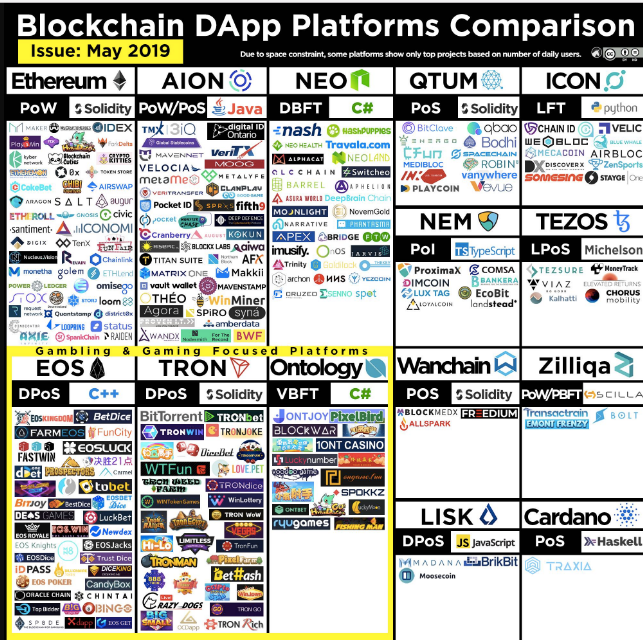 Basically, a whole new market for dApps is being built. As with any market, consumers and users are likely to gravitate towards the applications that offer the best quality at the most reasonable price. Therefore, the problem of quality control will probably be solved by the free market economy. In fact, the DApp market will soon become one of the freest markets in the world. Potential challenges for dApps There are a number of important challenges that the dApps are currently facing, and they are likely to continue to do so for a period of time. One of the most important challenges is that because many dApps depend on cryptocurrencies like Bitcoin and Ethereum, they can also rely on users to understand cryptocurrencies and feel comfortable using them. Unfortunately, despite the fact that cryptocurrencies are growing steadily, many people still do not understand them, do not possess them and, in general, feel uncomfortable with them. For applications to reach their full potential, cryptocurrencies must first obtain greater general acceptance. A large part of the world population has simply not focused on this concept yet. However, more and more people are using the Internet as smartphones and computers become more affordable. The greater the number of Internet users, the more likely cryptocurrencies will be used. In addition, as time passes, it is likely that more and more people will be comfortable with cryptocurrencies and start using them more. This can help the DApp market grow. In addition to adoption, one more problem persists. The scalability Many of the challenges to create real use cases go through the problems of achieving the holy grail of cryptocurrencies: scalability, security and decentralization. In view of the aforementioned problems, we will try to give a comparative technical approach among the most popular options currently available in the market to develop decentralized applications. ETHEREUM (ETH). This distributed computing platform was created by Vitalik Buterin at the end of 2013. Ethereum has its own cryptocurrency called Ether. Scalability One of the great weaknesses of Ethereum is the lack of scaling with its current EVM and its consensus mechanism, which has generated a deceleration of its widespread use for the development of dApps. In addition, the platform currently works, does not allow interoperable with other blockchains of higher generation, further limiting its development, amen of the price of gas which happens to be a problem many times. Currently, scalability is a big drawback for technology, as it is capable of processing only about 16 transactions per second, so the developer community is looking to migrate towards a new consensus algorithm, the Proof of Stake, as part of your plan to achieve greater TPS. Transaction rate The price that Dapps must pay on average for GAS expenses is 0.0086 ETH. Flexibility The goal of Ethereum's 'Turing-complete' programming language is to allow developers to write more programs in which blockchain transactions can govern and automate specific results. This flexibility is perhaps the main innovation of Ethereum, but the case of DAO showed the weakness of the platform in this aspect. Ethereum introduced the concept not only of smart contracts, but also of the lucrative idea behind them: dApps The smart contracts use Ether, which is the currency based on cryptography of Ethereum, with 18 decimals in length and its estimated supply amount is 100 million units. Consensus Protocol. Ethereum uses the Proof of Work consensus protocol, a derivation of the same consensus algorithm used by Bitcoin. The blocks are created and added to the chain of Ethereum blocks only when the mathematical equations are solved and thus the validity of a transaction is guaranteed. Although this work test model makes the transactions and transfers in the chain of blocks of Ethereum safe, it is not ideal and has its drawbacks. Ethereum is based on a consensus model of "order and execution", where each transaction execution must be deterministic, which means that it always produces the same result with the same input and the same logic. At the same time, Ethereum's intelligent contract engine, Ethereum Virtual Machine (EVM), provides developers with full logic programming capabilities, also known as Turing Complete. These two seemingly opposite objectives are achieved by eliminating non-deterministic language features, such as file systems, network IOs, clocks, floating-point arithmetic, etc. The result is a new specific domain language called Solidity. Architecture. The Merkle tree used in Ethereum is more complex than the simple Merkle binary tree. This is called as the "Patricia Merkle tree". Patricia's tree is used to allow efficient insertion / removal operations. The Ethereum key generation is based on the elliptic curve ecp256k1 and to generate the Ethereum address, the Keccak-256 hash of the public key is taken. .The Ethereum addresses are 160-bit data that identify the sender of the transaction with a 40-digit extension. Ethereum invented the transaction model "Statement of account". Ethereum implements two types of accounts (contract accounts and external property accounts) in which the assignment of account addresses and the status of the account are associated through cryptographic tests that validate their status. Ethereum uses accounts to process transactions, while Bitcoin uses unused transaction exits, UTXOs. Both have the vulnerability to filter a significant amount of private information. But the use of accounts by Ethereum is probably a bit more vulnerable when it comes to ensuring the user's anonymity. Utilities The Ethereum ecosystem is well developed and allows several tools of use such as wallet, network monitor, transaction confirmation and developer community. One of the major projects around Ethereum is Microsoft's partnership with ConsenSys, which offers "Ethereum Blockchain as a Service (EBaaS) in Microsoft Azure so that Enterprise customers and developers can have a single click in the developer environment of blockchain based on the cloud ". This alliance paves the way for more future offers involving Ethereum. Storage mechanism One of the biggest challenges in achieving a fast transaction speed for Ethereum is to reduce the data and the load that increases in the nodes. Currently each node has to store all the data in the block chain. Therefore, a decentralized storage mechanism that shares the data load could help make the processing of the transaction more efficient and faster Ethereum is close to implementing its Serenity improvement (Ethereum 2.0). The Ethereum Serenity update will pay the validators to secure the network instead of paying the miners. Because this update will include Sharding and Casper, many people started calling it "Shasper", but in Devcon4 it is now formally called "Serenity". Features included in next upgrade are: Proof of Stake (Casper): Pure PoS consensus Scalability (Sharding): ~ 1000x higher scalability VM improvement (EWASM): Fast VM execution via EWASM Improvements to cross-contract logic (eg abstraction): Faster time to synchronous confirmation (8-16 seconds). Under asynchronous model, you should be able to treat 1 block as close to final. Improvements to protocol economics: "Economic finality" (10-20 minutes) "Layer One" solutions such as Sharding and Casper have been on Ethereum's roadmap for some years, but have been plagued by multiple setbacks that have impeded significant progress on the implementation and development front. Even after these improvements, there will still be a need for "Layer Two" scaling mechanisms that provide even greater performance, private transactions and lower transaction fees. EOS The core team behind EOS is "Block.one", which is based in the Cayman Islands. Brendon Blumer, the CEO, has been involved in blockchain since 2014. EOS is designed as the "best of two worlds" that combines the high performance of Graphene and BitShares with Ethereum's smart contract capability. EOS is the logical continuation of Graphene towards the development of programmable intelligent contracts. Scalability The reason why blockchain-based applications can not compute so many transactions per second is because each and every node in the network must reach a consensus for anything to happen. EOS introduces a different consensus algorithm, called a delegated participation test. The main difference between the delegated participation test and the participation test is that there is a predetermined number of miners, also called delegates. In the case of EOS, there are 21 delegates that secure the network. Delegates are elected by vote. Each user who has chips can vote for the delegates. The delegated participation test is still considered a consensus algorithm without permission because anyone can become a delegate simply by getting enough votes from the community. EOS claims to be scalable to handle millions of transactions per second. It is a great fantasy and the progress of the current project is not very close. Their data currently point to a historical maximum of 4000 TPS, far from what they promise. Transaction rate Normally, when a user wishes to send a transaction through blockchain, he must pay a fee. In the case of EOS, transactions are free. The only requirement to send a transaction is to deposit some tokens in the account. Flexibility Because EOS uses DPOS, if a DAPP is defective, the producers of chosen blocks can freeze it until the system is taken care of. This is simply an extension of the DPOS system, not all nodes have to deal with the maintenance of the chain. EOS believes that flexibility is a very important concern in the cryptocurrency space. One of the biggest problems that most people with Ethereum had was their inflexibility. Usability EOS allows well-defined permission levels by incorporating features such as the web toolkit for the development of interfaces, self-describing interfaces, self-describing database schemas and a declarative permission scheme. Governance In EOS, the government is maintained by establishing jurisdiction and choosing the law, along with other mutually accepted rules. This is usually done through the legally binding constitution. Each individual transaction in EOS must include the hash of the constitution to the signature. This, in essence, forces users to the constitution. The constitution and protocol can be modified by the 17/21 approval that must be maintained for 30 days in a row, in addition to other consensus processes. Parallel processing In parallel processing, program instructions are divided among several processors. By doing this, the execution time of that program decreases considerably. EOS provides parallel processing of intelligent contracts through horizontal scalability, asynchronous communication and interoperability. The EOSIO software is a sophisticated operating system in which applications can be built. The software's brilliance is its ability to scale horizontally and vertically, which means that at some point in the near future, EOS-based block chains will be able to process millions of transactions per second. Another benefit of the software is that it does not charge user fees, making it a desirable platform for developers and users alike. One of the aspects that makes the EOSIO software unique is the way CPU and RAM are used in the EOS blockchain. Self-sufficiency Any blockchain based on the EOS software will have to generate 5% of natural inflation per year. This will be distributed to the producers of blocks of the platform in relation to their confirmation of the transactions in the platform and to the three main contracts or intelligent proposals that receive the highest number of votes from the holders of said tokens. The reason why this happens is to make sure that a chain of blocks does not depend on a single foundation, organization or individual for its growth, development or maintenance. Decentralized Operating System Probably, the most important feature to really understand what EOS is about is this feature. Think of a MacOs / Windows with a crypto-economic incentive. Now, Ethereum is a decentralized supercomputer, EOS is positioned as an operating system. Architecture the architecture of the EOS system is not a chain of blocks, according to the traditional definition, but a system of homogeneous non-autonomous distributed databases. An analysis of accounts in the EOS architecture indicates that the accounts manage the permissions and funds in the EOS network. The accounts in EOS follow a traditional configuration, similar to other distributed systems based on cryptography. However, EOS accounts have another layer of abstraction beyond a pair of public / private keys. Accounts are consistent with user profiles, in which multiple pairs of keys and wallets, with different permissions, can be linked to an account. To manage this, a user interacts with Nodeos and Keosd through the command line tool, Cleos. Transactions in EOS result primarily in changes to the underlying database, rather than status changes cryptographically verified in an underlying blockchain data structure such as Ethereum, by means of the data structure of the Merkle tree. Storage mechanism in the EOS architecture, state storage represents information that matches the logic of the application. Block producers will publish their available capacity for storage of bandwidth registration, computer debt and state storage. The storage availability of the state depends on the number of tokens that a stake account. TRON TRON is a very ambitious project that is very dedicated to establishing a truly decentralized Internet and online infrastructure. The main objective is to eliminate any need for an intermediary in entertainment companies and take users directly to content creators. Scalability At its maximum capacity, TRON can handle 2000 per second compared to Ethereum's 20 transactions per second. This is due to the very short time between blocks, which is about 15 seconds. Applications have a wide range of ways in which they can be developed and implemented on the network. They can handle a large number of users and have a reliable structure. Uses the delegated participation test consensus protocol with the Super Representative Representative (SR) that assumes important roles such as block generation and transaction packaging Transaction rate The transaction fee in the TRX Market decentralized exchange fell to 0.1% on December 14, 2018. The company stated that the TRX ecosystem could reach a zero transaction fee soon. Flexibility TRON says that its platform offers more flexibility to developers, leading to compatibility with projects and smart contracts. The TVM is a virtual machine made by the Tron Foundation to make the Tron ecosystem bigger, better and friendlier for the developer. Developers can create smart contracts that run on TVM using friendly programming languages that developers are familiar with. There is no need to learn a new programming language. Developers can use the strength of Ethereum, as well as other common ones. Better yet, the creation of Dapss and smart contracts can be tested before being uploaded to the main Tron network. Usability Developers can use given interfaces to easily bring about abundant dAPPs and implement the wallet by themselves. The protocol of TRON is defined by google proto-buf, and naturally supports multi-language extensions. Governance TRON is the first to propose a mixed-voting mechanism and set a two-tier voting system, 1. Poll 2. Follow vote All chip holders can choose their leaders and can choose their Super Representative. These SRs represent the entire network and its voters. They also decide the governance and the proposal in the network. In total there are 27 SR responsible for the decentralization of the project. Sharding Tron does not pose this technology for now. To achieve its high scalability and data transmission, it uses two platform-specific concepts within the Tron Virtual Machine: the concept of bandwidth to avoid network overload and Freeze Balance. Freezing a certain number of TRX tokens will give the bandwidth of the node, or power and TRON Power (voting rights) to the node of the frozen tokens. Self-sufficiency There will be no inflation in the TRON block chain before January 1, 2021. Instead, the block rewards are distributed from the 34,251,888,355 TRX blocked in the TRON Foundation. As calculated, each active SR can earn approximately $ 1,696,870 per year at the current market price of TRX. As the price of TRX fluctuates, so will the return. With such a high reward, SRs are expected to gather more companies and developers in the TRON blockchain, as well as to constantly show the community what they have done to further improve the network Architecture Tron adopts a 3-layer architecture, which is divided into storage layer, core layer and application layer. Storage Layer.Tech team of TRON designed a unique distributed storage protocol consisting of block storage and state storage. Core Layer.There are several modules in the core layer, including smart contracts, account management and consensus. Application Layer. Developers can use given interfaces to easily bring about abundant dAPPs and implement the wallet by themselves. Storage mechanism In Tron architecture storage is done through two methods KhaosDB. TRON has KhaosDB in the full-node memory that can store all new folk chains during a certain time and supports witnesses to switch their own active chain swiftly into new main chain. Level DB. Level DB will be initially adopted and its primary goal is to meet the requirements of fast R / W and rapid development. Third Party Applications Token Deployment Platform, Wallet and Blockchain Explorer. FLETA FLETA aims to provide a blockchain technology that can be addressed and also support integration with existing development environments. It is a practically new project that is entering the business of the third generation blockchains and aims to conquer the Dapps market through an intelligent and friendly environment for the development of applications. Scalability The advanced blockchain technology of FLETA and the independence of DApp open the doors to infinite scalability. FLETA proposed a new consensus model. Instead of the existing model, PoW (Work test, verification calculation process) or PoS (Play test, participation verification), FLETA developed a new consensus model to avoid unnecessary bifurcation. This new model is called PoF (Proof-of-Formulation) in which a consensus is obtained on the block mining procedure and the blocks are generated in a designated order. This allows to reduce the range of dissemination of the block, which results in a faster generation and dissemination of the block. In addition, the observer node allows instant confirmation and avoids bifurcation. In turn, the network becomes stable and the transaction speed increases. FLETA consists of a main chain and many substrings that operate at the top, creating a multi-chain platform. Each substring is assigned exclusively to the corresponding DApp application, which means that the administrator of the DApp application has the possibility to perform functions such as updating and data migration. To clarify, a new substring is created when a new DApp is created. Thus, the multichain system of FLETA overcomes the deficiencies of the existing chain systems. The ECDSA signature algorithm based on secp256k1 can perform a maximum of 23,000 verifications per second in a parallel processing of 8 central CPUs. This requires a network speed of 1.4 MB / s for this transaction to be transmitted. Therefore, FLETA aims to reach 20,000 TPS through the original block design. As a final result, FLETA has reached a maximum peak of 15,000 transactions per second in its beta phase. Transaction rate FLETA through its multi-channel structure projects very low fees in its transactions to encourage the development of the Dapps. Flexibility FLETA has created a PoF (Proof-of-Formulator), which allows the generation and rapid dissemination of blocks by using the reward sequence of the Formulator to designate the objective of mining and reduce the diffusion range. In addition, the existence of an observer node allows immediate authentication and avoids block bifurcation. This means that each Formulator is guaranteed with a mining opportunity in each phase and a different formulator sequence is provided in different phrases, in order to avoid possible attacks or collusions of and against Formulators. In addition to the multi-chain structure, all Dapps are operated as independent blockchains, so the flexibility of the platform is wide to avoid damage to the main chain. Usability FLETA provides intelligent contract services, which can be used with current development formats such as RDBMS, NoSQL and Event Sourcing, to integrate with existing development environments. FLETA basically provides Solidity, Relational database, Contract type of event supply. The future development of technology and the progress in research could allow new types of contract. Governance In FLETA the Government is maintained through the establishment of block generation by the proposed PoF algorithm. The mining group consists of A) the generator group of the 1st place, B) a synchronization group consisted of the 2nd to the 10th place, and C) the group on hold consisted of the 11th to the 20th place. In this way, the block generator can quickly generate a block, and as 3/5 of the observing nodes signed it, a branch is not possible since at least one observer node will detect the branch before it is formed. The integrity of the network is thus maintained by the 3/5 parts of the observing nodes. To participate in the Formulator group, you must have the FLETA tokens. The observing nodes will be operated by FLETA first, then operated by delegates later (for example, the dApps themselves). Parallel Sharding The parallel processing of transactions is a fundamental technology that updates the high-speed transaction speed. In FLETA, the transaction is assigned to a certain fragment according to a predetermined rule and the result of the transaction is processed independently in each fragment. Unlike the structure of a single chain, each fragment of FLETA has an independent chain. Therefore, each fragment does not influence each other and is processed in a parallel structure within an independent block chain. The Shard system basically does not share data and, therefore, it is not possible to duplicate the expense in this design. The independent strings of fragments update the complete parallel structure, increasing the processing speed. Self-sufficiency The dApps with token issued in the FLETA platform are operated in their own independent chain, not in the main chain. That is, the token economy is updated through several consensus modes selected by each and every one of the developers of Dapp. Each DApp token can be rewarded independently through a preferred consensus model (PoW, PoS or voting process is included, but not limited to these). The token economy is a driving force of FLETA and its dApps, which provides the motivation for several utility tokens to join FLETA. Network The algorithm of selection of balanced geolocational pairs allows the blocks to be distributed quickly and uniformly. This network algorithm is designed to connect colleagues with geolocated equilibrium. The distance is determined by ping, and the clumsiness of the network can be avoided, receiving nodes per group that is generated through distance. The distance of the network creates the greatest possible distance so that it is as uniform as possible to avoid deviation in a certain direction. Architecture The architecture of the FLETA system has a Microkernal system. Kernel is blockchain as Consensus, Store, Generator and is responsible for its operation, so that each chain supports its own account, transaction and contract. Microkernal has a summary structure 1) transaction, which is the formula actually modified, 2) account, which stores and manages transactions, 3) contract, which carries out with codes. FLETA recently designed and improved the block structure, which is the core of blockchain technology. Blocks that had 560 bytes in a transaction have been reduced to less than 360 bytes, leading to faster transaction speeds. In addition, FLTEA adopted the LEVEL Tree verification method, replacing the existing verification method of the Merkle Tree. This, too, is a technological advance that improves the real speed of the transaction. The replacement results in verification speeds more than 5 times faster. In addition, FLETA employs a hybrid method, which combines UTXO and Account. UTXO, which can be used immediately without creating an account. And the account, which can be used with less execution rate and data. Both coexist in harmony to improve ease of use and efficiency. Storage mechanism On existing blockchain platforms, the main chain included many dApps and the mining group had to operate the main chain and all other secondary chains. This easily led to the overload of the mining group. On the other hand, FLETA employs a structure in which each substring operates independently its own chain, solving the problem mentioned above. Therefore, FLETA separates the function and the data field so that the DApps are not affected by each other, which provides infinite scalability for Dapps. 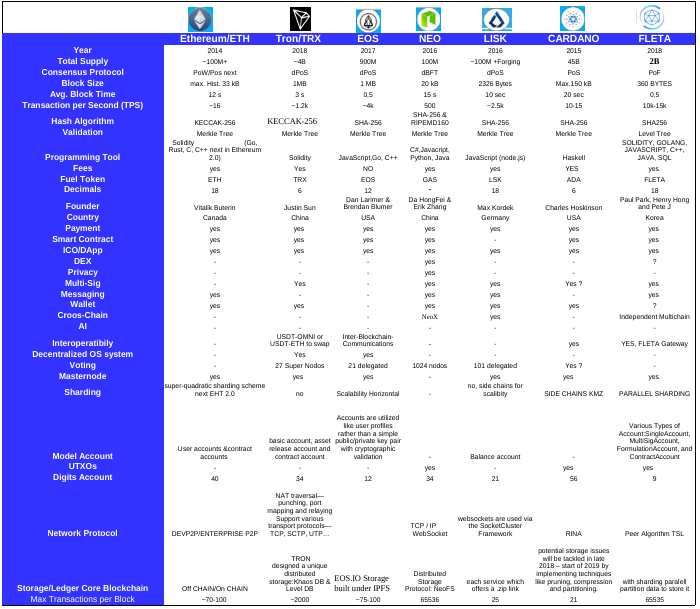 |
| json metadata | {"tags":["fleta","eos","eth","tron","blockchain"],"image":["https://cdn.steemitimages.com/DQmWHZWQd1Lc5ifSseDYrySjM5Xu1jm6NaGtQMQxq5G5Jhu/1.png","https://cdn.steemitimages.com/DQmPDJkpT1AuBfyvDXTHuVjaCWzj951p3tKAoT35iCnAkLh/2.png"],"app":"steemit/0.1","format":"markdown"} |
| Transaction Info | Block #33512402/Trx 49cceec81413f20632fa20101c7add1ae8c39b80 |
View Raw JSON Data
{
"trx_id": "49cceec81413f20632fa20101c7add1ae8c39b80",
"block": 33512402,
"trx_in_block": 25,
"op_in_trx": 0,
"virtual_op": 0,
"timestamp": "2019-06-04T19:06:54",
"op": [
"comment",
{
"parent_author": "",
"parent_permlink": "fleta",
"author": "daniejjimenez",
"permlink": "options-for-the-development-of-dapss-ethereum-tron-eos-fleta",
"title": "Options for the development of Dapss: Ethereum, Tron, EOS, Fleta.",
"body": "A common skepticism of the blockchain space is that technology is still looking for use cases, in which exaggeration and speculation exceed applicability. For some, the lack of broad use by consumers of decentralized applications reflects that the industry is still in an infrastructure development phase.\n\nBlockchain and cryptocurrencies will not become commonplace until they can be perfectly integrated into our daily lives. The solution to this for many could simply be decentralized applications (dApps). However, decentralized applications (dApps) will be considered common when they become invisible and intrinsically better than the applications and services they propose to replace.\n\nBlockchain applications are currently being oriented towards the mainstream, and the platforms running Dapps will be the ideal place for developers, publishers and users. This becomes especially relevant in ecosystems where users get value from the applications.\n\nAllowing the main users to experience Dapss without friction or over complication, aims to promote the widespread adoption of this technology. The gaming industry is a clear example of this.\n\nThe cases of Tron, EOS, and even Ethereum with its scalability proposal, as well as a handful of interesting projects with innovative technology such as Fleta, Lisk, among others, are developments that push the blockchain and dApps in our daily lives , which will allow experiencing them without problems, promoting the widespread adoption of this technology.\n\nCurrent status of the dApps\n\nMany dApps are currently being built, and many have already been built. According to the dapp.review website, there are more than 2700 decentralized applications, concentrated in the three main chains for their development, such as Ethereum, Tron and EOS.\n\nOnly in Ethereum for example there are more than 1700 Dapps and the sectors are diverse, from gaming to applications such as Liquid to convert ETH to USD, among other uses.\n\n\nBasically, a whole new market for dApps is being built. As with any market, consumers and users are likely to gravitate towards the applications that offer the best quality at the most reasonable price.\n\nTherefore, the problem of quality control will probably be solved by the free market economy. In fact, the DApp market will soon become one of the freest markets in the world.\n\nPotential challenges for dApps\n\nThere are a number of important challenges that the dApps are currently facing, and they are likely to continue to do so for a period of time. One of the most important challenges is that because many dApps depend on cryptocurrencies like Bitcoin and Ethereum, they can also rely on users to understand cryptocurrencies and feel comfortable using them.\n\nUnfortunately, despite the fact that cryptocurrencies are growing steadily, many people still do not understand them, do not possess them and, in general, feel uncomfortable with them. For applications to reach their full potential, cryptocurrencies must first obtain greater general acceptance.\n\nA large part of the world population has simply not focused on this concept yet.\n\nHowever, more and more people are using the Internet as smartphones and computers become more affordable. The greater the number of Internet users, the more likely cryptocurrencies will be used. In addition, as time passes, it is likely that more and more people will be comfortable with cryptocurrencies and start using them more. This can help the DApp market grow.\n\nIn addition to adoption, one more problem persists. The scalability Many of the challenges to create real use cases go through the problems of achieving the holy grail of cryptocurrencies: scalability, security and decentralization.\n\nIn view of the aforementioned problems, we will try to give a comparative technical approach among the most popular options currently available in the market to develop decentralized applications.\n\nETHEREUM (ETH).\n\nThis distributed computing platform was created by Vitalik Buterin at the end of 2013. Ethereum has its own cryptocurrency called Ether.\n\nScalability\n\nOne of the great weaknesses of Ethereum is the lack of scaling with its current EVM and its consensus mechanism, which has generated a deceleration of its widespread use for the development of dApps. In addition, the platform currently works, does not allow interoperable with other blockchains of higher generation, further limiting its development, amen of the price of gas which happens to be a problem many times.\n\nCurrently, scalability is a big drawback for technology, as it is capable of processing only about 16 transactions per second, so the developer community is looking to migrate towards a new consensus algorithm, the Proof of Stake, as part of your plan to achieve greater TPS.\n\n\nTransaction rate\n\nThe price that Dapps must pay on average for GAS expenses is 0.0086 ETH.\n\nFlexibility\n\nThe goal of Ethereum's 'Turing-complete' programming language is to allow developers to write more programs in which blockchain transactions can govern and automate specific results.\n\nThis flexibility is perhaps the main innovation of Ethereum, but the case of DAO showed the weakness of the platform in this aspect.\n\nEthereum introduced the concept not only of smart contracts, but also of the lucrative idea behind them: dApps\n\nThe smart contracts use Ether, which is the currency based on cryptography of Ethereum, with 18 decimals in length and its estimated supply amount is 100 million units.\n\nConsensus Protocol.\n\nEthereum uses the Proof of Work consensus protocol, a derivation of the same consensus algorithm used by Bitcoin.\n\nThe blocks are created and added to the chain of Ethereum blocks only when the mathematical equations are solved and thus the validity of a transaction is guaranteed. Although this work test model makes the transactions and transfers in the chain of blocks of Ethereum safe, it is not ideal and has its drawbacks.\n\nEthereum is based on a consensus model of \"order and execution\", where each transaction execution must be deterministic, which means that it always produces the same result with the same input and the same logic. At the same time, Ethereum's intelligent contract engine, Ethereum Virtual Machine (EVM), provides developers with full logic programming capabilities, also known as Turing Complete. These two seemingly opposite objectives are achieved by eliminating non-deterministic language features, such as file systems, network IOs, clocks, floating-point arithmetic, etc. The result is a new specific domain language called Solidity.\n\nArchitecture.\n\nThe Merkle tree used in Ethereum is more complex than the simple Merkle binary tree. This is called as the \"Patricia Merkle tree\". Patricia's tree is used to allow efficient insertion / removal operations.\n\nThe Ethereum key generation is based on the elliptic curve ecp256k1 and to generate the Ethereum address, the Keccak-256 hash of the public key is taken. .The Ethereum addresses are 160-bit data that identify the sender of the transaction with a 40-digit extension.\n\nEthereum invented the transaction model \"Statement of account\". Ethereum implements two types of accounts (contract accounts and external property accounts) in which the assignment of account addresses and the status of the account are associated through cryptographic tests that validate their status.\n\nEthereum uses accounts to process transactions, while Bitcoin uses unused transaction exits, UTXOs.\n\nBoth have the vulnerability to filter a significant amount of private information. But the use of accounts by Ethereum is probably a bit more vulnerable when it comes to ensuring the user's anonymity.\n\n\nUtilities\n\nThe Ethereum ecosystem is well developed and allows several tools of use such as wallet, network monitor, transaction confirmation and developer community.\n\nOne of the major projects around Ethereum is Microsoft's partnership with ConsenSys, which offers \"Ethereum Blockchain as a Service (EBaaS) in Microsoft Azure so that Enterprise customers and developers can have a single click in the developer environment of blockchain based on the cloud \". This alliance paves the way for more future offers involving Ethereum.\n\nStorage mechanism\n\nOne of the biggest challenges in achieving a fast transaction speed for Ethereum is to reduce the data and the load that increases in the nodes. Currently each node has to store all the data in the block chain. Therefore, a decentralized storage mechanism that shares the data load could help make the processing of the transaction more efficient and faster\n\nEthereum is close to implementing its Serenity improvement (Ethereum 2.0). The Ethereum Serenity update will pay the validators to secure the network instead of paying the miners. Because this update will include Sharding and Casper, many people started calling it \"Shasper\", but in Devcon4 it is now formally called \"Serenity\".\n\nFeatures included in next upgrade are:\n\nProof of Stake (Casper): Pure PoS consensus\nScalability (Sharding): ~ 1000x higher scalability\nVM improvement (EWASM): Fast VM execution via EWASM\nImprovements to cross-contract logic (eg abstraction): Faster time to synchronous confirmation (8-16 seconds). Under asynchronous model, you should be able to treat 1 block as close to final.\nImprovements to protocol economics: \"Economic finality\" (10-20 minutes)\n\n\"Layer One\" solutions such as Sharding and Casper have been on Ethereum's roadmap for some years, but have been plagued by multiple setbacks that have impeded significant progress on the implementation and development front. Even after these improvements, there will still be a need for \"Layer Two\" scaling mechanisms that provide even greater performance, private transactions and lower transaction fees.\n\nEOS\n\nThe core team behind EOS is \"Block.one\", which is based in the Cayman Islands. Brendon Blumer, the CEO, has been involved in blockchain since 2014.\n\nEOS is designed as the \"best of two worlds\" that combines the high performance of Graphene and BitShares with Ethereum's smart contract capability. EOS is the logical continuation of Graphene towards the development of programmable intelligent contracts.\n\n\nScalability\n\nThe reason why blockchain-based applications can not compute so many transactions per second is because each and every node in the network must reach a consensus for anything to happen.\n\nEOS introduces a different consensus algorithm, called a delegated participation test. The main difference between the delegated participation test and the participation test is that there is a predetermined number of miners, also called delegates.\nIn the case of EOS, there are 21 delegates that secure the network. Delegates are elected by vote.\n\nEach user who has chips can vote for the delegates. The delegated participation test is still considered a consensus algorithm without permission because anyone can become a delegate simply by getting enough votes from the community.\n\nEOS claims to be scalable to handle millions of transactions per second. It is a great fantasy and the progress of the current project is not very close. Their data currently point to a historical maximum of 4000 TPS, far from what they promise.\n\nTransaction rate\n\nNormally, when a user wishes to send a transaction through blockchain, he must pay a fee. In the case of EOS, transactions are free. The only requirement to send a transaction is to deposit some tokens in the account.\n\nFlexibility\n\nBecause EOS uses DPOS, if a DAPP is defective, the producers of chosen blocks can freeze it until the system is taken care of. This is simply an extension of the DPOS system, not all nodes have to deal with the maintenance of the chain.\n\nEOS believes that flexibility is a very important concern in the cryptocurrency space. One of the biggest problems that most people with Ethereum had was their inflexibility.\n\nUsability\n\nEOS allows well-defined permission levels by incorporating features such as the web toolkit for the development of interfaces, self-describing interfaces, self-describing database schemas and a declarative permission scheme.\n\n\n\nGovernance\n\nIn EOS, the government is maintained by establishing jurisdiction and choosing the law, along with other mutually accepted rules. This is usually done through the legally binding constitution. Each individual transaction in EOS must include the hash of the constitution to the signature. This, in essence, forces users to the constitution.\n\nThe constitution and protocol can be modified by the 17/21 approval that must be maintained for 30 days in a row, in addition to other consensus processes.\n\nParallel processing\n\nIn parallel processing, program instructions are divided among several processors. By doing this, the execution time of that program decreases considerably. EOS provides parallel processing of intelligent contracts through horizontal scalability, asynchronous communication and interoperability.\n\nThe EOSIO software is a sophisticated operating system in which applications can be built. The software's brilliance is its ability to scale horizontally and vertically, which means that at some point in the near future, EOS-based block chains will be able to process millions of transactions per second. Another benefit of the software is that it does not charge user fees, making it a desirable platform for developers and users alike. One of the aspects that makes the EOSIO software unique is the way CPU and RAM are used in the EOS blockchain.\n\nSelf-sufficiency\n\nAny blockchain based on the EOS software will have to generate 5% of natural inflation per year. This will be distributed to the producers of blocks of the platform in relation to their confirmation of the transactions in the platform and to the three main contracts or intelligent proposals that receive the highest number of votes from the holders of said tokens.\n\nThe reason why this happens is to make sure that a chain of blocks does not depend on a single foundation, organization or individual for its growth, development or maintenance.\n\nDecentralized Operating System\n\nProbably, the most important feature to really understand what EOS is about is this feature. Think of a MacOs / Windows with a crypto-economic incentive.\n\nNow, Ethereum is a decentralized supercomputer, EOS is positioned as an operating system.\n\n\nArchitecture\n\nthe architecture of the EOS system is not a chain of blocks, according to the traditional definition, but a system of homogeneous non-autonomous distributed databases.\n\nAn analysis of accounts in the EOS architecture indicates that the accounts manage the permissions and funds in the EOS network. The accounts in EOS follow a traditional configuration, similar to other distributed systems based on cryptography. However, EOS accounts have another layer of abstraction beyond a pair of public / private keys. Accounts are consistent with user profiles, in which multiple pairs of keys and wallets, with different permissions, can be linked to an account. To manage this, a user interacts with Nodeos and Keosd through the command line tool, Cleos.\n\nTransactions in EOS result primarily in changes to the underlying database, rather than status changes cryptographically verified in an underlying blockchain data structure such as Ethereum, by means of the data structure of the Merkle tree.\n\nStorage mechanism\n\nin the EOS architecture, state storage represents information that matches the logic of the application. Block producers will publish their available capacity for storage of bandwidth registration, computer debt and state storage. The storage availability of the state depends on the number of tokens that a stake account.\n\nTRON\n\nTRON is a very ambitious project that is very dedicated to establishing a truly decentralized Internet and online infrastructure. The main objective is to eliminate any need for an intermediary in entertainment companies and take users directly to content creators.\n\nScalability\n\nAt its maximum capacity, TRON can handle 2000 per second compared to Ethereum's 20 transactions per second. This is due to the very short time between blocks, which is about 15 seconds.\n\nApplications have a wide range of ways in which they can be developed and implemented on the network. They can handle a large number of users and have a reliable structure.\n\nUses the delegated participation test consensus protocol with the Super Representative Representative (SR) that assumes important roles such as block generation and transaction packaging\n\nTransaction rate\n\nThe transaction fee in the TRX Market decentralized exchange fell to 0.1% on December 14, 2018. The company stated that the TRX ecosystem could reach a zero transaction fee soon.\n\nFlexibility\n\nTRON says that its platform offers more flexibility to developers, leading to compatibility with projects and smart contracts.\n\nThe TVM is a virtual machine made by the Tron Foundation to make the Tron ecosystem bigger, better and friendlier for the developer.\n\nDevelopers can create smart contracts that run on TVM using friendly programming languages that developers are familiar with. There is no need to learn a new programming language. Developers can use the strength of Ethereum, as well as other common ones.\n\nBetter yet, the creation of Dapss and smart contracts can be tested before being uploaded to the main Tron network.\n\nUsability\n\nDevelopers can use given interfaces to easily bring about abundant dAPPs and implement the wallet by themselves. The protocol of TRON is defined by google proto-buf, and naturally supports multi-language extensions.\n\n\nGovernance\n\nTRON is the first to propose a mixed-voting mechanism and set a two-tier voting system,\n1. Poll\n2. Follow vote\n\nAll chip holders can choose their leaders and can choose their Super Representative. These SRs represent the entire network and its voters. They also decide the governance and the proposal in the network. In total there are 27 SR responsible for the decentralization of the project.\n\n\n\nSharding\nTron does not pose this technology for now. To achieve its high scalability and data transmission, it uses two platform-specific concepts within the Tron Virtual Machine: the concept of bandwidth to avoid network overload and Freeze Balance. Freezing a certain number of TRX tokens will give the bandwidth of the node, or power and TRON Power (voting rights) to the node of the frozen tokens.\n\nSelf-sufficiency\n\nThere will be no inflation in the TRON block chain before January 1, 2021. Instead, the block rewards are distributed from the 34,251,888,355 TRX blocked in the TRON Foundation.\n\nAs calculated, each active SR can earn approximately $ 1,696,870 per year at the current market price of TRX. As the price of TRX fluctuates, so will the return. With such a high reward, SRs are expected to gather more companies and developers in the TRON blockchain, as well as to constantly show the community what they have done to further improve the network\n\n\nArchitecture\n\nTron adopts a 3-layer architecture, which is divided into storage layer, core layer and application layer.\n\nStorage Layer.Tech team of TRON designed a unique distributed storage protocol consisting of block storage and state storage.\n\nCore Layer.There are several modules in the core layer, including smart contracts, account management and consensus.\n\nApplication Layer. Developers can use given interfaces to easily bring about abundant dAPPs and implement the wallet by themselves.\n\nStorage mechanism\n\nIn Tron architecture storage is done through two methods\n\nKhaosDB. TRON has KhaosDB in the full-node memory that can store all new folk chains during a certain time and supports witnesses to switch their own active chain swiftly into new main chain.\n\nLevel DB. Level DB will be initially adopted and its primary goal is to meet the requirements of fast R / W and rapid development. \n\nThird Party Applications\n\nToken Deployment Platform, Wallet and Blockchain Explorer.\n\nFLETA\nFLETA aims to provide a blockchain technology that can be addressed and also support integration with existing development environments. It is a practically new project that is entering the business of the third generation blockchains and aims to conquer the Dapps market through an intelligent and friendly environment for the development of applications.\n\nScalability\n\nThe advanced blockchain technology of FLETA and the independence of DApp open the doors to infinite scalability.\n\nFLETA proposed a new consensus model. Instead of the existing model, PoW (Work test, verification calculation process) or PoS (Play test, participation verification), FLETA developed a new consensus model to avoid unnecessary bifurcation.\n\nThis new model is called PoF (Proof-of-Formulation) in which a consensus is obtained on the block mining procedure and the blocks are generated in a designated order. This allows to reduce the range of dissemination of the block, which results in a faster generation and dissemination of the block. In addition, the observer node allows instant confirmation and avoids bifurcation. In turn, the network becomes stable and the transaction speed increases.\n\nFLETA consists of a main chain and many substrings that operate at the top, creating a multi-chain platform.\n\nEach substring is assigned exclusively to the corresponding DApp application, which means that the administrator of the DApp application has the possibility to perform functions such as updating and data migration. To clarify, a new substring is created when a new DApp is created. Thus, the multichain system of FLETA overcomes the deficiencies of the existing chain systems.\n\nThe ECDSA signature algorithm based on secp256k1 can perform a maximum of 23,000 verifications per second in a parallel processing of 8 central CPUs. This requires a network speed of 1.4 MB / s for this transaction to be transmitted. Therefore, FLETA aims to reach 20,000 TPS through the original block design.\n\nAs a final result, FLETA has reached a maximum peak of 15,000 transactions per second in its beta phase.\n\nTransaction rate\n\nFLETA through its multi-channel structure projects very low fees in its transactions to encourage the development of the Dapps.\n\n\nFlexibility\n\nFLETA has created a PoF (Proof-of-Formulator), which allows the generation and rapid dissemination of blocks by using the reward sequence of the Formulator to designate the objective of mining and reduce the diffusion range. In addition, the existence of an observer node allows immediate authentication and avoids block bifurcation.\n\n\nThis means that each Formulator is guaranteed with a mining opportunity in each phase and a different formulator sequence is provided in different phrases, in order to avoid possible attacks or collusions of and against Formulators.\n\nIn addition to the multi-chain structure, all Dapps are operated as independent blockchains, so the flexibility of the platform is wide to avoid damage to the main chain.\n\nUsability\n\n\nFLETA provides intelligent contract services, which can be used with current development formats such as RDBMS, NoSQL and Event Sourcing, to integrate with existing development environments.\n\nFLETA basically provides Solidity, Relational database, Contract type of event supply. The future development of technology and the progress in research could allow new types of contract.\n\nGovernance\n\nIn FLETA the Government is maintained through the establishment of block generation by the proposed PoF algorithm.\nThe mining group consists of A) the generator group of the 1st place, B) a synchronization group consisted of the 2nd to the 10th place, and C) the group on hold consisted of the 11th to the 20th place.\n\nIn this way, the block generator can quickly generate a block, and as 3/5 of the observing nodes signed it, a branch is not possible since at least one observer node will detect the branch before it is formed. The integrity of the network is thus maintained by the 3/5 parts of the observing nodes.\n\nTo participate in the Formulator group, you must have the FLETA tokens.\n\nThe observing nodes will be operated by FLETA first, then operated by delegates later (for example, the dApps themselves).\n\nParallel Sharding\n\nThe parallel processing of transactions is a fundamental technology that updates the high-speed transaction speed. In FLETA, the transaction is assigned to a certain fragment according to a predetermined rule and the result of the transaction is processed independently in each fragment.\n\nUnlike the structure of a single chain, each fragment of FLETA has an independent chain. Therefore, each fragment does not influence each other and is processed in a parallel structure within an independent block chain. The Shard system basically does not share data and, therefore, it is not possible to duplicate the expense in this design. The independent strings of fragments update the complete parallel structure, increasing the processing speed.\n\nSelf-sufficiency\n\nThe dApps with token issued in the FLETA platform are operated in their own independent chain, not in the main chain. That is, the token economy is updated through several consensus modes selected by each and every one of the developers of Dapp.\n\nEach DApp token can be rewarded independently through a preferred consensus model (PoW, PoS or voting process is included, but not limited to these). The token economy is a driving force of FLETA and its dApps, which provides the motivation for several utility tokens to join FLETA.\n\nNetwork\n\nThe algorithm of selection of balanced geolocational pairs allows the blocks to be distributed quickly and uniformly. This network algorithm is designed to connect colleagues with geolocated equilibrium. The distance is determined by ping, and the clumsiness of the network can be avoided, receiving nodes per group that is generated through distance. The distance of the network creates the greatest possible distance so that it is as uniform as possible to avoid deviation in a certain direction.\n\nArchitecture\n\nThe architecture of the FLETA system has a Microkernal system. Kernel is blockchain as Consensus, Store, Generator and is responsible for its operation, so that each chain supports its own account, transaction and contract.\n\nMicrokernal has a summary structure 1) transaction, which is the formula actually modified, 2) account, which stores and manages transactions, 3) contract, which carries out with codes.\n\nFLETA recently designed and improved the block structure, which is the core of blockchain technology. Blocks that had 560 bytes in a transaction have been reduced to less than 360 bytes, leading to faster transaction speeds.\n\nIn addition, FLTEA adopted the LEVEL Tree verification method, replacing the existing verification method of the Merkle Tree. This, too, is a technological advance that improves the real speed of the transaction. The replacement results in verification speeds more than 5 times faster.\n\nIn addition, FLETA employs a hybrid method, which combines UTXO and Account. UTXO, which can be used immediately without creating an account. And the account, which can be used with less execution rate and data. Both coexist in harmony to improve ease of use and efficiency.\n\n\nStorage mechanism\n\nOn existing blockchain platforms, the main chain included many dApps and the mining group had to operate the main chain and all other secondary chains. This easily led to the overload of the mining group. On the other hand, FLETA employs a structure in which each substring operates independently its own chain, solving the problem mentioned above. Therefore, FLETA separates the function and the data field so that the DApps are not affected by each other, which provides infinite scalability for Dapps.\n\n",
"json_metadata": "{\"tags\":[\"fleta\",\"eos\",\"eth\",\"tron\",\"blockchain\"],\"image\":[\"https://cdn.steemitimages.com/DQmWHZWQd1Lc5ifSseDYrySjM5Xu1jm6NaGtQMQxq5G5Jhu/1.png\",\"https://cdn.steemitimages.com/DQmPDJkpT1AuBfyvDXTHuVjaCWzj951p3tKAoT35iCnAkLh/2.png\"],\"app\":\"steemit/0.1\",\"format\":\"markdown\"}"
}
]
}daniejjimenezpublished a new post: options-for-the-development-of-dapss-ethereum-tron-eos-fleta2019/06/04 19:05:06
daniejjimenezpublished a new post: options-for-the-development-of-dapss-ethereum-tron-eos-fleta
2019/06/04 19:05:06
| parent author | |
| parent permlink | fleta |
| author | daniejjimenez |
| permlink | options-for-the-development-of-dapss-ethereum-tron-eos-fleta |
| title | Options for the development of Dapss: Ethereum, Tron, EOS, Fleta. |
| body | A common skepticism of the blockchain space is that technology is still looking for use cases, in which exaggeration and speculation exceed applicability. For some, the lack of broad use by consumers of decentralized applications reflects that the industry is still in an infrastructure development phase. Blockchain and cryptocurrencies will not become commonplace until they can be perfectly integrated into our daily lives. The solution to this for many could simply be decentralized applications (dApps). However, decentralized applications (dApps) will be considered common when they become invisible and intrinsically better than the applications and services they propose to replace. Blockchain applications are currently being oriented towards the mainstream, and the platforms running Dapps will be the ideal place for developers, publishers and users. This becomes especially relevant in ecosystems where users get value from the applications. Allowing the main users to experience Dapss without friction or over complication, aims to promote the widespread adoption of this technology. The gaming industry is a clear example of this. The cases of Tron, EOS, and even Ethereum with its scalability proposal, as well as a handful of interesting projects with innovative technology such as Fleta, Lisk, among others, are developments that push the blockchain and dApps in our daily lives , which will allow experiencing them without problems, promoting the widespread adoption of this technology. Current status of the dApps Many dApps are currently being built, and many have already been built. According to the dapp.review website, there are more than 2700 decentralized applications, concentrated in the three main chains for their development, such as Ethereum, Tron and EOS. Only in Ethereum for example there are more than 1700 Dapps and the sectors are diverse, from gaming to applications such as Liquid to convert ETH to USD, among other uses.  Basically, a whole new market for dApps is being built. As with any market, consumers and users are likely to gravitate towards the applications that offer the best quality at the most reasonable price. Therefore, the problem of quality control will probably be solved by the free market economy. In fact, the DApp market will soon become one of the freest markets in the world. Potential challenges for dApps There are a number of important challenges that the dApps are currently facing, and they are likely to continue to do so for a period of time. One of the most important challenges is that because many dApps depend on cryptocurrencies like Bitcoin and Ethereum, they can also rely on users to understand cryptocurrencies and feel comfortable using them. Unfortunately, despite the fact that cryptocurrencies are growing steadily, many people still do not understand them, do not possess them and, in general, feel uncomfortable with them. For applications to reach their full potential, cryptocurrencies must first obtain greater general acceptance. A large part of the world population has simply not focused on this concept yet. However, more and more people are using the Internet as smartphones and computers become more affordable. The greater the number of Internet users, the more likely cryptocurrencies will be used. In addition, as time passes, it is likely that more and more people will be comfortable with cryptocurrencies and start using them more. This can help the DApp market grow. In addition to adoption, one more problem persists. The scalability Many of the challenges to create real use cases go through the problems of achieving the holy grail of cryptocurrencies: scalability, security and decentralization. In view of the aforementioned problems, we will try to give a comparative technical approach among the most popular options currently available in the market to develop decentralized applications. ETHEREUM (ETH). This distributed computing platform was created by Vitalik Buterin at the end of 2013. Ethereum has its own cryptocurrency called Ether. Scalability One of the great weaknesses of Ethereum is the lack of scaling with its current EVM and its consensus mechanism, which has generated a deceleration of its widespread use for the development of dApps. In addition, the platform currently works, does not allow interoperable with other blockchains of higher generation, further limiting its development, amen of the price of gas which happens to be a problem many times. Currently, scalability is a big drawback for technology, as it is capable of processing only about 16 transactions per second, so the developer community is looking to migrate towards a new consensus algorithm, the Proof of Stake, as part of your plan to achieve greater TPS. Transaction rate The price that Dapps must pay on average for GAS expenses is 0.0086 ETH. Flexibility The goal of Ethereum's 'Turing-complete' programming language is to allow developers to write more programs in which blockchain transactions can govern and automate specific results. This flexibility is perhaps the main innovation of Ethereum, but the case of DAO showed the weakness of the platform in this aspect. Ethereum introduced the concept not only of smart contracts, but also of the lucrative idea behind them: dApps The smart contracts use Ether, which is the currency based on cryptography of Ethereum, with 18 decimals in length and its estimated supply amount is 100 million units. Consensus Protocol. Ethereum uses the Proof of Work consensus protocol, a derivation of the same consensus algorithm used by Bitcoin. The blocks are created and added to the chain of Ethereum blocks only when the mathematical equations are solved and thus the validity of a transaction is guaranteed. Although this work test model makes the transactions and transfers in the chain of blocks of Ethereum safe, it is not ideal and has its drawbacks. Ethereum is based on a consensus model of "order and execution", where each transaction execution must be deterministic, which means that it always produces the same result with the same input and the same logic. At the same time, Ethereum's intelligent contract engine, Ethereum Virtual Machine (EVM), provides developers with full logic programming capabilities, also known as Turing Complete. These two seemingly opposite objectives are achieved by eliminating non-deterministic language features, such as file systems, network IOs, clocks, floating-point arithmetic, etc. The result is a new specific domain language called Solidity. Architecture. The Merkle tree used in Ethereum is more complex than the simple Merkle binary tree. This is called as the "Patricia Merkle tree". Patricia's tree is used to allow efficient insertion / removal operations. The Ethereum key generation is based on the elliptic curve ecp256k1 and to generate the Ethereum address, the Keccak-256 hash of the public key is taken. .The Ethereum addresses are 160-bit data that identify the sender of the transaction with a 40-digit extension. Ethereum invented the transaction model "Statement of account". Ethereum implements two types of accounts (contract accounts and external property accounts) in which the assignment of account addresses and the status of the account are associated through cryptographic tests that validate their status. Ethereum uses accounts to process transactions, while Bitcoin uses unused transaction exits, UTXOs. Both have the vulnerability to filter a significant amount of private information. But the use of accounts by Ethereum is probably a bit more vulnerable when it comes to ensuring the user's anonymity. Utilities The Ethereum ecosystem is well developed and allows several tools of use such as wallet, network monitor, transaction confirmation and developer community. One of the major projects around Ethereum is Microsoft's partnership with ConsenSys, which offers "Ethereum Blockchain as a Service (EBaaS) in Microsoft Azure so that Enterprise customers and developers can have a single click in the developer environment of blockchain based on the cloud ". This alliance paves the way for more future offers involving Ethereum. Storage mechanism One of the biggest challenges in achieving a fast transaction speed for Ethereum is to reduce the data and the load that increases in the nodes. Currently each node has to store all the data in the block chain. Therefore, a decentralized storage mechanism that shares the data load could help make the processing of the transaction more efficient and faster Ethereum is close to implementing its Serenity improvement (Ethereum 2.0). The Ethereum Serenity update will pay the validators to secure the network instead of paying the miners. Because this update will include Sharding and Casper, many people started calling it "Shasper", but in Devcon4 it is now formally called "Serenity". Features included in next upgrade are: Proof of Stake (Casper): Pure PoS consensus Scalability (Sharding): ~ 1000x higher scalability VM improvement (EWASM): Fast VM execution via EWASM Improvements to cross-contract logic (eg abstraction): Faster time to synchronous confirmation (8-16 seconds). Under asynchronous model, you should be able to treat 1 block as close to final. Improvements to protocol economics: "Economic finality" (10-20 minutes) "Layer One" solutions such as Sharding and Casper have been on Ethereum's roadmap for some years, but have been plagued by multiple setbacks that have impeded significant progress on the implementation and development front. Even after these improvements, there will still be a need for "Layer Two" scaling mechanisms that provide even greater performance, private transactions and lower transaction fees. EOS The core team behind EOS is "Block.one", which is based in the Cayman Islands. Brendon Blumer, the CEO, has been involved in blockchain since 2014. EOS is designed as the "best of two worlds" that combines the high performance of Graphene and BitShares with Ethereum's smart contract capability. EOS is the logical continuation of Graphene towards the development of programmable intelligent contracts. Scalability The reason why blockchain-based applications can not compute so many transactions per second is because each and every node in the network must reach a consensus for anything to happen. EOS introduces a different consensus algorithm, called a delegated participation test. The main difference between the delegated participation test and the participation test is that there is a predetermined number of miners, also called delegates. In the case of EOS, there are 21 delegates that secure the network. Delegates are elected by vote. Each user who has chips can vote for the delegates. The delegated participation test is still considered a consensus algorithm without permission because anyone can become a delegate simply by getting enough votes from the community. EOS claims to be scalable to handle millions of transactions per second. It is a great fantasy and the progress of the current project is not very close. Their data currently point to a historical maximum of 4000 TPS, far from what they promise. Transaction rate Normally, when a user wishes to send a transaction through blockchain, he must pay a fee. In the case of EOS, transactions are free. The only requirement to send a transaction is to deposit some tokens in the account. Flexibility Because EOS uses DPOS, if a DAPP is defective, the producers of chosen blocks can freeze it until the system is taken care of. This is simply an extension of the DPOS system, not all nodes have to deal with the maintenance of the chain. EOS believes that flexibility is a very important concern in the cryptocurrency space. One of the biggest problems that most people with Ethereum had was their inflexibility. Usability EOS allows well-defined permission levels by incorporating features such as the web toolkit for the development of interfaces, self-describing interfaces, self-describing database schemas and a declarative permission scheme. Governance In EOS, the government is maintained by establishing jurisdiction and choosing the law, along with other mutually accepted rules. This is usually done through the legally binding constitution. Each individual transaction in EOS must include the hash of the constitution to the signature. This, in essence, forces users to the constitution. The constitution and protocol can be modified by the 17/21 approval that must be maintained for 30 days in a row, in addition to other consensus processes. Parallel processing In parallel processing, program instructions are divided among several processors. By doing this, the execution time of that program decreases considerably. EOS provides parallel processing of intelligent contracts through horizontal scalability, asynchronous communication and interoperability. The EOSIO software is a sophisticated operating system in which applications can be built. The software's brilliance is its ability to scale horizontally and vertically, which means that at some point in the near future, EOS-based block chains will be able to process millions of transactions per second. Another benefit of the software is that it does not charge user fees, making it a desirable platform for developers and users alike. One of the aspects that makes the EOSIO software unique is the way CPU and RAM are used in the EOS blockchain. Self-sufficiency Any blockchain based on the EOS software will have to generate 5% of natural inflation per year. This will be distributed to the producers of blocks of the platform in relation to their confirmation of the transactions in the platform and to the three main contracts or intelligent proposals that receive the highest number of votes from the holders of said tokens. The reason why this happens is to make sure that a chain of blocks does not depend on a single foundation, organization or individual for its growth, development or maintenance. Decentralized Operating System Probably, the most important feature to really understand what EOS is about is this feature. Think of a MacOs / Windows with a crypto-economic incentive. Now, Ethereum is a decentralized supercomputer, EOS is positioned as an operating system. Architecture the architecture of the EOS system is not a chain of blocks, according to the traditional definition, but a system of homogeneous non-autonomous distributed databases. An analysis of accounts in the EOS architecture indicates that the accounts manage the permissions and funds in the EOS network. The accounts in EOS follow a traditional configuration, similar to other distributed systems based on cryptography. However, EOS accounts have another layer of abstraction beyond a pair of public / private keys. Accounts are consistent with user profiles, in which multiple pairs of keys and wallets, with different permissions, can be linked to an account. To manage this, a user interacts with Nodeos and Keosd through the command line tool, Cleos. Transactions in EOS result primarily in changes to the underlying database, rather than status changes cryptographically verified in an underlying blockchain data structure such as Ethereum, by means of the data structure of the Merkle tree. Storage mechanism in the EOS architecture, state storage represents information that matches the logic of the application. Block producers will publish their available capacity for storage of bandwidth registration, computer debt and state storage. The storage availability of the state depends on the number of tokens that a stake account. TRON TRON is a very ambitious project that is very dedicated to establishing a truly decentralized Internet and online infrastructure. The main objective is to eliminate any need for an intermediary in entertainment companies and take users directly to content creators. Scalability At its maximum capacity, TRON can handle 2000 per second compared to Ethereum's 20 transactions per second. This is due to the very short time between blocks, which is about 15 seconds. Applications have a wide range of ways in which they can be developed and implemented on the network. They can handle a large number of users and have a reliable structure. Uses the delegated participation test consensus protocol with the Super Representative Representative (SR) that assumes important roles such as block generation and transaction packaging Transaction rate The transaction fee in the TRX Market decentralized exchange fell to 0.1% on December 14, 2018. The company stated that the TRX ecosystem could reach a zero transaction fee soon. Flexibility TRON says that its platform offers more flexibility to developers, leading to compatibility with projects and smart contracts. The TVM is a virtual machine made by the Tron Foundation to make the Tron ecosystem bigger, better and friendlier for the developer. Developers can create smart contracts that run on TVM using friendly programming languages that developers are familiar with. There is no need to learn a new programming language. Developers can use the strength of Ethereum, as well as other common ones. Better yet, the creation of Dapss and smart contracts can be tested before being uploaded to the main Tron network. Usability Developers can use given interfaces to easily bring about abundant dAPPs and implement the wallet by themselves. The protocol of TRON is defined by google proto-buf, and naturally supports multi-language extensions. Governance TRON is the first to propose a mixed-voting mechanism and set a two-tier voting system, 1. Poll 2. Follow vote All chip holders can choose their leaders and can choose their Super Representative. These SRs represent the entire network and its voters. They also decide the governance and the proposal in the network. In total there are 27 SR responsible for the decentralization of the project. Sharding Tron does not pose this technology for now. To achieve its high scalability and data transmission, it uses two platform-specific concepts within the Tron Virtual Machine: the concept of bandwidth to avoid network overload and Freeze Balance. Freezing a certain number of TRX tokens will give the bandwidth of the node, or power and TRON Power (voting rights) to the node of the frozen tokens. Self-sufficiency There will be no inflation in the TRON block chain before January 1, 2021. Instead, the block rewards are distributed from the 34,251,888,355 TRX blocked in the TRON Foundation. As calculated, each active SR can earn approximately $ 1,696,870 per year at the current market price of TRX. As the price of TRX fluctuates, so will the return. With such a high reward, SRs are expected to gather more companies and developers in the TRON blockchain, as well as to constantly show the community what they have done to further improve the network Architecture Tron adopts a 3-layer architecture, which is divided into storage layer, core layer and application layer. Storage Layer.Tech team of TRON designed a unique distributed storage protocol consisting of block storage and state storage. Core Layer.There are several modules in the core layer, including smart contracts, account management and consensus. Application Layer. Developers can use given interfaces to easily bring about abundant dAPPs and implement the wallet by themselves. Storage mechanism In Tron architecture storage is done through two methods KhaosDB. TRON has KhaosDB in the full-node memory that can store all new folk chains during a certain time and supports witnesses to switch their own active chain swiftly into new main chain. Level DB. Level DB will be initially adopted and its primary goal is to meet the requirements of fast R / W and rapid development. Third Party Applications Token Deployment Platform, Wallet and Blockchain Explorer. FLETA FLETA aims to provide a blockchain technology that can be addressed and also support integration with existing development environments. It is a practically new project that is entering the business of the third generation blockchains and aims to conquer the Dapps market through an intelligent and friendly environment for the development of applications. Scalability The advanced blockchain technology of FLETA and the independence of DApp open the doors to infinite scalability. FLETA proposed a new consensus model. Instead of the existing model, PoW (Work test, verification calculation process) or PoS (Play test, participation verification), FLETA developed a new consensus model to avoid unnecessary bifurcation. This new model is called PoF (Proof-of-Formulation) in which a consensus is obtained on the block mining procedure and the blocks are generated in a designated order. This allows to reduce the range of dissemination of the block, which results in a faster generation and dissemination of the block. In addition, the observer node allows instant confirmation and avoids bifurcation. In turn, the network becomes stable and the transaction speed increases. FLETA consists of a main chain and many substrings that operate at the top, creating a multi-chain platform. Each substring is assigned exclusively to the corresponding DApp application, which means that the administrator of the DApp application has the possibility to perform functions such as updating and data migration. To clarify, a new substring is created when a new DApp is created. Thus, the multichain system of FLETA overcomes the deficiencies of the existing chain systems. The ECDSA signature algorithm based on secp256k1 can perform a maximum of 23,000 verifications per second in a parallel processing of 8 central CPUs. This requires a network speed of 1.4 MB / s for this transaction to be transmitted. Therefore, FLETA aims to reach 20,000 TPS through the original block design. As a final result, FLETA has reached a maximum peak of 15,000 transactions per second in its beta phase. Transaction rate FLETA through its multi-channel structure projects very low fees in its transactions to encourage the development of the Dapps. Flexibility FLETA has created a PoF (Proof-of-Formulator), which allows the generation and rapid dissemination of blocks by using the reward sequence of the Formulator to designate the objective of mining and reduce the diffusion range. In addition, the existence of an observer node allows immediate authentication and avoids block bifurcation. This means that each Formulator is guaranteed with a mining opportunity in each phase and a different formulator sequence is provided in different phrases, in order to avoid possible attacks or collusions of and against Formulators. In addition to the multi-chain structure, all Dapps are operated as independent blockchains, so the flexibility of the platform is wide to avoid damage to the main chain. Usability FLETA provides intelligent contract services, which can be used with current development formats such as RDBMS, NoSQL and Event Sourcing, to integrate with existing development environments. FLETA basically provides Solidity, Relational database, Contract type of event supply. The future development of technology and the progress in research could allow new types of contract. Governance In FLETA the Government is maintained through the establishment of block generation by the proposed PoF algorithm. The mining group consists of A) the generator group of the 1st place, B) a synchronization group consisted of the 2nd to the 10th place, and C) the group on hold consisted of the 11th to the 20th place. In this way, the block generator can quickly generate a block, and as 3/5 of the observing nodes signed it, a branch is not possible since at least one observer node will detect the branch before it is formed. The integrity of the network is thus maintained by the 3/5 parts of the observing nodes. To participate in the Formulator group, you must have the FLETA tokens. The observing nodes will be operated by FLETA first, then operated by delegates later (for example, the dApps themselves). Parallel Sharding The parallel processing of transactions is a fundamental technology that updates the high-speed transaction speed. In FLETA, the transaction is assigned to a certain fragment according to a predetermined rule and the result of the transaction is processed independently in each fragment. Unlike the structure of a single chain, each fragment of FLETA has an independent chain. Therefore, each fragment does not influence each other and is processed in a parallel structure within an independent block chain. The Shard system basically does not share data and, therefore, it is not possible to duplicate the expense in this design. The independent strings of fragments update the complete parallel structure, increasing the processing speed. Self-sufficiency The dApps with token issued in the FLETA platform are operated in their own independent chain, not in the main chain. That is, the token economy is updated through several consensus modes selected by each and every one of the developers of Dapp. Each DApp token can be rewarded independently through a preferred consensus model (PoW, PoS or voting process is included, but not limited to these). The token economy is a driving force of FLETA and its dApps, which provides the motivation for several utility tokens to join FLETA. Network The algorithm of selection of balanced geolocational pairs allows the blocks to be distributed quickly and uniformly. This network algorithm is designed to connect colleagues with geolocated equilibrium. The distance is determined by ping, and the clumsiness of the network can be avoided, receiving nodes per group that is generated through distance. The distance of the network creates the greatest possible distance so that it is as uniform as possible to avoid deviation in a certain direction. Architecture The architecture of the FLETA system has a Microkernal system. Kernel is blockchain as Consensus, Store, Generator and is responsible for its operation, so that each chain supports its own account, transaction and contract. Microkernal has a summary structure 1) transaction, which is the formula actually modified, 2) account, which stores and manages transactions, 3) contract, which carries out with codes. FLETA recently designed and improved the block structure, which is the core of blockchain technology. Blocks that had 560 bytes in a transaction have been reduced to less than 360 bytes, leading to faster transaction speeds. In addition, FLTEA adopted the LEVEL Tree verification method, replacing the existing verification method of the Merkle Tree. This, too, is a technological advance that improves the real speed of the transaction. The replacement results in verification speeds more than 5 times faster. In addition, FLETA employs a hybrid method, which combines UTXO and Account. UTXO, which can be used immediately without creating an account. And the account, which can be used with less execution rate and data. Both coexist in harmony to improve ease of use and efficiency. Storage mechanism On existing blockchain platforms, the main chain included many dApps and the mining group had to operate the main chain and all other secondary chains. This easily led to the overload of the mining group. On the other hand, FLETA employs a structure in which each substring operates independently its own chain, solving the problem mentioned above. Therefore, FLETA separates the function and the data field so that the DApps are not affected by each other, which provides infinite scalability for Dapps.  |
| json metadata | {"tags":["fleta","eos","eth","tron","dapps"],"image":["https://cdn.steemitimages.com/DQmWHZWQd1Lc5ifSseDYrySjM5Xu1jm6NaGtQMQxq5G5Jhu/1.png","https://cdn.steemitimages.com/DQmPDJkpT1AuBfyvDXTHuVjaCWzj951p3tKAoT35iCnAkLh/2.png"],"app":"steemit/0.1","format":"markdown"} |
| Transaction Info | Block #33512366/Trx d3c317e7367d722ca66710de98d7dc8ee2d2c0f7 |
View Raw JSON Data
{
"trx_id": "d3c317e7367d722ca66710de98d7dc8ee2d2c0f7",
"block": 33512366,
"trx_in_block": 1,
"op_in_trx": 0,
"virtual_op": 0,
"timestamp": "2019-06-04T19:05:06",
"op": [
"comment",
{
"parent_author": "",
"parent_permlink": "fleta",
"author": "daniejjimenez",
"permlink": "options-for-the-development-of-dapss-ethereum-tron-eos-fleta",
"title": "Options for the development of Dapss: Ethereum, Tron, EOS, Fleta.",
"body": "A common skepticism of the blockchain space is that technology is still looking for use cases, in which exaggeration and speculation exceed applicability. For some, the lack of broad use by consumers of decentralized applications reflects that the industry is still in an infrastructure development phase.\n\nBlockchain and cryptocurrencies will not become commonplace until they can be perfectly integrated into our daily lives. The solution to this for many could simply be decentralized applications (dApps). However, decentralized applications (dApps) will be considered common when they become invisible and intrinsically better than the applications and services they propose to replace.\n\nBlockchain applications are currently being oriented towards the mainstream, and the platforms running Dapps will be the ideal place for developers, publishers and users. This becomes especially relevant in ecosystems where users get value from the applications.\n\nAllowing the main users to experience Dapss without friction or over complication, aims to promote the widespread adoption of this technology. The gaming industry is a clear example of this.\n\nThe cases of Tron, EOS, and even Ethereum with its scalability proposal, as well as a handful of interesting projects with innovative technology such as Fleta, Lisk, among others, are developments that push the blockchain and dApps in our daily lives , which will allow experiencing them without problems, promoting the widespread adoption of this technology.\n\nCurrent status of the dApps\n\nMany dApps are currently being built, and many have already been built. According to the dapp.review website, there are more than 2700 decentralized applications, concentrated in the three main chains for their development, such as Ethereum, Tron and EOS.\n\nOnly in Ethereum for example there are more than 1700 Dapps and the sectors are diverse, from gaming to applications such as Liquid to convert ETH to USD, among other uses.\n\n\nBasically, a whole new market for dApps is being built. As with any market, consumers and users are likely to gravitate towards the applications that offer the best quality at the most reasonable price.\n\nTherefore, the problem of quality control will probably be solved by the free market economy. In fact, the DApp market will soon become one of the freest markets in the world.\n\nPotential challenges for dApps\n\nThere are a number of important challenges that the dApps are currently facing, and they are likely to continue to do so for a period of time. One of the most important challenges is that because many dApps depend on cryptocurrencies like Bitcoin and Ethereum, they can also rely on users to understand cryptocurrencies and feel comfortable using them.\n\nUnfortunately, despite the fact that cryptocurrencies are growing steadily, many people still do not understand them, do not possess them and, in general, feel uncomfortable with them. For applications to reach their full potential, cryptocurrencies must first obtain greater general acceptance.\n\nA large part of the world population has simply not focused on this concept yet.\n\nHowever, more and more people are using the Internet as smartphones and computers become more affordable. The greater the number of Internet users, the more likely cryptocurrencies will be used. In addition, as time passes, it is likely that more and more people will be comfortable with cryptocurrencies and start using them more. This can help the DApp market grow.\n\nIn addition to adoption, one more problem persists. The scalability Many of the challenges to create real use cases go through the problems of achieving the holy grail of cryptocurrencies: scalability, security and decentralization.\n\nIn view of the aforementioned problems, we will try to give a comparative technical approach among the most popular options currently available in the market to develop decentralized applications.\n\nETHEREUM (ETH).\n\nThis distributed computing platform was created by Vitalik Buterin at the end of 2013. Ethereum has its own cryptocurrency called Ether.\n\nScalability\n\nOne of the great weaknesses of Ethereum is the lack of scaling with its current EVM and its consensus mechanism, which has generated a deceleration of its widespread use for the development of dApps. In addition, the platform currently works, does not allow interoperable with other blockchains of higher generation, further limiting its development, amen of the price of gas which happens to be a problem many times.\n\nCurrently, scalability is a big drawback for technology, as it is capable of processing only about 16 transactions per second, so the developer community is looking to migrate towards a new consensus algorithm, the Proof of Stake, as part of your plan to achieve greater TPS.\n\n\nTransaction rate\n\nThe price that Dapps must pay on average for GAS expenses is 0.0086 ETH.\n\nFlexibility\n\nThe goal of Ethereum's 'Turing-complete' programming language is to allow developers to write more programs in which blockchain transactions can govern and automate specific results.\n\nThis flexibility is perhaps the main innovation of Ethereum, but the case of DAO showed the weakness of the platform in this aspect.\n\nEthereum introduced the concept not only of smart contracts, but also of the lucrative idea behind them: dApps\n\nThe smart contracts use Ether, which is the currency based on cryptography of Ethereum, with 18 decimals in length and its estimated supply amount is 100 million units.\n\nConsensus Protocol.\n\nEthereum uses the Proof of Work consensus protocol, a derivation of the same consensus algorithm used by Bitcoin.\n\nThe blocks are created and added to the chain of Ethereum blocks only when the mathematical equations are solved and thus the validity of a transaction is guaranteed. Although this work test model makes the transactions and transfers in the chain of blocks of Ethereum safe, it is not ideal and has its drawbacks.\n\nEthereum is based on a consensus model of \"order and execution\", where each transaction execution must be deterministic, which means that it always produces the same result with the same input and the same logic. At the same time, Ethereum's intelligent contract engine, Ethereum Virtual Machine (EVM), provides developers with full logic programming capabilities, also known as Turing Complete. These two seemingly opposite objectives are achieved by eliminating non-deterministic language features, such as file systems, network IOs, clocks, floating-point arithmetic, etc. The result is a new specific domain language called Solidity.\n\nArchitecture.\n\nThe Merkle tree used in Ethereum is more complex than the simple Merkle binary tree. This is called as the \"Patricia Merkle tree\". Patricia's tree is used to allow efficient insertion / removal operations.\n\nThe Ethereum key generation is based on the elliptic curve ecp256k1 and to generate the Ethereum address, the Keccak-256 hash of the public key is taken. .The Ethereum addresses are 160-bit data that identify the sender of the transaction with a 40-digit extension.\n\nEthereum invented the transaction model \"Statement of account\". Ethereum implements two types of accounts (contract accounts and external property accounts) in which the assignment of account addresses and the status of the account are associated through cryptographic tests that validate their status.\n\nEthereum uses accounts to process transactions, while Bitcoin uses unused transaction exits, UTXOs.\n\nBoth have the vulnerability to filter a significant amount of private information. But the use of accounts by Ethereum is probably a bit more vulnerable when it comes to ensuring the user's anonymity.\n\n\nUtilities\n\nThe Ethereum ecosystem is well developed and allows several tools of use such as wallet, network monitor, transaction confirmation and developer community.\n\nOne of the major projects around Ethereum is Microsoft's partnership with ConsenSys, which offers \"Ethereum Blockchain as a Service (EBaaS) in Microsoft Azure so that Enterprise customers and developers can have a single click in the developer environment of blockchain based on the cloud \". This alliance paves the way for more future offers involving Ethereum.\n\nStorage mechanism\n\nOne of the biggest challenges in achieving a fast transaction speed for Ethereum is to reduce the data and the load that increases in the nodes. Currently each node has to store all the data in the block chain. Therefore, a decentralized storage mechanism that shares the data load could help make the processing of the transaction more efficient and faster\n\nEthereum is close to implementing its Serenity improvement (Ethereum 2.0). The Ethereum Serenity update will pay the validators to secure the network instead of paying the miners. Because this update will include Sharding and Casper, many people started calling it \"Shasper\", but in Devcon4 it is now formally called \"Serenity\".\n\nFeatures included in next upgrade are:\n\nProof of Stake (Casper): Pure PoS consensus\nScalability (Sharding): ~ 1000x higher scalability\nVM improvement (EWASM): Fast VM execution via EWASM\nImprovements to cross-contract logic (eg abstraction): Faster time to synchronous confirmation (8-16 seconds). Under asynchronous model, you should be able to treat 1 block as close to final.\nImprovements to protocol economics: \"Economic finality\" (10-20 minutes)\n\n\"Layer One\" solutions such as Sharding and Casper have been on Ethereum's roadmap for some years, but have been plagued by multiple setbacks that have impeded significant progress on the implementation and development front. Even after these improvements, there will still be a need for \"Layer Two\" scaling mechanisms that provide even greater performance, private transactions and lower transaction fees.\n\nEOS\n\nThe core team behind EOS is \"Block.one\", which is based in the Cayman Islands. Brendon Blumer, the CEO, has been involved in blockchain since 2014.\n\nEOS is designed as the \"best of two worlds\" that combines the high performance of Graphene and BitShares with Ethereum's smart contract capability. EOS is the logical continuation of Graphene towards the development of programmable intelligent contracts.\n\n\nScalability\n\nThe reason why blockchain-based applications can not compute so many transactions per second is because each and every node in the network must reach a consensus for anything to happen.\n\nEOS introduces a different consensus algorithm, called a delegated participation test. The main difference between the delegated participation test and the participation test is that there is a predetermined number of miners, also called delegates.\nIn the case of EOS, there are 21 delegates that secure the network. Delegates are elected by vote.\n\nEach user who has chips can vote for the delegates. The delegated participation test is still considered a consensus algorithm without permission because anyone can become a delegate simply by getting enough votes from the community.\n\nEOS claims to be scalable to handle millions of transactions per second. It is a great fantasy and the progress of the current project is not very close. Their data currently point to a historical maximum of 4000 TPS, far from what they promise.\n\nTransaction rate\n\nNormally, when a user wishes to send a transaction through blockchain, he must pay a fee. In the case of EOS, transactions are free. The only requirement to send a transaction is to deposit some tokens in the account.\n\nFlexibility\n\nBecause EOS uses DPOS, if a DAPP is defective, the producers of chosen blocks can freeze it until the system is taken care of. This is simply an extension of the DPOS system, not all nodes have to deal with the maintenance of the chain.\n\nEOS believes that flexibility is a very important concern in the cryptocurrency space. One of the biggest problems that most people with Ethereum had was their inflexibility.\n\nUsability\n\nEOS allows well-defined permission levels by incorporating features such as the web toolkit for the development of interfaces, self-describing interfaces, self-describing database schemas and a declarative permission scheme.\n\n\n\nGovernance\n\nIn EOS, the government is maintained by establishing jurisdiction and choosing the law, along with other mutually accepted rules. This is usually done through the legally binding constitution. Each individual transaction in EOS must include the hash of the constitution to the signature. This, in essence, forces users to the constitution.\n\nThe constitution and protocol can be modified by the 17/21 approval that must be maintained for 30 days in a row, in addition to other consensus processes.\n\nParallel processing\n\nIn parallel processing, program instructions are divided among several processors. By doing this, the execution time of that program decreases considerably. EOS provides parallel processing of intelligent contracts through horizontal scalability, asynchronous communication and interoperability.\n\nThe EOSIO software is a sophisticated operating system in which applications can be built. The software's brilliance is its ability to scale horizontally and vertically, which means that at some point in the near future, EOS-based block chains will be able to process millions of transactions per second. Another benefit of the software is that it does not charge user fees, making it a desirable platform for developers and users alike. One of the aspects that makes the EOSIO software unique is the way CPU and RAM are used in the EOS blockchain.\n\nSelf-sufficiency\n\nAny blockchain based on the EOS software will have to generate 5% of natural inflation per year. This will be distributed to the producers of blocks of the platform in relation to their confirmation of the transactions in the platform and to the three main contracts or intelligent proposals that receive the highest number of votes from the holders of said tokens.\n\nThe reason why this happens is to make sure that a chain of blocks does not depend on a single foundation, organization or individual for its growth, development or maintenance.\n\nDecentralized Operating System\n\nProbably, the most important feature to really understand what EOS is about is this feature. Think of a MacOs / Windows with a crypto-economic incentive.\n\nNow, Ethereum is a decentralized supercomputer, EOS is positioned as an operating system.\n\n\nArchitecture\n\nthe architecture of the EOS system is not a chain of blocks, according to the traditional definition, but a system of homogeneous non-autonomous distributed databases.\n\nAn analysis of accounts in the EOS architecture indicates that the accounts manage the permissions and funds in the EOS network. The accounts in EOS follow a traditional configuration, similar to other distributed systems based on cryptography. However, EOS accounts have another layer of abstraction beyond a pair of public / private keys. Accounts are consistent with user profiles, in which multiple pairs of keys and wallets, with different permissions, can be linked to an account. To manage this, a user interacts with Nodeos and Keosd through the command line tool, Cleos.\n\nTransactions in EOS result primarily in changes to the underlying database, rather than status changes cryptographically verified in an underlying blockchain data structure such as Ethereum, by means of the data structure of the Merkle tree.\n\nStorage mechanism\n\nin the EOS architecture, state storage represents information that matches the logic of the application. Block producers will publish their available capacity for storage of bandwidth registration, computer debt and state storage. The storage availability of the state depends on the number of tokens that a stake account.\n\nTRON\n\nTRON is a very ambitious project that is very dedicated to establishing a truly decentralized Internet and online infrastructure. The main objective is to eliminate any need for an intermediary in entertainment companies and take users directly to content creators.\n\nScalability\n\nAt its maximum capacity, TRON can handle 2000 per second compared to Ethereum's 20 transactions per second. This is due to the very short time between blocks, which is about 15 seconds.\n\nApplications have a wide range of ways in which they can be developed and implemented on the network. They can handle a large number of users and have a reliable structure.\n\nUses the delegated participation test consensus protocol with the Super Representative Representative (SR) that assumes important roles such as block generation and transaction packaging\n\nTransaction rate\n\nThe transaction fee in the TRX Market decentralized exchange fell to 0.1% on December 14, 2018. The company stated that the TRX ecosystem could reach a zero transaction fee soon.\n\nFlexibility\n\nTRON says that its platform offers more flexibility to developers, leading to compatibility with projects and smart contracts.\n\nThe TVM is a virtual machine made by the Tron Foundation to make the Tron ecosystem bigger, better and friendlier for the developer.\n\nDevelopers can create smart contracts that run on TVM using friendly programming languages that developers are familiar with. There is no need to learn a new programming language. Developers can use the strength of Ethereum, as well as other common ones.\n\nBetter yet, the creation of Dapss and smart contracts can be tested before being uploaded to the main Tron network.\n\nUsability\n\nDevelopers can use given interfaces to easily bring about abundant dAPPs and implement the wallet by themselves. The protocol of TRON is defined by google proto-buf, and naturally supports multi-language extensions.\n\n\nGovernance\n\nTRON is the first to propose a mixed-voting mechanism and set a two-tier voting system,\n1. Poll\n2. Follow vote\n\nAll chip holders can choose their leaders and can choose their Super Representative. These SRs represent the entire network and its voters. They also decide the governance and the proposal in the network. In total there are 27 SR responsible for the decentralization of the project.\n\n\n\nSharding\nTron does not pose this technology for now. To achieve its high scalability and data transmission, it uses two platform-specific concepts within the Tron Virtual Machine: the concept of bandwidth to avoid network overload and Freeze Balance. Freezing a certain number of TRX tokens will give the bandwidth of the node, or power and TRON Power (voting rights) to the node of the frozen tokens.\n\nSelf-sufficiency\n\nThere will be no inflation in the TRON block chain before January 1, 2021. Instead, the block rewards are distributed from the 34,251,888,355 TRX blocked in the TRON Foundation.\n\nAs calculated, each active SR can earn approximately $ 1,696,870 per year at the current market price of TRX. As the price of TRX fluctuates, so will the return. With such a high reward, SRs are expected to gather more companies and developers in the TRON blockchain, as well as to constantly show the community what they have done to further improve the network\n\n\nArchitecture\n\nTron adopts a 3-layer architecture, which is divided into storage layer, core layer and application layer.\n\nStorage Layer.Tech team of TRON designed a unique distributed storage protocol consisting of block storage and state storage.\n\nCore Layer.There are several modules in the core layer, including smart contracts, account management and consensus.\n\nApplication Layer. Developers can use given interfaces to easily bring about abundant dAPPs and implement the wallet by themselves.\n\nStorage mechanism\n\nIn Tron architecture storage is done through two methods\n\nKhaosDB. TRON has KhaosDB in the full-node memory that can store all new folk chains during a certain time and supports witnesses to switch their own active chain swiftly into new main chain.\n\nLevel DB. Level DB will be initially adopted and its primary goal is to meet the requirements of fast R / W and rapid development. \n\nThird Party Applications\n\nToken Deployment Platform, Wallet and Blockchain Explorer.\n\nFLETA\nFLETA aims to provide a blockchain technology that can be addressed and also support integration with existing development environments. It is a practically new project that is entering the business of the third generation blockchains and aims to conquer the Dapps market through an intelligent and friendly environment for the development of applications.\n\nScalability\n\nThe advanced blockchain technology of FLETA and the independence of DApp open the doors to infinite scalability.\n\nFLETA proposed a new consensus model. Instead of the existing model, PoW (Work test, verification calculation process) or PoS (Play test, participation verification), FLETA developed a new consensus model to avoid unnecessary bifurcation.\n\nThis new model is called PoF (Proof-of-Formulation) in which a consensus is obtained on the block mining procedure and the blocks are generated in a designated order. This allows to reduce the range of dissemination of the block, which results in a faster generation and dissemination of the block. In addition, the observer node allows instant confirmation and avoids bifurcation. In turn, the network becomes stable and the transaction speed increases.\n\nFLETA consists of a main chain and many substrings that operate at the top, creating a multi-chain platform.\n\nEach substring is assigned exclusively to the corresponding DApp application, which means that the administrator of the DApp application has the possibility to perform functions such as updating and data migration. To clarify, a new substring is created when a new DApp is created. Thus, the multichain system of FLETA overcomes the deficiencies of the existing chain systems.\n\nThe ECDSA signature algorithm based on secp256k1 can perform a maximum of 23,000 verifications per second in a parallel processing of 8 central CPUs. This requires a network speed of 1.4 MB / s for this transaction to be transmitted. Therefore, FLETA aims to reach 20,000 TPS through the original block design.\n\nAs a final result, FLETA has reached a maximum peak of 15,000 transactions per second in its beta phase.\n\nTransaction rate\n\nFLETA through its multi-channel structure projects very low fees in its transactions to encourage the development of the Dapps.\n\n\nFlexibility\n\nFLETA has created a PoF (Proof-of-Formulator), which allows the generation and rapid dissemination of blocks by using the reward sequence of the Formulator to designate the objective of mining and reduce the diffusion range. In addition, the existence of an observer node allows immediate authentication and avoids block bifurcation.\n\n\nThis means that each Formulator is guaranteed with a mining opportunity in each phase and a different formulator sequence is provided in different phrases, in order to avoid possible attacks or collusions of and against Formulators.\n\nIn addition to the multi-chain structure, all Dapps are operated as independent blockchains, so the flexibility of the platform is wide to avoid damage to the main chain.\n\nUsability\n\n\nFLETA provides intelligent contract services, which can be used with current development formats such as RDBMS, NoSQL and Event Sourcing, to integrate with existing development environments.\n\nFLETA basically provides Solidity, Relational database, Contract type of event supply. The future development of technology and the progress in research could allow new types of contract.\n\nGovernance\n\nIn FLETA the Government is maintained through the establishment of block generation by the proposed PoF algorithm.\nThe mining group consists of A) the generator group of the 1st place, B) a synchronization group consisted of the 2nd to the 10th place, and C) the group on hold consisted of the 11th to the 20th place.\n\nIn this way, the block generator can quickly generate a block, and as 3/5 of the observing nodes signed it, a branch is not possible since at least one observer node will detect the branch before it is formed. The integrity of the network is thus maintained by the 3/5 parts of the observing nodes.\n\nTo participate in the Formulator group, you must have the FLETA tokens.\n\nThe observing nodes will be operated by FLETA first, then operated by delegates later (for example, the dApps themselves).\n\nParallel Sharding\n\nThe parallel processing of transactions is a fundamental technology that updates the high-speed transaction speed. In FLETA, the transaction is assigned to a certain fragment according to a predetermined rule and the result of the transaction is processed independently in each fragment.\n\nUnlike the structure of a single chain, each fragment of FLETA has an independent chain. Therefore, each fragment does not influence each other and is processed in a parallel structure within an independent block chain. The Shard system basically does not share data and, therefore, it is not possible to duplicate the expense in this design. The independent strings of fragments update the complete parallel structure, increasing the processing speed.\n\nSelf-sufficiency\n\nThe dApps with token issued in the FLETA platform are operated in their own independent chain, not in the main chain. That is, the token economy is updated through several consensus modes selected by each and every one of the developers of Dapp.\n\nEach DApp token can be rewarded independently through a preferred consensus model (PoW, PoS or voting process is included, but not limited to these). The token economy is a driving force of FLETA and its dApps, which provides the motivation for several utility tokens to join FLETA.\n\nNetwork\n\nThe algorithm of selection of balanced geolocational pairs allows the blocks to be distributed quickly and uniformly. This network algorithm is designed to connect colleagues with geolocated equilibrium. The distance is determined by ping, and the clumsiness of the network can be avoided, receiving nodes per group that is generated through distance. The distance of the network creates the greatest possible distance so that it is as uniform as possible to avoid deviation in a certain direction.\n\nArchitecture\n\nThe architecture of the FLETA system has a Microkernal system. Kernel is blockchain as Consensus, Store, Generator and is responsible for its operation, so that each chain supports its own account, transaction and contract.\n\nMicrokernal has a summary structure 1) transaction, which is the formula actually modified, 2) account, which stores and manages transactions, 3) contract, which carries out with codes.\n\nFLETA recently designed and improved the block structure, which is the core of blockchain technology. Blocks that had 560 bytes in a transaction have been reduced to less than 360 bytes, leading to faster transaction speeds.\n\nIn addition, FLTEA adopted the LEVEL Tree verification method, replacing the existing verification method of the Merkle Tree. This, too, is a technological advance that improves the real speed of the transaction. The replacement results in verification speeds more than 5 times faster.\n\nIn addition, FLETA employs a hybrid method, which combines UTXO and Account. UTXO, which can be used immediately without creating an account. And the account, which can be used with less execution rate and data. Both coexist in harmony to improve ease of use and efficiency.\n\n\nStorage mechanism\n\nOn existing blockchain platforms, the main chain included many dApps and the mining group had to operate the main chain and all other secondary chains. This easily led to the overload of the mining group. On the other hand, FLETA employs a structure in which each substring operates independently its own chain, solving the problem mentioned above. Therefore, FLETA separates the function and the data field so that the DApps are not affected by each other, which provides infinite scalability for Dapps.\n\n",
"json_metadata": "{\"tags\":[\"fleta\",\"eos\",\"eth\",\"tron\",\"dapps\"],\"image\":[\"https://cdn.steemitimages.com/DQmWHZWQd1Lc5ifSseDYrySjM5Xu1jm6NaGtQMQxq5G5Jhu/1.png\",\"https://cdn.steemitimages.com/DQmPDJkpT1AuBfyvDXTHuVjaCWzj951p3tKAoT35iCnAkLh/2.png\"],\"app\":\"steemit/0.1\",\"format\":\"markdown\"}"
}
]
}daniejjimenezreplied to @kadjar / pskr5n2019/06/04 18:39:54
daniejjimenezreplied to @kadjar / pskr5n
2019/06/04 18:39:54
| parent author | kadjar |
| parent permlink | fleta-existing-blockchain-problems-and-a-new-formula-for-the-ecosystem |
| author | daniejjimenez |
| permlink | pskr5n |
| title | |
| body | Undoubtedly FLETA seems to be a strong competitor to take into consideration when entering the Dapps market for developers and companies in general especially in the world of gambling. |
| json metadata | {"tags":["crypto"],"app":"steemit/0.1"} |
| Transaction Info | Block #33511863/Trx 982c203f33914a7a35b57f4dbbc578cc2d4ea866 |
View Raw JSON Data
{
  "trx_id": "982c203f33914a7a35b57f4dbbc578cc2d4ea866",
  "block": 33511863,
  "trx_in_block": 19,
  "op_in_trx": 0,
  "virtual_op": 0,
  "timestamp": "2019-06-04T18:39:54",
  "op": [
    "comment",
    {
      "parent_author": "kadjar",
      "parent_permlink": "fleta-existing-blockchain-problems-and-a-new-formula-for-the-ecosystem",
      "author": "daniejjimenez",
      "permlink": "pskr5n",
      "title": "",
      "body": "Undoubtedly FLETA seems to be a strong competitor to take into consideration when entering the Dapps market for developers and companies in general especially in the world of gambling.",
      "json_metadata": "{\"tags\":[\"crypto\"],\"app\":\"steemit/0.1\"}"
    }
  ]
}steemdelegated 18.419 SP to @daniejjimenez2019/05/03 21:33:12
steemdelegated 18.419 SP to @daniejjimenez
2019/05/03 21:33:12
| delegator | steem |
| delegatee | daniejjimenez |
| vesting shares | 29939.239416 VESTS |
| Transaction Info | Block #32594384/Trx b8604197a1cbcfd3d0a50e6ec195ee59de6b7b34 |
View Raw JSON Data
{
  "trx_id": "b8604197a1cbcfd3d0a50e6ec195ee59de6b7b34",
  "block": 32594384,
  "trx_in_block": 58,
  "op_in_trx": 0,
  "virtual_op": 0,
  "timestamp": "2019-05-03T21:33:12",
  "op": [
    "delegate_vesting_shares",
    {
      "delegator": "steem",
      "delegatee": "daniejjimenez",
      "vesting_shares": "29939.239416 VESTS"
    }
  ]
}steemdelegated 18.641 SP to @daniejjimenez2019/05/03 18:50:45
steemdelegated 18.641 SP to @daniejjimenez
2019/05/03 18:50:45
| delegator | steem |
| delegatee | daniejjimenez |
| vesting shares | 30300.000000 VESTS |
| Transaction Info | Block #32591141/Trx 411a2c2d52c75d7cb3705b0fe17c91004c78b96a |
View Raw JSON Data
{
  "trx_id": "411a2c2d52c75d7cb3705b0fe17c91004c78b96a",
  "block": 32591141,
  "trx_in_block": 2,
  "op_in_trx": 0,
  "virtual_op": 0,
  "timestamp": "2019-05-03T18:50:45",
  "op": [
    "delegate_vesting_shares",
    {
      "delegator": "steem",
      "delegatee": "daniejjimenez",
      "vesting_shares": "30300.000000 VESTS"
    }
  ]
}steemcreated a new account: @daniejjimenez2019/05/03 18:50:45
steemcreated a new account: @daniejjimenez
2019/05/03 18:50:45
| creator | steem |
| new account name | daniejjimenez |
| owner | {"weight_threshold":1,"account_auths":[],"key_auths":[["STM7bysQLr73wgtC9KNkw8sFkBSj2UjRcuSuJQJtSoecykjzyUuCw",1]]} |
| active | {"weight_threshold":1,"account_auths":[],"key_auths":[["STM5uDdF3h5Z3uoV8peMrwxaXehpLYAhQ9NZigxhSyiDpupKGspKi",1]]} |
| posting | {"weight_threshold":1,"account_auths":[],"key_auths":[["STM8fsbdNxf2s2RXFKgPnqqToNN1Ap4Bsk1eGuuqfZzB7yLxugQNN",1]]} |
| memo key | STM8SbzRnSxCL9tniLRY9zaq1NPzNs6oDufY5YHFXLNFWrDV8CSxp |
| json metadata | {} |
| extensions | [] |
| Transaction Info | Block #32591141/Trx 411a2c2d52c75d7cb3705b0fe17c91004c78b96a |
View Raw JSON Data
{
  "trx_id": "411a2c2d52c75d7cb3705b0fe17c91004c78b96a",
  "block": 32591141,
  "trx_in_block": 2,
  "op_in_trx": 0,
  "virtual_op": 0,
  "timestamp": "2019-05-03T18:50:45",
  "op": [
    "create_claimed_account",
    {
      "creator": "steem",
      "new_account_name": "daniejjimenez",
      "owner": {
        "weight_threshold": 1,
        "account_auths": [],
        "key_auths": [
          [
            "STM7bysQLr73wgtC9KNkw8sFkBSj2UjRcuSuJQJtSoecykjzyUuCw",
            1
          ]
        ]
      },
      "active": {
        "weight_threshold": 1,
        "account_auths": [],
        "key_auths": [
          [
            "STM5uDdF3h5Z3uoV8peMrwxaXehpLYAhQ9NZigxhSyiDpupKGspKi",
            1
          ]
        ]
      },
      "posting": {
        "weight_threshold": 1,
        "account_auths": [],
        "key_auths": [
          [
            "STM8fsbdNxf2s2RXFKgPnqqToNN1Ap4Bsk1eGuuqfZzB7yLxugQNN",
            1
          ]
        ]
      },
      "memo_key": "STM8SbzRnSxCL9tniLRY9zaq1NPzNs6oDufY5YHFXLNFWrDV8CSxp",
      "json_metadata": "{}",
      "extensions": []
    }
  ]
}Manabar
Voting Power100.00%
Downvote Power100.00%
Resource Credits100.00%
Reputation Progress0.00%
{
  "voting_manabar": {
    "current_mana": 1920017158,
    "last_update_time": 1604324370
  },
  "downvote_manabar": {
    "current_mana": 480004290,
    "last_update_time": 1604324370
  },
  "rc_account": {
    "account": "daniejjimenez",
    "rc_manabar": {
      "current_mana": "11847819639",
      "last_update_time": 1604324370
    },
    "max_rc_creation_adjustment": {
      "amount": "5987886218",
      "precision": 6,
      "nai": "@@000000037"
    },
    "max_rc": "7907903376"
  }
}
Account Metadata
| POSTING JSON METADATA | |
| profile | {"profile_image":"https://cdn.steemitimages.com/DQmXofYBirDz1jVE8Bpwivh4AihiqszYQGutytHHUrnRSmC/Avatar-12.png","version":2,"cover_image":"https://cdn.steemitimages.com/DQmXofYBirDz1jVE8Bpwivh4AihiqszYQGutytHHUrnRSmC/Avatar-12.png"} |
| JSON METADATA | |
| None | |
{
  "posting_json_metadata": {
    "profile": {
      "profile_image": "https://cdn.steemitimages.com/DQmXofYBirDz1jVE8Bpwivh4AihiqszYQGutytHHUrnRSmC/Avatar-12.png",
      "version": 2,
      "cover_image": "https://cdn.steemitimages.com/DQmXofYBirDz1jVE8Bpwivh4AihiqszYQGutytHHUrnRSmC/Avatar-12.png"
    }
  },
  "json_metadata": {}
}
Auth Keys
Owner
Single Signature
Public Keys
STM7bysQLr73wgtC9KNkw8sFkBSj2UjRcuSuJQJtSoecykjzyUuCw1/1
Active
Single Signature
Public Keys
STM5uDdF3h5Z3uoV8peMrwxaXehpLYAhQ9NZigxhSyiDpupKGspKi1/1
Posting
Single Signature
Public Keys
STM8fsbdNxf2s2RXFKgPnqqToNN1Ap4Bsk1eGuuqfZzB7yLxugQNN1/1
Memo
STM8SbzRnSxCL9tniLRY9zaq1NPzNs6oDufY5YHFXLNFWrDV8CSxp
{
  "owner": {
    "weight_threshold": 1,
    "account_auths": [],
    "key_auths": [
      [
        "STM7bysQLr73wgtC9KNkw8sFkBSj2UjRcuSuJQJtSoecykjzyUuCw",
        1
      ]
    ]
  },
  "active": {
    "weight_threshold": 1,
    "account_auths": [],
    "key_auths": [
      [
        "STM5uDdF3h5Z3uoV8peMrwxaXehpLYAhQ9NZigxhSyiDpupKGspKi",
        1
      ]
    ]
  },
  "posting": {
    "weight_threshold": 1,
    "account_auths": [],
    "key_auths": [
      [
        "STM8fsbdNxf2s2RXFKgPnqqToNN1Ap4Bsk1eGuuqfZzB7yLxugQNN",
        1
      ]
    ]
  },
  "memo": "STM8SbzRnSxCL9tniLRY9zaq1NPzNs6oDufY5YHFXLNFWrDV8CSxp"
}
Witness Votes
0 / 30
No active witness votes.
[]