

VOTING POWER100.00%
DOWNVOTE POWER100.00%
RESOURCE CREDITS100.00%
REPUTATION PROGRESS19.51%
Net Worth
0.003USD
STEEM
0.002STEEM
SBD
0.005SBD
Effective Power
3.361SP
├── Own SP
0.000SP
└── Incoming DelegationsDeleg
+3.361SP
Detailed Balance
| STEEM | ||
| balance | 0.002STEEM | STEEM |
| market_balance | 0.000STEEM | STEEM |
| savings_balance | 0.000STEEM | STEEM |
| reward_steem_balance | 0.000STEEM | STEEM |
| STEEM POWER | ||
| Own SP | 0.000SP | SP |
| Delegated Out | 0.000SP | SP |
| Delegation In | 3.361SP | SP |
| Effective Power | 3.361SP | SP |
| Reward SP (pending) | 0.018SP | SP |
| SBD | ||
| sbd_balance | 0.000SBD | SBD |
| sbd_conversions | 0.000SBD | SBD |
| sbd_market_balance | 0.000SBD | SBD |
| savings_sbd_balance | 0.000SBD | SBD |
| reward_sbd_balance | 0.005SBD | SBD |
{
  "balance": "0.002 STEEM",
  "savings_balance": "0.000 STEEM",
  "reward_steem_balance": "0.000 STEEM",
  "vesting_shares": "0.000000 VESTS",
  "delegated_vesting_shares": "0.000000 VESTS",
  "received_vesting_shares": "5472.996220 VESTS",
  "sbd_balance": "0.000 SBD",
  "savings_sbd_balance": "0.000 SBD",
  "reward_sbd_balance": "0.005 SBD",
  "conversions": []
}
Account Info
| name | chucklesfreely |
| id | 1687841 |
| rank | 949,677 |
| reputation | 2924948823 |
| created | 2022-01-28T14:57:45 |
| recovery_account | steem |
| proxy | None |
| post_count | 12 |
| comment_count | 0 |
| lifetime_vote_count | 0 |
| witnesses_voted_for | 0 |
| last_post | 2022-08-23T16:21:24 |
| last_root_post | 2022-08-23T16:21:24 |
| last_vote_time | 2022-08-23T16:45:24 |
| proxied_vsf_votes | 0, 0, 0, 0 |
| can_vote | 1 |
| voting_power | 0 |
| delayed_votes | 0 |
| balance | 0.002 STEEM |
| savings_balance | 0.000 STEEM |
| sbd_balance | 0.000 SBD |
| savings_sbd_balance | 0.000 SBD |
| vesting_shares | 0.000000 VESTS |
| delegated_vesting_shares | 0.000000 VESTS |
| received_vesting_shares | 5472.996220 VESTS |
| reward_vesting_balance | 33.020564 VESTS |
| vesting_balance | 0.000 STEEM |
| vesting_withdraw_rate | 0.000000 VESTS |
| next_vesting_withdrawal | 1969-12-31T23:59:59 |
| withdrawn | 0 |
| to_withdraw | 0 |
| withdraw_routes | 0 |
| savings_withdraw_requests | 0 |
| last_account_recovery | 1970-01-01T00:00:00 |
| reset_account | null |
| last_owner_update | 1970-01-01T00:00:00 |
| last_account_update | 1970-01-01T00:00:00 |
| mined | No |
| sbd_seconds | 0 |
| sbd_last_interest_payment | 1970-01-01T00:00:00 |
| savings_sbd_last_interest_payment | 1970-01-01T00:00:00 |
{
  "id": 1687841,
  "name": "chucklesfreely",
  "owner": {
    "weight_threshold": 1,
    "account_auths": [],
    "key_auths": [
      [
        "STM6XjEfg5hXgZywXVyWL4MUrdP5inVfThqC4HAHPe8EvTYtNJNuJ",
        1
      ]
    ]
  },
  "active": {
    "weight_threshold": 1,
    "account_auths": [],
    "key_auths": [
      [
        "STM5Fp4qVLgPUCE2X9GLCbLPht8DSuGm27Y2WYEjT3FtThNfMx4u2",
        1
      ]
    ]
  },
  "posting": {
    "weight_threshold": 1,
    "account_auths": [],
    "key_auths": [
      [
        "STM8SfyoJCXjY3YhThqJMXSbogcUnVCLS5TJYxtrJhTFcmYbPJvFR",
        1
      ]
    ]
  },
  "memo_key": "STM6tFs1UCzZANuUMBHgk8ZSyDgsEz4WxxC6em3fDdD7pFTUCBMKk",
  "json_metadata": "{}",
  "posting_json_metadata": "",
  "proxy": "",
  "last_owner_update": "1970-01-01T00:00:00",
  "last_account_update": "1970-01-01T00:00:00",
  "created": "2022-01-28T14:57:45",
  "mined": false,
  "recovery_account": "steem",
  "last_account_recovery": "1970-01-01T00:00:00",
  "reset_account": "null",
  "comment_count": 0,
  "lifetime_vote_count": 0,
  "post_count": 12,
  "can_vote": true,
  "voting_manabar": {
    "current_mana": "5472996220",
    "last_update_time": 1769140011
  },
  "downvote_manabar": {
    "current_mana": 1368249055,
    "last_update_time": 1769140011
  },
  "voting_power": 0,
  "balance": "0.002 STEEM",
  "savings_balance": "0.000 STEEM",
  "sbd_balance": "0.000 SBD",
  "sbd_seconds": "0",
  "sbd_seconds_last_update": "1970-01-01T00:00:00",
  "sbd_last_interest_payment": "1970-01-01T00:00:00",
  "savings_sbd_balance": "0.000 SBD",
  "savings_sbd_seconds": "0",
  "savings_sbd_seconds_last_update": "1970-01-01T00:00:00",
  "savings_sbd_last_interest_payment": "1970-01-01T00:00:00",
  "savings_withdraw_requests": 0,
  "reward_sbd_balance": "0.005 SBD",
  "reward_steem_balance": "0.000 STEEM",
  "reward_vesting_balance": "33.020564 VESTS",
  "reward_vesting_steem": "0.018 STEEM",
  "vesting_shares": "0.000000 VESTS",
  "delegated_vesting_shares": "0.000000 VESTS",
  "received_vesting_shares": "5472.996220 VESTS",
  "vesting_withdraw_rate": "0.000000 VESTS",
  "next_vesting_withdrawal": "1969-12-31T23:59:59",
  "withdrawn": 0,
  "to_withdraw": 0,
  "withdraw_routes": 0,
  "curation_rewards": 0,
  "posting_rewards": 36,
  "proxied_vsf_votes": [
    0,
    0,
    0,
    0
  ],
  "witnesses_voted_for": 0,
  "last_post": "2022-08-23T16:21:24",
  "last_root_post": "2022-08-23T16:21:24",
  "last_vote_time": "2022-08-23T16:45:24",
  "post_bandwidth": 0,
  "pending_claimed_accounts": 0,
  "vesting_balance": "0.000 STEEM",
  "reputation": 2924948823,
  "transfer_history": [],
  "market_history": [],
  "post_history": [],
  "vote_history": [],
  "other_history": [],
  "witness_votes": [],
  "tags_usage": [],
  "guest_bloggers": [],
  "rank": 949677
}
Withdraw Routes
| Incoming | Outgoing |
|---|---|
Empty | Empty |
{
  "incoming": [],
  "outgoing": []
}From Date
To Date
steemdelegated 3.361 SP to @chucklesfreely2026/01/23 03:46:51
steemdelegated 3.361 SP to @chucklesfreely
2026/01/23 03:46:51
| delegator | steem |
| delegatee | chucklesfreely |
| vesting shares | 5472.996220 VESTS |
| Transaction Info | Block #102847000/Trx e785d0996e7d7498dba6df2ef4172c1de2d39a2b |
View Raw JSON Data
{
  "trx_id": "e785d0996e7d7498dba6df2ef4172c1de2d39a2b",
  "block": 102847000,
  "trx_in_block": 1,
  "op_in_trx": 0,
  "virtual_op": 0,
  "timestamp": "2026-01-23T03:46:51",
  "op": [
    "delegate_vesting_shares",
    {
      "delegator": "steem",
      "delegatee": "chucklesfreely",
      "vesting_shares": "5472.996220 VESTS"
    }
  ]
}steemdelegated 3.462 SP to @chucklesfreely2024/12/16 23:05:57
steemdelegated 3.462 SP to @chucklesfreely
2024/12/16 23:05:57
| delegator | steem |
| delegatee | chucklesfreely |
| vesting shares | 5637.215417 VESTS |
| Transaction Info | Block #91293400/Trx 79f8db7acde5366c7e8e6b2854daec6bc5d9f2a3 |
View Raw JSON Data
{
  "trx_id": "79f8db7acde5366c7e8e6b2854daec6bc5d9f2a3",
  "block": 91293400,
  "trx_in_block": 0,
  "op_in_trx": 0,
  "virtual_op": 0,
  "timestamp": "2024-12-16T23:05:57",
  "op": [
    "delegate_vesting_shares",
    {
      "delegator": "steem",
      "delegatee": "chucklesfreely",
      "vesting_shares": "5637.215417 VESTS"
    }
  ]
}steemdelegated 3.566 SP to @chucklesfreely2023/11/13 14:50:39
steemdelegated 3.566 SP to @chucklesfreely
2023/11/13 14:50:39
| delegator | steem |
| delegatee | chucklesfreely |
| vesting shares | 5806.348949 VESTS |
| Transaction Info | Block #79847654/Trx d1a1dbd098c5e5d857b0ff014684fb071f071dd2 |
View Raw JSON Data
{
  "trx_id": "d1a1dbd098c5e5d857b0ff014684fb071f071dd2",
  "block": 79847654,
  "trx_in_block": 2,
  "op_in_trx": 0,
  "virtual_op": 0,
  "timestamp": "2023-11-13T14:50:39",
  "op": [
    "delegate_vesting_shares",
    {
      "delegator": "steem",
      "delegatee": "chucklesfreely",
      "vesting_shares": "5806.348949 VESTS"
    }
  ]
}steemdelegated 5.370 SP to @chucklesfreely2023/09/21 20:03:24
steemdelegated 5.370 SP to @chucklesfreely
2023/09/21 20:03:24
| delegator | steem |
| delegatee | chucklesfreely |
| vesting shares | 8743.627735 VESTS |
| Transaction Info | Block #78345712/Trx 3038e51ee3839eee25b8d4b4b063d9d4fc7de7b2 |
View Raw JSON Data
{
  "trx_id": "3038e51ee3839eee25b8d4b4b063d9d4fc7de7b2",
  "block": 78345712,
  "trx_in_block": 5,
  "op_in_trx": 0,
  "virtual_op": 0,
  "timestamp": "2023-09-21T20:03:24",
  "op": [
    "delegate_vesting_shares",
    {
      "delegator": "steem",
      "delegatee": "chucklesfreely",
      "vesting_shares": "8743.627735 VESTS"
    }
  ]
}steemdelegated 5.481 SP to @chucklesfreely2022/12/29 00:48:27
steemdelegated 5.481 SP to @chucklesfreely
2022/12/29 00:48:27
| delegator | steem |
| delegatee | chucklesfreely |
| vesting shares | 8925.497546 VESTS |
| Transaction Info | Block #70702729/Trx 09997107503d8bab76011250fc70997b01ae5f05 |
View Raw JSON Data
{
  "trx_id": "09997107503d8bab76011250fc70997b01ae5f05",
  "block": 70702729,
  "trx_in_block": 0,
  "op_in_trx": 0,
  "virtual_op": 0,
  "timestamp": "2022-12-29T00:48:27",
  "op": [
    "delegate_vesting_shares",
    {
      "delegator": "steem",
      "delegatee": "chucklesfreely",
      "vesting_shares": "8925.497546 VESTS"
    }
  ]
}nazomimatute1998upvoted (100.00%) @chucklesfreely / artificial-sweeteners-really-screwup-your-gut-flora2022/08/23 20:18:30
nazomimatute1998upvoted (100.00%) @chucklesfreely / artificial-sweeteners-really-screwup-your-gut-flora
2022/08/23 20:18:30
| voter | nazomimatute1998 |
| author | chucklesfreely |
| permlink | artificial-sweeteners-really-screwup-your-gut-flora |
| weight | 10000 (100.00%) |
| Transaction Info | Block #67062878/Trx 4fe20d2b74289835f4f3cdf82870fd960a196a26 |
View Raw JSON Data
{
  "trx_id": "4fe20d2b74289835f4f3cdf82870fd960a196a26",
  "block": 67062878,
  "trx_in_block": 1,
  "op_in_trx": 0,
  "virtual_op": 0,
  "timestamp": "2022-08-23T20:18:30",
  "op": [
    "vote",
    {
      "voter": "nazomimatute1998",
      "author": "chucklesfreely",
      "permlink": "artificial-sweeteners-really-screwup-your-gut-flora",
      "weight": 10000
    }
  ]
}chucklesfreelyupvoted (100.00%) @chucklesfreely / artificial-sweeteners-really-screwup-your-gut-flora2022/08/23 16:45:24
chucklesfreelyupvoted (100.00%) @chucklesfreely / artificial-sweeteners-really-screwup-your-gut-flora
2022/08/23 16:45:24
| voter | chucklesfreely |
| author | chucklesfreely |
| permlink | artificial-sweeteners-really-screwup-your-gut-flora |
| weight | 10000 (100.00%) |
| Transaction Info | Block #67058635/Trx a6d0c8216def0b1e2fe31475a9b424ec9188202c |
View Raw JSON Data
{
  "trx_id": "a6d0c8216def0b1e2fe31475a9b424ec9188202c",
  "block": 67058635,
  "trx_in_block": 2,
  "op_in_trx": 0,
  "virtual_op": 0,
  "timestamp": "2022-08-23T16:45:24",
  "op": [
    "vote",
    {
      "voter": "chucklesfreely",
      "author": "chucklesfreely",
      "permlink": "artificial-sweeteners-really-screwup-your-gut-flora",
      "weight": 10000
    }
  ]
}chucklesfreelypublished a new post: artificial-sweeteners-really-screwup-your-gut-flora2022/08/23 16:21:24
chucklesfreelypublished a new post: artificial-sweeteners-really-screwup-your-gut-flora
2022/08/23 16:21:24
| parent author | |
| parent permlink | health |
| author | chucklesfreely |
| permlink | artificial-sweeteners-really-screwup-your-gut-flora |
| title | Artificial Sweeteners Really Screwup Your Gut Flora |
| body |  Aspartame, saccharin, stevia, and sucralose make concerning changes to your microbiome, according to new research. We all love sugar, but our excessive consumption of it is killing us. Global obesity has almost tripled since 1975, according to the WHO. They also claim 39% of adults (1.9 billion) are overweight, 13% of adults (650 million) are obese, and 340 million children over 5 years old are either obese or overweight. Even children under 5 are being affected, with 39 million being well beyond a healthy weight for their age. Our excessive sugar consumption is also directly linked with increased risk of hyperglycemia, type 2 diabetes, cardiovascular disease, among many other health problems shortening our lifespans. The main culprit is our sugar-laden diet. So many have sought sugar alternatives to satisfy their sweet tooth and reduce potential health problems. Artificial sweeteners or non-nutritive sweeteners (NNS) like aspartame, saccharin, stevia, and sucralose are the most popular options for the simple reason that they’re calorie free. Since saccharin, the first of its kind, was accidentally created in 1879 by a chemist working with coal tar, artificial sweeteners were thought to be inert, having no affect on the human body. New research, though, shows this is not the case. The authors of a new study published in the journal Cell chose 120 people who rarely consumed artificial sweeteners and fed most of them small amounts of these artificial sweeteners over a 2 week period. The participants were split into 6 groups, 2 control groups who were given placebos and 4 test groups given the artificial sweeteners. What they found brings their continued consumption into question. Their study revealed that artificial sweeteners in the 4 test groups “significantly and distinctly altered the human intestinal and oral microbiome, as would be expected for these chemically diverse compounds.” Our microbiome is a collection of trillions of microorganisms living in our body, including bacteria, fungi, viruses, among others. While we don’t fully understand how this complex ecosystem affects the body, a growing body of research suggests that a healthy microbiome is likely essential to our well-being. Links have been found between our microbiomes and diabetes, autism, anxiety, obesity, sleeping habits, medication response, immunoresponse, etc. The researchers couldn’t conclude that artificial sweeteners directly affected the link to any of these, but they caution that such clear “changes in the composition and function of the gut biome” is likely doing much more harm than good. To make matters worse, the researchers found that saccharin and sucralose significantly impair glycemic response. This means the body struggles to process blood sugar, in much the same way as the bodies of those with diabetes. Excess blood sugar can lead to heart disease, kidney failure, vision loss, cognitive impairment, nerve damage, infections, etc. To double check their results, the researchers transferred samples of the participants’ microbiomes to healthy mice, and the mice responded similarly to their human counterparts. They said “by performing extensive fecal transplantation of human microbiomes into GF mice, we demonstrate a causal and individualized link between NNS-altered microbiomes and glucose intolerance developing in non-NNS-consuming recipient mice.” This suggests that the artificial sweeteners are the cause and not due to the participants’ individual physiologies. Artificial sweeteners are everywhere, from soft drinks to bread, from yogurt to cereal. They’re seemingly impossible to avoid. One multi-national study found that over 50% of children regularly consume artificial sweeteners, and in countries that have laws to enforce labeling sugar and calorie content on products, the numbers were even higher. This is because products marketed as low calorie or low sugar, almost inevitably means they contain artificial sweeteners to match the flavor expectations of modern consumers. We evolved to crave sugar due to its caloric content, meaning it’s a great source of energy. But the modern world has enabled us to produce and consume it in unnatural amounts, leading to an array of health problems. Our solution of creating sugar alternatives, though, seems to be problematic as well. Originally published at http://thehappyneuron.com on August 23, 2022. |
| json metadata | {"tags":["health","medicine","diet","food","science"],"image":["https://cdn.steemitimages.com/DQmdRj2fPQUXniLt8xXhFJ4kLJbatn3w37MCNEf6PTw95qd/Artificial%20Sweetener.jpg"],"links":["http://thehappyneuron.com"],"app":"steemit/0.2","format":"markdown"} |
| Transaction Info | Block #67058156/Trx 7036a999b6aae07c03c6236931bda361bbf2124d |
View Raw JSON Data
{
"trx_id": "7036a999b6aae07c03c6236931bda361bbf2124d",
"block": 67058156,
"trx_in_block": 2,
"op_in_trx": 0,
"virtual_op": 0,
"timestamp": "2022-08-23T16:21:24",
"op": [
"comment",
{
"parent_author": "",
"parent_permlink": "health",
"author": "chucklesfreely",
"permlink": "artificial-sweeteners-really-screwup-your-gut-flora",
"title": "Artificial Sweeteners Really Screwup Your Gut Flora",
"body": "\n\nAspartame, saccharin, stevia, and sucralose make concerning changes to your microbiome, according to new research.\n\nWe all love sugar, but our excessive consumption of it is killing us. Global obesity has almost tripled since 1975, according to the WHO. They also claim 39% of adults (1.9 billion) are overweight, 13% of adults (650 million) are obese, and 340 million children over 5 years old are either obese or overweight. Even children under 5 are being affected, with 39 million being well beyond a healthy weight for their age. Our excessive sugar consumption is also directly linked with increased risk of hyperglycemia, type 2 diabetes, cardiovascular disease, among many other health problems shortening our lifespans. The main culprit is our sugar-laden diet.\n\nSo many have sought sugar alternatives to satisfy their sweet tooth and reduce potential health problems. Artificial sweeteners or non-nutritive sweeteners (NNS) like aspartame, saccharin, stevia, and sucralose are the most popular options for the simple reason that they’re calorie free. Since saccharin, the first of its kind, was accidentally created in 1879 by a chemist working with coal tar, artificial sweeteners were thought to be inert, having no affect on the human body. New research, though, shows this is not the case.\n\nThe authors of a new study published in the journal Cell chose 120 people who rarely consumed artificial sweeteners and fed most of them small amounts of these artificial sweeteners over a 2 week period. The participants were split into 6 groups, 2 control groups who were given placebos and 4 test groups given the artificial sweeteners. What they found brings their continued consumption into question.\n\nTheir study revealed that artificial sweeteners in the 4 test groups “significantly and distinctly altered the human intestinal and oral microbiome, as would be expected for these chemically diverse compounds.” Our microbiome is a collection of trillions of microorganisms living in our body, including bacteria, fungi, viruses, among others. While we don’t fully understand how this complex ecosystem affects the body, a growing body of research suggests that a healthy microbiome is likely essential to our well-being. Links have been found between our microbiomes and diabetes, autism, anxiety, obesity, sleeping habits, medication response, immunoresponse, etc. The researchers couldn’t conclude that artificial sweeteners directly affected the link to any of these, but they caution that such clear “changes in the composition and function of the gut biome” is likely doing much more harm than good.\n\nTo make matters worse, the researchers found that saccharin and sucralose significantly impair glycemic response. This means the body struggles to process blood sugar, in much the same way as the bodies of those with diabetes. Excess blood sugar can lead to heart disease, kidney failure, vision loss, cognitive impairment, nerve damage, infections, etc.\n\nTo double check their results, the researchers transferred samples of the participants’ microbiomes to healthy mice, and the mice responded similarly to their human counterparts. They said “by performing extensive fecal transplantation of human microbiomes into GF mice, we demonstrate a causal and individualized link between NNS-altered microbiomes and glucose intolerance developing in non-NNS-consuming recipient mice.” This suggests that the artificial sweeteners are the cause and not due to the participants’ individual physiologies.\n\nArtificial sweeteners are everywhere, from soft drinks to bread, from yogurt to cereal. They’re seemingly impossible to avoid. One multi-national study found that over 50% of children regularly consume artificial sweeteners, and in countries that have laws to enforce labeling sugar and calorie content on products, the numbers were even higher. This is because products marketed as low calorie or low sugar, almost inevitably means they contain artificial sweeteners to match the flavor expectations of modern consumers.\n\nWe evolved to crave sugar due to its caloric content, meaning it’s a great source of energy. But the modern world has enabled us to produce and consume it in unnatural amounts, leading to an array of health problems. Our solution of creating sugar alternatives, though, seems to be problematic as well.\n\nOriginally published at http://thehappyneuron.com on August 23, 2022.",
"json_metadata": "{\"tags\":[\"health\",\"medicine\",\"diet\",\"food\",\"science\"],\"image\":[\"https://cdn.steemitimages.com/DQmdRj2fPQUXniLt8xXhFJ4kLJbatn3w37MCNEf6PTw95qd/Artificial%20Sweetener.jpg\"],\"links\":[\"http://thehappyneuron.com\"],\"app\":\"steemit/0.2\",\"format\":\"markdown\"}"
}
]
}eintfreinflagged (-100.00%) @chucklesfreely / dark-matter-fools-us-yet-again2022/08/23 10:24:36
eintfreinflagged (-100.00%) @chucklesfreely / dark-matter-fools-us-yet-again
2022/08/23 10:24:36
| voter | eintfrein |
| author | chucklesfreely |
| permlink | dark-matter-fools-us-yet-again |
| weight | -10000 (-100.00%) |
| Transaction Info | Block #67051060/Trx 9aa677ba8b9539c1b36122e60aa3a0e582787de1 |
View Raw JSON Data
{
  "trx_id": "9aa677ba8b9539c1b36122e60aa3a0e582787de1",
  "block": 67051060,
  "trx_in_block": 1,
  "op_in_trx": 0,
  "virtual_op": 0,
  "timestamp": "2022-08-23T10:24:36",
  "op": [
    "vote",
    {
      "voter": "eintfrein",
      "author": "chucklesfreely",
      "permlink": "dark-matter-fools-us-yet-again",
      "weight": -10000
    }
  ]
}daycrypterupvoted (100.00%) @chucklesfreely / dark-matter-fools-us-yet-again2022/08/21 22:50:09
daycrypterupvoted (100.00%) @chucklesfreely / dark-matter-fools-us-yet-again
2022/08/21 22:50:09
| voter | daycrypter |
| author | chucklesfreely |
| permlink | dark-matter-fools-us-yet-again |
| weight | 10000 (100.00%) |
| Transaction Info | Block #67008583/Trx 57c16158890e983592200ab691c19c0eac23eb48 |
View Raw JSON Data
{
  "trx_id": "57c16158890e983592200ab691c19c0eac23eb48",
  "block": 67008583,
  "trx_in_block": 25,
  "op_in_trx": 0,
  "virtual_op": 0,
  "timestamp": "2022-08-21T22:50:09",
  "op": [
    "vote",
    {
      "voter": "daycrypter",
      "author": "chucklesfreely",
      "permlink": "dark-matter-fools-us-yet-again",
      "weight": 10000
    }
  ]
}ali2starupvoted (15.00%) @chucklesfreely / dark-matter-fools-us-yet-again2022/08/21 22:36:45
ali2starupvoted (15.00%) @chucklesfreely / dark-matter-fools-us-yet-again
2022/08/21 22:36:45
| voter | ali2star |
| author | chucklesfreely |
| permlink | dark-matter-fools-us-yet-again |
| weight | 1500 (15.00%) |
| Transaction Info | Block #67008316/Trx 955d3e79ea81d3c597a979dbec44807f67af3f43 |
View Raw JSON Data
{
  "trx_id": "955d3e79ea81d3c597a979dbec44807f67af3f43",
  "block": 67008316,
  "trx_in_block": 1,
  "op_in_trx": 0,
  "virtual_op": 0,
  "timestamp": "2022-08-21T22:36:45",
  "op": [
    "vote",
    {
      "voter": "ali2star",
      "author": "chucklesfreely",
      "permlink": "dark-matter-fools-us-yet-again",
      "weight": 1500
    }
  ]
}chucklesfreelyupvoted (100.00%) @chucklesfreely / dark-matter-fools-us-yet-again2022/08/21 22:32:33
chucklesfreelyupvoted (100.00%) @chucklesfreely / dark-matter-fools-us-yet-again
2022/08/21 22:32:33
| voter | chucklesfreely |
| author | chucklesfreely |
| permlink | dark-matter-fools-us-yet-again |
| weight | 10000 (100.00%) |
| Transaction Info | Block #67008234/Trx 5f12ff547a3f765b76cf45471adb62fee8c27351 |
View Raw JSON Data
{
  "trx_id": "5f12ff547a3f765b76cf45471adb62fee8c27351",
  "block": 67008234,
  "trx_in_block": 3,
  "op_in_trx": 0,
  "virtual_op": 0,
  "timestamp": "2022-08-21T22:32:33",
  "op": [
    "vote",
    {
      "voter": "chucklesfreely",
      "author": "chucklesfreely",
      "permlink": "dark-matter-fools-us-yet-again",
      "weight": 10000
    }
  ]
}chucklesfreelypublished a new post: dark-matter-fools-us-yet-again2022/08/21 22:32:24
chucklesfreelypublished a new post: dark-matter-fools-us-yet-again
2022/08/21 22:32:24
| parent author | |
| parent permlink | science |
| author | chucklesfreely |
| permlink | dark-matter-fools-us-yet-again |
| title | Dark Matter Fools Us Yet Again |
| body |  We just can’t figure out dark matter. It solves a lot of cosmological mysteries, yet it continues to elude some of our best predictions. Dark matter gets its name because it doesn’t interact with electromagnetic fields, meaning it doesn’t produce or reflect light. Though we can’t detect it directly, astrophysicists are fairly certain it exists due to its gravitational influence. Even back in 1884, Lord Kelvin looked at the velocity of stars near the center of the Milky Way and knew their speeds couldn’t be explained by only visible matter. He reasoned that the vast majority of the matter in our galaxy was invisible. Since then, the evidence for dark matter has piled up. Today astrophysicists use it to explain everything from the rotation of galaxies to the makeup of the cosmic microwave background, as dark matter’s gravitational pull seems to be the missing piece of the puzzle. In fact, the consensus is that it comprises roughly 85% of the universe’s matter, though we still struggle to explain what it’s made of. The problem, though, is that dark matter doesn’t always exist where it should. For example, a team of astrophysicists from the University of Bonn and the University of Saint Andrews published a study in the Monthly Notices of the Royal Astronomical Society in which they looked for evidence of dark matter halos around dwarf galaxies in the Fornax Cluster. According to the Lambda-CDM model, our most concise model of the macro-universe, most galaxies should be surrounded by a dark matter halo. These halos are thought to extend well beyond the luminous center and make up the vast majority of the galaxy’s matter, with some estimates putting the Milky Way’s dark matter halo at 95%. The Fornax Cluster was chosen because its dwarf galaxies are in the neighborhood of several large galaxies, whose influence could be used to detect the presence or absence of dark matter halos. According to our understanding of the universe, if the halos exist, then the dwarf galaxies would be protected from tidal forces, meaning they wouldn’t be perturbed. Because the dark matter halos have such a strong gravitational influence, their existence would be enough to help the dwarf galaxies retain their shapes. Without the halos, the larger galaxies would pull, contort, or destroy their smaller neighbors. The team calculated the expected level of disturbance for the dwarf galaxies based on their composition and proximity to the cluster’s center. The closer one is to the center and the less density it has, the more disturbed it should be. By comparing their calculations with observations from the VLT Survey Telescope of the European Southern Observatory, they were able to conclude that they were given no protection from dark matter halos. They said that the “observed deformations of dwarf galaxies in the Fornax Cluster and the lack of low surface brightness dwarfs towards its centre are incompatible with ΛCDM expectations.” The implications of such a result are far-reaching. If dark matter halos are not as prevalent as thought, it’s possible dark matter doesn’t make up the majority of matter in the universe. It could also mean that dark matter doesn’t exist at all. If either of these are true, then we need to go back to the drawing board. One rival explanation is Modified Newtonian dynamics or MOND. Newton’s original law of universal gravitation states that the force of attraction between two masses is inversely proportional to the square of the distance between them and directly proportional to their product. Newton presented the idea in Principia in 1687, and it quickly became one of the pillars of physics. However, in 1983 Israeli physicist Mordehai Milgrom realized that the larger-than-expected velocity of stars could be explained by tweaking this equation. He found that using the equation to calculate centripetal acceleration didn’t explain the stars’ velocities, especially those on the outskirts of galaxies. Instead, squaring centripetal acceleration produced results consistent with observations, as did treating the distance between them linearly instead of its square. Therefore, MOND provides solutions without dark matter. In fact, when the team from Bonn and Saint Andrews used Milgrom’s modified equation, they found it was “well consistent with MOND.” Such a result is controversial. It seems to imply that not only does dark matter not exist but that the laws of classical dynamics might be wrong. Of course, this has both intrigued and annoyed the scientific community. On one hand, dark matter and classical dynamics have proven their usefulness countless times. But on the other hand, it seems we’ve found examples where they don’t work. What all this means is hard to say. What’s certain, though, is that dark matter, if it exists, will continue to be a tricky opponent for the foreseeable future. The authors of the study believe the idea of dark matter might finally be put to rest. Originally published at http://thehappyneuron.com on August 15, 2022. |
| json metadata | {"tags":["science","dark","matter","physics","universe","space"],"image":["https://cdn.steemitimages.com/DQmQcAFfyU3EWbB5HfgJv1fWqHyuJvLM9xJrY3TAT4Ai4sT/Dark%20Matter.jpg"],"links":["http://thehappyneuron.com"],"app":"steemit/0.2","format":"markdown"} |
| Transaction Info | Block #67008231/Trx 31729003d5eb558ddf750295b5341da901e573e5 |
View Raw JSON Data
{
"trx_id": "31729003d5eb558ddf750295b5341da901e573e5",
"block": 67008231,
"trx_in_block": 4,
"op_in_trx": 0,
"virtual_op": 0,
"timestamp": "2022-08-21T22:32:24",
"op": [
"comment",
{
"parent_author": "",
"parent_permlink": "science",
"author": "chucklesfreely",
"permlink": "dark-matter-fools-us-yet-again",
"title": "Dark Matter Fools Us Yet Again",
"body": "\n\nWe just can’t figure out dark matter. It solves a lot of cosmological mysteries, yet it continues to elude some of our best predictions.\n\nDark matter gets its name because it doesn’t interact with electromagnetic fields, meaning it doesn’t produce or reflect light. Though we can’t detect it directly, astrophysicists are fairly certain it exists due to its gravitational influence. Even back in 1884, Lord Kelvin looked at the velocity of stars near the center of the Milky Way and knew their speeds couldn’t be explained by only visible matter. He reasoned that the vast majority of the matter in our galaxy was invisible. Since then, the evidence for dark matter has piled up. Today astrophysicists use it to explain everything from the rotation of galaxies to the makeup of the cosmic microwave background, as dark matter’s gravitational pull seems to be the missing piece of the puzzle. In fact, the consensus is that it comprises roughly 85% of the universe’s matter, though we still struggle to explain what it’s made of.\n\nThe problem, though, is that dark matter doesn’t always exist where it should. For example, a team of astrophysicists from the University of Bonn and the University of Saint Andrews published a study in the Monthly Notices of the Royal Astronomical Society in which they looked for evidence of dark matter halos around dwarf galaxies in the Fornax Cluster. According to the Lambda-CDM model, our most concise model of the macro-universe, most galaxies should be surrounded by a dark matter halo. These halos are thought to extend well beyond the luminous center and make up the vast majority of the galaxy’s matter, with some estimates putting the Milky Way’s dark matter halo at 95%.\n\nThe Fornax Cluster was chosen because its dwarf galaxies are in the neighborhood of several large galaxies, whose influence could be used to detect the presence or absence of dark matter halos. According to our understanding of the universe, if the halos exist, then the dwarf galaxies would be protected from tidal forces, meaning they wouldn’t be perturbed. Because the dark matter halos have such a strong gravitational influence, their existence would be enough to help the dwarf galaxies retain their shapes. Without the halos, the larger galaxies would pull, contort, or destroy their smaller neighbors.\n\nThe team calculated the expected level of disturbance for the dwarf galaxies based on their composition and proximity to the cluster’s center. The closer one is to the center and the less density it has, the more disturbed it should be. By comparing their calculations with observations from the VLT Survey Telescope of the European Southern Observatory, they were able to conclude that they were given no protection from dark matter halos. They said that the “observed deformations of dwarf galaxies in the Fornax Cluster and the lack of low surface brightness dwarfs towards its centre are incompatible with ΛCDM expectations.”\n\nThe implications of such a result are far-reaching. If dark matter halos are not as prevalent as thought, it’s possible dark matter doesn’t make up the majority of matter in the universe. It could also mean that dark matter doesn’t exist at all. If either of these are true, then we need to go back to the drawing board.\n\nOne rival explanation is Modified Newtonian dynamics or MOND. Newton’s original law of universal gravitation states that the force of attraction between two masses is inversely proportional to the square of the distance between them and directly proportional to their product. Newton presented the idea in Principia in 1687, and it quickly became one of the pillars of physics. However, in 1983 Israeli physicist Mordehai Milgrom realized that the larger-than-expected velocity of stars could be explained by tweaking this equation. He found that using the equation to calculate centripetal acceleration didn’t explain the stars’ velocities, especially those on the outskirts of galaxies. Instead, squaring centripetal acceleration produced results consistent with observations, as did treating the distance between them linearly instead of its square. Therefore, MOND provides solutions without dark matter. In fact, when the team from Bonn and Saint Andrews used Milgrom’s modified equation, they found it was “well consistent with MOND.”\n\nSuch a result is controversial. It seems to imply that not only does dark matter not exist but that the laws of classical dynamics might be wrong. Of course, this has both intrigued and annoyed the scientific community. On one hand, dark matter and classical dynamics have proven their usefulness countless times. But on the other hand, it seems we’ve found examples where they don’t work. What all this means is hard to say. What’s certain, though, is that dark matter, if it exists, will continue to be a tricky opponent for the foreseeable future. The authors of the study believe the idea of dark matter might finally be put to rest.\n\nOriginally published at http://thehappyneuron.com on August 15, 2022.",
"json_metadata": "{\"tags\":[\"science\",\"dark\",\"matter\",\"physics\",\"universe\",\"space\"],\"image\":[\"https://cdn.steemitimages.com/DQmQcAFfyU3EWbB5HfgJv1fWqHyuJvLM9xJrY3TAT4Ai4sT/Dark%20Matter.jpg\"],\"links\":[\"http://thehappyneuron.com\"],\"app\":\"steemit/0.2\",\"format\":\"markdown\"}"
}
]
}chucklesfreelyupvoted (100.00%) @chucklesfreely / was-newton-wrong-about-gravity2022/08/21 22:22:57
chucklesfreelyupvoted (100.00%) @chucklesfreely / was-newton-wrong-about-gravity
2022/08/21 22:22:57
| voter | chucklesfreely |
| author | chucklesfreely |
| permlink | was-newton-wrong-about-gravity |
| weight | 10000 (100.00%) |
| Transaction Info | Block #67008043/Trx 92a34b811367e916939086707c739ed50c45893f |
View Raw JSON Data
{
  "trx_id": "92a34b811367e916939086707c739ed50c45893f",
  "block": 67008043,
  "trx_in_block": 2,
  "op_in_trx": 0,
  "virtual_op": 0,
  "timestamp": "2022-08-21T22:22:57",
  "op": [
    "vote",
    {
      "voter": "chucklesfreely",
      "author": "chucklesfreely",
      "permlink": "was-newton-wrong-about-gravity",
      "weight": 10000
    }
  ]
}ali2starupvoted (15.00%) @chucklesfreely / was-newton-wrong-about-gravity2022/08/21 22:20:57
ali2starupvoted (15.00%) @chucklesfreely / was-newton-wrong-about-gravity
2022/08/21 22:20:57
| voter | ali2star |
| author | chucklesfreely |
| permlink | was-newton-wrong-about-gravity |
| weight | 1500 (15.00%) |
| Transaction Info | Block #67008004/Trx 5352207bb5089ce6695ebca12f69b664a94607de |
View Raw JSON Data
{
  "trx_id": "5352207bb5089ce6695ebca12f69b664a94607de",
  "block": 67008004,
  "trx_in_block": 1,
  "op_in_trx": 0,
  "virtual_op": 0,
  "timestamp": "2022-08-21T22:20:57",
  "op": [
    "vote",
    {
      "voter": "ali2star",
      "author": "chucklesfreely",
      "permlink": "was-newton-wrong-about-gravity",
      "weight": 1500
    }
  ]
}chucklesfreelypublished a new post: was-newton-wrong-about-gravity2022/08/21 22:17:27
chucklesfreelypublished a new post: was-newton-wrong-about-gravity
2022/08/21 22:17:27
| parent author | |
| parent permlink | science |
| author | chucklesfreely |
| permlink | was-newton-wrong-about-gravity |
| title | Was Newton Wrong About Gravity? |
| body |  After standing strong for more than 300 years, Newton’s law of universal gravitation might need an update. Newton published the law of universal gravitation in his 1687 Naturalis Principia Mathematica, and it quickly became one of the most important stones on which physics is built. It explains just about everything we can see, from the flight of a ball through the air to the movement of planets. However, some modern physicists have a good reason to question it. 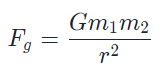 (Image Credit: Public Domain) It’s a simple equation. The gravitational force (F) between two masses (m1 and m2) is calculated by their product divided by the square of the distance between them (r) and multiplied by the gravitational constant (G). This means that the gravitational force changes according to the objects’ masses and is heavily dependent on the distance between the objects, according to the inverse square law. When Newton published this equation, although the basics were already known, it was revered as revolutionary. We still use it today, as it is central to classical dynamics. While Newton’s equation proved mathematically useful out of the gate, it was not until 1798 that it was demonstrated in the laboratory by Henry Cavendish. His now famous, highly-precise experiment consisted of two small balls (h) on the end of a wooden rod suspended by a wire. Two larger balls (W) were placed on opposite ends and on opposite sides. As expected, the two smaller balls were attracted towards the larger balls, causing the rod to rotate. Not only did this experiment prove Newton correct, the results were later used to calculate the gravitational constant (G), the Earth’s mass, and even its density. 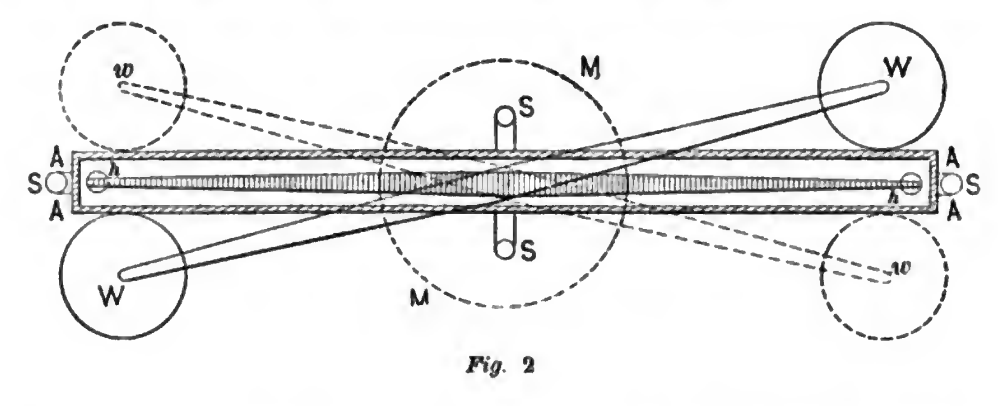 (Credit: Public Domain) However, Newton himself had a problem with his law of universal gravitation. He couldn’t explain the mechanism. He reasoned that some invisible force must be instantaneously acting on the two objects, an idea that violated the understanding of the universe at the time. In a 1692 letter to his friend Bently he wrote, “That one body may act upon another at a distance through a vacuum without the mediation of anything else, by and through which their action and force may be conveyed from one another, is to me so great an absurdity that, I believe, no man who has in philosophic matters a competent faculty of thinking could ever fall into it.” Einstein provided the answer in 1915. His General Relativity demonstrated that gravity is not actually a force acting between two objects but rather a result of curved 4D spacetime. That is, the three spatial dimensions and the time dimension curve according to the presence of matter or radiation. So, when objects are attracted to each other, they are not being pulled towards one another. Instead, they are reacting to how the other warped the fabric of the universe. Had Newton been alive when Einstein published his ideas, he would’ve had the answer he was looking for. But this doesn’t prove Newton wrong. Einstein’s equations show that Newton’s is only a special case. The equations of Relativity only become relevant with massive objects and when speed increases to significant fractions of the speed of light. For slow speeds and small objects, like the ones we deal with in our everyday lives, Newton’s equations work just fine. But when dealing with massive objects-like galaxies, blackholes, or the universe as a whole-or with fast moving particles-like muons or neutrinos-Newton’s equations are no longer sufficient and Einstein’s far more complex equations become more accurate. In fact, if you reduce the values for velocity and mass in Einstein’s equations, they eventually collapse into Newton’s. Today, modern cosmology is based on Newton and Einstein’s understanding of gravity, but some physicists have a problem. When they look at the velocity of stars in spiral galaxies, Newton and Einstein aren’t enough. One possible solution to the riddle is that these galaxies must have a lot of unseen mass, leading to the idea of dark matter. While we don’t know what dark matter is, it solves more problems than just the unexplained velocity of stars, leading many to assume that dark matter permeates the universe, composing some 85% of it’s matter. But there’s a problem with dark matter. Though it seemingly is the solution to numerous cosmological riddles, some studies have failed to show it exists. For example, a team from the University of Bonn and the University of Saint Andrews examined how dwarf galaxies in the Fornax Cluster were perturbed by nearby larger galaxies. If dark matter exists, then the dwarf galaxies would have a halo of it surrounding them, protecting them from the gravitational influence of their larger neighbors. However, the team saw this wasn’t the case, in that the dwarf galaxies were warped and stretched. This result, as well as the results of a few other studies, has thrown the idea of dark matter into question. If we assume dark matter doesn’t exist, then the leading explanation is Modified Newtonian dynamics (MOND). Like the name suggests, MOND tweaks Newton’s law of universal gravitation, most importantly by not calculating the gravitational force by squaring the distance between objects. Instead, MOND assumes the gravitational force changes linearly in regards to (r). Such an idea has already been fruitful. In fact, the scientists looking at dwarf galaxies in the Fornax Cluster also compared their observations with the predictions derived with MOND, and they found that they match nearly exactly. A handful of other studies relied on MOND, and the results have been rather promising, though MOND fails in other areas. The theoretical basis for MOND comes from Entropic gravity. This states that gravity is not one of the fundamental forces of the universe. Rather, it emerges from the quantum entanglement of tiny bits of information encoded in spacetime. While this idea is difficult to wrap our brains around, the math produces some interesting results, most importantly a gravitational acceleration threshold of 1.2×10 −10m/s^2. This means that when gravity becomes extremely weak it doesn’t follow the inverse square law, behaving linearly instead, in accordance with MOND. Therefore, Newton’s law of universal gravitation might not be so universal. If dark matter doesn’t exist, which is still a hotly debated topic in modern physics, then we are going to need to tweak Newton’s equation after standing strong for over 300 years. The leading candidate at the moment is MOND. If this is true, then Newton’s equations might be relegated yet again to a special case. Originally published at http://thehappyneuron.com on August 18, 2022. |
| json metadata | {"tags":["science","physics","space","universe"],"image":["https://cdn.steemitimages.com/DQmTbP4tKKYuN1LwBFhTfE9h3zTUaCekgbC1VQLP9qapZ8B/Universe.jpg","https://cdn.steemitimages.com/DQmZrabhixqjFhSX7jUNRm1qJnZiKowvCWVUmbgsDVjKdbw/Newton's%20Gravity%20Law.png","https://cdn.steemitimages.com/DQmXMqihcirJng3hWcWWpf3rrs99XjEn273AHjoetcteXwp/Cavendish_experiment_schematic.png"],"links":["http://thehappyneuron.com"],"app":"steemit/0.2","format":"markdown"} |
| Transaction Info | Block #67007934/Trx b5e95e074b33d6268bcdc953f98e147fe6980472 |
View Raw JSON Data
{
"trx_id": "b5e95e074b33d6268bcdc953f98e147fe6980472",
"block": 67007934,
"trx_in_block": 4,
"op_in_trx": 0,
"virtual_op": 0,
"timestamp": "2022-08-21T22:17:27",
"op": [
"comment",
{
"parent_author": "",
"parent_permlink": "science",
"author": "chucklesfreely",
"permlink": "was-newton-wrong-about-gravity",
"title": "Was Newton Wrong About Gravity?",
"body": "\n\nAfter standing strong for more than 300 years, Newton’s law of universal gravitation might need an update.\n\nNewton published the law of universal gravitation in his 1687 Naturalis Principia Mathematica, and it quickly became one of the most important stones on which physics is built. It explains just about everything we can see, from the flight of a ball through the air to the movement of planets. However, some modern physicists have a good reason to question it.\n\n\n(Image Credit: Public Domain)\n\nIt’s a simple equation. The gravitational force (F) between two masses (m1 and m2) is calculated by their product divided by the square of the distance between them (r) and multiplied by the gravitational constant (G). This means that the gravitational force changes according to the objects’ masses and is heavily dependent on the distance between the objects, according to the inverse square law. When Newton published this equation, although the basics were already known, it was revered as revolutionary. We still use it today, as it is central to classical dynamics.\n\nWhile Newton’s equation proved mathematically useful out of the gate, it was not until 1798 that it was demonstrated in the laboratory by Henry Cavendish. His now famous, highly-precise experiment consisted of two small balls (h) on the end of a wooden rod suspended by a wire. Two larger balls (W) were placed on opposite ends and on opposite sides. As expected, the two smaller balls were attracted towards the larger balls, causing the rod to rotate. Not only did this experiment prove Newton correct, the results were later used to calculate the gravitational constant (G), the Earth’s mass, and even its density.\n\n\n(Credit: Public Domain)\n\nHowever, Newton himself had a problem with his law of universal gravitation. He couldn’t explain the mechanism. He reasoned that some invisible force must be instantaneously acting on the two objects, an idea that violated the understanding of the universe at the time. In a 1692 letter to his friend Bently he wrote, “That one body may act upon another at a distance through a vacuum without the mediation of anything else, by and through which their action and force may be conveyed from one another, is to me so great an absurdity that, I believe, no man who has in philosophic matters a competent faculty of thinking could ever fall into it.”\n\nEinstein provided the answer in 1915. His General Relativity demonstrated that gravity is not actually a force acting between two objects but rather a result of curved 4D spacetime. That is, the three spatial dimensions and the time dimension curve according to the presence of matter or radiation. So, when objects are attracted to each other, they are not being pulled towards one another. Instead, they are reacting to how the other warped the fabric of the universe. Had Newton been alive when Einstein published his ideas, he would’ve had the answer he was looking for.\n\nBut this doesn’t prove Newton wrong. Einstein’s equations show that Newton’s is only a special case. The equations of Relativity only become relevant with massive objects and when speed increases to significant fractions of the speed of light. For slow speeds and small objects, like the ones we deal with in our everyday lives, Newton’s equations work just fine. But when dealing with massive objects-like galaxies, blackholes, or the universe as a whole-or with fast moving particles-like muons or neutrinos-Newton’s equations are no longer sufficient and Einstein’s far more complex equations become more accurate. In fact, if you reduce the values for velocity and mass in Einstein’s equations, they eventually collapse into Newton’s.\n\nToday, modern cosmology is based on Newton and Einstein’s understanding of gravity, but some physicists have a problem. When they look at the velocity of stars in spiral galaxies, Newton and Einstein aren’t enough. One possible solution to the riddle is that these galaxies must have a lot of unseen mass, leading to the idea of dark matter. While we don’t know what dark matter is, it solves more problems than just the unexplained velocity of stars, leading many to assume that dark matter permeates the universe, composing some 85% of it’s matter.\n\nBut there’s a problem with dark matter. Though it seemingly is the solution to numerous cosmological riddles, some studies have failed to show it exists. For example, a team from the University of Bonn and the University of Saint Andrews examined how dwarf galaxies in the Fornax Cluster were perturbed by nearby larger galaxies. If dark matter exists, then the dwarf galaxies would have a halo of it surrounding them, protecting them from the gravitational influence of their larger neighbors. However, the team saw this wasn’t the case, in that the dwarf galaxies were warped and stretched. This result, as well as the results of a few other studies, has thrown the idea of dark matter into question.\n\nIf we assume dark matter doesn’t exist, then the leading explanation is Modified Newtonian dynamics (MOND). Like the name suggests, MOND tweaks Newton’s law of universal gravitation, most importantly by not calculating the gravitational force by squaring the distance between objects. Instead, MOND assumes the gravitational force changes linearly in regards to (r). Such an idea has already been fruitful. In fact, the scientists looking at dwarf galaxies in the Fornax Cluster also compared their observations with the predictions derived with MOND, and they found that they match nearly exactly. A handful of other studies relied on MOND, and the results have been rather promising, though MOND fails in other areas.\n\nThe theoretical basis for MOND comes from Entropic gravity. This states that gravity is not one of the fundamental forces of the universe. Rather, it emerges from the quantum entanglement of tiny bits of information encoded in spacetime. While this idea is difficult to wrap our brains around, the math produces some interesting results, most importantly a gravitational acceleration threshold of 1.2×10 −10m/s^2. This means that when gravity becomes extremely weak it doesn’t follow the inverse square law, behaving linearly instead, in accordance with MOND.\n\nTherefore, Newton’s law of universal gravitation might not be so universal. If dark matter doesn’t exist, which is still a hotly debated topic in modern physics, then we are going to need to tweak Newton’s equation after standing strong for over 300 years. The leading candidate at the moment is MOND. If this is true, then Newton’s equations might be relegated yet again to a special case.\n\nOriginally published at http://thehappyneuron.com on August 18, 2022.",
"json_metadata": "{\"tags\":[\"science\",\"physics\",\"space\",\"universe\"],\"image\":[\"https://cdn.steemitimages.com/DQmTbP4tKKYuN1LwBFhTfE9h3zTUaCekgbC1VQLP9qapZ8B/Universe.jpg\",\"https://cdn.steemitimages.com/DQmZrabhixqjFhSX7jUNRm1qJnZiKowvCWVUmbgsDVjKdbw/Newton's%20Gravity%20Law.png\",\"https://cdn.steemitimages.com/DQmXMqihcirJng3hWcWWpf3rrs99XjEn273AHjoetcteXwp/Cavendish_experiment_schematic.png\"],\"links\":[\"http://thehappyneuron.com\"],\"app\":\"steemit/0.2\",\"format\":\"markdown\"}"
}
]
}chucklesfreelyupvoted (100.00%) @chucklesfreely / insects-might-be-the-key-to-detecting-cancer2022/08/21 22:06:51
chucklesfreelyupvoted (100.00%) @chucklesfreely / insects-might-be-the-key-to-detecting-cancer
2022/08/21 22:06:51
| voter | chucklesfreely |
| author | chucklesfreely |
| permlink | insects-might-be-the-key-to-detecting-cancer |
| weight | 10000 (100.00%) |
| Transaction Info | Block #67007722/Trx 4e23e84fe866b4b1b8946f758c3ef9fcf203cb02 |
View Raw JSON Data
{
  "trx_id": "4e23e84fe866b4b1b8946f758c3ef9fcf203cb02",
  "block": 67007722,
  "trx_in_block": 6,
  "op_in_trx": 0,
  "virtual_op": 0,
  "timestamp": "2022-08-21T22:06:51",
  "op": [
    "vote",
    {
      "voter": "chucklesfreely",
      "author": "chucklesfreely",
      "permlink": "insects-might-be-the-key-to-detecting-cancer",
      "weight": 10000
    }
  ]
}chucklesfreelypublished a new post: insects-might-be-the-key-to-detecting-cancer2022/08/21 22:06:36
chucklesfreelypublished a new post: insects-might-be-the-key-to-detecting-cancer
2022/08/21 22:06:36
| parent author | |
| parent permlink | medicine |
| author | chucklesfreely |
| permlink | insects-might-be-the-key-to-detecting-cancer |
| title | Insects Might Be the Key to Detecting Cancer |
| body | 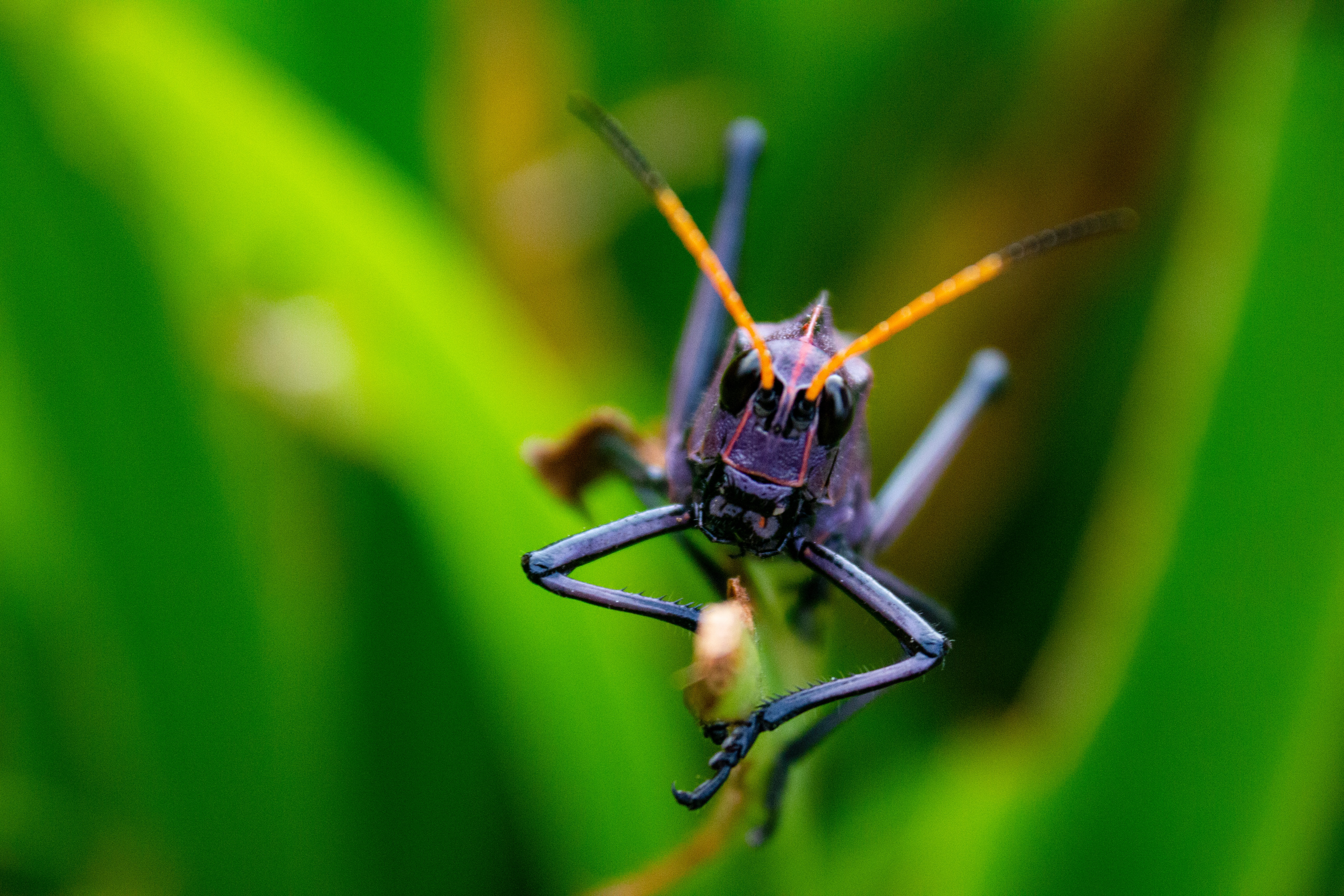 (Photo by Robin Canfield on Unsplash) Some insects can “smell” cancerous cells, possibly leading to new devices for early detection. Nothing beats a natural nose. Since the early 1980s, researchers have been trying to develop electronic noses, devices that can detect unique airborne chemical signatures, yet anything on the market or even in the lab can’t compete with evolution. Anything produced by humans just can’t match the complexity produced by billions of years of natural selection. So, researchers from Michigan State University have turned to insect noses in their attempt to create a device to detect cancer earlier than ever before. In a new study published in the journal bioRxiv, the researchers successfully used the brains and antennae of locusts to detect cancer. It’s thought that cancerous cells change the host’s metabolic process, which alters the volatile organic compounds (VOCs) in the breath, and locusts’ neurophysiology seems particularly sensitive to these changes. By connecting the locusts’ brains and antennae to an electrophysiology platform and using the computational rules to translate between neurons and circuitry, they saw that locusts responded differently to the VOCs from cancerous cells. In fact, the locusts were so sensitive that they could also tell the difference between types of cancer. The researchers claimed their “results demonstrate that three different human oral cancers can be robustly distinguished from each other and from a non-cancer oral cell line by analyzing individual cell culture VOC composition-evoked olfactory neural responses in the insect antennal lobe.” Though the team only focused on 3 types of mouth cancers, they are confident the same process could easily be expanded to most other forms of cancer, detected perhaps with other insects. In fact, the team has already had some success with honeybees detecting lung cancer. They believe their method is far superior to similar ideas, as it uses the natural olfactory components, rather than trying to artificially recreate them. The end goal is to create easy to use, cheap, portable, and fast devices to radically upgrade cancer detection. By incorporating the locusts’ actual biological parts into the device, the average person would be able to take advantage of their highly-evolved ability to distinguish healthy exhalations from those with altered VOCs. They believe such devices would have a response time of 250 milliseconds and could work in virtually any environment, upgrading our early detection abilities and saving millions of lives. Early detection is the key. More than 10 million people die of cancer each year globally, 600,000 in the US alone, making it the second leading cause of death behind heart disease. The most deadly forms are lung, colorectal, pancreatic, breast, prostate, and liver cancers. Fortunately, most forms are in decline due to healthier lifestyle choices and, most importantly, early detection, though pancreatic and liver cancers are on the rise. A report from Cancer.org claims that “Large reductions in smoking and earlier cancer detection have contributed to steady declines in cancer mortality since the early 1990s, averting an estimated 3.2 million cancer deaths.” Because of this, many scientists have been racing to not only educate the public about avoiding smoking, obesity, physical inactivity, and other other high risk factors but to also develop better early detection methods. Today’s common methods like radiology, endoscopies, and biopsies can be invasive, expensive, inaccurate, or unable to detect cancer early enough, leaving millions with undiagnosed cancers. The team from Michigan State University might be on the cusp of changing all that, though they caution the actual devices could still be years away. Originally published at http://thehappyneuron.com on August 19, 2022. |
| json metadata | {"tags":["medicine","cancer","science"],"image":["https://cdn.steemitimages.com/DQmRPThZ7kEsQmawkqWafvLaB2ivikTUKLSdJPLdfoaJ2JZ/Locust.jpg"],"links":["http://thehappyneuron.com"],"app":"steemit/0.2","format":"markdown"} |
| Transaction Info | Block #67007717/Trx c7426ef3e600122236741cc33708753cd913e99d |
View Raw JSON Data
{
"trx_id": "c7426ef3e600122236741cc33708753cd913e99d",
"block": 67007717,
"trx_in_block": 1,
"op_in_trx": 0,
"virtual_op": 0,
"timestamp": "2022-08-21T22:06:36",
"op": [
"comment",
{
"parent_author": "",
"parent_permlink": "medicine",
"author": "chucklesfreely",
"permlink": "insects-might-be-the-key-to-detecting-cancer",
"title": "Insects Might Be the Key to Detecting Cancer",
"body": "\n(Photo by Robin Canfield on Unsplash)\n\nSome insects can “smell” cancerous cells, possibly leading to new devices for early detection.\n\nNothing beats a natural nose. Since the early 1980s, researchers have been trying to develop electronic noses, devices that can detect unique airborne chemical signatures, yet anything on the market or even in the lab can’t compete with evolution. Anything produced by humans just can’t match the complexity produced by billions of years of natural selection. So, researchers from Michigan State University have turned to insect noses in their attempt to create a device to detect cancer earlier than ever before.\n\nIn a new study published in the journal bioRxiv, the researchers successfully used the brains and antennae of locusts to detect cancer. It’s thought that cancerous cells change the host’s metabolic process, which alters the volatile organic compounds (VOCs) in the breath, and locusts’ neurophysiology seems particularly sensitive to these changes. By connecting the locusts’ brains and antennae to an electrophysiology platform and using the computational rules to translate between neurons and circuitry, they saw that locusts responded differently to the VOCs from cancerous cells. In fact, the locusts were so sensitive that they could also tell the difference between types of cancer.\n\nThe researchers claimed their “results demonstrate that three different human oral cancers can be robustly distinguished from each other and from a non-cancer oral cell line by analyzing individual cell culture VOC composition-evoked olfactory neural responses in the insect antennal lobe.”\n\nThough the team only focused on 3 types of mouth cancers, they are confident the same process could easily be expanded to most other forms of cancer, detected perhaps with other insects. In fact, the team has already had some success with honeybees detecting lung cancer. They believe their method is far superior to similar ideas, as it uses the natural olfactory components, rather than trying to artificially recreate them.\n\nThe end goal is to create easy to use, cheap, portable, and fast devices to radically upgrade cancer detection. By incorporating the locusts’ actual biological parts into the device, the average person would be able to take advantage of their highly-evolved ability to distinguish healthy exhalations from those with altered VOCs. They believe such devices would have a response time of 250 milliseconds and could work in virtually any environment, upgrading our early detection abilities and saving millions of lives.\n\nEarly detection is the key. More than 10 million people die of cancer each year globally, 600,000 in the US alone, making it the second leading cause of death behind heart disease. The most deadly forms are lung, colorectal, pancreatic, breast, prostate, and liver cancers. Fortunately, most forms are in decline due to healthier lifestyle choices and, most importantly, early detection, though pancreatic and liver cancers are on the rise. A report from Cancer.org claims that “Large reductions in smoking and earlier cancer detection have contributed to steady declines in cancer mortality since the early 1990s, averting an estimated 3.2 million cancer deaths.”\n\nBecause of this, many scientists have been racing to not only educate the public about avoiding smoking, obesity, physical inactivity, and other other high risk factors but to also develop better early detection methods. Today’s common methods like radiology, endoscopies, and biopsies can be invasive, expensive, inaccurate, or unable to detect cancer early enough, leaving millions with undiagnosed cancers. The team from Michigan State University might be on the cusp of changing all that, though they caution the actual devices could still be years away.\n\nOriginally published at http://thehappyneuron.com on August 19, 2022.",
"json_metadata": "{\"tags\":[\"medicine\",\"cancer\",\"science\"],\"image\":[\"https://cdn.steemitimages.com/DQmRPThZ7kEsQmawkqWafvLaB2ivikTUKLSdJPLdfoaJ2JZ/Locust.jpg\"],\"links\":[\"http://thehappyneuron.com\"],\"app\":\"steemit/0.2\",\"format\":\"markdown\"}"
}
]
}chucklesfreelyupvoted (100.00%) @chucklesfreely / negative-leap-second-could-break-the-internet2022/08/21 22:02:09
chucklesfreelyupvoted (100.00%) @chucklesfreely / negative-leap-second-could-break-the-internet
2022/08/21 22:02:09
| voter | chucklesfreely |
| author | chucklesfreely |
| permlink | negative-leap-second-could-break-the-internet |
| weight | 10000 (100.00%) |
| Transaction Info | Block #67007629/Trx 5db41c4e4624f76c5d953a56232e2d4d696503ea |
View Raw JSON Data
{
  "trx_id": "5db41c4e4624f76c5d953a56232e2d4d696503ea",
  "block": 67007629,
  "trx_in_block": 1,
  "op_in_trx": 0,
  "virtual_op": 0,
  "timestamp": "2022-08-21T22:02:09",
  "op": [
    "vote",
    {
      "voter": "chucklesfreely",
      "author": "chucklesfreely",
      "permlink": "negative-leap-second-could-break-the-internet",
      "weight": 10000
    }
  ]
}beemenginesent 0.001 STEEM to @chucklesfreely- "🚀 Auto Voting Your New Posts 24/24. 🌐 1600+ Community ⚡️ 25+ Curator💰 Passive Earnings 💠 Support. Checkout beemengine.com to subscribe, or get a one month subscription for a reply of 1 HIVE/STEEM ..."2022/08/21 22:01:42
beemenginesent 0.001 STEEM to @chucklesfreely- "🚀 Auto Voting Your New Posts 24/24. 🌐 1600+ Community ⚡️ 25+ Curator💰 Passive Earnings 💠 Support. Checkout beemengine.com to subscribe, or get a one month subscription for a reply of 1 HIVE/STEEM ..."
2022/08/21 22:01:42
| from | beemengine |
| to | chucklesfreely |
| amount | 0.001 STEEM |
| memo | 🚀 Auto Voting Your New Posts 24/24. 🌐 1600+ Community ⚡️ 25+ Curator💰 Passive Earnings 💠 Support. Checkout beemengine.com to subscribe, or get a one month subscription for a reply of 1 HIVE/STEEM with memo: subscribe |
| Transaction Info | Block #67007620/Trx 1fa4b0cee4d13f54de032699ec93c42ae450c048 |
View Raw JSON Data
{
  "trx_id": "1fa4b0cee4d13f54de032699ec93c42ae450c048",
  "block": 67007620,
  "trx_in_block": 5,
  "op_in_trx": 0,
  "virtual_op": 0,
  "timestamp": "2022-08-21T22:01:42",
  "op": [
    "transfer",
    {
      "from": "beemengine",
      "to": "chucklesfreely",
      "amount": "0.001 STEEM",
      "memo": "🚀 Auto Voting Your New Posts 24/24. 🌐 1600+ Community ⚡️ 25+ Curator💰 Passive Earnings 💠 Support. Checkout beemengine.com to subscribe, or get a one month subscription for a reply of 1 HIVE/STEEM with memo: subscribe"
    }
  ]
}chucklesfreelypublished a new post: negative-leap-second-could-break-the-internet2022/08/21 22:00:51
chucklesfreelypublished a new post: negative-leap-second-could-break-the-internet
2022/08/21 22:00:51
| parent author | |
| parent permlink | internet |
| author | chucklesfreely |
| permlink | negative-leap-second-could-break-the-internet |
| title | Negative Leap Second Could Break the Internet |
| body |  (Photo by Eugene Chystiakov on Unsplash) Because days are inexplicably becoming longer, we might need the unprecedented negative leap second, but it could break the internet. Keeping our calendars in sync with the Earth has always been problematic. Any system we create, inevitably needs to be periodically adjusted to lineup with reality. The old Julian calendar needed an extra month added when Roman priests thought necessary. The Gregorian calendar, which is used today by most of the world, needs a day added every four years, though 3 of these leap days are omitted every 400 year leap cycle. The Islamic calendar depends on the lunar cycle and is tweaked as needed. Virtually all cultures have devised systems to ensure their calendars line up with the seasons, more specifically the equinoxes. But as technology advanced and precision became more important, we realized we needed a leap second too. The day is almost never exactly 86,400 seconds. Due to tidal friction with the Moon’s gravitational pull, geological events that shift the Earth’s mass distribution like melting ice caps or earthquakes, and the planet’s natural cycles like Milankovitch cycles or precession, days are rarely the same length. Because of this, the International Earth Rotation and Reference Systems Service decides to add a second to the Coordinated Universal Time (UTC) clock as needed. Since the leap second was proposed in 1972, only 27 have been added. However, leap seconds are problematic for computers. When one is added, their timestamps must be tweaked from 23:59:59 –> 00:00:00 to 23:59:59 –> 23:59:60 –> 00:00:00, and not all systems can handle this. The creator of Linux said, “Almost every time we have a leap second, we find something. It’s really annoying, because it’s a classic case of code that is basically never run, and thus not tested by users under their normal conditions.” Engineers at Meta, the company that owns Facebook and Instagram, claimed that leap seconds can actually cause a negative time event, which could easily crash programs and servers. They also explained that each time a leap second is added it’s been “devastating for the community.” For example, when a leap second was added in 2012, Reddit’s servers crashed for at least 30 minutes because the Linux subsystem called “hrtimer” got confused. Other companies like Gawker and Mozilla were also affected, and in 2009, Sun Microsystems and Oracle had serious problems. To mitigate potential problems, many companies now use a “leap smear,” which is basically adding the new leap second over many hours, instead of all at once. By slowing down their systems’ internal clocks, they can adjust to the new time slowly, without creating any awkward timestamps or negative time events. However, this doesn’t always work or may not be possible with some systems, and some industry leaders fear the next possible leap second on June 30, 2023 might do more harm than good, leading to a growing chorus to do away with the leap second all together. To make the situation worse, for the first time, some experts have suggested adding a negative leap second to compensate for days mysteriously becoming longer. When we filter out all the known phenomena that affect the length of a day, we’re left with no clear explanation for why the average day has been increasing since 2020. Some ideas are that it’s caused by melting icecaps, La Nina events, volcanic activity, or a 430 day cycle called the Chandler Wobble. Regardless of the cause, our clocks might soon be off enough to warrant a negative leap second, forcing tech companies to slow their internal clocks. According to Google, “A negative leap second, if one were ever to occur, would be smeared by speeding up clocks over the 86,399 SI seconds from noon to noon.” While subtracting only one second might not seem like a big problem, some high profile people have spoken out against it, saying it could screwup the internet. Meta said that “The impact of a negative leap second has never been tested on a large scale; it could have a devastating effect on the software relying on timers or schedulers.” If positive leap seconds are already problematic after having happening numerous times, being announced 6 months in advance, and having major tech companies do their best to anticipate and mitigate errors, then a negative leap second is sure to cause even more problems, as it’s never happened before. There’s no way to anticipate the effects, with some comparing it to the T2K bug that threatened to shut down modern society when the clocks rolled over at the turn of the century, although very little actually happened. Nobody knows when or if the first negative leap second will be implemented. It’s possible the movement to stop leap seconds, both positive and negative, might succeed, in favor of leap minutes or even leap hours, as these would happen much less often. Or maybe it will be implemented in the next year or two and be uneventful. But if the history of leap seconds has taught us anything, it could break the internet. Originally published at http://thehappyneuron.com on August 20, 2022. |
| json metadata | {"tags":["internet"],"image":["https://cdn.steemitimages.com/DQmajiDKP7iEHFTdkh9iJwTsB7ciqDicrjzwxCUmrUd8A9i/Negative%20Leap.jpg"],"links":["http://thehappyneuron.com"],"app":"steemit/0.2","format":"markdown"} |
| Transaction Info | Block #67007603/Trx 095deb65b82c5a2968eb784ff7a9d8b5a247d59e |
View Raw JSON Data
{
"trx_id": "095deb65b82c5a2968eb784ff7a9d8b5a247d59e",
"block": 67007603,
"trx_in_block": 3,
"op_in_trx": 0,
"virtual_op": 0,
"timestamp": "2022-08-21T22:00:51",
"op": [
"comment",
{
"parent_author": "",
"parent_permlink": "internet",
"author": "chucklesfreely",
"permlink": "negative-leap-second-could-break-the-internet",
"title": "Negative Leap Second Could Break the Internet",
"body": "\n(Photo by Eugene Chystiakov on Unsplash)\n\nBecause days are inexplicably becoming longer, we might need the unprecedented negative leap second, but it could break the internet.\n\nKeeping our calendars in sync with the Earth has always been problematic. Any system we create, inevitably needs to be periodically adjusted to lineup with reality. The old Julian calendar needed an extra month added when Roman priests thought necessary. The Gregorian calendar, which is used today by most of the world, needs a day added every four years, though 3 of these leap days are omitted every 400 year leap cycle. The Islamic calendar depends on the lunar cycle and is tweaked as needed. Virtually all cultures have devised systems to ensure their calendars line up with the seasons, more specifically the equinoxes.\n\nBut as technology advanced and precision became more important, we realized we needed a leap second too. The day is almost never exactly 86,400 seconds. Due to tidal friction with the Moon’s gravitational pull, geological events that shift the Earth’s mass distribution like melting ice caps or earthquakes, and the planet’s natural cycles like Milankovitch cycles or precession, days are rarely the same length. Because of this, the International Earth Rotation and Reference Systems Service decides to add a second to the Coordinated Universal Time (UTC) clock as needed. Since the leap second was proposed in 1972, only 27 have been added.\n\nHowever, leap seconds are problematic for computers. When one is added, their timestamps must be tweaked from 23:59:59 –> 00:00:00 to 23:59:59 –> 23:59:60 –> 00:00:00, and not all systems can handle this. The creator of Linux said, “Almost every time we have a leap second, we find something. It’s really annoying, because it’s a classic case of code that is basically never run, and thus not tested by users under their normal conditions.” Engineers at Meta, the company that owns Facebook and Instagram, claimed that leap seconds can actually cause a negative time event, which could easily crash programs and servers. They also explained that each time a leap second is added it’s been “devastating for the community.” For example, when a leap second was added in 2012, Reddit’s servers crashed for at least 30 minutes because the Linux subsystem called “hrtimer” got confused. Other companies like Gawker and Mozilla were also affected, and in 2009, Sun Microsystems and Oracle had serious problems.\n\nTo mitigate potential problems, many companies now use a “leap smear,” which is basically adding the new leap second over many hours, instead of all at once. By slowing down their systems’ internal clocks, they can adjust to the new time slowly, without creating any awkward timestamps or negative time events. However, this doesn’t always work or may not be possible with some systems, and some industry leaders fear the next possible leap second on June 30, 2023 might do more harm than good, leading to a growing chorus to do away with the leap second all together.\n\nTo make the situation worse, for the first time, some experts have suggested adding a negative leap second to compensate for days mysteriously becoming longer. When we filter out all the known phenomena that affect the length of a day, we’re left with no clear explanation for why the average day has been increasing since 2020. Some ideas are that it’s caused by melting icecaps, La Nina events, volcanic activity, or a 430 day cycle called the Chandler Wobble. Regardless of the cause, our clocks might soon be off enough to warrant a negative leap second, forcing tech companies to slow their internal clocks. According to Google, “A negative leap second, if one were ever to occur, would be smeared by speeding up clocks over the 86,399 SI seconds from noon to noon.”\n\nWhile subtracting only one second might not seem like a big problem, some high profile people have spoken out against it, saying it could screwup the internet. Meta said that “The impact of a negative leap second has never been tested on a large scale; it could have a devastating effect on the software relying on timers or schedulers.” If positive leap seconds are already problematic after having happening numerous times, being announced 6 months in advance, and having major tech companies do their best to anticipate and mitigate errors, then a negative leap second is sure to cause even more problems, as it’s never happened before. There’s no way to anticipate the effects, with some comparing it to the T2K bug that threatened to shut down modern society when the clocks rolled over at the turn of the century, although very little actually happened.\n\nNobody knows when or if the first negative leap second will be implemented. It’s possible the movement to stop leap seconds, both positive and negative, might succeed, in favor of leap minutes or even leap hours, as these would happen much less often. Or maybe it will be implemented in the next year or two and be uneventful. But if the history of leap seconds has taught us anything, it could break the internet.\n\nOriginally published at http://thehappyneuron.com on August 20, 2022.",
"json_metadata": "{\"tags\":[\"internet\"],\"image\":[\"https://cdn.steemitimages.com/DQmajiDKP7iEHFTdkh9iJwTsB7ciqDicrjzwxCUmrUd8A9i/Negative%20Leap.jpg\"],\"links\":[\"http://thehappyneuron.com\"],\"app\":\"steemit/0.2\",\"format\":\"markdown\"}"
}
]
}steemdelegated 5.591 SP to @chucklesfreely2022/05/02 15:52:45
steemdelegated 5.591 SP to @chucklesfreely
2022/05/02 15:52:45
| delegator | steem |
| delegatee | chucklesfreely |
| vesting shares | 9104.058265 VESTS |
| Transaction Info | Block #63821253/Trx 42550e1745ad6f2060269d5d41a5fdae1ff136ef |
View Raw JSON Data
{
  "trx_id": "42550e1745ad6f2060269d5d41a5fdae1ff136ef",
  "block": 63821253,
  "trx_in_block": 0,
  "op_in_trx": 0,
  "virtual_op": 0,
  "timestamp": "2022-05-02T15:52:45",
  "op": [
    "delegate_vesting_shares",
    {
      "delegator": "steem",
      "delegatee": "chucklesfreely",
      "vesting_shares": "9104.058265 VESTS"
    }
  ]
}steemdelegated 16.794 SP to @chucklesfreely2022/04/16 20:24:39
steemdelegated 16.794 SP to @chucklesfreely
2022/04/16 20:24:39
| delegator | steem |
| delegatee | chucklesfreely |
| vesting shares | 27347.343241 VESTS |
| Transaction Info | Block #63368958/Trx 709306d1eb9a8212f5825548f163e8ef78866cd3 |
View Raw JSON Data
{
  "trx_id": "709306d1eb9a8212f5825548f163e8ef78866cd3",
  "block": 63368958,
  "trx_in_block": 1,
  "op_in_trx": 0,
  "virtual_op": 0,
  "timestamp": "2022-04-16T20:24:39",
  "op": [
    "delegate_vesting_shares",
    {
      "delegator": "steem",
      "delegatee": "chucklesfreely",
      "vesting_shares": "27347.343241 VESTS"
    }
  ]
}chucklesfreelyreceived 0.005 SBD, 0.020 SP author reward for @chucklesfreely / trump-supporters-have-less-interpersonal-warmth-and-more-cognitive-rigidity2022/02/04 16:28:18
chucklesfreelyreceived 0.005 SBD, 0.020 SP author reward for @chucklesfreely / trump-supporters-have-less-interpersonal-warmth-and-more-cognitive-rigidity
2022/02/04 16:28:18
| author | chucklesfreely |
| permlink | trump-supporters-have-less-interpersonal-warmth-and-more-cognitive-rigidity |
| sbd payout | 0.005 SBD |
| steem payout | 0.000 STEEM |
| vesting payout | 33.020564 VESTS |
| Transaction Info | Block #61331666/Virtual Operation #3 |
View Raw JSON Data
{
  "trx_id": "0000000000000000000000000000000000000000",
  "block": 61331666,
  "trx_in_block": 4294967295,
  "op_in_trx": 0,
  "virtual_op": 3,
  "timestamp": "2022-02-04T16:28:18",
  "op": [
    "author_reward",
    {
      "author": "chucklesfreely",
      "permlink": "trump-supporters-have-less-interpersonal-warmth-and-more-cognitive-rigidity",
      "sbd_payout": "0.005 SBD",
      "steem_payout": "0.000 STEEM",
      "vesting_payout": "33.020564 VESTS"
    }
  ]
}frijochieflagged (-100.00%) @chucklesfreely / solar-energy-has-an-aluminum-problem2022/02/01 21:34:39
frijochieflagged (-100.00%) @chucklesfreely / solar-energy-has-an-aluminum-problem
2022/02/01 21:34:39
| voter | frijochie |
| author | chucklesfreely |
| permlink | solar-energy-has-an-aluminum-problem |
| weight | -10000 (-100.00%) |
| Transaction Info | Block #61251812/Trx 25e091e4af954bb9090523e89bc4b79be6b3b3f6 |
View Raw JSON Data
{
  "trx_id": "25e091e4af954bb9090523e89bc4b79be6b3b3f6",
  "block": 61251812,
  "trx_in_block": 1,
  "op_in_trx": 0,
  "virtual_op": 0,
  "timestamp": "2022-02-01T21:34:39",
  "op": [
    "vote",
    {
      "voter": "frijochie",
      "author": "chucklesfreely",
      "permlink": "solar-energy-has-an-aluminum-problem",
      "weight": -10000
    }
  ]
}2022/02/01 21:34:27
2022/02/01 21:34:27
| voter | frijochie |
| author | chucklesfreely |
| permlink | the-dark-forest-hypothesis-the-terrifying-reason-why-we-should-stop-broadcasting-earth-s-location |
| weight | -10000 (-100.00%) |
| Transaction Info | Block #61251808/Trx 38f8504668709f5af8394e09aeae25cd3871beda |
View Raw JSON Data
{
  "trx_id": "38f8504668709f5af8394e09aeae25cd3871beda",
  "block": 61251808,
  "trx_in_block": 0,
  "op_in_trx": 0,
  "virtual_op": 0,
  "timestamp": "2022-02-01T21:34:27",
  "op": [
    "vote",
    {
      "voter": "frijochie",
      "author": "chucklesfreely",
      "permlink": "the-dark-forest-hypothesis-the-terrifying-reason-why-we-should-stop-broadcasting-earth-s-location",
      "weight": -10000
    }
  ]
}frijochieflagged (-100.00%) @chucklesfreely / shiba-inu-is-finally-dying2022/02/01 21:34:15
frijochieflagged (-100.00%) @chucklesfreely / shiba-inu-is-finally-dying
2022/02/01 21:34:15
| voter | frijochie |
| author | chucklesfreely |
| permlink | shiba-inu-is-finally-dying |
| weight | -10000 (-100.00%) |
| Transaction Info | Block #61251804/Trx 51bfae069cab76afc498a60556fff012e6434e31 |
View Raw JSON Data
{
  "trx_id": "51bfae069cab76afc498a60556fff012e6434e31",
  "block": 61251804,
  "trx_in_block": 11,
  "op_in_trx": 0,
  "virtual_op": 0,
  "timestamp": "2022-02-01T21:34:15",
  "op": [
    "vote",
    {
      "voter": "frijochie",
      "author": "chucklesfreely",
      "permlink": "shiba-inu-is-finally-dying",
      "weight": -10000
    }
  ]
}frijochieflagged (-100.00%) @chucklesfreely / elon-musk-and-the-coin-hitler-inu2022/02/01 21:34:06
frijochieflagged (-100.00%) @chucklesfreely / elon-musk-and-the-coin-hitler-inu
2022/02/01 21:34:06
| voter | frijochie |
| author | chucklesfreely |
| permlink | elon-musk-and-the-coin-hitler-inu |
| weight | -10000 (-100.00%) |
| Transaction Info | Block #61251801/Trx f25fe1780a26b4d2596432b1bfb480e4912bdcfc |
View Raw JSON Data
{
  "trx_id": "f25fe1780a26b4d2596432b1bfb480e4912bdcfc",
  "block": 61251801,
  "trx_in_block": 6,
  "op_in_trx": 0,
  "virtual_op": 0,
  "timestamp": "2022-02-01T21:34:06",
  "op": [
    "vote",
    {
      "voter": "frijochie",
      "author": "chucklesfreely",
      "permlink": "elon-musk-and-the-coin-hitler-inu",
      "weight": -10000
    }
  ]
}chucklesfreelypublished a new post: elon-musk-and-the-coin-hitler-inu2022/01/31 13:39:09
chucklesfreelypublished a new post: elon-musk-and-the-coin-hitler-inu
2022/01/31 13:39:09
| parent author | |
| parent permlink | crypto |
| author | chucklesfreely |
| permlink | elon-musk-and-the-coin-hitler-inu |
| title | Elon Musk and the coin Hitler Inu |
| body | Elon Musk pushed back against critics with a meme saying "Everyone that disagrees with me is Hitler. I child's guide to online political discussion." And it depicts Hitler in pajamas riding a sled down a rainbow. https://twitter.com/elonmusk/status/1487861173626101760?cxt=HHwWgICjkdf2-KUpAAAA Naturally, the crypto-verse responded by creating a new coin: Hitler Inu. It's now up more than 5000%.  |
| json metadata | {"tags":["crypto","elonmusk","cryptocurrency","blockchain"],"image":["https://cdn.steemitimages.com/DQmYqqQSrVxEv3PbRpuCd2wewZtF2Vgx86YtfxR3MUHKG7G/image.png"],"links":["https://twitter.com/elonmusk/status/1487861173626101760?cxt=HHwWgICjkdf2-KUpAAAA"],"app":"steemit/0.2","format":"markdown"} |
| Transaction Info | Block #61213697/Trx ddcb217351077767b952f8c0b1b3ef9415a0ad99 |
View Raw JSON Data
{
"trx_id": "ddcb217351077767b952f8c0b1b3ef9415a0ad99",
"block": 61213697,
"trx_in_block": 5,
"op_in_trx": 0,
"virtual_op": 0,
"timestamp": "2022-01-31T13:39:09",
"op": [
"comment",
{
"parent_author": "",
"parent_permlink": "crypto",
"author": "chucklesfreely",
"permlink": "elon-musk-and-the-coin-hitler-inu",
"title": "Elon Musk and the coin Hitler Inu",
"body": "Elon Musk pushed back against critics with a meme saying \"Everyone that disagrees with me is Hitler. I child's guide to online political discussion.\" And it depicts Hitler in pajamas riding a sled down a rainbow. \n\nhttps://twitter.com/elonmusk/status/1487861173626101760?cxt=HHwWgICjkdf2-KUpAAAA\n\nNaturally, the crypto-verse responded by creating a new coin: Hitler Inu. It's now up more than 5000%.\n\n",
"json_metadata": "{\"tags\":[\"crypto\",\"elonmusk\",\"cryptocurrency\",\"blockchain\"],\"image\":[\"https://cdn.steemitimages.com/DQmYqqQSrVxEv3PbRpuCd2wewZtF2Vgx86YtfxR3MUHKG7G/image.png\"],\"links\":[\"https://twitter.com/elonmusk/status/1487861173626101760?cxt=HHwWgICjkdf2-KUpAAAA\"],\"app\":\"steemit/0.2\",\"format\":\"markdown\"}"
}
]
}chucklesfreelypublished a new post: shiba-inu-is-finally-dying2022/01/31 13:33:12
chucklesfreelypublished a new post: shiba-inu-is-finally-dying
2022/01/31 13:33:12
| parent author | |
| parent permlink | crypto |
| author | chucklesfreely |
| permlink | shiba-inu-is-finally-dying |
| title | Shiba Inu is finally dying. |
| body | At the end of last year, the cryptocurrency Shiba Inu was all the rage, even topping the searches on coinmarketcap.com. But according to Google Trends, interest in it is drying up. In my opinion, rightfully so. It's a horrible coin and an embarrassment to the crypto-verse.  |
| json metadata | {"tags":["crypto","shibainu","blockchain","cryptocurrency"],"image":["https://cdn.steemitimages.com/DQmaJyaVawQARfxWkLYYR9T1FbC8VxipngEhguqXkuAN2To/image.png"],"app":"steemit/0.2","format":"markdown"} |
| Transaction Info | Block #61213578/Trx 98315f18fe60c203d8e4ced1c5bbb4e51153108f |
View Raw JSON Data
{
"trx_id": "98315f18fe60c203d8e4ced1c5bbb4e51153108f",
"block": 61213578,
"trx_in_block": 0,
"op_in_trx": 0,
"virtual_op": 0,
"timestamp": "2022-01-31T13:33:12",
"op": [
"comment",
{
"parent_author": "",
"parent_permlink": "crypto",
"author": "chucklesfreely",
"permlink": "shiba-inu-is-finally-dying",
"title": "Shiba Inu is finally dying.",
"body": "At the end of last year, the cryptocurrency Shiba Inu was all the rage, even topping the searches on coinmarketcap.com. But according to Google Trends, interest in it is drying up. In my opinion, rightfully so. It's a horrible coin and an embarrassment to the crypto-verse. \n\n",
"json_metadata": "{\"tags\":[\"crypto\",\"shibainu\",\"blockchain\",\"cryptocurrency\"],\"image\":[\"https://cdn.steemitimages.com/DQmaJyaVawQARfxWkLYYR9T1FbC8VxipngEhguqXkuAN2To/image.png\"],\"app\":\"steemit/0.2\",\"format\":\"markdown\"}"
}
]
}2022/01/31 13:19:00
2022/01/31 13:19:00
| voter | chucklesfreely |
| author | chucklesfreely |
| permlink | 3-reasons-why-bitcoin-is-actually-good-for-renewable-energy |
| weight | 10000 (100.00%) |
| Transaction Info | Block #61213294/Trx 207c32ca7fd2432e11c84c711f0d635c3534e82d |
View Raw JSON Data
{
  "trx_id": "207c32ca7fd2432e11c84c711f0d635c3534e82d",
  "block": 61213294,
  "trx_in_block": 1,
  "op_in_trx": 0,
  "virtual_op": 0,
  "timestamp": "2022-01-31T13:19:00",
  "op": [
    "vote",
    {
      "voter": "chucklesfreely",
      "author": "chucklesfreely",
      "permlink": "3-reasons-why-bitcoin-is-actually-good-for-renewable-energy",
      "weight": 10000
    }
  ]
}2022/01/31 13:18:57
2022/01/31 13:18:57
| voter | chucklesfreely |
| author | chucklesfreely |
| permlink | the-dark-forest-hypothesis-the-terrifying-reason-why-we-should-stop-broadcasting-earth-s-location |
| weight | 10000 (100.00%) |
| Transaction Info | Block #61213293/Trx e4eb5ca18c14d1f467a75f94b17f1f65801f8bcd |
View Raw JSON Data
{
  "trx_id": "e4eb5ca18c14d1f467a75f94b17f1f65801f8bcd",
  "block": 61213293,
  "trx_in_block": 0,
  "op_in_trx": 0,
  "virtual_op": 0,
  "timestamp": "2022-01-31T13:18:57",
  "op": [
    "vote",
    {
      "voter": "chucklesfreely",
      "author": "chucklesfreely",
      "permlink": "the-dark-forest-hypothesis-the-terrifying-reason-why-we-should-stop-broadcasting-earth-s-location",
      "weight": 10000
    }
  ]
}2022/01/31 13:16:51
2022/01/31 13:16:51
| parent author | |
| parent permlink | fermiparadox |
| author | chucklesfreely |
| permlink | the-dark-forest-hypothesis-the-terrifying-reason-why-we-should-stop-broadcasting-earth-s-location |
| title | The Dark Forest Hypothesis: The Terrifying Reason Why We Should Stop Broadcasting Earth’s Location |
| body | One of the many possible solutions to the Fermi Paradox, the dark forest hypothesis suggests that we haven’t heard from aliens because they’re all cowering in fear. Maybe we should be too. "The universe is a dark forest. Every civilization is an armed hunter stalking through the trees like a ghost, gently pushing aside branches that block the path and trying to tread without sound. Even breathing is done with care. The hunter has to be careful, because everywhere in the forest are stealthy hunters like him. If he finds other life—another hunter, an angel or a demon, a delicate infant or a tottering old man, a fairy or a demigod—there’s only one thing he can do: open fire and eliminate them. In this forest, hell is other people. An eternal threat that any life that exposes its own existence will be swiftly wiped out. This is the picture of cosmic civilization. It’s the explanation for the Fermi Paradox." --Liu Cixin, The Dark Forest The Wow! Signal is the leading candidate for the first extraterrestrial message received by Earth.  Read more here: http://thehappyneuron.com/2022/01/the-dark-forest-hypothesis-the-terrifying-reason-why-we-should-stop-broadcasting-earths-location/ |
| json metadata | {"tags":["fermiparadox","space","aliens","nasa","seti"],"image":["https://cdn.steemitimages.com/DQmcMJgivUS9F4BQCspRC3y2cr3ubZjedFLHfD7JjQdR1wt/image.png"],"links":["http://thehappyneuron.com/2022/01/the-dark-forest-hypothesis-the-terrifying-reason-why-we-should-stop-broadcasting-earths-location/"],"app":"steemit/0.2","format":"markdown"} |
| Transaction Info | Block #61213251/Trx be35f751b3f347456f405d3e9231c500050b8c2c |
View Raw JSON Data
{
"trx_id": "be35f751b3f347456f405d3e9231c500050b8c2c",
"block": 61213251,
"trx_in_block": 4,
"op_in_trx": 0,
"virtual_op": 0,
"timestamp": "2022-01-31T13:16:51",
"op": [
"comment",
{
"parent_author": "",
"parent_permlink": "fermiparadox",
"author": "chucklesfreely",
"permlink": "the-dark-forest-hypothesis-the-terrifying-reason-why-we-should-stop-broadcasting-earth-s-location",
"title": "The Dark Forest Hypothesis: The Terrifying Reason Why We Should Stop Broadcasting Earth’s Location",
"body": "One of the many possible solutions to the Fermi Paradox, the dark forest hypothesis suggests that we haven’t heard from aliens because they’re all cowering in fear. Maybe we should be too.\n\n\"The universe is a dark forest. Every civilization is an armed hunter stalking through the trees like a ghost, gently pushing aside branches that block the path and trying to tread without sound. Even breathing is done with care. The hunter has to be careful, because everywhere in the forest are stealthy hunters like him. If he finds other life—another hunter, an angel or a demon, a delicate infant or a tottering old man, a fairy or a demigod—there’s only one thing he can do: open fire and eliminate them. In this forest, hell is other people. An eternal threat that any life that exposes its own existence will be swiftly wiped out. This is the picture of cosmic civilization. It’s the explanation for the Fermi Paradox.\"\n--Liu Cixin, The Dark Forest\n\nThe Wow! Signal is the leading candidate for the first extraterrestrial message received by Earth.\n\n\n\nRead more here: http://thehappyneuron.com/2022/01/the-dark-forest-hypothesis-the-terrifying-reason-why-we-should-stop-broadcasting-earths-location/",
"json_metadata": "{\"tags\":[\"fermiparadox\",\"space\",\"aliens\",\"nasa\",\"seti\"],\"image\":[\"https://cdn.steemitimages.com/DQmcMJgivUS9F4BQCspRC3y2cr3ubZjedFLHfD7JjQdR1wt/image.png\"],\"links\":[\"http://thehappyneuron.com/2022/01/the-dark-forest-hypothesis-the-terrifying-reason-why-we-should-stop-broadcasting-earths-location/\"],\"app\":\"steemit/0.2\",\"format\":\"markdown\"}"
}
]
}chucklesfreelyupvoted (100.00%) @chucklesfreely / solar-energy-has-an-aluminum-problem2022/01/31 13:11:21
chucklesfreelyupvoted (100.00%) @chucklesfreely / solar-energy-has-an-aluminum-problem
2022/01/31 13:11:21
| voter | chucklesfreely |
| author | chucklesfreely |
| permlink | solar-energy-has-an-aluminum-problem |
| weight | 10000 (100.00%) |
| Transaction Info | Block #61213141/Trx 77ab68b2e94454f1556329663963a3275751aba3 |
View Raw JSON Data
{
  "trx_id": "77ab68b2e94454f1556329663963a3275751aba3",
  "block": 61213141,
  "trx_in_block": 16,
  "op_in_trx": 0,
  "virtual_op": 0,
  "timestamp": "2022-01-31T13:11:21",
  "op": [
    "vote",
    {
      "voter": "chucklesfreely",
      "author": "chucklesfreely",
      "permlink": "solar-energy-has-an-aluminum-problem",
      "weight": 10000
    }
  ]
}gangstalkingupvoted (1.00%) @chucklesfreely / solar-energy-has-an-aluminum-problem2022/01/31 13:06:30
gangstalkingupvoted (1.00%) @chucklesfreely / solar-energy-has-an-aluminum-problem
2022/01/31 13:06:30
| voter | gangstalking |
| author | chucklesfreely |
| permlink | solar-energy-has-an-aluminum-problem |
| weight | 100 (1.00%) |
| Transaction Info | Block #61213046/Trx ec48c252b5c4f9904976dfbed2751dee7c5b0a06 |
View Raw JSON Data
{
  "trx_id": "ec48c252b5c4f9904976dfbed2751dee7c5b0a06",
  "block": 61213046,
  "trx_in_block": 4,
  "op_in_trx": 0,
  "virtual_op": 0,
  "timestamp": "2022-01-31T13:06:30",
  "op": [
    "vote",
    {
      "voter": "gangstalking",
      "author": "chucklesfreely",
      "permlink": "solar-energy-has-an-aluminum-problem",
      "weight": 100
    }
  ]
}chucklesfreelypublished a new post: solar-energy-has-an-aluminum-problem2022/01/31 13:06:24
chucklesfreelypublished a new post: solar-energy-has-an-aluminum-problem
2022/01/31 13:06:24
| parent author | |
| parent permlink | renewableenergy |
| author | chucklesfreely |
| permlink | solar-energy-has-an-aluminum-problem |
| title | Solar Energy Has an Aluminum Problem |
| body | Solar is growing rapidly, but producers are running out of aluminum, a not so carbon-friendly material. A study published in Nature Sustainability found that, given the accelerating global effort to reduce greenhouse gas emissions by 2050, solar capacity will need to grow by 85 times its current amount. The researchers believe “we will need more than 60 TW of photovoltaics installed and must be producing up to 4.5 TW of additional capacity each year if we are to rapidly reduce emissions to ‘net zero’.” According to their estimates, this will account for roughly 40% of the aluminum brought to market, an amount that is widely considered to be infeasible. The situation is even worse for renewable energy when you consider the fact that aluminum is also an important material in the production of wind turbines and lithium-ion batteries in electric vehicles.  Read more here: http://thehappyneuron.com/2022/01/solar-energy-has-an-aluminum-problem/ |
| json metadata | {"tags":["renewableenergy","climatechange","sustainability","environment","solar"],"image":["https://cdn.steemitimages.com/DQmYHep9HYjkDprPGtvM3BkBnzjMywtm8kBG3xChvazQsZb/image.png"],"links":["http://thehappyneuron.com/2022/01/solar-energy-has-an-aluminum-problem/"],"app":"steemit/0.2","format":"markdown"} |
| Transaction Info | Block #61213044/Trx 886fbacf9424ce03f1eefcfb66559260e3da5ac7 |
View Raw JSON Data
{
"trx_id": "886fbacf9424ce03f1eefcfb66559260e3da5ac7",
"block": 61213044,
"trx_in_block": 110,
"op_in_trx": 0,
"virtual_op": 0,
"timestamp": "2022-01-31T13:06:24",
"op": [
"comment",
{
"parent_author": "",
"parent_permlink": "renewableenergy",
"author": "chucklesfreely",
"permlink": "solar-energy-has-an-aluminum-problem",
"title": "Solar Energy Has an Aluminum Problem",
"body": "Solar is growing rapidly, but producers are running out of aluminum, a not so carbon-friendly material. \n\nA study published in Nature Sustainability found that, given the accelerating global effort to reduce greenhouse gas emissions by 2050, solar capacity will need to grow by 85 times its current amount. The researchers believe “we will need more than 60 TW of photovoltaics installed and must be producing up to 4.5 TW of additional capacity each year if we are to rapidly reduce emissions to ‘net zero’.” According to their estimates, this will account for roughly 40% of the aluminum brought to market, an amount that is widely considered to be infeasible. The situation is even worse for renewable energy when you consider the fact that aluminum is also an important material in the production of wind turbines and lithium-ion batteries in electric vehicles.\n\n\n\nRead more here: http://thehappyneuron.com/2022/01/solar-energy-has-an-aluminum-problem/",
"json_metadata": "{\"tags\":[\"renewableenergy\",\"climatechange\",\"sustainability\",\"environment\",\"solar\"],\"image\":[\"https://cdn.steemitimages.com/DQmYHep9HYjkDprPGtvM3BkBnzjMywtm8kBG3xChvazQsZb/image.png\"],\"links\":[\"http://thehappyneuron.com/2022/01/solar-energy-has-an-aluminum-problem/\"],\"app\":\"steemit/0.2\",\"format\":\"markdown\"}"
}
]
}2022/01/30 21:09:24
2022/01/30 21:09:24
| voter | criscalic |
| author | chucklesfreely |
| permlink | global-antibiotic-resistance-the-medical-community-s-biggest-fear |
| weight | -10000 (-100.00%) |
| Transaction Info | Block #61194001/Trx ac783b2067ff5184119b814fe0afefba60df720d |
View Raw JSON Data
{
  "trx_id": "ac783b2067ff5184119b814fe0afefba60df720d",
  "block": 61194001,
  "trx_in_block": 5,
  "op_in_trx": 0,
  "virtual_op": 0,
  "timestamp": "2022-01-30T21:09:24",
  "op": [
    "vote",
    {
      "voter": "criscalic",
      "author": "chucklesfreely",
      "permlink": "global-antibiotic-resistance-the-medical-community-s-biggest-fear",
      "weight": -10000
    }
  ]
}criscalicflagged (-100.00%) @chucklesfreely / 3-reasons-why-bitcoin-is-actually-good-for-renewable-energy2022/01/30 21:09:18
criscalicflagged (-100.00%) @chucklesfreely / 3-reasons-why-bitcoin-is-actually-good-for-renewable-energy
2022/01/30 21:09:18
| voter | criscalic |
| author | chucklesfreely |
| permlink | 3-reasons-why-bitcoin-is-actually-good-for-renewable-energy |
| weight | -10000 (-100.00%) |
| Transaction Info | Block #61193999/Trx b8bd68630d3cb9146dc216ce16944e559bb62902 |
View Raw JSON Data
{
  "trx_id": "b8bd68630d3cb9146dc216ce16944e559bb62902",
  "block": 61193999,
  "trx_in_block": 2,
  "op_in_trx": 0,
  "virtual_op": 0,
  "timestamp": "2022-01-30T21:09:18",
  "op": [
    "vote",
    {
      "voter": "criscalic",
      "author": "chucklesfreely",
      "permlink": "3-reasons-why-bitcoin-is-actually-good-for-renewable-energy",
      "weight": -10000
    }
  ]
}2022/01/30 00:19:45
2022/01/30 00:19:45
| voter | gangstalking |
| author | chucklesfreely |
| permlink | 3-reasons-why-bitcoin-is-actually-good-for-renewable-energy |
| weight | 100 (1.00%) |
| Transaction Info | Block #61169139/Trx bb71cdf64361d42e046ad1f59187798e3580e784 |
View Raw JSON Data
{
  "trx_id": "bb71cdf64361d42e046ad1f59187798e3580e784",
  "block": 61169139,
  "trx_in_block": 6,
  "op_in_trx": 0,
  "virtual_op": 0,
  "timestamp": "2022-01-30T00:19:45",
  "op": [
    "vote",
    {
      "voter": "gangstalking",
      "author": "chucklesfreely",
      "permlink": "3-reasons-why-bitcoin-is-actually-good-for-renewable-energy",
      "weight": 100
    }
  ]
}chucklesfreelypublished a new post: 3-reasons-why-bitcoin-is-actually-good-for-renewable-energy2022/01/30 00:19:39
chucklesfreelypublished a new post: 3-reasons-why-bitcoin-is-actually-good-for-renewable-energy
2022/01/30 00:19:39
| parent author | |
| parent permlink | bitcoin |
| author | chucklesfreely |
| permlink | 3-reasons-why-bitcoin-is-actually-good-for-renewable-energy |
| title | 3 Reasons Why Bitcoin Is Actually Good for Renewable Energy |
| body | Bitcoin has gotten a lot of hate recently because of its energy consumption and carbon footprint, but quite counterintuitively it might be the missing piece to a cleaner future. In early 2021, some prominent people have spoken out against Bitcoin stoking fears and causing crypto markets to tumble. In February, Bill Gates said in an interview with Andrew Sorkin that “Bitcoin uses more electricity per transaction than any other method known to mankind, and so it’s not a great climate thing.” And Elon Musk said in May “We are concerned about rapidly increasing use of fossil fuels for Bitcoin mining and transactions, especially coal, which has the worst emissions of any fuel.” Not only are both statements misleading (upwards of 75% of Bitcoin mining is fueled by renewable energy at the time of this writing), they demonstrate that Gates and Musk might be behind the curve when it comes to crypto. New and counterintuitive ideas are emerging that position Bitcoin and other Proof of Work (PoW) cryptos as essential to reducing humanity’s carbon footprint. ## Feeding the Monkey Proof of Work cryptos like Bitcoin, Litecoin, Ethereum Classic, Monero, and many others need a lot of energy. Like the name suggests, transactions are validated on their respective blockchains by dedicating computing power to solve problems of staggering complexity. These problems are so hard to solve, no computer or group of computers could do it on their own. Only the community’s collective computing power could feasibly do so, meaning a transaction is considered valid only if it has the support of the community via its computing power. This prevents bad actors from trying to manipulate the blockchain, as they could only do so if they controlled more than 50% of the computing power, which, for a blockchain like Bitcoin, is virtually impossible. The collective computing power at the moment for Bitcoin is around 100 TH/s. While this is a clever idea, one big problem is that Bitcoin is now consuming more energy than the entire country of Argentina. And it’s only going to get worse, as the problem that needs to be solved to add another block of transactions to the chain of other blocks becomes more difficult with each new one. This means that the people and companies running the Bitcoin blockchain, for which they are rewarded with a geometrically decreasing amount of newly minted Bitcoin (hence the term ‘mining’), need an increasing amount of electricity. Even if a majority of this electricity comes from renewables, Bitcoin still has an alarming carbon footprint.  For many, this is Bitcoin’s main drawback, but it could be a benefit. ## The Mallard in the Room Bitcoin and other PoW cryptos offer a unique opportunity for energy producers to sell excess energy during peak production hours, making them more profitable and more attractive to investors. Solar, for example, only produces energy when the sun is up and produces nothing when the sun is down. In areas that have heavily invested in solar energy, this means that it overproduces during peak day hours and then forces traditional powerplants to make up the difference as the sun goes down. In fact, in areas like California, so much solar energy is produced that it can’t be incorporated into the grid, as grid operators need to curtail solar powerplants. This means that the economic and environmental benefits from solar are partially wasted, as solar powerplants sit idle. For investors, this is makes solar unattractive.  Likewise, hydroelectric power produces too much for the electrical grid to handle during peak times because it produces more during the wet seasons and less during the dry seasons, especially in areas affected by monsoons. For example, in the southwestern Chinese province of Sichuan, so much hydroelectric power is created during the summer months that it just gets dumped. One report claims that “the wasted hydro-electricity in Sichuan per year between 2012 and 2016 were 7.6 billion kilowatt-hours (kWh), 2.6 billion kWh, 9.7 billion kWh, 10.2 billion kWh, and 14.2 billion kWh respectively.” Furthermore, when a new power plant comes online, grid operators must conduct lengthy interconnection studies to understand its impact on the grid, again leaving the plant idle. Bitcoin mining, though, would allow the plant to bring in income while waiting for what could be months or years. According to a whitepaper from Square and Ark Invest, “There are >200 GW of delayed solar and wind capacity currently in just three U.S. grid interconnection queues. These are solar and wind projects which have developers and financing readily available, but which grids physically cannot accommodate.” Throwing away clean energy and idling renewable power plants during peak production hurts the push to incorporate renewables into the grid because it reduces their profitability. Solar farms, hydroelectric dams, etc. are expensive, and when they are not operating at full capacity and able to sell as much energy as possible, they become a less attractive investment option. However, if renewable energy producers began selling energy to miners “behind the meter” then they would have a profitable way to unload unused energy, thus making them more profitable and attractive to investors. ## Catching the Phoenix If you’ve ever driven down the Texas coast near Houston, you’d be familiar with the ominous flames flickering on the many refineries in the area. These are gas flares, and their purpose is to do a controlled burn of the natural gas escaping from the refinement process. Although we don’t normally see them, they are also common on oil rigs and other production sites, and they are major source of pollution. Some estimates claim “gas flaring contributes approximately 1% of man-made atmospheric carbon dioxide emissions globally,” and not only that, “In the Permian Basin alone, about US$750 million worth of gas was wasted in 2018, without any public benefit.” The oil industry is able to harness some of this energy, but they struggle to so so effectively, mainly due to its profitability and grid connection issues. However, Bitcoin mining offers a unique solution to this problem because it can be profitably done on site. That is, it provides a feasible incentive to harness gas flares, turn them into electricity on site, and profit off of validating Bitcoin transactions, while reducing harmful emissions. Such an idea is already being implemented in North Dakota with Equinor’s operations on the Bakken oilfield. It’s backers include known crypto-enthusiasts Winklevoss twins and Bain Capital. Internal communications between Equinor and their partner Cruseo claim “Mining cryptocurrency requires a lot of electricity to power computers, while a valuable commodity is wasted, and carbon emissions are created when we flare. By connecting these inverse pains, we can satisfy both needs with no cost to market expense.” ## Chasing the Dragon PoW miners are always on the hunt for cheap electricity. Due to the amount of computing power needed to validate transactions, miners can only make a profit in areas like Sichuan, China that have so much electricity they can offer it at rates fall below the rest of the world. Now that the Chinese government is putting the squeeze on mining operations, some are relocating to Kazakhstan, where electricity rates are still profitable for them. Because of this, miners are turning to renewables, solar in particular, due to the fact that it’s now the cheapest form of energy. In late 2020, the International Energy Agency put out a report detailing how new solar facilities are cheaper to build than oil and gas, at least in most countries. Two big reasons for this is the rapid decline in the cost of producing them and their ever increasing efficiency. Therefore, miners have the perfect incentive for switching to solar, thus helping wide-scale adoption and weening us off of fossil fuels. This is already in the works in Montana with Atlas Power, who is planning on a new large-scale mining operation. The owner said “Now, the only barrier for data centers like this is power, and I believe green energy is the answer.” Likewise, Jack Dorsey’s Square and their partner Blockstream are investing $5 million in a similar project. Square claimed on Twitter “Together, we’ll be creating a public-facing dashboard to serve as a transparent case study for renewable energy and bitcoin mining. As we continue to explore the synergies between the two, we’re excited to share our ongoing learnings and real-world data points.” ## The Future and the Crypto Climate Accord Despite the FUD (fear, undermining, and doubt) about Bitcoin and other PoW cryptos, the industry is moving forward quickly. Modeled after the Paris Climate Agreement, the Crypto Climate Accord is an initiative to decarbonize everything related to crypto by 2030. Many high profile private entities have already signed on, with the list growing everyday. They recommend fostering the transition to more energy efficient consensus mechanisms when possible, using 100% renewable energy, using open source technology to measure and share data, among many possible solutions. So crypto is not the environmental enemy some make it out to be. Rather, it seems to be an integral part of ushering in a cleaner future. (Originally published at http://thehappyneuron.com on July 13, 2021) |
| json metadata | {"tags":["bitcoin"],"image":["https://cdn.steemitimages.com/DQmZzxAArQZXC7XfszEnxMRd4tmmNzf6Pigm5boDqxB5xqX/image.png","https://cdn.steemitimages.com/DQmPfLnH24AbwU79hrSUNEubaFxCkvXYBuuWfkfVMv3Za33/image.png"],"links":["http://thehappyneuron.com"],"app":"steemit/0.2","format":"markdown"} |
| Transaction Info | Block #61169137/Trx f05da9ca4035489376e90f87d0d50ab0d2379b4a |
View Raw JSON Data
{
"trx_id": "f05da9ca4035489376e90f87d0d50ab0d2379b4a",
"block": 61169137,
"trx_in_block": 2,
"op_in_trx": 0,
"virtual_op": 0,
"timestamp": "2022-01-30T00:19:39",
"op": [
"comment",
{
"parent_author": "",
"parent_permlink": "bitcoin",
"author": "chucklesfreely",
"permlink": "3-reasons-why-bitcoin-is-actually-good-for-renewable-energy",
"title": "3 Reasons Why Bitcoin Is Actually Good for Renewable Energy",
"body": "Bitcoin has gotten a lot of hate recently because of its energy consumption and carbon footprint, but quite counterintuitively it might be the missing piece to a cleaner future.\n\nIn early 2021, some prominent people have spoken out against Bitcoin stoking fears and causing crypto markets to tumble. In February, Bill Gates said in an interview with Andrew Sorkin that “Bitcoin uses more electricity per transaction than any other method known to mankind, and so it’s not a great climate thing.” And Elon Musk said in May “We are concerned about rapidly increasing use of fossil fuels for Bitcoin mining and transactions, especially coal, which has the worst emissions of any fuel.”\n\nNot only are both statements misleading (upwards of 75% of Bitcoin mining is fueled by renewable energy at the time of this writing), they demonstrate that Gates and Musk might be behind the curve when it comes to crypto. New and counterintuitive ideas are emerging that position Bitcoin and other Proof of Work (PoW) cryptos as essential to reducing humanity’s carbon footprint.\n\n## Feeding the Monkey\n\nProof of Work cryptos like Bitcoin, Litecoin, Ethereum Classic, Monero, and many others need a lot of energy. Like the name suggests, transactions are validated on their respective blockchains by dedicating computing power to solve problems of staggering complexity. These problems are so hard to solve, no computer or group of computers could do it on their own. Only the community’s collective computing power could feasibly do so, meaning a transaction is considered valid only if it has the support of the community via its computing power. This prevents bad actors from trying to manipulate the blockchain, as they could only do so if they controlled more than 50% of the computing power, which, for a blockchain like Bitcoin, is virtually impossible. The collective computing power at the moment for Bitcoin is around 100 TH/s.\n\nWhile this is a clever idea, one big problem is that Bitcoin is now consuming more energy than the entire country of Argentina. And it’s only going to get worse, as the problem that needs to be solved to add another block of transactions to the chain of other blocks becomes more difficult with each new one. This means that the people and companies running the Bitcoin blockchain, for which they are rewarded with a geometrically decreasing amount of newly minted Bitcoin (hence the term ‘mining’), need an increasing amount of electricity. Even if a majority of this electricity comes from renewables, Bitcoin still has an alarming carbon footprint.\n\n\n\nFor many, this is Bitcoin’s main drawback, but it could be a benefit.\n\n## The Mallard in the Room\n\nBitcoin and other PoW cryptos offer a unique opportunity for energy producers to sell excess energy during peak production hours, making them more profitable and more attractive to investors.\n\nSolar, for example, only produces energy when the sun is up and produces nothing when the sun is down. In areas that have heavily invested in solar energy, this means that it overproduces during peak day hours and then forces traditional powerplants to make up the difference as the sun goes down. In fact, in areas like California, so much solar energy is produced that it can’t be incorporated into the grid, as grid operators need to curtail solar powerplants. This means that the economic and environmental benefits from solar are partially wasted, as solar powerplants sit idle. For investors, this is makes solar unattractive.\n\n\n\nLikewise, hydroelectric power produces too much for the electrical grid to handle during peak times because it produces more during the wet seasons and less during the dry seasons, especially in areas affected by monsoons. For example, in the southwestern Chinese province of Sichuan, so much hydroelectric power is created during the summer months that it just gets dumped. One report claims that “the wasted hydro-electricity in Sichuan per year between 2012 and 2016 were 7.6 billion kilowatt-hours (kWh), 2.6 billion kWh, 9.7 billion kWh, 10.2 billion kWh, and 14.2 billion kWh respectively.”\n\nFurthermore, when a new power plant comes online, grid operators must conduct lengthy interconnection studies to understand its impact on the grid, again leaving the plant idle. Bitcoin mining, though, would allow the plant to bring in income while waiting for what could be months or years. According to a whitepaper from Square and Ark Invest, “There are >200 GW of delayed solar and wind capacity currently in just three U.S. grid interconnection queues. These are solar and wind projects which have developers and financing readily available, but which grids physically cannot accommodate.”\n\nThrowing away clean energy and idling renewable power plants during peak production hurts the push to incorporate renewables into the grid because it reduces their profitability. Solar farms, hydroelectric dams, etc. are expensive, and when they are not operating at full capacity and able to sell as much energy as possible, they become a less attractive investment option. However, if renewable energy producers began selling energy to miners “behind the meter” then they would have a profitable way to unload unused energy, thus making them more profitable and attractive to investors.\n\n## Catching the Phoenix\n\nIf you’ve ever driven down the Texas coast near Houston, you’d be familiar with the ominous flames flickering on the many refineries in the area. These are gas flares, and their purpose is to do a controlled burn of the natural gas escaping from the refinement process. Although we don’t normally see them, they are also common on oil rigs and other production sites, and they are major source of pollution. Some estimates claim “gas flaring contributes approximately 1% of man-made atmospheric carbon dioxide emissions globally,” and not only that, “In the Permian Basin alone, about US$750 million worth of gas was wasted in 2018, without any public benefit.” The oil industry is able to harness some of this energy, but they struggle to so so effectively, mainly due to its profitability and grid connection issues.\n\nHowever, Bitcoin mining offers a unique solution to this problem because it can be profitably done on site. That is, it provides a feasible incentive to harness gas flares, turn them into electricity on site, and profit off of validating Bitcoin transactions, while reducing harmful emissions. Such an idea is already being implemented in North Dakota with Equinor’s operations on the Bakken oilfield. It’s backers include known crypto-enthusiasts Winklevoss twins and Bain Capital. Internal communications between Equinor and their partner Cruseo claim “Mining cryptocurrency requires a lot of electricity to power computers, while a valuable commodity is wasted, and carbon emissions are created when we flare. By connecting these inverse pains, we can satisfy both needs with no cost to market expense.”\n\n## Chasing the Dragon\n\nPoW miners are always on the hunt for cheap electricity. Due to the amount of computing power needed to validate transactions, miners can only make a profit in areas like Sichuan, China that have so much electricity they can offer it at rates fall below the rest of the world. Now that the Chinese government is putting the squeeze on mining operations, some are relocating to Kazakhstan, where electricity rates are still profitable for them.\n\nBecause of this, miners are turning to renewables, solar in particular, due to the fact that it’s now the cheapest form of energy. In late 2020, the International Energy Agency put out a report detailing how new solar facilities are cheaper to build than oil and gas, at least in most countries. Two big reasons for this is the rapid decline in the cost of producing them and their ever increasing efficiency. Therefore, miners have the perfect incentive for switching to solar, thus helping wide-scale adoption and weening us off of fossil fuels. This is already in the works in Montana with Atlas Power, who is planning on a new large-scale mining operation. The owner said “Now, the only barrier for data centers like this is power, and I believe green energy is the answer.” \n\nLikewise, Jack Dorsey’s Square and their partner Blockstream are investing $5 million in a similar project. Square claimed on Twitter “Together, we’ll be creating a public-facing dashboard to serve as a transparent case study for renewable energy and bitcoin mining. As we continue to explore the synergies between the two, we’re excited to share our ongoing learnings and real-world data points.”\n\n## The Future and the Crypto Climate Accord\n\nDespite the FUD (fear, undermining, and doubt) about Bitcoin and other PoW cryptos, the industry is moving forward quickly. Modeled after the Paris Climate Agreement, the Crypto Climate Accord is an initiative to decarbonize everything related to crypto by 2030. Many high profile private entities have already signed on, with the list growing everyday. They recommend fostering the transition to more energy efficient consensus mechanisms when possible, using 100% renewable energy, using open source technology to measure and share data, among many possible solutions.\n\nSo crypto is not the environmental enemy some make it out to be. Rather, it seems to be an integral part of ushering in a cleaner future.\n\n(Originally published at http://thehappyneuron.com on July 13, 2021)",
"json_metadata": "{\"tags\":[\"bitcoin\"],\"image\":[\"https://cdn.steemitimages.com/DQmZzxAArQZXC7XfszEnxMRd4tmmNzf6Pigm5boDqxB5xqX/image.png\",\"https://cdn.steemitimages.com/DQmPfLnH24AbwU79hrSUNEubaFxCkvXYBuuWfkfVMv3Za33/image.png\"],\"links\":[\"http://thehappyneuron.com\"],\"app\":\"steemit/0.2\",\"format\":\"markdown\"}"
}
]
}2022/01/29 23:45:36
2022/01/29 23:45:36
| voter | chucklesfreely |
| author | chucklesfreely |
| permlink | global-antibiotic-resistance-the-medical-community-s-biggest-fear |
| weight | 10000 (100.00%) |
| Transaction Info | Block #61168459/Trx 71890b4f3e286359c1348fa583b809a0bc125f6e |
View Raw JSON Data
{
  "trx_id": "71890b4f3e286359c1348fa583b809a0bc125f6e",
  "block": 61168459,
  "trx_in_block": 2,
  "op_in_trx": 0,
  "virtual_op": 0,
  "timestamp": "2022-01-29T23:45:36",
  "op": [
    "vote",
    {
      "voter": "chucklesfreely",
      "author": "chucklesfreely",
      "permlink": "global-antibiotic-resistance-the-medical-community-s-biggest-fear",
      "weight": 10000
    }
  ]
}2022/01/29 23:42:57
2022/01/29 23:42:57
| voter | gangstalking |
| author | chucklesfreely |
| permlink | global-antibiotic-resistance-the-medical-community-s-biggest-fear |
| weight | 100 (1.00%) |
| Transaction Info | Block #61168408/Trx 0e9e5be1a7c815cf06534906553bae5bab123551 |
View Raw JSON Data
{
  "trx_id": "0e9e5be1a7c815cf06534906553bae5bab123551",
  "block": 61168408,
  "trx_in_block": 5,
  "op_in_trx": 0,
  "virtual_op": 0,
  "timestamp": "2022-01-29T23:42:57",
  "op": [
    "vote",
    {
      "voter": "gangstalking",
      "author": "chucklesfreely",
      "permlink": "global-antibiotic-resistance-the-medical-community-s-biggest-fear",
      "weight": 100
    }
  ]
}chucklesfreelypublished a new post: global-antibiotic-resistance-the-medical-community-s-biggest-fear2022/01/29 23:42:51
chucklesfreelypublished a new post: global-antibiotic-resistance-the-medical-community-s-biggest-fear
2022/01/29 23:42:51
| parent author | |
| parent permlink | medicine |
| author | chucklesfreely |
| permlink | global-antibiotic-resistance-the-medical-community-s-biggest-fear |
| title | Global Antibiotic Resistance, the Medical Community’s Biggest Fear |
| body |  Nearly 5 million people died from antibiotic-resistant infections in 2019, making it the 3rd leading cause of global deaths and sounding the alarm for medical professionals. The World Health Organization sounded the alarm in 2014, claiming that we are now in the “post-antibiotic era.” By looking at data from 129 countries, they’ve concluded that the overuse of antibiotics in humans and livestock has made bacteria resistant to common antibiotics, meaning they are ineffective in treating infections. Keiji Fukuda, WHO assistant director for health security, believes that “A post-antibiotic era — in which common infections and minor injuries can kill — far from being an apocalyptic fantasy, is instead a very real possibility for the twenty-first century.” And recent data shows the situation is even worse than previously thought. ## So What is Antibiotic Resistance? The use of antibiotics goes back to antiquity, when civilizations like Egypt, Greece, and China used the mold growing on bread to spread on their skin to control the spread of bacteria. The modern use of antibiotics, though, exploded when Alexander Fleming extracted penicillin from a species of fungus named penicillium rubens. In the following decades its use grew rapidly, especially on the World War 2 battle fields. At the time, there was only an inkling that such extensive use of penicillin and a host of other antibiotics would cause a problem. Today penicillin and its derivatives are manufactured synthetically, making them widely available on a global scale. When antibiotics are administered, most of the targeted bacteria are killed, but some have natural resistance. Normally, this isn’t an issue, as this is often enough to control the spread of harmful bacteria. However, the bacteria that live can continue to multiply, and because they have an immunity to a particular antibiotic, the same one can’t be used again. Different antibiotics need to be used, and they too can become ineffective over time. Antibiotic resistance was first identified in 1940, and since then the problem has only grown exponentially. Even Fleming himself gave us a warning in 1945 when he said the “public will demand [the drug and] … then will begin an era … of abuses.” This problem is compounded by 5 unfortunate realities. First, they are overused. In the US, in 2010 alone, 22 doses of antibiotics were prescribed per person on average. The states with the worst problems were Louisiana, Alabama, Mississippi, Tennessee, Kentucky, Indiana, and West Virginia. But his problem is certainly not limited to the US. Second, is inappropriate prescribing. Some studies found that the prescribed antibiotic therapy was wrong in nearly 50% of US cases. Third, we use antibiotics extensively in livestock. This is meant to keep the animals healthy, but the resistant bacteria is transferred to humans when the animal is consumed. In fact, roughly 80% of antibiotics are used on animals. Fourth, the production of new antibiotics is slowing down. Due to increased regulations and less profit to be made, pharmaceutical companies are turning to other products. Fifth, humans can spread resistant bacteria to each other, especially in areas with poor sanitation. Because of the above, a survey of infectious-disease specialists found that over 60% had seen an infection that was “pan-resistant” in the last year. ## The Problem is Worse Than We Thought Mohsen Naghavi and his colleagues at the University of Washington recently published the first of it’s kind study on antibiotic resistance in the journal The Lancet. By using systematic literature reviews, scouring hospital records, reviewing surveillance systems, and collecting data from a handful of other sources, the team was able to analyze the medical records of some 471 million patients with antibiotic resistance infections in 204 countries. A study of this size and depth on the subject had never been done before, and its results raise several red flags for how we administer and understand antibiotics. They found that the area with the highest burden was sub-Saharan Africa 27.3 deaths that are directly attributable to antibiotic resistance per 100,000 and 114.8 deaths that are only associated with antibiotic resistance per 100 000. Coming in 2nd was South Asia, followed by Eastern Europe, and Latin America. The area with the least burden was Australasia with 6.5 direct deaths per 100 000 and 28 associated deaths per 100 000. The main culprits for theses deaths were “lower respiratory and thorax infections, bloodstream infections, and intra-abdominal infections.” Together these were responsible for 78% of deaths associated with antibiotic resistance. Lower respiratory deaths alone were roughly 400,000 in 2019. 6 pathogens were responsible for these deadly infections: “ E coli, Staphylococcus aureus, K pneumoniae, S pneumoniae, Acinetobacter baumannii, and Pseudomonas aeruginosa,” listed in order of deaths caused. The researchers found that the total death count was nearly 5 million people for just 2019 alone. ## So What Are the Solutions? Infection Prevention and Control: This includes anything to stop infections from occurring and spreading, as well as stopping the spread of antibiotic resistant bacteria. This can take the form of hospital-based prevention programs, maintaining clean water supplies, educating communities on the best sanitation methods, etc. *Vaccinations Are Paramount*: Vaccines can control infections without the use of antibiotics. However, only 1 of the above 6 pathogens (S pneumoniae) have a vaccine to fight it. Research is being done to develop vaccines for the other 5. *Stop Using Antibiotics on Livestock*: Unless antibiotics are necessary in controlling infections in humans, humans shouldn’t be needlessly exposing themselves to antibiotics. *Antibiotic Stewardship*: This is the idea that doctors, hospitals, care-facilities, etc. should do as much as possible to ensure that antibiotics are administered appropriately. *The Antibiotic Pipeline*: This refers to the beginning-to-end production of antibiotics, which includes both public and private funding/research. The pipeline needs to be active, in that it needs to regularly bring new antibiotics to the market. All 5 of these need to be accomplished through the coordination of nations, NGOs, companies, and individuals on a global scale. If not, the problem of antibiotic resistance is only going to get worse. (Originally published at http://thehappyneuron.com on January 24, 2022) |
| json metadata | {"tags":["medicine"],"image":["https://cdn.steemitimages.com/DQmdRsSUCX6ULcm4vEsJd4HmgVpv2W8W56VVvdp2k12k3My/Antibiotics.jpg"],"links":["http://thehappyneuron.com"],"app":"steemit/0.2","format":"markdown"} |
| Transaction Info | Block #61168406/Trx 798ad2c3f8b708305d82f877d095f90f87c6424c |
View Raw JSON Data
{
"trx_id": "798ad2c3f8b708305d82f877d095f90f87c6424c",
"block": 61168406,
"trx_in_block": 4,
"op_in_trx": 0,
"virtual_op": 0,
"timestamp": "2022-01-29T23:42:51",
"op": [
"comment",
{
"parent_author": "",
"parent_permlink": "medicine",
"author": "chucklesfreely",
"permlink": "global-antibiotic-resistance-the-medical-community-s-biggest-fear",
"title": "Global Antibiotic Resistance, the Medical Community’s Biggest Fear",
"body": "\n\nNearly 5 million people died from antibiotic-resistant infections in 2019, making it the 3rd leading cause of global deaths and sounding the alarm for medical professionals.\n\nThe World Health Organization sounded the alarm in 2014, claiming that we are now in the “post-antibiotic era.” By looking at data from 129 countries, they’ve concluded that the overuse of antibiotics in humans and livestock has made bacteria resistant to common antibiotics, meaning they are ineffective in treating infections. Keiji Fukuda, WHO assistant director for health security, believes that “A post-antibiotic era — in which common infections and minor injuries can kill — far from being an apocalyptic fantasy, is instead a very real possibility for the twenty-first century.”\nAnd recent data shows the situation is even worse than previously thought.\n\n## So What is Antibiotic Resistance?\n\nThe use of antibiotics goes back to antiquity, when civilizations like Egypt, Greece, and China used the mold growing on bread to spread on their skin to control the spread of bacteria. The modern use of antibiotics, though, exploded when Alexander Fleming extracted penicillin from a species of fungus named penicillium rubens. In the following decades its use grew rapidly, especially on the World War 2 battle fields. At the time, there was only an inkling that such extensive use of penicillin and a host of other antibiotics would cause a problem. Today penicillin and its derivatives are manufactured synthetically, making them widely available on a global scale.\n\nWhen antibiotics are administered, most of the targeted bacteria are killed, but some have natural resistance. Normally, this isn’t an issue, as this is often enough to control the spread of harmful bacteria. However, the bacteria that live can continue to multiply, and because they have an immunity to a particular antibiotic, the same one can’t be used again. Different antibiotics need to be used, and they too can become ineffective over time. Antibiotic resistance was first identified in 1940, and since then the problem has only grown exponentially. Even Fleming himself gave us a warning in 1945 when he said the “public will demand [the drug and] … then will begin an era … of abuses.”\n\nThis problem is compounded by 5 unfortunate realities. First, they are overused. In the US, in 2010 alone, 22 doses of antibiotics were prescribed per person on average. The states with the worst problems were Louisiana, Alabama, Mississippi, Tennessee, Kentucky, Indiana, and West Virginia. But his problem is certainly not limited to the US. Second, is inappropriate prescribing. Some studies found that the prescribed antibiotic therapy was wrong in nearly 50% of US cases. Third, we use antibiotics extensively in livestock. This is meant to keep the animals healthy, but the resistant bacteria is transferred to humans when the animal is consumed. In fact, roughly 80% of antibiotics are used on animals. Fourth, the production of new antibiotics is slowing down. Due to increased regulations and less profit to be made, pharmaceutical companies are turning to other products. Fifth, humans can spread resistant bacteria to each other, especially in areas with poor sanitation.\n\nBecause of the above, a survey of infectious-disease specialists found that over 60% had seen an infection that was “pan-resistant” in the last year.\n\n## The Problem is Worse Than We Thought\n\nMohsen Naghavi and his colleagues at the University of Washington recently published the first of it’s kind study on antibiotic resistance in the journal The Lancet. By using systematic literature reviews, scouring hospital records, reviewing surveillance systems, and collecting data from a handful of other sources, the team was able to analyze the medical records of some 471 million patients with antibiotic resistance infections in 204 countries. A study of this size and depth on the subject had never been done before, and its results raise several red flags for how we administer and understand antibiotics.\n\nThey found that the area with the highest burden was sub-Saharan Africa 27.3 deaths that are directly attributable to antibiotic resistance per 100,000 and 114.8 deaths that are only associated with antibiotic resistance per 100 000. Coming in 2nd was South Asia, followed by Eastern Europe, and Latin America. The area with the least burden was Australasia with 6.5 direct deaths per 100 000 and 28 associated deaths per 100 000.\n\nThe main culprits for theses deaths were “lower respiratory and thorax infections, bloodstream infections, and intra-abdominal infections.” Together these were responsible for 78% of deaths associated with antibiotic resistance. Lower respiratory deaths alone were roughly 400,000 in 2019. 6 pathogens were responsible for these deadly infections: “ E coli, Staphylococcus aureus, K pneumoniae, S pneumoniae, Acinetobacter baumannii, and Pseudomonas aeruginosa,” listed in order of deaths caused.\n\nThe researchers found that the total death count was nearly 5 million people for just 2019 alone.\n\n## So What Are the Solutions?\n\nInfection Prevention and Control: This includes anything to stop infections from occurring and spreading, as well as stopping the spread of antibiotic resistant bacteria. This can take the form of hospital-based prevention programs, maintaining clean water supplies, educating communities on the best sanitation methods, etc.\n\n*Vaccinations Are Paramount*: Vaccines can control infections without the use of antibiotics. However, only 1 of the above 6 pathogens (S pneumoniae) have a vaccine to fight it. Research is being done to develop vaccines for the other 5.\n\n*Stop Using Antibiotics on Livestock*: Unless antibiotics are necessary in controlling infections in humans, humans shouldn’t be needlessly exposing themselves to antibiotics.\n\n*Antibiotic Stewardship*: This is the idea that doctors, hospitals, care-facilities, etc. should do as much as possible to ensure that antibiotics are administered appropriately.\n\n*The Antibiotic Pipeline*: This refers to the beginning-to-end production of antibiotics, which includes both public and private funding/research. The pipeline needs to be active, in that it needs to regularly bring new antibiotics to the market.\n\nAll 5 of these need to be accomplished through the coordination of nations, NGOs, companies, and individuals on a global scale. If not, the problem of antibiotic resistance is only going to get worse.\n\n(Originally published at http://thehappyneuron.com on January 24, 2022)",
"json_metadata": "{\"tags\":[\"medicine\"],\"image\":[\"https://cdn.steemitimages.com/DQmdRsSUCX6ULcm4vEsJd4HmgVpv2W8W56VVvdp2k12k3My/Antibiotics.jpg\"],\"links\":[\"http://thehappyneuron.com\"],\"app\":\"steemit/0.2\",\"format\":\"markdown\"}"
}
]
}2022/01/28 23:50:39
2022/01/28 23:50:39
| voter | jumentis |
| author | chucklesfreely |
| permlink | trump-supporters-have-less-interpersonal-warmth-and-more-cognitive-rigidity |
| weight | -10000 (-100.00%) |
| Transaction Info | Block #61139909/Trx 3f44a85fa3d4e8d77f21fb1d147bcc9ccd7c6fd8 |
View Raw JSON Data
{
  "trx_id": "3f44a85fa3d4e8d77f21fb1d147bcc9ccd7c6fd8",
  "block": 61139909,
  "trx_in_block": 23,
  "op_in_trx": 0,
  "virtual_op": 0,
  "timestamp": "2022-01-28T23:50:39",
  "op": [
    "vote",
    {
      "voter": "jumentis",
      "author": "chucklesfreely",
      "permlink": "trump-supporters-have-less-interpersonal-warmth-and-more-cognitive-rigidity",
      "weight": -10000
    }
  ]
}2022/01/28 18:22:45
2022/01/28 18:22:45
| voter | truism |
| author | chucklesfreely |
| permlink | trump-supporters-have-less-interpersonal-warmth-and-more-cognitive-rigidity |
| weight | -10000 (-100.00%) |
| Transaction Info | Block #61133389/Trx f400d2f56c1c076494a8ea1ec2d6c5b48d68cf05 |
View Raw JSON Data
{
  "trx_id": "f400d2f56c1c076494a8ea1ec2d6c5b48d68cf05",
  "block": 61133389,
  "trx_in_block": 94,
  "op_in_trx": 0,
  "virtual_op": 0,
  "timestamp": "2022-01-28T18:22:45",
  "op": [
    "vote",
    {
      "voter": "truism",
      "author": "chucklesfreely",
      "permlink": "trump-supporters-have-less-interpersonal-warmth-and-more-cognitive-rigidity",
      "weight": -10000
    }
  ]
}chucklesfreelycustom json: notify2022/01/28 17:53:48
chucklesfreelycustom json: notify
2022/01/28 17:53:48
| required auths | [] |
| required posting auths | ["chucklesfreely"] |
| id | notify |
| json | ["setLastRead",{"date":"2022-01-28T17:53:47"}] |
| Transaction Info | Block #61132815/Trx 7804998294c7ceb477c22a2632f3bc9f3314547f |
View Raw JSON Data
{
  "trx_id": "7804998294c7ceb477c22a2632f3bc9f3314547f",
  "block": 61132815,
  "trx_in_block": 5,
  "op_in_trx": 0,
  "virtual_op": 0,
  "timestamp": "2022-01-28T17:53:48",
  "op": [
    "custom_json",
    {
      "required_auths": [],
      "required_posting_auths": [
        "chucklesfreely"
      ],
      "id": "notify",
      "json": "[\"setLastRead\",{\"date\":\"2022-01-28T17:53:47\"}]"
    }
  ]
}2022/01/28 16:52:18
2022/01/28 16:52:18
| voter | inertia |
| author | chucklesfreely |
| permlink | trump-supporters-have-less-interpersonal-warmth-and-more-cognitive-rigidity |
| weight | 10000 (100.00%) |
| Transaction Info | Block #61131594/Trx 8e88a0ceda2c144d8d0ddfdbf991313e410ef567 |
View Raw JSON Data
{
  "trx_id": "8e88a0ceda2c144d8d0ddfdbf991313e410ef567",
  "block": 61131594,
  "trx_in_block": 18,
  "op_in_trx": 0,
  "virtual_op": 0,
  "timestamp": "2022-01-28T16:52:18",
  "op": [
    "vote",
    {
      "voter": "inertia",
      "author": "chucklesfreely",
      "permlink": "trump-supporters-have-less-interpersonal-warmth-and-more-cognitive-rigidity",
      "weight": 10000
    }
  ]
}steemdelegated 16.906 SP to @chucklesfreely2022/01/28 16:49:36
steemdelegated 16.906 SP to @chucklesfreely
2022/01/28 16:49:36
| delegator | steem |
| delegatee | chucklesfreely |
| vesting shares | 27529.824573 VESTS |
| Transaction Info | Block #61131540/Trx cc853c668896be8895cce1b25254951f76c94d4f |
View Raw JSON Data
{
  "trx_id": "cc853c668896be8895cce1b25254951f76c94d4f",
  "block": 61131540,
  "trx_in_block": 16,
  "op_in_trx": 0,
  "virtual_op": 0,
  "timestamp": "2022-01-28T16:49:36",
  "op": [
    "delegate_vesting_shares",
    {
      "delegator": "steem",
      "delegatee": "chucklesfreely",
      "vesting_shares": "27529.824573 VESTS"
    }
  ]
}2022/01/28 16:41:15
2022/01/28 16:41:15
| voter | chucklesfreely |
| author | chucklesfreely |
| permlink | trump-supporters-have-less-interpersonal-warmth-and-more-cognitive-rigidity |
| weight | 10000 (100.00%) |
| Transaction Info | Block #61131373/Trx def870f308bb1414d0482ae889fec405fc490640 |
View Raw JSON Data
{
  "trx_id": "def870f308bb1414d0482ae889fec405fc490640",
  "block": 61131373,
  "trx_in_block": 11,
  "op_in_trx": 0,
  "virtual_op": 0,
  "timestamp": "2022-01-28T16:41:15",
  "op": [
    "vote",
    {
      "voter": "chucklesfreely",
      "author": "chucklesfreely",
      "permlink": "trump-supporters-have-less-interpersonal-warmth-and-more-cognitive-rigidity",
      "weight": 10000
    }
  ]
}2022/01/28 16:33:36
2022/01/28 16:33:36
| voter | partitura.point |
| author | chucklesfreely |
| permlink | trump-supporters-have-less-interpersonal-warmth-and-more-cognitive-rigidity |
| weight | 10000 (100.00%) |
| Transaction Info | Block #61131221/Trx fe0332c5f67b2cea6ce8f23faf5d79f87333e30c |
View Raw JSON Data
{
  "trx_id": "fe0332c5f67b2cea6ce8f23faf5d79f87333e30c",
  "block": 61131221,
  "trx_in_block": 13,
  "op_in_trx": 0,
  "virtual_op": 0,
  "timestamp": "2022-01-28T16:33:36",
  "op": [
    "vote",
    {
      "voter": "partitura.point",
      "author": "chucklesfreely",
      "permlink": "trump-supporters-have-less-interpersonal-warmth-and-more-cognitive-rigidity",
      "weight": 10000
    }
  ]
}2022/01/28 16:28:27
2022/01/28 16:28:27
| voter | steem.history |
| author | chucklesfreely |
| permlink | trump-supporters-have-less-interpersonal-warmth-and-more-cognitive-rigidity |
| weight | 1000 (10.00%) |
| Transaction Info | Block #61131118/Trx 59ff8e545830697ecf71a5f3300fd7f16df1f2e1 |
View Raw JSON Data
{
  "trx_id": "59ff8e545830697ecf71a5f3300fd7f16df1f2e1",
  "block": 61131118,
  "trx_in_block": 14,
  "op_in_trx": 0,
  "virtual_op": 0,
  "timestamp": "2022-01-28T16:28:27",
  "op": [
    "vote",
    {
      "voter": "steem.history",
      "author": "chucklesfreely",
      "permlink": "trump-supporters-have-less-interpersonal-warmth-and-more-cognitive-rigidity",
      "weight": 1000
    }
  ]
}2022/01/28 16:28:27
2022/01/28 16:28:27
| voter | gangstalking |
| author | chucklesfreely |
| permlink | trump-supporters-have-less-interpersonal-warmth-and-more-cognitive-rigidity |
| weight | 100 (1.00%) |
| Transaction Info | Block #61131118/Trx f1ad6fcd9653bca91cefa0b0ae26e998bd8ab829 |
View Raw JSON Data
{
  "trx_id": "f1ad6fcd9653bca91cefa0b0ae26e998bd8ab829",
  "block": 61131118,
  "trx_in_block": 12,
  "op_in_trx": 0,
  "virtual_op": 0,
  "timestamp": "2022-01-28T16:28:27",
  "op": [
    "vote",
    {
      "voter": "gangstalking",
      "author": "chucklesfreely",
      "permlink": "trump-supporters-have-less-interpersonal-warmth-and-more-cognitive-rigidity",
      "weight": 100
    }
  ]
}2022/01/28 16:28:24
2022/01/28 16:28:24
| parent author | chucklesfreely |
| parent permlink | trump-supporters-have-less-interpersonal-warmth-and-more-cognitive-rigidity |
| author | steem.history |
| permlink | re-chucklesfreely-trump-supporters-have-less-interpersonal-warmth-and-more-cognitive-rigidity-20220128t162825068z |
| title | |
| body | Hello welcome to Steemit world! I'm @steem.history, who is steem witness. This is a recommended post for you.[Newcomers Guide](https://steemitdev.com/guide/@steemitblog/steemit-a-guide-for-newcomers) and [The Complete Steemit Etiquette Guide (Revision 2.0)](https://steemit.com/steem/@steem.history/the-complete-steemit-etiquette-guide-revision-20-homage-1598425779) and, recommended community [Newcomers Community](https://steemit.com/trending/hive-172186) I wish you luck to your steemit activities.<center> https://cdn.steemitimages.com/DQmXHwdcNs5VPcBft1iSosPdHLpBNBfjuG84g3ffWhMw5JQ/image.png <sub>(The bots avatar has been created using https://robohash.org/)</sub> @steem.history ### My witness activity - [My aspiration for STEEM witness](https://steemit.com/hive-185836/@steem.history/my-aspiration-for-steem-witness-1601280729) - Provides information on Steem. [Reference](https://steemit.com/trending/hive-130095) - Supporting the Steem project. [SPUD4STEEM project](https://steemit.com/trending/spud4steem) - Supporting the community. [Newcomers Community](https://steemit.com/trending/hive-172186),[Steem Sri Lanka](https://steemit.com/trending/hive-133716) ,[WORLD OF XPILAR](https://steemit.com/trending/hive-185836), [GLOBAL STEEM](https://steemit.com/trending/hive-145160), [Scouts](https://steemit.com/trending/hive-181136), [Latino Community](https://steemit.com/trending/hive-188619) ### My featured posts - [The Complete Steemit Etiquette Guide (Revision 2.0) -Homage](https://steemit.com/steem/@steem.history/the-complete-steemit-etiquette-guide-revision-20-homage-1598425779) [](https://steemlogin.com/sign/account-witness-vote?witness=steem.history&approve=1) <sub>please click it!</sub>  <sub>(Go to https://steemit.com/~witnesses and type fbslo at the bottom of the page)</sub> </center> |
| json metadata | {"tsgs":["hello"]} |
| Transaction Info | Block #61131117/Trx 126368d041324bdda2b695ffd3f5e91838a9ed2f |
View Raw JSON Data
{
"trx_id": "126368d041324bdda2b695ffd3f5e91838a9ed2f",
"block": 61131117,
"trx_in_block": 14,
"op_in_trx": 0,
"virtual_op": 0,
"timestamp": "2022-01-28T16:28:24",
"op": [
"comment",
{
"parent_author": "chucklesfreely",
"parent_permlink": "trump-supporters-have-less-interpersonal-warmth-and-more-cognitive-rigidity",
"author": "steem.history",
"permlink": "re-chucklesfreely-trump-supporters-have-less-interpersonal-warmth-and-more-cognitive-rigidity-20220128t162825068z",
"title": "",
"body": "Hello welcome to Steemit world! \n I'm @steem.history, who is steem witness. \n This is a recommended post for you.[Newcomers Guide](https://steemitdev.com/guide/@steemitblog/steemit-a-guide-for-newcomers) and [The Complete Steemit Etiquette Guide (Revision 2.0)](https://steemit.com/steem/@steem.history/the-complete-steemit-etiquette-guide-revision-20-homage-1598425779) and, recommended community [Newcomers Community](https://steemit.com/trending/hive-172186) \n I wish you luck to your steemit activities.<center> \n \n \n https://cdn.steemitimages.com/DQmXHwdcNs5VPcBft1iSosPdHLpBNBfjuG84g3ffWhMw5JQ/image.png \n <sub>(The bots avatar has been created using https://robohash.org/)</sub> \n @steem.history \n \n ### My witness activity \n - [My aspiration for STEEM witness](https://steemit.com/hive-185836/@steem.history/my-aspiration-for-steem-witness-1601280729) \n - Provides information on Steem. \n [Reference](https://steemit.com/trending/hive-130095) \n - Supporting the Steem project. \n [SPUD4STEEM project](https://steemit.com/trending/spud4steem) \n - Supporting the community. \n [Newcomers Community](https://steemit.com/trending/hive-172186),[Steem Sri Lanka](https://steemit.com/trending/hive-133716) ,[WORLD OF XPILAR](https://steemit.com/trending/hive-185836), [GLOBAL STEEM](https://steemit.com/trending/hive-145160), [Scouts](https://steemit.com/trending/hive-181136), [Latino Community](https://steemit.com/trending/hive-188619) \n \n ### My featured posts \n - [The Complete Steemit Etiquette Guide (Revision 2.0) -Homage](https://steemit.com/steem/@steem.history/the-complete-steemit-etiquette-guide-revision-20-homage-1598425779) \n \n [](https://steemlogin.com/sign/account-witness-vote?witness=steem.history&approve=1) \n <sub>please click it!</sub> \n \n  \n <sub>(Go to https://steemit.com/~witnesses and type fbslo at the bottom of the page)</sub> \n \n </center>",
"json_metadata": "{\"tsgs\":[\"hello\"]}"
}
]
}2022/01/28 16:28:18
2022/01/28 16:28:18
| parent author | |
| parent permlink | politics |
| author | chucklesfreely |
| permlink | trump-supporters-have-less-interpersonal-warmth-and-more-cognitive-rigidity |
| title | Trump Supporters Have Less Interpersonal Warmth and More Cognitive Rigidity |
| body |  Where someone is on the political spectrum has a lot to do with their psychological profile. During the 2020 US presidential primaries, Womick and King (1) rekindled an old debate among social psychologists. It had already been demonstrated that conservatism was correlated with having less interpersonal warmth and a less open mind, but some in this field believed this was true for liberals as well. That is, they supported the idea that the further a person drifted away from the moderate center, the less they cared for other people and the less willing they were to change their minds. In other words, social psychologists were split between symmetry (both sides of the political spectrum have similar psychological profiles) and asymmetry (liberals and conservatives are fundamentally different). Womick and King looked at how 831 US voters scored across 6 variables. To measure cognitive rigidity they used “openness to experience, active open-minded thinking, dogmatism, and preference for one right answer,” and for interpersonal warmth they used compassion and empathy. The researchers then modeled each candidates’ position on the political spectrum. At the time, the candidates were Trump, Bloomberg, Biden, Warren, Sanders, listed in order of most to least conservative. Their results favored the asymmetrical viewpoint, in that the more conservative a candidate voters supported, the less personal warmth they exhibited and the more cognitive rigidity they possessed. Trump supporters generally scored worse than the other 5 Democratic candidates. Asymmetry vs. Symmetry This debate spans 70 years, with empirical research supporting both sides. When it comes cognitive rigidity, the first peer-reviewed analysis in favor of asymmetry was published by Adorno et al. in 1950. It was called The Authoritarian Personality, and it found, among many things, that extreme conservatism could be described as “ ludicrous egotism” (2). This was later updated and republished several times since then, each time reaching the same conclusions. Numerous other studies have been performed in the last few decades demonstrating the same cognitive rigidity. For example, Carney et al. found that conservatism is correlated with an unwillingness to have new experiences (3); Yilmaz & Saribay found that conservatives tended to eschew open-minded thinking (4); Choma et al. showed a positive relation to dogmatism (5); Kruglanski & Webster found a need for cognitive closure (6); Van Hiel et al. showed an intolerance of ambiguity (7); and Altemeyer demonstrated that conservatives tend to want structure. Most authors believed that their findings could be attributed to biology, at least partly (8). On the other hand, some studies have shown that extreme liberals and extreme conservatives exhibit similar behavior regarding cognitive rigidity, supporting the symmetry point of view. For example, Ditto et al. showed that extremists on both sides were resistant to changing their beliefs (9); Frimer et al. showed that they avoided exposing themselves to different opinions (10); Zmigrod et al. demonstrated that they had more cognitive inflexibility when compared to moderates (11); and Rollwage et al. found that both extreme liberals and extreme conservatives had less metacognitive awareness (12). Not much research exists when it comes to interpersonal warmth. On the asymmetry side, Hirsh et al. found that conservatism was generally associated with politeness and conformity, while liberalism was associated with compassion and kindness (13). Hasson et al. showed that liberals were more motivated to empathize and were better at doing so than conservatives (14). On the other hand, Toner et al. showed that liberals and conservatives dislike each other just as much and display negative emotions towards those with opposite beliefs (15). In 2017, Jost performed a metanalysis of 281 studies on both cognitive rigidity and interpersonal warmth and confirmed that “significant ideological asymmetries exist with respect to dogmatism, cognitive/perceptual rigidity, personal needs for order/structure/closure, integrative complexity, tolerance of ambiguity/uncertainty, need for cognition, cognitive reflection, self-deception, and subjective perceptions of threat” (16). In other words, Jost concluded that not only does an asymmetry exist, conservative voters scored significantly higher in cognitive rigidity and lower in interpersonal warmth, tipping the scales in favor of the asymmetry camp. The 2020 US Presidential Primaries On March 3, 2020, after Super Tuesday, in which several states hold their primaries, Womack and King subjected 831 participants to a series of questions designed to gage their psychological profile and matched it up with their political leanings. This is how they performed on all 6 variables. Openness to Experience: Womack and King used 48 items from the Revised NEO Personal Inventory, a test that measures the 5 dimensions of personality, one of which is openness to experience (17). They found that Trump supporters scored lower than all Democratic candidates, and the more liberal a candidate, the more open his or her supporters were to new experiences, although Elizabeth Warren’s supporters came out slightly ahead of Bernie Sanders’. The test included the following categories: 1. Creativity 2. Intelligence and knowledge 3. Absorption and hypnotisability 4. Relationship to other personality traits 5. Social and political attitudes 6. Subjective well-being and mental health 7. Personality disorders 8. Religiosity and spirituality  (Data from Womack and King) Active Open-Minded Thinking: For this variable, Womack and King used the Actively Open-Minded Thinking Beliefs scale, and again Trump supporters were far behind the more liberal candidates, besides Bloomberg. This test asks participants to asses how true the below statements are (18). 1. True experts are willing to admit to themselves and others that they are uncertain or that they don’t know the answer. 2. People should take into consideration evidence that goes against conclusions they favor. 3. Being undecided or unsure is the result of muddled thinking. 4. People should revise their conclusions in response to relevant new information. 5. Changing your mind is a sign of weakness. 6. People should search actively for reasons why they might be wrong. 7. It is OK to ignore evidence against your established beliefs. 8. It is important to be loyal to your beliefs even when evidence is brought to bear against them. 9. There is nothing wrong with being undecided about many issues. 10. When faced with a puzzling question, we should try to consider more than one possible answer before reaching a conclusion. 11. It is best to be confident in a conclusion even when we have good reasons to question it. (Data from Womack and King) One Right Answer: For this variable, Womack and King used a collection of different assessments to create their own. It asked participants to judge how true the following statements were. Trump supporters were a clear outlier. 1. An expert who doesn’t come up with a definite answer probably doesn’t know too much. 2. The sooner we all acquire similar values and ideals, the better. 3. If we cannot achieve agreement on our values, we will never be able to keep this society together. 4. If two people are arguing about something, at least one of them must be wrong. 5. There is usually one right answer to problems. 6. I tend to prefer having one right answer, rather than valuing a variety of approaches to an issue. 7. I believe there is usually one right way of doing things.  (Data from Womack and King) Dogmatism: Here, Womack and King used the Altemeyer’s (2002) DOG scale, which is designed to measure how strictly participants adhered to a belief system (19). Like the other assessments, this asked participants to rate how true the following statements were. Trump supporters barely came out better than Bloomberg’s. 1. Our country will be great if we honor the ways of our forefathers, do what the authorities tell us to do, and get rid of the “rotten apples” who are ruining everything. 2. What our country really needs is a strong, determined leader who will crush evil, and take us back to our true path. 3. Our country will be destroyed someday if we do not smash the perversions eating away at our moral fiber and traditional beliefs. 4. The only way our country can get through the crisis ahead is to get back to our traditional values, put some tough leaders in power, and silence the troublemakers spreading bad ideas. 5. There is no “one right way” to live life; everybody has to create their own way. 6. This country would work a lot better if certain groups of troublemakers would just shut up and accept their group’s traditional place in society. 7. Some of the best people in our country are those who are challenging our government, criticizing religion, and ignoring the “normal way things are supposed to be done.”  (Data from Womack and King) Empathy and Compassion: For this variable Womack and used the 16-item Compassion Scale and the 16-item Toronto Empathy Questionnaire (20). The results were not good for Trump supporters. These tests asked participants to rate their responses to prompts such as: 1. I pay careful attention when others talk to me about their problems. 2. If I see someone going through a difficult time, I try to caring towards that person. 3. I am unconcerned with other people’s problems. 4. I realize everyone feels down sometimes, it’s part of being human. 5. I notice when people are upset, even when they don’t say anything. (Data from Womack and King) Final Thoughts So in the end, it seems Womack and King’s work has tipped the scale in favor of the asymmetrical viewpoint, and I’m not surprised. Trump’s supporters cheered as he made fun of the mentally-handicapped, called fallen soldiers “losers,” encouraged an insurrection, hatched (and nearly carried out) a plan to overturn an election, turned a blind-eye to immigrant children being separated from their parents, tried to destroy the Affordable Care Act without replacing it like he promised, cheated on his wife with an adult actress, lied multiple times about violating campaign finance laws by paying the adult actress to stay quiet about their affair, stole from a children’s cancer charity, committed 100s of millions of dollars in fraud by intentionally misstating the value of assets, resisted basic science on the pandemic, climate change, etc., etc. Is it a surprise to anyone that his supporters share some of the same qualities? References: (1) https://jspp.psychopen.eu/index.php/jspp/article/view/7771/7771.pdf (2) https://www.cambridge.org/core/journals/psychological-medicine/article/abs/authoritarian-personality-by-t-w-adorno-e-frenkelbrunswick-d-j-levinson-and-r-nevitt-sanford-pp-500-illustrated-760-w-w-norton-new-york-1982-the-roots-of-treason-by-e-fuller-torrey-pp-340-illustrated-1295-hb-895-pb-sidgwick-jackson-london-1984/6E0CC74B9E03EAD2495877B5B1EF3CEB (3) https://onlinelibrary.wiley.com/doi/10.1111/j.1467-9221.2008.00668.x (4) https://www.sas.upenn.edu/~baron/journal/16/161128a/jdm161128a.html (5) https://www.sciencedirect.com/science/article/abs/pii/S0191886912001778?via%3Dihub (6) https://doi.apa.org/doiLanding?doi=10.1037%2F0033-295X.103.2.263 (7) https://onlinelibrary.wiley.com/doi/10.1111/j.1467-6494.2010.00669.x (8) https://www.sciencedirect.com/science/article/abs/pii/S0065260108603822?via%3Dihub (9) https://journals.sagepub.com/doi/10.1177/1745691617746796 (10) https://jspp.psychopen.eu/plugins/generic/pdfJsViewer/pdf.js/web/viewer.html?file=https%3A%2F%2Fjspp.psychopen.eu%2Findex.php%2Fjspp%2Farticle%2Fdownload%2F7771%2F7771.pdf%2F#r20 (11) https://doi.apa.org/doiLanding?doi=10.1037%2Fxge0000661 (12) https://www.cell.com/current-biology/fulltext/S0960-9822(18)31420-9?_returnURL=https%3A%2F%2Flinkinghub.elsevier.com%2Fretrieve%2Fpii%2FS0960982218314209%3Fshowall%3Dtrue (13) https://journals.sagepub.com/doi/10.1177/0146167210366854 (14) https://journals.sagepub.com/doi/10.1177/0146167218769867 (15) https://journals.sagepub.com/doi/10.1177/0956797613494848 (16) https://onlinelibrary.wiley.com/doi/10.1111/pops.12407 (17) https://en.wikipedia.org/wiki/Openness_to_experience (18) https://sjdm.org/dmidi/Actively_Open-Minded_Thinking_Beliefs.html (19) http://www.panojohnson.com/automatons/rwa-scale.xhtml (20) https://journals.sagepub.com/doi/figure/10.1177/1073191119874108? |
| json metadata | {"tags":["politics","trump","psychology"],"image":["https://cdn.steemitimages.com/DQmWKPE4vwh3iNTsSr7mqoHEYVnHUctsPMSmMNkfGygSRSA/trump-g95552fb31_1920.jpg","https://cdn.steemitimages.com/DQmNfzLknR4oDtatU1JQNz1TkSZRikKgMigb5jr8nWR9htd/image.png","https://cdn.steemitimages.com/DQmdiDGJU4M8RAb8BZXBPdyLSVpfXHaAT6tYQr49XHJnvZB/image.png","https://cdn.steemitimages.com/DQmPyfoX7HkzrwP9HZt11qK13uVxSv8JwpCtmLCU458z2LV/image.png","https://cdn.steemitimages.com/DQmRUqMoH2Vw9KHJPLsUAAp23gMCS8XtVByyJVb5MJheDF7/image.png","https://cdn.steemitimages.com/DQmQn9J8jYGtHf5cM9Gak3qVayy3nAPCivfnADrDaufSrD7/image.png"],"links":["https://jspp.psychopen.eu/index.php/jspp/article/view/7771/7771.pdf","https://www.cambridge.org/core/journals/psychological-medicine/article/abs/authoritarian-personality-by-t-w-adorno-e-frenkelbrunswick-d-j-levinson-and-r-nevitt-sanford-pp-500-illustrated-760-w-w-norton-new-york-1982-the-roots-of-treason-by-e-fuller-torrey-pp-340-illustrated-1295-hb-895-pb-sidgwick-jackson-london-1984/6E0CC74B9E03EAD2495877B5B1EF3CEB","https://onlinelibrary.wiley.com/doi/10.1111/j.1467-9221.2008.00668.x","https://www.sas.upenn.edu/~baron/journal/16/161128a/jdm161128a.html","https://www.sciencedirect.com/science/article/abs/pii/S0191886912001778?via%3Dihub","https://doi.apa.org/doiLanding?doi=10.1037%2F0033-295X.103.2.263","https://onlinelibrary.wiley.com/doi/10.1111/j.1467-6494.2010.00669.x","https://www.sciencedirect.com/science/article/abs/pii/S0065260108603822?via%3Dihub","https://journals.sagepub.com/doi/10.1177/1745691617746796","https://jspp.psychopen.eu/plugins/generic/pdfJsViewer/pdf.js/web/viewer.html?file=https%3A%2F%2Fjspp.psychopen.eu%2Findex.php%2Fjspp%2Farticle%2Fdownload%2F7771%2F7771.pdf%2F#r20","https://doi.apa.org/doiLanding?doi=10.1037%2Fxge0000661","https://www.cell.com/current-biology/fulltext/S0960-9822","https://journals.sagepub.com/doi/10.1177/0146167210366854","https://journals.sagepub.com/doi/10.1177/0146167218769867","https://journals.sagepub.com/doi/10.1177/0956797613494848","https://onlinelibrary.wiley.com/doi/10.1111/pops.12407","https://en.wikipedia.org/wiki/Openness_to_experience","https://sjdm.org/dmidi/Actively_Open-Minded_Thinking_Beliefs.html","http://www.panojohnson.com/automatons/rwa-scale.xhtml","https://journals.sagepub.com/doi/figure/10.1177/1073191119874108?"],"app":"steemit/0.2","format":"markdown"} |
| Transaction Info | Block #61131115/Trx 9608e91d46e0a08cc443508a4d85038a16461602 |
View Raw JSON Data
{
"trx_id": "9608e91d46e0a08cc443508a4d85038a16461602",
"block": 61131115,
"trx_in_block": 9,
"op_in_trx": 0,
"virtual_op": 0,
"timestamp": "2022-01-28T16:28:18",
"op": [
"comment",
{
"parent_author": "",
"parent_permlink": "politics",
"author": "chucklesfreely",
"permlink": "trump-supporters-have-less-interpersonal-warmth-and-more-cognitive-rigidity",
"title": "Trump Supporters Have Less Interpersonal Warmth and More Cognitive Rigidity",
"body": "\n\nWhere someone is on the political spectrum has a lot to do with their psychological profile.\n\nDuring the 2020 US presidential primaries, Womick and King (1) rekindled an old debate among social psychologists. It had already been demonstrated that conservatism was correlated with having less interpersonal warmth and a less open mind, but some in this field believed this was true for liberals as well. That is, they supported the idea that the further a person drifted away from the moderate center, the less they cared for other people and the less willing they were to change their minds. In other words, social psychologists were split between symmetry (both sides of the political spectrum have similar psychological profiles) and asymmetry (liberals and conservatives are fundamentally different).\n\nWomick and King looked at how 831 US voters scored across 6 variables. To measure cognitive rigidity they used “openness to experience, active open-minded thinking, dogmatism, and preference for one right answer,” and for interpersonal warmth they used compassion and empathy. The researchers then modeled each candidates’ position on the political spectrum. At the time, the candidates were Trump, Bloomberg, Biden, Warren, Sanders, listed in order of most to least conservative.\n\nTheir results favored the asymmetrical viewpoint, in that the more conservative a candidate voters supported, the less personal warmth they exhibited and the more cognitive rigidity they possessed. Trump supporters generally scored worse than the other 5 Democratic candidates.\n\nAsymmetry vs. Symmetry\n\nThis debate spans 70 years, with empirical research supporting both sides. When it comes cognitive rigidity, the first peer-reviewed analysis in favor of asymmetry was published by Adorno et al. in 1950. It was called The Authoritarian Personality, and it found, among many things, that extreme conservatism could be described as “ ludicrous egotism” (2). This was later updated and republished several times since then, each time reaching the same conclusions. Numerous other studies have been performed in the last few decades demonstrating the same cognitive rigidity. For example, Carney et al. found that conservatism is correlated with an unwillingness to have new experiences (3); Yilmaz & Saribay found that conservatives tended to eschew open-minded thinking (4); Choma et al. showed a positive relation to dogmatism (5); Kruglanski & Webster found a need for cognitive closure (6); Van Hiel et al. showed an intolerance of ambiguity (7); and Altemeyer demonstrated that conservatives tend to want structure. Most authors believed that their findings could be attributed to biology, at least partly (8).\n\nOn the other hand, some studies have shown that extreme liberals and extreme conservatives exhibit similar behavior regarding cognitive rigidity, supporting the symmetry point of view. For example, Ditto et al. showed that extremists on both sides were resistant to changing their beliefs (9); Frimer et al. showed that they avoided exposing themselves to different opinions (10); Zmigrod et al. demonstrated that they had more cognitive inflexibility when compared to moderates (11); and Rollwage et al. found that both extreme liberals and extreme conservatives had less metacognitive awareness (12).\n\nNot much research exists when it comes to interpersonal warmth. On the asymmetry side, Hirsh et al. found that conservatism was generally associated with politeness and conformity, while liberalism was associated with compassion and kindness (13). Hasson et al. showed that liberals were more motivated to empathize and were better at doing so than conservatives (14). On the other hand, Toner et al. showed that liberals and conservatives dislike each other just as much and display negative emotions towards those with opposite beliefs (15).\n\nIn 2017, Jost performed a metanalysis of 281 studies on both cognitive rigidity and interpersonal warmth and confirmed that “significant ideological asymmetries exist with respect to dogmatism, cognitive/perceptual rigidity, personal needs for order/structure/closure, integrative complexity, tolerance of ambiguity/uncertainty, need for cognition, cognitive reflection, self-deception, and subjective perceptions of threat” (16). In other words, Jost concluded that not only does an asymmetry exist, conservative voters scored significantly higher in cognitive rigidity and lower in interpersonal warmth, tipping the scales in favor of the asymmetry camp.\n\nThe 2020 US Presidential Primaries\n\nOn March 3, 2020, after Super Tuesday, in which several states hold their primaries, Womack and King subjected 831 participants to a series of questions designed to gage their psychological profile and matched it up with their political leanings. This is how they performed on all 6 variables.\n\nOpenness to Experience: Womack and King used 48 items from the Revised NEO Personal Inventory, a test that measures the 5 dimensions of personality, one of which is openness to experience (17). They found that Trump supporters scored lower than all Democratic candidates, and the more liberal a candidate, the more open his or her supporters were to new experiences, although Elizabeth Warren’s supporters came out slightly ahead of Bernie Sanders’. The test included the following categories:\n\n1. Creativity\n2. Intelligence and knowledge\n3. Absorption and hypnotisability\n4. Relationship to other personality traits\n5. Social and political attitudes\n6. Subjective well-being and mental health\n7. Personality disorders\n8. Religiosity and spirituality\n\n\n(Data from Womack and King)\n\nActive Open-Minded Thinking: For this variable, Womack and King used the Actively Open-Minded Thinking Beliefs scale, and again Trump supporters were far behind the more liberal candidates, besides Bloomberg. This test asks participants to asses how true the below statements are (18).\n\n1. True experts are willing to admit to themselves and others that they are uncertain or that they don’t know the answer.\n2. People should take into consideration evidence that goes against conclusions they favor.\n3. Being undecided or unsure is the result of muddled thinking.\n4. People should revise their conclusions in response to relevant new information.\n5. Changing your mind is a sign of weakness.\n6. People should search actively for reasons why they might be wrong.\n7. It is OK to ignore evidence against your established beliefs.\n8. It is important to be loyal to your beliefs even when evidence is brought to bear against them.\n9. There is nothing wrong with being undecided about many issues.\n10. When faced with a puzzling question, we should try to consider more than one possible answer before reaching a conclusion.\n11. It is best to be confident in a conclusion even when we have good reasons to question it.\n\n(Data from Womack and King)\n\nOne Right Answer: For this variable, Womack and King used a collection of different assessments to create their own. It asked participants to judge how true the following statements were. Trump supporters were a clear outlier.\n\n1. An expert who doesn’t come up with a definite answer probably doesn’t know too much.\n2. The sooner we all acquire similar values and ideals, the better.\n3. If we cannot achieve agreement on our values, we will never be able to keep this society together.\n4. If two people are arguing about something, at least one of them must be wrong.\n5. There is usually one right answer to problems.\n6. I tend to prefer having one right answer, rather than valuing a variety of approaches to an issue.\n7. I believe there is usually one right way of doing things.\n\n\n(Data from Womack and King)\n\nDogmatism: Here, Womack and King used the Altemeyer’s (2002) DOG scale, which is designed to measure how strictly participants adhered to a belief system (19). Like the other assessments, this asked participants to rate how true the following statements were. Trump supporters barely came out better than Bloomberg’s.\n\n1. Our country will be great if we honor the ways of our forefathers, do what the authorities tell us to do, and get rid of the “rotten apples” who are ruining everything.\n2. What our country really needs is a strong, determined leader who will crush evil, and take us back to our true path.\n3. Our country will be destroyed someday if we do not smash the perversions eating away at our moral fiber and traditional beliefs.\n4. The only way our country can get through the crisis ahead is to get back to our traditional values, put some tough leaders in power, and silence the troublemakers spreading bad ideas.\n5. There is no “one right way” to live life; everybody has to create their own way.\n6. This country would work a lot better if certain groups of troublemakers would just shut up and accept their group’s traditional place in society.\n7. Some of the best people in our country are those who are challenging our government, criticizing religion, and ignoring the “normal way things are supposed to be done.”\n\n\n(Data from Womack and King)\n\nEmpathy and Compassion: For this variable Womack and used the 16-item Compassion Scale and the 16-item Toronto Empathy Questionnaire (20). The results were not good for Trump supporters. These tests asked participants to rate their responses to prompts such as:\n\n1. I pay careful attention when others talk to me about their problems.\n2. If I see someone going through a difficult time, I try to caring towards that person.\n3. I am unconcerned with other people’s problems.\n4. I realize everyone feels down sometimes, it’s part of being human.\n5. I notice when people are upset, even when they don’t say anything.\n\n(Data from Womack and King)\n\nFinal Thoughts\n\nSo in the end, it seems Womack and King’s work has tipped the scale in favor of the asymmetrical viewpoint, and I’m not surprised. Trump’s supporters cheered as he made fun of the mentally-handicapped, called fallen soldiers “losers,” encouraged an insurrection, hatched (and nearly carried out) a plan to overturn an election, turned a blind-eye to immigrant children being separated from their parents, tried to destroy the Affordable Care Act without replacing it like he promised, cheated on his wife with an adult actress, lied multiple times about violating campaign finance laws by paying the adult actress to stay quiet about their affair, stole from a children’s cancer charity, committed 100s of millions of dollars in fraud by intentionally misstating the value of assets, resisted basic science on the pandemic, climate change, etc., etc.\n\nIs it a surprise to anyone that his supporters share some of the same qualities?\n\nReferences: \n\n(1) https://jspp.psychopen.eu/index.php/jspp/article/view/7771/7771.pdf\n(2) https://www.cambridge.org/core/journals/psychological-medicine/article/abs/authoritarian-personality-by-t-w-adorno-e-frenkelbrunswick-d-j-levinson-and-r-nevitt-sanford-pp-500-illustrated-760-w-w-norton-new-york-1982-the-roots-of-treason-by-e-fuller-torrey-pp-340-illustrated-1295-hb-895-pb-sidgwick-jackson-london-1984/6E0CC74B9E03EAD2495877B5B1EF3CEB\n(3) https://onlinelibrary.wiley.com/doi/10.1111/j.1467-9221.2008.00668.x\n(4) https://www.sas.upenn.edu/~baron/journal/16/161128a/jdm161128a.html\n(5) https://www.sciencedirect.com/science/article/abs/pii/S0191886912001778?via%3Dihub\n(6) https://doi.apa.org/doiLanding?doi=10.1037%2F0033-295X.103.2.263\n(7) https://onlinelibrary.wiley.com/doi/10.1111/j.1467-6494.2010.00669.x\n(8) https://www.sciencedirect.com/science/article/abs/pii/S0065260108603822?via%3Dihub\n(9) https://journals.sagepub.com/doi/10.1177/1745691617746796\n(10) https://jspp.psychopen.eu/plugins/generic/pdfJsViewer/pdf.js/web/viewer.html?file=https%3A%2F%2Fjspp.psychopen.eu%2Findex.php%2Fjspp%2Farticle%2Fdownload%2F7771%2F7771.pdf%2F#r20\n(11) https://doi.apa.org/doiLanding?doi=10.1037%2Fxge0000661\n(12) https://www.cell.com/current-biology/fulltext/S0960-9822(18)31420-9?_returnURL=https%3A%2F%2Flinkinghub.elsevier.com%2Fretrieve%2Fpii%2FS0960982218314209%3Fshowall%3Dtrue\n(13) https://journals.sagepub.com/doi/10.1177/0146167210366854\n(14) https://journals.sagepub.com/doi/10.1177/0146167218769867\n(15) https://journals.sagepub.com/doi/10.1177/0956797613494848\n(16) https://onlinelibrary.wiley.com/doi/10.1111/pops.12407\n(17) https://en.wikipedia.org/wiki/Openness_to_experience\n(18) https://sjdm.org/dmidi/Actively_Open-Minded_Thinking_Beliefs.html\n(19) http://www.panojohnson.com/automatons/rwa-scale.xhtml\n(20) https://journals.sagepub.com/doi/figure/10.1177/1073191119874108?",
"json_metadata": "{\"tags\":[\"politics\",\"trump\",\"psychology\"],\"image\":[\"https://cdn.steemitimages.com/DQmWKPE4vwh3iNTsSr7mqoHEYVnHUctsPMSmMNkfGygSRSA/trump-g95552fb31_1920.jpg\",\"https://cdn.steemitimages.com/DQmNfzLknR4oDtatU1JQNz1TkSZRikKgMigb5jr8nWR9htd/image.png\",\"https://cdn.steemitimages.com/DQmdiDGJU4M8RAb8BZXBPdyLSVpfXHaAT6tYQr49XHJnvZB/image.png\",\"https://cdn.steemitimages.com/DQmPyfoX7HkzrwP9HZt11qK13uVxSv8JwpCtmLCU458z2LV/image.png\",\"https://cdn.steemitimages.com/DQmRUqMoH2Vw9KHJPLsUAAp23gMCS8XtVByyJVb5MJheDF7/image.png\",\"https://cdn.steemitimages.com/DQmQn9J8jYGtHf5cM9Gak3qVayy3nAPCivfnADrDaufSrD7/image.png\"],\"links\":[\"https://jspp.psychopen.eu/index.php/jspp/article/view/7771/7771.pdf\",\"https://www.cambridge.org/core/journals/psychological-medicine/article/abs/authoritarian-personality-by-t-w-adorno-e-frenkelbrunswick-d-j-levinson-and-r-nevitt-sanford-pp-500-illustrated-760-w-w-norton-new-york-1982-the-roots-of-treason-by-e-fuller-torrey-pp-340-illustrated-1295-hb-895-pb-sidgwick-jackson-london-1984/6E0CC74B9E03EAD2495877B5B1EF3CEB\",\"https://onlinelibrary.wiley.com/doi/10.1111/j.1467-9221.2008.00668.x\",\"https://www.sas.upenn.edu/~baron/journal/16/161128a/jdm161128a.html\",\"https://www.sciencedirect.com/science/article/abs/pii/S0191886912001778?via%3Dihub\",\"https://doi.apa.org/doiLanding?doi=10.1037%2F0033-295X.103.2.263\",\"https://onlinelibrary.wiley.com/doi/10.1111/j.1467-6494.2010.00669.x\",\"https://www.sciencedirect.com/science/article/abs/pii/S0065260108603822?via%3Dihub\",\"https://journals.sagepub.com/doi/10.1177/1745691617746796\",\"https://jspp.psychopen.eu/plugins/generic/pdfJsViewer/pdf.js/web/viewer.html?file=https%3A%2F%2Fjspp.psychopen.eu%2Findex.php%2Fjspp%2Farticle%2Fdownload%2F7771%2F7771.pdf%2F#r20\",\"https://doi.apa.org/doiLanding?doi=10.1037%2Fxge0000661\",\"https://www.cell.com/current-biology/fulltext/S0960-9822\",\"https://journals.sagepub.com/doi/10.1177/0146167210366854\",\"https://journals.sagepub.com/doi/10.1177/0146167218769867\",\"https://journals.sagepub.com/doi/10.1177/0956797613494848\",\"https://onlinelibrary.wiley.com/doi/10.1111/pops.12407\",\"https://en.wikipedia.org/wiki/Openness_to_experience\",\"https://sjdm.org/dmidi/Actively_Open-Minded_Thinking_Beliefs.html\",\"http://www.panojohnson.com/automatons/rwa-scale.xhtml\",\"https://journals.sagepub.com/doi/figure/10.1177/1073191119874108?\"],\"app\":\"steemit/0.2\",\"format\":\"markdown\"}"
}
]
}executive-boardsent 0.001 STEEM to @chucklesfreely- "❗ Hello chucklesfreely, welcome to the STEEM ecosystem. The Executive Board is publishing insider infos at https://discord.gg/KyBbmhh on how you will be earning the most coins. It's easy, just follow ..."2022/01/28 14:59:03
executive-boardsent 0.001 STEEM to @chucklesfreely- "❗ Hello chucklesfreely, welcome to the STEEM ecosystem. The Executive Board is publishing insider infos at https://discord.gg/KyBbmhh on how you will be earning the most coins. It's easy, just follow ..."
2022/01/28 14:59:03
| from | executive-board |
| to | chucklesfreely |
| amount | 0.001 STEEM |
| memo | ❗ Hello chucklesfreely, welcome to the STEEM ecosystem. The Executive Board is publishing insider infos at https://discord.gg/KyBbmhh on how you will be earning the most coins. It's easy, just follow the instructions. THE 1000X BOOSTER KEY is already waiting for you over there too. 😉 Warm regards, The Executive Board. |
| Transaction Info | Block #61129339/Trx 322696dbef4b262cf61b7db0764141c73cd44c8c |
View Raw JSON Data
{
  "trx_id": "322696dbef4b262cf61b7db0764141c73cd44c8c",
  "block": 61129339,
  "trx_in_block": 39,
  "op_in_trx": 0,
  "virtual_op": 0,
  "timestamp": "2022-01-28T14:59:03",
  "op": [
    "transfer",
    {
      "from": "executive-board",
      "to": "chucklesfreely",
      "amount": "0.001 STEEM",
      "memo": "❗ Hello chucklesfreely, welcome to the STEEM ecosystem. The Executive Board is publishing insider infos at https://discord.gg/KyBbmhh on how you will be earning the most coins. It's easy, just follow the instructions. THE 1000X BOOSTER KEY is already waiting for you over there too. 😉 Warm regards, The Executive Board."
    }
  ]
}steemdelegated 18.607 SP to @chucklesfreely2022/01/28 14:57:45
steemdelegated 18.607 SP to @chucklesfreely
2022/01/28 14:57:45
| delegator | steem |
| delegatee | chucklesfreely |
| vesting shares | 30300.000000 VESTS |
| Transaction Info | Block #61129315/Trx ae4ebec01d091316eb5ecd84db83e5a5bb496bec |
View Raw JSON Data
{
  "trx_id": "ae4ebec01d091316eb5ecd84db83e5a5bb496bec",
  "block": 61129315,
  "trx_in_block": 35,
  "op_in_trx": 0,
  "virtual_op": 0,
  "timestamp": "2022-01-28T14:57:45",
  "op": [
    "delegate_vesting_shares",
    {
      "delegator": "steem",
      "delegatee": "chucklesfreely",
      "vesting_shares": "30300.000000 VESTS"
    }
  ]
}steemcreated a new account: @chucklesfreely2022/01/28 14:57:45
steemcreated a new account: @chucklesfreely
2022/01/28 14:57:45
| creator | steem |
| new account name | chucklesfreely |
| owner | {"weight_threshold":1,"account_auths":[],"key_auths":[["STM6XjEfg5hXgZywXVyWL4MUrdP5inVfThqC4HAHPe8EvTYtNJNuJ",1]]} |
| active | {"weight_threshold":1,"account_auths":[],"key_auths":[["STM5Fp4qVLgPUCE2X9GLCbLPht8DSuGm27Y2WYEjT3FtThNfMx4u2",1]]} |
| posting | {"weight_threshold":1,"account_auths":[],"key_auths":[["STM8SfyoJCXjY3YhThqJMXSbogcUnVCLS5TJYxtrJhTFcmYbPJvFR",1]]} |
| memo key | STM6tFs1UCzZANuUMBHgk8ZSyDgsEz4WxxC6em3fDdD7pFTUCBMKk |
| json metadata | {} |
| extensions | [] |
| Transaction Info | Block #61129315/Trx ae4ebec01d091316eb5ecd84db83e5a5bb496bec |
View Raw JSON Data
{
  "trx_id": "ae4ebec01d091316eb5ecd84db83e5a5bb496bec",
  "block": 61129315,
  "trx_in_block": 35,
  "op_in_trx": 0,
  "virtual_op": 0,
  "timestamp": "2022-01-28T14:57:45",
  "op": [
    "create_claimed_account",
    {
      "creator": "steem",
      "new_account_name": "chucklesfreely",
      "owner": {
        "weight_threshold": 1,
        "account_auths": [],
        "key_auths": [
          [
            "STM6XjEfg5hXgZywXVyWL4MUrdP5inVfThqC4HAHPe8EvTYtNJNuJ",
            1
          ]
        ]
      },
      "active": {
        "weight_threshold": 1,
        "account_auths": [],
        "key_auths": [
          [
            "STM5Fp4qVLgPUCE2X9GLCbLPht8DSuGm27Y2WYEjT3FtThNfMx4u2",
            1
          ]
        ]
      },
      "posting": {
        "weight_threshold": 1,
        "account_auths": [],
        "key_auths": [
          [
            "STM8SfyoJCXjY3YhThqJMXSbogcUnVCLS5TJYxtrJhTFcmYbPJvFR",
            1
          ]
        ]
      },
      "memo_key": "STM6tFs1UCzZANuUMBHgk8ZSyDgsEz4WxxC6em3fDdD7pFTUCBMKk",
      "json_metadata": "{}",
      "extensions": []
    }
  ]
}Manabar
Voting Power100.00%
Downvote Power100.00%
Resource Credits100.00%
Reputation Progress19.51%
{
  "voting_manabar": {
    "current_mana": "5472996220",
    "last_update_time": 1769140011
  },
  "downvote_manabar": {
    "current_mana": 1368249055,
    "last_update_time": 1769140011
  },
  "rc_account": {
    "account": "chucklesfreely",
    "rc_manabar": {
      "current_mana": "11143217116",
      "last_update_time": 1769140011
    },
    "max_rc_creation_adjustment": {
      "amount": "5506001699",
      "precision": 6,
      "nai": "@@000000037"
    },
    "max_rc": "10978997919"
  }
}
Account Metadata
| POSTING JSON METADATA | |
| None | |
| JSON METADATA | |
| None |
{
  "posting_json_metadata": {},
  "json_metadata": {}
}
Auth Keys
Owner
Single Signature
Public Keys
STM6XjEfg5hXgZywXVyWL4MUrdP5inVfThqC4HAHPe8EvTYtNJNuJ1/1
Active
Single Signature
Public Keys
STM5Fp4qVLgPUCE2X9GLCbLPht8DSuGm27Y2WYEjT3FtThNfMx4u21/1
Posting
Single Signature
Public Keys
STM8SfyoJCXjY3YhThqJMXSbogcUnVCLS5TJYxtrJhTFcmYbPJvFR1/1
Memo
STM6tFs1UCzZANuUMBHgk8ZSyDgsEz4WxxC6em3fDdD7pFTUCBMKk
{
  "owner": {
    "weight_threshold": 1,
    "account_auths": [],
    "key_auths": [
      [
        "STM6XjEfg5hXgZywXVyWL4MUrdP5inVfThqC4HAHPe8EvTYtNJNuJ",
        1
      ]
    ]
  },
  "active": {
    "weight_threshold": 1,
    "account_auths": [],
    "key_auths": [
      [
        "STM5Fp4qVLgPUCE2X9GLCbLPht8DSuGm27Y2WYEjT3FtThNfMx4u2",
        1
      ]
    ]
  },
  "posting": {
    "weight_threshold": 1,
    "account_auths": [],
    "key_auths": [
      [
        "STM8SfyoJCXjY3YhThqJMXSbogcUnVCLS5TJYxtrJhTFcmYbPJvFR",
        1
      ]
    ]
  },
  "memo": "STM6tFs1UCzZANuUMBHgk8ZSyDgsEz4WxxC6em3fDdD7pFTUCBMKk"
}
Witness Votes
0 / 30
No active witness votes.
[]